EP0901008A1 - Verfahren zur Generierung von Korrekturtabellen zur Zündaussetzerdetektion mittels neuronaler Netzwerke - Google Patents
Verfahren zur Generierung von Korrekturtabellen zur Zündaussetzerdetektion mittels neuronaler Netzwerke Download PDFInfo
- Publication number
- EP0901008A1 EP0901008A1 EP98307146A EP98307146A EP0901008A1 EP 0901008 A1 EP0901008 A1 EP 0901008A1 EP 98307146 A EP98307146 A EP 98307146A EP 98307146 A EP98307146 A EP 98307146A EP 0901008 A1 EP0901008 A1 EP 0901008A1
- Authority
- EP
- European Patent Office
- Prior art keywords
- engine
- network
- correction values
- load
- parameter
- Prior art date
- Legal status (The legal status is an assumption and is not a legal conclusion. Google has not performed a legal analysis and makes no representation as to the accuracy of the status listed.)
- Granted
Links
- 238000012937 correction Methods 0.000 title claims abstract description 38
- 238000013528 artificial neural network Methods 0.000 title claims abstract description 24
- 238000000034 method Methods 0.000 title claims abstract description 24
- 238000001514 detection method Methods 0.000 title description 10
- 230000001133 acceleration Effects 0.000 claims abstract description 41
- 238000012549 training Methods 0.000 claims abstract description 19
- 230000001052 transient effect Effects 0.000 claims description 2
- 239000013598 vector Substances 0.000 description 12
- 230000006870 function Effects 0.000 description 11
- 230000000694 effects Effects 0.000 description 8
- 238000010304 firing Methods 0.000 description 6
- 238000013459 approach Methods 0.000 description 5
- 230000003068 static effect Effects 0.000 description 5
- 230000009897 systematic effect Effects 0.000 description 5
- 238000002485 combustion reaction Methods 0.000 description 4
- 238000012360 testing method Methods 0.000 description 4
- 230000008901 benefit Effects 0.000 description 3
- 230000006872 improvement Effects 0.000 description 3
- 230000010355 oscillation Effects 0.000 description 3
- 230000000306 recurrent effect Effects 0.000 description 3
- 238000004364 calculation method Methods 0.000 description 2
- 230000001419 dependent effect Effects 0.000 description 2
- 230000001788 irregular Effects 0.000 description 2
- 238000012546 transfer Methods 0.000 description 2
- 206010000117 Abnormal behaviour Diseases 0.000 description 1
- 230000002159 abnormal effect Effects 0.000 description 1
- 230000006399 behavior Effects 0.000 description 1
- 230000009286 beneficial effect Effects 0.000 description 1
- 230000005540 biological transmission Effects 0.000 description 1
- 230000008859 change Effects 0.000 description 1
- 230000008094 contradictory effect Effects 0.000 description 1
- 238000013480 data collection Methods 0.000 description 1
- 238000011161 development Methods 0.000 description 1
- 238000005183 dynamical system Methods 0.000 description 1
- 230000033001 locomotion Effects 0.000 description 1
- 230000000116 mitigating effect Effects 0.000 description 1
- 238000012986 modification Methods 0.000 description 1
- 230000004048 modification Effects 0.000 description 1
- 230000008569 process Effects 0.000 description 1
- 238000012545 processing Methods 0.000 description 1
- 238000000926 separation method Methods 0.000 description 1
- 230000002123 temporal effect Effects 0.000 description 1
- 230000009466 transformation Effects 0.000 description 1
- 230000007704 transition Effects 0.000 description 1
Images



Classifications
-
- G—PHYSICS
- G01—MEASURING; TESTING
- G01M—TESTING STATIC OR DYNAMIC BALANCE OF MACHINES OR STRUCTURES; TESTING OF STRUCTURES OR APPARATUS, NOT OTHERWISE PROVIDED FOR
- G01M15/00—Testing of engines
- G01M15/04—Testing internal-combustion engines
- G01M15/11—Testing internal-combustion engines by detecting misfire
Definitions
- This invention relates generally to misfire detection in internal combustion engines and, more particularly, to a method of generating cylinder specific torsional correction values to be used in an on-board engine misfire detection system to correct systematic irregularities in measured engine acceleration caused by torsional flexing of the crankshaft during rotation to thereby provide a more accurate discrimination between misfire and normal firing of the engine.
- One way to detect misfires in internal combustion engines is to measure crankshaft speed and observe fluctuations in speed. Detection of deviations in crankshaft velocities (as manifested by abnormal acceleration values) from expected normal crankshaft velocities is an indication of misfire. Deviations in acceleration are determined over nominally equal successive intervals of crankshaft rotation, referred to as Profile-Ignition-Pick-Up intervals (PIP intervals).
- PIP intervals is a digital signal received from a sensor, that detects specified positions of rotation of a crankshaft mounted wheel during engine rotation.
- PIP intervals are also known as combustion intervals, which are equal in length (but not necessarily phase) to the angular rotation between top dead centres of adjacent cylinders in the firing order.
- an engine will produce a series of PIP transition signals with periods that indicate the average crankshaft velocity during a substantial portion of the power stroke for each of the cylinders in the engine.
- the crankshaft velocity will either remain constant (zero acceleration), increase (positive acceleration) or decrease (negative acceleration) depending on whether the engine is operating at steady state, accelerating or decelerating, respectively. For example, if a normal engine is operating under steady-state operation (no acceleration), then it is expected to produce an acceleration value of near zero over successive PIP intervals.
- misfire detectors in general look for individual cylinders yielding acceleration values different from the local norm of all cylinders, where the local norm depends upon the operating condition (i.e., steady state, acceleration, or deceleration, etc.).
- the problem is that individual cylinders in normal engines tend to yield values of acceleration, which differ slightly from the local norm of all cylinders in a systematic manner according to cylinder number. In a normally operating engine, this will interfere with the misfire detection system's ability to detect abnormal behaviour due to misfire.
- crankshaft will produce different amounts of speed-up and slow-down because of the non-rigid (torsional) behaviour of the crankshaft. Since the crankshaft is not rigid, it produces subtle oscillations (due to crankshaft flexing) in the PIP signal (systematic noise). This noise tends to camouflage true misfires and can cause an erroneous indication of one or more cylinders as having misfired even when engine operation is in fact normal. For example, cylinders at the front of a crankshaft might affect the speed of the crankshaft at the measuring point slightly differently than cylinders at the rear.
- crankshaft-torsional flexing can occur when the power is cut off (as in the Dosdall et al. patent), because inertial torques produce uneven motions (acceleration).
- inertial torques produce uneven motions (acceleration).
- the effects of such torsional variations on the calculated acceleration values are most pronounced at higher engine speeds as manifested in typical engine data.
- Proposals to reduce these torsional effects include hardware changes and/or algorithm modifications.
- Hardware changes such as relocating the encoder wheel and sensor to the rear of the engine
- algorithmic torsional compensation is to reduce or eliminate the small variations in the acceleration parameter attributable to flexing of the crankshaft, while retaining the signal due to loss of combustion power (misfire).
- One approach to torsional compensation is to modify each measured acceleration value in such a way as to eliminate differences among cylinders for normal engine operation. For instance, a set of cylinder-specific correction values can be subtracted from the raw crankshaft acceleration (ACCEL) values, which yields the improvements seen in some high-speed data.
- ACCEL raw crankshaft acceleration
- FIG. 1 and 2 plot the deviant acceleration values (DACCEL) versus cylinder number (listed in firing order, denoted SEQ) for many engine cycles under nearly steady-state conditions.
- DACCEL is ACCEL minus a running median average. It can be seen in the first plot that the misfires (spread among all cylinders) consistently lie below the normals, but follow a similar pattern with respect to cylinder firing sequence. Thus, if all data are adjusted so that the normals have similar means regardless of cylinder number ( Figure 2), the misfire points also line up nearly straight.
- neural networks are very capable of learning representations of complex functions in multidimensional space.
- a network which produces an output vector based only on the current input vector is known as a feedforward neural network (or static neural network - SNN).
- This SNN differs from the more complex recurrent neural network (RNN) which has internal feedback between layers, creating "memory" of recent past input vectors which affects the transformation of the current input vector.
- RNN recurrent neural network
- speed/load dependent torsional correction can be applied over the full range of engine operation and the procedure for calibrating the lookup tables used in this correction is greatly simplified by the use of a neural network trained off-line.
- the use of this network does not involve any real-time or on-board execution. It is simply a highly efficient way of calibrating the torsional correction algorithm.
- Calibration of complex tables is facilitated in the present invention by training a feedforward neural network to estimate the effect of crankshaft torsional oscillations on the measured angular acceleration under normal engine operation. Because small deviations in acceleration caused by engine misfire can be obscured by these oscillations under some conditions, characterising the latter as functions of speed and load allows for their correction in signal processing for misfire detection.
- Training a neural network off-line to emulate the torsional characteristics of normal engine signals provides at least two advantages:
- This method does not require on-board implementation of a neural network, as do more sophisticated (and inherently more powerful) methods of torsional mitigation for misfire detection. Also, this approach may easily be applied to automate calibration of other engine control and diagnostic parameters as well.
- a static neural network is trained to produce the cylinder-specific ACCEL correction values according to the speed/load operating point of the engine. While the output of a static neural network does vary as the engine speed or load varies, the output depends only on the current speed/load point, not the temporal order of their presentation to the network (as would be the case for a recurrent neural network). Thus, the network represents a function of two variables analogous to a two-dimensional lookup table. Actually, the network represents a set of N tables, N being the number of cylinders, since the output of the network is an N-dimensional vector describing cylinder-specific correction values.
- a network can produce the torsional correction values for any speed/load point within the range covered in the training data.
- this trained network could be deployed directly in the engine controller as a background calculation, preferably the trained network is used to generate a set of tables for on-board inclusion. The latter task is accomplished by generating a set of input vectors for each of the speed/load points desired in the table, and recording the network output vector at each point, thus giving the values to be stored in all N tables at each point.
- Figure 3 shows the ACCEL signal calculated from PIP-interval times collected from a vehicle with manual transmission using standard data collection equipment well known in the art. ACCEL signals measured over a wide range of engine conditions show considerable spread during high speed operation. This variability contains both random and systematic (i.e. cylinder-specific) components.
- Figure 5 shows a map of the speed/load trajectory for the data of Figures 3 and 4.
- This file contains no induced misfires; it is one of several such files used to train the network to characterise torsional effects under normal operation.
- the target signal, DEV_ACCEL, during training is a modified form of ACCEL, obtained by subtracting a running mean (AVE_ACCEL) as indicated by the following equation.
- DEV_ACCEL ACCEL-AVE_ACCEL
- FIG. 4 shows the DEV_ACCEL signal as computed for the same file shown in Figure 3. Both ACCEL and DEV_ACCEL are quite similar; the latter has a zero baseline throughout the file as expected.
- an input vector is formed with the cycle-averaged (mean) RPM and LOAD as inputs to the network, and a target vector is created with the DEV_ACCEL for the four cylinders in firing order.
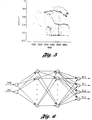
- the network shown in Figure 6, is presented with the input/output vectors for cycles chosen in random order from the data set.
- the internal weights of the network are adjusted gradually during training so as to minimise the error between network output and target vectors, using any of several common training algorithms. See for example, Puskorius, G. V. and L. A. Feldkamp (1994) Neurocontrol of Non-linear Dynamical Systems with Kalman Filter-Trained Recurrent Networks. IEEE Transactions on Neural Networks Vol. 5, pp. 279-297.
- the neural network is trained to output the mean value of deviant acceleration of each of the cylinders individually for each speed and load.
- the network tends toward this result during training because each deviant acceleration value is used as the target toward which the learning process drives the network output for that particular cylinder at a given speed/load point.
- the noise or "spread" in a cylinder's acceleration values for points representing the same operating condition causes slight contradictions in the network as it trains. Nevertheless, the network responds as best it can by tending to output the average (approximately) of these slightly contradictory targets, as intended.
- Figures 7a-7d show plots of four torsional correction tables TC0-TC3, one per cylinder, as functions of speed and load using the aforementioned grid spacing. They each show clearly that at low speeds and loads, the torsional correction is virtually zero, as expected. In fact, based on a realisation that torsional correction is primarily an issue with high-speed data, the table could easily be thrifted by eliminating low-speed areas, or at least making the grid coarser in areas of little change in correction factors. As mentioned earlier, this is trivially accomplished by querying the same neural network using input points based on a different grid.
- the network for the current example employed two input nodes (speed and load), 2 hidden layers consisting of 10 and 20 nodes, respectively, and four output nodes producing torsional correction values.
- a sigmoid transfer function was used in all but the output layer, which contains a linear transfer function instead.
- Figures 8 and 9 demonstrate the effectiveness of these torsional correction tables.
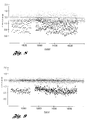
- Figure 8 shows the ACCEL signal of a test car with misfire induced (denoted by circles). The uncorrected torsional effects cause the misfire signal to be blurred with that of the normal events.
- Figure 9 shows the same data after applying the torsional correction from these table. The separation between misfiring and normal events is greatly enhanced, thus facilitating accurate misfire detection.
- Feedforward neural networks are a particularly versatile means of capturing complex functional relationships from empirical data. Even when the desired end result is a traditional lookup table, a network greatly facilitates its generation by removing the restriction that the engine be operated over a predetermined set of steady-state points. By first training a neural network, the calibration of tables is automated for any table size or grid spacing.
Landscapes
- Chemical & Material Sciences (AREA)
- Engineering & Computer Science (AREA)
- Combustion & Propulsion (AREA)
- Physics & Mathematics (AREA)
- General Physics & Mathematics (AREA)
- Combined Controls Of Internal Combustion Engines (AREA)
- Testing Of Engines (AREA)
Applications Claiming Priority (2)
| Application Number | Priority Date | Filing Date | Title |
|---|---|---|---|
| US08/923,670 US5774823A (en) | 1997-09-04 | 1997-09-04 | Method of generation correction tables for misfire detection using neural networks |
| US923670 | 1997-09-04 |
Publications (2)
| Publication Number | Publication Date |
|---|---|
| EP0901008A1 true EP0901008A1 (de) | 1999-03-10 |
| EP0901008B1 EP0901008B1 (de) | 2004-10-06 |
Family
ID=25449073
Family Applications (1)
| Application Number | Title | Priority Date | Filing Date |
|---|---|---|---|
| EP98307146A Expired - Lifetime EP0901008B1 (de) | 1997-09-04 | 1998-09-04 | Verfahren zur Generierung von Korrekturtabellen zur Detektion von Fehlzündungen mittels neuronaler Netzwerke |
Country Status (4)
| Country | Link |
|---|---|
| US (1) | US5774823A (de) |
| EP (1) | EP0901008B1 (de) |
| JP (1) | JPH11173208A (de) |
| DE (1) | DE69826797D1 (de) |
Cited By (1)
| Publication number | Priority date | Publication date | Assignee | Title |
|---|---|---|---|---|
| WO2019080483A1 (zh) * | 2017-10-23 | 2019-05-02 | 北京深鉴智能科技有限公司 | 利用非均匀量化和查找表加速神经网络计算的方法和系统 |
Families Citing this family (28)
| Publication number | Priority date | Publication date | Assignee | Title |
|---|---|---|---|---|
| JP3986603B2 (ja) * | 1996-02-02 | 2007-10-03 | ロベルト・ボッシュ・ゲゼルシャフト・ミト・ベシュレンクテル・ハフツング | 燃焼ミスファイヤの検出方法 |
| US5915359A (en) * | 1996-12-13 | 1999-06-29 | Ford Global Technologies, Inc. | Method and system for determining and controlling A/F ratio during cold start engine operation |
| DE19725233B4 (de) * | 1997-06-14 | 2005-03-24 | Volkswagen Ag | Verfahren zur Anpassung der Einspritzmenge einer Brennkraftmaschine zur Laufruheregelung |
| DE19845232A1 (de) * | 1998-10-01 | 2000-04-06 | Bosch Gmbh Robert | Verfahren und Vorrichtung zur Bewertung von Verbrennungsvorgängen an einer Brennkraftmaschine |
| US6223120B1 (en) | 1998-11-19 | 2001-04-24 | Jeremy Williams | Cylinder torque estimation using crankshaft angular response measurements |
| US6292738B1 (en) | 2000-01-19 | 2001-09-18 | Ford Global Tech., Inc. | Method for adaptive detection of engine misfire |
| FR2818740B1 (fr) * | 2000-12-21 | 2003-03-14 | Renault | Procede d'evaluation du couple gaz d'un moteur thermique |
| US7006912B2 (en) * | 2003-05-29 | 2006-02-28 | Cummins Inc. | Cylinder misfire diagnostic system |
| US7047125B1 (en) | 2005-02-25 | 2006-05-16 | Caterpillar Inc. | Internal combustion engine performance calibration systems |
| US7593796B2 (en) * | 2006-11-27 | 2009-09-22 | Toyota Motor Engineering & Manufacturing North America, Inc. | Torque estimator for internal combustion engine |
| US20080243364A1 (en) * | 2007-03-26 | 2008-10-02 | Etas, Inc. | Neural network-based engine misfire detection systems and methods |
| US20090158830A1 (en) * | 2007-12-20 | 2009-06-25 | Malaczynski Gerard W | Artificial neural network enhanced misfire detection system |
| US7900509B2 (en) * | 2008-08-06 | 2011-03-08 | Ford Global Technologies, Llc | Methods for variable displacement engine diagnostics |
| US7991585B2 (en) | 2008-10-01 | 2011-08-02 | Toyota Motor Engineering & Manufacturing North America, Inc. | Method and apparatus for three dimensional calibration of an on-board diagnostics system |
| CN101839805A (zh) * | 2010-03-19 | 2010-09-22 | 同济大学 | 发动机主动故障质检与智能故障诊断方法 |
| US8401764B2 (en) | 2012-01-18 | 2013-03-19 | Ford Global Technologies, Llc | Fuel identification based on crankshaft acceleration |
| US10570844B2 (en) | 2012-01-18 | 2020-02-25 | Ford Global Technologies, Llc | Air/fuel imbalance monitor |
| US11125175B2 (en) | 2017-11-14 | 2021-09-21 | Tula Technology, Inc. | Machine learning for misfire detection in a dynamic firing level modulation controlled engine of a vehicle |
| WO2019099228A1 (en) | 2017-11-14 | 2019-05-23 | Tula Technology, Inc. | Machine learning for misfire detection in a dynamic firing level modulation controlled engine of a vehicle |
| JP6702390B2 (ja) * | 2018-10-09 | 2020-06-03 | トヨタ自動車株式会社 | 車両用駆動装置の制御装置、車載電子制御ユニット、学習済みモデル、機械学習システム、車両用駆動装置の制御方法、電子制御ユニットの製造方法及び出力パラメータ算出装置 |
| JP6853287B2 (ja) * | 2019-02-21 | 2021-03-31 | トヨタ自動車株式会社 | インバランス検出装置、インバランス検出システム、データ解析装置、および内燃機関の制御装置 |
| JP6624324B1 (ja) | 2019-03-29 | 2019-12-25 | トヨタ自動車株式会社 | 内燃機関の失火検出装置、内燃機関の失火検出システム、データ解析装置、内燃機関の制御装置、内燃機関の失火検出方法、および受信実行装置 |
| JP6624325B1 (ja) * | 2019-03-29 | 2019-12-25 | トヨタ自動車株式会社 | 内燃機関の失火検出装置、内燃機関の失火検出システム、データ解析装置、内燃機関の制御装置、内燃機関の失火検出方法、および受信実行装置 |
| US11073098B2 (en) | 2019-06-07 | 2021-07-27 | Ford Global Technologies, Llc | Method and system for detecting cylinder misfire via corrected crankshaft acceleration |
| US11220965B2 (en) * | 2019-08-13 | 2022-01-11 | Ford Global Technologies, Llc | Method and system for balancing cylinder air-fuel ratio |
| JP7307928B2 (ja) * | 2020-02-24 | 2023-07-13 | トゥラ テクノロジー インコーポレイテッド | 排気圧力読取値を使用して内燃機関の異常を検出するための診断システム及び方法 |
| US11434839B2 (en) | 2020-12-30 | 2022-09-06 | Tula Technology, Inc. | Use of machine learning for detecting cylinder intake and/or exhaust valve faults during operation of an internal combustion engine |
| WO2022150404A1 (en) | 2021-01-11 | 2022-07-14 | Tula Technology Inc. | Exhaust valve failure diagnostics and management |
Citations (3)
| Publication number | Priority date | Publication date | Assignee | Title |
|---|---|---|---|---|
| US5361213A (en) * | 1990-02-09 | 1994-11-01 | Hitachi, Ltd. | Control device for an automobile |
| US5377537A (en) * | 1993-09-01 | 1995-01-03 | Ford Motor Company | System and method to compensate for torsional disturbances in measured crankshaft velocities for engine misfire detection |
| EP0736760A2 (de) * | 1995-04-05 | 1996-10-09 | Ford Motor Company Limited | Nichtlineare dynamische Transformation zur Korrektur einer torsionsschwingungsbehafteten Kurbelwellenbeschleunigung |
Family Cites Families (6)
| Publication number | Priority date | Publication date | Assignee | Title |
|---|---|---|---|---|
| US5109695A (en) * | 1990-08-24 | 1992-05-05 | Ford Motor Company | Misfire detection in an internal combustion engine |
| US5044194A (en) * | 1990-08-24 | 1991-09-03 | Ford Motor Company | Misfire detection in an internal combustion engine |
| US5117681A (en) * | 1990-10-01 | 1992-06-02 | Ford Motor Company | Correction of systematic position-sensing errors in internal combustion engines |
| US5193513A (en) * | 1992-06-03 | 1993-03-16 | Ford Motor Company | Misfire detection in an internal combustion engine using exhaust pressure |
| US5495415A (en) * | 1993-11-18 | 1996-02-27 | Regents Of The University Of Michigan | Method and system for detecting a misfire of a reciprocating internal combustion engine |
| DE19531845B4 (de) * | 1995-08-29 | 2005-10-20 | Bosch Gmbh Robert | Verbrennungsaussetzererkennungsverfahren |
-
1997
- 1997-09-04 US US08/923,670 patent/US5774823A/en not_active Expired - Fee Related
-
1998
- 1998-08-24 JP JP10254605A patent/JPH11173208A/ja active Pending
- 1998-09-04 DE DE69826797T patent/DE69826797D1/de not_active Expired - Lifetime
- 1998-09-04 EP EP98307146A patent/EP0901008B1/de not_active Expired - Lifetime
Patent Citations (3)
| Publication number | Priority date | Publication date | Assignee | Title |
|---|---|---|---|---|
| US5361213A (en) * | 1990-02-09 | 1994-11-01 | Hitachi, Ltd. | Control device for an automobile |
| US5377537A (en) * | 1993-09-01 | 1995-01-03 | Ford Motor Company | System and method to compensate for torsional disturbances in measured crankshaft velocities for engine misfire detection |
| EP0736760A2 (de) * | 1995-04-05 | 1996-10-09 | Ford Motor Company Limited | Nichtlineare dynamische Transformation zur Korrektur einer torsionsschwingungsbehafteten Kurbelwellenbeschleunigung |
Cited By (1)
| Publication number | Priority date | Publication date | Assignee | Title |
|---|---|---|---|---|
| WO2019080483A1 (zh) * | 2017-10-23 | 2019-05-02 | 北京深鉴智能科技有限公司 | 利用非均匀量化和查找表加速神经网络计算的方法和系统 |
Also Published As
| Publication number | Publication date |
|---|---|
| JPH11173208A (ja) | 1999-06-29 |
| US5774823A (en) | 1998-06-30 |
| DE69826797D1 (de) | 2004-11-11 |
| EP0901008B1 (de) | 2004-10-06 |
Similar Documents
| Publication | Publication Date | Title |
|---|---|---|
| EP0901008B1 (de) | Verfahren zur Generierung von Korrekturtabellen zur Detektion von Fehlzündungen mittels neuronaler Netzwerke | |
| US5699253A (en) | Nonlinear dynamic transform for correction of crankshaft acceleration having torsional oscillations | |
| US5732382A (en) | Method for identifying misfire events of an internal combustion engine | |
| US5495415A (en) | Method and system for detecting a misfire of a reciprocating internal combustion engine | |
| US6023651A (en) | Internal combustion engine misfire detection with engine acceleration and deceleration correction during a repetitive misfire condition | |
| US20180275017A1 (en) | Misfire detection device for internal combustion engine | |
| JP4312762B2 (ja) | 内燃機関におけるミスファイアの検出 | |
| US7219003B2 (en) | Regulating the mode of operation of an internal combustion engine | |
| US5576963A (en) | Method and system for detecting the misfire of a reciprocating internal combustion engine utilizing a misfire index model | |
| EP0646711B1 (de) | Vorrichtung und Verfahren zum Kompensieren von Torsionsstörungen bei Kurbelwellen | |
| US5559285A (en) | Fuzzy logic method for detecting misfiers in internal combustion engines | |
| US5794171A (en) | Process for deriving predictive model of crankshaft rotation of a combustion engine | |
| US5747681A (en) | Combustion state-detecting system for internal combustion engines | |
| WO1996003630A1 (en) | An acceleration based misfire detection system and method with improved signal fidelity | |
| US6978666B1 (en) | Automatic calibration method for engine misfire detection system | |
| US5528931A (en) | Engine diagnostic monitor with on-board adjustment of correction factors | |
| US5493901A (en) | Combustion state-detecting system for internal combustion engines | |
| US5390537A (en) | Combustion state-detecting system for internal combustion engines | |
| US7540185B2 (en) | System and method for detecting engine misfires | |
| US5689065A (en) | Combustion state-detecting system for internal combustion engines | |
| US6023964A (en) | Misfire diagnosis method and apparatus of internal combustion engine | |
| US20090158830A1 (en) | Artificial neural network enhanced misfire detection system | |
| US5050554A (en) | Ignition timing control apparatus for engines | |
| US6212945B1 (en) | Method and apparatus for combustion quality diagnosis and control utilizing synthetic measures of combustion quality | |
| US5373732A (en) | Combustion state-detecting system for internal combustion engines |
Legal Events
| Date | Code | Title | Description |
|---|---|---|---|
| PUAI | Public reference made under article 153(3) epc to a published international application that has entered the european phase |
Free format text: ORIGINAL CODE: 0009012 |
|
| AK | Designated contracting states |
Kind code of ref document: A1 Designated state(s): DE FR GB |
|
| AX | Request for extension of the european patent |
Free format text: AL;LT;LV;MK;RO;SI |
|
| 17P | Request for examination filed |
Effective date: 19990806 |
|
| AKX | Designation fees paid |
Free format text: DE FR GB |
|
| GRAP | Despatch of communication of intention to grant a patent |
Free format text: ORIGINAL CODE: EPIDOSNIGR1 |
|
| GRAS | Grant fee paid |
Free format text: ORIGINAL CODE: EPIDOSNIGR3 |
|
| GRAA | (expected) grant |
Free format text: ORIGINAL CODE: 0009210 |
|
| AK | Designated contracting states |
Kind code of ref document: B1 Designated state(s): DE FR GB |
|
| PG25 | Lapsed in a contracting state [announced via postgrant information from national office to epo] |
Ref country code: FR Free format text: LAPSE BECAUSE OF NON-PAYMENT OF DUE FEES Effective date: 20041006 |
|
| REG | Reference to a national code |
Ref country code: GB Ref legal event code: FG4D |
|
| REF | Corresponds to: |
Ref document number: 69826797 Country of ref document: DE Date of ref document: 20041111 Kind code of ref document: P |
|
| REG | Reference to a national code |
Ref country code: GB Ref legal event code: 732E |
|
| PG25 | Lapsed in a contracting state [announced via postgrant information from national office to epo] |
Ref country code: DE Free format text: LAPSE BECAUSE OF FAILURE TO SUBMIT A TRANSLATION OF THE DESCRIPTION OR TO PAY THE FEE WITHIN THE PRESCRIBED TIME-LIMIT Effective date: 20050108 |
|
| PGFP | Annual fee paid to national office [announced via postgrant information from national office to epo] |
Ref country code: GB Payment date: 20050809 Year of fee payment: 8 |
|
| PLBE | No opposition filed within time limit |
Free format text: ORIGINAL CODE: 0009261 |
|
| STAA | Information on the status of an ep patent application or granted ep patent |
Free format text: STATUS: NO OPPOSITION FILED WITHIN TIME LIMIT |
|
| 26N | No opposition filed |
Effective date: 20050707 |
|
| EN | Fr: translation not filed | ||
| GBPC | Gb: european patent ceased through non-payment of renewal fee |
Effective date: 20060904 |
|
| PG25 | Lapsed in a contracting state [announced via postgrant information from national office to epo] |
Ref country code: GB Free format text: LAPSE BECAUSE OF NON-PAYMENT OF DUE FEES Effective date: 20060904 |