EP0899720B1 - Quantisierung der linearen Prädiktionskoeffizienten - Google Patents
Quantisierung der linearen Prädiktionskoeffizienten Download PDFInfo
- Publication number
- EP0899720B1 EP0899720B1 EP98306906A EP98306906A EP0899720B1 EP 0899720 B1 EP0899720 B1 EP 0899720B1 EP 98306906 A EP98306906 A EP 98306906A EP 98306906 A EP98306906 A EP 98306906A EP 0899720 B1 EP0899720 B1 EP 0899720B1
- Authority
- EP
- European Patent Office
- Prior art keywords
- lsf
- quantizer
- lpc
- codebooks
- filter
- Prior art date
- Legal status (The legal status is an assumption and is not a legal conclusion. Google has not performed a legal analysis and makes no representation as to the accuracy of the status listed.)
- Expired - Lifetime
Links
Images
Classifications
-
- G—PHYSICS
- G10—MUSICAL INSTRUMENTS; ACOUSTICS
- G10L—SPEECH ANALYSIS TECHNIQUES OR SPEECH SYNTHESIS; SPEECH RECOGNITION; SPEECH OR VOICE PROCESSING TECHNIQUES; SPEECH OR AUDIO CODING OR DECODING
- G10L19/00—Speech or audio signals analysis-synthesis techniques for redundancy reduction, e.g. in vocoders; Coding or decoding of speech or audio signals, using source filter models or psychoacoustic analysis
- G10L19/02—Speech or audio signals analysis-synthesis techniques for redundancy reduction, e.g. in vocoders; Coding or decoding of speech or audio signals, using source filter models or psychoacoustic analysis using spectral analysis, e.g. transform vocoders or subband vocoders
- G10L19/032—Quantisation or dequantisation of spectral components
- G10L19/038—Vector quantisation, e.g. TwinVQ audio
-
- G—PHYSICS
- G10—MUSICAL INSTRUMENTS; ACOUSTICS
- G10L—SPEECH ANALYSIS TECHNIQUES OR SPEECH SYNTHESIS; SPEECH RECOGNITION; SPEECH OR VOICE PROCESSING TECHNIQUES; SPEECH OR AUDIO CODING OR DECODING
- G10L19/00—Speech or audio signals analysis-synthesis techniques for redundancy reduction, e.g. in vocoders; Coding or decoding of speech or audio signals, using source filter models or psychoacoustic analysis
- G10L19/04—Speech or audio signals analysis-synthesis techniques for redundancy reduction, e.g. in vocoders; Coding or decoding of speech or audio signals, using source filter models or psychoacoustic analysis using predictive techniques
- G10L19/06—Determination or coding of the spectral characteristics, e.g. of the short-term prediction coefficients
- G10L19/07—Line spectrum pair [LSP] vocoders
-
- G—PHYSICS
- G10—MUSICAL INSTRUMENTS; ACOUSTICS
- G10L—SPEECH ANALYSIS TECHNIQUES OR SPEECH SYNTHESIS; SPEECH RECOGNITION; SPEECH OR VOICE PROCESSING TECHNIQUES; SPEECH OR AUDIO CODING OR DECODING
- G10L19/00—Speech or audio signals analysis-synthesis techniques for redundancy reduction, e.g. in vocoders; Coding or decoding of speech or audio signals, using source filter models or psychoacoustic analysis
- G10L2019/0001—Codebooks
- G10L2019/0013—Codebook search algorithms
- G10L2019/0014—Selection criteria for distances
Definitions
- This invention relates to switched-predictive vector quantization and more particularly to quantization of LPC coefficients transformed to line spectral frequencies.
- the MELP coder is based on the traditional LPC vocoder with either a periodic impulse train or white noise exciting a 10th order on all-pole LPC filter.
- the synthesizer has the added capabilities of mixed pulse and noise excitation periodic or aperiodic pulses, adaptive spectral enhancement and pulse dispersion filter as shown in Fig. 1.
- Efficient quantization of the LPC coefficients is an important problem in these coders, since maintaining accuracy of the LPC has a significant effect on processed speech quality, but the bit rate of the LPC quantizer must be low in order to keep the overall bit rate of the speech coder small.
- the MELP coder for the new Federal Standard uses a 25-bit multi-stage vector quantizer (MSVQ) for line spectral frequencies (LSF) . There is a 1 to 1 transformation between the LPC coefficients and LSF coefficients.
- Quantization is the process of converting input values into discrete values in accordance with some fidelity criterion.
- a typical example of quantization is the conversion of a continuous amplitude signal into discrete amplitude values. The signal is first sampled, then quantized.
- a range of expected values of the input signal is divided into a series of subranges. Each subrange has an associated quantization level. A sample value of the input signal that is within a certain subrange is converted to the associated quantizing level. For example, for 8-bit quantization, a sample of the input signal would be converted to one of 256 levels, each level represented by an 8-bit value.
- Vector quantization is a method of quantization, which is based on the linear and non-linear correlation between samples and the shape of the probability distribution. Essentially, vector quantization is a lookup process, where the lookup table is referred to as a "codebook”. The codebook lists each quantization level, and each level has an associated "code-vector". The vector quantization process compares an input vector to the code-vectors and determines the best code-vector in terms of minimum distortion. Where x is the input vector, the comparison of distortion values may be expressed as: d(x, y (J) ) ⁇ d(x, y (k) ), for all j not equal to k.
- the codebook is represented by y (j) , where y (j) is the jth code-vector, 0 ⁇ j ⁇ L, and L is the number of levels in the codebook.
- Multi-stage vector quantization is a type of vector quantization. This process obtains a central quantized vector (the output vector) by adding a number of quantized vectors. The output vector is sometimes referred to as a "reconstructed" vector. Each vector used in the reconstruction is from a different codebook, each codebook corresponding to a "stage" of the quantization process. Each codebook is designed especially for a stage of the search. An input vector is quantized with the first codebook, and the resulting error vector is quantized with the second codebook, etc.
- S the number of stages
- y s the codebook for the sth stage.
- the codebooks may be searched using a sub-optimal tree search algorithm, also known as an M-algorithm.
- M-algorithm a sub-optimal tree search algorithm
- M-best number of "best” code-vectors are passed from one stage to the next.
- the "best" code-vectors are selected in terms of minimum distortion. The search continues until the final stage, when only one best code-vector is determined.
- a target vector for quantization in the current frame is the mean-removed input vector minus a predictive value.
- the predicted value is the previous quantized vector multiplied by a known prediction matrix.
- switched prediction there is more than one possible prediction matrix and the best prediction matrix is selected for each frame. See S. Wang, et al., "Product Code Vector Quantization of LPC Parameters," in Speech and Audio Coding for Wireless and Network Applications," Ch. 31, pp. 251-258, Kluwer Academic Publishers, 1993.
- the present invention as claimed in the appended claims provides an improved method of vector quantization of LSF transformation of LPC coefficients by a new weighted distance measure that better correlates with subjective speech quality.
- This weighting includes running samples from the LPC filter from an impulse and applying these samples to a perceptual weighting filter.
- the new quantization method like the one used in the 2.4 kb/s Federal Standard MELP coder, uses multi-stage vector quantization (MSVQ) of the Line Spectral Frequency (LSF) transformation of the LPC coefficients (LeBlanc, et al., entitled “Efficient Search and Design Procedures for Robust Multi-Stage VQ or LPC Parameters for 4kb/s Speech Coding," IEEE Transactions on Speech and Audio Processing, Vol. 1, No. 4, October 1993, pp. 373-385.)
- MSVQ multi-stage vector quantization
- LSF Line Spectral Frequency
- An efficient codebook search for multi-stage VQ is disclosed in US Patent Application Serial No. 09/003,172 cited above.
- the method, described herein improves on the previous one in two ways: the use of switched prediction to take advantage of time redundancy and the use of a new weighted distance measure that better correlates with subjective speech quality.
- the input LSF vector is quantized directly using MSVQ.
- MSVQ the target vector for quantization in the current frame
- the mean-removed input vector minus a predicted value, where the predicted value is the previous quantized vector multiplied by a known prediction matrix.
- switched prediction there is more than one possible prediction matrix, and the best predictor or prediction matrix is selected for each frame.
- both the predictor matrix and the MSVQ codebooks are switched.
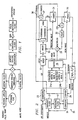
- the 10 LPC coefficients are transformed by transformer 23 to 10 LSF coefficients of the Line Spectral Frequency (LSF) vectors.
- the LSF has 10 dimensional elements or coefficients (for 10 order all-pole filter).
- the LSF input vector is subtracted in adder 22 by a selected mean vector and the mean-removed input vector is subtracted in adder 25 by a predicted value.
- the resulting target vector for quantization vector e in the current frame is applied to multi-stage vector quantizer (MSVQ) 27.
- the predicted value is the previous quantized vector multiplied by a known prediction matrix at multiplier 26.
- the predicted value in switched prediction has more than one possible prediction matrix.
- the best predictor (prediction matrix and mean vector) is selected for each frame.
- both the predictor (the prediction matrix and mean vector) and the MSVQ codebook set are switched.
- a control 29 first switches in via switch 28 prediction matrix 1 and mean vector 1 and first set of codebooks 1 in quantizer 27.
- the index corresponding to this first prediction matrix and the MSVQ codebook indices for the first set of codebooks are then provided out of the quantizer to gate 37.
- the predicted value is added to the quantized output ê for the target vector e at adder 31 to produce a quantized mean-removed vector.
- the mean-removed vector is added at Adder 70 to the selected mean vector to get quantized vector X and .
- the squared error for each dimension is determined at squarer 35.
- the weighted squared error between the input vector X i and the delayed quantized vector X and i is stored at control 29.
- the control 29 applies control signals to switch in via switch 28 prediction matrix 2 and mean vector 2 and codebook 2 set to likewise measure the weighted squared error for this set at squarer 35.
- the measured error from the first pair of prediction matrix 1 (with mean vector 1) and codebooks set 1 is compared with prediction matrix 2 (with mean vector 2) and codebook set 2.
- the set of indices for the codebooks with the minimum error is gated at gate 37 out of the encoder as encoded transmission of indices and a bit is sent out at terminal 38 from control 29 indicating from which pair of prediction matrix and codebooks set the indices was sent (codebook set 1 with mean vector 1 and predictor matrix 1 or codebook set 2 and prediction matrix 2 with mean vector 2).
- the mean-removed quantized vector from adder 31 associated with the minimum error is gated at gate 33a to frame delay 33 so as to provide the previous mean-removed quantized vector to multiplier 26.
- Fig. 3 illustrates a decoder 40 for use with LSF encoder 20.
- the indices for the codebooks from the encoding are received at the quantizer 44 with two sets of codebooks corresponding to codebook set 1 and 2 in the encoder.
- the bit from terminal 38 selects the appropriate codebook set used in the encoder.
- the LSF quantized input is added to the predicted value at adder 41 where the predicted value is the previous mean-removed quantized value (from delay 43) multiplied at multiplier 45 by the prediction matrix at 42 that matches the best one selected at the encoder to get mean-removed quantized vector.
- Both prediction matrix 1 and mean value 1 and prediction matrix 2 and mean value 2 are stored at storage 42 of the decoder.
- the 1 bit from terminal 38 of the encoder selects the prediction matrix and the mean value at storage 42 that matches the encoder prediction matrix and mean value.
- the quantized mean-removed vector is added to the selected mean value at adder 48 to get the quantized LSF vector.
- the quantized LSF vector is transformed to LPC coefficients by transformer 46.
- LSF vector coefficients correspond to the LPC coefficients.
- the LSF vector coefficients have better quantization properties than LPC coefficients. There is a 1 to 1 transformation between these two vector coefficients.
- a weighting function is applied for a particular set of LSFs for a particular set of LPC coefficients that correspond.
- the Federal Standard MELP coder uses a weighted Euclidean distance for LSF quantization due to its computational simplicity. However, this distance in the LSF domain does not necessarily correspond well with the ideal measure of quantization accuracy: perceived quality of the processed speech signal.
- the applicant has previously shown in the paper on the new 2.4 kb/s Federal Standard that a perceptually-weighted form of log spectral distortion has close correlation with subjective speech quality.
- the applicant teaches herein in accordance with an embodiment a weighted LSF distance which corresponds closely to this spectral distortion. This weighting function requires looking into the details of this transformation for a particular set of LSFs for a particular input vector x which is a set of LSFs for a particular set of LPC coefficients that correspond to that set.
- the coder computes the LPC coefficients and as discussed above, for purposes of quantization, this is converted to LSF vectors which are better behaved. As shown in Fig. 1, the actual synthesizer will take the quantized vector X and and perform an inverse transformation to get an LPC filter for use in the actual speech synthesis.
- the optimal LSF weights for un-weighted spectral distortion are computed using the formula presented in paper of Gardner, et al., entitled, "Theoretical Analysis of the High-Rate Vector Quantization of the LPC Parameters," IEEE Transactions on Speech and Audio Processing, Vol. 3, No. 5, September 1995, pp. 367-381.
- R A (m) is the autocorrelation of the impulse response of the LPC synthesis filter at lag m
- R i (m) is the correlation of the elements in the ith column of the Jacobian matrix of the transformation from LSF's to LPC coefficients. Therefore for a particular input vector x we compute the weight W i .
- perceptual weighting is applied to the synthesis filter impulse response prior to computation of the autocorrelation function R A (m), so as to reflect a perceptually-weighted form of spectral distortion.
- the weighting W i is applied to the squared error at 35.
- the weighted output from error detector 35 is: ⁇ W i ( X i - X i ) 2 .
- Each entry in a 10 dimensional vector has a weight value.
- the error sums the weight value for each element.
- one of the elements has a weight value of three and the others are one then the element with three is given an emphasis by a factor of three times that of the other elements in determining error.
- the weighting function requires looking into the details of the LPC to LSF conversion.
- the weight values are determined by applying an impulse to the LPC synthesis filter 21 and providing the resultant sampled output of the LPC synthesis filter 21 to a perceptual weighting filter 47.
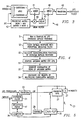
- a computer 39 is programmed with a code based on a pseudo code that follows and is illustrated in the flow chart of Fig. 4.
- An impulse is gated to the LPC filter 21 and N samples of LPC synthesis filter response (step 51) are taken and applied to a perceptual weighting filter 47 (step 52).
- low frequencies are weighted more than high frequencies and use the well known Bark scale which matches how the human ear responds to sounds.
- the coefficients of a filter with this response are determined in advance and stored and time domain coefficients are stored. An 8 order all-pole fit to this spectrum is determined and these 8 coefficients are used as the perceptual weighting filter.
- the following steps follow the equation for un-weighted spectral distortion from Gardner, et al.
- R A (m) is the autocorrelation of the impulse response of the LPC synthesis filter at lag m
- h(n) is an impulse response
- R 1 (m) is is the correlation function of the elements in the ith column of the Jacobian matrix J ⁇ ( ⁇ ) of the transformation from LSFs to LPC coefficients.
- the autocorrelation function of the weighted impulse response is calculated (step 53 in Fig. 4). From that the Jacobian matrix for LSFs is computed (step 54). The correlation of rows of Jacobian matrix is then computed (step 55). The LSF weights are then calculated by multiplying correlation matrices (step 56). The computed weight value from computer 39, in Fig. 2, is applied to the error detector 35. The indices from the prediction matrix/codebook set with the least error is then gated from the quantizer 27.
- the system may be implemented using a microprocessor encapsulating computer 39 and control 29 utilizing the following pseudo code.
- the pseudo code for computing the weighting vector from the current LPC and LSF follows:
- the system and method be used without switched prediction for each frame as illustrated in Fig. 5 wherein the weighted error for each frame would be determined at error detector and codebook indices with the least error would be gated out by control 29 and gate 37.
- the LPC filtered samples of the impulse at filter 21 should be filtered by perception weighting filter 47 and processed by computer 39 using code such as described in the pseudo code to provide the weight vales.
- the perception weighting filter may use other perceptual weighting besides the bark scale that is perceptually motivated such as weighting low frequencies more than high frequencies, or the perceptual weighting filter as is presently used in CELP coders.
Landscapes
- Engineering & Computer Science (AREA)
- Physics & Mathematics (AREA)
- Spectroscopy & Molecular Physics (AREA)
- Computational Linguistics (AREA)
- Signal Processing (AREA)
- Health & Medical Sciences (AREA)
- Audiology, Speech & Language Pathology (AREA)
- Human Computer Interaction (AREA)
- Acoustics & Sound (AREA)
- Multimedia (AREA)
- Compression, Expansion, Code Conversion, And Decoders (AREA)
Claims (15)
- Verfahren zur Vektorquantisierung von LPC-Koeffizienten, das die folgenden Schritte umfasst:Anwenden der Zielvektoren auf die Codebücher, um quantisierte Vektoren zu erhalten;Übersetzen von LPC-Koeffizienten in LSF-Koeffizienten;Vorsehen mehrerer Prädiktormatrizen und eines Quantisierers mit mehreren Codebüchern zum Quantisieren von LSF-Zielvektoren unter Verwendung einer geschalteten prädiktiven Quantisierung;Durchsuchen einer Prädiktor-/Codebuchmengen-Kombination, um LSF-Zielvektoren zu bestimmen, die einen quantisierten Ausgang zur Folge haben, mit dem die LPC-Koeffizienten am besten übereinstimmen, indem sowohl die Prädiktormatrizen als auch die Codebücher umgeschaltet werden, um einen quadratischen Fehler minimal zu machen;
wobei der Durchsuchungsschritt einen Schritt des Bestimmens des mit einem Gewichtungswert für jede Dimension multiplizierten quadratischen Fehlers zwischen den LSF-Koeffizienten und dem quantisierten Ausgang umfasst, wobei der Gewichtungswert eine Funktion der perzeptuellen Gewichtung ist;
und der Bestimmungs- und Berechnungsschritt die folgenden Schritte umfasst:Berechnen einer Autokorrelationsfunktion einer gewichteten Impulsantwort; undBerechnen von LSF-Gewichten (56) aus der perzeptuell gewichteten Eingangsantwort. - Verfahren nach Anspruch 1, das umfasst: Berechnen einer Jacobi-Matrix (54) für die LSF-Vektoren; und Berechnen der Korrelation (55) von Zeilen der Jacobi-Matrix;
wobei die LSF-Gewichte durch Multiplizieren von Korrelationsmatrizen berechnet werden. - Verfahren nach Anspruch 1 oder Anspruch 2, bei dem der Bestimmungsschritt zum Auffinden des Gewichtungswertes die folgenden weiteren Schritte umfasst:Eingeben eines Impulses in das LPC-Filter und Durchlaufenlassen von N Abtastwerten (51) der LPC-Syntheseantwort; undFiltern (52) der Abtastwerte mit einem perzeptuellen Filter;Berechnen der Autokorrelationsfunktion (53) der gewichteten Impulsantwort;Berechnen der Jacobi-Matrix (54) für die LSF-Vektoren;Berechnen der Korrelation (55) von Zeilen der Jacobi-Matrix; undBerechnen von LSF-Gewichten (56) durch Multiplizieren von Korrelationsmatrizen.
- Verfahren nach Anspruch 3, bei dem der Schritt (52) des Filterns der Abtastwerte mit dem perzeptuellen Filter das Gewichten niedriger Frequenzen in stärkerem Maß als hohe Frequenzen umfasst.
- Verfahren nach Anspruch 4, bei dem der Schritt (52) des Filtems der Abtastwerte mit dem perzeptuellen Filter das Verfolgen der Barkskala umfasst.
- Verfahren nach einem vorhergehenden Anspruch, bei dem der Schritt des Vorsehens des Quantisierers das Vorsehen eines mehrstufigen Vektorquantisierers umfasst.
- Verfahren nach einem vorhergehenden Anspruch, bei dem der Schritt des Vorsehens des Quantisierers das Vorsehen eines Quantisierers, der eine oder mehrere Mengen von Codebüchern besitzt, umfasst.
- Quantisierer (20) für einen Codierer, der ein LPC-Filter (21) und einen Übersetzer (23) zum Übersetzen von LPC-Koeffizienten in LSF-Koeffizienten enthält, mit:wobei die Durchsuchungsmittel Mittel enthalten, um in das LPC-Filter (21) einen Impuls einzugeben;Mitteln zum Vorsehen mehrerer Prädiktormatrizen und mehrerer Codebücher (27) zum Quantisieren von LSF-Zielvektoren unter Verwendung einer geschalteten prädiktiven Quantisierung;Mitteln (39) zum Durchsuchen einer Prädiktor-/Codebuchmengenkombination, um LSF-Zielvektoren zu bestimmen, die einen quantisierten Ausgang zur Folge haben, mit dem die LPC-Koeffizienten am besten übereinstimmen, indem sowohl die Prädiktormatrizen als auch die Codebücher umgeschaltet werden, um einen quadratischen Fehler minimal zu machen;Mitteln (29) zum Eingeben der LSF-Zielvektoren in die Codebücher, um einen quantisierten Ausgang zu schaffen;
Mitteln zum Durchlaufenlassen von Abtastwerten der LPC-Antwort;
einem perzeptuellen Filter (47) zum Filtern der Abtastwerte; und
Mitteln (35) zum Berechnen einer Autokorrelationsfunktion durch die gewichtete Antwort, um LSF-Gewichte zu schaffen, die aus der perzeptuell gewichteten Eingangsantwort in das LPC-Filter (21) berechnet werden. - Quantisierer (20) nach Anspruch 8, bei dem die Mittel (35) zum Berechnen einer Autokorrelationsfunktion so betreibbar sind, dass sie eine Jacobi-Matrix für die LSF-Vektoren, eine Korrelation von Zeilen der Jacobi-Matrix und die LSF-Gewichte durch Multiplizieren von Korrelationsmatrizen berechnen.
- Quantisierer (20) nach Anspruch 8 oder Anspruch 9, der ferner so betreibbar ist, dass er:N Abtastwerte der LPC-Syntheseantwort durchlaufen lässt, wenn die gewichtete Impulsantwort eingegeben wird; unddie Abtastwerte unter Verwendung eines perzeptuellen Filters (47) filtert.
- Quantisierer (20) nach Anspruch 10, bei dem das perzeptuelle Filter (47) dazu verwendet wird, niedrige Frequenzen stärker als hohe Frequenzen zu gewichten.
- Quantisierer (20) nach Anspruch 11, bei dem das perzeptuelle Filter (47) der Barkskala folgt.
- Quantisierer (20) nach einem der Ansprüche 8 bis 12, der ferner so betreibbar ist, dass er eine mehrstufige Vektorquantisierung bereitstellt.
- Quantisierer (20) nach einem der Ansprüche 8 bis 13, der eine oder mehrere Mengen von Codebüchern (27) umfasst.
- Codierer, der den Quantisierer (20) nach einem der Ansprüche 8 bis 14 enthält.
Applications Claiming Priority (2)
| Application Number | Priority Date | Filing Date | Title |
|---|---|---|---|
| US5711497P | 1997-08-28 | 1997-08-28 | |
| US57114P | 1997-08-28 |
Publications (3)
| Publication Number | Publication Date |
|---|---|
| EP0899720A2 EP0899720A2 (de) | 1999-03-03 |
| EP0899720A3 EP0899720A3 (de) | 1999-09-15 |
| EP0899720B1 true EP0899720B1 (de) | 2004-12-15 |
Family
ID=22008595
Family Applications (1)
| Application Number | Title | Priority Date | Filing Date |
|---|---|---|---|
| EP98306906A Expired - Lifetime EP0899720B1 (de) | 1997-08-28 | 1998-08-27 | Quantisierung der linearen Prädiktionskoeffizienten |
Country Status (3)
| Country | Link |
|---|---|
| EP (1) | EP0899720B1 (de) |
| JP (1) | JPH11143498A (de) |
| DE (1) | DE69828119D1 (de) |
Families Citing this family (9)
| Publication number | Priority date | Publication date | Assignee | Title |
|---|---|---|---|---|
| TW408298B (en) * | 1997-08-28 | 2000-10-11 | Texas Instruments Inc | Improved method for switched-predictive quantization |
| KR100464310B1 (ko) * | 1999-03-13 | 2004-12-31 | 삼성전자주식회사 | 선 스펙트럼 쌍을 이용한 패턴 정합 방법 |
| KR100474969B1 (ko) * | 2002-06-04 | 2005-03-10 | 에스엘투 주식회사 | 음성신호 부호화를 위한 선 스펙트럼 계수의 벡터 양자화방법과 이를 위한 마스킹 임계치 산출 방법 |
| US7516066B2 (en) | 2002-07-16 | 2009-04-07 | Koninklijke Philips Electronics N.V. | Audio coding |
| KR100647290B1 (ko) | 2004-09-22 | 2006-11-23 | 삼성전자주식회사 | 합성된 음성의 특성을 이용하여 양자화/역양자화를선택하는 음성 부호화/복호화 장치 및 그 방법 |
| US8160874B2 (en) | 2005-12-27 | 2012-04-17 | Panasonic Corporation | Speech frame loss compensation using non-cyclic-pulse-suppressed version of previous frame excitation as synthesis filter source |
| CN101320565B (zh) * | 2007-06-08 | 2011-05-11 | 华为技术有限公司 | 感知加权滤波方法及感知加权滤波器 |
| KR101747917B1 (ko) | 2010-10-18 | 2017-06-15 | 삼성전자주식회사 | 선형 예측 계수를 양자화하기 위한 저복잡도를 가지는 가중치 함수 결정 장치 및 방법 |
| CN111105807B (zh) * | 2014-01-15 | 2023-09-15 | 三星电子株式会社 | 对线性预测编码系数进行量化的加权函数确定装置和方法 |
Family Cites Families (1)
| Publication number | Priority date | Publication date | Assignee | Title |
|---|---|---|---|---|
| TW408298B (en) * | 1997-08-28 | 2000-10-11 | Texas Instruments Inc | Improved method for switched-predictive quantization |
-
1998
- 1998-08-27 EP EP98306906A patent/EP0899720B1/de not_active Expired - Lifetime
- 1998-08-27 DE DE69828119T patent/DE69828119D1/de not_active Expired - Lifetime
- 1998-08-27 JP JP10242058A patent/JPH11143498A/ja active Pending
Also Published As
| Publication number | Publication date |
|---|---|
| JPH11143498A (ja) | 1999-05-28 |
| DE69828119D1 (de) | 2005-01-20 |
| EP0899720A3 (de) | 1999-09-15 |
| EP0899720A2 (de) | 1999-03-03 |
Similar Documents
| Publication | Publication Date | Title |
|---|---|---|
| EP0905680B1 (de) | Verfahren zur Quantisierung der LPC Parameter mittels geschalteter prädiktiver Quantisierung | |
| EP0443548B1 (de) | Sprachcodierer | |
| US5675702A (en) | Multi-segment vector quantizer for a speech coder suitable for use in a radiotelephone | |
| CA2061832C (en) | Speech parameter coding method and apparatus | |
| US5684920A (en) | Acoustic signal transform coding method and decoding method having a high efficiency envelope flattening method therein | |
| EP1576585B1 (de) | Verfahren und vorrichtung zur robusten prädiktiven vektorquantisierung von parametern der linearen prädiktion in variabler bitraten-kodierung | |
| KR100872538B1 (ko) | Lpc 파라미터의 벡터 양자화 장치, lpc 파라미터복호화 장치, lpc 계수의 복호화 장치, 기록 매체,음성 부호화 장치, 음성 복호화 장치, 음성 신호 송신장치, 및 음성 신호 수신 장치 | |
| US5950155A (en) | Apparatus and method for speech encoding based on short-term prediction valves | |
| CA2202825C (en) | Speech coder | |
| US6889185B1 (en) | Quantization of linear prediction coefficients using perceptual weighting | |
| CA2061830C (en) | Speech coding system | |
| KR19980024885A (ko) | 벡터양자화 방법, 음성부호화 방법 및 장치 | |
| EP0657874B1 (de) | Stimmkodierer und Verfahren zum Suchen von Kodebüchern | |
| KR100408911B1 (ko) | 선스펙트럼제곱근을발생및인코딩하는방법및장치 | |
| US5839102A (en) | Speech coding parameter sequence reconstruction by sequence classification and interpolation | |
| EP0899720A2 (de) | Quantisierung der linearen Prädiktion Koeffizienten | |
| US5822722A (en) | Wide-band signal encoder | |
| EP0866443B1 (de) | Sprachsignalkodierer | |
| Li et al. | Coding of variable dimension speech spectral vectors using weighted nonsquare transform vector quantization | |
| JP2808841B2 (ja) | 音声符号化方式 | |
| EP0910064B1 (de) | Sprachparameterkodierungsvorrichtung | |
| JPH1097299A (ja) | ベクトル量子化方法、音声符号化方法及び装置、並びに音声復号化方法 |
Legal Events
| Date | Code | Title | Description |
|---|---|---|---|
| PUAI | Public reference made under article 153(3) epc to a published international application that has entered the european phase |
Free format text: ORIGINAL CODE: 0009012 |
|
| AK | Designated contracting states |
Kind code of ref document: A2 Designated state(s): DE FR GB IT NL |
|
| AX | Request for extension of the european patent |
Free format text: AL;LT;LV;MK;RO;SI |
|
| PUAL | Search report despatched |
Free format text: ORIGINAL CODE: 0009013 |
|
| RIC1 | Information provided on ipc code assigned before grant |
Free format text: 6G 10L 9/14 A, 6G 10L 3/02 B |
|
| AK | Designated contracting states |
Kind code of ref document: A3 Designated state(s): AT BE CH CY DE DK ES FI FR GB GR IE IT LI LU MC NL PT SE |
|
| AX | Request for extension of the european patent |
Free format text: AL;LT;LV;MK;RO;SI |
|
| 17P | Request for examination filed |
Effective date: 20000218 |
|
| AKX | Designation fees paid |
Free format text: DE FR GB IT NL |
|
| 17Q | First examination report despatched |
Effective date: 20030430 |
|
| GRAP | Despatch of communication of intention to grant a patent |
Free format text: ORIGINAL CODE: EPIDOSNIGR1 |
|
| RIC1 | Information provided on ipc code assigned before grant |
Ipc: 7G 10L 19/06 A |
|
| GRAS | Grant fee paid |
Free format text: ORIGINAL CODE: EPIDOSNIGR3 |
|
| GRAA | (expected) grant |
Free format text: ORIGINAL CODE: 0009210 |
|
| AK | Designated contracting states |
Kind code of ref document: B1 Designated state(s): DE FR GB IT NL |
|
| PG25 | Lapsed in a contracting state [announced via postgrant information from national office to epo] |
Ref country code: NL Free format text: LAPSE BECAUSE OF FAILURE TO SUBMIT A TRANSLATION OF THE DESCRIPTION OR TO PAY THE FEE WITHIN THE PRESCRIBED TIME-LIMIT Effective date: 20041215 Ref country code: IT Free format text: LAPSE BECAUSE OF FAILURE TO SUBMIT A TRANSLATION OF THE DESCRIPTION OR TO PAY THE FEE WITHIN THE PRESCRIBED TIME-LIMIT;WARNING: LAPSES OF ITALIAN PATENTS WITH EFFECTIVE DATE BEFORE 2007 MAY HAVE OCCURRED AT ANY TIME BEFORE 2007. THE CORRECT EFFECTIVE DATE MAY BE DIFFERENT FROM THE ONE RECORDED. Effective date: 20041215 Ref country code: FR Free format text: LAPSE BECAUSE OF FAILURE TO SUBMIT A TRANSLATION OF THE DESCRIPTION OR TO PAY THE FEE WITHIN THE PRESCRIBED TIME-LIMIT Effective date: 20041215 |
|
| REG | Reference to a national code |
Ref country code: GB Ref legal event code: FG4D |
|
| REF | Corresponds to: |
Ref document number: 69828119 Country of ref document: DE Date of ref document: 20050120 Kind code of ref document: P Owner name: OY AIRAM AB |
|
| PG25 | Lapsed in a contracting state [announced via postgrant information from national office to epo] |
Ref country code: DE Free format text: LAPSE BECAUSE OF FAILURE TO SUBMIT A TRANSLATION OF THE DESCRIPTION OR TO PAY THE FEE WITHIN THE PRESCRIBED TIME-LIMIT Effective date: 20050316 |
|
| NLV1 | Nl: lapsed or annulled due to failure to fulfill the requirements of art. 29p and 29m of the patents act | ||
| PLBE | No opposition filed within time limit |
Free format text: ORIGINAL CODE: 0009261 |
|
| STAA | Information on the status of an ep patent application or granted ep patent |
Free format text: STATUS: NO OPPOSITION FILED WITHIN TIME LIMIT |
|
| 26N | No opposition filed |
Effective date: 20050916 |
|
| EN | Fr: translation not filed | ||
| PGFP | Annual fee paid to national office [announced via postgrant information from national office to epo] |
Ref country code: GB Payment date: 20130726 Year of fee payment: 16 |
|
| GBPC | Gb: european patent ceased through non-payment of renewal fee |
Effective date: 20140827 |
|
| PG25 | Lapsed in a contracting state [announced via postgrant information from national office to epo] |
Ref country code: GB Free format text: LAPSE BECAUSE OF NON-PAYMENT OF DUE FEES Effective date: 20140827 |