EP0897919B1 - Novel pyridonecarboxylic acid derivatives or salts thereof and antibacterial agents containing the same as the active ingredient - Google Patents
Novel pyridonecarboxylic acid derivatives or salts thereof and antibacterial agents containing the same as the active ingredient Download PDFInfo
- Publication number
- EP0897919B1 EP0897919B1 EP97917416A EP97917416A EP0897919B1 EP 0897919 B1 EP0897919 B1 EP 0897919B1 EP 97917416 A EP97917416 A EP 97917416A EP 97917416 A EP97917416 A EP 97917416A EP 0897919 B1 EP0897919 B1 EP 0897919B1
- Authority
- EP
- European Patent Office
- Prior art keywords
- compound
- group
- amino
- methyl
- acid
- Prior art date
- Legal status (The legal status is an assumption and is not a legal conclusion. Google has not performed a legal analysis and makes no representation as to the accuracy of the status listed.)
- Expired - Lifetime
Links
- 150000003839 salts Chemical class 0.000 title claims abstract description 33
- YSLIPUSJNFIFAB-UHFFFAOYSA-N 2-oxopyridine-1-carboxylic acid Chemical class OC(=O)N1C=CC=CC1=O YSLIPUSJNFIFAB-UHFFFAOYSA-N 0.000 title claims abstract description 17
- 239000003242 anti bacterial agent Substances 0.000 title claims abstract description 10
- 239000004480 active ingredient Substances 0.000 title 1
- 125000003277 amino group Chemical group 0.000 claims abstract description 25
- 125000000217 alkyl group Chemical group 0.000 claims abstract description 22
- 230000000844 anti-bacterial effect Effects 0.000 claims abstract description 16
- 125000004435 hydrogen atom Chemical group [H]* 0.000 claims abstract description 16
- 125000002887 hydroxy group Chemical group [H]O* 0.000 claims abstract description 10
- 125000005843 halogen group Chemical group 0.000 claims abstract description 9
- 125000000449 nitro group Chemical group [O-][N+](*)=O 0.000 claims abstract description 4
- 150000001875 compounds Chemical class 0.000 claims description 177
- 238000002360 preparation method Methods 0.000 claims description 32
- -1 amino, methylamino Chemical group 0.000 claims description 23
- 125000002496 methyl group Chemical group [H]C([H])([H])* 0.000 claims description 11
- 229910052731 fluorine Inorganic materials 0.000 claims description 6
- 125000003282 alkyl amino group Chemical group 0.000 claims description 4
- 229910052801 chlorine Inorganic materials 0.000 claims description 4
- 238000011282 treatment Methods 0.000 claims description 4
- 239000000460 chlorine Chemical group 0.000 claims description 3
- 239000003814 drug Substances 0.000 claims description 3
- 125000001495 ethyl group Chemical group [H]C([H])([H])C([H])([H])* 0.000 claims description 3
- 239000011737 fluorine Substances 0.000 claims description 3
- 125000001153 fluoro group Chemical group F* 0.000 claims description 3
- 125000003187 heptyl group Chemical group [H]C([*])([H])C([H])([H])C([H])([H])C([H])([H])C([H])([H])C([H])([H])C([H])([H])[H] 0.000 claims description 3
- 125000004051 hexyl group Chemical group [H]C([H])([H])C([H])([H])C([H])([H])C([H])([H])C([H])([H])C([H])([H])* 0.000 claims description 3
- 229910052739 hydrogen Chemical group 0.000 claims description 3
- 125000000959 isobutyl group Chemical group [H]C([H])([H])C([H])(C([H])([H])[H])C([H])([H])* 0.000 claims description 3
- 125000001449 isopropyl group Chemical group [H]C([H])([H])C([H])(*)C([H])([H])[H] 0.000 claims description 3
- 125000004108 n-butyl group Chemical group [H]C([H])([H])C([H])([H])C([H])([H])C([H])([H])* 0.000 claims description 3
- 125000004123 n-propyl group Chemical group [H]C([H])([H])C([H])([H])C([H])([H])* 0.000 claims description 3
- 125000001147 pentyl group Chemical group C(CCCC)* 0.000 claims description 3
- 125000002924 primary amino group Chemical group [H]N([H])* 0.000 claims description 3
- 125000000999 tert-butyl group Chemical group [H]C([H])([H])C(*)(C([H])([H])[H])C([H])([H])[H] 0.000 claims description 3
- ZAMOUSCENKQFHK-UHFFFAOYSA-N Chlorine atom Chemical group [Cl] ZAMOUSCENKQFHK-UHFFFAOYSA-N 0.000 claims description 2
- 125000005236 alkanoylamino group Chemical group 0.000 claims description 2
- 239000001257 hydrogen Chemical group 0.000 claims 2
- UFHFLCQGNIYNRP-UHFFFAOYSA-N Hydrogen Chemical group [H][H] UFHFLCQGNIYNRP-UHFFFAOYSA-N 0.000 claims 1
- 230000002829 reductive effect Effects 0.000 abstract description 14
- 206010034972 Photosensitivity reaction Diseases 0.000 abstract description 6
- 208000007578 phototoxic dermatitis Diseases 0.000 abstract description 6
- 231100000018 phototoxicity Toxicity 0.000 abstract description 6
- 231100000135 cytotoxicity Toxicity 0.000 abstract description 5
- 230000003013 cytotoxicity Effects 0.000 abstract description 5
- 230000000694 effects Effects 0.000 abstract description 4
- 230000031891 intestinal absorption Effects 0.000 abstract description 4
- 230000002503 metabolic effect Effects 0.000 abstract description 4
- 230000001747 exhibiting effect Effects 0.000 abstract 1
- 239000000243 solution Substances 0.000 description 77
- 238000006243 chemical reaction Methods 0.000 description 71
- LFQSCWFLJHTTHZ-UHFFFAOYSA-N Ethanol Chemical compound CCO LFQSCWFLJHTTHZ-UHFFFAOYSA-N 0.000 description 67
- 238000000034 method Methods 0.000 description 53
- 239000002904 solvent Substances 0.000 description 48
- RTZKZFJDLAIYFH-UHFFFAOYSA-N Diethyl ether Chemical compound CCOCC RTZKZFJDLAIYFH-UHFFFAOYSA-N 0.000 description 46
- 239000000203 mixture Substances 0.000 description 43
- HEDRZPFGACZZDS-UHFFFAOYSA-N Chloroform Chemical compound ClC(Cl)Cl HEDRZPFGACZZDS-UHFFFAOYSA-N 0.000 description 36
- ZMXDDKWLCZADIW-UHFFFAOYSA-N N,N-Dimethylformamide Chemical compound CN(C)C=O ZMXDDKWLCZADIW-UHFFFAOYSA-N 0.000 description 34
- WYURNTSHIVDZCO-UHFFFAOYSA-N Tetrahydrofuran Chemical compound C1CCOC1 WYURNTSHIVDZCO-UHFFFAOYSA-N 0.000 description 34
- VLKZOEOYAKHREP-UHFFFAOYSA-N n-Hexane Chemical compound CCCCCC VLKZOEOYAKHREP-UHFFFAOYSA-N 0.000 description 32
- 239000000843 powder Substances 0.000 description 32
- XEKOWRVHYACXOJ-UHFFFAOYSA-N Ethyl acetate Chemical compound CCOC(C)=O XEKOWRVHYACXOJ-UHFFFAOYSA-N 0.000 description 30
- 238000005160 1H NMR spectroscopy Methods 0.000 description 28
- YXFVVABEGXRONW-UHFFFAOYSA-N Toluene Chemical compound CC1=CC=CC=C1 YXFVVABEGXRONW-UHFFFAOYSA-N 0.000 description 27
- 238000002844 melting Methods 0.000 description 27
- 230000008018 melting Effects 0.000 description 27
- VEXZGXHMUGYJMC-UHFFFAOYSA-N Hydrochloric acid Chemical compound Cl VEXZGXHMUGYJMC-UHFFFAOYSA-N 0.000 description 26
- XLYOFNOQVPJJNP-UHFFFAOYSA-N water Substances O XLYOFNOQVPJJNP-UHFFFAOYSA-N 0.000 description 24
- QTBSBXVTEAMEQO-UHFFFAOYSA-N Acetic acid Chemical compound CC(O)=O QTBSBXVTEAMEQO-UHFFFAOYSA-N 0.000 description 21
- YMWUJEATGCHHMB-UHFFFAOYSA-N Dichloromethane Chemical compound ClCCl YMWUJEATGCHHMB-UHFFFAOYSA-N 0.000 description 21
- HEDRZPFGACZZDS-MICDWDOJSA-N Trichloro(2H)methane Chemical compound [2H]C(Cl)(Cl)Cl HEDRZPFGACZZDS-MICDWDOJSA-N 0.000 description 20
- IAZDPXIOMUYVGZ-WFGJKAKNSA-N Dimethyl sulfoxide Chemical compound [2H]C([2H])([2H])S(=O)C([2H])([2H])[2H] IAZDPXIOMUYVGZ-WFGJKAKNSA-N 0.000 description 18
- ZMANZCXQSJIPKH-UHFFFAOYSA-N Triethylamine Chemical compound CCN(CC)CC ZMANZCXQSJIPKH-UHFFFAOYSA-N 0.000 description 18
- 239000007787 solid Substances 0.000 description 18
- CSNNHWWHGAXBCP-UHFFFAOYSA-L Magnesium sulfate Chemical compound [Mg+2].[O-][S+2]([O-])([O-])[O-] CSNNHWWHGAXBCP-UHFFFAOYSA-L 0.000 description 17
- YLQBMQCUIZJEEH-UHFFFAOYSA-N tetrahydrofuran Natural products C=1C=COC=1 YLQBMQCUIZJEEH-UHFFFAOYSA-N 0.000 description 17
- QAOWNCQODCNURD-UHFFFAOYSA-N Sulfuric acid Chemical compound OS(O)(=O)=O QAOWNCQODCNURD-UHFFFAOYSA-N 0.000 description 16
- 238000001914 filtration Methods 0.000 description 16
- OKKJLVBELUTLKV-UHFFFAOYSA-N Methanol Chemical compound OC OKKJLVBELUTLKV-UHFFFAOYSA-N 0.000 description 15
- HEMHJVSKTPXQMS-UHFFFAOYSA-M Sodium hydroxide Chemical compound [OH-].[Na+] HEMHJVSKTPXQMS-UHFFFAOYSA-M 0.000 description 15
- 229960004132 diethyl ether Drugs 0.000 description 14
- VZGDMQKNWNREIO-UHFFFAOYSA-N tetrachloromethane Chemical compound ClC(Cl)(Cl)Cl VZGDMQKNWNREIO-UHFFFAOYSA-N 0.000 description 14
- 239000002244 precipitate Substances 0.000 description 13
- UHOVQNZJYSORNB-UHFFFAOYSA-N Benzene Chemical compound C1=CC=CC=C1 UHOVQNZJYSORNB-UHFFFAOYSA-N 0.000 description 12
- JUJWROOIHBZHMG-UHFFFAOYSA-N Pyridine Chemical compound C1=CC=NC=C1 JUJWROOIHBZHMG-UHFFFAOYSA-N 0.000 description 12
- 239000002253 acid Substances 0.000 description 12
- BWHMMNNQKKPAPP-UHFFFAOYSA-L potassium carbonate Chemical compound [K+].[K+].[O-]C([O-])=O BWHMMNNQKKPAPP-UHFFFAOYSA-L 0.000 description 12
- 238000010992 reflux Methods 0.000 description 12
- 239000012044 organic layer Substances 0.000 description 11
- 230000008569 process Effects 0.000 description 11
- JOXIMZWYDAKGHI-UHFFFAOYSA-N toluene-4-sulfonic acid Chemical compound CC1=CC=C(S(O)(=O)=O)C=C1 JOXIMZWYDAKGHI-UHFFFAOYSA-N 0.000 description 11
- IAZDPXIOMUYVGZ-UHFFFAOYSA-N Dimethylsulphoxide Chemical compound CS(C)=O IAZDPXIOMUYVGZ-UHFFFAOYSA-N 0.000 description 10
- 150000007514 bases Chemical class 0.000 description 10
- 238000012360 testing method Methods 0.000 description 10
- GQHTUMJGOHRCHB-UHFFFAOYSA-N 2,3,4,6,7,8,9,10-octahydropyrimido[1,2-a]azepine Chemical compound C1CCCCN2CCCN=C21 GQHTUMJGOHRCHB-UHFFFAOYSA-N 0.000 description 9
- KWYUFKZDYYNOTN-UHFFFAOYSA-M Potassium hydroxide Chemical compound [OH-].[K+] KWYUFKZDYYNOTN-UHFFFAOYSA-M 0.000 description 9
- 239000007858 starting material Substances 0.000 description 9
- 125000001424 substituent group Chemical group 0.000 description 9
- CDBYLPFSWZWCQE-UHFFFAOYSA-L Sodium Carbonate Chemical compound [Na+].[Na+].[O-]C([O-])=O CDBYLPFSWZWCQE-UHFFFAOYSA-L 0.000 description 8
- 229910052751 metal Inorganic materials 0.000 description 8
- 239000002184 metal Substances 0.000 description 8
- CTSLXHKWHWQRSH-UHFFFAOYSA-N oxalyl chloride Chemical compound ClC(=O)C(Cl)=O CTSLXHKWHWQRSH-UHFFFAOYSA-N 0.000 description 8
- FGIUAXJPYTZDNR-UHFFFAOYSA-N potassium nitrate Chemical compound [K+].[O-][N+]([O-])=O FGIUAXJPYTZDNR-UHFFFAOYSA-N 0.000 description 8
- WVAWPIPXKLBDKO-UHFFFAOYSA-N 1-(5-amino-2,4-difluorophenyl)-6,7-difluoro-8-methyl-4-oxoquinoline-3-carboxylic acid Chemical compound CC1=C(F)C(F)=CC(C(C(C(O)=O)=C2)=O)=C1N2C1=CC(N)=C(F)C=C1F WVAWPIPXKLBDKO-UHFFFAOYSA-N 0.000 description 7
- 238000010438 heat treatment Methods 0.000 description 7
- 238000011084 recovery Methods 0.000 description 7
- WFDIJRYMOXRFFG-UHFFFAOYSA-N Acetic anhydride Chemical compound CC(=O)OC(C)=O WFDIJRYMOXRFFG-UHFFFAOYSA-N 0.000 description 6
- MZRVEZGGRBJDDB-UHFFFAOYSA-N N-Butyllithium Chemical compound [Li]CCCC MZRVEZGGRBJDDB-UHFFFAOYSA-N 0.000 description 6
- FDPKMJDUXJFKOI-UHFFFAOYSA-N azetidin-3-amine Chemical compound NC1CNC1 FDPKMJDUXJFKOI-UHFFFAOYSA-N 0.000 description 6
- 210000000941 bile Anatomy 0.000 description 6
- 125000004432 carbon atom Chemical group C* 0.000 description 6
- 229910052943 magnesium sulfate Inorganic materials 0.000 description 6
- 235000019341 magnesium sulphate Nutrition 0.000 description 6
- 239000003921 oil Substances 0.000 description 6
- 235000019198 oils Nutrition 0.000 description 6
- 229910000027 potassium carbonate Inorganic materials 0.000 description 6
- 125000006239 protecting group Chemical group 0.000 description 6
- UMJSCPRVCHMLSP-UHFFFAOYSA-N pyridine Natural products COC1=CC=CN=C1 UMJSCPRVCHMLSP-UHFFFAOYSA-N 0.000 description 6
- 238000010898 silica gel chromatography Methods 0.000 description 6
- 210000002700 urine Anatomy 0.000 description 6
- RYHBNJHYFVUHQT-UHFFFAOYSA-N 1,4-Dioxane Chemical compound C1COCCO1 RYHBNJHYFVUHQT-UHFFFAOYSA-N 0.000 description 5
- BXUIAWSDICOEBP-UHFFFAOYSA-N 1-(5-amino-4-fluoro-2-methylphenyl)-6,7-difluoro-8-methyl-4-oxoquinoline-3-carboxylic acid Chemical compound CC1=CC(F)=C(N)C=C1N1C2=C(C)C(F)=C(F)C=C2C(=O)C(C(O)=O)=C1 BXUIAWSDICOEBP-UHFFFAOYSA-N 0.000 description 5
- WUWFMDMBOJLQIV-UHFFFAOYSA-N 7-(3-aminopyrrolidin-1-yl)-1-(2,4-difluorophenyl)-6-fluoro-4-oxo-1,4-dihydro-1,8-naphthyridine-3-carboxylic acid Chemical compound C1C(N)CCN1C(C(=C1)F)=NC2=C1C(=O)C(C(O)=O)=CN2C1=CC=C(F)C=C1F WUWFMDMBOJLQIV-UHFFFAOYSA-N 0.000 description 5
- FYYHWMGAXLPEAU-UHFFFAOYSA-N Magnesium Chemical compound [Mg] FYYHWMGAXLPEAU-UHFFFAOYSA-N 0.000 description 5
- 238000010533 azeotropic distillation Methods 0.000 description 5
- 239000003153 chemical reaction reagent Substances 0.000 description 5
- 230000007062 hydrolysis Effects 0.000 description 5
- 238000006460 hydrolysis reaction Methods 0.000 description 5
- 239000011777 magnesium Substances 0.000 description 5
- 229910052749 magnesium Inorganic materials 0.000 description 5
- 229950008187 tosufloxacin Drugs 0.000 description 5
- SSUJUUNLZQVZMO-UHFFFAOYSA-N 1,2,3,4,8,9,10,10a-octahydropyrimido[1,2-a]azepine Chemical compound C1CCC=CN2CCCNC21 SSUJUUNLZQVZMO-UHFFFAOYSA-N 0.000 description 4
- CISXRFRLKWCFJS-UHFFFAOYSA-N 2,4,5-trifluoro-3-methylbenzoic acid Chemical compound CC1=C(F)C(F)=CC(C(O)=O)=C1F CISXRFRLKWCFJS-UHFFFAOYSA-N 0.000 description 4
- XTHFKEDIFFGKHM-UHFFFAOYSA-N Dimethoxyethane Chemical compound COCCOC XTHFKEDIFFGKHM-UHFFFAOYSA-N 0.000 description 4
- XEEYBQQBJWHFJM-UHFFFAOYSA-N Iron Chemical compound [Fe] XEEYBQQBJWHFJM-UHFFFAOYSA-N 0.000 description 4
- OFOBLEOULBTSOW-UHFFFAOYSA-L Malonate Chemical compound [O-]C(=O)CC([O-])=O OFOBLEOULBTSOW-UHFFFAOYSA-L 0.000 description 4
- IMNFDUFMRHMDMM-UHFFFAOYSA-N N-Heptane Chemical compound CCCCCCC IMNFDUFMRHMDMM-UHFFFAOYSA-N 0.000 description 4
- CTQNGGLPUBDAKN-UHFFFAOYSA-N O-Xylene Chemical compound CC1=CC=CC=C1C CTQNGGLPUBDAKN-UHFFFAOYSA-N 0.000 description 4
- OFBQJSOFQDEBGM-UHFFFAOYSA-N Pentane Chemical compound CCCCC OFBQJSOFQDEBGM-UHFFFAOYSA-N 0.000 description 4
- 241000700159 Rattus Species 0.000 description 4
- KEAYESYHFKHZAL-UHFFFAOYSA-N Sodium Chemical compound [Na] KEAYESYHFKHZAL-UHFFFAOYSA-N 0.000 description 4
- UIIMBOGNXHQVGW-UHFFFAOYSA-M Sodium bicarbonate Chemical compound [Na+].OC([O-])=O UIIMBOGNXHQVGW-UHFFFAOYSA-M 0.000 description 4
- WQDUMFSSJAZKTM-UHFFFAOYSA-N Sodium methoxide Chemical compound [Na+].[O-]C WQDUMFSSJAZKTM-UHFFFAOYSA-N 0.000 description 4
- 150000001298 alcohols Chemical class 0.000 description 4
- 125000000539 amino acid group Chemical group 0.000 description 4
- 150000004945 aromatic hydrocarbons Chemical class 0.000 description 4
- 239000003795 chemical substances by application Substances 0.000 description 4
- 150000002170 ethers Chemical class 0.000 description 4
- 229940052303 ethers for general anesthesia Drugs 0.000 description 4
- KBTHVTQCVYEEBK-UHFFFAOYSA-N ethyl 1-[2,4-difluoro-5-[(2-methylpropan-2-yl)oxycarbonylamino]phenyl]-6,7-difluoro-8-methyl-4-oxoquinoline-3-carboxylate Chemical compound C12=C(C)C(F)=C(F)C=C2C(=O)C(C(=O)OCC)=CN1C1=CC(NC(=O)OC(C)(C)C)=C(F)C=C1F KBTHVTQCVYEEBK-UHFFFAOYSA-N 0.000 description 4
- 150000008282 halocarbons Chemical class 0.000 description 4
- 239000003701 inert diluent Substances 0.000 description 4
- 239000007924 injection Substances 0.000 description 4
- 238000002347 injection Methods 0.000 description 4
- BDAGIHXWWSANSR-UHFFFAOYSA-N methanoic acid Natural products OC=O BDAGIHXWWSANSR-UHFFFAOYSA-N 0.000 description 4
- BASFCYQUMIYNBI-UHFFFAOYSA-N platinum Chemical compound [Pt] BASFCYQUMIYNBI-UHFFFAOYSA-N 0.000 description 4
- 239000002798 polar solvent Substances 0.000 description 4
- NROKBHXJSPEDAR-UHFFFAOYSA-M potassium fluoride Chemical compound [F-].[K+] NROKBHXJSPEDAR-UHFFFAOYSA-M 0.000 description 4
- 239000004323 potassium nitrate Substances 0.000 description 4
- 235000010333 potassium nitrate Nutrition 0.000 description 4
- BDERNNFJNOPAEC-UHFFFAOYSA-N propan-1-ol Chemical compound CCCO BDERNNFJNOPAEC-UHFFFAOYSA-N 0.000 description 4
- 229910000029 sodium carbonate Inorganic materials 0.000 description 4
- PUZPDOWCWNUUKD-UHFFFAOYSA-M sodium fluoride Chemical compound [F-].[Na+] PUZPDOWCWNUUKD-UHFFFAOYSA-M 0.000 description 4
- 239000012312 sodium hydride Substances 0.000 description 4
- 229910000104 sodium hydride Inorganic materials 0.000 description 4
- 238000006467 substitution reaction Methods 0.000 description 4
- 239000000725 suspension Substances 0.000 description 4
- 239000008096 xylene Substances 0.000 description 4
- ZWEHNKRNPOVVGH-UHFFFAOYSA-N 2-Butanone Chemical compound CCC(C)=O ZWEHNKRNPOVVGH-UHFFFAOYSA-N 0.000 description 3
- BMYNFMYTOJXKLE-UHFFFAOYSA-N 3-azaniumyl-2-hydroxypropanoate Chemical compound NCC(O)C(O)=O BMYNFMYTOJXKLE-UHFFFAOYSA-N 0.000 description 3
- CSDQQAQKBAQLLE-UHFFFAOYSA-N 4-(4-chlorophenyl)-4,5,6,7-tetrahydrothieno[3,2-c]pyridine Chemical compound C1=CC(Cl)=CC=C1C1C(C=CS2)=C2CCN1 CSDQQAQKBAQLLE-UHFFFAOYSA-N 0.000 description 3
- CSCPPACGZOOCGX-UHFFFAOYSA-N Acetone Chemical compound CC(C)=O CSCPPACGZOOCGX-UHFFFAOYSA-N 0.000 description 3
- 206010015150 Erythema Diseases 0.000 description 3
- DGAQECJNVWCQMB-PUAWFVPOSA-M Ilexoside XXIX Chemical compound C[C@@H]1CC[C@@]2(CC[C@@]3(C(=CC[C@H]4[C@]3(CC[C@@H]5[C@@]4(CC[C@@H](C5(C)C)OS(=O)(=O)[O-])C)C)[C@@H]2[C@]1(C)O)C)C(=O)O[C@H]6[C@@H]([C@H]([C@@H]([C@H](O6)CO)O)O)O.[Na+] DGAQECJNVWCQMB-PUAWFVPOSA-M 0.000 description 3
- SJRJJKPEHAURKC-UHFFFAOYSA-N N-Methylmorpholine Chemical compound CN1CCOCC1 SJRJJKPEHAURKC-UHFFFAOYSA-N 0.000 description 3
- SECXISVLQFMRJM-UHFFFAOYSA-N N-Methylpyrrolidone Chemical compound CN1CCCC1=O SECXISVLQFMRJM-UHFFFAOYSA-N 0.000 description 3
- 108010038807 Oligopeptides Chemical group 0.000 description 3
- 102000015636 Oligopeptides Human genes 0.000 description 3
- ZLMJMSJWJFRBEC-UHFFFAOYSA-N Potassium Chemical compound [K] ZLMJMSJWJFRBEC-UHFFFAOYSA-N 0.000 description 3
- DNIAPMSPPWPWGF-UHFFFAOYSA-N Propylene glycol Chemical compound CC(O)CO DNIAPMSPPWPWGF-UHFFFAOYSA-N 0.000 description 3
- 230000005856 abnormality Effects 0.000 description 3
- 238000010521 absorption reaction Methods 0.000 description 3
- 125000002252 acyl group Chemical group 0.000 description 3
- 125000003545 alkoxy group Chemical group 0.000 description 3
- 239000002585 base Substances 0.000 description 3
- KRKNYBCHXYNGOX-UHFFFAOYSA-N citric acid Chemical compound OC(=O)CC(O)(C(O)=O)CC(O)=O KRKNYBCHXYNGOX-UHFFFAOYSA-N 0.000 description 3
- UAOMVDZJSHZZME-UHFFFAOYSA-N diisopropylamine Chemical compound CC(C)NC(C)C UAOMVDZJSHZZME-UHFFFAOYSA-N 0.000 description 3
- 239000006196 drop Substances 0.000 description 3
- 231100000321 erythema Toxicity 0.000 description 3
- JQEUKEFBSRBBPD-UHFFFAOYSA-N ethyl 6,7-difluoro-1-(4-fluoro-2-methyl-5-nitrophenyl)-8-methyl-4-oxoquinoline-3-carboxylate Chemical compound C12=C(C)C(F)=C(F)C=C2C(=O)C(C(=O)OCC)=CN1C1=CC([N+]([O-])=O)=C(F)C=C1C JQEUKEFBSRBBPD-UHFFFAOYSA-N 0.000 description 3
- IIHOLXNJAOCTNV-UHFFFAOYSA-N ethyl 6,7-difluoro-1-(4-fluoro-2-methylphenyl)-8-methyl-4-oxoquinoline-3-carboxylate Chemical compound C12=C(C)C(F)=C(F)C=C2C(=O)C(C(=O)OCC)=CN1C1=CC=C(F)C=C1C IIHOLXNJAOCTNV-UHFFFAOYSA-N 0.000 description 3
- 239000010410 layer Substances 0.000 description 3
- YNESATAKKCNGOF-UHFFFAOYSA-N lithium bis(trimethylsilyl)amide Chemical compound [Li+].C[Si](C)(C)[N-][Si](C)(C)C YNESATAKKCNGOF-UHFFFAOYSA-N 0.000 description 3
- 238000004519 manufacturing process Methods 0.000 description 3
- 125000000250 methylamino group Chemical group [H]N(*)C([H])([H])[H] 0.000 description 3
- 239000006187 pill Substances 0.000 description 3
- 239000011591 potassium Substances 0.000 description 3
- 229910052700 potassium Inorganic materials 0.000 description 3
- 230000009467 reduction Effects 0.000 description 3
- 238000006722 reduction reaction Methods 0.000 description 3
- 238000000926 separation method Methods 0.000 description 3
- 239000011734 sodium Substances 0.000 description 3
- 229910052708 sodium Inorganic materials 0.000 description 3
- OWPOOOGXODOWIM-UHFFFAOYSA-N tert-butyl n-(5-amino-2,4-difluorophenyl)carbamate Chemical compound CC(C)(C)OC(=O)NC1=CC(N)=C(F)C=C1F OWPOOOGXODOWIM-UHFFFAOYSA-N 0.000 description 3
- GKASDNZWUGIAMG-UHFFFAOYSA-N triethyl orthoformate Chemical compound CCOC(OCC)OCC GKASDNZWUGIAMG-UHFFFAOYSA-N 0.000 description 3
- ZSFSJFAFVQJHGK-UHFFFAOYSA-N 1-(5-amino-2,4-difluorophenyl)-6,7-difluoro-5,8-dimethyl-4-oxoquinoline-3-carboxylic acid Chemical compound CC1=C(F)C(F)=C(C)C(C(C(C(O)=O)=C2)=O)=C1N2C1=CC(N)=C(F)C=C1F ZSFSJFAFVQJHGK-UHFFFAOYSA-N 0.000 description 2
- GSTRGBCQIRXTHS-UHFFFAOYSA-N 1-(5-amino-2-chloro-4-fluorophenyl)-6,7-difluoro-8-methyl-4-oxoquinoline-3-carboxylic acid Chemical compound CC1=C(F)C(F)=CC(C(C(C(O)=O)=C2)=O)=C1N2C1=CC(N)=C(F)C=C1Cl GSTRGBCQIRXTHS-UHFFFAOYSA-N 0.000 description 2
- PAMIQIKDUOTOBW-UHFFFAOYSA-N 1-methylpiperidine Chemical compound CN1CCCCC1 PAMIQIKDUOTOBW-UHFFFAOYSA-N 0.000 description 2
- LTMRRSWNXVJMBA-UHFFFAOYSA-L 2,2-diethylpropanedioate Chemical compound CCC(CC)(C([O-])=O)C([O-])=O LTMRRSWNXVJMBA-UHFFFAOYSA-L 0.000 description 2
- ZWRWRGOJQGCKGR-UHFFFAOYSA-N 2,4,5-trifluoro-3,6-dimethylbenzoic acid Chemical compound CC1=C(F)C(F)=C(C)C(C(O)=O)=C1F ZWRWRGOJQGCKGR-UHFFFAOYSA-N 0.000 description 2
- LXDITRBZRZATMT-UHFFFAOYSA-N 2,4,5-trifluoro-3-methyl-6-nitrobenzoic acid Chemical compound CC1=C(F)C(F)=C([N+]([O-])=O)C(C(O)=O)=C1F LXDITRBZRZATMT-UHFFFAOYSA-N 0.000 description 2
- NGNBDVOYPDDBFK-UHFFFAOYSA-N 2-[2,4-di(pentan-2-yl)phenoxy]acetyl chloride Chemical compound CCCC(C)C1=CC=C(OCC(Cl)=O)C(C(C)CCC)=C1 NGNBDVOYPDDBFK-UHFFFAOYSA-N 0.000 description 2
- PYBBRDLRXFWWFU-UHFFFAOYSA-N 3-methylazetidin-3-amine Chemical compound CC1(N)CNC1 PYBBRDLRXFWWFU-UHFFFAOYSA-N 0.000 description 2
- OSWFIVFLDKOXQC-UHFFFAOYSA-N 4-(3-methoxyphenyl)aniline Chemical compound COC1=CC=CC(C=2C=CC(N)=CC=2)=C1 OSWFIVFLDKOXQC-UHFFFAOYSA-N 0.000 description 2
- FFOYMNCZNJJCSO-UHFFFAOYSA-N 4-(carboxymethyl)-3,5,6-trifluorophthalic acid Chemical compound OC(=O)CC1=C(F)C(F)=C(C(O)=O)C(C(O)=O)=C1F FFOYMNCZNJJCSO-UHFFFAOYSA-N 0.000 description 2
- NIXOWILDQLNWCW-UHFFFAOYSA-M Acrylate Chemical compound [O-]C(=O)C=C NIXOWILDQLNWCW-UHFFFAOYSA-M 0.000 description 2
- IJGRMHOSHXDMSA-UHFFFAOYSA-N Atomic nitrogen Chemical compound N#N IJGRMHOSHXDMSA-UHFFFAOYSA-N 0.000 description 2
- 241000894006 Bacteria Species 0.000 description 2
- VTYYLEPIZMXCLO-UHFFFAOYSA-L Calcium carbonate Chemical compound [Ca+2].[O-]C([O-])=O VTYYLEPIZMXCLO-UHFFFAOYSA-L 0.000 description 2
- PXGOKWXKJXAPGV-UHFFFAOYSA-N Fluorine Chemical compound FF PXGOKWXKJXAPGV-UHFFFAOYSA-N 0.000 description 2
- VZCYOOQTPOCHFL-OWOJBTEDSA-N Fumaric acid Chemical compound OC(=O)\C=C\C(O)=O VZCYOOQTPOCHFL-OWOJBTEDSA-N 0.000 description 2
- AFVFQIVMOAPDHO-UHFFFAOYSA-N Methanesulfonic acid Chemical compound CS(O)(=O)=O AFVFQIVMOAPDHO-UHFFFAOYSA-N 0.000 description 2
- JLTDJTHDQAWBAV-UHFFFAOYSA-N N,N-dimethylaniline Chemical compound CN(C)C1=CC=CC=C1 JLTDJTHDQAWBAV-UHFFFAOYSA-N 0.000 description 2
- LRHPLDYGYMQRHN-UHFFFAOYSA-N N-Butanol Chemical compound CCCCO LRHPLDYGYMQRHN-UHFFFAOYSA-N 0.000 description 2
- GRYLNZFGIOXLOG-UHFFFAOYSA-N Nitric acid Chemical compound O[N+]([O-])=O GRYLNZFGIOXLOG-UHFFFAOYSA-N 0.000 description 2
- VYPSYNLAJGMNEJ-UHFFFAOYSA-N Silicium dioxide Chemical compound O=[Si]=O VYPSYNLAJGMNEJ-UHFFFAOYSA-N 0.000 description 2
- DTQVDTLACAAQTR-UHFFFAOYSA-N Trifluoroacetic acid Chemical compound OC(=O)C(F)(F)F DTQVDTLACAAQTR-UHFFFAOYSA-N 0.000 description 2
- DHKHKXVYLBGOIT-UHFFFAOYSA-N acetaldehyde Diethyl Acetal Natural products CCOC(C)OCC DHKHKXVYLBGOIT-UHFFFAOYSA-N 0.000 description 2
- 150000001241 acetals Chemical class 0.000 description 2
- 239000013543 active substance Substances 0.000 description 2
- 239000000654 additive Substances 0.000 description 2
- 150000001338 aliphatic hydrocarbons Chemical class 0.000 description 2
- 150000004703 alkoxides Chemical class 0.000 description 2
- 239000007864 aqueous solution Substances 0.000 description 2
- 125000003710 aryl alkyl group Chemical group 0.000 description 2
- GMWFCJXSQQHBPI-UHFFFAOYSA-N azetidin-3-ol Chemical compound OC1CNC1 GMWFCJXSQQHBPI-UHFFFAOYSA-N 0.000 description 2
- 150000001539 azetidines Chemical class 0.000 description 2
- 230000015572 biosynthetic process Effects 0.000 description 2
- 150000001639 boron compounds Chemical class 0.000 description 2
- GZUXJHMPEANEGY-UHFFFAOYSA-N bromomethane Chemical compound BrC GZUXJHMPEANEGY-UHFFFAOYSA-N 0.000 description 2
- 239000002775 capsule Substances 0.000 description 2
- 125000003178 carboxy group Chemical group [H]OC(*)=O 0.000 description 2
- 239000003054 catalyst Substances 0.000 description 2
- 238000002512 chemotherapy Methods 0.000 description 2
- 125000001309 chloro group Chemical group Cl* 0.000 description 2
- MYSWGUAQZAJSOK-UHFFFAOYSA-N ciprofloxacin Chemical compound C12=CC(N3CCNCC3)=C(F)C=C2C(=O)C(C(=O)O)=CN1C1CC1 MYSWGUAQZAJSOK-UHFFFAOYSA-N 0.000 description 2
- 125000004122 cyclic group Chemical group 0.000 description 2
- PAFZNILMFXTMIY-UHFFFAOYSA-N cyclohexylamine Chemical compound NC1CCCCC1 PAFZNILMFXTMIY-UHFFFAOYSA-N 0.000 description 2
- 230000005595 deprotonation Effects 0.000 description 2
- 238000010537 deprotonation reaction Methods 0.000 description 2
- MZBJJVBOSIIMEV-UHFFFAOYSA-N diethyl 4-(1,3-diethoxy-1,3-dioxopropan-2-yl)-3,5,6-trifluorobenzene-1,2-dicarboxylate Chemical compound CCOC(=O)C(C(=O)OCC)C1=C(F)C(F)=C(C(=O)OCC)C(C(=O)OCC)=C1F MZBJJVBOSIIMEV-UHFFFAOYSA-N 0.000 description 2
- SBZXBUIDTXKZTM-UHFFFAOYSA-N diglyme Chemical compound COCCOCCOC SBZXBUIDTXKZTM-UHFFFAOYSA-N 0.000 description 2
- 239000003995 emulsifying agent Substances 0.000 description 2
- 239000000839 emulsion Substances 0.000 description 2
- NMNSEXKAVSDSMH-UHFFFAOYSA-N ethyl 1-(2-chloro-4-fluoro-5-formamidophenyl)-6,7-difluoro-8-methyl-4-oxoquinoline-3-carboxylate Chemical compound C12=C(C)C(F)=C(F)C=C2C(=O)C(C(=O)OCC)=CN1C1=CC(NC=O)=C(F)C=C1Cl NMNSEXKAVSDSMH-UHFFFAOYSA-N 0.000 description 2
- OAOJORIJNBPKDW-UHFFFAOYSA-N ethyl 1-(2-chloro-4-fluoro-5-nitrophenyl)-6,7-difluoro-8-methyl-4-oxoquinoline-3-carboxylate Chemical compound C12=C(C)C(F)=C(F)C=C2C(=O)C(C(=O)OCC)=CN1C1=CC([N+]([O-])=O)=C(F)C=C1Cl OAOJORIJNBPKDW-UHFFFAOYSA-N 0.000 description 2
- SHPXSCSMQJBLAP-UHFFFAOYSA-N ethyl 1-(2-chloro-4-fluorophenyl)-6,7-difluoro-8-methyl-4-oxoquinoline-3-carboxylate Chemical compound C12=C(C)C(F)=C(F)C=C2C(=O)C(C(=O)OCC)=CN1C1=CC=C(F)C=C1Cl SHPXSCSMQJBLAP-UHFFFAOYSA-N 0.000 description 2
- GNLLVOYVDFLGLL-UHFFFAOYSA-N ethyl 1-[2,4-difluoro-5-[(2-methylpropan-2-yl)oxycarbonylamino]phenyl]-6,7-difluoro-5,8-dimethyl-4-oxoquinoline-3-carboxylate Chemical compound C12=C(C)C(F)=C(F)C(C)=C2C(=O)C(C(=O)OCC)=CN1C1=CC(NC(=O)OC(C)(C)C)=C(F)C=C1F GNLLVOYVDFLGLL-UHFFFAOYSA-N 0.000 description 2
- LOBVETBDKWAZDK-UHFFFAOYSA-N ethyl 1-[2,4-difluoro-5-[(2-methylpropan-2-yl)oxycarbonylamino]phenyl]-6,7-difluoro-8-methyl-5-nitro-4-oxoquinoline-3-carboxylate Chemical compound C12=C(C)C(F)=C(F)C([N+]([O-])=O)=C2C(=O)C(C(=O)OCC)=CN1C1=CC(NC(=O)OC(C)(C)C)=C(F)C=C1F LOBVETBDKWAZDK-UHFFFAOYSA-N 0.000 description 2
- NYEDFVILQHMRRH-UHFFFAOYSA-N ethyl 3-[2,4-difluoro-5-[(2-methylpropan-2-yl)oxycarbonylamino]anilino]-2-(2,4,5-trifluoro-3-methylbenzoyl)prop-2-enoate Chemical compound C=1C(F)=C(F)C(C)=C(F)C=1C(=O)C(C(=O)OCC)=CNC1=CC(NC(=O)OC(C)(C)C)=C(F)C=C1F NYEDFVILQHMRRH-UHFFFAOYSA-N 0.000 description 2
- JEUGNDSKQMUJIM-UHFFFAOYSA-N ethyl 3-oxo-3-(2,4,5-trifluoro-3-methyl-6-nitrophenyl)propanoate Chemical compound CCOC(=O)CC(=O)C1=C(F)C(C)=C(F)C(F)=C1[N+]([O-])=O JEUGNDSKQMUJIM-UHFFFAOYSA-N 0.000 description 2
- FTINRPRTRKCTHJ-UHFFFAOYSA-N ethyl 3-oxo-3-(2,4,5-trifluoro-3-methylphenyl)propanoate Chemical compound CCOC(=O)CC(=O)C1=CC(F)=C(F)C(C)=C1F FTINRPRTRKCTHJ-UHFFFAOYSA-N 0.000 description 2
- PAMYNFJGUKTGOL-UHFFFAOYSA-N ethyl 5-amino-1-(5-amino-2,4-difluorophenyl)-6,7-difluoro-8-methyl-4-oxoquinoline-3-carboxylate Chemical compound C12=C(C)C(F)=C(F)C(N)=C2C(=O)C(C(=O)OCC)=CN1C1=CC(N)=C(F)C=C1F PAMYNFJGUKTGOL-UHFFFAOYSA-N 0.000 description 2
- JQWPDDSYKVWABH-UHFFFAOYSA-N ethyl 6,7-difluoro-1-(4-fluoro-5-formamido-2-methylphenyl)-8-methyl-4-oxoquinoline-3-carboxylate Chemical compound C12=C(C)C(F)=C(F)C=C2C(=O)C(C(=O)OCC)=CN1C1=CC(NC=O)=C(F)C=C1C JQWPDDSYKVWABH-UHFFFAOYSA-N 0.000 description 2
- UKFXDFUAPNAMPJ-UHFFFAOYSA-N ethylmalonic acid Chemical compound CCC(C(O)=O)C(O)=O UKFXDFUAPNAMPJ-UHFFFAOYSA-N 0.000 description 2
- 230000029142 excretion Effects 0.000 description 2
- 239000003889 eye drop Substances 0.000 description 2
- 235000019253 formic acid Nutrition 0.000 description 2
- FFUAGWLWBBFQJT-UHFFFAOYSA-N hexamethyldisilazane Chemical compound C[Si](C)(C)N[Si](C)(C)C FFUAGWLWBBFQJT-UHFFFAOYSA-N 0.000 description 2
- 239000005457 ice water Substances 0.000 description 2
- 230000002401 inhibitory effect Effects 0.000 description 2
- 229910052500 inorganic mineral Inorganic materials 0.000 description 2
- INQOMBQAUSQDDS-UHFFFAOYSA-N iodomethane Chemical compound IC INQOMBQAUSQDDS-UHFFFAOYSA-N 0.000 description 2
- 239000007788 liquid Substances 0.000 description 2
- HQKMJHAJHXVSDF-UHFFFAOYSA-L magnesium stearate Chemical compound [Mg+2].CCCCCCCCCCCCCCCCCC([O-])=O.CCCCCCCCCCCCCCCCCC([O-])=O HQKMJHAJHXVSDF-UHFFFAOYSA-L 0.000 description 2
- 229910001512 metal fluoride Inorganic materials 0.000 description 2
- 229910052987 metal hydride Inorganic materials 0.000 description 2
- 150000004681 metal hydrides Chemical class 0.000 description 2
- 150000002739 metals Chemical class 0.000 description 2
- UKVIEHSSVKSQBA-UHFFFAOYSA-N methane;palladium Chemical compound C.[Pd] UKVIEHSSVKSQBA-UHFFFAOYSA-N 0.000 description 2
- 238000007069 methylation reaction Methods 0.000 description 2
- 235000010755 mineral Nutrition 0.000 description 2
- 239000011707 mineral Substances 0.000 description 2
- 230000000802 nitrating effect Effects 0.000 description 2
- 238000006396 nitration reaction Methods 0.000 description 2
- 229910017604 nitric acid Inorganic materials 0.000 description 2
- 229910052757 nitrogen Inorganic materials 0.000 description 2
- XHXFXVLFKHQFAL-UHFFFAOYSA-N phosphoryl trichloride Chemical compound ClP(Cl)(Cl)=O XHXFXVLFKHQFAL-UHFFFAOYSA-N 0.000 description 2
- 239000011698 potassium fluoride Substances 0.000 description 2
- 235000003270 potassium fluoride Nutrition 0.000 description 2
- LPNYRYFBWFDTMA-UHFFFAOYSA-N potassium tert-butoxide Chemical compound [K+].CC(C)(C)[O-] LPNYRYFBWFDTMA-UHFFFAOYSA-N 0.000 description 2
- 239000003755 preservative agent Substances 0.000 description 2
- 230000002335 preservative effect Effects 0.000 description 2
- 108090000765 processed proteins & peptides Proteins 0.000 description 2
- 238000007363 ring formation reaction Methods 0.000 description 2
- 235000017557 sodium bicarbonate Nutrition 0.000 description 2
- 229910000030 sodium bicarbonate Inorganic materials 0.000 description 2
- QDRKDTQENPPHOJ-UHFFFAOYSA-N sodium ethoxide Chemical compound [Na+].CC[O-] QDRKDTQENPPHOJ-UHFFFAOYSA-N 0.000 description 2
- 239000011775 sodium fluoride Substances 0.000 description 2
- 235000013024 sodium fluoride Nutrition 0.000 description 2
- 239000012453 solvate Substances 0.000 description 2
- 238000010561 standard procedure Methods 0.000 description 2
- 238000003756 stirring Methods 0.000 description 2
- 239000003826 tablet Substances 0.000 description 2
- PCPKUTDAEWTGOV-UHFFFAOYSA-N tert-butyl n-(2-amino-4,6-difluorophenyl)carbamate Chemical compound CC(C)(C)OC(=O)NC1=C(N)C=C(F)C=C1F PCPKUTDAEWTGOV-UHFFFAOYSA-N 0.000 description 2
- FYSNRJHAOHDILO-UHFFFAOYSA-N thionyl chloride Chemical compound ClS(Cl)=O FYSNRJHAOHDILO-UHFFFAOYSA-N 0.000 description 2
- VZCYOOQTPOCHFL-UHFFFAOYSA-N trans-butenedioic acid Natural products OC(=O)C=CC(O)=O VZCYOOQTPOCHFL-UHFFFAOYSA-N 0.000 description 2
- PYOKUURKVVELLB-UHFFFAOYSA-N trimethyl orthoformate Chemical compound COC(OC)OC PYOKUURKVVELLB-UHFFFAOYSA-N 0.000 description 2
- GETQZCLCWQTVFV-UHFFFAOYSA-N trimethylamine Chemical compound CN(C)C GETQZCLCWQTVFV-UHFFFAOYSA-N 0.000 description 2
- 239000000080 wetting agent Substances 0.000 description 2
- CGXLVFZJJOXEDF-UHFFFAOYSA-N 1,8-naphthyridine-3-carboxylic acid Chemical class N1=CC=CC2=CC(C(=O)O)=CN=C21 CGXLVFZJJOXEDF-UHFFFAOYSA-N 0.000 description 1
- HBHPZGRDGBPYFS-UHFFFAOYSA-N 1-(5-amino-2,4-difluorophenyl)-6-fluoro-7-(3-hydroxyazetidin-1-yl)-8-methyl-4-oxoquinoline-3-carboxylic acid Chemical compound FC1=CC(C(C(C(O)=O)=CN2C=3C(=CC(F)=C(N)C=3)F)=O)=C2C(C)=C1N1CC(O)C1 HBHPZGRDGBPYFS-UHFFFAOYSA-N 0.000 description 1
- XUJUMCNBTGGHOB-UHFFFAOYSA-N 1-(5-amino-2,4-difluorophenyl)-6-fluoro-8-methyl-7-[3-(methylamino)azetidin-1-yl]-4-oxoquinoline-3-carboxylic acid Chemical compound C1C(NC)CN1C1=C(F)C=C2C(=O)C(C(O)=O)=CN(C=3C(=CC(F)=C(N)C=3)F)C2=C1C XUJUMCNBTGGHOB-UHFFFAOYSA-N 0.000 description 1
- PFQKEZXXNRTVOM-UHFFFAOYSA-N 1-(5-amino-2,4-difluorophenyl)-7-(3-amino-3-methylazetidin-1-yl)-6-fluoro-8-methyl-4-oxoquinoline-3-carboxylic acid Chemical compound FC1=CC(C(C(C(O)=O)=CN2C=3C(=CC(F)=C(N)C=3)F)=O)=C2C(C)=C1N1CC(C)(N)C1 PFQKEZXXNRTVOM-UHFFFAOYSA-N 0.000 description 1
- UMWJNFOCHYGARI-UHFFFAOYSA-N 1-(5-amino-4-fluoro-2-methylphenyl)-6-fluoro-7-(3-hydroxyazetidin-1-yl)-8-methyl-4-oxoquinoline-3-carboxylic acid Chemical compound CC1=CC(F)=C(N)C=C1N1C2=C(C)C(N3CC(O)C3)=C(F)C=C2C(=O)C(C(O)=O)=C1 UMWJNFOCHYGARI-UHFFFAOYSA-N 0.000 description 1
- LKDIVUCNDHLHIE-UHFFFAOYSA-N 1-(5-amino-4-fluoro-2-methylphenyl)-6-fluoro-8-methyl-7-[3-(methylamino)azetidin-1-yl]-4-oxoquinoline-3-carboxylic acid Chemical compound C1C(NC)CN1C1=C(F)C=C2C(=O)C(C(O)=O)=CN(C=3C(=CC(F)=C(N)C=3)C)C2=C1C LKDIVUCNDHLHIE-UHFFFAOYSA-N 0.000 description 1
- JTVJHXTXOBQIET-UHFFFAOYSA-N 1-(5-amino-4-fluoro-2-methylphenyl)-7-(3-amino-3-methylazetidin-1-yl)-6-fluoro-8-methyl-4-oxoquinoline-3-carboxylic acid Chemical compound CC1=CC(F)=C(N)C=C1N1C2=C(C)C(N3CC(C)(N)C3)=C(F)C=C2C(=O)C(C(O)=O)=C1 JTVJHXTXOBQIET-UHFFFAOYSA-N 0.000 description 1
- 125000004343 1-phenylethyl group Chemical group [H]C1=C([H])C([H])=C(C([H])=C1[H])C([H])(*)C([H])([H])[H] 0.000 description 1
- 125000006017 1-propenyl group Chemical group 0.000 description 1
- LXFQSRIDYRFTJW-UHFFFAOYSA-N 2,4,6-trimethylbenzenesulfonic acid Chemical compound CC1=CC(C)=C(S(O)(=O)=O)C(C)=C1 LXFQSRIDYRFTJW-UHFFFAOYSA-N 0.000 description 1
- XRAKCYJTJGTSMM-UHFFFAOYSA-N 2-chloro-4-fluoroaniline Chemical compound NC1=CC=C(F)C=C1Cl XRAKCYJTJGTSMM-UHFFFAOYSA-N 0.000 description 1
- 125000003903 2-propenyl group Chemical group [H]C([*])([H])C([H])=C([H])[H] 0.000 description 1
- KMHLGVTVACLEJE-UHFFFAOYSA-N 4-fluoro-2-methylaniline Chemical compound CC1=CC(F)=CC=C1N KMHLGVTVACLEJE-UHFFFAOYSA-N 0.000 description 1
- XDTZIUUKVHHFQU-UHFFFAOYSA-N 7-(3-aminoazetidin-1-yl)-1-(5-amino-2,4-difluorophenyl)-6-fluoro-5,8-dimethyl-4-oxoquinoline-3-carboxylic acid Chemical compound CC=1C=2N(C=3C(=CC(F)=C(N)C=3)F)C=C(C(O)=O)C(=O)C=2C(C)=C(F)C=1N1CC(N)C1 XDTZIUUKVHHFQU-UHFFFAOYSA-N 0.000 description 1
- DOXYSZFWQNMGOR-UHFFFAOYSA-N 7-(3-aminoazetidin-1-yl)-1-(5-amino-2,4-difluorophenyl)-6-fluoro-8-methyl-4-oxoquinoline-3-carboxylic acid Chemical compound FC1=CC(C(C(C(O)=O)=CN2C=3C(=CC(F)=C(N)C=3)F)=O)=C2C(C)=C1N1CC(N)C1 DOXYSZFWQNMGOR-UHFFFAOYSA-N 0.000 description 1
- CYWSDYIYINCFJL-UHFFFAOYSA-N 7-(3-aminoazetidin-1-yl)-1-(5-amino-2-chloro-4-fluorophenyl)-6-fluoro-8-methyl-4-oxoquinoline-3-carboxylic acid Chemical compound FC1=CC(C(C(C(O)=O)=CN2C=3C(=CC(F)=C(N)C=3)Cl)=O)=C2C(C)=C1N1CC(N)C1 CYWSDYIYINCFJL-UHFFFAOYSA-N 0.000 description 1
- LTZKLKBKRUFBIC-UHFFFAOYSA-N 7-(3-aminoazetidin-1-yl)-1-(5-amino-4-fluoro-2-methylphenyl)-6-fluoro-8-methyl-4-oxoquinoline-3-carboxylic acid Chemical compound CC1=CC(F)=C(N)C=C1N1C2=C(C)C(N3CC(N)C3)=C(F)C=C2C(=O)C(C(O)=O)=C1 LTZKLKBKRUFBIC-UHFFFAOYSA-N 0.000 description 1
- VBAKBTWWXSSVLR-UHFFFAOYSA-N 7-(azetidin-1-yl)-1h-quinolin-2-one Chemical class C1=C2NC(=O)C=CC2=CC=C1N1CCC1 VBAKBTWWXSSVLR-UHFFFAOYSA-N 0.000 description 1
- ZCYVEMRRCGMTRW-UHFFFAOYSA-N 7553-56-2 Chemical group [I] ZCYVEMRRCGMTRW-UHFFFAOYSA-N 0.000 description 1
- GSDSWSVVBLHKDQ-UHFFFAOYSA-N 9-fluoro-3-methyl-10-(4-methylpiperazin-1-yl)-7-oxo-2,3-dihydro-7H-[1,4]oxazino[2,3,4-ij]quinoline-6-carboxylic acid Chemical compound FC1=CC(C(C(C(O)=O)=C2)=O)=C3N2C(C)COC3=C1N1CCN(C)CC1 GSDSWSVVBLHKDQ-UHFFFAOYSA-N 0.000 description 1
- 208000030507 AIDS Diseases 0.000 description 1
- WEVYAHXRMPXWCK-UHFFFAOYSA-N Acetonitrile Chemical compound CC#N WEVYAHXRMPXWCK-UHFFFAOYSA-N 0.000 description 1
- GUBGYTABKSRVRQ-XLOQQCSPSA-N Alpha-Lactose Chemical compound O[C@@H]1[C@@H](O)[C@@H](O)[C@@H](CO)O[C@H]1O[C@@H]1[C@@H](CO)O[C@H](O)[C@H](O)[C@H]1O GUBGYTABKSRVRQ-XLOQQCSPSA-N 0.000 description 1
- 229910015900 BF3 Inorganic materials 0.000 description 1
- 244000063299 Bacillus subtilis Species 0.000 description 1
- 235000014469 Bacillus subtilis Nutrition 0.000 description 1
- LSNNMFCWUKXFEE-UHFFFAOYSA-M Bisulfite Chemical compound OS([O-])=O LSNNMFCWUKXFEE-UHFFFAOYSA-M 0.000 description 1
- WKBOTKDWSSQWDR-UHFFFAOYSA-N Bromine atom Chemical compound [Br] WKBOTKDWSSQWDR-UHFFFAOYSA-N 0.000 description 1
- OYPRJOBELJOOCE-UHFFFAOYSA-N Calcium Chemical compound [Ca] OYPRJOBELJOOCE-UHFFFAOYSA-N 0.000 description 1
- BWLUMTFWVZZZND-UHFFFAOYSA-N Dibenzylamine Chemical compound C=1C=CC=CC=1CNCC1=CC=CC=C1 BWLUMTFWVZZZND-UHFFFAOYSA-N 0.000 description 1
- LVGKNOAMLMIIKO-UHFFFAOYSA-N Elaidinsaeure-aethylester Natural products CCCCCCCCC=CCCCCCCCC(=O)OCC LVGKNOAMLMIIKO-UHFFFAOYSA-N 0.000 description 1
- BDAGIHXWWSANSR-UHFFFAOYSA-M Formate Chemical compound [O-]C=O BDAGIHXWWSANSR-UHFFFAOYSA-M 0.000 description 1
- 241000725303 Human immunodeficiency virus Species 0.000 description 1
- GUBGYTABKSRVRQ-QKKXKWKRSA-N Lactose Natural products OC[C@H]1O[C@@H](O[C@H]2[C@H](O)[C@@H](O)C(O)O[C@@H]2CO)[C@H](O)[C@@H](O)[C@H]1O GUBGYTABKSRVRQ-QKKXKWKRSA-N 0.000 description 1
- 238000005684 Liebig rearrangement reaction Methods 0.000 description 1
- 241001465754 Metazoa Species 0.000 description 1
- 241000699670 Mus sp. Species 0.000 description 1
- ZSXGLVDWWRXATF-UHFFFAOYSA-N N,N-dimethylformamide dimethyl acetal Chemical compound COC(OC)N(C)C ZSXGLVDWWRXATF-UHFFFAOYSA-N 0.000 description 1
- 229910002651 NO3 Inorganic materials 0.000 description 1
- NHNBFGGVMKEFGY-UHFFFAOYSA-N Nitrate Chemical compound [O-][N+]([O-])=O NHNBFGGVMKEFGY-UHFFFAOYSA-N 0.000 description 1
- 206010030113 Oedema Diseases 0.000 description 1
- 239000004698 Polyethylene Substances 0.000 description 1
- 239000002202 Polyethylene glycol Substances 0.000 description 1
- OFOBLEOULBTSOW-UHFFFAOYSA-N Propanedioic acid Natural products OC(=O)CC(O)=O OFOBLEOULBTSOW-UHFFFAOYSA-N 0.000 description 1
- 239000007868 Raney catalyst Substances 0.000 description 1
- 229910000564 Raney nickel Inorganic materials 0.000 description 1
- NPXOKRUENSOPAO-UHFFFAOYSA-N Raney nickel Chemical compound [Al].[Ni] NPXOKRUENSOPAO-UHFFFAOYSA-N 0.000 description 1
- PMZURENOXWZQFD-UHFFFAOYSA-L Sodium Sulfate Chemical compound [Na+].[Na+].[O-]S([O-])(=O)=O PMZURENOXWZQFD-UHFFFAOYSA-L 0.000 description 1
- 229920002472 Starch Polymers 0.000 description 1
- CZMRCDWAGMRECN-UGDNZRGBSA-N Sucrose Chemical compound O[C@H]1[C@H](O)[C@@H](CO)O[C@@]1(CO)O[C@@H]1[C@H](O)[C@@H](O)[C@H](O)[C@@H](CO)O1 CZMRCDWAGMRECN-UGDNZRGBSA-N 0.000 description 1
- 229930006000 Sucrose Natural products 0.000 description 1
- QAOWNCQODCNURD-UHFFFAOYSA-L Sulfate Chemical compound [O-]S([O-])(=O)=O QAOWNCQODCNURD-UHFFFAOYSA-L 0.000 description 1
- 244000299461 Theobroma cacao Species 0.000 description 1
- 235000005764 Theobroma cacao ssp. cacao Nutrition 0.000 description 1
- 235000005767 Theobroma cacao ssp. sphaerocarpum Nutrition 0.000 description 1
- ATJFFYVFTNAWJD-UHFFFAOYSA-N Tin Chemical compound [Sn] ATJFFYVFTNAWJD-UHFFFAOYSA-N 0.000 description 1
- HCHKCACWOHOZIP-UHFFFAOYSA-N Zinc Chemical compound [Zn] HCHKCACWOHOZIP-UHFFFAOYSA-N 0.000 description 1
- UQNWUSKVLQFWJH-UHFFFAOYSA-N acetyl 2,4,5-trifluoro-3-methylbenzoate Chemical compound CC(=O)OC(=O)C1=CC(F)=C(F)C(C)=C1F UQNWUSKVLQFWJH-UHFFFAOYSA-N 0.000 description 1
- 125000002777 acetyl group Chemical group [H]C([H])([H])C(*)=O 0.000 description 1
- KXHASNSMMQNKFI-UHFFFAOYSA-N acetyloxyboron Chemical compound [B]OC(C)=O KXHASNSMMQNKFI-UHFFFAOYSA-N 0.000 description 1
- 239000003929 acidic solution Substances 0.000 description 1
- 230000004913 activation Effects 0.000 description 1
- 125000001980 alanyl group Chemical group 0.000 description 1
- 239000003513 alkali Substances 0.000 description 1
- 229910052784 alkaline earth metal Inorganic materials 0.000 description 1
- 150000001342 alkaline earth metals Chemical class 0.000 description 1
- 125000003342 alkenyl group Chemical group 0.000 description 1
- 125000004453 alkoxycarbonyl group Chemical group 0.000 description 1
- 238000005576 amination reaction Methods 0.000 description 1
- 150000001412 amines Chemical class 0.000 description 1
- 150000003863 ammonium salts Chemical class 0.000 description 1
- 230000036436 anti-hiv Effects 0.000 description 1
- 230000002155 anti-virotic effect Effects 0.000 description 1
- 229940088710 antibiotic agent Drugs 0.000 description 1
- 239000008365 aqueous carrier Substances 0.000 description 1
- 239000012736 aqueous medium Substances 0.000 description 1
- 150000001491 aromatic compounds Chemical class 0.000 description 1
- 125000003435 aroyl group Chemical group 0.000 description 1
- 125000003118 aryl group Chemical group 0.000 description 1
- QVGXLLKOCUKJST-UHFFFAOYSA-N atomic oxygen Chemical compound [O] QVGXLLKOCUKJST-UHFFFAOYSA-N 0.000 description 1
- 125000002393 azetidinyl group Chemical group 0.000 description 1
- UPABQMWFWCMOFV-UHFFFAOYSA-N benethamine Chemical compound C=1C=CC=CC=1CNCCC1=CC=CC=C1 UPABQMWFWCMOFV-UHFFFAOYSA-N 0.000 description 1
- JUHORIMYRDESRB-UHFFFAOYSA-N benzathine Chemical compound C=1C=CC=CC=1CNCCNCC1=CC=CC=C1 JUHORIMYRDESRB-UHFFFAOYSA-N 0.000 description 1
- SRSXLGNVWSONIS-UHFFFAOYSA-N benzenesulfonic acid Chemical compound OS(=O)(=O)C1=CC=CC=C1 SRSXLGNVWSONIS-UHFFFAOYSA-N 0.000 description 1
- 229940092714 benzenesulfonic acid Drugs 0.000 description 1
- 125000003236 benzoyl group Chemical group [H]C1=C([H])C([H])=C(C([H])=C1[H])C(*)=O 0.000 description 1
- 125000001797 benzyl group Chemical group [H]C1=C([H])C([H])=C(C([H])=C1[H])C([H])([H])* 0.000 description 1
- 229910052796 boron Inorganic materials 0.000 description 1
- WTEOIRVLGSZEPR-UHFFFAOYSA-N boron trifluoride Chemical compound FB(F)F WTEOIRVLGSZEPR-UHFFFAOYSA-N 0.000 description 1
- GDTBXPJZTBHREO-UHFFFAOYSA-N bromine Substances BrBr GDTBXPJZTBHREO-UHFFFAOYSA-N 0.000 description 1
- 229910052794 bromium Inorganic materials 0.000 description 1
- 239000000872 buffer Substances 0.000 description 1
- 125000004369 butenyl group Chemical group C(=CCC)* 0.000 description 1
- 235000014121 butter Nutrition 0.000 description 1
- 125000004063 butyryl group Chemical group O=C([*])C([H])([H])C([H])([H])C([H])([H])[H] 0.000 description 1
- 235000001046 cacaotero Nutrition 0.000 description 1
- 239000011575 calcium Substances 0.000 description 1
- 229910052791 calcium Inorganic materials 0.000 description 1
- 229910000019 calcium carbonate Inorganic materials 0.000 description 1
- 125000003917 carbamoyl group Chemical group [H]N([H])C(*)=O 0.000 description 1
- 150000001244 carboxylic acid anhydrides Chemical class 0.000 description 1
- 150000001732 carboxylic acid derivatives Chemical class 0.000 description 1
- 150000001735 carboxylic acids Chemical class 0.000 description 1
- 238000010531 catalytic reduction reaction Methods 0.000 description 1
- 239000013522 chelant Substances 0.000 description 1
- 150000001805 chlorine compounds Chemical class 0.000 description 1
- 229960003405 ciprofloxacin Drugs 0.000 description 1
- 238000003776 cleavage reaction Methods 0.000 description 1
- 230000000052 comparative effect Effects 0.000 description 1
- 238000009833 condensation Methods 0.000 description 1
- 230000005494 condensation Effects 0.000 description 1
- 238000007796 conventional method Methods 0.000 description 1
- 238000001816 cooling Methods 0.000 description 1
- 239000013078 crystal Substances 0.000 description 1
- 125000001559 cyclopropyl group Chemical group [H]C1([H])C([H])([H])C1([H])* 0.000 description 1
- 238000010908 decantation Methods 0.000 description 1
- 238000006114 decarboxylation reaction Methods 0.000 description 1
- 238000000354 decomposition reaction Methods 0.000 description 1
- YQSPVGBYBRQSDH-UHFFFAOYSA-N diethyl 3,4,5,6-tetrafluorobenzene-1,2-dicarboxylate Chemical compound CCOC(=O)C1=C(F)C(F)=C(F)C(F)=C1C(=O)OCC YQSPVGBYBRQSDH-UHFFFAOYSA-N 0.000 description 1
- HPNMFZURTQLUMO-UHFFFAOYSA-N diethylamine Chemical compound CCNCC HPNMFZURTQLUMO-UHFFFAOYSA-N 0.000 description 1
- 125000004212 difluorophenyl group Chemical group 0.000 description 1
- 229940043279 diisopropylamine Drugs 0.000 description 1
- 239000003085 diluting agent Substances 0.000 description 1
- 239000002270 dispersing agent Substances 0.000 description 1
- 239000003937 drug carrier Substances 0.000 description 1
- 210000005069 ears Anatomy 0.000 description 1
- 238000005516 engineering process Methods 0.000 description 1
- IDYZIJYBMGIQMJ-UHFFFAOYSA-N enoxacin Chemical compound N1=C2N(CC)C=C(C(O)=O)C(=O)C2=CC(F)=C1N1CCNCC1 IDYZIJYBMGIQMJ-UHFFFAOYSA-N 0.000 description 1
- 229960002549 enoxacin Drugs 0.000 description 1
- 239000002702 enteric coating Substances 0.000 description 1
- 238000009505 enteric coating Methods 0.000 description 1
- 125000003754 ethoxycarbonyl group Chemical group C(=O)(OCC)* 0.000 description 1
- LVGKNOAMLMIIKO-QXMHVHEDSA-N ethyl oleate Chemical compound CCCCCCCC\C=C/CCCCCCCC(=O)OCC LVGKNOAMLMIIKO-QXMHVHEDSA-N 0.000 description 1
- 229940093471 ethyl oleate Drugs 0.000 description 1
- 125000000031 ethylamino group Chemical group [H]C([H])([H])C([H])([H])N([H])[*] 0.000 description 1
- 239000000706 filtrate Substances 0.000 description 1
- 239000000796 flavoring agent Substances 0.000 description 1
- 235000019634 flavors Nutrition 0.000 description 1
- 239000005452 food preservative Substances 0.000 description 1
- 235000019249 food preservative Nutrition 0.000 description 1
- 235000011194 food seasoning agent Nutrition 0.000 description 1
- 235000003599 food sweetener Nutrition 0.000 description 1
- WBJINCZRORDGAQ-UHFFFAOYSA-N formic acid ethyl ester Natural products CCOC=O WBJINCZRORDGAQ-UHFFFAOYSA-N 0.000 description 1
- DMMAJTAWGRILQO-UHFFFAOYSA-N formic acid;iron Chemical compound [Fe].OC=O DMMAJTAWGRILQO-UHFFFAOYSA-N 0.000 description 1
- 125000002485 formyl group Chemical group [H]C(*)=O 0.000 description 1
- 239000001530 fumaric acid Substances 0.000 description 1
- 125000000524 functional group Chemical group 0.000 description 1
- 150000002337 glycosamines Chemical class 0.000 description 1
- 125000003630 glycyl group Chemical group [H]N([H])C([H])([H])C(*)=O 0.000 description 1
- 239000008187 granular material Substances 0.000 description 1
- 125000000623 heterocyclic group Chemical group 0.000 description 1
- 125000006038 hexenyl group Chemical group 0.000 description 1
- 150000004677 hydrates Chemical class 0.000 description 1
- 230000003301 hydrolyzing effect Effects 0.000 description 1
- 125000001841 imino group Chemical group [H]N=* 0.000 description 1
- 208000015181 infectious disease Diseases 0.000 description 1
- 229910052742 iron Inorganic materials 0.000 description 1
- 238000002955 isolation Methods 0.000 description 1
- 229950003188 isovaleryl diethylamide Drugs 0.000 description 1
- 150000002576 ketones Chemical class 0.000 description 1
- 239000008101 lactose Substances 0.000 description 1
- 125000001998 leucyl group Chemical group 0.000 description 1
- 231100000053 low toxicity Toxicity 0.000 description 1
- 239000000314 lubricant Substances 0.000 description 1
- 235000019359 magnesium stearate Nutrition 0.000 description 1
- VZCYOOQTPOCHFL-UPHRSURJSA-N maleic acid Chemical compound OC(=O)\C=C/C(O)=O VZCYOOQTPOCHFL-UPHRSURJSA-N 0.000 description 1
- 239000011976 maleic acid Substances 0.000 description 1
- 239000002609 medium Substances 0.000 description 1
- 229910044991 metal oxide Inorganic materials 0.000 description 1
- 150000004706 metal oxides Chemical class 0.000 description 1
- 229940098779 methanesulfonic acid Drugs 0.000 description 1
- 125000001160 methoxycarbonyl group Chemical group [H]C([H])([H])OC(*)=O 0.000 description 1
- 229940102396 methyl bromide Drugs 0.000 description 1
- 229920000609 methyl cellulose Polymers 0.000 description 1
- 239000012022 methylating agents Substances 0.000 description 1
- 239000001923 methylcellulose Substances 0.000 description 1
- 230000004048 modification Effects 0.000 description 1
- 238000012986 modification Methods 0.000 description 1
- PSZYNBSKGUBXEH-UHFFFAOYSA-N naphthalene-1-sulfonic acid Chemical compound C1=CC=C2C(S(=O)(=O)O)=CC=CC2=C1 PSZYNBSKGUBXEH-UHFFFAOYSA-N 0.000 description 1
- 125000001038 naphthoyl group Chemical group C1(=CC=CC2=CC=CC=C12)C(=O)* 0.000 description 1
- 125000001624 naphthyl group Chemical group 0.000 description 1
- JCZMXVGQBBATMY-UHFFFAOYSA-N nitro acetate Chemical compound CC(=O)O[N+]([O-])=O JCZMXVGQBBATMY-UHFFFAOYSA-N 0.000 description 1
- 125000004433 nitrogen atom Chemical group N* 0.000 description 1
- OGJPXUAPXNRGGI-UHFFFAOYSA-N norfloxacin Chemical compound C1=C2N(CC)C=C(C(O)=O)C(=O)C2=CC(F)=C1N1CCNCC1 OGJPXUAPXNRGGI-UHFFFAOYSA-N 0.000 description 1
- 229960001180 norfloxacin Drugs 0.000 description 1
- 150000007523 nucleic acids Chemical class 0.000 description 1
- 108020004707 nucleic acids Proteins 0.000 description 1
- 102000039446 nucleic acids Human genes 0.000 description 1
- 229960001699 ofloxacin Drugs 0.000 description 1
- 235000008390 olive oil Nutrition 0.000 description 1
- 239000004006 olive oil Substances 0.000 description 1
- 150000007524 organic acids Chemical class 0.000 description 1
- 150000002895 organic esters Chemical class 0.000 description 1
- 229910052760 oxygen Inorganic materials 0.000 description 1
- 239000001301 oxygen Substances 0.000 description 1
- 238000007911 parenteral administration Methods 0.000 description 1
- 125000002255 pentenyl group Chemical group C(=CCCC)* 0.000 description 1
- 239000000575 pesticide Substances 0.000 description 1
- 239000003208 petroleum Substances 0.000 description 1
- 239000000546 pharmaceutical excipient Substances 0.000 description 1
- 125000001997 phenyl group Chemical group [H]C1=C([H])C([H])=C(*)C([H])=C1[H] 0.000 description 1
- 125000000405 phenylalanyl group Chemical group 0.000 description 1
- 150000004986 phenylenediamines Chemical class 0.000 description 1
- UHZYTMXLRWXGPK-UHFFFAOYSA-N phosphorus pentachloride Chemical compound ClP(Cl)(Cl)(Cl)Cl UHZYTMXLRWXGPK-UHFFFAOYSA-N 0.000 description 1
- FAIAAWCVCHQXDN-UHFFFAOYSA-N phosphorus trichloride Chemical compound ClP(Cl)Cl FAIAAWCVCHQXDN-UHFFFAOYSA-N 0.000 description 1
- 229910052697 platinum Inorganic materials 0.000 description 1
- 229920000573 polyethylene Polymers 0.000 description 1
- 229920001223 polyethylene glycol Polymers 0.000 description 1
- MFDFERRIHVXMIY-UHFFFAOYSA-N procaine Chemical compound CCN(CC)CCOC(=O)C1=CC=C(N)C=C1 MFDFERRIHVXMIY-UHFFFAOYSA-N 0.000 description 1
- 229960004919 procaine Drugs 0.000 description 1
- 125000001501 propionyl group Chemical group O=C([*])C([H])([H])C([H])([H])[H] 0.000 description 1
- 238000000746 purification Methods 0.000 description 1
- 150000003248 quinolines Chemical class 0.000 description 1
- 230000007017 scission Effects 0.000 description 1
- CSMWJXBSXGUPGY-UHFFFAOYSA-L sodium dithionate Chemical compound [Na+].[Na+].[O-]S(=O)(=O)S([O-])(=O)=O CSMWJXBSXGUPGY-UHFFFAOYSA-L 0.000 description 1
- 229940075931 sodium dithionate Drugs 0.000 description 1
- HYHCSLBZRBJJCH-UHFFFAOYSA-M sodium hydrosulfide Chemical compound [Na+].[SH-] HYHCSLBZRBJJCH-UHFFFAOYSA-M 0.000 description 1
- 229910052938 sodium sulfate Inorganic materials 0.000 description 1
- 235000011152 sodium sulphate Nutrition 0.000 description 1
- 239000008247 solid mixture Substances 0.000 description 1
- 239000012265 solid product Substances 0.000 description 1
- 238000001228 spectrum Methods 0.000 description 1
- 230000002269 spontaneous effect Effects 0.000 description 1
- 239000008107 starch Substances 0.000 description 1
- 235000019698 starch Nutrition 0.000 description 1
- 239000000126 substance Substances 0.000 description 1
- 239000005720 sucrose Substances 0.000 description 1
- YBBRCQOCSYXUOC-UHFFFAOYSA-N sulfuryl dichloride Chemical compound ClS(Cl)(=O)=O YBBRCQOCSYXUOC-UHFFFAOYSA-N 0.000 description 1
- 239000000829 suppository Substances 0.000 description 1
- 239000000375 suspending agent Substances 0.000 description 1
- 239000003765 sweetening agent Substances 0.000 description 1
- 238000003786 synthesis reaction Methods 0.000 description 1
- 239000006188 syrup Substances 0.000 description 1
- 235000020357 syrup Nutrition 0.000 description 1
- 239000002562 thickening agent Substances 0.000 description 1
- 125000003396 thiol group Chemical group [H]S* 0.000 description 1
- 229910052718 tin Inorganic materials 0.000 description 1
- 239000011135 tin Substances 0.000 description 1
- HPGGPRDJHPYFRM-UHFFFAOYSA-J tin(iv) chloride Chemical compound Cl[Sn](Cl)(Cl)Cl HPGGPRDJHPYFRM-UHFFFAOYSA-J 0.000 description 1
- 238000013519 translation Methods 0.000 description 1
- IMFACGCPASFAPR-UHFFFAOYSA-N tributylamine Chemical compound CCCCN(CCCC)CCCC IMFACGCPASFAPR-UHFFFAOYSA-N 0.000 description 1
- YNJBWRMUSHSURL-UHFFFAOYSA-N trichloroacetic acid Chemical compound OC(=O)C(Cl)(Cl)Cl YNJBWRMUSHSURL-UHFFFAOYSA-N 0.000 description 1
- 125000002114 valyl group Chemical group 0.000 description 1
- 235000015112 vegetable and seed oil Nutrition 0.000 description 1
- 239000008158 vegetable oil Substances 0.000 description 1
- 239000003981 vehicle Substances 0.000 description 1
- 125000000391 vinyl group Chemical group [H]C([*])=C([H])[H] 0.000 description 1
- 239000011701 zinc Substances 0.000 description 1
- 229910052725 zinc Inorganic materials 0.000 description 1
Classifications
-
- C—CHEMISTRY; METALLURGY
- C07—ORGANIC CHEMISTRY
- C07D—HETEROCYCLIC COMPOUNDS
- C07D401/00—Heterocyclic compounds containing two or more hetero rings, having nitrogen atoms as the only ring hetero atoms, at least one ring being a six-membered ring with only one nitrogen atom
- C07D401/02—Heterocyclic compounds containing two or more hetero rings, having nitrogen atoms as the only ring hetero atoms, at least one ring being a six-membered ring with only one nitrogen atom containing two hetero rings
- C07D401/04—Heterocyclic compounds containing two or more hetero rings, having nitrogen atoms as the only ring hetero atoms, at least one ring being a six-membered ring with only one nitrogen atom containing two hetero rings directly linked by a ring-member-to-ring-member bond
-
- A—HUMAN NECESSITIES
- A61—MEDICAL OR VETERINARY SCIENCE; HYGIENE
- A61P—SPECIFIC THERAPEUTIC ACTIVITY OF CHEMICAL COMPOUNDS OR MEDICINAL PREPARATIONS
- A61P31/00—Antiinfectives, i.e. antibiotics, antiseptics, chemotherapeutics
- A61P31/04—Antibacterial agents
Definitions
- the present invention relates to novel pyridonecarboxylic acid derivatives or their salts having excellent antibacterial activities and oral absorption, and antibacterial agents containing the same.
- Frigola et al disclose a wide range of antibacterial 7-azetidinylquinolones, and in particular a series of 7-(2,3-disubstituted-1-azetidinyl)-1,4-dihydro-6-fluoro-4-oxoquinoline and 1,8-naphthyridine-3-carboxylic acids, with varied substitutions at the 1-, 5- and 8-positions.
- 1-substitutions are predominantly cyclopropyl; some are other lower alkyl or difluorophenyl.
- 8-substitution in the quinoline compounds is F, Cl or H. Substitution on azetidinyl is widely varied.
- the present invention has been completed in view of such situation, and an object of the present invention is to provide novel pyridonecarboxylic acid derivatives or the salts thereof having satisfactory antibacterial activities, intestinal absorption and metabolic stability, and reduced side effects, in particular, phototoxicity and cytotoxicity; and antibacterial agents containing the same.
- pyridonecarboxylic acid derivatives or their salts represented by the following formula (1): [In the formula, R 1 represents hydrogen atom, a halogen atom or a lower alkyl group; R 2 represents hydrogen atom or a lower alkyl group; R 3 represents substituted or unsubstituted amino group or hydroxyl group; and R 4 represents hydrogen atom, a lower alkyl group, amino group or nitro group.]
- antibacterial agents containing the pyridonecarboxylic acid derivatives or their salts as their effective components.
- novel pyridonecarboxylic acid derivatives of the present invention are represented by the general formula (1) as shown above, and the term "lower" used for the substituents of the pyridonecarboxylic acid derivatives represented by the general formula (1) designates that the substituent comprises 1 to 7 carbon atoms, and preferably 1 to 5 carbon atoms in the case of a linear substituent, and that the substituent comprises 3 to 7 carbon atoms in the case of a cyclic substituent.
- the halogen atoms represented by R 1 of the general formula (1) include fluorine, chlorine, bromine and iodine atoms, among which fluorine and chlorine atoms are preferred, and fluorine atom is most preferred.
- the lower alkyl groups represented by R 1 , R 2 and R 4 include methyl group, ethyl group, n-propyl group, i-propyl group, n-butyl group, i-butyl group, t-butyl group, pentyl group, hexyl group, and heptyl group, among which methyl group is preferred.
- the substituents of the substituted amino group represented by R 3 include lower alkyl groups such as methyl group, ethyl group, n-propyl group, i-propyl group, n-butyl group, i-butyl group, t-butyl group, pentyl group, hexyl group, and heptyl group; lower alkenyl groups such as vinyl group, allyl group, 1-propenyl group, butenyl group, pentenyl group, hexenyl group, and heptenyl group; aralkyl groups containing 7 to 11 carbon atoms such as benzyl group and 1-phenylethyl group; aryl groups containing 6 to 14 carbon atoms such as phenyl group and naphthyl group; lower alkanoyl groups such as formyl group, acetyl group, propionyl group, butyryl group and isobutyryl group; lower alkoxycarbonyl groups such
- Preferable groups represented by R 3 include amino group, lower alkylamino groups, di-lower alkylamino groups, lower alkanoylamino groups, amino acid-substituted amino groups, oligopeptide-substituted amino groups, and hydroxyl group. More preferable groups of R 3 include amino group, methylamino group, ethylamino group, dimethyamino group, formylamino group, glycyl-amino group, leucyl-amino group, valyl-amino group, alanyl-amino group, alanyl-alanyl-amino group, and hydroxyl group among which the amino group being the most preferred.
- R 2 and R 3 are methyl group or hydrogen atom for the R 2 and amino group, methylamino group or hydroxyl group for the R 3 .
- R 1 , R 2 and R 3 in the general formula (1) is fluorine atom, chlorine atom or methyl group for the R 1 , hydrogen atom or methyl group for the R 2 , and amino group, methylamino group or hydroxyl group for the R 3 , and the most preferable combination is methyl group for the R 1 , hydrogen atom for the R 2 and amino group for the R 3 .
- the pyridonecarboxylic acid derivatives of the formula (1) or the salts thereof as described above may form either an acid adduct salt or a base adduct salt.
- the term, salt used herein also includes a chelate salt with a boron compound.
- Exemplary acid adduct salts include (A) salts with a mineral acid such as hydrochloric acid or sulfuric acid; (B) salts with an organic carboxylic acid such as formic acid, citric acid, trichloroacetic acid, trifluoroacetic acid, fumaric acid, or maleic acid; and (C) salts with a sulfonic acid such as methanesulfonic acid, benzenesulfonic acid, p-toluenesulfonic acid, mesitylenesulfonic acid, or naphthalenesulfonic acid; and exemplary base adduct salts include (A') salts with an alkaline metal such as sodium or potassium; (B') salts with an alkaline earth metal such as calcium or magnesium; (C') ammonium salts; (D') salts with a nitrogen-containing organic base such as trimethylamine, triethylamine, tributylamine, pyridine, N,N-
- the pyridonecarboxylic acid derivatives of the formula (1) or the salts thereof may also be in the form of hydrates or solvates in addition to the non-solvated forms. Accordingly, the compounds of the present invention include all of the crystalline forms, the hydrate forms, and the solvate forms.
- the pyridonecarboxylic acid derivatives of the formula (1) or the salts thereof as described above may also be present in the form of optically active substances, and such optically active substances are also within the scope of the compounds of the present invention. Still further, the compounds of the formula (1) may be present in the form of (cis or trans) stereoisomers, and such stereoisomers are also within the scope of the compounds of the present invention.
- pyridonecarboxylic acid derivatives of the formula (1) or the salts thereof of the present invention as described above may be produced by any procedure appropriately selected in accordance with such factors as the type of the substituents, and an exemplary procedure is as described below.
- the compounds represented by the general formula (1) may be produced, for example, by the procedure 1 or procedure 2 represented by the reaction scheme as described below: [wherein R 5 represents a lower alkoxy group or -NR 8 R 9 group (wherein R 8 and R 9 independently represent a lower alkyl group); R 6 and R 7 independently represent a lower alkyl group; and L 1 and L 2 independently represent the same or different halogen atom; L 3 represents a lower alkyl group; and R 1 , R 2 , R 3 and R 4 are as defined above.]
- the compound (1) of the present invention is produced by reacting compound (A) with an orthoformate (B) such as ethyl orthoformate or methyl orthoformate and then, with compound (C) to produce compound (D); cyclizing the compound (D) to produce compound (E); nitrating the compound (E) to produce compound (F); reducing the compound (F) to produce compound (G); hydrolyzing the compound (G) to produce compound (H); and aminating the compound (H) by using an azetidine derivative (M).
- an orthoformate such as ethyl orthoformate or methyl orthoformate
- the reaction between the compound (A) and the orthoformate (B) is generally carried out at 0 to 160°C, and preferably 50 to 150°C usually for a reaction period of 10 minutes to 48 hours, and preferably for 1 to 10 hours.
- carboxylic anhydride such as acetic anhydride is desirably added in the above reaction.
- the orthoformate (B) is used in equimolar amount or more to the compound (A), and preferably, in about 1 to 10 times the molar amount to the compound (A).
- the reaction with the compound (C) may be effected without any solvent or in a solvent.
- the solvent used in this reaction may be any solvent as long as the reaction is not affected by the solvent, and the exemplary solvents include aromatic hydrocarbons such as benzene, toluene, and xylene; ethers such as diethylether, tetrahydrofuran, dioxane, monoglyme, and diglyme; aliphatic hydrocarbons such as pentane, hexane, heptane, and ligroin; halogenated hydrocarbons such as methylene chloride, chloroform, and carbon tetrachloride; nonprotonic polar solvents such as dimethylformamide and dimethylsulfoxide; and alcohols such as methanol, ethanol and propanol.
- This reaction is generally conducted at 0 to 150°C, and preferably at 0 to 100°C usually for a reaction period of 10 minutes to 48 hours.
- the compound (C) is used in equimolar amount or more to the compound (A), and preferably, in 1 to 2 times the molar amount to the compound (A).
- compound (A) may be reacted with an acetal such as N,N-dimethylformamide dimethylacetal or N-dimethylformamide diethylacetal, and then, with compound (C) to produce the compound (D).
- the solvent used in the reaction with the acetal may be any solvent as long as the reaction is not affected by the solvent, and the exemplary solvents are those described in the foregoing.
- This reaction is generally conducted at 0 to 150°C, and preferably at room temperature to 100°C generally for a reaction period of 10 minutes to 48 hours, and preferably for 1 to 10 hours.
- the solvent used in this reaction may be any solvent as long as the reaction is not affected by the solvent, and the exemplary solvents include aromatic hydrocarbons such as benzene, toluene, and xylene; ethers such as diethylether, tetrahydrofuran, dioxane, and monoglyme; halogenated hydrocarbons such as methylene chloride, chloroform, and carbon tetrachloride; alcohols such as methanol, ethanol, propanol, and butanol; and nonprotonic polar solvents such as dimethylformamide and dimethylsulfoxide.
- aromatic hydrocarbons such as benzene, toluene, and xylene
- ethers such as diethylether, tetrahydrofuran, dioxane, and monoglyme
- halogenated hydrocarbons such as methylene chloride, chloroform, and carbon tetrachloride
- alcohols such as methanol
- Exemplary basic compounds used are alkaline metals such as metal sodium and metal potassium; metal hydrides such as sodium hydride and calcium hydride; inorganic salts such as sodium hydroxide, potassium hydroxide, sodium carbonate, and potassium carbonate; alkoxides such as sodium methoxide, sodium ethoxide, and potassium t-butoxide; metal fluorides such as sodium fluoride and potassium fluoride; organic salts such as triethylamine and 1,8-diazabicyclo[5.4.0]undecene (DBU).
- This reaction is conducted at a reaction temperature of 0 to 200°C, and preferably, at room temperature to 180°C, and the reaction is generally completed in 5 minutes to 24 hours.
- the basic compound is used in equimolar amount or more to the compound (B), and preferably, in 1 to 2 times the molar amount to the compound (B).
- the nitration of the compound (E) into the compound (F) may be conducted by the procedure generally used in the nitration of aromatic compounds, and mixed acid of nitric acid or nitrate (such as potassium nitrate) in combination with sulfuric acid or acetyl nitrate is used for the nitrating agent.
- the amount of the mixed acid used in the reaction is such that 1 equivalent or more of sulfuric acid and 1 equivalent or more of nitric acid are used with 1 equivalent of the compound (E), and the reaction is conducted by adding the compound (E) to the mixed acid.
- the reaction is preferably conducted at a reaction temperature of -10°C to 80°C for a period of 5 minutes to 5 hours.
- the reduction of the compound (F) into the compound (G) may be conducted by any common procedure such as molten metal reduction wherein zinc, iron, tin, tin chloride (II) or the like is used in an acidic solution; the reduction wherein a sulfate such as sodium sulfate, sodium hydrosulfide, or sodium dithionate is used; and catalytic reduction wherein platinum, Raney nickel, platinum black (Pt-C) or palladium carbon (Pd-C) is used.
- molten metal reduction wherein zinc, iron, tin, tin chloride (II) or the like is used in an acidic solution
- a sulfate such as sodium sulfate, sodium hydrosulfide, or sodium dithionate
- platinum, Raney nickel, platinum black (Pt-C) or palladium carbon (Pd-C) is used.
- the compound (G) obtained is in the form of a formylamino compound.
- the hydrolysis of the compound (G) into the compound (H) may be conducted under any conditions commonly used in the hydrolysis, for example, in the presence of a basic compound such as sodium hydroxide, potassium hydroxide, sodium carbonate, and potassium carbonate, a mineral acid such as hydrochloric acid, sulfuric acid, and hydrobromic acid, or an organic acid such as p-toluenesulfonic acid, and in a solvent such as water, an alcohol such as methanol, ethanol or propanol, or an ether such as tetrahydrofuran or dioxane, a ketone such as acetone or methylethylketone, acetic acid, or a mixture of such solvents.
- the reaction is generally conducted at room temperature to 180°C, and preferably, at room temperature to 140°C usually for a reaction period of 1 to 24 hours.
- the reaction of the compound (H) with an azetidine derivative (M) for amination of the compound (H) into the compound of formula (1) of the present invention may be conducted in a solvent which does not affect the reaction.
- solvents include aromatic hydrocarbons such as benzene, toluene, and xylene; alcohols such as methanol and ethanol; ethers such as tetrahydrofuran, dioxane, and monoglyme; halogenated hydrocarbons such as methylene chloride, chloroform, and carbon tetrachloride; and nonprotonic polar solvents such as dimethylformamide, dimethylsulfoxide, N-methylpyrroridone; acetnitrile, pyridine, and the like.
- the reaction may be conducted in optional presence of neutralizer such as sodium carbonate, calcium carbonate, sodium hydrogencarbonate, triethylamine, and 1,8-diazabicyclo[5.4.0]undecene (DBU), and at a reaction temperature of from room temperature to 160°C, and the reaction is generally completed in several minutes to 48 hours, preferably in 10 minutes to 24 hours.
- neutralizer such as sodium carbonate, calcium carbonate, sodium hydrogencarbonate, triethylamine, and 1,8-diazabicyclo[5.4.0]undecene (DBU)
- DBU 1,8-diazabicyclo[5.4.0]undecene
- the compound (M) is used in equimolar amount or more to the compound (H), and preferably, in 1 to 5 times the molar amount to the compound (H).
- the compound (H) as described above may also be prepared by the following procedure, namely, by the procedure 2. [wherein R 10 is a protective group for the amino group; and R 1 , R 4 , R 6 , L 1 , L 2 and L 3 are as defined above.]
- compound (A) is reacted with orthoformate (B) to produce acrylate (I), and the acrylate (I) is reacted with phenylene diamine (J) instead of the compound (C) in the above-described procedure 1 for condensation and cyclization to produce compound (K).
- the lower alkyl group L 3 and the protective group R 10 for the amino group are then cleaved to obtain compound (H).
- the series of steps in the procedure 2 from the compound (I) to the compound (H) may be conducted under the conditions similar to the reactions of the procedure 1 as described above wherein the compound (G) is produced from the compound (A).
- the cleavage of the lower alkyl group L 3 and the protective group R 10 for the amino group may be conducted by hydrolysis with an acid or an alkali under the conditions similar to the conditions used in the hydrolysis of the compound (G) into the compound (H) in the procedure 1 as described above.
- the protective group used in such a case may be any group as long as the compound of the present invention produced by the reaction can be deprotected with no decomposition in its structure, and any group commonly used in the field of peptide, amino sugar, and nucleic acid chemistry can be used.
- the reaction of the compound (N) with the malonate (O) is conducted in the presence of a basic compound and in an appropriate solvent which does not affect the reaction.
- solvents are aromatic hydrocarbons such as benzene, toluene, and xylene; ethers such as diethylether, tetrahydrofuran, dioxane, monoglyme, and diglyme; aliphatic hydrocarbons such as pentane, hexane, heptane, and ligloin; halogenated hydrocarbons such as methylene chloride, chloroform, and carbon tetrachloride; and nonprotonic polar solvents such as dimethylformamide and dimethylsulfoxide; and alcohols such as methanol, ethanol, and propanol.
- Exemplary basic compounds used are alkaline metals such as metal sodium and metal potassium; metal hydride such as sodium hydride and calcium hydride; inorganic salts such as sodium hydroxide, potassium hydroxide, sodium carbonate, and potassium carbonate; alkoxides such as sodium methoxide, sodium ethoxide, and potassium t-butoxide; metal fluorides such as sodium fluoride and potassium fluoride; and organic salts such as triethylamine and 1,8-diazabicyclo[5.4.0]undecene (DBU), among which use of metal oxides such as sodium hydride and calcium hydride are preferred.
- alkaline metals such as metal sodium and metal potassium
- metal hydride such as sodium hydride and calcium hydride
- inorganic salts such as sodium hydroxide, potassium hydroxide, sodium carbonate, and potassium carbonate
- alkoxides such as sodium methoxide, sodium ethoxide, and potassium t-butoxide
- the reaction conditions are not particularly limited.
- the reaction is generally conducted under heating for a reaction period of about 30 minutes to 48 hours.
- the compound (O) is used in an equimolar amount or more to the compound (N), and preferably, in about 1 to 5 times the molar amount to the compound (N).
- the hydrolysis and decarboxylation reactions of the compound (P) into the compound (Q) are conducted in the presence of an acid such as sulfuric acid, hydrochloric acid, hydrobromic acid, and acetic acid, typically, by adding such acid to the compound (P) and refluxing for 1 to 4 days.
- an acid such as sulfuric acid, hydrochloric acid, hydrobromic acid, and acetic acid
- the reaction from the compound (Q) to the compound (S) is conducted in the presence of a basic compound, and generally, by heating the reaction system to a temperature in the range of from room temperature to 180°C for 1 to 48 hours, and preferably, to a temperature of from 100 to 140°C for 1 to 24 hours.
- the basic compounds used in this reaction may be the same as those described for the reaction of the compound (N) and the malonate (O), and use of triethylamine is most preferred.
- Exemplary solvents used are N-methylpyrrolidone, dimethylformamide and dimethylsulfoxide, and N-methylpyrrolidone is most preferred.
- the compound (S) is converted into the starting compound (A') by a known process such as procedure 4 as described below.
- the compound (S) is reacted with a chlorine compound such as oxalyl dichloride, phosphorus pentachloride, phosphorus trichloride, phosphoryl chloride, thionyl chloride, or sulfuryl chloride to produce acid chloride (T), and the acid chloride (T) is reacted with a malonate (U) in the presence of magnesium and ethanol to produce compound (V), and the compound (V) is converted into the starting compound (A) by refluxing with addition of paratoluene sulfonic acid and water, as known in the art. [wherein L 3 is as defined above.]
- the process of the procedure 3 is most preferred for producing the starting compound (A') since the intermediate (S) can be synthesized by relatively small number of steps at relatively high yield.
- the reagents used in the procedure 3 are relatively easy to handle, and the reaction apparatus and treatments are relatively simple.
- the starting compound (A) may be produced by a process other than the procedure 3, for example, by the process described in the documents as described below or its modification.
- the production process described in the document 17 is the process wherein the starting compound (A) is obtained by the procedure 5 as described below. [wherein R 13 and R 14 represent lower alkyl groups, and L 3 is as defined above.]
- compound (W) is first deprotonated with lithium bis(trimethylsilyl)amide and reacted with a methylating agent such as methyl iodide or methyl bromide to produce compound (X), and the compound (X) is hydrolyzed by heating under reflux with an acid such as hydrochloric acid, sulfuric acid or hydrobromic acid to produce compound (S).
- the compound (S) is then converted into the starting compound (A') as in the above-described process, for example, by procedure 4 as described above.
- lithium bis(trimethylsilyl)amide used as the deprotonating agent in the reaction from the compound (W) to the compound (X) is generally prepared from hexamethyldisilazane and n-butyllithium with no purification.
- the deprotonation and the methylation reactions are conducted by using an appropriate solvent at a relatively low temperature of from -10°C to room temperature.
- the process of procedure 5 is relatively preferable among the known processes since the synthesis can be accomplished by relatively small number of steps at a relatively high yield.
- the process of procedure 5 is not fully satisfactory in view of industrial scale production since n-butyllithium used in the preparation of lithium bis(trimethylsilyl)amide, the deprotonating agent, is inconvenient to handle since it undergoes spontaneous ignition by contact with oxygen or moisture, and the deprotonation and the methylation reactions have to be conducted at low temperature.
- Other known processes also suffer from drawbacks such as too many number of steps, complicated reactions, insufficient yield, or the like.
- the process of procedure 3 is preferable in view of industrial scale production.
- the thus obtained compounds of the present invention are isolated and purified in accordance with standard methods.
- the compounds obtained may be in the form of salts, free carboxylic acids, or free amines depending on the conditions of the isolation and the separation.
- the forms of the compounds are mutually convertible, and the compounds of the present invention in desired form may be produced.
- the compounds (1) or the salts thereof of the present invention have excellent antibacterial activities, intestinal absorption, and metabolic stability, and suffer from reduced phototoxicity, cytotoxicity and other side effects, and therefore, they can be advantageously used as an effective component in antibacterial agents.
- the compounds represented by the general formula (1) above or the salts thereof may be formulated into an antibacterial composition with a pharmaceutically acceptable carrier adapted for parenteral administration such as injection, transrectal administration, or eye drop, or oral administration in solid or liquid form.
- the antibacterial composition of the present invention when in the form of an injection, it may be in the form of a solution, a suspension or an emulsion in a pharmaceutically acceptable sterilized water or a non-aqueous medium.
- suitable non-aqueous carriers, diluents, media, and vehicles include propylene glycol, polyethylene glycol, vegetable oils such as olive oil, and organic esters adequate for injection such as ethyl oleate.
- Such composition may also contain additives such as a preservative, a wetting agent, an emulsifier and a dispersant.
- the composition may be sterilized, for example, by filtration through a bacteria-removing filter, or by incorporating a sterilizer in the form of a sterilizer or a sterile solid composition soluble in a sterilizable medium for injection just before its use.
- a preparation for eye drop administration may preferably contain a solubilizer, a preservative, an isotonizing agent, a thickening agent, and the like in addition to the compounds of the present invention.
- Solid preparations for oral administration include capsules, tablets, pills, powders, and granules.
- the compounds of the present invention are typically mixed with at least one inert diluent such as sucrose, lactose or starch.
- the preparation may also contain substances other than the inert diluents such as lubricant (for example, magnesium stearate etc.).
- lubricant for example, magnesium stearate etc.
- the preparation may also include a buffer.
- the tablets and the pills may have an enteric coating.
- Liquid preparations for oral administration include pharmaceutically acceptable emulsions, solutions, suspensions, syrups and elixirs containing an inert diluent normally used in the art such as water.
- the composition may also contain additives such as a wetting agent, an emulsifying agent, a suspending agent as well as a sweetener, a seasoning, and a flavor.
- Preparations for enteral administrations may preferably contain an excipient such as cacao butter or suppository wax in addition to the compound of the present invention.
- the dose of the compounds (1) of the present invention varies depending on the nature of the compound administered, route of administration, the desired treatment period, and other factors.
- the compounds of the present invention are typically administered at about 0.1 to 1000 mg/kg per day, and in particular, at about 0.5 to 100 mg/kg per day. If desired, such dose may be administered in 2 to 4 portions.
- the compounds (1) and the salts thereof of the present invention exhibit extremely strong antibacterial activities simultaneously with reduced phototoxicity and cytotoxicity, and therefore, would be widely applicable as pharmaceuticals for human and other animals as well as pharmaceuticals for fishes, pesticides, food preservatives, and the like.
- the compounds of the present invention are also expected to exhibit antivirus properties, and especially, anti-HIV (human immunodeficiency virus) actions, and to be effective in preventing and treating AIDS.
- the organic layer was dried over magnesium sulfate and concentrated under reduced pressure to obtain the title compound as 5.5 g of powder and 10.2 g of brown oil.
- Example 1 The procedure of Example 1 was repeated except that 3-aminoazetidine ⁇ dichloride was replaced with 110 mg of 3-N-methylaminoazetidine ⁇ dichloride to obtain the title compound.
- Example 2 The procedure of Example 2 was repeated except that 3-aminoazetidine ⁇ dichloride was replaced with 110 mg of 3-amino-3-methylazetidine ⁇ dichloride to obtain the title compound.
- Example 1 The procedure of Example 1 was repeated except that 1-(3-amino-4,6-difluorophenyl)-6,7-difluoro-8-methyl-1,4-dihydro-4-oxoquinoline-3-carboxylic acid was replaced with 110 mg of 1-(3-amino-4-fluoro-6-methylphenyl)-6,7-difluoro-8-methyl-1,4-dihydro-4-oxoquinoline-3-carboxylic acid obtained in the Reference Example 8 to obtain the title compound.
- Example 1 The procedure of Example 1 was repeated except that 1-(3-amino-4,6-difluorophenyl)-6,7-difluoro-8-methyl-1,4-dihydro-4-oxoquinoline-3-carboxylic acid was replaced with 180 mg of 1-(3-amino-4-fluoro-6-methylphenyl)-6,7-difluoro-8-methyl-1,4-dihydro-4-oxoquinoline-3-carboxylic acid obtained in the Reference Example 8, and 3-aminoazetidine ⁇ dichloride was replaced with 110 mg of 3-amino-3-methylazetidine ⁇ dichloride to obtain the title compound.
- Example 1 The procedure of Example 1 was repeated except that 1-(3-amino-4,6-difluorophenyl)-6,7-difluoro-8-methyl-1,4-dihydro-4-oxoquinoline-3-carboxylic acid was replaced with 180 mg of 1-(3-amino-4-fluoro-6-methylphenyl)-6,7-difluoro-8-methyl-1,4-dihydro-4-oxoquinoline-3-carboxylic acid obtained in the Reference Example 8, and 3-aminoazetidine ⁇ dichloride was replaced with 110 mg of 3-N-methylaminoazetidine ⁇ dichloride to obtain the title compound.
- Example 1 The procedure of Example 1 was repeated except that 1-(3-amino-4,6-difluorophenyl)-6,7-difluoro-8-methyl-1,4-dihydro-4-oxoquinoline-3-carboxylic acid was replaced with 110 mg of 1-(3-amino-6-chloro-4-fluorophenyl)-6,7-difluoro-8-methyl-1,4-dihydro-4-oxoquinoline-3-carboxylic acid obtained in the Reference Example 12 to obtain the title compound.
- mice Female ICR mice (5 to 6 week old) were intravenously administered with the test compound (40 mg/kg/10 ml), and irradiated with UVA (320 to 400 nm, 1.8 mW/cm 2 /sec) for 4 hours. Abnormality in the ears was monitored at 0 hour immediately after the irradiation and after 24 hours. The ear abnormality was evaluated by the following criteria: no abnormality (0 point), very slight erythema (1 point), well defined erythema (2 points), moderate to severe erythema or edema formation (3 points). The results are shown in Table 2. Tosufloxacin which is a conventional known antibacterial agent was also tested in a similar way for the purpose of comparison. The results are also shown in Table 2.
- a compound of the present invention was measured for its urine and bile recovery rates in rats after its oral administration to evaluate absorption and excretion of the compounds.
- test compounds Male SD rats of 6 week old which had been fasted overnight were administered orally with 0.5% methylcellulose suspension of the test compounds (20 mg/10 ml/kg). The urine collection was continued until 24 hours after the administration. The concentration of the test compound in the urine was measured by paper disc method using Bacillus subtilis ATCC6633 for the test bacterium to determine the urine recovery rate.
Landscapes
- Chemical & Material Sciences (AREA)
- Organic Chemistry (AREA)
- Health & Medical Sciences (AREA)
- Nuclear Medicine, Radiotherapy & Molecular Imaging (AREA)
- Life Sciences & Earth Sciences (AREA)
- Chemical Kinetics & Catalysis (AREA)
- General Chemical & Material Sciences (AREA)
- Medicinal Chemistry (AREA)
- Communicable Diseases (AREA)
- Pharmacology & Pharmacy (AREA)
- Oncology (AREA)
- Animal Behavior & Ethology (AREA)
- General Health & Medical Sciences (AREA)
- Public Health (AREA)
- Veterinary Medicine (AREA)
- Pharmaceuticals Containing Other Organic And Inorganic Compounds (AREA)
- Plural Heterocyclic Compounds (AREA)
- Pyridine Compounds (AREA)
- Agricultural Chemicals And Associated Chemicals (AREA)
Abstract
Description
- The present invention relates to novel pyridonecarboxylic acid derivatives or their salts having excellent antibacterial activities and oral absorption, and antibacterial agents containing the same.
- Many compounds having a basic skeleton of pyridonecarboxylic acid are known to be useful synthetic antibacterials for their excellent antibacterial activities and wide antibacterial spectrum. Among such compounds, norfloxacin (Japanese Patent Application Laid-Open No. 53-141286), enoxacin (Japanese Patent Application Laid-Open No. 55-31042), ofloxacin (Japanese Patent Application Laid-Open No. 57-46986), ciprofloxacin (Japanese Patent Application Laid-Open No. 58-74667), tosufloxacin (Japanese Patent Application Laid-Open No. 60-228479), and the like are widely used in clinical practice for treating infections.
- These compounds, however, need further improvements in antibacterial activities, intestinal absorption, metabolic stability, and side effects, and in particular, in phototoxicity and cytotoxicity.
- Other disclosures in the prior art include those of Frigola et al in J. Med Chem 1993 vol.36 No.7 pp 801-810 and J. Med. Chem 1994 vol. 37 No. 24 pp 4195 - 4210. Frigola et al disclose a wide range of antibacterial 7-azetidinylquinolones, and in particular a series of 7-(2,3-disubstituted-1-azetidinyl)-1,4-dihydro-6-fluoro-4-oxoquinoline and 1,8-naphthyridine-3-carboxylic acids, with varied substitutions at the 1-, 5- and 8-positions. 1-substitutions are predominantly cyclopropyl; some are other lower alkyl or difluorophenyl. 8-substitution in the quinoline compounds is F, Cl or H. Substitution on azetidinyl is widely varied.
- Our EP-A-0787720, published after the priority date of the present patent, describes antibacterial pyridonecarboxylic acid derivatives of the following formula:wherein R1 is a hydrogen atom or carboxy protecting group, R2 is a nitro or substituted or unsubstituted amino group, R3 is a halogen atom, each of R4 and R5, which may be the same or different, is a hydrogen atom, halogen atom, lower alkyl group or lower alkoxy group, A is a nitrogen atom or - CX= wherein X is a hydrogen atom, halogen atom, lower alkyl group or lower alkoxy group, and Z is a halogen atom or a saturated cyclic amino group which may have a substituent. Numerous examples are given.

- The present invention has been completed in view of such situation, and an object of the present invention is to provide novel pyridonecarboxylic acid derivatives or the salts thereof having satisfactory antibacterial activities, intestinal absorption and metabolic stability, and reduced side effects, in particular, phototoxicity and cytotoxicity; and antibacterial agents containing the same.
- In order to achieve the above object, the inventors of the present invention have made an intensive study to find compounds which would be excellent synthetic antibacterial agents in clinical practice, and found that novel compounds represented by the following general formula (1) have good antibacterial activities to gram negative and positive bacteria as well as an extremely low toxicity, and therefore, would be very useful synthetic antibacterial agents. The present invention has been accomplished on the bases of such a finding.
- According to the present invention, there is provided pyridonecarboxylic acid derivatives or their salts represented by the following formula (1):[In the formula, R1 represents hydrogen atom, a halogen atom or a lower alkyl group; R2 represents hydrogen atom or a lower alkyl group; R3 represents substituted or unsubstituted amino group or hydroxyl group; and R4 represents hydrogen atom, a lower alkyl group, amino group or nitro group.]

- According to the present invention, there is also provided antibacterial agents containing the pyridonecarboxylic acid derivatives or their salts as their effective components.
- The novel pyridonecarboxylic acid derivatives of the present invention are represented by the general formula (1) as shown above, and the term "lower" used for the substituents of the pyridonecarboxylic acid derivatives represented by the general formula (1) designates that the substituent comprises 1 to 7 carbon atoms, and preferably 1 to 5 carbon atoms in the case of a linear substituent, and that the substituent comprises 3 to 7 carbon atoms in the case of a cyclic substituent.
- The halogen atoms represented by R1 of the general formula (1) include fluorine, chlorine, bromine and iodine atoms, among which fluorine and chlorine atoms are preferred, and fluorine atom is most preferred.
- The lower alkyl groups represented by R1, R2 and R4 include methyl group, ethyl group, n-propyl group, i-propyl group, n-butyl group, i-butyl group, t-butyl group, pentyl group, hexyl group, and heptyl group, among which methyl group is preferred.
- The substituents of the substituted amino group represented by R3 include lower alkyl groups such as methyl group, ethyl group, n-propyl group, i-propyl group, n-butyl group, i-butyl group, t-butyl group, pentyl group, hexyl group, and heptyl group; lower alkenyl groups such as vinyl group, allyl group, 1-propenyl group, butenyl group, pentenyl group, hexenyl group, and heptenyl group; aralkyl groups containing 7 to 11 carbon atoms such as benzyl group and 1-phenylethyl group; aryl groups containing 6 to 14 carbon atoms such as phenyl group and naphthyl group; lower alkanoyl groups such as formyl group, acetyl group, propionyl group, butyryl group and isobutyryl group; lower alkoxycarbonyl groups such as methoxycarbonyl group and ethoxycarbonyl group; aroyl groups containing 7 to 15 carbon atoms such as benzoyl group and naphthoyl group; amino acid residues such as amino acid residues or oligopeptide residues such as glycyl, leucyl, valyl, alanyl, phenylalanyl, alanyl-alanyl, glycyl-valyl, and glycyl-glycyl-valyl, and the amino acid residues or the oligopeptide residues wherein the functional group thereof is protected with an acyl, a lower aralkyl, or other protective groups which is commonly used in peptide chemistry; and cyclic amino group. One or two substituents which may be the same or different may be selected from the substituents as described above. The compound protected with the amino acid residue or the oligopeptide residue is expected to have an improved water solubility.
- Preferable groups represented by R3 include amino group, lower alkylamino groups, di-lower alkylamino groups, lower alkanoylamino groups, amino acid-substituted amino groups, oligopeptide-substituted amino groups, and hydroxyl group. More preferable groups of R3 include amino group, methylamino group, ethylamino group, dimethyamino group, formylamino group, glycyl-amino group, leucyl-amino group, valyl-amino group, alanyl-amino group, alanyl-alanyl-amino group, and hydroxyl group among which the amino group being the most preferred.
- Preferable combinations of the R2 and R3 are methyl group or hydrogen atom for the R2 and amino group, methylamino group or hydroxyl group for the R3.
- Preferable combinations of the R1, R2 and R3 in the general formula (1) is fluorine atom, chlorine atom or methyl group for the R1, hydrogen atom or methyl group for the R2, and amino group, methylamino group or hydroxyl group for the R3, and the most preferable combination is methyl group for the R1, hydrogen atom for the R2 and amino group for the R3.
- The pyridonecarboxylic acid derivatives of the formula (1) or the salts thereof as described above may form either an acid adduct salt or a base adduct salt. The term, salt used herein also includes a chelate salt with a boron compound. Exemplary acid adduct salts include (A) salts with a mineral acid such as hydrochloric acid or sulfuric acid; (B) salts with an organic carboxylic acid such as formic acid, citric acid, trichloroacetic acid, trifluoroacetic acid, fumaric acid, or maleic acid; and (C) salts with a sulfonic acid such as methanesulfonic acid, benzenesulfonic acid, p-toluenesulfonic acid, mesitylenesulfonic acid, or naphthalenesulfonic acid; and exemplary base adduct salts include (A') salts with an alkaline metal such as sodium or potassium; (B') salts with an alkaline earth metal such as calcium or magnesium; (C') ammonium salts; (D') salts with a nitrogen-containing organic base such as trimethylamine, triethylamine, tributylamine, pyridine, N,N-dimethylaniline, N-methylpiperidine, N-methylmorpholine, diethylamine, cyclohexylamine, procaine, dibenzylamine, N-benzyl-β-phenethylamine, 1-ephenamine, or N,N'-dibenzylethylene-diamine. Exemplary boron compounds include boron halides such as boron fluoride, and lower acyloxyborons such as acetoxyboron.
- The pyridonecarboxylic acid derivatives of the formula (1) or the salts thereof may also be in the form of hydrates or solvates in addition to the non-solvated forms. Accordingly, the compounds of the present invention include all of the crystalline forms, the hydrate forms, and the solvate forms.
- The pyridonecarboxylic acid derivatives of the formula (1) or the salts thereof as described above may also be present in the form of optically active substances, and such optically active substances are also within the scope of the compounds of the present invention. Still further, the compounds of the formula (1) may be present in the form of (cis or trans) stereoisomers, and such stereoisomers are also within the scope of the compounds of the present invention.
- The pyridonecarboxylic acid derivatives of the formula (1) or the salts thereof of the present invention as described above may be produced by any procedure appropriately selected in accordance with such factors as the type of the substituents, and an exemplary procedure is as described below.
- The compounds represented by the general formula (1) may be produced, for example, by the procedure 1 or procedure 2 represented by the reaction scheme as described below:[wherein R5 represents a lower alkoxy group or -NR8R9 group (wherein R8 and R9 independently represent a lower alkyl group); R6 and R7 independently represent a lower alkyl group; and L1 and L2 independently represent the same or different halogen atom; L3 represents a lower alkyl group; and R1, R2, R3 and R4 are as defined above.]

- More illustratively, the compound (1) of the present invention is produced by reacting compound (A) with an orthoformate (B) such as ethyl orthoformate or methyl orthoformate and then, with compound (C) to produce compound (D); cyclizing the compound (D) to produce compound (E); nitrating the compound (E) to produce compound (F); reducing the compound (F) to produce compound (G); hydrolyzing the compound (G) to produce compound (H); and aminating the compound (H) by using an azetidine derivative (M).
- The reaction between the compound (A) and the orthoformate (B) is generally carried out at 0 to 160°C, and preferably 50 to 150°C usually for a reaction period of 10 minutes to 48 hours, and preferably for 1 to 10 hours. In this case, especially not limited, carboxylic anhydride such as acetic anhydride is desirably added in the above reaction. The orthoformate (B) is used in equimolar amount or more to the compound (A), and preferably, in about 1 to 10 times the molar amount to the compound (A).
- The reaction with the compound (C) may be effected without any solvent or in a solvent. The solvent used in this reaction may be any solvent as long as the reaction is not affected by the solvent, and the exemplary solvents include aromatic hydrocarbons such as benzene, toluene, and xylene; ethers such as diethylether, tetrahydrofuran, dioxane, monoglyme, and diglyme; aliphatic hydrocarbons such as pentane, hexane, heptane, and ligroin; halogenated hydrocarbons such as methylene chloride, chloroform, and carbon tetrachloride; nonprotonic polar solvents such as dimethylformamide and dimethylsulfoxide; and alcohols such as methanol, ethanol and propanol. This reaction is generally conducted at 0 to 150°C, and preferably at 0 to 100°C usually for a reaction period of 10 minutes to 48 hours. The compound (C) is used in equimolar amount or more to the compound (A), and preferably, in 1 to 2 times the molar amount to the compound (A).
- Alternatively, compound (A) may be reacted with an acetal such as N,N-dimethylformamide dimethylacetal or N-dimethylformamide diethylacetal, and then, with compound (C) to produce the compound (D). The solvent used in the reaction with the acetal may be any solvent as long as the reaction is not affected by the solvent, and the exemplary solvents are those described in the foregoing. This reaction is generally conducted at 0 to 150°C, and preferably at room temperature to 100°C generally for a reaction period of 10 minutes to 48 hours, and preferably for 1 to 10 hours.
- Next, the cyclization of the compound (D) into the compound (E) is conducted in an adequate solvent either in the presence or absence of a basic compound. The solvent used in this reaction may be any solvent as long as the reaction is not affected by the solvent, and the exemplary solvents include aromatic hydrocarbons such as benzene, toluene, and xylene; ethers such as diethylether, tetrahydrofuran, dioxane, and monoglyme; halogenated hydrocarbons such as methylene chloride, chloroform, and carbon tetrachloride; alcohols such as methanol, ethanol, propanol, and butanol; and nonprotonic polar solvents such as dimethylformamide and dimethylsulfoxide. Exemplary basic compounds used are alkaline metals such as metal sodium and metal potassium; metal hydrides such as sodium hydride and calcium hydride; inorganic salts such as sodium hydroxide, potassium hydroxide, sodium carbonate, and potassium carbonate; alkoxides such as sodium methoxide, sodium ethoxide, and potassium t-butoxide; metal fluorides such as sodium fluoride and potassium fluoride; organic salts such as triethylamine and 1,8-diazabicyclo[5.4.0]undecene (DBU). This reaction is conducted at a reaction temperature of 0 to 200°C, and preferably, at room temperature to 180°C, and the reaction is generally completed in 5 minutes to 24 hours. The basic compound is used in equimolar amount or more to the compound (B), and preferably, in 1 to 2 times the molar amount to the compound (B).
- The nitration of the compound (E) into the compound (F) may be conducted by the procedure generally used in the nitration of aromatic compounds, and mixed acid of nitric acid or nitrate (such as potassium nitrate) in combination with sulfuric acid or acetyl nitrate is used for the nitrating agent. The amount of the mixed acid used in the reaction is such that 1 equivalent or more of sulfuric acid and 1 equivalent or more of nitric acid are used with 1 equivalent of the compound (E), and the reaction is conducted by adding the compound (E) to the mixed acid. The reaction is preferably conducted at a reaction temperature of -10°C to 80°C for a period of 5 minutes to 5 hours.
- The reduction of the compound (F) into the compound (G) may be conducted by any common procedure such as molten metal reduction wherein zinc, iron, tin, tin chloride (II) or the like is used in an acidic solution; the reduction wherein a sulfate such as sodium sulfate, sodium hydrosulfide, or sodium dithionate is used; and catalytic reduction wherein platinum, Raney nickel, platinum black (Pt-C) or palladium carbon (Pd-C) is used. When formic acid-iron is used, the compound (G) obtained is in the form of a formylamino compound.
- The hydrolysis of the compound (G) into the compound (H) may be conducted under any conditions commonly used in the hydrolysis, for example, in the presence of a basic compound such as sodium hydroxide, potassium hydroxide, sodium carbonate, and potassium carbonate, a mineral acid such as hydrochloric acid, sulfuric acid, and hydrobromic acid, or an organic acid such as p-toluenesulfonic acid, and in a solvent such as water, an alcohol such as methanol, ethanol or propanol, or an ether such as tetrahydrofuran or dioxane, a ketone such as acetone or methylethylketone, acetic acid, or a mixture of such solvents. The reaction is generally conducted at room temperature to 180°C, and preferably, at room temperature to 140°C usually for a reaction period of 1 to 24 hours.
- The reaction of the compound (H) with an azetidine derivative (M) for amination of the compound (H) into the compound of formula (1) of the present invention may be conducted in a solvent which does not affect the reaction. Exemplary such solvents include aromatic hydrocarbons such as benzene, toluene, and xylene; alcohols such as methanol and ethanol; ethers such as tetrahydrofuran, dioxane, and monoglyme; halogenated hydrocarbons such as methylene chloride, chloroform, and carbon tetrachloride; and nonprotonic polar solvents such as dimethylformamide, dimethylsulfoxide, N-methylpyrroridone; acetnitrile, pyridine, and the like. The reaction may be conducted in optional presence of neutralizer such as sodium carbonate, calcium carbonate, sodium hydrogencarbonate, triethylamine, and 1,8-diazabicyclo[5.4.0]undecene (DBU), and at a reaction temperature of from room temperature to 160°C, and the reaction is generally completed in several minutes to 48 hours, preferably in 10 minutes to 24 hours. The compound (M) is used in equimolar amount or more to the compound (H), and preferably, in 1 to 5 times the molar amount to the compound (H).
- The compound (H) as described above may also be prepared by the following procedure, namely, by the procedure 2.[wherein R10 is a protective group for the amino group; and R1, R4, R6, L1, L2 and L3 are as defined above.]

- More illustratively, compound (A) is reacted with orthoformate (B) to produce acrylate (I), and the acrylate (I) is reacted with phenylene diamine (J) instead of the compound (C) in the above-described procedure 1 for condensation and cyclization to produce compound (K). The lower alkyl group L3 and the protective group R10 for the amino group are then cleaved to obtain compound (H).
- The series of steps in the procedure 2 from the compound (I) to the compound (H) may be conducted under the conditions similar to the reactions of the procedure 1 as described above wherein the compound (G) is produced from the compound (A). In the procedure 2, the cleavage of the lower alkyl group L3 and the protective group R10 for the amino group (which are typically an acyl group and carbamoyl group, respectively) may be conducted by hydrolysis with an acid or an alkali under the conditions similar to the conditions used in the hydrolysis of the compound (G) into the compound (H) in the procedure 1 as described above.
- When amino group, imino group, hydroxyl group, mercapto group, carboxyl group or the like which is not involved in the reaction is present in the starting materials of the procedure 1 or 2 as described above, such group may be protected during the reaction, and the protective group may be eliminated after the completion of the reaction by a conventional method. The protective group used in such a case may be any group as long as the compound of the present invention produced by the reaction can be deprotected with no decomposition in its structure, and any group commonly used in the field of peptide, amino sugar, and nucleic acid chemistry can be used.
- 2,4,5-trifluoro-3-methylbenzoyl acetate (A') which is a typical starting compounds (A) for the procedures 1 and 2 as described above may be produced by series of steps in the procedure 3 as described below.[wherein R11 and R12 represent lower alkyl groups, and L3 is as defined above.]

- Compound (N) is reacted with a malonate (O) in the presence of a basic compound to produce compound (P), and the compound (P) is hydrolyzed and decarboxylated to produce compound (Q). The compound (Q) is heated in the presence of a basic compound to produce compound (S). The thus produced compound (S) is converted into the starting compound (A) by known reactions such as procedure 4 as described below.
- The reaction of the compound (N) with the malonate (O) is conducted in the presence of a basic compound and in an appropriate solvent which does not affect the reaction. Exemplary such solvents are aromatic hydrocarbons such as benzene, toluene, and xylene; ethers such as diethylether, tetrahydrofuran, dioxane, monoglyme, and diglyme; aliphatic hydrocarbons such as pentane, hexane, heptane, and ligloin; halogenated hydrocarbons such as methylene chloride, chloroform, and carbon tetrachloride; and nonprotonic polar solvents such as dimethylformamide and dimethylsulfoxide; and alcohols such as methanol, ethanol, and propanol. Exemplary basic compounds used are alkaline metals such as metal sodium and metal potassium; metal hydride such as sodium hydride and calcium hydride; inorganic salts such as sodium hydroxide, potassium hydroxide, sodium carbonate, and potassium carbonate; alkoxides such as sodium methoxide, sodium ethoxide, and potassium t-butoxide; metal fluorides such as sodium fluoride and potassium fluoride; and organic salts such as triethylamine and 1,8-diazabicyclo[5.4.0]undecene (DBU), among which use of metal oxides such as sodium hydride and calcium hydride are preferred.
- The reaction conditions are not particularly limited. The reaction, however, is generally conducted under heating for a reaction period of about 30 minutes to 48 hours. The compound (O) is used in an equimolar amount or more to the compound (N), and preferably, in about 1 to 5 times the molar amount to the compound (N).
- The hydrolysis and decarboxylation reactions of the compound (P) into the compound (Q) are conducted in the presence of an acid such as sulfuric acid, hydrochloric acid, hydrobromic acid, and acetic acid, typically, by adding such acid to the compound (P) and refluxing for 1 to 4 days.
- The reaction from the compound (Q) to the compound (S) is conducted in the presence of a basic compound, and generally, by heating the reaction system to a temperature in the range of from room temperature to 180°C for 1 to 48 hours, and preferably, to a temperature of from 100 to 140°C for 1 to 24 hours. The basic compounds used in this reaction may be the same as those described for the reaction of the compound (N) and the malonate (O), and use of triethylamine is most preferred. Exemplary solvents used are N-methylpyrrolidone, dimethylformamide and dimethylsulfoxide, and N-methylpyrrolidone is most preferred.
- The compound (S) is converted into the starting compound (A') by a known process such as procedure 4 as described below. In the procedure 4, the compound (S) is reacted with a chlorine compound such as oxalyl dichloride, phosphorus pentachloride, phosphorus trichloride, phosphoryl chloride, thionyl chloride, or sulfuryl chloride to produce acid chloride (T), and the acid chloride (T) is reacted with a malonate (U) in the presence of magnesium and ethanol to produce compound (V), and the compound (V) is converted into the starting compound (A) by refluxing with addition of paratoluene sulfonic acid and water, as known in the art.[wherein L3 is as defined above.]
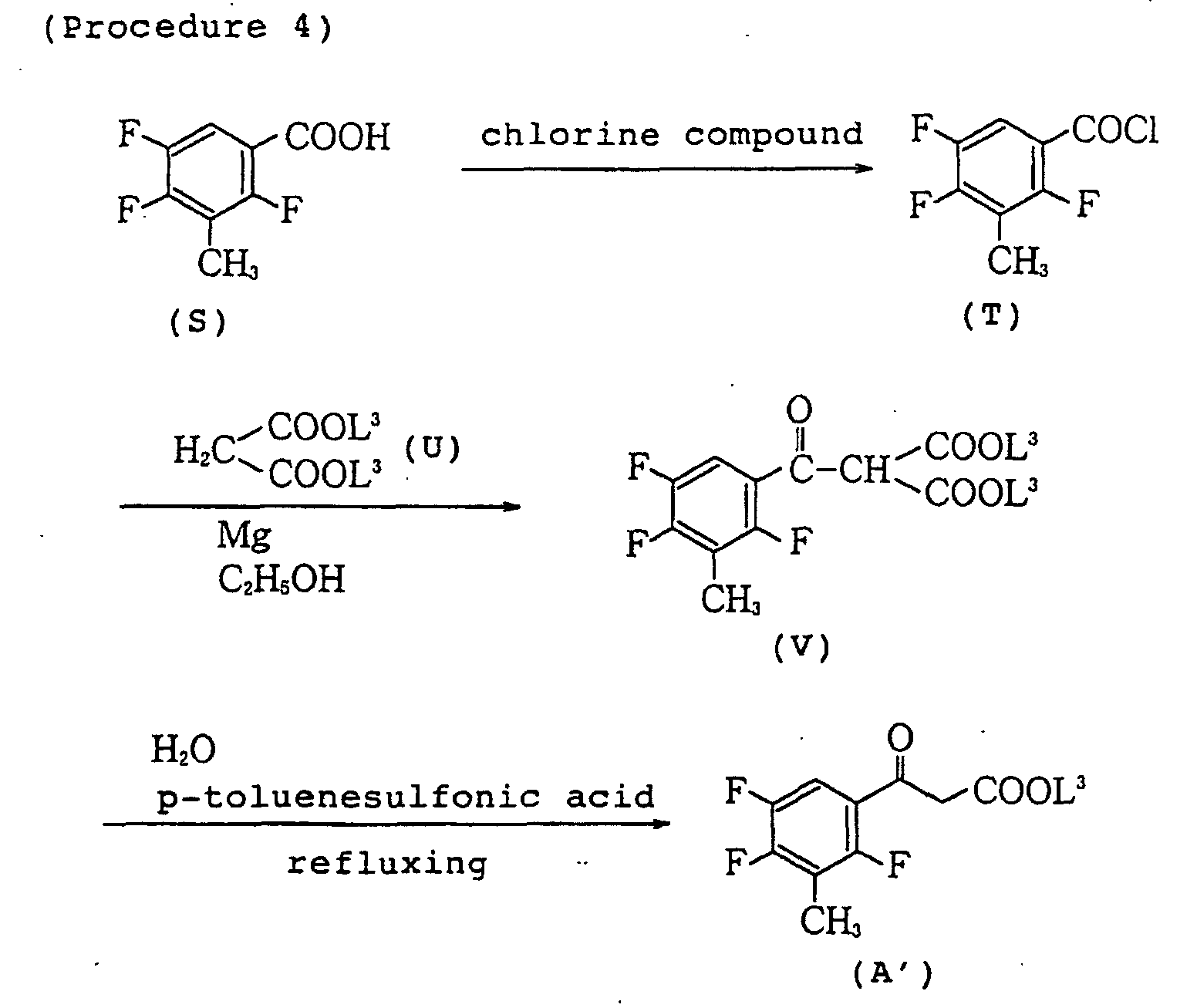
- The process of the procedure 3 is most preferred for producing the starting compound (A') since the intermediate (S) can be synthesized by relatively small number of steps at relatively high yield. In addition, the reagents used in the procedure 3 are relatively easy to handle, and the reaction apparatus and treatments are relatively simple. The starting compound (A) may be produced by a process other than the procedure 3, for example, by the process described in the documents as described below or its modification.
- 1) J. Heterocyclic Chem. 22, 1033 (1985)
- 2) Liebigs Ann. Chem. 29 (1987)
- 3) J. Med. Chem. 31, 991 (1988)
- 4) J. Org. Chem. 35, 930 (1970)
- 5) Japanese Patent Application Laid-Open No. 62-246541
- 6) Japanese Patent Application Laid-Open No. 62-26272
- 7) Japanese Patent Application Laid-Open No. 63-145268
- 8) J. Med. Chem. 29, 2363 (1986)
- 9) J. Fluorin Chem. 28, 361 (1985)
- 10) Japanese Patent Application Laid-Open No. 63-198664
- 11) Japanese Patent Application Laid-Open No. 63-264461
- 12) Japanese Patent'Application Laid-Open No. 63-104974
- 13) European Patent Application No. 230948
- 14) Japanese Patent Application Laid-Open No. 2-282384
- 15) Published Japanese Translation of PCT International Publication for Patent Application No. 3-502452
- 16) J. Het. Chem. 27, 1609 (1990)
- 17) Japanese Patent Application Laid-Open No. 7-215913
-
- For example, the production process described in the document 17) is the process wherein the starting compound (A) is obtained by the procedure 5 as described below.[wherein R13 and R14 represent lower alkyl groups, and L3 is as defined above.]

- In this procedure, compound (W) is first deprotonated with lithium bis(trimethylsilyl)amide and reacted with a methylating agent such as methyl iodide or methyl bromide to produce compound (X), and the compound (X) is hydrolyzed by heating under reflux with an acid such as hydrochloric acid, sulfuric acid or hydrobromic acid to produce compound (S). The compound (S) is then converted into the starting compound (A') as in the above-described process, for example, by procedure 4 as described above.
- In this case, lithium bis(trimethylsilyl)amide used as the deprotonating agent in the reaction from the compound (W) to the compound (X) is generally prepared from hexamethyldisilazane and n-butyllithium with no purification. The deprotonation and the methylation reactions are conducted by using an appropriate solvent at a relatively low temperature of from -10°C to room temperature.
- The process of procedure 5 is relatively preferable among the known processes since the synthesis can be accomplished by relatively small number of steps at a relatively high yield. The process of procedure 5, however, is not fully satisfactory in view of industrial scale production since n-butyllithium used in the preparation of lithium bis(trimethylsilyl)amide, the deprotonating agent, is inconvenient to handle since it undergoes spontaneous ignition by contact with oxygen or moisture, and the deprotonation and the methylation reactions have to be conducted at low temperature. Other known processes also suffer from drawbacks such as too many number of steps, complicated reactions, insufficient yield, or the like. The process of procedure 3 is preferable in view of industrial scale production.
- The thus obtained compounds of the present invention are isolated and purified in accordance with standard methods. The compounds obtained may be in the form of salts, free carboxylic acids, or free amines depending on the conditions of the isolation and the separation. The forms of the compounds are mutually convertible, and the compounds of the present invention in desired form may be produced.
- The compounds (1) or the salts thereof of the present invention have excellent antibacterial activities, intestinal absorption, and metabolic stability, and suffer from reduced phototoxicity, cytotoxicity and other side effects, and therefore, they can be advantageously used as an effective component in antibacterial agents.
- The compounds represented by the general formula (1) above or the salts thereof may be formulated into an antibacterial composition with a pharmaceutically acceptable carrier adapted for parenteral administration such as injection, transrectal administration, or eye drop, or oral administration in solid or liquid form.
- When the antibacterial composition of the present invention is in the form of an injection, it may be in the form of a solution, a suspension or an emulsion in a pharmaceutically acceptable sterilized water or a non-aqueous medium. Examples of appropriate non-aqueous carriers, diluents, media, and vehicles include propylene glycol, polyethylene glycol, vegetable oils such as olive oil, and organic esters adequate for injection such as ethyl oleate. Such composition may also contain additives such as a preservative, a wetting agent, an emulsifier and a dispersant. The composition may be sterilized, for example, by filtration through a bacteria-removing filter, or by incorporating a sterilizer in the form of a sterilizer or a sterile solid composition soluble in a sterilizable medium for injection just before its use.
- A preparation for eye drop administration may preferably contain a solubilizer, a preservative, an isotonizing agent, a thickening agent, and the like in addition to the compounds of the present invention.
- Solid preparations for oral administration include capsules, tablets, pills, powders, and granules. In preparing such solid preparations, the compounds of the present invention are typically mixed with at least one inert diluent such as sucrose, lactose or starch. The preparation may also contain substances other than the inert diluents such as lubricant (for example, magnesium stearate etc.). In the case of capsules, tablets or pills, the preparation may also include a buffer. The tablets and the pills may have an enteric coating.
- Liquid preparations for oral administration include pharmaceutically acceptable emulsions, solutions, suspensions, syrups and elixirs containing an inert diluent normally used in the art such as water. In addition to such inert diluent, the composition may also contain additives such as a wetting agent, an emulsifying agent, a suspending agent as well as a sweetener, a seasoning, and a flavor. Preparations for enteral administrations may preferably contain an excipient such as cacao butter or suppository wax in addition to the compound of the present invention.
- The dose of the compounds (1) of the present invention varies depending on the nature of the compound administered, route of administration, the desired treatment period, and other factors. The compounds of the present invention, however, are typically administered at about 0.1 to 1000 mg/kg per day, and in particular, at about 0.5 to 100 mg/kg per day. If desired, such dose may be administered in 2 to 4 portions.
- The compounds (1) and the salts thereof of the present invention exhibit extremely strong antibacterial activities simultaneously with reduced phototoxicity and cytotoxicity, and therefore, would be widely applicable as pharmaceuticals for human and other animals as well as pharmaceuticals for fishes, pesticides, food preservatives, and the like. The compounds of the present invention are also expected to exhibit antivirus properties, and especially, anti-HIV (human immunodeficiency virus) actions, and to be effective in preventing and treating AIDS.
- Next, the present invention is described in further detail by referring to Examples, Comparative Examples, and Reference Examples, which by no means limit the scope of the present invention.
- To 60 ml of tetrahydrofuran was suspended 8 g of sodium hydride from which oil content had been removed by petroleum ether, and 30 ml of tetrahydrofuran solution of 32 g of diethyl malonate was added dropwise to this suspension in an ice bath, and the mixture was stirred at room temerature for 20 minutes. 50 ml of tetrahydrofuran solution of 26.6 g of diethyl 3,4,5,6-tetrafluorophthalate was added dropwise to the reaction solution in an ice bath, and the mixture was stirred at 60°C for 1 hour. The reaction solution was allowed to cool, and 8 ml of acetic acid was added to the solution and the solution was stirred at room temperature for 20 minutes. To the solution was added chloroform and water to extract the organic layer. The extract was dried over magnesium sulfate and the solvent was distilled off to obtain 50 g of the title compound in crude form.
- To 50 g of diethyl 2-(2,5,6-trifluoro-3,4-bis(ethoxy-carbonyl)phenyl)malonate were added 60 ml of conc. hydrochloric acid and 60 ml of acetic acid, and the mixture was refluxed overnight. The ethyl acetate in the reaction solution was distilled off under reduced pressure, and the solution was refluxed for 2 days. The acid in the reaction solution was distilled off, and hexane was added to the residue. The solid content was collected by filtration and dried to obtain 27 g of the title compound in crude form.
Characteristic features: colorless powder
1HNMR (d6-DMSO) δ ;
3.78 (s, 2H) - To 27 g of 2-(2,5,6-trifluoro-3,4-dicarboxyphenyl)acetic acid was added 28 ml of N-methylpyrrolidone and 10 ml of triethylamine and the mixture was stirred at 140°C for 2 days. The reaction solution was poured into 6N hydrochloric acid with cooling, and separated by adding diethylether and aqueous solution of sodium hydroxide. The aqueous layer was acidified and extracted with diethylether.
- The organic layer was dried over magnesium sulfate and the solvent was distilled off. Hexane was added to the residue, and the solid content was collected by filtration to obtain 12 g of the title compound in powder form.
Characteristic features: colorless needle crystals
Melting point: 97-100°C
1HNMR (CDCl3) δ ;
2.29 (d, J=3Hz, 3H), 7.70 (dd, J=11Hz, 16Hz, 1H) - 2.4 g of magnesium, 10 ml of ethanol, and 0.4 ml of carbon tetrachloride were stirred in a three necked flask at room temperature for activation, and 15 ml of diethyl malonate and 40 ml of tetrahydrofuran were gradually added dropwise. The mixture was stirred at 80°C for 4 hours. The reaction solution was allowed to cool, and then cooled to -40°C. To 50 ml solution in methylene chloride of 15.5 g of 2,4,5-trifluoro-3-methylbenzoic acid obtained in Reference' Example 1(3) were added 8 ml of oxalyl dichloride and 5 drops of N,N-dimethylformamide, and the mixture was stirred at room temperature for 3 hours. The solvent was distilled off, and tetrahydrofuran was added for azeotropic distillation. The residue was dissolved in 40 ml of tetrahydrofuran, and this solution was gradually added dropwise to the above-described reaction solution at -40°C. After the dropwise addition, the reaction solution was stirred at room temperature for 3 days, and the solvent was distilled off. 50 ml of 12N hydrochloric acid was added to the solution to about pH 2, and the solution was extracted with chloroform, and solvent was distilled off. To the residue were added 30 ml of water and 0.6 g of p-toluenesulfonic acid, and the mixture was stirred under reflux for 6 hours. The reaction solution was allowed to cool, extracted with chloroform, and washed with water and 5% aqueous solution of sodium hydrogencarbonate successively.
- The organic layer was dried over magnesium sulfate and concentrated under reduced pressure to obtain the title compound as 5.5 g of powder and 10.2 g of brown oil.
- To 8.2 g of ethyl 2,4,5-trifluoro-3-methylbenzoylacetate obtained in the Reference Example 2 were added 18.9 g acetic anhydride and 7.0 g of triethyl formate, and the mixture was heated under reflux for 3 hours. The solvent was distilled off, and the residue was azeotropically distilled by adding toluene. To half of the residue was added 10 ml of chloroform, and 3.7 g of N-(tert-butoxycarbonyl)-4,6-difluoro-m-phenylenediamine dissolved in 10 ml of chloroform was added dropwise at 0°C. The mixture was stirred at room temperature for 30 minutes. The solvent was distilled off, and the solid content was collected from the residue by filtration and washed with ethanol to obtain 3.8 g of ethyl 2-(2,4,5-trifluoro-3-methylbenzoyl)-3-(3-tert-butoxycarbonylamino-4,6-difluorophenylamino)acrylate.
- To solution of the resulting ethyl 2-(2,4,5-trifluoro-3-methylbenzoyl)-3-(3-tert-butoxycarbonylamino-4,6-difluorophenylamino)acrylate in 10 ml of N,N-dimethyl-formamide was added 1.2 g of potassium carbonate, and the mixture was stirred at 100°C for 1 hour. The reaction solution was extracted by adding water and ethyl acetate, and organic layer was dried over magnesium sulfate, and the solvent was distilled off. The solid content was collected from the residue by using ethanol and washed with diethylether to obtain 2.9 g of the title compound.
Characteristic features: pale yellow powder
Melting point: 183-185°C
1HNMR (CDCl3) δ ;
1.40 (t, J=7Hz, 3H), 1.51 (s, 9H), 1.82 (d, J=3Hz, 3H), 4.39 (q, J=7Hz, 2H), 6.81 (brs, 1H), 7.10 (t, J=10Hz, 1H), 8.25 (t, J=10Hz, 1H), 8.29-8.40 (m, 2H) - To 2.8 g of ethyl 1-(3-tert-butoxycarbonylamino-4,6-difluorophenyl)-6,7-difluoro-8-methyl-1,4-dihydro-4-oxoquinoline-3-carboxylate obtained in the Reference Example 3 was added 10 ml of 12N hydrochloric acid, and the mixture was heated under reflux for 4 hours. The reaction solution was allowed to cool, and the solid precipitate was collected by filtration and washed with ethanol and diethylether successively to obtain 1.9 g of the title compound.
Characteristic features: pale yellow powder
Melting point: 266-267°C
1HNMR (d6-DMSO) δ ;
1.86 (d, J=3Hz, 3H), 7.13 (t, J=8Hz, 1H), 7.46 (t, J=11Hz, 1H), 8.25 (t, J=9Hz, 1H), 8.68 (s, 1H) - Solution of 70 mg of 3-aminoazetidine·dichloride, 200 mg of 1,8-diazabicyclo[5.4.0]undecene, and 300 mg of pyridine was stirred at 100°C, and to this solution was added 1-(3-amino-4,6-difluorophenyl)-6,7-difluoro-8-methyl-1,4-dihydro-4-oxoquinoline-3-carboxylic acid obtained in the Reference Example 4. The mixture was heated with stirring at 110°C for 60 minutes. Addition of diethylether to the reaction solution followed by decantation was repeated three times, and 5 ml of ethanol was added with heating to 70°C. The solution was allowed to stand, and the solid precipitate was collected by filtration to obtain 50 mg of the title compound.
Characteristic features: pale yellow powder
Melting point: 213-218°C
1HNMR (d6-DMSO) δ ;
1.61 (s, 3H), 3.66-3.81 (m, 2H), 3.82-3.95 (m, 1H), 4.36-4.52 (m, 2H), 5.47 (brs, 2H), 7.04 (t, J=9Hz, 1H), 7.40 (t, J=10Hz, 1H), 7.75 (d, J=14Hz, 1H), 8.48 (s, 1H) - The procedure of Example 1 was repeated except that 3-aminoazetidine·dichloride was replaced with 110 mg of 3-N-methylaminoazetidine·dichloride to obtain the title compound.
Characteristic features: pale yellow powder
Melting point: 189-194°C
1HNMR (d6-DMSO) δ ;
1.64 (s, 3H), 2.20 (s, 3H), 3.78-3.90 (m, 1H), 3.90-4.01 (m, 1H), 4.33-4.50 (m, 2H), 5.50 (brs, 2H), 7.02 (t, J=9Hz, 1H), 7.42 (t, J=11Hz, 1H), 7.76 (d, J=14Hz, 1H), 8.45 (s, 1H) - The procedure of Example 2 was repeated except that 3-aminoazetidine·dichloride was replaced with 110 mg of 3-amino-3-methylazetidine·dichloride to obtain the title compound.
Characteristic features: pale yellow powder
Melting point: 209-222°C
1HNMR (d6-DMSO) δ ;
1.37 (s, 3H), 1.63 (s, 3H), 3.83-3.94 (m, 1H), 3.95-4.13 (m, 3H), 5.46 (brs, 2H), 7.04 (t, J=9Hz, 1H), 7.40 (t, J=11Hz, 1H), 7.76 (d, J=14Hz, 1H), 8.48 (s, 1H) - The procedure of Reference Example 3 was repeated except that N-tert-butoxycarbonyl-4,6-difluoro-m-phenylenediamine was replaced with 1.4 g of 4-fluoro-2-methylaniline to obtain the title compound.
Characteristic features: pale yellow powder
Melting point: 187-189°C
1HNMR (CDCl3) δ ;
1.40 (t, J=7Hz, 3H), 1.64 (d, J=3Hz, 3H), 2.08 (s, 3H), 4.39 (q, J=7Hz, 2H), 7.06-7.17 (m, 2H), 7.34 (t, J=5Hz, 1H), 8.22-8.35 (m, 2H) - To solution of 1.7 g of ethyl 1-(4-fluoro-2-methylphenyl)-6,7-difluoro-8-methyl-1,4-dihydro-4-oxoquinoline-3-carboxylate obtained in the Reference Example 5 in 5 ml of sulfuric acid was incrementally added 480 mg of potassium nitrate on ice. After the addition, the mixture was stirred at room temperature overnight and the reaction solution was poured into ice water and stirred. Chloroform and water were added for separation, and the organic layer was dried over magnesium sulfate and the solvent was distilled off. The solid precipitate was collected by filtration and washed with ethanol to obtain 1.6 g of the title compound.
Characteristic features: pale yellow powder
Melting point: 211-214°C
1HNMR (CDCl3) δ ;
1.40 (t, J=7Hz, 3H), 1.69 (d, J=3Hz, 3H), 2.20 (s, 3H), 4.40 (q, J=7Hz, 2H), 7.39 (d, J=11Hz, 1H), 8.19 (d, J=7Hz, 1H), 8.23-8.35 (m, 2H) - 16 m of formic acid was added to 1.6 g of ethyl 1-(4-fluoro-2-methyl-5-nitrophenyl)-6,7-difluoro-8-methyl-1,4-dihydro-4-oxoquinoline-3-carboxylate obtained in the Reference Example 6 and dissolved. 2.1 g of iron powder was added, and the mixture was stirred at 70°C for 90 minutes. The reaction solution was allowed to cool, and the catalyst was filtered off by celite, and the solvent was distilled off the filtrate. The solid precipitate was collected by filtration and washed with ethanol to obtain 1.6 g of the title compound.
Characteristic features: pale brown powder
Melting point: 246-249°C - The procedure of Reference Example 4 was repeated except that ethyl 1-(3-tert-butoxycarbonylamino-4,6-difluorophenyl)-6,7-difluoro-8-methyl-1,4-dihydro-4-oxoquinoline-3-carboxylate was replaced with 1.6 g of ethyl 1-(4-fluoro-3-formylamino-6-methylphenyl)-6,7-difluoro-8-methyl-1,4-dihydro-4-oxoquinoline-3-carboxylate obtained in the Reference Example 7 to obtain the title compound.
Characteristic features: colorless powder
Melting point: 248-250°C
1HNMR (d6-DMSO) δ ;
1.76 (d, J=3Hz, 3H), 1.83 (s, 3H), 6.98 (d, J=8Hz, 1H), 7.16 (d, J=12Hz, 1H), 8.27 (t, J=9Hz, 1H), 8.50 (s, 1H) - The procedure of Example 1 was repeated except that 1-(3-amino-4,6-difluorophenyl)-6,7-difluoro-8-methyl-1,4-dihydro-4-oxoquinoline-3-carboxylic acid was replaced with 110 mg of 1-(3-amino-4-fluoro-6-methylphenyl)-6,7-difluoro-8-methyl-1,4-dihydro-4-oxoquinoline-3-carboxylic acid obtained in the Reference Example 8 to obtain the title compound.
Characteristic features: pale yellow powder
Melting point: 162-169°C
1HNMR (d6-DMSO) δ ;
1.55 (s, 3H), 1.79 (s, 3H), 3.67-3.78 (m, 2H), 3.83-3.94 (m, 1H), 4.35-4.50 (m, 2H), 5.41 (brs, 2H), 6.92 (d, J=8Hz, 1H), 7.09 (d, J=12Hz, 1H), 7.79 (d, J=14Hz, 1H), 8.34 (s, 1H) - The procedure of Example 1 was repeated except that 1-(3-amino-4,6-difluorophenyl)-6,7-difluoro-8-methyl-1,4-dihydro-4-oxoquinoline-3-carboxylic acid was replaced with 180 mg of 1-(3-amino-4-fluoro-6-methylphenyl)-6,7-difluoro-8-methyl-1,4-dihydro-4-oxoquinoline-3-carboxylic acid obtained in the Reference Example 8, and 3-aminoazetidine·dichloride was replaced with 110 mg of 3-amino-3-methylazetidine·dichloride to obtain the title compound.
Characteristic features: pale yellow powder
Melting point: 242-247°C
1HNMR (d6-DMSO) δ ;
1.36 (s, 3H), 1.54 (s, 3H), 1.78 (s, 3H), 3.77-3.85 (m, 1H), 3.95-4.09 (m, 3H), 5.44 (brs, 2H), 6.93 (d, J=9Hz, 1H), 7.09 (d, J=12Hz, 1H), 7.88 (d, J=14Hz, 1H), 8.34 (s, 1H) - The procedure of Example 1 was repeated except that 1-(3-amino-4,6-difluorophenyl)-6,7-difluoro-8-methyl-1,4-dihydro-4-oxoquinoline-3-carboxylic acid was replaced with 180 mg of 1-(3-amino-4-fluoro-6-methylphenyl)-6,7-difluoro-8-methyl-1,4-dihydro-4-oxoquinoline-3-carboxylic acid obtained in the Reference Example 8, and 3-aminoazetidine·dichloride was replaced with 110 mg of 3-N-methylaminoazetidine·dichloride to obtain the title compound.
Characteristic features: pale yellow powder
Melting point: 235-237°C
1HNMR (d6-DMSO) δ ;
1.56 (s, 3H), 1.80 (s, 3H), 2.20 (s, 3H), 3.77-3.90 (m, 1H), 3.90-4.02 (m, 1H), 4.31-4.59 (m, 2H), 5.44 (brs, 2H), 6.91 (d, J=8Hz, 1H), 7.10 (d, J=11Hz, 1H), 7.89 (d, J=14Hz, 1H), 8.34 (s, 1H) - The procedure of Reference Example 3 was repeated except that N-tert-butoxycarbonyl-4,6-difluoro-m-phenylenediamine was replaced with 1.6 g of 2-chloro-4-fluoroaniline to obtain the title compound.
Characteristic features: pale yellow powder
Melting point: 188-191°C
1HNMR (CDCl3) δ ;
1.40 (t, J=7Hz, 3H), 1.77 (d, J=3Hz, 3H), 4.39 (q, J=7Hz, 2H), 7.34-7.47 (m, 3H), 8.23 (t, J=10Hz, 1H), 8.31 (m, 1H) - The procedure of Reference Example 6 was repeated except that ethyl 1-(4-fluoro-2-methylphenyl)-6,7-difluoro-8-methyl-1,4-dihydro-4-oxoquinoline-3-carboxylate was replaced with 1.8 g of ethyl 1-(2-chloro-4-fluorophenyl)-6,7-difluoro-8-methyl-1,4-dihydro-4-oxoquinoline-3-carboxylate obtained in the Reference Example 9 to obtain the title compound.
Characteristic features: pale yellow powder
Melting point: 253-256°C
1HNMR (CDCl3) δ ;
1.40 (t, J=7Hz, 3H), 1.83 (d, J=2Hz, 3H), 4.39 (q, J=7Hz, 2H), 7.62 (d, J=9Hz, 1H), 8.13 (d, J=7Hz, 1H), 8.23 (t, J=9Hz, 1H), 8.29 (s, 1H) - The procedure of Reference Example 7 was repeated except that ethyl 1-(4-fluoro-2-methyl-5-nitrophenyl)-6,7-difluoro-8-methyl-1,4-dihydro-4-oxoquinoline-3-carboxylate was replaced with 1.6 g of ethyl 1-(2-chloro-4-fluoro-5-nitrophenyl)-6,7-difluoro-8-methyl-1,4-dihydro-4-oxoquinoline-3-carboxylate obtained in the Reference Example 10 to obtain the title compound.
Characteristic features: pale brown powder
Melting point: 261-263°C
1HNMR (d6-DMSO) δ ;
1.26 (t, J=7Hz, 3H), 1.78 (s, 3H), 4.23 (q, J=7Hz, 2H), 7.94 (d, J=10Hz, 1H), 8.08 (d, J=9Hz, 1H), 8.34-8.47 (m, 2H), 8.50 (s, 1H) - The procedure of Reference Example 4 was repeated except that ethyl 1-(3-tert-butoxycarbonylamino-4,6-difluorophenyl)-6,7-difluoro-8-methyl-1,4-dihydro-4-oxoquinoline-3-carboxylate was replaced with 1.7 g of ethyl 1-(6-chloro-4-fluoro-3-formylaminophenyl)-6,7-difluoro-8-methyl-1,4-dihydro-4-oxoquinoline-3-carboxylate obtained in the Reference Example 11 to obtain the title compound.
Characteristic features: pale yellow powder
Melting point: > 258°C (decomposed)
1HNMR (d6-DMSO) δ ;
1.18 (d, J=3Hz, 3H), 5.60-5.91 (br, 2H), 7.10 (d, J=7Hz, 1H), 7.59 (d, J=10Hz, 1H), 8.26 (t, J=9Hz, 1H), 8.71 (s, 1H) - The procedure of Example 1 was repeated except that 1-(3-amino-4,6-difluorophenyl)-6,7-difluoro-8-methyl-1,4-dihydro-4-oxoquinoline-3-carboxylic acid was replaced with 110 mg of 1-(3-amino-6-chloro-4-fluorophenyl)-6,7-difluoro-8-methyl-1,4-dihydro-4-oxoquinoline-3-carboxylic acid obtained in the Reference Example 12 to obtain the title compound.
Characteristic features: pale yellow powder
Melting point: > 175°C (decomposed)
1HNMR (d6-DMSO) δ ;
1.65 (s, 3H), 3.69-3.81 (m, 2H), 3.84-3.96 (m, 1H), 4.39-4.50 (m, 2H), 5.65 (brs, 2H), 7.05 (d, J=7Hz, 1H), 7.54 (d, J=10Hz, 1H), 7.77 (d, J=14Hz, 1H), 8.50 (s, 1H) - 70 mg of 3-hydroxyazetidine·monochloride, 200 mg of 1,8-diazabicyclo[5.4.0]-7-undecene, and 200 mg of pyridine were stirred at 80°C, and to this mixture was added 150 mg of 1-(3-amino-4,6-difluorophenyl)-6,7-difluoro-8-methyl-4-oxo-1,4-dihydroquinoline-3-carboxylic acid. The mixture was stirred at 90°C for 10 minutes. Diethylether was added to the reaction solution, and the solution was decanted. 1 ml of ethanol was added to the residue and the solid precipitate was collected by filtration and dried to obtain 70 mg of the title compound.
Characteristic features: pale yellow powder
Melting point: 206-208°C
1HNMR (d6-DMSO) δ ;
1.63 (s, 3H), 3.88-3.95 (m, 1H), 3.95-4.02 (m, 1H), 4.44-4.56 (m, 3H), 5.48 (brs, 2H), 5.70 (brs, 1H), 7.02 (t, J=9Hz, 1H), 7.42 (t, J=11Hz, 1H), 7.78 (d, J=13Hz, 1H), 8.49 (s, 1H) - 70 mg of 3-hydroxyazetidine·monochloride, 200 mg of 1,8-diazabicyclo[5.4.0]-7-undecene, and 200 mg of pyridine were stirred at 80°C, and to this mixture was added 150 mg of 1-(3-amino-4-fluoro-6-methylphenyl)-6,7-difluoro-8-methyl-4-oxo-1,4-dihydroquinoline-3-carboxylic acid. The mixture was stirred at 90°C for 20 minutes. Diethylether was added to the reaction solution, and the solution was decanted. 1 ml of ethanol was added to the residue and the solid precipitate was collected by filtration and dried to obtain 70 mg of the title compound.
Characteristic features: pale yellow powder
Melting point: 147-151°C
1HNMR (d6-DMSO) δ ;
1.55 (s, 3H), 1.82 (s, 3H), 3.85-3.95 (m, 1H), 3.95-4.03 (m, 1H), 4.40-4.53 (m, 3H), 5.43 (brs, 2H), 5.68 (brs, 1H), 6.91 (d, J=8Hz, 1H), 7.10 (d, J=10Hz, 1H), 7.81 (d, J=14Hz, 1H), 8.35 (s, 1H) - 70 ml of 1.69M n-hexane solution of n-butyllithium was added dropwise to solution of 18 ml of diisopropylamine in 75 ml of tetrahydrofuran at -65°C under nitrogen stream, and the mixture was stirred at the same temperature for 15 minutes. To the solution was added dropwise solution of 9.5 g of 2,4,5-trifluoro-3-methylbenzoic acid in 75 ml of tetrahydrofuran at -60°C, and the mixture was stirred at the same temperature for 15 minutes. To the solution was added dropwise 9.5 ml of methyl iodide at -70°C, and the mixture was stirred at the same temperature for 30 minutes and overnight at room temperature. Diethylether and water were added for separation, and the aqueous layer was collected. The aqueous layer was acidified by adding conc. hydrochloric acid, and extracted with diethylether. The organic layer was dried over ahnydrous magnesium sulfate, and the solvent was distilled off under reduced pressure to obtain 6.6 g of the title compound.
Characteristic features: pale yellow powder
Melting point: 118-119°C
1HNMR (CDCl3) δ ;
2.23 (s, 3H), 2.40 (s, 3H) - To 400 mg of magnesium were added 1.5 ml of ethanol and 0.05 ml of carbon tetrachloride, and the mixture was stirred at room temperature. To the thus activated solution was added solution of 2.7 ml of ethyl malonate in 5 ml of tetrahydrofuran, and the mixture was stirred at 80°C for 4 hours. After allowing to cool, the solution was cooled to -40°C. To solution of 3.3 g of the 2,4,5-trifluoro-3,6-dimethylbenzoic acid obtained in the Reference Example 13 in 5 ml of methylene chloride were added 1.5 ml of oxalyl chloride and 3 drops of N,N-dimethylformamide and the mixture was stirred at room temperature for 3 hours. The solvent and the reagent were distilled off under reduced pressure. Toluene was added for azeotropic distillation, and solution of the residue in 5 ml of tetrahydrofuran was added dropwise to the above-described reaction solution at -40°C. After the dropwise addition, the reaction solution was stirred overnight at room temperature, and the solvent was distilled off. To the residue was added 3 ml of 12N hydrochloric acid to adjust pH to about 2, and the solution was extracted with chloroform. The solvent was distilled off and 10 ml of water and 100 mg of p-toluenesulfonic acid were added to the solution. The solution was stirred under heating and reflux condition for 5 hours. After allowing to cool, the solution was extracted with chloroform, and the organic layer was washed with water, dried over anhydrous magnesium sulfate, and concentrated under reduced pressure. The residue was subjected to silica gel column chromatography and 3.2 g of the title compound as a pale brown oil was obtained from the fractions eluted with ethyl acetate:hexane of 1:10.
- To 3.2 g of the ethyl 2,4,5-trifluoro-3,6-dimethylbenzoyl acetate obtained in the Reference Example 14 were added 7.8 g of anhydrous acetic acid and 2.8 g of triethyl orthoformate, and the mixture was heated under reflux for 4 hours. The reaction solution was allowed to cool, and the reagents and the like were distilled off at reduced pressure. Toluene was added for azeotropic distillation. 10 ml of chloroform was added to the residue, and solution of 2.7 g of N-t-butoxycarbonyl-4,6-difluorophenylenediamine in 5 ml of chloroform was added dropwise. The mixture was stirred overnight at room temperature, and the solvent was distilled off. The residue was subjected to silica gel column chromatography and 4.0 g of aminoacrylate compound as a pale yellow solid product was obtained from the fractions eluted with ethyl acetate:hexane of 1:20.
- To the solution of all of the thus obtained aminoacrylate compound in 20 ml of N,N-dimethylformamide was added 1.0 g of potassium carbonate, and the mixture was stirred at 70°C for 3.5 hours. Ethyl acetate and water were added, and the organic layer separated was collected and dried over anhydrous magnesium sulfate. The solvent was distilled off and the residue was subjected to silica gel column chromatography to obtain 3.0 g of the title compound from the fractions eluted with ethyl acetate:hexane of 1:2.
Characteristic features: pale yellow powder
Melting point: 141-142°C
1HNMR (CDCl3) δ ;
1.38 (t, J=7Hz, 3H), 1.51 (s, 9H), 1.76 (d, J=2Hz, 3H), 2.86 (d, J=3Hz, 3H), 4.38 (q, J=7Hz, 2H), 6.80 (brs, 1H), 7.08 (t, J=10Hz, 1H), 8.17-8.30 (m, 2H) - To 1.8 g of the ethyl 1-(3-tert-butoxycarbonylamino-4,6-difluorophenyl)-6,7-difluoro-5,8-dimethyl-4-oxo-1,4-dihydroquinoline-3-carboxylate obtained in the Reference Example 15 was added 10 ml of 12N hydrochloric acid, and the mixture was stirred under heating and reflux condition for 4 hours. After allowing to cool, the solid precipitate was collected by filtration, washed with water and ethanol successively, and dried to obtain 1.2 g of the title compound.
Characteristic features: colorless powder
Melting point: > 281°C (decomposed)
1HNMR (d6-DMSO) δ ;
1.80 (s, 3H), 2.82 (s, 3H), 7.06 (t, J=8Hz, 1H), 7.46 (t, J=11Hz, 1H), 8.62 (s, 1H) - To 100 mg of the 1-(3-amino-4,6-difluorophenyl)-6,7-difluoro-5,8-dimethyl-4-oxo-1,4-dihydroquinoline-3-carboxylic acid obtained in the Reference Example 16 were added 300 mg of pyridine, 70 mg of 3-aminoazetidine· dichloride, and 150 mg of 1,8-diazabicyclo[5.4.0]-7-undecene, and the mixture was heated and stirred at 40°C for 24 hours. After allowing to cool, the solvent and the like were distilled off under reduced pressure. To the residue was added 1 ml of ethanol, and the solution was allowed to stand for 5 days. The solid content was collected by filtration, washed with ethanol and dried to obtain 15 mg of the title compound.
Characteristic features: pale yellow powder
Melting point: > 235°C (decomposed)
1HNMR (d6-DMSO) δ ;
1.60 (s, 3H), 2.73 (s, 3H), 3.99-4.08 (m, 1H), 4.08-4.18 (m, 1H), 4.23-4.32 (m, 1H), 4.42-4.56 (m, 2H), 5.49 (brs, 2H), 7.02 (t, J=8Hz, 1H), 7.39 (t, J=11Hz, 1H), 8.33 (s, 1H), 8.46 (s, 1H) - To 100 ml of conc. sulfuric acid was dissolved 31 g of 2,4,5-trifluoro-3-methylbenzoic acid, and to this solution was incrementally added 19.5 g of potassium nitrate on ice. The solution was stirred at room temperature for 3 days, and another 1.4 g of potassium nitrate was added on ice. After stirring for 6 hours, the solution was poured into ice water, and the solid precipitate was collected by filtration. The precipitate was dissolved in diethylether and washed with water. The organic layer was dried over anhydrous magnesium sulfate, and the solvent was distilled off. The solid precipitate was collected by filtration to obtain 21 g of the title compound.
Characteristic features: pale yellow powder
1HNMR (CDCl3) δ ;
2.38 (s, 3H) - To 2.2 g of magnesium were added ml of ethanol and 0.4 ml of carbon tetrachloride, and the mixture was stirred at room temperature. To the thus activated solution was added solution of 14 ml of ethyl malonate in 40 ml of tetrahydrofuran, and the mixture was stirred at 80°C for 4 hours. After allowing to cool, the solution was cooled to - 40°C. To solution of 20 g of the 2,4,5-trifluoro-3-methyl-6-nitrobenzoic acid obtained in the Reference Example 17 in 40 ml of methylene chloride were added 8.4 ml of oxalyl chloride and 3 drops of N,N-dimethylformamide and the mixture was stirred at room temperature for 3 and a half hours. The solvent and the reagent were distilled off under reduced pressure. Toluene was added for azeotropic distillation, and solution of the residue in 15 ml of tetrahydrofuran was added dropwise to the above-described reaction solution at -40°C. After the dropwise addition, the reaction solution was stirred overnight at room temperature, and the solvent was distilled off. To the residue was added 20 ml of 12N hydrochloric acid to adjust pH to about 2, and the solution was extracted with chloroform. The solvent was distilled off and 50 ml of water and 400 mg of p-toluenesulfonic acid were added to the solution. The solution was stirred under heating and reflux condition for 5 hours. After allowing to cool, the solution was extracted with chloroform, and the organic layer was washed with water, dried over anhydrous magnesium sulfate, and concentrated under reduced pressure. The residue was subjected to silica gel column chromatography and 8.0 g of the title compound as a red oil was obtained from the fractions eluted with ethyl acetate:hexane of 1:10.
- To 4 g of the ethyl 2,4,5-trifluoro-3-methyl-6-nitrobenzoyl acetate obtained in the Reference Example 18 were added 8.5 g of anhydrous acetic acid and 3.2 g of triethyl orthoformate, and the mixture was heated under reflux for 2 hours. The reaction solution was allowed to cool, and the reagents and the like were distilled off at reduced pressure. Toluene was added for azeotropic distillation. 10 ml of chloroform was added to the residue, and solution of 3.7 g of N-t-butoxycarbonyl-4,6-difluorophenylenediamine in 20 ml chloroform was added dropwise. The mixture was stirred at room temperature for 3 days, and the solvent was distilled off to obtain 4.8 g of aminoacrylate compound as a pale yellow oil.
- To the solution of all of the thus obtained aminoacrylate compound in 15 ml of N,N-dimethylformamide was added 1.4 g of potassium carbonate, and the mixture was stirred at 70°C for 30 minutes. The solution was allowed to cool, and ethyl acetate and water were added to the solution. The organic layer separated was collected and dried over anhydrous magnesium sulfate. The solvent was distilled off and the residue was subjected to silica gel column chromatography to obtain 4.0 g of the title compound from the fractions eluted with ethyl acetate:hexane of 1:2.
Characteristic features: pale yellow powder
Melting point: 188-189°C
1HNMR (CDCl3) δ ;
1.36 (t, J=7Hz, 3H), 1.52 (s, 9H), 1.88 (d, J=3Hz, 3H), 4.38 (q, J=7Hz, 2H), 6.94 (brs, 1H), 7.15 (t, J=10Hz, 1H), 8.29-8.44 (m, 2H) - To solution of 1.0 g of the ethyl 1-(3-tert-butoxycarbonylamino-4,6-difluorophenyl)-6,7-difluoro-8-methyl-5-nitro-4-oxo-1,4-dihydroquinoline-3-carboxylate obtained in the Reference Example 19 in 5 ml of acetic acid was added 900 mg of iron powder, and the mixture was heated and stirred at 90°C for 4 hours and 40 minutes. The catalyst in the reaction solution was filtered off by using celite, and the solvent in the residue was distilled off. The residue was subjected to silica gel column chromatography, and ethanol was added to the oil obtained from the fractions eluted with ethyl acetate:hexane of 1:1. The powder precipitate was collected by filtration to obtain 200 mg of the title compound.
Characteristic features: pale yellow powder
Melting point: 134-135°C
1HNMR (d6-DMSO) δ ;
1.24 (t, J=7Hz, 3H), 1.57 (d, J=2Hz, 3H), 4.19 (q, J=7Hz, 2H), 5.45 (brs, 2H), 6.95 (t, J=8Hz, 1H), 7.39 (t, J=11Hz, 1H), 8.20 (s, 1H) - To 200 mg of ethyl 5-amino-1-(3-amino-4,6-difluorophenyl)-6,7-difluoro-8-methyl-4-oxo-1,4-dihydroquinoline-3-carboxylate obtained in the Reference Example 20 was added 5 ml of 12N hydrochloric acid, and the mixture was heated under reflux for 10 hours. The reaction solution was allowed to cool, and the solid precipitate was collected by filtration. The precipitate was washed with ethanol, and then with diethylether to obtain 140 mg of the title compound.
Characteristic features: yellow powder
Melting point: > 290°C
1HNMR (d6-DMSO) δ
1.61 (d, J=2Hz, 3H), 7.02 (t, J=8Hz, 1H), 7.42 (t, J=11Hz, 1H), 8.47 (s, 1H) - Minimum growth inhibitory concentration (MIC, µg/ml) was evaluated in accordance with the standard method of Japan Chemotherapy Society (Chemotherapy 29(1), 76, 1981). The results are shown in Table 1. It should be noted that tosufloxacin was also evaluated for its minimum growth inhibitory concentration for the purpose of comparison. The results are also shown in Table 1.
S.aureus 209P P.aeruginosa IFO3445 Compound of Ex. 1 0.006 0.05 Compound of Ex. 2 0.006 0.1 Compound of Ex. 3 0.006 0.1 Compound of Ex. 4 0.003 0.1 Compound of Ex. 5 0.013 0.2 Compound of Ex. 6 0.013 0.2 Compound of Ex. 7 0.013 0.1 Compound of Ex. 8 0.006 0.2 Compound of Ex. 9 0.013 0.2 Compound of Ex. 10 0.003 0.1 Tosufloxacin 0.05 0.39 - Female ICR mice (5 to 6 week old) were intravenously administered with the test compound (40 mg/kg/10 ml), and irradiated with UVA (320 to 400 nm, 1.8 mW/cm2/sec) for 4 hours. Abnormality in the ears was monitored at 0 hour immediately after the irradiation and after 24 hours. The ear abnormality was evaluated by the following criteria: no abnormality (0 point), very slight erythema (1 point), well defined erythema (2 points), moderate to severe erythema or edema formation (3 points). The results are shown in Table 2. Tosufloxacin which is a conventional known antibacterial agent was also tested in a similar way for the purpose of comparison. The results are also shown in Table 2.
0 hour (point, occurrence) 24 hours (point, occurrence) Compound of Ex. 1 0, 0/3 0, 0/3 Compound of Ex. 2 0, 0/3 0, 0/3 Compound of Ex. 3 0, 0/3 0, 0/3 Compound of Ex. 4 0, 0/3 0, 0/3 Compound of Ex. 5 0, 0/3 0, 0/3 Compound of Ex. 6 0, 0/3 0, 0/3 Compound of Ex. 7 0, 0/3 0, 0/3 Compound of Ex. 8 0, 0/3 0, 0/3 Compound of Ex. 9 0, 0/3 0, 0/3 Compound of Ex. 10 0, 0/3 0, 0/3 Tosufloxacin 1.8, 4/5 0.8, 4/5 - A compound of the present invention was measured for its urine and bile recovery rates in rats after its oral administration to evaluate absorption and excretion of the compounds.
- Male SD rats of 6 week old which had been fasted overnight were administered orally with 0.5% methylcellulose suspension of the test compounds (20 mg/10 ml/kg). The urine collection was continued until 24 hours after the administration. The concentration of the test compound in the urine was measured by paper disc method using Bacillus subtilis ATCC6633 for the test bacterium to determine the urine recovery rate.
- Into choledoch duct of male SD rats of 6 week old which had been fasted overnight was inserted a polyethylene tube under etherization. After arousing, the rats were forcedly administered orally with the test compounds as in the case of the above (1), and bile collection was continued until 24 hours after the administration. The bile with no further treatment and the bile alkaline hydrolyzed (with 0.1N NaOH, 37°C, 1 hour) were measured for their concentration of the test compound by the same procedure as in the case of the above (1) to determine the bile recovery rate.
- The results are shown in Table 3.
Recovery rate (24 hours, %) Urine Bile Bile Total recovery rate Compound of Ex. 3 3.9 10.4 26.7 30.6
Claims (8)
- A compound which is a pyridonecarboxylic acid derivative represented by the following formula (1) or salt thereof:wherein R1 represents hydrogen atom, halogen atom or lower alkyl group; R2 represents hydrogen atom or lower alkyl group; R3 represents substituted or unsubstituted amino group or hydroxyl group; and R4 represents hydrogen atom, lower alkyl group, amino group or nitro group.

- A compound according to claim 1 in which R3 is selected from amino group, lower alkylamino groups, di-lower alkylamino groups, lower alkanoylamino groups, amino acid-substituted amino groups, oligopeptide-substituted amino groups, and hydroxyl group.
- A compound according to claim 1 or 2 in which R1, R2 and R4 are selected from methyl, ethyl, n-propyl, i-propyl, n-butyl, i-butyl, t-butyl, pentyl, hexyl and heptyl when they represent lower alkyl.
- A compound according to claim 1 in which R2 is methyl or hydrogen and R3 is amino, methylamino or hydroxyl.
- A compound according to claim 4 in which R1 is fluorine, chlorine or methyl.
- A compound according to claim 5 in which R1 is methyl, R2 is hydrogen and R3 is amino.
- An antibacterial agent containing a compound according to any one of claims 1 to 6 as its antibacterially-effective component.
- Use, in the preparation of a medicament for antibacterial treatment, of a compound according to any one of claims 1 to 6.
Applications Claiming Priority (4)
| Application Number | Priority Date | Filing Date | Title |
|---|---|---|---|
| JP122538/96 | 1996-04-19 | ||
| JP12253896 | 1996-04-19 | ||
| JP12253896 | 1996-04-19 | ||
| PCT/JP1997/001327 WO1997040036A1 (en) | 1996-04-19 | 1997-04-17 | Novel pyridonecarboxylic acid derivatives or salts thereof and antibacterial agents containing the same as the active ingredient |
Publications (3)
| Publication Number | Publication Date |
|---|---|
| EP0897919A1 EP0897919A1 (en) | 1999-02-24 |
| EP0897919A4 EP0897919A4 (en) | 2001-03-21 |
| EP0897919B1 true EP0897919B1 (en) | 2004-06-16 |
Family
ID=14838349
Family Applications (1)
| Application Number | Title | Priority Date | Filing Date |
|---|---|---|---|
| EP97917416A Expired - Lifetime EP0897919B1 (en) | 1996-04-19 | 1997-04-17 | Novel pyridonecarboxylic acid derivatives or salts thereof and antibacterial agents containing the same as the active ingredient |
Country Status (9)
| Country | Link |
|---|---|
| US (1) | US6211375B1 (en) |
| EP (1) | EP0897919B1 (en) |
| JP (1) | JP3484703B2 (en) |
| AT (1) | ATE269320T1 (en) |
| DE (1) | DE69729565T2 (en) |
| DK (1) | DK0897919T3 (en) |
| ES (1) | ES2224235T3 (en) |
| PT (1) | PT897919E (en) |
| WO (1) | WO1997040036A1 (en) |
Families Citing this family (4)
| Publication number | Priority date | Publication date | Assignee | Title |
|---|---|---|---|---|
| EP0945435B1 (en) * | 1996-11-28 | 2003-08-13 | Wakunaga Pharmaceutical Co., Ltd. | Novel pyridonecarboxylic acid derivatives or salts thereof and drugs containing the same as the active ingredient |
| CA2376760C (en) * | 1999-07-01 | 2008-11-25 | Wakunaga Pharmaceutical Co., Ltd. | Quinolinecarboxylic acid derivative or salts thereof |
| WO2017217441A1 (en) * | 2016-06-15 | 2017-12-21 | 湧永製薬株式会社 | Novel pyridonecarboxylic acid derivative or salt thereof |
| JOP20190086A1 (en) | 2016-10-21 | 2019-04-18 | Novartis Ag | Naphthyridinone derivatives and their use in the treatment of arrhythmia |
Family Cites Families (11)
| Publication number | Priority date | Publication date | Assignee | Title |
|---|---|---|---|---|
| JPS53141286A (en) | 1977-05-16 | 1978-12-08 | Kyorin Seiyaku Kk | Novel substituted quinolinecarboxylic acid |
| JPS5531042A (en) | 1978-08-25 | 1980-03-05 | Dainippon Pharmaceut Co Ltd | 1,8-naphthylidine derivative and its salt |
| JPS5746986A (en) | 1980-09-02 | 1982-03-17 | Dai Ichi Seiyaku Co Ltd | Pyrido(1,2,3-de)(1,4)benzoxazine derivative |
| JPS60228479A (en) | 1984-04-26 | 1985-11-13 | Toyama Chem Co Ltd | 1,4-dihydro-4-oxonaphthyridine derivative and salt thereof |
| GB8524662D0 (en) | 1985-10-07 | 1985-11-13 | Fujisawa Pharmaceutical Co | Quinolone compounds |
| US4771055A (en) | 1986-07-28 | 1988-09-13 | Warner-Lambert Company | 7-[[3-(aminomethyl)-3-alkyl]-1-pyrrolidinyl]-quinoline-carboxylic acids |
| JP2991381B2 (en) * | 1990-07-16 | 1999-12-20 | 大日本製薬株式会社 | Novel quinolinecarboxylic acid derivatives, esters and salts thereof |
| DE4123918A1 (en) | 1991-07-19 | 1993-01-21 | Bayer Ag | 8-VINYL AND 8-ETHINYL-CHINOLON CARBONIC ACIDS |
| FR2690161B1 (en) | 1992-04-16 | 1995-06-30 | Esteve Labor Dr | SUBSTITUTED PYRIDONE AZETIDINYL DERIVATIVES WITH ANTIMICROBIAL ACTIVITY. |
| DE69531305T2 (en) * | 1994-10-20 | 2004-05-13 | Wakunaga Seiyaku K.K. | PYRIDONE CARBOXYLATE DERIVATIVES OR SALTS THEREOF AND ANTIBACTERIAL COMPOSITIONS CONTAINING THEM AS AN ACTIVE COMPONENT |
| KR100499366B1 (en) | 1995-01-30 | 2005-09-08 | 와쿠나가 세이야쿠 가부시키 가이샤 | Novel pyridonecarboxylic acid derivatives or salts thereof and antibacterial agents comprising the same as active ingredient |
-
1997
- 1997-04-17 ES ES97917416T patent/ES2224235T3/en not_active Expired - Lifetime
- 1997-04-17 DE DE69729565T patent/DE69729565T2/en not_active Expired - Lifetime
- 1997-04-17 EP EP97917416A patent/EP0897919B1/en not_active Expired - Lifetime
- 1997-04-17 AT AT97917416T patent/ATE269320T1/en not_active IP Right Cessation
- 1997-04-17 PT PT97917416T patent/PT897919E/en unknown
- 1997-04-17 WO PCT/JP1997/001327 patent/WO1997040036A1/en not_active Ceased
- 1997-04-17 DK DK97917416T patent/DK0897919T3/en active
- 1997-04-17 US US09/171,411 patent/US6211375B1/en not_active Expired - Fee Related
- 1997-04-17 JP JP53790997A patent/JP3484703B2/en not_active Expired - Fee Related
Also Published As
| Publication number | Publication date |
|---|---|
| PT897919E (en) | 2004-11-30 |
| ATE269320T1 (en) | 2004-07-15 |
| DE69729565T2 (en) | 2005-06-09 |
| EP0897919A4 (en) | 2001-03-21 |
| WO1997040036A1 (en) | 1997-10-30 |
| EP0897919A1 (en) | 1999-02-24 |
| US6211375B1 (en) | 2001-04-03 |
| JP3484703B2 (en) | 2004-01-06 |
| DE69729565D1 (en) | 2004-07-22 |
| DK0897919T3 (en) | 2004-09-27 |
| ES2224235T3 (en) | 2005-03-01 |
Similar Documents
| Publication | Publication Date | Title |
|---|---|---|
| RU2177945C1 (en) | Derivative of pyridone carboxylic acid or its salt | |
| EP0132845A2 (en) | Novel 1,8-Naphthyridine derivatives, and process for preparation thereof | |
| EP0945435B1 (en) | Novel pyridonecarboxylic acid derivatives or salts thereof and drugs containing the same as the active ingredient | |
| US6211375B1 (en) | Pyridonecarboxylic acid derivatives or salts thereof and antibacterial agents containing the same as the active ingredient | |
| CA2252229C (en) | Novel pyridonecarboxylic acid derivatives or their salts, and antibacterial agents containing the same as their effective components | |
| EP1193266B1 (en) | Quinolinecarboxylic acid derivative or salts thereof | |
| JPWO1997040036A1 (en) | Novel pyridonecarboxylic acid derivatives or salts thereof and antibacterial agents containing said substances as active ingredients | |
| AU2005307447B2 (en) | Novel pyridonecarboxylic acid derivatives or salts thereof | |
| JPWO2001017991A1 (en) | Quinolinecarboxylic acid derivatives or their salts | |
| KR100485634B1 (en) | Novel pyridonecarboxylic acid derivatives or salts thereof and antibacterialagents containing the same as the active ingredient | |
| JPWO2001002390A1 (en) | Quinolinecarboxylic acid derivatives or their salts | |
| JPH06145147A (en) | Quinolone derivative or its salt and antimicrobial agent comprising the same | |
| JPH05255319A (en) | New quinolone derivative or its salt and antibacterial agent containing the compound | |
| JPH0725873A (en) | Quinolone derivative or its salt and antibacterial agent containing the compound | |
| JPWO1994027993A1 (en) | Quinolone derivatives or salts thereof and antibacterial agents containing the same |
Legal Events
| Date | Code | Title | Description |
|---|---|---|---|
| PUAI | Public reference made under article 153(3) epc to a published international application that has entered the european phase |
Free format text: ORIGINAL CODE: 0009012 |
|
| 17P | Request for examination filed |
Effective date: 19981109 |
|
| AK | Designated contracting states |
Kind code of ref document: A1 Designated state(s): AT BE CH DE DK ES FI FR GB GR IE IT LI LU MC NL PT SE |
|
| A4 | Supplementary search report drawn up and despatched |
Effective date: 20010206 |
|
| AK | Designated contracting states |
Kind code of ref document: A4 Designated state(s): AT BE CH DE DK ES FI FR GB GR IE IT LI LU MC NL PT SE |
|
| 17Q | First examination report despatched |
Effective date: 20030128 |
|
| GRAP | Despatch of communication of intention to grant a patent |
Free format text: ORIGINAL CODE: EPIDOSNIGR1 |
|
| GRAS | Grant fee paid |
Free format text: ORIGINAL CODE: EPIDOSNIGR3 |
|
| GRAA | (expected) grant |
Free format text: ORIGINAL CODE: 0009210 |
|
| AK | Designated contracting states |
Kind code of ref document: B1 Designated state(s): AT BE CH DE DK ES FI FR GB GR IE IT LI LU MC NL PT SE |
|
| REG | Reference to a national code |
Ref country code: GB Ref legal event code: FG4D |
|
| REG | Reference to a national code |
Ref country code: CH Ref legal event code: EP |
|
| REF | Corresponds to: |
Ref document number: 69729565 Country of ref document: DE Date of ref document: 20040722 Kind code of ref document: P |
|
| REG | Reference to a national code |
Ref country code: IE Ref legal event code: FG4D |
|
| REG | Reference to a national code |
Ref country code: DK Ref legal event code: T3 |
|
| REG | Reference to a national code |
Ref country code: SE Ref legal event code: TRGR |
|
| REG | Reference to a national code |
Ref country code: GR Ref legal event code: EP Ref document number: 20040402760 Country of ref document: GR |
|
| REG | Reference to a national code |
Ref country code: PT Ref legal event code: SC4A Free format text: AVAILABILITY OF NATIONAL TRANSLATION Effective date: 20040916 |
|
| ET | Fr: translation filed | ||
| REG | Reference to a national code |
Ref country code: ES Ref legal event code: FG2A Ref document number: 2224235 Country of ref document: ES Kind code of ref document: T3 |
|
| PLBE | No opposition filed within time limit |
Free format text: ORIGINAL CODE: 0009261 |
|
| STAA | Information on the status of an ep patent application or granted ep patent |
Free format text: STATUS: NO OPPOSITION FILED WITHIN TIME LIMIT |
|
| 26N | No opposition filed |
Effective date: 20050317 |
|
| PGFP | Annual fee paid to national office [announced via postgrant information from national office to epo] |
Ref country code: PT Payment date: 20080328 Year of fee payment: 12 |
|
| PGFP | Annual fee paid to national office [announced via postgrant information from national office to epo] |
Ref country code: LU Payment date: 20080513 Year of fee payment: 12 Ref country code: DK Payment date: 20080430 Year of fee payment: 12 Ref country code: CH Payment date: 20080502 Year of fee payment: 12 |
|
| PGFP | Annual fee paid to national office [announced via postgrant information from national office to epo] |
Ref country code: AT Payment date: 20080410 Year of fee payment: 12 |
|
| PGFP | Annual fee paid to national office [announced via postgrant information from national office to epo] |
Ref country code: MC Payment date: 20080418 Year of fee payment: 12 Ref country code: FI Payment date: 20080411 Year of fee payment: 12 Ref country code: IT Payment date: 20080428 Year of fee payment: 12 Ref country code: BE Payment date: 20080616 Year of fee payment: 12 |
|
| PGFP | Annual fee paid to national office [announced via postgrant information from national office to epo] |
Ref country code: SE Payment date: 20080408 Year of fee payment: 12 Ref country code: NL Payment date: 20080415 Year of fee payment: 12 Ref country code: IE Payment date: 20080422 Year of fee payment: 12 |
|
| PGFP | Annual fee paid to national office [announced via postgrant information from national office to epo] |
Ref country code: GR Payment date: 20080319 Year of fee payment: 12 |
|
| REG | Reference to a national code |
Ref country code: PT Ref legal event code: MM4A Free format text: LAPSE DUE TO NON-PAYMENT OF FEES Effective date: 20091019 |
|
| BERE | Be: lapsed |
Owner name: *WAKUNAGA PHARMACEUTICAL CO. LTD Effective date: 20090430 |
|
| REG | Reference to a national code |
Ref country code: CH Ref legal event code: PL |
|
| REG | Reference to a national code |
Ref country code: DK Ref legal event code: EBP |
|
| EUG | Se: european patent has lapsed | ||
| NLV4 | Nl: lapsed or anulled due to non-payment of the annual fee |
Effective date: 20091101 |
|
| PG25 | Lapsed in a contracting state [announced via postgrant information from national office to epo] |
Ref country code: LI Free format text: LAPSE BECAUSE OF NON-PAYMENT OF DUE FEES Effective date: 20090430 Ref country code: FI Free format text: LAPSE BECAUSE OF NON-PAYMENT OF DUE FEES Effective date: 20090417 Ref country code: CH Free format text: LAPSE BECAUSE OF NON-PAYMENT OF DUE FEES Effective date: 20090430 Ref country code: AT Free format text: LAPSE BECAUSE OF NON-PAYMENT OF DUE FEES Effective date: 20090417 |
|
| REG | Reference to a national code |
Ref country code: IE Ref legal event code: MM4A |
|
| PG25 | Lapsed in a contracting state [announced via postgrant information from national office to epo] |
Ref country code: NL Free format text: LAPSE BECAUSE OF NON-PAYMENT OF DUE FEES Effective date: 20091101 |
|
| PG25 | Lapsed in a contracting state [announced via postgrant information from national office to epo] |
Ref country code: PT Free format text: LAPSE BECAUSE OF NON-PAYMENT OF DUE FEES Effective date: 20091019 |
|
| PG25 | Lapsed in a contracting state [announced via postgrant information from national office to epo] |
Ref country code: MC Free format text: LAPSE BECAUSE OF NON-PAYMENT OF DUE FEES Effective date: 20090430 Ref country code: IE Free format text: LAPSE BECAUSE OF NON-PAYMENT OF DUE FEES Effective date: 20090417 Ref country code: DK Free format text: LAPSE BECAUSE OF NON-PAYMENT OF DUE FEES Effective date: 20090430 |
|
| PG25 | Lapsed in a contracting state [announced via postgrant information from national office to epo] |
Ref country code: BE Free format text: LAPSE BECAUSE OF NON-PAYMENT OF DUE FEES Effective date: 20090430 |
|
| PG25 | Lapsed in a contracting state [announced via postgrant information from national office to epo] |
Ref country code: GR Free format text: LAPSE BECAUSE OF NON-PAYMENT OF DUE FEES Effective date: 20091104 |
|
| PGFP | Annual fee paid to national office [announced via postgrant information from national office to epo] |
Ref country code: GB Payment date: 20100325 Year of fee payment: 14 |
|
| PGFP | Annual fee paid to national office [announced via postgrant information from national office to epo] |
Ref country code: FR Payment date: 20100521 Year of fee payment: 14 Ref country code: ES Payment date: 20100423 Year of fee payment: 14 |
|
| PGFP | Annual fee paid to national office [announced via postgrant information from national office to epo] |
Ref country code: DE Payment date: 20100430 Year of fee payment: 14 |
|
| PG25 | Lapsed in a contracting state [announced via postgrant information from national office to epo] |
Ref country code: IT Free format text: LAPSE BECAUSE OF NON-PAYMENT OF DUE FEES Effective date: 20090417 |
|
| PG25 | Lapsed in a contracting state [announced via postgrant information from national office to epo] |
Ref country code: LU Free format text: LAPSE BECAUSE OF NON-PAYMENT OF DUE FEES Effective date: 20090417 |
|
| PG25 | Lapsed in a contracting state [announced via postgrant information from national office to epo] |
Ref country code: SE Free format text: LAPSE BECAUSE OF NON-PAYMENT OF DUE FEES Effective date: 20090418 |
|
| REG | Reference to a national code |
Ref country code: DE Ref legal event code: R119 Ref document number: 69729565 Country of ref document: DE |
|
| REG | Reference to a national code |
Ref country code: DE Ref legal event code: R119 Ref document number: 69729565 Country of ref document: DE |
|
| GBPC | Gb: european patent ceased through non-payment of renewal fee |
Effective date: 20110417 |
|
| REG | Reference to a national code |
Ref country code: FR Ref legal event code: ST Effective date: 20111230 |
|
| PG25 | Lapsed in a contracting state [announced via postgrant information from national office to epo] |
Ref country code: FR Free format text: LAPSE BECAUSE OF NON-PAYMENT OF DUE FEES Effective date: 20110502 |
|
| PG25 | Lapsed in a contracting state [announced via postgrant information from national office to epo] |
Ref country code: GB Free format text: LAPSE BECAUSE OF NON-PAYMENT OF DUE FEES Effective date: 20110417 |
|
| REG | Reference to a national code |
Ref country code: ES Ref legal event code: FD2A Effective date: 20130605 |
|
| PG25 | Lapsed in a contracting state [announced via postgrant information from national office to epo] |
Ref country code: DE Free format text: LAPSE BECAUSE OF NON-PAYMENT OF DUE FEES Effective date: 20111031 |
|
| PG25 | Lapsed in a contracting state [announced via postgrant information from national office to epo] |
Ref country code: ES Free format text: LAPSE BECAUSE OF NON-PAYMENT OF DUE FEES Effective date: 20110418 |