EP0897563B1 - Procede pour selectionner un module electronique parmi une pluralite de modules presents dans le champ d'interrogation d'un terminal - Google Patents
Procede pour selectionner un module electronique parmi une pluralite de modules presents dans le champ d'interrogation d'un terminal Download PDFInfo
- Publication number
- EP0897563B1 EP0897563B1 EP97923141A EP97923141A EP0897563B1 EP 0897563 B1 EP0897563 B1 EP 0897563B1 EP 97923141 A EP97923141 A EP 97923141A EP 97923141 A EP97923141 A EP 97923141A EP 0897563 B1 EP0897563 B1 EP 0897563B1
- Authority
- EP
- European Patent Office
- Prior art keywords
- message
- module
- response
- modules
- activ
- Prior art date
- Legal status (The legal status is an assumption and is not a legal conclusion. Google has not performed a legal analysis and makes no representation as to the accuracy of the status listed.)
- Expired - Lifetime
Links
Images


Classifications
-
- G—PHYSICS
- G06—COMPUTING OR CALCULATING; COUNTING
- G06K—GRAPHICAL DATA READING; PRESENTATION OF DATA; RECORD CARRIERS; HANDLING RECORD CARRIERS
- G06K7/00—Methods or arrangements for sensing record carriers, e.g. for reading patterns
- G06K7/10—Methods or arrangements for sensing record carriers, e.g. for reading patterns by electromagnetic radiation, e.g. optical sensing; by corpuscular radiation
- G06K7/10009—Methods or arrangements for sensing record carriers, e.g. for reading patterns by electromagnetic radiation, e.g. optical sensing; by corpuscular radiation sensing by radiation using wavelengths larger than 0.1 mm, e.g. radio-waves or microwaves
- G06K7/10019—Methods or arrangements for sensing record carriers, e.g. for reading patterns by electromagnetic radiation, e.g. optical sensing; by corpuscular radiation sensing by radiation using wavelengths larger than 0.1 mm, e.g. radio-waves or microwaves resolving collision on the communication channels between simultaneously or concurrently interrogated record carriers.
- G06K7/10029—Methods or arrangements for sensing record carriers, e.g. for reading patterns by electromagnetic radiation, e.g. optical sensing; by corpuscular radiation sensing by radiation using wavelengths larger than 0.1 mm, e.g. radio-waves or microwaves resolving collision on the communication channels between simultaneously or concurrently interrogated record carriers. the collision being resolved in the time domain, e.g. using binary tree search or RFID responses allocated to a random time slot
- G06K7/10059—Methods or arrangements for sensing record carriers, e.g. for reading patterns by electromagnetic radiation, e.g. optical sensing; by corpuscular radiation sensing by radiation using wavelengths larger than 0.1 mm, e.g. radio-waves or microwaves resolving collision on the communication channels between simultaneously or concurrently interrogated record carriers. the collision being resolved in the time domain, e.g. using binary tree search or RFID responses allocated to a random time slot transponder driven
-
- G—PHYSICS
- G06—COMPUTING OR CALCULATING; COUNTING
- G06F—ELECTRIC DIGITAL DATA PROCESSING
- G06F13/00—Interconnection of, or transfer of information or other signals between, memories, input/output devices or central processing units
- G06F13/14—Handling requests for interconnection or transfer
- G06F13/36—Handling requests for interconnection or transfer for access to common bus or bus system
- G06F13/362—Handling requests for interconnection or transfer for access to common bus or bus system with centralised access control
- G06F13/366—Handling requests for interconnection or transfer for access to common bus or bus system with centralised access control using a centralised polling arbiter
-
- G—PHYSICS
- G06—COMPUTING OR CALCULATING; COUNTING
- G06K—GRAPHICAL DATA READING; PRESENTATION OF DATA; RECORD CARRIERS; HANDLING RECORD CARRIERS
- G06K7/00—Methods or arrangements for sensing record carriers, e.g. for reading patterns
- G06K7/0008—General problems related to the reading of electronic memory record carriers, independent of its reading method, e.g. power transfer
Definitions
- the present invention relates to a method for select an electronic module from a plurality of modules present in the interrogation field of a terminal, in order to establish communication between the terminal and the selected module.
- Terminal T is equipped with a IT communication interface allowing him to send messages to modules and receive messages sent by these.
- M modules are equipped with interfaces IM communication allowing them to send messages to the terminal and receive messages from the terminal.
- the terminal must establish communication with one of the modules, without preference, in order to achieve operations provided by the application, for example a monetary transaction, an identification operation in to issue a clearance, a toll operation or simply an identification modules present. Furthermore, this communication, once established, should not be disturbed by messages from other modules. Otherwise, a collision of messages would occur which would translate at the terminal level by the reception of electrically disturbed signals and tainted messages error.
- the terminal does not know the identity of the modules that are present in its field question mark. This means that it is not conceivable, as a general rule, that the terminal sends to a special message module which would allow make this module active while maintaining the others quiet. Also, it is not possible that communication initiative is left to modules, because these would emit so haphazard access requests coming in collide with each other or disrupt a communication already established with another module. So the generally adopted solution is that the terminal sends the modules a query message general. then sort through the various responses received until one module and only one is selected.
- the terminal then requests that the modules having sent an identification code whose first bit is at 1 send this code again (the terminal could also, at random, request that only codes whose first bit is at 0 be returned ).
- the following codes will be sent by the modules concerned: Code 2 1 1 0 0 Code 3 1 0 1 1
- the terminal Since there is no more collision on the first bit, the terminal will process the collision on the second bit, by example by asking that only messages with the second bit at 0 are returned. At the end of this second selective interrogation, the terminal receives the code 3 without collision and returns it to all modules. The M3 module that issued it recognizes and found selected.
- an objective of the present invention is to provide for a selection process that is rapid.
- Another object of the present invention is to provide a selection process that is simple to implement in action.
- Yet another object of the present invention is to provide a selection process that can apply to fairly synchronized modules.
- a process for select an electronic module from a plurality at least two modules likely to emit messages simultaneously including the steps of send a general inquiry message to modules, the modules being arranged for, upon receipt an interrogation message, determine a position of random response on a response time scale then send a response message when the response position is reached; select module having answered first; put in a standby state the modules that did not respond first.
- the steps are planned of sending a query message complementary to the modules that answered first, select the module that responded first to additional query message, and place in the standby state the modules that did not respond first.
- a module is placed automatically into a sleep state when it receives a message before waiting for its reply position.
- a module is placed also in a waking state when it receives a message not identifiable or not expected after responding to a query message.
- the standby state is characterized at less because a module does not respond to a message additional interrogation.
- the modules are arranged to send in response to a message of interrogation, an identification message comprising identification data.
- the modules are arranged to send in response to a message of interrogation, a response message comprising a low number of bits, an identification request is sent to modules immediately after receipt of minus a response message, the modules are arranged to send, in response to the identification request, an identification message containing data identification.
- the modules are arranged to send the response message on a time scale response comprising a plurality of positions of reply.
- the present invention applies in particular to a method for establishing communication between a terminal and an electronic module, in which, before communicate with the module, the terminal selects the module by means of the method according to the invention.
- the present invention also relates to a module electronic, arranged for, upon receipt of a message question not addressed in particular audit module nor in particular to another module, determine a position of random response on a time scale response then send a response message when the response position is reached, and place in a standby state when a message is received before the response position is not reached.
- the present invention also relates to a electronic terminal, arranged to send a message general interrogation and wait for a message from reply, detect a possible collision on a message received, and, if a collision is detected, send a additional query message and wait for a new reply message; if a collision is not detected, send a selection confirmation message containing identification data included in a identification message received.
- FIG 3 shows the various messages exchanged between terminal T and the three modules M1, M2, M3 of the Figure 1, as provided by the present invention. These messages are intended for the selection by the terminal of a module at random among all the modules present. For the sake of simplicity, we will limit our to the present description with examples involving three modules only, as we have already done in the preamble.
- the terminal first sends a signal ACTIVALL activation, or general interrogation signal modules.
- the reception of the message ACTIVALL triggers a calculation step in each module or producing a random value P, preferably an equiprobable value, which will be called later response position.
- the response position P represents the moment each module sends, on a scale RSP response time common to all modules, one response to the general query message.
- Sure the RSP scale represented in FIG. 3 shows the various response positions P0, P1, P2, P3 ... likely to be randomly calculated by modules M1 to M3.
- the RSP scale runs from the end of the ACTIVALL message but the first position P0 present, for practical reasons (elaboration time by the modules of their response positions respective), a time offset t from the end of the ACTIVALL message.
- module M3 is the first to answer and the answer here consists in sending a ID3 identification message containing data module-specific identification, for example NS serial number.
- the terminal sends a selection confirmation message SELECT-ID3.
- SELECT-ID3 message includes data of identification NS included in the message received ID3 from so that the M3 module can know that it is selected. The selection being made, any type of communication classic can then take place between the M3 module and the terminal.
- the modules M1 and M2 have randomly developed positions response more distant in time, respectively P2 and P3. It is desirable that the modules M1 and M2 do not issue their ID1 and ID2 responses when the positions P2, respectively P3 are reached, in order to not to disturb the communication between the terminal and the module M3.
- a module is place in a sleep state or deselection state when he receives any message during the period that precedes the sending of its response ID.
- modules M1 and M2 receive the SCLECT-ID3 message during the waiting period and deselect by themselves.
- Other ways of deselect modules can be provided, by example sending by the terminal, instead of the message SELECT-ID3, an explicit message to deselect all modules except the M3 module, of the DESELECT-EXCEPT-ID3 type.
- the message ACTIV has the effect of deselect module M2, which has not yet responded.
- the modules M1 and M3 develop new random response positions (respectively P2 'and P4 'in the example shown) on a new scale RSP 'response which runs from receipt of the ACTIV additional query message. At the of this new selection cycle, the probability is still higher that only one module is selected.
- the M3 module responds first in position P2 'and receives the selection confirmation SELECT-ID3.
- the waking state (or state of deselection) must at least result in the fact that a module does not respond to a query message complementary ACTIV.
- the standby state eliminates modules that did not respond first to the general ACTIVALL or additional ACTIV query previous.
- the probability of non-collision Pnc from the first interrogation (or probability of selecting a single module on the first interrogation) is given by the following relation: m being the number of modules and Np the number of positions included in the RSP response scale.
- the response scale is not too wide, the response positions due to their randomness that can be quite far apart the response scale and a significant time that can be lost while waiting for the first response.
- Another advantage of the selection process the invention is to be particularly fast when the number of modules present in the query field of the terminal is high.
- the responses of modules are indeed distributed equally on each of the response positions. It follows that the number of modules responding on the first position response is statistically equal to m / Np. So a only interrogation allows to divide by Np the number of modules remaining in competition for selection.
- the extent of the response scale and the speed of the selection process also depend on the time interval separating two successive response positions P i , P i + 1 .
- the time interval between two successive positions is not negligible and must at least allow a module to emit a complete response / ID identification message.
- another idea of the present invention is to separate the "response" function from the "identification” function so as to compress the response scale. This variant of the process of the invention will now be described.
- FIG. 5 illustrates such a variant.
- the modules M1 to M3 send, on the response position they have developed, a response message R not comprising identification data.
- the message R can be very short and contain only a small number of bits, for example from one to three bits depending on the transmission technique used.
- the response scale is thus compressed to the maximum as seen in FIG. 5, the time interval separating two successive positions P i , P i + 1 being equal to the time for sending the response R.
- the one or more R response bits can be the same for all modules.
- the terminal does not seek to detect collisions on the R responses (there will not be anyway if the R response code is identical for all the modules) and sends an AFI identification request message as soon as the first response R is received.
- the modules that have already responded immediately send their ID identification messages. If two modules have responded simultaneously to the ACTIVALL message, the collision is detected by the terminal when ID identification messages are received.
- Figure 5 illustrates the latter case.
- the modules M1 and M3 which have the same response position P2 respond simultaneously to the AFI message by sending the identification messages ID1 and ID3.
- the terminal receives a message disturbed by the collision of ID1 and ID3 and sends an additional query message ACTIV.
- the modules M1 and M3 develop new response positions on a new response scale RSP 'which runs from the end of the ACTIV message.
- Figure 6 is a logic state diagram representing by way of example and in a simplified way the operation of a module according to the invention, according to the variant of the process of the invention illustrated by figure 5.
- this state can correspond to a non-powered state (power off).
- the module is a microcircuit of a contactless smart card supplied by an alternating magnetic field emitted by the terminal, the module is in the OFF state when it is outside the supply field emitted by the terminal (generally around ten centimeters).
- IDL (standby) state the module is supplied with power but is in a standby state (or deselection state) and can only exit from this state by receiving an ACTIVALL general activation / interrogation message.
- the standby mode is for example that in which there is a contactless smart card microcircuit in the presence of an inductive supply field emitted by a terminal, the microcircuit being supplied but not yet active.
- SEL state when the module is in the selected state, it can be considered that communication is established with the terminal, the other modules remaining silent.
- the terminal sends the module a first COM functional command which switches the module to an EXEC execution state.
- EXEC state this state is in itself classic.
- the module executes functional COM commands for which it was designed, which can be of any type (transaction, authentication, toll, etc.)
- HALT state (blocking): at any time from the moment when the SEL or EXEC states are reached, the terminal can block the module by sending it the HALT message, for example when the communication is ended.
- the HALT blocking state is a muting state in which the module no longer responds to general ACTIVALL or complementary ACTIV queries.
- the module will not be brought into play again during the next selection of a module, for the benefit of modules that have not yet communicated with the terminal.
- For the module to return to the IDL state it must first go through the OFF state, that is to say that it is deactivated. In practice, this can for example mean that the user of a contactless smart card who has already carried out a transaction must, if he wants to carry out a new transaction, move his card away from the magnetic supply field and present it to new.
- a module To determine a response position, a module must first develop an ALINT random number, the response position P being equal to the random number ALINT multiplied by a time base common to all modules.
- the triggering of the message response R or response / identification ID can be obtained by a time delay or simply by means of a down-counter circuit loaded with the value ALINT and controlled by a clock signal H common to all modules (see below however the paragraph "module synchronization").
- modules must in principle be equipped with a random generator or pseudo-random.
- the present invention provides an advantageous solution applicable to modules equipped with an authentication function allowing fight fraud.
- CA F Ks (THIS) F Ks representing the authentication function and Ks the secret key of this function.
- an authentication procedure consists of the terminal sending a CE entry code.
- the module On receipt of the CE code, the module prepares the authentication code CA and sends it to the terminal.
- the terminal which has the F Ks function, checks the accuracy of the CA code before executing any operation requested by the module.
- Such an authentication procedure when it is provided, takes place at the EXEC state stage, that is to say when the module is selected.
- an idea of the invention is to use the module authentication function to generate the random number ALINT.
- the advantage is that it is no longer necessary to provide, in each module, a random number generator.
- the terminal incorporates into the general ACTIVALL or particular ACTIV activation message a random code ALEXT which it has itself developed.
- ALINT F Ks (ALEXT)
- the ALINT random code or a fraction of it is used to determine the response position.
- Ks secret key
- the modules are surrounded by an alternating magnetic field whose oscillation frequency gives the clock signal, and are thus naturally synchronized.
- the modules each have an oscillator which generates the clock signal and cannot be perfectly synchronized due to the tolerances of operation specific to each oscillator.
- an inherent advantage of the process of the invention is be able to be applied to modules fairly synchronized.
- the frequency clock is usually higher than the frequency transmission of the bits constituting the messages, one bit can represent a few tens or a few hundreds of clock strokes, so that a certain clock offset between modules can be tolerated.
- the response scale offers the advantage of simplifying implementing the method of the invention while avoiding collision cases that would be quite complex to treat.
- the selection process according to the invention could be implemented without such a scale of response, the various modules can then issue the responses R purely randomly and be completely out of sync.
- the present invention can be implemented both by microprocessor circuits and by by means of wired logic circuits. Indeed, management logical states of modules and transitions between these states can be ensured as well by software only by a wired sequencer. In the first case, the various logical states are materialized by subroutines and in the second case by status bits (or flags) arranged in a particular register and conditioning the operation of the wired sequencer.
- the terminal must ability to detect collisions of messages sent by modules, in particular collisions between messages identification ID.
- collision detection is carried out bit by bit.
- a comprehensive collision detection is sufficient, by example using a classic method of signing messages or by detecting anomalies appearing in electrical voltages representing the logical levels of the bits constituting the messages received by the terminal.
- the present invention has been conceived and perfected as an alternative to the art sorting method previous described in the preamble. It concerns first place the field of electronic labels without contact, smart cards in contact, etc. However, the method of selection of the invention is likely to apply to any system involving a link multipoint between a terminal and modules peripherals, whether this connection is wired or wireless contact, for example of the infrared, microwave type, inductive, radio, etc.
Landscapes
- Engineering & Computer Science (AREA)
- Theoretical Computer Science (AREA)
- Physics & Mathematics (AREA)
- General Physics & Mathematics (AREA)
- Computer Vision & Pattern Recognition (AREA)
- Toxicology (AREA)
- Health & Medical Sciences (AREA)
- Artificial Intelligence (AREA)
- General Engineering & Computer Science (AREA)
- General Health & Medical Sciences (AREA)
- Computer Networks & Wireless Communication (AREA)
- Electromagnetism (AREA)
- Mobile Radio Communication Systems (AREA)
- Communication Control (AREA)
- Information Transfer Systems (AREA)
- Selective Calling Equipment (AREA)
- Tests Of Electronic Circuits (AREA)
- Information Retrieval, Db Structures And Fs Structures Therefor (AREA)
- Radar Systems Or Details Thereof (AREA)
Description
| Module 1/code 1 : | 0 | 1 | 0 | 0 |
| Module 2/code 2 | 1 | 1 | 0 | 0 |
| Module 3/code 3 | 1 | 0 | 1 | 1 |
C C C C
| Code 2 | 1 | 1 | 0 | 0 |
| Code 3 | 1 | 0 | 1 | 1 |
1 C C C,
- le processus de sélection est assez lent et nécessite de nombreuses interrogations, chaque nouvelle interrogation permettant statistiquement de ne sélectionner que la moitié des modules sélectionnés à l'interrogation précédente,
- la probabilité d'une collision à la première interrogation ne dépend pas uniquement du nombre de modules effectivement présents dans le champ d'interrogation, mais également du nombre de bits que comprennent les codes d'identification des modules,
- cette méthode n'est pas simple à mettre en oeuvre puisqu'elle nécessite la détection des collisions bit par bit et par conséquent l'utilisation d'un codage particulier des 1 et des 0, comme décrit plus haut,
- cette méthode de sélection par détection des collisions bit par bit nécessite une parfaite synchronisation des différents modules, de manière que les bits des codes d'identification émis par les divers modules soient parfaitement superposés.
- la figure 1 précédemment décrite représente un terminal et plusieurs modules,
- les figures 2A à 2C précédemment décrites représentent un codage permettant de détecter bit par bit des collisions de messages,
- les figures 3 et 4 sont des chronogrammes représentant des signaux échangés entre un terminal et des modules conformément au procédé de l'invention,
- la figure 5 est un chronogramme représentant des signaux échangés entre un terminal et des modules conformément à une variante du procédé de l'invention,
- la figure 6 est un diagramme d'états logiques représentant le fonctionnement d'un module selon l'invention, et
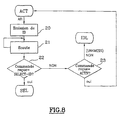
- les figures 7 et 8 sont des organigrammes représentant de façon plus détaillée des états du diagramme de la figure 6.

- étape 10 : le module calcule ou élabore une position de réponse P et attend le moment où la réponse R doit être émise. Pendant cette attente, le module reste à l'écoute des messages pouvant être envoyés par le terminal. Si le module reçoit un message quelconque MESS alors que la réponse R n'est pas encore envoyée, le module se désélectionne et revient à l'état IDL. Comme représenté en figure 7, on peut toutefois prévoir que le module, avant de se désélectionner, vérifie au cours d'une étape de test 11 que le message MESS reçu n'est pas un message de sélection directe DIRSELECT-ID comportant des données d'identification NS qui sont les siennes. Le cas échéant, le module bascule directement dans un état SEL (sélectionné) qui sera décrit plus loin.
- étape 12 : la position de réponse P est atteinte et le module envoie la réponse R.
- étape 13 : le module attend un message du terminal.
- étapes de test 14 et 15 : le module a reçu un message et cherche à reconnaítre ce message. Si le message reçu est une demande d'identification AFI, le module bascule dans un état WFS décrit ci-après. Si le message reçu est une sélection directe DIRSELECT-ID qui le désigne, le module bascule dans l'état SEL. Sinon, le message est un message UNKMESS inconnu ou qui n'est pas prévu à cette étape de fonctionnement, et le module se désélectionne en revenant à l'état IDL.
- le terminal pourrait forcer un module à quitter l'état HALT, par exemple en lui envoyant un message de sélection directe DIRSELECT-ID comme illustré en figure 6, ou, dans le cas d'une alimentation par champ magnétique, en supprimant un bref instant le champ d'alimentation,
- un module dans l'état ACT recevant un message ACTIV ou ACTIVALL pendant l'attente qui précède l'envoi de sa réponse R pourrait rester dans l'état ACT au lieu de revenir à l'état de veille IDL,
- un module dans l'état de veille IDL pourrait basculer dans l'état de sélection SEL sur réception d'un message de sélection directe DIRSELECT-ID le désignant,
- un message d'interrogation générale ACTIVALL ou complémentaire ACTIV pourrait renvoyer dans l'état ACT un module se trouvant dans l'état WFS, SEL ou EXEC.
Claims (20)
- Procédé pour sélectionner un module électronique (M) parmi une pluralité d'au moins deux modules (M1, M2, M3) susceptibles d'émettre des messages simultanément, caractérisé en ce qu'il comprend les étapes consistant à :envoyer un message d'interrogation générale (ACTIVALL) auxdits modules,
les modules étant agencés pour, sur réception d'un message d'interrogation (ACVTIVALL, ACTIV), déterminer une position de réponse (P) aléatoire sur une échelle temporelle de réponse (RSP), puis envoyer un message de réponse (ID, R) quand la position de réponse (P) est atteinte,sélectionner (AFI, SELECT-ID) le module ayant répondu le premier,placer dans un état de veille (IDL) les modules n'ayant pas répondu les premiers. - Procédé selon la revendication 1 dans lequel, quand plusieurs modules ont répondu simultanément à un message d'interrogation (ACTIVALL, ACTIV), il est prévu les étapes consistant à :envoyer un message d'interrogation complémentaire (ACTIV) aux modules ayant répondu les premiers,sélectionner (AFI, SELECT-ID) le module ayant répondu le premier au message d'interrogation complémentaire,placer dans l'état de veille (IDL) les modules n'ayant pas répondu les premiers.
- Procédé selon l'une des revendications précédentes, dans lequel un module se place automatiquement dans un état de veille (IDL) quand il reçoit un message (MESS) avant d'atteindre sa position de réponse (P).
- Procédé selon la revendication 3, dans lequel un module se place également dans un état de veille quand il reçoit un message non identifiable ou non prévu (UNKMESS) après avoir répondu à un message d'interrogation (ACTIVALL, ACTIV).
- Procédé selon l'une des revendications précédentes, dans lequel l'état de veille est caractérisé au moins par le fait qu'un module ne répond pas à un message d'interrogation complémentaire (ACTIV).
- Procédé selon l'une des revendications 1 à 5, dans lequel les modules sont agencés pour envoyer, en réponse à un message d'interrogation (ACTIV, ACTIVALL), un message d'identification (ID) comportant des données d'identification (NS).
- Procédé selon l'une des revendications 1 à 5, dans lequel :les modules sont agencés pour envoyer, en réponse à un message d'interrogation (ACTIV, ACTIVALL), un message de réponse (R) comprenant un faible nombre de bits,une demande d'identification (AFI) est envoyée aux modules immédiatement après la réception d'au moins un message de réponse (R),les modules sont agencés pour envoyer, en réponse à ladite demande d'identification (AFI), un message d'identification (ID) comportant des données d'identification (NS).
- Procédé selon l'une des revendications 6 et 7, dans lequel un message d'interrogation complémentaire (ACTIV) est envoyé quand il est reçu de la pluralité de modules plusieurs messages d'identification (ID).
- Procédé selon l'une des revendications précédentes, comprenant une étape d'envoi au module sélectionné d'un message de confirmation de sélection (SELECT-ID) comportant des données d'identification (NS) du module.
- Procédé selon l'une des revendications précédentes, dans lequel les modules sont agencés pour émettre ledit message de réponse (ID, R) sur une échelle temporelle de réponse (RSP) comprenant une pluralité (Np) de positions de réponse (P0, P1, P2...).
- Procédé selon la revendication 10, dans lequel la durée d'un message de réponse (ID, R) est au maximum égale à l'intervalle de temps séparant deux positions de réponse successives (Pi, Pi+1).
- Procédé selon l'une des revendications 10 et 11, dans lequel ladite position de réponse (P) est élaborée par les modules à partir d'un code aléatoire (ALEXT) inclus dans le message d'interrogation (ACTIVALL, ACTIV).
- Procédé selon la revendication 12, dans lequel la position de réponse (P) est élaborée par les modules au moyen d'une fonction d'authentification (FKs).
- Procédé pour établir une communication entre un terminal et un module électronique caractérisé en ce que, avant de communiquer avec le module, le terminal sélectionne le module au moyen du procédé selon l'une des revendications précédentes.
- Procédé selon la revendication 14, dans lequel un module sélectionné est placé dans un état de blocage (HALT) après une communication.
- Module électronique, caractérisé en ce qu'il est agencé pour, sur réception d'un message d'interrogation (ACTIV, ACTIVALL) ne s'adressant pas en particulier audit module ni en particulier à un autre module :déterminer une position de réponse (P) aléatoire sur une échelle temporelle de réponse (RSP), puis envoyer un message de réponse (ID, R) quand la position de réponse (P) est atteinte,se placer dans un état de veille (IDL) quand un message (MESS) est reçu avant que la position de réponse (P) ne soit atteinte.
- Module électronique selon la revendication 16, agencé pour se placer également dans ledit état de veille (IDL) quand un message non identifiable ou non prévu (UNKMESS) est reçu après avoir répondu à un message d'interrogation (ACTIVALL, ACTIV).
- Terminal électronique, caractérisé en ce qu'il est agencé pour :envoyer un message d'interrogation générale (ACTIVALL, ACTIV) et attendre un message de réponse (ID, R),détecter une éventuelle collision sur un message (ID) reçu,si une collision est détectée, envoyer un message d'interrogation complémentaire (ACTIV) et attendre un nouveau message de réponse (ID, R),si une collision n'est pas détectée, envoyer un message de confirmation de sélection (SELECT-ID) comportant des données d'identification (NS) comprises dans un message d'identification (ID) reçu.
- Terminal selon la revendication 18, agencé pour envoyer une demande d'identification (AFI) sur réception d'un message de réponse (R).
- Terminal selon l'une des revendications 18 et 19, agencé pour inclure un code aléatoire (ALEXT) dans un message d'interrogation (ACTIVALL, ACTIV).
Applications Claiming Priority (3)
| Application Number | Priority Date | Filing Date | Title |
|---|---|---|---|
| FR9605937 | 1996-05-06 | ||
| FR9605937A FR2748333B1 (fr) | 1996-05-06 | 1996-05-06 | Procede pour selectionner un module electronique parmi une pluralite de modules presents dans le champ d'interrogation d'un terminal |
| PCT/FR1997/000802 WO1997042578A1 (fr) | 1996-05-06 | 1997-05-06 | Procede pour selectionner un module electronique parmi une pluralite de modules presents dans le champ d'interrogation d'un terminal |
Publications (2)
| Publication Number | Publication Date |
|---|---|
| EP0897563A1 EP0897563A1 (fr) | 1999-02-24 |
| EP0897563B1 true EP0897563B1 (fr) | 2001-10-24 |
Family
ID=9492085
Family Applications (1)
| Application Number | Title | Priority Date | Filing Date |
|---|---|---|---|
| EP97923141A Expired - Lifetime EP0897563B1 (fr) | 1996-05-06 | 1997-05-06 | Procede pour selectionner un module electronique parmi une pluralite de modules presents dans le champ d'interrogation d'un terminal |
Country Status (11)
| Country | Link |
|---|---|
| US (1) | US6337619B1 (fr) |
| EP (1) | EP0897563B1 (fr) |
| JP (1) | JP3974182B2 (fr) |
| KR (1) | KR100439678B1 (fr) |
| CN (1) | CN1174329C (fr) |
| AT (1) | ATE207633T1 (fr) |
| AU (1) | AU734604B2 (fr) |
| CA (1) | CA2253627C (fr) |
| DE (1) | DE69707664T2 (fr) |
| FR (1) | FR2748333B1 (fr) |
| WO (1) | WO1997042578A1 (fr) |
Families Citing this family (17)
| Publication number | Priority date | Publication date | Assignee | Title |
|---|---|---|---|---|
| FR2809515B1 (fr) * | 2000-05-25 | 2002-08-30 | Gemplus Card Int | Procede de detection d'emissions simultanees d'etiquettes electroniques |
| FR2812482B1 (fr) | 2000-07-28 | 2003-01-24 | Inside Technologies | Dispositif electronique portable comprenant plusieurs circuits integres sans contact |
| US20030020595A1 (en) * | 2001-07-12 | 2003-01-30 | Philips Electronics North America Corp. | System and method for configuration of wireless networks using position information |
| US7506250B2 (en) * | 2002-09-03 | 2009-03-17 | Ricoh Company, Ltd. | Techniques for determining electronic document information for paper documents |
| US7884955B2 (en) * | 2002-09-03 | 2011-02-08 | Ricoh Company, Ltd. | Techniques for performing actions based upon physical locations of paper documents |
| US7652555B2 (en) * | 2002-09-03 | 2010-01-26 | Ricoh Company, Ltd. | Container for storing objects |
| US6860422B2 (en) * | 2002-09-03 | 2005-03-01 | Ricoh Company, Ltd. | Method and apparatus for tracking documents in a workflow |
| US7424974B2 (en) * | 2002-09-03 | 2008-09-16 | Ricoh Company, Ltd. | Techniques that facilitate tracking of physical locations of paper documents |
| US7129840B2 (en) * | 2002-09-03 | 2006-10-31 | Ricoh Company, Ltd. | Document security system |
| US8407097B2 (en) * | 2004-04-15 | 2013-03-26 | Hand Held Products, Inc. | Proximity transaction apparatus and methods of use thereof |
| EP1851675A1 (fr) * | 2005-01-31 | 2007-11-07 | Nxp B.V. | Communication amelioree entre une station de communication et des porteuses de donnees |
| JP5027398B2 (ja) | 2005-09-27 | 2012-09-19 | ルネサスエレクトロニクス株式会社 | Icタグ識別方法 |
| EP2107694A1 (fr) * | 2008-03-31 | 2009-10-07 | STMicroelectronics (Rousset) SAS | Terminal d'émission-réception radiofréquence par couplage inductif |
| JP4812889B1 (ja) * | 2010-06-09 | 2011-11-09 | 三智商事株式会社 | 無線icタグのデータ処理・投入装置 |
| US8325019B2 (en) | 2010-09-13 | 2012-12-04 | Ricoh Company, Ltd. | Motion tracking techniques for RFID tags |
| US9917028B2 (en) | 2011-09-09 | 2018-03-13 | Assa Abloy Ab | Method and apparatus for maintaining operational temperature of an integrated circuit |
| DE102018008227A1 (de) * | 2018-10-17 | 2020-04-23 | Daimler Ag | Verfahren zum Öffnen eines Fahrzeugs |
Family Cites Families (12)
| Publication number | Priority date | Publication date | Assignee | Title |
|---|---|---|---|---|
| JPS58201494A (ja) * | 1982-05-20 | 1983-11-24 | Sharp Corp | 集中監視システムにおける緊急アクセス方式 |
| US4623886A (en) * | 1983-01-21 | 1986-11-18 | E-Systems, Inc. | Prioritized data packet communication |
| US4680753A (en) * | 1985-04-03 | 1987-07-14 | Texas Instruments Incorporated | System and method for controlling network bus communications for input-output interlocking information among distributed programmable controllers |
| US4789926A (en) * | 1985-08-06 | 1988-12-06 | International Business Machines Corporation | Digital data processing arbitration system |
| JP3100716B2 (ja) * | 1991-01-04 | 2000-10-23 | シーエスアイアール | 識別装置 |
| FR2671894A1 (fr) * | 1991-01-18 | 1992-07-24 | Gemplus Card Int | Systeme de communication entre une borne et des mobiles. |
| JPH04360259A (ja) * | 1991-06-06 | 1992-12-14 | Casio Comput Co Ltd | ポーリングによる伝送制御方式 |
| JPH07154411A (ja) * | 1993-11-26 | 1995-06-16 | Nec Corp | ネットワーク情報収集方式 |
| US5602538A (en) * | 1994-07-27 | 1997-02-11 | Texas Instruments Incorporated | Apparatus and method for identifying multiple transponders |
| GB9505810D0 (en) * | 1995-03-22 | 1995-05-10 | Int Computers Ltd | Electronic identification system |
| DE69601588T2 (de) * | 1995-04-18 | 1999-10-07 | Em Microelectronic-Marin S.A., Marin | System zur Identifizierung von Gegenständen |
| DE19526353A1 (de) * | 1995-07-19 | 1997-01-23 | Anatoli Stobbe | Verfahren zur automatischen Identifikation einer unbekannten Anzahl von Transpondern durch einen Leser sowie Identifikationssystem zur Durchführung des Verfahrens |
-
1996
- 1996-05-06 FR FR9605937A patent/FR2748333B1/fr not_active Expired - Fee Related
-
1997
- 1997-05-06 AT AT97923141T patent/ATE207633T1/de not_active IP Right Cessation
- 1997-05-06 KR KR10-1998-0708765A patent/KR100439678B1/ko not_active Expired - Fee Related
- 1997-05-06 CA CA002253627A patent/CA2253627C/fr not_active Expired - Lifetime
- 1997-05-06 DE DE69707664T patent/DE69707664T2/de not_active Expired - Lifetime
- 1997-05-06 CN CNB971961026A patent/CN1174329C/zh not_active Expired - Lifetime
- 1997-05-06 EP EP97923141A patent/EP0897563B1/fr not_active Expired - Lifetime
- 1997-05-06 WO PCT/FR1997/000802 patent/WO1997042578A1/fr not_active Ceased
- 1997-05-06 JP JP53959697A patent/JP3974182B2/ja not_active Expired - Fee Related
- 1997-05-06 AU AU29021/97A patent/AU734604B2/en not_active Ceased
-
1998
- 1998-11-06 US US09/187,517 patent/US6337619B1/en not_active Expired - Lifetime
Also Published As
| Publication number | Publication date |
|---|---|
| DE69707664T2 (de) | 2002-08-08 |
| ATE207633T1 (de) | 2001-11-15 |
| FR2748333B1 (fr) | 1998-11-27 |
| JP2001504284A (ja) | 2001-03-27 |
| DE69707664D1 (de) | 2001-11-29 |
| JP3974182B2 (ja) | 2007-09-12 |
| FR2748333A1 (fr) | 1997-11-07 |
| WO1997042578A1 (fr) | 1997-11-13 |
| AU2902197A (en) | 1997-11-26 |
| KR100439678B1 (ko) | 2004-09-18 |
| CN1174329C (zh) | 2004-11-03 |
| CA2253627A1 (fr) | 1997-11-13 |
| AU734604B2 (en) | 2001-06-21 |
| EP0897563A1 (fr) | 1999-02-24 |
| KR20000010692A (ko) | 2000-02-25 |
| CA2253627C (fr) | 2006-08-29 |
| CN1224519A (zh) | 1999-07-28 |
| US6337619B1 (en) | 2002-01-08 |
Similar Documents
| Publication | Publication Date | Title |
|---|---|---|
| CA2253627C (fr) | Procede pour selectionner un module electronique parmi une pluralite de modules presents dans le champ d'interrogation d'un terminal | |
| EP1369812B1 (fr) | Procédé anticollision pour module électronique sans contact | |
| EP0495708B1 (fr) | Système de communication entre une borne et des mobiles | |
| EP1008252A1 (fr) | Procede et systeme pour securiser les serveurs informatiques de jeux | |
| EP1774458A1 (fr) | Modulation de charge dans un transpondeur electromagnetique | |
| EP1016023A1 (fr) | Procede de gestion des collisions dans un systeme d'echange de donnees sans contact | |
| EP0935222B1 (fr) | Procédé d'identification de cartes électroniques présentes dans une zone d'investigation | |
| EP0472472B1 (fr) | Dispositif pour le dialogue à distance entre une station et un ou plusieurs objets portatifs | |
| EP1257964B1 (fr) | Procede de lecture d'etiquettes electroniques par identification simultanee de leur code | |
| EP0718778A1 (fr) | Procédure de transmission de données par bus | |
| EP0957442B1 (fr) | Système d'identification électronique d'une pluralité de transpondeurs | |
| EP1163625A1 (fr) | Maintien d'un canal avec anticollision dans un systeme d'identification electronique | |
| EP1783693B1 (fr) | Procédé de transfert des données d'un chronotachygraphe | |
| CA2529134C (fr) | Procede de gestion d'une pluralite de lecteurs de jetons a puce electronique et equipements de mise en oeuvre dudit procede | |
| EP1256095B1 (fr) | Puce electronique pour objet portatif | |
| EP0997835B1 (fr) | Procédé d'identification de cartes électroniques | |
| EP1862945B1 (fr) | Dispositif d'identification électronique ou transpondeur muni de deux antennes accordées à des fréquences différentes | |
| FR2745965A1 (fr) | Procede d'authentification d'un emetteur au cours d'une communication a un seul sens | |
| EP1302889B1 (fr) | Transpondeur et procédé de gestion associé atténuants du bruit émis | |
| EP0870279B1 (fr) | Dispositif portatif d'acces a au moins un service dispense par un serveur | |
| FR2776095A1 (fr) | Procede et systeme de lecture multiple d'un ensemble dynamique d'etiquettes avec synchronisation de communication entre les etiquettes et le lecteur | |
| WO2000054209A1 (fr) | Transpondeur et gestionnaire d'archives utilisant de tels transpondeurs | |
| FR2776409A1 (fr) | Systeme et procede d'identification de produits par identifiant aleatoire | |
| FR2928759A1 (fr) | Systeme de paiement electronique a carte sans contact | |
| FR2675324A1 (fr) | Procede et dispositif pour la resolution de collisions au cours d'une transmission de messages entre differentes stations, a travers un reseau local a diffusion. |
Legal Events
| Date | Code | Title | Description |
|---|---|---|---|
| PUAI | Public reference made under article 153(3) epc to a published international application that has entered the european phase |
Free format text: ORIGINAL CODE: 0009012 |
|
| 17P | Request for examination filed |
Effective date: 19981031 |
|
| AK | Designated contracting states |
Kind code of ref document: A1 Designated state(s): AT BE CH DE ES FR GB IT LI NL |
|
| GRAG | Despatch of communication of intention to grant |
Free format text: ORIGINAL CODE: EPIDOS AGRA |
|
| 17Q | First examination report despatched |
Effective date: 20000623 |
|
| GRAG | Despatch of communication of intention to grant |
Free format text: ORIGINAL CODE: EPIDOS AGRA |
|
| GRAH | Despatch of communication of intention to grant a patent |
Free format text: ORIGINAL CODE: EPIDOS IGRA |
|
| GRAH | Despatch of communication of intention to grant a patent |
Free format text: ORIGINAL CODE: EPIDOS IGRA |
|
| GRAA | (expected) grant |
Free format text: ORIGINAL CODE: 0009210 |
|
| AK | Designated contracting states |
Kind code of ref document: B1 Designated state(s): AT BE CH DE ES FR GB IT LI NL |
|
| PG25 | Lapsed in a contracting state [announced via postgrant information from national office to epo] |
Ref country code: NL Free format text: LAPSE BECAUSE OF FAILURE TO SUBMIT A TRANSLATION OF THE DESCRIPTION OR TO PAY THE FEE WITHIN THE PRESCRIBED TIME-LIMIT Effective date: 20011024 Ref country code: IT Free format text: LAPSE BECAUSE OF FAILURE TO SUBMIT A TRANSLATION OF THE DESCRIPTION OR TO PAY THE FEE WITHIN THE PRE;WARNING: LAPSES OF ITALIAN PATENTS WITH EFFECTIVE DATE BEFORE 2007 MAY HAVE OCCURRED AT ANY TIME BEFORE 2007. THE CORRECT EFFECTIVE DATE MAY BE DIFFERENT FROM THE ONE RECORDED.SCRIBED TIME-LIMIT Effective date: 20011024 Ref country code: AT Free format text: LAPSE BECAUSE OF FAILURE TO SUBMIT A TRANSLATION OF THE DESCRIPTION OR TO PAY THE FEE WITHIN THE PRESCRIBED TIME-LIMIT Effective date: 20011024 |
|
| REF | Corresponds to: |
Ref document number: 207633 Country of ref document: AT Date of ref document: 20011115 Kind code of ref document: T |
|
| REG | Reference to a national code |
Ref country code: CH Ref legal event code: EP |
|
| REF | Corresponds to: |
Ref document number: 69707664 Country of ref document: DE Date of ref document: 20011129 |
|
| REG | Reference to a national code |
Ref country code: GB Ref legal event code: IF02 |
|
| GBT | Gb: translation of ep patent filed (gb section 77(6)(a)/1977) |
Effective date: 20020122 |
|
| NLV1 | Nl: lapsed or annulled due to failure to fulfill the requirements of art. 29p and 29m of the patents act | ||
| PG25 | Lapsed in a contracting state [announced via postgrant information from national office to epo] |
Ref country code: ES Free format text: LAPSE BECAUSE OF FAILURE TO SUBMIT A TRANSLATION OF THE DESCRIPTION OR TO PAY THE FEE WITHIN THE PRESCRIBED TIME-LIMIT Effective date: 20020430 |
|
| PG25 | Lapsed in a contracting state [announced via postgrant information from national office to epo] |
Ref country code: BE Free format text: LAPSE BECAUSE OF NON-PAYMENT OF DUE FEES Effective date: 20020531 |
|
| PLBE | No opposition filed within time limit |
Free format text: ORIGINAL CODE: 0009261 |
|
| STAA | Information on the status of an ep patent application or granted ep patent |
Free format text: STATUS: NO OPPOSITION FILED WITHIN TIME LIMIT |
|
| 26N | No opposition filed | ||
| REG | Reference to a national code |
Ref country code: FR Ref legal event code: CD Ref country code: FR Ref legal event code: CA |
|
| REG | Reference to a national code |
Ref country code: CH Ref legal event code: PFA Owner name: INSIDE CONTACTLESS Free format text: INSIDE TECHNOLOGIES#PEPINIERE AXONE#69930 SAINT-CLEMENT-LES-PLACES (FR) -TRANSFER TO- INSIDE CONTACTLESS#BAT. 11 A - PARC CLUB DU GOLF#13856 AIX-EN-PROVENCE CEDEX 3 (FR) |
|
| PGFP | Annual fee paid to national office [announced via postgrant information from national office to epo] |
Ref country code: CH Payment date: 20090429 Year of fee payment: 13 |
|
| REG | Reference to a national code |
Ref country code: CH Ref legal event code: PL |
|
| PG25 | Lapsed in a contracting state [announced via postgrant information from national office to epo] |
Ref country code: LI Free format text: LAPSE BECAUSE OF NON-PAYMENT OF DUE FEES Effective date: 20100531 Ref country code: CH Free format text: LAPSE BECAUSE OF NON-PAYMENT OF DUE FEES Effective date: 20100531 |
|
| REG | Reference to a national code |
Ref country code: DE Ref legal event code: R082 Ref document number: 69707664 Country of ref document: DE Representative=s name: HOFFMANN - EITLE, DE |
|
| REG | Reference to a national code |
Ref country code: DE Ref legal event code: R082 Ref document number: 69707664 Country of ref document: DE Representative=s name: HOFFMANN - EITLE PATENT- UND RECHTSANWAELTE PA, DE Effective date: 20131111 Ref country code: DE Ref legal event code: R082 Ref document number: 69707664 Country of ref document: DE Representative=s name: HOFFMANN - EITLE, DE Effective date: 20131111 Ref country code: DE Ref legal event code: R081 Ref document number: 69707664 Country of ref document: DE Owner name: INSIDE SECURE, FR Free format text: FORMER OWNER: INSIDE TECHNOLOGIES, SAINT-CLEMENT-LES-PLACES, FR Effective date: 20131111 |
|
| REG | Reference to a national code |
Ref country code: FR Ref legal event code: CD Owner name: INSIDE SECURE Effective date: 20140129 Ref country code: FR Ref legal event code: CA Effective date: 20140129 |
|
| REG | Reference to a national code |
Ref country code: FR Ref legal event code: PLFP Year of fee payment: 20 |
|
| PGFP | Annual fee paid to national office [announced via postgrant information from national office to epo] |
Ref country code: GB Payment date: 20160426 Year of fee payment: 20 Ref country code: DE Payment date: 20160421 Year of fee payment: 20 |
|
| PGFP | Annual fee paid to national office [announced via postgrant information from national office to epo] |
Ref country code: FR Payment date: 20160518 Year of fee payment: 20 |
|
| REG | Reference to a national code |
Ref country code: DE Ref legal event code: R071 Ref document number: 69707664 Country of ref document: DE |
|
| REG | Reference to a national code |
Ref country code: GB Ref legal event code: PE20 Expiry date: 20170505 |
|
| PG25 | Lapsed in a contracting state [announced via postgrant information from national office to epo] |
Ref country code: GB Free format text: LAPSE BECAUSE OF EXPIRATION OF PROTECTION Effective date: 20170505 |
|
| REG | Reference to a national code |
Ref country code: FR Ref legal event code: TP Owner name: WISEKEY SEMICONDUCTORS, FR Effective date: 20170727 Ref country code: FR Ref legal event code: CD Owner name: WISEKEY SEMICONDUCTORS, FR Effective date: 20170727 |