EP0896377B1 - Carbonaceous negative electrode material for nonaqueous secondary battery, process for producing the same, and nonaqueous secondary battery - Google Patents
Carbonaceous negative electrode material for nonaqueous secondary battery, process for producing the same, and nonaqueous secondary battery Download PDFInfo
- Publication number
- EP0896377B1 EP0896377B1 EP98114717A EP98114717A EP0896377B1 EP 0896377 B1 EP0896377 B1 EP 0896377B1 EP 98114717 A EP98114717 A EP 98114717A EP 98114717 A EP98114717 A EP 98114717A EP 0896377 B1 EP0896377 B1 EP 0896377B1
- Authority
- EP
- European Patent Office
- Prior art keywords
- negative electrode
- electrode material
- carbonaceous
- heat treatment
- heating
- Prior art date
- Legal status (The legal status is an assumption and is not a legal conclusion. Google has not performed a legal analysis and makes no representation as to the accuracy of the status listed.)
- Expired - Lifetime
Links
- 239000007773 negative electrode material Substances 0.000 title claims description 57
- 238000000034 method Methods 0.000 title claims description 28
- 230000008569 process Effects 0.000 title claims description 26
- 238000010438 heat treatment Methods 0.000 claims description 125
- 239000002245 particle Substances 0.000 claims description 67
- 239000003575 carbonaceous material Substances 0.000 claims description 38
- 239000012298 atmosphere Substances 0.000 claims description 33
- 239000011148 porous material Substances 0.000 claims description 24
- 239000007789 gas Substances 0.000 claims description 17
- 239000011261 inert gas Substances 0.000 claims description 17
- 230000001590 oxidative effect Effects 0.000 claims description 13
- HBBGRARXTFLTSG-UHFFFAOYSA-N Lithium ion Chemical group [Li+] HBBGRARXTFLTSG-UHFFFAOYSA-N 0.000 claims description 12
- 229910001416 lithium ion Inorganic materials 0.000 claims description 12
- 239000000126 substance Substances 0.000 claims description 8
- 238000004939 coking Methods 0.000 claims description 7
- 239000003245 coal Substances 0.000 claims description 4
- 239000003208 petroleum Substances 0.000 claims description 4
- 238000002441 X-ray diffraction Methods 0.000 claims description 3
- 239000013078 crystal Substances 0.000 claims description 3
- IJGRMHOSHXDMSA-UHFFFAOYSA-N Atomic nitrogen Chemical compound N#N IJGRMHOSHXDMSA-UHFFFAOYSA-N 0.000 description 26
- 229910052757 nitrogen Inorganic materials 0.000 description 13
- 239000002010 green coke Substances 0.000 description 12
- 238000003763 carbonization Methods 0.000 description 9
- 238000009830 intercalation Methods 0.000 description 7
- ZMXDDKWLCZADIW-UHFFFAOYSA-N N,N-Dimethylformamide Chemical compound CN(C)C=O ZMXDDKWLCZADIW-UHFFFAOYSA-N 0.000 description 6
- 230000002687 intercalation Effects 0.000 description 6
- 238000005259 measurement Methods 0.000 description 6
- 238000010298 pulverizing process Methods 0.000 description 6
- 238000011282 treatment Methods 0.000 description 6
- WHXSMMKQMYFTQS-UHFFFAOYSA-N Lithium Chemical compound [Li] WHXSMMKQMYFTQS-UHFFFAOYSA-N 0.000 description 5
- 239000011280 coal tar Substances 0.000 description 5
- 230000000052 comparative effect Effects 0.000 description 5
- 230000000694 effects Effects 0.000 description 5
- 239000010419 fine particle Substances 0.000 description 5
- 229910052744 lithium Inorganic materials 0.000 description 5
- -1 polytetrafluoroethylene Polymers 0.000 description 5
- 230000015572 biosynthetic process Effects 0.000 description 4
- 238000001354 calcination Methods 0.000 description 4
- 239000000571 coke Substances 0.000 description 4
- 239000002994 raw material Substances 0.000 description 4
- 239000002904 solvent Substances 0.000 description 4
- 229910001220 stainless steel Inorganic materials 0.000 description 4
- 239000010935 stainless steel Substances 0.000 description 4
- 150000001875 compounds Chemical class 0.000 description 3
- 239000003792 electrolyte Substances 0.000 description 3
- 239000008151 electrolyte solution Substances 0.000 description 3
- 239000007770 graphite material Substances 0.000 description 3
- 239000000463 material Substances 0.000 description 3
- 239000000203 mixture Substances 0.000 description 3
- 150000002894 organic compounds Chemical class 0.000 description 3
- 238000007254 oxidation reaction Methods 0.000 description 3
- 238000001179 sorption measurement Methods 0.000 description 3
- XTHFKEDIFFGKHM-UHFFFAOYSA-N Dimethoxyethane Chemical compound COCCOC XTHFKEDIFFGKHM-UHFFFAOYSA-N 0.000 description 2
- IAZDPXIOMUYVGZ-UHFFFAOYSA-N Dimethylsulphoxide Chemical compound CS(C)=O IAZDPXIOMUYVGZ-UHFFFAOYSA-N 0.000 description 2
- 229910001290 LiPF6 Inorganic materials 0.000 description 2
- SECXISVLQFMRJM-UHFFFAOYSA-N N-Methylpyrrolidone Chemical compound CN1CCCC1=O SECXISVLQFMRJM-UHFFFAOYSA-N 0.000 description 2
- UFWIBTONFRDIAS-UHFFFAOYSA-N Naphthalene Chemical compound C1=CC=CC2=CC=CC=C21 UFWIBTONFRDIAS-UHFFFAOYSA-N 0.000 description 2
- 239000002033 PVDF binder Substances 0.000 description 2
- WYURNTSHIVDZCO-UHFFFAOYSA-N Tetrahydrofuran Chemical compound C1CCOC1 WYURNTSHIVDZCO-UHFFFAOYSA-N 0.000 description 2
- WGLPBDUCMAPZCE-UHFFFAOYSA-N Trioxochromium Chemical compound O=[Cr](=O)=O WGLPBDUCMAPZCE-UHFFFAOYSA-N 0.000 description 2
- MWPLVEDNUUSJAV-UHFFFAOYSA-N anthracene Chemical compound C1=CC=CC2=CC3=CC=CC=C3C=C21 MWPLVEDNUUSJAV-UHFFFAOYSA-N 0.000 description 2
- 239000011230 binding agent Substances 0.000 description 2
- 229910052799 carbon Inorganic materials 0.000 description 2
- 238000006243 chemical reaction Methods 0.000 description 2
- 230000003247 decreasing effect Effects 0.000 description 2
- 238000009826 distribution Methods 0.000 description 2
- 239000011888 foil Substances 0.000 description 2
- YBMRDBCBODYGJE-UHFFFAOYSA-N germanium dioxide Chemical compound O=[Ge]=O YBMRDBCBODYGJE-UHFFFAOYSA-N 0.000 description 2
- 230000006872 improvement Effects 0.000 description 2
- NUJOXMJBOLGQSY-UHFFFAOYSA-N manganese dioxide Chemical compound O=[Mn]=O NUJOXMJBOLGQSY-UHFFFAOYSA-N 0.000 description 2
- 229920001343 polytetrafluoroethylene Polymers 0.000 description 2
- 239000004810 polytetrafluoroethylene Substances 0.000 description 2
- 229920002981 polyvinylidene fluoride Polymers 0.000 description 2
- RUOJZAUFBMNUDX-UHFFFAOYSA-N propylene carbonate Chemical compound CC1COC(=O)O1 RUOJZAUFBMNUDX-UHFFFAOYSA-N 0.000 description 2
- 239000000243 solution Substances 0.000 description 2
- WNXJIVFYUVYPPR-UHFFFAOYSA-N 1,3-dioxolane Chemical compound C1COCO1 WNXJIVFYUVYPPR-UHFFFAOYSA-N 0.000 description 1
- OKTJSMMVPCPJKN-UHFFFAOYSA-N Carbon Chemical compound [C] OKTJSMMVPCPJKN-UHFFFAOYSA-N 0.000 description 1
- RYGMFSIKBFXOCR-UHFFFAOYSA-N Copper Chemical compound [Cu] RYGMFSIKBFXOCR-UHFFFAOYSA-N 0.000 description 1
- VGGSQFUCUMXWEO-UHFFFAOYSA-N Ethene Chemical compound C=C VGGSQFUCUMXWEO-UHFFFAOYSA-N 0.000 description 1
- 239000005977 Ethylene Substances 0.000 description 1
- 229910032387 LiCoO2 Inorganic materials 0.000 description 1
- FXHOOIRPVKKKFG-UHFFFAOYSA-N N,N-Dimethylacetamide Chemical compound CN(C)C(C)=O FXHOOIRPVKKKFG-UHFFFAOYSA-N 0.000 description 1
- 229910019750 Nb3S4 Inorganic materials 0.000 description 1
- 239000004698 Polyethylene Substances 0.000 description 1
- 239000004743 Polypropylene Substances 0.000 description 1
- 229910003069 TeO2 Inorganic materials 0.000 description 1
- 229910003092 TiS2 Inorganic materials 0.000 description 1
- OJIJEKBXJYRIBZ-UHFFFAOYSA-N cadmium nickel Chemical compound [Ni].[Cd] OJIJEKBXJYRIBZ-UHFFFAOYSA-N 0.000 description 1
- 238000004523 catalytic cracking Methods 0.000 description 1
- 210000004027 cell Anatomy 0.000 description 1
- 239000011294 coal tar pitch Substances 0.000 description 1
- 239000011889 copper foil Substances 0.000 description 1
- 230000009849 deactivation Effects 0.000 description 1
- 238000009831 deintercalation Methods 0.000 description 1
- 230000003111 delayed effect Effects 0.000 description 1
- 210000001787 dendrite Anatomy 0.000 description 1
- 230000001419 dependent effect Effects 0.000 description 1
- 238000001035 drying Methods 0.000 description 1
- 239000000428 dust Substances 0.000 description 1
- 239000007772 electrode material Substances 0.000 description 1
- 230000007613 environmental effect Effects 0.000 description 1
- 238000011156 evaluation Methods 0.000 description 1
- 230000001747 exhibiting effect Effects 0.000 description 1
- 238000004880 explosion Methods 0.000 description 1
- 238000002309 gasification Methods 0.000 description 1
- 239000011521 glass Substances 0.000 description 1
- 229910002804 graphite Inorganic materials 0.000 description 1
- 239000010439 graphite Substances 0.000 description 1
- 229910052736 halogen Inorganic materials 0.000 description 1
- 150000002367 halogens Chemical class 0.000 description 1
- 229910052739 hydrogen Inorganic materials 0.000 description 1
- 239000001257 hydrogen Substances 0.000 description 1
- 239000012212 insulator Substances 0.000 description 1
- 239000007788 liquid Substances 0.000 description 1
- MHCFAGZWMAWTNR-UHFFFAOYSA-M lithium perchlorate Chemical compound [Li+].[O-]Cl(=O)(=O)=O MHCFAGZWMAWTNR-UHFFFAOYSA-M 0.000 description 1
- 229910001486 lithium perchlorate Inorganic materials 0.000 description 1
- 229910001496 lithium tetrafluoroborate Inorganic materials 0.000 description 1
- 238000004519 manufacturing process Methods 0.000 description 1
- 229910052960 marcasite Inorganic materials 0.000 description 1
- 230000007246 mechanism Effects 0.000 description 1
- 229910021382 natural graphite Inorganic materials 0.000 description 1
- 239000012299 nitrogen atmosphere Substances 0.000 description 1
- 239000004745 nonwoven fabric Substances 0.000 description 1
- 239000003960 organic solvent Substances 0.000 description 1
- 230000003647 oxidation Effects 0.000 description 1
- 235000011837 pasties Nutrition 0.000 description 1
- 239000008188 pellet Substances 0.000 description 1
- 229920000573 polyethylene Polymers 0.000 description 1
- 229920001155 polypropylene Polymers 0.000 description 1
- 239000007774 positive electrode material Substances 0.000 description 1
- 239000000843 powder Substances 0.000 description 1
- 239000002243 precursor Substances 0.000 description 1
- 238000003825 pressing Methods 0.000 description 1
- 239000011802 pulverized particle Substances 0.000 description 1
- NIFIFKQPDTWWGU-UHFFFAOYSA-N pyrite Chemical compound [Fe+2].[S-][S-] NIFIFKQPDTWWGU-UHFFFAOYSA-N 0.000 description 1
- 229910052683 pyrite Inorganic materials 0.000 description 1
- 230000009467 reduction Effects 0.000 description 1
- 229920003051 synthetic elastomer Polymers 0.000 description 1
- 239000005061 synthetic rubber Substances 0.000 description 1
- LAJZODKXOMJMPK-UHFFFAOYSA-N tellurium dioxide Chemical compound O=[Te]=O LAJZODKXOMJMPK-UHFFFAOYSA-N 0.000 description 1
- YLQBMQCUIZJEEH-UHFFFAOYSA-N tetrahydrofuran Natural products C=1C=COC=1 YLQBMQCUIZJEEH-UHFFFAOYSA-N 0.000 description 1
- XLYOFNOQVPJJNP-UHFFFAOYSA-N water Substances O XLYOFNOQVPJJNP-UHFFFAOYSA-N 0.000 description 1
Images
Classifications
-
- H—ELECTRICITY
- H01—ELECTRIC ELEMENTS
- H01M—PROCESSES OR MEANS, e.g. BATTERIES, FOR THE DIRECT CONVERSION OF CHEMICAL ENERGY INTO ELECTRICAL ENERGY
- H01M4/00—Electrodes
- H01M4/02—Electrodes composed of, or comprising, active material
- H01M4/36—Selection of substances as active materials, active masses, active liquids
- H01M4/58—Selection of substances as active materials, active masses, active liquids of inorganic compounds other than oxides or hydroxides, e.g. sulfides, selenides, tellurides, halogenides or LiCoFy; of polyanionic structures, e.g. phosphates, silicates or borates
- H01M4/583—Carbonaceous material, e.g. graphite-intercalation compounds or CFx
-
- H—ELECTRICITY
- H01—ELECTRIC ELEMENTS
- H01M—PROCESSES OR MEANS, e.g. BATTERIES, FOR THE DIRECT CONVERSION OF CHEMICAL ENERGY INTO ELECTRICAL ENERGY
- H01M4/00—Electrodes
- H01M4/02—Electrodes composed of, or comprising, active material
- H01M4/13—Electrodes for accumulators with non-aqueous electrolyte, e.g. for lithium-accumulators; Processes of manufacture thereof
-
- H—ELECTRICITY
- H01—ELECTRIC ELEMENTS
- H01M—PROCESSES OR MEANS, e.g. BATTERIES, FOR THE DIRECT CONVERSION OF CHEMICAL ENERGY INTO ELECTRICAL ENERGY
- H01M10/00—Secondary cells; Manufacture thereof
- H01M10/05—Accumulators with non-aqueous electrolyte
- H01M10/052—Li-accumulators
-
- Y—GENERAL TAGGING OF NEW TECHNOLOGICAL DEVELOPMENTS; GENERAL TAGGING OF CROSS-SECTIONAL TECHNOLOGIES SPANNING OVER SEVERAL SECTIONS OF THE IPC; TECHNICAL SUBJECTS COVERED BY FORMER USPC CROSS-REFERENCE ART COLLECTIONS [XRACs] AND DIGESTS
- Y02—TECHNOLOGIES OR APPLICATIONS FOR MITIGATION OR ADAPTATION AGAINST CLIMATE CHANGE
- Y02E—REDUCTION OF GREENHOUSE GAS [GHG] EMISSIONS, RELATED TO ENERGY GENERATION, TRANSMISSION OR DISTRIBUTION
- Y02E60/00—Enabling technologies; Technologies with a potential or indirect contribution to GHG emissions mitigation
- Y02E60/10—Energy storage using batteries
Definitions
- This invention relates to a carbonaceous negative electrode material for nonaqueous secondary batteries, a process for producing the negative electrode material, and a nonaqueous secondary battery containing the negative electrode material. More particularly, it relates to a carbonaceous material having a specific micropore size distribution and amount which is particularly suited as a negative electrode material of nonaqueous secondary batteries, a process for producing the same, and a nonaqueous secondary battery typified by a lithium ionsecondary battery, which is suitable for use in compact and light electronic equipment.
- the carboneous materials and the graphite materials can be seen as promising as high-capacity and low-cost negative electrode materials.
- carbonaceous materials are relatively inexpensive and safe and have a high charge capacity in the initial stage of use, their charge and discharge capacity in the later stage is about 2/3 of the theoretical capacity density of carbon-graphite materials (372 mAh/g). Batteries containing the conventional carbonaceous materials are not satisfactory in charge and discharge capacity and efficiency, leaving room for improvement.
- the inventors of the present invention previously found that the high initial charge capacity of a carbonaceous material owes to its volatile matter, that the volatile matter which is released on heating is partly carbonized to interfere with the manifestation of the capacity of the carbonaceous material, and that the volatile matter can be removed efficiently by pulverizing the carbonaceous material followed by heating at a high temperature (calcination) thereby to suppress remaining of the carbonized volatile matter.
- the inventors have reached the findings that the remained volatile matter, especially free organic high-molecular substances, which has been a main cause of the above-mentioned problem can be removed efficiently by subjecting fine carbonaceous powder to specific heat treatment to obtain a carbonaceous material having a controlled micropore size distribution and thereby exhibiting improved charge and discharge capacity and efficiency when used as a negative electrode material in a nonaqueous secondary battery.
- the present invention provides a carbonaceous negative electrode material for nonaqueous secondary batteries having (i) not less than 2 x 10 -4 cc/g of pores having a diameter of smaller than 8 A and (ii) not more than 15 x 10 -4 cc/g of pores having a diameter of 8 to 18 A.
- the present invention further provides a nonaqueous secondary battery containing the carbonaceous material as a negative electrode material.
- the present invention furthermore provides a process for producing a carbonaceous negative electrode material for nonaqueous secondary batteries comprising heating a particulate carbonaceous material having an average particle size of not greater than 100 ⁇ m at a temperature of 300 to 550°C in an inert gas atmosphere and then heating (calcining) the particles at a temperature of 700 to 1500°C in an inert gas atmosphere (hereinafter referred to as a first process), or heating a particulate carbonaceous material having an average particle size of not greater than 100 ⁇ m at a temperature of 50 to 400°C in an oxidative atmosphere and then heating (calcining) the particles at a temperature of 700 to 1500°C in an inert gas atmosphere (hereinafter referred to as a second process).
- the heating at 50 to 400°C in an oxidizing gas atmosphere can be preceded and/or followed by a heat treatment at a temperature of 250 to 650°C in an inert gas atmosphere (hereinafter referred to as a third process).
- a negative electrode material for nonaqueous secondary batteries having a high capacity and a high efficiency can be obtained with ease from inexpensive carbonaceous raw materials.
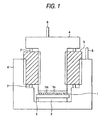
- Fig. 1 is a cross section of a button type nonaqueous secondary battery.
- the carbonaceous material which can be used as a raw material in the present invention includes coke obtained by coking heavy petroleum fractions, such as FCC (fluidized bed catalytic cracking) residual oil, EHE oil (by-produced oil in ethylene production), atmospheric residual oil, and low pressure residual oil; heavy coal fractions, such as coal tar and coal tar pitch; or tarry substances obtained by heating polycyclic aromatic 5 compounds, such as naphthalene and anthracene, in a delayed coker, an autoclave, etc. at about 400 to 500°C.
- heavy petroleum fractions such as FCC (fluidized bed catalytic cracking) residual oil, EHE oil (by-produced oil in ethylene production), atmospheric residual oil, and low pressure residual oil
- heavy coal fractions such as coal tar and coal tar pitch
- tarry substances obtained by heating polycyclic aromatic 5 compounds, such as naphthalene and anthracene in a delayed coker, an autoclave, etc. at about 400 to 500°C
- these carbonaceous raw materials prefferably have a volatile content of not greater than 30% by weight, particularly not greater than 15% by weight, especially not greater than 10% by weight.
- a volatile content of not greater than 30% by weight particularly not greater than 15% by weight, especially not greater than 10% by weight.
- the effects of the present invention can be obtained even in using a raw material having a volatile content exceeding 30%. In this case, however, a long time would be required for a first stage heat treatment, the finely particulate carbonaceous material may tend to be fused on heating to make release of the volatile matter difficult or dust explosion of the particulate carbonaceous material may tend to occur during pulverization.
- the carbonaceous negative electrode material of the present invention can be obtained by pulverizing the raw carbonaceous material and subjecting the resulting particulate carbonaceous material to at least two-divided heat treatments. Pulverization prior to heat treatment is of importance. Pulverization is carried out to reduce the average particle size to 100 ⁇ m or smaller, preferably 50 ⁇ m or smaller. The practical lower limit of the pulverized particle size is 1 ⁇ m.
- the manner of pulverization and operations for particle size regulation, such as classification, are not particularly limited. For example, commonly employed pulverizers, such as an impact pulverizer and an attrition mill, and various air classifiers, such as a sieve, can be used.
- the resulting particles do not practically contain particles of 500 ⁇ m or greater, particularly 200 ⁇ m or greater.
- maximum diameter of the particles excesses 500 ⁇ m removal efficiency of volatile matter is easy to be lowered and it is difficult to obtain an electrode having a uniform thickness. Further it is more difficult to make the thickness of the electrode thinner so that the surface area of the electrode is enlarged.
- the pulverized carbonaceous material is subjected to a first stage heat treatment at 300 to 550°C in an inert gas atmosphere and then to a second stage heat treatment at 700 to 1500°C in an inert gas atmosphere (two-stage heat treatment) .
- the first stage heat treatment is usually performed in a rotary kiln, an electric furnace, etc.
- a preferred heating temperature of the first stage heat treatment is 400 to 550°C.
- the heating time varies depending on the particle size or the state of the particles to be heated. The heating is continued until the volatile matter is substantially eliminated at a heating temperature selected from the range 300 to 550°C, usually until the volatile content is reduced to 1% by weight or lower, which usually takes 5 hours at the longest.
- the particles In order to facilitate release of the volatile matter by heating, it is preferable to put the particles in a layer as thin as about 50 mm or less, to agitate the particles so that the particle surface may always be in contact with air, or to fluidize the particles by gas. It is also preferred to add an auxiliary means for removing the released volatile matter by conducting the heat treatment under low pressure or to sweep the released volatile matter with a large quantity of gas.
- the particles are then subjected to a second stage heat treatment at 700 to 1500°C in an inert gas atmosphere.
- the heating means is not particularly limited and includes a rotary kiln and an electric furnace similarly to the first stage heat treatment.
- the second stage heat treatment may be carried out in a system separate from the first stage heat treatment or a system continuous from the first stage heat treatment. In the latter case, it is desirable to take care to prevent the vapor released in the first stage treatment from entering the second heating zone and from being re-carbonized and re-deposited.
- the second stage heat treatment should be conducted in a substantially inert atmosphere.
- a preferred heating temperature is 800 to 1200°C. While dependent on the desired battery performance, a still preferred heating temperature is 1000 to 1200°C. The heating is continued until the carbonization reaction completes substantially at a temperature selected, usually for a period of 15 minutes to 2 hours.
- the particles In order to release any volatile matter remaining after the first stage heat treatment early and rapidly, it is preferable to put the particles in a layer as thin as about 50 mm or less, to agitate the particles so that the particle surface may always be in contact with air, or to fluidize the particles by gas. For the same purpose, it is also preferred to conduct the heat treatment under low pressure or to sweep the remained volatile matter with a large quantity of gas.
- the pulverized carbonaceous material is first subjected to a heat treatment at 50 to 400°C in an oxidizing gas atmosphere (hereinafter sometimes referred to as a first stage heat treatment (an oxidizing gas treatment)), which is usually carried out, while not limiting, in a rotary kiln, an electric furnace or a drying apparatus.
- a first stage heat treatment an oxidizing gas treatment
- the heating temperature and time vary depending on the particle size or the state of the particles and the kind of the oxidizing gas used.
- the treatment is usually performed at a temperature of 250 to 400°C for 30 minutes to 10 hours.
- NO x , SO x , halogen gas, etc. in combination with air the treatment is usually conducted at a temperature of 50 to 200°C for about 15 minutes to 3 hours.
- the heating conditions are of necessity not limited to these ranges and can be selected appropriately according to the desired degree of treatment.
- the first stage heat treatment is preferably carried out with the particles made into a layer as thin as about 50 mm or less or while agitating the particles to always maintain the particles in contact with air or fluidizing the particles by gas thereby to facilitate uniform progress of the oxidation reaction and release of the volatile matter.
- the first stage heat treatment of the second process is the same as the first stage heat treatment of the first process in that the volatile matter is released by heating.
- the volatile matter simultaneously undergoes oxidation to have a structure easier to release by heating (to have such a chemical bond as an -O- bond) .
- the volatile matter is released more easily, and the residual volatile matter that cannot be released by the first stage heat treatment will be released long before the start of carbonization induced by the subsequent second stage heat treatment in an inert gas atmosphere.
- the second process achieves an increased volume of micropores in which lithium ion is intercalated probably because the chemical bond is also formed among the carbonaceous microcrystallites by the oxidation reaction and remains until the start of the carbonization reaction in the subsequent second stage heat treatment in an inert atmosphere.
- the particles are subjected to a second stage heating treatment at 700 to 1500°C in an inert gas atmosphere in the same manner as for the second stage heat treatment of the first process.
- the first stage heat treatment in an oxidizing gas atmosphere of the second process is combined with the two-stage heat treatment of the first process in an inert atmosphere to further ensure the release of the volatile matter.
- the third process is particularly effective where the temperature of the heat treatment in the oxidizing gas atmosphere is low or where the raw carbonaceous material used has a high volatile content.
- the heat treatment in an oxidizing atmosphere can be carried out before and/or after, preferably before, the heat treatment at 250 to 650°C in an inert gas atmosphere.
- the treated particles are subjected to the heat treatment at 700 to 1500°C in an inert gas atmosphere.
- the particulate carbonaceous material thus produced has micropores having a diameter smaller than 8 A which are suited to intercalate lithium ion in a total volume of not less than 2 x 10 -4 cc/g and greater pores having a diameter of 8 to 18 A which incur deactivation of the micropores (smaller than 8 A) in a total volume of not more than 15 x 10 -4 cc/g.
- the particulate carbonaceous material preferably has a volatile content of not more than 1% by weight from the standpoint of charge and discharge capacity.
- the size of the carbonaceous crystallites which is the greatest factor decisive for the total volume of micropores of smaller diameter than 8 A varies depending on the raw carbonaceous material. It usually ranges from 10 to 50 A in terms of crystal thickness (Lc) and from 3.40 to 3.55 A in terms of lattice spacing of a 002 lattice (d002) as measured by X-ray diffractometry.
- the size and volume of the pores are measured by a BET nitrogen adsorption method by use of, for example, AUTOSORB-1 manufactured by Quantachrom.
- the raw carbonaceous material contains volatile matter, which is composed chiefly of free organic compounds having relatively low molecular weights and low-molecular organic compounds released from the carbonaceous skeleton with the progress of carbonization. These volatile compounds are vaporized and released from the carbonaceous material on heating at high temperatures. On the other hand, the progress of carbonization by heating is accompanied by shrinkage of the skeleton. If the volatile matter is released in this stage of shrinkage, it develops fine cracks in the carbonaceous skeleton to form the route of escape under mutual actions of pressure of gasification and pressure of shrinkage, resulting in formation of pores having relatively small sizes. The greater particle size has the carbonaceous material, the more noticeable becomes this tendency.
- Lithium ion intercalation by a carbonaceous negative electrode material in a lithium ion secondary battery consists of intercalation between layers of crystallites constituting the carbonaceous material (a precursor of graphite crystals), i.e., between 002 lattices obtained by X-ray diffractometry and intercalation in micropores of several angstroms among the crystallites.
- the carbonaceous material a precursor of graphite crystals
- the micropores are connected to greater pores to form open pores, the intercalation activity and efficiency are lost. Therefore, a large volume of micropores does not lead to increases in charge and discharge capacity and efficiency in the presence of a large volume of greater pores.
- the volatile matter can escape easily so that the most part of the volatile matter is released before the progress of carbonization is accelerated. Formation of relatively large pores due to the release of the vapor is thus suppressed while carbonization proceeds. At the same time, the pores which have been formed by the release of vapor in the initial stage of heat treatment are collapsed to disappear or reduced to smaller pores by the pressure of shrinkage with the progress of carbonization. As a result, it is possible to prevent formation of open pores connected to micropores into which lithium ion is to be intercalated.
- the heat treatment at 50 to 400°C in an oxidizing gas atmosphere causes the carbonaceous material to react with the oxidizing gas to generate a structure easier to release by heating (a chemical bond) in the volatile compounds.
- the resulting carbonaceous material can be used as a negative electrode material of nonaqueous secondary batteries, such as lithium ion secondary batteries.
- the carbonaceous material of the present invention is mixed with a binder, a solvent (supporting medium), etc., and the resulting pasty mixture is applied to metallic foil, such as copper foil, dried, and compressed.
- a binder such as copper foil
- solvents include N-methyl-2-pyrrolidone, dimethylformamide, and water.
- Apositive electrode material and an electrolytic solution (a solution of an electrolyte in a nonaqueous solvent) which can be used in nonaqueous secondary batteries are not particularly limited, and any conventional materials can be used.
- suitable positive electrode active materials include LiCoO 2 , MnO 2 , TiS 2 , FeS 2 , Nb 3 S 4 , Mn 3 S 4 , CoS 2 , V 2 O 5 , P 2 O 5 , CrO 3 , V 3 O 8 , TeO 2 , and GeO 2 .
- suitable electrolytes are LiClO 4 , LiBF 4 , and LiPF 6 .
- Example of the nonaqueous solvents for dissolving the electrolyte include propylene carbonate, tetrahydrofuran, 1,2-dimethoxyethane, dimethyl sulfoxide, dioxolane, dimethylformamide, dimethylacetamide, and mixtures thereof.
- porous material is used for preference for decreasing the internal resistance of a battery.
- Separators made of organic solvent-resistant materials, such as nonwoven fabric of polypropylene, etc. and a glass filter are used.
- the negative electrode, positive electrode, and separator are generally put into a battery case made of stainless steel or nickel-plated stainless steel.
- the battery can have a cylindrical form in which a positive electrode and a negative electrode both having a band form are rolled with a separator therebetween or a button form in which a positive electrode pellet and a negative electrode disc are put in a button-shaped case with a separator therebetween.
- Green coke having a volatile content of 5.4% which was obtained by coking coal tar was pulverized in a jet mill to obtain fine particles having an average particle size of 12 ⁇ m and a maximum particle size of 40 ⁇ m.
- the particles were put in a stainless steel-made tray in a layer 10 mm thick. The tray was placed in a box type electric furnace and heated up to 450°C at a rate of temperature rise of 10°C/min in a nitrogen stream, at which the particles were kept for 1 hour to conduct a first stage heat treatment.
- the tray was taken out from the oven and transferred to a graphite-made tray in a 10-mm thick layer.
- the tray was again placed in the box type electric furnace and heated in a nitrogen stream at a rate of 10°C/min up to a temperature of from 800 to 1200°C as shown in Table 1 below, at which the particles were maintained for 1 hour to conduct a second stage heat treatment.
- the resulting carbonaceous negative electrode material was degassed (dried) in vacuum at 350°C for 1 hour.
- the adsorption isotherm and BET plot were obtained by nitrogen adsorption at a liquid nitrogen temperature by use of AUTOSORB-1 manufactured by Quantachrom and analyzed by a Horvath-Kawazoe method to measure the volume of micropores having a pore size up to 18 A.
- a test battery having the structure shown in Fig. 1 was assembled.
- Negative electrode 1 was made by compressing a mixture of the carbonaceous negative electrode material 1m and 10% of polyvinylidene fluoride onto a stainless steel net 1n having a diameter of 20 mm, and positive electrode 3 was made by pressing metallic Li foil onto a stainless steel net of the same size.
- a 1 mol/l solution of LiPF 6 in propylene carbonate was used as an electrolytic solution (numeral 2 indicates a separator and the electrolytic solution) .
- the negative electrode was made smaller enough than the positive electrode.
- Numerals 4, 5, 6, and 7 indicate a stainless steel-made battery case, an insulator made of polytetrafluoroethylene, charge and discharge terminals, and a gasket, respectively.
- the test battery was charged to 0.01 V (with reference to Li electrode) at a charging current of 0.5 mA/cm 2 and, while maintaining the voltage at 0.01 V, charging was continued until the charging current decreased to 0.03 mA/cm 2 or lower. Subsequently, the battery was discharged to 1.5 V at a constant current of 0.5 mA/cm 2 .
- Masses (30 to 150 mm in size) of the green coke used in Example 1 were put in a graphite-made tray and heated in a box type electric furnace up to 800-1200°C at a rate of temperature rise of 10°C/min in a nitrogen stream as shown in table 2, at which the coke was maintained for 1 hour.
- the resulting coke was pulverized in a jet mill to obtain a carbonaceous negative electrode material having an average particle size of 11 to 12 ⁇ m and a maximum particle size of 45 ⁇ m.
- the measurements of micropore volume and charge and discharge capacity and efficiency were made on the resulting carbonaceous negative electrode material, same as the example 1. The results obtained are shown in Table 2 below. Heating Temp.
- Green coke having a volatile content of 18% which was obtained by coking coal tar was pulverized in a rotary impact pulverizer and passed through a sieve of 86 ⁇ m to obtain fine particles having an average particle size of 18 ⁇ m.
- the particles were put in a stainless steel-made tray in a 10-mm thick layer and heated in a box type electric furnace up to 150°C at a rate of temperature rise of 10°C/min in an air stream and then up to a temperature of from 250 to 400°C as shown in Table 3 below at a rate of 1°C/min, at which the particles were kept for 30 minutes to conduct a first stage heat treatment.
- the tray was taken out from the oven and again placed in a box type electric furnace and heated in a nitrogen stream at a rate of 10°C/min up to 1000°C, at which the particles were maintained for 1 hour to conduct a second stage heat treatment.
- a carbonaceous negative electrode material was obtained in the same manner as in Example 3, except for changing the second stage heat treatment conditions to 450°C and 30 minutes.
- the resulting carbonaceous negative electrode material had a total volume of micropores smaller than 8 A of 28.5 x 10 -4 cc/g, a total volume of pores of 8 to 18 A of 46.6 x 10 -4 cc/g, a capacity of 355 mAh/g, and an efficiency of 70%.
- the fine particles of green coke obtained in Example 2 were put in a stainless steel-made tray in a 10-mm thick layer and heated in a box type electric furnace up to 120°C at a rate of temperature rise of 10°C/min in an atmosphere of air containing 10% by volume of nitrogen, at which temperature the particles were kept for 30 minutes to conduct a first stage heat treatment.
- the tray was taken out from the oven and again placed in a box type electric furnace and heated in a nitrogen stream at a rate of 10°C/min up to 1000°C, at which the particles were maintained for 1 hour to conduct a second stage heat treatment.
- the resulting carbonaceous negative electrode material had a total volume of micropores smaller than 8 A of 3.1 x 10 -4 cc/g, a total volume of pores of 8 to 18 A of 6.1 x 10 -4 cc/g, a capacity of 380 mAh/g, and an efficiency of 71%.
- a carbonaceous negative electrode material was prepared in the same manner as in Example 3, except that the first stage heat treatment was followed by a second stage heat treatment at 450°C for 1 hour in a nitrogen stream and further followed by a final heat treatment at 1000°C for 1 hour in a nitrogen stream.
- the resulting carbonaceous negative electrode material had a total volume of micropores smaller than 8 A of 3.9 x 10 -4 cc/g, a total volume of pores of 8 to 18 A of 6.7 x 10 -4 cc/g, a capacity of 405 mAh/g, and an efficiency of 79%.
- Green coke having a volatile content of 5.6% which was obtained by coking coal tar was pulverized in a jet mill to obtain fine particles having an average particle size of 11 ⁇ m and a maximum particle size of 40 ⁇ m.
- the particles were put in a graphite-made tray in a layer 40 mm thick and heated in a box type electric furnace up to 450°C at a rate of temperature rise of 10°C/min in a nitrogen stream, at which the particles were kept for 1.5 hours to conduct a first stage heat treatment.
- the tray was taken out from the oven, and the yield of the first stage heat treatment was measured.
- the tray was again placed in the box type electric furnace and heated in a nitrogen stream at a rate of 10°C/min up to a temperature of from 800 to 1200°C as shown in Table 4 below, at which the particles were maintained for 1 hour to conduct a second stage heat treatment.
- the yield of the second stage heat treatment was also measured.
- a test battery was assembled by using the resulting carbonaceous negative electrode material in the same manner as in Example 1, and the battery performance (capacity and efficiency) was evaluated by using a cell as shown in Fig. 1 in the same manner as in Example 1.
- the results obtained are shown in Table 4.
- 2nd stage Heating Temp. (°C) 800 900 1000 1100 1200 Yield of 1st stage Heat Treatment (%) 97.7 97.5 97.4 97.5 97.3 Yield of 2nd stage Heat Treatment (%) 94.4 95.1 94.9 94.7 94.7 Overall Yield (%) 92.6 92.7 92.4 92.3 92.1 Capacity (mAh/g) 450 385 330 300 270 Efficiency (%) 75 76 77 79 82
- a carbonaceous negative electrode material was prepared in the same manner as in Example 5, except that the first stage heat treatment was omitted.
- the results of the evaluation on battery performance are shown in Table 5 below.
- Masses (30 to 150 mm in size) of the green coke used in Example 5 were subjected to the same heat treatment as in Comparative Example 3 and then pulverized in a jet mill to obtain a particulate carbonaceous negative electrode material having an average particle size of 13 ⁇ m and a maximum particle size of 45 ⁇ m.
- a carbonaceous negative electrode material was prepared in the same manner as in Example 5, except for varying the first heating temperature from 300 to 600°C as shown in Table 7 below (first stage heat treatment) and fixing the second heating temperature at 1000°C (second stage heat treatment).
- the performance of a test battery using the resulting negative electrode material was evaluated in the same manner as in Example 6. The results obtained are shown in Table 7.
- 1st stage Heating Temp. (°C) 300 400 500 600 Yield of 1st stage Heat Treatment (%) 98.8 98.0 96.5 94.1 Yield of 2nd stage Heat Treatment (%) 93.5 94.3 95.6 98.1 Overall Yield (%) 92.4 92.4 92.3 92.3 Capacity (mAh/g) 325 330 335 315 Efficiency (%) 76 78 76 75
- a carbonaceous negative electrode material was prepared in the same manner as in Example 5, except for varying the first heating time from 0.5 to 5 hours as shown in Table 8 below (first stage heat treatment) and fixing the second heating temperature at 1000°C (second stage heat treatment) .
- the performance of a test battery 'using the resulting negative electrode material was evaluated in the same manner as in Example 5. The results obtained are shown in Table 8.
- Example 9 The same green coke as used in Example 5 was pulverized in a jet mill or an impact pulverizer to fine particles having an average particle size of 11 to 135 ⁇ m as shown in Table 9 below.
- the particles were subjected to first and second stage heat treatments in the same manner as in Example 5 except for fixing the second heating temperature at 1000°C.
- the performance of a test battery using the resulting negative electrode material was evaluated in the same manner as in Example 5. The results obtained are shown in Table 9.
- Green coke having a volatile content of 25.2% which was obtained by coking coal tar was put in a stainless steel-made dish and heated in a box type electric furnace at 425°C or 450°C for 5 hours in a nitrogen atmosphere to obtain green coke having a volatile content of 19.1% or 12.6%, respectively.
Landscapes
- Chemical & Material Sciences (AREA)
- Chemical Kinetics & Catalysis (AREA)
- Electrochemistry (AREA)
- General Chemical & Material Sciences (AREA)
- Inorganic Chemistry (AREA)
- Engineering & Computer Science (AREA)
- Materials Engineering (AREA)
- Battery Electrode And Active Subsutance (AREA)
Description
- This invention relates to a carbonaceous negative electrode material for nonaqueous secondary batteries, a process for producing the negative electrode material, and a nonaqueous secondary battery containing the negative electrode material. More particularly, it relates to a carbonaceous material having a specific micropore size distribution and amount which is particularly suited as a negative electrode material of nonaqueous secondary batteries, a process for producing the same, and a nonaqueous secondary battery typified by a lithium ionsecondary battery, which is suitable for use in compact and light electronic equipment.
- The demand for rechargeable secondary batteries has been increasing in pursuit of reduction of size and weight and improvement of function of electronic equipment. Clean nonaqueous batteries, such as nickel-hydrogen or lithium batteries, have been attracting attention as batteries meeting the demand, taking the place of lead or nickel-cadmium batteries from the viewpoint of power saving and environmental conservation. In particular, lithium ion secondary batteries have been gaining weight from their lightness and high voltage and been put to practical use. Lithium ion secondary batteries developed in the early years used metallic lithium in the negative electrode, which turned out disadvantageous in that a dendrite grows from metallic lithium to cause an internal short-circuit. Then materials capable of intercalating and deintercalating lithium ion have been developed in place of metallic lithium. Along this line, carbonaceous materials, such as coke, and graphite materials, such as natural graphite, have been used mainly (see JP-A-2-90863, JP-A-1-221859, and JP-A-63-121257, the term "JP-A" as used herein means an "unexamined published Japanese patent application").
- Of the carboneous materials and the graphite materials, the carboneous materials prepared by calcining at relatively low temperatures, for example 1500°C or lower, can be seen as promising as high-capacity and low-cost negative electrode materials. On the other hand, although carbonaceous materials are relatively inexpensive and safe and have a high charge capacity in the initial stage of use, their charge and discharge capacity in the later stage is about 2/3 of the theoretical capacity density of carbon-graphite materials (372 mAh/g). Batteries containing the conventional carbonaceous materials are not satisfactory in charge and discharge capacity and efficiency, leaving room for improvement.
- The inventors of the present invention previously found that the high initial charge capacity of a carbonaceous material owes to its volatile matter, that the volatile matter which is released on heating is partly carbonized to interfere with the manifestation of the capacity of the carbonaceous material, and that the volatile matter can be removed efficiently by pulverizing the carbonaceous material followed by heating at a high temperature (calcination) thereby to suppress remaining of the carbonized volatile matter. These findings were filed for a patent (JP-A-8-287911).
- As a result of further study, the inventors have reached the findings that the remained volatile matter, especially free organic high-molecular substances, which has been a main cause of the above-mentioned problem can be removed efficiently by subjecting fine carbonaceous powder to specific heat treatment to obtain a carbonaceous material having a controlled micropore size distribution and thereby exhibiting improved charge and discharge capacity and efficiency when used as a negative electrode material in a nonaqueous secondary battery.
- Completed based on the above findings, the present invention provides a carbonaceous negative electrode material for nonaqueous secondary batteries having (i) not less than 2 x 10⁻⁴ cc/g of pores having a diameter of smaller than 8 A and (ii) not more than 15 x 10-4 cc/g of pores having a diameter of 8 to 18 A.
- The present invention further provides a nonaqueous secondary battery containing the carbonaceous material as a negative electrode material.
- The present invention furthermore provides a process for producing a carbonaceous negative electrode material for nonaqueous secondary batteries comprising heating a particulate carbonaceous material having an average particle size of not greater than 100 µm at a temperature of 300 to 550°C in an inert gas atmosphere and then heating (calcining) the particles at a temperature of 700 to 1500°C in an inert gas atmosphere (hereinafter referred to as a first process), or heating a particulate carbonaceous material having an average particle size of not greater than 100 µm at a temperature of 50 to 400°C in an oxidative atmosphere and then heating (calcining) the particles at a temperature of 700 to 1500°C in an inert gas atmosphere (hereinafter referred to as a second process).
- In the second process, the heating at 50 to 400°C in an oxidizing gas atmosphere can be preceded and/or followed by a heat treatment at a temperature of 250 to 650°C in an inert gas atmosphere (hereinafter referred to as a third process).
- According to the present invention, a negative electrode material for nonaqueous secondary batteries having a high capacity and a high efficiency can be obtained with ease from inexpensive carbonaceous raw materials.
- Fig. 1 is a cross section of a button type nonaqueous secondary battery.
- The carbonaceous material which can be used as a raw material in the present invention includes coke obtained by coking heavy petroleum fractions, such as FCC (fluidized bed catalytic cracking) residual oil, EHE oil (by-produced oil in ethylene production), atmospheric residual oil, and low pressure residual oil; heavy coal fractions, such as coal tar and coal tar pitch; or tarry substances obtained by heating polycyclic aromatic 5 compounds, such as naphthalene and anthracene, in a delayed coker, an autoclave, etc. at about 400 to 500°C.
- It is preferred for these carbonaceous raw materials to have a volatile content of not greater than 30% by weight, particularly not greater than 15% by weight, especially not greater than 10% by weight. The effects of the present invention can be obtained even in using a raw material having a volatile content exceeding 30%. In this case, however, a long time would be required for a first stage heat treatment, the finely particulate carbonaceous material may tend to be fused on heating to make release of the volatile matter difficult or dust explosion of the particulate carbonaceous material may tend to occur during pulverization.
- The carbonaceous negative electrode material of the present invention can be obtained by pulverizing the raw carbonaceous material and subjecting the resulting particulate carbonaceous material to at least two-divided heat treatments. Pulverization prior to heat treatment is of importance. Pulverization is carried out to reduce the average particle size to 100 µm or smaller, preferably 50 µm or smaller. The practical lower limit of the pulverized particle size is 1 µm. The manner of pulverization and operations for particle size regulation, such as classification, are not particularly limited. For example, commonly employed pulverizers, such as an impact pulverizer and an attrition mill, and various air classifiers, such as a sieve, can be used. For securing efficiency of volatile matter removal, it is preferred that the resulting particles do not practically contain particles of 500 µm or greater, particularly 200 µm or greater. In the case that maximum diameter of the particles excesses 500 µm, removal efficiency of volatile matter is easy to be lowered and it is difficult to obtain an electrode having a uniform thickness. Further it is more difficult to make the thickness of the electrode thinner so that the surface area of the electrode is enlarged.
- In the first process of the invention, the pulverized carbonaceous material is subjected to a first stage heat treatment at 300 to 550°C in an inert gas atmosphere and then to a second stage heat treatment at 700 to 1500°C in an inert gas atmosphere (two-stage heat treatment) . While not limiting, the first stage heat treatment is usually performed in a rotary kiln, an electric furnace, etc. A preferred heating temperature of the first stage heat treatment is 400 to 550°C. The heating time varies depending on the particle size or the state of the particles to be heated. The heating is continued until the volatile matter is substantially eliminated at a heating temperature selected from the range 300 to 550°C, usually until the volatile content is reduced to 1% by weight or lower, which usually takes 5 hours at the longest.
- In order to facilitate release of the volatile matter by heating, it is preferable to put the particles in a layer as thin as about 50 mm or less, to agitate the particles so that the particle surface may always be in contact with air, or to fluidize the particles by gas. It is also preferred to add an auxiliary means for removing the released volatile matter by conducting the heat treatment under low pressure or to sweep the released volatile matter with a large quantity of gas.
- By this first stage heat treatment the most of the volatile content in the particles, especially the most of the volatile matter derived from free organic compounds can be released.
- The particles are then subjected to a second stage heat treatment at 700 to 1500°C in an inert gas atmosphere. The heating means is not particularly limited and includes a rotary kiln and an electric furnace similarly to the first stage heat treatment. The second stage heat treatment may be carried out in a system separate from the first stage heat treatment or a system continuous from the first stage heat treatment. In the latter case, it is desirable to take care to prevent the vapor released in the first stage treatment from entering the second heating zone and from being re-carbonized and re-deposited.
- The second stage heat treatment should be conducted in a substantially inert atmosphere. A preferred heating temperature is 800 to 1200°C. While dependent on the desired battery performance, a still preferred heating temperature is 1000 to 1200°C. The heating is continued until the carbonization reaction completes substantially at a temperature selected, usually for a period of 15 minutes to 2 hours.
- In order to release any volatile matter remaining after the first stage heat treatment early and rapidly, it is preferable to put the particles in a layer as thin as about 50 mm or less, to agitate the particles so that the particle surface may always be in contact with air, or to fluidize the particles by gas. For the same purpose, it is also preferred to conduct the heat treatment under low pressure or to sweep the remained volatile matter with a large quantity of gas.
- In the second process of the present invention, the pulverized carbonaceous material is first subjected to a heat treatment at 50 to 400°C in an oxidizing gas atmosphere (hereinafter sometimes referred to as a first stage heat treatment (an oxidizing gas treatment)), which is usually carried out, while not limiting, in a rotary kiln, an electric furnace or a drying apparatus.
- The heating temperature and time vary depending on the particle size or the state of the particles and the kind of the oxidizing gas used. In using air, for example, the treatment is usually performed at a temperature of 250 to 400°C for 30 minutes to 10 hours. In using NOx, SOx, halogen gas, etc. in combination with air, the treatment is usually conducted at a temperature of 50 to 200°C for about 15 minutes to 3 hours. The heating conditions are of necessity not limited to these ranges and can be selected appropriately according to the desired degree of treatment.
- Similarly to the first process, the first stage heat treatment is preferably carried out with the particles made into a layer as thin as about 50 mm or less or while agitating the particles to always maintain the particles in contact with air or fluidizing the particles by gas thereby to facilitate uniform progress of the oxidation reaction and release of the volatile matter.
- The first stage heat treatment of the second process is the same as the first stage heat treatment of the first process in that the volatile matter is released by heating. In addition thereto, the volatile matter simultaneously undergoes oxidation to have a structure easier to release by heating (to have such a chemical bond as an -O- bond) . As a result, the volatile matter is released more easily, and the residual volatile matter that cannot be released by the first stage heat treatment will be released long before the start of carbonization induced by the subsequent second stage heat treatment in an inert gas atmosphere.
- Compared with the first process, the second process achieves an increased volume of micropores in which lithium ion is intercalated probably because the chemical bond is also formed among the carbonaceous microcrystallites by the oxidation reaction and remains until the start of the carbonization reaction in the subsequent second stage heat treatment in an inert atmosphere.
- After completion of the first stage heat treatment, the particles are subjected to a second stage heating treatment at 700 to 1500°C in an inert gas atmosphere in the same manner as for the second stage heat treatment of the first process.
- In the third process of the invention, the first stage heat treatment in an oxidizing gas atmosphere of the second process is combined with the two-stage heat treatment of the first process in an inert atmosphere to further ensure the release of the volatile matter. The third process is particularly effective where the temperature of the heat treatment in the oxidizing gas atmosphere is low or where the raw carbonaceous material used has a high volatile content. In this process, the heat treatment in an oxidizing atmosphere can be carried out before and/or after, preferably before, the heat treatment at 250 to 650°C in an inert gas atmosphere. Finally, the treated particles are subjected to the heat treatment at 700 to 1500°C in an inert gas atmosphere.
- The particulate carbonaceous material thus produced has micropores having a diameter smaller than 8 A which are suited to intercalate lithium ion in a total volume of not less than 2 x 10⁻⁴ cc/g and greater pores having a diameter of 8 to 18 A which incur deactivation of the micropores (smaller than 8 A) in a total volume of not more than 15 x 10-4 cc/g. The particulate carbonaceous material preferably has a volatile content of not more than 1% by weight from the standpoint of charge and discharge capacity.
- The size of the carbonaceous crystallites which is the greatest factor decisive for the total volume of micropores of smaller diameter than 8 A varies depending on the raw carbonaceous material. It usually ranges from 10 to 50 A in terms of crystal thickness (Lc) and from 3.40 to 3.55 A in terms of lattice spacing of a 002 lattice (d002) as measured by X-ray diffractometry.
- The size and volume of the pores are measured by a BET nitrogen adsorption method by use of, for example, AUTOSORB-1 manufactured by Quantachrom.
- The following mechanism seems to control the formation of the novel carbonaceous negative electrode material of the present invention under the selected conditions and the manifestation of the excellent effects of the carbonaceous negative electrode material.
- The raw carbonaceous material contains volatile matter, which is composed chiefly of free organic compounds having relatively low molecular weights and low-molecular organic compounds released from the carbonaceous skeleton with the progress of carbonization. These volatile compounds are vaporized and released from the carbonaceous material on heating at high temperatures. On the other hand, the progress of carbonization by heating is accompanied by shrinkage of the skeleton. If the volatile matter is released in this stage of shrinkage, it develops fine cracks in the carbonaceous skeleton to form the route of escape under mutual actions of pressure of gasification and pressure of shrinkage, resulting in formation of pores having relatively small sizes. The greater particle size has the carbonaceous material, the more noticeable becomes this tendency.
- Lithium ion intercalation by a carbonaceous negative electrode material in a lithium ion secondary battery consists of intercalation between layers of crystallites constituting the carbonaceous material (a precursor of graphite crystals), i.e., between 002 lattices obtained by X-ray diffractometry and intercalation in micropores of several angstroms among the crystallites. In the latter mode of lithium ion intercalation, if the micropores are connected to greater pores to form open pores, the intercalation activity and efficiency are lost. Therefore, a large volume of micropores does not lead to increases in charge and discharge capacity and efficiency in the presence of a large volume of greater pores.
- According to the first process of the present invention, because a raw carbonaceous material is heated in a finely pulverized state, the volatile matter can escape easily so that the most part of the volatile matter is released before the progress of carbonization is accelerated. Formation of relatively large pores due to the release of the vapor is thus suppressed while carbonization proceeds. At the same time, the pores which have been formed by the release of vapor in the initial stage of heat treatment are collapsed to disappear or reduced to smaller pores by the pressure of shrinkage with the progress of carbonization. As a result, it is possible to prevent formation of open pores connected to micropores into which lithium ion is to be intercalated.
- As a result of the first stage heat treatment at 300 to 550°C in an inert gas atmosphere, release of the volatile matter almost completes before the commencement of carbonization, so that the effects of the second stage heat treatment at 700 to 1500°
C 5 in an inert gas atmosphere can be exerted easily. - In the second and third processes of the present invention, the heat treatment at 50 to 400°C in an oxidizing gas atmosphere causes the carbonaceous material to react with the oxidizing gas to generate a structure easier to release by heating (a chemical bond) in the volatile compounds. As a result, manifestation of the effects of the above-described heat treatment at 250 to 650°C or 700 to 1500°C is ensured, and also the total volume of the micropores for lithium ion intercalation increases.
- Therefore, it is preferable to combine the heat treatment at 250 to 650°C in an inert gas atmosphere and the heat treatment at 700 to 1500°C in an inert gas atmosphere with the heat treatment at 50 to 400°C in an oxidizing gas atmosphere.
- The resulting carbonaceous material can be used as a negative electrode material of nonaqueous secondary batteries, such as lithium ion secondary batteries.
- For use as a negative electrode material, the carbonaceous material of the present invention is mixed with a binder, a solvent (supporting medium), etc., and the resulting pasty mixture is applied to metallic foil, such as copper foil, dried, and compressed. Example of useful binders include polyvinylidene fluoride, polytetrafluoroethylene, polyethylene, and synthetic rubber. Suitable solvents include N-methyl-2-pyrrolidone, dimethylformamide, and water.
- Apositive electrode material and an electrolytic solution (a solution of an electrolyte in a nonaqueous solvent) which can be used in nonaqueous secondary batteries are not particularly limited, and any conventional materials can be used. Examples of suitable positive electrode active materials include LiCoO2, MnO2, TiS2, FeS2, Nb3S4, Mn3S4, CoS2, V2O5, P2O5, CrO3, V3O8, TeO2, and GeO2. Examples of suitable electrolytes are LiClO4, LiBF4, and LiPF6. Example of the nonaqueous solvents for dissolving the electrolyte include propylene carbonate, tetrahydrofuran, 1,2-dimethoxyethane, dimethyl sulfoxide, dioxolane, dimethylformamide, dimethylacetamide, and mixtures thereof.
- As a separator, porous material is used for preference for decreasing the internal resistance of a battery. Separators made of organic solvent-resistant materials, such as nonwoven fabric of polypropylene, etc. and a glass filter are used.
- The negative electrode, positive electrode, and separator are generally put into a battery case made of stainless steel or nickel-plated stainless steel. The battery can have a cylindrical form in which a positive electrode and a negative electrode both having a band form are rolled with a separator therebetween or a button form in which a positive electrode pellet and a negative electrode disc are put in a button-shaped case with a separator therebetween.
- The present invention will now be illustrated in greater detail with reference to Examples, but it should be understood that the present invention is not construed as being limited thereto. Unless otherwise noted, all the percents are by weight.
- Green coke having a volatile content of 5.4% which was obtained by coking coal tar was pulverized in a jet mill to obtain fine particles having an average particle size of 12 µm and a maximum particle size of 40 µm. The particles were put in a stainless steel-made tray in a layer 10 mm thick. The tray was placed in a box type electric furnace and heated up to 450°C at a rate of temperature rise of 10°C/min in a nitrogen stream, at which the particles were kept for 1 hour to conduct a first stage heat treatment.
- After once cooled, the tray was taken out from the oven and transferred to a graphite-made tray in a 10-mm thick layer. The tray was again placed in the box type electric furnace and heated in a nitrogen stream at a rate of 10°C/min up to a temperature of from 800 to 1200°C as shown in Table 1 below, at which the particles were maintained for 1 hour to conduct a second stage heat treatment.
- The resulting carbonaceous negative electrode material was degassed (dried) in vacuum at 350°C for 1 hour. The adsorption isotherm and BET plot were obtained by nitrogen adsorption at a liquid nitrogen temperature by use of AUTOSORB-1 manufactured by Quantachrom and analyzed by a Horvath-Kawazoe method to measure the volume of micropores having a pore size up to 18 A.
- In order to measure the charge and discharge capacity of the resulting carbonaceous negative electrode material, a test battery having the structure shown in Fig. 1 was assembled.
Negative electrode 1 was made by compressing a mixture of the carbonaceousnegative electrode material 1m and 10% of polyvinylidene fluoride onto a stainless steel net 1n having a diameter of 20 mm, andpositive electrode 3 was made by pressing metallic Li foil onto a stainless steel net of the same size. A 1 mol/l solution of LiPF6 in propylene carbonate was used as an electrolytic solution (numeral 2 indicates a separator and the electrolytic solution) . As for a battery capacity, the negative electrode was made smaller enough than the positive electrode.Numerals - The test battery was charged to 0.01 V (with reference to Li electrode) at a charging current of 0.5 mA/cm2 and, while maintaining the voltage at 0.01 V, charging was continued until the charging current decreased to 0.03 mA/cm2 or lower. Subsequently, the battery was discharged to 1.5 V at a constant current of 0.5 mA/cm2.
- The measurements of micropore volume and charge and discharge capacity and efficiency were made on the resulting carbonaceous negative electrode material. The results obtained are shown in Table 1.
2nd stage Heating Temp. (°C) 800 900 1000 1100 1200 Volume of Micropores Smaller than 8 A (x10-4) (cc/g) 2.0 3.2 4.3 5.2 6.6 Volume of Pores of 8-18 A (x10-4) (cc/g) 4.8 6.0 7.2 8.4 9.6 Capacity (mA/g) 460 390 335 300 270 Efficiency (%) 76 77 78 80 83 - Masses (30 to 150 mm in size) of the green coke used in Example 1 were put in a graphite-made tray and heated in a box type electric furnace up to 800-1200°C at a rate of temperature rise of 10°C/min in a nitrogen stream as shown in table 2, at which the coke was maintained for 1 hour. The resulting coke was pulverized in a jet mill to obtain a carbonaceous negative electrode material having an average particle size of 11 to 12 µm and a maximum particle size of 45 µm.
The measurements of micropore volume and charge and discharge capacity and efficiency were made on the resulting carbonaceous negative electrode material, same as the example 1. The results obtained are shown in Table 2 below.Heating Temp. (°C) 800 1000 1200 Volume of Micropores Smaller than 8 A (x10-4; cc/g) 9.6 13.0 15.1 Volume of Pores of 8-18 A (x10-4; cc/g) 15.6 21.9 26.8 Capacity (mAh/g) 415 285 230 Efficiency (%) 58 71 76 - Green coke having a volatile content of 18% which was obtained by coking coal tar was pulverized in a rotary impact pulverizer and passed through a sieve of 86 µm to obtain fine particles having an average particle size of 18 µm. The particles were put in a stainless steel-made tray in a 10-mm thick layer and heated in a box type electric furnace up to 150°C at a rate of temperature rise of 10°C/min in an air stream and then up to a temperature of from 250 to 400°C as shown in Table 3 below at a rate of 1°C/min, at which the particles were kept for 30 minutes to conduct a first stage heat treatment.
- After once cooled, the tray was taken out from the oven and again placed in a box type electric furnace and heated in a nitrogen stream at a rate of 10°C/min up to 1000°C, at which the particles were maintained for 1 hour to conduct a second stage heat treatment.
- The same measurements of micropore volume and charge and discharge capacity and efficiency were made on the resulting carbonaceous negative electrode material. The results obtained are shown in Table 3.
1st stage Heating Temp. (°C) 250 300 350 400 Volume of Micropores Smaller than 8 A (x10-4; cc/g) 2.7 3.0 3.7 4.9 Volume of Pores of 8-18 A (x10-4; cc/g) 5.1 5.6 6.5 8.9 Capacity (mAh/g) 351 375 400 380 Efficiency (%) 74 78 80 78 - A carbonaceous negative electrode material was obtained in the same manner as in Example 3, except for changing the second stage heat treatment conditions to 450°C and 30 minutes.
- As a result of the same measurements as in Example 1, the resulting carbonaceous negative electrode material had a total volume of micropores smaller than 8 A of 28.5 x 10⁻⁴ cc/g, a total volume of pores of 8 to 18 A of 46.6 x 10⁻⁴ cc/g, a capacity of 355 mAh/g, and an efficiency of 70%.
- The fine particles of green coke obtained in Example 2 were put in a stainless steel-made tray in a 10-mm thick layer and heated in a box type electric furnace up to 120°C at a rate of temperature rise of 10°C/min in an atmosphere of air containing 10% by volume of nitrogen, at which temperature the particles were kept for 30 minutes to conduct a first stage heat treatment.
- After once cooled, the tray was taken out from the oven and again placed in a box type electric furnace and heated in a nitrogen stream at a rate of 10°C/min up to 1000°C, at which the particles were maintained for 1 hour to conduct a second stage heat treatment.
- As a result of the same measurements as in Example 1, the resulting carbonaceous negative electrode material had a total volume of micropores smaller than 8 A of 3.1 x 10⁻⁴ cc/g, a total volume of pores of 8 to 18 A of 6.1 x 10⁻⁴ cc/g, a capacity of 380 mAh/g, and an efficiency of 71%.
- A carbonaceous negative electrode material was prepared in the same manner as in Example 3, except that the first stage heat treatment was followed by a second stage heat treatment at 450°C for 1 hour in a nitrogen stream and further followed by a final heat treatment at 1000°C for 1 hour in a nitrogen stream.
- As a result of the same measurements as in Example 1, the resulting carbonaceous negative electrode material had a total volume of micropores smaller than 8 A of 3.9 x 10⁻⁴ cc/g, a total volume of pores of 8 to 18 A of 6.7 x 10⁻⁴ cc/g, a capacity of 405 mAh/g, and an efficiency of 79%.
- Green coke having a volatile content of 5.6% which was obtained by coking coal tar was pulverized in a jet mill to obtain fine particles having an average particle size of 11 µm and a maximum particle size of 40 µm. The particles were put in a graphite-made tray in a layer 40 mm thick and heated in a box type electric furnace up to 450°C at a rate of temperature rise of 10°C/min in a nitrogen stream, at which the particles were kept for 1.5 hours to conduct a first stage heat treatment.
- After once cooled, the tray was taken out from the oven, and the yield of the first stage heat treatment was measured. The tray was again placed in the box type electric furnace and heated in a nitrogen stream at a rate of 10°C/min up to a temperature of from 800 to 1200°C as shown in Table 4 below, at which the particles were maintained for 1 hour to conduct a second stage heat treatment. The yield of the second stage heat treatment was also measured.
- A test battery was assembled by using the resulting carbonaceous negative electrode material in the same manner as in Example 1, and the battery performance (capacity and efficiency) was evaluated by using a cell as shown in Fig. 1 in the same manner as in Example 1. The results obtained are shown in Table 4.
2nd stage Heating Temp. (°C) 800 900 1000 1100 1200 Yield of 1st stage Heat Treatment (%) 97.7 97.5 97.4 97.5 97.3 Yield of 2nd stage Heat Treatment (%) 94.4 95.1 94.9 94.7 94.7 Overall Yield (%) 92.6 92.7 92.4 92.3 92.1 Capacity (mAh/g) 450 385 330 300 270 Efficiency (%) 75 76 77 79 82 - A carbonaceous negative electrode material was prepared in the same manner as in Example 5, except that the first stage heat treatment was omitted. The results of the evaluation on battery performance are shown in Table 5 below.
Heating Temp. (°C) 800 900 1000 1100 1200 Yield of Heat Treatment (%) 94.0 93.7 93.2 92.6 92.0 Capacity (mAh/g) 430 360 310 280 260 Efficiency (%) 72 75 75 77 79 - Masses (30 to 150 mm in size) of the green coke used in Example 5 were subjected to the same heat treatment as in Comparative Example 3 and then pulverized in a jet mill to obtain a particulate carbonaceous negative electrode material having an average particle size of 13 µm and a maximum particle size of 45 µm.
- The performance of a test battery using the resulting negative electrode material was evaluated in the same manner as in Example 5. The results obtained are shown in Table 6 below.
Heating Temp. (°C) 800 900 1000 1100 1200 Yield of Heat Treatment (%) 96.0 95.4 95.0 94.8 94.3 Capacity (mAh/g) 420 350 300 270 240 Efficiency (%) 56 66 71 74 75 - A carbonaceous negative electrode material was prepared in the same manner as in Example 5, except for varying the first heating temperature from 300 to 600°C as shown in Table 7 below (first stage heat treatment) and fixing the second heating temperature at 1000°C (second stage heat treatment). The performance of a test battery using the resulting negative electrode material was evaluated in the same manner as in Example 6. The results obtained are shown in Table 7.
1st stage Heating Temp. (°C) 300 400 500 600 Yield of 1st stage Heat Treatment (%) 98.8 98.0 96.5 94.1 Yield of 2nd stage Heat Treatment (%) 93.5 94.3 95.6 98.1 Overall Yield (%) 92.4 92.4 92.3 92.3 Capacity (mAh/g) 325 330 335 315 Efficiency (%) 76 78 76 75 - A carbonaceous negative electrode material was prepared in the same manner as in Example 5, except for varying the first heating time from 0.5 to 5 hours as shown in Table 8 below (first stage heat treatment) and fixing the second heating temperature at 1000°C (second stage heat treatment) . The performance of a test battery 'using the resulting negative electrode material was evaluated in the same manner as in Example 5. The results obtained are shown in Table 8.
1st stage Heating Time (hr) 0.5 1.0 1.5 3.0 5.0 Yield of 1st stage Heat Treatment (%) 98.8 98.1 97.4 96.9 96.5 Yield of 2nd stage Heat Treatment (%) 93.6 94.2 94.9 95.8 95.7 Overall Yield (%) 92.5 92.4 92.4 92.8 92.4 Capacity (mAh/g) 315 330 330 325 330 Efficiency (%) 75 77 77 77 76 - The same green coke as used in Example 5 was pulverized in a jet mill or an impact pulverizer to fine particles having an average particle size of 11 to 135 µm as shown in Table 9 below. The particles were subjected to first and second stage heat treatments in the same manner as in Example 5 except for fixing the second heating temperature at 1000°C. The performance of a test battery using the resulting negative electrode material was evaluated in the same manner as in Example 5. The results obtained are shown in Table 9.
Average Particle size (µm) 11 21 44 79 135 Yield of 1st stage Heat Treatment (%) 97.4 97.6 96.9 97.8 98.9 Yield of 2nd stage Heat Treatment (%) 94.9 94.8 95.9 95.6 95.6 Overall Yield (%) 92.4 92.5 92.9 93.5 94.5 Capacity (mAh/g) 330 330 315 310 300 Efficiency (%) 77 76 75 73 71 - Green coke having a volatile content of 25.2% which was obtained by coking coal tar was put in a stainless steel-made dish and heated in a box type electric furnace at 425°C or 450°C for 5 hours in a nitrogen atmosphere to obtain green coke having a volatile content of 19.1% or 12.6%, respectively.
- The above described green coke having a volatile content of 19.1% or 12.6%, respectively, the green coke having a volatile content of 5.6% used in example 5, and green coke having a volatile content of 25.2% without being heated, were pulverized in a jet mill to particles having the average particle size shown in Table 10 below. The particles were subjected to first and second stage heat treatments in the same manner as in Example 5 except for fixing the second heating temperature at 1000°C. The performance of a test battery using the resulting negative electrode material was evaluated in the same manner as in Example 5. The results obtained are shown in Table 10.
Volatile Matter of Green Coke (%) 5.6 12.6 19.1 25.2 Average Particle Size (µm) 11 10 13 12 Yield of 1st stage Heat Treatment (%) 97.4 96.7 96.7 95.4 Yield of 2nd stage Heat Treatment (%) 94.9 93.3 92.7 91.5 Overall Yield (%) 92.4 90.2 89.6 87.3 Capacity (mAh/g) 330 315 305 290 Efficiency (%) 77 75 72 69
Claims (13)
- A carbonaceous negative electrode material for nonaqueous secondary batteries derived from anyone of heavy petroleum fractions, heavy coal fractions, and tarry substances, including(i) not less than 2 x 10⁻⁴ cc/g of pores having a diameter of smaller than 8 A and(ii) not more than 15 x 10-4 cc/g of pores having a diameter of 8 to 18 A.
- The carbonaceous negative electrode material according to claim 1, wherein said negative electrode material is particles having an average particle size of not greater than 100 µm.
- The carbonaceous negative electrode material according to claim 1, wherein said negative electrode material is particles having an average particle size of not greater than 50 µm.
- The carbonaceous negative electrode material according to claim 1, wherein said negative electrode material is particles having a maximum particle size of not greater than 500 µm.
- The carbonaceous negative electrode material according to claim 1, wherein said negative electrode material is particles having a maximum particle size of not greater than 200 µm.
- The carbonaceous negative electrode material according to claim 1, wherein said negative electrode material has a volatile content of not more than 3% by weight.
- The carbonaceous negative electrode material according to claim 1, wherein said negative electrode material has a volatile content of not more than 1% by weight.
- The carbonaceous negative electrode material according to claim 1, wherein said negative electrode material has a crystal thickness Lc of from 10 to 50 A and a lattice spacing of a 002 lattice (d002) of from 3.40 to 3.55 A as measured by X-ray diffractometry.
- A process for producing a carbonaceous negative electrode material for nonaqueous secondary batteries comprising the steps of:heating a particulate carbonaceous material, obtained by coking heavy petroleum fractions, heavy coal fractions or tarry substances, at a temperature of 700°C or lower, having an average particle size of not greater than 100 µm at a temperature within a range between 300 and 550°C for a first period of time in an inert gas atmosphere;heating the particulate carbonaceous material, which is controlled so as to have a volatile content of 1% by weight or less at a temperature within a range between 700 and 1500°C for a second period of time in an inert atmosphere.
- A process for producing a carbonaceous negative electrode material for nonaqueous secondary batteries comprising the steps of:heating a particulate carbonaceous material, obtained by coking heavy petroleum fractions, heavy coal fractions or tarry substances, at a temperature of 700°C or lower, having an average particle size of not greater than 100 µm at a temperature within a range between 50 and 400°C for a first period of time in an oxidizing gas atmosphere;heating the particulate carbonaceous material, which is controlled so as to have a volatile content of 1% by weight or less at a temperature within a range between 700 and 1500°C for a second period of time'in an inert atmosphere.
- The process according to claim 10, further comprising the step of:heating the particulate carbonaceous material at a temperature of 250 to 650°C in an inert gas atmosphere before and/or after said heating at 50 to 400°C in an oxidizing gas atmosphere.
- A nonaqueous secondary battery containing, as a negative electrode material, a carbonaceous material comprising:(i) not less than 2x10⁻⁴ cc/g of pores having a diameter of smaller than 8 A; and(ii) not more than 15 x 10-4 cc/g of pores having a diameter of 8 to 18 A.
- The nonaqueous secondary battery according to claim 12, wherein said battery is a lithium ion secondary battery.
Applications Claiming Priority (3)
| Application Number | Priority Date | Filing Date | Title |
|---|---|---|---|
| JP21049797 | 1997-08-05 | ||
| JP210497/97 | 1997-08-05 | ||
| JP21049797 | 1997-08-05 |
Publications (2)
| Publication Number | Publication Date |
|---|---|
| EP0896377A1 EP0896377A1 (en) | 1999-02-10 |
| EP0896377B1 true EP0896377B1 (en) | 2002-04-24 |
Family
ID=16590345
Family Applications (1)
| Application Number | Title | Priority Date | Filing Date |
|---|---|---|---|
| EP98114717A Expired - Lifetime EP0896377B1 (en) | 1997-08-05 | 1998-08-05 | Carbonaceous negative electrode material for nonaqueous secondary battery, process for producing the same, and nonaqueous secondary battery |
Country Status (3)
| Country | Link |
|---|---|
| US (1) | US6150055A (en) |
| EP (1) | EP0896377B1 (en) |
| DE (1) | DE69805029T2 (en) |
Families Citing this family (10)
| Publication number | Priority date | Publication date | Assignee | Title |
|---|---|---|---|---|
| US6524748B1 (en) * | 1997-08-05 | 2003-02-25 | Mitsubishi Chemical Corporation | Carbonaceous negative electrode material for nonaqueous secondary battery, process for producing the same, and nonaqueous secondary battery |
| US6150022A (en) * | 1998-12-07 | 2000-11-21 | Flex Products, Inc. | Bright metal flake based pigments |
| US7175935B2 (en) * | 2001-10-12 | 2007-02-13 | John Welsh | Lithium manganese dioxide cell |
| EP1615851A1 (en) * | 2003-04-23 | 2006-01-18 | Foc Frankenburg Oil Company Est. | Method to modify pore characteristics of porous carbon and porous carbon materials produced by the method |
| US20040248492A1 (en) * | 2003-06-06 | 2004-12-09 | Reemay, Inc. | Nonwoven fabric printing medium and method of production |
| CA2535853A1 (en) * | 2003-09-09 | 2005-03-24 | Japan Energy Corporation | Nonaqueous electrolyte secondary battery, carbon material for use therein, and precursor of said carbon material |
| CN101669233B (en) * | 2007-05-29 | 2012-09-05 | 东海碳素株式会社 | Anode materials for lithium-ion secondary batteries |
| KR101920714B1 (en) | 2012-05-16 | 2018-11-21 | 삼성전자주식회사 | Negative electrode for lithium battery and the lithium battery comprising the same |
| KR102439849B1 (en) | 2015-08-27 | 2022-09-01 | 삼성에스디아이 주식회사 | Negative active material for rechargeable lithium battery, and rechargeable lithium battery including the same |
| CN112678813A (en) * | 2020-12-24 | 2021-04-20 | 上海杉杉科技有限公司 | Pre-carbonization method of lithium battery negative electrode material |
Family Cites Families (8)
| Publication number | Priority date | Publication date | Assignee | Title |
|---|---|---|---|---|
| US4100265A (en) * | 1976-08-02 | 1978-07-11 | Koa Oil Co., Ltd. | Process for preparation of high quality coke |
| JPH01161677A (en) * | 1987-12-18 | 1989-06-26 | Mitsubishi Petrochem Co Ltd | Secondary battery |
| US5162170A (en) * | 1989-07-21 | 1992-11-10 | Mistubishi Petrochemical Co., Ltd. | Electrode for secondary battery |
| JP3577776B2 (en) * | 1995-04-18 | 2004-10-13 | 三菱化学株式会社 | Non-aqueous secondary battery |
| EP0746047A1 (en) * | 1995-06-01 | 1996-12-04 | Toray Industries, Inc. | An amorphous material, electrode and secondary battery |
| EP0767505B1 (en) * | 1995-10-03 | 1999-05-12 | Kureha Kagaku Kogyo Kabushiki Kaisha | Carbonaceous electrode material for secondary battery and process for production thereof |
| AU1147597A (en) * | 1995-12-07 | 1997-06-27 | Sandia Corporation | Methods of preparation of carbon materials for use as electrodes in rechargeable batteries |
| JP3565994B2 (en) * | 1996-06-28 | 2004-09-15 | 呉羽化学工業株式会社 | Carbonaceous material for electrode of non-aqueous solvent secondary battery, method for producing the same, and non-aqueous solvent secondary battery |
-
1998
- 1998-08-04 US US09/128,842 patent/US6150055A/en not_active Expired - Lifetime
- 1998-08-05 DE DE69805029T patent/DE69805029T2/en not_active Expired - Lifetime
- 1998-08-05 EP EP98114717A patent/EP0896377B1/en not_active Expired - Lifetime
Also Published As
| Publication number | Publication date |
|---|---|
| DE69805029T2 (en) | 2002-11-07 |
| DE69805029D1 (en) | 2002-05-29 |
| US6150055A (en) | 2000-11-21 |
| EP0896377A1 (en) | 1999-02-10 |
Similar Documents
| Publication | Publication Date | Title |
|---|---|---|
| JP3844495B2 (en) | Non-aqueous electrolyte secondary battery | |
| US6806003B1 (en) | Nonaqueous electrolyte secondary battery having a negative electrode containing carbon fibers and carbon flakes | |
| JP4161376B2 (en) | Non-aqueous electrolyte secondary battery | |
| US20150024277A1 (en) | Carbonaceous material for non-aqueous electrolyte secondary battery | |
| JP3436033B2 (en) | Non-aqueous electrolyte secondary battery | |
| JPWO1998005083A1 (en) | Non-aqueous electrolyte secondary battery | |
| JP2001332263A (en) | Method for producing secondary battery and carbon-based negative electrode material | |
| JPWO1995028011A1 (en) | Non-aqueous electrolyte secondary battery | |
| JPH08315817A (en) | Method for producing carbon negative electrode material and non-aqueous electrolyte secondary battery | |
| US6150055A (en) | Carbonaceous negative electrode material for nonaqueous secondary battery, process for producing the same, and nonaqueous secondary battery | |
| KR100555817B1 (en) | Carbonaceous Precursors, Carbonaceous Materials for Anodes and Non-Aqueous Secondary Batteries | |
| JPH11310405A (en) | Anode materials for lithium secondary batteries | |
| KR19990074333A (en) | Method for manufacturing active material for negative electrode of lithium series secondary battery | |
| JP2004071580A (en) | Anode material for lithium secondary battery and secondary battery using the same | |
| JP4150087B2 (en) | Non-aqueous electrolyte secondary battery | |
| JP2001185140A (en) | Method for producing negative electrode material, method for producing negative electrode, and method for producing nonaqueous electrolyte battery | |
| US6524748B1 (en) | Carbonaceous negative electrode material for nonaqueous secondary battery, process for producing the same, and nonaqueous secondary battery | |
| JPH0831420A (en) | Carbon material for electrode of lithium battery and manufacture thereof | |
| JP4198254B2 (en) | Non-aqueous secondary battery carbonaceous negative electrode material, method for producing the same, and non-aqueous secondary battery | |
| JP3551490B2 (en) | Non-aqueous secondary battery | |
| EP0593785B1 (en) | Method of manufacture of a secondary cell | |
| JP2637305B2 (en) | Lithium secondary battery | |
| JP4108226B2 (en) | Bulk mesophase production method, carbon material production method, negative electrode active material, and lithium ion secondary battery | |
| KR102937915B1 (en) | Negative active material for lithium ion rechargable battery and method of manufacturing the same and negative electrode and lithium ion rechargable battery | |
| JPH07235327A (en) | Non-aqueous electrolyte secondary battery |
Legal Events
| Date | Code | Title | Description |
|---|---|---|---|
| PUAI | Public reference made under article 153(3) epc to a published international application that has entered the european phase |
Free format text: ORIGINAL CODE: 0009012 |
|
| AK | Designated contracting states |
Kind code of ref document: A1 Designated state(s): DE |
|
| AX | Request for extension of the european patent |
Free format text: AL;LT;LV;MK;RO;SI |
|
| 17P | Request for examination filed |
Effective date: 19990330 |
|
| AKX | Designation fees paid |
Free format text: DE |
|
| 17Q | First examination report despatched |
Effective date: 20000228 |
|
| GRAG | Despatch of communication of intention to grant |
Free format text: ORIGINAL CODE: EPIDOS AGRA |
|
| GRAG | Despatch of communication of intention to grant |
Free format text: ORIGINAL CODE: EPIDOS AGRA |
|
| GRAH | Despatch of communication of intention to grant a patent |
Free format text: ORIGINAL CODE: EPIDOS IGRA |
|
| GRAH | Despatch of communication of intention to grant a patent |
Free format text: ORIGINAL CODE: EPIDOS IGRA |
|
| GRAA | (expected) grant |
Free format text: ORIGINAL CODE: 0009210 |
|
| AK | Designated contracting states |
Kind code of ref document: B1 Designated state(s): DE |
|
| REF | Corresponds to: |
Ref document number: 69805029 Country of ref document: DE Date of ref document: 20020529 |
|
| PLBE | No opposition filed within time limit |
Free format text: ORIGINAL CODE: 0009261 |
|
| STAA | Information on the status of an ep patent application or granted ep patent |
Free format text: STATUS: NO OPPOSITION FILED WITHIN TIME LIMIT |
|
| 26N | No opposition filed |
Effective date: 20030127 |
|
| PGFP | Annual fee paid to national office [announced via postgrant information from national office to epo] |
Ref country code: DE Payment date: 20170801 Year of fee payment: 20 |
|
| REG | Reference to a national code |
Ref country code: DE Ref legal event code: R082 Ref document number: 69805029 Country of ref document: DE Representative=s name: HOFFMANN - EITLE PATENT- UND RECHTSANWAELTE PA, DE Ref country code: DE Ref legal event code: R081 Ref document number: 69805029 Country of ref document: DE Owner name: MITSUBISHI CHEMICAL CORPORATION, JP Free format text: FORMER OWNER: MITSUBISHI CHEMICAL CORP., TOKIO/TOKYO, JP |
|
| REG | Reference to a national code |
Ref country code: DE Ref legal event code: R071 Ref document number: 69805029 Country of ref document: DE |