EP0896209A2 - Verfahren zur Zuverlässigkeitsfeststellung einer mittels eines Krigingverfahrens auf einer Operationsgrösse einer Machine durchgeführte, auf Fehler in der Machine hinweisende, Tendenzanalyse - Google Patents
Verfahren zur Zuverlässigkeitsfeststellung einer mittels eines Krigingverfahrens auf einer Operationsgrösse einer Machine durchgeführte, auf Fehler in der Machine hinweisende, Tendenzanalyse Download PDFInfo
- Publication number
- EP0896209A2 EP0896209A2 EP98114291A EP98114291A EP0896209A2 EP 0896209 A2 EP0896209 A2 EP 0896209A2 EP 98114291 A EP98114291 A EP 98114291A EP 98114291 A EP98114291 A EP 98114291A EP 0896209 A2 EP0896209 A2 EP 0896209A2
- Authority
- EP
- European Patent Office
- Prior art keywords
- value
- operating quantity
- values
- err
- whenever
- Prior art date
- Legal status (The legal status is an assumption and is not a legal conclusion. Google has not performed a legal analysis and makes no representation as to the accuracy of the status listed.)
- Withdrawn
Links
Images

Classifications
-
- G—PHYSICS
- G01—MEASURING; TESTING
- G01H—MEASUREMENT OF MECHANICAL VIBRATIONS OR ULTRASONIC, SONIC OR INFRASONIC WAVES
- G01H1/00—Measuring characteristics of vibrations in solids by using direct conduction to the detector
- G01H1/003—Measuring characteristics of vibrations in solids by using direct conduction to the detector of rotating machines
Definitions
- the present invention relates to a method of evaluating the reliability of a trend analysis effected by means of the Kriging technique on an operating quantity of machinery, indicative of the presence of defects in the machinery itself.
- the Kriging method can be utilised in all cases in which a statistical and/or dynamic quantity can be expressed as a function of a certain number of independent quantities represented by operating parameters of the machinery (for example, active power, reactive power, temperature of the machinery, pressure, etc.).
- the Kriging method can also be utilised to obtain information on the state of insulation of the machinery by monitoring the partial discharges which take place in it.
- the vibrational behaviour of machinery of the above indicated type must be constantly monitored along the axis line, preferably at bearings and particular critical zones, such as, for example, the terminals of the electrical windings of the generator, for the purpose of testing for the presence of malfunctions and/or defects and to follow their evolution over time.
- the vibrational behaviour of a machine is given substantially by the contribution of two terms: the first determined by the operating conditions of the system, and a second contribution determined by malfunctions and/or defects, which, for machinery operating in optimum conditions, is null or in any event negligible.
- the objective of any type of trend analysis is the evaluation of the difference between the measured value of the monitored quantity and its expected value, for the purpose of identifying malfunctionings and/or defects in good time.
- the variability of the operating conditions of the machinery introduces a natural variation in the measured vibrations with possible masking effects on the comparison of variations introduced by defects and/or malfunctions; therefore the predictive analysis techniques must be able to discriminate variations correlated to operating conditions from others.
- Maintenance operations on machinery having components which can influence the monitored quantity involve at least a partial reconstitution of the database used for reference before continuous monitoring can be reinstated.
- the current observed value if accepted, is added to the database and in this way the reference database (representing the starting point for the performance of a new estimation) is incremented over time.
- the subsequent observations must confirm the phenomenon (short term trend) to exclude possible transient effects.
- the advantages of the Kriging technique can be summarised as follows: it is not necessary to have available a reference database to identify the model; the model is immediately operative (once having two measurements one can proceed to estimation of the third); the number of measurements necessary to effect the estimation is small; the estimations are effected by selecting measurements relating to operating conditions close to the conditions of the current measurements; the estimation is accurate and measurements errors can be taken into account; the model follows the monitored system without adapting itself to it; and it allows immediate monitoring of machines in which some operating parameters have seasonal variations and/or long periods in that the reference database is incremented over time.
- the Kriging technique has other characteristics which can be listed after having clarified what meanings are assumed in this art by the term “regionalised variable”, “random function”, “trend” (or “drift”), and “local trend” (or “local drift”).
- a distributed variable Y in a K-dimensional space D is the said "regionalised variable" - ReV; this definition does not include any probabilistic interpretation but is a function which considers a value at any point in the K-dimensional space D.
- a regionalised variable ReV can be considered a particular realisation of a set of random variables RVY (D); this set is called a "random function"; this latter expresses the random and functional aspect of a regionalised variable.
- a regionalised variable can be considered to be composed of two terms: the first, known as the “trend” or “drift” is a function of the independent variables constituting the domain (region in which they belong) of the regionalised variables and represents the average (or expected) value of the regionalised variable RV: the second known as the “residual” term, is not a function of the independent variables and represents the chance component of RV (its average is nil).
- the object of the present invention if therefore that of providing a method for evaluating the reliability of the estimations effected using the Kriging methods.
- a method for evaluating the reliability of a trend analysis effected by means of the Kriging technique on an operating quantity of machinery indicative of the presence of defects in the machinery itself characterised in that it comprises the steps of:
- a regionalised variable ReV can be considered a particular realisation of a set of random variables called a random function and this latter expresses the random and functional aspect of a regionalised variable.
- Y(P i ) is a random variable but is also a random function because, for each pair of points P i and (P i +h) the corresponding values Y(P i ) and Y(P i +h) , relating to a set of regionalised variables RV are not independent but are connected together through a correlation which expresses the spatial structure of the regionalised variables Y(P) .
- the said variability is a function of the point P and the vector h .
- the object of the "ordinary Kriging", characterised by a stationary trend (or average) value is the calculation of Y [an unknown value of a random function RV ] in a certain, known, position P belonging to a set of points P i of the domain D , for which the value of RV , [Y(P i )] is known.
- the relationship utilised is as follows: in which Y ⁇ (P) is the estimated value, Y(P i ) are the regionalised variables (real values) defined in the K-dimensional domain D , W i are the weightings (coefficients) which allow the expression to be written by "weighting the influence of the points close to one another.
- K(P i ,P) is the covariance between the points; it is a function of the vector h , representing the distance between the points and can be expressed as K(H ip ) by means of the equation: in which C 0 is the Lagrange coefficient of the system.
- the said condition provides (K+1) equations.
- the other equations are given by the condition of minimum error in the estimated variance; in the form of the matrix:
- the Kriging system defined by taking account of the error ⁇ is as that previously defined, but the covariance matrix includes the term ⁇ . ⁇ ij .
- the weightings W i depend on N functions representing the covariance and (K+1) coefficients representing the average plane or hyperplane, depending on whether a stationary or non-stationary (linear) trend is under consideration.
- the value at a certain point P of the regional variable Y itself can be written in the following form: where the term: represents just the non-stationary local trend, and the term: represents only the generalised covariance function (in which t represents the order of the trend).
- Kriging is an exact interpolator; this means that the interpolator passes exactly through the points Y(P i ) .
- the Kriging system is exactly the same but, since the measurements Y(P i ) are not equal to the current values Z(P i ) , the interpolator of Y(P i ) does not pass exactly through Y(P i ) .
- the K -dimensional domain D represents a hyperplane of independent variables with a different degree of variability and with different measurement units; therefore, in the resolution of the Kriging system, normalised co-ordinates and normalised distances of the vector h are adopted; moreover, the covariance matrix is also in the form of generalised covariance (it is necessary to remember that the terms of the covariance are a function only of the distance between the points represented by the vector h ). From the structure of the interpolator it is possible to observe the following:
- Procedures based on the application of (experimental) semi-variograms are applicable only if a constant trend is present over the whole domain; if the trend is not constant the procedure can be modified to consider the non-stationariness.
- the generalised co-variance is utilised in the application of the method, which makes it possible to proceed without having information on the structure of the data available, does not require operations for estimation of the trend and for subtraction of this from the dependent variables under examination, and allows the estimation of the expected value (a function of the operating parameters) to be effected starting from a minimum amount of data.
- the further advantages which can be obtained with the Kriging technique are: it is not necessary to have a reference databank ("baseline”) but it is possible to increment the different variables over time in that, in a first time period, a minimum quantity of data may be available and therefore the number of points necessary to perform the estimation is reduced; it is possible to utilise a series of criteria adapted to allow acceptance of the measurement as well as prediction of the evolution of the quantities in the short, medium and long term; interpolation within the K -dimensional domain provides a more precise estimation than that which can be obtained with other methods; the estimation is very accurate and takes account of the precision of the measurement and the scattering associated with it is reduced in that a large amount of data can be considered in a limited domain and, moreover, the measurement errors can be easily estimated; the influence of each operating mode on the estimated value can be evaluated (local and global); the model is immediately operative, in fact, as whenever two points have been determined the others can be quickly estimated.
- baseline reference databank
- this monitored operating quantity is a parameter of an electrical signal which is indicative of the intensity of the vibrations of the monitored machinery and which is generated by a sensor coupled to the machinery itself.
- the monitored operating quantity could be the amplitude (peak-to-peak, RMS, effective) of the electrical signal, the amplitude or the amplitude-and-phase of harmonic components of the electrical signal, the amplitude and the phase of synchronous components (harmonic and sub-harmonic) of the motion of points on the line of the axis of the machinery, derived by processing the electrical signal, the amplitude and phase of the "generating vector" relating to synchronous components of the motion of the line of the axis, derived from processing the electrical signal, the amplitude of the principal axis and the angle (with respect to the reference system used) of the ellipses representative of the motion of the point of the shaft derived starting from synchronous components (harmonic or sub-harmonic).
- the first embodiment of the present method is based on the assumption that the said amplitudes will always have values greater than zero and that the phase, possibly after being pre-treated, will lie between 0° and 360° or between 0 and 2 ⁇
- the trend analysis (difference between experimentally measured data and estimates thereof made with the Kriging technique) is performed at the j th repetition starting from the error defined by the following expression:
- the error err j % is positive if the current value of the monitored operating quantity is greater than the estimated value, whilst it is negative if the current value is smaller than the estimated value.
- an indicator C is utilised which, at the j th repetition, can have the values indicated below:
- the process starts at a block 100 in which the current value Z j of the monitored operating quantity and the values X i of the variables representing the operating conditions are detected (measured on the machinery).
- the estimated value Z ⁇ j of the monitored operating quantity is calculated by means of the Kriging technique.
- the estimated value Z ⁇ j is calculated in block 110 by assuming that the local trend of the values of the monitored operating quantity is linear ("linear local drift"), that is the estimated value Z ⁇ j is calculated utilising formula 1.
- the estimated value Z ⁇ j is greater than or equal to zero (output YES from block 130) it then goes to a block 140, otherwise if the estimated value Z ⁇ j is less than zero (output NO from block 130) it then passes to a block 150 in which operations for checking the functionality of the measurement lines and the calculator which makes the estimation are performed in that, as previously stated, the amplitude of the monitored operating quantity can only be greater than or equal to zero.
- the error err j % lies in the said predetermined range of values, that is if ⁇ 1 ⁇ err % ⁇ 2 (output YES from block 160) then it moves on to a block 170, otherwise if the error err j % is outside the said predetermined range of values (output NO from block 160) then it moves onto a block 180.
- the current value Z j of the monitored operating quantity is accepted and introduced into the reference database, the estimated value Z ⁇ j of the monitored operating quantity is accepted, the calculated error err j % is inserted into a relative error vector and the indicator C j relating to the formation of the reference database is put equal to zero.
- the counter I is incremented by one unit and from block 180 it then moves on to a block 190 in which it is checked to see if the counter I has a value less than or equal to a predetermined value, in the example under consideration 2.
- the predetermined value with which the value of the counter I is compared is the value to which the counter I was initialised in the block 120 increased by one unit.
- the counter I has a value less than or equal to 2 (output YES from block 190) then it moves onto a block 200 otherwise if the counter I has a value greater than 2 (output NO from block 190) then it moves onto a block 210.
- the estimated value Z ⁇ j of the monitored operating quantity is recalculated by means of the Kriging technique.
- the estimated value Z ⁇ j is calculated by assuming that the local trend of the values assumed by the monitored operating quantity is constant ("constant local drift") that is the calculation of the estimated value Z ⁇ j is performed utilising formula 2.
- the predetermined value with which the value of the counter I is compared is the value to which the counter I itself was initialised in block 120 increased by one unit has the purpose of allowing the repetition, but only once, of the calculation of the estimated value Z ⁇ j of the monitored operating quantity assuming, however, contrary to what has been done previously, that the local trend of the values of the monitored operating quantity is constant rather than linear.
- Z j is less than or equal to Z M (output YES from block 210) then it moved onto block 220, otherwise if Z j is greater than Z M (Output NO from block 210) then it moves onto block 230.
- the current value Z j is accepted and inserted into the reference database, the estimated value Z ⁇ j is refused, the error err j % is put equal to zero, inserted into the associated error-vector and will not be considered in the trend analysis, and the indicator C j relating to the formation of the reference database is put equal to 1.
- Block 230 tests if the current value Z j of the monitored operating quantity is greater than or equal to a predetermined threshold value Z 0 representative of an acceptance limit value.
- Z j is greater than or equal to the predetermined threshold value Z 0 (output YES from block 230) then it moves onto a block 240, otherwise if Z j is less than the predetermined threshold value Z 0 (output NO from block 230) then it moves on to block 250.
- the current value Z j is accepted but not inserted into the reference database, the estimated value Z ⁇ j is accepted, the error err j % is inserted into the associated error vector and the indicator C j relating to the formation of the reference database it put equal to 2.
- the estimated value Z ⁇ j of the monitored operating quantity is a function of K independent variables representative of the operating conditions of the monitored machinery.
- the reference database is constituted by all the current (measured) values Z j of the observed variable and by the corresponding operating conditions (independent variables) of the machinery.
- the reference database is built up over time, starting from the first current value acquired by utilising those current values answering to the above-described criteria.
- the accumulation of current values (during the course of the monitoring period) makes it possible to perform a division of the reference database itself into "homogeneous" subsets of operating conditions for the purposes of increasing the precision of the estimations and reducing the calculation times.
- the reference database can conveniently be divided into subsets which take account of the sign of the monitored operating quantity.
- the reference database is preferably divided into two subsets which take account of the sign of one of the independent variables (inductive or capacitive reactive power).
- the estimated value Z ⁇ j of the monitored operating quantity is calculated by utilising Kriging as interpolator; for the said calculation it is assumed that the trend of the monitored operating quantity is linear ("linear local drift") and in the case of an unsuccessful attempt with respect to the limits set the estimated values Z ⁇ j is calculated again assuming that the trend in the monitored operating quantity is constant ("constant local drift”); therefore the model developed utilises a double Kriging model to perform the estimation.
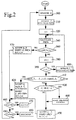
- Figure 2 there is shown a flow diagram of operations relating to a second embodiment of the method for evaluating the reliability of the trend analysis performed with the Kriging technique forming the subject of the present invention.
- the real component and the imaginary component of the electrical signal generated by the sensor is taken into consideration as the monitored operating quantity, these being of positive and negative value, or else the amplitude and phase of the electrical signal are used, in which case it is assumed that the amplitude can have any positive or negative value and the phase lies between -180° and +180°
- the trend analysis is performed starting from the error defined in expression 3).
- the estimated value Z ⁇ j of the monitored operating quantity is calculated.
- the estimated value Z ⁇ j is calculated assuming that the local trend of the values of the monitored operating quantity is linear ("linear local drift").
- the error err j % lies in the said predetermined range of values, that is if ⁇ 3 ⁇ err % ⁇ 4 (output YES from block 360) then it passes to a block 370, otherwise if the error err j % is outside the said predetermined range of values (output NO from block 360) then it passes to a block 380.
- the current value Z j of the monitored operating quantity is accepted and inserted into the reference database, the estimated value Z ⁇ j of the monitored operating quantity is accepted, the calculated error err j % is inserted into the associated error vector and the indicator C j relating to the formation of the reference database is set equal to zero.
- block 380 the counter I is incremented by one unit and from block 380 it then passes to a block 390 in which it is tested whether the counter I has a value less than or equal to 2.
- the counter If the counter has a value less than or equal to 2 (output YES from 390) it then passes to a block 400, otherwise if the counter I has a value greater than 2 (output NO) from block 390 then it passes to a block 410.
- the estimated value Z ⁇ j of the monitored operating quantity is re-calculated by means of the Kriging technique assuming that the local trend of the values of the monitored operating quantity is constant ("constant local drift").
- block 380 passes to block 390 in which it is again checked whether the value of the counter I is greater than 2.
- Z j lies in the said predetermined range of values (output YES from block 410) then it moves onto block 420, otherwise if Z j is outside the said predetermined range of values (output NO from block 410) then it moves onto a block 430.
- the current value Z j is accepted and inserted into the reference database, the estimated value Z ⁇ j is refused, the error err j % is set equal to zero, is inserted into the associated error vector and will not be considered in the trend analysis, and the indicator C j relating to the formation of the reference database is set equal to 1.
- Z j is outside the said predetermined range of values, that is if Z j is less than Z 1 or Z j is greater than Z 2 (output YES from block 430) then it moves onto block 440, otherwise if Z j lies in the said predetermined range of values (output NO from block 430) then it moves onto block 450.
- the current value Z j is accepted but not inserted into the reference database
- the estimated value Z ⁇ j is accepted
- the error err j % is inserted into the associated error vector
- the indicator C j relating to the formation of the reference database is set equal to 2.
Landscapes
- Physics & Mathematics (AREA)
- General Physics & Mathematics (AREA)
- Testing Of Devices, Machine Parts, Or Other Structures Thereof (AREA)
- Testing And Monitoring For Control Systems (AREA)
- Analysing Materials By The Use Of Radiation (AREA)
Applications Claiming Priority (2)
| Application Number | Priority Date | Filing Date | Title |
|---|---|---|---|
| ITTO970688 | 1997-07-31 | ||
| IT97TO000688A ITTO970688A1 (it) | 1997-07-31 | 1997-07-31 | Metodo di valutazione dell'attendibilita' di un'analisi di tendenza effettuata mediante la tecnica di kriging su di una grandezza |
Publications (2)
| Publication Number | Publication Date |
|---|---|
| EP0896209A2 true EP0896209A2 (de) | 1999-02-10 |
| EP0896209A3 EP0896209A3 (de) | 2000-02-23 |
Family
ID=11415910
Family Applications (1)
| Application Number | Title | Priority Date | Filing Date |
|---|---|---|---|
| EP98114291A Withdrawn EP0896209A3 (de) | 1997-07-31 | 1998-07-30 | Verfahren zur Zuverlässigkeitsfeststellung einer mittels eines Krigingverfahrens auf einer Operationsgrösse einer Machine durchgeführte, auf Fehler in der Machine hinweisende, Tendenzanalyse |
Country Status (3)
| Country | Link |
|---|---|
| EP (1) | EP0896209A3 (de) |
| BR (1) | BR9806661A (de) |
| IT (1) | ITTO970688A1 (de) |
Family Cites Families (2)
| Publication number | Priority date | Publication date | Assignee | Title |
|---|---|---|---|---|
| US5602761A (en) * | 1993-12-30 | 1997-02-11 | Caterpillar Inc. | Machine performance monitoring and fault classification using an exponentially weighted moving average scheme |
| US5610339A (en) * | 1994-10-20 | 1997-03-11 | Ingersoll-Rand Company | Method for collecting machine vibration data |
-
1997
- 1997-07-31 IT IT97TO000688A patent/ITTO970688A1/it not_active Application Discontinuation
-
1998
- 1998-07-30 BR BR9806661-7A patent/BR9806661A/pt not_active Application Discontinuation
- 1998-07-30 EP EP98114291A patent/EP0896209A3/de not_active Withdrawn
Also Published As
| Publication number | Publication date |
|---|---|
| ITTO970688A1 (it) | 1999-01-31 |
| BR9806661A (pt) | 2002-07-09 |
| EP0896209A3 (de) | 2000-02-23 |
Similar Documents
| Publication | Publication Date | Title |
|---|---|---|
| Gonçalves et al. | Faults detection and classification in a centrifugal pump from vibration data using markov parameters | |
| Nunzi et al. | Detection of anomalies in the behavior of atomic clocks | |
| RU2626231C1 (ru) | Способ диагностики технического состояния и оценки остаточного ресурса электромеханического агрегата с асинхронным двигателем | |
| US20020046004A1 (en) | General method for tracking the evolution of hidden damage or other unwanted changes in machinery components and predicting remaining useful life | |
| JP7468724B2 (ja) | 配管診断装置、配管診断方法、及びプログラム | |
| Kong et al. | Remaining useful life prediction of rolling bearings based on RMS-MAVE and dynamic exponential regression model | |
| KR900003909A (ko) | 원자로의 폐쇄시스템에 대한 폐쇄완벽도 평가방법 및 그 시스템 | |
| KR102512615B1 (ko) | 수명분포를 고려한 생애주기데이터 확장 기능을 가지는 잔존수명 예측 시스템 및 방법 | |
| Ellis et al. | A hybrid framework for remaining useful life estimation of turbomachine rotor blades | |
| CN113947017A (zh) | 一种滚动轴承剩余使用寿命预测方法 | |
| Boškoski et al. | Bearing fault prognostics based on signal complexity and Gaussian process models | |
| Barbieri et al. | Sensor-based degradation prediction and prognostics for remaining useful life estimation: Validation on experimental data of electric motors | |
| CN117889945A (zh) | 一种公路桥梁施工振动测试方法 | |
| Anis | Towards remaining useful life prediction in rotating machine fault prognosis: an exponential degradation model | |
| Ncwane et al. | Modeling wind speed using parametric and non-parametric distribution functions | |
| Isermann | Process fault detection based on modeling and estimation methods | |
| EP0896209A2 (de) | Verfahren zur Zuverlässigkeitsfeststellung einer mittels eines Krigingverfahrens auf einer Operationsgrösse einer Machine durchgeführte, auf Fehler in der Machine hinweisende, Tendenzanalyse | |
| Khuc et al. | A nonparametric method for identifying structural damage in bridges based on the best-fit auto-regressive models | |
| Natke et al. | System identification approaches in structural safety evaluation | |
| Koshekov et al. | Modernization of vibration analyzers based on identification measurements | |
| Popescu et al. | Change detection in vibration analysis—A review of problems and solutions | |
| Fan et al. | Application of phase space warping on damage tracking for bearing fault | |
| KR100956215B1 (ko) | 온도 특성을 가진 회로 구성원의 비정상 신호 분석을 위한 확률론적 오류 진단 방법 및 그 시스템 | |
| Gillich et al. | Efficient algorithm for frequency estimation used in structural damage detection | |
| Martinod et al. | Estimation of combustion engine technical state by multidimensional analysis using SVD method |
Legal Events
| Date | Code | Title | Description |
|---|---|---|---|
| PUAI | Public reference made under article 153(3) epc to a published international application that has entered the european phase |
Free format text: ORIGINAL CODE: 0009012 |
|
| AK | Designated contracting states |
Kind code of ref document: A2 Designated state(s): DE ES FR |
|
| AX | Request for extension of the european patent |
Free format text: AL;LT;LV;MK;RO;SI |
|
| RIN1 | Information on inventor provided before grant (corrected) |
Inventor name: ROSSI, MASSIMILIANO Inventor name: LUCIFREDI, ALERANO Inventor name: MAZZIERI, CLAUDIO |
|
| PUAL | Search report despatched |
Free format text: ORIGINAL CODE: 0009013 |
|
| AK | Designated contracting states |
Kind code of ref document: A3 Designated state(s): AT BE CH CY DE DK ES FI FR GB GR IE IT LI LU MC NL PT SE |
|
| AX | Request for extension of the european patent |
Free format text: AL;LT;LV;MK;RO;SI |
|
| RAP1 | Party data changed (applicant data changed or rights of an application transferred) |
Owner name: ANSALDO RICERCHE S.R.L. |
|
| AKX | Designation fees paid |
Free format text: DE ES FR |
|
| STAA | Information on the status of an ep patent application or granted ep patent |
Free format text: STATUS: THE APPLICATION IS DEEMED TO BE WITHDRAWN |
|
| 18D | Application deemed to be withdrawn |
Effective date: 20000824 |