EP0892343A2 - Compiler generating functionally-alike code sequence in an executable program intended for execution in different run-time environments - Google Patents
Compiler generating functionally-alike code sequence in an executable program intended for execution in different run-time environments Download PDFInfo
- Publication number
- EP0892343A2 EP0892343A2 EP98304376A EP98304376A EP0892343A2 EP 0892343 A2 EP0892343 A2 EP 0892343A2 EP 98304376 A EP98304376 A EP 98304376A EP 98304376 A EP98304376 A EP 98304376A EP 0892343 A2 EP0892343 A2 EP 0892343A2
- Authority
- EP
- European Patent Office
- Prior art keywords
- instruction
- executable program
- program
- executable
- computers
- Prior art date
- Legal status (The legal status is an assumption and is not a legal conclusion. Google has not performed a legal analysis and makes no representation as to the accuracy of the status listed.)
- Withdrawn
Links
Images

Classifications
-
- G—PHYSICS
- G06—COMPUTING OR CALCULATING; COUNTING
- G06F—ELECTRIC DIGITAL DATA PROCESSING
- G06F8/00—Arrangements for software engineering
- G06F8/40—Transformation of program code
- G06F8/41—Compilation
- G06F8/47—Retargetable compilers
Definitions
- the "trap and emulate” solution described above suffers from drawbacks that make it unattractive.
- One drawback is the requirement that the operating system be updated whenever new instructions are added to the architecture and used in executable programs.
- Another significant drawback is performance. There is a large penalty, on the order of a hundred processor clock cycles, for taking a trap. In fact, the performance on the older computer is generally worse than that of the original program that lacked the newer instructions.
- the trap-and-emulate solution therefore, does not adequately address the desire to maintain high performance on the older computers while achieving retroactive or backwards compatibility.
- a preferred embodiment described hereinafter includes a compiler that generates an executable program that can be run in different run-time environments, where the different run-time environments may for example be computers with different versions of an instruction-set architecture.
- the compiler generates code sequences in the executable program, each code sequence performing a function required by a portion of a source program from which the executable program. is generated.
- Each code sequence is better suited for execution in a corresponding one of the run-time environments than are the other code sequences, and the code sequences are generated in a manner enabling execution of the better-suited code sequence in each of the run time environments.
- An executable program thus generated by such a compiler can be easily modified at run time so that the better-suited code sequence is executed.
- a cooperating entity such as a loader program can patch in the better-suited code sequence, i.e., modify the flow of program control so that the better-suited code sequence is executed.
- newer instruction can be used on newer computers, and the routine on older computers, without the need. for a trap or other similarly inefficient mechanism.
- one of the code sequences can be generated in a manner providing for its default execution.
- the executable program can be executed in an environment where the loader program may be an older program that is oblivious to the other code sequence and the possibility of patching the executable.
- the executable program will nonetheless run correctly, if the default code sequence that is generated is the backwards-compatible code sequence.
- the preferred embodiment described herein comprises a compiler that generates, along with the code sequences, additional information in the executable program including (i) an address specifying a program location in the executable program at which the function required by the portion of the source program is to be performed; and (ii) a value indicating in which runtime environment the execution of one of the code sequences is better suited.
- This additional information makes it possible for fast and efficient patching of the executable program by a cooperating entity at image activation time.
- Version 1 and Version 2 computers are used to illustrate the preferred embodiment. These examples are drawn from the AlphaTM family of computers manufactured and sold by Digital Equipment Corporation. Earlier and later members of this family are distinguishable with regard to some of the instructions they use for processing data of certain types. A specific case is the processing of byte (8-bit) data types.
- the Alpha architecture specifies flat 64-bit virtual memory addressing, so that the natural width of a memory word in Alpha implementations is 64 bits. Partly for this reason, in the design of an early version of the Alpha architecture (hereinafter referred to as Version 1), the instructions for moving data between registers and memory (load and store instructions) are limited to handling primarily quadword (64-bit) data types, although instructions for longword (32-bit) data types also exist. To handle byte (8-bit) data types, as well as 16-bit data types called words, the Version 1 Alpha architecture provides instructions for manipulating bytes within one of several 64-bit general-purpose registers.
- a version 1 Alpha computer executes a set of instructions. These include a quadword load instruction to bring the quadword containing the byte into a register; instructions that insert or extract the byte in the desired position in the register; and a quadword store instruction to put the data (containing the new byte) back into memory.
- Appendix A contains a listing of a simple program "Example” showing the structure of the executable program 14 that is generated from the source program 10 listed in Section 1 of the listing. The elements appearing in the listing of Appendix A are now described in some detail.
- the Example program contains a subroutine called "s1" that performs a simple copying of a variable b to another variable a.
- the routine stb_routine begins with a load quadword instruction that brings the quadword containing the byte a into register t11. It then performs an insert byte instruction (insbl) that places the byte b (from t0) into register t12 at a position dictated by the lower order bits of the address a0, t12 otherwise containing a field of zeros.
- the mask instruction (mskbl) clears the bits of register t11 that make up byte a, so that t11 holds the quadword in which a used to be located but with a "hole" of consecutive zeros where a used to be.
- the flow of execution of the Example program as it appears in Appendix A is from location 0000 in the s1 subroutine through the bsr at 0008, then from location 0010 in stb_routine through location 0024, and finally back to location 000C in s1.
- This sequence performs a byte load/store pair in a manner that can execute on either a Version 1 or Version 2 Alpha computer. This is the default code sequence that is executed in the absence of modification of the executable program 14.
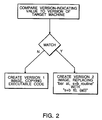
- the version-indicating value in the architecture entry enables the loader to determine whether the target computer on which it is running is capable of executing the instruction appearing in the architecture entry.
- the address enables the loader to identify the calling point for stb_routine. And the instruction is placed in the architecture entry so that it can be easily identified and retrieved by the loader.
- the loader 16 modifies the executable program 14 shown in Appendix A when it is to be executed on a Version 2 Alpha computer.
- the loader replaces the "bsr" instruction appearing at location 0008 with the "stb” instruction appearing in the architecture section.
- the resulting modified program performs the same assignment operation called for by the source program, but has a different flow of execution.
- the modified program simply executes straight through to the return at location 000C; the subroutine "stb_routine" is never called.
- the compiler as described relies on an external loader to advantageously process the generated executable image 14, but in alternative embodiments may itself generate code in the executable program that carries out the modification at run-time.
- the generated routine (such as stb_routine) can be called from multiple locations where the store byte function is required. Such a scheme would require that certain prearranged constraints be placed on the parameters used by the stb instruction; such techniques are known in the art and their use would contribute to greater space efficiency in the generated executable program.
- the default sequence to be the new instruction rather than the backwards-compatible routine. All these and other embodiments are intended to be covered by the claims which follow.
Landscapes
- Engineering & Computer Science (AREA)
- General Engineering & Computer Science (AREA)
- Theoretical Computer Science (AREA)
- Software Systems (AREA)
- Physics & Mathematics (AREA)
- General Physics & Mathematics (AREA)
- Stored Programmes (AREA)
- Devices For Executing Special Programs (AREA)
Applications Claiming Priority (2)
| Application Number | Priority Date | Filing Date | Title |
|---|---|---|---|
| US873147 | 1997-06-11 | ||
| US08/873,147 US5920721A (en) | 1997-06-11 | 1997-06-11 | Compiler generating functionally-alike code sequences in an executable program intended for execution in different run-time environments |
Publications (1)
| Publication Number | Publication Date |
|---|---|
| EP0892343A2 true EP0892343A2 (en) | 1999-01-20 |
Family
ID=25361066
Family Applications (1)
| Application Number | Title | Priority Date | Filing Date |
|---|---|---|---|
| EP98304376A Withdrawn EP0892343A2 (en) | 1997-06-11 | 1998-06-03 | Compiler generating functionally-alike code sequence in an executable program intended for execution in different run-time environments |
Country Status (3)
| Country | Link |
|---|---|
| US (1) | US5920721A (enExample) |
| EP (1) | EP0892343A2 (enExample) |
| JP (1) | JPH1115674A (enExample) |
Families Citing this family (57)
| Publication number | Priority date | Publication date | Assignee | Title |
|---|---|---|---|---|
| US6163764A (en) * | 1998-10-12 | 2000-12-19 | Intel Corporation | Emulation of an instruction set on an instruction set architecture transition |
| US6763452B1 (en) | 1999-01-28 | 2004-07-13 | Ati International Srl | Modifying program execution based on profiling |
| US7941647B2 (en) | 1999-01-28 | 2011-05-10 | Ati Technologies Ulc | Computer for executing two instruction sets and adds a macroinstruction end marker for performing iterations after loop termination |
| US8121828B2 (en) | 1999-01-28 | 2012-02-21 | Ati Technologies Ulc | Detecting conditions for transfer of execution from one computer instruction stream to another and executing transfer on satisfaction of the conditions |
| US6978462B1 (en) | 1999-01-28 | 2005-12-20 | Ati International Srl | Profiling execution of a sequence of events occuring during a profiled execution interval that matches time-independent selection criteria of events to be profiled |
| US8127121B2 (en) | 1999-01-28 | 2012-02-28 | Ati Technologies Ulc | Apparatus for executing programs for a first computer architechture on a computer of a second architechture |
| US7275246B1 (en) | 1999-01-28 | 2007-09-25 | Ati International Srl | Executing programs for a first computer architecture on a computer of a second architecture |
| US8074055B1 (en) | 1999-01-28 | 2011-12-06 | Ati Technologies Ulc | Altering data storage conventions of a processor when execution flows from first architecture code to second architecture code |
| US7065633B1 (en) | 1999-01-28 | 2006-06-20 | Ati International Srl | System for delivering exception raised in first architecture to operating system coded in second architecture in dual architecture CPU |
| US7013456B1 (en) | 1999-01-28 | 2006-03-14 | Ati International Srl | Profiling execution of computer programs |
| US6954923B1 (en) | 1999-01-28 | 2005-10-11 | Ati International Srl | Recording classification of instructions executed by a computer |
| US7111290B1 (en) | 1999-01-28 | 2006-09-19 | Ati International Srl | Profiling program execution to identify frequently-executed portions and to assist binary translation |
| US6526570B1 (en) * | 1999-04-23 | 2003-02-25 | Sun Microsystems, Inc. | File portability techniques |
| US6286134B1 (en) * | 1999-04-23 | 2001-09-04 | Sun Microsystems, Inc. | Instruction selection in a multi-platform environment |
| GB2389753B (en) | 1999-05-28 | 2004-02-25 | Nec Corp | Mobile telecommunications system |
| US6779107B1 (en) | 1999-05-28 | 2004-08-17 | Ati International Srl | Computer execution by opportunistic adaptation |
| US6549959B1 (en) | 1999-08-30 | 2003-04-15 | Ati International Srl | Detecting modification to computer memory by a DMA device |
| JP3655152B2 (ja) * | 1999-11-29 | 2005-06-02 | 富士通株式会社 | ソフトウェア編集装置及び記憶媒体 |
| JP3640081B2 (ja) * | 1999-12-27 | 2005-04-20 | 日本電気株式会社 | Mpiプログラムのコンパイルにおける最適化方法 |
| US6934832B1 (en) | 2000-01-18 | 2005-08-23 | Ati International Srl | Exception mechanism for a computer |
| US6941549B1 (en) * | 2000-03-31 | 2005-09-06 | International Business Machines Corporation | Communicating between programs having different machine context organizations |
| CN100344461C (zh) | 2000-09-11 | 2007-10-24 | 赛福尔有限公司 | 带驱动器及其控制方法 |
| US7207038B2 (en) * | 2003-08-29 | 2007-04-17 | Nokia Corporation | Constructing control flows graphs of binary executable programs at post-link time |
| US7395527B2 (en) | 2003-09-30 | 2008-07-01 | International Business Machines Corporation | Method and apparatus for counting instruction execution and data accesses |
| US8381037B2 (en) | 2003-10-09 | 2013-02-19 | International Business Machines Corporation | Method and system for autonomic execution path selection in an application |
| JP2005157849A (ja) * | 2003-11-27 | 2005-06-16 | Toshiba Corp | システムlsi設計装置、システムlsi設計用処理プログラム、及び整合性検証方法 |
| US7401330B2 (en) * | 2003-12-11 | 2008-07-15 | Hewlett-Packard Development Company, L.P. | Cloning programming code |
| US7895382B2 (en) | 2004-01-14 | 2011-02-22 | International Business Machines Corporation | Method and apparatus for qualifying collection of performance monitoring events by types of interrupt when interrupt occurs |
| US7415705B2 (en) * | 2004-01-14 | 2008-08-19 | International Business Machines Corporation | Autonomic method and apparatus for hardware assist for patching code |
| US20070016899A1 (en) * | 2005-07-15 | 2007-01-18 | Sule Dineel D | Technique for the calling of a sub-routine by a function using an intermediate sub-routine |
| US9727604B2 (en) * | 2006-03-10 | 2017-08-08 | International Business Machines Corporation | Generating code for an integrated data system |
| US9361137B2 (en) | 2006-03-10 | 2016-06-07 | International Business Machines Corporation | Managing application parameters based on parameter types |
| US8099725B2 (en) * | 2006-10-11 | 2012-01-17 | International Business Machines Corporation | Method and apparatus for generating code for an extract, transform, and load (ETL) data flow |
| US8160999B2 (en) * | 2006-12-13 | 2012-04-17 | International Business Machines Corporation | Method and apparatus for using set based structured query language (SQL) to implement extract, transform, and load (ETL) splitter operation |
| US8219518B2 (en) | 2007-01-09 | 2012-07-10 | International Business Machines Corporation | Method and apparatus for modelling data exchange in a data flow of an extract, transform, and load (ETL) process |
| US8156307B2 (en) * | 2007-08-20 | 2012-04-10 | Convey Computer | Multi-processor system having at least one processor that comprises a dynamically reconfigurable instruction set |
| US8561037B2 (en) * | 2007-08-29 | 2013-10-15 | Convey Computer | Compiler for generating an executable comprising instructions for a plurality of different instruction sets |
| US9710384B2 (en) * | 2008-01-04 | 2017-07-18 | Micron Technology, Inc. | Microprocessor architecture having alternative memory access paths |
| US8095735B2 (en) | 2008-08-05 | 2012-01-10 | Convey Computer | Memory interleave for heterogeneous computing |
| US9015399B2 (en) * | 2007-08-20 | 2015-04-21 | Convey Computer | Multiple data channel memory module architecture |
| US8370821B2 (en) * | 2007-08-21 | 2013-02-05 | International Business Machines Corporation | Method for enabling profile-based call site tailor-ing using profile gathering of cloned functions |
| US8185883B2 (en) * | 2007-09-14 | 2012-05-22 | International Business Machines Corporation | Instruction exploitation through loader late fix-up |
| US8205066B2 (en) | 2008-10-31 | 2012-06-19 | Convey Computer | Dynamically configured coprocessor for different extended instruction set personality specific to application program with shared memory storing instructions invisibly dispatched from host processor |
| US20100153693A1 (en) * | 2008-12-17 | 2010-06-17 | Microsoft Corporation | Code execution with automated domain switching |
| US9117071B2 (en) | 2009-06-03 | 2015-08-25 | Apple Inc. | Methods and apparatuses for secure compilation |
| US8677329B2 (en) | 2009-06-03 | 2014-03-18 | Apple Inc. | Methods and apparatuses for a compiler server |
| US8423745B1 (en) | 2009-11-16 | 2013-04-16 | Convey Computer | Systems and methods for mapping a neighborhood of data to general registers of a processing element |
| US8683455B1 (en) | 2011-01-12 | 2014-03-25 | Google Inc. | Method and system for optimizing an executable program by selectively merging identical program entities |
| US8689200B1 (en) * | 2011-01-12 | 2014-04-01 | Google Inc. | Method and system for optimizing an executable program by generating special operations for identical program entities |
| US8863082B2 (en) * | 2011-09-07 | 2014-10-14 | Microsoft Corporation | Transformational context-aware data source management |
| US8850413B2 (en) * | 2012-05-31 | 2014-09-30 | Oracle International Corporation | Compiling multi-threaded applications for targeted criticalities |
| US10430190B2 (en) | 2012-06-07 | 2019-10-01 | Micron Technology, Inc. | Systems and methods for selectively controlling multithreaded execution of executable code segments |
| US9052956B2 (en) * | 2012-08-30 | 2015-06-09 | Hewlett-Packard Development Company, L.P. | Selecting execution environments |
| US9110737B1 (en) * | 2014-05-30 | 2015-08-18 | Semmle Limited | Extracting source code |
| US10360906B2 (en) | 2016-06-14 | 2019-07-23 | Microsoft Technology Licensing, Llc | Computer proxy messaging bot |
| US10162817B2 (en) * | 2016-06-14 | 2018-12-25 | Microsoft Technology Licensing, Llc | Computer messaging bot creation |
| US10810007B2 (en) | 2017-12-29 | 2020-10-20 | Microsoft Technology Licensing, Llc | Classifying system-generated code |
Family Cites Families (13)
| Publication number | Priority date | Publication date | Assignee | Title |
|---|---|---|---|---|
| JPS6184740A (ja) * | 1984-10-03 | 1986-04-30 | Hitachi Ltd | 汎用オブジエクトコ−ド生成方式 |
| US4791558A (en) * | 1987-02-13 | 1988-12-13 | International Business Machines Corporation | System and method for generating an object module in a first format and then converting the first format into a format which is loadable into a selected computer |
| US5339422A (en) * | 1991-03-07 | 1994-08-16 | Digital Equipment Corporation | System and method for jacketing cross-domain calls in a multi-code execution and debugging system within a multi-architecture environment |
| EP0559221B1 (en) * | 1992-03-06 | 1999-05-12 | Microsoft Corporation | Method for storing programs |
| US5446899A (en) * | 1992-06-26 | 1995-08-29 | Digital Equipment Corporation | Hint generation in smart recompilation |
| US5671431A (en) * | 1992-09-22 | 1997-09-23 | Siemens Aktiengesellschaft | Method for processing user program on a parallel computer system by inserting a tag during compiling |
| US5546586A (en) * | 1993-05-06 | 1996-08-13 | Apple Computer, Inc. | Method and apparatus for vectorizing the contents of a read only memory device without modifying underlying source code |
| US5432937A (en) * | 1993-08-20 | 1995-07-11 | Next Computer, Inc. | Method and apparatus for architecture independent executable files |
| US5634114A (en) * | 1993-11-18 | 1997-05-27 | Intel Corporation | Dynamic link library version negotiation |
| US5675803A (en) * | 1994-01-28 | 1997-10-07 | Sun Microsystems, Inc. | Method and apparatus for a fast debugger fix and continue operation |
| US5701442A (en) * | 1995-09-19 | 1997-12-23 | Intel Corporation | Method of modifying an instruction set architecture of a computer processor to maintain backward compatibility |
| US5774728A (en) * | 1995-12-27 | 1998-06-30 | International Business Machines Corporation | Method and system for compiling sections of a computer program for multiple execution environments |
| US5732275A (en) * | 1996-01-11 | 1998-03-24 | Apple Computer, Inc. | Method and apparatus for managing and automatically updating software programs |
-
1997
- 1997-06-11 US US08/873,147 patent/US5920721A/en not_active Expired - Lifetime
-
1998
- 1998-06-03 EP EP98304376A patent/EP0892343A2/en not_active Withdrawn
- 1998-06-10 JP JP10161974A patent/JPH1115674A/ja not_active Abandoned
Also Published As
| Publication number | Publication date |
|---|---|
| US5920721A (en) | 1999-07-06 |
| JPH1115674A (ja) | 1999-01-22 |
Similar Documents
| Publication | Publication Date | Title |
|---|---|---|
| US5920721A (en) | Compiler generating functionally-alike code sequences in an executable program intended for execution in different run-time environments | |
| US6115550A (en) | Loader conditionally replacing a code sequence with a functionally-alike code sequence in an executable program intended for execution in different run-time environments | |
| AU2021250948B2 (en) | Load module compiler | |
| US5999732A (en) | Techniques for reducing the cost of dynamic class initialization checks in compiled code | |
| US9116717B2 (en) | Run-time interception of software methods | |
| US6651080B1 (en) | Techniques for implementing pluggable virtual machines | |
| US7712092B2 (en) | Binary translation using peephole translation rules | |
| JP3786644B2 (ja) | バイトコンパイルされたJava(R)コードを実行するためのマイクロプロセッサ | |
| CA2082409C (en) | Improved system and method for jacketing cross-domain calls in a multi-code execution and debugging system within a multi-architecture environment | |
| US7856618B2 (en) | Adaptively generating code for a computer program | |
| EP0962859A2 (en) | Global register systems, methods, and computer program products | |
| Fox et al. | Verified compilation of CakeML to multiple machine-code targets | |
| US20050188362A1 (en) | Method and system for performing link-time code optimization without additional code analysis | |
| US7032230B2 (en) | Efficient virtual function calls for compiled/interpreted environments | |
| US7219337B2 (en) | Direct instructions rendering emulation computer technique | |
| US5581769A (en) | Multipurpose program object linkage protocol for upward compatibility among different compilers | |
| US7725879B2 (en) | Method and apparatus for executing instructions of java virtual machine and transforming bytecode | |
| Hallou et al. | Dynamic re-vectorization of binary code | |
| US6976249B1 (en) | Method for embedding object codes in source codes | |
| US20040015913A1 (en) | Method for fast compilation of preverified JAVA TM bytecode to high quality native machine code | |
| US6938185B1 (en) | Method and system for adapting a debugger to new targets | |
| EP1033650A2 (en) | Instruction translation method | |
| Harris | A just-in-time Java bytecode compiler | |
| WO1999061970A2 (en) | Global register systems, methods, and computer program products | |
| CN120123041A (zh) | 一种软件流水线代码的动态二进制翻译方法及系统 |
Legal Events
| Date | Code | Title | Description |
|---|---|---|---|
| PUAI | Public reference made under article 153(3) epc to a published international application that has entered the european phase |
Free format text: ORIGINAL CODE: 0009012 |
|
| AK | Designated contracting states |
Kind code of ref document: A2 Designated state(s): AT BE CH CY DE DK ES FI FR GB GR IE IT LI LU MC NL PT SE |
|
| AX | Request for extension of the european patent |
Free format text: AL;LT;LV;MK;RO;SI |
|
| RAP1 | Party data changed (applicant data changed or rights of an application transferred) |
Owner name: COMPAQ COMPUTER CORPORATION |
|
| STAA | Information on the status of an ep patent application or granted ep patent |
Free format text: STATUS: THE APPLICATION IS DEEMED TO BE WITHDRAWN |
|
| 18D | Application deemed to be withdrawn |
Effective date: 20010103 |