EP0890939B1 - Microcapsule magnetic display sheet and a method thereof - Google Patents
Microcapsule magnetic display sheet and a method thereof Download PDFInfo
- Publication number
- EP0890939B1 EP0890939B1 EP98305332A EP98305332A EP0890939B1 EP 0890939 B1 EP0890939 B1 EP 0890939B1 EP 98305332 A EP98305332 A EP 98305332A EP 98305332 A EP98305332 A EP 98305332A EP 0890939 B1 EP0890939 B1 EP 0890939B1
- Authority
- EP
- European Patent Office
- Prior art keywords
- microcapsule
- sheet
- layer
- display sheet
- resin
- Prior art date
- Legal status (The legal status is an assumption and is not a legal conclusion. Google has not performed a legal analysis and makes no representation as to the accuracy of the status listed.)
- Expired - Lifetime
Links
- 239000003094 microcapsule Substances 0.000 title claims abstract description 168
- 238000000034 method Methods 0.000 title description 26
- 229920005989 resin Polymers 0.000 claims abstract description 94
- 239000011347 resin Substances 0.000 claims abstract description 94
- 239000007788 liquid Substances 0.000 claims abstract description 31
- 230000001678 irradiating effect Effects 0.000 claims abstract description 10
- 239000011248 coating agent Substances 0.000 claims description 21
- 238000000576 coating method Methods 0.000 claims description 21
- 238000004519 manufacturing process Methods 0.000 claims description 18
- 238000001035 drying Methods 0.000 claims description 9
- 238000010422 painting Methods 0.000 abstract description 12
- 230000001105 regulatory effect Effects 0.000 abstract description 4
- 239000010410 layer Substances 0.000 description 71
- 239000000853 adhesive Substances 0.000 description 11
- 230000001070 adhesive effect Effects 0.000 description 11
- 239000006247 magnetic powder Substances 0.000 description 10
- 238000009835 boiling Methods 0.000 description 9
- 239000002775 capsule Substances 0.000 description 7
- 239000002904 solvent Substances 0.000 description 7
- XLYOFNOQVPJJNP-UHFFFAOYSA-N water Substances O XLYOFNOQVPJJNP-UHFFFAOYSA-N 0.000 description 7
- YXFVVABEGXRONW-UHFFFAOYSA-N Toluene Chemical compound CC1=CC=CC=C1 YXFVVABEGXRONW-UHFFFAOYSA-N 0.000 description 6
- 239000000843 powder Substances 0.000 description 6
- 230000004907 flux Effects 0.000 description 5
- UQSXHKLRYXJYBZ-UHFFFAOYSA-N iron oxide Inorganic materials [Fe]=O UQSXHKLRYXJYBZ-UHFFFAOYSA-N 0.000 description 5
- 239000000178 monomer Substances 0.000 description 5
- 238000010998 test method Methods 0.000 description 5
- NIXOWILDQLNWCW-UHFFFAOYSA-M Acrylate Chemical compound [O-]C(=O)C=C NIXOWILDQLNWCW-UHFFFAOYSA-M 0.000 description 4
- YNQLUTRBYVCPMQ-UHFFFAOYSA-N Ethylbenzene Chemical compound CCC1=CC=CC=C1 YNQLUTRBYVCPMQ-UHFFFAOYSA-N 0.000 description 4
- CTQNGGLPUBDAKN-UHFFFAOYSA-N O-Xylene Chemical compound CC1=CC=CC=C1C CTQNGGLPUBDAKN-UHFFFAOYSA-N 0.000 description 4
- GWEVSGVZZGPLCZ-UHFFFAOYSA-N Titan oxide Chemical compound O=[Ti]=O GWEVSGVZZGPLCZ-UHFFFAOYSA-N 0.000 description 4
- NIXOWILDQLNWCW-UHFFFAOYSA-N acrylic acid group Chemical group C(C=C)(=O)O NIXOWILDQLNWCW-UHFFFAOYSA-N 0.000 description 4
- ISAOCJYIOMOJEB-UHFFFAOYSA-N benzoin Chemical compound C=1C=CC=CC=1C(O)C(=O)C1=CC=CC=C1 ISAOCJYIOMOJEB-UHFFFAOYSA-N 0.000 description 4
- USIUVYZYUHIAEV-UHFFFAOYSA-N diphenyl ether Chemical compound C=1C=CC=CC=1OC1=CC=CC=C1 USIUVYZYUHIAEV-UHFFFAOYSA-N 0.000 description 4
- IIEWJVIFRVWJOD-UHFFFAOYSA-N ethylcyclohexane Chemical compound CCC1CCCCC1 IIEWJVIFRVWJOD-UHFFFAOYSA-N 0.000 description 4
- 239000000203 mixture Substances 0.000 description 4
- 206010047571 Visual impairment Diseases 0.000 description 3
- 125000005442 diisocyanate group Chemical group 0.000 description 3
- 235000013980 iron oxide Nutrition 0.000 description 3
- 229920000728 polyester Polymers 0.000 description 3
- -1 polyethylene Polymers 0.000 description 3
- FQYVVSNFPLKMNU-UHFFFAOYSA-N 1,2-dipentylbenzene Chemical compound CCCCCC1=CC=CC=C1CCCCC FQYVVSNFPLKMNU-UHFFFAOYSA-N 0.000 description 2
- IXPNQXFRVYWDDI-UHFFFAOYSA-N 1-methyl-2,4-dioxo-1,3-diazinane-5-carboximidamide Chemical compound CN1CC(C(N)=N)C(=O)NC1=O IXPNQXFRVYWDDI-UHFFFAOYSA-N 0.000 description 2
- KWOLFJPFCHCOCG-UHFFFAOYSA-N Acetophenone Chemical compound CC(=O)C1=CC=CC=C1 KWOLFJPFCHCOCG-UHFFFAOYSA-N 0.000 description 2
- 108010010803 Gelatin Proteins 0.000 description 2
- XEEYBQQBJWHFJM-UHFFFAOYSA-N Iron Chemical compound [Fe] XEEYBQQBJWHFJM-UHFFFAOYSA-N 0.000 description 2
- PXHVJJICTQNCMI-UHFFFAOYSA-N Nickel Chemical compound [Ni] PXHVJJICTQNCMI-UHFFFAOYSA-N 0.000 description 2
- URLKBWYHVLBVBO-UHFFFAOYSA-N Para-Xylene Chemical group CC1=CC=C(C)C=C1 URLKBWYHVLBVBO-UHFFFAOYSA-N 0.000 description 2
- 239000004698 Polyethylene Substances 0.000 description 2
- 239000002202 Polyethylene glycol Substances 0.000 description 2
- 239000004372 Polyvinyl alcohol Substances 0.000 description 2
- 244000028419 Styrax benzoin Species 0.000 description 2
- 235000000126 Styrax benzoin Nutrition 0.000 description 2
- 235000008411 Sumatra benzointree Nutrition 0.000 description 2
- XLOMVQKBTHCTTD-UHFFFAOYSA-N Zinc monoxide Chemical compound [Zn]=O XLOMVQKBTHCTTD-UHFFFAOYSA-N 0.000 description 2
- 239000001785 acacia senegal l. willd gum Substances 0.000 description 2
- PCMNQIMILVGGTG-UHFFFAOYSA-N benzoic acid;1,2-diphenylethane-1,2-dione Chemical compound OC(=O)C1=CC=CC=C1.C=1C=CC=CC=1C(=O)C(=O)C1=CC=CC=C1 PCMNQIMILVGGTG-UHFFFAOYSA-N 0.000 description 2
- 229960002130 benzoin Drugs 0.000 description 2
- 239000003086 colorant Substances 0.000 description 2
- FLKPEMZONWLCSK-UHFFFAOYSA-N diethyl phthalate Chemical compound CCOC(=O)C1=CC=CC=C1C(=O)OCC FLKPEMZONWLCSK-UHFFFAOYSA-N 0.000 description 2
- KWKXNDCHNDYVRT-UHFFFAOYSA-N dodecylbenzene Chemical compound CCCCCCCCCCCCC1=CC=CC=C1 KWKXNDCHNDYVRT-UHFFFAOYSA-N 0.000 description 2
- 239000000839 emulsion Substances 0.000 description 2
- 239000004744 fabric Substances 0.000 description 2
- 229920000159 gelatin Polymers 0.000 description 2
- 239000008273 gelatin Substances 0.000 description 2
- 235000019322 gelatine Nutrition 0.000 description 2
- 235000011852 gelatine desserts Nutrition 0.000 description 2
- 235000019382 gum benzoic Nutrition 0.000 description 2
- 125000002887 hydroxy group Chemical group [H]O* 0.000 description 2
- IVSZLXZYQVIEFR-UHFFFAOYSA-N m-xylene Chemical group CC1=CC=CC(C)=C1 IVSZLXZYQVIEFR-UHFFFAOYSA-N 0.000 description 2
- NUJOXMJBOLGQSY-UHFFFAOYSA-N manganese dioxide Chemical compound O=[Mn]=O NUJOXMJBOLGQSY-UHFFFAOYSA-N 0.000 description 2
- 239000012528 membrane Substances 0.000 description 2
- 229920000573 polyethylene Polymers 0.000 description 2
- 229920001223 polyethylene glycol Polymers 0.000 description 2
- 239000003505 polymerization initiator Substances 0.000 description 2
- 229920002451 polyvinyl alcohol Polymers 0.000 description 2
- 229920000915 polyvinyl chloride Polymers 0.000 description 2
- 239000004800 polyvinyl chloride Substances 0.000 description 2
- 235000010413 sodium alginate Nutrition 0.000 description 2
- 239000000661 sodium alginate Substances 0.000 description 2
- 229940005550 sodium alginate Drugs 0.000 description 2
- 239000000243 solution Substances 0.000 description 2
- KKEYFWRCBNTPAC-UHFFFAOYSA-L terephthalate(2-) Chemical compound [O-]C(=O)C1=CC=C(C([O-])=O)C=C1 KKEYFWRCBNTPAC-UHFFFAOYSA-L 0.000 description 2
- 229920002803 thermoplastic polyurethane Polymers 0.000 description 2
- 235000010215 titanium dioxide Nutrition 0.000 description 2
- 239000008096 xylene Substances 0.000 description 2
- AOCLMTXQVVUTEB-UHFFFAOYSA-N (2-benzylphenyl)-phenylmethanone Chemical compound C=1C=CC=C(CC=2C=CC=CC=2)C=1C(=O)C1=CC=CC=C1 AOCLMTXQVVUTEB-UHFFFAOYSA-N 0.000 description 1
- ZTNJGMFHJYGMDR-UHFFFAOYSA-N 1,2-diisocyanatoethane Chemical compound O=C=NCCN=C=O ZTNJGMFHJYGMDR-UHFFFAOYSA-N 0.000 description 1
- ZGDSDWSIFQBAJS-UHFFFAOYSA-N 1,2-diisocyanatopropane Chemical compound O=C=NC(C)CN=C=O ZGDSDWSIFQBAJS-UHFFFAOYSA-N 0.000 description 1
- DFPJRUKWEPYFJT-UHFFFAOYSA-N 1,5-diisocyanatopentane Chemical compound O=C=NCCCCCN=C=O DFPJRUKWEPYFJT-UHFFFAOYSA-N 0.000 description 1
- OSNILPMOSNGHLC-UHFFFAOYSA-N 1-[4-methoxy-3-(piperidin-1-ylmethyl)phenyl]ethanone Chemical compound COC1=CC=C(C(C)=O)C=C1CN1CCCCC1 OSNILPMOSNGHLC-UHFFFAOYSA-N 0.000 description 1
- KMNCBSZOIQAUFX-UHFFFAOYSA-N 2-ethoxy-1,2-diphenylethanone Chemical compound C=1C=CC=CC=1C(OCC)C(=O)C1=CC=CC=C1 KMNCBSZOIQAUFX-UHFFFAOYSA-N 0.000 description 1
- BQZJOQXSCSZQPS-UHFFFAOYSA-N 2-methoxy-1,2-diphenylethanone Chemical compound C=1C=CC=CC=1C(OC)C(=O)C1=CC=CC=C1 BQZJOQXSCSZQPS-UHFFFAOYSA-N 0.000 description 1
- RBTBFTRPCNLSDE-UHFFFAOYSA-N 3,7-bis(dimethylamino)phenothiazin-5-ium Chemical compound C1=CC(N(C)C)=CC2=[S+]C3=CC(N(C)C)=CC=C3N=C21 RBTBFTRPCNLSDE-UHFFFAOYSA-N 0.000 description 1
- 244000215068 Acacia senegal Species 0.000 description 1
- VYZAMTAEIAYCRO-UHFFFAOYSA-N Chromium Chemical compound [Cr] VYZAMTAEIAYCRO-UHFFFAOYSA-N 0.000 description 1
- 229920000084 Gum arabic Polymers 0.000 description 1
- 239000005057 Hexamethylene diisocyanate Substances 0.000 description 1
- DGAQECJNVWCQMB-PUAWFVPOSA-M Ilexoside XXIX Chemical compound C[C@@H]1CC[C@@]2(CC[C@@]3(C(=CC[C@H]4[C@]3(CC[C@@H]5[C@@]4(CC[C@@H](C5(C)C)OS(=O)(=O)[O-])C)C)[C@@H]2[C@]1(C)O)C)C(=O)O[C@H]6[C@@H]([C@H]([C@@H]([C@H](O6)CO)O)O)O.[Na+] DGAQECJNVWCQMB-PUAWFVPOSA-M 0.000 description 1
- 229910001030 Iron–nickel alloy Inorganic materials 0.000 description 1
- 239000005058 Isophorone diisocyanate Substances 0.000 description 1
- 229910000004 White lead Inorganic materials 0.000 description 1
- 239000005083 Zinc sulfide Substances 0.000 description 1
- 235000010489 acacia gum Nutrition 0.000 description 1
- 239000000205 acacia gum Substances 0.000 description 1
- 239000002253 acid Substances 0.000 description 1
- 239000012790 adhesive layer Substances 0.000 description 1
- 239000007864 aqueous solution Substances 0.000 description 1
- 125000003118 aryl group Chemical group 0.000 description 1
- 238000006243 chemical reaction Methods 0.000 description 1
- IQFVPQOLBLOTPF-HKXUKFGYSA-L congo red Chemical compound [Na+].[Na+].C1=CC=CC2=C(N)C(/N=N/C3=CC=C(C=C3)C3=CC=C(C=C3)/N=N/C3=C(C4=CC=CC=C4C(=C3)S([O-])(=O)=O)N)=CC(S([O-])(=O)=O)=C21 IQFVPQOLBLOTPF-HKXUKFGYSA-L 0.000 description 1
- 239000002270 dispersing agent Substances 0.000 description 1
- 230000000694 effects Effects 0.000 description 1
- UHESRSKEBRADOO-UHFFFAOYSA-N ethyl carbamate;prop-2-enoic acid Chemical compound OC(=O)C=C.CCOC(N)=O UHESRSKEBRADOO-UHFFFAOYSA-N 0.000 description 1
- RRAMGCGOFNQTLD-UHFFFAOYSA-N hexamethylene diisocyanate Chemical compound O=C=NCCCCCCN=C=O RRAMGCGOFNQTLD-UHFFFAOYSA-N 0.000 description 1
- VLKZOEOYAKHREP-UHFFFAOYSA-N hexane Substances CCCCCC VLKZOEOYAKHREP-UHFFFAOYSA-N 0.000 description 1
- 239000003112 inhibitor Substances 0.000 description 1
- 238000011835 investigation Methods 0.000 description 1
- 229910052742 iron Inorganic materials 0.000 description 1
- WTFXARWRTYJXII-UHFFFAOYSA-N iron(2+);iron(3+);oxygen(2-) Chemical compound [O-2].[O-2].[O-2].[O-2].[Fe+2].[Fe+3].[Fe+3] WTFXARWRTYJXII-UHFFFAOYSA-N 0.000 description 1
- VBMVTYDPPZVILR-UHFFFAOYSA-N iron(2+);oxygen(2-) Chemical class [O-2].[Fe+2] VBMVTYDPPZVILR-UHFFFAOYSA-N 0.000 description 1
- SZVJSHCCFOBDDC-UHFFFAOYSA-N iron(II,III) oxide Inorganic materials O=[Fe]O[Fe]O[Fe]=O SZVJSHCCFOBDDC-UHFFFAOYSA-N 0.000 description 1
- NIMLQBUJDJZYEJ-UHFFFAOYSA-N isophorone diisocyanate Chemical compound CC1(C)CC(N=C=O)CC(C)(CN=C=O)C1 NIMLQBUJDJZYEJ-UHFFFAOYSA-N 0.000 description 1
- 238000010030 laminating Methods 0.000 description 1
- RYZCLUQMCYZBJQ-UHFFFAOYSA-H lead(2+);dicarbonate;dihydroxide Chemical compound [OH-].[OH-].[Pb+2].[Pb+2].[Pb+2].[O-]C([O-])=O.[O-]C([O-])=O RYZCLUQMCYZBJQ-UHFFFAOYSA-H 0.000 description 1
- 239000000463 material Substances 0.000 description 1
- 125000005395 methacrylic acid group Chemical group 0.000 description 1
- 229960000907 methylthioninium chloride Drugs 0.000 description 1
- 238000002156 mixing Methods 0.000 description 1
- 229910052759 nickel Inorganic materials 0.000 description 1
- SOQBVABWOPYFQZ-UHFFFAOYSA-N oxygen(2-);titanium(4+) Chemical class [O-2].[O-2].[Ti+4] SOQBVABWOPYFQZ-UHFFFAOYSA-N 0.000 description 1
- 239000002245 particle Substances 0.000 description 1
- 239000000049 pigment Substances 0.000 description 1
- 229920003023 plastic Polymers 0.000 description 1
- 239000004033 plastic Substances 0.000 description 1
- 239000004014 plasticizer Substances 0.000 description 1
- 229920001225 polyester resin Polymers 0.000 description 1
- 239000004645 polyester resin Substances 0.000 description 1
- 238000010526 radical polymerization reaction Methods 0.000 description 1
- 238000011160 research Methods 0.000 description 1
- 238000007789 sealing Methods 0.000 description 1
- 229910052708 sodium Inorganic materials 0.000 description 1
- 239000011734 sodium Substances 0.000 description 1
- 238000003756 stirring Methods 0.000 description 1
- BDHFUVZGWQCTTF-UHFFFAOYSA-M sulfonate Chemical compound [O-]S(=O)=O BDHFUVZGWQCTTF-UHFFFAOYSA-M 0.000 description 1
- 239000004408 titanium dioxide Substances 0.000 description 1
- OGIDPMRJRNCKJF-UHFFFAOYSA-N titanium oxide Inorganic materials [Ti]=O OGIDPMRJRNCKJF-UHFFFAOYSA-N 0.000 description 1
- DVKJHBMWWAPEIU-UHFFFAOYSA-N toluene 2,4-diisocyanate Chemical compound CC1=CC=C(N=C=O)C=C1N=C=O DVKJHBMWWAPEIU-UHFFFAOYSA-N 0.000 description 1
- RUELTTOHQODFPA-UHFFFAOYSA-N toluene 2,6-diisocyanate Chemical compound CC1=C(N=C=O)C=CC=C1N=C=O RUELTTOHQODFPA-UHFFFAOYSA-N 0.000 description 1
- 239000011787 zinc oxide Substances 0.000 description 1
- 229910052984 zinc sulfide Inorganic materials 0.000 description 1
- DRDVZXDWVBGGMH-UHFFFAOYSA-N zinc;sulfide Chemical compound [S-2].[Zn+2] DRDVZXDWVBGGMH-UHFFFAOYSA-N 0.000 description 1
- 229910000859 α-Fe Inorganic materials 0.000 description 1
Images


Classifications
-
- G—PHYSICS
- G09—EDUCATION; CRYPTOGRAPHY; DISPLAY; ADVERTISING; SEALS
- G09F—DISPLAYING; ADVERTISING; SIGNS; LABELS OR NAME-PLATES; SEALS
- G09F9/00—Indicating arrangements for variable information in which the information is built-up on a support by selection or combination of individual elements
- G09F9/30—Indicating arrangements for variable information in which the information is built-up on a support by selection or combination of individual elements in which the desired character or characters are formed by combining individual elements
- G09F9/37—Indicating arrangements for variable information in which the information is built-up on a support by selection or combination of individual elements in which the desired character or characters are formed by combining individual elements being movable elements
- G09F9/375—Indicating arrangements for variable information in which the information is built-up on a support by selection or combination of individual elements in which the desired character or characters are formed by combining individual elements being movable elements the position of the elements being controlled by the application of a magnetic field
-
- G—PHYSICS
- G02—OPTICS
- G02F—OPTICAL DEVICES OR ARRANGEMENTS FOR THE CONTROL OF LIGHT BY MODIFICATION OF THE OPTICAL PROPERTIES OF THE MEDIA OF THE ELEMENTS INVOLVED THEREIN; NON-LINEAR OPTICS; FREQUENCY-CHANGING OF LIGHT; OPTICAL LOGIC ELEMENTS; OPTICAL ANALOGUE/DIGITAL CONVERTERS
- G02F1/00—Devices or arrangements for the control of the intensity, colour, phase, polarisation or direction of light arriving from an independent light source, e.g. switching, gating or modulating; Non-linear optics
- G02F1/01—Devices or arrangements for the control of the intensity, colour, phase, polarisation or direction of light arriving from an independent light source, e.g. switching, gating or modulating; Non-linear optics for the control of the intensity, phase, polarisation or colour
- G02F1/09—Devices or arrangements for the control of the intensity, colour, phase, polarisation or direction of light arriving from an independent light source, e.g. switching, gating or modulating; Non-linear optics for the control of the intensity, phase, polarisation or colour based on magneto-optical elements, e.g. exhibiting Faraday effect
- G02F1/094—Devices or arrangements for the control of the intensity, colour, phase, polarisation or direction of light arriving from an independent light source, e.g. switching, gating or modulating; Non-linear optics for the control of the intensity, phase, polarisation or colour based on magneto-optical elements, e.g. exhibiting Faraday effect based on magnetophoretic effect
-
- Y—GENERAL TAGGING OF NEW TECHNOLOGICAL DEVELOPMENTS; GENERAL TAGGING OF CROSS-SECTIONAL TECHNOLOGIES SPANNING OVER SEVERAL SECTIONS OF THE IPC; TECHNICAL SUBJECTS COVERED BY FORMER USPC CROSS-REFERENCE ART COLLECTIONS [XRACs] AND DIGESTS
- Y10—TECHNICAL SUBJECTS COVERED BY FORMER USPC
- Y10T—TECHNICAL SUBJECTS COVERED BY FORMER US CLASSIFICATION
- Y10T428/00—Stock material or miscellaneous articles
- Y10T428/25—Web or sheet containing structurally defined element or component and including a second component containing structurally defined particles
-
- Y—GENERAL TAGGING OF NEW TECHNOLOGICAL DEVELOPMENTS; GENERAL TAGGING OF CROSS-SECTIONAL TECHNOLOGIES SPANNING OVER SEVERAL SECTIONS OF THE IPC; TECHNICAL SUBJECTS COVERED BY FORMER USPC CROSS-REFERENCE ART COLLECTIONS [XRACs] AND DIGESTS
- Y10—TECHNICAL SUBJECTS COVERED BY FORMER USPC
- Y10T—TECHNICAL SUBJECTS COVERED BY FORMER US CLASSIFICATION
- Y10T428/00—Stock material or miscellaneous articles
- Y10T428/25—Web or sheet containing structurally defined element or component and including a second component containing structurally defined particles
- Y10T428/254—Polymeric or resinous material
-
- Y—GENERAL TAGGING OF NEW TECHNOLOGICAL DEVELOPMENTS; GENERAL TAGGING OF CROSS-SECTIONAL TECHNOLOGIES SPANNING OVER SEVERAL SECTIONS OF THE IPC; TECHNICAL SUBJECTS COVERED BY FORMER USPC CROSS-REFERENCE ART COLLECTIONS [XRACs] AND DIGESTS
- Y10—TECHNICAL SUBJECTS COVERED BY FORMER USPC
- Y10T—TECHNICAL SUBJECTS COVERED BY FORMER US CLASSIFICATION
- Y10T428/00—Stock material or miscellaneous articles
- Y10T428/26—Web or sheet containing structurally defined element or component, the element or component having a specified physical dimension
- Y10T428/263—Coating layer not in excess of 5 mils thick or equivalent
- Y10T428/264—Up to 3 mils
Definitions
- the invention relates to a magnetic display sheet and a method of manufacture thereof, and more particularly to a microcapsule magnetic display sheet having a ultraviolet ray curable resin layer which has elasticity so as to endow the magnetic sheet with impact resistance and durability.
- a magnetic display sheet thus manufactured may have such properties as softness or stiffness, may be very strong against impact and may distinctly record words or pictures.
- FIG. 5 shows a cross-sectional view of the traditional magnetic display sheet.
- the microcapsule magnetic display sheet I in FIG.5 is prepared by a process of painting microcapsule dispersoid on a transparent front sheet 1, then drying it to form a microcapsule layer 31, and at last sticking a back sheet 21 closely to the microcapsule layer to complete it.
- the back sheet 21 is stuck onto t he microcapsule layer 31 in order to protect it, but the microcapsule layer is not very even as the microcapsules have different sizes.
- hollows 22 between the back sheet 21 and the microcapsule layer 31 generate and the hollows 22 result in microcapsules transformed or destroyed gradually inrepeated wording or drawing.
- the traditional magnetic display sheet does not have satisfactory impact resistance and desirable durability.
- a kind of adhesive is pre-coated on the back sheet 21 to stick it onto the microcapsule layer31.
- the hollows 22 generate inevitably because the adhesive does not match the microcapsules very well in all the case.
- the adhesion is not strong enough and as a result, the back sheet 21 is partially or completely separated from the microcapsule layer sometimes.
- microcapsule sheet I with a back sheet stuck thereon is stiff, it is necessary to stick an unwoven cloth instead of the back sheet if a soft microcapsule sheet is necessary.
- the inventors of the invention based on repeated researches, determined that a microcapsule magnetic sheet with good durability and impact resistance nay be obtained by painting liquid ultraviolet ray(UV ray) curable resin on the microcapsule layer 31 and drying it instead of the traditional back sheet 21.
- the reason for the merits can be considered as while painting the UV ray curable resin on the microcapsule layer, no hollows 22 generate and the UV ray curable resin can protect the microcapsule layer well from wording or drawing pressure.
- production efficiency of the microcapsule display sheet may also essentially be improved because the microcapsule display sheet having softness or stiffness can be produced by a process of covering or not covering a sheet onto the coated UV resin only.
- microcapsule display sheet which has very good durability and impact resistance, can display stable and distinct words or pictures at normal wording or drawing speed and the recorded words or pictures can be deleted speedily without after image left.
- Certain preferred embodiments of the present invention provide the above microcapsule display sheet and methods.
- an ultraviolet-ray curable microcapsule magnetic display sheet sequentially comprising: a transparent sheet; a microcapsule layer formed thereon; and an ultraviolet-ray curable resin layer.
- a microcapsule magnetic display sheet sequentially comprising a transparent layer, a microcapsule layer, and an ultraviolet-ray cured resin layer.
- the transparent sheet may be a transparent surface sheet
- the microcapsule layer may be coated on the surface sheet
- the UV resin layer may be coated on the microcapsule layer.
- the microcapsule display sheet is very good in durability and impact resistance.
- the ultraviolet-ray cured layer may be in a thickness of 20 ⁇ m to 500 ⁇ m.
- the UV resin layer with thickness of 20 ⁇ m to 500 ⁇ m protects the microcapsules from pressure, impact or moisture.
- a method of manufacturing a microcapsule magnetic display sheet comprising the steps of:
- a film may be covered on the coated liquid UV ray curable resin before it is hardened.
- the film covered on the UV curable resin may be separable.
- microcapsule display sheet coating microcapsule dispersoid on a transparent sheet, drying it to form a microcapsule layer, then coating liquid UV resin on the dried microcapsule layer and irradiating it with UV lamps to hard it, as the liquid UV resin fills into fine gaps between the microcapsules, the capsules are completely protected and that results in good durability and good impact resistance.
- the wording pressure is shared by the UV resin but not all suffered by the microcapsules.
- the UV resin after coating the liquid UV resin on the microcapsule layer and before hardening it, the UV resin may be covered by a sheet to make it more smooth and stiff.
- the microcapsule magnetic display sheet is sequentially provided thereon with a transparent sheet; a microcapsule dispersoid layer; and an ultraviolet-ray curable resin layer.
- the described microcapsule display sheet Owing to the existence of the ultraviolet ray curable resin layer, the described microcapsule display sheet has good impact resistance and durability and can stably distinctly record lines and the recorded words or pictures can be deleted comletely without after images left.
- coated ultraviolet ray curable resin in thickness of 20 ⁇ m to 500 ⁇ m is efficient enough to protect the microcapsule layer from the wording pressure, impact and moisture.
- the display sheet As the microcapsules are protected by the UV ray curable resin layer and few of then is destroyed during repeated use, the display sheet has wonderful durability and impact resistance.
- microcapsule display sheet painting microcapsule dispersoids on a transparent front sheet and drying it to form a microcapsule layer and then painting liquid ultraviolet ray curable resin on the microcapsule layer and hardening it by irradiating with UV rays.
- liquid ultraviolet ray curable resin fills in fine gaps, no hollows left between the microcapsule layer and the ultraviolet layer and the ultraviolet ray curable resin filled into fine gaps shares the wording pressure so as to protect the microcapsules. So the problems the traditional microcapsule display sheet are solved once and for all, the described microcapsule display sheet having good durability and impact resistance is thus manufactured.
- the stiffness of the microcapsule display sheet may be regulated by covering a sheet with different thickness.
- microcapsule display sheet with the covered sheet thereon it is hard and stiff. But as the covered sheet is separable, itcan be separated if necessary and once the covered sheet is separated the microcapsule display sheet becomes soft.
- the ultraviolet ray curable resin used for the present invention are not specially limited.
- the resin synthesized from diisocyanate and (meta)acrylic monomer having a hydroxyl group at end is desirable.
- Ethylene diisocyanate, propylene diisocyanate, pentamethylene diisocyanate, hexamethylene diisocyanate, 2,4-tolylene diisocyanate, 2,6-tolylene diisocyanate, isophorone diisocyanate, xylene-1,4-diisocyanate, xylene-1,3-diisocyanate may be pointed out as examples of the diisocyanate. Mixtures of the diisocyanate pointed above may also be used.
- 2-Hydroxy-ethyl-(meta)acrylate, 2-hydroxy-propyl-(meta)acrylate, 2-h ydroxy-(meta)acrylate, 2-hydroxy-phonoxy-ethyl-(meta)acrylate may be the examples of the acrylic monomer having a hydroxyl group at end.
- the acrylic monomer means both of acrylic monomer and methacrylic monomer.
- the UV resin layer in the described microcapsule display sheet is formed by coating liquid UV curable resin on the microcapsule layer and then hardening it by irradiating UV rays.
- the liquid UV curable resin may also be composed of UV resin and, reaction accelerators, radical polymerization inhibitors, plasticisers etc. Benzoin, benzoin-methylether, benzylbenzophenone, acetophenone may be pointed out as the UV polymerization initiator.
- UV resin UV polymerization initiators, accelerators etc. are well known in the technical field.
- the front sheet used in preferred embodiments of the present invention is transparent and each of microcapsule dispersoid, gelatin membrance or microcapsule layer can be colored by adding coloring agents.
- the back sheet can be colored. Normal coloring agents or pigments can be used and methylene blue, Congo red, benzoin yellow TZ, oil blue, oil green, oil yellow, benzidine yellow are the examples.
- the described method of manufacturing the microcapsule display sheet is composed of the processes of painting microcapsule dispersoid on a transparent front sheet, drying itto form a microcapsule layer, then painting liquid UV resin on the microcapsule layer, covering a sheet before hardening the UV resin and last irradiating UV rays to harden it so as to complete the microcapsule sheet.
- the transparent front sheet in preferred embodiments of the present invention is not too soft and not too thin, it has a suitable thickness so as to bear wording pressure.
- the transparent sheet made of polyester, polyethylene may be used but they are not the all.
- thickness of the front sheet is 30 ⁇ m to 250 ⁇ m in general, 50 ⁇ m to 200 ⁇ m is desirable, 50 ⁇ m to 150 ⁇ m is the best.
- Thickness of the UV resin layer is the meaning of from the low point of a hollow.
- Thickness of the coated UV curable resin is 20 ⁇ m to 500 ⁇ m, 50 ⁇ m to 400 ⁇ m is desirable and 100 ⁇ m to 300 ⁇ m is the best.
- Thickness of the UV resin layer thinner than 20 ⁇ m is too thin that can not protect the microcapsules fully and the thickness thicker than 500 ⁇ m is too thick that makes bad influence on magnetic flux and erasion and furthermore it is not economic.
- the microcapsule dispersoid is prepared by dispersing microcapsules in a transparent aqueous adhesive.
- Viscosity of the microcapsule dispersoid has to be suitable for being coated on the transparent front sheet. Too lower viscosity means less microcapsules coated on the front sheet and that results in the recorded words or pictures not distinct and not clear.
- the microcapsule dispersoid having too high viscosity can not be painted on the front sheet smoothly.
- the viscosity is different depending on circumstance temperature, season etc. 15,000cps to 35,000cps may be suggested.
- sodium alginate, polyvinyl alcohol, modified polyacrylic sodium, modified polyacrylic emulsion, modified polyacrylic sulfonate may be added into the microcapsule dispersoid to regulate the viscosity.
- the adding quantity of the viscosity regulators depends on the circumstance temperature, moisture etc. 0.5 to 3.0 wt% of the microcapsule dispersoid is suggested.
- the described method of manufacturing the microcapsule display sheet is composed of the processes of coating microcapsule dispersoid on a transparent front sheet, drying it to form a microcapsule layer, then painting liquid UV resin on the microcapsule layer, covering a sheet(or film) before hardening the UV resin and last irradiating UV rays to harden it so as to complete the microcapsule sheet.
- the sheet covered on the UV resin is usually made of polyester, polyethylene, polyvinylchloride etc.
- thinner is better. 10 ⁇ m to 60 ⁇ m is desirable and 20 ⁇ m to 50 m ⁇ m is the best.
- the sheet can be covered on the liquid UV resin at any time of after coating the liquid UV resin and before hardening it, for example, at the time of coating the liquid UV resin simultaneously, at the time of just after coating the liquid UV resin or at the time of start to harden the coated UV resin.
- UV wavelength can be used as long as they can harden the coated UV curable resin.
- UV lamp or black lamp in the wavelength of 200nm to 400nm are the examples.
- Irradiating time may be 5 seconds to 5 minutes and 5 seconds to 3 minutes is better and 20 seconds to 1 minute is the best.
- microcapsule display sheet is cut at desirable length.
- the microcapsules used in this invention are not specially limited.
- main Contents of the microcapsules are composed of solvents with low boiling point of 100°C to 150 °C and viscosity of lower than 0.8cps (at 25 °C), solvents with high boiling point of 240°C to 350°C and viscosity of 3cps to 12cps (at 25 °C ), magnetic powders and nonmagnetic powders in the same size.
- the diameter of the microcapsules is smaller than 800 ⁇ m, 300 ⁇ m to 600 ⁇ m in average.
- An example of the method for preparing the microcapsules is described as follows.
- the solvent with low boiling point used in preferred embodiments of the invention has the boiling point of 100°C to 150°C and viscosity of lower than 0.8cps.
- Toluene, xylene, ortho-xylene, meta-xylene, para-xylene, ethylbenzene, ethylcyclohexane, 2-hexane etc. may be pointed out as the solvent with low boiling point. One or mixture of them may be used.
- the solvent with high boiling point used in preferred embodiments of the invention has the boiling point of 240°C to 350°C and viscosity of 3cps to 12cps.
- Dodecyl benzene, dipentyl benzene, diphenyl ether, benzil benzoate, diethyl phthalate are the examples. One alone or mixture of them can be used. Furthermore, compatibility of the solvent with low boiling point and the solvent with high boiling point has to be attentive.
- Toluene and dodecyl benzene, xylene and dipentyl benzene, ethylbenzene and diphenyl ether, ethylcyclohexane and benzil benzoate are the combinations with good compatibility.
- the magnetic powders used in preferred embodiments of the invention are well-known in the technical field, for example, black iron oxide, porous iron oxides, manganese dioxide-containing iron oxide, chrome dioxide, ferrite, iron or nickel fine powders, iron-nickel alloy that are all not affinity-reated are pointed out. Among them, synthetic magnetic iron oxide is suggested.
- Diameter of the magnetic powders smaller than 5 ⁇ m is desirable, 0.1 ⁇ m to 3 ⁇ m is better.
- Titanium dioxide, lithopone, zinc oxide, basic lead carbonate, zinc sulfide can be used in the invention as the nonmagnetic powders.
- anatase-type or rutile-type titanium dioxides are both used.
- the described microcapsule magnetic display sheet records words or pictures by a magnet. This method is well known in the technical field.
- a magnet having about 800 gauss which shows lines rapidly, clearly and distinctly.
- microcapsule display sheet embodying the present invention can be used in a wide range.
- FIG 1 is a cross-sectional view of a coating device for manufacturing a microcapsule display sheet embodying the invention.
- belt conveyer 17 supported by the roller 10,10 turn along the arrow direction.
- Film 6 drew out from roller 8 is put on the belt conveyer through roller 12.
- the film 6 is polyvinyl chloride film or polyethylene glycol terephthalate film.
- the sheet 3, that is coated with a microcapsule layer thereon, is put on the film 6 passing through roller 12, 13.
- the liquid UV curable resin 7 is being coated on the microcapsule layer 31, by nozzle of hopper positioned over the belt conveyer 17 on the microcapsule layer 31.
- Coating thickness is about 200 ⁇ m.
- the film 6 suffers spares of the coated liquid UV resin 7.
- the liquid UV resin is prepared by mixing urethane acrylate 100 weight parts with benzoin ethyl ether 2 weight parts and its viscosity is regulated to be 4500 ⁇ 500cps.
- the sheet 5 made of polyester (polyethylene glycol terephthalate film) and having thickness of 30 ⁇ m is covered on the coated liquid UV resin 7 from roller 9.
- the black lamps 41 (20w, 40 units) irradiate the liquid UV resin from upper side to harden it.
- the black lamps 42 31w,10 units irradiate the spares of the coated UV resin flowing on the film 6 from the lower side to harden it.
- the film 6 can be separated easily later. While separating the film 6, a desirable microcapsule display sheet is cut and completed.
- microcapsule magnetic display sheet thus manufactured is shown in FIG 2.
- FIG 2 is its cross sectional view.
- microcapsule layer 31 is coated on the transparent front sheet 1, and hollows 25 between the front sheet 1 and those coated microcapsules of the microcapsule layer31 are filled by water transparent adhesives and the concave parts 26 between the UV resin layer 4 and the microcapsule layer 31 are filled by the UV resin.
- a film 5 is covered on the UV resin layer in this example.
- the microcapsule layer is completely supported and protected by the water adhesives filled in the hollows 25 formed between the front sheet and the microcapsules and the UV resin filled in the concave parts 26 formed in the other side between the microcapsule layer and the UV resin.
- the microcapsule display sheet has wonderful durability and impact-resistance.
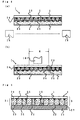
- FIG.3 is a cross sectional view of two embodiments of the invented microcapsule display sheet I manufactured by the invented method.
- the film 5 may be separated from the UV resin layer shown in the part A of the figure as one embodiment and the film 5 may also be kept on the UV resin layer shown in the part B of the figure as the other embodimentof the invention,
- microcapsule layer 31 in this figure is coated on the transparent front sheet 1 by ink-like transparent adhesives.
- the display sheet is rather hard with stiffness, and in the embodiment of the film being separated off, the display sheet is soft with flexibility.
- FIG. 4 is a cross sectional view of the sheet I.
- FIG.4 shows the state when a permanent magnet slips on back surface of the display sheet I, and (b) shows the state when a magnetic pen writes words on the front surface of it.
- Microcapsule magnetic display sheet manufactured in example 1 by the invented method is compared with traditional microcapsule display sheet which is prepared by coating adhesives in 80 ⁇ m thickness on the back side and then laminating a film with 150 ⁇ m thickness on the adhesive layer in order to investigate the properties as impact-resistance, durability wording, erasing and word-keeping properties.
- Sliding a permanent magnet composed of 7 sub-magnets and each of them is in size of 19mmK ⁇ 122mm, 1mm(thickness) and has the magnetic flux density of 380 gauss at speed of 10cm per second for one move back and forth to observe if the worded lines are erased completely.
- the microcapsule display sheet is manufactured by the same method as the example 1 except thickness of the coated UV resin is 300 m.
- microcapsule display sheet thus manufactured in example 3 is tested to investigate the properties.
- the sheet has very good wording property, erasing property as well as word-keeping property, has good impact resistance and good durability and the wording lines, pictures are quite distinct and clear.
- a microcapsule display sheet embodying the invention is sequentially provided thereon with a transparent surface sheet, a microcapsule layer painted on the surface sheet and a UV resin layer coated on the microcapsule layer, and owing to the existence of the UV resin layer, while wording with a magnetic pen at normal wording speed, distinct and clear lines or pictures can be recorded and while erasing, the wording lines are completely erased and no lines left. And, the microcapsule display sheet is very good in durability and impact resistance.
- the UV resin layer with thickness of 20 ⁇ m to 500 ⁇ m protects the microcapsules from pressure, impact or moisture.
- the capsules According to the method for manufacturing the microcapsule display sheet, painting microcapsule dispersoid on a transparent sheet, drying it to form a microcapsule layer, then coating liquid UV resin on the dried microcapsule layer and irradiating it with UV lamps to harden it, as the liquid UV resin fills into fine gaps between the microcapsules, the capsules are completely protected and that results in good durability and good impact resistance.
- the wording pressure is shared by the UV resin but not all suffered by the microcapsules.
Landscapes
- Physics & Mathematics (AREA)
- General Physics & Mathematics (AREA)
- Engineering & Computer Science (AREA)
- Theoretical Computer Science (AREA)
- Electrochromic Elements, Electrophoresis, Or Variable Reflection Or Absorption Elements (AREA)
- Devices For Indicating Variable Information By Combining Individual Elements (AREA)
- Manufacturing Of Micro-Capsules (AREA)
Abstract
Description
- The invention relates to a magnetic display sheet and a method of manufacture thereof, and more particularly to a microcapsule magnetic display sheet having a ultraviolet ray curable resin layer which has elasticity so as to endow the magnetic sheet with impact resistance and durability.
- A magnetic display sheet thus manufactured may have such properties as softness or stiffness, may be very strong against impact and may distinctly record words or pictures.
- Many methods of magnetic display are well known so far, for example, a method of sealing fine-shaped magnetic powders and titanium oxide particles in microcapsules, moving the magnetic powders in the microcapsules to front to make display by a magnetic field force is published recently. The magnetic display sheet used in this method is composed of a transparent front sheet, a back sheet which is not always necessary to be transparent and a microcapsule layer between the said two sheets. Such a display sheet is disclosed in JP 08297470A (Chemitec K.K.) FIG. 5 shows a cross-sectional view of the traditional magnetic display sheet. The microcapsule magnetic display sheet I in FIG.5 is prepared by a process of painting microcapsule dispersoid on a
transparent front sheet 1, then drying it to form amicrocapsule layer 31, and at last sticking aback sheet 21 closely to the microcapsule layer to complete it. - There are some problems in the traditional magnetic display methods now. While using a magnetic pen (magnetic flux density 850 ±100 gauss) sold on the market to write words or to draw pictures on the microcapsule magnetic sheet shown in FIG.5, the words or pictures are not distinct sometimes and afterimages leave somehow even the words or pictures are deleted.
- And according to its constitution, the
back sheet 21 is stuck onto t hemicrocapsule layer 31 in order to protect it, but the microcapsule layer is not very even as the microcapsules have different sizes. - As a result,
hollows 22 between theback sheet 21 and themicrocapsule layer 31 generate and thehollows 22 result in microcapsules transformed or destroyed gradually inrepeated wording or drawing. - Therefore, the traditional magnetic display sheet does not have satisfactory impact resistance and desirable durability.
- And, while sticking the
back sheet 21 onto themicrocapsule layer 31 for preparing the microcapsule magnetic sheet, a kind of adhesive is pre-coated on theback sheet 21 to stick it onto the microcapsule layer31. - But while sticking the
back sheet 21 onto the microcapsule layer, thehollows 22 generate inevitably because the adhesive does not match the microcapsules very well in all the case. - And as the adhesive is point-adhered to the microcapsules, the adhesion is not strong enough and as a result, the
back sheet 21 is partially or completely separated from the microcapsule layer sometimes. - Furthermore, as the microcapsule sheet I with a back sheet stuck thereon is stiff, it is necessary to stick an unwoven cloth instead of the back sheet if a soft microcapsule sheet is necessary.
- And as different adhesives are necessary to be pre-painted on the different back materials, namely sheet or unwoven cloth, the different process results in production efficiency down.
- Therefore, the inventors of the invention, based on repeated researches, determined that a microcapsule magnetic sheet with good durability and impact resistance nay be obtained by painting liquid ultraviolet ray(UV ray) curable resin on the
microcapsule layer 31 and drying it instead of thetraditional back sheet 21. - The reason for the merits can be considered as while painting the UV ray curable resin on the microcapsule layer, no
hollows 22 generate and the UV ray curable resin can protect the microcapsule layer well from wording or drawing pressure. - And, production efficiency of the microcapsule display sheet may also essentially be improved because the microcapsule display sheet having softness or stiffness can be produced by a process of covering or not covering a sheet onto the coated UV resin only.
- Therefore, it is desirable to provide a microcapsule display sheet which has very good durability and impact resistance, can display stable and distinct words or pictures at normal wording or drawing speed and the recorded words or pictures can be deleted speedily without after image left.
- It is further desirable to provide a method of manufacturing the said microcapsule display sheet.
- It is further desirable to provide a method for manufacturing a microcapsule display sheet with softness or stiffness by a simple process.
- Certain preferred embodiments of the present invention provide the above microcapsule display sheet and methods.
- According to one aspect of the present invention there is provided an ultraviolet-ray curable microcapsule magnetic display sheet sequentially comprising: a transparent sheet; a microcapsule layer formed thereon; and an ultraviolet-ray curable resin layer.
- According to another aspect of the present invention there is provided a microcapsule magnetic display sheet sequentially comprising a transparent layer, a microcapsule layer, and an ultraviolet-ray cured resin layer.
- The transparent sheet may be a transparent surface sheet, the microcapsule layer may be coated on the surface sheet, and the UV resin layer may be coated on the microcapsule layer.
- Owing to the existence of the UV resin layer, while wording with a magnetic pen at normal wording speed, distinct and clear lines or pictures (or images) can be recorded and while erasing, the wording lines are completely erased and no lines left. And, the microcapsule display sheet is very good in durability and impact resistance.
- Advantageously, the ultraviolet-ray cured layer may be in a thickness of 20µm to 500µm. The UV resin layer with thickness of 20 µm to 500µm protects the microcapsules from pressure, impact or moisture.
- According to a second aspect of the present invention, there is provided a method of manufacturing a microcapsule magnetic display sheet, the method comprising the steps of:
- (1) coating microcapsule dispersoids on a transparent sheet,
- (2) drying it to form a microcapsule layer, and
- (3) coating liquid ultraviolet-ray curable resin on the microcapsule layer and irradiating it with UV rays, just after coating, to harden it so as to form a UV ray cured resin layer.
-
- Advantageously, a film may be covered on the coated liquid UV ray curable resin before it is hardened.
- Advantageously, the film covered on the UV curable resin may be separable.
- According to the method for manufacturing the microcapsule display sheet, coating microcapsule dispersoid on a transparent sheet, drying it to form a microcapsule layer, then coating liquid UV resin on the dried microcapsule layer and irradiating it with UV lamps to hard it, as the liquid UV resin fills into fine gaps between the microcapsules, the capsules are completely protected and that results in good durability and good impact resistance.
- In more detail, as no gaps formed between the microcapsules and the UV resin, the wording pressure is shared by the UV resin but not all suffered by the microcapsules.
- Advantageously, after coating the liquid UV resin on the microcapsule layer and before hardening it, the UV resin may be covered by a sheet to make it more smooth and stiff.
- While the covered sheet separated the display sheet becomes soft.
-
- FIG. 1 is a cross-sectional view of manufacture process of a microcapsule display sheet, embodying the present invention;
- FIG. 2 is a cross-sectional view of a microcapsule display sheet embodying the present invention;
- FIG. 3 is a cross-sectional view of two embodiments of the invented microcapsule display sheet. Part A of the Figure shows the microcapsule display sheet while the covered sheet separated and part B shows the microcapsule display sheet with the covered sheet thereon.
- FIG. 4 is a cross-sectional view of wording method of a microcapsule display sheet embodying the present invention, a) shows the case of sliding a magnet on back side of the magnetic sheet and b) shows sliding a magnet on front side of the sheet.
- FIG. 5 is a cross-sectional view of traditional magnetic display sheet.
-
- Embodiments of the invention will be described fully as follow.
- The microcapsule magnetic display sheet is sequentially provided thereon with a transparent sheet; a microcapsule dispersoid layer; and an ultraviolet-ray curable resin layer.
- Owing to the existence of the ultraviolet ray curable resin layer, the described microcapsule display sheet has good impact resistance and durability and can stably distinctly record lines and the recorded words or pictures can be deleted comletely without after images left.
- The coated ultraviolet ray curable resin in thickness of 20 µm to 500 µm is efficient enough to protect the microcapsule layer from the wording pressure, impact and moisture.
- As the microcapsules are protected by the UV ray curable resin layer and few of then is destroyed during repeated use, the display sheet has wonderful durability and impact resistance.
- According to the described method of manufacturing the microcapsule display sheet, painting microcapsule dispersoids on a transparent front sheet and drying it to form a microcapsule layer and then painting liquid ultraviolet ray curable resin on the microcapsule layer and hardening it by irradiating with UV rays.
- Because the liquid ultraviolet ray curable resin fills in fine gaps, no hollows left between the microcapsule layer and the ultraviolet layer and the ultraviolet ray curable resin filled into fine gaps shares the wording pressure so as to protect the microcapsules. So the problems the traditional microcapsule display sheet are solved once and for all, the described microcapsule display sheet having good durability and impact resistance is thus manufactured.
- Also according to the described method of manufacturing the microcapsule display sheet, after painting liquid ultraviolet ray curable resin on the microcapsule layer, covering a sheet on the ultraviolet ray curable resin to make the surface smooth and stiff, and the stiffness of the microcapsule display sheet may be regulated by covering a sheet with different thickness.
- If the microcapsule display sheet with the covered sheet thereon, it is hard and stiff. But as the covered sheet is separable, itcan be separated if necessary and once the covered sheet is separated the microcapsule display sheet becomes soft.
- The ultraviolet ray curable resin used for the present invention are not specially limited. The resin synthesized from diisocyanate and (meta)acrylic monomer having a hydroxyl group at end is desirable.
- Ethylene diisocyanate, propylene diisocyanate, pentamethylene diisocyanate, hexamethylene diisocyanate, 2,4-tolylene diisocyanate, 2,6-tolylene diisocyanate, isophorone diisocyanate, xylene-1,4-diisocyanate, xylene-1,3-diisocyanate may be pointed out as examples of the diisocyanate. Mixtures of the diisocyanate pointed above may also be used.
- 2-Hydroxy-ethyl-(meta)acrylate, 2-hydroxy-propyl-(meta)acrylate, 2-h ydroxy-(meta)acrylate, 2-hydroxy-phonoxy-ethyl-(meta)acrylate may be the examples of the acrylic monomer having a hydroxyl group at end.
- One kind or mixtures of them can be used. The acrylic monomer means both of acrylic monomer and methacrylic monomer.
- The UV resin layer in the described microcapsule display sheet is formed by coating liquid UV curable resin on the microcapsule layer and then hardening it by irradiating UV rays. The liquid UV curable resin may also be composed of UV resin and, reaction accelerators, radical polymerization inhibitors, plasticisers etc. Benzoin, benzoin-methylether, benzylbenzophenone, acetophenone may be pointed out as the UV polymerization initiator.
- These UV resin, UV polymerization initiators, accelerators etc. are well known in the technical field.
- Any suitable one besides those pointed above can be selected.
- Known methods of coating the UV curable resin in the technical field are suitable for use.
- The front sheet used in preferred embodiments of the present invention is transparent and each of microcapsule dispersoid, gelatin membrance or microcapsule layer can be colored by adding coloring agents.
- Also the back sheet can be colored. Normal coloring agents or pigments can be used and methylene blue, Congo red, benzoin yellow TZ, oil blue, oil green, oil yellow, benzidine yellow are the examples.
- The described method of manufacturing the microcapsule display sheet is composed of the processes of painting microcapsule dispersoid on a transparent front sheet, drying itto form a microcapsule layer, then painting liquid UV resin on the microcapsule layer, covering a sheet before hardening the UV resin and last irradiating UV rays to harden it so as to complete the microcapsule sheet.
- The transparent front sheet in preferred embodiments of the present invention is not too soft and not too thin, it has a suitable thickness so as to bear wording pressure.
- The transparent sheet made of polyester, polyethylene may be used but they are not the all. And thickness of the front sheet is 30 µm to 250 µm in general, 50 µm to 200 µm is desirable, 50 µm to 150 µm is the best. Thickness of the UV resin layer is the meaning of from the low point of a hollow.
- Thickness of the coated UV curable resin is 20 µm to 500 µm, 50 µm to 400 µm is desirable and 100 µm to 300 µm is the best.
- Thickness of the UV resin layer thinner than 20 µm is too thin that can not protect the microcapsules fully and the thickness thicker than 500µm is too thick that makes bad influence on magnetic flux and erasion and furthermore it is not economic.
- According to the described method of manufacturing the microcapsule display sheet, the microcapsule dispersoid is prepared by dispersing microcapsules in a transparent aqueous adhesive.
- Viscosity of the microcapsule dispersoid has to be suitable for being coated on the transparent front sheet. Too lower viscosity means less microcapsules coated on the front sheet and that results in the recorded words or pictures not distinct and not clear.
- On the other hand, the microcapsule dispersoid having too high viscosity can not be painted on the front sheet smoothly. Of course the viscosity is different depending on circumstance temperature, season etc. 15,000cps to 35,000cps may be suggested.
- While regulating the viscosity of the microcapsule dispersoid, sodium alginate, polyvinyl alcohol, modified polyacrylic sodium, modified polyacrylic emulsion, modified polyacrylic sulfonate may be added into the microcapsule dispersoid to regulate the viscosity.
- And sodium alginate, polyvinyl alcohol are better. The adding quantity of the viscosity regulators depends on the circumstance temperature, moisture etc. 0.5 to 3.0 wt% of the microcapsule dispersoid is suggested.
- The described method of manufacturing the microcapsule display sheet is composed of the processes of coating microcapsule dispersoid on a transparent front sheet, drying it to form a microcapsule layer, then painting liquid UV resin on the microcapsule layer, covering a sheet(or film) before hardening the UV resin and last irradiating UV rays to harden it so as to complete the microcapsule sheet.
- The sheet covered on the UV resin is usually made of polyester, polyethylene, polyvinylchloride etc.
- As for the thickness of the covered sheet, thinner is better. 10 µm to 60 µm is desirable and 20 µm to 50 mµm is the best.
- The sheet can be covered on the liquid UV resin at any time of after coating the liquid UV resin and before hardening it, for example, at the time of coating the liquid UV resin simultaneously, at the time of just after coating the liquid UV resin or at the time of start to harden the coated UV resin.
- The time of just after coating the liquid UV resin is suggested.
- As regard to the W rays used in certain embodiments of the present invention, rays in UV wavelength, not specially limited, can be used as long as they can harden the coated UV curable resin. UV lamp or black lamp in the wavelength of 200nm to 400nm are the examples.
- Irradiating time may be 5 seconds to 5 minutes and 5 seconds to 3 minutes is better and 20 seconds to 1 minute is the best.
- At last, thus manufactured microcapsule display sheet is cut at desirable length. The microcapsules used in this invention are not specially limited.
- Typically, main Contents of the microcapsules are composed of solvents with low boiling point of 100°C to 150 °C and viscosity of lower than 0.8cps (at 25 °C), solvents with high boiling point of 240°C to 350°C and viscosity of 3cps to 12cps (at 25 °C ), magnetic powders and nonmagnetic powders in the same size.
- And the diameter of the microcapsules is smaller than 800 µm, 300 µm to 600 µm in average. An example of the method for preparing the microcapsules is described as follows.
- (1) dispersing magnetic powders, nonmagnetic powders and dispersant in a gelatin aqueous solution and stirring them well at 20 °C to 60°C,
- (2) adding gum Arabic into the solution to regulate pH to acid and then cool it to lower than 20°C to form a gelatin-arabic gum membrane,
- (3) curing the gelatin-arabic gum membrane to form microcapsules,
- (4) feltering it to delete the large microcapsules bigger than the average and remove water from the solution.
-
- The solvent with low boiling point used in preferred embodiments of the invention has the boiling point of 100°C to 150°C and viscosity of lower than 0.8cps.
- Toluene, xylene, ortho-xylene, meta-xylene, para-xylene, ethylbenzene, ethylcyclohexane, 2-hexane etc. may be pointed out as the solvent with low boiling point. One or mixture of them may be used.
- The solvent with high boiling point used in preferred embodiments of the invention has the boiling point of 240°C to 350°C and viscosity of 3cps to 12cps.
- Dodecyl benzene, dipentyl benzene, diphenyl ether, benzil benzoate, diethyl phthalate are the examples. One alone or mixture of them can be used. Furthermore, compatibility of the solvent with low boiling point and the solvent with high boiling point has to be attentive.
- Toluene and dodecyl benzene, xylene and dipentyl benzene, ethylbenzene and diphenyl ether, ethylcyclohexane and benzil benzoate are the combinations with good compatibility.
- The magnetic powders used in preferred embodiments of the invention are well-known in the technical field, for example, black iron oxide, porous iron oxides, manganese dioxide-containing iron oxide, chrome dioxide, ferrite, iron or nickel fine powders, iron-nickel alloy that are all not affinity-reated are pointed out. Among them, synthetic magnetic iron oxide is suggested.
- Diameter of the magnetic powders smaller than 5 µm is desirable, 0.1 µm to 3 µm is better. Titanium dioxide, lithopone, zinc oxide, basic lead carbonate, zinc sulfide can be used in the invention as the nonmagnetic powders. And anatase-type or rutile-type titanium dioxides are both used.
- No limit is necessary to the size of the nomagnetic powders used in certain embodiments of the invention, as long as they can be dispersed enough. 0.1 µm to 1 µm is normal. A wide range of aqueous transparent adhesives can be used, specially each of water soluble urethane resin, water soluble aromatic polyester resin or water dispersive urethane resin is the example and water emulsion is the best.
- The described microcapsule magnetic display sheet records words or pictures by a magnet. This method is well known in the technical field.
- In preferred embodiments of the present invention, a magnet having about 800 gauss is suggested which shows lines rapidly, clearly and distinctly.
- While erasing the recorded words or pictures, using several weak magnets with 200 to 500 gauss together is effective. The recorded words and lines can be erased rapidly and clearly.
- Therefore, it is very clear that certain embodiments of the present invention has the merits technically and economically. The microcapsule display sheet embodying the present invention can be used in a wide range.
- Picture books or toys for children, word-trainer, game-board, memo board, disk mat, blackboard for meeting, memo board in clean room, photo-electric notice board, display panel for computer etc, are the examples.
- Embodiments of the invention are described in more detail as follows.
- These embodiments are described by way of example only and are not intended to limit the invention.
- FIG 1 is a cross-sectional view of a coating device for manufacturing a microcapsule display sheet embodying the invention. In FIG. 1,
belt conveyer 17 supported by theroller Film 6 drew out fromroller 8 is put on the belt conveyer throughroller 12. Thefilm 6 is polyvinyl chloride film or polyethylene glycol terephthalate film. - The
sheet 3, that is coated with a microcapsule layer thereon, is put on thefilm 6 passing throughroller 12, 13. The liquid UVcurable resin 7 is being coated on themicrocapsule layer 31, by nozzle of hopper positioned over thebelt conveyer 17 on themicrocapsule layer 31. - Coating thickness is about 200 µm. The
film 6 suffers spares of the coatedliquid UV resin 7. - In this example, the liquid UV resin is prepared by mixing urethane acrylate 100 weight parts with
benzoin ethyl ether 2 weight parts and its viscosity is regulated to be 4500 ± 500cps. - Then, the
sheet 5 made of polyester (polyethylene glycol terephthalate film) and having thickness of 30µm is covered on the coatedliquid UV resin 7 from roller 9. And after that, the black lamps 41 (20w, 40 units) irradiate the liquid UV resin from upper side to harden it. And the black lamps 42 (31w,10 units) irradiate the spares of the coated UV resin flowing on thefilm 6 from the lower side to harden it. - As the spares of the coated UV resins is not a large quantity, the
film 6 can be separated easily later. While separating thefilm 6, a desirable microcapsule display sheet is cut and completed. - The microcapsule magnetic display sheet thus manufactured is shown in FIG 2.
- FIG 2 is its cross sectional view. In FIG 2,
microcapsule layer 31 is coated on thetransparent front sheet 1, and hollows 25 between thefront sheet 1 and those coated microcapsules of the microcapsule layer31 are filled by water transparent adhesives and theconcave parts 26 between theUV resin layer 4 and themicrocapsule layer 31 are filled by the UV resin. - Furthermore, a
film 5 is covered on the UV resin layer in this example. - Thus, the microcapsule layer is completely supported and protected by the water adhesives filled in the
hollows 25 formed between the front sheet and the microcapsules and the UV resin filled in theconcave parts 26 formed in the other side between the microcapsule layer and the UV resin. - As the
microcapsules 2 are completely protected from both sides, the microcapsule display sheet has wonderful durability and impact-resistance. - FIG.3 is a cross sectional view of two embodiments of the invented microcapsule display sheet I manufactured by the invented method.
- Namely, the
film 5 may be separated from the UV resin layer shown in the part A of the figure as one embodiment and thefilm 5 may also be kept on the UV resin layer shown in the part B of the figure as the other embodimentof the invention, - The
microcapsule layer 31 in this figure is coated on thetransparent front sheet 1 by ink-like transparent adhesives. - As the ink-like transparent adhesives fill into the
hollows 25, there are no gaps left. Also as the UV resin fill into theconcave parts 26, there are no gaps left. In the embodiment of thefilm 5 being kept on the UV resin layer, the display sheet is rather hard with stiffness, and in the embodiment of the film being separated off, the display sheet is soft with flexibility. - While explaining the wording method of the described microcapsule display sheet I, FIG. 4 is a cross sectional view of the sheet I.
- In the FIG.4, (a) shows the state when a permanent magnet slips on back surface of the display sheet I, and (b) shows the state when a magnetic pen writes words on the front surface of it.
- When a
permanent magnet 18 with magnetic force 200 gauss slips on the back side following the arrow in the figure just as like (a), themagnetic powders 23 inside themicrocapsules 2 move towards to the UV resin layer (erasing operation). - In this state, as the black
magnetic powders 23 move onto theUV side 4, the front surface of the sheet is white because only whitenonmagnetic powders 24 exist in the front side. On the other hand, in the state (b), while wording words or pictures with amagnetic pen 19, distinct black words or pictures E appear on the front surface of the sheet thanks to the existence of the black magnetic powders. - Microcapsule magnetic display sheet manufactured in example 1 by the invented method is compared with traditional microcapsule display sheet which is prepared by coating adhesives in 80µm thickness on the back side and then laminating a film with 150 µm thickness on the adhesive layer in order to investigate the properties as impact-resistance, durability wording, erasing and word-keeping properties.
- The investigated results are shown in table 1.
- Putting a microcapsule display sheet on a concrete plate sticking a plastic tile thereon, dropping a steel-made ball in diameter of 25mm and weight of 70g directly on the microcapsule display sheets from 50mm height to investigate, if the sheet is completely or partially destroyed.
- Preparing a conoid in weight of 500g and having a coning part in size of 1mm and contacting the coning part directly with front surface of the test sheet to write lines of 50mm length within one second repeatedly and continuously in the same place so as to investigate if there are some capsules destroyed.
- Wording lines on surfaces of the test sheets with a magnetic pen having magnetic flux density of 750 gauss at wording speed of 20cm per second to observe if the worded lines are distinct.
- Sliding a permanent magnet composed of 7 sub-magnets and each of them is in size of 19mmK × 122mm, 1mm(thickness) and has the magnetic flux density of 380 gauss at speed of 10cm per second for one move back and forth to observe if the worded lines are erased completely.
- Writing words on surfaces of the test sheets with a magnetic pen having magnetic flux density of 750 gauss and keeping the test sheets at temperature of -10 °C, moisture of 10% and temperature of 45°C, moisture of 90% respectively for one month to investigate if the wrote words have any changes.
TEST ITEMS EMBODIMENT OF PRESENT INVENTION TRADITIONAL SHEET WORDING PROPERTY Wording lines are very distinct. Wording lines are blurred and indistinct. ERASING PROPERTY Wording lines erased completely. Some wording lines left. WORD-KEEPING PROPERTY Conditions: No any changes No any changes -10°C, 10%RH observed. observed. Conditions: No any changes Some of magnetic powders 45°C,90%RH observed. drop and the wording lines are indistinct. DURABILITY Some of capsules destroyed. 53 rounds 16 rounds Almost of capsules destroyed. 78 rounds 25 rounds IMPACT No capsules Almost capsules RESISTANCE destroyed. destroyed. - The microcapsule display sheet, is manufactured by the same method as the example 1 except thickness of the coated UV resin is 300 m.
- The microcapsule display sheet thus manufactured in example 3 is tested to investigate the properties.
- As a results of the investigation, it is clarified that the sheet has very good wording property, erasing property as well as word-keeping property, has good impact resistance and good durability and the wording lines, pictures are quite distinct and clear.
- A microcapsule display sheet embodying the invention is sequentially provided thereon with a transparent surface sheet, a microcapsule layer painted on the surface sheet and a UV resin layer coated on the microcapsule layer, and owing to the existence of the UV resin layer, while wording with a magnetic pen at normal wording speed, distinct and clear lines or pictures can be recorded and while erasing, the wording lines are completely erased and no lines left. And, the microcapsule display sheet is very good in durability and impact resistance.
- In preferred embodiments, the UV resin layer with thickness of 20µm to 500 µm protects the microcapsules from pressure, impact or moisture.
- According to the method for manufacturing the microcapsule display sheet, painting microcapsule dispersoid on a transparent sheet, drying it to form a microcapsule layer, then coating liquid UV resin on the dried microcapsule layer and irradiating it with UV lamps to harden it, as the liquid UV resin fills into fine gaps between the microcapsules, the capsules are completely protected and that results in good durability and good impact resistance.
- In more detail, as no gaps formed between the microcapsules and the UV resin, the wording pressure is shared by the UV resin but not all suffered by the microcapsules.
- Also in preferred embodiments, after coating the liquid UV resin on the microcapsule layer and before hardening it, covering a sheet on the UV resin to make it more smooth and stiff.
- While the covered sheet separated the display sheet becomes soft.
Claims (7)
- An ultraviolet-ray curable microcapsule magnetic display sheet sequentially comprising: a transparent sheet; a microcapsule layer formed thereon; and an ultraviolet-ray curable resin layer.
- An ultraviolet-ray curable microcapsule magnetic display sheet according to Claim 1 wherein said ultraviolet-ray curable resin layer is in a thickness of 20µm to 500 µm.
- A method of manufacturing a microcapsule magnetic display sheet comprising the steps of:(1) coating microcapsule dispersoids on a transparent sheet,(2) drying it to form a microcapsule layer, and(3) coating liquid ultraviolet-ray curable resin on the microcapsule dispersoid layer and irradiating it with UV rays, just after coating, to harden it so as to form a UV ray cured resin layer.
- A method of manufacturing the microcapsule magnetic display sheet according to Claim 3, wherein a film is covered on the painted liquid UV ray curable resin before it is hardened.
- A method of manufacturing the microcapsule magnetic display sheet according to Claim 4, wherein said film covering the UV cured resin is separable.
- Microcapsule magnetic display sheet sequentially comprising a transparent layer; a microcapsule layer; and an ultraviolet-ray cured resin layer.
- Microcapsule magnetic display sheet according to Claim 6, wherein said ultraviolet-ray cured resin layer is in a thickness of 20µm to 500µm.
Applications Claiming Priority (3)
| Application Number | Priority Date | Filing Date | Title |
|---|---|---|---|
| JP9180857A JP2841294B1 (en) | 1997-07-07 | 1997-07-07 | Microcapsule magnetic display sheet and method of manufacturing the same |
| JP180857/97 | 1997-07-07 | ||
| JP18085797 | 1997-07-07 |
Publications (2)
| Publication Number | Publication Date |
|---|---|
| EP0890939A1 EP0890939A1 (en) | 1999-01-13 |
| EP0890939B1 true EP0890939B1 (en) | 2002-11-27 |
Family
ID=16090578
Family Applications (1)
| Application Number | Title | Priority Date | Filing Date |
|---|---|---|---|
| EP98305332A Expired - Lifetime EP0890939B1 (en) | 1997-07-07 | 1998-07-03 | Microcapsule magnetic display sheet and a method thereof |
Country Status (6)
| Country | Link |
|---|---|
| US (1) | US6299972B1 (en) |
| EP (1) | EP0890939B1 (en) |
| JP (1) | JP2841294B1 (en) |
| CN (1) | CN1139905C (en) |
| AT (1) | ATE228698T1 (en) |
| DE (1) | DE69809645T2 (en) |
Families Citing this family (16)
| Publication number | Priority date | Publication date | Assignee | Title |
|---|---|---|---|---|
| JP3587435B2 (en) * | 1998-10-16 | 2004-11-10 | 株式会社タカラ | Display panel |
| US6583780B1 (en) | 1999-02-19 | 2003-06-24 | Seiko Epson Corporation | Method for producing display panel and display panel |
| JP4089808B2 (en) * | 2001-12-25 | 2008-05-28 | ケミテック株式会社 | Erasable microcapsule magnetophoretic display sheet |
| TW578121B (en) | 2002-03-21 | 2004-03-01 | Sipix Imaging Inc | Magnetophoretic and electromagnetophoretic display |
| US7580180B2 (en) | 2002-03-21 | 2009-08-25 | Sipix Imaging, Inc. | Magnetophoretic and electromagnetophoretic displays |
| US7113323B2 (en) | 2002-03-21 | 2006-09-26 | Sipix Imaging, Inc. | Magnetophoretic and electromagnetophoretic displays |
| JP4171385B2 (en) * | 2003-09-17 | 2008-10-22 | 株式会社日本触媒 | Manufacturing method of microcapsule carrying sheet |
| US20090247042A1 (en) * | 2006-12-08 | 2009-10-01 | Koehler Steven M | Magnetic support surface with magnetic shapes |
| JP2010102293A (en) * | 2008-09-26 | 2010-05-06 | Toppan Printing Co Ltd | Microcapsule-type electrophoretic display panel and method of manufacturing the same |
| KR101613635B1 (en) * | 2008-10-31 | 2016-04-20 | 삼성전자주식회사 | Microcapsule, structure comprising same, article comprising same, and method for preparing same |
| US20110097699A1 (en) * | 2009-10-24 | 2011-04-28 | Shengmin Wen | Magnetically erasable writable educational flash card and method for making the same |
| US9757704B2 (en) * | 2009-12-22 | 2017-09-12 | Isp Investments Llc | Polymerizable lactamic copolymers suitable for the formation of coatings on microencapsulated particles |
| KR101691154B1 (en) * | 2010-03-05 | 2017-01-02 | 삼성전자주식회사 | Microcapsule array substrate, apparatus for transferring smell information having the substrate, and electronic device having the apparatus |
| CN103246122B (en) * | 2013-05-07 | 2015-07-29 | 京东方科技集团股份有限公司 | E-ink capsule making apparatus and method |
| KR101808228B1 (en) * | 2017-08-23 | 2017-12-13 | 주식회사 씨케이머티리얼즈랩 | Magnetic fluid display |
| CN111205912B (en) * | 2020-01-19 | 2021-03-30 | 清华大学 | Preparation method of intelligent storage type nanoparticles |
Family Cites Families (11)
| Publication number | Priority date | Publication date | Assignee | Title |
|---|---|---|---|---|
| US4283438A (en) * | 1979-12-26 | 1981-08-11 | Magnavox Government And Industrial Electronics Company | Method for individually encapsulating magnetic particles |
| JPS6485268A (en) | 1987-09-25 | 1989-03-30 | Kemitetsuku Kk | Ultraviolet ray and moisture curable adhesive composition |
| US5057363A (en) * | 1989-12-27 | 1991-10-15 | Japan Capsular Products Inc. | Magnetic display system |
| US5151032A (en) * | 1990-07-13 | 1992-09-29 | Kabushiki Kaisha Pilot | Magnetophoretic display panel |
| JPH0569502A (en) | 1991-09-13 | 1993-03-23 | Nok Corp | Micro-capsule layer adhering body |
| CA2070068C (en) * | 1992-05-29 | 2000-07-04 | Masayuki Nakanishi | Magnetic display system |
| JPH0759626A (en) | 1993-08-20 | 1995-03-07 | Dainippon Printing Co Ltd | Veneer |
| JPH07182695A (en) | 1993-12-24 | 1995-07-21 | Canon Inc | Optical information recording medium and manufacturing method thereof |
| JPH08297470A (en) | 1995-02-27 | 1996-11-12 | Chemitec Kk | Microcapsule magnetic display board and manufacturing method thereof |
| GB2292119B (en) * | 1994-08-10 | 1998-12-30 | Chemitech Inc | A process for producing a magnetic display sheet using microcapsules |
| JP3013649U (en) * | 1995-01-13 | 1995-07-18 | 株式会社トミー | Magnetic pen |
-
1997
- 1997-07-07 JP JP9180857A patent/JP2841294B1/en not_active Expired - Lifetime
-
1998
- 1998-06-04 CN CNB981023452A patent/CN1139905C/en not_active Expired - Lifetime
- 1998-07-02 US US09/109,833 patent/US6299972B1/en not_active Expired - Lifetime
- 1998-07-03 DE DE69809645T patent/DE69809645T2/en not_active Expired - Lifetime
- 1998-07-03 EP EP98305332A patent/EP0890939B1/en not_active Expired - Lifetime
- 1998-07-03 AT AT98305332T patent/ATE228698T1/en not_active IP Right Cessation
Also Published As
| Publication number | Publication date |
|---|---|
| DE69809645D1 (en) | 2003-01-09 |
| JPH1124113A (en) | 1999-01-29 |
| EP0890939A1 (en) | 1999-01-13 |
| ATE228698T1 (en) | 2002-12-15 |
| CN1204830A (en) | 1999-01-13 |
| JP2841294B1 (en) | 1998-12-24 |
| HK1016724A1 (en) | 1999-12-03 |
| DE69809645T2 (en) | 2003-08-14 |
| CN1139905C (en) | 2004-02-25 |
| US6299972B1 (en) | 2001-10-09 |
Similar Documents
| Publication | Publication Date | Title |
|---|---|---|
| EP0890939A1 (en) | Microcapsule magnetic display sheet and a method thereof | |
| CN1088533C (en) | Microcapsules for magnetic display and method for producing magnetic display sheet therewith | |
| US6639579B1 (en) | Magnetophoresis type display device and process of production of same | |
| GB2324273A (en) | Gelatinised microcapsules for magnetic display sheets | |
| FR2477306A1 (en) | MAGNETIC DISPLAY PANEL | |
| CN1120096C (en) | Color magnetic particles used for magnetic movement display, and its mfg. method | |
| CN1219950A (en) | pressure sensitive adhesive construction | |
| US4847110A (en) | Transfer recording medium and process for production thereof | |
| EP1315137B1 (en) | Magnetic display | |
| TW526347B (en) | Thin microcapsule magnetic flowing display plate and its using method | |
| JP2841291B2 (en) | Microcapsule for magnetic display, magnetic display plate, and method of manufacturing the same | |
| JPH10148702A (en) | Anti-reflection film | |
| JPH0854651A (en) | Magnetic display board manufacturing method | |
| US20100071842A1 (en) | Magnet structure with colorable surface and a method for manufacturing the magnet | |
| JPH08297470A (en) | Microcapsule magnetic display board and manufacturing method thereof | |
| JPH06313880A (en) | Reloadable display media | |
| HK1016724B (en) | Michocapsule magnetic display sheet and a method thereof | |
| US20060022367A1 (en) | Display element and manufacturing method thereof | |
| JPS62233283A (en) | Recording medium | |
| JPH0690780B2 (en) | Leader tape for magnetic tape | |
| JPH07261684A (en) | Magnetic display and magnetic display | |
| JPH10282908A (en) | Display panel | |
| JPS62134286A (en) | Recorded material | |
| JPH11301113A (en) | Thermomagnetic recording medium | |
| JPH05325179A (en) | Magnetic recording medium and tape cassette |
Legal Events
| Date | Code | Title | Description |
|---|---|---|---|
| PUAI | Public reference made under article 153(3) epc to a published international application that has entered the european phase |
Free format text: ORIGINAL CODE: 0009012 |
|
| AK | Designated contracting states |
Kind code of ref document: A1 Designated state(s): AT CH DE FR GB IE LI |
|
| AX | Request for extension of the european patent |
Free format text: AL;LT;LV;MK;RO;SI |
|
| 17P | Request for examination filed |
Effective date: 19990331 |
|
| AKX | Designation fees paid |
Free format text: AT CH DE FR GB IE LI |
|
| 17Q | First examination report despatched |
Effective date: 20000221 |
|
| GRAG | Despatch of communication of intention to grant |
Free format text: ORIGINAL CODE: EPIDOS AGRA |
|
| GRAG | Despatch of communication of intention to grant |
Free format text: ORIGINAL CODE: EPIDOS AGRA |
|
| GRAH | Despatch of communication of intention to grant a patent |
Free format text: ORIGINAL CODE: EPIDOS IGRA |
|
| GRAH | Despatch of communication of intention to grant a patent |
Free format text: ORIGINAL CODE: EPIDOS IGRA |
|
| GRAA | (expected) grant |
Free format text: ORIGINAL CODE: 0009210 |
|
| AK | Designated contracting states |
Kind code of ref document: B1 Designated state(s): AT CH DE FR GB IE LI |
|
| PG25 | Lapsed in a contracting state [announced via postgrant information from national office to epo] |
Ref country code: AT Free format text: LAPSE BECAUSE OF FAILURE TO SUBMIT A TRANSLATION OF THE DESCRIPTION OR TO PAY THE FEE WITHIN THE PRESCRIBED TIME-LIMIT Effective date: 20021127 |
|
| REF | Corresponds to: |
Ref document number: 228698 Country of ref document: AT Date of ref document: 20021215 Kind code of ref document: T |
|
| REG | Reference to a national code |
Ref country code: GB Ref legal event code: FG4D |
|
| REG | Reference to a national code |
Ref country code: CH Ref legal event code: EP |
|
| REG | Reference to a national code |
Ref country code: IE Ref legal event code: FG4D |
|
| REF | Corresponds to: |
Ref document number: 69809645 Country of ref document: DE Date of ref document: 20030109 |
|
| REG | Reference to a national code |
Ref country code: CH Ref legal event code: NV Representative=s name: BOVARD AG PATENTANWAELTE |
|
| ET | Fr: translation filed | ||
| PG25 | Lapsed in a contracting state [announced via postgrant information from national office to epo] |
Ref country code: IE Free format text: LAPSE BECAUSE OF NON-PAYMENT OF DUE FEES Effective date: 20030703 |
|
| PLBE | No opposition filed within time limit |
Free format text: ORIGINAL CODE: 0009261 |
|
| STAA | Information on the status of an ep patent application or granted ep patent |
Free format text: STATUS: NO OPPOSITION FILED WITHIN TIME LIMIT |
|
| 26N | No opposition filed |
Effective date: 20030828 |
|
| REG | Reference to a national code |
Ref country code: IE Ref legal event code: MM4A |
|
| REG | Reference to a national code |
Ref country code: GB Ref legal event code: 732E |
|
| REG | Reference to a national code |
Ref country code: FR Ref legal event code: TQ |
|
| REG | Reference to a national code |
Ref country code: CH Ref legal event code: PUEA Owner name: CHEMITECH INC. Free format text: CHEMITECH INC.#13F MEIJISEIMEI FUCHU BUILDING, 1-40 MIYA-MACHI#FUCHU-SHI, TOKYO 183 (JP) -TRANSFER TO- CHEMITECH INC.#13F MEIJISEIMEI FUCHU BUILDING, 1-40 MIYA-MACHI#FUCHU-SHI, TOKYO 183 (JP) $ DAINIPPON INK AND CHEMICALS, INCORPORATED#NO. 35-38 SAKASHITA 3-CHOME ITABASHI-KU#TOKYO 174-8520 (JP) |
|
| REG | Reference to a national code |
Ref country code: GB Ref legal event code: 732E |
|
| REG | Reference to a national code |
Ref country code: CH Ref legal event code: PUEA Owner name: TADASU NONAKA Free format text: CHEMITECH INC.#13F MEIJISEIMEI FUCHU BUILDING, 1-40 MIYA-MACHI#FUCHU-SHI, TOKYO 183 (JP) $ DAINIPPON INK AND CHEMICALS, INCORPORATED#NO. 35-38 SAKASHITA 3-CHOME ITABASHI-KU#TOKYO 174-8520 (JP) -TRANSFER TO- TADASU NONAKA#3-25-8, SAKURAGAOKA TAMA-SHI#TOKYO 206-0013 (JP) $ CHEMITECH INC.#13F MEIJISEIMEI FUCHU BUILDING, 1-40 MIYA-MACHI FUCHU-SHI,#TOKYO 183-0023 (JP) Ref country code: CH Ref legal event code: PUEA Owner name: CHEMITECH INC. Free format text: TADASU NONAKA#3-25-8, SAKURAGAOKA TAMA-SHI#TOKYO 206-0013 (JP) $ CHEMITECH INC.#13F MEIJISEIMEI FUCHU BUILDING, 1-40 MIYA-MACHI FUCHU-SHI,#TOKYO 183-0023 (JP) -TRANSFER TO- CHEMITECH INC.#13F MEIJISEIMEI FUCHU BUILDING, 1-40 MIYA-MACHI FUCHU-SHI,#TOKYO 183-0023 (JP) |
|
| REG | Reference to a national code |
Ref country code: FR Ref legal event code: TQ Ref country code: FR Ref legal event code: TP |
|
| REG | Reference to a national code |
Ref country code: CH Ref legal event code: PFA Owner name: CHEMITECH INC. Free format text: CHEMITECH INC.#13F MEIJISEIMEI FUCHU BUILDING, 1-40 MIYA-MACHI FUCHU-SHI,#TOKYO 183-0023 (JP) -TRANSFER TO- CHEMITECH INC.#13F MEIJISEIMEI FUCHU BUILDING, 1-40 MIYA-MACHI FUCHU-SHI,#TOKYO 183-0023 (JP) |
|
| REG | Reference to a national code |
Ref country code: FR Ref legal event code: PLFP Year of fee payment: 19 |
|
| REG | Reference to a national code |
Ref country code: FR Ref legal event code: PLFP Year of fee payment: 20 |
|
| PGFP | Annual fee paid to national office [announced via postgrant information from national office to epo] |
Ref country code: GB Payment date: 20170524 Year of fee payment: 20 |
|
| PGFP | Annual fee paid to national office [announced via postgrant information from national office to epo] |
Ref country code: CH Payment date: 20170719 Year of fee payment: 20 Ref country code: FR Payment date: 20170717 Year of fee payment: 20 Ref country code: DE Payment date: 20170721 Year of fee payment: 20 |
|
| REG | Reference to a national code |
Ref country code: DE Ref legal event code: R071 Ref document number: 69809645 Country of ref document: DE |
|
| REG | Reference to a national code |
Ref country code: GB Ref legal event code: PE20 Expiry date: 20180702 |
|
| REG | Reference to a national code |
Ref country code: CH Ref legal event code: PL |
|
| PG25 | Lapsed in a contracting state [announced via postgrant information from national office to epo] |
Ref country code: GB Free format text: LAPSE BECAUSE OF EXPIRATION OF PROTECTION Effective date: 20180702 |