EP0890171B1 - Automatische synchronisierung von videobildsequenzen mit neuen tonspuren - Google Patents
Automatische synchronisierung von videobildsequenzen mit neuen tonspuren Download PDFInfo
- Publication number
- EP0890171B1 EP0890171B1 EP97916971A EP97916971A EP0890171B1 EP 0890171 B1 EP0890171 B1 EP 0890171B1 EP 97916971 A EP97916971 A EP 97916971A EP 97916971 A EP97916971 A EP 97916971A EP 0890171 B1 EP0890171 B1 EP 0890171B1
- Authority
- EP
- European Patent Office
- Prior art keywords
- video
- images
- video image
- individual speech
- speech components
- Prior art date
- Legal status (The legal status is an assumption and is not a legal conclusion. Google has not performed a legal analysis and makes no representation as to the accuracy of the status listed.)
- Expired - Lifetime
Links
Images





Classifications
-
- G—PHYSICS
- G03—PHOTOGRAPHY; CINEMATOGRAPHY; ANALOGOUS TECHNIQUES USING WAVES OTHER THAN OPTICAL WAVES; ELECTROGRAPHY; HOLOGRAPHY
- G03B—APPARATUS OR ARRANGEMENTS FOR TAKING PHOTOGRAPHS OR FOR PROJECTING OR VIEWING THEM; APPARATUS OR ARRANGEMENTS EMPLOYING ANALOGOUS TECHNIQUES USING WAVES OTHER THAN OPTICAL WAVES; ACCESSORIES THEREFOR
- G03B31/00—Associated working of cameras or projectors with sound-recording or sound-reproducing means
- G03B31/02—Associated working of cameras or projectors with sound-recording or sound-reproducing means in which sound track is on a moving-picture film
-
- G—PHYSICS
- G10—MUSICAL INSTRUMENTS; ACOUSTICS
- G10L—SPEECH ANALYSIS TECHNIQUES OR SPEECH SYNTHESIS; SPEECH RECOGNITION; SPEECH OR VOICE PROCESSING TECHNIQUES; SPEECH OR AUDIO CODING OR DECODING
- G10L15/00—Speech recognition
- G10L15/24—Speech recognition using non-acoustical features
-
- G—PHYSICS
- G11—INFORMATION STORAGE
- G11B—INFORMATION STORAGE BASED ON RELATIVE MOVEMENT BETWEEN RECORD CARRIER AND TRANSDUCER
- G11B27/00—Editing; Indexing; Addressing; Timing or synchronising; Monitoring; Measuring tape travel
- G11B27/02—Editing, e.g. varying the order of information signals recorded on, or reproduced from, record carriers
- G11B27/031—Electronic editing of digitised analogue information signals, e.g. audio or video signals
- G11B27/032—Electronic editing of digitised analogue information signals, e.g. audio or video signals on tapes
-
- G—PHYSICS
- G11—INFORMATION STORAGE
- G11B—INFORMATION STORAGE BASED ON RELATIVE MOVEMENT BETWEEN RECORD CARRIER AND TRANSDUCER
- G11B27/00—Editing; Indexing; Addressing; Timing or synchronising; Monitoring; Measuring tape travel
- G11B27/02—Editing, e.g. varying the order of information signals recorded on, or reproduced from, record carriers
- G11B27/031—Electronic editing of digitised analogue information signals, e.g. audio or video signals
- G11B27/034—Electronic editing of digitised analogue information signals, e.g. audio or video signals on discs
-
- G—PHYSICS
- G11—INFORMATION STORAGE
- G11B—INFORMATION STORAGE BASED ON RELATIVE MOVEMENT BETWEEN RECORD CARRIER AND TRANSDUCER
- G11B27/00—Editing; Indexing; Addressing; Timing or synchronising; Monitoring; Measuring tape travel
- G11B27/10—Indexing; Addressing; Timing or synchronising; Measuring tape travel
-
- H—ELECTRICITY
- H04—ELECTRIC COMMUNICATION TECHNIQUE
- H04N—PICTORIAL COMMUNICATION, e.g. TELEVISION
- H04N5/00—Details of television systems
- H04N5/14—Picture signal circuitry for video frequency region
-
- G—PHYSICS
- G10—MUSICAL INSTRUMENTS; ACOUSTICS
- G10L—SPEECH ANALYSIS TECHNIQUES OR SPEECH SYNTHESIS; SPEECH RECOGNITION; SPEECH OR VOICE PROCESSING TECHNIQUES; SPEECH OR AUDIO CODING OR DECODING
- G10L21/00—Speech or voice signal processing techniques to produce another audible or non-audible signal, e.g. visual or tactile, in order to modify its quality or its intelligibility
- G10L21/06—Transformation of speech into a non-audible representation, e.g. speech visualisation or speech processing for tactile aids
- G10L21/10—Transforming into visible information
- G10L2021/105—Synthesis of the lips movements from speech, e.g. for talking heads
Definitions
- the present invention is directed to the synchronization of video image sequences with speech soundtracks, and more particularly to a system that provides a realistic video sequence of a natural human speaking any arbitrary sentence.
- Special markers are used to mark the outlines of the actor's lips in the newly recorded image of the actor speaking in the new language, and the original video must be manually marked. Once the corresponding portions of the old and new video images have been identified, pixels of the original movie frame are modified to make them look like the original actor spoke the words of the new soundtrack.
- the procedure disclosed in the '532 patent involves two types of video modification.
- the video sequence is temporally warped, in an effort to align the frames of the original image with the new sounds, so that the lip shapes match one another.
- visual warping e.g., morphing
- of the image is carried out to transition between non-continuous portions of the image that may result from skipping frames.
- Both of these warping steps require a significant amount of manual input. As a result, lengthy video sequences with language dubbing are not easily produced. Furthermore, it is not possible in all cases to temporally warp a video sequence in such a way that the new lip shapes match the original shapes. For example, the image for a closed-lip sound cannot be warped into one for an open-lipped sound, because the teeth and/or tongue would be missing. A similar problem occurs for sounds which are produced with different lip protrusions. Thus, the types of changes which can be effected are limited.
- the new soundtrack requires a second video recording, so that the two recorded sequences can be visually aligned. As such, the procedure cannot be used with any arbitrary utterance as the new soundtrack. Rather, only soundtracks which have accompanying video images can be employed.
- a method for synchronizing a video sequence having an accompanying audio track with a different audio track comprising the steps of:
- a system for modifying a recorded video image stream to synchronize it to a soundtrack which is generated separately from the recorded video image stream comprising:
- a system for modifying a recorded video image stream to synchronize it to a sound track which is generated separately from the recorded video image stream comprising:
- the present invention involves the phonetic analysis of an audio track to classify images associated with it, and the subsequent matching of images from the original video sequence to the phonetic components of the new sound.
- This technique permits a given original video sequence to be synchronized to any arbitrary audio track, without requiring a video recording of the new soundtrack or generation of any artificial speech or graphics.
- the matching of the video sequence to the new sounds can be carried out in a highly automated manner, thereby reducing the amount of manual effort that is required for audio dubbing and the like.
- the soundtrack for a video sequence of a person uttering a sound is replaced with a different soundtrack.
- the examples are related to the replacement of one set of spoken words, e.g. a sentence, with another set of spoken words.
- the practical applications of the invention are not limited to words. Rather, its principles can be applied to other sounds as well, such as singing. Therefore, in the context of the present invention, the term "utterance" is employed in a generic sense to refer to spoken words, musical notes, and any other sounds which are orally produced and capable of classification.
- Step S2 An overview of the procedure which is employed in the present invention to synchronize an original video recording to a new soundtrack is illustrated in the flow diagram of Figure 1.
- a video recording of a natural person who is speaking or singing is analyzed at Step S2, to associate characteristic sounds in the utterance with specific video image sequences. These video image sequences are stored in a database at Step S3, which is indexed according to the characteristic sounds associated with each image sequence.
- Step S4 a new sound utterance, such as the voice of a different speaker, is analyzed to identify the characteristic sounds therein.
- Step S5 the original video recording is synchronized with the new soundtrack by matching the characteristic sounds of each.
- an appropriate image sequence is retrieved from the database for each identified sound in the new soundtrack, and all of the retrieved image sequences are strung together at Step S6A.
- the sequence of images is then smoothed at Step S7A, for example by means of a morphing process, to produce a video stream of the person speaking the new utterance.
- the synchronization is achieved by temporally warping the original video or the new audio, as appropriate, to align the characteristic sounds of the original recording with those of the new soundtrack.
- a video recording with its accompanying audio track, first undergoes a speech recognition procedure.
- the purpose.of this procedure is to identify recognizable components, or features, which make up the recorded sounds.
- these components comprise the individual phonemes of speech, i.e. a set of the smallest units of speech. More preferably, individual diphones or triphones of speech are utilized, since they include sufficient context to be fairly constant in their visual and auditory aspects. Different words or different pronunciations of the same word can be generated by stringing together these phonetic units, with the use of conventional pronunciation dictionaries.
- other recognizable sound components that can be used to classify parts of speech, e.g. acoustic feature vectors generated by means of MFCC, RASTA-PLP and LPC analysis can be utilized.
- HMM Hidden Markov Model
- the speech recognizer is first trained to recognize the sound components which are to be employed for classification purposes.
- an HMM system can be trained to recognize phonemes by means of a training device such as the Hidden Markov Toolkit from Entropic Research Lab. If the same person's voice is to be employed in both the original video sequence and the new audio track, the HMM system can be trained on only that person's voice.
- one speaker-dependent HMM system can be used for the original soundtrack, and a different speaker-dependent system can be employed to analyze the new sound utterance, if sufficient training data is available for each speaker. More preferably, however, the speech recognizer is trained to be speaker independent, so that any arbitrary spoken utterance can be substituted for the original soundtrack. This approach is particularly desirable for those situations in which the original soundtrack is short, and very little training data is available for the speaker.
- a channel-invariant acoustic feature extraction system is preferably employed to provide the input information to the HMM system.
- a channel-invariant acoustic feature extraction system is preferably employed to provide the input information to the HMM system.
- One example of such a system is the RASTA-PLP system described in Hermansky et al., "Compensation for the Effect of the Communication Channel in Auditory", Proc. Europ. Conf. on Speech Comm. and Tech., 1991, pp. 1367-1370, and in U.S. Patent No. 5,450,522, the disclosures of which are incorporated herein by reference.
- Other approaches to channel invariance can also be employed.
- a video recording 10 comprises a series of image frames 12 and an accompanying audio track 14.
- the video recording is played back, and the recorded sounds are analyzed in a speech recognizer 16, which identifies individual phonemes in the recorded speech (Step S11 in Figure 2).
- video image data corresponding to the identified sound is recorded in a database 18 (Step S12).
- the recorded image data is annotated in the database 18 to identify the particular phoneme with which it is associated (Step S13).
- the stored video image data could comprise a single image, e.g. one video frame, for each phoneme.
- a sequence of images is stored, e.g. 3-4 frames, which encompass the full pronunciation of the phoneme.
- each phoneme represents a different sound that can be uttered by a person.
- different phonemes may have the same visual appearance to a viewer. For example, a speaker's lips are in the same position to pronounce the sounds for each of the letters "b" and "p".
- the pronunciation of the sounds associated with the consonants "d" and "t” present the same visual impression.
- the visual appearance of a spoken phoneme is identified as a "viseme.”
- the sixty-one categories of auditory phonemes can be mapped to a set of ten visemes.
- a compact version of the database need only contain ten entries, respectively associated with the ten visemes.
- the completed database contains a video image sequence of the speaker's lip position that corresponds to each spoken sound that was recorded.
- the database 18 can be used to assemble a video stream that is synchronized to a new utterance.
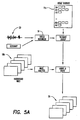
- This process is depicted in the schematic illustration of Figure 4 and the flow diagram of Figure 5.
- a new soundtrack is provided to the speech recognizer 16.
- the soundtrack is recorded on a suitable medium, such as a magnetic tape 20.
- the new soundtrack need not be prerecorded.
- words uttered by a speaker can be directly fed into the speech recognizer 16 via a microphone, as they are being spoken.
- the speech recognizer identifies each of the individual sounds in the new utterance, e.g., the successive phonemes, at Step S20.
- Each identified sound provides an index that is used to access the database 18 at Step S21.
- the corresponding video image sequence e.g., viseme
- the database is selected from the database at Step S22, and the retrieved visemes are assembled into a string 22 of video image sequences at Step S23.
- four selected image sequences 22 respectively correspond to four successive phonemes in the new soundtrack on the magnetic tape 20.
- Step S24 the sequences of images retrieved from the database 18 are preferably processed in an image morphing device 24 (Step S24).
- This device essentially functions to morph one image into the next successive image, over the course of a predetermined number of video frames.
- the smoothly fitted images are then combined with the new soundtrack 20 at Step S25, to produce a new video stream in which the image of the speaker is synchronized with the sounds in the new soundtrack.
- the information stored in the database 18 can comprise bi-visemes.
- a bi-viseme is the visual image that corresponds to the transition from one phoneme to the following phoneme.
- the bi-visemes are indexed in the database 18 by means of diphones, i.e., temporal phoneme pairs.
- the images are retrieved from the database 18 on the basis of diphones identified in the new soundtrack.
- the spoken word "bar” consists of a series phonemes corresponding to the sounds for "b", "ah", and "r”, accompanied by a pause at the beginning and the end.
- the speech recognizer 16 produces an output signal for the diphone "sil-b", i.e.
- the bi-viseme for this diphone is selected from the database 18.
- the speech recognizer 16 then produces an output signal for the diphone "b-ah”, and the corresponding bi-viseme is retrieved from the database to form the next image sequence in the string 22.
- the next diphone corresponds to the sound "ah-r”, and its corresponding bi-viseme is retrieved from the database, to form the next image sequence in the string 22.
- the bi-viseme for the diphone "r-sil”, i.e. the pause at the end of the word is selected from the database. If a bi-viseme for a particular diphone is not stored in the database, the corresponding single viseme is selected. Thus, in the foregoing example, if there is no stored bi-viseme for the sound "ah-r", the single viseme for the phoneme "r" is selected.
- an energy function can be defined which consists of three terms.
- One term measures the quality of the visual match between successive bi-visemes in the new utterance. This matching might be carried out, for example, by comparing the grayscale values of corresponding pixels in the successive bi-visemes.
- the second term in the energy function measures the difference between the length of the bi-viseme stored in the database and the corresponding diphone in the new utterance.
- the third term in the energy function is a penalty value that is assigned in those situations where a single viseme is used instead of a bi-viseme.
- the energy function is computed for each of the alternative combinations of bi-visemes, and the one which exhibits the minimum energy function is selected for use in the image sequence 22.
- the video data that is stored in the database 18 can comprise complete video frames from the original recording 10, each of which might include the full head of the speaker. If the spoken material is of any appreciable length, it is quite possible that the speaker's head will move during the recorded session. For non-portrait images, which encompass a larger portion of the speaker's body, the possibility of movement is even greater. Because of these movements in the original recording, when the various frames are reassembled to create the new sequence 22, jerky movements of the speaker's head or body may result. Similarly, if the speaker presents exaggerated expressions, e.g., raised eyebrows, unnatural movements may appear in the reconstructed sequence 22.
- exaggerated expressions e.g., raised eyebrows
- subimages which contain only those portions of a video frame that are necessary to achieve synchronization with the new utterance.
- the subimage therefore might comprise the lips of the speaker, and perhaps a small area surrounding the mouth. Since the jaw of a person typically moves in concert with the lower lip during speech, it is preferable to include the jaw in the subimage as well.
- the synchronized video stream 26 is generated by "pasting" or blending each retrieved sequence of subimages into the full image of the speaker's head.
- the successive subimages can be pasted onto a still-frame image of the speaker.
- the subimages are incorporated into a running presentation of the speaker.
- control points are identified in the original recording and the stored subimages. For example, a single control point might be located at the center of the top edge of the speaker's upper lip. This control point is identified in the original recording, and in each of the stored subimages.
- the control point of each frame in the subimage sequence is aligned with that of the corresponding frame of the original recording, to ensure that the subimage of the mouth is located at the proper position within the video frame.
- a plurality of control points which outline the speaker's lips are employed.
- an automatic visual tracking algorithm is preferably utilized to identify the lip boundaries of the speaker.
- Conventional contour tracking algorithms can be used to define the outer boundary of the speaker's lips.
- An example of a suitable contour tracking algorithm is described in Kaas et al., "SNAKES: Active Contour Models", Proc. of the First Int. Conf. on Computer Vision, Landon 1987.
- a greylevel-based algorithm can be employed, such as the eigen-images approach described in Pentland et al, "View-Based and Modular Eigenspaces for Face Recognition", Proceedings of the IEEE Computer Society Conference on Computer Vision and Pattern Recognition , June 1994, pps.
- the tracking algorithm is one which identifies control points on both the outer and inner boundaries of the speaker's lips.
- the sequences 22 of the subimages are pasted into the final video stream 26 by means of the morphing process, which utilizes the recorded control points.
- the control points are first used to determine the location of the new lip images in the video frame, and whether any rotation and scaling needs to be applied to them. After the general location, scaling and orientation of the images are determined, the control points are used to warp the original video image and fade the new lip images into the frame.
- This procedure can be carried out using any suitable conventional morphing program.
- a morphing program that can be used in this context is the public domain software "Morphine”.
- the duration of a phoneme is relatively short, and may encompass only three or four successive frames in the video sequence.
- a morphing process which comprises both cross-fading and warping of the images. Rather, it may be sufficient to simply cross-fade the images over the course of a few frames, to obtain an acceptable blending of the subimage into the original video recording. For example, after the subimage is suitably scaled and rotated, it is cross-faded into the original recording in such a manner that the position of the speaker's upper lip remains the same in both the original and new images.
- a database is constructed of image sequences corresponding to identified sounds, and a new video stream is assembled from the recorded images in accordance with the new soundtrack. If, however, the new soundtrack is substantially similar to the originally recorded sounds, the reconstruction of the video stream may not be necessary. For example, in the production of television advertisements, it is sometimes desirable to have an actor re-record a statement, for example to delete an unnecessary pause or provide different emphasis. In such a case, the words in the new soundtrack are the same as those of the original recording, but the timing may be different. In this type of situation, the present invention can be employed to modify the originally recorded video, to synchronize it with the re-recorded soundtrack, utilizing time warping techniques.
- the original recording 10 is analyzed at Step S31 to identify individual phonemes, or other characteristic components of speech.
- the particular frames which correspond to the different components are recorded at Step S32.
- the new sound recording 20 is similarly analyzed at Step S33. It may consist of the same sound components, but the timing between them may be different from the original recording.
- the recording undergoes a time warping process at Step S34, to synchronize it to the new soundtrack.
- a frame is dropped from the original recording, so that the remaining frames in a new sequence 27 correspond to the timing of the new soundtrack 20.
- the new soundtrack can be time warped, to temporally align it with the original video. Whether the original recorded video or the new soundtrack is temporally warped to align it to the other can be a matter of choice. Generally speaking, however, it is desirable to warp the one which is the slower of the two, to synchronize it with the faster recording.
- Any suitable time-scale modification technique such as synchronous overlap-and-add (SOLA), can be employed to temporally warp the audio or video track.
- SOLA synchronous overlap-and-add
- the video sequence is combined with the new soundtrack 20 at Step 535, to form the new video stream 28.
- This embodiment of the invention is particularly desirable for those cases in which the words in the two soundtracks are the same as, or substantially the same as, one another, since it does not require lip tracking, control-point designation or viseme alignment. Examples of suitable applications for this embodiment include redubbing of movie soundtracks, and karaoke systems in which a person sings to an accompanying video presentation.
- the foregoing aspects of the invention are preferably implemented in a computer system (not shown) which is suitably programmed to perform the functions of speech recognition and image morphing. Since these procedures are conventionally known in themselves, they have not been described in detail herein.
- the database can be stored in any suitable memory associated with the computer system, e.g. a magnetic hard disk.
- the original video recording and the new soundtrack can likewise be stored in the computer system.
- the output video stream that is synchronized to the new soundtrack can be initially stored in the computer's memory, and then transferred to some other medium suitable for playback, e.g. a video tape cassette, or played back directly from the computer.
- the present invention can be embodied in other specific forms without departing from the spirit or essential characteristics thereof.
- the invention can also be employed to provide a low bandwidth video phone.
- the transmitter only needs to send the audio channel and a viseme sequence.
- the receiver can utilize the viseme stream, along with previously stored video data, to reconstruct a lip-synchronized image of the caller.
- the invention can be used to provide new types of user interfaces for computers, in which a well-recognized personality can speak to the computer user with instructions or requests for information.
- the invention can be employed to create avitars in virtual reality games, or the like, wherein an image of any given face can speak with the player's voice.
Landscapes
- Engineering & Computer Science (AREA)
- Multimedia (AREA)
- Physics & Mathematics (AREA)
- Audiology, Speech & Language Pathology (AREA)
- Computational Linguistics (AREA)
- Health & Medical Sciences (AREA)
- General Physics & Mathematics (AREA)
- Human Computer Interaction (AREA)
- Acoustics & Sound (AREA)
- Signal Processing (AREA)
- Television Signal Processing For Recording (AREA)
- Electrically Operated Instructional Devices (AREA)
- Indexing, Searching, Synchronizing, And The Amount Of Synchronization Travel Of Record Carriers (AREA)
Claims (30)
- Verfahren zum Synchronisieren einer Videosequenz (12), die eine begleitende Audiospur (14) mit einer unterschiedlichen Audiospur (20) aufweist, wobei das Verfahren die Schritte umfasst:Analysieren der die Videosequenz begleitenden Audiospur (14) mit Hilfe von automatischen Spracherkennungsverfahren (16), um individuelle Sprachkomponenten in der Audiospur zu identifizieren;Analysieren einer Lautäußerung (20) mit Hilfe von automatischen Spracherkennungsverfahren (16), um individuelle Sprachkomponenten in der Lautäußerung zu identifizieren; undvorübergehendes Modifizieren (S6A, S6B) mindestens entweder der Videosequenz oder der Lautäußerung, so dass identifizierte individuelle Sprachkomponenten in der Videosequenz vorübergehend mit entsprechenden individuellen Sprachkomponenten in der Lautäußerung ausgerichtet werden.
- Verfahren nach Anspruch 1, wobei der Modifizierungsschritt das Verfahren der Neuordnung von Einzelbildern (S6A) der Videosequenz umfasst, um diese mit individuellen Sprachkomponenten in der Lautäußerung auszurichten.
- Verfahren nach Anspruch 1, wobei der Modifizierungsschritt das Verfahren der Änderung der zeitlichen Abstimmung der Einzelbilder (S6B) der Videosequenz umfasst, um diese mit individuellen Sprachkomponenten in der Lautäußerung auszurichten.
- Verfahren nach Anspruch 1, wobei der Modifizierungsschritt das Verfahren der zeitlichen Verzerrung der Sprachäußerung umfasst, so dass die Einzelbilder der Videosequenz mit individuellen Sprachmerkmalen in der Lautäußerung ausgerichtet sind.
- Verfahren nach einem der Ansprüche 1 bis 4, wobei die individuellen Sprachkomponenten in der Audiospur und in der Lautäußerung Laute umfassen.
- Verfahren nach Anspruch 5, wobei die individuellen Sprachkomponenten Doppellaute umfassen.
- Verfahren nach Anspruch 5, wobei die individuellen Sprachkomponenten Dreifachlaute umfassen.
- Verfahren nach einem der Ansprüche 1 bis 7, wobei die Lautäußerung der Audiospur entspricht und der Modifizierungsschritt den Schritt des vorübergehenden Verzerrens (S6B) der Videosequenz umfasst, um entsprechende individuelle Sprachkomponenten auszurichten.
- Verfahren nach Anspruch 8, wobei die Videosequenz vorübergehend verzerrt wird, indem ein oder mehrere Videoeinzelbilder aus der Sequenz entfernt werden und die zu entfernenden Einzelbilder gemäß individuellen Sprachkomponenten ausgewählt werden, die den jeweiligen Einzelbildern der Sequenz zugeordnet sind.
- Verfahren nach einem der Ansprüche 1 bis 9, wobei der Modifizierungsschritt die Schritte umfasst:Speichern von Videobilddaten für individuelle Sprachkomponenten, die in der Tonspur (S3) identifiziert sind; undAbrufen gespeicherter Videobilddaten (S6A) in einer Sequenz, die den identifizierten individuellen Sprachkomponenten in der Äußerung entspricht, um eine neue Videopräsentation zu erzeugen.
- Verfahren nach Anspruch 10, das des Weiteren den Schritt umfasst, die abgerufenen Videobilddaten (S7A) nahtlos in die Sequenz einzupassen, die aufeinanderfolgenden individuellen Sprachkomponenten in der Äußerung entspricht.
- Verfahren nach Anspruch 11, wobei der Schritt des nahtlosen Einpassens das Verfahren des Morphing zwischen aufeinanderfolgenden Sätzen abgerufener Videobilddaten umfasst.
- Verfahren nach Anspruch 11 oder Anspruch 12, das des Weiteren die Schritte umfasst, Bilder in der Videosequenz zu analysieren, um Steuerinformationen darin zu definieren, die Steuerinformationen mit den gespeicherten Videobilddaten zu speichern und die Videobilddaten gemäß den gespeicherten Steuerinformationen nahtlos einzupassen.
- Verfahren nach Anspruch 13, wobei die Steuerinformationen Punkte in den Videobildern umfassen, die sich auf Merkmale in den Bildern beziehen.
- Verfahren nach einem der Ansprüche 10 bis 14, wobei jedes Element der gespeicherten Videobilddaten ein Unterbild ist, das einen Abschnitt eines gesamten Bildes in einem Videoeinzelbild umfasst.
- Verfahren nach Anspruch 15, das des Weiteren den Schritt umfasst, Unterbilder in Voll-Videoeinzelbilder zu integrieren.
- Verfahren nach einem der Ansprüche 10 bis 16, wobei die Videosequenz ein Bild des Kopfes einer Person umfasst und jedes Element der gespeicherten Videobilddaten ein Unterbild eines Bereichs umfasst, der den Mund der Person in dem Bild enthält.
- Verfahren nach Anspruch 17, das des Weiteren den Schritt umfasst, Unterbilder des Mundes einer Person in ein Videoeinzelbild zu integrieren, das ein Bild des Kopfes einer Person umfasst.
- System zur Modifizierung eines aufgezeichneten Videobildstroms (12), um diesen mit einer Tonspur (20) zu synchronisieren, die getrennt von dem aufgezeichneten Videobildstrom erzeugt wird, wobei das System umfasst:Mittel zum automatischen Analysieren des aufgezeichneten Videobildstroms (S1, S2), um Bildsequenzen zu identifizieren, die individuellen Sprachkomponenten zugeordnet sind;einen Speicher, der eine Datenbank (18) speichert, die die identifizierten Bildsequenzen enthält;Mittel (16) zum automatischen Analysieren der Tonspur (20), um individuelle Sprachkomponenten zu identifizieren, die darin enthalten sind; undMittel zum Auswählen von Bildsequenzen, die in der Datenbank enthalten sind und individuellen Sprachmerkmalen entsprechen, die in der Tonspur identifiziert sind, und zum Zusammensetzen der ausgewählten Bildsequenzen zu einem Videobildstrom (22), der mit der Tonspur synchronisiert ist.
- System nach Anspruch 19, wobei jedes der automatischen Analysiermittel ein Spracherkennungssystem umfasst.
- System nach Anspruch 20, wobei das Spracherkennungssystem ein verborgenes Markow-Modellsystem ist.
- System nach Anspruch 20, wobei das Spracherkennungssystem ein Neuronennetz ist.
- System nach Anspruch 20, wobei das Spracherkennungssystem ein verborgenes Markow-Modellsystem und ein Neuronennetz umfasst.
- System nach einem der Ansprüche 19 bis 23, wobei die individuellen Sprachkomponenten Sprachlaute umfassen.
- System nach einem der Ansprüche 19 bis 24, das des Weiteren Mittel (24) umfasst, um die ausgewählten Bildsequenzen nahtlos aneinander anzupassen und so den synchronisierten Videobildstrom zu erzeugen.
- System nach Anspruch 25, wobei das Anpassmittel ein Morphingsystem umfasst.
- System nach einem der Ansprüche 19 bis 26, wobei das Mittel zum automatischen Analysieren des aufgezeichneten Videobildstroms Mittel zum Definieren von Steuerpunkten in den Bildern, die sich auf vorherbestimmte Merkmale beziehen, und Mittel zum Analysieren der Steuerpunkte umfasst, um die Sprachzusammensetzungen zu erkennen, die den Merkmalen zugeordnet sind.
- System zum Modifizieren eines aufgezeichneten Videobildstroms (12), um diesen mit einer Tonspur (20) zu synchronisieren, die getrennt von dem aufgezeichneten Videobildstrom erzeugt wird, wobei das System umfasst:Mittel zum Analysieren (S1, S2) des aufgezeichneten Videobildstroms, um Bilder zu identifizieren, die individuellen Sprachkomponenten zugeordnet sind;einen Speicher, der eine erste Datenbank (18a) speichert, die Unterbilder enthält, von denen jedes einen vorherbestimmten Abschnitt eines der identifzierten Bilder umfasst;Mittel zum Analysieren der identifzierten Bilder, um Steuermerkmale innerhalb der Unterbildabschnitte der Bilder zu definieren;Mittel zum Aufzeichnen der gespeicherten Unterbilder mit Daten, die sich auf die definierten Steuermerkmale beziehen;einen Speicher, der eine zweite Datenbank (18b), die Vollbilder aus dem Videobildstrom enthält, zusammen mit den definierten Steuermerkmalen speichert;Mittel zum Analysieren (16) der Tonspur, um individuelle Sprachkomponenten zu identifizieren, die darin enthalten sind;Mittel zum Auswählen (S22a) von Unterbildern, die in der ersten Datenbank enthalten sind und individuellen Sprachkomponenten entsprechen, die in der Tonspur identifiziert sind; undMittel zum Integrieren (S26a) der ausgewählten Unterbilder in Vollbilder, die in der zweiten Datenbank gespeichert sind, in Übereinstimmung mit den definierten Steuermerkmalen, um einen Videostrom zu bilden, der mit der Tonspur synchronisiert ist.
- System nach Anspruch 28, wobei das Integrationsmittel die Steuermerkmale in den Unterbildern mit entsprechenden Steuermerkmalen in den Vollbildern ausrichtet und die Unterbilder in die Vollbilder überblendet.
- System nach Anspruch 28, wobei das Integrationsmittel ein Morphingsystem umfasst, das die Unterbilder in Übereinstimmung mit den Steuermerkmalen in die Vollbilder morpht.
Applications Claiming Priority (3)
| Application Number | Priority Date | Filing Date | Title |
|---|---|---|---|
| US620949 | 1996-03-25 | ||
| US08/620,949 US5880788A (en) | 1996-03-25 | 1996-03-25 | Automated synchronization of video image sequences to new soundtracks |
| PCT/US1997/004797 WO1997036297A1 (en) | 1996-03-25 | 1997-03-25 | Automated synchronization of video image sequences to new soundtracks |
Publications (2)
| Publication Number | Publication Date |
|---|---|
| EP0890171A1 EP0890171A1 (de) | 1999-01-13 |
| EP0890171B1 true EP0890171B1 (de) | 2002-10-16 |
Family
ID=24488068
Family Applications (1)
| Application Number | Title | Priority Date | Filing Date |
|---|---|---|---|
| EP97916971A Expired - Lifetime EP0890171B1 (de) | 1996-03-25 | 1997-03-25 | Automatische synchronisierung von videobildsequenzen mit neuen tonspuren |
Country Status (7)
| Country | Link |
|---|---|
| US (1) | US5880788A (de) |
| EP (1) | EP0890171B1 (de) |
| JP (1) | JP2000508845A (de) |
| AU (1) | AU716673B2 (de) |
| CA (1) | CA2250462C (de) |
| DE (1) | DE69716413T2 (de) |
| WO (1) | WO1997036297A1 (de) |
Cited By (2)
| Publication number | Priority date | Publication date | Assignee | Title |
|---|---|---|---|---|
| WO2019195839A1 (en) * | 2018-04-06 | 2019-10-10 | Deluxe One Llc | Alignment of alternate dialogue audio track to frames in a multimedia production using background audio matching |
| US12192599B2 (en) | 2023-06-12 | 2025-01-07 | International Business Machines Corporation | Asynchronous content analysis for synchronizing audio and video streams |
Families Citing this family (141)
| Publication number | Priority date | Publication date | Assignee | Title |
|---|---|---|---|---|
| AU5027796A (en) | 1995-03-07 | 1996-09-23 | Interval Research Corporation | System and method for selective recording of information |
| BR9709751A (pt) * | 1996-04-29 | 1999-08-10 | Princeton Video Image Inc | Inserção eletrônica intensificada de áudio de sinais em víde |
| US6181383B1 (en) * | 1996-05-29 | 2001-01-30 | Sarnoff Corporation | Method and apparatus for preserving synchronization of audio and video presentation when splicing transport streams |
| US5893062A (en) | 1996-12-05 | 1999-04-06 | Interval Research Corporation | Variable rate video playback with synchronized audio |
| US6263507B1 (en) * | 1996-12-05 | 2001-07-17 | Interval Research Corporation | Browser for use in navigating a body of information, with particular application to browsing information represented by audiovisual data |
| US7366670B1 (en) * | 1997-08-05 | 2008-04-29 | At&T Corp. | Method and system for aligning natural and synthetic video to speech synthesis |
| JP4078691B2 (ja) * | 1997-09-19 | 2008-04-23 | ソニー株式会社 | 記録再生制御システム、記録再生制御方法および記録再生制御装置 |
| US6307576B1 (en) * | 1997-10-02 | 2001-10-23 | Maury Rosenfeld | Method for automatically animating lip synchronization and facial expression of animated characters |
| US7392190B1 (en) | 1997-11-07 | 2008-06-24 | At&T Corp. | Coarticulation method for audio-visual text-to-speech synthesis |
| US7117155B2 (en) * | 1999-09-07 | 2006-10-03 | At&T Corp. | Coarticulation method for audio-visual text-to-speech synthesis |
| US6112177A (en) * | 1997-11-07 | 2000-08-29 | At&T Corp. | Coarticulation method for audio-visual text-to-speech synthesis |
| JP3194428B2 (ja) * | 1997-11-17 | 2001-07-30 | 日本電気株式会社 | 部品選択装置及び部品選択方法 |
| US6380950B1 (en) * | 1998-01-20 | 2002-04-30 | Globalstreams, Inc. | Low bandwidth television |
| JPH11219446A (ja) * | 1998-02-03 | 1999-08-10 | Matsushita Electric Ind Co Ltd | 映像音響再生システム |
| WO1999046734A1 (en) * | 1998-03-11 | 1999-09-16 | Entropic, Inc. | Face synthesis system and methodology |
| US6496607B1 (en) * | 1998-06-26 | 2002-12-17 | Sarnoff Corporation | Method and apparatus for region-based allocation of processing resources and control of input image formation |
| US6622171B2 (en) * | 1998-09-15 | 2003-09-16 | Microsoft Corporation | Multimedia timeline modification in networked client/server systems |
| JP2003503925A (ja) * | 1999-06-24 | 2003-01-28 | コーニンクレッカ フィリップス エレクトロニクス エヌ ヴィ | 情報ストリームのポスト同期 |
| US6369822B1 (en) * | 1999-08-12 | 2002-04-09 | Creative Technology Ltd. | Audio-driven visual representations |
| US6366885B1 (en) * | 1999-08-27 | 2002-04-02 | International Business Machines Corporation | Speech driven lip synthesis using viseme based hidden markov models |
| US7630897B2 (en) * | 1999-09-07 | 2009-12-08 | At&T Intellectual Property Ii, L.P. | Coarticulation method for audio-visual text-to-speech synthesis |
| US6598074B1 (en) * | 1999-09-23 | 2003-07-22 | Rocket Network, Inc. | System and method for enabling multimedia production collaboration over a network |
| US7155735B1 (en) | 1999-10-08 | 2006-12-26 | Vulcan Patents Llc | System and method for the broadcast dissemination of time-ordered data |
| US6856329B1 (en) * | 1999-11-12 | 2005-02-15 | Creative Technology Ltd. | Automated acquisition of video textures acquired from a digital camera for mapping to audio-driven deformable objects |
| DE19956572B4 (de) * | 1999-11-24 | 2006-05-11 | STÜTZ, Andreas | Verfahren zur Telekommunikation und Kommunikationsterminal |
| US6766299B1 (en) * | 1999-12-20 | 2004-07-20 | Thrillionaire Productions, Inc. | Speech-controlled animation system |
| IL133797A (en) * | 1999-12-29 | 2004-07-25 | Speechview Ltd | Apparatus and method for visible indication of speech |
| US6757682B1 (en) | 2000-01-28 | 2004-06-29 | Interval Research Corporation | Alerting users to items of current interest |
| GB0008537D0 (en) * | 2000-04-06 | 2000-05-24 | Ananova Ltd | Character animation |
| US7302490B1 (en) * | 2000-05-03 | 2007-11-27 | Microsoft Corporation | Media file format to support switching between multiple timeline-altered media streams |
| US7149686B1 (en) * | 2000-06-23 | 2006-12-12 | International Business Machines Corporation | System and method for eliminating synchronization errors in electronic audiovisual transmissions and presentations |
| US6535269B2 (en) * | 2000-06-30 | 2003-03-18 | Gary Sherman | Video karaoke system and method of use |
| US6665450B1 (en) | 2000-09-08 | 2003-12-16 | Avid Technology, Inc. | Interpolation of a sequence of images using motion analysis |
| AU2001292963A1 (en) * | 2000-09-21 | 2002-04-02 | The Regents Of The University Of California | Visual display methods for use in computer-animated speech production models |
| US6778252B2 (en) * | 2000-12-22 | 2004-08-17 | Film Language | Film language |
| US6970185B2 (en) * | 2001-01-31 | 2005-11-29 | International Business Machines Corporation | Method and apparatus for enhancing digital images with textual explanations |
| US7053927B2 (en) * | 2001-03-02 | 2006-05-30 | Eastman Kodak Company | System for optimizing the display and rendering of digital images for digital mastering |
| US7043058B2 (en) * | 2001-04-20 | 2006-05-09 | Avid Technology, Inc. | Correcting motion vector maps for image processing |
| US7545957B2 (en) * | 2001-04-20 | 2009-06-09 | Avid Technology, Inc. | Analyzing motion of characteristics in images |
| US7076429B2 (en) * | 2001-04-27 | 2006-07-11 | International Business Machines Corporation | Method and apparatus for presenting images representative of an utterance with corresponding decoded speech |
| US9286941B2 (en) | 2001-05-04 | 2016-03-15 | Legend3D, Inc. | Image sequence enhancement and motion picture project management system |
| US8401336B2 (en) | 2001-05-04 | 2013-03-19 | Legend3D, Inc. | System and method for rapid image sequence depth enhancement with augmented computer-generated elements |
| US8897596B1 (en) | 2001-05-04 | 2014-11-25 | Legend3D, Inc. | System and method for rapid image sequence depth enhancement with translucent elements |
| US7012650B2 (en) * | 2001-06-14 | 2006-03-14 | Sony Corporation | Start/stop audio encoder apparatus and method for synchronizing digital audio and video signals |
| US6639649B2 (en) * | 2001-08-06 | 2003-10-28 | Eastman Kodak Company | Synchronization of music and images in a camera with audio capabilities |
| US7343082B2 (en) | 2001-09-12 | 2008-03-11 | Ryshco Media Inc. | Universal guide track |
| WO2003026273A2 (en) | 2001-09-15 | 2003-03-27 | Michael Neuman | Dynamic variation of output media signal in response to input media signal |
| US20030058932A1 (en) * | 2001-09-24 | 2003-03-27 | Koninklijke Philips Electronics N.V. | Viseme based video coding |
| US7315820B1 (en) * | 2001-11-30 | 2008-01-01 | Total Synch, Llc | Text-derived speech animation tool |
| US7194676B2 (en) | 2002-03-01 | 2007-03-20 | Avid Technology, Inc. | Performance retiming effects on synchronized data in an editing system |
| US7668901B2 (en) * | 2002-04-15 | 2010-02-23 | Avid Technology, Inc. | Methods and system using a local proxy server to process media data for local area users |
| US7209882B1 (en) * | 2002-05-10 | 2007-04-24 | At&T Corp. | System and method for triphone-based unit selection for visual speech synthesis |
| EP1365359A1 (de) * | 2002-05-24 | 2003-11-26 | BRITISH TELECOMMUNICATIONS public limited company | Bildverarbeitungsverfahren und -system |
| US7212248B2 (en) * | 2002-09-09 | 2007-05-01 | The Directv Group, Inc. | Method and apparatus for lipsync measurement and correction |
| CN100367313C (zh) * | 2002-11-07 | 2008-02-06 | 汤姆森许可贸易公司 | 应用缓冲计算在数字化环境中确定音频和视频之间的声像吻合的系统和方法 |
| US7716312B2 (en) | 2002-11-13 | 2010-05-11 | Avid Technology, Inc. | Method and system for transferring large data files over parallel connections |
| US7827034B1 (en) | 2002-11-27 | 2010-11-02 | Totalsynch, Llc | Text-derived speech animation tool |
| US7133535B2 (en) * | 2002-12-21 | 2006-11-07 | Microsoft Corp. | System and method for real time lip synchronization |
| US7142250B1 (en) * | 2003-04-05 | 2006-11-28 | Apple Computer, Inc. | Method and apparatus for synchronizing audio and video streams |
| WO2007035183A2 (en) * | 2005-04-13 | 2007-03-29 | Pixel Instruments, Corp. | Method, system, and program product for measuring audio video synchronization independent of speaker characteristics |
| US20070153125A1 (en) * | 2003-05-16 | 2007-07-05 | Pixel Instruments, Corp. | Method, system, and program product for measuring audio video synchronization |
| US7499104B2 (en) * | 2003-05-16 | 2009-03-03 | Pixel Instruments Corporation | Method and apparatus for determining relative timing of image and associated information |
| US7208669B2 (en) * | 2003-08-25 | 2007-04-24 | Blue Street Studios, Inc. | Video game system and method |
| US7990384B2 (en) * | 2003-09-15 | 2011-08-02 | At&T Intellectual Property Ii, L.P. | Audio-visual selection process for the synthesis of photo-realistic talking-head animations |
| JP3848319B2 (ja) * | 2003-11-11 | 2006-11-22 | キヤノン株式会社 | 情報処理方法及び情報処理装置 |
| CA2551998C (en) * | 2003-12-30 | 2015-11-17 | Nielsen Media Research, Inc. | Methods and apparatus to distinguish a signal originating from a local device from a broadcast signal |
| US20050234961A1 (en) * | 2004-04-16 | 2005-10-20 | Pinnacle Systems, Inc. | Systems and Methods for providing a proxy for a shared file system |
| US20060031916A1 (en) * | 2004-04-30 | 2006-02-09 | Vulcan Inc. | Management and non-linear presentation of broadcasted or streamed multimedia content |
| US20060031879A1 (en) * | 2004-04-30 | 2006-02-09 | Vulcan Inc. | Management and non-linear presentation of news-related broadcasted or streamed multimedia content |
| US20060031885A1 (en) * | 2004-04-30 | 2006-02-09 | Vulcan Inc. | Management and non-linear presentation of music-related broadcasted or streamed multimedia content |
| US8443279B1 (en) * | 2004-10-13 | 2013-05-14 | Stryker Corporation | Voice-responsive annotation of video generated by an endoscopic camera |
| US7388586B2 (en) * | 2005-03-31 | 2008-06-17 | Intel Corporation | Method and apparatus for animation of a human speaker |
| GB2438691A (en) * | 2005-04-13 | 2007-12-05 | Pixel Instr Corp | Method, system, and program product for measuring audio video synchronization independent of speaker characteristics |
| US7970613B2 (en) | 2005-11-12 | 2011-06-28 | Sony Computer Entertainment Inc. | Method and system for Gaussian probability data bit reduction and computation |
| US20070139189A1 (en) * | 2005-12-05 | 2007-06-21 | Helmig Kevin S | Multi-platform monitoring system and method |
| US7778831B2 (en) * | 2006-02-21 | 2010-08-17 | Sony Computer Entertainment Inc. | Voice recognition with dynamic filter bank adjustment based on speaker categorization determined from runtime pitch |
| US8010358B2 (en) * | 2006-02-21 | 2011-08-30 | Sony Computer Entertainment Inc. | Voice recognition with parallel gender and age normalization |
| US7535472B2 (en) * | 2006-04-05 | 2009-05-19 | Seoul National University Industry Foundation | Method for generating intuitive quasi-eigen faces |
| WO2008023819A1 (en) * | 2006-08-25 | 2008-02-28 | Hirofumi Ito | Computer system and operation control method |
| US7948558B2 (en) * | 2006-09-29 | 2011-05-24 | The Directv Group, Inc. | Audio video timing measurement and synchronization |
| US7669132B2 (en) * | 2006-10-30 | 2010-02-23 | Hewlett-Packard Development Company, L.P. | Matching a slideshow to an audio track |
| US20080111887A1 (en) * | 2006-11-13 | 2008-05-15 | Pixel Instruments, Corp. | Method, system, and program product for measuring audio video synchronization independent of speaker characteristics |
| US8179475B2 (en) * | 2007-03-09 | 2012-05-15 | Legend3D, Inc. | Apparatus and method for synchronizing a secondary audio track to the audio track of a video source |
| US8577126B2 (en) * | 2007-04-11 | 2013-11-05 | Irobot Corporation | System and method for cooperative remote vehicle behavior |
| US20090180668A1 (en) * | 2007-04-11 | 2009-07-16 | Irobot Corporation | System and method for cooperative remote vehicle behavior |
| US20080263450A1 (en) * | 2007-04-14 | 2008-10-23 | James Jacob Hodges | System and method to conform separately edited sequences |
| US8316302B2 (en) | 2007-05-11 | 2012-11-20 | General Instrument Corporation | Method and apparatus for annotating video content with metadata generated using speech recognition technology |
| US8678896B2 (en) | 2007-06-14 | 2014-03-25 | Harmonix Music Systems, Inc. | Systems and methods for asynchronous band interaction in a rhythm action game |
| US20090075711A1 (en) | 2007-06-14 | 2009-03-19 | Eric Brosius | Systems and methods for providing a vocal experience for a player of a rhythm action game |
| SG150415A1 (en) * | 2007-09-05 | 2009-03-30 | Creative Tech Ltd | A method for incorporating a soundtrack into an edited video-with-audio recording and an audio tag |
| WO2010006054A1 (en) * | 2008-07-08 | 2010-01-14 | Harmonix Music Systems, Inc. | Systems and methods for simulating a rock and band experience |
| US9324173B2 (en) * | 2008-07-17 | 2016-04-26 | International Business Machines Corporation | System and method for enabling multiple-state avatars |
| US8957914B2 (en) | 2008-07-25 | 2015-02-17 | International Business Machines Corporation | Method for extending a virtual environment through registration |
| US10166470B2 (en) | 2008-08-01 | 2019-01-01 | International Business Machines Corporation | Method for providing a virtual world layer |
| US8447065B2 (en) | 2008-09-16 | 2013-05-21 | Cyberlink Corp. | Method of facial image reproduction and related device |
| EP2376207B1 (de) | 2008-12-09 | 2015-08-12 | Koninklijke Philips N.V. | Verfahren und system zum erzeugen von daten für die steuerung eines systems zur abgabe mindestens eines signals |
| US8442833B2 (en) * | 2009-02-17 | 2013-05-14 | Sony Computer Entertainment Inc. | Speech processing with source location estimation using signals from two or more microphones |
| US8442829B2 (en) * | 2009-02-17 | 2013-05-14 | Sony Computer Entertainment Inc. | Automatic computation streaming partition for voice recognition on multiple processors with limited memory |
| US8788256B2 (en) * | 2009-02-17 | 2014-07-22 | Sony Computer Entertainment Inc. | Multiple language voice recognition |
| US8465366B2 (en) | 2009-05-29 | 2013-06-18 | Harmonix Music Systems, Inc. | Biasing a musical performance input to a part |
| US8449360B2 (en) | 2009-05-29 | 2013-05-28 | Harmonix Music Systems, Inc. | Displaying song lyrics and vocal cues |
| US8334888B2 (en) * | 2009-08-27 | 2012-12-18 | Apple Inc. | Dynamically generated ring tones |
| US9981193B2 (en) | 2009-10-27 | 2018-05-29 | Harmonix Music Systems, Inc. | Movement based recognition and evaluation |
| WO2011056657A2 (en) * | 2009-10-27 | 2011-05-12 | Harmonix Music Systems, Inc. | Gesture-based user interface |
| US8550908B2 (en) | 2010-03-16 | 2013-10-08 | Harmonix Music Systems, Inc. | Simulating musical instruments |
| US8562403B2 (en) | 2010-06-11 | 2013-10-22 | Harmonix Music Systems, Inc. | Prompting a player of a dance game |
| WO2011155958A1 (en) | 2010-06-11 | 2011-12-15 | Harmonix Music Systems, Inc. | Dance game and tutorial |
| US9358456B1 (en) | 2010-06-11 | 2016-06-07 | Harmonix Music Systems, Inc. | Dance competition game |
| US20110311144A1 (en) * | 2010-06-17 | 2011-12-22 | Microsoft Corporation | Rgb/depth camera for improving speech recognition |
| US9024166B2 (en) | 2010-09-09 | 2015-05-05 | Harmonix Music Systems, Inc. | Preventing subtractive track separation |
| US8751228B2 (en) * | 2010-11-04 | 2014-06-10 | Microsoft Corporation | Minimum converted trajectory error (MCTE) audio-to-video engine |
| US8600732B2 (en) * | 2010-11-08 | 2013-12-03 | Sling Media Pvt Ltd | Translating programming content to match received voice command language |
| US8730232B2 (en) | 2011-02-01 | 2014-05-20 | Legend3D, Inc. | Director-style based 2D to 3D movie conversion system and method |
| US9407904B2 (en) | 2013-05-01 | 2016-08-02 | Legend3D, Inc. | Method for creating 3D virtual reality from 2D images |
| US9288476B2 (en) | 2011-02-17 | 2016-03-15 | Legend3D, Inc. | System and method for real-time depth modification of stereo images of a virtual reality environment |
| US9241147B2 (en) | 2013-05-01 | 2016-01-19 | Legend3D, Inc. | External depth map transformation method for conversion of two-dimensional images to stereoscopic images |
| US9282321B2 (en) | 2011-02-17 | 2016-03-08 | Legend3D, Inc. | 3D model multi-reviewer system |
| TW201301148A (zh) * | 2011-06-21 | 2013-01-01 | Hon Hai Prec Ind Co Ltd | 網頁瀏覽控制系統及方法 |
| AU2012100262B4 (en) * | 2011-12-15 | 2012-05-24 | Nguyen, Phan Thi My Ngoc Ms | Speech visualisation tool |
| US8655152B2 (en) | 2012-01-31 | 2014-02-18 | Golden Monkey Entertainment | Method and system of presenting foreign films in a native language |
| US9153235B2 (en) | 2012-04-09 | 2015-10-06 | Sony Computer Entertainment Inc. | Text dependent speaker recognition with long-term feature based on functional data analysis |
| US20130300939A1 (en) * | 2012-05-11 | 2013-11-14 | Cisco Technology, Inc. | System and method for joint speaker and scene recognition in a video/audio processing environment |
| US9596386B2 (en) | 2012-07-24 | 2017-03-14 | Oladas, Inc. | Media synchronization |
| US9007365B2 (en) | 2012-11-27 | 2015-04-14 | Legend3D, Inc. | Line depth augmentation system and method for conversion of 2D images to 3D images |
| US9547937B2 (en) | 2012-11-30 | 2017-01-17 | Legend3D, Inc. | Three-dimensional annotation system and method |
| US9007404B2 (en) | 2013-03-15 | 2015-04-14 | Legend3D, Inc. | Tilt-based look around effect image enhancement method |
| US9438878B2 (en) | 2013-05-01 | 2016-09-06 | Legend3D, Inc. | Method of converting 2D video to 3D video using 3D object models |
| US20160042766A1 (en) * | 2014-08-06 | 2016-02-11 | Echostar Technologies L.L.C. | Custom video content |
| US9609307B1 (en) | 2015-09-17 | 2017-03-28 | Legend3D, Inc. | Method of converting 2D video to 3D video using machine learning |
| US10460732B2 (en) * | 2016-03-31 | 2019-10-29 | Tata Consultancy Services Limited | System and method to insert visual subtitles in videos |
| US11409791B2 (en) | 2016-06-10 | 2022-08-09 | Disney Enterprises, Inc. | Joint heterogeneous language-vision embeddings for video tagging and search |
| US10770092B1 (en) * | 2017-09-22 | 2020-09-08 | Amazon Technologies, Inc. | Viseme data generation |
| EP3815050B1 (de) * | 2018-05-24 | 2024-01-24 | Warner Bros. Entertainment Inc. | Anpassung der mundform und -bewegung in einem digitalen video an alternatives audio |
| US10558761B2 (en) * | 2018-07-05 | 2020-02-11 | Disney Enterprises, Inc. | Alignment of video and textual sequences for metadata analysis |
| US11423920B2 (en) * | 2018-09-28 | 2022-08-23 | Rovi Guides, Inc. | Methods and systems for suppressing vocal tracks |
| JP7500582B2 (ja) * | 2019-01-25 | 2024-06-17 | ソウル マシーンズ リミティド | 発話アニメーションのリアルタイム生成 |
| CN110534085B (zh) * | 2019-08-29 | 2022-02-25 | 北京百度网讯科技有限公司 | 用于生成信息的方法和装置 |
| US11119727B1 (en) * | 2020-06-25 | 2021-09-14 | Adobe Inc. | Digital tutorial generation system |
| CN114760534B (zh) * | 2022-03-28 | 2024-03-01 | 北京捷通华声科技股份有限公司 | 视频生成方法、装置、电子设备及可读存储介质 |
| CN115174826A (zh) * | 2022-07-07 | 2022-10-11 | 云知声智能科技股份有限公司 | 一种音视频合成方法及装置 |
| US20260119854A1 (en) * | 2023-05-12 | 2026-04-30 | Monsters Aliens Robots Zombies Inc. | Improved generative machine learning architecture for audio track replacement |
Family Cites Families (16)
| Publication number | Priority date | Publication date | Assignee | Title |
|---|---|---|---|---|
| US4260229A (en) * | 1978-01-23 | 1981-04-07 | Bloomstein Richard W | Creating visual images of lip movements |
| FR2571196B1 (fr) * | 1984-10-02 | 1987-01-23 | Guinet Yves | Procede de television pour programmes multilingues |
| US4600281A (en) * | 1985-03-29 | 1986-07-15 | Bloomstein Richard W | Altering facial displays in cinematic works |
| GB8528143D0 (en) * | 1985-11-14 | 1985-12-18 | British Telecomm | Image encoding & synthesis |
| US5040081A (en) * | 1986-09-23 | 1991-08-13 | Mccutchen David | Audiovisual synchronization signal generator using audio signature comparison |
| US4913539A (en) * | 1988-04-04 | 1990-04-03 | New York Institute Of Technology | Apparatus and method for lip-synching animation |
| US5025394A (en) * | 1988-09-09 | 1991-06-18 | New York Institute Of Technology | Method and apparatus for generating animated images |
| JP2518683B2 (ja) * | 1989-03-08 | 1996-07-24 | 国際電信電話株式会社 | 画像合成方法及びその装置 |
| US5430835A (en) * | 1991-02-15 | 1995-07-04 | Sierra On-Line, Inc. | Method and means for computer sychronization of actions and sounds |
| JP3298076B2 (ja) * | 1992-10-20 | 2002-07-02 | ソニー株式会社 | 画像作成装置 |
| US5608839A (en) * | 1994-03-18 | 1997-03-04 | Lucent Technologies Inc. | Sound-synchronized video system |
| CA2144795A1 (en) * | 1994-03-18 | 1995-09-19 | Homer H. Chen | Audio visual dubbing system and method |
| US6330023B1 (en) * | 1994-03-18 | 2001-12-11 | American Telephone And Telegraph Corporation | Video signal processing systems and methods utilizing automated speech analysis |
| US5623173A (en) * | 1994-03-18 | 1997-04-22 | Lucent Technologies Inc. | Bus structure for power system |
| US5572261A (en) * | 1995-06-07 | 1996-11-05 | Cooper; J. Carl | Automatic audio to video timing measurement device and method |
| US6492990B1 (en) * | 1995-10-08 | 2002-12-10 | Yissum Research Development Company Of The Hebrew University Of Jerusalem | Method for the automatic computerized audio visual dubbing of movies |
-
1996
- 1996-03-25 US US08/620,949 patent/US5880788A/en not_active Expired - Lifetime
-
1997
- 1997-03-25 JP JP9534555A patent/JP2000508845A/ja active Pending
- 1997-03-25 AU AU25446/97A patent/AU716673B2/en not_active Ceased
- 1997-03-25 CA CA002250462A patent/CA2250462C/en not_active Expired - Lifetime
- 1997-03-25 WO PCT/US1997/004797 patent/WO1997036297A1/en not_active Ceased
- 1997-03-25 EP EP97916971A patent/EP0890171B1/de not_active Expired - Lifetime
- 1997-03-25 DE DE69716413T patent/DE69716413T2/de not_active Expired - Lifetime
Cited By (2)
| Publication number | Priority date | Publication date | Assignee | Title |
|---|---|---|---|---|
| WO2019195839A1 (en) * | 2018-04-06 | 2019-10-10 | Deluxe One Llc | Alignment of alternate dialogue audio track to frames in a multimedia production using background audio matching |
| US12192599B2 (en) | 2023-06-12 | 2025-01-07 | International Business Machines Corporation | Asynchronous content analysis for synchronizing audio and video streams |
Also Published As
| Publication number | Publication date |
|---|---|
| AU716673B2 (en) | 2000-03-02 |
| WO1997036297A1 (en) | 1997-10-02 |
| JP2000508845A (ja) | 2000-07-11 |
| US5880788A (en) | 1999-03-09 |
| DE69716413D1 (de) | 2002-11-21 |
| EP0890171A1 (de) | 1999-01-13 |
| CA2250462C (en) | 2001-10-02 |
| AU2544697A (en) | 1997-10-17 |
| CA2250462A1 (en) | 1997-10-02 |
| DE69716413T2 (de) | 2003-06-26 |
Similar Documents
| Publication | Publication Date | Title |
|---|---|---|
| AU716673B2 (en) | Automated synchronization of video image sequences to new soundtracks | |
| Hu et al. | Neural dubber: Dubbing for videos according to scripts | |
| Zhang et al. | Text2video: Text-driven talking-head video synthesis with personalized phoneme-pose dictionary | |
| US6250928B1 (en) | Talking facial display method and apparatus | |
| Hazen et al. | A segment-based audio-visual speech recognizer: Data collection, development, and initial experiments | |
| Ezzat et al. | Miketalk: A talking facial display based on morphing visemes | |
| US7933772B1 (en) | System and method for triphone-based unit selection for visual speech synthesis | |
| US7133535B2 (en) | System and method for real time lip synchronization | |
| US6662161B1 (en) | Coarticulation method for audio-visual text-to-speech synthesis | |
| JP2518683B2 (ja) | 画像合成方法及びその装置 | |
| JPH10312467A (ja) | 像合成のための自動スピーチ整列方法 | |
| US7109993B2 (en) | Method and system for the automatic computerized audio visual dubbing of movies | |
| JP2003529861A5 (de) | ||
| Schabus et al. | Joint audiovisual hidden semi-markov model-based speech synthesis | |
| JP2003529861A (ja) | 音響信号により駆動される人間の顔の合成モデルのアニメ化方法 | |
| Hassid et al. | More than words: In-the-wild visually-driven prosody for text-to-speech | |
| Bozkurt et al. | Comparison of phoneme and viseme based acoustic units for speech driven realistic lip animation | |
| JPH086182A (ja) | 吹き替えシステムおよびビデオ画像表示システム | |
| Wang et al. | Synthesizing photo-real talking head via trajectory-guided sample selection. | |
| US20070165022A1 (en) | Method and system for the automatic computerized audio visual dubbing of movies | |
| Wang et al. | HMM trajectory-guided sample selection for photo-realistic talking head | |
| Tamura et al. | Text-to-audio-visual speech synthesis based on parameter generation from HMM. | |
| KR20230172427A (ko) | 사람 음성에 따른 실사인물의 발화 영상 합성 시스템 | |
| Pan et al. | Vocal: Vowel and consonant layering for expressive animator-centric singing animation | |
| Minnis et al. | Modeling visual coarticulation in synthetic talking heads using a lip motion unit inventory with concatenative synthesis. |
Legal Events
| Date | Code | Title | Description |
|---|---|---|---|
| PUAI | Public reference made under article 153(3) epc to a published international application that has entered the european phase |
Free format text: ORIGINAL CODE: 0009012 |
|
| 17P | Request for examination filed |
Effective date: 19980929 |
|
| AK | Designated contracting states |
Kind code of ref document: A1 Designated state(s): DE FR GB NL |
|
| 17Q | First examination report despatched |
Effective date: 19990126 |
|
| GRAG | Despatch of communication of intention to grant |
Free format text: ORIGINAL CODE: EPIDOS AGRA |
|
| GRAG | Despatch of communication of intention to grant |
Free format text: ORIGINAL CODE: EPIDOS AGRA |
|
| GRAH | Despatch of communication of intention to grant a patent |
Free format text: ORIGINAL CODE: EPIDOS IGRA |
|
| GRAH | Despatch of communication of intention to grant a patent |
Free format text: ORIGINAL CODE: EPIDOS IGRA |
|
| GRAA | (expected) grant |
Free format text: ORIGINAL CODE: 0009210 |
|
| AK | Designated contracting states |
Kind code of ref document: B1 Designated state(s): DE FR GB NL |
|
| REG | Reference to a national code |
Ref country code: GB Ref legal event code: FG4D |
|
| RIC1 | Information provided on ipc code assigned before grant |
Free format text: 7G 11B 27/032 A, 7G 11B 27/10 B, 7G 03B 31/02 B, 7G 10L 15/24 B, 7H 04N 5/14 B, 7H 04N 7/52 -, 7H 04N 7/26 - |
|
| REF | Corresponds to: |
Ref document number: 69716413 Country of ref document: DE Date of ref document: 20021121 |
|
| ET | Fr: translation filed | ||
| PLBE | No opposition filed within time limit |
Free format text: ORIGINAL CODE: 0009261 |
|
| STAA | Information on the status of an ep patent application or granted ep patent |
Free format text: STATUS: NO OPPOSITION FILED WITHIN TIME LIMIT |
|
| 26N | No opposition filed |
Effective date: 20030717 |
|
| PGFP | Annual fee paid to national office [announced via postgrant information from national office to epo] |
Ref country code: FR Payment date: 20100324 Year of fee payment: 14 |
|
| PGFP | Annual fee paid to national office [announced via postgrant information from national office to epo] |
Ref country code: GB Payment date: 20100322 Year of fee payment: 14 |
|
| PGFP | Annual fee paid to national office [announced via postgrant information from national office to epo] |
Ref country code: NL Payment date: 20100304 Year of fee payment: 14 |
|
| REG | Reference to a national code |
Ref country code: NL Ref legal event code: V1 Effective date: 20111001 |
|
| GBPC | Gb: european patent ceased through non-payment of renewal fee |
Effective date: 20110325 |
|
| REG | Reference to a national code |
Ref country code: FR Ref legal event code: ST Effective date: 20111130 |
|
| PG25 | Lapsed in a contracting state [announced via postgrant information from national office to epo] |
Ref country code: NL Free format text: LAPSE BECAUSE OF NON-PAYMENT OF DUE FEES Effective date: 20111001 Ref country code: FR Free format text: LAPSE BECAUSE OF NON-PAYMENT OF DUE FEES Effective date: 20110331 |
|
| PG25 | Lapsed in a contracting state [announced via postgrant information from national office to epo] |
Ref country code: GB Free format text: LAPSE BECAUSE OF NON-PAYMENT OF DUE FEES Effective date: 20110325 |
|
| PGFP | Annual fee paid to national office [announced via postgrant information from national office to epo] |
Ref country code: DE Payment date: 20160322 Year of fee payment: 20 |
|
| REG | Reference to a national code |
Ref country code: DE Ref legal event code: R071 Ref document number: 69716413 Country of ref document: DE |