EP0889943B1 - Method of operating a fluidized bed reactor system, and fluidized bed reactor system - Google Patents
Method of operating a fluidized bed reactor system, and fluidized bed reactor system Download PDFInfo
- Publication number
- EP0889943B1 EP0889943B1 EP96903020A EP96903020A EP0889943B1 EP 0889943 B1 EP0889943 B1 EP 0889943B1 EP 96903020 A EP96903020 A EP 96903020A EP 96903020 A EP96903020 A EP 96903020A EP 0889943 B1 EP0889943 B1 EP 0889943B1
- Authority
- EP
- European Patent Office
- Prior art keywords
- gas
- separator
- particles
- outlet
- solid
- Prior art date
- Legal status (The legal status is an assumption and is not a legal conclusion. Google has not performed a legal analysis and makes no representation as to the accuracy of the status listed.)
- Expired - Lifetime
Links
- 238000000034 method Methods 0.000 title claims description 23
- 239000002245 particle Substances 0.000 claims description 86
- 239000000463 material Substances 0.000 claims description 38
- 239000007787 solid Substances 0.000 claims description 38
- 238000001816 cooling Methods 0.000 claims description 22
- 239000000446 fuel Substances 0.000 claims description 16
- 239000011343 solid material Substances 0.000 claims description 9
- 238000007599 discharging Methods 0.000 claims description 6
- 238000006243 chemical reaction Methods 0.000 claims description 4
- 238000005243 fluidization Methods 0.000 claims description 2
- 239000007789 gas Substances 0.000 description 103
- 238000002309 gasification Methods 0.000 description 9
- 238000004140 cleaning Methods 0.000 description 8
- 238000002485 combustion reaction Methods 0.000 description 6
- 239000000126 substance Substances 0.000 description 5
- 230000000694 effects Effects 0.000 description 4
- 239000000047 product Substances 0.000 description 4
- 239000004071 soot Substances 0.000 description 4
- 239000000654 additive Substances 0.000 description 3
- 150000001875 compounds Chemical class 0.000 description 3
- 238000000151 deposition Methods 0.000 description 3
- 239000004576 sand Substances 0.000 description 3
- OKTJSMMVPCPJKN-UHFFFAOYSA-N Carbon Chemical compound [C] OKTJSMMVPCPJKN-UHFFFAOYSA-N 0.000 description 2
- 235000019738 Limestone Nutrition 0.000 description 2
- 238000009825 accumulation Methods 0.000 description 2
- 239000003513 alkali Substances 0.000 description 2
- 229910052799 carbon Inorganic materials 0.000 description 2
- 239000011362 coarse particle Substances 0.000 description 2
- 238000001914 filtration Methods 0.000 description 2
- 239000006028 limestone Substances 0.000 description 2
- 230000001154 acute effect Effects 0.000 description 1
- 230000002411 adverse Effects 0.000 description 1
- 229910000272 alkali metal oxide Inorganic materials 0.000 description 1
- 230000000903 blocking effect Effects 0.000 description 1
- 230000005587 bubbling Effects 0.000 description 1
- 239000003575 carbonaceous material Substances 0.000 description 1
- 239000003638 chemical reducing agent Substances 0.000 description 1
- 238000010276 construction Methods 0.000 description 1
- 238000005260 corrosion Methods 0.000 description 1
- 230000007797 corrosion Effects 0.000 description 1
- 238000009826 distribution Methods 0.000 description 1
- TXKMVPPZCYKFAC-UHFFFAOYSA-N disulfur monoxide Inorganic materials O=S=S TXKMVPPZCYKFAC-UHFFFAOYSA-N 0.000 description 1
- 239000000428 dust Substances 0.000 description 1
- 239000012065 filter cake Substances 0.000 description 1
- 239000010419 fine particle Substances 0.000 description 1
- 239000003546 flue gas Substances 0.000 description 1
- 239000003517 fume Substances 0.000 description 1
- 238000002347 injection Methods 0.000 description 1
- 239000007924 injection Substances 0.000 description 1
- 238000007689 inspection Methods 0.000 description 1
- 239000003077 lignite Substances 0.000 description 1
- 239000007788 liquid Substances 0.000 description 1
- 238000012423 maintenance Methods 0.000 description 1
- 239000000203 mixture Substances 0.000 description 1
- 230000000135 prohibitive effect Effects 0.000 description 1
- 238000004064 recycling Methods 0.000 description 1
- 239000010802 sludge Substances 0.000 description 1
- 239000004449 solid propellant Substances 0.000 description 1
- 239000000243 solution Substances 0.000 description 1
- XTQHKBHJIVJGKJ-UHFFFAOYSA-N sulfur monoxide Chemical compound S=O XTQHKBHJIVJGKJ-UHFFFAOYSA-N 0.000 description 1
- 239000002699 waste material Substances 0.000 description 1
- XLYOFNOQVPJJNP-UHFFFAOYSA-N water Substances O XLYOFNOQVPJJNP-UHFFFAOYSA-N 0.000 description 1
Images
Classifications
-
- C—CHEMISTRY; METALLURGY
- C10—PETROLEUM, GAS OR COKE INDUSTRIES; TECHNICAL GASES CONTAINING CARBON MONOXIDE; FUELS; LUBRICANTS; PEAT
- C10J—PRODUCTION OF PRODUCER GAS, WATER-GAS, SYNTHESIS GAS FROM SOLID CARBONACEOUS MATERIAL, OR MIXTURES CONTAINING THESE GASES; CARBURETTING AIR OR OTHER GASES
- C10J3/00—Production of combustible gases containing carbon monoxide from solid carbonaceous fuels
- C10J3/46—Gasification of granular or pulverulent flues in suspension
- C10J3/54—Gasification of granular or pulverulent fuels by the Winkler technique, i.e. by fluidisation
-
- C—CHEMISTRY; METALLURGY
- C10—PETROLEUM, GAS OR COKE INDUSTRIES; TECHNICAL GASES CONTAINING CARBON MONOXIDE; FUELS; LUBRICANTS; PEAT
- C10J—PRODUCTION OF PRODUCER GAS, WATER-GAS, SYNTHESIS GAS FROM SOLID CARBONACEOUS MATERIAL, OR MIXTURES CONTAINING THESE GASES; CARBURETTING AIR OR OTHER GASES
- C10J3/00—Production of combustible gases containing carbon monoxide from solid carbonaceous fuels
- C10J3/46—Gasification of granular or pulverulent flues in suspension
- C10J3/48—Apparatus; Plants
- C10J3/482—Gasifiers with stationary fluidised bed
-
- C—CHEMISTRY; METALLURGY
- C10—PETROLEUM, GAS OR COKE INDUSTRIES; TECHNICAL GASES CONTAINING CARBON MONOXIDE; FUELS; LUBRICANTS; PEAT
- C10J—PRODUCTION OF PRODUCER GAS, WATER-GAS, SYNTHESIS GAS FROM SOLID CARBONACEOUS MATERIAL, OR MIXTURES CONTAINING THESE GASES; CARBURETTING AIR OR OTHER GASES
- C10J3/00—Production of combustible gases containing carbon monoxide from solid carbonaceous fuels
- C10J3/46—Gasification of granular or pulverulent flues in suspension
- C10J3/54—Gasification of granular or pulverulent fuels by the Winkler technique, i.e. by fluidisation
- C10J3/56—Apparatus; Plants
-
- C—CHEMISTRY; METALLURGY
- C10—PETROLEUM, GAS OR COKE INDUSTRIES; TECHNICAL GASES CONTAINING CARBON MONOXIDE; FUELS; LUBRICANTS; PEAT
- C10J—PRODUCTION OF PRODUCER GAS, WATER-GAS, SYNTHESIS GAS FROM SOLID CARBONACEOUS MATERIAL, OR MIXTURES CONTAINING THESE GASES; CARBURETTING AIR OR OTHER GASES
- C10J3/00—Production of combustible gases containing carbon monoxide from solid carbonaceous fuels
- C10J3/72—Other features
- C10J3/82—Gas withdrawal means
- C10J3/84—Gas withdrawal means with means for removing dust or tar from the gas
-
- C—CHEMISTRY; METALLURGY
- C10—PETROLEUM, GAS OR COKE INDUSTRIES; TECHNICAL GASES CONTAINING CARBON MONOXIDE; FUELS; LUBRICANTS; PEAT
- C10K—PURIFYING OR MODIFYING THE CHEMICAL COMPOSITION OF COMBUSTIBLE GASES CONTAINING CARBON MONOXIDE
- C10K1/00—Purifying combustible gases containing carbon monoxide
- C10K1/02—Dust removal
- C10K1/026—Dust removal by centrifugal forces
-
- C—CHEMISTRY; METALLURGY
- C10—PETROLEUM, GAS OR COKE INDUSTRIES; TECHNICAL GASES CONTAINING CARBON MONOXIDE; FUELS; LUBRICANTS; PEAT
- C10J—PRODUCTION OF PRODUCER GAS, WATER-GAS, SYNTHESIS GAS FROM SOLID CARBONACEOUS MATERIAL, OR MIXTURES CONTAINING THESE GASES; CARBURETTING AIR OR OTHER GASES
- C10J2300/00—Details of gasification processes
- C10J2300/09—Details of the feed, e.g. feeding of spent catalyst, inert gas or halogens
- C10J2300/0983—Additives
- C10J2300/0993—Inert particles, e.g. as heat exchange medium in a fluidized or moving bed, heat carriers, sand
-
- C—CHEMISTRY; METALLURGY
- C10—PETROLEUM, GAS OR COKE INDUSTRIES; TECHNICAL GASES CONTAINING CARBON MONOXIDE; FUELS; LUBRICANTS; PEAT
- C10J—PRODUCTION OF PRODUCER GAS, WATER-GAS, SYNTHESIS GAS FROM SOLID CARBONACEOUS MATERIAL, OR MIXTURES CONTAINING THESE GASES; CARBURETTING AIR OR OTHER GASES
- C10J2300/00—Details of gasification processes
- C10J2300/09—Details of the feed, e.g. feeding of spent catalyst, inert gas or halogens
- C10J2300/0983—Additives
- C10J2300/0996—Calcium-containing inorganic materials, e.g. lime
-
- C—CHEMISTRY; METALLURGY
- C10—PETROLEUM, GAS OR COKE INDUSTRIES; TECHNICAL GASES CONTAINING CARBON MONOXIDE; FUELS; LUBRICANTS; PEAT
- C10J—PRODUCTION OF PRODUCER GAS, WATER-GAS, SYNTHESIS GAS FROM SOLID CARBONACEOUS MATERIAL, OR MIXTURES CONTAINING THESE GASES; CARBURETTING AIR OR OTHER GASES
- C10J2300/00—Details of gasification processes
- C10J2300/18—Details of the gasification process, e.g. loops, autothermal operation
- C10J2300/1807—Recycle loops, e.g. gas, solids, heating medium, water
-
- C—CHEMISTRY; METALLURGY
- C10—PETROLEUM, GAS OR COKE INDUSTRIES; TECHNICAL GASES CONTAINING CARBON MONOXIDE; FUELS; LUBRICANTS; PEAT
- C10J—PRODUCTION OF PRODUCER GAS, WATER-GAS, SYNTHESIS GAS FROM SOLID CARBONACEOUS MATERIAL, OR MIXTURES CONTAINING THESE GASES; CARBURETTING AIR OR OTHER GASES
- C10J2300/00—Details of gasification processes
- C10J2300/18—Details of the gasification process, e.g. loops, autothermal operation
- C10J2300/1861—Heat exchange between at least two process streams
- C10J2300/1884—Heat exchange between at least two process streams with one stream being synthesis gas
Definitions
- the present invention refers to a method and system of operating a fluidized bed reactor system as recited in the preamble of claims 1 and 10.
- Fluidized bed reactors are extremely useful in practicing a wide variety of reactions, such as combustion and gasification of fuel material, in atmospheric or pressurized conditions.
- Gasification in a fluidized bed reactor is an attractive way to convert energy of fuel material into a more useful form, producing combustible gas.
- Combustion of fuel in a fluidized bed reactor may produce steam to drive a steam turbine.
- the gas discharged from the reactor e.g. fuel product gas
- the gas discharged from the reactor may contain undesirable substances such as extremely fine dust and tar-like condensable compounds. These substances tend to turn sticky especially below certain temperatures, and therefore deposit or accumulate on surrounding surfaces, in particular surfaces of gas cooling devices, having an adverse effect on the surfaces and heat transfer.
- the carbon particles (soot) contained in the gas are very fine, they have typically a grain size of 0.1 - 5 ⁇ m, and sticky. Such sticky fine material is difficult to separate by filtration.
- the gas can be filtrated by adding into the gas coarser non-sticky particles, having a grain size distribution of 1 - 200 ⁇ m. Those particles together with fine soot are able to form a filter cake on filter elements. Filtration properties will be further improved if the added particles are porous.
- the fouling problem described above is particularly acute under pressurized conditions, e.g. superatmospheric pressure of about 2 - 50 bars. Under such pressurized conditions conventional steam soot blowers do not work properly.
- the basic concept behind the invention thereby is to utilize the very same solids which are used as bed material (e.g. inert bed material such as sand and/or reactive bed material such as limestone) in fluidized bed reactors to mechanically scrub the gas cooler's cooling surfaces so as to prevent accumulation of deposits, and/or remove deposits, therefrom.
- bed material e.g. inert bed material such as sand and/or reactive bed material such as limestone
- the present invention also solves the above mentioned problems of particles depositing on gas cooling surfaces, and it does so in a very simple and easily controllable manner.
- the present invention provides an alternative method to supply easily controlled amounts of bed particles, without the need to transport the particles from distant supplies.
- the present invention is also applicable to all types of fluidized bed reactors and reactor systems, and is particularly applicable to circulating fluidized bed reactors, and to pressurized systems (that are operating at a pressure of about 2 - 50 bar, preferably, 2 - 30 bar).
- a method of operating a fluidized bed reactor system for reacting fuel comprising:
- the method comprising the steps of:
- Step (f) is practiced to provide a sufficient concentration and size of separated solid particles into the gas for cleaning the cooling surfaces or keeping the cooling surfaces clean.
- Steps (f) to (g) are preferably practiced only at spaced intervals (e.g. intermittently or periodically, or in response to sensing of a decrease in cooling efficiency), but may be practiced continuously.
- Step (g) is typically practiced by introducing particles separated in step (c) into the gas just before the gas cooler.
- step (b) is practiced to produce gas at a temperature above 600°C and step (e) is practiced to cool the gas to about 400°C.
- a circulating fluidized bed reactor system comprising the following elements:
- the means for branching off a flow of bed material and introducing it into the gas cooler typically comprises an opening in the bottom of the separator and a by-pass conduit connecting said opening with the gas cooler or the inlet thereto.
- the means comprises according to another typical embodiment a branch conduit connecting the return conduit with the gas cooler or the inlet thereto.
- the gas cooler in a circulating fluidized bed reactor the gas cooler may be kept clean by means of a portion of the circulating bed material itself.
- the main portion of the circulating bed material is typically returned from the separator (e.g. cyclone separator) to the dense bed in the reactor chamber, whereas a typically minor portion of the circulating bed material is branched off the main portion and introduced into the gas cooler for cleaning the cooling surfaces therein.
- a gas flow may be utilized to transport the minor portion of bed material to the gas cooler.
- the solids needed for cleaning of the gas cooler are typically gathered from the bottom of the particle separator, but can alternatively be gathered from the wall of the particle separator or from the return conduit.
- the particles gathered in a cyclone separator are led through a separate conduit into the gas cooler.
- the separate particle conduit by-passes the gas center pipe of the cyclone.
- a gas flow may be introduced into this by-pass conduit in order to help to carry the particles and prevent blocking of the by-pass conduit.
- the mass flow of solids flowing to the gas cooler can be controlled e.g. by means of a plate which can be placed to cover wholly or partly the inlet opening into the by-pass conduit.
- the position of the cover plate may be controlled and operated outside the cyclone enclosure so that the plate opens or closes the inlet into the by-pass conduit for introducing sufficient amounts of particles to clean the cooling surfaces.
- the system preferably further comprises one common or two or more separate pressure vessels for surrounding the reactor, separator and cooler for maintaining them at superatmospheric pressure (e.g. 2 - 50 bar).
- a second separator is preferably provided downstream of the gas cooler for separating bed particles from gas discharged from the cooler.
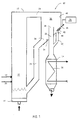
- FIGURE 1 illustrates a circulating fluidized bed (CFB) gasification reactor system 10 according to the present invention, including a circulating fluidized bed reactor 12 and a gas cooler 14.
- Gasification is practiced in the reactor 12 by introducing fluidizing gas through plenum 16 at the bottom of the reactor chamber 18.
- Solid fuel material is introduced into the reactor chamber 18 via an inlet 20 and solid bed material is introduced via inlet 22.
- the solid bed material may be an inert material such as sand, and may comprise additives, such as material active in the gasification process, e.g. limestone or other sulfur oxide reducing agents.
- the fuel material introduced at 20 is reacted (gasified in the case of FIGURE 1, but combusted or otherwise reacted in other reactor systems which also are within the scope of the invention) to produce an exhaust gas which is discharged from an outlet 24 adjacent the top of the reactor chamber 18 and connected to a cyclone separator 26.
- the cyclone separator comprises a gas outlet 28 forming the inlet end of a gas discharge 32 arranged to go through the bottom 34 of the separator 26.
- the gas discharge conduit 32 protrudes into the cyclone separator 26, so as to place the gas outlet at a distance above the bottom 34 and so as to form a center piece within the vortex chamber of the cyclone separator 26.
- Hot gas is introduced through reactor outlet 24 into the cyclone separator so as to form a vortex flow therein, whereby solid particles are separated and gather on the bottom 34.
- the solid material outlet 36 is connected through a solid material return conduit 38 with the bottom region of the reactor chamber 18, for recycling separated solid material into the reactor chamber.
- the gas produced during the reaction in reactor 18 and discharged through a gas outlet 24 therefrom includes in it entrained particulates, such as inert solid bed particles, additives and un-reacted fuel material, including some fine carbon material.
- particulates such as inert solid bed particles, additives and un-reacted fuel material, including some fine carbon material.
- the vast majority of the particles, particularly the large particles, are separated from the exhaust gas by the separator 26, and are returned by return conduit 38 to the lower part of the reactor chamber 18, as is conventional per se.
- the product gas which exhausts the separator 26 passes to the gas cooler 14.
- the exhaust gas from the reactor 18 and separator 26 has a temperature above 600°C, and the cooler 14 is typically designed to cool the gases to about 400°C.
- the gas cooler 14 includes a heat exchanger 30 formed of heat transfer surfaces, hot gas flowing on the outside of the heat transfer surfaces.
- the heat transfer surfaces may be made of water tubes, typically for producing steam to drive a steam turbine.
- Another heat exchanger or more may if desired be provided, connected to a turbine, other heat exchangers or the like.
- a fire-tube cooler in which hot gas flows inside a plurality of spaced tubes could be used.
- the space between the tubes is used as a conduit for heat transfer medium to extract heat from the gases.
- the surfaces are kept clean, or cleaned after accumulation of deposits, by introducing solid particles into the gas flow in, or just before, the cooler 14. This, for example, may be accomplished by injecting coarse particles using by-pass conduit 40, the coarse particles being provided from particles being separated from the gas in the cyclone separator 26. Such particles including e.g. sand, additives and/or un-reacted fuel.
- control may be automatic, e.g. in response to sensing of a decrease in cooling efficiency as a result of depositing or condensing or sticky substances.
- a second cyclone separator may be provided downstream of the gas cooler 14.
- the second separator may operate continuously, but is particularly necessary when particles are introduced (e.g. through by-pass conduit 40) to effect cleaning. Particles separated by the second separator may either be returned to the reactor 18 or may be disposed of.
- the thus cleaned product gas, discharged from the second separator may be filtered, and acted upon, or may be used directly, depending upon the desired use and the gas's composition.
- the by-pass conduit is controlled by a cover plate 42 being able to partly or wholly cover the inlet 44 into the by-pass conduit 40.
- the cover plate may be operated by a handle 46 by hand from outside the cyclone enclosure 48, or the cover plate 42 may be automatically operated by suitable automatic control means 50, such as conventional computer controller, for controlling the flow of particles introduced for cleaning.
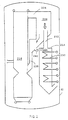
- FIGURE 2 illustrates a system substantially the same as that in FIGURE 1 same reference numbers as in FIGURE 1 are used preceded by a "2".
- the by-pass conduit 240 is connected to the return conduit 238 and solid particles are introduced directly into the gas cooler 214, not into the inlet conduit or center pipe 232.
- Several heat exchanger packages 230 are provided in the gas cooler. Fluidizing gas may be used to transport particles in the by-pass conduit.
- the reactor 218, cyclone 226 and gas cooler 214 are enclosed in a pressure vessel 52 for maintaining them at superatmospheric pressure.
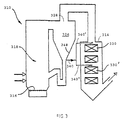
- FIGURE 3 illustrates a further system substantially the same as that in FIGURES 1 and 2 same reference numbers are used preceded by a "3".
- the particle separator is a conventional cyclone 326 having its gas outlet 328 in the upper part thereof. Solid particles are gathered from the wall 348 of the cyclone and led through a by-pass conduit 340 into the gas cooler 314.
- the by-pass conduit 340 is divided into two conduits 340' and 340'' introducing solid particles at different vertical levels in the gas cooler to mainly effect cleaning of different heat exchanger packages 330 and 330'.
Landscapes
- Chemical & Material Sciences (AREA)
- Engineering & Computer Science (AREA)
- Combustion & Propulsion (AREA)
- Oil, Petroleum & Natural Gas (AREA)
- Organic Chemistry (AREA)
- Chemical Kinetics & Catalysis (AREA)
- General Chemical & Material Sciences (AREA)
- Devices And Processes Conducted In The Presence Of Fluids And Solid Particles (AREA)
- Industrial Gases (AREA)
- Combined Means For Separation Of Solids (AREA)
Description
- a fluidized bed reactor chamber having a reactor chamber outlet for gas produced during fuel reaction (combustion, gasification, etc.)
- a particle separator, such as a cyclone separator, connected to the reactor chamber outlet for separating solid material from gas exhausted from the reactor chamber, said particle separator having a solid particle outlet and a gas outlet, and
- a gas cooler having cooling surfaces (heat transfer surfaces) and being connected to the gas outlet of the particle separator.
The method being characterized by the additional steps of:
- a fluidized bed reactor chamber having a bed material inlet, an exhaust gas outlet and a fluidizing gas inlet;
- a cyclone separator connected to the exhaust gas outlet, said separator having a gas outlet and a particle outlet for returning separated solid bed material to the reactor chamber;
- a return conduit connecting the particle outlet of the separator to the reactor chamber;
- a gas cooler connected to the separator gas outlet, the gas cooler having cooling surfaces and
- means for branching off a flow of solid bed material from the separated solid bed material and introducing said branched off flow of bed material into gas cooler.
- FIG. 1
- is a schematic view of the first exemplary embodiment of a circulating fluidized bed reactor system according to the present invention;
- FIG. 2
- is a schematic view of the second exemplary embodiment of a circulating fluidized bed reactor system according to the present invention, and
- FIG. 3
- is a schematic view of the third exemplary embodiment of a circulating fluidized bed reactor system according to the present invention.
Claims (16)
- A method of operating a fluidized bed reactor system for reacting fuel is provided, said reactor system comprising:
a fluidized bed reactor chamber having a reactor chamber outlet for gas produced during fuel reaction, a particle separator connected to the reactor chamber outlet for separating solid material from gas exhausted from the reactor chamber, said particle separator having a solid particle outlet and a gas outlet, and a gas cooler having cooling surfaces and being connected to the gas outlet of the particle separator, the method comprising the steps of:(a) introducing solid material particles, fluidization medium and fuel into the reactor chamber to provide a fluidized bed therewithin;(b) reacting the fuel material within the fluidized bed to produce exhaust gas and discharging the exhaust gas from the reactor chamber outlet;(c) introducing the exhaust gas into the particle separator and separating solid particles from the gas in said particle separator;(d) discharging from the particle separator gas through the gas outlet and a first flow of separated solid particles through the solid particle outlet and(e) cooling the gas discharged from the separator in the gas cooler,
the method being characterized by the additional steps of:(f) branching off from the first flow of solid particles, before or after discharging said first flow of solid particles from the particle separator, a second flow of solid particles;(g) introducing said second flow of particles into the gas discharged from the separator during, or before step (e), so that the particles mechanically dislodge deposits from, and thereby clean, the cooling surfaces, and(h) removing the particles from the gas after step (g). - A method as recited in claim 1, wherein steps (f) and (g) are practiced at spaced intervals only.
- A method as recited in claim 1, wherein steps (f) and (g) are practiced continuously.
- A method as recited in claim 1, wherein step (g) is practiced by introducing particles into the gas just before the gas cooler.
- A method as recited in claim 1, wherein step (g) is practiced by introducing particles into the gas in the gas cooler.
- A method as recited in claim 1, wherein the reactor is a circulating fluidized bed reactor, having a return conduit between the particle separator and the lower part of the reactor chamber, which return conduit normally operates so as to receive all particles separated in the particle separator; and wherein step (f) and (g) is practiced so as to periodically introduce a portion of the particles separated in the particle separator into the gas cooler.
- A method as recited in claim 6, wherein an inlet to a by-pass conduit connecting the particle separator with the gas cooler is periodically opened to allow separated particles to flow through the by-pass conduit into the gas cooler.
- A method as recited in claim 1, wherein steps (a) - (g) are practiced at a superatmospheric pressure between about 2 - 50 bar.
- A method as recited in claim 1, wherein step (b) is practiced so as to produce a gas at a temperature above 600°C and step (e) is practiced so as to cool the gas to about 400°C.
- A circulating fluidized bed reactor system is provided, comprising the following elements:the reactor system being characterized by further including means (42,44) for branching off a flow of solid bed material from the separated solid bed material and for introducing said branched off flow of bed material into the gas cooler.a fluidized bed reactor chamber (18) having a bed material inlet (22,20), an exhaust gas outlet (24) and a fluidizing gas inlet (16);a cyclone separator (26) connected to the exhaust gas outlet, said separator having a gas outlet (28) and a particle outlet (36) for returning separated solid bed material to the reactor chamber;a return conduit (38) connecting the particle outlet (36) of the separator to the reactor chamber (18), anda gas cooler (14) connected to the separator gas outlet (28), the gas cooler having cooling surfaces (30),
- A reactor system according to claim 10 further, wherein a pressure vessel (52) surrounding the reactor (218), cyclone (226) and gas cooler (214) is provided, for maintaining them at superatmospheric pressure.
- A reactor system according to claim 10, wherein the means for branching off a flow of solid bed material comprises in the cyclone separator (26) in the bottom (34) thereof an opening (44) connected to a by-pass conduit (40) for leading separated solid bed material from the cyclone separator to the gas cooler.
- A reactor system according to claim 12, wherein the means for branching off a flow of solid bed material further comprises a cover plate (42) for covering the opening (44) in the bottom of the separator.
- A reactor system according to claim 10, wherein the means for branching off a flow of solid bed material comprises a by-pass conduit (240) connecting the return conduit (238) with the gas cooler (214).
- A reactor system according to claim 10, wherein the cyclone separator (26) comprises a vertical vortex chamber and a gas outlet (28) connected to the bottom (34) of the cyclone.
- A reactor system according to claim 10, wherein the cyclone separator (326) comprises a vertical vortex chamber and a gas outlet (328) connected to its upper part.
Applications Claiming Priority (1)
| Application Number | Priority Date | Filing Date | Title |
|---|---|---|---|
| PCT/FI1996/000100 WO1997031084A1 (en) | 1996-02-21 | 1996-02-21 | Method of operating a fluidized bed reactor system, and fluidized bed reactor system |
Publications (2)
| Publication Number | Publication Date |
|---|---|
| EP0889943A1 EP0889943A1 (en) | 1999-01-13 |
| EP0889943B1 true EP0889943B1 (en) | 2002-01-23 |
Family
ID=8556640
Family Applications (1)
| Application Number | Title | Priority Date | Filing Date |
|---|---|---|---|
| EP96903020A Expired - Lifetime EP0889943B1 (en) | 1996-02-21 | 1996-02-21 | Method of operating a fluidized bed reactor system, and fluidized bed reactor system |
Country Status (8)
| Country | Link |
|---|---|
| US (1) | US6214065B1 (en) |
| EP (1) | EP0889943B1 (en) |
| JP (1) | JP2982977B2 (en) |
| AU (1) | AU4720296A (en) |
| DE (1) | DE69618819T2 (en) |
| DK (1) | DK0889943T3 (en) |
| ES (1) | ES2171648T3 (en) |
| WO (1) | WO1997031084A1 (en) |
Cited By (2)
| Publication number | Priority date | Publication date | Assignee | Title |
|---|---|---|---|---|
| TWI391610B (en) * | 2009-02-27 | 2013-04-01 | Mitsubishi Heavy Ind Environment & Chemical Engineering Co Ltd | A circulating fluidized bed, an operating system having the circulating fluidized bed, and a driving method of the circulating fluidized bed |
| WO2025168667A1 (en) * | 2024-02-06 | 2025-08-14 | Borealis Gmbh | Integrated reactor system and process for simultaneously producing a mixture of hydrocarbons from a carbonaceous feedstock and recovering heat |
Families Citing this family (11)
| Publication number | Priority date | Publication date | Assignee | Title |
|---|---|---|---|---|
| FI112952B (en) * | 2001-12-21 | 2004-02-13 | Foster Wheeler Energia Oy | Methods and devices for gasification of carbonaceous material |
| DE102004051477B4 (en) * | 2004-10-22 | 2008-10-02 | Alstom Technology Ltd. | Method for regulating the amount of circulating fluid in a circulating fluidized bed reactor system |
| DE102005005796A1 (en) * | 2005-02-09 | 2006-08-17 | Applikations- Und Technikzentrum Für Energieverfahrens-, Umwelt- Und Strömungstechnik (Atz-Evus) | Method and device for the thermochemical conversion of a fuel |
| NL1030189C2 (en) * | 2005-10-13 | 2007-04-16 | Stichting Energie | Biogas purification apparatus, contains bed comprising carbon particles and base particles of a material other than carbon |
| WO2009149602A1 (en) * | 2008-06-13 | 2009-12-17 | Peng Sigan | Washing device and washing method for marine exhaust flue gases |
| US9757686B2 (en) | 2008-06-13 | 2017-09-12 | Sigan Peng | Ship flue gas scrubbing apparatus and method |
| US8196533B2 (en) * | 2008-10-27 | 2012-06-12 | Kentucky-Tennessee Clay Co. | Methods for operating a fluidized-bed reactor |
| US8821600B2 (en) * | 2011-11-30 | 2014-09-02 | Aerojet Rocketdyne Of De, Inc. | Dry bottom reactor vessel and method |
| ES2436844B1 (en) | 2013-09-23 | 2014-07-07 | Eqtec Iberia, S.L. | Procedure for the gasification of organic solid materials and reactor used |
| DE102017210044A1 (en) * | 2017-06-14 | 2018-12-20 | Thyssenkrupp Ag | Aftertreatment arrangement and method for aftertreatment of at least gases downstream of a fluidized bed gasification and logic unit and use |
| EP4209710A1 (en) | 2022-01-10 | 2023-07-12 | ICMEA Srl leader of temporary association of companies ICMEA Srl - Tecnomec Engineering Srl - CNR IRSA | Fluidised bed unit |
Family Cites Families (6)
| Publication number | Priority date | Publication date | Assignee | Title |
|---|---|---|---|---|
| JPS57179289A (en) | 1981-04-28 | 1982-11-04 | Agency Of Ind Science & Technol | Recovering method of heat from gasified product of hydrocarbon |
| DE3724947A1 (en) * | 1987-07-28 | 1989-02-16 | Uhde Gmbh | METHOD AND DEVICE FOR COOLING RAW GAS FROM A PARTIAL OXIDATION OF CARBONATED MATERIAL |
| GB2232682A (en) * | 1989-05-31 | 1990-12-19 | Shell Int Research | Process for removal of flyslag deposits |
| US5281398A (en) | 1990-10-15 | 1994-01-25 | A. Ahlstrom Corporation | Centrifugal separator |
| US5269263A (en) * | 1992-09-11 | 1993-12-14 | Foster Wheeler Energy Corporation | Fluidized bed reactor system and method of operating same |
| DE69504524T2 (en) * | 1994-08-23 | 1999-04-15 | Foster Wheeler Energia Oy, Helsinki | METHOD FOR OPERATING A FLUID BED REACTOR SYSTEM, AND SUCH A SYSTEM |
-
1996
- 1996-02-21 DK DK96903020T patent/DK0889943T3/en active
- 1996-02-21 ES ES96903020T patent/ES2171648T3/en not_active Expired - Lifetime
- 1996-02-21 US US09/117,141 patent/US6214065B1/en not_active Expired - Fee Related
- 1996-02-21 AU AU47202/96A patent/AU4720296A/en not_active Abandoned
- 1996-02-21 DE DE69618819T patent/DE69618819T2/en not_active Expired - Fee Related
- 1996-02-21 WO PCT/FI1996/000100 patent/WO1997031084A1/en not_active Ceased
- 1996-02-21 EP EP96903020A patent/EP0889943B1/en not_active Expired - Lifetime
- 1996-02-21 JP JP9529823A patent/JP2982977B2/en not_active Expired - Fee Related
Cited By (2)
| Publication number | Priority date | Publication date | Assignee | Title |
|---|---|---|---|---|
| TWI391610B (en) * | 2009-02-27 | 2013-04-01 | Mitsubishi Heavy Ind Environment & Chemical Engineering Co Ltd | A circulating fluidized bed, an operating system having the circulating fluidized bed, and a driving method of the circulating fluidized bed |
| WO2025168667A1 (en) * | 2024-02-06 | 2025-08-14 | Borealis Gmbh | Integrated reactor system and process for simultaneously producing a mixture of hydrocarbons from a carbonaceous feedstock and recovering heat |
Also Published As
| Publication number | Publication date |
|---|---|
| WO1997031084A1 (en) | 1997-08-28 |
| DK0889943T3 (en) | 2002-05-06 |
| ES2171648T3 (en) | 2002-09-16 |
| JPH11504381A (en) | 1999-04-20 |
| DE69618819T2 (en) | 2002-08-22 |
| US6214065B1 (en) | 2001-04-10 |
| AU4720296A (en) | 1997-09-10 |
| DE69618819D1 (en) | 2002-03-14 |
| JP2982977B2 (en) | 1999-11-29 |
| EP0889943A1 (en) | 1999-01-13 |
Similar Documents
| Publication | Publication Date | Title |
|---|---|---|
| US4464183A (en) | Heat recovery process in coal gasification | |
| US6214065B1 (en) | Method of operating a fluidized bed reactor system, and fluidized bed reactor system | |
| EP0689654B1 (en) | Fluidized bed reactor with particle return | |
| EP0777711B1 (en) | Method of operating a fluidized bed reactor system, and system | |
| EP0630684B1 (en) | Method and apparatus for treating or utilizing a hot gas flow | |
| US4035170A (en) | Granular filter | |
| EP0762923B1 (en) | Eliminating ash bridging in ceramic filters | |
| US4033117A (en) | Solid fuel fired gas turbine system having continuously regenerating granular filter | |
| EP0515878B1 (en) | Cleaning of high temperature high pressure (HTHP) gases | |
| US4412848A (en) | Heat recovery method from gasified products of hydrocarbon | |
| FI112952B (en) | Methods and devices for gasification of carbonaceous material | |
| JP2000504991A (en) | High temperature gas filtration equipment | |
| JP2969369B2 (en) | Combustion devices, especially swirl-bed combustion devices | |
| EP0595867B1 (en) | A method of removing deposits from the walls of a gas cooler inlet duct, and a gas cooler inlet duct having a cooled elastic metal structure | |
| US5464528A (en) | FCC process and apparatus with upset tolerant third stage separator | |
| EP0177527B1 (en) | Two- or multi-component reactor | |
| US5567228A (en) | System for cooling and cleaning synthesized gas using ahot gravel bed | |
| EP0060044B1 (en) | Fluidised bed combustion | |
| US5171542A (en) | Circulating fluidized bed reactor | |
| US5277151A (en) | Integral water-cooled circulating fluidized bed boiler system | |
| EP4209710A1 (en) | Fluidised bed unit | |
| WO2002086385A1 (en) | Waste heat boiler | |
| EP1712839B1 (en) | Method of heat recovery and heat recovery apparatus | |
| US20020146362A1 (en) | Method of filtration and cleansing of high temperature combustible gases | |
| EP0074461A1 (en) | Cold wall separator |
Legal Events
| Date | Code | Title | Description |
|---|---|---|---|
| PUAI | Public reference made under article 153(3) epc to a published international application that has entered the european phase |
Free format text: ORIGINAL CODE: 0009012 |
|
| 17P | Request for examination filed |
Effective date: 19980625 |
|
| AK | Designated contracting states |
Kind code of ref document: A1 Designated state(s): DE DK ES FR SE |
|
| GRAG | Despatch of communication of intention to grant |
Free format text: ORIGINAL CODE: EPIDOS AGRA |
|
| RIC1 | Information provided on ipc code assigned before grant |
Free format text: 7C 10J 3/54 A, 7C 10J 3/56 B, 7C 10J 3/84 B |
|
| 17Q | First examination report despatched |
Effective date: 20010316 |
|
| GRAG | Despatch of communication of intention to grant |
Free format text: ORIGINAL CODE: EPIDOS AGRA |
|
| GRAG | Despatch of communication of intention to grant |
Free format text: ORIGINAL CODE: EPIDOS AGRA |
|
| GRAH | Despatch of communication of intention to grant a patent |
Free format text: ORIGINAL CODE: EPIDOS IGRA |
|
| GRAH | Despatch of communication of intention to grant a patent |
Free format text: ORIGINAL CODE: EPIDOS IGRA |
|
| GRAA | (expected) grant |
Free format text: ORIGINAL CODE: 0009210 |
|
| AK | Designated contracting states |
Kind code of ref document: B1 Designated state(s): DE DK ES FR SE |
|
| REF | Corresponds to: |
Ref document number: 69618819 Country of ref document: DE Date of ref document: 20020314 |
|
| REG | Reference to a national code |
Ref country code: DK Ref legal event code: T3 |
|
| ET | Fr: translation filed | ||
| REG | Reference to a national code |
Ref country code: ES Ref legal event code: FG2A Ref document number: 2171648 Country of ref document: ES Kind code of ref document: T3 |
|
| PLBE | No opposition filed within time limit |
Free format text: ORIGINAL CODE: 0009261 |
|
| STAA | Information on the status of an ep patent application or granted ep patent |
Free format text: STATUS: NO OPPOSITION FILED WITHIN TIME LIMIT |
|
| 26N | No opposition filed | ||
| PGFP | Annual fee paid to national office [announced via postgrant information from national office to epo] |
Ref country code: FR Payment date: 20050113 Year of fee payment: 10 |
|
| PGFP | Annual fee paid to national office [announced via postgrant information from national office to epo] |
Ref country code: DK Payment date: 20050114 Year of fee payment: 10 |
|
| PGFP | Annual fee paid to national office [announced via postgrant information from national office to epo] |
Ref country code: DE Payment date: 20050121 Year of fee payment: 10 |
|
| PGFP | Annual fee paid to national office [announced via postgrant information from national office to epo] |
Ref country code: SE Payment date: 20050124 Year of fee payment: 10 |
|
| PGFP | Annual fee paid to national office [announced via postgrant information from national office to epo] |
Ref country code: ES Payment date: 20050204 Year of fee payment: 10 |
|
| PG25 | Lapsed in a contracting state [announced via postgrant information from national office to epo] |
Ref country code: SE Free format text: LAPSE BECAUSE OF NON-PAYMENT OF DUE FEES Effective date: 20060222 Ref country code: ES Free format text: LAPSE BECAUSE OF NON-PAYMENT OF DUE FEES Effective date: 20060222 |
|
| PG25 | Lapsed in a contracting state [announced via postgrant information from national office to epo] |
Ref country code: DK Free format text: LAPSE BECAUSE OF NON-PAYMENT OF DUE FEES Effective date: 20060228 |
|
| PG25 | Lapsed in a contracting state [announced via postgrant information from national office to epo] |
Ref country code: DE Free format text: LAPSE BECAUSE OF NON-PAYMENT OF DUE FEES Effective date: 20060901 |
|
| REG | Reference to a national code |
Ref country code: DK Ref legal event code: EBP |
|
| EUG | Se: european patent has lapsed | ||
| REG | Reference to a national code |
Ref country code: FR Ref legal event code: ST Effective date: 20061031 |
|
| REG | Reference to a national code |
Ref country code: ES Ref legal event code: FD2A Effective date: 20060222 |
|
| PG25 | Lapsed in a contracting state [announced via postgrant information from national office to epo] |
Ref country code: FR Free format text: LAPSE BECAUSE OF NON-PAYMENT OF DUE FEES Effective date: 20060228 |