EP0889878B1 - Bisarylcyclobutene derivates as cyclooxygenase inhibitors - Google Patents
Bisarylcyclobutene derivates as cyclooxygenase inhibitors Download PDFInfo
- Publication number
- EP0889878B1 EP0889878B1 EP97908099A EP97908099A EP0889878B1 EP 0889878 B1 EP0889878 B1 EP 0889878B1 EP 97908099 A EP97908099 A EP 97908099A EP 97908099 A EP97908099 A EP 97908099A EP 0889878 B1 EP0889878 B1 EP 0889878B1
- Authority
- EP
- European Patent Office
- Prior art keywords
- alkyl
- phenyl
- methylsulfonylphenyl
- cyclobuten
- hydroxy
- Prior art date
- Legal status (The legal status is an assumption and is not a legal conclusion. Google has not performed a legal analysis and makes no representation as to the accuracy of the status listed.)
- Expired - Lifetime
Links
- 239000002599 prostaglandin synthase inhibitor Substances 0.000 title 1
- 150000001875 compounds Chemical class 0.000 claims abstract description 126
- 208000037265 diseases, disorders, signs and symptoms Diseases 0.000 claims abstract description 17
- 230000001404 mediated effect Effects 0.000 claims abstract description 15
- 201000010099 disease Diseases 0.000 claims abstract description 14
- 239000008194 pharmaceutical composition Substances 0.000 claims abstract description 12
- -1 tri-substituted phenyl Chemical group 0.000 claims description 68
- 125000004432 carbon atom Chemical group C* 0.000 claims description 43
- 125000001424 substituent group Chemical group 0.000 claims description 37
- 125000004169 (C1-C6) alkyl group Chemical group 0.000 claims description 30
- 229910052736 halogen Inorganic materials 0.000 claims description 30
- 150000002367 halogens Chemical class 0.000 claims description 30
- 229910052799 carbon Inorganic materials 0.000 claims description 28
- 102100038280 Prostaglandin G/H synthase 2 Human genes 0.000 claims description 27
- 125000004076 pyridyl group Chemical group 0.000 claims description 25
- 150000003839 salts Chemical class 0.000 claims description 24
- 125000000732 arylene group Chemical group 0.000 claims description 23
- 125000004191 (C1-C6) alkoxy group Chemical group 0.000 claims description 22
- 102000004005 Prostaglandin-endoperoxide synthases Human genes 0.000 claims description 17
- 108090000459 Prostaglandin-endoperoxide synthases Proteins 0.000 claims description 17
- 239000003814 drug Substances 0.000 claims description 16
- HRYWWQCLGHKRLN-UHFFFAOYSA-N 4,4-dimethyl-3-(4-methylsulfonylphenyl)-2-phenylcyclobut-2-en-1-one Chemical compound CC1(C)C(=O)C(C=2C=CC=CC=2)=C1C1=CC=C(S(C)(=O)=O)C=C1 HRYWWQCLGHKRLN-UHFFFAOYSA-N 0.000 claims description 15
- DHKHKXVYLBGOIT-UHFFFAOYSA-N acetaldehyde Diethyl Acetal Natural products CCOC(C)OCC DHKHKXVYLBGOIT-UHFFFAOYSA-N 0.000 claims description 14
- YLQBMQCUIZJEEH-UHFFFAOYSA-N Furan Chemical compound C=1C=COC=1 YLQBMQCUIZJEEH-UHFFFAOYSA-N 0.000 claims description 13
- 229910052717 sulfur Inorganic materials 0.000 claims description 13
- YTPLMLYBLZKORZ-UHFFFAOYSA-N Thiophene Chemical compound C=1C=CSC=1 YTPLMLYBLZKORZ-UHFFFAOYSA-N 0.000 claims description 12
- 229940021182 non-steroidal anti-inflammatory drug Drugs 0.000 claims description 12
- QVGXLLKOCUKJST-UHFFFAOYSA-N atomic oxygen Chemical group [O] QVGXLLKOCUKJST-UHFFFAOYSA-N 0.000 claims description 11
- 239000001301 oxygen Substances 0.000 claims description 11
- 229910052760 oxygen Inorganic materials 0.000 claims description 11
- 239000005977 Ethylene Substances 0.000 claims description 10
- 238000004519 manufacturing process Methods 0.000 claims description 10
- 239000000041 non-steroidal anti-inflammatory agent Substances 0.000 claims description 10
- KSLKJFIICOYAEA-UHFFFAOYSA-N 3-(4-methylsulfonylphenyl)-2-phenylcyclobut-2-en-1-one Chemical compound C1=CC(S(=O)(=O)C)=CC=C1C1=C(C=2C=CC=CC=2)C(=O)C1 KSLKJFIICOYAEA-UHFFFAOYSA-N 0.000 claims description 9
- QTBSBXVTEAMEQO-UHFFFAOYSA-M Acetate Chemical compound CC([O-])=O QTBSBXVTEAMEQO-UHFFFAOYSA-M 0.000 claims description 9
- 125000002950 monocyclic group Chemical group 0.000 claims description 9
- NINIDFKCEFEMDL-UHFFFAOYSA-N Sulfur Chemical group [S] NINIDFKCEFEMDL-UHFFFAOYSA-N 0.000 claims description 8
- 125000003118 aryl group Chemical group 0.000 claims description 8
- 125000000623 heterocyclic group Chemical group 0.000 claims description 8
- 239000011593 sulfur Chemical group 0.000 claims description 8
- MPLQIVYOLUADTB-UHFFFAOYSA-N 4,4-dimethyl-2-(4-methylsulfonylphenyl)-3-phenylcyclobut-2-en-1-one Chemical compound CC1(C)C(=O)C(C=2C=CC(=CC=2)S(C)(=O)=O)=C1C1=CC=CC=C1 MPLQIVYOLUADTB-UHFFFAOYSA-N 0.000 claims description 7
- 125000000217 alkyl group Chemical group 0.000 claims description 7
- 125000005842 heteroatom Chemical group 0.000 claims description 7
- 125000001997 phenyl group Chemical group [H]C1=C([H])C([H])=C(*)C([H])=C1[H] 0.000 claims description 7
- AFWGWVIHUIRADF-UHFFFAOYSA-N 4-chloro-3-(4-methylsulfonylphenyl)-2-phenylcyclobut-2-en-1-one Chemical compound C1=CC(S(=O)(=O)C)=CC=C1C1=C(C=2C=CC=CC=2)C(=O)C1Cl AFWGWVIHUIRADF-UHFFFAOYSA-N 0.000 claims description 6
- SKFYMFXFKMOXCO-UHFFFAOYSA-N 4-methyl-2-(4-methylsulfonylphenyl)-3-phenyl-4-thiophen-3-ylcyclobut-2-en-1-one Chemical compound C1=CSC=C1C1(C)C(=O)C(C=2C=CC(=CC=2)S(C)(=O)=O)=C1C1=CC=CC=C1 SKFYMFXFKMOXCO-UHFFFAOYSA-N 0.000 claims description 6
- TVVBZZKCMFGKPS-UHFFFAOYSA-N 4-methyl-3-(4-methylsulfonylphenyl)-2-phenyl-4-thiophen-3-ylcyclobut-2-en-1-one Chemical compound C1=CSC=C1C1(C)C(=O)C(C=2C=CC=CC=2)=C1C1=CC=C(S(C)(=O)=O)C=C1 TVVBZZKCMFGKPS-UHFFFAOYSA-N 0.000 claims description 6
- 229930192474 thiophene Natural products 0.000 claims description 6
- ANTUDLOSLOEGEQ-UHFFFAOYSA-N 1-methylsulfonyl-4-(2-phenylcyclobuten-1-yl)benzene Chemical compound C1=CC(S(=O)(=O)C)=CC=C1C1=C(C=2C=CC=CC=2)CC1 ANTUDLOSLOEGEQ-UHFFFAOYSA-N 0.000 claims description 5
- 125000003342 alkenyl group Chemical group 0.000 claims description 5
- 125000000304 alkynyl group Chemical group 0.000 claims description 5
- 125000004433 nitrogen atom Chemical group N* 0.000 claims description 5
- FHSSLWMENUZGNV-UHFFFAOYSA-N 2-(3-fluorophenyl)-4,4-dimethyl-3-(4-methylsulfonylphenyl)cyclobut-2-en-1-one Chemical compound CC1(C)C(=O)C(C=2C=C(F)C=CC=2)=C1C1=CC=C(S(C)(=O)=O)C=C1 FHSSLWMENUZGNV-UHFFFAOYSA-N 0.000 claims description 4
- BIKVSCVPZGXPRO-UHFFFAOYSA-N 2-(4-fluorophenyl)-4,4-dimethyl-3-(4-methylsulfonylphenyl)cyclobut-2-en-1-one Chemical compound CC1(C)C(=O)C(C=2C=CC(F)=CC=2)=C1C1=CC=C(S(C)(=O)=O)C=C1 BIKVSCVPZGXPRO-UHFFFAOYSA-N 0.000 claims description 4
- OXKWEEGQCUURNG-UHFFFAOYSA-N 3-(3-fluorophenyl)-4,4-dimethyl-2-(4-methylsulfonylphenyl)cyclobut-2-en-1-one Chemical compound CC1(C)C(=O)C(C=2C=CC(=CC=2)S(C)(=O)=O)=C1C1=CC=CC(F)=C1 OXKWEEGQCUURNG-UHFFFAOYSA-N 0.000 claims description 4
- ANLQSLCMDUDROE-UHFFFAOYSA-N 4,4-dimethyl-3-(4-methylsulfonylphenyl)-2-phenylcyclobut-2-en-1-ol Chemical compound CC1(C)C(O)C(C=2C=CC=CC=2)=C1C1=CC=C(S(C)(=O)=O)C=C1 ANLQSLCMDUDROE-UHFFFAOYSA-N 0.000 claims description 4
- FZWLAAWBMGSTSO-UHFFFAOYSA-N Thiazole Chemical compound C1=CSC=N1 FZWLAAWBMGSTSO-UHFFFAOYSA-N 0.000 claims description 4
- 125000003545 alkoxy group Chemical group 0.000 claims description 4
- 125000004414 alkyl thio group Chemical group 0.000 claims description 4
- 125000002915 carbonyl group Chemical group [*:2]C([*:1])=O 0.000 claims description 4
- 125000004122 cyclic group Chemical group 0.000 claims description 4
- 239000003937 drug carrier Substances 0.000 claims description 4
- AMLDQOLBITYQRQ-UHFFFAOYSA-N n-methoxy-4,4-dimethyl-3-(4-methylsulfonylphenyl)-2-phenylcyclobut-2-en-1-imine Chemical compound CC1(C)C(=NOC)C(C=2C=CC=CC=2)=C1C1=CC=C(S(C)(=O)=O)C=C1 AMLDQOLBITYQRQ-UHFFFAOYSA-N 0.000 claims description 4
- SNRBLWLCNVTARG-SFQUDFHCSA-N (1e)-1-[3-(4-methylsulfonylphenyl)-2-phenylcyclobut-2-en-1-ylidene]propan-2-ol Chemical compound CC(O)\C=C1/CC(C=2C=CC(=CC=2)S(C)(=O)=O)=C1C1=CC=CC=C1 SNRBLWLCNVTARG-SFQUDFHCSA-N 0.000 claims description 3
- MYJPFSFIJHWEKB-ROUUACIJSA-N (3R,4R)-2,2-dimethyl-3,4-bis(4-methylsulfanylphenyl)cyclobutan-1-one Chemical compound CC1(C([C@H]([C@@H]1C1=CC=C(C=C1)SC)C1=CC=C(C=C1)SC)=O)C MYJPFSFIJHWEKB-ROUUACIJSA-N 0.000 claims description 3
- 125000006700 (C1-C6) alkylthio group Chemical group 0.000 claims description 3
- KGOPIJQFLBPLCD-UHFFFAOYSA-N 1-(3-methylidene-2-phenylcyclobuten-1-yl)-4-methylsulfonylbenzene Chemical compound C1=CC(S(=O)(=O)C)=CC=C1C1=C(C=2C=CC=CC=2)C(=C)C1 KGOPIJQFLBPLCD-UHFFFAOYSA-N 0.000 claims description 3
- LPTIKMSXVGTDPE-UHFFFAOYSA-N 1-(4,4-dichloro-3-methylidene-2-phenylcyclobuten-1-yl)-4-methylsulfonylbenzene Chemical compound C1=CC(S(=O)(=O)C)=CC=C1C1=C(C=2C=CC=CC=2)C(=C)C1(Cl)Cl LPTIKMSXVGTDPE-UHFFFAOYSA-N 0.000 claims description 3
- LNVGPIHDLSUODK-UHFFFAOYSA-N 4,4-dichloro-2-(4-fluorophenyl)-3-(4-methylsulfonylphenyl)cyclobut-2-en-1-one Chemical compound C1=CC(S(=O)(=O)C)=CC=C1C1=C(C=2C=CC(F)=CC=2)C(=O)C1(Cl)Cl LNVGPIHDLSUODK-UHFFFAOYSA-N 0.000 claims description 3
- APHSDBGALYTWJV-UHFFFAOYSA-N 4-(4,4-dimethyl-3-oxo-2-phenylcyclobuten-1-yl)benzenesulfonamide Chemical compound CC1(C)C(=O)C(C=2C=CC=CC=2)=C1C1=CC=C(S(N)(=O)=O)C=C1 APHSDBGALYTWJV-UHFFFAOYSA-N 0.000 claims description 3
- VWSBJTPZTVPQFC-UHFFFAOYSA-N 4-methoxy-4-methyl-3-(4-methylsulfonylphenyl)-2-phenylcyclobut-2-en-1-one Chemical compound COC1(C)C(=O)C(C=2C=CC=CC=2)=C1C1=CC=C(S(C)(=O)=O)C=C1 VWSBJTPZTVPQFC-UHFFFAOYSA-N 0.000 claims description 3
- 125000000882 C2-C6 alkenyl group Chemical group 0.000 claims description 3
- 125000003601 C2-C6 alkynyl group Chemical group 0.000 claims description 3
- 125000006413 ring segment Chemical group 0.000 claims description 3
- RTHACADIJHCDMH-UHFFFAOYSA-N 1,4,4-trimethyl-3-(4-methylsulfonylphenyl)-2-phenylcyclobut-2-en-1-ol Chemical compound CC1(O)C(C)(C)C(C=2C=CC(=CC=2)S(C)(=O)=O)=C1C1=CC=CC=C1 RTHACADIJHCDMH-UHFFFAOYSA-N 0.000 claims description 2
- GNNCHLJCDMMTAB-UHFFFAOYSA-N 1-(3-fluoro-4,4-dimethyl-2-phenylcyclobuten-1-yl)-4-methylsulfonylbenzene Chemical compound CC1(C)C(F)C(C=2C=CC=CC=2)=C1C1=CC=C(S(C)(=O)=O)C=C1 GNNCHLJCDMMTAB-UHFFFAOYSA-N 0.000 claims description 2
- IFPSCINELPNSEE-UHFFFAOYSA-N 1-(3-methoxy-4,4-dimethyl-2-phenylcyclobuten-1-yl)-4-methylsulfonylbenzene Chemical compound CC1(C)C(OC)C(C=2C=CC=CC=2)=C1C1=CC=C(S(C)(=O)=O)C=C1 IFPSCINELPNSEE-UHFFFAOYSA-N 0.000 claims description 2
- FYNBOGBNIRAUMO-UHFFFAOYSA-N 1-(4,4-dimethyl-3-methylidene-2-phenylcyclobuten-1-yl)-4-methylsulfonylbenzene Chemical compound CC1(C)C(=C)C(C=2C=CC=CC=2)=C1C1=CC=C(S(C)(=O)=O)C=C1 FYNBOGBNIRAUMO-UHFFFAOYSA-N 0.000 claims description 2
- GFHHHGRBDWLMKZ-UHFFFAOYSA-N 1-(4-methoxy-3,3-dimethyl-2-phenylcyclobuten-1-yl)-4-methylsulfonylbenzene Chemical compound CC1(C)C(OC)C(C=2C=CC(=CC=2)S(C)(=O)=O)=C1C1=CC=CC=C1 GFHHHGRBDWLMKZ-UHFFFAOYSA-N 0.000 claims description 2
- MBCIXIQNHKMZOG-UHFFFAOYSA-N 2-(3,4-difluorophenyl)-4,4-dimethyl-3-(4-methylsulfonylphenyl)cyclobut-2-en-1-one Chemical compound CC1(C)C(=O)C(C=2C=C(F)C(F)=CC=2)=C1C1=CC=C(S(C)(=O)=O)C=C1 MBCIXIQNHKMZOG-UHFFFAOYSA-N 0.000 claims description 2
- DMPVBFRNVWYCOX-UHFFFAOYSA-N 2-(3,5-difluorophenyl)-4,4-dimethyl-3-(4-methylsulfonylphenyl)cyclobut-2-en-1-one Chemical compound CC1(C)C(=O)C(C=2C=C(F)C=C(F)C=2)=C1C1=CC=C(S(C)(=O)=O)C=C1 DMPVBFRNVWYCOX-UHFFFAOYSA-N 0.000 claims description 2
- WSFMIFSVTWIJLA-UHFFFAOYSA-N 2-(4-methylsulfonylphenyl)-3-phenyl-4-propan-2-ylcyclobut-2-en-1-one Chemical compound CC(C)C1C(=O)C(C=2C=CC(=CC=2)S(C)(=O)=O)=C1C1=CC=CC=C1 WSFMIFSVTWIJLA-UHFFFAOYSA-N 0.000 claims description 2
- QASBLVMRABVBFV-UHFFFAOYSA-N 3-(4-methylsulfonylphenyl)-2-phenyl-n-phenylmethoxycyclobut-2-en-1-imine Chemical compound C1=CC(S(=O)(=O)C)=CC=C1C(C1)=C(C=2C=CC=CC=2)C1=NOCC1=CC=CC=C1 QASBLVMRABVBFV-UHFFFAOYSA-N 0.000 claims description 2
- FRDKDBUKDGXDID-UHFFFAOYSA-N 3-(4-methylsulfonylphenyl)-4-phenylcyclobut-3-ene-1,2-dione Chemical compound C1=CC(S(=O)(=O)C)=CC=C1C(C(C1=O)=O)=C1C1=CC=CC=C1 FRDKDBUKDGXDID-UHFFFAOYSA-N 0.000 claims description 2
- ZURUDDMGSIMVST-UHFFFAOYSA-N 3-[[[4,4-dimethyl-3-(4-methylsulfonylphenyl)-2-phenylcyclobut-2-en-1-ylidene]amino]oxymethyl]benzoic acid Chemical compound C=1C=CC=CC=1C1=C(C=2C=CC(=CC=2)S(C)(=O)=O)C(C)(C)C1=NOCC1=CC=CC(C(O)=O)=C1 ZURUDDMGSIMVST-UHFFFAOYSA-N 0.000 claims description 2
- ANJALBIXTFXNAO-UHFFFAOYSA-N 4,4-dichloro-3-(4-methylsulfanylphenyl)-2-phenylcyclobut-2-en-1-one Chemical compound C1=CC(SC)=CC=C1C1=C(C=2C=CC=CC=2)C(=O)C1(Cl)Cl ANJALBIXTFXNAO-UHFFFAOYSA-N 0.000 claims description 2
- RFICRAJFJGCSPD-UHFFFAOYSA-N 4,4-dichloro-3-(4-methylsulfonylphenyl)-2-phenylcyclobut-2-en-1-one Chemical compound C1=CC(S(=O)(=O)C)=CC=C1C1=C(C=2C=CC=CC=2)C(=O)C1(Cl)Cl RFICRAJFJGCSPD-UHFFFAOYSA-N 0.000 claims description 2
- VURCZVIBPOOBSA-UHFFFAOYSA-N 4,4-dimethyl-2-(4-methylsulfinylphenyl)-3-phenylcyclobut-2-en-1-one Chemical compound C1=CC(S(=O)C)=CC=C1C(C(C1(C)C)=O)=C1C1=CC=CC=C1 VURCZVIBPOOBSA-UHFFFAOYSA-N 0.000 claims description 2
- ZTVPPGNUJVITBK-UHFFFAOYSA-N 4,4-dimethyl-2-(4-methylsulfonylphenyl)-3-phenyl-n-phenylmethoxycyclobut-2-en-1-imine Chemical compound C=1C=C(S(C)(=O)=O)C=CC=1C1=C(C=2C=CC=CC=2)C(C)(C)C1=NOCC1=CC=CC=C1 ZTVPPGNUJVITBK-UHFFFAOYSA-N 0.000 claims description 2
- UJCVIKCNPFYWML-UHFFFAOYSA-N 4,4-dimethyl-2-(4-methylsulfonylphenyl)-3-phenylcyclobut-2-en-1-ol Chemical compound CC1(C)C(O)C(C=2C=CC(=CC=2)S(C)(=O)=O)=C1C1=CC=CC=C1 UJCVIKCNPFYWML-UHFFFAOYSA-N 0.000 claims description 2
- AAFNTARBCMGBRC-UHFFFAOYSA-N 4,4-dimethyl-3-(4-methylsulfinylphenyl)-2-phenylcyclobut-2-en-1-one Chemical compound C1=CC(S(=O)C)=CC=C1C1=C(C=2C=CC=CC=2)C(=O)C1(C)C AAFNTARBCMGBRC-UHFFFAOYSA-N 0.000 claims description 2
- WUHKDBOLODRMQG-UHFFFAOYSA-N 4,4-dimethyl-3-(4-methylsulfonylphenyl)-2-phenyl-n-(pyridin-2-ylmethoxy)cyclobut-2-en-1-imine Chemical compound C=1C=CC=CC=1C1=C(C=2C=CC(=CC=2)S(C)(=O)=O)C(C)(C)C1=NOCC1=CC=CC=N1 WUHKDBOLODRMQG-UHFFFAOYSA-N 0.000 claims description 2
- SHHRJXXIOZRTGX-UHFFFAOYSA-N 4,4-dimethyl-3-(4-methylsulfonylphenyl)-2-phenyl-n-(pyridin-3-ylmethoxy)cyclobut-2-en-1-imine Chemical compound C=1C=CC=CC=1C1=C(C=2C=CC(=CC=2)S(C)(=O)=O)C(C)(C)C1=NOCC1=CC=CN=C1 SHHRJXXIOZRTGX-UHFFFAOYSA-N 0.000 claims description 2
- KRBPHFLOPZTVAX-UHFFFAOYSA-N 4,4-dimethyl-3-(4-methylsulfonylphenyl)-2-phenyl-n-phenylmethoxycyclobut-2-en-1-imine Chemical compound C=1C=CC=CC=1C1=C(C=2C=CC(=CC=2)S(C)(=O)=O)C(C)(C)C1=NOCC1=CC=CC=C1 KRBPHFLOPZTVAX-UHFFFAOYSA-N 0.000 claims description 2
- ZPBKZROSWHZFLF-UHFFFAOYSA-N 4-butyl-4-methoxy-3-(4-methylsulfonylphenyl)-2-phenylcyclobut-2-en-1-one Chemical compound CCCCC1(OC)C(=O)C(C=2C=CC=CC=2)=C1C1=CC=C(S(C)(=O)=O)C=C1 ZPBKZROSWHZFLF-UHFFFAOYSA-N 0.000 claims description 2
- ZMFZVUBXDZMBPW-UHFFFAOYSA-N 4-methyl-2-(4-methylsulfonylphenyl)-3-phenylcyclobut-2-en-1-one Chemical compound CC1C(=O)C(C=2C=CC(=CC=2)S(C)(=O)=O)=C1C1=CC=CC=C1 ZMFZVUBXDZMBPW-UHFFFAOYSA-N 0.000 claims description 2
- KJVOYLRJHJTKJS-UHFFFAOYSA-N 4-methyl-3-(4-methylsulfonylphenyl)-2,4-diphenylcyclobut-2-en-1-one Chemical compound C=1C=CC=CC=1C1(C)C(=O)C(C=2C=CC=CC=2)=C1C1=CC=C(S(C)(=O)=O)C=C1 KJVOYLRJHJTKJS-UHFFFAOYSA-N 0.000 claims description 2
- BVBWOACJHQMEEI-UHFFFAOYSA-N 4-methyl-3-(4-methylsulfonylphenyl)-2-phenyl-4-thiophen-2-ylcyclobut-2-en-1-one Chemical compound C=1C=CSC=1C1(C)C(=O)C(C=2C=CC=CC=2)=C1C1=CC=C(S(C)(=O)=O)C=C1 BVBWOACJHQMEEI-UHFFFAOYSA-N 0.000 claims description 2
- HNDPRJDPIXAPEI-UHFFFAOYSA-N ClC1(C(=C(C1=C(C)O)C1=CC=CC=C1)C1=CC=C(C=C1)S(=O)(=O)C)Cl Chemical compound ClC1(C(=C(C1=C(C)O)C1=CC=CC=C1)C1=CC=C(C=C1)S(=O)(=O)C)Cl HNDPRJDPIXAPEI-UHFFFAOYSA-N 0.000 claims description 2
- IAEBQELJPWXYLD-UHFFFAOYSA-N [4,4-dimethyl-2-(4-methylsulfonylphenyl)-3-phenylcyclobut-2-en-1-yl] acetate Chemical compound CC1(C)C(OC(=O)C)C(C=2C=CC(=CC=2)S(C)(=O)=O)=C1C1=CC=CC=C1 IAEBQELJPWXYLD-UHFFFAOYSA-N 0.000 claims description 2
- WUKLGMHAJWKOMJ-UHFFFAOYSA-N [4,4-dimethyl-3-(4-methylsulfonylphenyl)-2-phenylcyclobut-2-en-1-yl] 2,2-dimethylpropanoate Chemical compound CC1(C)C(OC(=O)C(C)(C)C)C(C=2C=CC=CC=2)=C1C1=CC=C(S(C)(=O)=O)C=C1 WUKLGMHAJWKOMJ-UHFFFAOYSA-N 0.000 claims description 2
- LGYIPOHBFZFPMJ-UHFFFAOYSA-N [4,4-dimethyl-3-(4-methylsulfonylphenyl)-2-phenylcyclobut-2-en-1-yl] acetate Chemical compound CC1(C)C(OC(=O)C)C(C=2C=CC=CC=2)=C1C1=CC=C(S(C)(=O)=O)C=C1 LGYIPOHBFZFPMJ-UHFFFAOYSA-N 0.000 claims description 2
- 239000013543 active substance Substances 0.000 claims description 2
- KCZVLRHWDHWRFU-UHFFFAOYSA-N methyl 3-[[[4,4-dimethyl-3-(4-methylsulfonylphenyl)-2-phenylcyclobut-2-en-1-ylidene]amino]oxymethyl]benzoate Chemical compound COC(=O)C1=CC=CC(CON=C2C(C(C=3C=CC(=CC=3)S(C)(=O)=O)=C2C=2C=CC=CC=2)(C)C)=C1 KCZVLRHWDHWRFU-UHFFFAOYSA-N 0.000 claims description 2
- SEGTYKYXVSXAKB-UHFFFAOYSA-N n-[3-(4-methylsulfonylphenyl)-2-phenylcyclobut-2-en-1-ylidene]hydroxylamine Chemical compound C1=CC(S(=O)(=O)C)=CC=C1C1=C(C=2C=CC=CC=2)C(=NO)C1 SEGTYKYXVSXAKB-UHFFFAOYSA-N 0.000 claims description 2
- BWPQTVZCMXKOKH-UHFFFAOYSA-N n-[4,4-dimethyl-3-(4-methylsulfonylphenyl)-2-phenylcyclobut-2-en-1-ylidene]hydroxylamine Chemical compound CC1(C)C(=NO)C(C=2C=CC=CC=2)=C1C1=CC=C(S(C)(=O)=O)C=C1 BWPQTVZCMXKOKH-UHFFFAOYSA-N 0.000 claims description 2
- PWXJULSLLONQHY-UHFFFAOYSA-N phenylcarbamic acid Chemical compound OC(=O)NC1=CC=CC=C1 PWXJULSLLONQHY-UHFFFAOYSA-N 0.000 claims description 2
- 125000000472 sulfonyl group Chemical group *S(*)(=O)=O 0.000 claims description 2
- 125000004178 (C1-C4) alkyl group Chemical group 0.000 claims 45
- 125000000229 (C1-C4)alkoxy group Chemical group 0.000 claims 29
- 125000002887 hydroxy group Chemical group [H]O* 0.000 claims 23
- KAESVJOAVNADME-UHFFFAOYSA-N Pyrrole Chemical compound C=1C=CNC=1 KAESVJOAVNADME-UHFFFAOYSA-N 0.000 claims 6
- SWWQJRAFLYFMRI-UHFFFAOYSA-N 4,4-dimethyl-3-(4-methylsulfanylphenyl)-2-phenylcyclobut-2-en-1-one Chemical compound C1=CC(SC)=CC=C1C1=C(C=2C=CC=CC=2)C(=O)C1(C)C SWWQJRAFLYFMRI-UHFFFAOYSA-N 0.000 claims 1
- 102100038277 Prostaglandin G/H synthase 1 Human genes 0.000 claims 1
- 108050003243 Prostaglandin G/H synthase 1 Proteins 0.000 claims 1
- 108050003267 Prostaglandin G/H synthase 2 Proteins 0.000 claims 1
- 125000002768 hydroxyalkyl group Chemical group 0.000 claims 1
- 208000027866 inflammatory disease Diseases 0.000 claims 1
- 125000001624 naphthyl group Chemical group 0.000 claims 1
- 108010037462 Cyclooxygenase 2 Proteins 0.000 abstract description 29
- 102000010907 Cyclooxygenase 2 Human genes 0.000 abstract 2
- VLKZOEOYAKHREP-UHFFFAOYSA-N n-Hexane Chemical compound CCCCCC VLKZOEOYAKHREP-UHFFFAOYSA-N 0.000 description 186
- XEKOWRVHYACXOJ-UHFFFAOYSA-N Ethyl acetate Chemical compound CCOC(C)=O XEKOWRVHYACXOJ-UHFFFAOYSA-N 0.000 description 134
- 238000000034 method Methods 0.000 description 100
- CSNNHWWHGAXBCP-UHFFFAOYSA-L Magnesium sulfate Chemical compound [Mg+2].[O-][S+2]([O-])([O-])[O-] CSNNHWWHGAXBCP-UHFFFAOYSA-L 0.000 description 88
- 239000002904 solvent Substances 0.000 description 86
- 239000007787 solid Substances 0.000 description 81
- 239000000243 solution Substances 0.000 description 69
- 235000019439 ethyl acetate Nutrition 0.000 description 67
- 239000000203 mixture Substances 0.000 description 67
- WYURNTSHIVDZCO-UHFFFAOYSA-N Tetrahydrofuran Chemical compound C1CCOC1 WYURNTSHIVDZCO-UHFFFAOYSA-N 0.000 description 66
- VYPSYNLAJGMNEJ-UHFFFAOYSA-N Silicium dioxide Chemical compound O=[Si]=O VYPSYNLAJGMNEJ-UHFFFAOYSA-N 0.000 description 58
- 238000003818 flash chromatography Methods 0.000 description 55
- 239000000741 silica gel Substances 0.000 description 55
- 229910002027 silica gel Inorganic materials 0.000 description 55
- 239000000047 product Substances 0.000 description 54
- XLYOFNOQVPJJNP-UHFFFAOYSA-N water Substances O XLYOFNOQVPJJNP-UHFFFAOYSA-N 0.000 description 54
- 229910001868 water Inorganic materials 0.000 description 52
- YMWUJEATGCHHMB-UHFFFAOYSA-N Dichloromethane Chemical compound ClCCl YMWUJEATGCHHMB-UHFFFAOYSA-N 0.000 description 48
- YXFVVABEGXRONW-UHFFFAOYSA-N Toluene Chemical compound CC1=CC=CC=C1 YXFVVABEGXRONW-UHFFFAOYSA-N 0.000 description 45
- 229910052943 magnesium sulfate Inorganic materials 0.000 description 44
- RTZKZFJDLAIYFH-UHFFFAOYSA-N Diethyl ether Chemical compound CCOCC RTZKZFJDLAIYFH-UHFFFAOYSA-N 0.000 description 43
- 239000012267 brine Substances 0.000 description 42
- HPALAKNZSZLMCH-UHFFFAOYSA-M sodium;chloride;hydrate Chemical compound O.[Na+].[Cl-] HPALAKNZSZLMCH-UHFFFAOYSA-M 0.000 description 42
- YZXBAPSDXZZRGB-DOFZRALJSA-N arachidonic acid Chemical compound CCCCC\C=C/C\C=C/C\C=C/C\C=C/CCCC(O)=O YZXBAPSDXZZRGB-DOFZRALJSA-N 0.000 description 38
- 239000012074 organic phase Substances 0.000 description 37
- IAZDPXIOMUYVGZ-UHFFFAOYSA-N Dimethylsulphoxide Chemical compound CS(C)=O IAZDPXIOMUYVGZ-UHFFFAOYSA-N 0.000 description 35
- LFQSCWFLJHTTHZ-UHFFFAOYSA-N Ethanol Chemical compound CCO LFQSCWFLJHTTHZ-UHFFFAOYSA-N 0.000 description 33
- HEDRZPFGACZZDS-MICDWDOJSA-N Trichloro(2H)methane Chemical compound [2H]C(Cl)(Cl)Cl HEDRZPFGACZZDS-MICDWDOJSA-N 0.000 description 33
- DFLRGCFWSRELEL-UHFFFAOYSA-N cyclobut-2-en-1-one Chemical class O=C1CC=C1 DFLRGCFWSRELEL-UHFFFAOYSA-N 0.000 description 33
- 210000004027 cell Anatomy 0.000 description 32
- 238000003556 assay Methods 0.000 description 26
- 238000005160 1H NMR spectroscopy Methods 0.000 description 24
- HEMHJVSKTPXQMS-UHFFFAOYSA-M Sodium hydroxide Chemical compound [OH-].[Na+] HEMHJVSKTPXQMS-UHFFFAOYSA-M 0.000 description 24
- OKKJLVBELUTLKV-UHFFFAOYSA-N Methanol Chemical compound OC OKKJLVBELUTLKV-UHFFFAOYSA-N 0.000 description 21
- XEYBRNLFEZDVAW-ARSRFYASSA-N dinoprostone Chemical compound CCCCC[C@H](O)\C=C\[C@H]1[C@H](O)CC(=O)[C@@H]1C\C=C/CCCC(O)=O XEYBRNLFEZDVAW-ARSRFYASSA-N 0.000 description 21
- 239000003921 oil Substances 0.000 description 21
- 235000019198 oils Nutrition 0.000 description 21
- 239000008279 sol Substances 0.000 description 21
- ZMXDDKWLCZADIW-UHFFFAOYSA-N N,N-dimethylformamide Substances CN(C)C=O ZMXDDKWLCZADIW-UHFFFAOYSA-N 0.000 description 20
- 230000000694 effects Effects 0.000 description 20
- 229940114079 arachidonic acid Drugs 0.000 description 19
- 235000021342 arachidonic acid Nutrition 0.000 description 19
- ZMANZCXQSJIPKH-UHFFFAOYSA-N Triethylamine Chemical compound CCN(CC)CC ZMANZCXQSJIPKH-UHFFFAOYSA-N 0.000 description 18
- 238000002360 preparation method Methods 0.000 description 18
- 210000004369 blood Anatomy 0.000 description 16
- 239000008280 blood Substances 0.000 description 16
- UHOVQNZJYSORNB-UHFFFAOYSA-N Benzene Chemical compound C1=CC=CC=C1 UHOVQNZJYSORNB-UHFFFAOYSA-N 0.000 description 15
- 102000010906 Cyclooxygenase 1 Human genes 0.000 description 15
- 108010037464 Cyclooxygenase 1 Proteins 0.000 description 15
- 229940079593 drug Drugs 0.000 description 15
- QTBSBXVTEAMEQO-UHFFFAOYSA-N Acetic acid Chemical compound CC(O)=O QTBSBXVTEAMEQO-UHFFFAOYSA-N 0.000 description 13
- 238000012360 testing method Methods 0.000 description 13
- 102000004190 Enzymes Human genes 0.000 description 12
- 108090000790 Enzymes Proteins 0.000 description 12
- 229940088598 enzyme Drugs 0.000 description 12
- 238000010992 reflux Methods 0.000 description 12
- 239000003981 vehicle Substances 0.000 description 12
- 239000012981 Hank's balanced salt solution Substances 0.000 description 11
- 241000282414 Homo sapiens Species 0.000 description 11
- 239000000725 suspension Substances 0.000 description 11
- HEDRZPFGACZZDS-UHFFFAOYSA-N Chloroform Chemical compound ClC(Cl)Cl HEDRZPFGACZZDS-UHFFFAOYSA-N 0.000 description 10
- PCLIMKBDDGJMGD-UHFFFAOYSA-N N-bromosuccinimide Chemical compound BrN1C(=O)CCC1=O PCLIMKBDDGJMGD-UHFFFAOYSA-N 0.000 description 10
- JUJWROOIHBZHMG-UHFFFAOYSA-N Pyridine Chemical compound C1=CC=NC=C1 JUJWROOIHBZHMG-UHFFFAOYSA-N 0.000 description 10
- 238000006243 chemical reaction Methods 0.000 description 10
- 239000006260 foam Substances 0.000 description 10
- 231100000252 nontoxic Toxicity 0.000 description 10
- 230000003000 nontoxic effect Effects 0.000 description 10
- JOXIMZWYDAKGHI-UHFFFAOYSA-N toluene-4-sulfonic acid Chemical compound CC1=CC=C(S(O)(=O)=O)C=C1 JOXIMZWYDAKGHI-UHFFFAOYSA-N 0.000 description 10
- WTDHULULXKLSOZ-UHFFFAOYSA-N Hydroxylamine hydrochloride Chemical class Cl.ON WTDHULULXKLSOZ-UHFFFAOYSA-N 0.000 description 9
- DNIAPMSPPWPWGF-UHFFFAOYSA-N Propylene glycol Chemical compound CC(O)CO DNIAPMSPPWPWGF-UHFFFAOYSA-N 0.000 description 9
- UIIMBOGNXHQVGW-UHFFFAOYSA-M Sodium bicarbonate Chemical class [Na+].OC([O-])=O UIIMBOGNXHQVGW-UHFFFAOYSA-M 0.000 description 9
- 239000002253 acid Substances 0.000 description 9
- 239000004480 active ingredient Substances 0.000 description 9
- 230000005764 inhibitory process Effects 0.000 description 9
- YEUYZNNBXLMFCW-UHFFFAOYSA-N 1-bromo-4-methylsulfanylbenzene Chemical compound CSC1=CC=C(Br)C=C1 YEUYZNNBXLMFCW-UHFFFAOYSA-N 0.000 description 8
- NLXLAEXVIDQMFP-UHFFFAOYSA-N Ammonia chloride Chemical class [NH4+].[Cl-] NLXLAEXVIDQMFP-UHFFFAOYSA-N 0.000 description 8
- UEXCJVNBTNXOEH-UHFFFAOYSA-N Ethynylbenzene Chemical group C#CC1=CC=CC=C1 UEXCJVNBTNXOEH-UHFFFAOYSA-N 0.000 description 8
- 230000015572 biosynthetic process Effects 0.000 description 8
- SHQSVMDWKBRBGB-UHFFFAOYSA-N cyclobutanone Chemical class O=C1CCC1 SHQSVMDWKBRBGB-UHFFFAOYSA-N 0.000 description 8
- 238000003786 synthesis reaction Methods 0.000 description 8
- VZGDMQKNWNREIO-UHFFFAOYSA-N tetrachloromethane Chemical compound ClC(Cl)(Cl)Cl VZGDMQKNWNREIO-UHFFFAOYSA-N 0.000 description 8
- QAEDZJGFFMLHHQ-UHFFFAOYSA-N trifluoroacetic anhydride Chemical compound FC(F)(F)C(=O)OC(=O)C(F)(F)F QAEDZJGFFMLHHQ-UHFFFAOYSA-N 0.000 description 8
- BSGSSBWVUCICNI-BQYQJAHWSA-N 1-methylsulfanyl-4-[(e)-2-phenylethenyl]benzene Chemical compound C1=CC(SC)=CC=C1\C=C\C1=CC=CC=C1 BSGSSBWVUCICNI-BQYQJAHWSA-N 0.000 description 7
- KCXVZYZYPLLWCC-UHFFFAOYSA-N EDTA Chemical compound OC(=O)CN(CC(O)=O)CCN(CC(O)=O)CC(O)=O KCXVZYZYPLLWCC-UHFFFAOYSA-N 0.000 description 7
- 241000700159 Rattus Species 0.000 description 7
- 239000002585 base Substances 0.000 description 7
- 239000003795 chemical substances by application Substances 0.000 description 7
- 239000002158 endotoxin Substances 0.000 description 7
- 150000002148 esters Chemical class 0.000 description 7
- 125000000101 thioether group Chemical group 0.000 description 7
- FMNQRUKVXAQEAZ-JNRFBPFXSA-N (5z,8s,9r,10e,12s)-9,12-dihydroxy-8-[(1s)-1-hydroxy-3-oxopropyl]heptadeca-5,10-dienoic acid Chemical compound CCCCC[C@H](O)\C=C\[C@@H](O)[C@H]([C@@H](O)CC=O)C\C=C/CCCC(O)=O FMNQRUKVXAQEAZ-JNRFBPFXSA-N 0.000 description 6
- BWZVCCNYKMEVEX-UHFFFAOYSA-N 2,4,6-Trimethylpyridine Chemical compound CC1=CC(C)=NC(C)=C1 BWZVCCNYKMEVEX-UHFFFAOYSA-N 0.000 description 6
- RCNOGGGBSSVMAS-UHFFFAOYSA-N 2-thiophen-3-ylacetic acid Chemical compound OC(=O)CC=1C=CSC=1 RCNOGGGBSSVMAS-UHFFFAOYSA-N 0.000 description 6
- 210000003743 erythrocyte Anatomy 0.000 description 6
- 239000000796 flavoring agent Substances 0.000 description 6
- 210000002683 foot Anatomy 0.000 description 6
- 239000003112 inhibitor Substances 0.000 description 6
- 229920006008 lipopolysaccharide Polymers 0.000 description 6
- ZCSHNCUQKCANBX-UHFFFAOYSA-N lithium diisopropylamide Chemical compound [Li+].CC(C)[N-]C(C)C ZCSHNCUQKCANBX-UHFFFAOYSA-N 0.000 description 6
- 239000000546 pharmaceutical excipient Substances 0.000 description 6
- 230000002829 reductive effect Effects 0.000 description 6
- PJANXHGTPQOBST-UHFFFAOYSA-N stilbene Chemical compound C=1C=CC=CC=1C=CC1=CC=CC=C1 PJANXHGTPQOBST-UHFFFAOYSA-N 0.000 description 6
- 239000003765 sweetening agent Substances 0.000 description 6
- 238000004809 thin layer chromatography Methods 0.000 description 6
- WJKHJLXJJJATHN-UHFFFAOYSA-N triflic anhydride Chemical compound FC(F)(F)S(=O)(=O)OS(=O)(=O)C(F)(F)F WJKHJLXJJJATHN-UHFFFAOYSA-N 0.000 description 6
- RIOQSEWOXXDEQQ-UHFFFAOYSA-N triphenylphosphine Chemical compound C1=CC=CC=C1P(C=1C=CC=CC=1)C1=CC=CC=C1 RIOQSEWOXXDEQQ-UHFFFAOYSA-N 0.000 description 6
- 239000011701 zinc Substances 0.000 description 6
- WSLDOOZREJYCGB-UHFFFAOYSA-N 1,2-Dichloroethane Chemical compound ClCCCl WSLDOOZREJYCGB-UHFFFAOYSA-N 0.000 description 5
- MGDAZGZNODVOKM-UHFFFAOYSA-N 1-methylsulfanyl-4-(2-phenylethynyl)benzene Chemical compound C1=CC(SC)=CC=C1C#CC1=CC=CC=C1 MGDAZGZNODVOKM-UHFFFAOYSA-N 0.000 description 5
- QKNYBSVHEMOAJP-UHFFFAOYSA-N 2-amino-2-(hydroxymethyl)propane-1,3-diol;hydron;chloride Chemical compound Cl.OCC(N)(CO)CO QKNYBSVHEMOAJP-UHFFFAOYSA-N 0.000 description 5
- VHYFNPMBLIVWCW-UHFFFAOYSA-N 4-Dimethylaminopyridine Chemical compound CN(C)C1=CC=NC=C1 VHYFNPMBLIVWCW-UHFFFAOYSA-N 0.000 description 5
- PIMQQGJMDMAZGT-UHFFFAOYSA-N 4-methylthiobenzaldehyde Chemical compound CC1=CC=C(C=S)C=C1 PIMQQGJMDMAZGT-UHFFFAOYSA-N 0.000 description 5
- 241001465754 Metazoa Species 0.000 description 5
- 239000007859 condensation product Substances 0.000 description 5
- 235000014113 dietary fatty acids Nutrition 0.000 description 5
- 125000001495 ethyl group Chemical group [H]C([H])([H])C([H])([H])* 0.000 description 5
- 125000002534 ethynyl group Chemical group [H]C#C* 0.000 description 5
- 239000000194 fatty acid Substances 0.000 description 5
- 229930195729 fatty acid Natural products 0.000 description 5
- 150000004665 fatty acids Chemical class 0.000 description 5
- 235000003599 food sweetener Nutrition 0.000 description 5
- 230000002496 gastric effect Effects 0.000 description 5
- 239000004615 ingredient Substances 0.000 description 5
- 229910052757 nitrogen Inorganic materials 0.000 description 5
- 239000003960 organic solvent Substances 0.000 description 5
- 230000003647 oxidation Effects 0.000 description 5
- 238000007254 oxidation reaction Methods 0.000 description 5
- 230000036961 partial effect Effects 0.000 description 5
- 239000003755 preservative agent Substances 0.000 description 5
- UMJSCPRVCHMLSP-UHFFFAOYSA-N pyridine Natural products COC1=CC=CN=C1 UMJSCPRVCHMLSP-UHFFFAOYSA-N 0.000 description 5
- 235000021286 stilbenes Nutrition 0.000 description 5
- 150000003457 sulfones Chemical class 0.000 description 5
- 239000003826 tablet Substances 0.000 description 5
- 150000003568 thioethers Chemical class 0.000 description 5
- JKMHFZQWWAIEOD-UHFFFAOYSA-N 2-[4-(2-hydroxyethyl)piperazin-1-yl]ethanesulfonic acid Chemical compound OCC[NH+]1CCN(CCS([O-])(=O)=O)CC1 JKMHFZQWWAIEOD-UHFFFAOYSA-N 0.000 description 4
- UZGLOGCJCWBBIV-UHFFFAOYSA-N 3-(chloromethyl)pyridin-1-ium;chloride Chemical compound Cl.ClCC1=CC=CN=C1 UZGLOGCJCWBBIV-UHFFFAOYSA-N 0.000 description 4
- DLFVBJFMPXGRIB-UHFFFAOYSA-N Acetamide Chemical compound CC(N)=O DLFVBJFMPXGRIB-UHFFFAOYSA-N 0.000 description 4
- KZMGYPLQYOPHEL-UHFFFAOYSA-N Boron trifluoride etherate Chemical compound FB(F)F.CCOCC KZMGYPLQYOPHEL-UHFFFAOYSA-N 0.000 description 4
- VTYYLEPIZMXCLO-UHFFFAOYSA-L Calcium carbonate Chemical compound [Ca+2].[O-]C([O-])=O VTYYLEPIZMXCLO-UHFFFAOYSA-L 0.000 description 4
- 239000004150 EU approved colour Substances 0.000 description 4
- IAYPIBMASNFSPL-UHFFFAOYSA-N Ethylene oxide Chemical compound C1CO1 IAYPIBMASNFSPL-UHFFFAOYSA-N 0.000 description 4
- 208000012895 Gastric disease Diseases 0.000 description 4
- 239000007995 HEPES buffer Substances 0.000 description 4
- KWYHDKDOAIKMQN-UHFFFAOYSA-N N,N,N',N'-tetramethylethylenediamine Chemical compound CN(C)CCN(C)C KWYHDKDOAIKMQN-UHFFFAOYSA-N 0.000 description 4
- JGFZNNIVVJXRND-UHFFFAOYSA-N N,N-Diisopropylethylamine (DIPEA) Chemical compound CCN(C(C)C)C(C)C JGFZNNIVVJXRND-UHFFFAOYSA-N 0.000 description 4
- HCHKCACWOHOZIP-UHFFFAOYSA-N Zinc Chemical compound [Zn] HCHKCACWOHOZIP-UHFFFAOYSA-N 0.000 description 4
- 150000001241 acetals Chemical class 0.000 description 4
- VSCWAEJMTAWNJL-UHFFFAOYSA-K aluminium trichloride Chemical compound Cl[Al](Cl)Cl VSCWAEJMTAWNJL-UHFFFAOYSA-K 0.000 description 4
- 239000007900 aqueous suspension Substances 0.000 description 4
- 208000006673 asthma Diseases 0.000 description 4
- WGQKYBSKWIADBV-UHFFFAOYSA-N benzylamine Chemical compound NCC1=CC=CC=C1 WGQKYBSKWIADBV-UHFFFAOYSA-N 0.000 description 4
- SIPUZPBQZHNSDW-UHFFFAOYSA-N bis(2-methylpropyl)aluminum Chemical compound CC(C)C[Al]CC(C)C SIPUZPBQZHNSDW-UHFFFAOYSA-N 0.000 description 4
- 125000000484 butyl group Chemical group [H]C([*])([H])C([H])([H])C([H])([H])C([H])([H])[H] 0.000 description 4
- RYYVLZVUVIJVGH-UHFFFAOYSA-N caffeine Chemical compound CN1C(=O)N(C)C(=O)C2=C1N=CN2C RYYVLZVUVIJVGH-UHFFFAOYSA-N 0.000 description 4
- 238000005119 centrifugation Methods 0.000 description 4
- IJOOHPMOJXWVHK-UHFFFAOYSA-N chlorotrimethylsilane Chemical compound C[Si](C)(C)Cl IJOOHPMOJXWVHK-UHFFFAOYSA-N 0.000 description 4
- 150000004305 cyclobutadienes Chemical class 0.000 description 4
- 239000003255 cyclooxygenase 2 inhibitor Substances 0.000 description 4
- CSJLBAMHHLJAAS-UHFFFAOYSA-N diethylaminosulfur trifluoride Chemical compound CCN(CC)S(F)(F)F CSJLBAMHHLJAAS-UHFFFAOYSA-N 0.000 description 4
- 239000002270 dispersing agent Substances 0.000 description 4
- 230000029142 excretion Effects 0.000 description 4
- 235000013355 food flavoring agent Nutrition 0.000 description 4
- 238000009472 formulation Methods 0.000 description 4
- 239000005556 hormone Substances 0.000 description 4
- 229940088597 hormone Drugs 0.000 description 4
- XNXVOSBNFZWHBV-UHFFFAOYSA-N hydron;o-methylhydroxylamine;chloride Chemical compound Cl.CON XNXVOSBNFZWHBV-UHFFFAOYSA-N 0.000 description 4
- 238000011534 incubation Methods 0.000 description 4
- KWGKDLIKAYFUFQ-UHFFFAOYSA-M lithium chloride Chemical compound [Li+].[Cl-] KWGKDLIKAYFUFQ-UHFFFAOYSA-M 0.000 description 4
- PIOZZBNFRIZETM-UHFFFAOYSA-L magnesium;2-carbonoperoxoylbenzoic acid;2-oxidooxycarbonylbenzoate Chemical compound [Mg+2].OOC(=O)C1=CC=CC=C1C([O-])=O.OOC(=O)C1=CC=CC=C1C([O-])=O PIOZZBNFRIZETM-UHFFFAOYSA-L 0.000 description 4
- 239000000463 material Substances 0.000 description 4
- 238000002844 melting Methods 0.000 description 4
- 230000008018 melting Effects 0.000 description 4
- LSEFCHWGJNHZNT-UHFFFAOYSA-M methyl(triphenyl)phosphanium;bromide Chemical compound [Br-].C=1C=CC=CC=1[P+](C=1C=CC=CC=1)(C)C1=CC=CC=C1 LSEFCHWGJNHZNT-UHFFFAOYSA-M 0.000 description 4
- MZRVEZGGRBJDDB-UHFFFAOYSA-N n-Butyllithium Substances [Li]CCCC MZRVEZGGRBJDDB-UHFFFAOYSA-N 0.000 description 4
- 229940006093 opthalmologic coloring agent diagnostic Drugs 0.000 description 4
- 201000008968 osteosarcoma Diseases 0.000 description 4
- CTSLXHKWHWQRSH-UHFFFAOYSA-N oxalyl chloride Chemical compound ClC(=O)C(Cl)=O CTSLXHKWHWQRSH-UHFFFAOYSA-N 0.000 description 4
- 239000007800 oxidant agent Substances 0.000 description 4
- 150000002923 oximes Chemical class 0.000 description 4
- LPNYRYFBWFDTMA-UHFFFAOYSA-N potassium tert-butoxide Chemical compound [K+].CC(C)(C)[O-] LPNYRYFBWFDTMA-UHFFFAOYSA-N 0.000 description 4
- 150000003180 prostaglandins Chemical class 0.000 description 4
- 229940127293 prostanoid Drugs 0.000 description 4
- 150000003814 prostanoids Chemical class 0.000 description 4
- 108090000623 proteins and genes Proteins 0.000 description 4
- 238000003127 radioimmunoassay Methods 0.000 description 4
- 208000018556 stomach disease Diseases 0.000 description 4
- 239000000375 suspending agent Substances 0.000 description 4
- 239000000080 wetting agent Substances 0.000 description 4
- 238000007106 1,2-cycloaddition reaction Methods 0.000 description 3
- RSZAQCHYAOTAME-NSCUHMNNSA-N 1,2-difluoro-4-[(e)-2-(4-methylsulfanylphenyl)ethenyl]benzene Chemical group C1=CC(SC)=CC=C1\C=C\C1=CC=C(F)C(F)=C1 RSZAQCHYAOTAME-NSCUHMNNSA-N 0.000 description 3
- AUHZEENZYGFFBQ-UHFFFAOYSA-N 1,3,5-Me3C6H3 Natural products CC1=CC(C)=CC(C)=C1 AUHZEENZYGFFBQ-UHFFFAOYSA-N 0.000 description 3
- JWVTWJNGILGLAT-UHFFFAOYSA-N 1-ethenyl-4-fluorobenzene Chemical compound FC1=CC=C(C=C)C=C1 JWVTWJNGILGLAT-UHFFFAOYSA-N 0.000 description 3
- GNYMDDZMQJEHQU-UHFFFAOYSA-N 1-ethenyl-4-methylsulfanylbenzene Chemical compound CSC1=CC=C(C=C)C=C1 GNYMDDZMQJEHQU-UHFFFAOYSA-N 0.000 description 3
- LMTUDXPNAHKMMS-AATRIKPKSA-N 1-fluoro-3-[(e)-2-(4-methylsulfanylphenyl)ethenyl]benzene Chemical group C1=CC(SC)=CC=C1\C=C\C1=CC=CC(F)=C1 LMTUDXPNAHKMMS-AATRIKPKSA-N 0.000 description 3
- QOAYIMIMQORKLD-UHFFFAOYSA-N 1-methylsulfanyl-4-(2-phenylcyclobuten-1-yl)benzene Chemical compound C1=CC(SC)=CC=C1C1=C(C=2C=CC=CC=2)CC1 QOAYIMIMQORKLD-UHFFFAOYSA-N 0.000 description 3
- OQUYUGAMTWBPGN-UHFFFAOYSA-N 3-(4-fluorophenyl)-4,4-dimethyl-2-(4-methylsulfonylphenyl)cyclobut-2-en-1-one Chemical compound CC1(C)C(=O)C(C=2C=CC(=CC=2)S(C)(=O)=O)=C1C1=CC=C(F)C=C1 OQUYUGAMTWBPGN-UHFFFAOYSA-N 0.000 description 3
- UXOJEDXRSJRADG-UHFFFAOYSA-N 3-(4-methylsulfanylphenyl)-2-phenylcyclobut-2-en-1-one Chemical compound C1=CC(SC)=CC=C1C1=C(C=2C=CC=CC=2)C(=O)C1 UXOJEDXRSJRADG-UHFFFAOYSA-N 0.000 description 3
- BMUDPLZKKRQECS-UHFFFAOYSA-K 3-[18-(2-carboxyethyl)-8,13-bis(ethenyl)-3,7,12,17-tetramethylporphyrin-21,24-diid-2-yl]propanoic acid iron(3+) hydroxide Chemical compound [OH-].[Fe+3].[N-]1C2=C(C)C(CCC(O)=O)=C1C=C([N-]1)C(CCC(O)=O)=C(C)C1=CC(C(C)=C1C=C)=NC1=CC(C(C)=C1C=C)=NC1=C2 BMUDPLZKKRQECS-UHFFFAOYSA-K 0.000 description 3
- NHQDETIJWKXCTC-UHFFFAOYSA-N 3-chloroperbenzoic acid Chemical compound OOC(=O)C1=CC=CC(Cl)=C1 NHQDETIJWKXCTC-UHFFFAOYSA-N 0.000 description 3
- JLENJULQNOJQPQ-UHFFFAOYSA-N 4-chloro-3-(4-methylsulfanylphenyl)-2-phenylcyclobut-2-en-1-one Chemical compound C1=CC(SC)=CC=C1C1=C(C=2C=CC=CC=2)C(=O)C1Cl JLENJULQNOJQPQ-UHFFFAOYSA-N 0.000 description 3
- 229910021595 Copper(I) iodide Inorganic materials 0.000 description 3
- 208000005171 Dysmenorrhea Diseases 0.000 description 3
- 206010013935 Dysmenorrhoea Diseases 0.000 description 3
- PEDCQBHIVMGVHV-UHFFFAOYSA-N Glycerine Chemical compound OCC(O)CO PEDCQBHIVMGVHV-UHFFFAOYSA-N 0.000 description 3
- 208000032843 Hemorrhage Diseases 0.000 description 3
- DGAQECJNVWCQMB-PUAWFVPOSA-M Ilexoside XXIX Chemical compound C[C@@H]1CC[C@@]2(CC[C@@]3(C(=CC[C@H]4[C@]3(CC[C@@H]5[C@@]4(CC[C@@H](C5(C)C)OS(=O)(=O)[O-])C)C)[C@@H]2[C@]1(C)O)C)C(=O)O[C@H]6[C@@H]([C@H]([C@@H]([C@H](O6)CO)O)O)O.[Na+] DGAQECJNVWCQMB-PUAWFVPOSA-M 0.000 description 3
- 206010061218 Inflammation Diseases 0.000 description 3
- 238000005481 NMR spectroscopy Methods 0.000 description 3
- 229910006074 SO2NH2 Inorganic materials 0.000 description 3
- FAPWRFPIFSIZLT-UHFFFAOYSA-M Sodium chloride Chemical compound [Na+].[Cl-] FAPWRFPIFSIZLT-UHFFFAOYSA-M 0.000 description 3
- QAOWNCQODCNURD-UHFFFAOYSA-N Sulfuric acid Chemical compound OS(O)(=O)=O QAOWNCQODCNURD-UHFFFAOYSA-N 0.000 description 3
- 150000001412 amines Chemical class 0.000 description 3
- 125000004397 aminosulfonyl group Chemical group NS(=O)(=O)* 0.000 description 3
- 230000003110 anti-inflammatory effect Effects 0.000 description 3
- 239000008346 aqueous phase Substances 0.000 description 3
- 238000010533 azeotropic distillation Methods 0.000 description 3
- 230000000740 bleeding effect Effects 0.000 description 3
- 230000023555 blood coagulation Effects 0.000 description 3
- 230000037396 body weight Effects 0.000 description 3
- FJDQFPXHSGXQBY-UHFFFAOYSA-L caesium carbonate Chemical compound [Cs+].[Cs+].[O-]C([O-])=O FJDQFPXHSGXQBY-UHFFFAOYSA-L 0.000 description 3
- AXCZMVOFGPJBDE-UHFFFAOYSA-L calcium dihydroxide Chemical compound [OH-].[OH-].[Ca+2] AXCZMVOFGPJBDE-UHFFFAOYSA-L 0.000 description 3
- 239000000920 calcium hydroxide Substances 0.000 description 3
- 229910001861 calcium hydroxide Inorganic materials 0.000 description 3
- 239000003153 chemical reaction reagent Substances 0.000 description 3
- 239000012230 colorless oil Substances 0.000 description 3
- 229940111134 coxibs Drugs 0.000 description 3
- 150000001931 cyclobutenes Chemical class 0.000 description 3
- 125000000113 cyclohexyl group Chemical group [H]C1([H])C([H])([H])C([H])([H])C([H])(*)C([H])([H])C1([H])[H] 0.000 description 3
- LOKCTEFSRHRXRJ-UHFFFAOYSA-I dipotassium trisodium dihydrogen phosphate hydrogen phosphate dichloride Chemical compound P(=O)(O)(O)[O-].[K+].P(=O)(O)([O-])[O-].[Na+].[Na+].[Cl-].[K+].[Cl-].[Na+] LOKCTEFSRHRXRJ-UHFFFAOYSA-I 0.000 description 3
- 208000035475 disorder Diseases 0.000 description 3
- 239000000839 emulsion Substances 0.000 description 3
- 230000002550 fecal effect Effects 0.000 description 3
- 210000003608 fece Anatomy 0.000 description 3
- 210000001035 gastrointestinal tract Anatomy 0.000 description 3
- 150000004820 halides Chemical class 0.000 description 3
- 229940109738 hematin Drugs 0.000 description 3
- 230000001939 inductive effect Effects 0.000 description 3
- 230000004054 inflammatory process Effects 0.000 description 3
- 230000002401 inhibitory effect Effects 0.000 description 3
- 238000001990 intravenous administration Methods 0.000 description 3
- 125000001449 isopropyl group Chemical group [H]C([H])([H])C([H])(*)C([H])([H])[H] 0.000 description 3
- 150000002576 ketones Chemical group 0.000 description 3
- 229940057995 liquid paraffin Drugs 0.000 description 3
- DLEDOFVPSDKWEF-UHFFFAOYSA-N lithium butane Chemical compound [Li+].CCC[CH2-] DLEDOFVPSDKWEF-UHFFFAOYSA-N 0.000 description 3
- GBMDVOWEEQVZKZ-UHFFFAOYSA-N methanol;hydrate Chemical compound O.OC GBMDVOWEEQVZKZ-UHFFFAOYSA-N 0.000 description 3
- 125000002496 methyl group Chemical group [H]C([H])([H])* 0.000 description 3
- 230000003228 microsomal effect Effects 0.000 description 3
- 238000002156 mixing Methods 0.000 description 3
- 239000004006 olive oil Substances 0.000 description 3
- 235000008390 olive oil Nutrition 0.000 description 3
- 229940094443 oxytocics prostaglandins Drugs 0.000 description 3
- 239000002953 phosphate buffered saline Substances 0.000 description 3
- 229920001223 polyethylene glycol Polymers 0.000 description 3
- 235000010482 polyoxyethylene sorbitan monooleate Nutrition 0.000 description 3
- 229920000053 polysorbate 80 Polymers 0.000 description 3
- 102000004169 proteins and genes Human genes 0.000 description 3
- 230000004044 response Effects 0.000 description 3
- 210000002966 serum Anatomy 0.000 description 3
- 239000011734 sodium Substances 0.000 description 3
- 229910052708 sodium Inorganic materials 0.000 description 3
- PWEBUXCTKOWPCW-UHFFFAOYSA-N squaric acid Chemical compound OC1=C(O)C(=O)C1=O PWEBUXCTKOWPCW-UHFFFAOYSA-N 0.000 description 3
- 150000001629 stilbenes Chemical class 0.000 description 3
- 150000003462 sulfoxides Chemical class 0.000 description 3
- 239000006228 supernatant Substances 0.000 description 3
- GFYHSKONPJXCDE-UHFFFAOYSA-N sym-collidine Natural products CC1=CN=C(C)C(C)=C1 GFYHSKONPJXCDE-UHFFFAOYSA-N 0.000 description 3
- IIHPVYJPDKJYOU-UHFFFAOYSA-N triphenylcarbethoxymethylenephosphorane Chemical compound C=1C=CC=CC=1P(C=1C=CC=CC=1)(=CC(=O)OCC)C1=CC=CC=C1 IIHPVYJPDKJYOU-UHFFFAOYSA-N 0.000 description 3
- 229910052725 zinc Inorganic materials 0.000 description 3
- PUPZLCDOIYMWBV-UHFFFAOYSA-N (+/-)-1,3-Butanediol Chemical compound CC(O)CCO PUPZLCDOIYMWBV-UHFFFAOYSA-N 0.000 description 2
- MDKNBFHJQZNLSD-IRXDYDNUSA-N (3r,4r)-2,2-dimethyl-3-(4-methylsulfonylphenyl)-4-phenylcyclobutan-1-one Chemical compound C1([C@H]2[C@@H](C(C2=O)(C)C)C=2C=CC(=CC=2)S(C)(=O)=O)=CC=CC=C1 MDKNBFHJQZNLSD-IRXDYDNUSA-N 0.000 description 2
- ZKENMPBUFZZGBB-IRXDYDNUSA-N (3r,4r)-2,2-dimethyl-4-(4-methylsulfonylphenyl)-3-phenylcyclobutan-1-one Chemical compound C1([C@H]2[C@@H](C(C2=O)(C)C)C=2C=CC=CC=2)=CC=C(S(C)(=O)=O)C=C1 ZKENMPBUFZZGBB-IRXDYDNUSA-N 0.000 description 2
- QRBWSIJEUWFDDZ-UHFFFAOYSA-M (4-methylsulfanylphenyl)methyl-triphenylphosphanium;chloride Chemical compound [Cl-].C1=CC(SC)=CC=C1C[P+](C=1C=CC=CC=1)(C=1C=CC=CC=1)C1=CC=CC=C1 QRBWSIJEUWFDDZ-UHFFFAOYSA-M 0.000 description 2
- 0 *c(cc1)ccc1C#C[Al] Chemical compound *c(cc1)ccc1C#C[Al] 0.000 description 2
- ZORQXIQZAOLNGE-UHFFFAOYSA-N 1,1-difluorocyclohexane Chemical compound FC1(F)CCCCC1 ZORQXIQZAOLNGE-UHFFFAOYSA-N 0.000 description 2
- VYMPLPIFKRHAAC-UHFFFAOYSA-N 1,2-ethanedithiol Chemical compound SCCS VYMPLPIFKRHAAC-UHFFFAOYSA-N 0.000 description 2
- WABHZDIPKMSQMN-NSCUHMNNSA-N 1,3-difluoro-5-[(e)-2-(4-methylsulfanylphenyl)ethenyl]benzene Chemical compound C1=CC(SC)=CC=C1\C=C\C1=CC(F)=CC(F)=C1 WABHZDIPKMSQMN-NSCUHMNNSA-N 0.000 description 2
- WFKPHKRMQTZXSW-NSCUHMNNSA-N 1-fluoro-4-[(e)-2-(4-methylsulfanylphenyl)ethenyl]benzene Chemical group C1=CC(SC)=CC=C1\C=C\C1=CC=C(F)C=C1 WFKPHKRMQTZXSW-NSCUHMNNSA-N 0.000 description 2
- PMOYRGTWWPHMIO-UHFFFAOYSA-N 1-fluoro-4-[2-(4-methylsulfanylphenyl)ethynyl]benzene Chemical compound C1=CC(SC)=CC=C1C#CC1=CC=C(F)C=C1 PMOYRGTWWPHMIO-UHFFFAOYSA-N 0.000 description 2
- ODEOIGOHHZFVHV-ONEGZZNKSA-N 1-methylsulfanyl-4-[(e)-2-(4-methylsulfanylphenyl)ethenyl]benzene Chemical compound C1=CC(SC)=CC=C1\C=C\C1=CC=C(SC)C=C1 ODEOIGOHHZFVHV-ONEGZZNKSA-N 0.000 description 2
- YUUYAAWODVTJGO-UHFFFAOYSA-N 1-methylsulfonyl-4-(2-phenylethynyl)benzene Chemical compound C1=CC(S(=O)(=O)C)=CC=C1C#CC1=CC=CC=C1 YUUYAAWODVTJGO-UHFFFAOYSA-N 0.000 description 2
- VBICKXHEKHSIBG-UHFFFAOYSA-N 1-monostearoylglycerol Chemical compound CCCCCCCCCCCCCCCCCC(=O)OCC(O)CO VBICKXHEKHSIBG-UHFFFAOYSA-N 0.000 description 2
- IIZPXYDJLKNOIY-JXPKJXOSSA-N 1-palmitoyl-2-arachidonoyl-sn-glycero-3-phosphocholine Chemical compound CCCCCCCCCCCCCCCC(=O)OC[C@H](COP([O-])(=O)OCC[N+](C)(C)C)OC(=O)CCC\C=C/C\C=C/C\C=C/C\C=C/CCCCC IIZPXYDJLKNOIY-JXPKJXOSSA-N 0.000 description 2
- CNIIGCLFLJGOGP-UHFFFAOYSA-N 2-(1-naphthalenylmethyl)-4,5-dihydro-1H-imidazole Chemical compound C=1C=CC2=CC=CC=C2C=1CC1=NCCN1 CNIIGCLFLJGOGP-UHFFFAOYSA-N 0.000 description 2
- OZAIFHULBGXAKX-UHFFFAOYSA-N 2-(2-cyanopropan-2-yldiazenyl)-2-methylpropanenitrile Chemical compound N#CC(C)(C)N=NC(C)(C)C#N OZAIFHULBGXAKX-UHFFFAOYSA-N 0.000 description 2
- HZAXFHJVJLSVMW-UHFFFAOYSA-N 2-Aminoethan-1-ol Chemical compound NCCO HZAXFHJVJLSVMW-UHFFFAOYSA-N 0.000 description 2
- NGNBDVOYPDDBFK-UHFFFAOYSA-N 2-[2,4-di(pentan-2-yl)phenoxy]acetyl chloride Chemical compound CCCC(C)C1=CC=C(OCC(Cl)=O)C(C(C)CCC)=C1 NGNBDVOYPDDBFK-UHFFFAOYSA-N 0.000 description 2
- IZHVBANLECCAGF-UHFFFAOYSA-N 2-hydroxy-3-(octadecanoyloxy)propyl octadecanoate Chemical compound CCCCCCCCCCCCCCCCCC(=O)OCC(O)COC(=O)CCCCCCCCCCCCCCCCC IZHVBANLECCAGF-UHFFFAOYSA-N 0.000 description 2
- KCZPGGVPQXQGEJ-UHFFFAOYSA-N 3,4-di(propan-2-yloxy)cyclobut-3-ene-1,2-dione Chemical compound CC(C)OC1=C(OC(C)C)C(=O)C1=O KCZPGGVPQXQGEJ-UHFFFAOYSA-N 0.000 description 2
- QRDLGPUTWGYLER-UHFFFAOYSA-N 4,4-dichloro-2-(4-fluorophenyl)-3-(4-methylsulfanylphenyl)cyclobut-2-en-1-one Chemical compound C1=CC(SC)=CC=C1C1=C(C=2C=CC(F)=CC=2)C(=O)C1(Cl)Cl QRDLGPUTWGYLER-UHFFFAOYSA-N 0.000 description 2
- DUGFEMUGYWLPMR-UHFFFAOYSA-N 4,4-dimethyl-2,3-bis(4-methylsulfonylphenyl)cyclobut-2-en-1-one Chemical compound CC1(C)C(=O)C(C=2C=CC(=CC=2)S(C)(=O)=O)=C1C1=CC=C(S(C)(=O)=O)C=C1 DUGFEMUGYWLPMR-UHFFFAOYSA-N 0.000 description 2
- KJDPJOMYZAGWOJ-UHFFFAOYSA-N 4,4-dimethyl-2-(4-methylsulfanylphenyl)-3-phenylcyclobut-2-en-1-one Chemical compound C1=CC(SC)=CC=C1C(C(C1(C)C)=O)=C1C1=CC=CC=C1 KJDPJOMYZAGWOJ-UHFFFAOYSA-N 0.000 description 2
- 229960000549 4-dimethylaminophenol Drugs 0.000 description 2
- YUYAVMNYCMHVPI-UHFFFAOYSA-N 4-hydroxy-4-phenyl-2,3-di(propan-2-yloxy)cyclobut-2-en-1-one Chemical compound O=C1C(OC(C)C)=C(OC(C)C)C1(O)C1=CC=CC=C1 YUYAVMNYCMHVPI-UHFFFAOYSA-N 0.000 description 2
- GGQBPSWYLUBSHE-UHFFFAOYSA-N 4-methoxy-4-methyl-3-(4-methylsulfanylphenyl)-2-phenylcyclobut-2-en-1-one Chemical compound COC1(C)C(=O)C(C=2C=CC=CC=2)=C1C1=CC=C(SC)C=C1 GGQBPSWYLUBSHE-UHFFFAOYSA-N 0.000 description 2
- KMQLIDDEQAJAGJ-UHFFFAOYSA-N 4-oxo-4-phenylbutyric acid Chemical compound OC(=O)CCC(=O)C1=CC=CC=C1 KMQLIDDEQAJAGJ-UHFFFAOYSA-N 0.000 description 2
- RZVAJINKPMORJF-UHFFFAOYSA-N Acetaminophen Chemical compound CC(=O)NC1=CC=C(O)C=C1 RZVAJINKPMORJF-UHFFFAOYSA-N 0.000 description 2
- WFDIJRYMOXRFFG-UHFFFAOYSA-N Acetic anhydride Chemical compound CC(=O)OC(C)=O WFDIJRYMOXRFFG-UHFFFAOYSA-N 0.000 description 2
- 241000349731 Afzelia bipindensis Species 0.000 description 2
- 208000024827 Alzheimer disease Diseases 0.000 description 2
- QGZKDVFQNNGYKY-UHFFFAOYSA-O Ammonium Chemical compound [NH4+] QGZKDVFQNNGYKY-UHFFFAOYSA-O 0.000 description 2
- USFZMSVCRYTOJT-UHFFFAOYSA-N Ammonium acetate Chemical compound N.CC(O)=O USFZMSVCRYTOJT-UHFFFAOYSA-N 0.000 description 2
- VHUUQVKOLVNVRT-UHFFFAOYSA-N Ammonium hydroxide Chemical compound [NH4+].[OH-] VHUUQVKOLVNVRT-UHFFFAOYSA-N 0.000 description 2
- 235000003911 Arachis Nutrition 0.000 description 2
- 244000105624 Arachis hypogaea Species 0.000 description 2
- 206010065687 Bone loss Diseases 0.000 description 2
- 241000283690 Bos taurus Species 0.000 description 2
- COVZYZSDYWQREU-UHFFFAOYSA-N Busulfan Chemical compound CS(=O)(=O)OCCCCOS(C)(=O)=O COVZYZSDYWQREU-UHFFFAOYSA-N 0.000 description 2
- OYPRJOBELJOOCE-UHFFFAOYSA-N Calcium Chemical compound [Ca] OYPRJOBELJOOCE-UHFFFAOYSA-N 0.000 description 2
- 206010053567 Coagulopathies Diseases 0.000 description 2
- 241000699802 Cricetulus griseus Species 0.000 description 2
- 102000004127 Cytokines Human genes 0.000 description 2
- 108090000695 Cytokines Proteins 0.000 description 2
- ROSDSFDQCJNGOL-UHFFFAOYSA-N Dimethylamine Chemical compound CNC ROSDSFDQCJNGOL-UHFFFAOYSA-N 0.000 description 2
- 108010010803 Gelatin Proteins 0.000 description 2
- 244000068988 Glycine max Species 0.000 description 2
- 235000010469 Glycine max Nutrition 0.000 description 2
- 241000282412 Homo Species 0.000 description 2
- 101000605127 Homo sapiens Prostaglandin G/H synthase 2 Proteins 0.000 description 2
- LPHGQDQBBGAPDZ-UHFFFAOYSA-N Isocaffeine Natural products CN1C(=O)N(C)C(=O)C2=C1N(C)C=N2 LPHGQDQBBGAPDZ-UHFFFAOYSA-N 0.000 description 2
- WMFOQBRAJBCJND-UHFFFAOYSA-M Lithium hydroxide Chemical compound [Li+].[OH-] WMFOQBRAJBCJND-UHFFFAOYSA-M 0.000 description 2
- FYYHWMGAXLPEAU-UHFFFAOYSA-N Magnesium Chemical compound [Mg] FYYHWMGAXLPEAU-UHFFFAOYSA-N 0.000 description 2
- YNAVUWVOSKDBBP-UHFFFAOYSA-N Morpholine Chemical compound C1COCCN1 YNAVUWVOSKDBBP-UHFFFAOYSA-N 0.000 description 2
- 206010028980 Neoplasm Diseases 0.000 description 2
- 235000019502 Orange oil Nutrition 0.000 description 2
- 208000001132 Osteoporosis Diseases 0.000 description 2
- 229910021605 Palladium(II) bromide Inorganic materials 0.000 description 2
- OFBQJSOFQDEBGM-UHFFFAOYSA-N Pentane Chemical compound CCCCC OFBQJSOFQDEBGM-UHFFFAOYSA-N 0.000 description 2
- ISWSIDIOOBJBQZ-UHFFFAOYSA-N Phenol Chemical compound OC1=CC=CC=C1 ISWSIDIOOBJBQZ-UHFFFAOYSA-N 0.000 description 2
- GLUUGHFHXGJENI-UHFFFAOYSA-N Piperazine Chemical compound C1CNCCN1 GLUUGHFHXGJENI-UHFFFAOYSA-N 0.000 description 2
- NQRYJNQNLNOLGT-UHFFFAOYSA-N Piperidine Chemical compound C1CCNCC1 NQRYJNQNLNOLGT-UHFFFAOYSA-N 0.000 description 2
- ZLMJMSJWJFRBEC-UHFFFAOYSA-N Potassium Chemical compound [K] ZLMJMSJWJFRBEC-UHFFFAOYSA-N 0.000 description 2
- 206010036600 Premature labour Diseases 0.000 description 2
- 241000282695 Saimiri Species 0.000 description 2
- CDBYLPFSWZWCQE-UHFFFAOYSA-L Sodium Carbonate Chemical compound [Na+].[Na+].[O-]C([O-])=O CDBYLPFSWZWCQE-UHFFFAOYSA-L 0.000 description 2
- WQDUMFSSJAZKTM-UHFFFAOYSA-N Sodium methoxide Chemical compound [Na+].[O-]C WQDUMFSSJAZKTM-UHFFFAOYSA-N 0.000 description 2
- PJANXHGTPQOBST-VAWYXSNFSA-N Stilbene Natural products C=1C=CC=CC=1/C=C/C1=CC=CC=C1 PJANXHGTPQOBST-VAWYXSNFSA-N 0.000 description 2
- CZMRCDWAGMRECN-UGDNZRGBSA-N Sucrose Chemical compound O[C@H]1[C@H](O)[C@@H](CO)O[C@@]1(CO)O[C@@H]1[C@H](O)[C@@H](O)[C@H](O)[C@@H](CO)O1 CZMRCDWAGMRECN-UGDNZRGBSA-N 0.000 description 2
- 229930006000 Sucrose Natural products 0.000 description 2
- 208000036029 Uterine contractions during pregnancy Diseases 0.000 description 2
- HUCJFAOMUPXHDK-UHFFFAOYSA-N Xylometazoline Chemical compound CC1=CC(C(C)(C)C)=CC(C)=C1CC1=NCCN1 HUCJFAOMUPXHDK-UHFFFAOYSA-N 0.000 description 2
- 150000007513 acids Chemical class 0.000 description 2
- 230000009471 action Effects 0.000 description 2
- 150000001298 alcohols Chemical class 0.000 description 2
- 150000001336 alkenes Chemical class 0.000 description 2
- HSFWRNGVRCDJHI-UHFFFAOYSA-N alpha-acetylene Natural products C#C HSFWRNGVRCDJHI-UHFFFAOYSA-N 0.000 description 2
- 229910052782 aluminium Inorganic materials 0.000 description 2
- XAGFODPZIPBFFR-UHFFFAOYSA-N aluminium Chemical compound [Al] XAGFODPZIPBFFR-UHFFFAOYSA-N 0.000 description 2
- 230000000202 analgesic effect Effects 0.000 description 2
- 230000001754 anti-pyretic effect Effects 0.000 description 2
- 239000003146 anticoagulant agent Substances 0.000 description 2
- 229940127219 anticoagulant drug Drugs 0.000 description 2
- USFRYJRPHFMVBZ-UHFFFAOYSA-M benzyl(triphenyl)phosphanium;chloride Chemical compound [Cl-].C=1C=CC=CC=1[P+](C=1C=CC=CC=1)(C=1C=CC=CC=1)CC1=CC=CC=C1 USFRYJRPHFMVBZ-UHFFFAOYSA-M 0.000 description 2
- 239000000872 buffer Substances 0.000 description 2
- 229910000024 caesium carbonate Inorganic materials 0.000 description 2
- 229960001948 caffeine Drugs 0.000 description 2
- VJEONQKOZGKCAK-UHFFFAOYSA-N caffeine Natural products CN1C(=O)N(C)C(=O)C2=C1C=CN2C VJEONQKOZGKCAK-UHFFFAOYSA-N 0.000 description 2
- 239000011575 calcium Substances 0.000 description 2
- 229910052791 calcium Inorganic materials 0.000 description 2
- 229910000019 calcium carbonate Inorganic materials 0.000 description 2
- 239000001506 calcium phosphate Substances 0.000 description 2
- 229910000389 calcium phosphate Inorganic materials 0.000 description 2
- 235000011010 calcium phosphates Nutrition 0.000 description 2
- JJNHBFYGCSOONU-UHFFFAOYSA-M carbanide;cyclopenta-1,3-diene;dimethylaluminum;titanium(4+);chloride Chemical compound [CH3-].[Ti+3]Cl.C[Al]C.C=1C=C[CH-]C=1.C=1C=C[CH-]C=1 JJNHBFYGCSOONU-UHFFFAOYSA-M 0.000 description 2
- 235000010418 carrageenan Nutrition 0.000 description 2
- 239000000679 carrageenan Substances 0.000 description 2
- 229920001525 carrageenan Polymers 0.000 description 2
- 229940113118 carrageenan Drugs 0.000 description 2
- 239000012876 carrier material Substances 0.000 description 2
- 239000003054 catalyst Substances 0.000 description 2
- OROGSEYTTFOCAN-DNJOTXNNSA-N codeine Chemical compound C([C@H]1[C@H](N(CC[C@@]112)C)C3)=C[C@H](O)[C@@H]1OC1=C2C3=CC=C1OC OROGSEYTTFOCAN-DNJOTXNNSA-N 0.000 description 2
- 239000010949 copper Substances 0.000 description 2
- 239000006184 cosolvent Substances 0.000 description 2
- CFBGXYDUODCMNS-UHFFFAOYSA-N cyclobutene Chemical compound C1CC=C1 CFBGXYDUODCMNS-UHFFFAOYSA-N 0.000 description 2
- 125000001995 cyclobutyl group Chemical group [H]C1([H])C([H])([H])C([H])(*)C1([H])[H] 0.000 description 2
- NZNMSOFKMUBTKW-UHFFFAOYSA-N cyclohexanecarboxylic acid Chemical group OC(=O)C1CCCCC1 NZNMSOFKMUBTKW-UHFFFAOYSA-N 0.000 description 2
- JBDSSBMEKXHSJF-UHFFFAOYSA-N cyclopentanecarboxylic acid Chemical group OC(=O)C1CCCC1 JBDSSBMEKXHSJF-UHFFFAOYSA-N 0.000 description 2
- 125000001511 cyclopentyl group Chemical group [H]C1([H])C([H])([H])C([H])([H])C([H])(*)C1([H])[H] 0.000 description 2
- 125000001559 cyclopropyl group Chemical group [H]C1([H])C([H])([H])C1([H])* 0.000 description 2
- 230000006378 damage Effects 0.000 description 2
- 230000003247 decreasing effect Effects 0.000 description 2
- 125000005594 diketone group Chemical group 0.000 description 2
- 239000003085 diluting agent Substances 0.000 description 2
- QKIUAMUSENSFQQ-UHFFFAOYSA-N dimethylazanide Chemical compound C[N-]C QKIUAMUSENSFQQ-UHFFFAOYSA-N 0.000 description 2
- 239000003974 emollient agent Substances 0.000 description 2
- 239000003995 emulsifying agent Substances 0.000 description 2
- 210000003979 eosinophil Anatomy 0.000 description 2
- JSEMUSFPVZYRSG-UHFFFAOYSA-N ethyl 3-(triphenyl-$l^{5}-phosphanylidene)propanoate Chemical compound C=1C=CC=CC=1P(C=1C=CC=CC=1)(=CCC(=O)OCC)C1=CC=CC=C1 JSEMUSFPVZYRSG-UHFFFAOYSA-N 0.000 description 2
- 229920000159 gelatin Polymers 0.000 description 2
- 239000008273 gelatin Substances 0.000 description 2
- 239000007903 gelatin capsule Substances 0.000 description 2
- 235000019322 gelatine Nutrition 0.000 description 2
- 235000011852 gelatine desserts Nutrition 0.000 description 2
- KWIUHFFTVRNATP-UHFFFAOYSA-N glycine betaine Chemical compound C[N+](C)(C)CC([O-])=O KWIUHFFTVRNATP-UHFFFAOYSA-N 0.000 description 2
- 239000008187 granular material Substances 0.000 description 2
- 239000003102 growth factor Substances 0.000 description 2
- 239000008241 heterogeneous mixture Substances 0.000 description 2
- BXWNKGSJHAJOGX-UHFFFAOYSA-N hexadecan-1-ol Chemical compound CCCCCCCCCCCCCCCCO BXWNKGSJHAJOGX-UHFFFAOYSA-N 0.000 description 2
- OROGSEYTTFOCAN-UHFFFAOYSA-N hydrocodone Natural products C1C(N(CCC234)C)C2C=CC(O)C3OC2=C4C1=CC=C2OC OROGSEYTTFOCAN-UHFFFAOYSA-N 0.000 description 2
- 125000004356 hydroxy functional group Chemical group O* 0.000 description 2
- CBOIHMRHGLHBPB-UHFFFAOYSA-N hydroxymethyl Chemical compound O[CH2] CBOIHMRHGLHBPB-UHFFFAOYSA-N 0.000 description 2
- 238000003018 immunoassay Methods 0.000 description 2
- 230000006698 induction Effects 0.000 description 2
- 238000002347 injection Methods 0.000 description 2
- 239000007924 injection Substances 0.000 description 2
- 150000007529 inorganic bases Chemical class 0.000 description 2
- NOESYZHRGYRDHS-UHFFFAOYSA-N insulin Chemical compound N1C(=O)C(NC(=O)C(CCC(N)=O)NC(=O)C(CCC(O)=O)NC(=O)C(C(C)C)NC(=O)C(NC(=O)CN)C(C)CC)CSSCC(C(NC(CO)C(=O)NC(CC(C)C)C(=O)NC(CC=2C=CC(O)=CC=2)C(=O)NC(CCC(N)=O)C(=O)NC(CC(C)C)C(=O)NC(CCC(O)=O)C(=O)NC(CC(N)=O)C(=O)NC(CC=2C=CC(O)=CC=2)C(=O)NC(CSSCC(NC(=O)C(C(C)C)NC(=O)C(CC(C)C)NC(=O)C(CC=2C=CC(O)=CC=2)NC(=O)C(CC(C)C)NC(=O)C(C)NC(=O)C(CCC(O)=O)NC(=O)C(C(C)C)NC(=O)C(CC(C)C)NC(=O)C(CC=2NC=NC=2)NC(=O)C(CO)NC(=O)CNC2=O)C(=O)NCC(=O)NC(CCC(O)=O)C(=O)NC(CCCNC(N)=N)C(=O)NCC(=O)NC(CC=3C=CC=CC=3)C(=O)NC(CC=3C=CC=CC=3)C(=O)NC(CC=3C=CC(O)=CC=3)C(=O)NC(C(C)O)C(=O)N3C(CCC3)C(=O)NC(CCCCN)C(=O)NC(C)C(O)=O)C(=O)NC(CC(N)=O)C(O)=O)=O)NC(=O)C(C(C)CC)NC(=O)C(CO)NC(=O)C(C(C)O)NC(=O)C1CSSCC2NC(=O)C(CC(C)C)NC(=O)C(NC(=O)C(CCC(N)=O)NC(=O)C(CC(N)=O)NC(=O)C(NC(=O)C(N)CC=1C=CC=CC=1)C(C)C)CC1=CN=CN1 NOESYZHRGYRDHS-UHFFFAOYSA-N 0.000 description 2
- 125000000959 isobutyl group Chemical group [H]C([H])([H])C([H])(C([H])([H])[H])C([H])([H])* 0.000 description 2
- 239000000787 lecithin Substances 0.000 description 2
- 235000010445 lecithin Nutrition 0.000 description 2
- 229940067606 lecithin Drugs 0.000 description 2
- 230000003902 lesion Effects 0.000 description 2
- IHLVCKWPAMTVTG-UHFFFAOYSA-N lithium;carbanide Chemical compound [Li+].[CH3-] IHLVCKWPAMTVTG-UHFFFAOYSA-N 0.000 description 2
- 239000011777 magnesium Substances 0.000 description 2
- 229910052749 magnesium Inorganic materials 0.000 description 2
- HQKMJHAJHXVSDF-UHFFFAOYSA-L magnesium stearate Chemical compound [Mg+2].CCCCCCCCCCCCCCCCCC([O-])=O.CCCCCCCCCCCCCCCCCC([O-])=O HQKMJHAJHXVSDF-UHFFFAOYSA-L 0.000 description 2
- 230000007246 mechanism Effects 0.000 description 2
- 230000004060 metabolic process Effects 0.000 description 2
- 229910052751 metal Inorganic materials 0.000 description 2
- 239000002184 metal Substances 0.000 description 2
- NTNUDYROPUKXNA-UHFFFAOYSA-N methyl 2-(triphenyl-$l^{5}-phosphanylidene)acetate Chemical compound C=1C=CC=CC=1P(C=1C=CC=CC=1)(=CC(=O)OC)C1=CC=CC=C1 NTNUDYROPUKXNA-UHFFFAOYSA-N 0.000 description 2
- 125000004170 methylsulfonyl group Chemical group [H]C([H])([H])S(*)(=O)=O 0.000 description 2
- 239000002480 mineral oil Substances 0.000 description 2
- 235000010446 mineral oil Nutrition 0.000 description 2
- 239000001788 mono and diglycerides of fatty acids Substances 0.000 description 2
- GXMIHVHJTLPVKL-UHFFFAOYSA-N n,n,2-trimethylpropanamide Chemical compound CC(C)C(=O)N(C)C GXMIHVHJTLPVKL-UHFFFAOYSA-N 0.000 description 2
- VSCKWMRVQXYBOG-UHFFFAOYSA-N n,n-dimethyl-2-thiophen-3-ylpropanamide Chemical compound CN(C)C(=O)C(C)C=1C=CSC=1 VSCKWMRVQXYBOG-UHFFFAOYSA-N 0.000 description 2
- 125000004123 n-propyl group Chemical group [H]C([H])([H])C([H])([H])C([H])([H])* 0.000 description 2
- 239000000346 nonvolatile oil Substances 0.000 description 2
- HYDZPXNVHXJHBG-UHFFFAOYSA-N o-benzylhydroxylamine;hydron;chloride Chemical group Cl.NOCC1=CC=CC=C1 HYDZPXNVHXJHBG-UHFFFAOYSA-N 0.000 description 2
- ZBDXGNXNXXPKJI-UHFFFAOYSA-N o-tert-butylhydroxylamine;hydrochloride Chemical group Cl.CC(C)(C)ON ZBDXGNXNXXPKJI-UHFFFAOYSA-N 0.000 description 2
- 238000006772 olefination reaction Methods 0.000 description 2
- 230000003287 optical effect Effects 0.000 description 2
- 239000010502 orange oil Substances 0.000 description 2
- 201000008482 osteoarthritis Diseases 0.000 description 2
- WYWIFABBXFUGLM-UHFFFAOYSA-N oxymetazoline Chemical compound CC1=CC(C(C)(C)C)=C(O)C(C)=C1CC1=NCCN1 WYWIFABBXFUGLM-UHFFFAOYSA-N 0.000 description 2
- YJVFFLUZDVXJQI-UHFFFAOYSA-L palladium(ii) acetate Chemical compound [Pd+2].CC([O-])=O.CC([O-])=O YJVFFLUZDVXJQI-UHFFFAOYSA-L 0.000 description 2
- INIOZDBICVTGEO-UHFFFAOYSA-L palladium(ii) bromide Chemical compound Br[Pd]Br INIOZDBICVTGEO-UHFFFAOYSA-L 0.000 description 2
- 230000001575 pathological effect Effects 0.000 description 2
- CPJSUEIXXCENMM-UHFFFAOYSA-N phenacetin Chemical compound CCOC1=CC=C(NC(C)=O)C=C1 CPJSUEIXXCENMM-UHFFFAOYSA-N 0.000 description 2
- YBYRMVIVWMBXKQ-UHFFFAOYSA-N phenylmethanesulfonyl fluoride Chemical compound FS(=O)(=O)CC1=CC=CC=C1 YBYRMVIVWMBXKQ-UHFFFAOYSA-N 0.000 description 2
- 239000011591 potassium Substances 0.000 description 2
- 229910052700 potassium Inorganic materials 0.000 description 2
- 239000000843 powder Substances 0.000 description 2
- 230000002335 preservative effect Effects 0.000 description 2
- 125000001436 propyl group Chemical group [H]C([*])([H])C([H])([H])C([H])([H])[H] 0.000 description 2
- 230000006920 protein precipitation Effects 0.000 description 2
- 238000000746 purification Methods 0.000 description 2
- LEHBURLTIWGHEM-UHFFFAOYSA-N pyridinium chlorochromate Chemical compound [O-][Cr](Cl)(=O)=O.C1=CC=[NH+]C=C1 LEHBURLTIWGHEM-UHFFFAOYSA-N 0.000 description 2
- 239000011541 reaction mixture Substances 0.000 description 2
- 229920006395 saturated elastomer Polymers 0.000 description 2
- 125000002914 sec-butyl group Chemical group [H]C([H])([H])C([H])([H])C([H])(*)C([H])([H])[H] 0.000 description 2
- 150000003333 secondary alcohols Chemical class 0.000 description 2
- 230000001624 sedative effect Effects 0.000 description 2
- NDVLTYZPCACLMA-UHFFFAOYSA-N silver oxide Chemical compound [O-2].[Ag+].[Ag+] NDVLTYZPCACLMA-UHFFFAOYSA-N 0.000 description 2
- 230000016160 smooth muscle contraction Effects 0.000 description 2
- 239000011780 sodium chloride Substances 0.000 description 2
- 239000001488 sodium phosphate Substances 0.000 description 2
- 239000001593 sorbitan monooleate Substances 0.000 description 2
- 235000011069 sorbitan monooleate Nutrition 0.000 description 2
- 229940035049 sorbitan monooleate Drugs 0.000 description 2
- 238000013222 sprague-dawley male rat Methods 0.000 description 2
- PWEBUXCTKOWPCW-UHFFFAOYSA-L squarate Chemical compound [O-]C1=C([O-])C(=O)C1=O PWEBUXCTKOWPCW-UHFFFAOYSA-L 0.000 description 2
- 150000003440 styrenes Chemical class 0.000 description 2
- 239000000126 substance Substances 0.000 description 2
- 239000005720 sucrose Substances 0.000 description 2
- 229960004793 sucrose Drugs 0.000 description 2
- 229940124530 sulfonamide Drugs 0.000 description 2
- 150000003456 sulfonamides Chemical class 0.000 description 2
- YBBRCQOCSYXUOC-UHFFFAOYSA-N sulfuryl dichloride Chemical compound ClS(Cl)(=O)=O YBBRCQOCSYXUOC-UHFFFAOYSA-N 0.000 description 2
- 239000006188 syrup Substances 0.000 description 2
- 235000020357 syrup Nutrition 0.000 description 2
- 125000000999 tert-butyl group Chemical group [H]C([H])([H])C(*)(C([H])([H])[H])C([H])([H])[H] 0.000 description 2
- NHGXDBSUJJNIRV-UHFFFAOYSA-M tetrabutylammonium chloride Chemical compound [Cl-].CCCC[N+](CCCC)(CCCC)CCCC NHGXDBSUJJNIRV-UHFFFAOYSA-M 0.000 description 2
- YAPQBXQYLJRXSA-UHFFFAOYSA-N theobromine Chemical compound CN1C(=O)NC(=O)C2=C1N=CN2C YAPQBXQYLJRXSA-UHFFFAOYSA-N 0.000 description 2
- 230000001225 therapeutic effect Effects 0.000 description 2
- HNKJADCVZUBCPG-UHFFFAOYSA-N thioanisole Chemical compound CSC1=CC=CC=C1 HNKJADCVZUBCPG-UHFFFAOYSA-N 0.000 description 2
- 150000003573 thiols Chemical class 0.000 description 2
- XJDNKRIXUMDJCW-UHFFFAOYSA-J titanium tetrachloride Chemical compound Cl[Ti](Cl)(Cl)Cl XJDNKRIXUMDJCW-UHFFFAOYSA-J 0.000 description 2
- 230000000699 topical effect Effects 0.000 description 2
- QORWJWZARLRLPR-UHFFFAOYSA-H tricalcium bis(phosphate) Chemical compound [Ca+2].[Ca+2].[Ca+2].[O-]P([O-])([O-])=O.[O-]P([O-])([O-])=O QORWJWZARLRLPR-UHFFFAOYSA-H 0.000 description 2
- PVFOMCVHYWHZJE-UHFFFAOYSA-N trichloroacetyl chloride Chemical compound ClC(=O)C(Cl)(Cl)Cl PVFOMCVHYWHZJE-UHFFFAOYSA-N 0.000 description 2
- 125000002023 trifluoromethyl group Chemical group FC(F)(F)* 0.000 description 2
- GETQZCLCWQTVFV-UHFFFAOYSA-N trimethylamine Chemical compound CN(C)C GETQZCLCWQTVFV-UHFFFAOYSA-N 0.000 description 2
- RYFMWSXOAZQYPI-UHFFFAOYSA-K trisodium phosphate Chemical compound [Na+].[Na+].[Na+].[O-]P([O-])([O-])=O RYFMWSXOAZQYPI-UHFFFAOYSA-K 0.000 description 2
- 235000015112 vegetable and seed oil Nutrition 0.000 description 2
- 239000008158 vegetable oil Substances 0.000 description 2
- UHVMMEOXYDMDKI-JKYCWFKZSA-L zinc;1-(5-cyanopyridin-2-yl)-3-[(1s,2s)-2-(6-fluoro-2-hydroxy-3-propanoylphenyl)cyclopropyl]urea;diacetate Chemical compound [Zn+2].CC([O-])=O.CC([O-])=O.CCC(=O)C1=CC=C(F)C([C@H]2[C@H](C2)NC(=O)NC=2N=CC(=CC=2)C#N)=C1O UHVMMEOXYDMDKI-JKYCWFKZSA-L 0.000 description 2
- LZUHLVXLLFDNKL-ROUUACIJSA-N (3r,4r)-2,2-dimethyl-3,4-bis(4-methylsulfonylphenyl)cyclobutan-1-one Chemical compound C1([C@H]2[C@@H](C(C2=O)(C)C)C=2C=CC(=CC=2)S(C)(=O)=O)=CC=C(S(C)(=O)=O)C=C1 LZUHLVXLLFDNKL-ROUUACIJSA-N 0.000 description 1
- WRIDQFICGBMAFQ-UHFFFAOYSA-N (E)-8-Octadecenoic acid Natural products CCCCCCCCCC=CCCCCCCC(O)=O WRIDQFICGBMAFQ-UHFFFAOYSA-N 0.000 description 1
- CRJIXKPYAHZJID-UHFFFAOYSA-N 1-(3,4-difluorophenyl)-2-(4-methylsulfanylphenyl)ethanol Chemical compound C1=CC(SC)=CC=C1CC(O)C1=CC=C(F)C(F)=C1 CRJIXKPYAHZJID-UHFFFAOYSA-N 0.000 description 1
- MIJCQIZJFFZPIM-UHFFFAOYSA-N 1-(3,4-difluorophenyl)-2-(4-methylsulfanylphenyl)ethanone Chemical compound C1=CC(SC)=CC=C1CC(=O)C1=CC=C(F)C(F)=C1 MIJCQIZJFFZPIM-UHFFFAOYSA-N 0.000 description 1
- ZPBXTBNCMQZGBD-UHFFFAOYSA-N 1-(3-methylidene-2-phenylcyclobuten-1-yl)-4-methylsulfanylbenzene Chemical compound C1=CC(SC)=CC=C1C1=C(C=2C=CC=CC=2)C(=C)C1 ZPBXTBNCMQZGBD-UHFFFAOYSA-N 0.000 description 1
- ITIGAIFHXNUHDX-UHFFFAOYSA-N 1-(4,4-dichloro-3-methylidene-2-phenylcyclobuten-1-yl)-4-methylsulfanylbenzene Chemical compound C1=CC(SC)=CC=C1C1=C(C=2C=CC=CC=2)C(=C)C1(Cl)Cl ITIGAIFHXNUHDX-UHFFFAOYSA-N 0.000 description 1
- VWVZFHRDLPHBEG-UHFFFAOYSA-N 1-(chloromethyl)-4-methylsulfanylbenzene Chemical compound CSC1=CC=C(CCl)C=C1 VWVZFHRDLPHBEG-UHFFFAOYSA-N 0.000 description 1
- OXHNLMTVIGZXSG-UHFFFAOYSA-N 1-Methylpyrrole Chemical compound CN1C=CC=C1 OXHNLMTVIGZXSG-UHFFFAOYSA-N 0.000 description 1
- JHLKSIOJYMGSMB-UHFFFAOYSA-N 1-bromo-3,5-difluorobenzene Chemical compound FC1=CC(F)=CC(Br)=C1 JHLKSIOJYMGSMB-UHFFFAOYSA-N 0.000 description 1
- QDFKKJYEIFBEFC-UHFFFAOYSA-N 1-bromo-3-fluorobenzene Chemical compound FC1=CC=CC(Br)=C1 QDFKKJYEIFBEFC-UHFFFAOYSA-N 0.000 description 1
- QXSWHQGIEKUBAS-UHFFFAOYSA-N 1-ethynyl-4-fluorobenzene Chemical group FC1=CC=C(C#C)C=C1 QXSWHQGIEKUBAS-UHFFFAOYSA-N 0.000 description 1
- MCTWTZJPVLRJOU-UHFFFAOYSA-N 1-methyl-1H-imidazole Chemical compound CN1C=CN=C1 MCTWTZJPVLRJOU-UHFFFAOYSA-N 0.000 description 1
- IXPNQXFRVYWDDI-UHFFFAOYSA-N 1-methyl-2,4-dioxo-1,3-diazinane-5-carboximidamide Chemical compound CN1CC(C(N)=N)C(=O)NC1=O IXPNQXFRVYWDDI-UHFFFAOYSA-N 0.000 description 1
- CJAOGUFAAWZWNI-UHFFFAOYSA-N 1-n,1-n,4-n,4-n-tetramethylbenzene-1,4-diamine Chemical compound CN(C)C1=CC=C(N(C)C)C=C1 CJAOGUFAAWZWNI-UHFFFAOYSA-N 0.000 description 1
- CFJMRBQWBDQYMK-UHFFFAOYSA-N 1-phenyl-1-cyclopentanecarboxylic acid 2-[2-(diethylamino)ethoxy]ethyl ester Chemical compound C=1C=CC=CC=1C1(C(=O)OCCOCCN(CC)CC)CCCC1 CFJMRBQWBDQYMK-UHFFFAOYSA-N 0.000 description 1
- IHPYMWDTONKSCO-UHFFFAOYSA-N 2,2'-piperazine-1,4-diylbisethanesulfonic acid Chemical compound OS(=O)(=O)CCN1CCN(CCS(O)(=O)=O)CC1 IHPYMWDTONKSCO-UHFFFAOYSA-N 0.000 description 1
- JVSFQJZRHXAUGT-UHFFFAOYSA-N 2,2-dimethylpropanoyl chloride Chemical compound CC(C)(C)C(Cl)=O JVSFQJZRHXAUGT-UHFFFAOYSA-N 0.000 description 1
- JPMRGPPMXHGKRO-UHFFFAOYSA-N 2-(chloromethyl)pyridine hydrochloride Chemical group Cl.ClCC1=CC=CC=N1 JPMRGPPMXHGKRO-UHFFFAOYSA-N 0.000 description 1
- KZTWONRVIPPDKH-UHFFFAOYSA-N 2-(piperidin-1-yl)ethanol Chemical compound OCCN1CCCCC1 KZTWONRVIPPDKH-UHFFFAOYSA-N 0.000 description 1
- MSWZFWKMSRAUBD-IVMDWMLBSA-N 2-amino-2-deoxy-D-glucopyranose Chemical compound N[C@H]1C(O)O[C@H](CO)[C@@H](O)[C@@H]1O MSWZFWKMSRAUBD-IVMDWMLBSA-N 0.000 description 1
- BFSVOASYOCHEOV-UHFFFAOYSA-N 2-diethylaminoethanol Chemical compound CCN(CC)CCO BFSVOASYOCHEOV-UHFFFAOYSA-N 0.000 description 1
- 229940013085 2-diethylaminoethanol Drugs 0.000 description 1
- 125000000954 2-hydroxyethyl group Chemical group [H]C([*])([H])C([H])([H])O[H] 0.000 description 1
- KFZMGEQAYNKOFK-UHFFFAOYSA-N 2-propanol Substances CC(C)O KFZMGEQAYNKOFK-UHFFFAOYSA-N 0.000 description 1
- 125000003903 2-propenyl group Chemical group [H]C([*])([H])C([H])=C([H])[H] 0.000 description 1
- 125000000175 2-thienyl group Chemical group S1C([*])=C([H])C([H])=C1[H] 0.000 description 1
- SMJRBWINMFUUDS-UHFFFAOYSA-N 2-thienylacetic acid Chemical group OC(=O)CC1=CC=CS1 SMJRBWINMFUUDS-UHFFFAOYSA-N 0.000 description 1
- KEYWOCXIPDAGCS-UHFFFAOYSA-N 2-thiophen-3-ylacetyl chloride Chemical compound ClC(=O)CC=1C=CSC=1 KEYWOCXIPDAGCS-UHFFFAOYSA-N 0.000 description 1
- LQJBNNIYVWPHFW-UHFFFAOYSA-N 20:1omega9c fatty acid Natural products CCCCCCCCCCC=CCCCCCCCC(O)=O LQJBNNIYVWPHFW-UHFFFAOYSA-N 0.000 description 1
- FDVLMFYILRWQOV-UHFFFAOYSA-N 3,4-difluoro-n-methoxy-n-methylbenzamide Chemical compound CON(C)C(=O)C1=CC=C(F)C(F)=C1 FDVLMFYILRWQOV-UHFFFAOYSA-N 0.000 description 1
- RPQWXGVZELKOEU-UHFFFAOYSA-N 3,4-difluorobenzoyl chloride Chemical compound FC1=CC=C(C(Cl)=O)C=C1F RPQWXGVZELKOEU-UHFFFAOYSA-N 0.000 description 1
- ISULZYQDGYXDFW-UHFFFAOYSA-N 3-methylbutanoyl chloride Chemical group CC(C)CC(Cl)=O ISULZYQDGYXDFW-UHFFFAOYSA-N 0.000 description 1
- 125000001541 3-thienyl group Chemical group S1C([H])=C([*])C([H])=C1[H] 0.000 description 1
- JZVRMCCCPUFVTL-UHFFFAOYSA-N 4,4-dimethyl-3-phenyl-2-thiophen-3-ylcyclobut-2-en-1-one Chemical compound CC1(C)C(=O)C(C2=CSC=C2)=C1C1=CC=CC=C1 JZVRMCCCPUFVTL-UHFFFAOYSA-N 0.000 description 1
- LSFZRFKIODGTIQ-UHFFFAOYSA-N 4-(4,4-dimethyl-3-oxo-2-phenylcyclobuten-1-yl)benzenesulfonyl chloride Chemical compound CC1(C)C(=O)C(C=2C=CC=CC=2)=C1C1=CC=C(S(Cl)(=O)=O)C=C1 LSFZRFKIODGTIQ-UHFFFAOYSA-N 0.000 description 1
- HVCNXQOWACZAFN-UHFFFAOYSA-N 4-ethylmorpholine Chemical compound CCN1CCOCC1 HVCNXQOWACZAFN-UHFFFAOYSA-N 0.000 description 1
- CZGMLPAOJAFPEK-UHFFFAOYSA-N 4-hydroxy-4-(4-methylsulfanylphenyl)-2,3-di(propan-2-yloxy)cyclobut-2-en-1-one Chemical compound C1=CC(SC)=CC=C1C1(O)C(OC(C)C)=C(OC(C)C)C1=O CZGMLPAOJAFPEK-UHFFFAOYSA-N 0.000 description 1
- FJKROLUGYXJWQN-UHFFFAOYSA-M 4-hydroxybenzoate Chemical compound OC1=CC=C(C([O-])=O)C=C1 FJKROLUGYXJWQN-UHFFFAOYSA-M 0.000 description 1
- XUPFOPSZNGLXBO-UHFFFAOYSA-N 4-phenyl-2,3-di(propan-2-yloxy)-4-trimethylsilyloxycyclobut-2-en-1-one Chemical compound O=C1C(OC(C)C)=C(OC(C)C)C1(O[Si](C)(C)C)C1=CC=CC=C1 XUPFOPSZNGLXBO-UHFFFAOYSA-N 0.000 description 1
- QSBYPNXLFMSGKH-UHFFFAOYSA-N 9-Heptadecensaeure Natural products CCCCCCCC=CCCCCCCCC(O)=O QSBYPNXLFMSGKH-UHFFFAOYSA-N 0.000 description 1
- OZAIFHULBGXAKX-VAWYXSNFSA-N AIBN Substances N#CC(C)(C)\N=N\C(C)(C)C#N OZAIFHULBGXAKX-VAWYXSNFSA-N 0.000 description 1
- 244000215068 Acacia senegal Species 0.000 description 1
- 235000006491 Acacia senegal Nutrition 0.000 description 1
- GUBGYTABKSRVRQ-XLOQQCSPSA-N Alpha-Lactose Chemical compound O[C@@H]1[C@@H](O)[C@@H](O)[C@@H](CO)O[C@H]1O[C@@H]1[C@@H](CO)O[C@H](O)[C@H](O)[C@H]1O GUBGYTABKSRVRQ-XLOQQCSPSA-N 0.000 description 1
- 239000005995 Aluminium silicate Substances 0.000 description 1
- 206010002556 Ankylosing Spondylitis Diseases 0.000 description 1
- 108010039627 Aprotinin Proteins 0.000 description 1
- YZXBAPSDXZZRGB-DOFZRALJSA-M Arachidonate Chemical compound CCCCC\C=C/C\C=C/C\C=C/C\C=C/CCCC([O-])=O YZXBAPSDXZZRGB-DOFZRALJSA-M 0.000 description 1
- 239000004475 Arginine Substances 0.000 description 1
- CIWBSHSKHKDKBQ-JLAZNSOCSA-N Ascorbic acid Natural products OC[C@H](O)[C@H]1OC(=O)C(O)=C1O CIWBSHSKHKDKBQ-JLAZNSOCSA-N 0.000 description 1
- 108010011485 Aspartame Proteins 0.000 description 1
- 206010003497 Asphyxia Diseases 0.000 description 1
- BSYNRYMUTXBXSQ-UHFFFAOYSA-N Aspirin Chemical compound CC(=O)OC1=CC=CC=C1C(O)=O BSYNRYMUTXBXSQ-UHFFFAOYSA-N 0.000 description 1
- 241000416162 Astragalus gummifer Species 0.000 description 1
- 208000008035 Back Pain Diseases 0.000 description 1
- 108010017384 Blood Proteins Proteins 0.000 description 1
- 102000004506 Blood Proteins Human genes 0.000 description 1
- 206010006811 Bursitis Diseases 0.000 description 1
- CAQFJUMEODUASV-IRXDYDNUSA-N CC1(C([C@H]([C@@H]1C1=CC=C(C=C1)SC)C1=CC=CC=C1)=O)C Chemical compound CC1(C([C@H]([C@@H]1C1=CC=C(C=C1)SC)C1=CC=CC=C1)=O)C CAQFJUMEODUASV-IRXDYDNUSA-N 0.000 description 1
- BXHZXZXFBMUXOG-IRXDYDNUSA-N CC1(C([C@H]([C@@H]1C1=CC=CC=C1)C1=CC=C(C=C1)SC)=O)C Chemical compound CC1(C([C@H]([C@@H]1C1=CC=CC=C1)C1=CC=C(C=C1)SC)=O)C BXHZXZXFBMUXOG-IRXDYDNUSA-N 0.000 description 1
- 101150041968 CDC13 gene Proteins 0.000 description 1
- LLDBWBLRNOTXLL-UHFFFAOYSA-N CSc(cc1)ccc1C#C Chemical compound CSc(cc1)ccc1C#C LLDBWBLRNOTXLL-UHFFFAOYSA-N 0.000 description 1
- 101100496968 Caenorhabditis elegans ctc-1 gene Proteins 0.000 description 1
- 241000282472 Canis lupus familiaris Species 0.000 description 1
- 229910021556 Chromium(III) chloride Inorganic materials 0.000 description 1
- 206010009900 Colitis ulcerative Diseases 0.000 description 1
- 208000033131 Congenital factor II deficiency Diseases 0.000 description 1
- RYGMFSIKBFXOCR-UHFFFAOYSA-N Copper Chemical compound [Cu] RYGMFSIKBFXOCR-UHFFFAOYSA-N 0.000 description 1
- 229920002261 Corn starch Polymers 0.000 description 1
- 208000011231 Crohn disease Diseases 0.000 description 1
- XDTMQSROBMDMFD-UHFFFAOYSA-N Cyclohexane Chemical compound C1CCCCC1 XDTMQSROBMDMFD-UHFFFAOYSA-N 0.000 description 1
- FBPFZTCFMRRESA-FSIIMWSLSA-N D-Glucitol Natural products OC[C@H](O)[C@H](O)[C@@H](O)[C@H](O)CO FBPFZTCFMRRESA-FSIIMWSLSA-N 0.000 description 1
- FBPFZTCFMRRESA-JGWLITMVSA-N D-glucitol Chemical compound OC[C@H](O)[C@@H](O)[C@H](O)[C@H](O)CO FBPFZTCFMRRESA-JGWLITMVSA-N 0.000 description 1
- 206010012689 Diabetic retinopathy Diseases 0.000 description 1
- 238000002965 ELISA Methods 0.000 description 1
- 241000283086 Equidae Species 0.000 description 1
- 241000588724 Escherichia coli Species 0.000 description 1
- PIICEJLVQHRZGT-UHFFFAOYSA-N Ethylenediamine Chemical compound NCCN PIICEJLVQHRZGT-UHFFFAOYSA-N 0.000 description 1
- CWYNVVGOOAEACU-UHFFFAOYSA-N Fe2+ Chemical compound [Fe+2] CWYNVVGOOAEACU-UHFFFAOYSA-N 0.000 description 1
- 241000282326 Felis catus Species 0.000 description 1
- 102000020897 Formins Human genes 0.000 description 1
- 108091022623 Formins Proteins 0.000 description 1
- 238000005727 Friedel-Crafts reaction Methods 0.000 description 1
- 241000287828 Gallus gallus Species 0.000 description 1
- 208000007882 Gastritis Diseases 0.000 description 1
- 206010059024 Gastrointestinal toxicity Diseases 0.000 description 1
- 108010024636 Glutathione Proteins 0.000 description 1
- 201000005569 Gout Diseases 0.000 description 1
- 229920000084 Gum arabic Polymers 0.000 description 1
- 206010019233 Headaches Diseases 0.000 description 1
- 208000031220 Hemophilia Diseases 0.000 description 1
- 208000009292 Hemophilia A Diseases 0.000 description 1
- 101000605122 Homo sapiens Prostaglandin G/H synthase 1 Proteins 0.000 description 1
- 208000007646 Hypoprothrombinemias Diseases 0.000 description 1
- 102000004877 Insulin Human genes 0.000 description 1
- 108090001061 Insulin Proteins 0.000 description 1
- ODKSFYDXXFIFQN-BYPYZUCNSA-P L-argininium(2+) Chemical compound NC(=[NH2+])NCCC[C@H]([NH3+])C(O)=O ODKSFYDXXFIFQN-BYPYZUCNSA-P 0.000 description 1
- HNDVDQJCIGZPNO-YFKPBYRVSA-N L-histidine Chemical compound OC(=O)[C@@H](N)CC1=CN=CN1 HNDVDQJCIGZPNO-YFKPBYRVSA-N 0.000 description 1
- KDXKERNSBIXSRK-YFKPBYRVSA-N L-lysine Chemical compound NCCCC[C@H](N)C(O)=O KDXKERNSBIXSRK-YFKPBYRVSA-N 0.000 description 1
- GUBGYTABKSRVRQ-QKKXKWKRSA-N Lactose Natural products OC[C@H]1O[C@@H](O[C@H]2[C@H](O)[C@@H](O)C(O)O[C@@H]2CO)[C@H](O)[C@@H](O)[C@H]1O GUBGYTABKSRVRQ-QKKXKWKRSA-N 0.000 description 1
- 240000007472 Leucaena leucocephala Species 0.000 description 1
- 235000010643 Leucaena leucocephala Nutrition 0.000 description 1
- GDBQQVLCIARPGH-UHFFFAOYSA-N Leupeptin Natural products CC(C)CC(NC(C)=O)C(=O)NC(CC(C)C)C(=O)NC(C=O)CCCN=C(N)N GDBQQVLCIARPGH-UHFFFAOYSA-N 0.000 description 1
- 239000002841 Lewis acid Substances 0.000 description 1
- 229910013594 LiOAc Inorganic materials 0.000 description 1
- WHXSMMKQMYFTQS-UHFFFAOYSA-N Lithium Chemical compound [Li] WHXSMMKQMYFTQS-UHFFFAOYSA-N 0.000 description 1
- 208000008930 Low Back Pain Diseases 0.000 description 1
- KDXKERNSBIXSRK-UHFFFAOYSA-N Lysine Natural products NCCCCC(N)C(O)=O KDXKERNSBIXSRK-UHFFFAOYSA-N 0.000 description 1
- 239000004472 Lysine Substances 0.000 description 1
- 229920003091 Methocel™ Polymers 0.000 description 1
- 241001529936 Murinae Species 0.000 description 1
- 241000699666 Mus <mouse, genus> Species 0.000 description 1
- 241000699670 Mus sp. Species 0.000 description 1
- 201000002481 Myositis Diseases 0.000 description 1
- UEEJHVSXFDXPFK-UHFFFAOYSA-N N-dimethylaminoethanol Chemical compound CN(C)CCO UEEJHVSXFDXPFK-UHFFFAOYSA-N 0.000 description 1
- HTLZVHNRZJPSMI-UHFFFAOYSA-N N-ethylpiperidine Chemical compound CCN1CCCCC1 HTLZVHNRZJPSMI-UHFFFAOYSA-N 0.000 description 1
- MBBZMMPHUWSWHV-BDVNFPICSA-N N-methylglucamine Chemical compound CNC[C@H](O)[C@@H](O)[C@H](O)[C@H](O)CO MBBZMMPHUWSWHV-BDVNFPICSA-N 0.000 description 1
- 206010028836 Neck pain Diseases 0.000 description 1
- 101100221647 Neurospora crassa (strain ATCC 24698 / 74-OR23-1A / CBS 708.71 / DSM 1257 / FGSC 987) cox-1 gene Proteins 0.000 description 1
- 239000005642 Oleic acid Substances 0.000 description 1
- ZQPPMHVWECSIRJ-UHFFFAOYSA-N Oleic acid Natural products CCCCCCCCC=CCCCCCCCC(O)=O ZQPPMHVWECSIRJ-UHFFFAOYSA-N 0.000 description 1
- ZCQWOFVYLHDMMC-UHFFFAOYSA-N Oxazole Chemical compound C1=COC=N1 ZCQWOFVYLHDMMC-UHFFFAOYSA-N 0.000 description 1
- 101150062589 PTGS1 gene Proteins 0.000 description 1
- 208000002193 Pain Diseases 0.000 description 1
- 235000019483 Peanut oil Nutrition 0.000 description 1
- 241001494479 Pecora Species 0.000 description 1
- 208000008469 Peptic Ulcer Diseases 0.000 description 1
- 229920003171 Poly (ethylene oxide) Polymers 0.000 description 1
- 239000004698 Polyethylene Substances 0.000 description 1
- 239000004743 Polypropylene Substances 0.000 description 1
- 206010037660 Pyrexia Diseases 0.000 description 1
- FTBCOQFMQSTCQQ-UHFFFAOYSA-N Sc(cc1)ccc1Br Chemical compound Sc(cc1)ccc1Br FTBCOQFMQSTCQQ-UHFFFAOYSA-N 0.000 description 1
- 229940124639 Selective inhibitor Drugs 0.000 description 1
- 208000010040 Sprains and Strains Diseases 0.000 description 1
- 229920002472 Starch Polymers 0.000 description 1
- 235000021355 Stearic acid Nutrition 0.000 description 1
- PPBRXRYQALVLMV-UHFFFAOYSA-N Styrene Natural products C=CC1=CC=CC=C1 PPBRXRYQALVLMV-UHFFFAOYSA-N 0.000 description 1
- UCKMPCXJQFINFW-UHFFFAOYSA-N Sulphide Chemical compound [S-2] UCKMPCXJQFINFW-UHFFFAOYSA-N 0.000 description 1
- FEWJPZIEWOKRBE-UHFFFAOYSA-N Tartaric Acid Chemical class [H+].[H+].[O-]C(=O)C(O)C(O)C([O-])=O FEWJPZIEWOKRBE-UHFFFAOYSA-N 0.000 description 1
- GUGOEEXESWIERI-UHFFFAOYSA-N Terfenadine Chemical compound C1=CC(C(C)(C)C)=CC=C1C(O)CCCN1CCC(C(O)(C=2C=CC=CC=2)C=2C=CC=CC=2)CC1 GUGOEEXESWIERI-UHFFFAOYSA-N 0.000 description 1
- 108090000190 Thrombin Proteins 0.000 description 1
- XNRNNGPBEPRNAR-UHFFFAOYSA-N Thromboxane B2 Natural products CCCCCC(O)C=CC1OC(O)CC(O)C1CC=CCCCC(O)=O XNRNNGPBEPRNAR-UHFFFAOYSA-N 0.000 description 1
- 229910003074 TiCl4 Inorganic materials 0.000 description 1
- 229920001615 Tragacanth Polymers 0.000 description 1
- 108090000631 Trypsin Proteins 0.000 description 1
- 102000004142 Trypsin Human genes 0.000 description 1
- 201000006704 Ulcerative Colitis Diseases 0.000 description 1
- 208000036142 Viral infection Diseases 0.000 description 1
- 208000027418 Wounds and injury Diseases 0.000 description 1
- WERKSKAQRVDLDW-ANOHMWSOSA-N [(2s,3r,4r,5r)-2,3,4,5,6-pentahydroxyhexyl] (z)-octadec-9-enoate Chemical compound CCCCCCCC\C=C/CCCCCCCC(=O)OC[C@H](O)[C@@H](O)[C@H](O)[C@H](O)CO WERKSKAQRVDLDW-ANOHMWSOSA-N 0.000 description 1
- BOJBPYLVCBYQOK-UHFFFAOYSA-M [Cl-].CSC1=CC=C(C[Mg+])C=C1 Chemical compound [Cl-].CSC1=CC=C(C[Mg+])C=C1 BOJBPYLVCBYQOK-UHFFFAOYSA-M 0.000 description 1
- FYJKEHKQUPSJDH-UHFFFAOYSA-N [dimethyl-(trimethylsilylamino)silyl]methane;potassium Chemical compound [K].C[Si](C)(C)N[Si](C)(C)C FYJKEHKQUPSJDH-UHFFFAOYSA-N 0.000 description 1
- 238000010521 absorption reaction Methods 0.000 description 1
- 235000010489 acacia gum Nutrition 0.000 description 1
- DPXJVFZANSGRMM-UHFFFAOYSA-N acetic acid;2,3,4,5,6-pentahydroxyhexanal;sodium Chemical compound [Na].CC(O)=O.OCC(O)C(O)C(O)C(O)C=O DPXJVFZANSGRMM-UHFFFAOYSA-N 0.000 description 1
- CSCPPACGZOOCGX-WFGJKAKNSA-N acetone d6 Chemical compound [2H]C([2H])([2H])C(=O)C([2H])([2H])[2H] CSCPPACGZOOCGX-WFGJKAKNSA-N 0.000 description 1
- 125000002777 acetyl group Chemical group [H]C([H])([H])C(*)=O 0.000 description 1
- 229960001138 acetylsalicylic acid Drugs 0.000 description 1
- 150000008065 acid anhydrides Chemical class 0.000 description 1
- 230000004913 activation Effects 0.000 description 1
- 239000011149 active material Substances 0.000 description 1
- 230000001154 acute effect Effects 0.000 description 1
- 230000010933 acylation Effects 0.000 description 1
- 238000005917 acylation reaction Methods 0.000 description 1
- 238000004115 adherent culture Methods 0.000 description 1
- 239000002671 adjuvant Substances 0.000 description 1
- 230000002411 adverse Effects 0.000 description 1
- 235000010443 alginic acid Nutrition 0.000 description 1
- 239000000783 alginic acid Substances 0.000 description 1
- 229920000615 alginic acid Polymers 0.000 description 1
- 229960001126 alginic acid Drugs 0.000 description 1
- 150000004781 alginic acids Chemical class 0.000 description 1
- 239000002168 alkylating agent Substances 0.000 description 1
- 229940100198 alkylating agent Drugs 0.000 description 1
- 230000002152 alkylating effect Effects 0.000 description 1
- 125000002947 alkylene group Chemical group 0.000 description 1
- 235000012211 aluminium silicate Nutrition 0.000 description 1
- 229940024548 aluminum oxide Drugs 0.000 description 1
- 150000001408 amides Chemical class 0.000 description 1
- 239000000908 ammonium hydroxide Substances 0.000 description 1
- 238000004458 analytical method Methods 0.000 description 1
- 208000007502 anemia Diseases 0.000 description 1
- 230000033115 angiogenesis Effects 0.000 description 1
- 210000003423 ankle Anatomy 0.000 description 1
- 230000001093 anti-cancer Effects 0.000 description 1
- 230000001387 anti-histamine Effects 0.000 description 1
- 229940124599 anti-inflammatory drug Drugs 0.000 description 1
- 239000000739 antihistaminic agent Substances 0.000 description 1
- 239000003963 antioxidant agent Substances 0.000 description 1
- 230000003078 antioxidant effect Effects 0.000 description 1
- 235000006708 antioxidants Nutrition 0.000 description 1
- 239000002221 antipyretic Substances 0.000 description 1
- 229960004405 aprotinin Drugs 0.000 description 1
- 229940114078 arachidonate Drugs 0.000 description 1
- ODKSFYDXXFIFQN-UHFFFAOYSA-N arginine Natural products OC(=O)C(N)CCCNC(N)=N ODKSFYDXXFIFQN-UHFFFAOYSA-N 0.000 description 1
- 229960003121 arginine Drugs 0.000 description 1
- 206010003246 arthritis Diseases 0.000 description 1
- 229960005070 ascorbic acid Drugs 0.000 description 1
- 235000010323 ascorbic acid Nutrition 0.000 description 1
- 239000011668 ascorbic acid Substances 0.000 description 1
- 239000000605 aspartame Substances 0.000 description 1
- IAOZJIPTCAWIRG-QWRGUYRKSA-N aspartame Chemical compound OC(=O)C[C@H](N)C(=O)N[C@H](C(=O)OC)CC1=CC=CC=C1 IAOZJIPTCAWIRG-QWRGUYRKSA-N 0.000 description 1
- 235000010357 aspartame Nutrition 0.000 description 1
- 229960003438 aspartame Drugs 0.000 description 1
- 239000012131 assay buffer Substances 0.000 description 1
- 238000003149 assay kit Methods 0.000 description 1
- 235000013871 bee wax Nutrition 0.000 description 1
- 239000012166 beeswax Substances 0.000 description 1
- WPYMKLBDIGXBTP-UHFFFAOYSA-N benzoic acid group Chemical group C(C1=CC=CC=C1)(=O)O WPYMKLBDIGXBTP-UHFFFAOYSA-N 0.000 description 1
- 125000001797 benzyl group Chemical group [H]C1=C([H])C([H])=C(C([H])=C1[H])C([H])([H])* 0.000 description 1
- MSWZFWKMSRAUBD-UHFFFAOYSA-N beta-D-galactosamine Natural products NC1C(O)OC(CO)C(O)C1O MSWZFWKMSRAUBD-UHFFFAOYSA-N 0.000 description 1
- 229960003237 betaine Drugs 0.000 description 1
- 239000011230 binding agent Substances 0.000 description 1
- 230000004071 biological effect Effects 0.000 description 1
- 208000034158 bleeding Diseases 0.000 description 1
- 208000015294 blood coagulation disease Diseases 0.000 description 1
- 238000009835 boiling Methods 0.000 description 1
- 229910052794 bromium Inorganic materials 0.000 description 1
- 235000019437 butane-1,3-diol Nutrition 0.000 description 1
- 235000010216 calcium carbonate Nutrition 0.000 description 1
- 238000004364 calculation method Methods 0.000 description 1
- 201000011510 cancer Diseases 0.000 description 1
- 230000005907 cancer growth Effects 0.000 description 1
- OFAIGZWCDGNZGT-UHFFFAOYSA-N caramiphen Chemical compound C=1C=CC=CC=1C1(C(=O)OCCN(CC)CC)CCCC1 OFAIGZWCDGNZGT-UHFFFAOYSA-N 0.000 description 1
- 229960004160 caramiphen Drugs 0.000 description 1
- 125000002837 carbocyclic group Chemical group 0.000 description 1
- 239000001768 carboxy methyl cellulose Substances 0.000 description 1
- 231100000504 carcinogenesis Toxicity 0.000 description 1
- 239000013553 cell monolayer Substances 0.000 description 1
- 239000006285 cell suspension Substances 0.000 description 1
- 230000001413 cellular effect Effects 0.000 description 1
- 229960000541 cetyl alcohol Drugs 0.000 description 1
- 230000008859 change Effects 0.000 description 1
- 229910052801 chlorine Inorganic materials 0.000 description 1
- OEYIOHPDSNJKLS-UHFFFAOYSA-N choline Chemical compound C[N+](C)(C)CCO OEYIOHPDSNJKLS-UHFFFAOYSA-N 0.000 description 1
- 229960001231 choline Drugs 0.000 description 1
- 238000004587 chromatography analysis Methods 0.000 description 1
- 239000011636 chromium(III) chloride Substances 0.000 description 1
- 230000001684 chronic effect Effects 0.000 description 1
- 210000003040 circulating cell Anatomy 0.000 description 1
- 230000035602 clotting Effects 0.000 description 1
- 230000009852 coagulant defect Effects 0.000 description 1
- 229940110456 cocoa butter Drugs 0.000 description 1
- 235000019868 cocoa butter Nutrition 0.000 description 1
- 239000003240 coconut oil Substances 0.000 description 1
- 235000019864 coconut oil Nutrition 0.000 description 1
- 229960004126 codeine Drugs 0.000 description 1
- 239000002299 complementary DNA Substances 0.000 description 1
- 238000009833 condensation Methods 0.000 description 1
- 230000005494 condensation Effects 0.000 description 1
- 229910052802 copper Inorganic materials 0.000 description 1
- LSXDOTMGLUJQCM-UHFFFAOYSA-M copper(i) iodide Chemical compound I[Cu] LSXDOTMGLUJQCM-UHFFFAOYSA-M 0.000 description 1
- 239000008120 corn starch Substances 0.000 description 1
- 239000006071 cream Substances 0.000 description 1
- 239000010779 crude oil Substances 0.000 description 1
- WZHCOOQXZCIUNC-UHFFFAOYSA-N cyclandelate Chemical compound C1C(C)(C)CC(C)CC1OC(=O)C(O)C1=CC=CC=C1 WZHCOOQXZCIUNC-UHFFFAOYSA-N 0.000 description 1
- TXWOGHSRPAYOML-UHFFFAOYSA-N cyclobutanecarboxylic acid Chemical group OC(=O)C1CCC1 TXWOGHSRPAYOML-UHFFFAOYSA-N 0.000 description 1
- VZFUCHSFHOYXIS-UHFFFAOYSA-N cycloheptane carboxylic acid Natural products OC(=O)C1CCCCCC1 VZFUCHSFHOYXIS-UHFFFAOYSA-N 0.000 description 1
- 125000002933 cyclohexyloxy group Chemical group C1(CCCCC1)O* 0.000 description 1
- 238000000354 decomposition reaction Methods 0.000 description 1
- 239000000850 decongestant Substances 0.000 description 1
- 235000005911 diet Nutrition 0.000 description 1
- 230000037213 diet Effects 0.000 description 1
- HPNMFZURTQLUMO-UHFFFAOYSA-N diethylamine Chemical compound CCNCC HPNMFZURTQLUMO-UHFFFAOYSA-N 0.000 description 1
- XYYVYLMBEZUESM-UHFFFAOYSA-N dihydrocodeine Natural products C1C(N(CCC234)C)C2C=CC(=O)C3OC2=C4C1=CC=C2OC XYYVYLMBEZUESM-UHFFFAOYSA-N 0.000 description 1
- 238000010790 dilution Methods 0.000 description 1
- 239000012895 dilution Substances 0.000 description 1
- 125000002147 dimethylamino group Chemical group [H]C([H])([H])N(*)C([H])([H])[H] 0.000 description 1
- 230000003292 diminished effect Effects 0.000 description 1
- 229960002986 dinoprostone Drugs 0.000 description 1
- AMTWCFIAVKBGOD-UHFFFAOYSA-N dioxosilane;methoxy-dimethyl-trimethylsilyloxysilane Chemical compound O=[Si]=O.CO[Si](C)(C)O[Si](C)(C)C AMTWCFIAVKBGOD-UHFFFAOYSA-N 0.000 description 1
- 238000006073 displacement reaction Methods 0.000 description 1
- 150000004252 dithioacetals Chemical class 0.000 description 1
- 150000004662 dithiols Chemical class 0.000 description 1
- 239000002934 diuretic Substances 0.000 description 1
- 230000001882 diuretic effect Effects 0.000 description 1
- 208000007784 diverticulitis Diseases 0.000 description 1
- DLNKOYKMWOXYQA-UHFFFAOYSA-N dl-pseudophenylpropanolamine Natural products CC(N)C(O)C1=CC=CC=C1 DLNKOYKMWOXYQA-UHFFFAOYSA-N 0.000 description 1
- 239000002552 dosage form Substances 0.000 description 1
- 239000000890 drug combination Substances 0.000 description 1
- 239000000428 dust Substances 0.000 description 1
- 230000008030 elimination Effects 0.000 description 1
- 238000003379 elimination reaction Methods 0.000 description 1
- 210000002472 endoplasmic reticulum Anatomy 0.000 description 1
- 230000002255 enzymatic effect Effects 0.000 description 1
- 238000006911 enzymatic reaction Methods 0.000 description 1
- XBRDBODLCHKXHI-UHFFFAOYSA-N epolamine Chemical compound OCCN1CCCC1 XBRDBODLCHKXHI-UHFFFAOYSA-N 0.000 description 1
- CCIVGXIOQKPBKL-UHFFFAOYSA-N ethanesulfonic acid Chemical compound CCS(O)(=O)=O CCIVGXIOQKPBKL-UHFFFAOYSA-N 0.000 description 1
- IDGUHHHQCWSQLU-UHFFFAOYSA-N ethanol;hydrate Chemical compound O.CCO IDGUHHHQCWSQLU-UHFFFAOYSA-N 0.000 description 1
- 125000000816 ethylene group Chemical group [H]C([H])([*:1])C([H])([H])[*:2] 0.000 description 1
- 238000001704 evaporation Methods 0.000 description 1
- 230000008020 evaporation Effects 0.000 description 1
- 239000013604 expression vector Substances 0.000 description 1
- 229910052731 fluorine Inorganic materials 0.000 description 1
- 125000001153 fluoro group Chemical group F* 0.000 description 1
- 235000013305 food Nutrition 0.000 description 1
- 231100000414 gastrointestinal toxicity Toxicity 0.000 description 1
- 231100001014 gastrointestinal tract lesion Toxicity 0.000 description 1
- 238000003304 gavage Methods 0.000 description 1
- 239000000499 gel Substances 0.000 description 1
- 102000018146 globin Human genes 0.000 description 1
- 108060003196 globin Proteins 0.000 description 1
- 229960002442 glucosamine Drugs 0.000 description 1
- RWSXRVCMGQZWBV-WDSKDSINSA-N glutathione Chemical compound OC(=O)[C@@H](N)CCC(=O)N[C@@H](CS)C(=O)NCC(O)=O RWSXRVCMGQZWBV-WDSKDSINSA-N 0.000 description 1
- 229940074045 glyceryl distearate Drugs 0.000 description 1
- 229940075507 glyceryl monostearate Drugs 0.000 description 1
- 229940093915 gynecological organic acid Drugs 0.000 description 1
- 239000007902 hard capsule Substances 0.000 description 1
- 231100000869 headache Toxicity 0.000 description 1
- 230000036541 health Effects 0.000 description 1
- XLYOFNOQVPJJNP-ZSJDYOACSA-N heavy water Substances [2H]O[2H] XLYOFNOQVPJJNP-ZSJDYOACSA-N 0.000 description 1
- FBPFZTCFMRRESA-UHFFFAOYSA-N hexane-1,2,3,4,5,6-hexol Chemical compound OCC(O)C(O)C(O)C(O)CO FBPFZTCFMRRESA-UHFFFAOYSA-N 0.000 description 1
- 125000006445 hexyl cyclopropyl group Chemical group 0.000 description 1
- 210000000548 hind-foot Anatomy 0.000 description 1
- 239000003485 histamine H2 receptor antagonist Substances 0.000 description 1
- HNDVDQJCIGZPNO-UHFFFAOYSA-N histidine Natural products OC(=O)C(N)CC1=CN=CN1 HNDVDQJCIGZPNO-UHFFFAOYSA-N 0.000 description 1
- 239000011539 homogenization buffer Substances 0.000 description 1
- 102000053332 human PTGS1 Human genes 0.000 description 1
- XGIHQYAWBCFNPY-AZOCGYLKSA-N hydrabamine Chemical compound C([C@@H]12)CC3=CC(C(C)C)=CC=C3[C@@]2(C)CCC[C@@]1(C)CNCCNC[C@@]1(C)[C@@H]2CCC3=CC(C(C)C)=CC=C3[C@@]2(C)CCC1 XGIHQYAWBCFNPY-AZOCGYLKSA-N 0.000 description 1
- YPGCWEMNNLXISK-UHFFFAOYSA-N hydratropic acid Chemical group OC(=O)C(C)C1=CC=CC=C1 YPGCWEMNNLXISK-UHFFFAOYSA-N 0.000 description 1
- LLPOLZWFYMWNKH-CMKMFDCUSA-N hydrocodone Chemical compound C([C@H]1[C@H](N(CC[C@@]112)C)C3)CC(=O)[C@@H]1OC1=C2C3=CC=C1OC LLPOLZWFYMWNKH-CMKMFDCUSA-N 0.000 description 1
- 229960000240 hydrocodone Drugs 0.000 description 1
- 230000007062 hydrolysis Effects 0.000 description 1
- 238000006460 hydrolysis reaction Methods 0.000 description 1
- USZLCYNVCCDPLQ-UHFFFAOYSA-N hydron;n-methoxymethanamine;chloride Chemical compound Cl.CNOC USZLCYNVCCDPLQ-UHFFFAOYSA-N 0.000 description 1
- RCBVKBFIWMOMHF-UHFFFAOYSA-L hydroxy-(hydroxy(dioxo)chromio)oxy-dioxochromium;pyridine Chemical compound C1=CC=NC=C1.C1=CC=NC=C1.O[Cr](=O)(=O)O[Cr](O)(=O)=O RCBVKBFIWMOMHF-UHFFFAOYSA-L 0.000 description 1
- 229920003088 hydroxypropyl methyl cellulose Polymers 0.000 description 1
- 150000002466 imines Chemical class 0.000 description 1
- 239000003701 inert diluent Substances 0.000 description 1
- 230000004968 inflammatory condition Effects 0.000 description 1
- 230000002757 inflammatory effect Effects 0.000 description 1
- 206010022000 influenza Diseases 0.000 description 1
- 238000001802 infusion Methods 0.000 description 1
- ZPNFWUPYTFPOJU-LPYSRVMUSA-N iniprol Chemical compound C([C@H]1C(=O)NCC(=O)NCC(=O)N[C@H]2CSSC[C@H]3C(=O)N[C@@H](CCCCN)C(=O)N[C@@H](C)C(=O)N[C@@H](CCCNC(N)=N)C(=O)N[C@H](C(N[C@H](C(=O)N[C@@H](CCCNC(N)=N)C(=O)N[C@@H](CC=4C=CC(O)=CC=4)C(=O)N[C@@H](CC=4C=CC=CC=4)C(=O)N[C@@H](CC=4C=CC(O)=CC=4)C(=O)N[C@@H](CC(N)=O)C(=O)N[C@@H](C)C(=O)N[C@@H](CCCCN)C(=O)N[C@@H](C)C(=O)NCC(=O)N[C@@H](CC(C)C)C(=O)N[C@@H](CSSC[C@H](NC(=O)[C@H](CC(O)=O)NC(=O)[C@H](CCC(O)=O)NC(=O)[C@H](C)NC(=O)[C@H](CO)NC(=O)[C@H](CCCCN)NC(=O)[C@H](CC=4C=CC=CC=4)NC(=O)[C@H](CC(N)=O)NC(=O)[C@H](CC(N)=O)NC(=O)[C@H](CCCNC(N)=N)NC(=O)[C@H](CCCCN)NC(=O)[C@H](C)NC(=O)[C@H](CCCNC(N)=N)NC2=O)C(=O)N[C@@H](CCSC)C(=O)N[C@@H](CCCNC(N)=N)C(=O)N[C@@H]([C@@H](C)O)C(=O)N[C@@H](CSSC[C@H](NC(=O)[C@H](CC=2C=CC=CC=2)NC(=O)[C@H](CC(O)=O)NC(=O)[C@H]2N(CCC2)C(=O)[C@@H](N)CCCNC(N)=N)C(=O)N[C@@H](CC(C)C)C(=O)N[C@@H](CCC(O)=O)C(=O)N2[C@@H](CCC2)C(=O)N2[C@@H](CCC2)C(=O)N[C@@H](CC=2C=CC(O)=CC=2)C(=O)N[C@@H]([C@@H](C)O)C(=O)NCC(=O)N2[C@@H](CCC2)C(=O)N3)C(=O)NCC(=O)NCC(=O)N[C@@H](C)C(O)=O)C(=O)N[C@@H](CCC(N)=O)C(=O)N[C@H](C(=O)N[C@@H](CC=2C=CC=CC=2)C(=O)N[C@H](C(=O)N1)C(C)C)[C@@H](C)O)[C@@H](C)CC)=O)[C@@H](C)CC)C1=CC=C(O)C=C1 ZPNFWUPYTFPOJU-LPYSRVMUSA-N 0.000 description 1
- 230000000977 initiatory effect Effects 0.000 description 1
- 229940102223 injectable solution Drugs 0.000 description 1
- 229940102213 injectable suspension Drugs 0.000 description 1
- 208000014674 injury Diseases 0.000 description 1
- 229940125396 insulin Drugs 0.000 description 1
- 238000007918 intramuscular administration Methods 0.000 description 1
- 229910052740 iodine Inorganic materials 0.000 description 1
- 239000003456 ion exchange resin Substances 0.000 description 1
- 229920003303 ion-exchange polymer Polymers 0.000 description 1
- 150000002500 ions Chemical class 0.000 description 1
- 238000002955 isolation Methods 0.000 description 1
- QXJSBBXBKPUZAA-UHFFFAOYSA-N isooleic acid Natural products CCCCCCCC=CCCCCCCCCC(O)=O QXJSBBXBKPUZAA-UHFFFAOYSA-N 0.000 description 1
- JJWLVOIRVHMVIS-UHFFFAOYSA-N isopropylamine Chemical compound CC(C)N JJWLVOIRVHMVIS-UHFFFAOYSA-N 0.000 description 1
- 230000000155 isotopic effect Effects 0.000 description 1
- NLYAJNPCOHFWQQ-UHFFFAOYSA-N kaolin Chemical compound O.O.O=[Al]O[Si](=O)O[Si](=O)O[Al]=O NLYAJNPCOHFWQQ-UHFFFAOYSA-N 0.000 description 1
- 208000017169 kidney disease Diseases 0.000 description 1
- TYQCGQRIZGCHNB-JLAZNSOCSA-N l-ascorbic acid Chemical compound OC[C@H](O)[C@H]1OC(O)=C(O)C1=O TYQCGQRIZGCHNB-JLAZNSOCSA-N 0.000 description 1
- 239000008101 lactose Substances 0.000 description 1
- GDBQQVLCIARPGH-ULQDDVLXSA-N leupeptin Chemical compound CC(C)C[C@H](NC(C)=O)C(=O)N[C@@H](CC(C)C)C(=O)N[C@H](C=O)CCCN=C(N)N GDBQQVLCIARPGH-ULQDDVLXSA-N 0.000 description 1
- 108010052968 leupeptin Proteins 0.000 description 1
- 150000007517 lewis acids Chemical class 0.000 description 1
- 230000000670 limiting effect Effects 0.000 description 1
- 238000012417 linear regression Methods 0.000 description 1
- 239000007788 liquid Substances 0.000 description 1
- 229910052744 lithium Inorganic materials 0.000 description 1
- XIXADJRWDQXREU-UHFFFAOYSA-M lithium acetate Chemical compound [Li+].CC([O-])=O XIXADJRWDQXREU-UHFFFAOYSA-M 0.000 description 1
- 239000012280 lithium aluminium hydride Substances 0.000 description 1
- IAQLJCYTGRMXMA-UHFFFAOYSA-M lithium;acetate;dihydrate Chemical compound [Li+].O.O.CC([O-])=O IAQLJCYTGRMXMA-UHFFFAOYSA-M 0.000 description 1
- 239000007937 lozenge Substances 0.000 description 1
- 239000000314 lubricant Substances 0.000 description 1
- VTHJTEIRLNZDEV-UHFFFAOYSA-L magnesium dihydroxide Chemical compound [OH-].[OH-].[Mg+2] VTHJTEIRLNZDEV-UHFFFAOYSA-L 0.000 description 1
- 239000000347 magnesium hydroxide Substances 0.000 description 1
- 229910001862 magnesium hydroxide Inorganic materials 0.000 description 1
- 229960000816 magnesium hydroxide Drugs 0.000 description 1
- 159000000003 magnesium salts Chemical class 0.000 description 1
- 235000019359 magnesium stearate Nutrition 0.000 description 1
- NIXOIRLDFIPNLJ-UHFFFAOYSA-M magnesium;benzene;bromide Chemical compound [Mg+2].[Br-].C1=CC=[C-]C=C1 NIXOIRLDFIPNLJ-UHFFFAOYSA-M 0.000 description 1
- NXPHGHWWQRMDIA-UHFFFAOYSA-M magnesium;carbanide;bromide Chemical compound [CH3-].[Mg+2].[Br-] NXPHGHWWQRMDIA-UHFFFAOYSA-M 0.000 description 1
- SCEZYJKGDJPHQO-UHFFFAOYSA-M magnesium;methanidylbenzene;chloride Chemical compound [Mg+2].[Cl-].[CH2-]C1=CC=CC=C1 SCEZYJKGDJPHQO-UHFFFAOYSA-M 0.000 description 1
- 238000012423 maintenance Methods 0.000 description 1
- 239000003550 marker Substances 0.000 description 1
- 238000004949 mass spectrometry Methods 0.000 description 1
- 238000005259 measurement Methods 0.000 description 1
- 150000002739 metals Chemical class 0.000 description 1
- YUHSMQQNPRLEEJ-UHFFFAOYSA-N methyl 3-(bromomethyl)benzoate Chemical group COC(=O)C1=CC=CC(CBr)=C1 YUHSMQQNPRLEEJ-UHFFFAOYSA-N 0.000 description 1
- 229920000609 methyl cellulose Polymers 0.000 description 1
- 150000004702 methyl esters Chemical class 0.000 description 1
- VHILIAIEEYLJNA-UHFFFAOYSA-N methyl p-tolyl sulfide Chemical compound CSC1=CC=C(C)C=C1 VHILIAIEEYLJNA-UHFFFAOYSA-N 0.000 description 1
- 239000001923 methylcellulose Substances 0.000 description 1
- 210000001589 microsome Anatomy 0.000 description 1
- 150000007522 mineralic acids Chemical class 0.000 description 1
- 239000003226 mitogen Substances 0.000 description 1
- 239000002324 mouth wash Substances 0.000 description 1
- ACTNHJDHMQSOGL-UHFFFAOYSA-N n',n'-dibenzylethane-1,2-diamine Chemical compound C=1C=CC=CC=1CN(CCN)CC1=CC=CC=C1 ACTNHJDHMQSOGL-UHFFFAOYSA-N 0.000 description 1
- YCGABSVLFFNFDM-UHFFFAOYSA-N n,n-dimethyl-2-thiophen-3-ylacetamide Chemical compound CN(C)C(=O)CC=1C=CSC=1 YCGABSVLFFNFDM-UHFFFAOYSA-N 0.000 description 1
- MBHINSULENHCMF-UHFFFAOYSA-N n,n-dimethylpropanamide Chemical group CCC(=O)N(C)C MBHINSULENHCMF-UHFFFAOYSA-N 0.000 description 1
- 125000004108 n-butyl group Chemical group [H]C([H])([H])C([H])([H])C([H])([H])C([H])([H])* 0.000 description 1
- 229960005016 naphazoline Drugs 0.000 description 1
- 201000009240 nasopharyngitis Diseases 0.000 description 1
- 230000010309 neoplastic transformation Effects 0.000 description 1
- 208000004296 neuralgia Diseases 0.000 description 1
- 238000006386 neutralization reaction Methods 0.000 description 1
- 231100000344 non-irritating Toxicity 0.000 description 1
- 239000012038 nucleophile Substances 0.000 description 1
- QIQXTHQIDYTFRH-UHFFFAOYSA-N octadecanoic acid Chemical compound CCCCCCCCCCCCCCCCCC(O)=O QIQXTHQIDYTFRH-UHFFFAOYSA-N 0.000 description 1
- OQCDKBAXFALNLD-UHFFFAOYSA-N octadecanoic acid Natural products CCCCCCCC(C)CCCCCCCCC(O)=O OQCDKBAXFALNLD-UHFFFAOYSA-N 0.000 description 1
- 239000002674 ointment Substances 0.000 description 1
- JRZJOMJEPLMPRA-UHFFFAOYSA-N olefin Natural products CCCCCCCC=C JRZJOMJEPLMPRA-UHFFFAOYSA-N 0.000 description 1
- ZQPPMHVWECSIRJ-KTKRTIGZSA-N oleic acid Chemical compound CCCCCCCC\C=C/CCCCCCCC(O)=O ZQPPMHVWECSIRJ-KTKRTIGZSA-N 0.000 description 1
- 150000007524 organic acids Chemical class 0.000 description 1
- 235000005985 organic acids Nutrition 0.000 description 1
- 150000007530 organic bases Chemical class 0.000 description 1
- 230000003204 osmotic effect Effects 0.000 description 1
- 210000001672 ovary Anatomy 0.000 description 1
- 229960001528 oxymetazoline Drugs 0.000 description 1
- 229940124641 pain reliever Drugs 0.000 description 1
- LXNAVEXFUKBNMK-UHFFFAOYSA-N palladium(II) acetate Substances [Pd].CC(O)=O.CC(O)=O LXNAVEXFUKBNMK-UHFFFAOYSA-N 0.000 description 1
- QJPQVXSHYBGQGM-UHFFFAOYSA-N palladium;triphenylphosphane Chemical compound [Pd].C1=CC=CC=C1P(C=1C=CC=CC=1)C1=CC=CC=C1.C1=CC=CC=C1P(C=1C=CC=CC=1)C1=CC=CC=C1 QJPQVXSHYBGQGM-UHFFFAOYSA-N 0.000 description 1
- 229960005489 paracetamol Drugs 0.000 description 1
- 239000012188 paraffin wax Substances 0.000 description 1
- 239000000312 peanut oil Substances 0.000 description 1
- 239000008188 pellet Substances 0.000 description 1
- 239000003961 penetration enhancing agent Substances 0.000 description 1
- 229960003436 pentoxyverine Drugs 0.000 description 1
- 125000001147 pentyl group Chemical group C(CCCC)* 0.000 description 1
- 239000012071 phase Substances 0.000 description 1
- 229960003893 phenacetin Drugs 0.000 description 1
- DGTNSSLYPYDJGL-UHFFFAOYSA-N phenyl isocyanate Chemical compound O=C=NC1=CC=CC=C1 DGTNSSLYPYDJGL-UHFFFAOYSA-N 0.000 description 1
- 229960001802 phenylephrine Drugs 0.000 description 1
- SONNWYBIRXJNDC-VIFPVBQESA-N phenylephrine Chemical compound CNC[C@H](O)C1=CC=CC(O)=C1 SONNWYBIRXJNDC-VIFPVBQESA-N 0.000 description 1
- DLNKOYKMWOXYQA-APPZFPTMSA-N phenylpropanolamine Chemical compound C[C@@H](N)[C@H](O)C1=CC=CC=C1 DLNKOYKMWOXYQA-APPZFPTMSA-N 0.000 description 1
- 229960000395 phenylpropanolamine Drugs 0.000 description 1
- 239000008363 phosphate buffer Substances 0.000 description 1
- 230000035790 physiological processes and functions Effects 0.000 description 1
- 230000036470 plasma concentration Effects 0.000 description 1
- 229920000768 polyamine Polymers 0.000 description 1
- 229920000573 polyethylene Polymers 0.000 description 1
- 239000000244 polyoxyethylene sorbitan monooleate Substances 0.000 description 1
- 229920001155 polypropylene Polymers 0.000 description 1
- 239000001267 polyvinylpyrrolidone Substances 0.000 description 1
- 235000013855 polyvinylpyrrolidone Nutrition 0.000 description 1
- 239000013641 positive control Substances 0.000 description 1
- IUBQJLUDMLPAGT-UHFFFAOYSA-N potassium bis(trimethylsilyl)amide Chemical compound C[Si](C)(C)N([K])[Si](C)(C)C IUBQJLUDMLPAGT-UHFFFAOYSA-N 0.000 description 1
- 239000002243 precursor Substances 0.000 description 1
- 230000002265 prevention Effects 0.000 description 1
- 150000003141 primary amines Chemical class 0.000 description 1
- MFDFERRIHVXMIY-UHFFFAOYSA-N procaine Chemical compound CCN(CC)CCOC(=O)C1=CC=C(N)C=C1 MFDFERRIHVXMIY-UHFFFAOYSA-N 0.000 description 1
- 229960004919 procaine Drugs 0.000 description 1
- 230000002062 proliferating effect Effects 0.000 description 1
- 229960000786 propylhexedrine Drugs 0.000 description 1
- JCRIVQIOJSSCQD-UHFFFAOYSA-N propylhexedrine Chemical compound CNC(C)CC1CCCCC1 JCRIVQIOJSSCQD-UHFFFAOYSA-N 0.000 description 1
- XEYBRNLFEZDVAW-UHFFFAOYSA-N prostaglandin E2 Natural products CCCCCC(O)C=CC1C(O)CC(=O)C1CC=CCCCC(O)=O XEYBRNLFEZDVAW-UHFFFAOYSA-N 0.000 description 1
- SGUKUZOVHSFKPH-YNNPMVKQSA-N prostaglandin G2 Chemical compound C1[C@@H]2OO[C@H]1[C@H](/C=C/[C@@H](OO)CCCCC)[C@H]2C\C=C/CCCC(O)=O SGUKUZOVHSFKPH-YNNPMVKQSA-N 0.000 description 1
- YIBNHAJFJUQSRA-YNNPMVKQSA-N prostaglandin H2 Chemical compound C1[C@@H]2OO[C@H]1[C@H](/C=C/[C@@H](O)CCCCC)[C@H]2C\C=C/CCCC(O)=O YIBNHAJFJUQSRA-YNNPMVKQSA-N 0.000 description 1
- 201000007183 prothrombin deficiency Diseases 0.000 description 1
- 229950010450 pseudophedrine Drugs 0.000 description 1
- 150000003212 purines Chemical class 0.000 description 1
- 238000011552 rat model Methods 0.000 description 1
- 230000035484 reaction time Effects 0.000 description 1
- 238000001953 recrystallisation Methods 0.000 description 1
- 210000000664 rectum Anatomy 0.000 description 1
- 230000000306 recurrent effect Effects 0.000 description 1
- 230000009467 reduction Effects 0.000 description 1
- 230000008327 renal blood flow Effects 0.000 description 1
- 239000011347 resin Substances 0.000 description 1
- 229920005989 resin Polymers 0.000 description 1
- 238000004007 reversed phase HPLC Methods 0.000 description 1
- 201000003068 rheumatic fever Diseases 0.000 description 1
- 206010039073 rheumatoid arthritis Diseases 0.000 description 1
- CVHZOJJKTDOEJC-UHFFFAOYSA-N saccharin Chemical compound C1=CC=C2C(=O)NS(=O)(=O)C2=C1 CVHZOJJKTDOEJC-UHFFFAOYSA-N 0.000 description 1
- 235000019204 saccharin Nutrition 0.000 description 1
- 229940081974 saccharin Drugs 0.000 description 1
- 239000000901 saccharin and its Na,K and Ca salt Substances 0.000 description 1
- 150000003335 secondary amines Chemical class 0.000 description 1
- 210000001625 seminal vesicle Anatomy 0.000 description 1
- 238000013207 serial dilution Methods 0.000 description 1
- 239000008159 sesame oil Substances 0.000 description 1
- 235000011803 sesame oil Nutrition 0.000 description 1
- 229910001923 silver oxide Inorganic materials 0.000 description 1
- 229940083037 simethicone Drugs 0.000 description 1
- 235000010413 sodium alginate Nutrition 0.000 description 1
- 239000000661 sodium alginate Substances 0.000 description 1
- 229940005550 sodium alginate Drugs 0.000 description 1
- 229910000030 sodium bicarbonate Inorganic materials 0.000 description 1
- 229910001467 sodium calcium phosphate Inorganic materials 0.000 description 1
- 229910000029 sodium carbonate Inorganic materials 0.000 description 1
- 235000019812 sodium carboxymethyl cellulose Nutrition 0.000 description 1
- 229920001027 sodium carboxymethylcellulose Polymers 0.000 description 1
- 229910000162 sodium phosphate Inorganic materials 0.000 description 1
- 159000000000 sodium salts Chemical class 0.000 description 1
- 239000007901 soft capsule Substances 0.000 description 1
- 238000000527 sonication Methods 0.000 description 1
- 239000000600 sorbitol Substances 0.000 description 1
- 238000004611 spectroscopical analysis Methods 0.000 description 1
- 239000007921 spray Substances 0.000 description 1
- 239000008107 starch Substances 0.000 description 1
- 235000019698 starch Nutrition 0.000 description 1
- 239000007858 starting material Substances 0.000 description 1
- 239000008117 stearic acid Substances 0.000 description 1
- 239000011550 stock solution Substances 0.000 description 1
- 210000002784 stomach Anatomy 0.000 description 1
- 238000010254 subcutaneous injection Methods 0.000 description 1
- 239000007929 subcutaneous injection Substances 0.000 description 1
- 125000003107 substituted aryl group Chemical group 0.000 description 1
- HHVIBTZHLRERCL-UHFFFAOYSA-N sulfonyldimethane Chemical group CS(C)(=O)=O HHVIBTZHLRERCL-UHFFFAOYSA-N 0.000 description 1
- 239000000829 suppository Substances 0.000 description 1
- 238000001356 surgical procedure Methods 0.000 description 1
- 238000004114 suspension culture Methods 0.000 description 1
- 230000002459 sustained effect Effects 0.000 description 1
- 208000024891 symptom Diseases 0.000 description 1
- 201000004595 synovitis Diseases 0.000 description 1
- 230000009885 systemic effect Effects 0.000 description 1
- 239000000454 talc Substances 0.000 description 1
- 235000012222 talc Nutrition 0.000 description 1
- 229910052623 talc Inorganic materials 0.000 description 1
- 235000002906 tartaric acid Nutrition 0.000 description 1
- 150000003509 tertiary alcohols Chemical class 0.000 description 1
- 150000003512 tertiary amines Chemical class 0.000 description 1
- CZDYPVPMEAXLPK-UHFFFAOYSA-N tetramethylsilane Chemical compound C[Si](C)(C)C CZDYPVPMEAXLPK-UHFFFAOYSA-N 0.000 description 1
- 229960004559 theobromine Drugs 0.000 description 1
- 238000002560 therapeutic procedure Methods 0.000 description 1
- 239000002562 thickening agent Substances 0.000 description 1
- 229960004072 thrombin Drugs 0.000 description 1
- 208000004371 toothache Diseases 0.000 description 1
- 239000012049 topical pharmaceutical composition Substances 0.000 description 1
- LLPOLZWFYMWNKH-UHFFFAOYSA-N trans-dihydrocodeinone Natural products C1C(N(CCC234)C)C2CCC(=O)C3OC2=C4C1=CC=C2OC LLPOLZWFYMWNKH-UHFFFAOYSA-N 0.000 description 1
- JGWFUSVYECJQDT-UHFFFAOYSA-N trimethyl(2-trimethylsilyloxyethoxy)silane Chemical compound C[Si](C)(C)OCCO[Si](C)(C)C JGWFUSVYECJQDT-UHFFFAOYSA-N 0.000 description 1
- 125000000026 trimethylsilyl group Chemical group [H]C([H])([H])[Si]([*])(C([H])([H])[H])C([H])([H])[H] 0.000 description 1
- FTVLMFQEYACZNP-UHFFFAOYSA-N trimethylsilyl trifluoromethanesulfonate Chemical compound C[Si](C)(C)OS(=O)(=O)C(F)(F)F FTVLMFQEYACZNP-UHFFFAOYSA-N 0.000 description 1
- CWMFRHBXRUITQE-UHFFFAOYSA-N trimethylsilylacetylene Chemical group C[Si](C)(C)C#C CWMFRHBXRUITQE-UHFFFAOYSA-N 0.000 description 1
- YFTHZRPMJXBUME-UHFFFAOYSA-N tripropylamine Chemical compound CCCN(CCC)CCC YFTHZRPMJXBUME-UHFFFAOYSA-N 0.000 description 1
- LENZDBCJOHFCAS-UHFFFAOYSA-N tris Chemical compound OCC(N)(CO)CO LENZDBCJOHFCAS-UHFFFAOYSA-N 0.000 description 1
- 229960000281 trometamol Drugs 0.000 description 1
- 239000012588 trypsin Substances 0.000 description 1
- 230000004614 tumor growth Effects 0.000 description 1
- 210000003462 vein Anatomy 0.000 description 1
- 201000010653 vesiculitis Diseases 0.000 description 1
- 230000009385 viral infection Effects 0.000 description 1
- 238000005406 washing Methods 0.000 description 1
- 238000013389 whole blood assay Methods 0.000 description 1
- 239000012224 working solution Substances 0.000 description 1
- 229960000833 xylometazoline Drugs 0.000 description 1
Classifications
-
- C—CHEMISTRY; METALLURGY
- C07—ORGANIC CHEMISTRY
- C07C—ACYCLIC OR CARBOCYCLIC COMPOUNDS
- C07C311/00—Amides of sulfonic acids, i.e. compounds having singly-bound oxygen atoms of sulfo groups replaced by nitrogen atoms, not being part of nitro or nitroso groups
- C07C311/15—Sulfonamides having sulfur atoms of sulfonamide groups bound to carbon atoms of six-membered aromatic rings
- C07C311/16—Sulfonamides having sulfur atoms of sulfonamide groups bound to carbon atoms of six-membered aromatic rings having the nitrogen atom of at least one of the sulfonamide groups bound to hydrogen atoms or to an acyclic carbon atom
-
- A—HUMAN NECESSITIES
- A61—MEDICAL OR VETERINARY SCIENCE; HYGIENE
- A61P—SPECIFIC THERAPEUTIC ACTIVITY OF CHEMICAL COMPOUNDS OR MEDICINAL PREPARATIONS
- A61P29/00—Non-central analgesic, antipyretic or antiinflammatory agents, e.g. antirheumatic agents; Non-steroidal antiinflammatory drugs [NSAID]
-
- A—HUMAN NECESSITIES
- A61—MEDICAL OR VETERINARY SCIENCE; HYGIENE
- A61P—SPECIFIC THERAPEUTIC ACTIVITY OF CHEMICAL COMPOUNDS OR MEDICINAL PREPARATIONS
- A61P31/00—Antiinfectives, i.e. antibiotics, antiseptics, chemotherapeutics
-
- A—HUMAN NECESSITIES
- A61—MEDICAL OR VETERINARY SCIENCE; HYGIENE
- A61P—SPECIFIC THERAPEUTIC ACTIVITY OF CHEMICAL COMPOUNDS OR MEDICINAL PREPARATIONS
- A61P31/00—Antiinfectives, i.e. antibiotics, antiseptics, chemotherapeutics
- A61P31/12—Antivirals
-
- A—HUMAN NECESSITIES
- A61—MEDICAL OR VETERINARY SCIENCE; HYGIENE
- A61P—SPECIFIC THERAPEUTIC ACTIVITY OF CHEMICAL COMPOUNDS OR MEDICINAL PREPARATIONS
- A61P35/00—Antineoplastic agents
-
- A—HUMAN NECESSITIES
- A61—MEDICAL OR VETERINARY SCIENCE; HYGIENE
- A61P—SPECIFIC THERAPEUTIC ACTIVITY OF CHEMICAL COMPOUNDS OR MEDICINAL PREPARATIONS
- A61P43/00—Drugs for specific purposes, not provided for in groups A61P1/00-A61P41/00
-
- C—CHEMISTRY; METALLURGY
- C07—ORGANIC CHEMISTRY
- C07C—ACYCLIC OR CARBOCYCLIC COMPOUNDS
- C07C317/00—Sulfones; Sulfoxides
- C07C317/14—Sulfones; Sulfoxides having sulfone or sulfoxide groups bound to carbon atoms of six-membered aromatic rings
-
- C—CHEMISTRY; METALLURGY
- C07—ORGANIC CHEMISTRY
- C07C—ACYCLIC OR CARBOCYCLIC COMPOUNDS
- C07C317/00—Sulfones; Sulfoxides
- C07C317/16—Sulfones; Sulfoxides having sulfone or sulfoxide groups and singly-bound oxygen atoms bound to the same carbon skeleton
- C07C317/22—Sulfones; Sulfoxides having sulfone or sulfoxide groups and singly-bound oxygen atoms bound to the same carbon skeleton with sulfone or sulfoxide groups bound to carbon atoms of six-membered aromatic rings of the carbon skeleton
-
- C—CHEMISTRY; METALLURGY
- C07—ORGANIC CHEMISTRY
- C07C—ACYCLIC OR CARBOCYCLIC COMPOUNDS
- C07C317/00—Sulfones; Sulfoxides
- C07C317/24—Sulfones; Sulfoxides having sulfone or sulfoxide groups and doubly-bound oxygen atoms bound to the same carbon skeleton
-
- C—CHEMISTRY; METALLURGY
- C07—ORGANIC CHEMISTRY
- C07C—ACYCLIC OR CARBOCYCLIC COMPOUNDS
- C07C317/00—Sulfones; Sulfoxides
- C07C317/26—Sulfones; Sulfoxides having sulfone or sulfoxide groups and nitrogen atoms, not being part of nitro or nitroso groups, bound to the same carbon skeleton
- C07C317/32—Sulfones; Sulfoxides having sulfone or sulfoxide groups and nitrogen atoms, not being part of nitro or nitroso groups, bound to the same carbon skeleton with sulfone or sulfoxide groups bound to carbon atoms of six-membered aromatic rings of the carbon skeleton
-
- C—CHEMISTRY; METALLURGY
- C07—ORGANIC CHEMISTRY
- C07C—ACYCLIC OR CARBOCYCLIC COMPOUNDS
- C07C317/00—Sulfones; Sulfoxides
- C07C317/44—Sulfones; Sulfoxides having sulfone or sulfoxide groups and carboxyl groups bound to the same carbon skeleton
-
- C—CHEMISTRY; METALLURGY
- C07—ORGANIC CHEMISTRY
- C07C—ACYCLIC OR CARBOCYCLIC COMPOUNDS
- C07C321/00—Thiols, sulfides, hydropolysulfides or polysulfides
- C07C321/24—Thiols, sulfides, hydropolysulfides, or polysulfides having thio groups bound to carbon atoms of six-membered aromatic rings
- C07C321/28—Sulfides, hydropolysulfides, or polysulfides having thio groups bound to carbon atoms of six-membered aromatic rings
-
- C—CHEMISTRY; METALLURGY
- C07—ORGANIC CHEMISTRY
- C07C—ACYCLIC OR CARBOCYCLIC COMPOUNDS
- C07C323/00—Thiols, sulfides, hydropolysulfides or polysulfides substituted by halogen, oxygen or nitrogen atoms, or by sulfur atoms not being part of thio groups
- C07C323/22—Thiols, sulfides, hydropolysulfides or polysulfides substituted by halogen, oxygen or nitrogen atoms, or by sulfur atoms not being part of thio groups containing thio groups and doubly-bound oxygen atoms bound to the same carbon skeleton
-
- C—CHEMISTRY; METALLURGY
- C07—ORGANIC CHEMISTRY
- C07C—ACYCLIC OR CARBOCYCLIC COMPOUNDS
- C07C323/00—Thiols, sulfides, hydropolysulfides or polysulfides substituted by halogen, oxygen or nitrogen atoms, or by sulfur atoms not being part of thio groups
- C07C323/50—Thiols, sulfides, hydropolysulfides or polysulfides substituted by halogen, oxygen or nitrogen atoms, or by sulfur atoms not being part of thio groups containing thio groups and carboxyl groups bound to the same carbon skeleton
- C07C323/62—Thiols, sulfides, hydropolysulfides or polysulfides substituted by halogen, oxygen or nitrogen atoms, or by sulfur atoms not being part of thio groups containing thio groups and carboxyl groups bound to the same carbon skeleton having the sulfur atom of at least one of the thio groups bound to a carbon atom of a six-membered aromatic ring of the carbon skeleton
-
- C—CHEMISTRY; METALLURGY
- C07—ORGANIC CHEMISTRY
- C07D—HETEROCYCLIC COMPOUNDS
- C07D333/00—Heterocyclic compounds containing five-membered rings having one sulfur atom as the only ring hetero atom
- C07D333/02—Heterocyclic compounds containing five-membered rings having one sulfur atom as the only ring hetero atom not condensed with other rings
- C07D333/04—Heterocyclic compounds containing five-membered rings having one sulfur atom as the only ring hetero atom not condensed with other rings not substituted on the ring sulphur atom
- C07D333/06—Heterocyclic compounds containing five-membered rings having one sulfur atom as the only ring hetero atom not condensed with other rings not substituted on the ring sulphur atom with only hydrogen atoms, hydrocarbon or substituted hydrocarbon radicals, directly attached to the ring carbon atoms
- C07D333/22—Radicals substituted by doubly bound hetero atoms, or by two hetero atoms other than halogen singly bound to the same carbon atom
Definitions
- This invention relates to methods of treating cyclooxygenase mediated diseases and certain pharmaceutical compositions therefor.
- Non-steroidal, antiinflammatory drugs exert most of their antiinflammatory, analgesic and antipyretic activity and inhibit hormone-induced uterine contractions and certain types of cancer growth through inhibition of prostaglandin G/H synthase, also known as cyclooxygenase.
- cyclooxygenase-1 cyclooxygenase-1
- COX-2 cyclooxygenase-2
- COX-1 This enzyme is distinct from the COX-1 which has been cloned, sequenced and characterized from various sources including the sheep, the mouse and man.
- the second form of cyclooxygenase, COX-2 is rapidly and readily inducible by a number of agents including mitogens, endotoxin, hormones, cytokines and growth factors.
- prostaglandins have both physiological and pathological roles, we have concluded that the constitutive enzyme, COX-1, is responsible, in large part, for endogenous basal release of prostaglandins and hence is important in their physiological functions such as the maintenance of gastrointestinal integrity and renal blood flow.
- COX-2 the inducible form
- a selective inhibitor of COX-2 will have similar antiinflammatory, antipyretic and analgesic properties to a conventional non-steroidal antiinflammatory drug, and in addition would inhibit hormone-induced uterine contractions and have potential anti-cancer effects, but will have a diminished ability to induce some of the mechanism-based side effects.
- such a compound should have a reduced potential for gastrointestinal toxicity, a reduced potential for renal side effects, a reduced effect on bleeding times and possibly a lessened ability to induce asthma attacks in aspirin-sensitive asthmatic subjects.
- such a compound will also inhibit prostanoid-induced smooth muscle contraction by preventing the synthesis of contractile prostanoids and hence may be of use in the treatment of dysmenorrhea, premature labour, asthma and eosinophil related disorders. It will also be of use in the treatment of Alzheimer's disease and for decreasing bone loss particularly in postmenopausal women (i.e. treatment of osteoporosis).
- US-A-5393790 discloses 5,6-diarylspiro [2.4]hept-5-enes for treating inflammation.
- US-A-5474995 discloses five membered carbocyclic and heterocyclic rings substituted on adjacent ring atoms by two aryl groups for treating cyclooxygenase-2 mediated diseases.
- the invention encompasses the novel compound of Formula I as well as a method of treating COX-2 mediated diseases comprising administration to a patient in need of such treatment of a non-toxic therapeutically effective amount of a compound of Formula I.
- the invention also encompasses certain pharmaceutical compositions for treatment of COX-2 mediated diseases comprising compounds of Formula I.
- the invention encompasses the novel compound of Formula I as well as a method of treating COX-2 mediated diseases comprising administration to a patient in need of such treatment of a non-toxic therapeutically effective amount of a compound of Formula I.
- R 1 , R 2 , R 3 and R 4 is each independently H, halogen, hydroxy, C 1-6 alkyl, C 2-6 alkenyl, C 2-6 alkynyl, C 1-6 alkoxy, hydroxy C 1-6 alkyl, C 1-6 alkylthio, CN, COR 5 , OCOR 6 , OCONHR 7 , (R 11 ) 1-3 -phenyl, (R 11 ) 1-3 -pyridyl, or is (R 11 ) 1-3 -arylene, wherein arylene is: a five membered aromatic ring containing one O,S or NR 14 , with 0-2 carbon atoms replaced by N.
- R 12 is SO 2 Me or SO 2 NH 2 .
- the invention is illustrated by the compounds of Examples 1 through 71 as disclosed herein as well as the compounds of Tables 1 through 6.
- Alkyl, alkenyl, and alkynyl mean linear, branched and cyclic structures and combinations thereof.
- alkyl means alkyl groups of from 1 to 6 carbon atoms. Examples of alkyl groups include methyl, ethyl, propyl, isopropyl, butyl, s- and t-butyl, pentyl, hexyl cyclopropyl and cyclohexyl.
- alkenyl means alkenyl groups of 2 to 6 carbon atoms. Examples of alkenyl groups are allyl, 5-hexen-1-yl, 2-methylpropen-1-yl and cyclopenten-4-yl.
- alkynyl means alkynyl groups of 2 to 6 carbon atoms. Examples of alkynyl groups are ethynyl, 2-pentyn-1-yl and 3,3-dimethyl-1-butyn-1-yl.
- alkoxy means alkoxy groups of from 1 to 6 carbon atoms of a straight, branched, or cyclic configuration. Examples of alkoxy groups include methoxy, ethoxy, propoxy, isopropoxy, cyclopropyloxy and cyclohexyloxy.
- alkylthio means alkylthio groups of from 1 to 6 carbon atoms of a straight, branched or cyclic configuration. Examples of alkylthio groups include methylthio, propylthio and isopropylthio. By way of illustration, the propylthio group signifies -SCH 2 CH 2 CH 3 .
- (R 11 ) 1-3 -phenyl indicates a phenyl group substituted with one to three R 11 substituents; (R 11 ) 1-3 -pyridyl, (R 11 ) 1-3 -arylene and (R 11 ) 1-3 -naphthyl have similar meanings.
- arylene examples include furan, thiophene, N-methylpyrrole, oxazole, thiazole and N-methylimidazole.
- Halogen includes F, Cl, Br, and I.
- Some of the compounds described herein contain one or more asymmetric centres and may thus give rise to diastereomers and optical isomers.
- the present invention is meant to comprehend such possible diastereomers as well as their racemic and resolved, enantiomerically pure forms and pharmaceutically acceptable salts thereof.
- compositions of the present invention comprise a compound of Formula I as an active ingredient or a pharmaceutically acceptable salt, thereof, and may also contain a pharmaceutically acceptable carrier and optionally other therapeutic ingredients.
- pharmaceutically acceptable salts refers to salts prepared from pharmaceutically acceptable non-toxic bases including inorganic bases and organic bases. Salts derived from inorganic bases include aluminum, ammonium, calcium, copper, ferric, ferrous, lithium, magnesium, manganic salts, manganous, potassium, sodium, zinc, and the like. Particularly preferred are the ammonium, calcium, magnesium, potassium, and sodium salts.
- Salts derived from pharmaceutically acceptable organic non-toxic bases include salts of primary, secondary, and tertiary amines, substituted amines including naturally occurring substituted amines, cyclic amines, and basic ion exchange resins, such as arginine, betaine, caffeine, choline, N,N-dibenzylethylenediamine, diethylamine, 2-diethylaminoethanol, 2-dimethylaminoethanol, ethanolamine, ethylenediamine, N-ethylmorpholine, N-ethylpiperidine, glucamine, glucosamine, histidine, hydrabamine, N-(2-hydroxyethyl)piperidine, N-(2-hydroxyethyl)pyrrolidine, isopropylamine, lysine, methylglucamine, morpholine, piperazine, piperidine, polyamine resins, procaine, purines, theobromine, triethylamine, trimethylamine, trip
- salts may be prepared from pharmaceutically acceptable non-toxic acids, including inorganic and organic acids.
- acids include acetic, adipic, aspartic, 1,5-naphthalenedisulfonic, benzenesulfonic, benzoic, camphorsulfonic, citric, 1,2-ethanedisulfonic, ethanesulfonic, ethylenediaminetetraacetic, fumaric, glucoheptonic, gluconic, glutamic, hydriodic, hydrobromic, hydrochloric, isethionic, lactic, maleic, malic, mandelic, methanesulfonic, mucic, 2-naphthalenesulfonic, nitric, oxalic, pamoic, pantothenic, phosphoric, pivalic, propionic, salicylic, stearic, succinic, sulfuric, tartaric, p-toluenesulfonic acid, unde
- the Compound of Formula I is useful for the relief of pain, fever and inflammation of a variety of conditions including rheumatic fever, symptoms associated with influenza or other viral infections, common cold, low back and neck pain, dysmenorrhea, headache, toothache, sprains and strains, myositis, neuralgia, synovitis, arthritis, including rheumatoid arthritis, degenerative joint diseases (osteoarthritis), gout and ankylosing spondylitis, bursitis, burns, injuries, following surgical and dental procedures.
- a compound may inhibit cellular neoplastic transformations and metastic tumour growth and hence can be used in the treatment of cancer.
- Compound I may also be of use in the treatment and/or prevention of cyclooxygenase-mediated proliferative disorders such as may occur in diabetic retinopathy and tumour angiogenesis.
- Compound I will also inhibit prostanoid-induced smooth muscle contraction by preventing the synthesis of contractile prostanoids and hence may be of use in the treatment of dysmenorrhea, premature labour, asthma and eosinophil related disorders. It will also be of use in the treatment of Alzheimer's disease and for decreasing bone loss particularly in postmenopausal women (i.e. treatment of osteoporosis).
- compound I By virtue of its high inhibitory activity against COX-2 and/or its specificity for COX-2 over COX-1, compound I will prove useful as an alternative to conventional NSAID'S, particularly where such non-steroidal antiinflammatory drugs may be contra-indicated such as in patients with peptic ulcers, gastritis, regional enteritis, ulcerative colitis, diverticulitis or with a recurrent history of gastrointestinal lesions; GI bleeding, coagulation disorders including anaemia such as hypoprothrombinemia, haemophilia or other bleeding problems; kidney disease; those prior to surgery or taking anticoagulants.
- compound I may be administered orally, topically, parenterally, by inhalation spray or rectally in dosage unit formulations containing conventional non-toxic pharmaceutically acceptable carriers, adjuvants and vehicles.
- parenteral as used herein includes subcutaneous injections, intravenous, intramuscular, intrastemal injection or infusion techniques.
- the compound of the invention is effective in the treatment of humans.
- compositions for treating COX-2 mediated diseases as defined may optionally include one or more ingredients as listed above.
- compositions containing the active ingredient may be in a form suitable for oral use, for example, as tablets, troches, lozenges, aqueous or oily suspensions, dispersible powders or granules, emulsions, hard or soft capsules, or syrups or elixirs.
- Compositions intended for oral use may be prepared according to any method known to the art for the manufacture of pharmaceutical compositions and such compositions may contain one or more agents selected from the group consisting of sweetening agents, flavouring agents, colouring agents and preserving agents in order to provide pharmaceutically elegant and palatable preparations. Tablets contain the active ingredient in admixture with non-toxic pharmaceutically acceptable excipients which are suitable for the manufacture of tablets.
- excipients may be for example, inert diluents, such as calcium carbonate, sodium carbonate, lactose, calcium phosphate or sodium phosphate; granulating and disintegrating agents, for example, corn starch, or alginic acid; binding agents, for example starch, gelatin or acacia, and lubricating agents, for example, magnesium stearate, stearic acid or talc.
- the tablets may be uncoated or they may be coated by known techniques to delay disintegration and absorption in the gastrointestinal tract and thereby provide a sustained action over a longer period.
- a time delay material such as glyceryl monostearate or glyceryl distearate may be employed. They may also be coated by the technique described in the U.S. Patent 4,256,108; 4,166,452; and 4,265,874 to form osmotic therapeutic tablets for control release.
- Formulations for oral use may also be presented as hard gelatin capsules wherein the active ingredient is mixed with an inert solid diluent, for example, calcium carbonate, calcium phosphate or kaolin, or as soft gelatin capsules wherein the active ingredients is mixed with water or miscible solvents such as propylene glycol, PEGs and ethanol, or an oil medium, for example peanut oil, liquid paraffin, or olive oil.
- an inert solid diluent for example, calcium carbonate, calcium phosphate or kaolin
- water or miscible solvents such as propylene glycol, PEGs and ethanol
- an oil medium for example peanut oil, liquid paraffin, or olive oil.
- Aqueous suspensions contain the active material in admixture with excipients suitable for the manufacture of aqueous suspensions.
- excipients are suspending agents, for example sodium carboxymethylcellulose, methylcellulose, hydroxypropylmethycellulose, sodium alginate, polyvinyl-pyrrolidone, gum tragacanth and gum acacia; dispersing or wetting agents may be a naturally-occurring phosphatide, for example lecithin, or condensation products of an alkylene oxide with fatty acids, for example polyoxyethylene stearate, or condensation products of ethylene oxide with long chain aliphatic alcohols, for example heptadecaethyleneoxycetanol, or condensation products of ethylene oxide with partial esters derived from fatty acids and a hexitol such as polyoxyethylene sorbitol monooleate, or condensation products of ethylene oxide with partial esters derived from fatty acids and hexitol anhydrides, for example polyethylene sorbitan mono
- the aqueous suspensions may also contain one or more preservatives, for example ethyl, or n-propyl, p-hydroxybenzoate, one or more colouring agents, one or more flavouring agents, and one or more sweetening agents, such as sucrose, saccharin or aspartame.
- preservatives for example ethyl, or n-propyl, p-hydroxybenzoate
- colouring agents for example ethyl, or n-propyl, p-hydroxybenzoate
- flavouring agents such as sucrose, saccharin or aspartame.
- sweetening agents such as sucrose, saccharin or aspartame.
- Oily suspensions may be formulated by suspending the active ingredient in a vegetable oil, for example arachis oil, olive oil, sesame oil or coconut oil, or in mineral oil such as liquid paraffin.
- the oily suspensions may contain a thickening agent, for example beeswax, hard paraffin or cetyl alcohol. Sweetening agents such as those set forth above, and flavouring agents may be added to provide a palatable oral preparation. These compositions may be preserved by the addition of an anti-oxidant such as ascorbic acid.
- Dispersible powders and granules suitable for preparation of an aqueous suspension by the addition of water provide the active ingredient in admixture with a dispersing or wetting agent, suspending agent and one or more preservatives.
- a dispersing or wetting agent for example sweetening, flavouring and colouring agents, may also be present.
- the pharmaceutical compositions of the invention may also be in the form of an oil-in-water emulsions.
- the oily phase may be a vegetable oil, for example olive oil or arachis oil, or a mineral oil, for example liquid paraffin or mixtures of these.
- Suitable emulsifying agents may be naturally-occurring phosphatides, for example soy bean, lecithin, and esters or partial esters derived from fatty acids and hexitol anhydrides, for example sorbitan monooleate, and condensation products of the said partial esters with ethylene oxide, for example polyoxyethylene sorbitan monooleate.
- the emulsions may also contain sweetening and flavouring agents.
- Syrups and elixirs may be formulated with sweetening agents, for example glycerol, propylene glycol, sorbitol or sucrose. Such formulations may also contain a demulcent, a preservative and flavouring and colouring agents.
- the pharmaceutical compositions may be in the form of a sterile injectable aqueous or oleagenous suspension. This suspension may be formulated according to the known art using those suitable dispersing or wetting agents and suspending agents which have been mentioned above.
- the sterile injectable preparation may also be a sterile injectable solution or suspension in a non-toxic parenterally-acceptable diluent or solvent, for example as a solution in 1,3-butane diol.
- acceptable vehicles and solvents that may be employed are water, Ringer's solution and isotonic sodium chloride solution. Cosolvents such as ethanol, propylene glycol or polyethylene glycols may also be used.
- sterile, fixed oils are conventionally employed as a solvent or suspending medium. For this purpose any bland fixed oil may be employed including synthetic mono- or diglycerides.
- fatty acids such as oleic acid find use in the preparation of injectables.
- Compound I may also be administered in the form of a suppositories for rectal administration of the drug.
- These compositions can be prepared by mixing the drug with a suitable non-irritating excipient which is solid at ordinary temperatures but liquid at the rectal temperature and will therefore melt in the rectum to release the drug.
- suitable non-irritating excipient which is solid at ordinary temperatures but liquid at the rectal temperature and will therefore melt in the rectum to release the drug.
- Such materials are cocoa butter and polyethylene glycols.
- Topical formulations may generally be comprised of a pharmaceutical carrier, cosolvent, emulsifier, penetration enhancer, preservative system, and emollient.
- Dosage levels of the order of from 0.01 mg to 140 mg/kg of body weight per day are useful in the treatment of the above-indicated conditions, or alternatively 0.5 mg to 7 g per patient per day.
- inflammation may be effectively treated by the administration of from 0.01 to 50 mg of the compound per kilogram of body weight per day, or alternatively 0.5 mg to about 3.5 g per patient per day.
- the amount of active ingredient that may be combined with the carrier materials to produce a single dosage form will vary depending upon the host treated and the particular mode of administration.
- a formulation intended for the oral administration of humans may contain from 0.5 mg to 5 g of active agent compounded with an appropriate and convenient amount of carrier material which may vary from 5 to 95 percent of the total composition.
- Dosage unit forms will generally contain between from 1 mg to 500 mg of an active ingredient, typically 25 mg, 50 mg, 100 mg, 200 mg, 300 mg, 400 mg, 500 mg, 600 mg, 800 mg, or 1000 mg.
- compositions for treating COX-2 mediated diseases as defined above comprising a non-toxic therapeutically effective amount of the compound of Formula I as defined above and one or more ingredients such as another pain reliever including acetaminophen or phenacetin; a potentiator including caffeine; an H 2 -antagonist, aluminum or magnesium hydroxide, simethicone, a decongestant including phenylephrine, phenylpropanolamine, pseudophedrine, oxymetazoline, ephinephrine, naphazoline, xylometazoline, propylhexedrine, or levodesoxyephedrine; an antiitussive including codeine, hydrocodone, caramiphen, carbetapentane, or dextramethor
- the invention encompasses a method of treating cyclooxygenase mediated diseases comprising: administration to a patient in need of such treatment a non-toxic therapeutically effect amount of the compound of Formula I, optionally co-administered with one or more of such ingredients as listed immediately above.
- the bis(aryl)acetylenes V may be prepared in a multi-step sequence from 4-bromothioanisole.
- the 4-bromothioanisole or an appropriately substituted aryl halide is coupled with trimethylsilylacetylene or an appropiately substituted phenylacetylene with a catalysts such as bis(triphenylphosphine)palladium(II) dibromide and copper(I) iodide in an organic solvent such as toluene and a base such as triethylamine.
- the trimethylsilyl group can be removed using a base such as sodium methoxide in methanol.
- the thioether IV is oxidized to the sulfone V with an oxidizing agent such as oxone®, mCPBA or MMPP in solvents such as dichloromethane and/or methanol-water.
- the bis(aryl)ethylenes or stilbenes VII may be prepared from 4-bromothioanisole and an appropriately substituted styrene VI using a catalyst such as palladium(II) acetate, with salts such as LiCl, LiOAc and nBu 4 NCl and an organic solvent such as DMF.
- the stilbenes VII can also be prepared from an appropriately substituted Ar 2 halide and 4-methylthiostyrene. The latter is obtained from a Wittig type olefination between 4-methylthiobenzaldehyde and methyltriphenylphosphonium bromide with a base such as potassium t-butoxide in a solvent such as THF.
- the stilbenes are prepared by a Wittig type olefination with 4-methylthiobenzaldehyde and an appropriately substituted benzylic phosphonium salts VIII in a solvent such as THF or in a two step sequence using a Grignard type condensation with appropriately substituted benzylic magnesium salts IX followed by elimination of the corresponding secondary alcohol with an acid such as TsOH in a solvent such as toluene.
- the cyclobutenones Ib and Ic may be prepared in a multi-step sequence, from stilbene VII of scheme 2.
- an oxidizing agent such as oxone®, mCPBA or MMPP
- solvents such as dichloromethane and/or methanol-water
- the cyclobutenones Ib and Ic may be prepared in a multi-step sequence, from bis(aryl)acetylenes IV or V of Scheme 1.
- the two regioisomers are separated by flash chromatography.
- R 1 ,R 2 R 3 ,R 4
- the cyclobutenones Ib and Ic may serves as precursors to various other derivatives as shown in Scheme 5.
- Other derivatives such as imines and oximes Ie and If can be obtained by treating the cyclobutanones Ib and Ic with various hydroxylamine hydrochlorides in organic solvents such as pyridine and/or ethanol or with amines such as benzylamine using an acid such as TsOH in a solvent such as toluene.
- the carbonyl function of the cyclobutenones Ib and Ic may be reduced to the secondary alcohol and then alkylated or acylated using standard organic procedures to derivatives Ik and Im or transformed into an halide such as the fluoro analog Ij using diethylaminosulfur trifluoride in a solvent such as chloroform.
- the carbonyl function may be converted to a dithioacetal derivative Ii by treatment with an dithiol like 1,2-ethanedithiol, and acid such as boron trifluoride etherate in a solvent such as dichloromethane.
- the cyclobutene In may be prepared in a multi-step sequence from 3-benzoylpropionic acid.
- the acid can be converted to the acid chloride using standard organic procedures and then used in a Friedel-Crafts type acylation of thioanisole with a Lewis acid such as aluminum chloride in a solvent such as dichloromethane to diketone XIV.
- the cyclobutenes Io to Is may be prepared in a multi-step sequence from the dialkyl squarate XV.
- the key intermediate Io and the cyclobutene-1,2 dione Is can be obtained by a sequence similar to the one described by L.S.Liebeskind, et al., [ J. Org. Chem., 55 , 5350 (1990)].
- the analog Iq can be prepared from the reaction of intermediate Io with a stabilized Wittig type reagent such as methyl triphenylphosphoranylidene acetate in a solvent such as toluene.
- the cyclobutenone Ir can then be obtained after hydrolysis of the acetal using an acid such as sulfuric acid in solvents such as ethanol-water.
- the derivatives Ip may be derived from addition of nucleophiles such as RcLi to the ketone function of intermediate Io to produce the alcohols XX. Those can then be O-alkylated using standard organic procedures to XXI and the acetal hydrolysed as described earlier. By reversing the order in which Ar 1 Li and Ar 2 Li are reacted with XV, The opposite regioisomers to those depicteds in Io-s are obtained.
- Table 1 illustrates compounds of formula I, which are representatives of the present invention.
- Table 2 illustrates compounds of formula I, which are further representatives of the present invention.
- Table 3 illustrates compounds of formula I, which are further representatives of the present invention.
- Table 4 illustrates compounds of formula I, which are further representatives of the present invention.
- Table 5 illustrates compounds of formula I, which are further representatives of the present invention.
- Table 6 illustrates compounds of formula I, which are further representatives of the present invention.
- the compound of Formula I can be tested using the following assays to determine their COX-2 inhibiting activity.
- Compounds are tested as inhibitors of cyclooxygenase activity in whole cell cyclooxygenase assays. Both of these assays measure prostaglandin E 2 synthesis in response to arachidonic acid, using a radioimmunoassay. Cells used for these assays are human osteosarcoma 143 cells (which specifically express COX-2) and human U-937 cells (which specifically express COX-1). In these assays, 100% activity is defined as the difference between prostaglandin E2 synthesis in the absence and presence of arachidonate.
- osteosarcoma cells are cultured in 1 mL of media in 24-well multidishes (Nunclon) until confluent (1-2 x 10 5 cells/well).
- U-937 cells are grown in spinner flasks and resuspended to a final density of 1.5 x 10 6 cells/mL in 24-well multidishes (Nunclon).
- 1 ⁇ L of a DMSO solution of test compound or DMSO vehicle is added, and samples gently mixed. All assays are performed in triplicate.
- CHO Chinese hamster ovary
- CHO[hCOX-1] cells from suspension cultures and CHO[hCOX-2] cells prepared by trypsinization of adherent cultures are harvested by centrifugation (300 x g, 10 min) and washed once in HBSS containing 15 mM HEPES, pH 7.4, and resuspended in HBSS, 15 mM HEPES, pH 7.4, at a cell concentration of 1.5 x 10 6 cells/ml.
- Drugs to be tested are dissolved in DMSO to 66.7-fold the highest test drug concentration. Compounds are typically tested at 8 concentrations in duplicate using serial 3-fold serial dilutions in DMSO of the highest drug concentration.
- Cells are then challenged in the presence or absence of drug with the AA/HBSS solution to yield a final concentration of 0.5 ⁇ M AA in the CHO[hCOX-1] assay and a final concentration of 10 ⁇ M AA in the CHO[hCOX-2] assay.
- the reaction is terminated by the addition of 10 ⁇ l 1 N HCl followed by neutralization with 20 ⁇ l of 0.5 N NaOH.
- the samples are centrifuged at 300 x g at 4C for 10 min, and an aliquot of the clarified supernatant is appropriately diluted for the determination of PGE 2 levels using an enzyme-linked immunoassay for PGE 2 (Correlate PGE 2 enzyme immunoassay kit, Assay Designs, Inc.).
- Cyclooxygenase activity in the absence of test compounds is determined as the difference in PGE 2 levels of cells challenged with arachidonic acid versus the PGE 2 levels in cells mock-challenged with ethanol vehicle. Inhibition of PGE 2 synthesis by test compounds is calculated as a percentage of the activity in the presence of drug versus the activity in the positive control samples.
- U 937 cells are pelleted by centrifugation at 500 x g for 5 min and washed once with phosphate-buffered saline and repelleted.
- Cells are resuspended in homogenization buffer consisting of 0.1 M Tris-HCl, pH 7.4, 10 mM EDTA, 2 ⁇ g/ml leupeptin, 2 ⁇ g/ml soybean trypsin . inhibitor, 2 ⁇ g/ml aprotinin and 1 mM phenyl methyl sulfonyl fluoride.
- the cell suspension is sonicated 4 times for 10 sec and is centrifuged at 10,000 x g for 10 min at 4° C.
- the supernatant is centrifuged at 100,000 x g for 1 hr at 4 ° C.
- the 100,000 x g microsomal pellet is resuspended in 0.1 M Tris-HCl, pH 7.4, 10 mM EDTA to approximately 7 mg protein/ml and stored at -80° C.
- Microsomal preparations are thawed immediately prior to use, subjected to a brief sonication, and then diluted to a protein concentration of 125 ⁇ g/ml in 0.1 M Tris-HCl buffer, pH 7.4 containing 10 mM EDTA, 0.5 mM phenol, 1 mM reduced glutathione and 1 ⁇ M hematin. Assays are performed in duplicate in a final volume of 250 ⁇ l. Initially, 5 ⁇ l of DMSO vehicle or drug in DMSO are added to 20 ⁇ l of 0.1 M Tris-HCl buffer, pH 7.4 containing 10 mM EDTA in wells of a 96-deepwell polypropylene titre plate.
- the enzyme activity is measured using a chromogenic assay based on the oxidation of N,N,N',N'-tetramethyl-p-phenylenediamine (TMPD) during the reduction of PGG 2 to PGH 2 by COX-2 (Copeland et al. (1994) Proc. Natl. Acad. Sci. 91, 11202-11206).
- TMPD N,N,N',N'-tetramethyl-p-phenylenediamine
- Recombinant human COX-2 is purified from Sf9 cells as previously described (Percival et al (1994) Arch. Biochem. Biophys. 15, 111-118).
- the assay mixture (180 ⁇ L) contains 100 mM sodium phosphate, pH 6.5, 2 mM genapol X-100, 1 ⁇ M hematin, 1 mg/ml gelatin, 80-100 units of purified enzyme (One unit of enzyme is defined as the amount of enzyme required to produce an O.D. change of 0.001/min at 610 nm) and 4 ⁇ L of the test compound in DMSO.
- the mixture is pre-incubated at room temperature (22°C) for 15 minutes prior to initiation of the enzymatic reaction by the addition of 20 ⁇ L of a sonicated solution of 1 mM arachidonic acid (AA) and 1 mM TMPD in assay buffer (without enzyme or hematin).
- AA arachidonic acid
- TMPD TMPD in assay buffer (without enzyme or hematin).
- the enzymatic activity is measured by estimation of the initial velocity of TMPD oxidation over the first 36 sec of the reaction. A non-specific rate of oxidation is observed in the absence of enzyme (0.007 - 0.010 O.D. /min) and is subtracted before the calculation of the % inhibition.
- IC50 values are derived from 4-parameter least squares non-linear regression analysis of the log-dose vs % inhibition plot.
- Human whole blood provides a protein and cell-rich milieu appropriate for the study of biochemical efficacy of anti-inflammatory compounds such as selective COX-2 inhibitors.
- This assay can be used to evaluate the inhibitory effect of selective COX-2 inhibitors on PGE 2 production.
- platelets in whole blood contain a large amount of the COX-1 enzyme. Immediately following blood clotting, platelets are activated through a thrombin-mediated mechanism.
- TxB 2 thromboxane B 2
- COX-1 thromboxane B 2
- the degree of selectivity by the test compound can be determined by measuring the levels of PGE 2 after LPS induction (COX-2) and TxB 2 following blood clotting (COX-1) in the same assay.
- Fresh blood is collected in heparinized tubes by venipuncture from both male and female volunteers. The subjects have no apparent inflammatory conditions and have not taken any NSAIDs for at least 7 days prior to blood collection. Plasma is immediately obtained from a 2mL blood aliquot to use as blank (basal levels of PGE 2 ). The remaining blood is incubated with LPS (100 ⁇ g/ml final concentration, Sigma Chem, #L-2630 from E. coli; diluted in 0.1% BSA (Phosphate buffered saline) for 5 minutes at room temperature.
- LPS 100 ⁇ g/ml final concentration, Sigma Chem, #L-2630 from E. coli; diluted in 0.1% BSA (Phosphate buffered saline) for 5 minutes at room temperature.
- Fresh blood is collected into vacutainers containing no anticoagulants. Aliquots of 500 ⁇ L are immediately transferred to siliconized microcentrifuge tubes preloaded with 2 ⁇ L of either DMSO or a test compound at final concentrations varying from 10nM to 30 ⁇ M. The tubes are vortexed and incubated at 37°C for 1 hour to allow blood to clot. At the end of incubation, serum is obtained by centrifugation (12,000 x g for 5 min.). A 100 ⁇ L aliquot of serum is mixed with 400 ⁇ L of methanol for protein precipitation. The supernatant is obtained and is assayed for TxB 2 using a enzyme immunoassay kit (Cayman, #519031) according to the manufacturer's instruction.
- a enzyme immunoassay kit (Cayman, #519031) according to the manufacturer's instruction.
- mice Male Sprague-Dawley rats (150-200 g) are fasted overnight and are given, po, either vehicle (1% methocel or 5% Tween 80) or a test compound. One hr later, a line is drawn using a permanent marker at the level above the ankle in one hind paw to define the area of the paw to be monitored. The paw volume (V 0 ) is measured using a plethysmometer (Ugo-Basile, Italy) based on the principle of water displacement. The animals are then injected subplantarly with 50 ml of 1% carrageenan solution in saline (FMC Corp, Maine) into the paw using an insulin syringe with a 25-gauge needle (i.e.
- NSAIDs The major side effect of conventional NSAIDs is their ability to produce gastric lesions in man. This action is believed to be caused by inhibition of Cox-1 in the gastrointestinal tract. Rats are particularly sensitive to the actions of NSAIDs. In fact, rat models have been used commonly in the past to evaluate the gastrointestinal side effects of current conventional NSAIDs. In the present assay, NSAID-induced gastrointestinal damage is observed by measuring fecal 51 Cr excretion after systemic injection of 51 Cr-labeled red blood cells. Fecal 51 Cr excretion is a well-established and sensitive technique to detect gastrointestinal integrity in animals and man.
- Male Sprague Dawley rats (150 - 200 g) are administered orally a test compound either once (acute dosing) or b.i.d. for 5 days (chronic dosing).
- the rats are injected via a tail vein with 0.5 mL of 51 Cr-labeled red blood cells from a donor rat.
- the animals are placed individually in metabolism cages with food and water ad lib. Feces are collected for a 48 h period and 51 Cr fecal excretion is calculated as a percent of total injected dose.
- 51 Cr-labeled red blood cells are prepared using the following procedures. Ten mL of blood is collected in heparinized tubes via the vena cava from a donor rat.
- Plasma is removed by centrifugation and replenished with equal volume of HBSS.
- the red blood cells are incubated with 400 Ci of sodium 51 chromate for 30 min. at 37C. At the end of the incubation, the red blood cells are washed twice with 20 mL HBSS to remove free sodium 51 chromate. The red blood cells are finally reconstituted in 10 mL HBSS and 0.5 mL of the solution (about 20 Ci) is injected per rat.
- Protein-losing gastropathy (manifested as appearance of circulating cells and plasma proteins in the GI tract) is a significant and dose-limiting adverse response to standard non-steroidal anti-inflammatory drugs (NSASDs). This can be quantitatively assessed by intravenous administration of 51 CrCl 3 solution. This isotopic ion can avidly bind to cell and serum globins and cell endoplasmic reticulum. Measurement of radioactivity appearing in feces collected for 24 h after administration of the isotope thus provides a sensitive and quantitative index of protein-losing gastropathy.
- NSASDs non-steroidal anti-inflammatory drugs
- Groups of male squirrel monkeys (0.8 to 1.4 kg) are treated by gavage with either 1% methocell or 5% Tween 80 in H 2 0 vehicles, (3mL/kg b.i.d.) or test compounds at doses from 1 - 100 mg/kg b.i.d. for 5 days.
- Intravenous 51 Cr (5Ci/kg in 1 ml/kg phosphate buffer saline (PBS)) is administered 1 h after the last drug/vehicle dose, and feces collected for 24 h in a metabolism cage and assessed for excreted 51 Cr by gamma-counting.
- Venous blood is sampled 1 h and 8 h after the last drug dose, and plasma concentrations of drug measured by RP-HPLC.
- Compounds of the present invention are inhibitors of COX-2 and are thereby useful in the treatment of COX-2 mediated diseases as enumerated above.
- the activities of the compounds against cyclooxygenase may be seen in the representative results shown below.
- inhibition is determined by measuring the amount of prostaglandin E2 (PGE 2 ) synthesized in the presence of arachidonic acid, COX-1 or COX-2 and a putative inhibitor.
- the IC 50 values represent the concentration of putative inhibitor required to lower PGE 2 synthesis to 50% of that obtained as compared to the uninhibited control.
- Example 1 To a solution of Example 1 (790mg) in CH 2 Cl 2 (10 mL) and MeOH (10 mL) was added a solution of Oxone® (3.6g) in H 2 0 (10mL). The mixture was stirred at r.t. for 2 hr and diluted with Et 2 0. The organic phase was washed with H 2 O, brine, dried (MgSO 4 ) and the solvents evaporated. The resulting solid residue was stirred vigorously in hexane/Et 2 O for 1 hr and then filtered to afford the title compound as a yellow solid, m.p. 124-125°C.
- Step 1 4-Chloro-3-(4-methylthiophenyl)-2-phenyl-2-cyclobuten-1-one and 3-(4-methylthiophenyl)-2-phenyl-2-cyclobuten-1-one
- Example 1 To a solution of Example 1 (1.1 g) in EtOH (8 mL), AcOH ( 0.94 mL) and TMEDA (2.48 mL) at -20°C was added Zinc powder (428 mg). The mixture was stirred at -20°C for 1.5 hr, 0°C for 2.5 hr, diluted with EtOAc, washed with HCl 1N, H 2 O, a saturated NaHCO 3 sol., brine, dried (MgSO 4 ) and the solvents evaporated.
- Step 2 4-Chloro-3-(4-methylsulfonylphenyl)-2-phenyl-2-cyclobuten-1-one (Example 3)
- Step 2 4,4-Dichloro-3-(4-methylsulfonylphenyl)-2-(4-fluorophenyl)-2-cyclobuten-1-one
- Step 3 4-Methyl-3-(4-methylsulfonylphenyl)-2-phenyl-4-(3-thienyl)-2-cyclobuten-1-one (Example 6) and 4-Methyl-2-(4-methylsulfonylphenyl)-3-phenyl-4-(3-thienyl)-2-cyclobuten-1-one (Example 24)
- Step 3 3-Isopropoxy-4 phenyl-3-cyclobuten-1,2-dione-2-(ethylene acetal)
- Step 4 3-(4-Methylthiophenyl)-4-phenyl-3-cyclobuten-1,2-dione-2-(ethylene acetal)
- Step 5 3-(4-Methylsulfonylphenyl)-4-phenyl-3-cyclobutene 1,2-dione-2-(ethylene acetal)
- Example 11 To a solution of Example 11 (175 mg) in THF (10 mL) was added conc. H 2 SO 4 (0.5 mL). The mixture was stirred at r.t. for 16 hr, heated to reflux for 4 hr and then cooled to r.t. The organic phase was diluted with Et 2 O, washed with H 2 O, brine, dried (MgSO 4 ) and the solvents evaporated. The resulting solid residue was stirred vigorously in hexane/Et 2 O for 1 hr and then filtered to afford the title compound as a yellow solid, m.p. 139-140°C.
- Step 2 4-(4-Methylthiophenyl)-3-phenyl-3-cyclobuten-1,2-dione-2-(ethylene acetal)
- Step 3 4-Methoxy-4-methyl-3-(4-methylthiophenyl)-2-phenyl-2-cyclobuten-1-one (ethylene acetal)
- Step 4 4-Methoxy-4-methyl-3-(4-methylthiophenyl)-2-phenyl-2-cyclobuten-1-one
- Step 5 4-Methoxy-4-methyl-3-(4-methylsulfonylphenyl)-2-phenyl-2-cyclobuten-1-one
- Step 1 (Z)-Methyl [4-(4-methylthiophenyl)-3-phenyl-3-cyclobuten-2-one-1-ylidene (ethylene acetal)] acetate
- Step 2 (Z)- Methyl [4-(4-methylthiophenyl)-3-phenyl-3-cyclobuten-2-one-1-ylidene] acetate
- Step 3 (Z)- Methyl [4-(4-methylsulfonylphenyl)-3-phenyl-3-cyclobuten-2-one-1-ylidene] acetate
- Step 1 (trans)-2,2-Dimethyl-3-(4-methylthiophenyl)-4-phenyl-1-cyclobutanone and (trans)-2,2-dimethyl-4-(4-methylthiophenyl)-3-phenyl-1-cyclobutanone
- Step 2 (trans)-2,2-Dimethyl-3-(4-methylsulfonylphenyl)-4-phenyl-1-cyclobutanone and (trans)-2,2-dimethyl-4-(4-methylsulfonylphenyl)-3-phenyl-1-cyclobutanone
- Step 3 4,4-Dimethyl-3-(4-methylsulfonylphenyl)-2-phenyl-2-cyclobuten-1-one (example 16) and 4,4-dimethyl-2-(4-methylsulfonylphenyl)-3-phenyl-2-cyclobuten-1-one (Example 30)
- Example 17 Following the procedure described in Example 16, but substituting (E)-1-(methylthio)-4-[2-(3-fluorophenyl)ethenyl]benzene (method 4) for (E)-1-(methylthio)-4-(2-phenylethenyl)benzene, the title products were obtained as yellow solids.
- Example 17 m.p. 127.5-129°C.
- Example 28 m.p. 116.5-117.5°C.
- Example 18 Following the procedure described in Example 16, but substituting (E)-1-(methylthio)-4-[2-(4-fluorophenyl)ethenyl]benzene (method 3) for (E)-1-(methylthio)-4-(2-phenylethenyl)benzene, the title products were obtained as white solids.
- Example 18 m.p. 59-60°C.
- Example 29 m.p. 124-126°C.
- step 1 and step 3 gave the title products after purification by flash chromatography (silica gel; hexane/EtOAc (95:5)): Example 21 as a yellow oil; 1 H NMR (300 MHz, CDCl 3 ): ⁇ 1.49 (s, 6H), 2.58 (s, 3H), 7.3-7.5 (m, 5H), 7.66 (d, 2H), 7.7 (d, 2H) and Example 31 as a yellow solid, m.p. 109-110°C.
- Example 21 To a solution of Example 21 (72 mg) in CH 2 Cl 2 (2 mL) at 0°C was added m-chloroperbenzoic acid (80%, 55 mg). The mixture was stirred at 0°C 10 min., at r.t. for 30 min. and then Ca(OH) 2 (36 mg) was added.
- Example 22 To a solution of Example 22 (148 mg) in CH 2 Cl 2 (2 mL) was added trifluoroacetic anhydride (240 ⁇ L). The mixture was stirred at reflux for 40 min., cooled to r.t., quenched with MeOH/Et 3 N (1:1) and the solvents evaporated to give the crude thiol which was used as such in the next step.
- Step 2 4,4-Dimethyl-3-(4-chlorosulfonylphenyl)-2-phenyl-2-cyclobuten-1-one
- Step 3 4,4-Dimethyl-3-(4- aminosulfonylphenyl)-2-phenyl-2-cyclobuten-1-one
- Example 31 Following the procedure described in Example 22, but substituting Example 31 for Example 21, the resulting residue was purified by flash chromatography (silica gel; hexane/EtOAc (40:60)) to give the title compound as yellow solid, m.p. 104-105°C.
- Step 2 (trans)-2,2-Dimethyl-3,4-bis(4-methylsulfonylphenyl)-1-cyclobutanone
- Step 3 4,4-Dimethyl-2,3-bis(4-methylsulfonylphenyl)-2-cyclobuten-1-one
- Example 1 To a solution of Example 1 (810 mg) in THF (20 mL) at 0°C was added Tebbe's reagent (0.5M, 5 mL) dropwise. The mixture was stirred at r.t. for 30 min., quenched with NaOH 0.5N at 0°C and diluted with Et 2 O. The organic phase was washed with H 2 O, brine, dried (MgSO 4 ) and the solvents evaporated. Flash chromatography of the residue (silica gel; hexane/EtOAc (95:5)) provided the title compound as a yellow oil.
- Tebbe's reagent 0.5M, 5 mL
- Example 2 A solution of Example 2 (100 mg) and ethyl triphenylphosphoranylidene acetate (200 mg) in benzene (10 mL) was refluxed 4 hr, cooled to r.t. and the solvents evaporated. Flash chromatography of the residue (silica gel; hexane/EtOAc (70:30)) provided the title compound as a white solid (E/Z; 88:12), m.p. 118-121°C.
- Example 37 To a solution of Example 37 (348 mg) in CH 2 Cl 2 (25 mL) at -78°C was added DIBAL (400 ⁇ L) dropwise. After 20 min., the reaction mixture was quenched with MeOH followed by a saturated NH 4 Cl sol. and then extracted with Et 2 O. The organic phase was washed with H 2 O, brine, dried (MgSO 4 ) and the solvents evaporated. The residue was first purified by flash chromatography (silica gel; hexane/EtOAc (70:30)) and then the resulting solid was stirred vigorously in hexane/Et 2 O for 1 hr and filtered to afford the title compound as a white solid (E/Z; 95:5), m.p. 194-195°C.
- Step 1 (E)-Ethyl [3-(4-methylthiophenyl)-2-phenyl-2-cyclobuten-1-ylidene] acetate
- Step 2 Ethyl [3-(4-methylsulfonylphenyl)-2-phenyl-2-cyclobuten-1-ylidene] acetate
- Step 1 (Z)- Ethyl [3-(4-methylthiophenyl)-2-phenyl-2-cyclobuten-1-ylidene] acetate
- Step 2 (Z)-Ethyl [3-(4-methylsulfonylphenyl)-2-phenyl-2-cyclobuten-1-ylidene] acetate
- Step 2 Ethyl [3-(4-methylsulfonylphenyl)-2-phenyl-2-cyclobuten-1-ylidene]-2-propanoate
- Step 3 (Z) and (E)-[3-(4-methylsulfonylphenyl)-2-phenyl-2-cyclobuten-1-ylidene]-2-propanol
- Example 16 Following the procedure describe in Example 39, but substituting Example 16 for Example 4, the resulting residue was purified by flash chromatography (silica gel; hexane/EtOAc (75:25)) to afford the title compound as a white solid, m.p. 110-111°C
- Example 16 A solution of Example 16 (1.63 g) and hydroxylamine hydrochloride (1.4 g) in pyridine (10 mL) was refluxed for 18 hr. The solvent was evaporated, the residue diluted with EtOAc and poured into HCl 1N. The organic phase was washed with HCl 1N, H 2 O, brine, dried (MgSO 4 ) and the solvent evaporated. The resulting residue was purified by flash chromatography (silica gel; hexane/EtOAc (70:30 to 60:40)) to give the title compound as white solid, m.p. 217-220°C.
- Example 16 A solution of Example 16 (163 mg) and methoxylamine hydrochloride (83 mg) in pyridine (1.5 mL) and EtOH (1.5 mL) was heated at 110°C for 18 hr. The solvents were evaporated, the residue diluted with EtOAc and HCl 0.2N. The organic phase was washed with brine, dried (MgSO 4 ) and the solvent evaporated. The resulting residue was purified by flash chromatography (silica gel; hexane/EtOAc (70:30)) to give the title compound as white solid, m.p. 156-158°C.
- Example 16 A mixture of Example 16 (200 mg), benzylamine (134 ⁇ L) and p-TsOH (140 mg) in toluene (20 ml) was refluxed, with azeotropic removal of water, for 48 hr, cooled to r.t., washed with saturated NaHCO 3 sol., brine, dried (MgSO 4 ) and the solvent evaporated. The residue was purified by flash chromatography (silica gel; hexane/EtOAc (80:20)) to give the title product as a beige solid, m.p. 189-190°C.
- Example 45 To a solution of Example 45 (102 mg) in DMF (3 mL) was added Cs 2 CO 3 (390 mg) and a solution of 3-picolylchloride hydrochloride (154 mg) in DMF (3 mL). The mixture was heated at 80°C for 18 hr, diluted with EtOAc and H 2 O. The aqueous phase was extracted with EtOAc, the combined organic phase was washed with brine, dried (MgSO 4 ) and the solvent evaporated.
- Example 45 Following the procedure describe in Example 45, but substituting Example 4 for Example 16, the title product was obtained as a white solid, m.p. 146.5-147.5°C.
- Example 45 Following the procedure describe in Example 45, but substituting Example 4 for Example 16 and O-(t-butyl)hydroxylamine hydrochloride for hydroxylamine hydrochloride, the title product was obtained as a white solid, m.p. 150-151.5°C.
- Example 45 Following the procedure describe in Example 45, but substituting Example 4 for Example 16, and methoxylamine hydrochloride for hydroxylamine hydrochloride, the title product was obtained as a white solid, m.p. 146-147°C.
- Example 47 Following the procedure describe in Example 47, but substituting Example 4 for Example 16 and O-benzylhydroxylamine hydrochloride for methoxylamine hydrochloride, the title product were obtained as a white solid, m.p. 148.5-149.5°C.
- Example 30 Following the procedure describe in Example 46, but substituting Example 30 for Example 16, the separable stereoisomers of the title products were obtained as white solids: (a) the less polar isomer, m.p. 184-185°C and (b) the more polar isomer, m.p. 135-136°C.
- Example 16 To a solution of Example 16 (60 mg) in THF (1 mL) at -20°C, was added methyl magnesium bromide (3M, ether, 185 ⁇ L). The mixture was stirred at -20°C for 1.5 hr, quenched with H 2 O, and diluted with EtOAc. The organic phase was washed with H 2 O, brine, dried (MgSO 4 ) and the solvents evaporated. The residue was purified by flash chromatography (silica gel; hexane/EtOAc (80:20)) to give the title compounds as a white solid, m.p. 114-115°C.
- Example 14 To a solution of Example 14 (100 mg) in THF (1 mL) at 0°C, was added LAH (1M, THF, 920 ⁇ L). The mixture was stirred at 0°C for min., quenched with H 2 O, and diluted with EtOAc. The organic phase was washed with HCl 1N, brine, dried (MgSO 4 ) and the solvents evaporated. The residue was purified by flash chromatography (silica gel; hexane/EtOAc (70:30)) to give the tide compound as a white solid, m.p. 79-81°C.
- Example 62 To a solution of Example 62 (70 mg) in CH 2 Cl 2 (1 mL) at r.t., was added silver oxide (100 mg) and MeI (1 mL). The mixture was stirred reflux for 18 hr, cooled to r.t., filtered through celite® and the solvents evaporated. The residue was purified by flash chromatography (silica gel; hexane/EtOAc (85:15)) to give the title product as a white solid, m.p. 130-132°C.
- Example 62 To a solution of Example 62 (150 mg) in CH 2 Cl 2 (3 mL) at r.t., was added pyridine (370 mL), Ac 2 O (215 ⁇ L) and DMAP (5 mg). The mixture was stirred at r.t. for 2 hr and diluted with EtOAc and H 2 O. The organic phase was washed with HCl 1N, brine, dried (MgSO 4 ) and the solvents evaporated. The residue was purified by flash chromatography (silica gel; hexane/EtOAc (70:30)) to give the title compound as a white solid, m.p. 60-61°C.
- Example 62 To a solution of Example 62 (100 mg) in CH2C12 (1.5 mL) at r.t., was added diisopropylethylamine (105 ⁇ L) and pivaloyl chloride (70 ⁇ L). The mixture was stirred at r.t. for 1.5 hr and the solvents evaporated. The residue was purified by flash chromatography (silica gel; hexane/EtOAc (80:20)) to give the title compound as a yellow solid, m.p. 66-67°C.
- Example 62 250 mg was added to diethylaminosulfur trifluoride (930 ⁇ L) at 0°C.
- the mixture was warmed to r.t. 10 min., diluted with CHCl 3 , cooled to 0°C and quenched carefully with saturated NaHCO 3 sol..
- the organic phase was washed with a saturated NaHC03 sol., brine, dried (MgSO 4 ) and the solvents evaporated.
- the residue was purified by flash chromatography (silica gel; hexane/EtOAc (80:20)) to give the title compound as a white solid, m.p. 79-81.5°C.
- Example 62 To a solution of Example 62 (150 mg) in toluene (2.3 mL) at r.t., was added diisopropylethylamine (160 ⁇ L) and phenylisocyanate (100 ⁇ L). The mixture was refluxed for 4 hr, cooled to r.t. and diluted with EtOAc and H 2 O. The organic phase was washed with HCl 1N, brine, dried (MgSO 4 ) and the solvents evaporated. The residue was purified by flash chromatography (silica gel; hexane/EtOAc (80:20 to 60:40)) to give the title compound as a white solid, m.p. 85.5-87°C.
- Example 16 To a solution of Example 16 (300 mg) in CH 2 Cl 2 (5 mL) at r.t., was added 1,2-ethanedithiol (115 mL) and boron trifluoride etherate (25 ⁇ L). The mixture was stirred at r.t. for 1.5 hr, diluted with EtOAc and NaOH 1N. The organic phase was washed with NaOH 1N, brine, dried (MgSO 4 ) and the solvents evaporated. The residue was purified by flash chromatography (silica gel; hexane/EtOAc (80:20)) to give the title compound as a white solid, m.p. 145-146.5°C.
- Example 30 Following the procedure descibed in Example 62 but substituting Example 30 for Example 16, the residue was purified by flash chromatography (silica gel; hexane/EtOAc (60:40 to 50:50)) to give the title compound as a white foam, 1 H NMR (300 MHz, Ace-d 6 -D 2 O): ⁇ .1.24 (s, 3H), 1.44 (s, 3H), 3.12 (s, 3H), 4.62 (s, 1H), 7.36-7.44 (m, 3H), 7.48-7.52 (m, 2H), 7.73 (dm, 2H), 7.86 (dm, 2H).
- Example 69 Following the procedure descibed in Example 63 but substituting Example 69 for Example 62, the residue was purified by flash chromatography (silica gel; hexane/EtOAc (67:33)) to give the title compound as a white solid, m.p. 120-121°C.
- Example 69 Following the procedure descibed in Example 64 but substituting for Example 69 for Example 62, the residue was purified by flash chromatography (silica gel; hexane/EtOAc (60:40)) to give the title compound as a white solid, m.p. 156-158°C.
- step 3 The alcohol from step 3 (3.78 g) was dissolved in toluene (45 mL) and p-TsOH (260 mg) was added. The mixture was refluxed with azeotropic removal of water for 18 hr, cooled to r.t., washed with saturated NaHCO 3 sol., brine, dried (MgSO 4 ) and the solvent evaporated. The residue was purified by flash chromatography (silica gel; hexane/EtOAc (95:5)) to give the title product as a yellow oil.
Landscapes
- Organic Chemistry (AREA)
- Chemical & Material Sciences (AREA)
- Health & Medical Sciences (AREA)
- Life Sciences & Earth Sciences (AREA)
- General Chemical & Material Sciences (AREA)
- Nuclear Medicine, Radiotherapy & Molecular Imaging (AREA)
- Medicinal Chemistry (AREA)
- Pharmacology & Pharmacy (AREA)
- Animal Behavior & Ethology (AREA)
- General Health & Medical Sciences (AREA)
- Public Health (AREA)
- Veterinary Medicine (AREA)
- Chemical Kinetics & Catalysis (AREA)
- Communicable Diseases (AREA)
- Oncology (AREA)
- Bioinformatics & Cheminformatics (AREA)
- Virology (AREA)
- Engineering & Computer Science (AREA)
- Pain & Pain Management (AREA)
- Rheumatology (AREA)
- Pharmaceuticals Containing Other Organic And Inorganic Compounds (AREA)
- Organic Low-Molecular-Weight Compounds And Preparation Thereof (AREA)
- Acyclic And Carbocyclic Compounds In Medicinal Compositions (AREA)
- Pyridine Compounds (AREA)
- Pyrrole Compounds (AREA)
- Nitrogen Condensed Heterocyclic Rings (AREA)
- Heterocyclic Compounds That Contain Two Or More Ring Oxygen Atoms (AREA)
- Heterocyclic Compounds Containing Sulfur Atoms (AREA)
Abstract
Description
- This invention relates to methods of treating cyclooxygenase mediated diseases and certain pharmaceutical compositions therefor.
- Non-steroidal, antiinflammatory drugs exert most of their antiinflammatory, analgesic and antipyretic activity and inhibit hormone-induced uterine contractions and certain types of cancer growth through inhibition of prostaglandin G/H synthase, also known as cyclooxygenase. Initially, only one form of cyclooxygenase was known, this corresponding to cyclooxygenase-1 (COX-1) or the constitutive enzyme, as originally identified in bovine seminal vesicles. More recently the gene for a second inducible form of cyclooxygenase, cyclooxygenase-2 (COX-2) has been cloned, sequenced and characterized initially from chicken, murine and human sources. This enzyme is distinct from the COX-1 which has been cloned, sequenced and characterized from various sources including the sheep, the mouse and man. The second form of cyclooxygenase, COX-2, is rapidly and readily inducible by a number of agents including mitogens, endotoxin, hormones, cytokines and growth factors. As prostaglandins have both physiological and pathological roles, we have concluded that the constitutive enzyme, COX-1, is responsible, in large part, for endogenous basal release of prostaglandins and hence is important in their physiological functions such as the maintenance of gastrointestinal integrity and renal blood flow. In contrast, we have concluded that the inducible form, COX-2, is mainly responsible for the pathological effects of prostaglandins where rapid induction of the enzyme would occur in response to such agents as inflammatory agents, hormones, growth factors, and cytokines. Thus, a selective inhibitor of COX-2 will have similar antiinflammatory, antipyretic and analgesic properties to a conventional non-steroidal antiinflammatory drug, and in addition would inhibit hormone-induced uterine contractions and have potential anti-cancer effects, but will have a diminished ability to induce some of the mechanism-based side effects. In particular, such a compound should have a reduced potential for gastrointestinal toxicity, a reduced potential for renal side effects, a reduced effect on bleeding times and possibly a lessened ability to induce asthma attacks in aspirin-sensitive asthmatic subjects.
- Furthermore, such a compound will also inhibit prostanoid-induced smooth muscle contraction by preventing the synthesis of contractile prostanoids and hence may be of use in the treatment of dysmenorrhea, premature labour, asthma and eosinophil related disorders. It will also be of use in the treatment of Alzheimer's disease and for decreasing bone loss particularly in postmenopausal women (i.e. treatment of osteoporosis).
- A brief description of the potential utility of cyclooxygenase-2 inhibitors is given in an article by John Vane, Nature, Vol. 367, pp. 215-216, 1994, and in an article in Drug News and Perspectives, Vol. 7, pp. 501-512, 1994.
- US-A-5393790 discloses 5,6-diarylspiro [2.4]hept-5-enes for treating inflammation.
- US-A-5474995 discloses five membered carbocyclic and heterocyclic rings substituted on adjacent ring atoms by two aryl groups for treating cyclooxygenase-2 mediated diseases.
- The invention encompasses the novel compound of Formula I as well as a method of treating COX-2 mediated diseases comprising administration to a patient in need of such treatment of a non-toxic therapeutically effective amount of a compound of Formula I.

- The invention also encompasses certain pharmaceutical compositions for treatment of COX-2 mediated diseases comprising compounds of Formula I.
- The invention encompasses the novel compound of Formula I as well as a method of treating COX-2 mediated diseases comprising administration to a patient in need of such treatment of a non-toxic therapeutically effective amount of a compound of Formula I.wherein

R1, R2, R3 and R4 is each independently H, halogen, hydroxy, C1-6 alkyl, C2-6 alkenyl, C2-6 alkynyl, C1-6 alkoxy, hydroxy C1-6 alkyl, C1-6 alkylthio, CN, COR5, OCOR6, OCONHR7, (R11)1-3-phenyl, (R11)1-3-pyridyl, or is (R11)1-3-arylene, wherein arylene is: a five membered aromatic ring containing one O,S or NR14, with 0-2 carbon atoms replaced by N.
or R1 and R2 or R3 and R4 are joined together to form a double bonded oxygen (=O)
or R1 and R2 or R3 and R4 are joined together to form a double bonded sulfur (=S)
or R1 and R2 or R3 and R4 are joined together to form a double bonded substituted carbon atom (=CR8R9)
or R1 and R2 or R3 and R4 are joined together to form a double bonded substituted nitrogen atom (=NR10)
or R1 and R2 or R3 and R4 are joined together to form a saturated monocyclic ring of 3,4,5,6 or 7 carbon atoms (spiro cycloalkyl)
or R1 and R2 or R3 and R4 are joined together to form a five or six membered saturated heterocyclic ring containing 1 or 2 heteroatoms chosen from oxygen, sulfur or NR10, and optionally containing a carbonyl or a sulfonyl group;
Ar1 is (R)12-phenyl or (R)12-naphthyl;
Ar2 is (R11)1-3-phenyl or (R11)1-3-pyridyl, or is (R11)1-3-arylene, wherein arylene is: a five membered aromatic ring containing one O,S or NR14 with 0-2 carbon atoms replaced by N;
R5 is H, C1-6 alkyl, C1-6 alkoxy;
R6 is C1-6 alkyl, C1-6 alkoxy, (R11)1-3-phenyl or (R11)1-3-pyridyl;
R7 is H, C1-6 alkyl, (R11)1-3-phenyl or (R11)1-3-pyridyl;
R8 and R9 is each independently H, hydroxy C1-6 alkyl, C1-6 alkyl, CN, COR5;
R10 is hydroxy, C1-6 alkoxy, C1-6 alkyl, (R11)1-3-phenylalkyl, (R11)1-3-pyridyl C1-6 alkyl, (R11)1-3-phenyl C1-6 alkoxy or (R11)1-3-pyridyl C1-6 alkoxy;
R11 is H, halogen, alkyl, hydroxy, hydroxy C1-6 alkyl, C1-6 alkoxy, CF3, CN, COR5, S(O)0-2R13;
R12 is S(O)0-2R13, S(O)2NHR14
R13 is C1-6 alkyl;
R14 is H, C1-6 alkyl;
or a pharmaceutically acceptable salt thereof. - A preferred embodiment of the present invention is represented by Formula Ia:R1, R2, R3 and R4 is each independently H, halogen, OH, C1-6 alkyl, C1-6 alkoxy, OCOR6, OCONHR7, (R11)1-2-phenyl, or (R11)1-2-arylene, wherein arylene is: a five membered aromatic ring containing one O,S or NR14; or R1 and R2 or R3 and R4 are joined together to form a double bonded oxygen (=O)

or R1 and R2 or R3 and R4 are joined together to form a double bonded substituted carbon atom (=CR8R9)
or R1 and R2 or R3 and R4 are joined together to form a double bonded substituted nitrogen atom (=NR10)
or R1 and R2 or R3 and R4 are joined together to form a saturated ring of 4,5 or 6 carbon atoms (spiro cycloalkyl)
or R1 and R2 or R3 and R4 are joined together to form a five or six membered saturated heterocyclic ring containing 1 or 2 heteroatoms chosen from oxygen or sulfur;
R5 is H, C1-6 alkyl, C1-6 alkoxy;
R6 is C1-6 alkyl, C1-6 alkoxy;
R7 is H, C1-6 alkyl, (R11)1-3-phenyl;
R8 and R9 is each independently H, hydroxy C1-6 alkyl, or COR5;
R10 is C1-6 alkoxy, (R11)1-3-phenyl C1-6 alkyl, (R11)1-3-pyridyl C1-6 alkyl, (R11)1-3-phenyl C1-6 alkoxy or (R11)1-3-pyridyl C1-6 alkoxy;
R11 is H, halogen, C1-6 alkyl, hydroxy, hydroxy C1-6 alkyl, C1-6 alkoxy, CF3, CN, COR5, S(O)0-2Me;
R12 is S(O)0-2Me, SO2NH2;
or a pharmaceutically acceptable salt thereof. - Another preferred embodiment of the present invention is that wherein R1 and R2 in formula Ia are joined together to form a double bonded oxygen (=O).
- Another preferred embodiment of the present invention is that wherein R3 and R4 in formula Ia are joined together to form a double bonded oxygen (=O).
- Another preferred embodiment of the present invention is that wherein R3 and R4 in formula Ia are joined together to form a double bonded carbon atom (=CR8R9).
- Another preferred embodiment of the present invention is that wherein R3 and R4 in formula Ia are joined together to form a double bonded substituted nitrogen atom (=NR10).
- Another preferred embodiment of formula Ia is that wherein R12 is SO2Me or SO2NH2.
- The invention is illustrated by the compounds of Examples 1 through 71 as disclosed herein as well as the compounds of Tables 1 through 6.
-
- Ace-d6 =
- acetone-d6
- Ac =
- acetyl
- AcOH =
- acetic acid
- AA =
- arachidonic acid
- AIBN =
- 2,2-azobisisobutyronitrile
- Ar =
- aryl
- Bn =
- benzyl
- DIBAL =
- diisobutyl aluminium hydride
- DMAP =
- 4-(dimethylamino)pyridine
- DMF =
- N,N-dimethylformamide
- DMSO =
- dimethyl sulfoxide
- EDTA =
- ethylenediaminetetraacetic acid
- Et3N =
- triethylamine
- HBSS =
- Hanks balanced salt solution
- HEPES =
- N-[2-Hydroxyethyl]piperazine-N1-[2-ethanesulfonic acid]
- HWB =
- human whole blood
- KHMDS =
- potassium hexamethyldisilazane
- LAH =
- lithium aluminium hydride
- LDA =
- lithium diisopropylamide
- LPS =
- lipopolysaccharide
- MMPP =
- monoperoxyphtalic acid magnesium salt
- NBS =
- N-bromosuccinimide
- NSAD =
- non-steroidal anti-inflammatory drug
- PCC =
- pyridinium chlorochromate
- PDC =
- pyridinium dichromate
- Ph =
- phenyl
- Pyr =
- pyridinyl
- r.t. =
- room temperature
- rac. =
- racemic
- TFAA =
- trifluoroacetic anhydride
- Th =
- 2- or 3-thienyl
- THF =
- tetrahydrofuran
- TLC =
- thin layer chromatography
- TMEDA =
- N,N,N,N-tetramethylethylenediamine
- TMSCl =
- chloro trimethylsilane
- TsOH =
- p-toluenesulfonic acid
- SO2Me =
- methyl sulfone
- SO2NH2 =
- sulfonamide
-
- Me =
- methyl
- Et =
- ethyl
- n-Pr =
- normal propyl
- i-Pr =
- isopropyl
- n-Bu =
- normal butyl
- i-Bu =
- isobutyl
- s-Bu =
- secondary butyl
- t-Bu =
- tertiary butyl
- c-Pr =
- cyclopropyl
- c-Bu =
- cyclobutyl
- c-Pen =
- cyclopentyl
- c-Hex =
- cyclohexyl
-
- bid =
- bis in die = twice daily
- qid =
- quater in die = four times a day
- tid =
- ter in die = three times a day
- Alkyl, alkenyl, and alkynyl mean linear, branched and cyclic structures and combinations thereof.
- The term "alkyl" means alkyl groups of from 1 to 6 carbon atoms. Examples of alkyl groups include methyl, ethyl, propyl, isopropyl, butyl, s- and t-butyl, pentyl, hexyl cyclopropyl and cyclohexyl.
- The term "alkenyl" means alkenyl groups of 2 to 6 carbon atoms. Examples of alkenyl groups are allyl, 5-hexen-1-yl, 2-methylpropen-1-yl and cyclopenten-4-yl.
- The term "alkynyl" means alkynyl groups of 2 to 6 carbon atoms. Examples of alkynyl groups are ethynyl, 2-pentyn-1-yl and 3,3-dimethyl-1-butyn-1-yl.
- The term "alkoxy" means alkoxy groups of from 1 to 6 carbon atoms of a straight, branched, or cyclic configuration. Examples of alkoxy groups include methoxy, ethoxy, propoxy, isopropoxy, cyclopropyloxy and cyclohexyloxy.
- The term "alkylthio" means alkylthio groups of from 1 to 6 carbon atoms of a straight, branched or cyclic configuration. Examples of alkylthio groups include methylthio, propylthio and isopropylthio. By way of illustration, the propylthio group signifies -SCH2CH2CH3.
- The term (R11)1-3-phenyl indicates a phenyl group substituted with one to three R11 substituents; (R11)1-3-pyridyl, (R11)1-3-arylene and (R11)1-3-naphthyl have similar meanings.
- Some examples of arylene are furan, thiophene, N-methylpyrrole, oxazole, thiazole and N-methylimidazole.
- Halogen includes F, Cl, Br, and I.
- It is intended that the definitions of any substituent (e.g., R5, R10, R11, R12, etc.) in a particular molecule be independent of its definitions elsewhere in the molecule.
- Some of the compounds described herein contain one or more asymmetric centres and may thus give rise to diastereomers and optical isomers. The present invention is meant to comprehend such possible diastereomers as well as their racemic and resolved, enantiomerically pure forms and pharmaceutically acceptable salts thereof.
- Some of the compounds described herein contain olefinic double bonds, and unless specified otherwise, are meant to include both E and Z geometric isomers.
- The pharmaceutical compositions of the present invention comprise a compound of Formula I as an active ingredient or a pharmaceutically acceptable salt, thereof, and may also contain a pharmaceutically acceptable carrier and optionally other therapeutic ingredients. The term "pharmaceutically acceptable salts" refers to salts prepared from pharmaceutically acceptable non-toxic bases including inorganic bases and organic bases. Salts derived from inorganic bases include aluminum, ammonium, calcium, copper, ferric, ferrous, lithium, magnesium, manganic salts, manganous, potassium, sodium, zinc, and the like. Particularly preferred are the ammonium, calcium, magnesium, potassium, and sodium salts. Salts derived from pharmaceutically acceptable organic non-toxic bases include salts of primary, secondary, and tertiary amines, substituted amines including naturally occurring substituted amines, cyclic amines, and basic ion exchange resins, such as arginine, betaine, caffeine, choline, N,N-dibenzylethylenediamine, diethylamine, 2-diethylaminoethanol, 2-dimethylaminoethanol, ethanolamine, ethylenediamine, N-ethylmorpholine, N-ethylpiperidine, glucamine, glucosamine, histidine, hydrabamine, N-(2-hydroxyethyl)piperidine, N-(2-hydroxyethyl)pyrrolidine, isopropylamine, lysine, methylglucamine, morpholine, piperazine, piperidine, polyamine resins, procaine, purines, theobromine, triethylamine, trimethylamine, tripropylamine and tromethamine.
- When the compound of the present invention is basic, salts may be prepared from pharmaceutically acceptable non-toxic acids, including inorganic and organic acids. Such acids include acetic, adipic, aspartic, 1,5-naphthalenedisulfonic, benzenesulfonic, benzoic, camphorsulfonic, citric, 1,2-ethanedisulfonic, ethanesulfonic, ethylenediaminetetraacetic, fumaric, glucoheptonic, gluconic, glutamic, hydriodic, hydrobromic, hydrochloric, isethionic, lactic, maleic, malic, mandelic, methanesulfonic, mucic, 2-naphthalenesulfonic, nitric, oxalic, pamoic, pantothenic, phosphoric, pivalic, propionic, salicylic, stearic, succinic, sulfuric, tartaric, p-toluenesulfonic acid, undecanoic and 10-undecenoic. Particularly preferred are citric, hydrobromic, hydrochloric, maleic, methanesulfonic, phosphoric, sulfuric and tartaric acids.
- It will be understood that in the discussion of methods of treatment which follows, references to the compounds of Formula I are meant to also include the pharmaceutically acceptable salts.
- The Compound of Formula I is useful for the relief of pain, fever and inflammation of a variety of conditions including rheumatic fever, symptoms associated with influenza or other viral infections, common cold, low back and neck pain, dysmenorrhea, headache, toothache, sprains and strains, myositis, neuralgia, synovitis, arthritis, including rheumatoid arthritis, degenerative joint diseases (osteoarthritis), gout and ankylosing spondylitis, bursitis, burns, injuries, following surgical and dental procedures. In addition, such a compound may inhibit cellular neoplastic transformations and metastic tumour growth and hence can be used in the treatment of cancer. Compound I may also be of use in the treatment and/or prevention of cyclooxygenase-mediated proliferative disorders such as may occur in diabetic retinopathy and tumour angiogenesis.
- Compound I will also inhibit prostanoid-induced smooth muscle contraction by preventing the synthesis of contractile prostanoids and hence may be of use in the treatment of dysmenorrhea, premature labour, asthma and eosinophil related disorders. It will also be of use in the treatment of Alzheimer's disease and for decreasing bone loss particularly in postmenopausal women (i.e. treatment of osteoporosis).
- By virtue of its high inhibitory activity against COX-2 and/or its specificity for COX-2 over COX-1, compound I will prove useful as an alternative to conventional NSAID'S, particularly where such non-steroidal antiinflammatory drugs may be contra-indicated such as in patients with peptic ulcers, gastritis, regional enteritis, ulcerative colitis, diverticulitis or with a recurrent history of gastrointestinal lesions; GI bleeding, coagulation disorders including anaemia such as hypoprothrombinemia, haemophilia or other bleeding problems; kidney disease; those prior to surgery or taking anticoagulants.
- For the treatment of any of these cyclooxygenase mediated diseases compound I may be administered orally, topically, parenterally, by inhalation spray or rectally in dosage unit formulations containing conventional non-toxic pharmaceutically acceptable carriers, adjuvants and vehicles. The term parenteral as used herein includes subcutaneous injections, intravenous, intramuscular, intrastemal injection or infusion techniques. In addition to the treatment of warm-blooded animals such as mice, rats, horses, cattle sheep, dogs and cats, the compound of the invention is effective in the treatment of humans.
- As indicated above, pharmaceutical compositions for treating COX-2 mediated diseases as defined may optionally include one or more ingredients as listed above.
- The pharmaceutical compositions containing the active ingredient may be in a form suitable for oral use, for example, as tablets, troches, lozenges, aqueous or oily suspensions, dispersible powders or granules, emulsions, hard or soft capsules, or syrups or elixirs. Compositions intended for oral use may be prepared according to any method known to the art for the manufacture of pharmaceutical compositions and such compositions may contain one or more agents selected from the group consisting of sweetening agents, flavouring agents, colouring agents and preserving agents in order to provide pharmaceutically elegant and palatable preparations. Tablets contain the active ingredient in admixture with non-toxic pharmaceutically acceptable excipients which are suitable for the manufacture of tablets. These excipients may be for example, inert diluents, such as calcium carbonate, sodium carbonate, lactose, calcium phosphate or sodium phosphate; granulating and disintegrating agents, for example, corn starch, or alginic acid; binding agents, for example starch, gelatin or acacia, and lubricating agents, for example, magnesium stearate, stearic acid or talc. The tablets may be uncoated or they may be coated by known techniques to delay disintegration and absorption in the gastrointestinal tract and thereby provide a sustained action over a longer period. For example, a time delay material such as glyceryl monostearate or glyceryl distearate may be employed. They may also be coated by the technique described in the U.S. Patent 4,256,108; 4,166,452; and 4,265,874 to form osmotic therapeutic tablets for control release.
- Formulations for oral use may also be presented as hard gelatin capsules wherein the active ingredient is mixed with an inert solid diluent, for example, calcium carbonate, calcium phosphate or kaolin, or as soft gelatin capsules wherein the active ingredients is mixed with water or miscible solvents such as propylene glycol, PEGs and ethanol, or an oil medium, for example peanut oil, liquid paraffin, or olive oil.
- Aqueous suspensions contain the active material in admixture with excipients suitable for the manufacture of aqueous suspensions. Such excipients are suspending agents, for example sodium carboxymethylcellulose, methylcellulose, hydroxypropylmethycellulose, sodium alginate, polyvinyl-pyrrolidone, gum tragacanth and gum acacia; dispersing or wetting agents may be a naturally-occurring phosphatide, for example lecithin, or condensation products of an alkylene oxide with fatty acids, for example polyoxyethylene stearate, or condensation products of ethylene oxide with long chain aliphatic alcohols, for example heptadecaethyleneoxycetanol, or condensation products of ethylene oxide with partial esters derived from fatty acids and a hexitol such as polyoxyethylene sorbitol monooleate, or condensation products of ethylene oxide with partial esters derived from fatty acids and hexitol anhydrides, for example polyethylene sorbitan monooleate. The aqueous suspensions may also contain one or more preservatives, for example ethyl, or n-propyl, p-hydroxybenzoate, one or more colouring agents, one or more flavouring agents, and one or more sweetening agents, such as sucrose, saccharin or aspartame.
- Oily suspensions may be formulated by suspending the active ingredient in a vegetable oil, for example arachis oil, olive oil, sesame oil or coconut oil, or in mineral oil such as liquid paraffin. The oily suspensions may contain a thickening agent, for example beeswax, hard paraffin or cetyl alcohol. Sweetening agents such as those set forth above, and flavouring agents may be added to provide a palatable oral preparation. These compositions may be preserved by the addition of an anti-oxidant such as ascorbic acid.
- Dispersible powders and granules suitable for preparation of an aqueous suspension by the addition of water provide the active ingredient in admixture with a dispersing or wetting agent, suspending agent and one or more preservatives. Suitable dispersing or wetting agents and suspending agents are examplified by those already mentioned above. Additional excipients, for example sweetening, flavouring and colouring agents, may also be present.
- The pharmaceutical compositions of the invention may also be in the form of an oil-in-water emulsions. The oily phase may be a vegetable oil, for example olive oil or arachis oil, or a mineral oil, for example liquid paraffin or mixtures of these. Suitable emulsifying agents may be naturally-occurring phosphatides, for example soy bean, lecithin, and esters or partial esters derived from fatty acids and hexitol anhydrides, for example sorbitan monooleate, and condensation products of the said partial esters with ethylene oxide, for example polyoxyethylene sorbitan monooleate. The emulsions may also contain sweetening and flavouring agents.
- Syrups and elixirs may be formulated with sweetening agents, for example glycerol, propylene glycol, sorbitol or sucrose. Such formulations may also contain a demulcent, a preservative and flavouring and colouring agents. The pharmaceutical compositions may be in the form of a sterile injectable aqueous or oleagenous suspension. This suspension may be formulated according to the known art using those suitable dispersing or wetting agents and suspending agents which have been mentioned above. The sterile injectable preparation may also be a sterile injectable solution or suspension in a non-toxic parenterally-acceptable diluent or solvent, for example as a solution in 1,3-butane diol. Among the acceptable vehicles and solvents that may be employed are water, Ringer's solution and isotonic sodium chloride solution. Cosolvents such as ethanol, propylene glycol or polyethylene glycols may also be used. In addition, sterile, fixed oils are conventionally employed as a solvent or suspending medium. For this purpose any bland fixed oil may be employed including synthetic mono- or diglycerides. In addition, fatty acids such as oleic acid find use in the preparation of injectables.
- Compound I may also be administered in the form of a suppositories for rectal administration of the drug. These compositions can be prepared by mixing the drug with a suitable non-irritating excipient which is solid at ordinary temperatures but liquid at the rectal temperature and will therefore melt in the rectum to release the drug. Such materials are cocoa butter and polyethylene glycols.
- For topical use, creams, ointments, gels, solutions or suspensions, etc., containing the compound of Formula I are employed. (For purposes of this application, topical application shall include mouth washes and gargles.) Topical formulations may generally be comprised of a pharmaceutical carrier, cosolvent, emulsifier, penetration enhancer, preservative system, and emollient.
- Dosage levels of the order of from 0.01 mg to 140 mg/kg of body weight per day are useful in the treatment of the above-indicated conditions, or alternatively 0.5 mg to 7 g per patient per day. For example, inflammation may be effectively treated by the administration of from 0.01 to 50 mg of the compound per kilogram of body weight per day, or alternatively 0.5 mg to about 3.5 g per patient per day.
- The amount of active ingredient that may be combined with the carrier materials to produce a single dosage form will vary depending upon the host treated and the particular mode of administration. For example, a formulation intended for the oral administration of humans may contain from 0.5 mg to 5 g of active agent compounded with an appropriate and convenient amount of carrier material which may vary from 5 to 95 percent of the total composition. Dosage unit forms will generally contain between from 1 mg to 500 mg of an active ingredient, typically 25 mg, 50 mg, 100 mg, 200 mg, 300 mg, 400 mg, 500 mg, 600 mg, 800 mg, or 1000 mg.
- It will be understood, however, that the specific dose level for any particular patient will depend upon a variety of factors including the age, body weight, general health, sex, diet, time of administration, route of administration, rate of excretion, drug combination and the severity of the particular disease undergoing therapy.
- Similarly, compound I, will be useful as a partial or complete substitute for conventional NSAID'S in preparations wherein they are presently co-administered with other agents or ingredients. Thus in further aspects, the invention encompasses pharmaceutical compositions for treating COX-2 mediated diseases as defined above comprising a non-toxic therapeutically effective amount of the compound of Formula I as defined above and one or more ingredients such as another pain reliever including acetaminophen or phenacetin; a potentiator including caffeine; an H2-antagonist, aluminum or magnesium hydroxide, simethicone, a decongestant including phenylephrine, phenylpropanolamine, pseudophedrine, oxymetazoline, ephinephrine, naphazoline, xylometazoline, propylhexedrine, or levodesoxyephedrine; an antiitussive including codeine, hydrocodone, caramiphen, carbetapentane, or dextramethorphan; a diuretic; a sedating or non-sedating antihistamine. In addition the invention encompasses a method of treating cyclooxygenase mediated diseases comprising: administration to a patient in need of such treatment a non-toxic therapeutically effect amount of the compound of Formula I, optionally co-administered with one or more of such ingredients as listed immediately above.
- Compounds of Formula I of the present invention may be prepared according to the synthetic routes outlines in schemes 1 to 7 and by following the methods described herein.
- The bis(aryl)acetylenes V may be prepared in a multi-step sequence from 4-bromothioanisole. The 4-bromothioanisole or an appropriately substituted aryl halide is coupled with trimethylsilylacetylene or an appropiately substituted phenylacetylene with a catalysts such as bis(triphenylphosphine)palladium(II) dibromide and copper(I) iodide in an organic solvent such as toluene and a base such as triethylamine. The trimethylsilyl group can be removed using a base such as sodium methoxide in methanol. The thioether IV is oxidized to the sulfone V with an oxidizing agent such as oxone®, mCPBA or MMPP in solvents such as dichloromethane and/or methanol-water.

- The bis(aryl)ethylenes or stilbenes VII may be prepared from 4-bromothioanisole and an appropriately substituted styrene VI using a catalyst such as palladium(II) acetate, with salts such as LiCl, LiOAc and nBu4NCl and an organic solvent such as DMF. The stilbenes VII can also be prepared from an appropriately substituted Ar2 halide and 4-methylthiostyrene. The latter is obtained from a Wittig type olefination between 4-methylthiobenzaldehyde and methyltriphenylphosphonium bromide with a base such as potassium t-butoxide in a solvent such as THF. Alternately, the stilbenes are prepared by a Wittig type olefination with 4-methylthiobenzaldehyde and an appropriately substituted benzylic phosphonium salts VIII in a solvent such as THF or in a two step sequence using a Grignard type condensation with appropriately substituted benzylic magnesium salts IX followed by elimination of the corresponding secondary alcohol with an acid such as TsOH in a solvent such as toluene.

- The cyclobutenones Ib and Ic may be prepared in a multi-step sequence, from stilbene VII of scheme 2. The cyclobutanones XI and XII (X=0) are obtained by a [2+2] cycloaddition between keteneiminium salts obtained from a N,N-dimethylamide X and a stilbene VII by a procedure analogous to the one described by L.Ghosez, et al., [Org. Synth., 69, 199 (1990)]. The thioethers XI and XII (X=0) can be oxidized first to the sulfones (X=2) with an oxidizing agent such as oxone®, mCPBA or MMPP in solvents such as dichloromethane and/or methanol-water, and then the regioisomers are separated by flash chromatography before being further oxidized to the cyclobutenones Ib and Ic (X=2) using for example NBS in a solvant such as CCl4. The sequence of oxidation can also be reversed; going from cyclobutanone XI (X=0) to cyclobutenone Ib (X=0), followed by oxidation to sulfone Ib (X=2). The sulfoxides (X=1) can be prepared by limiting the amount of the oxidizing agent.Note: R1,R2 = R3,R4

- The cyclobutenones Ib and Ic may be prepared in a multi-step sequence, from bis(aryl)acetylenes IV or V of Scheme 1. The cyclobutenones Ib and Ic can be obtained by a [2+2] cycloaddition between keteneiminium salts obtained from a N,N-dimethylamide X (Y=NMe2) and acetylene V by a procedure analogous to the one described by L.Ghosez, et al., [Tetrahedron Lett., 25, 5043 (1984)]. Alternately, the cyclobutenones Ib and Ic (X=0) can be obtained by a [2+2] cycloaddition between keteneiminium salts obtained from trichloroacetylchloride X (Y=Cl) and Zn by a procedure analogous to the one described by A.Hassner, et al., [Synthesis., 689 (1979)]. The derivatives obtained this way (Ib and Ic R1,R2=Cl) contains halides that can be reduced partially or totally to the alkenone (Ib and Ic R1,R2=H) using a metal such as zinc in solvents such as AcOH, ethanol and TMEDA, a procedure similar to the one described by R.L.Danheiser, et al., [Tetrahedron Lett., 28, 3299 (1987)]. The thioether Ib and Ic (X=0) can be oxidized to the sulfoxides (X=1) or to the sulfones (X=2) with an oxidizing agent such as oxone®, mCPBA, MMPP in solvents such as dichloromethane and/or methanol-water. The two regioisomers are separated by flash chromatography. The sulfoxide Ib (X=1) can be further transformed into the sulfonamide Id in a 3 step sequence which involves sequencial treatment with an acid anhydride such as TFAA, followed by Cl2 in AcOH and then ammonium hydroxide in organic solvents such as dichloromethane and THF.Note: R1,R2 = R3,R4
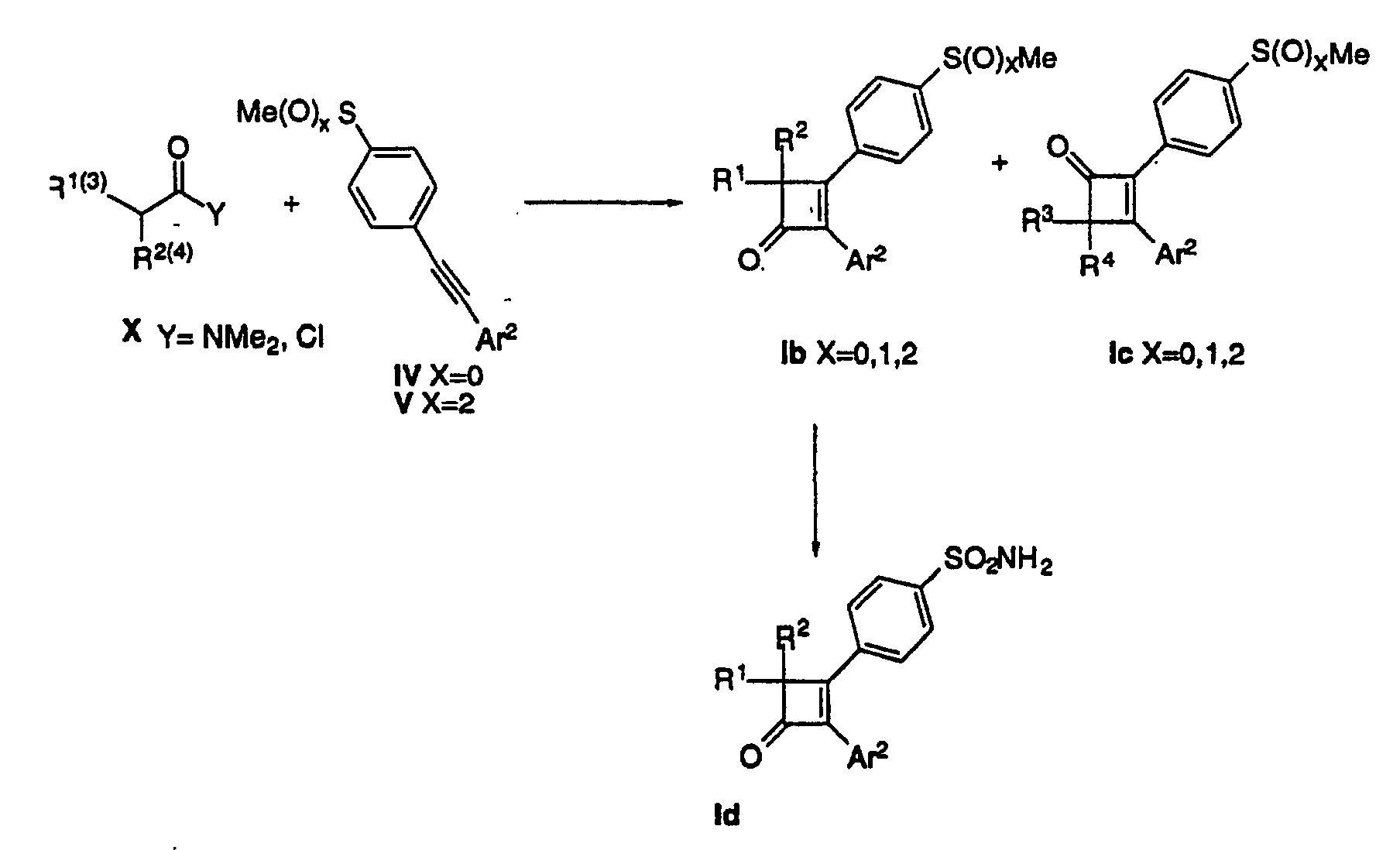
- The cyclobutenones Ib and Ic (X=2) may serves as precursors to various other derivatives as shown in Scheme 5. The cyclobutadienes Ig and Ih (R8,R9 = H) can be obtained using an olefinating agent such as Tebbe's reagent or a Wittig type reagent such as methyltriphenylphosphonium bromide with a base such as potassium t-butoxide in an organic solvent such as THF. Likewise, the substituted analogs Ig and Ih (R8,R9 = H, CO2Et and R8,R9 = Me, CO2Et) are prepared using a stabilised Wittig type reagent such as ethyl triphenylphosphoranylidene acetate or (carbethoxyethylidene)triphenylphosphorane in a solvent such as benzene. The ester function can be reduce to the corresponding alcohols Ig and Ih (R8,R9 = H, CH2OH and R8,R9 = Me, CH2OH) according to standard organic procedures. Other derivatives such as imines and oximes Ie and If can be obtained by treating the cyclobutanones Ib and Ic with various hydroxylamine hydrochlorides in organic solvents such as pyridine and/or ethanol or with amines such as benzylamine using an acid such as TsOH in a solvent such as toluene. Some O-alkyloximes are obtained by alkylating oximes Ie and If (R10=OH) using a base such as cesium carbonate and various alkylating agents such as 3-picolylchloride hydrochloride in a solvent such as DMF. The carbonyl function of the cyclobutenones Ib and Ic may be reduced to the secondary alcohol and then alkylated or acylated using standard organic procedures to derivatives Ik and Im or transformed into an halide such as the fluoro analog Ij using diethylaminosulfur trifluoride in a solvent such as chloroform. The carbonyl function may be converted to a dithioacetal derivative Ii by treatment with an dithiol like 1,2-ethanedithiol, and acid such as boron trifluoride etherate in a solvent such as dichloromethane.
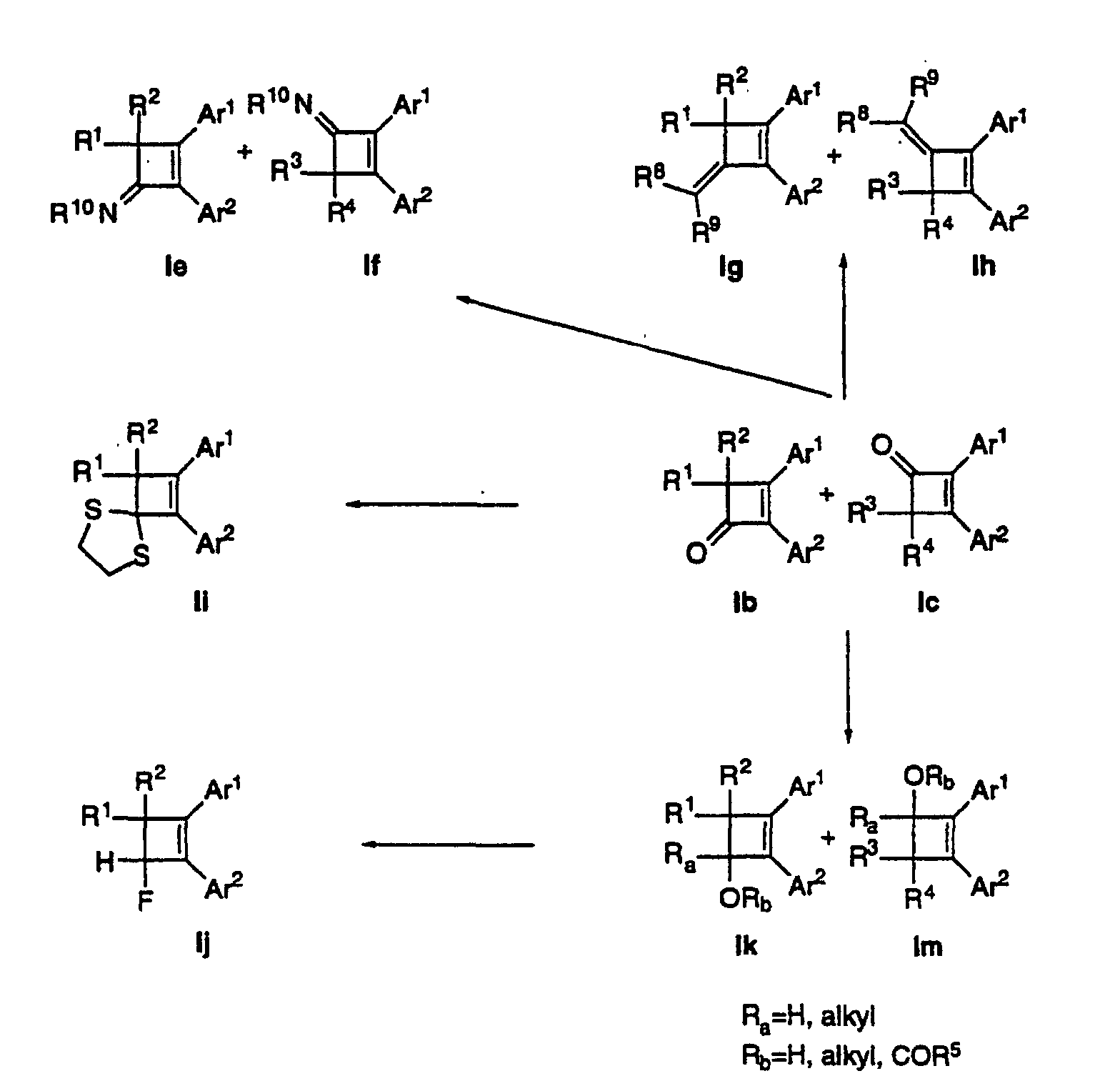
- The cyclobutene In may be prepared in a multi-step sequence from 3-benzoylpropionic acid. The acid can be converted to the acid chloride using standard organic procedures and then used in a Friedel-Crafts type acylation of thioanisole with a Lewis acid such as aluminum chloride in a solvent such as dichloromethane to diketone XIV. The diketone XIV can be cyclised to the cyclobutene In (X=0) using metals such as titanium tetrachloride and zinc in a solvent such as THF. The sulfide is then oxidized to the sulfone In (X=2) as described in Scheme 1.

- The cyclobutenes Io to Is may be prepared in a multi-step sequence from the dialkyl squarate XV. The key intermediate Io and the cyclobutene-1,2 dione Is can be obtained by a sequence similar to the one described by L.S.Liebeskind, et al., [J. Org. Chem., 55, 5350 (1990)]. The analog Iq can be prepared from the reaction of intermediate Io with a stabilized Wittig type reagent such as methyl triphenylphosphoranylidene acetate in a solvent such as toluene. The cyclobutenone Ir can then be obtained after hydrolysis of the acetal using an acid such as sulfuric acid in solvents such as ethanol-water. The derivatives Ip may be derived from addition of nucleophiles such as RcLi to the ketone function of intermediate Io to produce the alcohols XX. Those can then be O-alkylated using standard organic procedures to XXI and the acetal hydrolysed as described earlier. By reversing the order in which Ar1Li and Ar2Li are reacted with XV, The opposite regioisomers to those depicteds in Io-s are obtained.

- Table 1 illustrates compounds of formula I, which are representatives of the present invention.

- Table 2 illustrates compounds of formula I, which are further representatives of the present invention.

- Table 3 illustrates compounds of formula I, which are further representatives of the present invention.
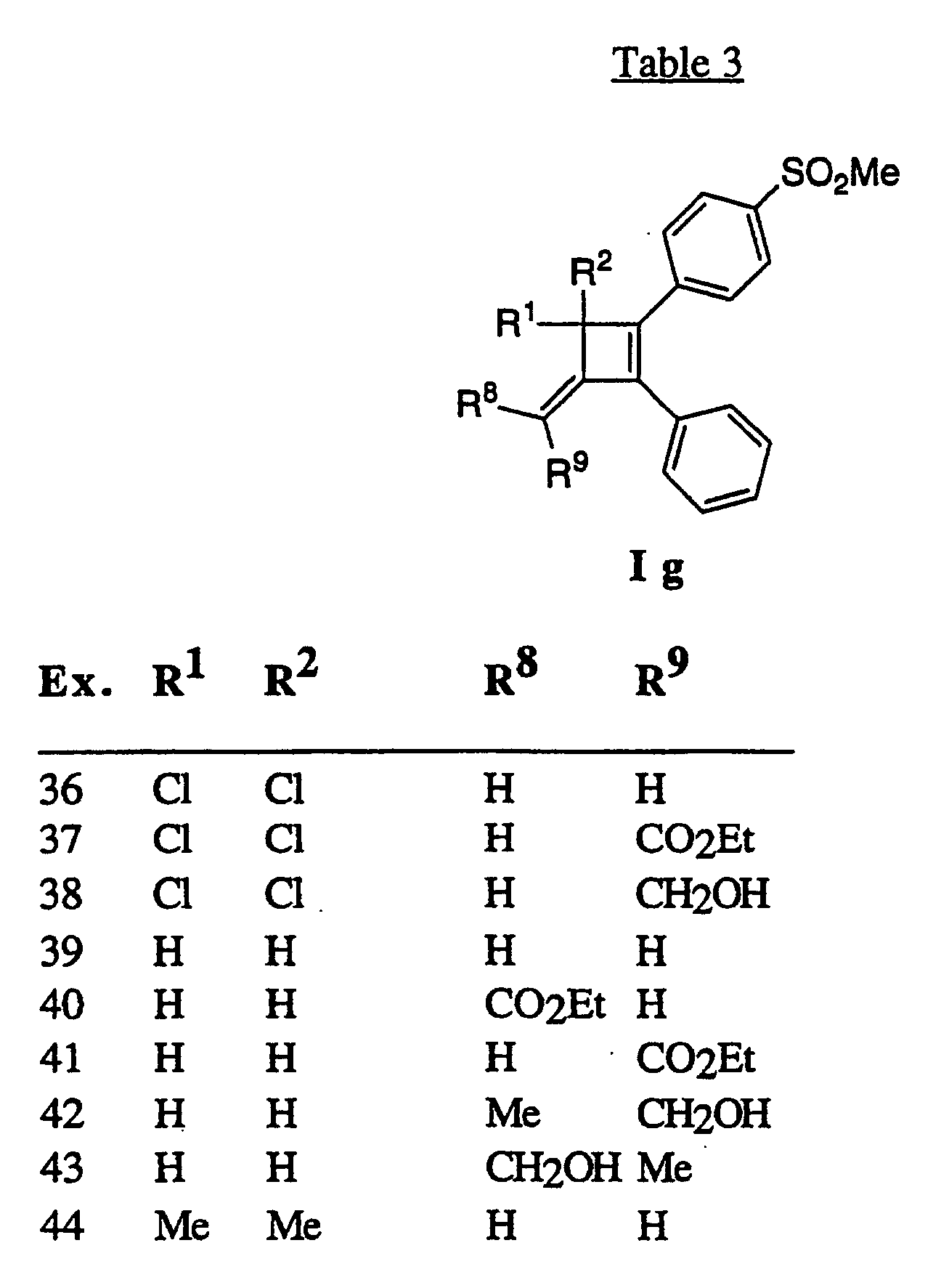
- Table 4 illustrates compounds of formula I, which are further representatives of the present invention.

- Table 5 illustrates compounds of formula I, which are further representatives of the present invention.
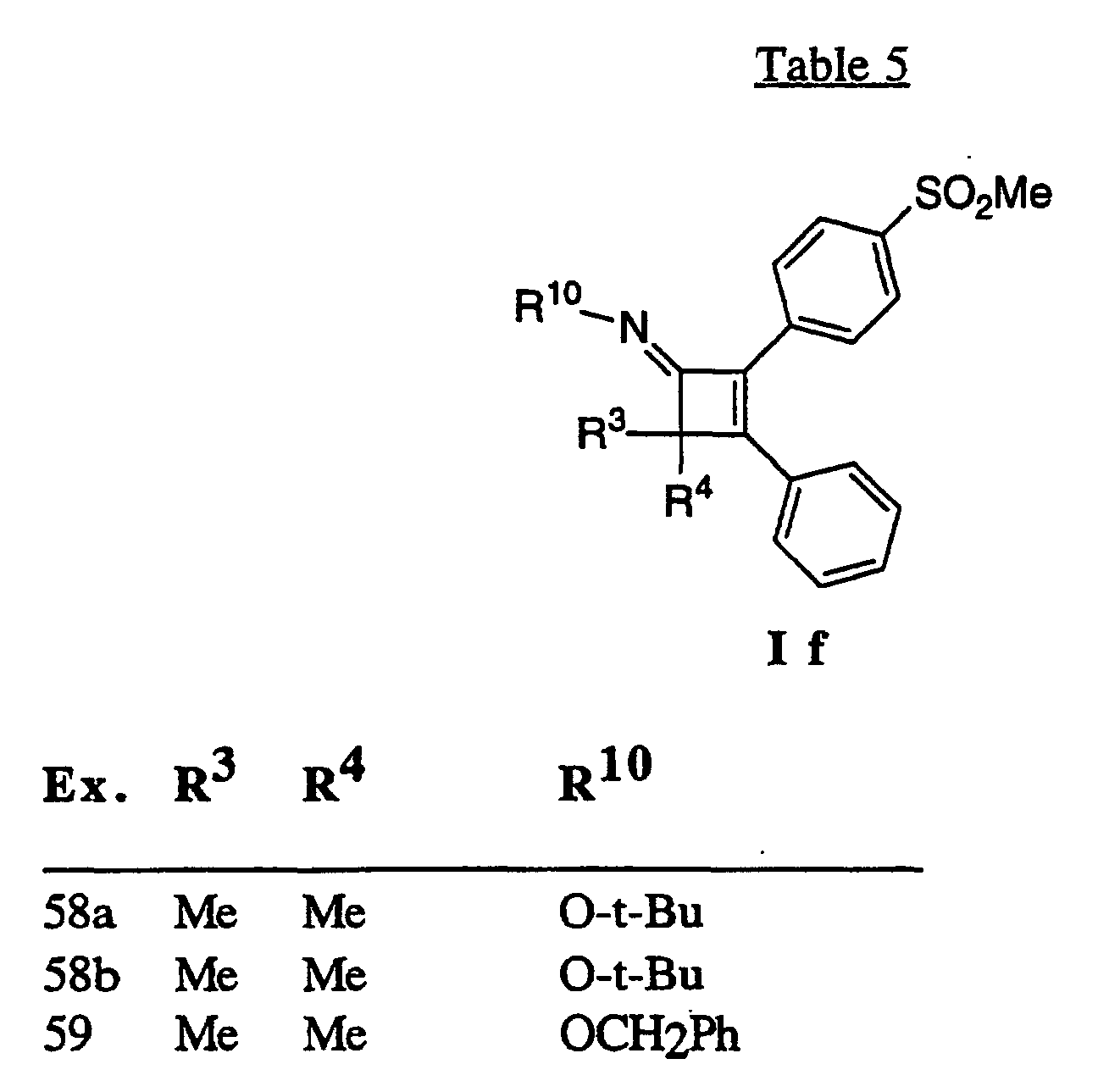
- Table 6 illustrates compounds of formula I, which are further representatives of the present invention.

- The compound of Formula I can be tested using the following assays to determine their COX-2 inhibiting activity.
- Compounds are tested as inhibitors of cyclooxygenase activity in whole cell cyclooxygenase assays. Both of these assays measure prostaglandin E2 synthesis in response to arachidonic acid, using a radioimmunoassay. Cells used for these assays are human osteosarcoma 143 cells (which specifically express COX-2) and human U-937 cells (which specifically express COX-1). In these assays, 100% activity is defined as the difference between prostaglandin E2 synthesis in the absence and presence of arachidonate.
- For cyclooxygenase assays, osteosarcoma cells are cultured in 1 mL of media in 24-well multidishes (Nunclon) until confluent (1-2 x 10⁵ cells/well). U-937 cells are grown in spinner flasks and resuspended to a final density of 1.5 x 10⁶ cells/mL in 24-well multidishes (Nunclon). Following washing and resuspension of osteosarcoma and U-937 cells in 1 mL of HBSS, 1 µL of a DMSO solution of test compound or DMSO vehicle is added, and samples gently mixed. All assays are performed in triplicate. Samples are then incubated for 5 or 15 minutes at 37C, prior to the addition of arachidonic acid. Arachidonic acid (peroxide-free, Cayman Chemical) is prepared as a 10 mM stock solution in ethanol and further diluted 10-fold in HBSS. An aliquot of 10 µL of this diluted solution is added to the cells to give a final arachidonic acid concentration of 10 µM. Control samples are incubated with ethanol vehicle instead of arachidonic acid. Samples are again gently mixed and incubated for a further 10 min. at 37C. For osteosarcoma cells, reactions are then stopped by the addition of 100 µL of 1N HCl, with mixing and by the rapid removal of the solution from cell monolayers. For U-937 cells, reactions are stopped by the addition of 100 µL of IN HCl, with mixing. Samples are then neutralized by the addition of 100 µL of 1N NaOH and PGE2 levels measured by radioimmunoassay.
- Chinese hamster ovary (CHO) cell lines which have been stably transfected with an eukaryotic expression vector pCDNAIII containing either the human COX-1 or COX-2 cDNA's are used for the assay. These cell lines are referred to as CHO [hCOX-1] and CHO [hCOX-2], respectively. For cyclooxygenase assays, CHO[hCOX-1] cells from suspension cultures and CHO[hCOX-2] cells prepared by trypsinization of adherent cultures are harvested by centrifugation (300 x g, 10 min) and washed once in HBSS containing 15 mM HEPES, pH 7.4, and resuspended in HBSS, 15 mM HEPES, pH 7.4, at a cell concentration of 1.5 x 10⁶ cells/ml. Drugs to be tested are dissolved in DMSO to 66.7-fold the highest test drug concentration. Compounds are typically tested at 8 concentrations in duplicate using serial 3-fold serial dilutions in DMSO of the highest drug concentration. Cells (0.3 x 10⁶ cells in 200 µl) are preincubated with 3 µl of the test drug or DMSO vehicle for 15 min at 37C. Working solutions of peroxide-free AA (5.5 µM and 110 µM AA for the CHO [hCOX-1] and CHO [COX-2] assays, respectively) are prepared by a 10-fold dilution of a concentrated AA solution in ethanol into HBSS containing 15 mM HEPES, pH 7.4. Cells are then challenged in the presence or absence of drug with the AA/HBSS solution to yield a final concentration of 0.5 µM AA in the CHO[hCOX-1] assay and a final concentration of 10 µM AA in the CHO[hCOX-2] assay. The reaction is terminated by the addition of 10 µl 1 N HCl followed by neutralization with 20 µl of 0.5 N NaOH. The samples are centrifuged at 300 x g at 4C for 10 min, and an aliquot of the clarified supernatant is appropriately diluted for the determination of PGE2 levels using an enzyme-linked immunoassay for PGE2 (Correlate PGE2 enzyme immunoassay kit, Assay Designs, Inc.). Cyclooxygenase activity in the absence of test compounds is determined as the difference in PGE2 levels of cells challenged with arachidonic acid versus the PGE2 levels in cells mock-challenged with ethanol vehicle. Inhibition of PGE2 synthesis by test compounds is calculated as a percentage of the activity in the presence of drug versus the activity in the positive control samples.
- U 937 cells are pelleted by centrifugation at 500 x g for 5 min and washed once with phosphate-buffered saline and repelleted. Cells are resuspended in homogenization buffer consisting of 0.1 M Tris-HCl, pH 7.4, 10 mM EDTA, 2 µg/ml leupeptin, 2 µg/ml soybean trypsin . inhibitor, 2 µg/ml aprotinin and 1 mM phenyl methyl sulfonyl fluoride. The cell suspension is sonicated 4 times for 10 sec and is centrifuged at 10,000 x g for 10 min at 4° C. The supernatant is centrifuged at 100,000 x g for 1 hr at 4 ° C. The 100,000 x g microsomal pellet is resuspended in 0.1 M Tris-HCl, pH 7.4, 10 mM EDTA to approximately 7 mg protein/ml and stored at -80° C.
- Microsomal preparations are thawed immediately prior to use, subjected to a brief sonication, and then diluted to a protein concentration of 125 µg/ml in 0.1 M Tris-HCl buffer, pH 7.4 containing 10 mM EDTA, 0.5 mM phenol, 1 mM reduced glutathione and 1 µM hematin. Assays are performed in duplicate in a final volume of 250 µl. Initially, 5 µl of DMSO vehicle or drug in DMSO are added to 20 µl of 0.1 M Tris-HCl buffer, pH 7.4 containing 10 mM EDTA in wells of a 96-deepwell polypropylene titre plate. 200 µl of the microsomal preparation are then added and pre-incubated for 15 min at room temperature before addition of 25 µl of 1 M arachidonic acid in 0.1 M Tris-HCl and 10 mM EDTA, pH 7.4. Samples are incubated for 40 min at room temperature and the reaction is stopped by the addition of 25 µl of 1 N HCl. Samples are neutralized with 25 µl of 1 N NaOH prior to quantitation of PGE2 content by radioimmunoassay (Dupont-NEN or Amersham assay kits). Cyclooxygenase activity is defined as the difference between PGE2 levels in samples incubated in the presence of arachidonic acid and ethanol vehicle.
- The enzyme activity is measured using a chromogenic assay based on the oxidation of N,N,N',N'-tetramethyl-p-phenylenediamine (TMPD) during the reduction of PGG2 to PGH2 by COX-2 (Copeland et al. (1994) Proc. Natl. Acad. Sci. 91, 11202-11206).
- Recombinant human COX-2 is purified from Sf9 cells as previously described (Percival et al (1994) Arch. Biochem. Biophys. 15, 111-118). The assay mixture (180 µL) contains 100 mM sodium phosphate, pH 6.5, 2 mM genapol X-100, 1 µM hematin, 1 mg/ml gelatin, 80-100 units of purified enzyme (One unit of enzyme is defined as the amount of enzyme required to produce an O.D. change of 0.001/min at 610 nm) and 4 µL of the test compound in DMSO. The mixture is pre-incubated at room temperature (22°C) for 15 minutes prior to initiation of the enzymatic reaction by the addition of 20 µL of a sonicated solution of 1 mM arachidonic acid (AA) and 1 mM TMPD in assay buffer (without enzyme or hematin). The enzymatic activity is measured by estimation of the initial velocity of TMPD oxidation over the first 36 sec of the reaction. A non-specific rate of oxidation is observed in the absence of enzyme (0.007 - 0.010 O.D. /min) and is subtracted before the calculation of the % inhibition. IC50 values are derived from 4-parameter least squares non-linear regression analysis of the log-dose vs % inhibition plot.
- Human whole blood provides a protein and cell-rich milieu appropriate for the study of biochemical efficacy of anti-inflammatory compounds such as selective COX-2 inhibitors. Studies have shown that normal human blood does not contain the COX-2 enzyme. This is consistent with the observation that COX-2 inhibitors have no effect on PGE2 production in normal blood. These inhibitors are active only after incubation of human whole blood with LPS, which induces COX-2. This assay can be used to evaluate the inhibitory effect of selective COX-2 inhibitors on PGE2 production. As well, platelets in whole blood contain a large amount of the COX-1 enzyme. Immediately following blood clotting, platelets are activated through a thrombin-mediated mechanism. This reaction results in the production of thromboxane B2 (TxB2) via activation of COX-1. Thus, the effect of test compounds on TxB2 levels following blood clotting can be examined and used as an index for COX-1 activity. Therefore, the degree of selectivity by the test compound can be determined by measuring the levels of PGE2 after LPS induction (COX-2) and TxB2 following blood clotting (COX-1) in the same assay.
- Fresh blood is collected in heparinized tubes by venipuncture from both male and female volunteers. The subjects have no apparent inflammatory conditions and have not taken any NSAIDs for at least 7 days prior to blood collection. Plasma is immediately obtained from a 2mL blood aliquot to use as blank (basal levels of PGE2). The remaining blood is incubated with LPS (100 µg/ml final concentration, Sigma Chem, #L-2630 from E. coli; diluted in 0.1% BSA (Phosphate buffered saline) for 5 minutes at room temperature. Five hundred µL aliquots of blood are incubated with either 2µL of vehicle (DMSO) or 2µL of a test compound at final concentrations varying from 10nM to 30µM for 24 hours at 37°C. At the end of the incubation, the blood is centrifuged at 12,000 x g for 5 minutes to obtain plasma. A 100µL aliquot of plasma is mixed with 400µL of methanol for protein precipitation. The supematant is obtained and is assayed for PGE2 using a radioimmunoassay kit (Amersham, RPA#530) after conversion of PGE2 to its methyl oximate derivative according to the manufacturer's procedure.
- Fresh blood is collected into vacutainers containing no anticoagulants. Aliquots of 500µL are immediately transferred to siliconized microcentrifuge tubes preloaded with 2µL of either DMSO or a test compound at final concentrations varying from 10nM to 30µM. The tubes are vortexed and incubated at 37°C for 1 hour to allow blood to clot. At the end of incubation, serum is obtained by centrifugation (12,000 x g for 5 min.). A 100µL aliquot of serum is mixed with 400µL of methanol for protein precipitation. The supernatant is obtained and is assayed for TxB2 using a enzyme immunoassay kit (Cayman, #519031) according to the manufacturer's instruction.
- Male Sprague-Dawley rats (150-200 g) are fasted overnight and are given, po, either vehicle (1% methocel or 5% Tween 80) or a test compound. One hr later, a line is drawn using a permanent marker at the level above the ankle in one hind paw to define the area of the paw to be monitored. The paw volume (V0) is measured using a plethysmometer (Ugo-Basile, Italy) based on the principle of water displacement. The animals are then injected subplantarly with 50 ml of 1% carrageenan solution in saline (FMC Corp, Maine) into the paw using an insulin syringe with a 25-gauge needle (i.e. 500 mg carrageenan per paw). Three hr later, the paw volume (V3) is measured and the increases in paw volume (V3 - VO) are calculated. The animals are sacrificed by CO2 asphyxiation and the absence or presence of stomach lesions scored. Data is compared with the vehicle-control values and percent inhibition calculated. All treatment groups are coded to eliminate observer bias.
- The major side effect of conventional NSAIDs is their ability to produce gastric lesions in man. This action is believed to be caused by inhibition of Cox-1 in the gastrointestinal tract. Rats are particularly sensitive to the actions of NSAIDs. In fact, rat models have been used commonly in the past to evaluate the gastrointestinal side effects of current conventional NSAIDs. In the present assay, NSAID-induced gastrointestinal damage is observed by measuring fecal 51Cr excretion after systemic injection of 51Cr-labeled red blood cells. Fecal 51Cr excretion is a well-established and sensitive technique to detect gastrointestinal integrity in animals and man.
- Male Sprague Dawley rats (150 - 200 g) are administered orally a test compound either once (acute dosing) or b.i.d. for 5 days (chronic dosing). Immediately after the administration of the last dose, the rats are injected via a tail vein with 0.5 mL of 51Cr-labeled red blood cells from a donor rat. The animals are placed individually in metabolism cages with food and water ad lib. Feces are collected for a 48 h period and 51Cr fecal excretion is calculated as a percent of total injected dose. 51Cr-labeled red blood cells are prepared using the following procedures. Ten mL of blood is collected in heparinized tubes via the vena cava from a donor rat. Plasma is removed by centrifugation and replenished with equal volume of HBSS. The red blood cells are incubated with 400 Ci of sodium 51chromate for 30 min. at 37C. At the end of the incubation, the red blood cells are washed twice with 20 mL HBSS to remove free sodium 51chromate. The red blood cells are finally reconstituted in 10 mL HBSS and 0.5 mL of the solution (about 20 Ci) is injected per rat.
- Protein-losing gastropathy (manifested as appearance of circulating cells and plasma proteins in the GI tract) is a significant and dose-limiting adverse response to standard non-steroidal anti-inflammatory drugs (NSASDs). This can be quantitatively assessed by intravenous administration of 51CrCl3 solution. This isotopic ion can avidly bind to cell and serum globins and cell endoplasmic reticulum. Measurement of radioactivity appearing in feces collected for 24 h after administration of the isotope thus provides a sensitive and quantitative index of protein-losing gastropathy.
- Groups of male squirrel monkeys (0.8 to 1.4 kg) are treated by gavage with either 1% methocell or 5% Tween 80 in H20 vehicles, (3mL/kg b.i.d.) or test compounds at doses from 1 - 100 mg/kg b.i.d. for 5 days. Intravenous 51Cr (5Ci/kg in 1 ml/kg phosphate buffer saline (PBS)) is administered 1 h after the last drug/vehicle dose, and feces collected for 24 h in a metabolism cage and assessed for excreted 51Cr by gamma-counting. Venous blood is sampled 1 h and 8 h after the last drug dose, and plasma concentrations of drug measured by RP-HPLC.
- Compounds of the present invention are inhibitors of COX-2 and are thereby useful in the treatment of COX-2 mediated diseases as enumerated above. The activities of the compounds against cyclooxygenase may be seen in the representative results shown below. In the assay, inhibition is determined by measuring the amount of prostaglandin E2 (PGE2) synthesized in the presence of arachidonic acid, COX-1 or COX-2 and a putative inhibitor. The IC50 values represent the concentration of putative inhibitor required to lower PGE2 synthesis to 50% of that obtained as compared to the uninhibited control.
- The results for inhibition of PGE2 production may be seen in Table 7.
Example COX-2 IC50 (µM) COX-1 IC50 (µM) CHO cell lines U-937 cells 6 0.025 (n=1) 2.0 (n=1) 16 0.028 (n=3) 0.52 (n=2) 30 0.096 (n=3) 1.1 (n=2) 39 0.001 (n=2) 1.0 (n=2) 42 0.022 (n=2) 1.5 (n=2) - The invention will now be illustrated by the following nonlimiting examples in which, unless stated otherwise:
- (i) all operations were carried out at room or ambient temperature, that is, at a temperature in the range 18-25 °C,
- (ii) evaporation of solvent was carried out using a rotary evaporator under reduced pressure (600-4000 pascals: 4.5-30 mmHg) with a bath temperature of up to 60 °C.,
- (iii) the course of reactions was followed by thin layer chromatography (TLC) and reaction times are given for illustration only;
- (iv) melting points are uncorrected and 'd' indicates decomposition; the melting points given are those obtained for the materials prepared as described; polymorphism may result in isolation of materials with different melting points in some preparations;
- (v) the structure and purity of all final products were assured by at least one of the following techniques: TLC, mass spectrometry, nuclear magnetic resonance (NMR) spectrometry or microanalytical data;
- (vi) yields are given for illustration only;
- (vii) when given, NMR data is in the form of delta (δ) values for major diagnostic protons, given in parts per million (ppm) relative to tetramethylsilane (TMS) as internal standard, determined at 300 MHz or 400 MHz using the indicated solvent; conventional abbreviations used for signal shape are: s. singlet; d. doublet; t. triplet; m. multiplet; br. broad; app. apparent; etc.: in addition "Ar" signifies an aromatic signal;
- (viii) chemical symbols have their usual meanings; the following abbreviations have also been used v (volume), w (weight), b.p. (boiling point), m.p. (melting point), L (litre(s)), mL (millilitres), g (gram(s)), mg (milligrams(s)), mol (moles), mmol (millimoles), eq (equivalents)).
-
- To a suspension of 1-(methylthio)-4-(phenylethynyl)benzene (method 6, 20 g) and Zn(Cu) couple (17.3 g) in anhydrous ether (450 mL) at 15°C was added trichloroacetyl chloride (32.4 g) dropwise (over 3h). Internal temperature was maintained between 13-16°C during addition. The mixture was stirred at r.t. for 18hr, filtered through a pad of celite®, washed with a saturated NH4Cl sol., saturated NaHCO3 sol., brine, dried (MgSO4) and the solvents evaporated. The resulting residue was first purified by flash chromatography (silica gel; hexane/EtOAc (98:2 to 90:10)) and then the resulting solid was stirred vigorously in Et2O for 3 hr and filtered to afford the title compound as a pale yellow solid, m.p. 99-100°C.
- To a solution of Example 1 (790mg) in CH2Cl2 (10 mL) and MeOH (10 mL) was added a solution of Oxone® (3.6g) in H20 (10mL). The mixture was stirred at r.t. for 2 hr and diluted with Et20. The organic phase was washed with H2O, brine, dried (MgSO4) and the solvents evaporated. The resulting solid residue was stirred vigorously in hexane/Et2O for 1 hr and then filtered to afford the title compound as a yellow solid, m.p. 124-125°C.
- To a solution of Example 1 (1.1 g) in EtOH (8 mL), AcOH ( 0.94 mL) and TMEDA (2.48 mL) at -20°C was added Zinc powder (428 mg). The mixture was stirred at -20°C for 1.5 hr, 0°C for 2.5 hr, diluted with EtOAc, washed with HCl 1N, H2O, a saturated NaHCO3 sol., brine, dried (MgSO4) and the solvents evaporated. The resulting residue was purified by flash chromatography (silica gel; hexane/EtOAc (90:10 to 80:20)) to afford the title compounds as oils (less polar product; 4-Chloro-3-(4-methylthiophenyl)-2-phenyl-2-cyclobuten-1-one (example 3); 1H NMR (300 MHz, CDCl3): δ 2.5 (s, 3H), 4.9 (s, 1H), 7.2-7.35 (m, 7H), 7.68 (d, 2H) and the more polar one; 3-(4-methylthiophenyl)-2-phenyl-2-cyclobuten-1-one (example 4); 1H NMR (300 MHz, CDCl3): δ 2.58 (s,3H), 3.6 (s, 2H), 7.35-7.50 (m, 5H), 7.68 (dd, 2H) 7.73 (d, 2H)).
- Following the procedure describe in Example 2, but substituting 4-chloro-3-(4-methylthiophenyl)-2-phenyl-2-cyclobuten-1-one from Step 1 for Example 1, the resulting residue was purified by flash chromatography (silica gel; hexane/EtOAc (80:20)) to afford the title compound as a yellow foam.
1H NMR (300 MHz, CDCl3): δ 3.04 (s,3H), 5.02 (s, 1H), 7.2-7.35 (m, 5H), 7.9 (app.q, 4H). - Following the procedure describe in Example 2, but substituting 3-(4-methylthiophenyl)-2-phenyl-2-cyclobuten-1-one from Step 1 for Example 1, the title compound was obtained as a yellow solid, m.p. 139-140°C.
- Following the procedure describe in Example 1, but sustituting 1-(methylthio)-4-(4-fluorophenylethynyl)benzene (method 6) for 1-(methylthio)-4-(phenylethynyl)benzene, the title compound was obtained as a yellow solid.
- Following the procedure describe in Example 2, but substituting 4,4-Dichloro-3-(4-methylthiophenyl)-2-(4-fluorophenyl)-2-cyclobuten-1-one from Step 1 for Example 1, the title compound was obtained as a white solid, m.p. 116.5-117.5°C.
- To a solution of 3-thienyl acetic acid (5 g) in CH2Cl2 (40 mL) at r.t. was added oxalyl chloride (3.5 mL) dropwise and one drop of DMF. After 2 hr at r.t., the solvents were evaporated and the resulting acid chloride was diluted in THE (50 mL). Dimethyl amine was bubbled through the solution until the pH remained basic then NaOH 1N and Et2O were added. The organic phase was washed with H2O, brine, . dried (MgSO4) and the solvents evaporated to afford the title product as an oil.
- To a solution of acetamide from Step 1 (510 mg) in THF (15 mL) at -78°C was added LDA (mono THE, 1.5M, cyclohexane, 250 µL) followed by MeI (700 µL) after 30 min. The mixture was warmed to r.t., quenched with a saturated NH4Cl sol. and then extracted with Et2O. The organic phase was washed with H2O, brine, dried (MgSO4) and the solvents evaporated. The residue was purified by flash chromatography (silica gel; hexane/EtOAc (60:40)) to afford the title compound as a oil.
- To a solution of acetamide from Step 2 (175 mg) in 1,2-dichloroethane (10 mL) at -20°C was added triflic anhydride (175 µL) followed by 2,4,6-collidine (150 µL) and 1-(methylsulfonyl)-4-(phenylethynyl)benzene (method 7) (180 mg). The mixture was heated to reflux for 6 hr, cooled to r.t. and then diluted with NaOH 0.5N and ether. The organic phase was washed with H2O, HCl 10%, H2O, brine, dried (MgSO4) and the solvents evaporated. The residue was purified by flash chromatography (silica gel; toluene/ether (95:5)) to afford the title compounds as a pale yellow solid for the more polar product (Example 6); m.p. 124-125°C and as a pale yellow foam for the less polar product (Example 24); 1H NMR (300 MHz, CDC13): δ 1.88 (s, 3H), 3.05 (s, 3H), 7.06 (q, 1H), 7.21 (q, 1H), 7.31 (q, 1H), 7.41 (m, 3H), 7.74 (m, 4H), 7.91 (m, 2H).
- 4-Methyl-3-(4-methylsulfonylphenyl)-2-phenyl-4-(2-thienyl)-2-cyclobuten-1-one
- Following the procedure describe in Example 6, but substituting 2-thienyl acetic acid for 3-thienyl acetic acid, the title product was obtained as a pale yellow foam (less polar product); 1H NMR (300 MHz, CDCl3): δ 1.94 (s, 3H), 3.06 (s, 3H), 7.01 (m, 2H), 7.26 (m, 2H), 7.43 (m, 2H), 7.72 (m, 2H), 7.77 (d, 2H), 7.91 (d, 2H).
- Following the procedure describe in Example 6, but substituting 2-phenyl propionic acid for 3-thienyl acetic acid and omitting step 2, the title product was obtained as a pale yellow foam (less polar product); 1H NMR (300 MHz, CDCl3): δ 1.91 (s, 3H), 3.06 (s, 3H). 7.28-7.45 (m, 8H), 7.89 (m, 4H), 7.91 (d, 2H).
- Following the procedure describe in Example 6, but substituting cyclohexanecarboxylic acid for 3-thienyl acetic acid and omitting step 2, the title products were obtained as a off-white solids; 3-(4-methylsulfonylphenyl)-2-phenyl-spiro[4.6]-2-nonen-1-one (Example 9), m.p. 169°C and 2-(4-methylsulfonylphenyl)-3-phenyl-spiro[4.6]-2-nonen-1-one (Example 25), m.p. 145°C.
- Following the procedure describe in Example 6, but substituting cyclopentanecarboxylic acid for 3-thienyl acetic acid and omitting step 2, the title products were obtained: 3-(4-methylsulfonylphenyl)-2-phenyl-spiro[4.5]-2-octen-1-one (Example 10) as an oil, 1H NMR (300 MHz, CDCl3): δ 1.8 (m, 4H), 2.0 (m, 2H), 3.08 (s, 3H), 7.35 (m, 3H), 7.6 (d, 2H), 7.98 (d, 2H) and 2-(4-methylsulfonylphenyl)-3-phenylspiro[4.5]-2-octen-1-one (Example 26) as a white solid, m.p. 98°C.
- To a solution of diisopropylsquarate (5g) in THF (50 mL) at -10°C was added PhMgBr (3M, Et2O, 9 mL). After 30 min., the mixture was quenched with saturated NH4Cl sol. and extracted with Et2O. The organic phase was washed with H2O, brine, dried (MgSO4) and the solvents evaporated. Flash chromatography of the residue (silica gel; hexane/EtOAc (85:15)) provided the title compound as an oil.
- To a solution of alcohol from Step 1 (4.1g) in Et2O (40 mL) at r.t. was added Et3N (6.2 mL) and TMSCl (2.8mL). The mixture was stirred at r.t. for 48 hr, quenched with H2O and extracted with Et2O. The organic phase was washed with H2O, brine, dried (MgSO4) and the solvents evaporated. Flash chromatography of the residue (silica gel; hexane/EtOAc (100:0 to 98:2)) provided the title compound as an oil.
- To a solution of cyclobutenone from Step 2 (3.9g) in THF (12 mL) at r.t. was added 1,2 bis(trimethylsilyloxy)ethane (2.9 mL) and trimethylsilyl triflate (10 µL). The mixture was stirred at r.t. for 6 hr, filtered through a plug of silica gel and the solvents evaporated. The resulting solid residue was stirred vigorously in hexane/Et2O for 1 hr and then filtered to afford the title compound as a yellow solid.
- To a solution of 4-bromothioanisole (450 mg) in THF (20 mL) at -78°C was added n-BuLi (2M, Hexane, 1.3 mL) dropwise. After 10 min. the cyclobutenone from Step 3 (400 mg) was added in one portion at -78°C. The mixture was stirred 10 more min., quenched with H2O and extracted with Et2O. The organic phase was washed with H2O, brine, dried (MgSO4) and the solvents evaporated. The crude residue was diluted with THF (10 mL) and HCl 2N (1 mL) and the mixture stirred at r.t. for 3 hr. The organic phase was washed with H2O, brine, dried (MgSO4) and the solvents evaporated. Flash chromatography of the residue (silica gel; hexane/EtOAc (80:20)) provided the title compound as a yellow solid.
- To a solution of cyclobutenone from Step 4 (254 mg) in CHCl3 (10 mL) at r.t. was added 3-chloroperoxybenzoic acid (80-85%, 400 mg). The mixture was stirred at r.t. for 20 min. and Ca(OH)2 (500 mg) was added. After 20 min., the heterogeneous solution was filtered and the solvents evaporated. The resulting solid residue was stirred vigorously in hexane/Et2O for 1 hr and then filtered to afford the title compound as a yellow solid, m.p. 166-167°C.
- To a solution of Example 11 (175 mg) in THF (10 mL) was added conc. H2SO4 (0.5 mL). The mixture was stirred at r.t. for 16 hr, heated to reflux for 4 hr and then cooled to r.t. The organic phase was diluted with Et2O, washed with H2O, brine, dried (MgSO4) and the solvents evaporated. The resulting solid residue was stirred vigorously in hexane/Et2O for 1 hr and then filtered to afford the title compound as a yellow solid, m.p. 139-140°C.
- To a solution of 4-bromothioanisole (32.5g) in THF (400 mL) at -78°C was added n-BuLi (1.6M, Hexane, 100 mL) dropwise. After 15 min., a solution of diisopropylsquarate (20g) in THF (200 mL) at -78°C was added. After 30 min., the mixture was quenched with saturated NH4Cl sol. and extracted with Et2O. The organic phase was washed with H2O, brine, dried (MgSO4) and the solvents evaporated. Flash chromatography of the residue (silica gel; hexane/EtOAc (85:15)) provided the title compound as a yellow solid.
- Following the procedure as described in Example 11, step 2 and 3, but substituting 2,3-diisopropoxy-4-hydroxy-4-(4-methylthiophenyl-2-cyclobuten-1-one for 2,3-diisopropoxy-4-hydroxy-4-phenyl-2-cyclobuten-1-one.
- To a solution of cyclobutenone from step 2 (132 mg) in THF (10 mL) at -78°C was added MeLi (1.6M, ether) dropwise until the reaction was completed by TLC. The mixture was quenched with H2O and ether. The organic phase was washed with H2O, brine, dried (MgSO4) and the solvents evaporated. The crude tertiary alcohol was dissolved in DMF (5 mL) and excess NaH (80%, 100 mg) and MeI (0.5 mL) was added. The mixture was stirred at r.t. 60 min., quenched with H2O and ether. The organic phase was washed with H2O, brine, dried (MgSO4) and the solvents evaporated to give the tide product as an oil.
- Following the procedure as describe in Example 12, but substituting acetal from step 3 for Example 11, the title product was used as such in the next step.
- Following the procedure describe in Example 2, but substituting sulfide from Step 4 for Example 1, the title product was obtained as a yellow solid, m.p. 145°C.
- Following the procedure described in Example 13 but substituting BuLi for MeLi in step 3, the title product was obtained as a oil, 1H NMR (300 MHz, CDCl3): δ 0.8 (t, 3H), 1.3 (m, 4H), 1.9 (m, 1H), 2.05 (m, 1H), 3.1 (s, 3H), 3.4 (s, 3H), 7.43 (m, 3H), 7.7 (dd, 2H), 8.0 (dd, 4H).
- A solution of 4-(4-methylthiophenyl)-3-phenyl-3-cyclobutene 1,2-dione-2-(ethylene acetal) from Example 13, step 2 (250 mg) and methyl triphenylphosphoranylidene acetate (400 mg) in toluene (20 mL) was refluxed 16 hr, cooled to r.t. and the solvents evaporated. Flash chromatography of the residue (silica gel; hexane/EtOAc (80:20)) provided the tide compound as a solid, m.p. 178°C.
- Following the procedure described in Example 12 but substituting acetal from step 1 for 3-(4-Methylsulfonylphenyl)-4-phenyl-3-cyclobutene 1,2-dione-2-(ethylene acetal), the title product was used as such in the next step.
- Following the procedure describe in Example 2, but substituting sulfide from Step 2 for Example 1, the title product was obtained as an oil, 1H NMR (300 MHz, CDCl3): δ 3.12 (s,3H), 3.80 (s,3H), 5.69 (s, 1H), 7.3-7.5 (m, 3H), 7.8-7.9 (m, 4H), 8.11 (d, 2H).
- To a solution of N,N-dimethyl-2-methylpropionamide (30.5 g) in 1,2-dichloroethane (1.0 L) at 0°C was added triflic anhydride (54 mL) dropwise followed by a solution of 2,4,6-collidine (42 mL) and (E)-1-(methylthio)-4-(2-phenylethenyl)benzene (method 1 or 2, 60 g) in 1,2-dichloroethane (450 mL). The mixture was stirred at r.t. for 30 min., heated at reflux for 6 hr, cooled to r.t., and the solvent evaporated. The residue was dissolved in CCl4 (450 mL) and H2O (225 mL) and the mixture refluxed for 18 hr. The organic phase was separated, the aqueous phase extracted with CH2Cl2 (2X), the combined organic phase was dried (MgSO4) and the solvents evaporated. The resulting residue was purified by flash chromatography (silica gel; toluene/hexane (75:25)) to provide the mixture of tide products (3:1) as an oil.
- Following the procedure described in method 7, but substituting cyclobutanone from step 1 for 1-(methylthio)-4-(phenylethynyl)benzene, after purification by flash chromatography (silica gel; hexane/EtOAc (70:30)) the tide products were obtained as white solids: the major more polar (trans)-2,2-dimethyl-3-(4-methylsulfonylphenyl)-4-phenyl-1-cyclobutanone; 1H NMR (300 MHz, CDCl3): δ 1.0 (s, 3H), 1.42 (s, 3H), 3.13 (s, 3H), 3.81 (d, 1H), 5.3 (d, 1H), 7.2-7.4 (m, 5H), 7.72 (d, 2H), 7.95 (d, 2H), the less polar minor (trans)-2,2-dimethyl-4-(4-methylsulfonylphenyl)-3-phenyl-1-cyclobutanone; 1H NMR (300 MHz, CDCl3): δ 0.99 (s, 3H)), 1.4 (s, 3H), 3.08 (s, 3H), 3.78 (d, 1H), 5.39 (d, 1H), 7.3-7.6 (m, 5H), 7.6 (d, 2H), 7.91 (d, 2H).
- To a solution of cyclobutanone from step 2 (7.9 g) in CCl4 was added NBS (5.1 g). The mixture was heated to reflux for 1.5 hr, cooled to r.t. and the solvent evaporated. The resulting residue was purified by flash chromatography (silica gel; hexane/EtOAc (70:30)) to provide the title compound as a yellow solid. Example 16; m.p. 136-138°C. Example 30; m.p. 134.5-135.5°C.
- 4,4-Dimethyl-3-(4-methylsulfonylphenyl)-2-(3-fluorophenyl)-2-cyclobuten-1-one (example 17) and 4,4-dimethyl-2-(4-methylsulfonylphenyl)-3-(3-fluorophenyl)-2-cyclobuten-1-one (example 28)
- Following the procedure described in Example 16, but substituting (E)-1-(methylthio)-4-[2-(3-fluorophenyl)ethenyl]benzene (method 4) for (E)-1-(methylthio)-4-(2-phenylethenyl)benzene, the title products were obtained as yellow solids. Example 17; m.p. 127.5-129°C. Example 28; m.p. 116.5-117.5°C.
- Following the procedure described in Example 16, but substituting (E)-1-(methylthio)-4-[2-(4-fluorophenyl)ethenyl]benzene (method 3) for (E)-1-(methylthio)-4-(2-phenylethenyl)benzene, the title products were obtained as white solids. Example 18; m.p. 59-60°C. Example 29; m.p. 124-126°C.
- Following the procedure described in Example 16, but (E)-1-(methylthio)-4-[2-(3,5-difluorophenyl)ethenyl]benzene (method 4) for (E)-1-(methylthio)-4-(2-phenylethenyl)benzene, the title product was obtained as yellow solid; m.p. 113-114°C.
- Following the procedure described in Example 16, but substituting (E)-1-(methylthio)-4-[2-(3,4-difluorophenyl)ethenyl]benzene (method 5) for (E)-1-(methylthio)-4-(2-phenylethenyl)benzene, the title product was obtained as pink solid; m.p. 117.5-118.5°C.
- Following the procedure described in Example 16, step 1 and step 3, gave the title products after purification by flash chromatography (silica gel; hexane/EtOAc (95:5)): Example 21 as a yellow oil; 1H NMR (300 MHz, CDCl3): δ 1.49 (s, 6H), 2.58 (s, 3H), 7.3-7.5 (m, 5H), 7.66 (d, 2H), 7.7 (d, 2H) and Example 31 as a yellow solid, m.p. 109-110°C.
- To a solution of Example 21 (72 mg) in CH2Cl2 (2 mL) at 0°C was added m-chloroperbenzoic acid (80%, 55 mg). The mixture was stirred at 0°C 10 min., at r.t. for 30 min. and then Ca(OH)2 (36 mg) was added. After 1 hr, the heterogeneous mixture was filtered and the solvent evaporated The resulting residue was purified by flash chromatography (silica gel; hexane/EtOAc (40:60)) to give the title compound as an orange oil; 1H NMR (300 MHz, CDCl3): δ 1.52 (s, 6H), 2.78 (s, 3H), 7.4-7.5 (m, 3H), 7.66 (dd, 2H), 7.81 (d, 2H), 7.98 (d, 2H).
- To a solution of Example 22 (148 mg) in CH2Cl2 (2 mL) was added trifluoroacetic anhydride (240 µL). The mixture was stirred at reflux for 40 min., cooled to r.t., quenched with MeOH/Et3N (1:1) and the solvents evaporated to give the crude thiol which was used as such in the next step.
- To a solution of crude thiol from step 1 in degassed CH2Cl2 (2 mL) at 0°C, was added a sol. of Cl2 in AcOH (1M, 1.9 mL). After 60 min. the mixture was poured into ice and CH2Cl2. The organic phase was separated, washed with saturated NaHCO3 sol., brine, dried (MgSO4) and the solvents evaporated to give the crude sulfonyl chloride which was used as such in the next step.
- To a solution of crude sulfonyl chloride from step 2 (96 mg) in THF (2 mL) at 0°C was added conc. NH4OH (77 µL). The mixture was stirred for 30 min., diluted with EtOAc, washed with H2O, brine, dried (MgSO4) and the solvents evaporated. Flash chromatography of the residue (silica gel; hexane/EtOAc (50:50)) gave the title compound as a yellow solid, m.p. 142.5-144°C.
- Following the procedure describe in Example 6, but substituting cyclobutanecarboxylic acid for 3-thienyl acetic acid and omitting step 2, the title product was obtained as a pale yellow solid, m.p. 139°C.
- Following the procedure described in Example 22, but substituting Example 31 for Example 21, the resulting residue was purified by flash chromatography (silica gel; hexane/EtOAc (40:60)) to give the title compound as yellow solid, m.p. 104-105°C.
- To a solution of N,N-dimethyl-2-methylpropionamide (615 mg) in 1,2-dichloroethane (20 mL) at 0°C was added triflic anhydride (1.51 g) dropwise followed by a solution of 2,4,6-collidine (715 mg) and (E)-1-(methylthio)-4-(2-phenylethenyl)benzene (730 mg, method 1) in 1,2-dichloroethane (5 mL). The mixture was stirred at r.t. for 30 min., heated at reflux for 6 hr, cooled to r.t., and the solvent evaporated. The residue was dissolved in CCl4 (50 mL) and H2O (50 mL) and the mixture refluxed for 18 hr. The organic phase was separated, the aqueous phase extracted with CH2Cl2 (2X), the combined organic phase were dried (MgSO4) and the solvents evaporated. The resulting residue was purified by flash chromatography (silica gel; toluene) to provide title product.
- Following the procedure describe in Example 2, but (trans)-2,2-dimethyl-3,4-bis(4-methylthiophenyl)-1-cyclobutanone from Step 1 for Example 1, the resulting residue was purified by flash chromatography (silica gel; hexane/EtOAc (80:20)) to afford the title compound.
- To a solution of cyclobutenone from step 2 (530 mg) in benzene was added NBS (350 mg). The mixture was heated to reflux for 1.5 hr in the presence of a sun lamp, cooled to r.t. and the solvent evaporated. The resulting residue was purified by flash chromatography (silica gel; hexane/EtOAc (70:30)) to provide the title compound as a white solid, m.p. 212°C.
- Following the procedure describe in Example 6, step 3, but substituting N,N-dimethylpropionamide for N,N-dimethyl-2-(3-thienyl) propionamide, the title product was first purified by flash chromatography (silica gel; hexane/EtOAc (80:20)) and then the resulting solid was stirred vigorously in Et2O for 1 hr and filtered to afford the title compound as a pale yellow solid m.p. 121-122°C.
- Following the procedure describe in Example 6, but substituting isovaleryl chloride for 3-thienyl acetyl chloride and omitting step 2, the title product was obtained as a white solid, m.p. 98°C.
- To a solution of Example 1 (810 mg) in THF (20 mL) at 0°C was added Tebbe's reagent (0.5M, 5 mL) dropwise. The mixture was stirred at r.t. for 30 min., quenched with NaOH 0.5N at 0°C and diluted with Et2O. The organic phase was washed with H2O, brine, dried (MgSO4) and the solvents evaporated. Flash chromatography of the residue (silica gel; hexane/EtOAc (95:5)) provided the title compound as a yellow oil.
- Following the procedure describe in Example 2, but substituting sulfide from Step 1 for Example 1, the tide product was obtained as a white solid, m.p. 124-126°C.
- A solution of Example 2 (100 mg) and ethyl triphenylphosphoranylidene acetate (200 mg) in benzene (10 mL) was refluxed 4 hr, cooled to r.t. and the solvents evaporated. Flash chromatography of the residue (silica gel; hexane/EtOAc (70:30)) provided the title compound as a white solid (E/Z; 88:12), m.p. 118-121°C.
- To a solution of Example 37 (348 mg) in CH2Cl2 (25 mL) at -78°C was added DIBAL (400 µL) dropwise. After 20 min., the reaction mixture was quenched with MeOH followed by a saturated NH4Cl sol. and then extracted with Et2O. The organic phase was washed with H2O, brine, dried (MgSO4) and the solvents evaporated. The residue was first purified by flash chromatography (silica gel; hexane/EtOAc (70:30)) and then the resulting solid was stirred vigorously in hexane/Et2O for 1 hr and filtered to afford the title compound as a white solid (E/Z; 95:5), m.p. 194-195°C.
- To a suspension of methyltriphenylphosphonium bromide (450 mg) in THF (10 mL) at r.t. was added potassium t-butoxide (1M, THF, 1.3 mL). After 30 min. the ketone (Example 4, step 1, 165 mg) was added and the mixture stirred for an additional 30 min. at r.t., quenched with a saturated NH4Cl sol. and diluted with Et2O. The organic phase was washed with H2O, brine, dried (MgSO4) and the solvents evaporated.. Flash chromatography of the residue (silica gel; hexane/EtOAc (90:10)) provided the title compound as a white solid.
- Following the procedure describe in Example 2, but substituting sulfide from Step 1 for Example 1, the title product was obtained as a pale yellow foam; 1H NMR (300 MHz, CDCl3): δ 3.03 (s, 3H), 3.37 (s, 2H), 4.81 (s, 1H), 5.09 (s, 1H), 7.3-7.5 (m, 5H), 7.65 (d, 2H), 7.84 (d, 2H).
- A solution of cyclobutenone from Example 4, step 1 (600 mg) and ethyl triphenylphosphoranylidene acetate (1.6 g) in benzene (30 mL) was heated at reflux for 5 hr, cooled to r.t. and the solvent evaporated. The residue was first purified by flash chromatography (silica gel; hexane/EtOAc (90:10)). The major product was obtained as a solid which was stirred vigorously in hexane/Et2O for 1 hr and filtered to afford the title (E)-compound as a yellow solid (E/Z; 90:10)
- Following the procedure describe in Example 2, but substituting sulfide from Step 1 for Example 1, the title product was obtained as pale yellow solid (E/Z; 95:5), m.p. 183-186°C.
- After the chromatography described in Example 40, Step 1, the fractions containing the (Z)-isomer as the major componant were evaporated and the resulting solid was stirred vigorously in hexane/Et2O for 1 hr and filtered to afford the title (Z)-product as a yellow solid.
- Following the procedure describe in Example 2, but substituting sulfide from Step 1 for Example 1, the tide product was obtained as white solid (E/Z; 10:90), m.p. 126-128°C.
- A solution of cyclobutenone from Example 4, step 1 (175 mg) and (carbethoxyethylidene)triphenylphosphorane(360 mg) in benzene (10 mL) was heated at reflux for 18 hr, cooled to r.t. and the solvent evaporated. The residue was first purified by flash chromatography (silica gel; hexane/EtOAc (90:10)) to afford the title product as an oil (E/Z; 50:50).
- Following the procedure describe in Example 2, but substituting sulfide from Step 1 for Example 1, the resulting residue was purified by flash chromatography (silica gel; hexane/EtOAc (70:30)) to afford the title compound as a white solid.
- To a solution of ester from step 2 (440 mg) in CH2Cl2 (25 mL) at -78°C was added DIBAL dropwise. After 30 min., the mixture was quenched with a saturated NH4Cl sol. and Et2O. The organic phase was decanted, washed with H2O, brine, dried (MgSO4) and the solvents evaporated. The residue was purified by flash chromatography (silica gel; hexane/EtOAc (70:30 to 60:40)) to afford the title compounds as a white solid for the less polar (Z)-isomer (example 42), m.p. 135-137°C, and as a yellow foam for the more polar (E)-isomer (example 43); 1H NMR (300 MHz, CDCl3): δ 1.69 (s, 3H), 2.99 (s, 3H), 3.24 (s, 2H), 4.15 (s, 2H), 7.4 (m, 7H), 7.76 (d, 2H).
- Following the procedure describe in Example 39, but substituting Example 16 for Example 4, the resulting residue was purified by flash chromatography (silica gel; hexane/EtOAc (75:25)) to afford the title compound as a white solid, m.p. 110-111°C
- A solution of Example 16 (1.63 g) and hydroxylamine hydrochloride (1.4 g) in pyridine (10 mL) was refluxed for 18 hr. The solvent was evaporated, the residue diluted with EtOAc and poured into HCl 1N. The organic phase was washed with HCl 1N, H2O, brine, dried (MgSO4) and the solvent evaporated. The resulting residue was purified by flash chromatography (silica gel; hexane/EtOAc (70:30 to 60:40)) to give the title compound as white solid, m.p. 217-220°C.
- Following the procedure describe in Example 45, but substituting O-(t-butyl)hydroxylamine hydrochloride for hydroxylamine hydrochloride, the title products were obtained as the (E) and (Z) isomers; the less polar one as white solid, m.p. 125-126°C and the more polar isomer as an oil; 1H NMR (300 MHz, Ace-d6): δ 1.25 (s, 9H), 1.58 (s, 6H), 3.14 (s, 3H), 7.36-7.39 (m, 3H), 7.65-7.68 (m, 2H), 7.75 (d, 2H), 7.92 (d, 2H).
- A solution of Example 16 (163 mg) and methoxylamine hydrochloride (83 mg) in pyridine (1.5 mL) and EtOH (1.5 mL) was heated at 110°C for 18 hr. The solvents were evaporated, the residue diluted with EtOAc and HCl 0.2N. The organic phase was washed with brine, dried (MgSO4) and the solvent evaporated. The resulting residue was purified by flash chromatography (silica gel; hexane/EtOAc (70:30)) to give the title compound as white solid, m.p. 156-158°C.
- Following the procedure describe in Example 47, but substituting O-benzylhydroxylamine hydrochloride for methoxylamine hydrochloride, the title product was obtained as a white solid, m.p. 119-121°C.
- A mixture of Example 16 (200 mg), benzylamine (134 µL) and p-TsOH (140 mg) in toluene (20 ml) was refluxed, with azeotropic removal of water, for 48 hr, cooled to r.t., washed with saturated NaHCO3 sol., brine, dried (MgSO4) and the solvent evaporated. The residue was purified by flash chromatography (silica gel; hexane/EtOAc (80:20)) to give the title product as a beige solid, m.p. 189-190°C.
- To a solution of Example 45 (102 mg) in DMF (3 mL) was added Cs2CO3 (390 mg) and a solution of 3-picolylchloride hydrochloride (154 mg) in DMF (3 mL). The mixture was heated at 80°C for 18 hr, diluted with EtOAc and H2O. The aqueous phase was extracted with EtOAc, the combined organic phase was washed with brine, dried (MgSO4) and the solvent evaporated. The resulting residue was purified by flash chromatography (silica gel; hexane/EtOAc (40:60)) to give the title compound as white foam; 1H NMR (300 MHz, Ace-d6): δ 1.61 (s,6H), 3.17 (s, 3H), 5.22 (s, 2H), 7.36-7.41 (m, 4H), 7.69 (m, 2H), 7.85 (m, 3H), 7.98 (d, 2H), 8.52 (dd, 1H), 8.68 (br s, 1H).
- Following the procedure described in Example 50 but substituting 2-picolylchloride hydrochloride for 3-picolylchloride hydrochloride, the title compound was obtained as a white foam; 1H NMR (300 MHz, Ace-d6): δ 1.68 (s,6H), 3.17 (s, 3H), 5.27 (s, 2H), 7.26 (m, 1H), 7.37 (m, 3H), 7.50 (d, 1H), 7.69 (m, 2H),7.8 (dt, 1H), 7.90 (d, 2H), 8.0 (d, 2H), 8.55 (dd, 1H).
- Following the procedure described in Example 50 but substituting methyl 3-bromomethylbenzoate for 3-picolylchloride hydrochloride, the title compound was obtained as an oil; 1H NMR (300 MHz, Ace-d6): δ 1.64 (s,6H), 3.17 (s, 3H), 3.89 (s, 3H), 5.26 (s, 2H), 7.39 (m, 3H), 7.55 (t, 1H), 7.70 (m, 3H),7.85 (d, 2H), 7.95 (dd, 1H), 8.03 (d, 2H), 8.16 (br s, 1H).
- A solution of methyl ester from Example 52 (90 mg) in THF (2 mL) and MeOH (1 mL) was treated with LiOH (2N, 276 µL). The mixture was heated at reflux for 18 hr, cooled to r.t. and diluted with EtOAc and HCl 1N. The organic phase was washed with brine, dried (MgSO4) and the solvent evaporated to give the title compound as white foam; 1H NMR (300 MHz, Ace-d6): δ 1.64 (s,6H), 3.17 (s, 3H), 5.26 (s, 2H), 7.39 (m, 3H), 7.51 (t, 1H), 7.70 (m, 3H),7.86 (d, 2H), 8.0 (m, 3H), 8.15 (br s, 1H).
- Following the procedure describe in Example 45, but substituting Example 4 for Example 16, the title product was obtained as a white solid, m.p. 146.5-147.5°C.
- Following the procedure describe in Example 45, but substituting Example 4 for Example 16 and O-(t-butyl)hydroxylamine hydrochloride for hydroxylamine hydrochloride, the title product was obtained as a white solid, m.p. 150-151.5°C.
- Following the procedure describe in Example 45, but substituting Example 4 for Example 16, and methoxylamine hydrochloride for hydroxylamine hydrochloride, the title product was obtained as a white solid, m.p. 146-147°C.
- Following the procedure describe in Example 47, but substituting Example 4 for Example 16 and O-benzylhydroxylamine hydrochloride for methoxylamine hydrochloride, the title product were obtained as a white solid, m.p. 148.5-149.5°C.
- Following the procedure describe in Example 46, but substituting Example 30 for Example 16, the separable stereoisomers of the title products were obtained as white solids: (a) the less polar isomer, m.p. 184-185°C and (b) the more polar isomer, m.p. 135-136°C.
- Following the procedure describe in Example 48, but substituting Example 30 for Example 16, the tide product was obtained as a white solid, m.p. 56-61°C.
- To a solution of 3-benzoylpropionic acid (10 g) in CH2Cl2 (50 mL) at 0°C, was added oxalyl chloride (5.4 mL) and 5 drops of DMF. The mixture was stirred at 0°C for 15 min., at r.t. for 2 hr and the solvents evaporated. The crude oil was dissolved in CH2Cl2 (50 mL) at 0°C and aluminium chloride (7.5 g) was added followed by thioanisole (6.6 g). After 3hr at 0°C, the reaction mixture was poured into ice and extracted with ether. The organic phase was washed with H2O, brine, dried (MgSO4) and the solvents evaporated. The residue was purified by flash chromatography (silica gel; hexane/EtOAc (75:25)) to afford the title compounds as an oil.
- To a solution of dione from step 1 (500 mg) in THF (18 mL) at -40°C was added TiCl4 (0,93 mL) dropwise followed after 5 min., by Zn dust (1.1 g). The mixture was stirred at -40°C for 1hr, at r.t. for 1.5 hr, poured into ice and extracted with ether. The organic phase was washed with H2O, brine, dried (MgSO4) and the solvents evaporated. The residue was purified by flash chromatography (silica gel; hexane/EtOAc (80:20)) to give the title product as a colorless oil.
- Following the procedure describe in Example 2, but substituting 1-(4-methylthiophenyl)-2-phenyl-1-cyclobutene from Step 2 for Example 1, the title compound was purified by flash chromatography (silica gel; hexane/EtOAc (80:20)) to give a white solid, m.p. 73-75°C.
- To a solution of Example 16 (60 mg) in THF (1 mL) at -20°C, was added methyl magnesium bromide (3M, ether, 185 µL). The mixture was stirred at -20°C for 1.5 hr, quenched with H2O, and diluted with EtOAc. The organic phase was washed with H2O, brine, dried (MgSO4) and the solvents evaporated. The residue was purified by flash chromatography (silica gel; hexane/EtOAc (80:20)) to give the title compounds as a white solid, m.p. 114-115°C.
- To a solution of Example 14 (100 mg) in THF (1 mL) at 0°C, was added LAH (1M, THF, 920 µL). The mixture was stirred at 0°C for min., quenched with H2O, and diluted with EtOAc. The organic phase was washed with HCl 1N, brine, dried (MgSO4) and the solvents evaporated. The residue was purified by flash chromatography (silica gel; hexane/EtOAc (70:30)) to give the tide compound as a white solid, m.p. 79-81°C.
- To a solution of Example 62 (70 mg) in CH2Cl2 (1 mL) at r.t., was added silver oxide (100 mg) and MeI (1 mL). The mixture was stirred reflux for 18 hr, cooled to r.t., filtered through celite® and the solvents evaporated. The residue was purified by flash chromatography (silica gel; hexane/EtOAc (85:15)) to give the title product as a white solid, m.p. 130-132°C.
- To a solution of Example 62 (150 mg) in CH2Cl2 (3 mL) at r.t., was added pyridine (370 mL), Ac2O (215 µL) and DMAP (5 mg). The mixture was stirred at r.t. for 2 hr and diluted with EtOAc and H2O. The organic phase was washed with HCl 1N, brine, dried (MgSO4) and the solvents evaporated. The residue was purified by flash chromatography (silica gel; hexane/EtOAc (70:30)) to give the title compound as a white solid, m.p. 60-61°C.
- To a solution of Example 62 (100 mg) in CH2C12 (1.5 mL) at r.t., was added diisopropylethylamine (105 µL) and pivaloyl chloride (70 µL). The mixture was stirred at r.t. for 1.5 hr and the solvents evaporated. The residue was purified by flash chromatography (silica gel; hexane/EtOAc (80:20)) to give the title compound as a yellow solid, m.p. 66-67°C.
- To diethylaminosulfur trifluoride (930 µL) at 0°C, was added Example 62 (250 mg) portionwise. The mixture was warmed to r.t. 10 min., diluted with CHCl3, cooled to 0°C and quenched carefully with saturated NaHCO3 sol.. The organic phase was washed with a saturated NaHC03 sol., brine, dried (MgSO4) and the solvents evaporated. The residue was purified by flash chromatography (silica gel; hexane/EtOAc (80:20)) to give the title compound as a white solid, m.p. 79-81.5°C.
- To a solution of Example 62 (150 mg) in toluene (2.3 mL) at r.t., was added diisopropylethylamine (160 µL) and phenylisocyanate (100 µL). The mixture was refluxed for 4 hr, cooled to r.t. and diluted with EtOAc and H2O. The organic phase was washed with HCl 1N, brine, dried (MgSO4) and the solvents evaporated. The residue was purified by flash chromatography (silica gel; hexane/EtOAc (80:20 to 60:40)) to give the title compound as a white solid, m.p. 85.5-87°C.
- To a solution of Example 16 (300 mg) in CH2Cl2 (5 mL) at r.t., was added 1,2-ethanedithiol (115 mL) and boron trifluoride etherate (25 µL). The mixture was stirred at r.t. for 1.5 hr, diluted with EtOAc and NaOH 1N. The organic phase was washed with NaOH 1N, brine, dried (MgSO4) and the solvents evaporated. The residue was purified by flash chromatography (silica gel; hexane/EtOAc (80:20)) to give the title compound as a white solid, m.p. 145-146.5°C.
- Following the procedure descibed in Example 62 but substituting Example 30 for Example 16, the residue was purified by flash chromatography (silica gel; hexane/EtOAc (60:40 to 50:50)) to give the title compound as a white foam, 1H NMR (300 MHz, Ace-d6-D2O): δ.1.24 (s, 3H), 1.44 (s, 3H), 3.12 (s, 3H), 4.62 (s, 1H), 7.36-7.44 (m, 3H), 7.48-7.52 (m, 2H), 7.73 (dm, 2H), 7.86 (dm, 2H).
- Following the procedure descibed in Example 63 but substituting Example 69 for Example 62, the residue was purified by flash chromatography (silica gel; hexane/EtOAc (67:33)) to give the title compound as a white solid, m.p. 120-121°C.
- Following the procedure descibed in Example 64 but substituting for Example 69 for Example 62, the residue was purified by flash chromatography (silica gel; hexane/EtOAc (60:40)) to give the title compound as a white solid, m.p. 156-158°C.
- To a cooled (0°C) suspension of benzyltriphenylphosphonium chloride (9.2 g) in THF (165 mL) was added n-BuLi (2.5M, 19 mL) dropwise. After 15 min., a solution of 4-methylthiobenzaldehyde (4.37 g) in THF (20 mL) was added. The mixture was stirred at 0°C for 1.5 hr, diluted with EtOAc, washed with H2O, brine, dried (MgSO4) and the solvents evaporated. The resulting solid was recrystallized in ether/pentane to provide the desired (E) olefin as a white solid.
- To a solution of 4-methylthiobenzaldehyde (50 g) in THF (500 mL) at -78°C was added benzylmagnesium chloride (2M, THF, 200 mL) dropwise. The mixture was stirred at -40°C for 1.5 hr, poured into ice and HCl 1N and extracted with EtOAc (3X). The combined organic phase was washed with H2O, brine, dried (MgSO4) and the solvents evaporated. The crude residu was diluted with toluene (1.0 L) and TsOH (3.9 g) was added. The mixture was refluxed with azeotropic removal of water for 18 hr, cooled to r.t., washed with saturated NaHCO3 sol., brine, dried (MgSO4) and the solvent evaporated. The resulting solid was stirred vigorously in Et2O for 2 hr and then filtered to afford the title compound as a white solid.
- A solution of 4-methylthiobenzyl chloride (3.1 g) and triphenylphosphine (4.72 g) was heated in toluene (35 mL) at reflux for 18 hr. The mixture was cooled to 0°C and filtered. The resulting solid was used as such in the next step.
- Following the procedure as describe in method 1, but sustituting 4-methylthiobenzyltriphenylphosphonium chloride for benzyltriphenylphosphonium chloride, the desired residue was purified by flash chromatography (silica gel; hexane/EtOAc (90:10)) and recrystallisation from hexane.
- To a solution of 4-fluorostyrene (2.0 g) in DMF (40 mL) at r.t. was added 4-bromothioanisole (3.66 g), LiCl (1.09 g), LiOAc-2H2O (4.24 g), Bu4NCl (9.3 g) and Pd(OAc)2 (107 mg). The mixture was heated at 115°C for 18 hr, cooled to r.t., quenched with a NH4OAc sol. and extracted with EtOAc. The organic phase was washed with H2O, saturated NaHCO3 sol., brine, dried (MgSO4) and the solvents evaporated to give the title product.
- To a suspension of methyltriphenylphosphonium bromide (1.76 g) in THE (15 mL) at r.t. was added potassium t-butoxide (1M, THF, 6.6 mL). After 30 min., 4-methylthiobenzaldehyde (500 mg) was added and the mixture stirred for an additional 60 min. at r.t., quenched with a saturated NH4Cl sol. and diluted with Et2O. The organic phase was washed with H2O, brine, dried (MgSO4) and the solvents evaporated to provide the title compound as a yellow oil.
- Following the procedure describe in Method 3, but substituting4-methylthiostyrene and 1-bromo-3-fluorobenzene for 4-fluorostyrene and 4-bromothioanisole, the title product was obtained as an off-white solid.
- Following the procedure describe in Method 3, but substituting 4-methylthiostyrene (from method 4, step 1) and 1-bromo-3,5-difluorobenzene for 4-fluorostyrene and 4-methylthioanisole, the title product was obtained after flash chromatography (silica gel; toluene/hexane (50:50)) as an orange oil.
- To a solution of 3,4-difluorobenzoyl chloride (5.25 g) in chloroform (30 mL) at 0°C was added N,O-dimethylhydroxylamine hydrochloride (3.2 g) followed by pyridine (5.8 mL) dropwise. The mixture was stirred at r.t. for 2 hr, diluted with EtOAc, washed with HCl 1N, with H2O, saturated NaHCO3 sol., brine, dried (MgSO4) and the solvents evaporated to give the title product.
- To a cold (0°C) solution of amide from step 1(400 mg) in THF (20 mL) was added 4-methylthiobenzylmagnesium chloride (J.Org. Chem. 42, 1914, 1977). The mixture was stirred at 0°C for 3 hr, quenched with NH4OAc sol. and extracted with EtOAc. The organic phase was washed with H2O, brine, dried (MgSO4) and the solvents evaporated. The title product was obtained after flash chromatography (silica gel; toluene/EtOAc (98:2)).
- To a solution of ketone from step 2 (4.8 g) in THF (60 mL) at 0°C, was added LAH (1M, THF, 52 mL) dropwise. The mixture was stirred 30 min., quenched with HCl 2N, diluted with EtOAc, washed with HCl 1N, H2O, brine, dried (MgSO4) and the solvents evaporated. The residue was purified by flash chromatography (silica gel; hexane/EtOAc (90:10)) to give the title product as a colorless oil.
- The alcohol from step 3 (3.78 g) was dissolved in toluene (45 mL) and p-TsOH (260 mg) was added. The mixture was refluxed with azeotropic removal of water for 18 hr, cooled to r.t., washed with saturated NaHCO3 sol., brine, dried (MgSO4) and the solvent evaporated. The residue was purified by flash chromatography (silica gel; hexane/EtOAc (95:5)) to give the title product as a yellow oil.
- To a solution of 4-bromothioanisole (38.5 g) in Et3N (65 mL) was added phenyl acetylene (25 mL), PdBr2(PPh3)2 (2 g) and CuI (2 g). The mixture was heated at 75°C for 24 hr then another portion of phenyl acetylene (10 mL), PdBr2(PPh3)2 (0.5 g) and CuI (0.5 g) was added. After 48 hr, the mixture was cooled to r.t., filtered through a pad of Celite® and silica gel and the solvents evaporated. The residue was stirred vigorously in hexane for 3 hr and filtered to afford the title compound as a white solid; 1H NMR (300 MHz, CDCl3): δ 2.52 (s, 3H), 7.26 (d, 2H), 7.35 (m, 3H), 7.42 (d, 2H), 7.5 (dd, 2H).
- Following the procedure as describe in method 6 but substituting 4-fluorophenyl acetylene for phenylacetylene, the title product was obtained as a colorless oil; 1H NMR (300 MHz, Ace-d6): δ 2.48 (s, 3H), 7.05 (t, 2H), 7.15 (d, 2H), 7.4 (d, 2H), 7.5 (q, 2H).
- To a solution of 1-(methylthio)-4-(phenylethynyl)benzene (method 6, 14 g) in CHCl3 (300 mL) at 0°C was added m-chloroperbenzoic acid (80%, 29 g) portionwise. The mixture was stirred at 0°C 30 min, at r.t. for 30 min. and then Ca(OH)2 (14 g) was added. After 1 hr, the heterogeneous mixture was filtered and the solvent evaporated The resulting solid residue was stirred vigorously in hexane for 1 hr and then filtered to afford the title compound as a white solid; 1H NMR (300 MHz, CDCl3): δ 3.17 (s, 3H), 7.42 (m, 3H), 7.57 (m, 2H), 7,78 (d, 2H), 7.98 (d, 2H).
Claims (19)
- A compound of formula I:or a pharmaceutically acceptable salt thereof.

wherein
R1, R2, R3 and R4 are each independently selected from the group consisting ofwherein the substituents are each independently R11 and wherein the arylene is a five membered aromatic ring wherein one of the ring atoms is O,S or NR14 and the ring optionally has 1 or 2 additional N atoms, or R1 and R2 or R3 and R4 are joined together with the carbon atom to which they are attached to form C=O,(a) H,(b) halogen,(c) hydroxy,(d) C1-6alkyl,(e) C2-6alkenyl,(f) C2-6alkynyl,(g) C1-6alkoxy,(h) hydroxy C1-6alkyl,(i) C1-6alkylthio,(j) CN,(k) COR5,(l) OCOR6,(m) OCONHR7, or(n) a mono-, di- or tri-substituted phenyl, pyridyl or arylene,
or R1 and R2 or R3 and R4 are joined together with the carbon atom to which they are attached to form C=S,
or R1 and R2 or R3 and R4 are joined together with the carbon atom to which they are attached to form C=CR8R9,
or R1 and R2 or R3 and R4 are joined together with the carbon atom to which they are attached to form C=NR10,
or R1 and R2 or R3 and R4 are joined together with the carbon atom to which they are attached to form a saturated monocyclic ring of 3,4,5,6 or 7 carbon atoms,
or R1 and R2 or R3 and R4 are joined together with the carbon atom to which they are attached to form a five or six membered saturated heterocyclic ring containing 1 or 2 heteroatoms selected from oxygen, sulfur or NR10, and optionally containing a carbonyl or a sulfonyl group;
Ar1 is mono-substituted phenyl or naphthyl wherein the substituent is R12;
Ar2 is mono-, di- or tri-substituted phenyl, pyridyl or arylene, wherein the substituents are each independently R11 and wherein the arylene is a five membered aromatic ring wherein one of the ring atoms is O,S or
NR14 and the ring optionally has 1 or 2 additional N atoms;
R5 isR6 is(a) H,(b) C1-6alkyl, or(c) C1-6alkoxy;R7 is(a) C1-6alkyl,(b) C1-6alkoxy, or(c) mono-, di- or tri-substituted phenyl or pyridyl, wherein the substituents are each independently R11;R8 and R9 are each independently(a) H,(b) C1-6alkyl, or(c) mono-, di- or tri-substituted phenyl or pyridyl, wherein the substituents are each independently R11;R10 is(a) H,(b) hydroxyC1-6alkyl,(c) C1-6alkyl,(d) CN, or(e) COR5;R11 is(a) hydroxy,(b) C1-6alkoxy,(c) C1-6alkyl, or(d) substituted C1-6alkyl or C1-6alkoxy, wherein the substituent is a mono-, di- or tri-substituted phenyl or pyridyl and the substituents on the phenyl or pyridyl are R11;R12 is S(O)nR13 or S(O)2NHR14;(a) H,(b) halogen,(c) C1-6alkyl,(d) hydroxy,(e) hydroxy C1-6alkyl,(f) C1-6alkoxy,(g) CF3,(h) CN,(i) COR5, or(j) S(O)n R13 wherein n is 0, 1 or 2;
R13 is C1-6alkyl;
R14 is H or C1-6alkyl;
wherein the terms alkyl, alkenyl, alkynyl, alkoxy and alkylthio include groups that are straight, branched or cyclic. - A compound according to Claim 1 wherein
R1, R2, R3and R4 are each independently selected from the group consisting ofwherein the substituents are each independently R11 and wherein the arylene is selected from the group consisting of(a) H,(b) halogen,(c) hydroxy,(d) C1-6alkyl,(e) C2-6alkenyl,(f) C2-6alkynyl,(g) C1-6alkoxy,(h) hydroxy C1-6alkyl,(i) C1-6alkylthio,(j) CN,(k) COR5,(l) OCOR6,(m) OCONHR7, or(n) mono-, di- or tri-substituted phenyl, pyridyl or arylene,or R1 and R2 or R3 and R4 are joined together with the carbon atom to which they are attached to form C=O,(a) thiophene,(b) furan,(c) pyrrole, and(d) thiazole,
or R1 and R2 or R3 and R4 are joined together with the carbon atom to which they are attached to form C=CR8R9,
or R1 and R2 or R3 and R4 are joined together with the carbon atom to which they are attached to form C=NR10,
or R1 and R2 or R3 and R4 are joined together with the carbon atom to which they are attached to form a saturated monocyclic ring of 3,4,5 or 6 carbon atoms,
or R1 and R2 or R3 and R4 are joined together with the carbon atom to which they are attached to form a five or six membered saturated heterocyclic ring containing 1 or 2 heteroatoms selected from oxygen, or sulfur;
Ar1 is mono-substituted phenyl wherein the substituent is R12;
R5 isR6 is(a) H,(b) C1-6alkyl, or(c) C1-6alkoxy;R7 is(a) C1-6alkyl, or(b) C1-6alkoxy;R8 and R9 are each independently(a) H,(b) C1-6alkyl, or(c) mono-, di- or tri-substituted phenyl, wherein the substituents are each independently R11;R10 is(a) H,(b) hydroxyC1-6alkyl,(c) C1-6alkyl, or(d) COR5;R11 is(a) hydroxy,(b) C1-6alkoxy, or(c) substituted C1-6alkyl or C1-6alkoxy, wherein the substituent is a mono-, di- or tri-substituted phenyl or pyridyl and the substituents on the phenyl or pyridyl are R11;R12 is S(O)nCH3 or S(O)2NH2.(a) H,(b) halogen,(c) C1-6alkyl,(d) hydroxy,(e) hydroxy C1-6alkyl,(f) C1-6alkoxy,(g) CF3,(h) CN,(i) COR5, or(j) S(O)nCH3 wherein n is 0, 1 or 2; - A compound according to Claim 2 of formula Icwherein
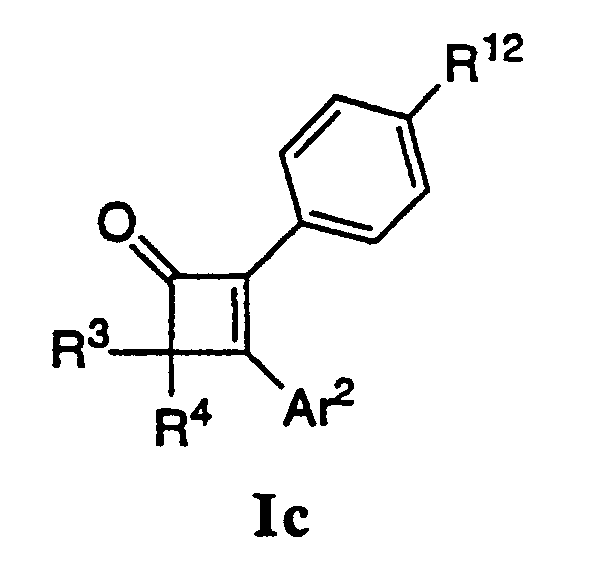
R3 and R4 are each independently selected from the group consisting ofwherein the substituents are each independently R11, or(a) H,(b) halogen,(c) hydroxy,(d) C1-4alkyl,(e) C2-4alkenyl,(f) C1-4alkoxy,(g) hydroxy C1-4alkyl,(h) CN,(i) COR5,(j) OCOR6,(k) OCONHR7, or(h) a mono-, di- or tri-substituted phenyl, pyridyl or arylene,
R3 and R4 are joined together with the carbon atom to which they are attached to form C=CR8R9, or
R3 and R4 are joined together with the carbon atom to which they are attached to form a saturated monocyclic ring of 3,4,5 or 6 carbon atoms, or
R3 and R4 are joined together with the carbon atom to which they are attached to form a five or six membered saturated heterocyclic ring containing 1 or 2 heteroatoms selected from oxygen, or sulfur;
Ar2 is mono-, di- or tri-substituted phenyl, wherein the substituents are each independently R11;
R5 isR6 is(a) H,(b) C1-4alkyl, or(c) C1-4alkoxy;R7 is(a) C1-4alkyl, or(b) C1-4alkoxy;R8 and R9 are each independently(a) H,(b) C1-4alkyl, or(c) mono-, di- or tri-substituted phenyl, wherein the subsdtuents are each independendy R11;R11 is(a) H,(b) hydroxyC1-4alkyl,(c) C1-4alkyl;R12 is S(O)2CH3 or S(O)2NH2.(a) H,(b) halogen,(c) C1-4alkyl,(d) hydroxy,(e) hydroxy C1-4alkyl,(f) C1-4alkoxy,(g) CF3,(h) CN,(i) S(O)nCH3 wherein n is 0, 1 or 2; - A compound according to Claim 3 wherein
R3 and R4 are each independently selected from the group consisting ofwherein the substituents are each independently R11, or(a) H,(b) halogen,(c) hydroxy,(d) C1-4alkyl,(e) C2-4alkenyl,(f) hydroxy C1-4alkyl, or(g) a mono-, di- or tri-substituted phenyl, pyridyl or arylene,
R3 and R4 are joined together with the carbon atom to which they are attached to form C=CR8R9, or
R3 and R4 are joined together with the carbon atom to which they are attached to form a saturated monocyclic ring of 3,4,5 or 6 carbon atoms,
R8 and R9 are each independentlyR11 is(a) H,(b) hydroxyalkyl,(c) C1-4alkyl;R12 is S(O)2CH3 or S(O)2NH2.(a) H,(b) halogen,(c) C1-4alkyl,(d) hydroxy,(e) hydroxy C1-4alkyl,(f) C1-4alkoxy;(g) S(O)nCH3 wherein n is 0, 1 or 2; - A compound according to Claim 4 wherein
R3 and R4 are each independently selected from C1-4alkyl;
Ar2 is mono-, di-, or tri-substituted phenyl wherein the substituents are each independently R11;
R11 isR12 is S(O)2CH3 or S(O)2NH2.(a) H,(b) halogen,(c) C1-4alkyl, - A compound according to Claim 1 of Formula Ibwherein
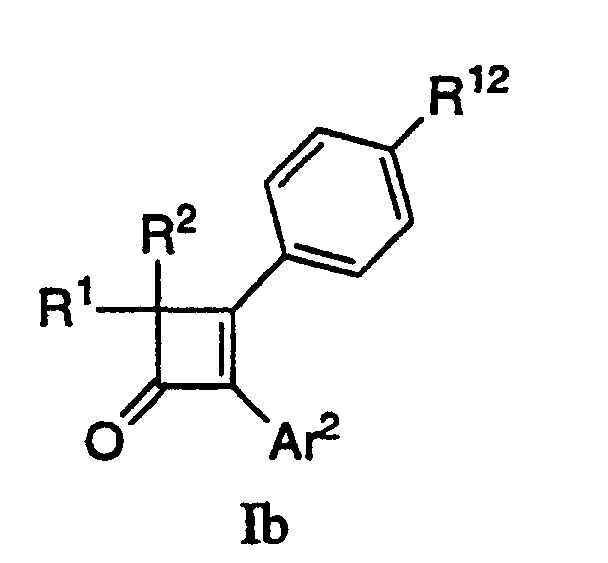
R1 and R2 are each independently selected from the group consisting ofwherein the substituents are each independently R11 and wherein the arylene is selected from the group consisting of(a) H,(b) halogen,(c) hydroxy,(d) C1-4alkyl,(e) C2-4alkenyl,(f) C2-4alkynyl,(g) C1-4alkoxy,(h) hydroxy C1-4alkyl,(i) C1-4alkylthio,(j) CN,(k) COR5,(l) OCOR6,(m) OCONHR7, or(n) a mono-, di- or tri-substituted phenyl, pyridyl or arylene,or R1 and R2 are joined together with the carbon atom to which they are attached to form C=CR8R9,(a) thiophene,(b) furan,(c) pyrrole, and(d) thiazole,
or R1 and R2 are joined together with the carbon atom to which they are attached to form a saturated monocyclic ring of 3,4,5 or 6 carbon atoms,
or R1 and R2 are joined together with the carbon atom to which they are attached to form a five or six membered saturated heterocyclic ring containing 1 or 2 heteroatoms selected from oxygen, or sulfur;
Ar2 is mono-, di- or tri-substituted phenyl, wherein the substituents are each independently R11;
R5 isR6 is(a) H,(b) C1-4alkyl, or(c) C1-4alkoxy;R7 is(a) C1-4alkyl, or(b) C1-4alkoxy;R8 and R9 are each independently(a) H,(b) C1-4alkyl, or(c) mono-, di- or tri-substituted phenyl, wherein the substituents are each independently R11;R11 is(a) H,(b) hydroxyC1-4alkyl,(c) C1-4alkyl, or(d) COR5;R12 is S(O)2CH3 or S(O)2NH2.(a) H,(b) halogen,(c) C1-4alkyl,(d) hydroxy,(e) hydroxy C1-4alkyl,(f) C1-4alkoxy,(g) CF3,(h) CN,(i) COR5, or(j) S(O)nCH3 wherein n is 0, 1 or 2; - A compound according to Claim 6 wherein
R1 and R2 are each independently selected from the group consisting ofwherein the substituents are each independently R11 and wherein the arylene is selected from the group consisting of(a) H,(b) halogen,(c) hydroxy,(d) C1-4alkyl,(e) C2-4alkenyl,(f) C2-4alkynyl,(g) C1-4alkoxy,(h) hydroxy C1-4alkyl,(i) C1-4alkylthio,(j) CN, or(k) a mono-, di- or tri-substituted phenyl, pyridyl or arylene,Ar2 is mono-, di- or tri-substituted phenyl, wherein the substituents are each independently R11;(a) thiophene,(b) furan.
R11 isR12 is S(O)2CH3 or S(O)2NH2.(a) H,(b) halogen,(c) C1-4alkyl,(d) hydroxy,(e) hydroxy C1-4alkyl,(f) C1-4alkoxy,(g) S(O)nCH3 wherein n is 0, 1 or 2; - A compound according to Claim 7 wherein
R1 and R2 are each independently selected from the group consisting ofwherein the substituents are each independently R11 and wherein the arylene is selected from the group consisting of(a) C1-4alkyl, or(b) a mono-, di- or tri-substituted phenyl, pyridyl or arylene,Ar2 is mono-, di- or tri-substituted phenyl, wherein the substituents are each independently R11;(a) thiophene,(b) furan,
R11 isR12 is S(O)2CH3 or S(O)2NH2.(a) H,(b) halogen,(c) C1-4alkyl, - A compound according to Claim 1 of Formula Ig'wherein
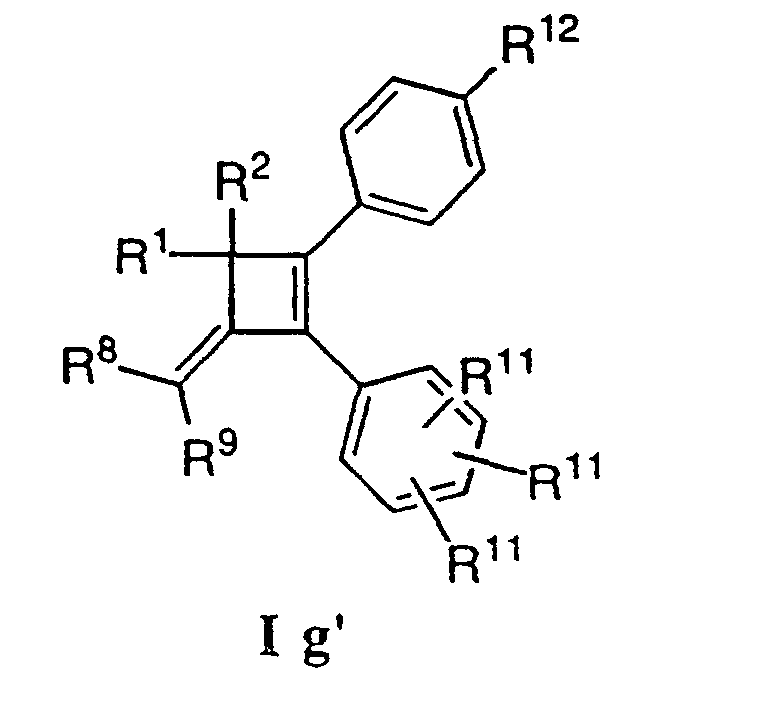
R1 and R2 are each independently selected from the group consisting ofwherein the substituents are each independently R11 and wherein the arylene is selected from the group consisting of(a) H,(b) halogen,(c) hydroxy,(d) C1-4alkyl,(e) C2-4alkenyl,(f) C2-4alkynyl,(g) C1-4alkoxy,(h) hydroxy C1-4alkyl,(i) C1-4alkylthio,(j) CN,(k) COR5,(l) OCOR6,(m) OCONHR7, or(n) a mono-, di- or tri-substituted phenyl, pyridyl or arylene,or R1 and R2 are joined together with the carbon atom to which they are attached to form a five or six membered saturated heterocyclic ring containing 1 or 2 heteroatoms selected from oxygen, or sulfur;(a) thiophene,(b) furan,(c) pyrrole, and(d) thiazole,
R5 isR6 is(a) H,(b) C1-4alkyl, or(c) C1-4alkoxy;R7 is(a) C1-4alkyl, or(b) C1-4alkoxy;R8 and R9 are each independently(a) H,(b) C1-4alkyl, or(c) mono-, di- or tri-substituted phenyl, wherein the substituents are each independently R11;R11 is each independently(a) H,(b) hydroxyC1-4alkyl,(c) C1-4alkyl, or(d) COR5;R12 is S(O)2CH3 or S(O)2NH2.(a) H,(b) halogen,(c) C1-4alkyl,(d) hydroxy,(e) hydroxy C1-4alkyl,(f) C1-4alkoxy,(g) CF3,(h) CN,(i) COR5, or(j) S(O)nCH3 wherein n is 0, 1 or 2; - A compound according to Claim 9 wherein
R1 and R2 are each independently selected from the group consisting ofR8 and R9 are each independently(a) H,(b) halogen,(c) hydroxy,(d) C1-4alkyl,(e) C2-4alkenyl,(f) C2-4alkynyl,(g) C1-4alkoxy,(h) hydroxy C1-4alkyl,(i) C1-4alkylthio,R11 is(a) H,(b) hydroxyC1-4alkyl,(c) C1-4alkyl;R12 is S(O)2CH3 or S(O)2NH2.(a) H,(b) halogen,(c) C1-4alkyl,(d) hydroxy,(e) hydroxy C1-4alkyl,(f) C1-4alkoxy,(g) CN,(h) S(O)nCH3 wherein n is 0, 1 or 2; - A compound according to Claim 10 wherein
R1 and R2 are each independently selected from the group consisting ofR8 and R9 are each independently(a) H,(b) C1-4alkyl,R11 is each independently(a) H,(b) hydroxyC1-4alkyl,(c) C1-4alkyl;R12 is S(O)2CH3 or S(O)2NH2.(a) H,(b) halogen,(c) C1-4alkyl; - A compound according to Claim 1 of Formula Ie'wherein

R1 and R2 are each independently selected from the group consisting ofwherein the substituents are each independently R11, or(a) H,(b) halogen,(c) hydroxy,(d) C1-4alkyl,(e) C2-4alkenyl,(f) C1-4alkoxy,(g) hydroxy C1-4alkyl,(h) CN,(i) COR5,(j) OCOR6,(k) OCONHR7, or(l) a mono-, di- or tri-substituted phenyl, pyridyl or arylene,
R1 and R2 are joined together with the carbon atom to which they are attached to form a saturated monocyclic ring of 3,4,5 or 6 carbon atoms,
R5 isR6 is(a) H,(b) C1-4alkyl, or(c) C1-4alkoxy;R7 is(a) C1-4alkyl, or(b) C1-4alkoxy;R10 is(a) H,(b) C1-4alkyl, or(c) mono-, di- or tri-substituted phenyl, wherein the substituents are each independently R11;R11 is each independently(a) C1-4alkoxy, or(b) substituted C1-4alkyl or C1-4alkoxy, wherein the substituent is a mono-, di- or tri-substituted phenyl or pyridyl and the substituents on the phenyl or pyridyl are R11;R12 is S(O)2CH3 or S(O)2NH2.(a) H,(b) halogen,(c) C1-4alkyl,(d) hydroxy,(e) hydroxy C1-4alkyl,(f) C1-4alkoxy,(g) CF3,(h) CN,(i) S(O)nCH3 wherein n is 0, 1 or 2; - A compound according to Claim 12 wherein
R1 and R2 are each independently selected from the group consisting ofwherein the substituents are each independently R11, or(a) H,(b) halogen,(c) hydroxy,(d) C1-4alkyl,(e) C1-4alkoxy,(f) hydroxy C1-4alkyl,(g) CN, or(i) a mono-, di- or tri-substituted phenyl, pyridyl or arylene,
R1 and R2 are joined together with the carbon atom to which they are attached to form a saturated monocyclic ring of 3,4,5 or 6 carbon atoms,
R10 isR11 is each independently(a) C1-4alkoxy, or(b) substituted C1-4alkyl or C1-4alkoxy, wherein the substituent is a mono-, di- or tri-substituted phenyl or pyridyl and the substituents on the phenyl or pyridyl are R11;R12 is S(O)2CH3 or S(O)2NH2.(a) H,(b) halogen,(c) C1-4alkyl,(d) hydroxy,(e) hydroxy C1-4alkyl,(f) C1-4alkoxy,(g) CF3,(h) CN,(i) S(O)nCH3 wherein n is 0, 1 or 2; - A compound according to Claim 13 wherein
R1 and R2 are each independently selected from the group consisting ofwherein the substituents are each independently R11,(a) H,(b) halogen,(c) hydroxy,(d) C1-4alkyl, or(e) a mono-, di- or tri-substituted phenyl, pyridyl or arylene,
R1 and R2 are joined together with the carbon atom to which they are attached to form a saturated monocyclic ring of 3,4,5 or 6 carbon atoms,
R10 isR11 is each independently(a) C1-4alkoxy, or(b) substituted C1-4alkyl or C1-4alkoxy, wherein the substituent is a mono-, di- or tri-substituted phenyl or pyridyl and the substituents on the phenyl or pyridyl are R11;R12 is S(O)2CH3 or S(O)2NH2.(a) H,(b) halogen,(c) C1-4alkyl, - A compound according to claim 1 selected from:(1) 4,4-Dichloro-3-(4-methylthiophenyl)-2-phenyl-2-cyclobuten-1-one;(2) 4,4-Dichloro-3-(4-methylsulfonylphenyl)-2-phenyl-2-cyclobuten-1-one;(3) 4-Chloro-3-(4-methylsulfonylphenyl)-2-phenyl-2-cyclobuten-1-one;(4) 3-(4-methylsulfonylphenyl)-2-phenyl-2-cyclobuten-1-one(5) 4,4-Dichloro-3-(4-methylsulfonylphenyl)-2-(4-fluorophenyl)-2-cyclobuten-1-one;(6) 4-Methyl-3-(4-methylsulfonylphenyl)-2-phenyl-4-(3-thienyl)-2-cyclobuten- 1-one;(7) 4-Methyl-3-(4-methylsulfonylphenyl)-2-phenyl-4-(2-thienyl)-2-cyclobuten-1-one;(8) 4-Methyl-3-(4-methylsulfonylphenyl)-2,4-diphenyl-2-cyclobuten-1-one;(9) 3-(4-Methylsulfonylphenyl)-2-phenylspiro[4.6]-2-nonen-1-one;(10) 3-(4-Methylsulfonylphenyl)-2-phenylspiro[4.5]-2-octen-1-one;(11) 3-(4-Methylsulfonylphenyl)-4-phenyl-3-cyclobuten-1,2-dione-2-(ethylene acetal);(12) 3-(4-Methylsulfonylphenyl)-4-phenyl-3-cyclobuten-1,2-dione;(13) 4-Methoxy-4-methyl-3-(4-methylsulfonylphenyl)-2-phenyl-2-cyclobuten-1-one;(14) 4-Methoxy-4-butyl-3-(4-methylsulfonylphenyl)-2-phenyl-2-cyclobuten-1-one;(15) (Z)-Methyl [4-(4-methylsulfonylphenyl)-3-phenyl-3-cyclobuten-2-one-1-ylidene] acetate;(16) 4,4-Dimethyl-3-(4-methylsulfonylphenyl)-2-phenyl-2-cyclobuten-1-one;(17) 4,4-Dimethyl-3-(4-methylsulfonylphenyl)-2-(3-fluorophenyl)-2-cyclobuten-1-one;(18) 4,4-Dimethyl-3-(4-methylsulfonylphenyl)-2-(4-fluorophenyl)-2-cyclobuten-1-one;(19) 4,4-Dimethyl-3-(4-methylsulfonylphenyl)-2-(3,5-difluorophenyl)-2-cyclobuten-1-one;(20) 4,4-Dimethyl-3-(4-methylsulfonylphenyl)-2-(3,4-difluorophenyl)-2-cyclobuten-1-one;(21) 4,4-Dimethyl-3-(4-methylthiophenyl)-2-phenyl-2-cyclobuten-1-one;(22) 4,4-Dimethyl-3-(4-methylsulfinylphenyl)-2-phenyl-2-cyclobuten-1-one;(23) 4,4-Dimethyl-3-(4-aminosulfonylphenyl)-2-phenyl-2-cyclobuten-1-one;(24) 4-methyl-2-(4-methylsulfonylphenyl)-3-phenyl-4-(3-thienyl)-2-cyclobuten-1-one;(25) 2-(4-methylsulfonylphenyl)-3-phenylspiro[4.6]-2-nonen-1-one;(26) 2-(4-methylsulfonylphenyl)-3-phenylspiro[4.5]-2-octen-1-one;(27) 2-(4-Methylsulfonylphenyl)-3-phenylspiro[4.4]-2-hepten-1-one;(28) 4,4-dimethyl-2-(4-methylsulfonylphenyl)-3-(3-fluorophenyl)-2-cyclobuten-1-one;(29)4,4-dimethyl-2-(4-methylsulfonylphenyl)-3-(4-fluorophenyl)-2-cyclobuten-1-one;(30)4,4-dimethyl-2-(4-methylsulfonylphenyl)-3-phenyl-2-cyclobuten-1-one;(31)4,4-dimethyl-2-(4-methylthiophenyl)-3-phenyl-2-cyclobuten-1-one;(32) 4,4-Dimethyl-2-(4-methylsulfinylphenyl)-3-phenyl-2-cyclobuten-1-one;(33) (trans)-2,2-Dimethyl-3,4-bis(4-methylthiophenyl)-1-cyclobutanone;(34) 4-Methyl-2-(4-methylsulfonylphenyl)-3-phenyl-2-cyclobuten-1-one;(35) 4-Isopropyl-2-(4-methylsulfonylphenyl)-3-phenyl-2-cyclobuten-1-one;(36) 4,4-Dichloro-3-methylene-1-(4-methylsulfonylphenyl)-2-phenyl-1-cyclobutene;(37) Ethyl [4,4-dichloro-3-(4-methylsulfonylphenyl)-2-phenyl-2-cyclobuten-1-ylidene] acetate;(38) [4,4-Dichloro-3-(4-methylsulfonylphenyl)-2-phenyl-2-cyclobuten-1-ylidene] ethanol;(39) 3-Methylene-1-(4-methylsulfonylphenyl)-2-phenyl-1-cyclobutene;(40) (E)-Ethyl [3-(4-methylsulfonylphenyl)-2-phenyl-2-cyclobuten-1-ylidene] acetate;(41) (Z)-Ethyl [3-(4-methylsulfonylphenyl)-2-phenyl-2-cyclobuten-1-ylidene] acetate;(42) (Z) and (E)-[3-(4-methylsulfonylphenyl)-2-phenyl-2-cyclobuten-1-ylidene]-2-propanol;(43) (Z) and (E)-[3-(4-methylsulfonylphenyl)-2-phenyl-2-cyclobuten-1-ylidene]-2-propanol;(44) 4,4-Dimethyl-3-methylene-1-(4-methylsulfonylphenyl)-2-phenyl-1-cyclobutene;(45) 4,4-Dimethyl-3-(4-methylsulfonylphenyl)-2-phenyl-2-cyclobuten-1-one oxime;(46) 4,4-Dimethyl-3-(4-methylsulfonylphenyl)-2-phenyl-2-cyclobuten-1-one t-butyloxime;(47) 4,4-Dimethyl-3-(4-methylsulfonylphenyl)-2-phenyl-2-cyclobuten-1-one methyloxime;(48) 4,4-Dimethyl-3-(4-methylsulfonylphenyl)-2-phenyl-2-cyclobuten-1-one benzyloxime;(49) 1-N-Benzylimine-4,4-dimethyl-3-(4-methylsulfonylphenyl)-2-phenyl-2-cyclobutene;(50) 4,4-Dimethyl-3-(4-methylsulfonylphenyl)-2-phenyl-2-cyclobuten-1-one 3-picolyloxime;(51) 4,4-Dimethyl-3-(4-methylsulfonylphenyl)-2-phenyl-2-cyclobuten-1-one 2-picolyloxime;(52) 4,4-Dimethyl-3-(4-methylsulfonylphenyl)-2-phenyl-2-cyclobuten-1-one (3-carbomethoxy)benzyl oxime;(53) 4,4-Dimethyl-3-(4-methylsulfonylphenyl)-2-phenyl-2-cyclobuten-1- one (3-carboxy)benzyl oxime;(54) 3-(4-Methylsulfonylphenyl)-2-phenyl-2-cyclobuten-1-one oxime;(55) 3-(4-Methylsulfonylphenyl)-2-phenyl-2-cyclobuten-1-one t-butyloxime;(56) 4,4-Dimethyl-3-(4-methylsulfonylphenyl)-2-phenyl-2-cyclobuten-1-one methyloxime;(57) 3-(4-Methylsulfonylphenyl)-2-phenyl-2-cyclobuten-1-one benzyloxime;(58) 4,4-Dimethyl-2-(4-methylsulfonylphenyl)-3-phenyl-2-cyclobuten-1-one t-butyloximes;(59) 4,4-Dimethyl-2-(4-methylsulfonylphenyl)-3-phenyl-2-cyclobuten-1-one benzyloxime;(60) 1-(4-Methylsulfonylphenyl)-2-phenyl-1-cyclobutene;(61) 1,4,4-Trimethyl-3-(4-methylsulfonylphenyl)-2-phenyl-2-cyclobuten-1-ol;(62) 4,4-Dimethyl-3-(4-methylsulfonylphenyl)-2-phenyl-2-cyclobuten-1-ol;(63) 4,4-Dimethyl-1-methoxy-3-(4-methylsulfonylphenyl)-2-phenyl-2-cyclobutene;(64) 4,4-Dimethyl-1-acetoxy-3-(4-methylsulfonylphenyl)-2-phenyl-2-cyclobutene;(65) 4,4-Dimethyl-1-pivaloxy-3-(4-methylsulfonylphenyl)-2-phenyl-2-cyclobutene;(66) 4,4-Dimethyl-1-fluoro-3-(4-methylsulfonylphenyl)-2-phenyl-2-cyclobutene;(67) 4,4-Dimethyl-3-(4-methylsulfonylphenyl)-2-phenyl-2-cyclobuten-1-ol N-phenylcarbamate;(68) 4,4-Dimethyl-3-(4-methylsulfonylphenyl)-2-phenyl-2-cyclobuten-1-one (ethylenedithioacetal);(69) 4,4-Dimethyl-2-(4-methylsulfonylphenyl)-3-phenyl-2-cyclobuten-1-ol;(70) 4,4-Dimethyl-1-methoxy-2-(4-methylsulfonylphenyl)-3-phenyl-2-cyclobutene; and(71) 4,4-Dimethyl-1-acetoxy-2-(4-methylsulfonylphenyl)-3-phenyl-2-cyclobutene.
- A pharmaceutical composition comprising a compound according to any one of claims 1 to 15, or a pharmaceutically acceptable salt thereof, and a pharmaceutically acceptable carrier.
- A pharmaceutically acceptable salt of a compound of formula (I), as defined in any one of claims 1 to 14.
- A compound or salt according to any one of claims 1 to 15, or a pharmaceutically acceptable salt thereof, for use in treating an inflammatory disease susceptible to treatment with a non-steroidal anti-inflammatory agent.
- Use of a compound or a pharmaceutically acceptable salt according to any one of claims 1 to 15 in the manufacture of a medicament for treating cyclooxygenase mediated diseases advantageously treated by an active agent that selectively inhibits COX-2 in preference to COX-1.
Applications Claiming Priority (5)
| Application Number | Priority Date | Filing Date | Title |
|---|---|---|---|
| US1428796P | 1996-03-29 | 1996-03-29 | |
| US14287P | 1996-03-29 | ||
| GB9607503 | 1996-04-11 | ||
| GBGB9607503.1A GB9607503D0 (en) | 1996-04-11 | 1996-04-11 | Bisaryl cyclobutenes derivatives as cyclooxygenase inhibitors |
| PCT/CA1997/000201 WO1997036863A1 (en) | 1996-03-29 | 1997-03-25 | Bisarylcyclobutene derivates as cyclooxygenase inhibitors |
Publications (2)
| Publication Number | Publication Date |
|---|---|
| EP0889878A1 EP0889878A1 (en) | 1999-01-13 |
| EP0889878B1 true EP0889878B1 (en) | 2002-09-04 |
Family
ID=26309099
Family Applications (1)
| Application Number | Title | Priority Date | Filing Date |
|---|---|---|---|
| EP97908099A Expired - Lifetime EP0889878B1 (en) | 1996-03-29 | 1997-03-25 | Bisarylcyclobutene derivates as cyclooxygenase inhibitors |
Country Status (8)
| Country | Link |
|---|---|
| EP (1) | EP0889878B1 (en) |
| JP (1) | JP2000510444A (en) |
| AT (1) | ATE223376T1 (en) |
| AU (1) | AU706518B2 (en) |
| CA (1) | CA2250350A1 (en) |
| DE (1) | DE69715173T2 (en) |
| ES (1) | ES2182035T3 (en) |
| WO (1) | WO1997036863A1 (en) |
Families Citing this family (14)
| Publication number | Priority date | Publication date | Assignee | Title |
|---|---|---|---|---|
| US6833373B1 (en) | 1998-12-23 | 2004-12-21 | G.D. Searle & Co. | Method of using an integrin antagonist and one or more antineoplastic agents as a combination therapy in the treatment of neoplasia |
| US6858598B1 (en) | 1998-12-23 | 2005-02-22 | G. D. Searle & Co. | Method of using a matrix metalloproteinase inhibitor and one or more antineoplastic agents as a combination therapy in the treatment of neoplasia |
| US6649629B2 (en) | 1999-12-23 | 2003-11-18 | Nitromed, Inc. | Nitrosated and nitrosylated cyclooxygenase-2 inhibitors, compositions and methods of use |
| ITMI20010733A1 (en) | 2001-04-05 | 2002-10-05 | Recordati Chem Pharm | USE OF ISOENZIN COX-2 INHIBITORS FOR THE TREATMENT OF URINARY INCONTINENCE |
| AR038957A1 (en) | 2001-08-15 | 2005-02-02 | Pharmacia Corp | COMBINATION THERAPY FOR CANCER TREATMENT |
| AU2003261281A1 (en) | 2002-07-29 | 2004-02-16 | Nicox S.A. | Cyclooxygenase- 2 selective inhibitors, compositions and methods of use |
| ES2214129B1 (en) * | 2003-02-13 | 2005-12-01 | Almirall Prodesfarma, S.A. | 3-FENILFURAN-2-ONAS. |
| MX2007014114A (en) | 2005-05-10 | 2008-03-14 | Intermune Inc | DERIVATIVES OF PIRIDONA TO MODULATE THE SYSTEM OF PROTEIN KINASE ACTIVATED BY STRESS. |
| JP5627574B2 (en) | 2008-06-03 | 2014-11-19 | インターミューン, インコーポレイテッド | Compounds and methods for treating inflammatory and fibrotic diseases |
| US8410144B2 (en) | 2009-03-31 | 2013-04-02 | Arqule, Inc. | Substituted indolo-pyridinone compounds |
| AR092742A1 (en) | 2012-10-02 | 2015-04-29 | Intermune Inc | ANTIFIBROTIC PYRIDINONES |
| US10233195B2 (en) | 2014-04-02 | 2019-03-19 | Intermune, Inc. | Anti-fibrotic pyridinones |
| CA3209491A1 (en) | 2021-03-15 | 2022-09-22 | Saul Yedgar | Hyaluronic acid-conjugated dipalmitoyl phosphatidyl ethanolamine in combination with non-steroidal anti-inflammatory drugs (nsaids) for treating or alleviating inflammatory disease |
| CN115197087B (en) * | 2021-04-08 | 2024-05-17 | 华东师范大学 | Polysubstituted cyclobutene derivative and preparation method thereof |
Family Cites Families (2)
| Publication number | Priority date | Publication date | Assignee | Title |
|---|---|---|---|---|
| US5474995A (en) * | 1993-06-24 | 1995-12-12 | Merck Frosst Canada, Inc. | Phenyl heterocycles as cox-2 inhibitors |
| US5393790A (en) * | 1994-02-10 | 1995-02-28 | G.D. Searle & Co. | Substituted spiro compounds for the treatment of inflammation |
-
1997
- 1997-03-25 ES ES97908099T patent/ES2182035T3/en not_active Expired - Lifetime
- 1997-03-25 WO PCT/CA1997/000201 patent/WO1997036863A1/en not_active Ceased
- 1997-03-25 AU AU20203/97A patent/AU706518B2/en not_active Ceased
- 1997-03-25 CA CA002250350A patent/CA2250350A1/en not_active Abandoned
- 1997-03-25 DE DE69715173T patent/DE69715173T2/en not_active Expired - Fee Related
- 1997-03-25 EP EP97908099A patent/EP0889878B1/en not_active Expired - Lifetime
- 1997-03-25 AT AT97908099T patent/ATE223376T1/en not_active IP Right Cessation
- 1997-03-25 JP JP09534762A patent/JP2000510444A/en active Pending
Also Published As
| Publication number | Publication date |
|---|---|
| AU2020397A (en) | 1997-10-22 |
| CA2250350A1 (en) | 1997-10-09 |
| ES2182035T3 (en) | 2003-03-01 |
| DE69715173T2 (en) | 2003-05-08 |
| WO1997036863A1 (en) | 1997-10-09 |
| EP0889878A1 (en) | 1999-01-13 |
| DE69715173D1 (en) | 2002-10-10 |
| AU706518B2 (en) | 1999-06-17 |
| JP2000510444A (en) | 2000-08-15 |
| ATE223376T1 (en) | 2002-09-15 |
Similar Documents
| Publication | Publication Date | Title |
|---|---|---|
| US5817700A (en) | Bisaryl cyclobutenes derivatives as cyclooxygenase inhibitors | |
| US5925631A (en) | Alkylated styrenes as prodrugs to COX-2 inhibitors | |
| US6239173B1 (en) | 3-phenyl-4-(4(methylsulfonyl)phenyl)-2-(5H)-furanone as a cox-2 inhibitor | |
| AU689302B2 (en) | Diaryl bicyclic heterocycles as inhibitors of cyclooxygenase-2 | |
| US5733909A (en) | Diphenyl stilbenes as prodrugs to COX-2 inhibitors | |
| US5698584A (en) | 3,4-diaryl-2-hydroxy-2,5-dihydrofurans as prodrugs to COX-2 inhibitors | |
| US5849943A (en) | Stilbene derivatives useful as cyclooxygenase-2 inhibitors | |
| US6057319A (en) | 3,4-Diaryl-2-hydroxy-2,5-dihydrofurans as prodrugs to cox-2 inhibitors | |
| EP0904269B1 (en) | 3,4-diaryl-2-hydroxy-2,5-dihydrofurans as prodrugs to cox-2 inhibitors | |
| WO1995018799A1 (en) | Phenyl heterocycles as cox-2 inhibitors | |
| AU706518B2 (en) | Bisarylcyclobutene derivates as cyclooxygenase inhibitors | |
| US20050261245A1 (en) | Nitric oxide releasing prodrugs of diaryl-2-(5h)-furanones as cyclooxygenase-2 inhibitors | |
| EP0882016B1 (en) | Alkylated styrenes as prodrugs to cox-2 inhibitors | |
| CA2244134C (en) | Diphenyl stilbenes as prodrugs to cox-2 inhibitors | |
| US6486194B2 (en) | Use of inhibitors of cyclooxygenase in the treatment of neurodegenerative diseases | |
| JP3490406B2 (en) | Phenyl heterocycle as cyclooxygenase-2 inhibitor | |
| AU711902C (en) | 3,4-diaryl-2-hydroxy-2,5-dihydrofurans as prodrugs to cox-2 inhibitors | |
| HK1027344A (en) | Phenyl heterocycles as cyclooxygenase-2 inhibitors | |
| HK1033311A (en) | Phenyl heterocycles as cyclooxygenase-2 inhibitors | |
| HK1027470A (en) | Phenyl heterocycles as cyclooxygenase-2 inhibitors |
Legal Events
| Date | Code | Title | Description |
|---|---|---|---|
| PUAI | Public reference made under article 153(3) epc to a published international application that has entered the european phase |
Free format text: ORIGINAL CODE: 0009012 |
|
| 17P | Request for examination filed |
Effective date: 19981029 |
|
| AK | Designated contracting states |
Kind code of ref document: A1 Designated state(s): AT BE CH DE DK ES FI FR GB GR IE IT LI LU NL PT SE |
|
| RAP1 | Party data changed (applicant data changed or rights of an application transferred) |
Owner name: MERCK FROSST CANADA & CO. |
|
| 17Q | First examination report despatched |
Effective date: 19991008 |
|
| GRAG | Despatch of communication of intention to grant |
Free format text: ORIGINAL CODE: EPIDOS AGRA |
|
| GRAG | Despatch of communication of intention to grant |
Free format text: ORIGINAL CODE: EPIDOS AGRA |
|
| GRAH | Despatch of communication of intention to grant a patent |
Free format text: ORIGINAL CODE: EPIDOS IGRA |
|
| GRAH | Despatch of communication of intention to grant a patent |
Free format text: ORIGINAL CODE: EPIDOS IGRA |
|
| GRAA | (expected) grant |
Free format text: ORIGINAL CODE: 0009210 |
|
| AK | Designated contracting states |
Kind code of ref document: B1 Designated state(s): AT BE CH DE DK ES FI FR GB GR IE IT LI LU NL PT SE |
|
| PG25 | Lapsed in a contracting state [announced via postgrant information from national office to epo] |
Ref country code: NL Free format text: LAPSE BECAUSE OF FAILURE TO SUBMIT A TRANSLATION OF THE DESCRIPTION OR TO PAY THE FEE WITHIN THE PRESCRIBED TIME-LIMIT Effective date: 20020904 Ref country code: LI Free format text: LAPSE BECAUSE OF FAILURE TO SUBMIT A TRANSLATION OF THE DESCRIPTION OR TO PAY THE FEE WITHIN THE PRESCRIBED TIME-LIMIT Effective date: 20020904 Ref country code: GR Free format text: LAPSE BECAUSE OF FAILURE TO SUBMIT A TRANSLATION OF THE DESCRIPTION OR TO PAY THE FEE WITHIN THE PRESCRIBED TIME-LIMIT Effective date: 20020904 Ref country code: FI Free format text: LAPSE BECAUSE OF FAILURE TO SUBMIT A TRANSLATION OF THE DESCRIPTION OR TO PAY THE FEE WITHIN THE PRESCRIBED TIME-LIMIT Effective date: 20020904 Ref country code: CH Free format text: LAPSE BECAUSE OF FAILURE TO SUBMIT A TRANSLATION OF THE DESCRIPTION OR TO PAY THE FEE WITHIN THE PRESCRIBED TIME-LIMIT Effective date: 20020904 Ref country code: BE Free format text: LAPSE BECAUSE OF FAILURE TO SUBMIT A TRANSLATION OF THE DESCRIPTION OR TO PAY THE FEE WITHIN THE PRESCRIBED TIME-LIMIT Effective date: 20020904 Ref country code: AT Free format text: LAPSE BECAUSE OF FAILURE TO SUBMIT A TRANSLATION OF THE DESCRIPTION OR TO PAY THE FEE WITHIN THE PRESCRIBED TIME-LIMIT Effective date: 20020904 |
|
| REF | Corresponds to: |
Ref document number: 223376 Country of ref document: AT Date of ref document: 20020915 Kind code of ref document: T |
|
| REG | Reference to a national code |
Ref country code: GB Ref legal event code: FG4D |
|
| REG | Reference to a national code |
Ref country code: CH Ref legal event code: EP |
|
| REG | Reference to a national code |
Ref country code: IE Ref legal event code: FG4D |
|
| REF | Corresponds to: |
Ref document number: 69715173 Country of ref document: DE Date of ref document: 20021010 |
|
| PG25 | Lapsed in a contracting state [announced via postgrant information from national office to epo] |
Ref country code: SE Free format text: LAPSE BECAUSE OF FAILURE TO SUBMIT A TRANSLATION OF THE DESCRIPTION OR TO PAY THE FEE WITHIN THE PRESCRIBED TIME-LIMIT Effective date: 20021204 Ref country code: DK Free format text: LAPSE BECAUSE OF FAILURE TO SUBMIT A TRANSLATION OF THE DESCRIPTION OR TO PAY THE FEE WITHIN THE PRESCRIBED TIME-LIMIT Effective date: 20021204 |
|
| PG25 | Lapsed in a contracting state [announced via postgrant information from national office to epo] |
Ref country code: PT Free format text: LAPSE BECAUSE OF FAILURE TO SUBMIT A TRANSLATION OF THE DESCRIPTION OR TO PAY THE FEE WITHIN THE PRESCRIBED TIME-LIMIT Effective date: 20021213 |
|
| NLV1 | Nl: lapsed or annulled due to failure to fulfill the requirements of art. 29p and 29m of the patents act | ||
| PGFP | Annual fee paid to national office [announced via postgrant information from national office to epo] |
Ref country code: GB Payment date: 20030204 Year of fee payment: 7 |
|
| ET | Fr: translation filed | ||
| REG | Reference to a national code |
Ref country code: ES Ref legal event code: FG2A Ref document number: 2182035 Country of ref document: ES Kind code of ref document: T3 |
|
| PGFP | Annual fee paid to national office [announced via postgrant information from national office to epo] |
Ref country code: FR Payment date: 20030303 Year of fee payment: 7 |
|
| REG | Reference to a national code |
Ref country code: CH Ref legal event code: PL |
|
| PGFP | Annual fee paid to national office [announced via postgrant information from national office to epo] |
Ref country code: ES Payment date: 20030318 Year of fee payment: 7 |
|
| PG25 | Lapsed in a contracting state [announced via postgrant information from national office to epo] |
Ref country code: LU Free format text: LAPSE BECAUSE OF NON-PAYMENT OF DUE FEES Effective date: 20030325 Ref country code: IE Free format text: LAPSE BECAUSE OF NON-PAYMENT OF DUE FEES Effective date: 20030325 |
|
| PGFP | Annual fee paid to national office [announced via postgrant information from national office to epo] |
Ref country code: DE Payment date: 20030331 Year of fee payment: 7 |
|
| PLBE | No opposition filed within time limit |
Free format text: ORIGINAL CODE: 0009261 |
|
| STAA | Information on the status of an ep patent application or granted ep patent |
Free format text: STATUS: NO OPPOSITION FILED WITHIN TIME LIMIT |
|
| 26N | No opposition filed |
Effective date: 20030605 |
|
| REG | Reference to a national code |
Ref country code: IE Ref legal event code: MM4A |
|
| PG25 | Lapsed in a contracting state [announced via postgrant information from national office to epo] |
Ref country code: GB Free format text: LAPSE BECAUSE OF NON-PAYMENT OF DUE FEES Effective date: 20040325 |
|
| PG25 | Lapsed in a contracting state [announced via postgrant information from national office to epo] |
Ref country code: ES Free format text: LAPSE BECAUSE OF NON-PAYMENT OF DUE FEES Effective date: 20040326 |
|
| PG25 | Lapsed in a contracting state [announced via postgrant information from national office to epo] |
Ref country code: DE Free format text: LAPSE BECAUSE OF NON-PAYMENT OF DUE FEES Effective date: 20041001 |
|
| GBPC | Gb: european patent ceased through non-payment of renewal fee |
Effective date: 20040325 |
|
| PG25 | Lapsed in a contracting state [announced via postgrant information from national office to epo] |
Ref country code: FR Free format text: LAPSE BECAUSE OF NON-PAYMENT OF DUE FEES Effective date: 20041130 |
|
| REG | Reference to a national code |
Ref country code: FR Ref legal event code: ST |
|
| PG25 | Lapsed in a contracting state [announced via postgrant information from national office to epo] |
Ref country code: IT Free format text: LAPSE BECAUSE OF NON-PAYMENT OF DUE FEES Effective date: 20050325 |
|
| REG | Reference to a national code |
Ref country code: ES Ref legal event code: FD2A Effective date: 20040326 |