EP0889604A2 - Interferenzgleichung für Endgerät in Satelliten Kommunikationsanordnung - Google Patents
Interferenzgleichung für Endgerät in Satelliten Kommunikationsanordnung Download PDFInfo
- Publication number
- EP0889604A2 EP0889604A2 EP98305014A EP98305014A EP0889604A2 EP 0889604 A2 EP0889604 A2 EP 0889604A2 EP 98305014 A EP98305014 A EP 98305014A EP 98305014 A EP98305014 A EP 98305014A EP 0889604 A2 EP0889604 A2 EP 0889604A2
- Authority
- EP
- European Patent Office
- Prior art keywords
- user terminal
- transceiver
- power
- signal
- satellite
- Prior art date
- Legal status (The legal status is an assumption and is not a legal conclusion. Google has not performed a legal analysis and makes no representation as to the accuracy of the status listed.)
- Withdrawn
Links
Images

Classifications
-
- H—ELECTRICITY
- H04—ELECTRIC COMMUNICATION TECHNIQUE
- H04B—TRANSMISSION
- H04B7/00—Radio transmission systems, i.e. using radiation field
- H04B7/14—Relay systems
- H04B7/15—Active relay systems
-
- H—ELECTRICITY
- H04—ELECTRIC COMMUNICATION TECHNIQUE
- H04B—TRANSMISSION
- H04B7/00—Radio transmission systems, i.e. using radiation field
- H04B7/14—Relay systems
- H04B7/15—Active relay systems
- H04B7/185—Space-based or airborne stations; Stations for satellite systems
- H04B7/1851—Systems using a satellite or space-based relay
- H04B7/18513—Transmission in a satellite or space-based system
Definitions
- the present invention relates to mobile communications where a radio telephone handset communicates with a telephone network by two-way exchange of radio signals between the handset and a transceiver which can take the form of a terrestrial base station or a satellite.
- a radio telephone handset When a radio telephone handset wishes to initiate communication, its first act is to send out a general signal, to be picked up by an appropriately selected transceiver, in the form of a communications satellite or base station, whereby the telephone network becomes aware of the request, made by the handset, and is able to respond thereto.
- a problem arises from the overlap of coverage of base stations and satellites. Each has an area in common with adjacent base stations or satellites where, if a handset sends out a service request, more than one base station or satellite will receive the request. Equally, such service requests must be made on a single frequency (channel) or on a small, predetermined set of channels.
- a handset which is best positioned to interact with one base station or satellite is quite capable of raising a request with several, or of interfering with requests from other handsets in other places. Equally, reciprocal interference between handsets may be possible.
- the satellite or base station may temporarily be suffering higher than expected interference levels, not only from handsets but from solar activity, urban electrical noise, other radio sources, and so on. This means that the request for service must be sent at a level able to overcome the unexpected increased noise, while still avoiding undue interference.
- EP 0741467 discloses a transceiver which measures its local interference on an extended statistical basis to characterize what it in general terms expects to see. This suffers from the disadvantage that the user terminal has to put out power in anticipation of a possible but not necessarily present interference, which is wasteful of user terminal power.
- the present invention seeks to provide a simple alternative solution.
- the present invention consists in a user terminal for use in a radio communications system wherein a transceiver is operative to provide a signal, receivable by said user terminal, said signal providing information concerning the instant level of radio interference experienced at said transceiver and information concerning the instant transmission power level of said signal, said user terminal, in response thereto, being operative to measure the strength of said signal to calculate the path loss between said transceiver and said user terminal to adjust the power of a subsequent transmission to the transceiver to an instant power to compensate both for path losses between said transceiver and said user terminal and to compensate for said instant level of radio interference at said transceiver.
- the use of the instant level of interference means that the transceiver only puts out greater power when the interference is actually present at the transceiver instead of putting out power in anticipation of possible but not necessarily present interference, as in the prior art, thereby saving user terminal power.
- the present invention provides a user terminal, wherein, in the event that the required power of the subsequent transmission by the user terminal exceeds the maximum power available in the user terminal, the user terminal is operative to make subsequent transmission at the maximum power.
- the present invention provides a user terminal wherein, in the event that the required power of the subsequent transmission exceeds a predetermined limit, the user terminal is operative to make the subsequent transmission at the predetermined limit of power.
- the present invention provides a user terminal, wherein the required power includes a margin above the minimum power for the transceiver to receive the subsequent transmission.
- the invention provides a user terminal wherein the signal is one of a plurality of signals from a plurality of transceivers, and wherein the user terminal is operative to elect one of the plurality of transceivers to which to send the subsequent transmission.
- the invention provides a user terminal wherein the user terminal is operative to elect that source which has the minimum required power.
- each of the plurality of signals includes information on the availability of its respective transceiver to receive the subsequent transmission, and wherein the user terminal is operative to include the availability when assessing each transceiver to be elected for receipt of the subsequent transmission.
- the invention yet further, provides a user terminal wherein the transceiver, or the plurality of transceivers, is a terrestrial cellular telephone base station or a plurality of terrestrial cellular telephone base stations.
- the invention provides a user terminal wherein the transceiver, or the plurality of transceivers, are comprised in one or more communications satellites.
- the invention provides that, when the transceiver or transceivers are comprised in one or more communications satellites, the plurality of transceivers include a plurality of spot beams, each signal from each of the plurality of spot beams including an identifier for that respective spot beam, the user terminal being operative to decode the identifier for each of the spot beams, being operative use the spot beam identifier to assess the altitude of the satellite wherefrom the each spot beam originates, and being operative to include the altitude when assessing each source to be elected for receipt of the subsequent transmission.
- the invention provides that the signal, or each of the plurality of signals, is a broadcast signal, and the subsequent transmission is a request for service.
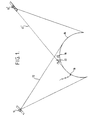
- Figure 1 shows the problem relating to handsets signalling for a request for service.
- Communications satellites 10 10' provide respective cones of radio coverage 12 12' on the surface of the earth 14.
- a user terminal 16 (handset), on the surface of the earth 14, falls within the cones of radio coverage 12 12' of both satellites 10 10'.
- a request for service, from the user terminal 16 would be heard by both satellites 10 10'. This would not be a problem if the user terminal 16 were unique.
- the user terminal 16 is one of very many terminals 16 all of whom are in a position to compete for service from the satellites 10 10'. They can interfere with each other.
- RACH Random Access Channel
- the radio signal path attenuation will vary.
- the satellites 10 10' are in a circular orbit approximately 10,355 kilometres above the earth 14. In this particular orbit, If the satellite 10 10' is low on the horizon, the propagation attenuation is around 3 decibels more that if the satellite 10 10' is immediately above the user terminal 16. Other heights of orbit, also applicable to the present invention, will have different characteristics.
- obstructions such as trees or building, can provide a further source of propagation path attenuation.
- the obstruction may be temporary, in the case of a moving user terminal 16 or a moving obstruction, or permanent, as in the case of a user terminal inside or near a building.
- the preferred embodiment of the invention has the satellites 10 10' orbiting at 10,355 Kilometres above the surface of the earth in two orthogonal orbits, each inclined at 45 degrees to the equator to provide whole-earth coverage from ten satellites 10 10', five equispaced around each orbit.
- This is not a restriction on the scope of the invention, which is equally applicable to any communications satellite 10 10' at any orbital height above the earth 14 or to any spaced array of terrestrial base stations such as might be used with terrestrial cellular telephones.
- the earth station 22 controls the communications satellite's 10 10' communication activities, provides signals for the communications satellites 10 10' to send, and monitors signals, received from whatever source, by the communications satellites 10 10'.
- the activities, hereinafter described as being enacted by the earth station, may equally well be performed by the satellites 10 10' themselves.
- the precise relationship between the elements 16. 10 10' 22 hereinafter described are merely by way of example for the best working of the invention according to the embodiment shown.
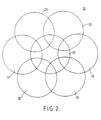
- FIG. 2 shows how the cones of radio coverage 12 12' are divided into a plurality of spot beams 20.
- Each spot beam 20 carries a separate communications load from any other spot beam 20 in the cone of radio coverage 12 12'. Only a few spot beams 20 are here shown. Suffice to say that the entire cone of radio coverage 12 12' is filled with spot beams 20 in a regular array, or in an irregular array so that small spot beams 20 fall over busy areas and large spot beams 20 over relatively empty areas, so that, nominally, each spot beam 20 covers its own nominated portion of the surface of the earth 14.
- the cones 12 12' of radio coverage comprise 163 spot beams. This is not restrictive on the present invention, which is also applicable to just one beam in the entire cone of radio coverage. The example given is merely one example of the applicability of the invention.
- the spot beams 20 overlap. While every endeavour is made to ensure that the overlap is minimised, the edge of the field for each spot beam coverage is not sharp. Some overlap is inevitable, since no point on the surface of the earth 14, within the cone 12 12' of radio coverage, must be left uncovered. To accommodate possible variations in signal or beam pattern, the spot beams 20 must be slightly oversized compared to minimum cover. In figure 2 it is plain that some areas are covered by only one spot beam 20 per satellite 10 10' while other areas are within the nominated cover of two or even three spot beams 20 per satellite 10 10'. In fact, this situation is idealised. The reality is that there is no perfect isolation between spot beams 20 and a signal, sent from an area nominated for a particular spot beam will be received, to some extent, by all of the spot beams 20 in the cone 12 12' of radio cover.
- the request signal from the user terminal 16 can be heard by up to six hundred and fifty-two spot beams 20 in the worst case.
- the situation is alleviated by separating the RACH channels for the spot beams 20 using frequency separation, antenna polarisation and handedness of circularly polarised radio signal separation (where possible), time division separation, code division separation, and any other means whereby one spot beam may improve its reception isolation from the others 20.
- some duplication must exist within each cone 12 12' of radio coverage and, in particular, between satellites 10 10' so that what appears to be a reasonable isolation in fact, is far from perfect. This creates the possibility of the request signal assisting in interfering with request signals from other user terminals. Equally, requests from other user terminals 16 can interfere with the request from the user terminal 16 shown in figure 1.
- Figures 1 and 2 show the environment appropriate to the present invention.
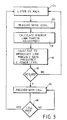
- Figure 3 shows the activities of the earth station 22 in the present invention.
- Each spot beam 20 has a random access channel (RACH).
- RACH is designated as being on a predetermined frequency.
- Other spot beams may share the same RACH frequency.
- each spot beam 20 has a predetermined broadcast channel (BCCH) where messages, at predetermined intervals, are sent for reception by all user terminals 16. Because each user terminal transmission may be received in multiple spot beams 20, there can be a problem.
- BCCH broadcast channel
- the earth station 22 listens to the RACH channel of a particular spot beam 20. If no signal from a user terminal 16 is present, the earth station 22 monitors the noise level at the satellite 10 10' and makes a measurement in a second operation 26. Interfering signals can come from any source, including incoherent transmissions from user terminals 16, sources of interference 18, or even from solar or cosmic sources. It does not, particularly matter from where. The earth station 22 has an expectation of how much noise, generally, without interference, deriving from internal thermal or antenna thermal sources, it ought to expect. If the noise level is different, a multiplying factor, in decibels, is calculated in a third operation 28.This is the link margin adjustment and represents the minimum alteration needed to ensure reception on the RACH.
- the link margin adjustment is a negative number of decibels and, theoretically, would allow the user terminal 16 to use less power. If the noise level is higher than expected, the link margin adjustment is a positive number of decibels and would require the user terminal 16 to use more power.
- the earth station 22 Having calculated the link margin adjustment, the earth station 22 then provides the information to be broadcast by the satellites 10 10' on the BCCH in a fourth operation 30.
- the broadcast also includes information concerning the frequency to be used by the RACH for each spot beam 20 and the power the satellite 10 10' is actually using for the transmission.
- a first test 32 does not detect a request for service on the RACH, the earth station returns to the first operation 24. If the first test 32 detects a request, the earth station 22 uses a fifth operation 34 to proceed with the call until a second test 36 determines that the call is over and returns control to the first operation 24.
- the formulation of the broadcast information can be centralised at a facility which gathers data from many satellite 10 10 /earth station 22 combinations, or from many base stations.
- the only requirement, for the present invention, is that the satellite 10 10' or base station sends the necessary signals, and measures (or has measured) the necessary interference levels. Any apparatus or method for achieving this purpose will suffice.
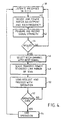
- Figure 4 shows the activity of the user terminal 16 in the embodiment of the invention.
- a sixth operation 38 has the user terminal 16 listening to the BCCH for any messages. If a message is received, a seventh operation 40 decodes the link margin adjustment, the indicated satellite transmission power, and the RACH channel frequency, as transmitted by the earth station 22 in the fourth operation 30 of figure 3. An eight operation 42 then measures the strength of the signal received on the BCCH, and calculates a path loss based on the expected signal strength which would be expected at the indicated power level of the satellite 10 10' transmission, made known by the fourth operation 30 of figure 3. The user terminal 16 also records the result for that spot beam 20. Recording can involve an instant record, where the most recent result for that spot beam 20 is used to replace the previous record, or involve a more complex operation where a running average for that spot beam is recorded.
- a third test 44 detects if a request for service is required.
- the need for service can arise from the owner of the user terminal requiring a telephone connection, from a periodic need for the user terminal 16, autonomously to re-register, from a need to re-register on moving from spot beam 20 to spot beam 20, responding to a high penetration notification (used when the user terminal is radio isolated and out of normal service) and a host of other reasons. It does not concern the present invention exactly why the user terminal should wish to make contact with an earth station 22, simply that it does.
- the third test 44 returns control to the sixth operation 38. If a request for service exists, control is passed to a ninth operation 46 where the user terminal 16 selects the BCCH channel, and hence the spot beam 20 20' which had the best signal in its broadcasts thus giving the highest probability of the user terminal 16 making a successful request for service. That signal can be selected which, given the strength of its broadcasts and its local RACH noise level, as transmitted over the BCCH, would require least power for reception. Thus, a very strong signal with a very noisy RACH might be less desirable than a weaker signal with less local RACH noise.
- Each spot beam 20 20' has its own identity, broadcast on the BCCH. Each spot beam 20 20' subtends a particular angle relative to the surface of the earth 14. Thus, by knowing the identity of a spot beam 20 20', it is possible to know whether it originates from a high elevation or a low elevation satellite.
- the user terminal 16 knows, from an internal table, what is the elevation for each spot beam 20 20' and can use that information in the selection of a BCCH (and hence spot beam 20 20'). Low elevation spot beams which are getting lower will be rejected, since call duration would be compromised as the satellite 10 10' disappeared below the minimum operational elevation.
- Certain satellites 10 10' may be operating with an earth station 22 which has a problem with availability of terrestrial line capacity. It is pointless to initiate a call with a satellite 10 10' or via a spot beam 20 20' where a scarcity of terrestrial lines will reduce the probability of the call being connected.
- Each spot beam 20 20' has a limited number of call channel frequencies which it can allocate. Some spot beams 20 20' will be busy, while others will be relatively empty of traffic. It is pointless to direct a request for service to a spot beam 20 20' whose call channels are already full.
- the earth station 22, via the satellite 10 10' using the BCCH on each spot beam 20 20', transmits an indication of the terrestrial connection capacity and the call channel availability. The user terminal 16 decodes this information and rejects any spot beam 20 20' which has impaired call candling and connecting capacity.
- the user terminal 16 in a tenth operation 48, scales its transmitter power to ensure a service request is received, at the selected satellite, with a predetermined excess margin, here chosen, but not restricted to, 10 decibels, above the minimum margin required for service. Any excess margin is within the scope of the invention, and it is for the designer of a particular embodiment to select an excess margin which fits his needs and to transmit the information as a system parameter to enable configuration of the system. If the expected user terminal 16 transmission power is more than the maximum that the user terminal 16 can provide, the user terminal simply uses its maximum power to give the best hope of reception.
- An eleventh operation 50 then sends the request at the power level determined by the tenth operation 48 and the operation (e.g. registration) or call is proceeded with, at a closed loop power control level, as is already known in the art, until a fourth test 52 determines that the user terminal instant operation is over and returns control to the sixth operation 38 via a twelfth operation 54 which terminates the call, re-registration, or whatever was the cause of the need for a request for service.
- the operation e.g. registration
- call is proceeded with, at a closed loop power control level, as is already known in the art, until a fourth test 52 determines that the user terminal instant operation is over and returns control to the sixth operation 38 via a twelfth operation 54 which terminates the call, re-registration, or whatever was the cause of the need for a request for service.
- Figure 5 is an expansion of the tenth operation 48 of figure 4. Entry is to a thirteen operation 56 where the user terminal 16 compares the signal strength from the BCCH with an expected norm.
- the norm is based on the indication of power used, by the satellite. At a certain indicated power level, a certain signal strength is expected. If the BCCH signal is greater that the expected norm, a general adjustment (X) is calculated which is a negative number of decibels. If the BCCH signal is below the expected norm, the general adjustment X is a positive number of decibels.
- Control passes to a fourteenth operation 58 where the power alteration (A decibels) is calculated as the sum of the general adjustment X, the excess margin (here chosen as 10 decibels), and the link margin adjustment L, received from the BCCH in the broadcast message.
- a margin is the amount, over a threshold of intelligibility, which a signal provides.
- the maximum return signal margin, experienced by the satellite 10 10' when receiving a signal from the user terminal 16 is the difference between the maximum signal margin which the user terminal can provide at the satellite 10 10' when in the most ideal conditions, the maximum signal margin being reduced by path losses.
- the path losses include distance effects, shielding by trees and buildings, atmospheric conditions, antenna inefficiencies, and, indeed, everything that can contribute to a change in signal strength.
- the path losses also include any deficiencies in the antenna of the user terminal 16 which, as will be seen, are reflected in a compensating increase of power when the user terminal 16 transmits.
- the sensitivity of the user terminal 16 is measured or assumed and the measured or assumed sensitivity stored within the user terminal 16 so that the signal from the BCCH can properly be assessed. Again, as a benefit, if the antenna on the satellite 10 10' is in any way over efficient or under efficient, compensation therefore by the user terminal 16 transmission power is automatic.
- a fifteenth operation 60 then scales the output power, up or down from a norm, by the calculated power alteration (A decibels) found in the fourteenth operation. If the expected transmission power from the user terminal 16 exceeds the maximum the user terminal 16 can provide, the user terminal simply uses the maximum power available.
- Each make and style of user terminal is aware of its maximum power capability, indicated either by storage of information on manufacture and/or testing, or, alternatively, by the user terminal 16 sending a message at a known or indicated power level to the satellite 10 10'/earth station 22 and the earth station sending back a signal report which allows the user terminal 16 to adjust its estimation of power output.
- the output power of the terminal 16 is limited to that power which will produce that predetermined signal strength.
- the spot beams can be replaced by terrestrial base stations, the base stations behaving the same way as the combination of the earth station 22 and the satellites 10 10', to achieve exactly the same effect in an entirely terrestrial system.
- the apparatus and method is applicable in any system where a transmission is receivable from a base station or satellite 10 10'and where the user terminal 16 must respond. All that is necessary is for the base station or satellite 10 10' to send out the necessary information on whatever channel or by whatever means is appropriate to an instant operation and for the user terminal 16 to respond as indicated to select its transmission power level.
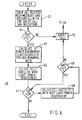
- Figure 6 is an expansion of the ninth operation 46, otherwise shown in figure 4, where the user terminal 16 selects the BCCH channel with the best signal.
- a sixteenth operation 62 checks the information received on all of the audible BCCH messages and discards any that have an indication that there is a line jam (where there are no available telephone lines from the earth station 22 with which the satellite 10 10' is in contact, thereby rendering the ability for the user terminal 16 to place a call, impossible), and also discards any that contain an indication of a call jam (where the particular satellite 10 10' has no remaining radio channels to accept a call, all channels, for now, being occupied).
- Control passes to a fifth test 64 which checks to see if there are any received BCCH messages after the others, in the sixteenth operation 62, which have been discarded on the basis of the impossibility of the user terminal 16 being capable of making a call. If the fifth test 64 detects that there are some remaining BCCH messages which indicate that a placement of a call is possible, control passes to a seventeenth operation 65 where the user terminal 16 calculates the minimum required power, for each of the residual BCCH messages, required to achieve the minimum signal to noise ratio at the satellite 10 10' if a call is placed by the user terminal 16.
- the seventeenth operation 65 passes control to an eighteenth operation 66 where that BCCH signal, with the least user terminal 16 transmission requirement, is selected for further analysis.
- the eighteenth operation 66 then passes control to a sixth test 67 which, as earlier described, looks at the identity of the BCCH to see if it originates from a satellite which is soon to disappear over the horizon and be unavailable to the user terminal for the duration of a call (in other words, if the BCCH signal originates from a satellite which is too low on the horizon and descending "out of sight").
- the nineteenth operation 68 passes control to a seventh test 69 which checks to see if there are any remaining BCCH signals to evaluate.
- the seventh test 69 detects remaining BCCH signals to evaluate, it passes control back to the sixth test 67.
- the sixth test 67, the nineteenth operation 68, and the seventh test 69 thus co-operate to run down the list of the remaining BCCH signals until one is found by the sixth test 67 which is not originating from a satellite which is too low and about to disappear below the horizon, or until the seventh test 69 detects that there are no further BCCH signals to evaluate.
- both tests 69 64 pass control to a twentieth operation 70 which aborts the call attempt in the user terminal 16 and passes control (in a path not shown in figure 4) back to the ninth operation 46 of figure 4.
- the user terminal 16 avoids causing undue interference by avoiding making call attempts where no call is possible or where the duration of a placed call would be unsatisfactorily short.
Landscapes
- Engineering & Computer Science (AREA)
- Computer Networks & Wireless Communication (AREA)
- Signal Processing (AREA)
- Physics & Mathematics (AREA)
- Astronomy & Astrophysics (AREA)
- Aviation & Aerospace Engineering (AREA)
- General Physics & Mathematics (AREA)
- Mobile Radio Communication Systems (AREA)
- Radio Relay Systems (AREA)
- Transmitters (AREA)
- Radio Transmission System (AREA)
Applications Claiming Priority (2)
| Application Number | Priority Date | Filing Date | Title |
|---|---|---|---|
| GBGB9713776.4A GB9713776D0 (en) | 1997-07-01 | 1997-07-01 | Interference mitigation |
| GB9713776 | 1997-07-01 |
Publications (2)
| Publication Number | Publication Date |
|---|---|
| EP0889604A2 true EP0889604A2 (de) | 1999-01-07 |
| EP0889604A3 EP0889604A3 (de) | 1999-12-15 |
Family
ID=10815134
Family Applications (1)
| Application Number | Title | Priority Date | Filing Date |
|---|---|---|---|
| EP98305014A Withdrawn EP0889604A3 (de) | 1997-07-01 | 1998-06-25 | Interferenzgleichung für Endgerät in Satelliten Kommunikationsanordnung |
Country Status (3)
| Country | Link |
|---|---|
| EP (1) | EP0889604A3 (de) |
| JP (1) | JPH11168430A (de) |
| GB (1) | GB9713776D0 (de) |
Cited By (1)
| Publication number | Priority date | Publication date | Assignee | Title |
|---|---|---|---|---|
| WO2020205272A1 (en) * | 2019-03-29 | 2020-10-08 | Qualcomm Incorporated | Random access channel frequency multiplexing for a non-terrestrial network |
Family Cites Families (2)
| Publication number | Priority date | Publication date | Assignee | Title |
|---|---|---|---|---|
| US5551057A (en) * | 1994-06-08 | 1996-08-27 | Lucent Technologies Inc. | Cellular mobile radio system power control |
| US5619525A (en) * | 1995-06-06 | 1997-04-08 | Globalstar L.P. | Closed loop power control for low earth orbit satellite communications system |
-
1997
- 1997-07-01 GB GBGB9713776.4A patent/GB9713776D0/en not_active Ceased
-
1998
- 1998-06-25 EP EP98305014A patent/EP0889604A3/de not_active Withdrawn
- 1998-07-01 JP JP10222237A patent/JPH11168430A/ja not_active Withdrawn
Cited By (4)
| Publication number | Priority date | Publication date | Assignee | Title |
|---|---|---|---|---|
| WO2020205272A1 (en) * | 2019-03-29 | 2020-10-08 | Qualcomm Incorporated | Random access channel frequency multiplexing for a non-terrestrial network |
| CN113615298A (zh) * | 2019-03-29 | 2021-11-05 | 高通股份有限公司 | 用于非地面网络的随机接入信道频率复用 |
| CN113615298B (zh) * | 2019-03-29 | 2024-06-25 | 高通股份有限公司 | 用于非地面网络的随机接入信道频率复用 |
| US12389236B2 (en) * | 2019-03-29 | 2025-08-12 | Qualcomm Incorporated | Random access channel frequency multiplexing for a non-terrestrial network |
Also Published As
| Publication number | Publication date |
|---|---|
| GB9713776D0 (en) | 1997-09-03 |
| EP0889604A3 (de) | 1999-12-15 |
| JPH11168430A (ja) | 1999-06-22 |
Similar Documents
| Publication | Publication Date | Title |
|---|---|---|
| EP0868790B1 (de) | Satellitendiversitysystem | |
| US5115514A (en) | Measuring and controlling signal feedback between the transmit and receive antennas of a communications booster | |
| KR100693621B1 (ko) | 다중 빔 통신 시스템에서의 호출 드롭핑 속도를감소시키는 시스템 및 방법 | |
| US5093923A (en) | Optimization system and method | |
| US6108561A (en) | Power control of an integrated cellular communications system | |
| CA1253213A (en) | Portable radio telephone system | |
| CA2460495C (en) | Methods and systems for modifying satellite antenna cell patterns in response to terrestrial reuse of satellite frequencies | |
| US5073900A (en) | Integrated cellular communications system | |
| US6539236B2 (en) | Establishment of a connection between a base station and a mobile station using random access channels | |
| MXPA04002456A (es) | Bandas de proteccion especiales para la reutilizacion terrestre de frecuencias de satelite. | |
| GB2227143A (en) | Mobile radio-telephone system with mobile units and base stations | |
| US6654617B1 (en) | Antenna system for narrowband communications systems and method of operation | |
| EP0919102B1 (de) | Verfahren zur Versorgung einer Radioeinheit mit zellularen Radiodiensten in einem festen zellularen Funksystem | |
| NO841286L (no) | Framgangsmaate og apparat for aa fastsette toveis radiokanaler og aa soeke toveis radiokanaler beregnet for mobile og baerbare radiotelefoner i et cellulaert radiotelefonsystem | |
| US6347235B1 (en) | System for scheduling reverse-channel messages in narrowband communications systems and method of operation | |
| EP0889604A2 (de) | Interferenzgleichung für Endgerät in Satelliten Kommunikationsanordnung | |
| JPH07505512A (ja) | デジタルセルラ無線通信システムにおける無線遠隔中継器のための方法および装置 | |
| EP0888024A1 (de) | Verbindungsaufbau in einem mobilen Übertragungssystem | |
| EP1050979A1 (de) | Verfahren zur intelligenten Zellenauswahl mittels Aufenthaltsdaten in zellularen Satellitensystemen | |
| CA1042989A (en) | Radio telephone system | |
| WO2001033892A1 (en) | Call notification delivered by an alternate network | |
| EP1011209A1 (de) | Zellauswahl in einer mobilen Radiocommunicationsanordnung entsprechend der Empfangsqualität | |
| WO2000059245A1 (en) | Mobile originating call setup |
Legal Events
| Date | Code | Title | Description |
|---|---|---|---|
| PUAI | Public reference made under article 153(3) epc to a published international application that has entered the european phase |
Free format text: ORIGINAL CODE: 0009012 |
|
| AK | Designated contracting states |
Kind code of ref document: A2 Designated state(s): DE FI FR GB NL SE |
|
| AX | Request for extension of the european patent |
Free format text: AL;LT;LV;MK;RO;SI |
|
| PUAL | Search report despatched |
Free format text: ORIGINAL CODE: 0009013 |
|
| AK | Designated contracting states |
Kind code of ref document: A3 Designated state(s): AT BE CH CY DE DK ES FI FR GB GR IE IT LI LU MC NL PT SE |
|
| AX | Request for extension of the european patent |
Free format text: AL;LT;LV;MK;RO;SI |
|
| RIC1 | Information provided on ipc code assigned before grant |
Free format text: 6H 04B 7/185 A, 6H 04B 7/005 B |
|
| 17P | Request for examination filed |
Effective date: 20000614 |
|
| AKX | Designation fees paid |
Free format text: AT BE CH CY DE DK LI |
|
| RBV | Designated contracting states (corrected) |
Designated state(s): DE FI FR GB NL SE |
|
| STAA | Information on the status of an ep patent application or granted ep patent |
Free format text: STATUS: THE APPLICATION HAS BEEN WITHDRAWN |
|
| 18W | Application withdrawn |
Withdrawal date: 20020424 |