EP0885612A1 - Pirenoxine for the topical treatment of inflammatory conditions - Google Patents
Pirenoxine for the topical treatment of inflammatory conditions Download PDFInfo
- Publication number
- EP0885612A1 EP0885612A1 EP98830353A EP98830353A EP0885612A1 EP 0885612 A1 EP0885612 A1 EP 0885612A1 EP 98830353 A EP98830353 A EP 98830353A EP 98830353 A EP98830353 A EP 98830353A EP 0885612 A1 EP0885612 A1 EP 0885612A1
- Authority
- EP
- European Patent Office
- Prior art keywords
- pirenoxine
- use according
- medicament
- inflammatory conditions
- treatment
- Prior art date
- Legal status (The legal status is an assumption and is not a legal conclusion. Google has not performed a legal analysis and makes no representation as to the accuracy of the status listed.)
- Withdrawn
Links
Classifications
-
- A—HUMAN NECESSITIES
- A61—MEDICAL OR VETERINARY SCIENCE; HYGIENE
- A61K—PREPARATIONS FOR MEDICAL, DENTAL OR TOILETRY PURPOSES
- A61K31/00—Medicinal preparations containing organic active ingredients
- A61K31/33—Heterocyclic compounds
- A61K31/395—Heterocyclic compounds having nitrogen as a ring hetero atom, e.g. guanethidine or rifamycins
- A61K31/535—Heterocyclic compounds having nitrogen as a ring hetero atom, e.g. guanethidine or rifamycins having six-membered rings with at least one nitrogen and one oxygen as the ring hetero atoms, e.g. 1,2-oxazines
- A61K31/5365—Heterocyclic compounds having nitrogen as a ring hetero atom, e.g. guanethidine or rifamycins having six-membered rings with at least one nitrogen and one oxygen as the ring hetero atoms, e.g. 1,2-oxazines ortho- or peri-condensed with heterocyclic ring systems
Definitions
- the present invention relates to the use pirenoxine or of a pharmaceutically acceptable salt thereof for the topical treatment of inflammatory conditions. More specifically, this invention concems the use of pirenoxine and its salts as anti-inflammatory agents for topical ophthalmic application.
- Pirenoxine i.e. 1-hydroxy-5-oxo-5H-pyrido-[3,2-a]-phenoxazine-3-carboxylic acid (also referred to as pirfenoxone), is a known compound having the following formula: which is used in ophthalmology, usually in the form of the corresponding sodium salt, for the treatment of cataract.
- the latter is an abnormal progressive condition of the lens of the eye, characterised by increasing loss of transparency.
- cataracts are most often caused by degenerative changes, often occurring after 50 years of age, while less often they may be caused by trauma or by exposure to poisons. At the onset, vision is blurred, then bright lights glare diffusely and distortion and double vision may develop.
- cataracts may be treated by the administration of pirenoxine to the eye, normally in the form of an ophthalmic solution, i.e. eye drops.
- the activity of pirenoxine in inhibiting the formation of lens opacities has been attributed to at least three different mechanisms of action: (a) inhibition of the oxidising activity that quinone molecules exert on the proteins of the lens, by binding to their -SH groups; (b) activation and normalisation of the cationic pump function of the crystalline capsule; (c) inhibition of the sorbitol synthesis and resulting reduction of the osmotic damage deriving from the accumulation of this substance (Iwata S., J. Pharmac. Soc. Jap. 1964; 84: 435-440; Ikemoto F., Fukui S., Iwata S., In: Proc. 50th Congr. Pharmacol. Soc. Jap., Kanto Region, 1974; Korte I., Hockwin O., Ohrloff C., Ophthalmic Res. 1979; 11: 123-125).
- pirenoxine besides being active in the treatment of cataracts, is also markedly active in counteracting or reducing inflammation, specifically as a topical anti-inflammatory agent suitable for ophthalmic use.
- pirenoxine when applied topically, in particular to the eye, is active against inflammation at a level comparable with that of other known anti-inflammatory agents, specifically non-steroidal anti-inflammatory agents.
- pirenoxine appears to possess with respect to many known non-steroidal anti-inflammatory agents is that it does not appear to show, when administered to the eye, the same typical side effects of this group of active ingredients, i.e. pain and irritation of the conjunctiva.
- pirenoxine shows no analogy with the group of non-steroidal anti-inflammatory agents as far as its chemical structure is concerned, nor it shows any analogy as concems its possible mechanism of action.
- the anti-inflammatory activity of pirenoxine is very likely to be ascribed to an inhibitory action on the oxidative catabolism of arachidonic acid, which leads to the production of prostaglandins.
- An additional clinical advantage of pirenoxine lies in the manifold action as an antioxidant and against protein denaturation that this drug exerts on the lens.
- the present invention specifically provides the use of 1-hydroxy-5-oxo-5H-pyrido-[3,2-a]-phenoxazine-3-carboxylic acid (pirenoxine) or of a pharmaceutically acceptable salt thereof for the manufacture of a medicament for the topical treatment of inflammatory conditions and, in particular, for the treatment of inflammations of the ocular region.
- the indications for the proposed use include the treatment of inflammatory conditions such as corneal and conjunctival inflammations, uveitis and ocular oedema.
- the ophthalmic preparations of the present invention preferably contain the active ingredient, i.e. pirenoxine or a pharmaceutically applicable salt thereof, in an amount from 0.0001% to 0.01% by weight, expressed as the free acid form. More suitably, the said medicaments contain from 0.001% to 0.005% by weight of pirenoxine, expressed as the free acid form, an optimal concentration being 0.001% by weight. Most suitably, said pirenoxine is in the form of the corresponding sodium salt.
- the preparation according to the invention may be administered, to obtain the desired anti-inflammatory effect, at a dosage of one-two drops from two to three times a day, preferably two drops three times a day. In general, the dosage and frequency of administration of the product will depend of the seriousness of the condition to be treated and on the general conditions of the patient.
- the topical ophthalmic medicament containing pirenoxine or a salt thereof may be, in general, in the form of an aqueous solution or suspension for eye drops or in the form of an emulsion, an ointment, a gel or a cream.
- the product is administered in the form of an aqueous ophthalmic solution.
- pirenoxine is normally formulated, in the medicinal products already in use for the treatment of cataracts, as a two-component preparation, wherein a first component comprises lyophilised pirenoxine, in the sodium salt form, together with an ocularly acceptable carrier, and the second component comprises an ocularly acceptable aqueous vehicle or carrier.
- the two components are reconstituted before use and the solution thus obtained may generally be kept at room temperature for about two weeks without degradation.
- compositions containing pirenoxine or a salt thereof according to the invention may be formulated in accordance with the known art, for example according to the teachings given in "Remington's Pharmaceutical Sciences Handbook", Ralph Publ. Co., U.S.A..
- one or more tonicity adjusting agents should be added , so as to give the solution a correct value of osmolarity.
- Any one of the products currently employed in the art as tonicity agents may be used, such as, for instance, sodium chloride, potassium chloride, mannitol, dextrose, boric acid, propylene glycol.
- the preparation may also comprise acids or bases as pH adjusting agents and/or buffers, such as, e.g., the monosodium phosphate - disodium phosphate system, the sodium borate - boric acid system or the sodium succinate - succinic acid system.
- the pH should be comprised between 4.5 and 8.5.
- composition should also comprise preservatives and antimicrobial agents, such as benzalkonium chloride, sodium merthiolate or thimerosal, methyl-, ethyl- and propyl paraben, chlorobutanol, as well as chelating or sequestering agents such as the edetates or EDTA.
- preservatives and antimicrobial agents such as benzalkonium chloride, sodium merthiolate or thimerosal, methyl-, ethyl- and propyl paraben, chlorobutanol, as well as chelating or sequestering agents such as the edetates or EDTA.
- the ophthalmic preparation may include further optional ingredients, such as thickening agents, antioxidants, stabilisers, surface-active agents, etc..
- additional optional ingredients such as thickening agents, antioxidants, stabilisers, surface-active agents, etc.
- the composition of a commercial product already in use for the treatment of cataracts is described below.
- the formulation may be suitable also for use as ocular anti-inflammatory medicament, possibly with a reduction of the concentration of active ingredient.
- the dry powder component of the product has the following composition, wherein the amounts are given for the reconstitution in a 7 ml solution: sodium pirenoxine mg 0.376 (corresponding to mg 0,350 of pirenoxine) taurine mg 34.34
- Taurine which is employed in the formulation as an antioxidant, is dissolved in deionised water, while sodium pirenoxine is dissolved in a separate amount of deionised water.
- the two solutions are sterilised by filtration and then mixed together, and subjected to the lyophilisation procedure.
- the aqueous solvent component has the following composition: polyvinyl alcohol mg 98 succinic acid mg 2.31 sodium succinate ⁇ 6H 2 O mg 89.215 sodium chloride mg 34.3 benzalkonium chloride mg 0.175 sodium edetate mg 0.89 deionised water q.s. to 7 ml
- the above formulation contains PVA as thickening agent.
- the pH of the solvent component is 6.
- the formulation is prepared by first stirring and dissolving in water all of the ingredients but benzalkonium chloride. After complete dissolution of all products benzalkonium chloride is added while keeping stirring, and the mixture is sterilised by filtration.
- the reconstituted product has a pH of 6-6.3.
- mice Male Wistar rats weighing about 200 g were used. After a period of suitable stabling, oedema was induced in the animals by an injection of a solution 0.5% by weight of carrageenin in the plantar zone of the right paw. The animals had been divided into three groups, which were treated as follows:
- pirenoxine has no significant protective action against the carrageenin-induced inflammation in the rat paw model.
- the treatment took place 10 minutes after the sub-conjunctival injection of the inflammatory agent and was carried out for 15 days.
- hyperaemia chemosis corneal oedema cellularity physiological solution (5) 1.00 0.20 1.00 1.00 pirenoxine (5) 0.40 0.20 0.40 0.40 diclofenac (5) 0.40 0.00 0.00 0.00 0.00 0.00 0.00 0.00 0.00 0.00 0.00 0.00 0.00 0.00 0.00 0.00 0.00 0.00 0.00 0.00 0.00 0.00 0.00 0.00 0.00 0.00 0.00 0.00 0.00 0.00 .
- the above values are average values (S.E. omitted as it is lower than 0.1).
- the myeloperoxidase activity (i.e., a marker for the contents of neutrophiles in the uveal tissue) was determined by measuring the change of the absorbance at 460 nm of a mixture of tissue homogenate, buffer, o-diansidine dihydrochloride and hydrogen peroxide.
- the prostaglandins and leukotrienes contents were determined in the aqueous by radio-immunologic method.
- the data obtained in the above experimentation actually show an anti-inflammatory activity of pirenoxine comparable with the activity of diclofenac.
- the parameters that appeared to be more responsive to the action of pirenoxine are hyperaemia, chemosis and the cellularity in the anterior chamber.
- hyperaemia chemosis corneal oedema cellularity physiological solution (5) 1.00 0.20 1.00 0.40 pirenoxine (5) 0.40 0.20 0.00 0.40 diclofenac (5) 0.40 0.20 0.00 0.40
- the above values are average values (S.E. omitted as it is lower than 0.1).
Landscapes
- Health & Medical Sciences (AREA)
- Chemical & Material Sciences (AREA)
- Medicinal Chemistry (AREA)
- Pharmacology & Pharmacy (AREA)
- Epidemiology (AREA)
- Life Sciences & Earth Sciences (AREA)
- Animal Behavior & Ethology (AREA)
- General Health & Medical Sciences (AREA)
- Public Health (AREA)
- Veterinary Medicine (AREA)
- Medicinal Preparation (AREA)
- Pharmaceuticals Containing Other Organic And Inorganic Compounds (AREA)
Abstract
Pirenoxine, i.e. 1-hydroxy-5-oxo-5H-pyrido-[3,2-a]-phenoxazine-3-carboxylic
acid (also referred to as pirfenoxone) or a pharmaceutically acceptable
salt thereof, a known anti-cataract agent, is used as an active ingredient
for the topical treatment of inflammatory conditions. More specifically,
pirenoxine is used for the topical treatment of ophthalmic inflammatory conditions
such as corneal and conjunctival inflammations, uveitis, ocular oedema.
Description
The present invention relates to the use pirenoxine or of a pharmaceutically
acceptable salt thereof for the topical treatment of inflammatory
conditions. More specifically, this invention concems the use of pirenoxine
and its salts as anti-inflammatory agents for topical ophthalmic application.
Pirenoxine, i.e. 1-hydroxy-5-oxo-5H-pyrido-[3,2-a]-phenoxazine-3-carboxylic
acid (also referred to as pirfenoxone), is a known compound having
the following formula:
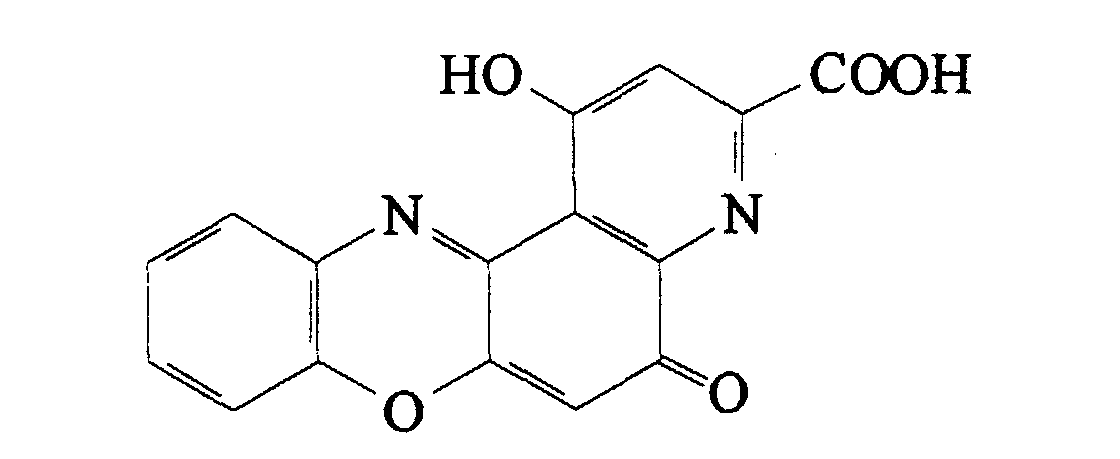 which is used in ophthalmology, usually in the form of the corresponding
sodium salt, for the treatment of cataract. The latter is an abnormal progressive
condition of the lens of the eye, characterised by increasing loss of
transparency. As it is known, cataracts are most often caused by degenerative
changes, often occurring after 50 years of age, while less often they may
be caused by trauma or by exposure to poisons. At the onset, vision is
blurred, then bright lights glare diffusely and distortion and double vision may
develop. Eventually, if the cataract is untreated, sight is totally lost. Besides
the surgical treatment, that becomes finally necessary and involves the excision
of the lens (with or without the surgical insertion of an intraocular lens),
cataracts may be treated by the administration of pirenoxine to the eye, normally
in the form of an ophthalmic solution, i.e. eye drops.
which is used in ophthalmology, usually in the form of the corresponding
sodium salt, for the treatment of cataract. The latter is an abnormal progressive
condition of the lens of the eye, characterised by increasing loss of
transparency. As it is known, cataracts are most often caused by degenerative
changes, often occurring after 50 years of age, while less often they may
be caused by trauma or by exposure to poisons. At the onset, vision is
blurred, then bright lights glare diffusely and distortion and double vision may
develop. Eventually, if the cataract is untreated, sight is totally lost. Besides
the surgical treatment, that becomes finally necessary and involves the excision
of the lens (with or without the surgical insertion of an intraocular lens),
cataracts may be treated by the administration of pirenoxine to the eye, normally
in the form of an ophthalmic solution, i.e. eye drops.
The activity of pirenoxine in inhibiting the formation of lens opacities
has been attributed to at least three different mechanisms of action: (a) inhibition
of the oxidising activity that quinone molecules exert on the proteins of
the lens, by binding to their -SH groups; (b) activation and normalisation of
the cationic pump function of the crystalline capsule; (c) inhibition of the sorbitol
synthesis and resulting reduction of the osmotic damage deriving from the
accumulation of this substance (Iwata S., J. Pharmac. Soc. Jap. 1964; 84:
435-440; Ikemoto F., Fukui S., Iwata S., In: Proc. 50th Congr. Pharmacol.
Soc. Jap., Kanto Region, 1974; Korte I., Hockwin O., Ohrloff C., Ophthalmic
Res. 1979; 11: 123-125).
More recently, some further pharmacological effects of pirenoxine
have been evidenced, i.e., (d) dose-dependent increase of the soluble proteins
and of the sulfur-containing amino acids, and (e) dose-dependent increase
of glutathione at the crystalline lens level (Drago F., D'Agata V., Marino
V., Marino A., Blasco G., Pharmacol. Res. 1995; 31: 325-329).
As a follow-up of the above studies on the biological activity of pirenoxine
it has been found, in accordance with the present invention, that
pirenoxine, besides being active in the treatment of cataracts, is also markedly
active in counteracting or reducing inflammation, specifically as a topical
anti-inflammatory agent suitable for ophthalmic use. Actually, it has been
shown experimentally that pirenoxine, when applied topically, in particular to
the eye, is active against inflammation at a level comparable with that of other
known anti-inflammatory agents, specifically non-steroidal anti-inflammatory
agents.
The main advantage that pirenoxine appears to possess with respect
to many known non-steroidal anti-inflammatory agents is that it does not appear
to show, when administered to the eye, the same typical side effects of
this group of active ingredients, i.e. pain and irritation of the conjunctiva. As a
matter of fact, pirenoxine shows no analogy with the group of non-steroidal
anti-inflammatory agents as far as its chemical structure is concerned, nor it
shows any analogy as concems its possible mechanism of action. The anti-inflammatory
activity of pirenoxine is very likely to be ascribed to an inhibitory
action on the oxidative catabolism of arachidonic acid, which leads to the
production of prostaglandins. An additional clinical advantage of pirenoxine
lies in the manifold action as an antioxidant and against protein denaturation
that this drug exerts on the lens.
Therefore, the present invention specifically provides the use of 1-hydroxy-5-oxo-5H-pyrido-[3,2-a]-phenoxazine-3-carboxylic
acid (pirenoxine)
or of a pharmaceutically acceptable salt thereof for the manufacture of a
medicament for the topical treatment of inflammatory conditions and, in particular,
for the treatment of inflammations of the ocular region. Specifically,
the indications for the proposed use include the treatment of inflammatory
conditions such as corneal and conjunctival inflammations, uveitis and ocular
oedema.
The ophthalmic preparations of the present invention preferably contain
the active ingredient, i.e. pirenoxine or a pharmaceutically applicable salt
thereof, in an amount from 0.0001% to 0.01% by weight, expressed as the
free acid form. More suitably, the said medicaments contain from 0.001% to
0.005% by weight of pirenoxine, expressed as the free acid form, an optimal
concentration being 0.001% by weight. Most suitably, said pirenoxine is in the
form of the corresponding sodium salt. When used as eye drops with 0.001%
by weight of active ingredient, the preparation according to the invention may
be administered, to obtain the desired anti-inflammatory effect, at a dosage of
one-two drops from two to three times a day, preferably two drops three times
a day. In general, the dosage and frequency of administration of the product
will depend of the seriousness of the condition to be treated and on the general
conditions of the patient.
The topical ophthalmic medicament containing pirenoxine or a salt
thereof may be, in general, in the form of an aqueous solution or suspension
for eye drops or in the form of an emulsion, an ointment, a gel or a cream.
Preferably, the product is administered in the form of an aqueous ophthalmic
solution. In view of the instability of the active ingredient, pirenoxine is normally
formulated, in the medicinal products already in use for the treatment of
cataracts, as a two-component preparation, wherein a first component comprises
lyophilised pirenoxine, in the sodium salt form, together with an ocularly
acceptable carrier, and the second component comprises an ocularly
acceptable aqueous vehicle or carrier. The two components are reconstituted
before use and the solution thus obtained may generally be kept at room
temperature for about two weeks without degradation.
In general, the compositions containing pirenoxine or a salt thereof
according to the invention may be formulated in accordance with the known
art, for example according to the teachings given in "Remington's Pharmaceutical
Sciences Handbook", Hack Publ. Co., U.S.A.. Usually, one or more
tonicity adjusting agents should be added , so as to give the solution a correct
value of osmolarity. Any one of the products currently employed in the art as
tonicity agents may be used, such as, for instance, sodium chloride, potassium
chloride, mannitol, dextrose, boric acid, propylene glycol. The preparation
may also comprise acids or bases as pH adjusting agents and/or buffers,
such as, e.g., the monosodium phosphate - disodium phosphate system, the
sodium borate - boric acid system or the sodium succinate - succinic acid
system. For good tolerability by the eye, the pH should be comprised between
4.5 and 8.5.
Further, the composition should also comprise preservatives and
antimicrobial agents, such as benzalkonium chloride, sodium merthiolate or
thimerosal, methyl-, ethyl- and propyl paraben, chlorobutanol, as well as
chelating or sequestering agents such as the edetates or EDTA. In the event
that the product is packaged in unit-dose containers the presence of preservatives
may be avoided, but when the product is in multiple dose containers,
e.g. eye drop bottles containing from 5 to 15 ml, the use of preservatives
is necessary.
In addition, the ophthalmic preparation may include further optional
ingredients, such as thickening agents, antioxidants, stabilisers, surface-active
agents, etc.. By way of example only, the composition of a commercial
product already in use for the treatment of cataracts is described below. The
formulation may be suitable also for use as ocular anti-inflammatory medicament,
possibly with a reduction of the concentration of active ingredient.
The dry powder component of the product has the following composition,
wherein the amounts are given for the reconstitution in a 7 ml solution:
| sodium pirenoxine | mg 0.376 |
| (corresponding to mg 0,350 of pirenoxine) | |
| taurine | mg 34.34 |
Taurine, which is employed in the formulation as an antioxidant, is
dissolved in deionised water, while sodium pirenoxine is dissolved in a separate
amount of deionised water. The two solutions are sterilised by filtration
and then mixed together, and subjected to the lyophilisation procedure.
The aqueous solvent component has the following composition:
| polyvinyl alcohol | mg 98 |
| succinic acid | mg 2.31 |
| sodium succinate · 6H2O | mg 89.215 |
| sodium chloride | mg 34.3 |
| benzalkonium chloride | mg 0.175 |
| sodium edetate | mg 0.89 |
| deionised water | q.s. to 7 ml |
Besides the ingredients that have already been mentioned in the
foregoing description, the above formulation contains PVA as thickening
agent. The pH of the solvent component is 6. The formulation is prepared by
first stirring and dissolving in water all of the ingredients but benzalkonium
chloride. After complete dissolution of all products benzalkonium chloride is
added while keeping stirring, and the mixture is sterilised by filtration.
The reconstituted product has a pH of 6-6.3.
In order to evaluate the performance of pirenoxine as an anti-inflammatory
agent, some experiments were carried out on animal models as
summarised below.
Male Wistar rats weighing about 200 g were used. After a period of
suitable stabling, oedema was induced in the animals by an injection of a
solution 0.5% by weight of carrageenin in the plantar zone of the right paw.
The animals had been divided into three groups, which were treated as follows:
The development of the inflammation was evaluated by means of a
plethysmograph after 20, 30, 60, 120 e 240 minutes from the induction of the
phlogosis. The test results are shown in the following table.
| Acute anti-inflammatory effect on the rat paw oedema | |||||
| Time from the carrageenin injection (hours) | |||||
| Experimental groups (No. of animals) | 20 | 30 | 60 | 120 | 240 |
| physiological solution (5) | 3.40 | 3.20 | 2.60 | 2.00 | 1.20 |
| pirenoxine (5) | 3.40 | 3.00 | 2.40 | 2.10 | 1.10 |
| diclofenac (5) | 3.00 | 2.60 | 1.80 | 1.60 | 0.80 |
| The above values are average values (S.E. omitted as it is lower than 0.1) of the paw volume expressed in mmHg. |
As is shown by the above data, pirenoxine has no significant protective
action against the carrageenin-induced inflammation in the rat paw
model.
Male New Zealand albino rabbits weighing about 2 kg were used.
After a period of suitable stabling, an aseptic phlogosis was induced in the
right eye of the animals by a sub-conjunctival injection of a solution 0.5% by
weight of formaldehyde. The animals had been divided into three groups,
which were treated as follows:
The treatment took place 10 minutes after the sub-conjunctival injection
of the inflammatory agent and was carried out for 15 days.
The development of the inflammation was studied by evaluating the
following parameters:
- conjunctival hyperaemia;
- conjunctival chemosis;
- corneal oedema;
- Tyndall effect;
- cellularity in the anterior chamber.
The above parameters were evaluated according to the following
scores: (0), absent; (1), light; (2), moderate; (3), serious.
Immediately after the sacrifice, some samples of aqueous were taken
by means of heparinised syringes. A staining in Wright-Giemsa was carried
out and then a differential leukocytes count under microscope (magnification
400x). The number of red and white series cells in the aqueous was determined
with the haemocytometric method. The test results are shown in the
following table.
| Anti-inflammatory effect on the formaldehyde-induced ocular phlogosis in rabbit | ||||
| Experimental groups (No. of animals) | hyperaemia | chemosis | corneal oedema | cellularity |
| physiological solution (5) | 1.00 | 0.20 | 1.00 | 1.00 |
| pirenoxine (5) | 0.40 | 0.20 | 0.40 | 0.40 |
| diclofenac (5) | 0.40 | 0.00 | 0.00 | 0.00 |
| The above values are average values (S.E. omitted as it is lower than 0.1). |
In the frame of the above test, a quantitative evaluation of the total
proteins of the aqueous and of the vitreous humour was also carried out, by
means of a phenolic reagent. The myeloperoxidase activity (i.e., a marker for
the contents of neutrophiles in the uveal tissue) was determined by measuring
the change of the absorbance at 460 nm of a mixture of tissue homogenate,
buffer, o-diansidine dihydrochloride and hydrogen peroxide. The prostaglandins
and leukotrienes contents were determined in the aqueous by radio-immunologic
method.
The data obtained in the above experimentation actually show an
anti-inflammatory activity of pirenoxine comparable with the activity of diclofenac.
The parameters that appeared to be more responsive to the action of
pirenoxine are hyperaemia, chemosis and the cellularity in the anterior chamber.
The above anti-inflammatory activity of pirenoxine was also confirmed
in a model of ocular phlogosis in rabbit induced by Nd:YAG laser. The laser
treatment was carried out under general anaesthesia. The energy was administered
through a silica fibre of 600 µm diameter. Apart from the different
method of inducing inflammation, the scheme of the experimentation was the
same as in the previous test. The results are shown in the following table.
| Anti-inflammatory effect on the Nd:YAG laser-induced ocular phlogosis in rabbit | ||||
| Experimental groups (No. of animals) | hyperaemia | chemosis | corneal oedema | cellularity |
| physiological solution (5) | 1.00 | 0.20 | 1.00 | 0.40 |
| pirenoxine (5) | 0.40 | 0.20 | 0.00 | 0.40 |
| diclofenac (5) | 0.40 | 0.20 | 0.00 | 0.40 |
| The above values are average values (S.E. omitted as it is lower than 0.1). |
The present invention has been disclosed with particular reference to
some specific embodiments thereof, but it should be understood that modifications
and changes may be made by the persons skilled in the art without
departing from the scope of the invention as defined in the appended claims.
Claims (8)
- Use of 1-hydroxy-5-oxo-5H-pyrido-[3,2-a]-phenoxazine-3-carboxylic acid (pirenoxine) or of a pharmaceutically acceptable salt thereof for the manufacture of a medicament for the topical treatment of inflammatory conditions.
- Use according to claim 1, wherein said medicament is a topical ophthalmic medicament.
- Use according to claim 2, wherein the said medicament is indicated for the treatment of inflammatory conditions chosen from the group consisting of comeal and conjunctival inflammations, uveitis, ocular oedema.
- Use according to claims 2 or 3, wherein said medicament contains from 0.0001% to 0.01% by weight of pirenoxine, expressed as the free acid form.
- Use according to claim 4, wherein said medicament contains from 0.001% to 0.005% by weight of pirenoxine, expressed as the free acid form.
- Use according to any one of claims 2-5, wherein said pirenoxine is in the form of the corresponding sodium salt.
- Use according to any one of claims 2-6, wherein said topical ophthalmic medicament is in the form of an aqueous solution or suspension for eye drops, or in the form of an emulsion, an ointment, a gel or a cream.
- Use according to claim 7, wherein said aqueous solution is obtained by reconstitution of a two-component preparation, wherein a first component comprises lyophilised pirenoxine, in the sodium salt form, together with an ocularly acceptable carrier, and the second component comprises an ocularly acceptable aqueous vehicle or carrier.
Applications Claiming Priority (2)
| Application Number | Priority Date | Filing Date | Title |
|---|---|---|---|
| ITMI971341 | 1997-06-06 | ||
| IT97MI001341A IT1292103B1 (en) | 1997-06-06 | 1997-06-06 | TOPICAL PHARMACEUTICAL COMPOSITIONS CONTAINING PIRFENOXONE AND USE THEREOF IN THE TREATMENT OF INFLAMMATORY CONDITIONS |
Publications (1)
| Publication Number | Publication Date |
|---|---|
| EP0885612A1 true EP0885612A1 (en) | 1998-12-23 |
Family
ID=11377313
Family Applications (1)
| Application Number | Title | Priority Date | Filing Date |
|---|---|---|---|
| EP98830353A Withdrawn EP0885612A1 (en) | 1997-06-06 | 1998-06-05 | Pirenoxine for the topical treatment of inflammatory conditions |
Country Status (2)
| Country | Link |
|---|---|
| EP (1) | EP0885612A1 (en) |
| IT (1) | IT1292103B1 (en) |
Cited By (4)
| Publication number | Priority date | Publication date | Assignee | Title |
|---|---|---|---|---|
| WO2000054757A3 (en) * | 1999-03-17 | 2001-03-29 | Farmigea Spa | Use of pirenoxine for the protection of corneal tissues in photokeratectomy |
| WO2001046035A1 (en) * | 1999-12-20 | 2001-06-28 | Alcon Universal Ltd. | Container with two compartments and a mixing device |
| CN103211754A (en) * | 2012-01-19 | 2013-07-24 | 武汉诺安药业有限公司 | Production method of sterile stable pirenoxine sodium eye drops |
| ES2925732A1 (en) * | 2021-04-06 | 2022-10-19 | Presbycarrod Drops S L | ophthalmic composition |
-
1997
- 1997-06-06 IT IT97MI001341A patent/IT1292103B1/en active IP Right Grant
-
1998
- 1998-06-05 EP EP98830353A patent/EP0885612A1/en not_active Withdrawn
Non-Patent Citations (1)
| Title |
|---|
| DRAGO ET AL, PHARMACOL RES, vol. 31, 1995, pages 325 - 329, XP002080309 * |
Cited By (5)
| Publication number | Priority date | Publication date | Assignee | Title |
|---|---|---|---|---|
| WO2000054757A3 (en) * | 1999-03-17 | 2001-03-29 | Farmigea Spa | Use of pirenoxine for the protection of corneal tissues in photokeratectomy |
| US6610686B1 (en) * | 1999-03-17 | 2003-08-26 | Ausimont S.P.A. | Use of pirenoxine for the protection of corneal tissues in photokeractomy |
| WO2001046035A1 (en) * | 1999-12-20 | 2001-06-28 | Alcon Universal Ltd. | Container with two compartments and a mixing device |
| CN103211754A (en) * | 2012-01-19 | 2013-07-24 | 武汉诺安药业有限公司 | Production method of sterile stable pirenoxine sodium eye drops |
| ES2925732A1 (en) * | 2021-04-06 | 2022-10-19 | Presbycarrod Drops S L | ophthalmic composition |
Also Published As
| Publication number | Publication date |
|---|---|
| IT1292103B1 (en) | 1999-01-25 |
| ITMI971341A1 (en) | 1998-12-06 |
| ITMI971341A0 (en) | 1997-06-06 |
Similar Documents
| Publication | Publication Date | Title |
|---|---|---|
| AU609932B2 (en) | Locally administrable 2-amino-3-benzoyl phenylacetic acid derivatives as therapeutic compositions for inflammatory disease | |
| RU2130774C1 (en) | Pharmaceutical composition for topical use for treatment of eye and nose allergic diseases | |
| RU2102069C1 (en) | Pharmaceutical composition for glaucoma treatment | |
| NL192561C (en) | Ophthalmic preparations containing certain phenylacetic acid compounds. | |
| US8691874B2 (en) | Treatment of ophthalmic disorders using urea | |
| KR19990028235A (en) | Pharmaceutical composition containing albumin as active ingredient | |
| JPWO1993024121A1 (en) | Glaucoma treatment | |
| US9901580B2 (en) | Methods of eye treatment using therapeutic compositions containing dipyridamole | |
| MXPA03011613A (en) | Ophthalmic composition containing n-acetylcysteine for the treat ment of dry-eye syndrome. | |
| EP0410749B1 (en) | Anthocyanidins for the treatment of ophthalmic diseases | |
| RU2434633C2 (en) | Pharmaceutical preparative forms of latrunculin | |
| EP0885612A1 (en) | Pirenoxine for the topical treatment of inflammatory conditions | |
| US20100113456A1 (en) | Therapeutic agent for corneal disease | |
| KR100193406B1 (en) | Composition for the prevention and treatment of myopia | |
| HUP0003803A2 (en) | Use of flunarizine for producing pharmaceutical compositions useful for the topical treating of glaucoma | |
| MXPA04007802A (en) | Treatment of ophthalmic disorders using urea and urea derivatives. | |
| JPH10500130A (en) | Pharmaceutical composition for treating glaucoma containing terazosin | |
| RU2733392C1 (en) | Combined ophthalmic agent | |
| JP2741285B2 (en) | Glaucoma treatment | |
| EP0456988B1 (en) | Use of naproxen as mydriatic agent | |
| JPH04327540A (en) | Calcitonin-containing medicine |
Legal Events
| Date | Code | Title | Description |
|---|---|---|---|
| PUAI | Public reference made under article 153(3) epc to a published international application that has entered the european phase |
Free format text: ORIGINAL CODE: 0009012 |
|
| AK | Designated contracting states |
Kind code of ref document: A1 Designated state(s): DE ES FR GB |
|
| AX | Request for extension of the european patent |
Free format text: AL;LT;LV;MK;RO;SI |
|
| 17P | Request for examination filed |
Effective date: 19990604 |
|
| AKX | Designation fees paid |
Free format text: DE ES FR GB |
|
| RAP1 | Party data changed (applicant data changed or rights of an application transferred) |
Owner name: FARMIGEA S.P.A. |
|
| STAA | Information on the status of an ep patent application or granted ep patent |
Free format text: STATUS: THE APPLICATION IS DEEMED TO BE WITHDRAWN |
|
| 18D | Application deemed to be withdrawn |
Effective date: 20010103 |