EP0882012B1 - Method for synthesis of an aromatic derivative substituted by a halogen atom other than fluorine and by a cyano group - Google Patents
Method for synthesis of an aromatic derivative substituted by a halogen atom other than fluorine and by a cyano group Download PDFInfo
- Publication number
- EP0882012B1 EP0882012B1 EP96944100A EP96944100A EP0882012B1 EP 0882012 B1 EP0882012 B1 EP 0882012B1 EP 96944100 A EP96944100 A EP 96944100A EP 96944100 A EP96944100 A EP 96944100A EP 0882012 B1 EP0882012 B1 EP 0882012B1
- Authority
- EP
- European Patent Office
- Prior art keywords
- reaction
- fluorine
- formula
- compound
- fluoride
- Prior art date
- Legal status (The legal status is an assumption and is not a legal conclusion. Google has not performed a legal analysis and makes no representation as to the accuracy of the status listed.)
- Expired - Lifetime
Links
- 238000000034 method Methods 0.000 title claims abstract description 38
- 125000003118 aryl group Chemical group 0.000 title claims abstract description 34
- 230000015572 biosynthetic process Effects 0.000 title claims abstract description 10
- 238000003786 synthesis reaction Methods 0.000 title claims abstract description 9
- 229910052731 fluorine Inorganic materials 0.000 title claims description 29
- 239000011737 fluorine Substances 0.000 title claims description 22
- PXGOKWXKJXAPGV-UHFFFAOYSA-N Fluorine Chemical compound FF PXGOKWXKJXAPGV-UHFFFAOYSA-N 0.000 title claims 3
- 125000004093 cyano group Chemical group *C#N 0.000 title description 6
- 125000005843 halogen group Chemical group 0.000 title description 5
- 229910052801 chlorine Inorganic materials 0.000 claims abstract description 14
- 229910052736 halogen Inorganic materials 0.000 claims abstract description 14
- 150000002367 halogens Chemical class 0.000 claims abstract description 12
- 150000002825 nitriles Chemical group 0.000 claims abstract description 9
- 229910052794 bromium Inorganic materials 0.000 claims abstract description 6
- 238000006243 chemical reaction Methods 0.000 claims description 55
- 239000003153 chemical reaction reagent Substances 0.000 claims description 33
- 150000001875 compounds Chemical class 0.000 claims description 28
- 125000001424 substituent group Chemical group 0.000 claims description 17
- 125000001153 fluoro group Chemical group F* 0.000 claims description 15
- XFXPMWWXUTWYJX-UHFFFAOYSA-N Cyanide Chemical group N#[C-] XFXPMWWXUTWYJX-UHFFFAOYSA-N 0.000 claims description 12
- KRHYYFGTRYWZRS-UHFFFAOYSA-M Fluoride anion Chemical compound [F-] KRHYYFGTRYWZRS-UHFFFAOYSA-M 0.000 claims description 12
- 239000007795 chemical reaction product Substances 0.000 claims description 12
- 239000011541 reaction mixture Substances 0.000 claims description 11
- 125000004429 atom Chemical group 0.000 claims description 10
- 239000000460 chlorine Substances 0.000 claims description 9
- RYGMFSIKBFXOCR-UHFFFAOYSA-N Copper Chemical compound [Cu] RYGMFSIKBFXOCR-UHFFFAOYSA-N 0.000 claims description 8
- 229910052802 copper Inorganic materials 0.000 claims description 8
- 239000010949 copper Substances 0.000 claims description 8
- 239000012429 reaction media Substances 0.000 claims description 8
- 229910052500 inorganic mineral Inorganic materials 0.000 claims description 6
- 239000011707 mineral Substances 0.000 claims description 6
- 125000001183 hydrocarbyl group Chemical group 0.000 claims description 5
- 230000001939 inductive effect Effects 0.000 claims description 5
- 125000005842 heteroatom Chemical group 0.000 claims description 4
- 229910052740 iodine Inorganic materials 0.000 claims description 4
- 125000001453 quaternary ammonium group Chemical group 0.000 claims description 3
- OKTJSMMVPCPJKN-UHFFFAOYSA-N Carbon Chemical group [C] OKTJSMMVPCPJKN-UHFFFAOYSA-N 0.000 claims description 2
- ZAMOUSCENKQFHK-UHFFFAOYSA-N Chlorine atom Chemical compound [Cl] ZAMOUSCENKQFHK-UHFFFAOYSA-N 0.000 claims description 2
- 229910052751 metal Inorganic materials 0.000 claims description 2
- 239000002184 metal Substances 0.000 claims description 2
- 229910001512 metal fluoride Inorganic materials 0.000 claims description 2
- 150000002739 metals Chemical class 0.000 claims 1
- -1 halogen substituted aryl nitrile Chemical class 0.000 abstract description 8
- 150000002222 fluorine compounds Chemical group 0.000 abstract description 5
- 239000000376 reactant Substances 0.000 abstract 2
- 239000000047 product Substances 0.000 description 27
- 239000002904 solvent Substances 0.000 description 18
- 239000000203 mixture Substances 0.000 description 14
- IAZDPXIOMUYVGZ-UHFFFAOYSA-N Dimethylsulphoxide Chemical compound CS(C)=O IAZDPXIOMUYVGZ-UHFFFAOYSA-N 0.000 description 12
- YCKRFDGAMUMZLT-UHFFFAOYSA-N Fluorine atom Chemical compound [F] YCKRFDGAMUMZLT-UHFFFAOYSA-N 0.000 description 12
- 230000009466 transformation Effects 0.000 description 12
- 230000008569 process Effects 0.000 description 11
- 238000006467 substitution reaction Methods 0.000 description 10
- ZMXDDKWLCZADIW-UHFFFAOYSA-N N,N-Dimethylformamide Chemical compound CN(C)C=O ZMXDDKWLCZADIW-UHFFFAOYSA-N 0.000 description 9
- 150000001768 cations Chemical class 0.000 description 8
- 238000000926 separation method Methods 0.000 description 8
- NNFCIKHAZHQZJG-UHFFFAOYSA-N potassium cyanide Chemical compound [K+].N#[C-] NNFCIKHAZHQZJG-UHFFFAOYSA-N 0.000 description 7
- 239000007787 solid Substances 0.000 description 7
- WEVYAHXRMPXWCK-UHFFFAOYSA-N Acetonitrile Chemical compound CC#N WEVYAHXRMPXWCK-UHFFFAOYSA-N 0.000 description 6
- JFDZBHWFFUWGJE-UHFFFAOYSA-N benzonitrile Chemical compound N#CC1=CC=CC=C1 JFDZBHWFFUWGJE-UHFFFAOYSA-N 0.000 description 6
- 238000004821 distillation Methods 0.000 description 6
- 230000000694 effects Effects 0.000 description 6
- 239000012071 phase Substances 0.000 description 6
- NROKBHXJSPEDAR-UHFFFAOYSA-M potassium fluoride Chemical compound [F-].[K+] NROKBHXJSPEDAR-UHFFFAOYSA-M 0.000 description 6
- HXJUTPCZVOIRIF-UHFFFAOYSA-N sulfolane Chemical compound O=S1(=O)CCCC1 HXJUTPCZVOIRIF-UHFFFAOYSA-N 0.000 description 6
- 238000002604 ultrasonography Methods 0.000 description 6
- 125000001309 chloro group Chemical group Cl* 0.000 description 5
- 125000006575 electron-withdrawing group Chemical group 0.000 description 5
- 235000010755 mineral Nutrition 0.000 description 5
- 150000003839 salts Chemical class 0.000 description 5
- SECXISVLQFMRJM-UHFFFAOYSA-N N-Methylpyrrolidone Chemical compound CN1CCCC1=O SECXISVLQFMRJM-UHFFFAOYSA-N 0.000 description 4
- ZLMJMSJWJFRBEC-UHFFFAOYSA-N Potassium Chemical compound [K] ZLMJMSJWJFRBEC-UHFFFAOYSA-N 0.000 description 4
- 150000001491 aromatic compounds Chemical class 0.000 description 4
- 229910052799 carbon Inorganic materials 0.000 description 4
- 238000004519 manufacturing process Methods 0.000 description 4
- SYSQUGFVNFXIIT-UHFFFAOYSA-N n-[4-(1,3-benzoxazol-2-yl)phenyl]-4-nitrobenzenesulfonamide Chemical class C1=CC([N+](=O)[O-])=CC=C1S(=O)(=O)NC1=CC=C(C=2OC3=CC=CC=C3N=2)C=C1 SYSQUGFVNFXIIT-UHFFFAOYSA-N 0.000 description 4
- 229910052700 potassium Inorganic materials 0.000 description 4
- 239000011591 potassium Substances 0.000 description 4
- 229910052723 transition metal Inorganic materials 0.000 description 4
- XILPLWOGHPSJBK-UHFFFAOYSA-N 1,2-dichloro-4-(trifluoromethyl)benzene Chemical compound FC(F)(F)C1=CC=C(Cl)C(Cl)=C1 XILPLWOGHPSJBK-UHFFFAOYSA-N 0.000 description 3
- 0 CC(C*(C)CC1)C1N Chemical compound CC(C*(C)CC1)C1N 0.000 description 3
- 238000005609 Rosenmund-von Braun cyanation reaction Methods 0.000 description 3
- 238000013019 agitation Methods 0.000 description 3
- 239000003513 alkali Substances 0.000 description 3
- 239000002585 base Substances 0.000 description 3
- KXZJHVJKXJLBKO-UHFFFAOYSA-N chembl1408157 Chemical compound N=1C2=CC=CC=C2C(C(=O)O)=CC=1C1=CC=C(O)C=C1 KXZJHVJKXJLBKO-UHFFFAOYSA-N 0.000 description 3
- 239000003795 chemical substances by application Substances 0.000 description 3
- 238000010438 heat treatment Methods 0.000 description 3
- 229910052739 hydrogen Inorganic materials 0.000 description 3
- 239000001257 hydrogen Substances 0.000 description 3
- 125000004435 hydrogen atom Chemical group [H]* 0.000 description 3
- 239000011698 potassium fluoride Substances 0.000 description 3
- 235000003270 potassium fluoride Nutrition 0.000 description 3
- 239000000758 substrate Substances 0.000 description 3
- 150000003624 transition metals Chemical class 0.000 description 3
- GEHMLBFNZKJDQM-UHFFFAOYSA-N 2-chloro-4-(trifluoromethyl)benzonitrile Chemical compound FC(F)(F)C1=CC=C(C#N)C(Cl)=C1 GEHMLBFNZKJDQM-UHFFFAOYSA-N 0.000 description 2
- IJGRMHOSHXDMSA-UHFFFAOYSA-N Atomic nitrogen Chemical compound N#N IJGRMHOSHXDMSA-UHFFFAOYSA-N 0.000 description 2
- 239000004215 Carbon black (E152) Substances 0.000 description 2
- UFHFLCQGNIYNRP-UHFFFAOYSA-N Hydrogen Chemical compound [H][H] UFHFLCQGNIYNRP-UHFFFAOYSA-N 0.000 description 2
- DGAQECJNVWCQMB-PUAWFVPOSA-M Ilexoside XXIX Chemical compound C[C@@H]1CC[C@@]2(CC[C@@]3(C(=CC[C@H]4[C@]3(CC[C@@H]5[C@@]4(CC[C@@H](C5(C)C)OS(=O)(=O)[O-])C)C)[C@@H]2[C@]1(C)O)C)C(=O)O[C@H]6[C@@H]([C@H]([C@@H]([C@H](O6)CO)O)O)O.[Na+] DGAQECJNVWCQMB-PUAWFVPOSA-M 0.000 description 2
- FXHOOIRPVKKKFG-UHFFFAOYSA-N N,N-Dimethylacetamide Chemical compound CN(C)C(C)=O FXHOOIRPVKKKFG-UHFFFAOYSA-N 0.000 description 2
- JUJWROOIHBZHMG-UHFFFAOYSA-N Pyridine Chemical compound C1=CC=NC=C1 JUJWROOIHBZHMG-UHFFFAOYSA-N 0.000 description 2
- SMWDFEZZVXVKRB-UHFFFAOYSA-N Quinoline Chemical compound N1=CC=CC2=CC=CC=C21 SMWDFEZZVXVKRB-UHFFFAOYSA-N 0.000 description 2
- 125000000217 alkyl group Chemical group 0.000 description 2
- VMPVEPPRYRXYNP-UHFFFAOYSA-I antimony(5+);pentachloride Chemical compound Cl[Sb](Cl)(Cl)(Cl)Cl VMPVEPPRYRXYNP-UHFFFAOYSA-I 0.000 description 2
- 239000006227 byproduct Substances 0.000 description 2
- 150000001721 carbon Chemical group 0.000 description 2
- 125000004432 carbon atom Chemical group C* 0.000 description 2
- 230000005595 deprotonation Effects 0.000 description 2
- 238000010537 deprotonation reaction Methods 0.000 description 2
- 238000001914 filtration Methods 0.000 description 2
- 238000004508 fractional distillation Methods 0.000 description 2
- 150000004820 halides Chemical class 0.000 description 2
- 229930195733 hydrocarbon Natural products 0.000 description 2
- 238000002156 mixing Methods 0.000 description 2
- 150000002894 organic compounds Chemical class 0.000 description 2
- 238000012958 reprocessing Methods 0.000 description 2
- 229910052708 sodium Inorganic materials 0.000 description 2
- 239000011734 sodium Substances 0.000 description 2
- 239000007790 solid phase Substances 0.000 description 2
- HHVIBTZHLRERCL-UHFFFAOYSA-N sulfonyldimethane Chemical compound CS(C)(=O)=O HHVIBTZHLRERCL-UHFFFAOYSA-N 0.000 description 2
- OCJBOOLMMGQPQU-UHFFFAOYSA-N 1,4-dichlorobenzene Chemical compound ClC1=CC=C(Cl)C=C1 OCJBOOLMMGQPQU-UHFFFAOYSA-N 0.000 description 1
- UHHZGIHGBLCIJM-UHFFFAOYSA-N 2-chloro-4-fluoro-1-(trifluoromethyl)benzene Chemical compound FC1=CC=C(C(F)(F)F)C(Cl)=C1 UHHZGIHGBLCIJM-UHFFFAOYSA-N 0.000 description 1
- DFPYRBFQHBGIKI-UHFFFAOYSA-N 2-chloro-6-(trifluoromethyl)benzonitrile Chemical class FC(F)(F)C1=CC=CC(Cl)=C1C#N DFPYRBFQHBGIKI-UHFFFAOYSA-N 0.000 description 1
- DDFHBQSCUXNBSA-UHFFFAOYSA-N 5-(5-carboxythiophen-2-yl)thiophene-2-carboxylic acid Chemical compound S1C(C(=O)O)=CC=C1C1=CC=C(C(O)=O)S1 DDFHBQSCUXNBSA-UHFFFAOYSA-N 0.000 description 1
- QGZKDVFQNNGYKY-UHFFFAOYSA-O Ammonium Chemical compound [NH4+] QGZKDVFQNNGYKY-UHFFFAOYSA-O 0.000 description 1
- OYPRJOBELJOOCE-UHFFFAOYSA-N Calcium Chemical compound [Ca] OYPRJOBELJOOCE-UHFFFAOYSA-N 0.000 description 1
- UXVMQQNJUSDDNG-UHFFFAOYSA-L Calcium chloride Chemical compound [Cl-].[Cl-].[Ca+2] UXVMQQNJUSDDNG-UHFFFAOYSA-L 0.000 description 1
- JPVYNHNXODAKFH-UHFFFAOYSA-N Cu2+ Chemical compound [Cu+2] JPVYNHNXODAKFH-UHFFFAOYSA-N 0.000 description 1
- FYYHWMGAXLPEAU-UHFFFAOYSA-N Magnesium Chemical compound [Mg] FYYHWMGAXLPEAU-UHFFFAOYSA-N 0.000 description 1
- OAICVXFJPJFONN-UHFFFAOYSA-N Phosphorus Chemical compound [P] OAICVXFJPJFONN-UHFFFAOYSA-N 0.000 description 1
- 230000009471 action Effects 0.000 description 1
- 229910052783 alkali metal Inorganic materials 0.000 description 1
- 150000001340 alkali metals Chemical class 0.000 description 1
- 125000003342 alkenyl group Chemical group 0.000 description 1
- 125000004450 alkenylene group Chemical group 0.000 description 1
- 125000000304 alkynyl group Chemical group 0.000 description 1
- 125000004419 alkynylene group Chemical group 0.000 description 1
- ICAIHGOJRDCMHE-UHFFFAOYSA-O ammonium cyanide Chemical class [NH4+].N#[C-] ICAIHGOJRDCMHE-UHFFFAOYSA-O 0.000 description 1
- 239000000010 aprotic solvent Substances 0.000 description 1
- 150000001501 aryl fluorides Chemical class 0.000 description 1
- 239000012298 atmosphere Substances 0.000 description 1
- QVGXLLKOCUKJST-UHFFFAOYSA-N atomic oxygen Chemical compound [O] QVGXLLKOCUKJST-UHFFFAOYSA-N 0.000 description 1
- 239000005667 attractant Substances 0.000 description 1
- 230000009286 beneficial effect Effects 0.000 description 1
- 150000001555 benzenes Chemical class 0.000 description 1
- 229910052792 caesium Inorganic materials 0.000 description 1
- TVFDJXOCXUVLDH-UHFFFAOYSA-N caesium atom Chemical compound [Cs] TVFDJXOCXUVLDH-UHFFFAOYSA-N 0.000 description 1
- 239000011575 calcium Substances 0.000 description 1
- 229910052791 calcium Inorganic materials 0.000 description 1
- 239000001110 calcium chloride Substances 0.000 description 1
- 229910001628 calcium chloride Inorganic materials 0.000 description 1
- ZQULWKDLLXZZSP-UHFFFAOYSA-N calcium cyanide Chemical compound [Ca+2].N#[C-].N#[C-] ZQULWKDLLXZZSP-UHFFFAOYSA-N 0.000 description 1
- 125000002915 carbonyl group Chemical group [*:2]C([*:1])=O 0.000 description 1
- 125000002843 carboxylic acid group Chemical group 0.000 description 1
- 230000008859 change Effects 0.000 description 1
- 239000007810 chemical reaction solvent Substances 0.000 description 1
- 150000001805 chlorine compounds Chemical class 0.000 description 1
- 150000001879 copper Chemical class 0.000 description 1
- 229910001431 copper ion Inorganic materials 0.000 description 1
- 238000005260 corrosion Methods 0.000 description 1
- 230000007797 corrosion Effects 0.000 description 1
- 150000003983 crown ethers Chemical class 0.000 description 1
- 238000010586 diagram Methods 0.000 description 1
- 229940117389 dichlorobenzene Drugs 0.000 description 1
- 238000000295 emission spectrum Methods 0.000 description 1
- 239000012467 final product Substances 0.000 description 1
- 238000005194 fractionation Methods 0.000 description 1
- 239000011521 glass Substances 0.000 description 1
- 150000005171 halobenzenes Chemical class 0.000 description 1
- 239000004009 herbicide Substances 0.000 description 1
- 230000006872 improvement Effects 0.000 description 1
- 238000009434 installation Methods 0.000 description 1
- 239000013067 intermediate product Substances 0.000 description 1
- 125000000468 ketone group Chemical group 0.000 description 1
- 239000007791 liquid phase Substances 0.000 description 1
- 239000011777 magnesium Substances 0.000 description 1
- 229910052749 magnesium Inorganic materials 0.000 description 1
- 238000010907 mechanical stirring Methods 0.000 description 1
- 150000002790 naphthalenes Chemical class 0.000 description 1
- 125000000449 nitro group Chemical group [O-][N+](*)=O 0.000 description 1
- 229910052757 nitrogen Inorganic materials 0.000 description 1
- 229910052760 oxygen Inorganic materials 0.000 description 1
- 239000001301 oxygen Substances 0.000 description 1
- XYFCBTPGUUZFHI-UHFFFAOYSA-O phosphonium Chemical compound [PH4+] XYFCBTPGUUZFHI-UHFFFAOYSA-O 0.000 description 1
- 229910052698 phosphorus Inorganic materials 0.000 description 1
- 239000011574 phosphorus Substances 0.000 description 1
- 239000003880 polar aprotic solvent Substances 0.000 description 1
- 239000002798 polar solvent Substances 0.000 description 1
- 125000003367 polycyclic group Chemical group 0.000 description 1
- 238000002360 preparation method Methods 0.000 description 1
- UMJSCPRVCHMLSP-UHFFFAOYSA-N pyridine Natural products COC1=CC=CN=C1 UMJSCPRVCHMLSP-UHFFFAOYSA-N 0.000 description 1
- 230000035484 reaction time Effects 0.000 description 1
- 238000004064 recycling Methods 0.000 description 1
- 229910052701 rubidium Inorganic materials 0.000 description 1
- IGLNJRXAVVLDKE-UHFFFAOYSA-N rubidium atom Chemical compound [Rb] IGLNJRXAVVLDKE-UHFFFAOYSA-N 0.000 description 1
- MNWBNISUBARLIT-UHFFFAOYSA-N sodium cyanide Chemical compound [Na+].N#[C-] MNWBNISUBARLIT-UHFFFAOYSA-N 0.000 description 1
- 239000013589 supplement Substances 0.000 description 1
- 239000000725 suspension Substances 0.000 description 1
- 125000005207 tetraalkylammonium group Chemical group 0.000 description 1
- JRMUNVKIHCOMHV-UHFFFAOYSA-M tetrabutylammonium bromide Chemical compound [Br-].CCCC[N+](CCCC)(CCCC)CCCC JRMUNVKIHCOMHV-UHFFFAOYSA-M 0.000 description 1
- RKHXQBLJXBGEKF-UHFFFAOYSA-M tetrabutylphosphanium;bromide Chemical compound [Br-].CCCC[P+](CCCC)(CCCC)CCCC RKHXQBLJXBGEKF-UHFFFAOYSA-M 0.000 description 1
- QEMXHQIAXOOASZ-UHFFFAOYSA-N tetramethylammonium Chemical compound C[N+](C)(C)C QEMXHQIAXOOASZ-UHFFFAOYSA-N 0.000 description 1
- USFPINLPPFWTJW-UHFFFAOYSA-N tetraphenylphosphonium Chemical compound C1=CC=CC=C1[P+](C=1C=CC=CC=1)(C=1C=CC=CC=1)C1=CC=CC=C1 USFPINLPPFWTJW-UHFFFAOYSA-N 0.000 description 1
- 238000000844 transformation Methods 0.000 description 1
- XLYOFNOQVPJJNP-UHFFFAOYSA-N water Substances O XLYOFNOQVPJJNP-UHFFFAOYSA-N 0.000 description 1
Classifications
-
- C—CHEMISTRY; METALLURGY
- C07—ORGANIC CHEMISTRY
- C07C—ACYCLIC OR CARBOCYCLIC COMPOUNDS
- C07C253/00—Preparation of carboxylic acid nitriles
- C07C253/14—Preparation of carboxylic acid nitriles by reaction of cyanides with halogen-containing compounds with replacement of halogen atoms by cyano groups
Definitions
- the present invention relates to a method of synthesis of an aromatic compound with a nucleus aromatic comprising at least one substituted C-C chain on a carbon atom by a cyano group, and on the other carbon atom by another halogen atom than fluorine.
- Cyanidation of aromatic compounds halogenated is known, the most widely used reaction being the reaction of Rosenmund von Braun, who realizes the cyanidation of chlorinated or brominated aromatics in the presence of a stoichiometric amount of copper ions.
- Rosenmund von Braun who realizes the cyanidation of chlorinated or brominated aromatics in the presence of a stoichiometric amount of copper ions.
- the reaction to be carried out is a monocyanidation of the corresponding ortho-dihalogenated aromatic.
- the grafting of a nitrile function in ortho of a halogen tends to favor a second substitution to lead to a dicyano, which is in against the yield of the reaction.
- the Rosenmund von Braun reaction catalyzed with copper is not regioselective with respect to a particular halogen atom.
- regioselective substitution of a halogen is often observed when the latter is ortho to an electro-attractant substituent with a preponderant mesomeric effect, such as NO 2 .
- the orientation of the substitution is not very clear, much less than for nuclei depleted by an electroattractive function by mesomeric effect. , and regioselectivity issues may arise.
- the object of the present invention is to obviate to these drawbacks and to propose a method of synthesis of such an aromatic derivative disubstituted by a group cyano and a halogen atom arranged in an ortho position, which uses simple and inexpensive reagents, does not require an effluent treatment operation and which leads to the desired product with a good yield and good selectivity.
- EP 608,713 describes the substitution of a fluorine atom for a ring aromatic depleted of electrons in ortho compared to a second atom of fluorine by a chlorine atom.
- FR 2 353 516 describes the substitution of a chlorine atom for a aromatic cycle depleted in para electrons of a nitro group by an atom fluorine, in the presence of potassium fluoride.
- step (a) leads to a majority isomer of formula (III) and optionally to a minority isomer of formula (IIIb), by monosubstitution with a fluorine atom.
- a fluorine atom a fluorine atom
- reaction product of step (a) can understand however a mixture of isomers whose separation is technically very difficult and expensive to be implemented on an industrial scale.
- step (b) shows a very high chemoselectivity which enhances the selectivity of the total synthetic sequence in favor of the cyanidation product of the isomer of formula (III), and which disadvantages the cyanidation of the isomer of formula (IIIb). So step (b) can be conducted on the reaction mixture of step (a) without separation of isomers.
- each X represents a chlorine atom.
- minus an X is a chlorine atom.
- the aromatic nucleus advantageously comprises 6 chains, and is in particular a benzene nucleus. It can also include at least one heteroatom.
- the possible substituents of the aromatic nucleus can be very varied in nature, for example bearers of useful functions later in the sequence synthetic. It can also be alkyl groups, alkenyl, alkynyl or aryl, optionally substituted, or alkenylene or alkynylene groups linked to aromatic nucleus to form a polycyclic system comprising at least one aromatic nucleus. We can cite as an example of such a nucleus a naphthalene nucleus.
- the aromatic nucleus of the compound of formula (II) is depleted in electrons due to the presence of two substituents X. It can also be depleted in electrons by an electron-withdrawing function forming a chain of said nucleus or by the presence of at least one substituent carrying an electron-withdrawing function grafted on an atom of said nucleus, or by these two causes at a time.
- formula (II) may denote an aromatic nucleus comprising at least one heteroatom which depletes the aromatic nucleus in electrons, such as in particular nitrogen or phosphorus.
- aromatic rings may cite pyridine or quinoline.
- Depletion of electrons can also result from the substitution of said nucleus by at least one electron-withdrawing group.
- Such an electron withdrawing substituent can be chosen from attracting groups by effect inductive or by mesomeric effect, as defined in the reference book in Organic Chemistry “Advanced Organic Chemistry “by M.J. MARCH, Sème Treatment, Ed. WILLEY, 1985, in particular pages 17 and 238.
- Suitable electron-withdrawing groups mention may be made of -NO 2 groups; -CN; -CF 2 R where R denotes a fluorine atom or a hydrocarbon radical; -COOR 'where R' denotes a hydrocarbon radical; CHO; - Cl; or -Br.
- the process of the invention is particularly applicable advantageously to compounds of formula (II) whose aromatic nucleus depleted in electrons carries a substituting electroattractor with predominant inductive effect, these compounds giving poor results in the Rosenmund von Braun type direct reaction.
- such a substituent is chosen from the groups -CN and -CF 2 R where R is chosen from a fluorine atom and hydrocarbon groups, advantageously C 1-20 , preferably electron-withdrawing groups themselves.
- R is chosen from a fluorine atom and hydrocarbon groups, advantageously C 1-20 , preferably electron-withdrawing groups themselves.
- hydrocarbon groups advantageously do not contain a basic hydrogen atom which can lead to deprotonation.
- a substituent of formula -CY 2 R, where Y identical or different are chosen from Cl and F, and R has the preceding meaning or is a chlorine atom can also be used but is capable of reacting in step (a) to lead to a chlorine / fluorine exchange.
- said aromatic nucleus depleted in electrons carries only one electron-withdrawing substituent.
- this substituent is in the ortho or para position relative to the atom X which is intended to be substituted initially by a fluorine atom in step (a) for form the majority product of formula (III).
- the presence of such an electron-withdrawing group in ortho or para of this atom X has the effect of increasing the selectivity of the substitution reaction of step (a) so that the product of formula (III) is largely in the majority. report to the product of formula (IIIb) according to the following reactions:
- said aromatic nucleus is an aryl
- its electron density is at most similar that of a halobenzene, in particular a dichlorobenzene.
- the sum of the Hammett constants of the said substituents aromatic nucleus is between 0.4 and 1, advantageously from 0.5 to 0.8.
- each substituent other than X has a Hammett constant understood between 0.2 and 0.7.
- the process of the invention can be implemented with 3,4-dichloro trifluoromethylbenzene to synthesize 2-chloro 4-trifluoromethyl benzonitrile, with good yield and high selectivity, according to the diagram below. after.
- the process of the invention essentially comprises two step.
- the compound of formula (II) is reacted with an exchange reagent halogen / fluorine.
- This reagent is advantageously a mineral fluoride, preferably chosen from fluorides of alkali metal, in particular among the fluorides of sodium, potassium, rubidium and cesium.
- the potassium fluoride is generally preferred for economic reasons, although metal fluorides alkalines with an atomic mass greater than that of potassium significantly improve the yield of the reaction.
- any cation with properties equivalent to that of an alkaline cation such as example a quaternary ammonium cation.
- This reaction can be done by heating reaction partners at relatively high temperatures high, usually 200 to 280 ° C, especially at around 250 ° C, in a suitable solvent.
- reaction can be carried out at lower temperature, with significant improvement yield, subjecting the reaction medium to the action of ultrasound.
- the reaction can be conducted at a temperature of 80 to 280 ° C depending on the conditions chosen.
- the preferred conditions include an ultrasonic power emitted directly by the wall ensuring this emission at least equal to 20 W / cm 2 , advantageously 50 W / cm 2 , more advantageously 100 W / cm 2 , preferably 200 W / cm 2 .
- the usable frequencies are those of commercial devices, i.e. the frequency of ultrasound is advantageously between 10 and 100 KHz, preferably between 15 and 50. Certain frequencies give very significantly better results; they correspond to those of resonance of the medium in experience conditions and are in general covered by the relatively broad emission spectrum commercial devices.
- ultrasound allows carry out the reaction at relatively low temperatures high, between 80 and 200 ° C, preferably 100 to 150 ° C.
- the reaction takes place from preferably in a dipolar aprotic solvent.
- the relative dielectric constant ⁇ of said solvent is advantageously at least equal to 10, preferably ⁇ is less than or equal to 100 and greater than or equal to 25.
- Particularly preferred are solvents whose index donor D expressed by the change in enthalpy ( ⁇ H in kcal / mol) of the association of said solvent with pentachloride antimony is 10 to 50.
- DMSO dimethyl sulfoxide
- DMF dimethylformamide
- NMP N-methylpyrrolidone
- DMAC dimethylacetamide
- sulfolane tetramethylenesulfone
- the exchange reagent halogen / fluorine includes a solid, remaining as solid dispersed in the reaction medium, and comprising an alkaline fluoride, and optionally a promoter cation of the reaction.
- the reagent comprises as promoter an alkaline cation heavier than potassium.
- This alkaline cation can be introduced in the form of a halide and not necessarily in the form of a fluoride.
- the alkali cation is introduced under form of a chloride.
- the alkali cation content represents advantageously from 1 to 5%, preferably from 2 to 3% by mole of the fluoride used.
- the reagent may include as a promoter often qualified phase transfer agents and who are "oniums". Oniums represent in generally from 1 to 10%, preferably from 2 to 5% by mole of the fluoride.
- the oniums are chosen from the group of cations formed by the elements of columns V B and VI B (as defined in the classification table of the elements published in the supplement to the Bulletin of the departments Chimique de France in January 1966), with 4 or 3 hydrocarbon chains.
- the preferred reagents are tetraalkyl or tetraaryl ammonium or phosphonium not having of hydrogen to ⁇ of the heteroatom.
- the hydrocarbon group advantageously contains from 4 to 12 carbon atoms, preferably 4 to 8 carbon atoms.
- Oniums deriving from the column VIB are preferably derived from number elements atomic higher than that of oxygen.
- the ultrasound process described above makes it possible to advantageously use tetraalkyl ammonium, which are not very stable at a higher temperature at around 150 ° C.
- the amount of onium generally represents 1 to 10%, preferably 2 to 5% of the mass of the mineral fluoride.
- the molar ratio between said alkali or ammonium fluoride and said substrate is between 0.8 and 1.5, preferably around 1.25 times the stoichiometry. It may be beneficial to work with a fluoride / sub-stoichiometric substrate ratio (therefore with incomplete conversion) because we thus limits the risks of double exchange reaction halogen / fluorine likely to occur when the compound of formula (I) is in the presence of a large excess of fluorine, and the compound of formula is formed under these conditions (I) with excellent selectivity which improves the selectivity of the overall process.
- the content of reagent water is at most equal to about 2% of preferably 1% based on the mass of the reagent.
- the agitation is advantageously carried out from so that at least 80%, preferably at least 90% solids are kept in suspension by agitation.
- step (a) The reaction product of step (a) can be engaged in step (b) as soon as the progress of the first step is considered satisfactory.
- reaction product is meant the product of the substitution reaction of a halogen atom with a fluorine atom on the compound of formula (II).
- This reaction product generally includes a mixture of isomers resulting from the substitution of one or the other of the X atoms, and a very small amount of difluorination product resulting from the substitution of the two X atoms, this reaction product containing mainly the compound of formula (III).
- the separation of the product of reagents that have not been converted to during step (a) is not necessary, as they do not will not be affected by the reagent from step (b), or well very little to possibly provide product from desired formula (I). We don't try to isolate either the products formed, and even less the isomers of monofluorination.
- reaction mixture obtained at the end of step (a) can therefore be started as is in step (b)
- reaction product optionally in solution in all or part of the solvent used for the reaction of step (a) is committed to the state of mixing in step (b) with a reagent fluorine / cyanide exchange.
- this reagent comprises a cyanide chosen from the metal cyanides of the groups I and II, such as in particular sodium, potassium, magnesium or calcium, and ammonium cyanides quaternary.
- a cyanide chosen from the metal cyanides of the groups I and II, such as in particular sodium, potassium, magnesium or calcium, and ammonium cyanides quaternary.
- Sodium cyanide and potassium cyanide are among the preferred reagents.
- the amount of reagent exchange, expressed in moles of cyanide, implementation in step (b) is between 1 and 2 times, advantageously between 1 and 1.5 times, the amount of compound of formula (2) formed in step (a).
- the reaction partners are preferably brought into contact in a polar aprotic solvent.
- the relative dielectric constant ⁇ of said solvent is advantageously at least equal to 10, preferably ⁇ is less than or equal to 100 and greater than or equal to 25.
- Particularly preferred are solvents whose index donor D ( ⁇ H in kcal / mol of the association of said solvent with antimony pentachloride) is 10 to 50.
- step (a) Most solvents usable at the stage (b) are also valid for step (a). Therefore the reaction product of step (a) can be put in clearance in step (b) in its reaction solvent, which removes any intermediate operation between the stages.
- the solvent usable for step (b) can no problem being chosen from those with a constant dielectric and / or a donor index of the order of lower limits indicated above, or even lower at these limits (little or very little polar solvents), like for example acetonitrile, benzonitrile, or crown ethers, providing for additional use phase transfer agents, such as "oniums" described above.
- the reaction temperature depends on the nature of the cyanide-based reagent and the solvent. Of in general, a rise in temperature accelerates the reaction. Advantageously, one operates between 20 and 250 ° C.
- the reaction is easily carried out at atmospheric pressure in a conventional reactor, but can also take place in a pressurized reactor, advantageously at a pressure below 5.10 6 Pa.
- the reaction medium is substantially anhydrous, not only to maintain selectivity of the reaction in favor of the isomer desired, but also to limit corrosion due to ions fluoride released as a byproduct of the reaction.
- step (b) The presence of a transition metal, in particular of copper, in the reaction medium in step (b) is not advantageous, because the reaction takes place spontaneously. It is even desirable to operate with a content as low as possible to avoid corresponding separation and reprocessing operations.
- the copper content of the reaction system of step (b) is 10 -2 mol.l -1 or less.
- this content is less than 10 -3 mol.l -1 , preferably 10 -4 mol.l -1 .
- the copper content can also be expressed in relation to the quantity of the substrate of the reaction of step (b). In this case, it is better that the amount of copper in the system reaction of step (b), expressed in mol is less to the tenth, advantageously to the hundredth, everything particularly to the thousandth, of the quantity of product reaction used in step (b), expressed in mol.
- the duration of the reaction is determined in function of the rate of formation of the final isomer longed for.
- the process in two steps according to the invention provides the desired product with a very good yield.
- the high selectivity of the second step which was not predictable and was put highlighted by the present inventors, allows to directly treat the reaction mixture obtained at step (a) to obtain, at the end of step (b), a reaction product essentially comprising the compound of formula (I) desired.
- the two-step process is easy to be implemented as part of a production at industrial scale, insofar as it does not require than conventional equipment, including if necessary an intermediate product separation unit particularly simple, and where it allows to overcome effluent reprocessing units intended for recovering transition metal salts, such as copper, essential in a production installation by the conventional one-step process.
- step (b) of cyanidation uses an economic reagent, on the one hand by the weak cost of cyanide salts, and secondly by the absence of transition metal.
- 35.4 g (0.164 mol) of 3,4-dichlorotrifluoromethylbenzene A are introduced at room temperature, in an anhydrous atmosphere, into a glass reactor, fitted with mechanical stirring, a fractionation column and a condenser , 11.6 g (0.200 mol) of potassium fluoride, 2.8 g (0.008 mol) of tetra (n-butyl) phosphonium bromide and 44.0 g of sulfolane.
- the reaction mixture is heated and the temperature is maintained at 85 ⁇ 2 ° C.
- the mixture is purified by distillation fractionated to recover the aromatic fractions and sulfolane.
- the reaction mixture is heated to a temperature of 60 ° C for 10 h 15 minutes.
- the cyanidation reaction very selectively provides the desired product with respect to its isomer.
- the proportion of the desired isomer E relative to the product of cyanidation ( E and F ), expressed by the molar ratio number of E produced number of E + quantity of F produced or E E + F which is indicative of the regioselectivity of the reaction is 98%.
- the desired product being very slightly soiled by its isomer which is difficult to separate, it suffices to use simple separation techniques to separate the other by-products of the reaction and provide a chloro-cyano-trifluoromethylbenzene derivative of high purity directly usable. with a view to further transformations.
- Step A is carried out as in Example 1 to obtain a monofluorination product comprising 89% C and 11% D.
- Stage B is carried out in the presence of 1.4 molar equivalents of sodium cyanide in DMSO (27 molar equivalents) at a temperature of 90 ° C for 2 h 30 min.
- Steps A and B of Example 1 were repeated with slight operational variations, which mainly concern the solvent, the temperature and the reaction time of step B. The results are shown in Table 1.
- Step B of Example 1 was repeated on pure product C (monofluorination product comprising 100% of C ) with a cyanidation reagent comprising a mixture of KCN and CaCl 2 in an amount of 1.5 molar equivalents of KCN and 0.5 molar equivalent of CaCl 2 for a molar equivalent of C.
- Step B of Example 1 was repeated on pure product C with 1.5 molar equivalents of sodium cyanide NaCN in N-methyl pyrrolidone (16 molar equivalents).
- NMP requires relatively harsh conditions. However, a very good conversion and a satisfactory reaction yield are obtained.
- Step B of Example 1 was repeated on pure product C with 1.9 molar equivalents of KCN in acetonitrile (11 molar equivalent) in the presence of tetrabutylammonium bromide as phase transfer agent ( 0.08 molar equivalent).
Landscapes
- Chemical & Material Sciences (AREA)
- Organic Chemistry (AREA)
- Health & Medical Sciences (AREA)
- Chemical Kinetics & Catalysis (AREA)
- Toxicology (AREA)
- Organic Low-Molecular-Weight Compounds And Preparation Thereof (AREA)
- Low-Molecular Organic Synthesis Reactions Using Catalysts (AREA)
- Addition Polymer Or Copolymer, Post-Treatments, Or Chemical Modifications (AREA)
- Heterocyclic Carbon Compounds Containing A Hetero Ring Having Oxygen Or Sulfur (AREA)
Abstract
Description
La présente invention concerne un procédé de synthèse d'un composé aromatique présentant un noyau aromatique comportant au moins un chaínon C-C substitué sur un atome de carbone par un groupe cyano, et sur l'autre atome de carbone par un atome d'halogène autre que le fluor.The present invention relates to a method of synthesis of an aromatic compound with a nucleus aromatic comprising at least one substituted C-C chain on a carbon atom by a cyano group, and on the other carbon atom by another halogen atom than fluorine.
La cyanuration de composés aromatiques halogénés est connue, la réaction la plus employée étant la réaction de Rosenmund von Braun, qui réalise la cyanuration d'aromatiques chlorés ou bromés en présence d'une quantité stoechiométrique d'ions cuivreux. K.W. Rosenmund and E. Struck, Ber. 52, 1749 (1916); J. Von Braun and G. Manz, Ann. 488, 111 (1931).Cyanidation of aromatic compounds halogenated is known, the most widely used reaction being the reaction of Rosenmund von Braun, who realizes the cyanidation of chlorinated or brominated aromatics in the presence of a stoichiometric amount of copper ions. K.W. Rosenmund and E. Struck, Ber. 52, 1749 (1916); J. Von Braun and G. Manz, Ann. 488, 111 (1931).
L'application industrielle de cette réaction est toutefois très lourde et coûteuse, car elle nécessite des opérations de traitement des effluents en vue de la séparation de sels de cuivre, et d'un éventuel recyclage du métal de transition.The industrial application of this reaction is however very heavy and expensive, because it requires effluent treatment operations for the separation of copper salts, and possible recycling transition metal.
Par ailleurs, lorsque le produit visé est un composé aromatique portant un groupe cyano en ortho d'un substituant halogène, la réaction à réaliser est une monocyanuration de l'aromatique ortho dihalogéné correspondant. Or, le greffage d'une fonction nitrile en ortho d'un halogène a tendance à favoriser une deuxième substitution pour conduire à un dicyano, ce qui est en défaveur du rendement de la réaction.Furthermore, when the product concerned is a aromatic compound carrying a cyano group ortho to a halogen substituent, the reaction to be carried out is a monocyanidation of the corresponding ortho-dihalogenated aromatic. However, the grafting of a nitrile function in ortho of a halogen tends to favor a second substitution to lead to a dicyano, which is in against the yield of the reaction.
En outre, de façon générale, la réaction de Rosenmund von Braun catalysée au cuivre n'est pas régiosélective vis-à-vis d'un atome d'halogène particulier. Cependant, on observe souvent une substitution régiosélective d'un halogène lorsque ce dernier est en ortho d'un substituant électroattracteur à effet mésomère prépondérant, tel que NO2. Par contre, dans le cas de composés aromatiques à noyau appauvri en électrons par une fonction électroattractrice à effet inductif prépondérant, l'orientation de la substitution n'est pas très nette, bien moins que pour des noyaux appauvris par une fonction électroattractrice par effet mésomère, et des problèmes de régiosélectivité peuvent se poser.In addition, in general, the Rosenmund von Braun reaction catalyzed with copper is not regioselective with respect to a particular halogen atom. However, regioselective substitution of a halogen is often observed when the latter is ortho to an electro-attractant substituent with a preponderant mesomeric effect, such as NO 2 . On the other hand, in the case of aromatic compounds with a nucleus depleted in electrons by an electroattractive function with a preponderant inductive effect, the orientation of the substitution is not very clear, much less than for nuclei depleted by an electroattractive function by mesomeric effect. , and regioselectivity issues may arise.
Le but de la présente invention est d'obvier à ces inconvénients et de proposer un procédé de synthèse d'un tel dérivé aromatique disubstitué par un groupe cyano et un atome d'halogène disposés en position ortho, qui mette en oeuvre des réactifs simples et peu coûteux, ne nécessite pas d'opération de traitement des effluents et qui conduise au produit désiré avec un bon rendement et une bonne sélectivité.The object of the present invention is to obviate to these drawbacks and to propose a method of synthesis of such an aromatic derivative disubstituted by a group cyano and a halogen atom arranged in an ortho position, which uses simple and inexpensive reagents, does not require an effluent treatment operation and which leads to the desired product with a good yield and good selectivity.
EP 608 713 décrit la substitution d'un atome de fluor d'un cycle aromatique appauvri en électrons en ortho par rapport à un second atome de fluor par un atome de chlore.EP 608,713 describes the substitution of a fluorine atom for a ring aromatic depleted of electrons in ortho compared to a second atom of fluorine by a chlorine atom.
FR 2 353 516 décrit la substitution d'un atome de chlore d'un cycle aromatique appauvri en électrons en para d'un groupe nitro par un atome de fluor, en présence de fluorure de potassium.FR 2 353 516 describes the substitution of a chlorine atom for a aromatic cycle depleted in para electrons of a nitro group by an atom fluorine, in the presence of potassium fluoride.
De manière surprenante, les présents inventeurs ont constaté que ce but, ainsi que d'autres qui apparaítront par la suite, peut être atteint par un procédé en deux étapes avec un grand succès, tant du point de vue rendement que du point de vue de la sélectivité, par rapport au procédé classique à une étape.Surprisingly, the present inventors have found that this goal, as well as others who will appear later, can be reached by a two-step process with great success, both yield point of view than selectivity point of view, compared to the conventional one-step process.
A cet égard, l'invention a pour objet un
procédé de synthèse d'un composé de formule (I)


et X est choisi parmi Cl, Br et I,
caractérisé en ce qu'il comprend au moins les étapes
consistant à


avec un réactif d'échange halogène/fluor à base de fluorure pour former majoritairement un composé de formule (III)

and X is chosen from Cl, Br and I,
characterized in that it comprises at least the steps consisting in
with a halide / fluorine exchange reagent based on fluoride to form mainly a compound of formula (III)
De manière générale, la réaction de l'étape
(a) conduit à un isomère majoritaire de formule (III) et
éventuellement à un isomère minoritaire de formule
(IIIb),

Le produit réactionnel de l'étape (a) peut comprendre cependant un mélange d'isomères dont la séparation est techniquement très difficile et coûteuse à mettre en oeuvre à l'échelle industrielle.The reaction product of step (a) can understand however a mixture of isomers whose separation is technically very difficult and expensive to be implemented on an industrial scale.
De façon surprenante, la réaction de l'étape (b) fait preuve d'une très forte chimiosélectivité qui amplifie la sélectivité de la séquence synthétique totale en faveur du produit de cyanuration de l'isomère de formule (III), et qui défavorise la cyanuration de l'isomère de formule (IIIb). Ainsi, l'étape (b) peut être conduite sur le mélange réactionnel de l'étape (a) sans séparation des isomères. Surprisingly, the reaction of step (b) shows a very high chemoselectivity which enhances the selectivity of the total synthetic sequence in favor of the cyanidation product of the isomer of formula (III), and which disadvantages the cyanidation of the isomer of formula (IIIb). So step (b) can be conducted on the reaction mixture of step (a) without separation of isomers.
En outre, le produit de la double cyanuration du composé de formule (III) n'est pas observé et on obtient le produit désiré avec une très bonne sélectivité.In addition, the product of double cyanidation of the compound of formula (III) is not observed and we obtains the desired product with very good selectivity.
Le procédé de l'invention s'applique de préférence à des composés de formule (II) où les deux substituants X sont identiques. Avantageusement, chaque X représente un atome de chlore.The method of the invention applies to preference to compounds of formula (II) where both substituents X are identical. Advantageously, each X represents a chlorine atom.
De manière générale, il est préférable qu'au moins un X soit un atome de chlore.In general, it is preferable that minus an X is a chlorine atom.
Le noyau aromatique

Les éventuels substituants du noyau aromatique peuvent être de nature très variée, par exemple porteurs de fonctions utiles dans la suite de la séquence synthétique. Il peut également s'agir de groupes alkyle, alcényle, alcynyle ou aryle, éventuellement substitués, ou encore de groupes alcénylène ou alcynylène reliés au noyau aromatique pour former un système polycyclique comprenant au moins un noyau aromatique. On peut citer comme exemple de tel noyau un noyau naphtalénique.The possible substituents of the aromatic nucleus can be very varied in nature, for example bearers of useful functions later in the sequence synthetic. It can also be alkyl groups, alkenyl, alkynyl or aryl, optionally substituted, or alkenylene or alkynylene groups linked to aromatic nucleus to form a polycyclic system comprising at least one aromatic nucleus. We can cite as an example of such a nucleus a naphthalene nucleus.
Le noyau aromatique du composé de formule (II) est appauvri en électrons du fait de la présence des deux substituants X. Il peut être en outre appauvri en électrons par une fonction électroattractrice formant un chaínon dudit noyau ou par la présence d'au moins un substituant porteur d'une fonction électroattractrice greffé sur un atome dudit noyau, ou par ces deux causes à la fois.The aromatic nucleus of the compound of formula (II) is depleted in electrons due to the presence of two substituents X. It can also be depleted in electrons by an electron-withdrawing function forming a chain of said nucleus or by the presence of at least one substituent carrying an electron-withdrawing function grafted on an atom of said nucleus, or by these two causes at a time.
En particulier, dans la formule (II),

Comme exemples de tels noyaux aromatiques, on peut citer la pyridine ou la quinoléine.As examples of such aromatic rings, may cite pyridine or quinoline.
L'appauvrissement en électrons peut également résulter de la substitution dudit noyau par au moins un groupe électroattracteur.Depletion of electrons can also result from the substitution of said nucleus by at least one electron-withdrawing group.
Un tel substituant électroattracteur peut être choisi parmi les groupes attracteurs par effet inductif ou par effet mésomère, tels que définis dans l'ouvrage de référence en Chimie Organique "Advanced Organic Chemistry" par M.J. MARCH, Sème édition, Ed. WILLEY, 1985, notamment pages 17 et 238. On préfère en particulier éviter les groupes portant un atome d'hydrogène susceptible de former des liaisons hydrogène, tels qu'un groupe acide carboxylique, et les groupes portant un atome d'hydrogène basique pouvant conduire à une déprotonation, tels qu'un groupe alkylcétone ayant un hydrogène en a du carbonyle.Such an electron withdrawing substituent can be chosen from attracting groups by effect inductive or by mesomeric effect, as defined in the reference book in Organic Chemistry "Advanced Organic Chemistry "by M.J. MARCH, Sème édition, Ed. WILLEY, 1985, in particular pages 17 and 238. We prefer in particular avoid groups carrying a hydrogen atom likely to form hydrogen bonds, such than a carboxylic acid group, and the groups carrying a basic hydrogen atom which can lead to a deprotonation, such as an alkyl ketone group having a hydrogen has carbonyl.
Comme exemple de groupes électroattracteurs convenables, on peut citer les groupes -NO2 ; -CN ; -CF2R où R désigne un atome de fluor ou un radical hydrocarboné; -COOR' où R' désigne un radical hydrocarboné ; CHO ; - Cl ; ou -Br.As an example of suitable electron-withdrawing groups, mention may be made of -NO 2 groups; -CN; -CF 2 R where R denotes a fluorine atom or a hydrocarbon radical; -COOR 'where R' denotes a hydrocarbon radical; CHO; - Cl; or -Br.
Le procédé de l'invention s'applique particulièrement avantageusement à des composés de formule (II) dont le noyau aromatique appauvri en électrons porte un substituant électroattracteur à effet inductif prédominant, ces composés donnant de mauvais résultats dans la réaction directe de type Rosenmund von Braun.The process of the invention is particularly applicable advantageously to compounds of formula (II) whose aromatic nucleus depleted in electrons carries a substituting electroattractor with predominant inductive effect, these compounds giving poor results in the Rosenmund von Braun type direct reaction.
De préférence, un tel substituant est choisi parmi les groupes -CN et -CF2R où R est choisi parmi un atome de fluor et des groupes hydrocarbonés, avantageusement en C1-20, de préférence électroattracteurs eux-mêmes. Ces groupes hydrocarbonés ne comportent avantageusement pas d'atome d'hydrogène basique pouvant conduire à une déprotonation.Preferably, such a substituent is chosen from the groups -CN and -CF 2 R where R is chosen from a fluorine atom and hydrocarbon groups, advantageously C 1-20 , preferably electron-withdrawing groups themselves. These hydrocarbon groups advantageously do not contain a basic hydrogen atom which can lead to deprotonation.
Un substituant de formule -CY2R, où Y identiques ou différents sont choisis parmi Cl et F, et R a la signification précédente ou est un atome de chlore peut également être utilisé mais est susceptible de réagir à l'étape (a) pour conduire à un échange chlore/fluor.A substituent of formula -CY 2 R, where Y identical or different are chosen from Cl and F, and R has the preceding meaning or is a chlorine atom can also be used but is capable of reacting in step (a) to lead to a chlorine / fluorine exchange.
Avantageusement, ledit noyau aromatique
appauvri en électrons ne porte qu'un seul substituant
électroattracteur. De préférence, sur un noyau aromatique
à 6 chaínons, ce substituant se trouve en position ortho
ou para par rapport à l'atome X qui est destiné à être
substitué dans un premier temps par un atome de fluor à
l'étape (a) pour former le produit majoritaire de formule
(III). La présence d'un tel groupe électroattracteur en
ortho ou para de cet atome X a pour effet d'augmenter la
sélectivité de la réaction de substitution de l'étape (a)
de façon que le produit de formule (III) soit largement
majoritaire par rapport au produit de formule (IIIb)
selon les réactions suivantes :


De préférence, lorsque ledit noyau aromatique est un aryle, sa densité électronique est au plus voisine de celle d'un halogénobenzène, notamment d'un dichlorobenzène.Preferably, when said aromatic nucleus is an aryl, its electron density is at most similar that of a halobenzene, in particular a dichlorobenzene.
Pour obtenir un appauvrissement en électrons satisfaisant, il est préférable que la somme des constantes de Hammett des fonctions électroattractrices portées par ledit noyau aromatique, soit en tant que chaínon, soit en tant que substituant dudit noyau, soit comprise entre 0,10 et 1,60.To obtain an electron depletion satisfactory, it is preferable that the sum of the constants of the electron-withdrawing functions carried by Hammett by said aromatic nucleus, either as a chain, either as a substituent of said nucleus, or included between 0.10 and 1.60.
Plus particulièrement, il est avantageux que la somme des constantes de Hammett des substituants dudit noyau aromatique soit comprise entre 0,4 et 1, avantageusement de 0,5 à 0,8.More particularly, it is advantageous that the sum of the Hammett constants of the said substituents aromatic nucleus is between 0.4 and 1, advantageously from 0.5 to 0.8.
Il est en outre avantageux que chaque substituant autre que X ait une constante de Hammett comprise entre 0,2 et 0,7.It is further advantageous that each substituent other than X has a Hammett constant understood between 0.2 and 0.7.
Pour la définition des constantes de Hammett, on se reportera à l'ouvrage de référence March, "Advanced Organic Chemistry", troisième édition, John Wiley and Son, pages 242 à 250.For the definition of the Hammett constants, see the March reference book, "Advanced Organic Chemistry ", third edition, John Wiley and Sound, pages 242 to 250.
A titre d'exemple, le procédé de l'invention
peut être mis en oeuvre avec le 3,4-dichloro trifluorométhylbenzène
pour synthétiser le 2-chloro 4-trifluorométhyl
benzonitrile, avec un bon rendement et une haute sélectivité,
suivant le schéma ci-après.

Le procédé de l'invention comprend essentiellement deux étapes.The process of the invention essentially comprises two step.
Dans un premier temps (a), le composé de formule (II) est amené à réagir avec un réactif d'échange halogène/fluor. Ce réactif est avantageusement un fluorure minéral, de préférence choisi parmi les fluorures de métal alcalin, notamment parmi les fluorures de sodium, de potassium, de rubidium et de césium. Le fluorure de potassium est en général préféré pour des raisons économiques, bien que les fluorures des métaux alcalins de masse atomique supérieure à celle du potassium améliorent sensiblement le rendement de la réaction.First (a), the compound of formula (II) is reacted with an exchange reagent halogen / fluorine. This reagent is advantageously a mineral fluoride, preferably chosen from fluorides of alkali metal, in particular among the fluorides of sodium, potassium, rubidium and cesium. The potassium fluoride is generally preferred for economic reasons, although metal fluorides alkalines with an atomic mass greater than that of potassium significantly improve the yield of the reaction.
On peut également utiliser comme contre-cation du fluorure, tout cation ayant des propriétés équivalentes à celles d'un cation alcalin, comme par exemple un cation ammonium quaternaire.It can also be used as a counter cation fluoride, any cation with properties equivalent to that of an alkaline cation, such as example a quaternary ammonium cation.
De nombreux procédés ont été décrits pour effectuer cette réaction, tels que par exemple ceux décrits dans le certificat d'addition n° 2 353 516 et dans l'article Chem. Ind. (1978)-56, et ont été mis en oeuvre industriellement pour obtenir des fluorures d'aryles, aryles sur lesquels sont greffés des groupements électroattracteurs.Many methods have been described for carry out this reaction, such as for example those described in the certificate of addition n ° 2 353 516 and in Chem. Ind. (1978) -56, and have been implemented industrially to obtain aryl fluorides, aryls onto which electron-withdrawing groups are grafted.
Cette réaction peut se faire par chauffage des partenaires réactionnels à température relativement élevée, généralement de 200 à 280°C, en particulier aux alentours de 250°C, dans un solvant idoine.This reaction can be done by heating reaction partners at relatively high temperatures high, usually 200 to 280 ° C, especially at around 250 ° C, in a suitable solvent.
En variante, la réaction peut être effectuée à plus basse température, avec une amélioration significative du rendement , en soumettant le milieu réactionnel à l'action d'ultra-sons.Alternatively, the reaction can be carried out at lower temperature, with significant improvement yield, subjecting the reaction medium to the action of ultrasound.
De façon générale, la réaction peut être conduite à une température de 80 à 280°C selon les conditions choisies.Generally, the reaction can be conducted at a temperature of 80 to 280 ° C depending on the conditions chosen.
Il convient de signaler que l'utilisation d'ultra-sons dégage une quantité d'énergie importante au sein du milieu réactionnel, cette énergie se substitue en tout ou partie à l'énergie de chauffage usuellement nécessaire.It should be noted that the use of ultrasound releases a significant amount of energy at within the reaction medium, this energy replaces all or part of the heating energy usually necessary.
Les conditions préférées comprennent une puissance d'ultra-sons émise directement par la paroi assurant cette émission au moins égale à 20 W/cm2, avantageusement à 50 W/cm2, plus avantageusement à 100 W/cm2, de préférence à 200 W/cm2.The preferred conditions include an ultrasonic power emitted directly by the wall ensuring this emission at least equal to 20 W / cm 2 , advantageously 50 W / cm 2 , more advantageously 100 W / cm 2 , preferably 200 W / cm 2 .
Les fréquences utilisables sont celles des appareils du commerce, c'est-à-dire que la fréquence des ultra-sons est avantageusement comprise entre 10 et 100 KHz, de préférence entre 15 et 50. Certaines fréquences donnent des résultats très significativement meilleurs; elles correspondent à celles de résonance du milieu dans les conditions de l'expérience et sont en général couvertes par le spectre d'émission relativement large des appareils du commerce.The usable frequencies are those of commercial devices, i.e. the frequency of ultrasound is advantageously between 10 and 100 KHz, preferably between 15 and 50. Certain frequencies give very significantly better results; they correspond to those of resonance of the medium in experience conditions and are in general covered by the relatively broad emission spectrum commercial devices.
L'utilisation des ultra-sons permet de réaliser la réaction à des températures relativement peu élevées, comprises entre 80 et 200°C, de préférence de 100 à 150°C.The use of ultrasound allows carry out the reaction at relatively low temperatures high, between 80 and 200 ° C, preferably 100 to 150 ° C.
De manière générale, la réaction a lieu de préférence dans un solvant aprotique dipolaire. La constante diélectrique relative ∈ dudit solvant est avantageusement au moins égale à 10, de préférence ∈ est inférieure ou égale à 100 et supérieure ou égale à 25. On préfère particulièrement les solvants dont l'indice donneur D exprimé par la variation d'enthalpie (ΔH en kcal/mol) de l'association dudit solvant avec le pentachlorure d'antimoine est de 10 à 50.Generally, the reaction takes place from preferably in a dipolar aprotic solvent. The relative dielectric constant ∈ of said solvent is advantageously at least equal to 10, preferably ∈ is less than or equal to 100 and greater than or equal to 25. Particularly preferred are solvents whose index donor D expressed by the change in enthalpy (ΔH in kcal / mol) of the association of said solvent with pentachloride antimony is 10 to 50.
Des solvants avantageux sont le diméthylsulfoxyde (DMSO), la diméthylsulfone, le diméthylformamide (DMF), la N-méthylpyrrolidone (NMP), le diméthylacétamide (DMAC) et le sulfolane (tétraméthylènesulfone).Advantageous solvents are dimethyl sulfoxide (DMSO), dimethylsulfone, dimethylformamide (DMF), N-methylpyrrolidone (NMP), dimethylacetamide (DMAC) and sulfolane (tetramethylenesulfone).
Avantageusement, le réactif d'échange halogène/fluor comprend un solide, restant sous forme de solide dispersé dans le milieu réactionnel, et comprenant un fluorure alcalin, et éventuellement un cation promoteur de la réaction. Advantageously, the exchange reagent halogen / fluorine includes a solid, remaining as solid dispersed in the reaction medium, and comprising an alkaline fluoride, and optionally a promoter cation of the reaction.
Avantageusement, le réactif comporte à titre de promoteur un cation alcalin plus lourd que le potassium. Ce cation alcalin peut être introduit sous forme d'un halogénure et pas nécessairement sous forme d'un fluorure. En général, on introduit le cation alcalin sous forme d'un chlorure. La teneur en cation alcalin représente avantageusement de 1 à 5 %, de préférence de 2 à 3 % en mole du fluorure utilisé.Advantageously, the reagent comprises as promoter an alkaline cation heavier than potassium. This alkaline cation can be introduced in the form of a halide and not necessarily in the form of a fluoride. In general, the alkali cation is introduced under form of a chloride. The alkali cation content represents advantageously from 1 to 5%, preferably from 2 to 3% by mole of the fluoride used.
Le réactif peut comporter à titre de promoteur des agents souvent qualifiés de transfert de phase et qui sont des "oniums". Les oniums représentent en général de 1 à 10 %, de préférence de 2 à 5 % en mole du fluorure.The reagent may include as a promoter often qualified phase transfer agents and who are "oniums". Oniums represent in generally from 1 to 10%, preferably from 2 to 5% by mole of the fluoride.
Les oniums sont choisis dans le groupe des cations formés par les éléments des colonnes V B et VI B (tels que définis dans le tableau de classification périodique des éléments publiés au supplément au Bulletin de la Société Chimique de France en janvier 1966), avec 4 ou 3 chaínes hydrocarbonées.The oniums are chosen from the group of cations formed by the elements of columns V B and VI B (as defined in the classification table of the elements published in the supplement to the Bulletin of the Société Chimique de France in January 1966), with 4 or 3 hydrocarbon chains.
Parmi les oniums dérivant d'éléments de la colonne VB, les réactifs préférés sont les tétraalcoyl ou tétraaryl ammonium ou phosphonium ne présentant pas d'hydrogène en β de l'hétéroatome. Le groupe hydrocarboné comporte avantageusement de 4 à 12 atomes de carbone, de préférence de 4 à 8 atomes de carbone. On peut citer par exemple le tétraméthyl ammonium ou le tétraphényl phosphonium. On peut également utiliser des composés de type alkyl pyridinium. Les oniums dérivant de la colonne VIB sont de préférence dérivés d'éléments de numéro atomique supérieur à celui de l'oxygène.Among the oniums derived from elements of the column VB, the preferred reagents are tetraalkyl or tetraaryl ammonium or phosphonium not having of hydrogen to β of the heteroatom. The hydrocarbon group advantageously contains from 4 to 12 carbon atoms, preferably 4 to 8 carbon atoms. We can cite by example tetramethyl ammonium or tetraphenyl phosphonium. It is also possible to use compounds of alkyl pyridinium type. Oniums deriving from the column VIB are preferably derived from number elements atomic higher than that of oxygen.
Le procédé aux ultra-sons décrit précédemment permet d'utiliser avantageusement les tétraalcoyl ammonium, qui sont peu stables à une température supérieure à environ 150°C.The ultrasound process described above makes it possible to advantageously use tetraalkyl ammonium, which are not very stable at a higher temperature at around 150 ° C.
La quantité d'onium représente en général de 1 à 10 %, de préférence de 2 à 5 % de la masse du fluorure minéral.The amount of onium generally represents 1 to 10%, preferably 2 to 5% of the mass of the mineral fluoride.
En général, le rapport molaire entre ledit fluorure alcalin ou d'ammonium et ledit substrat est compris entre 0,8 et 1,5, de préférence aux alentours de 1,25 fois la stoechiométrie. Il peut être avantageux de travailler avec un rapport fluorure/substrat sous-stoechiométrique (donc à conversion incomplète) car on limite ainsi les risques de double réaction d'échange halogène/fluor susceptible de survenir lorsque le composé de formule(I) est en présence d'un large excès de fluor, et l'on forme dans ces conditions le composé de formule (I) avec une excellente sélectivité qui améliore la sélectivité du procédé global.In general, the molar ratio between said alkali or ammonium fluoride and said substrate is between 0.8 and 1.5, preferably around 1.25 times the stoichiometry. It may be beneficial to work with a fluoride / sub-stoichiometric substrate ratio (therefore with incomplete conversion) because we thus limits the risks of double exchange reaction halogen / fluorine likely to occur when the compound of formula (I) is in the presence of a large excess of fluorine, and the compound of formula is formed under these conditions (I) with excellent selectivity which improves the selectivity of the overall process.
Il est également souhaitable que la teneur en eau du réactif soit au plus égale à environ 2 % de préférence 1 % par rapport à la masse du réactif.It is also desirable that the content of reagent water is at most equal to about 2% of preferably 1% based on the mass of the reagent.
L'agitation est avantageusement menée de manière que au moins 80 %, de préférence au moins 90 % des solides soient maintenus en suspension par l'agitation.The agitation is advantageously carried out from so that at least 80%, preferably at least 90% solids are kept in suspension by agitation.
En fait, il est souhaitable que la plus grande partie des solides soient en suspension dans le milieu réactionnel.In fact, it is desirable that the most much of the solids are suspended in the reaction medium.
Ainsi, l'agitation pour répondre à cette contrainte, ne doit être ni trop forte pour éviter de plaquer, par des effets de cyclone, une partie trop importante des solides contre la paroi du réacteur, ni trop faible pour être capable de faire entrer en suspension les solides issus de la réaction et les solides utilisés comme source de fluor.So the agitation to meet this constraint, should not be too strong to avoid tackle, by cyclone effects, too much large solids against the reactor wall, nor too weak to be able to suspend solids from the reaction and solids used as a source of fluorine.
Le produit réactionnel de l'étape (a) peut être engagé dans l'étape (b) dès que l'avancement de la première étape est jugé satisfaisant.The reaction product of step (a) can be engaged in step (b) as soon as the progress of the first step is considered satisfactory.
Par "produit réactionnel", on entend le produit de la réaction de substitution d'un atome d'halogène par un atome de fluor sur le composé de formule (II). Ce produit réactionnel comprend généralement un mélange d'isomères résultants de la substitution de l'un ou de l'autre des atomes X, et une quantité très minoritaire de produit de difluoration résultant de la substitution des deux atomes X, ce produit réactionnel contenant majoritairement le composé de formule (III).By "reaction product" is meant the product of the substitution reaction of a halogen atom with a fluorine atom on the compound of formula (II). This reaction product generally includes a mixture of isomers resulting from the substitution of one or the other of the X atoms, and a very small amount of difluorination product resulting from the substitution of the two X atoms, this reaction product containing mainly the compound of formula (III).
Selon l'invention, la séparation du produit réactionnel des réactifs qui n'ont pas été convertis au cours de l'étape (a) n'est pas nécessaire, car ils ne seront pas affectés par le réactif de l'étape (b), ou bien très peu pour éventuellement fournir du produit de formule (I) désiré. On ne cherche pas non plus à isoler les produits formés, et encore moins les isomères de monofluoration.According to the invention, the separation of the product of reagents that have not been converted to during step (a) is not necessary, as they do not will not be affected by the reagent from step (b), or well very little to possibly provide product from desired formula (I). We don't try to isolate either the products formed, and even less the isomers of monofluorination.
Le mélange réactionnel obtenu à la fin de l'étape (a) peut donc être engagé tel quel dans l'étape (b)The reaction mixture obtained at the end of step (a) can therefore be started as is in step (b)
De manière générale, le produit réactionnel, éventuellement en solution dans tout ou partie du solvant utilisé pour la réaction de l'étape (a), est engagé à l'état de mélange dans l'étape (b) avec un réactif d'échange fluor/cyanure.In general, the reaction product, optionally in solution in all or part of the solvent used for the reaction of step (a), is committed to the state of mixing in step (b) with a reagent fluorine / cyanide exchange.
Avantageusement, ce réactif comprend un cyanure choisi parmi les cyanures de métaux des groupes I et II, tels que notamment le sodium, le potassium, le magnésium ou le calcium, et les cyanures d'ammonium quaternaire. Le cyanure de sodium et le cyanure de potassium font partie des réactifs préférés. On peut également utiliser avantageusement un mélange de cyanure de potassium et de chlorure de calcium, source de cyanure de calcium.Advantageously, this reagent comprises a cyanide chosen from the metal cyanides of the groups I and II, such as in particular sodium, potassium, magnesium or calcium, and ammonium cyanides quaternary. Sodium cyanide and potassium cyanide are among the preferred reagents. We can also advantageously use a mixture of cyanide of potassium and calcium chloride, source of cyanide calcium.
De préférence, la quantité de réactif d'échange, exprimée en moles de cyanure, mise en oeuvre à l'étape (b) est comprise entre 1 et 2 fois, avantageusement entre 1 et 1,5 fois, la quantité de composé de formule (2) formé à l'étape (a).Preferably, the amount of reagent exchange, expressed in moles of cyanide, implementation in step (b) is between 1 and 2 times, advantageously between 1 and 1.5 times, the amount of compound of formula (2) formed in step (a).
Les partenaires réactionnels sont de préférence mis en présence dans un solvant aprotique polaire. La constante diélectrique relative ∈ dudit solvant est avantageusement au moins égale à 10, de préférence ∈ est inférieure ou égale à 100 et supérieure ou égale à 25. On préfère particulièrement les solvants dont l'indice donneur D (ΔH en kcal/mol de l'association dudit solvant avec le pentachlorure d'antimoine) est de 10 à 50.The reaction partners are preferably brought into contact in a polar aprotic solvent. The relative dielectric constant ∈ of said solvent is advantageously at least equal to 10, preferably ∈ is less than or equal to 100 and greater than or equal to 25. Particularly preferred are solvents whose index donor D (ΔH in kcal / mol of the association of said solvent with antimony pentachloride) is 10 to 50.
La plupart des solvants utilisables à l'étape (b) sont aussi valables pour l'étape (a). C'est ainsi que le produit réactionnel de l'étape (a) peut être mis en jeu dans l'étape (b) dans son solvant réactionnel, ce qui supprime toute opération intermédiaire entre les étapes.Most solvents usable at the stage (b) are also valid for step (a). Therefore the reaction product of step (a) can be put in clearance in step (b) in its reaction solvent, which removes any intermediate operation between the stages.
Le solvant utilisable pour l'étape (b) peut sans problème être choisi parmi ceux ayant une constante diélectrique et/ou un indice donneur de l'ordre des limites basses indiquées précédemment, voire inférieur(e) à ces limites (solvants peu ou très peu polaires), comme par exemple l'acétonitrile, le benzonitrile, ou des éthers couronne, en prévoyant l'utilisation complémentaire d'agents de transfert de phase, tels que les "oniums" décrits précédemment.The solvent usable for step (b) can no problem being chosen from those with a constant dielectric and / or a donor index of the order of lower limits indicated above, or even lower at these limits (little or very little polar solvents), like for example acetonitrile, benzonitrile, or crown ethers, providing for additional use phase transfer agents, such as "oniums" described above.
La température de réaction dépend de la nature du réactif à base de cyanure, et du solvant. De manière générale, une élévation de température accélère la réaction. Avantageusement, on opère entre 20 et 250°C.The reaction temperature depends on the nature of the cyanide-based reagent and the solvent. Of in general, a rise in temperature accelerates the reaction. Advantageously, one operates between 20 and 250 ° C.
La réaction se fait aisément à la pression atmosphérique dans un réacteur classique, mais peut aussi avoir lieu dans un réacteur sous pression, avantageusement à une pression inférieure à 5.106 Pa.The reaction is easily carried out at atmospheric pressure in a conventional reactor, but can also take place in a pressurized reactor, advantageously at a pressure below 5.10 6 Pa.
Il est préférable que le milieu réactionnel soit sensiblement anhydre, non seulement pour maintenir la sélectivité de la réaction en faveur de l'isomère désiré, mais aussi pour limiter la corrosion due aux ions fluorure libérés comme sous-produit de la réaction.It is preferable that the reaction medium is substantially anhydrous, not only to maintain selectivity of the reaction in favor of the isomer desired, but also to limit corrosion due to ions fluoride released as a byproduct of the reaction.
La présence d'un métal de transition, notamment de cuivre, dans le milieu réactionnel à l'étape (b) n'est pas avantageuse, car la réaction se fait spontanément. Il est même souhaitable d'opérer avec une teneur en cuivre aussi faible que possible pour éviter les opérations de séparation et de retraitement correspondantes.The presence of a transition metal, in particular of copper, in the reaction medium in step (b) is not advantageous, because the reaction takes place spontaneously. It is even desirable to operate with a content as low as possible to avoid corresponding separation and reprocessing operations.
De préférence, la teneur en cuivre du système réactionnel de l'étape (b) est 10-2 mol.l-1 ou moins. Avantageusement, cette teneur est inférieure à 10-3 mol.l-1, de préférence à 10-4 mol.l-1.Preferably, the copper content of the reaction system of step (b) is 10 -2 mol.l -1 or less. Advantageously, this content is less than 10 -3 mol.l -1 , preferably 10 -4 mol.l -1 .
La teneur en cuivre peut également être exprimée par rapport à la quantité du substrat de la réaction de l'étape (b). Dans ce cas, il est préférable que la quantité de cuivre présente dans le système réactionnel de l'étape (b), exprimée en mol soit inférieure au dixième, avantageusement au centième, tout particulièrement au millième, de la quantité de produit réactionnel mis en oeuvre à l'étape (b), exprimée en mol.The copper content can also be expressed in relation to the quantity of the substrate of the reaction of step (b). In this case, it is better that the amount of copper in the system reaction of step (b), expressed in mol is less to the tenth, advantageously to the hundredth, everything particularly to the thousandth, of the quantity of product reaction used in step (b), expressed in mol.
La durée de la réaction est déterminée en fonction de la vitesse de formation de l'isomère final désiré.The duration of the reaction is determined in function of the rate of formation of the final isomer longed for.
Le produit final désiré de formule (I) présent dans le mélange réactionnel à la fin de l'étape (b) peut être isolé aisément. La technique de séparation comprend de préférence les deux opérations suivantes :
- filtration ou distillation pour séparer les composés organiques des sels minéraux,
- distillation fractionnée pour séparer desdits composés organiques le produit désiré de formule (I), les réactifs et produits réactionnels de l'étape (a) n'ayant pas réagi à l'étape (b) et le solvant.
- filtration or distillation to separate organic compounds from mineral salts,
- fractional distillation to separate from said organic compounds the desired product of formula (I), the reagents and reaction products of step (a) which have not reacted in step (b) and the solvent.
Le procédé selon l'invention peut comprendre
les opérations consistant à :
Parmi les sels minéraux séparés en vi), on trouve le réactif de l'opération (i) qui n'a pas réagi et des sels formés par les ions fluorure libérés par la réaction de l'opération (v). Ces sels peuvent avantageusement être recyclés dans l'étape (i) pour y être utilisés comme réactif d'échange halogène/fluor.Among the mineral salts separated in vi), one finds the reagent for operation (i) which has not reacted and salts formed by the fluoride ions released by the operation reaction (v). These salts can advantageously be recycled in step (i) to be there used as halogen / fluorine exchange reagent.
Comme on l'a dit précédemment, le procédé en deux étapes selon l'invention fournit le produit désiré avec un très bon rendement. La forte sélectivité de la deuxième étape, qui n'était pas prévisible et a été mise en évidence par les présents inventeurs, permet de traiter directement le mélange réactionnel obtenu à l'étape (a) pour obtenir, à l'issue de l'étape (b), un produit réactionnel comprenant essentiellement le composé de formule (I) désiré.As mentioned above, the process in two steps according to the invention provides the desired product with a very good yield. The high selectivity of the second step, which was not predictable and was put highlighted by the present inventors, allows to directly treat the reaction mixture obtained at step (a) to obtain, at the end of step (b), a reaction product essentially comprising the compound of formula (I) desired.
De fait, le procédé en deux étapes est facile à mettre en oeuvre dans le cadre d'une production à échelle industrielle, dans la mesure où il ne nécessite que des équipements classiques, comprenant si nécessaire une unité de séparation des produits intermédiaires particulièrement simple, et où il permet de s'affranchir des unités de retraitement d'effluents destinées à récupérer les sels de métaux de transition, tels que le cuivre, indispensables dans une installation de production par le procédé en une étape classique.In fact, the two-step process is easy to be implemented as part of a production at industrial scale, insofar as it does not require than conventional equipment, including if necessary an intermediate product separation unit particularly simple, and where it allows to overcome effluent reprocessing units intended for recovering transition metal salts, such as copper, essential in a production installation by the conventional one-step process.
Par ailleurs, l'étape (b) de cyanuration utilise un réactif économique, d'une part par le faible coût des sels de cyanure, et d'autre part par l'absence de métal de transition.Furthermore, step (b) of cyanidation uses an economic reagent, on the one hand by the weak cost of cyanide salts, and secondly by the absence of transition metal.
L'invention va maintenant être illustrée par
les exemples suivants qui présentent diverses conditions
réactionnelles permettant la synthèse du 2-chloro 4-trifluorométhyl
benzonitrile

Les résultats présentés dans les exemples sont exprimés en fonction de trois grandeurs qui sont définies ci-après :
- le taux de transformation d'un réactif R (TTR) est le rapport de la quantité (molaire) de R disparue au cours d'une réaction sur la quantité de R initiale ;
- le rendement réel de production d'un produit P à partir d'un réactif R (RRP) est le rapport de la quantité de P produite sur la quantité de R initiale ;
- le rendement de transformation de R en P (RTP) qui est le rapport de la quantité de P produite sur la quantité de R disparue.
- the transformation rate of a reagent R (TT R ) is the ratio of the quantity (molar) of R disappeared during a reaction on the quantity of initial R ;
- the actual production yield of a product P from a reagent R (RR P ) is the ratio of the quantity of P produced to the quantity of initial R ;
- the transformation yield of R into P (RT P ) which is the ratio of the quantity of P produced on the quantity of R disappeared.
On réalise la réaction suivante :

Dans un réacteur en verre, muni d'une agitation mécanique, d'une colonne de fractionnement et d'un réfrigérant, on introduit à température ambiante, en atmosphère anhydre, 35,4 g (0,164 mol) de 3,4-dichlorotrifluorométhylbenzène A, 11,6 g (0,200 mol) de fluorure de potassium, 2,8 g (0,008 mol) de bromure de tétra(n-butyl)phosphonium et 44,0 g de sulfolane.35.4 g (0.164 mol) of 3,4-dichlorotrifluoromethylbenzene A are introduced at room temperature, in an anhydrous atmosphere, into a glass reactor, fitted with mechanical stirring, a fractionation column and a condenser , 11.6 g (0.200 mol) of potassium fluoride, 2.8 g (0.008 mol) of tetra (n-butyl) phosphonium bromide and 44.0 g of sulfolane.
Le mélange réactionnel est chauffé et la température est maintenue à 85 ± 2°C.The reaction mixture is heated and the temperature is maintained at 85 ± 2 ° C.
La distillation commence après environ 30 minutes et, après une évolution rapide, ralentit progressivement. La réaction est complète au bout de 5 heures.Distillation begins after approximately 30 minutes and, after a rapid evolution, gradually slows down. The reaction is complete after 5 hours.
Le mélange est purifié par distillation fractionnée pour récupérer les fractions aromatiques et le sulfolane.The mixture is purified by distillation fractionated to recover the aromatic fractions and sulfolane.
La conversion de A est TTA = 82,2 %The conversion of A is TT A = 82.2%
Le rendement réel en C est RRC = 66,3 %, le rendement de transformation de A en C, RTC vaut 80,7 %.The actual yield in C is RR C = 66.3%, the transformation yield from A to C , RT C is 80.7%.
Le rendement réel en D est RRD = 8,0 %, le rendement de transformation de A en D vaut 9,7 %.The actual yield in D is RR D = 8.0%, the transformation yield from A to D is 9.7%.
La transformation se fait donc avec une sélectivité à 89 % en faveur de C et à 11 % en faveur de D. The transformation is therefore done with a selectivity of 89% in favor of C and 11% in favor of D.
Dans un réacteur, on place :
- 1 g du mélange d'isomères C et D séparé en A (1 équivalent molaire)
- 16,1 g de DMSO (41 équivalents molaires)
- 0,52 g de KCN (1,6 " " )
- 1 g of the mixture of isomers C and D separated into A (1 molar equivalent)
- 16.1 g DMSO (41 molar equivalents)
- 0.52 g KCN (1.6 "")
Le mélange réactionnel est chauffé à une température de 60°C pendant 10 h 15 minutes.The reaction mixture is heated to a temperature of 60 ° C for 10 h 15 minutes.
L'analyse du mélange réactionnel final permet
de déterminer que la réaction correspond à l'équation
suivante avec les résultats suivants :

RTE 82 % ; RTF = 31 %.Analysis of the final reaction mixture makes it possible to determine that the reaction corresponds to the following equation with the following results:
RT E 82%; RT F = 31%.
C est converti presque quantitativement (TTC = 94 %) alors que D est peu transformé (TTD = 35%). La réaction est fortement régiosélective. C is converted almost quantitatively (TT C = 94%) while D is little transformed (TT D = 35%). The reaction is strongly regioselective.
Par ailleurs, la transformation de C conduit principalement au produit désiré E (RTE = 82 %), alors que la transformation de D ne fournit que peu de produit F d'échange fluor/cyanure (RTE = 31 %).Furthermore, the transformation of C leads mainly to the desired product E (RT E = 82%), while the transformation of D provides only a small product F of fluorine / cyanide exchange (RT E = 31%).
Par conséquent, la réaction de cyanuration
fournit de façon très sélective le produit désiré par
rapport à son isomère. En effet, la proportion de
l'isomère désiré E par rapport au produit de cyanuration
(E et F), exprimé par le rapport molaire
L'étape A est conduite comme dans l'exemple 1 pour obtenir un produit de monofluoration comprenant 89 % de C et 11 % de D.Step A is carried out as in Example 1 to obtain a monofluorination product comprising 89% C and 11% D.
L'étape B est conduite en présence de 1,4 équivalents molaires de cyanure de sodium dans du DMSO (27 équivalents molaires) à une température de 90°C pendant 2 h 30 min.Stage B is carried out in the presence of 1.4 molar equivalents of sodium cyanide in DMSO (27 molar equivalents) at a temperature of 90 ° C for 2 h 30 min.
Les résultats de la cyanuration sont présentés dans le tableau 1 suivant qui récapitule les conditions opératoires.Cyanidation results are presented in the following table 1 which summarizes the conditions operating.
Les étapes A et B de l'exemple 1 ont été répétées à de légères variations opératoires près, qui concernent principalement le solvant, la température et la durée de réaction de l'étape B. Les résultats sont présentés dans le tableau 1.Steps A and B of Example 1 were repeated with slight operational variations, which mainly concern the solvent, the temperature and the reaction time of step B. The results are shown in Table 1.
Ces exemples montrent que l'on peut faire varier les conditions opératoires selon les diverses variantes préférées indiquées précédemment en obtenant toujours de très bons résultats en ce qui concerne le rendement et la sélectivité, en particulier si le solvant est le DMF ou le DMSO. Le sulfolane nécessite des conditions réactionnelles un peu plus sévères.These examples show that we can do vary the operating conditions according to the various preferred variants indicated above by obtaining still doing very well with regard to the yield and selectivity, especially if the solvent is DMF or DMSO. Sulfolane requires conditions slightly more severe reactions.
L'étape B de l'exemple 1 a été répétée sur le produit C pur (produit de monofluoration comprenant 100 % de C) avec un réactif de cyanuration comprenant un mélange de KCN et de CaCl2 à raison de 1,5 équivalents molaires de KCN et 0,5 équivalent molaire de CaCl2 pour un équivalent molaire de C.Step B of Example 1 was repeated on pure product C (monofluorination product comprising 100% of C ) with a cyanidation reagent comprising a mixture of KCN and CaCl 2 in an amount of 1.5 molar equivalents of KCN and 0.5 molar equivalent of CaCl 2 for a molar equivalent of C.
Les résultats de conversion et de transformation sont présentés dans le tableau 1 qui rappelle les conditions opératoires. La conversion est un peu plus faible que dans l'exemple 1, mais le rendement de transformation est plus élevé, de sorte que le rendement de la réaction souhaitée est comparable à celui de l'exemple 1.Conversion and transformation results are presented in table 1 which recalls the operating conditions. The conversion is a little more lower than in Example 1, but the transformation yield is higher, so the yield of the desired reaction is comparable to that of the example 1.
L'étape B de l'exemple 1 a été répétée sur le produit C pur avec 1,5 équivalents molaires de cyanure de sodium NaCN dans la N-méthyl pyrrolidone (16 équivalents molaires). Comme le sulfolane, la NMP nécessite des conditions relativement sévères. On obtient toutefois une très bonne conversion et un rendement de réaction satisfaisant.Step B of Example 1 was repeated on pure product C with 1.5 molar equivalents of sodium cyanide NaCN in N-methyl pyrrolidone (16 molar equivalents). Like sulfolane, NMP requires relatively harsh conditions. However, a very good conversion and a satisfactory reaction yield are obtained.
Les données de cet exemple sont rassemblées dans le tableau 1.The data in this example is collected in table 1.
L'étape B de l'exemple 1 a été répétée sur le produit C pur avec 1,9 équivalents molaires de KCN dans l'acétonitrile (11 équivalent molaire) en présence de bromure de tétrabutylammonium en tant qu'agent de transfert de phase (0,08 équivalent molaire).Step B of Example 1 was repeated on pure product C with 1.9 molar equivalents of KCN in acetonitrile (11 molar equivalent) in the presence of tetrabutylammonium bromide as phase transfer agent ( 0.08 molar equivalent).
Les résultats de cet essai, présentés dans le
tableau 1 avec les conditions opératoires, sont une fois
encore très satisfaisants.

Claims (21)
- Method for synthesis of a compound of formula (I)in which
 indicates an aromatic ring having six chain links and depleted of electrons, possibly substituted, containing at least five carbon chain links
and X is chosen from Cl, Br and I,
characterised in that it includes at least the steps comprising:a) having a compound of formula (II)in which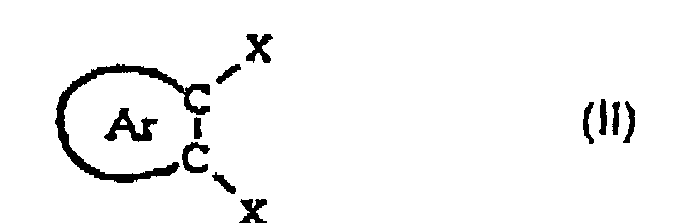 has the preceding meaning and the substituents X, the same or different, are chosen from Cl, Br and I,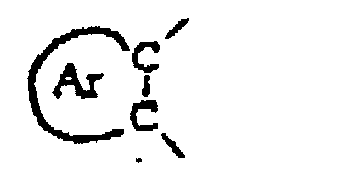
react with a halogen/fluorine exchange reagent on a basis of fluoride, the reaction resulting in a compound of formula (III)appearing in the majority in the reaction medium, and b) having the reaction product of step (a) react directly with a fluorine/cyanide exchange reagent on a basis of cyanide obtained in a selective manner, the compound of formula (I) being thus obtained in a selective manner.
 - Method according to claim 1, characterised in that in the compound of formula (II) the two substituents X are the same.
- Method according to claim 2, characterised in that each X represents an atom of chlorine.
- Method according to any of the preceding claims, characterised in that, in the compound of formula (II),indicates an aromatic ring comprising at least one heteroatom.
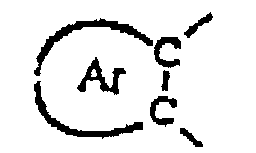
- Method according to any of the preceding claims, characterised in that said aromatic ring is furthermore substituted by at least one electroattractor group.
- Method according to any of the preceding claims, characterised in that said aromatic ring is substituted by at least one electroattractor group with a predominantly inductive effect.
- Method according to claim 6, characterised in that said electroattractor group with an inductive effect is chosen from the groups -CN and -CF2R where R is chosen from an atom of fluorine and hydrocarbon groups, preferably electroattractors.
- Method according to any of the claims 5 to 7, characterised in that said aromatic ring is substituted by a single electroattractor group.
- Method according to claims 1 and 8, characterised in that said attractor group is in ortho or para position with regard to the atom X to be substituted.
- Method according to any of the preceding claims characterised in that the sum of the Hammett constants of the electroattractor functions carried by said aromatic ring is between 0.10 and 1.60.
- Method according to any of the preceding claims, characterised in that the sum of the Hammett constants of the substitutents of said aromatic ring is between 0.4 and 1.
- Method according to any of the preceding claims, characterised in that the Hammett constant of each of the substituents of said aromatic ring other than X is between 0.2 and 0.7.
- Mathod according to any of the preceding claims, characterised in that the halogen/fluorine exchange reagent of step (a) is a mineral fluoride, in particular an alkaline metal fluoride, or a quaternary ammonium fluoride.
- Method according to any of the preceding claims, characterised in that the quantity of fluorine used at step (a) is between 0.8 and 1.5 times the quantity of compound of formula (I).
- Method according to any of the preceding claims, characterised in that the reaction of step (a) is carried out at a temperature of 80 to 280 °C.
- Method according to any of the preceding claims, characterised in that the reaction mixture obtained at the end of step (a) is used as that in step (b).
- Method according to any of the preceding claims, characterised in that said fluorine/cyanide exchange reagent of step (b) includes a cyanide chosen from the cyanides of the metals of groups I and II, and the cyanides of quaternary ammonium.
- Method according to any of the preceding claims, characterised in that the quantity of cyanide used in step (b) is between 1 and 1.5 times the quantity of compound of formula (III) formed at step (a).
- Method according to any of the preceding claims, characterised in that the content of copper of the reaction medium of step (b) is 10-2 mol.1-1 or less.
- Method according to any of the preceding claims, characterised in that the quantity of copper present in the reaction system of step (b), expressed in mol, is less than or equal to a tenth of the quantity of reaction product of step (a) used at step (b), expressed in mol.
- Method according to any of the preceding, claims, characterised in that fluoride liberated by the fluorine/cyanide exchange reaction, and possibly fluoride which has not reacted at step (a), is isolated at step (b), and is recycled at step (a) as halogen/fluorine exchange reagent.
Applications Claiming Priority (3)
| Application Number | Priority Date | Filing Date | Title |
|---|---|---|---|
| FR9515676 | 1995-12-28 | ||
| FR9515676A FR2743066B1 (en) | 1995-12-28 | 1995-12-28 | PROCESS FOR THE SYNTHESIS OF AN ARTHATIC DERIVATIVE ORTHODISUBSTITUTED BY A HALOGEN ATOM OTHER THAN FLUORINE AND BY A CYANO GROUP |
| PCT/FR1996/002100 WO1997024318A1 (en) | 1995-12-28 | 1996-12-27 | Method for synthesis of an aromatic derivative substituted by a halogen atom other than fluorine and by a cyano group |
Publications (2)
| Publication Number | Publication Date |
|---|---|
| EP0882012A1 EP0882012A1 (en) | 1998-12-09 |
| EP0882012B1 true EP0882012B1 (en) | 2001-08-29 |
Family
ID=9486096
Family Applications (1)
| Application Number | Title | Priority Date | Filing Date |
|---|---|---|---|
| EP96944100A Expired - Lifetime EP0882012B1 (en) | 1995-12-28 | 1996-12-27 | Method for synthesis of an aromatic derivative substituted by a halogen atom other than fluorine and by a cyano group |
Country Status (9)
| Country | Link |
|---|---|
| US (1) | US6156922A (en) |
| EP (1) | EP0882012B1 (en) |
| JP (1) | JP2000503008A (en) |
| AT (1) | ATE204854T1 (en) |
| AU (1) | AU1381897A (en) |
| DE (1) | DE69614884D1 (en) |
| DK (1) | DK0882012T3 (en) |
| FR (1) | FR2743066B1 (en) |
| WO (1) | WO1997024318A1 (en) |
Families Citing this family (4)
| Publication number | Priority date | Publication date | Assignee | Title |
|---|---|---|---|---|
| JP5529857B2 (en) | 2008-06-06 | 2014-06-25 | エフ.ホフマン−ラ ロシュ アーゲー | Method for producing halogenated benzoic acid derivative |
| CN107540583A (en) * | 2017-08-23 | 2018-01-05 | 连云港世杰农化有限公司 | A kind of method for synthesizing the trifluoromethylbenzoic acid ethyl ester of 2 methyl mercapto 4 |
| CN109574877B (en) * | 2018-12-30 | 2021-06-25 | 南京正荣医药化学有限公司 | Preparation method of 2-cyano-3-fluorobenzotrifluoride |
| CN113620867B (en) * | 2021-09-03 | 2023-06-16 | 内蒙古蓝科生物科技有限公司 | Synthesis method of fluopyram |
Family Cites Families (4)
| Publication number | Priority date | Publication date | Assignee | Title |
|---|---|---|---|---|
| GB1514082A (en) * | 1974-06-25 | 1978-06-14 | Isc Chem Ltd | Preparation of fluoronitrobenzenes |
| JPS55120549A (en) * | 1979-03-09 | 1980-09-17 | Nippon Kayaku Co Ltd | Preparation of 2-chloro-6-nitrobenzonitrile |
| DE3361778D1 (en) * | 1982-06-23 | 1986-02-20 | Daikin Ind Ltd | Process for preparing trifluoromethylbenzene derivatives |
| ES2098799T3 (en) * | 1993-01-23 | 1997-05-01 | Hoechst Ag | 2,3-DIFLUORO-6-NITRO-BENZONITRILE AND 2-CHLORINE-5,6-DIFLUORO-BENZONITRILE, PROCEDURE FOR ITS PREPARATION AND ITS USE FOR THE PREPARATION OF 2,3,6-TRIFLUORO-BENZOIC ACID. |
-
1995
- 1995-12-28 FR FR9515676A patent/FR2743066B1/en not_active Expired - Fee Related
-
1996
- 1996-12-27 EP EP96944100A patent/EP0882012B1/en not_active Expired - Lifetime
- 1996-12-27 DE DE69614884T patent/DE69614884D1/en not_active Expired - Lifetime
- 1996-12-27 AT AT96944100T patent/ATE204854T1/en not_active IP Right Cessation
- 1996-12-27 AU AU13818/97A patent/AU1381897A/en not_active Abandoned
- 1996-12-27 US US09/101,034 patent/US6156922A/en not_active Expired - Fee Related
- 1996-12-27 JP JP09524084A patent/JP2000503008A/en active Pending
- 1996-12-27 WO PCT/FR1996/002100 patent/WO1997024318A1/en not_active Ceased
- 1996-12-27 DK DK96944100T patent/DK0882012T3/en active
Also Published As
| Publication number | Publication date |
|---|---|
| FR2743066A1 (en) | 1997-07-04 |
| DE69614884D1 (en) | 2001-10-04 |
| FR2743066B1 (en) | 1998-03-27 |
| ATE204854T1 (en) | 2001-09-15 |
| JP2000503008A (en) | 2000-03-14 |
| EP0882012A1 (en) | 1998-12-09 |
| US6156922A (en) | 2000-12-05 |
| AU1381897A (en) | 1997-07-28 |
| DK0882012T3 (en) | 2001-10-08 |
| WO1997024318A1 (en) | 1997-07-10 |
Similar Documents
| Publication | Publication Date | Title |
|---|---|---|
| CA2355385C (en) | Method for separating a mixture comprising at least an hydrofluoroalkane and hydrogen fluoride, methods for preparing a hydrofluoroalkane and azeotropic compositions | |
| EP1713750A1 (en) | Method for preparation of a fluoroarmatic compound from an aminoaromatic amine compound | |
| EP0733614B1 (en) | Reagent and process useful for attaching a substituted difluoromethyl group onto a compound with at least one electrophilic function | |
| EP0882012B1 (en) | Method for synthesis of an aromatic derivative substituted by a halogen atom other than fluorine and by a cyano group | |
| EP0770051B1 (en) | Aromatic ether acylation process | |
| EP0467742A1 (en) | Process for the preparation of fluor derivatives | |
| BE481155A (en) | ||
| CA2015998C (en) | Process for the preparation of acyl cyanides in an anhydrous medium | |
| EP1222153B2 (en) | Method for obtaining halogenated hydrocarbons in the presence of a co-catalyst | |
| EP0398783B1 (en) | Process for the synthesis of acyl cyanides | |
| EP1165465A1 (en) | Method for activating aromatic substrates by microwaves | |
| EP0489140B1 (en) | Method for preparing 1,1-bis(chlorophenyl) 2,2,2-trichloroethanol | |
| EP0912466B1 (en) | Method for synthesis of hydrocarbon compounds containing fluorine on at least one alkyl chain carbon | |
| CA1280124C (en) | Process for the preparation of 4-fluoroanilines from 4-halogenonitrobenzenes | |
| EP0378942B1 (en) | Process for the preparation of 1,1-dichloro-1-fluoroethane | |
| EP0102305B1 (en) | Process for the preparation of metachlorinated anilines | |
| FR2622884A1 (en) | PROCESS FOR THE PREPARATION OF TELOMERS FROM CHLOROTRIFLUOROETHYLENE AND TRIFLUOROTRICHLOROETHANE | |
| FR2664589A1 (en) | Process and reactant for the synthesis of fluorinated aryl derivatives | |
| EP1189855A1 (en) | Use of nitriles as polar aprotic solvents | |
| FR2668483A1 (en) | PROCESS FOR THE PREPARATION OF ALDEHYDES FROM ALPHA-TRIHALOGENIC SECONDARY ALCOHOLS | |
| FR2652812A1 (en) | PROCESS FOR THE PREPARATION OF 2,2-DIFLUORO BENZODIOXOLE-1,3 | |
| FR2458529A1 (en) | PROCESS FOR THE PREPARATION OF 3,3-DIMETHYL-ALLYL ALCOHOL | |
| FR2791660A1 (en) | PROCESS FOR THE ACTIVATION OF MINERAL FLUORIDES IN ORGANIC MEDIA | |
| EP0687683A1 (en) | Process for the synthesis of haloalkylferrocenes | |
| FR2692261A1 (en) | Process for the preparation of an active telogen. |
Legal Events
| Date | Code | Title | Description |
|---|---|---|---|
| PUAI | Public reference made under article 153(3) epc to a published international application that has entered the european phase |
Free format text: ORIGINAL CODE: 0009012 |
|
| 17P | Request for examination filed |
Effective date: 19980618 |
|
| AK | Designated contracting states |
Kind code of ref document: A1 Designated state(s): AT BE CH DE DK ES FI FR GB GR IE IT LI LU MC NL PT SE |
|
| 17Q | First examination report despatched |
Effective date: 19991126 |
|
| GRAG | Despatch of communication of intention to grant |
Free format text: ORIGINAL CODE: EPIDOS AGRA |
|
| GRAG | Despatch of communication of intention to grant |
Free format text: ORIGINAL CODE: EPIDOS AGRA |
|
| GRAH | Despatch of communication of intention to grant a patent |
Free format text: ORIGINAL CODE: EPIDOS IGRA |
|
| GRAH | Despatch of communication of intention to grant a patent |
Free format text: ORIGINAL CODE: EPIDOS IGRA |
|
| GRAA | (expected) grant |
Free format text: ORIGINAL CODE: 0009210 |
|
| AK | Designated contracting states |
Kind code of ref document: B1 Designated state(s): AT BE CH DE DK ES FI FR GB GR IE IT LI LU MC NL PT SE |
|
| PG25 | Lapsed in a contracting state [announced via postgrant information from national office to epo] |
Ref country code: NL Free format text: LAPSE BECAUSE OF FAILURE TO SUBMIT A TRANSLATION OF THE DESCRIPTION OR TO PAY THE FEE WITHIN THE PRESCRIBED TIME-LIMIT Effective date: 20010829 Ref country code: IT Free format text: LAPSE BECAUSE OF FAILURE TO SUBMIT A TRANSLATION OF THE DESCRIPTION OR TO PAY THE FEE WITHIN THE PRE;WARNING: LAPSES OF ITALIAN PATENTS WITH EFFECTIVE DATE BEFORE 2007 MAY HAVE OCCURRED AT ANY TIME BEFORE 2007. THE CORRECT EFFECTIVE DATE MAY BE DIFFERENT FROM THE ONE RECORDED.SCRIBED TIME-LIMIT Effective date: 20010829 Ref country code: IE Free format text: LAPSE BECAUSE OF FAILURE TO SUBMIT A TRANSLATION OF THE DESCRIPTION OR TO PAY THE FEE WITHIN THE PRESCRIBED TIME-LIMIT Effective date: 20010829 Ref country code: GB Free format text: LAPSE BECAUSE OF FAILURE TO SUBMIT A TRANSLATION OF THE DESCRIPTION OR TO PAY THE FEE WITHIN THE PRESCRIBED TIME-LIMIT Effective date: 20010829 Ref country code: FI Free format text: LAPSE BECAUSE OF FAILURE TO SUBMIT A TRANSLATION OF THE DESCRIPTION OR TO PAY THE FEE WITHIN THE PRESCRIBED TIME-LIMIT Effective date: 20010829 Ref country code: AT Free format text: LAPSE BECAUSE OF FAILURE TO SUBMIT A TRANSLATION OF THE DESCRIPTION OR TO PAY THE FEE WITHIN THE PRESCRIBED TIME-LIMIT Effective date: 20010829 |
|
| REF | Corresponds to: |
Ref document number: 204854 Country of ref document: AT Date of ref document: 20010915 Kind code of ref document: T |
|
| REG | Reference to a national code |
Ref country code: CH Ref legal event code: EP |
|
| REG | Reference to a national code |
Ref country code: IE Ref legal event code: FG4D Free format text: FRENCH |
|
| REF | Corresponds to: |
Ref document number: 69614884 Country of ref document: DE Date of ref document: 20011004 |
|
| REG | Reference to a national code |
Ref country code: DK Ref legal event code: T3 |
|
| PG25 | Lapsed in a contracting state [announced via postgrant information from national office to epo] |
Ref country code: SE Free format text: LAPSE BECAUSE OF FAILURE TO SUBMIT A TRANSLATION OF THE DESCRIPTION OR TO PAY THE FEE WITHIN THE PRESCRIBED TIME-LIMIT Effective date: 20011129 Ref country code: PT Free format text: LAPSE BECAUSE OF FAILURE TO SUBMIT A TRANSLATION OF THE DESCRIPTION OR TO PAY THE FEE WITHIN THE PRESCRIBED TIME-LIMIT Effective date: 20011129 |
|
| PG25 | Lapsed in a contracting state [announced via postgrant information from national office to epo] |
Ref country code: GR Free format text: LAPSE BECAUSE OF FAILURE TO SUBMIT A TRANSLATION OF THE DESCRIPTION OR TO PAY THE FEE WITHIN THE PRESCRIBED TIME-LIMIT Effective date: 20011130 Ref country code: DE Free format text: LAPSE BECAUSE OF FAILURE TO SUBMIT A TRANSLATION OF THE DESCRIPTION OR TO PAY THE FEE WITHIN THE PRESCRIBED TIME-LIMIT Effective date: 20011130 |
|
| PG25 | Lapsed in a contracting state [announced via postgrant information from national office to epo] |
Ref country code: LU Free format text: LAPSE BECAUSE OF NON-PAYMENT OF DUE FEES Effective date: 20011227 Ref country code: DK Free format text: LAPSE BECAUSE OF NON-PAYMENT OF DUE FEES Effective date: 20011227 |
|
| PG25 | Lapsed in a contracting state [announced via postgrant information from national office to epo] |
Ref country code: LI Free format text: LAPSE BECAUSE OF NON-PAYMENT OF DUE FEES Effective date: 20011231 Ref country code: CH Free format text: LAPSE BECAUSE OF NON-PAYMENT OF DUE FEES Effective date: 20011231 Ref country code: BE Free format text: LAPSE BECAUSE OF NON-PAYMENT OF DUE FEES Effective date: 20011231 |
|
| NLV1 | Nl: lapsed or annulled due to failure to fulfill the requirements of art. 29p and 29m of the patents act | ||
| GBV | Gb: ep patent (uk) treated as always having been void in accordance with gb section 77(7)/1977 [no translation filed] |
Effective date: 20010829 |
|
| PG25 | Lapsed in a contracting state [announced via postgrant information from national office to epo] |
Ref country code: ES Free format text: LAPSE BECAUSE OF FAILURE TO SUBMIT A TRANSLATION OF THE DESCRIPTION OR TO PAY THE FEE WITHIN THE PRESCRIBED TIME-LIMIT Effective date: 20020228 |
|
| REG | Reference to a national code |
Ref country code: IE Ref legal event code: FD4D |
|
| PGFP | Annual fee paid to national office [announced via postgrant information from national office to epo] |
Ref country code: MC Payment date: 20020628 Year of fee payment: 6 |
|
| BERE | Be: lapsed |
Owner name: RHODIA CHIMIE Effective date: 20011231 |
|
| PLBE | No opposition filed within time limit |
Free format text: ORIGINAL CODE: 0009261 |
|
| STAA | Information on the status of an ep patent application or granted ep patent |
Free format text: STATUS: NO OPPOSITION FILED WITHIN TIME LIMIT |
|
| REG | Reference to a national code |
Ref country code: CH Ref legal event code: PL |
|
| 26N | No opposition filed | ||
| PG25 | Lapsed in a contracting state [announced via postgrant information from national office to epo] |
Ref country code: FR Free format text: LAPSE BECAUSE OF NON-PAYMENT OF DUE FEES Effective date: 20020830 |
|
| REG | Reference to a national code |
Ref country code: DK Ref legal event code: EBP |
|
| REG | Reference to a national code |
Ref country code: FR Ref legal event code: ST |
|
| PG25 | Lapsed in a contracting state [announced via postgrant information from national office to epo] |
Ref country code: MC Free format text: LAPSE BECAUSE OF NON-PAYMENT OF DUE FEES Effective date: 20030701 |