EP0881213A2 - Process for the synthesis of aromatic urethanes - Google Patents
Process for the synthesis of aromatic urethanes Download PDFInfo
- Publication number
- EP0881213A2 EP0881213A2 EP98106933A EP98106933A EP0881213A2 EP 0881213 A2 EP0881213 A2 EP 0881213A2 EP 98106933 A EP98106933 A EP 98106933A EP 98106933 A EP98106933 A EP 98106933A EP 0881213 A2 EP0881213 A2 EP 0881213A2
- Authority
- EP
- European Patent Office
- Prior art keywords
- carbonate
- reaction
- process according
- alcohol
- aromatic
- Prior art date
- Legal status (The legal status is an assumption and is not a legal conclusion. Google has not performed a legal analysis and makes no representation as to the accuracy of the status listed.)
- Granted
Links
Images

Classifications
-
- C—CHEMISTRY; METALLURGY
- C07—ORGANIC CHEMISTRY
- C07C—ACYCLIC OR CARBOCYCLIC COMPOUNDS
- C07C269/00—Preparation of derivatives of carbamic acid, i.e. compounds containing any of the groups, the nitrogen atom not being part of nitro or nitroso groups
- C07C269/04—Preparation of derivatives of carbamic acid, i.e. compounds containing any of the groups, the nitrogen atom not being part of nitro or nitroso groups from amines with formation of carbamate groups
Definitions
- organic carbonates particularly suitable for the process of the present invention are cyclic or acyclic carbonates such as for example ethylene carbonate, propylene carbonate, styrene carbonate, dimethyl carbonate, diethyl carbonate, dipropyl carbonate, dibutyl carbonate, diisopropyl carbonate, dihexyl carbonate, methyl butylcarbonate, diphenylcarbonate and methylphenylcarbonate.
- the organic carbonates can be prepared using the known methods.
- a quantity of carbonate in excess with respect to the amine is preferably used as it also acts as solvent.
- the process of the present invention after initial pressurization with nitrogen at 1-3 absolute atmospheres (ata), is carried out at an operating pressure which is the autogenous pressure of the system and which depends on the substrate and operating conditions.
- the process of the present invention can be carried out in batch, in continuous or semicontinuous.
- the product is recovered with the usual separation techniques.
- the carbamate can be isolated by crystallization or evaporation of the solvent after elimination of the catalytic system.
- the carbamoylation reaction can be carried out in a stainless steel autoclave, equipped with a distillation column arranged in series with a condenser.
- the carbonate and amine can be premixed and the catalyst added to the mixture thus obtained.
- the whole mixture is charged into the reactor which, after initial pressurization, is brought to the operating temperature.
- a partial distillation of the alcohol is effected, in the form of an azeotropic mixture with the carbonate, so that the quantity of alcohol coproduced remaining in the reaction mixture is maintained at 10 to 40% in moles with respect to the total quantity of alcohol produced, preferably between 20 and 35% in moles.
- FIG. 1 In the following experimental examples which provide a better illustration of the invention, the apparatus schematically illustrated in figure 1 was used.
- (A) indicates an autoclave equipped with a stirrer and an heat-exchange devices,
- (B) a smooth steel condenser maintained at a temperature ranging from 80 to 150°C, preferably from 100 to 130°C depending on the operating conditions,
- (C) a water condenser maintained at about 4-10°C and
- D a collection container.
- Examples 1-3 were carried out according to the present invention, whereas examples 4 and 5 are comparative.
- the reactor (A) is then pressurized to 2 atm, heated so as to have an internal temperature equal to 140°C and maintained under stirring at 300 rpm.
- the autoclave (A) is directly connected to the removal system of the alcohol consisting of a condenser (B) heated to about 115°C and a condenser (C) cooled to about 10°C.
- the maximum pressure registered during the test is 4 ata.
- the raw reaction product (203 g) thus obtained contains 197 g (97%) of 4,4'-methylenediphenyldiurethane, 4.5 g (2.2%) of N-methyl derivatives and about 1.5 g of ureas ( ⁇ 1% with respect to the total weight of the raw product).
- the autoclave is then brought to 2.5 ata and an internal temperature of 170°C.
- the condenser (B) was set at 130°C.
- the maximum pressure registered during the test was equal to 9 ata.
- 270 g of raw reaction product are obtained, consisting of 254 g of toluenediurethane 80/20 (mixture in a proportion of 80/20 of the respective dicarbamates of TDA 80/20), 13.8 g of a mixture of N-methylates and 2 g of insoluble ureas (equal to ⁇ 1% by weight with respect to the total raw product).
- polymeric MDA polymeric methylenedianiline
- DMC dimethylcarbonate
- zinc acetate dihydrate 4% by weight with respect to the polymeric MDA
- the quantity of methanol present in the mass in the autoclave (A) at the end of the reaction was equal to 32% in moles with respect to the quantity of methanol produced.
- the apparatus is then brought to a pressure of 1.9 ata and an internal temperature of 140°C.
- the condenser (B) is heated to 120°C. Under these conditions a continuous distillation is obtained of the methanol produced in the form of an azeotropic mixture with dimethyl carbonate.
- the maximum pressure registered during the test is 4 ata. After about 3 hours of reaction at 140°C, the disappearance of the methanol in the reactor A is verified.
- reaction raw product obtained as specified in example 1, was analyzed via HPLC with the internal standard method (RP-18 column, elution gradient starting from water/acetonitrile 60/40 v/v, flow 1 ml/minute) obtaining the following results:
- DMC and fresh catalyst are added to the reaction raw product so that a total of 2000 g of DMC and 5 g of zinc acetate dihydrate are present.
- the reaction is carried out for a further 3 hours with the procedure described above, but maintaining the internal temperature in the reactor at 160°C.
- reaction is carried out as described in example 1, in a closed autoclave, i.e. without removing any of the methanol produced.
Landscapes
- Chemical & Material Sciences (AREA)
- Organic Chemistry (AREA)
- Organic Low-Molecular-Weight Compounds And Preparation Thereof (AREA)
- Low-Molecular Organic Synthesis Reactions Using Catalysts (AREA)
- Catalysts (AREA)
Abstract
- reacting an organic carbonate, in a stoichiometric quantity or higher than the stoichiometric value, with an aromatic amine having formula (I-III), in the presence of a Lewis acid catalyst, at a temperature ranging from 100 to 190°C, operating in the presence of a quantity of alcohol ranging from 10 to 40% in moles with respect to the total quantity of alcohol coproduced during the reaction and
- recovering the aromatic urethane from the reaction mixture.
Description
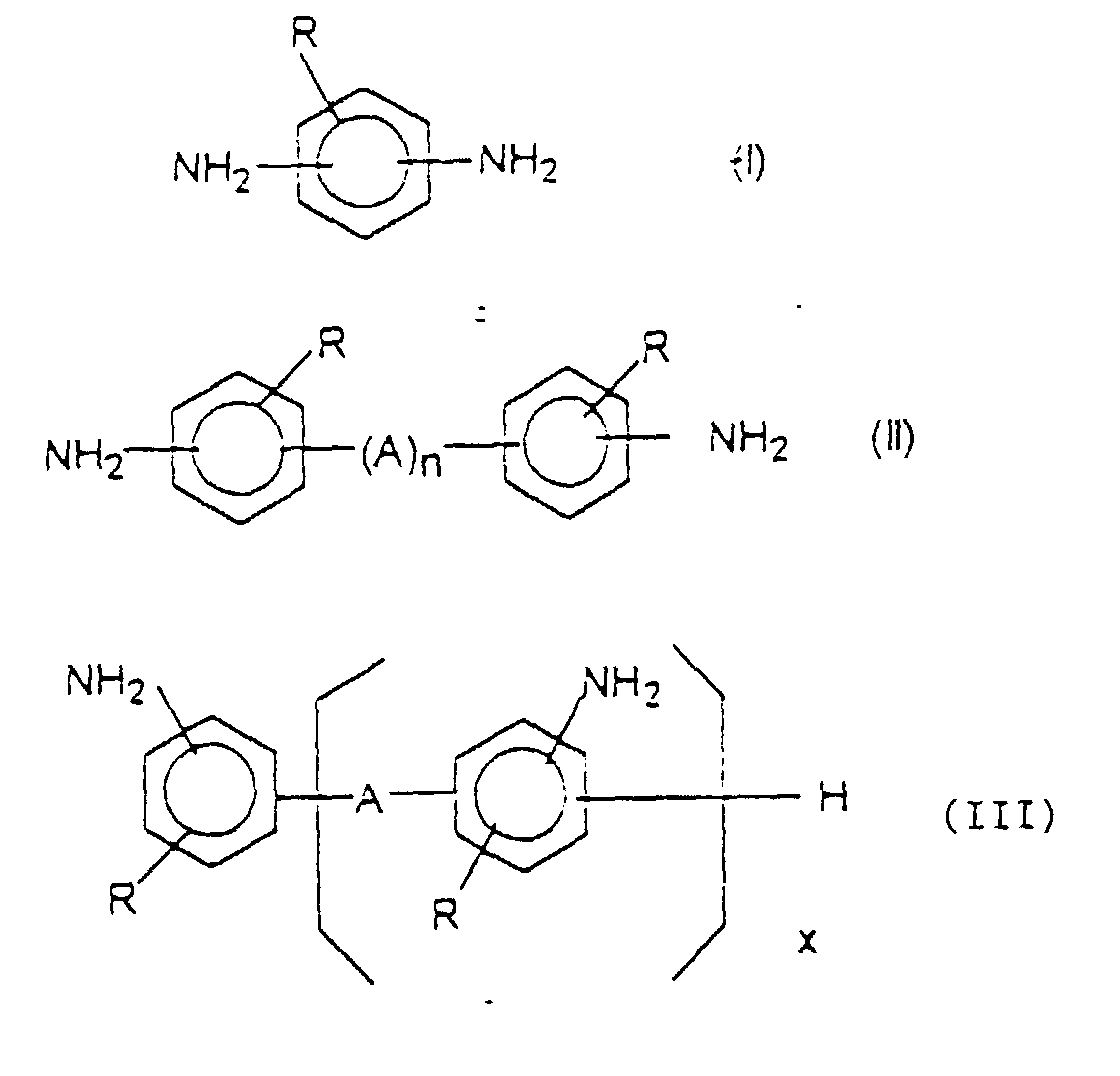
- conversion with respect to the initial 4,4'-MDA ≥ 99%
- selectivity to 4,4'-methylenediphenyldiurethane 97%
- yield 98%
- conversion with respect to the initial TDA 80/20 ≥ 99%
- selectivity to toluenediurethane 80/20 equal to 93%
- yield 92%
- conversion with respect to the initial polymeric MDA ≥ 99%
- selectivity to polymeric methylenediphenyldiurethane (obtained as a sum of all the isomers) 96%
- yield 95%
- conversion initial MDA ≥ 99%;
- selectivity to 4,4'-methylenediphenyldiurethane 88%;
- ureas 8%;
- by-products such as N-methylates (4%).
- conversion with respect to the initial MDA ≥ 99%,
- selectivity to methylenediphenyldiurethane 92%,
- yield 91%.
- conversion with respect to the initial MDA ≥ 99%,
- selectivity to methylenediphenyldiurethane 85%,
- yield 84%.
| Example Nr. | Time (hrs) | Removed methanol(%) | Select. to dicarb.(%) | Yield to dicarb.(%) |
| 1 | 1.5 | 72.5 | 97 | 96 |
| 4 | 6 | 100 | 92 | 91 |
| 5 | 6 | 0 | 85 | 84 |
Claims (12)
- A process for the synthesis of aromatic urethanes which comprises:(a) reacting an organic carbonate, in a stoichiometric quantity or higher than the stoichiometric value, with an aromatic amine having formula (I-III): wherein: R is hydrogen, a halogen, or a hydrocarbyl or hydrocarbyloxy group with up to 8 carbon atoms, A is a divalent hydrocarbon group with from 1 to 6 carbon atoms, n has a value of 0 or 1 and x has a value between 1 and 6, in the presence of a Lewis acid catalyst, at a temperature of 100 to 190°C;(b) recovering the aromatic urethane from the reaction mixture; wherein said process is characterized in that the reaction in step (a) is carried out maintaining the reaction alcohol within values ranging from 10 to 40% in moles with respect to the total quantity of alcohol coproduced during the reaction.
- The process according to claim 1, wherein A is a divalent hydrocarbon group with from 1 to 4 carbon atoms.
- The process according to claim 1, wherein R is a hydrocarbyl or hydrocarbyloxy group with up to 4 carbon atoms.
- The process according to claim 1, wherein the quantity of alcohol is maintained within values ranging from 20 to 30% in moles with respect to the total quantity of alcohol produced during the reaction.
- The process according to claim 1, wherein the carbonate is selected from ethylene carbonate, propylene carbonate, styrene carbonate, dimethyl carbonate, diethyl carbonate, dipropyl carbonate, dibutyl carbonate, diisopropyl carbonate, dihexyl carbonate, methyl butylcarbonate, diphenylcarbonate and methylphenylcarbonate.
- The process according to claim 5, wherein the carbonate is dimethyl carbonate.
- The process according to claim 1, wherein the aromatic amine is selected from 4,4'-methylenedianiline, 2,4'-methylenedianiline, 2,4-diaminotoluene, 2,6-diaminotoluene or mixtures of the two isomers, 1,3-diaminobenzene, 2,6-diaminonaphthalene or a polymeric methylenedianiline.
- The process according to claim 1, wherein the acid catalyst is selected from Lewis acids such as bivalent tin and zinc chlorides, or salts of these metals with mono- or bi-carboxylic organic acids.
- The process according to claim 1, wherein the acid catalyst is anhydrous or dihydrate zinc acetate.
- The process according to claim 1, wherein the quantity of catalyst is between 20 and 0.5% in moles per mole of amine (I-III).
- The process according to claim 10, wherein the quantity of catalyst is between 10 and 1.0% in moles per mole of amine (I-III).
- The process according to claim 1, wherein the reaction between carbonate and aromatic amine is carried out at a temperature ranging from 140 to 180°C.
Priority Applications (1)
| Application Number | Priority Date | Filing Date | Title |
|---|---|---|---|
| SI9830085T SI0881213T1 (en) | 1997-05-29 | 1998-04-16 | Process for the synthesis of aromatic urethanes |
Applications Claiming Priority (2)
| Application Number | Priority Date | Filing Date | Title |
|---|---|---|---|
| IT97MI001261A IT1292030B1 (en) | 1997-05-29 | 1997-05-29 | PROCEDURE FOR THE SYNTHESIS OF AROMATIC URETANS |
| ITMI971261 | 1997-05-29 |
Publications (3)
| Publication Number | Publication Date |
|---|---|
| EP0881213A2 true EP0881213A2 (en) | 1998-12-02 |
| EP0881213A3 EP0881213A3 (en) | 1999-01-20 |
| EP0881213B1 EP0881213B1 (en) | 2001-09-19 |
Family
ID=11377245
Family Applications (1)
| Application Number | Title | Priority Date | Filing Date |
|---|---|---|---|
| EP98106933A Expired - Lifetime EP0881213B1 (en) | 1997-05-29 | 1998-04-16 | Process for the synthesis of aromatic urethanes |
Country Status (10)
| Country | Link |
|---|---|
| US (1) | US6034265A (en) |
| EP (1) | EP0881213B1 (en) |
| JP (1) | JP4201881B2 (en) |
| AT (1) | ATE205825T1 (en) |
| DE (1) | DE69801708T2 (en) |
| DK (1) | DK0881213T3 (en) |
| ES (1) | ES2165108T3 (en) |
| IT (1) | IT1292030B1 (en) |
| PT (1) | PT881213E (en) |
| SI (1) | SI0881213T1 (en) |
Cited By (4)
| Publication number | Priority date | Publication date | Assignee | Title |
|---|---|---|---|---|
| WO2001068590A1 (en) * | 2000-03-17 | 2001-09-20 | Enichem S.P.A. | Continuous process for the synthesis of aromatic urethanes |
| DE10253289A1 (en) * | 2002-11-15 | 2004-06-03 | Basf Coatings Ag | Compounds containing urethane groups that can be activated with actinic radiation, process for their preparation and their use |
| EP2036884A1 (en) | 2007-09-14 | 2009-03-18 | Repsol Ypf S.A. | Process for producing fluorinated isocyanates and carbamates |
| WO2010000888A1 (en) | 2008-07-04 | 2010-01-07 | Consejo Superior De Investigaciones Científicas | Preparation of carbamates with solid catalysts |
Families Citing this family (5)
| Publication number | Priority date | Publication date | Assignee | Title |
|---|---|---|---|---|
| JP5313164B2 (en) | 2007-11-19 | 2013-10-09 | 旭化成ケミカルズ株式会社 | Method for producing isocyanate and aromatic hydroxy compound |
| US8895774B2 (en) * | 2008-05-15 | 2014-11-25 | Asahi Kasei Chemicals Corporation | Process for producing isocyanates using diaryl carbonate |
| KR20130127550A (en) * | 2008-05-15 | 2013-11-22 | 아사히 가세이 케미칼즈 가부시키가이샤 | Process for producing isocyanate |
| EP2199278B1 (en) * | 2008-12-19 | 2011-09-14 | Dow Global Technologies LLC | Process for the Production of Aromatic Urethanes |
| US11406964B2 (en) * | 2018-03-28 | 2022-08-09 | Covestro Intellectual Property Gmbh & Co. Kg | Heterogeneous catalysts for the synthesis of carbamates |
Family Cites Families (3)
| Publication number | Priority date | Publication date | Assignee | Title |
|---|---|---|---|---|
| US3763217A (en) * | 1970-12-03 | 1973-10-02 | Halcon International Inc | Preparation of carbamates |
| US4268683A (en) * | 1980-02-21 | 1981-05-19 | The Dow Chemical Company | Preparation of carbamates from aromatic amines and organic carbonates |
| IT1229144B (en) * | 1989-04-07 | 1991-07-22 | Enichem Sintesi | PROCEDURE FOR THE PRODUCTION OF CARBAMATES. |
-
1997
- 1997-05-29 IT IT97MI001261A patent/IT1292030B1/en active IP Right Grant
-
1998
- 1998-04-16 ES ES98106933T patent/ES2165108T3/en not_active Expired - Lifetime
- 1998-04-16 PT PT98106933T patent/PT881213E/en unknown
- 1998-04-16 EP EP98106933A patent/EP0881213B1/en not_active Expired - Lifetime
- 1998-04-16 AT AT98106933T patent/ATE205825T1/en not_active IP Right Cessation
- 1998-04-16 SI SI9830085T patent/SI0881213T1/en unknown
- 1998-04-16 DK DK98106933T patent/DK0881213T3/en active
- 1998-04-16 DE DE69801708T patent/DE69801708T2/en not_active Expired - Lifetime
- 1998-04-22 US US09/064,166 patent/US6034265A/en not_active Expired - Lifetime
- 1998-05-22 JP JP14147298A patent/JP4201881B2/en not_active Expired - Lifetime
Cited By (5)
| Publication number | Priority date | Publication date | Assignee | Title |
|---|---|---|---|---|
| WO2001068590A1 (en) * | 2000-03-17 | 2001-09-20 | Enichem S.P.A. | Continuous process for the synthesis of aromatic urethanes |
| DE10253289A1 (en) * | 2002-11-15 | 2004-06-03 | Basf Coatings Ag | Compounds containing urethane groups that can be activated with actinic radiation, process for their preparation and their use |
| EP2036884A1 (en) | 2007-09-14 | 2009-03-18 | Repsol Ypf S.A. | Process for producing fluorinated isocyanates and carbamates |
| WO2010000888A1 (en) | 2008-07-04 | 2010-01-07 | Consejo Superior De Investigaciones Científicas | Preparation of carbamates with solid catalysts |
| US8735621B2 (en) | 2008-07-04 | 2014-05-27 | Consejo Superior De Investigaciones Cientificas | Preparation of carbamates with solid catalysts |
Also Published As
| Publication number | Publication date |
|---|---|
| ITMI971261A0 (en) | 1997-05-29 |
| ATE205825T1 (en) | 2001-10-15 |
| EP0881213B1 (en) | 2001-09-19 |
| DK0881213T3 (en) | 2001-12-17 |
| DE69801708T2 (en) | 2002-07-11 |
| EP0881213A3 (en) | 1999-01-20 |
| JP4201881B2 (en) | 2008-12-24 |
| SI0881213T1 (en) | 2002-04-30 |
| US6034265A (en) | 2000-03-07 |
| ITMI971261A1 (en) | 1998-11-29 |
| PT881213E (en) | 2002-03-28 |
| ES2165108T3 (en) | 2002-03-01 |
| DE69801708D1 (en) | 2001-10-25 |
| JPH111462A (en) | 1999-01-06 |
| IT1292030B1 (en) | 1999-01-25 |
Similar Documents
| Publication | Publication Date | Title |
|---|---|---|
| JP3290240B2 (en) | Continuous multistage process for producing (cyclic) aliphatic diisocyanates | |
| US5087739A (en) | Circulation process for the production of aliphatic and cycloaliphatic diisocyanates | |
| US5386053A (en) | Multistep, continuous preparation of organic polyisocyanates | |
| EP0752413B1 (en) | Process for the production of aromatic carbamates | |
| US20120041223A1 (en) | Process for preparing aromatic carbamates | |
| US4146727A (en) | Process for the preparation of diphenylmethane mono and dicarbamates and polymethylene polyphenyl carbamates by the acid rearrangement of an (alkoxycarbonyl) phenylaminomethylphenyl compound | |
| US20030162995A1 (en) | Integrated process for the preparation of aromatic isocyanates and procedures for effecting the relative intermediate phases | |
| US6034265A (en) | Process for the synthesis of aromatic urethanes | |
| EP1323708B1 (en) | Method for producing carbamates and method for producing isocyanates | |
| Aresta et al. | Reaction of aromatic diamines with diphenylcarbonate catalyzed by phosphorous acids: a new clean synthetic route to mono-and dicarbamates | |
| EP0570071B1 (en) | Procedure for the preparation of alkyl isocyanates | |
| JP2005068146A (en) | Multi-stage method for continuously producing alicyclic diisocyanate | |
| EP0752414B1 (en) | Process for the production of aromatic urethanes | |
| US5347034A (en) | Process for the production of poly(O-alkylurethanes) of the diphenyl methane series | |
| EP1268409B1 (en) | Continuous process for the synthesis of aromatic urethanes | |
| CN111164070A (en) | Multi-step process for preparing hexamethylene diisocyanate, pentamethylene diisocyanate or toluene diisocyanate | |
| JP2004262835A (en) | Method for producing aromatic isocyanate | |
| CA2072034A1 (en) | Process for the preparation of bis-(ethoxycarbonylamino) toluenes and for the preparation of diisocyanatotoluenes therefrom | |
| US4172948A (en) | Preparation of diphenylmethane mono and dicarbamates and polymethylene polyphenyl carbamates | |
| JPH08277255A (en) | Continuous production of urethane | |
| US20090112018A1 (en) | Method for producing polyisocyanates | |
| CN111108094A (en) | A multi-step process for the preparation of diisocyanates | |
| CN103596920A (en) | Process for preparing polyisocyanates | |
| JPH05255232A (en) | Preparation of highly pure aromatic diurethane and/or polyurethane | |
| JP2003201275A (en) | Method of producing aromatic urethane |
Legal Events
| Date | Code | Title | Description |
|---|---|---|---|
| PUAI | Public reference made under article 153(3) epc to a published international application that has entered the european phase |
Free format text: ORIGINAL CODE: 0009012 |
|
| AK | Designated contracting states |
Kind code of ref document: A2 Designated state(s): AT BE DE DK ES FR GB GR IE NL PT SE |
|
| AX | Request for extension of the european patent |
Free format text: AL;LT;LV;MK;RO;SI PAYMENT 980416 |
|
| PUAL | Search report despatched |
Free format text: ORIGINAL CODE: 0009013 |
|
| AK | Designated contracting states |
Kind code of ref document: A3 Designated state(s): AT BE CH CY DE DK ES FI FR GB GR IE IT LI LU MC NL PT SE |
|
| AX | Request for extension of the european patent |
Free format text: AL;LT;LV;MK;RO;SI PAYMENT 980416 |
|
| AKX | Designation fees paid |
Free format text: AT BE DE DK ES FR GB GR IE NL PT SE |
|
| AXX | Extension fees paid |
Free format text: SI PAYMENT 19980416 |
|
| 17P | Request for examination filed |
Effective date: 19991015 |
|
| 17Q | First examination report despatched |
Effective date: 20000425 |
|
| GRAG | Despatch of communication of intention to grant |
Free format text: ORIGINAL CODE: EPIDOS AGRA |
|
| GRAG | Despatch of communication of intention to grant |
Free format text: ORIGINAL CODE: EPIDOS AGRA |
|
| GRAH | Despatch of communication of intention to grant a patent |
Free format text: ORIGINAL CODE: EPIDOS IGRA |
|
| GRAH | Despatch of communication of intention to grant a patent |
Free format text: ORIGINAL CODE: EPIDOS IGRA |
|
| GRAA | (expected) grant |
Free format text: ORIGINAL CODE: 0009210 |
|
| AK | Designated contracting states |
Kind code of ref document: B1 Designated state(s): AT BE DE DK ES FR GB GR IE NL PT SE |
|
| AX | Request for extension of the european patent |
Free format text: SI PAYMENT 19980416 |
|
| REF | Corresponds to: |
Ref document number: 205825 Country of ref document: AT Date of ref document: 20011015 Kind code of ref document: T |
|
| REG | Reference to a national code |
Ref country code: IE Ref legal event code: FG4D |
|
| REF | Corresponds to: |
Ref document number: 69801708 Country of ref document: DE Date of ref document: 20011025 |
|
| REG | Reference to a national code |
Ref country code: GB Ref legal event code: IF02 |
|
| ET | Fr: translation filed | ||
| REG | Reference to a national code |
Ref country code: ES Ref legal event code: FG2A Ref document number: 2165108 Country of ref document: ES Kind code of ref document: T3 |
|
| REG | Reference to a national code |
Ref country code: PT Ref legal event code: SC4A Free format text: AVAILABILITY OF NATIONAL TRANSLATION Effective date: 20011214 |
|
| REG | Reference to a national code |
Ref country code: GR Ref legal event code: EP Ref document number: 20010402486 Country of ref document: GR |
|
| PLBE | No opposition filed within time limit |
Free format text: ORIGINAL CODE: 0009261 |
|
| STAA | Information on the status of an ep patent application or granted ep patent |
Free format text: STATUS: NO OPPOSITION FILED WITHIN TIME LIMIT |
|
| 26N | No opposition filed | ||
| PGFP | Annual fee paid to national office [announced via postgrant information from national office to epo] |
Ref country code: GR Payment date: 20030226 Year of fee payment: 6 |
|
| PGFP | Annual fee paid to national office [announced via postgrant information from national office to epo] |
Ref country code: DK Payment date: 20030319 Year of fee payment: 6 Ref country code: SE Payment date: 20030319 Year of fee payment: 6 |
|
| PGFP | Annual fee paid to national office [announced via postgrant information from national office to epo] |
Ref country code: IE Payment date: 20030402 Year of fee payment: 6 |
|
| PGFP | Annual fee paid to national office [announced via postgrant information from national office to epo] |
Ref country code: AT Payment date: 20030403 Year of fee payment: 6 |
|
| PG25 | Lapsed in a contracting state [announced via postgrant information from national office to epo] |
Ref country code: IE Free format text: LAPSE BECAUSE OF NON-PAYMENT OF DUE FEES Effective date: 20040416 Ref country code: AT Free format text: LAPSE BECAUSE OF NON-PAYMENT OF DUE FEES Effective date: 20040416 |
|
| PG25 | Lapsed in a contracting state [announced via postgrant information from national office to epo] |
Ref country code: SE Free format text: LAPSE BECAUSE OF NON-PAYMENT OF DUE FEES Effective date: 20040417 |
|
| PG25 | Lapsed in a contracting state [announced via postgrant information from national office to epo] |
Ref country code: DK Free format text: LAPSE BECAUSE OF NON-PAYMENT OF DUE FEES Effective date: 20040430 |
|
| PG25 | Lapsed in a contracting state [announced via postgrant information from national office to epo] |
Ref country code: GR Free format text: LAPSE BECAUSE OF NON-PAYMENT OF DUE FEES Effective date: 20041103 |
|
| EUG | Se: european patent has lapsed | ||
| REG | Reference to a national code |
Ref country code: IE Ref legal event code: MM4A |
|
| REG | Reference to a national code |
Ref country code: SI Ref legal event code: KO00 Effective date: 20050120 |
|
| REG | Reference to a national code |
Ref country code: FR Ref legal event code: PLFP Year of fee payment: 19 |
|
| REG | Reference to a national code |
Ref country code: FR Ref legal event code: PLFP Year of fee payment: 20 |
|
| PGFP | Annual fee paid to national office [announced via postgrant information from national office to epo] |
Ref country code: FR Payment date: 20170313 Year of fee payment: 20 |
|
| PGFP | Annual fee paid to national office [announced via postgrant information from national office to epo] |
Ref country code: BE Payment date: 20170313 Year of fee payment: 20 |
|
| PGFP | Annual fee paid to national office [announced via postgrant information from national office to epo] |
Ref country code: NL Payment date: 20170412 Year of fee payment: 20 Ref country code: ES Payment date: 20170317 Year of fee payment: 20 |
|
| PGFP | Annual fee paid to national office [announced via postgrant information from national office to epo] |
Ref country code: DE Payment date: 20170411 Year of fee payment: 20 Ref country code: GB Payment date: 20170412 Year of fee payment: 20 |
|
| PGFP | Annual fee paid to national office [announced via postgrant information from national office to epo] |
Ref country code: PT Payment date: 20170417 Year of fee payment: 20 |
|
| REG | Reference to a national code |
Ref country code: DE Ref legal event code: R071 Ref document number: 69801708 Country of ref document: DE |
|
| REG | Reference to a national code |
Ref country code: NL Ref legal event code: MK Effective date: 20180415 |
|
| REG | Reference to a national code |
Ref country code: GB Ref legal event code: PE20 Expiry date: 20180415 |
|
| REG | Reference to a national code |
Ref country code: BE Ref legal event code: MK Effective date: 20180416 |
|
| PG25 | Lapsed in a contracting state [announced via postgrant information from national office to epo] |
Ref country code: PT Free format text: LAPSE BECAUSE OF EXPIRATION OF PROTECTION Effective date: 20180426 Ref country code: GB Free format text: LAPSE BECAUSE OF EXPIRATION OF PROTECTION Effective date: 20180415 |
|
| REG | Reference to a national code |
Ref country code: ES Ref legal event code: FD2A Effective date: 20200904 |
|
| PG25 | Lapsed in a contracting state [announced via postgrant information from national office to epo] |
Ref country code: ES Free format text: LAPSE BECAUSE OF EXPIRATION OF PROTECTION Effective date: 20180417 |