EP0880397B1 - Apparatus and method for producing polarised vapour-phase helium-3, particularly for nmr imaging - Google Patents
Apparatus and method for producing polarised vapour-phase helium-3, particularly for nmr imaging Download PDFInfo
- Publication number
- EP0880397B1 EP0880397B1 EP97904504A EP97904504A EP0880397B1 EP 0880397 B1 EP0880397 B1 EP 0880397B1 EP 97904504 A EP97904504 A EP 97904504A EP 97904504 A EP97904504 A EP 97904504A EP 0880397 B1 EP0880397 B1 EP 0880397B1
- Authority
- EP
- European Patent Office
- Prior art keywords
- helium
- polarized
- optical pumping
- pumping cell
- temperature
- Prior art date
- Legal status (The legal status is an assumption and is not a legal conclusion. Google has not performed a legal analysis and makes no representation as to the accuracy of the status listed.)
- Expired - Lifetime
Links
Images
Classifications
-
- G—PHYSICS
- G01—MEASURING; TESTING
- G01R—MEASURING ELECTRIC VARIABLES; MEASURING MAGNETIC VARIABLES
- G01R33/00—Arrangements or instruments for measuring magnetic variables
- G01R33/20—Arrangements or instruments for measuring magnetic variables involving magnetic resonance
- G01R33/28—Details of apparatus provided for in groups G01R33/44 - G01R33/64
- G01R33/282—Means specially adapted for hyperpolarisation or for hyperpolarised contrast agents, e.g. for the generation of hyperpolarised gases using optical pumping cells, for storing hyperpolarised contrast agents or for the determination of the polarisation of a hyperpolarised contrast agent
-
- A—HUMAN NECESSITIES
- A61—MEDICAL OR VETERINARY SCIENCE; HYGIENE
- A61K—PREPARATIONS FOR MEDICAL, DENTAL OR TOILETRY PURPOSES
- A61K49/00—Preparations for testing in vivo
- A61K49/06—Nuclear magnetic resonance [NMR] contrast preparations; Magnetic resonance imaging [MRI] contrast preparations
- A61K49/18—Nuclear magnetic resonance [NMR] contrast preparations; Magnetic resonance imaging [MRI] contrast preparations characterised by a special physical form, e.g. emulsions, microcapsules, liposomes
- A61K49/1806—Suspensions, emulsions, colloids, dispersions
- A61K49/1815—Suspensions, emulsions, colloids, dispersions compo-inhalant, e.g. breath tests
-
- B—PERFORMING OPERATIONS; TRANSPORTING
- B01—PHYSICAL OR CHEMICAL PROCESSES OR APPARATUS IN GENERAL
- B01D—SEPARATION
- B01D59/00—Separation of different isotopes of the same chemical element
- B01D59/34—Separation by photochemical methods
-
- Y—GENERAL TAGGING OF NEW TECHNOLOGICAL DEVELOPMENTS; GENERAL TAGGING OF CROSS-SECTIONAL TECHNOLOGIES SPANNING OVER SEVERAL SECTIONS OF THE IPC; TECHNICAL SUBJECTS COVERED BY FORMER USPC CROSS-REFERENCE ART COLLECTIONS [XRACs] AND DIGESTS
- Y10—TECHNICAL SUBJECTS COVERED BY FORMER USPC
- Y10S—TECHNICAL SUBJECTS COVERED BY FORMER USPC CROSS-REFERENCE ART COLLECTIONS [XRACs] AND DIGESTS
- Y10S62/00—Refrigeration
- Y10S62/919—Isotope
Definitions
- the present invention relates to an installation and process for the production of in-phase polarized helium-3 high pressure steam, especially for imaging by NMR, as well as the applications of such an installation.
- Polarized helium-3 is an isotope known for properties that have been implemented in particular for measuring very small field variations magnetic earth, in particular for the realization of magnetometers.
- Helium-3 production methods state-of-the-art dense polarized are relatively difficult to implement.
- a first method called "brute force" means placing a helium-3 sample in an intense magnetic field at low temperature. This process is only effective for solid helium-3 at a pressure greater than 36 atmospheres, or for helium-3 very diluted in liquid helium-4, at a temperature of a few millikelvin in a magnetic field of several tesla. These conditions pose technological problems important and do not allow production at acceptable economic conditions for applications requiring production within a reasonable time short of large volumes of polarized helium-3.
- the prior art has also proposed polarization by spin exchange with a gas of atoms alkaline oriented by optical pumping. This method is also very slow because the exchange collisions that transfer the polarization from the alkaline to helium are not very effective and are a factor limiting essential. This method requires a duration 10 hours to polarize 150 cubic centimeters of helium at a pressure of 10 bars and a polarization of 10%.
- WO-A-95 27 438 describes an apparatus for delivering a polarized gas comprising a cell having a point intended at break opening into a piston cylinder.
- the object of the present invention is to remedy the drawbacks of the processes and installations of the prior art by proposing a method allowing rapid obtaining of highly polarized helium-3 in the form dense gas at a pressure of the order of pressure atmospheric or above atmospheric pressure, at using a low cost installation and simple operation.
- the invention relates first of all an installation for the production of polarized helium-3 in high pressure vapor phase, especially for NMR imaging, the installation comprising a means injecting helium into an optical pumping cell, a means of liquefying the polarized gas coming from the optical pumping cell and a tank for storage liquid phase polarized helium-3 characterized in that the storage tank can be cooled by a cooling system to a temperature adjustable between an accumulation temperature Ta and a evaporation temperature Te and communicates alternately with the optical pumping cell and with a conduit for evacuation of helium-3 in the gaseous to high phase pressure.
- the installation according to the invention works according to a purely cryogenic principle of compression, and only uses thermal effects to move atoms. This especially avoids all problems arising from the use of a pump for the compression of polarized gas.
- the optical pumping cell communicates with the helium-3 source via a flow valve adjustable.
- the advantage major is the speed of orientation production by direct optical pumping of helium.
- the optical pumping cell includes means for determination of the nuclear polarization of the gas.
- This means for example a device specific to measure the polarization of the fluorescence radiation emitted by the gas mixture in the optical pumping cell, allows to control the polarization rate of the mixture gaseous in the pumping cell and adjust some installation settings to maximize this rate.
- the installation includes adjustment means for this purpose. the flow rate of the supply valve of the cubicle pumping and / or of the tank temperature Ta of accumulation as a function of nuclear polarization in the optical pumping cell.
- the optical pumping cell is excited by a laser emitting a line with a wavelength of 1083 nanometers.
- a laser diode with a power of 50 milliwatts makes it possible to prepare 100 cubic centimeters of a mixture containing 10% helium-3 under a pressure of 1.2 bars, in 15 minutes.
- the invention also relates to a method for the production of polarized helium-3 in the vapor phase consisting in injecting into an optical pumping cell helium-3 and store the phase-polarized helium-3 liquid in a storage tank characterized in that polarized gas from the optical pumping cell is collected in an accumulation tank cooled to a temperature adjustable between a temperature Ta of accumulation of helium-3 and a temperature Te helium-3 evaporation.
- the cell is injected with optical pumping a mixture of helium-3 and helium-4. It is appeared that using a mixture, rather than pure helium-3 has the effect of prolonging the duration of maintaining polarization.
- a mixture rather than pure helium-3 has the effect of prolonging the duration of maintaining polarization.
- said mixture contains between 3 and 30% helium-3.
- one proceeds to evaporation of part of the polarized helium contained in the tank.
- This variant translates by enrichment with polarized helium-3 in the mixture polarized gas produced by the installation.
- We can besides resorting to enrichment techniques that make use of thermodynamic effects specific to helium superfluid.
- the invention also relates to the application of a installation in accordance with the above with imaging by NMR.
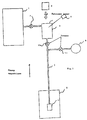
- Figure 1 shows a schematic view of an installation according to the invention. It is made up by a tank (1) containing a gaseous mixture of helium-3 and helium-4. The mixture contains a proportion of approximately 10% helium-3 for 90% helium-4.
- a valve (7) allows the mixture to be injected into an optical pumping cell (2). This valve (7) can also be used to influence the injection rate of the mixture in the cell (2).
- the pumping cell (2) is a volume allowing the circulation of atoms between the tank (1) and a conduit (3) opening into a reservoir accumulation (4).
- the cell (2) is made in one non-relaxing transparent material such as glass, and is placed on the path of a laser beam at a length of 1083 nanometers.
- a polarimeter (9) allows analyze the fluorescence light emitted by the mixture contained in cell (2) and deduct the rate of nuclear polarization. This measure controls the efficiency of optical pumping.
- the cell outlet (2) opens into an enclosure or accumulation tank (4) having walls made of a non-relaxing material.
- This accumulation enclosure (4) is cooled by a cooling system (5) making it possible to regulate the temperature to condense or evaporate the 3 He- 4 He mixture contained in the accumulation enclosure (4).
- the cooling system will for example be a pumped helium-4 refrigerator. This type of device makes it possible to reach temperatures of the order of 0.9 K.
- the temperature of the enclosure (4) must be less than 1.8 K so that at any concentration the vapor pressure is less than 10 Torr to allow optical pumping. Temperature of the enclosure (4) directly determines the pressure at inside the optical pumping cell (2), and therefore the efficiency of optical pumping. It is therefore possible to maximize the polarization rate by acting either on the temperature of the accumulation chamber (4), i.e. on the mixing injection rate using the valve (7).
- the gas flow in the optical pumping cell (2) must be adapted to the light flux available to polarize helium-3 atoms. It then determines the power of refrigeration necessary for liquefaction. The scale of correspondence for these three quantities is as follows:
- 1 W of laser power allows to correctly polarize up to 10 18 atoms of helium-3 per second, which corresponds to approximately 0.75 liters per second of a 4% gas mixture under a torr, and which produces 1 , 3mm 3 per second of 4% liquid mixture.
- the liquefaction of the mixture at this rate gives off latent heat of 4 millijoules per second, a power easily dissipated by the refrigeration system.
- the time subsequently required for the evaporation of the accumulated liquid will be negligible if a heating power much greater than 4 mW is used.
- the rate of production of polarized dense gas is only limited by the laser power, at 1 bar.cm 3 / s for 1 watt.
- a first valve (10) is closed to isolate the optical pumping cell (2) and at the opening a second valve (11) allowing the injection of the mixture polarized in a high gas storage volume (6) pressure, or directly in a nozzle connected to the injection facility in a hollow body, or inhalation by a patient.
- the pressure increases with the temperature T of the volume (4).
- T is around 4K for concentrations of a few percent.
- Critical pressure beyond which there is no longer any equilibrium liquid / vapor possible is around 2.3 bar for Helium-4.
- the heating expands the fluid and further increases the pressure, as shown in Figure 2.
- a first mode of use consists in completely evaporate the liquid accumulated in the tank (4) by heating it sufficiently and releasing the all of the polarized gas thus produced.
- a second mode of use consists in only partially evaporate the accumulated liquid.
- Helium-3 being more volatile, its concentration in the vapor is higher than that of the liquid.
- Gas recovered at high pressure is therefore richer in helium-3 than in the initially condensed mixture.
- the residual liquid remaining in the tank (4) will of course contain correlatively a higher proportion of helium-4.
- a third mode of use consists in previously extract from the solution contained in the reservoir (4) a significant fraction of helium-4, and then proceed to the evaporation of the liquid thus enriched.
- thermomechanical effects specific to helium superfluid can be used to isolate helium-4 : crossing a super leak, "heat flush” effect, "HEvac”.
- the entire volume accessible to the fluid polarized must be subjected to a magnetic field homogeneous enough not to induce relaxation. Its amplitude is determined by the quality of the surrounding magnetic environment: in general, a millitesla is enough. It must also not exceed a few tens of millitestlas so that the pumping optics remains effective.
- a first application concerns imagery NMR of the cavities of a hollow body, for example the lungs of a patient or an animal. It should be inhaled a gaseous mixture containing prepared polarized helium-3 with an installation as previously described.
- a second application is the imaging of organic or biological fluids or tissues where helium-3 polarized will have diffused.
- a third application is characterization of materials or porous bodies by measurement NMR, using polarized helium-3 as a local probe.
Landscapes
- Health & Medical Sciences (AREA)
- Life Sciences & Earth Sciences (AREA)
- Physics & Mathematics (AREA)
- Chemical & Material Sciences (AREA)
- General Health & Medical Sciences (AREA)
- Epidemiology (AREA)
- Radiology & Medical Imaging (AREA)
- Animal Behavior & Ethology (AREA)
- Nuclear Medicine, Radiotherapy & Molecular Imaging (AREA)
- Public Health (AREA)
- Veterinary Medicine (AREA)
- Biophysics (AREA)
- Chemical Kinetics & Catalysis (AREA)
- Dispersion Chemistry (AREA)
- Condensed Matter Physics & Semiconductors (AREA)
- General Physics & Mathematics (AREA)
- Separation By Low-Temperature Treatments (AREA)
Abstract
Description
La présente invention concerne une installation et procédé pour la production d'hélium-3 polarisé en-phase vapeur à forte pression, en particulier pour l'imagerie par RMN, ainsi que les applications d'une telle installation.The present invention relates to an installation and process for the production of in-phase polarized helium-3 high pressure steam, especially for imaging by NMR, as well as the applications of such an installation.
L'hélium-3 polarisé est un isotope connu pour les propriétés qui ont été mises en oeuvre en particulier pour la mesure de très faibles variations du champ magnétique terrestre, en particulier pour la réalisation de magnétomètres. Les méthodes de production d'hélium-3 polarisé dense de l'état de l'art sont relativement difficiles à mettre en oeuvre. Une première méthode dite "brute force" consiste à placer un échantillon d'hélium-3 dans un champ magnétique intense à basse température. Ce procédé n'est efficace que pour l'hélium-3 solide à une pression supérieure à 36 atmosphères, ou pour de l'hélium-3 très dilué dans de l'hélium-4 liquide, à une température de quelques millikelvin dans un champ magnétique de plusieurs teslas. Ces conditions posent des problèmes technologiques importants et ne permettent pas une production à des conditions économiques acceptables pour des applications nécessitant la production dans un délai raisonnablement court de volumes importants d'hélium-3 polarisé.Polarized helium-3 is an isotope known for properties that have been implemented in particular for measuring very small field variations magnetic earth, in particular for the realization of magnetometers. Helium-3 production methods state-of-the-art dense polarized are relatively difficult to implement. A first method called "brute force" means placing a helium-3 sample in an intense magnetic field at low temperature. This process is only effective for solid helium-3 at a pressure greater than 36 atmospheres, or for helium-3 very diluted in liquid helium-4, at a temperature of a few millikelvin in a magnetic field of several tesla. These conditions pose technological problems important and do not allow production at acceptable economic conditions for applications requiring production within a reasonable time short of large volumes of polarized helium-3.
On a également proposé dans l'art antérieur la
polarisation par échange de spin avec un gaz d'atomes
alcalins orientés par pompage optique. Cette méthode est
également très lente, car les collisions d'échange qui
assurent le transfert de polarisation de l'alcalin à
l'hélium sont peu efficaces et constituent un facteur
limitant incontournable. Cette méthode nécessite une durée
de 10 heures pour polariser 150 centimètres cube d'hélium à
une pression de 10 bars et une polarisation de 10%. The prior art has also proposed
polarization by spin exchange with a gas of atoms
alkaline oriented by optical pumping. This method is
also very slow because the exchange collisions that
transfer the polarization from the alkaline to
helium are not very effective and are a factor
limiting essential. This method requires a
On connaít encore un procédé qui consiste à comprimer l'hélium-3 gazeux polarisé par pompage optique à l'aide d'un compresseur à piston mobile. Un tel dispositif est très délicat à réaliser et à faire fonctionner. En effet, des précautions extrêmement rigoureuses doivent être prises pour éviter la relaxation pendant la phase de compression, lors du passage dans la pompe. Il convient en particulier d'éviter l'utilisation de tout lubrifiant susceptible de contaminer le gaz polarisé et de procéder à un choix des matériaux formant les parois de la pompe propres à réduire la relaxation des isotopes polarisés. La mise en oeuvre d'un tel procédé est possible pour des applications de recherche en laboratoire, mais ne permet pas actuellement de produire dans des conditions économiquement acceptables des quantités importantes d'hélium-3 fortement polarisé, dans des délais courts.We still know a process that consists of compressing helium-3 gas polarized by optical pumping using a compressor movable piston. Such a device is very delicate to realize and operate. Indeed, precautions extremely rigorous must be taken to avoid the relaxation during the compression phase, when passing in the pump. In particular, avoid the use of any lubricant likely to contaminate polarized gas and make a choice of materials forming the pump walls suitable for reducing the relaxation of polarized isotopes. The implementation of a such process is possible for research applications in the laboratory, but does not currently produce under economically acceptable conditions significant amounts of highly polarized helium-3, in short deadlines.
Le document WO-A-95 27 438 décrit un appareil pour délivrer un gaz polarisé comprenant une cellule ayant un point destiné à la rupture débouchant dans un cylindre à piston.WO-A-95 27 438 describes an apparatus for delivering a polarized gas comprising a cell having a point intended at break opening into a piston cylinder.
L'objet de la présente invention est de remédier aux inconvénients des procédés et installations de l'art antérieur en proposant un procédé permettant l'obtention rapide d'hélium-3 fortement polarisé sous forme de gaz dense, à une pression de l'ordre de la pression atmosphérique ou supérieure à la pression atmosphérique, à l'aide d'une installation d'un coût de réalisation faible et d'un fonctionnement simple.The object of the present invention is to remedy the drawbacks of the processes and installations of the prior art by proposing a method allowing rapid obtaining of highly polarized helium-3 in the form dense gas at a pressure of the order of pressure atmospheric or above atmospheric pressure, at using a low cost installation and simple operation.
A cet effet, l'invention concerne tout d'abord une installation pour la production d'hélium-3 polarisé en phase vapeur à forte pression, en particulier pour l'imagerie par RMN, l'installation comportant un moyen d'injection d'hélium dans une cellule de pompage optique, un moyen de liquéfaction du gaz polarisé provenant de la cellule de pompage optique et un réservoir pour le stockage d'hélium-3 polarisé en phase liquide caractérisé en ce que le réservoir d'accumulation est refroidissable par un système de refroidissement à une température ajustable entre une température d'accumulation Ta et une température d'évaporation Te et communique alternativement avec la cellule de pompage optique et avec un conduit d'évacuation de l'hélium-3 en phase gazeuse à forte pression.To this end, the invention relates first of all an installation for the production of polarized helium-3 in high pressure vapor phase, especially for NMR imaging, the installation comprising a means injecting helium into an optical pumping cell, a means of liquefying the polarized gas coming from the optical pumping cell and a tank for storage liquid phase polarized helium-3 characterized in that the storage tank can be cooled by a cooling system to a temperature adjustable between an accumulation temperature Ta and a evaporation temperature Te and communicates alternately with the optical pumping cell and with a conduit for evacuation of helium-3 in the gaseous to high phase pressure.
L'installation selon l'invention fonctionne selon un principe purement cryogénique de compression, et ne met en oeuvre que des effets thermiques pour déplacer les atomes. On évite ainsi en particulier tous les problèmes découlant de l'utilisation d'une pompe pour la compression du gaz polarisé.The installation according to the invention works according to a purely cryogenic principle of compression, and only uses thermal effects to move atoms. This especially avoids all problems arising from the use of a pump for the compression of polarized gas.
De préférence, la cellule de pompage optique communique avec la source d'hélium-3 par une vanne à débit réglable. Par rapport à la méthode d'échange de spins avec des atomes alcalins polarisés optiquement, l'avantage majeur est la rapidité de la production de l'orientation par pompage optique direct de l'hélium.Preferably, the optical pumping cell communicates with the helium-3 source via a flow valve adjustable. Compared to the method of exchange of spins with optically polarized alkaline atoms, the advantage major is the speed of orientation production by direct optical pumping of helium.
Selon un mode de réalisation préféré, la cellule de pompage optique comporte un moyen de détermination de la polarisation nucléaire du gaz.According to a preferred embodiment, the optical pumping cell includes means for determination of the nuclear polarization of the gas.
Ce moyen, par exemple un dispositif propre à mesurer la polarisation du rayonnement de fluorescence émis par le mélange gazeux dans la cellule de pompage optique, permet de contrôler le taux de polarisation du mélange gazeux dans la cellule de pompage et d'ajuster certains réglages de l'installation pour maximaliser ce taux. L'installation comporte à cet effet des moyens d'ajustage du débit de la vanne d'alimentation de la cellule de pompage et/ou de la température Ta du réservoir d'accumulation en fonction de polarisation nucléaire dans la cellule de pompage optique.This means, for example a device specific to measure the polarization of the fluorescence radiation emitted by the gas mixture in the optical pumping cell, allows to control the polarization rate of the mixture gaseous in the pumping cell and adjust some installation settings to maximize this rate. The installation includes adjustment means for this purpose. the flow rate of the supply valve of the cubicle pumping and / or of the tank temperature Ta of accumulation as a function of nuclear polarization in the optical pumping cell.
Selon un mode de réalisation préféré, la cellule de pompage optique est excitée par un laser émettant une raie d'une longueur d'onde de 1083 nanomètres.According to a preferred embodiment, the optical pumping cell is excited by a laser emitting a line with a wavelength of 1083 nanometers.
Par exemple, une diode laser d'une puissance de 50 milliwatts permet de préparer 100 centimètres cube d'un mélange contenant 10% d'hélium-3 sous une pression de 1,2 bars, en 15 minutes. For example, a laser diode with a power of 50 milliwatts makes it possible to prepare 100 cubic centimeters of a mixture containing 10% helium-3 under a pressure of 1.2 bars, in 15 minutes.
L'invention concerne également un procédé pour la production d'hélium-3 polarisé en phase vapeur consistant à injecter dans une cellule de pompage optique de l'hélium-3 et de stocker l'hélium-3 polarisé en phase liquide dans un réservoir de stockage caractérisé en ce que le gaz polarisé provenant de la cellule de pompage optique est recueilli dans un réservoir d'accumulation refroidi à une température ajustable entre une température Ta d'accumulation de l'hélium-3 et une température Te d'évaporation de l'hélium-3.The invention also relates to a method for the production of polarized helium-3 in the vapor phase consisting in injecting into an optical pumping cell helium-3 and store the phase-polarized helium-3 liquid in a storage tank characterized in that polarized gas from the optical pumping cell is collected in an accumulation tank cooled to a temperature adjustable between a temperature Ta of accumulation of helium-3 and a temperature Te helium-3 evaporation.
Avantageusement, on injecte dans la cellule de pompage optique un mélange d'hélium-3 et d'hélium-4. Il est apparu que l'utilisation d'un mélange, plutôt que de l'hélium-3 pur, a pour effet de prolonger la durée de maintien de la polarisation. De préférence ledit mélange contient entre 3 et 30% d'hélium-3.Advantageously, the cell is injected with optical pumping a mixture of helium-3 and helium-4. It is appeared that using a mixture, rather than pure helium-3 has the effect of prolonging the duration of maintaining polarization. Preferably said mixture contains between 3 and 30% helium-3.
Selon une variante avantageuse, on procède à une évaporation d'une partie de l'hélium polarisé contenu dans le réservoir. Cette variante se traduit par un enrichissement en hélium-3 polarisé dans le mélange gazeux polarisé produit par l'installation. On peut en outre recourir à des techniques d'enrichissement qui font appel à des effets thermodynamiques propres à l'hélium superfluide.According to an advantageous variant, one proceeds to evaporation of part of the polarized helium contained in the tank. This variant translates by enrichment with polarized helium-3 in the mixture polarized gas produced by the installation. We can besides resorting to enrichment techniques that make use of thermodynamic effects specific to helium superfluid.
L'invention concerne encore l'application d'une installation conforme à ce qui précède à l'imagerie par RMN. On fait pénétrer dans un corps à analyser un mélange gazeux polarisé fourni par une installation selon l'invention et en ce que l'on procède à une imagerie par RMN dudit corps.The invention also relates to the application of a installation in accordance with the above with imaging by NMR. One makes penetrate into a body to analyze a mixture polarized gas supplied by an installation according to the invention and in that one proceeds to an imagery by NMR of said body.
L'invention sera mieux comprise à la lecture de la description qui suit concernant un exemple non limitatif de réalisation et se référant aux dessins annexés où :
- la figure 1 représente une vue schématique de l'installation ;
- Figure 1 shows a schematic view of the installation;
La figure 1 représente une vue schématique d'une installation selon l'invention. Elle est constituée par un réservoir (1) contenant un mélange gazeux d'hélium-3 et d'hélium-4. Le mélange contient une proportion d'environ 10% d'hélium-3 pour 90% d'hélium-4.Figure 1 shows a schematic view of an installation according to the invention. It is made up by a tank (1) containing a gaseous mixture of helium-3 and helium-4. The mixture contains a proportion of approximately 10% helium-3 for 90% helium-4.
Une vanne (7) permet d'injecter le mélange dans une cellule de pompage optique (2). Cette vanne (7) peut également être utilisée pour agir sur le débit d'injection du mélange dans la cellule (2).A valve (7) allows the mixture to be injected into an optical pumping cell (2). This valve (7) can also be used to influence the injection rate of the mixture in the cell (2).
La cellule de pompage (2) est un volume permettant la circulation des atomes entre le réservoir (1) et un conduit (3) débouchant dans un réservoir d'accumulation (4). La cellule (2) est réalisée en un matériau transparent non relaxant tel que verre, et est placé sur le trajet d'un faisceau laser à une longueur d'onde de 1083 nanomètres. Un polarimètre (9) permet d'analyser la lumière de fluorescence émise par le mélange contenu dans la cellule (2) et de déduire le taux de polarisation nucléaire. Cette mesure permet de contrôler l'efficacité du pompage optique. A titre de variante, il est possible de procéder à une mesure directe de l'aimantation du gaz dans la cellule (2) par RMN, magnétométrie, etc.The pumping cell (2) is a volume allowing the circulation of atoms between the tank (1) and a conduit (3) opening into a reservoir accumulation (4). The cell (2) is made in one non-relaxing transparent material such as glass, and is placed on the path of a laser beam at a length of 1083 nanometers. A polarimeter (9) allows analyze the fluorescence light emitted by the mixture contained in cell (2) and deduct the rate of nuclear polarization. This measure controls the efficiency of optical pumping. Alternatively, it is possible to make a direct measurement of the magnetization of the gas in the cell (2) by NMR, magnetometry, etc.
La sortie de la cellule (2) débouche dans une enceinte ou réservoir d'accumulation (4) présentant des parois en un matériau non relaxant. Cette enceinte d'accumulation (4) est refroidie par un système de refroidissement (5) permettant de réguler la température pour condenser ou évaporer le mélange 3He-4He contenu dans l'enceinte d'accumulation (4). Le système de refroidissement sera par exemple un réfrigérateur à hélium-4 pompé. Ce type de dispositif permet d'atteindre des températures de l'ordre de 0,9 K. The cell outlet (2) opens into an enclosure or accumulation tank (4) having walls made of a non-relaxing material. This accumulation enclosure (4) is cooled by a cooling system (5) making it possible to regulate the temperature to condense or evaporate the 3 He- 4 He mixture contained in the accumulation enclosure (4). The cooling system will for example be a pumped helium-4 refrigerator. This type of device makes it possible to reach temperatures of the order of 0.9 K.
Pendant la phase d'accumulation, la température de l'enceinte (4) doit être inférieure à 1,8 K pour qu'à toute concentration la pression de vapeur soit inférieure à 10 Torr pour permettre le pompage optique. La température de l'enceinte (4) détermine directement la pression à l'intérieur de la cellule de pompage optique (2), et donc l'efficacité du pompage optique. Il est donc possible de maximiser le taux de polarisation en agissant soit sur la température de l'enceinte d'accumulation (4), soit sur le débit d'injection de mélange à l'aide de la vanne (7). Le débit gazeux dans la cellule de pompage optique (2) doit être adapté au flux lumineux disponible pour polariser les atomes d'hélium-3. Il détermine alors la puissance de réfrigération nécessaire à la liquéfaction. L'échelle de correspondance pour ces trois quantités est la suivante :During the accumulation phase, the temperature of the enclosure (4) must be less than 1.8 K so that at any concentration the vapor pressure is less than 10 Torr to allow optical pumping. Temperature of the enclosure (4) directly determines the pressure at inside the optical pumping cell (2), and therefore the efficiency of optical pumping. It is therefore possible to maximize the polarization rate by acting either on the temperature of the accumulation chamber (4), i.e. on the mixing injection rate using the valve (7). The gas flow in the optical pumping cell (2) must be adapted to the light flux available to polarize helium-3 atoms. It then determines the power of refrigeration necessary for liquefaction. The scale of correspondence for these three quantities is as follows:
1 W de puissance laser permet de polariser correctement jusqu'à 1018 atomes d'hélium-3 par seconde, ce qui correspond à environ 0,75 litres par seconde d'un mélange gazeux à 4% sous un torr, et qui produit 1,3mm3 par seconde de mélange liquide à 4%. La liquéfaction du mélange à ce rythme dégage une chaleur latente de 4 millijoules par seconde, puissance aisément évacuée par le système de réfrigération. Le temps ultérieurement nécessaire à l'évaporation du liquide accumulé sera négligeable si on utilise une puissance de chauffage très supérieure à 4 mW. Au bilan, le rythme de production du gaz dense polarisé n'est limité que par la puissance laser, à 1 bar.cm3/s pour 1 watt.1 W of laser power allows to correctly polarize up to 10 18 atoms of helium-3 per second, which corresponds to approximately 0.75 liters per second of a 4% gas mixture under a torr, and which produces 1 , 3mm 3 per second of 4% liquid mixture. The liquefaction of the mixture at this rate gives off latent heat of 4 millijoules per second, a power easily dissipated by the refrigeration system. The time subsequently required for the evaporation of the accumulated liquid will be negligible if a heating power much greater than 4 mW is used. In the balance sheet, the rate of production of polarized dense gas is only limited by the laser power, at 1 bar.cm 3 / s for 1 watt.
Il est également possible d'asservir la température de l'enceinte d'accumulation (4) et/ou le débit d'injection de mélange à la mesure du taux de polarisation délivrée par le dispositif (9).It is also possible to control the storage chamber temperature (4) and / or flow of injection of mixture to the measurement of the polarization rate delivered by the device (9).
Pendant la phase d'évaporation, on procède à une légère élévation de température, par exemple par apport calorifique à l'aide d'une petite résistance chauffante, et on procède à la fermeture d'une première vanne (10) pour isoler la cellule de pompage optique (2) et à l'ouverture d'une seconde vanne (11) permettant l'injection du mélange polarisé dans un volume de stockage (6) de gaz à forte pression, ou directement dans un embout relié à l'installation d'injection dans un corps creux, ou d'inhalation par un patient.During the evaporation phase, we proceed to a slight rise in temperature, for example by adding calorific using a small heating resistance, and a first valve (10) is closed to isolate the optical pumping cell (2) and at the opening a second valve (11) allowing the injection of the mixture polarized in a high gas storage volume (6) pressure, or directly in a nozzle connected to the injection facility in a hollow body, or inhalation by a patient.
A titre d'exemple, le tableau ci-après indique
la pression de vapeur (en torrs) pour différentes
températures et concentrations d'hélium-3 :
Pendant la phase d'évaporation, la pression augmente avec la température T du volume (4). Pour une pression finale de 1 bar, T est de l'ordre de 4K pour des concentrations de quelques pourcents. La pression critique au-delà de laquelle il n'y a plus d'équilibre liquide/vapeur possible est de l'ordre de 2,3 bar pour l'hélium-4. Au-delà, le chauffage dilate le fluide et augmente encore la pression, comme représenté en figure 2.During the evaporation phase, the pressure increases with the temperature T of the volume (4). For a final pressure of 1 bar, T is around 4K for concentrations of a few percent. Critical pressure beyond which there is no longer any equilibrium liquid / vapor possible is around 2.3 bar for Helium-4. Beyond, the heating expands the fluid and further increases the pressure, as shown in Figure 2.
Un premier mode d'utilisation consiste à évaporer totalement le liquide accumulé dans le réservoir (4) en le réchauffant suffisamment et en libérant la totalité du gaz polarisé ainsi produit.A first mode of use consists in completely evaporate the liquid accumulated in the tank (4) by heating it sufficiently and releasing the all of the polarized gas thus produced.
Un second mode d'utilisation consiste à n'évaporer que partiellement le liquide accumulé. L'hélium-3 étant plus volatil, sa concentration dans la vapeur est supérieure à celle du liquide. Le gaz récupéré à forte pression est donc plus riche en hélium-3 que dans le mélange initialement condensé. Le liquide résiduel subsistant dans le réservoir (4) contiendra bien entendu corrélativement une proportion plus importante d'hélium-4. A second mode of use consists in only partially evaporate the accumulated liquid. Helium-3 being more volatile, its concentration in the vapor is higher than that of the liquid. Gas recovered at high pressure is therefore richer in helium-3 than in the initially condensed mixture. The residual liquid remaining in the tank (4) will of course contain correlatively a higher proportion of helium-4.
Un troisième mode d'utilisation consiste à préalablement extraire de la solution contenue dans le réservoir (4) une fraction importante de l'hélium-4, et à procéder ensuite à l'évaporation du liquide ainsi enrichi. Plusieurs effets thermomécaniques propres à l'hélium superfluide peuvent être utilisés pour isoler de l'hélium-4 : traversée d'une superfuite, effet "heat flush", effet "hevac".A third mode of use consists in previously extract from the solution contained in the reservoir (4) a significant fraction of helium-4, and then proceed to the evaporation of the liquid thus enriched. Several thermomechanical effects specific to helium superfluid can be used to isolate helium-4 : crossing a super leak, "heat flush" effect, "HEvac".
L'ensemble du volume accessible au fluide polarisé doit être soumis à un champ magnétique suffisamment homogène pour ne pas induire de relaxation. Son amplitude est déterminée par la qualité de l'environnement magnétique ambiant: en général, un millitesla suffit. Elle ne doit par ailleurs pas dépasser quelques dizaines de millitestlas pour que le pompage optique reste efficace.The entire volume accessible to the fluid polarized must be subjected to a magnetic field homogeneous enough not to induce relaxation. Its amplitude is determined by the quality of the surrounding magnetic environment: in general, a millitesla is enough. It must also not exceed a few tens of millitestlas so that the pumping optics remains effective.
Un centimètre-cube d'hélium liquide évaporé à température ambiante produit 745 centimètres-cube de gaz à pression atmosphérique. Ainsi, par exemple, 4 cm3 de solution accumulée dans l'enceinte (4) donneront un litre de gaz à 3 bar. Si on n'évapore que le tiers de ce liquide, et qu'il est initialement à une concentration de 3%, on récupérera un litre de gaz à un bar avec une concentration de 5,8%.One cubic centimeter of liquid helium evaporated at room temperature produces 745 cubic centimeters of gas at atmospheric pressure. Thus, for example, 4 cm 3 of solution accumulated in the enclosure (4) will give a liter of gas at 3 bar. If only a third of this liquid is evaporated, and it is initially at a concentration of 3%, we will recover a liter of gas at a bar with a concentration of 5.8%.
Une première application concerne l'imagerie RMN des cavités d'un corps creux, par exemple les poumons d'un patient ou d'un animal. Il convient de faire inhaler un mélange gazeux contenant de l'hélium-3 polarisé préparé avec une installation telle que précédemment décrite.A first application concerns imagery NMR of the cavities of a hollow body, for example the lungs of a patient or an animal. It should be inhaled a gaseous mixture containing prepared polarized helium-3 with an installation as previously described.
Une deuxième application est l'imagerie des fluides ou tissus organiques ou biologiques où l'hélium-3 polarisé aura diffusé.A second application is the imaging of organic or biological fluids or tissues where helium-3 polarized will have diffused.
Une troisième application est la caractérisation de matériaux ou de corps poreux par mesure RMN, en utilisant l'hélium-3 polarisé comme sonde locale.A third application is characterization of materials or porous bodies by measurement NMR, using polarized helium-3 as a local probe.
Claims (13)
- A apparatus for producing high pressure vapor phase polarized helium-3, in particular for NMR-imaging, the apparatus comprising a means for injecting helium-3 or an isotope mixture into an optical pumping cell (2), a means for liquefying polarized gas from the optical pumping cell (2), and a reservoir (4) for storing liquid phase polarized helium-3, characterized in that the accumulation reservoir (4) can be cooled down by a refrigeration system to a temperature between an accumulation temperature Ta and an evaporation temperature Te and alternately links to the optical pumping cell (2) and to a duct for discharging high pressure gaseous helium-3.
- The apparatus for producing vapor phase polarized helium-3 according to claim 1, characterized in that the optical pumping cell (2) links to the helium-3 source through a variable flow valve (7).
- The apparatus for producing vapor phase polarized helium-3 according to claim 1 or 2, characterized in that the optical pumping cell (2) comprises a means for determining nuclear polarization.
- The apparatus for producing vapor phase polarized helium-3 according to any of the preceding claims, characterized in that it comprises means for adjusting the flow rate of the supply valve of the pumping cell and/or the temperature Ta of the accumulation reservoir (4) depending on the nuclear polarization in the optical pumping cell (2).
- The apparatus for producing vapor phase polarized helium-3 according to any of the preceding claims, characterized in that it comprises means for allowing total or partial evaporation of the polarized liquid accumulated in the reservoir (4) as high pressure gas.
- The apparatus for producing vapor phase polarized helium-3 according to any of the preceding claims, characterized the optical pumping cell (2) is energized by a laser emitting a ray at a wavelength of 1083 nanometers.
- A method for producing vapor phase polarized helium-3 comprising the steps of injecting helium into an optical pumping cell (2) and storing the liquid phase polarized helium-3 in a storage reservoir, characterized in that the polarized gas from the optical pumping cell (2) is collected in an accumulation reservoir (4) cooled down to a temperature adjustable between a helium accumulation temperature Ta and a helium evaporation temperature Te.
- The method for producing helium-3 according to claim 7, characterized in that a mixture of helium-3 and helium-4 is injected into the optical pumping cell (2).
- The method for producing helium-3 according to claim 8, characterized in that said mixture contains from 3 to 30 % of helium-3.
- The method for producing helium-3 according to any of claims 6 to 9, characterized in that the flow rate and/or the temperature of the reservoir (4) cooled down depending on the nuclear polarization measured in the optical pumping cell (2) is adjusted.
- The method for producing helium-3 according to any of claims 6 to 10, characterized in that the delivery of polarized helium-3 is performed by heat supply to the cooled reservoir (4) which evaporates the accumulated liquid.
- The method for producing helium-3 according to any of claims 6 to 11, characterized in that partial evaporation is performed of the polarized liquid only contained in the reservoir (4) in order to enrich the rate of helium-3 delivered by the apparatus.
- A method for imaging a body comprising a step of entering a polarized gaseous mixture into said body, characterized in that it comprises a step prior to storing polarized helium-3 in an accumulation reservoir (4) cooled down to a temperature adjustable between an accumulation temperature Ta and an evaporation temperature Te, said reservoir linking alternately to the optical pumping cell (2) and a gaseous helium-3 discharge duct.
Applications Claiming Priority (3)
| Application Number | Priority Date | Filing Date | Title |
|---|---|---|---|
| FR9601973 | 1996-02-16 | ||
| FR9601973A FR2744932B1 (en) | 1996-02-16 | 1996-02-16 | INSTALLATION AND METHOD FOR THE PRODUCTION OF POLARIZED HELIUM-3 IN THE VAPOR PHASE, IN PARTICULAR FOR NMR IMAGING |
| PCT/FR1997/000240 WO1997029836A1 (en) | 1996-02-16 | 1997-02-06 | Apparatus and method for producing polarised vapour-phase helium-3, particularly for nmr imaging |
Publications (2)
| Publication Number | Publication Date |
|---|---|
| EP0880397A1 EP0880397A1 (en) | 1998-12-02 |
| EP0880397B1 true EP0880397B1 (en) | 2002-11-20 |
Family
ID=9489309
Family Applications (1)
| Application Number | Title | Priority Date | Filing Date |
|---|---|---|---|
| EP97904504A Expired - Lifetime EP0880397B1 (en) | 1996-02-16 | 1997-02-06 | Apparatus and method for producing polarised vapour-phase helium-3, particularly for nmr imaging |
Country Status (6)
| Country | Link |
|---|---|
| US (1) | US6282920B1 (en) |
| EP (1) | EP0880397B1 (en) |
| JP (1) | JP2000504623A (en) |
| DE (1) | DE69717254T2 (en) |
| FR (1) | FR2744932B1 (en) |
| WO (1) | WO1997029836A1 (en) |
Families Citing this family (13)
| Publication number | Priority date | Publication date | Assignee | Title |
|---|---|---|---|---|
| US6123919A (en) * | 1994-04-08 | 2000-09-26 | The Trustees Of Princeton University | Magnetic resonance imaging using hyperpolarized noble gases |
| US5545396A (en) * | 1994-04-08 | 1996-08-13 | The Research Foundation Of State University Of New York | Magnetic resonance imaging using hyperpolarized noble gases |
| FR2768568B1 (en) * | 1997-09-17 | 2000-02-25 | Centre Nat Rech Scient | PROCESS AND EQUIPMENT FOR THE PREPARATION OF A HYPERPOLARIZED HELIUM GAS AT HIGH PRESSURE, APPLICATION OF SAID METHOD |
| DE19742548C2 (en) * | 1997-09-26 | 1999-10-07 | Otten Ernst Wilhelm | Magnetic device for transport and storage of nuclear spin polarized gases and procedures for extracting these gases |
| DE69813904T2 (en) | 1997-12-12 | 2004-02-05 | Medi-Physics, Inc. | METHOD FOR SAWING AND DEFROSTING A POLARIZED GAS CONTAINING XENON |
| US6286319B1 (en) | 1998-09-30 | 2001-09-11 | Medi-Physics, Inc. | Meted hyperpolarized noble gas dispensing methods and associated devices |
| US6523356B2 (en) | 1998-09-30 | 2003-02-25 | Medi-Physics, Inc. | Meted hyperpolarized noble gas dispensing methods and associated devices |
| US6237363B1 (en) | 1998-09-30 | 2001-05-29 | Medi-Physics, Inc. | Hyperpolarized noble gas extraction methods masking methods and associated transport containers |
| US6284222B1 (en) | 1998-11-03 | 2001-09-04 | Medi--Physics, Inc. | Hyperpolarized helium-3 microbubble gas entrapment methods |
| FR2787835B1 (en) * | 1998-12-23 | 2004-09-24 | Centre Nat Rech Scient | PERISTALTIC COMPRESSORS SUITABLE FOR NON-RELAXING POLARIZED GAS COMPRESSION |
| US6295834B1 (en) | 1999-06-30 | 2001-10-02 | Medi-Physics, Inc. | NMR polarization monitoring coils, hyperpolarizers with same, and methods for determining the polarization level of accumulated hyperpolarized noble gases during production |
| DE19937566C2 (en) * | 1999-08-09 | 2001-06-28 | Forschungszentrum Juelich Gmbh | High pressure polarizer for noble gases and method for operating the polarizer |
| US8991150B2 (en) | 2012-07-27 | 2015-03-31 | Board Of Trustees Of Northern Illinois University | High specific impulse superfluid and nanotube propulsion device, system and propulsion method |
Family Cites Families (7)
| Publication number | Priority date | Publication date | Assignee | Title |
|---|---|---|---|---|
| US2982106A (en) * | 1959-07-30 | 1961-05-02 | Ambler Ernest | Low temperature refrigeration apparatus and process |
| FR2598518B1 (en) * | 1986-05-12 | 1988-06-24 | Centre Nat Rech Scient | LASER PUMP HELIUM MAGNETOMETER |
| US4977749A (en) * | 1989-04-25 | 1990-12-18 | Sercel Jeffrey P | Apparatus and method for purification of gases used in exciplex (excimer) lasers |
| FR2654570A1 (en) * | 1989-11-14 | 1991-05-17 | Thomson Csf | ATOMIC OR MOLECULAR VAPOR CELL FOR OPTICAL PUMPING AND MAGNETOMETER OR GYROSCOPE USING SUCH A CELL. |
| CA2049148C (en) * | 1990-08-17 | 2000-10-17 | Raytheon Company | He3 solenoid magnetometer |
| US5073896A (en) * | 1991-04-18 | 1991-12-17 | Lumonics Inc. | Purification of laser gases |
| US5545396A (en) * | 1994-04-08 | 1996-08-13 | The Research Foundation Of State University Of New York | Magnetic resonance imaging using hyperpolarized noble gases |
-
1996
- 1996-02-16 FR FR9601973A patent/FR2744932B1/en not_active Expired - Fee Related
-
1997
- 1997-02-06 EP EP97904504A patent/EP0880397B1/en not_active Expired - Lifetime
- 1997-02-06 WO PCT/FR1997/000240 patent/WO1997029836A1/en not_active Ceased
- 1997-02-06 JP JP9529042A patent/JP2000504623A/en not_active Ceased
- 1997-02-06 DE DE69717254T patent/DE69717254T2/en not_active Expired - Fee Related
-
1998
- 1998-08-14 US US09/134,788 patent/US6282920B1/en not_active Expired - Fee Related
Also Published As
| Publication number | Publication date |
|---|---|
| FR2744932B1 (en) | 1998-04-30 |
| WO1997029836A1 (en) | 1997-08-21 |
| EP0880397A1 (en) | 1998-12-02 |
| DE69717254D1 (en) | 2003-01-02 |
| JP2000504623A (en) | 2000-04-18 |
| FR2744932A1 (en) | 1997-08-22 |
| DE69717254T2 (en) | 2003-08-21 |
| US6282920B1 (en) | 2001-09-04 |
Similar Documents
| Publication | Publication Date | Title |
|---|---|---|
| AU712530B2 (en) | Cryogenic accumulator for spin-polarized xenon-129 | |
| WO1997029836A1 (en) | Apparatus and method for producing polarised vapour-phase helium-3, particularly for nmr imaging | |
| US6666047B1 (en) | High pressure polarizer for hyperpolarizing the nuclear spin of noble gases | |
| JP2000507689A (en) | High capacity hyperpolarizer for producing spin-polarized noble gases | |
| FR2460460A1 (en) | STABLE AND ACCURATE CRYOGENIC DEVICE | |
| Ridinger et al. | Large atom number dual-species magneto-optical trap for fermionic 6Li and 40K atoms | |
| Kim et al. | Hyperquenched glassy films of water: a study by hole burning | |
| EP1303646A1 (en) | Apparatus and method for polarizing polarizable nuclear species | |
| Brown et al. | Experimental and theoretical simulations of ice sublimation with implications for the chemical, isotopic, and physical evolution of icy objects | |
| US7495435B2 (en) | Method for the hyperpolarisation of atomic nuclei and device for implementing the method | |
| Hussey et al. | Polarized He3 gas compression system using metastability-exchange optical pumping | |
| US7541051B2 (en) | Nuclear spin polarized rare gas production device and polarized rare gas production method using this | |
| McAdams | Dynamic nuclear polarization of liquid helium-three by optical pumping | |
| Dos Santos et al. | Efficient magneto-optical trapping of a metastable helium gas | |
| Fournier et al. | Description of an apparatus and experimental procedures for low temperature spectroscopy and photochemistry of condensed gases | |
| Linden et al. | An open flow helium cryostat for synchrotron x-ray diffraction experiments | |
| Zhao et al. | Highly efficient gaseous sample loading technique for diamond anvil cells | |
| Brock et al. | Horizontal 1 K refrigerator with novel loading mechanism for polarized solid targets | |
| Sater et al. | A high-pressure filling and layering apparatus for cyrogenic hohlraums | |
| Krausz et al. | A top-loading matrix isolation apparatus for magneto-optical investigations | |
| FR3147114A1 (en) | Method and device for coupling the refrigerant and heat transfer effects | |
| Honig | Temperature-dependent tensile strength, surface roughness diagnostics, and magnetic support and positioning of polymer ICF shells. Final report, April 17, 1995--July 31, 1996 | |
| Looijmans et al. | On the Principle, Design, and Performance of an Expansion—Shock Tube for Nucleation Studies | |
| Tao et al. | Experimental study of a nitrogen loop heat pipe for cooling large area heat source | |
| Smith et al. | A vacuum chamber to study the luminescence emission from liquids and low temperature glasses following electron irradiation |
Legal Events
| Date | Code | Title | Description |
|---|---|---|---|
| PUAI | Public reference made under article 153(3) epc to a published international application that has entered the european phase |
Free format text: ORIGINAL CODE: 0009012 |
|
| 17P | Request for examination filed |
Effective date: 19980807 |
|
| AK | Designated contracting states |
Kind code of ref document: A1 Designated state(s): DE FR GB IT NL SE |
|
| 17Q | First examination report despatched |
Effective date: 19991012 |
|
| GRAG | Despatch of communication of intention to grant |
Free format text: ORIGINAL CODE: EPIDOS AGRA |
|
| GRAG | Despatch of communication of intention to grant |
Free format text: ORIGINAL CODE: EPIDOS AGRA |
|
| GRAH | Despatch of communication of intention to grant a patent |
Free format text: ORIGINAL CODE: EPIDOS IGRA |
|
| GRAH | Despatch of communication of intention to grant a patent |
Free format text: ORIGINAL CODE: EPIDOS IGRA |
|
| GRAA | (expected) grant |
Free format text: ORIGINAL CODE: 0009210 |
|
| AK | Designated contracting states |
Kind code of ref document: B1 Designated state(s): DE FR GB IT NL SE |
|
| REG | Reference to a national code |
Ref country code: GB Ref legal event code: FG4D Free format text: NOT ENGLISH |
|
| REF | Corresponds to: |
Ref document number: 69717254 Country of ref document: DE Date of ref document: 20030102 |
|
| GBT | Gb: translation of ep patent filed (gb section 77(6)(a)/1977) |
Effective date: 20030401 |
|
| PLBE | No opposition filed within time limit |
Free format text: ORIGINAL CODE: 0009261 |
|
| STAA | Information on the status of an ep patent application or granted ep patent |
Free format text: STATUS: NO OPPOSITION FILED WITHIN TIME LIMIT |
|
| 26N | No opposition filed |
Effective date: 20030821 |
|
| PGFP | Annual fee paid to national office [announced via postgrant information from national office to epo] |
Ref country code: FR Payment date: 20040223 Year of fee payment: 8 |
|
| PGFP | Annual fee paid to national office [announced via postgrant information from national office to epo] |
Ref country code: NL Payment date: 20050124 Year of fee payment: 9 |
|
| PGFP | Annual fee paid to national office [announced via postgrant information from national office to epo] |
Ref country code: SE Payment date: 20050125 Year of fee payment: 9 |
|
| PGFP | Annual fee paid to national office [announced via postgrant information from national office to epo] |
Ref country code: GB Payment date: 20050131 Year of fee payment: 9 |
|
| PGFP | Annual fee paid to national office [announced via postgrant information from national office to epo] |
Ref country code: DE Payment date: 20050201 Year of fee payment: 9 |
|
| PG25 | Lapsed in a contracting state [announced via postgrant information from national office to epo] |
Ref country code: FR Free format text: LAPSE BECAUSE OF NON-PAYMENT OF DUE FEES Effective date: 20051031 |
|
| REG | Reference to a national code |
Ref country code: FR Ref legal event code: ST Effective date: 20051031 |
|
| PG25 | Lapsed in a contracting state [announced via postgrant information from national office to epo] |
Ref country code: GB Free format text: LAPSE BECAUSE OF NON-PAYMENT OF DUE FEES Effective date: 20060206 |
|
| PG25 | Lapsed in a contracting state [announced via postgrant information from national office to epo] |
Ref country code: SE Free format text: LAPSE BECAUSE OF NON-PAYMENT OF DUE FEES Effective date: 20060207 |
|
| PGFP | Annual fee paid to national office [announced via postgrant information from national office to epo] |
Ref country code: IT Payment date: 20060228 Year of fee payment: 10 |
|
| PG25 | Lapsed in a contracting state [announced via postgrant information from national office to epo] |
Ref country code: NL Free format text: LAPSE BECAUSE OF NON-PAYMENT OF DUE FEES Effective date: 20060901 Ref country code: DE Free format text: LAPSE BECAUSE OF NON-PAYMENT OF DUE FEES Effective date: 20060901 |
|
| EUG | Se: european patent has lapsed | ||
| GBPC | Gb: european patent ceased through non-payment of renewal fee |
Effective date: 20060206 |
|
| NLV4 | Nl: lapsed or anulled due to non-payment of the annual fee |
Effective date: 20060901 |
|
| PG25 | Lapsed in a contracting state [announced via postgrant information from national office to epo] |
Ref country code: IT Free format text: LAPSE BECAUSE OF NON-PAYMENT OF DUE FEES Effective date: 20070206 |