EP0877073B1 - Use of borated compounds for the improvement of the compatibility of lubricating oils with fluorocarbon elastomers - Google Patents
Use of borated compounds for the improvement of the compatibility of lubricating oils with fluorocarbon elastomers Download PDFInfo
- Publication number
- EP0877073B1 EP0877073B1 EP98400970A EP98400970A EP0877073B1 EP 0877073 B1 EP0877073 B1 EP 0877073B1 EP 98400970 A EP98400970 A EP 98400970A EP 98400970 A EP98400970 A EP 98400970A EP 0877073 B1 EP0877073 B1 EP 0877073B1
- Authority
- EP
- European Patent Office
- Prior art keywords
- succinimide
- use according
- bis
- lubricating composition
- basic
- Prior art date
- Legal status (The legal status is an assumption and is not a legal conclusion. Google has not performed a legal analysis and makes no representation as to the accuracy of the status listed.)
- Expired - Lifetime
Links
Classifications
-
- C—CHEMISTRY; METALLURGY
- C10—PETROLEUM, GAS OR COKE INDUSTRIES; TECHNICAL GASES CONTAINING CARBON MONOXIDE; FUELS; LUBRICANTS; PEAT
- C10M—LUBRICATING COMPOSITIONS; USE OF CHEMICAL SUBSTANCES EITHER ALONE OR AS LUBRICATING INGREDIENTS IN A LUBRICATING COMPOSITION
- C10M141/00—Lubricating compositions characterised by the additive being a mixture of two or more compounds covered by more than one of the main groups C10M125/00 - C10M139/00, each of these compounds being essential
- C10M141/12—Lubricating compositions characterised by the additive being a mixture of two or more compounds covered by more than one of the main groups C10M125/00 - C10M139/00, each of these compounds being essential at least one of them being an organic compound containing atoms of elements not provided for in groups C10M141/02 - C10M141/10
-
- C—CHEMISTRY; METALLURGY
- C10—PETROLEUM, GAS OR COKE INDUSTRIES; TECHNICAL GASES CONTAINING CARBON MONOXIDE; FUELS; LUBRICANTS; PEAT
- C10M—LUBRICATING COMPOSITIONS; USE OF CHEMICAL SUBSTANCES EITHER ALONE OR AS LUBRICATING INGREDIENTS IN A LUBRICATING COMPOSITION
- C10M133/00—Lubricating compositions characterised by the additive being an organic non-macromolecular compound containing nitrogen
- C10M133/52—Lubricating compositions characterised by the additive being an organic non-macromolecular compound containing nitrogen having a carbon chain of 30 or more atoms
- C10M133/56—Amides; Imides
-
- C—CHEMISTRY; METALLURGY
- C10—PETROLEUM, GAS OR COKE INDUSTRIES; TECHNICAL GASES CONTAINING CARBON MONOXIDE; FUELS; LUBRICANTS; PEAT
- C10M—LUBRICATING COMPOSITIONS; USE OF CHEMICAL SUBSTANCES EITHER ALONE OR AS LUBRICATING INGREDIENTS IN A LUBRICATING COMPOSITION
- C10M139/00—Lubricating compositions characterised by the additive being an organic non-macromolecular compound containing atoms of elements not provided for in groups C10M127/00 - C10M137/00
-
- C—CHEMISTRY; METALLURGY
- C10—PETROLEUM, GAS OR COKE INDUSTRIES; TECHNICAL GASES CONTAINING CARBON MONOXIDE; FUELS; LUBRICANTS; PEAT
- C10M—LUBRICATING COMPOSITIONS; USE OF CHEMICAL SUBSTANCES EITHER ALONE OR AS LUBRICATING INGREDIENTS IN A LUBRICATING COMPOSITION
- C10M2215/00—Organic non-macromolecular compounds containing nitrogen as ingredients in lubricant Compositions
- C10M2215/02—Amines, e.g. polyalkylene polyamines; Quaternary amines
- C10M2215/04—Amines, e.g. polyalkylene polyamines; Quaternary amines having amino groups bound to acyclic or cycloaliphatic carbon atoms
-
- C—CHEMISTRY; METALLURGY
- C10—PETROLEUM, GAS OR COKE INDUSTRIES; TECHNICAL GASES CONTAINING CARBON MONOXIDE; FUELS; LUBRICANTS; PEAT
- C10M—LUBRICATING COMPOSITIONS; USE OF CHEMICAL SUBSTANCES EITHER ALONE OR AS LUBRICATING INGREDIENTS IN A LUBRICATING COMPOSITION
- C10M2215/00—Organic non-macromolecular compounds containing nitrogen as ingredients in lubricant Compositions
- C10M2215/086—Imides [having hydrocarbon substituents containing less than thirty carbon atoms]
-
- C—CHEMISTRY; METALLURGY
- C10—PETROLEUM, GAS OR COKE INDUSTRIES; TECHNICAL GASES CONTAINING CARBON MONOXIDE; FUELS; LUBRICANTS; PEAT
- C10M—LUBRICATING COMPOSITIONS; USE OF CHEMICAL SUBSTANCES EITHER ALONE OR AS LUBRICATING INGREDIENTS IN A LUBRICATING COMPOSITION
- C10M2215/00—Organic non-macromolecular compounds containing nitrogen as ingredients in lubricant Compositions
- C10M2215/24—Organic non-macromolecular compounds containing nitrogen as ingredients in lubricant Compositions having hydrocarbon substituents containing thirty or more carbon atoms, e.g. nitrogen derivatives of substituted succinic acid
- C10M2215/26—Amines
-
- C—CHEMISTRY; METALLURGY
- C10—PETROLEUM, GAS OR COKE INDUSTRIES; TECHNICAL GASES CONTAINING CARBON MONOXIDE; FUELS; LUBRICANTS; PEAT
- C10M—LUBRICATING COMPOSITIONS; USE OF CHEMICAL SUBSTANCES EITHER ALONE OR AS LUBRICATING INGREDIENTS IN A LUBRICATING COMPOSITION
- C10M2215/00—Organic non-macromolecular compounds containing nitrogen as ingredients in lubricant Compositions
- C10M2215/24—Organic non-macromolecular compounds containing nitrogen as ingredients in lubricant Compositions having hydrocarbon substituents containing thirty or more carbon atoms, e.g. nitrogen derivatives of substituted succinic acid
- C10M2215/28—Amides; Imides
-
- C—CHEMISTRY; METALLURGY
- C10—PETROLEUM, GAS OR COKE INDUSTRIES; TECHNICAL GASES CONTAINING CARBON MONOXIDE; FUELS; LUBRICANTS; PEAT
- C10M—LUBRICATING COMPOSITIONS; USE OF CHEMICAL SUBSTANCES EITHER ALONE OR AS LUBRICATING INGREDIENTS IN A LUBRICATING COMPOSITION
- C10M2217/00—Organic macromolecular compounds containing nitrogen as ingredients in lubricant compositions
- C10M2217/04—Macromolecular compounds from nitrogen-containing monomers obtained otherwise than by reactions only involving carbon-to-carbon unsaturated bonds
- C10M2217/046—Polyamines, i.e. macromoleculars obtained by condensation of more than eleven amine monomers
-
- C—CHEMISTRY; METALLURGY
- C10—PETROLEUM, GAS OR COKE INDUSTRIES; TECHNICAL GASES CONTAINING CARBON MONOXIDE; FUELS; LUBRICANTS; PEAT
- C10M—LUBRICATING COMPOSITIONS; USE OF CHEMICAL SUBSTANCES EITHER ALONE OR AS LUBRICATING INGREDIENTS IN A LUBRICATING COMPOSITION
- C10M2217/00—Organic macromolecular compounds containing nitrogen as ingredients in lubricant compositions
- C10M2217/06—Macromolecular compounds obtained by functionalisation op polymers with a nitrogen containing compound
-
- C—CHEMISTRY; METALLURGY
- C10—PETROLEUM, GAS OR COKE INDUSTRIES; TECHNICAL GASES CONTAINING CARBON MONOXIDE; FUELS; LUBRICANTS; PEAT
- C10M—LUBRICATING COMPOSITIONS; USE OF CHEMICAL SUBSTANCES EITHER ALONE OR AS LUBRICATING INGREDIENTS IN A LUBRICATING COMPOSITION
- C10M2227/00—Organic non-macromolecular compounds containing atoms of elements not provided for in groups C10M2203/00, C10M2207/00, C10M2211/00, C10M2215/00, C10M2219/00 or C10M2223/00 as ingredients in lubricant compositions
-
- C—CHEMISTRY; METALLURGY
- C10—PETROLEUM, GAS OR COKE INDUSTRIES; TECHNICAL GASES CONTAINING CARBON MONOXIDE; FUELS; LUBRICANTS; PEAT
- C10M—LUBRICATING COMPOSITIONS; USE OF CHEMICAL SUBSTANCES EITHER ALONE OR AS LUBRICATING INGREDIENTS IN A LUBRICATING COMPOSITION
- C10M2227/00—Organic non-macromolecular compounds containing atoms of elements not provided for in groups C10M2203/00, C10M2207/00, C10M2211/00, C10M2215/00, C10M2219/00 or C10M2223/00 as ingredients in lubricant compositions
- C10M2227/06—Organic compounds derived from inorganic acids or metal salts
-
- C—CHEMISTRY; METALLURGY
- C10—PETROLEUM, GAS OR COKE INDUSTRIES; TECHNICAL GASES CONTAINING CARBON MONOXIDE; FUELS; LUBRICANTS; PEAT
- C10M—LUBRICATING COMPOSITIONS; USE OF CHEMICAL SUBSTANCES EITHER ALONE OR AS LUBRICATING INGREDIENTS IN A LUBRICATING COMPOSITION
- C10M2227/00—Organic non-macromolecular compounds containing atoms of elements not provided for in groups C10M2203/00, C10M2207/00, C10M2211/00, C10M2215/00, C10M2219/00 or C10M2223/00 as ingredients in lubricant compositions
- C10M2227/06—Organic compounds derived from inorganic acids or metal salts
- C10M2227/061—Esters derived from boron
-
- C—CHEMISTRY; METALLURGY
- C10—PETROLEUM, GAS OR COKE INDUSTRIES; TECHNICAL GASES CONTAINING CARBON MONOXIDE; FUELS; LUBRICANTS; PEAT
- C10M—LUBRICATING COMPOSITIONS; USE OF CHEMICAL SUBSTANCES EITHER ALONE OR AS LUBRICATING INGREDIENTS IN A LUBRICATING COMPOSITION
- C10M2227/00—Organic non-macromolecular compounds containing atoms of elements not provided for in groups C10M2203/00, C10M2207/00, C10M2211/00, C10M2215/00, C10M2219/00 or C10M2223/00 as ingredients in lubricant compositions
- C10M2227/06—Organic compounds derived from inorganic acids or metal salts
- C10M2227/061—Esters derived from boron
- C10M2227/062—Cyclic esters
-
- C—CHEMISTRY; METALLURGY
- C10—PETROLEUM, GAS OR COKE INDUSTRIES; TECHNICAL GASES CONTAINING CARBON MONOXIDE; FUELS; LUBRICANTS; PEAT
- C10M—LUBRICATING COMPOSITIONS; USE OF CHEMICAL SUBSTANCES EITHER ALONE OR AS LUBRICATING INGREDIENTS IN A LUBRICATING COMPOSITION
- C10M2227/00—Organic non-macromolecular compounds containing atoms of elements not provided for in groups C10M2203/00, C10M2207/00, C10M2211/00, C10M2215/00, C10M2219/00 or C10M2223/00 as ingredients in lubricant compositions
- C10M2227/06—Organic compounds derived from inorganic acids or metal salts
- C10M2227/063—Complexes of boron halides
-
- C—CHEMISTRY; METALLURGY
- C10—PETROLEUM, GAS OR COKE INDUSTRIES; TECHNICAL GASES CONTAINING CARBON MONOXIDE; FUELS; LUBRICANTS; PEAT
- C10M—LUBRICATING COMPOSITIONS; USE OF CHEMICAL SUBSTANCES EITHER ALONE OR AS LUBRICATING INGREDIENTS IN A LUBRICATING COMPOSITION
- C10M2227/00—Organic non-macromolecular compounds containing atoms of elements not provided for in groups C10M2203/00, C10M2207/00, C10M2211/00, C10M2215/00, C10M2219/00 or C10M2223/00 as ingredients in lubricant compositions
- C10M2227/06—Organic compounds derived from inorganic acids or metal salts
- C10M2227/065—Organic compounds derived from inorganic acids or metal salts derived from Ti or Zr
-
- C—CHEMISTRY; METALLURGY
- C10—PETROLEUM, GAS OR COKE INDUSTRIES; TECHNICAL GASES CONTAINING CARBON MONOXIDE; FUELS; LUBRICANTS; PEAT
- C10M—LUBRICATING COMPOSITIONS; USE OF CHEMICAL SUBSTANCES EITHER ALONE OR AS LUBRICATING INGREDIENTS IN A LUBRICATING COMPOSITION
- C10M2227/00—Organic non-macromolecular compounds containing atoms of elements not provided for in groups C10M2203/00, C10M2207/00, C10M2211/00, C10M2215/00, C10M2219/00 or C10M2223/00 as ingredients in lubricant compositions
- C10M2227/06—Organic compounds derived from inorganic acids or metal salts
- C10M2227/066—Organic compounds derived from inorganic acids or metal salts derived from Mo or W
Definitions
- a subject of the present invention is the improvement of the compatibility of a lubricating oil composition comprising dispersants containing basic nitrogen atoms, with fluorocarbon elastomer seals.
- Lubricating oil compositions in particular for the automotive industry, make use of a large number of additives, each having its respective role.
- dispersants which, as their name indicates, are used to guarantee engine cleanliness and to keep carbonate residues in suspension.
- polyalkylene-amines are preferred, such as diethylene triamine (DETA), triethylene tetramine (TETA), tetraethylene pentamine (TEPA), pentaethylene hexamine (PEHA) and heavier poly-alkyleneamines (HPA).
- DETA diethylene triamine
- TETA triethylene tetramine
- TEPA tetraethylene pentamine
- PEHA pentaethylene hexamine
- HPA heavier poly-alkyleneamines
- polyalkyleneamines react with the succinic anhydrides substituted by alkyl groups of polyisobutylene (PIBSA) type to produce, according to the molar ratio of these two reagents, mono-succinimides, bis-succinimides or mixtures of mono- and bis-succinimides
- Such reaction products optionally post-treated, generally have a non-zero basic nitrogen content of the order of 5 to 50, as measured by the total base number or TBN, expressed as mg of KOH per gram of sample, which enables them to protect the metallic parts of an engine while in service from corrosion by acidic components originating from the oxidation of the lubricating oil or the fuel, while keeping the said oxidation products dispersed in the lubricating oil to prevent their agglomeration and their deposition in the casing containing the lubricating oil composition.
- TBN total base number
- the lubricating oil compositions must contain a great number of other ingredients, each of which has a very specific role.
- detergents such as sulphonates, alkylphenates or metallic salicylates, sulphurized or not, anti-oxidants, in particular zinc dialkyl dithiophosphates, extreme pressure agents, foam inhibitors, friction reducers, rust removing agents, corrosion inhibitors, pour point depressants, viscosity improvers and many other additives.
- additives thus used as agents to reduce friction between moving surfaces in engines are borated glycerol or thioglycerol esters.
- the Applicant has just discovered that, by using lubricating oil compositions containing a dispersant of monosuccinimide or bis-succinimide type, post-treated or not, in combination with a borated glycerol ester, it obtained a composition compatible with fluorocarbon elastomers.
- the borated glycerol ester is preferably an ester of a carboxylic acid, in particular a fatty acid, saturated or unsaturated, containing only one carboxylic acid function, such as, for example, palmitic, stearic and oleic acids.
- a carboxylic acid in particular a fatty acid, saturated or unsaturated, containing only one carboxylic acid function, such as, for example, palmitic, stearic and oleic acids.
- borated glycerol mono-oleate is preferred.
- the invention thus relates to the use of an effective quantity of borated compounds having the following general formula: in which X is S or O, and R is a lipophilic hydrocarbyl group allowing the solubilization of the substance, this hydrocarbyl containing at least 3 carbon atoms, in particular between 3 and 50 carbon atoms and preferably between 3 and 17 carbon atoms, as an additive improving the compatibility of a lubricating oil composition, comprising dispersants containing basic nitrogen atoms, with fluorocarbon elastomer seals.
- the borated glycerol esters which are preferably monoesters, are mixed with other additives, in particular with detergent/dispersant additives of succinimide type and added to the lubricating oil composition in proportions such that the ratio % Boron/% basic N of the dispersants varies from 0.25 to 5.
- ranges of more precise values can be selected from this general range in order to account for the exact nature of the nitrogen dispersant additives, generally dispersants of polyalkylene succinimide type.
- PV 3344 static immersion test developed by the manufacturer Volkswagen to evaluate the chemical attack of lubricating oils on Viton TN type fluorocarbon elastomers.
- this test measures the formation of surface cracks on these elastomers after immersion for 282 hours in the oil proposed.
- the inventors have observed that the ratio %Boron/% basic N of the dispersants, allowing the formation of surface cracks in fluorocarbon elastomers to be avoided for an additive containing bis-succinimides, varied substantially depending on whether or not the bis-succinimide had been subjected to a post-treatment step. For example, if the additive contains borated glycerol mono-oleate as well as a polyalkylene bis-succinimide which has undergone post-treatment with ethylene carbonate, the minimum ratio % Boron/% basic N of the dispersants used to reduce the surface cracks of the fluorocarbon seals is about 1.0.
- the minimum ratio % Boron/% basic N of the dispersants, is situated at about 3.
- the choice of the minimum ratio % Boron/% basic N is determined by the structural environment of the nitrogen atoms present in the dispersant additive, more precisely by the hindrance around these nitrogen atoms, which makes them more or less accessible to the borated glycerol esters used to neutralize their attack on the fluorocarbon esters.
- the concentration of basic nitrogen in % by weight in the oil is calculated using the following equation:
- the BN of the polyisobutylene bis-succinimide is measured by the ASTM D 2896 method.
- the boron concentration given in % by weight in the oil is calculated using the following equation:
- the % boron in the boron ester is measured by the plasma emission spectroscopy (ICP) method described below:
- Calibration range 0 to 50 ppm (at torch) standards prepared using CONOSTANT BORON 5000 ppm.
- the internal standard is introduced at a concentration of 100 ppm (at torch).
- the standards and samples are diluted in kerosene. Sample rate: 2 to 2.5 ml/min. regulated by a peristaltic pump.
- the choice as well as the concentration of the appropriate borated glycerol ester is determined by considering the type of dispersant, in particular of mono- or bis-succinimide type. A person skilled in the art can use several methods to make the appropriate choice.
- the invention also relates to the use of mixtures of borated glycerol esters.
- the additive comprises a plurality of dispersants of alkyl or alkenyl mono- or bis-succinimide type.
- the proportion of different glycerol borated esters is then directly related to the proportion of the different dispersants.
- bis-succinimides with a molecular weight of 500 to 5000 and monosuccinimides with a molecular weight of 500 to 5000, post-treated or not with ethylene carbonate react well with borated glycerol mono-oleate.
- the concentration of borated glycerol ester must then be adjusted as a function of the post-treatment to which the dispersant may optionally be subjected.
- borated glycerol or thioglycerol esters used for the synthesis of borated esters there can be mentioned amongst others, glycerol mono-oleate, glycerol mono-ricinoleate, glycerol laurates, myristates, palmitates and stearates, phenyl stearates as well as their unsaturated derivatives. It is also possible to use thioglycerol esters. By way of example there can be mentioned monothioglycerol or dithioglycerol mono-oleate and also trithioglycerol mono-oleate.
- the borated glycerol esters can be prepared by reacting a glycerol ester with boric acid in an appropriate solvent at a temperature which can vary between 90 and 280°C.
- the experimental parameters as well as the molar proportions of the different reagents are well known. It is also possible to adjust the degree of boration of the glycerol esters as a function of the property desired. Boration as complete as possible is generally sought.
- the boration reaction is obviously not limited to the use of boric acid. Other boration methods, such as transesterification using a borated alkyl, are also known to the person skilled in the art.
- the oil soluble alkenyl or alkyl mono- or bis-succinimides which are used in the present invention are generally known as lubricating oil dispersants and are described in United States Patents Nos. 2,992,708, 3,018,291, 3,024,237, 3,100,673, 3,219,666, 3,172,892 and 3,272,746.
- the alkenyl succinimides are the reaction product of a succinic anhydride substituted by a polyolefin polymer with an amine, preferably a polyalkylene polyamine.
- the polyolefin polymersubstituted succinic anhydrides are obtained by the reaction of a polyolefin polymer or one of its derivatives with maleic anhydride.
- the succinic anhydride thus obtained is reacted with the amine.
- the preparation of the alkenyl succinimides has been described many times in the art. See, for example, United States Patents Nos. 3,390,082, 3,219,666 and 3,172,892.
- Reduction of the alkenyl substituted succinic anhydride produces the corresponding alkyl derivative.
- a product comprising predominantly mono- or bis-succinimide can be prepared by adjusting the molar ratios of the reactants.
- a predominantly mono-succinimide product will be prepared.
- two moles of the succinic anhydride are reacted per mole of polyamine, a bis-succinimide will be prepared.
- alkenyl succinimide is a mono- or a bis-succinimide prepared from a succinic anhydride substituted by polyisobutene of a polyalkylene polyamine.
- the polyisobutene (from which the polyisobutene-substituted succinic anhydride (PIBSA) is prepared) is obtained by the polymerization of isobutene and can vary widely in its composition.
- the average number of carbon atoms can range from 30 to a value of greater than or equal to 250, with a resulting number average molecular weight comprised in the range of a value less than or equal to 400 to a value equal to or greater than 3500.
- the average number of carbon atoms per polyisobutene molecule will range from 50 to 180, the polyisobutene having a number average molecular weight of 700 to about 2500.
- the average number of carbon atoms per polyisobutene molecule ranges from 85 to 180 and the number average molecular weight ranges from about 1200 to 2500.
- the polyisobutene is reacted with maleic anhydride according to well-known operating methods in order to obtain the polyisobutene-substituted succinic anhydride. See, for example, United States Patents Nos. 4,388,471 and 4,450,281.
- each alkylene radical of the polyalkyleneamine usually has up to about 8 carbon atoms.
- the number of alkylene radicals can range up to about 8.
- the alkylene radical is illustrated by ethylene, propylene, butylene, trimethylene, tetramethylene, pentamethylene, hexamethylene, octamethylene, etc.
- the number of amino groups is generally greater than the number of alkylene radicals present in the amine, i.e. if a polyalkyleneamine contains three alkylene radicals, it will usually contain about 4 amino radicals.
- the number of amino radicals can range up to about 9.
- the alkylene radical contains from 2 to 4 carbon atoms and all the amine groups are primary or secondary groups. It is generally preferred that the polyalkyleneamine/PIBSA ratios have a value contained in the range between 0.3 and 0.7, with values of 0.4 to 0.5 being particularly preferred.
- the polyalkyleneamine contains from 2 to 6 amine groups.
- Specific examples of the polyalkyleneamines include ethylenediamine, diethylenetriamine, triethylenetetramine, propylenediamine, tripropylenetetramine, tetraethylenepentamine, trimethylenediamine, pentaethylenehexamine, di-(trimethylene)triamine, tri(hexamethylene)tetramine, etc.
- amines suitable for the preparation of the alkenyl succinimides which are of use in this invention include the cyclic amines such as piperazine, morpholine and the dipiperazines.
- alkenyl succinimides used in the compositions of the present invention have the following formula: in which:
- the alkenyl succinimide is present in the lubricating oil compositions which are of use in this invention in a sufficient quantity to impart the desired dispersant properties to the lubricating oil in order to prevent the deposit of contaminants formed in oil during operation of the engine.
- the percentage by weight of succinimide is contained in the range from 1 to 20% by weight of the finished lubricating oil, usually from 2 to 15% by weight and preferably from 1 to 10% by weight of the total composition.
- alkenyl succinimides used in the context of the present invention can also be subjected to post-treatment reactions with compounds such as ethylene carbonate. These treatments are well-known to a person skilled in the art (see, for example, US Patent 4,904,278 by Timothy Erdman).
- this complex consists of compounds in which boron is either complexed by, or is the salt of, one or more nitrogen atoms of the basic nitrogen present in the succinimide. Consequently, in most cases the alkenyl succinimide will contain at most 6, but preferably 2 to 5 basic nitrogen atoms per molecule of succinimide.
- the complex may be formed by reacting the borated glycerol ester and the succinimide together in the pure state, at a temperature above the melting point of the mixture of reactants and below the decomposition temperature, or in a diluent in which both reactants are soluble.
- the reactants can be combined in the proper ratio in the absence of a solvent to form a homogenous product which may be added to the oil or the reactants can be combined in the proper ratio in a solvent such as toluene or chloroform, the solvent can be eliminated by stripping off, and the complex thus formed can be added to the oil.
- the complex can be prepared in a lubrication oil in the form of a concentrate containing from 20 to 90% by weight of the complex, which concentrate can be added in appropriate quantities to the lubricating oil in which it is to be used or the complex may be prepared directly in the lubricating oil in which it is to be used.
- the diluent is preferably inert vis-à-vis the reactants and the products formed and is used in a quantity sufficient to ensure solubility of the reactants and to allow the mixture to be efficiently stirred.
- Temperatures for the preparation of the complex can be in the range of from 25°C to 200°C and preferably 25°C to 100°C as a function of whether the complex is prepared in the pure state or in a diluent, which signifies that lower temperatures can be used when a solvent is used.
- complexes of the present invention can also be used in combination with other additive systems in standard quantities for their known purpose.
- the base composition described above is formulated with supplementary additives to provide the necessary stability, detergent, dispersant, anti-wear and anticorrosion properties.
- the lubrication oils to which the complexes prepared by reacting the borated glycerol esters and the succinimides can be added can contain an alkali or alkaline earth metal phenate, and a Group II metal dihydrocarbyl dithiophosphate.
- succinimides act as excellent dispersants, additional succinimides can be added to the lubricating oil compositions, above the quantities added in the form of the complex with the borated glycerol esters.
- the quantity of succinimides can range up to about 20% by weight of the total lubricating oil compositions.
- the alkali or alkaline earth metal hydrocarbyl sulphonates can consist of sulphonate derivatives of petroleum, synthetically alkylated aromatic sulphonates, or aliphatic sulphonates such as those derived from polyisobutylene.
- One of the most important functions of the sulphonates is to act as a detergent.
- the sulphonates are well known in the art. These hydrocarbyl groups must have a sufficient number of carbon atoms to render the sulphonate molecule soluble in the oil.
- the hydrocarbyl portion has at least 20 carbon atoms and can be aromatic or aliphatic, but is usually alkylaromatic. Most preferred for use are calcium, magnesium or barium sulphonates which are aromatic in character.
- Certain sulphonates are typically prepared by the sulphonation of a petroleum fraction containing aromatic groups, usually mono- or dialkylbenzene groups, and then the formation of the metal salt of the sulphonic acid type material.
- Other feedstocks used for the preparation of these sulphonates include synthetically alkylated benzenes and aliphatic hydrocarbons prepared by the polymerization of a mono- or diolefin, for example, a polyisobutenyl group prepared by the polymerization of isobutene.
- the metallic salts are formed directly or by metathesis using well-known operating methods.
- the sulphonates can be neutral or overbased. Carbon dioxide and calcium hydroxide or oxide are the most commonly used materials to produce the basic or overbased sulphonates. Mixtures of neutral and overbased sulphonates can be used.
- the sulphonates are usually used so as to represent from 0.3% to 10% by weight of the total composition. Preferably, the neutral sulphonates are present in a quantity from 0.4% to 5% by weight of the total composition and overbased sulphonates are present in a quantity from 0.3% to 33% by weight of the total composition.
- the phenates intended for use in the present invention are standard products which are the alkali or alkaline earth metal salts of alkylated phenols.
- One of the functions of the phenates is to act as a detergent.
- the phenate prevents the deposit of contaminants formed during high temperature operation of the engine.
- the phenols can be mono- or polyalkylated.
- the alkyl portion of the alkyl phenate is present to lend solubility to the phenate in the oil.
- the alkyl portion can be obtained from naturally occurring or synthetic sources.
- Naturally occurring sources include petroleum hydrocarbon derivatives such as white oil and wax. Being derived from petroleum, the hydrocarbon group consists of a mixture of different hydrocarbyl groups, the specific composition of which depends upon the particular oil stock which was used as a starting material.
- Suitable synthetic sources include various commercially available alkenes and alkane derivatives which, when reacted with the phenol, produce an alkylphenol.
- Suitable radicals obtained include butyl, etc. radicals.
- Other suitable synthetic sources of the alkyl radical include olefin polymers such as polypropylene, polybutylene, polyisobutylene etc.
- the alkyl group can be straight-chained or branch-chained, saturated or unsaturated (if unsaturated, it preferably contains no more than 2 and generally no more than 1 site of olefinic unsaturation).
- the alkyl radicals generally contain from 4 to 30 carbon atoms. In general when the phenol is monoalkyl-substituted, the alkyl radical shoud contain at least 8 carbon atoms.
- the phenate can be sulphurized if desired. It can be either neutral or overbased and if it is overbased has a base number of 200 to 300 or more. Mixtures of neutral and overbased phenates can be used.
- the phenates are usually present in the oil to represent from 0.2% to 27% by weight of the total composition.
- the neutral phenates are present in a quantity from 0.2% to 9% by weight of the total composition and the overbased phenates are present in a quantity from 0.2% to 13% by weight of the total composition.
- the overbased phenates are present in a quantity from 0.2% to 27% by weight of the total composition.
- the preferred metals are calcium, magnesium, strontium and barium.
- the sulphurized alkaline earth metal alkyl phenates are preferred. These salts are obtained by a variety of processes such as the treatment of the neutralization product of an alkaline earth metal base and an alkylphenol with sulphur. Conveniently the sulphur, in elemental form, is added to the neutralization product and reacted at high temperatures in order to produce the sulfurized alkaline earth metal alkyl phenate.
- a basic sulphurized alkaline earth metal alkyl phenate is obtained. See, for example, the process of Walker et al., United States Patent No. 2,680,096. Additional basicity can be obtained by adding carbon dioxide to the basic sulphurized alkaline earth metal alkyl phenate.
- the excess base containing an alkaline earth metal can be added after the sulphurization step but is conveniently added at the same time as the addition of the alkaline earth metal to neutralize the phenol.
- Carbon dioxide and calcium hydroxide or oxide are the most commonly used substances to produce the basic or "overbased" phenates.
- a process in which basic sulphurized alkaline earth metal alkylphenates are produced by the addition of carbon dioxide is described by Hanneman in United States Patent No. 3,178,368.
- the Group II metal salts of dihydrocarbyl dithiophosphoric acids present anti-wear, antioxidant and thermal stability properties.
- Group II metal salts of phosphorodithioic acids have been described previously. See, for example, United States Patent No. 3,390,080, columns 6 and 7, in which these compounds and their preparations are described in a general fashion.
- the Group II metal salts of the dihydrocarbyl dithiophosphoric acids which are of use in the lubricating oil composition of the present invention contain from about 4 to about 12 carbon atoms in each of the hydrocarbyl radicals and can be identical or different and can be aromatic, alkyl or cycloalkyl.
- the preferred hydrocarbyl groups are alkyl groups containing from 4 to 8 carbon atoms and are represented by butyl, isobutyl, sec-butyl, hexyl, isohexyl, octyl, 2-ethylhexyl etc. radicals.
- the metals suitable for the formation of these salts include barium, calcium, strontium, zinc and cadmium, amongst which zinc is preferred.
- the Group II metal salt of a dihydrocarbyl dithiophosphoric acid corresponds to the following formula: in which:
- the dithiophosphoric salt is present in the lubricating oil compositions of the present invention in a quantity effective to inhibit wear and oxidation of the lubricating oil.
- the quantity ranges from about 0.1 to about 4% by weight of the total composition; preferably, the salt is present in a quantity representing about 0.2 to 2.5% by weight of the total lubricating oil composition.
- the final lubricating oil composition will usually contain from 0.025 to 0.25% by weight of phosphorus and preferably 0.05 to 0.15% by weight.
- the finished lubricating oil can be single or multigrade.
- Multigrade lubricating oils are prepared by adding agents which improve the viscosity index (VI).
- Standard agents for improving the viscosity index are alkyl methacrylate polymers, ethylene-propylene copolymers, styrene-diene copolymers, etc.
- Agents called improved VI improvers having both viscosity index and dispersion improvement properties are also suitable for use in the formulations of the present invention.
- the lubricating oil used in the compositions of the present invention can be a mineral oil or a synthetic oil of lubricating viscosity, preferably suitable for use in the crankcase of an internal combustion engine.
- Crankcase lubricating oils usually have a viscosity of about 1300 mm 2 /s (cST) at -18°C (0°F) to 22.7 mm 2 /s (cSt) at 99°C (210°F).
- the lubricating oils can be derived from synthetic or natural sources.
- the mineral oils intended to be used as the base oil in the present invention include paraffinic oils, naphthenic oils and other oils which are usually used in lubricating oil compositions.
- the synthetic oils include hydrocarbon synthetic oils and synthetic esters.
- Particularly useful synthetic hydrocarbon oils are liquid polymers of alpha olefins having the suitable viscosity.
- Particularly useful oils are hydrogenated liquid oligomers of C 6-12 alpha olefins such as 1-decene trimers, tetramers and higher oligomers.
- alkyl benzenes of suitable viscosity such as didodecyl benzene can be used.
- Useful synthetic esters include the esters of a monocarboxylic acid and polycarboxylic acids as well as monohydroxy alkanols and polyols.
- Typical examples are didodecyl adipate, pentaerythritol tetracaproate, di-2-ethylhexyl adipate, dilauryl sebacate, etc.
- Complex esters prepared from mixtures of mono- and dicarboxylic acid and mono- and dihydroxy alkanols can also be used.
- Blends of hydrocarbon oils with synthetic oils are also useful. For example, blends of 10 to 25% by weight of a hydrogenated 1-decene trimer with 75 to 90% by weight of a mineral oil having a viscosity of 33 mm 2 /s (cSt) at 38°C (100°F) give an excellent lubricating oil base.
- additives which may be present in the formulation include rust removing additives, foam inhibitors, corrosion inhibitors, metal deactivators, pour point depressants, antioxidants and a variety of other well-known additives.
- the envisaged additives were tested for their compatibility in a bench test (PV 3344) by suspending a fluorocarbon test piece (AK 6) in an oilbased solution heated to 150°C for 282 hours, the oil being renewed every 92 hours, then by measuring the variation in the physical properties of the sample, in particular the tensile strength break (TSB) and the elongation at break (ELB), in accordance with procedure DIN 53504, by observing whether any cracks had formed at 100% elongation.
- the passing test criteria included the following: no evidence of crack development; a tensile strength break greater than 8N/mm 2 and an elongation at break greater than 160%. This test procedure will be designated above and later simply as the "VW Bench Test".
- Additive A is a detergent-inhibitor for petrol and diesel passenger vehicles. It contains a polyisobutene bis-succinimide the PIB molecular weight of which is 2200 gmol -1 having been subjected to a treatment with ethylene carbonate, a polyisobutene dispersant ester of which the PIB molecular weight is 950 gmol -1 , a sulphurized calcium alkylate-phenate, a calcium alkylsulphonate LOB, a secondary zinc dithiophosphate, a magnesium alkylsulphonate HOB, an amino oxidation inhibitor, a phenolic oxidation inhibitor and a foam inhibitor.
- a polyisobutene bis-succinimide the PIB molecular weight of which is 2200 gmol -1 having been subjected to a treatment with ethylene carbonate
- Additive B is a detergent-inhibitor formulation for diesel commercial vehicles. It contains practically the same components as additive A but in different proportions. It contains no polyisobutene dispersant ester, nor a phenolic oxidation inhibitor. In addition, it contains a specific molybdenum-based anti-wear additive.
- Tests were carried out in additive B by replacing the polyisobutene bis-succinimide having been subjected to ethylene carbonate treatment by a the polyisobutene bis-succinimide with the same molecular weight but not having been subjected to ethylene carbonate treatment.
- the finished oil formulated from these additives contains an olefin copolymer as a viscosity index improver and a blend of mineral oils of ESSO 150N and 600N grades.
Landscapes
- Chemical & Material Sciences (AREA)
- Chemical Kinetics & Catalysis (AREA)
- General Chemical & Material Sciences (AREA)
- Oil, Petroleum & Natural Gas (AREA)
- Organic Chemistry (AREA)
- Lubricants (AREA)
Description
- A subject of the present invention is the improvement of the compatibility of a lubricating oil composition comprising dispersants containing basic nitrogen atoms, with fluorocarbon elastomer seals.
- Lubricating oil compositions, in particular for the automotive industry, make use of a large number of additives, each having its respective role.
- Among the most important additives are dispersants, which, as their name indicates, are used to guarantee engine cleanliness and to keep carbonate residues in suspension.
- The most widely used dispersants today are products of the reaction of succinic anhydrides substituted in alpha position by an alkyl chain of polyisobutylene (PIBSA) type with a polyalkyleneamine, optionally post-treated with a boron derivative, ethylene carbonate or other post-treatment reagents known in the specialized literature.
- Among the polyamines used, polyalkylene-amines are preferred, such as diethylene triamine (DETA), triethylene tetramine (TETA), tetraethylene pentamine (TEPA), pentaethylene hexamine (PEHA) and heavier poly-alkyleneamines (HPA).
- These polyalkyleneamines react with the succinic anhydrides substituted by alkyl groups of polyisobutylene (PIBSA) type to produce, according to the molar ratio of these two reagents, mono-succinimides, bis-succinimides or mixtures of mono- and bis-succinimides
- Such reaction products, optionally post-treated, generally have a non-zero basic nitrogen content of the order of 5 to 50, as measured by the total base number or TBN, expressed as mg of KOH per gram of sample, which enables them to protect the metallic parts of an engine while in service from corrosion by acidic components originating from the oxidation of the lubricating oil or the fuel, while keeping the said oxidation products dispersed in the lubricating oil to prevent their agglomeration and their deposition in the casing containing the lubricating oil composition.
- These dispersants of mono-succinimide or bis-succinimide type are even more effective if their relative basic nitrogen content is high, i.e. in so far as the number of nitrogen atoms of the polyamine is larger than the number of succinic anhydride groups subsituted by a polyisobutenyl group.
- However, the higher the basic nitrogen content of these dispersants, the more they favour the attack of the fluorocarbon elastomer seals used in modern engines, because the basic nitrogen tends to react with the acidic hydrogen atoms of this type of seal, and this attack results in the formation of cracks in the elastomer surface and the loss of other physical properties sought in this type of material.
- In order to resolve this dilemma, it has been proposed, according to U.S. Patent 5,356,552 filed by the company Chevron, to subject the dispersants of bis-succinimide type to a post-treatment by reaction with a cyclic carbonate. Such a process not only improves the sludge dispersion in a lubricating oil containing these additives, but also the compatibility of the oil with a fluorocarbon elastomer.
- Another solution is the subject of a Patent Application WO 93/07242, also filed by Chevron, in which the compatibility of a lubricating oil comprising additives containing basic nitrogen atoms with fluorocarbon elastomers is guaranteed by the addition of borated aromatic polyols, such as borated alkyl catechols.
- Furthermore, it is well known that, in order to meet the longevity requirements demanded today in internal combustion engines, the lubricating oil compositions must contain a great number of other ingredients, each of which has a very specific role.
- It is also known from GB - A - 2102023 and US - A - 5,006,272, lubricating compositions comprising borated glycerol esters as friction reducing additives.
- Accordingly, besides the dispersants of the preceding type, other detergents are added, such as sulphonates, alkylphenates or metallic salicylates, sulphurized or not, anti-oxidants, in particular zinc dialkyl dithiophosphates, extreme pressure agents, foam inhibitors, friction reducers, rust removing agents, corrosion inhibitors, pour point depressants, viscosity improvers and many other additives.
- Among the additives thus used as agents to reduce friction between moving surfaces in engines are borated glycerol or thioglycerol esters.
- The Applicant has just discovered that, by using lubricating oil compositions containing a dispersant of monosuccinimide or bis-succinimide type, post-treated or not, in combination with a borated glycerol ester, it obtained a composition compatible with fluorocarbon elastomers.
- This combination effect in a lubricating oil is especially surprising because each of these additives had a very specific function, namely the maintenance of sludge in suspension for the first, and friction reduction for the second, and that an additional effect, probably linked to the interaction of the first additive with the second, does not harm their own function but allows this unexpected additional effect of compatibility with fluorocarbon elastomers to be obtained.
- In this new use, the borated glycerol ester is preferably an ester of a carboxylic acid, in particular a fatty acid, saturated or unsaturated, containing only one carboxylic acid function, such as, for example, palmitic, stearic and oleic acids. Among these compounds, borated glycerol mono-oleate is preferred.
- The invention thus relates to the use of an effective quantity of borated compounds having the following general formula:in which X is S or O, and R is a lipophilic hydrocarbyl group allowing the solubilization of the substance, this hydrocarbyl containing at least 3 carbon atoms, in particular between 3 and 50 carbon atoms and preferably between 3 and 17 carbon atoms, as an additive improving the compatibility of a lubricating oil composition, comprising dispersants containing basic nitrogen atoms, with fluorocarbon elastomer seals.

- In general, the borated glycerol esters, which are preferably monoesters, are mixed with other additives, in particular with detergent/dispersant additives of succinimide type and added to the lubricating oil composition in proportions such that the ratio % Boron/% basic N of the dispersants varies from 0.25 to 5. However, ranges of more precise values can be selected from this general range in order to account for the exact nature of the nitrogen dispersant additives, generally dispersants of polyalkylene succinimide type. This determination, once the property of the borated glycerol esters to protect the fluorocarbon elastomers is known, can be made by a person skilled in the art by tests that are easy to perform.
- By way of example, it should ne noted that one of these tests is the PV 3344 static immersion test developed by the manufacturer Volkswagen to evaluate the chemical attack of lubricating oils on Viton TN type fluorocarbon elastomers. Amongst other things, this test measures the formation of surface cracks on these elastomers after immersion for 282 hours in the oil proposed.
- Without wishing to restrict themselves to the additives mentioned hereafter, the inventors have observed that the ratio %Boron/% basic N of the dispersants, allowing the formation of surface cracks in fluorocarbon elastomers to be avoided for an additive containing bis-succinimides, varied substantially depending on whether or not the bis-succinimide had been subjected to a post-treatment step. For example, if the additive contains borated glycerol mono-oleate as well as a polyalkylene bis-succinimide which has undergone post-treatment with ethylene carbonate, the minimum ratio % Boron/% basic N of the dispersants used to reduce the surface cracks of the fluorocarbon seals is about 1.0. On the other hand, if the additive contains an untreated bis-succinimide, the minimum ratio % Boron/% basic N, of the dispersants, is situated at about 3. The choice of the minimum ratio % Boron/% basic N is determined by the structural environment of the nitrogen atoms present in the dispersant additive, more precisely by the hindrance around these nitrogen atoms, which makes them more or less accessible to the borated glycerol esters used to neutralize their attack on the fluorocarbon esters.
- The concentration of basic nitrogen in % by weight in the oil is calculated using the following equation:

- The BN of the polyisobutylene bis-succinimide is measured by the ASTM D 2896 method.
- The boron concentration given in % by weight in the oil is calculated using the following equation:

- The % boron in the boron ester is measured by the plasma emission spectroscopy (ICP) method described below:
-
- ARL 3580 spectrometer under vacuum - 750W - Meinhard type K minitroch nebulizer = temperature-controlled nebulization chamber at 5°C with jet breaker.
- observation height: 9 mm above the turn.
- argon flow rates :
- carrier 0.65 l/min.
- plasma 0.8 l/min.
- coolant 11 l/min.
- Rays observed : for boron : 182.64 mm; for selenium internal standard: 196.09 mm.
- Calibration range 0 to 50 ppm (at torch) , standards prepared using CONOSTANT BORON 5000 ppm. The internal standard is introduced at a concentration of 100 ppm (at torch). The standards and samples are diluted in kerosene. Sample rate: 2 to 2.5 ml/min. regulated by a peristaltic pump.
- The choice as well as the concentration of the appropriate borated glycerol ester is determined by considering the type of dispersant, in particular of mono- or bis-succinimide type. A person skilled in the art can use several methods to make the appropriate choice.
- The invention also relates to the use of mixtures of borated glycerol esters. In fact, it is advisable in certain situations to select mixtures, particularly if the additive comprises a plurality of dispersants of alkyl or alkenyl mono- or bis-succinimide type. The proportion of different glycerol borated esters is then directly related to the proportion of the different dispersants. By way of example, bis-succinimides with a molecular weight of 500 to 5000 and monosuccinimides with a molecular weight of 500 to 5000, post-treated or not with ethylene carbonate, react well with borated glycerol mono-oleate. The concentration of borated glycerol ester must then be adjusted as a function of the post-treatment to which the dispersant may optionally be subjected.
- Among the borated glycerol or thioglycerol esters used for the synthesis of borated esters there can be mentioned amongst others, glycerol mono-oleate, glycerol mono-ricinoleate, glycerol laurates, myristates, palmitates and stearates, phenyl stearates as well as their unsaturated derivatives. It is also possible to use thioglycerol esters. By way of example there can be mentioned monothioglycerol or dithioglycerol mono-oleate and also trithioglycerol mono-oleate.
- The borated glycerol esters can be prepared by reacting a glycerol ester with boric acid in an appropriate solvent at a temperature which can vary between 90 and 280°C. The experimental parameters as well as the molar proportions of the different reagents are well known. It is also possible to adjust the degree of boration of the glycerol esters as a function of the property desired. Boration as complete as possible is generally sought. The boration reaction is obviously not limited to the use of boric acid. Other boration methods, such as transesterification using a borated alkyl, are also known to the person skilled in the art.
- The oil soluble alkenyl or alkyl mono- or bis-succinimides which are used in the present invention are generally known as lubricating oil dispersants and are described in United States Patents Nos. 2,992,708, 3,018,291, 3,024,237, 3,100,673, 3,219,666, 3,172,892 and 3,272,746. The alkenyl succinimides are the reaction product of a succinic anhydride substituted by a polyolefin polymer with an amine, preferably a polyalkylene polyamine. The polyolefin polymersubstituted succinic anhydrides are obtained by the reaction of a polyolefin polymer or one of its derivatives with maleic anhydride. The succinic anhydride thus obtained is reacted with the amine. The preparation of the alkenyl succinimides has been described many times in the art. See, for example, United States Patents Nos. 3,390,082, 3,219,666 and 3,172,892. Reduction of the alkenyl substituted succinic anhydride produces the corresponding alkyl derivative. A product comprising predominantly mono- or bis-succinimide can be prepared by adjusting the molar ratios of the reactants. Thus, for example, if one mole of amine is reacted with one mole of the succinic anhydride substituted by alkenyl or alkyl, a predominantly mono-succinimide product will be prepared. If two moles of the succinic anhydride are reacted per mole of polyamine, a bis-succinimide will be prepared.
- Particularly advantageous results with the lubricating oil compositions of the present invention are obtained when the alkenyl succinimide is a mono- or a bis-succinimide prepared from a succinic anhydride substituted by polyisobutene of a polyalkylene polyamine.
- The polyisobutene (from which the polyisobutene-substituted succinic anhydride (PIBSA) is prepared) is obtained by the polymerization of isobutene and can vary widely in its composition. The average number of carbon atoms can range from 30 to a value of greater than or equal to 250, with a resulting number average molecular weight comprised in the range of a value less than or equal to 400 to a value equal to or greater than 3500. Preferably, the average number of carbon atoms per polyisobutene molecule will range from 50 to 180, the polyisobutene having a number average molecular weight of 700 to about 2500. More advantageously, the average number of carbon atoms per polyisobutene molecule ranges from 85 to 180 and the number average molecular weight ranges from about 1200 to 2500. The polyisobutene is reacted with maleic anhydride according to well-known operating methods in order to obtain the polyisobutene-substituted succinic anhydride. See, for example, United States Patents Nos. 4,388,471 and 4,450,281.
- In the preparation of the alkenyl succinimide, the substituted succinic anhydride is reacted with a polyalkyleneamine to produce the corresponding succinimide. Each alkylene radical of the polyalkyleneamine usually has up to about 8 carbon atoms. The number of alkylene radicals can range up to about 8. The alkylene radical is illustrated by ethylene, propylene, butylene, trimethylene, tetramethylene, pentamethylene, hexamethylene, octamethylene, etc. The number of amino groups is generally greater than the number of alkylene radicals present in the amine, i.e. if a polyalkyleneamine contains three alkylene radicals, it will usually contain about 4 amino radicals. The number of amino radicals can range up to about 9. Preferably, the alkylene radical contains from 2 to 4 carbon atoms and all the amine groups are primary or secondary groups. It is generally preferred that the polyalkyleneamine/PIBSA ratios have a value contained in the range between 0.3 and 0.7, with values of 0.4 to 0.5 being particularly preferred.
- Preferably the polyalkyleneamine contains from 2 to 6 amine groups. Specific examples of the polyalkyleneamines include ethylenediamine, diethylenetriamine, triethylenetetramine, propylenediamine, tripropylenetetramine, tetraethylenepentamine, trimethylenediamine, pentaethylenehexamine, di-(trimethylene)triamine, tri(hexamethylene)tetramine, etc.
- Other amines suitable for the preparation of the alkenyl succinimides which are of use in this invention include the cyclic amines such as piperazine, morpholine and the dipiperazines.
- Preferably the alkenyl succinimides used in the compositions of the present invention have the following formula:in which:
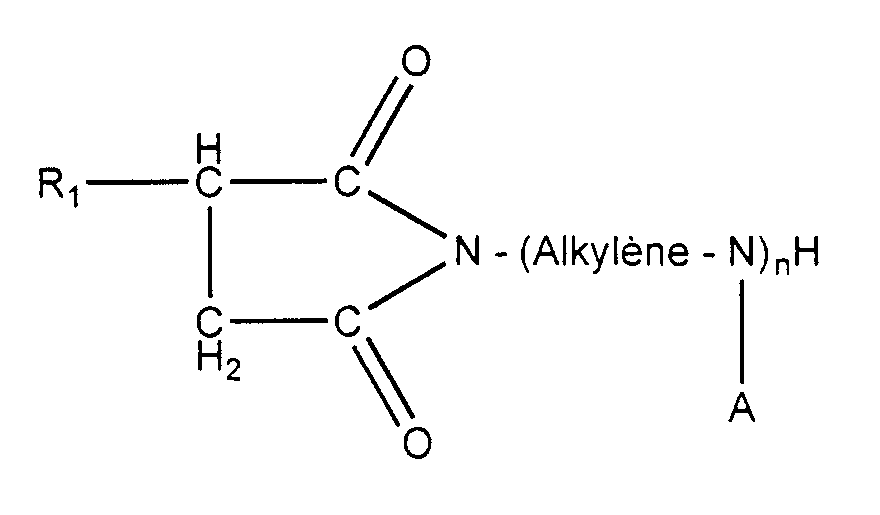
- R1 represents an alkenyl group, preferably a substantially saturated hydrocarbon group prepared by the polymerization of aliphatic monoolefins and preferably R1 is prepared from isobutene and has an average number of carbon atoms and a number average molecular weight as defined previously;
- the "alkylene" radical represents a substantially straight chain hydrocarbyl group containing up to 8 carbon atoms and preferably containing from 2 to 4 carbon atoms as defined previously;
- "A" represents a hydrocarbyl group, an amine-substituted hydrocarbyl group, or hydrogen; the hydrocarbyl group and the amine-substituted hydrocarbyl groups are generally the alkyl and amino substituted alkyl analogs of the alkylene radicals described above; and preferably "A" represents hydrogen; and n represents an integer of from 1 to 10, and preferably from 3 to 5 inclusive.
-
- The alkenyl succinimide is present in the lubricating oil compositions which are of use in this invention in a sufficient quantity to impart the desired dispersant properties to the lubricating oil in order to prevent the deposit of contaminants formed in oil during operation of the engine. In general, the percentage by weight of succinimide is contained in the range from 1 to 20% by weight of the finished lubricating oil, usually from 2 to 15% by weight and preferably from 1 to 10% by weight of the total composition.
- The alkenyl succinimides used in the context of the present invention can also be subjected to post-treatment reactions with compounds such as ethylene carbonate. These treatments are well-known to a person skilled in the art (see, for example, US Patent 4,904,278 by Timothy Erdman).
- The addition of the borated glycerol esters described above to the alkenyl succinimide results in the formation of a complex with the succinimide.
- The exact structure of the complex of the present invention is not known for certain. However, without wishing to limit the present invention to any theory, it is considered that this complex consists of compounds in which boron is either complexed by, or is the salt of, one or more nitrogen atoms of the basic nitrogen present in the succinimide. Consequently, in most cases the alkenyl succinimide will contain at most 6, but preferably 2 to 5 basic nitrogen atoms per molecule of succinimide.
- The complex may be formed by reacting the borated glycerol ester and the succinimide together in the pure state, at a temperature above the melting point of the mixture of reactants and below the decomposition temperature, or in a diluent in which both reactants are soluble. For example, the reactants can be combined in the proper ratio in the absence of a solvent to form a homogenous product which may be added to the oil or the reactants can be combined in the proper ratio in a solvent such as toluene or chloroform, the solvent can be eliminated by stripping off, and the complex thus formed can be added to the oil. Alternatively, the complex can be prepared in a lubrication oil in the form of a concentrate containing from 20 to 90% by weight of the complex, which concentrate can be added in appropriate quantities to the lubricating oil in which it is to be used or the complex may be prepared directly in the lubricating oil in which it is to be used.
- The diluent is preferably inert vis-à-vis the reactants and the products formed and is used in a quantity sufficient to ensure solubility of the reactants and to allow the mixture to be efficiently stirred.
- Temperatures for the preparation of the complex can be in the range of from 25°C to 200°C and preferably 25°C to 100°C as a function of whether the complex is prepared in the pure state or in a diluent, which signifies that lower temperatures can be used when a solvent is used.
- In general, the complexes of the present invention can also be used in combination with other additive systems in standard quantities for their known purpose.
- For example, for application in modern crankcase lubricants, the base composition described above is formulated with supplementary additives to provide the necessary stability, detergent, dispersant, anti-wear and anticorrosion properties.
- Thus, as another embodiment of this invention, the lubrication oils to which the complexes prepared by reacting the borated glycerol esters and the succinimides can be added can contain an alkali or alkaline earth metal phenate, and a Group II metal dihydrocarbyl dithiophosphate.
- Also, since the succinimides act as excellent dispersants, additional succinimides can be added to the lubricating oil compositions, above the quantities added in the form of the complex with the borated glycerol esters. The quantity of succinimides can range up to about 20% by weight of the total lubricating oil compositions.
- The alkali or alkaline earth metal hydrocarbyl sulphonates can consist of sulphonate derivatives of petroleum, synthetically alkylated aromatic sulphonates, or aliphatic sulphonates such as those derived from polyisobutylene. One of the most important functions of the sulphonates is to act as a detergent. The sulphonates are well known in the art. These hydrocarbyl groups must have a sufficient number of carbon atoms to render the sulphonate molecule soluble in the oil. Preferably, the hydrocarbyl portion has at least 20 carbon atoms and can be aromatic or aliphatic, but is usually alkylaromatic. Most preferred for use are calcium, magnesium or barium sulphonates which are aromatic in character.
- Certain sulphonates are typically prepared by the sulphonation of a petroleum fraction containing aromatic groups, usually mono- or dialkylbenzene groups, and then the formation of the metal salt of the sulphonic acid type material. Other feedstocks used for the preparation of these sulphonates include synthetically alkylated benzenes and aliphatic hydrocarbons prepared by the polymerization of a mono- or diolefin, for example, a polyisobutenyl group prepared by the polymerization of isobutene. The metallic salts are formed directly or by metathesis using well-known operating methods.
- The sulphonates can be neutral or overbased. Carbon dioxide and calcium hydroxide or oxide are the most commonly used materials to produce the basic or overbased sulphonates. Mixtures of neutral and overbased sulphonates can be used. The sulphonates are usually used so as to represent from 0.3% to 10% by weight of the total composition. Preferably, the neutral sulphonates are present in a quantity from 0.4% to 5% by weight of the total composition and overbased sulphonates are present in a quantity from 0.3% to 33% by weight of the total composition.
- The phenates intended for use in the present invention are standard products which are the alkali or alkaline earth metal salts of alkylated phenols. One of the functions of the phenates is to act as a detergent. Among other things, the phenate prevents the deposit of contaminants formed during high temperature operation of the engine. The phenols can be mono- or polyalkylated.
- The alkyl portion of the alkyl phenate is present to lend solubility to the phenate in the oil. The alkyl portion can be obtained from naturally occurring or synthetic sources. Naturally occurring sources include petroleum hydrocarbon derivatives such as white oil and wax. Being derived from petroleum, the hydrocarbon group consists of a mixture of different hydrocarbyl groups, the specific composition of which depends upon the particular oil stock which was used as a starting material. Suitable synthetic sources include various commercially available alkenes and alkane derivatives which, when reacted with the phenol, produce an alkylphenol. Suitable radicals obtained include butyl, etc. radicals. Other suitable synthetic sources of the alkyl radical include olefin polymers such as polypropylene, polybutylene, polyisobutylene etc.
- The alkyl group can be straight-chained or branch-chained, saturated or unsaturated (if unsaturated, it preferably contains no more than 2 and generally no more than 1 site of olefinic unsaturation). The alkyl radicals generally contain from 4 to 30 carbon atoms. In general when the phenol is monoalkyl-substituted, the alkyl radical shoud contain at least 8 carbon atoms. The phenate can be sulphurized if desired. It can be either neutral or overbased and if it is overbased has a base number of 200 to 300 or more. Mixtures of neutral and overbased phenates can be used.
- The phenates are usually present in the oil to represent from 0.2% to 27% by weight of the total composition. In an advantageous manner, the neutral phenates are present in a quantity from 0.2% to 9% by weight of the total composition and the overbased phenates are present in a quantity from 0.2% to 13% by weight of the total composition. Preferably, the overbased phenates are present in a quantity from 0.2% to 27% by weight of the total composition.
- The preferred metals are calcium, magnesium, strontium and barium.
- The sulphurized alkaline earth metal alkyl phenates are preferred. These salts are obtained by a variety of processes such as the treatment of the neutralization product of an alkaline earth metal base and an alkylphenol with sulphur. Conveniently the sulphur, in elemental form, is added to the neutralization product and reacted at high temperatures in order to produce the sulfurized alkaline earth metal alkyl phenate.
- If more of a quantity of base containing alkaline earth metal was added during the neutralization reation than was necessary to neutralize the phenol, a basic sulphurized alkaline earth metal alkyl phenate is obtained. See, for example, the process of Walker et al., United States Patent No. 2,680,096. Additional basicity can be obtained by adding carbon dioxide to the basic sulphurized alkaline earth metal alkyl phenate. The excess base containing an alkaline earth metal can be added after the sulphurization step but is conveniently added at the same time as the addition of the alkaline earth metal to neutralize the phenol.
- Carbon dioxide and calcium hydroxide or oxide are the most commonly used substances to produce the basic or "overbased" phenates. A process in which basic sulphurized alkaline earth metal alkylphenates are produced by the addition of carbon dioxide is described by Hanneman in United States Patent No. 3,178,368.
- The Group II metal salts of dihydrocarbyl dithiophosphoric acids present anti-wear, antioxidant and thermal stability properties. Group II metal salts of phosphorodithioic acids have been described previously. See, for example, United States Patent No. 3,390,080, columns 6 and 7, in which these compounds and their preparations are described in a general fashion. Suitably, the Group II metal salts of the dihydrocarbyl dithiophosphoric acids which are of use in the lubricating oil composition of the present invention contain from about 4 to about 12 carbon atoms in each of the hydrocarbyl radicals and can be identical or different and can be aromatic, alkyl or cycloalkyl. The preferred hydrocarbyl groups are alkyl groups containing from 4 to 8 carbon atoms and are represented by butyl, isobutyl, sec-butyl, hexyl, isohexyl, octyl, 2-ethylhexyl etc. radicals. The metals suitable for the formation of these salts include barium, calcium, strontium, zinc and cadmium, amongst which zinc is preferred.
- Preferably, the Group II metal salt of a dihydrocarbyl dithiophosphoric acid corresponds to the following formula:in which:

- R2 and R3 each independently represent hydrocarbyl radicals corresponding to the description immediately above, and
- M1 represents a Group II metal cation corresponding to the previous definition.
-
- The dithiophosphoric salt is present in the lubricating oil compositions of the present invention in a quantity effective to inhibit wear and oxidation of the lubricating oil. The quantity ranges from about 0.1 to about 4% by weight of the total composition; preferably, the salt is present in a quantity representing about 0.2 to 2.5% by weight of the total lubricating oil composition. The final lubricating oil composition will usually contain from 0.025 to 0.25% by weight of phosphorus and preferably 0.05 to 0.15% by weight.
- The finished lubricating oil can be single or multigrade. Multigrade lubricating oils are prepared by adding agents which improve the viscosity index (VI). Standard agents for improving the viscosity index are alkyl methacrylate polymers, ethylene-propylene copolymers, styrene-diene copolymers, etc. Agents called improved VI improvers having both viscosity index and dispersion improvement properties are also suitable for use in the formulations of the present invention.
- The lubricating oil used in the compositions of the present invention can be a mineral oil or a synthetic oil of lubricating viscosity, preferably suitable for use in the crankcase of an internal combustion engine. Crankcase lubricating oils usually have a viscosity of about 1300 mm2/s (cST) at -18°C (0°F) to 22.7 mm2/s (cSt) at 99°C (210°F). The lubricating oils can be derived from synthetic or natural sources. The mineral oils intended to be used as the base oil in the present invention include paraffinic oils, naphthenic oils and other oils which are usually used in lubricating oil compositions. The synthetic oils include hydrocarbon synthetic oils and synthetic esters. Particularly useful synthetic hydrocarbon oils are liquid polymers of alpha olefins having the suitable viscosity. Particularly useful oils are hydrogenated liquid oligomers of C6-12 alpha olefins such as 1-decene trimers, tetramers and higher oligomers. Similarly, alkyl benzenes of suitable viscosity, such as didodecyl benzene can be used. Useful synthetic esters include the esters of a monocarboxylic acid and polycarboxylic acids as well as monohydroxy alkanols and polyols. Typical examples are didodecyl adipate, pentaerythritol tetracaproate, di-2-ethylhexyl adipate, dilauryl sebacate, etc. Complex esters prepared from mixtures of mono- and dicarboxylic acid and mono- and dihydroxy alkanols can also be used.
- Blends of hydrocarbon oils with synthetic oils are also useful. For example, blends of 10 to 25% by weight of a hydrogenated 1-decene trimer with 75 to 90% by weight of a mineral oil having a viscosity of 33 mm2/s (cSt) at 38°C (100°F) give an excellent lubricating oil base.
- Other additives which may be present in the formulation include rust removing additives, foam inhibitors, corrosion inhibitors, metal deactivators, pour point depressants, antioxidants and a variety of other well-known additives.
- The following examples are proposed to specifically illustrate the present invention.
- The envisaged additives were tested for their compatibility in a bench test (PV 3344) by suspending a fluorocarbon test piece (AK 6) in an oilbased solution heated to 150°C for 282 hours, the oil being renewed every 92 hours, then by measuring the variation in the physical properties of the sample, in particular the tensile strength break (TSB) and the elongation at break (ELB), in accordance with procedure DIN 53504, by observing whether any cracks had formed at 100% elongation. The passing test criteria included the following: no evidence of crack development; a tensile strength break greater than 8N/mm2 and an elongation at break greater than 160%. This test procedure will be designated above and later simply as the "VW Bench Test".
- Two baseline formulations, additives A and B were used in these tests.
- Additive A is a detergent-inhibitor for petrol and diesel passenger vehicles. It contains a polyisobutene bis-succinimide the PIB molecular weight of which is 2200 gmol-1 having been subjected to a treatment with ethylene carbonate, a polyisobutene dispersant ester of which the PIB molecular weight is 950 gmol-1, a sulphurized calcium alkylate-phenate, a calcium alkylsulphonate LOB, a secondary zinc dithiophosphate, a magnesium alkylsulphonate HOB, an amino oxidation inhibitor, a phenolic oxidation inhibitor and a foam inhibitor.
- Additive B is a detergent-inhibitor formulation for diesel commercial vehicles. It contains practically the same components as additive A but in different proportions. It contains no polyisobutene dispersant ester, nor a phenolic oxidation inhibitor. In addition, it contains a specific molybdenum-based anti-wear additive.
- Tests were carried out in additive B by replacing the polyisobutene bis-succinimide having been subjected to ethylene carbonate treatment by a the polyisobutene bis-succinimide with the same molecular weight but not having been subjected to ethylene carbonate treatment.
- The finished oil formulated from these additives contains an olefin copolymer as a viscosity index improver and a blend of mineral oils of ESSO 150N and 600N grades.
- A series of experiments was carried out in order to determine the concentration of borated glycerol monooleates required in aditives containing a bis-succinimide, having been subjected to post-treatment or not, with ethylene carbonate in order to produce a satisfactory result in the PV 3344 bench test. The borated glycerol monooleate was at concentrations such that the % boron/% basic nitrogen ratio varies over the range of approximately 0.5 to 4.0. The results are summarized in the table below.
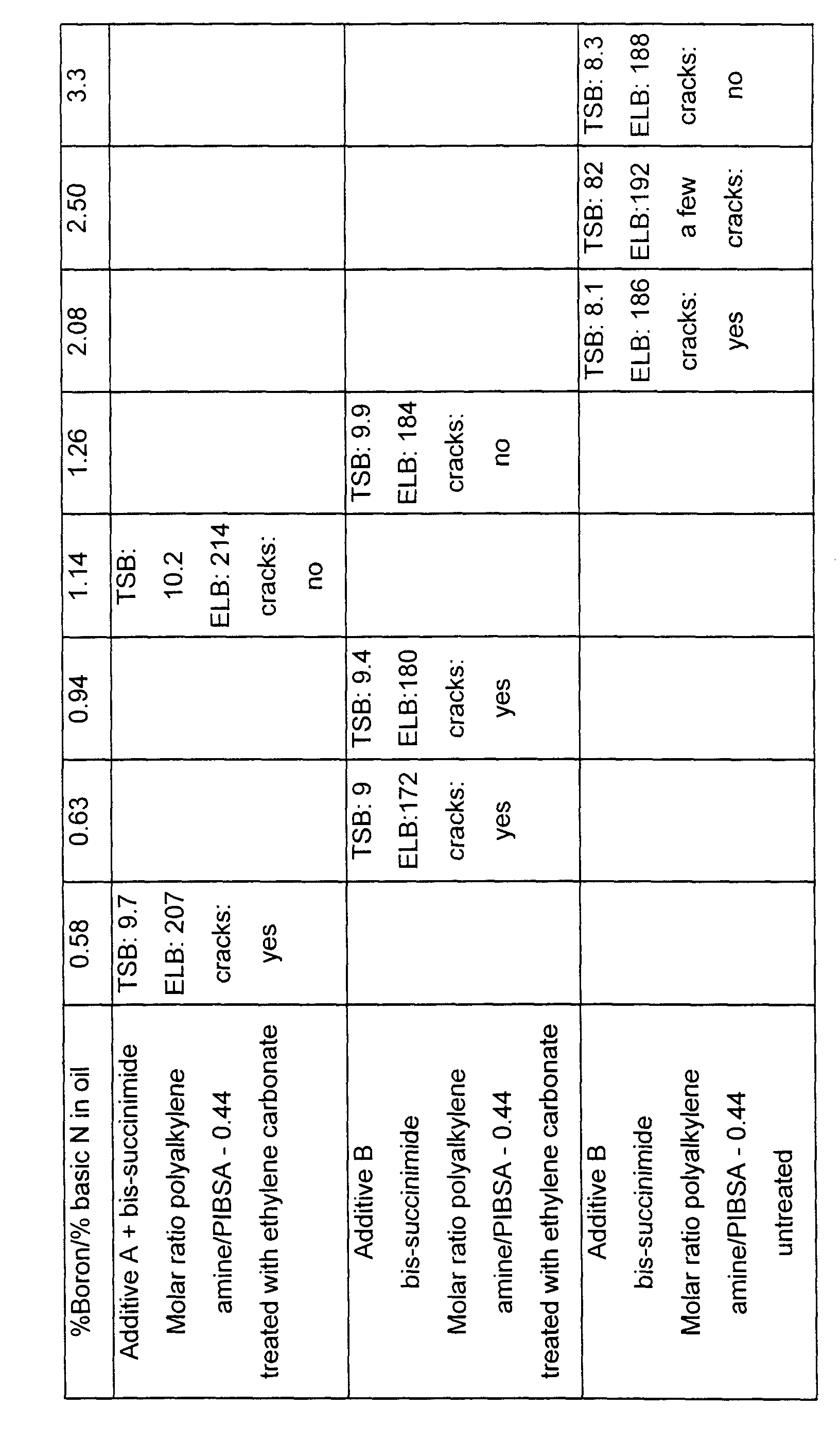
- These results show that post-treatment of dispersants commonly found in oil additives, such as succinimides, allows a reduction in the quantity of borated glycerol oleates required to eliminate the presence of cracks on fluorocarbon elastomers. For succinimides which have been subjected to a post-treatment, the minimum % boron/% basic nitrogen ratio is equal to approximately 1.0, whereas for succinimides which have not been subjected to a post-treatment, this same minimum ratio is probably around 3.
Claims (8)
- The use of borated compounds having the following general formula I :In which X is S or O, and R is a hydrocarbyl group containing at least 3 carbon atoms, as an additive improving the compatibility of a lubricating oil composition, comprising dispersants containing basic nitrogen atoms, with fluorocarbon elastomers, the concentration of the compound of general formula I being such that the ratio % Boron/ % basic N of the lubricating composition varies from 0.25 to 5.

- The use according to claim 1, characterized in that the concentration of the compound of general formula I is selected as a function of the nature of the dispersant compound present in said lubricating composition.
- The use according to claims 1 and 2, characterized in that R is a hydrocarbyl group containing between 3 and 50 carbon atoms .
- The use according to claims I and 2, characterized in that R is a hydrocarbyl group containing between 3 and 17 carbon atoms.
- The use according to any one of claims 1 to 4, characterized in that the compound of general formula I is borated glycerol mono-oleate.
- The use according to any one of claims 1 to 5, characterized in that the dispersant compound contained in the lubricating composition is a bis-succinimide, post-treated or not, in particular with ethylene carbonate.
- The use according to claim 6, characterized in that the minimum ratio % Boron/% basic N of the lubricating composition is situated around 1.0, if said lubricating composition contains a dispersant compound of bis-succinimide type, post-treated, in particular, with ethylene carbonate.
- The use according to claim 6, characterized in that the minimum ratio % Boron/% basic N of the lubricating composition is situated around 3, if said lubricating composition contains a dispersant compound of bis-succinimide type, which has not been subjected to a post-treatment step.
Applications Claiming Priority (2)
| Application Number | Priority Date | Filing Date | Title |
|---|---|---|---|
| FR9705512 | 1997-05-05 | ||
| FR9705512A FR2762848B1 (en) | 1997-05-05 | 1997-05-05 | USE OF BORATE COMPOUNDS FOR IMPROVING THE COMPATIBILITY OF LUBRICATING OILS WITH FLUOROCARBON ELASTOMERS |
Publications (2)
| Publication Number | Publication Date |
|---|---|
| EP0877073A1 EP0877073A1 (en) | 1998-11-11 |
| EP0877073B1 true EP0877073B1 (en) | 2001-12-12 |
Family
ID=9506585
Family Applications (1)
| Application Number | Title | Priority Date | Filing Date |
|---|---|---|---|
| EP98400970A Expired - Lifetime EP0877073B1 (en) | 1997-05-05 | 1998-04-21 | Use of borated compounds for the improvement of the compatibility of lubricating oils with fluorocarbon elastomers |
Country Status (7)
| Country | Link |
|---|---|
| US (1) | US6124247A (en) |
| EP (1) | EP0877073B1 (en) |
| JP (1) | JP4079510B2 (en) |
| CA (1) | CA2235428C (en) |
| DE (1) | DE69802861T2 (en) |
| FR (1) | FR2762848B1 (en) |
| SG (1) | SG77172A1 (en) |
Families Citing this family (18)
| Publication number | Priority date | Publication date | Assignee | Title |
|---|---|---|---|---|
| US20040171501A1 (en) * | 2003-02-27 | 2004-09-02 | Leeuwen Jeroen Van | Method for improving elastomer compatibility |
| JP4955998B2 (en) * | 2005-12-27 | 2012-06-20 | シェブロンジャパン株式会社 | Lubricating oil composition |
| US20080171677A1 (en) * | 2006-04-13 | 2008-07-17 | Buck William H | Low SAP engine lubricant additive and composition containing non-corrosive sulfur and organic borates |
| US20080128184A1 (en) * | 2006-11-30 | 2008-06-05 | Loper John T | Lubricating oil compositions having improved corrosion and seal protection properties |
| US8901050B2 (en) | 2010-03-31 | 2014-12-02 | Chevron Oronite Company Llc | Method for improving copper corrosion performance |
| US8933001B2 (en) * | 2010-03-31 | 2015-01-13 | Chevron Oronite Company Llc | Method for improving fluorocarbon elastomer seal compatibility |
| US8993496B2 (en) * | 2010-03-31 | 2015-03-31 | Chevron Oronite Company Llc | Method for improving fluorocarbon elastomer seal compatibility |
| US9150811B2 (en) | 2010-03-31 | 2015-10-06 | Cherron Oronite Company LLC | Method for improving copper corrosion performance |
| US8716202B2 (en) | 2010-12-14 | 2014-05-06 | Chevron Oronite Company Llc | Method for improving fluorocarbon elastomer seal compatibility |
| EP3810733B1 (en) * | 2018-06-22 | 2024-05-22 | Chevron Oronite Company LLC | Lubricating oil compositions |
| US12529006B2 (en) * | 2021-07-21 | 2026-01-20 | Afton Chemical Corporation | Methods of reducing lead corrosion in an internal combustion engine |
| US12146115B2 (en) | 2022-12-20 | 2024-11-19 | Afton Chemical Corporation | Low ash lubricating compositions for controlling steel corrosion |
| US12195695B2 (en) | 2023-05-10 | 2025-01-14 | Afton Chemical Corporation | Lubricating oil compositions for improving low-speed pre-ignition |
| CN119264964B (en) * | 2023-07-04 | 2025-09-26 | 中国石油天然气股份有限公司 | A boronated fatty acid glyceride anti-wear additive and preparation method thereof |
| US12291688B1 (en) | 2023-12-12 | 2025-05-06 | Afton Chemical Corporation | Silicon-containing compounds for lubricants |
| US12565625B2 (en) | 2023-12-18 | 2026-03-03 | Afton Chemical Corporation | Thiophosphate esters as antiwear additives for lubricants |
| US12378493B1 (en) | 2024-03-27 | 2025-08-05 | Afton Chemical Corporation | Lubricating composition for enhanced fuel economy |
| US12460150B1 (en) | 2024-09-27 | 2025-11-04 | Afton Chemical Corporation | Low-ash lubricating compositions |
Family Cites Families (7)
| Publication number | Priority date | Publication date | Assignee | Title |
|---|---|---|---|---|
| US5006272A (en) * | 1980-03-24 | 1991-04-09 | Mobil Oil Corporation | Friction reducing additives and compositions thereof |
| AU549639B2 (en) * | 1981-07-01 | 1986-02-06 | Chevron Research Company | Lubricating oil composition to improve fuel economy |
| US4455243A (en) * | 1983-02-24 | 1984-06-19 | Chevron Research Company | Succinimide complexes of borated fatty acid esters of glycerol and lubricating oil compositions containing same |
| CA1237959A (en) * | 1983-09-29 | 1988-06-14 | Andrew G. Papay | Boronation process |
| CA2097828C (en) * | 1991-10-08 | 2003-07-08 | Anatoli Onopchenko | Fluorocarbon seal protective additives for lubrication oils |
| US5356552A (en) * | 1993-03-09 | 1994-10-18 | Chevron Research And Technology Company, A Division Of Chevron U.S.A. Inc. | Chlorine-free lubricating oils having modified high molecular weight succinimides |
| GB9516326D0 (en) * | 1995-08-09 | 1995-10-11 | Exxon Research Engineering Co | Lubricant composition containing antioxidant additive combination |
-
1997
- 1997-05-05 FR FR9705512A patent/FR2762848B1/en not_active Expired - Lifetime
-
1998
- 1998-04-20 CA CA002235428A patent/CA2235428C/en not_active Expired - Lifetime
- 1998-04-20 SG SG1998000755A patent/SG77172A1/en unknown
- 1998-04-21 DE DE69802861T patent/DE69802861T2/en not_active Expired - Fee Related
- 1998-04-21 EP EP98400970A patent/EP0877073B1/en not_active Expired - Lifetime
- 1998-05-06 JP JP13914798A patent/JP4079510B2/en not_active Expired - Lifetime
-
1999
- 1999-09-02 US US09/389,303 patent/US6124247A/en not_active Expired - Lifetime
Also Published As
| Publication number | Publication date |
|---|---|
| EP0877073A1 (en) | 1998-11-11 |
| DE69802861D1 (en) | 2002-01-24 |
| CA2235428C (en) | 2007-07-31 |
| JP4079510B2 (en) | 2008-04-23 |
| US6124247A (en) | 2000-09-26 |
| CA2235428A1 (en) | 1998-11-04 |
| FR2762848B1 (en) | 2000-02-04 |
| DE69802861T2 (en) | 2002-08-29 |
| SG77172A1 (en) | 2000-12-19 |
| FR2762848A1 (en) | 1998-11-06 |
| JPH10316984A (en) | 1998-12-02 |
Similar Documents
| Publication | Publication Date | Title |
|---|---|---|
| US6124247A (en) | Use of borated compounds for the improvement of the compatibility of lubricating oils with fluorocarbon elastomers | |
| US4455243A (en) | Succinimide complexes of borated fatty acid esters of glycerol and lubricating oil compositions containing same | |
| JP2877887B2 (en) | Improved low ash lubricating compositions for internal combustion engines | |
| EP0277729B1 (en) | Lubricant compositions providing wear protection at reduced phosphorus levels | |
| JP4921691B2 (en) | Oil composition with improved fuel economy | |
| JP2796357B2 (en) | Lubricating oil compositions and concentrates | |
| KR0145373B1 (en) | High performance lubricant composition | |
| AU711001B2 (en) | A composition for providing anti-shudder friction durability performance for automatic transmissions | |
| EP0217591B1 (en) | Normally liquid c18 to c24 monoalkyl catechols | |
| JPH06166887A (en) | Sulfided overbased composition | |
| MXPA04008499A (en) | Lubricating compositions with good thermal stability and demulsibility properties. | |
| EP1018539B1 (en) | Overbased metal detergents | |
| EP0562062B1 (en) | Fluorocarbon seal protective additives for lubrication oils | |
| US4629578A (en) | Succinimide complexes of borated alkyl catechols and lubricating oil compositions containing same | |
| JPH093471A (en) | Lubricating compositions, functional fluids and greases containing thioline-containing esters or salts thereof with oxyalkylene groups, and methods of using them | |
| JPH0438793B2 (en) | ||
| US4629577A (en) | Method for improving fuel economy of internal combustion engines | |
| US8138130B2 (en) | Fused-ring aromatic amine based wear and oxidation inhibitors for lubricants | |
| EP0206748B1 (en) | Lubricating oil additive and lubricating oil composition containing the same | |
| CA2794660C (en) | Oil-soluble titanium compounds for improving copper corrosion performance of a lubricating oil composition | |
| CA1224470A (en) | Succinimide complexes of borated fatty acid esters of glycerol and lubricating compositions containing same | |
| CA2305637A1 (en) | Polyalkylene succinimide composition useful in internal combustion engines | |
| CA2794654C (en) | Method for improving fluorocarbon elastomer seal compatibility | |
| EP0491856B1 (en) | Alkylamine complexes of borated alkyl catechols and lubricating oil compositions containing the same | |
| NO170161B (en) | LUBRICANE OIL CONTAINING A COMPLEX OF A SUCCINIMIDE AND INCORPORATED ALKYLCATECHOL |
Legal Events
| Date | Code | Title | Description |
|---|---|---|---|
| PUAI | Public reference made under article 153(3) epc to a published international application that has entered the european phase |
Free format text: ORIGINAL CODE: 0009012 |
|
| AK | Designated contracting states |
Kind code of ref document: A1 Designated state(s): DE GB NL |
|
| AX | Request for extension of the european patent |
Free format text: AL;LT;LV;MK;RO;SI |
|
| 17P | Request for examination filed |
Effective date: 19990329 |
|
| AKX | Designation fees paid |
Free format text: DE GB NL |
|
| 17Q | First examination report despatched |
Effective date: 20000515 |
|
| RAP1 | Party data changed (applicant data changed or rights of an application transferred) |
Owner name: CHEVRON ORONITE S.A. |
|
| GRAG | Despatch of communication of intention to grant |
Free format text: ORIGINAL CODE: EPIDOS AGRA |
|
| GRAG | Despatch of communication of intention to grant |
Free format text: ORIGINAL CODE: EPIDOS AGRA |
|
| GRAH | Despatch of communication of intention to grant a patent |
Free format text: ORIGINAL CODE: EPIDOS IGRA |
|
| GRAH | Despatch of communication of intention to grant a patent |
Free format text: ORIGINAL CODE: EPIDOS IGRA |
|
| GRAA | (expected) grant |
Free format text: ORIGINAL CODE: 0009210 |
|
| AK | Designated contracting states |
Kind code of ref document: B1 Designated state(s): DE GB NL |
|
| REG | Reference to a national code |
Ref country code: GB Ref legal event code: IF02 |
|
| REF | Corresponds to: |
Ref document number: 69802861 Country of ref document: DE Date of ref document: 20020124 |
|
| PLBE | No opposition filed within time limit |
Free format text: ORIGINAL CODE: 0009261 |
|
| STAA | Information on the status of an ep patent application or granted ep patent |
Free format text: STATUS: NO OPPOSITION FILED WITHIN TIME LIMIT |
|
| 26N | No opposition filed | ||
| PGFP | Annual fee paid to national office [announced via postgrant information from national office to epo] |
Ref country code: NL Payment date: 20030318 Year of fee payment: 6 |
|
| PGFP | Annual fee paid to national office [announced via postgrant information from national office to epo] |
Ref country code: DE Payment date: 20030430 Year of fee payment: 6 |
|
| PG25 | Lapsed in a contracting state [announced via postgrant information from national office to epo] |
Ref country code: NL Free format text: LAPSE BECAUSE OF NON-PAYMENT OF DUE FEES Effective date: 20041101 |
|
| PG25 | Lapsed in a contracting state [announced via postgrant information from national office to epo] |
Ref country code: DE Free format text: LAPSE BECAUSE OF NON-PAYMENT OF DUE FEES Effective date: 20041103 |
|
| NLV4 | Nl: lapsed or anulled due to non-payment of the annual fee |
Effective date: 20041101 |
|
| PGFP | Annual fee paid to national office [announced via postgrant information from national office to epo] |
Ref country code: GB Payment date: 20170419 Year of fee payment: 20 |
|
| REG | Reference to a national code |
Ref country code: GB Ref legal event code: PE20 Expiry date: 20180420 |
|
| PG25 | Lapsed in a contracting state [announced via postgrant information from national office to epo] |
Ref country code: GB Free format text: LAPSE BECAUSE OF EXPIRATION OF PROTECTION Effective date: 20180420 |