EP0875151A2 - Process for producing soybean milk and okara - Google Patents
Process for producing soybean milk and okara Download PDFInfo
- Publication number
- EP0875151A2 EP0875151A2 EP98303093A EP98303093A EP0875151A2 EP 0875151 A2 EP0875151 A2 EP 0875151A2 EP 98303093 A EP98303093 A EP 98303093A EP 98303093 A EP98303093 A EP 98303093A EP 0875151 A2 EP0875151 A2 EP 0875151A2
- Authority
- EP
- European Patent Office
- Prior art keywords
- okara
- soybean
- soybean milk
- soybeans
- water
- Prior art date
- Legal status (The legal status is an assumption and is not a legal conclusion. Google has not performed a legal analysis and makes no representation as to the accuracy of the status listed.)
- Granted
Links
Classifications
-
- A—HUMAN NECESSITIES
- A23—FOODS OR FOODSTUFFS; TREATMENT THEREOF, NOT COVERED BY OTHER CLASSES
- A23C—DAIRY PRODUCTS, e.g. MILK, BUTTER OR CHEESE; MILK OR CHEESE SUBSTITUTES; PREPARATION THEREOF
- A23C11/00—Milk substitutes, e.g. coffee whitener compositions
- A23C11/02—Milk substitutes, e.g. coffee whitener compositions containing at least one non-milk component as source of fats or proteins
- A23C11/10—Milk substitutes, e.g. coffee whitener compositions containing at least one non-milk component as source of fats or proteins containing or not lactose but no other milk components as source of fats, carbohydrates or proteins
- A23C11/103—Milk substitutes, e.g. coffee whitener compositions containing at least one non-milk component as source of fats or proteins containing or not lactose but no other milk components as source of fats, carbohydrates or proteins containing only proteins from pulses, oilseeds or nuts, e.g. nut milk
-
- A—HUMAN NECESSITIES
- A23—FOODS OR FOODSTUFFS; TREATMENT THEREOF, NOT COVERED BY OTHER CLASSES
- A23L—FOODS, FOODSTUFFS OR NON-ALCOHOLIC BEVERAGES, NOT OTHERWISE PROVIDED FOR; PREPARATION OR TREATMENT THEREOF
- A23L11/00—Pulses, i.e. fruits of leguminous plants, for production of food; Products from legumes; Preparation or treatment thereof
- A23L11/05—Mashed or comminuted pulses or legumes; Products made therefrom
- A23L11/07—Soya beans, e.g. oil-extracted soya bean flakes
-
- A—HUMAN NECESSITIES
- A23—FOODS OR FOODSTUFFS; TREATMENT THEREOF, NOT COVERED BY OTHER CLASSES
- A23L—FOODS, FOODSTUFFS OR NON-ALCOHOLIC BEVERAGES, NOT OTHERWISE PROVIDED FOR; PREPARATION OR TREATMENT THEREOF
- A23L11/00—Pulses, i.e. fruits of leguminous plants, for production of food; Products from legumes; Preparation or treatment thereof
- A23L11/40—Pulse curds
- A23L11/45—Soy bean curds, e.g. tofu
-
- A—HUMAN NECESSITIES
- A23—FOODS OR FOODSTUFFS; TREATMENT THEREOF, NOT COVERED BY OTHER CLASSES
- A23L—FOODS, FOODSTUFFS OR NON-ALCOHOLIC BEVERAGES, NOT OTHERWISE PROVIDED FOR; PREPARATION OR TREATMENT THEREOF
- A23L11/00—Pulses, i.e. fruits of leguminous plants, for production of food; Products from legumes; Preparation or treatment thereof
- A23L11/60—Drinks from legumes, e.g. lupine drinks
- A23L11/65—Soy drinks
-
- A—HUMAN NECESSITIES
- A23—FOODS OR FOODSTUFFS; TREATMENT THEREOF, NOT COVERED BY OTHER CLASSES
- A23V—INDEXING SCHEME RELATING TO FOODS, FOODSTUFFS OR NON-ALCOHOLIC BEVERAGES AND LACTIC OR PROPIONIC ACID BACTERIA USED IN FOODSTUFFS OR FOOD PREPARATION
- A23V2300/00—Processes
- A23V2300/31—Mechanical treatment
Definitions
- the present invention relates to a process for producing soybean milk and okara.
- the traditional process for producing tofu includes the steps of soaking soybeans in water for one night to impregnate them with water, pulverizing the impregnated soybeans in the presence of water to provide an aqueous slurry and separating the water soluble portion, i.e. soybean milk, from the water insoluble portion, i.e. okara, by means such as wringing with filter cloth.
- the soybean milk obtained is further processed to provide tofu.
- soybean milk and okara are also used as they are as health foods and the like, or used as raw materials for processed foods.
- the step of pulverizing the impregnated soybeans is carried out by means of only frictional shearing stress exerted by, for example, a Micolloider or homogenizer.
- a Micolloider or homogenizer As a result of such treatment, frictional heat is generated and the cell walls of the soybeans are crushed.
- a substantial portion of the water insoluble fiber component of the soybeans which is mainly derived from cell walls, is eluted into the soybean milk and causes an unpleasant taste and flavor, that the frictional heat may cause denaturation of the soybean proteins, and that soybean enzymes may be activated so as to generate an unpleasant flavor.
- JP-A 59-205957 describes a process comprising multiple phase grinding of impregnated soybeans under heating with direct steam at 80-100°C. This process contains the steps of grinding the impregnated soybeans with a grinder, and further grinding the soybeans with a hammer mill. There was no description of a device having rotating blades being used for the first pulverizing step.
- JP-A 62-11068 describes a process for preparing soybean milk which comprises the steps of grinding enzyme inactivated impregnated soybeans roughly into particles of 40-mesh or coarser, then grinding the soybean particles finely into particles of 80-mesh or finer.
- the okara fiber obtained may be further ground into ultra fine particles.
- a Microgreater a device which can exert shearing stress
- an Ultramizer a device which grinds materials by means of impact stress
- JP-A 61-242553 describes a process for preparing soybean milk which comprises the steps of grinding enzyme inactivated impregnated soybeans in the presence of hot or warm water roughly, and then finely. However, the details of the process are not described or shown.
- the main object of the present invention is to provide a process for producing soybean milk and okara with pleasant flavor and mild taste.
- the present inventors have studied pulverization conditions of impregnated soybeans to obtain soybean milk and okara with pleasant flavor and mild taste. As a result, it has been found that the desired soybean milk and okara can be obtained by carrying out pulverization of impregnated soybeans first with a device having rotating blade(s) to obtain particles having a certain particle size and then with a device which exerts frictional shearing stress to obtain particles having a finer particle size. Thus, the present invention has been completed.
- the present invention provides a process for producing soybean milk and okara which comprises carrying out pulverization of impregnated soybeans by the steps of:
- the average size of the soybean particles obtained in the cutting step is less than about 100 ⁇ m, preferably, about 20-100 ⁇ m, more preferably, about 30-70 ⁇ m.
- the average particle size of the soybean particles obtained in the grinding step may be about 15-40 ⁇ m, preferably, about 20-30 ⁇ m.
- the cutting and/or grinding operations may preferably be effected twice or more.
- soybeans are pulverized by a two step process consisting of cutting with a device having rotating blades and grinding by means of frictional shearing stress to provide an aqueous slurry.
- the production steps per se may be those of conventional steps for producing soybean milk and okara.
- Soybeans used for producing soybean milk and okara may be any kind of soybean that is conventionally used for producing tofu, soybean milk or okara. Defatted, dehypocotyled and dehulled soybeans are preferable. In order to dehypocotyl and dehull the soybeans, any conventional manner can be employed, for example, soybeans may be heated at over 70°C, preferably 70°C-90°C to dry them and the soybeans are then broken into 2 to 4 pieces.
- Soybeans are soaked in water so as to impregnate them with water.
- the impregnated soybeans contain about 50 wt% of water.
- the water may be cold, warm or hot water. Hot water is preferable.
- the soaking time may vary depending on the temperature of the water, i.e. the higher the temperature, the shorter the soaking time.
- the impregnated soybeans are pulverized into particles.
- the impregnated soybeans may be pulverized together with the water used for the soaking.
- the soaking water may be just separated from the soybeans.
- the water removed may be further treated by passing it through an ultrafiltration membrane or reverse-osmotic pressure filtration membrane, and the filtrate may be reused for the pulverizing steps.
- the impregnated soybeans obtained as above are subjected to the first pulverizing step, i.e. the cutting step.
- the soybeans are cut with a device having rotating blade(s), which can cut the soybeans into particles of less than about 100 ⁇ m.
- soybeans are cut into particles having an average diameter of less than about 100 ⁇ m, preferably about 30-70 ⁇ m.
- Any device having high speed rotating edged blade(s) which can cut the impregnated soybeans into particles having an average diameter of less than about 100 ⁇ m may be employed for the cutting step of the present invention.
- An example of such a device includes a Commit roll (trade name).
- the conventional cutter mill or line mill which has rotating blades which can cut materials but has fewer blades and less speed of rotation, is not preferred.
- the cell walls of the impregnated soybeans are cut very smoothly without being crushed. Therefore, the soybean particles obtained are expected to show increased extractability of soybean protein into the soybean milk.
- the process of the present invention is effective to increase protein extractability into the soybean milk.
- the soybean particles obtained in the cutting step have a sharpened edge, which may cause a stimulating taste in the resulting soybean milk and okara. Therefore, it is preferable, for a mild taste of the soybean milk and okara, that further grinding the soybean particles by means of frictional shearing stress be conducted to provide spherically shaped particles.
- the soybean particles obtained are further ground in the second pulverizing step.
- the soybean particles, obtained in the cutting step are ground more finely by means of frictional shearing stress.
- the term "frictional shearing stress” means in this specification and claims that shearing stress generated by frictional force.
- any device that can generate frictional shearing stress and can provide particles having a size of less than 40 ⁇ m may be employed.
- a Micolloider and a homogenizer may be employed in the grinding step of the present invention.
- a homogenizer more preferably, a high pressure homogenizer is employed.
- a low pressure homogenizer such as one which exerts a pressure of under 150 kg/cm 2 is not preferred since it requires many grinding operations to obtain particles of the desired size. Too many such operations may cause an unpleasant flavor of the resulting soybean milk and okara.
- the pressure exerted by the high-pressure homogenizer may be about 100-400 kg/cm 2 , preferably, about 150-200 kg/cm 2 .
- the pressure is too high, the particle size of the aqueous soybean slurry obtained becomes too small to separate the okara and soybean milk effectively.
- the grinding operation twice or more.
- the distribution range of the particles will be narrower.
- okara and soybean milk may be separated effectively to provide an improved flavor for both the soybean milk and okara.
- An average particle size of the soybean slurry obtained by the grinding step may be about 15-40 ⁇ m, preferably, about 20-30 ⁇ m.
- the separation may be effected by a batch process, which includes a step of wringing the aqueous slurry with a filter cloth, or by a continuous method such as centrifugation.
- a continuous process is preferable as an industrial process. In order to increase the yield of soybean milk and okara, centrifugation more than twice is preferable.
- Soybean milk obtained by the present process contains a relatively high amount of glucose but a low amount of uronic acid (galacturonic acid). This means that the soybean milk of the present invention contains a smaller amount of pectin-like polysaccharides.
- soybean milk obtained by a conventional process in which the impregnated soybeans are pulverized by means of only frictional shearing stress, contains a relatively high amount of galactose or arabinose but a low amount of glucose.
- Such rich pectin or hemicellulose-like polysaccharides may come from the crushed cell walls of the soybeans and may cause an unpleasant taste of the resulting soybean milk.
- the present invention by cutting the impregnated soybeans in the first pulverizing step, elution of pectin-like polysaccharides, the main component of the cell wall, into the soybean milk is effectively reduced.
- Okara obtained according to the present invention provides a pleasant flavor with a mild and creamy taste.
- soybeans One part by weight of dehulled and dehypocotyled soybeans were soaked in 10 parts by weight of water at a temperature of 30-50°C for more than 60 minutes.
- the aqueous soybean slurry obtained contained soybean particles of 30-70 ⁇ m.
- the slurry obtained was further ground twice with a high-pressure homogenizer (APV Co.) at 200 kg/cm 2 for 2 minutes to provide an aqueous slurry containing soybean particles of 20-30 ⁇ m (designated as "CH").
- AAV Co. high-pressure homogenizer
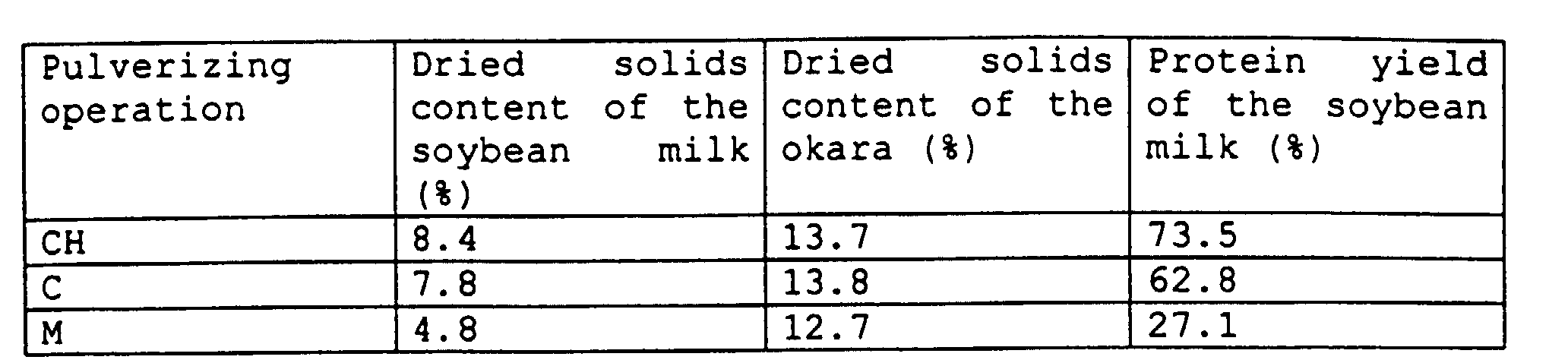
- the mixture of water and the impregnated soybeans as above was ground with only a Commit roll , which had rotating blades to provide an aqueous soybean slurry having soybean particles of 20-30 ml designated as "C"), or with only a Masucolloider (MASUKO SANGYO KABUSHIKI KAISHA, JAPAN), a device which grinds a material by means of frictional shearing stress and the clearance of which was adjusted to provide the desired particle size, to provide an aqueous soybean slurry containing soybean particles of 20-30 ⁇ m (designated as "M").
- Each of the slurries was centrifuged at 3,000 G for 5 minutes to separate soybean milk and okara.
- the particle size of the slurry, weight ratio between the soybean milk and the okara, % by weight of dried solid content of the slurry, the soybean milk and the okara, and protein yield of the soybean milk were determined.
- the particle size was determined with Coulter counter (Coulter Co.) .
- the taste of the soybean milk was evaluated and compared by panelists. Twelve out of twelve panelists rated the soybean milk obtained by the present invention (CH) as being better than the "C” or "M” soybean milk since the "CH” soybean milk had less soybean odor, grassy smell or stimulating smells than the others.
- CH soybean milk obtained by the present invention
- One part by weight of the dehulled and dehycotylled soybeans were soaked in 8 parts by weight of water at 90°C until the soybeans are sufficiently impregnated with water.
- One part by weight of the impregnated soybeans was mixed with 3 parts by weight of hot water (90°C) and the mixture was roughly cut with a Commit roll URSCHEL) which has 170 rotating blades, and then with a Commit roll which has 206 rotating blades to provide a slurry containing particles of 30-70 ⁇ m.
- the slurry obtained was then ground twice with a high-pressure homogenizer (APV Co.) at 200 kg/cm 2 to provide a finely divided soybean slurry containing particles of 20-30 ⁇ m (designated as "CH").
- AAV Co. high-pressure homogenizer
- the impregnated soybeans were cut with a Commit roll, which has 222 rotating blades to provide a slurry containing particles of 20-30 ⁇ m (designated as "C”); or the impregnated soybeans were ground only with a Masucolloider (MASUKOU SANGYOU SYA, Japan), a device which grinds a material by means of frictional shearing stress, to provide a slurry containing particles of 20-30 ⁇ m (designated as "M”). The particle size was determined with a Coulter counter. The results are shown in Table 2.
- Soybean milk obtained from heat-treated soybeans, which were pulverized with only a Comitt roll or Mascolloider were shown to yield less protein.
- the protein yield of the soybean milk obtained by pulverizing with only a Mascolloider was low.
- the taste of the soybean milk obtained was evaluated and compared by panelists.
- Table 3 shows that the soybean milk obtained by the present invention has a substantially better taste and flavor than the others.
- One part by weight of dehulled and dehypocotyl soybeans were soaked into 10 parts by weight of water at a temperature of 90°C to be impregnated sufficiently.
- a mixture of one part by weight of the impregnated soybeans and three parts by weight of hot water (90°C) was subjected to a pulverizing treatment with certain combinations of a Commit roll (URSCHEL), a Mascolloider (MASUKO SANGYOU, Japan), a chopper mill (MASUKO SANGYO, Japan), which has rotating blades, and a line mill (TOKUSYUKIKA, Japan), which has rotating blades, as specified in Table 4 to provide an aqueous slurry containing particles of 30-70 ⁇ m.
- URSCHEL Commit roll
- MASUKO SANGYOU Mascolloider
- MASUKO SANGYO chopper mill
- TOKUSYUKIKA Japan
- the soybean milks which showed good protein yield were CCH, CMH and MMH.
- the particle size of the soybeans could not be less than 100 ⁇ m. Therefore, after pulverizing with each of them, the soybean particles were cut with a commit roll to provide the desired particle size.
- the soybean milk obtained did not show a good protein yield.
- each of the soybean milks was adjusted to pH 4.5 with hydrochloric acid in order to precipitate the protein content, then centrifuged and the supernatant was freeze-dried to provide test samples.
- An analysis was carried out with a 0.1% concentration of samples prepared by adding water to the freeze-dried supernatant.
- One ml of each sample was added to 2N trifluoro acetic acid (TFA) and hydrolyzed for 2 hours at 121°C. Then, the TFA was removed by evaporation under reduced pressure and the remainder was added with 1 ml of water and 0.1 ml of 1% aqueous glycerol solution as an internal standard.
- the sample obtained was measured with HPLC under the following conditions: Analysis of uronic acid and neutral saccharides Column Shodex Sugar SH-1821 Eluent 0.001N sulfuric acid Flow rate 1 ml/min. Detection RI
- CCH soybean milk contains a large amount of glucose and a small amount of uronic acid, that is, the pectin-like polysaccharide content of the CCH soybean milk is small.
- MMH soybean milk contains a relatively small amount of glucose and a large amount of uronic acid and rhamnose, that is, the pectin-like polysaccharides content of the MMH soybean milk is relatively large.
- One part by weight of dehulled and dehypocotyled soybeans were soaked in 10 parts by weight of water at a temperature of 40°C for more than 60 minutes to sufficiently impregnate them with water.
- a mixture of one part by weight of the impregnated soybeans (water content was 50%) and three parts by weight of hot water (90°C) was cut twice with a commit roll (URSCHEL) to provide an aqueous slurry containing soybean particles of 30-70 ⁇ m.
- the slurry obtained was further ground twice with a high-pressure homogenizer (APV Co.) at 200kg/cm 2 to provide an aqueous slurry containing soybean particles of 25 ⁇ m.
- the slurry obtained was centrifuged and separated into soybean milk and okara.
- the average particle size of the obtained okara was 25 ⁇ m.
- the particle size was determined by the Coulter counter method.
- the okara obtained was used in following use examples.
- Example 4 Twenty grams of well mixed egg yolk (one egg yolk), 200 ml of water, 100 g of okara (not dried) of Example 4 and 160 g of flour were well blended to provide an okara batter.
- commercially available undried okara of which the average particle size was 200 ⁇ m, was used instead the okara of Example 4 to provide a commercial okara batter.
- 20 g of egg yolk, 200 ml of water and 170 g of flour were well blended to provide a standard batter.
- the fried prawns prepared with the okara batter of the present invention showed a good and crisp texture, a mild flavor, and an overall excellent taste without any sandy taste.
- Standard dough Dough with commercially available okara Dough with okara of Example 4 State of the dough standard less thickness standard Taste of the okonomiyaki evaluated after cocking immediately ⁇ ⁇ sticky o ⁇ soft 1 hour ⁇ sticky ⁇ sticky o ⁇ 2 hours ⁇ ⁇ sticky o ⁇ Flavor of the okonomiyaki evaluated after cooking immediately ⁇ ⁇ ⁇ 1 hour ⁇ ⁇ ⁇ 2 hours ⁇ ⁇ ⁇ o ⁇ : very good with commercial value ⁇ : good with commercial value ⁇ : slightly bad without commercial value ⁇ : very bad without commercial value
- okonomiyaki obtained with the dough containing okara of the present invention had a pleasant soft and light taste even after standing for two hours.
Landscapes
- Life Sciences & Earth Sciences (AREA)
- Chemical & Material Sciences (AREA)
- Engineering & Computer Science (AREA)
- Food Science & Technology (AREA)
- Polymers & Plastics (AREA)
- Agronomy & Crop Science (AREA)
- Botany (AREA)
- Health & Medical Sciences (AREA)
- Nutrition Science (AREA)
- Oil, Petroleum & Natural Gas (AREA)
- Beans For Foods Or Fodder (AREA)
- Dairy Products (AREA)
Abstract
Description


| Pulverizing treatment | Flavor | Taste |
| CH | o ○ | o ○ |
| C | ○ | Δ |
| M | Δ | ○ |
| o ○: very good, ○: good, Δ: slightly good, ×: bad |
| Pulverizing operation | |
| CCH | Commit roll → Commit roll → homogenizer |
| CMH | Commit roll → Masucolloider → homogenizer |
| MCH | Masucolloider → Commit roll → homogenizer |
| MMH | Masucolloider → Masucolloider → homogenizer |
| CLH | Commit roll → line mill→homogenizer |
| ChCH | chopper mill → Commit roll → homogenizer |
| ChMH | chopper mill → Masucolloider → homogenizer |

| Pulverizing operation | Flavor | Taste |
| CCH | o ○ | o ○ |
| CMH | ○ | o ○ |
| MCH | Δ | o ○ |
| MMH | Δ | o ○ |
| o ○: very good, ○: good, Δ: slightly good, ×: bad |
| Analysis of uronic acid and neutral saccharides | |
| Column | Shodex Sugar SH-1821 |
| Eluent | 0.001N sulfuric acid |
| Flow rate | 1 ml/min. |
| Detection | RI |
| Analysis of composition of the neutral saccharides | |
| Column | TS Kgel Sugar AX-1 |
| Eluent | 0.5M borate buffer containing 1% monoethanol amine (pH 7.8) |
| Flow rate | 0.4 ml/min. |
| Detection | UV 320nm |

| Batter | Standard | Commercial okara | Okara |
| Condition of the batter | standard | separated | standard |
| Fried prawns color | standard | almost standard | almost standard |
| Texture | standard | standard | tougher than standard |
| Taste | standard | standard | better than standard |
| Standard dough | Dough with commercially available okara | Dough with okara of Example 4 | ||
| State of the dough | standard | less thickness | standard | |
| Taste of the okonomiyaki evaluated after cocking | immediately | ○ | Δ sticky | o ○ soft |
| 1 hour | Δsticky | Δ sticky | o ○ | |
| 2 hours | × | Δ sticky | o ○ | |
| Flavor of the okonomiyaki evaluated after cooking | immediately | ○ | Δ | ○ |
| 1 hour | ○ | Δ | ○ | |
| 2 hours | ○ | Δ | ○ | |
| o ○: very good with commercial value ○: good with commercial value Δ: slightly bad without commercial value ×: very bad without commercial value |
Claims (4)
- A process for producing soybean milk and okara which comprises carrying out pulverization of impregnated soybeans by the steps of:cutting impregnated soybeans with a device having rotating blade(s) to provide particles having an average diameter of less than about 100 µm,grinding the soybean particles obtained with a device which exerts frictional shearing stress to provide an aqueous soybean slurry, andseparating the water-soluble portion of the slurry from the water-insoluble portion to provide soybean milk and okara.
- The process of Claim 1, wherein the average diameter of the particles obtained in the cutting step is about 20-100 µm, and the average diameter of the particles obtained in the grinding step is about 15-40 µm.
- The process of Claim 1, wherein the cutting and/or the grinding steps are effected twice or more.
- Food products when made from the soybean milk and/or the okara produced by the process as claimed in any one of claims 1 to 3.
Applications Claiming Priority (3)
| Application Number | Priority Date | Filing Date | Title |
|---|---|---|---|
| JP11375297A JP3440749B2 (en) | 1997-05-01 | 1997-05-01 | Soy milk production method |
| JP113752/97 | 1997-05-01 | ||
| JP11375297 | 1997-05-01 |
Publications (3)
| Publication Number | Publication Date |
|---|---|
| EP0875151A2 true EP0875151A2 (en) | 1998-11-04 |
| EP0875151A3 EP0875151A3 (en) | 1999-05-06 |
| EP0875151B1 EP0875151B1 (en) | 2002-07-24 |
Family
ID=14620238
Family Applications (1)
| Application Number | Title | Priority Date | Filing Date |
|---|---|---|---|
| EP98303093A Expired - Lifetime EP0875151B1 (en) | 1997-05-01 | 1998-04-22 | Process for producing soybean milk and okara |
Country Status (6)
| Country | Link |
|---|---|
| US (1) | US5955134A (en) |
| EP (1) | EP0875151B1 (en) |
| JP (1) | JP3440749B2 (en) |
| KR (1) | KR100494756B1 (en) |
| CN (1) | CN1098639C (en) |
| DE (1) | DE69806679T2 (en) |
Cited By (2)
| Publication number | Priority date | Publication date | Assignee | Title |
|---|---|---|---|---|
| WO2008088973A3 (en) * | 2007-01-11 | 2009-02-12 | Kraft Foods Global Brands Llc | Methods of forming heat stable soy milk concentrates |
| WO2017172718A1 (en) | 2016-03-30 | 2017-10-05 | Dow Global Technologies Llc | Blends of okara and a fiber-containing pectin product |
Families Citing this family (24)
| Publication number | Priority date | Publication date | Assignee | Title |
|---|---|---|---|---|
| JP3582344B2 (en) * | 1998-02-25 | 2004-10-27 | 不二製油株式会社 | Fine okara, its production method and its use food |
| US6485775B1 (en) * | 1998-10-16 | 2002-11-26 | Basic American, Inc. | Starchy food-based fine particle fat substitute |
| US6322846B1 (en) * | 1999-10-01 | 2001-11-27 | Jeneil Biotech Inc. | Soy milk compositions and methods of preparation |
| US6663912B2 (en) | 1999-10-01 | 2003-12-16 | Jeneil Biotech Inc. | Soy milk compositions and methods of preparation |
| AU3440801A (en) * | 1999-11-22 | 2001-06-04 | Philip G Crandall | Production of pectin from soybeans |
| JP2001346535A (en) * | 2000-06-07 | 2001-12-18 | Hiroaki Kanazawa | Method for producing soybean milk, and method and arrangement for producing soybean-curd |
| KR100836755B1 (en) * | 2003-09-02 | 2008-06-10 | 한미에프티 주식회사 | Manufacturing method of whole component soymilk and tofu through multi-stage ultra high pressure homogenization of soybean |
| JP2006109801A (en) * | 2004-10-18 | 2006-04-27 | Toru Akazawa | Processed bean and method for producing the same |
| JP2007082470A (en) * | 2005-09-22 | 2007-04-05 | Fuji Oil Co Ltd | Production method of soy protein material |
| TW200740376A (en) * | 2006-04-26 | 2007-11-01 | Brasfanta Ind E Com Ltda | A processing method of bean |
| WO2008010273A1 (en) * | 2006-07-19 | 2008-01-24 | Fuji Oil Company, Limited | Process for producing soymilk |
| ATE458405T1 (en) * | 2007-01-08 | 2010-03-15 | Brasfanta Ind E Com Ltda | BEAN PROCESSING METHODS AND APPLICATIONS THEREOF |
| US8178379B2 (en) | 2007-04-13 | 2012-05-15 | Qimonda Ag | Integrated circuit, resistivity changing memory device, memory module, and method of fabricating an integrated circuit |
| JP2008259471A (en) * | 2007-04-13 | 2008-10-30 | Takeo Ochi | Method for processing soybean, and method for utilizing processed product |
| JP5673103B2 (en) * | 2008-12-27 | 2015-02-18 | 不二製油株式会社 | Method for producing coffee whitener using soy milk |
| CN103444875A (en) * | 2009-10-28 | 2013-12-18 | 太子食品工业株式会社 | Method for producing soy milk and processed foods produced by using the soy milk |
| JP2011147394A (en) * | 2010-01-22 | 2011-08-04 | Taishi Food Inc | Method for producing soymilk |
| KR101306771B1 (en) * | 2011-05-19 | 2013-09-10 | 씨제이제일제당 (주) | A novel extracting method of soybean milk |
| JP2015524263A (en) * | 2012-07-18 | 2015-08-24 | コーニンクレッカ フィリップス エヌ ヴェ | Soy milk machine and method of making soy milk |
| KR101409967B1 (en) * | 2012-09-19 | 2014-06-20 | 한미메디케어(주) | Process for the preparation of whole soybean milk with improved storage stability |
| KR101893836B1 (en) * | 2016-07-11 | 2018-08-31 | 김종해 | System and method for making vegetable alternative milk. |
| WO2020014530A1 (en) * | 2018-07-11 | 2020-01-16 | Lyrical Foods, Inc. | Methods of making non-dairy and systems associated therewith |
| CN109769954B (en) * | 2019-01-30 | 2022-04-01 | 吉林农业大学 | Preparation method of whole soybean milk |
| EP4162806A4 (en) | 2020-06-08 | 2024-07-10 | Amano Enzyme Inc. | IMPROVING THE TEXTURE OF PROTEIN |
Family Cites Families (25)
| Publication number | Priority date | Publication date | Assignee | Title |
|---|---|---|---|---|
| JPS4826957A (en) * | 1971-08-16 | 1973-04-09 | ||
| US3728327A (en) * | 1972-04-10 | 1973-04-17 | Grain Processing Corp | Protein and method of extracting same from soybeans employing reverse osmosis |
| US3901978A (en) * | 1972-08-21 | 1975-08-26 | Univ Illinois | Soybean beverage and process |
| US4041187A (en) * | 1973-07-06 | 1977-08-09 | The University Of Illinois Foundation | Soybean beverage and process |
| US3981234A (en) * | 1974-05-09 | 1976-09-21 | University Of Illinois Foundation | Apparatus for the preparation of a soybean beverage base |
| US4039696A (en) * | 1976-04-02 | 1977-08-02 | Mead Johnson & Company | Soy lipid-protein concentrate |
| CH616059A5 (en) * | 1976-10-08 | 1980-03-14 | Nestle Sa | |
| JPS5939107B2 (en) * | 1977-03-19 | 1984-09-20 | 雪印乳業株式会社 | Soy milk production method |
| JPS53136558A (en) * | 1977-04-28 | 1978-11-29 | Misuzu Toufu Kk | Production of drink food containing soybean milk |
| JPS59205957A (en) * | 1983-05-10 | 1984-11-21 | Meiji Milk Prod Co Ltd | Preparation of soya milk |
| JPS60141247A (en) * | 1983-12-27 | 1985-07-26 | Asahi Denka Kogyo Kk | Production of whole grain soybean milk |
| JPS61157370A (en) * | 1984-12-28 | 1986-07-17 | 須藤 重三郎 | Structure of crushing blade in shearing type vertical crusher |
| JPS61167460A (en) * | 1985-01-19 | 1986-07-29 | 須藤 重三郎 | Structure of crushing blade in shearing type vertical crusher |
| JPS61187762A (en) * | 1985-02-14 | 1986-08-21 | Norin Suisansyo Shokuhin Sogo Kenkyusho | Production method of odorless soy milk |
| FR2578396A1 (en) * | 1985-03-06 | 1986-09-12 | Nguyen Dinh Mao | Food products based on soya milk and method for preparing them |
| JPS61242553A (en) * | 1985-04-22 | 1986-10-28 | Erubii:Kk | Production of soybean milk |
| JPS6211068A (en) * | 1985-07-09 | 1987-01-20 | Seikenshiya:Kk | Production of soya milk, bean curd and other food produced by utilizing soya milk |
| JPS61192256A (en) * | 1986-01-09 | 1986-08-26 | World Food Kk | Production of whole grain soya milk for bean curd or food prepared from soya milk |
| JPS6324868A (en) * | 1986-07-17 | 1988-02-02 | Asahi Chem Ind Co Ltd | Production of dense soybean milk |
| JPS6384455A (en) * | 1986-09-27 | 1988-04-15 | Meiji Seika Kaisha Ltd | Production of sterilized packed tofu |
| DE3713047A1 (en) * | 1987-04-16 | 1988-11-03 | Schoeller Lebensmittel | METHOD FOR PRODUCING A FIBER SOY MILK AND A HOMOGENOUS FIBER CONCENTRATE FROM SOY BEANS |
| US4902526A (en) * | 1988-06-27 | 1990-02-20 | Ryosei Sudo | Process for preparing high-fat soybean milk |
| JPH02299566A (en) * | 1989-05-12 | 1990-12-11 | Sanyu:Kk | Production of soymilk for tofu |
| KR920005993A (en) * | 1990-09-10 | 1992-04-27 | 김동기 | Chongsimhwa Cheongsimwon |
| JPH07203892A (en) * | 1994-01-19 | 1995-08-08 | Marushima Shoyu Kk | Preparation of bean curd |
-
1997
- 1997-05-01 JP JP11375297A patent/JP3440749B2/en not_active Expired - Lifetime
-
1998
- 1998-04-22 DE DE69806679T patent/DE69806679T2/en not_active Expired - Lifetime
- 1998-04-22 EP EP98303093A patent/EP0875151B1/en not_active Expired - Lifetime
- 1998-04-28 US US09/066,667 patent/US5955134A/en not_active Expired - Lifetime
- 1998-04-29 KR KR10-1998-0015356A patent/KR100494756B1/en not_active Expired - Lifetime
- 1998-05-01 CN CN98114717A patent/CN1098639C/en not_active Expired - Lifetime
Cited By (3)
| Publication number | Priority date | Publication date | Assignee | Title |
|---|---|---|---|---|
| WO2008088973A3 (en) * | 2007-01-11 | 2009-02-12 | Kraft Foods Global Brands Llc | Methods of forming heat stable soy milk concentrates |
| US7989015B2 (en) | 2007-01-11 | 2011-08-02 | Kraft Foods Global Brands Llc | Methods of forming heat stable soy milk concentrates |
| WO2017172718A1 (en) | 2016-03-30 | 2017-10-05 | Dow Global Technologies Llc | Blends of okara and a fiber-containing pectin product |
Also Published As
| Publication number | Publication date |
|---|---|
| JP3440749B2 (en) | 2003-08-25 |
| CN1201602A (en) | 1998-12-16 |
| DE69806679T2 (en) | 2003-03-06 |
| US5955134A (en) | 1999-09-21 |
| EP0875151B1 (en) | 2002-07-24 |
| JPH10295308A (en) | 1998-11-10 |
| EP0875151A3 (en) | 1999-05-06 |
| KR19980086664A (en) | 1998-12-05 |
| CN1098639C (en) | 2003-01-15 |
| KR100494756B1 (en) | 2005-10-25 |
| DE69806679D1 (en) | 2002-08-29 |
Similar Documents
| Publication | Publication Date | Title |
|---|---|---|
| US5955134A (en) | Process for producing soybean milk and okara | |
| US4113716A (en) | Process for preparing improved soy protein materials | |
| US10292406B2 (en) | Process for the manufacture of a product from a plant material | |
| US4409256A (en) | Soymilk process | |
| EP0834260B1 (en) | Process for producing edible material from soybeans | |
| KR20050025177A (en) | Low isoflavones, high saponins soy protein product and process for producing the same | |
| EP0165544B1 (en) | Method for production of garlic paste | |
| JPWO2001010242A1 (en) | Soybean processing method using enzymes, processed soybeans obtained by the method, and foods containing the processed soybeans | |
| JPS6324868A (en) | Production of dense soybean milk | |
| CN112471481A (en) | Method for preparing chicken powder seasoning and product thereof | |
| US7022370B2 (en) | Method for preparing improved soybean products | |
| US20070031577A1 (en) | Method for producing a soy protein product | |
| EP1638409A1 (en) | Process for the production of lupin extracts | |
| JP2819797B2 (en) | Method for producing vegetable protein powder | |
| JP2007082470A (en) | Production method of soy protein material | |
| JP3582344B2 (en) | Fine okara, its production method and its use food | |
| KR890002393B1 (en) | Processing method of soy milk | |
| EP1912519A1 (en) | Method for producing a soy protein product | |
| JP3274543B2 (en) | Manufacturing method of light colored brewed soy sauce | |
| CA1108924A (en) | Process for making hydrated peanut products and products made thereby | |
| JP2024545172A (en) | Water-soluble legume protein | |
| KR870000023B1 (en) | Method for making protein extract from lupinseed | |
| US20050095344A1 (en) | Method of preparation of highly functional soy protein | |
| JPS6122939B2 (en) | ||
| HK113994A (en) | Process for preparing a flavourant |
Legal Events
| Date | Code | Title | Description |
|---|---|---|---|
| PUAI | Public reference made under article 153(3) epc to a published international application that has entered the european phase |
Free format text: ORIGINAL CODE: 0009012 |
|
| AK | Designated contracting states |
Kind code of ref document: A2 Designated state(s): CH DE FR GB IT LI |
|
| AX | Request for extension of the european patent |
Free format text: AL;LT;LV;MK;RO;SI |
|
| PUAL | Search report despatched |
Free format text: ORIGINAL CODE: 0009013 |
|
| AK | Designated contracting states |
Kind code of ref document: A3 Designated state(s): AT BE CH CY DE DK ES FI FR GB GR IE IT LI LU MC NL PT SE |
|
| AX | Request for extension of the european patent |
Free format text: AL;LT;LV;MK;RO;SI |
|
| 17P | Request for examination filed |
Effective date: 19990910 |
|
| AKX | Designation fees paid |
Free format text: CH DE FR GB IT LI |
|
| 17Q | First examination report despatched |
Effective date: 20001114 |
|
| GRAG | Despatch of communication of intention to grant |
Free format text: ORIGINAL CODE: EPIDOS AGRA |
|
| GRAG | Despatch of communication of intention to grant |
Free format text: ORIGINAL CODE: EPIDOS AGRA |
|
| GRAH | Despatch of communication of intention to grant a patent |
Free format text: ORIGINAL CODE: EPIDOS IGRA |
|
| GRAH | Despatch of communication of intention to grant a patent |
Free format text: ORIGINAL CODE: EPIDOS IGRA |
|
| GRAA | (expected) grant |
Free format text: ORIGINAL CODE: 0009210 |
|
| AK | Designated contracting states |
Kind code of ref document: B1 Designated state(s): CH DE FR GB IT LI |
|
| REG | Reference to a national code |
Ref country code: GB Ref legal event code: FG4D |
|
| REG | Reference to a national code |
Ref country code: CH Ref legal event code: EP |
|
| REG | Reference to a national code |
Ref country code: CH Ref legal event code: NV Representative=s name: BOVARD AG PATENTANWAELTE |
|
| REF | Corresponds to: |
Ref document number: 69806679 Country of ref document: DE Date of ref document: 20020829 |
|
| ET | Fr: translation filed | ||
| PLBE | No opposition filed within time limit |
Free format text: ORIGINAL CODE: 0009261 |
|
| STAA | Information on the status of an ep patent application or granted ep patent |
Free format text: STATUS: NO OPPOSITION FILED WITHIN TIME LIMIT |
|
| 26N | No opposition filed |
Effective date: 20030425 |
|
| REG | Reference to a national code |
Ref country code: CH Ref legal event code: PFA Owner name: FUJI OIL COMPANY, LIMITED Free format text: FUJI OIL COMPANY, LIMITED#1-5, NISHISHINSAIBASHI 2-CHOME, CHUO-KU#OSAKA-SHI, OSAKA-FU 542 (JP) -TRANSFER TO- FUJI OIL COMPANY, LIMITED#1-5, NISHISHINSAIBASHI 2-CHOME, CHUO-KU#OSAKA-SHI, OSAKA-FU 542 (JP) |
|
| REG | Reference to a national code |
Ref country code: FR Ref legal event code: PLFP Year of fee payment: 19 |
|
| REG | Reference to a national code |
Ref country code: FR Ref legal event code: PLFP Year of fee payment: 20 |
|
| PGFP | Annual fee paid to national office [announced via postgrant information from national office to epo] |
Ref country code: CH Payment date: 20170419 Year of fee payment: 20 Ref country code: DE Payment date: 20170419 Year of fee payment: 20 Ref country code: FR Payment date: 20170419 Year of fee payment: 20 Ref country code: GB Payment date: 20170419 Year of fee payment: 20 |
|
| PGFP | Annual fee paid to national office [announced via postgrant information from national office to epo] |
Ref country code: IT Payment date: 20170424 Year of fee payment: 20 |
|
| REG | Reference to a national code |
Ref country code: DE Ref legal event code: R071 Ref document number: 69806679 Country of ref document: DE |
|
| REG | Reference to a national code |
Ref country code: CH Ref legal event code: PL |
|
| REG | Reference to a national code |
Ref country code: GB Ref legal event code: PE20 Expiry date: 20180421 |
|
| PG25 | Lapsed in a contracting state [announced via postgrant information from national office to epo] |
Ref country code: GB Free format text: LAPSE BECAUSE OF EXPIRATION OF PROTECTION Effective date: 20180421 |