EP0872900A2 - Method of making a trilayer battery separator - Google Patents
Method of making a trilayer battery separator Download PDFInfo
- Publication number
- EP0872900A2 EP0872900A2 EP98106208A EP98106208A EP0872900A2 EP 0872900 A2 EP0872900 A2 EP 0872900A2 EP 98106208 A EP98106208 A EP 98106208A EP 98106208 A EP98106208 A EP 98106208A EP 0872900 A2 EP0872900 A2 EP 0872900A2
- Authority
- EP
- European Patent Office
- Prior art keywords
- precursor
- trilayer
- polypropylene
- separator
- annealing
- Prior art date
- Legal status (The legal status is an assumption and is not a legal conclusion. Google has not performed a legal analysis and makes no representation as to the accuracy of the status listed.)
- Granted
Links
Images

Classifications
-
- H—ELECTRICITY
- H01—ELECTRIC ELEMENTS
- H01M—PROCESSES OR MEANS, e.g. BATTERIES, FOR THE DIRECT CONVERSION OF CHEMICAL ENERGY INTO ELECTRICAL ENERGY
- H01M50/00—Constructional details or processes of manufacture of the non-active parts of electrochemical cells other than fuel cells, e.g. hybrid cells
- H01M50/40—Separators; Membranes; Diaphragms; Spacing elements inside cells
- H01M50/409—Separators, membranes or diaphragms characterised by the material
- H01M50/449—Separators, membranes or diaphragms characterised by the material having a layered structure
-
- H—ELECTRICITY
- H01—ELECTRIC ELEMENTS
- H01M—PROCESSES OR MEANS, e.g. BATTERIES, FOR THE DIRECT CONVERSION OF CHEMICAL ENERGY INTO ELECTRICAL ENERGY
- H01M50/00—Constructional details or processes of manufacture of the non-active parts of electrochemical cells other than fuel cells, e.g. hybrid cells
- H01M50/40—Separators; Membranes; Diaphragms; Spacing elements inside cells
- H01M50/409—Separators, membranes or diaphragms characterised by the material
- H01M50/449—Separators, membranes or diaphragms characterised by the material having a layered structure
- H01M50/457—Separators, membranes or diaphragms characterised by the material having a layered structure comprising three or more layers
-
- H—ELECTRICITY
- H01—ELECTRIC ELEMENTS
- H01M—PROCESSES OR MEANS, e.g. BATTERIES, FOR THE DIRECT CONVERSION OF CHEMICAL ENERGY INTO ELECTRICAL ENERGY
- H01M50/00—Constructional details or processes of manufacture of the non-active parts of electrochemical cells other than fuel cells, e.g. hybrid cells
- H01M50/40—Separators; Membranes; Diaphragms; Spacing elements inside cells
- H01M50/409—Separators, membranes or diaphragms characterised by the material
- H01M50/411—Organic material
- H01M50/414—Synthetic resins, e.g. thermoplastics or thermosetting resins
- H01M50/417—Polyolefins
-
- Y—GENERAL TAGGING OF NEW TECHNOLOGICAL DEVELOPMENTS; GENERAL TAGGING OF CROSS-SECTIONAL TECHNOLOGIES SPANNING OVER SEVERAL SECTIONS OF THE IPC; TECHNICAL SUBJECTS COVERED BY FORMER USPC CROSS-REFERENCE ART COLLECTIONS [XRACs] AND DIGESTS
- Y02—TECHNOLOGIES OR APPLICATIONS FOR MITIGATION OR ADAPTATION AGAINST CLIMATE CHANGE
- Y02E—REDUCTION OF GREENHOUSE GAS [GHG] EMISSIONS, RELATED TO ENERGY GENERATION, TRANSMISSION OR DISTRIBUTION
- Y02E60/00—Enabling technologies; Technologies with a potential or indirect contribution to GHG emissions mitigation
- Y02E60/10—Energy storage using batteries
-
- Y—GENERAL TAGGING OF NEW TECHNOLOGICAL DEVELOPMENTS; GENERAL TAGGING OF CROSS-SECTIONAL TECHNOLOGIES SPANNING OVER SEVERAL SECTIONS OF THE IPC; TECHNICAL SUBJECTS COVERED BY FORMER USPC CROSS-REFERENCE ART COLLECTIONS [XRACs] AND DIGESTS
- Y10—TECHNICAL SUBJECTS COVERED BY FORMER USPC
- Y10T—TECHNICAL SUBJECTS COVERED BY FORMER US CLASSIFICATION
- Y10T29/00—Metal working
- Y10T29/49—Method of mechanical manufacture
- Y10T29/49002—Electrical device making
- Y10T29/49108—Electric battery cell making
- Y10T29/49114—Electric battery cell making including adhesively bonding
Definitions
- the invention is directed to a method of making a trilayer, shutdown battery separator.
- Trilayer, shutdown battery separators are known. See: Japanese Patent Application Nos. 98395/1994 and 98394/1994 both filed May 20, 1994 by Ube Industries, Ltd. (the Ube trilayer separator); U.S. Patent Application No. 359,772 filed December 20, 1994 by Hoechst Celanese Corporation (the CELGARD®Separator); Japanese Patent Application No. 55550/1995 filed March 15, 1995 by Nitto Denko Kogyo K.K. (the Nitto Denko trilayer separator); and Japanese Patent Application No. 56320/1995 filed March 15, 1995 by Kureha Chemical Industry Co., Ltd. (the Kureha trilayer separator).
- Trilayer, shutdown battery separator are porous films and have become a commercial success, within the battery industry, particularly within the secondary (or rechargeable) lithium battery industry. The success is believed to be due, in part, to the separator's puncture strength and the separator's ability to reduce the risk of internal short circuit within the battery
- the separator's puncture strength is, at least, important because it enables the separator to withstand the rigors of battery manufacture.
- the separator's ability to reduce the risk of internal short circuit is believed to be important because internal short circuit may lead to unexpected battery rupture.
- the Ube trilayer separator is a porous trilayer film having a polypropylene polyethylene-polypropylene construction.
- Ube's process includes the steps of: extruding a polypropylene non-porous precursor; extruding a polyethylene non-porous precursor; forming the polypropylene-polyethylene-polypropylene non-porous trilayer precursor; bonding the trilayer precursor together at a temperature ranging from 120-140°C between nip rollers and then taking up the precursor for subsequent processing; heat-treating (annealing) the bonded precursor at a temperature range from 110-140°C; and stretching the bonded, annealed precursor to form the porous, trilayer separator.
- the stretching step consisted of three discrete steps: cold-stretching (temperature ranging from -20° to 50°C and a draw ratio of 5-200%); hot-stretching (temperature ranging from 70-130°C and a draw ratio of 100-400%); and heat-treating, also believed to be referred to as annealing and/or relax (temperature ranging from 75-175°C and a draft ratio of -10 to -50% or 0%).
- the CELGARD® separator is a porous trilayer film having a polypropylene-polyethylene-polypropylene construction.
- the CELGARD separator process includes the steps of: forming a porous polypropylene precursor; forming a porous polyethylene precursor; forming a porous trilayer precursor; and bonding the porous trilayer precursor to form the trilayer battery separator.
- the Nitto Denko separator is a porous trilayer film having polypropylene-polyethylene-polypropylene construction.
- the Nitto Denko separator process includes the steps of: co-extruding a trilayer precursor having a polypropylene-polyethylene-polypropylene non-porous construction; annealing (heat-treating) the trilayer precursor; and stretching the annealed trilayer precursor to form the porous trilayer battery separator.
- the Kureha separator is a porous trilayer film having a polypropylene-polyethylene-polypropylene construction.
- the Kureha separator process includes the steps of: co-extruding a trilayer precursor, the precursor containing a pore forming aid (e.g., a fine inorganic particle or a solvent extractable material); and forming the pores in the precursor by stretching the particleloaded precursor or by solvent extraction of the extractable-laden precursor.
- a pore forming aid e.g., a fine inorganic particle or a solvent extractable material
- a method of making a porous, trilayer, shutdown battery separator has the following steps: extruding a non-porous polyethylene precursor; extruding a non-porous polypropylene precursor; forming a non-porous trilayer precursor, the trilayer precursor having the polyethylene precursor sandwiched between two polypropylene precursors; simultaneously bonding and annealing the trilayer precursor to form a bonded and annealed trilayer precursor; stretching the bonded and annealed trilayer precursor; and forming thereby the porous battery separator.
- a method of making a trilayer, shutdown battery separator has the following steps: extruding a non-porous polyethylene precursor; extruding a non-porous polypropylene precursor; forming a non-porous trilayer precursor, the trilayer precursor having the polyethylene precursor sandwiched between two polypropylene precursors; bonding the trilayer precursor to form a bonded precursor; annealing the bonded precursor; and stretching the bonded, annealed precursor to form the battery separator.
- the annealing step further includes annealing in two zones, each zone at a different temperature.
- a trilayer, shutdown battery separator refers to a porous film for use in electrochemical cells. e.g., batteries, particularly secondary (or rechargeable) batteries, such as lithium batteries.
- This trilayer separator has a polypropylene-polyethylene-polypropylene construction.
- the separator has a thickness of less than 3 mils (about 75 microns).
- the separator's thickness preferably ranges between 0.5 mils (about 12 microns) and 1.5 mils (about 38 microns). Most preferably, the separator's thickness is about 1 mil (about 25 microns).
- the separator has a permeability, as measured by Gurley, of less than 50 sec.
- the separator has a puncture strength of at least 300 grams.
- the separator has an interply adhesion strength of at least 5 grams/inch.
- the separator's pores have an average area in the range of 0.003 to 0.010 square microns with an aspect ratio ranging from 3 to 5.
- the method of making the trilayer, shutdown battery separator generally comprises the steps of: extruding, a non-porous polypropylene precursor; extruding a non-porous polyethylene precursor; forming a non-porous trilayer precursor where the polyethylene precursor is sandwiched between the polypropylene precursors; bonding the trilayer precursor; annealing the trilayer precursor; and stretching the bonded and annealed, non-porous trilayer precursor to form the porous battery separator.
- Each of the steps shall be discussed in greater detail below.
- Extrading the polypropylene or a polyethylene precursor refers to the conversion of resin into a non-porous film. Extrusion is performed in a conventional manner, preferably through a circular dye, so that the parison may be collapsed for subsequent processing (e.g. to form a 2-ply structure). Varying the precursor thickness, to obtain the desired final separator thickness, is well known.
- Polypropylene refers to polypropylene, or a blend comprising primarily polypropylene, or a copolymer of polypropylene.
- An exemplary polypropylene is Escorene PP 4292 commercially available from Exxon Chemical Company, Houston, TX.
- Polyethylene refers to polyethylene, or a blend comprising primarily polyethylene, or a copolymer of polyethylene.
- An exemplary polyethylene is Fina HDPE 7208 commercially available from Fina Oil and Chemical Company, Dallas, TX, and Hizex HDPE 5202B commercially available from Mitsui Petrochemical Industries. Ltd.
- Forming the trilayer precursor may be accomplished as shown in Figure 1.
- Scheme 10 includes a first level layout 12 and a second level layout 14.
- Layouts 12 and 14 are identical, but for elevation (to efficiently use space), so only layout 12 will be discussed in detail.
- Layout 12 comprises three unwind stations 16, 18, and 20.
- Stations 16 and 20 support rolls of polypropylene precursor (i.e., one roll - 2 plies), and station 18 supports a roll of polyethylene precursor (i.e., one roll - 2 plies). To avoid wrinkling or creasing , these precursors are handled (as much as possible), in 2-ply form.
- the polypropylene precursors 24 and polyethylene precursor 26 are unwound from their rollers, deplyed, in some cases with the assistance of guide rollers 22, and then replied to form trilayer precursors 28. From scheme 10, four (4) trilayer precursors 28 are formed. ). A minimum of at least two trilayer precursors is preferred for process economics. At least four trilayer precursors are preferred so to avoid the wrinkle problem and to more efficiently use equipment (economic reasons to facilitate production efficiency, at least four trilayer precursors are (and preferably eight or more) simultaneously passed through the following steps of bonding, annealing and stretching. The precursors 28 are forwarded to the next processing operation (not shown).
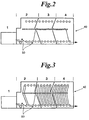
- Bonding and annealing of the trilayer precursor may be performed in a multizone oven 40, each zone capable of maintaining a distinct temperature. See, for example, Figures 2-3. Bonding is for joining together the polypropylene-polyethylene-polypropylene precursors to form the trilayer precursor.
- the interply adhesion should be at least 5 gram/inch. Bonding may be performed at a temperature ranging from 125-135°C and between nip rollers. Preferably, bonding is performed at a temperature ranging from 128-130°C.
- Annealing is to form crystal structures in the polymers to facilitate pore formation in the stretching step. Annealing is influenced by temperature and time. Accordingly, the multizoned oven capable of maintaining several distinct temperatures may be advantageous.
- Annealing of the trilayer precursor should be conducted within the temperature range of 105-135°C, preferably in the range of 110-130°C. If annealing is conducted at a single temperature, that temperature should be in the range of 125-132°C, preferably about 128°C. If annealing is conducted at more than a single temperature, e.g., to separately influence annealing in the differing polymer layers, then the higher temperature, e.g., the temperature influencing the polypropylene, should be in the range of 125-132°C, preferably 128-132°C; and the lower temperature, e.g., the temperature influencing the polyethylene, should be in the range of 105-125°C, preferably about 110°C.
- Stretching the bonded and annealed trilayer precursor forms the microporous structure of battery separators.
- Stretching generally includes several steps, e.g., a cold drawing step, a hot drawing step, and a relax or heat-treating step.
- the relax or heat-treating step is to reduce internal stress within the separator and may be accomplished with either negative draw ratio or substantially no draw tension at various heat profiles.
- Stretching is a continuous process performed in ovens containing a draw frame.
- the cold drawing step is conducted at ambient temperature (i.e., no energy is input into the precursor) and at a draw ratio in the range of 15-40%.
- the draw ratio is in the rang of 20-35%.
- the hot drawing step is conducted at temperatures ranging from 110-125°C and at draw ratios ranging from 105-130%.
- hot drawing is conducted at temperatures ranging from 115-123°C and at draw ratios ranging from 110-125%.
- the relax or heat-treating step is conducted at temperatures ranging from 110-125°C and at draw ratios ranging from -30 to -50%.
- relax or heat-treatment is conducted at temperatures ranging from 115-123°C and at draw ratios of -30 to -50%.
- the trilayer battery separators are wound up and slit to desired widths.
- the polyethylene precursor was extruded from Fina HDPE 7208 resin to form a 0.38 micron thick film.
- the polypropylene precursor was extruded from Escorene PP 4292 to form a 0.37 micron thick film.
- the trilayer precursor was formed as shown in Figure 1.
- the bonding and annealing of the precursor was accomplished as follows: the precursor was strung-up with the oven configured as shown in Figure 2; the oven has 4 zones. The nip rollers 50 are located in zone 2. Zones 2, 3 and 4 were set at a temperature of 128°C and the line speed was 30 ft./min. The adhesion of the trilayer precursor was 5.7 g/in. The trilayer precursor was then stretched under various conditions (note Table 1) to yield the battery separator, the results are set forth in Table 1. Sample Oven Temp (°C) Cold Stretch (%) Hot Stretch (%) Relax (-%) Gurley (Sec) Thickness (mil) Punct.
- the polyethylene precursor was extruded from Fina HDPE 7208 resin to form a 0.38 micron film.
- the polypropylene precursor was extruded from Escorene PP 4292 to form a 0.37 micron film.
- the trilayer precursor was formed as shown in Figure 1.
- the bonding and annealing of the precursor was accomplished as follows: the precursor was strung-up with the oven configured as shown in Figure 3. Zone 1 is at ambient temperature, zone 2 at 128-130°C, and zones 3 and 4 at 110°C.
- the line speed was 40 ft./min.
- the interply adhesion for the precursor was greater than 30 g/in.
- the trilayer precursors were then stretched under various conditions (note Table 2) and at speeds ranging from 20-30 ft/min. (feed speed) to 40-60 ft/min. (output speed) to yield the battery separator; the results are set forth in Table 2.
Landscapes
- Chemical & Material Sciences (AREA)
- Chemical Kinetics & Catalysis (AREA)
- Electrochemistry (AREA)
- General Chemical & Material Sciences (AREA)
- Cell Separators (AREA)
- Laminated Bodies (AREA)
- Extrusion Moulding Of Plastics Or The Like (AREA)
- Shaping By String And By Release Of Stress In Plastics And The Like (AREA)
Abstract
Description
- Gurley
- ASTM-D726(B)
Gurley is a resistance to air flow measured by the Gurley Densometer (e.g. Model 4120). Gurley is the time in seconds required to pass 10cc of air through one square inch of product under a pressure of 12.2 inches of water. - Thickness
- Method: T411om-83 developed under the auspices of the Technical Association of the Pulp and Paper Industry. Thickness is determined using a precision micrometer with a 1/2 inch diameter, circular shoe contacting the sample at seven (7) PSI. Ten (10) individual micrometer readings taken across the width of the sample are averaged.
- Porosity
- ASTM D-2873
- Puncture Strength
- Ten measurements are made across the width of the stretched product and averaged. A Mitech Stevens LFRA Texture Analyzer is used. The needle is 1.65 mm in diameter with 0.5 mm radius. The rate of descent is 2 mm/sec and the amount of deflection is 6 mm. The film is held tight in the clamping device with a central hole of 11.3 mm. The displacement (in mm) of the film that was pierced by the needle was recorded against the resistance force (in gram force) developed by the tested film. The maximum resistance force is the puncture strength.
- Peel Strength
- Peel strength is measured using a tension and compression tester to determine the force in grams required to separate two one-inch wide
- Shrinkage
- The sample in the machine direction is marked Li (Li = 9.99cm) apart, and
then suspended in a convection oven set at 90°C for one hour. After taking
out of the oven, the sample is then measured the distance, Lf. between the
marks. The shrinkage is calculated as follows.
| Sample | Oven Temp (°C) | Cold Stretch (%) | Hot Stretch (%) | Relax (-%) | Gurley (Sec) | Thickness (mil) | Punct. Strength (g) | Shrinkage (%) |
| 1 | 115 | 35 | 115 | 50 | 32.9 | 1.02 | 388 | 25.5 |
| 2 | 120 | 35 | 115 | 50 | 29.3 | 1.02 | 396 | 15.3 |
| 3 | 120 | 30 | 115 | 45 | 28.3 | 0.97 | 400 | 17.3 |
| 4 | 120 | 25 | 115 | 40 | 29.5 | 0.99 | 421 | 18 |
| 5 | 120 | 25 | 115 | 35 | 100+ | - | - | - |
| 6 | 120 | 30 | 115 | 40 | 66 | .99 | 435 | 2.6 |
| 7 | 120 | 35 | 115 | 45 | 50 | .95 | 428 | 3.0 |
| 8 | 120 | 35 | 115 | 30 | 40 | .98 | 442 | 7.0 |
| 9 | 120 | 25 | 125 | 30 | 162 | .94 | 441 | 7.0 |
| 10 | 118 | 35 | 115 | 30 | 22 | 1.01 | 439 | 13.0 |
| Sample | Oven Temp (°C) | Cold Stretch (%) | Hot Stretch (%) | Relax (-%) | Gurley (Sec) | Thickness (mil) | Shrinkage (%) | ||
| 2 | 3 | 4 | |||||||
| 4 | 118 | 118 | 118 | 35 | 115 | 50 | 28.8 | 1.00 | 10.0 |
| 6 | 118 | 118 | 128 | 35 | 115 | 50 | 31.6 | 1.00 | 3.0 |
| 7 | 118 | 118 | 123 | 35 | 115 | 50 | 28.9 | 1.00 | 6.0 |
| 8 | 118 | 118 | 123 | 30 | 120 | 50 | 31.8 | 1.00 | 7.0 |
| 9 | 118 | 118 | 123 | 25 | 115 | 40 | 26.6 | 1.00 | 5.0 |
| 10 | 118 | 118 | 123 | 20 | 120 | 40 | 25.4 | 1.00 | 5.0 |
| 101 | 118 | 118 | 123 | 20 | 120 | 40 | 25.4 | 1.00 | 3.0 |
| 102 | 118 | 118 | 123 | 20 | 120 | 40 | 24.6 | 1.02 | 3.1 |
| 11 | 118 | 118 | 123 | 20 | 110 | 30 | 25.8 | 1.02 | 5.6 |
| 12 | 118 | 118 | 123 | 20 | 110 | 30 | 27.0 | 1.02 | 6.9 |
| 13 | 123 | 123 | 123 | 20 | 120 | 40 | 24.0 | 0.99 | 2.2 |
| 14 | 123 | 123 | 123 | 20 | 120 | 40 | 25.4 | 1.01 | 3.5 |

Claims (16)
- A method of making a trilayer, shutdown battery separator comprising the steps of:extruding a polyethylene precursor;extruding a polypropylene precursor;forming a trilayer precursor, the trilayer precursor having the polyethylene precursor sandwiched between two polypropylene precursors;simultaneously bonding and annealing the trilayer precursor to form a bonded and annealed trilayer precursor;stretching the bonded and annealed trilayer precursor; andforming thereby the battery separator.
- The method according to claim 1 where bonding is performed at a temperature ranging from 125 to 135°C.
- The method according to claim 1 where bonding is performed by nip rollers.
- The method according to claim 1 where annealing is performed at a temperature ranging from 105 to 135°C.
- The method according to claim 1 where annealing further comprises two zones, each zone at a different temperature.
- The method according to claim 1 where stretching is performed in several steps.
- The battery made with the separator produced by the method of claim 1.
- A method of making a trilayer, shutdown battery separator comprising the steps of:extruding a polyethylene precursor;extruding a polypropylene precursor;forming a trilayer precursor, the trilayer precursor having the polyethylene precursor sandwiched between two polypropylene precursors;bonding the trilayer precursor, to form a bonded trilayer precursor;annealing the bonded trilayer precursor, to form a bonded, annealed trilayer precursor, the annealing further comprising two zones, each zone at a different temperature;stretching the bonded, annealed trilayer precursor; andforming thereby the battery separator.
- The method according to claim 8 where bonding is performed at a temperature ranging from 125 to 135°C.
- The method according to claim 8 whereby bonding is performed by nip rollers.
- The method according to claim 8 where annealing is performed at a temperature ranging from 105 to 135°C.
- The method according to claim 8 where bonding and annealing are initiated simultaneously.
- The method according to claim 8 where stretching is performed in several steps.
- The battery made with the separator produced by the method of claim 8.
- A method of making a trilayer, shutdown battery separator comprising the steps of:extruding a polyethylene precursor;extruding a polypropylene precursor;forming a trilayer precursor, the trilayer precursor having the polyethylene precursor sandwiched between two polypropylene precursors;bonding, annealing and stretching the trilayer precursor in a multizone oven; andforming thereby the battery separator.
- The battery made with the separator produced by the method of claim 15.
Applications Claiming Priority (2)
| Application Number | Priority Date | Filing Date | Title |
|---|---|---|---|
| US08/839,664 US5952120A (en) | 1997-04-15 | 1997-04-15 | Method of making a trilayer battery separator |
| US839664 | 1997-04-15 |
Publications (3)
| Publication Number | Publication Date |
|---|---|
| EP0872900A2 true EP0872900A2 (en) | 1998-10-21 |
| EP0872900A3 EP0872900A3 (en) | 2000-07-26 |
| EP0872900B1 EP0872900B1 (en) | 2004-09-29 |
Family
ID=25280352
Family Applications (1)
| Application Number | Title | Priority Date | Filing Date |
|---|---|---|---|
| EP98106208A Expired - Lifetime EP0872900B1 (en) | 1997-04-15 | 1998-04-04 | Method of making a trilayer battery separator |
Country Status (7)
| Country | Link |
|---|---|
| US (1) | US5952120A (en) |
| EP (1) | EP0872900B1 (en) |
| JP (1) | JP4247340B2 (en) |
| KR (1) | KR100512540B1 (en) |
| CA (1) | CA2233052A1 (en) |
| DE (1) | DE69826552T2 (en) |
| TW (1) | TW367632B (en) |
Cited By (6)
| Publication number | Priority date | Publication date | Assignee | Title |
|---|---|---|---|---|
| EP0942480A1 (en) * | 1998-03-12 | 1999-09-15 | Celgard Llc | Trilayer microporous shutdown battery separator |
| EP0951080A1 (en) * | 1998-04-13 | 1999-10-20 | Celgard Llc | Trilayer shutdown battery separator and process of manufacture |
| EP0967671A3 (en) * | 1998-06-26 | 2003-12-03 | Celgard Inc. | Polypropylene microporous membrane for battery separator and process for making |
| CN106229444A (en) * | 2016-07-21 | 2016-12-14 | 昆明云天化纽米科技有限公司 | A kind of pressure three-layer composite structure microporous polypropylene membrane |
| USRE47520E1 (en) | 2000-04-10 | 2019-07-16 | Celgard, Llc | Separator for a high energy rechargeable lithium battery |
| CN111098533A (en) * | 2019-12-31 | 2020-05-05 | 武汉中兴创新材料技术有限公司 | Preparation method of hard elastic polypropylene film, hard elastic polypropylene film and application |
Families Citing this family (52)
| Publication number | Priority date | Publication date | Assignee | Title |
|---|---|---|---|---|
| US6753114B2 (en) * | 1998-04-20 | 2004-06-22 | Electrovaya Inc. | Composite electrolyte for a rechargeable lithium battery |
| KR100349601B1 (en) * | 1998-12-17 | 2002-10-19 | 주식회사 엘지화학 | Microporous membrane and its manufacturing method_ |
| US6562511B2 (en) | 1999-12-09 | 2003-05-13 | Ntk Powerdex, Inc. | Battery separator for Li-Ion and/or Li-Ion polymer battery |
| US20020136945A1 (en) * | 2000-01-18 | 2002-09-26 | Call Ronald W. | Multilayer battery separators |
| US6921608B2 (en) * | 2000-07-11 | 2005-07-26 | Celgard, Inc. | Battery separator |
| US7063917B2 (en) | 2001-02-21 | 2006-06-20 | Ahlstrom Mount Holly Springs, Llc | Laminated battery separator material |
| US6881515B2 (en) * | 2001-05-08 | 2005-04-19 | Celgard Inc. | Separator for polymer battery |
| US20050112462A1 (en) * | 2003-11-21 | 2005-05-26 | Marple Jack W. | High discharge capacity lithium battery |
| US8007940B2 (en) * | 2001-12-11 | 2011-08-30 | Eveready Battery Company, Inc. | High discharge capacity lithium battery |
| US6878226B2 (en) * | 2002-01-08 | 2005-04-12 | Wei-Ching Yu | Continuous methods of making microporous battery separators |
| US20040241550A1 (en) * | 2003-05-28 | 2004-12-02 | Wensley C. Glen | Battery separator for lithium polymer battery |
| US7087343B2 (en) * | 2003-07-15 | 2006-08-08 | Celgard, Inc. | High melt integrity battery separator for lithium ion batteries |
| US20050031943A1 (en) * | 2003-08-07 | 2005-02-10 | Call Ronald W. | Battery separator and method of making same |
| US20050233214A1 (en) * | 2003-11-21 | 2005-10-20 | Marple Jack W | High discharge capacity lithium battery |
| US8283071B2 (en) | 2003-11-21 | 2012-10-09 | Eveready Battery Company, Inc. | High discharge capacity lithium battery |
| US8124274B2 (en) * | 2003-11-21 | 2012-02-28 | Eveready Battery Company, Inc. | High discharge capacity lithium battery |
| US20050287425A1 (en) * | 2004-06-25 | 2005-12-29 | Celgard Inc. | Li/MnO2 battery separators with selective ion transport |
| US8945753B2 (en) * | 2005-01-26 | 2015-02-03 | Medtronic, Inc. | Implantable battery having thermal shutdown separator |
| US20070238017A1 (en) * | 2006-04-07 | 2007-10-11 | Celgard Llc | Multilayer separator exhibiting improved strength and stability |
| US8722231B2 (en) * | 2006-11-14 | 2014-05-13 | Mp Assets Corporation | Smart battery separators |
| US10003058B2 (en) | 2006-11-17 | 2018-06-19 | Celgard, Llc | Method of making a co-extruded, multi-layered battery separator |
| CN105347404A (en) * | 2007-09-28 | 2016-02-24 | 永备电池有限公司 | Processes for producing synthetic pyrite |
| JP5502707B2 (en) * | 2009-11-20 | 2014-05-28 | 三菱樹脂株式会社 | Multilayer porous film, battery separator and battery |
| KR101861212B1 (en) | 2010-09-09 | 2018-06-29 | 캘리포니아 인스티튜트 오브 테크놀로지 | Electrochemical Energy Storage Systems and Methods |
| US9379368B2 (en) | 2011-07-11 | 2016-06-28 | California Institute Of Technology | Electrochemical systems with electronically conductive layers |
| EP2732487A4 (en) | 2011-07-11 | 2015-04-08 | California Inst Of Techn | NEW SEPARATORS FOR ELECTROCHEMICAL SYSTEMS |
| TW201351758A (en) | 2012-06-11 | 2013-12-16 | Enerage Inc | Isolation film of electrochemical device and manufacturing method thereof |
| CN102729532B (en) * | 2012-06-11 | 2015-07-01 | 达尼特材料科技(芜湖)有限公司 | Multilayer porous membrane and preparation method thereof |
| JP2016516279A (en) * | 2013-03-15 | 2016-06-02 | セルガード エルエルシー | Multilayer hybrid battery separator for lithium ion secondary battery and method for producing the same |
| WO2014147648A1 (en) | 2013-03-19 | 2014-09-25 | Council Of Scientic & Industrial Reserach | High-ionic conductivity electrolyte compositions comprising semi-interpenetrating polymer networks and their composites |
| US9680143B2 (en) | 2013-10-18 | 2017-06-13 | Miltec Uv International Llc | Polymer-bound ceramic particle battery separator coating |
| US10714724B2 (en) | 2013-11-18 | 2020-07-14 | California Institute Of Technology | Membranes for electrochemical cells |
| WO2015074037A2 (en) | 2013-11-18 | 2015-05-21 | California Institute Of Technology | Separator enclosures for electrodes and electrochemical cells |
| CN104085101B (en) * | 2014-07-02 | 2016-06-29 | 湖南锂顺能源科技有限公司 | A kind of battery diaphragm simple tension micro molding equipment |
| US10818900B2 (en) | 2014-07-18 | 2020-10-27 | Miltec UV International, LLC | UV or EB cured polymer-bonded ceramic particle lithium secondary battery separators, method for the production thereof |
| CN104262674B (en) * | 2014-08-26 | 2018-02-13 | 东莞新能源科技有限公司 | The preparation method of porous composite isolated film |
| JP6659214B2 (en) * | 2014-10-17 | 2020-03-04 | トヨタ自動車株式会社 | Battery separators, laminated separators, lithium ion secondary batteries and assembled batteries |
| CN114122621B (en) | 2015-06-03 | 2024-08-20 | 赛尔格有限责任公司 | Microporous membranes, battery separators, battery cells, batteries, and related methods |
| KR20180026790A (en) | 2015-07-31 | 2018-03-13 | 셀가드 엘엘씨 | Improved laminated multilayer film, separator, battery, and method |
| PL3350854T3 (en) | 2015-09-18 | 2023-01-30 | Celgard, Llc | Improved membranes, calendered microporous membranes, battery separators and related methods |
| CN105489813B (en) * | 2015-11-03 | 2018-08-03 | 深圳市星源材质科技股份有限公司 | A kind of heat treatment method for dry method lithium electric separator |
| US10340528B2 (en) | 2015-12-02 | 2019-07-02 | California Institute Of Technology | Three-dimensional ion transport networks and current collectors for electrochemical cells |
| CN105470434A (en) * | 2015-12-17 | 2016-04-06 | 江门市龙世纪科技股份有限公司 | Preparation method for producing membrane with PP and PE composite structure through uniaxial tension by membrane blowing |
| CN108604657B (en) * | 2016-01-29 | 2021-02-23 | 住友化学株式会社 | Method for measuring curling amount of diaphragm, slitting device, and curling amount measuring device |
| EP3539173A4 (en) | 2016-11-11 | 2020-10-28 | Celgard LLC | IMPROVED MICROLAYER MEMBRANES, IMPROVED BATTERY SEPARATORS, AND RELATED PROCEDURES |
| US11027040B2 (en) | 2016-12-29 | 2021-06-08 | Industrial Technology Research Institute | Method for manufacturing a porous film, porous film and method for tissue adhesion |
| JP2020511766A (en) * | 2017-03-20 | 2020-04-16 | セルガード エルエルシー | Improved battery separator, electrode, cell, lithium battery and related methods |
| KR102799083B1 (en) * | 2017-11-03 | 2025-04-23 | 셀가드 엘엘씨 | Improved microporous membrane, battery separator, battery, and device including same |
| CN114128029A (en) | 2019-05-24 | 2022-03-01 | 赛尔格有限责任公司 | Improved coated battery separator and battery |
| WO2021211914A1 (en) | 2020-04-17 | 2021-10-21 | Celgard, Llc | Assymetric porous membrane |
| KR102542382B1 (en) * | 2021-05-18 | 2023-06-13 | 유펙스(주) | Apparatus of manufacturing drying type separator using inline process |
| DE102021211933B4 (en) | 2021-10-22 | 2025-09-11 | Powerco Se | Separator for a lithium-ion battery cell |
Family Cites Families (9)
| Publication number | Priority date | Publication date | Assignee | Title |
|---|---|---|---|---|
| US4650730A (en) * | 1985-05-16 | 1987-03-17 | W. R. Grace & Co. | Battery separator |
| JPH0698395A (en) * | 1991-09-30 | 1994-04-08 | Iwatsu Electric Co Ltd | Sound source diaphragm |
| US5281491A (en) * | 1991-12-20 | 1994-01-25 | W. R. Grace & Co. | Battery separator |
| US5240655A (en) * | 1991-12-20 | 1993-08-31 | W. R. Grace & Co.-Conn. | Process of making a battery separator |
| JPH0698394A (en) * | 1992-09-11 | 1994-04-08 | Pioneer Cone Corp | Production of speaker vibrating parts |
| DE69514711T2 (en) * | 1994-05-12 | 2000-05-31 | Ube Industries, Ltd. | Porous multilayer film |
| TW297171B (en) * | 1994-12-20 | 1997-02-01 | Hoechst Celanese Corp | |
| JPH08244152A (en) * | 1995-03-15 | 1996-09-24 | Nitto Denko Corp | Porous film and method for producing the same |
| JP3939778B2 (en) * | 1996-02-09 | 2007-07-04 | 日東電工株式会社 | Battery separator |
-
1997
- 1997-04-15 US US08/839,664 patent/US5952120A/en not_active Expired - Lifetime
-
1998
- 1998-03-25 CA CA002233052A patent/CA2233052A1/en not_active Abandoned
- 1998-04-01 TW TW087104866A patent/TW367632B/en not_active IP Right Cessation
- 1998-04-04 EP EP98106208A patent/EP0872900B1/en not_active Expired - Lifetime
- 1998-04-04 DE DE69826552T patent/DE69826552T2/en not_active Expired - Fee Related
- 1998-04-09 KR KR10-1998-0012581A patent/KR100512540B1/en not_active Expired - Lifetime
- 1998-04-14 JP JP10229998A patent/JP4247340B2/en not_active Expired - Lifetime
Cited By (7)
| Publication number | Priority date | Publication date | Assignee | Title |
|---|---|---|---|---|
| EP0942480A1 (en) * | 1998-03-12 | 1999-09-15 | Celgard Llc | Trilayer microporous shutdown battery separator |
| EP0951080A1 (en) * | 1998-04-13 | 1999-10-20 | Celgard Llc | Trilayer shutdown battery separator and process of manufacture |
| US6080507A (en) * | 1998-04-13 | 2000-06-27 | Celgard Inc. | Trilayer battery separator |
| EP0967671A3 (en) * | 1998-06-26 | 2003-12-03 | Celgard Inc. | Polypropylene microporous membrane for battery separator and process for making |
| USRE47520E1 (en) | 2000-04-10 | 2019-07-16 | Celgard, Llc | Separator for a high energy rechargeable lithium battery |
| CN106229444A (en) * | 2016-07-21 | 2016-12-14 | 昆明云天化纽米科技有限公司 | A kind of pressure three-layer composite structure microporous polypropylene membrane |
| CN111098533A (en) * | 2019-12-31 | 2020-05-05 | 武汉中兴创新材料技术有限公司 | Preparation method of hard elastic polypropylene film, hard elastic polypropylene film and application |
Also Published As
| Publication number | Publication date |
|---|---|
| DE69826552T2 (en) | 2005-10-06 |
| KR19980081232A (en) | 1998-11-25 |
| US5952120A (en) | 1999-09-14 |
| KR100512540B1 (en) | 2005-11-22 |
| JPH10289703A (en) | 1998-10-27 |
| EP0872900A3 (en) | 2000-07-26 |
| TW367632B (en) | 1999-08-21 |
| EP0872900B1 (en) | 2004-09-29 |
| DE69826552D1 (en) | 2004-11-04 |
| CA2233052A1 (en) | 1998-10-15 |
| JP4247340B2 (en) | 2009-04-02 |
Similar Documents
| Publication | Publication Date | Title |
|---|---|---|
| EP0872900B1 (en) | Method of making a trilayer battery separator | |
| US6602593B1 (en) | Battery separators with reduced splitting propensity | |
| EP0718901B1 (en) | Shutdown, trilayer battery separator | |
| KR100637971B1 (en) | Battery separator and method of making same | |
| US20210320377A1 (en) | Low electrical resistance microporous battery separator membranes, separators, cells, batteries, and related methods | |
| EP0715364B1 (en) | Shutdown, bilayer battery separator | |
| CN101536221B (en) | Co-extruded, multi-layered battery separator | |
| US9908317B2 (en) | Multilayer battery separators | |
| EP0924780B1 (en) | Penta-layer battery separator | |
| JP3436055B2 (en) | Battery separator | |
| JPH11297297A (en) | Method for producing porous film and porous film | |
| JP3508510B2 (en) | Laminated porous film and method for producing the same |
Legal Events
| Date | Code | Title | Description |
|---|---|---|---|
| PUAI | Public reference made under article 153(3) epc to a published international application that has entered the european phase |
Free format text: ORIGINAL CODE: 0009012 |
|
| AK | Designated contracting states |
Kind code of ref document: A2 Designated state(s): DE FR GB IT |
|
| AX | Request for extension of the european patent |
Free format text: AL;LT;LV;MK;RO;SI |
|
| PUAL | Search report despatched |
Free format text: ORIGINAL CODE: 0009013 |
|
| RAP1 | Party data changed (applicant data changed or rights of an application transferred) |
Owner name: CELGARD INC. |
|
| AK | Designated contracting states |
Kind code of ref document: A3 Designated state(s): AT BE CH DE DK ES FI FR GB GR IE IT LI LU MC NL PT SE |
|
| AX | Request for extension of the european patent |
Free format text: AL;LT;LV;MK;RO;SI |
|
| 17P | Request for examination filed |
Effective date: 20001013 |
|
| AKX | Designation fees paid |
Free format text: DE FR GB IT |
|
| 17Q | First examination report despatched |
Effective date: 20010403 |
|
| GRAP | Despatch of communication of intention to grant a patent |
Free format text: ORIGINAL CODE: EPIDOSNIGR1 |
|
| GRAS | Grant fee paid |
Free format text: ORIGINAL CODE: EPIDOSNIGR3 |
|
| GRAA | (expected) grant |
Free format text: ORIGINAL CODE: 0009210 |
|
| AK | Designated contracting states |
Kind code of ref document: B1 Designated state(s): DE FR GB IT |
|
| REG | Reference to a national code |
Ref country code: GB Ref legal event code: FG4D |
|
| REF | Corresponds to: |
Ref document number: 69826552 Country of ref document: DE Date of ref document: 20041104 Kind code of ref document: P |
|
| PGFP | Annual fee paid to national office [announced via postgrant information from national office to epo] |
Ref country code: GB Payment date: 20050314 Year of fee payment: 8 |
|
| PGFP | Annual fee paid to national office [announced via postgrant information from national office to epo] |
Ref country code: FR Payment date: 20050401 Year of fee payment: 8 |
|
| PGFP | Annual fee paid to national office [announced via postgrant information from national office to epo] |
Ref country code: DE Payment date: 20050429 Year of fee payment: 8 |
|
| PLBE | No opposition filed within time limit |
Free format text: ORIGINAL CODE: 0009261 |
|
| STAA | Information on the status of an ep patent application or granted ep patent |
Free format text: STATUS: NO OPPOSITION FILED WITHIN TIME LIMIT |
|
| ET | Fr: translation filed | ||
| 26N | No opposition filed |
Effective date: 20050630 |
|
| PG25 | Lapsed in a contracting state [announced via postgrant information from national office to epo] |
Ref country code: GB Free format text: LAPSE BECAUSE OF NON-PAYMENT OF DUE FEES Effective date: 20060404 |
|
| PGFP | Annual fee paid to national office [announced via postgrant information from national office to epo] |
Ref country code: IT Payment date: 20060430 Year of fee payment: 9 |
|
| PG25 | Lapsed in a contracting state [announced via postgrant information from national office to epo] |
Ref country code: DE Free format text: LAPSE BECAUSE OF NON-PAYMENT OF DUE FEES Effective date: 20061101 |
|
| GBPC | Gb: european patent ceased through non-payment of renewal fee |
Effective date: 20060404 |
|
| REG | Reference to a national code |
Ref country code: FR Ref legal event code: ST Effective date: 20061230 |
|
| PG25 | Lapsed in a contracting state [announced via postgrant information from national office to epo] |
Ref country code: FR Free format text: LAPSE BECAUSE OF NON-PAYMENT OF DUE FEES Effective date: 20060502 |
|
| PG25 | Lapsed in a contracting state [announced via postgrant information from national office to epo] |
Ref country code: IT Free format text: LAPSE BECAUSE OF NON-PAYMENT OF DUE FEES Effective date: 20070404 |