EP0872151B1 - Verwaltung von authentifizierungsschlüsseln in einem mobilen kommunikationssystem - Google Patents
Verwaltung von authentifizierungsschlüsseln in einem mobilen kommunikationssystem Download PDFInfo
- Publication number
- EP0872151B1 EP0872151B1 EP97901103A EP97901103A EP0872151B1 EP 0872151 B1 EP0872151 B1 EP 0872151B1 EP 97901103 A EP97901103 A EP 97901103A EP 97901103 A EP97901103 A EP 97901103A EP 0872151 B1 EP0872151 B1 EP 0872151B1
- Authority
- EP
- European Patent Office
- Prior art keywords
- authentication
- subscriber
- subscriber identity
- identifiers
- identifier
- Prior art date
- Legal status (The legal status is an assumption and is not a legal conclusion. Google has not performed a legal analysis and makes no representation as to the accuracy of the status listed.)
- Expired - Lifetime
Links
- 238000010295 mobile communication Methods 0.000 title claims abstract description 67
- 238000000034 method Methods 0.000 claims abstract description 48
- 230000008901 benefit Effects 0.000 description 6
- 230000006870 function Effects 0.000 description 5
- 230000008569 process Effects 0.000 description 4
- 238000012546 transfer Methods 0.000 description 4
- 230000008520 organization Effects 0.000 description 3
- 230000004044 response Effects 0.000 description 3
- 230000005540 biological transmission Effects 0.000 description 2
- 230000001419 dependent effect Effects 0.000 description 2
- 238000010586 diagram Methods 0.000 description 2
- 230000015654 memory Effects 0.000 description 2
- 230000011664 signaling Effects 0.000 description 2
- 230000003213 activating effect Effects 0.000 description 1
- 238000013475 authorization Methods 0.000 description 1
- 230000001413 cellular effect Effects 0.000 description 1
- 238000004891 communication Methods 0.000 description 1
- 230000000977 initiatory effect Effects 0.000 description 1
- 230000007246 mechanism Effects 0.000 description 1
- 230000009897 systematic effect Effects 0.000 description 1
- 230000002463 transducing effect Effects 0.000 description 1
- 238000010200 validation analysis Methods 0.000 description 1
- 238000012795 verification Methods 0.000 description 1
- 230000000007 visual effect Effects 0.000 description 1
Images

Classifications
-
- H—ELECTRICITY
- H04—ELECTRIC COMMUNICATION TECHNIQUE
- H04L—TRANSMISSION OF DIGITAL INFORMATION, e.g. TELEGRAPHIC COMMUNICATION
- H04L9/00—Cryptographic mechanisms or cryptographic arrangements for secret or secure communications; Network security protocols
- H04L9/08—Key distribution or management, e.g. generation, sharing or updating, of cryptographic keys or passwords
- H04L9/0816—Key establishment, i.e. cryptographic processes or cryptographic protocols whereby a shared secret becomes available to two or more parties, for subsequent use
- H04L9/0819—Key transport or distribution, i.e. key establishment techniques where one party creates or otherwise obtains a secret value, and securely transfers it to the other(s)
- H04L9/083—Key transport or distribution, i.e. key establishment techniques where one party creates or otherwise obtains a secret value, and securely transfers it to the other(s) involving central third party, e.g. key distribution center [KDC] or trusted third party [TTP]
- H04L9/0833—Key transport or distribution, i.e. key establishment techniques where one party creates or otherwise obtains a secret value, and securely transfers it to the other(s) involving central third party, e.g. key distribution center [KDC] or trusted third party [TTP] involving conference or group key
- H04L9/0836—Key transport or distribution, i.e. key establishment techniques where one party creates or otherwise obtains a secret value, and securely transfers it to the other(s) involving central third party, e.g. key distribution center [KDC] or trusted third party [TTP] involving conference or group key using tree structure or hierarchical structure
-
- H—ELECTRICITY
- H04—ELECTRIC COMMUNICATION TECHNIQUE
- H04L—TRANSMISSION OF DIGITAL INFORMATION, e.g. TELEGRAPHIC COMMUNICATION
- H04L9/00—Cryptographic mechanisms or cryptographic arrangements for secret or secure communications; Network security protocols
- H04L9/32—Cryptographic mechanisms or cryptographic arrangements for secret or secure communications; Network security protocols including means for verifying the identity or authority of a user of the system or for message authentication, e.g. authorization, entity authentication, data integrity or data verification, non-repudiation, key authentication or verification of credentials
- H04L9/321—Cryptographic mechanisms or cryptographic arrangements for secret or secure communications; Network security protocols including means for verifying the identity or authority of a user of the system or for message authentication, e.g. authorization, entity authentication, data integrity or data verification, non-repudiation, key authentication or verification of credentials involving a third party or a trusted authority
-
- H—ELECTRICITY
- H04—ELECTRIC COMMUNICATION TECHNIQUE
- H04W—WIRELESS COMMUNICATION NETWORKS
- H04W12/00—Security arrangements; Authentication; Protecting privacy or anonymity
- H04W12/04—Key management, e.g. using generic bootstrapping architecture [GBA]
- H04W12/041—Key generation or derivation
-
- H—ELECTRICITY
- H04—ELECTRIC COMMUNICATION TECHNIQUE
- H04W—WIRELESS COMMUNICATION NETWORKS
- H04W12/00—Security arrangements; Authentication; Protecting privacy or anonymity
- H04W12/04—Key management, e.g. using generic bootstrapping architecture [GBA]
- H04W12/043—Key management, e.g. using generic bootstrapping architecture [GBA] using a trusted network node as an anchor
- H04W12/0433—Key management protocols
-
- H—ELECTRICITY
- H04—ELECTRIC COMMUNICATION TECHNIQUE
- H04W—WIRELESS COMMUNICATION NETWORKS
- H04W12/00—Security arrangements; Authentication; Protecting privacy or anonymity
- H04W12/06—Authentication
- H04W12/069—Authentication using certificates or pre-shared keys
-
- H—ELECTRICITY
- H04—ELECTRIC COMMUNICATION TECHNIQUE
- H04L—TRANSMISSION OF DIGITAL INFORMATION, e.g. TELEGRAPHIC COMMUNICATION
- H04L2209/00—Additional information or applications relating to cryptographic mechanisms or cryptographic arrangements for secret or secure communication H04L9/00
- H04L2209/80—Wireless
Definitions
- the invention relates to a method for managing authentication keys in a mobile communication system comprising at least one authentication centre, base stations and mobile stations to which subscriber identity modules may be coupled and which communicate with said base stations.
- the invention is intended to be applied in mobile communication systems in which subscribers may be identified by means of a subscriber identity module which is either in the mobile station or may be coupled to it.
- a mobile communication system is represented by the GSM system (Global System for Mobiles).
- GSM Global System for Mobiles
- TETRA Trans European Trunked Radio
- PMR Private Mobile Radio
- the network checks a subscriber's identity by carrying out an Authentication Procedure to be sure that the subscriber identity given by the mobile station is correct. By checking the subscriber identity, the network makes it sure that only such subscribers who have the right to use the network services are able to use them. At the same time it is ascertained that an unauthorized user will not cause any extra costs to authorized subscribers or be able to impersonate another subscriber.
- the mobile communication system always checks a subscriber's identity in conjunction with registration, call set-up stage and when activating or deactivating certain supplementary services.
- the subscriber identity is also checked at Location Area (LA) updating when the subscriber's roaming number, i.e. MSRN (Mobile Station Roaming Number), changes.
- LA Location Area
- MSRN Mobile Station Roaming Number
- the network operator may decide whether to check a subscriber's identity or not.
- a subscriber's identity is checked according to the following steps:
- the mobile communication system for example its Authentication Centre (AUC) transmits a random number RAND to the mobile station, the RAND being generated in the system. Having received the RAND, the mobile station computes a value for an acknowledgment parameter SRES by a specific algorithm, the received RAND, and an Authentication Key K previously stored in the mobile station. Hence, the key K is stored at least in the authentication centre and the mobile station so that they are both able to compute the same reference numbers.
- the mobile station sends the acknowledgment parameter SRES to the mobile communication network, in particular to its authentication centre, which checks the parameter SRES value, computed in the mobile station, i.e. compares it to the value it has computed, and as a result of this comparison deducts whether the subscriber who transmitted the acknowledgment parameter, is an authorized subscriber.
- the mobile stations used in mobile communication systems have a subscriber identity and an authentication key stored in a subscriber identity module, which may be attached to the mobile station detachably or integrated therein.
- the subscriber identity modules which are coupled detachably to the mobile station contain the identifiers of the subscribers, and, when necessary, they may be connected to a terminal equipment to form a mobile station.
- the subscriber identity module described above is subscriber specific, which means that subscriber equipments are not confined to a specific subscriber.
- the subscriber identity module such as a SIM card, is a smart card which is placed in the mobile station and which contains information, e.g. an authentication key K, needed for identifying a subscriber and for encrypting radio traffic.
- a subscriber identity module such as a SIM card, refers to a functional card that can be removed from a mobile station and by means of which a subscriber is able to use a card controlled mobile station.
- a subscriber identity module e.g. a SIM card
- the user need not have a mobile station of his own, but a subscriber identity module e.g. a SIM card issued to him by the operator of the mobile communication system is all he needs.
- a subscriber identity module is, in a way, a phone card by means of which the subscriber can make (and receive) calls from any mobile station of the system.
- the functions of the SIM card include on the one hand providing the mobile station with data identifying the user in a well protected manner and on the other hand providing services to the mobile station.
- Such services include e.g. maintaining (inputting, changing) a Personal Identification Number (PIN), maintaining the data protection key i.e. the authentication key K, and unblocking by e.g. a PUK code, Personal Unblocking Key, a SIM card blocked by too many attempts of inputting a wrong PIN.
- PIN Personal Identification Number
- a plug-in-SIM is approximately a coin-sized part containing the electronics of a credit card sized SIM card, and it is placed in a phone so that the user is not able to replace it easily.
- the phone may also have an incorporated plug-in-SIM and, in addition, a card reader. If the card reader contains a card, the phone is identified on the basis of the external card, otherwise on the basis of the incorporated plug-in-SIM.
- subscriber identity module such as a SIM card
- subscriber identity module refers to the plug-in-SIM, the credit card sized smart card SIM, and the subscriber identity module which is incorporated in the mobile station and which contains the subscriber identity and the authentication key K.
- PMR Primaryvate or Professional Mobile Radio
- trunked networks which are typically company networks or private mobile radio networks used by authorities, in which all the channels are used by one or more companies or organizations. The networks used by the authorities have even stricter security demands than the normal GSM network.
- the management of the authentication key K is described in normal operation according to the GSM system.
- SIM Subscriber Identity Module
- the subscriber's IMSI, authentication key K and encryption algorithms are stored in the SIM card.
- the IMSI and the authentication key K are additionally stored in the authentication centre AUC of the subscriber's home PLMN (Public Land Mobile Network).
- PLMN Public Land Mobile Network
- Each PLMN comprises one or more authentication centres.
- the GSM system two key managing methods are defined. When the one which is protected better is used, there is no need to transfer the key from one place to another. When the less well protected method is employed, the key is transferred within the network, which results in that the method is allowed to be used only when it is not necessary to transfer encrypted information between PLMNs. At other times, the network operator may decide which one of the methods to employ.
- a suitable network element e.g. a Base Station (BS) or a Mobile Switching Centre (MSC) per each mobile station may request secret subscriber-specific information from the AUC in the home PLMN of the mobile station.
- the authentication centre is either a separate unit or a part of a HLR (Home Location Register).
- the secret information in this case includes a table of RAND/SRES pairs, which have been obtained by using an algorithm with known values of the parameters RAND and the authentication keys K. The pairs are normally stored in a visitor location register VLR.
- the authentication key is stored in the mobile communication network in a safe database of a subscriber's home network.
- the authentication key may be generated in three different ways, which are described in the aforementioned document.
- One of the methods for generating the authentication key in the terminal equipment is to use in the generation a User Authentication Key (UAK) stored in the subscriber equipment.
- UKA User Authentication Key
- This matter is also influenced by other solutions of the network: if, for example, the network-intemal subscriber number IMSI and the subscriber number MSISDN (Mobile Subscriber Intemational ISDN number) employed by the users are separate, as is the GSM system, flexible use is possible so that the actual subscriber number MSISDN and subscriber data corresponding thereto can be defined afterwards for the pair constituted by the allocated IMSI and the authentication key K.
- IMSI and the subscriber number MSISDN Mobile Subscriber Intemational ISDN number
- subscriber numbers such as MSISDN or ITSI numbers
- subscriber identity modules e.g. SIM cards
- distributors would be given cards which have subscriber numbers entered in them, whereas the other subscriber data would only be fed in the system when a new subscriber is defined.
- a problem here is that subscribers would not have any chance to choose or form a suitable subscriber number which the user would find easy to remember or which would identify that user in some other way, for example by name.
- this solution does not allow the different levels and fleets of a public authority organization to be described in a systematic manner by means of subscriber numbers of the members of these organizations as it is not possible to know in advance how many new members there will be in the organization and what hierarchical identifiers to give afterwards to each member of the organization.
- a way to solve the problems set forth would be to centralize the generation, subscriber definition and the system authentication, or key, database (AUC) of subscriber identity modules e.g. SIM cards to one place.
- AUC key, database
- subscriber identity modules e.g. SIM cards
- Such centralization of all the key and subscriber management in one location is not, however, a sensible solution from the users' point of view. It must be possible to define new subscribers and to give out SIM cards in several places, for example in networks used by authorities at police stations and alarm receiving stations and in commercial networks at distributor agencies.
- SIM cards subscriber numbers have been pre-stored in SIM cards. Consequently, a number could not be issued to a police patrol, for example, in conjunction with the defining, but a number pre-stored on a SIM card somewhere in the distribution chain would have to be chosen.
- MSISDN mobile subscriber international ISDN number
- IMSI international mobile subscriber identity
- a network may have several groups of authorities as users, such as the police, fire brigade, customs, etc., each group desiring to distribute and define separate subscriber identity modules for their respective users, the subscriber identifiers in these modules being hierarchically organizable, for example fleet by fleet, even after the authentication keys have been stored in them.
- the authentication keys should not be readily readable by people at any stage, and they should be stored only in connection with the subscriber data of the system and on the SIM card, and they should not be transferred in the network. This means that the keys will have to be generated in a centralized manner in one location both to the system and to the subscriber identity module, such as a SIM card.
- Document D1 US 5 303 285 discloses a mechanism for providing authentication and ciphering keys in the wireless communication system, wherein an intelligent network is involved. An access method is developed, which offers increased protection against fraudulent misuse and also enables the authorisation or rejection of access based on the called number. In D1, subscription-dependent identification words are used to identify the authentication keys.
- EP 506 637 discloses a system for validation and verification of base stations and mobile stations within a mobile communication system.
- the authentication algorithm uses a fixed key and a changeable key as inputs and generates key-dependent responses.
- the responses generated by a particular mobile station are compared to responses generated by the network and the presence of fraudulent users may be detected.
- the aim is to provide a method and a system by means of which authentication in mobile communication systems can be arranged as flexibly as possible but nevertheless securely.
- a further object is to be able, when need be to define, for the subscribers, identifiers that are independent of any previous definitions so that each subscriber may, when need be, choose an available subscriber identity without restrictions.
- the new method for managing authentication keys in a mobile communication system is obtained by a method according to the invention, which is characterized by the steps of generating authentication keys and corresponding identifiers, which identifiers are independent of any mobile subscriber identity and which identifiers serve as pointers to their corresponding authentication keys in said authentication centre, storing said authentication keys with an index to their corresponding identifiers in said authentication centre, whereby said authentication keys are arranged to be retrieved from said authentication centre on the basis of said identifiers, and storing at least said authentication keys in said subscriber identity modules and said identifiers corresponding to the authentication keys in said subscriber identity modules (SIM) or in a subscriber database (DB)_accessible upon authentication.
- SIM subscriber identity modules
- DB subscriber database
- a method for managing authentication keys in a mobile communication system wherein the mobile stations are provided with identifiers and the mobile communication system comprises at least one subscriber database which stores each subscriber's subscriber data.
- the method according to the embodiment is characterized by further comprising: after generating authentication keys and corresponding identifiers, storing in each subscriber identity module an authentication key to which a specific identifier corresponds and, after storing said authentication keys in the authentication centre storing said identifier in said at least one subscriber database in association with the subscriber data of said mobile station.
- a method for managing authentication keys in a mobile communication system wherein the mobile communication system further comprises at least one subscriber database for storing subscriber data of a mobile station.
- the method according to the embodiment is characterized by further comprising the following steps: performing said generation of authentication keys required in the authentication and identifiers corresponding to the authentication keys in a centralized manner in one location of the mobile communication system, storing said authentication keys with an index to their corresponding identifiers in said authentication center, whereby said authentication keys are arranged to be retrieved from said authentication center on the basis of said identifiers, storing the authentication key in a subscriber identity module, storing the mobile subscriber identity in said subscriber identity module following the generating and storing of said authentication keys and said identifiers.
- the invention further relates to a mobile communication system comprising at least one authentication centre containing authentication keys, base stations, and mobile stations to which subscriber identity modules are arranged to be coupled and which communicate with said base stations.
- the mobile communication system of the invention is characterized in that it comprises generating means for generating the identifiers which correspond to the authentication keys required in the authentication, which identifiers are independent of any mobile subscriber identity and on the basis of which identifiers said authentication keys are arranged to be found in said authentication centre when authentication is being carried out.
- the invention is based on the idea that according to the solution of the invention the cellular network employs an index or an identifier as a pointer to a subscriber's secret authentication key K.
- the pointer is needed in order to obtain correspondence between the secret authentication keys entered onto the cards and the ones defined in the network.
- the secret keys used for authentication are programmed simultaneously in the network databases and in the integrated or detachable subscriber identity modules, e.g. SIM cards, so as to prevent anyone seeing the secret keys.
- each key is in addition provided with an index or identifier by means of which the mobile communication system knows the location of the corresponding key in its databases, for example in an authentication database (AUC) connected to the Home Location Register (HLR).
- AUC authentication database
- HLR Home Location Register
- identifiers are generated for the authentication keys in the database of the mobile communication system. It is consequently enough that when the mobile stations or the network elements desired know these identifiers, the mobile stations may during authentication transmit these identifiers to the mobile communication system.
- the authentication keys are stored in a separate unit which is able to e.g. generate pairs of numbers employed in the authentication process. This signifies that by means of the pointer transmitted by the mobile station or another network element, the authentication centre is able to search its database for an authentication key corresponding to each particular subscriber. This means that the authentication may be carried out without transmitting authentication keys on the radio path.
- the index or pointer given according to the invention may be in the subscriber identity module, e.g. on a SIM card, or it may be a piece of information stored otherwise, for example manually or on paper, to be entered in a subscriber's data, for example in his HLR, upon defining the subscriber.
- the method of the invention relates to managing secret keys employed for authenticating subscribers of a radio network in a way in which the keys are generated in a centralized manner in the system and in the subscriber identity modules, for example in SIM cards or subscriber identity modules integrated in mobile stations.
- the system employs an index for pointing to secret authentication keys in the system.
- the index may be located in the subscriber identity module, e.g. in a SIM card, or stored in the subscriber database, for example in the subscriber's HLR.
- the invention provides the advantage that the authentication keys are not revealed at any stage to the user, and they are not transmitted over the radio path. Instead, they are used e.g. for computing pairs of identification numbers.
- the invention provides the further advantage that it enables keeping the authentication keys secret and invisible, simultaneously enabling smooth distribution of SIM cards to subscribers.
- the invention provides the advantage that subscribers may de defined in a decentralized manner, and also subscriber numbers may be defined in the system freely for the subscribers, and programmed on SIM cards. Nevertheless, the encryption keys will not have to be transferred without encryption in the system or with a SIM card.
- the method consequently combines flexible usability with high level of security.
- the system or SIM cards need not have any functions by means of which the authentication key could be read.
- the key is only entered once both into the subscriber identity module and the authentication centre of the mobile communication system, and it is thereafter used in internal computing in the authentication centre and the subscriber identity module, such as a SIM card.
- the index number in a mobile communication system of the invention only needs to be internal to the system, and therefore it does not have to be taken into account when numbering or air interface signalling is carried out.
- the invention provides the advantage that divulging of the index number according to the invention in a subscriber identity module such as a SIM card does not constitute a threat to security as the divulging does not benefit an unauthorized user in any way in his unauthorized attempts to be authenticated and registered into the mobile communication system.
- the invention provides the further advantage that the subscriber identity modules, e.g. SIM cards, and keys do not have to be programmed in the same place.
- the authentication keys may also be transferred in both directions via an intermediate device, a card or a computer.
- the data on such distribution cards must naturally be protected equally well as the data in the system and on the SIM card.
- the distribution cards are provided with index numbers of all the cards to be programmed from it.
- the method need not be used in association with SIM cards as a similar arrangement is also possible in a system with integral subscriber identity modules in the mobile stations and in systems in which the subscriber identity modules with their subscriber identities form an integral part of the mobile station or its memory.
- Figure 1 shows generation according to the invention of an authentication key in a centralized place in the mobile communication system.
- the mobile communication system/network comprises a centralized place - a key generator 100 - in which the authentication keys are generated and programmed in the memories of authentication centres in the system and on the SIM cards.
- a key generator 100 in which the authentication keys are generated and programmed in the memories of authentication centres in the system and on the SIM cards.
- Each key will be provided with an identifier, such as an index number, which points to the location of the key in the system.
- the figure in addition shows a master authentication centre 102 in which the actual authentication takes place.
- the mobile communication system may additionally have another, back-up authentication centre 103.
- an identifier stored in a subscriber identity module SIM, 101 is transmitted from the mobile station concerned to a base station BS of the mobile communication system. After this, on the basis of said identifier, an authentication key corresponding to said identifier 202 will be retrieved from an authentication centre AUG,102. On the basis of the identifier 202, the authentication desired is carried out by means of the authentication key retrieved.
- an identifier in accordance with the invention which is stored in a subscriber database DB, is transmitted during the authentication process to the authentication centre 102,AUC. After this, on the basis of said identifier, an authentication key corresponding to said identifier 202 will be retrieved from an authentication centre AUC,102. On the basis of the identifier 202, the authentication desired is then carried out by means of the authentication key retrieved.
- FIG. 2 shows a method according to the invention for defining a subscriber in a mobile communication system.
- the subscriber receives a SIM card, 101, and his subscriber data are defined in the system, for example in a subscriber database 201 of the system.
- the authentication key index i.e. the identifier 202 supplied with the card is defined in the subscriber data.
- information on the index i.e. the identifier 202 is external to the SIM card 101, for example on a separate piece of paper, e.g. in a letter 203.
- Figure 3 shows an implementation according to an embodiment of the invention, in which the index in accordance with the invention is transmitted over the radio path RP from a mobile station 301 to the base station BS.
- the index i.e. identifier 202 of the invention is on a SIM card 101, and therefore it is transferred for example in conjunction with registration or authentication over the radio path RP to the base station BS and further to other parts of the mobile communication system, e.g. to its authentication centre 102 ( Figure 1).
- the authentication may also be implemented so that it is provided with exchange of messages, in which said identifier is transferred to the mobile communication system and stored permanently in its database, from which it may be picked up when a subscriber later registers in the system and when authentication is carried out.
- the authentication centre AUC, 102 of the system may be placed in connection with the Home Location Register (HLR) of the subscriber.
- HLR Home Location Register
- the system is able to find the correct authentication centre on the basis of the identifier. Further, within the authentication centre, the system is able to request a pair of authentication numbers corresponding to said subscriber on the basis of the identifier. The mobile station, subscriber or mobile communication system in question may then be authenticated on the basis of said pair of numbers.
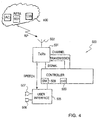
- FIG. 4 is a block diagram illustration of a radio unit according to the invention.
- the figure shows the network infrastructure (INFRA) 600 of the mobile communication system.
- the network infrastructure comprises e.g. base stations BS, exchanges and other telecommunication devices as well as subscriber databases DB, such as a Home Location Register (HLR) and a Visitor Location Register (VLR), and an authentication centre (AUC).
- HLR Home Location Register
- VLR Visitor Location Register
- AUC authentication centre
- the mobile communication system of the invention further comprises generating means 601 for generating identifiers 202 which correspond to the authentication keys required in the authentication process and on the basis of which said authentication keys may be found in said authentication centre 102, AUC when authentication is being carried out.
- FIG. 4 shows a typical radio unit 500 communicating in the mobile communication system, such as a subscriber-operated mobile phone, a mobile station or a subscriber station.
- the function of the transceiver unit (TX/RX) 501 is to tune to the radio channel employed on any one occasion, by means of which the mobile station communicates with the network infrastructure, typically via the base station BS ( Figure 3).
- An antenna 502 is connected to the transceiver 501, the antenna having connection to the radio path RP.
- radio frequencies in the range 60-1000 MHz (VHF and UHF bands) are used, although other frequencies can also be used.
- VHF and UHF bands are used, although other frequencies can also be used.
- either analogue or digital modulation may be employed.
- the user interface 505 comprises an electroacoustic transducing means, typically a loudspeaker 506 and a microphone 507, and possibly buttons relating to beginning, ending and dialling a call.
- an electroacoustic transducing means typically a loudspeaker 506 and a microphone 507, and possibly buttons relating to beginning, ending and dialling a call.
- the subscriber unit typically contains a push to talk button (PTT) that must be pressed down for the duration of the speaking turn.
- PTT push to talk button
- the function of a controller 503 is to control the operation of the radio unit.
- the controller 503 is connected to the user interface 505, from which it obtains impulses relating to, for example, the call initiation and termination. Through the user interface 505, the controller 503 may also provide the user with acoustic or visual signals relating to the operation of the mobile phone or the mobile radio system.
- the controller 503 is connected to the transceiver TX/RX 501.
- the channel employed by the transceiver is defined by the controller 503, i.e. the transceiver 501 tunes to a channel, i.e. radio frequency and an appropriate time slot, allocated by the controller 503.
- the transceiver is also activated by the controller 503.
- the controller 503 receives and transmits signalling messages by means of the transceiver 501.
- a radio unit 500 according to the invention may be used, for example, in a radio system comprising a radio network which has at least one base station BS and subscriber stations, and possibly one or more repeater stations.
- Said radio unit contains a transceiver unit 501 for receiving transmissions transmitted by other radio units or base stations and for transmitting the transmissions to other radio units or base stations, a control unit 503 for controlling the radio unit functions, and a user interface 504.
- the mobile station 500 comprises a subscriber equipment which may be provided with a subscriber identity module.
- the subscriber equipment consists of the transceiver unit 501, the controller 503 and the user interface 505.
- the mobile station further comprises a unique subscriber identity module 509, e.g. a SIM card, which is detachably connected to the subscriber equipment to form a mobile station.
- the mobile station comprises transmitting means 510 for transmitting identifiers, on the basis of which authentication keys used in the authentication process may be found in the authentication centre AUC, from the mobile station to the mobile communication system.
- the method may be implemented either by inserting the index i.e. the identifier in the subscriber identity module (the SIM card, 509), which is either integral to the mobile station or a removable SIM card, or by programming the identifier in the system in one of its databases in connection with the subscriber data.
- the index In the former method, the index must be transferred, if need be, over the radio interface to the system.
- information of the identifier In the latter method, information of the identifier must be somehow written down, e.g. on a piece of paper, in conjunction with storing the authentication key in the subscriber identity module, so that it can be associated with the subscriber data when entering the subscriber of the subscriber identity module, e.g. a SIM card, in the system.
- SIM cards Of the alternatives disclosed, the one employing SIM cards is the most useful. This results from the fact that to attach the subscriber identity module integrally to the mobile station would be rather difficult as it would require much co-operation between various manufacturers and operators.
Landscapes
- Engineering & Computer Science (AREA)
- Computer Security & Cryptography (AREA)
- Computer Networks & Wireless Communication (AREA)
- Signal Processing (AREA)
- Mobile Radio Communication Systems (AREA)
- Telephone Function (AREA)
Claims (13)
- Verfahren zum Verwalten von Authentisierungsschlüsseln in einem Mobilkommunikationssystem, das zumindest ein Authentifikationszentrum (102, AUC), Basisstationen (BS) sowie Mobilstationen (301, 500) umfasst, denen Teilnehmeridentitätsmodule (101, 509, SIM) zur Herstellung einer Verbindung zugeordnet sind, und die mit den Basisstationen kommunizieren,
dadurch gekennzeichnet,
dass das Verfahren umfasst:Erzeugen (601) von Authentisierungsschlüsseln und korrespondierenden Identifikatoren (202), wobei die Identifikatoren unabhängig von jeder Mobilteilnehmeridentität sind, und wobei die Identifikatoren als Zeiger zu ihren korrespondierenden Authentisierungsschlüsseln im Authentifikationszentrum (102, AUC) dienen,Speichern der Authentisierungsschlüssel mit einem Index auf ihre korrespondierenden Identifikatoren im Authentifikationszentrum (102, AUC), wobei die Authentisierungsschlüssel vorgesehen sind, um vom Authentifikationszentrum basierend auf den Identifikatoren (202) abgerufen zu werden, undSpeichern mindestens der Authentisierungsschlüssel in den Teilnehmeridentitätsmodulen (101, 509, SIM) und der mit den Authentisierungsschlüsseln korrespondierenden Identifikatoren in den Teilnehmeridentitätsmodulen (SIM) oder in einer bei der Authentisierung zugänglichen Teilnehmerdatenbank (DB). - Verfahren nach Anspruch 1,
dadurch gekennzeichnet,
dass das Verfahren weiterhin umfasst:Speichern der mit den Authentisierungsschlüsseln korrespondierenden Identifikatoren in den Teilnehmeridentitätsmodulen (101, 509, SIM),Senden des im Teilnehmeridentitätsmodul (101, 509, SIM) gespeicherten Identifikators (202) von der Mobilstation (301) über eine Basisstation (BS) zu einem Netzelement des Mobilkommunikationssystems,Abrufen, basierend auf dem Identifikator, eines mit dem Identifikator (202) korrespondierenden Authentisierungsschlüssels vom Authentifikationszentrum (102, AUC),Ausführen der Authentisierung im Netzelement mittels des basierend auf dem Identifikator (202) abgerufenen Authentisierungsschlüssels. - Verfahren nach Anspruch 1, wobei die Mobilstationen (301, 500) mit Identifikatoren versehen sind und das Mobilkommunikationssystem mindestens eine Teilnehmerdatenbank (DB) umfasst, die die Daten jedes Teilnehmers speichert,
dadurch gekennzeichnet,
dass das Verfahren weiterhin umfasst:Speichern eines Authentisierungsschlüssels, mit dem ein bestimmter Identifikator (202) korrespondiert, in jedem Teilnehmeridentitätsmodul (101, 509, SIM) nach dem Erzeugen (601) der Authentisierungsschlüssel und der korrespondierenden Identifikatoren (202), undSpeichern des Identifikators (202) in Verbindung mit den Teilnehmerdaten des Teilnehmers in der mindestens einen Teilnehmerdatenbank (DB) nach dem Speichern der Authentisierungsschlüssel im Authentifikationszentrum (102, AUC). - Verfahren nach Anspruch 3,
dadurch gekennzeichnet,
dass das Verfahren weiterhin umfasst:Senden des in der Teilnehmerdatenbank (DB) gespeicherten Identifikators (202)zum Authentifikationszentrum (102, AUC), während die Authentisierung ausgeführt wird,Abrufen, basierend auf dem Identifikator (202), des mit diesem korrespondierenden Authentisierungsschlüssels vom Authentifikationszentrum (102, AUC), undAusführen der Authentisierung mittels des basierend auf dem Identifikator (202) abgerufenen Authentisierungsschlüssels. - Verfahren nach Anspruch 2 oder 4,
dadurch gekennzeichnet,
dass die Mobilstation (301, 500) oder der diese benutzende Teilnehmer mittels des Authentisierungsschlüssels authentisiert wird. - Verfahren nach Anspruch 2 oder 4,
dadurch gekennzeichnet,
dass das Mobilkommunikationssystem mittels des Authentisierungsschlüssels authentisiert wird. - Verfahren nach Anspruch 1, wobei das Mobilkommunikationssystem mindestens eine Teilnehmerdatenbank (DB) zum Speichern der Teilnehmerdaten einer Mobilstation umfasst,
dadurch gekennzeichnet,
dass das Verfahren weiterhin umfasst:Ausführen des Erzeugens (601) der für die Authentisierung benötigten Authentisierungsschlüssel und der mit den Authentisierungsschlüsseln korrespondierenden Identifikatoren (202) in einer zentralisierten Weise an einer Stelle des mobilen Kommunikationssystems, Speichern der Authentisierungsschlüssel mit einem Index auf ihre korrespondierenden Identifikatoren im Authentifikationszentrum (102, AUC), wobei die Authentisierungsschlüssel vorgesehen sind, um basierend auf den Identifikatoren (202) vom Authentifikationszentrum (102, AUC) abgerufen zu werden,Speichern des Authentisierungsschlüssels in einem Teilnehmeridentitätsmodul (101, 509, SIM),Speichern der Mobilteilnehmeridentität im Teilnehmeridentitätsmodul (101, 509, SIM) nach dem Erzeugen und dem Speichern der Authentisierungsschlüssel und der Identifikatoren (202). - Verfahren nach Anspruch 7,
gekennzeichnet durch
Speichern des in Verbindung mit dem Erzeugen der Authentisierungsschlüssel erzeugten (601) Identifikators (202) zur selben Zeit und auch im selben Teilnehmeridentitätsmodul (101, 509, SIM) mit dem zum Identifikator (202) korrespondierenden Authentisierungsschlüssel. - Verfahren nach Anspruch 8,
gekennzeichnet durch
Speichern der Teilnehmeridentität und des in der Teilnehmerdatenbank (DB) des Mobilkommunikationssystems damit verbundenen Identifikators (202) gleichzeitig mit dem Speichern der Teilnehmeridentität im Teilnehmeridentitätsmodul (101, 509, SIM), um auf den im Authentifikationszentrum (102, AUC) des Mobilkommunikationssystems gespeicherten Authentisierungsschlüssel zu zeigen. - Verfahren nach Anspruch 8,
gekennzeichnet durch
Senden der Teilnehmeridentität und des im Teilnehmeridentitätsmodul (101, 509, SIM) gespeicherten Identifikators (202) von der Mobilstation (3012, 500) zum Mobilkommunikationssystem, um auf den im Authentifikationszentrum (102, AUC) des Mobilkommunikationssystems gespeicherten Authentisierungsschlüssel zu zeigen. - Verfahren nach Anspruch 7,
gekennzeichnet durch
Anfügen des in Verbindung mit dem Erzeugen der Authentisierungsschlüssel erzeugten Identifikators (202) an das Teilnehmeridentitätsmodul (101, 509, SIM), in dem der mit dem Identifikator (202) korrespondierende Authentisierungsschlüssel gespeichert ist, so dass der Identifikator verfügbar ist, wenn die Teilnehmeridentität in der Teilnehmerdatenbank (DB) gespeichert wird. - Verfahren nach Anspruch 11,
gekennzeichnet durch
Speichern der Teilnehmeridentität und des aufgrund des vorangegangenen Anfügens an das Teilnehmeridentitätsmodul (101, 509, SIM) der Teilnehmeridentität zugeordneten Identifikators (202) in der Teilnehmerdatenbank (DB) des Mobilkommunikationssystems, um auf den im Authentifikationszentrum (102, AUC) des Mobilkommunikationssystems gespeicherten Authentisierungsschlüssel zu zeigen, gleichzeitig mit dem Speichern der Teilnehmeridentität im Teilnehmeridentitätsmodul (101, 509, SIM). - Mobilkommunikationssystem, das zumindest ein Authentifikationszentrum (102, AUC) umfasst, das Authentisierungsschlüssel, Basisstationen (BS) und mobile Stationen (301, 500) enthält, die mit der Basisstation kommunizieren und denen Teilnehmeridentitätsmodule (101, 509, SIM) zur Herstellung einer Verbindung zugeordnet sind,
dadurch gekennzeichnet,
dass das Mobilkommunikationssystem umfasst
Erzeugungsmittel (601) zum Erzeugen von Identifikatoren (202), die mit den bei der Authentisierung erforderlichen Authentisierungsschlüsseln korrespondieren, wobei die Identifikatoren unabhängig von jeder Mobilteilnehmeridentität sind und wobei basierend auf den Identifikatoren (202) Authentisierungsschlüssel vorgesehen sind, um vom Authentifikationszentrum (102, AUC) abgerufen zu werden, während die Authe ntisierung durchgeführt wird.
Applications Claiming Priority (3)
| Application Number | Priority Date | Filing Date | Title |
|---|---|---|---|
| FI960325 | 1996-01-24 | ||
| FI960325A FI102235B1 (fi) | 1996-01-24 | 1996-01-24 | Autentikointiavainten hallinta matkaviestinjärjestelmässä |
| PCT/FI1997/000030 WO1997027716A1 (en) | 1996-01-24 | 1997-01-23 | Management of authentication keys in a mobile communication system |
Publications (2)
| Publication Number | Publication Date |
|---|---|
| EP0872151A1 EP0872151A1 (de) | 1998-10-21 |
| EP0872151B1 true EP0872151B1 (de) | 2006-07-26 |
Family
ID=8545044
Family Applications (1)
| Application Number | Title | Priority Date | Filing Date |
|---|---|---|---|
| EP97901103A Expired - Lifetime EP0872151B1 (de) | 1996-01-24 | 1997-01-23 | Verwaltung von authentifizierungsschlüsseln in einem mobilen kommunikationssystem |
Country Status (12)
| Country | Link |
|---|---|
| US (1) | US6199161B1 (de) |
| EP (1) | EP0872151B1 (de) |
| JP (1) | JP2000504156A (de) |
| KR (1) | KR19990077193A (de) |
| CN (2) | CN1209939A (de) |
| AT (1) | ATE334562T1 (de) |
| AU (1) | AU716523B2 (de) |
| DE (1) | DE69736384T2 (de) |
| ES (1) | ES2267128T3 (de) |
| FI (1) | FI102235B1 (de) |
| NZ (1) | NZ326379A (de) |
| WO (1) | WO1997027716A1 (de) |
Families Citing this family (96)
| Publication number | Priority date | Publication date | Assignee | Title |
|---|---|---|---|---|
| US6393270B1 (en) * | 1996-10-11 | 2002-05-21 | Bellsouth Intellectual Property Corp. | Network authentication method for over the air activation |
| US7599681B2 (en) * | 1998-09-30 | 2009-10-06 | At&T Intellectual Property I, L.P. | Methods and apparatus of over-the-air programming of a wireless unit |
| WO2000019733A2 (en) | 1998-09-30 | 2000-04-06 | Bellsouth Intellectual Property Corporation | Method and apparatus for a unit locked against use until unlocked and/or activated on a selected network |
| US6732277B1 (en) * | 1998-10-08 | 2004-05-04 | Entrust Technologies Ltd. | Method and apparatus for dynamically accessing security credentials and related information |
| US6760585B1 (en) * | 1998-12-02 | 2004-07-06 | Siemens Information And Communication Networks, Inc. | Private user mobility (PUM) update and private integrated services network PUM alternative identifier translator (PP-AIT) system and methods |
| CA2374829A1 (en) | 1999-06-15 | 2000-12-21 | Bellsouth Intellectual Property Corporation | Methods and apparatus for over-the-air programming of a wireless unit |
| FI19992197A7 (fi) * | 1999-10-12 | 2001-04-30 | Sonera Oyj | Varmenteiden jakelu |
| US20010027528A1 (en) * | 1999-12-08 | 2001-10-04 | Pirkey Roger D. | Enhanced pin-based security method and apparatus |
| NL1014274C2 (nl) * | 2000-02-03 | 2001-08-16 | Tele Atlas Bv | Stelsel voor het beveiligen van op een datadrager aanwezige data. |
| KR100364760B1 (ko) * | 2000-04-10 | 2002-12-16 | 엘지전자 주식회사 | 익명의 이동통신서비스 방법 |
| TW589855B (en) * | 2000-05-15 | 2004-06-01 | Ntt Docomo Inc | Authentication system and method |
| WO2001093622A1 (en) * | 2000-05-25 | 2001-12-06 | Siemens Information And Communication Networks, Inc. | Personal identification number update |
| US7305478B2 (en) * | 2000-06-08 | 2007-12-04 | Symbol Technologies, Inc. | Bar code symbol ticketing for authorizing access in a wireless local area communications network |
| FR2812509B1 (fr) * | 2000-07-26 | 2002-12-27 | Gemplus Card Int | Procede de reconnaissance securisee entre deux appareils d'un reseau radiofrequence |
| EP1343093B8 (de) | 2000-12-11 | 2011-02-02 | Ntt Docomo, Inc. | Verfahren und einrichtung zur authentifizierung von benutzern |
| JP2002198956A (ja) * | 2000-12-27 | 2002-07-12 | Toshiba Corp | 通信装置、及びその認証方法 |
| US7123719B2 (en) * | 2001-02-16 | 2006-10-17 | Motorola, Inc. | Method and apparatus for providing authentication in a communication system |
| US7266687B2 (en) | 2001-02-16 | 2007-09-04 | Motorola, Inc. | Method and apparatus for storing and distributing encryption keys |
| US20020120844A1 (en) * | 2001-02-23 | 2002-08-29 | Stefano Faccin | Authentication and distribution of keys in mobile IP network |
| US8121296B2 (en) * | 2001-03-28 | 2012-02-21 | Qualcomm Incorporated | Method and apparatus for security in a data processing system |
| US7693508B2 (en) * | 2001-03-28 | 2010-04-06 | Qualcomm Incorporated | Method and apparatus for broadcast signaling in a wireless communication system |
| US9100457B2 (en) * | 2001-03-28 | 2015-08-04 | Qualcomm Incorporated | Method and apparatus for transmission framing in a wireless communication system |
| US8077679B2 (en) * | 2001-03-28 | 2011-12-13 | Qualcomm Incorporated | Method and apparatus for providing protocol options in a wireless communication system |
| MXPA03008878A (es) * | 2001-03-28 | 2004-05-24 | Qualcomm Inc | Control de potencia para los servicios de punto a puntos multiples que se proporcionan en sistemas inalambricos. |
| US20020147926A1 (en) * | 2001-04-04 | 2002-10-10 | Pecen Mark E. | Method and apparatus for authentication using remote multiple access SIM technology |
| US20040243802A1 (en) * | 2001-07-16 | 2004-12-02 | Jorba Andreu Riera | System and method employed to enable a user to securely validate that an internet retail site satisfied pre-determined conditions |
| US7185362B2 (en) * | 2001-08-20 | 2007-02-27 | Qualcomm, Incorporated | Method and apparatus for security in a data processing system |
| US20040120527A1 (en) * | 2001-08-20 | 2004-06-24 | Hawkes Philip Michael | Method and apparatus for security in a data processing system |
| EP1294210A1 (de) * | 2001-09-12 | 2003-03-19 | Hewlett Packard Company, a Delaware Corporation | Verfahren und System zum Bereitstellen eines Teilnehmerdienstes |
| FI114953B (fi) * | 2001-09-28 | 2005-01-31 | Nokia Corp | Menetelmä käyttäjän tunnistamiseksi päätelaitteessa, tunnistusjärjestelmä, päätelaite ja käyttöoikeuksien varmistuslaite |
| US7697523B2 (en) * | 2001-10-03 | 2010-04-13 | Qualcomm Incorporated | Method and apparatus for data packet transport in a wireless communication system using an internet protocol |
| US7925878B2 (en) * | 2001-10-03 | 2011-04-12 | Gemalto Sa | System and method for creating a trusted network capable of facilitating secure open network transactions using batch credentials |
| US7352868B2 (en) * | 2001-10-09 | 2008-04-01 | Philip Hawkes | Method and apparatus for security in a data processing system |
| US7649829B2 (en) * | 2001-10-12 | 2010-01-19 | Qualcomm Incorporated | Method and system for reduction of decoding complexity in a communication system |
| US20030099362A1 (en) * | 2001-11-27 | 2003-05-29 | Doug Rollins | Method and apparatus for WEP key management and propagation in a wireless system |
| US8568224B1 (en) * | 2001-12-04 | 2013-10-29 | Fortunet, Inc. | Wireless wagering system |
| US8469790B1 (en) | 2001-12-04 | 2013-06-25 | Fortunet, Inc. | Wireless wagering system |
| KR100888471B1 (ko) * | 2002-07-05 | 2009-03-12 | 삼성전자주식회사 | 링크 접속권한을 등급화 한 암호화 키 차등분배방법 및이를 이용한 로밍방법 |
| CN100454798C (zh) * | 2002-07-10 | 2009-01-21 | 中兴通讯股份有限公司 | 一种实现密钥动态分发的码分多址系统及方法 |
| CN1717893B (zh) * | 2002-10-28 | 2010-05-05 | 诺基亚有限公司 | 设备密钥 |
| FI113756B (fi) * | 2003-01-02 | 2004-06-15 | Kone Corp | Menetelmä hissien ja/tai liukuportaiden ja/tai liukukäytävien kaukovalvontaan |
| US7599655B2 (en) * | 2003-01-02 | 2009-10-06 | Qualcomm Incorporated | Method and apparatus for broadcast services in a communication system |
| US6997379B2 (en) * | 2003-04-09 | 2006-02-14 | Motorola, Inc. | Method for performing identity card provisioning for mobile communication device order fulfillment |
| CN100369504C (zh) * | 2003-04-10 | 2008-02-13 | 中兴通讯股份有限公司 | 在机卡分离的phs手机上防止被并机盗打的方法 |
| US8555344B1 (en) * | 2003-06-05 | 2013-10-08 | Mcafee, Inc. | Methods and systems for fallback modes of operation within wireless computer networks |
| US8098818B2 (en) * | 2003-07-07 | 2012-01-17 | Qualcomm Incorporated | Secure registration for a multicast-broadcast-multimedia system (MBMS) |
| US8718279B2 (en) * | 2003-07-08 | 2014-05-06 | Qualcomm Incorporated | Apparatus and method for a secure broadcast system |
| US8724803B2 (en) * | 2003-09-02 | 2014-05-13 | Qualcomm Incorporated | Method and apparatus for providing authenticated challenges for broadcast-multicast communications in a communication system |
| US8160580B2 (en) | 2003-09-15 | 2012-04-17 | Qualcomm Incorporated | Systems and methods for home carrier determination using a centralized server |
| CN100362880C (zh) * | 2003-11-21 | 2008-01-16 | 华为技术有限公司 | 一种移动终端用户合法性的验证方法 |
| US7146159B1 (en) * | 2003-12-23 | 2006-12-05 | Sprint Communications Company L.P. | Over-the-air card provisioning system and method |
| CN100382644C (zh) * | 2004-07-30 | 2008-04-16 | 华为技术有限公司 | 一种移动终端防盗方法 |
| CN1767430B (zh) | 2004-10-27 | 2010-04-21 | 华为技术有限公司 | 鉴权方法 |
| US20060288225A1 (en) * | 2005-06-03 | 2006-12-21 | Jung Edward K | User-centric question and answer for authentication and security |
| US20060282384A1 (en) * | 2005-06-06 | 2006-12-14 | Mobicom Corporation | Methods and apparatus for a wireless terminal with third party advertising: dual authentication method |
| US20060282308A1 (en) * | 2005-06-06 | 2006-12-14 | Mobicom Corporation | Methods and apparatus for a wireless terminal with third party advertising: card with indicium of sponsorship |
| US20060282307A1 (en) * | 2005-06-06 | 2006-12-14 | Mobicom Corporation | Methods and apparatus for a wireless terminal with third party advertising: method for third party advertising |
| US20060282385A1 (en) * | 2005-06-06 | 2006-12-14 | Mobicom Corporation | Methods and apparatus for a wireless terminal with third party advertising: authentication methods |
| US20060280382A1 (en) * | 2005-06-06 | 2006-12-14 | Mobicom Corporation | Methods and apparatus for a wireless terminal with third party advertising: advertising-enabled wireless terminal |
| CN100346668C (zh) * | 2005-09-02 | 2007-10-31 | 华为技术有限公司 | 一种密钥更新协商方法 |
| JP4118294B2 (ja) * | 2005-10-18 | 2008-07-16 | 株式会社ウィルコム | 移動通信用の無線通信モジュール |
| DE102006004868B4 (de) * | 2005-11-04 | 2010-06-02 | Siemens Ag | Verfahren und Server zum Bereitstellen eines Mobilitätsschlüssels |
| JP2006260603A (ja) * | 2006-06-14 | 2006-09-28 | Swisscom Mobile Ag | 人物を認証する方法、システムおよび装置 |
| CN100423609C (zh) * | 2006-08-01 | 2008-10-01 | 中国移动通信集团公司 | 一种接入移动通信装置的方法 |
| US8676745B2 (en) * | 2006-12-29 | 2014-03-18 | Accenture Global Services Limited | Integrated number management module and service order system |
| CN101933287B (zh) * | 2007-08-08 | 2015-11-25 | 黄金富 | 对抗木马程式用完即弃一次性密钥的加密认证装置和方法 |
| CN101378582B (zh) * | 2007-08-29 | 2012-04-11 | 中国移动通信集团公司 | 用户识别模块、鉴权中心、鉴权方法及系统 |
| US9883381B1 (en) | 2007-10-02 | 2018-01-30 | Sprint Communications Company L.P. | Providing secure access to smart card applications |
| CN101170765B (zh) * | 2007-11-23 | 2012-08-08 | 东信和平智能卡股份有限公司 | 电信智能卡生产及鉴权方法 |
| CN101459506B (zh) * | 2007-12-14 | 2011-09-14 | 华为技术有限公司 | 密钥协商方法、用于密钥协商的系统、客户端及服务器 |
| US8083140B1 (en) | 2008-02-05 | 2011-12-27 | Sprint Communications Company L.P. | System and method of over-the-air provisioning |
| JP2010045535A (ja) * | 2008-08-11 | 2010-02-25 | Buffalo Inc | 暗号キー管理システム、外部機器及び暗号キー管理プログラム |
| US8706588B1 (en) | 2008-10-20 | 2014-04-22 | Sprint Communications Company L.P. | System and method of provisioning confidential information via a mobile device |
| US9030153B2 (en) | 2008-12-22 | 2015-05-12 | General Electric Company | Systems and methods for delivering energy to an electric vehicle with parking fee collection |
| US9505317B2 (en) | 2008-12-22 | 2016-11-29 | General Electric Company | System and method for electric vehicle charging and billing using a wireless vehicle communication service |
| US8583551B2 (en) | 2008-12-22 | 2013-11-12 | General Electric Company | Systems and methods for prepaid electric metering for vehicles |
| US9396462B2 (en) | 2008-12-22 | 2016-07-19 | General Electric Company | System and method for roaming billing for electric vehicles |
| US8060449B1 (en) | 2009-01-05 | 2011-11-15 | Sprint Communications Company L.P. | Partially delegated over-the-air provisioning of a secure element |
| US8768845B1 (en) | 2009-02-16 | 2014-07-01 | Sprint Communications Company L.P. | Electronic wallet removal from mobile electronic devices |
| US8625437B2 (en) * | 2010-09-24 | 2014-01-07 | Cassidian Sas | Infrastructure for professional radiocommunication network |
| EP2533588A1 (de) * | 2011-06-08 | 2012-12-12 | Cinterion Wireless Modules GmbH | SIM-Information basierend auf SIM-Validierung |
| KR101416542B1 (ko) * | 2012-12-24 | 2014-07-09 | 주식회사 로웸 | 패스코드 관리 방법 및 장치 |
| KR101898934B1 (ko) * | 2014-03-26 | 2018-09-14 | 삼성전자주식회사 | 통신 시스템에서 인증 방법 및 장치 |
| US9641400B2 (en) | 2014-11-21 | 2017-05-02 | Afero, Inc. | Internet of things device for registering user selections |
| US20160180100A1 (en) | 2014-12-18 | 2016-06-23 | Joe Britt | System and method for securely connecting network devices using optical labels |
| US9832173B2 (en) * | 2014-12-18 | 2017-11-28 | Afero, Inc. | System and method for securely connecting network devices |
| US10291595B2 (en) | 2014-12-18 | 2019-05-14 | Afero, Inc. | System and method for securely connecting network devices |
| US10045150B2 (en) | 2015-03-30 | 2018-08-07 | Afero, Inc. | System and method for accurately sensing user location in an IoT system |
| US9704318B2 (en) | 2015-03-30 | 2017-07-11 | Afero, Inc. | System and method for accurately sensing user location in an IoT system |
| US9717012B2 (en) | 2015-06-01 | 2017-07-25 | Afero, Inc. | Internet of things (IOT) automotive device, system, and method |
| US9729528B2 (en) | 2015-07-03 | 2017-08-08 | Afero, Inc. | Apparatus and method for establishing secure communication channels in an internet of things (IOT) system |
| US9699814B2 (en) | 2015-07-03 | 2017-07-04 | Afero, Inc. | Apparatus and method for establishing secure communication channels in an internet of things (IoT) system |
| US10015766B2 (en) | 2015-07-14 | 2018-07-03 | Afero, Inc. | Apparatus and method for securely tracking event attendees using IOT devices |
| US9793937B2 (en) | 2015-10-30 | 2017-10-17 | Afero, Inc. | Apparatus and method for filtering wireless signals |
| US10178530B2 (en) | 2015-12-14 | 2019-01-08 | Afero, Inc. | System and method for performing asset and crowd tracking in an IoT system |
| EP3824609B1 (de) * | 2018-07-17 | 2025-05-07 | Telefonaktiebolaget LM Ericsson (publ) | Mehrfach-x-schlüsselverkettung für generische bootstrap-architektur (gba) |
Family Cites Families (14)
| Publication number | Priority date | Publication date | Assignee | Title |
|---|---|---|---|---|
| FR2662878B1 (fr) * | 1990-05-30 | 1994-03-25 | Alcatel Cit | Procede d'acces a un service de telephonie sans fil. |
| US5237612A (en) * | 1991-03-29 | 1993-08-17 | Ericsson Ge Mobile Communications Inc. | Cellular verification and validation system |
| SE468068C (sv) | 1991-09-30 | 1994-04-11 | Comvik Gsm Ab | Förfarande för personifiering av ett aktivt kort, för användning i ett mobiltelefonsystem |
| US5249230A (en) * | 1991-11-21 | 1993-09-28 | Motorola, Inc. | Authentication system |
| US5396614A (en) * | 1992-06-25 | 1995-03-07 | Sun Microsystems, Inc. | Method and apparatus for a secure protocol for virtual memory managers that use memory objects |
| US5551073A (en) | 1993-02-25 | 1996-08-27 | Ericsson Inc. | Authentication key entry in cellular radio system |
| FR2706210B1 (fr) * | 1993-06-08 | 1995-07-21 | Bull Cp8 | Procédé d'authentification d'un objet portatif par un terminal hors ligne, objet portatif et terminal correspondants. |
| US5943614A (en) * | 1993-08-11 | 1999-08-24 | Kabushiki Kaisha Toshiba | Mobile radio communication device using plurals authentication parameters |
| US5454039A (en) * | 1993-12-06 | 1995-09-26 | International Business Machines Corporation | Software-efficient pseudorandom function and the use thereof for encryption |
| US5991407A (en) * | 1995-10-17 | 1999-11-23 | Nokia Telecommunications Oy | Subscriber authentication in a mobile communications system |
| US5793866A (en) * | 1995-12-13 | 1998-08-11 | Motorola, Inc. | Communication method and device |
| FI112419B (fi) * | 1996-06-06 | 2003-11-28 | Nokia Corp | Menetelmä tiedonsiirron salaamiseksi |
| US5970144A (en) * | 1997-01-31 | 1999-10-19 | Synacom Technology, Inc. | Secure authentication-key management system and method for mobile communications |
| US6014558A (en) * | 1998-12-28 | 2000-01-11 | Northern Telecom Limited | Variable rate optional security measures method and apparatus for wireless communications network |
-
1996
- 1996-01-24 FI FI960325A patent/FI102235B1/fi active
-
1997
- 1997-01-23 KR KR1019980705334A patent/KR19990077193A/ko not_active Abandoned
- 1997-01-23 AT AT97901103T patent/ATE334562T1/de not_active IP Right Cessation
- 1997-01-23 CN CN97191858A patent/CN1209939A/zh active Pending
- 1997-01-23 ES ES97901103T patent/ES2267128T3/es not_active Expired - Lifetime
- 1997-01-23 CN CN2007100850491A patent/CN101076190B/zh not_active Expired - Fee Related
- 1997-01-23 NZ NZ326379A patent/NZ326379A/en unknown
- 1997-01-23 JP JP9526574A patent/JP2000504156A/ja active Pending
- 1997-01-23 EP EP97901103A patent/EP0872151B1/de not_active Expired - Lifetime
- 1997-01-23 AU AU14467/97A patent/AU716523B2/en not_active Ceased
- 1997-01-23 DE DE69736384T patent/DE69736384T2/de not_active Expired - Lifetime
- 1997-01-23 US US09/117,133 patent/US6199161B1/en not_active Expired - Fee Related
- 1997-01-23 WO PCT/FI1997/000030 patent/WO1997027716A1/en not_active Ceased
Also Published As
| Publication number | Publication date |
|---|---|
| WO1997027716A1 (en) | 1997-07-31 |
| FI102235B (fi) | 1998-10-30 |
| AU1446797A (en) | 1997-08-20 |
| ES2267128T3 (es) | 2007-03-01 |
| KR19990077193A (ko) | 1999-10-25 |
| AU716523B2 (en) | 2000-02-24 |
| NZ326379A (en) | 1998-11-25 |
| DE69736384T2 (de) | 2007-08-09 |
| FI960325A0 (fi) | 1996-01-24 |
| CN101076190A (zh) | 2007-11-21 |
| FI960325L (fi) | 1997-07-25 |
| CN1209939A (zh) | 1999-03-03 |
| DE69736384D1 (de) | 2006-09-07 |
| ATE334562T1 (de) | 2006-08-15 |
| US6199161B1 (en) | 2001-03-06 |
| EP0872151A1 (de) | 1998-10-21 |
| CN101076190B (zh) | 2010-08-18 |
| FI102235B1 (fi) | 1998-10-30 |
| JP2000504156A (ja) | 2000-04-04 |
Similar Documents
| Publication | Publication Date | Title |
|---|---|---|
| US6199161B1 (en) | Management of authentication keys in a mobile communication system | |
| EP0776141B1 (de) | Überprüfung der persönlichen Identifizierungsnummer eines mobilen Teilnehmers | |
| CA2141318C (en) | Method and apparatus for efficient real-time authentication and encryption in a communication system | |
| CA2344757C (en) | An improved method for an authentication of a user subscription identity module | |
| US7363056B2 (en) | Method and system for secured duplication of information from a SIM card to at least one communicating object | |
| US6341220B1 (en) | Finding copied sim cards | |
| EP0976278B1 (de) | Verhinderung des missbrauchs einer kodierten teilnehmeridentität in einem mobilfunksystem | |
| US5572193A (en) | Method for authentication and protection of subscribers in telecommunications systems | |
| AU6248294A (en) | Authentication key entry in cellular radio system | |
| CA2063447C (en) | Method for authentication and protection of subscribers in telecommunication systems | |
| FI111597B (fi) | Päätelaitteen älykortti, älykorttia käyttävä päätelaite ja parannettu menetelmä käyttäjän tunnistamiseksi älykorttia käyttämällä | |
| US5884158A (en) | Cellular telephone authentication system using a digital certificate |
Legal Events
| Date | Code | Title | Description |
|---|---|---|---|
| PUAI | Public reference made under article 153(3) epc to a published international application that has entered the european phase |
Free format text: ORIGINAL CODE: 0009012 |
|
| 17P | Request for examination filed |
Effective date: 19980627 |
|
| AK | Designated contracting states |
Kind code of ref document: A1 Designated state(s): AT BE CH DE DK ES FI FR GB IE IT LI NL PT SE |
|
| RAP1 | Party data changed (applicant data changed or rights of an application transferred) |
Owner name: NOKIA NETWORKS OY |
|
| RAP1 | Party data changed (applicant data changed or rights of an application transferred) |
Owner name: NOKIA CORPORATION |
|
| 17Q | First examination report despatched |
Effective date: 20030704 |
|
| RAP1 | Party data changed (applicant data changed or rights of an application transferred) |
Owner name: EADS SECURE NETWORKS OY |
|
| GRAP | Despatch of communication of intention to grant a patent |
Free format text: ORIGINAL CODE: EPIDOSNIGR1 |
|
| GRAS | Grant fee paid |
Free format text: ORIGINAL CODE: EPIDOSNIGR3 |
|
| GRAA | (expected) grant |
Free format text: ORIGINAL CODE: 0009210 |
|
| AK | Designated contracting states |
Kind code of ref document: B1 Designated state(s): AT BE CH DE DK ES FI FR GB IE IT LI NL PT SE |
|
| PG25 | Lapsed in a contracting state [announced via postgrant information from national office to epo] |
Ref country code: NL Free format text: LAPSE BECAUSE OF FAILURE TO SUBMIT A TRANSLATION OF THE DESCRIPTION OR TO PAY THE FEE WITHIN THE PRESCRIBED TIME-LIMIT Effective date: 20060726 Ref country code: LI Free format text: LAPSE BECAUSE OF FAILURE TO SUBMIT A TRANSLATION OF THE DESCRIPTION OR TO PAY THE FEE WITHIN THE PRESCRIBED TIME-LIMIT Effective date: 20060726 Ref country code: IT Free format text: LAPSE BECAUSE OF FAILURE TO SUBMIT A TRANSLATION OF THE DESCRIPTION OR TO PAY THE FEE WITHIN THE PRESCRIBED TIME-LIMIT;WARNING: LAPSES OF ITALIAN PATENTS WITH EFFECTIVE DATE BEFORE 2007 MAY HAVE OCCURRED AT ANY TIME BEFORE 2007. THE CORRECT EFFECTIVE DATE MAY BE DIFFERENT FROM THE ONE RECORDED. Effective date: 20060726 Ref country code: CH Free format text: LAPSE BECAUSE OF FAILURE TO SUBMIT A TRANSLATION OF THE DESCRIPTION OR TO PAY THE FEE WITHIN THE PRESCRIBED TIME-LIMIT Effective date: 20060726 Ref country code: BE Free format text: LAPSE BECAUSE OF FAILURE TO SUBMIT A TRANSLATION OF THE DESCRIPTION OR TO PAY THE FEE WITHIN THE PRESCRIBED TIME-LIMIT Effective date: 20060726 Ref country code: AT Free format text: LAPSE BECAUSE OF FAILURE TO SUBMIT A TRANSLATION OF THE DESCRIPTION OR TO PAY THE FEE WITHIN THE PRESCRIBED TIME-LIMIT Effective date: 20060726 |
|
| REG | Reference to a national code |
Ref country code: GB Ref legal event code: FG4D |
|
| REG | Reference to a national code |
Ref country code: CH Ref legal event code: EP |
|
| REG | Reference to a national code |
Ref country code: IE Ref legal event code: FG4D |
|
| REF | Corresponds to: |
Ref document number: 69736384 Country of ref document: DE Date of ref document: 20060907 Kind code of ref document: P |
|
| PG25 | Lapsed in a contracting state [announced via postgrant information from national office to epo] |
Ref country code: DK Free format text: LAPSE BECAUSE OF FAILURE TO SUBMIT A TRANSLATION OF THE DESCRIPTION OR TO PAY THE FEE WITHIN THE PRESCRIBED TIME-LIMIT Effective date: 20061026 |
|
| REG | Reference to a national code |
Ref country code: SE Ref legal event code: TRGR |
|
| PG25 | Lapsed in a contracting state [announced via postgrant information from national office to epo] |
Ref country code: PT Free format text: LAPSE BECAUSE OF FAILURE TO SUBMIT A TRANSLATION OF THE DESCRIPTION OR TO PAY THE FEE WITHIN THE PRESCRIBED TIME-LIMIT Effective date: 20061226 |
|
| NLV1 | Nl: lapsed or annulled due to failure to fulfill the requirements of art. 29p and 29m of the patents act | ||
| PG25 | Lapsed in a contracting state [announced via postgrant information from national office to epo] |
Ref country code: IE Free format text: LAPSE BECAUSE OF NON-PAYMENT OF DUE FEES Effective date: 20070123 |
|
| ET | Fr: translation filed | ||
| REG | Reference to a national code |
Ref country code: ES Ref legal event code: FG2A Ref document number: 2267128 Country of ref document: ES Kind code of ref document: T3 |
|
| PLBE | No opposition filed within time limit |
Free format text: ORIGINAL CODE: 0009261 |
|
| STAA | Information on the status of an ep patent application or granted ep patent |
Free format text: STATUS: NO OPPOSITION FILED WITHIN TIME LIMIT |
|
| 26N | No opposition filed |
Effective date: 20070427 |
|
| PGFP | Annual fee paid to national office [announced via postgrant information from national office to epo] |
Ref country code: GB Payment date: 20101229 Year of fee payment: 15 |
|
| PGFP | Annual fee paid to national office [announced via postgrant information from national office to epo] |
Ref country code: FI Payment date: 20111223 Year of fee payment: 16 Ref country code: SE Payment date: 20111229 Year of fee payment: 16 |
|
| PGFP | Annual fee paid to national office [announced via postgrant information from national office to epo] |
Ref country code: FR Payment date: 20120216 Year of fee payment: 16 |
|
| PGFP | Annual fee paid to national office [announced via postgrant information from national office to epo] |
Ref country code: IT Payment date: 20111223 Year of fee payment: 16 |
|
| PGFP | Annual fee paid to national office [announced via postgrant information from national office to epo] |
Ref country code: DE Payment date: 20121226 Year of fee payment: 17 |
|
| PGFP | Annual fee paid to national office [announced via postgrant information from national office to epo] |
Ref country code: ES Payment date: 20120105 Year of fee payment: 16 |
|
| REG | Reference to a national code |
Ref country code: SE Ref legal event code: EUG |
|
| GBPC | Gb: european patent ceased through non-payment of renewal fee |
Effective date: 20130123 |
|
| REG | Reference to a national code |
Ref country code: FR Ref legal event code: ST Effective date: 20130930 |
|
| PG25 | Lapsed in a contracting state [announced via postgrant information from national office to epo] |
Ref country code: FI Free format text: LAPSE BECAUSE OF NON-PAYMENT OF DUE FEES Effective date: 20130123 Ref country code: SE Free format text: LAPSE BECAUSE OF NON-PAYMENT OF DUE FEES Effective date: 20130124 |
|
| PG25 | Lapsed in a contracting state [announced via postgrant information from national office to epo] |
Ref country code: FR Free format text: LAPSE BECAUSE OF NON-PAYMENT OF DUE FEES Effective date: 20130131 Ref country code: GB Free format text: LAPSE BECAUSE OF NON-PAYMENT OF DUE FEES Effective date: 20130123 |
|
| PG25 | Lapsed in a contracting state [announced via postgrant information from national office to epo] |
Ref country code: IT Free format text: LAPSE BECAUSE OF NON-PAYMENT OF DUE FEES Effective date: 20130123 |
|
| REG | Reference to a national code |
Ref country code: ES Ref legal event code: FD2A Effective date: 20140321 |
|
| PG25 | Lapsed in a contracting state [announced via postgrant information from national office to epo] |
Ref country code: ES Free format text: LAPSE BECAUSE OF NON-PAYMENT OF DUE FEES Effective date: 20130124 |
|
| REG | Reference to a national code |
Ref country code: DE Ref legal event code: R119 Ref document number: 69736384 Country of ref document: DE |
|
| REG | Reference to a national code |
Ref country code: DE Ref legal event code: R079 Ref document number: 69736384 Country of ref document: DE Free format text: PREVIOUS MAIN CLASS: H04Q0007380000 Ipc: H04W0004000000 |
|
| PG25 | Lapsed in a contracting state [announced via postgrant information from national office to epo] |
Ref country code: DE Free format text: LAPSE BECAUSE OF NON-PAYMENT OF DUE FEES Effective date: 20140801 |
|
| REG | Reference to a national code |
Ref country code: DE Ref legal event code: R119 Ref document number: 69736384 Country of ref document: DE Effective date: 20140801 Ref country code: DE Ref legal event code: R079 Ref document number: 69736384 Country of ref document: DE Free format text: PREVIOUS MAIN CLASS: H04Q0007380000 Ipc: H04W0004000000 Effective date: 20140930 |