EP0869170A2 - Laundry detergent formulation - Google Patents
Laundry detergent formulation Download PDFInfo
- Publication number
- EP0869170A2 EP0869170A2 EP98302649A EP98302649A EP0869170A2 EP 0869170 A2 EP0869170 A2 EP 0869170A2 EP 98302649 A EP98302649 A EP 98302649A EP 98302649 A EP98302649 A EP 98302649A EP 0869170 A2 EP0869170 A2 EP 0869170A2
- Authority
- EP
- European Patent Office
- Prior art keywords
- formulation
- surface active
- active agent
- weight
- amount
- Prior art date
- Legal status (The legal status is an assumption and is not a legal conclusion. Google has not performed a legal analysis and makes no representation as to the accuracy of the status listed.)
- Withdrawn
Links
Classifications
-
- C—CHEMISTRY; METALLURGY
- C11—ANIMAL OR VEGETABLE OILS, FATS, FATTY SUBSTANCES OR WAXES; FATTY ACIDS THEREFROM; DETERGENTS; CANDLES
- C11D—DETERGENT COMPOSITIONS; USE OF SINGLE SUBSTANCES AS DETERGENTS; SOAP OR SOAP-MAKING; RESIN SOAPS; RECOVERY OF GLYCEROL
- C11D3/00—Other compounding ingredients of detergent compositions covered in group C11D1/00
- C11D3/39—Organic or inorganic per-compounds
- C11D3/3902—Organic or inorganic per-compounds combined with specific additives
- C11D3/3905—Bleach activators or bleach catalysts
- C11D3/3907—Organic compounds
- C11D3/391—Oxygen-containing compounds
-
- C—CHEMISTRY; METALLURGY
- C11—ANIMAL OR VEGETABLE OILS, FATS, FATTY SUBSTANCES OR WAXES; FATTY ACIDS THEREFROM; DETERGENTS; CANDLES
- C11D—DETERGENT COMPOSITIONS; USE OF SINGLE SUBSTANCES AS DETERGENTS; SOAP OR SOAP-MAKING; RESIN SOAPS; RECOVERY OF GLYCEROL
- C11D3/00—Other compounding ingredients of detergent compositions covered in group C11D1/00
- C11D3/02—Inorganic compounds ; Elemental compounds
- C11D3/12—Water-insoluble compounds
- C11D3/124—Silicon containing, e.g. silica, silex, quartz or glass beads
- C11D3/1246—Silicates, e.g. diatomaceous earth
- C11D3/1253—Layer silicates, e.g. talcum, kaolin, clay, bentonite, smectite, montmorillonite, hectorite or attapulgite
- C11D3/126—Layer silicates, e.g. talcum, kaolin, clay, bentonite, smectite, montmorillonite, hectorite or attapulgite in solid compositions
-
- C—CHEMISTRY; METALLURGY
- C11—ANIMAL OR VEGETABLE OILS, FATS, FATTY SUBSTANCES OR WAXES; FATTY ACIDS THEREFROM; DETERGENTS; CANDLES
- C11D—DETERGENT COMPOSITIONS; USE OF SINGLE SUBSTANCES AS DETERGENTS; SOAP OR SOAP-MAKING; RESIN SOAPS; RECOVERY OF GLYCEROL
- C11D3/00—Other compounding ingredients of detergent compositions covered in group C11D1/00
- C11D3/39—Organic or inorganic per-compounds
- C11D3/3902—Organic or inorganic per-compounds combined with specific additives
- C11D3/3905—Bleach activators or bleach catalysts
- C11D3/3907—Organic compounds
- C11D3/391—Oxygen-containing compounds
- C11D3/3912—Oxygen-containing compounds derived from saccharides
-
- C—CHEMISTRY; METALLURGY
- C11—ANIMAL OR VEGETABLE OILS, FATS, FATTY SUBSTANCES OR WAXES; FATTY ACIDS THEREFROM; DETERGENTS; CANDLES
- C11D—DETERGENT COMPOSITIONS; USE OF SINGLE SUBSTANCES AS DETERGENTS; SOAP OR SOAP-MAKING; RESIN SOAPS; RECOVERY OF GLYCEROL
- C11D1/00—Detergent compositions based essentially on surface-active compounds; Use of these compounds as a detergent
- C11D1/02—Anionic compounds
- C11D1/12—Sulfonic acids or sulfuric acid esters; Salts thereof
- C11D1/14—Sulfonic acids or sulfuric acid esters; Salts thereof derived from aliphatic hydrocarbons or mono-alcohols
- C11D1/146—Sulfuric acid esters
-
- C—CHEMISTRY; METALLURGY
- C11—ANIMAL OR VEGETABLE OILS, FATS, FATTY SUBSTANCES OR WAXES; FATTY ACIDS THEREFROM; DETERGENTS; CANDLES
- C11D—DETERGENT COMPOSITIONS; USE OF SINGLE SUBSTANCES AS DETERGENTS; SOAP OR SOAP-MAKING; RESIN SOAPS; RECOVERY OF GLYCEROL
- C11D1/00—Detergent compositions based essentially on surface-active compounds; Use of these compounds as a detergent
- C11D1/02—Anionic compounds
- C11D1/12—Sulfonic acids or sulfuric acid esters; Salts thereof
- C11D1/22—Sulfonic acids or sulfuric acid esters; Salts thereof derived from aromatic compounds
-
- C—CHEMISTRY; METALLURGY
- C11—ANIMAL OR VEGETABLE OILS, FATS, FATTY SUBSTANCES OR WAXES; FATTY ACIDS THEREFROM; DETERGENTS; CANDLES
- C11D—DETERGENT COMPOSITIONS; USE OF SINGLE SUBSTANCES AS DETERGENTS; SOAP OR SOAP-MAKING; RESIN SOAPS; RECOVERY OF GLYCEROL
- C11D1/00—Detergent compositions based essentially on surface-active compounds; Use of these compounds as a detergent
- C11D1/88—Ampholytes; Electroneutral compounds
- C11D1/90—Betaines
Definitions
- the present invention relates to a laundry detergent formulation incorporating an activated bleaching system.
- Laundry detergent formulations containing an activated bleaching system are well known.
- the bleaching system generally comprises a compound (referred to herein for convenience as a hydrogen peroxide precursor compound) which provides, releases or generates hydrogen peroxide under the aqueous conditions of the wash and a bleach activator reacts with the hydrogen peroxide to generate a peracid which is a more effective bleach (particularly for low temperature washing operations) than hydrogen peroxide.
- hydrogen peroxide precursor compounds which are known for use in the art include inorganic persalts and specific examples of bleach activator include tetraacetylethylene diamine (TAED) and acetylated sugars such as acetylated sorbitol and acetylated mannitol. All of these specific bleach activators are capable of reacting with hydrogen peroxide to generate peracetic acid which is an active bleaching species for low temperature washes.
- the bleaching properties of a laundry detergent need to meet two requirements which may be considered to be in conflict with each other.
- the bleaching system must be sufficiently active to "bleach out” a range of different types of stain with which garments being washed may be soiled.
- the bleaching system should not be so “powerful” that it causes a significant degree of damage to dye present in the garments being laundered.
- a laundry detergent formulation comprising at least one surfactant, a clay having fabric softening properties, and an activated bleaching system which includes at least one bleach activator which is an ester of a polyhydric alcohol having at least 5 carbon atoms and at least 3 hydroxyl groups esterified with C 2-5 acyl groups, the polyhydric alcohol residue of said activator not having any substituents with six or more carbon atoms.
- the activator used in the invention will generally have an HLB value of at least 16.
- HLB Hydrophilic Balance
- the hydrophilic part of the molecule is that which is not hydrophobic.
- the hydrophobic part of the molecule is the hydrocarbon portion consisting of CH 3 , CH 2 , and C groups (the latter being carbon atoms attached to four other carbon atoms) in alkyl and alkenyl chains.
- the molecular weights of the hydrophilic part and of the hydrophobic part of the molecular may be calculated accordingly.
- hexa acetyl sorbitol which is a preferred activator for use in the invention has a HLB value of 11.8.
- the activator has an HLB value of at least 7, more preferably at least 9, and even more preferably at least 11.
- the HLB value may be as high as 14 or 15.
- the laundry detergent formulation in accordance with the present invention is preferably a powdered or granular formulation but may also be a liquid.
- the alcohol residue of the activator preferably has a maximum of 12 carbon atoms and a minimum of five hydroxyl groups esterified with C 2-5 acyl groups.
- suitable alcohols are sugar and sugar derived alcohols such as sorbitol, glucitol, mannitol, glucose and sucrose.
- the acyl groups in the activator are aliphatic acyl groups. It is preferred that the acyl group has two or three carbon atoms and is most preferably the acetyl group.
- bleach activator which may be used in the detergent formulations of the invention include hexa acetyl sorbitol, hexa acetyl mannitol, penta acetyl glucose and octa acetyl sucrose. Particularly preferred are hexa acetyl sorbitol and hexa acetyl mannitol which may be used in admixture, e.g. as disclosed in EP-A-0 525 239. Further examples are compounds having nitrogen atoms in the basic carbohydrate skeleton, e.g. the peracetylated forms of N-methyl gluxconamide, N-methyl glucamine and glucopyronosyl amine.
- the amount of bleach activator incorporated in the detergent formulation of the invention will generally be in the range of 0.5% to 10% by weight of the total formulation, more preferably 1% to 8% and even more preferably 2% to 4% on the same basis.
- the preferred bleaching system for use in the invention comprises a hydrogen peroxide precursor compound and the bleach activator as defined above which is capable of reacting with the hydrogen peroxide to generate a peracid.
- the hydrogen peroxide precursor compound may, for example, be an inorganic persalt e.g. a perborate (in the monohydrate and/or tetrahydrate form), a percarbonate or a persulphate.
- the alkali metal salts of these compounds are preferred, particularly sodium and potassium salts.
- the bleaching agent may be a urea-hydrogen peroxide complex.
- the hydrogen peroxide precursor compound may be hydrogen peroxide per se .
- the amount of hydrogen peroxide precursor compound present in the formulation of the invention is preferably such as to provide 0.5% to 3% by weight active oxygen.
- the clay which is used in the formulation of the invention may be any one of the fabric softening clays having fabric softening properties used in laundry detergent formulations. Such clays are generally of the "lamellar type" and are such that the layers "separate" to become deposited on the garments being washed.
- the clay may for example be a smectite such as a Laponite, Bentonite, Montmorrillonite, Hectorite or Saponite.
- the clay may be a Sodium Montmorrillonite, a Sodium Hectorite, a Sodium Saponite, a Calcium Montmorrillonite or a Lithium Hectorite.
- the amount of clay in the detergent formulation of the invention will be 5% to 20% by weight.
- the clay may be used in conjunction with a cationic and/or amide surfactant to help delamination of the clay and absorption thereof onto the garments being laundered.
- the cationic surfactant may for example be a quaternary ammonium salt having one long chain (e.g. C 8-22 ) alkyl group and three short chain (e.g. C 1-4 ) alkyl groups.
- a suitable cationic surfactant is coco trimethyl ammonium chloride.
- the amide surfactant may contain at least one long chain (e.g. C 8-22 ) alkyl group and may for example be stearyl stearamide.
- a suitable clay formulation may contain 20-30% by weight of the formulation (i.e. clay plus surfactants) of amide surfactant and 1-2% cationic surfactant.
- the enzyme may, for example, be a protease, amylase, lipase or cellulase (or mixtures thereof) such as commonly used in detergent formulations.
- suitable enzymes are available under the names Opticlean, Savinase, Esperase; Termamyl, Maxamayl, Lipomax, Lipolase; Celluzyme and Carezyme.
- the amount of enzyme incorporated in the formulation will depend on activity but will typically be 0.1 to 3%. This level is particularly suitable for Savinase 6.0T, Termamyl 60T, Celluzyme 0.7T and Lipomax..
- We have found that the activity of enzymes is inhibited to a lower degree, for a similar level of bleachable stain removal, using the activators employed in the invention as compared to TAED.
- the detergent formulation in accordance with the invention will include at least one surface active agent which may, for example, be an anionic, cationic, non-anionic or amphoteric surface active agent. Any of the surface active agents widely used in detergent formulations may be employed in the present invention.
- amphoteric surface active agent it may be present in the formulation in an amount of 0.1 to 10% by weight, more preferably 0.5 to 5%, even more preferably 1 to 4% on the same basis.
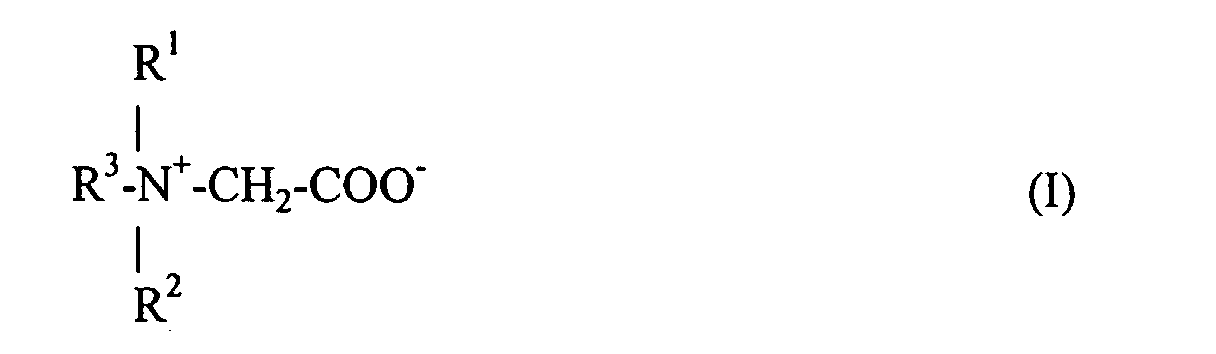
- amphoteric surface active agent may be betaine surface active agent.
- Preferred betaines may be either of the formula (I) or (II).
- R 1 and R 2 may be the same or different C 1-4 alkyl groups whereas R 3 is an alkyl group having 8-22 carbon atoms, more preferably 12 to 18 carbon atoms e.g. mixed C 10 to C 14 .
- cocoamidopropyl betaine also known as cocodimethyl acetic acid betaine (CAS Registry No.66455-29-6).
- Further betaines which may be used are lauryl dimethyl betaine (CAS Registry No. 683-10-3), cocoa dimethyl amidopropyl betaine (CAS Registry No. 61789-40-0) and the products identified as CAS Registry Nos. 70851-07-09 and 4292-10-8.
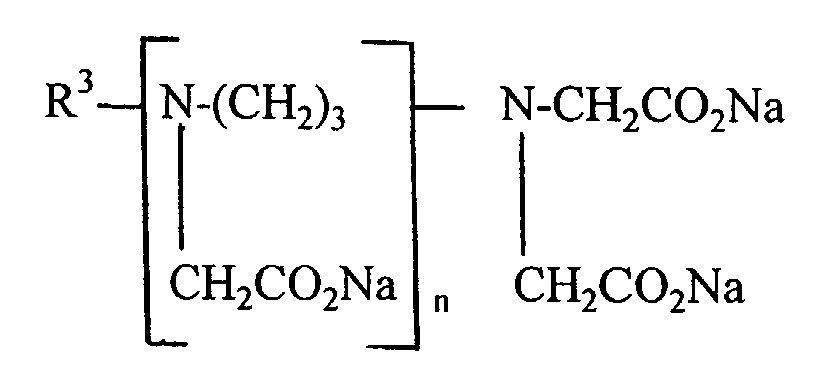
- amphoteric surface active agent for use in the formulation of the invention is a glycinate of the formula R 3 NHCH 2 CO 2 H where R 3 is as defined above.
- a further glycinate which may be used is of the formula
- R 3 is as defined above and n is 1 to 3.
- a cationic surface active agent is employed in conjunction with the amphoteric surface active agent.
- the cationic surface active agent is preferably used in an amount of up to 2% by weight of the formulation and is conveniently added in conjunction with the clay.
- suitable cationic surface active agents include quaternary ammonium salts having three lower (C 1-4 ) alkyl groups (preferably methyl groups) and a long chain (C 8-20 ) alkyl group, e.g. coco trimethyl ammonium chloride.
- Further examples include alkyl pyridinium salts and other compounds in which the nitrogen atom of the pyridine assumes a quaternary form, e.g. as in an alkyl pyridinium bromide.
- cationic surface active agents which may be used include amine and imidazoline salts.
- anionic surface active agent it is preferably present in the formulation in an amount of up to 20%, more preferably up to 10%, even more preferably up to 5% by weight of the formulation.
- anionic surface active agents which may be employed include alkylaryl sulphonates, alkyl sulphates, ether sulphates and ether carboxylates all as conventionally employed in laundry detergent formulations.
- non-ionic surface active agent is used then it is preferably present in an amount of up to 20% by weight of the formulation, more preferably 2 to 10% on the same basis.
- non-ionic surface active agent which may be used include alkoxylates, ethylene oxide/propylene oxide block copolymers, alkanolamides (e.g. monoethanolamides and diethanolamides), esters and amine oxides.
- the formulation may include at least one builder salt in a total amount of 10% to 50% by weight of the formulation.
- the builder may be for example be an alkali metal phosphate or alkali metal carbonate.
- a particularly preferred builder is sodium triphosphate.
- the formulation may incorporate additional components as conventionally included in laundry detergent formulation.
- additional component is a soap which may be used in an amount up to 5% by weight as a processing aid.
- additional components include anti-foam agents, sequestrants (e.g. of the phosphonate type), whiteness maintenance agents (e.g. CMC, polyoxyethylene terephthalate, polyethylene terephthalate), colourants (e.g. dyestuffs), perfume, flow control agents (e.g. a sulphate) flow enhancer (e.g. a zeodite), pH regulators (e.g. a carbonate or bicarbonate), anti-corrosion agents, dye transfer inhibitors (e.g. PVP) and optical brighteners (e.g. Tinopal CBS-X and Tinopal DMS-X). These components may, for example, each be present in amounts up to 1% by weight of the formulation.
- laundry detergent formulation A in accordance with the invention was produced using standard procedures % by weight Sodium Triphosphate 29.23 Granular Sodium Carbonate 9.81 Sodium Perborate Tetrahydrate 9.00 Sodium Perborate Monohydrate 9.00 Hexaacetyl Sorbitol 3.10 WA Powder (clay incl cationic and amide surfactants) 11.5 Ampholak X07/SD80 (Betaine Surfactant) 3.00 Synperonic 87k 4.50 Synperonic A3 1.50 Trepalbe Veg.
- the surfactants included in the WA powder are stearyl stearamide and cocotrimethyl ammonium chloride.
- a comparative formulation B was prepared exactly as for A save that the hexaacetyl sorbitol was replaced by tetraacetyl ethylene diamine (TAED).
- TAED tetraacetyl ethylene diamine
- Formulations A and B were used to launder standard pre-stained Red Wine, Tea, Blackcurrant, Enzyme Sensitive, Cocoa) or pre-dyed (Immedial Black) cotton swatches so as to test the bleaching activity of the formulations and the extent to which they caused dye damage. These laundering operations were carried out using a Hoover Ecologic Autowasher 100 de Luxe set on its "Main Wash” wash cycle. Laundering was carried out at 40°C and 60°C using 75 g of the formulations. Water hardness was 290 ppm calcium.
- formulation A was more effective (i.e. higher value of r 2 -r 1 ) than formulation B save for Red Wine and tea stains using the 40°C wash for which A and B gave the same stain removal properties.
- formulation A was superior (lower value of r 2 -r 1 ) to B at both 40°C and 60°C.
- Formulation C in accordance with the invention was formulated as shown in Table 3.
- Comparative formulation D was prepared by replacing the Hexaacetyl Sorbitol (HAS) with the same amount (1.5%) of TAED.
- a further comparative formulation E was prepared by omission of HAS and increasing the sodium sulphate content to 21.8% by weight.
Landscapes
- Chemical & Material Sciences (AREA)
- Inorganic Chemistry (AREA)
- Life Sciences & Earth Sciences (AREA)
- Engineering & Computer Science (AREA)
- Chemical Kinetics & Catalysis (AREA)
- Oil, Petroleum & Natural Gas (AREA)
- Wood Science & Technology (AREA)
- Organic Chemistry (AREA)
- Detergent Compositions (AREA)
Abstract
Description

| % by weight | |
| Sodium Triphosphate | 29.23 |
| Granular Sodium Carbonate | 9.81 |
| Sodium Perborate Tetrahydrate | 9.00 |
| Sodium Perborate Monohydrate | 9.00 |
| Hexaacetyl Sorbitol | 3.10 |
| WA Powder (clay incl cationic and amide surfactants) | 11.5 |
| Ampholak X07/SD80 (Betaine Surfactant) | 3.00 |
| Synperonic 87k | 4.50 |
| Synperonic A3 | 1.50 |
| Trepalbe Veg. Soap | 4.92 |
| Opticlean M375 Plus (Proteolytic Enzyme) | 1.14 |
| Maxamyl 2900 (Amylolytic Enzyme) | 0.80 |
| CMC | 2.06 |
| C-Sol (disilicate) | 4.47 |
| Wessalith P (zeolite) | 3.43 |
| Dequest 20160 (Diphosphonate Sequestrant) | 0.69 |
| Colour | 0.75 |
| Optical Brightners | 0.30 |
| Antifoam | 0.41 |
| Perfume | 0.40 |
| Stain Type and Temperature | A | B | |
| Red Wine Stain | 40°C | 21.5 | 21.5 |
| 60°C | 31.4 | 29.3 | |
| Tea Stain | 40°C | 10.5 | 10.5 |
| 60°C | 16.5 | 14.6 | |
| Blackcurrant Stain | 40°C | 23.5 | 23.3 |
| 60°C | 35.1 | 33.1 | |
| Enzyme Sensitive Stain | 40°C | 43.4 | 35.7 |
| 60°C | 52.4 | 44.6 | |
| Cocoa Stain | 40°C | 36.9 | 36.3 |
| 60°C | 45.8 | 38.2 | |
| TOTAL | 316.9 | 287.0 | |
| Immedial Black Dye Damage | 40°C | 3.1 | 3.2 |
| 60°C | 6.7 | 7.6 | |
| TOTAL | 9.8 | 10.8 |
| Raw Material | C % |
| STP L16 | 16.5 |
| Light Sodium Carbonate | 21 |
| Perborate Tetrahydrate | 11.5 |
| Sodium Sulphate | 20.3 |
| Al Powder (Pyramid P10) | 1 |
| CMC | 1.5 |
| Tinopal DMS-X | 0.125 |
| Tinopal CBS | 0.03 |
| Esperase/Savinase | 0.5 |
| Maxamyl 2900 CXT | 0.5 |
| Antifoam Rhodersil 20471LV | 0.2 |
| STP L16 | 1.645 |
| C Sol (Pyramid P40) | 2.5 |
| Armosoft WA Powder | 10 |
| Blue Beads | 1 |
| Green Beads | 1 |
| Synperonic A7 | 1.5 |
| Nansa SS Acid | 3.4 |
| Waterglass C100 | 4.5 |
| Perfume White Blossom 2951 | 0.2 |
| Hexaacetyl Sorbitol | 1.5 |
| Less Evaporation | -0.4 |
| TOTAL | 100 |
| Stain Type and Temperature | C % | D % | E % | |
| Removal of Coffee from Cotton | 40°C | 39.5 | 34.0 | 34.8 |
| 60°C | 48.2 | 47.2 | 43.0 | |
| Removal of Blackcurrant from Cotton | 40°C | 24.9 | 23.1 | 28.0 |
| 60°C | 45.5 | 43.7 | 33.2 | |
| Red Wine Stain removal | 40°C | 21.4 | 15.6 | 14.4 |
| 60°C | 12.4 | 11.9 | 19.8 | |
| Tea Stain Removal | 40°C | 11.2 | 9.8 | 8.3 |
| 60°C | 37.5 | 37.1 | 13.4 | |
| Immedial Black Dye Damage | 40°C | 2.5 | 3.1 | 2.0 |
| 60°C | 4.9 | 6.0 | 4.3 | |
| Enzyme Sensitive Stain Removal | 40°C | 34.0 | 33.3 | 36.9 |
| 60°C | 42.0 | 36.5 | 46.8 | |
| Cocoa Stain Removal | 40°C | 31.1 | 28.8 | 32.8 |
| 60°C | 42.1 | 37.4 | 39.5 | |
| OXIDSABLE TOTALS | 247.9 | 231.4 | 201.1 | |
| ENZYME TOTALS | 149.2 | 135.9 | 155.9 | |
| SUM TOTAL | 397.06 | 367.3 | 357.02 |
Claims (25)
- A laundry detergent formulation comprising at least one surfactant, a clay having fabric softening properties, and an activated bleaching system which includes at least one bleach activator which is an ester of a polyhydric alcohol having at least 5 carbon atoms and at least 3 hydroxyl groups esterified with C2-5 acyl groups, the polyhydric alcohol residue of said activator not having any substituents with six or more carbon atoms.
- A formulation as claimed in claim 1 wherein the activator has an HLB value of at least 7, more preferably at least 9 and even more preferably at least 11.
- A formulation as claimed in claim 1 or 2 wherein the alcohol residue of the activator has a maximum of 12 carbon atoms.
- A formulation as claimed in any one of claims 1 to 3 wherein the alcohol has at least 5 hydroxyl groups esterified with C2-5 acyl groups.
- A formulation as claimed in any one of claims 1 to 4 wherein said acyl groups have two or three carbon atoms and are preferably acetyl groups.
- A formulation as claimed in any one of claims 1 to 5 wherein said alcohol is a sugar or sugar derived alcohol, preferably sorbitol, glucitol, mannitol, glucose or sucrose.
- A formulation as claimed in claim 6 wherein the bleach activator is hexa acetyl sorbitol, hexa acetyl mannitol, penta acetyl glucose or octa acetyl sucrose.
- A formulation as claimed in any one of claims 1 to 7 wherein the amount of bleach activator incorporated in the formulation is in the range 0.5% to 10% by weight.
- A formulation as claimed in any one of claims 1 to 8 wherein the bleaching system includes a hydrogen peroxide precursor compound, for example an organic persalt such as a perborate, percarbonate or persulfate.
- A formulation as claimed in claim 9 wherein the amount of hydrogen peroxide precursor compound present in the formulation is such as to provide 0.5% to 3% by weight active oxygen.
- A formulation as claimed in any one of claims 1 to 10 wherein the clay is Laponite, Bentonite, Montmorrilonite, Hectorite and mixtures thereof.
- A formulation as claimed in any one of claims 1 to 11 wherein the amount of clay in the formulation is 5% to 20% by weight.
- A formulation as claimed in any one of claims 1 to 12 wherein the surface active agent is an amphoteric surface active agent.
- A formulation as claimed in claim 13 wherein the amphoteric surface active agent is present in an amount of 0.1 to 10%, preferably 0.5 to 5% and more preferably 1 to 4% by weight based on the total weight of the formulation.
- A formulation as claimed in claim 13 or 14 wherein the amphoteric surface active agent is a betaine surface active agent.
- A formulation as claimed in claim 15 wherein the betaine surface active agent is of the formula (I) or (II):
 wherein R1 and R2 may be the same or different C1-4 alkyl groups and R3 is an alkyl group having 8-22 carbon atoms.
- A formulation as claimed in claim 16 wherein the betaine surface active agent is cocoamidopropyl betaine.
- A formulation as claimed in any one of claims 13 to 17 additionally incorporating a cationic surface active agent, present for example in an amount up to 2% by weight of the formulation.
- A formulation as claimed in claim 18 wherein the cationic surface active agent is incorporated in the clay.
- A formulation as claimed in any one of claims 1 to 12 wherein the surface active agent is an anionic surface active agent present for example in an amount up to 20% by weight of the formulation.
- A formulation as claimed in claim 20 wherein the anionic surface active agent is an alkylaryl sulphonate, alkyl sulphate, ether sulphate or ether carboxylate.
- A formulation as claimed in any one of claims 1 to 12 wherein the surface active agent is a non-ionic surface active agent present for example in an amount up to 20% by weight of the formulation.
- A formulation as claimed in claim 22 wherein the non-ionic surface active agent is an alkoxylate, ethylene oxide/propylene oxide block copolymer, alkanolamide, ester and amine oxide.
- A formulation as claimed in any one of claims 1 to 23 including a total amount of 10% to 50% by weight of the formulation of at least one builder salt, for example an alkali metal phosphate such as sodium triphosphate or an alkali metal carbonate.
- A laundry detergent formulation comprising at least one surfactant, a clay having fabric softening properties, and an activated bleaching system which includes at least one bleach activator having an HLB value of at least 7, more preferably at least 9 and even more preferably at least 11.
Applications Claiming Priority (2)
| Application Number | Priority Date | Filing Date | Title |
|---|---|---|---|
| GBGB9706757.3A GB9706757D0 (en) | 1997-04-03 | 1997-04-03 | Laundry detergent formulation |
| GB9706757 | 1997-04-03 |
Publications (2)
| Publication Number | Publication Date |
|---|---|
| EP0869170A2 true EP0869170A2 (en) | 1998-10-07 |
| EP0869170A3 EP0869170A3 (en) | 1999-05-26 |
Family
ID=10810211
Family Applications (1)
| Application Number | Title | Priority Date | Filing Date |
|---|---|---|---|
| EP98302649A Withdrawn EP0869170A3 (en) | 1997-04-03 | 1998-04-03 | Laundry detergent formulation |
Country Status (2)
| Country | Link |
|---|---|
| EP (1) | EP0869170A3 (en) |
| GB (1) | GB9706757D0 (en) |
Cited By (2)
| Publication number | Priority date | Publication date | Assignee | Title |
|---|---|---|---|---|
| WO2017066400A1 (en) | 2015-10-13 | 2017-04-20 | The Sun Products Corporation | Multi-stage benefit agent delivery system |
| CN119121611A (en) * | 2024-08-27 | 2024-12-13 | 山东中康国创先进印染技术研究院有限公司 | A low temperature fabric bleach |
Family Cites Families (7)
| Publication number | Priority date | Publication date | Assignee | Title |
|---|---|---|---|---|
| DE3526405A1 (en) * | 1985-07-24 | 1987-02-05 | Henkel Kgaa | LAYERED SILICATES WITH RESTRICTED SOURCE, PROCESS FOR THEIR PRODUCTION AND THEIR USE IN DETERGENT AND CLEANING AGENTS |
| US4800038A (en) * | 1988-01-21 | 1989-01-24 | Colgate-Palmolive Company | Acetylated sugar ethers as bleach activators detergency boosters and fabric softeners |
| US4889651A (en) * | 1988-01-21 | 1989-12-26 | Colgate-Palmolive Company | Acetylated sugar ethers as bleach activators and detergency boosters |
| EP0492000B1 (en) * | 1990-12-28 | 1997-04-09 | AUSIMONT S.p.A. | Process for increasing the bleaching efficiency of an inorganic persalt |
| DE69126778T2 (en) * | 1991-07-31 | 1998-01-02 | Ausimont Spa | Process for increasing the bleaching efficiency of an inorganic persalt |
| EP0635563A1 (en) * | 1993-07-22 | 1995-01-25 | The Procter & Gamble Company | Dye-transfer-inhibiting compositions containing fabric-softening agent |
| ATE226239T1 (en) * | 1994-12-29 | 2002-11-15 | Procter & Gamble | WASHING SOFTENING DETERGENT COMPOSITIONS |
-
1997
- 1997-04-03 GB GBGB9706757.3A patent/GB9706757D0/en active Pending
-
1998
- 1998-04-03 EP EP98302649A patent/EP0869170A3/en not_active Withdrawn
Cited By (2)
| Publication number | Priority date | Publication date | Assignee | Title |
|---|---|---|---|---|
| WO2017066400A1 (en) | 2015-10-13 | 2017-04-20 | The Sun Products Corporation | Multi-stage benefit agent delivery system |
| CN119121611A (en) * | 2024-08-27 | 2024-12-13 | 山东中康国创先进印染技术研究院有限公司 | A low temperature fabric bleach |
Also Published As
| Publication number | Publication date |
|---|---|
| GB9706757D0 (en) | 1997-05-21 |
| EP0869170A3 (en) | 1999-05-26 |
Similar Documents
| Publication | Publication Date | Title |
|---|---|---|
| US5437686A (en) | Peroxygen bleach composition activated by bi and tricyclic diketones | |
| CA2023614C (en) | Laundry treatment product | |
| US8128712B2 (en) | Process for protecting the colors of colored textile articles or for providing crease resistance to textile articles | |
| US4758378A (en) | Softening detergent compositions containing amide softening agent | |
| GB2125454A (en) | Bleaching composition | |
| EP0890635A2 (en) | Compositions based on percarboxylic acids as cleaning and hygienizing agents | |
| US5512206A (en) | Peroxygen bleach composition | |
| US3640874A (en) | Bleaching and detergent compositions | |
| JPH05209193A (en) | Method for increasing bleaching effct of inorganic peracid salt or hydrogen peroxide, and bleaching and/or cleaning composition | |
| US4115309A (en) | Compositions and method for activating oxygen utilizing cyclic ester-anhydrides of α-hydroxycarboxylic acids | |
| CA2187303A1 (en) | Detergents containing an enzyme and a delayed release peroxyacid bleaching system | |
| CN100390258C (en) | detergent composition | |
| US5785887A (en) | Peroxygen bleach composition | |
| JP2001520266A (en) | Detergent composition | |
| JPH08245985A (en) | Laundry bleaching composition | |
| EP1253191B1 (en) | Detergent compositions | |
| WO2002083829A1 (en) | Mixed bleach activator compositions and methods of bleaching | |
| JP3410880B2 (en) | Liquid bleach composition | |
| JP2635178B2 (en) | Bleach detergent composition | |
| JP3330226B2 (en) | Liquid bleach composition | |
| GB2362161A (en) | Detergent tablets | |
| JP3913369B2 (en) | Cleaning composition | |
| JP2801053B2 (en) | Bleach detergent composition | |
| JPH09500674A (en) | Softening Through The Wash Composition | |
| JP2002517554A (en) | Amylase-containing detergent |
Legal Events
| Date | Code | Title | Description |
|---|---|---|---|
| PUAI | Public reference made under article 153(3) epc to a published international application that has entered the european phase |
Free format text: ORIGINAL CODE: 0009012 |
|
| AK | Designated contracting states |
Kind code of ref document: A2 Designated state(s): BE DE ES FR GB IT NL |
|
| PUAL | Search report despatched |
Free format text: ORIGINAL CODE: 0009013 |
|
| AK | Designated contracting states |
Kind code of ref document: A3 Designated state(s): AT BE CH CY DE DK ES FI FR GB GR IE IT LI LU MC NL PT SE |
|
| AX | Request for extension of the european patent |
Free format text: AL;LT;LV;MK;RO;SI |
|
| 17P | Request for examination filed |
Effective date: 19991123 |
|
| AKX | Designation fees paid |
Free format text: BE DE ES FR GB IT NL |
|
| 17Q | First examination report despatched |
Effective date: 20000614 |
|
| GRAG | Despatch of communication of intention to grant |
Free format text: ORIGINAL CODE: EPIDOS AGRA |
|
| STAA | Information on the status of an ep patent application or granted ep patent |
Free format text: STATUS: THE APPLICATION IS DEEMED TO BE WITHDRAWN |
|
| 18D | Application deemed to be withdrawn |
Effective date: 20011031 |