EP0868484B1 - Coating composition - Google Patents
Coating composition Download PDFInfo
- Publication number
- EP0868484B1 EP0868484B1 EP96943084A EP96943084A EP0868484B1 EP 0868484 B1 EP0868484 B1 EP 0868484B1 EP 96943084 A EP96943084 A EP 96943084A EP 96943084 A EP96943084 A EP 96943084A EP 0868484 B1 EP0868484 B1 EP 0868484B1
- Authority
- EP
- European Patent Office
- Prior art keywords
- weight
- monomers
- crosslinked
- coating composition
- core
- Prior art date
- Legal status (The legal status is an assumption and is not a legal conclusion. Google has not performed a legal analysis and makes no representation as to the accuracy of the status listed.)
- Expired - Lifetime
Links
Classifications
-
- C—CHEMISTRY; METALLURGY
- C08—ORGANIC MACROMOLECULAR COMPOUNDS; THEIR PREPARATION OR CHEMICAL WORKING-UP; COMPOSITIONS BASED THEREON
- C08F—MACROMOLECULAR COMPOUNDS OBTAINED BY REACTIONS ONLY INVOLVING CARBON-TO-CARBON UNSATURATED BONDS
- C08F265/00—Macromolecular compounds obtained by polymerising monomers on to polymers of unsaturated monocarboxylic acids or derivatives thereof as defined in group C08F20/00
- C08F265/04—Macromolecular compounds obtained by polymerising monomers on to polymers of unsaturated monocarboxylic acids or derivatives thereof as defined in group C08F20/00 on to polymers of esters
-
- C—CHEMISTRY; METALLURGY
- C08—ORGANIC MACROMOLECULAR COMPOUNDS; THEIR PREPARATION OR CHEMICAL WORKING-UP; COMPOSITIONS BASED THEREON
- C08F—MACROMOLECULAR COMPOUNDS OBTAINED BY REACTIONS ONLY INVOLVING CARBON-TO-CARBON UNSATURATED BONDS
- C08F285/00—Macromolecular compounds obtained by polymerising monomers on to preformed graft polymers
-
- C—CHEMISTRY; METALLURGY
- C09—DYES; PAINTS; POLISHES; NATURAL RESINS; ADHESIVES; COMPOSITIONS NOT OTHERWISE PROVIDED FOR; APPLICATIONS OF MATERIALS NOT OTHERWISE PROVIDED FOR
- C09D—COATING COMPOSITIONS, e.g. PAINTS, VARNISHES OR LACQUERS; FILLING PASTES; CHEMICAL PAINT OR INK REMOVERS; INKS; CORRECTING FLUIDS; WOODSTAINS; PASTES OR SOLIDS FOR COLOURING OR PRINTING; USE OF MATERIALS THEREFOR
- C09D151/00—Coating compositions based on graft polymers in which the grafted component is obtained by reactions only involving carbon-to-carbon unsaturated bonds; Coating compositions based on derivatives of such polymers
- C09D151/003—Coating compositions based on graft polymers in which the grafted component is obtained by reactions only involving carbon-to-carbon unsaturated bonds; Coating compositions based on derivatives of such polymers grafted on to macromolecular compounds obtained by reactions only involving unsaturated carbon-to-carbon bonds
-
- Y—GENERAL TAGGING OF NEW TECHNOLOGICAL DEVELOPMENTS; GENERAL TAGGING OF CROSS-SECTIONAL TECHNOLOGIES SPANNING OVER SEVERAL SECTIONS OF THE IPC; TECHNICAL SUBJECTS COVERED BY FORMER USPC CROSS-REFERENCE ART COLLECTIONS [XRACs] AND DIGESTS
- Y10—TECHNICAL SUBJECTS COVERED BY FORMER USPC
- Y10S—TECHNICAL SUBJECTS COVERED BY FORMER USPC CROSS-REFERENCE ART COLLECTIONS [XRACs] AND DIGESTS
- Y10S525/00—Synthetic resins or natural rubbers -- part of the class 520 series
- Y10S525/902—Core-shell
Definitions
- This invention relates to an aqueous coating composition and to a process for preparing the composition. It also relates to a coating process using the coating composition and to a substrate coated by the coating process.
- the painting of motor vehicles broadly involves three stages.
- the first stage is called pre-treatment in which the bare metal is treated with various chemicals to improve corrosion resistance and the adhesion of subsequently applied paint coatings.
- the second stage one or more coats of primer and/or surfacer are applied to even out small surface irregularities and provide a foundation for subsequent layers.
- a topcoat is applied. The topcoat gives the vehicle its final appearance and also must resist the elements and physical damage.
- the topcoat on modern motor vehicles, particularly cars, is often applied using what is known as a basecoat-clearcoat process. This involves applying two different layers of paint.
- the first layer is a pigmented composition called a basecoat which gives the vehicle its colour as well as any other pigment effects such as a metallic or pearlescent effect.
- the second and final layer is an unpigmented composition called a clearcoat which provides the final glossy appearance.
- European Patent EP-B-0 038 127 discloses and claims an entirely revolutionary waterborne basecoat which can be used in the original manufacture of motor vehicles.
- the Patent discloses a pseudoplastic or thixotropic composition which comprises an aqueous dispersion of acrylic polymer in water.
- the dispersed polymer particles are made from various ethylenic monomers and are internally crosslinked.
- the combination of the internal crosslinking and the rheological properties make these basecoats particularly good for use with metallic pigments.
- These basecoats give particularly good metal flake orientation and hence good metallic "flip" effect, and are very resistant to disturbance by the subsequently applied clearcoat.
- European Patent EP-B-0 300 612 discloses waterborne basecoats comprising similar dispersions which have a crosslinked core and a non-crosslinked stabilising mantle having salt forming groups. These dispersions are used in combination with another different type of dispersion so as to give basecoats which can be used for the refinishing of motor vehicles.
- Our new addition polymer microparticles are made by polymerising ethylenically unsaturated monomers and consist of a crosslinked core from which there extends a non-crosslinked stabilising mantle containing acid groups.
- a sprayable aqueous coating composition for motor vehicles comprising an aqueous dispersion of addition polymer microparticles having a crosslinked core and a non-crosslinked stabilising mantle containing acid groups, characterised in that the crosslinked core comprises;
- the outer core preferably surrounds the inner core.
- the inner and outer core can have the same monomer composition in which case the crosslinked core is homogeneous.
- the outer core preferably has a Tg of at least 5°C greater than that of the inner core, more preferably at least 10°C greater, still more preferably at least 20°C greater and most preferably at least 40°C greater.
- the outer core preferably has a Tg of greater than 10°C.
- the inner core preferably has a Tg of less than -10°C, more preferably less than -25°C.
- the outer core is made from at least 10% by weight of monomer having a water solubility of less than 0.1% by weight, crosslinking monomer and optionally other ethylenic monomer.
- the outer core is preferably made from at least 15% by weight of monomer having a water solubility of less than 0.1% by weight, more preferably at least 20%, most preferably at least 40% and especially above 90%.
- a particularly preferred outer core is made from between 95 and 99.5% by weight of monomer having a water solubility of less than 0.1% by weight and between 0.5 and 5% of crosslinking monomer.
- the water solubility of certain monomers is given in J.W.Vanderhoff, J.Polym.Sci: Polymer Symposium, 72 , 161-198 (1985) or F.C.Leonard, Vinyl & Diene Monomers, Parts I to III, published by John Wiley in their High Polymers Series in 1970.
- the water solubility of other monomers can be determined by preparing a saturated, equilibrated solution of the monomer in water at 25°C, extracting a sample of the aqueous phase and determining the monomer concentration by gas chromatography against an internal standard, for example isopropanol.
- Examples of monomers having water solubility of less than 0.1% by weight are n-octyl acrylate (0.002%), dimethyl styrene (0.003%), alpha-methyl styrene (0.005), 2-ethylhexyl acrylate (0.001), vinyl toluene (0.008%), hexyl acrylate (0.008%), styrene (0.03%), vinyl hexanoate (0.004) and n-butyl methacrylate (0.03), of which 2-ethylhexyl acrylate and styrene are preferred.
- Styrene is particularly preferred because compositions in which the microparticle contains styrene show particularly good mechanical properties such as chip resistance.
- Crosslinking monomers can be monomers having more than one ethylenic unsaturation which can polymerise with the other monomers so as to crosslink the polymer.
- suitable crosslinking monomers are allyl methacrylate, vinyl acrylate divinyl benzene, ethylene glycol dimethacrylate and glycerol triacrylate.
- the crosslinking monomer can also be a mixture of two monomers having coreactive functional groups such as epoxy and carboxyl (for example glycidyl methacrylate and methacrylic acid), anhydride and hydroxyl or isocyanate and hydroxyl.
- the crosslinking monomer is allyl methacrylate.
- the outer core is made from 0.5 to 5 % by weight of crosslinking monomer, more preferably 1 to 4%.
- the other ethylenic monomers which can be included in the outer core have a water solubility greater than 0.1% by weight.
- examples of other ethylenic monomers are (meth) acrylic acid esters and nitriles and vinyl esters.
- (meth) acrylic acid esters are C 1-5 alkyl esters, particularly methyl (meth)acrylate, ethyl (meth)acrylate, propyl (meth)acrylate and butyl acrylate, and poly(ethylene oxide) esters such as polyethylene glycol methacrylates.
- nitriles are (meth)acrylonitrile.
- vinyl esters are vinyl C 1-4 alkanoate esters, particularly vinyl acetate, vinyl propionate and vinyl butyrate.
- the other ethylenic monomers are methyl methacrylate and butyl acrylate.
- the outer core comprises monomers selected from methyl methacrylate, butyl acrylate, 2-ethylhexyl acrylate, styrene and allyl methacrylate and mixtures of these.
- the inner core can be made from crosslinking monomer and other ethylenic monomer, optionally together with monomers having a water solubility of less than 0.1% by weight.
- the crosslinking monomer can be any of those described in relation to the outer core.
- the inner core is made from 0.5 to 5% by weight of crosslinking monomer.
- the other ethylenic monomer can be any of those described in relation to the outer core.
- the inner core is made from 65 to 99.5% by weight of other ethylenic monomer.
- the inner core is made from less than 30% by weight of monomers having a water solubility of less than 0.1% by weight, more preferably less than 25% by weight, and most preferably less than 10% by weight.
- the inner core is made from monomers selected from methyl methacrylate, butyl acrylate, styrene and allyl methacrylate.
- the core in practice consists of a polymer seed onto which the core is formed. Where the core comprises an inner core and an outer core then the seed is regarded as part of the inner core.
- the polymer seed can be formed from any of those monomers described above in relation to the monomers making up the core.
- the polymer seed is made from the same monomers as the core.
- the seed comprises the same monomers as the inner core.
- hydrophilic monomers such as hydroxyl or acid functional monomers in the core because these tend to have a deleterious effect on water resistance in the final coatings.
- the non-crosslinked mantle which is formed on the core contributes wholly or in part to the stability and rheological properties of the microparticles in dispersion.
- This mantle is made from monomer having acid groups, optionally monomer having other hydrophillic groups, optionally monomer having a water solubility of less than 0.1% by weight, and other ethylenic monomer.
- Examples of monomers having acid groups are carboxylic acid, phosphate and sulphonate functional monomers such as (meth)acrylic acid.
- the monomer having acid groups is methacrylic acid.
- Examples of monomers having other hydrophillic groups are hydroxy functional monomers and poly (ethylene oxide) containing monomers.
- hydroxy functional monomers are hydroxyethyl (meth)acrylate, hydroxybutyl (met)acrylate and hydroxy propyl (meth)acrylate.
- a preferred hydroxy functional monomer is hydroxyethyl acrylate.
- Examples of poly (ethylene oxide) containing monomers are those containing a poly (ethylene oxide) moiety of molecular weight 750 to 2500, for example methoxy poly (ethylene oxide) 2000 methacrylate in which the 2000 indicates the molecular weight of the poly (ethylene oxide) moiety.
- Examples of monomers having a solubility in water of less than 0.1% by weight are those monomers referred to as such above in relation to the outer core.
- Examples of other ethylenic monomers making up the mantle are those monomers referred to as such above in relation to the outer core.
- Preferred mantle monomers in addition to the monomer having acid groups are styrene, butyl methacrylate, butyl acrylate and methyl methacrylate.
- the mantle is made from 5 to 19%, preferably 5 to 17% by weight of monomers having acid groups and 81 to 95% and preferably 83 to 95% by weight of other ethylenic monomers and any monomers having a solubility in water of less than 0.1% by weight.
- the mantle is also made from monomers having other hydrophillic groups these preferably make up from 5 to 35 % by weight of the mantle.
- the weight ratio of the core to mantle is preferably 5:95 to 95:5, more preferably 40:60 to 90:10.
- the acid groups on the mantle are at least partially neutralised by the presence of a base such as an amine, for exampie dimethyl aminoethanol, so as to form a salt.
- a base such as an amine, for exampie dimethyl aminoethanol
- the microparticles have a diameter of 10 to 500nm, more preferably 25 to 200nm.
- the mantle has a Tg of -40 to +30°C.
- the aqueous continuous phase in which the microparticles are dispersed comprises water, optionally with one or more water miscible organic solvents.
- the aqueous continuous phase comprises at least 50, more preferably at least 75 and most preferably at least 90 weight % water.
- An example of a suitable water miscible solvent is 2-butoxyethanol.
- the microparticle dispersions themselves are pseudoplastic or thixotropic, more preferably pseudoplastic.
- the dispersions have a low shear viscosity (measured at 22% non-volatile content, containing 10% 2-butoxy ethanol and at pH 8.0, on a Couvette viscometer at a shear rate of 1s -1 and at 25°C) of more than 0.5 Pa.s, and a high shear viscosity (measured under the same conditions on a cone and plate viscometer at a shear rate of 10 4 s -1 at 25°C) of less than 0.1 Pa.s.
- microparticles can be made by the general processes described in EP-B-0 038 127, EP-B-0 001 489 and EP-B-0 300 612. In particular, they can be made by an emulsion polymerisation process which comprises;
- the monomer mixture in step (A2) produces a polymer having a Tg of at least 5°C greater than the Tg of the polymer produced in (A1).
- step (A1) comprises a first step in which a mixture of ethylenic monomers optionally comprising a crosslinking monomer is polymerised to form a polymer seed followed by polymerisation of further ethylenic monomers comprising crosslinking monomer so as to form the crosslinked inner core.
- the emulsion polymerisation to form the polymer seed is carried out by firstly emulsifying the appropriate monomer mixture in water in the presence of a surfactant, heating this emulsion to a temperature at which polymerisation will occur in the presence of a polymerisation initiator and then adding a suitable polymerisation initiator.
- the emulsion polymerisations to form the inner core (A1), the outer core (A2) and the mantle (B) are carried out by firstly emulsifying the appropriate monomer mixture in water in the presence of a surfactant, and then feeding this monomer emulsion into the aqueous dispersion from the previous stage in the presence of a polymerisation initiator at a temperature at which polymerisation occurs.
- Suitable surfactants include anionic or non-ionic surfactants.
- suitable anionic surfactants are sodium lauryl sulphate, sodium dioctyl sulphosuccinate, disodium octadecyl sulphosuccinamate and the ammonium salt of a sulphate ester of a condensate of nonyl phenol and ethylene oxide.
- a suitable non-ionic surfactant is the poly(ethylene glycol) ether of nonyl phenol.
- Suitable initiators include peroxides such as hydrogen peroxide and tertiary butyl hydroperoxide, persulphates such as potassium persulphate and ammonium persulphate, azo initiators such as azodiisobutyronitrile and redox initiator combinations such as ascorbic acid and hydrogen peroxide. Redox initiators have been found to be particularly good for water resistance.
- metal salts such as iron, chromium or copper salts can also be added when redox initiators are used.
- step (B) Preferably no chain transfer agent is present during step (B) and more preferably no chain transfer agent is used at all in making the microparticles.
- the polymerisation steps are carried out at a temperature of 40 to 98°C, preferably 50 to 90°C.
- the acid groups on the mantle are at least partially neutralised by the addition of a base, during or preferably after the preparation of the polymer microparticles.
- a base is alkali metal hydroxides and amines.
- Suitable amines include ammonia and primary, secondary or tertiary alkylamines such as triethylamine and dimethyl ethanolamine
- the coating composition preferably comprises the aqueous dispersion as described above and a pigment.
- the pigment can be any pigment or mixture of pigments suitable for use in an aqueous composition such as a solid colour pigment, a metallic pigment or a pearlescent pigment.
- a metallic pigment or a pearlescent pigment or a mixture of these optionally together with any other pigment is particularly preferred.
- the coating composition can also contain co-solvents, for example 2-butoxyethanol to aid coalescence, extenders, biocides, dispersants, rheological modifiers, and wetting agents.
- co-solvents for example 2-butoxyethanol to aid coalescence, extenders, biocides, dispersants, rheological modifiers, and wetting agents.
- Coatings can be formulated for the original manufacture or refinishing of motor vehicles of many different kinds such as automobiles, trucks, trailers, transport containers and motorcycles. They can also be formulated for use in other applications such as for coating lawn mowers and bicycles.
- the coating composition is a motor vehicle basecoat composition.
- Basecoat compositions are formulated for use under a clearcoat.
- the coating composition can also comprise a crosslinker.
- suitable crosslinkers are polyisocyanates and aminoplast resins such as melamine formaldehydes and urea formaldehydes.
- the coating composition is for use as a basecoat in vehicle refinishing, it is advantageous to include an aqueous dispersion of different addition polymer microparticles having C 1-4 alkoxypolyoxyalkylene stabiliser units as described in EP-B-0 300 612.
- the composition comprises 5 to 95% by weight, more preferably 15 to 85%, most preferably 40 to 80%, of the crosslinked addition polymer microparticles of the invention, and 95 to 5% by weight, more preferably 85 to 15%, most preferably 60 to 20%, of the different addition polymer microparticles having C 1-4 alkoxy polyoxyalkylene stabiliser.
- the addition polymer microparticles having C 1-4 alkoxy polyoxyalkylene stabiliser are optionally crosslinked.
- the microparticles are made from polyoxyalkylene group containing monomers, optionally crosslinking monomers, optionally also monomers having di-C 1-6 alkylamino, hydroxy or epoxy groups and other ethylenic monomers.
- the polyoxyalkylene group containing monomers are C 1-4 alkoxypolyoxyalkylene (meth)acrylate esters. In practice, these have a molecular weight in the range 700 to 3,000, preferably 1000 to 2500 and more preferably around 2000.
- the C 1-4 alkoxy moiety can be methoxy, ethoxy or propoxy. Preferably it is methoxy.
- the alkylene moiety is predominantly ethylene which may contain a proportion of propylene and/or butylene.
- a preferred stabiliser is methoxypolyoxyethylene (2,000) methacrylate.
- addition polymer microparticles having C 1-4 alkoxy polyoxyalkylene stabiliser also contain a monomer having epoxy groups, such as glycidyl methacrylate.
- the monomer having epoxy groups can make up to 5 to 50% by weight of the addition polymer. Preferably they make up 10 to 30% by weight of the polymer.
- the optional crosslinking monomers can be any of those referred to above as crosslinking monomers in relation to the outer core of the microparticles having a crosslinked core and a stabilising mantle containing salt-forming groups.
- the polymer contains less than 1% by weight of crosslinking monomer and preferably it is not crosslinked.
- Examples of other ethylenic monomers making up the addition polymer microparticles having C 1-4 alkoxy polyoxyalkylene stabiliser are those monomers referred to above in relation to the outer core of the microparticles having a crosslinked core and a stabilising mantle containing salt-forming groups as monomers having a solubility in water of less than 0.1% by weight and also those referred to there as other ethylenic monomers.
- the other ethylenic monomers making up the addition polymer microparticles having C 1-4 alkoxy polyoxyalkylene stabiliser are C 1-6 alkyl acrylate monomers and vinyl benzene derivative monomers and, more preferably, they are styrene and butyl acrylate.
- the polymer preferably consists of 30 to 80% styrene, (more preferably 40 to 60%) and 20 to 70% butyl acrylate, (more preferably 40 to 60%).
- the exact proportion of monomers making up the polymer microparticles having C 1-4 alkoxypolyoxyalkylene stabiliser is chosen so as to obtain the appropriate and desired physical properties in the polymer produced.
- the monomers are selected primarily so as to control the Tg or glass transition temperature.
- the monomers are selected such that the theoretical Tg as calculated by the Fox equation is from -50°C to +50°C. Preferably it is -10°C to +10°C.
- the polymer microparticles having C 1-4 alkoxypolyoxyalkylene stabiliser units have a diameter of 10 to 1000nm, more preferably 50 to 500nm.
- the polymer microparticles having C 1-4 alkoxypolyoxyalkylene stabiliser units can be made by known methods. For example, they can be made by emulsion polymerisation or by an aqueous dispersion polymerisation process as described in EP-A-0013478.
- the aqueous dispersion of polymer microparticles having C 1-4 alkoxy polyoxyalkylene stabiliser units can be added to the coating composition by stirring it in.
- the coating compositions of the invention can also comprise a polyurethane resin dispersion.
- Aqueous dispersions of polyurethane resin comprise particles of polyurethane polymer dispersed in an aqueous medium.
- the polyurethane polymer has pendent acid groups, and these acid groups are neutralised in the presence of a base to form anionic groups which stabilise the dispersion.
- the polyurethane can be made by the reaction of a polyisocyanate, a polyol, a compound having an acid group and optionally a chain extending compound such as a polyamine or hydrazine.
- Polyisocyanates are compounds with more than one isocyanate group.
- suitable diisocyanates are toluene diisocyanate, hexamethylene diisocyanate, isophorone diisocyanate and dicyclohexyl methane diisocyanate.
- suitable three or more functional isocyanates are the reaction products of diisocyanates with polyois such as trimethylol propane, glycerol and pentaerythritol. Many such polyisocyanates are commercially available, for example under the Desmodur trade mark from Bayer.
- a preferred polyisocyana is a mixture of 2,4'- and 4,4'-dicyclohexyl methane diisocyanate, available as Desmodur W from Bayer.
- Polyols are compounds with more than one hydroxyl group.
- suitable polyols are simple polyols such as those from which the polyisocyanate can be made, polyester polyols and polyether polyols.
- a preferred polyol is a polyester polyol.
- the compound having an acid group preferably has an acid group, such as a carboxylic acid group and two groups which can react with either the polyisocyanate or the polyol.
- An example of a group which can react with the polyol is an isocyanate group.
- groups which can react with the polyisocyanate are hydroxyl groups and amine groups.
- One example of a compound having two hydroxyl groups and an acid group is dimethylol propionic acid.
- polyamines examples include ethylene diamine, isophorone diamine and diethylene triamine.
- the polyurethane dispersions are generally dispersed using a base which ionises the acidic groups on the polymer and so stabilises the dispersion.
- the base can be an inorganic base, ammonia or an amine.
- the base is an amine.
- the polyisocyanate, the compound having an acid group and the polyol can be reacted together in an organic solvent to produce an isocyanate terminated prepolymer which can be dispersed in water in the presence of the base and then chain extended by adding the polyamine.
- the prepolymer can be chain extended in solution and then the final polyurethane polymer can be dispersed in water in the presence of the base.
- aqueous polyurethane dispersions examples include Witcobond 240 from Baxenden Chemical co., Bayhydrol PR135 from Bayer, Neorez R984 from Zeneca Specialties, Cydrothane HP 1035 from Cyanamid, Spensol L52 from Spenser-Kellogg, Flexthane 610 from Air Products and Incorez W830/074 from Industrial Copolymers Ltd.
- the coating compositions can be used to coat motor vehicles in a coating process which comprises applying a layer of the composition to the surface of the vehicle and subsequently allowing or causing the layer to dry or cure.
- a coating process which comprises applying a layer of the composition to the surface of the vehicle and subsequently allowing or causing the layer to dry or cure.
- the coating composition is a basecoat composition
- a layer of clearcoat is usually applied over the basecoat.
- the clearcoat can be applied after the basecoat has dried or cured.
- the clearcoat can be applied only a short time after the basecoat and before the basecoat has fully dried or cured. In this case both basecoat and clearcoat are dried and cured in a single step. This is referred to as a "wet-on-wet" process.
- composition can be applied by conventional means such as brushing, rolling or spraying.
- Motor vehicles are preferably painted by spraying.
- the layer can be allowed or caused to dry or cure either by leaving it at ambient temperatures or by the use of heat.
- the compositions are allowed or caused to cure at temperatures between 0 and 160°C.
- the compositions are used for the refinishing of motor vehicles they are caused or allowed to dry or cure at temperatures between 10 and 70°C and for the original painting of motor vehicles between 100 and 200°C, usually 110 to 150°C.
- the drying or curing step takes, for example, between 10 minutes and 24 hours depending on the conditions used and typically between 10 minutes and 5 hours.
Landscapes
- Chemical & Material Sciences (AREA)
- Organic Chemistry (AREA)
- Chemical Kinetics & Catalysis (AREA)
- Polymers & Plastics (AREA)
- Medicinal Chemistry (AREA)
- Health & Medical Sciences (AREA)
- Materials Engineering (AREA)
- Wood Science & Technology (AREA)
- Engineering & Computer Science (AREA)
- Life Sciences & Earth Sciences (AREA)
- Paints Or Removers (AREA)
- Polishing Bodies And Polishing Tools (AREA)
- Graft Or Block Polymers (AREA)
- Agricultural Chemicals And Associated Chemicals (AREA)
- Fats And Perfumes (AREA)
- Acyclic And Carbocyclic Compounds In Medicinal Compositions (AREA)
- Compositions Of Macromolecular Compounds (AREA)
- Manufacturing Of Micro-Capsules (AREA)
Abstract
Description
- This invention relates to an aqueous coating composition and to a process for preparing the composition. It also relates to a coating process using the coating composition and to a substrate coated by the coating process.
- The painting of motor vehicles broadly involves three stages. The first stage is called pre-treatment in which the bare metal is treated with various chemicals to improve corrosion resistance and the adhesion of subsequently applied paint coatings. In the second stage, one or more coats of primer and/or surfacer are applied to even out small surface irregularities and provide a foundation for subsequent layers. In the final stage, a topcoat is applied. The topcoat gives the vehicle its final appearance and also must resist the elements and physical damage.
- The topcoat on modern motor vehicles, particularly cars, is often applied using what is known as a basecoat-clearcoat process. This involves applying two different layers of paint. The first layer is a pigmented composition called a basecoat which gives the vehicle its colour as well as any other pigment effects such as a metallic or pearlescent effect. The second and final layer is an unpigmented composition called a clearcoat which provides the final glossy appearance.
- European Patent EP-B-0 038 127 discloses and claims an entirely revolutionary waterborne basecoat which can be used in the original manufacture of motor vehicles. The Patent discloses a pseudoplastic or thixotropic composition which comprises an aqueous dispersion of acrylic polymer in water. The dispersed polymer particles are made from various ethylenic monomers and are internally crosslinked. The combination of the internal crosslinking and the rheological properties make these basecoats particularly good for use with metallic pigments. These basecoats give particularly good metal flake orientation and hence good metallic "flip" effect, and are very resistant to disturbance by the subsequently applied clearcoat.
- European Patent EP-B-0 300 612 discloses waterborne basecoats comprising similar dispersions which have a crosslinked core and a non-crosslinked stabilising mantle having salt forming groups. These dispersions are used in combination with another different type of dispersion so as to give basecoats which can be used for the refinishing of motor vehicles.
- We have now found that by including in part of the core a minimum proportion of monomers having a low water solubility, we can produce waterborne basecoats which, when overcoated with a clearcoat, will form topcoats having improved resistance to humidity and which have very good "flip" appearance.
- Our new addition polymer microparticles are made by polymerising ethylenically unsaturated monomers and consist of a crosslinked core from which there extends a non-crosslinked stabilising mantle containing acid groups.
- According to the present invention there is provided a sprayable aqueous coating composition for motor vehicles comprising an aqueous dispersion of addition polymer microparticles having a crosslinked core and a non-crosslinked stabilising mantle containing acid groups, characterised in that the crosslinked core comprises;
- i) a crosslinked inner core of an addition polymer
- ii) a crosslinked outer core of an addition polymer which is made from at least 10% by weight of monomers having a solubility in water of less than 0.1% by weight, the weight ratio of the inner core to the outer core being in the range 10:90 to 90:10, preferably 25:75 to 75:25, and the mantle has a Tg of -50°C to +50°C, and is made from 5 to 19% by weight of monomers having acid groups.
-
- The outer core preferably surrounds the inner core. The inner and outer core can have the same monomer composition in which case the crosslinked core is homogeneous. Preferably the inner and outer core have a different monomer composition.
- The outer core preferably has a Tg of at least 5°C greater than that of the inner core, more preferably at least 10°C greater, still more preferably at least 20°C greater and most preferably at least 40°C greater.
- The outer core preferably has a Tg of greater than 10°C. The inner core preferably has a Tg of less than -10°C, more preferably less than -25°C.
- The Tg of each portion of the microparticles can be calculated from the monomers from which that portion is made by using the Fox Equation (in which Tg is expressed in Kelvin):
- The outer core is made from at least 10% by weight of monomer having a water solubility of less than 0.1% by weight, crosslinking monomer and optionally other ethylenic monomer. The outer core is preferably made from at least 15% by weight of monomer having a water solubility of less than 0.1% by weight, more preferably at least 20%, most preferably at least 40% and especially above 90%. A particularly preferred outer core is made from between 95 and 99.5% by weight of monomer having a water solubility of less than 0.1% by weight and between 0.5 and 5% of crosslinking monomer.
- The water solubility of certain monomers is given in J.W.Vanderhoff, J.Polym.Sci: Polymer Symposium, 72, 161-198 (1985) or F.C.Leonard, Vinyl & Diene Monomers, Parts I to III, published by John Wiley in their High Polymers Series in 1970. The water solubility of other monomers can be determined by preparing a saturated, equilibrated solution of the monomer in water at 25°C, extracting a sample of the aqueous phase and determining the monomer concentration by gas chromatography against an internal standard, for example isopropanol. Examples of monomers having water solubility of less than 0.1% by weight, with the literature figure for their solubilities in parentheses, are n-octyl acrylate (0.002%), dimethyl styrene (0.003%), alpha-methyl styrene (0.005), 2-ethylhexyl acrylate (0.001), vinyl toluene (0.008%), hexyl acrylate (0.008%), styrene (0.03%), vinyl hexanoate (0.004) and n-butyl methacrylate (0.03), of which 2-ethylhexyl acrylate and styrene are preferred. Styrene is particularly preferred because compositions in which the microparticle contains styrene show particularly good mechanical properties such as chip resistance.
- Crosslinking monomers can be monomers having more than one ethylenic unsaturation which can polymerise with the other monomers so as to crosslink the polymer. Examples of suitable crosslinking monomers are allyl methacrylate, vinyl acrylate divinyl benzene, ethylene glycol dimethacrylate and glycerol triacrylate. The crosslinking monomer can also be a mixture of two monomers having coreactive functional groups such as epoxy and carboxyl (for example glycidyl methacrylate and methacrylic acid), anhydride and hydroxyl or isocyanate and hydroxyl.
- Preferably the crosslinking monomer is allyl methacrylate. Preferably the outer core is made from 0.5 to 5 % by weight of crosslinking monomer, more preferably 1 to 4%.
- The other ethylenic monomers which can be included in the outer core have a water solubility greater than 0.1% by weight. Using the nomenclature (meth)acrylate to represent acrylate and methacrylate equally and (meth)acrylic to represent acrylic and methacrylic equally, examples of other ethylenic monomers are (meth) acrylic acid esters and nitriles and vinyl esters. Examples of (meth) acrylic acid esters are C1-5 alkyl esters, particularly methyl (meth)acrylate, ethyl (meth)acrylate, propyl (meth)acrylate and butyl acrylate, and poly(ethylene oxide) esters such as polyethylene glycol methacrylates. Examples of nitriles are (meth)acrylonitrile. Examples of vinyl esters are vinyl C1-4 alkanoate esters, particularly vinyl acetate, vinyl propionate and vinyl butyrate.
- Most preferably the other ethylenic monomers are methyl methacrylate and butyl acrylate.
- Most preferably the outer core comprises monomers selected from methyl methacrylate, butyl acrylate, 2-ethylhexyl acrylate, styrene and allyl methacrylate and mixtures of these.
- The inner core can be made from crosslinking monomer and other ethylenic monomer, optionally together with monomers having a water solubility of less than 0.1% by weight.
- The crosslinking monomer can be any of those described in relation to the outer core. Preferably the inner core is made from 0.5 to 5% by weight of crosslinking monomer.
- The other ethylenic monomer can be any of those described in relation to the outer core. Preferably the inner core is made from 65 to 99.5% by weight of other ethylenic monomer.
- Preferably the inner core is made from less than 30% by weight of monomers having a water solubility of less than 0.1% by weight, more preferably less than 25% by weight, and most preferably less than 10% by weight.
- These monomers can be any of those referred to above in relation to the outer core. Most preferably the inner core is made from monomers selected from methyl methacrylate, butyl acrylate, styrene and allyl methacrylate.
- The core in practice consists of a polymer seed onto which the core is formed. Where the core comprises an inner core and an outer core then the seed is regarded as part of the inner core.
- The polymer seed can be formed from any of those monomers described above in relation to the monomers making up the core. Preferably the polymer seed is made from the same monomers as the core. Preferably, when the core comprises an inner core and an outer core, the seed comprises the same monomers as the inner core.
- Preferably there are no hydrophilic monomers such as hydroxyl or acid functional monomers in the core because these tend to have a deleterious effect on water resistance in the final coatings.
- The non-crosslinked mantle which is formed on the core contributes wholly or in part to the stability and rheological properties of the microparticles in dispersion. This mantle is made from monomer having acid groups, optionally monomer having other hydrophillic groups, optionally monomer having a water solubility of less than 0.1% by weight, and other ethylenic monomer.
- Examples of monomers having acid groups are carboxylic acid, phosphate and sulphonate functional monomers such as (meth)acrylic acid. Preferably the monomer having acid groups is methacrylic acid.
- Examples of monomers having other hydrophillic groups are hydroxy functional monomers and poly (ethylene oxide) containing monomers. Examples of hydroxy functional monomers are hydroxyethyl (meth)acrylate, hydroxybutyl (met)acrylate and hydroxy propyl (meth)acrylate. A preferred hydroxy functional monomer is hydroxyethyl acrylate. Examples of poly (ethylene oxide) containing monomers are those containing a poly (ethylene oxide) moiety of molecular weight 750 to 2500, for example methoxy poly (ethylene oxide) 2000 methacrylate in which the 2000 indicates the molecular weight of the poly (ethylene oxide) moiety.
- Examples of monomers having a solubility in water of less than 0.1% by weight are those monomers referred to as such above in relation to the outer core. Examples of other ethylenic monomers making up the mantle are those monomers referred to as such above in relation to the outer core. Preferred mantle monomers in addition to the monomer having acid groups are styrene, butyl methacrylate, butyl acrylate and methyl methacrylate.
- The mantle is made from 5 to 19%, preferably 5 to 17% by weight of monomers having acid groups and 81 to 95% and preferably 83 to 95% by weight of other ethylenic monomers and any monomers having a solubility in water of less than 0.1% by weight. When the mantle is also made from monomers having other hydrophillic groups these preferably make up from 5 to 35 % by weight of the mantle.
- The weight ratio of the core to mantle is preferably 5:95 to 95:5, more preferably 40:60 to 90:10.
- Preferably the acid groups on the mantle are at least partially neutralised by the presence of a base such as an amine, for exampie dimethyl aminoethanol, so as to form a salt.
- Preferably the microparticles have a diameter of 10 to 500nm, more preferably 25 to 200nm. Preferably the mantle has a Tg of -40 to +30°C.
- The aqueous continuous phase in which the microparticles are dispersed comprises water, optionally with one or more water miscible organic solvents. Preferably the aqueous continuous phase comprises at least 50, more preferably at least 75 and most preferably at least 90 weight % water. An example of a suitable water miscible solvent is 2-butoxyethanol.
- Preferably the microparticle dispersions themselves are pseudoplastic or thixotropic, more preferably pseudoplastic. Preferably the dispersions have a low shear viscosity (measured at 22% non-volatile content, containing 10% 2-butoxy ethanol and at pH 8.0, on a Couvette viscometer at a shear rate of 1s-1 and at 25°C) of more than 0.5 Pa.s, and a high shear viscosity (measured under the same conditions on a cone and plate viscometer at a shear rate of 104s-1 at 25°C) of less than 0.1 Pa.s.
- The microparticles can be made by the general processes described in EP-B-0 038 127, EP-B-0 001 489 and EP-B-0 300 612. In particular, they can be made by an emulsion polymerisation process which comprises;
- A1) polymerising a mixture of ethylenic monomers comprising a crosslinking monomer and other ethylenic monomers so as to form a crosslinked addition polymer and then,
- A2) polymerising in the presence of the polymer from Al a mixture of ethylenic monomers comprising at least 10% by weight of monomer having a solubility in water of less than 0.1% by weight, crosslinking monomer and optionally other ethylenic monomers,
- B) polymerising in the presence of the polymer from (A2) a different monomer mixture containing 5 to 19 % by weight of monomer having acid groups, optionally monomer having other hydrophillic groups and other ethylenic monomer so as to form a non-crosslinked stabilising mantle of polymer containing acid groups, which has a Tg of -50°C to +50°C.
-
- Preferably the monomer mixture in step (A2) produces a polymer having a Tg of at least 5°C greater than the Tg of the polymer produced in (A1).
- Preferably step (A1) comprises a first step in which a mixture of ethylenic monomers optionally comprising a crosslinking monomer is polymerised to form a polymer seed followed by polymerisation of further ethylenic monomers comprising crosslinking monomer so as to form the crosslinked inner core.
- Preferably the emulsion polymerisation to form the polymer seed is carried out by firstly emulsifying the appropriate monomer mixture in water in the presence of a surfactant, heating this emulsion to a temperature at which polymerisation will occur in the presence of a polymerisation initiator and then adding a suitable polymerisation initiator.
- Preferably the emulsion polymerisations to form the inner core (A1), the outer core (A2) and the mantle (B) are carried out by firstly emulsifying the appropriate monomer mixture in water in the presence of a surfactant, and then feeding this monomer emulsion into the aqueous dispersion from the previous stage in the presence of a polymerisation initiator at a temperature at which polymerisation occurs.
- Suitable surfactants include anionic or non-ionic surfactants. Examples of suitable anionic surfactants are sodium lauryl sulphate, sodium dioctyl sulphosuccinate, disodium octadecyl sulphosuccinamate and the ammonium salt of a sulphate ester of a condensate of nonyl phenol and ethylene oxide. A suitable non-ionic surfactant is the poly(ethylene glycol) ether of nonyl phenol.
- Suitable initiators include peroxides such as hydrogen peroxide and tertiary butyl hydroperoxide, persulphates such as potassium persulphate and ammonium persulphate, azo initiators such as azodiisobutyronitrile and redox initiator combinations such as ascorbic acid and hydrogen peroxide. Redox initiators have been found to be particularly good for water resistance. Optionally, metal salts such as iron, chromium or copper salts can also be added when redox initiators are used.
- Preferably no chain transfer agent is present during step (B) and more preferably no chain transfer agent is used at all in making the microparticles.
- Typically the polymerisation steps are carried out at a temperature of 40 to 98°C, preferably 50 to 90°C.
- The acid groups on the mantle are at least partially neutralised by the addition of a base, during or preferably after the preparation of the polymer microparticles. Examples of suitable bases are alkali metal hydroxides and amines.
- Amines are preferred. Suitable amines include ammonia and primary, secondary or tertiary alkylamines such as triethylamine and dimethyl ethanolamine
- The coating composition preferably comprises the aqueous dispersion as described above and a pigment.
- The pigment can be any pigment or mixture of pigments suitable for use in an aqueous composition such as a solid colour pigment, a metallic pigment or a pearlescent pigment. Preferably the pigment is a metallic pigment or a pearlescent pigment or a mixture of these optionally together with any other pigment.
- The coating composition can also contain co-solvents, for example 2-butoxyethanol to aid coalescence, extenders, biocides, dispersants, rheological modifiers, and wetting agents.
- Coatings can be formulated for the original manufacture or refinishing of motor vehicles of many different kinds such as automobiles, trucks, trailers, transport containers and motorcycles. They can also be formulated for use in other applications such as for coating lawn mowers and bicycles.
- Preferably the coating composition is a motor vehicle basecoat composition. Basecoat compositions are formulated for use under a clearcoat.
- The coating composition can also comprise a crosslinker. Examples of suitable crosslinkers are polyisocyanates and aminoplast resins such as melamine formaldehydes and urea formaldehydes.
- Where the coating composition is for use as a basecoat in vehicle refinishing, it is advantageous to include an aqueous dispersion of different addition polymer microparticles having C1-4 alkoxypolyoxyalkylene stabiliser units as described in EP-B-0 300 612.
- Preferably the composition comprises 5 to 95% by weight, more preferably 15 to 85%, most preferably 40 to 80%, of the crosslinked addition polymer microparticles of the invention, and 95 to 5% by weight, more preferably 85 to 15%, most preferably 60 to 20%, of the different addition polymer microparticles having C1-4 alkoxy polyoxyalkylene stabiliser.
- The addition polymer microparticles having C1-4 alkoxy polyoxyalkylene stabiliser are optionally crosslinked. The microparticles are made from polyoxyalkylene group containing monomers, optionally crosslinking monomers, optionally also monomers having di-C1-6 alkylamino, hydroxy or epoxy groups and other ethylenic monomers.
- The polyoxyalkylene group containing monomers are C1-4 alkoxypolyoxyalkylene (meth)acrylate esters. In practice, these have a molecular weight in the range 700 to 3,000, preferably 1000 to 2500 and more preferably around 2000. The C1-4 alkoxy moiety can be methoxy, ethoxy or propoxy. Preferably it is methoxy.
- The alkylene moiety is predominantly ethylene which may contain a proportion of propylene and/or butylene.
- A preferred stabiliser is methoxypolyoxyethylene (2,000) methacrylate.
- Preferably the addition polymer microparticles having C1-4 alkoxy polyoxyalkylene stabiliser also contain a monomer having epoxy groups, such as glycidyl methacrylate.
- The monomer having epoxy groups can make up to 5 to 50% by weight of the addition polymer. Preferably they make up 10 to 30% by weight of the polymer.
- The optional crosslinking monomers can be any of those referred to above as crosslinking monomers in relation to the outer core of the microparticles having a crosslinked core and a stabilising mantle containing salt-forming groups. Preferably the polymer contains less than 1% by weight of crosslinking monomer and preferably it is not crosslinked.
- Examples of other ethylenic monomers making up the addition polymer microparticles having C1-4 alkoxy polyoxyalkylene stabiliser are those monomers referred to above in relation to the outer core of the microparticles having a crosslinked core and a stabilising mantle containing salt-forming groups as monomers having a solubility in water of less than 0.1% by weight and also those referred to there as other ethylenic monomers.
- Preferably the other ethylenic monomers making up the addition polymer microparticles having C1-4 alkoxy polyoxyalkylene stabiliser are C1-6 alkyl acrylate monomers and vinyl benzene derivative monomers and, more preferably, they are styrene and butyl acrylate. Where these preferred monomers are used, the polymer preferably consists of 30 to 80% styrene, (more preferably 40 to 60%) and 20 to 70% butyl acrylate, (more preferably 40 to 60%).
- The exact proportion of monomers making up the polymer microparticles having C1-4 alkoxypolyoxyalkylene stabiliser is chosen so as to obtain the appropriate and desired physical properties in the polymer produced. The monomers are selected primarily so as to control the Tg or glass transition temperature. In particular the monomers are selected such that the theoretical Tg as calculated by the Fox equation is from -50°C to +50°C. Preferably it is -10°C to +10°C.
- Preferably the polymer microparticles having C1-4 alkoxypolyoxyalkylene stabiliser units have a diameter of 10 to 1000nm, more preferably 50 to 500nm.
- The polymer microparticles having C1-4 alkoxypolyoxyalkylene stabiliser units can be made by known methods. For example, they can be made by emulsion polymerisation or by an aqueous dispersion polymerisation process as described in EP-A-0013478.
- The aqueous dispersion of polymer microparticles having C1-4 alkoxy polyoxyalkylene stabiliser units can be added to the coating composition by stirring it in.
- The coating compositions of the invention can also comprise a polyurethane resin dispersion. Aqueous dispersions of polyurethane resin comprise particles of polyurethane polymer dispersed in an aqueous medium. The polyurethane polymer has pendent acid groups, and these acid groups are neutralised in the presence of a base to form anionic groups which stabilise the dispersion.
- The polyurethane can be made by the reaction of a polyisocyanate, a polyol, a compound having an acid group and optionally a chain extending compound such as a polyamine or hydrazine.
- Polyisocyanates are compounds with more than one isocyanate group. Examples of suitable diisocyanates are toluene diisocyanate, hexamethylene diisocyanate, isophorone diisocyanate and dicyclohexyl methane diisocyanate. Examples of suitable three or more functional isocyanates are the reaction products of diisocyanates with polyois such as trimethylol propane, glycerol and pentaerythritol. Many such polyisocyanates are commercially available, for example under the Desmodur trade mark from Bayer. A preferred polyisocyana is a mixture of 2,4'- and 4,4'-dicyclohexyl methane diisocyanate, available as Desmodur W from Bayer.
- Polyols are compounds with more than one hydroxyl group. Examples of suitable polyols are simple polyols such as those from which the polyisocyanate can be made, polyester polyols and polyether polyols. A preferred polyol is a polyester polyol.
- The compound having an acid group preferably has an acid group, such as a carboxylic acid group and two groups which can react with either the polyisocyanate or the polyol. An example of a group which can react with the polyol is an isocyanate group. Examples of groups which can react with the polyisocyanate are hydroxyl groups and amine groups. One example of a compound having two hydroxyl groups and an acid group is dimethylol propionic acid.
- Examples of polyamines are ethylene diamine, isophorone diamine and diethylene triamine.
- The polyurethane dispersions are generally dispersed using a base which ionises the acidic groups on the polymer and so stabilises the dispersion. The base can be an inorganic base, ammonia or an amine. Preferably the base is an amine.
- The polyisocyanate, the compound having an acid group and the polyol can be reacted together in an organic solvent to produce an isocyanate terminated prepolymer which can be dispersed in water in the presence of the base and then chain extended by adding the polyamine. Alternatively, the prepolymer can be chain extended in solution and then the final polyurethane polymer can be dispersed in water in the presence of the base.
- Examples of commercially available aqueous polyurethane dispersions are Witcobond 240 from Baxenden Chemical co., Bayhydrol PR135 from Bayer, Neorez R984 from Zeneca Specialties, Cydrothane HP 1035 from Cyanamid, Spensol L52 from Spenser-Kellogg, Flexthane 610 from Air Products and Incorez W830/074 from Industrial Copolymers Ltd.
- The coating compositions can be used to coat motor vehicles in a coating process which comprises applying a layer of the composition to the surface of the vehicle and subsequently allowing or causing the layer to dry or cure. When the coating composition is a basecoat composition, a layer of clearcoat is usually applied over the basecoat.
- The clearcoat can be applied after the basecoat has dried or cured. Alternatively the clearcoat can be applied only a short time after the basecoat and before the basecoat has fully dried or cured. In this case both basecoat and clearcoat are dried and cured in a single step. This is referred to as a "wet-on-wet" process.
- The composition can be applied by conventional means such as brushing, rolling or spraying. Motor vehicles are preferably painted by spraying.
- The layer can be allowed or caused to dry or cure either by leaving it at ambient temperatures or by the use of heat. Preferably the compositions are allowed or caused to cure at temperatures between 0 and 160°C. Typically, when the compositions are used for the refinishing of motor vehicles they are caused or allowed to dry or cure at temperatures between 10 and 70°C and for the original painting of motor vehicles between 100 and 200°C, usually 110 to 150°C. The drying or curing step takes, for example, between 10 minutes and 24 hours depending on the conditions used and typically between 10 minutes and 5 hours.
- Conventional clearcoats which are well known in the art and which are commercially available can be used.
- The invention will now be illustrated by means of the following Examples in which all parts are by weight;
-
- 1. Preparation of Aqueous Dispersions 1 to 6; Crosslinked
Polymer microparticles with inner and outer core and
stabilising mantle.
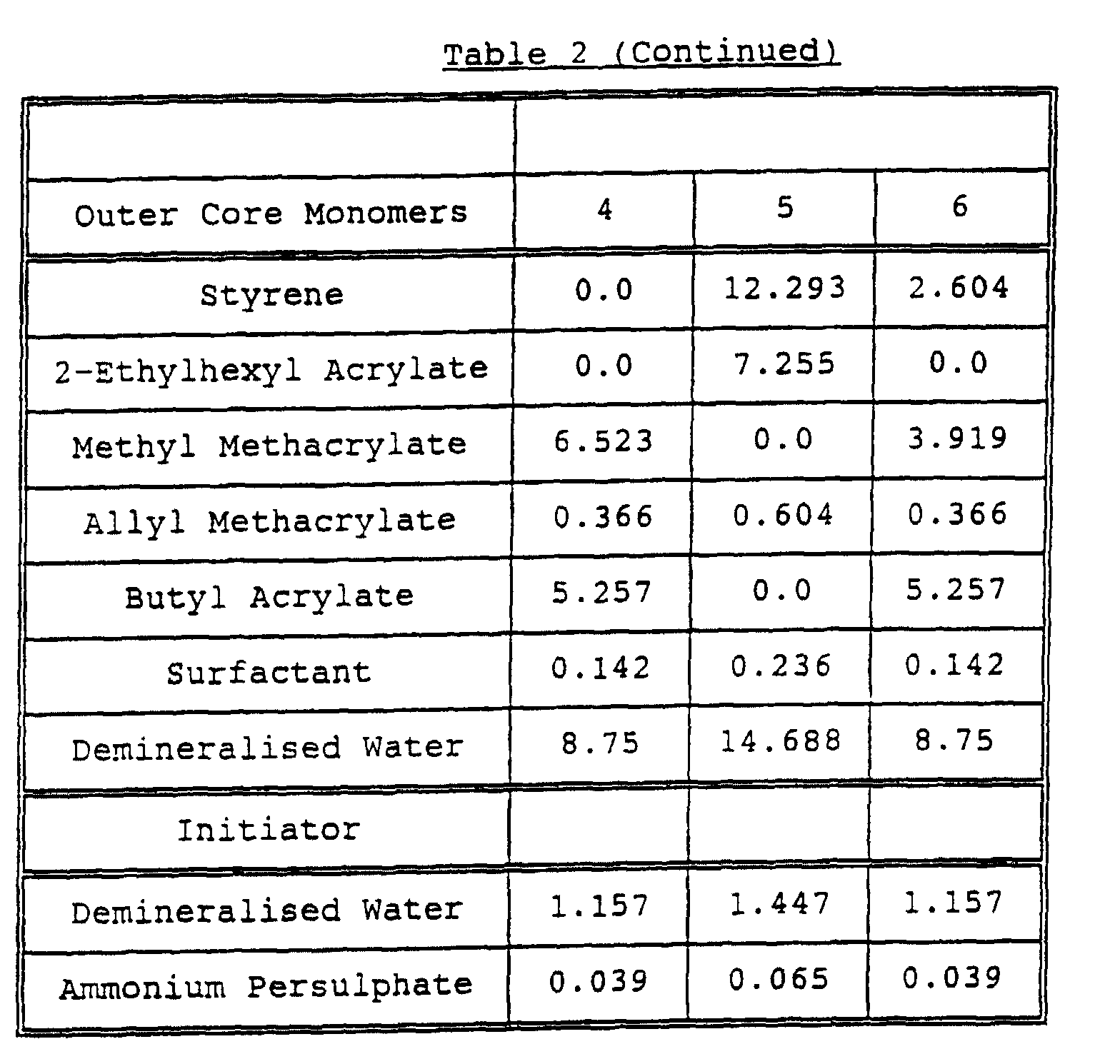
The following is a general method for Aqueous Dispersions 1 to
6 which uses the components given in Tables 1 to 3 below. All
of Aqueous Dispersions 1 to 6 have an inner and an outer core.
Aqueous Dispersions 3, 5 and 6 are according to the invention,
while Aqueous Dispersions 1, 2 and 4 are comparative.
- 1.1 Formation of Polymer Seed
The inner core monomers were emulsified in demineralised water
in the presence of surfactant (the ammonium salt of the
sulphate ester of a condensate of nonyl phenol and 20 moles of
ethylene oxide sold as Rhodapex C0436) in the amounts given in
Table 1 using a Silverson Homogeniser (trade mark) for 20
minutes to form the inner core monomer emulsion. 8.8% by
weight of the inner core monomer emulsion was added to a
solution of Rhodapex C0436 (0.228 parts) in demineralised
water (24.806 parts) pre-heated to 80-85°C in a nitrogen
atmosphere with stirring. The mixture was stirred for 5
minutes and then the initiator solution from Table 1 was
added. This mixture was stirred for 15 minutes to form a
polymer seed.

- 1.2 Formation of inner coreThe remainder of the inner core monomer emulsion was fed into the mixture over 30 minutes at 80-85°C and the mixture was stirred for a further hour so as to form the inner core.
- 1.3 Formation of outer coreThe outer core monomers were emulsified in demineralised water
in the presence of surfactant (Rhodapex CO436) in the
proportions given in Table 2 so as to form the outer core
monomer emulsion. The initiator solution given in Table 2 was
added to the inner core dispersion and then the outer core
monomer emulsion was added over 30 minutes. The mixture was
stirred for a further hour so as to form an inner core/outer
core dispersion.

- 1.3 Formation of Stabilising Mantle containing salt forming
groups
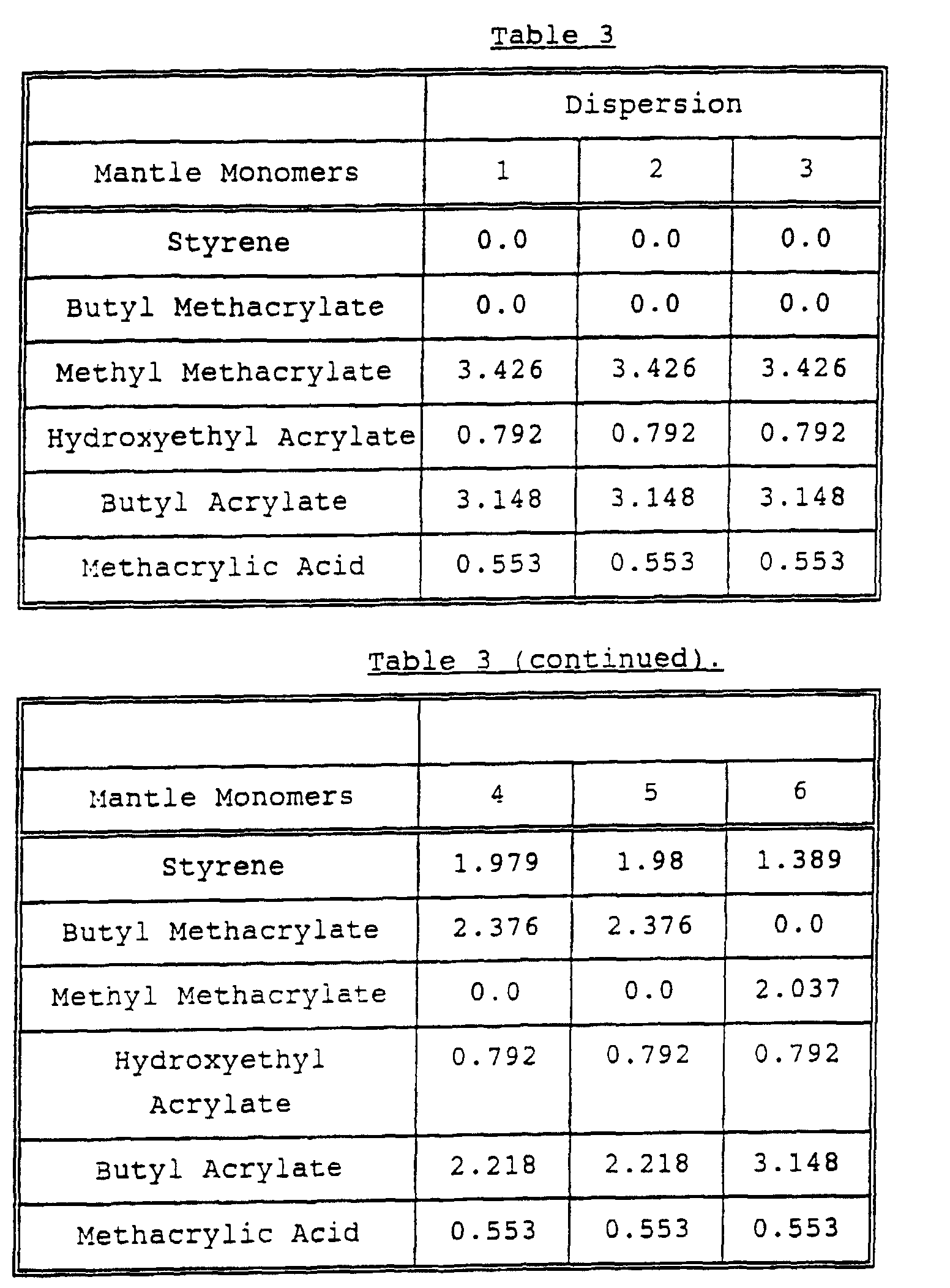
The mantle monomers given in Table 3 were emulsified in
demineralised water (8.68 parts) in the presence of Rhodapex
C0436 (0.141 parts) so as to form a dispersion of mantle
monomers. This dispersion of mantle monomers was added to the
inner core/outer core dispersion over 30 minutes
simultaneously with an initiator solution of ammonium
persulphate (0.016 parts) in demineralised water (1.91 parts).
The mixture was held at 80-85°C for one hour. A solution of
dimethyl ethanolamine (0.579 parts) in demineralised water
(2.06 parts) was added over 20 minutes. The resulting
dispersion was filtered and allowed to cool.
The product obtained was an aqueous dispersion of polymer particles having a crosslinked core and a stabilising mantle having at least partially neutralised acid groups.
- 2. Silver Basecoat compositions 1 to 6.Silver Basecoat compositions 1 to 6 were made from Aqueous
Dispersions 1 to 6 respectively as follows;
- 2.1 A solution of alkylarylphosphate ester of the type described in EP-A-0 206 615 (6.069 parts) was made in butoxyethanol (4.862 parts) and neutralised to pH 7.6 with dimethylamino ethanol (0.345 parts).
- 2.2 A pigment paste was prepared by stirring an aluminium paste (60% metal in a hydrocarbon carrier sold under trademark Silberline SS 5245 AR; 27.565 parts) with 2-butoxyethanol (27.565 parts) for 2 hours at room temperature. The mixture was left to stand over night. The solution from 2.1 above was added and the mixture was stirred for 15 minutes. A melamine formaldehyde resin (sold under the trademark Beetle BE370; 14.931 parts) was added followed by a second melamine formaldehyde resin (sold under the trademark Cymel 325; 18.664 parts) and the mixture was stirred for 15 minutes to form the pigment paste.
- 2.3 The Crosslinked microparticle dispersions, prepared as in 1 above (245.614 parts) was added with stirring to the aluminium pigment paste (100.436 parts) from 2.2 above. 2-butoxy ethanol (41.332 parts) was added.
- 2.4 Demineralised water, a 10 % aqueous dimethylaminoethanol solution in demineralised water and a 2% by weight Primal ASE 60 (trademark of Rohm & Haas) solution in demineralised water were added so as to give a final pH of 8.0 to 8.2, a viscosity of 20-24 poise (as measured on a Couvette viscometer at 1s-1 and 20°C) and a non-volatile solids content of 16%.
- 3. Mica-based green Basecoat Compositions 7 to 12Mica-based green Basecoat Compositions 7 to 12 were made from
Aqueous Dispersions 1 to 6 respectively as follows;
- 3.1 To 2-butoxyethanol (76.9 parts) were added sequentially with stirring, mica pigment (Irodin 9235 WRII; 31.7 parts), dimethylamino ethanol (0.5 parts), latex from 1 above (75 parts), melamine formaldehylde (Cymel 325; 27 parts), melamine formaldehyde (Beetle BE370; 17.3 parts); Latex from 1 above (202.8 parts) and 2-butoxyethanol (52 parts). A millbase comprising blue and black pigments, melamine formaldehyde resin and solvent (43 parts) was added.
- 3.2 Demineralised water, a 10 % aqueous dimethylaminoethanol solution in demineralised water and a 2% by weight Primal ASE 60 (trademark of Rohm & Haas) solution in demineralised water were added so as to give a final pH of 8.0 to 8.2, a viscosity of 20-24 poise (as measured on a Couvette viscometer at 1s-1 and 20°C) and a non-volatile solids content of 16%.
- 4. Application of Basecoat Compositions 1 to 12
- 4.1 Coating compositions 1 to 12 were applied by spray application on to pretreated and electrocoated steel panels (ED 5100 from ACT Laboratories Inc) which had been coated with a surfacer (M330-7139 from IDAC (UK) Ltd). The spraying was carried out at 60psi (0.41 N/mm2) at 20°C and 65% relative humidity in two coats to give a basecoat thickness of 12 to 14 µm. The coated panels were allowed to stand at room temperature for 30 minutes and were then stoved at 80°C for 10 minutes.
- 4.2 A layer of a commercially available clearcoat (M190-517 from IDAC (UK) Ltd) was applied, the coated panel was allowed to stand for 30 minutes at room temperature and then stoved at 130°C for 30 minutes.
- 5. Testing the Coated Panels for Humidity Resistance The panels from 4 above were tested according to ASTM D4585-92) as follows. The panels were exposed in a humidity cabinet with the coated side down. The water vapour in the cabinet was maintained at 60°C as measured 2.5cm from the panel surface. The backs of the panels were exposed to room temperature so as to induce condensation on the painted surface. The extent of blistering (ASTM D714-87) was noted after 4 days.
- 6. Test ResultsThe test results for compositions 1 to 12 are summarised in
Table 4 below. The numbers relate to the size of the blisters
on a scale of 1 to 10 (1 being about 1cm in diameter and 10
being microscopic) and the letters refer to the density of
blistering on a standard scale from None, VF (Very Few), F
(Few), M (Medium) and MD (Medium Dense) and D (Dense).
Composition Humidity Test Result 1 (Comparative) 6M 2 (Comparative) 6M 3 6VF 4 (Comparative) 6M 5 None 6 8F 7 (Comparative) 10M 8 (Comparative) 8MD 9 8VF 10 (Comparative) 8D 11 None 12 8F - 7. Preparation of Aqueous Dispersions 7 and 8 having a homogeneous coreThe general method given below was used to make Aqueous Dispersions 7 and 8 which use the components given in Tables 5 and 6 below. Aqueous dispersions 7 and 8 both have a homogeneous core. Aqueous Dispersion 7 is according to the invention, while Aqueous Dispersion 8 is comparative.
- 7.1 Formation of Polymer Seed Methyl methacrylate (0.542 parts) and butyl acrylate (0.585 parts) were added to a solution of Rhodapex C0436 (0.250 parts) in demineralised water (46.677 parts) pre-heated to 80-85°C in a nitrogen atmosphere with stirring. The mixture was stirred for 5 minutes and then an initiator solution comprising demineralised water (0.583 parts) and ammonium persulphate (0.017 parts) was added. This mixture was stirred for 15 minutes to form a polymer seed.
- 7.2 Formation of coreThe core monomers given in Table 5 were emulsified in
demineralised water (11.870 parts) in the presence of
surfactant (the ammonium salt of the sulphate ester of a
condensate of nonyl phenol and 20 moles of ethylene oxide sold
as Rhodapex C0436; 0.163 parts) using a Silverson Homogeniser
(trade mark) for 20 minutes to form the core monomer emulsion.
Dispersion Core Monomers 7 8 Styrene 10.179 0.0 2-Ethylhexyl Acrylate 8.105 0.0 Methyl Methacrylate 0.0 8.864 Allyl Methacrylate 0.601 0.601 Butyl Acrylate 0.0 9.42 - 7.3 Formation of Stabilising Mantle containing salt forming
groups
The mantle monomers given in Table 6 were emulsified in
demineralised water (6.571 parts) in the presence of Rhodapex
CO436 (0.102 parts) so as to form a dispersion of mantle
monomers.
Dispersion Mantle Monomers 7 8 Hydroxyethyl Acrylate 1.178 1.178 Butyl Acrylate 3.887 3.887 Methacrylic Acid 0.824 0.824 - 8. Preparation of comparative Dispersion 9 according to EP-A-0
348 565Example 34 of EP-A-0 348 565 was repeated as comparative
dispersion 9;
6.6% Of Monomer emulsion 1 listed in Table 7 below was added to a stirred mixture of deionised water (1020g), sodium lauryl sulphate (1.69g) and of dibasic ammonium phosphate (0.9g) at 81°C under nitrogen. A mixture of ammonium persulphate (1.1g) and deionised water (28g) was added and the mixture stirred for 17 minutes. The remainder of monomer emulsion 1 in Table 7 was added slowly over 72 minutes along with Cofeed 1 from Table 7 maintaining the mixture at about 81°C. The mixture was stirred for a further 20 minutes at 81°C and a solution of ammonium persulphate (1.1g) in deionised water (55g) was added over a 10 minute period. Monomer emulsion 2 from table 7 was added over a period of 108 minutes while cofeed 2 from Table 7 was added over 138 minutes at 81°C.The dispersion was neutralised by adding a solution of basic ammonium phosphate (24.4) in deionised water (632g) over 10 minutes followed by a solution of 28% aqueous ammonia (193g) in deionised water (200g).Monomer Emulsion 1 Monomer Emulsion 2 Deionised water 150 216 Sodium lauryl sulphate 5.4 3.3 styrene 425.25 - allyl methacrylate 22.5 - methacrylic acid 2.25 235.25 n-dodecylmercaptan - 40.5 methylmethacrylate - 438.75 Cofeed 1 Cofeed 2 deionised water 77.0 115.0 ammonium persulphate 0.44 1.49 - 9. Preparation of comparative Dispersion 10 according to EP-A-0
348 565Example 47 of EP-A-0 348 565 was repeated as comparative
dispersion 10.40g of Monomer Emulsion 1 listed in Table 8 below was added to
deionised water (1102g) with stirring at 81°C under nitrogen.
A mixture of ammonium persulphate (1.1g) and deionised water
was added and the mixture stirred for 17 minutes. The
remainder of Monomer Emulsion 1 from Table 8 was added over
135 minutes along with cofeed 1 in Table 8, at 81°C under
nitrogen. The mixture was stirred for 30 minutes at 81°C.
Monomer mixture 2 from table 8 was added over a period of 45
minutes while cofeed 2 from Table 7 was added over 75 minutes
at 81°C. The dispersion was neutralised to pH 8.5 by adding a solution
of 28% aqueous ammonia in deionised water.
Monomer Emulsion 1 Monomer Emulsion 2 Deionised water 405 75 Sodium lauryl sulphate 12.37 2.07 2-ethylhexyl acrylate 433 - allyl methacrylate 37 - methacrylic acid 6.2 82.5 n-octyl mercaptan - 12.4 methylmethacrylate 761 330 Cofeed 1 Cofeed 2 deionised water 240 135 ammonium persulphate 2.92 1.65 - 10. Silver Basecoat compositions 13 to 16.Silver Basecoat compositions 13 to 16 were made from Aqueous
Dispersions 7 to 10 respectively using the same general method
as silver basecoats 1 to 6 as follows;
- 10.1 A solution of alkylarylphosphate ester of the type described in EP-A-0 206 615 (6.069 parts) was made in butoxyethanol (4.862 parts) and neutralised to pH 7.6 with dimethylamino ethanol (0.345 parts).
- 10.2 A pigment paste was prepared by stirring an aluminium paste (60% metal in a hydrocarbon carrier sold under trademark Silberline SS 5245 AR; 27.565 parts) with 2-butoxyethanol (27.565 parts) for 2 hours at room temperature. The mixture was left to stand over night. The solution from 10.1 above was added and the mixture was stirred for 15 minutes. A melamine formaldehyde resin (sold under the trademark Beetle BE370; 14.931 parts) was added followed by a second melamine formaldehyde resin (sold under the trademark Cymel 325; 18.664 parts) and the mixture was stirred for 15 minutes to form the pigment paste.
- 10.3 The Crosslinked microparticle dispersions, prepared as in 7 to 9 above (245.614 parts) were added with stirring to the aluminium pigment paste (100.436 parts) from 10.2 above. 2-butoxy ethanol (41.332 parts) was added.
- 10.4 Demineralised water, a 10 % aqueous dimethylaminoethanol solution in demineralised water and a 2% by weight Primal ASE 60 (trademark of Rohm & Haas) solution in demineralised water were added so as to give a final pH of 8.0 to 8.2, a viscosity of 20-24 poise (as measured on a Couvette viscometer at 1s-1 and 20°C) and a non-volatile solids content of 16%.
- 11. Application and testing of Silver Basecoat compositions 1 to 6 and 13 to 16. A comparative test was carried out of basecoat compositions 1 to 6 and 13 to 16 as follows. Compositions 1 to 6 and 13 to 16 were applied to steel panels, and clearcoated in exactly the same way as given in paragraphs 4.1 and 4.2 above. The panels were tested for humidity resistance in exactly the same way as in paragraph 5 above.
- 12. Test ResultsThe test results for compositions 1 to 6 and 13 to 16 are
summarised in Table 9 below. The numbers relate to the size of
the blisters on a scale of 1 to 10 as referred to in paragraph
6 above and the letters refer to the density of blistering on
a standard scale from None, VF (Very Few), F (Few), M (Medium)
and MD (Medium Dense) and D (Dense). In the table (C)
indicates comparative compositions.
Silver Basecoat Rating 1 (C) 8M/F 2 (C) 9F 3 10VVF 4 (C) 9M 5 10VVF 6 10VF 13 10VF 14 (C) 8-9M 15 (C) 2D 16 (C) 2D -
Claims (21)
- A sprayable aqueous coating composition for motor vehicles comprising an aqueous dispersion of addition polymer microparticles having a crosslinked core and a non-crosslinked stabilising mantle containing acid groups, characterised in that the crosslinked core comprises;the weight ratio of the inner core to the outer core being in the range 10:90 to 90:10, the mantle having a Tg of -50°C to +50°C, and being made from 5 to 19% by weight of monomers having acid groups.i) a crosslinked inner core of an addition polymer and,ii) a crosslinked outer core of addition polymer which is made from at least 10% by weight of monomers having a solubility in water of less than 0.1% by weight,
- A coating composition as claimed in claim 1 in which the monomers having a solubility in water of less than 0.1% by weight are selected from 2-ethylhexyl acrylate, styrene and mixtures thereof.
- A coating composition as claimed in claim 1 in which the monomers having a solubility in water of less than 0.1% by weight comprise styrene.
- A coating composition as claimed in any one of claims 1 to 3 in which the outer core polymer has a Tg of at least 5°C greater than the Tg of the inner core polymer.
- A coating composition as claimed in any one of claims 1 to 4 in which the outer core has a Tg of greater than 10°C.
- A coating composition as claimed in any one of claims 1 to 5 in which the outer core is made from at least 15% by weight of monomers having a water solubility of less than 0.1% by weight
- A coating composition as claimed in any one of claims 1 to 6 in which the outer core is made from monomers selected from methyl methacrylate, butyl acrylate, 2-ethylhexyl acrylate, styrene and allyl methacrylate and mixtures of these.
- A coating composition as claimed in any one of claims 1 to 7 in which the inner core has a Tg of less than -10°C.
- A coating composition as claimed in any one of claims 1 to 6 in which the inner core is made from monomers selected from methyl methacrylate, butyl acrylate, styrene and allyl methacrylate and mixtures of these.
- A coating composition as claimed in claim 1 in which the outer core and the inner core have the same monomer composition.
- A coating composition as claimed in any one of Claims 1 to 10 in which the mantle is made from 3 to 30% by weight of monomers having acid groups and 70 to 97% by weight of other ethylenic monomers.
- A coating composition as claimed in any one of Claims 1 to 11 formulated for use as a basecoat.
- A coating composition as claimed in claim 12 which contains a metallic pigment or a pearlescent pigment or a mixture of these.
- A coating composition as claimed in any one of claims 1 to 13 also comprising a crosslinker.
- A coating composition as claimed in any one of Claims 1 to 14 which also comprises a dispersion of different addition polymer microparticles having C1-4 alkoxy polyoxyalkylene stabiliser units.
- A coating composition as claimed in Claim 15 which comprises 5 to 95% by weight of addition polymer microparticles as defined in Claims 1 to 14 and 95 to 5% by weight of the different addition polymer microparticles having C1-4 alkoxy polyoxyalkylene stabiliser units.
- A coating composition as claimed in Claims 1 to 16 which also comprises a polyurethane resin dispersion.
- A sprayable aqueous coating composition for motor vehicles comprising an aqueous dispersion of addition polymer microparticles made by a process which comprises;A1) polymerising a mixture of ethylenic monomers comprising a crosslinking monomer and other ethylenic monomers so as to form a crosslinked addition polymer,A2) polymerising in the presence of the polymer from A1 a mixture of ethylenic monomers comprising at least 10% by weight of monomer having a solubility in water of less than 0.1% by weight, crosslinking monomer and optionally other ethylenic monomers,B) polymerising in the presence of the polymer from (A2) a different monomer mixture containing 5 to 19% by weight of monomer having acid groups, optionally monomer having other hydrophillic groups and other ethylenic monomer so as to form a non-crosslinked stabilising mantle of polymer containing acid groups, which has a Tg of -50°C to +50°C.
- A process for producing a sprayable aqueous coating composition for motor vehicles comprising;so as to form an aqueous dispersion of addition polymer microparticles having a crosslinked core and a non-crosslinked stabilising mantle.A1) polymerising a mixture of ethylenic monomers comprising a crosslinking monomer and other ethylenic monomers so as to form a crosslinked addition polymer,A2) polymerising in the presence of the polymer from (A1) a different mixture of ethylenic monomers comprising at least 10% by weight of monomer having a solubility in water of less than 0.1% by weight, crosslinking monomer and optionally other ethylenic monomers,B) polymerising in the presence of the polymer from (A2) a different monomer mixture containing 5 to 19% by weight of monomer having acid groups, optionally monomer having other hydrophillic groups and other ethylenic monomer so as to form a non-crosslinked stabilising mantle of polymer containing acid groups having a Tg of -50°C to +50°C,
- A process of coating a motor vehicle which comprises spraying on to the surface of the vehicle a layer of an aqueous coating composition comprising an aqueous dispersion of addition polymer microparticles having a crosslinked core and a non-crosslinked stabilising mantle containing acid groups, characterised in that the crosslinked core comprises;i) a crosslinked inner core of an addition polymer and,ii) a crosslinked outer core of addition polymer which is made from at least 10% by weight of monomers having a solubility in water of less than 0.1% by weight,the weight ratio of the inner core to the outer core being in the range 10:90 to 90:10, the mantle having a Tg of -50°C to +50°C, and being made from 5 to 19 % by weight of monomers having acid groups,and subsequently allowing or causing the layer to dry or cure.
- A process for applying a basecoat-clear coating to a motor vehicle which comprises spraying on to the surface of the vehicle a first layer of an aqueous coating composition comprising an aqueous dispersion of addition polymer microparticles having a crosslinked core and a non-crosslinked stabilising mantle containing acid groups, characterised in that the crosslinked core comprises;i) a crosslinked inner core of an addition polymer and,ii) a crosslinked outer core of addition polymer which is made from at least 10% by weight of monomers having a solubility in water of less than 0.1% by weight,the weight ratio of the inner core to the outer core being in the range 10:90 to 90:10 the mantle having a Tg of -50°C to +50°C, and being made from 5 to 19 % by weight of monomers having acid groups, followed byspraying a layer of a clearcoat over this first layer and then causing both layers to dry or cure together.
Applications Claiming Priority (3)
| Application Number | Priority Date | Filing Date | Title |
|---|---|---|---|
| GB9525914 | 1995-12-19 | ||
| GBGB9525914.9A GB9525914D0 (en) | 1995-12-19 | 1995-12-19 | Aqueous dispersion |
| PCT/EP1996/005534 WO1997022667A1 (en) | 1995-12-19 | 1996-12-11 | Coating composition |
Publications (2)
| Publication Number | Publication Date |
|---|---|
| EP0868484A1 EP0868484A1 (en) | 1998-10-07 |
| EP0868484B1 true EP0868484B1 (en) | 1999-09-08 |
Family
ID=10785664
Family Applications (1)
| Application Number | Title | Priority Date | Filing Date |
|---|---|---|---|
| EP96943084A Expired - Lifetime EP0868484B1 (en) | 1995-12-19 | 1996-12-11 | Coating composition |
Country Status (12)
| Country | Link |
|---|---|
| US (1) | US6013324A (en) |
| EP (1) | EP0868484B1 (en) |
| JP (1) | JP3722445B2 (en) |
| AT (1) | ATE184302T1 (en) |
| AU (1) | AU709460B2 (en) |
| BR (1) | BR9612177A (en) |
| CA (1) | CA2240982C (en) |
| DE (1) | DE69604203T2 (en) |
| ES (1) | ES2138841T3 (en) |
| GB (1) | GB9525914D0 (en) |
| MX (1) | MX9804940A (en) |
| WO (1) | WO1997022667A1 (en) |
Families Citing this family (13)
| Publication number | Priority date | Publication date | Assignee | Title |
|---|---|---|---|---|
| JPH08218015A (en) * | 1995-02-14 | 1996-08-27 | Dainippon Ink & Chem Inc | Polymer fine particles for jet ink and jet ink containing the same |
| US6180181B1 (en) * | 1998-12-14 | 2001-01-30 | Ppg Industries Ohio, Inc. | Methods for forming composite coatings on substrates |
| IT1312575B1 (en) * | 1999-05-28 | 2002-04-22 | Elf Atochem Italia S R L Ora A | WATER DISPERSIONS OF POLYMERS. |
| JP2003518546A (en) † | 1999-12-23 | 2003-06-10 | アクゾ ノーベル ナムローゼ フェンノートシャップ | Aqueous coating composition comprising addition polymer and polyurethane |
| US6391973B1 (en) | 2000-07-24 | 2002-05-21 | Basf Corporation | Curable coating composition with improved stability |
| IT1320087B1 (en) * | 2000-11-21 | 2003-11-18 | Atofina | WATER DISPERSIONS OF ACRYLIC POLYMERS. |
| US6646058B1 (en) * | 2001-02-21 | 2003-11-11 | The Sherwin-Williams Company | Water-borne paint composition having improved hiding and scrub-resistance |
| US6632880B2 (en) * | 2001-07-09 | 2003-10-14 | E. I. Du Pont De Nemours And Company | Coating compositions containing isocyanate-functional non-aqueous dispersed polymers |
| US7612126B2 (en) * | 2003-12-04 | 2009-11-03 | Basf Aktiengesellschaft | Low-VOC aqueous coating compositions with excellent freeze-thaw stability |
| US20060099334A1 (en) * | 2004-11-08 | 2006-05-11 | O'brien Joseph | Apparatus and method for applying a coating to a windshield |
| US8133938B2 (en) | 2005-11-01 | 2012-03-13 | Ppg Industries Ohio, Inc. | Radiation diffraction colorants |
| MX2013000951A (en) | 2010-07-27 | 2013-02-27 | Du Pont | Waterborne base coat compositions having a special-effect color. |
| US10233349B2 (en) | 2014-02-04 | 2019-03-19 | Ppg Industries Ohio, Inc. | Acrylic aqueous dispersions for container coatings |
Family Cites Families (14)
| Publication number | Priority date | Publication date | Assignee | Title |
|---|---|---|---|---|
| FR1508258A (en) * | 1966-02-09 | 1968-01-05 | Rohm & Haas | Heterogeneous copolymers obtained by emulsion polymerization of alkyl esters of acrylic or methacrylic acid |
| FR2069007A5 (en) * | 1969-11-18 | 1971-09-03 | Rohm & Haas | Acrylic latex polymers useful in coatings etc |
| US3668274A (en) * | 1970-09-10 | 1972-06-06 | Rohm & Haas | Acrylic modifiers for polycarbonamides |
| US3787522A (en) * | 1972-11-01 | 1974-01-22 | Ford Motor Co | Acrylate polymer particles comprising a core,an outer shell,and an intermediate layer |
| US4540740A (en) * | 1983-04-04 | 1985-09-10 | Ppg Industries, Inc. | Cross-linked polymeric microgel prepared from polymerizing epoxy-containing monomer in the presence of an acid |
| US4569966A (en) * | 1984-04-19 | 1986-02-11 | Ppg Industries, Inc. | Polymeric microparticles |
| US4916171A (en) * | 1984-07-25 | 1990-04-10 | Rohm And Haas Company | Polymers comprising alkali-insoluble core/alkali-soluble shell and copositions thereof |
| US4849480A (en) * | 1985-10-23 | 1989-07-18 | E. I. Du Pont De Nemours And Company | Crosslinked polymer microparticle |
| JPS62230841A (en) * | 1985-11-29 | 1987-10-09 | Mitsubishi Rayon Co Ltd | Impact resistant methacrylic resin composition |
| US5219900A (en) * | 1987-07-02 | 1993-06-15 | Imperial Chemical Industries Plc | Coatings |
| JP3099099B2 (en) * | 1992-04-20 | 2000-10-16 | 関西ペイント株式会社 | Paint composition and coating method |
| JPH07228611A (en) * | 1994-02-15 | 1995-08-29 | Japan Synthetic Rubber Co Ltd | Polymer emulsion |
| US5412039A (en) * | 1994-07-08 | 1995-05-02 | E. I. Dupont De Nemours And Company | Acrylic copolymer core with catalyst grafted with macromonomers |
| US5763528A (en) * | 1996-12-17 | 1998-06-09 | E. I. Du Pont De Nemours And Company | Coating compositions containing non-aqueous dispersed polymers having a high glass transition temperature |
-
1995
- 1995-12-19 GB GBGB9525914.9A patent/GB9525914D0/en active Pending
-
1996
- 1996-12-11 DE DE69604203T patent/DE69604203T2/en not_active Expired - Lifetime
- 1996-12-11 BR BR9612177A patent/BR9612177A/en not_active IP Right Cessation
- 1996-12-11 AU AU12032/97A patent/AU709460B2/en not_active Expired
- 1996-12-11 CA CA002240982A patent/CA2240982C/en not_active Expired - Lifetime
- 1996-12-11 US US09/091,002 patent/US6013324A/en not_active Expired - Lifetime
- 1996-12-11 ES ES96943084T patent/ES2138841T3/en not_active Expired - Lifetime
- 1996-12-11 AT AT96943084T patent/ATE184302T1/en not_active IP Right Cessation
- 1996-12-11 EP EP96943084A patent/EP0868484B1/en not_active Expired - Lifetime
- 1996-12-11 JP JP52248697A patent/JP3722445B2/en not_active Expired - Lifetime
- 1996-12-11 WO PCT/EP1996/005534 patent/WO1997022667A1/en not_active Ceased
-
1998
- 1998-06-19 MX MX9804940A patent/MX9804940A/en unknown
Also Published As
| Publication number | Publication date |
|---|---|
| JP2000502140A (en) | 2000-02-22 |
| EP0868484A1 (en) | 1998-10-07 |
| US6013324A (en) | 2000-01-11 |
| JP3722445B2 (en) | 2005-11-30 |
| AU709460B2 (en) | 1999-08-26 |
| ES2138841T3 (en) | 2000-01-16 |
| CA2240982A1 (en) | 1997-06-26 |
| AU1203297A (en) | 1997-07-14 |
| MX9804940A (en) | 1998-09-30 |
| WO1997022667A1 (en) | 1997-06-26 |
| ATE184302T1 (en) | 1999-09-15 |
| DE69604203T2 (en) | 1999-12-30 |
| BR9612177A (en) | 1999-07-13 |
| DE69604203D1 (en) | 1999-10-14 |
| GB9525914D0 (en) | 1996-02-21 |
| CA2240982C (en) | 2004-12-07 |
Similar Documents
| Publication | Publication Date | Title |
|---|---|---|
| JP3884065B2 (en) | Paint containing self-stabilizing latex prepared in aqueous carrier | |
| US5969030A (en) | Waterborne coating compositions containing hydrophobically modified emulsions | |
| US6281272B1 (en) | Low temperature cure waterborne coating compositions having improved appearance and humidity resistance and methods for coating substrates | |
| DE69808768T2 (en) | AQUEOUS PAINT COMPOSITIONS FROM SELF-STABILIZED, NETWORKED LATHS | |
| US6541070B2 (en) | Method of forming a composite coating film comprising a pigment and resin emulsion | |
| US6770702B1 (en) | Polymer | |
| US20010024693A1 (en) | Coating film forming method | |
| JP2002504575A (en) | Low molecular weight (meth) acrylate copolymer emulsion | |
| EP0300612B1 (en) | Basecoat compositions | |
| GB2421507A (en) | Thermosetting water-based paint | |
| US6013324A (en) | Coating composition | |
| CA2194126A1 (en) | Heat-curable, water-dispersible resin composition, production thereof, water-based paint composition, method of coating and coated article | |
| US5219900A (en) | Coatings | |
| EP1444278B1 (en) | Coating compositions | |
| CA2079214C (en) | Process for producing a multi-layer coating | |
| JP2002012811A (en) | Method for producing pigment-dispersed resin and water- based pigment dispersion containing the same | |
| US20030134970A1 (en) | Basecoat coating composition having low volatile organic content and composite coating prepared therefrom | |
| JP4235476B2 (en) | Pigment dispersion resin and aqueous pigment dispersion containing the same | |
| JP3828255B2 (en) | Water-based paint composition and paint finishing method using the same | |
| CN114106649A (en) | topcoat composition | |
| JP2001342438A (en) | Aqueous colored thermosetting type base coating material and method for forming coated film by using the same | |
| JPH0751692B2 (en) | Method for coating conductive substrate and water-based coating based on cationic binder | |
| EP0906925A2 (en) | Resin for aqueous paint |
Legal Events
| Date | Code | Title | Description |
|---|---|---|---|
| PUAI | Public reference made under article 153(3) epc to a published international application that has entered the european phase |
Free format text: ORIGINAL CODE: 0009012 |
|
| 17P | Request for examination filed |
Effective date: 19980720 |
|
| AK | Designated contracting states |
Kind code of ref document: A1 Designated state(s): AT BE CH DE DK ES FI FR GB GR IE IT LI LU MC NL PT SE |
|
| GRAG | Despatch of communication of intention to grant |
Free format text: ORIGINAL CODE: EPIDOS AGRA |
|
| 17Q | First examination report despatched |
Effective date: 19981102 |
|
| GRAG | Despatch of communication of intention to grant |
Free format text: ORIGINAL CODE: EPIDOS AGRA |
|
| GRAG | Despatch of communication of intention to grant |
Free format text: ORIGINAL CODE: EPIDOS AGRA |
|
| GRAH | Despatch of communication of intention to grant a patent |
Free format text: ORIGINAL CODE: EPIDOS IGRA |
|
| GRAH | Despatch of communication of intention to grant a patent |
Free format text: ORIGINAL CODE: EPIDOS IGRA |
|
| GRAA | (expected) grant |
Free format text: ORIGINAL CODE: 0009210 |
|
| ITF | It: translation for a ep patent filed | ||
| AK | Designated contracting states |
Kind code of ref document: B1 Designated state(s): AT BE CH DE DK ES FI FR GB GR IE IT LI LU MC NL PT SE |
|
| PG25 | Lapsed in a contracting state [announced via postgrant information from national office to epo] |
Ref country code: SE Free format text: THE PATENT HAS BEEN ANNULLED BY A DECISION OF A NATIONAL AUTHORITY Effective date: 19990908 Ref country code: GR Free format text: LAPSE BECAUSE OF NON-PAYMENT OF DUE FEES Effective date: 19990908 Ref country code: FI Free format text: LAPSE BECAUSE OF NON-PAYMENT OF DUE FEES Effective date: 19990908 Ref country code: AT Free format text: LAPSE BECAUSE OF FAILURE TO SUBMIT A TRANSLATION OF THE DESCRIPTION OR TO PAY THE FEE WITHIN THE PRESCRIBED TIME-LIMIT Effective date: 19990908 |
|
| REF | Corresponds to: |
Ref document number: 184302 Country of ref document: AT Date of ref document: 19990915 Kind code of ref document: T |
|
| REG | Reference to a national code |
Ref country code: CH Ref legal event code: EP |
|
| REG | Reference to a national code |
Ref country code: CH Ref legal event code: NV Representative=s name: BOVARD AG PATENTANWAELTE |
|
| REF | Corresponds to: |
Ref document number: 69604203 Country of ref document: DE Date of ref document: 19991014 |
|
| ET | Fr: translation filed | ||
| REG | Reference to a national code |
Ref country code: IE Ref legal event code: FG4D |
|
| PG25 | Lapsed in a contracting state [announced via postgrant information from national office to epo] |
Ref country code: DK Free format text: LAPSE BECAUSE OF FAILURE TO SUBMIT A TRANSLATION OF THE DESCRIPTION OR TO PAY THE FEE WITHIN THE PRESCRIBED TIME-LIMIT Effective date: 19991208 |
|
| PG25 | Lapsed in a contracting state [announced via postgrant information from national office to epo] |
Ref country code: PT Free format text: LAPSE BECAUSE OF FAILURE TO SUBMIT A TRANSLATION OF THE DESCRIPTION OR TO PAY THE FEE WITHIN THE PRESCRIBED TIME-LIMIT Effective date: 19991209 |
|
| PG25 | Lapsed in a contracting state [announced via postgrant information from national office to epo] |
Ref country code: LU Free format text: LAPSE BECAUSE OF NON-PAYMENT OF DUE FEES Effective date: 19991211 Ref country code: IE Free format text: LAPSE BECAUSE OF NON-PAYMENT OF DUE FEES Effective date: 19991211 |
|
| REG | Reference to a national code |
Ref country code: ES Ref legal event code: FG2A Ref document number: 2138841 Country of ref document: ES Kind code of ref document: T3 |
|
| PG25 | Lapsed in a contracting state [announced via postgrant information from national office to epo] |
Ref country code: MC Free format text: LAPSE BECAUSE OF NON-PAYMENT OF DUE FEES Effective date: 20000630 |
|
| PLBE | No opposition filed within time limit |
Free format text: ORIGINAL CODE: 0009261 |
|
| STAA | Information on the status of an ep patent application or granted ep patent |
Free format text: STATUS: NO OPPOSITION FILED WITHIN TIME LIMIT |
|
| 26N | No opposition filed | ||
| RAP2 | Party data changed (patent owner data changed or rights of a patent transferred) |
Owner name: PPG INDUSTRIES OHIO, INC. |
|
| REG | Reference to a national code |
Ref country code: IE Ref legal event code: MM4A |
|
| NLT2 | Nl: modifications (of names), taken from the european patent patent bulletin |
Owner name: PPG INDUSTRIES OHIO, INC. |
|
| REG | Reference to a national code |
Ref country code: GB Ref legal event code: 732E |
|
| REG | Reference to a national code |
Ref country code: GB Ref legal event code: IF02 |
|
| REG | Reference to a national code |
Ref country code: CH Ref legal event code: PFA Owner name: IMPERIAL CHEMICAL INDUSTRIES PLC Free format text: IMPERIAL CHEMICAL INDUSTRIES PLC#IMPERIAL CHEMICAL HOUSE, MILLBANK#LONDON SW1P 3JF (GB) -TRANSFER TO- IMPERIAL CHEMICAL INDUSTRIES PLC#IMPERIAL CHEMICAL HOUSE, MILLBANK#LONDON SW1P 3JF (GB) |
|
| REG | Reference to a national code |
Ref country code: DE Ref legal event code: R082 Ref document number: 69604203 Country of ref document: DE Representative=s name: ANDRAE WESTENDORP PATENTANWAELTE PARTNERSCHAFT, DE |
|
| REG | Reference to a national code |
Ref country code: FR Ref legal event code: PLFP Year of fee payment: 20 |
|
| PGFP | Annual fee paid to national office [announced via postgrant information from national office to epo] |
Ref country code: GB Payment date: 20151229 Year of fee payment: 20 Ref country code: CH Payment date: 20151228 Year of fee payment: 20 |
|
| PGFP | Annual fee paid to national office [announced via postgrant information from national office to epo] |
Ref country code: ES Payment date: 20151228 Year of fee payment: 20 Ref country code: NL Payment date: 20151226 Year of fee payment: 20 Ref country code: FR Payment date: 20151217 Year of fee payment: 20 |
|
| PGFP | Annual fee paid to national office [announced via postgrant information from national office to epo] |
Ref country code: DE Payment date: 20151229 Year of fee payment: 20 |
|
| PGFP | Annual fee paid to national office [announced via postgrant information from national office to epo] |
Ref country code: BE Payment date: 20151228 Year of fee payment: 20 |
|
| REG | Reference to a national code |
Ref country code: DE Ref legal event code: R071 Ref document number: 69604203 Country of ref document: DE |
|
| REG | Reference to a national code |
Ref country code: NL Ref legal event code: MK Effective date: 20161210 |
|
| REG | Reference to a national code |
Ref country code: CH Ref legal event code: PL |
|
| PG25 | Lapsed in a contracting state [announced via postgrant information from national office to epo] |
Ref country code: IT Free format text: LAPSE BECAUSE OF NON-PAYMENT OF DUE FEES Effective date: 20151211 |
|
| REG | Reference to a national code |
Ref country code: GB Ref legal event code: PE20 Expiry date: 20161210 |
|
| PG25 | Lapsed in a contracting state [announced via postgrant information from national office to epo] |
Ref country code: GB Free format text: LAPSE BECAUSE OF EXPIRATION OF PROTECTION Effective date: 20161210 |
|
| PG25 | Lapsed in a contracting state [announced via postgrant information from national office to epo] |
Ref country code: ES Free format text: LAPSE BECAUSE OF EXPIRATION OF PROTECTION Effective date: 20161212 |
|
| PG25 | Lapsed in a contracting state [announced via postgrant information from national office to epo] |
Ref country code: IT Free format text: LAPSE BECAUSE OF NON-PAYMENT OF DUE FEES Effective date: 20151211 |
|
| PGFP | Annual fee paid to national office [announced via postgrant information from national office to epo] |
Ref country code: IT Payment date: 20151222 Year of fee payment: 20 |
|
| PGRI | Patent reinstated in contracting state [announced from national office to epo] |
Ref country code: IT Effective date: 20170710 |