EP0867958A1 - Method for forming a SiOC ceramic electrode material and rechargeable lithium ion battery containing same as an anode - Google Patents
Method for forming a SiOC ceramic electrode material and rechargeable lithium ion battery containing same as an anode Download PDFInfo
- Publication number
- EP0867958A1 EP0867958A1 EP98105306A EP98105306A EP0867958A1 EP 0867958 A1 EP0867958 A1 EP 0867958A1 EP 98105306 A EP98105306 A EP 98105306A EP 98105306 A EP98105306 A EP 98105306A EP 0867958 A1 EP0867958 A1 EP 0867958A1
- Authority
- EP
- European Patent Office
- Prior art keywords
- silicon
- ceramic
- composition
- lithium ion
- electrode
- Prior art date
- Legal status (The legal status is an assumption and is not a legal conclusion. Google has not performed a legal analysis and makes no representation as to the accuracy of the status listed.)
- Withdrawn
Links
- 239000000919 ceramic Substances 0.000 title claims abstract description 57
- HBBGRARXTFLTSG-UHFFFAOYSA-N Lithium ion Chemical compound [Li+] HBBGRARXTFLTSG-UHFFFAOYSA-N 0.000 title claims abstract description 24
- 229910001416 lithium ion Inorganic materials 0.000 title claims abstract description 24
- 239000007772 electrode material Substances 0.000 title claims abstract description 11
- 238000000034 method Methods 0.000 title claims description 20
- 239000000203 mixture Substances 0.000 claims abstract description 30
- 229910052710 silicon Inorganic materials 0.000 claims abstract description 28
- XUIMIQQOPSSXEZ-UHFFFAOYSA-N Silicon Chemical compound [Si] XUIMIQQOPSSXEZ-UHFFFAOYSA-N 0.000 claims abstract description 20
- 239000010703 silicon Substances 0.000 claims abstract description 20
- 229910052760 oxygen Inorganic materials 0.000 claims abstract description 17
- 229920000642 polymer Polymers 0.000 claims abstract description 14
- 229910010293 ceramic material Inorganic materials 0.000 claims abstract description 10
- 239000002253 acid Substances 0.000 claims abstract description 7
- 239000003795 chemical substances by application Substances 0.000 claims description 20
- 229920005573 silicon-containing polymer Polymers 0.000 claims description 19
- 229910052799 carbon Inorganic materials 0.000 claims description 18
- -1 polysiloxane Polymers 0.000 claims description 9
- 239000000843 powder Substances 0.000 claims description 7
- 239000011230 binding agent Substances 0.000 claims description 6
- 239000003085 diluting agent Substances 0.000 claims description 6
- 229920003257 polycarbosilane Polymers 0.000 claims description 6
- 229920000548 poly(silane) polymer Polymers 0.000 claims description 5
- 229920001577 copolymer Polymers 0.000 claims description 3
- 238000010438 heat treatment Methods 0.000 claims description 3
- 229920000620 organic polymer Polymers 0.000 claims description 3
- 229920001709 polysilazane Polymers 0.000 claims description 3
- 229920001296 polysiloxane Polymers 0.000 claims description 3
- 150000004756 silanes Chemical class 0.000 claims description 2
- 238000004519 manufacturing process Methods 0.000 abstract description 4
- OKTJSMMVPCPJKN-UHFFFAOYSA-N Carbon Chemical compound [C] OKTJSMMVPCPJKN-UHFFFAOYSA-N 0.000 description 21
- 229910052744 lithium Inorganic materials 0.000 description 18
- WHXSMMKQMYFTQS-UHFFFAOYSA-N Lithium Chemical compound [Li] WHXSMMKQMYFTQS-UHFFFAOYSA-N 0.000 description 16
- 239000000463 material Substances 0.000 description 13
- 238000000197 pyrolysis Methods 0.000 description 11
- IJGRMHOSHXDMSA-UHFFFAOYSA-N Atomic nitrogen Chemical compound N#N IJGRMHOSHXDMSA-UHFFFAOYSA-N 0.000 description 10
- QVGXLLKOCUKJST-UHFFFAOYSA-N atomic oxygen Chemical compound [O] QVGXLLKOCUKJST-UHFFFAOYSA-N 0.000 description 10
- 239000001301 oxygen Substances 0.000 description 10
- KRHYYFGTRYWZRS-UHFFFAOYSA-N Fluorane Chemical compound F KRHYYFGTRYWZRS-UHFFFAOYSA-N 0.000 description 9
- VYPSYNLAJGMNEJ-UHFFFAOYSA-N Silicium dioxide Chemical compound O=[Si]=O VYPSYNLAJGMNEJ-UHFFFAOYSA-N 0.000 description 7
- QPJSUIGXIBEQAC-UHFFFAOYSA-N n-(2,4-dichloro-5-propan-2-yloxyphenyl)acetamide Chemical compound CC(C)OC1=CC(NC(C)=O)=C(Cl)C=C1Cl QPJSUIGXIBEQAC-UHFFFAOYSA-N 0.000 description 7
- XKRFYHLGVUSROY-UHFFFAOYSA-N Argon Chemical compound [Ar] XKRFYHLGVUSROY-UHFFFAOYSA-N 0.000 description 6
- 239000011888 foil Substances 0.000 description 6
- 239000001257 hydrogen Substances 0.000 description 6
- 229910052739 hydrogen Inorganic materials 0.000 description 6
- UFHFLCQGNIYNRP-UHFFFAOYSA-N Hydrogen Chemical compound [H][H] UFHFLCQGNIYNRP-UHFFFAOYSA-N 0.000 description 5
- SECXISVLQFMRJM-UHFFFAOYSA-N N-Methylpyrrolidone Chemical compound CN1CCCC1=O SECXISVLQFMRJM-UHFFFAOYSA-N 0.000 description 5
- 239000002033 PVDF binder Substances 0.000 description 5
- 239000003792 electrolyte Substances 0.000 description 5
- 230000002427 irreversible effect Effects 0.000 description 5
- 229910052757 nitrogen Inorganic materials 0.000 description 5
- 239000002002 slurry Substances 0.000 description 5
- 238000012360 testing method Methods 0.000 description 5
- ZOXJGFHDIHLPTG-UHFFFAOYSA-N Boron Chemical compound [B] ZOXJGFHDIHLPTG-UHFFFAOYSA-N 0.000 description 4
- 229910052782 aluminium Inorganic materials 0.000 description 4
- XAGFODPZIPBFFR-UHFFFAOYSA-N aluminium Chemical group [Al] XAGFODPZIPBFFR-UHFFFAOYSA-N 0.000 description 4
- 238000004458 analytical method Methods 0.000 description 4
- 239000010405 anode material Substances 0.000 description 4
- 229910052796 boron Inorganic materials 0.000 description 4
- 239000006229 carbon black Substances 0.000 description 4
- JHIVVAPYMSGYDF-UHFFFAOYSA-N cyclohexanone Chemical compound O=C1CCCCC1 JHIVVAPYMSGYDF-UHFFFAOYSA-N 0.000 description 4
- 229930195733 hydrocarbon Natural products 0.000 description 4
- 229910052751 metal Inorganic materials 0.000 description 4
- 239000002184 metal Substances 0.000 description 4
- 125000002496 methyl group Chemical group [H]C([H])([H])* 0.000 description 4
- 229920002981 polyvinylidene fluoride Polymers 0.000 description 4
- 230000002441 reversible effect Effects 0.000 description 4
- LIVNPJMFVYWSIS-UHFFFAOYSA-N silicon monoxide Inorganic materials [Si-]#[O+] LIVNPJMFVYWSIS-UHFFFAOYSA-N 0.000 description 4
- 125000000391 vinyl group Chemical group [H]C([*])=C([H])[H] 0.000 description 4
- RYGMFSIKBFXOCR-UHFFFAOYSA-N Copper Chemical compound [Cu] RYGMFSIKBFXOCR-UHFFFAOYSA-N 0.000 description 3
- 229910052786 argon Inorganic materials 0.000 description 3
- 239000010406 cathode material Substances 0.000 description 3
- 239000011889 copper foil Substances 0.000 description 3
- 229910002804 graphite Inorganic materials 0.000 description 3
- 239000010439 graphite Substances 0.000 description 3
- 150000002430 hydrocarbons Chemical class 0.000 description 3
- 125000001997 phenyl group Chemical group [H]C1=C([H])C([H])=C(*)C([H])=C1[H] 0.000 description 3
- 229910010271 silicon carbide Inorganic materials 0.000 description 3
- 239000000377 silicon dioxide Substances 0.000 description 3
- 229910052814 silicon oxide Inorganic materials 0.000 description 3
- 239000000243 solution Substances 0.000 description 3
- CSCPPACGZOOCGX-UHFFFAOYSA-N Acetone Chemical compound CC(C)=O CSCPPACGZOOCGX-UHFFFAOYSA-N 0.000 description 2
- VYZAMTAEIAYCRO-UHFFFAOYSA-N Chromium Chemical group [Cr] VYZAMTAEIAYCRO-UHFFFAOYSA-N 0.000 description 2
- 229910004674 SiO0.5 Inorganic materials 0.000 description 2
- 229910020485 SiO4/2 Inorganic materials 0.000 description 2
- RTAQQCXQSZGOHL-UHFFFAOYSA-N Titanium Chemical group [Ti] RTAQQCXQSZGOHL-UHFFFAOYSA-N 0.000 description 2
- 239000011149 active material Substances 0.000 description 2
- 238000005054 agglomeration Methods 0.000 description 2
- 230000002776 aggregation Effects 0.000 description 2
- PNEYBMLMFCGWSK-UHFFFAOYSA-N aluminium oxide Inorganic materials [O-2].[O-2].[O-2].[Al+3].[Al+3] PNEYBMLMFCGWSK-UHFFFAOYSA-N 0.000 description 2
- 125000004432 carbon atom Chemical group C* 0.000 description 2
- 229910052804 chromium Inorganic materials 0.000 description 2
- 239000011651 chromium Chemical group 0.000 description 2
- 150000001875 compounds Chemical class 0.000 description 2
- 229920001940 conductive polymer Polymers 0.000 description 2
- 238000001914 filtration Methods 0.000 description 2
- 239000007789 gas Substances 0.000 description 2
- 238000000227 grinding Methods 0.000 description 2
- 238000010348 incorporation Methods 0.000 description 2
- 239000011261 inert gas Substances 0.000 description 2
- 238000003780 insertion Methods 0.000 description 2
- 230000037431 insertion Effects 0.000 description 2
- 235000015110 jellies Nutrition 0.000 description 2
- 239000008274 jelly Substances 0.000 description 2
- 239000006193 liquid solution Substances 0.000 description 2
- 238000005259 measurement Methods 0.000 description 2
- 230000007246 mechanism Effects 0.000 description 2
- 229910044991 metal oxide Inorganic materials 0.000 description 2
- 150000004706 metal oxides Chemical class 0.000 description 2
- VNWKTOKETHGBQD-UHFFFAOYSA-N methane Chemical compound C VNWKTOKETHGBQD-UHFFFAOYSA-N 0.000 description 2
- 239000011148 porous material Substances 0.000 description 2
- 239000002243 precursor Substances 0.000 description 2
- 230000008569 process Effects 0.000 description 2
- 230000005855 radiation Effects 0.000 description 2
- 150000003839 salts Chemical class 0.000 description 2
- 239000010935 stainless steel Substances 0.000 description 2
- 229910001220 stainless steel Inorganic materials 0.000 description 2
- 239000010936 titanium Chemical group 0.000 description 2
- 229910052719 titanium Chemical group 0.000 description 2
- 230000007306 turnover Effects 0.000 description 2
- 229920002554 vinyl polymer Polymers 0.000 description 2
- XLYOFNOQVPJJNP-UHFFFAOYSA-N water Substances O XLYOFNOQVPJJNP-UHFFFAOYSA-N 0.000 description 2
- 239000004215 Carbon black (E152) Substances 0.000 description 1
- OIFBSDVPJOWBCH-UHFFFAOYSA-N Diethyl carbonate Chemical compound CCOC(=O)OCC OIFBSDVPJOWBCH-UHFFFAOYSA-N 0.000 description 1
- 229920002943 EPDM rubber Polymers 0.000 description 1
- KMTRUDSVKNLOMY-UHFFFAOYSA-N Ethylene carbonate Chemical compound O=C1OCCO1 KMTRUDSVKNLOMY-UHFFFAOYSA-N 0.000 description 1
- 229910004723 HSiO1.5 Inorganic materials 0.000 description 1
- 229910000733 Li alloy Inorganic materials 0.000 description 1
- 229910032387 LiCoO2 Inorganic materials 0.000 description 1
- 229910001290 LiPF6 Inorganic materials 0.000 description 1
- 229910001209 Low-carbon steel Inorganic materials 0.000 description 1
- BPQQTUXANYXVAA-UHFFFAOYSA-N Orthosilicate Chemical compound [O-][Si]([O-])([O-])[O-] BPQQTUXANYXVAA-UHFFFAOYSA-N 0.000 description 1
- 239000004743 Polypropylene Substances 0.000 description 1
- KWYUFKZDYYNOTN-UHFFFAOYSA-M Potassium hydroxide Chemical compound [OH-].[K+] KWYUFKZDYYNOTN-UHFFFAOYSA-M 0.000 description 1
- 229910018540 Si C Inorganic materials 0.000 description 1
- 229910018557 Si O Inorganic materials 0.000 description 1
- 229910020381 SiO1.5 Inorganic materials 0.000 description 1
- BLRPTPMANUNPDV-UHFFFAOYSA-N Silane Chemical compound [SiH4] BLRPTPMANUNPDV-UHFFFAOYSA-N 0.000 description 1
- 238000010521 absorption reaction Methods 0.000 description 1
- 150000007513 acids Chemical class 0.000 description 1
- 125000003342 alkenyl group Chemical group 0.000 description 1
- 125000000217 alkyl group Chemical group 0.000 description 1
- 239000007864 aqueous solution Substances 0.000 description 1
- 125000003118 aryl group Chemical group 0.000 description 1
- 230000005540 biological transmission Effects 0.000 description 1
- 230000015572 biosynthetic process Effects 0.000 description 1
- 238000009835 boiling Methods 0.000 description 1
- 125000000484 butyl group Chemical group [H]C([*])([H])C([H])([H])C([H])([H])C([H])([H])[H] 0.000 description 1
- 229910021386 carbon form Inorganic materials 0.000 description 1
- 239000003575 carbonaceous material Substances 0.000 description 1
- 230000001413 cellular effect Effects 0.000 description 1
- 150000004770 chalcogenides Chemical class 0.000 description 1
- 230000008859 change Effects 0.000 description 1
- 238000006243 chemical reaction Methods 0.000 description 1
- 229910052681 coesite Inorganic materials 0.000 description 1
- 238000002485 combustion reaction Methods 0.000 description 1
- 230000000052 comparative effect Effects 0.000 description 1
- 230000001143 conditioned effect Effects 0.000 description 1
- 239000006258 conductive agent Substances 0.000 description 1
- 238000010276 construction Methods 0.000 description 1
- 238000011109 contamination Methods 0.000 description 1
- 239000010949 copper Substances 0.000 description 1
- 229910052906 cristobalite Inorganic materials 0.000 description 1
- 239000013078 crystal Substances 0.000 description 1
- 230000001351 cycling effect Effects 0.000 description 1
- 238000000151 deposition Methods 0.000 description 1
- 238000003795 desorption Methods 0.000 description 1
- 239000012153 distilled water Substances 0.000 description 1
- 230000000694 effects Effects 0.000 description 1
- 125000001495 ethyl group Chemical group [H]C([H])([H])C([H])([H])* 0.000 description 1
- 238000011049 filling Methods 0.000 description 1
- 239000010408 film Substances 0.000 description 1
- 239000012634 fragment Substances 0.000 description 1
- 238000009499 grossing Methods 0.000 description 1
- 239000001307 helium Substances 0.000 description 1
- 229910052734 helium Inorganic materials 0.000 description 1
- SWQJXJOGLNCZEY-UHFFFAOYSA-N helium atom Chemical compound [He] SWQJXJOGLNCZEY-UHFFFAOYSA-N 0.000 description 1
- 125000005842 heteroatom Chemical group 0.000 description 1
- BHEPBYXIRTUNPN-UHFFFAOYSA-N hydridophosphorus(.) (triplet) Chemical compound [PH] BHEPBYXIRTUNPN-UHFFFAOYSA-N 0.000 description 1
- 125000004435 hydrogen atom Chemical group [H]* 0.000 description 1
- 229910010272 inorganic material Inorganic materials 0.000 description 1
- 239000011147 inorganic material Substances 0.000 description 1
- 239000000543 intermediate Substances 0.000 description 1
- 238000002386 leaching Methods 0.000 description 1
- 150000002641 lithium Chemical class 0.000 description 1
- 239000001989 lithium alloy Substances 0.000 description 1
- 229910021437 lithium-transition metal oxide Inorganic materials 0.000 description 1
- 230000007774 longterm Effects 0.000 description 1
- 150000002739 metals Chemical class 0.000 description 1
- 238000003801 milling Methods 0.000 description 1
- 238000002156 mixing Methods 0.000 description 1
- 229910003465 moissanite Inorganic materials 0.000 description 1
- 239000011255 nonaqueous electrolyte Substances 0.000 description 1
- 125000005375 organosiloxane group Chemical group 0.000 description 1
- 230000003647 oxidation Effects 0.000 description 1
- 238000007254 oxidation reaction Methods 0.000 description 1
- 239000002245 particle Substances 0.000 description 1
- 229920003223 poly(pyromellitimide-1,4-diphenyl ether) Polymers 0.000 description 1
- 229920000098 polyolefin Polymers 0.000 description 1
- 229920001155 polypropylene Polymers 0.000 description 1
- 229920001343 polytetrafluoroethylene Polymers 0.000 description 1
- 238000000634 powder X-ray diffraction Methods 0.000 description 1
- 239000012254 powdered material Substances 0.000 description 1
- 125000001436 propyl group Chemical group [H]C([*])([H])C([H])([H])C([H])([H])[H] 0.000 description 1
- 238000010926 purge Methods 0.000 description 1
- 230000009257 reactivity Effects 0.000 description 1
- 229910000077 silane Inorganic materials 0.000 description 1
- 238000000235 small-angle X-ray scattering Methods 0.000 description 1
- 239000007787 solid Substances 0.000 description 1
- 239000011877 solvent mixture Substances 0.000 description 1
- 238000001694 spray drying Methods 0.000 description 1
- 238000003756 stirring Methods 0.000 description 1
- 229910052682 stishovite Inorganic materials 0.000 description 1
- 238000003860 storage Methods 0.000 description 1
- 239000000126 substance Substances 0.000 description 1
- 230000005469 synchrotron radiation Effects 0.000 description 1
- 239000010409 thin film Substances 0.000 description 1
- 229910052905 tridymite Inorganic materials 0.000 description 1
- 238000005406 washing Methods 0.000 description 1
Images
Classifications
-
- H—ELECTRICITY
- H01—ELECTRIC ELEMENTS
- H01M—PROCESSES OR MEANS, e.g. BATTERIES, FOR THE DIRECT CONVERSION OF CHEMICAL ENERGY INTO ELECTRICAL ENERGY
- H01M4/00—Electrodes
- H01M4/02—Electrodes composed of, or comprising, active material
- H01M4/36—Selection of substances as active materials, active masses, active liquids
- H01M4/58—Selection of substances as active materials, active masses, active liquids of inorganic compounds other than oxides or hydroxides, e.g. sulfides, selenides, tellurides, halogenides or LiCoFy; of polyanionic structures, e.g. phosphates, silicates or borates
-
- H—ELECTRICITY
- H01—ELECTRIC ELEMENTS
- H01M—PROCESSES OR MEANS, e.g. BATTERIES, FOR THE DIRECT CONVERSION OF CHEMICAL ENERGY INTO ELECTRICAL ENERGY
- H01M10/00—Secondary cells; Manufacture thereof
- H01M10/05—Accumulators with non-aqueous electrolyte
- H01M10/052—Li-accumulators
- H01M10/0525—Rocking-chair batteries, i.e. batteries with lithium insertion or intercalation in both electrodes; Lithium-ion batteries
-
- H—ELECTRICITY
- H01—ELECTRIC ELEMENTS
- H01M—PROCESSES OR MEANS, e.g. BATTERIES, FOR THE DIRECT CONVERSION OF CHEMICAL ENERGY INTO ELECTRICAL ENERGY
- H01M4/00—Electrodes
- H01M4/02—Electrodes composed of, or comprising, active material
- H01M4/13—Electrodes for accumulators with non-aqueous electrolyte, e.g. for lithium-accumulators; Processes of manufacture thereof
- H01M4/139—Processes of manufacture
- H01M4/1397—Processes of manufacture of electrodes based on inorganic compounds other than oxides or hydroxides, e.g. sulfides, selenides, tellurides, halogenides or LiCoFy
-
- Y—GENERAL TAGGING OF NEW TECHNOLOGICAL DEVELOPMENTS; GENERAL TAGGING OF CROSS-SECTIONAL TECHNOLOGIES SPANNING OVER SEVERAL SECTIONS OF THE IPC; TECHNICAL SUBJECTS COVERED BY FORMER USPC CROSS-REFERENCE ART COLLECTIONS [XRACs] AND DIGESTS
- Y02—TECHNOLOGIES OR APPLICATIONS FOR MITIGATION OR ADAPTATION AGAINST CLIMATE CHANGE
- Y02E—REDUCTION OF GREENHOUSE GAS [GHG] EMISSIONS, RELATED TO ENERGY GENERATION, TRANSMISSION OR DISTRIBUTION
- Y02E60/00—Enabling technologies; Technologies with a potential or indirect contribution to GHG emissions mitigation
- Y02E60/10—Energy storage using batteries
Definitions
- the invention pertains to a method for producing ceramic materials useful in forming electrodes for rechargeable lithium ion batteries and the electrodes formed thereby. These electrodes can be used to form batteries with high capacities.
- Lithium ion batteries are known in the art and are widely used as electric sources for lap top computers, cellular phones and camcorders. They are advantageous in that they can provide high voltage, high energy density, small self-discharge and excellent long-term reliability.
- Rechargeable lithium ion batteries have a simple mechanism. During charge, lithium ions are extracted from the cathode and inserted as lithium into the anode. On discharge, the reverse process occurs. The electrodes used in these batteries are very important and can have dramatic effects on the batteries performance
- Positive electrodes known in the art for use in these rechargeable lithium ion batteries include metal chalcogenides, metal oxides and conductive polymers.
- Negative electrodes (anodes) known in the art for use in rechargeable lithium batteries include compounds in which the lithium ion is incorporated into a crystal structure of inorganic materials such as WO 2 and Fe 2 0 3 and carbonaceous materials, such as graphite and conductive polymers.
- Electrode materials Properties which are desirable in electrode materials include 1) chemical inertness towards other battery components such as lithium ions, electrolyte salts and electrolyte medium; 2) the ability to store high quantities of lithium; 3) the ability to reversibly store or bind lithium; 4) lithium storage that minimizes formation of metallic lithium clusters or agglomerates and, thereby minimizes safety concerns; and 5) a high density which allows for volume efficiency.
- the most desirable anode materials to date have been carbonaceous compounds such as graphite.
- Graphite is chemically inert, can bind reasonable amounts of lithium (cells with capacities of 330 mAh/g of anode) with little being irreversible (10%) and it has a high density (2.2 g/cm 3 , although in the electrode the density is 1.2 g/cm 3 ). Cells with larger capacities, however, are often desired.
- SiOC silicon oxycarbide
- This invention pertains to a method for producing electrode materials for lithium ion batteries comprising pyrolyzing a composition comprising a silicon-containing preceramic polymer to produce a ceramic composition comprising a siliconoxycarbide (SiOC); treating the ceramic composition with a strong acid or a strong base; and thereafter introducing lithium ions into the ceramic material to form an electrode material.
- Treatment of the ceramic composition reduces the levels of Si and O and increases the surface area and open porosity of the ceramic thus making the ceramic more useful as an electrode material.
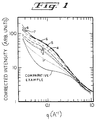
- FIG. 1 is a graphical representation of Small Angle X-ray (SAX) data for treated and untreated siliconoxycarbide ceramics produced in Examples 1-8.
- SAX Small Angle X-ray
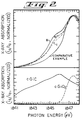
- FIG. 2 is a graphical representation of the Silicon K-shell-edge from Examples 1, 6 and 8.
- the present invention is based on the unexpected discovery that lithium ion batteries containing anodes of siliconoxycarbide (SiOC) derived from preceramic polymers can provide the batteries with highly desirable properties.
- the batteries can have large capacities (the electrodes have the ability to store large quantities of lithium) with low irreversible capacity (the lithium is reversibly stored).
- these anode materials are chemically inert towards the other battery components, they minimize the agglomeration of lithium and they have a high density.
- the electrodes of the present invention are formed from SiOC ceramics that have been treated to reduce the Si and O contents as well as increase the surface area and open porosity.
- the SiOC ceramics are derived from silicon-containing polymers including, but not limited to, polycarbosilanes, polysilazanes, polysilanes and polysiloxanes.
- Polycarbosilanes useful herein are known in the art. Generally, these polycarbosilanes contain units of the type (R 1 R 2 SiCH 2 ), (R 1 Si(CH 2 ) 1.5 ) and/or (R 1 R 2 R 3 Si(CH 2 ) 0.5 ) where each R 1 , R 2 and R 3 is independently selected from hydrogen and hydrocarbons having 1-20 carbon atoms.
- the hydrocarbons can include alkyls such as methyl, ethyl, propyl and butyl; alkenyls such as vinyl and ally; and aryls such as phenyl.
- the hydrocarbon radicals can contain hetero atoms such as silicon, nitrogen or boron.
- the polycarbosilanes may also be substituted with various metal groups such as boron, aluminum, chromium and titanium. The substituted polycarbosilanes are also known in the art and can be manufactured by known methods.
- the polysilazanes useful herein are also known in the art and generally contain units of the type (R 1 R 2 SiNR 4 ), (R 1 Si(NR 4 ) 1.5 ) and/or (R 1 R 2 R 3 Si(NR 4 ) 0.5 ) and/or wherein R 1 , R 2 and R 3 are described above and R 4 , R 5 , R 6 and R 7 are independently selected from hydrogen and hydrocarbons having 1-20 carbon atoms.
- the polysilanes useful herein are known in the art and generally contain units of the formula (R 1 R 2 R 3 Si), (R 1 R 2 Si) and (R 3 Si) wherein R 1 , R 2 and R 3 are as described above.
- Examples of specific polysilane units are (Me 2 Si), (PhMeSi), (MeSi), (PhSi), (ViSi), (PhMeSi), (MeHSi), (MeViSi), (Ph 2 Si), (Me 2 Si), (Me 3 Si) and others.
- the polysilane may also be substituted with various metal groups (i.e., containing repeating metal-Si units). Examples of suitable metals include boron, aluminum, chromium and titanium.
- Examples of specific siloxane units include (MeSiO 1.5 ), (PhSiO 1.5 ), (ViSiO 1.5 ), (HSiO 1.5 ), (PhMeSiO), (MeHSiO), (PhViSiO), (MeViSiO), (Ph 2 SiO), (Me 2 SiO), (Me 3 SiO 0.5 ), (PHViSiO 0.5 ), (Ph2HSiO 0.5 ) (H2ViSiO 0.5 ), (Me2ViSiO 0.5 ), (SiO 4/2 ) and others wherein Me is methyl, Ph is phenyl and Vi is vinyl.
- silicon-containing polymer as used herein is intended to include copolymers or blends of the above silicon-containing polymers and other polymers which are also useful herein.
- copolymers of silicon-containing polymers and silalkylenes such as silethylene
- silarylenes such as silphenylene (R 2 Si(C 6 H 4 ) n SiR 2 O)
- silazanes R 2 SiN
- silanes R 2 Si-SiR 2
- organic polymers and others can be used herein.
- blends of silicon-containing polymers and the above mentioned polymers are also useful herein.
- the silicon-containing polymer should be capable of being converted to ceramic materials with a ceramic char yield greater than 20 weight percent, preferably greater than 30 weight percent, more preferably greater than 50 weight percent and most preferably greater than 70 weight percent.
- the silicon-containing polymers should provide a char with at least an excess of carbon (e.g., >0.05 wt% based on the weight of the char). Although not wishing to be bound by theory, it is thought that the excess carbon forms a continuous network for the lithium ions. Larger excesses of carbon (e.g., >5 wt%) are preferred.
- Excess carbon is the amount of free or excess carbon derived from the silicon-containing polymer (i.e., not bound to Si or O) during pyrolysis expressed as a weight percentage based on the weight of the char.
- the amount of free carbon derived from the silicon-containing polymer is determined by pyrolysis of the polymer to an elevated temperature under an inert atmosphere until a stable ceramic char is obtained.
- a "stable ceramic char” is defined as the ceramic char produced at an elevated temperature (e.g., 700-1400°C.).
- Both the ceramic yield and the silicon, oxygen, carbon and nitrogen content of the stable ceramic char are then determined.
- the amount of excess carbon in the stable ceramic char can be calculated (the amount of "excess carbon" in the char is calculated by subtracting the theoretical amount of carbon bound to silicon (one mole carbon per mole silicon) from the total carbon present) .
- the amount of excess carbon thus calculated is normally expressed as a weight percent based on the weight of the char derived from the silicon-containing polymer.
- Silicon-containing polymers which contain phenyl groups are preferred since they add to the free carbon in the ceramic chars. Silicon-containing polymers which contain vinyl groups are also preferred since vinyl groups attached to silicon provide a mechanism whereby the polymer can be cured prior to pyrolysis. Silicon-containing polymers where the functionality on the silicon is almost exclusively methyl or hydrogen are generally not suitable when used alone for use in this invention as there is insufficient free carbon in the resulting ceramic char. However, silicon-containing polymers where the functionality on the silicon is almost exclusively methyl or hydrogen can be blended with organic polymers for use in this invention.
- the silicon-containing polymer is optionally cured, by a variety of techniques well known in the art and is then pyrolyzed in an inert atmosphere and/or under vacuum to a temperature of 700°C. or more, preferably 800 to 1400°C.
- Inert atmospheres are used during pyrolysis to prevent oxygen incorporation into the ceramic or loss of carbon through combustion.
- an inert atmosphere includes inert gases, vacuum or both.
- Inert gases include, but are not limited to, argon, helium or nitrogen.
- Vacuum, when used, is typically in the range of 0.1-200 torr (13.3 to 26,600 Pa).
- a reactive gas such as silane, methane, H 2 , O or NH 3 may be introduced during pyrolysis to chemically change the composition of the ceramic from that derived by pyrolysis in an inert atmosphere.
- Pyrolysis of the silicon-containing polymer may be performed in any conventional high temperature furnace equipped with a means to control the furnace atmosphere. Such furnaces are well known in the art and many are commercially available.
- heating temperatures should be at a rate less than 50°C./minute and preferably less than 10°C./minute.
- the resultant ceramics contain silicon, carbon, oxygen, nitrogen and/or hydrogen in a wide array of proportions, based on the composition of the silicon-containing polymer.
- hydrogen or nitrogen may also be present in small amounts (e.g. ⁇ 5 wt%).
- Treating agents useful herein include, but are not limited to, strong acids such as hydrofluoric acid (HF) and strong bases such as potassium hydroxide (KOH).
- HF hydrofluoric acid
- KOH potassium hydroxide
- the treating agent is HF.
- the ceramic is treated by contacting the ceramic with the treating agent.
- the treating agent is typically a liquid solution. However, the ceramic may be contacted with the treating agent in a gaseous state. When used as a liquid solution, the treating agent is typically at a concentration of 3 to 30 wt%, preferably from 15 to 25 wt%. There should be sufficient treating agent present in excess to the oxygen and silicon present in the starting ceramic.
- the ceramic is ground into a powder and mixed with the treating agent.
- the ceramic is brought into contact with the treating agent for a period of time to reduce the Si and O and increase the surface area of the ceramic. This typically takes from 5 minutes to 24 hours, preferably from 15 minutes to 4 hours.
- the treatment may be carried out at any temperature, preferably below the boiling point of the treating agent. Typically the treatment is carried out at room temperature and atmospheric pressure.
- the treated ceramic is recovered from the treating agent by means known in the art such as filtration; washed to remove any residual treating agent and dried, for example, by mild heating in an oven.
- the ceramic composition (SiO x C y ) and the microstructure are changed.
- microstructure it is meant the amount of surface area, open porosity and composition at the surface of the SiOC particle. Additionally, the bulk and surface composition of the ceramic is selectively changed. It is theorized that the changes that result from the treatment of the ceramic have an impact on the reactivity towards reversible insertion of lithium.
- the ceramic material into a powder form for use in the electrodes. This can be accomplished by techniques known in the art such as grinding, milling and spray drying.
- a ceramic powder is used, it is often mixed with variety of conductive agents, diluents or binders to assist in forming the desired shape electrode.
- conductive agents for instance carbon black conductive diluent, N-methylpyrollidone, cyclohexanone, dibutylpthallate, acetone or polyvinylidene fluoride binder, polytetrafluorethylene dispersed in water as a binder or ethylene propylene diene terpolymer dissolved in cyclohexanone as a binder are within the scope of the invention.
- lithium ions are incorporated into the electrode. This can occur prior to insertion of the electrode into the battery, for instance, by mixing the lithium in the powdered ceramic material. Preferably, however, the lithium ions are inserted after the electrode is inserted into the battery. At such time, the battery is merely "charged” by placing both the electrode of the invention and a counter electrode of, for instance, lithium transition metal oxide such as LiCoO 2 , in a lithium ion conductive non-aqueous electrolyte and then applying a current in a direction which allows incorporation of the lithium into the electrode of the invention.
- a counter electrode for instance, lithium transition metal oxide such as LiCoO 2
- the electrodes of the present invention can be used in any battery configuration.
- the preferred battery of the present invention is the conventional spiral wound type in which a cathode and anode separated by a porous sheet are wound into a "jelly roll".
- the cathodes typically comprise known suitable cathode materials (e.g., as lithiated metal oxides) applied on the surface of aluminum foil. This is often accomplished by forming a slurry of the cathode material and a binder and/or diluent and then depositing the slurry on the foil. The diluent is dried leaving a thin film of the cathode material on the foil.
- Anodes are formed in the same manner as the cathode except that the ceramic of the present invention is used as the anode material and a copper foil is used in place of the aluminum foil.
- a porous sheet such as a polyolefin material is placed between the cathode and the anode and the composition is then rolled.
- This "jelly roll” is inserted into a conventional battery can and the can is sealed with a header and a gasket.
- an appropriate electrolyte is added to fill the pores in the porous sheet and in the electrode themselves and connections are made between the anode and cathode and the external terminals.
- the type and amount of the battery components will be chosen based on component material properties and the desired performance and safety requirements of the battery. Also, the battery is generally electrically conditioned (recharged) during its manufacture.
- the ceramics produced herein When the ceramics produced herein are used as electrodes in lithium ion batteries, they provide the batteries with many desirable properties. For instance, the batteries can have large capacities with low irreversible capacity. In addition, these anode materials are chemically inert towards the other battery components, they minimize the agglomeration of lithium and they have a high density. Finally, the ceramics produced herein can be designed to have low hysteresis or a larger hysteresis. It is believed that the hysteresis of these materials may be valuable since it may reduce reaction rates between intercalated lithium and electrolyte under thermal abuse.
- Small angle X-ray scattering was measured by transmission mode operation of a Siemens D5000 diffractometer. Fifty to one hundred micron thick powdered samples were held in a rectangular frame with kapton windows. Data were collected between the scattering angle of 0.3 and 15°.
- BET Brunauer-Emmett-Teller
- X-ray absorption measurements were performed at the Canadian Synchroton Radiation Facility Double-Crystal-Monochromator beam-line, located at the Synchrotron Radiation Facility in Stoughton, Wisconsin, USA. Samples were placed under a vacuum not exceeding 10 -6 torr (1.33x10 -4 torr) and exposed to monochromatic synchtron radiation. The electrons excited from the material were collected in a loop of wire biased at 250 V located in front of the sample. To maintain electrical neutrality, a current was supplied to the sample.
- the samples were prepared by washing a sample of the powdered ceramic in a 20 wt% HF solution. The powders were immersed in the aqueous solution such that the HF was present in excess to the oxygen and silicon present in the initial ceramic. After stirring the resulting slurry for a specific period of time, the sample was recovered by filtration and washed with distilled water to remove any HF. The ceramic was then dried at 150°C. in an air circulating oven prior to analysis. The surface area by BET and elemental compositions are given in Table I.
- the SiK-edge is shown in Figure 2 for the comparative example (untreated ceramic) and Examples 1, 6 and 8.
- the bottom panel showed the SiK-edge for SiO 2 and SiC. It was obvious from this figure as well as the accompanying data that the population of Si-C bonds was growing relative to the Si-O bonds. Hence, we were changing the composition of the ceramic by removing the silica like species.
Landscapes
- Chemical & Material Sciences (AREA)
- Engineering & Computer Science (AREA)
- Chemical Kinetics & Catalysis (AREA)
- Electrochemistry (AREA)
- General Chemical & Material Sciences (AREA)
- Inorganic Chemistry (AREA)
- Manufacturing & Machinery (AREA)
- Materials Engineering (AREA)
- Battery Electrode And Active Subsutance (AREA)
- Secondary Cells (AREA)
Abstract
This invention pertains to a method for producing
electrode materials for lithium ion batteries comprising
pyrolyzing a composition comprising a silicon-containing
preceramic polymer to produce a ceramic composition
comprising a siliconoxycarbide (SiOC); treating the ceramic
composition with a strong acid or a strong base; and
thereafter introducing lithium ions into the ceramic
material to form an electrode material. Treatment of the
ceramic composition reduces the levels of Si and O and
increases the surface area and open porosity of the ceramic
thus making the ceramic more useful as an electrode
material.
Description
The invention pertains to a method for producing
ceramic materials useful in forming electrodes for
rechargeable lithium ion batteries and the electrodes formed
thereby. These electrodes can be used to form batteries
with high capacities.
Lithium ion batteries are known in the art and are
widely used as electric sources for lap top computers,
cellular phones and camcorders. They are advantageous in
that they can provide high voltage, high energy density,
small self-discharge and excellent long-term reliability.
Rechargeable lithium ion batteries have a simple
mechanism. During charge, lithium ions are extracted from
the cathode and inserted as lithium into the anode. On
discharge, the reverse process occurs. The electrodes used
in these batteries are very important and can have dramatic
effects on the batteries performance
Positive electrodes known in the art for use in
these rechargeable lithium ion batteries include metal
chalcogenides, metal oxides and conductive polymers.
Negative electrodes (anodes) known in the art for use in
rechargeable lithium batteries include compounds in which
the lithium ion is incorporated into a crystal structure of
inorganic materials such as WO2 and Fe203 and carbonaceous
materials, such as graphite and conductive polymers.
Properties which are desirable in electrode
materials include 1) chemical inertness towards other
battery components such as lithium ions, electrolyte salts
and electrolyte medium; 2) the ability to store high
quantities of lithium; 3) the ability to reversibly store or
bind lithium; 4) lithium storage that minimizes formation of
metallic lithium clusters or agglomerates and, thereby
minimizes safety concerns; and 5) a high density which
allows for volume efficiency.
The electrodes to date, however, have not
maximized these properties. For instance, while lithium
metal provides the best electrode potential, large batteries
constructed therewith have poor safety behavior. Likewise,
while lithium alloys have reasonable electrode potentials
and safety profiles, they often crack and fragment with
constant cycling of the battery.
The most desirable anode materials to date have
been carbonaceous compounds such as graphite. Graphite is
chemically inert, can bind reasonable amounts of lithium
(cells with capacities of 330 mAh/g of anode) with little
being irreversible (10%) and it has a high density (2.2
g/cm3, although in the electrode the density is 1.2 g/cm3).
Cells with larger capacities, however, are often desired.
It has recently been suggested that the addition
of boron, phosphorous or silicon to carbonaceous anodes can
increase the capacity of the resultant batteries. Such
batteries, however, have not achieved optimal results.
For instance, Tahara et al. in European
publication 0,582,173 teach the use of a silicon oxide or a
silicate as the negative electrode in a lithium ion battery.
Similarly, European publication 0,685,896 teaches the use of
SiC containing materials as anodes in lithium ion batteries.
These references, however, do not teach the methods or
materials described and claimed herein.
From this previous work on silicon oxycarbide
(SiOC) materials it was learned that better battery anode
performance came from ceramic materials with relatively high
levels of open porosity and relatively low levels of oxygen.
From a polymer precursor perspective low oxygen/high carbon
ceramics with high surface areas can be expensive compared
to high oxygen systems. Thus, it would be desirable to have
a method which could take the ceramics derived from the
relatively inexpensive high oxygen precursors and convert
them into the more desirable low oxygen ceramics.
It is an object of the instant invention to
provide a method of treating siliconoxycarbide ceramics with
a treating agent selected from a strong acid or a strong
base wherein the treating agent can selectively solubilize
and remove the silica like materials; thus, lowering the
weight percents of Si and O relative to the C in these SiOC
ceramics.
It is further an object of the instant invention
to provide a method of treatment wherein after treatment
with the treating agent, the ceramic materials have an
increased surface area and increased porosity.
This invention pertains to a method for producing
electrode materials for lithium ion batteries comprising
pyrolyzing a composition comprising a silicon-containing
preceramic polymer to produce a ceramic composition
comprising a siliconoxycarbide (SiOC); treating the ceramic
composition with a strong acid or a strong base; and
thereafter introducing lithium ions into the ceramic
material to form an electrode material. Treatment of the
ceramic composition reduces the levels of Si and O and
increases the surface area and open porosity of the ceramic
thus making the ceramic more useful as an electrode
material.
FIG. 1 is a graphical representation of Small
Angle X-ray (SAX) data for treated and untreated
siliconoxycarbide ceramics produced in Examples 1-8.
FIG. 2 is a graphical representation of the
Silicon K-shell-edge from Examples 1, 6 and 8.
The present invention is based on the unexpected
discovery that lithium ion batteries containing anodes of
siliconoxycarbide (SiOC) derived from preceramic polymers
can provide the batteries with highly desirable properties.
The batteries can have large capacities (the electrodes have
the ability to store large quantities of lithium) with low
irreversible capacity (the lithium is reversibly stored).
In addition, these anode materials are chemically inert
towards the other battery components, they minimize the
agglomeration of lithium and they have a high density.
The electrodes of the present invention are formed
from SiOC ceramics that have been treated to reduce the Si
and O contents as well as increase the surface area and open
porosity. The SiOC ceramics are derived from silicon-containing
polymers including, but not limited to,
polycarbosilanes, polysilazanes, polysilanes and
polysiloxanes.
Polycarbosilanes useful herein are known in the
art. Generally, these polycarbosilanes contain units of the
type (R1R2SiCH2), (R1Si(CH2)1.5) and/or (R1R2R3Si(CH2)0.5)
where each R1, R2 and R3 is independently selected from
hydrogen and hydrocarbons having 1-20 carbon atoms. The
hydrocarbons can include alkyls such as methyl, ethyl,
propyl and butyl; alkenyls such as vinyl and ally; and aryls
such as phenyl. In addition, the hydrocarbon radicals can
contain hetero atoms such as silicon, nitrogen or boron. The
polycarbosilanes may also be substituted with various metal
groups such as boron, aluminum, chromium and titanium. The
substituted polycarbosilanes are also known in the art and
can be manufactured by known methods.
The polysilazanes useful herein are also known in
the art and generally contain units of the type (R1R2SiNR4),
(R1Si(NR4)1.5) and/or (R1R2R3Si(NR4)0.5) and/or
 wherein R1, R2 and R3 are described above and R4, R5, R6 and
R7 are independently selected from hydrogen and hydrocarbons
having 1-20 carbon atoms.
wherein R1, R2 and R3 are described above and R4, R5, R6 and
R7 are independently selected from hydrogen and hydrocarbons
having 1-20 carbon atoms.
The polysilanes useful herein are known in the art
and generally contain units of the formula (R1R2R3Si),
(R1R2Si) and (R3Si) wherein R1, R2 and R3 are as described
above. Examples of specific polysilane units are (Me2Si),
(PhMeSi), (MeSi), (PhSi), (ViSi), (PhMeSi), (MeHSi),
(MeViSi), (Ph2Si), (Me2Si), (Me3Si) and others. The
polysilane may also be substituted with various metal groups
(i.e., containing repeating metal-Si units). Examples of
suitable metals include boron, aluminum, chromium and
titanium.
The polysiloxanes useful herein are known in the
art and are of the structure:
(R1R2R3SiO0.5)w(R4R5SiO)x(R6SiO1.5)y(SiO4/2)z
wherein R1, R2, R3, R4, R5 and R6 are as described above and
w, x, y and z are mole fractions with w=0 to 0.8, x=0 to
0.9, y=0 to 0.9, z=0.3 to 0.9 and w + x + y + z = 1 .
Examples of specific siloxane units include
(MeSiO1.5), (PhSiO1.5), (ViSiO1.5), (HSiO1.5), (PhMeSiO),
(MeHSiO), (PhViSiO), (MeViSiO), (Ph2SiO), (Me2SiO),
(Me3SiO0.5), (PHViSiO0.5), (Ph2HSiO0.5) (H2ViSiO0.5),
(Me2ViSiO0.5), (SiO4/2) and others wherein Me is methyl, Ph
is phenyl and Vi is vinyl.
It should be noted that the term  silicon-containing
polymer" as used herein is intended to include
copolymers or blends of the above silicon-containing
polymers and other polymers which are also useful herein.
For instance, copolymers of silicon-containing polymers and
silalkylenes (R2Si(CH2)nSiR2O) such as silethylene;
silarylenes such as silphenylene (R2Si(C6H4)nSiR2O);
silazanes (R2SiN), silanes (R2Si-SiR2), organic polymers and
others can be used herein. Moreover, blends of silicon-containing
polymers and the above mentioned polymers are
also useful herein.
silicon-containing
polymer" as used herein is intended to include
copolymers or blends of the above silicon-containing
polymers and other polymers which are also useful herein.
For instance, copolymers of silicon-containing polymers and
silalkylenes (R2Si(CH2)nSiR2O) such as silethylene;
silarylenes such as silphenylene (R2Si(C6H4)nSiR2O);
silazanes (R2SiN), silanes (R2Si-SiR2), organic polymers and
others can be used herein. Moreover, blends of silicon-containing
polymers and the above mentioned polymers are
also useful herein.
The silicon-containing polymer should be capable
of being converted to ceramic materials with a ceramic char
yield greater than 20 weight percent, preferably greater
than 30 weight percent, more preferably greater than 50
weight percent and most preferably greater than 70 weight
percent.
The silicon-containing polymers should provide a
char with at least an excess of carbon (e.g., >0.05 wt%
based on the weight of the char). Although not wishing to
be bound by theory, it is thought that the excess carbon
forms a continuous network for the lithium ions. Larger
excesses of carbon (e.g., >5 wt%) are preferred.
What is meant by "excess carbon" is the amount of
free or excess carbon derived from the silicon-containing
polymer (i.e., not bound to Si or O) during pyrolysis
expressed as a weight percentage based on the weight of the
char.
The amount of free carbon derived from the
silicon-containing polymer is determined by pyrolysis of the
polymer to an elevated temperature under an inert atmosphere
until a stable ceramic char is obtained. A "stable ceramic
char" is defined as the ceramic char produced at an elevated
temperature (e.g., 700-1400°C.).
Both the ceramic yield and the silicon, oxygen,
carbon and nitrogen content of the stable ceramic char are
then determined. Using a composition rule of mixtures, the
amount of excess carbon in the stable ceramic char can be
calculated (the amount of "excess carbon" in the char is
calculated by subtracting the theoretical amount of carbon
bound to silicon (one mole carbon per mole silicon) from the
total carbon present) . The amount of excess carbon thus
calculated is normally expressed as a weight percent based
on the weight of the char derived from the silicon-containing
polymer.
Silicon-containing polymers which contain phenyl
groups are preferred since they add to the free carbon in
the ceramic chars. Silicon-containing polymers which
contain vinyl groups are also preferred since vinyl groups
attached to silicon provide a mechanism whereby the polymer
can be cured prior to pyrolysis. Silicon-containing
polymers where the functionality on the silicon is almost
exclusively methyl or hydrogen are generally not suitable
when used alone for use in this invention as there is
insufficient free carbon in the resulting ceramic char.
However, silicon-containing polymers where the functionality
on the silicon is almost exclusively methyl or hydrogen can
be blended with organic polymers for use in this invention.
The silicon-containing polymer is optionally
cured, by a variety of techniques well known in the art and
is then pyrolyzed in an inert atmosphere and/or under vacuum
to a temperature of 700°C. or more, preferably 800 to
1400°C.
Inert atmospheres are used during pyrolysis to
prevent oxygen incorporation into the ceramic or loss of
carbon through combustion. For purposes of this invention,
an inert atmosphere includes inert gases, vacuum or both.
Inert gases include, but are not limited to, argon, helium
or nitrogen. Vacuum, when used, is typically in the range
of 0.1-200 torr (13.3 to 26,600 Pa).
A reactive gas such as silane, methane, H2, O or
NH3 may be introduced during pyrolysis to chemically change
the composition of the ceramic from that derived by
pyrolysis in an inert atmosphere.
Pyrolysis of the silicon-containing polymer may be
performed in any conventional high temperature furnace
equipped with a means to control the furnace atmosphere.
Such furnaces are well known in the art and many are
commercially available.
The temperature schedule for pyrolysis has been
found to be important in the present invention. Generally,
heating temperatures should be at a rate less than
50°C./minute and preferably less than 10°C./minute.
The resultant ceramics contain silicon, carbon,
oxygen, nitrogen and/or hydrogen in a wide array of
proportions, based on the composition of the silicon-containing
polymer. Typically, the material will have a
composition of SiOxCy wherein x = 0 to 2 and 0 < y > 100.
Although unaccounted for in this formula, hydrogen or
nitrogen may also be present in small amounts (e.g. <5 wt%).
Following pyrolysis of the silicon-containing
polymer to a ceramic, the ceramic is treated with a treating
agent selected from a strong acid and a strong base.
Treating agents useful herein include, but are not limited
to, strong acids such as hydrofluoric acid (HF) and strong
bases such as potassium hydroxide (KOH). Preferably, the
treating agent is HF.
The ceramic is treated by contacting the ceramic
with the treating agent. The treating agent is typically a
liquid solution. However, the ceramic may be contacted with
the treating agent in a gaseous state. When used as a
liquid solution, the treating agent is typically at a
concentration of 3 to 30 wt%, preferably from 15 to 25 wt%.
There should be sufficient treating agent present in excess
to the oxygen and silicon present in the starting ceramic.
Typically the ceramic is ground into a powder and
mixed with the treating agent. The ceramic is brought into
contact with the treating agent for a period of time to
reduce the Si and O and increase the surface area of the
ceramic. This typically takes from 5 minutes to 24 hours,
preferably from 15 minutes to 4 hours. The treatment may be
carried out at any temperature, preferably below the boiling
point of the treating agent. Typically the treatment is
carried out at room temperature and atmospheric pressure.
The treated ceramic is recovered from the treating
agent by means known in the art such as filtration; washed
to remove any residual treating agent and dried, for
example, by mild heating in an oven.
By treating the ceramic with a treating agent, the
ceramic composition (SiOxCy) and the microstructure are
changed. By microstructure", it is meant the amount of
surface area, open porosity and composition at the surface
of the SiOC particle. Additionally, the bulk and surface
composition of the ceramic is selectively changed. It is
theorized that the changes that result from the treatment of
the ceramic have an impact on the reactivity towards
reversible insertion of lithium.
It is often preferred to process the ceramic
material into a powder form for use in the electrodes. This
can be accomplished by techniques known in the art such as
grinding, milling and spray drying.
If a ceramic powder is used, it is often mixed
with variety of conductive agents, diluents or binders to
assist in forming the desired shape electrode. For instance
carbon black conductive diluent, N-methylpyrollidone,
cyclohexanone, dibutylpthallate, acetone or polyvinylidene
fluoride binder, polytetrafluorethylene dispersed in water
as a binder or ethylene propylene diene terpolymer dissolved
in cyclohexanone as a binder are within the scope of the
invention.
After the electrode is shaped, lithium ions are
incorporated into the electrode. This can occur prior to
insertion of the electrode into the battery, for instance,
by mixing the lithium in the powdered ceramic material.
Preferably, however, the lithium ions are inserted after the
electrode is inserted into the battery. At such time, the
battery is merely "charged" by placing both the electrode of
the invention and a counter electrode of, for instance,
lithium transition metal oxide such as LiCoO2, in a lithium
ion conductive non-aqueous electrolyte and then applying a
current in a direction which allows incorporation of the
lithium into the electrode of the invention.
The electrodes of the present invention can be
used in any battery configuration. The preferred battery of
the present invention is the conventional spiral wound type
in which a cathode and anode separated by a porous sheet are
wound into a "jelly roll". The cathodes typically comprise
known suitable cathode materials (e.g., as lithiated metal
oxides) applied on the surface of aluminum foil. This is
often accomplished by forming a slurry of the cathode
material and a binder and/or diluent and then depositing the
slurry on the foil. The diluent is dried leaving a thin
film of the cathode material on the foil.
Anodes are formed in the same manner as the
cathode except that the ceramic of the present invention is
used as the anode material and a copper foil is used in
place of the aluminum foil.
As noted above, a porous sheet such as a
polyolefin material is placed between the cathode and the
anode and the composition is then rolled. This "jelly roll"
is inserted into a conventional battery can and the can is
sealed with a header and a gasket.
Before the can is sealed, an appropriate
electrolyte is added to fill the pores in the porous sheet
and in the electrode themselves and connections are made
between the anode and cathode and the external terminals.
Those skilled in the art will understand that the
type and amount of the battery components will be chosen
based on component material properties and the desired
performance and safety requirements of the battery. Also,
the battery is generally electrically conditioned
(recharged) during its manufacture.
Other configurations or components are possible.
For instance, coin cells or a prismatic format are within
the scope of the present invention.
When the ceramics produced herein are used as
electrodes in lithium ion batteries, they provide the
batteries with many desirable properties. For instance, the
batteries can have large capacities with low irreversible
capacity. In addition, these anode materials are chemically
inert towards the other battery components, they minimize
the agglomeration of lithium and they have a high density.
Finally, the ceramics produced herein can be designed to
have low hysteresis or a larger hysteresis. It is believed
that the hysteresis of these materials may be valuable since
it may reduce reaction rates between intercalated lithium
and electrolyte under thermal abuse.
So that those skilled in the art can understand
and appreciate the invention taught herein, the following
examples are presented.
Small angle X-ray scattering was measured by
transmission mode operation of a Siemens D5000
diffractometer. Fifty to one hundred micron thick powdered
samples were held in a rectangular frame with kapton
windows. Data were collected between the scattering angle
of 0.3 and 15°.
Surface area of the materials was measured by the
Brunauer-Emmett-Teller (BET) method. Single point
measurements were made using Micrometrics Flowsorb surface
area analyzer. A mixture of N2 in He (30:70 mole%) was
used. The samples were degassed in this gas mixture at
140°C. for 15 minutes. The final results were taken from
the desorption data.
X-ray absorption measurements were performed at
the Canadian Synchroton Radiation Facility Double-Crystal-Monochromator
beam-line, located at the Synchrotron
Radiation Facility in Stoughton, Wisconsin, USA. Samples
were placed under a vacuum not exceeding 10-6 torr (1.33x10⁻⁴
torr) and exposed to monochromatic synchtron radiation.
The electrons excited from the material were collected in a
loop of wire biased at 250 V located in front of the sample.
To maintain electrical neutrality, a current was supplied to
the sample.
Leaching with Dilute HF. The samples were
prepared by washing a sample of the powdered ceramic in a 20
wt% HF solution. The powders were immersed in the aqueous
solution such that the HF was present in excess to the
oxygen and silicon present in the initial ceramic. After
stirring the resulting slurry for a specific period of time,
the sample was recovered by filtration and washed with
distilled water to remove any HF. The ceramic was then
dried at 150°C. in an air circulating oven prior to
analysis. The surface area by BET and elemental
compositions are given in Table I.
The increase in surface area with the treatment
was accompanied by an increase in porosity. This was
evident from the fits to the SAX data in Figure 1. It was
surprising that the pore size increase at ∼10Å (Figure 1)
was most prevelant.
The SiK-edge is shown in Figure 2 for the
comparative example (untreated ceramic) and Examples 1, 6
and 8. For comparison the bottom panel showed the SiK-edge
for SiO2 and SiC. It was obvious from this figure as well
as the accompanying data that the population of Si-C bonds
was growing relative to the Si-O bonds. Hence, we were
changing the composition of the ceramic by removing the
silica like species.
The battery testing results are shown in Table II.
| Result from HF treatment of SiOC ceramic | |||||
| Example # | Wash Time (h) | C (wt%) | Si (wt%) | O (wt%) | Surface Area (m2/g) |
| Comp. Ex. | 0 | 28.7 | 38.3 | 26.8 | 0.25 |
| 1 | 0.25 | 24.8 | 35.5 | 39.7 | 17.7 |
| 2 | 0.5 | 27.0 | 34.3 | 38.7 | 25.7 |
| 3 | 1.0 | 28.3 | 35.8 | 35.9 | 37.1 |
| 4 | 2.0 | 30.1 | 34.2 | 35.7 | 44.4 |
| 5 | 4.0 | 30.8 | 34.8 | 34.4 | 53.8 |
| 6 | 8.0 | 31.2 | 32.1 | 38.7 | 55.6 |
| 7 | 16.0 | 31.4 | 31.6 | 37.0 | 54.4 |
| 8 | 24.0 | 33.4 | 33.6 | 33.1 | 54.1 |
| Battery testing results | |||
| Example # | Reversible Capacity (mAh/g) [C/g] | Irreversible Capacity (mAh/g) [C/g] | Average Charge Voltage |
| Comp. Ex. | 890 [3204] | 360 [1296] | 1.06 |
| 1 | 840 [3024] | 420 [1512] | 1.02 |
| 2 | 900 [3240] | 360 [1296] | 1.03 |
| 3 | 840 [3024] | 400 [1440] | 1.05 |
| 4 | 760 [2736] | 390 [1404] | 1.12 |
| 5 | 860 [3096] | 390 [1404] | 1.00 |
Claims (9)
- A method of forming an electrode material for a lithium ion battery comprising:(A) pyrolyzing a composition comprising a silicon-containing preceramic polymer to yield a ceramic composition comprising Si, O and C,(B) treating the SiOC composition with a treating agent selected from a strong acid or a strong base wherein said treatment reduces the levels of Si and O and increases the surface area and open porosity, and(C) introducing lithium ions into the treated ceramic material to form an electrode material.
- The method as claimed in claim 1 wherein the silicon-containing preceramic polymer is selected from polysiloxane, polysilazane, polysilane and polycarbosilane.
- The method as claimed in claim 1 wherein the composition comprising the silicon-containing preceramic polymer is pyrolyzed by heating at a rate of 10°C./minute to a temperature in the range of 700 to 1400°C.
- The method as claimed in claim 1 wherein the silicon-containing preceramic polymer has a char yield greater than 50 wt%.
- The method as claimed in claim 1 wherein the silicon-containing preceramic polymer is a copolymer comprising a silicon-containing polymer and at least one unit selected from silalkylenes, silarylenes, silazanes, silanes and organic polymers.
- The method as claimed in claim 1 wherein the treating agent is a strong acid and is HF.
- The method as claimed in claim 1 wherein the treating agent is a strong base and is KOH.
- The method as claimed in claim 1 wherein the ceramic material produced in step (B) is formed into a powder, the powder blended with a binder and a diluent to form a mixture and the mixture is then formed into the desired shape of an electrode before lithium ions are introduced.
- A rechargeable lithium ion battery where an anode is obtainable by the method of claim 1.
Applications Claiming Priority (2)
| Application Number | Priority Date | Filing Date | Title |
|---|---|---|---|
| US82423197A | 1997-03-25 | 1997-03-25 | |
| US824231 | 1997-03-25 |
Publications (1)
| Publication Number | Publication Date |
|---|---|
| EP0867958A1 true EP0867958A1 (en) | 1998-09-30 |
Family
ID=25240909
Family Applications (1)
| Application Number | Title | Priority Date | Filing Date |
|---|---|---|---|
| EP98105306A Withdrawn EP0867958A1 (en) | 1997-03-25 | 1998-03-24 | Method for forming a SiOC ceramic electrode material and rechargeable lithium ion battery containing same as an anode |
Country Status (4)
| Country | Link |
|---|---|
| EP (1) | EP0867958A1 (en) |
| JP (1) | JP4188445B2 (en) |
| KR (1) | KR19980080616A (en) |
| CA (1) | CA2231665A1 (en) |
Cited By (16)
| Publication number | Priority date | Publication date | Assignee | Title |
|---|---|---|---|---|
| EP0915067A3 (en) * | 1997-10-29 | 1999-09-15 | Dow Corning Asia, Ltd. | Tin-containing silicon oxycarbide ceramic material |
| DE102009056756A1 (en) | 2009-12-04 | 2011-06-09 | Schott Ag | Material for battery electrodes, battery electrodes containing the same and batteries with these electrodes and method for its production |
| US20120003547A1 (en) * | 2010-06-30 | 2012-01-05 | Rishi Raj | Electrode Material, Lithium-Ion Battery And Related Methods |
| US8446127B2 (en) | 2005-08-03 | 2013-05-21 | California Institute Of Technology | Methods for thermodynamic evaluation of battery state of health |
| US8530617B2 (en) | 2008-01-30 | 2013-09-10 | Dow Corning Toray Company, Ltd. | Silicon-containing particle, process for producing the same, organic-polymer composition, ceramic, and process for producing the same |
| US9065292B2 (en) | 2010-08-23 | 2015-06-23 | California Institute Of Technology | Methods and systems for charging electrochemical cells |
| CN105428610A (en) * | 2015-10-16 | 2016-03-23 | 常州大学 | Preparation method of composite anode material for lithium-ion battery |
| EP3018099A1 (en) | 2014-11-06 | 2016-05-11 | Commissariat A L'energie Atomique Et Aux Energies Alternatives | SiOC composite electrode material |
| US9599584B2 (en) | 2012-04-27 | 2017-03-21 | California Institute Of Technology | Imbedded chip for battery applications |
| EP3597597A1 (en) | 2018-07-17 | 2020-01-22 | Commissariat à l'Energie Atomique et aux Energies Alternatives | Spherical sioc particulate electrode material |
| US10556510B2 (en) | 2012-04-27 | 2020-02-11 | California Institute Of Technology | Accurate assessment of the state of charge of electrochemical cells |
| US10615410B2 (en) | 2014-03-20 | 2020-04-07 | Kabushiki Kaisha Toshiba | Active material for nonaqueous electrolyte battery, electrode for nonaqueous electrolyte battery, nonaqueous electrolyte secondary battery, battery pack, method of manufacturing active material for nonaqueous electrolyte battery, and vehicle |
| US11091370B2 (en) | 2013-05-02 | 2021-08-17 | Pallidus, Inc. | Polysilocarb based silicon carbide materials, applications and devices |
| US12030819B2 (en) | 2013-05-02 | 2024-07-09 | Pallidus, Inc. | Doped SiC and SiOC compositions and Methods |
| US12330948B2 (en) | 2017-03-29 | 2025-06-17 | Pallidus, Inc. | SiC volumetric shapes and methods of forming boules |
| US12617686B2 (en) | 2023-06-26 | 2026-05-05 | Pallidus, Inc. | Vapor deposition apparatus and techniques using high purity polymer derived silicon carbide |
Families Citing this family (12)
| Publication number | Priority date | Publication date | Assignee | Title |
|---|---|---|---|---|
| CA2432397A1 (en) * | 2003-06-25 | 2004-12-25 | Hydro-Quebec | Procedure for preparing an electrode from porous silicon, the electrode so obtained, and an electrochemical system containing at least one such electrode |
| US7595611B2 (en) * | 2005-08-03 | 2009-09-29 | California Institute Of Technology | Electrochemical thermodynamic measurement system |
| EP2271702A2 (en) | 2008-04-30 | 2011-01-12 | Dow Corning Toray Co., Ltd. | Silicon-containing particles, method for manufacturing thereof, oil composition, ceramic material, and method for manufacturing thereof |
| JP2012178224A (en) | 2011-01-31 | 2012-09-13 | Dow Corning Toray Co Ltd | Manufacturing method of surface carbon-coating silicon-containing carbon-based composite material |
| JP6057208B2 (en) * | 2012-11-12 | 2017-01-11 | 学校法人早稲田大学 | Electroplating solution, method for producing active material for lithium secondary battery, and lithium secondary battery |
| US20150340695A1 (en) * | 2012-12-19 | 2015-11-26 | Dic Corporation | Active material for negative electrodes of nonaqueous secondary batteries, and nonaqueous secondary battery |
| JP6362006B2 (en) * | 2014-02-26 | 2018-07-25 | 東海カーボン株式会社 | Porous silicon oxycarbide ceramics, method for producing the same, porous silicon oxycarbide composite material, and nonaqueous electrolyte secondary battery |
| KR101581242B1 (en) * | 2014-03-26 | 2015-12-31 | 한국세라믹기술원 | SiOC ANODE MATERIAL FOR LITHIUM ION BATTERY FROM CARBOSILANE POLYMER AND METHOD FOR MANUFACTURING THE SAME |
| CN107001152A (en) * | 2014-09-25 | 2017-08-01 | 梅里奥创新公司 | Carbofrax material derived from the poly- silica carbon of high-purity, using and process |
| JP6690381B2 (en) * | 2016-04-20 | 2020-04-28 | Dic株式会社 | Negative electrode active material for non-aqueous electrolyte secondary battery and method for producing the same |
| JP6857879B2 (en) * | 2016-12-22 | 2021-04-14 | Dic株式会社 | Method for manufacturing active material for negative electrode of non-aqueous secondary battery, and method for manufacturing negative electrode for non-aqueous secondary battery |
| FR3145236B1 (en) * | 2023-01-24 | 2025-02-21 | Safran | Electrochemical cell manufacturing process |
Citations (2)
| Publication number | Priority date | Publication date | Assignee | Title |
|---|---|---|---|---|
| US5139901A (en) * | 1989-11-24 | 1992-08-18 | Central Glass Company, Limited | Lithium secondary battery using hydric boron carbonitride as electrode material |
| GB2298516A (en) * | 1995-03-03 | 1996-09-04 | Moli Energy | Amorphous silicon- and oxygen-containing carbonaceous insertion compounds for use as anodes in rechargeable batteries |
Family Cites Families (3)
| Publication number | Priority date | Publication date | Assignee | Title |
|---|---|---|---|---|
| JP3530544B2 (en) * | 1992-09-14 | 2004-05-24 | キヤノン株式会社 | Rechargeable battery |
| CA2127621C (en) * | 1994-07-08 | 1999-12-07 | Alfred Macdonald Wilson | Carbonaceous insertion compounds and use as anodes in rechargeable batteries |
| US5824280A (en) * | 1996-06-11 | 1998-10-20 | Dow Corning Corporation | Electrodes for lithium ion batteries using polysiloxanes |
-
1998
- 1998-03-10 CA CA002231665A patent/CA2231665A1/en not_active Abandoned
- 1998-03-24 EP EP98105306A patent/EP0867958A1/en not_active Withdrawn
- 1998-03-25 KR KR1019980010220A patent/KR19980080616A/en not_active Withdrawn
- 1998-03-25 JP JP07719998A patent/JP4188445B2/en not_active Expired - Fee Related
Patent Citations (2)
| Publication number | Priority date | Publication date | Assignee | Title |
|---|---|---|---|---|
| US5139901A (en) * | 1989-11-24 | 1992-08-18 | Central Glass Company, Limited | Lithium secondary battery using hydric boron carbonitride as electrode material |
| GB2298516A (en) * | 1995-03-03 | 1996-09-04 | Moli Energy | Amorphous silicon- and oxygen-containing carbonaceous insertion compounds for use as anodes in rechargeable batteries |
Non-Patent Citations (4)
| Title |
|---|
| WEIBING X ET AL: "Pyrolysed pitch-polysilane blends for use as anode materials in lithium ion batteries", SOLID STATE IONICS, vol. 93, no. 3, January 1997 (1997-01-01), pages 239-244, XP004056293 * |
| WILSON A M ET AL: "CARBONACEOUS MATERIALS CONTAINING SILICON AS ANODES FOR LITHIUM -IONCELLS", MATERIALS RESEARCH SOCIETY SYMPOSIUM PROCEEDINGS, vol. 393, 1995, pages 305 - 313, XP002042137 * |
| WILSON A M ET AL: "LITHIUM INSERTION IN CARBONS CONTAINING NANODISPERSED SILICON", JOURNAL OF THE ELECTROCHEMICAL SOCIETY, vol. 142, no. 2, 1 February 1995 (1995-02-01), pages 326 - 332, XP002042127 * |
| WILSON A M ET AL: "LITHIUM INSERTION IN PYROLYZED SILOXANE POLYMERS", SOLID STATE IONICS, vol. 74, no. 3/04, 15 December 1994 (1994-12-15), pages 249 - 254, XP002042128 * |
Cited By (19)
| Publication number | Priority date | Publication date | Assignee | Title |
|---|---|---|---|---|
| EP0915067A3 (en) * | 1997-10-29 | 1999-09-15 | Dow Corning Asia, Ltd. | Tin-containing silicon oxycarbide ceramic material |
| US8446127B2 (en) | 2005-08-03 | 2013-05-21 | California Institute Of Technology | Methods for thermodynamic evaluation of battery state of health |
| US8901892B2 (en) | 2005-08-03 | 2014-12-02 | California Institute Of Technology | Methods and systems for thermodynamic evaluation of battery state of health |
| US8530617B2 (en) | 2008-01-30 | 2013-09-10 | Dow Corning Toray Company, Ltd. | Silicon-containing particle, process for producing the same, organic-polymer composition, ceramic, and process for producing the same |
| DE102009056756A1 (en) | 2009-12-04 | 2011-06-09 | Schott Ag | Material for battery electrodes, battery electrodes containing the same and batteries with these electrodes and method for its production |
| US20120003547A1 (en) * | 2010-06-30 | 2012-01-05 | Rishi Raj | Electrode Material, Lithium-Ion Battery And Related Methods |
| US9065292B2 (en) | 2010-08-23 | 2015-06-23 | California Institute Of Technology | Methods and systems for charging electrochemical cells |
| US10556510B2 (en) | 2012-04-27 | 2020-02-11 | California Institute Of Technology | Accurate assessment of the state of charge of electrochemical cells |
| US9599584B2 (en) | 2012-04-27 | 2017-03-21 | California Institute Of Technology | Imbedded chip for battery applications |
| US12030819B2 (en) | 2013-05-02 | 2024-07-09 | Pallidus, Inc. | Doped SiC and SiOC compositions and Methods |
| US11091370B2 (en) | 2013-05-02 | 2021-08-17 | Pallidus, Inc. | Polysilocarb based silicon carbide materials, applications and devices |
| US10615410B2 (en) | 2014-03-20 | 2020-04-07 | Kabushiki Kaisha Toshiba | Active material for nonaqueous electrolyte battery, electrode for nonaqueous electrolyte battery, nonaqueous electrolyte secondary battery, battery pack, method of manufacturing active material for nonaqueous electrolyte battery, and vehicle |
| EP3018099A1 (en) | 2014-11-06 | 2016-05-11 | Commissariat A L'energie Atomique Et Aux Energies Alternatives | SiOC composite electrode material |
| WO2016071462A1 (en) | 2014-11-06 | 2016-05-12 | Commissariat A L'energie Atomique Et Aux Energies Alternatives | Sioc composite electrode material |
| CN105428610A (en) * | 2015-10-16 | 2016-03-23 | 常州大学 | Preparation method of composite anode material for lithium-ion battery |
| US12330948B2 (en) | 2017-03-29 | 2025-06-17 | Pallidus, Inc. | SiC volumetric shapes and methods of forming boules |
| WO2020016280A1 (en) | 2018-07-17 | 2020-01-23 | Commissariat A L'energie Atomique Et Aux Energies Alternatives | Spherical sioc particulate electrode material |
| EP3597597A1 (en) | 2018-07-17 | 2020-01-22 | Commissariat à l'Energie Atomique et aux Energies Alternatives | Spherical sioc particulate electrode material |
| US12617686B2 (en) | 2023-06-26 | 2026-05-05 | Pallidus, Inc. | Vapor deposition apparatus and techniques using high purity polymer derived silicon carbide |
Also Published As
| Publication number | Publication date |
|---|---|
| CA2231665A1 (en) | 1998-09-25 |
| JP4188445B2 (en) | 2008-11-26 |
| KR19980080616A (en) | 1998-11-25 |
| JPH10275617A (en) | 1998-10-13 |
Similar Documents
| Publication | Publication Date | Title |
|---|---|---|
| EP0867958A1 (en) | Method for forming a SiOC ceramic electrode material and rechargeable lithium ion battery containing same as an anode | |
| US5907899A (en) | Method of forming electrodes for lithium ion batteries using polycarbosilanes | |
| US5824280A (en) | Electrodes for lithium ion batteries using polysiloxanes | |
| US20250174640A1 (en) | Lithium tetraborate glass coating on cathode materials for improving safety and cycling stability | |
| US5587256A (en) | Carbonaceous insertion compounds and use as anodes in rechargeable batteries | |
| US5698340A (en) | Carbonaceous insertion compounds and use as anodes in rechargeable batteries | |
| Jeong et al. | Multifunctional TiO 2 coating for a SiO anode in Li-ion batteries | |
| EP3215460B1 (en) | Sioc composite electrode material | |
| US8992801B2 (en) | Electroactive material, and use thereof in anodes for lithium-ion cells | |
| WO2011077654A1 (en) | Negative electrode active substance for nonaqueous secondary cell and method for producing the same | |
| CN105409051A (en) | Alkali metal ion-conducting separator assembly for rechargeable electrochemical cells | |
| JP2018116927A (en) | Positive electrode active material and battery | |
| US6306541B1 (en) | Electrodes for lithium ion batteries using polysilanes | |
| US5631106A (en) | Electrodes for lithium ion batteries using polysilazanes ceramic with lithium | |
| EP0813259A1 (en) | Electrodes for lithium ion batteries using polysilazanes | |
| EP4660133A1 (en) | Si-c composite particles, method for producing same, and use of same | |
| JP2007115548A (en) | Si-C-O amorphous material and negative electrode for lithium secondary battery using this material | |
| EP4645466A1 (en) | Composite particles, method for producing same and use of same | |
| Wakihara et al. | A rechargeable lithium battery employing a porous thin film of Cu3+ δMo6S7. 9 | |
| JP2020536367A (en) | Electrode active material, its manufacture and usage | |
| RU2823264C1 (en) | Protective layer for metal electrode and lithium battery containing thereof | |
| CN103956467B (en) | Porous SiC N-NaOH lithium ion battery cathode material and its preparation method and application | |
| CN103500814A (en) | Preparation method and application of porous SiCN-HF lithium ion battery negative electrode material | |
| EP4645465A1 (en) | Composite particles, method for producing same and use of same | |
| WO2024004786A1 (en) | Negative electrode material for secondary battery, secondary battery, and method for manufacturing negative electrode material for secondary battery |
Legal Events
| Date | Code | Title | Description |
|---|---|---|---|
| PUAI | Public reference made under article 153(3) epc to a published international application that has entered the european phase |
Free format text: ORIGINAL CODE: 0009012 |
|
| AK | Designated contracting states |
Kind code of ref document: A1 Designated state(s): DE FR GB IT |
|
| AX | Request for extension of the european patent |
Free format text: AL;LT;LV;MK;RO;SI |
|
| 17P | Request for examination filed |
Effective date: 19981110 |
|
| 17Q | First examination report despatched |
Effective date: 19981218 |
|
| STAA | Information on the status of an ep patent application or granted ep patent |
Free format text: STATUS: THE APPLICATION HAS BEEN WITHDRAWN |
|
| AKX | Designation fees paid |
Free format text: DE FR GB IT |
|
| 18W | Application withdrawn |
Withdrawal date: 19990419 |