EP0867547A2 - A method of knitting tubular fabrics - Google Patents
A method of knitting tubular fabrics Download PDFInfo
- Publication number
- EP0867547A2 EP0867547A2 EP98302323A EP98302323A EP0867547A2 EP 0867547 A2 EP0867547 A2 EP 0867547A2 EP 98302323 A EP98302323 A EP 98302323A EP 98302323 A EP98302323 A EP 98302323A EP 0867547 A2 EP0867547 A2 EP 0867547A2
- Authority
- EP
- European Patent Office
- Prior art keywords
- fabric
- yarn
- knitting
- yarn feeder
- tubular
- Prior art date
- Legal status (The legal status is an assumption and is not a legal conclusion. Google has not performed a legal analysis and makes no representation as to the accuracy of the status listed.)
- Granted
Links
Images


Classifications
-
- D—TEXTILES; PAPER
- D04—BRAIDING; LACE-MAKING; KNITTING; TRIMMINGS; NON-WOVEN FABRICS
- D04B—KNITTING
- D04B1/00—Weft knitting processes for the production of fabrics or articles not dependent on the use of particular machines; Fabrics or articles defined by such processes
- D04B1/22—Weft knitting processes for the production of fabrics or articles not dependent on the use of particular machines; Fabrics or articles defined by such processes specially adapted for knitting goods of particular configuration
Definitions
- the present invention relates to a method of knitting tubular fabrics that uses a flat knitting machine wherein at least a pair of needle beds, one in the front and the other in the back, are provided and at least one of these needle beds can be racked sidewise, and uses a first yarn feeder and a second yarn feeder to make double system knitting, and in particular, the present invention relates to a method of forming a broadened portion in tubular fabrics.
- a left sleeve and a right sleeve are arranged with a body between them, and each of these parts is knitted in a tubular form by using a dedicated yarn feeder.
- a sleeve that is knitted from the lower sleeve edge towards the side is shifted towards the side of the body that is knitted from the waist band towards the neck, and as knitting of the body proceeds, a loop of the sleeve and a loop of the body are overlapped with each other, and a loop of the next course is formed on said overlapped loops to join the body and the sleeve.
- the sleeve is knitted in such a way that the diameter of the tubular form is increased gradually from the lower sleeve edge to the side.
- broadening is made in one edge of the sleeve, said edge being adjacent to the body and being hidden from sight when the pull-over is put on. Broadening is not made in the edge that is opposite to the body and appears on the outer side. This is to avoid marring the appearance of the fabric.
- double system knitting is made by using a flat knitting machine that is provided with two yarn feeders, preceding one and succeeding one, and at least two knitting systems to use said two yarn feeders to knit.
- two yarn feeders are used as a preceding one and a succeeding one, they are made to travel in the longitudinal direction of the needle beds at different phases, and loops are formed separately by the preceding yarn feeder and by the succeeding yarn feeder.
- Fig. 8 shows the positional relationship of yarn feeders when double system knitting is made by using a yarn feeder A that is indicated by a white triangle and a yarn feeder B that is indicated by a black triangle.
- the yarn feeder A is provided on a guide rail (not illustrated) that is on this side (front side) of the knitting machine that is seen from the front.
- the yarn feeder B is provided on a guide rail (not illustrated) that is on the other side (back side).
- the leftward and rightward arrows in the diagram show knitting directions. For example, when a front fabric FF is to be knitted, the yarn feeders are shifted to the left to knit, and the yarn feeder B is used as the preceding yarn feeder, and the yarn feeder A is used as the succeeding yarn feeder.
- the rightward arrow indicates that the back fabric BF is knitted rightward by using the yarn feeder B as the preceding yarn feeder and the yarn feeder A as the succeeding yarn feeder.
- the yarn feeders are shown at their respective positions when knitting of one course is completed.
- Fig. 8 when the front fabric FF is knitted leftward, both the yarn feeder A and the yarn feeder B are located on the left of the tubular fabric.
- the yarn feeders A, B are located on the right of the tubular fabric.
- one objective of at least the preferred forms of the present invention is to make holes generated in broadened portions inconspicuous when double system knitting is used to knit a first tubular knitted fabric and a second tubular knitted fabric on different areas of the needle beds, and at the same time, to make holes generated in one edge inconspicuous when double system knitting is made.
- a method of knitting tubular fabrics wherein is used a flat knitting machine, which is provided with at least a pair of needle beds, one in the front and one in the back, at least one of said needle beds being able to be racked sidewise, is provided with a first yarn feeder and a second yarn feeder, being able to be reciprocated on different guide rails one in the front and one in the back, and is provided with at least two knitting systems, said first and second yarn feeders are used as a preceding yarn feeder and a succeeding yarn feeder, double system knitting is used to knit a first tubular fabric comprising a first fabric and a second fabric being joined at both edges thereof, and to knit a second tubular fabric comprising a first fabric and a second fabric being joined at both edges thereof by using needles of a knitting area differing from that of the first tubular knitted fabric, the edge of the first tubular fabric on the side of the second tubular fabric is broadened to have desired diameters of the tubular fabric, then the first tubular
- the method of knitting tubular fabrics according to the present invention may include, in succession to the above-mentioned knitting steps, the following steps:
- the method of knitting tubular fabrics according to the present invention is may include, in succession to the above-mentioned knitting steps, the following steps:
- a method of knitting tubular fabrics wherein is used a flat knitting machine, which is provided with at least a pair of needle beds, one in the front and one in the back, at least one of said needle beds being able to be racked sidewise, is provided with a first yarn feeder and a second yarn feeder, being able to be reciprocated on different guide rails one in the front and one in the back, and is provided with at least two knitting systems, said first and second yarn feeders are used as a preceding yarn feeder and a succeeding yarn feeder, double system knitting is used to knit a first tubular fabric comprising a first fabric and a second fabric being joined at both edges thereof, and to knit a second tubular fabric comprising a first fabric and a second fabric being joined at both edges thereof by using needles of a knitting area differing from that of the first tubular knitted fabric, the edge of the first tubular fabric on the side of the second tubular fabric is broadened to have desired diameters of the tubular fabric, then the first tubular
- the first tubular fabric and the second tubular fabric may be knitted by using different areas on the needle beds, and when the edge on the second tubular fabric side of the first tubular fabric is broadened, in a course to be knitted towards the edge of the first tubular fabric to be broadened on the side of the second tubular fabric, the yarn feeder that agrees with the front and back of the fabric to be knitted is used as the preceding yarn feeder and broadening is made, after that, the first tubular fabric is shifted towards the second tubular fabric, and loops of the first tubular fabric on the side of the second tubular fabric are overlapped with loops of the second tubular fabric sequentially to connect the first tubular fabric and the second tubular fabric together.
- hole filling knitting is made wherein prior to formation of a broadening portion, yarn is fed to needles holding two stitches on the outer side of one needle bed, said needle bed holding loops located on the most outer side of the loops being held on needles of both front and back needle beds at the edge to be broadened, and to a needle at the edge of the opposing needle bed alternately in the travelling direction of the yarn feeder, and in the next course, yarn is fed to needles on said opposing needle bed except said needle located at the edge.
- a method of knitting tubular fabrics wherein is used a flat knitting machine, which is provided with at least a pair of needle beds, one in the front and one in the back, at least one of said needle beds being able to be racked sidewise, is provided with a first yarn feeder and a second yarn feeder, being able to be reciprocated on different guide rails one in the front and one in the back, and is provided with at least two knitting systems, said first and second yarn feeders are used as a preceding yarn feeder and a succeeding yarn feeder, double system knitting is used to knit a first tubular fabric comprising a first fabric and a second fabric being joined at both edges thereof, and to knit a second tubular fabric comprising a first fabric and a second fabric being joined at both edges thereof by using needles of a knitting area differing from that of the first tubular knitted fabric, the edge of the first tubular fabric on the side of the second tubular fabric is broadened to have desired diameters of the tubular fabric, then the first tubular
- a broadening portion of the first tubular fabric may be made on its edge on the side of the second tubular fabric, and in knitting a course towards this edge, a yarn feeder that agrees with the front and back of the fabric to be knitted is used as the preceding yarn feeder to form the broadening portion.
- the first tubular fabric is shifted towards the second tubular fabric, and loops of the first tubular fabric on the side of the second tubular fabric are overlapped with loops of the second tubular fabric sequentially to connect the first tubular fabric and the second tubular fabric together.
- broadening of the first tubular fabric and crossing of yarns are generated on the same edge, and holes generated by the crossing of yarns and broadening become inconspicuous.
- the broadened portion and crossing of yarns are concealed by the second tubular fabric and becomes inconspicuous.
- the first needle bed or the second needle bed is racked so that the needle holding the loop at the edge of the first fabric is closer to the broadening portion formation side than the needle holding the loop at the edge of the second fabric.
- a method of knitting tubular fabrics wherein is used a flat knitting machine, which is provided with at least a pair of needle beds, one in the front and one in the back, at least one of said needle beds being able to be racked sidewise, is provided with a first yarn feeder and a second yarn feeder, being able to be reciprocated on different guide rails one in the front and one in the back, and is provided with at least two knitting systems, said first and second yarn feeders are used as a preceding yarn feeder and a succeeding yarn feeder, and double system knitting is used to knit tubular fabrics, each comprising a first fabric and a second fabric being joined at both edges thereof, said method of knitting tubular fabrics being characterized in that in knitting to a edge where crossing of the yarn of the preceding yarn feeder and the succeeding yarn feeder is generated, yarn feeding to any one needle of the needles holding a pair of stitches one in the front and one in the back located at the edge where crossing of yarns is generated is made either the first yarn feeder or
- the number of courses of the fabric is reduced to one half of other wales, and as the loops are stretched, holes generated by crossing of the yarn of the preceding yarn feeder and that of the succeeding yarn feeder are concealed, thus making crossing of yarns inconspicuous.
- the first tubular fabric and the second tubular fabric are knitted by using different areas of needle beds, and when a broadening portion is formed on the edge of the first tubular fabric on the side of the second tubular fabric, in knitting a course towards the edge on which the broadening portion of the first tubular fabric is to be formed on the side of the second tubular fabric, a yarn feeder that agrees with the front and back of the fabric to be knitted is used as the preceding yarn feeder to form the broadening portion to get the desired diameters of the tubular fabric, then the first tubular fabric is shifted towards the second tubular fabric, and loops of the first tubular fabric on the side of the second tubular fabric are overlapped with loops of the second tubular fabric sequentially to connect the first tubular fabric and the second tubular fabric together.
- the edge of the first tubular fabric on which the broadening portion is formed is the same edge on which crossing of yarns is generated.
- holes generated in portions where broadening is made and yarns are crossed become inconspicuous.
- the edge on which the broadening portion is formed and yarns are crossed is concealed by the second tubular fabric, and is inconspicuous.
- Fig. 1A is a diagram showing a pull-over to be knitted by the present invention.
- Fig. 1B is a diagram showing the pull-over when knitting is completed up to the upper edge of the side.
- Fig. 1C is a diagram showing the right sleeve of the pull-over of Fig. 1A.
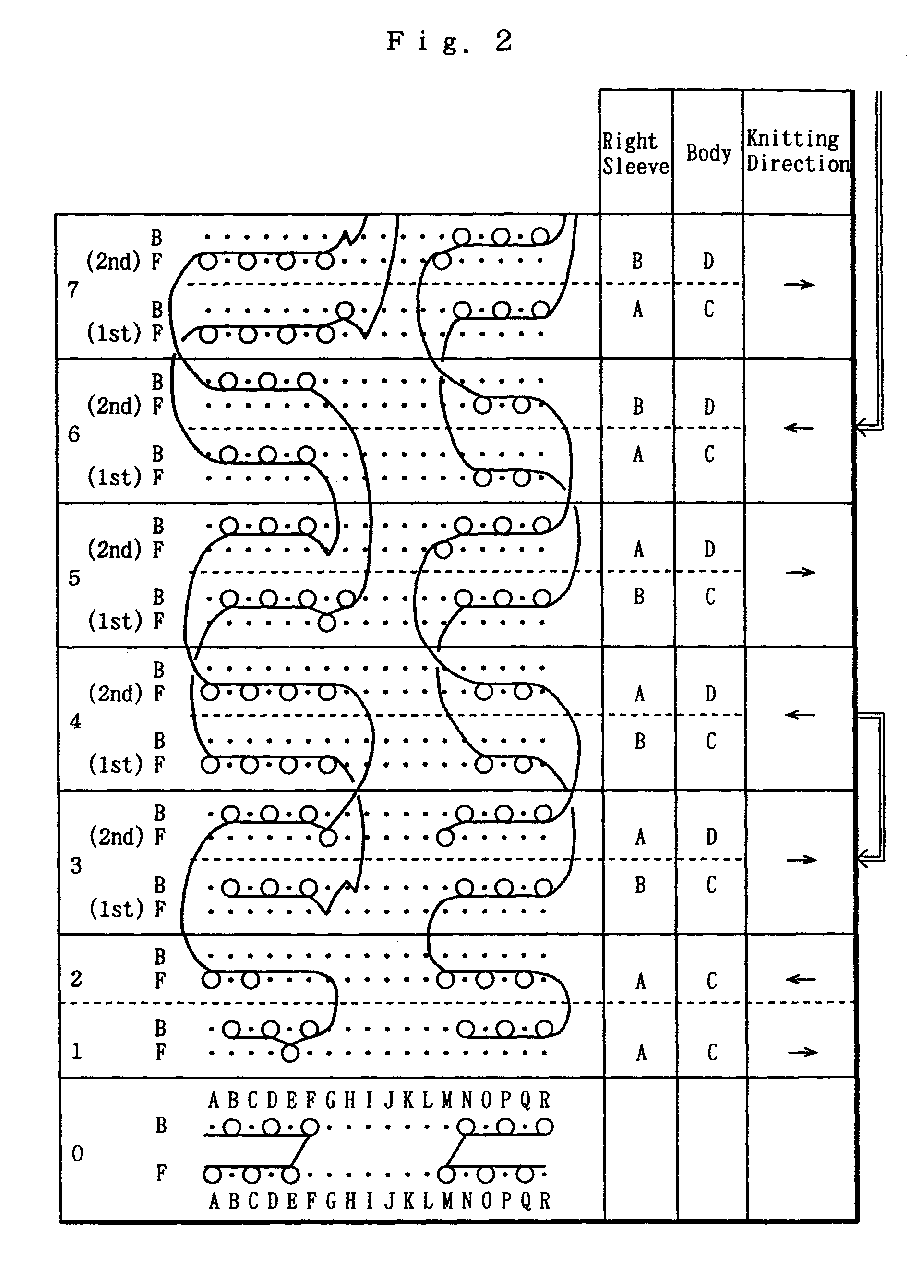
- Fig. 2 shows a knitting course of the embodiment 1 of the present invention.
- Fig. 3 shows a knitting course of the embodiment 1 of the present invention.
- Fig. 4 shows a knitting course of the embodiment 2 of the present invention.
- Fig. 5 shows a knitting course of the embodiment 3 of the present invention.
- Fig. 6 shows a knitting course of the embodiment 4 of the present invention.
- Fig. 7 shows a knitting course of the embodiment 4 of the present invention.
- Fig. 8 is a diagram explaining the generation of crossing of yarns when tubular fabrics are knitted by double system knitting.
- Fig. 1A shows the state of completion of a pull-over 1 that is to be knitted by the method of knitting tubular fabrics according to the present invention.
- Fig. 1B shows the state of the pullover 1 of Fig. 1A when it is knitted up to the top edges of both sides 4, 5 at which joining of both the left and right sleeves 2, 3 and the body is started.
- Fig. 1C shows the right sleeve 2 of the pull-over 1.
- a body 6 that is to be knitted in a tubular form, and tubular left and right sleeves 2, 3 that are to be knitted by using areas left to and right to the body, with the body 6 between, are formed.
- the left and right sleeves 2, 3 broadening portions are formed at edges adjacent to the body.
- Each of the left and right sleeves 2, 3 comprises a lower edge rib stitch part 7 or 8 being the starting point of knitting, a part X where both the front fabric FF and the back fabric BF are broadened by one stitch for every two courses, a part Y where both fabrics are broadened by one stitch for every four courses, and a part Z where both fabrics are broadened by one stitch for every six courses.
- the body 6 and the left and right sleeves 2, 3 are knitted in parallel by double system knitting using two yarn feeders that can be shifted sidewise on different guide rails one in the front (this side) and one in the back (the other side) seen from the front of the flat knitting machine.
- the left and right sleeves 2, 3 are shifted towards the body when knitting from the lower edge parts 7, 8 to the top of sides 4, 5 is completed, and the loops on the body side are overlapped with the loops of the body 6 sequentially to join the sleeves and the body 6 together.
- embodiments of the method of knitting tubular fabrics will be explained with reference to the knitting course diagrams Fig. 2 through Fig. 6.
- the knitting method is the same except the left and right relationship is reversed. Hence knitting of only the right sleeve 2 will be explained in the following.
- the numbers of needles used are reduced significantly from those used in actual knitting.
- Numbers at the left end of the diagram indicate the course numbers. 1st on the right of these numbers indicates knitting with the preceding yarn feeder. 2nd indicates knitting with the succeeding yarn feeder.
- F indicates the front bed, and B indicates the back bed.
- yarn feeders used for knitting the right sleeve 2 and the body 6 in each course are indicated, and the knitting direction is marked by an arrow.
- the yarn feeders used for knitting the right sleeve 2 and the body 6 the yarn feeder used for preceding knitting is shown below the broken line, and the yarn feeder used for succeeding knitting is shown above the broken line.
- the yarn feeder A is closer to the front side of the flat knitting machine than the yarn feeder B.
- the yarn feeder C is closer to the front side of the flat knitting machine than the yarn feeder D.
- the broadening method of this embodiment is made on a flat knitting machine which is provided with at least a pair of needle beds, one in the front and one in the back, at least one of said needle beds being able to be racked sidewise, is provided with at least two yarn feeders, being able to be reciprocated in the longitudinal direction of the needle beds, and is provided with at least two knitting systems for knitting with the preceding and succeeding yarn feeders.
- the needles of odd numbers may be used as needles for knitting front fabrics
- the needles of even numbers may be used as needles for knitting back fabrics.
- needles for transferring are arranged between needles used for loop formation.
- fabrics including back stitch structure can be knitted in a tubular form.
- a flat knitting machine with four needle beds where above each of a pair of needle beds, one in the front and one in the back, an upper auxiliary needle bed having means of transferring is provided, with the use of the transferring means of the upper auxiliary needle beds, full needles of the lower needle beds can be used for knitting.
- a case of knitting a front fabric FF and a back fabric BF with plain stitch is used as an example, and explanation is limited to the knitting of a broadening portion.
- the first embodiment will be explained with reference to Fig. 2 and Fig. 3.
- the course 0 of Fig. 2 shows the state before starting the formation of a broadened portion.
- Loops held on every other needles A • C • E of the front bed are those of the front fabric FF of the right sleeve 2
- loops held on the needles B • D • F of the back bed are those of the back fabric BF of the right sleeve 2.
- Loops held on needles M • O • Q of the front bed are those of the front fabric FF of the body 6
- the yarn feeder A is used to feed yarn to the needles B • D of the back bed, the needle E of the front bed and the needle F of the back bed sequentially to knit the right sleeve 2.
- the yarn feeder C is used to feed yarn to the needles N • P • R of the back bed to knit the body 6.
- the yarn feeder A is used to feed yarn to the needles C • A of the front bed, and the yarn feeder C is used to feed yarn to the needles Q • O • M of the front bed.
- Knitting given to the right sleeve 2 in the course 1 and the course 2 is hole filling knitting that make holes generated in the broadening start portion inconspicuous.
- This hole filling knitting that is made before starting broadening, prevents spaces between loops of the front fabric FF and loops of the back fabric BF from being spread.
- this hole filling knitting is not necessarily needed. It may be used when closure of holes is not adequate, due to, for example, the material of yarn, and size of the loop to be formed.
- the yarn feeder B that is closer to the back side of the knitting machine than the yarn feeder A is used as the preceding yarn feeder to feed yarn to every other needles B • D • F of the back bed holding the loops of the back fabric BF, the needle G of the front bed, and the needle H of the back bed.
- the succeeding yarn feeder A is used to feed yarn to every other needles B • D • F of the back bed to knit the back fabric BF, and to feed yarn to the needle G of the front bed to form a new loop on the needle G of the front bed holding the yarn constituting the front fabric FF.
- the preceding yarn feeder C is used to feed yarn to needles N • P • R of the back bed to knit
- the succeeding yarn feeder D is used to feed yarn to the needle M of the front bed and needles N • P • R of the back bed to knit the body 6.
- the yarn of the yarn feeder C and the yarn of the yarn feeder D do not cross on the left sleeve side of the body.
- the preceding yarn feeder B is used to feed yarn to every other needles G • E • C • A of the front bed
- the succeeding yarn feeder A is used to feed yarn to needles G • E • C • A of the front bed to knit.
- the preceding yarn feeder C is used to feed yarn to needles Q • O of the front bed
- the succeeding yarn feeder D is used to feed yarn to needles Q • O of the front bed to knit.
- the yarn feeder on the front side is used as the preceding yarn feeder; crossing of the yarns is generated only on the left edge 10 of the body 6.
- the loop of the needle M being the loop at the left edge of the front fabric FF, is formed in a course for knitting the back fabric BF.
- the loop formed on the needle M is extended, and this loop can hide the hole that is generated by crossing of the yarn of the preceding yarn feeder and the yarn of the succeeding yarn feeder.
- double system knitting that controls the generation of hole in the edge due to crossing of yarns, can be made.
- This knitting is also made in knitting of the part Z of the left sleeve that will be explained later.
- the subsequent knitting of the body 6 is the repetition of the knitting indicated in the course 3 and the course 4, in the following explanation, the explanation of knitting of the body 6 is omitted.
- the preceding yarn feeder B is used to feed yarn to needles B • D • F of the back bed and the needle G of the front bed and the needle H of the back bed to knit
- the succeeding yarn feeder A is used to feed yarn to needles B • D • F of the back bed to knit, and to the needle G of the front bed to tack, and knit the right sleeve 2.
- the yarn feeder A which was used as the succeeding yarn feeder in the course 5 is used as the preceding yarn feeder to feed yarn to needles F • D • B of the back bed, and the succeeding yarn feeder B is used to feed yarn to the same needles F • D • B to knit.
- the preceding yarn feeder A is used to feed yarn to needles A • C • E • G of the front bed and the needle H of the back bed and the needle I of the front bed
- the succeeding yarn feeder B is used to feed yarn to needles A • C • E • G of the front bed and the needle H of the back bed.
- the preceding yarn feeder B is used to feed yarn to needles G • E • C • A of the front bed to knit
- the succeeding yarn feeder A is used to the same needles G • E • C • A of the front bed to knit.
- the preceding yarn feeder B is used to feed yarn to needles B • D • F • H of the back bed and the needle I of the front bed to knit, and to feed yarn to the needle J of the back bed
- the succeeding yarn feeder A is used to feed yarn to needles B • D • F • H of the back bed to knit, and to feed yarn to the needle I of the front bed.
- the preceding yarn feeder B is used to feed yarn to needles I • G • E • C • A of the front bed
- the succeeding yarn feeder A is used to feed yarn to the same needles I • G • E • C • A of the front bed to knit.
- this broadening can be made at any desired ratio by adding an appropriate number of repetition of the knitting shown in the course 13 and the course 14 to the knitting shown in the course 6 through the course 9.
- the knitting in the courses 13, 14 is similar to that given to the body 6 in the courses 3, 4 of Fig. 2 described above.
- broadening is not made, and this knitting is intended to make inconspicuous a hole generated by crossing of the yarn of the yarn feeder A and that of the yarn feeder B.
- course for broadening are knitted by backtrack knitting.
- Courses not to be broadened, such as those used in broadening for every six courses, are knitted by circularly feeding yarn to the front and back fabrics.
- the preceding yarn B is used, in the course 5, to feed yarn to needles of the back bed holding loops of the back fabric BF, and to form a loop on the needle G of the front bed
- the succeeding yarn feeder A is used to feed yarn to needles of the back bed, and to tack on the needle G of the front bed.
- the front fabric FF is knitted, at an edge thereof, yarn is fed to a needle holding a loop of the back fabric BF.
- the back fabric is knitted, yarn is fed to a needle holding a loop of the front fabric FF, and backtrack knitting is made.
- the yarn constituting the front fabric FF and the yarn constituting the back fabric BF are entangled with each other to join the front fabric FF and the back fabric BF at the right edge 9.
- the hole filling knitting explained in the embodiment 1, and the tubular knitting when broadening is made for knitting of every six courses or more of the front and back fabrics are applicable to the following examples. However, to keep the explanation simple, explanation of the hole filling knitting and the tubular knitting will be omitted in the following embodiments.
- the right sleeve 2 is broadened to a desired diameter of the tubular form by the above-mentioned knitting for broadening. Then the loops of the right sleeve 2 at the right edge are overlapped with loops of the body 6 sequentially to join the right sleeve with the body 6.
- Japanese Provisional Patent Hei 2-229248 its explanation is omitted here.
- the knitting of the part X where broadening is made for knitting of every two courses, is identical to the embodiment 1.
- the succeeding yarn feeder A is used to feed yarn to needles B • D • F • H of the back bed and the needle I of the front bed to knit.
- the preceding yarn feeder B is used to feed yarn to needles I • G • E • C • A of the front bed, and the succeeding yarn feeder A is used to feed yarn to the same needles I • G • E • C • A of the front bed to knit.
- the preceding yarn feeder B is used to feed yarn to needles B • D • F • H of the back bed, and the succeeding yarn feeder A is used to feed yarn to the same needles B • D • F • H of the back bed to knit.
- the preceding yarn feeder B is used to feed yarn to the needle J of the back bed and needles I • G • E • C • A of the front bed to knit
- the succeeding yarn feeder A is used to tack on the needle J of the back bed, and to feed yarn to needles I • G • E • C • A of the front bed to knit.
- the preceding yarn feeder B is used to feed yarn to needles B, D of the back bed, and to feed yarn to the needle G of the front bed
- the succeeding yarn feeder A is used to feed yarn to needles B • D • F of the back bed to knit.
- the preceding yarn feeder B is used to feed yarn to needles E • C • A of the front bed to knit
- the succeeding yarn feeder A is used to feed yarn to the needle H of the back bed, and to feed yarn to needles G • E • C • A of the front bed to knit.
- the part X is formed, where the front fabric and the back fabric are broadened by one stitch each for every two courses formed on the front fabric FF and the back fabric BF, respectively.
- the preceding yarn feeder B is used to feed yarn to needles B • D • F of the back bed to knit, and to feed yarn to the needle I of the front bed
- the succeeding yarn feeder A is used to feed yarn to needles B • D • F • H of the back bed to knit.
- the preceding yarn feeder B is used to feed yarn to needles G • E • C • A of the front bed to knit
- the succeeding yarn feeder A is used to feed yarn to the needle J of the back bed, and to feed yarn to needles I • G • E • C • A of the front bed to knit.
- the preceding yarn feeder B is used to feed yarn to needles B • D • F • H • J to knit
- the succeeding yarn feeder A is used to feed yarn to needles B • D • F • H of the back bed to knit.
- the preceding yarn feeder B is used to feed yarn to needles G • E • C • A of the front bed to knit
- the succeeding yarn feeder A is used to feed yarn to the needle J of the back bed to knit, and to feed yarn to needles I • G • E • C • A of the front bed to knit.
- the part Y is formed, where the front fabric and the back fabric are broadened by one stitch each for every four courses formed on the front fabric FF and the back fabric BF, respectively.
- yarn is not fed to the needle J of the back bed, and in the course 6, yarn is fed to the needle J by the succeeding yarn feeder A. It, however, is possible to make modification such that yarn is fed to the needle J in the course 5 and yarn is not fed to the needle J in the course 6.
- Fig. 6 and Fig. 7 B is the yarn feeder on the front side and A is the yarn feeder on the back side.
- the course 0 shows the state before broadening is started.
- knitting is made by fully using needles; no empty needles are arranged between needles that are used for forming loops.
- Loops held on needles A ⁇ C of the front bed are those of the front fabric FF of the right sleeve 2.
- Loops held on needles A ⁇ C of the back bed are those of the back fabric BF of the right sleeve 2.
- Loops held on needles G ⁇ I of the front bed are those of the front fabric FF of the body 6.
- Loops held on needles G ⁇ I of the back bed are those of the back fabric BF of body 6.
- the back bed is racked by one needle to the left from the condition shown in the course 0, to position the loop at the edge of the front fabric FF held on the needle C of the front bed to the right of the needle C of the back bed holding the loop at the edge of the back fabric BF.
- the yarn feeder B is used as the preceding yarn feeder to feed yarn to needles A • B of the front bed, and to feed yarn to the needle D of the back bed.
- the succeeding yarn feeder A is used to feed yarn to to needles A • B • C of the front bed to knit, and to feed yarn to the needle E of the back bed.
- the preceding yarn feeder B is used to feed yarn to needles C • B • A of the back bed
- the succeeding yarn feeder A is used to feed yarn to needles E • D • C • B • A of the back bed to knit.
- the loop held on the needle E of the back bed is transferred to the needle D of the front bed.
- the part X is formed, where the front fabric and the back fabric are broadened by one stitch each for every two courses formed on the front fabric FF and the back fabric BF, respectively.
- the preceding yarn feeder B is used to feed yarn to needles A • B • C of the front bed to knit, and to feed yarn to the needle E of the back bed.
- the succeeding yarn feeder A is used to feed yarn to needles A • B • C • D of the front bed to knit, and to feed yarn to the needle F of the back bed.
- the preceding yarn feeder B is used to feed yarn to needles D • C • B • A of the back bed to knit, and the succeeding yarn feeder A is used to feed yarn to needles E • D • C • B • A of the back bed to knit.
- the succeeding yarn feeder A is used to feed yarn to needles E • D • C • B • A of the back bed to knit.
- the preceding yarn feeder B is used to feed yarn to needles A • B • C • D of the front bed and the needle F of the back bed to knit
- the succeeding yarn feeder A is used to feed yarn to needles A • B • C • D of the front bed to knit.
- the preceding yarn feeder B is used to feed yarn to needles E • D • C • B .
- a of the back bed to knit and the succeeding yarn feeder A is used to feed yarn to needles F • E • D • C • B • A of the same back bed to knit.
- the loop held on the needle F of the back bed is transferred to the needle E of the front bed.
- the part Y is formed, where the front fabric FF and the back fabric BF are broadened by one stitch each for every four courses formed on the front fabric FF and the back fabric BF, respectively.
- Knitting systems in the above-mentioned embodiments are not limited to cam systems in a flat knitting machine of a type where knitting is effected by cam systems that advance and retract needles and are mounted on carriages that move sidewise over the needle beds. They include knitting waves of needles of a flat knitting machine where advancement and retraction of each needle is driven by linear motor means to knit.
Landscapes
- Engineering & Computer Science (AREA)
- Textile Engineering (AREA)
- Knitting Machines (AREA)
- Knitting Of Fabric (AREA)
Abstract
Description
a method of knitting tubular fabrics wherein is used a flat knitting machine, which is provided with at least a pair of needle beds, one in the front and one in the back, at least one of said needle beds being able to be racked sidewise, is provided with a first yarn feeder and a second yarn feeder, being able to be reciprocated on different guide rails one in the front and one in the back, and is provided with at least two knitting systems, said first and second yarn feeders are used as a preceding yarn feeder and a succeeding yarn feeder, double system knitting is used to knit a first tubular fabric comprising a first fabric and a second fabric being joined at both edges thereof, and to knit a second tubular fabric comprising a first fabric and a second fabric being joined at both edges thereof by using needles of a knitting area differing from that of the first tubular knitted fabric, the edge of the first tubular fabric on the side of the second tubular fabric is broadened to have desired diameters of the tubular fabric, then the first tubular fabric and the second tubular fabric are joined together,
said method of knitting tubular fabrics being characterized in that
in knitting a course for forming a broadened portion on the edge on the lower end of the knitting direction of the first tubular fabric, a yarn feeder of which front and back agrees with the front and back of the fabric to be knitted is used as the preceding yarn feeder, and the step of forming a broadened portion in the first tubular fabric includes the following steps:
said method of knitting tubular fabrics being characterized in that
in knitting a course for forming a broadened portion on the edge on the lower end of the knitting direction of the first tubular fabric, a yarn feeder of which front and back agree with the front and back of the fabric to be knitted is used as the preceding yarn feeder, and the step of forming a broadened portion in the first tubular fabric includes the following steps:
said method of knitting tubular fabrics being characterized in that
in knitting a course for forming a broadened portion on the edge on the lower end of the knitting direction of the first tubular fabric, a yarn feeder of which front and back agree with the front and back of the fabric to be knitted is used as the preceding yarn feeder, and the step of forming a broadened portion in the first tubular fabric includes the following steps:
Claims (8)
- A method of knitting tubular fabrics wherein is used a flat knitting machine, which is provided with at least a pair of needle beds, one in the front and one in the back, at least one of said needle beds being able to be racked sidewise, is provided with a first yarn feeder and a second yarn feeder, being able to be reciprocated on different guide rails one in the front and one in the back, and is provided with at least two knitting systems, said first and second yarn feeders are used as a preceding yarn feeder and a succeeding yarn feeder, double system knitting is used to knit a first tubular fabric comprising a first fabric and a second fabric being joined at both edges thereof, and to knit a second tubular fabric comprising a first fabric and a second fabric being joined at both edges thereof by using needles of a knitting area differing from that of the first tubular knitted fabric, the edge of the first tubular fabric on the side of the second tubular fabric is broadened to have desired diameters of the tubular fabric, then the first tubular fabric and the second tubular fabric are joined together,
said method of knitting tubular fabrics being characterized in that
in knitting a course for forming a broadened portion on the edge on the lower end of the knitting direction of the first tubular fabric, a yarn feeder of which front and back agrees with the front and back of the fabric to be knitted is used as the preceding yarn feeder, and the step of forming a broadened portion in the first tubular fabric includes the following steps:(a) a step wherein the preceding first yarn feeder is used to knit the first fabric, and yarn is newly fed to a needle of the opposing needle bed being located on the lower side of the knitting direction of the course and to needles of the original needle bed in the knitting direction; and(b) a step wherein the succeeding second yarn feeder is used to knit the first fabric, and yarn is fed again to either of the groups of needles to which yarn was newly fed by the first yarn feeder in said step a. - A method of knitting tubular fabrics described in Claim 1, being characterized to include, in succession to the above-mentioned knitting steps of tubular fabrics, the following steps:(c) a step wherein the first and second yarn feeders are reversed, and the preceding second yarn feeder is used to knit the first fabric;(d) a step wherein the succeeding first yarn feeder is used to knit the first fabric;(e) a step wherein after the first and second yarn feeder are reversed, the preceding second yarn feeder is used to knit the second fabric, and yarn is fed to needles of said original needle bed to which yarn was newly fed, and in succession, yarn is fed to needles of the opposing needle bed adjacent on the lower end in the knitting direction of said needles,(f) a step wherein the succeeding first yarn feeder is used to knit the second fabric, and tacking is made to one needle of the original needle bed to which yarn was fed in said step e;(g) a step wherein the preceding first yarn feeder is used to knit the second fabric in the direction opposite to that of said step e; and(h) a step wherein the succeeding second yarn feeder is used to knit the second fabric in the direction opposite to that in said step f.
- A method of knitting tubular fabrics described in Claim 1, being characterized to include, in succession to the knitting steps of tubular fabrics described in Claim 1, the following steps:(c) a step wherein the first and second yarn feeders are reversed, and the preceding first yarn feeder is used to knit the second fabric;(d) a step wherein the succeeding second yarn feeder is used to knit the second fabric;(e) a step wherein the first and second yarn feeder are reversed, the preceding first yarn feeder is used to knit the first fabric;(f) a step wherein the second yarn feeder is used to knit the first fabric;(g) a step wherein the first and second yarn feeders are reversed again, and the preceding first yarn feeder is used to feed yarn to needles of the original needle bed to which yarn was fed in said step a to knit, and the second fabric is knitted; and(h) a step wherein the succeeding second yarn feeder is used to tack to one needle of the original needle bed on which knitting was made in said step g, and the second fabric is knitted.
- A method of knitting tubular fabrics described in Claim 1, being characterized in that hole filling knitting is made wherein prior to formation of a broadening portion, yarn is fed to needles holding two stitches on the outer side of one needle bed, said needle bed holding loops located on the most outer side of the loops being held on needles of both front and back needle beds at the edge to be broadened, and to a needle at the edge of the opposing needle bed alternately in the travelling direction of the yarn feeder, and in the next course, yarn is fed to needles on said opposing needle bed except said needle located at the edge.
- A method of knitting tubular fabrics wherein is used a flat knitting machine, which is provided with at least a pair of needle beds, one in the front and one in the back, at least one of said needle beds being able to be racked sidewise, is provided with a first yarn feeder and a second yarn feeder, being able to be reciprocated on different guide rails one in the front and one in the back, and is provided with at least two knitting systems, said first and second yarn feeders are used as a preceding yarn feeder and a succeeding yarn feeder, double system knitting is used to knit a first tubular fabric comprising a first fabric and a second fabric being joined at both edges thereof, and to knit a second tubular fabric comprising a first fabric and a second fabric being joined at both edges thereof by using needles of a knitting area differing from that of the first tubular knitted fabric, the edge of the first tubular fabric on the side of the second tubular fabric is broadened to have desired diameters of the tubular fabric, then the first tubular fabric and the second tubular fabric are joined together,
said method of knitting tubular fabrics being characterized in that
in knitting a course for forming a broadened portion on the edge on the lower end of the knitting direction of the first tubular fabric, a yarn feeder of which front and back agree with the front and back of the fabric to be knitted is used as the preceding yarn feeder, and the step of forming a broadened portion in the first tubular fabric includes the following steps:(a) a step wherein the preceding first yarn feeder is used to feed yarn to needles holding loops of the first fabric except a loop at the edge on the lower side of the knitting direction of the first fabric to knit, and yarn is newly fed to the needle on the lower side of the knitting direction of the needle bed opposing to the needle holding the loop of the edge of the first fabric;(b) a step wherein the succeeding second yarn feeder is used to knit the first fabric;(c) a step wherein the first and second yarn feeders are reversed, and the preceding first yarn feeder is used to knit the second fabric; and(d) the succeeding second yarn feeder is used to feed yarn to needles on the upper side of the knitting direction of the needle bed opposing to the needle to which yarn was newly fed in said step a, and the second fabric is knitted. - A method of knitting tubular fabrics described in Claim 5, being characterized in that hole filling knitting is made wherein prior to formation of a broadening portion, yarn is fed to needles holding two stitches on the outer side of one needle bed, said needle bed holding loops located on the most outer side of the loops being held on needles of both front and back needle beds at the edge to be broadened, and to a needle at the edge of the opposing needle bed alternately in the travelling direction of the yarn feeder, and in the next course, yarn is fed to needles on said opposing needle bed except said needle located at the edge.
- A method of knitting tubular fabrics wherein is used a flat knitting machine, which is provided with at least a pair of needle beds, one in the front and one in the back, at least one of said needle beds being able to be racked sidewise, is provided with a first yarn feeder and a second yarn feeder, being able to be reciprocated on different guide rails one in the front and one in the back, and is provided with at least two knitting systems, said first and second yarn feeders are used as a preceding yarn feeder and a succeeding yarn feeder, double system knitting is used to knit a first tubular fabric comprising a first fabric and a second fabric being joined at both edges thereof, and to knit a second tubular fabric comprising a first fabric and a second fabric being joined at both edges thereof by using needles of a knitting area differing from that of the first tubular knitted fabric, the edge of the first tubular fabric on the side of the second tubular fabric is broadened to have desired diameters of the tubular fabric, then the first tubular fabric and the second tubular fabric are joined together,
said method of knitting tubular fabrics being characterized in that
in knitting a course for forming a broadened portion on the edge on the lower end of the knitting direction of the first tubular fabric, a yarn feeder of which front and back agree with the front and back of the fabric to be knitted is used as the preceding yarn feeder, and the step of forming a broadened portion in the first tubular fabric includes the following steps:(a) a step of racking the first needle bed or the second needle bed so that the needle holding the loop at the edge of the first fabric on the first needle bed is positioned closer to the broadening formation side than the needle holding the loop of the edge of the second fabric on the second needle bed;(b) a step wherein the preceding first yarn feeder is used to feed yarn to needles holding loops of the first fabric except a needle holding the loop at the edge on the lower side of knitting direction of the first fabric, and yarn is fed to needles of the second needle bed located on the lower side of the knitting direction;(c) a step wherein the succeeding second yarn feeder is used to feed yarn to needles holding the loops of the first fabric and to needles of the second needle bed located on the lower side of the knitting direction;(d) a step wherein the first and second yarn feeders are reversed, and the preceding first yarn feeder is used to feed yarn to needles holding the second fabric except a needle holding the loop at the edge on the upper side of the knitting direction of the second fabric to knit;(e) a step wherein the succeeding second yarn feeder is used to feed yarn to the needles of the second needle bed to which yarn was newly fed in said step b and step c, and to the needles holding the loops of the second fabric to knit; and(f) a step wherein in succession to the yarn newly fed to the needles of the second needle bed in said step c, loops formed in said step e are transferred to needles of the opposing needle bed. - A method of knitting tubular fabrics wherein is used a flat knitting machine, which is provided with at least a pair of needle beds, one in the front and one in the back, at least one of said needle beds being able to be racked sidewise, is provided with a first yarn feeder and a second yarn feeder, being able to be reciprocated on different guide rails one in the front and one in the back, and is provided with at least two knitting systems, said first and second yarn feeders are used as a preceding yarn feeder and a succeeding yarn feeder, and double system knitting is used to knit tubular fabrics, each comprising a first fabric and a second fabric being joined at both edges thereof, said method of knitting tubular fabrics being characterized in that in knitting to a edge where crossing of the yarn of the preceding yarn feeder and the succeeding yarn feeder is generated, yarn feeding to any one needle of the needles holding a pair of stitches one in the front and one in the back located at the edge where crossing of yarns is generated is made either the first yarn feeder or the second yarn feeder.
Applications Claiming Priority (3)
| Application Number | Priority Date | Filing Date | Title |
|---|---|---|---|
| JP72992/97 | 1997-03-26 | ||
| JP09072992A JP3121283B2 (en) | 1997-03-26 | 1997-03-26 | Knitting method of tubular knitted fabric |
| JP7299297 | 1997-03-26 |
Publications (3)
| Publication Number | Publication Date |
|---|---|
| EP0867547A2 true EP0867547A2 (en) | 1998-09-30 |
| EP0867547A3 EP0867547A3 (en) | 1999-10-06 |
| EP0867547B1 EP0867547B1 (en) | 2004-08-18 |
Family
ID=13505421
Family Applications (1)
| Application Number | Title | Priority Date | Filing Date |
|---|---|---|---|
| EP98302323A Expired - Lifetime EP0867547B1 (en) | 1997-03-26 | 1998-03-26 | A method of knitting tubular fabrics |
Country Status (5)
| Country | Link |
|---|---|
| US (1) | US6021650A (en) |
| EP (1) | EP0867547B1 (en) |
| JP (1) | JP3121283B2 (en) |
| DE (1) | DE69825650T2 (en) |
| ES (1) | ES2222555T3 (en) |
Cited By (4)
| Publication number | Priority date | Publication date | Assignee | Title |
|---|---|---|---|---|
| WO2004046591A1 (en) | 2002-11-20 | 2004-06-03 | Burgmann Dichtungswerke Gmbh & Co. Kg | Secondary sealing element |
| WO2004063447A1 (en) * | 2003-01-15 | 2004-07-29 | Shima Seiki Manufacturing, Ltd. | Tubular knitting fabric and knitting method for the same |
| CN102421949A (en) * | 2009-05-08 | 2012-04-18 | 株式会社岛精机制作所 | Method of knitting tubular fabric, and tubular fabric |
| EP2226417A4 (en) * | 2007-12-28 | 2015-01-14 | Shima Seiki Mfg | METHOD FOR KNITTING TISSUE, AND FABRIC |
Families Citing this family (7)
| Publication number | Priority date | Publication date | Assignee | Title |
|---|---|---|---|---|
| JP4180527B2 (en) | 2004-01-30 | 2008-11-12 | 株式会社島精機製作所 | Formation method of wide rib structure by plating |
| KR101232703B1 (en) * | 2005-04-12 | 2013-02-13 | 가부시키가이샤 시마세이키 세이사쿠쇼 | Knitting method of tubular knitted fabric |
| WO2007099708A1 (en) * | 2006-02-28 | 2007-09-07 | Shima Seiki Mfg., Ltd. | Method of forming increase and knitted fabric where increases are formed inner side of knitting width direction end of knitted fabric |
| EP1990452B1 (en) * | 2006-02-28 | 2014-04-23 | Shima Seiki Manufacturing., Ltd. | Method of knitting tubular knitted fabric |
| GB2443885A (en) * | 2006-11-18 | 2008-05-21 | Yuk-Ki Wong | A device for predicting a myocardial infarction or other co- morbid disease |
| EP2290141B1 (en) | 2008-05-02 | 2015-09-30 | Shima Seiki Mfg., Ltd. | Method of knitting a tubular fabric and tubular fabric |
| JP7628059B2 (en) | 2021-06-11 | 2025-02-07 | 株式会社島精機製作所 | Knitting method for tubular pile fabric and tubular pile fabric |
Family Cites Families (10)
| Publication number | Priority date | Publication date | Assignee | Title |
|---|---|---|---|---|
| GB1183574A (en) * | 1966-06-07 | 1970-03-11 | Courtaulds Ltd | Knitting Method |
| JPH02133637A (en) * | 1988-11-09 | 1990-05-22 | Shima Seiki Seisakusho:Kk | Method for knitting increased stitch |
| JPH02229248A (en) * | 1989-03-03 | 1990-09-12 | Shima Seiki Seisakusho:Kk | Knitting of tubular knit fabric |
| JPH0819606B2 (en) * | 1990-08-06 | 1996-02-28 | 株式会社島精機製作所 | Knitting method of one garment knitted by multiple carriages |
| JPH0781228B2 (en) * | 1991-07-05 | 1995-08-30 | 株式会社島精機製作所 | Cylindrical knitted fabric having a three-dimensional silhouette and knitting method thereof |
| DE69232234T2 (en) * | 1991-09-19 | 2002-06-13 | Shima Seiki Mfg. Ltd., Wakayama | Process for knitting seamless clothing on flat knitting machines |
| US5701766A (en) * | 1995-11-24 | 1997-12-30 | Shima Seiki Manufacturing, Ltd. | Method for broadening a tubular knitted fabric by a flat knitting machine, a knit design apparatus and a memory therefor, and knitted tubular fabric |
| US5826445A (en) * | 1996-02-09 | 1998-10-27 | Shima Seiki Manufacturing Ltd. | Knitting method on a flat knitting machine and a knit fabric thus produced |
| DE19630006A1 (en) * | 1996-07-25 | 1998-01-29 | Stoll & Co H | Process for the production of flat knitted fabrics seamlessly connected to open or closed at the edges |
| DE19652612A1 (en) | 1996-12-18 | 1998-06-25 | Stoll & Co H | Method for increasing the stitch size of a tubular knitted fabric produced on a two-bed flat knitting machine |
-
1997
- 1997-03-26 JP JP09072992A patent/JP3121283B2/en not_active Expired - Fee Related
-
1998
- 1998-03-20 US US09/045,025 patent/US6021650A/en not_active Expired - Lifetime
- 1998-03-26 DE DE69825650T patent/DE69825650T2/en not_active Expired - Lifetime
- 1998-03-26 EP EP98302323A patent/EP0867547B1/en not_active Expired - Lifetime
- 1998-03-26 ES ES98302323T patent/ES2222555T3/en not_active Expired - Lifetime
Cited By (5)
| Publication number | Priority date | Publication date | Assignee | Title |
|---|---|---|---|---|
| WO2004046591A1 (en) | 2002-11-20 | 2004-06-03 | Burgmann Dichtungswerke Gmbh & Co. Kg | Secondary sealing element |
| WO2004063447A1 (en) * | 2003-01-15 | 2004-07-29 | Shima Seiki Manufacturing, Ltd. | Tubular knitting fabric and knitting method for the same |
| EP2226417A4 (en) * | 2007-12-28 | 2015-01-14 | Shima Seiki Mfg | METHOD FOR KNITTING TISSUE, AND FABRIC |
| CN102421949A (en) * | 2009-05-08 | 2012-04-18 | 株式会社岛精机制作所 | Method of knitting tubular fabric, and tubular fabric |
| CN102421949B (en) * | 2009-05-08 | 2013-09-11 | 株式会社岛精机制作所 | Method of knitting tubular fabric, and tubular fabric |
Also Published As
| Publication number | Publication date |
|---|---|
| DE69825650D1 (en) | 2004-09-23 |
| JP3121283B2 (en) | 2000-12-25 |
| EP0867547A3 (en) | 1999-10-06 |
| EP0867547B1 (en) | 2004-08-18 |
| ES2222555T3 (en) | 2005-02-01 |
| JPH10266047A (en) | 1998-10-06 |
| DE69825650T2 (en) | 2005-01-05 |
| US6021650A (en) | 2000-02-08 |
Similar Documents
| Publication | Publication Date | Title |
|---|---|---|
| EP0989219B1 (en) | Method of knitting inlaid fabric | |
| US5873266A (en) | Method of knitting tubular fabric having 2×1 rib stitch | |
| JP5414538B2 (en) | Knitting method of knitted fabric and knitted fabric | |
| US20040093907A1 (en) | Knitted fabric having open part and knitting method therefor | |
| US6070438A (en) | Bound knitted fabric | |
| JP3888899B2 (en) | Knitwear knitting method | |
| US6789402B2 (en) | Welt-seaming method and welt-seamed knitted fabric, and CAD device for welt-seaming | |
| US6748770B2 (en) | Method of linking tubular knitted fabrics together and knitted fabric therefor | |
| EP0867547B1 (en) | A method of knitting tubular fabrics | |
| EP1380677B1 (en) | Welt-processed knitted fabric and welt processing method | |
| CN101395312B (en) | Method of forming increase and knitted fabric where increases are formed inner side of knitting width direction end of knitted fabric | |
| WO2005014902A1 (en) | Knitting method for tubular knitting fabric with stripe pattern and tubular knitting fabric with stripe pattern | |
| US6655175B1 (en) | Method for joining knitted fabrics and joined knitted fabrics | |
| US6935140B2 (en) | Method of knitting tubular knitted fabric | |
| JPH0397945A (en) | Knitting of thick and tough knit fabric having low stretchability | |
| JP3541191B2 (en) | Bind off method with excellent elasticity | |
| US20020189299A1 (en) | Welt seaming method and welt-seamed knitted fabric, cad device for welt seaming | |
| EP0940491B1 (en) | A widening method | |
| CN1610771A (en) | Neck forming method | |
| JP2000034654A (en) | Knitting of interlock stitch fabric including ribknit fabric and fabric produced thereby | |
| JP3673107B2 (en) | Forming method | |
| JPH07238445A (en) | Method for knitting tubular knit fabric of jacquard gray sheeting | |
| JP3954324B2 (en) | Bind-off method and bind-off knitted fabric | |
| JP3954326B2 (en) | Bind-off method and bind-off knitted fabric | |
| JPH09143843A (en) | Knitting increased stitch in cylindrical knitting |
Legal Events
| Date | Code | Title | Description |
|---|---|---|---|
| PUAI | Public reference made under article 153(3) epc to a published international application that has entered the european phase |
Free format text: ORIGINAL CODE: 0009012 |
|
| AK | Designated contracting states |
Kind code of ref document: A2 Designated state(s): DE ES FR GB IT |
|
| AX | Request for extension of the european patent |
Free format text: AL;LT;LV;MK;RO;SI |
|
| PUAL | Search report despatched |
Free format text: ORIGINAL CODE: 0009013 |
|
| AK | Designated contracting states |
Kind code of ref document: A3 Designated state(s): AT BE CH DE DK ES FI FR GB GR IE IT LI LU MC NL PT SE |
|
| AX | Request for extension of the european patent |
Free format text: AL;LT;LV;MK;RO;SI |
|
| 17P | Request for examination filed |
Effective date: 19991011 |
|
| AKX | Designation fees paid |
Free format text: DE ES FR GB IT |
|
| 17Q | First examination report despatched |
Effective date: 20020625 |
|
| GRAP | Despatch of communication of intention to grant a patent |
Free format text: ORIGINAL CODE: EPIDOSNIGR1 |
|
| GRAS | Grant fee paid |
Free format text: ORIGINAL CODE: EPIDOSNIGR3 |
|
| GRAA | (expected) grant |
Free format text: ORIGINAL CODE: 0009210 |
|
| AK | Designated contracting states |
Kind code of ref document: B1 Designated state(s): DE ES FR GB IT |
|
| REG | Reference to a national code |
Ref country code: GB Ref legal event code: FG4D |
|
| REF | Corresponds to: |
Ref document number: 69825650 Country of ref document: DE Date of ref document: 20040923 Kind code of ref document: P |
|
| REG | Reference to a national code |
Ref country code: ES Ref legal event code: FG2A Ref document number: 2222555 Country of ref document: ES Kind code of ref document: T3 |
|
| ET | Fr: translation filed | ||
| PLBE | No opposition filed within time limit |
Free format text: ORIGINAL CODE: 0009261 |
|
| STAA | Information on the status of an ep patent application or granted ep patent |
Free format text: STATUS: NO OPPOSITION FILED WITHIN TIME LIMIT |
|
| 26N | No opposition filed |
Effective date: 20050519 |
|
| PGFP | Annual fee paid to national office [announced via postgrant information from national office to epo] |
Ref country code: FR Payment date: 20120319 Year of fee payment: 15 |
|
| PGFP | Annual fee paid to national office [announced via postgrant information from national office to epo] |
Ref country code: GB Payment date: 20120321 Year of fee payment: 15 |
|
| PGFP | Annual fee paid to national office [announced via postgrant information from national office to epo] |
Ref country code: ES Payment date: 20120419 Year of fee payment: 15 |
|
| GBPC | Gb: european patent ceased through non-payment of renewal fee |
Effective date: 20130326 |
|
| REG | Reference to a national code |
Ref country code: FR Ref legal event code: ST Effective date: 20131129 |
|
| PG25 | Lapsed in a contracting state [announced via postgrant information from national office to epo] |
Ref country code: GB Free format text: LAPSE BECAUSE OF NON-PAYMENT OF DUE FEES Effective date: 20130326 Ref country code: FR Free format text: LAPSE BECAUSE OF NON-PAYMENT OF DUE FEES Effective date: 20130402 |
|
| PGFP | Annual fee paid to national office [announced via postgrant information from national office to epo] |
Ref country code: IT Payment date: 20140314 Year of fee payment: 17 |
|
| REG | Reference to a national code |
Ref country code: ES Ref legal event code: FD2A Effective date: 20140609 |
|
| PG25 | Lapsed in a contracting state [announced via postgrant information from national office to epo] |
Ref country code: ES Free format text: LAPSE BECAUSE OF NON-PAYMENT OF DUE FEES Effective date: 20130327 |
|
| PGFP | Annual fee paid to national office [announced via postgrant information from national office to epo] |
Ref country code: DE Payment date: 20140417 Year of fee payment: 17 |
|
| REG | Reference to a national code |
Ref country code: DE Ref legal event code: R119 Ref document number: 69825650 Country of ref document: DE |
|
| PG25 | Lapsed in a contracting state [announced via postgrant information from national office to epo] |
Ref country code: IT Free format text: LAPSE BECAUSE OF NON-PAYMENT OF DUE FEES Effective date: 20150326 |
|
| PG25 | Lapsed in a contracting state [announced via postgrant information from national office to epo] |
Ref country code: DE Free format text: LAPSE BECAUSE OF NON-PAYMENT OF DUE FEES Effective date: 20151001 |