EP0867468A1 - Additive for masticating natural rubber, mastication method, composition obtained thereof and pneumatic tire - Google Patents
Additive for masticating natural rubber, mastication method, composition obtained thereof and pneumatic tire Download PDFInfo
- Publication number
- EP0867468A1 EP0867468A1 EP98302100A EP98302100A EP0867468A1 EP 0867468 A1 EP0867468 A1 EP 0867468A1 EP 98302100 A EP98302100 A EP 98302100A EP 98302100 A EP98302100 A EP 98302100A EP 0867468 A1 EP0867468 A1 EP 0867468A1
- Authority
- EP
- European Patent Office
- Prior art keywords
- natural rubber
- acid
- additive
- rubber
- mastication
- Prior art date
- Legal status (The legal status is an assumption and is not a legal conclusion. Google has not performed a legal analysis and makes no representation as to the accuracy of the status listed.)
- Granted
Links
Classifications
-
- C—CHEMISTRY; METALLURGY
- C08—ORGANIC MACROMOLECULAR COMPOUNDS; THEIR PREPARATION OR CHEMICAL WORKING-UP; COMPOSITIONS BASED THEREON
- C08K—Use of inorganic or non-macromolecular organic substances as compounding ingredients
- C08K5/00—Use of organic ingredients
- C08K5/16—Nitrogen-containing compounds
- C08K5/32—Compounds containing nitrogen bound to oxygen
-
- C—CHEMISTRY; METALLURGY
- C08—ORGANIC MACROMOLECULAR COMPOUNDS; THEIR PREPARATION OR CHEMICAL WORKING-UP; COMPOSITIONS BASED THEREON
- C08C—TREATMENT OR CHEMICAL MODIFICATION OF RUBBERS
- C08C19/00—Chemical modification of rubber
- C08C19/08—Depolymerisation
-
- C—CHEMISTRY; METALLURGY
- C08—ORGANIC MACROMOLECULAR COMPOUNDS; THEIR PREPARATION OR CHEMICAL WORKING-UP; COMPOSITIONS BASED THEREON
- C08K—Use of inorganic or non-macromolecular organic substances as compounding ingredients
- C08K5/00—Use of organic ingredients
- C08K5/04—Oxygen-containing compounds
- C08K5/09—Carboxylic acids; Metal salts thereof; Anhydrides thereof
-
- C—CHEMISTRY; METALLURGY
- C08—ORGANIC MACROMOLECULAR COMPOUNDS; THEIR PREPARATION OR CHEMICAL WORKING-UP; COMPOSITIONS BASED THEREON
- C08K—Use of inorganic or non-macromolecular organic substances as compounding ingredients
- C08K5/00—Use of organic ingredients
- C08K5/16—Nitrogen-containing compounds
- C08K5/17—Amines; Quaternary ammonium compounds
- C08K5/18—Amines; Quaternary ammonium compounds with aromatically bound amino groups
-
- C—CHEMISTRY; METALLURGY
- C08—ORGANIC MACROMOLECULAR COMPOUNDS; THEIR PREPARATION OR CHEMICAL WORKING-UP; COMPOSITIONS BASED THEREON
- C08K—Use of inorganic or non-macromolecular organic substances as compounding ingredients
- C08K5/00—Use of organic ingredients
- C08K5/36—Sulfur-, selenium-, or tellurium-containing compounds
- C08K5/37—Thiols
- C08K5/375—Thiols containing six-membered aromatic rings
Definitions
- the present invention relates to an additive for masticating natural rubber capable of reducing the amount of gel without lowering the molecular weight and capable of improving the processability as well, a mastication method of natural rubber using the above additive, a natural rubber composition obtained by the above mastication method, and a pneumatic tire using the above natural rubber composition.
- the significance of mastication lies in providing crude rubber with satisfactory plasticity by giving shearing force to it.
- This mastication facilitates blending and milling work (work for milling homogeneously various compounding agents into crude rubber) like dispersing of various compounding agents such as vulcanizing agents and fillers.
- the mastication stabilizes the dimensions, makes the skin fine and makes scorching difficult in after-steps of rolling and extruding, that is, it serves the purpose for making it easy to carry out these operations.
- An object of the present invention is to provide an additive for masticating natural rubber capable of reducing the amount of gel natural rubber without lowering the molecular weight thereof and capable of improving the processability as well, a mastication method of natural rubber using the above additive, a natural rubber composition obtained by the above mastication method, and a pneumatic tire using the above natural rubber composition.
- the present invention comprises the following constitutions (1) to (8):
- an additive for masticating natural rubber capable of reducing the amount gel of natural rubber without lowering the molecular weight thereof and capable of improving the processability as well.
- the use of this additive provides a natural rubber composition in which the rubber compounding agents are not brought about poor dispersion and vulcanized rubber obtained by vulcanizing the rubber composition does not lose its quality in breaking properties.
- a pneumatic tire obtained by using the above rubber composition is excellent in heat-generating properties and abrasion resistance.
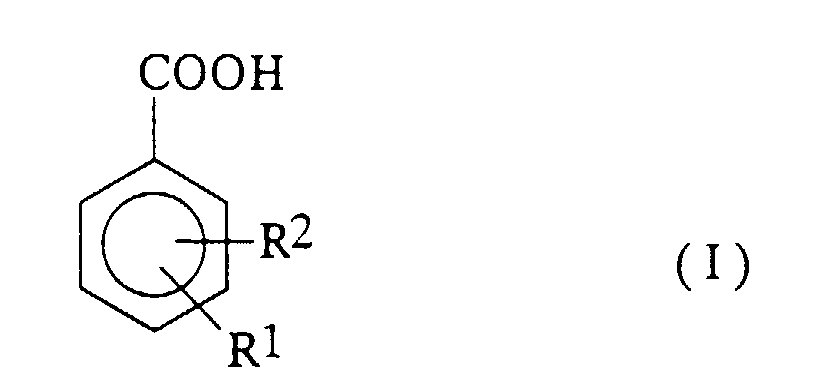
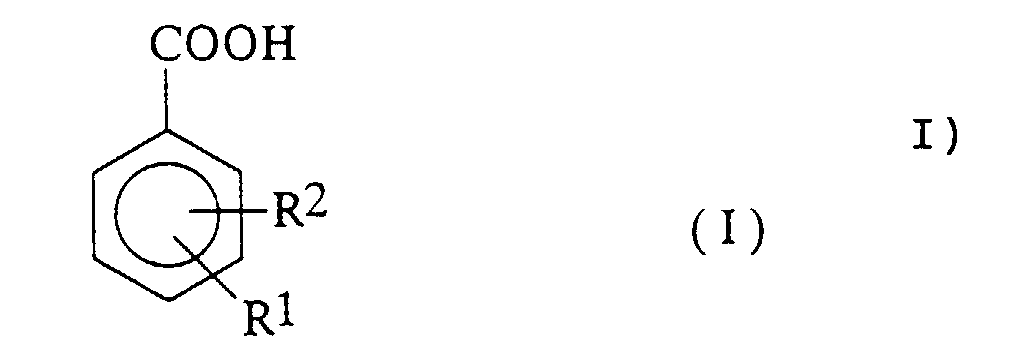
- the additive for masticating natural rubber of the present invention comprises at least one compound selected from the group consisting of the benzoic acids represented by Formula (I) described above, the naphthoic acids represented by Formula (II) described above, the dicarboxylic acids represented by Formula (III) described above and the aromatic polycarboxylic acid derivatives represented by Formula (IV) described above.
- the additive for natural rubber of the present invention can reduce the amount of gel of the natural rubber without lowering the molecular weight thereof by adding at a mastication step of natural rubber.
- benzoic acids represented by Formula (I) described above include benzoic acid, p-toluic acid, p-t-butylbenzoic acid, anthranilic acid, p-aminobenzoic acid, p-nitrobenzoic acid, o-benzoylbenzoic acid, salicylic acid and thiosalicylic acid.
- p-toluic acid and p-t-butylbenzoic acid are preferable in terms of the great effects of the present invention, a low cost and no sublimating property.
- naphthoic acids represented by Formula (II) described above include ⁇ -naphthoic acid, ⁇ -naphthoic acid and ⁇ -oxynaphthoic acid.
- dicarboxylic acids represented by Formula (III) described above include terephthalic acid, isophthalic acid, fumaric acid, adipic acid, maleic acid, citraconic acid, sebacic acid and dodecanoic diacid.
- terephthalic acid isophthalic acid, fumaric acid and adipic acid are preferable in terms of the great effects of the present invention and a low cost.
- aromatic polycarboxylic acid derivatives represented by Formula (IV) described above are, for example, derivatives of any one of phthalic acid, trimellitic acid, pyromellitic acid or an anhydride thereof.
- R 6 is preferably an alkyl group having 1 to 22 carbon atoms, and X is preferably O or (R 9 O) q . In particular, X is preferably O.
- aromatic polycarboxylic acid derivatives represented by Formula (IV) described above are preferably derivatives of any one of phthalic acid, trimellitic acid, pyromellitic acid and an anhydride thereof in which R 6 in Formula (IV) described above is an alkyl group having 1 to 22 carbon atoms and X is O or (R 9 O) q .
- R 6 in Formula (IV) described above is an alkyl group having 1 to 22 carbon atoms and X is O or (R 9 O) q .
- preferable are such derivatives which have O for X.
- they include monostearyl phthalate, monodecyl phthalate, N-octyl phthalamic acid, monodecyl trimellitate, monostearyl trimellitate, monostearyl pyromellitate and distearyl pyromellitate.
- monoalkyl phthalates are preferable in terms of an effect of reducing the amount of gel, a plasticizing effect and a low cost, and monostearyl phthalate is more preferable.
- the mastication method of natural rubber of the present invention is characterized in that the amount of gel of the natural rubber can be reduced without lowering the molecular weight thereof by masticating 100 parts by weight of natural rubber blended with 0.05 to 20 parts by weight of at least one compound selected from the benzoic acids represented by Formula (I) described above, the naphthoic acids represented by Formula (II) described above, the dicarboxylic acids represented by Formula (III) described above and the aromatic polycarboxylic acid derivatives represented by Formula (IV) described above.
- the blending amount of the additives represented by Formulas (I) to (IV) described above has been set to 0.05 to 20 parts by weight per 100 parts by weight of the natural rubber component because the blending amount of less than 0.05 part by weight can not provide the desired effects of the present invention. On the other hand, the blending amount exceeding 20 parts by weight exerts an adverse effect on the breaking characteristics of the vulcanized rubber to bring about undesired effects.
- the blending amount of the additives represented by Formulas (I) to (IV) varies within the range described above depending on the kind of natural rubber such as RSS (Ribbed Smoked sheets) and TSR (Technical Standard Rubber) and the grade, and is preferably within the range from 1 to 5 parts by weight from the viewpoints of a cost, an effect met with an increased amount and handling.
- the additives described above may be used alone or in combination of two or more kinds thereof.
- the additives according to the present invention may be used in combination with thiophenols and disulfides which are usually used as peptizers by substituting for a part of the additives of the present invention.
- the blending amount of the peptizers has to be 10 % by weight or less based on the blending amount of the additives of the present invention. If the blending amount exceeds 10 % by weight, an adverse effect of breaking the molecular chains is increased, and the vulcanized rubber obtained by vulcanization is deteriorated in breaking properties. Accordingly, it is not preferable that the blending amount exceeds 10 % by weight.
- the optimum machine and ranges shall be selected according to uses of the rubber.
- the masticating machine used includes, for example, a roll machine, an internal mixer and a Gordon plasticator.
- a roll interval, a roll revolution ratio, a roll revolution number and the like are selected in the optimum ranges.
- a start temperature of mastication is 60 to 85°C, preferably 70 to 80°C.
- Mastication time is 60 to 120 seconds, preferably 80 to 100 seconds.
- the mastication method of natural rubber thus constituted according to the present invention can reduce the amount of gel of natural rubber without lowering the molecular weight thereof and improve the processability as well (these points shall be explained in further detail in the examples described later).
- Gels formed by intertwined molecular chains and the reaction between functional groups contained in the isoprene chains of natural rubber or the reaction of such functional groups with non-rubber components contained in the natural rubber are absent from the natural rubber composition obtained by the preceding mastication method of natural rubber.
- the amount of gel of the natural rubber can selectively be reduced without lowering the molecular weight thereof.
- this natural rubber composition makes it easy to disperse various compounding agents such as a vulcanizing agent and a filler and facilitates exceedingly operations at a mixing step, that is, operations for milling homogeneously various compounding agents in non-productive mixing in which fillers such as carbon black, oils and an anti-oxidant are blended into crude rubber and milled and then in productive mixing in which sulfur and a vulcanization accelerator are blended and milled.
- a mixing step that is, operations for milling homogeneously various compounding agents in non-productive mixing in which fillers such as carbon black, oils and an anti-oxidant are blended into crude rubber and milled and then in productive mixing in which sulfur and a vulcanization accelerator are blended and milled.
- the use of the natural rubber composition stabilizes the dimensions, makes the skin fine and makes scorching difficult in rolling and extruding which are after-steps, that is, makes it possible to carry out these operations very easily and efficiently and does not deteriorate the breaking characteristics of the vulcanized rubber obtained by vulcanization.
- the resulting natural rubber composition can suitably be used for rubber products such as conveyor belts, belts and hoses in addition to pneumatic tires.
- the pneumatic tire of the present invention is characterized by using the natural rubber composition obtained by the mastication method described above.
- a pneumatic tire has structure that comprises a tread part, a pair of side parts connected at both sides of said tread part and a pair of bead parts each of which is formed in the inner circumferences of said side parts and that is reinforced with a carcass ply formed by disposing carcass ply cords in a tire radial direction and a belt layer surrounding said carcass ply and buried in the inside of the tread part.
- the pneumatic tire of the present invention uses the natural rubber composition obtained by the mastication method described above and is blended, if necessary, with a suitable amount of synthetic rubber depending on the tire component members forming the tire structure described above. That is, if the tire component members are, for example, tread rubber, belt coating rubber, carcass ply rubber, bead filler rubber, rubber chafer and side wall rubber, the natural rubber composition obtained by the mastication method described above is blended, if necessary, with a suitable amount of synthetic rubber according to uses of these tire rubber component members.
- the synthetic rubber to be blended includes, for example, styrene-butadiene rubber (SBR), butadiene rubber (BR), isoprene rubber (IR), butyl rubber (IIR), halogenated butyl rubber (X-IIR), ethylene-propylene rubber (EPDM) and a mixture thereof but shall not be restricted thereto.
- SBR styrene-butadiene rubber
- BR butadiene rubber
- IR isoprene rubber
- IIR butyl rubber
- X-IIR halogenated butyl rubber
- EPDM ethylene-propylene rubber
- a rubber component comprising the natural rubber composition obtained by the mastication method described above and synthetic rubber blended if necessary are blended with a filler such as carbon black, oils and an anti-oxidant depending on the preceding various tire component members to be applied to carry out non-productive mixing and then blended with sulfur and a vulcanization accelerator to carry out productive mixing.
- a filler such as carbon black, oils and an anti-oxidant depending on the preceding various tire component members
- the resulting rubber composition is applied to the respective tire component members.
- These component members are molded into a green tire on a drum, and then the green tire is vulcanized by means of a vulcanizing machine, whereby an intended pneumatic tire is obtained.
- a mixing machine a vulcanizing machine, mixing time (non-productive mixing time and productive mixing time), mixing temperature (non-productive mixing temperature and productive mixing temperature), vulcanizing time and vulcanizing temperature
- mixing time non-productive mixing time and productive mixing time
- mixing temperature non-productive mixing temperature and productive mixing temperature
- vulcanizing time and vulcanizing temperature the optimum machines and ranges are selected depending on uses of the pneumatic tire.
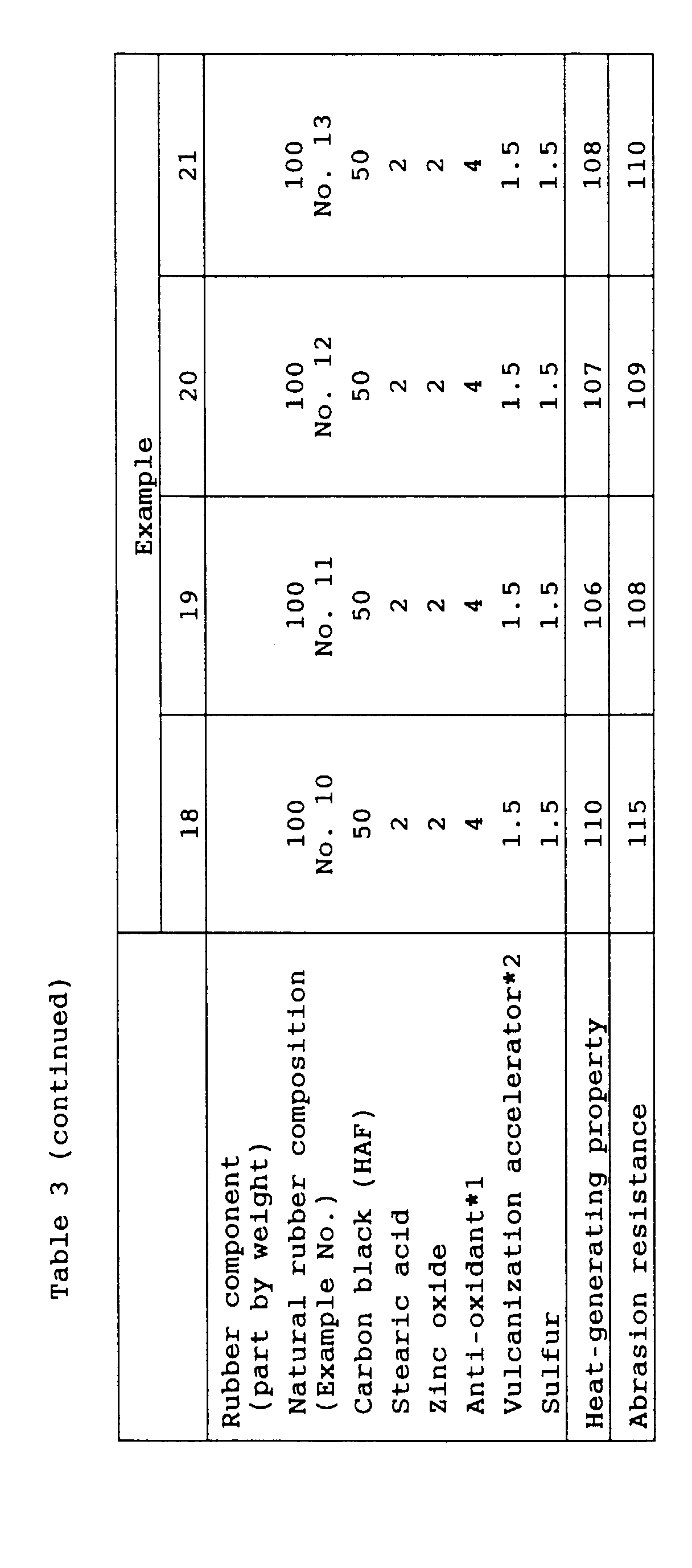
- the pneumatic tire of the present invention thus constituted is excellent in a heat-generating property and abrasion resistance since a reduction in the molecular weights of the natural rubber compositions used for the various tire component members described above is less than in conventional natural rubber compositions.
- the amounts of gel, the molecular weights and the Mooney viscosities were determined by the following methods.
- the gel component was separated by means of a centrifugal separator, and the solvent was evaporated in a vacuum drier. Then, the weight of the gel was measured.
- the molecular weight of masticated rubber was determined by means of GPC (gel permeation chromatography) manufactured by Tosoh Corp. after dissolving 0.03 g of the rubber in 30 ml of THF (tetrahydrofuran) and leaving for standing at room temperature for 24 hours.
- GPC gel permeation chromatography
- the Mooney viscosity of the masticated rubber was measured for processability at 100°C by means of a Mooney viscometer SMV201 manufactured by Shimadzu Corp., and the value obtained after 5 minutes was employed.
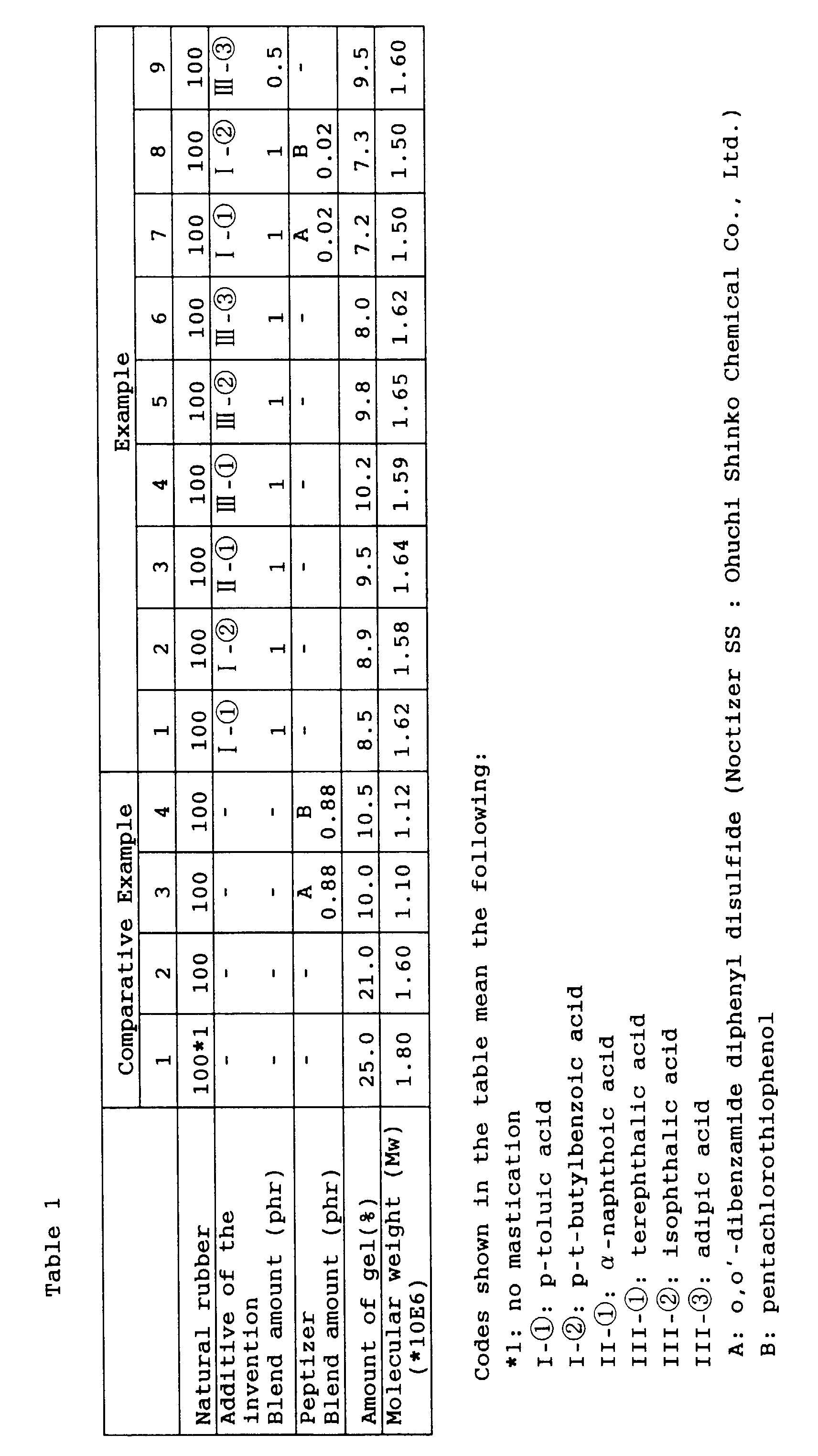
- Natural rubber was blended with the additives according to the recipes (parts by weight) shown in Table 1, and then was masticated by means of a banbury mixer under a masticating conditions of 90 seconds at 80°C of a starting temperature.
- the resulting masticated rubber was measured for an amount of gel and a molecular weight. These results are shown in the following Table 1. RSS No. 3 was used as natural rubber.
- Natural rubber was blended with the additives according to the recipes (parts by weight) shown in Table 2, and then was masticated by means of the banbury mixer under a masticating condition of 90 seconds at 80°C a starting temperature.
- the resulting masticated rubber was measured for an amount of gel, a molecular weight and a Mooney viscosity. These results are shown in the following Table 2. RSS No. 3 was used as natural rubber.
- Comparative Example 1 in which the natural rubber has not been masticated, the amount of gel is increased and in Comparative Example 2 in which the natural rubber has been masticated as usual, the amount of gel is also increased and the molecular weight is lowered as well. Further, it can be confirmed that in Comparative Examples 3 to 6 in which conventional peptizers have been added to masticate the natural rubber, the amounts of gel are reduced but the molecular weights are notably lowered as well. It can be found that in Comparative Example 7 in which less amount of an aromatic polycarboxylic acid derivative which is an additive according to the present invention is blended, the amount of gel grows large.
- a test tire was charged with air having a maximum air pressure prescribed in JATMA and subjected to a running test by means of a drum test machine at a speed of 65 km/hr with a load of 150 % of the maximum load applied to determine the maximum temperature in the inside of the tread.
- a reciprocal number of the temperature was calculated to show a heat-generating property by index, wherein that of Comparative Example was set at 100 (control). The larger the value is, the better the heat-generating property is.
- a commercial car equipped with test tires was driven 5000 km on roads, and then the traveling distance per abrasion by 1 mm was calculated from the remaining grooves.
- Comparative Example 10 was set at 100 (control), and the larger the value is, the more excellent the tire is in abrasion resistance.
Landscapes
- Chemical & Material Sciences (AREA)
- Health & Medical Sciences (AREA)
- Chemical Kinetics & Catalysis (AREA)
- Medicinal Chemistry (AREA)
- Polymers & Plastics (AREA)
- Organic Chemistry (AREA)
- General Chemical & Material Sciences (AREA)
- Compositions Of Macromolecular Compounds (AREA)
- Disintegrating Or Milling (AREA)
Abstract

Description







revolution number 50 RPM, time 4 minutes
revolution number 50 RPM, time 1 minute


Claims (10)
- An additive for masticating natural rubber comprising at least one compound selected from the group consisting of benzoic acids represented by the following Formula (I), naphthoic acids represented by the following Formula (II), dicarboxylic acids represented by the following Formula (III) and aromatic polycarboxylic acid derivatives represented by the following Formula (IV):wherein R1 and R2 each represent -H, -CH3, -CH2CH3, -C(CH3)3, -NH2, -OH, -SH, -NO2, -COPh, -Br, -Cl, -CH2CH2CH3, -CH(CH3)2, -OCH3 or -OC2H5 and may be same or different,
 wherein R3 and R4 each represent -H, -OH or -NH2,
 (ℓ is an integer of 1 to 14),
 and
and wherein m and n each represent an integer of 1 to 3; p represents an integer of 1 to 4; m + n + p = 6; when m≧2, a part or all of the carboxyl groups may be dehydrated to an anhydride in a molecule; X is any one of O, NR8 (R8 is H or an alkyl group having 1 to 24 carbon atoms) and (R9O)q (R9 is an alkyl group having 1 to 4 carbon atoms, and q is an integer of 1 to 5); R6 is any one of an alkyl group having 1 to 24 carbon atoms, an alkenyl group having 2 to 24 carbon atoms and an aryl group having 6 to 24 carbon atoms; R7 is any one of H, OH, an alkyl group, an alkenyl group and an aryl group; and a part or all of hydrogens in both R6 and R7 may be substituted with halogens.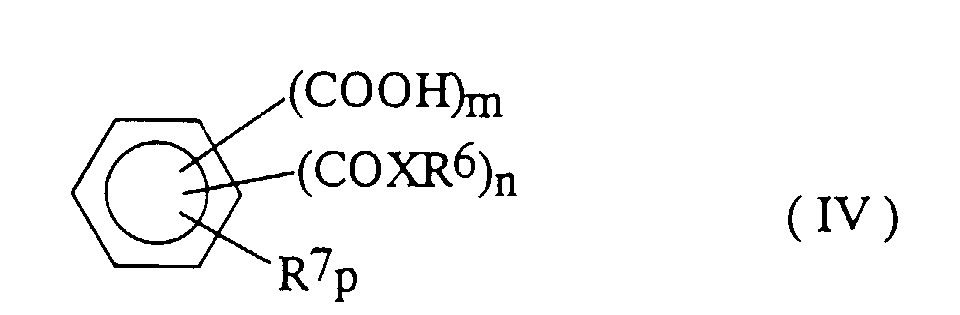
- The additive for natural rubber as described in claim 1, wherein the benzoic acids represented by Formula (I) are p-toluic acid and p-t-butylbenzoic acid.
- The additive for natural rubber as described in claim 1, wherein the dicarboxylic acids represented by Formula (III) are terephthalic acid, isophthalic acid, fumaric acid and adipic acid.
- The additive for natural rubber as described in claim 1, wherein the aromatic polycarboxylic acid derivatives represented by Formula (IV) are derivatives of any one of phthalic acid, trimellitic acid, pyromellitic acid and an anhydride thereof.
- A mastication method of natural rubber comprising a step of carrying out mastication after adding 0.05 to 20 parts by weight of at least one selected from the additives for natural rubber as described in any one of claims 1 to 4 relative to 100 parts by weight of the natural rubber.
- The mastication method of natural rubber as described in claim 5, wherein a peptizer is used in combination with the additive for natural rubber.
- A natural rubber composition obtained by the mastication method of natural rubber as described in claim 5.
- A natural rubber composition obtained by the mastication method of natural rubber as described in claim 6.
- A pneumatic tire characterized by using the natural rubber composition as described in claim 7.
- A pneumatic tire characterized by using the natural rubber composition as described in claim 8.
Applications Claiming Priority (6)
| Application Number | Priority Date | Filing Date | Title |
|---|---|---|---|
| JP72045/97 | 1997-03-25 | ||
| JP07204597A JP3628138B2 (en) | 1997-03-25 | 1997-03-25 | Natural rubber mastication additive, natural rubber mastication method using the additive, and natural rubber produced by the mastication method |
| JP7204597 | 1997-03-25 | ||
| JP01911698A JP3677758B2 (en) | 1998-01-30 | 1998-01-30 | Natural rubber mastication additive, natural rubber mastication method, natural rubber composition obtained by mastication method, and pneumatic tire using the natural rubber composition |
| JP1911698 | 1998-01-30 | ||
| JP19116/98 | 1998-01-30 |
Publications (2)
| Publication Number | Publication Date |
|---|---|
| EP0867468A1 true EP0867468A1 (en) | 1998-09-30 |
| EP0867468B1 EP0867468B1 (en) | 2002-05-29 |
Family
ID=26355934
Family Applications (1)
| Application Number | Title | Priority Date | Filing Date |
|---|---|---|---|
| EP98302100A Expired - Lifetime EP0867468B1 (en) | 1997-03-25 | 1998-03-20 | Additive for masticating natural rubber, mastication method, composition obtained thereof and pneumatic tire |
Country Status (4)
| Country | Link |
|---|---|
| US (1) | US6008304A (en) |
| EP (1) | EP0867468B1 (en) |
| DE (1) | DE69805565T2 (en) |
| ES (1) | ES2176910T3 (en) |
Cited By (5)
| Publication number | Priority date | Publication date | Assignee | Title |
|---|---|---|---|---|
| EP1179561A1 (en) * | 2000-08-08 | 2002-02-13 | Bridgestone Corporation | Additive for rubber composition, additive composition for rubber composition, rubber composition and tire |
| EP1435375A4 (en) * | 2001-10-05 | 2005-12-14 | Bridgestone Corp | Rubber composition |
| CN105669490A (en) * | 2016-01-15 | 2016-06-15 | 辽宁石油化工大学 | Phthalic acid derivative gelator and preparation method and application thereof |
| CN111333532A (en) * | 2020-04-09 | 2020-06-26 | 江苏顶塑实业有限公司 | N-alkyl phthalic diamide acid derivative and synthetic method and application thereof |
| EP3917976A4 (en) * | 2019-01-29 | 2022-11-02 | Bridgestone Americas Tire Operations, LLC | PROCESS FOR THE PRODUCTION OF REDUCED COLD-FLOW POLYDIENES |
Families Citing this family (3)
| Publication number | Priority date | Publication date | Assignee | Title |
|---|---|---|---|---|
| KR20020080782A (en) * | 2001-04-17 | 2002-10-26 | 금호산업 주식회사 | Natural rubber composition |
| JP4236679B2 (en) * | 2006-11-24 | 2009-03-11 | 横浜ゴム株式会社 | Rubber composition |
| US10329463B2 (en) | 2016-05-19 | 2019-06-25 | Shurtape Technologies, Llc | Process for making pressure-sensitive adhesive and duct tape |
Citations (6)
| Publication number | Priority date | Publication date | Assignee | Title |
|---|---|---|---|---|
| US3297607A (en) * | 1962-08-16 | 1967-01-10 | Texas Us Chem Co | Rubbery polybutadiene peptized with c6-c10 monocarboxylic acids |
| DD150473A1 (en) * | 1980-05-06 | 1981-09-02 | Joachim Waschkowiak | REVERSE-RESISTANT MIXTURE |
| US4410656A (en) * | 1982-05-03 | 1983-10-18 | Monsanto Company | Method for rubber treatment |
| EP0494131A1 (en) * | 1991-01-04 | 1992-07-08 | Monsanto Europe S.A./N.V. | Rubber compositions providing improved rubber-vulcanisate properties |
| EP0551818A1 (en) * | 1992-01-16 | 1993-07-21 | Bayer Ag | Vulcanisable rubber compositions |
| EP0603611A1 (en) * | 1992-12-16 | 1994-06-29 | RHEIN-CHEMIE RHEINAU GmbH | Masticating agent for rubber |
Family Cites Families (5)
| Publication number | Priority date | Publication date | Assignee | Title |
|---|---|---|---|---|
| DE150473C (en) * | ||||
| US2570632A (en) * | 1948-04-01 | 1951-10-09 | Us Rubber Co | Improving the cut growth resistance of butadiene-vinyl pyridine rubbery copolymers |
| US3915943A (en) * | 1974-02-27 | 1975-10-28 | Phillips Petroleum Co | Tire tread having low heat buildup |
| US4075159A (en) * | 1974-06-21 | 1978-02-21 | The Yokohama Rubber Co., Ltd. | Rubber compositions with benzoic acid compounds |
| JPS52121653A (en) * | 1976-04-07 | 1977-10-13 | Bridgestone Corp | Wear-resistant rubber articles |
-
1998
- 1998-03-20 DE DE69805565T patent/DE69805565T2/en not_active Expired - Lifetime
- 1998-03-20 ES ES98302100T patent/ES2176910T3/en not_active Expired - Lifetime
- 1998-03-20 EP EP98302100A patent/EP0867468B1/en not_active Expired - Lifetime
- 1998-03-24 US US09/046,606 patent/US6008304A/en not_active Expired - Lifetime
Patent Citations (6)
| Publication number | Priority date | Publication date | Assignee | Title |
|---|---|---|---|---|
| US3297607A (en) * | 1962-08-16 | 1967-01-10 | Texas Us Chem Co | Rubbery polybutadiene peptized with c6-c10 monocarboxylic acids |
| DD150473A1 (en) * | 1980-05-06 | 1981-09-02 | Joachim Waschkowiak | REVERSE-RESISTANT MIXTURE |
| US4410656A (en) * | 1982-05-03 | 1983-10-18 | Monsanto Company | Method for rubber treatment |
| EP0494131A1 (en) * | 1991-01-04 | 1992-07-08 | Monsanto Europe S.A./N.V. | Rubber compositions providing improved rubber-vulcanisate properties |
| EP0551818A1 (en) * | 1992-01-16 | 1993-07-21 | Bayer Ag | Vulcanisable rubber compositions |
| EP0603611A1 (en) * | 1992-12-16 | 1994-06-29 | RHEIN-CHEMIE RHEINAU GmbH | Masticating agent for rubber |
Cited By (10)
| Publication number | Priority date | Publication date | Assignee | Title |
|---|---|---|---|---|
| EP1179561A1 (en) * | 2000-08-08 | 2002-02-13 | Bridgestone Corporation | Additive for rubber composition, additive composition for rubber composition, rubber composition and tire |
| US6806303B2 (en) | 2000-08-08 | 2004-10-19 | Bridgestone Corporation | Additive for rubber composition, additive composition for rubber composition, rubber composition and tire |
| EP1435375A4 (en) * | 2001-10-05 | 2005-12-14 | Bridgestone Corp | Rubber composition |
| US7799856B2 (en) | 2001-10-05 | 2010-09-21 | Bridgestone Corporation | Rubber composition |
| US8110625B2 (en) | 2001-10-05 | 2012-02-07 | Bridgestone Corporation | Rubber composition |
| CN105669490A (en) * | 2016-01-15 | 2016-06-15 | 辽宁石油化工大学 | Phthalic acid derivative gelator and preparation method and application thereof |
| EP3917976A4 (en) * | 2019-01-29 | 2022-11-02 | Bridgestone Americas Tire Operations, LLC | PROCESS FOR THE PRODUCTION OF REDUCED COLD-FLOW POLYDIENES |
| US12091474B2 (en) | 2019-01-29 | 2024-09-17 | Bridgestone Americas Tire Operations, Llc | Method for producing polydienes with reduced cold flow |
| CN111333532A (en) * | 2020-04-09 | 2020-06-26 | 江苏顶塑实业有限公司 | N-alkyl phthalic diamide acid derivative and synthetic method and application thereof |
| CN111333532B (en) * | 2020-04-09 | 2022-09-16 | 江苏顶塑实业有限公司 | N-alkyl phthalic diamide acid derivative and synthetic method and application thereof |
Also Published As
| Publication number | Publication date |
|---|---|
| US6008304A (en) | 1999-12-28 |
| EP0867468B1 (en) | 2002-05-29 |
| ES2176910T3 (en) | 2002-12-01 |
| DE69805565T2 (en) | 2003-01-09 |
| DE69805565D1 (en) | 2002-07-04 |
Similar Documents
| Publication | Publication Date | Title |
|---|---|---|
| JP4046579B2 (en) | tire | |
| EP0867468B1 (en) | Additive for masticating natural rubber, mastication method, composition obtained thereof and pneumatic tire | |
| CN107429005A (en) | Rubber composition and pneumatic tire | |
| KR0185992B1 (en) | Fibrid reinforced elastomers | |
| EP1535961B1 (en) | Tire | |
| EP0719820A1 (en) | Composition for tread rubber of tires | |
| JP2001233997A (en) | Rubber composition and process for preparation thereof | |
| EP0289752A1 (en) | Rubber compositions modified with heterocyclic Di-N-oxides | |
| JP2012102238A (en) | Tread rubber composition and pneumatic tire | |
| EP1179561B1 (en) | Additive for rubber composition, additive composition for rubber composition, rubber composition and tire | |
| JP3677758B2 (en) | Natural rubber mastication additive, natural rubber mastication method, natural rubber composition obtained by mastication method, and pneumatic tire using the natural rubber composition | |
| EP1026196A2 (en) | Pneumatic tire | |
| JP4074164B2 (en) | tire | |
| JP4961081B2 (en) | Additive for rubber composition, additive composition for rubber composition, rubber composition using the same, and pneumatic tire | |
| US5137981A (en) | Halogenated polybutadiene series elastomers, method of producing the same and rubber compositions for tire containing this elastomer | |
| JP2957221B2 (en) | Tire running surface mainly composed of polydiene rubber and having high running performance and method for producing the same | |
| JPH0424374B2 (en) | ||
| JP2011052095A (en) | Rubber composition and pneumatic tire using the same | |
| JP4015844B2 (en) | Additive for rubber composition, additive composition for rubber composition, rubber composition using the same, and tire | |
| CN105452343B (en) | Rubber-silica composite and its manufacturing method and rubber composition and pneumatic tire | |
| JPS58109545A (en) | Rubber composition | |
| KR101884425B1 (en) | Dispensing agent and Rubber Composition Comprising the Same | |
| JP3486288B2 (en) | Rubber composition for tire tread and pneumatic tire | |
| JP3628138B2 (en) | Natural rubber mastication additive, natural rubber mastication method using the additive, and natural rubber produced by the mastication method | |
| JPS6248695B2 (en) |
Legal Events
| Date | Code | Title | Description |
|---|---|---|---|
| PUAI | Public reference made under article 153(3) epc to a published international application that has entered the european phase |
Free format text: ORIGINAL CODE: 0009012 |
|
| AK | Designated contracting states |
Kind code of ref document: A1 Designated state(s): DE ES FR GB IT |
|
| AX | Request for extension of the european patent |
Free format text: AL;LT;LV;MK;RO;SI |
|
| 17P | Request for examination filed |
Effective date: 19981120 |
|
| AKX | Designation fees paid |
Free format text: DE ES FR GB IT |
|
| 17Q | First examination report despatched |
Effective date: 19990611 |
|
| GRAG | Despatch of communication of intention to grant |
Free format text: ORIGINAL CODE: EPIDOS AGRA |
|
| GRAG | Despatch of communication of intention to grant |
Free format text: ORIGINAL CODE: EPIDOS AGRA |
|
| GRAH | Despatch of communication of intention to grant a patent |
Free format text: ORIGINAL CODE: EPIDOS IGRA |
|
| GRAH | Despatch of communication of intention to grant a patent |
Free format text: ORIGINAL CODE: EPIDOS IGRA |
|
| GRAA | (expected) grant |
Free format text: ORIGINAL CODE: 0009210 |
|
| AK | Designated contracting states |
Kind code of ref document: B1 Designated state(s): DE ES FR GB IT |
|
| REG | Reference to a national code |
Ref country code: GB Ref legal event code: FG4D |
|
| REF | Corresponds to: |
Ref document number: 69805565 Country of ref document: DE Date of ref document: 20020704 |
|
| ET | Fr: translation filed | ||
| REG | Reference to a national code |
Ref country code: ES Ref legal event code: FG2A Ref document number: 2176910 Country of ref document: ES Kind code of ref document: T3 |
|
| PLBE | No opposition filed within time limit |
Free format text: ORIGINAL CODE: 0009261 |
|
| STAA | Information on the status of an ep patent application or granted ep patent |
Free format text: STATUS: NO OPPOSITION FILED WITHIN TIME LIMIT |
|
| 26N | No opposition filed |
Effective date: 20030303 |
|
| PG25 | Lapsed in a contracting state [announced via postgrant information from national office to epo] |
Ref country code: IT Free format text: LAPSE BECAUSE OF NON-PAYMENT OF DUE FEES Effective date: 20050320 |
|
| PGFP | Annual fee paid to national office [announced via postgrant information from national office to epo] |
Ref country code: ES Payment date: 20110318 Year of fee payment: 14 Ref country code: GB Payment date: 20110316 Year of fee payment: 14 |
|
| GBPC | Gb: european patent ceased through non-payment of renewal fee |
Effective date: 20120320 |
|
| PG25 | Lapsed in a contracting state [announced via postgrant information from national office to epo] |
Ref country code: GB Free format text: LAPSE BECAUSE OF NON-PAYMENT OF DUE FEES Effective date: 20120320 |
|
| REG | Reference to a national code |
Ref country code: ES Ref legal event code: FD2A Effective date: 20130710 |
|
| PG25 | Lapsed in a contracting state [announced via postgrant information from national office to epo] |
Ref country code: ES Free format text: LAPSE BECAUSE OF NON-PAYMENT OF DUE FEES Effective date: 20120321 |
|
| REG | Reference to a national code |
Ref country code: FR Ref legal event code: CA Effective date: 20140812 |
|
| REG | Reference to a national code |
Ref country code: DE Ref legal event code: R081 Ref document number: 69805565 Country of ref document: DE Owner name: KAO CORPORATION, JP Free format text: FORMER OWNERS: BRIDGESTONE CORP., TOKIO/TOKYO, JP; KAO CORP., TOKIO/TOKYO, JP Effective date: 20140828 Ref country code: DE Ref legal event code: R081 Ref document number: 69805565 Country of ref document: DE Owner name: BRIDGESTONE CORPORATION, JP Free format text: FORMER OWNERS: BRIDGESTONE CORP., TOKIO/TOKYO, JP; KAO CORP., TOKIO/TOKYO, JP Effective date: 20140828 Ref country code: DE Ref legal event code: R081 Ref document number: 69805565 Country of ref document: DE Owner name: KAO CORPORATION, JP Free format text: FORMER OWNER: BRIDGESTONE CORP., KAO CORP., , JP Effective date: 20140828 Ref country code: DE Ref legal event code: R081 Ref document number: 69805565 Country of ref document: DE Owner name: BRIDGESTONE CORPORATION, JP Free format text: FORMER OWNER: BRIDGESTONE CORP., KAO CORP., , JP Effective date: 20140828 |
|
| REG | Reference to a national code |
Ref country code: FR Ref legal event code: PLFP Year of fee payment: 19 |
|
| REG | Reference to a national code |
Ref country code: FR Ref legal event code: PLFP Year of fee payment: 20 |
|
| PGFP | Annual fee paid to national office [announced via postgrant information from national office to epo] |
Ref country code: DE Payment date: 20170322 Year of fee payment: 20 Ref country code: FR Payment date: 20170322 Year of fee payment: 20 |
|
| REG | Reference to a national code |
Ref country code: DE Ref legal event code: R071 Ref document number: 69805565 Country of ref document: DE |