EP0865474B1 - Neoacid corrosion inhibitors - Google Patents
Neoacid corrosion inhibitors Download PDFInfo
- Publication number
- EP0865474B1 EP0865474B1 EP96940572A EP96940572A EP0865474B1 EP 0865474 B1 EP0865474 B1 EP 0865474B1 EP 96940572 A EP96940572 A EP 96940572A EP 96940572 A EP96940572 A EP 96940572A EP 0865474 B1 EP0865474 B1 EP 0865474B1
- Authority
- EP
- European Patent Office
- Prior art keywords
- neo
- antifreeze coolant
- mono
- corrosion inhibitor
- isomer
- Prior art date
- Legal status (The legal status is an assumption and is not a legal conclusion. Google has not performed a legal analysis and makes no representation as to the accuracy of the status listed.)
- Expired - Lifetime
Links
- 230000007797 corrosion Effects 0.000 title claims abstract description 100
- 238000005260 corrosion Methods 0.000 title claims abstract description 100
- 239000003112 inhibitor Substances 0.000 title claims abstract description 83
- 239000000203 mixture Substances 0.000 claims abstract description 67
- 230000002528 anti-freeze Effects 0.000 claims abstract description 51
- 239000002826 coolant Substances 0.000 claims abstract description 46
- YPIFGDQKSSMYHQ-UHFFFAOYSA-N 7,7-dimethyloctanoic acid Chemical compound CC(C)(C)CCCCCC(O)=O YPIFGDQKSSMYHQ-UHFFFAOYSA-N 0.000 claims abstract description 41
- 150000002763 monocarboxylic acids Chemical class 0.000 claims abstract description 39
- 150000003839 salts Chemical class 0.000 claims abstract description 25
- 229910052751 metal Inorganic materials 0.000 claims abstract description 18
- 239000002184 metal Substances 0.000 claims abstract description 18
- 238000009472 formulation Methods 0.000 claims description 44
- 239000012141 concentrate Substances 0.000 claims description 35
- LYCAIKOWRPUZTN-UHFFFAOYSA-N Ethylene glycol Chemical compound OCCO LYCAIKOWRPUZTN-UHFFFAOYSA-N 0.000 claims description 19
- PEDCQBHIVMGVHV-UHFFFAOYSA-N Glycerine Chemical compound OCC(O)CO PEDCQBHIVMGVHV-UHFFFAOYSA-N 0.000 claims description 18
- LFQSCWFLJHTTHZ-UHFFFAOYSA-N Ethanol Chemical compound CCO LFQSCWFLJHTTHZ-UHFFFAOYSA-N 0.000 claims description 14
- -1 or isomer Chemical class 0.000 claims description 13
- VBHRLSQLJDHSCO-UHFFFAOYSA-N 5,5-dimethylhexanoic acid Chemical compound CC(C)(C)CCCC(O)=O VBHRLSQLJDHSCO-UHFFFAOYSA-N 0.000 claims description 11
- DNIAPMSPPWPWGF-UHFFFAOYSA-N Propylene glycol Chemical compound CC(O)CO DNIAPMSPPWPWGF-UHFFFAOYSA-N 0.000 claims description 9
- MTHSVFCYNBDYFN-UHFFFAOYSA-N diethylene glycol Chemical compound OCCOCCO MTHSVFCYNBDYFN-UHFFFAOYSA-N 0.000 claims description 9
- 239000007788 liquid Substances 0.000 claims description 8
- 238000000034 method Methods 0.000 claims description 8
- 238000007710 freezing Methods 0.000 claims description 7
- 230000008014 freezing Effects 0.000 claims description 7
- 150000003852 triazoles Chemical class 0.000 claims description 7
- XLYOFNOQVPJJNP-UHFFFAOYSA-N water Substances O XLYOFNOQVPJJNP-UHFFFAOYSA-N 0.000 claims description 7
- OKKJLVBELUTLKV-UHFFFAOYSA-N Methanol Chemical compound OC OKKJLVBELUTLKV-UHFFFAOYSA-N 0.000 claims description 6
- 238000002485 combustion reaction Methods 0.000 claims description 6
- 230000000994 depressogenic effect Effects 0.000 claims description 6
- 230000002401 inhibitory effect Effects 0.000 claims description 6
- OBETXYAYXDNJHR-SSDOTTSWSA-M (2r)-2-ethylhexanoate Chemical compound CCCC[C@@H](CC)C([O-])=O OBETXYAYXDNJHR-SSDOTTSWSA-M 0.000 claims description 5
- 229910052783 alkali metal Inorganic materials 0.000 claims description 5
- OBETXYAYXDNJHR-UHFFFAOYSA-N alpha-ethylcaproic acid Natural products CCCCC(CC)C(O)=O OBETXYAYXDNJHR-UHFFFAOYSA-N 0.000 claims description 5
- 150000001642 boronic acid derivatives Chemical class 0.000 claims description 5
- 150000002826 nitrites Chemical class 0.000 claims description 5
- YXIWHUQXZSMYRE-UHFFFAOYSA-N 1,3-benzothiazole-2-thiol Chemical compound C1=CC=C2SC(S)=NC2=C1 YXIWHUQXZSMYRE-UHFFFAOYSA-N 0.000 claims description 4
- CMGDVUCDZOBDNL-UHFFFAOYSA-N 4-methyl-2h-benzotriazole Chemical compound CC1=CC=CC2=NNN=C12 CMGDVUCDZOBDNL-UHFFFAOYSA-N 0.000 claims description 4
- LCGLNKUTAGEVQW-UHFFFAOYSA-N Dimethyl ether Chemical compound COC LCGLNKUTAGEVQW-UHFFFAOYSA-N 0.000 claims description 4
- 229910019142 PO4 Inorganic materials 0.000 claims description 4
- FZWLAAWBMGSTSO-UHFFFAOYSA-N Thiazole Chemical compound C1=CSC=N1 FZWLAAWBMGSTSO-UHFFFAOYSA-N 0.000 claims description 4
- 150000001558 benzoic acid derivatives Chemical class 0.000 claims description 4
- 150000002823 nitrates Chemical class 0.000 claims description 4
- 235000021317 phosphate Nutrition 0.000 claims description 4
- 150000003013 phosphoric acid derivatives Chemical class 0.000 claims description 4
- 150000004760 silicates Chemical class 0.000 claims description 4
- 150000003557 thiazoles Chemical class 0.000 claims description 4
- DGAQECJNVWCQMB-PUAWFVPOSA-M Ilexoside XXIX Chemical compound C[C@@H]1CC[C@@]2(CC[C@@]3(C(=CC[C@H]4[C@]3(CC[C@@H]5[C@@]4(CC[C@@H](C5(C)C)OS(=O)(=O)[O-])C)C)[C@@H]2[C@]1(C)O)C)C(=O)O[C@H]6[C@@H]([C@H]([C@@H]([C@H](O6)CO)O)O)O.[Na+] DGAQECJNVWCQMB-PUAWFVPOSA-M 0.000 claims description 3
- 150000008044 alkali metal hydroxides Chemical class 0.000 claims description 3
- SZXQTJUDPRGNJN-UHFFFAOYSA-N dipropylene glycol Chemical compound OCCCOCCCO SZXQTJUDPRGNJN-UHFFFAOYSA-N 0.000 claims description 3
- 150000002739 metals Chemical class 0.000 claims description 3
- 229910052708 sodium Inorganic materials 0.000 claims description 3
- 239000011734 sodium Substances 0.000 claims description 3
- PUPZLCDOIYMWBV-UHFFFAOYSA-N (+/-)-1,3-Butanediol Chemical compound CC(O)CCO PUPZLCDOIYMWBV-UHFFFAOYSA-N 0.000 claims description 2
- 125000003545 alkoxy group Chemical group 0.000 claims description 2
- QRUDEWIWKLJBPS-UHFFFAOYSA-N benzotriazole Chemical compound C1=CC=C2N[N][N]C2=C1 QRUDEWIWKLJBPS-UHFFFAOYSA-N 0.000 claims description 2
- 239000012964 benzotriazole Substances 0.000 claims description 2
- 159000000001 potassium salts Chemical class 0.000 claims description 2
- BDERNNFJNOPAEC-UHFFFAOYSA-N propan-1-ol Chemical compound CCCO BDERNNFJNOPAEC-UHFFFAOYSA-N 0.000 claims description 2
- ZIBGPFATKBEMQZ-UHFFFAOYSA-N triethylene glycol Chemical compound OCCOCCOCCO ZIBGPFATKBEMQZ-UHFFFAOYSA-N 0.000 claims description 2
- RTZKZFJDLAIYFH-UHFFFAOYSA-N Diethyl ether Chemical compound CCOCC RTZKZFJDLAIYFH-UHFFFAOYSA-N 0.000 claims 1
- 150000001991 dicarboxylic acids Chemical class 0.000 claims 1
- 150000007524 organic acids Chemical class 0.000 abstract description 13
- 238000012360 testing method Methods 0.000 description 18
- CXMXRPHRNRROMY-UHFFFAOYSA-N sebacic acid Chemical compound OC(=O)CCCCCCCCC(O)=O CXMXRPHRNRROMY-UHFFFAOYSA-N 0.000 description 16
- HEMHJVSKTPXQMS-UHFFFAOYSA-M Sodium hydroxide Chemical compound [OH-].[Na+] HEMHJVSKTPXQMS-UHFFFAOYSA-M 0.000 description 12
- 239000002253 acid Substances 0.000 description 12
- 229910052782 aluminium Inorganic materials 0.000 description 11
- XAGFODPZIPBFFR-UHFFFAOYSA-N aluminium Chemical compound [Al] XAGFODPZIPBFFR-UHFFFAOYSA-N 0.000 description 11
- 239000000126 substance Substances 0.000 description 6
- HMMSZUQCCUWXRA-UHFFFAOYSA-N 4,4-dimethyl valeric acid Chemical compound CC(C)(C)CCC(O)=O HMMSZUQCCUWXRA-UHFFFAOYSA-N 0.000 description 5
- 150000007513 acids Chemical class 0.000 description 5
- 230000002195 synergetic effect Effects 0.000 description 5
- 239000000654 additive Substances 0.000 description 4
- 230000015572 biosynthetic process Effects 0.000 description 4
- 229910045601 alloy Inorganic materials 0.000 description 3
- 239000000956 alloy Substances 0.000 description 3
- 238000001816 cooling Methods 0.000 description 3
- 230000007423 decrease Effects 0.000 description 3
- 239000012530 fluid Substances 0.000 description 3
- 125000000008 (C1-C10) alkyl group Chemical group 0.000 description 2
- UZHQHNDRVITJPL-UHFFFAOYSA-N 5,6-dimethoxy-1h-indole-2-carboxylic acid Chemical compound C1=C(OC)C(OC)=CC2=C1NC(C(O)=O)=C2 UZHQHNDRVITJPL-UHFFFAOYSA-N 0.000 description 2
- 229910000838 Al alloy Inorganic materials 0.000 description 2
- XEEYBQQBJWHFJM-UHFFFAOYSA-N Iron Chemical compound [Fe] XEEYBQQBJWHFJM-UHFFFAOYSA-N 0.000 description 2
- 239000002518 antifoaming agent Substances 0.000 description 2
- 239000012736 aqueous medium Substances 0.000 description 2
- WPYMKLBDIGXBTP-UHFFFAOYSA-N benzoic acid Chemical compound OC(=O)C1=CC=CC=C1 WPYMKLBDIGXBTP-UHFFFAOYSA-N 0.000 description 2
- 239000003795 chemical substances by application Substances 0.000 description 2
- 239000006185 dispersion Substances 0.000 description 2
- TVIDDXQYHWJXFK-UHFFFAOYSA-N dodecanedioic acid Chemical compound OC(=O)CCCCCCCCCCC(O)=O TVIDDXQYHWJXFK-UHFFFAOYSA-N 0.000 description 2
- 239000000975 dye Substances 0.000 description 2
- 239000013529 heat transfer fluid Substances 0.000 description 2
- 238000010438 heat treatment Methods 0.000 description 2
- 238000002156 mixing Methods 0.000 description 2
- 235000005985 organic acids Nutrition 0.000 description 2
- 239000006174 pH buffer Substances 0.000 description 2
- 230000010287 polarization Effects 0.000 description 2
- 239000002455 scale inhibitor Substances 0.000 description 2
- 230000009919 sequestration Effects 0.000 description 2
- VWDWKYIASSYTQR-UHFFFAOYSA-N sodium nitrate Chemical compound [Na+].[O-][N+]([O-])=O VWDWKYIASSYTQR-UHFFFAOYSA-N 0.000 description 2
- 239000007787 solid Substances 0.000 description 2
- XNWFRZJHXBZDAG-UHFFFAOYSA-N 2-METHOXYETHANOL Chemical compound COCCO XNWFRZJHXBZDAG-UHFFFAOYSA-N 0.000 description 1
- CQPFMGBJSMSXLP-ZAGWXBKKSA-M Acid orange 7 Chemical compound OC1=C(C2=CC=CC=C2C=C1)/N=N/C1=CC=C(C=C1)S(=O)(=O)[O-].[Na+] CQPFMGBJSMSXLP-ZAGWXBKKSA-M 0.000 description 1
- 108010053481 Antifreeze Proteins Proteins 0.000 description 1
- 239000005711 Benzoic acid Substances 0.000 description 1
- 229910001369 Brass Inorganic materials 0.000 description 1
- RYGMFSIKBFXOCR-UHFFFAOYSA-N Copper Chemical compound [Cu] RYGMFSIKBFXOCR-UHFFFAOYSA-N 0.000 description 1
- 229910002651 NO3 Inorganic materials 0.000 description 1
- 229910004619 Na2MoO4 Inorganic materials 0.000 description 1
- NHNBFGGVMKEFGY-UHFFFAOYSA-N Nitrate Chemical compound [O-][N+]([O-])=O NHNBFGGVMKEFGY-UHFFFAOYSA-N 0.000 description 1
- RVGRUAULSDPKGF-UHFFFAOYSA-N Poloxamer Chemical compound C1CO1.CC1CO1 RVGRUAULSDPKGF-UHFFFAOYSA-N 0.000 description 1
- 229910000831 Steel Inorganic materials 0.000 description 1
- CQPFMGBJSMSXLP-UHFFFAOYSA-M acid orange 7 Chemical compound [Na+].OC1=CC=C2C=CC=CC2=C1N=NC1=CC=C(S([O-])(=O)=O)C=C1 CQPFMGBJSMSXLP-UHFFFAOYSA-M 0.000 description 1
- 125000000217 alkyl group Chemical group 0.000 description 1
- 150000003863 ammonium salts Chemical class 0.000 description 1
- 238000004458 analytical method Methods 0.000 description 1
- 235000010233 benzoic acid Nutrition 0.000 description 1
- 239000010951 brass Substances 0.000 description 1
- 230000015556 catabolic process Effects 0.000 description 1
- 125000003636 chemical group Chemical group 0.000 description 1
- 230000000052 comparative effect Effects 0.000 description 1
- 238000013329 compounding Methods 0.000 description 1
- 229910052802 copper Inorganic materials 0.000 description 1
- 239000010949 copper Substances 0.000 description 1
- 239000002173 cutting fluid Substances 0.000 description 1
- 239000010730 cutting oil Substances 0.000 description 1
- 239000008367 deionised water Substances 0.000 description 1
- 229910021641 deionized water Inorganic materials 0.000 description 1
- NJDNXYGOVLYJHP-UHFFFAOYSA-L disodium;2-(3-oxido-6-oxoxanthen-9-yl)benzoate Chemical compound [Na+].[Na+].[O-]C(=O)C1=CC=CC=C1C1=C2C=CC(=O)C=C2OC2=CC([O-])=CC=C21 NJDNXYGOVLYJHP-UHFFFAOYSA-L 0.000 description 1
- NRZDMKVYRRMFRR-UHFFFAOYSA-L disodium;4-[3-(diethylamino)-6-diethylazaniumylidenexanthen-9-yl]benzene-1,3-dicarboxylate;chloride Chemical compound [Na+].[Na+].[Cl-].C=12C=CC(=[N+](CC)CC)C=C2OC2=CC(N(CC)CC)=CC=C2C=1C1=CC=C(C([O-])=O)C=C1C([O-])=O NRZDMKVYRRMFRR-UHFFFAOYSA-L 0.000 description 1
- 230000003628 erosive effect Effects 0.000 description 1
- 230000001747 exhibiting effect Effects 0.000 description 1
- 239000008233 hard water Substances 0.000 description 1
- KQSBZNJFKWOQQK-UHFFFAOYSA-N hystazarin Natural products O=C1C2=CC=CC=C2C(=O)C2=C1C=C(O)C(O)=C2 KQSBZNJFKWOQQK-UHFFFAOYSA-N 0.000 description 1
- 239000004615 ingredient Substances 0.000 description 1
- 229910052742 iron Inorganic materials 0.000 description 1
- 238000009533 lab test Methods 0.000 description 1
- 230000007774 longterm Effects 0.000 description 1
- 239000000463 material Substances 0.000 description 1
- 239000002609 medium Substances 0.000 description 1
- 239000003921 oil Substances 0.000 description 1
- 239000003973 paint Substances 0.000 description 1
- 239000003208 petroleum Substances 0.000 description 1
- 238000002360 preparation method Methods 0.000 description 1
- 230000002265 prevention Effects 0.000 description 1
- 230000002035 prolonged effect Effects 0.000 description 1
- 230000001681 protective effect Effects 0.000 description 1
- 239000002994 raw material Substances 0.000 description 1
- PYWVYCXTNDRMGF-UHFFFAOYSA-N rhodamine B Chemical compound [Cl-].C=12C=CC(=[N+](CC)CC)C=C2OC2=CC(N(CC)CC)=CC=C2C=1C1=CC=CC=C1C(O)=O PYWVYCXTNDRMGF-UHFFFAOYSA-N 0.000 description 1
- 239000011684 sodium molybdate Substances 0.000 description 1
- TVXXNOYZHKPKGW-UHFFFAOYSA-N sodium molybdate (anhydrous) Chemical compound [Na+].[Na+].[O-][Mo]([O-])(=O)=O TVXXNOYZHKPKGW-UHFFFAOYSA-N 0.000 description 1
- 229910000679 solder Inorganic materials 0.000 description 1
- 238000010561 standard procedure Methods 0.000 description 1
- 238000007655 standard test method Methods 0.000 description 1
- 239000010959 steel Substances 0.000 description 1
- 238000010998 test method Methods 0.000 description 1
- 230000001988 toxicity Effects 0.000 description 1
- 231100000419 toxicity Toxicity 0.000 description 1
Images

Classifications
-
- C—CHEMISTRY; METALLURGY
- C09—DYES; PAINTS; POLISHES; NATURAL RESINS; ADHESIVES; COMPOSITIONS NOT OTHERWISE PROVIDED FOR; APPLICATIONS OF MATERIALS NOT OTHERWISE PROVIDED FOR
- C09K—MATERIALS FOR MISCELLANEOUS APPLICATIONS, NOT PROVIDED FOR ELSEWHERE
- C09K5/00—Heat-transfer, heat-exchange or heat-storage materials, e.g. refrigerants; Materials for the production of heat or cold by chemical reactions other than by combustion
-
- C—CHEMISTRY; METALLURGY
- C09—DYES; PAINTS; POLISHES; NATURAL RESINS; ADHESIVES; COMPOSITIONS NOT OTHERWISE PROVIDED FOR; APPLICATIONS OF MATERIALS NOT OTHERWISE PROVIDED FOR
- C09K—MATERIALS FOR MISCELLANEOUS APPLICATIONS, NOT PROVIDED FOR ELSEWHERE
- C09K5/00—Heat-transfer, heat-exchange or heat-storage materials, e.g. refrigerants; Materials for the production of heat or cold by chemical reactions other than by combustion
- C09K5/20—Antifreeze additives therefor, e.g. for radiator liquids
-
- C—CHEMISTRY; METALLURGY
- C23—COATING METALLIC MATERIAL; COATING MATERIAL WITH METALLIC MATERIAL; CHEMICAL SURFACE TREATMENT; DIFFUSION TREATMENT OF METALLIC MATERIAL; COATING BY VACUUM EVAPORATION, BY SPUTTERING, BY ION IMPLANTATION OR BY CHEMICAL VAPOUR DEPOSITION, IN GENERAL; INHIBITING CORROSION OF METALLIC MATERIAL OR INCRUSTATION IN GENERAL
- C23F—NON-MECHANICAL REMOVAL OF METALLIC MATERIAL FROM SURFACE; INHIBITING CORROSION OF METALLIC MATERIAL OR INCRUSTATION IN GENERAL; MULTI-STEP PROCESSES FOR SURFACE TREATMENT OF METALLIC MATERIAL INVOLVING AT LEAST ONE PROCESS PROVIDED FOR IN CLASS C23 AND AT LEAST ONE PROCESS COVERED BY SUBCLASS C21D OR C22F OR CLASS C25
- C23F11/00—Inhibiting corrosion of metallic material by applying inhibitors to the surface in danger of corrosion or adding them to the corrosive agent
-
- C—CHEMISTRY; METALLURGY
- C23—COATING METALLIC MATERIAL; COATING MATERIAL WITH METALLIC MATERIAL; CHEMICAL SURFACE TREATMENT; DIFFUSION TREATMENT OF METALLIC MATERIAL; COATING BY VACUUM EVAPORATION, BY SPUTTERING, BY ION IMPLANTATION OR BY CHEMICAL VAPOUR DEPOSITION, IN GENERAL; INHIBITING CORROSION OF METALLIC MATERIAL OR INCRUSTATION IN GENERAL
- C23F—NON-MECHANICAL REMOVAL OF METALLIC MATERIAL FROM SURFACE; INHIBITING CORROSION OF METALLIC MATERIAL OR INCRUSTATION IN GENERAL; MULTI-STEP PROCESSES FOR SURFACE TREATMENT OF METALLIC MATERIAL INVOLVING AT LEAST ONE PROCESS PROVIDED FOR IN CLASS C23 AND AT LEAST ONE PROCESS COVERED BY SUBCLASS C21D OR C22F OR CLASS C25
- C23F11/00—Inhibiting corrosion of metallic material by applying inhibitors to the surface in danger of corrosion or adding them to the corrosive agent
- C23F11/08—Inhibiting corrosion of metallic material by applying inhibitors to the surface in danger of corrosion or adding them to the corrosive agent in other liquids
-
- C—CHEMISTRY; METALLURGY
- C23—COATING METALLIC MATERIAL; COATING MATERIAL WITH METALLIC MATERIAL; CHEMICAL SURFACE TREATMENT; DIFFUSION TREATMENT OF METALLIC MATERIAL; COATING BY VACUUM EVAPORATION, BY SPUTTERING, BY ION IMPLANTATION OR BY CHEMICAL VAPOUR DEPOSITION, IN GENERAL; INHIBITING CORROSION OF METALLIC MATERIAL OR INCRUSTATION IN GENERAL
- C23F—NON-MECHANICAL REMOVAL OF METALLIC MATERIAL FROM SURFACE; INHIBITING CORROSION OF METALLIC MATERIAL OR INCRUSTATION IN GENERAL; MULTI-STEP PROCESSES FOR SURFACE TREATMENT OF METALLIC MATERIAL INVOLVING AT LEAST ONE PROCESS PROVIDED FOR IN CLASS C23 AND AT LEAST ONE PROCESS COVERED BY SUBCLASS C21D OR C22F OR CLASS C25
- C23F11/00—Inhibiting corrosion of metallic material by applying inhibitors to the surface in danger of corrosion or adding them to the corrosive agent
- C23F11/08—Inhibiting corrosion of metallic material by applying inhibitors to the surface in danger of corrosion or adding them to the corrosive agent in other liquids
- C23F11/10—Inhibiting corrosion of metallic material by applying inhibitors to the surface in danger of corrosion or adding them to the corrosive agent in other liquids using organic inhibitors
-
- C—CHEMISTRY; METALLURGY
- C23—COATING METALLIC MATERIAL; COATING MATERIAL WITH METALLIC MATERIAL; CHEMICAL SURFACE TREATMENT; DIFFUSION TREATMENT OF METALLIC MATERIAL; COATING BY VACUUM EVAPORATION, BY SPUTTERING, BY ION IMPLANTATION OR BY CHEMICAL VAPOUR DEPOSITION, IN GENERAL; INHIBITING CORROSION OF METALLIC MATERIAL OR INCRUSTATION IN GENERAL
- C23F—NON-MECHANICAL REMOVAL OF METALLIC MATERIAL FROM SURFACE; INHIBITING CORROSION OF METALLIC MATERIAL OR INCRUSTATION IN GENERAL; MULTI-STEP PROCESSES FOR SURFACE TREATMENT OF METALLIC MATERIAL INVOLVING AT LEAST ONE PROCESS PROVIDED FOR IN CLASS C23 AND AT LEAST ONE PROCESS COVERED BY SUBCLASS C21D OR C22F OR CLASS C25
- C23F11/00—Inhibiting corrosion of metallic material by applying inhibitors to the surface in danger of corrosion or adding them to the corrosive agent
- C23F11/08—Inhibiting corrosion of metallic material by applying inhibitors to the surface in danger of corrosion or adding them to the corrosive agent in other liquids
- C23F11/10—Inhibiting corrosion of metallic material by applying inhibitors to the surface in danger of corrosion or adding them to the corrosive agent in other liquids using organic inhibitors
- C23F11/12—Oxygen-containing compounds
- C23F11/124—Carboxylic acids
Definitions
- the present invention relates generally to organic acid corrosion inhibitors for antifreeze coolant formulations. More particularly, the present invention relates to C 8 mono-carboxylic acids, or isomers and/or salts thereof, and neo-decanoic acids, or isomers and/or salts thereof, for use in antifreeze coolant concentrates and compositions as corrosion inhibitors to provide prolonged corrosion protection to the metal surfaces in cooling and/or heating systems, such as those found in internal combustion engines.
- Corrosion has long been a problem when certain metals or alloys are used in applications in which they come into contact with an aqueous medium.
- alcohol-based heat transfer fluids i.e., antifreezes
- Compounding this problem is that the corrosion is accelerated under normal engine operating conditions (i.e., high temperatures and pressures).
- Corrosion inhibitors have been used to address these problems.
- triazoles, thiazoles, borates, silicates, phosphates, benzoates, nitrates, nitrites and molybdates have been used in antifreeze formulations.
- SAE SP-811 at pp. 135-138, 145-46.
- corrosion inhibitors have several problems, including toxicity (e.g., borates, nitrites, and molybdates), expense, and inadequate long-term protection. See United States patent No. 4,946,616, col. 1, lines 31-45; United States patent No 4,588,513, col.
- Organic acids such as mono- and/or di-carboxylic acids, have also been used as corrosion inhibitors. See, e.g., United States patent Nos. 4,382,008 (combination of C 7 -C 13 di-carboxylic acid and conventional corrosion inhibitors); 4,448,702 (di-carboxylic acids having 3 or more carbons); 4,647,392 (combination of monobasic and dibasic acids); and 4,946,616 (combination of C 10 and C 12 diacids).
- sebacic acid which is used in several commercial antifreezes (e.g., Texaco's "Havoline” Extended Life AntiFreeze/Coolant; General Motors' “Dex-Cool” Anti-Freeze/Coolant; Canadian Tire's “Motomaster” Long Life and is currently used in the standard formulation set forth by the British Military (see Specification TS 10177 , "Antifreeze, Inhibited Ethanediol, AL-39”), is more difficult to use commercially since it is commercially available as a solid, and as such requires heat to dissolve it in a heat transfer fluid.
- antifreezes e.g., Texaco's "Havoline” Extended Life AntiFreeze/Coolant; General Motors' “Dex-Cool” Anti-Freeze/Coolant; Canadian Tire's “Motomaster” Long Life and is currently used in the standard formulation set forth by the British Military (see Specification TS 10177 , "Antifreeze, Inhibited Ethan
- sebacic acid is generally more expensive and difficult to obtain commercially since currently there is only one domestic industrial supplier (Union Camp Corporation). See SAE SP-811, pp 141-42. Also, sebacic acid and higher di-carboxylic acids, tend to have poor solubility in antifreeze formulations using hard water. See United States patent No 4,578,205, col 1, lines 52-64.
- European patent publication No. 479,470 relates to corrosion inhibitors having at least one acid of the formula: wherein the groups R 1 , R 2 and R 3 are the same or different C 1 -C 10 alkyls or where one of R 1 , R 2 and R 3 is H, and the other two R groups are C 1 -C 10 alkyls.
- this publication does not disclose any specific combination of mono-carboxylic acids nor does it teach or suggest which combinations would be useful.
- the only multi-acid combinations disclosed include sebacic acid, which as previously discussed has several disadvantages.
- neo-decanoic acid a mono-carboxylic organic acid
- United States patent No. 4,390,439 (“Schwartz et al.") relates to the use of neo-decanoic acid as a corrosion inhibitor in hydraulic fluids.
- Schwartz et al. does not teach or suggest other organic acids (except benzoic acid) used alone or in combination with neo-decanoic acid as a corrosion inhibitor.
- SAE SP-811 also describes neo-decanoic acid as a possible corrosion inhibitor. However, SAE SP-811 relates to the use of combinations of mono-carboxylic acids and di-carboxylic acids, including sebacic acid, as corrosion inhibitors. Also, although SAE SP-811 suggests that neo-decanoic acid is effective as a corrosion inhibitor, SAE SP-811 teaches away from the use of neo-decanoic acid since it states that "[t]he use of neodecanoic acid is limited by solubility considerations " (p. 147).
- It is an objective of this invention to provide improved organic acid corrosion inhibitors comprising a C 8 mono-carboxylic acid component, or isomers and/or salts thereof, and a neo-decanoic acid, or isomers and/or salts thereof
- the addition of relatively small amounts of neo-decanoic acid to a C 8 mono-carboxylic acid component results in surprisingly improved corrosion inhibiting properties as compared to conventional corrosion inhibitors, other organic acid corrosion inhibitors, and corrosion inhibitors comprising only the C 8 mono-carboxylic acid component or neo-decanoic acid alone.
- the C 8 mono-carboxylic acid component is preferably 2-ethylhexanoic acid or neo-octanoic acid, and more preferably 2-ethylhexanoic acid.
- these corrosion inhibitors may also comprise other organic acid corrosion inhibitors such as di-carboxylic acids, and conventional corrosion inhibitors such as triazoles, as well as other additives such as anti-foaming agents, dyes, pH buffers, scale inhibitors, sequestration and dispersion agents.
- organic acid corrosion inhibitors such as di-carboxylic acids
- conventional corrosion inhibitors such as triazoles
- additives such as anti-foaming agents, dyes, pH buffers, scale inhibitors, sequestration and dispersion agents.
- Another objective of this invention is to provide antifreeze coolant formulations comprising these corrosion inhibitors and methods of using the formulations for corrosion protection of metal surfaces in heating and/or cooling systems, primarily of internal combustion engines.
- Figure 1 A shows an example of a Type I pitting potential time-graph resulting from the formulation of Example 4.
- Figure 1B shows an example of a Type I+ pitting potential time-graph resulting from the formulation of Example 3.
- Figure 1C shows an example of a Type II pitting potential time-graph resulting from the formulation of Example 2
- the corrosion inhibitors of this invention comprise a C 8 mono-carboxylic acid component (i.e., a single C 8 mono-carboxylic acid or mixtures of C 8 mono-carboxylic acids), or isomers and/or salts thereof, and a neo-decanoic acid component, or isomers and/or salts thereof.
- Neo-decanoic acid is a neoacid which is a type of mono-carboxylic acid.
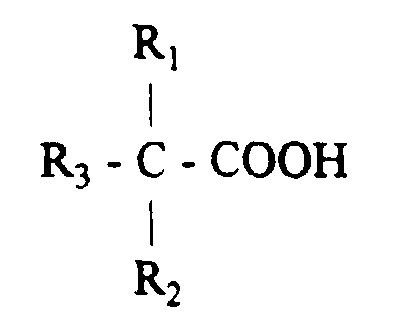
- the term "neoacid” refers to trialkylacetic acids having the following general structure: wherein the groups R 1 , R 2 and R 3 are alkyl groups. Neoacids such as neo-octanoic and neo-decanoic acids are readily available, for example, from Exxon Chemical Company.
- neo-decanoic acid to a C 8 mono-carboxylic acid component results in surprisingly improved corrosion inhibiting properties as compared to corrosion inhibitors having conventional and/or organic acid components, as well as corrosion inhibitors comprising only the C 8 mono-carboxylic acid component or neo-decanoic acid alone.
- the corrosion inhibitors of this invention comprise either 2-ethylhexanoic acid ("2-EHA") or neo-octanoic acid, or isomers and/or salts thereof, and neo-decanoic acid, or isomers and/or salts thereof
- 2-EHA and neo-octanoic acid are less expensive than sebacic acid and more readily available
- 2-EHA may be obtained from, for example, ALLCHEM Industries, Inc., ASHLAND Chemical Co., BASF Corp., Brook-Chem Inc., EASTMAN Chemical Group and Union Carbide Corp.
- neo-octanoic acid is available from, for example, Exxon Chemical Company.
- these mono-carboxylic acids are available as liquids rather than solids (as is sebacic acid) and as such, they are more easily used to prepare corrosion inhibitors on a commercial scale.
- the acid components of the corrosion inhibitors of this invention may alternatively be in the form of an alkali metal salt, ammonium salt or amine salt.
- Preferred salts are the alkali metal salts, and most preferred are sodium or potassium salts of the mono-carboxylic acids.
- the corrosion inhibitors of this invention may also include one or more additional corrosion inhibitors, such as triazoles, thiazoles, di-carboxylic acids, phosphates, borates, silicates, benzoates, nitrates, nitrites, molybdates, or alkali metal salts thereof.
- the preferred corrosion inhibitors of this invention further comprise a triazole or thiazole, more preferably, an aromatic triazole or thiazole such as benzotriazole, mercaptobenzothiazole or tolyltriazole ("TTZ”) and most preferably, TTZ.
- additives may also be used depending on the application. Suitable additives include anti-foaming agents (e.g., "PM-5150” from Union Carbide Corp., “Pluronic L-61” from BASF Corp., and “Patco 492” or “Patco 415" from American Ingredients Company), dyes (e.g., "Alizarine Green,” “Uranine Yellow” or “Green AGS-liquid” from Abbey Color Inc., “Orange II (Acid Orange 7)” or “Intracid Rhodamine WT (Acid Red 388)” from Crompton & Knowles Corp.), pH buffers, scale inhibitors, and/or sequestration and dispersion agents (e.g.,”Dequest” from Monsanto Chemical Company, “Bayhibit” from Miles Inc., “Nalco” or “NalPREP” from Nalco Chemical Company).
- anti-foaming agents e.g., "PM-5150” from Union Carbide Corp., "Pluronic
- the corrosion inhibitors of this invention may be used in numerous applications where metal surfaces (e.g., aluminum, copper, iron, steel, brass, solder or other alloys) are in contact with an aqueous medium.
- metal surfaces e.g., aluminum, copper, iron, steel, brass, solder or other alloys
- they may be used in conjunction with hydraulic fluids, aqueous cutting oils, paints, soluble oils, metal cutting fluids, aircraft deicers, and greases.
- the corrosion inhibitors of this invention are particularly well-suited for use in antifreeze coolant formulations, such as antifreeze coolant concentrates and compositions, for internal combustion engines.
- a minor amount of the corrosion inhibitor is added to a major amount of a water-soluble liquid alcohol freezing point depressant
- the corrosion inhibitor may be added in an amount from about 0.001% to about 5 0% (total mono-carboxylic acid by weight in the concentrate), and preferably, from about 2.0% to about 5.0%.
- the corrosion inhibitor comprises a C 8 mono-carboxylic acid component, or isomers and/or salts thereof, and a relatively small amount of neo-decanoic acid, or isomers and/or salts thereof.
- the amount of neo-decanoic acid used is that which is sufficient to result in a corrosion inhibitor exhibiting a synergistic effect as compared to the corrosion inhibiting effectiveness of the individual acid components.
- the corrosion inhibitor comprises the C 8 mono-carboxylic acid component and neo-decanoic acid in the ratio from about 100:1 to about 1:1, and more preferably, about 3:1.
- the corrosion inhibitor comprises an amount sufficient of the C 8 mono-carboxylic acid component such that in the antifreeze coolant concentrate, this component is present from about 2.4% to about 3.3% (by weight), and more preferably about 3.1%.
- the neo-decanoic acid is present in an amount sufficient such that its concentration in the antifreeze coolant concentrate is from about 0.8% to about 1.1% (by weight), and more preferably about 1.0%.
- the antifreeze coolant concentrate may also include one or more additional corrosion inhibitors, such as triazoles, thiazoles, di-carboxylic acids, phosphates, borates, silicates, benzoates, nitrates, nitrites, molybdates or alkali metal salts thereof.
- additional corrosion inhibitors may be added at concentrations of up to about 5.5% (by weight).
- the antifreeze coolant concentrate comprises up to about 0.8% (by weight) of a triazole or thiazole, and more preferably, up to about 0.5%.
- the major portion of the antifreeze coolant concentrate (i.e., 75%-99.999% (by weight), preferably 90%-99.999% (by weight)) comprises a liquid alcohol freezing point depressant.
- suitable liquid alcohol freezing point depressants include any alcohol or heat transfer medium capable of use as a heat transfer fluid and preferably is at least one alcohol, selected from the group consisting of methanol, ethanol, propanol, ethylene glycol, diethylene glycol, triethylene glycol, propylene glycol, dipropylene glycol, butylene glycol, glycerol, the monethylether of glycerol, the dimethylether of glycerol, alkoxy alkanols (such as methoxyethanol) and mixtures thereof.
- the preferred alcohol is selected from the group consisting of ethylene glycol, diethylene glycol, propylene glycol, dipropylene glycol and mixtures thereof
- the antifreeze coolant concentrate may also comprise a sufficient amount of an alkali metal hydroxide to adjust the pH to between about 6.0 to about 10.0, preferably to about 6.9 to about 9.6.
- Formulations having a pH less than about 6.0 or more than about 10.0 tend to be corrosive to metal surfaces.
- Other additives, as described above, may also be used depending on the application.
- antifreeze coolant compositions are antifreeze coolant compositions.
- an antifreeze concentrate is usually diluted with water such that between 10% to about 90% (by weight) water is present in the composition, and preferably from about 25% to about 75% (by weight) water, with the balance being the antifreeze coolant concentrate.
- the present invention also provides methods for inhibiting corrosion of the metal components in internal combustion engines. Such methods comprise the step of contacting the metals to be protected with the inventive corrosion inhibitors described above.
- Example 2 Twenty-six different antifreeze coolant concentrates were prepared (Examples 1-26). The components of these formulations are described in Tables 1-4 below Each formulation contained ethylene glycol as the water-soluble liquid alcohol freezing point depressant, sodium hydroxide (“NaOH”) to adjust the pH to about 9.0, sodium tolyltriazole (“NaTTZ”), and deionized water, in the specified amounts
- Examples 1-4 correspond to known antifreeze coolant concentrates and serve as control formulations. These Examples include a formulation comprising conventional corrosion inhibitors (Example 1), a formulation comprising an organic acid (mono-carboxylic acid based) corrosion inhibitor (Example 2, contains primarily only organic acid corrosion inhibitors and a small amount of NaTTZ), and formulations comprising conventional corrosion inhibitors as well as organic acid components (di-carboxylic acid based) (Examples 3 and 4).
- Examples 5-8 as shown in Table 2 below, are mono-carboxylic acid antifreeze concentrates each having only a single acid component: 2-EHA (Example 5), neo-heptanoic acid (Example 6), neo-octanoic acid (Example 7) and neo-decanoic acid (Example 8).
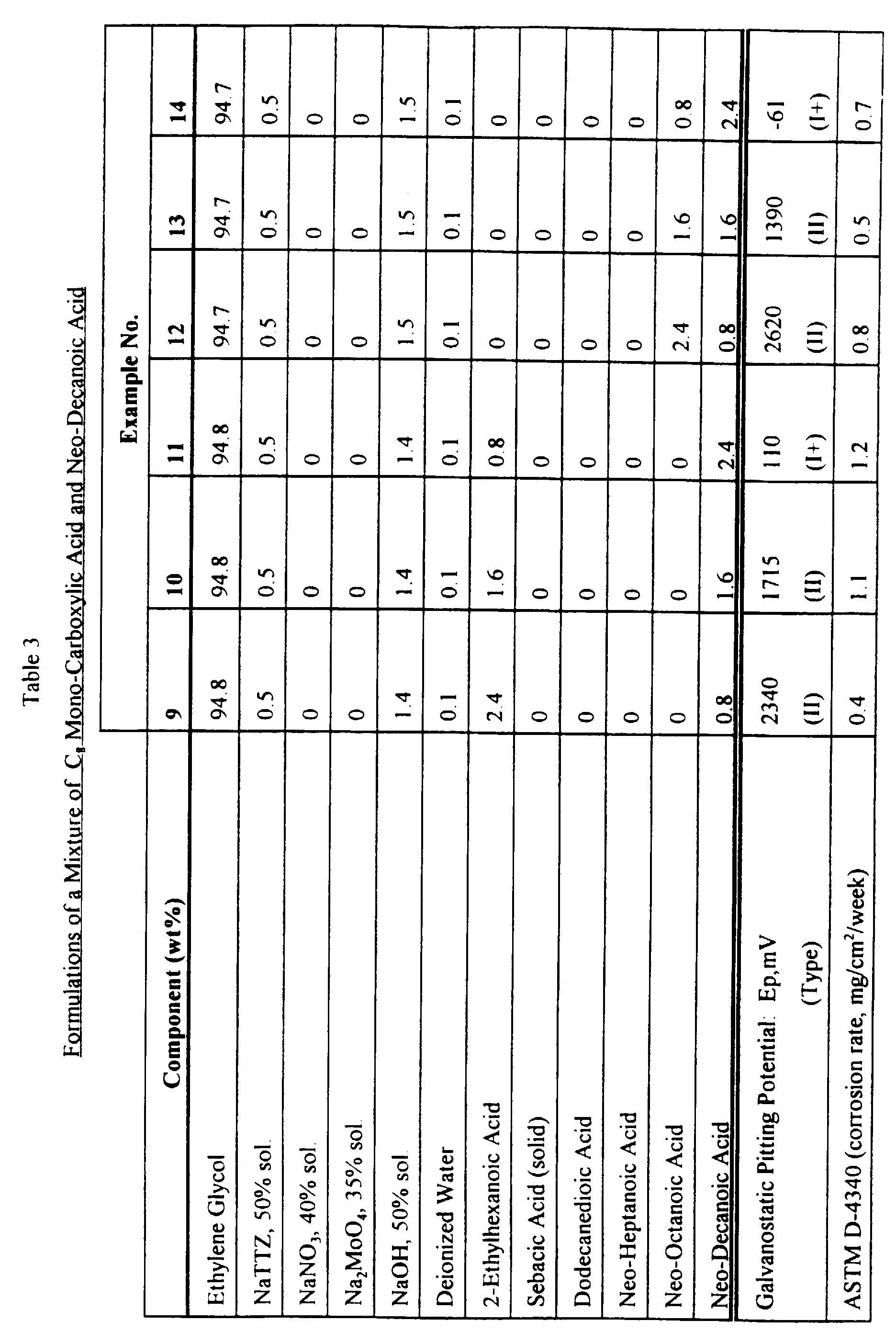
- Examples 9-14 as shown in Table 3 below, contain corrosion inhibitors comprising mixtures of 2-EHA and neo-decanoic acid (Examples 9-11) and neo-octanoic and neo-decanoic acids (Examples 12-14).
- the remaining antifreeze coolant concentrates contain comparative corrosion inhibitors. These formulations either contain mixtures of 2-EHA and neo-octanoic acid (Examples 15-17), or mixtures of neo-heptanoic acid with 2-EHA (Examples 18-20), neo-octanoic acid (Examples 21-23) or neo-decanoic acid (Examples 24-26).
- Each of the formulations tested was prepared in a mixing vessel at room temperature (approximately 20°C) and at a pressure of 91-111 KPa.
- ethylene glycol was added first to the mixing vessel and while being agitated, the remaining components were added in the following order: acid components, NaOH, NaTTZ, water, and other corrosion inhibitors, if any.
- the Galvanostatic Pitting Potential Test is a standard electrochemical technique used to evaluate the effectiveness of corrosion inhibitors in the prevention of pitting corrosion. This test is used to predict the effectiveness of engine coolants in preventing pitting and crevice formation on aluminum heat exchanger alloys. The test measures the pitting potential (Ep) of aluminum alloys in an engine coolant. See Ford Motor Company, BL 5-1, supra . The test procedure is well known.
- This test provides a measure of how well the corrosion inhibitor prevents the breakdown of the protective oxide film and subsequent pit formation on the sample metal, and provides a measure of how well the inhibitor repassivates the surface once initial pit formation has begun.
- the results from this test can be categorized in one of three types.
- corrosion inhibitors comprising a C 8 mono-carboxylic acid and neo-decanoic acid (Examples 9-14, Table 3) exhibit Ep values that are either above or within the acceptable range of -200 to +200 mV Indeed, corrosion inhibitors comprising a C 8 mono-carboxylic acid and a relatively small amount of neo-decanoic acid (Examples 9 and 12, Table 3) exhibited the highest Ep values of all the formulations tested including those of the control group (Examples 1-4, Table 1).
- the corrosion inhibitors comprising a C 8 mono-carboxylic acid and a relatively small amount of neo-decanoic acid (Examples 9 and 12, Table 3) exhibited surprisingly higher Ep values than those expected from the Ep values exhibited by formulations containing only a single mono-carboxylic acid component.
- a small amount of neo-decanoic acid added to 2-EHA resulted in a formulation with a synergistic Ep of 2340 mV as compared to the Ep values of the formulations that contained only 2-EHA (1640 mV, Example 5, Table 2) or neo-decanoic acid (-112 mV, Example 8, Table 2).
- neo-decanoic acid added to neo-octanoic acid (Example 12, Table 3) resulted in a formulation with a synergistic Ep of 2620 mV as compared to the Ep values of the formulations that contained only neo-octanoic acid (2030 mV, Example 7, Table 2) or neo-decanoic acid (-112 mV, Example 8, Table 2).
- the Aluminum Hot Surface Test is another standard technique used to evaluate the effectiveness of corrosion inhibitors. This test measures the corrosion rate of a metal sample resulting from the corrosive properties of antifreeze formulations. According to ASTM D-3306, the maximum allowed corrosion rate resulting from a tested sample is 1.0 mg/cm 2 /week. The results for this test are also set forth in Tables 1-4 above.
- the antifreeze concentrates comprising a C 8 mono-carboxylic acid and a small amount of neo-decanoic acid (Examples 9 and 12, Table 3) resulted in a corrosion rate of 0.8 and 0.4 mg/cm 2 /week, respectively, less than the ASTM D-3306 standard of 1.0 mg/cm 2 /week.
Landscapes
- Chemical & Material Sciences (AREA)
- Engineering & Computer Science (AREA)
- Materials Engineering (AREA)
- Organic Chemistry (AREA)
- Mechanical Engineering (AREA)
- Metallurgy (AREA)
- Physics & Mathematics (AREA)
- Chemical Kinetics & Catalysis (AREA)
- Combustion & Propulsion (AREA)
- Thermal Sciences (AREA)
- Preventing Corrosion Or Incrustation Of Metals (AREA)
- Indole Compounds (AREA)
- Nitrogen Condensed Heterocyclic Rings (AREA)
- Acyclic And Carbocyclic Compounds In Medicinal Compositions (AREA)
- Steroid Compounds (AREA)
Abstract
Description




Claims (16)
- An antifreeze coolant concentrate comprising a water-soluble liquid alcohol freezing point depressant and a corrosion inhibitor composition comprising: (1) a C8 mono-carboxylic acid, or isomer, or salt, or mixture thereof; and (2) relatively small amount of a neo-decanoic acid, or isomer, or salt thereof; wherein the corrosion inhibitor is present in an amount such that the total mono-carboxylic acid in the concentrate is from about 0.001% to about 5.0% (by weight).
- The antifreeze coolant concentrate of claim 1, wherein the C8 mono-carboxylic acid in the corrosion inhibitor composition is selected from the group consisting of 2-ethylhexanoic acid and neo-octanoic acid.
- The antifreeze coolant concentrate according to claim 1 or claim 2, wherein the mono-carboxylic acid components in the corrosion inhibitor composition are in the form of sodium or potassium salts.
- The antifreeze coolant concentrate according to claim 1 or claim 2, wherein the corrosion inhibitor composition further comprises at least one additional corrosion inhibitor selected from the group consisting of triazoles, thiazoles, dicarboxylic acids, phosphates, borates, silicates, benzoates, nitrates, nitrites, molybdates, and alkali metal salts thereof.
- The antifreeze coolant concentrate of according to claim 1 or claim 2, wherein the corrosion inhibitor composition further comprises an aromatic triazole or thiazole.
- The antifreeze coolant concentrate according to claim 5, wherein the corrosion inhibitor composition further comprises benzotriazole, mercaptobenzothiazole or tolyltriazole.
- The antifreeze coolant concentrate according to claim 1 or claim 2, wherein the corrosion inhibitor is present in an amount such that the total mono-carboxylic acid concentration in the concentrate is from about 2.0% to about 5.0% (by weight).
- The antifreeze coolant concentrate according to claim 1 or claim 2, wherein the corrosion inhibitor comprises the C8 mono-carboxylic acid component, or isomer and/or salt thereof, and neo-decanoic acid, or isomer and/or salt thereof, in the weight ratio of from about 100:1 to about 1:1.
- The antifreeze coolant concentrate according to claim 1 or claim 2, wherein the corrosion inhibitor comprises the C8 mono-carboxylic acid component, or isomer and/or salt thereof, and neo-decanoic acid, or isomer and/or salt thereof, in the weight ratio of about 3:1.
- The antifreeze coolant concentrate according to claim 1 or claim 2, wherein the corrosion inhibitor comprises from about 2.4% to about 3.3% (by weight) of the C8 mono-carboxylic acid component, or isomer and/or salt thereof, and from about 0.8% (by weight) to about 1.1% (by weight) of neo-decanoic acid, or isomer and/or salt thereof.
- The antifreeze coolant concentrate according to claim 1 or claim 2, wherein the corrosion inhibitor comprises about 3.1% (by weight) of the C8 mono-carboxylic acid component, or isomer and/or salt thereof, and about 1.0% (by weight) of neo-decanoic acid, or isomer and/or salt thereof.
- The antifreeze coolant concentrate according to claim 1 or claim 2, wherein the water-soluble liquid alcohol freezing point depressant is selected from the group consisting of methanol, ethanol, propanol, ethylene glycol, diethylene glycol, triethylene glycol, propylene glycol, dipropylene glycol, butylene glycol, glycerol, the monoethylether of glycerol, the dimethylether of glycerol, alkoxy alkanols, and mixtures thereof.
- The antifreeze coolant concentrate according to claim 1 or claim 2, further comprising an alkali metal hydroxide in an amount sufficient to adjust the pH of the formulation to between about 6 to about 10.
- An antifreeze coolant composition comprising the antifreeze coolant concentrate according to claim 1 or claim 2, and further comprising water in an amount sufficient such that the amount of water in the formulation is from about 10% to about 90% (by weight).
- An antifreeze coolant concentrate comprising:a) from about 90% to about 98% (by weight) of a liquid-alcohol freezing point depressant;b) from about 2.0% to about 5.0% (by weight) of a mixture of 2-ethylhexanoic acid, or isomer and/or salt thereof, and neo-decanoic acid, or isomer and/or salt thereof;c) up to about 0.5% (by weight) of tolyltriazole; andd) an alkali metal hydroxide in an amount sufficient to adjust the pH of the concentrate to between about 6.9 and about 9.6.
- A method of inhibiting corrosion of the metal components in internal combustion engines comprising the step of contacting the metals to be protected with the antifreeze coolant composition according to claim 14.
Applications Claiming Priority (3)
| Application Number | Priority Date | Filing Date | Title |
|---|---|---|---|
| US08/567,639 US5741436A (en) | 1995-12-05 | 1995-12-05 | Antifreeze concentrates and compositions comprising neodecanoic acid corrosion inhibitors |
| US567639 | 1995-12-05 | ||
| PCT/US1996/018657 WO1997020901A1 (en) | 1995-12-05 | 1996-11-22 | Neoacid corrosion inhibitors |
Publications (2)
| Publication Number | Publication Date |
|---|---|
| EP0865474A1 EP0865474A1 (en) | 1998-09-23 |
| EP0865474B1 true EP0865474B1 (en) | 2000-07-05 |
Family
ID=24268020
Family Applications (1)
| Application Number | Title | Priority Date | Filing Date |
|---|---|---|---|
| EP96940572A Expired - Lifetime EP0865474B1 (en) | 1995-12-05 | 1996-11-22 | Neoacid corrosion inhibitors |
Country Status (17)
| Country | Link |
|---|---|
| US (1) | US5741436A (en) |
| EP (1) | EP0865474B1 (en) |
| JP (1) | JP3192430B2 (en) |
| KR (1) | KR100293023B1 (en) |
| CN (1) | CN1097627C (en) |
| AT (1) | ATE194378T1 (en) |
| AU (1) | AU703894B2 (en) |
| BR (1) | BR9611862A (en) |
| CO (1) | CO4600599A1 (en) |
| DE (1) | DE69609193T2 (en) |
| ES (1) | ES2147942T3 (en) |
| NZ (1) | NZ323308A (en) |
| PE (1) | PE37297A1 (en) |
| PT (1) | PT865474E (en) |
| RU (1) | RU2170752C2 (en) |
| WO (1) | WO1997020901A1 (en) |
| ZA (1) | ZA9610100B (en) |
Families Citing this family (50)
| Publication number | Priority date | Publication date | Assignee | Title |
|---|---|---|---|---|
| DE19625692A1 (en) * | 1996-06-27 | 1998-01-02 | Basf Ag | Antifreeze concentrates free of silicate, borate and nitrate and these comprehensive coolant compositions |
| US5925173A (en) * | 1997-08-11 | 1999-07-20 | Prestone Products Corporation | Method of inhibiting corrosion of flux-treated metal surfaces |
| US5876621A (en) * | 1997-09-30 | 1999-03-02 | Sapienza; Richard | Environmentally benign anti-icing or deicing fluids |
| US6506318B1 (en) * | 1997-09-30 | 2003-01-14 | Mli Associates, Llc | Environmentally benign anti-icing or deicing fluids |
| US20070012896A1 (en) * | 1997-09-30 | 2007-01-18 | Richard Sapienza | Environmentally benign anti-icing or deicing fluids |
| US20030168625A1 (en) * | 1997-09-30 | 2003-09-11 | Richard Sapienza | Environmentally benign anti-icing or deicing fluids |
| AU771582B2 (en) * | 1997-11-06 | 2004-03-25 | Ashland Licensing And Intellectual Property Llc | Monocarboxylic acid based antifreeze composition |
| US6126852A (en) * | 1997-11-06 | 2000-10-03 | Ashland Inc. | Monocarboxylic acid based antifreeze composition |
| US6143243A (en) * | 1997-12-29 | 2000-11-07 | Prestone Products Corporation | Method of inhibiting cavitation-erosion corrosion of aluminum surfaces using carboxylic acid based compositions comprising polymerizable-acid graft polymers |
| US6391257B1 (en) * | 1998-08-19 | 2002-05-21 | Prestone Products Corporation | Antifreeze compositions comprising carboxylic acid and cyclohexenoic acid |
| DE19846434A1 (en) * | 1998-10-08 | 2000-04-13 | Henkel Kgaa | Concentrate used in the manufacture of an engine intake agent contains a water-soluble alcoholic freezing point lowering agent and an effective amount of ammonium salts of carboxylic acids |
| US6191315B1 (en) | 1999-02-11 | 2001-02-20 | Basf Corporation | Haze free polyether polyol compositions and a method for their preparation |
| ATE282679T1 (en) * | 2000-06-19 | 2004-12-15 | Texaco Development Corp | HEAT TRANSFER FLUID CONTAINING NANOPARTICLES AND CARBOXYLATES |
| KR20020049430A (en) * | 2000-12-19 | 2002-06-26 | 이계안 | A composition of hard water resistance engine coolant |
| KR20020050933A (en) * | 2000-12-22 | 2002-06-28 | 김형벽ㅂ | Antifreeze composite |
| EP1304367A1 (en) * | 2001-10-17 | 2003-04-23 | Texaco Development Corporation | Corrosion inhibiting compositions and methods for fuel cell coolant systems |
| US20040075077A1 (en) * | 2002-10-21 | 2004-04-22 | Jean-Pierre Maes | Method for cooling high temperature engines |
| US20090314983A1 (en) * | 2003-01-13 | 2009-12-24 | Richard Sapienza | Environmentally benign anti-icing or deicing fluids |
| RU2241784C1 (en) * | 2003-04-22 | 2004-12-10 | Закрытое акционерное обшество "Булгар-Синтез" | Rust inhibitor for antifreezing agent |
| RU2232209C1 (en) * | 2003-04-22 | 2004-07-10 | Закрытое акционерное общество "Булгар-Синтез" | Antifreeze corrosion inhibitor |
| KR20050039462A (en) * | 2003-10-25 | 2005-04-29 | 윤준석 | Antifreezing liquid |
| RU2263131C1 (en) * | 2004-08-05 | 2005-10-27 | Белокурова Ирина Николаевна | Antifreeze concentrate |
| KR101300541B1 (en) * | 2005-06-24 | 2013-09-02 | 프레스톤 프로닥츠 코포레이션 | Method for inhibiting corrosion in brazed metal surfaces and coolants and additives for use therein |
| WO2007021961A1 (en) * | 2005-08-12 | 2007-02-22 | Honeywell International Inc. | Method for stabilizing an engine coolant concentrate and preventing hard water salt formation upon dilution |
| RU2290425C1 (en) * | 2005-09-26 | 2006-12-27 | Открытое акционерное общество "Техноформ" | Super-concentrate used in preparing antifreezes and heat carrier |
| KR100748779B1 (en) * | 2005-12-12 | 2007-08-13 | 현대자동차주식회사 | Antifreeze Composition |
| DE102006004895A1 (en) * | 2006-02-03 | 2007-08-23 | Clariant International Limited | Heat transfer fluid with improved temperature stability based on higher polyglycols |
| RU2303083C1 (en) * | 2006-03-14 | 2007-07-20 | Институт элементоорганических соединений РАН (ИНЭОС РАН) | Corrosion inhibitor for low-freezing fluids |
| US20080001118A1 (en) * | 2006-06-29 | 2008-01-03 | Alverson Frederick C | Additive combinations, antifreeze concentrates, coolant compositions, and method for using same to provide corrosion and oxidation inhibition at high temperatures |
| FR2904829B1 (en) * | 2006-08-08 | 2012-10-05 | Total France | CARBOXYLIC ACID COMPOSITIONS FOR TEMPORARY PROTECTION OF METALLIC SURFACES AND DRY FILMS OBTAINED THEREFROM |
| US20100311025A1 (en) * | 2009-06-09 | 2010-12-09 | The Government Of The Us, As Represented By The Secretary Of The Navy | Material Formulations for Human Tissue Simulation |
| US8357310B2 (en) * | 2010-11-10 | 2013-01-22 | Hamilton Sundstrand Space Systems International, Inc. | Aqueous based cooling of components having high surface area levels of aluminum or nickel |
| US9023235B2 (en) | 2012-09-07 | 2015-05-05 | Prestone Products Corporation | Heat transfer fluid additive composition |
| US8617416B1 (en) * | 2012-09-07 | 2013-12-31 | Prestone Products Corporation | Heat transfer fluids and corrosion inhibitor formulations for use thereof |
| US9994755B2 (en) | 2012-09-07 | 2018-06-12 | Prestone Products Corporation | Heat transfer fluids and corrosion inhibitor formulations for use thereof |
| RU2518583C1 (en) * | 2012-12-20 | 2014-06-10 | Общество с ограниченной ответственностью "ФОТОН" | Cooling liquid concentrate |
| EP2956520B1 (en) * | 2013-02-13 | 2019-11-06 | Basf Se | Anti-freeze concentrate having corrosion protection and aqueous coolant composition produced therefrom |
| US20150284617A1 (en) * | 2014-04-02 | 2015-10-08 | J. Thomas Light | Non-Aqueous Heat Transfer Fluid With Reduced Low Temperature Viscosity |
| CN103924247B (en) * | 2014-04-12 | 2016-06-08 | 冯智勇 | A kind of efficient coal-burning boiler corrosion inhibiter |
| US10336928B2 (en) | 2014-10-10 | 2019-07-02 | Dober Chemical Corporation | Corrosion inhibited compositions and methods of using same |
| JP6154371B2 (en) * | 2014-12-26 | 2017-06-28 | トヨタ自動車株式会社 | Coolant composition and method for operating internal combustion engine using the same |
| JP6010186B1 (en) * | 2015-06-08 | 2016-10-19 | 一般社団法人鉄筋溶接継手協会 | A backing metal installation tool and a method for welding two rebars using the backing metal installation tool |
| US11560505B2 (en) * | 2018-08-02 | 2023-01-24 | Prestone Products Corporation | Heat transfer fluids containing synergistic blends of corrosion inhibitor formulations |
| US12215272B2 (en) | 2019-03-08 | 2025-02-04 | Prestone Products Llc | Heat transfer fluids and corrosion inhibitor formulations for use thereof |
| JP7771167B2 (en) * | 2020-08-26 | 2025-11-17 | ビーエーエスエフ ソシエタス・ヨーロピア | Novel coolants exhibiting improved storage stability |
| CN115161628B (en) * | 2021-04-07 | 2023-10-13 | 中南大学 | A kind of passivation agent and passivation method for electrolytic manganese |
| DE102021126948A1 (en) | 2021-10-18 | 2023-04-20 | Vaillant Gmbh | Increasing the solubility of alkanes |
| US20230167348A1 (en) * | 2021-12-01 | 2023-06-01 | Valvoline Licensing andIntellectual Property LLC | Low current heat transfer fluid for safer electrical applications |
| EP4540354A1 (en) * | 2022-07-08 | 2025-04-23 | Dow Global Technologies LLC | Lubricant compositions including a polymerizable-acid graft polymer as a corrosion inhibitor |
| WO2025238665A1 (en) * | 2024-05-17 | 2025-11-20 | Patel Kaushikkumar B | A glycol based antifreeze liquid composition for combustion engines, electric vehicles, industrial and submersible motors |
Family Cites Families (31)
| Publication number | Priority date | Publication date | Assignee | Title |
|---|---|---|---|---|
| US2726215A (en) * | 1952-04-19 | 1955-12-06 | Atlantic Refining Co | Rust inhibitors for aqueous systems |
| US2832742A (en) * | 1954-06-09 | 1958-04-29 | Alox Corp | Corrosion inhibitor composition |
| US3573225A (en) * | 1968-02-01 | 1971-03-30 | Masahiko Kondo | Rust-proofing composite solutions |
| US4406811A (en) * | 1980-01-16 | 1983-09-27 | Nalco Chemical Company | Composition and method for controlling corrosion in aqueous systems |
| GB2075483A (en) * | 1980-03-12 | 1981-11-18 | Ici Ltd | Corrosion inhibitors and compositions containing them |
| US4342596A (en) * | 1980-04-10 | 1982-08-03 | Conner Alvin James Sen | Non-petroleum based metal corrosion inhibitor |
| FR2489355A1 (en) * | 1980-08-29 | 1982-03-05 | Perrot Paul Henri | Sodium sebacate as corrosion inhibitor - for glycol antifreeze and heat transfer liq. |
| US4390439A (en) * | 1981-03-30 | 1983-06-28 | Basf Wyandotte Corporation | Water-based hydraulic fluids having improved lubricity and corrosion inhibiting properties employing neodecanoic acid |
| AT378786B (en) * | 1981-10-12 | 1985-09-25 | Lang Chem Tech Prod | FREEZER PROTECTION AND ICE SOLVENT |
| US4488998A (en) * | 1982-08-27 | 1984-12-18 | Atlantic Richfield Company | Preparation of higher antimony tricarboxylates in improved yields using an inert gas |
| US4522785A (en) * | 1982-11-04 | 1985-06-11 | The Sherwin-Williams Company | Dialkylaminomethyl aromatic triazoles as corrosion inhibitors |
| AU562417B2 (en) * | 1983-04-13 | 1987-06-11 | W.R. Grace & Co. | Phosphate or molybdate anti-corrosive compositions |
| US4528108A (en) * | 1983-04-20 | 1985-07-09 | The Lubrizol Corporation | Method for cooling internal combustion engine with an oleaginous coolant fluid composition |
| JPS60118799A (en) * | 1983-11-29 | 1985-06-26 | Nippon Oil Co Ltd | Lubricant for working metal |
| US4587028A (en) * | 1984-10-15 | 1986-05-06 | Texaco Inc. | Non-silicate antifreeze formulations |
| US4588513A (en) * | 1984-11-19 | 1986-05-13 | Texaco, Inc. | Non-borate, non-phosphate antifreeze formulations containing dibasic acid salts as corrosion inhibitors |
| US4578205A (en) * | 1985-02-01 | 1986-03-25 | Texaco, Inc. | Use of methylene azelaic acid as a corrosion inhibitor |
| US4647392A (en) * | 1985-12-27 | 1987-03-03 | Texaco Inc. | Monobasic-dibasic acid/salt antifreeze corrosion inhibitor |
| GB8606901D0 (en) * | 1986-03-20 | 1986-04-23 | Shell Int Research | Corrosion-inhibiting heat-transfer composition |
| US4851145A (en) * | 1986-06-30 | 1989-07-25 | S.A. Texaco Petroleum Nv | Corrosion-inhibited antifreeze/coolant composition |
| US4759864A (en) * | 1987-09-04 | 1988-07-26 | Texaco Inc. & S.A. Texaco Petro, N.V. | Corrosion-inhibited antifreeze formulation |
| KR910003915B1 (en) * | 1988-01-27 | 1991-06-15 | 한국과학기술원 | Anti-freezing liquid |
| US4946616A (en) * | 1988-11-14 | 1990-08-07 | The Dow Chemical Company | Heat transfer fluids containing dicarboxylic acid mixtures as corrosion inhibitors |
| CA2051609A1 (en) * | 1990-10-01 | 1992-04-02 | Jeffrey M. Burns | Corrosion-inhibited antifreeze/coolant composition |
| US5085791A (en) * | 1990-10-01 | 1992-02-04 | Texaco Chemical Company | Corrosion-inhibited antifreeze/coolant composition containing cyclohexane acid(s) |
| DE4034792A1 (en) * | 1990-11-02 | 1992-05-07 | Hoechst Ag | LIQUID DE-CLEANER BASED ON ACETATES AND METHOD FOR MELTING SNOW AND ICE ON TRAFFIC AREAS WITH THE MEANS OF THIS MEANS |
| RU2009158C1 (en) * | 1991-07-01 | 1994-03-15 | Научно-исследовательский институт полимерных материалов | Cooling liquid for internal-combustion engines |
| US5269956A (en) * | 1991-09-25 | 1993-12-14 | Texaco Chemical Co. | Compatible corrosion inhibitor combinations |
| ATE182927T1 (en) * | 1992-02-14 | 1999-08-15 | Atochem Elf Sa | USE FOR INHIBITING COPPER CORROSION OF A COMPOSITION CONSISTING OF HEPTANESOIUCE OR ITS DERIVATIVES AND SODIUM TETRABORATE. |
| ES2103888T3 (en) * | 1992-04-06 | 1997-10-01 | Texaco Services Europ Ltd | CORROSION INHIBITING ANTIFREEZE FORMULATIONS. |
| US5242621A (en) * | 1992-06-03 | 1993-09-07 | Texaco Chemical Co. | Combinations of alkanoic hydrocarbyl dicarboxylic and carbocyclic alkanoic acids or salts useful as heat transfer fluid corrosion inhibitors |
-
1995
- 1995-12-05 US US08/567,639 patent/US5741436A/en not_active Expired - Lifetime
-
1996
- 1996-11-22 EP EP96940572A patent/EP0865474B1/en not_active Expired - Lifetime
- 1996-11-22 JP JP52130697A patent/JP3192430B2/en not_active Expired - Lifetime
- 1996-11-22 AU AU10221/97A patent/AU703894B2/en not_active Expired
- 1996-11-22 WO PCT/US1996/018657 patent/WO1997020901A1/en not_active Ceased
- 1996-11-22 KR KR1019980704176A patent/KR100293023B1/en not_active Expired - Lifetime
- 1996-11-22 ES ES96940572T patent/ES2147942T3/en not_active Expired - Lifetime
- 1996-11-22 AT AT96940572T patent/ATE194378T1/en not_active IP Right Cessation
- 1996-11-22 DE DE69609193T patent/DE69609193T2/en not_active Expired - Lifetime
- 1996-11-22 CN CN96198850A patent/CN1097627C/en not_active Expired - Lifetime
- 1996-11-22 PT PT96940572T patent/PT865474E/en unknown
- 1996-11-22 BR BR9611862-8A patent/BR9611862A/en not_active IP Right Cessation
- 1996-11-22 NZ NZ323308A patent/NZ323308A/en not_active IP Right Cessation
- 1996-11-22 RU RU98112269/04A patent/RU2170752C2/en active
- 1996-12-02 ZA ZA9610100A patent/ZA9610100B/en unknown
- 1996-12-03 PE PE1996000867A patent/PE37297A1/en not_active Application Discontinuation
- 1996-12-04 CO CO96063699A patent/CO4600599A1/en unknown
Also Published As
| Publication number | Publication date |
|---|---|
| CO4600599A1 (en) | 1998-05-08 |
| DE69609193T2 (en) | 2001-03-22 |
| ATE194378T1 (en) | 2000-07-15 |
| US5741436A (en) | 1998-04-21 |
| ES2147942T3 (en) | 2000-10-01 |
| NZ323308A (en) | 2000-01-28 |
| PE37297A1 (en) | 1997-10-04 |
| ZA9610100B (en) | 1997-06-18 |
| PT865474E (en) | 2000-10-31 |
| RU2170752C2 (en) | 2001-07-20 |
| DE69609193D1 (en) | 2000-08-10 |
| JPH11501355A (en) | 1999-02-02 |
| EP0865474A1 (en) | 1998-09-23 |
| JP3192430B2 (en) | 2001-07-30 |
| AU703894B2 (en) | 1999-04-01 |
| CN1203622A (en) | 1998-12-30 |
| KR19990071891A (en) | 1999-09-27 |
| CN1097627C (en) | 2003-01-01 |
| HK1016210A1 (en) | 1999-10-29 |
| KR100293023B1 (en) | 2001-09-06 |
| WO1997020901A1 (en) | 1997-06-12 |
| AU1022197A (en) | 1997-06-27 |
| BR9611862A (en) | 2000-10-10 |
Similar Documents
| Publication | Publication Date | Title |
|---|---|---|
| US5741436A (en) | Antifreeze concentrates and compositions comprising neodecanoic acid corrosion inhibitors | |
| EP1119593B1 (en) | Antifreeze compositions comprising carboxylic acid and cyclohexenoic acid corrosion inhibitors | |
| EP0251480B1 (en) | Corrosion-inhibited antifreeze/coolant composition | |
| EP0308037B1 (en) | Corrosion - inhibited antifreeze formulation | |
| EP0816467B1 (en) | Silicate, borate and nitrate free antifreeze concentrate and refrigerant comprising said antifreeze | |
| JP2004530017A (en) | Antifreeze concentrate containing dye C.I. ReactiveViolet 5 | |
| CA2308195C (en) | Silicate free antifreeze composition | |
| US6235217B1 (en) | Monocarboxylic acid based antifreeze composition | |
| KR930002766B1 (en) | Inhibited alkylene glycol coolant and cooling process | |
| JP3686120B2 (en) | Antifreeze composition | |
| AU3502900A (en) | Monocarboxylic acid based antifreeze composition for diesel engines | |
| CA2309887C (en) | Neoacid corrosion inhibitors | |
| CA2238174C (en) | Neoacid corrosion inhibitors | |
| HK1016210B (en) | Neoacid corrosion inhibitors | |
| JP3651939B2 (en) | Antifreeze composition | |
| SA97170544B1 (en) | Antifreeze concentrates and formulations containing neo-decanoic acid as a rust inhibitor | |
| MXPA00004372A (en) | Silicate free antifreeze composition |
Legal Events
| Date | Code | Title | Description |
|---|---|---|---|
| PUAI | Public reference made under article 153(3) epc to a published international application that has entered the european phase |
Free format text: ORIGINAL CODE: 0009012 |
|
| 17P | Request for examination filed |
Effective date: 19980703 |
|
| AK | Designated contracting states |
Kind code of ref document: A1 Designated state(s): AT BE CH DE DK ES FI FR GB GR IE IT LI LU MC NL PT SE |
|
| GRAG | Despatch of communication of intention to grant |
Free format text: ORIGINAL CODE: EPIDOS AGRA |
|
| 17Q | First examination report despatched |
Effective date: 19990507 |
|
| GRAG | Despatch of communication of intention to grant |
Free format text: ORIGINAL CODE: EPIDOS AGRA |
|
| GRAG | Despatch of communication of intention to grant |
Free format text: ORIGINAL CODE: EPIDOS AGRA |
|
| GRAH | Despatch of communication of intention to grant a patent |
Free format text: ORIGINAL CODE: EPIDOS IGRA |
|
| GRAH | Despatch of communication of intention to grant a patent |
Free format text: ORIGINAL CODE: EPIDOS IGRA |
|
| GRAA | (expected) grant |
Free format text: ORIGINAL CODE: 0009210 |
|
| AK | Designated contracting states |
Kind code of ref document: B1 Designated state(s): AT BE CH DE DK ES FI FR GB GR IE IT LI LU MC NL PT SE |
|
| PG25 | Lapsed in a contracting state [announced via postgrant information from national office to epo] |
Ref country code: NL Free format text: LAPSE BECAUSE OF FAILURE TO SUBMIT A TRANSLATION OF THE DESCRIPTION OR TO PAY THE FEE WITHIN THE PRESCRIBED TIME-LIMIT Effective date: 20000705 Ref country code: IT Free format text: LAPSE BECAUSE OF FAILURE TO SUBMIT A TRANSLATION OF THE DESCRIPTION OR TO PAY THE FEE WITHIN THE PRE;WARNING: LAPSES OF ITALIAN PATENTS WITH EFFECTIVE DATE BEFORE 2007 MAY HAVE OCCURRED AT ANY TIME BEFORE 2007. THE CORRECT EFFECTIVE DATE MAY BE DIFFERENT FROM THE ONE RECORDED.SCRIBED TIME-LIMIT Effective date: 20000705 Ref country code: GR Free format text: LAPSE BECAUSE OF NON-PAYMENT OF DUE FEES Effective date: 20000705 Ref country code: FI Free format text: LAPSE BECAUSE OF FAILURE TO SUBMIT A TRANSLATION OF THE DESCRIPTION OR TO PAY THE FEE WITHIN THE PRESCRIBED TIME-LIMIT Effective date: 20000705 Ref country code: AT Free format text: LAPSE BECAUSE OF FAILURE TO SUBMIT A TRANSLATION OF THE DESCRIPTION OR TO PAY THE FEE WITHIN THE PRESCRIBED TIME-LIMIT Effective date: 20000705 |
|
| REF | Corresponds to: |
Ref document number: 194378 Country of ref document: AT Date of ref document: 20000715 Kind code of ref document: T |
|
| REG | Reference to a national code |
Ref country code: CH Ref legal event code: EP |
|
| REG | Reference to a national code |
Ref country code: IE Ref legal event code: FG4D |
|
| REF | Corresponds to: |
Ref document number: 69609193 Country of ref document: DE Date of ref document: 20000810 |
|
| REG | Reference to a national code |
Ref country code: ES Ref legal event code: FG2A Ref document number: 2147942 Country of ref document: ES Kind code of ref document: T3 |
|
| PG25 | Lapsed in a contracting state [announced via postgrant information from national office to epo] |
Ref country code: SE Free format text: LAPSE BECAUSE OF FAILURE TO SUBMIT A TRANSLATION OF THE DESCRIPTION OR TO PAY THE FEE WITHIN THE PRESCRIBED TIME-LIMIT Effective date: 20001005 Ref country code: DK Free format text: LAPSE BECAUSE OF FAILURE TO SUBMIT A TRANSLATION OF THE DESCRIPTION OR TO PAY THE FEE WITHIN THE PRESCRIBED TIME-LIMIT Effective date: 20001005 |
|
| ET | Fr: translation filed | ||
| REG | Reference to a national code |
Ref country code: PT Ref legal event code: SC4A Free format text: AVAILABILITY OF NATIONAL TRANSLATION Effective date: 20000707 |
|
| PG25 | Lapsed in a contracting state [announced via postgrant information from national office to epo] |
Ref country code: LU Free format text: LAPSE BECAUSE OF NON-PAYMENT OF DUE FEES Effective date: 20001122 Ref country code: IE Free format text: LAPSE BECAUSE OF NON-PAYMENT OF DUE FEES Effective date: 20001122 |
|
| PG25 | Lapsed in a contracting state [announced via postgrant information from national office to epo] |
Ref country code: MC Free format text: THE PATENT HAS BEEN ANNULLED BY A DECISION OF A NATIONAL AUTHORITY Effective date: 20001130 |
|
| NLV1 | Nl: lapsed or annulled due to failure to fulfill the requirements of art. 29p and 29m of the patents act | ||
| PLBE | No opposition filed within time limit |
Free format text: ORIGINAL CODE: 0009261 |
|
| STAA | Information on the status of an ep patent application or granted ep patent |
Free format text: STATUS: NO OPPOSITION FILED WITHIN TIME LIMIT |
|
| 26N | No opposition filed | ||
| REG | Reference to a national code |
Ref country code: IE Ref legal event code: MM4A |
|
| REG | Reference to a national code |
Ref country code: GB Ref legal event code: IF02 |
|
| REG | Reference to a national code |
Ref country code: CH Ref legal event code: PFA Owner name: PRESTONE PRODUCTS CORPORATION Free format text: PRESTONE PRODUCTS CORPORATION#39 OLD RIDGEBURY ROAD#DANBURY, CONNECTICUT 06810-5109 (US) -TRANSFER TO- PRESTONE PRODUCTS CORPORATION#39 OLD RIDGEBURY ROAD#DANBURY, CONNECTICUT 06810-5109 (US) |
|
| REG | Reference to a national code |
Ref country code: FR Ref legal event code: PLFP Year of fee payment: 20 |
|
| PGFP | Annual fee paid to national office [announced via postgrant information from national office to epo] |
Ref country code: CH Payment date: 20151127 Year of fee payment: 20 Ref country code: DE Payment date: 20151127 Year of fee payment: 20 Ref country code: GB Payment date: 20151127 Year of fee payment: 20 |
|
| PGFP | Annual fee paid to national office [announced via postgrant information from national office to epo] |
Ref country code: PT Payment date: 20151120 Year of fee payment: 20 Ref country code: FR Payment date: 20151117 Year of fee payment: 20 Ref country code: BE Payment date: 20151130 Year of fee payment: 20 Ref country code: ES Payment date: 20151126 Year of fee payment: 20 |
|
| REG | Reference to a national code |
Ref country code: DE Ref legal event code: R071 Ref document number: 69609193 Country of ref document: DE |
|
| REG | Reference to a national code |
Ref country code: CH Ref legal event code: PL |
|
| REG | Reference to a national code |
Ref country code: GB Ref legal event code: PE20 Expiry date: 20161121 |
|
| PG25 | Lapsed in a contracting state [announced via postgrant information from national office to epo] |
Ref country code: GB Free format text: LAPSE BECAUSE OF EXPIRATION OF PROTECTION Effective date: 20161121 |
|
| PG25 | Lapsed in a contracting state [announced via postgrant information from national office to epo] |
Ref country code: PT Free format text: LAPSE BECAUSE OF EXPIRATION OF PROTECTION Effective date: 20161130 |
|
| REG | Reference to a national code |
Ref country code: ES Ref legal event code: FD2A Effective date: 20170301 |
|
| PG25 | Lapsed in a contracting state [announced via postgrant information from national office to epo] |
Ref country code: ES Free format text: LAPSE BECAUSE OF EXPIRATION OF PROTECTION Effective date: 20161123 |