EP0865090A1 - Electrode for cell - Google Patents
Electrode for cell Download PDFInfo
- Publication number
- EP0865090A1 EP0865090A1 EP96939322A EP96939322A EP0865090A1 EP 0865090 A1 EP0865090 A1 EP 0865090A1 EP 96939322 A EP96939322 A EP 96939322A EP 96939322 A EP96939322 A EP 96939322A EP 0865090 A1 EP0865090 A1 EP 0865090A1
- Authority
- EP
- European Patent Office
- Prior art keywords
- electrode
- coupling agent
- silane coupling
- admixture
- powder
- Prior art date
- Legal status (The legal status is an assumption and is not a legal conclusion. Google has not performed a legal analysis and makes no representation as to the accuracy of the status listed.)
- Withdrawn
Links
- 239000000843 powder Substances 0.000 claims abstract description 173
- 239000006087 Silane Coupling Agent Substances 0.000 claims abstract description 171
- 229910045601 alloy Inorganic materials 0.000 claims abstract description 127
- 239000000956 alloy Substances 0.000 claims abstract description 127
- 239000000758 substrate Substances 0.000 claims abstract description 95
- 239000001257 hydrogen Substances 0.000 claims abstract description 89
- 229910052739 hydrogen Inorganic materials 0.000 claims abstract description 89
- BFDHFSHZJLFAMC-UHFFFAOYSA-L nickel(ii) hydroxide Chemical compound [OH-].[OH-].[Ni+2] BFDHFSHZJLFAMC-UHFFFAOYSA-L 0.000 claims abstract description 84
- UFHFLCQGNIYNRP-UHFFFAOYSA-N Hydrogen Chemical compound [H][H] UFHFLCQGNIYNRP-UHFFFAOYSA-N 0.000 claims abstract description 78
- 239000011149 active material Substances 0.000 claims abstract description 36
- 239000011230 binding agent Substances 0.000 claims abstract description 33
- 239000002562 thickening agent Substances 0.000 claims abstract description 30
- PXHVJJICTQNCMI-UHFFFAOYSA-N Nickel Chemical group [Ni] PXHVJJICTQNCMI-UHFFFAOYSA-N 0.000 claims description 182
- 229910052759 nickel Inorganic materials 0.000 claims description 84
- 229920002313 fluoropolymer Polymers 0.000 claims description 55
- XLYOFNOQVPJJNP-UHFFFAOYSA-N water Substances O XLYOFNOQVPJJNP-UHFFFAOYSA-N 0.000 claims description 28
- 230000002940 repellent Effects 0.000 claims description 7
- 239000005871 repellent Substances 0.000 claims description 7
- 239000003795 chemical substances by application Substances 0.000 claims 1
- 125000004435 hydrogen atom Chemical group [H]* 0.000 claims 1
- 229920001343 polytetrafluoroethylene Polymers 0.000 description 56
- 239000004810 polytetrafluoroethylene Substances 0.000 description 56
- 238000000034 method Methods 0.000 description 43
- 239000000725 suspension Substances 0.000 description 33
- 239000000470 constituent Substances 0.000 description 32
- 238000004519 manufacturing process Methods 0.000 description 21
- 230000000052 comparative effect Effects 0.000 description 20
- 230000014759 maintenance of location Effects 0.000 description 19
- 239000007822 coupling agent Substances 0.000 description 18
- 238000005096 rolling process Methods 0.000 description 17
- 238000001035 drying Methods 0.000 description 16
- 238000004898 kneading Methods 0.000 description 16
- 239000004020 conductor Substances 0.000 description 15
- 239000012466 permeate Substances 0.000 description 14
- 229920002134 Carboxymethyl cellulose Polymers 0.000 description 13
- 239000007864 aqueous solution Substances 0.000 description 13
- -1 polytetrafluoroethylene Polymers 0.000 description 13
- HEMHJVSKTPXQMS-UHFFFAOYSA-M Sodium hydroxide Chemical compound [OH-].[Na+] HEMHJVSKTPXQMS-UHFFFAOYSA-M 0.000 description 12
- HCHKCACWOHOZIP-UHFFFAOYSA-N Zinc Chemical compound [Zn] HCHKCACWOHOZIP-UHFFFAOYSA-N 0.000 description 12
- 239000000126 substance Substances 0.000 description 12
- 229910052725 zinc Inorganic materials 0.000 description 12
- 239000011701 zinc Substances 0.000 description 12
- 238000009826 distribution Methods 0.000 description 10
- 239000006104 solid solution Substances 0.000 description 10
- 238000011049 filling Methods 0.000 description 9
- 125000000524 functional group Chemical group 0.000 description 9
- 230000000694 effects Effects 0.000 description 8
- 238000004080 punching Methods 0.000 description 8
- 239000003792 electrolyte Substances 0.000 description 7
- YUYCVXFAYWRXLS-UHFFFAOYSA-N trimethoxysilane Chemical compound CO[SiH](OC)OC YUYCVXFAYWRXLS-UHFFFAOYSA-N 0.000 description 7
- LYCAIKOWRPUZTN-UHFFFAOYSA-N Ethylene glycol Chemical compound OCCO LYCAIKOWRPUZTN-UHFFFAOYSA-N 0.000 description 6
- WMFOQBRAJBCJND-UHFFFAOYSA-M Lithium hydroxide Chemical compound [Li+].[OH-] WMFOQBRAJBCJND-UHFFFAOYSA-M 0.000 description 6
- 239000002033 PVDF binder Substances 0.000 description 6
- DNIAPMSPPWPWGF-UHFFFAOYSA-N Propylene glycol Chemical compound CC(O)CO DNIAPMSPPWPWGF-UHFFFAOYSA-N 0.000 description 6
- IVMYJDGYRUAWML-UHFFFAOYSA-N cobalt(II) oxide Inorganic materials [Co]=O IVMYJDGYRUAWML-UHFFFAOYSA-N 0.000 description 6
- 239000006260 foam Substances 0.000 description 6
- 239000000203 mixture Substances 0.000 description 6
- 229920002981 polyvinylidene fluoride Polymers 0.000 description 6
- 229920001780 ECTFE Polymers 0.000 description 5
- 150000004703 alkoxides Chemical group 0.000 description 5
- 229920000840 ethylene tetrafluoroethylene copolymer Polymers 0.000 description 5
- 239000004745 nonwoven fabric Substances 0.000 description 5
- 229920002493 poly(chlorotrifluoroethylene) Polymers 0.000 description 5
- 239000005023 polychlorotrifluoroethylene (PCTFE) polymer Substances 0.000 description 5
- PPBRXRYQALVLMV-UHFFFAOYSA-N Styrene Chemical compound C=CC1=CC=CC=C1 PPBRXRYQALVLMV-UHFFFAOYSA-N 0.000 description 4
- 229920001577 copolymer Polymers 0.000 description 4
- 238000000354 decomposition reaction Methods 0.000 description 4
- 238000011835 investigation Methods 0.000 description 4
- 239000002184 metal Substances 0.000 description 4
- 229910052751 metal Inorganic materials 0.000 description 4
- 229920000642 polymer Polymers 0.000 description 4
- 239000000047 product Substances 0.000 description 4
- 229910001122 Mischmetal Inorganic materials 0.000 description 3
- 125000000217 alkyl group Chemical group 0.000 description 3
- 229910052799 carbon Inorganic materials 0.000 description 3
- 239000001768 carboxy methyl cellulose Substances 0.000 description 3
- 235000010948 carboxy methyl cellulose Nutrition 0.000 description 3
- 239000008112 carboxymethyl-cellulose Substances 0.000 description 3
- 229920002620 polyvinyl fluoride Polymers 0.000 description 3
- 239000010935 stainless steel Substances 0.000 description 3
- 229910001220 stainless steel Inorganic materials 0.000 description 3
- 239000000375 suspending agent Substances 0.000 description 3
- CHJAYYWUZLWNSQ-UHFFFAOYSA-N 1-chloro-1,2,2-trifluoroethene;ethene Chemical group C=C.FC(F)=C(F)Cl CHJAYYWUZLWNSQ-UHFFFAOYSA-N 0.000 description 2
- KHLRJDNGHBXOSV-UHFFFAOYSA-N 5-trimethoxysilylpentane-1,3-diamine Chemical compound CO[Si](OC)(OC)CCC(N)CCN KHLRJDNGHBXOSV-UHFFFAOYSA-N 0.000 description 2
- CYJRNFFLTBEQSQ-UHFFFAOYSA-N 8-(3-methyl-1-benzothiophen-5-yl)-N-(4-methylsulfonylpyridin-3-yl)quinoxalin-6-amine Chemical compound CS(=O)(=O)C1=C(C=NC=C1)NC=1C=C2N=CC=NC2=C(C=1)C=1C=CC2=C(C(=CS2)C)C=1 CYJRNFFLTBEQSQ-UHFFFAOYSA-N 0.000 description 2
- 239000001856 Ethyl cellulose Substances 0.000 description 2
- ZZSNKZQZMQGXPY-UHFFFAOYSA-N Ethyl cellulose Chemical compound CCOCC1OC(OC)C(OCC)C(OCC)C1OC1C(O)C(O)C(OC)C(CO)O1 ZZSNKZQZMQGXPY-UHFFFAOYSA-N 0.000 description 2
- YCKRFDGAMUMZLT-UHFFFAOYSA-N Fluorine atom Chemical compound [F] YCKRFDGAMUMZLT-UHFFFAOYSA-N 0.000 description 2
- 229920000663 Hydroxyethyl cellulose Polymers 0.000 description 2
- 239000004354 Hydroxyethyl cellulose Substances 0.000 description 2
- 229920000459 Nitrile rubber Polymers 0.000 description 2
- 239000004677 Nylon Substances 0.000 description 2
- 239000002202 Polyethylene glycol Substances 0.000 description 2
- 239000004793 Polystyrene Substances 0.000 description 2
- 239000004372 Polyvinyl alcohol Substances 0.000 description 2
- CDBYLPFSWZWCQE-UHFFFAOYSA-L Sodium Carbonate Chemical compound [Na+].[Na+].[O-]C([O-])=O CDBYLPFSWZWCQE-UHFFFAOYSA-L 0.000 description 2
- NOZAQBYNLKNDRT-UHFFFAOYSA-N [diacetyloxy(ethenyl)silyl] acetate Chemical compound CC(=O)O[Si](OC(C)=O)(OC(C)=O)C=C NOZAQBYNLKNDRT-UHFFFAOYSA-N 0.000 description 2
- 230000001070 adhesive effect Effects 0.000 description 2
- 125000003277 amino group Chemical group 0.000 description 2
- 229920002678 cellulose Polymers 0.000 description 2
- 239000001913 cellulose Substances 0.000 description 2
- 238000006243 chemical reaction Methods 0.000 description 2
- YGZSVWMBUCGDCV-UHFFFAOYSA-N chloro(methyl)silane Chemical compound C[SiH2]Cl YGZSVWMBUCGDCV-UHFFFAOYSA-N 0.000 description 2
- GUTLYIVDDKVIGB-UHFFFAOYSA-N cobalt atom Chemical compound [Co] GUTLYIVDDKVIGB-UHFFFAOYSA-N 0.000 description 2
- 230000008602 contraction Effects 0.000 description 2
- YQGOWXYZDLJBFL-UHFFFAOYSA-N dimethoxysilane Chemical compound CO[SiH2]OC YQGOWXYZDLJBFL-UHFFFAOYSA-N 0.000 description 2
- 239000006185 dispersion Substances 0.000 description 2
- 229920001971 elastomer Polymers 0.000 description 2
- 125000003700 epoxy group Chemical group 0.000 description 2
- 229920001249 ethyl cellulose Polymers 0.000 description 2
- 235000019325 ethyl cellulose Nutrition 0.000 description 2
- 229940093476 ethylene glycol Drugs 0.000 description 2
- 239000000835 fiber Substances 0.000 description 2
- 239000011737 fluorine Substances 0.000 description 2
- 229910052731 fluorine Inorganic materials 0.000 description 2
- 229920001973 fluoroelastomer Polymers 0.000 description 2
- 150000002431 hydrogen Chemical class 0.000 description 2
- 235000019447 hydroxyethyl cellulose Nutrition 0.000 description 2
- 238000005259 measurement Methods 0.000 description 2
- 229920000609 methyl cellulose Polymers 0.000 description 2
- 239000001923 methylcellulose Substances 0.000 description 2
- 235000010981 methylcellulose Nutrition 0.000 description 2
- BFXIKLCIZHOAAZ-UHFFFAOYSA-N methyltrimethoxysilane Chemical compound CO[Si](C)(OC)OC BFXIKLCIZHOAAZ-UHFFFAOYSA-N 0.000 description 2
- KBJFYLLAMSZSOG-UHFFFAOYSA-N n-(3-trimethoxysilylpropyl)aniline Chemical compound CO[Si](OC)(OC)CCCNC1=CC=CC=C1 KBJFYLLAMSZSOG-UHFFFAOYSA-N 0.000 description 2
- 229920001778 nylon Polymers 0.000 description 2
- 229920001084 poly(chloroprene) Polymers 0.000 description 2
- 229920000058 polyacrylate Polymers 0.000 description 2
- 229920001223 polyethylene glycol Polymers 0.000 description 2
- 229920002223 polystyrene Polymers 0.000 description 2
- 229920002451 polyvinyl alcohol Polymers 0.000 description 2
- 235000019422 polyvinyl alcohol Nutrition 0.000 description 2
- 239000011148 porous material Substances 0.000 description 2
- 238000002360 preparation method Methods 0.000 description 2
- 229960004063 propylene glycol Drugs 0.000 description 2
- 235000013772 propylene glycol Nutrition 0.000 description 2
- 230000036647 reaction Effects 0.000 description 2
- 239000005060 rubber Substances 0.000 description 2
- 238000000682 scanning probe acoustic microscopy Methods 0.000 description 2
- XGVXKJKTISMIOW-ZDUSSCGKSA-N simurosertib Chemical compound N1N=CC(C=2SC=3C(=O)NC(=NC=3C=2)[C@H]2N3CCC(CC3)C2)=C1C XGVXKJKTISMIOW-ZDUSSCGKSA-N 0.000 description 2
- 238000006277 sulfonation reaction Methods 0.000 description 2
- 239000004094 surface-active agent Substances 0.000 description 2
- BFKJFAAPBSQJPD-UHFFFAOYSA-N tetrafluoroethene Chemical group FC(F)=C(F)F BFKJFAAPBSQJPD-UHFFFAOYSA-N 0.000 description 2
- 125000003396 thiol group Chemical group [H]S* 0.000 description 2
- CPUDPFPXCZDNGI-UHFFFAOYSA-N triethoxy(methyl)silane Chemical compound CCO[Si](C)(OCC)OCC CPUDPFPXCZDNGI-UHFFFAOYSA-N 0.000 description 2
- QQQSFSZALRVCSZ-UHFFFAOYSA-N triethoxysilane Chemical compound CCO[SiH](OCC)OCC QQQSFSZALRVCSZ-UHFFFAOYSA-N 0.000 description 2
- 125000000391 vinyl group Chemical group [H]C([*])=C([H])[H] 0.000 description 2
- OXYZDRAJMHGSMW-UHFFFAOYSA-N 3-chloropropyl(trimethoxy)silane Chemical compound CO[Si](OC)(OC)CCCCl OXYZDRAJMHGSMW-UHFFFAOYSA-N 0.000 description 1
- SJECZPVISLOESU-UHFFFAOYSA-N 3-trimethoxysilylpropan-1-amine Chemical compound CO[Si](OC)(OC)CCCN SJECZPVISLOESU-UHFFFAOYSA-N 0.000 description 1
- QGZKDVFQNNGYKY-UHFFFAOYSA-O Ammonium Chemical compound [NH4+] QGZKDVFQNNGYKY-UHFFFAOYSA-O 0.000 description 1
- OKTJSMMVPCPJKN-UHFFFAOYSA-N Carbon Chemical compound [C] OKTJSMMVPCPJKN-UHFFFAOYSA-N 0.000 description 1
- 229910021503 Cobalt(II) hydroxide Inorganic materials 0.000 description 1
- MYMOFIZGZYHOMD-UHFFFAOYSA-N Dioxygen Chemical compound O=O MYMOFIZGZYHOMD-UHFFFAOYSA-N 0.000 description 1
- NHNBFGGVMKEFGY-UHFFFAOYSA-N Nitrate Chemical compound [O-][N+]([O-])=O NHNBFGGVMKEFGY-UHFFFAOYSA-N 0.000 description 1
- IOVCWXUNBOPUCH-UHFFFAOYSA-N Nitrous acid Chemical compound ON=O IOVCWXUNBOPUCH-UHFFFAOYSA-N 0.000 description 1
- BLRPTPMANUNPDV-UHFFFAOYSA-N Silane Chemical compound [SiH4] BLRPTPMANUNPDV-UHFFFAOYSA-N 0.000 description 1
- 239000013543 active substance Substances 0.000 description 1
- OJIJEKBXJYRIBZ-UHFFFAOYSA-N cadmium nickel Chemical compound [Ni].[Cd] OJIJEKBXJYRIBZ-UHFFFAOYSA-N 0.000 description 1
- 239000006229 carbon black Substances 0.000 description 1
- 239000007795 chemical reaction product Substances 0.000 description 1
- ASKVAEGIVYSGNY-UHFFFAOYSA-L cobalt(ii) hydroxide Chemical compound [OH-].[OH-].[Co+2] ASKVAEGIVYSGNY-UHFFFAOYSA-L 0.000 description 1
- LBFUKZWYPLNNJC-UHFFFAOYSA-N cobalt(ii,iii) oxide Chemical compound [Co]=O.O=[Co]O[Co]=O LBFUKZWYPLNNJC-UHFFFAOYSA-N 0.000 description 1
- 238000007906 compression Methods 0.000 description 1
- 125000000113 cyclohexyl group Chemical group [H]C1([H])C([H])([H])C([H])([H])C([H])(*)C([H])([H])C1([H])[H] 0.000 description 1
- 230000007423 decrease Effects 0.000 description 1
- 239000008367 deionised water Substances 0.000 description 1
- 229910021641 deionized water Inorganic materials 0.000 description 1
- 230000001419 dependent effect Effects 0.000 description 1
- 230000006866 deterioration Effects 0.000 description 1
- 230000002542 deteriorative effect Effects 0.000 description 1
- ZXPDYFSTVHQQOI-UHFFFAOYSA-N diethoxysilane Chemical compound CCO[SiH2]OCC ZXPDYFSTVHQQOI-UHFFFAOYSA-N 0.000 description 1
- 229910001882 dioxygen Inorganic materials 0.000 description 1
- 239000012153 distilled water Substances 0.000 description 1
- 230000002708 enhancing effect Effects 0.000 description 1
- NKSJNEHGWDZZQF-UHFFFAOYSA-N ethenyl(trimethoxy)silane Chemical compound CO[Si](OC)(OC)C=C NKSJNEHGWDZZQF-UHFFFAOYSA-N 0.000 description 1
- 125000001495 ethyl group Chemical group [H]C([H])([H])C([H])([H])* 0.000 description 1
- 150000002334 glycols Chemical class 0.000 description 1
- XLYOFNOQVPJJNP-UHFFFAOYSA-M hydroxide Chemical compound [OH-] XLYOFNOQVPJJNP-UHFFFAOYSA-M 0.000 description 1
- 238000005342 ion exchange Methods 0.000 description 1
- 230000002427 irreversible effect Effects 0.000 description 1
- 125000001449 isopropyl group Chemical group [H]C([H])([H])C([H])(*)C([H])([H])[H] 0.000 description 1
- 125000002496 methyl group Chemical group [H]C([H])([H])* 0.000 description 1
- 238000002156 mixing Methods 0.000 description 1
- QELJHCBNGDEXLD-UHFFFAOYSA-N nickel zinc Chemical compound [Ni].[Zn] QELJHCBNGDEXLD-UHFFFAOYSA-N 0.000 description 1
- 230000003647 oxidation Effects 0.000 description 1
- 238000007254 oxidation reaction Methods 0.000 description 1
- 125000001997 phenyl group Chemical group [H]C1=C([H])C([H])=C(*)C([H])=C1[H] 0.000 description 1
- 229920006122 polyamide resin Polymers 0.000 description 1
- 229920000098 polyolefin Polymers 0.000 description 1
- 239000011347 resin Substances 0.000 description 1
- 229920005989 resin Polymers 0.000 description 1
- 238000007493 shaping process Methods 0.000 description 1
- 229910000077 silane Inorganic materials 0.000 description 1
- 239000007787 solid Substances 0.000 description 1
- QAOWNCQODCNURD-UHFFFAOYSA-N sulfuric acid Substances OS(O)(=O)=O QAOWNCQODCNURD-UHFFFAOYSA-N 0.000 description 1
- 238000009692 water atomization Methods 0.000 description 1
Images

Classifications
-
- H—ELECTRICITY
- H01—ELECTRIC ELEMENTS
- H01M—PROCESSES OR MEANS, e.g. BATTERIES, FOR THE DIRECT CONVERSION OF CHEMICAL ENERGY INTO ELECTRICAL ENERGY
- H01M4/00—Electrodes
- H01M4/02—Electrodes composed of, or comprising, active material
- H01M4/64—Carriers or collectors
- H01M4/66—Selection of materials
- H01M4/665—Composites
- H01M4/667—Composites in the form of layers, e.g. coatings
-
- H—ELECTRICITY
- H01—ELECTRIC ELEMENTS
- H01M—PROCESSES OR MEANS, e.g. BATTERIES, FOR THE DIRECT CONVERSION OF CHEMICAL ENERGY INTO ELECTRICAL ENERGY
- H01M4/00—Electrodes
- H01M4/02—Electrodes composed of, or comprising, active material
- H01M4/24—Electrodes for alkaline accumulators
-
- H—ELECTRICITY
- H01—ELECTRIC ELEMENTS
- H01M—PROCESSES OR MEANS, e.g. BATTERIES, FOR THE DIRECT CONVERSION OF CHEMICAL ENERGY INTO ELECTRICAL ENERGY
- H01M4/00—Electrodes
- H01M4/02—Electrodes composed of, or comprising, active material
- H01M4/62—Selection of inactive substances as ingredients for active masses, e.g. binders, fillers
- H01M4/621—Binders
-
- Y—GENERAL TAGGING OF NEW TECHNOLOGICAL DEVELOPMENTS; GENERAL TAGGING OF CROSS-SECTIONAL TECHNOLOGIES SPANNING OVER SEVERAL SECTIONS OF THE IPC; TECHNICAL SUBJECTS COVERED BY FORMER USPC CROSS-REFERENCE ART COLLECTIONS [XRACs] AND DIGESTS
- Y02—TECHNOLOGIES OR APPLICATIONS FOR MITIGATION OR ADAPTATION AGAINST CLIMATE CHANGE
- Y02E—REDUCTION OF GREENHOUSE GAS [GHG] EMISSIONS, RELATED TO ENERGY GENERATION, TRANSMISSION OR DISTRIBUTION
- Y02E60/00—Enabling technologies; Technologies with a potential or indirect contribution to GHG emissions mitigation
- Y02E60/10—Energy storage using batteries
Definitions
- the present invention relates to an electrode for battery which is used as a positive and/or a negative electrode in a closed alkaline secondary battery such as a nickel-zinc secondary battery, a nickel-cadmium battery and a nickel-hydrogen secondary battery, and more specifically to an electrode for battery wherein admixture for electrode, which has powdered active material as a main constituent and is carried on a conductive substrate, adheres to the conductive substrate securely, therefore flaking of the admixture for electrode at the time of charge and discharge is suppressed, so that the battery exhibits high capacity retention for a long time and has good cycle life characteristics.
- a closed alkaline secondary battery such as a nickel-zinc secondary battery, a nickel-cadmium battery and a nickel-hydrogen secondary battery
- a nickel-hydrogen secondary battery of which practical use as a power source for various electric and electronic apparatuses is developing rapidly, is a non-polluting and high-capacity battery.
- the nickel-hydrogen secondary battery operates using hydrogen absorbing alloy as active material for negative electrode. More specifically, a nickel electrode, in which nickel hydroxide powder as active material for positive electrode is carried on a conductive substrate, is used as a positive electrode, and a hydrogen absorbing alloy electrode, in which hydrogen absorbing alloy powder, electrochemically absorbing and desorbing hydrogen, is carried on a conductive substrate, is used as a negative electrode.
- Those positive and negative electrodes are contained in an armoring can together with predetermined alkaline electrolyte, and the battery has closed structure as a whole.
- a nickel electrode As a nickel electrode, a sintered nickel electrode and a non-sintered nickel electrode are available.
- the non-sintered nickel electrode is thought more advantageous, since the non-sintered nickel electrode makes it possible to raise filling density of active material, to raise capacity of an electrode and to lower production cost.
- the non-sintered nickel electrode is generally produced as follows:
- Predetermined quantities of nickel hydroxide powder as active material, aqueous solution of thickener prepared by dissolving thickener in water, and if required, powdered conductive material and binder are mixed to prepare active admixture paste.
- a predetermined quantity of that admixture paste is applied to a conductive substrate such as a foam nickel sheet having three-dimensional network structure, so that voids of the conductive substrate is filled with the admixture paste and at the same time the admixture paste adheres to the surface of the conductive substrate in the form of a layer. Then, drying and rolling are performed in succession.
- thickener dissolved in water covers surfaces of grains of powder constituents of the admixture paste, thereby serving as surface active agent for realizing homogenious dispersion of the powder constituents.
- Cellulose type polymer such as carboxymethylcellulose, methylcellulose, hydroxyethylcellulose and ethylcellulose
- synthetic high polymer such as ethyleneglycol, polyethyleneglycol, propyleneglycol, polyvinylalcohol and polyacrylate soda are used generally.
- Powdered conductive material is used to raise current collecting capacity of the nickel electrode.
- Nickel powder, carbonylnickel powder, cobalt powder, cobalt oxide powder, cobalt hydroxide powder and the like are used generally.
- Binder is used to mutually bond the grains of powder constituents such as the aforementioned nickel hydroxide powder and the powdered conductive material and to have them carried on the current collector.
- fluoroplastics powder such as polytetrafluoroethylene (PTFE) powder, tetrafluoroethylene hexafluoropropylene copolymer (FEP) powder, tetrafluoroethylene perfluoroalkylvinylether copolymer (PFA) powder, polychlorotrifluoroethylene (PCTFE) powder, polyvinylidene fluoride (PVDF) powder, polyvinyl fluoride powder, ethylene tetrafluoroethylene copolymer (ETFE) powder and ethylene chlorotrifluoroethylene copolymer (ECTFE) powder, powdered fluoro rubber, chloroprene rubber, nitrile rubber, styrene rubber and the like, and powdered polystyrene, nylon and the like are used generally
- admixture for electrode dry admixture having nickel hydroxide powder as a main constituent
- admixture for electrode dry admixture having nickel hydroxide powder as a main constituent
- the powdered binder is spread to bond the grains of powder constituents of the admixture for electrode, such as nickel hydroxide powder and powdered conductive material, mutually.
- the admixture for electrode is, as a whole, carried in the voids and on the surfaces of the current collector.
- the whole conductive substrate is heated to a desired temperature to melt the aforementioned binder, so that the admixture for electrode is carried on the conductive substrate more firmly.
- the hydrogen absorbing alloy electrode is produced as follows: Normally, hydrogen absorbing alloy powder having a predetermined grain size, aqueous solution of thickener prepared by dissolving thickener in water as mentioned above, and if required, powdered conductive material are mixed in a predetermined proportion to prepare admixture paste.
- the admixture paste is applied to a conductive substrate such as a punching nickel sheet so as to adhere to both sides of the conductive substrate in the form of a layer. Then, drying and rolling are performed in succession, so that the grains of hydrogen absorbing alloy powder and powdered conductive material are mutually bonded mechanically, and the admixture for electrode containing those powder constituents is carried on the conductive substrate by adhesive property of contained thickener.
- grains of nickel hydroxide powder which are subject to stress caused by the aforementioned expansion and deformation of the nickel hydroxide powder, may fall off the admixture for electrode, and/or the admixture for electrode, which has nickel hydroxide powder as a main constituent, may flake off the surface of the conductive substrate. In those cases, the capacity of the nickel electrode is lowered. Moreover, if the nickel hydroxide powder falls off in large quantity and/or the admixture for electrode flakes off in large quantity, it may cause a short cut between the positive and negative electrodes and thereby shorten the cycle life of the battery.
- a method of making a nickel electrode for use as a positive electrode wherein, for example, a foam metal is filled with admixture paste having nickel hydroxide powder as a main constituent, then the metal is dried, thereafter pressed, thereafter dipped in suspension containing fluoroplastics (for example, suspension of polytetrafluoroethylene), and thereafter dried (Japanese Patent Preliminary Publication No. Sho 60-131765).
- fluoroplastics for example, suspension of polytetrafluoroethylene
- part of the suspension penetrates into voids of the admixture for electrode and covers the surfaces thereof, thereby bonding the grains of nickel hydroxide powder in some degree.
- the aforementioned phenomenon that is, falling of the grains of nickel hydroxide powder and flaking of the admixture for electrode owing to the stress caused by the expansion and deformation of the nickel hydroxide powder is suppressed in some degree.
- Japanese Patent Preliminary Publication No. Hei 4-248265 discloses another method of making a nickel electrode, wherein nickel hydroxide powder having a spherical shape, thickener, water and suspension of polytetrafluoroethylene (PTFE) are kneaded to prepare admixture paste, and a conductive substrate is filled with thus prepared admixture paste.
- PTFE polytetrafluoroethylene
- mutual bonding of grains of nickel hydroxide powder is ensured by polytetrafluoroethylene.
- polytetrafluoroethylene which is used as binder, has a property that it is fiberized when shear force is applied thereto, for example, at the time of kneading. The fiberization of polytetrafluoroethylene deteriorates filling property of the admixture paste.
- the capacity of the hydrogen absorbing alloy electrode itself is lowered.
- the hydrogen absorbing alloy powder falls off in large quantity and/or the admixture for electrode flakes off in large quantity, it may cause a short cut between the positive electrode and the negative electrode (the hydrogen absorbing alloy electrode) and thereby shorten the cycle life of the battery.
- a predetermined quantity of polytetrafluoroethylene PTFE
- tetrafluoroethylene hexafluoropropylene copolymer FEP
- FFA tetrafluoroethylene perfluoroalkylvinylether copolymer
- PCTFE polychlorotrifluoroethylene
- PVDF polyvinylidene fluoride
- ETFE ethylene tetrafluoroethylene copolymer
- ECTFE ethylene chlorotrifluoroethylene copolymer
- fluoro rubber chloroprene rubber, nitrile rubber, styrene rubber, polystyrene, nylon or the like
- any of the above mentioned binders loses the bonding property due to the alkaline electrolyte contained in the battery, so that none of them can effectively prevent the falling of the hydrogen absorbing alloy powder and the flaking of the admixture for electrode at the time of boosting charge.
- those binders are used in large quantity in order to prevent the aforementioned falling and flaking, it causes a problem that current collecting capacity and mechanical strength (flexibility) of the electrode itself are lowered, so that the capacity of the battery can not be maintained for a long time.
- An object of the present invention is to provide an electrode for battery wherein grains of powdered active material such as nickel hydroxide powder or hydrogen absorbing alloy powder, which is a main constituent of admixture for electrode, are mutually bonded securely, and the admixture for electrode adheres to a conductive substrate securely, and therefore falling of the powdered active material and flaking of the admixture for electrode are suppressed even when charge and discharge cycle is repeated for a long time, so that the battery using that electrode exhibits high capacity retention for a long time and has good cycle life.
- powdered active material such as nickel hydroxide powder or hydrogen absorbing alloy powder
- a particular object of the present invention is to provide a nickel electrode having nickel hydroxide powder as a main constituent, and a hydrogen absorbing alloy electrode having hydrogen absorbing alloy powder as a main constituent.
- an electrode for battery comprising:
- the present invention also provides an electrode for battery comprising:
- the present invention provides the aforementioned first and second electrodes in particular in the form of nickel hydroxide electrodes which respectively use nickel hydroxide powder as the respective powdered active material, and in the form of hydrogen absorbing alloy electrodes which respectively use hydrogen absorbing alloy powder as the respective powdered active material.
- Figure is a graph showing cycle-life characteristics of batteries.
- the first and second electrodes for battery provided by the present invention have, like the conventional electrodes for battery, such structure that admixture for electrode, which is an admixture of powdered active material such as nickel hydroxide powder or hydrogen absorbing alloy powder and organic substances such as the aforementioned thickener and binder, is carried on a conductive substrate.
- admixture for electrode which is an admixture of powdered active material such as nickel hydroxide powder or hydrogen absorbing alloy powder and organic substances such as the aforementioned thickener and binder, is carried on a conductive substrate.
- silane coupling agent which will be described later, is mixed with the binder in order to in itself serve as a kind of binder, and grains of the powdered active material, which is a main constituent of the admixture for electrode, are thereby bonded mutually.
- a film of silane coupling agent is formed on the surface of the conductive substrate, and the admixture for electrode and the conductive substrate are mutually bonded securely through the intermediary of that film.
- the silane coupling agent and fluorine-containing resin which will be described later, are used together as a binder, since it improves the mutual bonding of grains of the powdered active material.
- the silane coupling agent is also mixed with the admixture for electrode, since it can suppress more effectively the falling of the powdered active material and the flaking of the admixture for electrode.
- the first electrode will be described, taking a case in which it is formed as a nickel electrode.
- the nickel electrode as an example of the first electrode of the present invention has, like the conventional nickel electrodes, such structure that admixture for electrode having nickel hydroxide powder as a main constituent is carried on a conductive substrate.
- the conductive substrate functions as a current collector.
- the conductive substrate those having three-dimensional structure in which open-pores are formed complicatedly, such as network structure, fibrous structure, felt structure or sponge structure can be used.
- Those in the form of a planar porous sheet in which a plurality of opens are formed, such as a punching metal sheet, can also be used.
- the conductive substrate having three-dimensional network structure is advantageous in that it has a high porosity, so that it allows high filling density of the admixture paste described later. It is desirable that the conductive substrate is made of nickel at least at the surface thereof.
- the above mentioned admixture for electrode is made having nickel hydroxide powder as a main constituent.
- the admixture for electrode is made up of nickel hydroxide powder, thickener, fluoroplastics, silane coupling agent, and if required, powdered conductive material.
- nickel hydroxide powder has a spherical shape.
- shear force applied to, for example, PTFE, which is mixed as fluoroplastics powder is kept small as disclosed in Japanese Patent Preliminary Publication No. Hei 4-248265, so that the admixture paste can be prepared suppressing the fiberization of PTFE. Therefore, filling property of the admixture paste to be applied to the conductive substrate is not deteriorated.
- the nickel hydroxide powder should preferably be a nickel hydroxide powder in which zinc is solid soluted, since zinc exposed at the surfaces of grains of nickel hydroxide powder has affinity for fluoroplastics, and thereby improves the mutual bonding of grains of nickel hydroxide powder.
- nickel hydroxide powder having a spherical shape and being a solid solution of zinc is particularly desirable.
- Thickener is a constituent which is mixed when the admixture paste is prepared in the production method described later, and used to give an appropriate viscosity to the admixture paste, thereby helping the admixture paste to permeate and/or adhere to the conductive substrate smoothly.
- any of those conventionally used for preparation of the admixture paste can be used.
- cellulose type polymers such as carboxymethylcellulose, methylcellulose, hydroxyethylcellulose and ethylcellulose, glycols such as ethyleneglycol, polyethyleneglycol and propyleneglycol, and synthetic high polymers such as polyvinylalcohol and polyacrylate soda can be mentioned.
- the thicker is used in the state of aqueous solution of thickener with a predetermined concentration, prepared in advance by dissolving a predetermined quantity of thickener in water.
- any of those conventionally used for bonding of grains of nickel hydroxide powder and powdered conductive material can be used.
- FEP, PFA, PCTFE, PVDF, ETFE, ECTFE, polyvinyl fluoride, polyethylene chloride trifluoride and the like can be mentioned in addition to the aforementioned PTFE.
- the fluoroplastics may be used in the state of dry powder. However, it is desirable to use it in the state of suspension with a predetermined concentration, since it is easier in that case to produce a uniform mixed state of the fluoroplastics and the nickel hydroxide powder.
- the silane coupling agent mediates the bonding of the nickel hydroxide powder and the fluoroplastics, thereby improving the mutual bonding of grains of nickel hydroxide powder by the fluoroplastics.
- the silane coupling agent has a structural unit represented by the following formula: X-Si-(OR) 3 wherein X represents an organic functional group and R an alkyl group.
- the organic functional group X may be, for example, epoxy group, amino group, vinyl group, mercapto group, chloric radical or the like.
- the alkyl group R may be, for example, methyl group, ethyl group, isopropyl group, cyclohexyl group, phenyl group or the like.
- the silane coupling agent has a property that the functional group X located at one end of its structure reacts and combines with an organic substance, while the -OR (alkoxide group) located at the other end of its structure hydrolyzes in the presence of water.
- the silane coupling agent when the aforementioned silane coupling agent is added to a system containing nickel hydroxide powder and fluoroplastics, the functional group X combines with the fluoroplastics, which is an organic substance, while the alkoxide group (-OR) hydrolyzes and combines with the nickel hydroxide powder, which is an inorganic substance.
- the silane coupling agent mediates the bonding of the nickel hydroxide powder and the fluoroplastics.
- silane coupling agent ⁇ -chloropropyltrimethoxysilane, vinyltrimethoxysilane, ⁇ -(3,4-epoxycyclohexyl)trimethoxysilane, ⁇ -gricidoxypropyltrimethoxysilane, ⁇ -mercaptpropyltrimethoxysilane, N- ⁇ -(aminoethyl)- ⁇ -aminopropyltrimethoxysilane, ⁇ -aminopropyltrimethoxysilane or the like can be mentioned, by way of example.
- those of which the functional group X is epoxy group or alkyl group are more slightly soluble in alkaline aqueous solution, for example, aqueous solution of KOH, which is often used as electrolyte for battery, than those of which the functional group X is amino group, vinyl group, mercapto group or chloric group, and do not produce decomposition product.
- the former substances show good resistance to oxidation in the presence of oxygen gas produced at the time of charge, and are chemically extremely stable.
- the former substances are desirable, since they allow the battery to show good self-discharge characteristics and good cycle life characteristics.
- silane coupling agent such as (1H, 1H, 2H, 2H-heneicosafluorododecyl) trimethoxysilane, (1H, 1H, 2H, 2H-heneicosafluorododecyl) triethoxysilane, (1H, 1H, 2H, 2H-nonafluorohexyl) dimethoxysilane, (1H, 1H, 2H, 2H-nonafluorohexyl) diethoxysilane, (1H, 1H, 2H, 2H-heptadecafluorodecyl) dimethoxysilane, (1H, 1H, 2H, 2H-heptadecafluorodecyl) trimethoxysilane, (1H, 1H, 2H, 2H-tridecafluorooxyl) trimethoxysilane, (1H, 1H, 2H, 2H-tridecafluorooxyl) trime
- the admixture for electrode in which the aforementioned silane coupling agent mediates the bonding of nickel hydroxide powder and fluoroplastics does not produce decomposition product harmful to cell reaction, and maintains that bonding state for a long time. This means that the mutual bonding of grains of nickel hydroxide powder does not become weaker.
- the aforementioned fluorine-contained silane coupling agent is particularly desirable, since it contains, in its molecular, fluorine in the form of -(CF 2 )- n , (CF 3 )- , so that it has a water repellent property as well as a bonding property. That is, the fluorine-contained silane coupling agent has a water repellent function which is otherwise to be expected in the fluoroplastics as a binder, so that it is no more necessary to add the fluoroplastics at the time of preparing the admixture paste in order to ensure the water repellent property.
- the intensity of water repellent property of fluorine-contained silane coupling agent can be controlled by changing the value of n in the -(CF 2 )- n .
- the water repellent property becomes strong when n takes a large value, and becomes weak when n takes a small value.
- the fluorine-contained silane coupling agent is also desirable, in that it does not decompose to produce decomposition products such as nitrous acid, nitrate ion, ammonium ion at all, even when it is in the state of over-charge or over-discharge in the alkaline electrolyte, unlike the aforementioned amine-contained silane coupling agent which can not help slightly decomposing to produce those decomposition products in small quantity.
- the fluorine-contained silane coupling agent does not cause the deterioration of self discharge characteristic of the battery.
- carbonyl nickel powder, nickel powder, carbon black and graphite powder can be mentioned by way of example.
- the nickel electrode described above as an example of the first electrode of the present invention can be produced by the following two methods. First, a first production method will be described hereunder.
- Nickel hydroxide powder, water, thickener, fluoroplastics, silane coupling agent, and if required, powdered conductive material are kneaded to prepare admixture paste which is an admixture of inorganic powder and organic substance (kneading process).
- water for use in the kneading process those not containing substances harmful to cell reaction are used.
- distilled water, deionized water or the like can be used.
- silane coupling agent mediates the bonding of nickel hydroxide powder and fluoroplastics in the prepared admixture paste, thereby producing the mutual bonding of grains of nickel hydroxide powder.
- fluoroplastics adheres to the surfaces of grains of nickel hydroxide powder efficiently, so that a smaller quantity of fluoroplastics is required in the method using silane coupling agent than in the case where the same level of bonding is to be produced without using silane coupling agent, solely with the fluoroplastics.
- silane coupling agent the quantity of fluoroplastics required for mutual bonding of grains of nickel hydroxide powder can be reduced, so that the lowering of capacity, which is caused by covering of the surfaces of grains of nickel hydroxide powder with fluoroplastics, is suppressed.
- mixture proportion of the above mentioned constituents of the admixture paste is so controlled that the prepared admixture paste may have appropriate viscosity, and that the surfaces of grains of nickel hydroxide powder may not be excessively covered with fluoroplastics and silane coupling agent.
- the proportion of water becomes too large, relative quantity of nickel hydroxide powder which serves as active material decreases.
- the prepared admixture paste has so large fluidity that it may flow away after it is applied to the conductive substrate in a succeeding process.
- the filling density of active material is lowered, so that the capacity of nickel electrode is lowered.
- the proportion of water is too small, the admixture paste has so small fluidity that it can not be well applied to permeate nor adhere to the conductive substrate. As a result, an adequate quantity of nickel hydroxide is not carried on the conductive substrate.
- the quantities of fluoroplastics and silane coupling agent used in the kneading process are decided in relation to the quantity of nickel hydroxide powder used therein.
- the desirable proportion is 0.01 ⁇ 5 parts by weight, especially 0.01 ⁇ 1 part by weight of fluoroplastics plus silane coupling agent per 100 parts by weight of nickel hydroxide powder.
- the proportion of silane coupling agent to fluoroplastics when the proportion of silane coupling agent is too small, the aforementioned effect of mediation of bonding is lowered.
- the proportion thereof is too large, that is not only useless to raise the aforementioned effect of mediation of bonding, but also deteriorates the surface activity of grains of nickel hydroxide powder.
- the desirable proportion by weight is 0.05 ⁇ 100 parts of silane coupling agent per 1 part of fluoroplastics.
- the desirable proportion by weight of the respective constituents to be kneaded is, per 100 parts of nickel hydroxide powder, 0.1 ⁇ 1 part of thickener, 30 ⁇ 70 parts of water, 0.5 ⁇ 3 parts of fluoroplastics, 0.1 ⁇ 3 parts of silane coupling agent and 5 ⁇ 30 parts of powdered conductive material.
- the concentration of fluoroplastics in that suspension and the quantity of that suspension to be used are so decided that the proportion of fluoroplastics to 100 parts by weight of nickel hydroxide powder may be within the above mentioned range.
- the nickel hydroxide powder having a spherical shape it is desirable that the aforementioned concentration and quantity of suspension to be used are so chosen that the proportion of fluoroplastics may be 0.001 ⁇ 2 per cent by weight.
- Grain sizes of those powder constituents are appropriately chosen in relation to a type of conductive substrate used in a succeeding process and to adhesiveness and filling property of those powder constituents to the conductive substrate.
- adhesiveness and filling property of those powder constituents to the conductive substrate is lowered.
- grain sizes are too small, that makes it difficult in the kneading process to prepare the admixture paste having respective powder constituents uniformly dispersed.
- the admixture paste prepared in the kneading process is made to be carried on a conductive substrate in a succeeding carrying process.
- the conductive substrate has three-dimensional network structure
- pores of that network structure are filled with the admixture paste.
- the admixture paste is carried on the conductive substrate.
- the conductive substrate is in the form of a planar porous sheet
- the admixture paste is applied to the surface of the conductive substrate to be engaged in opens thereof.
- the admixture paste is carried on the conductive substrate in the form of a layer.
- the admixture paste applied to permeate or adhere to the conductive substrate is wet. Therefore, in the carrying process, after the admixture paste is applied to permeate or adhere to the conductive substrate, drying is performed. Then, for example, rolling is performed in succession to shape the conductive substrate into an electrode plate having a predetermined thickness.
- nickel hydroxide powder, water, thickener, and if required, powdered conductive material are kneaded. Fluoroplastics and silane coupling agent are not kneaded at the same time.
- the admixture paste is applied to permeate or adhere to a conductive substrate, and thus carried thereon. Then, like in the carrying process of the first production method, drying is performed, and rolling is thereafter performed to shape the conductive substrate into a electrode plate having a predetermined thickness.
- the shaped electrode plate is transferred to an applying process, where fluoroplastics and silane coupling agent are further applied to the surface of the electrode plate.
- silane coupling agent is added to suspension of fluoroplastics, in which the electrode plate which has gone through the carrying process is dipped.
- Types, quantities and the like of fluoroplastics and silane coupling agent to be dispersed in the suspension are chosen based on the criteria similar to those in the first production method, so that the appropriate mutual bonding of grains of nickel hydroxide powder may be produced and surface activity of grains of nickel hydroxide powder may not be deteriorated.
- part of suspension and silane coupling agent penetrates into voids of the admixture for electrode which has been already applied to permeate or adhere to the conductive substrate, and there, silane coupling agent mediates the bonding of fluoroplastics and nickel hydroxide powder. Most part of suspension and silane coupling agent adheres to the surface of the admixture for electrode, thereby enhancing the mutual bonding of grains of nickel hydroxide powder.
- the nickel electrode as an example of the first electrode of the present invention can be produced by either of the aforementioned first and second production methods.
- the admixture paste is prepared with a smaller quantity of fluoroplastics in the kneading process, and then in the carrying process, after the electrode plate is shaped, fluoroplastics is applied to permeate or adhere to the surface of the electrode plate.
- silane coupling agent already contained in the admixture for electrode mediates the bonding of nickel hydroxide powder and the fluoroplastics which is newly applied to permeate or adhere to the electrode plate in the aforementioned final process.
- the first electrode will be described, taking a case in which it is formed as a hydrogen absorbing alloy electrode.
- the hydrogen absorbing alloy electrode as an example of the first electrode of the present invention has, like the conventional hydrogen absorbing alloy electrodes, such structure that admixture paste for electrode having hydrogen absorbing alloy powder as a main constituent is carried on a conductive substrate.
- the conductive substrate those in the form of a planar porous sheet in which a plurality of opens are formed, such as a punching metal sheet, are preferably used. It is desirable that the conductive substrate is made of nickel at least at the surface thereof.
- the above mentioned admixture paste may be prepared by mixing only silane coupling agent with hydrogen absorbing alloy powder having a predetermined grain size.
- silane coupling agent aqueous solution of thickener and/or fluoroplastics are added to hydrogen absorbing alloy powder to prepare the admixture paste, since in that case, the mutual bonding of grains of hydrogen absorbing alloy powder becomes more secure due to the aforementioned function of silane coupling agent.
- hydrogen absorbing alloy powder has a spherical shape. If hydrogen absorbing alloy powder has non-spherical shape, it is difficult to cover the surfaces of grains of hydrogen absorbing alloy powder uniformly with silane coupling agent and/or thickener, so that uniform mutual bonding of grains of hydrogen absorbing alloy powder can not be obtained.
- thickener and fluoroplastics to be used those mentioned in the case of the aforementioned nickel electrode can be also mentioned in this case. It is desirable that thickener is used in the state of aqueous solution and fluoroplastics is used in the state of suspension.
- powdered conductive material for example, nickel powder, cobalt powder or the like may be further added to prepare the admixture paste.
- the proportion of silane coupling agent to be added is, for example, when thickener and fluoroplastics are also added, dependent on those proportions of thickener and fluoroplastics.
- the desirable proportion is 0.1 ⁇ 10 parts by weight of silane coupling agent per 100 parts by weight of hydrogen absorbing alloy powder.
- the proportion of silane coupling agent is smaller than 0.1 parts by weight, the mutual bonding of grains of hydrogen absorbing alloy powder is lowered.
- the proportion thereof is larger than 10 parts by weight, that is not only useless to enhance the mutual bonding, but also allows the surfaces of grains of hydrogen absorbing alloy powder to be covered, thereby deteriorating the surface activity thereof. As a result, the capacity of battery is lowered.
- a conductive substrate is dipped in the admixture paste and then pulled up, so that a predetermined quantity of the admixture paste may adhere to the conductive substrate. Then, drying is performed, and for example, rolling is thereafter performed. Finally, the conductive substrate is cut into predetermined shape and sized thus the hydrogen absorbing alloy electrode as an example of the first electrode of the present invention is provided.
- the second electrode has, like the conventional electrodes for battery, such structure that admixture for electrode having powdered conductive material, such as nickel hydroxide powder (in the case of a positive electrode of nickel-hydrogen secondary battery) or hydrogen absorbing alloy powder (in the case of a negative electrode of nickel-hydrogen secondary battery), as a main constituent is carried on a conductive substrate.
- powdered conductive material such as nickel hydroxide powder (in the case of a positive electrode of nickel-hydrogen secondary battery) or hydrogen absorbing alloy powder (in the case of a negative electrode of nickel-hydrogen secondary battery)
- the surface of the conductive substrate is covered with a film of the aforementioned silane coupling agent.
- the admixture paste which is an admixture of powdered active material, thickener and binder
- the functional group X of the silane coupling agent combines with the aforementioned organic substance, while the alkoxide group (-OR) thereof hydrolyzes and combines with inorganic powder constituent of the admixture paste and with the conductive substrate.
- the silane coupling agent mediates the bonding of the admixture paste for electrode and the conductive substrate.
- a film of silane coupling agent is formed to cover the surface of the conductive substrate. Specifically, the conductive substrate is dipped in silane coupling agent.
- part of alkoxide group of silane coupling agent hydrolyzes and forms a film which is combined with the surface of the conductive substrate.
- the functional group X of the silane coupling agent is waiting for organic substance to combine with.
- the prepared admixture for paste has water repellent property.
- interfacial active agent such as carboxymethylcellulose is mixed therein, since in that case, dispersed state of silane coupling agent is improved, and therefore a film of silane coupling agent can be formed uniformly on the surface of the conductive substrate, so that the flaking of the admixture for electrode is prevented more effectively.
- a film of silane coupling agent is formed with a thickness of 10 ⁇ 300 ⁇ .
- the thickness thereof is less than 10 ⁇ , the aforementioned effect of bonding the admixture paste and the conductive substrate does not sufficiently appear.
- the thickness thereof is more than 300 ⁇ , conductivity of an electrode as a whole, therefore, current collecting capacity thereof is lowered, so that battery performance is lowered.
- the desirable thickness of the film of silane coupling agent is, more specifically, 30 ⁇ 150 ⁇ .
- a predetermined quantity of admixture paste is applied to permeate or adhere to the conductive substrate.
- Thickener and binder in the admixture paste combine with the functional group X of silane coupling agent of the film already formed, while powdered active material in the admixture paste combines with the alkoxide group, that is, the remaining group of silane coupling agent.
- the admixture paste is bonded with the surface of the conductive substrate through the intermediary of that film.
- silane coupling agent mixed in the admixture paste not only produces mutual bonding of grains of respective powder constituents of the admixture paste, but also combines with silane coupling agent which has already formed the film. This serves to prevent the falling of respective powder constituents of the admixture paste and the flaking of the admixture paste off the conductive substrate.
- the powdered active material which is a main constituent of the admixture paste has a spherical, oval or elliptic shape.
- the admixture paste has a greater tendency to produce uniform contact with the film of silane coupling agent, so that the mutual bonding of the admixture paste and the conductive substrate is improved.
- Examples of the first electrode of the present invention were produced as follows.
- the admixture paste was applied to permeate a sponge-like nickel sheet having a porosity of 95 %. Then, drying was performed at a temperature of 150 °C for 20 minutes, and rolling was thereafter performed with a pressure of 4 ton/cm 2 .
- electrode plate was next dipped in the same suspension as used in the kneading process (1 part by weight in terms of PTFE powder per 100 parts by weight of nickel hydroxide powder) and pulled up therefrom. Then, drying was performed at a temperature of 120 °C for 20 minutes, and rolling was thereafter performed with a pressure of 6 ton/cm 2 , thereby obtaining a nickel electrode having a thickness of 0.7 mm. This will be referred to as a nickel electrode of Example 1.
- nickel electrode was produced in the same way as in the case of the nickel electrode of Example 1, except that nickel hydroxide powder contained 3 % by weight of solid solution of zinc, that 0.3 parts by weight of ⁇ -gricidoxypropyltrimethoxysilane was used, that 0.5 parts by weight of suspension of PTFE having a concentration of 60 % by weight (0.3 parts by weight in terms of PTFE powder) was used in the kneading process, and that 2.5 parts by weight of suspension of PTFE having a concentration of 60 % by weight (1.5 parts by weight in terms of PTFE powder) was used in the applying process.
- This will be referred to as a nickel electrode of Example 2.
- nickel electrode was produced in the same way as in the case of the nickel electrode of Example 1, except that nickel hydroxide powder contained 10 % by weight of solid solution of zinc, and that 2.5 parts by weight of suspension of PTFE having a concentration of 60 % by weight (1.5 parts by weight in terms of PTFE powder) was used in the applying process. This will be referred to as a nickel electrode of Example 3.
- nickel electrode was produced in the same way as in the case of the nickel electrode of Example 1, except that nickel hydroxide powder contained 5 % by weight of solid solution of zinc, and that 0.2 parts by weight of suspension of PTFE having a concentration of 60 % by weight (0.12 parts by weight in terms of PTFE powder) was used in the kneading process. This will be referred to as a nickel electrode of Example 4.
- nickel electrode was produced in the same way as in the case of the nickel electrode of Example 1, except that nickel hydroxide powder contained 5 % by weight of solid solution of zinc, that neither suspension of PTFE nor silane coupling agent was used in the kneading process, and that the electrode plate was dipped in the admixture of 1 part by weight of suspension of PTFE having a concentration of 60 % by weight (0.6 parts by weight in terms of PTFE powder) and 0.1 parts by weight of ⁇ -gricidoxypropyltrimethoxysilane in the applying process. This will be referred to as a nickel electrode of Example 5.
- nickel electrode was produced in the same way as in the case of the nickel electrode of Example 1, except that suspension of PTFE and silane coupling agent were used in the applying process. This will be referred to as a nickel electrode of Example 6.
- nickel electrode was produced in the same way as in the case of the nickel electrode of Example 1, except that (1H, 1H, 2H, 2H-heneicosafluorododecyle) trimethoxysilane was used as silane hydroxide coupling agent, and that PTFE was not used at all. This will be referred to as a nickel electrode of Example 7.
- nickel electrode was produced in the same way as in the case of the nickel electrode of Example 1, except that nickel hydroxide powder having a non-spherical shape and not containing solid solution of zinc was used, that silane coupling agent was not used, that 5 parts by weight of suspension of PTFE having a concentration of 60 % by weight (3 parts by weight in terms of PTFE powder) was used in the kneading process, and the applying process was not performed.
- This will be referred to as a nickel electrode of Comparative Example 1.
- nickel electrode was produced in the same way as in the case of the nickel electrode of Example 1, except that nickel hydroxide powder having a non-spherical shape and not containing solid solution of zinc was used, that neither suspension of PTFE nor silane coupling agent was not used in the kneading process, and that only 2.5 parts by weight of suspension of PTFE having a concentration of 60 % by weight (1.5 parts by weight in terms of PTFE powder) was used in the applying process. This will be referred to as a nickel electrode of Comparative Example 2.
- Hydrogen absorbing alloy having composition of MmNi 3.2 Co 1.0 Al 0.2 Mn 0.4 (where Mm represents misch metal) was ground into powder having an average grain size of 65 ⁇ m. 100 parts by weight of that hydrogen absorbing alloy powder, 0.15 parts by weight of nickel powder, 0.03 parts by weight of polyvinylidene fluoride and 0.2 parts by weight of aqueous solution of carboxylmethylcellulose having a concentration of 1% were mixed to prepare admixture paste.
- the prepared admixture paste was applied to both sides of a punching nickel sheet (open diameter: 1.5mm, rate of open area: 38 %, thickness: 0.07mm). Then, drying was performed at a temperature of 80 °C for 60 minutes, and rolling was thereafter performed with a pressure of 3 ton/cm 2 , so that a hydrogen absorbing alloy electrode (negative electrode) having a thickness of 0.35 mm was obtained.
- a separator to be mounted in a battery was produced as follows:
- FT-310 (trade name of polyolefine non-woven fabric produced by Japan Vilene Co., Ltd.) was washed with water, thereby to remove nonionic surface active agent attached to the surface thereof. After dried, the non-woven fabric was dipped in hot concentrated sulfuric acid having a concentration of 95 % (temperature: 100 ° C) for 30 minutes for sulfonation treatment of the surface thereof. After that sulfonation treatment, the non-woven fabric was washed with running water thoroughly, and dried at a temperature of 80 ° C for 1 hour. Then, the non-woven fabric was dipped in aqueous solution of sodium hydroxide having a concentration of 1 % for 5 minutes, and further washed with water.
- FT-773 (trade name of polyamide resin non-woven fabric produced by Japan Vilene Co., Ltd.) was washed with water, and the FT-310 having been treated as mentioned above was laid on each surface of the FT-773. Then, the thermo-compression treatment was performed at a temperature of 80 °C for 1 hour applying a pressure of 3kg/m 2 to the whole of the FT-310 and FT-773, thereby integrating them into a separator.
- the separator was interposed between one of the aforementioned nickel electrodes and the negative electrode, thereby to form a group of electrode.
- the group of electrode was placed in a nickel-plated stainless steel can, then electrolyte composed of 0.6 N NaOH, 1N LiOH and 7N KOH was poured in the can, and then the can was sealed.
- electrolyte composed of 0.6 N NaOH, 1N LiOH and 7N KOH was poured in the can, and then the can was sealed.
- a nickel-hydrogen secondary battery in square shape having rated capacity of 900 mAh was assembled.
- a cycle life test of each of thus assembled batteries was conducted at a temperature of 0 °C, in which one cycle consisted of charge with 900 mA for 1.5 hours, discharge with 900 mA up to the perfect discharge state showing battery voltage of 0V, and pause for 0.25 hours.
- discharge capacity relative to capacity before the test was measured, and capacity retention (%) was calculated by dividing the discharge capacity by the capacity before test. The results were shown in Fig. 1.
- Examples of hydrogen absorbing alloy electrode for use as a first electrode according to the present invention were produced as follows.
- Each of those hydrogen absorbing alloys was mechanically ground into powder having regular grains in an average grain size of approximately 65 ⁇ m. It is to be noted that grain shape of each powder is not spherical.
- silane coupling agents were also prepared.
- Each prepared admixture paste was applied to both sides of a punching nickel sheet (open diameter: 1.5mm, rate of open area: 38 %, thickness: 0.07mm). Then, drying was performed at a temperature of 80 °C for 60 minutes, and rolling was thereafter performed with a pressure of 3 ton/cm 2 . Thus, each example of hydrogen absorbing alloy electrode according to the present invention having a thickness of 0.35 mm was obtained.
- comparative examples of hydrogen absorbing alloy electrode were produced under the same conditions as in the case of the aforementioned examples according to the present invention, except that silane coupling agent was not mixed to prepare admixture paste.
- nickel hydroxide powder having a spherical shape and grain size distribution of 1 ⁇ 200 ⁇ m and containing 7 % by weight of solid solution of zinc 10 parts by weight of carbonyl nickel powder having grain size distribution of 0.5 ⁇ 10 ⁇ m, 5 parts by weight of cobalt monoxide powder having grain size distribution of 0.5 ⁇ 30 ⁇ m, 50 parts by weight of aqueous solution of carboxylmethylcellulose having a concentration of 2 % by weight (1 part by weight in terms of carboxylmethylcellulose) and 1 part by weight of suspension of PTFE having a concentration of 60 % by weight (0.6 part by weight in terms of PTFE powder, PTFE powder having a grain size of 0.1 ⁇ 10 ⁇ m) were kneaded to prepare admixture paste.
- the admixture paste was applied to permeate a sponge-like nickel sheet having a porosity of 95 %. Then drying was performed at a temperature of 150 °C for 20 minutes, and rolling was thereafter performed with a pressure of 4 ton/cm 2 .
- electrode plate was next dipped in 1 part by weight of suspension of PTFE having a concentration of 60 % by weight (0.6 parts by weight in terms of PTFE powder) and pulled up therefrom. Then drying was performed at a temperature of 120 ° C for 20 minutes, and rolling was thereafter performed with a pressure of 6 ton/cm 2 , thereby obtaining a nickel electrode having a thickness of 0.7 mm.
- the same separator as those used in Examples 1 ⁇ 7 was interposed between that nickel electrode and one of the aforementioned hydrogen absorbing alloy electrodes, thereby to form a group of electrode.
- the group of electrode was placed in a nickel-plated stainless steel can, then electrolyte composed of 0.6 N NaOH, 1N LiOH and 7N KOH was poured in the can, and then the can was sealed.
- electrolyte composed of 0.6 N NaOH, 1N LiOH and 7N KOH was poured in the can, and then the can was sealed.
- a nickel-hydrogen secondary battery in square shape having rated capacity of 1200 mAh was assembled.
- a cycle life test of each of thus assembled batteries was conducted at a temperature of 0 °C, in which one cycle consisted of charge with 1200 mA for 1.5 hours, discharge with 1200 mA for 1.25 hours in order to attain the perfect discharge state showing battery voltage of 0V, and pause for 0.25 hours. After 500 cycles were performed, discharge capacity was measured, and capacity retention (%) was calculated by dividing the discharge capacity by the capacity before the test. The results were shown in Tables 2 and 3.
- the quantity of fallen hydrogen absorbing alloy powder in the examples in which silane coupling agent is mixed to prepare admixture paste is approximately 1/3 ⁇ 2/3 of that in the examples in which no silane coupling agent is mixed.
- the former examples show higher capacity retention and better cycle life characteristics than the latter examples.
- Examples of hydrogen absorbing alloy electrode were produced under the same production conditions as those in the case of the hydrogen absorbing alloy electrode used in Examples 1 ⁇ 7, except that admixture pastes having compositions given in Tables 4 ⁇ 6 were prepared, respectively. Batteries were assembled using those examples of hydrogen absorbing alloy electrode respectively, in the same way as in the case of Examples 1 ⁇ 7, and characteristics of those batteries were investigated. The results were shown in Tables 4 ⁇ 6.
- Powder of the aforementioned alloy 1 was produced by known water atomization.
- the powder has a spherical shape and an average grain size of approximately 20 ⁇ m.
- Examples of the second electrode of the present invention were produced as follows.
- silane coupling agents were prepared.
- a foam nickel sheet having a porosity of 95 % by volume was prepared as a conductive substrate for positive electrode, and a punching nickel sheet (open diameter: 1.5mm, rate of open area: 38 %, thickness: 0.07mm) was prepared as a conductive substrate for negative electrode.
- both of those conductive substrates were dipped in one of the aforementioned silane coupling agents for 10 seconds, then pulled out and dried, so that a film of silane coupling agent was formed on each surface of each conductive substrate.
- the thickness of those films was found to be approximately 50 ⁇ respectively, according to measurement using Auger spectroscopy analyzer.
- MmNi 3.2 Co 1.0 Al 0.2 Mn 0.4 (where Mm represents misch metal) was mechanically ground into powder having regular grains in an average grain size of 65 ⁇ m. 100 parts by weight of this powder, 10 parts by weight of nickel powder, 50 parts by weight of aqueous solution of carboxylmethylcellulose having a concentration of 2 % by weight, and 3.3 parts by weight of suspension of PTFE having a concentration of 60 % by weight were kneaded to prepare admixture paste for negative electrode.
- the aforementioned admixture paste for positive electrode was applied to permeate the aforementioned conductive substrate for positive electrode (foam nickel sheet) of each example, and then, drying and rolling were performed.
- the conductive substrate was then dipped in the aforementioned suspension of PTFE, and then, drying and rolling were performed again.
- a nickel electrode having a thickness of 0.7 mm was obtained in each example.
- the aforementioned admixture paste for negative electrode was applied to the conductive substrate for negative electrode (punching nickel sheet) of each example, and then, drying and rolling were performed, so that a hydrogen absorbing alloy electrode having a thickness of 0.35 mm was obtained in each example.
- a nickel electrode and a hydrogen absorbing alloy electrode were produced in the same way as in the case of the aforementioned examples according to the present invention, except that conductive substrates of those electrodes were not treated with silane coupling agent.
- each example the same separator as those used in Examples 1 ⁇ 7 was interposed between the aforementioned nickel electrode and the aforementioned hydrogen absorbing alloy electrode, thereby to form a group of electrode.
- the group of electrode was placed in a nickel-plated stainless steel can, then electrolyte composed of 0.6 N NaOH, 1N LiOH and 7N KOH was poured in the can, and then the can was sealed.
- electrolyte composed of 0.6 N NaOH, 1N LiOH and 7N KOH was poured in the can, and then the can was sealed.
- a cycle life test of each of thus assembled batteries was conducted at a temperature of 20 ⁇ 25 °C, in which one cycle consisted of charge with 1300 mA for 1.5 hours, discharge with 1300 mA for 1.25 hours in order to attain the discharge state with final discharge voltage of 1V, and pause for 0.25 hours. After 500 cycles were performed, discharge capacity was measured, and capacity retention (%) was calculated by dividing the discharge capacity by the capacity before the test.
- batteries using the examples of electrode according to the present invention in which the surfaces of conductive substrates are coated with silane coupling agent, do not show the flaking of admixture for electrode even after charge and discharge cycle test, and show relatively high values of capacity retention.
- silane coupling agent the aforementioned silane coupling agent 1 was chosen.
- the same foam nickel sheet and the same punching nickel sheet as those used in Examples 82 ⁇ 89 were dipped for 10 seconds in the silane coupling agent 1, of which a concentration was varied for each example, and then pulled out and dried.
- the thickness of film of silane coupling agent 1 formed in each example was measured using Auger spectroscopy analyzer. The results of measurement are shown in Table 9.
- Example 98 400 81 No flaking 1.54 (An initial value exceeded 25 m ⁇ .)
- the thickness of film of silane coupling agent 1 As clear from Table 9, in order to prevent the flaking of admixture for electrode, it is desirable to increase the thickness of film of silane coupling agent 1. However, as that thickness of film increases, the internal resistance of battery increases, and for example, when the thickness is 400 ⁇ , the initial value of internal resistance of battery exceeds 25 m ⁇ . Thus, it is desirable that the thickness of film is 10 ⁇ 300 ⁇ .
- Admixture pastes for positive electrode were prepared in the same way as in the case of Examples 82 ⁇ 89, except that 1.65 parts by weight of suspension of PTFE and 1.65 parts of the same silane coupling agent as that used to coat the surfaces of foam nickel sheet of each example were both added to prepare each admixture paste for positive electrode in place of 3.3 parts by weight of suspension of PTFE.
- Admixture pastes for negative electrode were also prepared in the same way, each containing both PTFE and silane coupling agent.
- Example 107 (1H, 1H, 2H, 2H-heneicosafluorododecyl) trimethoxysilane was used as silane coupling agent, and a nickel electrode and a hydrogen absorbing alloy electrode were produced in the same way as in Example 82. Then, a battery was assembled using those electrodes in the same way in Example 82, and characteristics of that battery were investigated.
- Example 108 the aforementioned silane coupling agent was also added to the admixture paste, and a nickel electrode and a hydrogen absorbing alloy electrode were produced in the same way as in Example 99. Characteristics of a battery using those electrodes were investigated.
- Example 109 approximately the same quantities of the aforementioned silane coupling agent 1 and the suspension of PTFE were mixed, and conductive substrates were coated with that admixture in the same way as in Example 82.
- a battery was assembled in the same way as in Example 82, and characteristics of that battery were investigated.
- Example 110 the aforementioned silane coupling agent 1 was also added to the admixture paste, and a nickel electrode and a hydrogen absorbing alloy electrode were produced in the same way as in Example 99 using that admixture paste and the same conductive substrates as used in Example 99. Characteristics of a battery using those electrodes were investigated.
- powdered active material such as nickel hydroxide powder and hydrogen absorbing alloy powder, which is a main constituent of admixture for electrode carried on a conductive substrate, is not liable to fall off during charge and discharge cycle, nor is the mixture for electrode liable to flake off the conductive substrate. Therefore, a battery using the electrode of the present invention can exhibit high capacity retention even when charge and discharge are performed for a long time, and has high cycle life characteristics.
Landscapes
- Chemical & Material Sciences (AREA)
- Chemical Kinetics & Catalysis (AREA)
- Electrochemistry (AREA)
- General Chemical & Material Sciences (AREA)
- Composite Materials (AREA)
- Engineering & Computer Science (AREA)
- Materials Engineering (AREA)
- Battery Electrode And Active Subsutance (AREA)
Abstract
In an electrode for battery according to the present
invention, admixture for electrode, which is an admixture of
powdered active material such as nickel hydroxide powder or
hydrogen absorbing alloy powder, thickener, binder and the like,
is carried on a conductive substrate. Grains of the powdered
active material are mutually bonded by silane coupling agent.
Alternatively, the surface of the conductive substrate is coated
with a film of silane coupling agent, and the admixture for
electrode and the conductive substrate are bonded through the
intermediary of that film.
Description
The present invention relates to an electrode for battery
which is used as a positive and/or a negative electrode in a closed
alkaline secondary battery such as a nickel-zinc secondary
battery, a nickel-cadmium battery and a nickel-hydrogen secondary
battery, and more specifically to an electrode for battery wherein
admixture for electrode, which has powdered active material as
a main constituent and is carried on a conductive substrate,
adheres to the conductive substrate securely, therefore flaking
of the admixture for electrode at the time of charge and discharge
is suppressed, so that the battery exhibits high capacity
retention for a long time and has good cycle life characteristics.
For example, a nickel-hydrogen secondary battery, of which
practical use as a power source for various electric and electronic
apparatuses is developing rapidly, is a non-polluting and
high-capacity battery. The nickel-hydrogen secondary battery
operates using hydrogen absorbing alloy as active material for
negative electrode. More specifically, a nickel electrode, in
which nickel hydroxide powder as active material for positive
electrode is carried on a conductive substrate, is used as a
positive electrode, and a hydrogen absorbing alloy electrode, in
which hydrogen absorbing alloy powder, electrochemically
absorbing and desorbing hydrogen, is carried on a conductive
substrate, is used as a negative electrode. Those positive and
negative electrodes are contained in an armoring can together with
predetermined alkaline electrolyte, and the battery has closed
structure as a whole.
As a nickel electrode, a sintered nickel electrode and a
non-sintered nickel electrode are available. The non-sintered
nickel electrode is thought more advantageous, since the non-sintered
nickel electrode makes it possible to raise filling
density of active material, to raise capacity of an electrode and
to lower production cost.
The non-sintered nickel electrode is generally produced as
follows:
Predetermined quantities of nickel hydroxide powder as
active material, aqueous solution of thickener prepared by
dissolving thickener in water, and if required, powdered
conductive material and binder are mixed to prepare active
admixture paste. A predetermined quantity of that admixture
paste is applied to a conductive substrate such as a foam nickel
sheet having three-dimensional network structure, so that voids
of the conductive substrate is filled with the admixture paste
and at the same time the admixture paste adheres to the surface
of the conductive substrate in the form of a layer. Then, drying
and rolling are performed in succession.
Here, thickener dissolved in water covers surfaces of grains
of powder constituents of the admixture paste, thereby serving
as surface active agent for realizing homogenious dispersion of
the powder constituents. Cellulose type polymer such as
carboxymethylcellulose, methylcellulose, hydroxyethylcellulose
and ethylcellulose, and synthetic high polymer such as
ethyleneglycol, polyethyleneglycol, propyleneglycol,
polyvinylalcohol and polyacrylate soda are used generally.
Powdered conductive material is used to raise current
collecting capacity of the nickel electrode. Nickel powder,
carbonylnickel powder, cobalt powder, cobalt oxide powder, cobalt
hydroxide powder and the like are used generally.
Binder is used to mutually bond the grains of powder
constituents such as the aforementioned nickel hydroxide powder
and the powdered conductive material and to have them carried on
the current collector. Conventionally, fluoroplastics powder
such as polytetrafluoroethylene (PTFE) powder,
tetrafluoroethylene hexafluoropropylene copolymer (FEP) powder,
tetrafluoroethylene perfluoroalkylvinylether copolymer (PFA)
powder, polychlorotrifluoroethylene (PCTFE) powder,
polyvinylidene fluoride (PVDF) powder, polyvinyl fluoride powder,
ethylene tetrafluoroethylene copolymer (ETFE) powder and
ethylene chlorotrifluoroethylene copolymer (ECTFE) powder,
powdered fluoro rubber, chloroprene rubber, nitrile rubber,
styrene rubber and the like, and powdered polystyrene, nylon and
the like are used generally.
In the aforementioned process of production, water
constituent of the admixture paste is removed, and dry admixture
having nickel hydroxide powder as a main constituent (hereunder
referred to as "admixture for electrode") remains in the voids
and on the surfaces of the conductive substrate. At the time of
rolling, the powdered binder is spread to bond the grains of powder
constituents of the admixture for electrode, such as nickel
hydroxide powder and powdered conductive material, mutually.
Thus, the admixture for electrode is, as a whole, carried in the
voids and on the surfaces of the current collector.
If required, the whole conductive substrate is heated to a
desired temperature to melt the aforementioned binder, so that
the admixture for electrode is carried on the conductive substrate
more firmly.
On the other hand, the hydrogen absorbing alloy electrode
is produced as follows: Normally, hydrogen absorbing alloy
powder having a predetermined grain size, aqueous solution of
thickener prepared by dissolving thickener in water as mentioned
above, and if required, powdered conductive material are mixed
in a predetermined proportion to prepare admixture paste. The
admixture paste is applied to a conductive substrate such as a
punching nickel sheet so as to adhere to both sides of the
conductive substrate in the form of a layer. Then, drying and
rolling are performed in succession, so that the grains of hydrogen
absorbing alloy powder and powdered conductive material are
mutually bonded mechanically, and the admixture for electrode
containing those powder constituents is carried on the conductive
substrate by adhesive property of contained thickener.
In the aforementioned nickel electrode, when charge and,
discharge cycle of the battery is repeated, γ-oxynickelhydroxide,
which is an irreversible reaction product, is accumulated on the
nickel hydroxide carried on the conductive substrate, so that the
nickel hydroxide powder is expanded and deformed. That
phenomenon appears outstandingly at the time of boosting charge.
As a result, grains of nickel hydroxide powder, which are
subject to stress caused by the aforementioned expansion and
deformation of the nickel hydroxide powder, may fall off the
admixture for electrode, and/or the admixture for electrode,
which has nickel hydroxide powder as a main constituent, may flake
off the surface of the conductive substrate. In those cases, the
capacity of the nickel electrode is lowered. Moreover, if the
nickel hydroxide powder falls off in large quantity and/or the
admixture for electrode flakes off in large quantity, it may cause
a short cut between the positive and negative electrodes and
thereby shorten the cycle life of the battery.
In order to solve the aforementioned problems, there has been
proposed a method of making a nickel electrode for use as a positive
electrode, wherein, for example, a foam metal is filled with
admixture paste having nickel hydroxide powder as a main
constituent, then the metal is dried, thereafter pressed,
thereafter dipped in suspension containing fluoroplastics (for
example, suspension of polytetrafluoroethylene), and thereafter
dried (Japanese Patent Preliminary Publication No. Sho 60-131765).
In that method, part of the suspension penetrates into voids
of the admixture for electrode and covers the surfaces thereof,
thereby bonding the grains of nickel hydroxide powder in some
degree. As a result, the aforementioned phenomenon, that is,
falling of the grains of nickel hydroxide powder and flaking of
the admixture for electrode owing to the stress caused by the
expansion and deformation of the nickel hydroxide powder is
suppressed in some degree.
Japanese Patent Preliminary Publication No. Hei 4-248265
discloses another method of making a nickel electrode, wherein
nickel hydroxide powder having a spherical shape, thickener,
water and suspension of polytetrafluoroethylene (PTFE) are
kneaded to prepare admixture paste, and a conductive substrate
is filled with thus prepared admixture paste. In that method,
mutual bonding of grains of nickel hydroxide powder is ensured
by polytetrafluoroethylene. However, polytetrafluoroethylene,
which is used as binder, has a property that it is fiberized when
shear force is applied thereto, for example, at the time of
kneading. The fiberization of polytetrafluoroethylene
deteriorates filling property of the admixture paste.
On the other hand, in the aforementioned hydrogen absorbing
alloy electrode, mutual bonding of grains of hydrogen absorbing
alloy powder mainly relies on the adhesive property of the
thickener, so that it is not so stable. In that electrode, when
charge and discharge cycle of the battery is repeated, the grains
of hydrogen absorbing alloy powder carried on the conductive
substrate repeat absorbing and desorbing of hydrogen, and at that
time the grains repeat expansion and contraction. Owing to the
stress caused by the expansion and contraction, the grains of
hydrogen absorbing alloy powder tend to be atomized and fall off,
and the admixture for electrode carried on the conductive
substrate tends to flake off the conductive substrate. That
phenomenon appears outstandingly at the time of boosting charge.
In those cases, the capacity of the hydrogen absorbing alloy
electrode itself is lowered. Moreover, if the hydrogen absorbing
alloy powder falls off in large quantity and/or the admixture for
electrode flakes off in large quantity, it may cause a short cut
between the positive electrode and the negative electrode (the
hydrogen absorbing alloy electrode) and thereby shorten the cycle
life of the battery.
Thus, nowadays, it is thought important to raise the mutual
bonding of the grains of hydrogen absorbing alloy powder carried
on the conductive substrate.
As an attempt to raise the mutual bonding of the grains of
hydrogen absorbing alloy powder as well as the mutual bonding of
the admixture for electrode and the conductive substrate, a
predetermined quantity of polytetrafluoroethylene (PTFE),
tetrafluoroethylene hexafluoropropylene copolymer (FEP),
tetrafluoroethylene perfluoroalkylvinylether copolymer (PFA),
polychlorotrifluoroethylene (PCTFE), polyvinylidene fluoride
(PVDF), polyvinyl fluoride, ethylene tetrafluoroethylene
copolymer (ETFE) and ethylene chlorotrifluoroethylene copolymer
(ECTFE), fluoro rubber, chloroprene rubber, nitrile rubber,
styrene rubber, polystyrene, nylon or the like has been added as
a binder in preparation of the aforementioned admixture, with a
view to utilizing the bonding property of those substances.
However, it has been proved that any of the above mentioned
binders loses the bonding property due to the alkaline electrolyte
contained in the battery, so that none of them can effectively
prevent the falling of the hydrogen absorbing alloy powder and
the flaking of the admixture for electrode at the time of boosting
charge. Moreover, when those binders are used in large quantity
in order to prevent the aforementioned falling and flaking, it
causes a problem that current collecting capacity and mechanical
strength (flexibility) of the electrode itself are lowered, so
that the capacity of the battery can not be maintained for a long
time.
An object of the present invention is to provide an electrode
for battery wherein grains of powdered active material such as
nickel hydroxide powder or hydrogen absorbing alloy powder, which
is a main constituent of admixture for electrode, are mutually
bonded securely, and the admixture for electrode adheres to a
conductive substrate securely, and therefore falling of the
powdered active material and flaking of the admixture for
electrode are suppressed even when charge and discharge cycle is
repeated for a long time, so that the battery using that electrode
exhibits high capacity retention for a long time and has good cycle
life.
A particular object of the present invention is to provide
a nickel electrode having nickel hydroxide powder as a main
constituent, and a hydrogen absorbing alloy electrode having
hydrogen absorbing alloy powder as a main constituent.
In order to attain the aforementioned objects, the present
invention provides an electrode for battery comprising:
The present invention also provides an electrode for battery
comprising:
The present invention provides the aforementioned first and
second electrodes in particular in the form of nickel hydroxide
electrodes which respectively use nickel hydroxide powder as the
respective powdered active material, and in the form of hydrogen
absorbing alloy electrodes which respectively use hydrogen
absorbing alloy powder as the respective powdered active
material.
Figure is a graph showing cycle-life characteristics of
batteries.
The first and second electrodes for battery provided by the
present invention have, like the conventional electrodes for
battery, such structure that admixture for electrode, which is
an admixture of powdered active material such as nickel hydroxide
powder or hydrogen absorbing alloy powder and organic substances
such as the aforementioned thickener and binder, is carried on
a conductive substrate.
In the first electrode, silane coupling agent, which will
be described later, is mixed with the binder in order to in itself
serve as a kind of binder, and grains of the powdered active
material, which is a main constituent of the admixture for
electrode, are thereby bonded mutually.
In the second electrode, a film of silane coupling agent is
formed on the surface of the conductive substrate, and the
admixture for electrode and the conductive substrate are mutually
bonded securely through the intermediary of that film.
In the case of the first electrode, it is desirable that the
silane coupling agent and fluorine-containing resin, which will
be described later, are used together as a binder, since it
improves the mutual bonding of grains of the powdered active
material.
In the case of the second electrode, it is desirable that
the silane coupling agent is also mixed with the admixture for
electrode, since it can suppress more effectively the falling of
the powdered active material and the flaking of the admixture for
electrode.
First, the first electrode will be described, taking a case
in which it is formed as a nickel electrode.
The nickel electrode as an example of the first electrode
of the present invention has, like the conventional nickel
electrodes, such structure that admixture for electrode having
nickel hydroxide powder as a main constituent is carried on a
conductive substrate.
The conductive substrate functions as a current collector.
As the conductive substrate, those having three-dimensional
structure in which open-pores are formed complicatedly, such as
network structure, fibrous structure, felt structure or sponge
structure can be used. Those in the form of a planar porous sheet
in which a plurality of opens are formed, such as a punching metal
sheet, can also be used. Among those conductive substrates, the
conductive substrate having three-dimensional network structure
is advantageous in that it has a high porosity, so that it allows
high filling density of the admixture paste described later. It
is desirable that the conductive substrate is made of nickel at
least at the surface thereof.
The above mentioned admixture for electrode is made having
nickel hydroxide powder as a main constituent. Specifically, the
admixture for electrode is made up of nickel hydroxide powder,
thickener, fluoroplastics, silane coupling agent, and if required,
powdered conductive material.
It is desirable that nickel hydroxide powder has a spherical
shape. In that case, shear force applied to, for example, PTFE,
which is mixed as fluoroplastics powder, is kept small as disclosed
in Japanese Patent Preliminary Publication No. Hei 4-248265, so
that the admixture paste can be prepared suppressing the
fiberization of PTFE. Therefore, filling property of the
admixture paste to be applied to the conductive substrate is not
deteriorated. Further, the nickel hydroxide powder should
preferably be a nickel hydroxide powder in which zinc is solid
soluted, since zinc exposed at the surfaces of grains of nickel
hydroxide powder has affinity for fluoroplastics, and thereby
improves the mutual bonding of grains of nickel hydroxide powder.
Thus, in the present invention, nickel hydroxide powder
having a spherical shape and being a solid solution of zinc is
particularly desirable.
Thickener is a constituent which is mixed when the admixture
paste is prepared in the production method described later, and
used to give an appropriate viscosity to the admixture paste,
thereby helping the admixture paste to permeate and/or adhere to
the conductive substrate smoothly.
As the thickener, any of those conventionally used for
preparation of the admixture paste can be used. By way of example,
cellulose type polymers such as carboxymethylcellulose,
methylcellulose, hydroxyethylcellulose and ethylcellulose,
glycols such as ethyleneglycol, polyethyleneglycol and
propyleneglycol, and synthetic high polymers such as
polyvinylalcohol and polyacrylate soda can be mentioned.
It is desirable that the thicker is used in the state of
aqueous solution of thickener with a predetermined concentration,
prepared in advance by dissolving a predetermined quantity of
thickener in water.
As the fluoroplastics, any of those conventionally used for
bonding of grains of nickel hydroxide powder and powdered
conductive material can be used. By way of example, FEP, PFA,
PCTFE, PVDF, ETFE, ECTFE, polyvinyl fluoride, polyethylene
chloride trifluoride and the like can be mentioned in
addition to the aforementioned PTFE.
The fluoroplastics may be used in the state of dry powder.
However, it is desirable to use it in the state of suspension with
a predetermined concentration, since it is easier in that case
to produce a uniform mixed state of the fluoroplastics and the
nickel hydroxide powder.
The silane coupling agent mediates the bonding of the nickel
hydroxide powder and the fluoroplastics, thereby improving the
mutual bonding of grains of nickel hydroxide powder by the
fluoroplastics.
The silane coupling agent has a structural unit represented
by the following formula:
X-Si-(OR)3
wherein X represents an organic functional group and R an alkyl
group.
The organic functional group X may be, for example, epoxy
group, amino group, vinyl group, mercapto group, chloric radical
or the like. The alkyl group R may be, for example, methyl group,
ethyl group, isopropyl group, cyclohexyl group, phenyl group or
the like.
The silane coupling agent has a property that the functional
group X located at one end of its structure reacts and combines
with an organic substance, while the -OR (alkoxide group) located
at the other end of its structure hydrolyzes in the presence of
water.
Therefore, when the aforementioned silane coupling agent is
added to a system containing nickel hydroxide powder and
fluoroplastics, the functional group X combines with the
fluoroplastics, which is an organic substance, while the alkoxide
group (-OR) hydrolyzes and combines with the nickel hydroxide
powder, which is an inorganic substance. Thus, the silane
coupling agent mediates the bonding of the nickel hydroxide powder
and the fluoroplastics.
As the silane coupling agent, γ-chloropropyltrimethoxysilane,
vinyltrimethoxysilane, β-(3,4-epoxycyclohexyl)trimethoxysilane,
γ-gricidoxypropyltrimethoxysilane,
γ-mercaptpropyltrimethoxysilane,
N-β-(aminoethyl)-γ-aminopropyltrimethoxysilane,
γ-aminopropyltrimethoxysilane or
the like can be mentioned, by way of example.
Among the above mentioned substances, those of which the
functional group X is epoxy group or alkyl group are more slightly
soluble in alkaline aqueous solution, for example, aqueous
solution of KOH, which is often used as electrolyte for battery,
than those of which the functional group X is amino group, vinyl
group, mercapto group or chloric group, and do not produce
decomposition product. In addition, the former substances show
good resistance to oxidation in the presence of oxygen gas produced
at the time of charge, and are chemically extremely stable. Thus,
the former substances are desirable, since they allow the battery
to show good self-discharge characteristics and good cycle life
characteristics.
As the silane coupling agent to be used, fluorine-contained
silane coupling agent such as (1H, 1H, 2H, 2H-heneicosafluorododecyl)
trimethoxysilane, (1H, 1H, 2H, 2H-heneicosafluorododecyl)
triethoxysilane, (1H, 1H, 2H, 2H-nonafluorohexyl)
dimethoxysilane, (1H, 1H, 2H, 2H-nonafluorohexyl)
diethoxysilane, (1H, 1H, 2H, 2H-heptadecafluorodecyl)
dimethoxysilane, (1H, 1H, 2H, 2H-heptadecafluorodecyl)
trimethoxysilane, (1H, 1H, 2H, 2H-tridecafluorooxyl)
trimethoxysilane, (1H, 1H, 2H, 2H-tridecafluorooxyl)
triethoxysilane or the like can be mentioned.
Thus, the admixture for electrode in which the
aforementioned silane coupling agent mediates the bonding of
nickel hydroxide powder and fluoroplastics does not produce
decomposition product harmful to cell reaction, and maintains
that bonding state for a long time. This means that the mutual
bonding of grains of nickel hydroxide powder does not become
weaker.
The aforementioned fluorine-contained silane coupling agent
is particularly desirable, since it contains, in its molecular,
fluorine in the form of -(CF2)-n, (CF3)- , so that it has a water
repellent property as well as a bonding property. That is, the
fluorine-contained silane coupling agent has a water repellent
function which is otherwise to be expected in the fluoroplastics
as a binder, so that it is no more necessary to add the
fluoroplastics at the time of preparing the admixture paste in
order to ensure the water repellent property. In addition, the
intensity of water repellent property of fluorine-contained
silane coupling agent can be controlled by changing the value of
n in the -(CF2)-n. The water repellent property becomes strong
when n takes a large value, and becomes weak when n takes a small
value.
Further, the fluorine-contained silane coupling agent is
also desirable, in that it does not decompose to produce
decomposition products such as nitrous acid, nitrate ion,
ammonium ion at all, even when it is in the state of over-charge
or over-discharge in the alkaline electrolyte, unlike the
aforementioned amine-contained silane coupling agent which can
not help slightly decomposing to produce those decomposition
products in small quantity. Thus, the fluorine-contained silane
coupling agent does not cause the deterioration of self discharge
characteristic of the battery.
As the powdered conductive material which can be, if required,
mixed in addition to the aforementioned four constituents,
carbonyl nickel powder, nickel powder, carbon black and graphite
powder can be mentioned by way of example.
The nickel electrode described above as an example of the
first electrode of the present invention can be produced by the
following two methods. First, a first production method will be
described hereunder.
Nickel hydroxide powder, water, thickener, fluoroplastics,
silane coupling agent, and if required, powdered conductive
material are kneaded to prepare admixture paste which is an
admixture of inorganic powder and organic substance (kneading
process).
As the water for use in the kneading process, those not
containing substances harmful to cell reaction are used. For
example, distilled water, deionized water or the like can be used.
In the kneading process, silane coupling agent mediates the
bonding of nickel hydroxide powder and fluoroplastics in the
prepared admixture paste, thereby producing the mutual bonding
of grains of nickel hydroxide powder. Owing to the mediating
function of silane coupling agent, fluoroplastics adheres to the
surfaces of grains of nickel hydroxide powder efficiently, so that
a smaller quantity of fluoroplastics is required in the method
using silane coupling agent than in the case where the same level
of bonding is to be produced without using silane coupling agent,
solely with the fluoroplastics. Thus, by use of silane coupling
agent, the quantity of fluoroplastics required for mutual bonding
of grains of nickel hydroxide powder can be reduced, so that the
lowering of capacity, which is caused by covering of the surfaces
of grains of nickel hydroxide powder with fluoroplastics, is
suppressed.
In the kneading process, mixture proportion of the above
mentioned constituents of the admixture paste is so controlled
that the prepared admixture paste may have appropriate viscosity,
and that the surfaces of grains of nickel hydroxide powder may
not be excessively covered with fluoroplastics and silane
coupling agent.
For example, when the proportion of water becomes too large,
relative quantity of nickel hydroxide powder which serves as
active material decreases. In addition, the prepared admixture
paste has so large fluidity that it may flow away after it is
applied to the conductive substrate in a succeeding process. As
a result, the filling density of active material is lowered, so
that the capacity of nickel electrode is lowered. On the other
hand, when the proportion of water is too small, the admixture
paste has so small fluidity that it can not be well applied to
permeate nor adhere to the conductive substrate. As a result,
an adequate quantity of nickel hydroxide is not carried on the
conductive substrate.
When the proportion of fluoroplastics plus silane coupling
agent becomes too large, filling property and adhesiveness of the
admixture paste are deteriorated, although the mutual bonding of
grains of nickel hydroxide powder can be improved. In addition,
large parts of surfaces of grains of nickel hydroxide powder become
covered with fluoroplastics and silane coupling agent, so that
the capacity of nickel electrode is lowered. On the other hand,
when the proportion thereof is too small, the mutual bonding of
grains of nickel hydroxide powder is lowered.
Thus, the quantities of fluoroplastics and silane coupling
agent used in the kneading process are decided in relation to the
quantity of nickel hydroxide powder used therein. Generally, the
desirable proportion is 0.01 ∼ 5 parts by weight, especially 0.01
∼ 1 part by weight of fluoroplastics plus silane coupling agent
per 100 parts by weight of nickel hydroxide powder. In respect
of the proportion of silane coupling agent to fluoroplastics, when
the proportion of silane coupling agent is too small, the
aforementioned effect of mediation of bonding is lowered. On the
other hand, when the proportion thereof is too large, that is not
only useless to raise the aforementioned effect of mediation of
bonding, but also deteriorates the surface activity of grains of
nickel hydroxide powder. The desirable proportion by weight is
0.05 ∼ 100 parts of silane coupling agent per 1 part of
fluoroplastics.
Taking the above into consideration, the desirable
proportion by weight of the respective constituents to be kneaded
is, per 100 parts of nickel hydroxide powder, 0.1 ∼ 1 part of
thickener, 30 ∼ 70 parts of water, 0.5 ∼ 3 parts of fluoroplastics,
0.1 ∼ 3 parts of silane coupling agent and 5 ∼ 30 parts of powdered
conductive material.
When the fluoroplastics is used in the state of suspension,
the concentration of fluoroplastics in that suspension and the
quantity of that suspension to be used are so decided that the
proportion of fluoroplastics to 100 parts by weight of nickel
hydroxide powder may be within the above mentioned range. When
the nickel hydroxide powder having a spherical shape is used, it
is desirable that the aforementioned concentration and quantity
of suspension to be used are so chosen that the proportion of
fluoroplastics may be 0.001 ∼ 2 per cent by weight.
Grain sizes of those powder constituents are appropriately
chosen in relation to a type of conductive substrate used in a
succeeding process and to adhesiveness and filling property of
those powder constituents to the conductive substrate. When the
grain sizes are too large, adhesiveness and filling property of
those powder constituents to the conductive substrate is lowered.
When the grain sizes are too small, that makes it difficult in
the kneading process to prepare the admixture paste having
respective powder constituents uniformly dispersed. Thus, it is
desirable to use nickel hydroxide powder, powdered conductive
material and fluoroplastics powder having a grain size
distribution in a range of 1 ∼ 200 µm, respectively.
The admixture paste prepared in the kneading process is made
to be carried on a conductive substrate in a succeeding carrying
process.
In the case where the conductive substrate has three-dimensional
network structure, pores of that network structure
are filled with the admixture paste. Thus the admixture paste
is carried on the conductive substrate. In the case where the
conductive substrate is in the form of a planar porous sheet, the
admixture paste is applied to the surface of the conductive
substrate to be engaged in opens thereof. Thus the admixture
paste is carried on the conductive substrate in the form of a layer.
The admixture paste applied to permeate or adhere to the
conductive substrate is wet. Therefore, in the carrying process,
after the admixture paste is applied to permeate or adhere to the
conductive substrate, drying is performed. Then, for example,
rolling is performed in succession to shape the conductive
substrate into an electrode plate having a predetermined
thickness.
In the case where PTFE powder is used as the fluoroplastics,
grains of PTFE powder get fiberized and intertwined with one
another in the course of rolling and shaping which are performed
subsequently after the admixture paste is applied to permeate or
adhere to the conductive substrate. Therefore, the mutual
bonding of grains of nickel hydroxide powder is further increased,
and falling thereof is suppressed more effectively.
Next, a second method for producing the nickel electrode,
which is an example of the first electrode of the present invention,
will be described hereunder.
In the second production method, unlike in the
aforementioned kneading process of the first production method,
nickel hydroxide powder, water, thickener, and if required,
powdered conductive material are kneaded. Fluoroplastics and
silane coupling agent are not kneaded at the same time.
Therefore, mutual bonding of grains of nickel hydroxide
powder in the admixture paste prepared in the second production
method is weaker than that in the first production method. That
is, the grains are slightly bonded only by the thickener.
Then, in a carrying process, the admixture paste is applied
to permeate or adhere to a conductive substrate, and thus carried
thereon. Then, like in the carrying process of the first
production method, drying is performed, and rolling is thereafter
performed to shape the conductive substrate into a electrode plate
having a predetermined thickness.
At the time when the carrying process is finished, grains
of nickel hydroxide powder are not securely bonded mutually, since
fluoroplastics, which serves as binder, is not contained in the
shaped electrode plate.
Thus, in the second production method, after the
aforementioned carrying process is finished, the shaped electrode
plate is transferred to an applying process, where fluoroplastics
and silane coupling agent are further applied to the surface of
the electrode plate.
Specifically, silane coupling agent is added to suspension
of fluoroplastics, in which the electrode plate which has gone
through the carrying process is dipped. Types, quantities and
the like of fluoroplastics and silane coupling agent to be
dispersed in the suspension are chosen based on the criteria
similar to those in the first production method, so that the
appropriate mutual bonding of grains of nickel hydroxide powder
may be produced and surface activity of grains of nickel hydroxide
powder may not be deteriorated.
In the applying process, part of suspension and silane
coupling agent penetrates into voids of the admixture for
electrode which has been already applied to permeate or adhere
to the conductive substrate, and there, silane coupling agent
mediates the bonding of fluoroplastics and nickel hydroxide
powder. Most part of suspension and silane coupling agent adheres
to the surface of the admixture for electrode, thereby enhancing
the mutual bonding of grains of nickel hydroxide powder.
It is to be noted that in the second production method, since
the drying is performed in the carrying process, water and the
like are removed from the admixture paste, so that a plurality
of voids are produced in the electrode plate. Then, in the
succeeding applying process, suspension and silane coupling agent
penetrate into thus produced voids smoothly, so that the mutual
bonding of grains of nickel hydroxide powder are improved more
effectively.
The nickel electrode as an example of the first electrode
of the present invention can be produced by either of the
aforementioned first and second production methods.
In the first production method, it is also possible that the
admixture paste is prepared with a smaller quantity of
fluoroplastics in the kneading process, and then in the carrying
process, after the electrode plate is shaped, fluoroplastics is
applied to permeate or adhere to the surface of the electrode plate.
In that case, silane coupling agent already contained in the
admixture for electrode mediates the bonding of nickel hydroxide
powder and the fluoroplastics which is newly applied to permeate
or adhere to the electrode plate in the aforementioned final
process.
It is to be noted that if drying is performed subsequently
after the above mention applying process, and rolling is
thereafter performed, and if PTFE is used for the fluoroplastics
to be applied to the surface of the electrode plate, PTFE gets
fiberized, and fibers produced inside the electrode plate and
fibers produced at the surface thereof easily get intertwined with
each other, so that the mutual bonding of grains of nickel
hydroxide powder is further enhanced, and falling thereof is
prevented more securely.
Next, the first electrode will be described, taking a case
in which it is formed as a hydrogen absorbing alloy electrode.
The hydrogen absorbing alloy electrode as an example of the
first electrode of the present invention has, like the
conventional hydrogen absorbing alloy electrodes, such structure
that admixture paste for electrode having hydrogen absorbing
alloy powder as a main constituent is carried on a conductive
substrate.
As the conductive substrate, those in the form of a planar
porous sheet in which a plurality of opens are formed, such as
a punching metal sheet, are preferably used. It is desirable that
the conductive substrate is made of nickel at least at the surface
thereof.
The above mentioned admixture paste may be prepared by mixing
only silane coupling agent with hydrogen absorbing alloy powder
having a predetermined grain size. However, it is more desirable
that besides silane coupling agent, aqueous solution of thickener
and/or fluoroplastics are added to hydrogen absorbing alloy
powder to prepare the admixture paste, since in that case, the
mutual bonding of grains of hydrogen absorbing alloy powder
becomes more secure due to the aforementioned function of silane
coupling agent.
It is desirable that hydrogen absorbing alloy powder has a
spherical shape. If hydrogen absorbing alloy powder has non-spherical
shape, it is difficult to cover the surfaces of grains
of hydrogen absorbing alloy powder uniformly with silane coupling
agent and/or thickener, so that uniform mutual bonding of grains
of hydrogen absorbing alloy powder can not be obtained.
As thickener and fluoroplastics to be used, those mentioned
in the case of the aforementioned nickel electrode can be also
mentioned in this case. It is desirable that thickener is used
in the state of aqueous solution and fluoroplastics is used in
the state of suspension.
If required, powdered conductive material, for example,
nickel powder, cobalt powder or the like may be further added to
prepare the admixture paste.
In the admixture paste, the proportion of silane coupling
agent to be added is, for example, when thickener and
fluoroplastics are also added, dependent on those proportions of
thickener and fluoroplastics. Generally, the desirable
proportion is 0.1 ∼ 10 parts by weight of silane coupling agent
per 100 parts by weight of hydrogen absorbing alloy powder. When
the proportion of silane coupling agent is smaller than 0.1 parts
by weight, the mutual bonding of grains of hydrogen absorbing alloy
powder is lowered. On the other hand, when the proportion thereof
is larger than 10 parts by weight, that is not only useless to
enhance the mutual bonding, but also allows the surfaces of grains
of hydrogen absorbing alloy powder to be covered, thereby
deteriorating the surface activity thereof. As a result, the
capacity of battery is lowered.
After the admixture paste is prepared, a conductive
substrate is dipped in the admixture paste and then pulled up,
so that a predetermined quantity of the admixture paste may adhere
to the conductive substrate. Then, drying is performed, and for
example, rolling is thereafter performed. Finally, the
conductive substrate is cut into predetermined shape and sized
thus the hydrogen absorbing alloy electrode as an example of the
first electrode of the present invention is provided.
Next, the second electrode of the present invention will be
described.
Also the second electrode has, like the conventional
electrodes for battery, such structure that admixture for
electrode having powdered conductive material, such as nickel
hydroxide powder (in the case of a positive electrode of
nickel-hydrogen secondary battery) or hydrogen absorbing alloy
powder (in the case of a negative electrode of nickel-hydrogen
secondary battery), as a main constituent is carried on a
conductive substrate. What is characteristic of the second
electrode of the present invention is that the surface of the
conductive substrate is covered with a film of the aforementioned
silane coupling agent.
When the admixture paste, which is an admixture of powdered
active material, thickener and binder, is applied to permeate the
conductive substrate of which the surface is covered with a film
of silane coupling agent, the functional group X of the silane
coupling agent combines with the aforementioned organic substance,
while the alkoxide group (-OR) thereof hydrolyzes and combines
with inorganic powder constituent of the admixture paste and with
the conductive substrate. Thus, the silane coupling agent
mediates the bonding of the admixture paste for electrode and the
conductive substrate.
In order to produce the second electrode, first, a film of
silane coupling agent is formed to cover the surface of the
conductive substrate. Specifically, the conductive substrate is
dipped in silane coupling agent.
In that process, part of alkoxide group of silane coupling
agent hydrolyzes and forms a film which is combined with the
surface of the conductive substrate. On the other hand, the
functional group X of the silane coupling agent is waiting for
organic substance to combine with.
It is desirable that a desired quantity of fluoroplastics
is mixed therein, since in that case, the prepared admixture for
paste has water repellent property. Further, it is effective that
interfacial active agent such as carboxymethylcellulose is mixed
therein, since in that case, dispersed state of silane coupling
agent is improved, and therefore a film of silane coupling agent
can be formed uniformly on the surface of the conductive substrate,
so that the flaking of the admixture for electrode is prevented
more effectively.
It is desirable that a film of silane coupling agent is formed
with a thickness of 10 ∼ 300 Å. When the thickness thereof is
less than 10 Å, the aforementioned effect of bonding the admixture
paste and the conductive substrate does not sufficiently appear.
When the thickness thereof is more than 300 Å, conductivity of
an electrode as a whole, therefore, current collecting capacity
thereof is lowered, so that battery performance is lowered. The
desirable thickness of the film of silane coupling agent is, more
specifically, 30 ∼ 150 Å.
Next, a predetermined quantity of admixture paste is applied
to permeate or adhere to the conductive substrate.
Thickener and binder in the admixture paste combine with the
functional group X of silane coupling agent of the film already
formed, while powdered active material in the admixture paste
combines with the alkoxide group, that is, the remaining group
of silane coupling agent. Thus, the admixture paste is bonded
with the surface of the conductive substrate through the
intermediary of that film.
It is useful that a desired quantity of silane coupling agent
is also mixed at the time of preparing the admixture paste. In
that case, silane coupling agent mixed in the admixture paste not
only produces mutual bonding of grains of respective powder
constituents of the admixture paste, but also combines with silane
coupling agent which has already formed the film. This serves
to prevent the falling of respective powder constituents of the
admixture paste and the flaking of the admixture paste off the
conductive substrate.
It is desirable that the powdered active material which is
a main constituent of the admixture paste has a spherical, oval
or elliptic shape.
In that case, filling property and adhesiveness of the
admixture paste to the conductive substrate are improved.
Further, the admixture paste has a greater tendency to produce
uniform contact with the film of silane coupling agent, so that
the mutual bonding of the admixture paste and the conductive
substrate is improved.
Examples of the first electrode of the present invention were
produced as follows.
100 parts by weight of nickel hydroxide powder having a
spherical shape and grain size distribution of 1 ∼ 200 µm and
containing 7 % by weight of solid solution of zinc, 10 parts by
weight of carbonyl nickel powder having grain size distribution
of 0.5 ∼ 10 µm, 5 parts by weight of cobalt monoxide powder having
grain size distribution of 0.5 ∼ 30 µm, 50 parts by weight of
aqueous solution of carboxylmethylcellulose having a
concentration of 2 % by weight (1 part by weight in terms of
carboxylmethylcellulose), 1 part by weight of suspension of PTFE
having a concentration of 60 % by weight (0.6 parts by weight in
terms of PTFE powder, PTFE powder having a grain size of 0.1 ∼
10µm) and 0.1 parts by weight of γ-gricidoxypropyltrimethoxysilane
were kneaded to prepare
admixture paste. First, carboxylmethylcellulose and suspension
of PTFE were kneaded, and thereafter the other constituents were
added thereto and kneaded.
The admixture paste was applied to permeate a sponge-like
nickel sheet having a porosity of 95 %. Then, drying was performed
at a temperature of 150 °C for 20 minutes, and rolling was
thereafter performed with a pressure of 4 ton/cm2.
Thus obtained electrode plate was next dipped in the same
suspension as used in the kneading process (1 part by weight in
terms of PTFE powder per 100 parts by weight of nickel hydroxide
powder) and pulled up therefrom. Then, drying was performed at
a temperature of 120 °C for 20 minutes, and rolling was thereafter
performed with a pressure of 6 ton/cm2, thereby obtaining a nickel
electrode having a thickness of 0.7 mm. This will be referred
to as a nickel electrode of Example 1.
Another example of nickel electrode was produced in the same
way as in the case of the nickel electrode of Example 1, except
that nickel hydroxide powder contained 3 % by weight of solid
solution of zinc, that 0.3 parts by weight of γ-gricidoxypropyltrimethoxysilane
was used, that 0.5 parts by
weight of suspension of PTFE having a concentration of 60 % by
weight (0.3 parts by weight in terms of PTFE powder) was used in
the kneading process, and that 2.5 parts by weight of suspension
of PTFE having a concentration of 60 % by weight (1.5 parts by
weight in terms of PTFE powder) was used in the applying process.
This will be referred to as a nickel electrode of Example 2.
Another example of nickel electrode was produced in the same
way as in the case of the nickel electrode of Example 1, except
that nickel hydroxide powder contained 10 % by weight of solid
solution of zinc, and that 2.5 parts by weight of suspension of
PTFE having a concentration of 60 % by weight (1.5 parts by weight
in terms of PTFE powder) was used in the applying process. This
will be referred to as a nickel electrode of Example 3.
Another example of nickel electrode was produced in the same
way as in the case of the nickel electrode of Example 1, except
that nickel hydroxide powder contained 5 % by weight of solid
solution of zinc, and that 0.2 parts by weight of suspension of
PTFE having a concentration of 60 % by weight (0.12 parts by weight
in terms of PTFE powder) was used in the kneading process. This
will be referred to as a nickel electrode of Example 4.
Another example of nickel electrode was produced in the same
way as in the case of the nickel electrode of Example 1, except
that nickel hydroxide powder contained 5 % by weight of solid
solution of zinc, that neither suspension of PTFE nor silane
coupling agent was used in the kneading process, and that the
electrode plate was dipped in the admixture of 1 part by weight
of suspension of PTFE having a concentration of 60 % by weight
(0.6 parts by weight in terms of PTFE powder) and 0.1 parts by
weight of γ-gricidoxypropyltrimethoxysilane in the applying
process. This will be referred to as a nickel electrode of Example
5.
Another example of nickel electrode was produced in the same
way as in the case of the nickel electrode of Example 1, except
that suspension of PTFE and silane coupling agent were used in
the applying process. This will be referred to as a nickel
electrode of Example 6.
Another example of nickel electrode was produced in the same
way as in the case of the nickel electrode of Example 1, except
that (1H, 1H, 2H, 2H-heneicosafluorododecyle) trimethoxysilane
was used as silane hydroxide coupling agent, and that PTFE was
not used at all. This will be referred to as a nickel electrode
of Example 7.
Another example of nickel electrode was produced in the same
way as in the case of the nickel electrode of Example 1, except
that nickel hydroxide powder having a non-spherical shape and not
containing solid solution of zinc was used, that silane coupling
agent was not used, that 5 parts by weight of suspension of PTFE
having a concentration of 60 % by weight (3 parts by weight in
terms of PTFE powder) was used in the kneading process, and the
applying process was not performed. This will be referred to as
a nickel electrode of Comparative Example 1.
Another example of nickel electrode was produced in the same
way as in the case of the nickel electrode of Example 1, except
that nickel hydroxide powder having a non-spherical shape and not
containing solid solution of zinc was used, that neither
suspension of PTFE nor silane coupling agent was not used in the
kneading process, and that only 2.5 parts by weight of suspension
of PTFE having a concentration of 60 % by weight (1.5 parts by
weight in terms of PTFE powder) was used in the applying process.
This will be referred to as a nickel electrode of Comparative
Example 2.
Hydrogen absorbing alloy having composition of
MmNi3.2Co1.0Al0.2Mn0.4 (where Mm represents misch metal) was ground
into powder having an average grain size of 65 µm. 100 parts
by weight of that hydrogen absorbing alloy powder, 0.15 parts by
weight of nickel powder, 0.03 parts by weight of polyvinylidene
fluoride and 0.2 parts by weight of aqueous solution of
carboxylmethylcellulose having a concentration of 1% were mixed
to prepare admixture paste.
The prepared admixture paste was applied to both sides of
a punching nickel sheet (open diameter: 1.5mm, rate of open area:
38 %, thickness: 0.07mm). Then, drying was performed at a
temperature of 80 °C for 60 minutes, and rolling was thereafter
performed with a pressure of 3 ton/cm2, so that a hydrogen absorbing
alloy electrode (negative electrode) having a thickness of 0.35
mm was obtained.
A separator to be mounted in a battery was produced as
follows:
FT-310 (trade name of polyolefine non-woven fabric produced
by Japan Vilene Co., Ltd.) was washed with water, thereby to remove
nonionic surface active agent attached to the surface thereof.
After dried, the non-woven fabric was dipped in hot concentrated
sulfuric acid having a concentration of 95 % (temperature: 100 °
C) for 30 minutes for sulfonation treatment of the surface thereof.
After that sulfonation treatment, the non-woven fabric was washed
with running water thoroughly, and dried at a temperature of 80 °
C for 1 hour. Then, the non-woven fabric was dipped in aqueous
solution of sodium hydroxide having a concentration of 1 % for
5 minutes, and further washed with water.
FT-773 (trade name of polyamide resin non-woven fabric
produced by Japan Vilene Co., Ltd.) was washed with water, and
the FT-310 having been treated as mentioned above was laid on each
surface of the FT-773. Then, the thermo-compression treatment
was performed at a temperature of 80 °C for 1 hour applying a
pressure of 3kg/m2 to the whole of the FT-310 and FT-773, thereby
integrating them into a separator.
The separator was interposed between one of the
aforementioned nickel electrodes and the negative electrode,
thereby to form a group of electrode. The group of electrode was
placed in a nickel-plated stainless steel can, then electrolyte
composed of 0.6 N NaOH, 1N LiOH and 7N KOH was poured in the can,
and then the can was sealed. Thus a nickel-hydrogen secondary
battery in square shape having rated capacity of 900 mAh was
assembled.
A cycle life test of each of thus assembled batteries was
conducted at a temperature of 0 °C, in which one cycle consisted
of charge with 900 mA for 1.5 hours, discharge with 900 mA up to
the perfect discharge state showing battery voltage of 0V, and
pause for 0.25 hours. For each cycle, discharge capacity relative
to capacity before the test was measured, and capacity retention
(%) was calculated by dividing the discharge capacity by the
capacity before test. The results were shown in Fig. 1.
In the above mentioned cycle time test, after 1000 cycles
of charge and discharge were finished, the battery was decomposed
and the nickel electrode was pulled out to measure the weight
thereof. From that measured weight and the weight before mounting
in the battery, quantity of fallen active material was obtained.
In Table 1, the quantity of fallen active material in each nickel
electrode is expressed in a value relative to the quantity of
fallen active material in the nickel electrode of Comparative
Example 1, which is expressed as 1. In Table 1, capacity
retention of each battery at the time when 1000 cycles of charge
and discharge were finished is also given.

As clear from Fig. 1 and Table 1, in each example of nickel
electrode according to the present invention, falling of active
material is only produced in very small quantity even after 1000
cycles of charge and discharge test are performed, so that capacity
retention of more than 90 % is ensured and good cycle life
characteristics are shown.
On the other hand, in the comparative examples of nickel
electrode, for example, in Comparative Example 1, even though a
large quantity of PTFE is used, the quantity of fallen active
material is 17 ∼ 48 times as much as that in the case of the examples
of nickel electrode according to the present invention, and the
cycle life characteristics deteriorate from an earlier stage.
Those are the effects of using silane coupling agent at the
time of preparing the admixture paste in the examples of nickel
electrode according to the present invention.
Examples of hydrogen absorbing alloy electrode for use as
a first electrode according to the present invention were produced
as follows.
First, hydrogen absorbing alloys having the following
compositions were prepared.
Each of those hydrogen absorbing alloys was mechanically
ground into powder having regular grains in an average grain size
of approximately 65 µm. It is to be noted that grain shape of
each powder is not spherical.
The following silane coupling agents were also prepared.
100 parts by weight of one of the aforementioned alloys, 5
parts by weight of one of the aforementioned silane coupling agent,
10 parts by weight of nickel powder having an average grain size
of approximately 35 µm, 5 parts by weight of PTFE powder and 15
parts by weight of ion exchange water were mixed to prepare
admixture paste of each kind.
Each prepared admixture paste was applied to both sides of
a punching nickel sheet (open diameter: 1.5mm, rate of open area:
38 %, thickness: 0.07mm). Then, drying was performed at a
temperature of 80 °C for 60 minutes, and rolling was thereafter
performed with a pressure of 3 ton/cm2. Thus, each example of
hydrogen absorbing alloy electrode according to the present
invention having a thickness of 0.35 mm was obtained.
On the other hand, comparative examples of hydrogen
absorbing alloy electrode were produced under the same conditions
as in the case of the aforementioned examples according to the
present invention, except that silane coupling agent was not mixed
to prepare admixture paste.
100 parts by weight of nickel hydroxide powder having a
spherical shape and grain size distribution of 1 ∼ 200 µm and
containing 7 % by weight of solid solution of zinc, 10 parts by
weight of carbonyl nickel powder having grain size distribution
of 0.5 ∼ 10 µm, 5 parts by weight of cobalt monoxide powder having
grain size distribution of 0.5 ∼ 30 µm, 50 parts by weight of
aqueous solution of carboxylmethylcellulose having a
concentration of 2 % by weight (1 part by weight in terms of
carboxylmethylcellulose) and 1 part by weight of suspension of
PTFE having a concentration of 60 % by weight (0.6 part by weight
in terms of PTFE powder, PTFE powder having a grain size of 0.1
∼ 10 µm) were kneaded to prepare admixture paste.
The admixture paste was applied to permeate a sponge-like
nickel sheet having a porosity of 95 %. Then drying was performed
at a temperature of 150 °C for 20 minutes, and rolling was
thereafter performed with a pressure of 4 ton/cm2.
Thus obtained electrode plate was next dipped in 1 part by
weight of suspension of PTFE having a concentration of 60 % by
weight (0.6 parts by weight in terms of PTFE powder) and pulled
up therefrom. Then drying was performed at a temperature of 120 °
C for 20 minutes, and rolling was thereafter performed with a
pressure of 6 ton/cm2, thereby obtaining a nickel electrode having
a thickness of 0.7 mm.
The same separator as those used in Examples 1 ∼ 7 was
interposed between that nickel electrode and one of the
aforementioned hydrogen absorbing alloy electrodes, thereby to
form a group of electrode. The group of electrode was placed in
a nickel-plated stainless steel can, then electrolyte composed
of 0.6 N NaOH, 1N LiOH and 7N KOH was poured in the can, and then
the can was sealed. Thus a nickel-hydrogen secondary battery in
square shape having rated capacity of 1200 mAh was assembled.
A cycle life test of each of thus assembled batteries was
conducted at a temperature of 0 °C, in which one cycle consisted
of charge with 1200 mA for 1.5 hours, discharge with 1200 mA for
1.25 hours in order to attain the perfect discharge state showing
battery voltage of 0V, and pause for 0.25 hours. After 500 cycles
were performed, discharge capacity was measured, and capacity
retention (%) was calculated by dividing the discharge capacity
by the capacity before the test. The results were shown in Tables
2 and 3.
In the above mentioned cycle life test, after 500 cycles were
performed, the battery was decomposed and the hydrogen absorbing
alloy electrode was pulled out to measure the weight thereof.
From that measured weight and the weight before mounting in a
battery, quantity of fallen hydrogen absorbing alloy powder was
obtained. In Tables 2 and 3, the quantity of fallen hydrogen
absorbing alloy powder in each hydrogen absorbing alloy electrode
according to the present invention is expressed in a value relative
to that in a relevant comparative example, which is expressed as
1.
| Kind of hydrogen absorbing alloy | Kind of silane coupling agent | Characteristics of battery | ||
| Rate of capacity Retention (%) | Quantity by weight of fallen hydrogen absorbing alloy powder (expressed in a relative value) | |||
| Example 8 | | | 88 | 1/3 |
| Example 9 | | | 89 | 1/3 |
| Example 10 | | Silane coupling agent 3 | 90 | 1/4 |
| Example 11 | | | 80 | 2/3 |
| Example 12 | | Silane coupling agent 5 | 81 | 2/3 |
| Example 13 | | Silane coupling agent 6 | 80 | 2/3 |
| Example 14 | | Silane coupling agent 7 | 85 | 1/2 |
| Example 15 | | Silane coupling agent 8 | 80 | 2/3 |
| Example 16 | | Silane coupling agent 9 | 93 | 1/5 |
| Comparative Example 3 | | Not used. | 72 | 1 |
| Example 17 | Alloy 2 | Silane coupling agent 1 | 87 | 1/3 |
| Example 18 | Alloy 2 | Silane coupling agent 2 | 89 | 1/3 |
| Example 19 | Alloy 2 | Silane coupling agent 3 | 88 | 1/3 |
| Example 20 | Alloy 2 | Silane coupling agent 4 | 80 | 2/3 |
| Example 21 | Alloy 2 | Silane coupling agent 5 | 80 | 2/3 |
| Example 22 | Alloy 2 | Silane coupling agent 6 | 80 | 2/3 |
| Example 23 | Alloy 2 | Silane coupling agent 7 | 80 | 2/3 |
| Example 24 | Alloy 2 | Silane coupling agent 8 | 80 | 2/3 |
| Example 25 | Alloy 2 | Silane coupling agent 9 | 92 | 1/4 |
| Comparative Example 4 | Alloy 2 | Not used | 71 | 1 |
| Kind of hydrogen absorbing alloy | Kind of silane coupling agent | Characteristics of battery | ||
| Capacity Retention (%) | Quantity by weight of fallen hydrogen absorbing alloy powder (expressed in a relative value) | |||
| Example 26 | Alloy 3 | Silane coupling agent 1 | 87 | 1/3 |
| Example 27 | Alloy 3 | Silane coupling agent 2 | 88 | 1/3 |
| Example 28 | Alloy 3 | Silane coupling agent 3 | 89 | 1/3 |
| Example 29 | Alloy 3 | Silane coupling agent 4 | 80 | 2/3 |
| Example 30 | Alloy 3 | Silane coupling agent 5 | 80 | 2/3 |
| Example 31 | Alloy 3 | Silane coupling agent 6 | 80 | 2/3 |
| Example 32 | Alloy 3 | Silane coupling agent 7 | 84 | 1/2 |
| Example 33 | Alloy 3 | Silane coupling agent 8 | 80 | 2/3 |
| Example 34 | Alloy 3 | Silane coupling agent 9 | 92 | 1/4 |
| Comparative Example 5 | Alloy 3 | Not used. | 74 | 1 |
| Example 35 | | | 87 | 1/3 |
| Example 36 | | | 88 | 1/3 |
| Example 37 | | Silane coupling agent 3 | 89 | 1/3 |
| Example 38 | | | 80 | 2/3 |
| Example 39 | | Silane coupling agent 5 | 80 | 2/3 |
| Example 40 | | Silane coupling agent 6 | 80 | 2/3 |
| Example 41 | | Silane coupling agent 7 | 84 | 1/2 |
| Example 42 | | Silane coupling agent 8 | 80 | 2/3 |
| Example 43 | | Silane coupling agent 9 | 92 | 1/4 |
| Comparative Example 6 | | Not used. | 71 | 1 |
As clear from Tables 2 and 3, regardless of kind of hydrogen
absorbing alloy, the quantity of fallen hydrogen absorbing alloy
powder in the examples in which silane coupling agent is mixed
to prepare admixture paste is approximately 1/3 ∼ 2/3 of that in
the examples in which no silane coupling agent is mixed. The
former examples show higher capacity retention and better cycle
life characteristics than the latter examples. Those are the
effects of silane coupling agent, which mediates the bonding of
hydrogen absorbing alloy powder and PTFE, thereby making the
mutual bonding of grains of hydrogen absorbing alloy powder
securer.
Examples of hydrogen absorbing alloy electrode were produced
under the same production conditions as those in the case of the
hydrogen absorbing alloy electrode used in Examples 1 ∼ 7, except
that admixture pastes having compositions given in Tables 4 ∼ 6
were prepared, respectively. Batteries were assembled using
those examples of hydrogen absorbing alloy electrode respectively,
in the same way as in the case of Examples 1 ∼ 7, and characteristics
of those batteries were investigated. The results were shown in
Tables 4 ∼ 6.

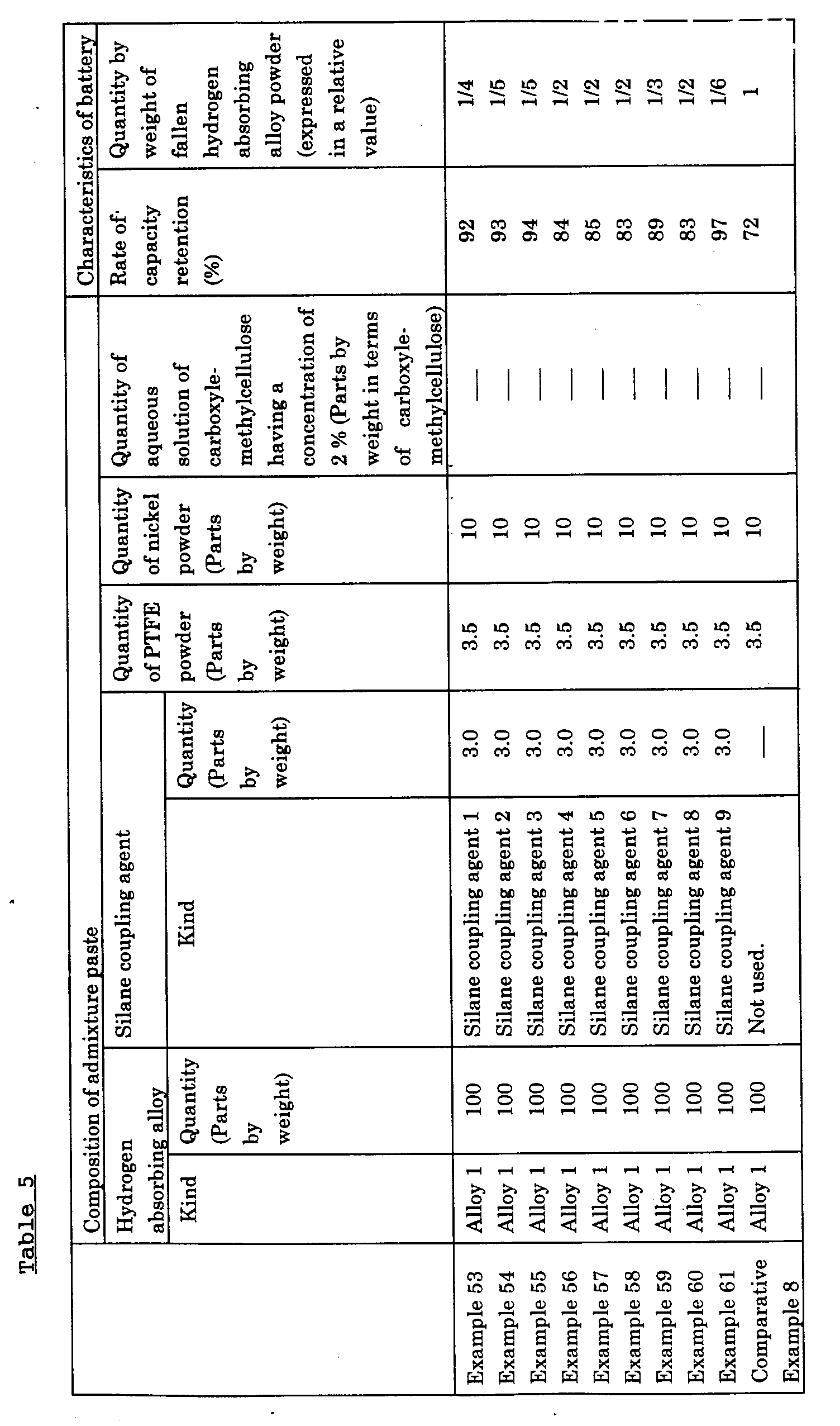
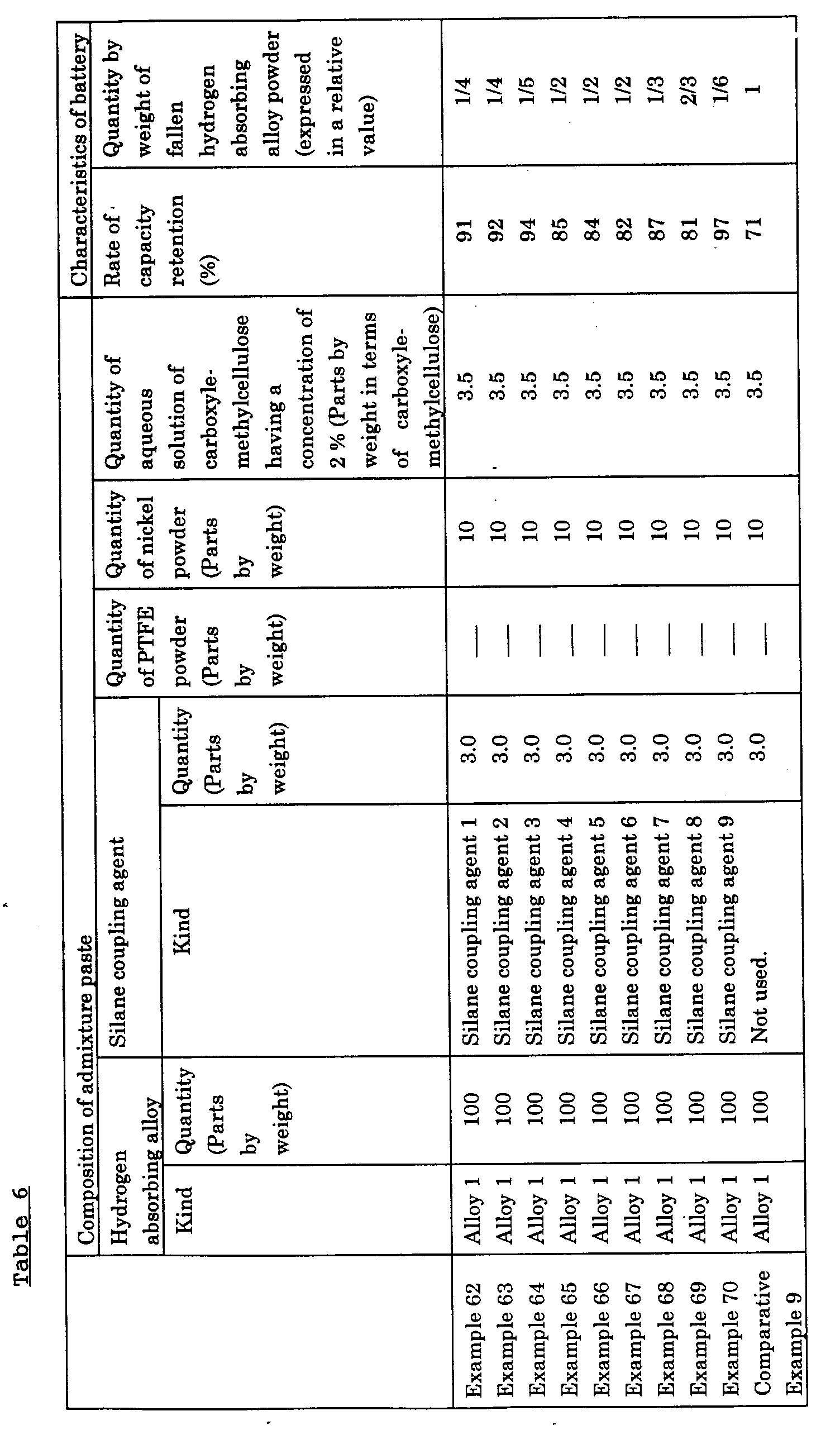
As clear from the comparison between the results given in
Tables 4 ∼ 6 and those already given in Tables 2 and 3, when
thickener (carboxylmethylcellulose) is further mixed at the time
of preparing the admixture paste, dispersed state of binder is
improved, that is, uniform dispersion of binder is produced. As
a result, the mutual bonding of grains of the alloy powder in the
hydrogen absorbing alloy electrode is further improved, capacity
retention of battery is raised and cycle life characteristics are
further improved.
Powder of the aforementioned alloy 1 was produced by known
water atomization. The powder has a spherical shape and an
average grain size of approximately 20 µm.
Using thus produced alloy powder, pastes having compositions
given in Table 7 were prepared, respectively. Examples of
hydrogen absorbing alloy electrode were produced using those
pastes respectively, in the same manner as in the case of Examples
1 ∼ 7. Then, batteries were assembled using those examples
respectively, in the same way as in the case of Examples 1 ∼ 7,
and characteristics of those batteries were investigated. The
results were shown in Table 7.

As clear from Table 7, when hydrogen absorbing alloy powder
having a spherical shape is used, capacity retention is further
improved.
Examples of the second electrode of the present invention
were produced as follows.
The following silane coupling agents were prepared.
A foam nickel sheet having a porosity of 95 % by volume
(thickness: 1.2mm) was prepared as a conductive substrate for
positive electrode, and a punching nickel sheet (open diameter:
1.5mm, rate of open area: 38 %, thickness: 0.07mm) was prepared
as a conductive substrate for negative electrode.
In each example according to the present invention, both of
those conductive substrates were dipped in one of the
aforementioned silane coupling agents for 10 seconds, then pulled
out and dried, so that a film of silane coupling agent was formed
on each surface of each conductive substrate.
The thickness of those films was found to be approximately
50 Å respectively, according to measurement using Auger
spectroscopy analyzer.
100 parts by weight of nickel hydroxide powder having a
spherical shape and grain size distribution of 1 ∼ 200 µm and
containing 7 % by weight of solid solution of zinc, 10 parts by
weight of carbonyl nickel powder having grain size distribution
of 0.5 ∼ 10 µm, 5 parts by weight of cobalt monoxide powder having
grain size distribution of 0.5 ∼ 30 µm, 50 parts by weight of
aqueous solution of carboxylmethylcellulose having a
concentration of 2 % by weight (1 part by weight in terms of
carboxylmethylcellulose), and 3.3 parts by weight of suspension
of PTFE having a concentration of 60 % by weight (2 parts by weight
in terms of PTFE) were kneaded to prepare admixture paste for
positive electrode.
On the other hand, MmNi3.2Co1.0Al0.2Mn0.4 (where Mm represents
misch metal) was mechanically ground into powder having regular
grains in an average grain size of 65 µm. 100 parts by weight
of this powder, 10 parts by weight of nickel powder, 50 parts by
weight of aqueous solution of carboxylmethylcellulose having a
concentration of 2 % by weight, and 3.3 parts by weight of
suspension of PTFE having a concentration of 60 % by weight were
kneaded to prepare admixture paste for negative electrode.
The aforementioned admixture paste for positive electrode
was applied to permeate the aforementioned conductive substrate
for positive electrode (foam nickel sheet) of each example, and
then, drying and rolling were performed. The conductive
substrate was then dipped in the aforementioned suspension of PTFE,
and then, drying and rolling were performed again. Thus a nickel
electrode having a thickness of 0.7 mm was obtained in each
example.
On the other hand, the aforementioned admixture paste for
negative electrode was applied to the conductive substrate for
negative electrode (punching nickel sheet) of each example, and
then, drying and rolling were performed, so that a hydrogen
absorbing alloy electrode having a thickness of 0.35 mm was
obtained in each example.
Further, for a comparative example, a nickel electrode and
a hydrogen absorbing alloy electrode were produced in the same
way as in the case of the aforementioned examples according to
the present invention, except that conductive substrates of those
electrodes were not treated with silane coupling agent.
In each example, the same separator as those used in Examples
1 ∼ 7 was interposed between the aforementioned nickel electrode
and the aforementioned hydrogen absorbing alloy electrode,
thereby to form a group of electrode. The group of electrode was
placed in a nickel-plated stainless steel can, then electrolyte
composed of 0.6 N NaOH, 1N LiOH and 7N KOH was poured in the can,
and then the can was sealed. Thus each example of nickel-hydrogen
secondary battery in cylindrical shape having rated capacity of
1300 mAh was assembled.
A cycle life test of each of thus assembled batteries was
conducted at a temperature of 20 ∼ 25 °C, in which one cycle
consisted of charge with 1300 mA for 1.5 hours, discharge with
1300 mA for 1.25 hours in order to attain the discharge state with
final discharge voltage of 1V, and pause for 0.25 hours. After
500 cycles were performed, discharge capacity was measured, and
capacity retention (%) was calculated by dividing the discharge
capacity by the capacity before the test.
Further, after each battery was left at room temperature for
0.5 hours subsequently to charge, internal resistance of each
battery was measured by alternating current with 1000 Hz and
expressed in a value relative to that of the battery of comparative
example, which was expressed as 1.
Furthermore, in the above mentioned cycle life test, after
500 cycles were performed, each battery was decomposed and the
nickel electrode and the hydrogen absorbing alloy electrode
thereof were pulled out to observe with the eyes the flaking state
of each admixture for electrode.
The results were summarized in Table 8.
| Kind of used silane coupling agent | Characteristics of battery | |||
| Rate of capacity retention (%) | Flaking state of admixture for electrode in positive and negative electrodes | Internal resistance (expressed in a relative value) | ||
| Example 82 | | 81 | No flaking. | 1.11 |
| Example 83 | | 83 | No flaking. | 1.11 |
| Example 84 | Silane coupling agent 3 | 85 | No flaking. | 1.12 |
| Example 85 | | 74 | No flaking. | 1.11 |
| Example 86 | Silane coupling agent 5 | 78 | No flaking. | 1.11 |
| Example 87 | Silane coupling agent 6 | 77 | No flaking. | 1.12 |
| Example 88 | Silane coupling agent 7 | 73 | No flaking. | 1.11 |
| Example 89 | Silane coupling agent 8 | 74 | No flaking. | 1.11 |
| Comparative Example 11 | Not used. | 73 | | 1 |
As clear from Table 8, batteries using the examples of
electrode according to the present invention, in which the
surfaces of conductive substrates are coated with silane coupling
agent, do not show the flaking of admixture for electrode even
after charge and discharge cycle test, and show relatively high
values of capacity retention.
As silane coupling agent, the aforementioned silane coupling
agent 1 was chosen. The same foam nickel sheet and the same
punching nickel sheet as those used in Examples 82 ∼ 89 were dipped
for 10 seconds in the silane coupling agent 1, of which a
concentration was varied for each example, and then pulled out
and dried.
The thickness of film of silane coupling agent 1 formed in
each example was measured using Auger spectroscopy analyzer. The
results of measurement are shown in Table 9.
Next, in the same way as in the case of Examples 82 ∼ 89,
nickel electrodes and hydrogen absorbing alloy electrodes were
produced, batteries were assembled using those electrodes, and
characteristics of those batteries were investigated. The
results are shown in Table 9.
| Thickness of film of silane coupling agent 1 (Å) | Characteristics of battery | |||
| Rate of capacity retention (%) | Flaking state of admixture for electrode in positive and negative electrodes | Internal resistance (expressed in a relative value) | ||
| Example 90 | 5 | 70 | Small flaking in part. | 1 |
| Example 91 | 10 | 78 | No flaking. | 1.05 |
| Example 92 | 50 | 81 | No flaking. | 1.11 |
| Example 93 | 80 | 81 | No flaking. | 1.12 |
| Example 94 | 100 | 81 | No flaking. | 1.13 |
| Example 95 | 150 | 81 | No flaking. | 1.15 |
| Example 96 | 200 | 81 | No flaking. | 1.20 |
| Example 97 | 300 | 81 | No flaking. | 1.25 |
| Example 98 | 400 | 81 | No flaking | 1.54 |
| (An initial value exceeded 25 mΩ.) |
As clear from Table 9, in order to prevent the flaking of
admixture for electrode, it is desirable to increase the thickness
of film of silane coupling agent 1. However, as that thickness
of film increases, the internal resistance of battery increases,
and for example, when the thickness is 400 Å, the initial value
of internal resistance of battery exceeds 25 mΩ. Thus, it is
desirable that the thickness of film is 10 ∼ 300 Å.
Admixture pastes for positive electrode were prepared in the
same way as in the case of Examples 82 ∼ 89, except that 1.65 parts
by weight of suspension of PTFE and 1.65 parts of the same silane
coupling agent as that used to coat the surfaces of foam nickel
sheet of each example were both added to prepare each admixture
paste for positive electrode in place of 3.3 parts by weight of
suspension of PTFE. Admixture pastes for negative electrode were
also prepared in the same way, each containing both PTFE and silane
coupling agent.
In the same way as in the case of Examples 82 ∼ 89, nickel
electrodes and hydrogen absorbing alloy electrodes were produced
using those admixture pastes, batteries were assembled using
those electrodes, and characteristics of those batteries were
investigated. The results are shown in Table 10.
| Kind of used silane coupling agent | Characteristics of battery | |||
| Rate of capacity retention (%) | Flaking state of admixture for electrode in positive and negative electrodes | Internal resistance (expressed in a relative value) | ||
| Example 99 | | 91 | No flaking. | 1.11 |
| Example 100 | | 92 | No flaking. | 1.11 |
| Example 101 | Silane coupling agent 3 | 93 | No flaking. | 1.12 |
| Example 102 | | 84 | No flaking. | 1.11 |
| Example 103 | Silane coupling agent 5 | 85 | No flaking. | 1.12 |
| Example 104 | Silane coupling agent 6 | 83 | No flaking. | 1.11 |
| Example 105 | Silane coupling agent 7 | 89 | No flaking. | 1.11 |
| Example 106 | Silane coupling agent 8 | 82 | No flaking. | 1.12 |
| Comparative Example 11 | Not used. | 73 | | 1 |
As clear from comparison between the aforementioned Table
8 and Table 10, when silane coupling agent is also added to the
admixture paste as in the case of Examples 99 ∼ 106, not only the
flaking of admixture for electrode is likewise prevented, but also
the capacity retention and the cycle life characteristics are
further improved as compared with the case in which silane coupling
agent is only used to coat the surfaces of conductive plates.
In Example 107, (1H, 1H, 2H, 2H-heneicosafluorododecyl)
trimethoxysilane was used as silane coupling agent, and a nickel
electrode and a hydrogen absorbing alloy electrode were produced
in the same way as in Example 82. Then, a battery was assembled
using those electrodes in the same way in Example 82, and
characteristics of that battery were investigated.
In Example 108, the aforementioned silane coupling agent was
also added to the admixture paste, and a nickel electrode and a
hydrogen absorbing alloy electrode were produced in the same way
as in Example 99. Characteristics of a battery using those
electrodes were investigated.
In Example 109, approximately the same quantities of the
aforementioned silane coupling agent 1 and the suspension of PTFE
were mixed, and conductive substrates were coated with that
admixture in the same way as in Example 82. A battery was
assembled in the same way as in Example 82, and characteristics
of that battery were investigated.
In Example 110, the aforementioned silane coupling agent 1
was also added to the admixture paste, and a nickel electrode and
a hydrogen absorbing alloy electrode were produced in the same
way as in Example 99 using that admixture paste and the same
conductive substrates as used in Example 99. Characteristics of
a battery using those electrodes were investigated.
The results of investigations are shown in Table 11.
| Characteristics of battery | |||
| Rate of capacity retention (%) | Flaking state of admixture for electrode in positive and negative electrodes | Internal resistance (expressed in a relative value) | |
| Example 107 | 90 | No flaking. | 1.11 |
| Example 108 | 97 | No flaking. | 1.11 |
| Example 109 | 83 | No flaking. | 1.12 |
| Example 110 | 93 | No flaking. | 1.12 |
In the electrode for battery according to the present
invention, powdered active material such as nickel hydroxide
powder and hydrogen absorbing alloy powder, which is a main
constituent of admixture for electrode carried on a conductive
substrate, is not liable to fall off during charge and discharge
cycle, nor is the mixture for electrode liable to flake off the
conductive substrate. Therefore, a battery using the electrode
of the present invention can exhibit high capacity retention even
when charge and discharge are performed for a long time, and has
high cycle life characteristics.
Claims (9)
- An electrode for battery comprising:admixture for electrode, which is an admixture of powdered active material and binder, carried on a conductive substrate;grains of said powdered active material being mutually bonded by said binder, wherein
said binder contains at least silane coupling agent. - An electrode for battery according to claim 1, wherein said binder comprises fluoroplastics and silane coupling agent.
- An electrode for battery according to claim 1, wherein said silane coupling agent is fluorine-contained silane coupling agent.
- An electrode for battery according to claim 1, wherein said powdered active material is nickel hydroxide powder, said binder comprises both fluoroplastics and silane coupling agent, and said electrode for battery is a nickel electrode.
- An electrode for battery according to claim 4, wherein said silane coupling agent is epoxy-contained silane coupling agent.
- An electrode for battery according to claim 1, wherein said powdered active material is hydrogen absorbing alloy powder, said binder comprises silane coupling agent and water repellent agent and/or thickener, and said electrode for battery is a hydrogen absorbing alloy electrode.
- An electrode for battery according to claim 6, wherein said silane coupling agent is fluorine-contained silane coupling agent.
- An electrode for battery comprising:admixture for electrode, which is an admixture of powdered active material and thickener and/or binder, carried on a conductive substrate;grains of said powdered active material being mutually bonded by said thickner and/or binder, whereina film of silane coupling agent is formed on the surface of said conductive substrate.
- An electrode for battery according to claim 8, wherein said binder contains at least silane coupling agent.
Applications Claiming Priority (7)
| Application Number | Priority Date | Filing Date | Title |
|---|---|---|---|
| JP7309074A JPH09147854A (en) | 1995-11-28 | 1995-11-28 | Nickel positive electrode plate |
| JP309074/95 | 1995-11-28 | ||
| JP143021/96 | 1996-06-05 | ||
| JP8143021A JPH09326251A (en) | 1996-06-05 | 1996-06-05 | Hydrogen storage alloy electrode |
| JP8313794A JPH10154514A (en) | 1996-11-25 | 1996-11-25 | Electrode for battery |
| JP313794/96 | 1996-11-25 | ||
| PCT/JP1996/003490 WO1997020356A1 (en) | 1995-11-28 | 1996-11-28 | Electrode for cell |
Publications (2)
| Publication Number | Publication Date |
|---|---|
| EP0865090A1 true EP0865090A1 (en) | 1998-09-16 |
| EP0865090A4 EP0865090A4 (en) | 1999-03-24 |
Family
ID=27318553
Family Applications (1)
| Application Number | Title | Priority Date | Filing Date |
|---|---|---|---|
| EP96939322A Withdrawn EP0865090A4 (en) | 1995-11-28 | 1996-11-28 | Electrode for cell |
Country Status (2)
| Country | Link |
|---|---|
| EP (1) | EP0865090A4 (en) |
| WO (1) | WO1997020356A1 (en) |
Cited By (2)
| Publication number | Priority date | Publication date | Assignee | Title |
|---|---|---|---|---|
| EP1117142A4 (en) * | 1998-08-20 | 2005-03-30 | Matsushita Electronics Corp | FUEL CELL AND METHOD FOR THE PRODUCTION THEREOF |
| EP1837935A1 (en) * | 2006-03-21 | 2007-09-26 | Saft | Plastic-coated electrode for alkaline storage battery |
Family Cites Families (3)
| Publication number | Priority date | Publication date | Assignee | Title |
|---|---|---|---|---|
| US5104753A (en) * | 1989-09-11 | 1992-04-14 | Kabushiki Kaisha Toyoda Jidoshokki Seisakusho | Hydrogen storage electrode and process for producing the same |
| US5571638A (en) * | 1993-09-30 | 1996-11-05 | Sumitomo Chemical Company Limited | Lithium secondary battery |
| JP3405367B2 (en) * | 1994-05-30 | 2003-05-12 | エフ・ディ−・ケイ株式会社 | Manufacturing method of sheet-like electrode |
-
1996
- 1996-11-28 EP EP96939322A patent/EP0865090A4/en not_active Withdrawn
- 1996-11-28 WO PCT/JP1996/003490 patent/WO1997020356A1/en not_active Ceased
Cited By (4)
| Publication number | Priority date | Publication date | Assignee | Title |
|---|---|---|---|---|
| EP1117142A4 (en) * | 1998-08-20 | 2005-03-30 | Matsushita Electronics Corp | FUEL CELL AND METHOD FOR THE PRODUCTION THEREOF |
| EP1837935A1 (en) * | 2006-03-21 | 2007-09-26 | Saft | Plastic-coated electrode for alkaline storage battery |
| FR2899018A1 (en) * | 2006-03-21 | 2007-09-28 | Accumulateurs Fixes | PLASTICATED ELECTRODE FOR ALKALINE ACCUMULATOR |
| US8062790B2 (en) | 2006-03-21 | 2011-11-22 | Saft | Plasticized electrode for an alkaline battery |
Also Published As
| Publication number | Publication date |
|---|---|
| EP0865090A4 (en) | 1999-03-24 |
| WO1997020356A1 (en) | 1997-06-05 |
Similar Documents
| Publication | Publication Date | Title |
|---|---|---|
| US8293419B2 (en) | Method for preparing hydrogen absorbing electrode and nickel metal-hydride battery | |
| JP2003051306A (en) | Negative electrode for lead-acid battery | |
| US7166391B2 (en) | Cobalt compound for use in alkaline storage battery, method for manufacturing the same, and positive electrode plate of alkaline storage battery employing the same | |
| JPS62165860A (en) | Manufacture of cadmium negative electrode plate for alkaline secondary cell | |
| EP0865090A1 (en) | Electrode for cell | |
| JPH11144733A (en) | Secondary battery electrode and secondary battery | |
| JP2020087516A (en) | Method for manufacturing zinc battery negative electrode and method for manufacturing zinc battery | |
| JP3686139B2 (en) | Alkaline secondary battery | |
| JPS61163569A (en) | Metal oxide-hydrogen secondary cell | |
| JP2000285922A (en) | Manufacturing method of alkaline storage battery and its electrode | |
| JPH10154514A (en) | Electrode for battery | |
| JPH1040917A (en) | Battery electrode | |
| EP1755184B1 (en) | Method for producing electrode paste mixture for alkaline storage battery | |
| JP2004055309A (en) | Method for producing paste-like active material for positive electrode and lead storage battery using the same | |
| JPH09147854A (en) | Nickel positive electrode plate | |
| CN1215141C (en) | Nickel-hydrogen battery adhesive | |
| JP2002117857A (en) | Hydrogen storing metal alloy electrode, and manufacturing method of nickel hydrogen secondary battery and hydrogen storage alloy electrode | |
| JPH09326251A (en) | Hydrogen storage alloy electrode | |
| JP2000182611A (en) | Alkaline storage battery and its manufacture | |
| JPH06168719A (en) | Negative electrode plate for nickel-hydrogen battery, manufacture thereof, and nickel-hydrogen battery | |
| JP3330088B2 (en) | Negative electrode for secondary battery | |
| CN100517816C (en) | Composite particle, nickel-hydrogen secondary battery negative electrode and battery, and their preparation method | |
| JP2983066B2 (en) | Method for producing paste-type nickel electrode | |
| JPH10188971A (en) | Unsintered nickel electrode for alkaline storage battery | |
| JP2003297351A (en) | Positive electrode active material for nickel-metal hydride battery, positive electrode plate, nickel-metal hydride battery and method for manufacturing nickel-metal hydride battery |
Legal Events
| Date | Code | Title | Description |
|---|---|---|---|
| PUAI | Public reference made under article 153(3) epc to a published international application that has entered the european phase |
Free format text: ORIGINAL CODE: 0009012 |
|
| 17P | Request for examination filed |
Effective date: 19980527 |
|
| AK | Designated contracting states |
Kind code of ref document: A1 Designated state(s): DE FR GB |
|
| A4 | Supplementary search report drawn up and despatched |
Effective date: 19990208 |
|
| AK | Designated contracting states |
Kind code of ref document: A4 Designated state(s): DE FR GB |
|
| 17Q | First examination report despatched |
Effective date: 19991015 |
|
| STAA | Information on the status of an ep patent application or granted ep patent |
Free format text: STATUS: THE APPLICATION IS DEEMED TO BE WITHDRAWN |
|
| 18D | Application deemed to be withdrawn |
Effective date: 20000226 |