EP0864377B1 - Method for cleaning structural surface - Google Patents
Method for cleaning structural surface Download PDFInfo
- Publication number
- EP0864377B1 EP0864377B1 EP97305836A EP97305836A EP0864377B1 EP 0864377 B1 EP0864377 B1 EP 0864377B1 EP 97305836 A EP97305836 A EP 97305836A EP 97305836 A EP97305836 A EP 97305836A EP 0864377 B1 EP0864377 B1 EP 0864377B1
- Authority
- EP
- European Patent Office
- Prior art keywords
- membrane
- aqueous solution
- reinforcing member
- substratum
- structural surface
- Prior art date
- Legal status (The legal status is an assumption and is not a legal conclusion. Google has not performed a legal analysis and makes no representation as to the accuracy of the status listed.)
- Expired - Lifetime
Links
Images



Classifications
-
- B—PERFORMING OPERATIONS; TRANSPORTING
- B08—CLEANING
- B08B—CLEANING IN GENERAL; PREVENTION OF FOULING IN GENERAL
- B08B7/00—Cleaning by methods not provided for in a single other subclass or a single group in this subclass
- B08B7/0014—Cleaning by methods not provided for in a single other subclass or a single group in this subclass by incorporation in a layer which is removed with the contaminants
-
- E—FIXED CONSTRUCTIONS
- E04—BUILDING
- E04G—SCAFFOLDING; FORMS; SHUTTERING; BUILDING IMPLEMENTS OR AIDS, OR THEIR USE; HANDLING BUILDING MATERIALS ON THE SITE; REPAIRING, BREAKING-UP OR OTHER WORK ON EXISTING BUILDINGS
- E04G23/00—Working measures on existing buildings
- E04G23/002—Arrangements for cleaning building facades
Definitions
- This invention relates to a method for cleaning a structural surface.
- the invention relates to a structural surface cleaning method including steps of forming a peelable membrane on a structural surface by applying an aqueous solution or aqueous emulsion (hereinafter, the words "aqueous solution” will be used to mean an “aqueous solution or aqueous emulsion", unless any ambiguity is brought about) of a membrane-forming polymer thereon, and causing dirt substance on the structural surface to be adhered to the membrane, and peeling off the membrane from the structural surface together with the dirt substance adhering thereto.
- Conventional methods for removing dirt from structural surface include washing with water, washing with chemical, sand-blasting, and the like. Such conventional methods have a problem in that they tend to scatter water or dirt substance to the surrounding, and it is usually difficult to prevent such scattering completely. Due to the increased public concern on environmental, unless such problem is solved, chance of using the conventional methods will be gradually diminished.
- a structural wall is divided into a number of cleaning zones and that one of such zones, e.g., the cleaning zone 10a is to be cleaned to begin with, and a polymer solution 5a, which is made by dissolving adhering-membrane-forming-polymer 2a in a solvent 9, is applied to the zone 10a twice in the step 603.
- a polymer solution 5a which is made by dissolving adhering-membrane-forming-polymer 2a in a solvent 9
- Each step of application produces a thin membrane 6a on the cleaning zone 10a, as shown in Fig. 5(A).
- Arrows ⁇ and ⁇ indicate that, after a thin membrane 6a formed by a first application of the polymer 2a as shown by the arrow ⁇ is dried by evaporation of the solvent 9 to become an adhering membrane, a second application as shown by the arrow ⁇ is made so as to produce another thin membrane 6a applied thereon.
- a laminated adhering membrane 7a is formed on the cleaning zone 10a in a peelable manner, as shown in Fig. 5(B). Dirt substance on the cleaning zone 10a are caused to adhere to the laminated adhering membrane 7a for cleaning the zone 10a at the step 604.
- FIG. 5(E) indicates that, in this example, after the entire building structure is finished the laminated adhering membranes 7a on all the cleaning zones 10a, 10b, 10c, ⁇ of the structural surface 10 are removed simultaneously in one stroke (see step 607 of Fig. 6.)
- a laminated adhering membrane 7a can be formed on a wide surface or intricately shaped surface of a structure in a short period of time simply by applying a polymer solution 5a thereon twice through brushing or spraying.
- the method not only facilitates removal of dirt substances, but also provides protection of structural surface and prevention from dirt deposit, and one can expect saving in labor for such cleaning, protection, and prevention of deposit by using the method.
- the adhering-membrane-forming-polymer 2a include polyvinyl alcohol, carboxymethyl cellulose, polyvinyl chloride, acrylic resin, and polyvinyl butyral.
- the solvent 9 can be water or an organic solvent.
- the method of cleaning structural surface by using the above laminated adhering membrane 7a has certain advantages; e.g., in the ease of operation for applying the polymer solution, in the readiness of handling the polymer solution, in facilitation of peeling operation of the polymer membrane by using the laminated structure of the membrane, and in simplification of the disposal of the used membranes. If water is used as the solvent 9 of the polymer solution 5a, there is no risk of generating poisonous gas or stench gas when applying it on surfaces to be cleaned, and the solution is free from catching fire.
- Membranes formed by spreading of aqueous solution of water-soluble polymer tend to be weakened and lose flexibility when water contained therein evaporates to dry them, despite that as long as moisture above a certain level is kept the flexibility and toughness of the membranes are maintained. Weakened membranes are easily torn when peeling force is applied thereto, and the process of peeling the membrane becomes cumbersome and time-consuming. Especially, in the case of a rough structural surface with projections and recesses, when the aqueous polymer solution is applied thereon and a membrane is formed by drying of it, the membrane tends to become comparatively thin at portions corresponding to the projections of the rough surface and comparatively thick at portions corresponding to the recesses thereof.
- the inventors have found that the toughness of the dried membrane of water-soluble polymer depends on the remaining moisture therein, which remaining moisture is affected by the thickness of the membrane when applied on a surface to be cleaned.
- a method for cleaning a structural surface by forming a peelable membrane thereon, making foreign matters on the structural surface adhere to the membrane and peeling off the membrane therefrom together with the foreign matters adhering thereto characterized in that the membrane is produced by preparing an aqueous solution containing 10-30% by weight of polyvinyl alcohol having a degree of polymerization of 1,000 to 3,000 and a degree of saponification of 95 to 99 mole%, the solution having a viscosity of 5,000 to 100,000 mPa/s, applying the solution on the structural surface in the form of a first thin liquid layer and drying the first liquid layer into the membrane whereby the membrane is made tough enough for peeling without rupture from the structural surface.
- a multi-layered membrane is produced by forming a substratum on the structural surface upon drying of the first liquid layer, applying a second liquid layer of the aqueous solution on the substratum before or after drying of the first liquid layer, so as to form an intermediate layer integral with said substratum upon drying of the second liquid layer, spreading a fibrous reinforcing member on the intermediate layer before or after drying of the second liquid layer, and applying a third liquid layer of the aqueous solution on the reinforcing member while wetting the reinforcing member in such a manner that, upon drying, an overlying layer integral with both the intermediate layer and the reinforcing member is formed, whether the multi-layered membrane is made four-layered with the intermediate layer on the substratum and overlying layer sandwiching the reinforcing member.
- a fibrous reinforcing member 15 is spread on the thin layer 16 before it dries.
- the above-mentioned overlying membrane 17b is formed on the fibrous reinforcing member 15 so as to be integral therewith.
- a quadruple multi-layer membrane 18 having the substratum membrane 17a, the intermediate membrane 17c, the fibrous reinforcing member 15, and the overlying membrane 17b is formed on the structural surface 1.
- the fibrous reinforcing member 15 is those of woven fabric, paper, and the like which can be wetted by the above-mentioned aqueous solution 5.
- the fibrous reinforcing member 15 is such a sheet member to which the aqueous solution 5 of membrane-forming polymer 2 permeates.
- the aqueous solution 2 may be permeated from the top surface of the reinforcing member 15 to the substratum membrane 17a below the member 15, so that the overlying membrane 17b can be made integral with both the substratum membrane 17a and the fibrous reinforcing member 15.
- Such member 15 may be made of fibers having a high affinity with water, or fibers with a lower affinity with water but with large inter-fiber gaps, such as gaps of a net, so as to ensure integral bondage of the membrane-forming polymer 2 with the fibrous reinforcing member 15.
- sheet material are gauze, non-woven fabric, plastic net, glass fiber mat, and the like.
- wood pulp such as that made of short fibers of 5 to 10 mm can be mixed in the polymer membrane of the multi-layer membrane 18.
- the short fibers may be added in the aqueous solution 5 of the membrane-forming polymer 2 so as to be dispersed therein, and the mixed solution thus prepared may be used to form a fibrous reinforcing member in the multi-layer membrane 18.
- Such mixed solution may be spread by a brush, a roller, a rubber spatula, a medicine spoon, a sweeping board such as a rubber blade, or a roller connected to a solution supply hose.
- the use of a fibrous reinforcing member of mixed solution with short fiber will facilitate application of the fiber-mixed aqueous solution 5 to every corner of recesses between projections, whereby cleaning effect is enhanced and at the same time the peeling and recovery of the multi-layer membrane 18 are made easier.
- short fibers are wood pulp, cotton, acrylic resin, polyester, silk, hemp yarn, plastics, glass fibers, and the like. Two or more of such short fibers may be used as a mixture.
- the length of the short fiber may 5 - 10 mm. If it is shorter than 5 mm, one cannot expect a sufficient improvement of membrane strength and toughness, and if longer than 10 mm, the fibers tend to be entangled and become hard to be dispersed.
- the number of each of the substratum membrane 17a, intermediate membrane 17c, and overlying membrane 17b in the multi-layer membrane 18 is not restricted to one, and the number of each constituent membrane may be adjusted depending on the conditions of the structural surface to be cleaned.
- the fibrous reinforcing member 15 is used to reinforce the polymer membrane, so that the thickness and the quantity of the fibrous reinforcing member 15 to be used will be properly determined depending on the physical properties of the polymer 2, the thickness of the multi-layer membrane 18, method of peeling, the location of cleaning operation, strength of the single fiber, the strength of fibrous layer, the affinity of the fiber and the polymer, and the like.
- the membrane-forming polymer 2 to be used in the method of the invention is water soluble.
- the polymer 2 dissolved in water 4 can be applied on the structural surface 1 in the form of a thin layer 16. After the evaporation of water 4, the thin layer 16 produces a substratum membrane 17a or overlying membrane 17b (the substratum and overlying membranes may be jointly referred to as membrane 17, hereinafter) depending on the position in the multi-layer membrane 18.
- membrane-forming polymer 2 examples include one or more materials selected from the group consisting of polyvinyl alcohol (may be referred to as PVA, hereinafter), ethylene/vinyl acetate copolymer, vinyl acetate, carboxymethyl cellulose, polyvinyl acetate, acrylic resin, polyvinyl butyral, and the like.
- PVA polyvinyl alcohol
- ethylene/vinyl acetate copolymer vinyl acetate
- carboxymethyl cellulose polyvinyl acetate
- acrylic resin polyvinyl butyral
- Preferable polymers are PVA and/or ethylene/vinyl acetate copolymer.
- PVA having a degree of polymerization of 500 - 5,000, preferably 1,000 - 3,000, and a degree of saponification of 90 - 99 mole % can be used.
- concentration of ethylene/vinyl acetate copolymer in the aqueous solution 5 can be selected depending on the material of the structural surface 1, surrounding conditions, and a method of spreading, and its preferable range is 40 - 80 weight % (Wt.%), preferably 50 - 70 Wt.%.
- the contents of vinyl acetate in the ethylene/vinyl acetate copolymer may be 98 - 50 mole %, preferably 80 - 60 mole %.
- a copolymer with multiple monomers including acrylic acid, methacrylic acid, acrylic ester, methacrylic ester, vinyl chloride, and the like may be used.
- the concentration of the membrane-forming polymer 2 in the aqueous solution 5 is selectable in a range suitable for producing the membrane 17, depending on the material of the structural surface 1, the environmental conditions at the site of cleaning, and the method of applying the solution 5.
- the following Table 1 shows the results of tests on five specimens of aqueous solution 5 of PVA as the membrane-forming polymer 2 at different concentrations. Each specimen of the solution 5 was spread on a concrete surface to form a membrane 17.
- aqueous solution 5 did not produce a peelable membrane 17, while a 70 No. Aqueous solution of polymer Membrane produced 1 PVA 3% No peelable membrane 2 PVA 5% Thickness: 0.05 mm 3 PVA 15% Thickness: 0.10 mm 4 PVA 30% Thickness: 0.20 mm 5 PVA 70% Thickness uneven 6 EVA56% Thickness: 0.10 mm
- Wt.% aqueous solution 5 caused difficulty in spreading an evenly thin layer 16 and did not produce a membrane 17 of even thickness.
- lines 2 to 4 of Table 1 show that 5 - 30 Wt % aqueous solutions 5 can produce peelable membranes of different thickness.
- the thickness of the membrane 17 depends on the viscosity of the aqueous solution 5, and if the PVA concentration is low, the viscosity of the aqueous solution 5 is small, and the membrane 17 becomes thin. To the contrary, if the PVA concentration is high, the viscosity of the aqueous solution 5 becomes large, and the membrane 7 gets comparatively thick.
- Table 1 shows that application of an aqueous emulsion 5 of ethylene/vinyl acetate copolymer on a concrete-surface produced a membrane 17 of 0.10 mm thick.
- the aqueous solution 5 can be applied on the structural surface 1 by using a brush, a roller, a spray, or an injector.
- Fig. 2(B) shows a painted zone of a structural surface 1, on which zone the aqueous solution 5 is applied as a thin layer 16. Water in the thin layer 16 evaporates in a few hours in the case of natural drying, or in 5 - 10 minutes when dried by blowing air of 40 - 60 °C, so as to become a substratum membrane 17a sticking to the structural surface 1 as shown in Fig. 2(C).
- this substratum membrane 17a Due to the viscosity of this substratum membrane 17a, foreign matters 8 such as dirt substance on the structural surface 1 can be adhered to the substratum membrane 17a so as to be removed together with the latter being peeled off. It is also possible to protect the structural surface 1 against subsequent deposit of dirt or damage from outside by the substratum membrane 17a. Attention should be paid to the fact that the substratum membrane 17a is flexible and easily peelable when it keeps a certain moisture, but when dried excessively, it may lose toughness and weakened, and the peeling and recovery of it after cleaning operation may become cumbersome.
- a fibrous reinforcing member 15 (Fig. 2(C)) is spread on the substratum membrane 17a which is formed on the structural surface 1. Then, an overlying membrane 17b is formed as shown in Fig. 2(D), by applying another thin layer 16 of the aqueous solution 5 thereon while wetting both outer and inner surfaces thereof.
- the fibrous reinforcing member 15 can be made integral with the thin layer of the polymer 2, so that the membrane 17 is tightly bonded to the fibrous reinforcing member 15, which bondage contributes to the strength of the membrane 17 against tearing.
- inner surface of the fibrous reinforcing member 15 is tightly bonded to the substratum membrane 17a, while the outer surface of the fibrous reinforcing member 15 is integrally joined to the overlying membrane 17b, so that an integral combination of the substratum membrane 17a, the fibrous reinforcing member 15, and the overlying membrane 17b formulates a multi-layer membrane 18 (see Fig. 2(E)).
- a multi-layer membrane 18 with a plurality of the fibrous reinforcing members 15 and overlying membranes 17b can be formed.
- the multi-layer membrane 18 can be peeled off from the structural surface 1 while maintaining its multi-layer configuration intact.
- the multi-layer membrane 18 of the invention causes peeling of the membrane 17 as an integral combination with the fibrous reinforcing member 15 without breakage, so that the operation of peeling and recovering of the membrane 17 for cleaning the structural surface 1 is greatly simplified.
- the use of the multi-layer membrane 18 has effects of simultaneously simplifying both the application of the aqueous solution 5 and the peeling of the membranes 17.
- low viscosity of the aqueous solution 5 is desirable, and aqueous solution 5 with a low viscosity tends to make the membrane 17 thin.
- strength or thickness of the membrane 17 in excess of a certain value is required.
- multiple application of easily applicable aqueous solution 5 results in a sufficiently thick multi-layer membrane 18 for facilitating easy peeling and recovery.
- the multi-layer membrane 18 may be recycled by dissolving the polymer 2 in warm water and separating foreign matters 8 and fibrous reinforcing member 15 therefrom. Hence, it does not cause any contamination of the environment. Tools for spreading the aqueous solution 5 can be washed with warm water after each use, and organic solvent is not required for tool cleaning. In short, the cleaning method of the invention is very safe for operators and the environment.
- the method of the invention can be used for cleaning the finished or unfinished surface of various materials; namely, glass, synthetic resin, metal such as aluminum and others, tile, earthenware, stoneware, porcelain, pottery, wood, concrete, paper, rubber, fiber, stone, soil, lime plaster, paint, and the like. It can be used for cleaning the surface of sculpture.
- a suitable plasticizer 3 may be added to the membrane-forming polymer 2.
- the addition of plasticizer will reduce the viscosity of the aqueous solution 5 and increase the flexibility of the dried membrane 17, so that the efficiency of the operation for spreading, applying, peeling, and recovering can be improved.
- the plasticizer to be used with the invention must be soluble in water and compatible with the membrane-forming polymer 2.
- Such plasticizer 3 can be one or more compounds selected from the group consisting of glycerol, ethylene glycol, diethylene glycol, triethylene glycol, propylene glycol, trimethylene glycol, tetramethylene glycol, pentamethylene glycol, hexamethylene glycol, 2,3-butanediol, and 1,3-butanediol, and preferably, it is glycerol and/or propylene glycol.
- Glycerol and propylene glycol are used as cosmetic materials and they are safe for human and environment.
- Table 2 below indicates the result of tests on addition of plasticizer 3 in the aqueous solution 5 in forming the membrane 17 through application of the solution 5 on concrete surface. As can be seen from the comparison of the thickness of the membrane 17 in Tables 1 and 2, the addition of the plasticizer 3 results in a reduction of the thickness of the membrane 17. Although Table 2 relates to the use of the plasticizer 3 at concentration of 1 to 10 Wt.% based on the amount of the polymer 2, the test results indicate that the plasticizer concentration can be suitably selected in a range of 0.5 - 15 Wt.%. No.
- Aqueous solution of polymer Plasticizer Membrane produced 1 PVA 15% glycerol 2% Thickness: 0.08 mm 2 PVA 15% glycerol 5% Thickness: 0.04 mm 3 PVA 15% propylene glycol 10% Thickness: 0.07 mm 4 PVA 15% glycerol 1% + propylene glycol 1% Thickness: 0.08 mm 5 PVA 15% + EVA 5% glycerol 2% Thickness: 0.08 mm 6 PVA 30% glycerol 2% Thickness: 0.08 mm
- results of tensile test on a membrane 17 formed by aqueous solution of PVA without adding any plasticizer 3 are also shown in Table 3.
- the addition of plasticizer 3 increases the breakdown elongation of the membrane 17 to a great extent as compared with the membrane 17 without plasticizer.
- the membrane 17 with the plasticizer 3 added therein can toughly resists the peeling force and elongates to a large extent without rupture, so that such membrane 17 can be easily peeled off from the structural surface 1.
- the filler to be use in the method of the invention can be one or more materials selected from the group consisting of silica sand, calcium carbonate, clay, fly ash, blast furnace slag, and sand, and preferably silica sand and/or calcium carbonate.
- the filler has effect of reducing the adhesion of the membrane 17 to the structural surface 1, and by adjusting the amount of the filler to be added, the adhesion of the membrane 17 can be regulated to a level for facilitating its peeling.
- the addition of calcium carbonate will enable the thickness of the membrane 17 to be at a level suitable for easy peeling.
- the efficiency of the work of peeling and recovery of the membrane 17 can be further improved in the operation of cleaning the structural surface 1.
- aqueous solution 5 containing 15 Wt.% of polyvinyl alcohol (produced by Kabushikikaisha KURARE with a trade name PVA-120) was applied to a concrete surface and left for 3 hours for producing a substratum membrane 17a.
- the same aqueous solution 5 of PVA was applied again on the substratum membrane 17a, and immediately thereafter a gauze for medical use was spread on the fleshly applied layer of the aqueous solution 5 as a fibrous reinforcing member 15, and the same aqueous solution 5 of PVA was applied and left for one day, so as to generate a multi-layer membrane 18 of PVA containing the gauze on the concrete structural surface 1.
- the thickness of the multi-layer membrane was 0.4 mm. This multi-layer membrane 18 was peeled off from the concrete surface without rupturing more easily as compared with conventional membranes having no gauze added therein.
- Embodiment 1 The same operation as embodiment 1 was repeated except that 2 Wt.% of glycerol based on the weight of PVA was added in the aqueous solution 5 of PVA as a plasticizer. The same result as that of Embodiment 1 was achieved.
- Embodiment 1 The same operation as embodiment 1 was repeated except that, instead of the aqueous solution 5 of PVA, and aqueous emulsion 5 containing 56 Wt% of ethylene vinyl acetate copolymer (produced by Kabushikikaisha KURARE with a trade name PANFLEX OM-28) was used. The same result as that of Embodiment 1 was achieved.
- Figs. 3 and 4 illustrate an example of cleaning dirts on a stucco-finished lime plaster indoor wall relief surface by the method of the invention. If a conventional washing machine with water is used for cleaning a lime plaster finished indoor wall, a number of difficult problems will be caused; namely, that it is difficult to collect water which absorbed dirts, that the lime plaster itself will absorb water and becomes weak, and that there is a risk for the lime plaster to absorb the dirt-carrying water.
- a thin layer 16 of membrane-forming polymer 2 was applied by a roller 20 and left for one day for drying to produce a substratum membrane 17a as depicted in Fig. 3(B). Then, another thin layer 16 of the membrane-forming polymer was applied on the substratum membrane 17a by the same roller 20 as shown in Fig.3 (C), which was a kind of interim layer for making an intermediate membrane 17c.
- a further thin layer 16 of polymer for an overlying membrane 17b was applied on the gauze by the same roller 20 while wetting the gauze and paying careful attention not to pull the gauze.
- the polymer membrane was left for one day for drying, and a multi-layer membrane 18 of four-layered structure having the substratum membrane 17a, the intermediate membrane 17c, the fibrous reinforcing member 15 and the overlying membrane 17b was produced as shown in Fig. 4(A).
- the multi-layer membrane 18 was slowly and carefully peeled off while avoiding any harm on the stucco-finished surface, as shown in Fig. 4(B).
- the multi-layer membrane 18 was easily flexed and separated from the surface 1 without any rupture while maintaining its four-layered structure.
- foreign matters 8 or dirt substance on the stucco-finished surface 1 were adhered to the substratum membrane 17a of the multi-layer membrane 18 and removed together with the multi-layer membrane 18.
- the surface of the stucco-finished lime plaster indoor wall was successfully cleaned as intended.
- aqueous solution of 15 Wt.% PVA was prepared by dissolving 150 g of PVA (produced by Kabushikikaish KURARE with Trade name of PVA-120) having a degree of polymerization of 2,000 and a degree of saponification of 98 - 99% in 850 g of water.
- the aqueous solution 5 thus prepared was applied to a structural surface 1, which was a concrete wall in this case, at a rate of about 1,000 g/m 2 , as shown in Figs. 7(A) and (B).
- An aqueous solution of 15 Wt.% PVA was prepared by dissolving 150 g of PVA (produced by Kabushikikaish KURARE with Trade name of PVA-120) having a degree of polymerization of 2,000 and a degree of saponification of 98 - 99% in 850 g of water.
- the aqueous solution 5 thus prepared was applied to a rough concrete structural surface 1 with projections and recesses, at a rate of about 1,500 g/m 2 .
- PVA with a degree of polymerization of 1,000 to 3,000 can be used for producing a peelable tough membrane 17 on structural surface 1 by spreading an aqueous solution thereof at a concentration of 10 to 30% by weight. If the degree of polymerization of PVA is smaller than 1,000, desired toughness of the membrane 17 cannot be achieved, and if the degree of polymerization of PVA exceeds 3,000 the viscosity of the aqueous solution becomes too high for uniform spreading.
- An aqueous solution of 15 Wt.% PVA was prepared by dissolving 150 g of PVA (produced by Kabushikikaish KURARE with Trade name of PVA-117) having a degree of polymerization of 1,700 and a degree of saponification of 98 - 99% in 850 g of water.
- the aqueous solution 5 thus prepared was applied to a concrete structural surface 1, at a rate of about 950 g/m 2 .
- An aqueous solution of 17 Wt.% PVA was prepared by dissolving 170 g of PVA (produced by Kabushikikaish KURARE with Trade name of PVA-117) having a degree of polymerization of 1,700 and a degree of saponification of 98 - 99% in 850 g of water.
- the aqueous solution 5 thus prepared was applied to a concrete structural surface 1, at a rate of about 1,000 g/m 2 .
- An aqueous solution of 15 Wt.% PVA was prepared by dissolving 150 g of PVA (produced by Kabushikikaish KURARE with Trade name of PVA-117) having a degree of polymerization of 1,700 and a degree of saponification of 97 - 99% in 850 g of water.
- the aqueous solution 5 thus prepared was applied to a concrete structural surface 1, at a rate of about 1,000 g/m 2 .
- An aqueous solution of 15 Wt.% PVA was prepared by dissolving 150 g of PVA (produced by Kabushikikaish KURARE with Trade name of PVA-120) having a degree of polymerization of 2,000 and a degree of saponification of 98 - 99% in 750 g of water and 100 g of ethyl alcohol.
- the aqueous solution 5 thus prepared was applied to a concrete structural surface 1, at a rate of about 1,000 g/m 2 .
- aqueous emulsion of ethylene/vinyl acetate copolymer (produced by Kabushikikaish KURARE with Trade name of OM-28) was applied to a concrete structural surface 1, at a rate of about 850 g/m 2 .
- aqueous emulsion of ethylene/vinyl acetate copolymer (produced by Kabushikikaish KURARE with Trade name of OM-4200) was applied to a concrete structural surface 1, at a rate of about 700 g/m 2 .
- aqueous emulsion of ethylene/vinyl acetate copolymer (produced by Kabushikikaish KURARE with Trade name of OM-5500) was applied to a concrete structural surface 1, at a rate of about 720 g/m 2 .
- aqueous emulsion of ethylene/vinyl acetate copolymer (produced by Kabushikikaish KURARE with Trade name of OM-600) was applied to a concrete structural surface 1, at a rate of about 700 g/m 2 .
- the membrane to be used in the method of the invention it is possible to add sterilizing function to the membrane by adding a suitable agent in it, such as a pesticide, germicide, aromatic, a bleaching agent, a surfactant, and the like.
- a suitable agent in it such as a pesticide, germicide, aromatic, a bleaching agent, a surfactant, and the like.
- the anti-micro-organism may exude from the membrane and remain on the structural surface, so that even after the peeling of the membrane, the structural surface can be protected against recontamination by unwanted micro-organism.
Landscapes
- Engineering & Computer Science (AREA)
- Architecture (AREA)
- Civil Engineering (AREA)
- Chemical Kinetics & Catalysis (AREA)
- Electrochemistry (AREA)
- Mechanical Engineering (AREA)
- Chemical & Material Sciences (AREA)
- Structural Engineering (AREA)
- Laminated Bodies (AREA)
- Application Of Or Painting With Fluid Materials (AREA)
- Moulds For Moulding Plastics Or The Like (AREA)
- Detergent Compositions (AREA)
- Cleaning And De-Greasing Of Metallic Materials By Chemical Methods (AREA)
Abstract
Description
- This invention relates to a method for cleaning a structural surface. In particular, the invention relates to a structural surface cleaning method including steps of forming a peelable membrane on a structural surface by applying an aqueous solution or aqueous emulsion (hereinafter, the words "aqueous solution" will be used to mean an "aqueous solution or aqueous emulsion", unless any ambiguity is brought about) of a membrane-forming polymer thereon, and causing dirt substance on the structural surface to be adhered to the membrane, and peeling off the membrane from the structural surface together with the dirt substance adhering thereto.
- Conventional methods for removing dirt from structural surface include washing with water, washing with chemical, sand-blasting, and the like. Such conventional methods have a problem in that they tend to scatter water or dirt substance to the surrounding, and it is usually difficult to prevent such scattering completely. Due to the increased public concern on environmental, unless such problem is solved, chance of using the conventional methods will be gradually diminished.
- To solve the above problems of the conventional methods the inventors disclosed an invention titled "Method for peeling off dirt from wall surface by using peelable polymer membrane" in his Japanese Patent No. 2823813 and corresponding European Patent Application No. 681875, filed on 28.4.1995. This cleaning method will be briefly reviewed by referring to Figs. 5 and 6 showing a case of cleaning the
surface 10 of a building structure. In this example,cleaning zones overall surface 10 of a building are successively cleaned one after another (seesteps 601 and 602 of Fig. 6). - At first, it is confirmed that a structural wall is divided into a number of cleaning zones and that one of such zones, e.g., the
cleaning zone 10a is to be cleaned to begin with, and apolymer solution 5a, which is made by dissolving adhering-membrane-forming-polymer 2a in asolvent 9, is applied to thezone 10a twice in the step 603. Each step of application produces athin membrane 6a on thecleaning zone 10a, as shown in Fig. 5(A). Arrows α and β indicate that, after athin membrane 6a formed by a first application of thepolymer 2a as shown by the arrow α is dried by evaporation of thesolvent 9 to become an adhering membrane, a second application as shown by the arrow β is made so as to produce anotherthin membrane 6a applied thereon. With the use of twothin membranes 6a, a laminatedadhering membrane 7a is formed on thecleaning zone 10a in a peelable manner, as shown in Fig. 5(B). Dirt substance on thecleaning zone 10a are caused to adhere to the laminated adheringmembrane 7a for cleaning thezone 10a at the step 604. - Views (B) through (E) of Fig. 5 show that by repetition of the steps 602 - 604, the
remaining cleaning zones surface 10 are also covered by the laminatedadhering membranes 7a and cleaned (see steps 605 and 606 of Gig. 6). Fig. 5(E) indicates that, in this example, after the entire building structure is finished the laminatedadhering membranes 7a on all thecleaning zones structural surface 10 are removed simultaneously in one stroke (seestep 607 of Fig. 6.) - With the cleaning method for the
surface 10 of a structure, as shown in Figs. 5 and 6, a laminated adheringmembrane 7a can be formed on a wide surface or intricately shaped surface of a structure in a short period of time simply by applying apolymer solution 5a thereon twice through brushing or spraying. The method not only facilitates removal of dirt substances, but also provides protection of structural surface and prevention from dirt deposit, and one can expect saving in labor for such cleaning, protection, and prevention of deposit by using the method. Examples of the adhering-membrane-forming-polymer 2a include polyvinyl alcohol, carboxymethyl cellulose, polyvinyl chloride, acrylic resin, and polyvinyl butyral. Thesolvent 9 can be water or an organic solvent. - Thus, the method of cleaning structural surface by using the above laminated adhering
membrane 7a has certain advantages; e.g., in the ease of operation for applying the polymer solution, in the readiness of handling the polymer solution, in facilitation of peeling operation of the polymer membrane by using the laminated structure of the membrane, and in simplification of the disposal of the used membranes. If water is used as thesolvent 9 of thepolymer solution 5a, there is no risk of generating poisonous gas or stench gas when applying it on surfaces to be cleaned, and the solution is free from catching fire. - Membranes formed by spreading of aqueous solution of water-soluble polymer, however, tend to be weakened and lose flexibility when water contained therein evaporates to dry them, despite that as long as moisture above a certain level is kept the flexibility and toughness of the membranes are maintained. Weakened membranes are easily torn when peeling force is applied thereto, and the process of peeling the membrane becomes cumbersome and time-consuming. Especially, in the case of a rough structural surface with projections and recesses, when the aqueous polymer solution is applied thereon and a membrane is formed by drying of it, the membrane tends to become comparatively thin at portions corresponding to the projections of the rough surface and comparatively thick at portions corresponding to the recesses thereof. Due to the thickness difference at different portions of the membrane, unevenness of strength is produced therein; i.e., there are weak portions and strong portions in the membrane. When peeled from structural surface, the membrane tears at weak portions and tearing cracks spread, so that peeling of the membrane as one piece becomes difficult. Even with the above-mentioned "Method for Peeling Off Dirt from Wall Surface by using peelable polymer membrane", it was difficult to prevent the tearing of the laminated adhering membrane due to the roughness of the structural surface. When torn, broken pieces of the membrane tend to be scattered around the structure, and laborious process of collecting the scattered pieces and cleaning the surrounding becomes indispensable. Thus, there has been a need for solving the problem related to the weakness of the membrane of water-soluble polymer.
- Therefore, it is an object of the invention to provide an improved method for cleaning a structural surface by forming a peelable membrane on a surface to make foreign matter adhere thereon and peeling off the membrane, together with the foreign matter.
- The inventors have found that the toughness of the dried membrane of water-soluble polymer depends on the remaining moisture therein, which remaining moisture is affected by the thickness of the membrane when applied on a surface to be cleaned.
- Based on the knowledge of such facts, the inventors have succeeded in completing the invention through a number of experiments and analyses.
- According to a first aspect of the invention (and referring to Fig. 7), there is provided a method for cleaning a structural surface by forming a peelable membrane thereon, making foreign matters on the structural surface adhere to the membrane and peeling off the membrane therefrom together with the foreign matters adhering thereto, characterized in that the membrane is produced by preparing an aqueous solution containing 10-30% by weight of polyvinyl alcohol having a degree of polymerization of 1,000 to 3,000 and a degree of saponification of 95 to 99 mole%, the solution having a viscosity of 5,000 to 100,000 mPa/s, applying the solution on the structural surface in the form of a first thin liquid layer and drying the first liquid layer into the membrane whereby the membrane is made tough enough for peeling without rupture from the structural surface.
Referring to Figs. 1 and 2, a multi-layered membrane is produced by forming a substratum on the structural surface upon drying of the first liquid layer, applying a second liquid layer of the aqueous solution on the substratum before or after drying of the first liquid layer, so as to form an intermediate layer integral with said substratum upon drying of the second liquid layer, spreading a fibrous reinforcing member on the intermediate layer before or after drying of the second liquid layer, and applying a third liquid layer of the aqueous solution on the reinforcing member while wetting the reinforcing member in such a manner that, upon drying, an overlying layer integral with both the intermediate layer and the reinforcing member is formed, whether the multi-layered membrane is made four-layered with the intermediate layer on the substratum and overlying layer sandwiching the reinforcing member. - For a better understanding of the invention, reference is made to the accompanying drawings, in which
- Fig. 1 is a partial sectional view of a
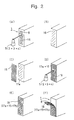
structural surface 1 which is being cleaned by a method of the invention; - Fig. 2 shows various steps for producing a multi-layer membrane to be used in the cleaning method of the invention;
- Fig. 3 shows first four steps for cleaning stucco-finished wall relief surface by the method of the invention;
- Fig. 4 shows succeeding steps to those of Fig. 3;
- Fig. 5 is a diagrammatic illustration of a conventional method for cleaning structural surface by using polymer membrane;
- Fig. 6 is a flow chart of the method of Fig. 5; and
- Fig. 7 shows steps in another embodiment of the method for cleaning structural surface according to the invention.
-
- Like parts are designated by like numerals and symbols throughout different views of the drawing.
- In a preferred embodiment of the invention, after the
substratum membrane 17a is formed, anotherthin layer 16 of theaqueous solution 5 ofpolymer 2 is applied on thesubstratum membrane 17a (see Fig. 3(C)) for inserting anintermediate membrane 17c (Fig.1), and a fibrous reinforcingmember 15 is spread on thethin layer 16 before it dries. The above-mentionedoverlying membrane 17b is formed on thefibrous reinforcing member 15 so as to be integral therewith. Thereby, a quadruplemulti-layer membrane 18 having thesubstratum membrane 17a, theintermediate membrane 17c, thefibrous reinforcing member 15, and theoverlying membrane 17b is formed on thestructural surface 1. Due to the viscousness of thepolymer 2 in thesubstratum membrane 17a,foreign matters 8 such as dirt substances on thestructural surface 1 tend to adhere to thesubstratum membrane 17a, and after such adhesion of theforeign matters 8, themulti-layer membrane 18 is peeled off from thestructural surface 1 together theforeign matter 8 carried thereby. Thus, thestructural surface 1 is cleaned, as desired. - An example of the fibrous reinforcing
member 15 is those of woven fabric, paper, and the like which can be wetted by the above-mentionedaqueous solution 5. Preferably, the fibrous reinforcingmember 15 is such a sheet member to which theaqueous solution 5 of membrane-formingpolymer 2 permeates. With such permeablefibrous reinforcing member 15, theaqueous solution 2 may be permeated from the top surface of the reinforcingmember 15 to thesubstratum membrane 17a below themember 15, so that theoverlying membrane 17b can be made integral with both thesubstratum membrane 17a and thefibrous reinforcing member 15.Such member 15 may be made of fibers having a high affinity with water, or fibers with a lower affinity with water but with large inter-fiber gaps, such as gaps of a net, so as to ensure integral bondage of the membrane-formingpolymer 2 with thefibrous reinforcing member 15. Examples of such sheet material are gauze, non-woven fabric, plastic net, glass fiber mat, and the like. - In addition to the
fibrous reinforcing member 15, or in lieu of thefibrous reinforcing member 15, wood pulp such as that made of short fibers of 5 to 10 mm can be mixed in the polymer membrane of themulti-layer membrane 18. In this case, the short fibers may be added in theaqueous solution 5 of the membrane-formingpolymer 2 so as to be dispersed therein, and the mixed solution thus prepared may be used to form a fibrous reinforcing member in themulti-layer membrane 18. Such mixed solution may be spread by a brush, a roller, a rubber spatula, a medicine spoon, a sweeping board such as a rubber blade, or a roller connected to a solution supply hose. According to test results, when thestructural surface 1 has many recesses and projections, the use of a fibrous reinforcing member of mixed solution with short fiber will facilitate application of the fiber-mixedaqueous solution 5 to every corner of recesses between projections, whereby cleaning effect is enhanced and at the same time the peeling and recovery of themulti-layer membrane 18 are made easier. Examples of such short fibers are wood pulp, cotton, acrylic resin, polyester, silk, hemp yarn, plastics, glass fibers, and the like. Two or more of such short fibers may be used as a mixture. The length of the short fiber may 5 - 10 mm. If it is shorter than 5 mm, one cannot expect a sufficient improvement of membrane strength and toughness, and if longer than 10 mm, the fibers tend to be entangled and become hard to be dispersed. - The number of each of the
substratum membrane 17a,intermediate membrane 17c, andoverlying membrane 17b in themulti-layer membrane 18 is not restricted to one, and the number of each constituent membrane may be adjusted depending on the conditions of the structural surface to be cleaned. The fibrous reinforcingmember 15 is used to reinforce the polymer membrane, so that the thickness and the quantity of the fibrous reinforcingmember 15 to be used will be properly determined depending on the physical properties of thepolymer 2, the thickness of themulti-layer membrane 18, method of peeling, the location of cleaning operation, strength of the single fiber, the strength of fibrous layer, the affinity of the fiber and the polymer, and the like. - The membrane-forming
polymer 2 to be used in the method of the invention is water soluble. Thepolymer 2 dissolved inwater 4 can be applied on thestructural surface 1 in the form of athin layer 16. After the evaporation ofwater 4, thethin layer 16 produces asubstratum membrane 17a oroverlying membrane 17b (the substratum and overlying membranes may be jointly referred to asmembrane 17, hereinafter) depending on the position in themulti-layer membrane 18. Examples of such membrane-formingpolymer 2 are one or more materials selected from the group consisting of polyvinyl alcohol (may be referred to as PVA, hereinafter), ethylene/vinyl acetate copolymer, vinyl acetate, carboxymethyl cellulose, polyvinyl acetate, acrylic resin, polyvinyl butyral, and the like. Preferable polymers are PVA and/or ethylene/vinyl acetate copolymer. - For instance, PVA having a degree of polymerization of 500 - 5,000, preferably 1,000 - 3,000, and a degree of saponification of 90 - 99 mole % can be used. The concentration of ethylene/vinyl acetate copolymer in the
aqueous solution 5 can be selected depending on the material of thestructural surface 1, surrounding conditions, and a method of spreading, and its preferable range is 40 - 80 weight % (Wt.%), preferably 50 - 70 Wt.%. The contents of vinyl acetate in the ethylene/vinyl acetate copolymer may be 98 - 50 mole %, preferably 80 - 60 mole %. To adjust the physical properties of thepolymer 2, a copolymer with multiple monomers including acrylic acid, methacrylic acid, acrylic ester, methacrylic ester, vinyl chloride, and the like may be used. - The concentration of the membrane-forming
polymer 2 in theaqueous solution 5 is selectable in a range suitable for producing themembrane 17, depending on the material of thestructural surface 1, the environmental conditions at the site of cleaning, and the method of applying thesolution 5. The following Table 1 shows the results of tests on five specimens ofaqueous solution 5 of PVA as the membrane-formingpolymer 2 at different concentrations. Each specimen of thesolution 5 was spread on a concrete surface to form amembrane 17. - Referring to
lines aqueous solution 5 did not produce apeelable membrane 17, while a 70No. Aqueous solution of polymer Membrane produced 1 PVA 3%No peelable membrane 2 PVA 5%Thickness: 0.05 mm 3 PVA 15%Thickness: 0.10 mm 4 PVA 30% Thickness: 0.20 mm 5 PVA 70% Thickness uneven 6 EVA56% Thickness: 0.10 mm - Wt.%
aqueous solution 5 caused difficulty in spreading an evenlythin layer 16 and did not produce amembrane 17 of even thickness. On the other hand,lines 2 to 4 of Table 1 show that 5 - 30 Wt %aqueous solutions 5 can produce peelable membranes of different thickness. The thickness of themembrane 17 depends on the viscosity of theaqueous solution 5, and if the PVA concentration is low, the viscosity of theaqueous solution 5 is small, and themembrane 17 becomes thin. To the contrary, if the PVA concentration is high, the viscosity of theaqueous solution 5 becomes large, and the membrane 7 gets comparatively thick. One can choose a suitable viscosity of the aqueous solution, considering the method for spreading or applying it on thestructural surface 1. Based on the test results of Table 1, the concentration of PVA as the membrane-forming polymer in theaqueous solution 5 can be selected in the range of 5 to 30 Wt.%. - Sixth line of Table 1 shows that application of an
aqueous emulsion 5 of ethylene/vinyl acetate copolymer on a concrete-surface produced amembrane 17 of 0.10 mm thick. In the test of Table 1, an aqueous emulsion with 56 Wt.% of ethylene/vinyl acetate copolymer, produced by Kabushikikasha KURARE with Tradename Panflex OM-28, was used. - Referring to Fig. 2(A), the
aqueous solution 5 can be applied on thestructural surface 1 by using a brush, a roller, a spray, or an injector. Fig. 2(B) shows a painted zone of astructural surface 1, on which zone theaqueous solution 5 is applied as athin layer 16. Water in thethin layer 16 evaporates in a few hours in the case of natural drying, or in 5 - 10 minutes when dried by blowing air of 40 - 60 °C, so as to become asubstratum membrane 17a sticking to thestructural surface 1 as shown in Fig. 2(C). Due to the viscosity of thissubstratum membrane 17a,foreign matters 8 such as dirt substance on thestructural surface 1 can be adhered to thesubstratum membrane 17a so as to be removed together with the latter being peeled off. It is also possible to protect thestructural surface 1 against subsequent deposit of dirt or damage from outside by thesubstratum membrane 17a. Attention should be paid to the fact that thesubstratum membrane 17a is flexible and easily peelable when it keeps a certain moisture, but when dried excessively, it may lose toughness and weakened, and the peeling and recovery of it after cleaning operation may become cumbersome. - In the embodiment of Fig. 2, a fibrous reinforcing member 15 (Fig. 2(C)) is spread on the
substratum membrane 17a which is formed on thestructural surface 1. Then, an overlyingmembrane 17b is formed as shown in Fig. 2(D), by applying anotherthin layer 16 of theaqueous solution 5 thereon while wetting both outer and inner surfaces thereof. The fibrous reinforcingmember 15 can be made integral with the thin layer of thepolymer 2, so that themembrane 17 is tightly bonded to the fibrous reinforcingmember 15, which bondage contributes to the strength of themembrane 17 against tearing. More specifically, inner surface of the fibrous reinforcingmember 15 is tightly bonded to thesubstratum membrane 17a, while the outer surface of the fibrous reinforcingmember 15 is integrally joined to theoverlying membrane 17b, so that an integral combination of thesubstratum membrane 17a, the fibrous reinforcingmember 15, and theoverlying membrane 17b formulates a multi-layer membrane 18 (see Fig. 2(E)). - If the steps of Fig. 2(C) through 2(D) are repeated, a
multi-layer membrane 18 with a plurality of the fibrous reinforcingmembers 15 andoverlying membranes 17b can be formed. - As shown in Fig. 2(F), the
multi-layer membrane 18 can be peeled off from thestructural surface 1 while maintaining its multi-layer configuration intact. In contrast to the conventional laminated adheringmembrane 7a of Fig. 5 which is susceptible to weakening and fracturing into pieces at the time of peeling, themulti-layer membrane 18 of the invention causes peeling of themembrane 17 as an integral combination with the fibrous reinforcingmember 15 without breakage, so that the operation of peeling and recovering of themembrane 17 for cleaning thestructural surface 1 is greatly simplified. - The use of the
multi-layer membrane 18 has effects of simultaneously simplifying both the application of theaqueous solution 5 and the peeling of themembranes 17. In particular, from the standpoint of easy application, low viscosity of theaqueous solution 5 is desirable, andaqueous solution 5 with a low viscosity tends to make themembrane 17 thin. On the other hand, from the standpoint of easy peeling and recovery of themembrane 17, strength or thickness of themembrane 17 in excess of a certain value is required. With the present invention, multiple application of easily applicableaqueous solution 5 results in a sufficiently thickmulti-layer membrane 18 for facilitating easy peeling and recovery. - Thereby, the above-mentioned object of invention which is to provide a method for cleaning structural surface by using easily peelable and readily recoverable membrane of water-soluble polymer is fulfilled.
- After being peeled off, the
multi-layer membrane 18 may be recycled by dissolving thepolymer 2 in warm water and separatingforeign matters 8 and fibrous reinforcingmember 15 therefrom. Hence, it does not cause any contamination of the environment. Tools for spreading theaqueous solution 5 can be washed with warm water after each use, and organic solvent is not required for tool cleaning. In short, the cleaning method of the invention is very safe for operators and the environment. - The method of the invention can be used for cleaning the finished or unfinished surface of various materials; namely, glass, synthetic resin, metal such as aluminum and others, tile, earthenware, stoneware, porcelain, pottery, wood, concrete, paper, rubber, fiber, stone, soil, lime plaster, paint, and the like. It can be used for cleaning the surface of sculpture.
- In practicing the method of the invention, a
suitable plasticizer 3 may be added to the membrane-formingpolymer 2. The addition of plasticizer will reduce the viscosity of theaqueous solution 5 and increase the flexibility of the driedmembrane 17, so that the efficiency of the operation for spreading, applying, peeling, and recovering can be improved. The plasticizer to be used with the invention must be soluble in water and compatible with the membrane-formingpolymer 2.Such plasticizer 3 can be one or more compounds selected from the group consisting of glycerol, ethylene glycol, diethylene glycol, triethylene glycol, propylene glycol, trimethylene glycol, tetramethylene glycol, pentamethylene glycol, hexamethylene glycol, 2,3-butanediol, and 1,3-butanediol, and preferably, it is glycerol and/or propylene glycol. Glycerol and propylene glycol are used as cosmetic materials and they are safe for human and environment. - Table 2 below indicates the result of tests on addition of
plasticizer 3 in theaqueous solution 5 in forming themembrane 17 through application of thesolution 5 on concrete surface. As can be seen from the comparison of the thickness of themembrane 17 in Tables 1 and 2, the addition of theplasticizer 3 results in a reduction of the thickness of themembrane 17. Although Table 2 relates to the use of theplasticizer 3 at concentration of 1 to 10 Wt.% based on the amount of thepolymer 2, the test results indicate that the plasticizer concentration can be suitably selected in a range of 0.5 - 15 Wt.%.No. Aqueous solution of polymer Plasticizer Membrane produced 1 PVA 15% glycerol 2% Thickness: 0.08 mm 2 PVA 15% glycerol 5% Thickness: 0.04 mm 3 PVA 15% propylene glycol 10% Thickness: 0.07 mm 4 PVA 15% glycerol 1% + propylene glycol 1%Thickness: 0.08 mm 5 PVA 15% +EVA 5% glycerol 2% Thickness: 0.08 mm 6 PVA 30 % glycerol 2% Thickness: 0.08 mm - As to the effect of the plasticizer on the toughness of
Test item PVA 15 % PVA 15% + glycerol 2% PVA 15% + glycerol 5%Width (mm) 10.0 10.0 10.0 Thickness (mm) 0.1 0.08 0.04 Tensile elasticity (N/mm2) 3,500 126 1,350 Tensile strength Load (N) 97.1 24.2 24.0 Strength (N/mm2) 97.1 30.2 60.1 Breakdown elongation (%), Lo=100 mm 2 120 231 membrane 17, tests were made on the Specimens No.1 and No. 2 of Table 2 and the result is shown in the following Table 3. For comparison, results of tensile test on amembrane 17 formed by aqueous solution of PVA without adding anyplasticizer 3 are also shown in Table 3. As can be seen from Table 3, the addition ofplasticizer 3 increases the breakdown elongation of themembrane 17 to a great extent as compared with themembrane 17 without plasticizer. In particular, themembrane 17 with theplasticizer 3 added therein can toughly resists the peeling force and elongates to a large extent without rupture, so thatsuch membrane 17 can be easily peeled off from thestructural surface 1. In Table 3, the breakdown elongation indicates the elongation (%) of a membrane specimen with an initial length Lo=100 mm when it is subjected to tension until breakdown. It should be noted here that whether to use a plasticizer or not should be determined depending on the conditions of thestructural surface 1 to be cleaned, and the addition of the plasticizer does not necessarily facilitate the peeling. With the addition of theplasticizer 3 and the use of the fibrous reinforcingmember 15, the peeling and recovery of themembrane 17 can be carried out very efficiently in the operation of cleaning thestructural surface 1. - With the invention, it is also possible to add a filler in the
aqueous solution 5. The filler to be use in the method of the invention can be one or more materials selected from the group consisting of silica sand, calcium carbonate, clay, fly ash, blast furnace slag, and sand, and preferably silica sand and/or calcium carbonate. The filler has effect of reducing the adhesion of themembrane 17 to thestructural surface 1, and by adjusting the amount of the filler to be added, the adhesion of themembrane 17 can be regulated to a level for facilitating its peeling. In particular, the addition of calcium carbonate will enable the thickness of themembrane 17 to be at a level suitable for easy peeling. Thus, by the addition of a suitable filler, the efficiency of the work of peeling and recovery of themembrane 17 can be further improved in the operation of cleaning thestructural surface 1. - If necessary, it is also possible to add a suitable coloring agent or pigment in the
aqueous solution 5 so as to render color to themulti-layer membrane 8. - An
aqueous solution 5 containing 15 Wt.% of polyvinyl alcohol (produced by Kabushikikaisha KURARE with a trade name PVA-120) was applied to a concrete surface and left for 3 hours for producing asubstratum membrane 17a. The sameaqueous solution 5 of PVA was applied again on thesubstratum membrane 17a, and immediately thereafter a gauze for medical use was spread on the fleshly applied layer of theaqueous solution 5 as a fibrous reinforcingmember 15, and the sameaqueous solution 5 of PVA was applied and left for one day, so as to generate amulti-layer membrane 18 of PVA containing the gauze on the concretestructural surface 1. The thickness of the multi-layer membrane was 0.4 mm. Thismulti-layer membrane 18 was peeled off from the concrete surface without rupturing more easily as compared with conventional membranes having no gauze added therein. - The same operation as
embodiment 1 was repeated except that 2 Wt.% of glycerol based on the weight of PVA was added in theaqueous solution 5 of PVA as a plasticizer. The same result as that ofEmbodiment 1 was achieved. - The same operation as
embodiment 1 was repeated except that, instead of theaqueous solution 5 of PVA, andaqueous emulsion 5 containing 56 Wt% of ethylene vinyl acetate copolymer (produced by Kabushikikaisha KURARE with a trade name PANFLEX OM-28) was used. The same result as that ofEmbodiment 1 was achieved. - Figs. 3 and 4 illustrate an example of cleaning dirts on a stucco-finished lime plaster indoor wall relief surface by the method of the invention. If a conventional washing machine with water is used for cleaning a lime plaster finished indoor wall, a number of difficult problems will be caused; namely, that it is difficult to collect water which absorbed dirts, that the lime plaster itself will absorb water and becomes weak, and that there is a risk for the lime plaster to absorb the dirt-carrying water.
- To the
structural surface 1 of Fig. 3(A), which is a portion of stucco-finished lime plaster indoor wall relief surface, athin layer 16 of membrane-formingpolymer 2 was applied by aroller 20 and left for one day for drying to produce asubstratum membrane 17a as depicted in Fig. 3(B). Then, anotherthin layer 16 of the membrane-forming polymer was applied on thesubstratum membrane 17a by thesame roller 20 as shown in Fig.3 (C), which was a kind of interim layer for making anintermediate membrane 17c. A fibrous reinforcingmember 15, which was a piece of gauze in this case, was spread on and attached to the interimthin layer 16 while stretching and providing a slack for entering into recessed portions of the stucco-finishing as shown in Fig. 3(D). At the same time, a furtherthin layer 16 of polymer for anoverlying membrane 17b was applied on the gauze by thesame roller 20 while wetting the gauze and paying careful attention not to pull the gauze. After attaching the gauze, the polymer membrane was left for one day for drying, and amulti-layer membrane 18 of four-layered structure having thesubstratum membrane 17a, theintermediate membrane 17c, the fibrous reinforcingmember 15 and theoverlying membrane 17b was produced as shown in Fig. 4(A). - After the drying, the
multi-layer membrane 18 was slowly and carefully peeled off while avoiding any harm on the stucco-finished surface, as shown in Fig. 4(B). Themulti-layer membrane 18 was easily flexed and separated from thesurface 1 without any rupture while maintaining its four-layered structure. Of course,foreign matters 8 or dirt substance on the stucco-finishedsurface 1 were adhered to thesubstratum membrane 17a of themulti-layer membrane 18 and removed together with themulti-layer membrane 18. Thus, the surface of the stucco-finished lime plaster indoor wall was successfully cleaned as intended. - To check the effect of the degree of polymerization of the PVA on the toughness of PVA membrane, tests were made on three kinds of PVA, i.e., PVA with degrees of polymerization of 550. 2,000 and 1,000. The results are shown in Table 4.
- One can see from Table 4 that when PVA with a high degree of polymerization is used, the viscosity of the
aqueous solution 5 of PVA becomes high, and the thickness of thethin layer 16 formed by suchaqueous solution 5 becomes large, and a peelable membrane can be produced. Referring to Fig. 7, with the knowledge of the data in Table 4, further embodiments of the invention were tested. An aqueous solution of 15 Wt.% PVA was prepared by dissolving 150 g of PVA (produced by Kabushikikaish KURARE with Trade name of PVA-120) having a degree of polymerization of 2,000 and a degree of saponification of 98 - 99% in 850 g of water. Theaqueous solution 5 thus prepared was applied to astructural surface 1, which was a concrete wall in this case, at a rate of about 1,000 g/m2, as shown in Figs. 7(A) and (B). - After drying it into a
membrane 17 by leaving for 12 hours, it was peeled off successfully, as shown in Fig. 7(C).Foreign matters 8 or dirt substances on thestructural surface 1 were removed together with themembrane 17. - An aqueous solution of 15 Wt.% PVA was prepared by dissolving 150 g of PVA (produced by Kabushikikaish KURARE with Trade name of PVA-120) having a degree of polymerization of 2,000 and a degree of saponification of 98 - 99% in 850 g of water. The
aqueous solution 5 thus prepared was applied to a rough concretestructural surface 1 with projections and recesses, at a rate of about 1,500 g/m2.Test item Reference sample Specimen 1 Specimen 2Properties of PVA degree of polymerization 550 1,000 2,000 degree of saponification (%) 88 97 - 99 98 - 99 concentration (Wt.%) 25 21 15 viscosity (mPa/s) 2,120 7,860 14,000 Film properties (Maker's data, 20oC 66% (moist)) Peeling strength (g/cm) 28 14.8 10.5 Yield strength (kg/mm2 ) 1.95 2.20 2.76 Rupture strength (kg/mm2 ) 2.89 3.70 6.21 Elongation (%) 157 285 312 Structural surface of glass Amount applied (g/cm2) 400 1.000 1,000 Thickness of thin layer (mm) 0.293 0.960 0.975 drying time (h) 12 12 12 Water content (after 12 h) 0.83 1.5 1.76 Moisture meter reading 0 3.0 3.6 Peeling possible possible possible Peeling strength (g/10cm) ruptured 200 250 Thickness of dry membrane (mm) 0.05 0.19 0.24 Structural surface of concrete Amount applied (g/cm2) 400 1.200 1,500 Thickness of thin layer (mm) 0.085 0.70 0.79 drying time (h) 12 12 12 Water content (after 12 h) 0 4.75 13.41 Moisture meter reading 0 10.0 12.9 Peeling impossible possible possible Thickness of dry membrane (mm) --- 0.4 0.5 - After drying it into a
membrane 17 by leaving for 12 hours, it was peeled off successfully.Foreign matters 8 or dirt substances on thestructural surface 1 were removed together with themembrane 17. - It has been found through further tests that PVA with a degree of polymerization of 1,000 to 3,000 can be used for producing a peelable
tough membrane 17 onstructural surface 1 by spreading an aqueous solution thereof at a concentration of 10 to 30% by weight. If the degree of polymerization of PVA is smaller than 1,000, desired toughness of themembrane 17 cannot be achieved, and if the degree of polymerization of PVA exceeds 3,000 the viscosity of the aqueous solution becomes too high for uniform spreading. - An aqueous solution of 15 Wt.% PVA was prepared by dissolving 150 g of PVA (produced by Kabushikikaish KURARE with Trade name of PVA-117) having a degree of polymerization of 1,700 and a degree of saponification of 98 - 99% in 850 g of water. The
aqueous solution 5 thus prepared was applied to a concretestructural surface 1, at a rate of about 950 g/m2. - Similar cleaning effect as that of the
above Embodiment 5 was proved with this embodiment, too. - An aqueous solution of 17 Wt.% PVA was prepared by dissolving 170 g of PVA (produced by Kabushikikaish KURARE with Trade name of PVA-117) having a degree of polymerization of 1,700 and a degree of saponification of 98 - 99% in 850 g of water. The
aqueous solution 5 thus prepared was applied to a concretestructural surface 1, at a rate of about 1,000 g/m2. - Similar cleaning effect as that of the
above Embodiment 5 was proved with this embodiment, too. - An aqueous solution of 15 Wt.% PVA was prepared by dissolving 150 g of PVA (produced by Kabushikikaish KURARE with Trade name of PVA-117) having a degree of polymerization of 1,700 and a degree of saponification of 97 - 99% in 850 g of water. The
aqueous solution 5 thus prepared was applied to a concretestructural surface 1, at a rate of about 1,000 g/m2. - Similar cleaning effect as that of the
above Embodiment 5 was proved with this embodiment, too. - An aqueous solution of 15 Wt.% PVA was prepared by dissolving 150 g of PVA (produced by Kabushikikaish KURARE with Trade name of PVA-120) having a degree of polymerization of 2,000 and a degree of saponification of 98 - 99% in 750 g of water and 100 g of ethyl alcohol. The
aqueous solution 5 thus prepared was applied to a concretestructural surface 1, at a rate of about 1,000 g/m2. - After drying it into a
membrane 17 by leaving for 10 hours, it was peeled off successfully.Foreign matters 8 or dirt substances on thestructural surface 1 were removed together with themembrane 17. - An aqueous emulsion of ethylene/vinyl acetate copolymer (EVAC) (produced by Kabushikikaish KURARE with Trade name of OM-28) was applied to a concrete
structural surface 1, at a rate of about 850 g/m2. - After drying it into a
membrane 17 by leaving for 12 hours, it was peeled off successfully.Foreign matters 8 or dirt substances on thestructural surface 1 were removed together with themembrane 17. - An aqueous emulsion of ethylene/vinyl acetate copolymer (EVAC) (produced by Kabushikikaish KURARE with Trade name of OM-4200) was applied to a concrete
structural surface 1, at a rate of about 700 g/m2. - Similar cleaning effect as that of the above Embodiment 11 was proved with this embodiment, too.
- An aqueous emulsion of ethylene/vinyl acetate copolymer (EVAC) (produced by Kabushikikaish KURARE with Trade name of OM-5500) was applied to a concrete
structural surface 1, at a rate of about 720 g/m2. - Similar cleaning effect as that of the above Embodiment 11 was proved with this embodiment, too.
- An aqueous emulsion of ethylene/vinyl acetate copolymer (EVAC) (produced by Kabushikikaish KURARE with Trade name of OM-600) was applied to a concrete
structural surface 1, at a rate of about 700 g/m2. - Similar cleaning effect as that of the above Embodiment 11 was proved with this embodiment, too.
- In producing the membrane to be used in the method of the invention, it is possible to add sterilizing function to the membrane by adding a suitable agent in it, such as a pesticide, germicide, aromatic, a bleaching agent, a surfactant, and the like. For instance, when a structural surface is contaminated with micro-organism such as fungus, bacteria, or algae, one can remove the contaminating micro-organism by Using an aqueous solution of the invention which contains a suitable anti-micro-organism agent such as pesticide, germicide, aromatic, and the like in producing the membrane. At the time of removing the membrane, the micro-organism living on the structural surface is adhered to the membrane together with other foreign matters and removed from the structural surface. Thus, a high-degree of cleaning can be accomplished. The anti-micro-organism may exude from the membrane and remain on the structural surface, so that even after the peeling of the membrane, the structural surface can be protected against recontamination by unwanted micro-organism.
- As described in detail in the foregoing, with the method of cleaning a structural surface the following outstanding effects can be achieved by the use of the water soluble polymer, possibly together with the fibrous reinforcing member.
- (1) A method for cleaning structural surface by forming tough and yet easily peelable polymer membrane thereon with polyvinyl alcohol having a degree of polymerisation 1,000 to 3,000 and a degree of sponification 90 to 99 mole % is provided.
- (2) With the use of a flexible fibrous reinforcing member integrally sandwiched by two polymer layers made of an aqueous solution of the above polyvinyl alcohol, an easily removable multi-layer membrane for cleaning structural surface can be formed, so that high efficiency can be achieved in both applying the aqueous solution and peeling of the membrane.
- (3) The membrane removed from the structural surface may be recycled by dissolving it in warm water. Even if disposed by burning, noxious gas is never generated.
- (4) The aqueous solution can be easily handled, and it has a high degree of safety to human and environment.
- (5) Rough surface with projections and recesses can be cleaned with a high reliability.
-
Claims (11)
- A method for cleaning a structural surface (1) by forming a peelable multi-layer membrane (18) thereon, making foreign matters (8) on the structural surface adhere to the membrane, and peeling off the membrane (18) therefrom together with the foreign matters (18) adhering thereto, in that wherein the membrane is produced by preparing an aqueous solution (5) containing polyvinyl alcohol, applying the solution on the structural surface as a thin first liquid layer (16), which upon drying forms a substratum (17a) on the structural surface (1), characterised in that the aqueous solution contains 10-30% by weight of polyvinyl alcohol (2) having a degree of polymerisation of 1,000 to 3,000 and a degree of saponification of 95 to 99 mole%, the solution having a viscosity of 5,000 to 100,000 mPa.s, applying a second thin liquid layer of the aqueous solution on the substratum before or after drying of the first liquid layer, so as to form an overlying layer (17b) integral with said substratum upon drying of the second liquid layer, whereby moisture in the membrane is kept so as to make the membrane flexible and easily peelable.
- A membrane as set forth in claim 1, characterised in that the membrane (18) is produced by spreading a flexible fibrous reinforcing member (15) on the substratum (17a) before or after drying of the first liquid layer (16), and applying a second liquid layer of the aqueous solution (5) on the reinforcing member while wetting the reinforcing member in such a manner that, upon drying, an overlying layer (17b) integral with both substratum and the reinforcing member is formed, whereby toughness of the membrane is maintained on curved portions of the structural surface by the reinforcing member sandwiched between the substratum and overlying layer.
- A method as set forth in Claim 2, characterised in that the membrane (18) is produced by applying a second liquid layer of the aqueous solution (5) on the substratum (17a) before or after drying of the first liquid layer (16), so as to form an intermediate layer (17c) integral with said substratum upon drying of the second layer, spreading a fibrous reinforcing member (15) on the intermediate layer before or after drying of the second liquid layer, and applying a third liquid layer of the aqueous solution on the reinforcing member while wetting the reinforcing member in such a manner that, upon drying, an overlying layer (17b) integral with both the intermediate layer and the reinforcing member is formed, whereby toughness of the membrane is maintained on curved portions of the structural surface of the reinforcing member sandwiched between the substratum and overlying layer while protecting the structural surface from the reinforcing member by both the substratum and the intermediate layer.
- A method as set forth in Claim 2 or 3, characterised in that the fibrous reinforcing member (15) is a sheet member to which the aqueous solution (15) is permeable, whereby the reinforcing membrane is made integrally bonded to the membrane (18).
- A method as set forth in any preceding claims, characterised in that short fibers are added in the aqueous solution (5) before application thereof on the substratum (17a) or reinforcing member (15), whereby the application of the aqueous solution to recesses between projections on the structural surface is facilitated while enhancing the peelableness of the membrane.
- A method as set forth in Claims 2 to 5, characterised in that the fibrous reinforcing member is gauze, non-woven fabric, plastic net and/or glass fiber mat.
- A method as set forth in Claim 5 or Claim 6, characterised in that the short fiber is a material or a mixture of materials selected from the group consisting of wood pulp, cotton, acrylic fiber, polyester, silk, hemp yarn, plastics and glass fiber.
- A method as set forth in any preceding claim, characterised in that a plasticizer is added in the aqueous solution or emulsion of the membrane-forming polymer.
- A method as set forth in Claim 8, characterised in that the plasticizer is glycerol and/or propylene glycerol.
- A method as set forth in any preceding claim, characterised in that a filler is added in the aqueous solution or emulsion of the membrane-forming polymer.
- A method as set forth in Claim 10, characterised in that the filler is a material or a mixture of materials selected from the group consisting of silica sand, calcium carbonate, clay, fly ash, blast furnace slag powder,and sand.
Priority Applications (2)
| Application Number | Priority Date | Filing Date | Title |
|---|---|---|---|
| JP10052553A JP3107030B2 (en) | 1997-03-14 | 1998-03-04 | How to clean the structure surface |
| US09/038,978 US6123777A (en) | 1997-03-14 | 1998-03-12 | Method for cleaning structural surface |
Applications Claiming Priority (3)
| Application Number | Priority Date | Filing Date | Title |
|---|---|---|---|
| JP61290/97 | 1997-03-14 | ||
| JP6129097 | 1997-03-14 | ||
| JP6129097 | 1997-03-14 |
Publications (3)
| Publication Number | Publication Date |
|---|---|
| EP0864377A2 EP0864377A2 (en) | 1998-09-16 |
| EP0864377A3 EP0864377A3 (en) | 1999-05-19 |
| EP0864377B1 true EP0864377B1 (en) | 2003-05-21 |
Family
ID=13166928
Family Applications (1)
| Application Number | Title | Priority Date | Filing Date |
|---|---|---|---|
| EP97305836A Expired - Lifetime EP0864377B1 (en) | 1997-03-14 | 1997-08-01 | Method for cleaning structural surface |
Country Status (3)
| Country | Link |
|---|---|
| EP (1) | EP0864377B1 (en) |
| AT (1) | ATE240792T1 (en) |
| DE (1) | DE69722170D1 (en) |
Cited By (1)
| Publication number | Priority date | Publication date | Assignee | Title |
|---|---|---|---|---|
| WO2014110128A1 (en) * | 2013-01-11 | 2014-07-17 | California Institute Of Technology | Protective devices and methods for precision application of cleaning polymer to optics |
Families Citing this family (2)
| Publication number | Priority date | Publication date | Assignee | Title |
|---|---|---|---|---|
| EP1111441B1 (en) | 1997-06-12 | 2009-12-02 | Sharp Kabushiki Kaisha | Vertically-aligned (VA) liquid crystal display device |
| ES2264345B1 (en) * | 2004-09-28 | 2007-11-01 | Iago Lopez Romero | PROCEDURE FOR CLEANING BUILDINGS BY APPLICATION OF LATEX. |
Family Cites Families (8)
| Publication number | Priority date | Publication date | Assignee | Title |
|---|---|---|---|---|
| DE2603290B2 (en) * | 1976-01-29 | 1978-04-20 | Claus 6000 Frankfurt Hilgenstock | Process for cleaning metal, glass or plastic surfaces, in particular records |
| US5120369A (en) * | 1982-04-15 | 1992-06-09 | The United States Of America As Represented By The Secretary Of The Navy | Hazardous material removal using strippable coatings |
| US4613378A (en) * | 1984-11-08 | 1986-09-23 | Lawrence Christy | Method of restoring marble and brick surfaces |
| JPH06225848A (en) * | 1993-02-01 | 1994-08-16 | Tootaru Service:Kk | Cleaning method for outer wall surface of building |
| JP2823813B2 (en) * | 1994-05-06 | 1998-11-11 | 鹿島建設株式会社 | A method for removing wall dirt using a peelable polymer film |
| JP3369304B2 (en) * | 1994-05-27 | 2003-01-20 | 富士通株式会社 | Method for growing compound semiconductor crystal layer |
| JP3202158B2 (en) * | 1995-11-15 | 2001-08-27 | 鹿島建設株式会社 | Cleaning method for indoor and outdoor structures |
| JP3337113B2 (en) * | 1996-07-25 | 2002-10-21 | 鹿島建設株式会社 | How to protect the structure surface |
-
1997
- 1997-08-01 DE DE69722170T patent/DE69722170D1/en not_active Expired - Lifetime
- 1997-08-01 EP EP97305836A patent/EP0864377B1/en not_active Expired - Lifetime
- 1997-08-01 AT AT97305836T patent/ATE240792T1/en not_active IP Right Cessation
Cited By (1)
| Publication number | Priority date | Publication date | Assignee | Title |
|---|---|---|---|---|
| WO2014110128A1 (en) * | 2013-01-11 | 2014-07-17 | California Institute Of Technology | Protective devices and methods for precision application of cleaning polymer to optics |
Also Published As
| Publication number | Publication date |
|---|---|
| ATE240792T1 (en) | 2003-06-15 |
| DE69722170D1 (en) | 2003-06-26 |
| EP0864377A3 (en) | 1999-05-19 |
| EP0864377A2 (en) | 1998-09-16 |
Similar Documents
| Publication | Publication Date | Title |
|---|---|---|
| US6123777A (en) | Method for cleaning structural surface | |
| EP0078553B1 (en) | Application of a multilayer sheet as a packaging sheet | |
| US20030037502A1 (en) | Fungus resistant gypsum-based substrate | |
| US5779811A (en) | Method for peeling off dirt from wall surface by using peelable polymer membrane | |
| FI85279B (en) | REDUCERANDE BEHANDLING AV FARLIGA PARTIKLAR. | |
| JP5846997B2 (en) | Film forming composition, surface cleaning method, radioactive substance removing method, surface protecting method, and film | |
| EP0864377A2 (en) | Method for cleaning structural surface | |
| JP3337113B2 (en) | How to protect the structure surface | |
| JP3952360B2 (en) | Surface protection method for structures | |
| JP3217916B2 (en) | Concrete curing sheet | |
| JP7149717B2 (en) | formwork protection sheet | |
| US8721818B2 (en) | Method and apparatus for toxic substance encapsulation | |
| JPS59199921A (en) | Ant preventive foundation work | |
| KR20030093389A (en) | Lining paper, wallpaper and method for producing the same | |
| JPH05346047A (en) | Ant-proofing sheet and ant-proofing construction method | |
| JPH09250242A (en) | Structure surface curing method | |
| JP2855152B2 (en) | Dust prevention treatment method for inorganic fiber-containing building materials and peeling removal treatment method for inorganic fiber-containing building materials | |
| EP0354942B1 (en) | Process for preventing exposure to chemically and/or biologically harmful substances given off by building surfaces | |
| JP4038554B2 (en) | Rough concrete | |
| JP4868817B2 (en) | Subsoil substitute material | |
| JP2002095361A (en) | Light-shielding sheet | |
| JP2007056450A (en) | Tile reinforcing method | |
| DE102006002541B4 (en) | Composite with visible fabric layer and manufacturing process | |
| JP2007146611A (en) | Asbestos scattering prevention method at discharging sprayed asbestos by using sprayed-asbestos scattering-prevention chemical injection nozzle | |
| JPS5949390B2 (en) | How to remove long floor sheets, wall sheets, etc. attached to the interior and exterior of buildings |
Legal Events
| Date | Code | Title | Description |
|---|---|---|---|
| PUAI | Public reference made under article 153(3) epc to a published international application that has entered the european phase |
Free format text: ORIGINAL CODE: 0009012 |
|
| AK | Designated contracting states |
Kind code of ref document: A2 Designated state(s): AT BE CH DE ES FR GB IT LI NL PT |
|
| AX | Request for extension of the european patent |
Free format text: AL;LT;LV;RO;SI |
|
| PUAL | Search report despatched |
Free format text: ORIGINAL CODE: 0009013 |
|
| AK | Designated contracting states |
Kind code of ref document: A3 Designated state(s): AT BE CH DE DK ES FI FR GB GR IE IT LI LU MC NL PT SE |
|
| AX | Request for extension of the european patent |
Free format text: AL;LT;LV;RO;SI |
|
| 17P | Request for examination filed |
Effective date: 19990727 |
|
| AKX | Designation fees paid |
Free format text: AT BE CH DE ES FR GB IT LI NL PT |
|
| 17Q | First examination report despatched |
Effective date: 20010509 |
|
| GRAH | Despatch of communication of intention to grant a patent |
Free format text: ORIGINAL CODE: EPIDOS IGRA |
|
| GRAH | Despatch of communication of intention to grant a patent |
Free format text: ORIGINAL CODE: EPIDOS IGRA |
|
| GRAH | Despatch of communication of intention to grant a patent |
Free format text: ORIGINAL CODE: EPIDOS IGRA |
|
| GRAA | (expected) grant |
Free format text: ORIGINAL CODE: 0009210 |
|
| AK | Designated contracting states |
Designated state(s): AT BE CH DE ES FR GB IT LI NL PT |
|
| PG25 | Lapsed in a contracting state [announced via postgrant information from national office to epo] |
Ref country code: LI Free format text: LAPSE BECAUSE OF FAILURE TO SUBMIT A TRANSLATION OF THE DESCRIPTION OR TO PAY THE FEE WITHIN THE PRESCRIBED TIME-LIMIT Effective date: 20030521 Ref country code: IT Free format text: LAPSE BECAUSE OF FAILURE TO SUBMIT A TRANSLATION OF THE DESCRIPTION OR TO PAY THE FEE WITHIN THE PRESCRIBED TIME-LIMIT;WARNING: LAPSES OF ITALIAN PATENTS WITH EFFECTIVE DATE BEFORE 2007 MAY HAVE OCCURRED AT ANY TIME BEFORE 2007. THE CORRECT EFFECTIVE DATE MAY BE DIFFERENT FROM THE ONE RECORDED. Effective date: 20030521 Ref country code: CH Free format text: LAPSE BECAUSE OF FAILURE TO SUBMIT A TRANSLATION OF THE DESCRIPTION OR TO PAY THE FEE WITHIN THE PRESCRIBED TIME-LIMIT Effective date: 20030521 Ref country code: BE Free format text: LAPSE BECAUSE OF FAILURE TO SUBMIT A TRANSLATION OF THE DESCRIPTION OR TO PAY THE FEE WITHIN THE PRESCRIBED TIME-LIMIT Effective date: 20030521 Ref country code: AT Free format text: LAPSE BECAUSE OF FAILURE TO SUBMIT A TRANSLATION OF THE DESCRIPTION OR TO PAY THE FEE WITHIN THE PRESCRIBED TIME-LIMIT Effective date: 20030521 |
|
| REG | Reference to a national code |
Ref country code: GB Ref legal event code: FG4D |
|
| REG | Reference to a national code |
Ref country code: CH Ref legal event code: EP |
|
| REF | Corresponds to: |
Ref document number: 69722170 Country of ref document: DE Date of ref document: 20030626 Kind code of ref document: P |
|
| PG25 | Lapsed in a contracting state [announced via postgrant information from national office to epo] |
Ref country code: PT Free format text: LAPSE BECAUSE OF FAILURE TO SUBMIT A TRANSLATION OF THE DESCRIPTION OR TO PAY THE FEE WITHIN THE PRESCRIBED TIME-LIMIT Effective date: 20030821 Ref country code: GB Free format text: LAPSE BECAUSE OF NON-PAYMENT OF DUE FEES Effective date: 20030821 |
|
| PG25 | Lapsed in a contracting state [announced via postgrant information from national office to epo] |
Ref country code: DE Free format text: LAPSE BECAUSE OF FAILURE TO SUBMIT A TRANSLATION OF THE DESCRIPTION OR TO PAY THE FEE WITHIN THE PRESCRIBED TIME-LIMIT Effective date: 20030822 |
|
| PG25 | Lapsed in a contracting state [announced via postgrant information from national office to epo] |
Ref country code: ES Free format text: LAPSE BECAUSE OF FAILURE TO SUBMIT A TRANSLATION OF THE DESCRIPTION OR TO PAY THE FEE WITHIN THE PRESCRIBED TIME-LIMIT Effective date: 20030901 |
|
| REG | Reference to a national code |
Ref country code: CH Ref legal event code: PL |
|
| PLBE | No opposition filed within time limit |
Free format text: ORIGINAL CODE: 0009261 |
|
| STAA | Information on the status of an ep patent application or granted ep patent |
Free format text: STATUS: NO OPPOSITION FILED WITHIN TIME LIMIT |
|
| ET | Fr: translation filed | ||
| GBPC | Gb: european patent ceased through non-payment of renewal fee | ||
| 26N | No opposition filed |
Effective date: 20040224 |
|
| PGFP | Annual fee paid to national office [announced via postgrant information from national office to epo] |
Ref country code: NL Payment date: 20060824 Year of fee payment: 10 |
|
| PGFP | Annual fee paid to national office [announced via postgrant information from national office to epo] |
Ref country code: FR Payment date: 20060831 Year of fee payment: 10 |
|
| PG25 | Lapsed in a contracting state [announced via postgrant information from national office to epo] |
Ref country code: NL Free format text: LAPSE BECAUSE OF NON-PAYMENT OF DUE FEES Effective date: 20080301 |
|
| NLV4 | Nl: lapsed or anulled due to non-payment of the annual fee |
Effective date: 20080301 |
|
| REG | Reference to a national code |
Ref country code: FR Ref legal event code: ST Effective date: 20080430 |
|
| PG25 | Lapsed in a contracting state [announced via postgrant information from national office to epo] |
Ref country code: FR Free format text: LAPSE BECAUSE OF NON-PAYMENT OF DUE FEES Effective date: 20070831 |