EP0863753B1 - Use of perfluoroalkyl derivatives of amino acids as metallo-beta-lactamase inhibitors - Google Patents
Use of perfluoroalkyl derivatives of amino acids as metallo-beta-lactamase inhibitors Download PDFInfo
- Publication number
- EP0863753B1 EP0863753B1 EP96939998A EP96939998A EP0863753B1 EP 0863753 B1 EP0863753 B1 EP 0863753B1 EP 96939998 A EP96939998 A EP 96939998A EP 96939998 A EP96939998 A EP 96939998A EP 0863753 B1 EP0863753 B1 EP 0863753B1
- Authority
- EP
- European Patent Office
- Prior art keywords
- nmr
- mhz
- cdcl
- chcl
- general procedure
- Prior art date
- Legal status (The legal status is an assumption and is not a legal conclusion. Google has not performed a legal analysis and makes no representation as to the accuracy of the status listed.)
- Expired - Lifetime
Links
- 150000001413 amino acids Chemical class 0.000 title claims abstract description 20
- 102000020235 metallo-beta-lactamase Human genes 0.000 title abstract description 8
- 108060004734 metallo-beta-lactamase Proteins 0.000 title abstract description 8
- 239000003781 beta lactamase inhibitor Substances 0.000 title description 2
- 229940126813 beta-lactamase inhibitor Drugs 0.000 title description 2
- 125000005010 perfluoroalkyl group Chemical group 0.000 title 1
- 239000000203 mixture Substances 0.000 claims abstract description 37
- 238000009472 formulation Methods 0.000 claims abstract description 8
- 108090000765 processed proteins & peptides Chemical class 0.000 claims abstract description 8
- 230000000844 anti-bacterial effect Effects 0.000 claims abstract description 7
- 238000000034 method Methods 0.000 claims description 76
- 239000004215 Carbon black (E152) Substances 0.000 claims description 16
- 229930195733 hydrocarbon Natural products 0.000 claims description 16
- 230000002378 acidificating effect Effects 0.000 claims description 8
- 239000003782 beta lactam antibiotic agent Substances 0.000 claims description 7
- 239000002132 β-lactam antibiotic Substances 0.000 claims description 7
- 229940124586 β-lactam antibiotics Drugs 0.000 claims description 7
- 125000001424 substituent group Chemical group 0.000 claims description 6
- 239000002253 acid Substances 0.000 claims description 5
- 238000002360 preparation method Methods 0.000 claims description 5
- 150000003839 salts Chemical class 0.000 claims description 5
- 239000012458 free base Substances 0.000 claims description 4
- 125000000623 heterocyclic group Chemical group 0.000 claims description 4
- 239000000825 pharmaceutical preparation Substances 0.000 claims description 2
- 150000001338 aliphatic hydrocarbons Chemical class 0.000 claims 2
- GCSBYWTVHSKTNC-UHFFFAOYSA-N 1,3-oxazolidin-5-one Chemical class O=C1CNCO1 GCSBYWTVHSKTNC-UHFFFAOYSA-N 0.000 abstract description 17
- 235000001014 amino acid Nutrition 0.000 abstract description 15
- 150000001875 compounds Chemical class 0.000 abstract description 15
- 102000004190 Enzymes Human genes 0.000 abstract description 14
- 108090000790 Enzymes Proteins 0.000 abstract description 14
- MWKJTNBSKNUMFN-UHFFFAOYSA-N trifluoromethyltrimethylsilane Chemical compound C[Si](C)(C)C(F)(F)F MWKJTNBSKNUMFN-UHFFFAOYSA-N 0.000 abstract description 11
- 235000008206 alpha-amino acids Nutrition 0.000 abstract description 6
- 150000001371 alpha-amino acids Chemical class 0.000 abstract description 5
- 125000002023 trifluoromethyl group Chemical group FC(F)(F)* 0.000 abstract description 4
- 102000004196 processed proteins & peptides Human genes 0.000 abstract description 3
- 230000000415 inactivating effect Effects 0.000 abstract description 2
- 230000002401 inhibitory effect Effects 0.000 abstract description 2
- HEDRZPFGACZZDS-MICDWDOJSA-N Trichloro(2H)methane Chemical compound [2H]C(Cl)(Cl)Cl HEDRZPFGACZZDS-MICDWDOJSA-N 0.000 description 240
- RTZKZFJDLAIYFH-UHFFFAOYSA-N Diethyl ether Chemical compound CCOCC RTZKZFJDLAIYFH-UHFFFAOYSA-N 0.000 description 103
- XEKOWRVHYACXOJ-UHFFFAOYSA-N Ethyl acetate Chemical compound CCOC(C)=O XEKOWRVHYACXOJ-UHFFFAOYSA-N 0.000 description 78
- 238000005160 1H NMR spectroscopy Methods 0.000 description 63
- 238000001644 13C nuclear magnetic resonance spectroscopy Methods 0.000 description 54
- 238000004293 19F NMR spectroscopy Methods 0.000 description 50
- 238000000746 purification Methods 0.000 description 37
- 239000000243 solution Substances 0.000 description 36
- 238000003818 flash chromatography Methods 0.000 description 35
- 150000002576 ketones Chemical class 0.000 description 31
- VEXZGXHMUGYJMC-UHFFFAOYSA-N Hydrochloric acid Chemical compound Cl VEXZGXHMUGYJMC-UHFFFAOYSA-N 0.000 description 27
- HEDRZPFGACZZDS-UHFFFAOYSA-N Chloroform Chemical compound ClC(Cl)Cl HEDRZPFGACZZDS-UHFFFAOYSA-N 0.000 description 24
- CSNNHWWHGAXBCP-UHFFFAOYSA-L Magnesium sulfate Chemical compound [Mg+2].[O-][S+2]([O-])([O-])[O-] CSNNHWWHGAXBCP-UHFFFAOYSA-L 0.000 description 24
- 239000007787 solid Substances 0.000 description 23
- LFQSCWFLJHTTHZ-UHFFFAOYSA-N Ethanol Chemical compound CCO LFQSCWFLJHTTHZ-UHFFFAOYSA-N 0.000 description 21
- 239000002904 solvent Substances 0.000 description 20
- 238000002425 crystallisation Methods 0.000 description 15
- UIIMBOGNXHQVGW-UHFFFAOYSA-M Sodium bicarbonate Chemical compound [Na+].OC([O-])=O UIIMBOGNXHQVGW-UHFFFAOYSA-M 0.000 description 13
- YXFVVABEGXRONW-UHFFFAOYSA-N toluene Substances CC1=CC=CC=C1 YXFVVABEGXRONW-UHFFFAOYSA-N 0.000 description 13
- WEVYAHXRMPXWCK-UHFFFAOYSA-N Acetonitrile Chemical compound CC#N WEVYAHXRMPXWCK-UHFFFAOYSA-N 0.000 description 12
- ZMANZCXQSJIPKH-UHFFFAOYSA-N Triethylamine Chemical compound CCN(CC)CC ZMANZCXQSJIPKH-UHFFFAOYSA-N 0.000 description 12
- CSCPPACGZOOCGX-WFGJKAKNSA-N acetone d6 Chemical compound [2H]C([2H])([2H])C(=O)C([2H])([2H])[2H] CSCPPACGZOOCGX-WFGJKAKNSA-N 0.000 description 12
- 229940024606 amino acid Drugs 0.000 description 12
- 239000012267 brine Substances 0.000 description 12
- 229910052943 magnesium sulfate Inorganic materials 0.000 description 12
- 235000019341 magnesium sulphate Nutrition 0.000 description 12
- HPALAKNZSZLMCH-UHFFFAOYSA-M sodium;chloride;hydrate Chemical compound O.[Na+].[Cl-] HPALAKNZSZLMCH-UHFFFAOYSA-M 0.000 description 12
- 125000001797 benzyl group Chemical group [H]C1=C([H])C([H])=C(C([H])=C1[H])C([H])([H])* 0.000 description 11
- -1 but not exclusively Chemical class 0.000 description 11
- 239000012044 organic layer Substances 0.000 description 10
- 238000000425 proton nuclear magnetic resonance spectrum Methods 0.000 description 10
- 239000003112 inhibitor Substances 0.000 description 9
- 238000005481 NMR spectroscopy Methods 0.000 description 8
- 238000006243 chemical reaction Methods 0.000 description 8
- 239000000047 product Substances 0.000 description 8
- FPGGTKZVZWFYPV-UHFFFAOYSA-M tetrabutylammonium fluoride Chemical compound [F-].CCCC[N+](CCCC)(CCCC)CCCC FPGGTKZVZWFYPV-UHFFFAOYSA-M 0.000 description 8
- 150000001408 amides Chemical class 0.000 description 7
- HSDAJNMJOMSNEV-UHFFFAOYSA-N benzyl chloroformate Chemical compound ClC(=O)OCC1=CC=CC=C1 HSDAJNMJOMSNEV-UHFFFAOYSA-N 0.000 description 7
- VBZWSGALLODQNC-UHFFFAOYSA-N hexafluoroacetone Chemical class FC(F)(F)C(=O)C(F)(F)F VBZWSGALLODQNC-UHFFFAOYSA-N 0.000 description 7
- 239000007858 starting material Substances 0.000 description 7
- QTBSBXVTEAMEQO-UHFFFAOYSA-N Acetic acid Chemical compound CC(O)=O QTBSBXVTEAMEQO-UHFFFAOYSA-N 0.000 description 6
- UHOVQNZJYSORNB-UHFFFAOYSA-N Benzene Chemical compound C1=CC=CC=C1 UHOVQNZJYSORNB-UHFFFAOYSA-N 0.000 description 6
- VYPSYNLAJGMNEJ-UHFFFAOYSA-N Silicium dioxide Chemical compound O=[Si]=O VYPSYNLAJGMNEJ-UHFFFAOYSA-N 0.000 description 6
- 238000004458 analytical method Methods 0.000 description 6
- 230000015572 biosynthetic process Effects 0.000 description 6
- 239000003054 catalyst Substances 0.000 description 6
- 238000012746 preparative thin layer chromatography Methods 0.000 description 6
- 230000002829 reductive effect Effects 0.000 description 6
- JOXIMZWYDAKGHI-UHFFFAOYSA-N toluene-4-sulfonic acid Chemical compound CC1=CC=C(S(O)(=O)=O)C=C1 JOXIMZWYDAKGHI-UHFFFAOYSA-N 0.000 description 6
- HRZONCQDMHFTQB-UGSOOPFHSA-N (2s,4s)-2-(4-methoxyphenyl)-4-methyl-3-(2-phenoxyacetyl)-1,3-oxazolidin-5-one Chemical compound C1=CC(OC)=CC=C1[C@H]1N(C(=O)COC=2C=CC=CC=2)[C@@H](C)C(=O)O1 HRZONCQDMHFTQB-UGSOOPFHSA-N 0.000 description 5
- USDBUSYEJHMXOK-SJCJKPOMSA-N (2s,4s)-3-benzoyl-2-(4-methoxyphenyl)-4-methyl-1,3-oxazolidin-5-one Chemical compound C1=CC(OC)=CC=C1[C@H]1N(C(=O)C=2C=CC=CC=2)[C@@H](C)C(=O)O1 USDBUSYEJHMXOK-SJCJKPOMSA-N 0.000 description 5
- VPPLCMIALSLLGH-QRPNPIFTSA-N (3s)-3-amino-1,1,1-trifluoro-4-phenylbutan-2-one;hydrochloride Chemical compound Cl.FC(F)(F)C(=O)[C@@H](N)CC1=CC=CC=C1 VPPLCMIALSLLGH-QRPNPIFTSA-N 0.000 description 5
- AFPFPBWUKCVIJV-UHFFFAOYSA-N 3-benzoyl-2-(4-methoxyphenyl)-1,3-oxazolidin-5-one Chemical compound C1=CC(OC)=CC=C1C1N(C(=O)C=2C=CC=CC=2)CC(=O)O1 AFPFPBWUKCVIJV-UHFFFAOYSA-N 0.000 description 5
- BNUQVUBDBKNWPK-GOTSBHOMSA-N benzyl (2s,4s)-4-benzyl-2-(4-methoxyphenyl)-5-oxo-1,3-oxazolidine-3-carboxylate Chemical compound C1=CC(OC)=CC=C1[C@H]1N(C(=O)OCC=2C=CC=CC=2)[C@@H](CC=2C=CC=CC=2)C(=O)O1 BNUQVUBDBKNWPK-GOTSBHOMSA-N 0.000 description 5
- HEDONMMVUXJFFP-LBPRGKRZSA-N benzyl (4s)-4-(3-methoxy-3-oxopropyl)-5-oxo-1,3-oxazolidine-3-carboxylate Chemical compound C1OC(=O)[C@H](CCC(=O)OC)N1C(=O)OCC1=CC=CC=C1 HEDONMMVUXJFFP-LBPRGKRZSA-N 0.000 description 5
- 102000006635 beta-lactamase Human genes 0.000 description 5
- 238000004440 column chromatography Methods 0.000 description 5
- 238000001035 drying Methods 0.000 description 5
- 238000000605 extraction Methods 0.000 description 5
- 230000005764 inhibitory process Effects 0.000 description 5
- 239000010410 layer Substances 0.000 description 5
- 125000002496 methyl group Chemical group [H]C([H])([H])* 0.000 description 5
- 125000000999 tert-butyl group Chemical group [H]C([H])([H])C(*)(C([H])([H])[H])C([H])([H])[H] 0.000 description 5
- XLYOFNOQVPJJNP-UHFFFAOYSA-N water Substances O XLYOFNOQVPJJNP-UHFFFAOYSA-N 0.000 description 5
- 0 *C(C(C(F)(F)F)O)NC(COc1ccccc1)=C Chemical compound *C(C(C(F)(F)F)O)NC(COc1ccccc1)=C 0.000 description 4
- 241000607528 Aeromonas hydrophila Species 0.000 description 4
- 108020004256 Beta-lactamase Proteins 0.000 description 4
- YXHKONLOYHBTNS-UHFFFAOYSA-N Diazomethane Chemical compound C=[N+]=[N-] YXHKONLOYHBTNS-UHFFFAOYSA-N 0.000 description 4
- 239000002262 Schiff base Substances 0.000 description 4
- 238000013459 approach Methods 0.000 description 4
- 239000012300 argon atmosphere Substances 0.000 description 4
- ALZIMYRJFSJRHM-GUYCJALGSA-N benzyl (2s,4s)-2-(4-methoxyphenyl)-4-methyl-5-oxo-1,3-oxazolidine-3-carboxylate Chemical compound C1=CC(OC)=CC=C1[C@H]1N(C(=O)OCC=2C=CC=CC=2)[C@@H](C)C(=O)O1 ALZIMYRJFSJRHM-GUYCJALGSA-N 0.000 description 4
- OHPKSCMFBCYUJR-OALUTQOASA-N benzyl (2s,4s)-2-(4-methoxyphenyl)-5-oxo-4-propan-2-yl-1,3-oxazolidine-3-carboxylate Chemical compound C1=CC(OC)=CC=C1[C@H]1N(C(=O)OCC=2C=CC=CC=2)[C@@H](C(C)C)C(=O)O1 OHPKSCMFBCYUJR-OALUTQOASA-N 0.000 description 4
- XWNGAENLNFXAJT-FZMZJTMJSA-N benzyl (2s,4s)-2-tert-butyl-4-methyl-5-oxo-1,3-oxazolidine-3-carboxylate Chemical compound CC(C)(C)[C@@H]1OC(=O)[C@H](C)N1C(=O)OCC1=CC=CC=C1 XWNGAENLNFXAJT-FZMZJTMJSA-N 0.000 description 4
- LOIVUBUCHDREOP-ICSRJNTNSA-N benzyl (2s,4s)-4-benzyl-2-tert-butyl-5-oxo-1,3-oxazolidine-3-carboxylate Chemical compound C([C@H]1C(=O)O[C@H](N1C(=O)OCC=1C=CC=CC=1)C(C)(C)C)C1=CC=CC=C1 LOIVUBUCHDREOP-ICSRJNTNSA-N 0.000 description 4
- LGTHDHHKNWPELS-NSHDSACASA-N benzyl (4s)-4-(2-methoxy-2-oxoethyl)-5-oxo-1,3-oxazolidine-3-carboxylate Chemical compound C1OC(=O)[C@H](CC(=O)OC)N1C(=O)OCC1=CC=CC=C1 LGTHDHHKNWPELS-NSHDSACASA-N 0.000 description 4
- XJHCXCQVJFPJIK-UHFFFAOYSA-M caesium fluoride Inorganic materials [F-].[Cs+] XJHCXCQVJFPJIK-UHFFFAOYSA-M 0.000 description 4
- 238000001460 carbon-13 nuclear magnetic resonance spectrum Methods 0.000 description 4
- 230000002860 competitive effect Effects 0.000 description 4
- 230000000694 effects Effects 0.000 description 4
- 239000003208 petroleum Substances 0.000 description 4
- 230000008569 process Effects 0.000 description 4
- 238000003756 stirring Methods 0.000 description 4
- TWJZPTLBNWWFBM-VIFPVBQESA-N tert-butyl (4s)-4-(2-methylpropyl)-5-oxo-1,3-oxazolidine-3-carboxylate Chemical compound CC(C)C[C@@H]1N(C(=O)OC(C)(C)C)COC1=O TWJZPTLBNWWFBM-VIFPVBQESA-N 0.000 description 4
- WQKVMDWNYRTAJN-LBPRGKRZSA-N tert-butyl (4s)-4-benzyl-5-oxo-1,3-oxazolidine-3-carboxylate Chemical compound CC(C)(C)OC(=O)N1COC(=O)[C@@H]1CC1=CC=CC=C1 WQKVMDWNYRTAJN-LBPRGKRZSA-N 0.000 description 4
- YEBBIFRHEJTLQR-QMMMGPOBSA-N tert-butyl (4s)-5-oxo-4-propan-2-yl-1,3-oxazolidine-3-carboxylate Chemical compound CC(C)[C@@H]1N(C(=O)OC(C)(C)C)COC1=O YEBBIFRHEJTLQR-QMMMGPOBSA-N 0.000 description 4
- 238000004809 thin layer chromatography Methods 0.000 description 4
- OALNIPIQHCZFHE-WCCKRBBISA-N (3s)-3-amino-1,1,1-trifluoro-4-methylpentan-2-one;hydrochloride Chemical compound Cl.CC(C)[C@H](N)C(=O)C(F)(F)F OALNIPIQHCZFHE-WCCKRBBISA-N 0.000 description 3
- NWUYHJFMYQTDRP-UHFFFAOYSA-N 1,2-bis(ethenyl)benzene;1-ethenyl-2-ethylbenzene;styrene Chemical compound C=CC1=CC=CC=C1.CCC1=CC=CC=C1C=C.C=CC1=CC=CC=C1C=C NWUYHJFMYQTDRP-UHFFFAOYSA-N 0.000 description 3
- CORJABMEMZNFQB-UHFFFAOYSA-N 3-amino-1,1,1-trifluoropentan-2-one;hydrochloride Chemical compound Cl.CCC(N)C(=O)C(F)(F)F CORJABMEMZNFQB-UHFFFAOYSA-N 0.000 description 3
- CSCPPACGZOOCGX-UHFFFAOYSA-N Acetone Chemical compound CC(C)=O CSCPPACGZOOCGX-UHFFFAOYSA-N 0.000 description 3
- 241000193755 Bacillus cereus Species 0.000 description 3
- 241000894006 Bacteria Species 0.000 description 3
- UFHFLCQGNIYNRP-UHFFFAOYSA-N Hydrogen Chemical compound [H][H] UFHFLCQGNIYNRP-UHFFFAOYSA-N 0.000 description 3
- KDLHZDBZIXYQEI-UHFFFAOYSA-N Palladium on carbon Substances [Pd] KDLHZDBZIXYQEI-UHFFFAOYSA-N 0.000 description 3
- 108091005804 Peptidases Proteins 0.000 description 3
- HEMHJVSKTPXQMS-UHFFFAOYSA-M Sodium hydroxide Chemical compound [OH-].[Na+] HEMHJVSKTPXQMS-UHFFFAOYSA-M 0.000 description 3
- 241000122973 Stenotrophomonas maltophilia Species 0.000 description 3
- DHWBOHMECVGVTA-SSPYTLHUSA-N [(2s,4s,5s)-4-benzyl-2-tert-butyl-5-(trifluoromethyl)-5-trimethylsilyloxy-1,3-oxazolidin-3-yl]-phenylmethanone Chemical compound C([C@H]1[C@@](O[Si](C)(C)C)(O[C@H](N1C(=O)C=1C=CC=CC=1)C(C)(C)C)C(F)(F)F)C1=CC=CC=C1 DHWBOHMECVGVTA-SSPYTLHUSA-N 0.000 description 3
- 150000001412 amines Chemical class 0.000 description 3
- PASDCCFISLVPSO-UHFFFAOYSA-N benzoyl chloride Chemical compound ClC(=O)C1=CC=CC=C1 PASDCCFISLVPSO-UHFFFAOYSA-N 0.000 description 3
- LGPUVKOBWMYZGW-PMACEKPBSA-N benzyl (2s,4s)-2-(4-methoxyphenyl)-4-(2-methylpropyl)-5-oxo-1,3-oxazolidine-3-carboxylate Chemical compound C1=CC(OC)=CC=C1[C@H]1N(C(=O)OCC=2C=CC=CC=2)[C@@H](CC(C)C)C(=O)O1 LGPUVKOBWMYZGW-PMACEKPBSA-N 0.000 description 3
- MAYIZTDGUDJAHZ-KLJDGLGGSA-N benzyl (2s,4s,5s)-4-benzyl-2-phenyl-5-(trifluoromethyl)-5-trimethylsilyloxy-1,3-oxazolidine-3-carboxylate Chemical compound C([C@@H]1N([C@@H](O[C@@]1(O[Si](C)(C)C)C(F)(F)F)C=1C=CC=CC=1)C(=O)OCC=1C=CC=CC=1)C1=CC=CC=C1 MAYIZTDGUDJAHZ-KLJDGLGGSA-N 0.000 description 3
- WBJLDPLBWCGOKG-HWBMXIPRSA-N benzyl (2s,4s,5s)-4-benzyl-2-tert-butyl-5-(trifluoromethyl)-5-trimethylsilyloxy-1,3-oxazolidine-3-carboxylate Chemical compound C([C@H]1[C@@](O[Si](C)(C)C)(O[C@H](N1C(=O)OCC=1C=CC=CC=1)C(C)(C)C)C(F)(F)F)C1=CC=CC=C1 WBJLDPLBWCGOKG-HWBMXIPRSA-N 0.000 description 3
- GIWOALDQWFNDRV-YOEHRIQHSA-N benzyl (4s,5s)-4-(2-methoxy-2-oxoethyl)-5-(trifluoromethyl)-5-trimethylsilyloxy-1,3-oxazolidine-3-carboxylate Chemical compound C1O[C@](C(F)(F)F)(O[Si](C)(C)C)[C@H](CC(=O)OC)N1C(=O)OCC1=CC=CC=C1 GIWOALDQWFNDRV-YOEHRIQHSA-N 0.000 description 3
- JAHYHOJDMRRUHB-YJBOKZPZSA-N benzyl (4s,5s)-4-(3-methoxy-3-oxopropyl)-5-(trifluoromethyl)-5-trimethylsilyloxy-1,3-oxazolidine-3-carboxylate Chemical compound C1O[C@](C(F)(F)F)(O[Si](C)(C)C)[C@H](CCC(=O)OC)N1C(=O)OCC1=CC=CC=C1 JAHYHOJDMRRUHB-YJBOKZPZSA-N 0.000 description 3
- 238000007865 diluting Methods 0.000 description 3
- 238000001704 evaporation Methods 0.000 description 3
- 230000008020 evaporation Effects 0.000 description 3
- 238000000806 fluorine-19 nuclear magnetic resonance spectrum Methods 0.000 description 3
- 150000003840 hydrochlorides Chemical class 0.000 description 3
- 239000001257 hydrogen Substances 0.000 description 3
- 229910052739 hydrogen Inorganic materials 0.000 description 3
- 230000007062 hydrolysis Effects 0.000 description 3
- 238000006460 hydrolysis reaction Methods 0.000 description 3
- VLKZOEOYAKHREP-UHFFFAOYSA-N n-Hexane Chemical compound CCCCCC VLKZOEOYAKHREP-UHFFFAOYSA-N 0.000 description 3
- 239000002244 precipitate Substances 0.000 description 3
- 239000011541 reaction mixture Substances 0.000 description 3
- 235000017557 sodium bicarbonate Nutrition 0.000 description 3
- 229910000030 sodium bicarbonate Inorganic materials 0.000 description 3
- MICSPQMUFMJBHO-QRPNPIFTSA-M sodium;(2s)-2-[(4-methoxyphenyl)methylideneamino]propanoate Chemical compound [Na+].COC1=CC=C(C=N[C@@H](C)C([O-])=O)C=C1 MICSPQMUFMJBHO-QRPNPIFTSA-M 0.000 description 3
- 238000000527 sonication Methods 0.000 description 3
- 239000012086 standard solution Substances 0.000 description 3
- BITTXKORDZJICZ-ZDUSSCGKSA-N tert-butyl (4r)-4-(benzylsulfanylmethyl)-5-oxo-1,3-oxazolidine-3-carboxylate Chemical compound CC(C)(C)OC(=O)N1COC(=O)[C@@H]1CSCC1=CC=CC=C1 BITTXKORDZJICZ-ZDUSSCGKSA-N 0.000 description 3
- WVXNWBIDSHYNAN-LURJTMIESA-N tert-butyl (4s)-4-methyl-5-oxo-1,3-oxazolidine-3-carboxylate Chemical compound C[C@@H]1N(C(=O)OC(C)(C)C)COC1=O WVXNWBIDSHYNAN-LURJTMIESA-N 0.000 description 3
- KXIGHNRDHRDGSY-APWZRJJASA-N tert-butyl (4s,5s)-4-(benzylsulfanylmethyl)-5-(trifluoromethyl)-5-trimethylsilyloxy-1,3-oxazolidine-3-carboxylate Chemical compound CC(C)(C)OC(=O)N1CO[C@@](O[Si](C)(C)C)(C(F)(F)F)[C@H]1CSCC1=CC=CC=C1 KXIGHNRDHRDGSY-APWZRJJASA-N 0.000 description 3
- VDEATPCOHUSFTE-YJBOKZPZSA-N tert-butyl (4s,5s)-4-benzyl-5-(trifluoromethyl)-5-trimethylsilyloxy-1,3-oxazolidine-3-carboxylate Chemical compound CC(C)(C)OC(=O)N1CO[C@@](O[Si](C)(C)C)(C(F)(F)F)[C@@H]1CC1=CC=CC=C1 VDEATPCOHUSFTE-YJBOKZPZSA-N 0.000 description 3
- XYXNUVHXENMULV-CABZTGNLSA-N tert-butyl (4s,5s)-4-methyl-5-(trifluoromethyl)-5-trimethylsilyloxy-1,3-oxazolidine-3-carboxylate Chemical compound C[C@@H]1N(C(=O)OC(C)(C)C)CO[C@@]1(O[Si](C)(C)C)C(F)(F)F XYXNUVHXENMULV-CABZTGNLSA-N 0.000 description 3
- KYWQEAKMLRWCEN-FZMZJTMJSA-N tert-butyl (4s,5s)-4-propan-2-yl-5-(trifluoromethyl)-5-trimethylsilyloxy-1,3-oxazolidine-3-carboxylate Chemical compound CC(C)[C@@H]1N(C(=O)OC(C)(C)C)CO[C@@]1(O[Si](C)(C)C)C(F)(F)F KYWQEAKMLRWCEN-FZMZJTMJSA-N 0.000 description 3
- VPPLCMIALSLLGH-UHFFFAOYSA-N (4,4,4-trifluoro-3-oxo-1-phenylbutan-2-yl)azanium;chloride Chemical compound Cl.FC(F)(F)C(=O)C(N)CC1=CC=CC=C1 VPPLCMIALSLLGH-UHFFFAOYSA-N 0.000 description 2
- YWQZDQOWDCXAKX-UHFFFAOYSA-N 1-[2-(4-methoxyphenyl)-4,4-dimethyl-5-(trifluoromethyl)-5-trimethylsilyloxy-1,3-oxazolidin-3-yl]-2-phenoxyethanone Chemical compound C1=CC(OC)=CC=C1C1N(C(=O)COC=2C=CC=CC=2)C(C)(C)C(O[Si](C)(C)C)(C(F)(F)F)O1 YWQZDQOWDCXAKX-UHFFFAOYSA-N 0.000 description 2
- PKUPAJQAJXVUEK-UHFFFAOYSA-N 2-phenoxyacetyl chloride Chemical compound ClC(=O)COC1=CC=CC=C1 PKUPAJQAJXVUEK-UHFFFAOYSA-N 0.000 description 2
- HBAQYPYDRFILMT-UHFFFAOYSA-N 8-[3-(1-cyclopropylpyrazol-4-yl)-1H-pyrazolo[4,3-d]pyrimidin-5-yl]-3-methyl-3,8-diazabicyclo[3.2.1]octan-2-one Chemical class C1(CC1)N1N=CC(=C1)C1=NNC2=C1N=C(N=C2)N1C2C(N(CC1CC2)C)=O HBAQYPYDRFILMT-UHFFFAOYSA-N 0.000 description 2
- IJGRMHOSHXDMSA-UHFFFAOYSA-N Atomic nitrogen Chemical compound N#N IJGRMHOSHXDMSA-UHFFFAOYSA-N 0.000 description 2
- HZZVJAQRINQKSD-UHFFFAOYSA-N Clavulanic acid Natural products OC(=O)C1C(=CCO)OC2CC(=O)N21 HZZVJAQRINQKSD-UHFFFAOYSA-N 0.000 description 2
- KRHYYFGTRYWZRS-UHFFFAOYSA-M Fluoride anion Chemical compound [F-] KRHYYFGTRYWZRS-UHFFFAOYSA-M 0.000 description 2
- DGAQECJNVWCQMB-PUAWFVPOSA-M Ilexoside XXIX Chemical compound C[C@@H]1CC[C@@]2(CC[C@@]3(C(=CC[C@H]4[C@]3(CC[C@@H]5[C@@]4(CC[C@@H](C5(C)C)OS(=O)(=O)[O-])C)C)[C@@H]2[C@]1(C)O)C)C(=O)O[C@H]6[C@@H]([C@H]([C@@H]([C@H](O6)CO)O)O)O.[Na+] DGAQECJNVWCQMB-PUAWFVPOSA-M 0.000 description 2
- 229930040373 Paraformaldehyde Natural products 0.000 description 2
- 102000035195 Peptidases Human genes 0.000 description 2
- 239000004365 Protease Substances 0.000 description 2
- JUJWROOIHBZHMG-UHFFFAOYSA-N Pyridine Chemical compound C1=CC=NC=C1 JUJWROOIHBZHMG-UHFFFAOYSA-N 0.000 description 2
- MTCFGRXMJLQNBG-UHFFFAOYSA-N Serine Natural products OCC(N)C(O)=O MTCFGRXMJLQNBG-UHFFFAOYSA-N 0.000 description 2
- UAMQIIZOLOVQMA-UHFFFAOYSA-N [2-(4-methoxyphenyl)-4,4-dimethyl-5-(trifluoromethyl)-5-trimethylsilyloxy-1,3-oxazolidin-3-yl]-phenylmethanone Chemical compound C1=CC(OC)=CC=C1C1N(C(=O)C=2C=CC=CC=2)C(C)(C)C(O[Si](C)(C)C)(C(F)(F)F)O1 UAMQIIZOLOVQMA-UHFFFAOYSA-N 0.000 description 2
- SHXNHMIHTOMUOK-UHFFFAOYSA-N [2-(4-methoxyphenyl)-5-(trifluoromethyl)-5-trimethylsilyloxy-1,3-oxazolidin-3-yl]-phenylmethanone Chemical compound C1=CC(OC)=CC=C1C1N(C(=O)C=2C=CC=CC=2)CC(C(F)(F)F)(O[Si](C)(C)C)O1 SHXNHMIHTOMUOK-UHFFFAOYSA-N 0.000 description 2
- 150000001299 aldehydes Chemical class 0.000 description 2
- 125000003118 aryl group Chemical group 0.000 description 2
- 238000003556 assay Methods 0.000 description 2
- JAUTVPHWRNXSHP-BUKVSMQUSA-N benzyl (2S,4S,5S)-2-(4-methoxyphenyl)-4-methyl-5-(trifluoromethyl)-5-trimethylsilyloxy-1,3-oxazolidine-3-carboxylate Chemical compound C(C1=CC=CC=C1)OC(=O)N1[C@@H](O[C@@]([C@@H]1C)(O[Si](C)(C)C)C(F)(F)F)C1=CC=C(C=C1)OC JAUTVPHWRNXSHP-BUKVSMQUSA-N 0.000 description 2
- TZYSDHBKZDDDLP-LSQMVHIFSA-N benzyl (2s,4s,5s)-2-(4-methoxyphenyl)-4-(2-methylpropyl)-5-(trifluoromethyl)-5-trimethylsilyloxy-1,3-oxazolidine-3-carboxylate Chemical compound C1=CC(OC)=CC=C1[C@H]1N(C(=O)OCC=2C=CC=CC=2)[C@@H](CC(C)C)[C@](O[Si](C)(C)C)(C(F)(F)F)O1 TZYSDHBKZDDDLP-LSQMVHIFSA-N 0.000 description 2
- IHXXPHCQHPNLIH-FIXSFTCYSA-N benzyl (2s,4s,5s)-2-(4-methoxyphenyl)-4-propan-2-yl-5-(trifluoromethyl)-5-trimethylsilyloxy-1,3-oxazolidine-3-carboxylate Chemical compound C1=CC(OC)=CC=C1[C@H]1N(C(=O)OCC=2C=CC=CC=2)[C@@H](C(C)C)[C@](O[Si](C)(C)C)(C(F)(F)F)O1 IHXXPHCQHPNLIH-FIXSFTCYSA-N 0.000 description 2
- JIUPVFDIBLTSOE-NSVAZKTRSA-N benzyl (2s,4s,5s)-4-benzyl-2-(4-methoxyphenyl)-5-(trifluoromethyl)-5-trimethylsilyloxy-1,3-oxazolidine-3-carboxylate Chemical compound C1=CC(OC)=CC=C1[C@H]1N(C(=O)OCC=2C=CC=CC=2)[C@@H](CC=2C=CC=CC=2)[C@](O[Si](C)(C)C)(C(F)(F)F)O1 JIUPVFDIBLTSOE-NSVAZKTRSA-N 0.000 description 2
- 125000001584 benzyloxycarbonyl group Chemical group C(=O)(OCC1=CC=CC=C1)* 0.000 description 2
- 230000003197 catalytic effect Effects 0.000 description 2
- 239000003153 chemical reaction reagent Substances 0.000 description 2
- 239000012043 crude product Substances 0.000 description 2
- 239000013078 crystal Substances 0.000 description 2
- 238000005828 desilylation reaction Methods 0.000 description 2
- RIFGWPKJUGCATF-UHFFFAOYSA-N ethyl chloroformate Chemical compound CCOC(Cl)=O RIFGWPKJUGCATF-UHFFFAOYSA-N 0.000 description 2
- 125000000816 ethylene group Chemical group [H]C([H])([*:1])C([H])([H])[*:2] 0.000 description 2
- 125000002887 hydroxy group Chemical group [H]O* 0.000 description 2
- 230000002779 inactivation Effects 0.000 description 2
- 239000003456 ion exchange resin Substances 0.000 description 2
- 229920003303 ion-exchange polymer Polymers 0.000 description 2
- 230000001404 mediated effect Effects 0.000 description 2
- 239000012299 nitrogen atmosphere Substances 0.000 description 2
- 230000000269 nucleophilic effect Effects 0.000 description 2
- 150000002917 oxazolidines Chemical class 0.000 description 2
- 239000012071 phase Substances 0.000 description 2
- UYWQUFXKFGHYNT-UHFFFAOYSA-N phenylmethyl ester of formic acid Natural products O=COCC1=CC=CC=C1 UYWQUFXKFGHYNT-UHFFFAOYSA-N 0.000 description 2
- 125000006239 protecting group Chemical group 0.000 description 2
- 239000000741 silica gel Substances 0.000 description 2
- 229910002027 silica gel Inorganic materials 0.000 description 2
- 229910052708 sodium Inorganic materials 0.000 description 2
- 239000011734 sodium Substances 0.000 description 2
- 239000000758 substrate Substances 0.000 description 2
- 238000003786 synthesis reaction Methods 0.000 description 2
- QAEDZJGFFMLHHQ-UHFFFAOYSA-N trifluoroacetic anhydride Chemical compound FC(F)(F)C(=O)OC(=O)C(F)(F)F QAEDZJGFFMLHHQ-UHFFFAOYSA-N 0.000 description 2
- MMOOKCIIHPTTDE-ZDUSSCGKSA-N (2r)-3-(benzylsulfanylmethylsulfanyl)-2-[(2-methylpropan-2-yl)oxycarbonylamino]propanoic acid Chemical compound CC(C)(C)OC(=O)N[C@H](C(O)=O)CSCSCC1=CC=CC=C1 MMOOKCIIHPTTDE-ZDUSSCGKSA-N 0.000 description 1
- ZYJPUMXJBDHSIF-NSHDSACASA-N (2s)-2-[(2-methylpropan-2-yl)oxycarbonylamino]-3-phenylpropanoic acid Chemical compound CC(C)(C)OC(=O)N[C@H](C(O)=O)CC1=CC=CC=C1 ZYJPUMXJBDHSIF-NSHDSACASA-N 0.000 description 1
- QVHJQCGUWFKTSE-YFKPBYRVSA-N (2s)-2-[(2-methylpropan-2-yl)oxycarbonylamino]propanoic acid Chemical compound OC(=O)[C@H](C)NC(=O)OC(C)(C)C QVHJQCGUWFKTSE-YFKPBYRVSA-N 0.000 description 1
- SZXBQTSZISFIAO-ZETCQYMHSA-N (2s)-3-methyl-2-[(2-methylpropan-2-yl)oxycarbonylamino]butanoic acid Chemical compound CC(C)[C@@H](C(O)=O)NC(=O)OC(C)(C)C SZXBQTSZISFIAO-ZETCQYMHSA-N 0.000 description 1
- RRONHWAVOYADJL-HNNXBMFYSA-N (2s)-3-phenyl-2-(phenylmethoxycarbonylamino)propanoic acid Chemical compound C([C@@H](C(=O)O)NC(=O)OCC=1C=CC=CC=1)C1=CC=CC=C1 RRONHWAVOYADJL-HNNXBMFYSA-N 0.000 description 1
- NDNZKIQATHJUKP-DJJJIMSYSA-N (2s,3s)-2-(9h-fluoren-1-ylmethoxycarbonylamino)-3-methylpentanoic acid Chemical compound C1C2=CC=CC=C2C2=C1C(COC(=O)N[C@@H]([C@@H](C)CC)C(O)=O)=CC=C2 NDNZKIQATHJUKP-DJJJIMSYSA-N 0.000 description 1
- LHNIIDJCEODSHA-OQRUQETBSA-N (6r,7r)-3-[(e)-2-(2,4-dinitrophenyl)ethenyl]-8-oxo-7-[(2-thiophen-2-ylacetyl)amino]-5-thia-1-azabicyclo[4.2.0]oct-2-ene-2-carboxylic acid Chemical compound N([C@H]1[C@H]2SCC(=C(N2C1=O)C(=O)O)\C=C\C=1C(=CC(=CC=1)[N+]([O-])=O)[N+]([O-])=O)C(=O)CC1=CC=CS1 LHNIIDJCEODSHA-OQRUQETBSA-N 0.000 description 1
- DSVLFUBTQYXOCL-UHFFFAOYSA-N 1,1,1,3,3,3-hexafluoropropan-2-one;hydrochloride Chemical class Cl.FC(F)(F)C(=O)C(F)(F)F DSVLFUBTQYXOCL-UHFFFAOYSA-N 0.000 description 1
- XGNNOKSIFRVHHA-JTQLQIEISA-N 2-[(4s)-5-oxo-3-phenylmethoxycarbonyl-1,3-oxazolidin-4-yl]acetic acid Chemical compound C1OC(=O)[C@H](CC(=O)O)N1C(=O)OCC1=CC=CC=C1 XGNNOKSIFRVHHA-JTQLQIEISA-N 0.000 description 1
- NGNBDVOYPDDBFK-UHFFFAOYSA-N 2-[2,4-di(pentan-2-yl)phenoxy]acetyl chloride Chemical compound CCCC(C)C1=CC=C(OCC(Cl)=O)C(C(C)CCC)=C1 NGNBDVOYPDDBFK-UHFFFAOYSA-N 0.000 description 1
- AYOCGDFDOZVEKT-NSHDSACASA-N 3-[(4s)-5-oxo-3-phenylmethoxycarbonyl-1,3-oxazolidin-4-yl]propanoic acid Chemical compound C1OC(=O)[C@H](CCC(=O)O)N1C(=O)OCC1=CC=CC=C1 AYOCGDFDOZVEKT-NSHDSACASA-N 0.000 description 1
- CSDQQAQKBAQLLE-UHFFFAOYSA-N 4-(4-chlorophenyl)-4,5,6,7-tetrahydrothieno[3,2-c]pyridine Chemical compound C1=CC(Cl)=CC=C1C1C(C=CS2)=C2CCN1 CSDQQAQKBAQLLE-UHFFFAOYSA-N 0.000 description 1
- PIYSDVQRRVBPEJ-UHFFFAOYSA-N 4-(4-methoxyphenyl)-n-[4-[[3-(trifluoromethyl)phenyl]carbamoyl]phenyl]oxane-4-carboxamide Chemical compound C1=CC(OC)=CC=C1C1(C(=O)NC=2C=CC(=CC=2)C(=O)NC=2C=C(C=CC=2)C(F)(F)F)CCOCC1 PIYSDVQRRVBPEJ-UHFFFAOYSA-N 0.000 description 1
- 125000004172 4-methoxyphenyl group Chemical group [H]C1=C([H])C(OC([H])([H])[H])=C([H])C([H])=C1* 0.000 description 1
- PUNRFYYNYNPRPH-UHFFFAOYSA-N 5-(trifluoromethyl)-1,3-oxazolidin-5-ol Chemical compound FC(F)(F)C1(O)CNCO1 PUNRFYYNYNPRPH-UHFFFAOYSA-N 0.000 description 1
- KXDAEFPNCMNJSK-UHFFFAOYSA-N Benzamide Chemical compound NC(=O)C1=CC=CC=C1 KXDAEFPNCMNJSK-UHFFFAOYSA-N 0.000 description 1
- 229930186147 Cephalosporin Natural products 0.000 description 1
- HOKIDJSKDBPKTQ-GLXFQSAKSA-N Cephalosporin C Natural products S1CC(COC(=O)C)=C(C(O)=O)N2C(=O)[C@@H](NC(=O)CCC[C@@H](N)C(O)=O)[C@@H]12 HOKIDJSKDBPKTQ-GLXFQSAKSA-N 0.000 description 1
- 238000006021 Dakin-West synthesis reaction Methods 0.000 description 1
- 108090000204 Dipeptidase 1 Proteins 0.000 description 1
- WSFSSNUMVMOOMR-UHFFFAOYSA-N Formaldehyde Chemical compound O=C WSFSSNUMVMOOMR-UHFFFAOYSA-N 0.000 description 1
- 102000010750 Metalloproteins Human genes 0.000 description 1
- 108010063312 Metalloproteins Proteins 0.000 description 1
- MDXGYYOJGPFFJL-QMMMGPOBSA-N N(alpha)-t-butoxycarbonyl-L-leucine Chemical compound CC(C)C[C@@H](C(O)=O)NC(=O)OC(C)(C)C MDXGYYOJGPFFJL-QMMMGPOBSA-N 0.000 description 1
- 206010028980 Neoplasm Diseases 0.000 description 1
- 229930182555 Penicillin Natural products 0.000 description 1
- ZLMJMSJWJFRBEC-UHFFFAOYSA-N Potassium Chemical compound [K] ZLMJMSJWJFRBEC-UHFFFAOYSA-N 0.000 description 1
- 241000589517 Pseudomonas aeruginosa Species 0.000 description 1
- 102100037486 Reverse transcriptase/ribonuclease H Human genes 0.000 description 1
- WKDDRNSBRWANNC-UHFFFAOYSA-N Thienamycin Natural products C1C(SCCN)=C(C(O)=O)N2C(=O)C(C(O)C)C21 WKDDRNSBRWANNC-UHFFFAOYSA-N 0.000 description 1
- 208000007536 Thrombosis Diseases 0.000 description 1
- HCHKCACWOHOZIP-UHFFFAOYSA-N Zinc Chemical compound [Zn] HCHKCACWOHOZIP-UHFFFAOYSA-N 0.000 description 1
- 238000010521 absorption reaction Methods 0.000 description 1
- HYWVELCSGZINQW-ZWKOTPCHSA-N ac1l4j9n Chemical compound CN([C@@H]1[C@H](O)C2=C(C3=C11)C=CC=C2OC)CCC1=CC1=C3OCO1 HYWVELCSGZINQW-ZWKOTPCHSA-N 0.000 description 1
- 238000007259 addition reaction Methods 0.000 description 1
- 125000002723 alicyclic group Chemical group 0.000 description 1
- 125000003342 alkenyl group Chemical group 0.000 description 1
- 125000000217 alkyl group Chemical group 0.000 description 1
- 125000000304 alkynyl group Chemical group 0.000 description 1
- 150000001370 alpha-amino acid derivatives Chemical class 0.000 description 1
- 150000003862 amino acid derivatives Chemical class 0.000 description 1
- LSQZJLSUYDQPKJ-NJBDSQKTSA-N amoxicillin Chemical compound C1([C@@H](N)C(=O)N[C@H]2[C@H]3SC([C@@H](N3C2=O)C(O)=O)(C)C)=CC=C(O)C=C1 LSQZJLSUYDQPKJ-NJBDSQKTSA-N 0.000 description 1
- 229960003022 amoxicillin Drugs 0.000 description 1
- 239000003242 anti bacterial agent Substances 0.000 description 1
- 125000003710 aryl alkyl group Chemical group 0.000 description 1
- 229940098164 augmentin Drugs 0.000 description 1
- JXLHNMVSKXFWAO-UHFFFAOYSA-N azane;7-fluoro-2,1,3-benzoxadiazole-4-sulfonic acid Chemical compound N.OS(=O)(=O)C1=CC=C(F)C2=NON=C12 JXLHNMVSKXFWAO-UHFFFAOYSA-N 0.000 description 1
- 230000001580 bacterial effect Effects 0.000 description 1
- RWCCWEUUXYIKHB-UHFFFAOYSA-N benzophenone Chemical compound C=1C=CC=CC=1C(=O)C1=CC=CC=C1 RWCCWEUUXYIKHB-UHFFFAOYSA-N 0.000 description 1
- 239000012965 benzophenone Substances 0.000 description 1
- 125000003236 benzoyl group Chemical group [H]C1=C([H])C([H])=C(C([H])=C1[H])C(*)=O 0.000 description 1
- HZDPJHOWPIVWMR-INIZCTEOSA-N benzyl n-[(2s)-1-oxo-3-phenylpropan-2-yl]carbamate Chemical compound C([C@@H](C=O)NC(=O)OCC=1C=CC=CC=1)C1=CC=CC=C1 HZDPJHOWPIVWMR-INIZCTEOSA-N 0.000 description 1
- 230000003115 biocidal effect Effects 0.000 description 1
- 239000007978 cacodylate buffer Substances 0.000 description 1
- 201000011510 cancer Diseases 0.000 description 1
- 229940041011 carbapenems Drugs 0.000 description 1
- 150000001728 carbonyl compounds Chemical class 0.000 description 1
- 150000007942 carboxylates Chemical class 0.000 description 1
- 150000001732 carboxylic acid derivatives Chemical class 0.000 description 1
- 239000003729 cation exchange resin Substances 0.000 description 1
- 229940124587 cephalosporin Drugs 0.000 description 1
- HOKIDJSKDBPKTQ-GLXFQSAKSA-M cephalosporin C(1-) Chemical compound S1CC(COC(=O)C)=C(C([O-])=O)N2C(=O)[C@@H](NC(=O)CCC[C@@H]([NH3+])C([O-])=O)[C@@H]12 HOKIDJSKDBPKTQ-GLXFQSAKSA-M 0.000 description 1
- 150000001780 cephalosporins Chemical class 0.000 description 1
- 229920001429 chelating resin Polymers 0.000 description 1
- PBAYDYUZOSNJGU-UHFFFAOYSA-N chelidonic acid Natural products OC(=O)C1=CC(=O)C=C(C(O)=O)O1 PBAYDYUZOSNJGU-UHFFFAOYSA-N 0.000 description 1
- 239000003795 chemical substances by application Substances 0.000 description 1
- HZZVJAQRINQKSD-PBFISZAISA-N clavulanic acid Chemical compound OC(=O)[C@H]1C(=C/CO)/O[C@@H]2CC(=O)N21 HZZVJAQRINQKSD-PBFISZAISA-N 0.000 description 1
- 229960003324 clavulanic acid Drugs 0.000 description 1
- 238000002648 combination therapy Methods 0.000 description 1
- 229940125904 compound 1 Drugs 0.000 description 1
- 229940126214 compound 3 Drugs 0.000 description 1
- 229940125898 compound 5 Drugs 0.000 description 1
- 230000008878 coupling Effects 0.000 description 1
- 238000010168 coupling process Methods 0.000 description 1
- 238000005859 coupling reaction Methods 0.000 description 1
- 125000004122 cyclic group Chemical group 0.000 description 1
- 238000007405 data analysis Methods 0.000 description 1
- 238000000354 decomposition reaction Methods 0.000 description 1
- 201000010099 disease Diseases 0.000 description 1
- 208000037265 diseases, disorders, signs and symptoms Diseases 0.000 description 1
- 239000003814 drug Substances 0.000 description 1
- 229940079593 drug Drugs 0.000 description 1
- 238000000921 elemental analysis Methods 0.000 description 1
- 230000008030 elimination Effects 0.000 description 1
- 238000003379 elimination reaction Methods 0.000 description 1
- 239000002532 enzyme inhibitor Substances 0.000 description 1
- 238000002474 experimental method Methods 0.000 description 1
- 150000002430 hydrocarbons Chemical group 0.000 description 1
- 238000005984 hydrogenation reaction Methods 0.000 description 1
- ZSKVGTPCRGIANV-ZXFLCMHBSA-N imipenem Chemical compound C1C(SCC\N=C\N)=C(C(O)=O)N2C(=O)[C@H]([C@H](O)C)[C@H]21 ZSKVGTPCRGIANV-ZXFLCMHBSA-N 0.000 description 1
- 229960002182 imipenem Drugs 0.000 description 1
- 238000000338 in vitro Methods 0.000 description 1
- 230000000937 inactivator Effects 0.000 description 1
- 238000002329 infrared spectrum Methods 0.000 description 1
- 150000002561 ketenes Chemical class 0.000 description 1
- 150000002596 lactones Chemical class 0.000 description 1
- 238000004519 manufacturing process Methods 0.000 description 1
- 238000004949 mass spectrometry Methods 0.000 description 1
- 238000001819 mass spectrum Methods 0.000 description 1
- 230000007246 mechanism Effects 0.000 description 1
- 238000002483 medication Methods 0.000 description 1
- 238000002844 melting Methods 0.000 description 1
- 230000008018 melting Effects 0.000 description 1
- TYRGLVWXHJRKMT-QMMMGPOBSA-N n-benzyloxycarbonyl-l-serine-betalactone Chemical compound OC(=O)[C@H](C)NC(=O)OCC1=CC=CC=C1 TYRGLVWXHJRKMT-QMMMGPOBSA-N 0.000 description 1
- 229910052757 nitrogen Inorganic materials 0.000 description 1
- 125000004433 nitrogen atom Chemical group N* 0.000 description 1
- 239000012074 organic phase Substances 0.000 description 1
- LSQZJLSUYDQPKJ-UHFFFAOYSA-N p-Hydroxyampicillin Natural products O=C1N2C(C(O)=O)C(C)(C)SC2C1NC(=O)C(N)C1=CC=C(O)C=C1 LSQZJLSUYDQPKJ-UHFFFAOYSA-N 0.000 description 1
- RUVINXPYWBROJD-UHFFFAOYSA-N para-methoxyphenyl Natural products COC1=CC=C(C=CC)C=C1 RUVINXPYWBROJD-UHFFFAOYSA-N 0.000 description 1
- 229920002866 paraformaldehyde Polymers 0.000 description 1
- 150000002960 penicillins Chemical class 0.000 description 1
- 229940127557 pharmaceutical product Drugs 0.000 description 1
- 229910052700 potassium Inorganic materials 0.000 description 1
- 239000011591 potassium Substances 0.000 description 1
- UMJSCPRVCHMLSP-UHFFFAOYSA-N pyridine Natural products COC1=CC=CN=C1 UMJSCPRVCHMLSP-UHFFFAOYSA-N 0.000 description 1
- 230000007420 reactivation Effects 0.000 description 1
- 238000010992 reflux Methods 0.000 description 1
- 239000011347 resin Substances 0.000 description 1
- 229920005989 resin Polymers 0.000 description 1
- 238000003385 ring cleavage reaction Methods 0.000 description 1
- 238000000926 separation method Methods 0.000 description 1
- 125000003607 serino group Chemical group [H]N([H])[C@]([H])(C(=O)[*])C(O[H])([H])[H] 0.000 description 1
- IHQKEDIOMGYHEB-UHFFFAOYSA-M sodium dimethylarsinate Chemical compound [Na+].C[As](C)([O-])=O IHQKEDIOMGYHEB-UHFFFAOYSA-M 0.000 description 1
- ABOMQHIIZPASMK-YDALLXLXSA-M sodium;(2s)-2-(2-methylpropylideneamino)-3-phenylpropanoate Chemical compound [Na+].CC(C)C=N[C@H](C([O-])=O)CC1=CC=CC=C1 ABOMQHIIZPASMK-YDALLXLXSA-M 0.000 description 1
- SRLQIGWPIRMVLD-YDALLXLXSA-M sodium;(2s)-2-[(4-methoxyphenyl)methylideneamino]-3-methylbutanoate Chemical compound [Na+].COC1=CC=C(C=N[C@@H](C(C)C)C([O-])=O)C=C1 SRLQIGWPIRMVLD-YDALLXLXSA-M 0.000 description 1
- JUBCXVLITWUHGZ-NTISSMGPSA-M sodium;(2s)-2-[(4-methoxyphenyl)methylideneamino]-3-phenylpropanoate Chemical compound [Na+].C1=CC(OC)=CC=C1C=N[C@H](C([O-])=O)CC1=CC=CC=C1 JUBCXVLITWUHGZ-NTISSMGPSA-M 0.000 description 1
- JJWUADCASARROV-ZOWNYOTGSA-M sodium;(2s)-2-[(4-methoxyphenyl)methylideneamino]-4-methylpentanoate Chemical compound [Na+].COC1=CC=C(C=N[C@@H](CC(C)C)C([O-])=O)C=C1 JJWUADCASARROV-ZOWNYOTGSA-M 0.000 description 1
- IAXCVXVUFDSRAZ-UHFFFAOYSA-M sodium;2-[(4-methoxyphenyl)methylideneamino]acetate Chemical compound [Na+].COC1=CC=C(C=NCC([O-])=O)C=C1 IAXCVXVUFDSRAZ-UHFFFAOYSA-M 0.000 description 1
- 238000004611 spectroscopical analysis Methods 0.000 description 1
- 238000010561 standard procedure Methods 0.000 description 1
- 239000000725 suspension Substances 0.000 description 1
- RUPAXCPQAAOIPB-UHFFFAOYSA-N tert-butyl formate Chemical group CC(C)(C)OC=O RUPAXCPQAAOIPB-UHFFFAOYSA-N 0.000 description 1
- 230000001225 therapeutic effect Effects 0.000 description 1
- 238000002560 therapeutic procedure Methods 0.000 description 1
- 229910001428 transition metal ion Inorganic materials 0.000 description 1
- CYRMSUTZVYGINF-UHFFFAOYSA-N trichlorofluoromethane Chemical compound FC(Cl)(Cl)Cl CYRMSUTZVYGINF-UHFFFAOYSA-N 0.000 description 1
- 238000006692 trifluoromethylation reaction Methods 0.000 description 1
- 238000001665 trituration Methods 0.000 description 1
- 238000010792 warming Methods 0.000 description 1
- 229910052725 zinc Inorganic materials 0.000 description 1
- 239000011701 zinc Substances 0.000 description 1
- 239000011592 zinc chloride Substances 0.000 description 1
- JIAARYAFYJHUJI-UHFFFAOYSA-L zinc dichloride Chemical compound [Cl-].[Cl-].[Zn+2] JIAARYAFYJHUJI-UHFFFAOYSA-L 0.000 description 1
- 229940126085 β‑Lactamase Inhibitor Drugs 0.000 description 1
Classifications
-
- C—CHEMISTRY; METALLURGY
- C07—ORGANIC CHEMISTRY
- C07C—ACYCLIC OR CARBOCYCLIC COMPOUNDS
- C07C235/00—Carboxylic acid amides, the carbon skeleton of the acid part being further substituted by oxygen atoms
- C07C235/02—Carboxylic acid amides, the carbon skeleton of the acid part being further substituted by oxygen atoms having carbon atoms of carboxamide groups bound to acyclic carbon atoms and singly-bound oxygen atoms bound to the same carbon skeleton
- C07C235/04—Carboxylic acid amides, the carbon skeleton of the acid part being further substituted by oxygen atoms having carbon atoms of carboxamide groups bound to acyclic carbon atoms and singly-bound oxygen atoms bound to the same carbon skeleton the carbon skeleton being acyclic and saturated
- C07C235/18—Carboxylic acid amides, the carbon skeleton of the acid part being further substituted by oxygen atoms having carbon atoms of carboxamide groups bound to acyclic carbon atoms and singly-bound oxygen atoms bound to the same carbon skeleton the carbon skeleton being acyclic and saturated having at least one of the singly-bound oxygen atoms further bound to a carbon atom of a six-membered aromatic ring, e.g. phenoxyacetamides
- C07C235/20—Carboxylic acid amides, the carbon skeleton of the acid part being further substituted by oxygen atoms having carbon atoms of carboxamide groups bound to acyclic carbon atoms and singly-bound oxygen atoms bound to the same carbon skeleton the carbon skeleton being acyclic and saturated having at least one of the singly-bound oxygen atoms further bound to a carbon atom of a six-membered aromatic ring, e.g. phenoxyacetamides having the nitrogen atoms of the carboxamide groups bound to hydrogen atoms or to acyclic carbon atoms
-
- A—HUMAN NECESSITIES
- A61—MEDICAL OR VETERINARY SCIENCE; HYGIENE
- A61K—PREPARATIONS FOR MEDICAL, DENTAL OR TOILETRY PURPOSES
- A61K31/00—Medicinal preparations containing organic active ingredients
- A61K31/16—Amides, e.g. hydroxamic acids
-
- A—HUMAN NECESSITIES
- A61—MEDICAL OR VETERINARY SCIENCE; HYGIENE
- A61K—PREPARATIONS FOR MEDICAL, DENTAL OR TOILETRY PURPOSES
- A61K31/00—Medicinal preparations containing organic active ingredients
- A61K31/16—Amides, e.g. hydroxamic acids
- A61K31/165—Amides, e.g. hydroxamic acids having aromatic rings, e.g. colchicine, atenolol, progabide
-
- A—HUMAN NECESSITIES
- A61—MEDICAL OR VETERINARY SCIENCE; HYGIENE
- A61K—PREPARATIONS FOR MEDICAL, DENTAL OR TOILETRY PURPOSES
- A61K31/00—Medicinal preparations containing organic active ingredients
- A61K31/21—Esters, e.g. nitroglycerine, selenocyanates
- A61K31/27—Esters, e.g. nitroglycerine, selenocyanates of carbamic or thiocarbamic acids, meprobamate, carbachol, neostigmine
-
- A—HUMAN NECESSITIES
- A61—MEDICAL OR VETERINARY SCIENCE; HYGIENE
- A61K—PREPARATIONS FOR MEDICAL, DENTAL OR TOILETRY PURPOSES
- A61K31/00—Medicinal preparations containing organic active ingredients
- A61K31/33—Heterocyclic compounds
- A61K31/395—Heterocyclic compounds having nitrogen as a ring hetero atom, e.g. guanethidine or rifamycins
- A61K31/41—Heterocyclic compounds having nitrogen as a ring hetero atom, e.g. guanethidine or rifamycins having five-membered rings with two or more ring hetero atoms, at least one of which being nitrogen, e.g. tetrazole
- A61K31/425—Thiazoles
- A61K31/429—Thiazoles condensed with heterocyclic ring systems
- A61K31/43—Compounds containing 4-thia-1-azabicyclo [3.2.0] heptane ring systems, i.e. compounds containing a ring system of the formula, e.g. penicillins, penems
-
- A—HUMAN NECESSITIES
- A61—MEDICAL OR VETERINARY SCIENCE; HYGIENE
- A61P—SPECIFIC THERAPEUTIC ACTIVITY OF CHEMICAL COMPOUNDS OR MEDICINAL PREPARATIONS
- A61P31/00—Antiinfectives, i.e. antibiotics, antiseptics, chemotherapeutics
-
- A—HUMAN NECESSITIES
- A61—MEDICAL OR VETERINARY SCIENCE; HYGIENE
- A61P—SPECIFIC THERAPEUTIC ACTIVITY OF CHEMICAL COMPOUNDS OR MEDICINAL PREPARATIONS
- A61P31/00—Antiinfectives, i.e. antibiotics, antiseptics, chemotherapeutics
- A61P31/04—Antibacterial agents
-
- C—CHEMISTRY; METALLURGY
- C07—ORGANIC CHEMISTRY
- C07C—ACYCLIC OR CARBOCYCLIC COMPOUNDS
- C07C221/00—Preparation of compounds containing amino groups and doubly-bound oxygen atoms bound to the same carbon skeleton
-
- C—CHEMISTRY; METALLURGY
- C07—ORGANIC CHEMISTRY
- C07C—ACYCLIC OR CARBOCYCLIC COMPOUNDS
- C07C233/00—Carboxylic acid amides
- C07C233/01—Carboxylic acid amides having carbon atoms of carboxamide groups bound to hydrogen atoms or to acyclic carbon atoms
- C07C233/16—Carboxylic acid amides having carbon atoms of carboxamide groups bound to hydrogen atoms or to acyclic carbon atoms having the nitrogen atom of at least one of the carboxamide groups bound to a carbon atom of a hydrocarbon radical substituted by singly-bound oxygen atoms
-
- C—CHEMISTRY; METALLURGY
- C07—ORGANIC CHEMISTRY
- C07C—ACYCLIC OR CARBOCYCLIC COMPOUNDS
- C07C233/00—Carboxylic acid amides
- C07C233/01—Carboxylic acid amides having carbon atoms of carboxamide groups bound to hydrogen atoms or to acyclic carbon atoms
- C07C233/30—Carboxylic acid amides having carbon atoms of carboxamide groups bound to hydrogen atoms or to acyclic carbon atoms having the nitrogen atom of at least one of the carboxamide groups bound to a carbon atom of a hydrocarbon radical substituted by doubly-bound oxygen atoms
-
- C—CHEMISTRY; METALLURGY
- C07—ORGANIC CHEMISTRY
- C07C—ACYCLIC OR CARBOCYCLIC COMPOUNDS
- C07C233/00—Carboxylic acid amides
- C07C233/64—Carboxylic acid amides having carbon atoms of carboxamide groups bound to carbon atoms of six-membered aromatic rings
- C07C233/76—Carboxylic acid amides having carbon atoms of carboxamide groups bound to carbon atoms of six-membered aromatic rings having the nitrogen atom of at least one of the carboxamide groups bound to a carbon atom of a hydrocarbon radical substituted by doubly-bound oxygen atoms
Definitions
- This invention concerns the use of certain perfluoro-lower-alkyl derivatives of amino acids for preparing an antibacterial formulation, and formulations comprising a ⁇ -lactam antibiotic in combination with said perfluoro-lower-alkyl derivatives of amino acids.
- a new synthetic route is provided for preparing ⁇ -aminotrifluoromethylketones.
- the referred fluorinated derivatives of amino acids and peptides are shown to have a new property of inhibiting or inactivating certain enzymes.
- Trifluoromethylketones including, but not exclusively, trifluoromethylketone derivatives of ⁇ -amino acids and peptides are documented inhibitors of proteases in vitro and are currently being developed by the pharmaceutical industry.
- ⁇ -lactamases are bacterial enzymes which confer resistance to ⁇ -lactam antibiotics. They may be divided into four groups on the basis of their primary structure and mechanism [Ambler, R.P., Phil. Trans. R. Soc. Lond. B., 289, 321-331 (1980)]. Classes A, C and D contain a nucleophilic serine residue at their active sites. Class B enzymes do not, but are metalloproteins which require a bivalent transition metal ion (normally zinc) for activity. The class B enzymes are produced by a range of bacteria.
- Bacteria which produce ⁇ -lactamases are able to hydrolyse and thereby inactivate a wide range of ⁇ -lactam antibiotics (including those of medicinal and commercial interest, e.g. penicillins, cephalosporins, carbapenems and others). Resistance to ⁇ -lactam antibiotics mediated by metallo ⁇ -lactamases is becoming an increasing clinical problem [Payne, D., J. Med. Microbiol., 39, 93, 1993.]
- This invention is partly based on the discovery that certain perfluoro-lower-alkyl (i.e. C n F 2n+1 where n is 1-4) e.g. trifluoromethyl derivatives of ⁇ -amino acids can act as metallo- ⁇ -lactamase enzyme inhibitors.
- the invention provides use of said perfluoro-lower-alkyl derivative of an amino acid in the preparation of an antibacterial formulation.
- the invention also provides an antibacterial formulation comprising a mixture of a ⁇ -lactam antibiotic and a perfluoro-lower-alkyl derivative of an amino acid
- the perfluoro-lower-alkyl derivatives of the amino acids have the formula (I) or (II)
- the hydrocarbon groups R, R 1 , R 4 and R 5 may be alkyl, alkenyl, alkynyl, straight chained or branched, cyclic, aromatic, heterocyclic or alicyclic.
- acidic and basic substituents include carboxylate, sulphonate, hydroxyl and amine.
- one of R and R 1 is H and the other is a C 1 - C 12 alkyl or aryl or aralkyl group such as methyl or benzyl.
- R 4 and R 5 together O.
- X may be a protecting group such as tertiary-butoxycarbonyl or benzyloxycarbonyl. Or X may be H or an acid salt of the amine. Or X may be -COR or -COOR or -COCH 2 OR where R is as defined above. Alternatively, X may be a peptide residue.
- the following experimental section demonstrates the activity of certain ⁇ -amino trifluoromethyl derivatives as inhibitors against four different metallo- ⁇ -lactamases.
- the eight compounds tested have been given the numbers 2 to 9, and their activities compared with a known compound 1 having the formula PhCOCH 2 COCF 3 .
- Class B ⁇ -lactamases were purified according to published 4 or standard procedures from a range of bacteria, including: Xanthomonas maltophilia, Bacillus cereus, Pseudomonas aeruginosa and Aeromonas hydrophila.
- the K l (inhibition constant) values were determined by analysing the initial rate of hydrolysis at different inhibitor concentrations using the following reporter substrates: 30 ⁇ m nitrocefin ( X. maltophilia enzyme), 200 ⁇ M imipenem ( A. hydrophila) , or 1 mM cephalosporin C (B. cereus and P. aeruginosa enzymes). Data analysis was carried out according to standard kinetic procedures [Felici, A. et al ., Biochem. J., 291, 151-155 (1993) and references therein].
- the data indicate that inhibition may be characterised as occurring via either a competitive process and/or by a process resulting in inactivation of the enzymes or by another as yet unspecified process.
- a method of making a trifluoromethylketone from a corresponding starting optionally N-protected ⁇ -amino add comprises the steps:
- the present inventors have studied the reaction of TMS-CF 3 with oxazolidin-5-ones 4 derived from both natural and unnatural amino acids, and developed a new general route to trifluoromethyl ketone derivatives of amino acids.
- ⁇ -Amino acids can be readily converted into oxazolidin-5-ones by known literature methods 5,6 ( Scheme 1 ).
- R R 1 R 2 R 3 method yield TFMK I 1 PhCH 2 H BOC H A 1a: 98% - - - - II 2 H 3 C H BOC H A 2a: 85% - - - - III 3 (H 3 C) 2 CH H BOC H A 3a: 84% - - - - IV 4 (H 3 C)CH 2 C H BOC H A 4a: 95% - - - - V 5 PhCH 2 SCH 2 H BOC H A 5a: 77% - - - - VI 6 PhCH 2 H CBZ H A 6a: 95% - - - - VII 7 H 3 C H CBZ H A 7a: 69% - - - - VIII 8 MeO 2 CCH 2 H CBZ H A 8a: 50% - - - - IX 9 MeO 2 C(CH 2 ) 2 H CBZ H A 9a: 73% - - - - X 10 PhCH 2 H CB
- Oxazolidin-5-ones having a para -methoxyphenyl or a tert -butyl substituent at the C-2 position were cleaved by stirring in acetonitrile at 40-50 °C in the presence of strongly acidic ion exchange resin for 48 to 72 hours.
- Oxazolidin-5-one 16a with a C-2 tert -butyl substituent and a benzoyl group at the nitrogen was also hydrolysed under similar conditions.
- the product N -substituted a-amino-trifluoromethyl ketones were obtained in excellent yields ( Scheme 3 ).
- N -substituted ⁇ -amino trifluoromethyl ketones are stable highly crystalline compounds which can be stored for long periods without any sign of decomposition.
- (2 S ,4 S )-2-(4'-Methoxyphenyl)-4-methyl- N -phenoxyacetyl-1,3-oxazolidin-5-one (18) was prepared from sodium N- ( para -methoxybenzylidene)-( L )-alaninate (2.29 g, 10.0 mM) and phenoxyacetyl chloride (1.37 mL, 10.0 mM) following general procedure D and obtained as a colourless oil after purification by flash column chromatography, using 20% ethyl acetate/petroleum ether as eluant (1.87 g, 55%, mixture of two diastereomers in a ratio of 4:1 by 1 H-NMR).
- (2 S ,4 S ,5 S )- and (2 S ,4 S ,5 R )-2-(4'-Methoxyphenyl)-4-methyl- N -phenoxyacetyl-5-trifluoro-methyl-5-trimethylsilyloxy-1,3-oxazolidine (18a) were prepared from 18 (341 mg, 1.00 mM) following general procedure F and obtained as a colourless oil after purification by flash column chromatography, using 25% diethyl ether/petrol as eluant (410 mg, 85%, mixture of two diastereomers in a ratio of 1.3:1 by 1 H and 19 F NMR analysis): IR (CHCl 3 ): 1655, 1615 cm -1 ; 1 H NMR (250 MHz, d 8 -toluene, 90 °C): ⁇ 6.56-7.21 (m, 18H), 6.69 (s, 1H, minor diastereomer), 6.67 (s, 1H, major diastere
- 3-Amino-3-methyl- N -phenoxyacetyl-1,1,1-trifluorobutan-2-one (20c) was prepared following general procedure H and obtained as colourless prisms after crystallisation from diethyl ether/petrol (254 mg, 88%, mixture of ketone and hydrate in a ratio of 5:1 by 19 F NMR in CDCl 3 .
Landscapes
- Chemical & Material Sciences (AREA)
- Organic Chemistry (AREA)
- Health & Medical Sciences (AREA)
- Life Sciences & Earth Sciences (AREA)
- Veterinary Medicine (AREA)
- Public Health (AREA)
- General Health & Medical Sciences (AREA)
- Medicinal Chemistry (AREA)
- Animal Behavior & Ethology (AREA)
- Pharmacology & Pharmacy (AREA)
- Epidemiology (AREA)
- Nuclear Medicine, Radiotherapy & Molecular Imaging (AREA)
- General Chemical & Material Sciences (AREA)
- Chemical Kinetics & Catalysis (AREA)
- Oncology (AREA)
- Communicable Diseases (AREA)
- Emergency Medicine (AREA)
- Heterocyclic Carbon Compounds Containing A Hetero Ring Having Nitrogen And Oxygen As The Only Ring Hetero Atoms (AREA)
- Plural Heterocyclic Compounds (AREA)
- Peptides Or Proteins (AREA)
- Medicines That Contain Protein Lipid Enzymes And Other Medicines (AREA)
Abstract
Description
- This invention concerns the use of certain perfluoro-lower-alkyl derivatives of amino acids for preparing an antibacterial formulation, and formulations comprising a β-lactam antibiotic in combination with said perfluoro-lower-alkyl derivatives of amino acids. A new synthetic route is provided for preparing α-aminotrifluoromethylketones. The referred fluorinated derivatives of amino acids and peptides are shown to have a new property of inhibiting or inactivating certain enzymes.
- The catalytic action of a number of proteases is associated with disease processes, e.g. cancer, thrombosis. The inhibition of these protease enzymes is thus of potential therapeutic importance. Trifluoromethylketones including, but not exclusively, trifluoromethylketone derivatives of α-amino acids and peptides are documented inhibitors of proteases in vitro and are currently being developed by the pharmaceutical industry.
- β-lactamases are bacterial enzymes which confer resistance to β-lactam antibiotics. They may be divided into four groups on the basis of their primary structure and mechanism [Ambler, R.P., Phil. Trans. R. Soc. Lond. B., 289, 321-331 (1980)]. Classes A, C and D contain a nucleophilic serine residue at their active sites. Class B enzymes do not, but are metalloproteins which require a bivalent transition metal ion (normally zinc) for activity. The class B enzymes are produced by a range of bacteria. Bacteria which produce β-lactamases are able to hydrolyse and thereby inactivate a wide range of β-lactam antibiotics (including those of medicinal and commercial interest, e.g. penicillins, cephalosporins, carbapenems and others). Resistance to β-lactam antibiotics mediated by metallo β-lactamases is becoming an increasing clinical problem [Payne, D., J. Med. Microbiol., 39, 93, 1993.]
- The so-called "combination" therapy in which a mixture of a β-lactam antibiotic and an inhibitor of a serine β-lactamase is administered in order to overcome the problem of resistance mediated by the serine β-lactamases, has led to useful and highly effective medications. This approach is exemplified by the pharmaceutical product Augmentin (a Smithkline Beecham product) which is a combination of amoxycillin, an antibiotic and clavulanic acid [Cartwright, S.J. and Coulson, A.F.W., Nature, 278, 360-361 (1979) and references therein.], a β-lactamase inhibitor. To the best of our knowledge there are no literature reports of inhibitors of the class B metallo-β-lactamases, hence a combination therapy approach cannot be used, and thus resistance to them is a particular problem.
- This invention is partly based on the discovery that certain perfluoro-lower-alkyl (i.e. CnF2n+1 where n is 1-4) e.g. trifluoromethyl derivatives of α-amino acids can act as metallo-β-lactamase enzyme inhibitors. Thus, in this aspect the invention provides use of said perfluoro-lower-alkyl derivative of an amino acid in the preparation of an antibacterial formulation. The invention also provides an antibacterial formulation comprising a mixture of a β-lactam antibiotic and a perfluoro-lower-alkyl derivative of an amino acid
- The perfluoro-lower-alkyl derivatives of the amino acids have the formula (I) or (II)
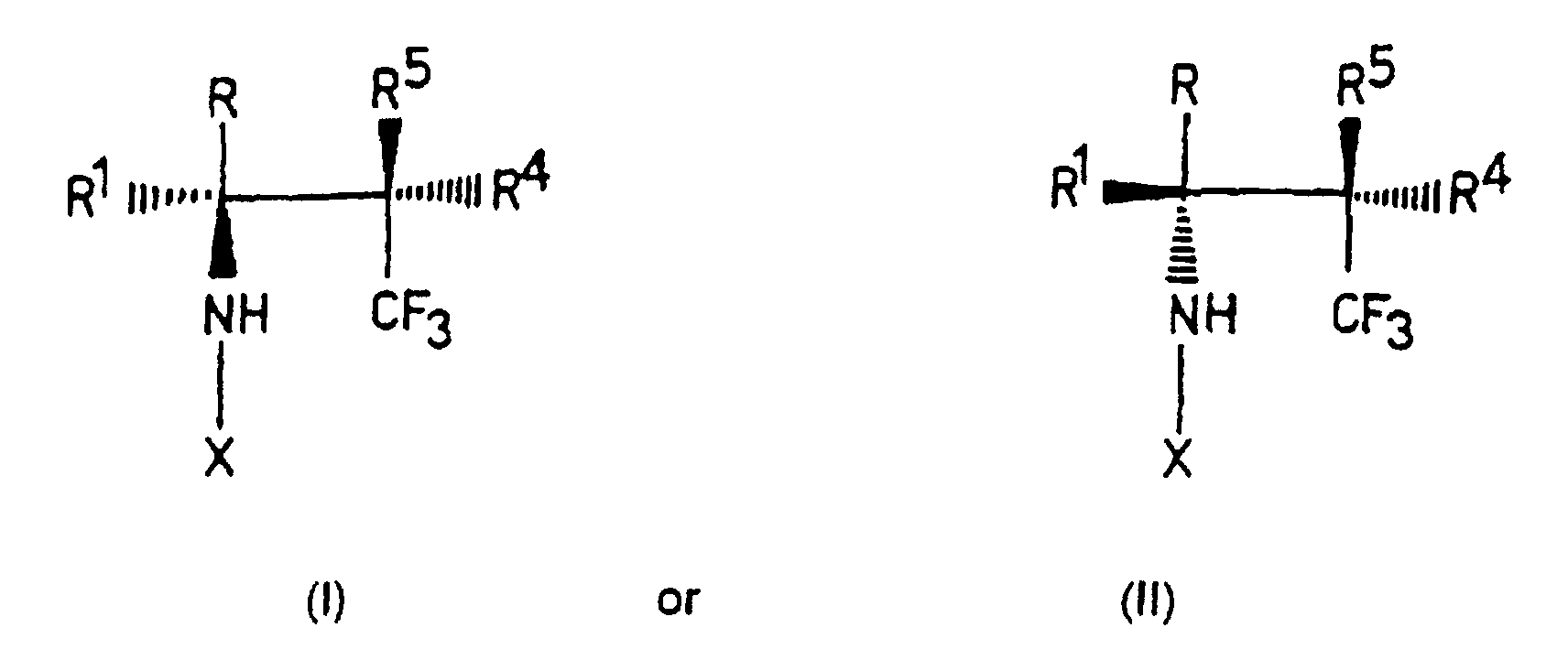
- where either R4 is OH and R5 is H, or C1-C12 hydrocarbon; or R5 is OH and R4 is H or C1-C12 hydrocarbon; or each of R4 and R5 is H; or R4 and R5 together are =O,
- R and R1 are the same or different and each is H or C1-C12 hydrocarbon which is either unsubstituted or which carries an acidic or a basic substituent,
- X is -COR or -COCH2OR or -COOR or a peptide residue or H including the free base and acid salts thereof.
-
- The hydrocarbon groups R, R1, R4 and R5 may be alkyl, alkenyl, alkynyl, straight chained or branched, cyclic, aromatic, heterocyclic or alicyclic. Examples of acidic and basic substituents include carboxylate, sulphonate, hydroxyl and amine. Preferably one of R and R1 is H and the other is a C1 - C12 alkyl or aryl or aralkyl group such as methyl or benzyl. Preferably R4 and R5 together are =O.
- X may be a protecting group such as tertiary-butoxycarbonyl or benzyloxycarbonyl. Or X may be H or an acid salt of the amine. Or X may be -COR or -COOR or -COCH2OR where R is as defined above. Alternatively, X may be a peptide residue.
- The following experimental section demonstrates the activity of certain α-amino trifluoromethyl derivatives as inhibitors against four different metallo-β-lactamases. The eight compounds tested have been given the numbers 2 to 9, and their activities compared with a known compound 1 having the formula PhCOCH2COCF3.
- The structures of compounds 2 to 9 are set out in the following table with reference to structures (I) and (II) above:-
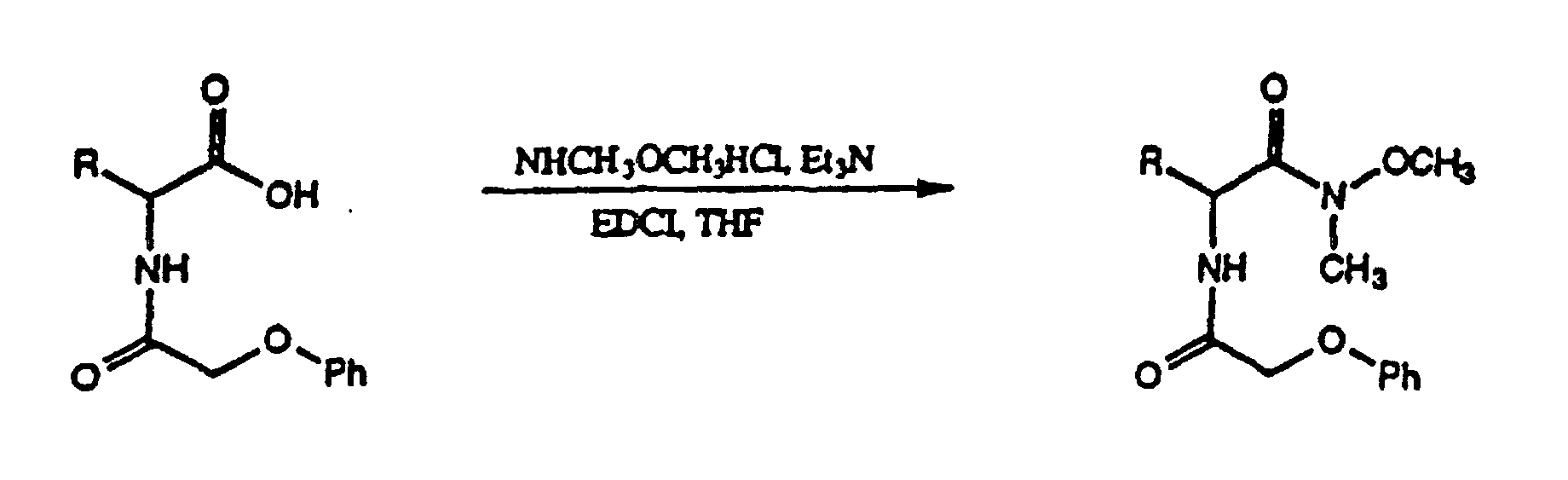
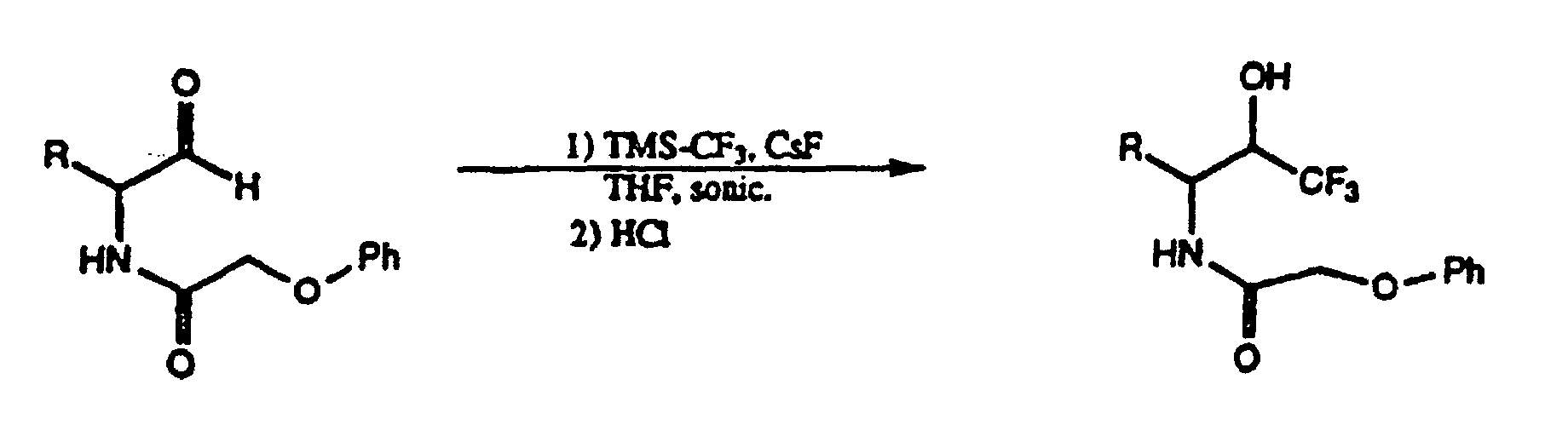
Compound Structure R, R1 R4, R5 X 2 (II) PhCH2-, H =O -COCH2OPh 3 (I) PhCH2-, H =O -COCH2OPh 4 (I) PhCH2-, H OH, H -COCH2OPh 5 (II) PhCH2-, H OH, H -COCH2OPh 6 (I) CH3, H =O -COCH2OPh 7 (II) CH3, H =O -COCH2OPh 8 (I) CH3, H OH, H -COCH2OPh 9 (II) CH3, H OH, H -COCH2OPh - Some of the compounds which were found to be active against metallo β-lactamases were obtained according to the general scheme below which is based on a known literature procedure (reference: Skiles, J. W. et al, J. Med. Chem. 1992, 35, 641-662), and some by the novel procedure described in a later section.


- Class B β-lactamases were purified according to published4 or standard procedures from a range of bacteria, including: Xanthomonas maltophilia, Bacillus cereus, Pseudomonas aeruginosa and Aeromonas hydrophila.
- Assays for inhibition were also carried out according to published procedures4. Kinetic experiments were typically carried out at 30°C with 30 mM sodium cacodylate buffer, pH 6.5, containing 0.1 mM ZnCl2.
- The Kl (inhibition constant) values were determined by analysing the initial rate of hydrolysis at different inhibitor concentrations using the following reporter substrates: 30 µm nitrocefin (X. maltophilia enzyme), 200 µM imipenem (A. hydrophila), or 1 mM cephalosporin C (B. cereus and P. aeruginosa enzymes). Data analysis was carried out according to standard kinetic procedures [Felici, A. et al., Biochem. J., 291, 151-155 (1993) and references therein].
- The following are exemplary kinetic data which illustrate the use of trifluoromethylketone derivatives for the inhibition of metallo β-lactamases. The data indicate that inhibition may be characterised as occurring via either a competitive process and/or by a process resulting in inactivation of the enzymes or by another as yet unspecified process.
- Compounds 3, 6, 7 and 9 behaved as competitive inhibitors of the X. maltophilia enzyme with Kl values of 15 µM, 1.5 µM, 3.0 µM and 35 µM, respectively.
- Compounds 2, 3, 4, 5, 6, 7, 8, 9 and 1 were similarly shown to be competitive inhibitors of the B. cereus enzyme with Ki values of 1 mM, 500 µM, 1 mM, 30 µM, 30 µM, 700 µM, 300 µM, 700 µM and 300 µM, respectively.
- Compounds 3, 4, 5, 6, 7, 8 and 9 were similarly shown to be competitive inhibitors of the P. aeruginosa enzyme with Ki values of 530 µM, 900 µM, 60 µM, 300 µM, 500 µM, 400 µM, and 400 µM, respectively.
- Compounds 3, 4, 5, 6, 7 and 9 were also shown to be inhibitors of the A. hydrophila enzyme. Further kinetic analyses showed them to act as inactivators (no reactivation was observed) of the A. hydrophila enzyme. The following kinetic parameters were obtained, where K= apparent binding constant between the enzyme and substrate and k+2 = apparent rate constant for inactivation as in the following scheme:

-
- for compound 3: K = 6 µM, k+2 = 4.3 x 10⁻² s-1
- for compound 4: K = 19 µM, k+2 = 4.3 x 10⁻² s-1
- for compound 5: K = 20 µM, k+2 = 3.9 x 10⁻² s-1
- for compound 6: K = 44 µM, k+2 = 4.0 x 10⁻² s-1
- for compound 7: K = 11 µM, k+2 = 11 x 10-2 s-1
- for compound 9: K = 217 µM, k+2 = 1.1 x 10⁻² s-1
-
- A method of making a trifluoromethylketone from a corresponding starting optionally N-protected α-amino add, comprises the steps:
- a) converting the starting α-amino acid to a corresponding oxazolidin-5-one.
- b) reacting the oxazolidin-5-one with a trifluoromethyl trialkylsilane to form a C-2 substituted oxazolidine.
- c) effecting desilylation and ring-cleavage of the C-2 substituted oxazolidine.
-
- Preferably the steps are performed according to the reaction scheme:
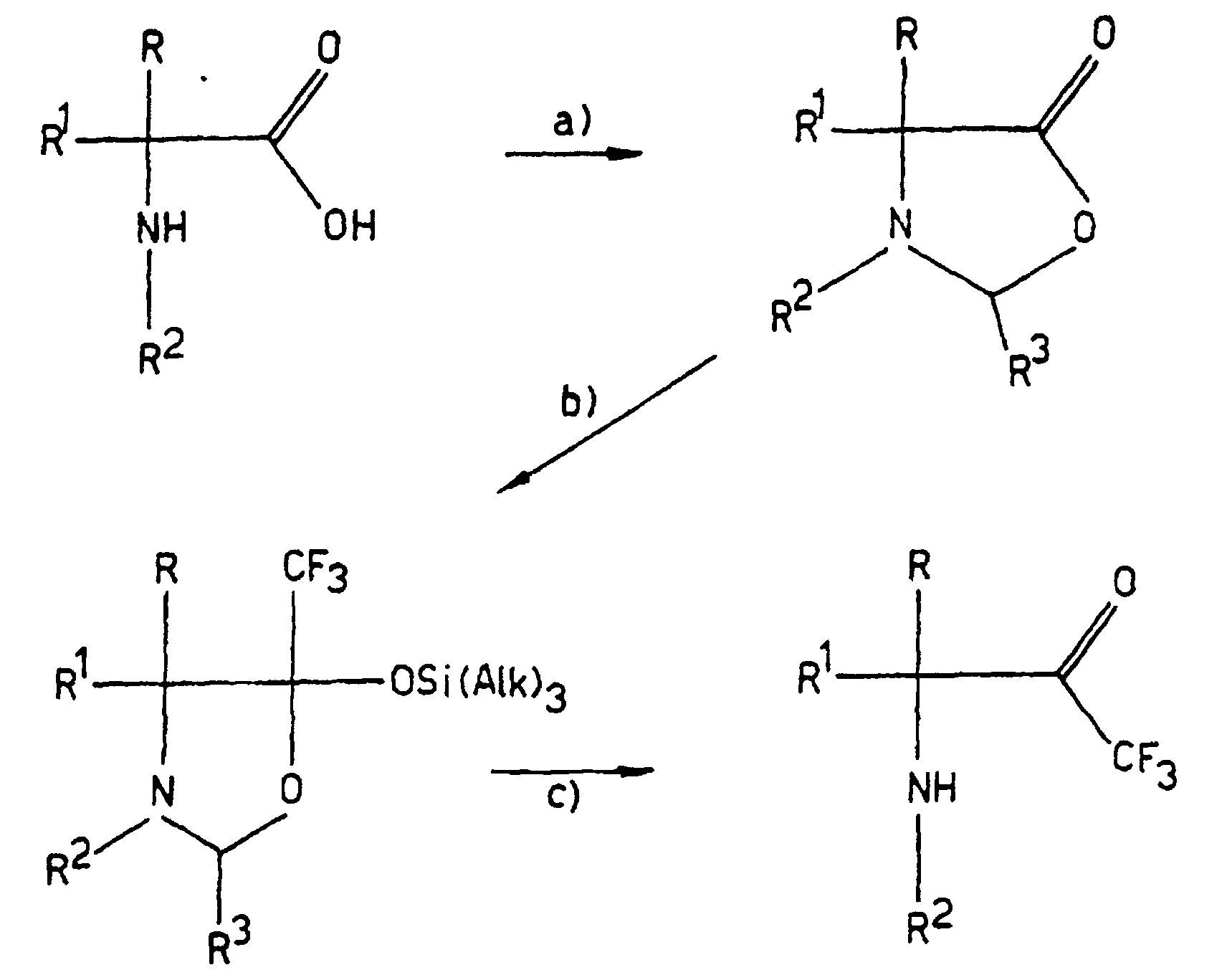
- where R2 is a protecting group
- R and R1 are the same or different and each is H or C1 - C12 hydrocarbon which is either unsubstituted or which carries an acidic or a basic substituent, and
- R3 is H or C1 - C12 hydrocarbon which is either unsubstituted or which carries a hydroxy or alkoxy substituent.
-
- Various synthetic approaches to this class of compounds have been reported including a modified Dakin-West procedure, reaction of trifluoroacetic anhydride with ketenes, and trifluoromethyl carbanions1. The latter approach is, however, of limited utility due to the well-documented tendency of the trifluoromethyl anion to undergo fluoride elimination. Ruppert and coworkers2 have developed a stable trifluoromethyl anion equivalent in the form of (trifluoromethyl)trimethylsilane (Ruppert's Reagent/TMS-CF3), which is an efficient nucleophilic trifluoromethylation agent for addition to certain carbonyl compounds3. Fluoride-catalysed addition reaction of TMS-CF3 to ketones or aldehydes generally proceeds in good yields, but efficient reaction with carboxylic acid derivatives has only been reported in the case of five- and six-membered lactones3.
- The present inventors have studied the reaction of TMS-CF3 with oxazolidin-5-ones4 derived from both natural and unnatural amino acids, and developed a new general route to trifluoromethyl ketone derivatives of amino acids. α-Amino acids can be readily converted into oxazolidin-5-ones by known literature methods5,6 (Scheme 1).

- The addition of Ruppert's Reagent to oxazolidin-5-ones occurs in very good to excellent yields and tolerates a wide variety of amino acid side-chains (see Table 1). Also α-disubstituted oxazolidin-5-ones react in very good yields (19, 20 in Table 1).
Entry Nr. R R1 R2 R3 method yield TFMK I 1 PhCH2 H BOC H A 1a: 98% - - - - II 2 H3C H BOC H A 2a: 85% - - - - III 3 (H3C)2CH H BOC H A 3a: 84% - - - - IV 4 (H3C)CH2C H BOC H A 4a: 95% - - - - V 5 PhCH2SCH2 H BOC H A 5a: 77% - - - - VI 6 PhCH2 H CBZ H A 6a: 95% - - - - VII 7 H3C H CBZ H A 7a: 69% - - - - VIII 8 MeO2CCH2 H CBZ H A 8a: 50% - - - - IX 9 MeO2C(CH2)2 H CBZ H A 9a: 73% - - - - X 10 PhCH2 H CBZ t-Bu A 10a: 80% - - - - XI 11 H3C H CBZ t-Bu A 11a: 38% - - - - XII 12 PhCH2 H CBZ Ph A 12a: 53% - - - - XIII 13 PhCH2 H CBZ p-H3COC6H4 B 13a: 91% 13c XIV 14 H3C H CBZ p-H3COC6H4 B 14a: 92% 14c XV 15 (H3C)CH2CH2 H CBZ p-H3COC6H4 B 15a: 85% 15c XVI 16 PhCH2 H PhCO t-Bu B 16a: 71% 16c XVII 17 H3C H PhCO p-H3COC6H4 B 17a: 94% 17c XVIII 18 H3C H PhOCH2CO p-H3COC6H4 B 18a: 85% 18c XIX 19 H3C H3C PhCO p-H3COC6H4 B 19a: 72% 19c XX 20 H3C H3C PhOCH2CO p-H3COC6H4 B 20a: 75% 20c XXI 21 H H PhCO p-H3COC6H4 B 21a: 75% 21c XXII 22 (H3C)2CH H CBZ p-H3COC6H4 B 22a: 81% 22c - In the case of paraformaldehyde derived oxazolidin-5-ones CsF with sonication was used as a fluoride source (method A in Scheme 2), whereas for C-2 substituted oxazolidin-5-ones a commercial solution of tetrabutylammonium fluoride in THF was preferable (method B in Scheme 2). The silylated adducts 1a - 22a were desilylated in quantitative yield using 1 equivalent of a solution of tetrabutylammonium fluoride in THF or 1 equivalent of CsF with sonication.

- Oxazolidin-5-ones having a para-methoxyphenyl or a tert-butyl substituent at the C-2 position were cleaved by stirring in acetonitrile at 40-50 °C in the presence of strongly acidic ion exchange resin for 48 to 72 hours. Oxazolidin-5-one 16a with a C-2 tert-butyl substituent and a benzoyl group at the nitrogen was also hydrolysed under similar conditions. The product N-substituted a-amino-trifluoromethyl ketones were obtained in excellent yields (Scheme 3).

- Analytical data of 13c obtained via addition of Ruppert's Reagent to the oxazolidin-5-one 13 followed by hydrolysis were the same as those obtained for the synthesis of 13c via a known route (Scheme 4) starting from N-benzyloxycarbonyl-(L)-phenylalaninal, ([α] 20 / D = +23.2° (c = 0.5, CHCl3) for 13c prepared as in Scheme 3, and [α] 20 / D = +22.9° (c = 0.5, CHCl3) for 13c prepared as in Scheme 4).
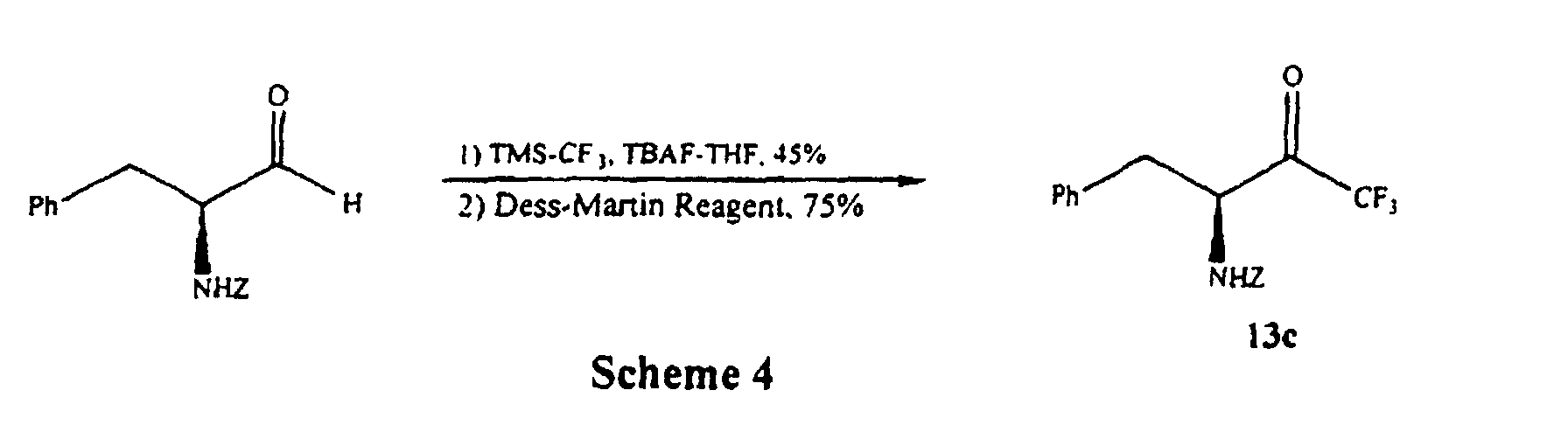
- Z is CBZ (benzyloxycarbonyl)
- N-substituted α-amino trifluoromethyl ketones are stable highly crystalline compounds which can be stored for long periods without any sign of decomposition.
- Compounds 13c and 14c were converted into hydrochloride salts of the corresponding α-amino trifluoromethyl ketones in quantitative yield using a standard hydrogenation procedure (Scheme 5).
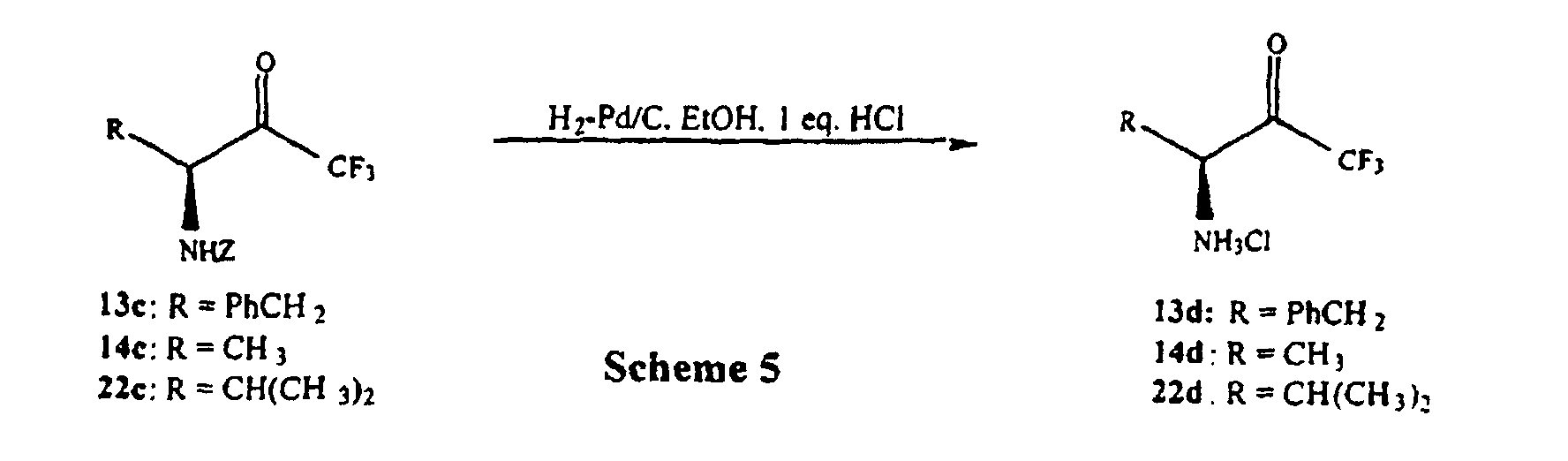
- First studies have shown that hydrochloride salts of α-amino trifluoromethyl ketones undergo the same reactions as the well known hydrochloride salts of α-amino acids. Thus, the N atom in 13d was derivatised as the benzoyl amide. Coupling with activated amino acid derivatives provided access to peptidic trifluoromethyl ketones (Scheme 6).

- Using amino acid fluorides as acylating reagents9,10 peptidic trifluoromethyl ketones were obtained as single diastereomers from optically pure trifluoromethyl ketone hydrochloride salts (Scheme 7).
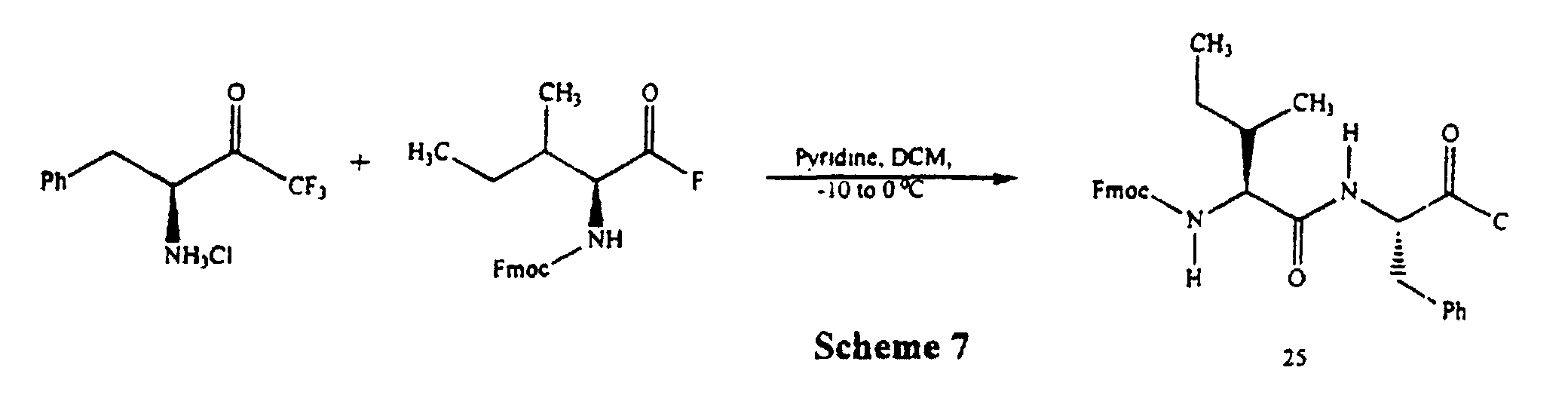
- Melting points are uncorrected. 1H, 19F, and 13C NMR spectra were recorded at the indicated field strengths. 19F NMR spectra were referenced externally to CFCl3 at 0.00 ppm. Elemental analyses were performed at the Dyson Perrins Laboratory, University of Oxford. High resolution mass spectra were obtained by the EPSRC mass spectrometry service, Swansea. All separations were effected under flash chromatography conditions using either Acros C60 (0.035-0.07 mm) silica gel or Sigma-Aldrich octadecyl modified silica gel (40-63, 550 m2/g, 60Å) following a literature procedure for reversed phase column chromatography ref. Sonication was carried out in a Kerry Pulsatron. Amberlite® IR 120 (Plus) ion exchange resin was obtained from Aldrich and 'activated' by refluxing in 2M hydrochloric acid and washed several times with water before use. All reagents were obtained from commercial suppliers and used as received unless otherwise stated. THF was distilled from potassium/benzophenone ketyl under a nitrogen atmosphere. DCM was distilled from calcium hydride under a nitrogen atmosphere.
- General procedure A: Preparation of N-CBZ and N-BOC protected oxazolidin-5-ones: A mixture of N-CBZ or N-BOC-protected amino acid (10.0 mM), para-formaldehyde (400 mg), and para-toluenesulfonic acid (100 mg) in benzene (150 ml) was refluxed for 1 h, the water being distilled off and collected in a water separator as it was formed (Dean-Stark-conditions). The benzene solution was allowed to cool to room temperature and washed with aqueous sodium bicarbonate solution (50 mL) and brine (50 mL). After drying over magnesium sulphate and evaporation of solvents in vacuo, the crude product was purified by column chromatography or by crystallisation from suitable solvents.
- General procedure B: Formation of Schiff-base salts of amino acids: The amino acid (10.0 mM) was dissolved in a 1M solution of sodium hydroxide (10 mL). Gentle warming or addition of ethanol was sometimes required to effect solution. The solution was then reduced in vacuo until solid began to appear at which time one molar equivalent of aldehyde was added. Concentration in vacuo was continued until the reaction mixture solidified. The solid was suspended in diethyl ether (150 mL), filtered and washed thoroughly with same solvent and dried in vacuo. This procedure afforded the Schiff-base salts in nearly quantitative yield. The infrared spectrum exhibited the characteristic absorption peaks at 1665 and 1800-1810 cm-1.
- General procedure C: Preparation of N-CBZ protected, C-2 substituted oxazolidin-5-ones: To a suspension of carefully ground Schiff-base salt (10.0 mM) in DCM (150 mL) was added benzyl chloroformate (1.43 mL, 10.0 mM) over a period of 6 h at -15 °C under an argon atmosphere. The resulting mixture was stirred at -15 °C for 72 h after which time the reaction mixture was reduced in vacuo and ethyl acetate (100 mL) was added. The organic layer was washed with aqueous hydrochloric acid (50 mL), saturated sodium bicarbonate solution (50 mL) and brine (50 mL). After re-extraction of the aqueous layer with ethyl acetate (50 mL) the combined organic layers were washed with brine (2x75 mL) and dried over magnesium sulphate. The solvents were removed in vacuo and the products purified by column chromatography or by crystallisation from suitable solvents.
- General procedure D: Preparation of N-amide protected, C-2 substituted oxazolidin-5-ones: A mixture of carefully ground Schiff base salt (10 mM) and the appropriate acid chloride (10 mM) in DCM (150 mL) was refluxed for 12 h under an argon atmosphere. The reaction mixture was reduced in vacuo and ethyl acetate (100 mL) was added. The organic layer was washed with aqueous hydrochloric acid (50 mL), saturated sodium bicarbonate solution (50 mL) and brine (50 mL). After re-extraction of the aqueous layer with ethyl acetate (50 mL) the combined organic layers were washed with brine (2x75 mL) and dried over magnesium sulphate. The solvents were removed in vacuo and the products purified by column chromatography or by crystallisation from suitable solvents.
- General procedure E (Method A in Table 1): To a solution of oxazolidin-5-one (1 mM) in dry THF (5 mL) were added caesium fluoride (catalytic amounts) and (trifluoromethyl)- trimethylsilane (0.19 mL, 1.20 mM, 1.20 eq) under an argon atmosphere. The flask was placed in a sonicator and the reaction followed by TLC analysis. After all starting material had been consumed (usually 20 to 60 min) the mixture was diluted with ethyl acetate (10 mL), washed with water (10 mL), brine (10 mL), and dried over magnesium sulphate. The solvents were removed in vacuo and the products purified by flash column chromatography.
- General procedure F (Method B in Table 1): To a solution of oxazolidin-5-one (1.00 mM) in dry THF (5 mL) were added (trifluoromethyl)trimethylsilane (0.19 mL, 1.20 mM, 1.20 eq). and tetrabutylammonium fluoride (25 µL of a 1.00 M solution in THF, 0.025 mM) under an argon atmosphere at room temperature resulting in a yellow solution. The reaction was followed by TLC analysis. After all starting material had been consumed the mixture was taken up in ethyl acetate (10 mL), washed with water (2x10 mL), brine (10 mL), and dried over magnesium sulphate. The solvents were removed in vacuo and the products purified by flash column chromatography.
- General procedure G: Desilylation of adducts 1a-21a: To a solution of silylated adduct (1.00 mM) in THF (5 mL) was added tetrabutylammonium fluoride (1.20 mL of a 1.00 M solution in THF, 1.20 eq). The reaction was followed by TLC analysis. After all starting material had been consumed, ethyl acetate (10 mL) and aqueous hydrochloric acid (10 mL) were added. The organic layer was separated and washed with saturated sodium bicarbonate solution (10 mL) and brine (10 mL). The combined organic phases were dried over magnesium sulphate and the solvents evaporated in vacuo.
- General procedure H: Hydrolysis of 5-hydroxy-5-trifluoromethyloxazolidins: To a solution of 5-hydroxy-5-trifluoromethyloxazolidin (1 mM) in acetonitrile (15 mL) was added strongly acidic cation exchange resin (2.0 g) and stirred at 45 °C until all starting material had disappeared by TLC (usually 36-48 h) after which time a deeply red solution was obtained. The crude product was diluted with acetonitrile (25 mL), filtered through Celite® and the resin thoroughly washed with acetonitrile. After removal of the solvent in vacuo, the residue was taken up in ethyl acetate (25 mL) and washed with saturated sodium bicarbonate solution (15 mL) and brine (15 mL). After drying over magnesium sulphate the solvent was removed in vacuo. Purification was achieved by reversed phase column chromatography on octadecylsilyl coated silica gel.
- (4S)-4-Benzyl-N-tert-butyloxycarbonyl-1,3-oxazolidin-5-one (1) was prepared from N-tert-butyloxycarbonyl-(L)-phenylalanine (2.65 g, 10.0 mM) and para-toluene-sulfonic acid (30 mg) following general procedure A and obtained as a white solid after crystallisation from diethyl ether (1.49 g, 54%): [α] 20 / D +23.5 (c 1.0, CHCl3); mp 84-86 °C; IR (KBr): 1795, 1705 cm-1; 1H NMR (500 MHz, d8-toluene, 90 °C): δ 6.97-7.08 (m, 5H), 4.75 (d, J = 4 Hz, 1H), 4.03-4.05 (m, 2H), 3.17 (dd, J = 4, 14 Hz, 1H), 2.92 (dd, J = 3, 14 Hz, 1H), 1.31 (s, 9H); 13C NMR (50.3 MHz, CDCl3): δ 172.7, 153.2, 135.0, 129.8, 128.9, 127.6, 82.0, 78.0, 56.3, 34.3, 28.6; LRMS (NH3): 295 (MNH4 +). Anal. Calcd for C15H19NO4: C, 64.96; H, 6.90; N, 5.05; found: C, 64.93; H, 6.73; N, 4.83.
- (4S)-N-tert-Butyloxycarbonyl-4-methyl-1,3-oxazolidin-5-one (2) was prepared from N-tert-butyloxycarbonyl-(L)-alanine (1.89 g, 10.0 mM) and para-toluenesulfonic acid (30 mg) following general procedure A and obtained as fine white needles after crystallisation from chloroform (1.49 g, 74%): [α] 20 / D +78.1 (c 1, CHCl3); mp 64-67 °C; IR (KBr) 1795, 1705 cm-1; 1H NMR (200 MHz, CDCl3): δ 5.40 (d, J = 2 Hz, 1H), 5.20 (d, J = 2 Hz, 1H), 4.50 (q, J = 7 Hz, 1H), 1.55 (d, J = 7 Hz, 3H), 1.45 (s, 9H); 13C NMR (50.3 MHz, CDCl3): δ 173.5, 152.0, 81.4, 77.3, 50.3, 27.8, 16.3; LRMS (NH3): 219 (MNH4 +). Anal. Calcd for C9H15NO4: C, 53.72; H, 7.51; N, 6.96; found: C, 53.58; H, 7.71; N, 6.70.
- (4S)-N-tert-Butyloxycarbonyl-4-isopropyl-1,3-oxazolidin-5-one (3) was prepared from N-tert-butyloxycarbonyl-(L)-valine (2.17 g, 10.0 mM) and para-toluenesulfonic acid (30 mg) following general procedure A and obtained as a white solid after crystallisation from chloroform (1.67 g, 73%): [α] 20 / D +104.9 (c 1, CHCl3); mp 43-45 °C; IR (KBr): 1795, 1705 cm-1; 1H NMR (200 MHz, CDCl3): δ 5.55 (br, 1H), 5.10 (d, J = 4 Hz, 1H), 4.15 (d, J = 4 Hz, 1H), 2.21-2.43 (m, 1H), 1.49 (s, 9H), 1.06 (d, J = 7 Hz, 3H), 1.02 (d, J = 7 Hz, 3H); 13C NMR (50.3 MHz, CDCl3): d 171.8, 152.6, 81.6, 78.4, 59.9, 31.1, 27.9, 17.9, 17.5; LRMS (NH3): 230 (MH+). Anal. Calcd for C11H19NO4: C, 57.63; H, 8.35; N, 6.11; found: C, 57.62; H, 8.54; N, 5.93.
- (4S)-N-tert-Butyloxycarbonyl-4-isobutyl-1,3-oxazolidin-5-one (4) was prepared from N-tert-butyloxycarbonyl-(L)-leucine (2.31 g, 10.0 mM) and para-toluenesulfonic acid (30 mg) following general procedure A and obtained as a colourless, slowly solidifying oil after purification by flash column chromatography, using 30% chloroform/petroleum ether as eluant (1.91 g, 79%): [α] 20 / D +88.5 (c 0.9, CHCl3); IR (CHCl3): 1790, 1720 cm-1; 1H NMR (200 MHz, CDCl3): δ 5.48 (d, J = 5 Hz, 1H), 5.09 (d, J = 5 Hz, 1H), 4.22 (t, J = 6 Hz, 1H), 1.43 (s, 9H), 1.23-1.16 (m, 3H), 0.92 (d, J = 5 Hz, 3H), 0.90 (d, J = 5 Hz, 3H); 13C NMR (50.3 MHz, CDCl3): δ 172.9, 152.2, 81.5, 77.8, 53.2, 39.4, 27.9, 24.2, 22.4, 22.2; LRMS (NH3): 244 (MH+).
- (4R)-4-(S-Benzylthiomethyl)-N-tert-butyloxycarbonyl-1,3-oxazolidin-5-one (5) was prepared from S-benzylthiomethyl-N-tert-butyloxycarbonyl-(L)-cysteine (3.11 g, 10.0 mM) and para-toluenesulfonic acid (30 mg) following general procedure A and obtained as fine white needles after crystallisation from diethyl ether (1.68 g, 52%): [α] 20 / D +140.0 (c 1.0, CHCl3); mp 63-65 °C; IR (KBr): 1800, 1700 cm-1; 1H NMR (500 MHz, d8-toluene, 90 °C): δ 6.81-7.34 (m, 5H), 4.96 (br, d, J = 4 Hz, 1H), 4.93 (dd, J = 1, 4 Hz, 1H), 3.95 (dd, J = 3, 4 Hz, 1H), 3.52 (d, J = 13 Hz, 1H), 3.49 (d, J = 13 Hz, 1H), 3.03 (dd, J = 4, 14 Hz, 1H), 2.71 (dd, J = 3, 14 Hz, 1H), 1.29 (s, 9H); 13C NMR (50.3 MHz, CDCl3): δ 171.8, 152.4, 137.6, 129.0, 128.6, 127.3, 82.2, 78.9, 56.4, 37.4, 37.3, 28.3; LRMS (EI): 324 (MH+). Anal. Calcd for C16H21NO4S: C, 59.42; H, 6.55; N, 4.33; found: C, 59.25; H, 6.40; N, 4.25.
- (4S)-N-Benzyloxycarbonyl-4-methoxycarbonylmethyl-1,3-oxazolidin-5-one (8): To a solution of (4S)-3-benzyloxycarbonyl-4-carboxymethyl-1,3-oxazolidin-5-one11 (1.00 g, 3.58 mM) in ethyl acetate (25 mL) was added a solution of diazomethane (10.0 mM) in diethyl ether (45 mL) over 25 min. Excess diazomethane was removed by addition of a few drops of acetic acid. The organic layer was then washed with aqueous sodium bicarbonate solution (3x50 mL) and brine (50 mL). After drying over magnesium sulphate and removal of solvents in vacuo (6) was obtained as a colourless solid from diethyl ether (1.01 g, 96%): [α] 20 / D +84.0 (c 2, CHCl3); mp 90-93 °C; IR (KBr): 1805, 1735 cm-1; 1H NMR (500 MHz, d8-toluene): δ 6.80-7.11 (m, 5H), 4.99 (dd, J = 1, 4 Hz, 1H), 4.95 (d, J = 4 Hz, 1H), 4.92 (d, J = 12 Hz, 1H), 4.85 (d, J = 12 Hz, 1H), 3.81 (dd, J = 3.5, 4.5 Hz, 1H), 3.20 (s, 3H), 2.90 (dd, J = 4.5, 7 Hz, 1H), 2.60 (dd, J = 3.5, 7 Hz, 1H); 13C NMR (50.3 MHz, CDCl3): δ 172.8, 170.1, 152.6, 135.4, 128.7, 128.5, 128.2, 78.4, 67.8, 52.7, 51.5, 34.0; LRMS (NH3): 294 (MH+). Anal. Calcd for C14H15NO6: C, 57.33; H, 5.15; N, 4.76; found: C, 57.15; H, 5.04; N, 4.71.
- (4S)-N-Benzyloxycarbonyl-4-methoxycarbonylethyl-1,3-oxazolidin-5-one (9): To a solution of (4S)-3-benzyloxycarbonyl-4-carboxyethyl-1,3-oxazolidin-5-oneref (1.0 g, 3.41 mM) in ethyl acetate (25 mL) was added a solution of diazomethane (10.0 mM) in diethyl ether (45 mL) over 25 min. Excess diazomethane was removed by addition of a few drops of acetic acid. The organic layer was then washed with aqueous sodium bicarbonate solution (3x50 mL) and brine (50 mL). After drying over magnesium sulphate and removal of solvents in vacuo (8) was obtained as a colourless solid from diethyl ether (1.02 g, 97%): [α] 20 / D +83.1 (c 2, CHCl3); mp 96-97 °C; IR (CHCl3): 1805, 1735 cm-1; 1H NMR (200 MHz, CDCl3): δ 7.38-7.49 (m, 5H), 5.54 (br, 1H), 5.23-5.47 (m, 3H), 4.45 (dd, J = 4 Hz, 1H), 3.61 (s, 3H), 2.01-2.46 (m, 4H); 13C NMR (50.3 MHz, CDCl3): δ 172.5, 171.8, 153.0, 135.3, 128.7, 128.6, 128.3, 77.8, 68.1, 54.0, 51.8, 29.1, 25.9; LRMS (NH3): 325 (MNH4 +); HRMS: calcd for C15H18NO6 (MH+): 308.1134; found: 308.1134.
- (2S,4S)-4-Benzyl-N-benzyloxycarbonyl-2-tert-butyl-1,3-oxazolidin-5-one (10) was prepared from sodium N-(tert-butylidene)-(L)-phenylalaninate (2.55 g, 10.0 mM) and benzyl chloroformate (1.43 mL, 10.0 mM) following general procedure C and obtained as a colourless oil, after purification by flash column chromatography, using 25% diethyl ether/petrol as eluant (2.08 g, 57%, single diastereomer): [α] 20 / D -3.0 (c 1.0, CHCl3); IR (CHCl3): 1795, 1725 cm-1; 1H NMR (200 MHz, CDCl3): δ 7.26-7.43 (m, 10H), 5.59 (s, 1H), 5.17 (d, J = 12 Hz, 1H), 4.95 (d, J = 12 Hz, 1H), 4.51 (dd, J = 6, 7 Hz, 1H), 3.25 (dd, J = 7, 12 Hz, 1H), 3.15 (dd, J = 6, 12 Hz, 1H), 1.04 (s, 9H); 13C NMR: δ 171.9, 155.8, 136.7, 135.1, 129.4, 128.9, 126.9, 128.5, 128.4, 96.1, 68.2, 58.8, 39.2, 36.9, 24.8; LRMS (NH3): 385 (MNH4 +); HRMS: calcd for C22H26NO4 (MH+): 368.1862; found: 368.1862.
- (2S,4S)-N-Benzyloxycarbonyl-2-tert-butyl-4-methyl-1,3-oxazolidin-5-one (11) was prepared from sodiumN-(tert-butylidene)-(L)-alaninate8 (1.79 g, 10.0 mM) and benzyl chloroformate (1.42 mL, 10.0mM) following general procedure C and obtained as a colourless oil after purification by flash column chromatography, using 16% diethyl ether/petrol as eluant (1.39 g, 48%, mixture of 2 diastereomers in a ratio of 2:1 by 1H NMR): IR (CHCl3): 1800, 1720 cm-1; 1H NMR (200 MHz, CDCl3): δ 7.32-7.43 (5H, m), 5.66 (s, 1H, minor diastereomer), 5.55 (s, 1H, major diastereomer), 5.16-5.20 (m, 2H), 4.37 (q, J = 6 Hz, 1H, minor diastereomer), 4.12 (q, J = 7 Hz, 1H, major diastereomer), 1.61 (d, J = 6 Hz, 3H, minor diastereomer), 1.54 (d, J = 7 Hz, 3H, major diastereomer), 0.96 (s, 9H, minor diastereomer), 0.93 (s, 9H, major diastereomer); 13C NMR (50.3 MHz, CDCl3): δ 173.8, 173.1, 155.7, 135.3, 128.6, 128.2, 96.2, 94.9, 68.0, 67.7, 53.4, 53.0, 39.4, 37.1, 24.8, 24.6, 17.4; LRMS (NH3): 309 (MNH4 +); HRMS: calcd for C16H22NO4 (MH+): 292.1549; found: 292.1549.
- (2S,4S)-4-Benzyl-N-benzyloxycarbonyl-2-(4'-methoxyphenyl)-1,3-oxazolidin-5-one (13) was prepared from sodium N-(para-methoxybenzylidene)-(L)-phenylalaninate (3.05 g, 10.0 mM) and benzyl chloroformate (1.43 mL, 10.0 mM) following general procedure C and obtained as a white solid after crystallisation from diethyl ether (2.87 g, 69%): [α] 20 / D +50.1 (c 1.0, CHCl3); mp 85 °C; IR (KBr): 1795, 1700 cm-1; 1H NMR (500 MHz, d8-toluene, 90 °C): δ 6.49-7.08 (m, 14H), 6.04 (s, 1H), 4.92 (d, J = 12 Hz, 1H), 4.83 (d, J = 12 Hz, 1H), 4.19 (dd, J = 4, 6 Hz, 1H), 3.39 (s, 3H), 3.25 (dd, J = 6, 14 Hz, 1H), 3.08 (dd, J = 4, 14 Hz, 1H); 13C NMR (50.3 MHz, CDCl3): δ 171.4, 160.3, 151.5, 135.3, 129.2, 128.8, 128.5, 128.2, 127.3, 113.4, 89.3, 67.8, 58.4, 55.3, 34.5; LRMS (EI): 418 (MH+). Anal. Calcd for C25H23NO5: C, 71.93; H, 5.55; N, 3.35. Found: C, 72.22; H, 5.36; N, 3.28.
- (2S,4S)-N-Benzyloxycarbonyl-2-(4'-methoxyphenyl)-4-methyl-1,3-oxazolidin-5-one (14) was prepared from sodium N-(para-methoxybenzylidene)-(L)-alaninate (2.29 g, 10.0 mM) and benzyl chloroformate (1.43 mL, 10.0 mM) following general procedure C and obtained as a white solid after purification by flash column chromatography, using 33% ethyl acetate/petrol as eluant (1.75g, 51%, single diastereomer): [α] 20 / D +99.9 (c 1.0, CHCl3); mp 97-99 °C; IR (KBr): 1790, 1695 cm-1; 1H NMR (500 MHz, d8-toluene, 90 °C): δ 6.56-7.06 (m, 9H), 6.11 (s, 1H), 4.82 (d, J = 12 Hz, 1H), 4.72 (d, J = 12 Hz, 1H), 4.13 (q, J = 7 Hz, 1H), 3.35 (s, 3H), 1.47 (d, J = 7 Hz, 3H); 13C NMR (50.3 MHz, CDCl3): δ 172.3, 160.8, 152.0, 135.2, 128.4, 128.0, 127.7, 125.8, 121.3, 114.1, 89.2, 67.5, 55.3, 52.1, 16.5; LRMS (NH3): 342 (MNH4 +). Anal. Calcd for C19H19NO5: C, 66.85; H, 5.61; N, 4.10; found: C, 66.80; H, 5.42; N, 4.15.
- (2S,4S)-N-Benzyloxycarbonyl-4-isobutyl-2-(4'-methoxyphenyl)-1,3-oxazolidin-5-one (15) was prepared from sodium N-(para-methoxybenzylidene)-(L)-leucinate (2.71 g, 10.0 mM) and benzyl chloroformate (1.43 mL, 10.0 mM) following general procedure C and obtained as a colourless oil after purification by flash column chromatography, using 25% ethyl acetate/petrol as eluant (3.21 g, 84%, single diastereomer): [α] 20 / D -30.0 (c 1.0, CHCl3); IR (CHCl3): 1795, 1715 cm-1; 1H NMR (200 MHz, CDCl3): δ 6.89-7.38 (m, 9H), 6.71 (s, 1H), 5.20 (s, 2H), 4.47 (t, J = 7 Hz, 1H), 3.82 (s, 3H), 1.57-1.98 (m, 3H), 0.88-0.92 (m, 6H); 13C NMR (50.3 MHz, CDCl3): δ 172.5, 160.4, 154.0, 135.3, 129.2, 128.6, 128.3, 127.4, 113.9, 88.8, 68.1, 55.3, 54.4, 42.1, 24.5, 22.3, 22.2; LRMS (NH3): 384 (MH+); HRMS: calcd for C22H26NO5 (MH+): 384.1811; found: 384.1811. (2S,4S)-N-Benzoyl-2-(4'-methoxyphenyl)-4-methyl-1,3-oxazolidin-5-one (17) was prepared from sodium N-(para-methoxybenzylidene)-(L)-alaninate (2.29 g, 10.0 mM) and benzoyl chloride (1.16 mL, 10.0 mM) following general procedure D and obtained as a white solid after purification by flash column chromatography, using 20% ethyl acetate/petrol as eluant (2.15 g, 69%, mixture of two diastereomers in a ratio of 3:1 by 1H NMR). After crystallisation from diethyl ether 17 was obtained as very fine white needles and as a single diastereomer by 1H NMR: [α] 20 / D +78.2 (c 1.0, CHCl3); mp 145-147 °C; IR (KBr): 1795, 1735, 1650 cm-1; 1H NMR (500 MHz, d8-toluene, 90 °C): δ 6.80-7.21 (m, 5H), 6.51-6.53 (m, 4H), 6.43 (s, 1H), 4.44 (q, J = 7 Hz, 1H), 3.29 (s, 3H), 1.25 (d, J = 7 Hz, 3H); 13C NMR (50.3 MHz, CDCl3): δ 172.5, 170.5, 160.6, 135.2, 130.9, 128.0, 127.6, 126.9, 126.8, 114.0, 90.3, 55.3, 52.7, 18.4; LRMS (NH3): 312 (MH+). Anal. Calcd for C18H17NO4: C, 69.45; H: 5.46; N, 4.50.; found: C, 69.18; H, 5.55; N, 4.38.
- (2S,4S)-2-(4'-Methoxyphenyl)-4-methyl-N-phenoxyacetyl-1,3-oxazolidin-5-one (18) was prepared from sodium N-(para-methoxybenzylidene)-(L)-alaninate (2.29 g, 10.0 mM) and phenoxyacetyl chloride (1.37 mL, 10.0 mM) following general procedure D and obtained as a colourless oil after purification by flash column chromatography, using 20% ethyl acetate/petroleum ether as eluant (1.87 g, 55%, mixture of two diastereomers in a ratio of 4:1 by 1H-NMR). Upon trituration with diethyl ether 18 was obtained as very fine white needles and as a single diastereomer by 1H NMR: [α] 20 / D +224 (c 1.0, CHCl3); mp 95-97 °C; IR (KBr): 1795, 1715, 1670 cm-1; 1H NMR (500 MHz, d8-toluene, 90 °C): δ 6.45-7.09 (m, 9H), 6.44 (s, 1H), 4.50 (q, J = 7 Hz, 1H), 4.06 (d, J = 14 Hz, 1H), 3.81 (d, J = 14 Hz, 1H), 3.31 (s, 3H), 1.41 (d, J = 7 Hz, 3H); 13C NMR (50.3 MHz, CDCl3): δ 172.1, 167.3, 161.4, 156.7, 129.0, 128.5, 128.1, 122.1, 114.6, 114.0, 89.6, 67.8, 55.4, 52.7, 16.1; LRMS (NH3): 342 (MH+). Anal. Calcd for C19H19NO5: C, 66.86; H, 5.57; N, 4.10; found: C, 66.69; H, 5.59; N, 4.01.
- (R/S)-N-Benzoyl-4,4-dimethyl-2-(4'-methoxyphenyl)-1,3-oxazolidin-5-one (19) was prepared from sodium N-(para-methoxybenzylidene)-(2-amino-2'-methyl)-propionate (2.43 g, 10.0 mM) and benzoyl chloride (1.16 mL, 10.0 mM) following general procedure D and obtained as a white solid after purification by flash column chromatography, using 20% ethyl acetate/petrol as eluant (1.71 g, 52%): mp 82-83 °C; IR (KBr): 1800, 1650 cm-1; 1H NMR (200 MHz, CDCl3): δ 7.10-7.29 (m, 6H), 6.63-6.71 (m, 4H), 3.69 (s, 3H), 1.88 (s, 3H), 1.71 (s, 3H); 13C NMR (50.3 MHz, CDCl3): 172.5, 169.5, 160.5, 136.4, 130.0, 128.4, 128.2, 128.1, 126.2, 113.9, 89.2, 59.7, 55.2, 25.2, 23.8; LRMS (EI): 326 (MH+). Anal. Calcd for C19H19NO4: C, 70.15; H, 5.85; N, 4.31; found: C, 69.94; H, 6.08; N, 4.64.
- (R/S)-4,4-Dimethyl-2-(4'-methoxyphenyl)-N-phenoxyacetyl-1,3-oxazolidin-5-one (20) was prepared from sodium N-(para-methoxybenzylidene)-(2-amino-2'-methyl)-propionate (2.43 g, 10.0 mM) and phenoxyacetyl chloride (1.37 mL, 10.0 mM) following general procedure D and obtained as a white solid after purification by flash column chromatography, using 20% ethyl acetate/petrol as eluant (2.10 g, 59%): mp 78-82 °C; IR (KBr): 1795, 1680 cm-1, 1H NMR (200 MHz, CDCl3): δ 7.21-7,40 (m, 5H), 6.77-7.03 (m, 4H), 6.71 (s, 1H), 4,10-4,15 (m, 2H), 3.83 (s, 3H), 1.92 (s, 3H), 1.69 (s, 3H); 13C NMR (50.3 MHz, CDCl3): δ 174.6, 166.4, 161.4, 157.0, 129.7, 128.6, 127.3, 122.0, 114.6, 114.3, 88.5, 68.2, 60.4, 55.4, 24.3, 22.6; LRMS (EI): 356 (MH+). Anal. Calcd for C20H21NO5: C, 67.60; H, 5.91; N, 3.94; found: C, 67.45; H, 5.91; N, 3.94.
- (R/S)-N-Benzoyl-2-(4'-methoxyphenyl)-1,3-oxazolidin-5-one (21) was prepared from sodium N-(para-methoxybenzylidene)-glycinate (2.15 g, 10,0 mM) and benzoyl chloride (1.16 mL, 10.0 mM) following general procedure D and obtained as a white solid after purification by flash column chromatography, using 20% ethyl acetate/petrol as eluant (2.08 g, 70%): mp 130-132 °C; IR (KBr): 1795, 1635 cm-1; 1H NMR (200 MHz, CDCl3): δ 6.84-7.55 (m, 10H), 4.35 (br, 2H), 3.78 (s, 3H); 13C NMR (50.3 MHz, CDCl3): 169.4, 169.3, 160.6, 133.6, 131.6, 128.6, 128.3, 127.7, 127.5, 114.3, 89.9, 55.4, 46.7; LRMS (El): 298 (MH+). Anal. Calcd for C17H15NO4: C, 68.68; H, 5.05; N, 4.71; found: C, 68.62; H, 5.01; N, 4.57.
- (2S,4S)-N-Benzyloxycarbonyl-4-isopropyl-2-(4'-methoxyphenyl)-1,3-oxazolidin-5-one (22) was prepared from sodium N-(para-methoxybenzylidene)-(L)-valinate (2.57 g, 10.0 mM) and benzyl chloroformate (1.43 mL, 10.0 mM) following general procedure C and obtained as a colourless oil after purification by flash column chromatography, using 25% ethyl acetate/petrol as eluant (2.54 g, 69% mixture of 2 rotamers in a ratio of 2:1, NMR data for major isomer only reported): IR (CHCl3): 1795, 1715 cm-1; 1H NMR (200 MHz, CDCl3): δ 6.92-7.41 (m, 9H), 6.87 (s, 1H), 5.24 (s, 2H), 4.26 (d, J = 5 Hz, 1H), 3.82 (s, 3H), 1.10-1.35 (m, 1H), 0.94 (d, J = 5 Hz, 3H), 0.98 (d, J = 5 Hz, 3H); 13C NMR (50.3 MHz, CDCl3): δ 171.2, 160.2, 155.1, 135.3, 129.5, 128.6, 128.0, 127.3, 113.8, 88.4, 68.3, 61.6, 55.3, 31.5, 19.1, 18.4; LRMS (Scan AP+): 370 (MH+); HRMS: calcd for C21H24NO5 (MH+): 370.1654; found: 370.1654.
- (4S,5S)-4-Benzyl-N-tert-butyloxycarbonyl-5-trifluoromethyl-5-trimethylsilyloxy-1,3-oxazolidine (1a) was prepared from 1 (277 mg, 1.00 mM) following general procedure E and obtained as a white solid after flash column chromatography using 25% chloroform/petrol as eluant (410 mg, 98%, single diastereomer): [α] 20 / D +5.5 (c 1, CHCl3); mp 53-55 °C; IR (KBr): 1705, 1455 cm-1; 1H NMR (500 MHz, CDCl3): δ 7.19-7.39 (m, 5H), 5.45-5.47 (m, 1H), 4.95 (d, J = 5 Hz, 1H), 4.49-4.53 (m, 1H), 3.03 (dd, J = 5, 14 Hz, 1H), 2.54-2.70 (m, 1H), 1.15 (s, 9H), 0.25 (s, 9H); 13C NMR (125.7 MHz, CDCl3): δ 153.0, 137.7, 129.5, 128.2, 126.4, 122.5 (q, JC-F = 292 Hz), 102.8 (q, JC-F = 32 Hz), 80.6, 77.5, 61.5, 34.5, 27.6, 1.1; 19F NMR (235.19 MHz, CDCl3): δ -85.6; LRMS (NH3): 437 (MNH4 +). Anal. Calcd for C19H28F3NO4Si: C, 54.40; H, 6.73; N, 3.34; found: C, 54.33; H, 6.76; N, 3.56.
- (4S,5S)-N-tert-Butyloxycarbonyl-4-methyl-5-trifluoromethyl-5-trimethylsilyloxy-1,3-oxazolidine (2a) was prepared from 2 (201 mg, 1.00 mM) following general procedure E and obtained as a colourless oil after flash column chromatography, using 25% chloroform/petrol as eluant (292 mg, 85%, single diastereomer): [α] 20 / D +58.4 (c 0.5, CHCl3); IR (CHCl3): 1700, 1475 cm-1; 1H NMR (500 MHz, CDCl3): δ 5.17-5.20 (m, 1H), 4.89 (d, J = 4 Hz, 1H), 4.26 (q, J = 7 Hz, 1H), 1.46 (s, 9H), 1.20 (d, J = 7 Hz, 3H), 0.20 (s, 9H); 13C NMR (125.7 MHz, CDCl3): δ 152.0, 123.5 (q, JC-F = 289 Hz), 102,2 (q, JC-F = 32 Hz), 80.6, 77.6, 55.2, 27.0, 14,0, 0.6; 19F NMR (235.19 MHz, CDCl3): δ -85.6; LRMS (NH3): 361 (MNH4 +); HRMS: calcd for C13H15F3NO4Si (MH+): 344.1505; found: 344.1505.
- (4S,5S)-N-tert-Butyloxycarbonyl-4-isopropyl-5-trifluoromethyl-5-trimethylsilyloxy-1,3-oxazolidine (3a) was prepared from 3 (229 mg, 1.00 mM) following general procedure E and obtained as a colourless oil after purification by flash column chromatography, using 25% chloroform/petrol as eluant (312 mg, 84%, single diastereomer): [α] 20 / D +24.2 (c 0.5, CHCl3); IR (CHCl3): 1735, 1495 cm-1; 1H NMR (200 MHz, CDCl3): δ 5.25-5.47 (m, 1H), 4.69 (br, 1H), 3.80-4.12 (m, 1H), 1.85-2.10 (m, 1H), 1.45 (s, 9H), 1.02 (d, J = 7 Hz, 3H), 0.96 (d, J = 7 Hz, 3H), 0.20 (s, 9H); 13C NMR (50.3 MHz, CDCl3): δ 153.9, 122.4 (q, JC-F = 288 Hz), 102.1 (q, JC-F = 31 Hz), 81.0, 78.0, 64.9, 27.9, 20.8, 18,6, 18.3, 0.9; 19F NMR: δ - 85.7; LRMS (NH3): 389 (MNH4 +); HRMS: calculated for C15H29F3NO4Si (MH+): 372.1818; found: 372.1818.
- (4S,5S)-N-tert-Butyloxycarbonyl-4-isobutyl-5-trifluoromethyl-5-trimethyl-silyloxy-1,3-oxazolidine (4a) was prepared from 4 (243 mg, 1.00 mM) following general procedure E and obtained as a colourless oil after purification by flash column chromatography, using 25% chloroform/petrol as eluant (366 mg, 95%, single diastereomer): [α] 20 / D +22.2 (c 0.5, CHCl3); IR (CHCl3): 1735, 1470 cm-1; 1H NMR (500 MHz, CDCl3): δ 5.30-5.40 (m, 1H), 4.70-4,81 (m, 1H), 4.25-4.45 (m, 1H), 1.51-1.73 (m, 3H), 1.46 (s, 9H), 0.97 (d, J = 6 Hz, 3H), 0.95 (d, J = 6 Hz, 3H), 0.19 (s, 9H); 13C NMR (125.7 MHz, CDCl3): δ 153.0, 122.0 (q, JC-F = 288 Hz), 102.2 (q, JC-F = 32 Hz), 81.2, 78.4, 57.9, 37.5, 28.1, 24.4, 22.7, 22.0, 1.0; 19F NMR: δ -85.6; LRMS (NH3): 403 (MNH4 +); HRMS: calcd for C16H31F3NO4Si (MH+): 386.1974; found: 386.1974.
- (4S,5S)-4-(S-Benzylthiomethyl)-N-tert-butyloxycarbonyl-5-trifluoromethyl-5-trimethylsilyloxy-1,3-oxazolidine (5a) was prepared from 5 (323 mg, 1.00 mM) following general procedure E and obtained as a colourless oil after purification by flash column chromatography, using 25% chloroform/petrol as eluant (358 mg, 77%, single diastereomer): [α] 20 / D +25.1 (c 1, CHCl3); IR (CHCl3): 1705, 1495 cm-1; 1H NMR (500 MHz, CDCl3): δ 7.20-7.35 (m, 5H), 5.23-5.32 (m, 1H), 4.75-4.87 (m, 1H), 4.47-4.55 (m, 1H), 3.77 (s, 2H), 2.63 (dd, J = 6, 14 Hz, 1H), 2.49 (dd, J = 7, 14 Hz, 1H), 1.50 (s, 9H), 0.17 (s, 9H); 13C NMR (125.7 MHz, CDCl3): δ 153.4, 138.0, 129.4, 128.9, 127.5, 122.3 (q, JC-F = 292 Hz), 102.4 (q, JC-F = 32 Hz), 82.0, 78.9, 59.4, 37.3, 30.5, 28.6, 1.5; 19F NMR (235.19 MHz, CDCl3): δ-85.6. LRMS (EI): 466 (MH+); HRMS: calcd for C20H31F3NO4SSi (MH+): 466.1633; found: 465.1633.
- (4S,5S)-4-Benzyl-N-benzyloxycarbonyl-5-trifluocomethyl-5-trimethylsilyloxy-1,3-oxazolidine (6a) was prepared from 6 5 (311 mg, 1.00 mM) following general procedure E using excess (trifluoromethyl)trimethylsilane (0.38 mL, 2.00 mM, 2.00 eq) and obtained as colourless prisms after purification by flash column chromatography, using 25% chloroform/petrol as eluant (430 mg, 95%, single diastereomer): [α] 20 / D +1.1 (c 1, CHCl3); mp 98-101 °C; IR (KBr): 1715, 1500 cm-1; 1H-NMR (200 MHz, CDCl3): δ 7.10,7.59 (m, 10H), 5.40-5.45 (m, 1H), 4.95-5.05 (m, 3H), 4.63-4.67 (m, 1H), 3.05 (dd, J = 6, 14 Hz, 1H), 2.69-2.76 (m, 1H), 0.26 (s, 9H); 13C NMR (125.7 MHz, CDCl3): δ 154.7, 137.7, 136.1, 129.8, 129.2, 128.8, 128.7, 128.6, 127.6, 122.1 (q, JC-F = 283 Hz), 102.7 (q, JC-F = 32 Hz), 78.0, 68.0, 61.6, 35.0, 1.6; 19F NMR (235.19 MHz, CDCl3): δ -85.1; LRMS (NH3): 471 (MNH4 +). Anal. Calcd for C22H26F3NO4Si: C, 58.26; H, 5.78; N, 3.09. Found: C, 58.59; H, 5.77; N, 3.06.
- (4S,5S)-N-Benzyloxycarbonyl-4-methyl-5-trifluoromethyl-5-trimethylsililoxy-1,3-oxazolidine (7a) was prepared from 7 5 (235 mg, 1.00 mM) following general procedure E and obtained as a colourless oil after purification by flash column chromatography, using 25% chloroform/petrol as eluant (260 mg, 69%, single diastereomer): [α] 20 / D +13.1 (c 1, CHCl3); IR (CHCl3): 1715, 1500 cm-1; 1H NMR (500 MHz, d8-toluene, 90°C): δ 6.96-7.13 (m, 5H), 5.06 (d, J = 4 Hz, 1H), 4.99 (d, J = 12 Hz, 1H), 4.95 (d, J = 12 Hz, 1H), 4.71 (d, J = 4 Hz, 1H), 4.39 (q, J = 7 Hz, 1H), 1.15 (d, J = 7 Hz, 3H), 0.12 (s, 9H); 13C NMR (125.7 MHz, CDCl3): 152.9, 135.8, 128.6, 128.3, 127.9, 122.1 (q, JC-F = 283 Hz), 102.7 (q, JC-F = 32 Hz), 77.8, 67.5, 55.6, 14.2, 1.0; 19F NMR (235.19 MHz, CDCl3): -85.4; LRMS (NH3): 395 (MNH4 +).
- (4S,5S)-N-Benzyloxycarbonyl-4-methoxycarbonylmethyl-5-trifluoromethyl-5-trimethylsilyloxy-1,3-oxazolidine (8a) was prepared from 8 (293 mg, 1.00 mM) following general procedure E and obtained as a colourless oil after purification by flash column chromatography, using 25% chloroform/petrol as eluant (217 mg, 50%, single diastereomer): [α] 20 / D +31.7 (c 1.0, CHCl3); IR (CHCl3): 3055, 1720 cm-1; 1H NMR (500 MHz, d8-toluene, 90°C): δ 7.14-7.39 (m, 5H), 5.08 (d, J = 4 Hz, 1H), 4.91-4.98 (m, 3H), 4.67 (d, J = 4 Hz, 1H), 3.35 (s, 3H), 2.51-2.55 (m, 2H), 0.21 (s, 9H); 13C NMR (125.7 MHz, CDCl3): 169.9, 152.6, 135.7, 128.3, 127.9, 127.2, 122.0 (q, JC-F = 288 Hz), 102.5 (q, JC-F = 30 Hz), 78.3, 67.7, 56.8, 51.7, 35.4, 0.85; 19F NMR (235.19 MHz, CDCl3): -85.3; LRMS (NH3): 436 (MH+).
- (4S,5S)-N-Benzyloxycarbonyl-4-methoxycarbonylethyl-5-trifluoromethyl-5-trimethylsilyloxy-1,3-oxazolidine (9a) was prepared from 9 (307 mg, 1.00 mM) following general procedure E and obtained as a colourless oil after purification by flash column chromatography, using 25% chloroform/petrol as eluant (330 mg, 73%): [α] 20 / D +25.8 (c 0.5, CHCl3); IR (CHCl3): 3055, 1710, 1370 cm-1; 1H NMR (200 MHz, CHCl3): δ 7.27-7.39 (m, 5H), 5.30-5.40 (m, 1H), 5.15 (s, 2H), 4.85 (s, 1H), 4.36-4.44 (m, 1H), 3.62 (br, 3H), 1.70-2.66 (m, 4H), 0.21 (s, 9H); 13C NMR (125.7 MHz, CDCl3): δ 173.2, 153.9, 135.7, 128.7, 128.3, 127.9, 122.0 (q, JC-F = 288 Hz), 102.5 (q, JC-F = 30 Hz), 77.8, 67.9, 59.0, 51.6, 30.2, 23.8, 1.2; 19F NMR (235.19 MHz, CDCl3): δ -85.5; LRMS (NH3): 450 (MH+), HRMS: calcd for C19H27F3NO6Si (MH+): 450.1560; found: 450.1560.
- (2S,4S,5S)-N-Benzyloxycarbonyl-4-benzyl-2-tert-butyl-5-trifluoromethyl-5-trimethylsilyloxy-1,3-oxazolidine (10a) was prepared from 10 (367 mg, 1.00 mM) following general procedure E and obtained as a colourless oil after purification by flash column chromatography, using 25% diethyl ether/petrol as eluant (407 mg, 80%, single, diastereomer): [α] 20 / D -5.1 (c 0.5, CHCl3); IR (CHCl3): 1715 cm-1; 1H NMR (500 MHz, CDCl3): δ 7.19-7.37 (m, 10H), 5.19 (s, 1H), 5.07 (d, J = 12 Hz, 1H), 5.06-5.09 (m, 1H), 4.57 (dd, J = 6, 7 Hz, 1H), 3.15 (dd, J = 7, 14 Hz, 1H), 2.84 (dd, J = 6, 14 Hz, 1H), 1.05 (s, 9H), 0.26 (s, 9H); 13C NMR (125.7 MHz, CDCl3): δ 156.1, 138.3, 135.7, 129.2, 128.4, 128.1, 128.0, 126.2, 122.9 (q, JC-F = 290 Hz), 101.1 (q, JC-F = 32 Hz), 97.9, 67.7, 62.7, 36.8, 36.5, 25.9, 1.35; 19F NMR (235.19 MHz, CDCl3): δ -85.4; LRMS (NH3): 510 (MH+); HRMS: calcd for C26H35F3NO4Si (MH+): 510.229; found: 510.229.
- (2S,4S,5S)-N-Benzyloxycarbonyl-2-tert-butyl-4-methyl-5-trifluoromethyl-5-trimethyl-silyloxy-1,3-oxazolidine (11a) was prepared from 11 (291 mg, 1.00 mM) following general procedure E and obtained as a colourless oil after purification by flash column chromatography, using 10% diethyl ether/petrol as eluant (164 mg, 38%, single diastereomer): [α] 20 / D +24.9 (c 0.75, CHCl3); IR (CHCl3): 1715, 1515 cm-1; 1H NMR (500 MHz, CDCl3): δ 7.23-7.38 (m, 5H), 5.14 (s, 1H), 5.14-5.16 (m, 2H), 4.41 (q, J = 7 Hz, 1H), 1.24 (d, J = 7 Hz, 3H), 0.96 (s, 9H), 0.23 (s, 9H); 13C NMR (50.3 MHz, CDCl3): δ 156.0, 136.1, 128.5, 128.1, 127.8, 122.3 (q, JC-F = 291 Hz), 100.7 (q, JC-F = 32 Hz), 97.4, 67.4, 57.1, 36.4, 25.8, 16.0, 1.2; 19F NMR (235.19 MHz, CDCl3): δ -85.7; LRMS (NH3): 434 (MH+); HRMS: calcd for C20H31F3NO4Si (MH+): 434.1974; found: 434.1974.
- (2S,4S,5S)-4-Benzyl-N-benzyloxycarbonyl-2-phenyl-5-trifluoromethyl-5-trimethylsilyloxy-1,3-oxazolidine (12a) was prepared from 12 7 (387 mg, 1.00 mM) following general procedure E and obtained as a colourless oil after purification by flash column chromatography, using 50% diethyl ether/petrol as eluant (280 mg, 53%, single diastereomer): [α] 20 / D -19.1, (c 0.5, CHCl3); IR (CHCl3): 1720, 1605 cm-1; 1H NMR (500 MHz, CDCl3): δ 7.10-7.63 (m, 15H), 6.40 (s, 1H), 5.03-5.09 (m, 2H), 4.72-4.74 (m, 1H), 3.14 (dd, J = 7, 14 Hz, 1H), 2.75-2.85 (m, 1H); 13C NMR (125.7 MHz, CDCl3): δ 154.2, 138.5, 137.3, 129.6, 129.3, 129.0, 128.8, 128.3, 128.1, 127.8, 127.7, 126.5, 126.3, 122.6 (q, JC-F = 290 Hz), 102.1 (q, JC-F = 33 Hz), 90.3, 67.6, 61.1, 36.4, 1,2; 19F NMR (235.19 MHz, CDCl3): δ -86.2; LRMS (NH3): 547 (MH+); HRMS: calculated for C28H31F3NO4Si (MH+): 530.1974; found: 530.1970.
- (2S,4S,5S)-4-Benzyl-N-benzyloxycarbonyl-2-(4'-methoxyphenyl)-5-trifluoromethyl-5-trimethylsilyloxy-1,3-oxazolidine (13a) was prepared from 13 (417 mg, 1.00 mM) following general procedure F and obtained as a colourless, waxy solid after purification by flash column chromatography, using 25% diethyl ether/petrol as eluant (509 mg, 91%, single diastereomer): [α] 20 / D -155 (c 2.0, CHCl3); mp 41-42†°C; IR (CHCl3): 1710, 1500 cm-1; 1H NMR (500 MHz, CDCl3): δ 6.97-7.44 (m, 14H), 6.33 (s, 1H), 5.07 (d, J = 12 Hz, 1H), 4.91 (d, J = 12 Hz, 1H), 4.68-4.72 (m, 1H), 3.88 (s, 3H), 3.16 (dd, J = 7, 13 Hz, 1H), 2.80-2.85 (m, 1H), 0.21 (s, 9H); 13C NMR (125.7 MHz, CDCl3): δ 160.1, 154.1, 137.4, 135.7, 130.7, 129.3, 128.3, 128.0, 127.7, 126.3, 122.1 (q, JC-F = 290 Hz), 113.7, 102.0 (q, JC-F = 33 Hz), 90.3, 67.5, 61.1, 55.2, 36.6, 1.2; 19F NMR (235.19 MHz, CDCl3): δ -85.1; LRMS (EI): 560 (MH+). Anal. Calcd for C29H32F3NO5Si: C, 62.24; H, 5.76; N, 2.50. Found: C, 61.99; H, 5.68; N, 2.46.
- (2S,4S,5S)-N-Benzyloxycarbonyl-2-(4'-methoxyphenyl)-4-methyl-5-trifluoromethyl-5-trimethylsilyloxy-1,3-oxazolidine (14a) was prepared from 14 (341 mg, 1.00 mM) following general procedure F and obtained as a colourless oil after purification by flash column chromatography, using 25% diethyl ether/petrol as eluant (444 mg, 92%, single diastereomer): IR (CHCl3): 1705, 1615, 1500 cm-1; 1H NMR (500 MHz, d8-toluene, 90 °C): δ 6.61-7.20 (m, 9H), 6.22 (s, 1H), 4.88 (d, J = 12 Hz, 1H), 4.75 (d, J = 12 Hz, 1H), 4.47 (q, J = 7 Hz, 1H), 3.36 (s, 3H), 1.50 (d, J = 7 Hz, 3H), 0.19 (s, 9H); 13C NMR (125.7 MHz, CDCl3): δ 160.1, 153.5, 135.9, 128.5, 128.2, 127.5, 123.5 (q, JC-F = 286 Hz), 113.6, 101.6 (q, JC-F = 32 Hz), 90.2, 67.1, 55.2, 14.6, 1.1; 19F NMR (235.19 MHz, CDCl3): δ -85.1; LRMS (NH3): 501 (MNH4 +); HRMS: calcd for C23H29F3NO5Si(MH+): 484.1767; found: 484.1767.
- (2S,4S,5S)-N-Benzyloxycarbonyl-4-isobutyl-2-(4'-methoxyphenyl)-5-trifluoromethyl-5-trimethylsilyloxy-1,3-oxazolidine (15a) was prepared from 15 (383 mg, 1.00 mM) following general procedure F and obtained as a colourless oil after purification by flash column chromatography, using 25% diethyl ether/petrol as eluant (446 mg, 85%, single diastereomer): [α] 20 / D -30.3 (c 1.5, CHCl3); IR (CHCl3): 1710, 1615 cm-1; 1H NMR (500 MHz, CDCl3): δ 6.91-7.38 (m, 9H), 6.89 (s, 1H), 5.10-5.20 (m, 2H), 4.40-4.42 (m, 1H), 3.83 (s, 3H), 1.34-1.69 (m, 3H), 0.92-1.00 (m, 6H), 0.21 (s, 9H); 13C NMR (125.7 MHz, CDCl3): δ 160.1, 154.1, 135.6, 130.6, 128.4, 128.1, 127.9, 122.9 (q, JC-F = 286 Hz), 113.6, 102.1 (q, JC-F = 33 Hz), 90.1, 67.5, 57.6, 55.2, 39.8, 24.4, 22.4, 22.2, 1.1; 19F NMR (235.19 MHz, CDCl3): δ -87.6; LRMS (NH3): 543 (MNH4 +); HRMS: calcd for C26H35F3NO5Si (MH+): 526.2236; found: 526.2236.
- (2S,4S,5S)-N-Benzoyl-4-benzyl-2-tert-butyl-5-trifluoromethyl-5-trimethylsilyloxy-1,3-oxazolidine (16a) was prepared from 16 8 (337 mg, 1.00 mM) following general procedure E and obtained as a colourless oil after purification by flash column chromatography, using 25% diethyl ether/petrol as eluant (340 mg, 71%): [α] 20 / D -33.0 (c 1.0, CHCl3); IR (CHCl3): 1665, 1600 cm-1; 1H NMR (500 MHz, CDCl3): δ 7.09-7.51 (m, 8H), 6.70-6.81 (m, 2H), 5.69 (s, 1H), 4.24 (dd, J = 2, 6 Hz, 1H), 3.35 (dd, J = 6, 7 Hz, 1H), 2.93 (dd, J = 2, 7 Hz, 1H), 1.12 (s, 9H), 0.21 (s, 9H); 13C NMR (50.3 MHz, CDCl3): δ 174.8, 137.0, 130.4, 129.1, 128.7, 128.4, 126.8, 126.6, 126.5, 121.5 (q, JC-F = 292 Hz), 100.7 (q, JC-F = 32 Hz), 96.6, 63.3, 37.9, 26.0, 14.0, 1.2; 19F NMR (235.19 MHz, CDCl3): δ - 85.7; LRMS (NH3): 480 (MH+). Anal. calcd for C25H32F3NO3Si: C: 62.61, H: 6.72, N: 2.92%; found: C: 62.52, H: 6.44, N: 2.92%.
- (2S,4S,5S)- and (2S,4S,5R)-N-Benzoyl-2-(4'-methoxyphenyl)-4-methyl-5-trifluoromethyl-5-trimethyl-silyloxy-1,3-oxazolidine (17a) were prepared from 17 (311 mg, 1.00 mM) following general procedure F and obtained as a colourless oil after purification by flash column chromatography, using 25% diethyl ether/petrol as eluant (425 mg, 94%, mixture of two diastereomers in a ratio of 1.5:1 by 1H and 19F NMR analysis): IR (CHCl3): 1650, 1495 cm-1; 1H NMR (500 MHz, d8-toluene, 90 °C): 6.41-7.23 (m, 10H), 4.81 (q, J = 6 Hz, 1H, minor diastereomer), 4.66 (q, J = 7 Hz, 1H, major diastereomer), 3.36 (s, 3H, major diastereomer), 3.28 (s, 3H, minor diastereomer), 1.34 (d, J = 6 Hz, 3H, minor diastereomer), 1.27 (d, J = 7 Hz, 3H, major diastereomer), 0.24 (s, 9H, minor diastereomer), 0.07 (s, 9H, major diastereomer); 13C NMR (125.7 MHz, CDCl3, all signals were very broad): δ 170.5, 159.9, 135.6, 130.1, 128.7, 128.5, 127.9, 127.1, 126.3, 122.8 (q, JC-F = 290 Hz), 102.2 (q, JC-F = 33 Hz), 90.2, 55.3, 16.2, 1.1; 19F NMR (235.19 MHz, CDCl3): δ - 85.0/-86.0; LRMS (EI): 454 (MH+); HRMS calcd for C22H27F3NO4Si: 454.1661; found: 454.1661.
- (2S,4S,5S)- and (2S,4S,5R)-2-(4'-Methoxyphenyl)-4-methyl-N-phenoxyacetyl-5-trifluoro-methyl-5-trimethylsilyloxy-1,3-oxazolidine (18a) were prepared from 18 (341 mg, 1.00 mM) following general procedure F and obtained as a colourless oil after purification by flash column chromatography, using 25% diethyl ether/petrol as eluant (410 mg, 85%, mixture of two diastereomers in a ratio of 1.3:1 by 1H and 19F NMR analysis): IR (CHCl3): 1655, 1615 cm-1; 1H NMR (250 MHz, d8-toluene, 90 °C): δ 6.56-7.21 (m, 18H), 6.69 (s, 1H, minor diastereomer), 6.67 (s, 1H, major diastereomer), 4.97 (d, J = 12 Hz, 1H, minor diastereomer), 4.91 (d, J = 12 Hz, 1H, major diastereomer), 4.88 (d, J = 12 Hz, 1H, minor diastereomer), 4.74 (d, J = 12 Hz, 1H, major diastereomer), 4.62 (q, J = 7 Hz, 1H, major diastereomer), 4.47 (q, J = 7 Hz, 1H, minor diastereomer), 3.31 (s, 3H, major diastereomer), 3.30 (s, 3H, minor diastereomer), 1.50 (d, J = 7 Hz, 3H, major diastereomer), 1.34 (d, J = 7 Hz, 3H, minor diastereomer), 0.13 (s, 9H, major diastereomer), 0.05 (s, 9H, major diastereomer); 13C NMR (125.7 MHz, CDCl3): δ 160.4, 160.1, 153.5, 152.4, 135.9, 130.3, 128.5, 128.4, 128.2, 127.9, 127.5, 124.0 (q, JC-F = 290 Hz), 123.5 (q, JC-F = 287 Hz), 113.7, 113.6, 101.7 (q, JC-F = 32 Hz), 101.6 (q, JC-F = 32 Hz), 90.3, 90.2, 67.2, 67.1, 55.2, 55.1, 16.2, 14.6, 1.07; 19F NMR (235.19 MHz, d8-toluene, 90 °C): δ -89.0 (major diastereomer), - 90.2 (minor diastereomer); LRMS (NH3): 501 (MNH4 +); HRMS: calcd for C23H29F3NO5Si (MH+): 484.1767, found: 484.1767.
- (2RS,5RS)-N-Benzoyl-4,4-dimethyl-2-(4'-methoxyphenyl)-5-trifluoromethyl-5-trimethylsilyloxy-1,3-oxazolidine (19a) was prepared from 19 (325 mg, 1.00 mM) following general procedure F and obtained as a colourless oil after purification by flash column chromatography, using 15% ethyl acetate/petrol as eluant (336 mg, 72%, single pair of enantiomers): mp 120-123 °C; IR (KBr): 1650, 1495 cm-1; 1H NMR (500 MHz, CDCl3): δ 6.65-7.85 (m, 9H), 6.19 (s, 1H), 3.79 (s, 3H), 1.62 (s, 6H), 0.18 (s, 9H); 13C NMR (125.7 MHz, CDCl3): δ 169.6, 160.0, 137.5, 132.0, 129.7, 128.1, 126.4, 122.1 (q, JC-F = 293 Hz), 113.5, 103.8 (q, JC-F = 31 Hz), 90.5, 65.1, 55.2, 23.1, 20.3, 1.2; 19F NMR (235.19 MHz, CDCl3): δ -77.7; LRMS (NH3): 468 (MH+); HRMS: calcd for C23H29F3NO4Si (MH+): 468.1818; found: 468.1818.
- (2RS,5RS)-4,4-Dimethyl-2-(4'-methoxyphenyl)-N-phenoxyacetyl-5-trifluoromethyl-5-trimethylsilyloxy-1,3-oxazolidine (20a) was prepared from 20 (355 mg, 1.00 mM) following general procedure F and obtained as a white solid after purification by flash column chromatography, using 25% ethyl acetate/petrol as eluant (372 mg, 75%, single pair of enantiomers): mp 89-92 °C; IR (KBr): 1650, 1515, 1495 cm-1; 1H NMR (500 MHz, CDCl3): δ 6.39-7.48 (m, 9H), 6.29 (s, 1H), 3.90-4.14 (m, 2H), 3.84 (s, 3H), 1.67 (s, 3H), 1.66 (s, 3H), 0.15 (s, 9H); 13C NMR (125.7 MHz, CDCl3): δ 166.7, 160.8, 157.3, 129.5, 129.1, 128.9, 122.8 (q, JC-F = 290 Hz), 121.6, 114.3, 114.2, 103.4 (q, JC-F = 30 Hz), 89.1, 68.4, 66.1, 55.3, 22.9, 19.9, 1.2; 19F NMR (235.19 MHz, CDCl3): δ-77.7; LRMS (NH3): 498 (MH+). Anal. Calcd for C24H30F3NO5Si: C, 57.93; H, 6.08; N, 2.82. Found: C, 58.07; H, 5.91; N, 2.91.
- (2RS, 5RS)-N-benzoyl-2-(4'-methoxyphenyl)-5-trifluoromethyl-5-trimethylsilyloxy-1,3-oxazolidine (21a) was prepared from 21 (150 mg, 0.46 mM) following general procedure F and obtained as a white solid after purification by preparative thin layer chromatography, using 25% ethyl acetate/petrol as eluant (151 mg, 75%, 21 was unstable and only characterised by its 1H and 19F NMR spectrum):1H NMR (500 MHz, CDCl3): δ 6.81-7.50 (m, 9H), 6.70 (s, br, 1H), 3.71-3.91 (m, 5H), 0.10-0.26 (s, 9H); 19F NMR (235.19 MHz, CDCl3): δ -85.2.
- (2S,4S,5S)-N-Benzyloxycarbonyl-4-isopropyl-2-(4'-methoxyphenyl)-5-trifluoromethyl-5-trimethylsilyloxy-1,3-oxazolidine (22a) was prepared from 22 (369 mg, 1.00 mM) following general procedure F and obtained as a colourless oil after purification by flash column chromatography, using 25% diethyl ether/petrol as eluant (414 mg, 81%, single diastereomer): IR (CHCl3): 1720, 1615 cm-1; 1H NMR (500 MHz, CDCl3): δ 6.87-7.34 (m, 9H), 6.24 (s, 1H), 5.15-5.20 (m, 2H), 4.04 (d, br, J = 8.5 Hz, 1H), 3.83 (s, 3H), 1.91-1.98 (m, 1H), 1.05 (d, J = 6 Hz, 3H), 087-0.97 (m, 3H) 0.21 (s, 9H); 13C NMR (125.7 MHz, CDCl3): δ 159.9, 155.1, 136.0, 130.7, 128.5, 128.1, 128.0, 127.7, 122.9 (q, JC-F = 290 Hz), 113.5, 102.3 (q, JC-F = 32 Hz), 90.0, 67.6, 64.2, 55.2, 28.8, 20.6, 19.5, 1.2; 19F NMR (235.19 MHz, CDCl3): δ -85.6; LRMS (Scan AP+): 512 (MNH4 +); HRMS: calcd for C25H33F3NO5Si (MH+): 512.2080; found: 512.2080.
- (3S)-3-Amino-N-benzyloxycarbonyl-4-phenyl-1,1,1-trifluorobutan-2-one (13c) was prepared following general procedure H and obtained as fine white needles after crystallisation from diethyl ether/petrol (374 mg, 98%, mixture of ketone and hydrate in a ratio of 2:3 by 19F NMR in CDCl3. The assignment of NMR signals to ketone or hydrate is based on this ratio and the integrals in the 1H NMR spectrum: [α] 20 / D = +23.1 (c 0.5, CHCl3). mp 86-89 °C. IR: 3400-2800, 1770, 1705, 1680 cm-1; 1H NMR (500 MHz, CDCl3): δ 6.76-7.34 (m, 2x10H), 5.29-5.31 (m, 5H), 4.42/4.48 (2xABq, JA-B = 13 Hz, 2x2H), 3.82-3.86 (m, 1H), 3.26-3.30 (m, 1H), 2.97-3.02 (m, 2x1H); 13C NMR (125.7 MHz, CDCl3): δ 190.1 (q, JC-F = 35 Hz), 156.9, 156.8, 137.0, 133.7, 129.8, 129.2, 129.0, 128.9, 128.8, 127.8, 127.1, 122.6 (q, JC-F = 289 Hz), 122.5, 122.3, 115.0 (q, JC-F = 293 Hz), 114.8, 114.6, 94.5 (q, JC-F = 31 Hz), 67.1, 67.0, 57.8, 54.3, 36.2, 33.4; 19F NMR (235.19 MHz, CDCl3): δ -76.2, -82.6; LRMS (EI): 352 (MH+). Anal. Calcd for C18H16F3NO3: C, 61.54; H, 4.56; N, 3.99. Found: C, 61.30; H, 4.86; N, 3.66.
- (3S)-3-Amino-N-benzyloxycarbonyl-4-methyl-1,1,1-trifluorobutan-2-one (14c) was prepared following general procedure H and obtained as a slowly solidifying oil after purification by preparative thin layer chromatography using 25% ethyl acetate/petrol as eluant (190 mg, 69%, mixture of ketone and hydrate in a ratio of 3:1 by 19F NMR in CDCl3). The assignment of NMR signals to ketone or hydrate is based on this ratio and the integrals in the 1H NMR spectrum): IR: 3500-3000, 1770, 1685, 1535 cm-1; 1H NMR (500 MHz, CDCl3): δ 7.32-7.40 (m, 2x5H), 5.31 (d, J = 7 Hz, 1H, ketone), 5.11-5.15 (m, 5H), 4.86 (qui, J = 7 Hz, 1H, ketone), 3.99 (qui, J = 7 Hz, 1H, hydrate), 1.48 (d, J = 7 Hz, 1H, ketone), 1.37 (d, J = 7 Hz, 1H, hydrate); 13C NMR (125.7 MHz, CDCl3): δ 190.1 (q, JC-F = 35 Hz), 158.5, 155.3, 135.7, 135.4, 128.6, 128.5, 128.4, 128.2, 127.8, 127.1, 123.1 (q, JC-F = 288 Hz), 115.5 (q, JC-F = 293 Hz), 95.2-95.5 (m), 67.9, 67.5, 51.8, 51.6, 18.9, 16.8; 19F NMR (235.19 MHz, CDCl3): δ -76.4, -82.6; LRMS (Scan AP+): 298 (MNa+); HRMS: calcd for C12H13F3NO3 (MH+): 276.085; found: 276.085.
- (3S)-3-Amino-N-benzyloxycarbonyl-4-methyl-1,1,1-trifluorohexan-2-one (15c) was prepared following general procedure H and obtained as a slowly solidifying oil after purification by preparative thin layer chromatography using 25% ethyl acetate/petrol as eluant (174 mg, 55%, mixture of ketone and hydrate in a ratio of 9:1 by 19F NMR in CDCl3. Only the signals for the ketone form were observed in the 1H and 13C NMR spectra: IR: 3500-3000, 1770, 1680 cm-1; 1H NMR (500 MHz, CDCl3): δ 7.33-7.39 (m, 5H), 5.11-5.15 (m, 2H), 4.71-4.87 (m, 1H), 1.60-1.81 (m, 3H), 1.10 (d, J = 7 Hz, 1H), 0.97 (d, J = 7 Hz, 1H); 13C NMR (125.7 MHz, CDCl3): δ 191.1 (q, JC-F = 33 Hz), 155.8, 135.8, 128.6, 128.4, 128.2, 115.1 (q, JC-F = 293 Hz), 67.5, 54.6, 39.6, 24.9, 23.1, 21.1; 19F NMR (235.19 MHz, CDCl3): δ -76.2, -81.9; LRMS (NH3): 318 (MH+); HRMS: calcd for C15H18F3NO3 (MH+): 318.1317; found: 318.1317.
- (3S)-3-Amino-N-benzoyl-4-phenyl-1,1,1-trifluorobutan-2-one (16c) was prepared following general procedure H and obtained as fine white needles after from ethyl acetate/hexane (244 mg, 76%, mixture of hydrate and ketone in a ratio of 20:1 by 19F NMR in d6-acetone. Only the signals for the hydrate form were observed in the 1H and 13C NMR spectra): [α] 20 / D = -154.0 (c 0.5, acetone). mp 158-160 °C. IR: 3400-2800, 1770, 1705, 1680 cm-1. NMR spectroscopic data for hydrate form: 1H NMR (500 MHz, d6-acetone): δ 8.06 (d, J = 8 Hz, 1H), 7.16-7.51 (m, 10H), 6.80 (s, 1H), 4.34 (ddd, J = 3, 8, 12 Hz, 1H), 3.38 (dd, J = 3, 14 Hz, 1H), 3.27 (dd, J = 12, 14 Hz, 1H); 13C NMR (125.7 MHz, d6-acetone): δ 170.8, 139.6, 134.6, 130.6, 130.1, 129.1, 128.2, 127.2, 124.9 (q, JC-F = 289 Hz), 95.4 (q, JC-F = 293 Hz), 58.9, 33.5; 19F NMR (235.19 MHz, CDCl3): δ -82.7; LRMS (El): 322 (MH+); HRMS: calcd for C17H15F3NO2 (MH+): 322.1055; found: 322.1015.
- (3S)-3-Amino-N-benzoyl-1,1,1-trifluorobutan-2-one (17c) was prepared following general procedure H and obtained as colourless crystals after crystallisation from diethyl ether/petroleum (208 mg, 85%, mixture of ketone and hydrate in a ratio of 2:3 by 19F NMR in d6-acetone. The assignment of NMR signals to ketone or hydrate is based on this ratio and the integrals in the 1H NMR spectrum): mp 115 °C. IR: 3400-3000, 1625 cm-1. 1H NMR (500 MHz, d6-acetone): δ 7.69-7.80 (m, 4H), 7.37-7.54 (m, 6H), 6.95 (d, br, J = 7 Hz, ketone), 6.85 (d, br, J = 7 Hz, hydrate), 5.18 (qui, J = 7 Hz, 1H, ketone), 4.22 (qui, J = 7 Hz, 1H, hydrate), 1.56 (d, J = 7 Hz, 3H, ketone), 1.47 (d, J = 7 Hz, 3H, hydrate); 13C NMR (125.7 MHz, d6-acetone): δ 192.0-192.3 (m), 170.4, 167.1, 132.3, 132.1, 128.6, 127.6, 127.3, 127.1, 123.3, 122.6 (q, JC-F = 291 Hz), 122.4, 116.8 (q, JC-F = 292 Hz), 94.8 (q, JC-F = 32 Hz), 51.5, 50.4, 16.4, 14.8; 19F NMR (235.19 MHz, d6-acetone): δ -76.4/-82.2; LRMS (EI): 246 (MH+); HRMS: calcd for C11H10F3NO2 (MH+): 246.0742; found: 246.0749.
- (3S)-3-Amino-N-phenoxyacetyl-1,1,1-trifluorobutan-2-one (18c) was prepared following general procedure H and obtained as colourless crystals after crystallisation from diethyl ether/petrol (208 mg, 85%, mixture of ketone and hydrate in a ratio of 3:2 by 19F NMR in CDCl3. The assignment of NMR signals to ketone or hydrate is based on this ratio and the integrals in the 1H NMR spectrum): [α] 20 / D = +16.6 (c 0.5, CHCl3); mp 75-77 °C; IR (CHCl3): 1770, 1600 cm-1; 1H NMR (500 MHz, CDCl3): δ 6.93-7.37 (m, 6H), 5.12 (qui, 1H, ketone), 4.55 (s, 2H, ketone), 4.54 (s, 2H, hydrate), 4.22 (qui, J = 5 Hz, 1H, hydrate), 1.44 (d, J = 5 Hz, 3H, ketone), 1.40 (d, J = 5 Hz, 3H, hydrate); 13C NMR (125.7 MHz, CDCl3): δ 190.2 (q, JC-F = 35 Hz), 171.6, 168.2, 157.0, 156.8, 129.8, 122.5 (q, JC-F = 292 Hz), 122.6, 122.4, 114.7, 115.6 (q, JC-F = 289 Hz), 94.6 (q, JC-F = 30 Hz), 51.2, 49.8, 16.6, 14.6; δF (235.19 MHz, CDCl3): -76.5, -82.4; m/z (NH3): 276 (MH+); Anal calcd for C12H12F3NO3: C: 52.37, H: 4.39, N: 5.09%; found: C: 52.51, H: 4.25, N: 5.09%.
- 3-Amino-N-benzoyl-3-methyl-1,1,1-trifluorobutan-2-one (19c) was prepared following general procedure H and obtained as colourless prisms after crystallisation from diethyl ether/petrol (176 mg, 68%, mixture of ketone and hydrate in a ratio of 7:1 by 19F NMR in CDCl3. Only the signals for the ketone form were observed in the 1H and 13C NMR spectra): mp 178-180 °C. IR: 3300-3100, 1730, 1630 cm-1. NMR data for ketone: 1H NMR (500 MHz, CDCl3): δ 7.45-7.78 (m, 5H), 6.49 (s, 1H), 1.66 (s, 6H); 13C NMR (125.7 MHz, CDCl3): δ 189.9 (q, JC-F = 32 Hz), 167.6, 136.3, 128.5, 126.1, 116.2 (q, JC-F = 294 Hz), 113.9, 24.1, 23.7; 19F NMR (235.19 MHz, CDCl3): δ -73.0; LRMS (EI): 260 (MH+). Anal calcd for C12H12F3NO2: C: 55.60, H: 4.68, N: 5.40%; found: C: 55.46, H: 4.72, N: 5.41%.
- 3-Amino-3-methyl-N-phenoxyacetyl-1,1,1-trifluorobutan-2-one (20c) was prepared following general procedure H and obtained as colourless prisms after crystallisation from diethyl ether/petrol (254 mg, 88%, mixture of ketone and hydrate in a ratio of 5:1 by 19F NMR in CDCl3. The assignment of NMR signals to ketone or hydrate is based on this ratio and the integrals in the 1H NMR spectrum): IR: 3200-3000, 1750, 1650 cm-1; 1H NMR (500 MHz, CDCl3): δ 6.92-7.36 (m, 12H), 4.51 (s, 2H, ketone), 4.50 (s, 2H, hydrate), 1.60 (s, 6H, ketone), 1.55 (s, 6H, hydrate); 13C NMR: δ 189.9 (q, JC-F = 33 Hz), 171.4, 168.4, 156.9, 156.7, 129.9, 129.6, 122.7, 122.5, 116.1 (q, JC-F = 293 Hz), 114.8, 114.7, 95.5-95.7 (m), 67.0, 66.9, 60.1, 58.5, 24.0, 23.6; 19F NMR (235.19 MHz, CDCl3): δ -72.9, 79.7; LRMS (El): 290 (MH+); HRMS: calcd for C13H13F3NO3 (MH+): 290.1004; found: 290.1004.
- 3-Amino-N-benzoyl-1,1,1-trifluoropropan-2-one hydrate (21c) was prepared following general procedure H and obtained as a white solid after crystallisation from diethyl ether/petroleum (176 mg, 68%): IR: 3500-3000, 1625 cm-1; 1H NMR (500 MHz, d6-acetone): δ 8.44 (br, 1H), 7.48-7.98 (m, 5H), 3.79 (d, J = 6 Hz, 2H); 13C NMR (125.7 MHz, CDCl3): δ 171.5, 134.0, 132.9, 129.4, 128.4, 124.6 (q, JC-F = 294 Hz), 94.4 (q, JC-F = 288 Hz), 46.0; 19F NMR (235.19 MHz, CDCl3): δ -85.7; LRMS (EI): 232 (MH+); HRMS: calcd for C10H9F3NO2 (MH+): 232.0585; found: 232.0585.
- (3S)-3-Amino-N-benzyloxycarbonyl-4-methyl-1,1,1-trifluoropentan-2-one (22c) was prepared from 22b (11 mg, 0.025 mM) following general procedure H and obtained as a colourless oil after purification by preparative thin layer chromatography (4.9 mg, 65 %): IR: 1785, 1705, 1680 cm-1; 1H NMR (500 MHz, CDCl3): δ 7.26-7.34 (m, 5H), 5.25-5.26 (m, 1H), 5.13-5.15 (m, 2H), 4.84 (dd, J = 4, 9 Hz, 1H), 2.32-2.36 (m, 1H), 1.09 (d, J = 7 Hz, 3H), 0.85 (d, J = 7 Hz, 3H); 13C NMR (125.7 MHz, CDCl3): δ 189.2 (q, JC-F = 31 Hz), 156.1, 135.8, 128.6, 128.4, 128.2, 115.4 (q, JC-F = 281 Hz), 67.5, 60.9, 29.3, 19.2, 16.2; 19F NMR (235.19 MHz, CDCl3): δ -76.8; LRMS (Scan AP+): 302 (M-H); HRMS: calcd for C14H17F3NO3 (MH+): 304.1170; found: 304.1170.
- (3S)-3-Amino-4-phenyl-1,1,1-trifluorobutan-2-one hydrochloride salt (13d): To a solution of 13c (130 mg, 0.37 mM) in ethanol (5 mL) was added Pd-C catalyst (30 mg) and 1eq of 1.0 N hydrochloric acid (0.37 mL of a 1.0 N convol® standard solution). The mixture was placed under a hydrogen balloon and stirred for three hours after which time all starting material had been consumed by tic. After diluting with ethanol (15 mL) the catalyst was filtered off through a plug of Celite®. The solvents were removed in vacuo and the residue taken up in aqueous hydrochloric acid. After extraction with diethyl ether the aqueous layer was reduced in vacuo and 13d was obtained as a pale yellow solid (90mg, quantitative yield): [α] 20 / D = -37.0 (c= 1.0, 1.0 M HCl); 1H NMR (500 MHz, D2O): δ 7.34-7.44 (m, 5H), 3.83 (dd, J = 3, 11 Hz, 1H), 3.39 (dd, J = 3, 14 Hz, 1H), 2.86 (dd, J = 11, 14 Hz, 1H); 13C NMR (125.7 MHz, D2O): δ 135.2, 130.0, 129.9, 128.4, 123.2 (q, JC-F = 291 Hz), 92.4 (q, JC-F = 32 Hz), 57.4, 33.3; 19F NMR (235.19 MHz, D2O): -81.7. LRMS (EI): 218 (free amine).
- (±)-3-Amino-4-methyl-1,1,1-trifluorobutan-2-one hydrochloride salt (14d): To a solution of 14c (108 mg, 0.39 mM) in ethanol (5 mL) was added Pd-C catalyst (30 mg) and 1eq of 1.0 N hydrochloric acid (0.39 mL of a 1.0 N convol® standard solution). The mixture was placed under a hydrogen balloon and stirred for two hours after which time all starting material had been consumed by tlc. After diluting with 15 mL of ethanol the catalyst was filtered off through a plug of Celite®. The solvents were removed in vacuo and the residue taken up in aqueous hydrochloric acid. After extraction with diethyl ether the aqueous layer was reduced in vacuo and 14d was obtained as a pale yellow solid (70 mg, quantitative yield): 1H NMR (500 MHz, D2O): δ 3.66 (q, J = 7 Hz, 1H), 1.35 (d, J = 7 Hz, 3H); 13C NMR (125.7 MHz, D2O): δ 122.9 (q, JC-F = 288 Hz), 92.2 (q, JC-F = 32 Hz), 51.1, 12.6; 19F NMR (235.19 MHz, D2O): - 82.2.
- (3S)-3-Amino-4-methyl-1,1,1-trifluoropentan-2-one hydrochloride salt (22d): To a solution of 22c (303 mg, 1.00 mM) in ethanol (10 mL) was added Pd-C catalyst (110 mg) and 1eq of 1.0 N hydrochloric acid (1.00 mL of a 1.0 N convol® standard solution). The mixture was placed under a hydrogen balloon and stirred for three hours after which time all starting material had been consumed by tlc. After diluting with ethanol (15 mL) the catalyst was filtered off through a plug of Celite®. The solvents were removed in vacuo and the residue taken up in aqueous hydrochloric acid. After extraction with diethyl ether the aqueous layer was reduced in vacuo and 22d was obtained as a pale yellow solid (110 mg, 53%): 1H NMR (500 MHz, D2O): δ 3.41 (d, J = 3.5 Hz, 1H), 2.34-2.40 (m, 1H), 1.09 (d, J = 7 Hz, 3H), 1.04 (d, J = 7 Hz, 3H); 13C NMR (125.7 MHz, D2O): δ 122.8 (q, JC-F = 288 Hz), 92.3 (q, JC-F = 32 Hz), 59.2, 25.6, 20.3, 15.8; 19F NMR (235.19 MHz, D2O): -82.7.
- Benzyloxycarbonyl-(L)-phenylalanyl-N-[(3RS)-(4-phenyl-1,1,1-trifluorobutan-2-one)] amide (23): To a cooled solution (-15 °C) of N-benzyloxycarbonyl-(L)-phenylalanine (87 mg, 0.29 mM) and triethylamine (41 µL, 0.29 mM) in THF was added ethyl chloroformate (27 µL, 0.28 mM) followed by the formation of a white precipitate. After 10 minutes a pre-cooled solution (-15 °C) of (3RS)-3-amino-4-phenyl-1,1,1-trifluorobutan-2-one hydrochloride salt (65 mg, 0.26 mM) and triethylamine (35 µl, 0.26 mM) was added and stirring continued at -10 °C for 30 minutes and then for another 30 minutes allowing to warm slowly to room temperature. After addition of ethyl acetate (15 mL) the organic layer was washed with aqueous hydrochloric acid (10 mL), saturated sodium bicarbonate solution (15 mL) and dried over magnesium sulphate. The solvents were evaporated in vacuo and the product obtained as a white solid after purification by preparative thin layer chromatography using 50% petrol/diethyl ether as eluant (39mg, 30%, two diastereomers in a ratio of 1:1 and as a 1:4 mixture of ketone and hydrate by 19F NMR in CDCl3): 1H NMR (500 MHz, d6-acetone): δ 7.75 (d, br, J = 8.5 Hz, 1H), 7.66 (d, br, J = 8.5 Hz, 1H), 7.09-7.39 (4x15H), 6.41 (d, br, J = 8 Hz, 1H), 6.36 (d, br, J = 8 Hz, 1H), 4.94-5.06 (m, 4x3H), 4.25-4.52 (m, 4x2H), 2.60-3.01 (m, 4x4H); 13C NMR (125.7 MHz, CDCl3, only the signals for the hydrated form were observed): δ 174.6, 174.4, 156.8, 139.3, 138.6, 138.4, 138.3, 138.1, 137.8, 130.3, 130.2, 130.1, 130.0, 129.4, 129.2, 129.1, 129.0, 128.6, 128.5, 128.4, 127.3, 127.2, 127.1, 124.8, 94.1-95.7, 66.7, 66.6, 57.3, 57.2, 57.1, 38.5, 38.4, 34.7, 34.3; 19F NMR (235.19 MHz, d6-acetone): δ -82.3, -82.5; m/z (NH3): 499 (MH+); HRMS calculated for C27H25F3N2O4: 499.1844; found: 499.1845.
- N-Benzyloxycarbonyl-(L)-alanyl-N-[(3RS)-3-(4-phenyl-1,1,1-trifluorobutan-2-one)] amide (24): To a cooled solution (-15 °C) of N-benzyloxycarbonyl-(L)-alanine (49 mg, 0.22 mM) and triethylamine (31 µL, 0.22 mM) in dry THF was added ethyl chloroformate (21 µL, 0.22 mM) followed by the formation of a white precipitate. After 10 minutes a pre-cooled solution (-15 °C) of (3RS)-3-amino-4-phenyl-1,1,1-trifluorobutan-2-one hydrochloride salt (50 mg, 0.20 mM) and triethylamine (28 µL, 0.20 mM) was added and stirring continued at -10 °C for 30 minutes and then for another 30 minutes allowing to warm slowly to room temperature. Ethyl acetate (15 mL) was added and the organic layer washed with aqueous hydrochloric acid (10 mL), saturated sodium bicarbonate solution (15 mL) and dried over magnesium sulphate. After evaporation of solvents in vacuo, the product was obtained as a white solid after purification by preparative thin layer chromatography using 50% petrol/diethyl ether as eluant (33 mg, 39%, mixture of two diastereomers in a ratio of 1:1 and as a mixture of ketone and hydrate in a ratio of 1:4 by 19F-NMR in d6-acetone): 1H NMR (500 MHz, d6-acetone): δ 7.58 (d, br, J = 8 Hz, 1H), 6.95-7.40 (m, 4x10H), 4.98-5.15 (m, 4x3H), 4.23 (q, J = 7 Hz, 1H), 4.17-4.29 (m, 2x1H), 4.14 (q, J = 7 Hz, 1H), 3.24-3.31 and 2.85-3.01 (m, 4x2H), 1.27 (d, J = 7 Hz, 3H), 1.23 (d, J = 7 Hz, 3H), 1.18 (d, J = 7 Hz, 3H), 1.09 (d, J = 7 Hz, 3H); 13C NMR (125.7 MHz, CDCl3, only the signals for the hydrated form are quoted): δ 175.6, 175.4, 156.7, 139.4, 139.3, 138.1, 130.3, 130.2, 129.3, 129.2, 129.1, 128.6, 127.7, 127.1, 127.0, 122.5 (q, JC-F = 289 Hz), 94.7-95.8 (m), 66.9, 66.8, 57.5, 56.5, 51.3, 51.1, 34.6, 34.1, 18.3, 18.0; 19F NMR (235.19 MHz, CDCl3): δ -76.2, -76.3, -82.1, -82.3; m/z (NH3): 423 (MH+); HRMS: calcd for C21H22F3N2O4 (MH+): 423.1531; found: 423.1531.
- N-Fluorenylmethoxycarbonyl-(L)-isoleucinyl-N-[(3S)-3-(4-phenyl-1,1,1-trifluorobutan-2-one)] amide (25): To a solution of N-fluorenylmethoxycarbonyl-(L)-isoleucine (62 mg, 0.18 mM) and (3S)-3-amino-4-phenyl-1,1,1-trifluorobutan-2-one hydrochloride salt (44 mg, 0.18 mM) in dry DCM (5 mL) was added pyridine (30µl, 0.36 mM) followed by the formation of a white precipitate. After stirring at room temperature for 1 hour DCM was added (10 mL) and the organic layer washed with aqueous hydrochloric acid (10 mL), saturated sodium bicarbonate solution (15 mL) and brine (10 mL). Drying over magnesium sulphate and evaporation of solvents in vacuo, gave 25 as a pale yellow solid (60 mg, 60%, single diastereomer as a mixture of ketone and hydrate in a ratio of 2:1 by 19F-NMR in CDCl3): 1H NMR (500 MHz, CDCl3): δ 7.10-7.70 (m, 13H), 5.31-5.39 (m, 1H), 5.08-5.12 (m, 1H), 4.45.4.55 (m, 3H), 4.25 (t, J = 7 Hz, 1H), 2.25-3.35 (m, 2H), 1.15-1.60 (m, 3H), 0.81-1.10 (m, 6H); 19F NMR (235.19 MHz, CDCl3): 8 -76.2, -82.9; m/z (Scan AP+): 553 (MH+).
-
- 1.) Kitazume, G.; Ishikawa, N. Chem. Lett. 1981, 1679-1680.
- 2.) Ruppert, I.; Schlich, K.; Volbach, W. Tetrahedron Lett. 1984, 25, 2195-2198.
- 3.) Krishnamurti, R.; Bellew, D. R.; Prakash, G. K. S. J. Org. Chem 1991, 56, 984-9.
- 4.) Walter, M. W.; Adlington, R. M.; Baldwin, J. E.; Chuhan, J.; Schofield, C. J. Tetrahedron Lett. 1995, 36, 7761-4.
- 5.) Ben-Ishai, D. J. Am. Chem. Soc. 1957, 79, 5736-5738.
- 6.) Hiskey, R. G.; Jung, J. M. J. Am. Chem. Soc. 1963, 85, 578-582.
- 7.) Karady, S.; Amato, J. S.; Weinstock, L. M. Tetrahedron Lett. 1984, 25, 4337-4340.
- 8.) Seebach, D.; Fadel, A. Helv. Chim. Acta 1985, 68. 1243-1250.
- 9.) Carpino, L. A.; Sadat-Aalaee, D.; Chao, H. G.; Deselms, H. H. J. Am. Chem. Soc. 1990, 112, 9651-9652.
- 10.) Carpino, L. A.; EI-Sayed, M. E. M.; Sadat-Aalaee, D. J. Am. Chem. Soc. 1991, 56, 2611-2614.
- 11.) Scholtz, J. M.; Bartlett, P. A. Synthesis 1989, 542-544.
-
Claims (5)
- Use of a perfluoro-lower-alkyl derivative of an amino acid in the preparation of an antibacterial formulation, wherein the perfluoro-lower-alkyl derivative of the amino acid has the formula
 where either R4 is OH and R5 is H, or C1-C12 hydrocarbon; or R5 is OH and R4 is H or C1-C12 hydrocarbon; or each of R4 and R5 is H; or R4 and R5 together are =O,R and R1 are the same or different and each is H or C1-C12 hydrocarbon which is either unsubstituted or which carries an acidic or a basic substituent,X is -COR or -COCH2OR or -COOR or a peptide residue, or H including the free base and acid salts thereof, wherein C1-C12 hydrocarbon may be heterocyclic.
 - Use as claimed in claim 1, wherein one of R and R1 is H and the other is C1 - C12 aromatic or aliphatic hydrocarbon, either one of R4 and R5 is H and the other is OH or R4 and R5 together are =O and X is -COCH2OR.
- An antibacterial formulation comprising a mixture of a β-lactam antibiotic and a perfluoro-lower-alkyl derivative of an amino acid having the formula
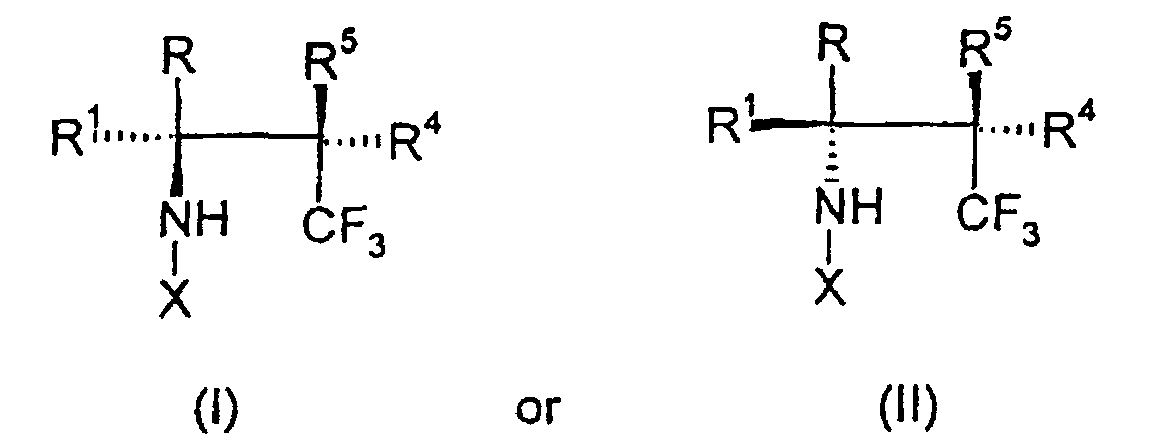 where either R4 is OH and R5 is H, or C1-C12 hydrocarbon; orR5 is OH and R4 is H or C1-C12 hydrocarbon; or each of R4 and R5 is H; or R4 and R5 together are =O,R and R1 are the same or different and each is H or C1 - C12 hydrocarbon which is either unsubstituted or which carries an acidic or a basic substituent,X is -COR or -COCH2OR or -COOR or a peptide residue, or H including the free base and acid salts thereof, wherein C1-C12 hydrocarbon may be heterocyclic.
 - A pharmaceutical preparation as claimed in claim 3, wherein one of R and R1 is H and the other is C1 - C12 aromatic or aliphatic hydrocarbon, either one of R4 and R5 is H and the other is OH or R4 and R5 together are =O and X is -COCH2OR.
- A method of preparing an antibacterial formulation, which method comprises bringing a perfluoro-lower-alkyl derivative of an amino acid into a form suitable for administration, wherein the perfluoro-lower-alkyl derivative of the amino acid has the formula
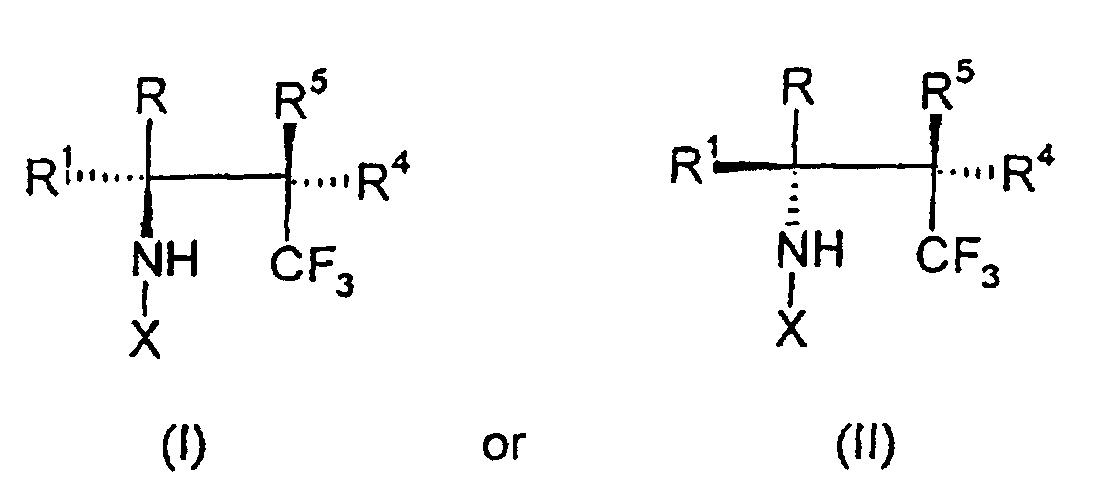 where either R4 is OH and R5 is H, or C1-C12 hydrocarbon; or R5 is OH and R4 is H or C1-C12 hydrocarbon; or each of R4 and R5 is H; or R4 and R5 together are =O,R and R1 are the same or different and each is H or C1 -C12 hydrocarbon which is either unsubstituted or which carries an acidic or a basic substituent,X is -COR or -COCH2OR or -COOR or a peptide residue, or H including the free base and acid salts thereof, wherein C1-C12 may be heterocyclic.
Applications Claiming Priority (3)
| Application Number | Priority Date | Filing Date | Title |
|---|---|---|---|
| GB9524267 | 1995-11-28 | ||
| GBGB9524267.3A GB9524267D0 (en) | 1995-11-28 | 1995-11-28 | Enzyme inhibitor and method |
| PCT/GB1996/002922 WO1997019681A1 (en) | 1995-11-28 | 1996-11-27 | Perfluoroalkyl substituted metallo-beta-lactamase inhibitors and method for the preparation of trifluoromethylketone derivatives |
Publications (2)
| Publication Number | Publication Date |
|---|---|
| EP0863753A1 EP0863753A1 (en) | 1998-09-16 |
| EP0863753B1 true EP0863753B1 (en) | 2002-07-17 |
Family
ID=10784535
Family Applications (1)
| Application Number | Title | Priority Date | Filing Date |
|---|---|---|---|
| EP96939998A Expired - Lifetime EP0863753B1 (en) | 1995-11-28 | 1996-11-27 | Use of perfluoroalkyl derivatives of amino acids as metallo-beta-lactamase inhibitors |
Country Status (6)
| Country | Link |
|---|---|
| US (1) | US6043278A (en) |
| EP (1) | EP0863753B1 (en) |
| DE (1) | DE69622423T2 (en) |
| ES (1) | ES2176514T3 (en) |
| GB (1) | GB9524267D0 (en) |
| WO (1) | WO1997019681A1 (en) |
Families Citing this family (5)
| Publication number | Priority date | Publication date | Assignee | Title |
|---|---|---|---|---|
| GB2363379B (en) * | 1999-03-05 | 2004-02-25 | Ajinomoto Kk | Process for producing alpha-aminoketones |
| US6630510B1 (en) | 1999-10-28 | 2003-10-07 | Merck & Co., Inc. | Substituted succinic acid metallo-β-lactamase inhibitors and their use in treating bacterial infections |
| DE60031299T2 (en) | 1999-12-16 | 2007-05-24 | Dainippon Sumitomo Pharma Co., Ltd. | Process for the industrial production of (aminomethyl) trifluoromethylcarbinol derivatives |
| WO2019040109A1 (en) | 2017-08-21 | 2019-02-28 | Celgene Corporation | Processes for preparation of (s)-tert-butyl 4,5-diamino-5-oxopentanoate |
| CN116332774A (en) * | 2023-03-29 | 2023-06-27 | 成都瑞尔医药科技有限公司 | A kind of preparation method of metaraminol tartrate with high chiral purity |
Family Cites Families (8)
| Publication number | Priority date | Publication date | Assignee | Title |
|---|---|---|---|---|
| US2521902A (en) * | 1948-04-06 | 1950-09-12 | Eastman Kodak Co | N-fluoroalkylacrylamides and polymers thereof |
| US4524152A (en) * | 1982-12-30 | 1985-06-18 | Pennwalt Corporation | 1-Cyano-3-(fluoroalkyl)guanidines for lowering blood pressure |
| ZA86746B (en) * | 1985-02-04 | 1986-09-24 | Merrell Dow Pharma | Novel peptidase inhibitors |
| CA2021660A1 (en) * | 1989-07-26 | 1991-01-27 | Philippe Bey | Peptidase inhibitors |
| EP0503203A1 (en) * | 1991-03-15 | 1992-09-16 | Merrell Dow Pharmaceuticals Inc. | Novel thrombin inhibitors |
| ZA924089B (en) * | 1992-06-04 | 1993-02-24 | Merrell Dow Pharma | Novel thrombin inhibitors |
| CA2137832C (en) * | 1992-06-12 | 2000-09-26 | Dennis J. Hoover | Inhibitors of angiotensin i chymase(s) including human heart chymase |
| US5338856A (en) * | 1992-08-17 | 1994-08-16 | Dowelanco | 3,4-N,trisubstituted-4,5-dihydro-1H-pyrazole-1-carboxamides and their use as insecticides |
-
1995
- 1995-11-28 GB GBGB9524267.3A patent/GB9524267D0/en active Pending
-
1996
- 1996-11-27 ES ES96939998T patent/ES2176514T3/en not_active Expired - Lifetime
- 1996-11-27 DE DE69622423T patent/DE69622423T2/en not_active Expired - Fee Related
- 1996-11-27 WO PCT/GB1996/002922 patent/WO1997019681A1/en not_active Ceased
- 1996-11-27 EP EP96939998A patent/EP0863753B1/en not_active Expired - Lifetime
- 1996-11-27 US US09/077,333 patent/US6043278A/en not_active Expired - Fee Related
Also Published As
| Publication number | Publication date |
|---|---|
| GB9524267D0 (en) | 1996-01-31 |
| EP0863753A1 (en) | 1998-09-16 |
| WO1997019681A1 (en) | 1997-06-05 |
| DE69622423D1 (en) | 2002-08-22 |
| US6043278A (en) | 2000-03-28 |
| ES2176514T3 (en) | 2002-12-01 |
| DE69622423T2 (en) | 2002-10-31 |
Similar Documents
| Publication | Publication Date | Title |
|---|---|---|
| US5462939A (en) | Peptidic ketones as interleukin-1β-converting enzyme inhibitors | |
| US5041644A (en) | Peptide derivatives of β-chloro-L(Z)-dehydro-glutamic acid | |
| EP0337714A2 (en) | HIV protease inhibitors useful for the treatment of aids | |
| SK281120B6 (en) | URINATES OR URETANS, METHODS FOR PREPARING THEM AND PHARMACEUTICAL PREPARATIONS FOR THIS BASE | |
| Kanemasa et al. | New chiral auxiliaries based on conformation control, a C2-symmetric 2, 2-dimethylimidazolidine and 4-chiral, 2, 2-dialkyloxazolidines. Synthesis and conformational analysis of acrylamide derivatives | |
| US6344457B1 (en) | Amino acid derivatives inhibiting extracellular matrix metalloproteinase and TNF alpha release | |
| JP2008163035A (en) | Substituted cyclopentane and cyclopentene compound useful as neuraminidase inhibitor | |
| HUT73428A (en) | Thiazolidine derivatives, preparation thereof and drugs containing same | |
| WO2007144169A2 (en) | Entacapone-derivatives | |
| EP0045161A1 (en) | Amides of 4-oxo-5-amidohexanoic acid derivatives | |
| US20050143319A1 (en) | Protease inhibitors | |
| JPH04210966A (en) | New compound, process for preparing same and medicinal composition containing same | |
| US6043278A (en) | Perfluoralkyl substituted metallo-beta-lactamase inhibitors | |
| JP2008013568A (en) | METHOD FOR PRODUCING beta-AMINO-alpha-HYDROXYCARBOXYLIC ACID AMIDE | |
| JP3576193B2 (en) | Biphenylmethyl-substituted valerylamide derivatives | |
| JPH04275263A (en) | Stereoregulated preparation of hydroxy ester, hydroxy amide and lactone compound from chiral alpha-aminoaldehyde | |
| RU2111959C1 (en) | N-[(4,5-dihydroxy- and 4,5,8-trihydroxy-9,10-dihydro-9,10-di- -oxo-2-anthracenyl)carbonyl]-amino acids, method of their synthesis and pharmaceutical composition based on thereof | |
| IL118869A (en) | ANTIMICROBIAL MIXTURES COMPRISING α-AMINO ACIDS AND CYCLOPENTANE-β-AMINO ACIDS AND PHARMACEUTICAL COMPOSITIONS CONTAINING THEM | |
| JP6021918B2 (en) | Versatile stereospecific synthesis of γ, δ-unsaturated amino acids by Wittig reaction | |
| JP3490114B2 (en) | Chondroprotectors | |
| US5739395A (en) | Method for synthesis of rhizoferrin | |
| JP2000504311A (en) | Method for producing perfluoroalkyl-substituted metallo-beta-lactamase inhibitor and trifluoromethyl ketone derivative | |
| ES2203955T3 (en) | 7-ACILAMINO-3- (METHYL HYDRAZONE) METHYL-CEPHALOSPORINS REPLACED ANTIBACTERIALS AND INTERMEDIATE PRODUCTS. | |
| KR890000769B1 (en) | Preparation of Proline Derivatives | |
| JPH09512012A (en) | Synthesis of N-Boc-L-propargylglycine by zinc-mediated addition of organic halides to glycine cation equivalents |
Legal Events
| Date | Code | Title | Description |
|---|---|---|---|
| PUAI | Public reference made under article 153(3) epc to a published international application that has entered the european phase |
Free format text: ORIGINAL CODE: 0009012 |
|
| 17P | Request for examination filed |
Effective date: 19980624 |
|
| AK | Designated contracting states |
Kind code of ref document: A1 Designated state(s): BE DE ES FR GB IT |
|
| 17Q | First examination report despatched |
Effective date: 20010129 |
|
| GRAG | Despatch of communication of intention to grant |
Free format text: ORIGINAL CODE: EPIDOS AGRA |
|
| RIC1 | Information provided on ipc code assigned before grant |
Free format text: 7A 61K 31/165 A, 7A 61K 31/27 B, 7A 61K 31/16 B, 7A 61K 31/13 B, 7A 61K 38/55 B, 7C 07C 233/76 B, 7C 07C 235/18 B, 7C 07C 271/22 B, 7A 61P 31/04 B |
|
| RTI1 | Title (correction) |
Free format text: USE OF PERFLUOROALKYL DERIVATIVES OF AMINO ACIDS AS METALLO-BETA-LACTAMASE INHIBITORS |
|
| GRAG | Despatch of communication of intention to grant |
Free format text: ORIGINAL CODE: EPIDOS AGRA |
|
| GRAH | Despatch of communication of intention to grant a patent |
Free format text: ORIGINAL CODE: EPIDOS IGRA |
|
| GRAH | Despatch of communication of intention to grant a patent |
Free format text: ORIGINAL CODE: EPIDOS IGRA |
|
| GRAA | (expected) grant |
Free format text: ORIGINAL CODE: 0009210 |
|
| AK | Designated contracting states |
Kind code of ref document: B1 Designated state(s): BE DE ES FR GB IT |
|
| REG | Reference to a national code |
Ref country code: GB Ref legal event code: FG4D |
|
| REF | Corresponds to: |
Ref document number: 69622423 Country of ref document: DE Date of ref document: 20020822 |
|
| REG | Reference to a national code |
Ref country code: ES Ref legal event code: FG2A Ref document number: 2176514 Country of ref document: ES Kind code of ref document: T3 |
|
| ET | Fr: translation filed | ||
| PLBE | No opposition filed within time limit |
Free format text: ORIGINAL CODE: 0009261 |
|
| STAA | Information on the status of an ep patent application or granted ep patent |
Free format text: STATUS: NO OPPOSITION FILED WITHIN TIME LIMIT |
|
| 26N | No opposition filed |
Effective date: 20030422 |
|
| PGFP | Annual fee paid to national office [announced via postgrant information from national office to epo] |
Ref country code: BE Payment date: 20040831 Year of fee payment: 9 |
|
| PGFP | Annual fee paid to national office [announced via postgrant information from national office to epo] |
Ref country code: DE Payment date: 20040928 Year of fee payment: 9 |
|
| PGFP | Annual fee paid to national office [announced via postgrant information from national office to epo] |
Ref country code: ES Payment date: 20041102 Year of fee payment: 9 |
|
| PGFP | Annual fee paid to national office [announced via postgrant information from national office to epo] |
Ref country code: GB Payment date: 20041116 Year of fee payment: 9 Ref country code: FR Payment date: 20041116 Year of fee payment: 9 |
|
| PG25 | Lapsed in a contracting state [announced via postgrant information from national office to epo] |
Ref country code: IT Free format text: LAPSE BECAUSE OF NON-PAYMENT OF DUE FEES;WARNING: LAPSES OF ITALIAN PATENTS WITH EFFECTIVE DATE BEFORE 2007 MAY HAVE OCCURRED AT ANY TIME BEFORE 2007. THE CORRECT EFFECTIVE DATE MAY BE DIFFERENT FROM THE ONE RECORDED. Effective date: 20051127 Ref country code: GB Free format text: LAPSE BECAUSE OF NON-PAYMENT OF DUE FEES Effective date: 20051127 |
|
| PG25 | Lapsed in a contracting state [announced via postgrant information from national office to epo] |
Ref country code: ES Free format text: LAPSE BECAUSE OF NON-PAYMENT OF DUE FEES Effective date: 20051128 |
|
| PG25 | Lapsed in a contracting state [announced via postgrant information from national office to epo] |
Ref country code: BE Free format text: LAPSE BECAUSE OF NON-PAYMENT OF DUE FEES Effective date: 20051130 |
|
| PG25 | Lapsed in a contracting state [announced via postgrant information from national office to epo] |
Ref country code: DE Free format text: LAPSE BECAUSE OF NON-PAYMENT OF DUE FEES Effective date: 20060601 |
|
| GBPC | Gb: european patent ceased through non-payment of renewal fee |
Effective date: 20051127 |
|
| PG25 | Lapsed in a contracting state [announced via postgrant information from national office to epo] |
Ref country code: FR Free format text: LAPSE BECAUSE OF NON-PAYMENT OF DUE FEES Effective date: 20060731 |
|
| REG | Reference to a national code |
Ref country code: FR Ref legal event code: ST Effective date: 20060731 |
|
| REG | Reference to a national code |
Ref country code: ES Ref legal event code: FD2A Effective date: 20051128 |
|
| BERE | Be: lapsed |
Owner name: *ISIS INNOVATION LTD Effective date: 20051130 |