EP0863180B1 - Polyamide resin composition and articles formed from them - Google Patents
Polyamide resin composition and articles formed from them Download PDFInfo
- Publication number
- EP0863180B1 EP0863180B1 EP98301707A EP98301707A EP0863180B1 EP 0863180 B1 EP0863180 B1 EP 0863180B1 EP 98301707 A EP98301707 A EP 98301707A EP 98301707 A EP98301707 A EP 98301707A EP 0863180 B1 EP0863180 B1 EP 0863180B1
- Authority
- EP
- European Patent Office
- Prior art keywords
- polyamide resin
- inorganic filler
- resin composition
- nylon
- parts
- Prior art date
- Legal status (The legal status is an assumption and is not a legal conclusion. Google has not performed a legal analysis and makes no representation as to the accuracy of the status listed.)
- Expired - Lifetime
Links
- 229920006122 polyamide resin Polymers 0.000 title claims description 79
- 239000011342 resin composition Substances 0.000 title claims description 36
- 239000011256 inorganic filler Substances 0.000 claims description 57
- 229910003475 inorganic filler Inorganic materials 0.000 claims description 57
- -1 olefin compound Chemical class 0.000 claims description 47
- JRZJOMJEPLMPRA-UHFFFAOYSA-N olefin Natural products CCCCCCCC=C JRZJOMJEPLMPRA-UHFFFAOYSA-N 0.000 claims description 37
- 239000004677 Nylon Substances 0.000 claims description 34
- 229920001778 nylon Polymers 0.000 claims description 34
- 229920005989 resin Polymers 0.000 claims description 32
- 239000011347 resin Substances 0.000 claims description 32
- 229920000642 polymer Polymers 0.000 claims description 25
- 238000004898 kneading Methods 0.000 claims description 17
- 150000001244 carboxylic acid anhydrides Chemical group 0.000 claims description 13
- 239000002245 particle Substances 0.000 claims description 13
- 239000000835 fiber Substances 0.000 claims description 12
- 239000003365 glass fiber Substances 0.000 claims description 11
- BYEAHWXPCBROCE-UHFFFAOYSA-N 1,1,1,3,3,3-hexafluoropropan-2-ol Chemical compound FC(F)(F)C(O)C(F)(F)F BYEAHWXPCBROCE-UHFFFAOYSA-N 0.000 claims description 10
- FPYJFEHAWHCUMM-UHFFFAOYSA-N maleic anhydride Chemical compound O=C1OC(=O)C=C1 FPYJFEHAWHCUMM-UHFFFAOYSA-N 0.000 claims description 10
- 229920002302 Nylon 6,6 Polymers 0.000 claims description 8
- 238000013329 compounding Methods 0.000 claims description 8
- 238000002844 melting Methods 0.000 claims description 8
- 230000008018 melting Effects 0.000 claims description 8
- 239000005995 Aluminium silicate Substances 0.000 claims description 7
- 235000012211 aluminium silicate Nutrition 0.000 claims description 7
- NLYAJNPCOHFWQQ-UHFFFAOYSA-N kaolin Chemical group O.O.O=[Al]O[Si](=O)O[Si](=O)O[Al]=O NLYAJNPCOHFWQQ-UHFFFAOYSA-N 0.000 claims description 7
- 238000004438 BET method Methods 0.000 claims description 6
- 239000004721 Polyphenylene oxide Substances 0.000 claims description 6
- 229920006380 polyphenylene oxide Polymers 0.000 claims description 6
- 239000010456 wollastonite Substances 0.000 claims description 6
- 229910052882 wollastonite Inorganic materials 0.000 claims description 6
- 239000000454 talc Substances 0.000 claims description 5
- 229910052623 talc Inorganic materials 0.000 claims description 5
- 229920002292 Nylon 6 Polymers 0.000 claims description 4
- 238000004519 manufacturing process Methods 0.000 claims description 3
- 229920000141 poly(maleic anhydride) Polymers 0.000 claims description 3
- XVOUMQNXTGKGMA-OWOJBTEDSA-N (E)-glutaconic acid Chemical compound OC(=O)C\C=C\C(O)=O XVOUMQNXTGKGMA-OWOJBTEDSA-N 0.000 claims description 2
- 239000001124 (E)-prop-1-ene-1,2,3-tricarboxylic acid Substances 0.000 claims description 2
- AYKYXWQEBUNJCN-UHFFFAOYSA-N 3-methylfuran-2,5-dione Chemical compound CC1=CC(=O)OC1=O AYKYXWQEBUNJCN-UHFFFAOYSA-N 0.000 claims description 2
- OFNISBHGPNMTMS-UHFFFAOYSA-N 3-methylideneoxolane-2,5-dione Chemical compound C=C1CC(=O)OC1=O OFNISBHGPNMTMS-UHFFFAOYSA-N 0.000 claims description 2
- 229940091181 aconitic acid Drugs 0.000 claims description 2
- GTZCVFVGUGFEME-IWQZZHSRSA-N cis-aconitic acid Chemical compound OC(=O)C\C(C(O)=O)=C\C(O)=O GTZCVFVGUGFEME-IWQZZHSRSA-N 0.000 claims description 2
- GTZCVFVGUGFEME-UHFFFAOYSA-N trans-aconitic acid Natural products OC(=O)CC(C(O)=O)=CC(O)=O GTZCVFVGUGFEME-UHFFFAOYSA-N 0.000 claims description 2
- 229920003231 aliphatic polyamide Polymers 0.000 claims 1
- 238000000034 method Methods 0.000 description 42
- 239000000463 material Substances 0.000 description 30
- 239000000945 filler Substances 0.000 description 28
- 239000000203 mixture Substances 0.000 description 24
- 230000000052 comparative effect Effects 0.000 description 18
- 150000001875 compounds Chemical class 0.000 description 14
- 238000005259 measurement Methods 0.000 description 12
- 238000009740 moulding (composite fabrication) Methods 0.000 description 12
- 230000006872 improvement Effects 0.000 description 9
- 239000004952 Polyamide Substances 0.000 description 8
- 229920002647 polyamide Polymers 0.000 description 8
- IJGRMHOSHXDMSA-UHFFFAOYSA-N Atomic nitrogen Chemical compound N#N IJGRMHOSHXDMSA-UHFFFAOYSA-N 0.000 description 7
- 230000009102 absorption Effects 0.000 description 7
- 238000010521 absorption reaction Methods 0.000 description 7
- 230000008901 benefit Effects 0.000 description 6
- 230000006866 deterioration Effects 0.000 description 6
- 238000002347 injection Methods 0.000 description 6
- 239000007924 injection Substances 0.000 description 6
- 239000008188 pellet Substances 0.000 description 5
- 230000002411 adverse Effects 0.000 description 4
- 239000011324 bead Substances 0.000 description 4
- 238000000921 elemental analysis Methods 0.000 description 4
- 239000011521 glass Substances 0.000 description 4
- 238000009863 impact test Methods 0.000 description 4
- 238000000465 moulding Methods 0.000 description 4
- 229910000077 silane Inorganic materials 0.000 description 4
- 238000012360 testing method Methods 0.000 description 4
- SJECZPVISLOESU-UHFFFAOYSA-N 3-trimethoxysilylpropan-1-amine Chemical compound CO[Si](OC)(OC)CCCN SJECZPVISLOESU-UHFFFAOYSA-N 0.000 description 3
- 229920000305 Nylon 6,10 Polymers 0.000 description 3
- 229920000265 Polyparaphenylene Polymers 0.000 description 3
- BLRPTPMANUNPDV-UHFFFAOYSA-N Silane Chemical compound [SiH4] BLRPTPMANUNPDV-UHFFFAOYSA-N 0.000 description 3
- 150000008064 anhydrides Chemical class 0.000 description 3
- 150000001732 carboxylic acid derivatives Chemical class 0.000 description 3
- 229920001971 elastomer Polymers 0.000 description 3
- 239000000806 elastomer Substances 0.000 description 3
- 239000000155 melt Substances 0.000 description 3
- 229910052757 nitrogen Inorganic materials 0.000 description 3
- 238000005453 pelletization Methods 0.000 description 3
- 229920000098 polyolefin Polymers 0.000 description 3
- 229920001955 polyphenylene ether Polymers 0.000 description 3
- PBLZLIFKVPJDCO-UHFFFAOYSA-N 12-aminododecanoic acid Chemical compound NCCCCCCCCCCCC(O)=O PBLZLIFKVPJDCO-UHFFFAOYSA-N 0.000 description 2
- ZYAASQNKCWTPKI-UHFFFAOYSA-N 3-[dimethoxy(methyl)silyl]propan-1-amine Chemical compound CO[Si](C)(OC)CCCN ZYAASQNKCWTPKI-UHFFFAOYSA-N 0.000 description 2
- CNPURSDMOWDNOQ-UHFFFAOYSA-N 4-methoxy-7h-pyrrolo[2,3-d]pyrimidin-2-amine Chemical compound COC1=NC(N)=NC2=C1C=CN2 CNPURSDMOWDNOQ-UHFFFAOYSA-N 0.000 description 2
- HEDRZPFGACZZDS-UHFFFAOYSA-N Chloroform Chemical compound ClC(Cl)Cl HEDRZPFGACZZDS-UHFFFAOYSA-N 0.000 description 2
- RYGMFSIKBFXOCR-UHFFFAOYSA-N Copper Chemical compound [Cu] RYGMFSIKBFXOCR-UHFFFAOYSA-N 0.000 description 2
- 229920000572 Nylon 6/12 Polymers 0.000 description 2
- GLUUGHFHXGJENI-UHFFFAOYSA-N Piperazine Chemical compound C1CNCCN1 GLUUGHFHXGJENI-UHFFFAOYSA-N 0.000 description 2
- PPBRXRYQALVLMV-UHFFFAOYSA-N Styrene Chemical compound C=CC1=CC=CC=C1 PPBRXRYQALVLMV-UHFFFAOYSA-N 0.000 description 2
- KKEYFWRCBNTPAC-UHFFFAOYSA-N Terephthalic acid Chemical compound OC(=O)C1=CC=C(C(O)=O)C=C1 KKEYFWRCBNTPAC-UHFFFAOYSA-N 0.000 description 2
- XLOMVQKBTHCTTD-UHFFFAOYSA-N Zinc monoxide Chemical compound [Zn]=O XLOMVQKBTHCTTD-UHFFFAOYSA-N 0.000 description 2
- 239000000654 additive Substances 0.000 description 2
- WNLRTRBMVRJNCN-UHFFFAOYSA-N adipic acid Chemical compound OC(=O)CCCCC(O)=O WNLRTRBMVRJNCN-UHFFFAOYSA-N 0.000 description 2
- 150000001336 alkenes Chemical class 0.000 description 2
- 150000001413 amino acids Chemical class 0.000 description 2
- 125000003277 amino group Chemical group 0.000 description 2
- 239000007864 aqueous solution Substances 0.000 description 2
- UORVGPXVDQYIDP-UHFFFAOYSA-N borane Chemical compound B UORVGPXVDQYIDP-UHFFFAOYSA-N 0.000 description 2
- 239000003795 chemical substances by application Substances 0.000 description 2
- 239000003086 colorant Substances 0.000 description 2
- 229920001577 copolymer Polymers 0.000 description 2
- 239000007822 coupling agent Substances 0.000 description 2
- 230000007423 decrease Effects 0.000 description 2
- 238000011156 evaluation Methods 0.000 description 2
- 238000010438 heat treatment Methods 0.000 description 2
- NAQMVNRVTILPCV-UHFFFAOYSA-N hexane-1,6-diamine Chemical compound NCCCCCCN NAQMVNRVTILPCV-UHFFFAOYSA-N 0.000 description 2
- QQVIHTHCMHWDBS-UHFFFAOYSA-N isophthalic acid Chemical compound OC(=O)C1=CC=CC(C(O)=O)=C1 QQVIHTHCMHWDBS-UHFFFAOYSA-N 0.000 description 2
- 150000003951 lactams Chemical class 0.000 description 2
- BDJRBEYXGGNYIS-UHFFFAOYSA-N nonanedioic acid Chemical compound OC(=O)CCCCCCCC(O)=O BDJRBEYXGGNYIS-UHFFFAOYSA-N 0.000 description 2
- 229920006139 poly(hexamethylene adipamide-co-hexamethylene terephthalamide) Polymers 0.000 description 2
- 238000006116 polymerization reaction Methods 0.000 description 2
- 238000001556 precipitation Methods 0.000 description 2
- 230000008569 process Effects 0.000 description 2
- KIDHWZJUCRJVML-UHFFFAOYSA-N putrescine Chemical compound NCCCCN KIDHWZJUCRJVML-UHFFFAOYSA-N 0.000 description 2
- 239000012779 reinforcing material Substances 0.000 description 2
- CXMXRPHRNRROMY-UHFFFAOYSA-N sebacic acid Chemical compound OC(=O)CCCCCCCCC(O)=O CXMXRPHRNRROMY-UHFFFAOYSA-N 0.000 description 2
- 239000002904 solvent Substances 0.000 description 2
- TYFQFVWCELRYAO-UHFFFAOYSA-N suberic acid Chemical compound OC(=O)CCCCCCC(O)=O TYFQFVWCELRYAO-UHFFFAOYSA-N 0.000 description 2
- 229920005992 thermoplastic resin Polymers 0.000 description 2
- PXGZQGDTEZPERC-UHFFFAOYSA-N 1,4-cyclohexanedicarboxylic acid Chemical compound OC(=O)C1CCC(C(O)=O)CC1 PXGZQGDTEZPERC-UHFFFAOYSA-N 0.000 description 1
- GUOSQNAUYHMCRU-UHFFFAOYSA-N 11-Aminoundecanoic acid Chemical compound NCCCCCCCCCCC(O)=O GUOSQNAUYHMCRU-UHFFFAOYSA-N 0.000 description 1
- QFGCFKJIPBRJGM-UHFFFAOYSA-N 12-[(2-methylpropan-2-yl)oxy]-12-oxododecanoic acid Chemical compound CC(C)(C)OC(=O)CCCCCCCCCCC(O)=O QFGCFKJIPBRJGM-UHFFFAOYSA-N 0.000 description 1
- DPQHRXRAZHNGRU-UHFFFAOYSA-N 2,4,4-trimethylhexane-1,6-diamine Chemical compound NCC(C)CC(C)(C)CCN DPQHRXRAZHNGRU-UHFFFAOYSA-N 0.000 description 1
- FZZMTSNZRBFGGU-UHFFFAOYSA-N 2-chloro-7-fluoroquinazolin-4-amine Chemical compound FC1=CC=C2C(N)=NC(Cl)=NC2=C1 FZZMTSNZRBFGGU-UHFFFAOYSA-N 0.000 description 1
- JZUHIOJYCPIVLQ-UHFFFAOYSA-N 2-methylpentane-1,5-diamine Chemical compound NCC(C)CCCN JZUHIOJYCPIVLQ-UHFFFAOYSA-N 0.000 description 1
- UFMBOFGKHIXOTA-UHFFFAOYSA-N 2-methylterephthalic acid Chemical compound CC1=CC(C(O)=O)=CC=C1C(O)=O UFMBOFGKHIXOTA-UHFFFAOYSA-N 0.000 description 1
- RNLHGQLZWXBQNY-UHFFFAOYSA-N 3-(aminomethyl)-3,5,5-trimethylcyclohexan-1-amine Chemical compound CC1(C)CC(N)CC(C)(CN)C1 RNLHGQLZWXBQNY-UHFFFAOYSA-N 0.000 description 1
- XUSNPFGLKGCWGN-UHFFFAOYSA-N 3-[4-(3-aminopropyl)piperazin-1-yl]propan-1-amine Chemical compound NCCCN1CCN(CCCN)CC1 XUSNPFGLKGCWGN-UHFFFAOYSA-N 0.000 description 1
- IGSBHTZEJMPDSZ-UHFFFAOYSA-N 4-[(4-amino-3-methylcyclohexyl)methyl]-2-methylcyclohexan-1-amine Chemical compound C1CC(N)C(C)CC1CC1CC(C)C(N)CC1 IGSBHTZEJMPDSZ-UHFFFAOYSA-N 0.000 description 1
- DZIHTWJGPDVSGE-UHFFFAOYSA-N 4-[(4-aminocyclohexyl)methyl]cyclohexan-1-amine Chemical compound C1CC(N)CCC1CC1CCC(N)CC1 DZIHTWJGPDVSGE-UHFFFAOYSA-N 0.000 description 1
- BDBZTOMUANOKRT-UHFFFAOYSA-N 4-[2-(4-aminocyclohexyl)propan-2-yl]cyclohexan-1-amine Chemical compound C1CC(N)CCC1C(C)(C)C1CCC(N)CC1 BDBZTOMUANOKRT-UHFFFAOYSA-N 0.000 description 1
- PMZBHPUNQNKBOA-UHFFFAOYSA-N 5-methylbenzene-1,3-dicarboxylic acid Chemical compound CC1=CC(C(O)=O)=CC(C(O)=O)=C1 PMZBHPUNQNKBOA-UHFFFAOYSA-N 0.000 description 1
- MBRGOFWKNLPACT-UHFFFAOYSA-N 5-methylnonane-1,9-diamine Chemical compound NCCCCC(C)CCCCN MBRGOFWKNLPACT-UHFFFAOYSA-N 0.000 description 1
- SLXKOJJOQWFEFD-UHFFFAOYSA-N 6-aminohexanoic acid Chemical compound NCCCCCC(O)=O SLXKOJJOQWFEFD-UHFFFAOYSA-N 0.000 description 1
- GVNWZKBFMFUVNX-UHFFFAOYSA-N Adipamide Chemical compound NC(=O)CCCCC(N)=O GVNWZKBFMFUVNX-UHFFFAOYSA-N 0.000 description 1
- 239000004593 Epoxy Substances 0.000 description 1
- 101000837308 Homo sapiens Testis-expressed protein 30 Proteins 0.000 description 1
- VQTUBCCKSQIDNK-UHFFFAOYSA-N Isobutene Chemical group CC(C)=C VQTUBCCKSQIDNK-UHFFFAOYSA-N 0.000 description 1
- 241001076195 Lampsilis ovata Species 0.000 description 1
- JHWNWJKBPDFINM-UHFFFAOYSA-N Laurolactam Chemical compound O=C1CCCCCCCCCCCN1 JHWNWJKBPDFINM-UHFFFAOYSA-N 0.000 description 1
- FYYHWMGAXLPEAU-UHFFFAOYSA-N Magnesium Chemical compound [Mg] FYYHWMGAXLPEAU-UHFFFAOYSA-N 0.000 description 1
- OFOBLEOULBTSOW-UHFFFAOYSA-N Malonic acid Chemical compound OC(=O)CC(O)=O OFOBLEOULBTSOW-UHFFFAOYSA-N 0.000 description 1
- 150000007945 N-acyl ureas Chemical group 0.000 description 1
- 229920003189 Nylon 4,6 Polymers 0.000 description 1
- 229920000577 Nylon 6/66 Polymers 0.000 description 1
- ISWSIDIOOBJBQZ-UHFFFAOYSA-N Phenol Chemical compound OC1=CC=CC=C1 ISWSIDIOOBJBQZ-UHFFFAOYSA-N 0.000 description 1
- 239000004696 Poly ether ether ketone Substances 0.000 description 1
- 229920006121 Polyxylylene adipamide Polymers 0.000 description 1
- 241000705939 Shortia uniflora Species 0.000 description 1
- 239000006087 Silane Coupling Agent Substances 0.000 description 1
- 102100028631 Testis-expressed protein 30 Human genes 0.000 description 1
- RTAQQCXQSZGOHL-UHFFFAOYSA-N Titanium Chemical compound [Ti] RTAQQCXQSZGOHL-UHFFFAOYSA-N 0.000 description 1
- 230000006750 UV protection Effects 0.000 description 1
- 241000276425 Xiphophorus maculatus Species 0.000 description 1
- QLBRROYTTDFLDX-UHFFFAOYSA-N [3-(aminomethyl)cyclohexyl]methanamine Chemical compound NCC1CCCC(CN)C1 QLBRROYTTDFLDX-UHFFFAOYSA-N 0.000 description 1
- OXIKYYJDTWKERT-UHFFFAOYSA-N [4-(aminomethyl)cyclohexyl]methanamine Chemical compound NCC1CCC(CN)CC1 OXIKYYJDTWKERT-UHFFFAOYSA-N 0.000 description 1
- ISKQADXMHQSTHK-UHFFFAOYSA-N [4-(aminomethyl)phenyl]methanamine Chemical compound NCC1=CC=C(CN)C=C1 ISKQADXMHQSTHK-UHFFFAOYSA-N 0.000 description 1
- 125000005396 acrylic acid ester group Chemical group 0.000 description 1
- 239000001361 adipic acid Substances 0.000 description 1
- 235000011037 adipic acid Nutrition 0.000 description 1
- 125000002723 alicyclic group Chemical group 0.000 description 1
- 125000001931 aliphatic group Chemical group 0.000 description 1
- 150000001412 amines Chemical class 0.000 description 1
- 229960002684 aminocaproic acid Drugs 0.000 description 1
- QCTBMLYLENLHLA-UHFFFAOYSA-N aminomethylbenzoic acid Chemical compound NCC1=CC=C(C(O)=O)C=C1 QCTBMLYLENLHLA-UHFFFAOYSA-N 0.000 description 1
- 229960003375 aminomethylbenzoic acid Drugs 0.000 description 1
- 239000003963 antioxidant agent Substances 0.000 description 1
- 150000004984 aromatic diamines Chemical class 0.000 description 1
- TZYHIGCKINZLPD-UHFFFAOYSA-N azepan-2-one;hexane-1,6-diamine;hexanedioic acid Chemical compound NCCCCCCN.O=C1CCCCCN1.OC(=O)CCCCC(O)=O TZYHIGCKINZLPD-UHFFFAOYSA-N 0.000 description 1
- 238000005452 bending Methods 0.000 description 1
- UHVCSNKHFBQKBO-UHFFFAOYSA-N benzyl-ethenyl-[2-(3-trimethoxysilylpropylamino)ethyl]azanium;chloride Chemical compound Cl.CO[Si](OC)(OC)CCCNCCN(C=C)CC1=CC=CC=C1 UHVCSNKHFBQKBO-UHFFFAOYSA-N 0.000 description 1
- 238000000071 blow moulding Methods 0.000 description 1
- 229910000085 borane Inorganic materials 0.000 description 1
- 238000011088 calibration curve Methods 0.000 description 1
- 230000001413 cellular effect Effects 0.000 description 1
- 239000011248 coating agent Substances 0.000 description 1
- 238000000576 coating method Methods 0.000 description 1
- 238000004891 communication Methods 0.000 description 1
- XBZSBBLNHFMTEB-UHFFFAOYSA-N cyclohexane-1,3-dicarboxylic acid Chemical compound OC(=O)C1CCCC(C(O)=O)C1 XBZSBBLNHFMTEB-UHFFFAOYSA-N 0.000 description 1
- 230000003247 decreasing effect Effects 0.000 description 1
- 230000000593 degrading effect Effects 0.000 description 1
- 230000018044 dehydration Effects 0.000 description 1
- 238000006297 dehydration reaction Methods 0.000 description 1
- 230000008021 deposition Effects 0.000 description 1
- 150000004985 diamines Chemical class 0.000 description 1
- 229910001873 dinitrogen Inorganic materials 0.000 description 1
- ILRSCQWREDREME-UHFFFAOYSA-N dodecanamide Chemical compound CCCCCCCCCCCC(N)=O ILRSCQWREDREME-UHFFFAOYSA-N 0.000 description 1
- QFTYSVGGYOXFRQ-UHFFFAOYSA-N dodecane-1,12-diamine Chemical compound NCCCCCCCCCCCCN QFTYSVGGYOXFRQ-UHFFFAOYSA-N 0.000 description 1
- ZMUCVNSKULGPQG-UHFFFAOYSA-N dodecanedioic acid;hexane-1,6-diamine Chemical compound NCCCCCCN.OC(=O)CCCCCCCCCCC(O)=O ZMUCVNSKULGPQG-UHFFFAOYSA-N 0.000 description 1
- 230000000694 effects Effects 0.000 description 1
- 229920006351 engineering plastic Polymers 0.000 description 1
- 238000005516 engineering process Methods 0.000 description 1
- 125000003700 epoxy group Chemical group 0.000 description 1
- NKSJNEHGWDZZQF-UHFFFAOYSA-N ethenyl(trimethoxy)silane Chemical compound CO[Si](OC)(OC)C=C NKSJNEHGWDZZQF-UHFFFAOYSA-N 0.000 description 1
- 238000001125 extrusion Methods 0.000 description 1
- 239000002657 fibrous material Substances 0.000 description 1
- 230000009477 glass transition Effects 0.000 description 1
- 239000012760 heat stabilizer Substances 0.000 description 1
- 229920001519 homopolymer Polymers 0.000 description 1
- 125000002887 hydroxy group Chemical group [H]O* 0.000 description 1
- 238000001746 injection moulding Methods 0.000 description 1
- 239000012948 isocyanate Substances 0.000 description 1
- 150000002513 isocyanates Chemical class 0.000 description 1
- 125000001261 isocyanato group Chemical group *N=C=O 0.000 description 1
- 239000000314 lubricant Substances 0.000 description 1
- 239000011777 magnesium Substances 0.000 description 1
- 229910052749 magnesium Inorganic materials 0.000 description 1
- 239000000395 magnesium oxide Substances 0.000 description 1
- CPLXHLVBOLITMK-UHFFFAOYSA-N magnesium oxide Inorganic materials [Mg]=O CPLXHLVBOLITMK-UHFFFAOYSA-N 0.000 description 1
- AXZKOIWUVFPNLO-UHFFFAOYSA-N magnesium;oxygen(2-) Chemical compound [O-2].[Mg+2] AXZKOIWUVFPNLO-UHFFFAOYSA-N 0.000 description 1
- 125000005397 methacrylic acid ester group Chemical group 0.000 description 1
- 238000002156 mixing Methods 0.000 description 1
- 239000000178 monomer Substances 0.000 description 1
- QJGQUHMNIGDVPM-UHFFFAOYSA-N nitrogen group Chemical group [N] QJGQUHMNIGDVPM-UHFFFAOYSA-N 0.000 description 1
- 239000012766 organic filler Substances 0.000 description 1
- 150000002903 organophosphorus compounds Chemical class 0.000 description 1
- 150000002978 peroxides Chemical class 0.000 description 1
- ACVYVLVWPXVTIT-UHFFFAOYSA-N phosphinic acid Chemical class O[PH2]=O ACVYVLVWPXVTIT-UHFFFAOYSA-N 0.000 description 1
- 229920006111 poly(hexamethylene terephthalamide) Polymers 0.000 description 1
- 229920002530 polyetherether ketone Polymers 0.000 description 1
- 229920006123 polyhexamethylene isophthalamide Polymers 0.000 description 1
- 239000000843 powder Substances 0.000 description 1
- 238000002360 preparation method Methods 0.000 description 1
- 239000011814 protection agent Substances 0.000 description 1
- 238000002407 reforming Methods 0.000 description 1
- 239000012744 reinforcing agent Substances 0.000 description 1
- 238000000926 separation method Methods 0.000 description 1
- FZHAPNGMFPVSLP-UHFFFAOYSA-N silanamine Chemical compound [SiH3]N FZHAPNGMFPVSLP-UHFFFAOYSA-N 0.000 description 1
- 150000004760 silicates Chemical class 0.000 description 1
- 239000000243 solution Substances 0.000 description 1
- 238000002798 spectrophotometry method Methods 0.000 description 1
- 238000004611 spectroscopical analysis Methods 0.000 description 1
- 238000010561 standard procedure Methods 0.000 description 1
- QAOWNCQODCNURD-UHFFFAOYSA-N sulfuric acid Substances OS(O)(=O)=O QAOWNCQODCNURD-UHFFFAOYSA-N 0.000 description 1
- 238000004381 surface treatment Methods 0.000 description 1
- 239000000725 suspension Substances 0.000 description 1
- 125000003396 thiol group Chemical group [H]S* 0.000 description 1
- CENHPXAQKISCGD-UHFFFAOYSA-N trioxathietane 4,4-dioxide Chemical compound O=S1(=O)OOO1 CENHPXAQKISCGD-UHFFFAOYSA-N 0.000 description 1
- 239000011787 zinc oxide Substances 0.000 description 1
Images
Classifications
-
- C—CHEMISTRY; METALLURGY
- C08—ORGANIC MACROMOLECULAR COMPOUNDS; THEIR PREPARATION OR CHEMICAL WORKING-UP; COMPOSITIONS BASED THEREON
- C08L—COMPOSITIONS OF MACROMOLECULAR COMPOUNDS
- C08L77/00—Compositions of polyamides obtained by reactions forming a carboxylic amide link in the main chain; Compositions of derivatives of such polymers
- C08L77/02—Polyamides derived from omega-amino carboxylic acids or from lactams thereof
-
- C—CHEMISTRY; METALLURGY
- C08—ORGANIC MACROMOLECULAR COMPOUNDS; THEIR PREPARATION OR CHEMICAL WORKING-UP; COMPOSITIONS BASED THEREON
- C08K—Use of inorganic or non-macromolecular organic substances as compounding ingredients
- C08K7/00—Use of ingredients characterised by shape
- C08K7/02—Fibres or whiskers
- C08K7/04—Fibres or whiskers inorganic
-
- C—CHEMISTRY; METALLURGY
- C08—ORGANIC MACROMOLECULAR COMPOUNDS; THEIR PREPARATION OR CHEMICAL WORKING-UP; COMPOSITIONS BASED THEREON
- C08J—WORKING-UP; GENERAL PROCESSES OF COMPOUNDING; AFTER-TREATMENT NOT COVERED BY SUBCLASSES C08B, C08C, C08F, C08G or C08H
- C08J5/00—Manufacture of articles or shaped materials containing macromolecular substances
-
- C—CHEMISTRY; METALLURGY
- C08—ORGANIC MACROMOLECULAR COMPOUNDS; THEIR PREPARATION OR CHEMICAL WORKING-UP; COMPOSITIONS BASED THEREON
- C08K—Use of inorganic or non-macromolecular organic substances as compounding ingredients
- C08K3/00—Use of inorganic substances as compounding ingredients
- C08K3/01—Use of inorganic substances as compounding ingredients characterized by their specific function
- C08K3/013—Fillers, pigments or reinforcing additives
-
- C—CHEMISTRY; METALLURGY
- C08—ORGANIC MACROMOLECULAR COMPOUNDS; THEIR PREPARATION OR CHEMICAL WORKING-UP; COMPOSITIONS BASED THEREON
- C08K—Use of inorganic or non-macromolecular organic substances as compounding ingredients
- C08K9/00—Use of pretreated ingredients
- C08K9/08—Ingredients agglomerated by treatment with a binding agent
-
- C—CHEMISTRY; METALLURGY
- C08—ORGANIC MACROMOLECULAR COMPOUNDS; THEIR PREPARATION OR CHEMICAL WORKING-UP; COMPOSITIONS BASED THEREON
- C08L—COMPOSITIONS OF MACROMOLECULAR COMPOUNDS
- C08L23/00—Compositions of homopolymers or copolymers of unsaturated aliphatic hydrocarbons having only one carbon-to-carbon double bond; Compositions of derivatives of such polymers
- C08L23/26—Compositions of homopolymers or copolymers of unsaturated aliphatic hydrocarbons having only one carbon-to-carbon double bond; Compositions of derivatives of such polymers modified by chemical after-treatment
-
- C—CHEMISTRY; METALLURGY
- C08—ORGANIC MACROMOLECULAR COMPOUNDS; THEIR PREPARATION OR CHEMICAL WORKING-UP; COMPOSITIONS BASED THEREON
- C08L—COMPOSITIONS OF MACROMOLECULAR COMPOUNDS
- C08L71/00—Compositions of polyethers obtained by reactions forming an ether link in the main chain; Compositions of derivatives of such polymers
- C08L71/08—Polyethers derived from hydroxy compounds or from their metallic derivatives
- C08L71/10—Polyethers derived from hydroxy compounds or from their metallic derivatives from phenols
- C08L71/12—Polyphenylene oxides
-
- C—CHEMISTRY; METALLURGY
- C08—ORGANIC MACROMOLECULAR COMPOUNDS; THEIR PREPARATION OR CHEMICAL WORKING-UP; COMPOSITIONS BASED THEREON
- C08K—Use of inorganic or non-macromolecular organic substances as compounding ingredients
- C08K2201/00—Specific properties of additives
- C08K2201/002—Physical properties
- C08K2201/003—Additives being defined by their diameter
Definitions
- thermoplastic resin materials In order to meet growing demands for higher-performance engineering plastics, attempts have been made to improve characteristics of thermoplastic resin materials.
- Polymer, 26, 1855(1985) describes the compounding of an elastomer component into nylon 66 wherein the elastomer component is finely dispersed so that a high impact strength is achieved.
- the heat resistance or the rigidity of a resin material can be enhanced by adding an inorganic filler into the resin material.
- such an improvement in one characteristic by quality reforming is often accompanied by deterioration in another characteristic. For example, if an elastomer component is added to a material to improve impact strength or ductility, the heat resistance or rigidity of the material deteriorates.
- US-A-5036127 discloses a thermoplastic resin composition which is reinforced with fibrous magnesium oxysulfate and magnesium oxide and/or zinc oxide.
- JP-A-253652 discloses the melt-kneading of a resin, such as a polyphenylene-based resin, which has a high glass transition temperature, and a rubber-like polymer, unsaturated carboxylic acid together with polyamide for the purpose of achieving both a good impact resistance and a good heat resistance.
- this technology has drawbacks of insufficient heat resistance and insufficient dimensional stability.
- EP-A-0375177 discloses a composition containing polyphenylene ether resin, a polyamide resin, an inorganic filler and a compatibilizing agent which improves compatibility between the polyphenylene resin and the polyamide resin.
- the present invention relates to a polyamide resin composition that is excellent in rigidity and toughness and particularly excellent in tensile elongation, high-speed surface impact fracture characteristic and that achieve excellent surface external appearance and dimensional stability of formed articles in good balance, and a method for producing the polyamide resin composition, and a forming formed the polyamide resin composition.
- a polyamide resin composition substantially composed of (A) nylon resin, and (B) at least one of a non-fibrous inorganic filler having an average particle diameter of 0.05-10 ⁇ m and a fibrous inorganic filler, excluding glass fiber, having a fiber diameter of 0.05-10 ⁇ m, which inorganic filler is selected from kaolin, wollastonite and talc and which is melt-kneaded together with the nylon resin (A), in a compounding amount of 5-150 parts by weight relative to 100 parts by weight of the nylon resin (A); and (C) an olefin compound having in its molecule a carboxylic anhydride group or a polymer of the olefin compound that is melt-kneaded together, in a compounding amount of 0.05-10 parts by weight relative to 100 parts by weight of the nylon resin (A).
- An amount of a polyamide resin component deposit remaining on the inorganic filler when the inorganic filler is recovered by dissolving the polyamide resin composition into hexafluoroisopropanol is at least 4 g/m 2 per unit surface area of the inorganic filler measured by a BET method.
- a method for producing a polyamide resin composition wherein (A) 100 parts by weight of nylon resin, and (B) 5-150 parts by weight of at least one of a non-fibrous inorganic filler having an average particle diameter of 0.05-10 ⁇ m and a fibrous inorganic filler, excluding glass fiber, having a fiber diameter of 0.05-10 ⁇ m, and which inorganic filler is selected from kaolin, wollastonite and talc and (C) an olefin compound having in its molecule a carboxylic anhydride group or a polymer of the olefin compound, in an amount of 0.05-10 parts by weight relative to 100 parts by weight of the nylon resin are melt-kneaded, in such a manner that an amount of a polyamide resin component deposit remaining on the inorganic filler when the inorganic filler is recovered by dissolving the polyamide resin composition into hexafluoroisopropanol becomes at least 4 g/m 2
- a vehicle exterior part an under-hood part forming for a motor vehicle, and a portable device casing which are formed from a polyamide resin composition as defined above and in the accompanying claim 1.
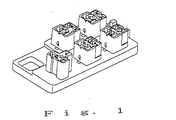
- Fig. 1 is a perspective view of a relay box that was used in a sample evaluation of Examples of the present invention.
- weight means “mass”.
- the polyamide resin used in the present invention is nylon whose main components are amino acid, lactam or diamine and dicarboxylic acid.
- Representative examples of the monomers forming the main component of the polyamide resin include, but are not limited to: amino acids such as 6-aminocaproic acid, 11-aminoundecanoic acid, 12-aminododecanoic acid, para-aminomethylbenzoic acid and the like; lactams such as -aminocaprolactam, laurolactam and the like; aliphatic or alicyclic or aromatic diamines such as tetramethylenediamine, hexamethylenediamine, 2-methylpentametylendiamine, undecamethylendiamine, dodecamethylenediamine, 2,2,4-/2,4,4-trimethylhexamethylene diamine, 5-methylnonamethylenediamine, meta-xylenediamine, para-xylylenediamine, 1,3-bis(aminomethyl)-cycl
- nylon resins that has a melting point equal to or greater than 200°C and that are excellent in heat resistance and strength.
- Specific examples of such nylon resins include, but are not limited to, polycaproamide (nylon 6), polyhexamethylene adipamide (nylon 66), polytetramethylene adipamide (nylon 46), polyhexamethylene sebacamide (nylon 610), polyhexamethylene dodecamide (nylon 612), polyhexamethylene adipamide/polyhexamethyleneterephtalamide copolymer (nylon 66/6T), polyhexamethylene adipamide/polyhexamethyleneisophthalamide copolymer (nylon 55/6I), polyhexamethylene adipamide/polyhexamethyleneterephthalamide copolymer (nylon 66/6T/6I), polyxylylene adipamide (nylon XD6), and mixtures of these material, and copolymers thereof.
- nylon 6, nylon 66, nylon 610, nylon 6/66 copolymer, nylon 6/12 copolymer, and the like examples include nylon 6, nylon 66, nylon 610, nylon 6/66 copolymer, nylon 6/12 copolymer, and the like. It is also preferable in practical applications to use mixtures of these polyamide resins in accordance with required characteristics, such as formability, heat resistance, toughness, surface characteristic, and the like.
- the polymerization degree of the polyamide resins is not particularly limited.
- the relative viscosity of the polyamide resins measured in a 1% concentrated sulfuric acid solution at 25°C is preferably within the range of 1.5-5.0 and, more preferably, within the range of 2.0-4.0.
- examples of the non-fibrous inorganic filler having an average particle diameter of 0.05-100 ⁇ m, which is used as component (B), include silicates, namely wollastonite, kaolin and talc.
- the filler particles may be hollow. It is also possible to use two or more kinds of fillers as indicated above.
- kaolin is a most preferable in order to provide ductility and rigidity in good balance.
- the average particle diameter of the non-fibrous inorganic filler needs to be 0.05-10 ⁇ m.
- An average particle diameter thereof below 0.05 ⁇ m is not preferable, because the inorganic filler particles aggregate resulting in deterioration of ductility and deterioration of a molding surface. If the average particle diameter thereof exceeds 10 ⁇ m, molding surface deterioration becomes remarkable.
- the average particle diameter thereof is preferable 0.1-5 ⁇ m and, more preferably, 0.1-3 ⁇ m.
- the average particle diameter is determined by a precipitation method.
- fibrous inorganic filler having a fiber diameter of 0.05-10 ⁇ m which is used as component (B)
- fibrous wollastonite examples include fibrous wollastonite.
- These fillers may also be used in a combination of two or more kinds.
- the fiber diameter of the fibrous inorganic filler needs to be 0.05-10 ⁇ m.
- a fiber diameter thereof less than 0.05 ⁇ m is not preferred, because the fibrous inorganic filler fibers become likely to aggregate degrading ductility and molding surfaces. If the fiber diameter thereof exceeds 10 ⁇ m, molding surface deterioration becomes remarkable.
- the fiber diameter thereof is preferably 0.1-8 ⁇ m and, more preferably, 1-6 ⁇ m.
- the fiber diameter thereof is a number average fiber diameter measured using a microscope such as an electron microscope or the like.
- the inorganic filler be used after being pre-treated with a coupling agent such as an isocyanate-based compound, an organic silane-based compound, an organic titanate-based compound, an organic borane-based compound, an epoxy compound and the like, in terms of obtaining further improvement in mechanical strength.
- a coupling agent such as an isocyanate-based compound, an organic silane-based compound, an organic titanate-based compound, an organic borane-based compound, an epoxy compound and the like, in terms of obtaining further improvement in mechanical strength.
- a coupling agent such as an isocyanate-based compound, an organic silane-based compound, an organic titanate-based compound, an organic borane-based compound, an epoxy compound and the like.
- an organic silane-based compound is particularly preferred.
- organic silane-based compound examples include, but are not limited to: epoxy group-containing alkoxysilane compounds such as-glycidoxypropyltrimethoxysilane, - glycidoxypropyltriethoxysilane, -(3,4-epoxycyclohexyl)ethyltrimethoxysilane and the like; mercapto group-containing alkoxysilane compounds such as-mercaptopropyltrimethoxysilane, - mercaptopropyltriethoxysilane and the like; ureide group-containing alkoxysilane compounds such as-ureidepropyltrimethoxysilane, -(2-ureideethyl)aminopropyltrimethoxysilane and the like; isocyanato group-containing alkoxysilane compounds such as - isocyanatopropyltriethoxysilane, - isocyanatopropyltrimethoxysilane and
- silane coupling agent by used to pre-treat the filler by a normal method, and then melted and kneaded together with the polyamide resin. It is also possible to employ a so-called integral blend method wherein the pre-surface treatment of the filler is not performed, but the coupling agent is added when the filler and the polyamide resin are melted and kneaded.
- the amount of the inorganic filler compounded relative to 100 parts by weight of the polyamide resin is, in total of the non-fibrous inorganic filler and the fibrous inorganic filler, within the range of 5-150 parts by weight and, desirably, within the range of 10-80 parts by weight.
- the amount is within the range of 10-45 parts by weight in view of the balance between ductility and rigidity, tensile elongation, high-speed surface impact fracture characteristics.
- the amount of the polyamide resin component deposited on the inorganic filler when the inorganic filler is recovered after the polyamide resin composition is dissolved into hexafluoroisopropanol be at least 4 g/m 2 in an amount per unit area of the inorganic filler measured by a BET method.
- the aforementioned amount of polyamide resin component deposition may be determined as follows. First, the polyhexamethylene is dissolved into hexafluoroisopropanol so that the concentration of the polyamide resin component becomes 10% by weight. The obtained suspension is centrifuged to separate the inorganic filler by precipitation. The thus-separated inorganic filler is again suspended in hexafluoroisopropanol to a concentration of 10% by weight, and then centrifuged for separation. The recovered fraction is dried by a vacuum drier until no solvent remains. The obtained filler is subjected to measurement by an infrared spectrophotometer.
- the polyamide resin component deposited on the filler is quantified (hereinafter, referred to as method (1)). If polyamide is considered to be substantially only the nitrogen-containing component among the components deposited on the filler, the recovered filler may be subjected to an elemental analysis to quantify the nitrogen content, whereby the amount of nylon deposit can be determined (method (2)).
- the obtained filler may be subjected to a thermogravimeter test, wherein the filler is heated to 500°C at a rate of 20°C/min, and kept at 500°C for 15 minutes to determine a loss on heating.
- the substantial amount of the polyamide resin component can be determined (method (3)). If a component, such as a polymer, which is substantially insoluble in hexafluoroisopropanol, is contained as an additional component in the composition of the present invention, a method to remove the insoluble component using an appropriate solvent or the like, or a like method, needs to be performed before determination of the amount of the polyamide resin component deposit based on the infrared spectrophotometric determination or elemental analysis as described above.
- a component such as a polymer, which is substantially insoluble in hexafluoroisopropanol
- the amount of polyamide resin component deposit on the filler is less than 4 g/m 2 , the improvement in surface characteristics and the achievement of tensile elongation and ductile fracture characteristics in high speed surface impact become insufficient. Thus, such a small amount is not preferable.
- the amount of the deposit needs to be at least 4 g/m 2 and, preferably, at least 5 g/m 2 .
- the present invention it is possible to use a glass fiber together with the aforementioned inorganic filler as long as the presence of the glass fiber does not adversely affect the advantages of the invention. If a glass fiber is used, it is preferable that the aforementioned amount of the deposit be at least 4 g/m 2 relative to the total amount of the inorganic filler including the glass fiber.
- the method for increasing the amount of nylon deposited on the filler is to add an olefin compound having in its molecule a carboxylic anhydride group, or a polymer of the olefin compound, either of which can be used as component (C) according to the invention.
- an olefin compound having in its molecule a carboxylic anhydride group or the polymer of the olefin compound include maleic anhydride, itaconic acid anhydride, glutaconic acid anhydride, citraconic acid anhydride, aconitic acid anhydride, polymers of any of these anhydrides, and the like.
- the olefin compound polymer may contain a small amount of a copolymerized olefin component other than the olefin components having a carboxylic anhydride group, such as styrene, isobutylene, methacrylic acid ester, acrylic acid ester and the like, that is, a small amount that does not adversely affect the advantages of the invention.
- the olefin compound polymer be substantially formed of a polymer of an olefin compound that has in its molecule a carboxylic anhydride group.
- the polymerization degree of the olefin compound polymer is preferably 2-100 and, more preferably, 2-50 and, most preferably, 2-20.
- maleic anhydride and polymaleic anhydride are most preferably used due to their high performance in providing ductile fracture characteristic and rigidity.
- a polymaleic anhydride described in J. Macromol. Sci. -Revs. Macromol. Chem. C13(2), 235 (1975) or the like may be used.
- the amount of the olefin compound or olefin compound polymer added is 0.05-10 parts by weight relative to 100 parts by weight of the polyamide resin, in view of improvement in ductility and fluidity of the obtained composition.
- the amount is more preferably within the range of 0.1-5 parts by weight and, still more preferably, 0.1-3 parts by weight and, further more preferably, 0.1-1 part by weight.
- the olefin compound having in its molecule a carboxylic anhydride group or the polymer of the olefin compound needs only to substantially have an anhydride structure at the time of melting and kneading together with the polyamide resin. It is possible to hydrolyze the olefin compound or the olefin compound polymer and use the obtained carboxylic acid or an aqueous solution thereof or in an other form in the process of melting and kneading, whereby heat provided during the melting and kneading process causes dehydration of the carboxylic acid or the aqueous solution thereof or the like. Thus, the material substantially in the form of an anhydride is melted and kneaded together with a nylon resin.
- polyamide is to be alloyed with a material poor in compatibility with polyamide, such as polyolefin, polyphenylene oxide or the like
- a material poor in compatibility with polyamide such as polyolefin, polyphenylene oxide or the like
- it is a conventional practice to further add a filler to the composition see, for example, Japanese patent application laid-open Nos.
- the polyamide resin composition of the present invention may contain various additives that include: crystalline nucleus agents such as organic phosphorous compound, polyether ether ketone and the like; anti-coloring agents such as hypophosphorous acid salts and the like; antioxidants such as hindered phenol, hindered amine and the like; heat stabilizers; lubricants; UV protection agents; coloring agents; and the like.
- the method for preparing the polyamide resin composition of the present invention is not limited to a particular method as long as the method meets the requirements defined according to the present invention.
- a specific and efficient, but not restrictive, example of the preparation method is a method wherein a mixture of materials, that is, polyamide resin, an inorganic filler and a particular olefin compound or a polymer of the olefin compound, is supplied to a known melting and kneading machine, such as a single-screw or double-screw extruder, a Banbury mixer, a kneader, a mixing roll or the like, and the mixture is then melted and kneaded at a temperature of 220-330°C in accordance with the melting point of the nylon resin used.
- the composition of the present invention it is necessary that at least a predetermined amount of the polyamide resin component be deposited on the filler.
- the kneading conditions need to be sufficiently controlled. For example, if a melt kneader is used, it is necessary to control, the kneader L/D (screw length/screw diameter), vent, kneading time, dwell time, positions at which the individual components are added, and the amounts added. Normally, an increased LD and an increased dwell time in a melt kneader increase the amount of deposit on the filler and, therefore, are preferable.
- polyamide, the filler and the specified olefin compound of the polymer of the olefin compound sufficiently contact one another during the melt kneading. Therefore, the copresence of a large amount of a polymer component that impedes the contact between the materials is not preferred.
- polyphenylene ether may be added to the polyamide resin composition of the present invention in such an amount that the advantages of the present invention are not adversely affected.
- the amount of polyphenylene ether is preferably less than 40 parts by weight relative to 100 parts by weight of polyamide.
- the thus-obtained nylon resin composition of the present invention has an excellent balance of properties among formed article surface external appearance, dimensional stability, high-speed surface ductile fracture characteristic, rigidity, ductility and tensile elongation.
- the nylon resin composition is particularly useful for applications to formings that are formed by injection molding, extrusion forming, blow molding or the like.
- the polyamide resin composition of the present invention is very useful and practical in applications to vehicular exterior parts. Due to this advantage, the polyamide resin composition of the present invention can be suitably used for various exterior parts of not only motor vehicles but also motor cycles, bicycles, toy vehicles, carts, and the like.
- automotive exterior parts to which the polyamide resin composition of the present invention can be suitably applied include: exterior parts such as fenders, bumpers, bumper facers, spoilers, wheel caps, center wheel caps and the like; vehicle-loaded luggage holding tools; on-board trunks; windscreens for trucks or the like; and parts thereof.
- exterior parts such as fenders, bumpers, bumper facers, spoilers, wheel caps, center wheel caps and the like; vehicle-loaded luggage holding tools; on-board trunks; windscreens for trucks or the like; and parts thereof.
- the applications in motor cycles include cowlings, fenders, various covers, gasoline tanks and the like.
- Examples of the applications in bicycles include mudguards, saddles, load-carrying platforms and the like. Particularly preferred are the applications to wheel caps, spoilers and fenders.
- the polyamide resin composition is also useful for automotive under-hood parts, for example, covers such as engine covers, engine cover coverings, cylinder head covers, timing belt covers and the like, connectors such as wire harness connectors and the like, boxes such as junction boxes, relay boxes, fuse boxes and the like.
- the polyamide resin composition is particularly useful for the relay boxes and the junction boxes.
- the composition of the present invention is useful for cases or casings of portable devices that include portable computers such as notebook personal computers, electronic pocketbooks and the like, portable communication devices such as pagers, cellular phones, personal handy phones (PHS), wireless transceivers, facsimiles and the like, portable audio appliances such as radios, cassette players, CD players and the like, flash lights, battery containers, and the like.
- the material strength was measured by the following standard methods.
- Rectangular plates of 80 x 80 x 3 mm were formed by injection.
- the clearness of a reflection of a fluorescent lamp on a surface of each plate formed, by the unaided eye, to determine indications of smoothness.
- Chips of resin compositions obtained by melt kneading were heated in air at 500°C for 5 hours, to obtain a filler as an ash content.
- BELSORP 36 by Nippon Bell Kabushiki Gaisha
- the filler obtained as an ash content and a polyamide resin were mixed in the form of powder. Infrared absorptions of the mixtures were measured using an infrared spectrophotometer and, based on the measured absorptions, a working curve was prepared. Using hexafluoroisopropanol, the inorganic filler was separated from the polyamide resin composition by the above-described method. The infrared absorption of the inorganic filler was measured. Using the prepared working curve, the amount of nylon deposit was quantified (method (1)).
- the composition contained at most 1 part by weight of an olefin compound having in its molecule a carboxylic anhydride group or a polymer of the olefin compound, relative to 100 parts by weight of the polyamide resin/inorganic filler/polyamide resin, the value of the heating loss of the inorganic filler recovered using hexafluoroisopropanol (method (3)) was in good accordance with the value determined by infrared absorption as described above (method (1)) within an error range.
- the quantified value of the polyamide resin component based on the elemental analysis was in good accordance with the value determined by infrared absorption (method (1)).
- L/D 45.5
- 100 parts by weight of nylon 6 resin having a relative viscosity of 2.70, 16 parts by weight of kaolin surface-treated with aminosilane having a particle diameter of 0.8 ⁇ m, and 0.4 part by weight of maleic anhydride relative to 100 parts by weight of the nylon resin were drive-blended.
- the entire amount of the mixture was supplied to the feeder of the extruder being operated in conditions of a cylinder temperature of 260°C and a screw revolution speed of 150 rpm, thereby performing the melt-kneading of the mixture.
- the extruded gut was cooled, and then formed into pellets by a pelletizer.
- the pellets were injection-formed into various test pieces for measurements of surface smoothness, material strength, high-speed surface impact and the like. Results are shown in Table 1. Amounts of polyamide resin component deposit were determined by method (1), method (2) and method (3). The determined amounts were in accordance with each other within an error range.
- Example 2 The kneading, pelletization, injection forming and property measurement were performed substantially in the same manners as described in Example 1, except that maleic anhydride was not added. Amounts of polyamide resin component deposit were measured by method (1), method (2) and method (3), and were in accordance with each other. Results are shown in Table 2. With regard to the composition obtained herein, the amount of polyamide resin component deposit on the inorganic filler was small, and the tensile rupture elongation, impact value and high-speed surface impact characteristic thereof were insufficient compared with those of the composition of the present invention exhibited in Example 1.
- Example 2 The kneading, pelletization, injection forming and property measurement were performed substantially in the same manners as described in Example 1, except that the kinds or compounding amounts of polyamide resin, inorganic filler and olefin compound having in its molecule a carboxylic anhydride group, and the like, and the extruding method were changed as shown in Tables 1 and 2. Results are shown in Tables 1 and 2. Amounts of polyamide resin component deposit in Examples 2-5 and Comparative Examples 2-5 were measured by method (1), method (2) and method (3), and were in accordance with each other. For Comparative Examples 6 and 7, method (2) was used for the measurement.
- Full wheel caps of 14 inches in diameter were formed by injection using the pellets of Example 1 and Comparative Example 1, as shown in Table 4.
- the surface smoothness of the formings was evaluated.
- a thin-wall flat portion (2 mm in thickness) was cut out from the full wheel cap of each Example 7 and Comparative Example 11, and was subjected to the high-speed surface impact test under the same conditions as described above.
- An increase in the amount of polyamide resin component deposit improved high-speed surface impact characteristics and surface smoothness as indicated in Table 4.
- Relay boxes as shown in Fig. 1 were formed using the pellets of Example 1 and Comparative Example 1, as shown in Table 4. The surface smoothness of the formings was evaluated. A platy portion of the forming of each of Example 8 and Comparative Example 12 was cut out, and was subjected to the high-speed surface impact test. The strength of lance portions of the relay boxes was measured by a tension test as follows. A metallic terminal connected to a copper wire was inserted into a lance portion provided in a terminal inserting opening of each relay box. The relay box was secured using a tension tester, and the copper wire was subjected to a tension test, thereby measuring a strength of a lance.
- the strength of the lance in Example 8 (the composition of Example 1) was 9.5 kgf while the strength of the lance in Comparative Example 12 (the composition of Comparative Example 1) was 8.8 kgf.
- the higher strength of the lance in Example 8 is considered to correspond to the superiority of the composition of Example 1 in overall material characteristics.
- Portable pocket-size computer casings having a width of 20 cm, a depth of 12 cm and a thickness of 1.5 cm were formed by injection using the pellets of Example 1 and Comparative Example 1 as shown in Table 4.
- the surface smoothness of the casings was evaluated.
- a thin-wall flat portions (2 mm in thickness) was cut out from each casing, and was subjected to the high-speed surface impact test under the same conditions as described above. The results indicate that an increase in the amount of polyamide resin component achieved improvements in high-speed surface impact characteristic and surface smoothness.
- nylon resin compositions embodying the invention give products having excellent rigidity and toughness and particularly excellent high speed surface impact fracture characteristics. Articles formed from them also have an excellent external surface appearance and excellent dimensional stability in good balance.
Landscapes
- Chemical & Material Sciences (AREA)
- Health & Medical Sciences (AREA)
- Chemical Kinetics & Catalysis (AREA)
- Medicinal Chemistry (AREA)
- Polymers & Plastics (AREA)
- Organic Chemistry (AREA)
- General Chemical & Material Sciences (AREA)
- Engineering & Computer Science (AREA)
- Manufacturing & Machinery (AREA)
- Materials Engineering (AREA)
- Compositions Of Macromolecular Compounds (AREA)
Description
- In order to meet growing demands for higher-performance engineering plastics, attempts have been made to improve characteristics of thermoplastic resin materials. For example, Polymer, 26, 1855(1985) describes the compounding of an elastomer component into nylon 66 wherein the elastomer component is finely dispersed so that a high impact strength is achieved. It is also known that the heat resistance or the rigidity of a resin material can be enhanced by adding an inorganic filler into the resin material. However, such an improvement in one characteristic by quality reforming is often accompanied by deterioration in another characteristic. For example, if an elastomer component is added to a material to improve impact strength or ductility, the heat resistance or rigidity of the material deteriorates. Conversely, if various inorganic fillers or reinforcing agents are compounded into materials to improve heat resistance or rigidity, the ductility of the material, such as Izod impact strength, tensile elongation, surface impact strength and the like, deteriorates. Therefore, it is difficult to improve the impact strength or ductility and the rigidity of a material at the same time.
- It is also known that the compounding of a fibrous reinforcing material, such as glass fiber, improves rigidity and also notched Izod impact strength. In this known method, however, surface impact strength and notch-less Izod impact strength deteriorate in comparison with a non-reinforced material. Furthermore, the reduced elongation of the material or the influence of the orientation of the fibrous reinforcing material gives rise to problems of anisotropy in mechanical characteristics, warping or the like. Thus this method has adverse effects on engineering materials as well.
- Various considerations have been made as to how to control or curb decreases in the impact strength or tensile elongation that occur if an inorganic filler, other than fibrous materials, is added to a resin material. For example, Japanese patent application laid-open No. Sho 61-36340 discloses a method in which glass beads are coated with at most 1% by weight of a coating material such as a silane compound, a fluorocarbon compound or the like. However, although the coated glass beads control the decrease in impact strength compared with materials containing non-coated glass beads, the impact strength of the materials containing coated glass beads is still lower than that of the materials containing no filler. In addition, it has been found that the disclosed method does not achieve sufficiently high tensile rupture elongation or sufficiently high surface impact strength. US-A-5036127 discloses a thermoplastic resin composition which is reinforced with fibrous magnesium oxysulfate and magnesium oxide and/or zinc oxide. JP-A-253652 discloses the melt-kneading of a resin, such as a polyphenylene-based resin, which has a high glass transition temperature, and a rubber-like polymer, unsaturated carboxylic acid together with polyamide for the purpose of achieving both a good impact resistance and a good heat resistance. However, this technology has drawbacks of insufficient heat resistance and insufficient dimensional stability. If an organic filler is merely added to overcome the drawbacks, there result considerable deterioration in impact resistance, high-speed surface impact fracture characteristic and tensile elongation, thus failing to provide a material with sufficiently improved characteristics. EP-A-0375177 discloses a composition containing polyphenylene ether resin, a polyamide resin, an inorganic filler and a compatibilizing agent which improves compatibility between the polyphenylene resin and the polyamide resin.
- The present invention relates to a polyamide resin composition that is excellent in rigidity and toughness and particularly excellent in tensile elongation, high-speed surface impact fracture characteristic and that achieve excellent surface external appearance and dimensional stability of formed articles in good balance, and a method for producing the polyamide resin composition, and a forming formed the polyamide resin composition.
- According to a first aspect of the present invention, there is provided a polyamide resin composition substantially composed of (A) nylon resin, and (B) at least one of a non-fibrous inorganic filler having an average particle diameter of 0.05-10µm and a fibrous inorganic filler, excluding glass fiber, having a fiber diameter of 0.05-10µm, which inorganic filler is selected from kaolin, wollastonite and talc and which is melt-kneaded together with the nylon resin (A), in a compounding amount of 5-150 parts by weight relative to 100 parts by weight of the nylon resin (A); and (C) an olefin compound having in its molecule a carboxylic anhydride group or a polymer of the olefin compound that is melt-kneaded together, in a compounding amount of 0.05-10 parts by weight relative to 100 parts by weight of the nylon resin (A). An amount of a polyamide resin component deposit remaining on the inorganic filler when the inorganic filler is recovered by dissolving the polyamide resin composition into hexafluoroisopropanol is at least 4 g/m2 per unit surface area of the inorganic filler measured by a BET method.
- According to another aspect of the present invention, there is provided a method for producing a polyamide resin composition, wherein (A) 100 parts by weight of nylon resin, and (B) 5-150 parts by weight of at least one of a non-fibrous inorganic filler having an average particle diameter of 0.05-10µm and a fibrous inorganic filler, excluding glass fiber, having a fiber diameter of 0.05-10µm, and which inorganic filler is selected from kaolin, wollastonite and talc and (C) an olefin compound having in its molecule a carboxylic anhydride group or a polymer of the olefin compound, in an amount of 0.05-10 parts by weight relative to 100 parts by weight of the nylon resin are melt-kneaded, in such a manner that an amount of a polyamide resin component deposit remaining on the inorganic filler when the inorganic filler is recovered by dissolving the polyamide resin composition into hexafluoroisopropanol becomes at least 4 g/m2 per unit surface area of the inorganic filler measured by a BET method.
- According to still other aspects of the present invention, there are provided a vehicle exterior part, an under-hood part forming for a motor vehicle, and a portable device casing which are formed from a polyamide resin composition as defined above and in the accompanying
claim 1. - Preferred embodiments of the invention will now be described, in which description reference will be made to Fig. 1 which is a perspective view of a relay box that was used in a sample evaluation of Examples of the present invention.
- In this specification, "weight" means "mass".
- The polyamide resin used in the present invention is nylon whose main components are amino acid, lactam or diamine and dicarboxylic acid. Representative examples of the monomers forming the main component of the polyamide resin include, but are not limited to: amino acids such as 6-aminocaproic acid, 11-aminoundecanoic acid, 12-aminododecanoic acid, para-aminomethylbenzoic acid and the like; lactams such as -aminocaprolactam, laurolactam and the like; aliphatic or alicyclic or aromatic diamines such as tetramethylenediamine, hexamethylenediamine, 2-methylpentametylendiamine, undecamethylendiamine, dodecamethylenediamine, 2,2,4-/2,4,4-trimethylhexamethylene diamine, 5-methylnonamethylenediamine, meta-xylenediamine, para-xylylenediamine, 1,3-bis(aminomethyl)-cyclohexane, 1,4-bis(aminomethyl)cyclohexane, 1-amino-3-aminomethyl-3,5,5-trimethylcyclohexane, bis(4-aminocyclohexyl)methane, bis(3-methyl-4-aminocyclohexyl)methane, 2,2-bis(4-aminocyclohexyl)propane, bis(aminopropyl)piperazine, aminoethyle piperazine, and the like; and aliphatic alicyclic aromatic dicarboxylic acids such as adipic acid, suberic acid, azelaic acid, sebacic acid, dodecanedioic acid, terephthalic acid, isophthalic acid, 2-chloroterephthalic aicd, 2-methylterephthalic acid, 5-methylisophthalic acid, 5-sodium sulfoisophthalic acid, hexahydroterephthalic acid, hexahydroisophthalic acid and the like. In the present invention, nylon homopolymers or copolylmers derived from the aforementioned materials may be used individually or in the form of a mixture.
- In the present invention, particularly useful nylon resins are nylon resins that has a melting point equal to or greater than 200°C and that are excellent in heat resistance and strength. Specific examples of such nylon resins include, but are not limited to, polycaproamide (nylon 6), polyhexamethylene adipamide (nylon 66), polytetramethylene adipamide (nylon 46), polyhexamethylene sebacamide (nylon 610), polyhexamethylene dodecamide (nylon 612), polyhexamethylene adipamide/polyhexamethyleneterephtalamide copolymer (nylon 66/6T), polyhexamethylene adipamide/polyhexamethyleneisophthalamide copolymer (nylon 55/6I), polyhexamethylene adipamide/polyhexamethyleneterephthalamide copolymer (nylon 66/6T/6I), polyxylylene adipamide (nylon XD6), and mixtures of these material, and copolymers thereof.
- Examples of particularly preferable examples include nylon 6, nylon 66, nylon 610, nylon 6/66 copolymer, nylon 6/12 copolymer, and the like. It is also preferable in practical applications to use mixtures of these polyamide resins in accordance with required characteristics, such as formability, heat resistance, toughness, surface characteristic, and the like.
- The polymerization degree of the polyamide resins is not particularly limited. The relative viscosity of the polyamide resins measured in a 1% concentrated sulfuric acid solution at 25°C is preferably within the range of 1.5-5.0 and, more preferably, within the range of 2.0-4.0.
- In the present invention, examples of the non-fibrous inorganic filler having an average particle diameter of 0.05-100µm, which is used as component (B), include silicates, namely wollastonite, kaolin and talc.
- The filler particles may be hollow. It is also possible to use two or more kinds of fillers as indicated above.
- In particular, kaolin is a most preferable in order to provide ductility and rigidity in good balance.
- The average particle diameter of the non-fibrous inorganic filler needs to be 0.05-10µm. An average particle diameter thereof below 0.05µm is not preferable, because the inorganic filler particles aggregate resulting in deterioration of ductility and deterioration of a molding surface. If the average particle diameter thereof exceeds 10µm, molding surface deterioration becomes remarkable. The average particle diameter thereof is preferable 0.1-5µm and, more preferably, 0.1-3µm. The average particle diameter is determined by a precipitation method.
- Specific examples of the fibrous inorganic filler having a fiber diameter of 0.05-10µm, which is used as component (B), include fibrous wollastonite.
- These fillers may also be used in a combination of two or more kinds.
- Use of a glass fiber is not preferable, because the improvement in ductility is small for an unknown reason.
- The fiber diameter of the fibrous inorganic filler needs to be 0.05-10µm. A fiber diameter thereof less than 0.05µm is not preferred, because the fibrous inorganic filler fibers become likely to aggregate degrading ductility and molding surfaces. If the fiber diameter thereof exceeds 10µm, molding surface deterioration becomes remarkable. The fiber diameter thereof is preferably 0.1-8µm and, more preferably, 1-6µm. The fiber diameter thereof is a number average fiber diameter measured using a microscope such as an electron microscope or the like.
- It is preferable that the inorganic filler be used after being pre-treated with a coupling agent such as an isocyanate-based compound, an organic silane-based compound, an organic titanate-based compound, an organic borane-based compound, an epoxy compound and the like, in terms of obtaining further improvement in mechanical strength. Particularly preferred is an organic silane-based compound. Specific examples of the organic silane-based compound include, but are not limited to: epoxy group-containing alkoxysilane compounds such as-glycidoxypropyltrimethoxysilane, - glycidoxypropyltriethoxysilane, -(3,4-epoxycyclohexyl)ethyltrimethoxysilane and the like; mercapto group-containing alkoxysilane compounds such as-mercaptopropyltrimethoxysilane, - mercaptopropyltriethoxysilane and the like; ureide group-containing alkoxysilane compounds such as-ureidepropyltrimethoxysilane, -(2-ureideethyl)aminopropyltrimethoxysilane and the like; isocyanato group-containing alkoxysilane compounds such as - isocyanatopropyltriethoxysilane, - isocyanatopropyltrimethoxysilane, - isocyanatopropylmethyldimethoxysilane, - isocyanatopropylmethyldiethoxysilane, - isocyanatopropylethyldimethoxysilane, - isocyanatopropylethyldiethoxysilane,-isocyanatopropyltrichlorosilane and the like; amino group-containing alkoxysilane componds such as -(2-aminoethyl)aminopropylmethyldimethoxysilane, -(2-aminoethyl)aminopropyltrimethoxysilane, - aminopropyltrimethoxysilane and the like; hydroxyl group-containing alkoxysilane compounds such as-hydroxypropyltrimethoxysilane, - hydroxypropyltriethoxysilane and the like; carbon-unsaturated group-containing alkoxysilane compounds such as -methacryloxypropyltrimethoxysilane, vinyltrimethoxysilane, N--(N-vinylbenzylaminoethyl)--aminopropyltrimethoxysilane hydrochloride and the like. Particularly preferred are-methacryloxypropyltrimethoxysilane,-(2-aminoethyl)aminopropylmethyldimethoxysilane, -(2-aminoethyl)aminopropyltrimethoxysilane, and - aminopropyltrimethoxysilane. It is preferable that the silane coupling agent by used to pre-treat the filler by a normal method, and then melted and kneaded together with the polyamide resin. It is also possible to employ a so-called integral blend method wherein the pre-surface treatment of the filler is not performed, but the coupling agent is added when the filler and the polyamide resin are melted and kneaded.
- In the present invention, the amount of the inorganic filler compounded relative to 100 parts by weight of the polyamide resin is, in total of the non-fibrous inorganic filler and the fibrous inorganic filler, within the range of 5-150 parts by weight and, desirably, within the range of 10-80 parts by weight. Preferably, the amount is within the range of 10-45 parts by weight in view of the balance between ductility and rigidity, tensile elongation, high-speed surface impact fracture characteristics.
- In the present invention, it is necessary that the amount of the polyamide resin component deposited on the inorganic filler when the inorganic filler is recovered after the polyamide resin composition is dissolved into hexafluoroisopropanol be at least 4 g/m2 in an amount per unit area of the inorganic filler measured by a BET method.
- The aforementioned amount of polyamide resin component deposition may be determined as follows. First, the polyhexamethylene is dissolved into hexafluoroisopropanol so that the concentration of the polyamide resin component becomes 10% by weight. The obtained suspension is centrifuged to separate the inorganic filler by precipitation. The thus-separated inorganic filler is again suspended in hexafluoroisopropanol to a concentration of 10% by weight, and then centrifuged for separation. The recovered fraction is dried by a vacuum drier until no solvent remains. The obtained filler is subjected to measurement by an infrared spectrophotometer. Based on the polyamide characteristic absorption and the calibration curve of the characteristic absorption of the filler, the polyamide resin component deposited on the filler is quantified (hereinafter, referred to as method (1)). If polyamide is considered to be substantially only the nitrogen-containing component among the components deposited on the filler, the recovered filler may be subjected to an elemental analysis to quantify the nitrogen content, whereby the amount of nylon deposit can be determined (method (2)). In addition, if the substantially entire components deposited on the filler are considered to be the polyamide resin component, as in a composition, for example wherein relative to 100% by weight of polyamide resin/filler/polyamide resin, 1% by weight of compounds or the like is present, the obtained filler may be subjected to a thermogravimeter test, wherein the filler is heated to 500°C at a rate of 20°C/min, and kept at 500°C for 15 minutes to determine a loss on heating.
- Thereby, the substantial amount of the polyamide resin component can be determined (method (3)). If a component, such as a polymer, which is substantially insoluble in hexafluoroisopropanol, is contained as an additional component in the composition of the present invention, a method to remove the insoluble component using an appropriate solvent or the like, or a like method, needs to be performed before determination of the amount of the polyamide resin component deposit based on the infrared spectrophotometric determination or elemental analysis as described above.
- To achieve the advantages of the invention, it is essential that at least a predetermined amount of polyamide resin component be deposited on the filler. If the amount of polyamide resin component deposit on the filler is less than 4 g/m2, the improvement in surface characteristics and the achievement of tensile elongation and ductile fracture characteristics in high speed surface impact become insufficient. Thus, such a small amount is not preferable. The amount of the deposit needs to be at least 4 g/m2 and, preferably, at least 5 g/m2.
- In the present invention, it is possible to use a glass fiber together with the aforementioned inorganic filler as long as the presence of the glass fiber does not adversely affect the advantages of the invention. If a glass fiber is used, it is preferable that the aforementioned amount of the deposit be at least 4 g/m2 relative to the total amount of the inorganic filler including the glass fiber.
- The method for increasing the amount of nylon deposited on the filler is to add an olefin compound having in its molecule a carboxylic anhydride group, or a polymer of the olefin compound, either of which can be used as component (C) according to the invention. Specific examples of the olefin compound having in its molecule a carboxylic anhydride group or the polymer of the olefin compound include maleic anhydride, itaconic acid anhydride, glutaconic acid anhydride, citraconic acid anhydride, aconitic acid anhydride, polymers of any of these anhydrides, and the like. The olefin compound polymer may contain a small amount of a copolymerized olefin component other than the olefin components having a carboxylic anhydride group, such as styrene, isobutylene, methacrylic acid ester, acrylic acid ester and the like, that is, a small amount that does not adversely affect the advantages of the invention. However, it is preferable that the olefin compound polymer be substantially formed of a polymer of an olefin compound that has in its molecule a carboxylic anhydride group. The polymerization degree of the olefin compound polymer is preferably 2-100 and, more preferably, 2-50 and, most preferably, 2-20. Among the aforementioned materials, maleic anhydride and polymaleic anhydride are most preferably used due to their high performance in providing ductile fracture characteristic and rigidity. For example, a polymaleic anhydride described in J. Macromol. Sci. -Revs. Macromol. Chem. C13(2), 235 (1975) or the like may be used.
- The amount of the olefin compound or olefin compound polymer added is 0.05-10 parts by weight relative to 100 parts by weight of the polyamide resin, in view of improvement in ductility and fluidity of the obtained composition. The amount is more preferably within the range of 0.1-5 parts by weight and, still more preferably, 0.1-3 parts by weight and, further more preferably, 0.1-1 part by weight.
- The olefin compound having in its molecule a carboxylic anhydride group or the polymer of the olefin compound needs only to substantially have an anhydride structure at the time of melting and kneading together with the polyamide resin. It is possible to hydrolyze the olefin compound or the olefin compound polymer and use the obtained carboxylic acid or an aqueous solution thereof or in an other form in the process of melting and kneading, whereby heat provided during the melting and kneading process causes dehydration of the carboxylic acid or the aqueous solution thereof or the like. Thus, the material substantially in the form of an anhydride is melted and kneaded together with a nylon resin.
- In a case where polyamide is to be alloyed with a material poor in compatibility with polyamide, such as polyolefin, polyphenylene oxide or the like, it is a conventional practice to make the polymers compatible with each other by melting and kneading maleic anhydride with polyolefin or polyphenylene oxide in the presence of a peroxide so that polyolefin or polyphenylene oxide graft-polymerizes with maleic anhydride, and by further kneading polyamide with the polymerized material so that the grafted maleic anhydride react with amino groups. Thus, it is a conventional practice to further add a filler to the composition (see, for example, Japanese patent application laid-open Nos. Hei 1-311146 and Hei 3-163164). However, such a technique is insufficient to increase the amount of polyamide resin component deposit on the filler according to the invention, because maleic anhydride is consumed mainly for improvements in the compatibility with nylon. In other words, the technique cannot provide a sufficient ductility, which is an advantage of the invention.
- Furthermore, the polyamide resin composition of the present invention may contain various additives that include: crystalline nucleus agents such as organic phosphorous compound, polyether ether ketone and the like; anti-coloring agents such as hypophosphorous acid salts and the like; antioxidants such as hindered phenol, hindered amine and the like; heat stabilizers; lubricants; UV protection agents; coloring agents; and the like.
- The method for preparing the polyamide resin composition of the present invention is not limited to a particular method as long as the method meets the requirements defined according to the present invention. A specific and efficient, but not restrictive, example of the preparation method is a method wherein a mixture of materials, that is, polyamide resin, an inorganic filler and a particular olefin compound or a polymer of the olefin compound, is supplied to a known melting and kneading machine, such as a single-screw or double-screw extruder, a Banbury mixer, a kneader, a mixing roll or the like, and the mixture is then melted and kneaded at a temperature of 220-330°C in accordance with the melting point of the nylon resin used.
- However, to obtain the composition of the present invention, it is necessary that at least a predetermined amount of the polyamide resin component be deposited on the filler. To accomplish this, the kneading conditions need to be sufficiently controlled. For example, if a melt kneader is used, it is necessary to control, the kneader L/D (screw length/screw diameter), vent, kneading time, dwell time, positions at which the individual components are added, and the amounts added. Normally, an increased LD and an increased dwell time in a melt kneader increase the amount of deposit on the filler and, therefore, are preferable. It is also preferred in this case that the polyamide, the filler and the specified olefin compound of the polymer of the olefin compound sufficiently contact one another during the melt kneading. Therefore, the copresence of a large amount of a polymer component that impedes the contact between the materials is not preferred. For example, polyphenylene ether may be added to the polyamide resin composition of the present invention in such an amount that the advantages of the present invention are not adversely affected. The amount of polyphenylene ether is preferably less than 40 parts by weight relative to 100 parts by weight of polyamide.
- The thus-obtained nylon resin composition of the present invention has an excellent balance of properties among formed article surface external appearance, dimensional stability, high-speed surface ductile fracture characteristic, rigidity, ductility and tensile elongation. The nylon resin composition is particularly useful for applications to formings that are formed by injection molding, extrusion forming, blow molding or the like. The polyamide resin composition of the present invention is very useful and practical in applications to vehicular exterior parts. Due to this advantage, the polyamide resin composition of the present invention can be suitably used for various exterior parts of not only motor vehicles but also motor cycles, bicycles, toy vehicles, carts, and the like. Examples of automotive exterior parts to which the polyamide resin composition of the present invention can be suitably applied include: exterior parts such as fenders, bumpers, bumper facers, spoilers, wheel caps, center wheel caps and the like; vehicle-loaded luggage holding tools; on-board trunks; windscreens for trucks or the like; and parts thereof. Examples of the applications in motor cycles include cowlings, fenders, various covers, gasoline tanks and the like. Examples of the applications in bicycles include mudguards, saddles, load-carrying platforms and the like. Particularly preferred are the applications to wheel caps, spoilers and fenders. The polyamide resin composition is also useful for automotive under-hood parts, for example, covers such as engine covers, engine cover coverings, cylinder head covers, timing belt covers and the like, connectors such as wire harness connectors and the like, boxes such as junction boxes, relay boxes, fuse boxes and the like. The polyamide resin composition is particularly useful for the relay boxes and the junction boxes. Furthermore, the composition of the present invention is useful for cases or casings of portable devices that include portable computers such as notebook personal computers, electronic pocketbooks and the like, portable communication devices such as pagers, cellular phones, personal handy phones (PHS), wireless transceivers, facsimiles and the like, portable audio appliances such as radios, cassette players, CD players and the like, flash lights, battery containers, and the like.
- Embodiments of the present invention will be described in more detail with reference to Examples.
- All the compounding proportions indicated in the description of Examples and Comparative Examples are parts or part by weight.
- In the following examples, the measurements of material strength, formed article surface smoothness and amount of polyamide resin deposit, the measurement of surface area and the evaluation of high-speed surface impact were performed by methods described below.
- The material strength was measured by the following standard methods.
- Tensile strength:
- ASTM D638
- Bending elastic coefficient:
- ASTM D790
- Izod impact strength:
- ASTM D256
- Rectangular plates of 80 x 80 x 3 mm were formed by injection. The clearness of a reflection of a fluorescent lamp on a surface of each plate formed, by the unaided eye, to determine indications of smoothness.
- ○ : The outline of the fluorescent lamp was clearly observed.
- Δ: The outline of the fluorescent lamp was blurred.
- ×: No image of the fluorescent lamp was observed.
-
- Chips of resin compositions obtained by melt kneading were heated in air at 500°C for 5 hours, to obtain a filler as an ash content. Using BELSORP 36 (by Nippon Bell Kabushiki Gaisha), nitrogen gas adsorbed to the filler for measurement.
- The filler obtained as an ash content and a polyamide resin were mixed in the form of powder. Infrared absorptions of the mixtures were measured using an infrared spectrophotometer and, based on the measured absorptions, a working curve was prepared. Using hexafluoroisopropanol, the inorganic filler was separated from the polyamide resin composition by the above-described method. The infrared absorption of the inorganic filler was measured. Using the prepared working curve, the amount of nylon deposit was quantified (method (1)).
- If the composition contained at most 1 part by weight of an olefin compound having in its molecule a carboxylic anhydride group or a polymer of the olefin compound, relative to 100 parts by weight of the polyamide resin/inorganic filler/polyamide resin, the value of the heating loss of the inorganic filler recovered using hexafluoroisopropanol (method (3)) was in good accordance with the value determined by infrared absorption as described above (method (1)) within an error range. In the case of a composition wherein the nitrogen content derived from the other additives was at most 1 part by weight relative to 100 parts by weight of the nitrogen content derived from the polyamide resin, the quantified value of the polyamide resin component based on the elemental analysis (method (2)) was in good accordance with the value determined by infrared absorption (method (1)).
- Using a Servo Pulser EHF-U2H-20L Model high-speed surface impact tester manufactured by Shimazu Seisakusho, rectangular plate samples of 2 mm in thickness were tested under the conditions of 23°C, punch tip diameter being 5/8 inch, and impact speed being 2.5 m/s.
- The melt-kneading of a polyamide resin, an inorganic filler and an olefin compound having in its molecule a carboxylic anhydride group or a polymer of the olefin compound was performed using a TEX30 Model double-screw extruder (L/D = 45.5) manufactured by Nippon Seikousho. 100 parts by weight of nylon 6 resin having a relative viscosity of 2.70, 16 parts by weight of kaolin surface-treated with aminosilane having a particle diameter of 0.8µm, and 0.4 part by weight of maleic anhydride relative to 100 parts by weight of the nylon resin were drive-blended. The entire amount of the mixture was supplied to the feeder of the extruder being operated in conditions of a cylinder temperature of 260°C and a screw revolution speed of 150 rpm, thereby performing the melt-kneading of the mixture. The extruded gut was cooled, and then formed into pellets by a pelletizer.
- The pellets were injection-formed into various test pieces for measurements of surface smoothness, material strength, high-speed surface impact and the like. Results are shown in Table 1. Amounts of polyamide resin component deposit were determined by method (1), method (2) and method (3). The determined amounts were in accordance with each other within an error range.

- The kneading, pelletization, injection forming and property measurement were performed substantially in the same manners as described in Example 1, except that maleic anhydride was not added. Amounts of polyamide resin component deposit were measured by method (1), method (2) and method (3), and were in accordance with each other. Results are shown in Table 2. With regard to the composition obtained herein, the amount of polyamide resin component deposit on the inorganic filler was small, and the tensile rupture elongation, impact value and high-speed surface impact characteristic thereof were insufficient compared with those of the composition of the present invention exhibited in Example 1.

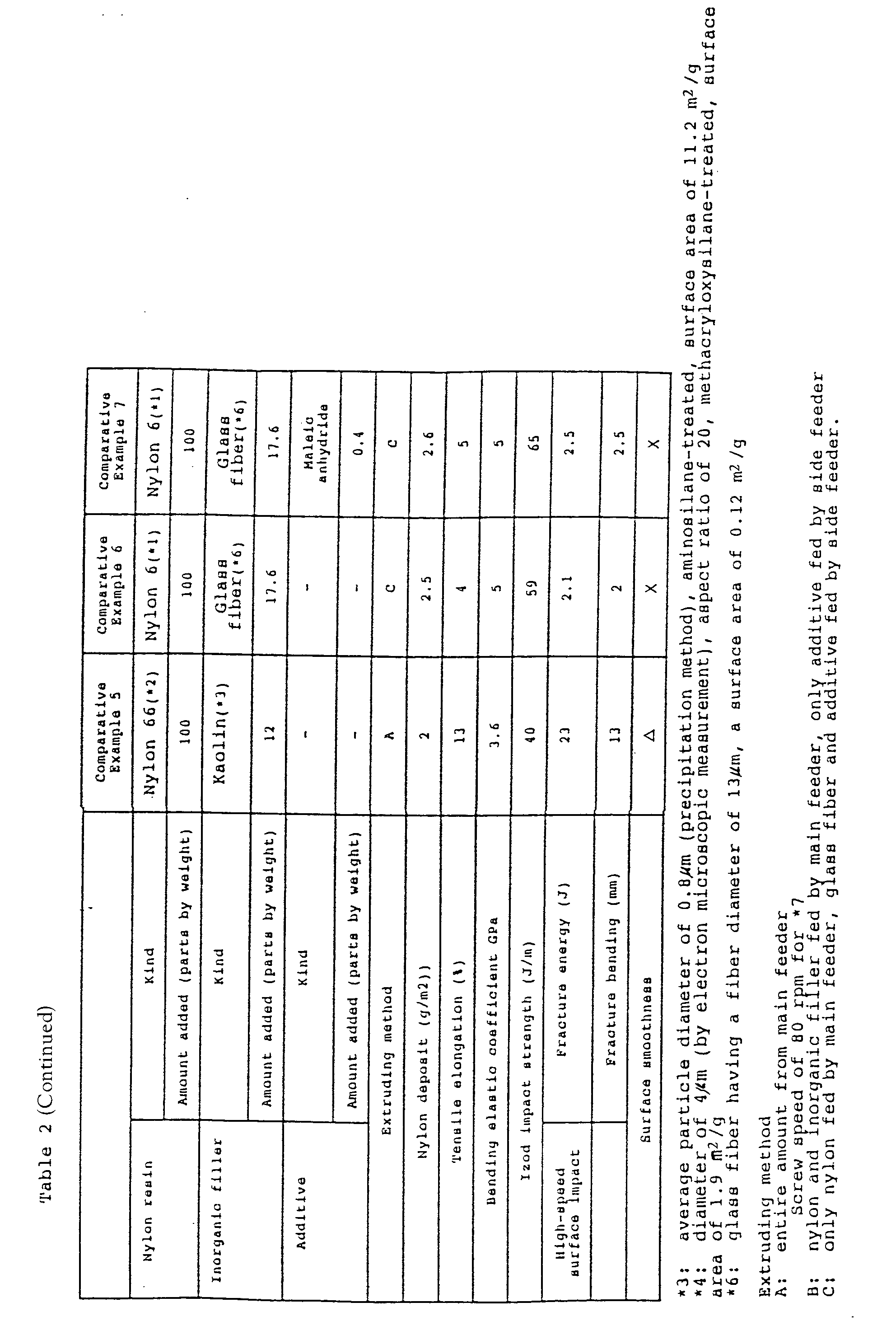
- The kneading, pelletization, injection forming and property measurement were performed substantially in the same manners as described in Example 1, except that the kinds or compounding amounts of polyamide resin, inorganic filler and olefin compound having in its molecule a carboxylic anhydride group, and the like, and the extruding method were changed as shown in Tables 1 and 2. Results are shown in Tables 1 and 2. Amounts of polyamide resin component deposit in Examples 2-5 and Comparative Examples 2-5 were measured by method (1), method (2) and method (3), and were in accordance with each other. For Comparative Examples 6 and 7, method (2) was used for the measurement.
- As indicated by Comparative Examples 2 and 3, if the extruding conditions were not appropriate although the composition was the same as that of Example 1, the amount of polyamide resin component deposit on the inorganic filler became insufficient, and the obtained formings were apparently inferior in tensile elongation, impact strength, high-speed surface impact characteristic and surface smoothness.
- Furthermore, if the kind of nylon resin or the kind of inorganic filler was changed, improvements were still achieved in tensile elongation, impact strength, high-speed surface impact characteristic and surface smoothness, in comparison with the cases where an olefin compound having in its molecule a carboxylic anhydride group or a polymer of the olefin compound was not added. In the cases where glass fiber was used, no remarkable improvement was observed (Comparative Examples 6 and 7).
- The kneading, pelletization, injection forming and property measurement were performed substantially in the same manners as described in Example 1, except that polyamide resin, inorganic filler, polyphenylene oxide resin and maleic anhydride were compounded as shown in Table 3. Results are shown in Tables 3. Polyphenylene oxide was removed using chloroform. The amount of nylon deposited on the filler was measured by the infrared spectroscopic method (method (1)) and the elemental analysis method (method (2)). The measurements thereby were in accordance with each other within an error range. If polyphenylene was added in a large amount, the amount of nylon deposit decreased, thereby failing to achieve good characteristics.
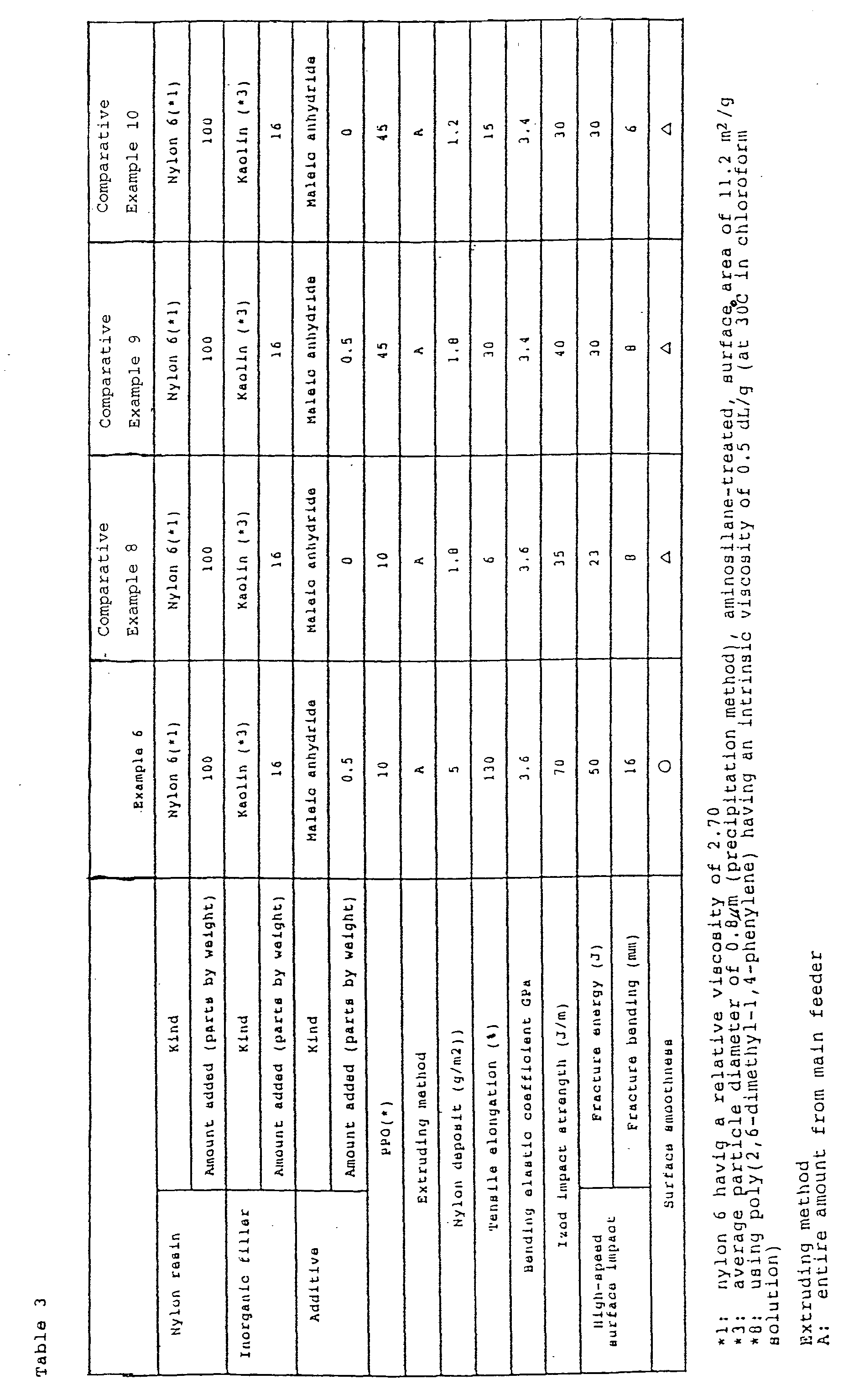
- Full wheel caps of 14 inches in diameter were formed by injection using the pellets of Example 1 and Comparative Example 1, as shown in Table 4. The surface smoothness of the formings was evaluated. A thin-wall flat portion (2 mm in thickness) was cut out from the full wheel cap of each Example 7 and Comparative Example 11, and was subjected to the high-speed surface impact test under the same conditions as described above. An increase in the amount of polyamide resin component deposit improved high-speed surface impact characteristics and surface smoothness as indicated in Table 4.

- Relay boxes as shown in Fig. 1 were formed using the pellets of Example 1 and Comparative Example 1, as shown in Table 4. The surface smoothness of the formings was evaluated. A platy portion of the forming of each of Example 8 and Comparative Example 12 was cut out, and was subjected to the high-speed surface impact test. The strength of lance portions of the relay boxes was measured by a tension test as follows. A metallic terminal connected to a copper wire was inserted into a lance portion provided in a terminal inserting opening of each relay box. The relay box was secured using a tension tester, and the copper wire was subjected to a tension test, thereby measuring a strength of a lance. The strength of the lance in Example 8 (the composition of Example 1) was 9.5 kgf while the strength of the lance in Comparative Example 12 (the composition of Comparative Example 1) was 8.8 kgf. The higher strength of the lance in Example 8 is considered to correspond to the superiority of the composition of Example 1 in overall material characteristics.
- Portable pocket-size computer casings having a width of 20 cm, a depth of 12 cm and a thickness of 1.5 cm were formed by injection using the pellets of Example 1 and Comparative Example 1 as shown in Table 4. The surface smoothness of the casings was evaluated. A thin-wall flat portions (2 mm in thickness) was cut out from each casing, and was subjected to the high-speed surface impact test under the same conditions as described above. The results indicate that an increase in the amount of polyamide resin component achieved improvements in high-speed surface impact characteristic and surface smoothness.
- Thus, nylon resin compositions embodying the invention give products having excellent rigidity and toughness and particularly excellent high speed surface impact fracture characteristics. Articles formed from them also have an excellent external surface appearance and excellent dimensional stability in good balance.
Claims (12)
- A polyamide resin composition comprising:wherein the amount of polyamide resin component deposit remaining on the inorganic filler when the inorganic filler is recovered by dissolving the polyamide resin composition into hexafluoroisopropanol is at least 4 g/m2 per unit surface area of the inorganic filler measured by a BET method.(A) nylon resin;(B) at least one of a non-fibrous inorganic filler having an average particle diameter of 0.05-10µm and a fibrous inorganic filler, excluding glass fiber, having a fiber diameter of 0.05-10µm, which inorganic filler is selected from kaolin, wollastonite and talc and which is melt-kneaded together with the nylon resin (A), in a compounding amount of 5-150 parts by weight relative to 100 parts by weight of the nylon resin (A); and(C) an olefin compound having in its molecule a carboxylic anhydride group or a polymer of the olefin compound that is melt-kneaded together, in a compounding amount of 0.05-10 parts by weight relative to 100 parts by weight of the nylon resin (A),
- A polyamide resin composition according to claim 1, wherein the nylon resin is at least one selected from aliphatic nylon resins whose melting points are at least 200°C.
- A polyamide resin composition according to claim 1 or 2, wherein the nylon resin is at least one selected from the group consisting of nylon 66 and nylon 6.
- A polyamide resin composition according to any one of claims 1 to 3, wherein the olefin compound is at least one selected from the group consisting of maleic anhydride, itaconic acid anhydride, glutaconic acid anhydride, citraconic acid anhydride and aconitic acid anhydride.
- A polyamide resin composition according to any one of claims 1 to 3, wherein the polymer of the olefin compound is polymaleic anhydride.
- A polyamide resin composition according to any one of claims 1 to 5, wherein the polyphenylene oxide resin is optionally added in an amount less than 40 parts by weight relative to 100 parts by weight of polyamide resin.
- A method for producing a polyamide resin composition, comprising melt-kneading (A) 100 parts by weight of nylon resin; (B) 5-150 parts by weight of at least one of a non-fibrous inorganic filler having an average particle diameter of 0.05-10µm and a fibrous inorganic filler, excluding glass fiber, having a fiber diameter of 0.05-10µm and which inorganic filler is selected from kaolin, wollastonite and talc; and (C) an olefin compound having in its molecule a carboxylic anhydride group or a polymer of the olefin compound, in an amount of 0.05-10 parts by weight relative to 100 parts by weight of the nylon resin (A); in such a manner that the amount of a polyamide resin component deposit remaining on the inorganic filler when the inorganic filler is recovered by dissolving the polyamide resin composition into hexafluoroisopropanol becomes at least 4 g/m2 per unit surface area of the inorganic filler measured by a BET method.
- A vehicular exterior component part formed from a polyamide resin composition defined in any one of claims 1 to 6.
- A vehicular exterior component part according to claim 8, wherein the vehicular exterior component part is one selected from the group consisting of a wheel cap, a spoiler and a fender.
- An under-hood component part forming for a motor vehicle, formed from a polyamide resin composition defined in any one of claims 1 to 6.
- An under-hood component part forming for a motor vehicle according to claim 10, wherein the under-hood component part forming is any one electrical component part selected from the group consisting of a relay box, a junction box and fuse box.
- A portable device casing formed from a polyamide resin composition defined in any one of claims 1 to 6.
Applications Claiming Priority (9)
| Application Number | Priority Date | Filing Date | Title |
|---|---|---|---|
| JP5320597 | 1997-03-07 | ||
| JP53206/97 | 1997-03-07 | ||
| JP5320697 | 1997-03-07 | ||
| JP53205/97 | 1997-03-07 | ||
| JP5320597 | 1997-03-07 | ||
| JP5320697 | 1997-03-07 | ||
| JP21375197A JPH1160941A (en) | 1997-08-07 | 1997-08-07 | Resin composition for mobile device housing |
| JP213751/97 | 1997-08-07 | ||
| JP21375197 | 1997-08-07 |
Publications (2)
| Publication Number | Publication Date |
|---|---|
| EP0863180A1 EP0863180A1 (en) | 1998-09-09 |
| EP0863180B1 true EP0863180B1 (en) | 2002-08-28 |
Family
ID=27294871
Family Applications (1)
| Application Number | Title | Priority Date | Filing Date |
|---|---|---|---|
| EP98301707A Expired - Lifetime EP0863180B1 (en) | 1997-03-07 | 1998-03-09 | Polyamide resin composition and articles formed from them |
Country Status (5)
| Country | Link |
|---|---|
| US (1) | US6617381B1 (en) |
| EP (1) | EP0863180B1 (en) |
| KR (1) | KR19980079990A (en) |
| CN (1) | CN1198454A (en) |
| SG (1) | SG71090A1 (en) |
Families Citing this family (20)
| Publication number | Priority date | Publication date | Assignee | Title |
|---|---|---|---|---|
| RU2182107C1 (en) * | 2001-03-30 | 2002-05-10 | Общество С Ограниченной Ответственностью Производственно-Коммерческая Фирма "Атлантис-Пак" | Polymer film for packing foodstuff and package made from such film |
| KR20030055809A (en) * | 2001-12-27 | 2003-07-04 | 주식회사 효성 | Preparation of Polyamide Resin Composition |
| CH695687A5 (en) * | 2002-09-06 | 2006-07-31 | Ems Chemie Ag | Polyamide molding materials with ultrafine fillers and produced therefrom Lichtreflektier components. |
| US9339789B2 (en) * | 2004-10-12 | 2016-05-17 | Multisorb Technologies, Inc. | Thermoset desiccant product and method for making same |
| US20060166818A1 (en) * | 2005-01-21 | 2006-07-27 | Thomas Powers | Resin bonded sorbent |
| US8097221B2 (en) * | 2005-01-21 | 2012-01-17 | Multisorb Technologies, Inc. | Lamp assembly |
| US7989388B2 (en) * | 2005-01-21 | 2011-08-02 | Multisorb Technologies, Inc. | Resin bonded sorbent |
| US8853124B2 (en) * | 2005-01-21 | 2014-10-07 | Multisorb Technologies, Inc. | Resin bonded sorbent |
| US7595278B2 (en) * | 2005-01-21 | 2009-09-29 | Multisorb Technologies, Inc. | Resin bonded sorbent |
| DE102006045269A1 (en) | 2005-11-09 | 2007-05-31 | Ems-Chemie Ag | Metallic coated Lichtreflektierbauteile based on thermoplastic molding compositions |
| FR2922552B1 (en) * | 2007-10-19 | 2013-03-08 | Rhodia Operations | POLYAMIDE COMPOSITION CHARGED WITH FIBERS |
| US20090170998A1 (en) * | 2007-12-28 | 2009-07-02 | Deval Gupta | Silicon carbide containing thermoplastic compositions, method of preparing, and articles comprising the same |
| DE102009059771A1 (en) | 2009-12-21 | 2011-06-22 | Bayer MaterialScience AG, 51373 | Polycarbonate with improved thermal and mechanical properties and reduced thermal expansion coefficient |
| DE102012104308A1 (en) | 2012-05-18 | 2013-11-21 | Ensinger Gmbh | Polymer material, in particular for tribological applications |
| CN105968800A (en) * | 2016-07-26 | 2016-09-28 | 潘明华 | Reinforced antistatic nylon composite and preparation method thereof |
| KR101940418B1 (en) | 2017-10-30 | 2019-01-18 | 롯데첨단소재(주) | Polyamide resin composition and article comprising the same |
| KR102171421B1 (en) * | 2017-12-31 | 2020-10-29 | 롯데첨단소재(주) | Polyamide resin composition and article comprising the same |
| US11577496B2 (en) * | 2017-12-31 | 2023-02-14 | Lotte Chemical Corporation | Polyamide resin composition and molded article comprising the same |
| KR102198388B1 (en) | 2018-05-31 | 2021-01-05 | 롯데첨단소재(주) | Polyamide resin composition and article comprising the same |
| KR102714443B1 (en) * | 2018-12-10 | 2024-10-08 | 현대자동차주식회사 | Resin composition for parts of automobile, parts for automobile using the same and manufacturing method thereof |
Family Cites Families (34)
| Publication number | Priority date | Publication date | Assignee | Title |
|---|---|---|---|---|
| US3893969A (en) | 1974-03-29 | 1975-07-08 | Gen Motors Corp | Reinforced polyamide molding composition |
| US4065519A (en) | 1975-07-03 | 1977-12-27 | Rilsan Corporation | Process for coating fine powders with a nylon and products made therewith |
| US4444836A (en) * | 1979-09-17 | 1984-04-24 | Allied Corporation | Metal plated polyamide articles |
| US4289668A (en) * | 1980-10-14 | 1981-09-15 | The Standard Oil Company | Polymer systems plasticized with hydroxy fatty acids |
| JPS57123231A (en) * | 1981-01-22 | 1982-07-31 | Toyobo Co Ltd | Metal-plated polyamide molded product and preparation of same |
| GB2092600A (en) * | 1981-02-11 | 1982-08-18 | Du Pont | Mineral reinforced polyamides |
| US4399246A (en) * | 1982-08-06 | 1983-08-16 | E. I. Du Pont De Nemours & Co. | Filled polyamide compositions with silanes and sulfonamides |
| JPS6011555A (en) | 1983-06-30 | 1985-01-21 | Mitsubishi Rayon Co Ltd | Polyamide resin composition having good plating adhesion |
| DE3425628A1 (en) * | 1984-07-12 | 1986-01-16 | Basf Ag, 6700 Ludwigshafen | CONDUCTIVE POLYAMIDE MOLDS |
| FR2583424B1 (en) * | 1985-06-13 | 1987-07-31 | Rhone Poulenc Fibres | MASTER BLENDS FOR THE MATIFICATION OF POLYAMIDES |
| JPS62253652A (en) | 1986-03-28 | 1987-11-05 | Japan Synthetic Rubber Co Ltd | Thermoplastic resin composition |
| US5288786A (en) * | 1986-09-30 | 1994-02-22 | Sumitomo Chemical Co., Ltd. | Thermoplastic resin composition |
| JP2842536B2 (en) * | 1988-08-31 | 1999-01-06 | 三菱化学株式会社 | Resin composition |
| DE68914926T2 (en) * | 1988-09-13 | 1994-09-01 | Nippon Oils & Fats Co Ltd | Synthetic resin compositions. |
| JP2605832B2 (en) * | 1988-10-15 | 1997-04-30 | 住友化学工業株式会社 | Thermoplastic resin composition and method for producing the same |
| JP2715499B2 (en) | 1988-12-15 | 1998-02-18 | 住友化学工業株式会社 | Thermoplastic resin composition |
| FR2641540B1 (en) * | 1989-01-12 | 1992-08-14 | Solvay | |
| US5206284A (en) * | 1989-03-17 | 1993-04-27 | Ube Industries Ltd. | Thermoplastic resin composition |
| JPH0689176B2 (en) | 1989-05-30 | 1994-11-09 | 宇部興産株式会社 | Fiber-reinforced thermoplastic resin composition |
| US5219940A (en) * | 1989-10-13 | 1993-06-15 | Idemitsu Kosan Co., Ltd. | Styrene polymer composition |
| EP0430545B1 (en) * | 1989-11-21 | 1996-07-10 | Sumitomo Chemical Company, Limited | Surface irradiation of articles molded from polypropylene compositions |
| JP3102039B2 (en) * | 1990-03-14 | 2000-10-23 | 住友化学工業株式会社 | Surface treatment method and coating method for thermoplastic resin molded products |
| TW203083B (en) * | 1990-05-11 | 1993-04-01 | Sumitomo Chemical Co | |
| US5703164A (en) * | 1990-09-12 | 1997-12-30 | Idemitsu Kosan Co., Ltd. | Styrene polymer composition |
| DE4129500A1 (en) * | 1991-09-05 | 1993-03-11 | Basf Ag | HIGH IMPACT TOE, FLAME RETARDED POLYPHENYLENE ETHER / POLYAMIDE MOLDING MATERIALS |
| JP3077948B2 (en) | 1991-12-27 | 2000-08-21 | 日本ジーイープラスチックス株式会社 | Resin composition |
| TW284778B (en) * | 1992-03-02 | 1996-09-01 | Dsm Nv | |
| DE4208108A1 (en) * | 1992-03-13 | 1993-09-16 | Bayer Ag | THERMOPLASTIC MOLDS |
| JP3217171B2 (en) * | 1992-04-14 | 2001-10-09 | 住友化学工業株式会社 | Resin composition and fabricated article made therefrom |
| JPH0665500A (en) * | 1992-08-21 | 1994-03-08 | Mitsubishi Gas Chem Co Inc | Polyamide resin composition |
| JP3231435B2 (en) * | 1992-11-09 | 2001-11-19 | 日本ジーイープラスチックス株式会社 | Resin composition |
| JPH06240132A (en) * | 1993-02-18 | 1994-08-30 | Fujitsu Ltd | Polyamide resin composition and housing for electronic device |
| US5571851A (en) * | 1994-01-28 | 1996-11-05 | J.M. Huber Corporation | Reinforcing fillers for plastics systems |
| JP3024495B2 (en) * | 1994-10-21 | 2000-03-21 | ジェイエスアール株式会社 | Resin composition for laser marking |
-
1998
- 1998-03-04 US US09/034,817 patent/US6617381B1/en not_active Expired - Fee Related
- 1998-03-05 SG SG1998000492A patent/SG71090A1/en unknown
- 1998-03-06 KR KR1019980007481A patent/KR19980079990A/en not_active Withdrawn
- 1998-03-07 CN CN98108242A patent/CN1198454A/en active Pending
- 1998-03-09 EP EP98301707A patent/EP0863180B1/en not_active Expired - Lifetime
Also Published As
| Publication number | Publication date |
|---|---|
| SG71090A1 (en) | 2000-03-21 |
| KR19980079990A (en) | 1998-11-25 |
| EP0863180A1 (en) | 1998-09-09 |
| CN1198454A (en) | 1998-11-11 |
| US6617381B1 (en) | 2003-09-09 |
Similar Documents
| Publication | Publication Date | Title |
|---|---|---|
| US6617381B1 (en) | Polyamide resin composition and forming from the same | |
| KR100387850B1 (en) | Polyamide resin composition and synthetic resin product | |
| CA2691872C (en) | Thermoplastic polyamide resin composition having improved paint adhesion | |
| JP3217171B2 (en) | Resin composition and fabricated article made therefrom | |
| US20040167264A1 (en) | Impact-strength-modified polymer compositions | |
| EP2397523B1 (en) | Reinforced poly(arylene ether)/polyamide composition and article comprising the foregoing | |
| CN101665121B (en) | Exterior formed article made of long fiber-reinforced thermoplastic resin | |
| US8168088B2 (en) | Electrically conductive compositions/shaped articles comprising polyamide matrices | |
| CN111201284A (en) | Resin composition, molded article, and method for producing the same | |
| JP3911819B2 (en) | Multi-layer hollow molded body | |
| JP2011057798A (en) | Polyamide composition and molded article containing polyamide composition | |
| JP3588383B2 (en) | Polyamide resin composition and engine cover material comprising the same | |
| KR102788767B1 (en) | Thermoplastic resin composition and article manufactured using the same | |
| JP4207437B2 (en) | Polyamide resin composition for baking coating and baking coating molded product | |
| JP3551674B2 (en) | Welding polyamide resin composition | |
| KR100199635B1 (en) | Thermoplastic resin composition | |
| JP2022010813A (en) | Resin composition and molded article thereof | |
| JPH10306213A (en) | Resin composition for vehicle exterior parts | |
| JP4075125B2 (en) | Polyamide resin composition and method for producing the same | |
| JP2019081895A (en) | Injection molded article and automobile impact member | |
| JP7388132B2 (en) | Resin compositions and molded products thereof | |
| KR20030027219A (en) | A polyamide resin composition for outside door handle of automobile | |
| WO2021153123A1 (en) | Energy-absorbing member | |
| CN1326916C (en) | Conductive masterbatch and conductive resin composition | |
| JP4000657B2 (en) | Thermoplastic resin composition for hollow molding |
Legal Events
| Date | Code | Title | Description |
|---|---|---|---|
| PUAI | Public reference made under article 153(3) epc to a published international application that has entered the european phase |
Free format text: ORIGINAL CODE: 0009012 |
|
| 17P | Request for examination filed |
Effective date: 19980330 |
|
| AK | Designated contracting states |
Kind code of ref document: A1 Designated state(s): DE FR GB NL Kind code of ref document: A1 Designated state(s): GB |
|
| AX | Request for extension of the european patent |
Free format text: AL;LT;LV;MK;RO;SI |
|
| AKX | Designation fees paid |
Free format text: DE FR GB NL |
|
| RBV | Designated contracting states (corrected) |
Designated state(s): DE FR GB NL |
|
| 17Q | First examination report despatched |
Effective date: 19990708 |
|
| GRAG | Despatch of communication of intention to grant |
Free format text: ORIGINAL CODE: EPIDOS AGRA |
|
| GRAG | Despatch of communication of intention to grant |
Free format text: ORIGINAL CODE: EPIDOS AGRA |
|
| GRAG | Despatch of communication of intention to grant |
Free format text: ORIGINAL CODE: EPIDOS AGRA |
|
| GRAH | Despatch of communication of intention to grant a patent |
Free format text: ORIGINAL CODE: EPIDOS IGRA |
|
| GRAH | Despatch of communication of intention to grant a patent |
Free format text: ORIGINAL CODE: EPIDOS IGRA |
|
| RBV | Designated contracting states (corrected) |
Designated state(s): GB |
|
| GRAA | (expected) grant |
Free format text: ORIGINAL CODE: 0009210 |
|
| REG | Reference to a national code |
Ref country code: DE Ref legal event code: 8566 |
|
| AK | Designated contracting states |
Kind code of ref document: B1 Designated state(s): GB |
|
| REG | Reference to a national code |
Ref country code: GB Ref legal event code: FG4D |
|
| PLBE | No opposition filed within time limit |
Free format text: ORIGINAL CODE: 0009261 |
|
| STAA | Information on the status of an ep patent application or granted ep patent |
Free format text: STATUS: NO OPPOSITION FILED WITHIN TIME LIMIT |
|
| 26N | No opposition filed |
Effective date: 20030530 |
|
| PGFP | Annual fee paid to national office [announced via postgrant information from national office to epo] |
Ref country code: GB Payment date: 20040227 Year of fee payment: 7 |
|
| PG25 | Lapsed in a contracting state [announced via postgrant information from national office to epo] |
Ref country code: GB Free format text: LAPSE BECAUSE OF NON-PAYMENT OF DUE FEES Effective date: 20050309 |
|
| GBPC | Gb: european patent ceased through non-payment of renewal fee |
Effective date: 20050309 |