EP0860438B1 - Fluorine-containing diphenyl acrylamide antimicrobial agents - Google Patents
Fluorine-containing diphenyl acrylamide antimicrobial agents Download PDFInfo
- Publication number
- EP0860438B1 EP0860438B1 EP19970200506 EP97200506A EP0860438B1 EP 0860438 B1 EP0860438 B1 EP 0860438B1 EP 19970200506 EP19970200506 EP 19970200506 EP 97200506 A EP97200506 A EP 97200506A EP 0860438 B1 EP0860438 B1 EP 0860438B1
- Authority
- EP
- European Patent Office
- Prior art keywords
- compound
- ppm
- weight
- test
- sodium
- Prior art date
- Legal status (The legal status is an assumption and is not a legal conclusion. Google has not performed a legal analysis and makes no representation as to the accuracy of the status listed.)
- Expired - Lifetime
Links
- 0 *C(C(c(cc1)ccc1F)c(cc1*)ccc1O*)C(O)=* Chemical compound *C(C(c(cc1)ccc1F)c(cc1*)ccc1O*)C(O)=* 0.000 description 3
Classifications
-
- C—CHEMISTRY; METALLURGY
- C07—ORGANIC CHEMISTRY
- C07D—HETEROCYCLIC COMPOUNDS
- C07D295/00—Heterocyclic compounds containing polymethylene-imine rings with at least five ring members, 3-azabicyclo [3.2.2] nonane, piperazine, morpholine or thiomorpholine rings, having only hydrogen atoms directly attached to the ring carbon atoms
- C07D295/16—Heterocyclic compounds containing polymethylene-imine rings with at least five ring members, 3-azabicyclo [3.2.2] nonane, piperazine, morpholine or thiomorpholine rings, having only hydrogen atoms directly attached to the ring carbon atoms acylated on ring nitrogen atoms
- C07D295/18—Heterocyclic compounds containing polymethylene-imine rings with at least five ring members, 3-azabicyclo [3.2.2] nonane, piperazine, morpholine or thiomorpholine rings, having only hydrogen atoms directly attached to the ring carbon atoms acylated on ring nitrogen atoms by radicals derived from carboxylic acids, or sulfur or nitrogen analogues thereof
- C07D295/182—Radicals derived from carboxylic acids
- C07D295/185—Radicals derived from carboxylic acids from aliphatic carboxylic acids
-
- A—HUMAN NECESSITIES
- A01—AGRICULTURE; FORESTRY; ANIMAL HUSBANDRY; HUNTING; TRAPPING; FISHING
- A01N—PRESERVATION OF BODIES OF HUMANS OR ANIMALS OR PLANTS OR PARTS THEREOF; BIOCIDES, e.g. AS DISINFECTANTS, AS PESTICIDES OR AS HERBICIDES; PEST REPELLANTS OR ATTRACTANTS; PLANT GROWTH REGULATORS
- A01N37/00—Biocides, pest repellants or attractants, or plant growth regulators containing organic compounds containing a carbon atom having three bonds to hetero atoms with at the most two bonds to halogen, e.g. carboxylic acids
- A01N37/36—Biocides, pest repellants or attractants, or plant growth regulators containing organic compounds containing a carbon atom having three bonds to hetero atoms with at the most two bonds to halogen, e.g. carboxylic acids containing at least one carboxylic group or a thio analogue, or a derivative thereof, and a singly bound oxygen or sulfur atom attached to the same carbon skeleton, this oxygen or sulfur atom not being a member of a carboxylic group or of a thio analogue, or of a derivative thereof, e.g. hydroxy-carboxylic acids
- A01N37/38—Biocides, pest repellants or attractants, or plant growth regulators containing organic compounds containing a carbon atom having three bonds to hetero atoms with at the most two bonds to halogen, e.g. carboxylic acids containing at least one carboxylic group or a thio analogue, or a derivative thereof, and a singly bound oxygen or sulfur atom attached to the same carbon skeleton, this oxygen or sulfur atom not being a member of a carboxylic group or of a thio analogue, or of a derivative thereof, e.g. hydroxy-carboxylic acids having at least one oxygen or sulfur atom attached to an aromatic ring system
-
- C—CHEMISTRY; METALLURGY
- C07—ORGANIC CHEMISTRY
- C07C—ACYCLIC OR CARBOCYCLIC COMPOUNDS
- C07C235/00—Carboxylic acid amides, the carbon skeleton of the acid part being further substituted by oxygen atoms
- C07C235/02—Carboxylic acid amides, the carbon skeleton of the acid part being further substituted by oxygen atoms having carbon atoms of carboxamide groups bound to acyclic carbon atoms and singly-bound oxygen atoms bound to the same carbon skeleton
- C07C235/32—Carboxylic acid amides, the carbon skeleton of the acid part being further substituted by oxygen atoms having carbon atoms of carboxamide groups bound to acyclic carbon atoms and singly-bound oxygen atoms bound to the same carbon skeleton the carbon skeleton containing six-membered aromatic rings
- C07C235/34—Carboxylic acid amides, the carbon skeleton of the acid part being further substituted by oxygen atoms having carbon atoms of carboxamide groups bound to acyclic carbon atoms and singly-bound oxygen atoms bound to the same carbon skeleton the carbon skeleton containing six-membered aromatic rings having the nitrogen atoms of the carboxamide groups bound to hydrogen atoms or to acyclic carbon atoms
-
- C—CHEMISTRY; METALLURGY
- C07—ORGANIC CHEMISTRY
- C07D—HETEROCYCLIC COMPOUNDS
- C07D317/00—Heterocyclic compounds containing five-membered rings having two oxygen atoms as the only ring hetero atoms
- C07D317/08—Heterocyclic compounds containing five-membered rings having two oxygen atoms as the only ring hetero atoms having the hetero atoms in positions 1 and 3
- C07D317/44—Heterocyclic compounds containing five-membered rings having two oxygen atoms as the only ring hetero atoms having the hetero atoms in positions 1 and 3 ortho- or peri-condensed with carbocyclic rings or ring systems
- C07D317/46—Heterocyclic compounds containing five-membered rings having two oxygen atoms as the only ring hetero atoms having the hetero atoms in positions 1 and 3 ortho- or peri-condensed with carbocyclic rings or ring systems condensed with one six-membered ring
- C07D317/48—Methylenedioxybenzenes or hydrogenated methylenedioxybenzenes, unsubstituted on the hetero ring
- C07D317/50—Methylenedioxybenzenes or hydrogenated methylenedioxybenzenes, unsubstituted on the hetero ring with only hydrogen atoms, hydrocarbon or substituted hydrocarbon radicals, directly attached to atoms of the carbocyclic ring
- C07D317/60—Radicals substituted by carbon atoms having three bonds to hetero atoms with at the most one bond to halogen, e.g. ester or nitrile radicals
-
- C—CHEMISTRY; METALLURGY
- C07—ORGANIC CHEMISTRY
- C07D—HETEROCYCLIC COMPOUNDS
- C07D319/00—Heterocyclic compounds containing six-membered rings having two oxygen atoms as the only ring hetero atoms
- C07D319/10—1,4-Dioxanes; Hydrogenated 1,4-dioxanes
- C07D319/14—1,4-Dioxanes; Hydrogenated 1,4-dioxanes condensed with carbocyclic rings or ring systems
- C07D319/16—1,4-Dioxanes; Hydrogenated 1,4-dioxanes condensed with carbocyclic rings or ring systems condensed with one six-membered ring
- C07D319/18—Ethylenedioxybenzenes, not substituted on the hetero ring
Definitions
- US Patent Number 4,753,934 describes antimicrobial diphenyl acrylamide compounds that can be used as antimicrobial agents in agriculture.
- the protective effect of these compounds against plant pests is poor, and more active compounds are needed.
- antimicrobial agents such as metalaxyl, aluminium phosphide, chlorothalonil, and probamocarb do not have satisfactory effect.
- EP 219 756 describes fungicidal diphenyl acrylamides
- EP 520 585 and EP 208 999 describe fungicides which are structurally close to the compound of the current application, but do not specifically describe fluorine-containing agents.
- the present invention intends to propose a new fluorine-containing diphenyl acrylamide antimicrobial agent and its composition.
- the fluorine-containing diphenyl acrylamide antimicrobial compound of the present invention is 3-(4-fluorophenyl)-3-(3,4-dimethoxyphenyl)-acryloyl)morpholine (compound 1).
- the present invention provides a fungicidal composition for controlling phytophathogenic fungi which comprises an agronomically acceptable carrier and compound 1 wherein the ratio of the carrier to the compound is 99:1 to 1:3.
- the ratio of the agriculturally acceptable carrier to compound is 20:1 to 1:2.
- the present invention provides a fungicidal mixture for controlling phytophathogenic fungi which comprises 3 -(4-fluorophenyl)-3-(3,4-dimethoxyphenyl)acryl morpholine and mancozeb in a weight ratio of 1:10 to 1:1.
- the present invention provides a fungicidal mixture for controlling phytophathogenic fungi which comprises 3 -(4-fluorophenyr)-3-(3,4-dimethoxypheinyl)acryl morpholine and fenbuconazole in a weight ratio of 1:10 to 10:1.
- the present invention provides a method for controlling phytophathogenic fungi which comprises applying to the locus where control is desired the compound 1 at a rate of from 0.005 to 50 kilograms per hectare.
- 3-(4-Fluorophenyl)-3-(3,4-dmiethoxyphenyl)acryloyl) morpholine has the formula.
- the compound of the present invention can be prepared by the following methods described in Methods 1 to 4..
- the compound of the present invention is useful as agricultural fungicides and, as such, can be applied to various loci such as the seed, the soil or the foliage.
- the compound can be applied as fungicidal sprays by methods commonly employed, such as conventional high-gallonage hydraulic sprays, low-gallonage sprays, air-blast spray, aerial sprays and dusts.
- the dilution and rate of application will depend upon the type of equipment employed, the method of application, plants to be treated and diseases to be controlled.
- the compound of this invention will be applied in amount of from 0.005 kilogram to 50 kilograms per hectare and preferably from 0.025 to 25 kilograms per hectare of the active ingredient.
- the amount of compound coated on the seed is usually at a dosage rate of from 0.05 to 20, preferably from 0.05 to 4, and more preferably from 0.1 to 1 grams per hundred kilograms of seed.
- the compounds can be incorporated in the soil or applied to the surface usually at a rate of from 0.02 to 20, preferably from 0.05 to 10, and more preferably from 0.1 to 5 kilograms per hectare.
- the toxicant is usually applied to growing plants at a rate of from 0.01 to 10, preferably from 0.02 to 5, and more preferably from 0.25 to 1 kilograms per hectare.
- the compound of the invention display fungicidal activity
- thecompound can be combined with other known fungicides to provide broad spectrum activity.
- Suitable fungicides include, but are not limited to, those compounds listed in U.S. Patent Number 5,252,594 (see in particular columns 14 and 15).
- the compound Since the compound possesses broad spectrum fungicidal activity, they can be employed in the storage of cereal grain. These complexes can also be employed as fungicides in cereals including wheat, barley and rye, in rice, peanuts, beans and grapes, on turf, in fruit, nut and vegetable orchards, and for golf course applications.
- diseases against which the compound of the invention is useful include helminthosporium of corn and barley, wheat and barley powdery mildew, wheat leaf and stem rusts, tomato early blight, tomato late blight, peanut early leaf spot, grape powdery mildew, grape black rot, apple scab, apple powdery mildew, cucumber powdery mildew, brown rot of fruits, botrytis, bean powdery mildew, cucumber anthracnose, wheat septoria nodorum, rice sheath blight and rice blast.
- the active compound may be applied to the soil or foliage where it is absorbed by the plant, translocated to other plant parts and ultimately ingested by the pest or insects by means of ingestion of the plant part(s).
- This means of application is referred to as "systemic” application.
- the active compound may be applied to the soil and contacted therein with the insects and other pests to be controlled. This means of application is referred to as "soil” application.
- the active compound may be foliarly applied to the plants to be freed from insects and other pests which feed on the foliage.
- the compound of the present invention can be used in the form of compositions or formulations.
- Examples of the preparation of compositions and formulations can be found in the American Chemical Society publication “Pesticidal Formulation Research,” (1969), Advances in Chemistry Series No. 86, written by Wade Van Valkenburg; and the Marcel Dekker, Inc. publication “Pesticide Formulations”, (1973) edited by Wade Van Valkenburg.
- the active substance is mixed with conventional inert agronomically acceptable (i.e., plant compatible and/or pesticidally inert) pesticide diluents or extenders such as solid carrier material or liquid carrier material, of the type usable in conventional pesticide compositions or formulations.
- agronomically acceptable carrier any substance which can be used to dissolve, disperse of diffuse the active ingredient in the composition without impairing the active ingredients effectiveness and which by itself has no significant detrimental effect on the soil, equipment, desirable plants, or agronomic environment.
- adjuvants such as surfactants, stabilizers, antifoam agents and antidrift agents may also be combined.
- compositions and formulations according to the invention are aqueous solutions and dispersions, oily solutions and oil dispersions, pastes, dusting powders, wettable powders, emulsifiable concentrates, flowables, granules, baits, invert emulsions, aerosol compositions and fumigating candles.
- Wettable powders, pastes, flowables and emulsifiable concentrates are concentrated preparations which are diluted with water before or during use. In such formulations, the compounds are extended with a liquid or solid carrier and, when desired, suitable surfactants are incorporated.
- Baits are preparations generally comprising a food or other substance attractive to insects, that includes at least one compound of the instantinvention.
- adjuvants such as wetting agents, spreading agents, dispersing agents, stickers, adhesive and the like in accordance with agricultural practices.
- adjuvants commonly used in the art, and a discussion of adjuvants can be found in many references, such as in the John W. McCutcheon, Inc. publication "Detergents and Emulsifiers, Annual"
- the active compound of the present invention may be employed alone or in the form of mixtures with one another and/or with such solid and/or liquid dispersible carrier vehicles and/or with other known compatible active agents, especially plant protection agents, such as other insecticides, arthropodicides, nematicides, fungicides, bactericides, rodenticides, herbicides, fertilizers, growth-regulating agents, synergists.
- plant protection agents such as other insecticides, arthropodicides, nematicides, fungicides, bactericides, rodenticides, herbicides, fertilizers, growth-regulating agents, synergists.
- the active compound is present in an amount substantially between 0.0001-99% by weight.
- the amount of active ingredient is preferably between 0.5-90% by weight, and more preferably between 1-75% by weight of the mixture.
- Compositions suitable for direct application or field application generally contain the active compound in an amount substantially between 0.0001-95%, preferably between 0.0005-90% by weight, and more preferably between 0.001-75% by weight of the mixture.
- the composition can also be stated as a ratio of the compound to the carrier. In the present invention the weight ratio of these materials (active compound/carrier) can vary from 99:1 to 1:4 and more preferably from 10:1 to 1:3.
- the compound of this invention can be dissolved in certain solvents such as acetone, methanol, ethanol, dimethylformamide, pyridine or dimethyl sulfoxide and such solutions can be diluted with water.
- concentrations of the solution can vary from 1% to 90% with a preferred range being from 5% to 50%.
- the compound can be dissolved in suitable organic solvents, or a mixture of solvents, together with an emulsifying agent to enhance dispersion of the compound in water.
- concentration of the active ingredient in emulsifiable concentrates is usually from 10% to 90%, and in flowable emulsion concentrates, can be as high as 75%.
- Wettable powders suitable for spraying can be prepared by admixing the compound with a finely divided solid, such as clays, inorganic silicates and carbonates, and silicas and incorporating wetting agents, sticking agents, and/or dispersing agents in such mixtures.
- concentration of active ingredients in such formulations is usually in the range of from 20% to 99%, preferably from 40% to 75%.
- a typical wettable powder is made by blending 50 parts of a pyridazinone, 45 parts of a synthetic precipitated hydrated silicon dioxide, such as that sold under the trademark Hi-SilR, and 5 parts of sodium lignosulfonate.
- a kaolin type (Burden) clay is used in place of the Hi-Sil in the above wettable powder, and in another such preparation 25% of the Hi-Sil is replaced with a synthetic sodium silicoaluminate sold under the trademark Zeolex® 7.
- the compound (1) of this invention can be used alone or can be mixed with one, two or more fungicidal agent(s) or insecticide(s) to form a binary or ternary mixture, for application.
- Suitable insecticides known in the art include those listed in U.S. Patent 5,075,471, see in particular columns 14 and 15.
- Specific insecticides that can be mixed and used together with the compound (1) of this invention include Bromopropylate, Tedion, Methyl 1605, 1605, Sumithion, Diazinon, Dursban, Mimic, Aphistar, Methomyl, Tetrachlorovinphos, Methidathion, Cartap, Sevin, NRDC 143, Chlorocyano pyrethrate, Tetramethrin, Heptafluoro pyrethrate, Fluorochlorocyano pyrethrate, Cyanopenta pyrethrate, PH 60-40, Saziron, Pyrazophos, Acar, Imidacloprid, Fipronil, NI-25, Dioxacarb, Neotran, Methamidophos, Tamarin, and Clofentezine.
- Suitable fungicidal agents that can be mixed with the title compound (1) of this invention include, but are not limited to, Captan, Phaltan, Zineb, Mancozeb, Thiram, Difoltan, Iprodione, Methyl dichlozoline, Methylethyl dichlorozoline, Hexaconazole, Myclobutanil, Tebuconazole, DPX-3217, diguanidoacetoacetate salt, Diethofencarb, Cyprofuram, allylazole, Flutolanil, Carbendazim, Benomyl, Triazolone, Cyproconazole, Methyl thiophanate, Hydroxyoxazole, Butylphenyl morpholine, Propamocarb, Metalaxyl, Furalaxyl, Benalaxyl, Methasulfocarb, Pyrifenox .
- the content of the compound (1) of this invention is 1% - 99% and the other active ingreients may make up from 99-1% by weight of the active ingredients.
- Preferred combinations include 3 -(4-fluorophenyl)-3-(3,4-dimethoxyphenyl)acryl morpholine and mancozeb in a weight ratio of 1:10 to 1:1 and -(4-fluorophenyl)-3-(3,4-dimethoxyphenyl)acryl morpholine and fenbuconazole in a weight ratio of 1:10 to 10:1.
- Examples of the carriers that can be used include for the powder, wettable powder, and granules are kieselghur, clay, gypsum, talc powder and kaolin.
- Solvent that can be used in the emulsion are benzene, toluene, xylene, alkyl benzene, chlorinated cycloalkylenes, C 1-6 aliphatic alcohols, benzyl alcohol, cyclohexanol, acetone, methylethyl ketone, methyl isobutyl ketone, cyclohexanone, dimethyl formamide, dimethylsulfoxide, N-methylpyrrolidone, water and the like.
- the compound of this invention can be prepared as an emulsion, powder, wettable powder, granule or a colloidal suspension.
- Cationic, anionic or nonionic surface active agent may be added as an emulsifier, dispersing agent or wetting agent to the preparation.
- sodium dodecylsulfonate, sodium dodecylbenzene sulfonate, polyethylenoxy aliphatic acid ester, polyethylenoxy aliphatic acid alcohol, polyethylenoxy aliiphatic acyl amine, ethoxylated castor oil, sodium (or potassium) ligninsulfonate, carboxymethyl alcohol, polyvinyl alcohols, polyvinyl esters can be used.
- Compound 1 of this invention 40 weight % kieselghur, 53 weight %, C 12-20 alcohol/sulfate ester 4 weight %, and sodium dodecylbenzensulfonate 3 weight % were mixed homogeneously, and pulverized, to obtain a wettable powder that contained effective component at 40 weight %.
- Compound 1 of this invention 30 weight %, xylene 33 weight %, dimethylformamide 30 weight % and polyethylenoxyalkyl propyl ether 7 weight % were mixed homogeneously and dissolved, to obtain an emulsion that contained effective component at 30 weight.%.
- Compound 1 of this invention 10 weight %, talc powder 89 weight %, and polyethylenoxyalkyl propyl ether 1 weight % were mixed homogeneously, and pulverized, to obtain a powder that contained effective component at 10 weight. %.
- Compound 1 of this invention 5 weight %, bentonite 20 weight %, sodium dioctyl thiosuccinate 1 weight %, and sodium phosphate 1 weight % were mixed homogeneously. After pulverizing thoroughly, a proper amount of water was added, and they were blended thoroughly, pelletized and dried, to obtain granules that contained effective component 5 weight.%.
- Compound 1 of this invention 10 weight %, sodium ligninsulfonate 4 weight %, sodium dodecylbenzensulfonate 1 weight %, xantic acid 0.2 weight %, and water 84.8 weight % were mixed homogeneously, and they were wet-ground to a particle size of 1 mm or smaller, to obtain a colloidal suspension that contained effective component 10 weight. %.
- Compound 1 of this invention 8 weight %, zinc maneb 50 weight %, kaolin 30 weight %, sodium dodecylbenzene sulfonate 4 weight %, and sodium ligninsulfonate 8 weight % were mixed and pulverized thoroughly, to obtain a wettable powder that contained the mixture 58 weight. %.
- Compound 1 of this invention 10 weight %, azaconazole 30 weight %, kaolin 45 weight %, sodium dodecylbenzenesulfonate 6 weight %, and sodium ligninsulfonate 9 weight % were mixed homogeneously, and then pulverized thoroughly, to obtain a wettable powder that contained the mixture 40 weight. %.
- the compound of this invention has very good biological activity, and it can be used to prevent damages caused by spores and mycelial pathogens, and particularly effective against downy mildew, blight, and rot, such as apple root knot rot, citrus rot, pepper rot, pumpkin rot, potato late blight, diseases of fig, tomato brown rot, deseases of onion, rot of yellow melon, tobacco black wilting, downy mildew of yellow melon, downy mildew of grape, and red root rot of strawberry.
- Compound 1 is used as an example to demonstrate the fungicidal efficacy of the compound of this invention
- Concentration of the test Compound 1 (content: 9% in emulsion oil) was set at 100, 50 and 25 ppm. Dimethomorph (commercially available product) Concentration was 50% wettable powder) was set a 50 ppm, and a blank was set up also as a control Fresh fungal layer was taken from the leaves which were infected by downy mildew, and a spore suspension was prepared. This spore suspension was mixed with the solution of the test compound, and each treatment was run 6 times. Treated sample was kept in a constant temperature incubator (25°C), and result was examined after 24 hours. Eighteen fields were examined for each treatment, and the numbers of germinated spores and ungerminated spores were counted.
- % inhibition of the spore germination was calculated, and results are shown in Table 1 Results of the spore germination test shown in Table lemonstrate the following: Compound 1 has a highly effective in inhibiting spore germination, and its inhibitory action is superior to Dimethomorph. % Inhibition of spore germination by the compound 1 at 25, 50 and 100 ppm was 65.2%, 93.5%, and 97.6%, respectively. With Dimethomorph at 50ppm, % inhibition of spore germination was 42.5%.
- test Compound 1 (content was 9% in emulsion oil) was set at 250, 200, 150, 100 and 75 ppm. Dimethomorph (American Cyanamid) 150 ppm was used as the control. Healthy seedling of yellow melon was selected for use, and test was run three times. For protection test, treatment was carried out on September 17, 1995, and they were inoculated 24 hours later. For the therapeutic test, inoculation was made on September 18, and then they were treated 24 hours later. Examination was made a week later, and results were recorded in 9 grades, and disease index and protection effect were calculated. Results are shown in Table 2.
- Test was divided into test for therapy and test for protection. Concentration of two chemicals (Compound 1 and Dimethomorph) was set at 150 and 100 ppm, and each treatment was run three times. A blank control was set separately. Samples were selected from seedling of yellow melon in the 2 - 3 leaf stage. Method of treatment and study was the same as before. Results are shown in Table 3.
- Concentration of the Compound 1 was set at 200, 100, 75, 50 and 25 ppm. Concentration of the control was set with metalaxyl (500 ppm), aluminium phosphide (1000 ppm), Chlorothalonil (1000 ppm), and Previcur (1000 ppm). Each treatment was run three times, and a blank control was set separately also. Seedling of yellow melon (2nd and 3rd leaf stage) was selected to use as a sample. Methods of treatment and testing were the same as before. Results are shown in Table 4.
- Results are shown in Table 5. Result of the protective effect of compound 1 against the cucumber downy mildew in the field Concentration April 22 April 29 May 5 Chemical (ppm) Disease Protective Disease Protective Disease Protective index (%)control (%)control (%)control Compound 1 200 0 100 0 100 0.03 97.0 400 0 100 0 100 0 100 0 100 600 0 100 0 100 0 100 Previcur 800 0.08 89.2 0.21 77.2 0.59 41.0 100 0.06 91.6 0.16 82.6 0.42 58.0 1200 0.03 95.9 0.10 89.1 0.32 68.0 CK - 0.74 - 0.92 - 1.00 -
- Concentration of the Compound 1 (20% wettable powder) was set at 100, 200 and 300 ppm. Chlor 1500 ppm was used as the control, and blank control was set separately also. Each treatment was repeated three times. First treatment was made on May 13, second treatment was made on May 20, and third treatment was made on May 27, and protective effect was examined on June 3. Results are shown in Table 6.
Landscapes
- Organic Chemistry (AREA)
- Chemical & Material Sciences (AREA)
- Life Sciences & Earth Sciences (AREA)
- Health & Medical Sciences (AREA)
- Plant Pathology (AREA)
- Engineering & Computer Science (AREA)
- Dentistry (AREA)
- General Health & Medical Sciences (AREA)
- Wood Science & Technology (AREA)
- Zoology (AREA)
- Environmental Sciences (AREA)
- Pest Control & Pesticides (AREA)
- Agronomy & Crop Science (AREA)
- Agricultural Chemicals And Associated Chemicals (AREA)
- Organic Low-Molecular-Weight Compounds And Preparation Thereof (AREA)
- Pharmaceuticals Containing Other Organic And Inorganic Compounds (AREA)
Description
- US Patent Number 4,753,934 describes antimicrobial diphenyl acrylamide compounds that can be used as antimicrobial agents in agriculture. However, the protective effect of these compounds against plant pests is poor, and more active compounds are needed. For example, for protection against cucumber downy mildew, antimicrobial agents such as metalaxyl, aluminium phosphide, chlorothalonil, and probamocarb do not have satisfactory effect. EP 219 756 describes fungicidal diphenyl acrylamides, EP 520 585 and EP 208 999 describe fungicides which are structurally close to the compound of the current application, but do not specifically describe fluorine-containing agents. In order to meet requirements in agriculture and horticulture, the present invention intends to propose a new fluorine-containing diphenyl acrylamide antimicrobial agent and its composition.
- The fluorine-containing diphenyl acrylamide antimicrobial compound of the present invention is 3-(4-fluorophenyl)-3-(3,4-dimethoxyphenyl)-acryloyl)morpholine (compound 1).
- In another aspect, the present invention provides a fungicidal composition for controlling phytophathogenic fungi which comprises an agronomically acceptable carrier and compound 1 wherein the ratio of the carrier to the compound is 99:1 to 1:3. Preferably the ratio of the agriculturally acceptable carrier to compound is 20:1 to 1:2.
- In yet another aspect, the present invention provides a fungicidal mixture for controlling phytophathogenic fungi which comprises 3 -(4-fluorophenyl)-3-(3,4-dimethoxyphenyl)acryl morpholine and mancozeb in a weight ratio of 1:10 to 1:1.
- In yet another aspect, the present invention provides a fungicidal mixture for controlling phytophathogenic fungi which comprises 3 -(4-fluorophenyr)-3-(3,4-dimethoxypheinyl)acryl morpholine and fenbuconazole in a weight ratio of 1:10 to 10:1.
- In yet another aspect, the present invention provides a method for controlling phytophathogenic fungi which comprises applying to the locus where control is desired the compound 1 at a rate of from 0.005 to 50 kilograms per hectare.
3-(4-Fluorophenyl)-3-(3,4-dmiethoxyphenyl)acryloyl) morpholine has the formula.The compound of the present invention can be prepared by the following methods described in Methods 1 to 4..
- Method 1 : In method 1 a substituted benzophenone is reacted with a diethylphosphonoacetamide as
described in Chem. Pharm. Bull. 1394-1402, 1980 and US Patent No.4,753,934. The preparation of
the substituted benzophenones (II) are described in J.Med.Chem. 1140, 1979 and in US Patent Nos.
4,912,000 and 4,753,934.

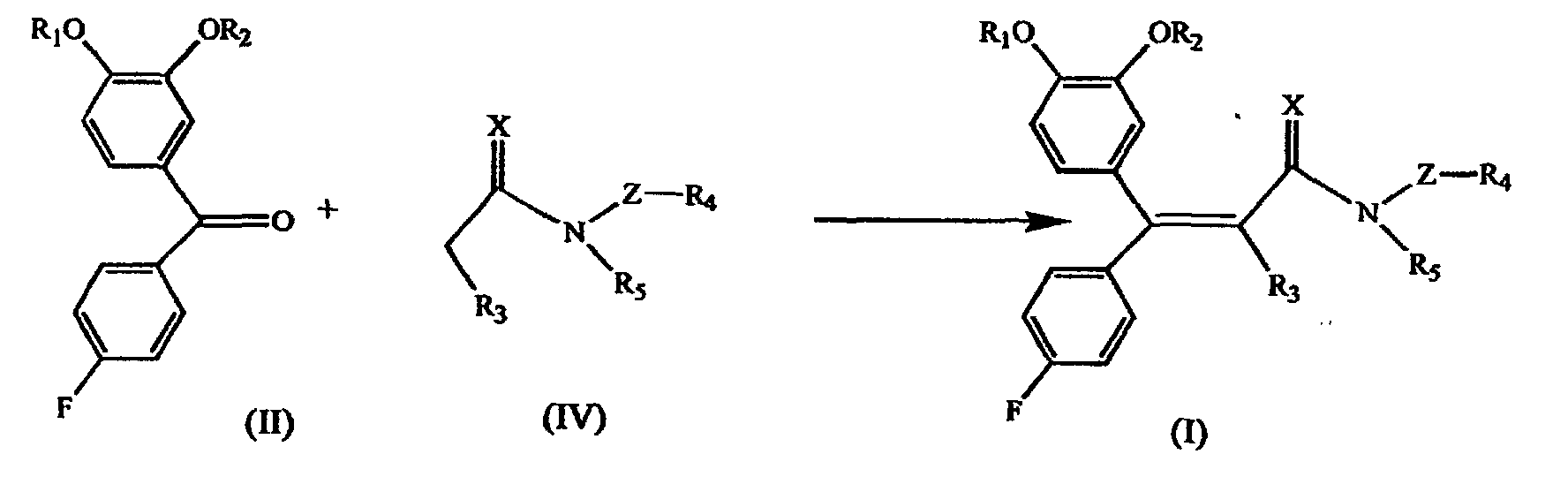
- Method 2 : In method 2 a substituted benzophenone is reacted with an disubstituted amide or
thioamide (IV) and for R3= hydrogen is described in US Pat. No. 4,912,217 and for R3= cyano is
described in US Pat. No. 4,753,934.
The method 1 and method 2, reactions are carried out in an inert solvent (benzene, toluene, xylene, ethyl ether, tetrahydrofuran, dichloromethane, ethanol) in the presence of a strong alkali (sodium hydroxide, potassium hydroxide, sodium hydride, potassium tert-butylate, sodium tert-butyrate, sodium methylate, sodium ethylate) at a temperature between 0°C and the boiling point of the solvent for 0.5 - 24 hours.
- Method 3 : In method 3 a substituted cinnamic acid (V) is reacted with an substituted amine
following in situ activation as described in US Patent No. 4,753,934. The preparation of substituted
cinnamic acids is described in US Patent 4,910,200.
The intermediate (V) is reacted in situ, in an inert solvent such as benzene, methyl benzene, dimethyl benzene, ethyl ether, tetrahydrofuran, dimethylformamide, dichloromethane in the presence of a chlorinating agent such as chlorosulfoxide, phosphorus oxytrichloride, phosphorus trichloride, or phosgene, at a temperature, from 0°C to the boiling point of the solvent, for 0.5 - 24 hours, with the secondary amine shown in Method 3.

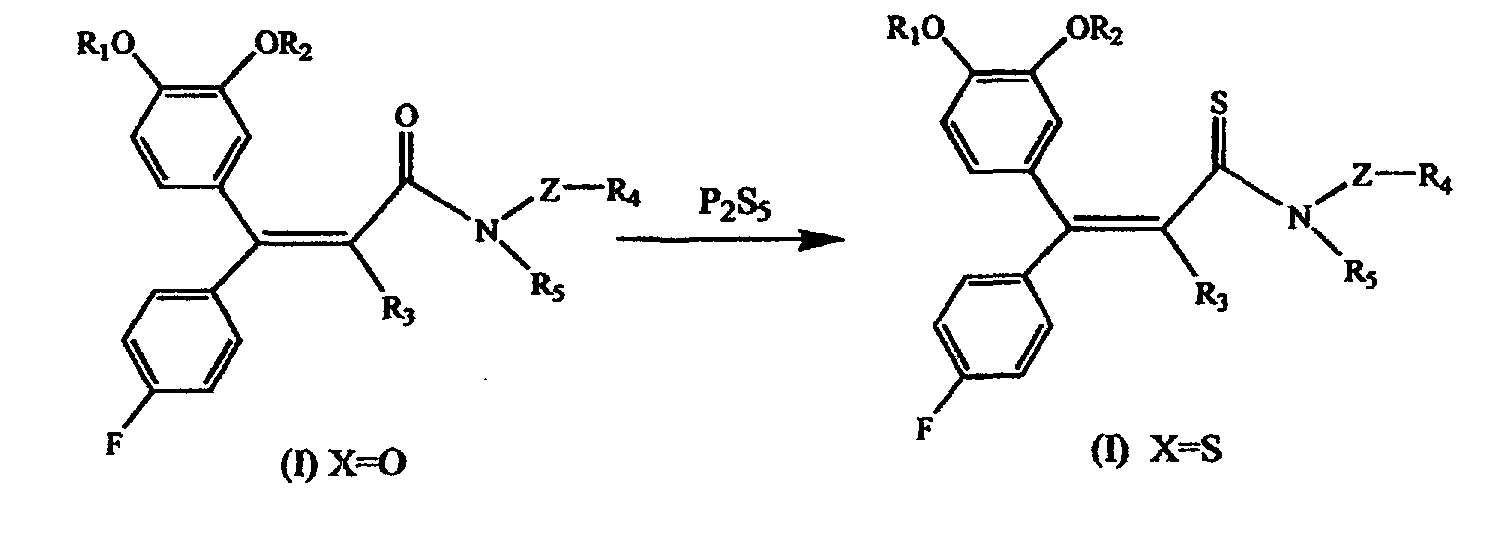
- Method 4 : Reaction formula is as follows.
The compound (I) (X = O) is dissolved in an inert solvent (dichloromethane, chloroform, dichloroethane, tetrahydrofuran, benzene, methyl benzene, dimethyl benzene, chlorobenzene, dichlorobenzene, ethyl ether, or acetonitrile), and then it is reacted with phosphorus pentasulfide in the presence of an alkali (triethylamine, sodium hydroxide, potassium hydroxide, sodium bicarbonate, potassium bicarbonate) at a temperature, from -25°C to the boiling point of the solvent, for 0.5 - 24 hours, to obtain the title compound (I).
-
- Preparation of 3-(4-fluorophenyl)-3-(3,4-dimethoxyphenyl)acrybyl)morpholine (Compound 1).4-Fluoro-3',4'-dimethoxy diphenyl ketone 26 g (0.1 mol) was added in a mixed solution of sodium tert-butylate (0.15 - 0.35 mol) containing methylbenzene 380 ml and tert-butanol 30 ml. While being heated and agitated to reflux, methyl benzene solution 50 ml that contained acetyl morpholine (0.15-0.35 mol) was added over a period of 5 - 8 hours. It was refluxed to react, meantime distilling offthe tert-butanol, for 6 - 12 hours (reaction was traced by TLC). After completing the reaction, reaction mixture was cooled, the methyl benzene layer was washed with water, dehydrated over anhydrous magnesium sulfate to remove the solvent, and then it was let stand to form crystals. It was recrystallized from methanol, to yield a product 31.5- 34.0 g (yield = 88 - 95%). Melting point = 120 - 128°C (Z/E mixture ratio = 55/45).
IR (KBr disc) : 1625 cm-1 (-CO-)
1 H NMR (DMCO, internal standard = tetramethylsilane, 90 MHz) d : =CH-CO-, cis- : 6.21 ppm, trans : 6.35 ppm
cis- and trans-isomers can be separated by further processing. - The compound of the present invention is useful as agricultural fungicides and, as such, can be applied to various loci such as the seed, the soil or the foliage. The compound can be applied as fungicidal sprays by methods commonly employed, such as conventional high-gallonage hydraulic sprays, low-gallonage sprays, air-blast spray, aerial sprays and dusts. The dilution and rate of application will depend upon the type of equipment employed, the method of application, plants to be treated and diseases to be controlled. Generally, the compound of this invention will be applied in amount of from 0.005 kilogram to 50 kilograms per hectare and preferably from 0.025 to 25 kilograms per hectare of the active ingredient.
- As a seed protectant, the amount of compound coated on the seed is usually at a dosage rate of from 0.05 to 20, preferably from 0.05 to 4, and more preferably from 0.1 to 1 grams per hundred kilograms of seed. As a soi fungicide the compounds can be incorporated in the soil or applied to the surface usually at a rate of from 0.02 to 20, preferably from 0.05 to 10, and more preferably from 0.1 to 5 kilograms per hectare. As a foliar fungicide, the toxicant is usually applied to growing plants at a rate of from 0.01 to 10, preferably from 0.02 to 5, and more preferably from 0.25 to 1 kilograms per hectare.
- Inasmuch as the compound of the invention display fungicidal activity, thecompound can be combined with other known fungicides to provide broad spectrum activity. Suitable fungicides include, but are not limited to, those compounds listed in U.S. Patent Number 5,252,594 (see in particular columns 14 and 15).
- Since the compound possesses broad spectrum fungicidal activity, they can be employed in the storage of cereal grain. These complexes can also be employed as fungicides in cereals including wheat, barley and rye, in rice, peanuts, beans and grapes, on turf, in fruit, nut and vegetable orchards, and for golf course applications.
- Examples of diseases against which the compound of the invention is useful include helminthosporium of corn and barley, wheat and barley powdery mildew, wheat leaf and stem rusts, tomato early blight, tomato late blight, peanut early leaf spot, grape powdery mildew, grape black rot, apple scab, apple powdery mildew, cucumber powdery mildew, brown rot of fruits, botrytis, bean powdery mildew, cucumber anthracnose, wheat septoria nodorum, rice sheath blight and rice blast.
- In the practice of the method of the invention, the active compound may be applied to the soil or foliage where it is absorbed by the plant, translocated to other plant parts and ultimately ingested by the pest or insects by means of ingestion of the plant part(s). This means of application is referred to as "systemic" application. Alternatively, the active compound may be applied to the soil and contacted therein with the insects and other pests to be controlled. This means of application is referred to as "soil" application. In another alternative, the active compound may be foliarly applied to the plants to be freed from insects and other pests which feed on the foliage.
- The compound of the present invention can be used in the form of compositions or formulations. Examples of the preparation of compositions and formulations can be found in the American Chemical Society publication "Pesticidal Formulation Research," (1969), Advances in Chemistry Series No. 86, written by Wade Van Valkenburg; and the Marcel Dekker, Inc. publication "Pesticide Formulations", (1973) edited by Wade Van Valkenburg. In these compositions and formulations, the active substance is mixed with conventional inert agronomically acceptable (i.e., plant compatible and/or pesticidally inert) pesticide diluents or extenders such as solid carrier material or liquid carrier material, of the type usable in conventional pesticide compositions or formulations. By "agronomically acceptable carrier is meant any substance which can be used to dissolve, disperse of diffuse the active ingredient in the composition without impairing the active ingredients effectiveness and which by itself has no significant detrimental effect on the soil, equipment, desirable plants, or agronomic environment. If desired, adjuvants such as surfactants, stabilizers, antifoam agents and antidrift agents may also be combined.
- Examples of compositions and formulations according to the invention are aqueous solutions and dispersions, oily solutions and oil dispersions, pastes, dusting powders, wettable powders, emulsifiable concentrates, flowables, granules, baits, invert emulsions, aerosol compositions and fumigating candles. Wettable powders, pastes, flowables and emulsifiable concentrates are concentrated preparations which are diluted with water before or during use. In such formulations, the compounds are extended with a liquid or solid carrier and, when desired, suitable surfactants are incorporated. Baits are preparations generally comprising a food or other substance attractive to insects, that includes at least one compound of the instantinvention.
- It is usually desirable, particularly in the case of foliar spray formulations, to include adjuvants, such as wetting agents, spreading agents, dispersing agents, stickers, adhesive and the like in accordance with agricultural practices. Such adjuvants commonly used in the art, and a discussion of adjuvants can be found in many references, such as in the John W. McCutcheon, Inc. publication "Detergents and Emulsifiers, Annual"
- The active compound of the present invention may be employed alone or in the form of mixtures with one another and/or with such solid and/or liquid dispersible carrier vehicles and/or with other known compatible active agents, especially plant protection agents, such as other insecticides, arthropodicides, nematicides, fungicides, bactericides, rodenticides, herbicides, fertilizers, growth-regulating agents, synergists.
- In the compositions of the invention, the active compound is present in an amount substantially between 0.0001-99% by weight. For compositions suitable for storage or transportation, the amount of active ingredient is preferably between 0.5-90% by weight, and more preferably between 1-75% by weight of the mixture. Compositions suitable for direct application or field application generally contain the active compound in an amount substantially between 0.0001-95%, preferably between 0.0005-90% by weight, and more preferably between 0.001-75% by weight of the mixture. The composition can also be stated as a ratio of the compound to the carrier. In the present invention the weight ratio of these materials (active compound/carrier) can vary from 99:1 to 1:4 and more preferably from 10:1 to 1:3.
- In general, the compound of this invention can be dissolved in certain solvents such as acetone, methanol, ethanol, dimethylformamide, pyridine or dimethyl sulfoxide and such solutions can be diluted with water. The concentrations of the solution can vary from 1% to 90% with a preferred range being from 5% to 50%.
- For the preparation of emulsifiable concentrates, the compound can be dissolved in suitable organic solvents, or a mixture of solvents, together with an emulsifying agent to enhance dispersion of the compound in water. The concentration of the active ingredient in emulsifiable concentrates is usually from 10% to 90%, and in flowable emulsion concentrates, can be as high as 75%.
- Wettable powders suitable for spraying, can be prepared by admixing the compound with a finely divided solid, such as clays, inorganic silicates and carbonates, and silicas and incorporating wetting agents, sticking agents, and/or dispersing agents in such mixtures. The concentration of active ingredients in such formulations is usually in the range of from 20% to 99%, preferably from 40% to 75%. A typical wettable powder is made by blending 50 parts of a pyridazinone, 45 parts of a synthetic precipitated hydrated silicon dioxide, such as that sold under the trademark Hi-SilR, and 5 parts of sodium lignosulfonate. In another preparation a kaolin type (Burden) clay is used in place of the Hi-Sil in the above wettable powder, and in another such preparation 25% of the Hi-Sil is replaced with a synthetic sodium silicoaluminate sold under the trademark Zeolex® 7.
- The compound (1) of this invention can be used alone or can be mixed with one, two or more fungicidal agent(s) or insecticide(s) to form a binary or ternary mixture, for application. Suitable insecticides known in the art include those listed in U.S. Patent 5,075,471, see in particular columns 14 and 15. Specific insecticides that can be mixed and used together with the compound (1) of this invention include Bromopropylate, Tedion, Methyl 1605, 1605, Sumithion, Diazinon, Dursban, Mimic, Aphistar, Methomyl, Tetrachlorovinphos, Methidathion, Cartap, Sevin, NRDC 143, Chlorocyano pyrethrate, Tetramethrin, Heptafluoro pyrethrate, Fluorochlorocyano pyrethrate, Cyanopenta pyrethrate, PH 60-40, Saziron, Pyrazophos, Acar, Imidacloprid, Fipronil, NI-25, Dioxacarb, Neotran, Methamidophos, Tamarin, and Clofentezine.
- Suitable fungicidal agents that can be mixed with the title compound (1) of this invention include, but are not limited to, Captan, Phaltan, Zineb, Mancozeb, Thiram, Difoltan, Iprodione, Methyl dichlozoline, Methylethyl dichlorozoline, Hexaconazole, Myclobutanil, Tebuconazole, DPX-3217, diguanidoacetoacetate salt, Diethofencarb, Cyprofuram, allylazole, Flutolanil, Carbendazim, Benomyl, Triazolone, Cyproconazole, Methyl thiophanate, Hydroxyoxazole, Butylphenyl morpholine, Propamocarb, Metalaxyl, Furalaxyl, Benalaxyl, Methasulfocarb, Pyrifenox . Fenpropidin, Kresoximmethyl, Azoxystrobin, Fenbuconazole, Thitluzamide, Mepanipyrim, Dimethomorph, Mycotox, Seedvax, Azaconazole, Chlorothalonil, Diazinon, copper sulfate, Dichlorofluamid, aluminium phosphide, and Hymexazol..
- In the prepared mixture, the content of the compound (1) of this invention is 1% - 99% and the other active ingreients may make up from 99-1% by weight of the active ingredients. Preferred combinations include 3 -(4-fluorophenyl)-3-(3,4-dimethoxyphenyl)acryl morpholine and mancozeb in a weight ratio of 1:10 to 1:1 and -(4-fluorophenyl)-3-(3,4-dimethoxyphenyl)acryl morpholine and fenbuconazole in a weight ratio of 1:10 to 10:1.
- Examples of the carriers that can be used include for the powder, wettable powder, and granules are kieselghur, clay, gypsum, talc powder and kaolin. Solvent that can be used in the emulsion are benzene, toluene, xylene, alkyl benzene, chlorinated cycloalkylenes, C1-6 aliphatic alcohols, benzyl alcohol, cyclohexanol, acetone, methylethyl ketone, methyl isobutyl ketone, cyclohexanone, dimethyl formamide, dimethylsulfoxide, N-methylpyrrolidone, water and the like.
- The compound of this invention can be prepared as an emulsion, powder, wettable powder, granule or a colloidal suspension.. Cationic, anionic or nonionic surface active agent may be added as an emulsifier, dispersing agent or wetting agent to the preparation. For example, sodium dodecylsulfonate, sodium dodecylbenzene sulfonate, polyethylenoxy aliphatic acid ester, polyethylenoxy aliphatic acid alcohol, polyethylenoxy aliiphatic acyl amine, ethoxylated castor oil, sodium (or potassium) ligninsulfonate, carboxymethyl alcohol, polyvinyl alcohols, polyvinyl esters can be used.
- Compound 1 of this invention 40 weight % kieselghur, 53 weight %, C12-20 alcohol/sulfate ester 4 weight %, and sodium dodecylbenzensulfonate 3 weight % were mixed homogeneously, and pulverized, to obtain a wettable powder that contained effective component at 40 weight %.
- Compound 1 of this invention 30 weight %, xylene 33 weight %, dimethylformamide 30 weight % and polyethylenoxyalkyl propyl ether 7 weight % were mixed homogeneously and dissolved, to obtain an emulsion that contained effective component at 30 weight.%.
- Compound 1 of this invention 10 weight %, talc powder 89 weight %, and polyethylenoxyalkyl propyl ether 1 weight % were mixed homogeneously, and pulverized, to obtain a powder that contained effective component at 10 weight. %.
- Compound 1 of this invention 5 weight %, bentonite 20 weight %, sodium dioctyl thiosuccinate 1 weight %, and sodium phosphate 1 weight % were mixed homogeneously. After pulverizing thoroughly, a proper amount of water was added, and they were blended thoroughly, pelletized and dried, to obtain granules that contained effective component 5 weight.%.
- Compound 1 of this invention 10 weight %, sodium ligninsulfonate 4 weight %, sodium dodecylbenzensulfonate 1 weight %, xantic acid 0.2 weight %, and water 84.8 weight % were mixed homogeneously, and they were wet-ground to a particle size of 1 mm or smaller, to obtain a colloidal suspension that contained effective component 10 weight. %.
- Compound 1 of this invention 8 weight %, zinc maneb 50 weight %, kaolin 30 weight %, sodium dodecylbenzene sulfonate 4 weight %, and sodium ligninsulfonate 8 weight % were mixed and pulverized thoroughly, to obtain a wettable powder that contained the mixture 58 weight. %.
- Compound 1 of this invention 10 weight %, azaconazole 30 weight %, kaolin 45 weight %, sodium dodecylbenzenesulfonate 6 weight %, and sodium ligninsulfonate 9 weight % were mixed homogeneously, and then pulverized thoroughly, to obtain a wettable powder that contained the mixture 40 weight. %.
- Compared to the existing antimicrobial agents, the compound of this invention has very good biological activity, and it can be used to prevent damages caused by spores and mycelial pathogens, and particularly effective against downy mildew, blight, and rot, such as apple root knot rot, citrus rot, pepper rot, pumpkin rot, potato late blight, diseases of fig, tomato brown rot, deseases of onion, rot of yellow melon, tobacco black wilting, downy mildew of yellow melon, downy mildew of grape, and red root rot of strawberry. In Examples 9 to 15, Compound 1 is used as an example to demonstrate the fungicidal efficacy of the compound of this invention
- Concentration of the test Compound 1 (content: 9% in emulsion oil) was set at 100, 50 and 25 ppm. Dimethomorph (commercially available product) Concentration was 50% wettable powder) was set a 50 ppm, and a blank was set up also as a control Fresh fungal layer was taken from the leaves which were infected by downy mildew, and a spore suspension was prepared. This spore suspension was mixed with the solution of the test compound, and each treatment was run 6 times. Treated sample was kept in a constant temperature incubator (25°C), and result was examined after 24 hours. Eighteen fields were examined for each treatment, and the numbers of germinated spores and ungerminated spores were counted. Thus, % inhibition of the spore germination was calculated, and results are shown in Table 1
Results of the spore germination test shown in Table lemonstrate the following: Compound 1 has a highly effective in inhibiting spore germination, and its inhibitory action is superior to Dimethomorph. % Inhibition of spore germination by the compound 1 at 25, 50 and 100 ppm was 65.2%, 93.5%, and 97.6%, respectively. With Dimethomorph at 50ppm, % inhibition of spore germination was 42.5%.Results of the test for inhibition of spore germination by compound 1 Compound tested Compound 1 Dimethmorph 25 ppm 50 ppm 100 ppm 50 ppm CK Number of spores germinated 198 45 17 208 383 Number of ungerminated spores 660 990 1044 336 194 % Spore germination 23.1 4.3 1.6 38.2 66.4 % Inhibition of spore 65.2 93.5 97.6 42.5 CK is the untreated check. - Concentration of test Compound 1 (content was 9% in emulsion oil) was set at 250, 200, 150, 100 and 75 ppm. Dimethomorph (American Cyanamid) 150 ppm was used as the control. Healthy seedling of yellow melon was selected for use, and test was run three times. For protection test, treatment was carried out on September 17, 1995, and they were inoculated 24 hours later. For the therapeutic test, inoculation was made on September 18, and then they were treated 24 hours later. Examination was made a week later, and results were recorded in 9 grades, and disease index and protection effect were calculated. Results are shown in Table 2.
Result of test for protection and therapy with compound 1 Protection Therapeutic Compound Concentration Disease index Protection Disease index (ppm) (%)control (%)control 250 0 100 0 100 200 0 100 0.01 98.1 Compound 1 150 0 100 0 100 100 0 100 0.08 84.6 75 0.03 92.5 0.11 78.8 Dimethmorph 150 0 100 0.19 63.5 Check (untreated) - 0.40 - 0.52 - - Test was divided into test for therapy and test for protection. Concentration of two chemicals (Compound 1 and Dimethomorph) was set at 150 and 100 ppm, and each treatment was run three times. A blank control was set separately. Samples were selected from seedling of yellow melon in the 2 - 3 leaf stage. Method of treatment and study was the same as before. Results are shown in Table 3.
Results of comparison of the activities of compound 1 and Dimethomorph Protective effect Therapeutic effect Concentration Disease index Protective effect Disease index Compound (ppm) (%)control (%)control Compound 1 100 0.07 93 0.37 63 150 0.05 95 0.26 74 Dimethomorph 100 0.39 61 0.98 2 150 0.21 79 0.76 24 untreated - 1.00 - 1.00 - - The tests were divided into therapeutic effect and protective effect. Concentration of the Compound 1 was set at 200, 100, 75, 50 and 25 ppm. Concentration of the control was set with metalaxyl (500 ppm), aluminium phosphide (1000 ppm), Chlorothalonil (1000 ppm), and Previcur (1000 ppm). Each treatment was run three times, and a blank control was set separately also. Seedling of yellow melon (2nd and 3rd leaf stage) was selected to use as a sample. Methods of treatment and testing were the same as before. Results are shown in Table 4.
Results of comparison of the activities of compound 1
and the existing antimicrobial agentsConcentration Protective effect/preventive Therapeutic effect (ppm) (%)control (%)control Compound 1 25 40.0 0.0 50 60.0 40.0 75 75.0 60.0 100 90.0 75.0 200 100.0 90.0 metalaxyl 500 60.0 40.0 Aluminium phosphide 1000 75.0 40.0 Chlorothalonil 1000 90.0 75.0 Previcur 1000 90.0 0.0 untreated 0.0 0.0 - As we can see in Table 4, protective effect and therapeutic effect of the Compound 1 (1000 ppm) are equivalent to Chlorothalonil (1000 ppm), but it is obviously superior to the preventive effect of metalaxyl, aluminium phosphide, and Previcur.
- Field protection test against cucumber downy mildew was carried out in the farm at a village near Shenyang City.
Concentration of the Compound 1 (20% wettable powder) was set at 200, 400 and 600 ppm. Concentration of Previcur (66.5% hydrate ) which was used as the control, was set at 800, 1000 and 1200 ppm. And, a blank control was set separately also. Each treatment was run 4 times. Samples were taken for examination. First treatment was carried out on April 5, infected stands were seen at the center ; second treatment on April 17, spread of infection was seen; and third treatment was on April 22. First examination of protective effect was made on April 22. The second examination of protective effect was made on April 29, and the third examinatnion of protective effect was made on May 5. Results are shown in Table 5.Result of the protective effect of compound 1 against
the cucumber downy mildew in the fieldConcentration April 22 April 29 May 5 Chemical (ppm) Disease Protective Disease Protective Disease Protective index (%)control (%)control (%)control Compound 1 200 0 100 0 100 0.03 97.0 400 0 100 0 100 0 100 600 0 100 0 100 0 100 Previcur 800 0.08 89.2 0.21 77.2 0.59 41.0 100 0.06 91.6 0.16 82.6 0.42 58.0 1200 0.03 95.9 0.10 89.1 0.32 68.0 CK - 0.74 - 0.92 - 1.00 - - Field therapeutic test of the compound 1 against cucumber downy mildew was carried out in a farm at a village near Shenyang City.
- Concentration of the Compound 1 (20% wettable powder) was set at 100, 200 and 300 ppm. Chlor 1500 ppm was used as the control, and blank control was set separately also. Each treatment was repeated three times. First treatment was made on May 13, second treatment was made on May 20, and third treatment was made on May 27, and protective effect was examined on June 3. Results are shown in Table 6.
- As we can see in Table 6, therapeutic effect of the compound 1 at 100 ppm was slightly better than Chlor at 1500 ppm Compound 1 at 200 and 300 ppm showed an obviously better therapeutic effect, compared to that of Chlor at 1500 ppm.
Result of therapeutic test of compound 1 against cucumber downy mildew in the field Concentration Disease index Protective effect Chemical (ppm) (%)control Compound 1 100 0.049 88.4 200 0.011 97.4 300 0 100 Chlor 1500 0.076 81.9 untreated - 0.422 - * Chlor is a product of Du Pont Co. (a mixture of DPX-3217 and Mancozeb). - Field therapeutic test of compound 1 against late blight of tomato was carried out in a farm at a village near Shenyang City.
Concentration of Compound 1 (20% wettable powder) was set at 200, 400 and 600 ppm. Dithane (containing 80% wettable powder) 1300 ppm was used as a positive control and a blank control was also used. Treatment was run three times. First treatment was made on May 21, second treatment was made on May 28, and third treatment was made on June 5. And, protective effect was examined on June 20. Results are shown in Table 7.Result of field test of the therapeutic effect of compound 1 against late blight of tomato Chemical Concentration Disease index before treatment Disease index Protective (ppm) (%) control Compound 1 200 0.74 5.56 80.9 400 0.74 2.59 91.1 600 1.11 2.22 94.9 Dithane 1300 1.11 5.56 87.3 untreated - 1.11 43.7 - * Dithane (mancozeb) is a product of Rohm and Haas Company, U.S.A.. - As we can see in Table 7, Compound 1 at 400 ppm and 600 ppm showed a better therapeutic effect against late blight of tomato, than Dithane at 1300 ppm.
Claims (7)
- The compound 3-(4-fluorophenyl)-3-(3,4-dimethoxyphenyl)acryloyl)morpholine.
- A fungicidal composition for controlling phytophathogenic fungi which comprises an agronomically acceptable carrier and the compound of claim 1 wherein the ratio of the carrier to the compound is 99:1 to 1:3.
- The composition of claim 2 wherein the ratio of the agriculturally acceptable carrier to compound is 20:1 to 1:2.
- A fungicidal mixture for controlling phytophathogenic fungi which comprises 3 -(4-fluorophenyl)-3-(3,4-dimethoxyphenyl)acryl morpholine and mancozeb in a weight ratio of 1:10 to 1:1.
- A fungicidal mixture for controlling phytophathogenic fungi which comprises 3 -(4-fluorophenyl)-3-(3,4-dimethoxyphenyl)acryl morpholine and fenbuconazole in a weight ratio of 1:10 to 10:1.
- A method for controlling phytophathogenic fungi which comprises applying to the locus where control is desired the compound of claim 1 at a rate of from 0.005 to 50 kilograms per hectare.
- The method of claim 6 wherein the compound of claim 1 is applied at the rate of from 0.025 to 10 kilograms per hectare.
Priority Applications (3)
| Application Number | Priority Date | Filing Date | Title |
|---|---|---|---|
| EP19970200506 EP0860438B1 (en) | 1997-02-21 | 1997-02-21 | Fluorine-containing diphenyl acrylamide antimicrobial agents |
| ES97200506T ES2189918T3 (en) | 1997-02-21 | 1997-02-21 | ANTIMICROBIAL AGENTS OF DIFENYLACRYLAMIDE CONTAINING FLUOR. |
| DE1997618288 DE69718288T2 (en) | 1997-02-21 | 1997-02-21 | Diphenylacrylamide microbicides containing fluorine |
Applications Claiming Priority (1)
| Application Number | Priority Date | Filing Date | Title |
|---|---|---|---|
| EP19970200506 EP0860438B1 (en) | 1997-02-21 | 1997-02-21 | Fluorine-containing diphenyl acrylamide antimicrobial agents |
Publications (2)
| Publication Number | Publication Date |
|---|---|
| EP0860438A1 EP0860438A1 (en) | 1998-08-26 |
| EP0860438B1 true EP0860438B1 (en) | 2003-01-08 |
Family
ID=8228035
Family Applications (1)
| Application Number | Title | Priority Date | Filing Date |
|---|---|---|---|
| EP19970200506 Expired - Lifetime EP0860438B1 (en) | 1997-02-21 | 1997-02-21 | Fluorine-containing diphenyl acrylamide antimicrobial agents |
Country Status (3)
| Country | Link |
|---|---|
| EP (1) | EP0860438B1 (en) |
| DE (1) | DE69718288T2 (en) |
| ES (1) | ES2189918T3 (en) |
Cited By (3)
| Publication number | Priority date | Publication date | Assignee | Title |
|---|---|---|---|---|
| US8637575B2 (en) | 2008-06-05 | 2014-01-28 | Novotyr Therapeutics Ltd. | Modulators of protein kinase signaling |
| US10188659B2 (en) | 2013-07-14 | 2019-01-29 | Yissum Research Development Company Of The Hebrew University Of Jerusalem, Ltd. | IGF-1R signaling pathway inhibitors useful in the treatment of neurodegenerative diseases |
| US10912745B2 (en) | 2015-02-05 | 2021-02-09 | Tyrnovo Ltd. | Combinations of IRS/Stat3 dual modulators and anti-cancer agents for treating cancer |
Families Citing this family (43)
| Publication number | Priority date | Publication date | Assignee | Title |
|---|---|---|---|---|
| AU779426B2 (en) * | 1999-11-15 | 2005-01-27 | Janssen Pharmaceutica N.V. | Triazoles as farnesyl transferase inhibitors |
| CA2560341A1 (en) | 2004-04-30 | 2005-11-10 | Jordi Tormo I Blasco | Fungicidal mixtures |
| GB0418047D0 (en) | 2004-08-12 | 2004-09-15 | Syngenta Participations Ag | Fungicidal compositions |
| GB0422401D0 (en) | 2004-10-08 | 2004-11-10 | Syngenta Participations Ag | Fungicidal compositions |
| PE20060796A1 (en) | 2004-11-25 | 2006-09-29 | Basf Ag | PROCEDURE TO INTENSIFY THE EFFICIENCY OF ETABOXAM |
| DE102006023263A1 (en) | 2006-05-18 | 2007-11-22 | Bayer Cropscience Ag | Synergistic drug combinations |
| KR20090045401A (en) * | 2006-08-28 | 2009-05-07 | 바스프 에스이 | How to control harmful fungi |
| EP2091330B1 (en) | 2006-09-18 | 2017-07-05 | Basf Se | Pesticidal mixtures comprising an anthranilamide insecticide and a fungicide |
| WO2008071714A1 (en) | 2006-12-15 | 2008-06-19 | Rohm And Haas Company | Mixtures comprising 1-methylcyclopropene |
| EP2679096A1 (en) | 2007-02-06 | 2014-01-01 | Basf Se | Pesticidal mixtures |
| MX2009011456A (en) | 2007-04-23 | 2009-11-05 | Basf Se | INCREASED PRODUCTIVITY OF PLANTS BY COMBINATION OF CHEMICAL AGENTS WITH TRANSGENIC MODIFICATIONS. |
| PL2193714T3 (en) | 2007-04-25 | 2012-01-31 | Syngenta Participations Ag | Fungicidal compositions |
| DE102007045920B4 (en) | 2007-09-26 | 2018-07-05 | Bayer Intellectual Property Gmbh | Synergistic drug combinations |
| PT2205082E (en) | 2007-09-26 | 2012-05-02 | Basf Se | Ternary fungicidal compositions comprising boscalid and chlorothalonil |
| UA104887C2 (en) | 2009-03-25 | 2014-03-25 | Баєр Кропсаєнс Аг | Synergic combinations of active ingredients |
| CN104430378A (en) | 2009-07-16 | 2015-03-25 | 拜尔农作物科学股份公司 | Synergistic active substance combinations containing phenyl triazoles |
| WO2011026796A1 (en) | 2009-09-01 | 2011-03-10 | Basf Se | Synergistic fungicidal mixtures comprising lactylates and method for combating phytopathogenic fungi |
| BR112012019142A2 (en) | 2010-02-04 | 2016-08-16 | Syngenta Participations Ag | pyridazine derivatives, processes for their preparation and their use as fungicides |
| EP2539338A1 (en) | 2010-02-24 | 2013-01-02 | Syngenta Participations AG | Novel microbicides |
| WO2012001040A1 (en) | 2010-07-02 | 2012-01-05 | Syngenta Participations Ag | Novel microbiocidal dioxime ether derivatives |
| AR082405A1 (en) | 2010-07-29 | 2012-12-05 | Syngenta Participations Ag | DIOXYM ETERES MICROBICIDE DERIVATIVES |
| AR083112A1 (en) | 2010-10-01 | 2013-01-30 | Syngenta Participations Ag | METHOD FOR CONTROLLING PHYTOPATHOGEN DISEASES AND COMPOSITIONS USEFUL FUNGICIDES FOR SUCH CONTROL |
| WO2012066122A1 (en) | 2010-11-18 | 2012-05-24 | Syngenta Participations Ag | 2 - (pyridin- 2 -yl) -quinazoline derivatives and their use as microbicides |
| WO2012069652A2 (en) | 2010-11-26 | 2012-05-31 | Syngenta Participations Ag | Fungicide mixtures |
| US20130267476A1 (en) | 2010-12-20 | 2013-10-10 | Basf Se | Pesticidal Active Mixtures Comprising Pyrazole Compounds |
| EP2481284A3 (en) | 2011-01-27 | 2012-10-17 | Basf Se | Pesticidal mixtures |
| EP2688405B1 (en) | 2011-03-23 | 2017-11-22 | Basf Se | Compositions containing polymeric, ionic compounds comprising imidazolium groups |
| CN102796062B (en) * | 2011-05-25 | 2014-12-24 | 中国中化股份有限公司 | Method for preparing flumorph |
| WO2013011010A1 (en) | 2011-07-19 | 2013-01-24 | Syngenta Participations Ag | Fungizide mixtures |
| AR087609A1 (en) | 2011-08-23 | 2014-04-03 | Syngenta Participations Ag | MICROBIOCIDES |
| EP2750507A2 (en) | 2011-09-02 | 2014-07-09 | Basf Se | Agricultural mixtures comprising arylquinazolinone compounds |
| WO2013189801A1 (en) | 2012-06-20 | 2013-12-27 | Basf Se | Pyrazole compound and pesticidal mixtures comprising a pyrazole compound |
| US20150257383A1 (en) | 2012-10-12 | 2015-09-17 | Basf Se | Method for combating phytopathogenic harmful microbes on cultivated plants or plant propagation material |
| BR112015014753B8 (en) | 2012-12-20 | 2020-03-03 | Basf Agro Bv | compositions, use of a composition, method for combating phytopathogenic fungi and use of the components |
| EP2783569A1 (en) | 2013-03-28 | 2014-10-01 | Basf Se | Compositions comprising a triazole compound |
| EP2835052A1 (en) | 2013-08-07 | 2015-02-11 | Basf Se | Fungicidal mixtures comprising pyrimidine fungicides |
| CN103483245B (en) * | 2013-09-03 | 2015-12-23 | 中国农业大学 | The improvement in synthesis of disinfectant use in agriculture pyrimorph |
| WO2015036059A1 (en) | 2013-09-16 | 2015-03-19 | Basf Se | Fungicidal pyrimidine compounds |
| CA2923101A1 (en) | 2013-09-16 | 2015-03-19 | Basf Se | Fungicidal pyrimidine compounds |
| EP2979549A1 (en) | 2014-07-31 | 2016-02-03 | Basf Se | Method for improving the health of a plant |
| BR112017008200A2 (en) | 2014-10-24 | 2017-12-26 | Basf Se | particles, method for depositing a metal from an electrolyte, and, uses of a polymer and particles. |
| EP2910126A1 (en) | 2015-05-05 | 2015-08-26 | Bayer CropScience AG | Active compound combinations having insecticidal properties |
| CN110742077B (en) | 2019-11-11 | 2020-07-17 | 甘肃省农业科学院植物保护研究所 | Application of cinnamate compound in preventing and treating crop fungal diseases |
Family Cites Families (4)
| Publication number | Priority date | Publication date | Assignee | Title |
|---|---|---|---|---|
| DE3525623A1 (en) * | 1985-07-18 | 1987-01-22 | Celamerck Gmbh & Co Kg | Fungicidally effective acrylic acid amides |
| DE3689506D1 (en) * | 1985-10-09 | 1994-02-17 | Shell Int Research | New acrylic acid amides. |
| GB9114004D0 (en) * | 1991-06-28 | 1991-08-14 | Shell Int Research | Fungicidal compositions |
| EP0601477A1 (en) * | 1992-12-08 | 1994-06-15 | Hoechst Schering AgrEvo GmbH | Substituted cinnamic hydroxyamides, processes for their preparation, compositions containing them and their use |
-
1997
- 1997-02-21 EP EP19970200506 patent/EP0860438B1/en not_active Expired - Lifetime
- 1997-02-21 ES ES97200506T patent/ES2189918T3/en not_active Expired - Lifetime
- 1997-02-21 DE DE1997618288 patent/DE69718288T2/en not_active Expired - Lifetime
Cited By (4)
| Publication number | Priority date | Publication date | Assignee | Title |
|---|---|---|---|---|
| US8637575B2 (en) | 2008-06-05 | 2014-01-28 | Novotyr Therapeutics Ltd. | Modulators of protein kinase signaling |
| US10188659B2 (en) | 2013-07-14 | 2019-01-29 | Yissum Research Development Company Of The Hebrew University Of Jerusalem, Ltd. | IGF-1R signaling pathway inhibitors useful in the treatment of neurodegenerative diseases |
| US10912745B2 (en) | 2015-02-05 | 2021-02-09 | Tyrnovo Ltd. | Combinations of IRS/Stat3 dual modulators and anti-cancer agents for treating cancer |
| US12201592B2 (en) | 2015-02-05 | 2025-01-21 | Tyrnovo Ltd. | Combinations of IRS/STAT3 dual modulators and anti-cancer agents for treating cancer |
Also Published As
| Publication number | Publication date |
|---|---|
| ES2189918T3 (en) | 2003-07-16 |
| DE69718288D1 (en) | 2003-02-13 |
| EP0860438A1 (en) | 1998-08-26 |
| DE69718288T2 (en) | 2003-07-31 |
Similar Documents
| Publication | Publication Date | Title |
|---|---|---|
| EP0860438A1 (en) | Fluorine-containing diphenyl acrylamide antimicrobial agents | |
| US6020332A (en) | Fluorine-containing diphenyl acrylamide antimicrobial agents | |
| CN102726405B (en) | Fungicidal compositions | |
| JP2776864B2 (en) | Quinazoline derivatives | |
| JP3683015B2 (en) | Bactericidal and fungicidal active compound combination | |
| JP2688530B2 (en) | Acylaminobenzamide, method for producing the same, fungicide composition and sterilization method | |
| PT93089B (en) | PROCESS FOR THE PREPARATION OF DERIVATIVES OF PROPENOIC ACID AND FUNGICIDAL COMPOSITIONS CONTAINING THEM | |
| JP2001505886A (en) | Fungicidal / fungicidal active substance combination | |
| JP2001131141A (en) | Phthalamide derivatives or salts thereof, agricultural and horticultural insecticides, and methods of using the same | |
| RU2265331C2 (en) | Fungicide composition | |
| JP2001510144A (en) | Herbicidal composition of tetrazolinone herbicide and antidote to it | |
| US6207695B1 (en) | Chiral imidazole fungicidal compositions and methods for their use | |
| SK2492000A3 (en) | Method of combatting phytopathogenic diseases on crop plants and fungicidal composition for carrying out this method | |
| JPS5984804A (en) | Agricultural and horticultural germicide | |
| US6432965B1 (en) | Fungicidal combinations comprising thieno(2,3-d)pyrimidin-4-one | |
| UA72459C2 (en) | 6-(2-halo-4-alkoxyphenyl)triazolepyrimidines, a method for preparation and a fungicide composition | |
| DE69702441T2 (en) | PYRIDE DERIVATIVES AS FUNGICIDES | |
| KR20010080945A (en) | Fungicidal combinations comprising thieno[2,3-d]pyrimidin-4-one | |
| EP0263958B1 (en) | 4-substituted-2,6-diphenylpyridine derivatives, use thereof, production of the same, chemical intermediates therein and herbicides | |
| JPH07501050A (en) | Benzoxazole, benzothiazole and benzimidazole derivatives as fungicides | |
| JP2814678B2 (en) | Agricultural and horticultural sterilizing composition | |
| JP4122475B2 (en) | Phthalamide derivatives or salts thereof, agricultural and horticultural insecticides, and methods of use thereof | |
| CN116640092B (en) | Benzyloxy substituted bispyridinyl ketone compounds and their application | |
| PL100076B1 (en) | FUNGICIDE | |
| JP2814680B2 (en) | Agricultural and horticultural sterilizing composition |
Legal Events
| Date | Code | Title | Description |
|---|---|---|---|
| PUAI | Public reference made under article 153(3) epc to a published international application that has entered the european phase |
Free format text: ORIGINAL CODE: 0009012 |
|
| AK | Designated contracting states |
Kind code of ref document: A1 Designated state(s): DE ES FR GB IT NL |
|
| 17P | Request for examination filed |
Effective date: 19990224 |
|
| AKX | Designation fees paid |
Free format text: DE ES FR GB IT NL |
|
| RBV | Designated contracting states (corrected) |
Designated state(s): DE ES FR GB IT NL |
|
| 17Q | First examination report despatched |
Effective date: 19991227 |
|
| GRAG | Despatch of communication of intention to grant |
Free format text: ORIGINAL CODE: EPIDOS AGRA |
|
| GRAG | Despatch of communication of intention to grant |
Free format text: ORIGINAL CODE: EPIDOS AGRA |
|
| GRAH | Despatch of communication of intention to grant a patent |
Free format text: ORIGINAL CODE: EPIDOS IGRA |
|
| GRAH | Despatch of communication of intention to grant a patent |
Free format text: ORIGINAL CODE: EPIDOS IGRA |
|
| GRAA | (expected) grant |
Free format text: ORIGINAL CODE: 0009210 |
|
| AK | Designated contracting states |
Kind code of ref document: B1 Designated state(s): DE ES FR GB IT NL |
|
| PG25 | Lapsed in a contracting state [announced via postgrant information from national office to epo] |
Ref country code: NL Free format text: LAPSE BECAUSE OF FAILURE TO SUBMIT A TRANSLATION OF THE DESCRIPTION OR TO PAY THE FEE WITHIN THE PRESCRIBED TIME-LIMIT Effective date: 20030108 |
|
| REG | Reference to a national code |
Ref country code: GB Ref legal event code: FG4D |
|
| REF | Corresponds to: |
Ref document number: 69718288 Country of ref document: DE Date of ref document: 20030213 Kind code of ref document: P |
|
| REG | Reference to a national code |
Ref country code: ES Ref legal event code: FG2A Ref document number: 2189918 Country of ref document: ES Kind code of ref document: T3 |
|
| ET | Fr: translation filed | ||
| PLBE | No opposition filed within time limit |
Free format text: ORIGINAL CODE: 0009261 |
|
| STAA | Information on the status of an ep patent application or granted ep patent |
Free format text: STATUS: NO OPPOSITION FILED WITHIN TIME LIMIT |
|
| 26N | No opposition filed |
Effective date: 20031009 |
|
| REG | Reference to a national code |
Ref country code: GB Ref legal event code: 732E Free format text: REGISTERED BETWEEN 20110922 AND 20110928 |
|
| REG | Reference to a national code |
Ref country code: ES Ref legal event code: PC2A Owner name: SINOCHEM CORPORATION Effective date: 20111115 |
|
| REG | Reference to a national code |
Ref country code: FR Ref legal event code: TQ Owner name: SINOCHEM CORPORATION, CN Effective date: 20111128 Ref country code: FR Ref legal event code: TQ Owner name: SHENYANG RESEARCH INSTITUTE OF CHEMICAL INDUSTRY C Effective date: 20111128 Ref country code: FR Ref legal event code: CD Owner name: SINOCHEM CORPORATION, CN Effective date: 20111128 Ref country code: FR Ref legal event code: CD Owner name: SHENYANG RESEARCH INSTITUTE OF CHEMICAL INDUSTRY C Effective date: 20111128 |
|
| REG | Reference to a national code |
Ref country code: DE Ref legal event code: R082 Ref document number: 69718288 Country of ref document: DE Representative=s name: WEICKMANN & WEICKMANN PATENTANWAELTE - RECHTSA, DE Effective date: 20111222 Ref country code: DE Ref legal event code: R082 Ref document number: 69718288 Country of ref document: DE Representative=s name: WEICKMANN & WEICKMANN PATENTANWAELTE - RECHTSA, DE Effective date: 20120215 Ref country code: DE Ref legal event code: R082 Ref document number: 69718288 Country of ref document: DE Representative=s name: PATENTANWAELTE WEICKMANN & WEICKMANN, DE Effective date: 20111222 Ref country code: DE Ref legal event code: R082 Ref document number: 69718288 Country of ref document: DE Representative=s name: PATENTANWAELTE WEICKMANN & WEICKMANN, DE Effective date: 20120215 Ref country code: DE Ref legal event code: R082 Ref document number: 69718288 Country of ref document: DE Representative=s name: WEICKMANN & WEICKMANN, DE Effective date: 20111222 Ref country code: DE Ref legal event code: R082 Ref document number: 69718288 Country of ref document: DE Representative=s name: WEICKMANN & WEICKMANN, DE Effective date: 20120215 Ref country code: DE Ref legal event code: R081 Ref document number: 69718288 Country of ref document: DE Owner name: SHENYANG RESEARCH INSTITUTE OF CHEMICAL INDUST, CN Free format text: FORMER OWNER: SHENYANG RESEARCH INSTITUTE OF CHEMICAL INDUSTRY, SHENYANG LIAONING, CN Effective date: 20111222 Ref country code: DE Ref legal event code: R081 Ref document number: 69718288 Country of ref document: DE Owner name: SINOCHEM CORPORATION, CN Free format text: FORMER OWNER: SHENYANG RESEARCH INSTITUTE OF CHEMICAL INDUSTRY, SHENYANG LIAONING, CN Effective date: 20111222 |
|
| REG | Reference to a national code |
Ref country code: DE Ref legal event code: R082 Ref document number: 69718288 Country of ref document: DE Representative=s name: WEICKMANN & WEICKMANN PATENTANWAELTE - RECHTSA, DE Effective date: 20130919 Ref country code: DE Ref legal event code: R082 Ref document number: 69718288 Country of ref document: DE Representative=s name: PATENTANWAELTE WEICKMANN & WEICKMANN, DE Effective date: 20130919 Ref country code: DE Ref legal event code: R082 Ref document number: 69718288 Country of ref document: DE Representative=s name: WEICKMANN & WEICKMANN, DE Effective date: 20130919 Ref country code: DE Ref legal event code: R081 Ref document number: 69718288 Country of ref document: DE Owner name: SHENYANG RESEARCH INSTITUTE OF CHEMICAL INDUST, CN Free format text: FORMER OWNER: SINOCHEM CORPORATION, BEIJING, CN Effective date: 20130919 Ref country code: DE Ref legal event code: R081 Ref document number: 69718288 Country of ref document: DE Owner name: SINOCHEM CORPORATION, CN Free format text: FORMER OWNER: SINOCHEM CORPORATION, BEIJING, CN Effective date: 20130919 |
|
| REG | Reference to a national code |
Ref country code: ES Ref legal event code: PC2A Owner name: SHENYANG RESEARCH INSTITUTE OF CHEMICAL INDUSTRY C Effective date: 20131217 |
|
| REG | Reference to a national code |
Ref country code: FR Ref legal event code: PLFP Year of fee payment: 20 |
|
| PGFP | Annual fee paid to national office [announced via postgrant information from national office to epo] |
Ref country code: ES Payment date: 20160127 Year of fee payment: 20 Ref country code: DE Payment date: 20160128 Year of fee payment: 20 Ref country code: IT Payment date: 20160128 Year of fee payment: 20 |
|
| PGFP | Annual fee paid to national office [announced via postgrant information from national office to epo] |
Ref country code: FR Payment date: 20160127 Year of fee payment: 20 Ref country code: GB Payment date: 20160120 Year of fee payment: 20 |
|
| REG | Reference to a national code |
Ref country code: DE Ref legal event code: R071 Ref document number: 69718288 Country of ref document: DE |
|
| REG | Reference to a national code |
Ref country code: GB Ref legal event code: PE20 Expiry date: 20170220 |
|
| PG25 | Lapsed in a contracting state [announced via postgrant information from national office to epo] |
Ref country code: GB Free format text: LAPSE BECAUSE OF EXPIRATION OF PROTECTION Effective date: 20170220 |
|
| REG | Reference to a national code |
Ref country code: ES Ref legal event code: FD2A Effective date: 20180508 |
|
| PG25 | Lapsed in a contracting state [announced via postgrant information from national office to epo] |
Ref country code: ES Free format text: LAPSE BECAUSE OF EXPIRATION OF PROTECTION Effective date: 20170222 |