EP0860169B1 - Compositions for oral administration containing pyridazinone compounds - Google Patents
Compositions for oral administration containing pyridazinone compounds Download PDFInfo
- Publication number
- EP0860169B1 EP0860169B1 EP98101553A EP98101553A EP0860169B1 EP 0860169 B1 EP0860169 B1 EP 0860169B1 EP 98101553 A EP98101553 A EP 98101553A EP 98101553 A EP98101553 A EP 98101553A EP 0860169 B1 EP0860169 B1 EP 0860169B1
- Authority
- EP
- European Patent Office
- Prior art keywords
- oral administration
- composition
- pyridazinone
- acid
- tablets
- Prior art date
- Legal status (The legal status is an assumption and is not a legal conclusion. Google has not performed a legal analysis and makes no representation as to the accuracy of the status listed.)
- Expired - Lifetime
Links
Images


Classifications
-
- A—HUMAN NECESSITIES
- A61—MEDICAL OR VETERINARY SCIENCE; HYGIENE
- A61K—PREPARATIONS FOR MEDICAL, DENTAL OR TOILETRY PURPOSES
- A61K31/00—Medicinal preparations containing organic active ingredients
- A61K31/33—Heterocyclic compounds
- A61K31/395—Heterocyclic compounds having nitrogen as a ring hetero atom, e.g. guanethidine or rifamycins
- A61K31/495—Heterocyclic compounds having nitrogen as a ring hetero atom, e.g. guanethidine or rifamycins having six-membered rings with two or more nitrogen atoms as the only ring heteroatoms, e.g. piperazine or tetrazines
- A61K31/50—Pyridazines; Hydrogenated pyridazines
- A61K31/501—Pyridazines; Hydrogenated pyridazines not condensed and containing further heterocyclic rings
-
- A—HUMAN NECESSITIES
- A61—MEDICAL OR VETERINARY SCIENCE; HYGIENE
- A61K—PREPARATIONS FOR MEDICAL, DENTAL OR TOILETRY PURPOSES
- A61K47/00—Medicinal preparations characterised by the non-active ingredients used, e.g. carriers or inert additives; Targeting or modifying agents chemically bound to the active ingredient
- A61K47/06—Organic compounds, e.g. natural or synthetic hydrocarbons, polyolefins, mineral oil, petrolatum or ozokerite
- A61K47/08—Organic compounds, e.g. natural or synthetic hydrocarbons, polyolefins, mineral oil, petrolatum or ozokerite containing oxygen, e.g. ethers, acetals, ketones, quinones, aldehydes, peroxides
- A61K47/12—Carboxylic acids; Salts or anhydrides thereof
-
- A—HUMAN NECESSITIES
- A61—MEDICAL OR VETERINARY SCIENCE; HYGIENE
- A61K—PREPARATIONS FOR MEDICAL, DENTAL OR TOILETRY PURPOSES
- A61K9/00—Medicinal preparations characterised by special physical form
- A61K9/20—Pills, tablets, discs, rods
- A61K9/2004—Excipients; Inactive ingredients
- A61K9/2013—Organic compounds, e.g. phospholipids, fats
Definitions
- the present invention relates to a composition for oral administration, which contains a pyridazinone compound of the formula (I): wherein R 1 , R 2 and R 3 are each independently a hydrogen atom or a C 1 -C 6 alkyl, X is a halogen atom, a cyano or a hydrogen atom, Y is a halogen atom, a trifluoromethyl or a hydrogen atom, and A is a C 1 -C 8 alkylene which may be substituted by hydroxy, or a pharmacologically acceptable salt thereof (hereinafter to be referred to as pyridazinone compounds).
- R 1 , R 2 and R 3 are each independently a hydrogen atom or a C 1 -C 6 alkyl
- X is a halogen atom, a cyano or a hydrogen atom
- Y is a halogen atom, a trifluoromethyl or a hydrogen atom
- A is a C 1
- the pyridazinone compounds to be used in the present invention are known in literatures, are known to have superior platelet aggregation inhibitory activity, heart stimulating activity, vasodilative activity, anti SRS-A (Slow Reacting Substances of Anaphylaxis) activity, thromboxane A 2 synthase inhibitory activity and the like, and are expected to be useful as antiplatelet agents and the like (EP 482208, EP 744950).
- compositions for oral administration which contain pyridazinone compounds, that (a) pyridazinone compounds are relatively stable to heat, light, moisture and the like but show less dissolution after oral administration because their solubility in water starts falling at about pH 4 and they become hardly soluble at the neutral range, and (b) bioavailability (hereinafter to be abbreviated as BA) which shows absorption by dogs after fasting is low (about 10%) and the absorption shows great interindividual differences.
- BA bioavailability
- EP-A-0 482 208 and EP-A-0 742 211 3(2H)-pyridazinone derivatives and their pharmaceutically acceptable salts are disclosed. The nature of the pharmaceutically acceptable salts is not further specified.
- WO 95/22329 discloses the pyridazinone compounds of formula I, and their pharmacologically acceptable salts.
- organic acid salts acetate, succinate, maleate, fumerate, maleate and tartrate are mentioned.
- US-A-5 364 646 discloses pharmaceutical forms of pimobendan for oral administration comprising citric acid ensuring a constant, satisfactory resorption even when there a major pH functions in the gastrointestinal tract. It is therefore an object of the present invention to provide a composition for oral administration, which shows improved dissolution and absorption of pyridazinone compounds.
- the dissolution and absorption of pyridazinone compounds can be improved by adding an organic acid selected from citric acid, succinic acid, maleic acid, fumaric acid, malic acid or tartaric acid to a composition thereof, rather than by a typical formulation method which cannot provide sufficient effects, which finding has led to the completion of the present invention.
- composition for oral administration which contains a pyridazinone compound of the formula (I) wherein
- Fig. 1 is a graph showing the results of the dissolution test of Experimental Example 1.
- Fig. 2 is a graph showing BA of beagle dogs tested in Experimental Example 2.
- the lower alkyl at R 1 , R 2 and R 3 may be linear or branched and has 1 to 6 carbon atoms. Examples thereof include methyl, ethyl, n-propyl, isopropyl, n-butyl, isobutyl, sec-butyl, t-butyl, pentyl, hexyl and the like.
- Preferred R 1 and R 2 are hydrogen atoms and preferred R 3 is a hydrogen atom or an alkyl having 1 to 4 carbon atoms.
- the alkyl having 1 to 4 carbon atoms at R 3 is exemplified by methyl, ethyl, n-propyl, isopropyl, n-butyl, isobutyl, sec-butyl, t-butyl and the like.
- the halogen atom at X and Y is fluorine atom, chlorine atom, bromine atom or iodine atom.
- Preferred X is halogen atom and preferred Y is halogen atom or hydrogen atom.
- the alkylene having 1 to 8 carbon atoms at A which may be substituted by hydroxy may be linear or branched. Examples thereof include methylene, ethylene, propylene, butylene, pentylene, hexylene, heptylene, octylene, 2,2-dimethylethylene, 2,2-diethylethylene, 2,2-di-n-propylethylene, hydroxymethylene, 1-hydroxyethylene, 2-hydroxyethylene, 3-hydroxypropylene and the like.
- Preferred A is an alkylene having 1 to 5 carbon atoms which is optionally substituted by hydroxy.
- position of the bond of methylene group and pyridine ring in formula (I) is not particularly limited, it is preferably 3-position relative to nitrogen atom of the pyridine ring.
- Y may be bonded at any position on the benzene ring, but preferably at 4-position.
- a pyridazinone compound (I) wherein R 1 is a hydrogen atom is preferable.
- More preferable pyridazinone compound (I) includes 4-bromo-6-(3-phenylpropoxy)-5-(3-pyridylmethylamino)-3(2H)-pyridazinone, 4-chloro-6-(3-phenylpropoxy)-5-(3-pyridylmethylamino)-3(2H)-pyridazinone, 4-chloro-6-[3-(4-chlorophenyl)propoxy]-5-(3-pyridylmethylamino)-3(2H)-pyridazinone, 4-bromo-6-[3-(4-chlorophenyl)propoxy]-5-(3-pyridylmethylamino)-3(2H)-pyridazinone, 4-bromo-6-(2,2-dimethyl-3-phenylpropoxy)-5-(3-pyridylmethylamino)-3(2H)-pyridazinone, 4-chloro-6
- the pyridazinone compound (I) of the present invention encompasses stereoisomers and optical isomers.
- the pyridazinone compound (I) can be produced by, for example, the method disclosed in EP 482208, or other method.
- the pharmacologically acceptable salt of the pyridazinone compound (I) may be a salt with an inorganic acid (e.g., hydrochloride, hydrobromide, phosphate, sulfate and the like), a salt with an organic acid (e.g., acetate, succinate, maleate, fumarate, malate, tartrate and the like), and the like.
- the pyridazinone compound (I) can be converted to the above-mentioned salts by a known method.
- the organic acid to be used in the present invention are, citric acid, succinic acid, maleic acid, fumaric acid, malic acid, tartaric acid, with particular preference given to citric acid.
- the organic acid is preferably added in a proportion of 0.05-20 parts by weight per part by weight of the pyridazinone compound.
- an organic acid When to add the organic acid is not particularly limited and an organic acid may be added before granulation or after granulation but before compression. Considering the absorption of the pyridazinone compound, an organic acid is preferably added before granulation.
- the dissolution and absorption of the pyridazinone compound can be improved, and a composition for oral administration which is stable to heat, light, moisture and the like can be provided.
- the pyridazinone compound When formulating the composition for oral administration of the present invention, the pyridazinone compound is preferably micronized.
- the pyridazinone compound as a bulk powder has an average particle size of 20 ⁇ m. Micronization by a known method can make the average particle size 7-10 ⁇ m. The micronization of the pyridazinone compound contributes to improvement in dissolution and absorption.
- composition for oral administration of the present invention can be formulated into a dosage form of tablet, capsule, powder, granule, pill and the like by a conventional method using excipients, binders, disintegrators, lubricants and the like.
- excipients and the like to be used are not particularly limited. Examples of excipient include lactose, corn starch, sucrose, glucose, mannitol, sorbit, crystalline cellulose, silicon dioxide and the like.
- binder examples include polyvinyl alcohol, polyvinyl ether, ethylcellulose, methylcellulose, gum arabic, tragacanth, gelatin, shellac, hydroxypropylcellulose, hydroxypropylmethylcellulose, hydroxypropyl starch, polyvinylpyrrolidone and the like.
- disintegrator examples include starch, agar, gelatin powder, crystalline cellulose, calcium carbonate, sodium hydrogencarbonate, calcium citrate, dextrin, pectin, carboxymethylcellulose calcium, low substitution hydroxypropylcellulose, croscarmellose sodium, partly pregelatinized starch and the like.
- lubricant examples include magnesium stearate, talc, polyethylene glycol, silica, hydrogenated vegetable oil and the like.
- lactose as an excipient or the use of hydroxypropylcellulose as a binder may unexpectedly lead to undesirable coloring of the preparation.
- the use of other excipients and other binders is preferable.
- Preferable excipient may be crystalline cellulose, corn starch, mannitol and the like.
- Preferable binder may be hydroxypropylmethylcellulose and the like.
- the excipient, binder, disintegrator and lubricant are contained in a proportion of preferably 10-150 parts by weight, 0.5-10 parts by weight, 1-20 parts by weight and 0.1-1.5 parts by weight, respectively, per part by weight of the pyridazinone compound.
- the dosage form of the inventive pharmaceutical composition is not limited, it is preferably tablet.
- tablets are prepared, for example, water is added to an admixture of ingredients in a proportion of 5-35% (w/w), and the resulting mixture is granulated by a stirring-granulation method using a high speed mixer and the like, followed by compression (wet granulation compression method), or the respective ingredients are mixed homogeneously, followed by compression molding (direct compression method), or they are prepared by other method.
- a coating base material such as a commercially available HA "SANKYO" manufactured by Sankyo Co., Ltd. and the like to increase resistance to moisture.
- pyridazinone hydrochloride 4-bromo-6-[3-(4-chlorophenyl)propoxy]-5-(3-pyridylmethylamino)-3(2H)-pyridazinone hydrochloride (hereinafter to be simply referred to as pyridazinone hydrochloride) prepared by a conventional method was used as a pyridazinone compound.
- Tablets were prepared, which contained pyridazinone hydrochloride (10.0 mg) as an active ingredient, citric acid (5.0 mg, manufactured by Showa Chemical Industry Co., Ltd.) as an organic acid, lactose (123.0 mg) as an excipient, hydroxypropylcellulose (4.0 mg, HPC-SL, manufactured by Nippon Soda Co., Ltd.) as a binder, croscarmellose sodium (7.0 mg, Ac-Di-Sol, manufactured by Asahi Chemical Industry Co., Ltd.) as a disintegrator and magnesium stearate (1.0 mg, manufactured by TAIHEI CHEMICAL Co., Ltd.) as a lubricant.
- citric acid 5.0 mg, manufactured by Showa Chemical Industry Co., Ltd.
- lactose 123.0 mg
- hydroxypropylcellulose 4.0 mg, HPC-SL, manufactured by Nippon Soda Co., Ltd.
- croscarmellose sodium 7.0 mg, Ac-Di-
- the tablets were made by the wet granulation compression method, wherein the active ingredient, organic acid, excipient, binder and disintegrator were mixed, to which 12% (w/w) of water was added, and the mixture was granulated by a stirring-granulation method. Then, the obtained granules were dried at 80°C for 30 min, and passed through a 0.5 mm (32 mesh) sieve to give a powder for compression. The lubricant and disintegrator were added to the obtained powder, and the mixture was compressed with a die and a punch having 7.5 mm ⁇ and typical R surfaces to give tablets.
- the active ingredient, pyridazinone hydrochloride was prepared by dry-micronization of a bulk powder with a turbo mill micronizer (TJ-60, manufactured by Turbo Kogyo Co., LTD., air pressure 7.5-8.5 kg/cm 2 , feed control 8.0-8.5).
- the average particle size of the bulk powder was about 20 ⁇ m.
- the obtained micronization product had an average particle size of about 7 ⁇ m.
- the average particle size was an average of three determinations performed using a particle size measuring device (CIS-1, manufactured by GALAI), hereinafter the same.
- tablets were prepared, which contained pyridazinone hydrochloride (10.0 mg) as an active ingredient, citric acid as an organic acid (15.0 mg, manufactured by Showa Chemical Industry Co., Ltd.), crystalline cellulose (15.0 mg, Avicel PH101, manufactured by Asahi Chemical Industry Co., Ltd.) as an excipient, hydroxypropylmethylcellulose (4.0 mg, TC-5R, manufactured by Shin-Etsu Chemical Co., Ltd.) as a binder, low substitution hydroxypropylcellulose (7.0 mg, L-HPC, manufactured by Shin-Etsu Chemical Co., Ltd.) as a disintegrator, and magnesium stearate (1.0 mg) as a lubricant.
- pyridazinone hydrochloride 10.0 mg
- citric acid as an organic acid
- crystalline cellulose 15.0 mg, Avicel PH101, manufactured by Asahi Chemical Industry Co., Ltd.
- hydroxypropylmethylcellulose 4.0 mg, TC-5R, manufactured by Shin-E
- the active ingredient, pyridazinone hydrochloride was prepared by micronization of a bulk powder with a pin mill micronizer (KOLLOPLEX 160Z, manufactured by Powrex Corporation, pin rotation 9000 rpm, supply slit width ca. 1 cm, charge amount 500 g).
- the pin mill micronization product had an average particle size of about 10 ⁇ m.
- Example 5 In the same manner as in Example 5 except that low substitution hydroxypropylcellulose was not added, the amount of crystalline cellulose was changed to 90.0 mg and partly pregelatinized starch (30.0 mg, PCS, manufactured by Asahi Chemical Industry Co., Ltd.) was added as a disintegrator, tablets were obtained.
- Example 5 In the same manner as in Example 5 except that the amount of crystalline cellulose was changed to 56.5 mg, corn starch (56.5 mg, manufactured by MATSUTANI KAGAKU KOGYO Co., Ltd.) was added as an excipient and citric acid was added after passing through a sieve, tablets were obtained.
- corn starch (56.5 mg, manufactured by MATSUTANI KAGAKU KOGYO Co., Ltd.) was added as an excipient and citric acid was added after passing through a sieve, tablets were obtained.
- Example 8 In the same manner as in Example 8 except that corn starch was changed to D-mannitol (manufactured by TOWA CHEMICAL INDUSTRY Co., Ltd.), tablets were obtained.
- Tablets were prepared, which contained pyridazinone hydrochloride (10.0 mg) as an active ingredient, citric acid (15.0 mg) as an organic acid, crystalline cellulose (75.0 mg) as an excipient, lactose (15.0 mg), hydroxypropylmethylcellulose (4.0 mg) as a binder, partly pregelatinized starch (30.0 mg) as a disintegrator and magnesium stearate (1.0 mg) as a lubricant.
- the tablets were prepared by the direct compression method. To be specific, the active ingredient and the organic acid were mixed, and the obtained mixture was micronized with a pin mill as in Example 5, to which an excipient, a binder and a disintegrator, respectively passed through a sieve, were added. Then, a lubricant was added thereto to give a powder for compression. Using a die and a punch having 7.5 mm ⁇ and typical R surfaces, tablets were produced.
- Example 1 According to the wet granulation compression method of Example 1, naked tablets having the formulations shown in Table 1 were prepared, which tablets were coated with a coating agent [coating base HA "SANKYO" (manufactured by Sankyo Co., Ltd.) and triacetine] by a pan coating method to give film-coated tablets.
- a coating agent coating base HA "SANKYO” (manufactured by Sankyo Co., Ltd.) and triacetine
- Example 11 12 13 ingredients (naked tablet) 8 mg tablet 2 mg tablet 0.5 mg tablet pin mill micronized product of pyridazinone hydrochloride 8.0 2.0 0.5 citric acid 15.0 9.0 9.0 crystalline cellulose 106.5 66.7 68.2 hydroxypropylmethylcellulose 4.5 2.7 2.7 low substitution hydroxypropylcellulose 15.0 9.0 9.0 magnesium stearate 1.0 0.6 0.6 subtotal (mg) 150.0 90.0 90.0 tablet diameter (mm ⁇ ) 7.5 6.5 6.5 (coating film) HA "SANKYO" 13.7 8.2 8.2 triacetine 1.3 0.8 0.8 total (mg) 165.0 99.0 99.0
- Example 2 In the same manner as in Example 1 except that citric acid was not added, the amount of lactose was changed to 127.0 mg, and sugar ester (1.0 mg, DK ester SS, manufactured by DAI-ICHI KOGYO SEIYAKU CO., LTD.) was added as a surfactant, tablets were obtained.
- sugar ester 1.0 mg, DK ester SS, manufactured by DAI-ICHI KOGYO SEIYAKU CO., LTD.
- a bulk powder (2 g) of pyridazinone hydrochloride and a water soluble polymer (10 g) were mixed, to which methanol or a methanol/dichloromethane (1/1) mixed solution was added, followed by dissolution under heating at 50°C.
- the mixture was evaporated to dryness in a rotary evaporator at 50°C and dried under reduced pressure overnight at 60°C.
- the dry product was micronized in a sample mill and dried under reduced pressure overnight at 60°C to give an amorphous composition.
- the tablets of Examples 1 to 3 and Reference Example 1 were subjected to a dissolution test using a phosphate buffer (pH 6.8).
- the test followed the dissolution test (puddle method) according to 12th Edition Japan Pharmacopoeia, wherein the number of rotation was 100 rpm, the amount of test solution was 900 ml and the amount of sampling and the amount of supplementary solution were both 10 ml.
- the sample was centrifuged at 15000 rpm for 10 min, and an internal standard solution (0.5 ml) was added to 0.5 ml of the supernatant thus obtained.
- the obtained mixture was subjected to HPLC under the following conditions.
- Fig. 1 The relationship between percent dissolution and dissolution time is shown in Fig. 1. As shown in Fig. 1, the tablets containing citric acid showed faster dissolution pattern than the tablets without citric acid.
- Example 2 and Reference Examples 1 to 5 were subjected to absorption test using beagle dogs.
- the drug concentration in plasma was determined by HPLC under the following conditions.
- Cmax The maximum drug concentration (Cmax) in plasma after the administration of the composition is shown in Table 2.
- Cmax The maximum drug concentration (Cmax) in plasma after the administration of the composition is shown in Table 2.
- the BA of each composition in beagle dogs is shown in Fig. 2.
- the tablets of Example 2 showed a BA of about 30%, which indicated about three times greater absorption than the bulk powder of pyridazinone hydrochloride.
- the best BA of the compositions of Reference Examples was about 20%.
- the interindividual difference seen in the tablets of Example 2 was not more than one-second of the difference found with the compositions of Reference Examples.
- Example 2 The tablets of Example 2 were subjected to an absorption test after post-feeding administration. The test was done in the same manner as in the above fast-administration except that standard solid feed (ca. 300 g) was given 30 min before administration of the tablets. The results of absorption by post-feeding administration are shown in Table 3 along with the results of fast-administration.
- Example 2 Cmax (ng/ml) BA (%) fast-administration 751.4 28.2 post-feeding administration 1054.8 29.0
- the average BA of post-feeding administration was 29%, which was similar to the result obtained by fast-administration.
- composition for oral administration which is stable to heat, light, moisture and the like and which shows improved dissolution and absorption of a pyridazinone compound can be provided.
Landscapes
- Health & Medical Sciences (AREA)
- Life Sciences & Earth Sciences (AREA)
- Chemical & Material Sciences (AREA)
- Public Health (AREA)
- Epidemiology (AREA)
- Pharmacology & Pharmacy (AREA)
- Animal Behavior & Ethology (AREA)
- General Health & Medical Sciences (AREA)
- Medicinal Chemistry (AREA)
- Veterinary Medicine (AREA)
- Biophysics (AREA)
- Molecular Biology (AREA)
- Engineering & Computer Science (AREA)
- Chemical Kinetics & Catalysis (AREA)
- General Chemical & Material Sciences (AREA)
- Oil, Petroleum & Natural Gas (AREA)
- Pharmaceuticals Containing Other Organic And Inorganic Compounds (AREA)
- Medicinal Preparation (AREA)
Description
- The present invention relates to a composition for oral administration, which contains a pyridazinone compound of the formula (I):wherein R1, R2 and R3 are each independently a hydrogen atom or a C1-C6 alkyl, X is a halogen atom, a cyano or a hydrogen atom, Y is a halogen atom, a trifluoromethyl or a hydrogen atom, and A is a C1-C8 alkylene which may be substituted by hydroxy, or a pharmacologically acceptable salt thereof (hereinafter to be referred to as pyridazinone compounds).

- The pyridazinone compounds to be used in the present invention are known in literatures, are known to have superior platelet aggregation inhibitory activity, heart stimulating activity, vasodilative activity, anti SRS-A (Slow Reacting Substances of Anaphylaxis) activity, thromboxane A2 synthase inhibitory activity and the like, and are expected to be useful as antiplatelet agents and the like (EP 482208, EP 744950).
- The present inventors have now found with regard to compositions for oral administration, which contain pyridazinone compounds, that (a) pyridazinone compounds are relatively stable to heat, light, moisture and the like but show less dissolution after oral administration because their solubility in water starts falling at about
pH 4 and they become hardly soluble at the neutral range, and (b) bioavailability (hereinafter to be abbreviated as BA) which shows absorption by dogs after fasting is low (about 10%) and the absorption shows great interindividual differences. They have concluded, therefore, that these problems in terms of dissolution and absorption of pyridazinone compounds need to be resolved before using the compounds for preparations for oral administration. - In EP-A-0 482 208 and EP-A-0 742 211 3(2H)-pyridazinone derivatives and their pharmaceutically acceptable salts are disclosed. The nature of the pharmaceutically acceptable salts is not further specified.
- WO 95/22329 discloses the pyridazinone compounds of formula I, and their pharmacologically acceptable salts. In this context the organic acid salts, acetate, succinate, maleate, fumerate, maleate and tartrate are mentioned.
- US-A-5 364 646 discloses pharmaceutical forms of pimobendan for oral administration comprising citric acid ensuring a constant, satisfactory resorption even when there a major pH functions in the gastrointestinal tract. It is therefore an object of the present invention to provide a composition for oral administration, which shows improved dissolution and absorption of pyridazinone compounds.
- According to the present invention, the dissolution and absorption of pyridazinone compounds can be improved by adding an organic acid selected from citric acid, succinic acid, maleic acid, fumaric acid, malic acid or tartaric acid to a composition thereof, rather than by a typical formulation method which cannot provide sufficient effects, which finding has led to the completion of the present invention.
- Accordingly, the present invention provides a composition for oral administration which contains a pyridazinone compound of the formula (I)wherein
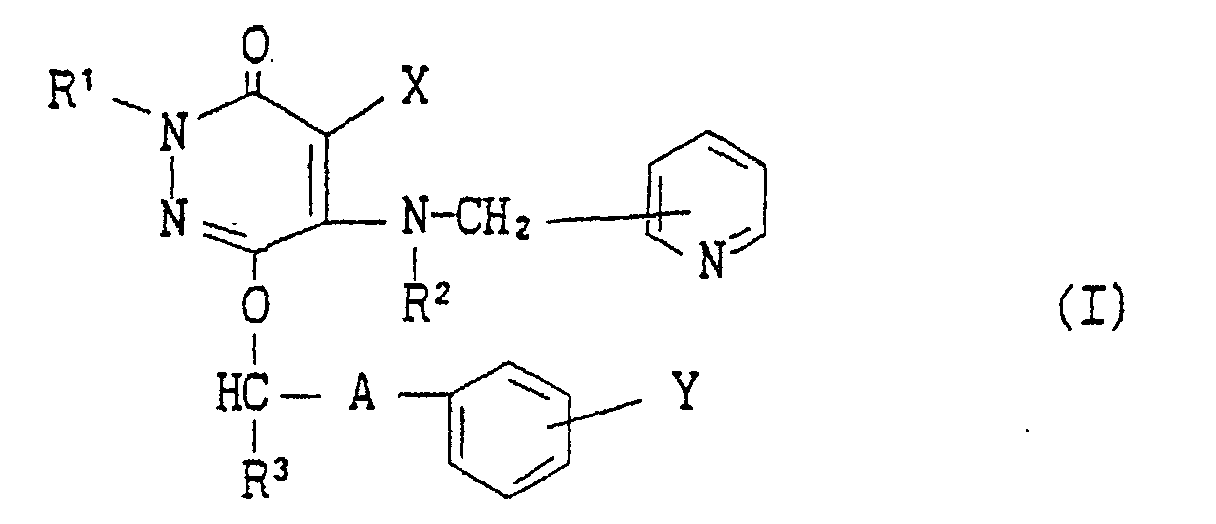
- R1, R2 and R3
- are each independently a hydrogen atom or a C1-C6 alkyl;
- X
- is a halogen atom, a cyano or a hydrogen atom;
- Y
- is a halogen atom, a trifluoromethyl or a hydrogen atom; and
- A
- is a C1-C8 alkylene optionally substituted by hydroxy,
- Fig. 1 is a graph showing the results of the dissolution test of Experimental Example 1.
- Fig. 2 is a graph showing BA of beagle dogs tested in Experimental Example 2.
- The symbols used in the present specification are explained in the following. The lower alkyl at R1, R2 and R3 may be linear or branched and has 1 to 6 carbon atoms. Examples thereof include methyl, ethyl, n-propyl, isopropyl, n-butyl, isobutyl, sec-butyl, t-butyl, pentyl, hexyl and the like. Preferred R1 and R2 are hydrogen atoms and preferred R3 is a hydrogen atom or an alkyl having 1 to 4 carbon atoms.
- The alkyl having 1 to 4 carbon atoms at R3 is exemplified by methyl, ethyl, n-propyl, isopropyl, n-butyl, isobutyl, sec-butyl, t-butyl and the like.
- The halogen atom at X and Y is fluorine atom, chlorine atom, bromine atom or iodine atom. Preferred X is halogen atom and preferred Y is halogen atom or hydrogen atom.
- The alkylene having 1 to 8 carbon atoms at A which may be substituted by hydroxy may be linear or branched. Examples thereof include methylene, ethylene, propylene, butylene, pentylene, hexylene, heptylene, octylene, 2,2-dimethylethylene, 2,2-diethylethylene, 2,2-di-n-propylethylene, hydroxymethylene, 1-hydroxyethylene, 2-hydroxyethylene, 3-hydroxypropylene and the like. Preferred A is an alkylene having 1 to 5 carbon atoms which is optionally substituted by hydroxy.
- While the position of the bond of methylene group and pyridine ring in formula (I) is not particularly limited, it is preferably 3-position relative to nitrogen atom of the pyridine ring. Y may be bonded at any position on the benzene ring, but preferably at 4-position.
- In the formula (I), a pyridazinone compound (I) wherein R1 is a hydrogen atom is preferable.
- In particular, a pyridazinone compound of the formula (I) wherein R1 and R2 are hydrogen atoms, R3 is a hydrogen atom or an alkyl having 1 to 4 carbon atoms, X is a halogen atom, Y is a halogen atom or a hydrogen atom, and A is an alkylene having 1 to 5 carbon atoms which may be substituted by hydroxy is preferable.
- More preferable pyridazinone compound (I) includes 4-bromo-6-(3-phenylpropoxy)-5-(3-pyridylmethylamino)-3(2H)-pyridazinone, 4-chloro-6-(3-phenylpropoxy)-5-(3-pyridylmethylamino)-3(2H)-pyridazinone, 4-chloro-6-[3-(4-chlorophenyl)propoxy]-5-(3-pyridylmethylamino)-3(2H)-pyridazinone, 4-bromo-6-[3-(4-chlorophenyl)propoxy]-5-(3-pyridylmethylamino)-3(2H)-pyridazinone, 4-bromo-6-(2,2-dimethyl-3-phenylpropoxy)-5-(3-pyridylmethylamino)-3(2H)-pyridazinone, 4-chloro-6-(2,2-dimethyl-3-phenylpropoxy)-5-(3-pyridylmethylamino)-3(2H)-pyridazinone, 4-bromo-6-[3-(4-chlorophenyl)-2,2-dimethylpropoxy]-5-(3-pyridylmethylamino)-3(2H)-pyridazinone, 4-chloro-6-[3-(4-chlorophenyl)-2,2-dimethylpropoxy]-5-(3-pyridylmethylamino)-3(2H)-pyridazinone, 4-bromo-6-[3-(4-chlorophenyl)-3-hydroxypropoxy]-5-(3-pyridylmethylamino)-3(2H)-pyridazinone, 4-chloro-6-[3-(4-chlorophenyl)-3-hydroxypropoxy]-5-(3-pyridylmethylamino)-3(2H)-pyridazinone, 4-bromo-6-[3-(4-chlorophenyl)-2-hydroxypropoxy]-5-(3-pyridylmethylamino)-3(2H)-pyridazinone and 4-chloro-6-[3-(4-chlorophenyl)-2-hydroxypropoxy]-5-(3-pyridylmethylamino)-3(2H)-pyridazinone.
- The pyridazinone compound (I) of the present invention encompasses stereoisomers and optical isomers.
- The pyridazinone compound (I) can be produced by, for example, the method disclosed in EP 482208, or other method.
- The pharmacologically acceptable salt of the pyridazinone compound (I) may be a salt with an inorganic acid (e.g., hydrochloride, hydrobromide, phosphate, sulfate and the like), a salt with an organic acid (e.g., acetate, succinate, maleate, fumarate, malate, tartrate and the like), and the like. The pyridazinone compound (I) can be converted to the above-mentioned salts by a known method.
- The organic acid to be used in the present invention are, citric acid, succinic acid, maleic acid, fumaric acid, malic acid, tartaric acid, with particular preference given to citric acid. The organic acid is preferably added in a proportion of 0.05-20 parts by weight per part by weight of the pyridazinone compound.
- When to add the organic acid is not particularly limited and an organic acid may be added before granulation or after granulation but before compression. Considering the absorption of the pyridazinone compound, an organic acid is preferably added before granulation.
- By adding an organic acid to a pyridazinone compound, the dissolution and absorption of the pyridazinone compound can be improved, and a composition for oral administration which is stable to heat, light, moisture and the like can be provided.
- When formulating the composition for oral administration of the present invention, the pyridazinone compound is preferably micronized. The pyridazinone compound as a bulk powder has an average particle size of 20 µm. Micronization by a known method can make the average particle size 7-10 µm. The micronization of the pyridazinone compound contributes to improvement in dissolution and absorption.
- The composition for oral administration of the present invention can be formulated into a dosage form of tablet, capsule, powder, granule, pill and the like by a conventional method using excipients, binders, disintegrators, lubricants and the like. The excipients and the like to be used are not particularly limited. Examples of excipient include lactose, corn starch, sucrose, glucose, mannitol, sorbit, crystalline cellulose, silicon dioxide and the like. Examples of binder include polyvinyl alcohol, polyvinyl ether, ethylcellulose, methylcellulose, gum arabic, tragacanth, gelatin, shellac, hydroxypropylcellulose, hydroxypropylmethylcellulose, hydroxypropyl starch, polyvinylpyrrolidone and the like. Examples of disintegrator include starch, agar, gelatin powder, crystalline cellulose, calcium carbonate, sodium hydrogencarbonate, calcium citrate, dextrin, pectin, carboxymethylcellulose calcium, low substitution hydroxypropylcellulose, croscarmellose sodium, partly pregelatinized starch and the like. Examples of lubricant include magnesium stearate, talc, polyethylene glycol, silica, hydrogenated vegetable oil and the like. The use of lactose as an excipient or the use of hydroxypropylcellulose as a binder may unexpectedly lead to undesirable coloring of the preparation. Thus, the use of other excipients and other binders is preferable. Preferable excipient may be crystalline cellulose, corn starch, mannitol and the like. Preferable binder may be hydroxypropylmethylcellulose and the like.
- The excipient, binder, disintegrator and lubricant are contained in a proportion of preferably 10-150 parts by weight, 0.5-10 parts by weight, 1-20 parts by weight and 0.1-1.5 parts by weight, respectively, per part by weight of the pyridazinone compound.
- While the dosage form of the inventive pharmaceutical composition is not limited, it is preferably tablet. When tablets are prepared, for example, water is added to an admixture of ingredients in a proportion of 5-35% (w/w), and the resulting mixture is granulated by a stirring-granulation method using a high speed mixer and the like, followed by compression (wet granulation compression method), or the respective ingredients are mixed homogeneously, followed by compression molding (direct compression method), or they are prepared by other method. To the tablets is preferably applied a coating base material such as a commercially available HA "SANKYO" manufactured by Sankyo Co., Ltd. and the like to increase resistance to moisture.
- The present invention is explained in detail by way of Examples and Experimental Examples.
- In the following Examples and Experimental Examples, 4-bromo-6-[3-(4-chlorophenyl)propoxy]-5-(3-pyridylmethylamino)-3(2H)-pyridazinone hydrochloride (hereinafter to be simply referred to as pyridazinone hydrochloride) prepared by a conventional method was used as a pyridazinone compound.
- Tablets were prepared, which contained pyridazinone hydrochloride (10.0 mg) as an active ingredient, citric acid (5.0 mg, manufactured by Showa Chemical Industry Co., Ltd.) as an organic acid, lactose (123.0 mg) as an excipient, hydroxypropylcellulose (4.0 mg, HPC-SL, manufactured by Nippon Soda Co., Ltd.) as a binder, croscarmellose sodium (7.0 mg, Ac-Di-Sol, manufactured by Asahi Chemical Industry Co., Ltd.) as a disintegrator and magnesium stearate (1.0 mg, manufactured by TAIHEI CHEMICAL Co., Ltd.) as a lubricant.
- The tablets were made by the wet granulation compression method, wherein the active ingredient, organic acid, excipient, binder and disintegrator were mixed, to which 12% (w/w) of water was added, and the mixture was granulated by a stirring-granulation method. Then, the obtained granules were dried at 80°C for 30 min, and passed through a 0.5 mm (32 mesh) sieve to give a powder for compression. The lubricant and disintegrator were added to the obtained powder, and the mixture was compressed with a die and a punch having 7.5 mm and typical R surfaces to give tablets.
- The active ingredient, pyridazinone hydrochloride, was prepared by dry-micronization of a bulk powder with a turbo mill micronizer (TJ-60, manufactured by Turbo Kogyo Co., LTD., air pressure 7.5-8.5 kg/cm2, feed control 8.0-8.5). The average particle size of the bulk powder was about 20 µm. The obtained micronization product had an average particle size of about 7 µm. The average particle size was an average of three determinations performed using a particle size measuring device (CIS-1, manufactured by GALAI), hereinafter the same.
- In the same manner as in Example 1 except that the amount of citric acid was changed to 15.0 mg and the amount of lactose was changed to 113.0 mg, tablets were prepared.
- In the same manner as in Example 1 except that the amount of citric acid was changed to 50.0 mg and the amount of lactose was changed to 78.0 mg, tablets were prepared.
- In the same manner as in Example 1 except that the amount of citric acid was changed to 7.5 mg and the amount of lactose was changed to 120.5 mg, tablets were prepared.
- In the same manner as in Example 1, tablets were prepared, which contained pyridazinone hydrochloride (10.0 mg) as an active ingredient, citric acid as an organic acid (15.0 mg, manufactured by Showa Chemical Industry Co., Ltd.), crystalline cellulose (15.0 mg, Avicel PH101, manufactured by Asahi Chemical Industry Co., Ltd.) as an excipient, hydroxypropylmethylcellulose (4.0 mg, TC-5R, manufactured by Shin-Etsu Chemical Co., Ltd.) as a binder, low substitution hydroxypropylcellulose (7.0 mg, L-HPC, manufactured by Shin-Etsu Chemical Co., Ltd.) as a disintegrator, and magnesium stearate (1.0 mg) as a lubricant.
- The active ingredient, pyridazinone hydrochloride, was prepared by micronization of a bulk powder with a pin mill micronizer (KOLLOPLEX 160Z, manufactured by Powrex Corporation, pin rotation 9000 rpm, supply slit width ca. 1 cm, charge amount 500 g). The pin mill micronization product had an average particle size of about 10 µm.
- In the same manner as in Example 5 except that low substitution hydroxypropylcellulose was not added, the amount of crystalline cellulose was changed to 90.0 mg and partly pregelatinized starch (30.0 mg, PCS, manufactured by Asahi Chemical Industry Co., Ltd.) was added as a disintegrator, tablets were obtained.
- In the same manner as in Example 5 except that the amount of crystalline cellulose was changed to 56.5 mg, corn starch (56.5 mg, manufactured by MATSUTANI KAGAKU KOGYO Co., Ltd.) was added as an excipient and citric acid was added after passing through a sieve, tablets were obtained.
- In the same manner as in Example 6 except that the amount of crystalline cellulose was changed to 45.0 mg and corn starch was added in an amount of 45.0 mg, tablets were obtained.
- In the same manner as in Example 8 except that corn starch was changed to D-mannitol (manufactured by TOWA CHEMICAL INDUSTRY Co., Ltd.), tablets were obtained.
- Tablets were prepared, which contained pyridazinone hydrochloride (10.0 mg) as an active ingredient, citric acid (15.0 mg) as an organic acid, crystalline cellulose (75.0 mg) as an excipient, lactose (15.0 mg), hydroxypropylmethylcellulose (4.0 mg) as a binder, partly pregelatinized starch (30.0 mg) as a disintegrator and magnesium stearate (1.0 mg) as a lubricant.
- The tablets were prepared by the direct compression method. To be specific, the active ingredient and the organic acid were mixed, and the obtained mixture was micronized with a pin mill as in Example 5, to which an excipient, a binder and a disintegrator, respectively passed through a sieve, were added. Then, a lubricant was added thereto to give a powder for compression. Using a die and a punch having 7.5 mm and typical R surfaces, tablets were produced.
- According to the wet granulation compression method of Example 1, naked tablets having the formulations shown in Table 1 were prepared, which tablets were coated with a coating agent [coating base HA "SANKYO" (manufactured by Sankyo Co., Ltd.) and triacetine] by a pan coating method to give film-coated tablets.
Example 11 12 13 ingredients (naked tablet) 8 mg tablet 2 mg tablet 0.5 mg tablet pin mill micronized product of pyridazinone hydrochloride 8.0 2.0 0.5 citric acid 15.0 9.0 9.0 crystalline cellulose 106.5 66.7 68.2 hydroxypropylmethylcellulose 4.5 2.7 2.7 low substitution hydroxypropylcellulose 15.0 9.0 9.0 magnesium stearate 1.0 0.6 0.6 subtotal (mg) 150.0 90.0 90.0 tablet diameter (mm⊘) 7.5 6.5 6.5 (coating film) HA "SANKYO" 13.7 8.2 8.2 triacetine 1.3 0.8 0.8 total (mg) 165.0 99.0 99.0 - In the same manner as in Example 1 except that citric acid was not added and the amount of lactose was changed to 128.0 mg, tablets were obtained.
- In the same manner as in Example 1 except that citric acid was not added, the amount of lactose was changed to 127.0 mg, and sugar ester (1.0 mg, DK ester SS, manufactured by DAI-ICHI KOGYO SEIYAKU CO., LTD.) was added as a surfactant, tablets were obtained.
- A bulk powder (2 g) of pyridazinone hydrochloride and a water soluble polymer (10 g) were mixed, to which methanol or a methanol/dichloromethane (1/1) mixed solution was added, followed by dissolution under heating at 50°C. The mixture was evaporated to dryness in a rotary evaporator at 50°C and dried under reduced pressure overnight at 60°C. The dry product was micronized in a sample mill and dried under reduced pressure overnight at 60°C to give an amorphous composition. Using, as the water soluble polymers, polyvinylpyrrolidone vinylacetate (Kollidon VA64, manufactured by BASF), hydroxypropylmethylcellulose and hydroxypropylmethylcellulose phthalate (HP-55, manufactured by Shin-Etsu Chemical Co., Ltd.), the compositions of Reference Examples 3 to 5 were obtained.
- The tablets of Examples 1 to 3 and Reference Example 1 were subjected to a dissolution test using a phosphate buffer (pH 6.8). The test followed the dissolution test (puddle method) according to 12th Edition Japan Pharmacopoeia, wherein the number of rotation was 100 rpm, the amount of test solution was 900 ml and the amount of sampling and the amount of supplementary solution were both 10 ml.
- The sample was centrifuged at 15000 rpm for 10 min, and an internal standard solution (0.5 ml) was added to 0.5 ml of the supernatant thus obtained. The obtained mixture was subjected to HPLC under the following conditions.
-
- Standard solution: Pyridazinone hydrochloride (0.020 g) was accurately weighed and dissolved in methanol to make the total amount precisely 20 ml. One milliliter was taken therefrom and phosphate buffer (pH 6.8) was added to make the total amount precisely 100 ml. To 0.5 ml thereof was added an internal standard solution (0.5 ml) to give a standard solution.
- Internal standard solution: 2-Acetonaphtone (5 µg/ml) was dissolved in a methanol · acetonitrile mixed solution (15:9) to give an internal standard solution.
- Detector: UV absorptiometer (measurement wavelength 290 nm)
- Column : Nucleosil 100-5-C18 (4.6×250 mm, manufactured by GL Science)
- Column temperature: 40°C
- Mobile phase: water · methanol · acetonitrile mixture (6:5:3)
- Flow rate: 1.4 ml/min
- Analysis time: 20 min
- Feed amount: 10 µl
-
- The relationship between percent dissolution and dissolution time is shown in Fig. 1. As shown in Fig. 1, the tablets containing citric acid showed faster dissolution pattern than the tablets without citric acid.
- The compositions of Example 2 and Reference Examples 1 to 5 were subjected to absorption test using beagle dogs. The test included administration (10 mg/kg body weight) of the compositions to the dogs (body weight 10-12 kg, n=5 or 10) fasted for 20 hr before the administration, fasting the dogs for 5 hr after the administration, and time-course determination of the drug concentration in plasma after the administration. The drug concentration in plasma was determined by HPLC under the following conditions.
-
- Detector: UV absorptiometer (measurement wavelength 286 nm)
- Column : Superspher RP-18e (4.0×250 mm, manufactured by Merck)
- Guardcolumn: Lichrospher RP-18e (4.0×4.0 mm, 5 µm, manufactured by Merck)
- Mobile phase: CH3CN/10mM CH3COONa=42/58
- Flow rate: 1.0 ml/min
- Column temperature: 50°C
- Analysis time: 30 min
- Feed amount: 30 µl
-
- The maximum drug concentration (Cmax) in plasma after the administration of the composition is shown in Table 2.
Ex. 2 Ref.Ex.1 Ref.Ex.2 Ref.Ex.3 Ref.Ex.4 Ref.Ex.5 Cmax (ng/ml) 751.4 726.5 543.9 439.2 560.6 408.1 - The BA of each composition in beagle dogs is shown in Fig. 2. The tablets of Example 2 showed a BA of about 30%, which indicated about three times greater absorption than the bulk powder of pyridazinone hydrochloride. On the other hand, the best BA of the compositions of Reference Examples was about 20%. The interindividual difference seen in the tablets of Example 2 was not more than one-second of the difference found with the compositions of Reference Examples.
- The tablets of Example 2 were subjected to an absorption test after post-feeding administration. The test was done in the same manner as in the above fast-administration except that standard solid feed (ca. 300 g) was given 30 min before administration of the tablets. The results of absorption by post-feeding administration are shown in Table 3 along with the results of fast-administration.
Example 2 Cmax (ng/ml) BA (%) fast-administration 751.4 28.2 post-feeding administration 1054.8 29.0 - The average BA of post-feeding administration was 29%, which was similar to the result obtained by fast-administration.
- According to the present invention, a composition for oral administration which is stable to heat, light, moisture and the like and which shows improved dissolution and absorption of a pyridazinone compound can be provided.
- This application is based on application No. 19115/1997 filed in Japan.
Claims (9)
- A composition for oral administration which comprises a pyridazinone compound of the formula (I)wherein

- R1, R2 and R3
- are each independently a hydrogen atom or a C1-C6 alkyl;
- X
- is a halogen atom, a cyano or a hydrogen atom;
- Y
- is a halogen atom, a trifluoromethyl or a hydrogen atom; and
- A
- is a C1-C8 alkylene optionally substituted by hydroxy,
- The composition for oral administration of claim 1, wherein, in the formula (I), R1 is a hydrogen atom.
- The composition for oral administration of claim 1, wherein the pyridazinone compound of the formula (I) is 4-bromo-6-[3-(4-chlorophenyl)propoxy]-5-(3-pyridylmethylamino)-3(2H)-pyridazinone.
- The composition for oral administration of any one of claims 1 to 3, wherein the organic acid is citric acid.
- The composition for oral administration of claim 1, wherein the pyridazinone compound or the pharmacologically acceptable salt thereof is micronized.
- The composition for oral administration of claim 1, comprising at least one excipient selected from the group consisting of crystalline cellulose, corn starch and mannitol.
- The composition for oral administration of claim 1, further comprising hydroxypropylmethylcellulose as a binder.
- The composition for oral administration of claim 1, which is a tablet.
- The composition for oral administration of claim 8, which is coated with a moisture-proof coating.
Priority Applications (1)
| Application Number | Priority Date | Filing Date | Title |
|---|---|---|---|
| DK98101553T DK0860169T3 (en) | 1998-01-29 | 1998-01-29 | Preparations for oral administration containing pyridazinone compounds |
Applications Claiming Priority (3)
| Application Number | Priority Date | Filing Date | Title |
|---|---|---|---|
| JP1911597 | 1997-01-31 | ||
| JP1911597 | 1997-01-31 | ||
| JP19115/97 | 1997-01-31 |
Publications (3)
| Publication Number | Publication Date |
|---|---|
| EP0860169A2 EP0860169A2 (en) | 1998-08-26 |
| EP0860169A3 EP0860169A3 (en) | 1999-06-16 |
| EP0860169B1 true EP0860169B1 (en) | 2004-07-28 |
Family
ID=11990489
Family Applications (1)
| Application Number | Title | Priority Date | Filing Date |
|---|---|---|---|
| EP98101553A Expired - Lifetime EP0860169B1 (en) | 1997-01-31 | 1998-01-29 | Compositions for oral administration containing pyridazinone compounds |
Country Status (8)
| Country | Link |
|---|---|
| US (1) | US5942249A (en) |
| EP (1) | EP0860169B1 (en) |
| KR (1) | KR100509170B1 (en) |
| CN (1) | CN1114408C (en) |
| CA (1) | CA2228078C (en) |
| DE (1) | DE69825193T2 (en) |
| ES (1) | ES2224296T3 (en) |
| TW (1) | TW482675B (en) |
Families Citing this family (7)
| Publication number | Priority date | Publication date | Assignee | Title |
|---|---|---|---|---|
| NZ512754A (en) * | 1998-12-07 | 2002-10-25 | Nissan Chemical Ind Ltd | Remedial agent for erectile dysfunction containing a 3(2H)-pyridazinone derivative |
| JP4868695B2 (en) * | 2000-09-22 | 2012-02-01 | 大日本住友製薬株式会社 | Oral preparation with good disintegration |
| KR20080055797A (en) * | 2005-08-23 | 2008-06-19 | 닛산 가가쿠 고교 가부시키 가이샤 | Sustained release preparations |
| WO2010026993A1 (en) * | 2008-09-03 | 2010-03-11 | 武田薬品工業株式会社 | Method for improving absorbability of preparation, and preparation having improved absorbability |
| JPWO2010074090A1 (en) | 2008-12-25 | 2012-06-21 | 日産化学工業株式会社 | Crystals of pyridazine-3 (2H) -one compound hydrochloride and method for producing the same |
| CN102740855B (en) * | 2010-02-12 | 2013-11-27 | 大正制药株式会社 | Extended release preparation |
| US9555115B2 (en) | 2012-09-19 | 2017-01-31 | Taiho Pharmaceutical Co., Ltd. | Pharmaceutical composition for oral administration with improved dissolution and/or absorption |
Family Cites Families (9)
| Publication number | Priority date | Publication date | Assignee | Title |
|---|---|---|---|---|
| JPH02256668A (en) * | 1988-12-20 | 1990-10-17 | Nissan Chem Ind Ltd | Pyridazinone derivative |
| US5167947A (en) * | 1989-10-26 | 1992-12-01 | Southwest Research Institute | Enhancement of absorption of radioprotective drugs |
| US5364646A (en) * | 1990-01-10 | 1994-11-15 | Dr. Karl Thomae Gmbh | Oral pharmaceutical forms of pimobendan |
| CA2056405A1 (en) * | 1990-04-06 | 1991-10-07 | Mitsumasa Shino | Solid oral preparation containing catechol compound |
| CA2039742A1 (en) * | 1990-04-23 | 1991-10-24 | Andrew B. Dennis | Tablet composition and method for problem pharmaceutical materials |
| HU208124B (en) * | 1990-04-25 | 1993-08-30 | Nissan Chemical Ind Ltd | Process for producing pyridazinone derivatives and pharmaceutical compositions comprising such derivatives as active ingredient |
| CA2061520C (en) * | 1991-03-27 | 2003-04-22 | Lawrence J. Daher | Delivery system for enhanced onset and increased potency |
| KR100318653B1 (en) * | 1994-01-25 | 2002-04-22 | 도쿠시마 히데이치 | Pyridazinone derivatives |
| IL112695A (en) * | 1994-02-22 | 1999-04-11 | Green Cross Corp | Pharmaceutical compositions containing pyridazinone derivatives |
-
1998
- 1998-01-26 TW TW087101030A patent/TW482675B/en not_active IP Right Cessation
- 1998-01-28 CA CA002228078A patent/CA2228078C/en not_active Expired - Fee Related
- 1998-01-28 US US09/014,563 patent/US5942249A/en not_active Expired - Lifetime
- 1998-01-29 EP EP98101553A patent/EP0860169B1/en not_active Expired - Lifetime
- 1998-01-29 ES ES98101553T patent/ES2224296T3/en not_active Expired - Lifetime
- 1998-01-29 DE DE69825193T patent/DE69825193T2/en not_active Expired - Lifetime
- 1998-01-30 KR KR10-1998-0002556A patent/KR100509170B1/en not_active Expired - Fee Related
- 1998-01-31 CN CN98106413A patent/CN1114408C/en not_active Expired - Fee Related
Non-Patent Citations (1)
| Title |
|---|
| TOKUMURA T. ET AL: "Evaluation of bioavailability upon oral administration of cinnarizine-beta-cyclodextrin inclusion complex to beagle dogs", CHEM PHARM BULL, vol. 33, no. 7, 1985, pages 2962 - 2967, XP008071497 * |
Also Published As
| Publication number | Publication date |
|---|---|
| CA2228078C (en) | 2007-03-13 |
| CN1114408C (en) | 2003-07-16 |
| EP0860169A3 (en) | 1999-06-16 |
| ES2224296T3 (en) | 2005-03-01 |
| US5942249A (en) | 1999-08-24 |
| EP0860169A2 (en) | 1998-08-26 |
| KR19980070938A (en) | 1998-10-26 |
| TW482675B (en) | 2002-04-11 |
| DE69825193D1 (en) | 2004-09-02 |
| DE69825193T2 (en) | 2005-08-11 |
| CN1194139A (en) | 1998-09-30 |
| CA2228078A1 (en) | 1998-07-31 |
| HK1016070A1 (en) | 1999-10-29 |
| KR100509170B1 (en) | 2005-11-11 |
Similar Documents
| Publication | Publication Date | Title |
|---|---|---|
| CA2085037C (en) | Stabilized pharmaceutical compositions comprising an hmg-coa reductase inhibitor compound | |
| US4673564A (en) | Sustained release pharmaceutical composition of solid medical material | |
| JP5295123B2 (en) | New pharmaceutical composition | |
| PL184183B1 (en) | Three-phase pharmaceutic form of constant-rate controllable release of amorphous active ingredient for administration once per day | |
| US20090292016A1 (en) | Stable Pharmaceutical Compositions Containing Pravastatin | |
| US20110097414A1 (en) | Pharmaceutical compositions comprising adsorbate of fenofibrate | |
| US5942249A (en) | Composition for oral administration containing pyridazinone compounds | |
| JP4292588B2 (en) | Oral formulation of pyridazinone compounds | |
| SI22750A (en) | Ivabradin hydrobromide | |
| JP2008501024A (en) | Mixed co-crystal and pharmaceutical composition comprising the same | |
| EP3886817A1 (en) | Pharmaceutical composition comprising ramipril and indapamide | |
| US20100310668A1 (en) | Pharmaceutical compositions comprising n-[2-(diethylamino)ethyl]-5-[(5-fluoro-1,2-dihydro-2-oxo-3h-indol-3-ylidene)methyl]-2,4-dimethyl-1h-pyrrole-3-carboxamide | |
| KR20030096294A (en) | A stable pharmaceutical composition of pravastatin | |
| KR100504618B1 (en) | Methods for making sustained-release pharmaceutical compositions of ergot alkaloids having improved bioavailability and compositions thereof | |
| AU756338B2 (en) | Stabile compositions comprising levosimendan and alginic acid | |
| WO2009061105A2 (en) | Stabilized preparation containing coenzyme q10 and process for preparation thereof | |
| US20110262540A1 (en) | Solid Pharmaceutical Composition Comprising Exemestane | |
| EP3601278B1 (en) | Crystalline form of masitinib | |
| KR100265467B1 (en) | Sustained release tablet containing azelastine hydrochloride and preparation method thereof | |
| KR20110104903A (en) | Pharmaceutical composition containing pramipexole with improved stability and preparation method thereof | |
| EP2255792A1 (en) | Pharmaceutical compositions for N-[2-(Diethylamino)ethyl]5-[(fluoro-1,2-dihydro-2-oxo-3H-indole-3-ylidene) methyl]-2,4-dimenthyl-1H-pyrrole-3-carboxamide | |
| HK1016070B (en) | Composition for oral administration containing pyridazinone compounds | |
| EP2090306A1 (en) | Pharmaceutical compositions comprising N-[2-(diethylamino)ethyl]-5-[(5-fluoro-1,2-dihydro-2-oxo-3H-indol-3-ylidene)methyl]-2,4-dimethyl-1H-pyrrole-3-carboxamide | |
| HK1076715A (en) | Methods for making sustained-release pharmaceutical compositions of ergot alkaloids having improved bioavailability and compositions thereof |
Legal Events
| Date | Code | Title | Description |
|---|---|---|---|
| PUAI | Public reference made under article 153(3) epc to a published international application that has entered the european phase |
Free format text: ORIGINAL CODE: 0009012 |
|
| AK | Designated contracting states |
Kind code of ref document: A2 Designated state(s): BE CH DE DK ES FR GB IT LI NL SE |
|
| AX | Request for extension of the european patent |
Free format text: AL;LT;LV;MK;RO;SI |
|
| PUAL | Search report despatched |
Free format text: ORIGINAL CODE: 0009013 |
|
| AK | Designated contracting states |
Kind code of ref document: A3 Designated state(s): AT BE CH DE DK ES FI FR GB GR IE IT LI LU MC NL PT SE |
|
| AX | Request for extension of the european patent |
Free format text: AL;LT;LV;MK;RO;SI |
|
| RAP1 | Party data changed (applicant data changed or rights of an application transferred) |
Owner name: NISSAN CHEMICAL INDUSTRIES, LIMITED Owner name: YOSHITOMI PHARMACEUTICAL INDUSTRIES, LTD. |
|
| 17P | Request for examination filed |
Effective date: 19990906 |
|
| AKX | Designation fees paid |
Free format text: BE CH DE DK ES FR GB IT LI NL SE |
|
| RAP1 | Party data changed (applicant data changed or rights of an application transferred) |
Owner name: NISSAN CHEMICAL INDUSTRIES, LIMITED Owner name: WELFIDE CORPORATION |
|
| RAP1 | Party data changed (applicant data changed or rights of an application transferred) |
Owner name: NISSAN CHEMICAL INDUSTRIES, LIMITED Owner name: MITSUBISHI PHARMA CORPORATION |
|
| 17Q | First examination report despatched |
Effective date: 20011227 |
|
| RAP1 | Party data changed (applicant data changed or rights of an application transferred) |
Owner name: NISSAN CHEMICAL INDUSTRIES, LIMITED |
|
| GRAP | Despatch of communication of intention to grant a patent |
Free format text: ORIGINAL CODE: EPIDOSNIGR1 |
|
| GRAS | Grant fee paid |
Free format text: ORIGINAL CODE: EPIDOSNIGR3 |
|
| GRAA | (expected) grant |
Free format text: ORIGINAL CODE: 0009210 |
|
| RAP1 | Party data changed (applicant data changed or rights of an application transferred) |
Owner name: NISSAN CHEMICAL INDUSTRIES, LTD. |
|
| AK | Designated contracting states |
Kind code of ref document: B1 Designated state(s): BE CH DE DK ES FR GB IT LI NL SE |
|
| REG | Reference to a national code |
Ref country code: GB Ref legal event code: FG4D |
|
| REG | Reference to a national code |
Ref country code: CH Ref legal event code: EP |
|
| REF | Corresponds to: |
Ref document number: 69825193 Country of ref document: DE Date of ref document: 20040902 Kind code of ref document: P |
|
| REG | Reference to a national code |
Ref country code: SE Ref legal event code: TRGR |
|
| REG | Reference to a national code |
Ref country code: CH Ref legal event code: NV Representative=s name: A. BRAUN, BRAUN, HERITIER, ESCHMANN AG PATENTANWAE |
|
| REG | Reference to a national code |
Ref country code: DK Ref legal event code: T3 |
|
| REG | Reference to a national code |
Ref country code: ES Ref legal event code: FG2A Ref document number: 2224296 Country of ref document: ES Kind code of ref document: T3 |
|
| ET | Fr: translation filed | ||
| PLBE | No opposition filed within time limit |
Free format text: ORIGINAL CODE: 0009261 |
|
| STAA | Information on the status of an ep patent application or granted ep patent |
Free format text: STATUS: NO OPPOSITION FILED WITHIN TIME LIMIT |
|
| 26N | No opposition filed |
Effective date: 20050429 |
|
| REG | Reference to a national code |
Ref country code: CH Ref legal event code: PFA Owner name: NISSAN CHEMICAL INDUSTRIES, LTD. Free format text: NISSAN CHEMICAL INDUSTRIES, LTD.#7-1, KANDA NISHIKI-CHO 3-CHOME#CHIYODA-KU, TOKYO 101-0054 (JP) -TRANSFER TO- NISSAN CHEMICAL INDUSTRIES, LTD.#7-1, KANDA NISHIKI-CHO 3-CHOME#CHIYODA-KU, TOKYO 101-0054 (JP) |
|
| PGFP | Annual fee paid to national office [announced via postgrant information from national office to epo] |
Ref country code: DK Payment date: 20110111 Year of fee payment: 14 |
|
| PGFP | Annual fee paid to national office [announced via postgrant information from national office to epo] |
Ref country code: FR Payment date: 20110128 Year of fee payment: 14 Ref country code: NL Payment date: 20110120 Year of fee payment: 14 Ref country code: IT Payment date: 20110125 Year of fee payment: 14 Ref country code: SE Payment date: 20110111 Year of fee payment: 14 Ref country code: CH Payment date: 20110112 Year of fee payment: 14 Ref country code: DE Payment date: 20110126 Year of fee payment: 14 |
|
| PGFP | Annual fee paid to national office [announced via postgrant information from national office to epo] |
Ref country code: ES Payment date: 20110121 Year of fee payment: 14 Ref country code: BE Payment date: 20110225 Year of fee payment: 14 Ref country code: GB Payment date: 20110126 Year of fee payment: 14 |
|
| BERE | Be: lapsed |
Owner name: *NISSAN CHEMICAL INDUSTRIES LTD Effective date: 20120131 |
|
| REG | Reference to a national code |
Ref country code: NL Ref legal event code: V1 Effective date: 20120801 |
|
| REG | Reference to a national code |
Ref country code: CH Ref legal event code: PL |
|
| REG | Reference to a national code |
Ref country code: SE Ref legal event code: EUG |
|
| REG | Reference to a national code |
Ref country code: DK Ref legal event code: EBP |
|
| GBPC | Gb: european patent ceased through non-payment of renewal fee |
Effective date: 20120129 |
|
| REG | Reference to a national code |
Ref country code: FR Ref legal event code: ST Effective date: 20120928 |
|
| PG25 | Lapsed in a contracting state [announced via postgrant information from national office to epo] |
Ref country code: CH Free format text: LAPSE BECAUSE OF NON-PAYMENT OF DUE FEES Effective date: 20120131 Ref country code: LI Free format text: LAPSE BECAUSE OF NON-PAYMENT OF DUE FEES Effective date: 20120131 Ref country code: GB Free format text: LAPSE BECAUSE OF NON-PAYMENT OF DUE FEES Effective date: 20120129 Ref country code: SE Free format text: LAPSE BECAUSE OF NON-PAYMENT OF DUE FEES Effective date: 20120130 Ref country code: DE Free format text: LAPSE BECAUSE OF NON-PAYMENT OF DUE FEES Effective date: 20120801 |
|
| REG | Reference to a national code |
Ref country code: DE Ref legal event code: R119 Ref document number: 69825193 Country of ref document: DE Effective date: 20120801 |
|
| PG25 | Lapsed in a contracting state [announced via postgrant information from national office to epo] |
Ref country code: IT Free format text: LAPSE BECAUSE OF NON-PAYMENT OF DUE FEES Effective date: 20120129 |
|
| PG25 | Lapsed in a contracting state [announced via postgrant information from national office to epo] |
Ref country code: FR Free format text: LAPSE BECAUSE OF NON-PAYMENT OF DUE FEES Effective date: 20120131 Ref country code: BE Free format text: LAPSE BECAUSE OF NON-PAYMENT OF DUE FEES Effective date: 20120131 |
|
| PG25 | Lapsed in a contracting state [announced via postgrant information from national office to epo] |
Ref country code: NL Free format text: LAPSE BECAUSE OF NON-PAYMENT OF DUE FEES Effective date: 20120801 Ref country code: DK Free format text: LAPSE BECAUSE OF NON-PAYMENT OF DUE FEES Effective date: 20120131 |
|
| REG | Reference to a national code |
Ref country code: ES Ref legal event code: FD2A Effective date: 20130708 |
|
| PG25 | Lapsed in a contracting state [announced via postgrant information from national office to epo] |
Ref country code: ES Free format text: LAPSE BECAUSE OF NON-PAYMENT OF DUE FEES Effective date: 20120130 |