EP0859353B1 - Signal processing method and system utilizing logical speech boundaries - Google Patents
Signal processing method and system utilizing logical speech boundaries Download PDFInfo
- Publication number
- EP0859353B1 EP0859353B1 EP98101792A EP98101792A EP0859353B1 EP 0859353 B1 EP0859353 B1 EP 0859353B1 EP 98101792 A EP98101792 A EP 98101792A EP 98101792 A EP98101792 A EP 98101792A EP 0859353 B1 EP0859353 B1 EP 0859353B1
- Authority
- EP
- European Patent Office
- Prior art keywords
- speech
- data
- signal
- speech information
- frames
- Prior art date
- Legal status (The legal status is an assumption and is not a legal conclusion. Google has not performed a legal analysis and makes no representation as to the accuracy of the status listed.)
- Expired - Lifetime
Links
- 238000003672 processing method Methods 0.000 title 1
- 238000000034 method Methods 0.000 claims description 25
- 238000012545 processing Methods 0.000 claims description 21
- 238000007906 compression Methods 0.000 claims description 7
- 230000006835 compression Effects 0.000 claims description 7
- 238000012937 correction Methods 0.000 description 13
- 230000005540 biological transmission Effects 0.000 description 11
- 238000004891 communication Methods 0.000 description 8
- 230000011218 segmentation Effects 0.000 description 5
- 230000004044 response Effects 0.000 description 4
- 238000013144 data compression Methods 0.000 description 3
- 238000001514 detection method Methods 0.000 description 3
- 238000012546 transfer Methods 0.000 description 3
- 230000001413 cellular effect Effects 0.000 description 2
- 238000010586 diagram Methods 0.000 description 2
- 230000003139 buffering effect Effects 0.000 description 1
- 230000015556 catabolic process Effects 0.000 description 1
- 238000005352 clarification Methods 0.000 description 1
- 238000007796 conventional method Methods 0.000 description 1
- 238000006731 degradation reaction Methods 0.000 description 1
- 230000001934 delay Effects 0.000 description 1
- 230000001419 dependent effect Effects 0.000 description 1
- 238000011143 downstream manufacturing Methods 0.000 description 1
- 238000002347 injection Methods 0.000 description 1
- 239000007924 injection Substances 0.000 description 1
- 238000002955 isolation Methods 0.000 description 1
- 238000012544 monitoring process Methods 0.000 description 1
- 230000001960 triggered effect Effects 0.000 description 1
- 238000011144 upstream manufacturing Methods 0.000 description 1
- 230000001755 vocal effect Effects 0.000 description 1
Images



Classifications
-
- G—PHYSICS
- G10—MUSICAL INSTRUMENTS; ACOUSTICS
- G10L—SPEECH ANALYSIS TECHNIQUES OR SPEECH SYNTHESIS; SPEECH RECOGNITION; SPEECH OR VOICE PROCESSING TECHNIQUES; SPEECH OR AUDIO CODING OR DECODING
- G10L25/00—Speech or voice analysis techniques not restricted to a single one of groups G10L15/00 - G10L21/00
- G10L25/78—Detection of presence or absence of voice signals
- G10L25/87—Detection of discrete points within a voice signal
-
- G—PHYSICS
- G10—MUSICAL INSTRUMENTS; ACOUSTICS
- G10L—SPEECH ANALYSIS TECHNIQUES OR SPEECH SYNTHESIS; SPEECH RECOGNITION; SPEECH OR VOICE PROCESSING TECHNIQUES; SPEECH OR AUDIO CODING OR DECODING
- G10L19/00—Speech or audio signals analysis-synthesis techniques for redundancy reduction, e.g. in vocoders; Coding or decoding of speech or audio signals, using source filter models or psychoacoustic analysis
- G10L19/005—Correction of errors induced by the transmission channel, if related to the coding algorithm
Definitions
- the invention relates generally to signal processing of speech information and more particularly to processing voice data for division into segments.
- speech data may be segmented for storage within different tracks of a recording medium, such as a computer hard disk.
- voice communications between two remote sites often include segmenting speech data into packets which are transmitted via a communications link, such as a digital link.
- Voice digitization may produce approximately 64 Kbits of data for each second of real-time speech input. Therefore, digital speech compression techniques are utilized to increase the efficiency of the digital link. If a compression algorithm is utilized to reduce the voice data to 6.4 Kbits/s, a packet-switched 64 Kbits/s connection has the bandwidth to simultaneously support ten voice calls.
- a concern with the conventional techniques is that data packets and information within data packets may be lost, causing the quality of voice communication to be degraded.
- the degradation is particularly significant in some links that are susceptible to packet loss, such as a wireless connection or a local area network connection.
- the speech data can be treated in much the same manner as non-speech data at the originating site, the receiving site does not have the same ability.
- One known technique for detecting and correcting errors for non-speech data transmissions is referred to as "checksum" error reporting.
- an algorithm is utilized to calculate a checksum number for each data packet that is transmitted to the receiving site. The checksum number identifies the content of the data packet.
- Each data packet and its associated checksum are transmitted to the receiving site, which utilizes the same algorithm to calculate a checksum number for each received packet. The two checksums are then compared. If the numbers are identical, the data packet is treated as being error-free. On the other hand, if the two checksum numbers are different, it is assumed that an error has been introduced during the transmission from the originating site to the receiving site.
- a negative acknowledgment (NAK) is transmitted to the originating site in order to initiate a retransmission of the affected data packet.
- an acknowledgment (ACK) may be transmitted from the receiving site to the originating site for each packet that is determined to be error-free.
- the originating site anticipates the ACK signal for each transmitted data packet, and if an ACK signal is not received for a particular data packet within a pre-established timeout period, the data packet is retransmitted.
- the receiving site typically includes a large memory buffer that enables reassembly of the data packets, despite non-sequential receptions as a result of retransmissions.
- the retransmission of lost speech packets is typically not an option in real-time voice communications, since the buffering of a large number of packets would introduce noticeable delays into a conversation between persons at the two sites.
- some real-time voice transmission networks utilize error correcting encoding schemes for "repairing" speech data packets.
- the repair that can take place is limited, so that speech information is lost despite the error correcting encoding scheme.
- the speech information that is lost may include portions or all of a number of different words.
- the attempt to repair the packet may cause the error to be masked from the receiving party. As a result, the message may be misinterpreted.
- What is needed is a method and system for processing speech information to reduce the impact of lost data upon the intelligibility of the remaining, error-free speech information.
- a signal processing system 10 is shown as being connected to a receiver 12.
- the system is used for voice communications with a remote site, i.e. the receiver.
- the system 10 and the receiver 12 may be separate sites within a local area network (LAN).
- links 14 and 16 between the system and the receiver may be wireless digital links of a cellular network.
- the receiver 12 is a storage medium, such as a computer hard disk.
- Digital data may be stored in packets that are determined by speech content. For example, each packet may contain data representative of a single word in a logical sequence of words. That is, the segmentation of a signal that is generated in response to a speech input is content based, rather than time based. The time-based segmentation typical of conventional systems disregards the signal content and forms data frames that are generally equal in duration, e.g. 5 milliseconds.
- the signal processing system 10 of Fig. 1 includes a speech input/output device 18.
- the input/output device may be a telephone.
- a signal generator 20 is connected to the speech input/output device to form an electrical signal in response to speech.
- the signal generator is an analog-to-digital converter having an input from an analog speech input/output device 18.
- the input/output device 18 and the signal generator 20 are a single unit that provides an analog or digital signal to downstream processing circuitry.
- a continuous stream of speech information is input to a speech recognition device 22. That is, real-time voice information is received at the speech recognition device.
- the device analyzes the signal to detect signal segments representative of logical speech boundaries, providing the basis for segmenting the signal.
- each signal segment defined by analysis at the speech recognition device includes the signal components which comprise an isolated word.
- the signal analysis at the speech recognition device 22 may be implemented using known algorithms. Identifying particular words is not critical to some applications of the invention, since logical speech boundaries are of interest. If the segmentation is implemented on a syllable-by-syllable basis, the input signal is a time-varying speech signal and the algorithm is required to only distinguish portions of the signal that include speech from portions having silence. Thus, an intensity threshold may be designated and any portions of the speech signal having an intensity greater than the threshold may be identified as the "speech," while portions having a signal intensity less than the threshold may be identified as "non speech.” However, the speech recognition device 22 preferably is able to identify particular words, so that words remain intact during a subsequent step of packetizing the signal for transfer to the receiver 12.
- a fixed timing frame may be implemented. That is, the signal segments may be limited in duration by imposing a pre-established threshold, e.g., 250 milliseconds. In such a situation, the quality of speech provided by the signal processing system 10 will be equivalent to that achieved using prior techniques.
- the output from the speech recognition device 22 is transferred to a data compressor 24.
- the incoming digital voice signal is compressed, with each frame preferably containing a single word.
- data compression is optional.
- the specific compression algorithm is not critical to the invention, and will depend upon the application.
- a codec 26 encodes the compressed data frames from the data 5 compressor 24 to form packets for transfer to the receiver 12.
- the data packets are encoded to allow error checking. If the signal processing system 10 is one site of a network having an error detection and correction scheme, the codec 26 follows the scheme. On the other hand, if no error correction and detection scheme is implemented on a network level, a simple checksum process may be employed. That is, an algorithm may be utilized to calculate a checksum number for each data packet that is transmitted to the receiver 12. Prior to decoding at the receiver 12, the same algorithm may be used to calculate a checksum number for each received packet. If the two checksum numbers are identical, the data packet is presumed to be error-free.
- the listener at the receiver is alerted when speech information is lost.
- notice data may be generated to introduce silence or a tone into the received speech.
- the receiver 12 may be a recording medium, but preferably is a remote site having reception and transmission capabilities.
- the digital link 16 inputs a signal to error checking circuitry 28. With checksum error checking, the checksum numbers are compared at the circuitry 28. However, error checking is not critical to the invention.
- the speech information is passed to a decoder 30 that utilizes known techniques for formatting the speech information in order to accommodate voice presentation at the speech input/output device 18. The decoding operation depends upon the encoding scheme of the received packets and upon the type of input/output device, e.g., an analog or a digital telephone or audio equipment of a video conferencing station.
- a more detailed and preferred embodiment of a signal processing system 32 is shown in Fig. 2.
- a telephone 34 provides an input to a speech recognition device 36.
- the speech recognition device detects logical speech boundaries within the input signal and designates frames based upon the speech boundaries. For example, each frame may include the speech information for a single word. If no word boundary has been detected within a preselected duration, a frame boundary is defined. In one embodiment, the preselected duration threshold is 250 milliseconds. Thus, each frame that is defined by the signal processing system 32 will be the lesser of 250 milliseconds and the duration of the detected speech element, e.g., a word.
- a data compression device 38 and a codec 40 compress the data within each frame and implement any desired encoding to provide data packets for transfer to a remote site 42 by means of a transmitter 44.
- data compression is optional to some embodiments of the invention.
- the signal processing system 32 and the remote site 42 are devices within a cellular network, with the transmission being made via a hub 46.
- the hub 46 forwards the message from the remote site to a receiver 48 at the system 32.
- the message is forwarded in data packets of compressed speech information.
- Each data packet is directed to optional error correction and checking circuitry 50.
- Error correction is not a critical feature of the invention. If error correction is implemented, any known techniques may be employed. In one embodiment, checksum techniques are utilized.
- Data packets that are determined to be error-free are passed from the error correction and checking circuitry 50 to the speech decoder 52.
- the error-free packets may also be stored for potential utilization in the correction scheme. Packets that are determined to have corrupt data are "repaired,” if possible.
- Packets which are not correctable are forwarded to a notice data generator 62.
- the notice data generator provides a packet having signal characteristics which are designed to alert a listener at the telephone 34 that speech information has been lost. For example, a single frequency tone may be injected into the decoded speech information that is presented to the listener at the telephone 34. Alternatively, the notice to the listener may be a silent period.
- the notification allows the listener to request "retransmission" of the message from the person at the remote site 42.
- the "retransmission" is a verbal request to repeat missed information.
- the system assumes that the packet has been lost in the network transmission.
- An acceptable threshold is 5 milliseconds, but the preferred threshold value will depend upon the application.
- a time-out signal is sent to the notice data generator 62 on path 66.
- a notice data packet is generated and sent to the speech decoder 52 for injection into the voice stream in place of the missing packet, thereby alerting the listener that information has been lost.
- step 68 speech information is input to the system.
- the speech input device is shown ' as a telephone 34, but this is not critical.
- an electrical signal is generated in response to the speech input.
- the signal may be an analog signal, but digital signal processing is preferred.
- the signal is analyzed in step 72 using a speech recognition algorithm.
- Logical speech boundaries are identified by the signal analysis.
- the boundaries isolate single words within the speech information.
- the isolation may be on a syllable-by-syllable basis rather than on a word-by-word basis.
- the boundaries may isolate more than one word in a signal segment, but without dividing words.
- the decision step 74 is included for instances in which the speech recognition algorithm is unable to distinguish words. This may be a result of an inability by the speech recognition algorithm or may be a result of the input. For example, a long pause between words or sentences will result in an extended signal segment unless a time threshold is established to limit the duration of the signal segments. An acceptable time threshold is 250 milliseconds. If a logical speech boundary is identified within the 250 milliseconds, a signal segment (i.e., a frame) is defined at step 76. If a logical speech element is not isolated within the time threshold, the decision step 74 automatically triggers the definition of a signal segment at step 76.
- step 78 the speech information is compressed and encoded.
- Known compression and encoding schemes may be utilized.
- the encoding may include error correction information.
- the resulting packets are transmitted in step 80 to a remote site. Because each packet has dimensions defined by logical speech boundaries, loss of a single packet is less likely to cause a misinterpretation at the receiving site 42. This is particularly true if the receiving site includes means for generating notice data in response to detection of lost data.
- step 82 packets of compressed speech information are received from the remote site 42.
- a threshold duration may be set between consecutive packets. If the threshold duration is exceeded, it is assumed that a packet has been lost during transmission.
- a decision step 84 is included to implement the threshold monitoring. All received packets are passed to an error correction and checking process (when one is utilized), but if the threshold duration is exceeded between consecutive packets, a step 88 of generating notice data is triggered. The notice data has signal characteristics that will alert a listener to the fact that data has been lost.
- the error correction and checking process is executed using known techniques, such as checksum number comparison. If at step 90 it is determined that there is no transmission error, packets are passed to the decoding step 92 that receives the notice data generated at step 88. Packets that are identified as having transmission errors are passed to step 94, in which it is determined whether the error is correctable. Packets having a correctable error are repaired at step 96 and passed to the decoding step 92. Uncorrectable errors trigger generation of notice data at step 88, with the notice data being forwarded to the decoding step for proper placement within a continuous stream of speech information that is output at step 98. The notice data alerts the listener that some speech information is missing. This allows the listener to request that the speaker at the remote site 42 repeat the message or provide a clarification.
- the invention handles voice data in logical increments (e.g., words), if a packet is lost, speech information will be presented to a listener with a missing logical increment. The resulting speech will be less garbled than if random-sized pieces of words were missing. Since voice packets can be sequentially numbered, a skipped packet can be replaced with the above-mentioned notice data for alerting the listener that speech information is missing.
- logical increments e.g., words
- the receiver 12 in Fig. 1 is a storage medium, such as a computer hard disk.
- the steps of transmitting and receiving data over communication lines all of the steps described above apply equally to the computer storage application.
Landscapes
- Engineering & Computer Science (AREA)
- Computational Linguistics (AREA)
- Signal Processing (AREA)
- Health & Medical Sciences (AREA)
- Audiology, Speech & Language Pathology (AREA)
- Human Computer Interaction (AREA)
- Physics & Mathematics (AREA)
- Acoustics & Sound (AREA)
- Multimedia (AREA)
- Data Exchanges In Wide-Area Networks (AREA)
Description
- The invention relates generally to signal processing of speech information and more particularly to processing voice data for division into segments.
- There are a number of applications in which a continuous stream of speech information is divided into signal segments in order to accommodate subsequent signal handling. For example, speech data may be segmented for storage within different tracks of a recording medium, such as a computer hard disk. As another example, voice communications between two remote sites often include segmenting speech data into packets which are transmitted via a communications link, such as a digital link. Voice digitization may produce approximately 64 Kbits of data for each second of real-time speech input. Therefore, digital speech compression techniques are utilized to increase the efficiency of the digital link. If a compression algorithm is utilized to reduce the voice data to 6.4 Kbits/s, a packet-switched 64 Kbits/s connection has the bandwidth to simultaneously support ten voice calls.
- In practice, as disclosed in e.g. US-A-5 592 586, real-time speech information is digitized, compressed and packetized. Each packet may have a fixed duration. For voice communications, the fixed duration may be 5 milliseconds. Thus, the speech information is treated in the same manner as non-voice data during the signal processing. The document WO 93/17415 discloses a method for determining boundaries of isolated words.
- A concern with the conventional techniques is that data packets and information within data packets may be lost, causing the quality of voice communication to be degraded. The degradation is particularly significant in some links that are susceptible to packet loss, such as a wireless connection or a local area network connection. While the speech data can be treated in much the same manner as non-speech data at the originating site, the receiving site does not have the same ability. One known technique for detecting and correcting errors for non-speech data transmissions is referred to as "checksum" error reporting. At the originating site, an algorithm is utilized to calculate a checksum number for each data packet that is transmitted to the receiving site. The checksum number identifies the content of the data packet. Each data packet and its associated checksum are transmitted to the receiving site, which utilizes the same algorithm to calculate a checksum number for each received packet. The two checksums are then compared. If the numbers are identical, the data packet is treated as being error-free. On the other hand, if the two checksum numbers are different, it is assumed that an error has been introduced during the transmission from the originating site to the receiving site. A negative acknowledgment (NAK) is transmitted to the originating site in order to initiate a retransmission of the affected data packet. Alternatively, an acknowledgment (ACK) may be transmitted from the receiving site to the originating site for each packet that is determined to be error-free. With this alternative, the originating site anticipates the ACK signal for each transmitted data packet, and if an ACK signal is not received for a particular data packet within a pre-established timeout period, the data packet is retransmitted. The receiving site typically includes a large memory buffer that enables reassembly of the data packets, despite non-sequential receptions as a result of retransmissions.
- The retransmission of lost speech packets is typically not an option in real-time voice communications, since the buffering of a large number of packets would introduce noticeable delays into a conversation between persons at the two sites.
- As an alternative to error correction by packet retransmission, some real-time voice transmission networks utilize error correcting encoding schemes for "repairing" speech data packets. The repair that can take place is limited, so that speech information is lost despite the error correcting encoding scheme. When the error correction fails, the speech information that is lost may include portions or all of a number of different words. The attempt to repair the packet may cause the error to be masked from the receiving party. As a result, the message may be misinterpreted.
- What is needed is a method and system for processing speech information to reduce the impact of lost data upon the intelligibility of the remaining, error-free speech information.
- A method and system of processing speech information are provided as set forth in
claims 1 and 7, specific embodiments are provided as set forth in the dependent claims. -
- Fig. 1 is a block diagram of a system for processing speech information utilizing upstream word recognition techniques in accordance with the invention.
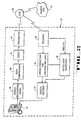
- Fig. 2 is a block diagram of the system of Fig. 1 in a telephone network application.
- Fig. 3 is a process flow of steps for utilizing the system of Fig. 2 in a transmit mode.
- Fig. 4 is a process flow of steps for utilizing the system of Fig. 2 in a receive mode.
-
- With reference to Fig. 1, a
signal processing system 10 is shown as being connected to areceiver 12. In the preferred embodiment, the system is used for voice communications with a remote site, i.e. the receiver. For example, thesystem 10 and thereceiver 12 may be separate sites within a local area network (LAN). Alternatively,links 14 and 16 between the system and the receiver may be wireless digital links of a cellular network. - While the
signal processing system 10 is preferably used in providing real-time voice communication with a remote site, the logical speech boundary segmentation to be described below may be used in other applications. In an alternative embodiment, thereceiver 12 is a storage medium, such as a computer hard disk. Digital data may be stored in packets that are determined by speech content. For example, each packet may contain data representative of a single word in a logical sequence of words. That is, the segmentation of a signal that is generated in response to a speech input is content based, rather than time based. The time-based segmentation typical of conventional systems disregards the signal content and forms data frames that are generally equal in duration, e.g. 5 milliseconds. - The
signal processing system 10 of Fig. 1 includes a speech input/output device 18. The input/output device may be a telephone. Asignal generator 20 is connected to the speech input/output device to form an electrical signal in response to speech. In one embodiment, the signal generator is an analog-to-digital converter having an input from an analog speech input/output device 18. In another embodiment, the input/output device 18 and thesignal generator 20 are a single unit that provides an analog or digital signal to downstream processing circuitry. - A continuous stream of speech information is input to a
speech recognition device 22. That is, real-time voice information is received at the speech recognition device. The device analyzes the signal to detect signal segments representative of logical speech boundaries, providing the basis for segmenting the signal. Preferably, each signal segment defined by analysis at the speech recognition device includes the signal components which comprise an isolated word. However, in some embodiments, there may be advantages to including more than one complete word within a signal segment. Similarly, there may be applications in which each signal segment comprises the speech information associated with a single syllable, so that the segmentation is implemented on a syllable-by-syllable basis. - The signal analysis at the
speech recognition device 22 may be implemented using known algorithms. Identifying particular words is not critical to some applications of the invention, since logical speech boundaries are of interest. If the segmentation is implemented on a syllable-by-syllable basis, the input signal is a time-varying speech signal and the algorithm is required to only distinguish portions of the signal that include speech from portions having silence. Thus, an intensity threshold may be designated and any portions of the speech signal having an intensity greater than the threshold may be identified as the "speech," while portions having a signal intensity less than the threshold may be identified as "non speech." However, thespeech recognition device 22 preferably is able to identify particular words, so that words remain intact during a subsequent step of packetizing the signal for transfer to thereceiver 12. - For occasions in which the
speech recognition device 22 cannot identify word boundaries for a significant period of time, a fixed timing frame may be implemented. That is, the signal segments may be limited in duration by imposing a pre-established threshold, e.g., 250 milliseconds. In such a situation, the quality of speech provided by thesignal processing system 10 will be equivalent to that achieved using prior techniques. - The output from the
speech recognition device 22 is transferred to adata compressor 24. The incoming digital voice signal is compressed, with each frame preferably containing a single word. In some embodiments of the invention, data compression is optional. For applications in which compression is employed, the specific compression algorithm is not critical to the invention, and will depend upon the application. - A
codec 26 encodes the compressed data frames from the data 5compressor 24 to form packets for transfer to thereceiver 12. Preferably, the data packets are encoded to allow error checking. If thesignal processing system 10 is one site of a network having an error detection and correction scheme, thecodec 26 follows the scheme. On the other hand, if no error correction and detection scheme is implemented on a network level, a simple checksum process may be employed. That is, an algorithm may be utilized to calculate a checksum number for each data packet that is transmitted to thereceiver 12. Prior to decoding at thereceiver 12, the same algorithm may be used to calculate a checksum number for each received packet. If the two checksum numbers are identical, the data packet is presumed to be error-free. On the other hand, if the two checksum numbers are different, it is assumed that a transmission error has been introduced. Preferably, the listener at the receiver is alerted when speech information is lost. As will be explained more fully below, notice data may be generated to introduce silence or a tone into the received speech. - As previously noted, the
receiver 12 may be a recording medium, but preferably is a remote site having reception and transmission capabilities. When thesignal processing system 10 is in a receive or readback mode, thedigital link 16 inputs a signal toerror checking circuitry 28. With checksum error checking, the checksum numbers are compared at thecircuitry 28. However, error checking is not critical to the invention. The speech information is passed to adecoder 30 that utilizes known techniques for formatting the speech information in order to accommodate voice presentation at the speech input/output device 18. The decoding operation depends upon the encoding scheme of the received packets and upon the type of input/output device, e.g., an analog or a digital telephone or audio equipment of a video conferencing station. - A more detailed and preferred embodiment of a
signal processing system 32 is shown in Fig. 2. Atelephone 34 provides an input to aspeech recognition device 36. The speech recognition device detects logical speech boundaries within the input signal and designates frames based upon the speech boundaries. For example, each frame may include the speech information for a single word. If no word boundary has been detected within a preselected duration, a frame boundary is defined. In one embodiment, the preselected duration threshold is 250 milliseconds. Thus, each frame that is defined by thesignal processing system 32 will be the lesser of 250 milliseconds and the duration of the detected speech element, e.g., a word. - A
data compression device 38 and acodec 40 compress the data within each frame and implement any desired encoding to provide data packets for transfer to aremote site 42 by means of atransmitter 44. As noted with reference to Fig. 1, data compression is optional to some embodiments of the invention. In the embodiment of Fig. 2, thesignal processing system 32 and theremote site 42 are devices within a cellular network, with the transmission being made via ahub 46. - For a voice message from a person at the
remote site 42 to a person at thesignal processing system 32, thehub 46 forwards the message from the remote site to areceiver 48 at thesystem 32. The message is forwarded in data packets of compressed speech information. Each data packet is directed to optional error correction and checkingcircuitry 50. Error correction is not a critical feature of the invention. If error correction is implemented, any known techniques may be employed. In one embodiment, checksum techniques are utilized. - Data packets that are determined to be error-free are passed from the error correction and checking
circuitry 50 to thespeech decoder 52. Depending upon the error correction techniques used within thesystem 32, the error-free packets may also be stored for potential utilization in the correction scheme. Packets that are determined to have corrupt data are "repaired," if possible. - Packets which are not correctable are forwarded to a
notice data generator 62. The notice data generator provides a packet having signal characteristics which are designed to alert a listener at thetelephone 34 that speech information has been lost. For example, a single frequency tone may be injected into the decoded speech information that is presented to the listener at thetelephone 34. Alternatively, the notice to the listener may be a silent period. The notification allows the listener to request "retransmission" of the message from the person at theremote site 42. The "retransmission" is a verbal request to repeat missed information. - In the preferred embodiment, if the period between reception of two consecutive data packets from the
remote site 42 is longer than a pre-established threshold, the system assumes that the packet has been lost in the network transmission. An acceptable threshold is 5 milliseconds, but the preferred threshold value will depend upon the application. When the threshold has been exceeded, a time-out signal is sent to thenotice data generator 62 on path 66. A notice data packet is generated and sent to thespeech decoder 52 for injection into the voice stream in place of the missing packet, thereby alerting the listener that information has been lost. - The process steps for operating the
signal processing system 32 of Fig. 2 in a transmit mode are shown in Fig. 3. Instep 68, speech information is input to the system. In Fig. 2, the speech input device is shown ' as atelephone 34, but this is not critical. - In
step 70, an electrical signal is generated in response to the speech input. The signal may be an analog signal, but digital signal processing is preferred. The signal is analyzed instep 72 using a speech recognition algorithm. Logical speech boundaries are identified by the signal analysis. In a preferred embodiment, the boundaries isolate single words within the speech information. However, the isolation may be on a syllable-by-syllable basis rather than on a word-by-word basis. As another alternative, the boundaries may isolate more than one word in a signal segment, but without dividing words. - The
decision step 74 is included for instances in which the speech recognition algorithm is unable to distinguish words. This may be a result of an inability by the speech recognition algorithm or may be a result of the input. For example, a long pause between words or sentences will result in an extended signal segment unless a time threshold is established to limit the duration of the signal segments. An acceptable time threshold is 250 milliseconds. If a logical speech boundary is identified within the 250 milliseconds, a signal segment (i.e., a frame) is defined atstep 76. If a logical speech element is not isolated within the time threshold, thedecision step 74 automatically triggers the definition of a signal segment atstep 76. - 5 In
step 78, the speech information is compressed and encoded. Known compression and encoding schemes may be utilized. The encoding may include error correction information. The resulting packets are transmitted instep 80 to a remote site. Because each packet has dimensions defined by logical speech boundaries, loss of a single packet is less likely to cause a misinterpretation at the receivingsite 42. This is particularly true if the receiving site includes means for generating notice data in response to detection of lost data. - The receive operation of the
signal processing system 32 will be described with reference to Fig. 4. Instep 82, packets of compressed speech information are received from theremote site 42. As previously noted, a threshold duration may be set between consecutive packets. If the threshold duration is exceeded, it is assumed that a packet has been lost during transmission. In Fig. 4, adecision step 84 is included to implement the threshold monitoring. All received packets are passed to an error correction and checking process (when one is utilized), but if the threshold duration is exceeded between consecutive packets, astep 88 of generating notice data is triggered. The notice data has signal characteristics that will alert a listener to the fact that data has been lost. - The error correction and checking process is executed using known techniques, such as checksum number comparison. If at
step 90 it is determined that there is no transmission error, packets are passed to thedecoding step 92 that receives the notice data generated atstep 88. Packets that are identified as having transmission errors are passed to step 94, in which it is determined whether the error is correctable. Packets having a correctable error are repaired atstep 96 and passed to thedecoding step 92. Uncorrectable errors trigger generation of notice data atstep 88, with the notice data being forwarded to the decoding step for proper placement within a continuous stream of speech information that is output atstep 98. The notice data alerts the listener that some speech information is missing. This allows the listener to request that the speaker at theremote site 42 repeat the message or provide a clarification. - Because the invention handles voice data in logical increments (e.g., words), if a packet is lost, speech information will be presented to a listener with a missing logical increment. The resulting speech will be less garbled than if random-sized pieces of words were missing. Since voice packets can be sequentially numbered, a skipped packet can be replaced with the above-mentioned notice data for alerting the listener that speech information is missing.
- While the invention has been described and illustrated primarily with regard to transmission of speech data to and from a remote site, this is not critical. In another embodiment, the
receiver 12 in Fig. 1 is a storage medium, such as a computer hard disk. Thus, with the exception of the steps of transmitting and receiving data over communication lines, all of the steps described above apply equally to the computer storage application.
Claims (10)
- A method of processing speech information comprising steps of:generating an electrical signal (70) representative of a sequence of words (68);analyzing (72) said electrical signal to detect logical boundaries of signal segments representative of isolated words within said sequence of words;segmenting (76) said electrical signal at least partially by designating frame boundaries based upon the logical boundaries of said signal segments representative of isolated words, thereby forming frames of speech information; anddata compressing (78) said speech information within said frames.
- The method of claim 1 further comprising steps of forming said frames of data compressed speech information into packets and transmitting (80) said packets to a remote site (42).
- The method of claim 1 or 2 wherein said step of generating (70) said electrical signal includes forming a digital signal and wherein said step of analyzing (72) includes utilizing word recognition techniques (22; 36).
- The method of claim 1, 2 or 3 wherein said step of segmenting (76) includes establishing a time threshold (74) and includes forming said frames based upon limiting each frame to containing the lesser of data specific to an isolated word of said sequence of words (68) and data generated during passage of said time threshold.
- The method of claim 2 further comprising steps of receiving packets (82) of data compressed speech information from said remote site (42) and error checking (90) said received packets.
- The method of claim 5 further comprising steps of data decompressing (92) said speech information of said received packets (82) to form a continuous stream and injecting notice data (88) into said stream when said step of error checking (90) determines that speech information has been lost.
- A system (10; 32) for processing speech information comprising:a speech input device (18; 34);a signal generator (20) responsive to said speech input for forming an electrical signal at an output;speech recognition logic (22; 36) coupled to said output of said signal generator for detecting logical boundaries of signal segments representative of isolated words and designating frame boundaries based upon the logical boundaries, thereby from frames; andcompression circuitry (24; 40), connected to said speech recognition logic, for compressing data within said frames.
- The system of claim 7 further comprising a transmitter (44) connected to said compression circuitry (24; 40) for transferring said frames to a remote site (42).
- The system of claim 7 or 8 wherein said signal generator (20) is a digital device and said speech input device is a telephone (34).
- The system of claim 8 further comprising a receiver (48) connected to receive signal segments from said remote site (42), said receiver having error checking circuitry (28; 50) for detecting a missing frame.
Applications Claiming Priority (2)
| Application Number | Priority Date | Filing Date | Title |
|---|---|---|---|
| US08/800,001 US6167374A (en) | 1997-02-13 | 1997-02-13 | Signal processing method and system utilizing logical speech boundaries |
| US800001 | 2004-03-12 |
Publications (3)
| Publication Number | Publication Date |
|---|---|
| EP0859353A2 EP0859353A2 (en) | 1998-08-19 |
| EP0859353A3 EP0859353A3 (en) | 1999-03-03 |
| EP0859353B1 true EP0859353B1 (en) | 2003-06-18 |
Family
ID=25177265
Family Applications (1)
| Application Number | Title | Priority Date | Filing Date |
|---|---|---|---|
| EP98101792A Expired - Lifetime EP0859353B1 (en) | 1997-02-13 | 1998-02-03 | Signal processing method and system utilizing logical speech boundaries |
Country Status (3)
| Country | Link |
|---|---|
| US (1) | US6167374A (en) |
| EP (1) | EP0859353B1 (en) |
| DE (1) | DE69815562T2 (en) |
Families Citing this family (13)
| Publication number | Priority date | Publication date | Assignee | Title |
|---|---|---|---|---|
| US6078566A (en) * | 1998-04-28 | 2000-06-20 | Genesys Telecommunications Laboratories, Inc. | Noise reduction techniques and apparatus for enhancing wireless data network telephony |
| US6795406B2 (en) | 1999-07-12 | 2004-09-21 | Genesys Telecommunications Laboratories, Inc. | Methods and apparatus for enhancing wireless data network telephony, including quality of service monitoring and control |
| WO2000002236A2 (en) * | 1998-07-07 | 2000-01-13 | Memc Electronic Materials, Inc. | Radio frequency identification system and method for tracking silicon wafers |
| DE19939102C1 (en) * | 1999-08-18 | 2000-10-26 | Siemens Ag | Method and arrangement for recognizing speech |
| AU2001294989A1 (en) * | 2000-10-04 | 2002-04-15 | Clarity, L.L.C. | Speech detection |
| JP2004515800A (en) * | 2000-10-05 | 2004-05-27 | オクイン,ディー.ジーン | A device that converts voice to data |
| US20040049377A1 (en) * | 2001-10-05 | 2004-03-11 | O'quinn D Gene | Speech to data converter |
| WO2003049389A1 (en) * | 2001-12-06 | 2003-06-12 | Siemens Aktiengesellschaft | Method and device for transferring sound and/or voice data in a packet-oriented communication system |
| JP4667082B2 (en) * | 2005-03-09 | 2011-04-06 | キヤノン株式会社 | Speech recognition method |
| JP4557919B2 (en) * | 2006-03-29 | 2010-10-06 | 株式会社東芝 | Audio processing apparatus, audio processing method, and audio processing program |
| US8255218B1 (en) * | 2011-09-26 | 2012-08-28 | Google Inc. | Directing dictation into input fields |
| US8543397B1 (en) | 2012-10-11 | 2013-09-24 | Google Inc. | Mobile device voice activation |
| US10855841B1 (en) * | 2019-10-24 | 2020-12-01 | Qualcomm Incorporated | Selective call notification for a communication device |
Family Cites Families (17)
| Publication number | Priority date | Publication date | Assignee | Title |
|---|---|---|---|---|
| US3582559A (en) * | 1969-04-21 | 1971-06-01 | Scope Inc | Method and apparatus for interpretation of time-varying signals |
| JPS5544624A (en) * | 1978-09-25 | 1980-03-29 | Nec Corp | Information input/output unit |
| NL8202318A (en) * | 1982-06-09 | 1984-01-02 | Koninkl Philips Electronics Nv | SYSTEM FOR THE TRANSFER OF VOICE OVER A DISTURBED TRANSMISSION. |
| US4707858A (en) * | 1983-05-02 | 1987-11-17 | Motorola, Inc. | Utilizing word-to-digital conversion |
| EP0139803B1 (en) * | 1983-10-28 | 1987-10-14 | International Business Machines Corporation | Method of recovering lost information in a digital speech transmission system, and transmission system using said method |
| US5218668A (en) * | 1984-09-28 | 1993-06-08 | Itt Corporation | Keyword recognition system and method using template concantenation model |
| US4761796A (en) * | 1985-01-24 | 1988-08-02 | Itt Defense Communications | High frequency spread spectrum communication system terminal |
| US5127051A (en) * | 1988-06-13 | 1992-06-30 | Itt Corporation | Adaptive modem for varying communication channel |
| US5222190A (en) * | 1991-06-11 | 1993-06-22 | Texas Instruments Incorporated | Apparatus and method for identifying a speech pattern |
| US5305421A (en) * | 1991-08-28 | 1994-04-19 | Itt Corporation | Low bit rate speech coding system and compression |
| US5483618A (en) * | 1991-12-26 | 1996-01-09 | International Business Machines Corporation | Method and system for distinguishing between plural audio responses in a multimedia multitasking environment |
| US5305422A (en) * | 1992-02-28 | 1994-04-19 | Panasonic Technologies, Inc. | Method for determining boundaries of isolated words within a speech signal |
| EP0559349B1 (en) * | 1992-03-02 | 1999-01-07 | AT&T Corp. | Training method and apparatus for speech recognition |
| US5546395A (en) * | 1993-01-08 | 1996-08-13 | Multi-Tech Systems, Inc. | Dynamic selection of compression rate for a voice compression algorithm in a voice over data modem |
| US5452289A (en) * | 1993-01-08 | 1995-09-19 | Multi-Tech Systems, Inc. | Computer-based multifunction personal communications system |
| IT1270919B (en) * | 1993-05-05 | 1997-05-16 | Cselt Centro Studi Lab Telecom | SYSTEM FOR THE RECOGNITION OF ISOLATED WORDS INDEPENDENT OF THE SPEAKER THROUGH NEURAL NETWORKS |
| JP3533696B2 (en) * | 1994-03-22 | 2004-05-31 | 三菱電機株式会社 | Speech recognition boundary estimation method and speech recognition device |
-
1997
- 1997-02-13 US US08/800,001 patent/US6167374A/en not_active Expired - Lifetime
-
1998
- 1998-02-03 EP EP98101792A patent/EP0859353B1/en not_active Expired - Lifetime
- 1998-02-03 DE DE69815562T patent/DE69815562T2/en not_active Expired - Lifetime
Also Published As
| Publication number | Publication date |
|---|---|
| EP0859353A2 (en) | 1998-08-19 |
| US6167374A (en) | 2000-12-26 |
| DE69815562D1 (en) | 2003-07-24 |
| DE69815562T2 (en) | 2004-04-29 |
| EP0859353A3 (en) | 1999-03-03 |
Similar Documents
| Publication | Publication Date | Title |
|---|---|---|
| US6597961B1 (en) | System and method for concealing errors in an audio transmission | |
| US6167374A (en) | Signal processing method and system utilizing logical speech boundaries | |
| US6850559B1 (en) | System and methods for transmitting data | |
| US6725191B2 (en) | Method and apparatus for transmitting voice over internet | |
| US7180434B2 (en) | Audio data code conversion transmission method and code conversion reception method, device, system, and program | |
| US9437216B2 (en) | Method of transmitting data in a communication system | |
| WO2004059894A2 (en) | Method and device for compressed-domain packet loss concealment | |
| CN100390772C (en) | Systems and methods for resynchronizing drifting data streams | |
| EP0680034B1 (en) | Mobile radio communication system using a sound or voice activity detector and convolutional coding | |
| JP2003241799A (en) | Acoustic encoding method, decoding method, encoding device, decoding device, encoding program, decoding program | |
| CN1135786C (en) | Method and device for providing multi-party voice connection in wireless communication system | |
| EP0894409B1 (en) | Detection of speech channel back-looping | |
| CN110149452A (en) | A method of it reducing network packet loss rate and promotes call sound effect | |
| US6185526B1 (en) | Speech transmission and reception system for digital communication | |
| JP3931594B2 (en) | Retransmission method for multipoint broadcast networks | |
| KR20000068950A (en) | Transmission system with improved reconstruction of missing parts | |
| US7856096B2 (en) | Erasure of DTMF signal transmitted as speech data | |
| Wang | A Beat-Pattern based Error Concealment Scheme for Music Delivery with Burst Packet Loss. | |
| US8023428B2 (en) | Method and apparatus for QoS improvement with packet voice transmission over wireless LANs | |
| JP4758687B2 (en) | Voice packet transmission method, voice packet reception method, apparatus using the methods, program, and recording medium | |
| US20050229046A1 (en) | Evaluation of received useful information by the detection of error concealment | |
| JPH07283757A (en) | Voice data communication device | |
| US8300622B2 (en) | Systems and methods for tandem free operation signal transmission | |
| KR100406232B1 (en) | Method for Transmission Error Notification in VoDSL Gateway | |
| US20050268198A1 (en) | Error processing of user information received by a communication network |
Legal Events
| Date | Code | Title | Description |
|---|---|---|---|
| PUAI | Public reference made under article 153(3) epc to a published international application that has entered the european phase |
Free format text: ORIGINAL CODE: 0009012 |
|
| AK | Designated contracting states |
Kind code of ref document: A2 Designated state(s): DE FR GB IT |
|
| AX | Request for extension of the european patent |
Free format text: AL;LT;LV;MK;RO;SI |
|
| PUAL | Search report despatched |
Free format text: ORIGINAL CODE: 0009013 |
|
| 17P | Request for examination filed |
Effective date: 19981218 |
|
| AK | Designated contracting states |
Kind code of ref document: A3 Designated state(s): AT BE CH DE DK ES FI FR GB GR IE IT LI LU MC NL PT SE |
|
| AX | Request for extension of the european patent |
Free format text: AL;LT;LV;MK;RO;SI |
|
| AKX | Designation fees paid |
Free format text: DE FR GB IT |
|
| RAP1 | Party data changed (applicant data changed or rights of an application transferred) |
Owner name: SIEMENS INFORMATION AND COMMUNICATION NETWORKS, IN |
|
| GRAH | Despatch of communication of intention to grant a patent |
Free format text: ORIGINAL CODE: EPIDOS IGRA |
|
| RIC1 | Information provided on ipc code assigned before grant |
Free format text: 7G 10L 11/02 A |
|
| RIC1 | Information provided on ipc code assigned before grant |
Free format text: 7G 10L 11/02 A |
|
| GRAH | Despatch of communication of intention to grant a patent |
Free format text: ORIGINAL CODE: EPIDOS IGRA |
|
| GRAA | (expected) grant |
Free format text: ORIGINAL CODE: 0009210 |
|
| AK | Designated contracting states |
Designated state(s): DE FR GB IT |
|
| REG | Reference to a national code |
Ref country code: GB Ref legal event code: FG4D |
|
| REF | Corresponds to: |
Ref document number: 69815562 Country of ref document: DE Date of ref document: 20030724 Kind code of ref document: P |
|
| PLBE | No opposition filed within time limit |
Free format text: ORIGINAL CODE: 0009261 |
|
| STAA | Information on the status of an ep patent application or granted ep patent |
Free format text: STATUS: NO OPPOSITION FILED WITHIN TIME LIMIT |
|
| ET | Fr: translation filed | ||
| 26N | No opposition filed |
Effective date: 20040319 |
|
| REG | Reference to a national code |
Ref country code: DE Ref legal event code: R082 Ref document number: 69815562 Country of ref document: DE Representative=s name: THOMAS MICHAEL FRITZSCHE, DE |
|
| REG | Reference to a national code |
Ref country code: DE Ref legal event code: R082 Ref document number: 69815562 Country of ref document: DE Representative=s name: FRITZSCHE PATENTANWAELTE, DE Effective date: 20120404 Ref country code: DE Ref legal event code: R082 Ref document number: 69815562 Country of ref document: DE Representative=s name: FRITZSCHE PATENT, DE Effective date: 20120404 Ref country code: DE Ref legal event code: R081 Ref document number: 69815562 Country of ref document: DE Owner name: UNIFY INC. (N.D.GES.D. STAATES DELAWARE), BOCA, US Free format text: FORMER OWNER: SIEMENS INFORMATION AND COMMUNICATION NETWORKS, INC., BOCA RATON, FLA., US Effective date: 20120404 Ref country code: DE Ref legal event code: R081 Ref document number: 69815562 Country of ref document: DE Owner name: UNIFY INC. (N.D.GES.D. STAATES DELAWARE), US Free format text: FORMER OWNER: SIEMENS INFORMATION AND COMMUNICATION NETWORKS, INC., BOCA RATON, US Effective date: 20120404 |
|
| REG | Reference to a national code |
Ref country code: DE Ref legal event code: R082 Ref document number: 69815562 Country of ref document: DE Representative=s name: FRITZSCHE PATENT, DE |
|
| REG | Reference to a national code |
Ref country code: DE Ref legal event code: R079 Ref document number: 69815562 Country of ref document: DE Free format text: PREVIOUS MAIN CLASS: G10L0011020000 Ipc: G10L0025000000 |
|
| REG | Reference to a national code |
Ref country code: DE Ref legal event code: R082 Ref document number: 69815562 Country of ref document: DE Representative=s name: FRITZSCHE PATENTANWAELTE, DE Effective date: 20140110 Ref country code: DE Ref legal event code: R082 Ref document number: 69815562 Country of ref document: DE Representative=s name: FRITZSCHE PATENT, DE Effective date: 20140110 Ref country code: DE Ref legal event code: R081 Ref document number: 69815562 Country of ref document: DE Owner name: UNIFY INC. (N.D.GES.D. STAATES DELAWARE), BOCA, US Free format text: FORMER OWNER: SIEMENS ENTERPRISE COMMUNICATIONS, INC., BOCA RATON, FLA., US Effective date: 20140110 Ref country code: DE Ref legal event code: R081 Ref document number: 69815562 Country of ref document: DE Owner name: UNIFY INC. (N.D.GES.D. STAATES DELAWARE), US Free format text: FORMER OWNER: SIEMENS ENTERPRISE COMMUNICATIONS, INC., BOCA RATON, US Effective date: 20140110 Ref country code: DE Ref legal event code: R079 Ref document number: 69815562 Country of ref document: DE Free format text: PREVIOUS MAIN CLASS: G10L0011020000 Ipc: G10L0025000000 Effective date: 20140527 |
|
| PGFP | Annual fee paid to national office [announced via postgrant information from national office to epo] |
Ref country code: IT Payment date: 20150225 Year of fee payment: 18 |
|
| REG | Reference to a national code |
Ref country code: FR Ref legal event code: PLFP Year of fee payment: 19 |
|
| PGFP | Annual fee paid to national office [announced via postgrant information from national office to epo] |
Ref country code: DE Payment date: 20160218 Year of fee payment: 19 |
|
| PGFP | Annual fee paid to national office [announced via postgrant information from national office to epo] |
Ref country code: FR Payment date: 20160222 Year of fee payment: 19 Ref country code: GB Payment date: 20160222 Year of fee payment: 19 |
|
| REG | Reference to a national code |
Ref country code: FR Ref legal event code: TP Owner name: UNIFY, INC., US Effective date: 20160524 Ref country code: FR Ref legal event code: CD Owner name: UNIFY, INC., US Effective date: 20160524 |
|
| PG25 | Lapsed in a contracting state [announced via postgrant information from national office to epo] |
Ref country code: IT Free format text: LAPSE BECAUSE OF NON-PAYMENT OF DUE FEES Effective date: 20160203 |
|
| REG | Reference to a national code |
Ref country code: DE Ref legal event code: R119 Ref document number: 69815562 Country of ref document: DE |
|
| GBPC | Gb: european patent ceased through non-payment of renewal fee |
Effective date: 20170203 |
|
| REG | Reference to a national code |
Ref country code: FR Ref legal event code: ST Effective date: 20171031 |
|
| PG25 | Lapsed in a contracting state [announced via postgrant information from national office to epo] |
Ref country code: DE Free format text: LAPSE BECAUSE OF NON-PAYMENT OF DUE FEES Effective date: 20170901 Ref country code: FR Free format text: LAPSE BECAUSE OF NON-PAYMENT OF DUE FEES Effective date: 20170228 |
|
| PG25 | Lapsed in a contracting state [announced via postgrant information from national office to epo] |
Ref country code: GB Free format text: LAPSE BECAUSE OF NON-PAYMENT OF DUE FEES Effective date: 20170203 |