EP0858068A2 - Verfahren zur Erzeugung eines hemmenden Referenzmusters - Google Patents
Verfahren zur Erzeugung eines hemmenden Referenzmusters Download PDFInfo
- Publication number
- EP0858068A2 EP0858068A2 EP98102205A EP98102205A EP0858068A2 EP 0858068 A2 EP0858068 A2 EP 0858068A2 EP 98102205 A EP98102205 A EP 98102205A EP 98102205 A EP98102205 A EP 98102205A EP 0858068 A2 EP0858068 A2 EP 0858068A2
- Authority
- EP
- European Patent Office
- Prior art keywords
- speaker
- inhibiting
- feature vector
- reference pattern
- true
- Prior art date
- Legal status (The legal status is an assumption and is not a legal conclusion. Google has not performed a legal analysis and makes no representation as to the accuracy of the status listed.)
- Withdrawn
Links
- 238000000034 method Methods 0.000 title claims description 60
- 230000002401 inhibitory effect Effects 0.000 claims abstract description 469
- 239000013598 vector Substances 0.000 claims abstract description 343
- 230000006870 function Effects 0.000 claims abstract description 168
- 238000013507 mapping Methods 0.000 claims abstract description 116
- 238000006243 chemical reaction Methods 0.000 abstract 1
- 230000006978 adaptation Effects 0.000 description 33
- 238000012795 verification Methods 0.000 description 27
- 230000007613 environmental effect Effects 0.000 description 13
- 230000003595 spectral effect Effects 0.000 description 10
- 238000001228 spectrum Methods 0.000 description 9
- 238000010586 diagram Methods 0.000 description 8
- 238000010606 normalization Methods 0.000 description 7
- 238000004364 calculation method Methods 0.000 description 6
- 238000012545 processing Methods 0.000 description 4
- 239000000654 additive Substances 0.000 description 2
- 230000000996 additive effect Effects 0.000 description 2
- 238000012549 training Methods 0.000 description 2
- LFYJSSARVMHQJB-QIXNEVBVSA-N bakuchiol Chemical compound CC(C)=CCC[C@@](C)(C=C)\C=C\C1=CC=C(O)C=C1 LFYJSSARVMHQJB-QIXNEVBVSA-N 0.000 description 1
- 238000010276 construction Methods 0.000 description 1
- 230000000694 effects Effects 0.000 description 1
- 238000004519 manufacturing process Methods 0.000 description 1
- 238000012986 modification Methods 0.000 description 1
- 230000004048 modification Effects 0.000 description 1
- 230000001737 promoting effect Effects 0.000 description 1
- 238000013139 quantization Methods 0.000 description 1
Images




Classifications
-
- G—PHYSICS
- G10—MUSICAL INSTRUMENTS; ACOUSTICS
- G10L—SPEECH ANALYSIS TECHNIQUES OR SPEECH SYNTHESIS; SPEECH RECOGNITION; SPEECH OR VOICE PROCESSING TECHNIQUES; SPEECH OR AUDIO CODING OR DECODING
- G10L17/00—Speaker identification or verification techniques
- G10L17/04—Training, enrolment or model building
Definitions
- the present invention relates to inhibiting reference pattern (or Cohort pattern) generating methods used in speaker verification systems.
- This normalization employs N selected inhibiting speakers, whose speeches more closely resemble speech of the speaker to be verified, and distance calculation for verification is performed by subtracting inhibiting speaker's likelihoods from likelihood of the speaker to be verified.
- the inhibiting speaker's likelihoods to be subtracted may be various conceivable values, such as their maximum or mean values. It is thought that the environmental differences at the time of registration and at the time of verification can be removed by subtracting the inhibiting speaker's likelihoods from the likelihood of the speaker to be verified. This is so because the environmental differences affect likewise the likelihood of the speaker to be verified and the inhibiting speaker's likelihoods.
- Fig. 10 is a block diagram illustrating the prior art inhibiting speaker's reference pattern generating method.
- an analyzer 1010 converts input speech of the true speaker into feature vector
- an inhibiting speaker selector 1030 selects inhibiting speakers in the order of higher similarities between feature vector and inhibiting speaker's reference patterns, which are stored in an inhibiting speaker's reference pattern memory 1020.
- Another problem in the prior art is encountered in case when different words or contents are spoken by the true speaker and inhibiting speaker.
- continuous phone recognition of an unknown content speech of the true speaker are performed, and inhibiting speaker's reference patterns corresponding to unknown content speeches are generated by connecting phone patterns by using the result of the recognition.
- the quality of the inhibiting speaker's reference patterns is influenced by the continuous phone recognition performance.
- An object of the present invention there is provided an inhibiting reference pattern (or Cohort pattern) generating method with high speaker verification accuracy with fewer inhibiting speaker's reference patterns even when the speaker verification is performed in connection with different environments at the time of registration and at the time of verification.
- an inhibiting reference pattern (or Cohort pattern) generating method capable of creating accurate inhibiting speaker's reference patterns even when different words are uttered by the true speaker and inhibiting speakers.
- an inhibiting speaker's reference pattern generating system comprising: an analyzer for converting an input speech of the true speaker into feature vectors; a feature vector memory for storing the feature vector obtained in the analyzer; an inhibiting speaker's reference pattern memory with one or more inhibiting speaker's reference patterns stored therein; an inhibiting speaker selector for calculating similarity or similarities between the inhibiting speaker's reference pattern or patterns stored in the inhibiting speaker's reference pattern memory and the feature vector obtained in the analyzer and selecting one or more inhibiting speakers; an estimator for obtaining mapping function or functions from inhibiting speaker's feature vector space or spaces to feature vector space of the true speaker, by using the selected inhibiting speaker's reference pattern or patterns and the feature vector of the true speaker, stored in the feature vector memory; and an adapter for adapting the inhibiting speaker's reference pattern or patterns stored in the inhibiting speaker's reference pattern memory on the basis of the mapping function or functions obtained in the estimator.
- an inhibiting speaker's reference pattern generating system comprising: an analyzer for converting an input speech of the true speaker into feature vectors; a feature vector memory for storing the feature vector obtained in the analyzer; an inhibiting speaker's reference pattern memory with one or more inhibiting speaker's reference patterns stored therein; an inhibiting speaker selector for calculating similarity or similarities between the inhibiting speaker's reference pattern or patterns stored in the inhibiting speaker's reference pattern memory and the feature vector obtained in the analyzer and selecting one or more inhibiting speakers; an estimator for obtaining mapping function or functions from inhibiting speaker's feature vector space or spaces to feature vector space of the true speaker, by using the selected inhibiting speaker's reference pattern or patterns and feature vector of the speaker to be verified, obtained from a first speech of known content stored in the feature vector memory; an adapter for adapting the inhibiting speaker's reference pattern or patterns stored in the inhibiting speaker's reference pattern memory on the basis of the mapping function or functions obtained in the estimator; an alignment estimator
- an inhibiting speaker's reference patter generating system comprising: an analyzer for converting an input speech of the true speaker into feature vectors; a feature vector memory for storing the feature vector obtained in the analyzer; an inhibiting speaker's reference pattern memory with one or more inhibiting speaker's reference patterns stored therein; an inhibiting speaker selector for calculating similarity or similarities between the inhibiting speaker's reference pattern or patterns stored in the inhibiting speaker's reference pattern memory and the feature vector obtained in the analyzer and selecting one or more inhibiting speakers; an estimator for obtaining mapping function or functions from inhibiting speaker's feature vector space or spaces to feature vector space of the true speaker, by using the selected inhibiting speaker's reference pattern or patterns and feature vector of the true speaker, obtained from a first speech of known content thereof stored in the feature vector memory; an adapter for adapting the inhibiting speaker's reference pattern or patterns stored in the inhibiting speaker's reference pattern memory on the basis of the mapping function or functions obtained in the estimator; an alignment estimator
- an inhibiting speaker's reference pattern generating system comprising: an analyzer for converting an input speech of the true speaker into feature vectors; a feature vector memory for storing the feature vector obtained in the analyzer; an inhibiting speaker's reference pattern memory with one or more inhibiting speaker's reference patterns stored therein; an inhibiting speaker selector for calculating similarity or similarities between the inhibiting speaker's reference pattern or patterns stored in the inhibiting speaker's reference pattern memory and the feature vector obtained in the analyzer and selecting one or more inhibiting speakers; an estimator for obtaining mapping function or functions from feature vector space of the true speaker to inhibiting speaker's feature vector space or spaces, by using the selected inhibiting speaker's reference pattern or patterns and feature vector of the true speaker stored in the feature vector memory; a reference pattern generator for creating reference pattern of the true speaker by using the feature vector stored in the feature vector memory; and an adapter for adapting the speaker's reference pattern or patterns obtained in the reference pattern generator on the basis of the mapping function or functions obtained in the
- an inhibiting speaker's reference pattern generating system comprising: an analyzer for converting an input speech of the true speaker into feature vectors; a feature vector memory for storing the feature vector obtained in the analyzer; an inhibiting speaker's reference pattern memory with one or more inhibiting speaker's reference patterns stored therein; an estimator for obtaining mapping function or functions from inhibiting speaker's feature vector space or spaces to feature vector space of the true speaker by using the feature vector obtained in the analyzer and the inhibiting speaker's reference pattern or patterns stored in the inhibiting speaker's reference pattern memory; an adapter for adapting the inhibiting speaker's reference pattern or patterns stored in the inhibiting speaker's reference pattern memory on the basis of the mapping function or functions obtained in the estimator; and inhibiting speaker selector for calculating similarities between the adapted reference pattern or patterns obtained in the adapter and the feature vector of the true speaker, stored in the feature vector memory.
- an inhibiting speaker's reference pattern generating system comprising: an analyzer for converting an input speech of the true speaker into feature vectors; a feature vector memory for storing the feature vector obtained in the analyzer; an inhibiting speaker's reference pattern memory with one or more inhibiting speaker's reference patterns stored therein; an estimator for estimating mapping function or functions from inhibiting speaker's feature vector space or spaces to feature factor of the true speaker, by using the converted feature vector of the true speaker, obtained from a first speech of known content and the inhibiting speaker's reference pattern or patterns stored in the inhibiting speaker's reference pattern memory; an adapter for adapting the inhibiting speaker's reference pattern or patterns stored in the inhibiting speaker's reference pattern memory on the basis of the mapping function or functions obtained in the estimator; an alignment estimator for estimating alignment or alignments of feature vector of the true speaker, obtained from a second speech of unknown content stored in the feature vector memory, by using the adapted reference pattern or patterns obtained in the adapter, and generating inhibit
- an inhibiting speaker's reference pattern generating system comprising: an analyzer for converting an input speech of the true speaker into feature vectors; a feature vector memory for storing the feature vector obtained in the analyzer; an inhibiting speaker's reference pattern memory with one or more inhibiting speaker's reference patterns stored therein; an estimator for estimating mapping function or functions from inhibiting speaker's feature vector space or spaces to feature factor of the true speaker, by using the converted feature vector of the true speaker, obtained from a first speech of known content and the inhibiting speaker's reference pattern or patterns stored in the inhibiting speaker's reference pattern memory; an alignment estimator for estimating alignment or alignments of feature vector of the true speaker, obtained form a second speech of unknown content stored in the feature vector memory, by using the inhibiting speaker's reference pattern or patterns stored in the inhibiting speaker's reference memory, and creating inhibiting speaker's reference pattern or patterns corresponding to the second speech on the basis of the estimated alignment or alignments; an adapter for adapting the reference pattern or
- an inhibiting speaker's reference pattern generating system comprising: an analyzer for converting an input speech of the true speaker into feature vectors; a feature vector memory for storing the feature vector obtained in the analyzer; an inhibiting speaker's reference pattern memory with one or more inhibiting speaker's reference patterns stored therein; an estimator for obtaining mapping function or functions from feature vector space of the true speaker to inhibiting speaker's feature vector space or spaces, by using the converted feature vector obtained in the analyzer and the inhibiting speaker's reference pattern or patterns stored in the inhibiting speaker's reference pattern memory; a reference pattern generator for generating reference pattern of the true speaker by using the feature vector of the true speaker, stored in the feature vector memory; an adapter for adapting the reference pattern of the true speaker, obtained in the reference pattern generator, on the basis of the mapping function or functions obtained in the estimator; and an inhibiting speaker selector for calculating similarity or similarities between the adapted reference pattern or patterns obtained in the adapter and the feature vector of the true speaker, stored in
- a speaker verifying system comprising: an analyzer for converting an input speech of the speaker to be verified into feature vectors; an inhibiting reference pattern generator including above the feature vector memory, inhibiting speaker reference pattern memory, inhibiting speaker selector, estimator and reference pattern generator; a speaker's reference pattern memory with one or more speaker's reference patterns stored therein; a distance calculator for normalizing distance or distances by subtracting the distance between the feature vector or vectors and the reference pattern or patterns of the inhibiting speaker or speakers from the distance between the feature vector and the reference pattern of the true speaker on the basis of the converted feature vector of the speaker to be verified, the inhibiting speaker's reference pattern or patterns generated in the inhibiting speaker's reference pattern generator and the reference pattern of the true speaker, stored in a reference pattern memory; and a verifier for verifying the speaker to be verified on the basis of the normalized distance or distances calculated in the distance calculator.
- an inhibiting speaker's reference pattern generating method which performs the above processings.
- a recording medium storing programs which is to be performed by processor according to the above processings.
- the likelihood normalization based on inhibiting speaker's reference patterns speakers having voice characters resembling that of the true speaker are selected as inhibiting speakers, and distance calculation for the speaker verification is executed by subtracting inhibiting speaker's likelihoods from likelihood of the speaker to be verified.
- the inhibiting speaker's likelihoods may be various values, such as their maximum or mean value.
- the likelihood normalization based on inhibiting speaker's reference patterns is expressed by following formula (1). where log (p(O/I)) is the likelihood of probability that observation vector O for a model of the speaker I is observed, and log (p(O/ck(I)) is the likelihood of probability that observation vector O for the reference pattern of k-th inhibiting speaker in inhibiting speaker set C(I) with respect to the speaker I is observed.
- stat represents various statistical calculation methods, such as one in which the maximum or mean inhibiting speaker's likelihood is taken.
- Score represents the normalized likelihood. It is thought that the environmental differences at the time of registration and at the time of verification can be removed by subtracting the inhibiting speaker's likelihood from the likelihood of the speaker to be verified, because the environmental differences affect likewise the likelihood of the speaker to be verified and the inhibiting speaker's likelihood.
- the prior art method has the problems that a large number of inhibiting speaker's reference patterns should be to be able to cope with a variety of line characteristics, and that accurate inhibiting speaker's reference patterns cannot be generated in case when different words or contents are spoken by the true speaker and inhibiting speakers.
- this invention seeks to provide an inhibiting speaker's reference pattern generating method utilizing adaptation, and also a speaker verification apparatus using the same method.
- the adaptation utilized may be fast environmental adaptation (RIALISE method) as proposed by Takagi, "Speech Recognition with Environmental Adaptation by Spectrum Equalization", Onkyoh Kohron, pp. 173-174, 1994/3 (hereinafter referred to as Literature 5), tree structured speaker adaptation (ACTS) as proposed by Shinoda, "Speaker Adaptation Using Tree-Structured Probability Density Function", Onkyo Kohron, pp.
- RIALISE method fast environmental adaptation
- ACTS tree structured speaker adaptation
- Literature 6 speaker adaptation using spectral interpolation as proposed by Shinoda, "Speaker Adaptation for Demi-Syllable Based Speech Recognition Using HMM", Onkyo Kohron, pp. 23-24, 1991/9 (hereinafter referred to as Literature 7).
- the fast environmental adaptation is a method, in which difference of line distortion or additional noise between reference pattern and speech are taken out on the spectral axis by using the speech itself at the time of the recognition, and reference patterns are adapted to the environment, under which the speech is spoken.
- the formula (2) represents an adaptation concerning noise part of the reference patterns
- the formula (3) represents speech part of the reference patterns.
- Sw is the mean spectrum of speech model of the reference patterns
- Nw is the mean spectrum of noise model of the reference patterns
- Sv is the mean spectrum of input speech corresponding to speech interval
- Nv the mean spectrum of input speech corresponding to noise interval.
- the method may be used in various conceivable forms or modes for the inhibiting speaker's reference pattern (or Cohort pattern) production.
- mapping functions from inhibiting speaker's feature vector spaces to feature vector space of the true speaker are obtained after inhibiting speaker selection, and inhibiting speaker's reference patterns are adapted by using the mapping functions thus obtained.
- the adaptation is performed by using speech of the true speaker at the time of registration, so that it is possible to produce new inhibiting speaker's reference patterns under environments including that at the time of registration. It is thus possible to remove environmental differences (due to additive noise, line characteristics, etc.) between reference pattern of the true speaker and inhibiting speaker's reference patterns, and obtain higher speaker verification accuracy with fewer inhibiting speaker's reference patterns.
- mapping functions from inhibiting speaker's feature vector space to feature vector space of the true speaker are obtained by using a first speech (of known content) of the true speaker after inhibiting speaker selection, inhibiting speaker's reference patterns are adapted by using the mapping functions thus obtained, and inhibiting speaker's reference patterns corresponding to a second speech (of unknown content) of the true speaker are generated by using the adapted reference patterns.
- inhibiting speaker's reference patterns can be generated even in case when different words are uttered by the true speaker and inhibiting speakers.
- adaptation can be performed by using continuous phone recognition of an unknown content speech of the true speaker and estimating mapping functions on the basis of the recognized speech content.
- the accuracy of the mapping function estimation is low.
- this method has an advantage that highly accurate inhibiting speaker's reference patterns can be generated because the mapping function estimation can be obtained by using a known content speech.
- mapping functions from inhibiting speaker's feature vector spaces to feature vector space of the true speaker are obtained by using a first speech (of known content) of the true speaker after inhibiting speaker selection, and inhibiting speaker's reference patterns concerning a second speech (of unknown content) of the true speaker are adapted by using the mapping functions thus obtained.
- This third method has substantially the same advantages as the second method. However, in case when SNR is low at the time of registration so that satisfactory mapping function estimation cannot be obtained, more accurate inhibiting speaker's reference patterns can be generated in the third method than in the second method.
- mapping functions from feature vector space of the true speaker to inhibiting speaker's feature vector space are obtained, and reference pattern of the true speaker is adapted by using the mapping functions thus obtained.
- This fourth method has an advantage that time structure features of the reference pattern of the true speaker at the time of registration can be reflected on inhibiting speaker's reference patterns.
- the fourth method also has the same effects as mentioned above in case when different words contents are spoken by the speaker to be verified and inhibiting speakers.
- a fifth method inhibiting speaker's reference patterns used for the mapping function estimation in the above first to fourth methods, are contained features of two or more speakers.
- this reference patterns used for the mapping function estimation contain features of two or more speakers, this reference patterns can be expressed as a reference pattern having features of plural speakers with a single reference pattern. It is possible to obtain stable mapping function with fewer inhibiting speaker's reference patterns, and thus obtain higher speaker verification accuracy with less computational amount.
- reference pattern of the true speaker is adapted by using all inhibiting speaker's reference patterns, and adapted inhibiting speaker's reference patterns are selected in the order of shorter distances thereof from the reference pattern of the true speaker.
- This sixth method is the same in principle as the first to fifth methods. Besides, the method has an advantage that more accurate inhibiting speaker's reference patterns can be generated because it is possible to take the accuracy at the time of the adaptation into considerations.
- the inhibiting speaker's reference pattern (or Cohort pattern) generating method according to the invention, higher speaker verification accuracy can be obtained with fewer inhibiting speaker's reference patterns.
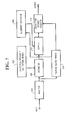
- Fig. 1 is a block diagram showing a first embodiment of the invention.
- mapping functions from the inhibiting speaker's feature vector spaces to feature vector space of the true speaker is obtained after inhibiting speaker selection, and inhibiting speaker's reference patterns are adapted by using the mapping functions thus obtained.
- input speech of the true speaker is supplied to an analyzer 10.
- the analyzer 10 converts the input speech into feature vector, which is supplied to a feature vector memory 30 and also to an inhibiting speaker selector 40.
- the feature vector may be cepstrum, delta cepstrum or the like.
- Literature 8 Furui, "Digital Speech Processing", Tokai University Publishing Association, pp. 44-47, 1985 (hereinafter referred to as Literature 8) may be referred to.
- the inhibiting speaker selector 40 calculates distance between the feature vector of the true speaker, supplied form the analyzer 10, and each inhibiting speaker's reference pattern supplied from an inhibiting speaker's reference pattern memory 20, and selects inhibiting speaker's reference patterns in the order of smaller distances thereof.
- the distance calculation may be performed by DP matching proposed by Sakoe and Chiba, "Continuous Speech Recognition based on Time Normalization Utilizing Dynamic Programming", Onkyo Journal, 27.9, pp. 483-490, September 1984 hereinafter referred to as Literature 9), or by using Viterbi algorithm proposed by L. R. Rabiner and M. M. Sondhi, "On the Application of Vector Quantization and Hidden Markov Models to Speaker-Independent, Isolated Work Recognition", pp. 1075-1105 (hereinafter referred to as Literature 10).
- inhibiting speaker's reference pattern memory 20 various reference patterns such as those containing features of each speaker or those containing features of two or more speakers are stored.
- the selected inhibiting speaker's reference patterns are supplied to an estimator 50.
- the estimator 50 obtains mapping functions from inhibiting speaker's feature vector spaces to feature vector space of the true speaker, using the selected inhibiting speaker's reference patterns supplied from the inhibiting speaker's reference pattern memory 40 and feature vector of the true speaker, supplied from the feature vector memory 30.
- mapping functions to be obtained depend on the adapting method used.
- the mapping function is Sw representing the mean spectrum of reference pattern speech models, Nw representing the mean spectrum of noise parts of the reference patterns, Sv representing the mean spectrum of input speech corresponding to speech interval, or Nv representing the mean spectrum of input speech corresponding to noise interval in the above formula (3).
- the Literature 5 may be referred to.
- the mapping functions to be obtained are of inter-node mapping from inhibiting speaker's reference patterns to reference pattern of the true speaker.
- the mapping functions are spectral mapping functions from inhibiting speaker's feature vector spaces to feature vector space of the true speaker.
- the Literature 6 may be referred to.
- formula (1) shown in the Literature 6 may be referred to for details.
- the Literature 7 may be referred to.
- the mapping functions obtained in the estimator 50 are supplied to an adapter 60.
- the adapter 60 adapts the selected inhibiting speaker's reference patterns supplied from the inhibiting speaker selector 40 on the basis of the mapping functions supplied from the estimator 50.
- the reference patterns are adapted in accordance with the formulas (2) and (3).
- the reference patterns are adapted in a method shown in the Literature 6.
- the function formula is not shown in the application text, but for its details formula (4) shown in the Literature 6 may be referred to.
- the reference patterns are adapted by using a method shown in the Literature 7.
- the function formula is not shown in the application text, but for its details formula (2) shown in the Literature 7 may be referred to.
- the new inhibiting speaker's reference patterns obtained by the adaptation in the adapter 60 are provided as output.
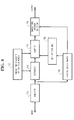
- Fig. 2 is a block diagram showing a second embodiment of the invention.
- mapping functions from inhibiting speaker's feature vector spaces to feature vector space of the true speaker are obtained using a first speech (of known content) of the true speaker after inhibiting speaker selection, then inhibiting speaker's reference patterns are adapted by using the mapping functions thus obtained, and then inhibiting speaker's reference patterns corresponding to a second speech (of unknown content) of the true speaker are generated by using the adapted inhibiting speaker's reference patterns.
- Input first and second speeches (of known and unknown contents, respectively) of the true speaker are supplied to an analyzer 110.
- the input speeches supplied to the analyzer 110 are converted into feature vectors, which are supplied to a feature vector memory 130.
- the first speech feature vector is supplied to an inhibiting speaker selector 140.
- the inhibiting speaker selector 140 calculates distances between the feature vector of the true speaker, supplied form the analyzer 110, and inhibiting speaker's reference patterns supplied from the inhibiting speaker's reference pattern memory 120, and selects inhibiting speaker's reference patterns in the order of smaller distances thereof.
- the selected inhibiting speaker's reference patterns are supplied to an estimator 150.
- the estimator 150 obtains mapping functions from inhibiting speaker's feature vectors to feature vector of the true speaker from the selected inhibiting speaker's reference patterns supplied from the inhibiting speaker selector 140 and first speech feature vector of the true speaker, supplied from the feature vector memory 130.
- the mapping functions thus obtained are supplied to an adapter 160.
- the adapter 160 adapts the selected inhibiting speaker's reference patterns supplied from the inhibiting speaker selector 140 on the basis of the mapping functions supplied from the estimator 150.
- the adapted reference patterns are supplied to an alignment estimator 170.
- the alignment estimator 170 estimates alignments of the second speech feature vector of the true speaker, supplied from the feature vector memory 130 using the reference patterns supplied from the adapter 160.
- the estimation is performed by using DP matching (as detailed in the Literature 9) or Viterbi algorithm (as detailed in the Literature 10).
- the alignment estimator 170 then generates inhibiting speaker's reference patterns corresponding to the second speech of the true speaker by connecting reference patterns supplied from the adapter 160 in the order of sound elements corresponding to the estimated alignment or alignments, and generated inhibiting reference patterns are supplied as output.
- Fig. 3 is a block diagram showing a third embodiment of the invention.
- mapping functions of inhibiting speaker's feature vector spaces to feature vector space of the true speaker are generated by using a first speech (of known content) of the true speaker after inhibiting speaker selection, then reference patterns corresponding to a second speech (of unknown content) of the true speaker are generated by using the non-adapted inhibiting speaker's reference patterns, and the reference patterns thus generated are adapted by using the estimated mapping functions.
- Input first and second speeches (of known and unknown contents, respectively) of the true speaker are supplied to an analyzer 210.
- the input speeches supplied to the analyzer 210 are converted into feature vectors, which are supplied to a feature vector memory 230.
- the first speech feature vector is also supplied to an inhibiting speaker selector 240.
- the inhibiting speaker selector 240 calculates distances between feature vector of the true speaker, supplied from the analyzer 210, and inhibiting speaker's reference patterns supplied from the inhibiting speaker's reference pattern memory 220, and selects inhibiting speaker's reference patterns in the order of smaller distances thereof.
- the selected inhibiting speaker's reference patterns are supplied to an estimator 250.
- the estimator 250 obtains mapping functions from inhibiting speaker's feature vector spaces to feature vector space of the true speaker, using the selected inhibiting speaker's reference patterns supplied from the inhibiting speaker selector 240 and the first speech feature vector of the true speaker, supplied from the feature vector memory 230.
- the mapping functions thus obtained are supplied to an adapter 260.
- the alignment estimator 270 estimates alignments of the second speech feature factor of the true speaker, supplied from the feature vector memory 230 using the reference patterns supplied from the inhibiting speaker's reference pattern memory 220. The alignment estimator 270 then generates inhibiting speaker's reference patterns corresponding to the second speech of the true speaker by connecting reference patterns supplied from the inhibiting speaker's reference pattern memory 220 in the order of phone corresponding to the estimated alignments. The inhibiting speaker's reference patterns thus generated are supplied to an adapter 260.
- the adapter 260 adapts the inhibiting speaker's reference patterns generated in the alignment estimator 270 on the basis of the mapping functions supplied from the estimator 250, and adapted inhibiting reference patterns are supplied as output.
- Fig. 4 is a view showing a fourth embodiment of the invention.
- mapping functions from feature vector space of the true speaker to inhibiting speaker's feature vector spaces are obtained after inhibiting speaker selection, and reference pattern of the true speaker is adapted by using the mapping functions thus obtained.
- Input speech of the true speaker is supplied to an analyzer 310.
- the input speech supplied to the analyzer 310 is converted to feature vector, which is supplied to a feature vector memory 330 and also to an inhibiting speaker selector 340.
- the inhibiting speaker selector 340 calculates distances between feature vector of the true speaker, supplied from the analyzer 310, and inhibiting speaker's reference patterns supplied from the inhibiting speaker's reference pattern memory 320, and selects inhibiting speaker's reference patterns in the order of smaller distances thereof.
- the selected inhibiting speaker's reference patterns are supplied to an estimator 350.
- the estimator 350 obtains mapping functions from feature vector of the true speaker to inhibiting speaker's feature vector spaces, using the inhibiting speaker's reference patterns supplied from the inhibiting speaker selector 340 and feature vector of the true speaker, supplied from the feature vector memory 330.
- the mapping functions thus obtained are supplied to an adapter 370.
- a reference pattern generator 360 generates reference pattern of the true speaker by using the feature vector thereof supplied from the feature vector memory 330.
- reference pattern is HMM (Hidden Markov Model), S. E. Levinsin, L. R. Rabinar, and M. M. Sondhi, "An Introduction to the Application of the Theory of Probability Functions of Markov Process to Automatic Speech Recognition", The Bell System Technical Journal Vol. 62, No. 4, 1983, pp. 1035-1074 (hereinafter referred to as Literature 11), the reference pattern is produced by studying HMM, with the feature vector of the true speaker used as training data, and with HMM stored in the reference pattern generator 360 used as initial HMM.
- the training algorithm may be forward pass algorithm as proposed by Nakagawa, "Speech Recognition based on Probability Models", IECE Japan, pp. 40-44, 1988 (hereinafter referred to as Literature 12) or speaker adaptation using spectral interpolation detailed in the Literature 7.
- the studied HMM is the generated reference pattern.
- the reference pattern is a template one
- the feature vector itself is the reference pattern.
- the generated reference pattern is supplied to an adapter 370.
- the adapter 370 adapts the reference pattern of the true speaker, supplied from the reference pattern generator 360, on the basis of the mapping functions supplied from the estimator 350. Adapted inhibiting speaker's reference patterns are provided as output. This method is applicable even in the case where different contents are uttered at the time of the mapping function estimation and at the time of the adaptation.
- Fig. 5 is a view showing a fifth embodiment of the invention.
- mapping functions from inhibiting speaker's feature vector spaces to vector feature space of the true speaker are obtained, inhibiting speaker's reference patterns are adapted by using the mapping functions thus obtained, and inhibiting speakers are selected after adaptation.
- Input speech of the true speaker is supplied to an analyzer 410.
- the input speech supplied to the analyzer 410 is converted into feature vector, which is supplied to a feature vector memory 430 and also to an estimator 440.
- the estimator 440 obtains mapping functions from inhibiting speaker's feature vector spaces to feature vector space of the true speaker, by using inhibiting speaker's reference patterns supplied from an inhibiting speaker's reference pattern memory 420 and the feature vector of the true speaker, supplied from the analyzer 410.
- the mapping functions thus obtained are supplied to an adapter 450.
- the adapter 450 adapts inhibiting speaker's reference patterns supplied from the inhibiting speaker's reference pattern memory 420.
- the adapted reference patterns are supplied to an inhibiting speaker selector 460.
- the inhibiting speaker selector 460 calculates distance between the adapted reference patterns supplied from the adapter 450 and the feature vector of the true speaker, supplied from the feature vector memory 430, and selects adapted inhibiting speaker's reference patterns in the order of smaller distances thereof.
- the selected reference patterns are provided as output.
- Fig. 6 is a view showing a sixth embodiment of the invention.
- mapping functions from inhibiting speaker's feature vector spaces to feature vector space of the true speaker are obtained by using a first speech (of known content) of the true speaker, inhibiting speaker's reference patterns are adapted by using the mapping functions thus obtained, and inhibiting speakers are selected from the adapted inhibiting speaker's reference patterns.
- Input first and second speeches (of known and unknown contents, respectively) of the true speaker are supplied to an analyzer 510.
- the input speeches supplied to the analyzer 510 are converted into feature vectors, which are supplied to a feature vector memory 530.
- Feature vector is obtained from the first speech and supplied to an estimator 540.
- the estimator 540 obtains mapping functions of inhibiting speaker's feature vector spaces to the feature vector space of the true speaker, using inhibiting speaker's reference patterns supplied from the inhibiting speaker's reference pattern memory 520 and the first speech feature vector of the true speaker, supplied from the feature vector memory 530.
- the mapping functions thus obtained are supplied to an adapter 550.
- the adapter 550 adapts the reference patterns supplied from the inhibiting speaker's reference pattern memory 520 on the basis of the mapping functions supplied from the estimator 540.
- the adapted reference patterns are supplied to an alignment estimator 560.
- the alignment estimator 560 estimates alignments of the second speech feature vector of the true speaker, supplied from the feature vector memory 530 using the reference patterns supplied from the adapter 550. The alignment estimator 560 then generates inhibiting speaker's reference patterns corresponding to the second speech of the true speaker by connecting the reference patterns supplied from the adapter 550 in the order of phone corresponding to the estimated alignments. The inhibiting speaker's reference patterns thus generated are supplied to an inhibiting speaker selector 570.
- the inhibiting speaker selector 570 calculates distances between the second speech feature vector of the true speaker and the reference patterns supplied from the alignment estimator 560, and selects inhibiting speaker's reference patterns in the order of smaller distances thereof. The selected inhibiting speaker's reference patterns are provided as output.
- Fig. 7 is a view showing a seventh embodiment of the invention.
- mapping functions from inhibiting speaker's feature vector spaces to feature vector space of the true speaker are obtained by using a first speech (of known content) of the true speaker, inhibiting speaker's reference patterns corresponding to a second speech (of unknown content) of the true speaker are generated by using previously obtained inhibiting speaker's reference patterns, the newly obtained inhibiting speaker's reference patterns are adapted, and inhibiting speakers are selected after the adaptation.
- first and second speeches (of known and unknown contents, respectively) of the true speaker are supplied to an analyzer 610.
- the input speeches supplied to an analyzer 610 are converted into feature vectors, which are supplied to a feature vector memory 630.
- first speech feature vector is supplied to an estimator 640.
- the estimator 640 obtains mapping functions from inhibiting speaker's feature vector spaces to feature vector space of the true speaker.
- the mapping functions thus obtained are supplied to an adapter 650.
- An alignment estimator 660 estimates alignments of the first speech feature vector of the true speaker, supplied from the analyzer 610 using reference patterns supplied from inhibiting speaker's reference pattern memory 620. The mapping functions thus obtained are supplied to the adapter 650.
- the adapter 650 adapts the inhibiting speaker's reference patterns generated in the alignment estimator 660 on the basis of the mapping functions supplied from the estimator 640.
- the adapted reference patterns are supplied to an inhibiting speaker selector 670.
- the inhibiting speaker selector 670 calculates distances between the adapted reference patterns and second speech feature vector of the true speaker, supplied from the feature vector memory 630, and selects inhibiting speaker's reference patterns in the order of smaller distances thereof.
- the selected inhibiting speaker's reference patterns are provided as output.
- Fig. 8 is a view showing an eighth embodiment of the invention.
- mapping functions from the feature vector space of the true speaker to inhibiting speaker's feature vector spaces are obtained, the reference pattern of the true speaker is adapted by using the mapping functions thus obtained, and inhibiting speakers are selected after the adaptation.
- Input speech of the true speaker is supplied to an analyzer 710.
- the input speech supplied to the analyzer 710 is converted into feature vector, which is supplied to a feature vector memory 730 and an estimator 740.
- the estimator 740 obtains mapping functions from the feature vector space of the true speaker to inhibiting speaker's feature vector spaces.
- the mapping functions thus obtained are supplied to an estimator 750.
- a reference pattern generator 750 generates reference pattern of the true speaker by using the feature vector of the true speaker, supplied from the feature vector memory 730. The reference pattern of the true speaker thus generated in supplied to an adapter 760.
- the adapter 760 adapts the reference pattern of the true speaker, supplied from the reference pattern generator 750, on the basis of the mapping functions supplied from the estimator 740.
- the adapted reference patterns are supplied to an inhibiting speaker selector 770.
- the inhibiting speaker selector 770 calculates distances between the adapted reference patterns supplied from the adapter 760 and the feature vector of the true speaker, supplied from the feature vector memory 730, and selects adapted inhibiting speaker's reference patterns in the order of smaller distances thereof.
- the selected inhibiting speaker's reference patterns are provided as output. This method may also be applied to the case where different contents are uttered at the time of the mapping function estimation and at the time of the adaptation.
- Fig. 9 is a view showing a speaker verification system for carrying out the embodiments of the inhibiting speaker's reference pattern generating system described before with reference to Figs. 1 to 8.
- Input speech of the speaker to be verified is supplied to an analyzer 810.
- the input speech supplied to the analyzer 810 is converted into feature vector, which is supplied to a distance calculator 840.
- An inhibiting speaker's reference pattern generator 820 generates inhibiting speaker's reference patterns by using either of the above embodiments of the method.
- the generated inhibiting speaker's reference patterns are supplied to the distance calculator 840.
- the distance calculator 840 first calculates distance between reference pattern of the true speaker, supplied from a reference pattern memory 830, and feature vector of the speaker to be verified, supplied from the analyzer 810. The result of the calculation is referred to as distance 1. Then, the distance calculator 840 calculates distance between the inhibiting speaker's reference patterns supplied from the inhibiting speaker's reference pattern generator 820 and the feature vector of the speaker to be verified. The results of the calculation is referred to as distances 2. The distance calculator 840 then normalizes distances (or likelihoods) by subtracting the distances 2 from the distance 1. The normalized distances (or likelihoods) are supplied to a verifier 850.
- the verifier 850 compares the distances (or likelihoods) supplied from the distance calculator 840 with a predetermined threshold value. When the compared distance is not greater than the threshold, (when the compared likelihood is greater), the verifier 850 determines that the speaker is the true speaker. When the compared distance is greater, (when the compared likelihood is not greater), the verifier 850 determines that the speaker is not true speaker.
Landscapes
- Engineering & Computer Science (AREA)
- Health & Medical Sciences (AREA)
- Audiology, Speech & Language Pathology (AREA)
- Human Computer Interaction (AREA)
- Physics & Mathematics (AREA)
- Acoustics & Sound (AREA)
- Multimedia (AREA)
- Information Retrieval, Db Structures And Fs Structures Therefor (AREA)
- Image Analysis (AREA)
- Transmission Systems Not Characterized By The Medium Used For Transmission (AREA)
Applications Claiming Priority (2)
| Application Number | Priority Date | Filing Date | Title |
|---|---|---|---|
| JP9040102A JP2991148B2 (ja) | 1997-02-07 | 1997-02-07 | 話者認識における抑制標準パターンすなわちコホートの作成方法及びシステムと該システムを含む話者照合装置 |
| JP40102/97 | 1997-02-07 |
Publications (2)
| Publication Number | Publication Date |
|---|---|
| EP0858068A2 true EP0858068A2 (de) | 1998-08-12 |
| EP0858068A3 EP0858068A3 (de) | 1999-03-10 |
Family
ID=12571509
Family Applications (1)
| Application Number | Title | Priority Date | Filing Date |
|---|---|---|---|
| EP98102205A Withdrawn EP0858068A3 (de) | 1997-02-07 | 1998-02-09 | Verfahren zur Erzeugung eines hemmenden Referenzmusters |
Country Status (3)
| Country | Link |
|---|---|
| EP (1) | EP0858068A3 (de) |
| JP (1) | JP2991148B2 (de) |
| CA (1) | CA2229113C (de) |
Families Citing this family (3)
| Publication number | Priority date | Publication date | Assignee | Title |
|---|---|---|---|---|
| JP3090119B2 (ja) | 1998-05-15 | 2000-09-18 | 日本電気株式会社 | 話者照合装置、方法及び記憶媒体 |
| JP3090122B2 (ja) | 1998-06-12 | 2000-09-18 | 日本電気株式会社 | 話者照合装置 |
| WO2009110613A1 (ja) * | 2008-03-07 | 2009-09-11 | 日本電気株式会社 | 個人照合装置及び話者登録装置と方法並びにプログラム |
Family Cites Families (3)
| Publication number | Priority date | Publication date | Assignee | Title |
|---|---|---|---|---|
| JPS5876893A (ja) * | 1981-10-30 | 1983-05-10 | 日本電気株式会社 | 音声認識装置 |
| CA2105034C (en) * | 1992-10-09 | 1997-12-30 | Biing-Hwang Juang | Speaker verification with cohort normalized scoring |
| AUPM983094A0 (en) * | 1994-12-02 | 1995-01-05 | Australian National University, The | Method for forming a cohort for use in identification of an individual |
-
1997
- 1997-02-07 JP JP9040102A patent/JP2991148B2/ja not_active Expired - Lifetime
-
1998
- 1998-02-09 EP EP98102205A patent/EP0858068A3/de not_active Withdrawn
- 1998-02-09 CA CA002229113A patent/CA2229113C/en not_active Expired - Fee Related
Also Published As
| Publication number | Publication date |
|---|---|
| JPH10222189A (ja) | 1998-08-21 |
| CA2229113A1 (en) | 1998-08-07 |
| JP2991148B2 (ja) | 1999-12-20 |
| EP0858068A3 (de) | 1999-03-10 |
| CA2229113C (en) | 2002-05-28 |
Similar Documents
| Publication | Publication Date | Title |
|---|---|---|
| JP3457431B2 (ja) | 信号識別方法 | |
| EP0686965B1 (de) | Spracherkennung mit Sprecheradaptierung mittels Berechnung von Mittelwerten akustischer Kategorien | |
| JP4218982B2 (ja) | 音声処理 | |
| US5749068A (en) | Speech recognition apparatus and method in noisy circumstances | |
| EP0911805B1 (de) | Verfahren und Vorrichtung zur Spracherkennung | |
| US5822728A (en) | Multistage word recognizer based on reliably detected phoneme similarity regions | |
| US20080300875A1 (en) | Efficient Speech Recognition with Cluster Methods | |
| CA2652302C (en) | Intersession variability compensation for automatic extraction of information from voice | |
| EP0831461A2 (de) | Schema und Modelladaption bei Mustererkennung welche auf Taylorausdehnung basiert | |
| US5794192A (en) | Self-learning speaker adaptation based on spectral bias source decomposition, using very short calibration speech | |
| CN101027716B (zh) | 健壮的说话者相关的语音识别系统 | |
| US5129001A (en) | Method and apparatus for modeling words with multi-arc markov models | |
| EP0779609B1 (de) | Sprachadaptionssystem und Spracherkenner | |
| US7552049B2 (en) | Noise adaptation system of speech model, noise adaptation method, and noise adaptation program for speech recognition | |
| US6006184A (en) | Tree structured cohort selection for speaker recognition system | |
| US6934681B1 (en) | Speaker's voice recognition system, method and recording medium using two dimensional frequency expansion coefficients | |
| Deligne et al. | A robust high accuracy speech recognition system for mobile applications | |
| Zhao | Frequency-domain maximum likelihood estimation for automatic speech recognition in additive and convolutive noises | |
| EP0858068A2 (de) | Verfahren zur Erzeugung eines hemmenden Referenzmusters | |
| EP0838803B1 (de) | Abstandsberechung zur Verwendung in einem Spracherkenner | |
| Young | Acoustic modelling for large vocabulary continuous speech recognition | |
| JP3090119B2 (ja) | 話者照合装置、方法及び記憶媒体 | |
| Kosaka et al. | Instantaneous environment adaptation techniques based on fast PMC and MAP-CMS methods | |
| JP2001067094A (ja) | 音声認識装置及び方法 | |
| Munteanu et al. | Romanian language robust continuous speech recognition [articol] |
Legal Events
| Date | Code | Title | Description |
|---|---|---|---|
| PUAI | Public reference made under article 153(3) epc to a published international application that has entered the european phase |
Free format text: ORIGINAL CODE: 0009012 |
|
| AK | Designated contracting states |
Kind code of ref document: A2 Designated state(s): BE DE FR GB SE |
|
| AX | Request for extension of the european patent |
Free format text: AL;LT;LV;MK;RO;SI |
|
| PUAL | Search report despatched |
Free format text: ORIGINAL CODE: 0009013 |
|
| AK | Designated contracting states |
Kind code of ref document: A3 Designated state(s): AT BE CH DE DK ES FI FR GB GR IE IT LI LU MC NL PT SE |
|
| AX | Request for extension of the european patent |
Free format text: AL;LT;LV;MK;RO;SI |
|
| 17P | Request for examination filed |
Effective date: 19990812 |
|
| AKX | Designation fees paid |
Free format text: BE DE FR GB SE |
|
| STAA | Information on the status of an ep patent application or granted ep patent |
Free format text: STATUS: THE APPLICATION HAS BEEN WITHDRAWN |
|
| 18W | Application withdrawn |
Withdrawal date: 20020909 |