EP0856514B1 - 8-substituted-1,3,8-triazaspiro[4.5]decan-4-on derivatives - Google Patents
8-substituted-1,3,8-triazaspiro[4.5]decan-4-on derivatives Download PDFInfo
- Publication number
- EP0856514B1 EP0856514B1 EP98100970A EP98100970A EP0856514B1 EP 0856514 B1 EP0856514 B1 EP 0856514B1 EP 98100970 A EP98100970 A EP 98100970A EP 98100970 A EP98100970 A EP 98100970A EP 0856514 B1 EP0856514 B1 EP 0856514B1
- Authority
- EP
- European Patent Office
- Prior art keywords
- phenyl
- decan
- triaza
- alkyl
- spiro
- Prior art date
- Legal status (The legal status is an assumption and is not a legal conclusion. Google has not performed a legal analysis and makes no representation as to the accuracy of the status listed.)
- Expired - Lifetime
Links
- 0 *N(CN1)C2(CCNCC2)C1=O Chemical compound *N(CN1)C2(CCNCC2)C1=O 0.000 description 3
Classifications
-
- C—CHEMISTRY; METALLURGY
- C07—ORGANIC CHEMISTRY
- C07D—HETEROCYCLIC COMPOUNDS
- C07D471/00—Heterocyclic compounds containing nitrogen atoms as the only ring hetero atoms in the condensed system, at least one ring being a six-membered ring with one nitrogen atom, not provided for by groups C07D451/00 - C07D463/00
- C07D471/02—Heterocyclic compounds containing nitrogen atoms as the only ring hetero atoms in the condensed system, at least one ring being a six-membered ring with one nitrogen atom, not provided for by groups C07D451/00 - C07D463/00 in which the condensed system contains two hetero rings
- C07D471/10—Spiro-condensed systems
-
- A—HUMAN NECESSITIES
- A61—MEDICAL OR VETERINARY SCIENCE; HYGIENE
- A61P—SPECIFIC THERAPEUTIC ACTIVITY OF CHEMICAL COMPOUNDS OR MEDICINAL PREPARATIONS
- A61P25/00—Drugs for disorders of the nervous system
-
- A—HUMAN NECESSITIES
- A61—MEDICAL OR VETERINARY SCIENCE; HYGIENE
- A61P—SPECIFIC THERAPEUTIC ACTIVITY OF CHEMICAL COMPOUNDS OR MEDICINAL PREPARATIONS
- A61P25/00—Drugs for disorders of the nervous system
- A61P25/04—Centrally acting analgesics, e.g. opioids
-
- A—HUMAN NECESSITIES
- A61—MEDICAL OR VETERINARY SCIENCE; HYGIENE
- A61P—SPECIFIC THERAPEUTIC ACTIVITY OF CHEMICAL COMPOUNDS OR MEDICINAL PREPARATIONS
- A61P25/00—Drugs for disorders of the nervous system
- A61P25/08—Antiepileptics; Anticonvulsants
-
- A—HUMAN NECESSITIES
- A61—MEDICAL OR VETERINARY SCIENCE; HYGIENE
- A61P—SPECIFIC THERAPEUTIC ACTIVITY OF CHEMICAL COMPOUNDS OR MEDICINAL PREPARATIONS
- A61P25/00—Drugs for disorders of the nervous system
- A61P25/18—Antipsychotics, i.e. neuroleptics; Drugs for mania or schizophrenia
-
- A—HUMAN NECESSITIES
- A61—MEDICAL OR VETERINARY SCIENCE; HYGIENE
- A61P—SPECIFIC THERAPEUTIC ACTIVITY OF CHEMICAL COMPOUNDS OR MEDICINAL PREPARATIONS
- A61P25/00—Drugs for disorders of the nervous system
- A61P25/20—Hypnotics; Sedatives
-
- A—HUMAN NECESSITIES
- A61—MEDICAL OR VETERINARY SCIENCE; HYGIENE
- A61P—SPECIFIC THERAPEUTIC ACTIVITY OF CHEMICAL COMPOUNDS OR MEDICINAL PREPARATIONS
- A61P25/00—Drugs for disorders of the nervous system
- A61P25/24—Antidepressants
-
- A—HUMAN NECESSITIES
- A61—MEDICAL OR VETERINARY SCIENCE; HYGIENE
- A61P—SPECIFIC THERAPEUTIC ACTIVITY OF CHEMICAL COMPOUNDS OR MEDICINAL PREPARATIONS
- A61P25/00—Drugs for disorders of the nervous system
- A61P25/26—Psychostimulants, e.g. nicotine, cocaine
-
- A—HUMAN NECESSITIES
- A61—MEDICAL OR VETERINARY SCIENCE; HYGIENE
- A61P—SPECIFIC THERAPEUTIC ACTIVITY OF CHEMICAL COMPOUNDS OR MEDICINAL PREPARATIONS
- A61P25/00—Drugs for disorders of the nervous system
- A61P25/28—Drugs for disorders of the nervous system for treating neurodegenerative disorders of the central nervous system, e.g. nootropic agents, cognition enhancers, drugs for treating Alzheimer's disease or other forms of dementia
-
- A—HUMAN NECESSITIES
- A61—MEDICAL OR VETERINARY SCIENCE; HYGIENE
- A61P—SPECIFIC THERAPEUTIC ACTIVITY OF CHEMICAL COMPOUNDS OR MEDICINAL PREPARATIONS
- A61P25/00—Drugs for disorders of the nervous system
- A61P25/30—Drugs for disorders of the nervous system for treating abuse or dependence
-
- A—HUMAN NECESSITIES
- A61—MEDICAL OR VETERINARY SCIENCE; HYGIENE
- A61P—SPECIFIC THERAPEUTIC ACTIVITY OF CHEMICAL COMPOUNDS OR MEDICINAL PREPARATIONS
- A61P29/00—Non-central analgesic, antipyretic or antiinflammatory agents, e.g. antirheumatic agents; Non-steroidal antiinflammatory drugs [NSAID]
-
- A—HUMAN NECESSITIES
- A61—MEDICAL OR VETERINARY SCIENCE; HYGIENE
- A61P—SPECIFIC THERAPEUTIC ACTIVITY OF CHEMICAL COMPOUNDS OR MEDICINAL PREPARATIONS
- A61P3/00—Drugs for disorders of the metabolism
- A61P3/04—Anorexiants; Antiobesity agents
-
- A—HUMAN NECESSITIES
- A61—MEDICAL OR VETERINARY SCIENCE; HYGIENE
- A61P—SPECIFIC THERAPEUTIC ACTIVITY OF CHEMICAL COMPOUNDS OR MEDICINAL PREPARATIONS
- A61P3/00—Drugs for disorders of the metabolism
- A61P3/12—Drugs for disorders of the metabolism for electrolyte homeostasis
-
- A—HUMAN NECESSITIES
- A61—MEDICAL OR VETERINARY SCIENCE; HYGIENE
- A61P—SPECIFIC THERAPEUTIC ACTIVITY OF CHEMICAL COMPOUNDS OR MEDICINAL PREPARATIONS
- A61P43/00—Drugs for specific purposes, not provided for in groups A61P1/00-A61P41/00
-
- A—HUMAN NECESSITIES
- A61—MEDICAL OR VETERINARY SCIENCE; HYGIENE
- A61P—SPECIFIC THERAPEUTIC ACTIVITY OF CHEMICAL COMPOUNDS OR MEDICINAL PREPARATIONS
- A61P9/00—Drugs for disorders of the cardiovascular system
-
- A—HUMAN NECESSITIES
- A61—MEDICAL OR VETERINARY SCIENCE; HYGIENE
- A61P—SPECIFIC THERAPEUTIC ACTIVITY OF CHEMICAL COMPOUNDS OR MEDICINAL PREPARATIONS
- A61P9/00—Drugs for disorders of the cardiovascular system
- A61P9/12—Antihypertensives
Definitions
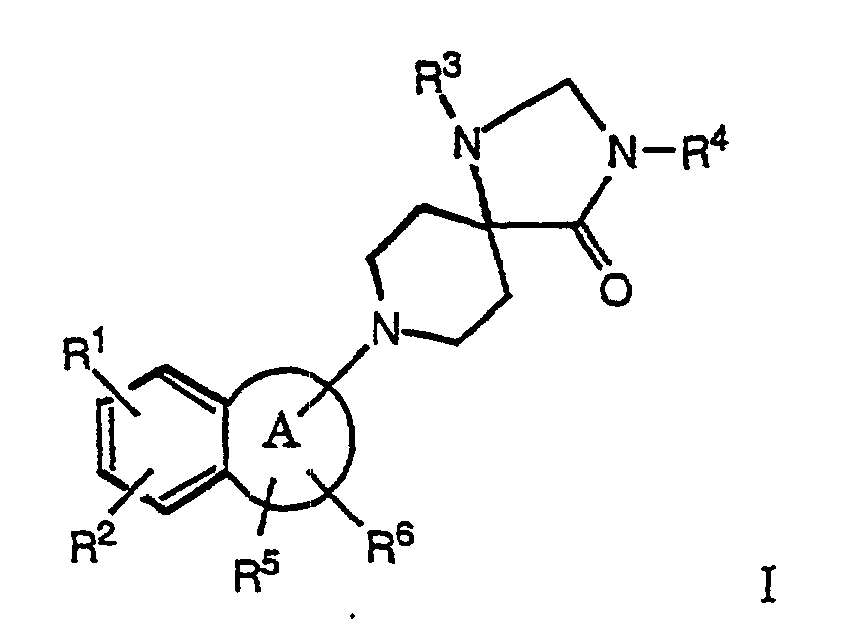
- the present invention relates to compounds of the formula wherein
- the compounds of formula I and their salts are distinguished by valuable therapeutic properties. It has surprisingly been found that the compounds of the present invention are agonists and/or antagonists of the OFQ receptor. Consequently they will be useful in the treatment of psychiatric, neurological and physiological disorders, especially, but not limited to, amelioration of symptoms of anxiety and stress disorders, depression, trauma, memory loss due to Alzheimer's disease or other dementias, epilepsy and convulsions, acute and/or chronic pain conditions, symptoms of withdrawal from drugs of addiction, control of water balance, Na + excretion, arterial blood pressure disorders and eating disorders such as obesity.
- Orphanin FQ a seventeen amino-acid-long peptide (F-G-G-F-T-G-A-R-K-S-A-R-K-L-A-N-Q), has been isolated from rat brain and is a natural ligand for a G-protein coupled receptor (OFQ-R), found at high levels in brain tissue.
- OFQ exhibits agonistic action at the OFQ-R both in vitro and in vivo.
- Objects of the present invention are the compounds of formula I and pharmaceutically acceptable addition salts thereof, racemic mixtures and their corresponding enantiomers, the preparation of the above-mentioned compounds, medicaments containing them and their manufacture as well as the use of the above-mentioned compounds in the control or prevention of illnesses, especially of illnesses and disorders of the kind referred to earlier, or in the manufacture of corresponding medicaments.
- lower alkyl denotes a straight- or branched-chain alkyl group containing from 1 to 6 carbon atoms, for example, methyl, ethyl, propyl, isopropyl, n-butyl, i-butyl, 2-butyl, t-butyl.
- halogen denotes chlorine, iodine, fluorine and bromine.
- lower alkoxy denotes a group wherein the alkyl residues is as defined above, and which is attached via an oxygen atom.
- pharmaceutically acceptable acid addition salts embraces salts with inorganic and organic acids, such as hydrochloric acid, nitric acid, sulfuric acid, phosphoric acid, citric acid, formic acid, fumaric acid, maleic acid, acetic acid, succinic acid, tartaric acid, methane-sulfonic acid, p-toluenesulfonic acid and the like.
- R 1 and/or R 2 are hydrogen or chlorine, for example the following compounds:
- R 5 and one of R 1 or R 2 form together a saturated 6 membered ring, for example the following compounds:
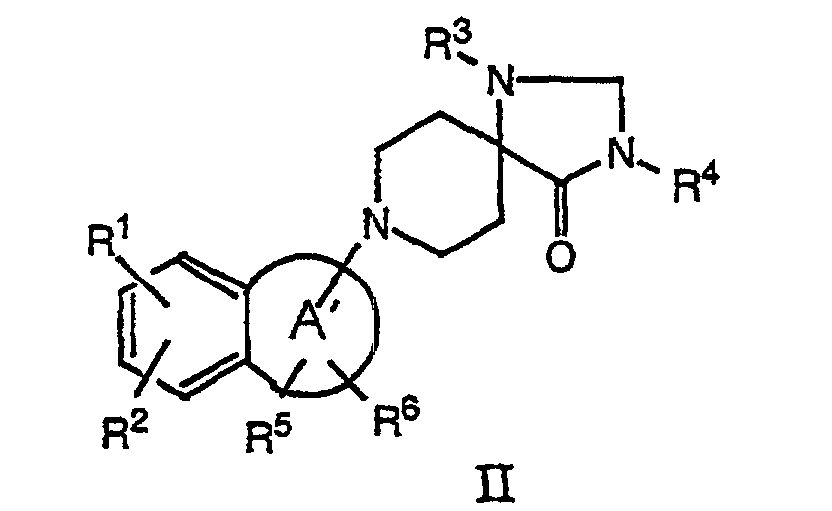
- a compound of formula II can be hydrogenated in conventional manner, for example with metal hydrides, such as borohydride, sodium cyanoborohyride or with triethylsilane in protic solvents, e.g. methanol or ethanol, and/or in the presence of protic reagents like trifluoroacetic acid in methylene chloride. This reaction is usually carried out at room temperature.
- metal hydrides such as borohydride, sodium cyanoborohyride or with triethylsilane
- protic solvents e.g. methanol or ethanol
- Another method is the hydrogenation in the presence of at least one hydrogenating catalyst, such as palladium on carbon, platinum or ruthenium, in an inert solvent, for example methanol, ethanol or ethyl acetate or mixtures thereof.
- This reaction is carried out at a pressure of 1 ⁇ 10 5 - 981 ⁇ 10 5 Pa and temperatures between 25 and 250 °C.
- a compound of formula I, wherein R 4 is hydrogen can be alkylated, benzylated or acylated in conventional manner, for example in the presence of a corresponding alkyl-, benzyl- or acyl-halogenide, such as methyliodide, allylbromide, benzylbromide, ethylbromide, acetylchloride, methylbromacetate and the like.
- a metal hydride such as sodium hydride at a temperature of 60-100°C.
- the reductive amination of a keto-compound of formula III with an amine of formula IV in accordance with variant c) is carried out in conventional manner in a solvent, such as tetrahydrofuran (THF), methanol or ethanol, or in a mixture of THF with a suitable alcohol, and in the presence of a reducing agent, such as Na-cyanoborohydride.
- a solvent such as tetrahydrofuran (THF), methanol or ethanol
- THF tetrahydrofuran
- reaction is carried out by reaction of an amine with a ketone in the presence of TI-(IV)-isopropoxide and Na-cyanoborohydride.
- the salt formation in accordance with variant e) is effected at room temperature in accordance with methods which are known per se and which are familiar to any person skilled in the art. Not only salts with inorganic acids, but also salts with organic acids come into consideration. Hydrochlorides, hydrobromides, sulphates, nitrates, citrates, acetates, maleates, succinates, methanesulphonates, p-toluenesulphonates and the
- the starting materials of the compound described in example 44 can be prepared in accordance with J. Org. Chem., 1995, 60, 4324-4330 and with J. Med.Chem., 1996, 39, 3169. wherein the substituents have the significances given above. wherein the substituents have the significance given above.
- a compound of formula II is obtained by treating a suitable ketone of formula III with a secondary amine to an enamine with loss of water.
- This reaction is reversible, so water has to be removed azeotropically or with a drying agent.
- This reaction is carried out in an inert solvent, such as benzene or toluene and in the presence of an acidic catalyst like p-toluene sulfonic acid or sulfuric acid or, alternatively, with a drying agent, for example with molecular sieves at temperatures of about 80-120 °C.
- the above mentioned compounds of formula II can also be prepared by stirring components in an inert solvent, such as hexane, benzene or 1,2-dichloroethane at room temperature or elevated temperatures up to 80 °C in the presence of, e.g. titanium tetrachloride as Lewis-acid and drying agent.
- an inert solvent such as hexane, benzene or 1,2-dichloroethane
- inert solvent such as hexane, benzene or 1,2-dichloroethane
- Compounds of formula I can then be obtained in accordance with process variant a).
- a compound of formula Ia can then be obtained by hydrogenation in accordance with process variant a).
- ketones or aldehydes of formulae III and V and the compounds of formula IV are known compounds or can be prepared according to methods known per se.
- the compounds of formula I and their pharmaceutically usuable addition salts possess valuable pharmacodynamic properties. It has been found that the compounds of the present invention are agonists and/or antagonists of the OFQ receptor and have effects in animal models of psychiatric, neurological and physiological disorders, such as anxiety, stress disorders, depression, trauma, memory loss due to Alzheimer's disease or other dementias, epilepsy and convulsions, acute and/or chronic pain conditions, symptoms of withdrawal from drugs of addiction, control of water balance, Na + excretion, arterial blood pressure disorders and eating disorders such as obesity.
- psychiatric neurological and physiological disorders
- neurological and physiological disorders such as anxiety, stress disorders, depression, trauma, memory loss due to Alzheimer's disease or other dementias, epilepsy and convulsions, acute and/or chronic pain conditions, symptoms of withdrawal from drugs of addiction, control of water balance, Na + excretion, arterial blood pressure disorders and eating disorders such as obesity.
- HEK-293 cells adapted to suspension growth (293s) were cultured in HL medium plus 2% FBS.
- the cells were transfected with the rat OFQ receptor cDNA (LC132), FEBS Lett. 347, 284-288, 1994, cloned in the expression vector pCEP4 (Invitrogen, SanDiego, CA, USA) using lipofectin (Life Technologies, Bethesda, MD, USA).
- Transfected cells were selected in the presence of hygromycin (1000 U/ml) (Calbiochem, SanDiego, CA, USA).
- a pool of resistant cells was tested for OFQ-R expression by binding of [ 3 H]-OFQ (Amersham PLC, Buckinghamshire, England). These cells (293s-OFQ-R) were expanded for large scale culture and membrane preparation.
- 293s-OFQ-R cells were harvested by centrifugation, washed 3 times with phosphate buffered saline (PBS) before resuspension in buffer A (50 mM Tris-HCl, pH 7.8, 5 mM MgCl 2 , 1 mM EGTA) and disruption with a tissue homogenizer (30 seconds, setting 4, Pt 20, Kinematica, Kriens-Lucern, Switzerland). A total membrane fraction was obtained by centrifugation at 49,000 x g at 4°C. This procedure was repeated twice and the pellet was resuspended in buffer A. Aliquots were stored at -70°C and protein concentrations were determined using the BCATM Protein Assay Reagent (Pierce, Rockford, IL) following the manufacturer's recommendations.
- PBS phosphate buffered saline
- [ 3 H]-OFQ competition studies were carried out with 77 ⁇ g membrane protein in a final assay volume of 0.5 ml buffer A plus 0.1% BSA and 0.01% bacitracin (Boehringer-Mannheim, Mannheim, Germany) for one hour at room temperature. 50 nM unlabeled OFQ was used to define the non-specific binding. The assays were terminated by filtration through Whatman GF/C filters (Unifilter-96, Canberra Packard S.A., Zurich, Switzerland) pretreated with 0.3% polyethylenimine (Sigma, St. Louis, MO, USA) and 0.1% BSA (Sigma) for 1 hour.
- the filters were washed 6 times with 1 ml of ice bold 50 mM Tris-HCI pH 7.5. The retained radioactivity was counted on a Packard Top-Count microplate scintillation counter after addition of 40 ⁇ l of Microscint 40 (Canberra Packard). The effects of compounds were determined using at least 6 concentrations in triplicate, and determined twice. IC 50 values were determined by curve fitting and these calues were converted to K i values by the method of Cheng and Prusoff, Biochem. Pharmacol., 22, 3099, 1973.
- the affinity to the OFQ-receptor is in the scope of 6,6 to 9,6.
- the pK i -values of Examples 8 and 15 are 7,9 and 8,0, respectively.
- the compounds of formula I as well as their pharmaceutically usable acid addition salts can be used as medicaments, e.g. in the form of pharmaceutical preparations.
- the pharmaceutical preparations can be administered orally, e.g. in the form of tablets, coated tablets, dragées, hard and soft gelatine capsules, solutions, emulsions or suspensions.
- the administration can, however, also be effected rectally, e.g. in the form of suppositories, or parenterally, e.g. in the form of injection solutions.
- the compounds of formula I and their pharmaceutically usable acid addition salts can be processed with pharmaceutically inert, inorganic or organic excipients for the production of tablets, coated tablets, dragees and hard gelatine capsules. Lactose, corn starch or derivatives thereof, talc, stearic acid or its salts etc can be used as such excipients e.g. for tablets, dragées and hard gelatine capsules.
- Suitable excipients for soft gelatine capsules are e.g. vegetable oils, waxes, fats, semi-solid and liquid polyols etc.
- Suitable excipients for the manufacture of solutions and syrups are e.g. water, polyols, saccharose, invert sugar, glucose etc.
- Suitable excipients for injection solutions are e.g. water, alcohols, polyols, glycerol, vegetable oils etc.
- Suitable excipients for suppositories are e.g. natural or hardened oils, waxes, fats, semi-liquid or liquid polyols etc.
- the pharmaceutical preparations can contain preservatives, solubilizers, stabilizers, wetting agents, emulsifiers, sweeteners, colorants, flavorants, salts for varying the osmotic pressure, buffers, masking agents or antioxidants. They can also contain still other therapeutically valuable substances.
- the dosage can vary within wide limits and will, of course, be fitted to the individual requirements in each particular case.
- a daily dosage of about 10 to 1000 mg per person of a compound of general formula I should be appropriate, although the above upper limit can also be exceeded when it appears to be indicated.
- 6-Chloro-2-tetralone (22.7 mmol) was dissolved in toluene (210 ml).
- 1-Phenyl-1,3,8-triazaspiro[4.5]decan-4-one (22.7 mmol) and molecular sieves (19 g) were added and the mixture was refluxed for 6 h. After cooling the molecular sieves were removed by filtration and washed with methylenchloride. Evaporation of the filtrate yielded a residue which was dissolved in THF (90 ml) and methanol (10 ml). Sodium cyanoborohydride (22.7 mmol) was added to the solution and the pH was adjusted to 4. The mixture was stirred for 4 h at room temperature.
- the title compound, m.p. 286 - 290 °C was prepared in accordance with the general method of example 1 from 8-chloro-2-tetralone and 1-phenyl-1,3,8-triazaspiro[4.5]decan-4-one.
- the title compound, m.p. 290 - 293 °C was prepared in accordance with the general method of example 1 from 5,8-dichloro-2-tetralone and 1-phenyl-1,3,8-triazaspiro [4.5]decan-4-one.
- the title compound, m.p. 185-187 °C was prepared in accordance with the general method of exaple 4 from 8-(5,8-dichloro-1,2,3,4-tetrahydro-2-naphthyl)-1-phenyl-1,3,8-triaza-spiro[4.5]decan-4-one and methyl bromoacetate.
- the title compound, m.p. 220 °C dec. was prepared in accordance with the general method of example 4 from 8-(5,8-dichloro-1,2,3,4-tetrahydro-2-naphthyl)-1-phenyl-1,3,8-triazaspiro[4.5]decan-4-one hydrochloride and benzoylchloride.
- the title compound, m.p. 191-192 °C dec. was prepared in accordance with the general method of example 4 from 8-(5,8-dichloro-1,2,3,4-tetrahydro-2-naphthyl)-1-phenyl-1,3,8-triazaspiro[4.5]decan-4-one hydrochloride and dimethyl bromomalonate.
- the title compound, m.p. 232-234 °C was prepared in accordance with the general method of example 4 from 1-phenyl-8-(1,2,3,4-tetrahydro-naphtyl-1)-1,3,8-triaza-spiro[4.5]decan-4-one hydrochloride (1:1) and methyliodide.
- the tide compound, m.p. >250 °C and MS: m/e 396.2 (M+H + ) was prepared in accordance with the general method of example 11 from 6-chloro-3,4-dihydro-1(2H)-naphthalenone oxime and 1-phenyl-1,3,8-triazaspiro[4.5]decan-4-one.
- Tablets of the following composition are manufactured in the usual manner: mg/tablet Active substance 5 Lactose 45 Corn starch 15 Microcrystalline cellulose 34 Magnesium stearate 1 Tablet weight 100
- Capsules of the following composition are manufactured: mg/capsule Active substance 10 Lactose 155 Corn starch 30 Talc 5 Capsule fill weight 200
- the active substance, lactose and corn starch are firstly mixed in a mixer and then in a comminuting machine. The mixture is returned to the mixer, the talc is added thereto and mixed thoroughly. The mixture is filled by machine into hard gelatine capsules.
- the suppository mass is melted in a glass or steel vessel, mixed thoroughly and cooled to 45°C. Thereupon, the finely powdered active substance is added thereto and stirred until it has dispersed completely. The mixture is poured into suppository moulds of suitable size, left to cool, the suppositories are then removed from the moulds and packed individually in wax paper or metal foil.
Landscapes
- Health & Medical Sciences (AREA)
- Organic Chemistry (AREA)
- Chemical & Material Sciences (AREA)
- Engineering & Computer Science (AREA)
- Bioinformatics & Cheminformatics (AREA)
- Pharmacology & Pharmacy (AREA)
- Public Health (AREA)
- General Chemical & Material Sciences (AREA)
- Medicinal Chemistry (AREA)
- Veterinary Medicine (AREA)
- Nuclear Medicine, Radiotherapy & Molecular Imaging (AREA)
- Chemical Kinetics & Catalysis (AREA)
- Life Sciences & Earth Sciences (AREA)
- Animal Behavior & Ethology (AREA)
- General Health & Medical Sciences (AREA)
- Biomedical Technology (AREA)
- Neurosurgery (AREA)
- Neurology (AREA)
- Psychiatry (AREA)
- Pain & Pain Management (AREA)
- Diabetes (AREA)
- Cardiology (AREA)
- Hematology (AREA)
- Obesity (AREA)
- Heart & Thoracic Surgery (AREA)
- Rheumatology (AREA)
- Anesthesiology (AREA)
- Hospice & Palliative Care (AREA)
- Addiction (AREA)
- Child & Adolescent Psychology (AREA)
- Pharmaceuticals Containing Other Organic And Inorganic Compounds (AREA)
- Nitrogen Condensed Heterocyclic Rings (AREA)
- Organic Low-Molecular-Weight Compounds And Preparation Thereof (AREA)
- Photoreceptors In Electrophotography (AREA)
- Nitrogen And Oxygen Or Sulfur-Condensed Heterocyclic Ring Systems (AREA)
- Acyclic And Carbocyclic Compounds In Medicinal Compositions (AREA)
- Lubricants (AREA)
Description
- The present invention relates to compounds of the formulawherein

- R1 and R2
- are, independently from each other, hydrogen, lower alkyl or halogen;
- R3
- is phenyl, optionally substituted by lower alkyl, CF3, lower alkoxy or halogen; and
- R4
- is hydrogen, lower alkyl, lower alkenyl, -C(O)-lower alkyl, -C(O)-phenyl, lower alkyl-C(O)-phenyl, lower alkylen-C(O)O-lower alkyl, lower alkantriyl-di-C(O)O-lower alkyl, hydroxy-lower alkyl, lower alkyl-O-lower alkyl, lower alkyl-CH(OH)CF3, phenyl or benzyl,
- R5 and R6
- are, independently from each other, hydrogen, phenyl, lower alkyl or di-lower alkyl or may form together a phenyl ring, and
- R5 and one of R1 or R2
- may form together a saturated or unsaturated 6 membered ring,
- A
- is a 4 - 7 membered saturated ring which may contain a heteroatom such as O or S, and to pharmaceutically acceptable acid addition salts thereof.
- The compounds of formula I and their salts are distinguished by valuable therapeutic properties. It has surprisingly been found that the compounds of the present invention are agonists and/or antagonists of the OFQ receptor. Consequently they will be useful in the treatment of psychiatric, neurological and physiological disorders, especially, but not limited to, amelioration of symptoms of anxiety and stress disorders, depression, trauma, memory loss due to Alzheimer's disease or other dementias, epilepsy and convulsions, acute and/or chronic pain conditions, symptoms of withdrawal from drugs of addiction, control of water balance, Na+ excretion, arterial blood pressure disorders and eating disorders such as obesity.
- Orphanin FQ (OFQ), a seventeen amino-acid-long peptide (F-G-G-F-T-G-A-R-K-S-A-R-K-L-A-N-Q), has been isolated from rat brain and is a natural ligand for a G-protein coupled receptor (OFQ-R), found at high levels in brain tissue.
- OFQ exhibits agonistic action at the OFQ-R both in vitro and in vivo.
- Julius (Nature 377,476, [1995]) discusses the discovery of OFQ noting that this peptide shares greatest sequence similarity with dynorphin A, an established endogenous ligand for opioid receptors. OFQ inhibits adenylate cyclase in CHO(LC 132+) cells in culture and induces hyperalgesia when administered intra-cerebroventricularly to mice. The pattern of results indicate that this heptadecapeptide is an endogenous agonist of the LC 132 receptor and it appears to have pro-nociceptive properties. It was described that when injected intra-cerebroventricularly in mice, OFQ slowed down locomotive activity and induced hyperalgesia. It was concluded that OFQ may act as a brain neurotransmitter to modulate nociceptive and locomotive behavior.
- Objects of the present invention are the compounds of formula I and pharmaceutically acceptable addition salts thereof, racemic mixtures and their corresponding enantiomers, the preparation of the above-mentioned compounds, medicaments containing them and their manufacture as well as the use of the above-mentioned compounds in the control or prevention of illnesses, especially of illnesses and disorders of the kind referred to earlier, or in the manufacture of corresponding medicaments.
- The following definitions of the general terms used in the present description apply irrespective of whether the terms in question appear alone or in combination.
- As used herein, the term "lower alkyl" denotes a straight- or branched-chain alkyl group containing from 1 to 6 carbon atoms, for example, methyl, ethyl, propyl, isopropyl, n-butyl, i-butyl, 2-butyl, t-butyl.
- The term "halogen" denotes chlorine, iodine, fluorine and bromine.
- The term "lower alkoxy" denotes a group wherein the alkyl residues is as defined above, and which is attached via an oxygen atom.
- The term "pharmaceutically acceptable acid addition salts" embraces salts with inorganic and organic acids, such as hydrochloric acid, nitric acid, sulfuric acid, phosphoric acid, citric acid, formic acid, fumaric acid, maleic acid, acetic acid, succinic acid, tartaric acid, methane-sulfonic acid, p-toluenesulfonic acid and the like.
- Exemplary preferred are compounds, in which R1 and/or R2 are hydrogen or chlorine, for example the following compounds:
- (-)-8-(5,8-dichloro-1,2,3,4-tetrahydro-naphthyl-2)-1-phenyl-1,3,8-triaza-spiro [4.5]decan-4-one,
- 8-(8-chloro-1,2,3,4-tetrahydro-naphthyl-2)-1-phenyl-1,3,8-triaza-spiro[4.5]decan-4-one,
- 1-phenyl-8-(1,2,3,4-tetrahydro-naphthyl-1)-1,3,8-triaza-spiro[4.5]decan-4-one 8-Indan-2-yl-1-phenyl-1,3,8-triaza-spiro[4.5]decan-4-one.
-
- Exemplary preferred are also compounds, in which R5 and one of R1 or R2 form together a saturated 6 membered ring, for example the following compounds:
- (RS)-8-(Acenaphthen-1-yl)-1-phenyl-1,3,8-triaza-spiro[4.5]decan-4-one
- (RS)-8-(Acenaphthen-1-yl)-3-methyl-1-phenyl-1,3,8-triaza-spiro[4.5]decan-4-one
- (RS)-8-(2,3-Dihydro-1H-phenalen-1-yl)-1-phenyl-1,3,8-triaza-spiro[4.5]decan-4-one
- (R)-8-(Acenaphthen-1-yl)-1-phenyl-1,3,8-triaza-spiro[4.5]decan-4-one and
- 8-(2,3,3a,4,5,6-Hexahydro-1H-phenalen-1-yl)-1-phenyl-1,3,8-triaza-spiro [4.5] decan-4-one.
-
- The present compounds of formula I and their pharmaceutically acceptable salts can be prepared by methods known in the art, for example, by processes described below, which comprise
- a) hydrogenating the double bond in a compound of formula
wherein R1 - R6 have the significances given above and A' is a 5 - 7 membered partial unsaturated ring which may contain a heteroatom such as O or S to a compound of formula I, or

- b) alkylating, benzylating or acylating a compound of formula I, wherein R4 is hydrogen, to a compound of formula I, wherein R4 is lower alkyl, lower alkenyl, -C(O)-lower alkyl, -C(O)-phenyl, lower alkyl-C(O)-phenyl, lower alkylen-C(O)O-lower alkyl, lower alkantriyl-di-C(O)O-lower alkyl, hydroxy-lower alkyl, lower alkyl-O-lower alkyl, lower alkyl-CH(OH)CF3, phenyl or benzyl, or
- c) reductively aminating a compound of formula
with a compound of formula
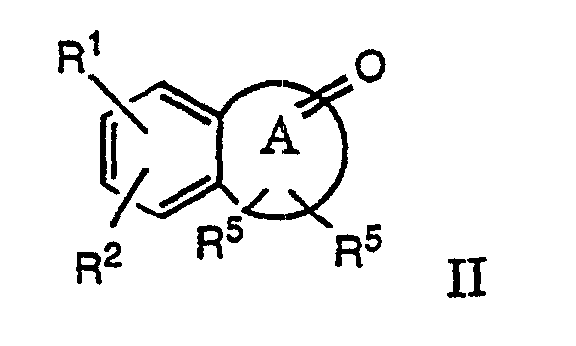 to a compound of formula
 wherein A and R1 - R6 have the significances given above, or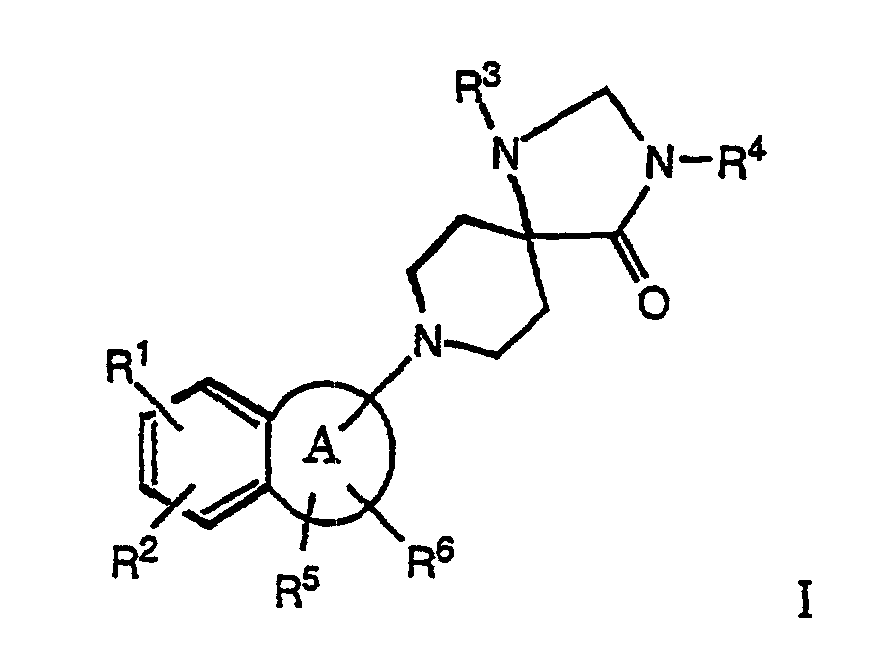
- d) converting a racemic mixture into its enantiomeric components for the manufacture of optically pure compounds, and
- e) if desired, converting the compound of formula I obtained into a pharmaceutically acceptable acid addition salt.
-
- In accordance with process variant a) a compound of formula II can be hydrogenated in conventional manner, for example with metal hydrides, such as borohydride, sodium cyanoborohyride or with triethylsilane in protic solvents, e.g. methanol or ethanol, and/or in the presence of protic reagents like trifluoroacetic acid in methylene chloride. This reaction is usually carried out at room temperature.
- Another method is the hydrogenation in the presence of at least one hydrogenating catalyst, such as palladium on carbon, platinum or ruthenium, in an inert solvent, for example methanol, ethanol or ethyl acetate or mixtures thereof. This reaction is carried out at a pressure of 1·105- 981·105 Pa and temperatures between 25 and 250 °C.
- In accordance with process variant b) a compound of formula I, wherein R4 is hydrogen, can be alkylated, benzylated or acylated in conventional manner, for example in the presence of a corresponding alkyl-, benzyl- or acyl-halogenide, such as methyliodide, allylbromide, benzylbromide, ethylbromide, acetylchloride, methylbromacetate and the like. This reaction is carried out in the presence of a metal hydride, such as sodium hydride at a temperature of 60-100°C.
- The reductive amination of a keto-compound of formula III with an amine of formula IV in accordance with variant c) is carried out in conventional manner in a solvent, such as tetrahydrofuran (THF), methanol or ethanol, or in a mixture of THF with a suitable alcohol, and in the presence of a reducing agent, such as Na-cyanoborohydride.
- Another method is described in J. Org. Chem., 55, 2552-54, 1990. In accordance with this variant the reaction is carried out by reaction of an amine with a ketone in the presence of TI-(IV)-isopropoxide and Na-cyanoborohydride.
- The salt formation in accordance with variant e) is effected at room temperature in accordance with methods which are known per se and which are familiar to any person skilled in the art. Not only salts with inorganic acids, but also salts with organic acids come into consideration. Hydrochlorides, hydrobromides, sulphates, nitrates, citrates, acetates, maleates, succinates, methanesulphonates, p-toluenesulphonates and the
- like are examples of such salts. The compounds which are used as starting materials can be prepared,
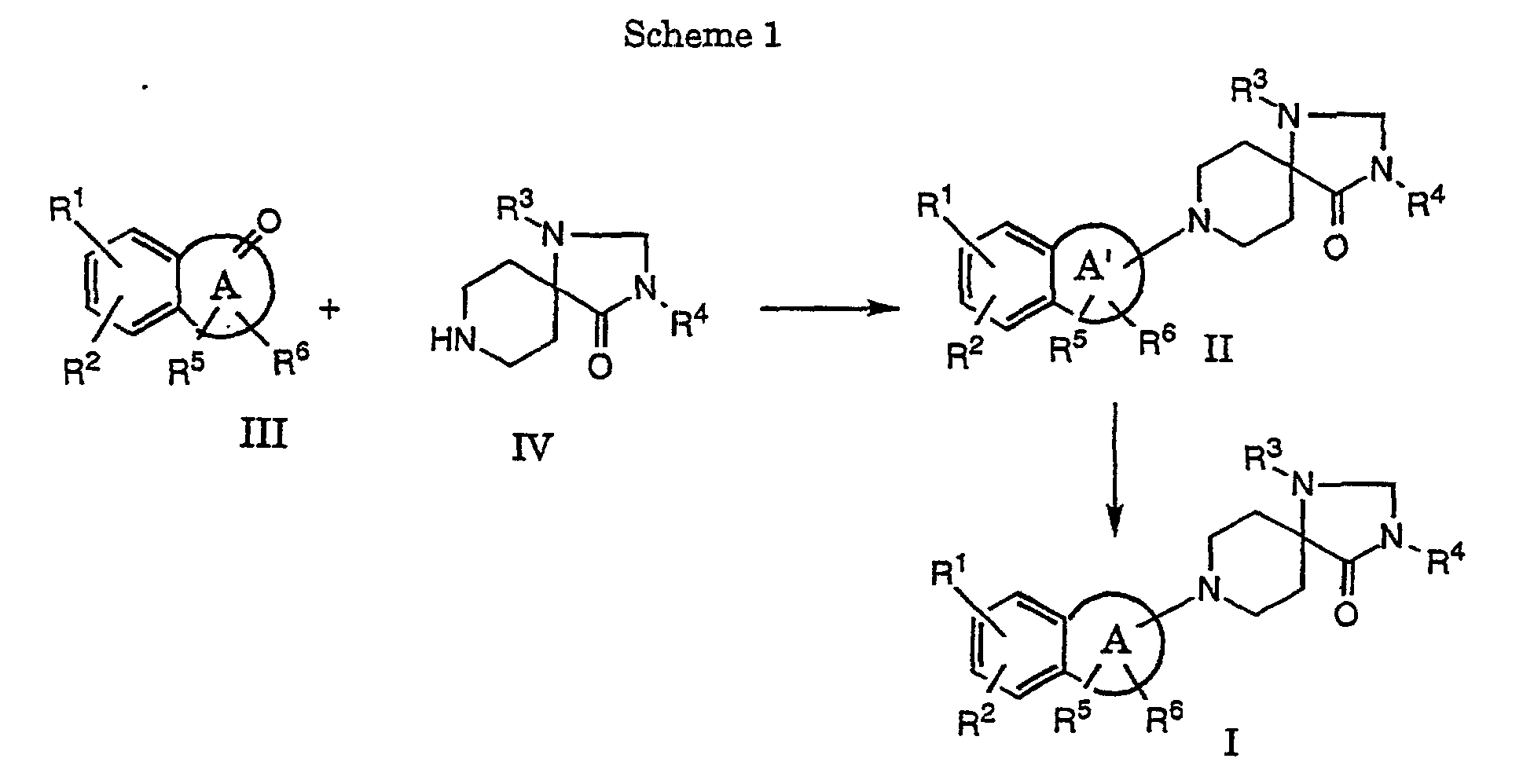
- for example, according to reaction schemes 1 and 2 and to Examples aa - av. Furthermore, the starting materials of the compound described in example 44 can be prepared in accordance with J. Org. Chem., 1995, 60, 4324-4330 and with J. Med.Chem., 1996, 39, 3169.wherein the substituents have the significances given above.
 wherein the substituents have the significance given above.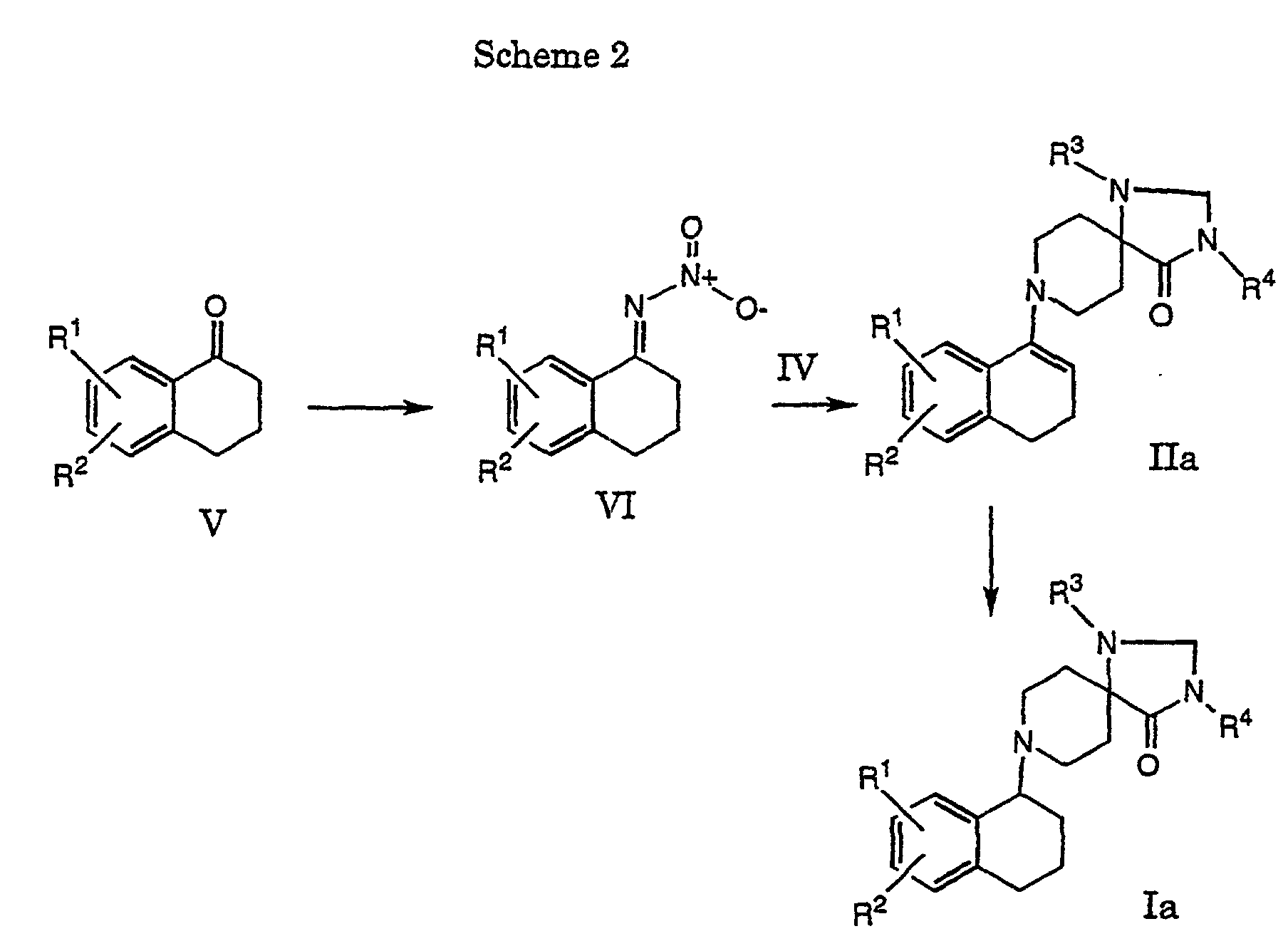
- A compound of formula II is obtained by treating a suitable ketone of formula III with a secondary amine to an enamine with loss of water. This reaction is reversible, so water has to be removed azeotropically or with a drying agent. This reaction is carried out in an inert solvent, such as benzene or toluene and in the presence of an acidic catalyst like p-toluene sulfonic acid or sulfuric acid or, alternatively, with a drying agent, for example with molecular sieves at temperatures of about 80-120 °C.
- The above mentioned compounds of formula II can also be prepared by stirring components in an inert solvent, such as hexane, benzene or 1,2-dichloroethane at room temperature or elevated temperatures up to 80 °C in the presence of, e.g. titanium tetrachloride as Lewis-acid and drying agent. Compounds of formula I can then be obtained in accordance with process variant a).
- In accordance with scheme 2 are obtained compounds of formula IIa. A compound of formula V is dissolved in an inert solvent, such as methanol, ethanol, water or mixtures thereof and refluxed with NH2OH and NaOAc. The obtained oxime is dissolved in an inert solvent such as diethylether. After a reaction with NaNO2 in water in the presence of H2SO4 it is obtained a compound of formula VI. This compound is dissolved in an inert solvent, such as acetonitrile and stirred together with the corresponding compound of formula IV and molecular sieves to give a compound of formula IIa.
- A compound of formula Ia can then be obtained by hydrogenation in accordance with process variant a).
- The ketones or aldehydes of formulae III and V and the compounds of formula IV are known compounds or can be prepared according to methods known per se.
- As mentioned earlier, the compounds of formula I and their pharmaceutically usuable addition salts possess valuable pharmacodynamic properties. It has been found that the compounds of the present invention are agonists and/or antagonists of the OFQ receptor and have effects in animal models of psychiatric, neurological and physiological disorders, such as anxiety, stress disorders, depression, trauma, memory loss due to Alzheimer's disease or other dementias, epilepsy and convulsions, acute and/or chronic pain conditions, symptoms of withdrawal from drugs of addiction, control of water balance, Na+ excretion, arterial blood pressure disorders and eating disorders such as obesity.
- The compounds were investigated in accordance with the tests given hereinafter:
- HEK-293 cells adapted to suspension growth (293s) were cultured in HL medium plus 2% FBS. The cells were transfected with the rat OFQ receptor cDNA (LC132), FEBS Lett. 347, 284-288, 1994, cloned in the expression vector pCEP4 (Invitrogen, SanDiego, CA, USA) using lipofectin (Life Technologies, Bethesda, MD, USA). Transfected cells were selected in the presence of hygromycin (1000 U/ml) (Calbiochem, SanDiego, CA, USA). A pool of resistant cells was tested for OFQ-R expression by binding of [3H]-OFQ (Amersham PLC, Buckinghamshire, England). These cells (293s-OFQ-R) were expanded for large scale culture and membrane preparation.
- 293s-OFQ-R cells were harvested by centrifugation, washed 3 times with phosphate buffered saline (PBS) before resuspension in buffer A (50 mM Tris-HCl, pH 7.8, 5 mM MgCl2, 1 mM EGTA) and disruption with a tissue homogenizer (30 seconds, setting 4, Pt 20, Kinematica, Kriens-Lucern, Switzerland). A total membrane fraction was obtained by centrifugation at 49,000 x g at 4°C. This procedure was repeated twice and the pellet was resuspended in buffer A. Aliquots were stored at -70°C and protein concentrations were determined using the BCA™ Protein Assay Reagent (Pierce, Rockford, IL) following the manufacturer's recommendations.
- [3H]-OFQ competition studies were carried out with 77 µg membrane protein in a final assay volume of 0.5 ml buffer A plus 0.1% BSA and 0.01% bacitracin (Boehringer-Mannheim, Mannheim, Germany) for one hour at room temperature. 50 nM unlabeled OFQ was used to define the non-specific binding. The assays were terminated by filtration through Whatman GF/C filters (Unifilter-96, Canberra Packard S.A., Zurich, Switzerland) pretreated with 0.3% polyethylenimine (Sigma, St. Louis, MO, USA) and 0.1% BSA (Sigma) for 1 hour. The filters were washed 6 times with 1 ml of ice bold 50 mM Tris-HCI pH 7.5. The retained radioactivity was counted on a Packard Top-Count microplate scintillation counter after addition of 40 µl of Microscint 40 (Canberra Packard). The effects of compounds were determined using at least 6 concentrations in triplicate, and determined twice. IC50 values were determined by curve fitting and these calues were converted to Ki values by the method of Cheng and Prusoff, Biochem. Pharmacol., 22, 3099, 1973.
- The affinity to the OFQ-receptor, given as pKi, is in the scope of 6,6 to 9,6. For example, the pKi -values of Examples 8 and 15 are 7,9 and 8,0, respectively.
- 8
- 3-Benzyl-8-(5,8-dichloro-1,2,3,4-tetrahydro-naphthyl-2)-1-phenyl-1,3,8-triaza-spiro [4,5] decan-4-on
- 15
- 3-Acetyl-8-(5,8-dichloro-1,2,3,4-tetrahydro-naphthyl-2)-1-phenyl-1,3,8-triaza-spiro[4,5]decan-4-on
- The compounds of formula I as well as their pharmaceutically usable acid addition salts can be used as medicaments, e.g. in the form of pharmaceutical preparations. The pharmaceutical preparations can be administered orally, e.g. in the form of tablets, coated tablets, dragées, hard and soft gelatine capsules, solutions, emulsions or suspensions. The administration can, however, also be effected rectally, e.g. in the form of suppositories, or parenterally, e.g. in the form of injection solutions.
- The compounds of formula I and their pharmaceutically usable acid addition salts can be processed with pharmaceutically inert, inorganic or organic excipients for the production of tablets, coated tablets, dragees and hard gelatine capsules. Lactose, corn starch or derivatives thereof, talc, stearic acid or its salts etc can be used as such excipients e.g. for tablets, dragées and hard gelatine capsules.
- Suitable excipients for soft gelatine capsules are e.g. vegetable oils, waxes, fats, semi-solid and liquid polyols etc.
- Suitable excipients for the manufacture of solutions and syrups are e.g. water, polyols, saccharose, invert sugar, glucose etc.
- Suitable excipients for injection solutions are e.g. water, alcohols, polyols, glycerol, vegetable oils etc.
- Suitable excipients for suppositories are e.g. natural or hardened oils, waxes, fats, semi-liquid or liquid polyols etc.
- Moreover, the pharmaceutical preparations can contain preservatives, solubilizers, stabilizers, wetting agents, emulsifiers, sweeteners, colorants, flavorants, salts for varying the osmotic pressure, buffers, masking agents or antioxidants. They can also contain still other therapeutically valuable substances.
- The dosage can vary within wide limits and will, of course, be fitted to the individual requirements in each particular case. In general, in the case of oral administration a daily dosage of about 10 to 1000 mg per person of a compound of general formula I should be appropriate, although the above upper limit can also be exceeded when it appears to be indicated.
- The following Examples illustrate the present invention, but are not intended to be limiting in any manner. All temperatures are given in degrees Celsius.
- 6-Chloro-2-tetralone (22.7 mmol) was dissolved in toluene (210 ml). 1-Phenyl-1,3,8-triazaspiro[4.5]decan-4-one (22.7 mmol) and molecular sieves (19 g) were added and the mixture was refluxed for 6 h. After cooling the molecular sieves were removed by filtration and washed with methylenchloride. Evaporation of the filtrate yielded a residue which was dissolved in THF (90 ml) and methanol (10 ml). Sodium cyanoborohydride (22.7 mmol) was added to the solution and the pH was adjusted to 4. The mixture was stirred for 4 h at room temperature. Ethylacetate was added and the organic phase was washed with 2 N sodium hydroxide and brine. The organic phase was concentrated and chromatographed over silicagel (ethylacetate). Addition of HCl in ethanol to a solution of the product in ethylacetate/ethanol yielded 8-(6-chloro-1,2,3,4-tetrahydro-naphthyl-2)-1-phenyl-1,3,8-triaza-spiro[4.5]decan-4-on hydrochloride (4.0 g, 41%) as colourless solid, m.p. 288-290 °C.
- The title compound, m.p. 286 - 290 °C was prepared in accordance with the general method of example 1 from 8-chloro-2-tetralone and 1-phenyl-1,3,8-triazaspiro[4.5]decan-4-one.
- The title compound, m.p. 290 - 293 °C was prepared in accordance with the general method of example 1 from 5,8-dichloro-2-tetralone and 1-phenyl-1,3,8-triazaspiro [4.5]decan-4-one.
- A suspension of 8-(6-chloro-1,2,3,4-tetrahydro-naphthyl-2)-1-phenyl-1,3,8-triaza-spiro[4.5]decan-4-on hydrochloride (0.47 mmol) and sodium hydride (60 mg, 60%) in DMF was stirred for 30 min at 80 °C. Methyliodide (40 ml, 0.47 mmol) was added and stirring continued for another 30 min. The mixture was cooled, ethyl acetate (100 ml) was added and washed with sodium bicarbonate solution and brine (50 ml each). Water phases were extracted with ethyl acetate, organic phases were pooled, dried with sodium sulfate and evaporated. Addition of HCl in ethanol to a solution of the residue in ethylacetate yielded 8-(6-chloro-1,2,3,4-tetrahydro-naphthyl-2)-3-methyl-1-phenyl-1,3,8-triaza-spiro[4.5]decan-4-on hydrochloride (0.17 g, 82%) as colourless solid, m.p. >250 °C and MS: m/e = 410.2 (M+H+).
- The title compound, m.p. > 250 °C and MS: m/e = 410.4 (M+H+) was prepared in accordance with the general method of example 4 from 8-(8-chloro-1,2,3,4-tetrahydro-2-naphthyl-1-phenyl-1,3,8-triaza-spiro[4.5]decan-4-one and methyliodide.
- The title compound, m.p. > 250 °C and MS: m/e = 444.7, 446.6 (M+H+) was prepared in accordance with the general method of example 4 from 8-(5,8-dichloro-1,2,3,4-tetrahydro-2-naphthyl-1-phenyl-1,3,8-triaza-spiro[4.5]decan-4-one and methyliodide.
- The title compound, m.p. > 250 °C and MS: m/e = 470.4, 472.4 (M+H+) was prepared in accordance with the general method of example 4 from 8-(5,8-dichloro-1,2,3,4-tetrahydro-2-naphthyl)-1-phenyl-1,3,8-triaza-spiro[4.5]decan-4-one and allylbromide.
- The title compound, m.p. > 250 °C and MS: m/e = 520.3, 522.3 (M+H+) was prepared in accordance with the general method of example 4 from 8-(5,8-dichloro-1,2,3,4-tetrahydro-2-naphthyl)-1-phenyl-1,3,8-triaza-spiro[4.5]decan-4-one and benzylbromide.
- The title compound, m.p. > 250 °C and MS: m/e = 458.3, 460.3 (M+H+) was prepared in accordance with general method of example 4 from 8-(5,8-dichloro-1,2,3,4-tetrahydro-2-naphthyl)-1-phenyl-1,3,8-triaza-spiro[4.5] decan-4-one and ethylbromide.
- The title compound, m.p. >250 °C and MS: m/e = 362.3 (M+H+) was prepared in accordance with general method of example 1 from 2-tetralone and 1-phenyl-1,3,8-triazaspiro[4.5]decan-4-one.
- 3,4-Dihydro-2H-naphthyl-1-oxime (2.98 mmol) was dissolved in ether (6 ml) and a solution of sodium nitrite (5 mmol) in 2,5 ml water was added. The solution was stirred for 1 hr under inert atmosphere (Ar). Then IN H2SO4 (5 ml) was added and the solution was stirred for 3 hrs. The organic phase was separated and washed twice with 5 ml NaHCO3. The water phase was washed with 5 ml ether. Evaporation of the pooled organic phases yielded a residue which was dissolved in acetonitril (10 ml) and to this solution was added at 0 °C a suspension of 1-phenyl-1,3,8-triaza-spiro[4.5]-decan-4-on (11.9 mmol) in acetonitril (30 ml). The mixture and molecular sieves (10 g) were stirred about 40 hrs at room temperature in inert atmosphere (Ar). The organic phase was concentrated and washed twice with acetonitril (20 ml). After evaporation of the filtrate the residue was dissolved in THF (90 ml) and ethanol (10 ml). Sodium cyanoborohydride (190 mg) was added to the solution and the pH was adjusted to 4 (HCl/EtOH). The mixture was stirred for 105 min. at room temperature. Evaporation and purification (described in example 1) yielded 1-phenyl-8-(1,2,3,4-tetrahydro-1-naphthyl)-1,3,8-triaza-spiro[4.5]decan-4-on hydrochloride, m.p. >250 °C and MS: m/e = 361 (M+).
- The title compound, m.p. >250 °C and MS: m/e = 396.2, 398.2 (M+H+) was prepared in accordance with general method of example 1 from 7-chloro-2-tetralone and 1-phenyl-1,3,8-triaza-spiro [4.5]decan-4-on.
- The title compound, m.p. >250 °C and MS: m/e = 396.4, 398.4 (M+H+) was prepared in accordance with general method of example 1 from 5-chloro-2-tetralone and 1-phenyl-1,3,8-triaza-spiro[4.5]decan-4-on.
- The title compound, m.p. > 250 °C and MS: m/e = 389 (M+) was prepared in accordance with general method of example 1 from 5,7 dimethyl-2-tetralone and 1-phenyl-1,3,8-triazaspiro[4.5]decan-4-one.
- The title compound, m.p. > 250 °C and MS: m/e = 472.3, 474.4 (M+H+) was prepared in accordance with general method of example 4 from 8-(5,8-dichloro-1,2,3,4-tetrahydro-2-naphthyl)-1-phenyl-1,3,8-triaza-spiro[4.5]decan-4-one and acetylchloride.
- The title compound, m.p. 185-187 °C was prepared in accordance with the general method of exaple 4 from 8-(5,8-dichloro-1,2,3,4-tetrahydro-2-naphthyl)-1-phenyl-1,3,8-triaza-spiro[4.5]decan-4-one and methyl bromoacetate.
- The title compound, m.p. > 250 °C, MS: m/e = 430.5, 432.5 (M+H+) and [α] 20 / D = - 54.9 was prepared from 8-(5,8-dichloro-1,2,3,4-tetrahydro-2-naphthyl)-1-phenyl-1,3,8-triaza-spiro[4.5]decan-4-one by cocrystallization with (+)-2,2'-(1,1'-binaphtyl)-phosphoric acid.
- The title compound, m.p. > 250 °C, MS: m/e = 430.5, 432.5 (M+H+) and [α] 20 / D = + 53.2 was prepared from 8-(5,8-dichloro-1,2,3,4-tetrahydro-2-naphthyl)-1-phenyl-1,3,8-triaza-spiro[4.5]decan-4-one by cocrystallization with (-)-2,2'-(1,1'-binaphtyl)-phosphoric acid.
- The title compound, m.p. 220 °C dec. was prepared in accordance with the general method of example 4 from 8-(5,8-dichloro-1,2,3,4-tetrahydro-2-naphthyl)-1-phenyl-1,3,8-triazaspiro[4.5]decan-4-one hydrochloride and benzoylchloride.
- The title compound, m.p. 191-192 °C dec. was prepared in accordance with the general method of example 4 from 8-(5,8-dichloro-1,2,3,4-tetrahydro-2-naphthyl)-1-phenyl-1,3,8-triazaspiro[4.5]decan-4-one hydrochloride and dimethyl bromomalonate.
- The title compound, m.p. >250 °C and MS: m/e = 514.3 (M+H+) was prepared in accordance with the general method of example 4 from 8-(8-Chloro-1,2,3,4-tetrahydro-2-naphthyl)-1-phenyl-1,3,8-triazaspiro[4.5]decan-4-one hydrochloride and phenacylbromide.
- The title compound, m.p. >250 °C and MS: m/e = 390.5 (M+H+) was prepared in accordance with the general method of example 1 from 3,4-dihydro-5,8-dimethyl-1(2H)-naphthalenone and 1-phenyl-1,3,8-triazaspiro[4.5]decan-4-one.
- The title compound, m.p. 244 °C dec. and MS: m/e = 439 (M+) was prepared in accordance with the general method of example 4 from 8-(8-Chloro-1,2,3,4-tetrahydro-2-naphthyl)-1-phenyl-1,3,8-triazaspiro [4.5]decan-4-one hydrochloride and 2-chloroethoxy-trimethylsilane (in situ deprotection).
- The title compound, m.p. >227-229 °C dec. and MS: m/e = 440.6 (M+H+) was prepared in accordance with the general method of example 4 from 8-(8-Chloro-1,2,3,4-tetrahydro-2-naphthyl)-1-phenyl-1,3,8-triazaspiro [4.5]decan-4-one hydrochloride and chloromethyl-methylether.
- The title compound, m.p. >245 °C dec. and MS: m/e = 488.5 (M+H+) was prepared in accordance with the general method of example 4 from 8-(1,2,3,4-tetrahydro-2-naphthyl)-1-phenyl-1,3,8-triazaspiro[4.5] decan-4-one hydrochloride and (S)-1-(4-methylbenzenesulfonate)-4,4,4-trifluoro-1,3-butanediol.
- The title compound, m.p. >250 °C and MS: m/e = 348.4 (M+H+) was prepared in accordance with the general method of example 11 from 2,3-dihydro-1H-inden-1-one oxime and 1-phenyl-1,3,8-triazaspiro[4.5]decan-4-one.
- The title compound, m.p. >246 °C dec. and MS: m/e = 488.5 (M+H+) was prepared in accordance with the general method of example 4 from 8-(1,2,3,4-tetrahydro-2-naphthyl)-1-phenyl-1,3,8-triazaspiro[4.5]decan-4-one hydrochloride and (R)-1-(4-methylbenzenesulfonate)-4,4,4-trifluoro-1,3-butanediol.
- The title compound, m.p. >235 °C dec. and MS: m/e = 350.4 (M+H+) was prepared in accordance with the general method of example 1 from 3(2H)-benzofuranone and 1-phenyl-1,3,8-triazaspiro[4.5]decan-4-one.
- The title compound, m.p. >250 °C dec. and MS: m/e = 440.4, 442.4 (M+H+) was prepared in accordance with the general method of example 1 from 8-bromo-3,4-dihydro-2(1H)-naphthalenone and 1-phenyl-1,3,8-triazaspiro[4.5]decan-4-one.
- The title compound, m.p. >250 °C and MS: m/e = 424.4 (M+H+) was prepared in accordance with the general method of example 1 from 2,3-dihydro-3-phenyl-1H-inden-1-one and 1-phenyl-1,3,8-triazaspiro[4.5]decan-4-one.
- The title compound, m.p. >244-246 °C dec. and MS: m/e = 361 (M+) was prepared in accordance with the general method of example 1 from 2,3-dihydro-3-methyl-1H-inden-1-one and 1-phenyl-1,3,8-triazaspiro[4.5]decan-4-one.
- The title compound, m.p. >250 °C and MS: m/e = 348.4 (M+H+) was prepared in accordance with the general method of example 1 from 1,3-dihydro-2H-inden-2-one and 1-phenyl-1,3,8-triazaspiro[4.5]decan-4-one.
- The title compound, m.p. 250 °C and MS: m/e = 390.2 (M+H+) was prepared in accordance with the general method of example 1 from 2,3-dihydro-3,3,6-trimethyl-1H-inden-1-one and 1-phenyl-1,3,8-triazaspiro[4.5]decan-4-one.
- 6,7,8,9-Tetrahydro-5H-benzocyclohepten-5-one (3.1 mmol) was dissolved in THF (10 ml). 1-Phenyl-1,3,8-triazaspiro[4.5]decan-4-one (3.1 mmol) and tetraisopropyl-orthotitanate (3.1 mmol) were added and the mixture was stirred for 22 h at room temperature. Evaporation yielded a residue which was dissolved in ethanol (5 ml). Sodium cyanoborohydride (2.1 mmol) was added to the solution and the mixture was stirred for 2 d at room temperature. Water was added, the precipitate was removed by filtration through Celite® and washed with ethanol. The filtrate was dried with Na2SO4 and concentrated. Chromatography on silica gel (ethylacetate/hexane, 50:50) yielded the desired product which was crystallized as its HCl-salt from methylene chloride/ethanol. 0.1 g (8%) of (RS)-1-Phenyl-8-(6,7,8,9-tetrahydro-5H-benzocyclohepten-5-yl)-1,3,8-triaza-spiro[4.5]decan-4-one hydrochloride (1:1) as a colorless solid, m.p. > 250 °C and MS: m/e = 376.4 (M+H+).
- The title compound, m.p. >250 °C and MS: m/e = 396.2 (M+H+) was prepared in accordance with the general method of example 11 from 5-chloro-3,4-dihydro-1(2H)-naphthalenone oxime and 1-phenyl-1,3,8-triazaspiro[4.5] decan-4-one.
- The title compound, m.p. >250 °C and MS: m/e = 380.3 (M+H+) was prepared in accordance with the general method of example 11 from 7-fluoro-3,4-dihydro-1(2H)-naphthalenone oxime and 1-phenyl-1,3,8-triazaspiro [4.5]decan-4-one.
- The title compound, m.p. >250 °C and MS: m/e = 382.2 (M+H+) was prepared in accordance with the general method of example 34 from 5-chloro-2,3-dihydro-1H-inden-1-one and 1-phenyl-1,3,8-triazaspiro[4.5]decan-4-one.
- The title compound, m.p. >250 °C and MS: m/e = 414.2 (M+H+) was prepared in accordance with the general method of example 11 from 7-chloro-5-fluoro-3,4-dihydro-1(2H)-naphthalenone oxime and 1-phenyl-1,3,8-triazaspiro[4.5] decan-4-one.
- The title compound, m.p. >250 °C and MS: m/e = 362.2 (M+H+) was prepared in accordance with the general method of example 34 from 2,3-dihydro-4-methyl-1H-inden-1-one and 1-phenyl-1,3,8-triazaspiro[4.5] decan-4-one.
- The title compound, m.p. >250 °C and MS: m/e = 362.2 (M+H+) was prepared in accordance with the general method of example 4 from 8-indan-2-yl-1-phenyl-1,3,8-triaza-spiro[4.5]decan-4-one hydrochloride (1:1) and methyliodide.
- The title compound, m.p. >250 °C and MS: m/e = 396.2 (M+H+) was prepared in accordance with the general method of example 11 from 7-chloro-3,4-dihydro-1(2H)-naphthalenone oxime and 1-phenyl-1,3,8-triazaspiro[4.5]decan-4-one.
- The title compound, m.p. 232-234 °C was prepared in accordance with the general method of example 4 from 1-phenyl-8-(1,2,3,4-tetrahydro-naphtyl-1)-1,3,8-triaza-spiro[4.5]decan-4-one hydrochloride (1:1) and methyliodide.
- The title compound, m.p. 200-203 °C and MS: m/e = 362.2 (M+H+) was prepared in accordance with the general method of example 4 from (RS)-8-indan-1-yl-1-phenyl-1,3,8-triaza-spiro[4.5]decan-4-one hydrochloride (1:1) and methyliodide.
- (R)-1-Indan-1-yl-4-phenylamino-piperidine-4-carboxylic acid amide (2.9 mmol) suspended in formamide (15 ml) was stirred for 2 h at 200 °C. The mixture was cooled, poured into cold water (150 ml) and extracted with methylene chloride. Organic phases were pooled, dried with sodium sulfate and concentrated to yield a mixture of (R)-8-indan-1-yl-1-phenyl-1,3,8-triaza-spiro[4.5]decan-4-one and (R)-8-indan-1-yl-1-phenyl-1,3,8-triaza-spiro[4.5]dec-2-en-4-one. This mixture was dissolved in methanol (60 ml) and sodiumborohydride (4.2 mmol) was added. The mixture was stirred for 1 h at 60° C, cooled and concentrated. Saturated ammonium chloride solution and methylene chloride were added to the residue. The water phase was extracted with methylene chloride. Organic phases were pooled, dried with sodium sulfate and concentrated. Chromatography on silica gel (methylene chloride/methanol, 98:2) yielded the desired product. This was crystallized as its HCl-salt from ethylacetate/ethanol. 0.27 g (24%) of (R)-8-indan-1-yl-1-phenyl-1,3,8-triaza-spiro[4.5]decan-4-one hydrochloride (1:1), m.p. >250 °C and MS: m/e = 348.4 (M+H+).
- The title compound, m.p. 164-166 °C dec. and MS: m/e = 414.2 (M+H+) was prepared in accordance with the general method of example 11 from 6-chloro-2,3-dihydro-4H-1-benzothiopyran-4-one oxime and 1-phenyl-1,3,8-triazaspiro[4.5]decan-4-one.
- The title compound, m.p. >250 °C dec. and MS: m/e = 348.4 (M+H+) was prepared in accordance with the general method of example 44 from (S)-1-indan-l-yl-4-phenylamino-piperidine-4-carboxylic acid amide.
- The tide compound, m.p. >250 °C and MS: m/e = 396.2 (M+H+) was prepared in accordance with the general method of example 11 from 6-chloro-3,4-dihydro-1(2H)-naphthalenone oxime and 1-phenyl-1,3,8-triazaspiro[4.5]decan-4-one.
- The title compound, m.p. >250 °C and MS: m/e = 376.3 (M+H+) was prepared in accordance with the general method of example 1 from 5,6,8,9-tetrahydro-7H-benzocyclohepten-7-one and 1-phenyl-1,3,8-triazaspiro[4.5]decan-4-one.
- The title compound, m.p. >250 °C and MS: m/e = 382.2 (M+H+) was prepared in accordance with the general method of example 11 from 6-fluoro-2,3-dihydro-4H-1-benzopyran-4-one oxime and 1-phenyl-1,3,8-triazaspiro[4.5]decan-4-one.
- The title compound, m.p. >250 °C and MS: m/e = 398.2 (M+H+) was prepared in accordance with the general method of example 11 from 6-chloro-2,3-dihydro-4H-1-benzopyran-4-one oxime and 1-phenyl-1,3,8-triazaspiro[4.5]decan-4-one.
- The title compound, m.p. >250 °C and MS: m/e = 362.2 (M+H+) was prepared in accordance with the general method of example 44 from (R)-4-phenylamino-1-(1,2,3,4-tetrahydro-naphtalen-1-yl)-piperidine-4-carboxylic acid amide.
- The title compound, m.p. >250 °C and MS: m/e = 362.2 (M+H+) was prepared in accordance with the general method of example 44 from (S)-4-phenylamino-1-(1,2,3,4-tetrahydro-naphtalen-1-yl)-piperidine-4-carboxylic acid amide.
- The title compound, white solid, m.p. >230 °C and MS: m/e = 382.2 (M+H+) was prepared in accordance with the general method of example 34 from 4-chloro-indan-1-one and 1-phenyl-1,3,8-triazaspiro[4.5]decan-4-one.
- The title compound, white solid, m.p. 240 °C (dec.) and MS: m/e = 363 (M+) was prepared in accordance with the general method of example 11 from 4-chromanone oxime and 1-phenyl- 1,3,8-triazaspiro [4.5]decan-4-one.
- The title compound, light yellow solid, m.p. >220 °C and MS: m/e = 384.3 (M+H+) was prepared in accordance with the general method of example 34 from 2H-acenaphthylen-1-one and 1-phenyl-1,3,8-triazaspiro[4.5]decan-4-one.
- The title compound, off white solid m.p. >220 °C and MS: m/e = 390.2 (M+H+) was prepared in accordance with the general method of example 34 from 5-iso-propyl-indan-1-one and 1-phenyl-1,3,8-triazaspiro[4.5]decan-4-one.
- The title compound, white solid, m.p. 203 °C and MS: m/e = 438.3 (M+H+) was prepared in accordance with the general method of example 11 from 3-phenyl-3,4-dihydro-1(2H)-naphthalenone oxime and 1-phenyl-1,3,8-triazaspiro[4.5]decan-4-one.
- The title compound, light brown solid, m.p. >185 °C (dec.) and MS: m/e = 398.3 (M+H+) was prepared in accordance with the general method of example 4 from (RS)-8-(acenaphthen-1-yl)-1-phenyl-1,3,8-triazaspiro[4.5]decan-4-one hydrochloride (1:1) and methyliodide.
- The title compound, white solid, m.p. >220 °C and MS: m/e = 424.3 (M+H+) was prepared in accordance with the general method of example 1 from 5,7- dihydro-dibenzo[a,c]cydo-hepten-6-one and 1-phenyl-1,3,8-triazaspiro[4.5]decan-4-one.
- The title compound, light brown solid, m.p. 293 °C (dec.) and MS: m/e = 388.2 (M+H+) was prepared in accordance with the general method of example 34 from 2a,3,4,5-tetrahydro-2H-acenaphthylen-1-one and 1-phenyl-1,3,8-triazaspiro[4.5] decan-4-one.
- The title compound, light brown solid, m.p. 251 °C and MS: m/e = 398.3 (M+H+) was prepared in accordance with the general methods of example aa and 44 from 4-phenylamino-1-(2,3-dihydro-1H-phenalen-1-yl)-piperidine-4-carbonitrile without isolation of the intermediate amide.
- Example 63
- The title compound, white solid, m.p. 270 °C and MS: m/e = 384.3 (M+H+) was prepared in accordance with the general methods of examples aa and 44 from (R)-4-phenylamino-1-(acenaphthen-1-yl)-piperidine-4-carbonitrile without isolation of the intermediate amide.
- The title compound, white solid, m.p. 246 °C and MS: m/e = 402.4 (M+H+) was prepared in accordance with the general method of example 11 from 2,3,3a,4,5,6-hexahydrophenalen-1-one oxime and 1-phenyl-1,3,8-triazaspiro[4.5]decan-4-one.
- The title compound, white solid, m.p. 285°C and MS: m/e = 396.1 (M+H+) was prepared in accordance with the general methods of examples aa and 44 from 4-phenylamino-1-(fluoren-9-yl)-piperidine-4-carbonitrile without isolation of the intermediate amide.
- The title compound, m.p. >250 °C and MS: m/e = 376.3 (M+H+) was prepared in accordance with the general method of example 11 from 5-methyl-3,4-dihydro-1(2H)-naphthalenone oxime and 1-phenyl-1,3,8-triazaspiro[4.5] decan-4-one.
- The title compound, white solid, m.p. 272 °C and MS: m/e = 418.2 (M+H+) was prepared in accordance with the general methods of examples aa and 44 from (RS)-1-(acenaphthen-1-yl)-4-(3-chloro-phenylamino)-piperidine-4-carbonitrile without isolation of the intermediate amide.
- The title compound, white solid, m.p. 268 °C and MS: m/e = 398.3 (M+H+) was prepared in accordance with the general methods of examples aa and 44 from (RS)-1-(acenaphthen-1-yl)-4-(m-tolylamino)-piperidine-4-carbonitrile without isolation of the intermediate amide.
- The title compound, white solid, m.p. 266 °C and MS: m/e = 398.3 (M+H+) was prepared in accordance with the general methods of examples aa and 44 from (RS)-1-(acenaphthen-1-yl)-4-(p-tolylamino)-piperidine-4-carbonitrile without isolation of the intermediate amide.
- The title compound, white solid, m.p. 274 °C and MS: m/e = 414.2 (M+H+) was prepared in accordance with the general methods of examples aa and 44 from (RS)-1-(acenaphthen-1-yl)-4-(3-methoxy-phenylamino)-piperidine-4-carbonitrile without isolation of the intermediate amide.
- The title compound, white solid, m.p. 262 °C and MS: m/e = 414.2 (M+H+) was prepared in accordance with the general methods of examples aa and 44 from (RS)-1-(acenaphthen-1-yl)-4-(4-methoxy-phenylamino)-piperidine-4-carbonitrile without isolation of the intermediate amide.
- (S)-1-Indan-1-yl-4-phenylamino-piperidine-4-carbonitrile (27 mmol) was added dropwise at room temperature to a mixture of acetic anhydride and formic acid (40 ml each). The mixture was stirred for 16 h at room temperature. Sodium hydroxide solution was added (pH = 7) and the mixture extracted with ethylacetate. Organic phases were pooled, dried with sodium sulfate and concentrated. Chromatography on silica gel (ethylacetate) yielded the formylated amine which was dissolved in t-butanol (60 ml). Ammonia (28%, 10 ml), water (10 ml) and hydrogen peroxide solution (33% in water, 5 ml) were added. The mixture was stirred for 2.5 h at room temperature, quenched with cold water (50 ml) and extracted with methylene chloride. Organic phases were pooled, dried with sodium sulfate and concentrated. Chromatography on silica gel (methylene chloride/methanol, 98:2) yielded the desired product as a selid. 1.0 g (11%) of (S)-1-indan-1-yl-4-phenylamino-piperidine-4-carboxylic acid amide, m.p. 194-195 °C and MS: m/e = 336.2 (M+H+).
- (S)-1-Indan-1-yl-piperidine-4-one (31 mmol) was dissolved in acetic acid (28 ml). Aniline (33 mmol) and trimethylsilylcyanide (31 mmol) were added and the mixture was stirred for 45 min at room temperature. The reaction mixture was poured into cold ammonia solution (water/28% ammonia, 50ml/30ml). The solution was adjusted to pH 10 and extracted with methylene chloride. Organic phases were pooled, dried with sodium sulfate and concentrated. Crystallization from diethylether yielded the desired product as a solid. 8.1 g (80%) of (S)-1-indan-1-yl-4-phenylamino-piperidine-4-carbonitrile, m.p. 157-160 °C and MS: m/e = 318.3 (M+H+).
- (S)-1-Aminoindane (37 mmol) was dissolved in ethanol (65 ml). Potassium carbonate (3.7 mmol) and 1-ethyl-1-methyl-4-oxo-piperidinium iodide (56 mmol) dissolved in water (30 ml) were added and the mixture was refluxed for 30 min. Water was added, ethanol was removed in vacuo and the residue was extracted with ethylacetate. Organic phases were pooled, dried with sodium sulfate and concentrated. Chromatography on silica gel (ethylacetate) yielded the desired product as an oil. 7.1 g (90%) of (S)-1-indan-1-yl-piperidine-4-one, MS: m/e = 216.4 (M+H+).
- The title compound, m.p. 193-195 °C and MS: m/e = 336.2 (M+H+) was prepared in accordance with the general method of example aa from (R)-1-Indan-1-yl-4-phenylamino-piperidine-4-carbonitrile.
- The title compound, m.p. 158-159°C and MS: m/e = 318.3 (M+H+) was prepared in accordance with the general method of example ab from (R)-1-indan-1-yl-piperidine-4-one, aniline and trimethylsilylcyanide.
- The title compound, MS: m/e = 216.4 (M+H+) was prepared in accordance with the general method of example ac from (R)-1-aminoindane and 1-ethyl-1-methyl-4-oxo-piperidinium iodide.
- The title compound, m.p. 182-184 °C and MS: m/e = 350.3 (M+H+) was prepared in accordance with the general method of example aa from (R)-4-phenylamino-1-(1,2,3,4-tetrahydro-naphtalen-1-yl)-piperidine-4-carbonitrile.
- (R)-1,2,3,4-Tetrahydro-1-naphthylamine (16 mmol) was dissolved in ethanol (30 ml). Potassium carbonate (9.3 mmol) and 1-ethyl-1-methyl-4-oxo-piperidinium iodide (23 mmol) dissolved in water (30 ml) were added and the mixture was refluxed for 1 h. Water was added, ethanol was removed in vacuo and the residue was extracted with ethylacetate. Organic phases were pooled, dried with sodium sulfate and concentrated. Chromatography on silica gel (ethylacetate) yielded (R)-1-(1,2,3,4-tetrahydro-naphtalen-1-yl)-piperidine-4-one which was dissolved in acetic acid (11 ml). Aniline (14 mmol) and trimethylsilylcyanide (13 mmol) were added and the mixture was stirred for 1.5 h at room temperature. The reaction mixture was poured into cold ammonia solution (water/28% ammonia, 70ml/30ml). The solution was adjusted to pH 10 and extracted with methylene chloride. Organic phases were pooled, dried with sodium sulfate and concentrated. Crystallization from diethylether yielded the desired product as a solid. 8.1 g (80%) of (R)-4-phenylamino-1-(1,2,3,4-tetrahydro-naphtalen-1-yl)-piperidine-4-carbonitrile, m.p. 152-153 °C and MS: m/e = 332.3 (M+H+).
- The title compound, m.p. 186-187 °C and MS: m/e = 350.3 (M+H+) was prepared in accordance with the general method of example aa from (S)-4-phenylamino-1-(1,2,3,4-tetrahydro-naphtalen-1-yl)-piperidine-4-carbonitrile.
- The title compound, m.p. 152-153 °C and MS: m/e = 332.3 (M+H+) was prepared in accordance with the general method of example ai from (S)-1,2,3,4-tetrahydro-1-naphthylamine.
- To a stirred mixture of 2,3-dihydro-phenalen-1-one (1.32 g, 7.24 mmol), hydroxylamine hydrochloride (0.85 g, 12.2 mmol) and water (6 ml) was added dropwise at 75 °C MeOH (7.5 ml) and afterwards a solution of sodium acetate (2.58 g, 19.0 mmol) in water (4 ml). Stirring was continued over a period of 1.5 h, water (20 ml) was added and after cooling (ice bath) the solid was collected by filtration. After drying in vacuo the crude product was dissolved in 3.5 N NH3/ MeOH (100 ml) and hydrogenated over Raney-Nickel (0.5 g, washed with MeOH) at RT for 17h. The catalyst was filtered off, the solution evaporated in vacuo and the residue purified by column chromatography on silica gel (dichloromethane/MeOH 9:1) to yield (RS)-2,3-dihydro-1H-phenalen-1-yl-amine (0.95 g) as a brown oil.
- The title compound, brown oil, was prepared in accordance with the general method of example ac from (RS)-2,3-dihydro-lH-phenalen-1-yl-amine and 1-ethyl-1-methyl-4-oxo-piperidinium iodide.
- The title compound, pale brown oil, was prepared in accordance with the general method of example ab from (RS)-1-(2,3-dihydro-1H-phenalen-1-yl)-piperidin-4-one.
- To a cooled (0 °C) and stirred solution of (S)-acenaphthenol (1.74 g, 10.2 mmol) and diphenyl-phosphorylazide in toluene (17.5 ml) was added DBU (1.86 ml, 12.3 mmol) and stirring was continued at RT over a period of 20 h. The reaction mixture was extracted with toluene (2 x 50 ml), the combined organic phases washed with water, dried (MgSO4) and evaporated in vacuo. The crude product was dissolved in EtOH (120 ml) and hydrogenated at RT over PtO2(0.24 g). The catalyst was filtered off, the solution evaporated in vacuo and the residue purified by column chromatography on silica gel (dichloromethane/MeOH 9:1) to yield (R)-acenaphthen-1-yl-amine (1.56 g) as a pink oil. MS: m/e = 169 (M+).
- The title compound, pale yellow oil, MS: m/e = 169 (M+) was prepared in accordance with the general method of example ao from (R)-acenaphthenol.
- The title compound, red-brown oil, MS: m/e = 252.2 (M+H+) was prepared in accordance with the general method of example ac from (R)-acenaphthen-1-yl-amine and 1-ethyl-1-methyl-4-oxo-piperidinium iodide.
- The title compound, red-brown oil, MS: m/e = 252.2 (M+H+) was prepared in accordance with the general method of example ac from (S)-acenaphthen-1-yl-amine and 1-ethyl-1-methyl-4-oxo-piperidinium iodide.
- The title compound, pale yellow foam, MS: m/e = 354.3 (M+H+) was prepared in accordance with the general method of example ab from (R)-1-(acenaphthen-1-yl)-piperidin-4-one.
- The title compound, pale yellow oil, MS: m/e = 354.3 (M+H+) was prepared in accordance with the general method of example ab from (S)-1-(acenaphthen-1-yl)-piperidin-4-one.
- The title compound, red-brown solid, m.p. 135 °C, MS: m/e = 263 (M+) was prepared in accordance with the general method of example ac from fluoren-9-yl-amine and 1-ethyl-1-methyl-4-oxo-piperidinium iodide.
- The title compound, white solid, m.p. 165°C, MS: m/e = 366.1 (M+H+) was prepared in accordance with the general method of example ab from 1-(fluoren-9-yl)-piperidine-4-one.
- The title compound, pale brown foam, MS: m/e = 388.1 (M+H+) was prepared in accordance with the general method of example ab from 3-chloro-aniline and (RS)-1-(acenaphthen-1-yl)-piperidin-4-one.
- The title compound, pale brown foam, MS: m/e = 368.2 (M+H+) was prepared in accordance with the general method of example ab from m-toluidine and (RS)-1-(acenaphthen-1-yl)-piperidin-4-one.
- The title compound, pale brown foam, MS: m/e = 384.2 (M+H+) was prepared in accordance with the general method of example ab from 3-methoxyaniline and (RS)-1-(acenaphthen-1-yl)-piperidin-4-one.
- The title compound, pale brown foam, MS: m/e = 384.2 (M+H+) was prepared in accordance with the general method of example ab from 3-methoxyaniline and (RS)-1-(acenaphthen-1-yl)-piperidin-4-one.
- The title compound, pale brown foam, MS: m/e = 368.2 (M+H+) was prepared in accordance with the general method of example ab from p-toluidine and (RS)-1-(acenaphthen-1-yl)-piperidin-4-one.
- Tablets of the following composition are manufactured in the usual manner:
mg/tablet Active substance 5 Lactose 45 Corn starch 15 Microcrystalline cellulose 34 Magnesium stearate 1 Tablet weight 100 - Capsules of the following composition are manufactured:
mg/capsule Active substance 10 Lactose 155 Corn starch 30 Talc 5 Capsule fill weight 200 - Suppositories of the following composition are manufactured:
mg/supp. Active substance 15 Suppository mass 1285 Total 1300 - The suppository mass is melted in a glass or steel vessel, mixed thoroughly and cooled to 45°C. Thereupon, the finely powdered active substance is added thereto and stirred until it has dispersed completely. The mixture is poured into suppository moulds of suitable size, left to cool, the suppositories are then removed from the moulds and packed individually in wax paper or metal foil.
Claims (16)
- Compounds of the general formulawherein

- R1 and R2
- are, independently from each other, hydrogen, (C1-C6)-alkyl or halogen;
- R3
- is phenyl, optionally substituted by (C1-C6)-alkyl, CF3, (C1-C6)-alkoxy or halogen; and
- R4
- is hydrogen, (C1-C6)-alkyl, (C1-C6)-alkenyl, -C(O)-(C1-C6)-alkyl, -C(O)-phenyl, (C1-C6)-alkyl-C(O)-phenyl, (C1-C6)-alkylen-C(O)O-(C1-C6)-alkyl, (C1-C6)-alkantriyl-di-C(O)O-(C1-C6)-alkyl, hydroxy-(C1-C6)-alkyl, (C1-C6)-alkyl-O-(C1-C6)-alkyl, (C1-C6)-alkyl-CH(OH)CF3, phenyl or benzyl,
- R5 and R6
- are, independently from each other, hydrogen, phenyl, (C1-C6)-alkyl or di-(C1-6)-alkyl or may form together a phenyl ring, and
- R5 and one of R1 or R2
- may form together a saturated or unsaturated 6 membered ring,
- A
- is a 4 - 7 membered saturated ring which may contain a heteroatom such as O or S,
- A compound according to claim 1, wherein R1 and R2 are halogen.
- A compound according to claim 2, wherein R1 and R2 are chloro.
- A compound according to claim 3(-)-8-(5,8-dichloro-1,2,3,4-tetrahydro-naphthyl-2)-1-phenyl-1,3,8-triaza-spiro[4,5] decan-4-on.
- A compound according to claim 1, wherein one of R1 and R2 is hydrogen and the other is halogen.
- A compound according to claim 5, wherein R1 or R2 is chloro.
- A compound according to claim 6
8-(8-chloro-1,2,3,4-tetrahydro-naphthyl-2)-1-phenyl-1,3,8-triaza-spiro[4.5] decan-4-on. - A compound according to claim 1, wherein R1 and R2 are hydrogen.
- A compound according to claim 81-phenyl-8-(1,2,3,4-tetrahydro-naphthyl-1)-1,3,8-triaza-spiro[4.5]decan-4-on and8-Indan-1-yl-1-phenyl-1,3,8-triaza-spire[4.5] decan-4-one.
- A compound according to claim 1, wherein R5 and one of R1 or R2 form together a saturated 6 membered ring.
- A compound according to claim 10, selected from the following group(RS)-8-(Acenaphthen-1-yl)-1-phenyl-1,3,8-triaza-spiro [4.5]decan-4-one(RS)-8-(Acenaphthen-1-yl)-3-methyl-1-phenyl-1,3,8-triaza-spiro[4.5]decan-4-one(RS)-8-(2,3-Dihydro-1H-phenalen-1-yl)-1-phenyl-1,3,8-triaza-spiro[4.5]decan-4-one(R)-8-(Acenaphthen-1-yl)-1-phenyl-1,3,8-triaza-spiro [4.5]decan-4-one and8-(2,3,3a,4,5,6-Hexahydro-1H-phenalen-1-yl)-1-phenyl-1,3,8-triaza-spiro[4.5]decan-4-one.
- A medicament containing one or more compounds of any one of claims 1 to 11 or a pharmaceutically acceptable salt thereof for the treatment of diseases.
- A medicament according to claim 12 for the treatment of diseases related to the Orphanin FQ (OFQ) receptor, which include psychiatric, neurological and physiological disorders, such as anxiety and stress disorders, depression, trauma, memory loss due to Alzheimer's disease or other dementias, epilepsy and convulsions, acute and/or chronic pain conditions, and symptoms of withdrawal from drugs of addiction, control of water balance, Na+ excretion, arterial blood pressure disorders and eating disorders such as obesity.
- A process for preparing a compound of formula I as defined in claim 1, which process comprisesa) hydrogenating the double bond in a compound of formulawherein R1 - R6 have the significances given in claim 1 and A' is a 5 - 7 membered partial unsaturated ring which may contain a heteroatom such as O or S to a compound of formula I, or
 b) alkylating, benzylating or acylating a compound of formula I, wherein R4 is hydrogen, to a compound of formula I, wherein R4 is (C1-C6)-alkyl, (C1-C6)-alkenyl, -C(O)-(C1-C6)-alkyl, -C(O)-phenyl, (C1-C6)-alkyl-C(O)-phenyl, (C1-C6)-alkylen-C(O)O-(C1-C6)-alkyl, (C1-C6)-alkantriyl-di-C(O)O-(C1-C6)-alkyl, hydroxy-(C1-C6)-alkyl, (C1-C6)-alkyl-O-(C1-C6)-alkyl, (C1-C6)-alkyl-CH(OH)CF3, phenyl or benzyl, orc) reductively aminating a compound of formulawith a compound of formula
 to a compound of formula
 wherein A and R1 - R6 have the significances given in claim 1, or
 d) converting a racemic mixture into its enantiomeric components for the manufacture of optically pure compounds, ande) if desired, converting the compound of formula I obtained into a pharmaceutically acceptable acid addition salt.
 - A compound according to any one of claims 1-11, whenever prepared by a process as claimed in claim 13 or by an equivalent method.
- The use of a compound in accordance with any one of claims 1-11 for the manufacture of a medicament for the treatment of diseases based on therapeutic indications for the Orphanin FQ (OFQ) receptor, which include psychiatric, neurological and physiological disorders, such as anxiety and stress disorders, depression, trauma, memory loss due to Alzheimer's disease or other dementias, epilepsy and convulsions, acute and/or chronic pain conditions, and symptoms of withdrawal from drugs of addiction, control of water balance, Na+ excretion, arterial blood pressure disorders and eating disorders such as obesity.
Priority Applications (3)
| Application Number | Priority Date | Filing Date | Title |
|---|---|---|---|
| SI9830035T SI0856514T1 (en) | 1997-01-30 | 1998-01-21 | 8-substituted-1,3,8-triazaspiro(4.5)decan-4-on derivatives |
| EP98100970A EP0856514B1 (en) | 1997-01-30 | 1998-01-21 | 8-substituted-1,3,8-triazaspiro[4.5]decan-4-on derivatives |
| GR20010401383T GR3036523T3 (en) | 1997-01-30 | 2001-09-05 | 8-substituted-1,3,8-triazaspiro[4.5]decan-4-on derivatives |
Applications Claiming Priority (5)
| Application Number | Priority Date | Filing Date | Title |
|---|---|---|---|
| EP97101409 | 1997-01-30 | ||
| EP97101409 | 1997-01-30 | ||
| EP97119311 | 1997-11-05 | ||
| EP97119311 | 1997-11-05 | ||
| EP98100970A EP0856514B1 (en) | 1997-01-30 | 1998-01-21 | 8-substituted-1,3,8-triazaspiro[4.5]decan-4-on derivatives |
Publications (2)
| Publication Number | Publication Date |
|---|---|
| EP0856514A1 EP0856514A1 (en) | 1998-08-05 |
| EP0856514B1 true EP0856514B1 (en) | 2001-06-13 |
Family
ID=26145196
Family Applications (1)
| Application Number | Title | Priority Date | Filing Date |
|---|---|---|---|
| EP98100970A Expired - Lifetime EP0856514B1 (en) | 1997-01-30 | 1998-01-21 | 8-substituted-1,3,8-triazaspiro[4.5]decan-4-on derivatives |
Country Status (34)
| Country | Link |
|---|---|
| US (1) | US6071925A (en) |
| EP (1) | EP0856514B1 (en) |
| JP (1) | JP3292457B2 (en) |
| KR (1) | KR100274107B1 (en) |
| CN (1) | CN1113881C (en) |
| AR (1) | AR011576A1 (en) |
| AT (1) | ATE202105T1 (en) |
| AU (1) | AU730147B2 (en) |
| BR (1) | BR9800524B1 (en) |
| CA (1) | CA2226058C (en) |
| CO (1) | CO4920223A1 (en) |
| CZ (1) | CZ27398A3 (en) |
| DE (1) | DE69800896T2 (en) |
| DK (1) | DK0856514T3 (en) |
| EA (1) | EA001357B1 (en) |
| ES (1) | ES2158622T3 (en) |
| GR (1) | GR3036523T3 (en) |
| HR (1) | HRP980043B1 (en) |
| HU (1) | HUP9800138A3 (en) |
| ID (1) | ID19773A (en) |
| IL (1) | IL123036A (en) |
| MA (1) | MA26470A1 (en) |
| NO (1) | NO310026B1 (en) |
| NZ (1) | NZ329627A (en) |
| PE (1) | PE59999A1 (en) |
| PL (1) | PL324571A1 (en) |
| PT (1) | PT856514E (en) |
| SG (1) | SG71077A1 (en) |
| SI (1) | SI0856514T1 (en) |
| TR (1) | TR199800085A2 (en) |
| TW (1) | TW457238B (en) |
| UY (1) | UY24865A1 (en) |
| YU (1) | YU2098A (en) |
| ZA (1) | ZA98570B (en) |
Cited By (3)
| Publication number | Priority date | Publication date | Assignee | Title |
|---|---|---|---|---|
| US7582649B2 (en) | 2002-09-09 | 2009-09-01 | Janssen Pharmaceutica, Nv | Hydroxy alkyl substituted 1,3,8-triazaspiro[4.5]decan-4-one derivatives useful for the treatment of ORL-1 receptor mediated disorders |
| US8703948B2 (en) | 2006-11-28 | 2014-04-22 | Janssen Pharmaceutica Nv | Salts of 3-(3-amino-2-(R)-hydroxy-propyl)-1-(4-fluoro-phenyl)-8-(8-methyl-naphthalen-1-ylmethyl)-1,3,8-triaza-spiro[4.5]decan-4-one |
| US8741916B2 (en) | 2007-04-09 | 2014-06-03 | Janssen Pharmaceutica Nv | 1,3,8-trisubstituted-1,3,8-triaza-spiro[4.5]decan-4-one derivatives as ligands of the ORL-1 receptor |
Families Citing this family (31)
| Publication number | Priority date | Publication date | Assignee | Title |
|---|---|---|---|---|
| EP0921125B1 (en) * | 1997-12-05 | 2002-01-30 | F. Hoffmann-La Roche Ag | 1,3,8-Triazaspiro[4,5]decan-4-on derivatives |
| ES2170446T3 (en) * | 1997-12-05 | 2002-08-01 | Hoffmann La Roche | DERIVATIVES OF 1,3,8-TRIAZA-ESPIRO (4,5) DECAN-4-ONA. |
| US6166209A (en) * | 1997-12-11 | 2000-12-26 | Hoffmann-La Roche Inc. | Piperidine derivatives |
| US6277991B1 (en) | 1998-05-18 | 2001-08-21 | Novo Nordisk A/S | 1,3,8-triazaspiro[4.5]decanones with high affinity for opioid receptor subtypes |
| EP0963985B1 (en) * | 1998-06-12 | 2003-03-12 | F. Hoffmann-La Roche Ag | Di-or triaza-spiro(4,5)decane derivatives |
| EP0963987B1 (en) * | 1998-06-12 | 2002-08-28 | F. Hoffmann-La Roche Ag | Spiro(piperidine-4,1'-pyrrolo(3,4-c)pyrrole) |
| US6262066B1 (en) * | 1998-07-27 | 2001-07-17 | Schering Corporation | High affinity ligands for nociceptin receptor ORL-1 |
| ID29137A (en) * | 1998-07-27 | 2001-08-02 | Schering Corp | HIGH AFINITY LIGANS FOR ORL-1 NOSISEPTIN RECEPTORS |
| CO5150201A1 (en) * | 1998-09-07 | 2002-04-29 | Hoffmann La Roche | PIPERIDINE DERIVATIVES |
| ATE289307T1 (en) * | 1998-10-23 | 2005-03-15 | Pfizer | 1,3,8-TRIAZASPIRO(4,5) DECANONE COMPOUNDS AS ORL1 RECEPTOR AGONISTS |
| WO2000031061A1 (en) * | 1998-11-20 | 2000-06-02 | Banyu Pharmaceutical Co., Ltd. | 2-oxoimidazole derivatives |
| GB9900078D0 (en) * | 1999-01-05 | 1999-02-24 | Zeneca Ltd | Chemical compounds |
| GB9914024D0 (en) * | 1999-06-17 | 1999-08-18 | Zeneca Ltd | Chemical compounds |
| WO2001036418A1 (en) * | 1999-11-17 | 2001-05-25 | Novo Nordisk A/S | Novel triazaspirodecanones with high affinity for opioid receptor subtypes |
| US6686370B2 (en) | 1999-12-06 | 2004-02-03 | Euro-Celtique S.A. | Triazospiro compounds having nociceptin receptor affinity |
| ATE449084T1 (en) * | 2000-03-31 | 2009-12-15 | Nippon Shinyaku Co Ltd | DERIVATIVES OF HETEROCYCLES AND DRUGS |
| CA2443868C (en) | 2001-04-10 | 2011-01-25 | Ortho-Mcneil Pharmaceutical, Inc. | 1,3,8-triazaspiro[4.5]decan-4-one derivatives useful for the treatment of orl-1 receptor mediated disorders |
| EP1406629A1 (en) | 2001-07-02 | 2004-04-14 | Omeros Corporation | Method for inducing analgesia comprising administration alternatively of an opioid receptor agonist and an opioid receptor like receptor 1 agonist for and an implantable infusion pump |
| US20030040479A1 (en) * | 2001-07-02 | 2003-02-27 | Omeros Corporation | Rotational intrathecal analgesia method and device |
| JP4056977B2 (en) * | 2002-03-29 | 2008-03-05 | 田辺三菱製薬株式会社 | Sleep disorder drug |
| US6995168B2 (en) | 2002-05-31 | 2006-02-07 | Euro-Celtique S.A. | Triazaspiro compounds useful for treating or preventing pain |
| US20080287478A1 (en) * | 2003-05-23 | 2008-11-20 | Lars Bo Laurenborg Hansen | Nociceptin Analogues and Uses Thereof |
| SA04250305B1 (en) | 2003-09-25 | 2008-06-02 | سولفاي فارماسوتيكالز بي . في | The benzimidazolone derivatives cenzimidazolone and quinazolinone as agonists on the human ORL1 receptor. |
| US20060178390A1 (en) * | 2004-08-02 | 2006-08-10 | Alfonzo Jordan | 1,3,8-Triazaspiro[4,5]decan-4-one derivatives useful for the treatment of ORL-1 receptor mediated disorders |
| DE102006046745A1 (en) * | 2006-09-29 | 2008-04-03 | Grünenthal GmbH | Use of spirocyclic cyclohexane-derivative exhibiting an affinity for opioid-receptor and opioid receptor-like-1-receptor, for producing a medicament e.g. for treating diabetic neuropathy, for narcosis or for analgesia during narcosis |
| EP2128154B1 (en) * | 2007-03-01 | 2015-04-08 | Mitsubishi Tanabe Pharma Corporation | Benzimidazole compound and pharmaceutical use thereof |
| TW201016675A (en) * | 2008-09-16 | 2010-05-01 | Mitsubishi Tanabe Pharma Corp | Crystalline benzoimidazole compound and salt thereof |
| US10112924B2 (en) | 2015-12-02 | 2018-10-30 | Astraea Therapeutics, Inc. | Piperdinyl nociceptin receptor compounds |
| JP7011596B2 (en) * | 2015-12-02 | 2022-02-10 | アストライア セラピューティクス, エルエルシー | Piperidinyl nociceptin receptor compound |
| CN106467476A (en) * | 2016-09-04 | 2017-03-01 | 王际菊 | A kind of synthetic method of left-handed amine compound |
| CN106397225A (en) * | 2016-09-04 | 2017-02-15 | 王际菊 | Preparation method of chiral compound |
Family Cites Families (14)
| Publication number | Priority date | Publication date | Assignee | Title |
|---|---|---|---|---|
| US488082A (en) * | 1892-12-13 | Automatic gut-off for gas bxxenees | ||
| JPS5212171A (en) * | 1975-07-17 | 1977-01-29 | Yoshitomi Pharmaceut Ind Ltd | Process for preparation of cyclohexane derivatives |
| US4076821A (en) * | 1976-02-27 | 1978-02-28 | Yoshitomi Pharmaceutical Industries, Ltd. | 4,4-Diphenylcycloalkylpiperidines and psychotropic compositions thereof |
| US4110333A (en) * | 1976-05-17 | 1978-08-29 | Janssen Pharmaceutica N.V. | 1,3-Dihydro-1-[3-(1-piperidinyl)propyl]-2H-benzimidazol-2-ones and related compounds |
| US4329353A (en) * | 1980-10-22 | 1982-05-11 | Janssen Pharmaceutica, N.V. | 1-(4-Aryl-cyclohexyl)piperidine derivatives, method of use thereof and pharmaceutical compositions thereof |
| SU1095878A3 (en) * | 1980-10-22 | 1984-05-30 | Жансен Фармасетика Н.В. (Фирма) | Process for preparing derivatives of 1-(4-arylcyclohexylpiperidine) or their pharmaceutically acceptable salts or their stereoisomeric forms |
| US4374245A (en) * | 1982-04-09 | 1983-02-15 | Hoechst-Roussel Pharmaceuticals Inc. | 8-[3-(6-Fluoro-1,2-benzisoxazol-3-yl)propyl]-1-phenyl-1,3,8-triazaspiro[4.5]decan-4-one |
| JPS6012357B2 (en) * | 1984-01-23 | 1985-04-01 | 吉富製薬株式会社 | Alicyclic derivative |
| US4707484A (en) * | 1986-11-25 | 1987-11-17 | Hoffmann-La Roche Inc. | Substituted piperidinomethylindolone and cyclopent(b)indolone derivatives |
| US5153225A (en) * | 1986-12-10 | 1992-10-06 | Bayer Aktiengesellschaft | Substituted basic 2-aminotetralin in pharmaceuticals |
| DE3718317A1 (en) * | 1986-12-10 | 1988-06-16 | Bayer Ag | SUBSTITUTED BASIC 2-AMINOTETRALINE |
| US5039804A (en) * | 1989-12-13 | 1991-08-13 | Glaxo Inc. | Preparation of substituted alkali metal piperidine-4-carboxylates |
| DE4135473A1 (en) * | 1991-10-28 | 1993-04-29 | Bayer Ag | TRIAZASPIRODECANON-METHYLCHROMANE |
| DE4405178A1 (en) * | 1994-02-18 | 1995-08-24 | Hoechst Ag | Substituted 1,3,8-triaza-spiro (4,5) -decan-4-one derivatives as precursors for the production of pharmaceuticals |
-
1997
- 1997-12-31 CA CA002226058A patent/CA2226058C/en not_active Expired - Fee Related
-
1998
- 1998-01-07 SG SG1998000062A patent/SG71077A1/en unknown
- 1998-01-15 YU YU2098A patent/YU2098A/en unknown
- 1998-01-20 TR TR1998/00085A patent/TR199800085A2/en unknown
- 1998-01-20 US US09/009,457 patent/US6071925A/en not_active Expired - Fee Related
- 1998-01-21 ES ES98100970T patent/ES2158622T3/en not_active Expired - Lifetime
- 1998-01-21 AT AT98100970T patent/ATE202105T1/en active
- 1998-01-21 EP EP98100970A patent/EP0856514B1/en not_active Expired - Lifetime
- 1998-01-21 DK DK98100970T patent/DK0856514T3/en active
- 1998-01-21 SI SI9830035T patent/SI0856514T1/en unknown
- 1998-01-21 PT PT98100970T patent/PT856514E/en unknown
- 1998-01-21 DE DE69800896T patent/DE69800896T2/en not_active Expired - Lifetime
- 1998-01-22 ID IDP980073A patent/ID19773A/en unknown
- 1998-01-23 CN CN98103687A patent/CN1113881C/en not_active Expired - Fee Related
- 1998-01-23 NZ NZ329627A patent/NZ329627A/en unknown
- 1998-01-23 ZA ZA98570A patent/ZA98570B/en unknown
- 1998-01-23 IL IL12303698A patent/IL123036A/en not_active IP Right Cessation
- 1998-01-26 NO NO980332A patent/NO310026B1/en not_active IP Right Cessation
- 1998-01-26 HU HU9800138A patent/HUP9800138A3/en unknown
- 1998-01-27 HR HR980043A patent/HRP980043B1/en not_active IP Right Cessation
- 1998-01-27 PE PE1998000056A patent/PE59999A1/en not_active Application Discontinuation
- 1998-01-27 AR ARP980100349A patent/AR011576A1/en active IP Right Grant
- 1998-01-27 JP JP01371198A patent/JP3292457B2/en not_active Expired - Fee Related
- 1998-01-28 CO CO98003944A patent/CO4920223A1/en unknown
- 1998-01-28 MA MA24950A patent/MA26470A1/en unknown
- 1998-01-29 AU AU52809/98A patent/AU730147B2/en not_active Ceased
- 1998-01-29 UY UY24865A patent/UY24865A1/en unknown
- 1998-01-29 PL PL98324571A patent/PL324571A1/en unknown
- 1998-01-29 CZ CZ98273A patent/CZ27398A3/en unknown
- 1998-01-30 BR BRPI9800524-3A patent/BR9800524B1/en not_active IP Right Cessation
- 1998-01-30 EA EA199800108A patent/EA001357B1/en not_active IP Right Cessation
- 1998-01-30 KR KR1019980002475A patent/KR100274107B1/en not_active Expired - Fee Related
- 1998-02-04 TW TW087101434A patent/TW457238B/en not_active IP Right Cessation
-
2001
- 2001-09-05 GR GR20010401383T patent/GR3036523T3/en unknown
Cited By (3)
| Publication number | Priority date | Publication date | Assignee | Title |
|---|---|---|---|---|
| US7582649B2 (en) | 2002-09-09 | 2009-09-01 | Janssen Pharmaceutica, Nv | Hydroxy alkyl substituted 1,3,8-triazaspiro[4.5]decan-4-one derivatives useful for the treatment of ORL-1 receptor mediated disorders |
| US8703948B2 (en) | 2006-11-28 | 2014-04-22 | Janssen Pharmaceutica Nv | Salts of 3-(3-amino-2-(R)-hydroxy-propyl)-1-(4-fluoro-phenyl)-8-(8-methyl-naphthalen-1-ylmethyl)-1,3,8-triaza-spiro[4.5]decan-4-one |
| US8741916B2 (en) | 2007-04-09 | 2014-06-03 | Janssen Pharmaceutica Nv | 1,3,8-trisubstituted-1,3,8-triaza-spiro[4.5]decan-4-one derivatives as ligands of the ORL-1 receptor |
Also Published As
Similar Documents
| Publication | Publication Date | Title |
|---|---|---|
| EP0856514B1 (en) | 8-substituted-1,3,8-triazaspiro[4.5]decan-4-on derivatives | |
| US6166209A (en) | Piperidine derivatives | |
| EP0921125B1 (en) | 1,3,8-Triazaspiro[4,5]decan-4-on derivatives | |
| CA2255171C (en) | 1,3,8-triaza-spiro[4,5]decan-4-on derivatives | |
| EP0970957B1 (en) | Diaza-spiro[3,5] nonane derivatives | |
| EP0963985B1 (en) | Di-or triaza-spiro(4,5)decane derivatives | |
| EP0963987B1 (en) | Spiro(piperidine-4,1'-pyrrolo(3,4-c)pyrrole) | |
| MXPA98000824A (en) | Derivatives of 1,3,8-triaza-espiro [4.5] decan-4-ona 8-substitute |
Legal Events
| Date | Code | Title | Description |
|---|---|---|---|
| PUAI | Public reference made under article 153(3) epc to a published international application that has entered the european phase |
Free format text: ORIGINAL CODE: 0009012 |
|
| AK | Designated contracting states |
Kind code of ref document: A1 Designated state(s): AT BE CH DE DK ES FI FR GB GR IE IT LI LU MC NL PT SE |
|
| AX | Request for extension of the european patent |
Free format text: AL;LT PAYMENT 980121;LV PAYMENT 980121;MK;RO PAYMENT 980121;SI PAYMENT 980121 |
|
| 17P | Request for examination filed |
Effective date: 19981026 |
|
| AKX | Designation fees paid |
Free format text: AT BE CH DE DK ES FI FR GB GR IE IT LI LU MC NL PT SE |
|
| AXX | Extension fees paid |
Free format text: LT PAYMENT 19980121;LV PAYMENT 19980121;RO PAYMENT 19980121;SI PAYMENT 19980121 |
|
| RBV | Designated contracting states (corrected) |
Designated state(s): AT BE CH DE DK ES FI FR GB GR IE IT LI LU MC NL PT SE |
|
| 17Q | First examination report despatched |
Effective date: 20000704 |
|
| GRAG | Despatch of communication of intention to grant |
Free format text: ORIGINAL CODE: EPIDOS AGRA |
|
| GRAG | Despatch of communication of intention to grant |
Free format text: ORIGINAL CODE: EPIDOS AGRA |
|
| GRAH | Despatch of communication of intention to grant a patent |
Free format text: ORIGINAL CODE: EPIDOS IGRA |
|
| GRAH | Despatch of communication of intention to grant a patent |
Free format text: ORIGINAL CODE: EPIDOS IGRA |
|
| GRAA | (expected) grant |
Free format text: ORIGINAL CODE: 0009210 |
|
| AK | Designated contracting states |
Kind code of ref document: B1 Designated state(s): AT BE CH DE DK ES FI FR GB GR IE IT LI LU MC NL PT SE |
|
| AX | Request for extension of the european patent |
Free format text: LT PAYMENT 19980121;LV PAYMENT 19980121;RO PAYMENT 19980121;SI PAYMENT 19980121 |
|
| REF | Corresponds to: |
Ref document number: 202105 Country of ref document: AT Date of ref document: 20010615 Kind code of ref document: T |
|
| REF | Corresponds to: |
Ref document number: 69800896 Country of ref document: DE Date of ref document: 20010719 |
|
| REG | Reference to a national code |
Ref country code: IE Ref legal event code: FG4D |
|
| ITF | It: translation for a ep patent filed | ||
| REG | Reference to a national code |
Ref country code: ES Ref legal event code: FG2A Ref document number: 2158622 Country of ref document: ES Kind code of ref document: T3 |
|
| REG | Reference to a national code |
Ref country code: DK Ref legal event code: T3 |
|
| REG | Reference to a national code |
Ref country code: PT Ref legal event code: SC4A Free format text: AVAILABILITY OF NATIONAL TRANSLATION Effective date: 20010803 |
|
| ET | Fr: translation filed | ||
| REG | Reference to a national code |
Ref country code: GB Ref legal event code: IF02 |
|
| PGFP | Annual fee paid to national office [announced via postgrant information from national office to epo] |
Ref country code: MC Payment date: 20020131 Year of fee payment: 5 |
|
| PLBE | No opposition filed within time limit |
Free format text: ORIGINAL CODE: 0009261 |
|
| STAA | Information on the status of an ep patent application or granted ep patent |
Free format text: STATUS: NO OPPOSITION FILED WITHIN TIME LIMIT |
|
| 26N | No opposition filed | ||
| PG25 | Lapsed in a contracting state [announced via postgrant information from national office to epo] |
Ref country code: MC Free format text: LAPSE BECAUSE OF NON-PAYMENT OF DUE FEES Effective date: 20030131 |
|
| LTLA | Lt: lapse of european patent or patent extension |
Effective date: 20030121 |
|
| PGFP | Annual fee paid to national office [announced via postgrant information from national office to epo] |
Ref country code: IE Payment date: 20101216 Year of fee payment: 14 Ref country code: FR Payment date: 20101221 Year of fee payment: 14 Ref country code: DK Payment date: 20101215 Year of fee payment: 14 |
|
| PGFP | Annual fee paid to national office [announced via postgrant information from national office to epo] |
Ref country code: PT Payment date: 20101214 Year of fee payment: 14 Ref country code: LU Payment date: 20110124 Year of fee payment: 14 Ref country code: FI Payment date: 20101217 Year of fee payment: 14 |
|
| PGFP | Annual fee paid to national office [announced via postgrant information from national office to epo] |
Ref country code: GB Payment date: 20101215 Year of fee payment: 14 Ref country code: GR Payment date: 20101220 Year of fee payment: 14 |
|
| PGFP | Annual fee paid to national office [announced via postgrant information from national office to epo] |
Ref country code: SE Payment date: 20110107 Year of fee payment: 14 Ref country code: AT Payment date: 20101215 Year of fee payment: 14 Ref country code: DE Payment date: 20110131 Year of fee payment: 14 Ref country code: CH Payment date: 20110103 Year of fee payment: 14 Ref country code: NL Payment date: 20110117 Year of fee payment: 14 Ref country code: IT Payment date: 20110119 Year of fee payment: 14 |
|
| PGFP | Annual fee paid to national office [announced via postgrant information from national office to epo] |
Ref country code: ES Payment date: 20110117 Year of fee payment: 14 Ref country code: BE Payment date: 20110221 Year of fee payment: 14 |
|
| BERE | Be: lapsed |
Owner name: F. *HOFFMANN-LA ROCHE A.G. Effective date: 20120131 |
|
| REG | Reference to a national code |
Ref country code: PT Ref legal event code: MM4A Free format text: LAPSE DUE TO NON-PAYMENT OF FEES Effective date: 20120723 |
|
| REG | Reference to a national code |
Ref country code: NL Ref legal event code: V1 Effective date: 20120801 |
|
| REG | Reference to a national code |
Ref country code: CH Ref legal event code: PL |
|
| REG | Reference to a national code |
Ref country code: SE Ref legal event code: EUG |
|
| REG | Reference to a national code |
Ref country code: DK Ref legal event code: EBP |
|
| REG | Reference to a national code |
Ref country code: GR Ref legal event code: ML Ref document number: 20010401383 Country of ref document: GR Effective date: 20120802 |
|
| GBPC | Gb: european patent ceased through non-payment of renewal fee |
Effective date: 20120121 |
|
| REG | Reference to a national code |
Ref country code: FR Ref legal event code: ST Effective date: 20120928 |
|
| REG | Reference to a national code |
Ref country code: IE Ref legal event code: MM4A |
|
| PG25 | Lapsed in a contracting state [announced via postgrant information from national office to epo] |
Ref country code: DE Free format text: LAPSE BECAUSE OF NON-PAYMENT OF DUE FEES Effective date: 20120801 Ref country code: CH Free format text: LAPSE BECAUSE OF NON-PAYMENT OF DUE FEES Effective date: 20120131 Ref country code: LI Free format text: LAPSE BECAUSE OF NON-PAYMENT OF DUE FEES Effective date: 20120131 Ref country code: GB Free format text: LAPSE BECAUSE OF NON-PAYMENT OF DUE FEES Effective date: 20120121 Ref country code: SE Free format text: LAPSE BECAUSE OF NON-PAYMENT OF DUE FEES Effective date: 20120122 Ref country code: FI Free format text: LAPSE BECAUSE OF NON-PAYMENT OF DUE FEES Effective date: 20120121 |
|
| REG | Reference to a national code |
Ref country code: DE Ref legal event code: R119 Ref document number: 69800896 Country of ref document: DE Effective date: 20120801 |
|
| PG25 | Lapsed in a contracting state [announced via postgrant information from national office to epo] |
Ref country code: GR Free format text: LAPSE BECAUSE OF NON-PAYMENT OF DUE FEES Effective date: 20120802 Ref country code: PT Free format text: LAPSE BECAUSE OF NON-PAYMENT OF DUE FEES Effective date: 20120723 Ref country code: IT Free format text: LAPSE BECAUSE OF NON-PAYMENT OF DUE FEES Effective date: 20120121 |
|
| REG | Reference to a national code |
Ref country code: AT Ref legal event code: MM01 Ref document number: 202105 Country of ref document: AT Kind code of ref document: T Effective date: 20120121 |
|
| PG25 | Lapsed in a contracting state [announced via postgrant information from national office to epo] |
Ref country code: FR Free format text: LAPSE BECAUSE OF NON-PAYMENT OF DUE FEES Effective date: 20120131 Ref country code: BE Free format text: LAPSE BECAUSE OF NON-PAYMENT OF DUE FEES Effective date: 20120131 |
|
| PG25 | Lapsed in a contracting state [announced via postgrant information from national office to epo] |
Ref country code: DK Free format text: LAPSE BECAUSE OF NON-PAYMENT OF DUE FEES Effective date: 20120131 Ref country code: NL Free format text: LAPSE BECAUSE OF NON-PAYMENT OF DUE FEES Effective date: 20120801 Ref country code: AT Free format text: LAPSE BECAUSE OF NON-PAYMENT OF DUE FEES Effective date: 20120121 Ref country code: IE Free format text: LAPSE BECAUSE OF NON-PAYMENT OF DUE FEES Effective date: 20120121 |
|
| REG | Reference to a national code |
Ref country code: ES Ref legal event code: FD2A Effective date: 20130708 |
|
| PG25 | Lapsed in a contracting state [announced via postgrant information from national office to epo] |
Ref country code: ES Free format text: LAPSE BECAUSE OF NON-PAYMENT OF DUE FEES Effective date: 20120122 |
|
| PG25 | Lapsed in a contracting state [announced via postgrant information from national office to epo] |
Ref country code: LU Free format text: LAPSE BECAUSE OF NON-PAYMENT OF DUE FEES Effective date: 20120121 |