EP0855700A2 - Speaker recognition system capable of accurately selecting inhibiting reference patterns at small amount of calculation - Google Patents
Speaker recognition system capable of accurately selecting inhibiting reference patterns at small amount of calculation Download PDFInfo
- Publication number
- EP0855700A2 EP0855700A2 EP98101468A EP98101468A EP0855700A2 EP 0855700 A2 EP0855700 A2 EP 0855700A2 EP 98101468 A EP98101468 A EP 98101468A EP 98101468 A EP98101468 A EP 98101468A EP 0855700 A2 EP0855700 A2 EP 0855700A2
- Authority
- EP
- European Patent Office
- Prior art keywords
- similarities
- nodes
- inhibiting
- speakers
- node stage
- Prior art date
- Legal status (The legal status is an assumption and is not a legal conclusion. Google has not performed a legal analysis and makes no representation as to the accuracy of the status listed.)
- Withdrawn
Links
- 230000002401 inhibitory effect Effects 0.000 title claims abstract description 71
- 239000013598 vector Substances 0.000 claims abstract description 16
- 238000012795 verification Methods 0.000 claims abstract description 12
- 238000000034 method Methods 0.000 description 21
- 238000010606 normalization Methods 0.000 description 4
- 230000003247 decreasing effect Effects 0.000 description 3
- 238000007476 Maximum Likelihood Methods 0.000 description 2
- 230000006978 adaptation Effects 0.000 description 2
- 238000010586 diagram Methods 0.000 description 2
- 230000000694 effects Effects 0.000 description 2
- 239000000654 additive Substances 0.000 description 1
- 230000000996 additive effect Effects 0.000 description 1
- 238000013139 quantization Methods 0.000 description 1
- 238000012360 testing method Methods 0.000 description 1
Images

Classifications
-
- G—PHYSICS
- G10—MUSICAL INSTRUMENTS; ACOUSTICS
- G10L—SPEECH ANALYSIS TECHNIQUES OR SPEECH SYNTHESIS; SPEECH RECOGNITION; SPEECH OR VOICE PROCESSING TECHNIQUES; SPEECH OR AUDIO CODING OR DECODING
- G10L17/00—Speaker identification or verification techniques
- G10L17/06—Decision making techniques; Pattern matching strategies
- G10L17/12—Score normalisation
-
- G—PHYSICS
- G10—MUSICAL INSTRUMENTS; ACOUSTICS
- G10L—SPEECH ANALYSIS TECHNIQUES OR SPEECH SYNTHESIS; SPEECH RECOGNITION; SPEECH OR VOICE PROCESSING TECHNIQUES; SPEECH OR AUDIO CODING OR DECODING
- G10L15/00—Speech recognition
- G10L15/08—Speech classification or search
Definitions
- This invention relates to a speaker recognition system which selects inhibiting reference patterns (namely cohort).
- N inhibit speakers are selected in order from a speaker having a voice that is the most approximate to a voice of true speaker.
- normalization of the likelihood ratio is carried out by subtracting each of likelihood ratios of the inhibit speakers from a likelihood ratio of the true speaker when distances are calculated in times of verifying.
- the method of Rosenberg uses the utterance of the true speaker in the time of recording in case of calculating similarities in selection of inhibiting reference patterns. Also, as explained in detail in the first and the third documents, the methods of Higgins and Matsui use the utterance of the true person in the time of verifying in case of calculating similarities in selection of inhibiting reference patterns.
- This invention provides a speaker recognition system comprising:
- the similarities calculating unit may calculate the similarities of ones of the nodes of the N-th node stage which are connected to a perdetermined number of ones of the nodes of the (N-1)-th node stage selected in order from one of the nodes of the (N-1)-th node stage having the highest similarities; the similarities calculating unit using the similarities of ones of the nodes of the (N-1)-th node stage for unselected ones except the perdetermined number of ones.
- the tree-structured reference pattern memorizing unit may have a plurality of reference patterns of the inhibiting speakers in the M-th node stage.
- N inhibit speakers are selected in order from a speaker having a voice that is the most approximate to a voice of true speaker.
- normalization of the likelihood ratio is carried out by subtracting each of likelihood ratios of the inhibit speakers from a likelihood ratio of the true speaker when distances are calculated in times of verifying.
- a normalized likelihood ratio is given by the following equation (1).
- log[p(O/I)] is the log likelihood of the observation vector sequence for model of I
- log(p(O/ck (I)) is the log likelihood of the observation vector sequence for model of the k-th speaker in the cohort c(I) assigned to I
- "stat" refers to some statistic, such as min or max, applied to the cohort scores
- the size of the cohort is K
- Score is the normalized likelihood ratio.
- the conventional speaker recognition system comprises a reference pattern memorizing unit 1, an analysis unit 2, and an inhibiting speaker selecting unit 3 connected to the reference pattern memorizing unit 1 and to the analysis unit 2.
- the reference pattern memorizing unit 1 memorizes reference patterns of all of inhibiting speakers.
- the analysis unit 2 analyzes an input verification utterance to convert the verification utterance to feature vectors.
- the inhibiting speaker selecting unit 3 calculates similarities between the feature vector from the analysis unit 2 and the reference patterns of all of inhibiting speakers from the reference pattern memorizing unit 1.
- the inhibiting speaker selecting unit 3 sorts the similarities and select a perdetermined number of inhibiting speakers which are selected in order from speaker of the similarities that is the highest.
- the method of Rosenberg uses the utterance of the true speaker in the time of recording in case of calculating similarities in selection of inhibiting reference patterns. Also, as explained in detail in the first and third documents, the methods of Higgins and Matsui use the utterance of the true speaker in the time of verifying in case of calculating similarities in selection of inhibiting reference patterns.
- the speaker recognition system comprises a tree-structured reference pattern memorizing unit 11, an analysis unit 12, a similarities calculating unit 13 connected to the tree-structured reference pattern memorizing unit 11 and to the analysis unit 12, and inhibiting speaker selecting unit 14 connected to the similarities calculating unit 13.
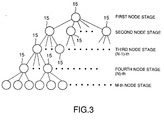
- the tree-structured reference pattern memorizing unit 11 has first through M-th node stages each of which has a plurality of nodes 15 each of which memorizes a reference pattern of an inhibiting speaker, where M represents an integer greater than three.
- Each of the nodes 15 of (N)-th node stage is connected to predetermined ones of the nodes 15 of the (N-1)-th node stage, where N represents an integer which is over one to M.
- the reference pattern of each of the nodes 15 of the (N-1)-th node stage represents acoustic features in the reference patterns of the predetermined ones of the nodes 15 of the N-th node stage.
- the tree-structured reference pattern memorizing unit 11 has tree structures.
- the analysis unit 12 analyzes an input verification utterance and converts the input verification utterance to feature vectors.
- feature vectors cepstrum and ⁇ cepstrum are used.
- the cepstrum and ⁇ cepstrum are described in a fourth document "Furui: "Digital Speech Processing", the issuing office of Toukai University, pp. 44-47, 1985".
- the similarities calculating unit 13 calculates similarities between the feature vector and the reference patterns of all of the inhibiting speakers.
- the inhibiting speaker selecting unit 14 sorts the similarities and selects a predetermined number of inhibiting speakers.
- the similarities calculating unit 13 calculates the similarities of the nodes 15 of the first node stage.
- the similarities calculating unit 13 calculates the similarities of the nodes of the first node stage and calculates the similarities of ones of the nodes 15 of the N-th node stage which are connected to a perdetermined number of ones of the nodes 15 of the (N-1)-th node stage selected in order from one of the nodes 15 of the (N-1)-th node stage having the highest similarities.
- the similarities calculating unit 13 uses the similarities of ones of the nodes of the (N-1)-th node stage for unselected ones except the perdetermined number of ones.
- the tree-structured reference patterns are implemented by the nodes 15 which correspond to speaker clusters.
- the nodes 15 of the first node stage correspond to speaker clusters of all of speakers.
- a speaker clustering is described in detail in a fifth document "Kai-FuLee: “Large-Vocabulary Speaker-Independent Continuous Speech Recognition: The SPHINK System", CMU-CS-88 -148, pp. 103-107 (1988. 4)". Also, the tree structure of the reference pattern is described in detail in a sixth document "Kosaka, Matsunaga, Sagayama: “Tree-Structured Speaker Clustering for Speaker Adaptation", Singakugihou, SP93-110, pp. 49 -54 (1193-12)". In addition, the reference pattern of the tree structure in the sixth document is used for adaptation of speaker. Therefore, the reference pattern of the tree structure in the sixth document is different in purpose of use from that of this invention.
- the similarities calculating unit 13 calculates the similarities of the nodes 15 of the first node stage and calculates the similarities of ones of the nodes 15 of the N-th node stage that are connected to a perdetermined number of ones of the nodes 15 of the (N-1)-th node stage that are selected in order from one of the nodes of the (N-1)-th node stage that has the highest similarities.
- the similarities calculating unit 13 uses the similarities of ones of the nodes of the (N-1)-th node stage for unselected ones except the perdetermined number of ones.
- the speaker recognition system is capable of, at a remarkably high speed, calculating the similarities between the feature vector of the utterance of the true person and the reference patterns of all of the inhibiting speakers.
- the conventional speaker recognition system must calculate the similarities at 5000 times.
- number of the inhibiting speakers is equal to 5000
- number of nodes 15 in each of the node stages is equal to 10
- number of the perdetermined number of ones of the nodes 15 of the (N-1)-th node stage that are selected is equal to 3 in the speaker recognition system of this invent ion.
- the speaker recognition system of this invention calculates the similarities 85 times.
- times of calculating the similarities in the speaker recognition system of this invention is equal to about (1/60) of that of the conventional speaker recognition system.
- DP matching method As the similarities calculating method, DP matching method is known.
- the DP matching method is described in a seventh document "Sakoe, Chiba: “Continuous Speech Recognition based on time normalizing by using dynamic programming", Sound Journal, 27, 9, pp. 483-490(1974. 9)".
- the method of using Viterbi algorithm is known.
- the Viterbi algorithm is described in an eight document “L. R. Rabiner and M. M. Sondhi: “On the application of vector quantization and hidden markov models to speaker-independent, isolated word recognition", ibid, pp. 1075-1105".
- the speaker recognition system can calculate the similarities between the feature vector of the utterance of the true person and the reference patterns of all of the inhibiting speakers, the speaker recognition system can select ones of the inhibiting speakers that has optional similarities. For example, when the inhibiting speakers which are similar to the true person are needed, the speaker recognition system sorts the similarities and selects the predetermined number of inhibiting speakers which correspond to ones which are selected in order from the one of the nodes 15 of the N-th node stage that has a highest similaritiree.
- the speaker recognition system sorts the similarities and selects the predetermined number of inhibiting speakers which correspond to ones which are selected in order from one of the nodes 15 of the N-th node stage that has a lowest similaritiree.
- the speaker recognition system may memorize, as a part of reference patterns of speaker of the tree structure, the reference patterns of the inhibiting speakers that are selected by using the true person in the time of recording. In this event, it is possible to select, as the inhibiting speakers, both of the inhibiting speakers selected in the time of recording and the inhibiting speakers in the time of verifying.
- the speaker recognition system can select, at a remarkably high speed, the inhibiting speakers by using the reference patterns of the inhibiting speakers of the tree structure, the speaker recognition system can select the inhibiting speakers in a large number of speakers in the time of verifying. Thereby, when the environments in the times of recording and verifying are greatly different, the speaker recognition system can accurately select the reference patterns of the inhibiting speakers.
Landscapes
- Engineering & Computer Science (AREA)
- Human Computer Interaction (AREA)
- Computer Vision & Pattern Recognition (AREA)
- Game Theory and Decision Science (AREA)
- Health & Medical Sciences (AREA)
- Audiology, Speech & Language Pathology (AREA)
- Business, Economics & Management (AREA)
- Physics & Mathematics (AREA)
- Acoustics & Sound (AREA)
- Multimedia (AREA)
- Image Analysis (AREA)
- Information Retrieval, Db Structures And Fs Structures Therefor (AREA)
- Devices For Executing Special Programs (AREA)
Abstract
Description

Claims (4)
- A speaker recognition system characterized in that said speaker recognition system comprises:tree-structured reference pattern memorizing unit (11) having first through M-th node stages each of which has a plurality of nodes (15) each of which memorizes a reference pattern of an inhibiting speaker, each of said nodes (15) of (N)-th node stage being connected to predetermined ones of said nodes (15) of said (N-1)-th node stage, said reference pattern of each of said nodes (15) of said (N-1)-th node stage representing acoustic features in said reference patterns of the predetermined ones of said nodes (15) of said N-th node stage, where M represents an integer greater than three and N represents an integer which is ove r one to M;analysis unit (12) for analyzing an input verification utterance and for converting said verification utterance to feature vectors;similarities calculating unit (13) connected to said tree-structured reference pattern memorizing unit (11) and to said analysis unit (12) for calculating similarities between said feature vectors and said reference patterns of all of said inhibiting speakers; andinhibiting speaker selecting unit (14) connected to said similarities calculating unit (13) for calculating said similarities to select a predetermined number of inhibiting speakers.
- A speaker recognition system as claimed in claim 1, characterized in that said similarities calculating unit (13) calculates said similarities of ones of said nodes (15) of said N-th node stage which are connected to a perdetermined number of on es of said nodes (15) of said (N-1)-th node stage selected in order from one of said nodes (15) of said (N-1)-th node stage having the highest similarities; said similarities calculating unit (13) using said similarities of ones of said nodes (15) of said (N-1)-th node stage for unselected ones except said perdetermined number of ones.
- A speaker recognition system as claimed in claim 1, characterized in that said tree-structured reference pattern memorizing unit (11) has a plurality of reference patterns of said inhibiting speakers in said M-th node stage.
- A speaker recognition system as claimed in claim 2, characterized in that said tree-structured reference pattern memorizing unit (11) has a plurality of reference patterns of said inhibiting speakers in said M-th node stage.
Applications Claiming Priority (2)
| Application Number | Priority Date | Filing Date | Title |
|---|---|---|---|
| JP9013562A JP2991287B2 (en) | 1997-01-28 | 1997-01-28 | Suppression standard pattern selection type speaker recognition device |
| JP13562/97 | 1997-01-28 |
Publications (2)
| Publication Number | Publication Date |
|---|---|
| EP0855700A2 true EP0855700A2 (en) | 1998-07-29 |
| EP0855700A3 EP0855700A3 (en) | 1999-03-31 |
Family
ID=11836623
Family Applications (1)
| Application Number | Title | Priority Date | Filing Date |
|---|---|---|---|
| EP98101468A Withdrawn EP0855700A3 (en) | 1997-01-28 | 1998-01-28 | Speaker recognition system capable of accurately selecting inhibiting reference patterns at small amount of calculation |
Country Status (4)
| Country | Link |
|---|---|
| US (1) | US6006184A (en) |
| EP (1) | EP0855700A3 (en) |
| JP (1) | JP2991287B2 (en) |
| CA (1) | CA2228109C (en) |
Families Citing this family (15)
| Publication number | Priority date | Publication date | Assignee | Title |
|---|---|---|---|---|
| JP3412496B2 (en) * | 1998-02-25 | 2003-06-03 | 三菱電機株式会社 | Speaker adaptation device and speech recognition device |
| US6243695B1 (en) * | 1998-03-18 | 2001-06-05 | Motorola, Inc. | Access control system and method therefor |
| AU752317B2 (en) * | 1998-06-17 | 2002-09-12 | Motorola Australia Pty Ltd | Cohort model selection apparatus and method |
| US6684186B2 (en) * | 1999-01-26 | 2004-01-27 | International Business Machines Corporation | Speaker recognition using a hierarchical speaker model tree |
| US6253179B1 (en) * | 1999-01-29 | 2001-06-26 | International Business Machines Corporation | Method and apparatus for multi-environment speaker verification |
| JP3699608B2 (en) * | 1999-04-01 | 2005-09-28 | 富士通株式会社 | Speaker verification apparatus and method |
| TW440810B (en) * | 1999-08-11 | 2001-06-16 | Ind Tech Res Inst | Method of speech recognition |
| US6754628B1 (en) * | 2000-06-13 | 2004-06-22 | International Business Machines Corporation | Speaker recognition using cohort-specific feature transforms |
| JP3885523B2 (en) * | 2001-06-20 | 2007-02-21 | 日本電気株式会社 | Server / client type speech recognition apparatus and method |
| US20040006481A1 (en) | 2002-07-03 | 2004-01-08 | Daniel Kiecza | Fast transcription of speech |
| US20040006628A1 (en) * | 2002-07-03 | 2004-01-08 | Scott Shepard | Systems and methods for providing real-time alerting |
| US7292977B2 (en) * | 2002-10-17 | 2007-11-06 | Bbnt Solutions Llc | Systems and methods for providing online fast speaker adaptation in speech recognition |
| JP2006003452A (en) * | 2004-06-15 | 2006-01-05 | Asahi Kasei Corp | Voice authentication device |
| US10325602B2 (en) * | 2017-08-02 | 2019-06-18 | Google Llc | Neural networks for speaker verification |
| WO2021034786A1 (en) * | 2019-08-21 | 2021-02-25 | Dolby Laboratories Licensing Corporation | Systems and methods for adapting human speaker embeddings in speech synthesis |
Family Cites Families (4)
| Publication number | Priority date | Publication date | Assignee | Title |
|---|---|---|---|---|
| JPH05257492A (en) * | 1992-03-13 | 1993-10-08 | Toshiba Corp | Voice recognition system |
| JP2522154B2 (en) * | 1993-06-03 | 1996-08-07 | 日本電気株式会社 | Voice recognition system |
| AUPM983094A0 (en) * | 1994-12-02 | 1995-01-05 | Australian National University, The | Method for forming a cohort for use in identification of an individual |
| JP2751856B2 (en) | 1995-02-03 | 1998-05-18 | 日本電気株式会社 | Pattern adaptation method using tree structure |
-
1997
- 1997-01-28 JP JP9013562A patent/JP2991287B2/en not_active Expired - Fee Related
-
1998
- 1998-01-28 CA CA002228109A patent/CA2228109C/en not_active Expired - Fee Related
- 1998-01-28 US US09/014,565 patent/US6006184A/en not_active Expired - Fee Related
- 1998-01-28 EP EP98101468A patent/EP0855700A3/en not_active Withdrawn
Also Published As
| Publication number | Publication date |
|---|---|
| JP2991287B2 (en) | 1999-12-20 |
| CA2228109A1 (en) | 1998-07-28 |
| JPH10207484A (en) | 1998-08-07 |
| EP0855700A3 (en) | 1999-03-31 |
| CA2228109C (en) | 2001-05-29 |
| US6006184A (en) | 1999-12-21 |
Similar Documents
| Publication | Publication Date | Title |
|---|---|---|
| US5167004A (en) | Temporal decorrelation method for robust speaker verification | |
| Rosenberg et al. | Speaker background models for connected digit password speaker verification | |
| Murthy et al. | Robust text-independent speaker identification over telephone channels | |
| EP0891618B1 (en) | Speech processing | |
| Burton | Text-dependent speaker verification using vector quantization source coding | |
| EP0686965B1 (en) | Speech recognition apparatus with speaker adaptation using acoustic category mean value calculus | |
| EP0855700A2 (en) | Speaker recognition system capable of accurately selecting inhibiting reference patterns at small amount of calculation | |
| Satoh et al. | A robust speaker verification system against imposture using an HMM-based speech synthesis system. | |
| EP1159737B1 (en) | Speaker recognition | |
| Ilyas et al. | Speaker verification using vector quantization and hidden Markov model | |
| Mengusoglu et al. | Use of acoustic prior information for confidence measure in ASR applications. | |
| JP3036509B2 (en) | Method and apparatus for determining threshold in speaker verification | |
| US6341263B1 (en) | Speech recognition apparatus, method and storage medium thereof | |
| EP1524650A1 (en) | Confidence measure in a speech recognition system | |
| Wilpon et al. | Connected digit recognition based on improved acoustic resolution | |
| EP0858068A2 (en) | Inhibitting reference pattern generating method | |
| JP3090122B2 (en) | Speaker verification device | |
| KR20120067384A (en) | Utterance verification method in voice recognition system and the voice recognition system | |
| Zhang et al. | Confidence measure (CM) estimation for large vocabulary speaker-independent continuous speech recognition system. | |
| De La Torre et al. | On-line garbage modeling for word and utterance verification in natural numbers recognition | |
| Nickel et al. | Robust speaker verification with principal pitch components | |
| Burget | Measurement of complementarity of recognition systems | |
| WO1997037345A1 (en) | Speech processing | |
| Gu et al. | Competition-based score analysis for utterance verification in name recognition | |
| Thambiratnam et al. | Modeling of output probability distribution to improve small vocabulary speech recognition in adverse environments. |
Legal Events
| Date | Code | Title | Description |
|---|---|---|---|
| PUAI | Public reference made under article 153(3) epc to a published international application that has entered the european phase |
Free format text: ORIGINAL CODE: 0009012 |
|
| AK | Designated contracting states |
Kind code of ref document: A2 Designated state(s): BE DE FR GB SE |
|
| AX | Request for extension of the european patent |
Free format text: AL;LT;LV;MK;RO;SI |
|
| PUAL | Search report despatched |
Free format text: ORIGINAL CODE: 0009013 |
|
| AK | Designated contracting states |
Kind code of ref document: A3 Designated state(s): AT BE CH DE DK ES FI FR GB GR IE IT LI LU MC NL PT SE |
|
| AX | Request for extension of the european patent |
Free format text: AL;LT;LV;MK;RO;SI |
|
| 17P | Request for examination filed |
Effective date: 19990318 |
|
| AKX | Designation fees paid |
Free format text: BE DE FR GB SE |
|
| GRAH | Despatch of communication of intention to grant a patent |
Free format text: ORIGINAL CODE: EPIDOS IGRA |
|
| RIC1 | Information provided on ipc code assigned before grant |
Ipc: 7G 10L 15/10 B Ipc: 7G 10L 17/00 A |
|
| STAA | Information on the status of an ep patent application or granted ep patent |
Free format text: STATUS: THE APPLICATION IS DEEMED TO BE WITHDRAWN |
|
| 18D | Application deemed to be withdrawn |
Effective date: 20030813 |