EP0854873B1 - Galanthamine derivatives and process for their preparation - Google Patents
Galanthamine derivatives and process for their preparation Download PDFInfo
- Publication number
- EP0854873B1 EP0854873B1 EP96931169A EP96931169A EP0854873B1 EP 0854873 B1 EP0854873 B1 EP 0854873B1 EP 96931169 A EP96931169 A EP 96931169A EP 96931169 A EP96931169 A EP 96931169A EP 0854873 B1 EP0854873 B1 EP 0854873B1
- Authority
- EP
- European Patent Office
- Prior art keywords
- hydrogen
- compound
- formula
- alkyl
- groups
- Prior art date
- Legal status (The legal status is an assumption and is not a legal conclusion. Google has not performed a legal analysis and makes no representation as to the accuracy of the status listed.)
- Expired - Lifetime
Links
- 0 C*c1cc(N)c2c3c1OC(CC(C)C(*)C1)C31CC*C2 Chemical compound C*c1cc(N)c2c3c1OC(CC(C)C(*)C1)C31CC*C2 0.000 description 3
Classifications
-
- C—CHEMISTRY; METALLURGY
- C07—ORGANIC CHEMISTRY
- C07D—HETEROCYCLIC COMPOUNDS
- C07D491/00—Heterocyclic compounds containing in the condensed ring system both one or more rings having oxygen atoms as the only ring hetero atoms and one or more rings having nitrogen atoms as the only ring hetero atoms, not provided for by groups C07D451/00 - C07D459/00, C07D463/00, C07D477/00 or C07D489/00
- C07D491/02—Heterocyclic compounds containing in the condensed ring system both one or more rings having oxygen atoms as the only ring hetero atoms and one or more rings having nitrogen atoms as the only ring hetero atoms, not provided for by groups C07D451/00 - C07D459/00, C07D463/00, C07D477/00 or C07D489/00 in which the condensed system contains two hetero rings
- C07D491/10—Spiro-condensed systems
-
- C—CHEMISTRY; METALLURGY
- C07—ORGANIC CHEMISTRY
- C07C—ACYCLIC OR CARBOCYCLIC COMPOUNDS
- C07C217/00—Compounds containing amino and etherified hydroxy groups bound to the same carbon skeleton
- C07C217/54—Compounds containing amino and etherified hydroxy groups bound to the same carbon skeleton having etherified hydroxy groups bound to carbon atoms of at least one six-membered aromatic ring and amino groups bound to acyclic carbon atoms or to carbon atoms of rings other than six-membered aromatic rings of the same carbon skeleton
- C07C217/56—Compounds containing amino and etherified hydroxy groups bound to the same carbon skeleton having etherified hydroxy groups bound to carbon atoms of at least one six-membered aromatic ring and amino groups bound to acyclic carbon atoms or to carbon atoms of rings other than six-membered aromatic rings of the same carbon skeleton with amino groups linked to the six-membered aromatic ring, or to the condensed ring system containing that ring, by carbon chains not further substituted by singly-bound oxygen atoms
- C07C217/58—Compounds containing amino and etherified hydroxy groups bound to the same carbon skeleton having etherified hydroxy groups bound to carbon atoms of at least one six-membered aromatic ring and amino groups bound to acyclic carbon atoms or to carbon atoms of rings other than six-membered aromatic rings of the same carbon skeleton with amino groups linked to the six-membered aromatic ring, or to the condensed ring system containing that ring, by carbon chains not further substituted by singly-bound oxygen atoms with amino groups and the six-membered aromatic ring, or the condensed ring system containing that ring, bound to the same carbon atom of the carbon chain
Definitions
- This invention relates to the discovery of a novel process for the manufacture of galanthamine and related compounds, in racemic or in optically-enriched form, and to novel intermediates in that process.
- (-)-Galanthamine (and related compounds) are useful compounds for the treatment of Alzheimer's disease and related illnesses.
- galanthamine is usually obtained by extraction from particular types of bulbs., such as daffodils or snowdrops.
- single enantiomer galanthamine (2) can be prepared from racemic narwedine (1) through resolution followed by reduction of the enone function, as depicted in Scheme 1, below.
- a dynamic resolution of (1) can be carried out by crystallisation with entrainment by crystals of the desired isomer (see Barton and Kirby, J. Chem. Soc. (C) (1962) 806).
- racemic narwedine itself is not readily available.
- a process for preparing an optically-enriched compound having the formula (11) comprises oxidative cyclisation of a tertiary amine having the formula (12) , below, wherein X 1 is a removable functionality, X 2 is hydrogen or a removable functionality, R 1 is selected from hydrogen and alkyl, aryl, alkaryl, aralkyl groups having up to 20 carbon atoms, and R 2 and R 3 are independently selected from hydrogen and alkyl, aryl, alkaryl, aralkyl and acyl groups having up to 20 carbon atoms. Resolution and reduction of the resulting compounds leads to optically-enriched compounds having the galanthamine structure as depicted by formula (10), below.
- novel compounds having the formulae (11) and (12) are provided and defined in the claims.
- optically-enriched forms of compound (11) and in particular when enriched in the enantiomer which has the stereochemical configuration of (-)-galanthamine, which therefore allow ready access to (-)-galanthamine per se.
- optically-enriched typically we mean an enantiomeric excess of at least 50%, preferably at least 80%, more preferably at least 90% or higher, thereby including single enantiomer form.
- X 1 is described as a removable functionality, which means any group replaceable by hydrogen.
- suitable groups for X 1 include the halogens, tert -butyl and O-E groups, wherein E comprises a group linked by a carbon, sulphur or phosphorus atom.
- X 1 is a halogen atom, and more preferably it is bromine.
- R 1 need not be acyl, or some other protecting group for the nitrogen atom, to achieve acceptable yield in the phenolic coupling reaction.
- R 1 is alkyl, preferably C 1-10 alkyl, and most preferably methyl.
- Scheme 3 a preferred cyclisation is shown in Scheme 3 below, where the amine (6) is converted to bromonarwedine (7) . This can then be readily reduced, or de-brominated, to racemic narwedine by an appropriate chemoselective method, eg. using a palladium catalyst, which can then be resolved, for instance as described by Shieh et al , J. Org. Chem.
- racemic bromonarwedine, or a salt derivative thereof can be converted by dynamic entrainment or crystallisation into an optically-enriched form thereof, for example using a method of the general type described by Barton et al or by Shieh et al , discussed above. This can then be converted into optically-enriched bromogalanthamine, for instance (-)-bromogalanthamine of formula (8) , below, by reduction, for instance as described in International Application No. PCT/GB96/00843.
- the bromine atom can then be removed as described above, or replaced by different functionality.
- the tertiary amine substrate for the phenolic coupling reaction can be made by any of the known techniques. For instance, it can be made by reductive amination from 6-bromoisovanillin (from either isovanillin or veratraldehyde) and tyramine (or N-methyltyramine). Reference is made in this respect to Kametani et al and Szewczyk et al , mentioned above, and to Bulavka et al ., Khim. Farm. ZH. (1990) 24 :59.
- N,p-o'-Dimethylbromonorbelladine (6) (as its formate salt) (1 g) was added to a stirred mixture of potassium ferricyanide (5.39 g) in 5% aqueous sodium hydrogen carbonate (50 ml) and toluene (100 ml) and the mixture heated at 85°C for 3 hours. The mixture was cooled and filtered. The layers were separated and the organic phase evaporated to give racemic bromonarwedine (7) (0.113 g, 13%) substantially pure by NMR analysis.
- Example 4 The racemic narwedine obtained in Example 4 can then be converted to optically-enriched galanthamine as described above.
Landscapes
- Chemical & Material Sciences (AREA)
- Organic Chemistry (AREA)
- Saccharide Compounds (AREA)
- Organic Low-Molecular-Weight Compounds And Preparation Thereof (AREA)
- Pharmaceuticals Containing Other Organic And Inorganic Compounds (AREA)
- Preparation Of Compounds By Using Micro-Organisms (AREA)
- Heterocyclic Carbon Compounds Containing A Hetero Ring Having Oxygen Or Sulfur (AREA)
Abstract
Description
- This invention relates to the discovery of a novel process for the manufacture of galanthamine and related compounds, in racemic or in optically-enriched form, and to novel intermediates in that process.
- (-)-Galanthamine (and related compounds) are useful compounds for the treatment of Alzheimer's disease and related illnesses. Currently galanthamine is usually obtained by extraction from particular types of bulbs., such as daffodils or snowdrops.
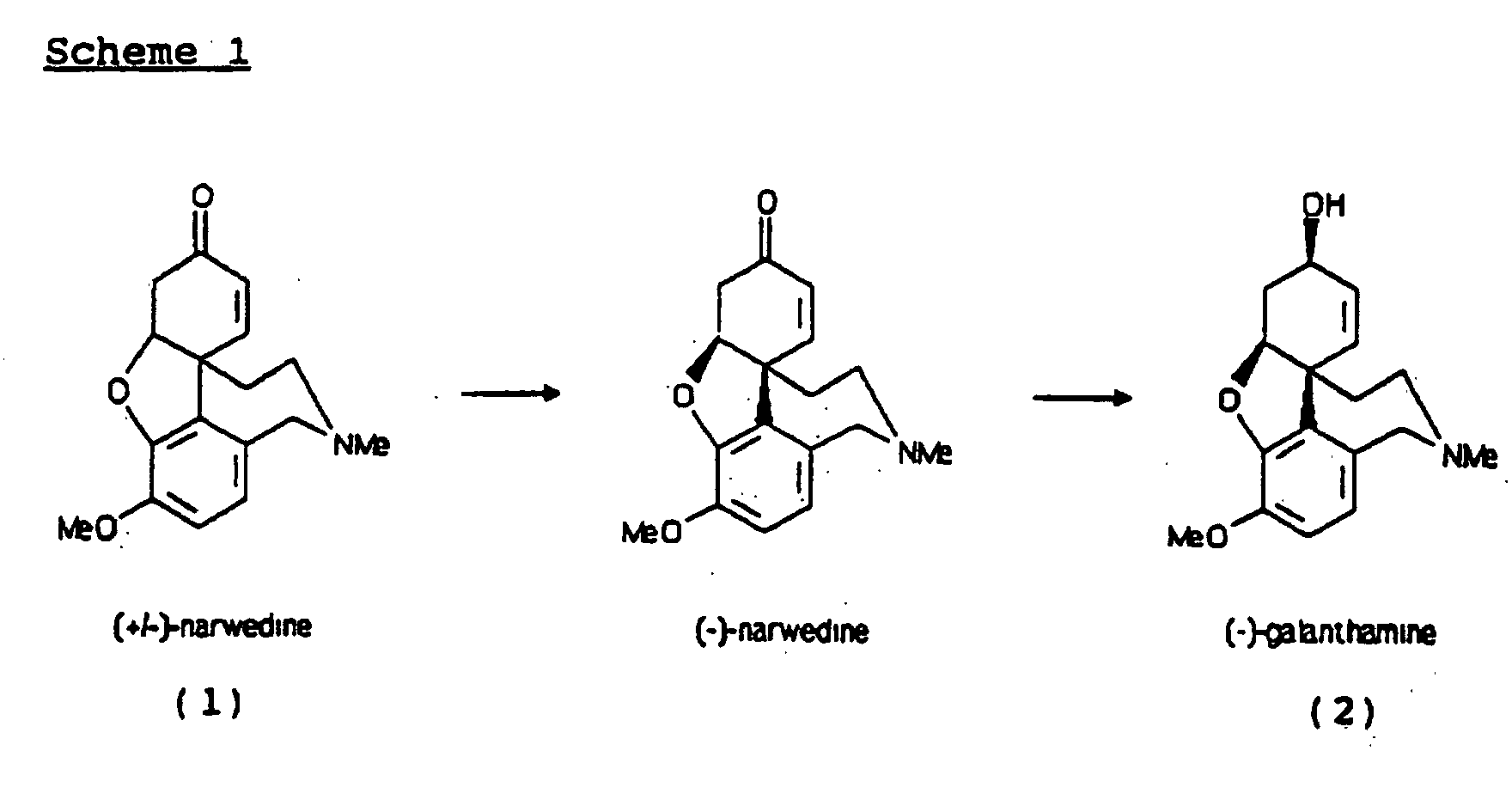
- It is known that single enantiomer galanthamine (2) can be prepared from racemic narwedine (1) through resolution followed by reduction of the enone function, as depicted in Scheme 1, below. Usefully, since the enantiomers of narwedine (1) readily equilibrate (racemise) by way of reversible ring opening to a dienone, coupled to the fact that crystals of racemic (1) exist as a conglomerate of enantiomers, a dynamic resolution of (1) can be carried out by crystallisation with entrainment by crystals of the desired isomer (see Barton and Kirby, J. Chem. Soc. (C) (1962) 806). However, in respect of a total synthesis, racemic narwedine itself is not readily available.
- Numerous processes have been based on the biomimetic approach pioneered by Barton and Kirby in 1962, in which the key oxidative cyclisation step proceeded in only 1.4% yield. In later studies it was found that the yields of the phenolic coupling could be increased substantially by deactivation of the basic amine as either an amide or sulphonamide group, and by blocking the para-position with a removable group (i.e. replaceable by hydrogen) such as bromine, e.g. as in compound (3) in Scheme 2 below; see for instance Franck and Lubs, Liebigs. Ann. Chem. (1968) 720: 131; Kametani et al., J. Chem. Soc., Chem. Comm. (1969) 425 and J. Chem. Soc. (C) (1969) 2602-2605 and Szewczyk et al., J. Heterocyclic Chem. (1988) 1809).
- However, processes operating on this strategy are cumbersome owing to the need to remove the amine protecting group from the product of the phenolic coupling (compound (4) in Scheme 2) by reduction. This invariably leads to concomitant reduction of the narwedine carbonyl group, and possibly other functional groups, producing racemic galanthamine and/or epigalanthamine, or derivatives thereof, as depicted by compound (5) in Scheme 2. To obtain racemic narwedine (1) from the latter compounds then requires a separate reoxidation step.
- Surprisingly, it has now been discovered that phenolic coupling of the general type described above can be carried out with acceptable yield without the need to render non-basic the amine functionality in the cyclisation precursor. This discovery is particularly advantageous because the product of the phenolic coupling does not need to undergo the cumbersome reduction-oxidation procedure to afford narwedine.
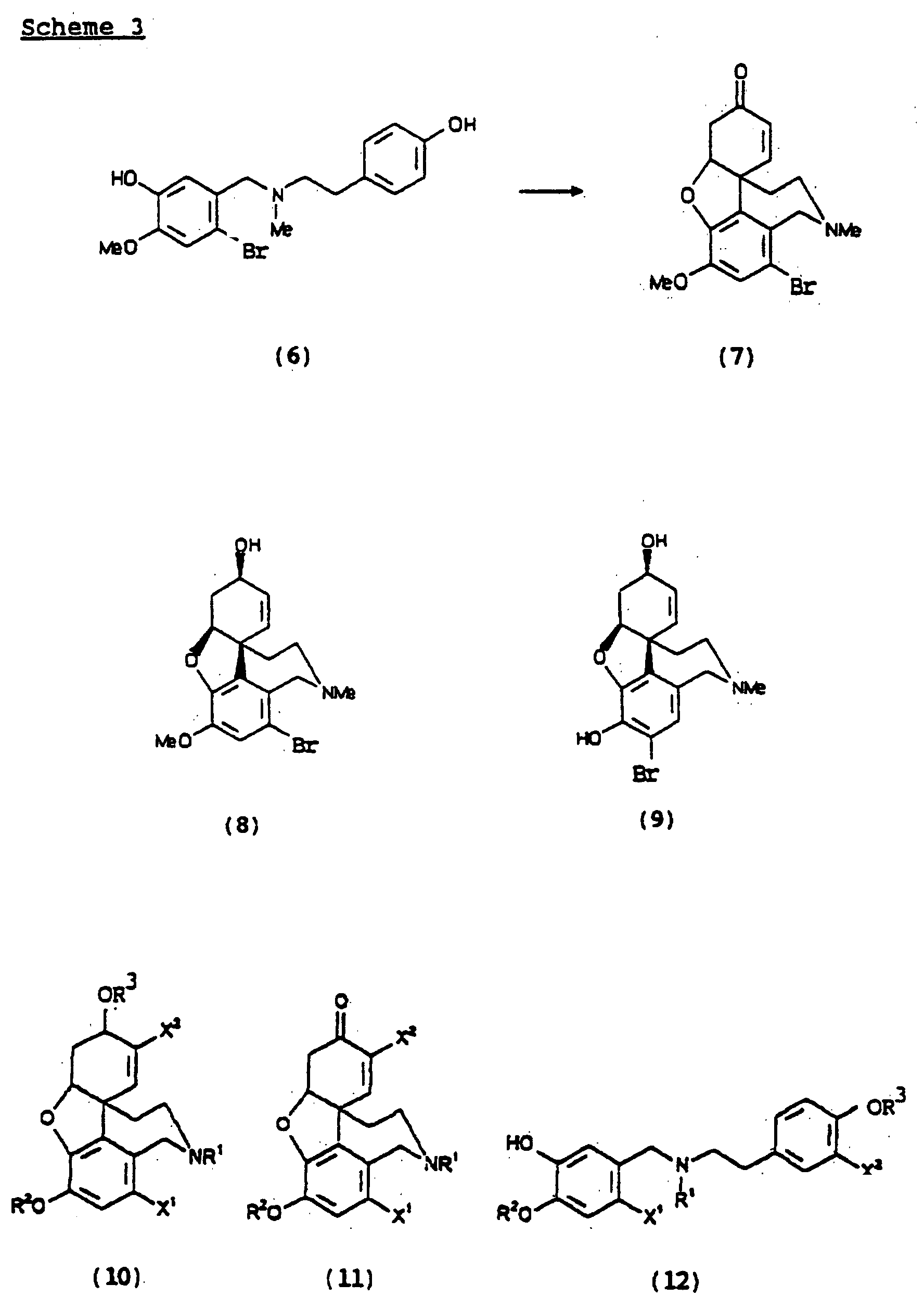
- Accordingly, in one aspect of the present invention a process for preparing an optically-enriched compound having the formula (11), below, comprises oxidative cyclisation of a tertiary amine having the formula (12), below, wherein X1 is a removable functionality, X2 is hydrogen or a removable functionality, R1 is selected from hydrogen and alkyl, aryl, alkaryl, aralkyl groups having up to 20 carbon atoms, and R2 and R3 are independently selected from hydrogen and alkyl, aryl, alkaryl, aralkyl and acyl groups having up to 20 carbon atoms. Resolution and reduction of the resulting compounds leads to optically-enriched compounds having the galanthamine structure as depicted by formula (10), below.
- According to other aspects of the present invention, novel compounds having the formulae (11) and (12) are provided and defined in the claims. Of particular interest are the optically-enriched forms of compound (11), and in particular when enriched in the enantiomer which has the stereochemical configuration of (-)-galanthamine, which therefore allow ready access to (-)-galanthamine per se. By optically-enriched typically we mean an enantiomeric excess of at least 50%, preferably at least 80%, more preferably at least 90% or higher, thereby including single enantiomer form.
- In the above, X1 is described as a removable functionality, which means any group replaceable by hydrogen. Examples of suitable groups for X1 include the halogens, tert-butyl and O-E groups, wherein E comprises a group linked by a carbon, sulphur or phosphorus atom. Preferably X1 is a halogen atom, and more preferably it is bromine.
- As has been explained above, the key to the present invention is that R1 need not be acyl, or some other protecting group for the nitrogen atom, to achieve acceptable yield in the phenolic coupling reaction. Preferably R1 is alkyl, preferably C1-10 alkyl, and most preferably methyl. For instance, a preferred cyclisation is shown in Scheme 3 below, where the amine (6) is converted to bromonarwedine (7). This can then be readily reduced, or de-brominated, to racemic narwedine by an appropriate chemoselective method, eg. using a palladium catalyst, which can then be resolved, for instance as described by Shieh et al, J. Org. Chem. (1994), 59: 5463, for subsequent conversion to the corresponding galanthamine structure. Alternatively, racemic bromonarwedine, or a salt derivative thereof, can be converted by dynamic entrainment or crystallisation into an optically-enriched form thereof, for example using a method of the general type described by Barton et al or by Shieh et al, discussed above. This can then be converted into optically-enriched bromogalanthamine, for instance (-)-bromogalanthamine of formula (8), below, by reduction, for instance as described in International Application No. PCT/GB96/00843. The bromine atom can then be removed as described above, or replaced by different functionality.
- Bromination of O'-dimethylgalanthamine has recently been described in EP-A-0649846 and EP-A-0648771, and this procedure affords the regioisomeric bromine derivative (9) which can be converted into galanthamine analogues. The availability of bromonarwedine and bromogalanthamine by virtue of the present invention, therefore, provides a possible entry into other galanthamine analogues which would not be accessible via semi-synthetic routes from galanthamine obtained from natural sources.
- The tertiary amine substrate for the phenolic coupling reaction can be made by any of the known techniques. For instance, it can be made by reductive amination from 6-bromoisovanillin (from either isovanillin or veratraldehyde) and tyramine (or N-methyltyramine). Reference is made in this respect to Kametani et al and Szewczyk et al, mentioned above, and to Bulavka et al., Khim. Farm. ZH. (1990) 24:59.
- While the above description concentrates on the (-)-enantiomers of the respective compounds, as these allow ready access to the therapeutically-useful (-)-galanthamine, the chemistry is equally applicable to the (+)-enantiomers.
- The present invention is now further illustrated by the following Examples.
- 6-Bromoisovanillin (500 g) was suspended in MeOH (2.5 1) in a 5 1 3-necked flask equipped with an overhead stirrer. Tyramine was added and the resulting mixture was stirred at room temperature for 60 min and then cooled to 0°C. NaBH4 (67 g) was then added in approx 2.5 g portions keeping the temperature below 20°C, eventually forming a solution. After stirring for a further 60 min a precipitate had formed. HCHO (37% aq solution) (179 ml) was added in one portion at room temperature and stirred for 60 min during which time a solution formed. The solution was cooled to 0°C and NaBH4 (31.0 g) added, again in approx 2.5 g portions keeping the temperature below 20°C. The mixture then became quite thick as a white solid formed. MeOH (2.5 l) was added to mobilise the mixture, which was then filtered to collect the white solid, washing with cold MeOH. Yield = 780 g, 98%.
- The N,p-O'-Dimethyl-6-bromonorbelladine (6) obtained (300 g) was dissolved in IMS (3.0 l) and treated with charcoal (10 g). After hot filtration the solution was allowed to cool yielding a white crystalline solid. Recovery = 231 g, 77%.
- Toluene (2.67 l) and water (333 ml) were placed in a 5 1 jacketed vessel and the mixture was heated to 70°C under nitrogen. K2CO3 (33 g, 0.24 mol) and K3Fe(CN)6 were added and then the homogenizer was turned on. N,p-O'-Dimethyl-6-bromonorbelladine (6) (20 g, 52.6 mmol) was then added in one portion. After 30 min. the homogenizer was turned off and the mixture was filtered to remove a large amount of brown solid. The two layers were separated and the toluene phase was washed with NaOH (2M; 500 ml). The product was then extracted into HCl (2M, 500 ml). TBME (500 ml) and EtOAc (250 ml) were added and the aqueous layer was neutralised. The organic phase was dried over Na2SO4 and concentrated in vacuo to yield bromonarwedine (7) (6.27 g, 33%).
- N,p-o'-Dimethylbromonorbelladine (6) (as its formate salt) (1 g) was added to a stirred mixture of potassium ferricyanide (5.39 g) in 5% aqueous sodium hydrogen carbonate (50 ml) and toluene (100 ml) and the mixture heated at 85°C for 3 hours. The mixture was cooled and filtered. The layers were separated and the organic phase evaporated to give racemic bromonarwedine (7) (0.113 g, 13%) substantially pure by NMR analysis.
- DMF (930 ml) was added to bromonarwedine (7) (187.3 g, 515 mmol), NaCO2H (52.5 g, 772 mmol), PPh3 (13.5 g, 51 mmol), Pd(OAc)2 (5.78 g, 26 mmol) and NaCl (3.76 g, 103 mmol). The mixture was heated to 94 °C, for 6 hours at which point GC indicated complete reaction. The dark mixture was diluted with CH2Cl2 (2 l) and filtered. 2M NaOH (2 l) was added and the layers separated. The product was extracted from the CH2Cl2 using 2M HCl (2 l). This was added to CH2Cl2 (2 l) and the pH adjusted to 12 using 46-48% NaOH. The CH2Cl2 was separated and concentrated to approx 200 ml. MeOH (100, ml) was added and the remainder of the CH2Cl2 evaporated. The solid product formed (1) was collected by filtration washing with cold MeOH. Yield = 122.2 g, 84%, purity >95% by HPLC.
- The racemic narwedine obtained in Example 4 can then be converted to optically-enriched galanthamine as described above.

Claims (12)
- A process for preparing a compound having the formula (11), comprising oxidative cyclisation of a tertiary amine having the formula (12) wherein X1 is a removable functionality, X2 is hydrogen or a group as defined above for X1, and R1 is selected from hydrogen and alkyl, aryl and alkaryl groups having up to 20 carbon atoms, and R2 and R3 are independently selected from hydrogen and alkyl, aryl, alkaryl, aralkyl and acyl groups having up to 20 carbon atoms

- A process according to claim 1, wherein R1 is selected from alkyl, aryl and alkaryl groups having up to 20 carbon atoms.
- A process according to claim 1 or claim 2, wherein in compound (11) R1 = R2 = methyl, X1 = bromine and X2 = hydrogen.
- A process according to any preceding claim, which further comprises resolving the compound (11), e.g. by entrainment or crystallization of a salt thereof, to give compound (11) in optically-enriched form.
- A process for preparing an optically-enriched compound having the formula (10), in which the R and X groups are as defined in claim 1, comprising a process as defined in claim 4, followed by reduction of the product thereof.
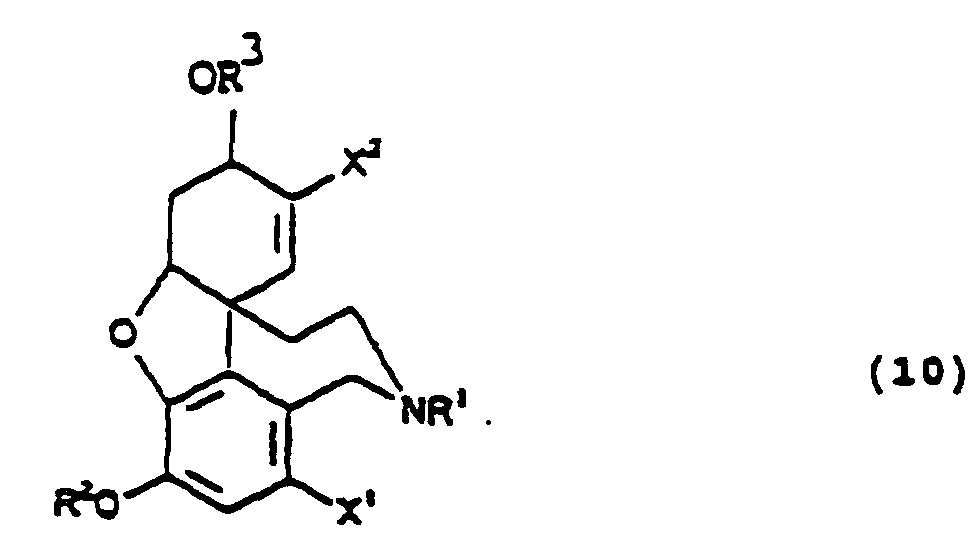
- A process for preparing an optically-enriched compound having the formula (10), in which the R and X groups are as defined in claim 1, comprising a process as defined in claim 1, followed by reduction of the product thereof to give a racemic compound of formula (10), and subsequent resolution thereof.

- A process for preparing a compound of formula (11) in which the R groups and X2 are as defined in claim 1 and X1 = hydrogen, comprising debromination of a precursor compound of formula (11) in which R and X2 are as defined in claim 1 and X1 = bromine to convert X1 from bromine to hydrogen.
- A process according to claim 7, wherein in the precursor compound R1 = R2 = methyl and X2 = hydrogen.
- A process according to claim 7 or claim 8, which further comprises resolving the product obtained to form an optically-enriched form of compound (11), by entrainment or crystallisation.
- A process according to any of claims 7 to 9, wherein the precursor compound is prepared by a process as defined in claim 1.
- A compound having the formula (12)wherein R1 is an alkyl, aryl or alkaryl group having up to 20 carbon atoms, and R2 and R3 are independently selected from hydrogen and alkyl, aryl, alkaryl, aralkyl and acyl groups having up to 20 carbon atoms, X1 is a removable functionality and X2 is hydrogen or a group as defined above for X1.

- A compound according to claim 11, wherein R1=R2=methyl, R3=hydrogen, X1=bromine and X2=hydrogen.
Applications Claiming Priority (3)
| Application Number | Priority Date | Filing Date | Title |
|---|---|---|---|
| GB9519267 | 1995-09-21 | ||
| GBGB9519267.0A GB9519267D0 (en) | 1995-09-21 | 1995-09-21 | Preparation of alkaloids |
| PCT/GB1996/002334 WO1997011077A1 (en) | 1995-09-21 | 1996-09-23 | Galanthamine derivatives and process for their preparation |
Publications (2)
| Publication Number | Publication Date |
|---|---|
| EP0854873A1 EP0854873A1 (en) | 1998-07-29 |
| EP0854873B1 true EP0854873B1 (en) | 2002-03-06 |
Family
ID=10781038
Family Applications (1)
| Application Number | Title | Priority Date | Filing Date |
|---|---|---|---|
| EP96931169A Expired - Lifetime EP0854873B1 (en) | 1995-09-21 | 1996-09-23 | Galanthamine derivatives and process for their preparation |
Country Status (13)
| Country | Link |
|---|---|
| US (1) | US6093815A (en) |
| EP (1) | EP0854873B1 (en) |
| AT (1) | ATE214070T1 (en) |
| AU (1) | AU714711B2 (en) |
| CA (1) | CA2230826C (en) |
| CY (1) | CY2301B1 (en) |
| DE (1) | DE69619685T2 (en) |
| DK (1) | DK0854873T3 (en) |
| ES (1) | ES2173316T3 (en) |
| GB (1) | GB9519267D0 (en) |
| PT (1) | PT854873E (en) |
| WO (1) | WO1997011077A1 (en) |
| ZA (1) | ZA968028B (en) |
Families Citing this family (10)
| Publication number | Priority date | Publication date | Assignee | Title |
|---|---|---|---|---|
| EP1604653A1 (en) | 1998-09-30 | 2005-12-14 | Takeda Pharmaceutical Company Limited | Acetylcholinesterase inhibitors for improving excretory potency of urinary bladder |
| JP2003136077A (en) * | 2001-10-31 | 2003-05-13 | Nec Corp | Cleaning water or immersion water production equipment used for semiconductor production |
| WO2005065662A1 (en) * | 2003-12-31 | 2005-07-21 | Actavis Group Hf | Solid dosage formulations of galantamine |
| WO2005065661A2 (en) * | 2003-12-31 | 2005-07-21 | Actavis Group Hf | Immediate, controlled and sustained release formulations of galanthamine |
| WO2006124584A2 (en) * | 2005-05-13 | 2006-11-23 | Alza Corporation | Multilayer drug delivery system with barrier against reservoir material flow |
| WO2007035941A2 (en) * | 2005-09-23 | 2007-03-29 | Alza Corporation | Transdermal galantamine delivery system |
| AT504663B1 (en) | 2007-02-22 | 2008-07-15 | Sanochemia Pharmazeutika Ag | PROCESS FOR THE PRODUCTION OF HIGH PURSES 4A, 5,9,10,11,12, -HEXAHYDRO-6H-BENZOFURO (3A, 3,2-F) (2) BENZAZEPINES AND THEIR DERIVATIVES |
| EP2009015B1 (en) * | 2007-06-18 | 2012-01-11 | Aurobindo Pharma Limited | Process for the preparation of galantamine hydrobromide |
| AT507039A1 (en) | 2008-06-26 | 2010-01-15 | Sanochemia Pharmazeutika Ag | METHOD FOR PRODUCING HIGH-PURITY BENZAZEPINE DERIVATIVES |
| CN106977412B (en) * | 2017-05-15 | 2019-08-02 | 张家港威胜生物医药有限公司 | A kind of preparation method of galanthamine key intermediate |
Family Cites Families (3)
| Publication number | Priority date | Publication date | Assignee | Title |
|---|---|---|---|---|
| JP2755403B2 (en) * | 1987-05-04 | 1998-05-20 | デイービス、ボニー | Compounds for the treatment of Alzheimer's disease |
| AT401058B (en) * | 1994-10-21 | 1996-06-25 | Waldheim Pharmazeutika Gmbh | Process for the preparation of derivatives of 4a, 5, 9, 10, 11, 12-hexahydro-6H-benzofuro(3a, 3, 2- ef)(2)benzazepine |
| NZ294191A (en) * | 1994-10-21 | 1998-10-28 | Waldheim Pharmazeutika Gmbh | Process for preparing 4a,5,9,10,11,12-hexahydro-6h-benzofuro[3a,3,2-ef][2]benzazepine derivatives and intermediates thereof |
-
1995
- 1995-09-21 GB GBGB9519267.0A patent/GB9519267D0/en active Pending
-
1996
- 1996-09-23 CA CA002230826A patent/CA2230826C/en not_active Expired - Lifetime
- 1996-09-23 EP EP96931169A patent/EP0854873B1/en not_active Expired - Lifetime
- 1996-09-23 DE DE69619685T patent/DE69619685T2/en not_active Expired - Lifetime
- 1996-09-23 AU AU69964/96A patent/AU714711B2/en not_active Expired
- 1996-09-23 WO PCT/GB1996/002334 patent/WO1997011077A1/en not_active Ceased
- 1996-09-23 PT PT96931169T patent/PT854873E/en unknown
- 1996-09-23 ZA ZA9608028A patent/ZA968028B/en unknown
- 1996-09-23 ES ES96931169T patent/ES2173316T3/en not_active Expired - Lifetime
- 1996-09-23 US US09/043,330 patent/US6093815A/en not_active Expired - Lifetime
- 1996-09-23 DK DK96931169T patent/DK0854873T3/en active
- 1996-09-23 AT AT96931169T patent/ATE214070T1/en active
-
2002
- 2002-11-25 CY CY0200063A patent/CY2301B1/en unknown
Non-Patent Citations (1)
| Title |
|---|
| WARD R.S., CHEM.SOC.REV., vol. 11, no. 2, 1982, pages 75 - 125 * |
Also Published As
| Publication number | Publication date |
|---|---|
| GB9519267D0 (en) | 1995-11-22 |
| ZA968028B (en) | 1997-09-23 |
| ES2173316T3 (en) | 2002-10-16 |
| WO1997011077A1 (en) | 1997-03-27 |
| DE69619685T2 (en) | 2002-10-17 |
| PT854873E (en) | 2002-08-30 |
| CY2301B1 (en) | 2003-07-04 |
| EP0854873A1 (en) | 1998-07-29 |
| US6093815A (en) | 2000-07-25 |
| AU714711B2 (en) | 2000-01-06 |
| DE69619685D1 (en) | 2002-04-11 |
| ATE214070T1 (en) | 2002-03-15 |
| CA2230826C (en) | 2008-09-02 |
| CA2230826A1 (en) | 1997-03-27 |
| DK0854873T3 (en) | 2002-07-01 |
| AU6996496A (en) | 1997-04-09 |
Similar Documents
| Publication | Publication Date | Title |
|---|---|---|
| LV12630B (en) | 2-AMINOINDERS AS SELECTED DOFAMINE D3 LIGANDI | |
| US6093815A (en) | Galanthamine derivatives and process for their preparation | |
| EP1713801B1 (en) | Process for preparation of 1-(2s,3s)-2-benzhydr yl-n-(5-tert-butyl-2-methoxybenzyl)quinuclidin-3-amine | |
| PT626961E (en) | PROCESS FOR THE PREPARATION OF CYANOMETHOXYIMINYMETHYL DERIVATIVES | |
| Hockless et al. | Convenient resolution of (±)-piperidine-2-carboxylic acid ((±)-pipecolic acid) by separation of palladium (II) diastereomers containing orthometallated (S)-(−)-1-[1-(dimethylamino) ethyl] naphthalene | |
| TW200831478A (en) | Chromane derivatives, synthesis thereof, and intermediates thereto | |
| RU2265595C2 (en) | Method for preparing(-)-cis-3-hydroxy-1-methyl-4-(2,4,6-trimethoxyphenyl)piperidine and intermediates compounds | |
| EP0906314B1 (en) | Optical resolution of narwedine-type compounds | |
| US4704472A (en) | Preparation of an enantiomer of a substituted fluorenyloxyacetic acid | |
| JP2010523620A (en) | Preparation method of mirtazapine | |
| US4885364A (en) | Resolution process for benzazepine intermediates | |
| US6620945B2 (en) | Process for producing stereoisomer of pyrrolidine derivative | |
| CA2287566A1 (en) | 9,10-diazatricyclo¬4.2.1.12,5|decane and 9,10-diazatricyclo¬3.3.1.12,6|decane derivatives having analgesic activity | |
| HK1040516A1 (en) | Process for the production of paroxetine | |
| NO175744B (en) | Process for Enantiospecific Synthesis of Intermediates for Hexahydrobenzo (d) Naphtho (2,1-b) Azepines | |
| KR102088972B1 (en) | Benzosulfamidate-fused-isoindoline compounds and method for the stereoselective preparation thereof | |
| US20040235928A1 (en) | Process for the preparation of optically active amines or salts thereof | |
| EP1409490B1 (en) | 2-(aminomethyl)-tetrahydro-9-oxa-1,3-diaza-cyclopenta a|naphthalenyl derivatives with antipsychotic activity | |
| KR880002000B1 (en) | Process for the preparation of hexahydronaphth(1,2-6)-1,4-oxazines | |
| WO2004026855A1 (en) | Method for manufacture of dihydroisobenzofuran derivatives | |
| USH1406H (en) | Process for preparing dibenzofurans via catalytic heteroannulation | |
| FR2500823A1 (en) | 1-Aminoalkyl- tetra:hydro-naphthalene derivs. - useful as adrenergic and dopaminergic stimulants and inhibitors | |
| SU425396A3 (en) | METHOD FOR PRODUCING HEXAGIDRO-7YA-AZEPIN DERIVATIVES OR THEIR SALTS | |
| Urban | Synthesis of R-and S-3-Oxo-2-oxaspiro [4.4]-nonane-1-carboxylic acid. | |
| EP0251713A2 (en) | Enantioselective synthesis of 1,3,4,6,7,12B (S)- hexahydro-2H-bezo (B) furo (2,3-A) quinolizin-2-one |
Legal Events
| Date | Code | Title | Description |
|---|---|---|---|
| PUAI | Public reference made under article 153(3) epc to a published international application that has entered the european phase |
Free format text: ORIGINAL CODE: 0009012 |
|
| 17P | Request for examination filed |
Effective date: 19980409 |
|
| AK | Designated contracting states |
Kind code of ref document: A1 Designated state(s): AT BE CH DE DK ES FI FR GB GR IE IT LI LU NL PT SE |
|
| RAP1 | Party data changed (applicant data changed or rights of an application transferred) |
Owner name: CHIROTECH TECHNOLOGY LIMITED |
|
| 17Q | First examination report despatched |
Effective date: 19990915 |
|
| GRAG | Despatch of communication of intention to grant |
Free format text: ORIGINAL CODE: EPIDOS AGRA |
|
| RAP1 | Party data changed (applicant data changed or rights of an application transferred) |
Owner name: JANSSEN PHARMACEUTICA N.V. |
|
| GRAG | Despatch of communication of intention to grant |
Free format text: ORIGINAL CODE: EPIDOS AGRA |
|
| GRAH | Despatch of communication of intention to grant a patent |
Free format text: ORIGINAL CODE: EPIDOS IGRA |
|
| GRAH | Despatch of communication of intention to grant a patent |
Free format text: ORIGINAL CODE: EPIDOS IGRA |
|
| REG | Reference to a national code |
Ref country code: GB Ref legal event code: IF02 |
|
| GRAA | (expected) grant |
Free format text: ORIGINAL CODE: 0009210 |
|
| AK | Designated contracting states |
Kind code of ref document: B1 Designated state(s): AT BE CH DE DK ES FI FR GB GR IE IT LI LU NL PT SE |
|
| REF | Corresponds to: |
Ref document number: 214070 Country of ref document: AT Date of ref document: 20020315 Kind code of ref document: T |
|
| REG | Reference to a national code |
Ref country code: CH Ref legal event code: EP |
|
| REF | Corresponds to: |
Ref document number: 69619685 Country of ref document: DE Date of ref document: 20020411 |
|
| REG | Reference to a national code |
Ref country code: DK Ref legal event code: T3 |
|
| ET | Fr: translation filed | ||
| REG | Reference to a national code |
Ref country code: PT Ref legal event code: SC4A Free format text: AVAILABILITY OF NATIONAL TRANSLATION Effective date: 20020527 |
|
| REG | Reference to a national code |
Ref country code: GR Ref legal event code: EP Ref document number: 20020401687 Country of ref document: GR |
|
| REG | Reference to a national code |
Ref country code: ES Ref legal event code: FG2A Ref document number: 2173316 Country of ref document: ES Kind code of ref document: T3 |
|
| PLBE | No opposition filed within time limit |
Free format text: ORIGINAL CODE: 0009261 |
|
| STAA | Information on the status of an ep patent application or granted ep patent |
Free format text: STATUS: NO OPPOSITION FILED WITHIN TIME LIMIT |
|
| 26N | No opposition filed |
Effective date: 20021209 |
|
| REG | Reference to a national code |
Ref country code: FR Ref legal event code: PLFP Year of fee payment: 20 |
|
| PGFP | Annual fee paid to national office [announced via postgrant information from national office to epo] |
Ref country code: DE Payment date: 20150916 Year of fee payment: 20 Ref country code: ES Payment date: 20150810 Year of fee payment: 20 Ref country code: GB Payment date: 20150923 Year of fee payment: 20 Ref country code: FI Payment date: 20150909 Year of fee payment: 20 Ref country code: CH Payment date: 20150911 Year of fee payment: 20 Ref country code: PT Payment date: 20150922 Year of fee payment: 20 Ref country code: IE Payment date: 20150909 Year of fee payment: 20 |
|
| PGFP | Annual fee paid to national office [announced via postgrant information from national office to epo] |
Ref country code: AT Payment date: 20150825 Year of fee payment: 20 Ref country code: GR Payment date: 20150812 Year of fee payment: 20 Ref country code: FR Payment date: 20150629 Year of fee payment: 20 Ref country code: BE Payment date: 20150911 Year of fee payment: 20 Ref country code: SE Payment date: 20150911 Year of fee payment: 20 Ref country code: LU Payment date: 20151005 Year of fee payment: 20 |
|
| PGFP | Annual fee paid to national office [announced via postgrant information from national office to epo] |
Ref country code: DK Payment date: 20150910 Year of fee payment: 20 |
|
| PGFP | Annual fee paid to national office [announced via postgrant information from national office to epo] |
Ref country code: IT Payment date: 20150925 Year of fee payment: 20 |
|
| PGFP | Annual fee paid to national office [announced via postgrant information from national office to epo] |
Ref country code: NL Payment date: 20150909 Year of fee payment: 20 |
|
| REG | Reference to a national code |
Ref country code: DE Ref legal event code: R071 Ref document number: 69619685 Country of ref document: DE |
|
| REG | Reference to a national code |
Ref country code: DK Ref legal event code: EUP Effective date: 20160923 |
|
| REG | Reference to a national code |
Ref country code: NL Ref legal event code: MK Effective date: 20160922 |
|
| REG | Reference to a national code |
Ref country code: CH Ref legal event code: PL |
|
| REG | Reference to a national code |
Ref country code: GB Ref legal event code: PE20 Expiry date: 20160922 |
|
| PG25 | Lapsed in a contracting state [announced via postgrant information from national office to epo] |
Ref country code: GB Free format text: LAPSE BECAUSE OF EXPIRATION OF PROTECTION Effective date: 20160922 |
|
| REG | Reference to a national code |
Ref country code: SE Ref legal event code: EUG |
|
| REG | Reference to a national code |
Ref country code: IE Ref legal event code: MK9A |
|
| REG | Reference to a national code |
Ref country code: AT Ref legal event code: MK07 Ref document number: 214070 Country of ref document: AT Kind code of ref document: T Effective date: 20160923 |
|
| PG25 | Lapsed in a contracting state [announced via postgrant information from national office to epo] |
Ref country code: PT Free format text: LAPSE BECAUSE OF EXPIRATION OF PROTECTION Effective date: 20160930 |
|
| REG | Reference to a national code |
Ref country code: ES Ref legal event code: FD2A Effective date: 20170102 |
|
| PG25 | Lapsed in a contracting state [announced via postgrant information from national office to epo] |
Ref country code: IE Free format text: LAPSE BECAUSE OF EXPIRATION OF PROTECTION Effective date: 20160923 |
|
| REG | Reference to a national code |
Ref country code: GR Ref legal event code: MA Ref document number: 20020401687 Country of ref document: GR Effective date: 20160924 |
|
| PG25 | Lapsed in a contracting state [announced via postgrant information from national office to epo] |
Ref country code: ES Free format text: LAPSE BECAUSE OF EXPIRATION OF PROTECTION Effective date: 20160924 |