EP0854206B1 - Acid tin-silver alloy electroplating bath and method for electroplating tin-silver alloy - Google Patents
Acid tin-silver alloy electroplating bath and method for electroplating tin-silver alloy Download PDFInfo
- Publication number
- EP0854206B1 EP0854206B1 EP97306700A EP97306700A EP0854206B1 EP 0854206 B1 EP0854206 B1 EP 0854206B1 EP 97306700 A EP97306700 A EP 97306700A EP 97306700 A EP97306700 A EP 97306700A EP 0854206 B1 EP0854206 B1 EP 0854206B1
- Authority
- EP
- European Patent Office
- Prior art keywords
- tin
- acid
- compounds
- aromatic
- plating bath
- Prior art date
- Legal status (The legal status is an assumption and is not a legal conclusion. Google has not performed a legal analysis and makes no representation as to the accuracy of the status listed.)
- Expired - Lifetime
Links
- 239000002253 acid Substances 0.000 title claims description 58
- 229910001316 Ag alloy Inorganic materials 0.000 title claims description 41
- QCEUXSAXTBNJGO-UHFFFAOYSA-N [Ag].[Sn] Chemical compound [Ag].[Sn] QCEUXSAXTBNJGO-UHFFFAOYSA-N 0.000 title claims description 41
- 238000000034 method Methods 0.000 title claims description 16
- 238000009713 electroplating Methods 0.000 title claims description 7
- 238000007747 plating Methods 0.000 claims description 64
- -1 aromatic thiol compounds Chemical class 0.000 claims description 40
- 229910052709 silver Inorganic materials 0.000 claims description 22
- 239000004332 silver Substances 0.000 claims description 22
- XLYOFNOQVPJJNP-UHFFFAOYSA-N water Substances O XLYOFNOQVPJJNP-UHFFFAOYSA-N 0.000 claims description 16
- 150000001875 compounds Chemical class 0.000 claims description 14
- ATJFFYVFTNAWJD-UHFFFAOYSA-N Tin Chemical compound [Sn] ATJFFYVFTNAWJD-UHFFFAOYSA-N 0.000 claims description 12
- 239000000758 substrate Substances 0.000 claims description 12
- FOIXSVOLVBLSDH-UHFFFAOYSA-N Silver ion Chemical compound [Ag+] FOIXSVOLVBLSDH-UHFFFAOYSA-N 0.000 claims description 9
- 229910001432 tin ion Inorganic materials 0.000 claims description 9
- 150000007513 acids Chemical class 0.000 claims description 8
- XFXPMWWXUTWYJX-UHFFFAOYSA-N Cyanide Chemical compound N#[C-] XFXPMWWXUTWYJX-UHFFFAOYSA-N 0.000 claims description 7
- 125000004432 carbon atom Chemical group C* 0.000 claims description 7
- 239000005028 tinplate Substances 0.000 claims description 4
- 125000000217 alkyl group Chemical group 0.000 claims description 3
- 125000003277 amino group Chemical group 0.000 claims description 3
- 125000004435 hydrogen atom Chemical group [H]* 0.000 claims description 3
- 125000002887 hydroxy group Chemical group [H]O* 0.000 claims description 3
- 125000000449 nitro group Chemical group [O-][N+](*)=O 0.000 claims description 3
- 125000003396 thiol group Chemical group [H]S* 0.000 claims description 3
- 125000003118 aryl group Chemical group 0.000 claims description 2
- 150000002019 disulfides Chemical class 0.000 claims description 2
- IIACRCGMVDHOTQ-UHFFFAOYSA-N sulfamic acid group Chemical class S(N)(O)(=O)=O IIACRCGMVDHOTQ-UHFFFAOYSA-N 0.000 claims 2
- BQCADISMDOOEFD-UHFFFAOYSA-N Silver Chemical compound [Ag] BQCADISMDOOEFD-UHFFFAOYSA-N 0.000 description 21
- AFVFQIVMOAPDHO-UHFFFAOYSA-N Methanesulfonic acid Chemical compound CS(O)(=O)=O AFVFQIVMOAPDHO-UHFFFAOYSA-N 0.000 description 14
- QHGNHLZPVBIIPX-UHFFFAOYSA-N tin(ii) oxide Chemical compound [Sn]=O QHGNHLZPVBIIPX-UHFFFAOYSA-N 0.000 description 11
- 230000000052 comparative effect Effects 0.000 description 10
- 238000002360 preparation method Methods 0.000 description 10
- 229910000108 silver(I,III) oxide Inorganic materials 0.000 description 9
- 229940098779 methanesulfonic acid Drugs 0.000 description 7
- 239000000203 mixture Substances 0.000 description 7
- 238000001556 precipitation Methods 0.000 description 6
- 0 CCc1c(*)c(*)c(C*)c(C)c1C* Chemical compound CCc1c(*)c(*)c(C*)c(C)c1C* 0.000 description 5
- 239000002736 nonionic surfactant Substances 0.000 description 5
- 239000002244 precipitate Substances 0.000 description 5
- VRVRGVPWCUEOGV-UHFFFAOYSA-N 2-aminothiophenol Chemical compound NC1=CC=CC=C1S VRVRGVPWCUEOGV-UHFFFAOYSA-N 0.000 description 4
- WSFSSNUMVMOOMR-UHFFFAOYSA-N Formaldehyde Chemical compound O=C WSFSSNUMVMOOMR-UHFFFAOYSA-N 0.000 description 4
- 238000005282 brightening Methods 0.000 description 4
- 239000010408 film Substances 0.000 description 4
- VKYKSIONXSXAKP-UHFFFAOYSA-N hexamethylenetetramine Chemical compound C1N(C2)CN3CN1CN2C3 VKYKSIONXSXAKP-UHFFFAOYSA-N 0.000 description 4
- 239000000047 product Substances 0.000 description 4
- SQGYOTSLMSWVJD-UHFFFAOYSA-N silver(1+) nitrate Chemical class [Ag+].[O-]N(=O)=O SQGYOTSLMSWVJD-UHFFFAOYSA-N 0.000 description 4
- 239000000126 substance Substances 0.000 description 4
- UMGDCJDMYOKAJW-UHFFFAOYSA-N thiourea Chemical compound NC(N)=S UMGDCJDMYOKAJW-UHFFFAOYSA-N 0.000 description 4
- BWHOZHOGCMHOBV-UHFFFAOYSA-N Benzalacetone Natural products CC(=O)C=CC1=CC=CC=C1 BWHOZHOGCMHOBV-UHFFFAOYSA-N 0.000 description 3
- ROFVEXUMMXZLPA-UHFFFAOYSA-N Bipyridyl Chemical group N1=CC=CC=C1C1=CC=CC=N1 ROFVEXUMMXZLPA-UHFFFAOYSA-N 0.000 description 3
- HEMHJVSKTPXQMS-UHFFFAOYSA-M Sodium hydroxide Chemical compound [OH-].[Na+] HEMHJVSKTPXQMS-UHFFFAOYSA-M 0.000 description 3
- 239000003795 chemical substances by application Substances 0.000 description 3
- RMVRSNDYEFQCLF-UHFFFAOYSA-N thiophenol Chemical compound SC1=CC=CC=C1 RMVRSNDYEFQCLF-UHFFFAOYSA-N 0.000 description 3
- BWHOZHOGCMHOBV-BQYQJAHWSA-N trans-benzylideneacetone Chemical compound CC(=O)\C=C\C1=CC=CC=C1 BWHOZHOGCMHOBV-BQYQJAHWSA-N 0.000 description 3
- CLHYKAZPWIRRRD-UHFFFAOYSA-N 1-hydroxypropane-1-sulfonic acid Chemical compound CCC(O)S(O)(=O)=O CLHYKAZPWIRRRD-UHFFFAOYSA-N 0.000 description 2
- KWOLFJPFCHCOCG-UHFFFAOYSA-N Acetophenone Chemical compound CC(=O)C1=CC=CC=C1 KWOLFJPFCHCOCG-UHFFFAOYSA-N 0.000 description 2
- CIWBSHSKHKDKBQ-JLAZNSOCSA-N Ascorbic acid Chemical compound OC[C@H](O)[C@H]1OC(=O)C(O)=C1O CIWBSHSKHKDKBQ-JLAZNSOCSA-N 0.000 description 2
- QIGBRXMKCJKVMJ-UHFFFAOYSA-N Hydroquinone Chemical compound OC1=CC=C(O)C=C1 QIGBRXMKCJKVMJ-UHFFFAOYSA-N 0.000 description 2
- XEEYBQQBJWHFJM-UHFFFAOYSA-N Iron Chemical compound [Fe] XEEYBQQBJWHFJM-UHFFFAOYSA-N 0.000 description 2
- ISWSIDIOOBJBQZ-UHFFFAOYSA-N Phenol Chemical compound OC1=CC=CC=C1 ISWSIDIOOBJBQZ-UHFFFAOYSA-N 0.000 description 2
- GSEJCLTVZPLZKY-UHFFFAOYSA-N Triethanolamine Chemical compound OCCN(CCO)CCO GSEJCLTVZPLZKY-UHFFFAOYSA-N 0.000 description 2
- XSQUKJJJFZCRTK-UHFFFAOYSA-N Urea Natural products NC(N)=O XSQUKJJJFZCRTK-UHFFFAOYSA-N 0.000 description 2
- 230000015572 biosynthetic process Effects 0.000 description 2
- YCIMNLLNPGFGHC-UHFFFAOYSA-N catechol Chemical compound OC1=CC=CC=C1O YCIMNLLNPGFGHC-UHFFFAOYSA-N 0.000 description 2
- 229910052802 copper Inorganic materials 0.000 description 2
- 239000010949 copper Substances 0.000 description 2
- WBTCZEPSIIFINA-MSFWTACDSA-J dipotassium;antimony(3+);(2r,3r)-2,3-dioxidobutanedioate;trihydrate Chemical compound O.O.O.[K+].[K+].[Sb+3].[Sb+3].[O-]C(=O)[C@H]([O-])[C@@H]([O-])C([O-])=O.[O-]C(=O)[C@H]([O-])[C@@H]([O-])C([O-])=O WBTCZEPSIIFINA-MSFWTACDSA-J 0.000 description 2
- 235000010299 hexamethylene tetramine Nutrition 0.000 description 2
- 239000004312 hexamethylene tetramine Substances 0.000 description 2
- LNOPIUAQISRISI-UHFFFAOYSA-N n'-hydroxy-2-propan-2-ylsulfonylethanimidamide Chemical compound CC(C)S(=O)(=O)CC(N)=NO LNOPIUAQISRISI-UHFFFAOYSA-N 0.000 description 2
- HGBOYTHUEUWSSQ-UHFFFAOYSA-N pentanal Chemical compound CCCCC=O HGBOYTHUEUWSSQ-UHFFFAOYSA-N 0.000 description 2
- SATCULPHIDQDRE-UHFFFAOYSA-N piperonal Chemical compound O=CC1=CC=C2OCOC2=C1 SATCULPHIDQDRE-UHFFFAOYSA-N 0.000 description 2
- WQGWDDDVZFFDIG-UHFFFAOYSA-N pyrogallol Chemical compound OC1=CC=CC(O)=C1O WQGWDDDVZFFDIG-UHFFFAOYSA-N 0.000 description 2
- SMQUZDBALVYZAC-UHFFFAOYSA-N salicylaldehyde Chemical compound OC1=CC=CC=C1C=O SMQUZDBALVYZAC-UHFFFAOYSA-N 0.000 description 2
- NJRXVEJTAYWCQJ-UHFFFAOYSA-N thiomalic acid Chemical compound OC(=O)CC(S)C(O)=O NJRXVEJTAYWCQJ-UHFFFAOYSA-N 0.000 description 2
- HPGGPRDJHPYFRM-UHFFFAOYSA-J tin(iv) chloride Chemical class Cl[Sn](Cl)(Cl)Cl HPGGPRDJHPYFRM-UHFFFAOYSA-J 0.000 description 2
- 239000002351 wastewater Substances 0.000 description 2
- NGCDGPPKVSZGRR-UHFFFAOYSA-J 1,4,6,9-tetraoxa-5-stannaspiro[4.4]nonane-2,3,7,8-tetrone Chemical class [Sn+4].[O-]C(=O)C([O-])=O.[O-]C(=O)C([O-])=O NGCDGPPKVSZGRR-UHFFFAOYSA-J 0.000 description 1
- ZSSCTTQONPHGRA-UHFFFAOYSA-N 1-methyl-2-(2-methylphenyl)disulfanylbenzene Chemical compound CC1=CC=CC=C1SSC1=CC=CC=C1C ZSSCTTQONPHGRA-UHFFFAOYSA-N 0.000 description 1
- LXUNZSDDXMPKLP-UHFFFAOYSA-N 2-Methylbenzenethiol Chemical compound CC1=CC=CC=C1S LXUNZSDDXMPKLP-UHFFFAOYSA-N 0.000 description 1
- WXHLLJAMBQLULT-UHFFFAOYSA-N 2-[[6-[4-(2-hydroxyethyl)piperazin-1-yl]-2-methylpyrimidin-4-yl]amino]-n-(2-methyl-6-sulfanylphenyl)-1,3-thiazole-5-carboxamide;hydrate Chemical compound O.C=1C(N2CCN(CCO)CC2)=NC(C)=NC=1NC(S1)=NC=C1C(=O)NC1=C(C)C=CC=C1S WXHLLJAMBQLULT-UHFFFAOYSA-N 0.000 description 1
- YAFIBTDNARUFOG-UHFFFAOYSA-N 2-hydroxy-2-sulfanylpropanoic acid Chemical compound CC(O)(S)C(O)=O YAFIBTDNARUFOG-UHFFFAOYSA-N 0.000 description 1
- CQMNNMLVXSWLCH-UHFFFAOYSA-B 2-hydroxypropane-1,2,3-tricarboxylate;tin(4+) Chemical class [Sn+4].[Sn+4].[Sn+4].[O-]C(=O)CC(O)(CC([O-])=O)C([O-])=O.[O-]C(=O)CC(O)(CC([O-])=O)C([O-])=O.[O-]C(=O)CC(O)(CC([O-])=O)C([O-])=O.[O-]C(=O)CC(O)(CC([O-])=O)C([O-])=O CQMNNMLVXSWLCH-UHFFFAOYSA-B 0.000 description 1
- JKIFPWHZEZQCQA-UHFFFAOYSA-N 2-nitrobenzenethiol Chemical compound [O-][N+](=O)C1=CC=CC=C1S JKIFPWHZEZQCQA-UHFFFAOYSA-N 0.000 description 1
- VMKYTRPNOVFCGZ-UHFFFAOYSA-N 2-sulfanylphenol Chemical compound OC1=CC=CC=C1S VMKYTRPNOVFCGZ-UHFFFAOYSA-N 0.000 description 1
- BZOVBIIWPDQIHF-UHFFFAOYSA-N 3-hydroxy-2-methylbenzenesulfonic acid Chemical compound CC1=C(O)C=CC=C1S(O)(=O)=O BZOVBIIWPDQIHF-UHFFFAOYSA-N 0.000 description 1
- VWGKEVWFBOUAND-UHFFFAOYSA-N 4,4'-thiodiphenol Chemical compound C1=CC(O)=CC=C1SC1=CC=C(O)C=C1 VWGKEVWFBOUAND-UHFFFAOYSA-N 0.000 description 1
- TZQVSGOOKNNDFU-UHFFFAOYSA-N 4-phenylsulfanylaniline Chemical compound C1=CC(N)=CC=C1SC1=CC=CC=C1 TZQVSGOOKNNDFU-UHFFFAOYSA-N 0.000 description 1
- RYGMFSIKBFXOCR-UHFFFAOYSA-N Copper Chemical compound [Cu] RYGMFSIKBFXOCR-UHFFFAOYSA-N 0.000 description 1
- FBPFZTCFMRRESA-FSIIMWSLSA-N D-Glucitol Natural products OC[C@H](O)[C@H](O)[C@@H](O)[C@H](O)CO FBPFZTCFMRRESA-FSIIMWSLSA-N 0.000 description 1
- BWGNESOTFCXPMA-UHFFFAOYSA-N Dihydrogen disulfide Chemical compound SS BWGNESOTFCXPMA-UHFFFAOYSA-N 0.000 description 1
- 239000002211 L-ascorbic acid Substances 0.000 description 1
- 235000000069 L-ascorbic acid Nutrition 0.000 description 1
- JUJWROOIHBZHMG-UHFFFAOYSA-N Pyridine Chemical group C1=CC=NC=C1 JUJWROOIHBZHMG-UHFFFAOYSA-N 0.000 description 1
- 229910000831 Steel Inorganic materials 0.000 description 1
- 229910021627 Tin(IV) chloride Inorganic materials 0.000 description 1
- JKNZUZCGFROMAZ-UHFFFAOYSA-L [Ag+2].[O-]S([O-])(=O)=O Chemical class [Ag+2].[O-]S([O-])(=O)=O JKNZUZCGFROMAZ-UHFFFAOYSA-L 0.000 description 1
- 230000002378 acidificating effect Effects 0.000 description 1
- 239000000654 additive Substances 0.000 description 1
- 229910045601 alloy Inorganic materials 0.000 description 1
- 239000000956 alloy Substances 0.000 description 1
- 150000001412 amines Chemical class 0.000 description 1
- 239000003945 anionic surfactant Substances 0.000 description 1
- 229910052787 antimony Inorganic materials 0.000 description 1
- 239000003963 antioxidant agent Substances 0.000 description 1
- 235000006708 antioxidants Nutrition 0.000 description 1
- 150000003934 aromatic aldehydes Chemical class 0.000 description 1
- 229960005070 ascorbic acid Drugs 0.000 description 1
- 229910052788 barium Inorganic materials 0.000 description 1
- 150000008107 benzenesulfonic acids Chemical class 0.000 description 1
- 229910052791 calcium Inorganic materials 0.000 description 1
- 230000003247 decreasing effect Effects 0.000 description 1
- PNOXNTGLSKTMQO-UHFFFAOYSA-L diacetyloxytin Chemical compound CC(=O)O[Sn]OC(C)=O PNOXNTGLSKTMQO-UHFFFAOYSA-L 0.000 description 1
- 238000007598 dipping method Methods 0.000 description 1
- CCIVGXIOQKPBKL-UHFFFAOYSA-M ethanesulfonate Chemical compound CCS([O-])(=O)=O CCIVGXIOQKPBKL-UHFFFAOYSA-M 0.000 description 1
- 231100000086 high toxicity Toxicity 0.000 description 1
- 125000004464 hydroxyphenyl group Chemical group 0.000 description 1
- 229910052738 indium Inorganic materials 0.000 description 1
- 238000011835 investigation Methods 0.000 description 1
- 229910052742 iron Inorganic materials 0.000 description 1
- 150000002576 ketones Chemical class 0.000 description 1
- 231100000053 low toxicity Toxicity 0.000 description 1
- 239000000314 lubricant Substances 0.000 description 1
- 229910052751 metal Inorganic materials 0.000 description 1
- 239000002184 metal Substances 0.000 description 1
- 150000002736 metal compounds Chemical class 0.000 description 1
- OTCVAHKKMMUFAY-UHFFFAOYSA-N oxosilver Chemical class [Ag]=O OTCVAHKKMMUFAY-UHFFFAOYSA-N 0.000 description 1
- 229940081310 piperonal Drugs 0.000 description 1
- 231100000614 poison Toxicity 0.000 description 1
- 230000007096 poisonous effect Effects 0.000 description 1
- 239000001508 potassium citrate Substances 0.000 description 1
- 229960002635 potassium citrate Drugs 0.000 description 1
- QEEAPRPFLLJWCF-UHFFFAOYSA-K potassium citrate (anhydrous) Chemical compound [K+].[K+].[K+].[O-]C(=O)CC(O)(CC([O-])=O)C([O-])=O QEEAPRPFLLJWCF-UHFFFAOYSA-K 0.000 description 1
- 235000011082 potassium citrates Nutrition 0.000 description 1
- WHMDPDGBKYUEMW-UHFFFAOYSA-N pyridine-2-thiol Chemical compound SC1=CC=CC=N1 WHMDPDGBKYUEMW-UHFFFAOYSA-N 0.000 description 1
- 229940079877 pyrogallol Drugs 0.000 description 1
- 150000003839 salts Chemical class 0.000 description 1
- 229910052711 selenium Inorganic materials 0.000 description 1
- 229940100890 silver compound Drugs 0.000 description 1
- 150000003379 silver compounds Chemical class 0.000 description 1
- HKZLPVFGJNLROG-UHFFFAOYSA-M silver monochloride Chemical class [Cl-].[Ag+] HKZLPVFGJNLROG-UHFFFAOYSA-M 0.000 description 1
- 229910001961 silver nitrate Inorganic materials 0.000 description 1
- 229910001923 silver oxide Inorganic materials 0.000 description 1
- 239000000600 sorbitol Substances 0.000 description 1
- RCIVOBGSMSSVTR-UHFFFAOYSA-L stannous sulfate Chemical compound [SnH2+2].[O-]S([O-])(=O)=O RCIVOBGSMSSVTR-UHFFFAOYSA-L 0.000 description 1
- 239000010959 steel Substances 0.000 description 1
- 125000001424 substituent group Chemical group 0.000 description 1
- 229920001059 synthetic polymer Polymers 0.000 description 1
- 239000010409 thin film Substances 0.000 description 1
- 150000003556 thioamides Chemical class 0.000 description 1
- NBOMNTLFRHMDEZ-UHFFFAOYSA-N thiosalicylic acid Chemical compound OC(=O)C1=CC=CC=C1S NBOMNTLFRHMDEZ-UHFFFAOYSA-N 0.000 description 1
- 229940103494 thiosalicylic acid Drugs 0.000 description 1
- 150000003606 tin compounds Chemical class 0.000 description 1
- 229910000375 tin(II) sulfate Inorganic materials 0.000 description 1
- AFNRRBXCCXDRPS-UHFFFAOYSA-N tin(ii) sulfide Chemical class [Sn]=S AFNRRBXCCXDRPS-UHFFFAOYSA-N 0.000 description 1
- QPBYLOWPSRZOFX-UHFFFAOYSA-J tin(iv) iodide Chemical class I[Sn](I)(I)I QPBYLOWPSRZOFX-UHFFFAOYSA-J 0.000 description 1
- MWOOGOJBHIARFG-UHFFFAOYSA-N vanillin Chemical compound COC1=CC(C=O)=CC=C1O MWOOGOJBHIARFG-UHFFFAOYSA-N 0.000 description 1
- FGQOOHJZONJGDT-UHFFFAOYSA-N vanillin Natural products COC1=CC(O)=CC(C=O)=C1 FGQOOHJZONJGDT-UHFFFAOYSA-N 0.000 description 1
- 235000012141 vanillin Nutrition 0.000 description 1
- 238000004065 wastewater treatment Methods 0.000 description 1
- 229910052725 zinc Inorganic materials 0.000 description 1
Classifications
-
- C—CHEMISTRY; METALLURGY
- C25—ELECTROLYTIC OR ELECTROPHORETIC PROCESSES; APPARATUS THEREFOR
- C25D—PROCESSES FOR THE ELECTROLYTIC OR ELECTROPHORETIC PRODUCTION OF COATINGS; ELECTROFORMING; APPARATUS THEREFOR
- C25D3/00—Electroplating: Baths therefor
- C25D3/02—Electroplating: Baths therefor from solutions
- C25D3/56—Electroplating: Baths therefor from solutions of alloys
- C25D3/60—Electroplating: Baths therefor from solutions of alloys containing more than 50% by weight of tin
Definitions
- the present invention relates to an acid, tin-silver alloy plating bath substantially non-cyanide and a method for electroplating Tin-Silver alloy onto a substrate.
- an alkaline cyanide bath As tin-silver alloy plating baths used for forming a tin-silver alloy plating film on a metal substrate or the like, an alkaline cyanide bath has been known.
- the bath contains the poisonous cyanide
- the bath has problems that the bath per se has an extremely high toxicity which necessitates a special care in the handling and a special treatment of the waste water and that the working environment is polluted.
- non-cyanide acid baths include an alkanesulfonic acid or alkanolsulfonic acid bath, and mercaptoalkanecarboxylic acid and/or mercaptoalkanesulfonic acid as disclosed in Japanese Patent Unexamined Published Application (hereinafter referred to as "J. P. KOKAI") Nos. Hei 7-252684(corresponding to EP-A-0 666 342) and Hei 8-13185.
- the present applicant had developed an acid bath which was an alkanesulfonic acid and/or sulfamic acid bath containing a thioamide compound and a thiol compound.
- an acid bath which was an alkanesulfonic acid and/or sulfamic acid bath containing a thioamide compound and a thiol compound.
- silver is not precipitated or insolubilized immediately after the preparation of the plating bath or in 24 hours thereafter, the plating bath has a problem that the thioamide compounds and the thiol compounds such as mercaptosuccinic acid and mercaptolactic acid exert a harmful influence on the plating properties when the plating bath is left to stand or kept being used for a long period of time.
- a primary object of the present invention is to provide a tin-silver alloy plating bath in which tin and silver can be kept dissolved therein in a stable state for a long period of time even at a high temperature and which is capable of keeping a predetermined plating capacity for a long period of time even though the bath is free from a cyan compound.
- Another object of the present invention is to provide an effective method for electroplating Tin-Silver alloy onto a substrate.
- the present invention has been completed on the basis of a finding that a specific aromatic sulfur compound is effective in dissolving both tin and silver in a substantially non-cyanide acid bath to form a stable solution.
- the present invention provides an acid tin-silver alloy plating bath which comprises a tin ion, a silver ion, one compound selected from aromatic thiol compounds and aromatic sulfide compounds, and a balance of water, the pH of the bath being not high than 2 and the bath being substantially cyanide free.
- the present invention further provides a method for electroplating a Tin-Silver alloy on a substrate, which method comprises the steps of immersing the substrate as the cathode and a plate of a tin-silver alloy or tin plate as the anode in an acid tin-silver alloy plating bath which comprises a tin ion, a silver ion, one compound selected from aromatic thiol compounds and aromatic sulfide compounds, substantially no cyan compounds and a balance of water, the pH of the bath being not higher than 2, and charging electric current of about 0.5 to 50 A thereto for about 0.5 to 10 minutes to form onto the substrate a tin-silver alloy film comprising from 20 to 99 % by weight of tin and from 80 to 1 % by weight of silver and having a thickness of from 1 to 30 ⁇ m.
- the tin compounds usable in the present invention are not particularly limited so far as they are capable of releasing tin ion in the acid bath. They include, for example, stannous oxide, stannous sulfate, tin chlorides, tin sulfides, tin iodides, tin citrates, tin oxalates and stannous acetate. They are used either singly or in the form of a mixture of two or more of them.
- the tin ion concentration in the plating bath is not particularly limited, it is preferably 2 to 80 g/l, more preferably 10 to 40 g/l (in terms of tin).
- the silver compounds usable in the present invention are not particularly limited so far as they are capable of releasing silver ion in the acid bath. They include, for example, silver oxides, silver sulfates, silver chlorides and silver nitrates. They are used either singly or in the form of a mixture of two or more of them.
- the silver ion concentration in the plating bath is not particularly limited, it is preferably 0.01 to 80 g/l, more preferably 0.1 to 50 g/ l (in terms of silver).
- aromatic thiol compounds and aromatic sulfide compounds used in the present invention are preferably those having 6 to 14 carbon atoms.
- at least one of the compounds having the following structures is preferably used: wherein R 1 to R 8 each represent a hydrogen atom, lower alkyl group (preferably having 1 to 3 carbon atoms), hydroxyl group, nitro group, amino group or thiol group.
- aromatic thiol compounds usable in the present invention include, for example, thiophenol, mercaptophenol, thiocresol, nitrothiophenol, thiosalicylic acid, aminothiophenol, benzenedithiophenol and mercaptopyridine. They are used either singly or in the form of a mixture of two or more of them.
- aromatic sulfides are preferably aromatic mono- or disulfide compounds such as 4,4-thiodiphenol, 4,4-aminodiphenyl sulfide, thiobisthiophenol, 2,2-diaminodiphenyl disulfide, 2,2-dithiodibenzoic acid, ditolyl disulfide and 2,2-dipyridyl disulfide. They are used either singly or in the form of a mixture of two or more of them.
- aromatic thiol compounds and aromatic sulfides are more preferably those having NH 2 group in the substituent in the structure thereof or those having a pyridine ring in the structure thereof.
- aromatic thiol compound or/and aromatic sulfide compound is usable in the present invention. Further a mixture of two or more of the aromatic thiol compounds or aromatic sulfide compounds is also usable. These compounds are capable of imparting a gloss to the resultant deposit, too.
- the amount of each of the aromatic thiol compound and aromatic sulfide compound used in the present invention is not particularly limited so far as both tin and silver dissolved in the bath can be kept stable. It is preferably 0.1 to 200 g/l, more preferably 0.2 to 50 g/ l.
- the acid substances can be incorporated into the tin-silver alloy plating bath in order to control the pH of the bath on acidic side.
- the acid substances are preferably alkanesulfonic acids having 1 to 3 carbon atoms such as methanesulfonic acid, ethanesulfonic acid and hydroxypropanesulfonic acid; benzenesulfonic acids and phenolsulfonic acids having 6 or 7 carbon atoms such as sulfosalicylic acid and cresolsulfonic acid; alkanolsulfonic acids such as isopropanolsulfonic acid; and sulfamic acid. These acids are usable either singly or in the form of a mixture of two or more of them.
- the acid concentration in the plating bath is not particularly limited so far as tin and silver are soluble therein, it is preferably 10 to 500 g/ l, more preferably 50 to 400 g/l.
- the acid concentration in the plating bath is controlled so that the pH of the bath can be kept not higher than 2, preferably not higher than 1.
- the plating bath of the present invention can comprise the above-described indispensable components and the balance of water and, if necessary, additives such as a brightening agent and lubricating agent.
- the brightening agent may be any of those used for brightening tin and silver such as nonionic surfactants, anionic surfactants, synthetic polymers (e. g. PVP, PEG and PVA), amines (e. g. hexamethylenetetramine and triethanolamine), ketones (e. g. benzalacetone and acetophenone), aliphatic aldehydes (e. g. formalin and valeric aldehyde), aromatic aldehydes (e. g.
- the amount of the brightening agent is preferably 0.5 to 50 g/ l , more preferably 0.2 to 30 g/l.
- Antioxidants for tin are also usable. They include hydroxyphenyl compounds such as phenol, catechol, pyrogallol and hydroquinone; L-ascorbic acid; and sorbitol.
- the acid tin-silver alloy plating bath of the present invention are usable for plating various substrates such as iron or copper substrates by an ordinary method to form the tin-silver alloy deposit.
- the substrate as the cathode and a plate of a tin-silver alloy or tin plate as the anode are immersed in the tin-silver alloy plating bath and then electric current of about 0.5 to 50 A is sent for about 0.5 to 10 minutes to form a tin-silver alloy film comprising 20 to 99 % by weight of tin and 80 to 1 % by weight of silver and having a thickness of 1 to 30 ⁇ m.
- the tin-silver alloy plating bath of the present invention has an advantage that it has only a low toxicity and a high safety because it is of a non-cyan type unlike an ordinary alkaline cyan bath.
- silver easily forms insoluble salts with various substances
- the tin-silver alloy plating bath of the present invention can be kept stable for a long period of time without changing the plating function thereof.
- Another advantage of this plating bath is that since it does not necessitate any special treatment of the waste water, the waste water treatment cost is low.
- the tin-silver alloy plating bath of the present invention When used as an electroplating bath, a thin film having a thickness of 1 to 30 ⁇ m is obtained unlike a film formed by a hot dipping technique. Thus, according to the present invention, even precision parts can be plated and a high workability can be attained advantageously.
- An acid tin-silver alloy plating bath comprising the following components and the balance of water was prepared (pH: not higher than 1): SnO 30 g/l methanesulfonic acid 350 g/l Ag 2 O 2 g/l 2-aminobenzenethiol 20 g/l
- An acid tin-silver alloy plating bath comprising the following components and the balance of water was prepared (pH: not higher than 1): SnO 30 g/l methanesulfonic acid 350 g/l Ag 2 O 1 g/l 2,2-dipyridyl disulfide 5 g/l
- An acid tin-silver alloy plating bath comprising the following components and the balance of water was prepared (pH: not higher than 1): SnO 30 g/l methanesulfonic acid 1150 g/l Ag 2 O 1 g/l 2,2-dipyridyl disulfide 5 g/l nonionic surfactant (SEDORAN FF-180; a product of Sanyo Chemical Industries, Ltd.) 4 g/l benzalacetone 1.5 g/l
- An acid tin-silver alloy plating bath comprising the following components and the balance of water was prepared (pH: not higher than 1): SnO 10 g/l hydroxypropanesulfonic acid 150 g/l Ag 2 O 10 g/l 2-aminobenzenethiol 5 g/l nonionic surfactant (EPAN 450; a product of Dai-ichi Kogyo Seiyaku Co., Ltd.) 5 g/l 35 % formalin 10 g/l triethanolamine 5 g/l potassium antimonyl tartrate 0.1 g/l
- An acid tin-silver alloy plating bath comprising the following components and the balance of water was prepared (pH: not higher than 1): SnO 30 g/l isopropanolsulfonic acid 250 g/l Ag 2 O 3 g/l 2-aminobenzenethiol 5 g/l nonionic surfactant (EPAN 450; a product of Dai-ichi Kogyo Seiyaku Co., Ltd.) 6 g/l piperonal 0.1 g/l
- An acid tin-silver alloy plating bath comprising the following components and the balance of water was prepared (pH: not higher than 1): SnO 30 g/l methanesulfonic acid 150 g/l Ag 2 O 2 g/l
- An acid tin-silver alloy plating bath comprising the following components and the balance of water was prepared (pH: not higher than 1): SnO 30 g/l isopropanolsulfonic acid 150 g/l Ag 2 O 5 g/l
- An acid tin-silver alloy plating bath comprising the following components and the balance of water was prepared (pH: 3.2): SnCl 4 ⁇ 5H 2 O 30 g/l AgNO 3 63 g/l thiomalic acid 90 g/l potassium citrate 26 g/l
- KOH and NaOH were used in a weight ratio of 1:1 for controlling pH.
- An acid tin-silver alloy plating bath comprising the following components and the balance of water was prepared (pH: not higher than 1): SnO 30 g/l methanesulfonic acid 150 g/l Ag 2 O 2 g/l thiourea 3 g/l
- An acid tin-silver alloy plating bath comprising the following components and the balance of water was prepared (pH: not higher than 1): SnO 30 g/l methanesulfonic acid 150 g/l Ag 2 O 1 g/l thiourea 3 g/l nonionic surfactant (SUNMORL BN-13D; a product of Nikka Kagaku) 4 g/l hexamethylenetetramine 4 g/l benzalacetone 1.5 g/l potassium antimonyl tartrate 0.1 g/l
- the plating baths prepared in Examples 1 to 5 and Comparative Examples 1 to 5 were left to stand at room temperature.
- the formation of the precipitate in the plating bath was macroscopically observed and the silver concentration was analyzed by the atomic absorptiometry 4 hours, 10 days, 30 days and 120 days after.
- the plating baths prepared in Examples 1 to 5 and Comparative Examples 4 and 5 were left to stand at 60 °C.
- the formation of the precipitate in the plating bath was macroscopically observed and the silver concentration was analyzed by the atomic absorptiometry 4 hours, 10 days, 30 days and 120 days after.
- the plating baths prepared in Examples 1 to 5 and Comparative Examples 4 and 5 were left to stand at room temperature.
- the Hull cell tests were conducted under the conditions shown below 4 hours, 10 days, 30 days and 120 days after.
- the relative amount of alloyed silver in the deposit was determined by the atomic absorptiometry in parts 1, 5 and 9 cm distant from the high-current density side of the Hull cell test panel. The results of the analysis are shown in Table 3.
Landscapes
- Chemical & Material Sciences (AREA)
- Engineering & Computer Science (AREA)
- Chemical Kinetics & Catalysis (AREA)
- Electrochemistry (AREA)
- Materials Engineering (AREA)
- Metallurgy (AREA)
- Organic Chemistry (AREA)
- Electroplating And Plating Baths Therefor (AREA)
Description
- The present invention relates to an acid, tin-silver alloy plating bath substantially non-cyanide and a method for electroplating Tin-Silver alloy onto a substrate.
- As tin-silver alloy plating baths used for forming a tin-silver alloy plating film on a metal substrate or the like, an alkaline cyanide bath has been known.
- However, since the bath contains the poisonous cyanide, the bath has problems that the bath per se has an extremely high toxicity which necessitates a special care in the handling and a special treatment of the waste water and that the working environment is polluted.
- On the other hand, known non-cyanide acid baths, for example, include an alkanesulfonic acid or alkanolsulfonic acid bath, and mercaptoalkanecarboxylic acid and/or mercaptoalkanesulfonic acid as disclosed in Japanese Patent Unexamined Published Application (hereinafter referred to as "J. P. KOKAI") Nos. Hei 7-252684(corresponding to EP-A-0 666 342) and Hei 8-13185.
- However, in such an acid bath, it was impossible to form a stable solution by dissolving silver which is an indispensable component for forming the tin-silver alloy together with tin. Namely, silver was insolubilized to form a black or brown precipitate immediately after or within 24 hours after the preparation of the plating bath. It was thus difficult to maintain the concentration of the components in the bath.
- After intensive investigations, the present applicant had developed an acid bath which was an alkanesulfonic acid and/or sulfamic acid bath containing a thioamide compound and a thiol compound. Although silver is not precipitated or insolubilized immediately after the preparation of the plating bath or in 24 hours thereafter, the plating bath has a problem that the thioamide compounds and the thiol compounds such as mercaptosuccinic acid and mercaptolactic acid exert a harmful influence on the plating properties when the plating bath is left to stand or kept being used for a long period of time.
- When the acid bath is left to stand at a high temperature, silver is insolubilized to form the black or brown precipitate within 24 hours like in the acid baths disclosed in the above-described J. P. KOKAI Nos. Hei 7-252684 and 8-13185 and thus, it is difficult to keep the concentration of each component in the bath.
- A primary object of the present invention is to provide a tin-silver alloy plating bath in which tin and silver can be kept dissolved therein in a stable state for a long period of time even at a high temperature and which is capable of keeping a predetermined plating capacity for a long period of time even though the bath is free from a cyan compound.
- Another object of the present invention is to provide an effective method for electroplating Tin-Silver alloy onto a substrate.
- These and other objects of the present invention will be apparent from the following description and Examples.
- The present invention has been completed on the basis of a finding that a specific aromatic sulfur compound is effective in dissolving both tin and silver in a substantially non-cyanide acid bath to form a stable solution.
- Namely, the present invention provides an acid tin-silver alloy plating bath which comprises a tin ion, a silver ion, one compound selected from aromatic thiol compounds and aromatic sulfide compounds, and a balance of water, the pH of the bath being not high than 2 and the bath being substantially cyanide free.
- The present invention further provides a method for electroplating a Tin-Silver alloy on a substrate, which method comprises the steps of immersing the substrate as the cathode and a plate of a tin-silver alloy or tin plate as the anode in an acid tin-silver alloy plating bath which comprises a tin ion, a silver ion, one compound selected from aromatic thiol compounds and aromatic sulfide compounds, substantially no cyan compounds and a balance of water, the pH of the bath being not higher than 2, and charging electric current of about 0.5 to 50 A thereto for about 0.5 to 10 minutes to form onto the substrate a tin-silver alloy film comprising from 20 to 99 % by weight of tin and from 80 to 1 % by weight of silver and having a thickness of from 1 to 30 µm.
- The tin compounds usable in the present invention are not particularly limited so far as they are capable of releasing tin ion in the acid bath. They include, for example, stannous oxide, stannous sulfate, tin chlorides, tin sulfides, tin iodides, tin citrates, tin oxalates and stannous acetate. They are used either singly or in the form of a mixture of two or more of them. Although the tin ion concentration in the plating bath is not particularly limited, it is preferably 2 to 80 g/ℓ, more preferably 10 to 40 g/ℓ (in terms of tin).
- The silver compounds usable in the present invention are not particularly limited so far as they are capable of releasing silver ion in the acid bath. They include, for example, silver oxides, silver sulfates, silver chlorides and silver nitrates. They are used either singly or in the form of a mixture of two or more of them. Although the silver ion concentration in the plating bath is not particularly limited, it is preferably 0.01 to 80 g/ℓ, more preferably 0.1 to 50 g/ ℓ (in terms of silver).
- The aromatic thiol compounds and aromatic sulfide compounds used in the present invention are preferably those having 6 to 14 carbon atoms. In particular, at least one of the compounds having the following structures is preferably used:
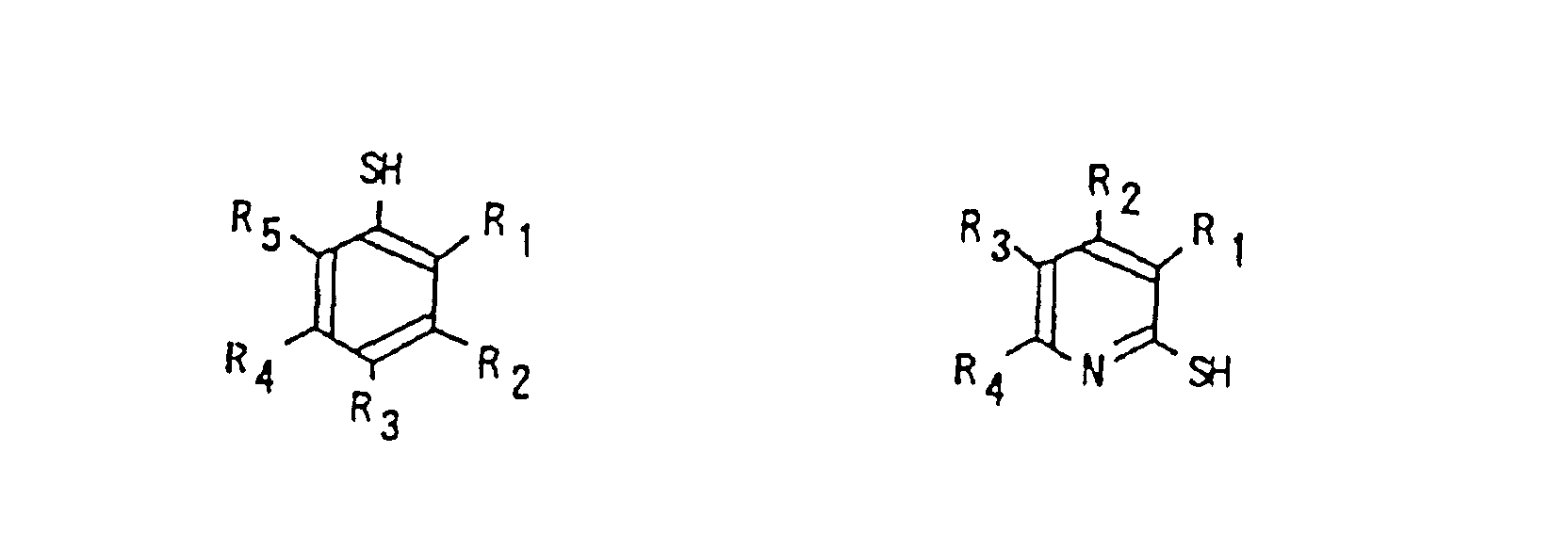
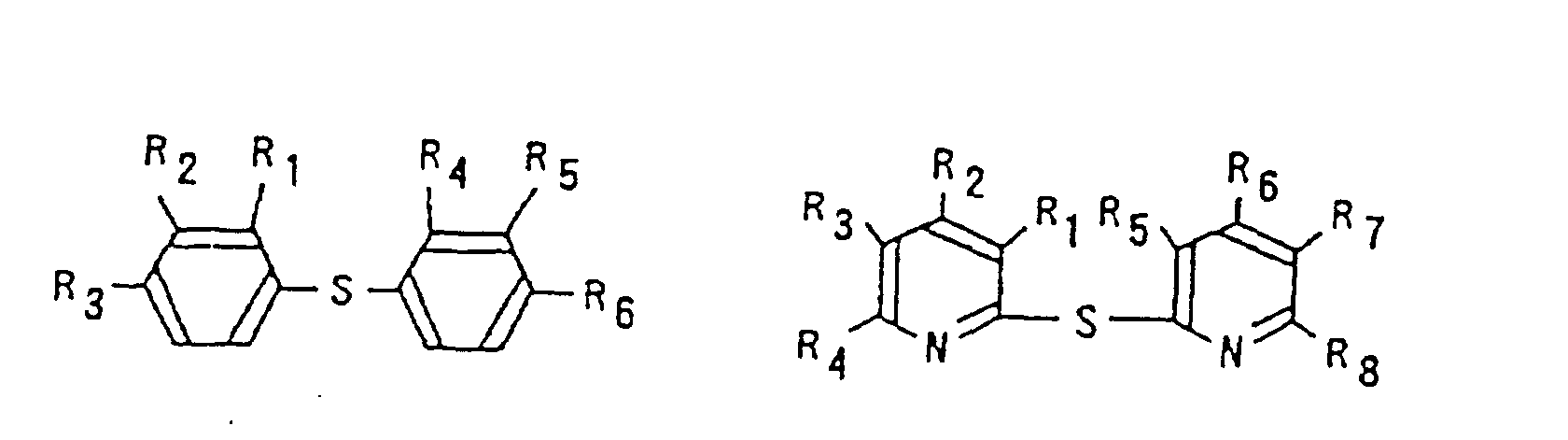 wherein R1 to R8 each represent a hydrogen atom, lower alkyl group (preferably having 1 to 3 carbon atoms), hydroxyl group, nitro group, amino group or thiol group.
- More specifically, the aromatic thiol compounds usable in the present invention include, for example, thiophenol, mercaptophenol, thiocresol, nitrothiophenol, thiosalicylic acid, aminothiophenol, benzenedithiophenol and mercaptopyridine. They are used either singly or in the form of a mixture of two or more of them.
- The aromatic sulfides are preferably aromatic mono- or disulfide compounds such as 4,4-thiodiphenol, 4,4-aminodiphenyl sulfide, thiobisthiophenol, 2,2-diaminodiphenyl disulfide, 2,2-dithiodibenzoic acid, ditolyl disulfide and 2,2-dipyridyl disulfide. They are used either singly or in the form of a mixture of two or more of them.
- The aromatic thiol compounds and aromatic sulfides are more preferably those having NH2 group in the substituent in the structure thereof or those having a pyridine ring in the structure thereof.
- Either or both of the aromatic thiol compound or/and aromatic sulfide compound is usable in the present invention. Further a mixture of two or more of the aromatic thiol compounds or aromatic sulfide compounds is also usable. These compounds are capable of imparting a gloss to the resultant deposit, too.
- The amount of each of the aromatic thiol compound and aromatic sulfide compound used in the present invention is not particularly limited so far as both tin and silver dissolved in the bath can be kept stable. It is preferably 0.1 to 200 g/ℓ, more preferably 0.2 to 50 g/ ℓ.
- An acid substance can be incorporated into the tin-silver alloy plating bath in order to control the pH of the bath on acidic side. The acid substances are preferably alkanesulfonic acids having 1 to 3 carbon atoms such as methanesulfonic acid, ethanesulfonic acid and hydroxypropanesulfonic acid; benzenesulfonic acids and phenolsulfonic acids having 6 or 7 carbon atoms such as sulfosalicylic acid and cresolsulfonic acid; alkanolsulfonic acids such as isopropanolsulfonic acid; and sulfamic acid. These acids are usable either singly or in the form of a mixture of two or more of them. Although the acid concentration in the plating bath is not particularly limited so far as tin and silver are soluble therein, it is preferably 10 to 500 g/ ℓ, more preferably 50 to 400 g/ℓ. In particular, the acid concentration in the plating bath is controlled so that the pH of the bath can be kept not higher than 2, preferably not higher than 1.
- The plating bath of the present invention can comprise the above-described indispensable components and the balance of water and, if necessary, additives such as a brightening agent and lubricating agent. The brightening agent may be any of those used for brightening tin and silver such as nonionic surfactants, anionic surfactants, synthetic polymers (e. g. PVP, PEG and PVA), amines (e. g. hexamethylenetetramine and triethanolamine), ketones (e. g. benzalacetone and acetophenone), aliphatic aldehydes (e. g. formalin and valeric aldehyde), aromatic aldehydes (e. g. salicylaldehyde and vanillin) and metal compounds containing Sb, Se, Cu, In, Zn, Ca, Ba or the like. These compounds are usable either singly or in the form of a mixture of two or more of them. The amount of the brightening agent is preferably 0.5 to 50 g/ℓ, more preferably 0.2 to 30 g/ℓ.
- Antioxidants for tin are also usable. They include hydroxyphenyl compounds such as phenol, catechol, pyrogallol and hydroquinone; L-ascorbic acid; and sorbitol.
- The acid tin-silver alloy plating bath of the present invention are usable for plating various substrates such as iron or copper substrates by an ordinary method to form the tin-silver alloy deposit. In particular, the substrate as the cathode and a plate of a tin-silver alloy or tin plate as the anode are immersed in the tin-silver alloy plating bath and then electric current of about 0.5 to 50 A is sent for about 0.5 to 10 minutes to form a tin-silver alloy film comprising 20 to 99 % by weight of tin and 80 to 1 % by weight of silver and having a thickness of 1 to 30 µ m.
- The tin-silver alloy plating bath of the present invention has an advantage that it has only a low toxicity and a high safety because it is of a non-cyan type unlike an ordinary alkaline cyan bath. In addition, although silver easily forms insoluble salts with various substances, the tin-silver alloy plating bath of the present invention can be kept stable for a long period of time without changing the plating function thereof. Another advantage of this plating bath is that since it does not necessitate any special treatment of the waste water, the waste water treatment cost is low.
- When the tin-silver alloy plating bath of the present invention is used as an electroplating bath, a thin film having a thickness of 1 to 30 µ m is obtained unlike a film formed by a hot dipping technique. Thus, according to the present invention, even precision parts can be plated and a high workability can be attained advantageously.
- The following Examples will further illustrate the present invention.
- An acid tin-silver alloy plating bath comprising the following components and the balance of water was prepared (pH: not higher than 1):
SnO 30 g/ℓ methanesulfonic acid 350 g/ℓ Ag2O 2 g/ℓ 2-aminobenzenethiol 20 g/ℓ - An acid tin-silver alloy plating bath comprising the following components and the balance of water was prepared (pH: not higher than 1):
SnO 30 g/ℓ methanesulfonic acid 350 g/ℓ Ag2O 1 g/ℓ 2,2-dipyridyl disulfide 5 g/ℓ - An acid tin-silver alloy plating bath comprising the following components and the balance of water was prepared (pH: not higher than 1):
SnO 30 g/ℓ methanesulfonic acid 1150 g/ℓ Ag2O 1 g/ℓ 2,2-dipyridyl disulfide 5 g/ℓ nonionic surfactant (SEDORAN FF-180; a product of Sanyo Chemical Industries, Ltd.) 4 g/ℓ benzalacetone 1.5 g/ℓ - An acid tin-silver alloy plating bath comprising the following components and the balance of water was prepared (pH: not higher than 1):
SnO 10 g/ℓ hydroxypropanesulfonic acid 150 g/ℓ Ag2O 10 g/ℓ 2-aminobenzenethiol 5 g/ℓ nonionic surfactant (EPAN 450; a product of Dai-ichi Kogyo Seiyaku Co., Ltd.) 5 g/ℓ 35 % formalin 10 g/ℓ triethanolamine 5 g/ℓ potassium antimonyl tartrate 0.1 g/ℓ - An acid tin-silver alloy plating bath comprising the following components and the balance of water was prepared (pH: not higher than 1):
SnO 30 g/ℓ isopropanolsulfonic acid 250 g/ℓ Ag2O 3 g/ℓ 2-aminobenzenethiol 5 g/ℓ nonionic surfactant (EPAN 450; a product of Dai-ichi Kogyo Seiyaku Co., Ltd.) 6 g/ℓ piperonal 0.1 g/ℓ - An acid tin-silver alloy plating bath comprising the following components and the balance of water was prepared (pH: not higher than 1):
SnO 30 g/ℓ methanesulfonic acid 150 g/ℓ Ag2O 2 g/ℓ - An acid tin-silver alloy plating bath comprising the following components and the balance of water was prepared (pH: not higher than 1):
SnO 30 g/ℓ isopropanolsulfonic acid 150 g/ℓ Ag2O 5 g/ℓ - An acid tin-silver alloy plating bath comprising the following components and the balance of water was prepared (pH: 3.2):
SnCl4 · 5H2O 30 g/ℓ AgNO3 63 g/ℓ thiomalic acid 90 g/ℓ potassium citrate 26 g/ℓ - KOH and NaOH were used in a weight ratio of 1:1 for controlling pH.
- An acid tin-silver alloy plating bath comprising the following components and the balance of water was prepared (pH: not higher than 1):
SnO 30 g/ℓ methanesulfonic acid 150 g/ℓ Ag2O 2 g/ℓ thiourea 3 g/ℓ - An acid tin-silver alloy plating bath comprising the following components and the balance of water was prepared (pH: not higher than 1):
SnO 30 g/ℓ methanesulfonic acid 150 g/ℓ Ag2O 1 g/ℓ thiourea 3 g/ℓ nonionic surfactant (SUNMORL BN-13D; a product of Nikka Kagaku) 4 g/ℓ hexamethylenetetramine 4 g/ℓ benzalacetone 1.5 g/ℓ potassium antimonyl tartrate 0.1 g/ℓ - The plating baths prepared in Examples 1 to 5 and Comparative Examples 1 to 5 were left to stand at room temperature. The formation of the precipitate in the plating bath was macroscopically observed and the silver concentration was analyzed by the atomic absorptiometry 4 hours, 10 days, 30 days and 120 days after.
- The results are summarized in Table 1.
Precipitation Silver conc. in bath (g/l) a. b. c. d. a. b. c. d. Ex. 1 ○ ○ ○ ○ 1.86 1.86 1.85 1.86 Ex. 2 ○ ○ ○ ○ 0.93 0.91 0.93 0.92 Ex. 3 ○ ○ ○ ○ 0.93 0.93 0.91 0.92 Ex. 4 ○ ○ ○ ○ 27.9 27.7 27.8 27.8 Ex. 5 ○ ○ ○ ○ 2.78 2.78 2.79 2.78 Comp. Ex. 1 × × × × 0.00 0.00 0.00 0.00 Comp. Ex. 2 × × × × 0.00 0.00 0.00 0.00 Comp. Ex. 3 ○ × × × 40.4 8.64 0.00 0.00 Comp. Ex. 4 ○ ○ ○ ○ 1.86 1.85 1.86 1.86 Comp. Ex. 5 ○ ○ ○ ○ 0.93 0.92 0.92 0.93 ○ : no precipitation
× : precipitation
a. 4 hours after the preparation of the plating bath:
b. 10 days after the preparation of the plating bath:
c. 30 days after the preparation of the plating bath:
d. 120 days after the preparation of the plating bath: - The plating baths prepared in Examples 1 to 5 and Comparative Examples 4 and 5 were left to stand at 60 °C. The formation of the precipitate in the plating bath was macroscopically observed and the silver concentration was analyzed by the atomic absorptiometry 4 hours, 10 days, 30 days and 120 days after.
- The results are summarized in Table 2.
Precipitation Silver conc. in bath (g/l) a. b. c. d. a. b. c. d. Ex. 1 ○ ○ ○ ○ 1.86 1.86 1.85 1.86 Ex. 2 ○ ○ ○ ○ 0.93 0.91 0.93 0.92 Ex. 3 ○ ○ ○ ○ 0.93 0.93 0.91 0.92 Ex. 4 ○ ○ ○ ○ 27.9 27.7 27.8 27.8 Ex. 5 ○ ○ ○ ○ 2.78 2.78 2.79 2.78 Comp. Ex. 4 × × × × 0.74 0.00 0.00 0.00 Comp. Ex. 5 × × × × 0.36 0.00 0.00 0.00 ○ : no precipitation
× : precipitation
a. 4 hours after the preparation of the plating bath:
b. 10 days after the preparation of the plating bath:
c. 30 days after the preparation of the plating bath:
d. 120 days after the preparation of the plating bath: - The plating baths prepared in Examples 1 to 5 and Comparative Examples 4 and 5 were left to stand at room temperature. The Hull cell tests were conducted under the conditions shown below 4 hours, 10 days, 30 days and 120 days after.
-
bath temperature 25 °C anodic plate tin plate cathodic plate polished steel plate electric current 3 A plating time 10 minutes. - In the plating bath prepared in Comparative Example 4, crude precipitates were formed in a high-current density part and the relative amount of alloyed silver was increased in the tin-silver alloy with time, while no change in the appearance of the deposit or in the proportion of the tin to silver in the alloy with time was observed when the plating bath prepared in any of Examples 1 to 5 was used. When the plating bath prepared in Comparative Example 5 was used, the gloss and smoothness of the deposit were deteriorated and the relative amount of alloyed silver was decreased in the tin-silver alloy with time.
- The relative amount of alloyed silver in the deposit was determined by the atomic absorptiometry in parts 1, 5 and 9 cm distant from the high-current density side of the Hull cell test panel. The results of the analysis are shown in Table 3.

Claims (18)
- An acid tin-silver alloy plating bath which comprises a tin ion, a silver ion, one compound selected from aromatic thiol compounds and aromatic sulfide compounds, and a balance of water, the pH of the bath being not high than 2 and the bath being substantially cyanide free.
- An acid plating bath as claimed in claim 1, wherein the aromatic sulfide compounds are aromatic mono- or disulfide compounds.
- An acid plating bath as claimed in claim 1 or claim 2, wherein the aromatic thiol compounds and aromatic sulfide compounds have from 6 to 14 carbon atoms.
- An acid plating bath as claimed in any one of claims 1 to 3, wherein the amount of the aromatic thiol compounds and aromatic sulfide compounds is from 0.1 to 200 g/l.
- An acid plating bath as claimed in any one of claims 1 to 4, wherein the amount of the tin ion is from 2 to 80 g/l calculated as Sn.
- An acid plating bath as claimed in any one of claims 1 to 5, wherein the amount of the silver ion is from 0.01 to 80 g/l calculated as Ag.
- An acid tin-silver alloy plating bath as claimed in claim 1 which comprises from 2 to 80 g/l of a tin ion calculated as Sn, from 0.01 to 80 g/l of a silver ion calculated as Ag, from 0.1 to 200 g/l of one compound having from 6 to 14 carbon atoms selected from aromatic thiol compounds and aromatic sulfide compounds, substantially no cyan compounds and a balance of water, the pH of the bath being not higher than 2.
- An acid plating bath as claimed in any one of claims 1 to 7, wherein the aromatic thiol compounds and aromatic sulfide compounds are selected from compounds having the following structure:

 wherein R1 to R8 each represent a hydrogen atom, lower alkyl group, hydroxyl group, nitro group, amino group or thiol group.
- An acid plating bath as claimed in any one of claims 1 to 8, which further contains an acid selected from the group consisting of alkanesulfonic acids, alkanolsulfonic acids and sulfamic acids.
- An acid plating bath as claimed in claim 9, wherein the acid is present in an amount of from 10 to 500 g/l.
- A method for electroplating a tin-silver alloy on a substrate, which method comprises the steps of immersing the substrate as the cathode and a plate of a tin-silver alloy or tin plate as the anode in an acid tin-silver alloy plating bath which comprises a tin ion, a silver ion, one compound selected from aromatic thiol compounds and aromatic sulfide compounds, substantially no cyan compounds and a balance of water, the pH of the bath being not higher than 2, and charging electric current of about 0.5 to 50 A thereto for about 0.5 to 10 minutes to form onto the substrate a tin-silver alloy film comprising from 20 to 99 % by weight of tin and from 80 to 1 % by weight of silver and having a thickness of from 1 to 30 µm.
- A method as claimed in claim 11, wherein the aromatic thiol compounds and aromatic sulfide compounds have from 6 to 14 carbon atoms.
- A method as claimed in claim 11 or claim 12, wherein the aromatic thiol compounds and aromatic sulfide compounds are selected from compounds having the following structure:

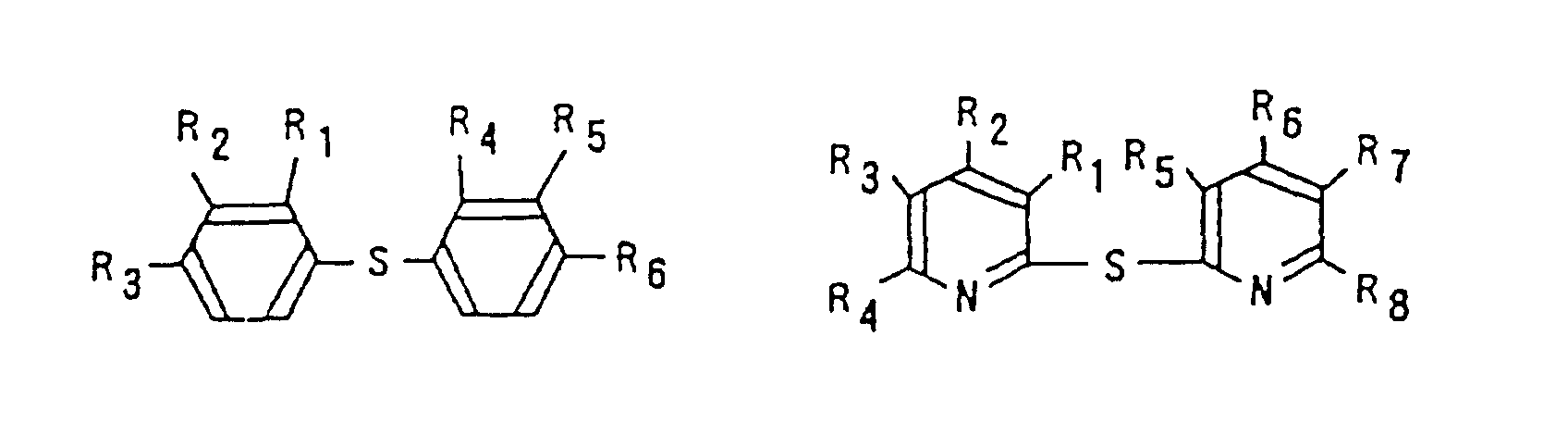 wherein R1 to R8 each represent a hydrogen atom, lower alkyl group, hydroxyl group, nitro group, amino group or thiol group.
- A method as claimed in any one of claims 11 to 13, wherein the amount of the aromatic thiol compounds and aromatic sulfide compounds is from 0.1 to 200 g/l.
- A method as claimed in any one of claims 11 to 14, wherein the amount of the tin ion is from 2 to 80 g/l calculated as Sn.
- A method as claimed in any one of claims 11 to 15, wherein the amount of the silver ion is from 0.01 to 80 g/l calculated as Ag.
- A method as claimed in any one of claims 11 to 16, wherein the bath further contains an acid selected from aklanesulfonic acids, alkanolsulfonic acids and sulfamic acids.
- A method as claimed in claim 17, wherein the acid is present in an amount of from 10 to 500 g/l.
Applications Claiming Priority (3)
| Application Number | Priority Date | Filing Date | Title |
|---|---|---|---|
| JP755597 | 1997-01-20 | ||
| JP00755597A JP3301707B2 (en) | 1997-01-20 | 1997-01-20 | Tin-silver alloy acid electroplating bath |
| JP7555/97 | 1997-01-20 |
Publications (2)
| Publication Number | Publication Date |
|---|---|
| EP0854206A1 EP0854206A1 (en) | 1998-07-22 |
| EP0854206B1 true EP0854206B1 (en) | 2001-08-16 |
Family
ID=11669056
Family Applications (1)
| Application Number | Title | Priority Date | Filing Date |
|---|---|---|---|
| EP97306700A Expired - Lifetime EP0854206B1 (en) | 1997-01-20 | 1997-09-01 | Acid tin-silver alloy electroplating bath and method for electroplating tin-silver alloy |
Country Status (4)
| Country | Link |
|---|---|
| US (1) | US5911866A (en) |
| EP (1) | EP0854206B1 (en) |
| JP (1) | JP3301707B2 (en) |
| DE (1) | DE69706132T2 (en) |
Cited By (4)
| Publication number | Priority date | Publication date | Assignee | Title |
|---|---|---|---|---|
| US7122108B2 (en) | 2001-10-24 | 2006-10-17 | Shipley Company, L.L.C. | Tin-silver electrolyte |
| US20130206602A1 (en) * | 2012-02-09 | 2013-08-15 | Rohm And Haas Electronic Materials Llc | Plating bath and method |
| EP3578693A1 (en) | 2018-06-08 | 2019-12-11 | ATOTECH Deutschland GmbH | Aqueous composition for depositing a tin silver alloy and method for electrolytically depositing such an alloy |
| EP4563729A1 (en) | 2023-11-28 | 2025-06-04 | Atotech Deutschland GmbH & Co. KG | Aqueous composition for depositing a tin silver alloy and method for electrolyti-cally depositing such an alloy |
Families Citing this family (26)
| Publication number | Priority date | Publication date | Assignee | Title |
|---|---|---|---|---|
| JP3433291B2 (en) * | 1999-09-27 | 2003-08-04 | 石原薬品株式会社 | Tin-copper-containing alloy plating bath, tin-copper-containing alloy plating method, and article formed with tin-copper-containing alloy plating film |
| AUPQ653700A0 (en) * | 2000-03-28 | 2000-04-20 | Ceramic Fuel Cells Limited | Surface treated electrically conductive metal element and method of forming same |
| DE10025106A1 (en) * | 2000-05-20 | 2001-11-22 | Stolberger Metallwerke Gmbh | Electrically conductive metal tape and connectors from it |
| DE10026680C1 (en) | 2000-05-30 | 2002-02-21 | Schloetter Fa Dr Ing Max | Electrolyte and method for depositing tin-silver alloy layers and use of the electrolyte |
| DE10129648C2 (en) * | 2000-06-20 | 2003-06-26 | Siemens Ag | Method and arrangement for electromechanical coating of metal elements |
| JP2004510053A (en) * | 2000-09-20 | 2004-04-02 | デーエル.−イーエヌゲー.マックス シュレッター ゲーエムベーハー ウント ツェーオー.カーゲー | Electrolyte and method for depositing a tin-copper alloy layer |
| US6924044B2 (en) | 2001-08-14 | 2005-08-02 | Snag, Llc | Tin-silver coatings |
| DE10158227A1 (en) * | 2001-11-15 | 2003-06-05 | Siemens Ag | Electrolysis bath for the electrodeposition of silver-tin alloys |
| JP4447215B2 (en) * | 2002-12-16 | 2010-04-07 | Necエレクトロニクス株式会社 | Electronic components |
| US7012333B2 (en) * | 2002-12-26 | 2006-03-14 | Ebara Corporation | Lead free bump and method of forming the same |
| JP4758614B2 (en) * | 2003-04-07 | 2011-08-31 | ローム・アンド・ハース・エレクトロニック・マテリアルズ,エル.エル.シー. | Electroplating composition and method |
| US20070037005A1 (en) * | 2003-04-11 | 2007-02-15 | Rohm And Haas Electronic Materials Llc | Tin-silver electrolyte |
| US20050085062A1 (en) * | 2003-10-15 | 2005-04-21 | Semitool, Inc. | Processes and tools for forming lead-free alloy solder precursors |
| JP4756887B2 (en) * | 2005-03-22 | 2011-08-24 | 石原薬品株式会社 | Non-cyan tin-silver alloy electroplating bath |
| US20080308300A1 (en) * | 2007-06-18 | 2008-12-18 | Conti Mark A | Method of manufacturing electrically conductive strips |
| US8980077B2 (en) | 2012-03-30 | 2015-03-17 | Rohm And Haas Electronic Materials Llc | Plating bath and method |
| CN110100048B (en) | 2016-12-20 | 2022-06-21 | 巴斯夫欧洲公司 | Composition for metal plating comprising an inhibiting agent for void-free filling |
| EP3631051B1 (en) | 2017-06-01 | 2021-10-13 | Basf Se | Composition for tin alloy electroplating comprising leveling agent |
| JP2019052355A (en) * | 2017-09-15 | 2019-04-04 | 上村工業株式会社 | Electrolytic Sn or Sn alloy plating solution and method for producing Sn or Sn alloy plating product |
| US11459665B2 (en) | 2017-12-20 | 2022-10-04 | Basf Se | Composition for tin or tin alloy electroplating comprising suppressing agent |
| CN111918985B (en) | 2018-03-29 | 2024-02-02 | 巴斯夫欧洲公司 | Compositions containing complexing agents for tin-silver alloy electroplating |
| SG11202009106XA (en) | 2018-04-20 | 2020-11-27 | Basf Se | Composition for tin or tin alloy electroplating comprising suppressing agent |
| US12559852B2 (en) | 2019-09-16 | 2026-02-24 | Basf Se | Composition for tin-silver alloy electroplating comprising a complexing agent |
| EP4263916A1 (en) | 2020-12-18 | 2023-10-25 | Basf Se | Composition for tin or tin alloy electroplating comprising leveling agent |
| KR20240113774A (en) | 2021-11-22 | 2024-07-23 | 바스프 에스이 | Composition for electroplating of tin or tin alloy containing pyrazole type antioxidant |
| CN119630838A (en) | 2022-07-26 | 2025-03-14 | 巴斯夫欧洲公司 | Composition for tin or tin alloy electroplating comprising a leveling agent |
Family Cites Families (4)
| Publication number | Priority date | Publication date | Assignee | Title |
|---|---|---|---|---|
| EP0666342B1 (en) * | 1994-02-05 | 1998-05-06 | W.C. Heraeus GmbH | Bath for electroplating silver-tin alloys |
| JP3274766B2 (en) * | 1994-06-28 | 2002-04-15 | 荏原ユージライト株式会社 | Low melting tin alloy plating bath |
| EP0693579B1 (en) * | 1994-07-21 | 1997-08-27 | W.C. Heraeus GmbH | Palladium-silver alloys electroplating bath |
| JPH08104993A (en) * | 1994-10-04 | 1996-04-23 | Electroplating Eng Of Japan Co | Silver plating bath and its silver plating method |
-
1997
- 1997-01-20 JP JP00755597A patent/JP3301707B2/en not_active Expired - Lifetime
- 1997-08-29 US US08/921,081 patent/US5911866A/en not_active Expired - Lifetime
- 1997-09-01 DE DE69706132T patent/DE69706132T2/en not_active Expired - Lifetime
- 1997-09-01 EP EP97306700A patent/EP0854206B1/en not_active Expired - Lifetime
Cited By (5)
| Publication number | Priority date | Publication date | Assignee | Title |
|---|---|---|---|---|
| US7122108B2 (en) | 2001-10-24 | 2006-10-17 | Shipley Company, L.L.C. | Tin-silver electrolyte |
| US20130206602A1 (en) * | 2012-02-09 | 2013-08-15 | Rohm And Haas Electronic Materials Llc | Plating bath and method |
| US8888984B2 (en) * | 2012-02-09 | 2014-11-18 | Rohm And Haas Electronic Materials Llc | Plating bath and method |
| EP3578693A1 (en) | 2018-06-08 | 2019-12-11 | ATOTECH Deutschland GmbH | Aqueous composition for depositing a tin silver alloy and method for electrolytically depositing such an alloy |
| EP4563729A1 (en) | 2023-11-28 | 2025-06-04 | Atotech Deutschland GmbH & Co. KG | Aqueous composition for depositing a tin silver alloy and method for electrolyti-cally depositing such an alloy |
Also Published As
| Publication number | Publication date |
|---|---|
| JP3301707B2 (en) | 2002-07-15 |
| DE69706132T2 (en) | 2001-12-06 |
| JPH10204675A (en) | 1998-08-04 |
| EP0854206A1 (en) | 1998-07-22 |
| US5911866A (en) | 1999-06-15 |
| DE69706132D1 (en) | 2001-09-20 |
Similar Documents
| Publication | Publication Date | Title |
|---|---|---|
| EP0854206B1 (en) | Acid tin-silver alloy electroplating bath and method for electroplating tin-silver alloy | |
| US7150781B2 (en) | Pyrophosphoric acid bath for use in copper-tin alloy plating | |
| US7628903B1 (en) | Silver and silver alloy plating bath | |
| KR100268967B1 (en) | Method for producing a plating product using an aqueous solution for forming a metal complex, a tin-silver alloy plating bath and the plating bath | |
| EP1874982B1 (en) | Method for electrodeposition of bronzes | |
| US5514261A (en) | Electroplating bath for the electrodeposition of silver-tin alloys | |
| US6998036B2 (en) | Electrolyte and method for depositing tin-silver alloy layers | |
| EP3002350B1 (en) | Cyanide-free electroplating baths for white bronze based on copper (i) ions | |
| KR102174876B1 (en) | Tin alloy plating solution | |
| JP2011520037A (en) | Improved copper-tin electrolyte and bronze layer deposition method | |
| US4885064A (en) | Additive composition, plating bath and method for electroplating tin and/or lead | |
| US20040065558A1 (en) | Electrolyte media for the deposition of tin alloys and methods for depositing tin alloys | |
| KR20010039969A (en) | Sn-Cu ALLOY PLATING BATH | |
| JP2000328286A (en) | Tin-silver alloy electroplating bath | |
| JP3920983B2 (en) | Silver or silver alloy acidic electroplating bath | |
| US20050077186A1 (en) | Electrolysis bath for electrodepositing silver-tin alloys | |
| US4772362A (en) | Zinc alloy electrolyte and process | |
| JP3336621B2 (en) | Composition solution for plating and plating method | |
| JP3645955B2 (en) | Tin-silver alloy acid plating bath | |
| US6770185B2 (en) | Aqueous solution for electrodepositing tin-zinc alloys | |
| JP3872201B2 (en) | Tin-silver alloy acidic electroplating bath | |
| JP3210678B2 (en) | Tin plating electrolyte composition | |
| JP2006144073A (en) | Lead-free tin-silver alloy or tin-copper alloy electroplating bath | |
| JPH09296274A (en) | Aqueous solution for forming metal complex, tin-silver alloy plating bath, and method for producing plated product using this plating bath | |
| EP4249646A1 (en) | Method of inhibiting tarnish formation and corrosion |
Legal Events
| Date | Code | Title | Description |
|---|---|---|---|
| PUAI | Public reference made under article 153(3) epc to a published international application that has entered the european phase |
Free format text: ORIGINAL CODE: 0009012 |
|
| AK | Designated contracting states |
Kind code of ref document: A1 Designated state(s): DE FR GB |
|
| 17P | Request for examination filed |
Effective date: 19981110 |
|
| AKX | Designation fees paid |
Free format text: DE FR GB |
|
| RBV | Designated contracting states (corrected) |
Designated state(s): DE FR GB |
|
| 17Q | First examination report despatched |
Effective date: 19990913 |
|
| GRAG | Despatch of communication of intention to grant |
Free format text: ORIGINAL CODE: EPIDOS AGRA |
|
| GRAG | Despatch of communication of intention to grant |
Free format text: ORIGINAL CODE: EPIDOS AGRA |
|
| GRAH | Despatch of communication of intention to grant a patent |
Free format text: ORIGINAL CODE: EPIDOS IGRA |
|
| GRAH | Despatch of communication of intention to grant a patent |
Free format text: ORIGINAL CODE: EPIDOS IGRA |
|
| GRAA | (expected) grant |
Free format text: ORIGINAL CODE: 0009210 |
|
| AK | Designated contracting states |
Kind code of ref document: B1 Designated state(s): DE FR GB |
|
| REF | Corresponds to: |
Ref document number: 69706132 Country of ref document: DE Date of ref document: 20010920 |
|
| ET | Fr: translation filed | ||
| REG | Reference to a national code |
Ref country code: GB Ref legal event code: IF02 |
|
| PLBE | No opposition filed within time limit |
Free format text: ORIGINAL CODE: 0009261 |
|
| STAA | Information on the status of an ep patent application or granted ep patent |
Free format text: STATUS: NO OPPOSITION FILED WITHIN TIME LIMIT |
|
| 26N | No opposition filed | ||
| REG | Reference to a national code |
Ref country code: FR Ref legal event code: PLFP Year of fee payment: 20 |
|
| PGFP | Annual fee paid to national office [announced via postgrant information from national office to epo] |
Ref country code: GB Payment date: 20160926 Year of fee payment: 20 |
|
| PGFP | Annual fee paid to national office [announced via postgrant information from national office to epo] |
Ref country code: FR Payment date: 20160805 Year of fee payment: 20 |
|
| PGFP | Annual fee paid to national office [announced via postgrant information from national office to epo] |
Ref country code: DE Payment date: 20160928 Year of fee payment: 20 |
|
| REG | Reference to a national code |
Ref country code: DE Ref legal event code: R071 Ref document number: 69706132 Country of ref document: DE |
|
| REG | Reference to a national code |
Ref country code: GB Ref legal event code: PE20 Expiry date: 20170831 |
|
| PG25 | Lapsed in a contracting state [announced via postgrant information from national office to epo] |
Ref country code: GB Free format text: LAPSE BECAUSE OF EXPIRATION OF PROTECTION Effective date: 20170831 |