EP0850671A2 - Game, especially chess - Google Patents
Game, especially chess Download PDFInfo
- Publication number
- EP0850671A2 EP0850671A2 EP97660129A EP97660129A EP0850671A2 EP 0850671 A2 EP0850671 A2 EP 0850671A2 EP 97660129 A EP97660129 A EP 97660129A EP 97660129 A EP97660129 A EP 97660129A EP 0850671 A2 EP0850671 A2 EP 0850671A2
- Authority
- EP
- European Patent Office
- Prior art keywords
- game
- piece
- area
- pieces
- base disc
- Prior art date
- Legal status (The legal status is an assumption and is not a legal conclusion. Google has not performed a legal analysis and makes no representation as to the accuracy of the status listed.)
- Withdrawn
Links
Images

Classifications
-
- A—HUMAN NECESSITIES
- A63—SPORTS; GAMES; AMUSEMENTS
- A63F—CARD, BOARD, OR ROULETTE GAMES; INDOOR GAMES USING SMALL MOVING PLAYING BODIES; VIDEO GAMES; GAMES NOT OTHERWISE PROVIDED FOR
- A63F3/00—Board games; Raffle games
- A63F3/00697—Playing pieces
-
- A—HUMAN NECESSITIES
- A63—SPORTS; GAMES; AMUSEMENTS
- A63F—CARD, BOARD, OR ROULETTE GAMES; INDOOR GAMES USING SMALL MOVING PLAYING BODIES; VIDEO GAMES; GAMES NOT OTHERWISE PROVIDED FOR
- A63F3/00—Board games; Raffle games
- A63F3/00173—Characteristics of game boards, alone or in relation to supporting structures or playing piece
- A63F3/00529—Board game without game board
-
- A—HUMAN NECESSITIES
- A63—SPORTS; GAMES; AMUSEMENTS
- A63F—CARD, BOARD, OR ROULETTE GAMES; INDOOR GAMES USING SMALL MOVING PLAYING BODIES; VIDEO GAMES; GAMES NOT OTHERWISE PROVIDED FOR
- A63F11/00—Game accessories of general use
- A63F11/0011—Chance selectors
- A63F2011/0023—Chance selectors indicating a direction, e.g. wind direction
-
- A—HUMAN NECESSITIES
- A63—SPORTS; GAMES; AMUSEMENTS
- A63F—CARD, BOARD, OR ROULETTE GAMES; INDOOR GAMES USING SMALL MOVING PLAYING BODIES; VIDEO GAMES; GAMES NOT OTHERWISE PROVIDED FOR
- A63F2250/00—Miscellaneous game characteristics
- A63F2250/10—Miscellaneous game characteristics with measuring devices
- A63F2250/1005—Miscellaneous game characteristics with measuring devices for angles
-
- A—HUMAN NECESSITIES
- A63—SPORTS; GAMES; AMUSEMENTS
- A63F—CARD, BOARD, OR ROULETTE GAMES; INDOOR GAMES USING SMALL MOVING PLAYING BODIES; VIDEO GAMES; GAMES NOT OTHERWISE PROVIDED FOR
- A63F2250/00—Miscellaneous game characteristics
- A63F2250/10—Miscellaneous game characteristics with measuring devices
- A63F2250/1036—Miscellaneous game characteristics with measuring devices for distances
-
- A—HUMAN NECESSITIES
- A63—SPORTS; GAMES; AMUSEMENTS
- A63F—CARD, BOARD, OR ROULETTE GAMES; INDOOR GAMES USING SMALL MOVING PLAYING BODIES; VIDEO GAMES; GAMES NOT OTHERWISE PROVIDED FOR
- A63F3/00—Board games; Raffle games
- A63F3/02—Chess; Similar board games
Definitions
- the present invention relates to a game, especially chess, which comprises a board delimiting a level game area, a group of game pieces, for example, a king, queen, two castles, two bishops, two knights, and eight pawns, for each player.
- the game of chess like many other board games, has included a game board marked with squares or similar.
- the squares or other markings show, in known games, the permitted locations of the pieces. In the game of chess, only one piece can fit on a square and each piece must remain on the game area marked with squares.
- the object of the invention is to create a boardless game, on the board or similar base of which no squares or other markings are required to show the permitted places of the pieces.
- the characteristic features of the invention are described in the accompanying Patent Claims.
- no squares are required, because the pieces always move a measurable distance in a set direction. Contact between the pieces is defined by means of the intersection of the individual areas, which replaces moving to a square.
- the game area is a limited two-dimensional surface, which is formed by game board 1, in which the boundaries 2 are defined by a feature.
- the edge of the circular game board 1 forms the aforesaid boundary.
- Each player has a group 3 and 3' of sixteen pieces, as in normal chess, each comprising a king, a queen, two castles, two bishops, two knights, and eight pawns.
- Each piece has a circular area around it, which is defined by the area of the base of the piece.
- the pieces are placed so that on the White side the king and queen are in the middle, with the queen on the left.
- Each is in its own area, so that the areas border one another.
- the Black queen directly faces the White queen.
- the extent of the area of the game is defined by drawing a circle, the centrepoint of which is the centrepoint of the line segment between the Black queen and the White king.
- the game can be played on any level base whatever, the most advantageous game generally has a base, a particular game board, in which this delimitation has been ready made, as in this case.
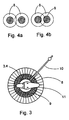
- Figures 2 and 3 the construction of a knight 3.4 is used to exemplify the construction of the pieces.
- the definition of the location of a piece takes place according to a direction scale 11 printed on the upper surface of the base 8 of the piece.
- the direction device 10 a measuring rule or tape, at the base of the piece, which is attached to a rotating ring, is turned in the chosen direction and the movement of the piece is read from the set scale of the direction device. Its length is a measure of 10 areas for a bishop, castle, and queen, a measure of 3 areas for a knight, and a measure of 2 areas for other pieces.
- Direction indicator 4 is on the left when viewed from the White player's position and it has a button moving in a groove 5 in the centre, from which there is a measuring rule 6 that can be moved to the right. At the beginning of the game, direction indicator 4 is set parallel to a straight line drawn between the White and Black kings.
- both players have sixteen 'Black' or 'White' pieces. Each has one king, one queen, two castles, two knights, two bishops, and eight pawns. The number and setup of the pieces are thus the same as in 'conventional' chess.
- Each piece can move from the point of departure within the framework of the predetermined rules.
- a piece cannot move to such a place that belongs to the area of another piece on its own side, nor to such a place that belongs to the area of one of the opponent's pieces. If the area of a moved piece intersects the area of one of the opponent's pieces, this latter is 'taken' and removed from the area of the game. Only the knight and bishop may move over the areas of the other pieces. The area of a piece may not intersect the boundary of the area of the game.
- the definition of an area takes place in practice by the piece having a flat circular disc as a base, i.e. the aforesaid base 8, the surface area of which is the same as the area of the piece. In the piece, there is also a concentric inner ring 9, the so-called inner area, the diameter of which is half the diameter of the entire area.
- the aggressiveness of the pieces can be selected according to Figures 4a and 4b.
- the aggressiveness of the pieces can be reduced by moderating the intersection rule concerning the intersection of the area (base 8) and the inner area (ring 9).
- the result of this moderation is that the pieces can also be located next to one another so that the ring-shaped zones remaining between the edge of the inner area and the edge of the entire area of the piece intersect one another.
- Check, checkmate, and stalemate are defined as in conventional chess.
- the pieces are attached to the base by magnets or some Velcro-like device. Gravity replaces a separate direction indicator.
Landscapes
- Engineering & Computer Science (AREA)
- Multimedia (AREA)
- Measurement Of The Respiration, Hearing Ability, Form, And Blood Characteristics Of Living Organisms (AREA)
- Length Measuring Devices With Unspecified Measuring Means (AREA)
- Toys (AREA)
Abstract
Description
- Figure 1
- shows the devices of boardless chess.
- Figures 2 & 3
- show the construction of the pieces used in the game.
- Figures 4a & 4b
- show the alternative aggressiveness of the pieces.
- The castle moves from the north in the directions 0°, 60°, 120°, 180°, 240°, and 300°, while the number of steps in its move is not limited, provided the route is otherwise unobstructed.
- The bishop moves two areas at a time in the directions 30°, 90°, 150°, 210°, 270°, and 330°. If there are other pieces in the areas between, the bishop jumps over them. As in the case of the castle, the number of steps in the bishop's moves is not limited.
- The knight moves over three areas at a time in the directions 20°, 40°, 80°, 100°, 140°, 160°, 200°, 220°, 260°, 280°, 320°, 340°, one step at a time. If there are other pieces in the areas in between, the knight jumps over them.
- The queen moves in the same way as the castle and bishop together.
- The king moves like the queen, but only one area measure at a time. Castling is a king's move complemented by the castle's move. It is counted as a single move and takes place as follows; the king remains in place or else moves next to a castle that is on the same horizontal level, after which the castle moves over the king, if the area on the other side of the king is free. Castling is impossible is one or other of the pieces, the king or the castle has already been moved. Castling is temporarily prevented, if the king is threatened by one of the opponents' pieces.
- The pawn moves forward only by the amount of its own area. Only the initial move may be of two areas, if the area between is completely free. The pawn takes from its area to a distance of one step in a direction of ±30° forwards. A pawn, which threatens an area that a pawn from the opponent's original area has passed in a move of two steps, may, immediately on the next move (and only then), take the opponent's pawn, just as if the latter had moved only one step. This special rule is termed taking en passant. Every pawn that has been able to move more than six areas from its original position must during the same move and irrespective of the other remaining pieces, be changed into a queen, castle, bishop, or knight of the same colour, as the player wishes. The transformation of the pawn is termed elevation and comes into force immediately.
Claims (5)
- A game, especially chess, comprising a game board (1), or other delimiting devices, delimiting a level game area (2), a group (3, 3') of pieces for each player, comprising a group of pieces, such as a king, queen, 2 castles, 2 bishops, 2 knights, and 8 pawns, characterized in that in each piece there is at least one member showing the individual area of the piece, for example, a base disc (8), and that the game includes at least one direction scale (11) and move distance measuring device (10) for moving a piece a certain distance in a certain direction, according to the rules of the game.
- A game according to Claim 1, characterized in that the direction scale (11) is printed on the base disc (8) of each piece.
- A game according to Claim 1 or 2, characterized in that each piece includes a second member showing the individual area, for example a smaller ring (9) placed above the base disc (8) so that the base disc of an opposing piece extends into this second individual area.
- A game according to Claim 1 or 2, characterized in that the game includes a separate direction indicator (4), which comprises a transverse measuring rule (6) moving on a linear guide (5), for maintaining a standard basic direction throughout the game.
- A game according to one of Claims 1 - 4, characterized in that the measuring device of the distance of the move consists of a measuring rule, in which there is a distance scale as a multiple of the base disc (8) of the piece.
Applications Claiming Priority (2)
| Application Number | Priority Date | Filing Date | Title |
|---|---|---|---|
| FI960588U | 1996-11-27 | ||
| FI960588U FI2844U1 (en) | 1996-11-27 | 1996-11-27 | A game, especially a game of chess |
Publications (2)
| Publication Number | Publication Date |
|---|---|
| EP0850671A2 true EP0850671A2 (en) | 1998-07-01 |
| EP0850671A3 EP0850671A3 (en) | 1999-12-08 |
Family
ID=8545374
Family Applications (1)
| Application Number | Title | Priority Date | Filing Date |
|---|---|---|---|
| EP97660129A Withdrawn EP0850671A3 (en) | 1996-11-27 | 1997-11-26 | Game, especially chess |
Country Status (2)
| Country | Link |
|---|---|
| EP (1) | EP0850671A3 (en) |
| FI (1) | FI2844U1 (en) |
Cited By (2)
| Publication number | Priority date | Publication date | Assignee | Title |
|---|---|---|---|---|
| WO2005018763A1 (en) * | 2003-08-19 | 2005-03-03 | Hasbro, Inc. | Action figure game piece and method of playing action figure game |
| US9925454B2 (en) | 2014-08-08 | 2018-03-27 | Asmodee North America, Inc. | Gaming apparatus with status indicator |
Family Cites Families (6)
| Publication number | Priority date | Publication date | Assignee | Title |
|---|---|---|---|---|
| FR632269A (en) * | 1926-08-11 | 1928-01-06 | Chess | |
| US3642286A (en) * | 1969-12-22 | 1972-02-15 | Robert L Moore | Games with changeable playing pieces |
| JPS51125550A (en) * | 1975-04-22 | 1976-11-02 | Makoto Shirasago | Chessmen |
| US4226419A (en) * | 1978-09-05 | 1980-10-07 | Wooden Neal R | Strategy game |
| US4936585A (en) * | 1989-10-27 | 1990-06-26 | Looney Andrew J | Method of manipulating and interpreting playing pieces |
| GB2299519A (en) * | 1995-04-05 | 1996-10-09 | Gerard Anthony Peter Lyons | Apparatus for playing a board game |
-
1996
- 1996-11-27 FI FI960588U patent/FI2844U1/en active
-
1997
- 1997-11-26 EP EP97660129A patent/EP0850671A3/en not_active Withdrawn
Non-Patent Citations (1)
| Title |
|---|
| None |
Cited By (6)
| Publication number | Priority date | Publication date | Assignee | Title |
|---|---|---|---|---|
| WO2005018763A1 (en) * | 2003-08-19 | 2005-03-03 | Hasbro, Inc. | Action figure game piece and method of playing action figure game |
| US7104543B2 (en) | 2003-08-19 | 2006-09-12 | Hasbro, Inc. | Action figure game piece and method of playing action figure game |
| US7281714B2 (en) | 2003-08-19 | 2007-10-16 | Hasbro, Inc. | Action figure game piece and method of playing action figure game |
| US7290767B2 (en) | 2003-08-19 | 2007-11-06 | Hasbro, Inc. | Action figure game piece and method of playing action figure game |
| US8708340B1 (en) | 2003-08-19 | 2014-04-29 | Hasbro, Inc. | Action figure game piece and method of playing action figure game |
| US9925454B2 (en) | 2014-08-08 | 2018-03-27 | Asmodee North America, Inc. | Gaming apparatus with status indicator |
Also Published As
| Publication number | Publication date |
|---|---|
| FIU960588U0 (en) | 1996-11-27 |
| FI2844U1 (en) | 1997-04-25 |
| EP0850671A3 (en) | 1999-12-08 |
Similar Documents
| Publication | Publication Date | Title |
|---|---|---|
| US4083564A (en) | Board game | |
| US2585268A (en) | Game board and multiple elements therefor | |
| US3642286A (en) | Games with changeable playing pieces | |
| CA2190980A1 (en) | Games and puzzles | |
| US4194741A (en) | Board game apparatus | |
| US4613134A (en) | Method of playing a board game utilizing a board with different zones | |
| US5641166A (en) | Diverse board game | |
| US4984807A (en) | Board game | |
| US4019740A (en) | Board games | |
| US4688802A (en) | Board game | |
| US3765679A (en) | Game employing magnet playing pieces and magnetizable game | |
| US4453718A (en) | Swivel switch game | |
| US5601289A (en) | Chess piece for a three-dimensional vertical stacking chess game | |
| US4063734A (en) | Board game apparatus | |
| US4674753A (en) | Boardless maze game | |
| US4124213A (en) | Board game apparatus | |
| US4556221A (en) | Backgammon board game for three players | |
| US4949977A (en) | Game with table top and wall supported game boards | |
| US6196545B1 (en) | Simple chess-type board game for two, three, and four players | |
| US4235443A (en) | Board game with directional indicator | |
| US3905601A (en) | Board game apparatus | |
| US4779875A (en) | Game board | |
| US4534566A (en) | Board game with reversible secondary pieces | |
| US4280703A (en) | Three dimensional game with political theme | |
| GB2105995A (en) | Board game apparatus |
Legal Events
| Date | Code | Title | Description |
|---|---|---|---|
| PUAI | Public reference made under article 153(3) epc to a published international application that has entered the european phase |
Free format text: ORIGINAL CODE: 0009012 |
|
| AK | Designated contracting states |
Kind code of ref document: A2 Designated state(s): DE ES FR GB IT |
|
| AX | Request for extension of the european patent |
Free format text: AL;LT;LV;MK;RO;SI |
|
| PUAL | Search report despatched |
Free format text: ORIGINAL CODE: 0009013 |
|
| AK | Designated contracting states |
Kind code of ref document: A3 Designated state(s): AT BE CH DE DK ES FI FR GB GR IE IT LI LU MC NL PT SE |
|
| AX | Request for extension of the european patent |
Free format text: AL;LT;LV;MK;RO;SI |
|
| 17P | Request for examination filed |
Effective date: 20000526 |
|
| AKX | Designation fees paid |
Free format text: DE ES FR GB IT |
|
| 17Q | First examination report despatched |
Effective date: 20020125 |
|
| STAA | Information on the status of an ep patent application or granted ep patent |
Free format text: STATUS: THE APPLICATION IS DEEMED TO BE WITHDRAWN |
|
| 18D | Application deemed to be withdrawn |
Effective date: 20020806 |