EP0849250A1 - Iridium-catalysed carbonylation process for the production of acetic acid - Google Patents
Iridium-catalysed carbonylation process for the production of acetic acid Download PDFInfo
- Publication number
- EP0849250A1 EP0849250A1 EP97310016A EP97310016A EP0849250A1 EP 0849250 A1 EP0849250 A1 EP 0849250A1 EP 97310016 A EP97310016 A EP 97310016A EP 97310016 A EP97310016 A EP 97310016A EP 0849250 A1 EP0849250 A1 EP 0849250A1
- Authority
- EP
- European Patent Office
- Prior art keywords
- propionic acid
- acetic acid
- reaction composition
- water
- ppm
- Prior art date
- Legal status (The legal status is an assumption and is not a legal conclusion. Google has not performed a legal analysis and makes no representation as to the accuracy of the status listed.)
- Granted
Links
- QTBSBXVTEAMEQO-UHFFFAOYSA-N Acetic acid Chemical compound CC(O)=O QTBSBXVTEAMEQO-UHFFFAOYSA-N 0.000 title claims abstract description 144
- 238000000034 method Methods 0.000 title claims abstract description 60
- 238000005810 carbonylation reaction Methods 0.000 title claims abstract description 56
- 230000006315 carbonylation Effects 0.000 title claims abstract description 52
- 238000004519 manufacturing process Methods 0.000 title claims abstract description 10
- XBDQKXXYIPTUBI-UHFFFAOYSA-N dimethylselenoniopropionate Natural products CCC(O)=O XBDQKXXYIPTUBI-UHFFFAOYSA-N 0.000 claims abstract description 88
- 239000007788 liquid Substances 0.000 claims abstract description 74
- 238000006243 chemical reaction Methods 0.000 claims abstract description 61
- 239000000203 mixture Substances 0.000 claims abstract description 55
- 229910001868 water Inorganic materials 0.000 claims abstract description 47
- OKKJLVBELUTLKV-UHFFFAOYSA-N Methanol Chemical compound OC OKKJLVBELUTLKV-UHFFFAOYSA-N 0.000 claims abstract description 46
- XLYOFNOQVPJJNP-UHFFFAOYSA-N water Substances O XLYOFNOQVPJJNP-UHFFFAOYSA-N 0.000 claims abstract description 46
- 235000019260 propionic acid Nutrition 0.000 claims abstract description 44
- IUVKMZGDUIUOCP-BTNSXGMBSA-N quinbolone Chemical compound O([C@H]1CC[C@H]2[C@H]3[C@@H]([C@]4(C=CC(=O)C=C4CC3)C)CC[C@@]21C)C1=CCCC1 IUVKMZGDUIUOCP-BTNSXGMBSA-N 0.000 claims abstract description 44
- 238000004821 distillation Methods 0.000 claims abstract description 39
- INQOMBQAUSQDDS-UHFFFAOYSA-N iodomethane Chemical compound IC INQOMBQAUSQDDS-UHFFFAOYSA-N 0.000 claims abstract description 26
- 229910052741 iridium Inorganic materials 0.000 claims abstract description 25
- GKOZUEZYRPOHIO-UHFFFAOYSA-N iridium atom Chemical compound [Ir] GKOZUEZYRPOHIO-UHFFFAOYSA-N 0.000 claims abstract description 24
- XBDQKXXYIPTUBI-UHFFFAOYSA-M Propionate Chemical compound CCC([O-])=O XBDQKXXYIPTUBI-UHFFFAOYSA-M 0.000 claims abstract description 22
- KXKVLQRXCPHEJC-UHFFFAOYSA-N acetic acid trimethyl ester Natural products COC(C)=O KXKVLQRXCPHEJC-UHFFFAOYSA-N 0.000 claims abstract description 22
- 239000006227 byproduct Substances 0.000 claims abstract description 17
- KJTLSVCANCCWHF-UHFFFAOYSA-N Ruthenium Chemical compound [Ru] KJTLSVCANCCWHF-UHFFFAOYSA-N 0.000 claims abstract description 16
- 239000003054 catalyst Substances 0.000 claims abstract description 15
- 229910052707 ruthenium Inorganic materials 0.000 claims abstract description 15
- 239000002243 precursor Substances 0.000 claims abstract description 12
- 239000000047 product Substances 0.000 claims abstract description 12
- UGFAIRIUMAVXCW-UHFFFAOYSA-N Carbon monoxide Chemical compound [O+]#[C-] UGFAIRIUMAVXCW-UHFFFAOYSA-N 0.000 claims abstract description 11
- 229910002091 carbon monoxide Inorganic materials 0.000 claims abstract description 10
- 229910052762 osmium Inorganic materials 0.000 claims abstract description 9
- SYQBFIAQOQZEGI-UHFFFAOYSA-N osmium atom Chemical compound [Os] SYQBFIAQOQZEGI-UHFFFAOYSA-N 0.000 claims abstract description 8
- 229910052793 cadmium Inorganic materials 0.000 claims abstract description 7
- BDOSMKKIYDKNTQ-UHFFFAOYSA-N cadmium atom Chemical compound [Cd] BDOSMKKIYDKNTQ-UHFFFAOYSA-N 0.000 claims abstract description 7
- GYHNNYVSQQEPJS-UHFFFAOYSA-N Gallium Chemical compound [Ga] GYHNNYVSQQEPJS-UHFFFAOYSA-N 0.000 claims abstract description 6
- HCHKCACWOHOZIP-UHFFFAOYSA-N Zinc Chemical compound [Zn] HCHKCACWOHOZIP-UHFFFAOYSA-N 0.000 claims abstract description 6
- 229910052733 gallium Inorganic materials 0.000 claims abstract description 6
- 229910052738 indium Inorganic materials 0.000 claims abstract description 6
- APFVFJFRJDLVQX-UHFFFAOYSA-N indium atom Chemical compound [In] APFVFJFRJDLVQX-UHFFFAOYSA-N 0.000 claims abstract description 6
- QSHDDOUJBYECFT-UHFFFAOYSA-N mercury Chemical compound [Hg] QSHDDOUJBYECFT-UHFFFAOYSA-N 0.000 claims abstract description 6
- 229910052753 mercury Inorganic materials 0.000 claims abstract description 6
- 238000004064 recycling Methods 0.000 claims abstract description 6
- 229910052702 rhenium Inorganic materials 0.000 claims abstract description 6
- WUAPFZMCVAUBPE-UHFFFAOYSA-N rhenium atom Chemical compound [Re] WUAPFZMCVAUBPE-UHFFFAOYSA-N 0.000 claims abstract description 6
- WFKWXMTUELFFGS-UHFFFAOYSA-N tungsten Chemical compound [W] WFKWXMTUELFFGS-UHFFFAOYSA-N 0.000 claims abstract description 6
- 229910052721 tungsten Inorganic materials 0.000 claims abstract description 6
- 239000010937 tungsten Substances 0.000 claims abstract description 6
- 229910052725 zinc Inorganic materials 0.000 claims abstract description 6
- 239000011701 zinc Substances 0.000 claims abstract description 6
- 239000003426 co-catalyst Substances 0.000 claims abstract description 5
- 210000003918 fraction a Anatomy 0.000 claims abstract description 3
- 230000036961 partial effect Effects 0.000 claims description 10
- UFHFLCQGNIYNRP-UHFFFAOYSA-N Hydrogen Chemical compound [H][H] UFHFLCQGNIYNRP-UHFFFAOYSA-N 0.000 claims description 7
- 229910052739 hydrogen Inorganic materials 0.000 claims description 7
- 239000001257 hydrogen Substances 0.000 claims description 7
- 239000007789 gas Substances 0.000 claims description 5
- 150000001875 compounds Chemical class 0.000 description 13
- 229910052751 metal Inorganic materials 0.000 description 10
- 239000002184 metal Substances 0.000 description 10
- 239000012071 phase Substances 0.000 description 8
- 239000002585 base Substances 0.000 description 7
- 238000005260 corrosion Methods 0.000 description 7
- 230000007797 corrosion Effects 0.000 description 7
- -1 Ir2O3 Inorganic materials 0.000 description 5
- VNWKTOKETHGBQD-UHFFFAOYSA-N methane Chemical compound C VNWKTOKETHGBQD-UHFFFAOYSA-N 0.000 description 5
- LCGLNKUTAGEVQW-UHFFFAOYSA-N Dimethyl ether Chemical compound COC LCGLNKUTAGEVQW-UHFFFAOYSA-N 0.000 description 4
- 239000008346 aqueous phase Substances 0.000 description 4
- 239000000356 contaminant Substances 0.000 description 4
- 239000012535 impurity Substances 0.000 description 4
- 150000002739 metals Chemical class 0.000 description 4
- 239000000376 reactant Substances 0.000 description 4
- UHOVQNZJYSORNB-UHFFFAOYSA-N Benzene Chemical compound C1=CC=CC=C1 UHOVQNZJYSORNB-UHFFFAOYSA-N 0.000 description 3
- CURLTUGMZLYLDI-UHFFFAOYSA-N Carbon dioxide Chemical compound O=C=O CURLTUGMZLYLDI-UHFFFAOYSA-N 0.000 description 3
- 230000002411 adverse Effects 0.000 description 3
- 238000011065 in-situ storage Methods 0.000 description 3
- 238000000746 purification Methods 0.000 description 3
- VNDYJBBGRKZCSX-UHFFFAOYSA-L zinc bromide Chemical compound Br[Zn]Br VNDYJBBGRKZCSX-UHFFFAOYSA-L 0.000 description 3
- POILWHVDKZOXJZ-ARJAWSKDSA-M (z)-4-oxopent-2-en-2-olate Chemical compound C\C([O-])=C\C(C)=O POILWHVDKZOXJZ-ARJAWSKDSA-M 0.000 description 2
- NWUYHJFMYQTDRP-UHFFFAOYSA-N 1,2-bis(ethenyl)benzene;1-ethenyl-2-ethylbenzene;styrene Chemical compound C=CC1=CC=CC=C1.CCC1=CC=CC=C1C=C.C=CC1=CC=CC=C1C=C NWUYHJFMYQTDRP-UHFFFAOYSA-N 0.000 description 2
- IJGRMHOSHXDMSA-UHFFFAOYSA-N Atomic nitrogen Chemical compound N#N IJGRMHOSHXDMSA-UHFFFAOYSA-N 0.000 description 2
- XEEYBQQBJWHFJM-UHFFFAOYSA-N Iron Chemical compound [Fe] XEEYBQQBJWHFJM-UHFFFAOYSA-N 0.000 description 2
- PXHVJJICTQNCMI-UHFFFAOYSA-N Nickel Chemical compound [Ni] PXHVJJICTQNCMI-UHFFFAOYSA-N 0.000 description 2
- 239000002253 acid Substances 0.000 description 2
- 229910052784 alkaline earth metal Inorganic materials 0.000 description 2
- KPWJBEFBFLRCLH-UHFFFAOYSA-L cadmium bromide Chemical compound Br[Cd]Br KPWJBEFBFLRCLH-UHFFFAOYSA-L 0.000 description 2
- YKYOUMDCQGMQQO-UHFFFAOYSA-L cadmium dichloride Chemical compound Cl[Cd]Cl YKYOUMDCQGMQQO-UHFFFAOYSA-L 0.000 description 2
- OKIIEJOIXGHUKX-UHFFFAOYSA-L cadmium iodide Chemical compound [Cd+2].[I-].[I-] OKIIEJOIXGHUKX-UHFFFAOYSA-L 0.000 description 2
- 229910002092 carbon dioxide Inorganic materials 0.000 description 2
- 238000010276 construction Methods 0.000 description 2
- 230000007423 decrease Effects 0.000 description 2
- 239000000539 dimer Substances 0.000 description 2
- 230000000694 effects Effects 0.000 description 2
- PSCMQHVBLHHWTO-UHFFFAOYSA-K indium(iii) chloride Chemical compound Cl[In](Cl)Cl PSCMQHVBLHHWTO-UHFFFAOYSA-K 0.000 description 2
- 239000003456 ion exchange resin Substances 0.000 description 2
- 229920003303 ion-exchange polymer Polymers 0.000 description 2
- KZLHPYLCKHJIMM-UHFFFAOYSA-K iridium(3+);triacetate Chemical compound [Ir+3].CC([O-])=O.CC([O-])=O.CC([O-])=O KZLHPYLCKHJIMM-UHFFFAOYSA-K 0.000 description 2
- 239000007791 liquid phase Substances 0.000 description 2
- HSZCZNFXUDYRKD-UHFFFAOYSA-M lithium iodide Chemical compound [Li+].[I-] HSZCZNFXUDYRKD-UHFFFAOYSA-M 0.000 description 2
- HFPZCAJZSCWRBC-UHFFFAOYSA-N p-cymene Chemical compound CC(C)C1=CC=C(C)C=C1 HFPZCAJZSCWRBC-UHFFFAOYSA-N 0.000 description 2
- 238000010992 reflux Methods 0.000 description 2
- XZQYTGKSBZGQMO-UHFFFAOYSA-I rhenium pentachloride Chemical compound Cl[Re](Cl)(Cl)(Cl)Cl XZQYTGKSBZGQMO-UHFFFAOYSA-I 0.000 description 2
- YOUIDGQAIILFBW-UHFFFAOYSA-J tetrachlorotungsten Chemical compound Cl[W](Cl)(Cl)Cl YOUIDGQAIILFBW-UHFFFAOYSA-J 0.000 description 2
- JKNHZOAONLKYQL-UHFFFAOYSA-K tribromoindigane Chemical compound Br[In](Br)Br JKNHZOAONLKYQL-UHFFFAOYSA-K 0.000 description 2
- UAYWVJHJZHQCIE-UHFFFAOYSA-L zinc iodide Chemical compound I[Zn]I UAYWVJHJZHQCIE-UHFFFAOYSA-L 0.000 description 2
- DMRVBCXRFYZCPR-PGUQZTAYSA-L (5Z)-cycloocta-1,5-diene dichlororuthenium Chemical compound Cl[Ru]Cl.C1C\C=C/CCC=C1 DMRVBCXRFYZCPR-PGUQZTAYSA-L 0.000 description 1
- ZVYYAYJIGYODSD-LNTINUHCSA-K (z)-4-bis[[(z)-4-oxopent-2-en-2-yl]oxy]gallanyloxypent-3-en-2-one Chemical compound [Ga+3].C\C([O-])=C\C(C)=O.C\C([O-])=C\C(C)=O.C\C([O-])=C\C(C)=O ZVYYAYJIGYODSD-LNTINUHCSA-K 0.000 description 1
- DXJSLXVHZRWEMR-UHFFFAOYSA-N 1-[3-amino-6-(3-methoxyphenyl)pyrazin-2-yl]piperidine-4-carboxylic acid Chemical compound COC1=CC=CC(C=2N=C(C(N)=NC=2)N2CCC(CC2)C(O)=O)=C1 DXJSLXVHZRWEMR-UHFFFAOYSA-N 0.000 description 1
- 229940101798 4-cymene Drugs 0.000 description 1
- VEXZGXHMUGYJMC-UHFFFAOYSA-M Chloride anion Chemical compound [Cl-] VEXZGXHMUGYJMC-UHFFFAOYSA-M 0.000 description 1
- VYZAMTAEIAYCRO-UHFFFAOYSA-N Chromium Chemical compound [Cr] VYZAMTAEIAYCRO-UHFFFAOYSA-N 0.000 description 1
- LFQSCWFLJHTTHZ-UHFFFAOYSA-N Ethanol Chemical compound CCO LFQSCWFLJHTTHZ-UHFFFAOYSA-N 0.000 description 1
- 229910005258 GaBr3 Inorganic materials 0.000 description 1
- 229910005267 GaCl3 Inorganic materials 0.000 description 1
- 229910005263 GaI3 Inorganic materials 0.000 description 1
- 229910021599 Gallium(II) chlorid Inorganic materials 0.000 description 1
- 229910021621 Indium(III) iodide Inorganic materials 0.000 description 1
- 229910021638 Iridium(III) chloride Inorganic materials 0.000 description 1
- ZOKXTWBITQBERF-UHFFFAOYSA-N Molybdenum Chemical compound [Mo] ZOKXTWBITQBERF-UHFFFAOYSA-N 0.000 description 1
- 229910021634 Rhenium(III) chloride Inorganic materials 0.000 description 1
- 239000007983 Tris buffer Substances 0.000 description 1
- 229910008940 W(CO)6 Inorganic materials 0.000 description 1
- 229910003091 WCl6 Inorganic materials 0.000 description 1
- 229910007339 Zn(OAc)2 Inorganic materials 0.000 description 1
- ROZSPJBPUVWBHW-UHFFFAOYSA-N [Ru]=O Chemical class [Ru]=O ROZSPJBPUVWBHW-UHFFFAOYSA-N 0.000 description 1
- 150000001242 acetic acid derivatives Chemical class 0.000 description 1
- 150000004729 acetoacetic acid derivatives Chemical class 0.000 description 1
- CUJRVFIICFDLGR-UHFFFAOYSA-N acetylacetonate Chemical compound CC(=O)[CH-]C(C)=O CUJRVFIICFDLGR-UHFFFAOYSA-N 0.000 description 1
- 239000003513 alkali Substances 0.000 description 1
- 229910001516 alkali metal iodide Inorganic materials 0.000 description 1
- 150000001342 alkaline earth metals Chemical class 0.000 description 1
- 238000010923 batch production Methods 0.000 description 1
- 238000009835 boiling Methods 0.000 description 1
- NWJBOTGGBYFKEJ-UHFFFAOYSA-M bromorhenium;carbon monoxide Chemical compound [O+]#[C-].[O+]#[C-].[O+]#[C-].[O+]#[C-].[O+]#[C-].[Re]Br NWJBOTGGBYFKEJ-UHFFFAOYSA-M 0.000 description 1
- VNBCLZZFHLADIG-UHFFFAOYSA-K butanoate ruthenium(3+) Chemical compound [Ru+3].CCCC([O-])=O.CCCC([O-])=O.CCCC([O-])=O VNBCLZZFHLADIG-UHFFFAOYSA-K 0.000 description 1
- 239000001569 carbon dioxide Substances 0.000 description 1
- JQUUAHKBIXPQAP-UHFFFAOYSA-M carbon monoxide;chlororhenium Chemical compound [O+]#[C-].[O+]#[C-].[O+]#[C-].[O+]#[C-].[O+]#[C-].[Re]Cl JQUUAHKBIXPQAP-UHFFFAOYSA-M 0.000 description 1
- JYHHJVKGDCZCCL-UHFFFAOYSA-J carbon monoxide;dichlororuthenium Chemical compound [O+]#[C-].[O+]#[C-].[O+]#[C-].[O+]#[C-].[O+]#[C-].[O+]#[C-].Cl[Ru]Cl.Cl[Ru]Cl JYHHJVKGDCZCCL-UHFFFAOYSA-J 0.000 description 1
- VUBLMKVEIPBYME-UHFFFAOYSA-N carbon monoxide;osmium Chemical group [Os].[Os].[Os].[O+]#[C-].[O+]#[C-].[O+]#[C-].[O+]#[C-].[O+]#[C-].[O+]#[C-].[O+]#[C-].[O+]#[C-].[O+]#[C-].[O+]#[C-].[O+]#[C-].[O+]#[C-] VUBLMKVEIPBYME-UHFFFAOYSA-N 0.000 description 1
- NQZFAUXPNWSLBI-UHFFFAOYSA-N carbon monoxide;ruthenium Chemical group [Ru].[Ru].[Ru].[O+]#[C-].[O+]#[C-].[O+]#[C-].[O+]#[C-].[O+]#[C-].[O+]#[C-].[O+]#[C-].[O+]#[C-].[O+]#[C-].[O+]#[C-].[O+]#[C-].[O+]#[C-] NQZFAUXPNWSLBI-UHFFFAOYSA-N 0.000 description 1
- 150000001732 carboxylic acid derivatives Chemical class 0.000 description 1
- JIXOCHSERUXVMW-UHFFFAOYSA-M chlororuthenium Chemical compound [Ru]Cl JIXOCHSERUXVMW-UHFFFAOYSA-M 0.000 description 1
- 229910052804 chromium Inorganic materials 0.000 description 1
- 239000011651 chromium Substances 0.000 description 1
- 230000002860 competitive effect Effects 0.000 description 1
- 238000009833 condensation Methods 0.000 description 1
- 230000005494 condensation Effects 0.000 description 1
- 238000010924 continuous production Methods 0.000 description 1
- FYWVTSQYJIPZLW-UHFFFAOYSA-K diacetyloxygallanyl acetate Chemical compound [Ga+3].CC([O-])=O.CC([O-])=O.CC([O-])=O FYWVTSQYJIPZLW-UHFFFAOYSA-K 0.000 description 1
- VBXWCGWXDOBUQZ-UHFFFAOYSA-K diacetyloxyindiganyl acetate Chemical compound [In+3].CC([O-])=O.CC([O-])=O.CC([O-])=O VBXWCGWXDOBUQZ-UHFFFAOYSA-K 0.000 description 1
- ZOMNIUBKTOKEHS-UHFFFAOYSA-L dimercury dichloride Chemical compound Cl[Hg][Hg]Cl ZOMNIUBKTOKEHS-UHFFFAOYSA-L 0.000 description 1
- 238000005886 esterification reaction Methods 0.000 description 1
- 229910021513 gallium hydroxide Inorganic materials 0.000 description 1
- UPWPDUACHOATKO-UHFFFAOYSA-K gallium trichloride Chemical compound Cl[Ga](Cl)Cl UPWPDUACHOATKO-UHFFFAOYSA-K 0.000 description 1
- SRVXDMYFQIODQI-UHFFFAOYSA-K gallium(iii) bromide Chemical compound Br[Ga](Br)Br SRVXDMYFQIODQI-UHFFFAOYSA-K 0.000 description 1
- DWRNSCDYNYYYHT-UHFFFAOYSA-K gallium(iii) iodide Chemical compound I[Ga](I)I DWRNSCDYNYYYHT-UHFFFAOYSA-K 0.000 description 1
- 229930195733 hydrocarbon Natural products 0.000 description 1
- 150000002430 hydrocarbons Chemical class 0.000 description 1
- XMBWDFGMSWQBCA-UHFFFAOYSA-N hydrogen iodide Chemical compound I XMBWDFGMSWQBCA-UHFFFAOYSA-N 0.000 description 1
- 229910000043 hydrogen iodide Inorganic materials 0.000 description 1
- 238000005984 hydrogenation reaction Methods 0.000 description 1
- SKWCWFYBFZIXHE-UHFFFAOYSA-K indium acetylacetonate Chemical compound CC(=O)C=C(C)O[In](OC(C)=CC(C)=O)OC(C)=CC(C)=O SKWCWFYBFZIXHE-UHFFFAOYSA-K 0.000 description 1
- ZMFWDTJZHRDHNW-UHFFFAOYSA-N indium;trihydrate Chemical compound O.O.O.[In] ZMFWDTJZHRDHNW-UHFFFAOYSA-N 0.000 description 1
- 150000004694 iodide salts Chemical class 0.000 description 1
- HLYTZTFNIRBLNA-LNTINUHCSA-K iridium(3+);(z)-4-oxopent-2-en-2-olate Chemical compound [Ir+3].C\C([O-])=C\C(C)=O.C\C([O-])=C\C(C)=O.C\C([O-])=C\C(C)=O HLYTZTFNIRBLNA-LNTINUHCSA-K 0.000 description 1
- HTXDPTMKBJXEOW-UHFFFAOYSA-N iridium(IV) oxide Inorganic materials O=[Ir]=O HTXDPTMKBJXEOW-UHFFFAOYSA-N 0.000 description 1
- 229910052742 iron Inorganic materials 0.000 description 1
- 239000003446 ligand Substances 0.000 description 1
- 239000000463 material Substances 0.000 description 1
- BRMYZIKAHFEUFJ-UHFFFAOYSA-L mercury diacetate Chemical compound CC(=O)O[Hg]OC(C)=O BRMYZIKAHFEUFJ-UHFFFAOYSA-L 0.000 description 1
- NGYIMTKLQULBOO-UHFFFAOYSA-L mercury dibromide Chemical compound Br[Hg]Br NGYIMTKLQULBOO-UHFFFAOYSA-L 0.000 description 1
- LWJROJCJINYWOX-UHFFFAOYSA-L mercury dichloride Chemical compound Cl[Hg]Cl LWJROJCJINYWOX-UHFFFAOYSA-L 0.000 description 1
- 229910052750 molybdenum Inorganic materials 0.000 description 1
- 239000011733 molybdenum Substances 0.000 description 1
- 229910052759 nickel Inorganic materials 0.000 description 1
- 229910052757 nitrogen Inorganic materials 0.000 description 1
- QJGQUHMNIGDVPM-UHFFFAOYSA-N nitrogen group Chemical group [N] QJGQUHMNIGDVPM-UHFFFAOYSA-N 0.000 description 1
- 229910052756 noble gas Inorganic materials 0.000 description 1
- 150000002835 noble gases Chemical class 0.000 description 1
- 229910000489 osmium tetroxide Inorganic materials 0.000 description 1
- 150000003891 oxalate salts Chemical class 0.000 description 1
- 150000003003 phosphines Chemical class 0.000 description 1
- 229920000642 polymer Polymers 0.000 description 1
- LEIZJJNFNQIIKH-UHFFFAOYSA-K propanoate;ruthenium(3+) Chemical compound [Ru+3].CCC([O-])=O.CCC([O-])=O.CCC([O-])=O LEIZJJNFNQIIKH-UHFFFAOYSA-K 0.000 description 1
- 238000011084 recovery Methods 0.000 description 1
- 229910001925 ruthenium oxide Inorganic materials 0.000 description 1
- BNBKCTCLPAQLAH-UHFFFAOYSA-K ruthenium(3+) triformate Chemical compound [Ru+3].[O-]C=O.[O-]C=O.[O-]C=O BNBKCTCLPAQLAH-UHFFFAOYSA-K 0.000 description 1
- OJLCQGGSMYKWEK-UHFFFAOYSA-K ruthenium(3+);triacetate Chemical compound [Ru+3].CC([O-])=O.CC([O-])=O.CC([O-])=O OJLCQGGSMYKWEK-UHFFFAOYSA-K 0.000 description 1
- WYRXRHOISWEUST-UHFFFAOYSA-K ruthenium(3+);tribromide Chemical compound [Br-].[Br-].[Br-].[Ru+3] WYRXRHOISWEUST-UHFFFAOYSA-K 0.000 description 1
- YBCAZPLXEGKKFM-UHFFFAOYSA-K ruthenium(iii) chloride Chemical compound [Cl-].[Cl-].[Cl-].[Ru+3] YBCAZPLXEGKKFM-UHFFFAOYSA-K 0.000 description 1
- 150000003839 salts Chemical class 0.000 description 1
- 238000005201 scrubbing Methods 0.000 description 1
- 239000000243 solution Substances 0.000 description 1
- 239000002904 solvent Substances 0.000 description 1
- 239000000126 substance Substances 0.000 description 1
- DANYXEHCMQHDNX-UHFFFAOYSA-K trichloroiridium Chemical compound Cl[Ir](Cl)Cl DANYXEHCMQHDNX-UHFFFAOYSA-K 0.000 description 1
- KHHOLOMEVBPRQY-UHFFFAOYSA-K trichloroosmium;hydrate Chemical compound O.Cl[Os](Cl)Cl KHHOLOMEVBPRQY-UHFFFAOYSA-K 0.000 description 1
- ZTWIEIFKPFJRLV-UHFFFAOYSA-K trichlororuthenium;trihydrate Chemical compound O.O.O.Cl[Ru](Cl)Cl ZTWIEIFKPFJRLV-UHFFFAOYSA-K 0.000 description 1
- RMUKCGUDVKEQPL-UHFFFAOYSA-K triiodoindigane Chemical compound I[In](I)I RMUKCGUDVKEQPL-UHFFFAOYSA-K 0.000 description 1
- LOIHSHVELSAXQN-UHFFFAOYSA-K trirhenium nonachloride Chemical compound Cl[Re](Cl)Cl LOIHSHVELSAXQN-UHFFFAOYSA-K 0.000 description 1
- KPGXUAIFQMJJFB-UHFFFAOYSA-H tungsten hexachloride Chemical compound Cl[W](Cl)(Cl)(Cl)(Cl)Cl KPGXUAIFQMJJFB-UHFFFAOYSA-H 0.000 description 1
- UXVOMHPBSSIGNQ-UHFFFAOYSA-I tungsten(v) bromide Chemical compound Br[W](Br)(Br)(Br)Br UXVOMHPBSSIGNQ-UHFFFAOYSA-I 0.000 description 1
- 229910009112 xH2O Inorganic materials 0.000 description 1
- DJWUNCQRNNEAKC-UHFFFAOYSA-L zinc acetate Chemical compound [Zn+2].CC([O-])=O.CC([O-])=O DJWUNCQRNNEAKC-UHFFFAOYSA-L 0.000 description 1
- 239000011592 zinc chloride Substances 0.000 description 1
- JIAARYAFYJHUJI-UHFFFAOYSA-L zinc dichloride Chemical compound [Cl-].[Cl-].[Zn+2] JIAARYAFYJHUJI-UHFFFAOYSA-L 0.000 description 1
- 229910021511 zinc hydroxide Inorganic materials 0.000 description 1
- NHXVNEDMKGDNPR-UHFFFAOYSA-N zinc;pentane-2,4-dione Chemical compound [Zn+2].CC(=O)[CH-]C(C)=O.CC(=O)[CH-]C(C)=O NHXVNEDMKGDNPR-UHFFFAOYSA-N 0.000 description 1
Images


Classifications
-
- C—CHEMISTRY; METALLURGY
- C07—ORGANIC CHEMISTRY
- C07C—ACYCLIC OR CARBOCYCLIC COMPOUNDS
- C07C53/00—Saturated compounds having only one carboxyl group bound to an acyclic carbon atom or hydrogen
- C07C53/08—Acetic acid
-
- C—CHEMISTRY; METALLURGY
- C07—ORGANIC CHEMISTRY
- C07C—ACYCLIC OR CARBOCYCLIC COMPOUNDS
- C07C51/00—Preparation of carboxylic acids or their salts, halides or anhydrides
- C07C51/10—Preparation of carboxylic acids or their salts, halides or anhydrides by reaction with carbon monoxide
- C07C51/12—Preparation of carboxylic acids or their salts, halides or anhydrides by reaction with carbon monoxide on an oxygen-containing group in organic compounds, e.g. alcohols
Definitions
- the present invention relates to a process for the production of acetic acid and in particular to a process for the production of acetic acid by the carbonylation of methanol and/or a reactive derivative thereof in the presence of an iridium catalyst.
- Acetic acid is a well-known commodity chemical which has many industrial uses.
- the construction and operation of carbonylation plant for the production of acetic acid is a competitive business and clearly any saving in capital expenditure and operating costs by eliminating plant is an economically desirable objective.
- the technical problem to be overcome by the process of the present invention is that of reducing the capital expenditure and/or operating costs of a plant for the production of acetic acid by the liquid phase carbonylation of methanol and/or a reactive derivative thereof using an iridium catalyst.
- the present invention provides a process for the production of an acetic acid process stream comprising less than 400 ppm propionic acid and less than 1500 ppm water which process comprises the steps:-
- the process of the invention allows the production of acetic acid containing less than 400 ppm , for example less than 300 ppm propionic acid and less than 1500 ppm water, for example less than 1000 ppm, using two or less distillation zones for the basic purification rather than the three generally employed in carbonylation purification systems.
- hydrogen present in the carbonylation reactor is maintained at as low a partial pressure as possible, typically a partial pressure of less than 0.5 bar, preferably less than 0.3 bar.
- a partial pressure of hydrogen typically a partial pressure of less than 0.5 bar, preferably less than 0.3 bar.
- hydrogen in the carbon monoxide feed gas is maintained at less than 0.5 mol %, more preferably less than 0.3 mol % and most preferably less than 0. 1 mol %.
- the concentration of methyl iodide co-catalyst in the liquid reaction composition is greater than 4% by weight, typically from 4 to 20% by weight, preferably from 4 to 16% by weight.
- the amount of propionic acid by-product decreases.
- the molar ratio of methyl iodide : iridium in the liquid reaction composition is [greater than 20]:1, preferably [up to 400]:1, more preferably [from 20 to 200]:1.
- the amount of propionic acid by-product decreases.
- the flash zone is preferably maintained at a pressure below that of the reactor, typically at a pressure of 0 to 10 barg.
- the flash zone is preferably maintained at a temperature of 100 to 160°C.
- the vapour fraction from the flash zone may be introduced to the first distillation zone as a vapour or the condensable components therein may be partially or fully condensed and the vapour fraction may be introduced as a mixed vapour/liquid or as a liquid with non-condensables.
- the first distillation zone preferably has up to 40 theoretical stages. Since distillation zones may have differing efficiencies this may be equivalent to 57 actual stages with an efficiency of about 0.7 or 80 actual stages with an efficiency of about 0.5.
- the product acid stream may be removed at the base of the first distillation zone or at a point one or more stages above the base of the distillation zone.
- the process stream containing acetic acid may be withdrawn as a liquid or as a vapour.
- a small liquid bleed is also taken from the base of the distillation zone.
- the vapour stream passing overhead from the first distillation zone will be two phase when it is cooled.
- the reflux to the distillation zone be provided by separating the phases and using only the light, aqueous phase; the heavy, methyl iodide-rich phase being recycled to the carbonylation reactor. At least a portion of the aqueous phase may be recycled to the carbonylation reactor.
- suitable reactive derivatives of methanol include methyl acetate, dimethyl ether and methyl iodide.
- a mixture of methanol and reactive derivatives thereof may be used as reactants in the process of the present invention.
- methanol and/or methyl acetate are used as reactants.
- methyl acetate or dimethyl ether are used water co-reactant is also required to produce acetic acid.
- At least some of the methanol and/or reactive derivative thereof will be converted to, and hence present as, methyl acetate in the liquid reaction composition by reaction with acetic acid product or solvent.
- the methyl acetate concentration in the liquid reaction composition is suitably in the range from 1 to 70% by weight, preferably from 2 to 50% by weight and more preferably from 5 to 40% by weight.
- the carbon monoxide fed to the carbonylation reactor may be essentially pure or may contain inert impurities such as carbon dioxide, methane, nitrogen, noble gases, water and C 1 to C 4 paraffinic hydrocarbons.
- the partial pressure of carbon monoxide in the carbonylation reactor is suitably in the range from 1 to 70 bar, preferably from 1 to 35 bar, more preferably from 1 to 20 bar.
- the carbonylation reactor is suitably maintained at a pressure in the range from 10 to 200 barg, preferably from 15 to 100 barg, more preferably from 15 to 50 barg.
- the carbonylation reactor is suitably maintained at a temperature in the range from 100 to 300 °C, preferably in the range from 150 to 220 °C.
- the process of the present invention is preferably performed as a continuous process but may be performed as a batch process.
- the iridium catalyst in the liquid reaction composition may comprise any iridium-containing compound which is soluble in the liquid reaction composition.
- the iridium catalyst may be added to the liquid reaction composition for the carbonylation reaction in any suitable form which dissolves in the liquid reaction composition or is convertible to a soluble form.
- one or more promoters may be present in the reaction composition.
- Suitable promoters are preferably selected from the group consisting of ruthenium, osmium, rhenium, cadmium, mercury, zinc, gallium, indium and tungsten, and are more preferably selected from ruthenium and osmium and most preferably is ruthenium.
- the promoter is present in an effective amount up to the limit of its solubility in the liquid reaction composition and/or any liquid process streams recycled to the carbonylation reactor from the acetic acid recovery stage.
- the promoter is suitably present in the liquid reaction composition at a molar ratio of promoter : iridium of [from 0.5 to 15] : 1
- the promoter may comprise any suitable promoter metal-containing compound which is soluble in the liquid reaction composition.
- the promoter may be added to the liquid reaction composition for the carbonylation reaction in any suitable form which dissolves in the liquid reaction composition or is convertible to soluble form.
- suitable ruthenium-containing compounds which may be used as sources of promoter include ruthenium (III) chloride, ruthenium (III) chloride trihydrate, ruthenium (lV) chloride, ruthenium (III) bromide, ruthenium metal, ruthenium oxides, ruthenium (III) formate, [Ru(CO) 3 I 3 ] - H + , [Ru(CO) 2 I 2 ] n , [Ru(CO) 4 I 2 ], [Ru(CO) 3 I 2 ] 2 , tetra(aceto)chlororuthenium(II,III), ruthenium (III) acetate, ruthenium (III) propionate, ruthenium (III) butyrate
- osmium (III) chloride hydrate and anhydrous osmium metal, osmium tetraoxide, triosmiumdodecacarbonyl, [Os(CO) 4 I 2 ], [Os(CO) 3 I 2 ] 2 , [Os(CO) 3 I 3 ] - H + , and mixed osmium
- Suitable rhenium-containing compounds which may be used as sources of promoter include Re 2 (CO) 10 , Re(CO) 5 Cl, Re(CO) 5 Br, Re(CO) 5 I, ReCl 3 .xH 2 O [Re(CO) 4 I] 2 , [Re(CO) 4 I 2 ] - H + and ReCl 5 .yH 2 O.
- Suitable cadmium-containing compounds include Cd(OAc) 2 , CdI 2 , CdBr 2 , CdCl 2 , Cd(OH) 2 , and cadmium acetylacetonate.
- suitable mercury-containing compounds which may be used as sources of promoter include Hg(OAc) 2 , Hgl 2 , HgBr 2 , HgCl 2 , Hg 2 I 2 , and Hg 2 Cl 2 .
- Suitable zinc-containing compounds which may be used as sources of promoter include Zn(OAc) 2 , Zn(OH) 2 , ZnI 2 , ZnBr 2 , ZnCl 2 , and zinc acetylacetonate.
- the iridium- and promoter-containing compounds are free of impurities which provide or generate in situ ionic iodides which may inhibit the reaction, for example, alkali or alkaline earth metal or other metal salts.
- Ionic contaminants such as, for example, (a) corrosion metals, particularly nickel, iron and chromium and (b) phosphines or nitrogen-containing compounds or ligands which may quaternise in situ should be kept to a minimum in the liquid reaction composition as these may generally have an adverse effect on the reaction by generating I - in the liquid reaction composition which may have an adverse effect on the reaction rate.
- Some corrosion metal contaminants such as for example molybdenum have been found to be less susceptible to the generation of I - Corrosion metals which have an adverse affect on the reaction rate may be minimised by using suitable corrosion resistant materials of construction.
- contaminants such as alkali metal iodides, for example lithium iodide, may be kept to a minimum.
- Corrosion metal and other ionic impurities may be reduced by the use of a suitable ion exchange resin bed to treat the reaction composition, or preferably a catalyst recycle stream. Such a process is described in US 4007130. Ionic contaminants may be kept below a concentration at which they would generate less than 500 ppm I - , preferably less than 250 ppm I - in the liquid reaction composition.
- Water may be formed in situ in the liquid reaction composition, for example, by the esterification reaction between methanol reactant and acetic acid product. Water may be introduced to the carbonylation reactor together with or separately from other components of the liquid reaction composition. Water may be separated from other components of the reaction composition withdrawn from the carbonylation reactor and may be recycled in controlled amounts to maintain the required concentration of the water in the liquid reaction composition.
- the concentration of water in the liquid reaction composition is in the range from 0.5 to 8% by weight.
- liquid reaction composition may be withdrawn from the carbonylation reactor and introduced, with or without the addition of heat to a preliminary flash zone.
- a preliminary flash vapour fraction comprising some of the methyl acetate, methyl iodide, acetic acid, water, methanol and propionic acid precursors in the introduced liquid reaction composition,is separated from a preliminary flash liquid fraction comprising the remaining components.
- the preliminary flash vapour fraction is recycled to the carbonylation reactor.
- the preliminary flash liquid fraction is introduced to the flash zone of the present invention with or without the addition of heat, in the same way as if the preliminary flash zone had not been used.
- the preliminary flash zone is preferably operated at a pressure below that of the reactor, typically at a pressure of 3 3 to 9 bara and the flash zone is operated at a pressure below that of the preliminary flash zone, typically at a pressure of 1 to 4 bara.
- the preliminary flash zone is maintained at a temperature of 120 to 160°C and the flash zone is maintained at a temperature of 100 to 140°C.
- any process stream containing iridium carbonylation catalyst which is to be recycled to the carbonylation reactor contains a water concentration of at least 0.5% by weight to stabilise the iridium catalyst.
- reaction conditions are selected to give an acetic acid process stream from step (f) containing less than 400 ppm propionic acid and less than 1500 ppm water.
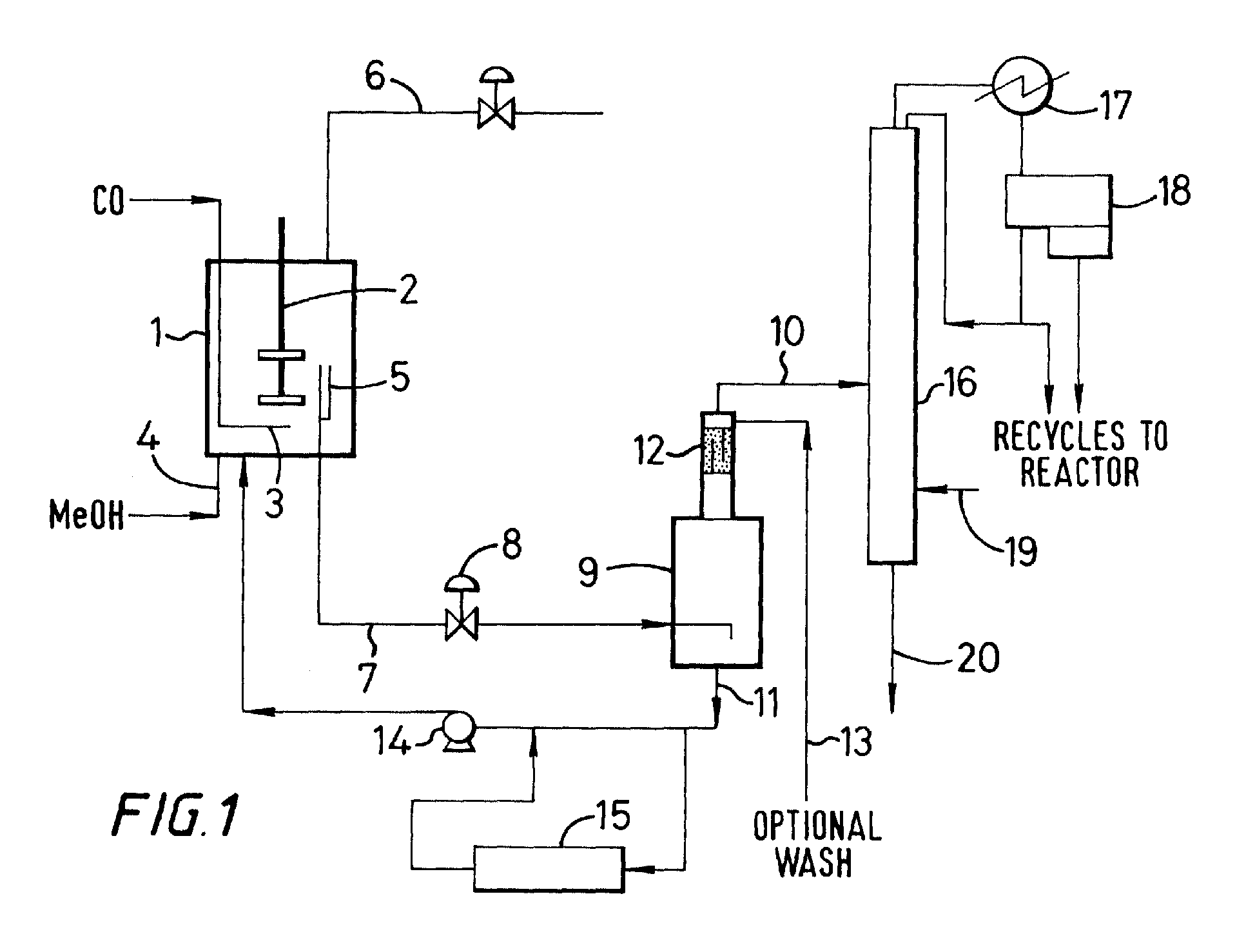
- Figure 1 represents in schematic form apparatus for performing a preferred embodiment of the process of the present invention having a single flash zone
- Figure 2 represents in schematic form apparatus for performing another preferred embodiment of the process of the present invention having a preliminary flash zone
- Figure 3 represents in schematic form a further embodiment of the present invention wherein further purification with respect to propionic acid is effected.
- a carbonylation reactor (1) is provided with a stirrer (2), an inlet for carbon monoxide (3) and an inlet for methanol and/or a reactive derivative thereof (4).
- the reactor is also provided with an outlet (5) for withdrawing liquid reaction composition from the reactor and an outlet (6) for withdrawing gas from the head of the reactor.
- the outlet (5) is connected by line (7) through flashing valve (8) directly to flash zone (9).
- the outlet (5) is connected by line (7) and flashing valve (27) to preliminary flash zone (28).
- the preliminary flash zone (28) is provided with a vapour outlet (29) for recycling to the reactor, preliminary flash zone vapour fraction comprising some of the methyl acetate, acetic acid, methyl iodide, water, methanol and propionic acid precursors in the liquid reaction composition introduced into the preliminary flash zone. This is condensed and pumped back or fed back to the reactor (1) using a pump (31).
- the preliminary flash zone is also provided with an outlet (30) for passing preliminary flash zone liquid comprising the remaining components of the introduced liquid reaction composition to the flash zone (9).
- the flash zone (9) is an adiabatic flash zone without heat input and is provided with an outlet (10) for a vapour fraction and an outlet (11) for a liquid fraction formed in use therein.
- heat can be supplied to the flash zone (9) to alter the ratio of vapour and liquid fractions.
- the flash zone is also provided with a scrubbing section (12) and optional wash through line (13).
- the liquid outlet (11) from the flash zone is connected to recycle pump (14) for recycling the liquid fraction to the reactor. At least part of the flash zone liquid fraction may be passed through an ion exchange resin bed (15) to remove corrosion metals therefrom and maintain the concentration of corrosion metals in the liquid reaction composition at less than that which would generate less than 500 ppm I - .
- the vapour outlet (10) from the flash zone is connected to a first distillation zone (16) provided with an overhead condenser (17) and decanter (18).
- the vapours from the distillation zone are condensed into the decanter and form two phases, a methyl iodide-rich phase and an aqueous phase.
- the heavy methyl iodide rich phase is recycled to the carbonylation reactor and the lighter aqueous phase is divided; part being used as reflux to the distillation zone and part being recycled to the carbonylation reactor.
- the distillation zone is provided with an optional methanol feed (19) to convert hydrogen iodide to methyl iodide which is returned to the carbonylation reactor from the distillation zone in the overhead recycles.
- the distillation zone is provided with a base liquid take-off(20) for removing a process stream comprising acetic acid containing less than 1500 ppm water and less than 400 ppm propionic acid.
- the distillation zone (16) in Figures 1 and 2 may be provided below the feed point with a take-off for a vapour stream comprising acetic acid product containing less than 1500ppm water and less than 400 ppm propionic acid and with a base liquid take-off suitably for recycle to the reactor.
- An advantage of using a preliminary flash zone as depicted in Figure 2 is that the decanter (18) may be dispensed with because the overhead from the distillation zone (16) will generally be single phased. Not only does this result in a capital saving but it also offers operational advantage in that it avoids any problems associated with consistently obtaining and maintaining two phases.
- (1) to (19) are identical to Figure 1.
- the distillation zone (16) is provided with an optional base liquid bleed outlet (21) for withdrawing and recycling involatile iridium and other high-boiling impurities, if present, to the carbonylation reactor (1).
- the distillation zone (16) is also provided, below the feed point, with a take-off (22) for a vapour process stream comprising acetic acid product and propionic acid by-product. From the vapour process stream take-off (22) the vapour is fed to an intermediate point in a second distillation column (23) which is provided with a head take-off (24) for acetic acid containing less than 1500 ppm water and less than 400 ppm propionic acid.
- acetic acid containing less than 1500 ppm water and less than 400 ppm propionic acid may be taken off the second distillation column (23) as a side-draw above the vapour feed point, with recycle of at least a part of the heads take-off after condensation thereof, either to the reactor (1) and/or the first distillation column (16).
- This alternative is not shown in Figure 3.
- the second distillation column (23) is provided with a base take-off (25) for by-product propionic acid removal.
- the process conditions used in the carbonylation reactor (1) may typically be:- temperature 181 to 195°C; total pressure 22 to 32 bar gauge; carbon monoxide partial pressure 8 to 10 bar; hydrogen partial pressure 0.05 to 0.3 bar; and liquid reaction composition component concentrations:- iridium 700 to 1500 ppm; ruthenium 1500 to 2500 ppm; methyl acetate 10 to 25% by weight; methyl iodide 6 to 12% by weight water 3 to 8% by weight.
- the flash zone and distillation zone may be operated at a pressure of 1 to 3 bar gauge.
- the preliminary flash zone (28) is operated at a higher pressure (for example 2 to 8 bar gauge) than the flash zone (9) and first distillation zone which may be operated at a pressure of 0 to 3 bar gauge.
Landscapes
- Chemical & Material Sciences (AREA)
- Organic Chemistry (AREA)
- Chemical Kinetics & Catalysis (AREA)
- Engineering & Computer Science (AREA)
- Oil, Petroleum & Natural Gas (AREA)
- Organic Low-Molecular-Weight Compounds And Preparation Thereof (AREA)
- Low-Molecular Organic Synthesis Reactions Using Catalysts (AREA)
- Catalysts (AREA)
Abstract
Description
| temperature | 181 to 195°C; |
| | 22 to 32 bar gauge; |
| carbon monoxide partial pressure | 8 to 10 bar; |
| hydrogen partial pressure | 0.05 to 0.3 bar; and |
| iridium | 700 to 1500 ppm; |
| ruthenium | 1500 to 2500 ppm; |
| | 10 to 25% by weight; |
| methyl iodide | 6 to 12% by |
| water | |
| 3 to 8% by weight. |
| Reactor conditions | Ex 1 | | | | |
| Reactor Temperature (°C) | 189.0 | 191.2 | 189.0 | 189.0 | 189.0 |
| Reactor Pressure | 27.4 | 27.6 | 29.9 | 30.0 | 29.6 |
| CO partial pressure (bar) | 8.1 | 8.9 | 9.1 | 8.8 | 8.3 |
| H2partial pressure (bar) | 0.18 | 0.21 | 0.18 | 0.15 | 0.12 |
| Liquid reaction composition | |||||
| Water (% by weight) | 7.8 | 4.7 | 5.1 | 4.6 | 5.7 |
| Methyl iodide (% by weight) | 7.1 | 6.6 | 9.6 | 10.0 | 10.3 |
| Methyl acetate (% by weight) | 18.2 | 14.3 | 19.8 | 21.9 | 22.3 |
| Ir (ppm) | 1320 | 1170 | 930 | 840 | 870 |
| Ru (ppm) | 1760 | 1610 | 2040 | 2330 | 2870 |
| H2 in feed (%v/v) | 0.86 | 0.06 | 0.30 | 0.30 | 0.29 |
| Carbonylation rate (mol/l/hr) | 17.8 | 17.3 | 20.3 | 19.8 | 19.8 |
| CO2 rate (% of carbonylation rate) | 0.88 | 0.98 | 0.68 | 0.63 | 0.67 |
| CH4 rate (% of carbonylation rate) | 1.02 | 0.83 | 0.89 | 0.81 | 0.84 |
| Process stream from step (f) | |||||
| Water in process stream (20) | 510 | 780 | 790 | 920 | 930 |
| Propionic acid in process stream(20) | 380 | 390 | 390 | 360 | 290 |
Claims (16)
- A process for the production of an acetic acid process stream comprising less than 400 ppm propionic acid and less than 1500 ppm water which process comprises the steps:-(a) feeding methanol and/or a reactive derivative thereof and carbon monoxide to a carbonylation reactor in which there is maintained during the course of the process a liquid reaction composition comprising:-(i) an iridium carbonylation catalyst;(ii) methyl iodide co-catalyst;(iii) optionally one or more promoters selected from the group consisting of ruthenium, osmium, rhenium, cadmium, mercury, zinc, gallium, indium and tungsten;(iv) a finite amount of water at a concentration of less than about 8% by weight;(v) methyl acetate;(vi) acetic acid; and(vii) propionic acid by-product and its precursors;(b) withdrawing liquid reaction composition from the carbonylation reactor and introducing at least part of the withdrawn liquid reaction composition, with or without the addition of heat, to a flash zone to form a vapour fraction comprising water, acetic acid product, propionic acid by-product, methyl acetate, methyl iodide and propionic acid precursors, and a liquid fraction comprising involatile iridium catalyst, involatile optional promoter or promoters, acetic acid and water;(c) recycling the liquid fraction from the flash zone to the carbonylation reactor;(d) introducing the vapour fraction from the flash zone into a first distillation zone;(e) removing from the first distillation zone at a point above the introduction point of the flash zone vapour fraction a light ends recycle stream comprising water, methyl acetate, methyl iodide, acetic acid and propionic acid precursors which stream is recycled in whole or in part to the carbonylation reactor, and(f) removing from the first distillation zone at a point below the introduction point of the flash zone vapour fraction, a process stream comprising acetic acid product, propionic acid by-product, and less than 1500 ppm water and,(g) if the process stream removed in step (f) comprises greater than 400 ppm propionic acid introducing said stream into a second distillation column, removing from a point below the introduction point of the stream from (f) propionic acid by-product and from a point above the introduction point of the stream from (f) an acetic acid process stream containing less than 400 ppm propionic acid and less than 1500 ppm water.
- A process according to claim 1 wherein methanol and/or methyl acetate is (are) fed to the carbonylation reactor.
- A process according to either claim 1 or claim 2 wherein the concentration of methyl iodide co-catalyst in the liquid reaction composition is from 4 to 16% by weight.
- A process according to any one of the preceding claims wherein the methyl acetate concentration in the liquid reaction composition is in the range from 5 to 40% by weight.
- A process according to any one of the preceding claims wherein the concentration of water in the liquid reaction composition is in the range from 0.5 to 8% by weight.
- A process according to any one of the preceding claims wherein the concentration of iridium catalyst in the liquid reaction composition is from 400 to 2000 ppm.
- A process according to any one of the preceding claims wherein the molar ratio of methyl iodide:iridiumin the liquid reaction composition is [from 20 to 200]:1.
- A process according to any one of the preceding claims wherein hydrogen present in the carbonylation reactor is maintained at a partial pressure less than 0.3 bar.
- A process according to any one of the preceding claims wherein hydrogen in the carbon monoxide feed gas is maintained at less than 0.3 mol %.
- A process according to any one of the preceding claims wherein there is present in the reaction composition one or more promoters selected from the group consisting of ruthenium, osmium, rhenium, cadmium, mercury, zinc, gallium, indium and tungsten.
- A process according to claim 10 wherein the promoter is ruthenium.
- A process according to either claim 10 or claim 11 wherein the promoter is present in the liquid reaction composition at a molar ratio of promoter:iridium of [from 0. 5 to 15]:1.
- A process according to any one of the preceding claims wherein the carbonylation temperature is in the range from 150 to 220°C and the carbonylation pressure is in the range from 15 to 50 barg.
- A process according to any one of the preceding claims wherein in the liquid reaction composition methyl acetate is present in an amount from 10 to 25% by weight, methyl iodide is present in an amount from 6 to 12% by weight, water is present in an amount from 3 to 8% by weight, iridium is present in an amount of from 700 to 1500 ppm, ruthenium is present in an amount of from 1500 to 2500 ppm, the carbon monoxide partial pressure is from 8 to 10 bar, the hydrogen partial pressure is from 0.05 to 0.3 bar, the carbonylation temperature is from 181 to 195°C and the carbonylation total pressure is from 22 to 32 barg.
- A process according to any one of the preceding claims wherein the first distillation zone has up to 40 theoretical stages.
- A process according to any one ofthe preceding claims wherein liquid reaction composition is withdrawn from the carbonylation reactor and introduced with or without the addition of heat to a preliminary flash zone in which a preliminary flash vapour fraction comprising some of the methyl acetate, methyl iodide, acetic acid, water, methanol and propionic acid precursors in the introduced liquid reaction composition is separated from a preliminary flash liquid fraction comprising the remaining components, the preliminary flash vapour fraction is recycled to the carbonylation reactor and the preliminary flash liquid fraction is introduced to the flash zone of step (b).
Applications Claiming Priority (2)
| Application Number | Priority Date | Filing Date | Title |
|---|---|---|---|
| GBGB9626324.9A GB9626324D0 (en) | 1996-12-19 | 1996-12-19 | Process |
| GB9626324 | 1996-12-19 |
Publications (2)
| Publication Number | Publication Date |
|---|---|
| EP0849250A1 true EP0849250A1 (en) | 1998-06-24 |
| EP0849250B1 EP0849250B1 (en) | 2002-11-13 |
Family
ID=10804662
Family Applications (1)
| Application Number | Title | Priority Date | Filing Date |
|---|---|---|---|
| EP97310016A Expired - Lifetime EP0849250B1 (en) | 1996-12-19 | 1997-12-11 | Iridium-catalysed carbonylation process for the production of acetic acid |
Country Status (19)
| Country | Link |
|---|---|
| US (1) | US6140535A (en) |
| EP (1) | EP0849250B1 (en) |
| JP (1) | JP4017724B2 (en) |
| KR (1) | KR100540020B1 (en) |
| CN (1) | CN1073980C (en) |
| BR (1) | BR9706417A (en) |
| CA (1) | CA2225868C (en) |
| DE (1) | DE69717062T2 (en) |
| GB (1) | GB9626324D0 (en) |
| ID (1) | ID19691A (en) |
| MY (1) | MY117534A (en) |
| NO (1) | NO975916L (en) |
| NZ (1) | NZ329436A (en) |
| RU (1) | RU2183618C2 (en) |
| SA (1) | SA98190163B1 (en) |
| SG (1) | SG55437A1 (en) |
| TW (1) | TW448152B (en) |
| UA (1) | UA52604C2 (en) |
| ZA (1) | ZA9711267B (en) |
Cited By (14)
| Publication number | Priority date | Publication date | Assignee | Title |
|---|---|---|---|---|
| EP0985653A1 (en) * | 1998-09-08 | 2000-03-15 | BP Chemicals Limited | Carbonylation process |
| WO2003097567A1 (en) * | 2002-05-20 | 2003-11-27 | Bp Chemicals Limited | Process for the production of acetic acid |
| WO2003106396A1 (en) * | 2002-06-12 | 2003-12-24 | Bp Chemicals Limited | Process for the production of acetic acid |
| WO2005009939A1 (en) | 2003-07-17 | 2005-02-03 | Bp Chemicals Limited | Catalyst and process for the production of acetic acid |
| WO2004033407A3 (en) * | 2002-10-08 | 2005-02-24 | Daicel Chem | Process for producing carboxylic acid and system for producing the same |
| US7053241B1 (en) | 2005-02-24 | 2006-05-30 | Celanese International Corporation | Acetic acid production methods incorporating at least one metal salt as a catalyst stabilizer |
| DE102005024116A1 (en) * | 2005-05-25 | 2006-11-30 | Umicore Ag & Co. Kg | Preparation of iridium precipitate comprises reacting iridium compound with an alkaline compound in a solvent under iridium-containing precipitate in the presence of compound such as oxalic acid and formic acid |
| WO2009042078A1 (en) * | 2007-09-27 | 2009-04-02 | Celanese International Corporation | Method and apparatus for making acetic acid with improved purification |
| WO2009134333A1 (en) * | 2008-04-29 | 2009-11-05 | Celanese International Corporation | Method and apparatus for carbonylating methanol with acetic acid enriched flash stream |
| US8697907B2 (en) | 2006-03-21 | 2014-04-15 | Bp Chemicals Limited | Process for the production of acetic acid |
| EP2220022B1 (en) * | 2007-10-11 | 2015-10-28 | Celanese International Corporation | Method and apparatus for making acetic acid with improved productivity |
| WO2016020410A1 (en) * | 2014-08-05 | 2016-02-11 | Bp Chemicals Limited | Process |
| WO2016123194A1 (en) * | 2015-01-30 | 2016-08-04 | Lyondellbasell Acetyls, Llc | Recovery of acetic acid |
| US12398084B2 (en) | 2020-10-06 | 2025-08-26 | Ineos Acetyls Uk Limited | Distillation process and apparatus with pressure corrected temperature heat source control |
Families Citing this family (51)
| Publication number | Priority date | Publication date | Assignee | Title |
|---|---|---|---|---|
| GB9825424D0 (en) * | 1998-11-19 | 1999-01-13 | Bp Chem Int Ltd | Process |
| US7999030B2 (en) * | 2004-03-12 | 2011-08-16 | Southern Diversified Products, Llc | Latex compositions comprising functionalized vegetable oil derivatives |
| US7361710B2 (en) * | 2004-03-12 | 2008-04-22 | Southern Diversified Products, Llc | Functionalized vegetable oil derivatives, latex compositions and coatings |
| US20060236467A1 (en) * | 2004-03-12 | 2006-10-26 | Thames Shelby F | Functionalized vegetable oil derivatives, latex compositions and textile finishes |
| GB0601865D0 (en) * | 2006-01-30 | 2006-03-08 | Bp Chem Int Ltd | Process |
| US7989659B2 (en) * | 2007-05-17 | 2011-08-02 | Celanese International Corporation | Method and apparatus for making acetic acid with improved light ends column productivity |
| US8168822B2 (en) * | 2009-07-07 | 2012-05-01 | Celanese International Corporation | Acetic acid production by way of carbonylation with enhanced reaction and flashing |
| US8932372B2 (en) | 2010-02-02 | 2015-01-13 | Celanese International Corporation | Integrated process for producing alcohols from a mixed acid feed |
| US8728179B2 (en) | 2010-02-02 | 2014-05-20 | Celanese International Corporation | Ethanol compositions |
| US8575403B2 (en) | 2010-05-07 | 2013-11-05 | Celanese International Corporation | Hydrolysis of ethyl acetate in ethanol separation process |
| WO2012039840A2 (en) | 2010-02-02 | 2012-03-29 | Celanese International Corporation | Processes for producing alcohols from a mixed acid feed |
| US8541633B2 (en) | 2010-02-02 | 2013-09-24 | Celanese International Corporation | Processes for producing anhydrous ethanol compositions |
| US8858659B2 (en) | 2010-02-02 | 2014-10-14 | Celanese International Corporation | Processes for producing denatured ethanol |
| US8747492B2 (en) | 2010-02-02 | 2014-06-10 | Celanese International Corporation | Ethanol/fuel blends for use as motor fuels |
| US8460405B2 (en) | 2010-02-02 | 2013-06-11 | Celanese International Corporation | Ethanol compositions |
| US8668750B2 (en) | 2010-02-02 | 2014-03-11 | Celanese International Corporation | Denatured fuel ethanol compositions for blending with gasoline or diesel fuel for use as motor fuels |
| WO2012039841A1 (en) | 2010-02-02 | 2012-03-29 | Celanese International Corporation | Integrated process for producing alcohols from a mixed acid feed |
| US9272970B2 (en) | 2010-07-09 | 2016-03-01 | Celanese International Corporation | Hydrogenolysis of ethyl acetate in alcohol separation processes |
| US8710279B2 (en) | 2010-07-09 | 2014-04-29 | Celanese International Corporation | Hydrogenolysis of ethyl acetate in alcohol separation processes |
| US8664454B2 (en) | 2010-07-09 | 2014-03-04 | Celanese International Corporation | Process for production of ethanol using a mixed feed using copper containing catalyst |
| US8704008B2 (en) | 2010-07-09 | 2014-04-22 | Celanese International Corporation | Process for producing ethanol using a stacked bed reactor |
| US8394988B2 (en) | 2010-09-28 | 2013-03-12 | Celanese International Corporation | Production of acetic acid with high conversion rate |
| US8877963B2 (en) | 2010-09-28 | 2014-11-04 | Celanese International Corporation | Production of acetic acid with high conversion rate |
| US8461379B2 (en) * | 2010-10-12 | 2013-06-11 | Celanese International Corporation | Production of acetic acid comprising feeding at least one reactant to a recycle stream |
| MY161203A (en) | 2010-12-15 | 2017-04-14 | Daicel Corp | Process for producing acetic acid |
| TW201302684A (en) | 2011-04-26 | 2013-01-16 | Celanese Int Corp | Process for the production of ethanol from an acetic acid feed and a recycled ethyl acetate feed |
| US8754268B2 (en) | 2011-04-26 | 2014-06-17 | Celanese International Corporation | Process for removing water from alcohol mixtures |
| US9073816B2 (en) | 2011-04-26 | 2015-07-07 | Celanese International Corporation | Reducing ethyl acetate concentration in recycle streams for ethanol production processes |
| US8592635B2 (en) | 2011-04-26 | 2013-11-26 | Celanese International Corporation | Integrated ethanol production by extracting halides from acetic acid |
| US8895786B2 (en) | 2011-08-03 | 2014-11-25 | Celanese International Corporation | Processes for increasing alcohol production |
| US9663437B2 (en) | 2011-09-13 | 2017-05-30 | Celanese International Corporation | Production of acetic acid with high conversion rate |
| US8686201B2 (en) | 2011-11-09 | 2014-04-01 | Celanese International Corporation | Integrated acid and alcohol production process having flashing to recover acid production catalyst |
| US8614359B2 (en) | 2011-11-09 | 2013-12-24 | Celanese International Corporation | Integrated acid and alcohol production process |
| US9133079B2 (en) | 2012-01-13 | 2015-09-15 | Siluria Technologies, Inc. | Process for separating hydrocarbon compounds |
| US9969660B2 (en) | 2012-07-09 | 2018-05-15 | Siluria Technologies, Inc. | Natural gas processing and systems |
| WO2014089479A1 (en) | 2012-12-07 | 2014-06-12 | Siluria Technologies, Inc. | Integrated processes and systems for conversion of methane to multiple higher hydrocarbon products |
| US10047020B2 (en) | 2013-11-27 | 2018-08-14 | Siluria Technologies, Inc. | Reactors and systems for oxidative coupling of methane |
| US10301234B2 (en) | 2014-01-08 | 2019-05-28 | Siluria Technologies, Inc. | Ethylene-to-liquids systems and methods |
| CA3225180A1 (en) | 2014-01-09 | 2015-07-16 | Lummus Technology Llc | Oxidative coupling of methane implementations for olefin production |
| US10377682B2 (en) | 2014-01-09 | 2019-08-13 | Siluria Technologies, Inc. | Reactors and systems for oxidative coupling of methane |
| US10793490B2 (en) | 2015-03-17 | 2020-10-06 | Lummus Technology Llc | Oxidative coupling of methane methods and systems |
| US9334204B1 (en) | 2015-03-17 | 2016-05-10 | Siluria Technologies, Inc. | Efficient oxidative coupling of methane processes and systems |
| US20160289143A1 (en) | 2015-04-01 | 2016-10-06 | Siluria Technologies, Inc. | Advanced oxidative coupling of methane |
| US9328297B1 (en) | 2015-06-16 | 2016-05-03 | Siluria Technologies, Inc. | Ethylene-to-liquids systems and methods |
| EP3362425B1 (en) | 2015-10-16 | 2020-10-28 | Lummus Technology LLC | Separation methods and systems for oxidative coupling of methane |
| EP4071131A1 (en) | 2016-04-13 | 2022-10-12 | Lummus Technology LLC | Apparatus and method for exchanging heat |
| US20180169561A1 (en) | 2016-12-19 | 2018-06-21 | Siluria Technologies, Inc. | Methods and systems for performing chemical separations |
| WO2018217924A1 (en) | 2017-05-23 | 2018-11-29 | Siluria Technologies, Inc. | Integration of oxidative coupling of methane processes |
| KR20200051583A (en) | 2017-07-07 | 2020-05-13 | 루머스 테크놀로지 엘엘씨 | Systems and methods for oxidative coupling of methane |
| AU2022340529A1 (en) | 2021-08-31 | 2024-02-29 | Lummus Technology Llc | Methods and systems for performing oxidative coupling of methane |
| CN115894219B (en) * | 2022-09-26 | 2024-10-22 | 上海华谊能源化工有限公司 | Iridium catalyzed carbonylation method and system for producing acetic acid |
Citations (3)
| Publication number | Priority date | Publication date | Assignee | Title |
|---|---|---|---|---|
| EP0616997A1 (en) * | 1993-03-26 | 1994-09-28 | BP Chemicals Limited | Process for the recovery of a carbonylation product |
| EP0643034A1 (en) * | 1993-09-10 | 1995-03-15 | BP Chemicals Limited | Process for the production of acetic acid |
| EP0752406A1 (en) * | 1995-06-21 | 1997-01-08 | BP Chemicals Limited | Process for the production of acetic acid by carbonylation |
Family Cites Families (14)
| Publication number | Priority date | Publication date | Assignee | Title |
|---|---|---|---|---|
| US3769329A (en) * | 1970-03-12 | 1973-10-30 | Monsanto Co | Production of carboxylic acids and esters |
| GB1294432A (en) * | 1970-04-23 | 1972-10-25 | Monsanto Co | Purification of carboxylic acid streams |
| US3627967A (en) * | 1970-06-15 | 1971-12-14 | Amsted Ind Inc | Power switch short circuit detector for edm |
| US3791935A (en) * | 1971-11-10 | 1974-02-12 | Monsanto Co | Purification of carboxylic acids |
| US3769177A (en) * | 1971-11-10 | 1973-10-30 | Monsanto Co | Purification of carboxylic acids by plural stage distillation with side stream draw-offs |
| BE791577A (en) * | 1971-11-19 | 1973-05-17 | Monsanto Co | Purification of carboxylic acid streams |
| US4029553A (en) * | 1975-07-28 | 1977-06-14 | Monsanto Company | Purification of acetic acid streams by distillation |
| US4039395A (en) * | 1975-08-11 | 1977-08-02 | Monsanto Company | Purification of acetic acid |
| US4008131A (en) * | 1975-12-11 | 1977-02-15 | Monsanto Company | Purification of acetic acid |
| AU639630B2 (en) * | 1991-01-28 | 1993-07-29 | Celanese International Corporation | Removal of carbonyl impurities from carbonylation process stream |
| GB9211671D0 (en) * | 1992-06-02 | 1992-07-15 | Bp Chem Int Ltd | Process |
| CA2120287C (en) * | 1993-03-31 | 2000-10-24 | Dominique Nobel | Process for preparing carboxylic acids or corresponding esters using an iridium-based catalyst |
| US5723660A (en) * | 1995-04-24 | 1998-03-03 | Daicel Chemical Industries, Ltd. | Process for producing acetic acid |
| GB9626429D0 (en) * | 1996-12-19 | 1997-02-05 | Bp Chem Int Ltd | Process |
-
1996
- 1996-12-19 GB GBGB9626324.9A patent/GB9626324D0/en active Pending
-
1997
- 1997-12-11 EP EP97310016A patent/EP0849250B1/en not_active Expired - Lifetime
- 1997-12-11 DE DE69717062T patent/DE69717062T2/en not_active Expired - Lifetime
- 1997-12-15 ZA ZA9711267A patent/ZA9711267B/en unknown
- 1997-12-16 NO NO975916A patent/NO975916L/en unknown
- 1997-12-17 US US08/992,105 patent/US6140535A/en not_active Expired - Lifetime
- 1997-12-18 SG SG1997004533A patent/SG55437A1/en unknown
- 1997-12-18 CA CA002225868A patent/CA2225868C/en not_active Expired - Fee Related
- 1997-12-18 NZ NZ329436A patent/NZ329436A/en unknown
- 1997-12-18 MY MYPI97006134A patent/MY117534A/en unknown
- 1997-12-19 KR KR1019970070794A patent/KR100540020B1/en not_active Expired - Fee Related
- 1997-12-19 ID IDP973934A patent/ID19691A/en unknown
- 1997-12-19 RU RU97121302/04A patent/RU2183618C2/en not_active IP Right Cessation
- 1997-12-19 BR BR9706417-3A patent/BR9706417A/en not_active Application Discontinuation
- 1997-12-19 UA UA97126169A patent/UA52604C2/en unknown
- 1997-12-19 JP JP35098797A patent/JP4017724B2/en not_active Expired - Fee Related
- 1997-12-19 CN CN97120890A patent/CN1073980C/en not_active Expired - Fee Related
- 1997-12-27 TW TW086119865A patent/TW448152B/en not_active IP Right Cessation
-
1998
- 1998-06-15 SA SA98190163A patent/SA98190163B1/en unknown
Patent Citations (3)
| Publication number | Priority date | Publication date | Assignee | Title |
|---|---|---|---|---|
| EP0616997A1 (en) * | 1993-03-26 | 1994-09-28 | BP Chemicals Limited | Process for the recovery of a carbonylation product |
| EP0643034A1 (en) * | 1993-09-10 | 1995-03-15 | BP Chemicals Limited | Process for the production of acetic acid |
| EP0752406A1 (en) * | 1995-06-21 | 1997-01-08 | BP Chemicals Limited | Process for the production of acetic acid by carbonylation |
Cited By (37)
| Publication number | Priority date | Publication date | Assignee | Title |
|---|---|---|---|---|
| US6326515B1 (en) | 1998-09-08 | 2001-12-04 | Bp Chemicals Limited | Carbonylation of methanol to acetic acid with removal of impurities from the product |
| SG87823A1 (en) * | 1998-09-08 | 2002-04-16 | Bp Chem Int Ltd | Carbonylation process |
| RU2213726C2 (en) * | 1998-09-08 | 2003-10-10 | Бп Кемикэлз Лимитед | Carbonylation process |
| EP0985653A1 (en) * | 1998-09-08 | 2000-03-15 | BP Chemicals Limited | Carbonylation process |
| US7202382B2 (en) | 2002-05-20 | 2007-04-10 | Bp Chemicals Limited | Process for the production of acetic acid |
| WO2003097567A1 (en) * | 2002-05-20 | 2003-11-27 | Bp Chemicals Limited | Process for the production of acetic acid |
| KR100969842B1 (en) * | 2002-05-20 | 2010-07-13 | 비피 케미칼즈 리미티드 | Method of producing acetic acid |
| US7342129B2 (en) | 2002-06-12 | 2008-03-11 | Bp Chemicals Limited | Process for the production of acetic acid |
| CN100376535C (en) * | 2002-06-12 | 2008-03-26 | 英国石油化学品有限公司 | Process for the production of acetic acid |
| RU2336263C2 (en) * | 2002-06-12 | 2008-10-20 | Бп Кемикэлз Лимитед | Method of obtaining acetic acid |
| TWI391370B (en) * | 2002-06-12 | 2013-04-01 | Bp Chem Int Ltd | Process for the production of acetic acid |
| WO2003106396A1 (en) * | 2002-06-12 | 2003-12-24 | Bp Chemicals Limited | Process for the production of acetic acid |
| WO2004033407A3 (en) * | 2002-10-08 | 2005-02-24 | Daicel Chem | Process for producing carboxylic acid and system for producing the same |
| KR101286321B1 (en) * | 2003-07-17 | 2013-07-15 | 비피 케미칼즈 리미티드 | Catalyst and process for the production of acetic acid |
| WO2005009939A1 (en) | 2003-07-17 | 2005-02-03 | Bp Chemicals Limited | Catalyst and process for the production of acetic acid |
| US7915446B2 (en) | 2003-07-17 | 2011-03-29 | Bp Chemicals Limited | Catalyst and process for the production of acetic acid |
| US7053241B1 (en) | 2005-02-24 | 2006-05-30 | Celanese International Corporation | Acetic acid production methods incorporating at least one metal salt as a catalyst stabilizer |
| WO2006091397A1 (en) | 2005-02-24 | 2006-08-31 | Celanese International Corporation | Acetic acid production methods incorporating at least one metal salt as a catalyst stabilizer |
| DE102005024116A1 (en) * | 2005-05-25 | 2006-11-30 | Umicore Ag & Co. Kg | Preparation of iridium precipitate comprises reacting iridium compound with an alkaline compound in a solvent under iridium-containing precipitate in the presence of compound such as oxalic acid and formic acid |
| US8697907B2 (en) | 2006-03-21 | 2014-04-15 | Bp Chemicals Limited | Process for the production of acetic acid |
| WO2009042078A1 (en) * | 2007-09-27 | 2009-04-02 | Celanese International Corporation | Method and apparatus for making acetic acid with improved purification |
| EP2220022B1 (en) * | 2007-10-11 | 2015-10-28 | Celanese International Corporation | Method and apparatus for making acetic acid with improved productivity |
| US7820855B2 (en) | 2008-04-29 | 2010-10-26 | Celanese International Corporation | Method and apparatus for carbonylating methanol with acetic acid enriched flash stream |
| US9840451B2 (en) | 2008-04-29 | 2017-12-12 | Celanese International Corporation | Method and apparatus for carbonylating methanol with acetic acid enriched flash stream |
| US8771616B2 (en) | 2008-04-29 | 2014-07-08 | Celanese International Corporation | Method and apparatus for carbonylating methanol with acetic acid enriched flash stream |
| US8987512B2 (en) | 2008-04-29 | 2015-03-24 | Celanese International Corporation | Method and apparatus for carbonylating methanol with acetic acid enriched flash stream |
| WO2009134333A1 (en) * | 2008-04-29 | 2009-11-05 | Celanese International Corporation | Method and apparatus for carbonylating methanol with acetic acid enriched flash stream |
| US10519089B2 (en) | 2008-04-29 | 2019-12-31 | Celanese International Corporation | Method and apparatus for carbonylating methanol with acetic acid enriched flash stream |
| EP3002057A1 (en) * | 2008-04-29 | 2016-04-06 | Celanese International Corporation | Apparatus for carbonylating methanol with acetic acid enriched flash stream |
| US10118885B2 (en) | 2008-04-29 | 2018-11-06 | Celanese International Corporation | Method and apparatus for carbonylating methanol with acetic acid enriched flash stream |
| US8329944B2 (en) | 2008-04-29 | 2012-12-11 | Celanese International Corporation | Method and apparatus for carbonylating methanol with acetic acid enriched flash stream |
| KR20170039098A (en) * | 2014-08-05 | 2017-04-10 | 비피 케미칼즈 리미티드 | Process |
| US10017450B2 (en) | 2014-08-05 | 2018-07-10 | Bp Chemicals Limited | Method of operating a heavy ends column in an acetic acid production process |
| WO2016020410A1 (en) * | 2014-08-05 | 2016-02-11 | Bp Chemicals Limited | Process |
| US9611207B2 (en) | 2015-01-30 | 2017-04-04 | Lyondellbasell Acetyls, Llc | Recovery of acetic acid |
| WO2016123194A1 (en) * | 2015-01-30 | 2016-08-04 | Lyondellbasell Acetyls, Llc | Recovery of acetic acid |
| US12398084B2 (en) | 2020-10-06 | 2025-08-26 | Ineos Acetyls Uk Limited | Distillation process and apparatus with pressure corrected temperature heat source control |
Also Published As
| Publication number | Publication date |
|---|---|
| GB9626324D0 (en) | 1997-02-05 |
| KR19980064380A (en) | 1998-10-07 |
| EP0849250B1 (en) | 2002-11-13 |
| NO975916D0 (en) | 1997-12-16 |
| UA52604C2 (en) | 2003-01-15 |
| DE69717062D1 (en) | 2002-12-19 |
| NZ329436A (en) | 1998-11-25 |
| NO975916L (en) | 1998-06-22 |
| SA98190163B1 (en) | 2006-10-11 |
| MY117534A (en) | 2004-07-31 |
| CA2225868A1 (en) | 1998-06-19 |
| US6140535A (en) | 2000-10-31 |
| BR9706417A (en) | 1999-11-23 |
| DE69717062T2 (en) | 2003-07-17 |
| CA2225868C (en) | 2007-02-13 |
| ZA9711267B (en) | 1999-06-15 |
| KR100540020B1 (en) | 2006-02-28 |
| JPH10273470A (en) | 1998-10-13 |
| CN1073980C (en) | 2001-10-31 |
| TW448152B (en) | 2001-08-01 |
| JP4017724B2 (en) | 2007-12-05 |
| CN1192432A (en) | 1998-09-09 |
| SG55437A1 (en) | 1998-12-21 |
| RU2183618C2 (en) | 2002-06-20 |
| MX9710425A (en) | 1998-09-30 |
| ID19691A (en) | 1998-07-30 |
Similar Documents
| Publication | Publication Date | Title |
|---|---|---|
| EP0849250B1 (en) | Iridium-catalysed carbonylation process for the production of acetic acid | |
| EP0752406B1 (en) | Process for the production of acetic acid by carbonylation | |
| JP4002332B2 (en) | Iridium-catalyzed carbonylation process for the production of carboxylic acids | |
| EP0849249B1 (en) | Iridium catalysed carbonylation process for the production of acetic acid | |
| EP0849248B1 (en) | Iridium-catalysed carbonylation process for the production of acetic acid | |
| KR20050020838A (en) | Process for the production of acetic acid | |
| EP0769486B1 (en) | Process for the production of acetic acid by the carbonylation of dimethyl ether | |
| EP1506151B1 (en) | Process for the production of acetic acid | |
| US7692040B2 (en) | Process for the production of acetic acid | |
| EP0999198B1 (en) | Process for the production of acetic acid | |
| GB2334955A (en) | Carbonylation process for the production of acetic acid | |
| US8101796B2 (en) | Process for the production of acetic acid | |
| WO2007085792A1 (en) | Process for the production of acetic acid | |
| MXPA97010425A (en) | Catalytic process of catalyzed with iridio for the production of acid acet | |
| MXPA97009588A (en) | Carbonilation process catalyzed with iridio for the production of a carboxil acid |
Legal Events
| Date | Code | Title | Description |
|---|---|---|---|
| PUAI | Public reference made under article 153(3) epc to a published international application that has entered the european phase |
Free format text: ORIGINAL CODE: 0009012 |
|
| AK | Designated contracting states |
Kind code of ref document: A1 Designated state(s): BE DE ES FI FR GB IT NL SE |
|
| AX | Request for extension of the european patent |
Free format text: AL;LT;LV;MK;RO;SI |
|
| 17P | Request for examination filed |
Effective date: 19981203 |
|
| AKX | Designation fees paid |
Free format text: BE DE ES FI FR GB IT NL SE |
|
| RBV | Designated contracting states (corrected) |
Designated state(s): BE DE ES FI FR GB IT NL SE |
|
| 17Q | First examination report despatched |
Effective date: 20001106 |
|
| GRAG | Despatch of communication of intention to grant |
Free format text: ORIGINAL CODE: EPIDOS AGRA |
|
| GRAG | Despatch of communication of intention to grant |
Free format text: ORIGINAL CODE: EPIDOS AGRA |
|
| GRAH | Despatch of communication of intention to grant a patent |
Free format text: ORIGINAL CODE: EPIDOS IGRA |
|
| GRAH | Despatch of communication of intention to grant a patent |
Free format text: ORIGINAL CODE: EPIDOS IGRA |
|
| GRAA | (expected) grant |
Free format text: ORIGINAL CODE: 0009210 |
|
| AK | Designated contracting states |
Kind code of ref document: B1 Designated state(s): BE DE ES FI FR GB IT NL SE |
|
| PG25 | Lapsed in a contracting state [announced via postgrant information from national office to epo] |
Ref country code: NL Free format text: LAPSE BECAUSE OF FAILURE TO SUBMIT A TRANSLATION OF THE DESCRIPTION OR TO PAY THE FEE WITHIN THE PRESCRIBED TIME-LIMIT Effective date: 20021113 Ref country code: IT Free format text: LAPSE BECAUSE OF FAILURE TO SUBMIT A TRANSLATION OF THE DESCRIPTION OR TO PAY THE FEE WITHIN THE PRESCRIBED TIME-LIMIT;WARNING: LAPSES OF ITALIAN PATENTS WITH EFFECTIVE DATE BEFORE 2007 MAY HAVE OCCURRED AT ANY TIME BEFORE 2007. THE CORRECT EFFECTIVE DATE MAY BE DIFFERENT FROM THE ONE RECORDED. Effective date: 20021113 Ref country code: FI Free format text: LAPSE BECAUSE OF FAILURE TO SUBMIT A TRANSLATION OF THE DESCRIPTION OR TO PAY THE FEE WITHIN THE PRESCRIBED TIME-LIMIT Effective date: 20021113 Ref country code: BE Free format text: LAPSE BECAUSE OF FAILURE TO SUBMIT A TRANSLATION OF THE DESCRIPTION OR TO PAY THE FEE WITHIN THE PRESCRIBED TIME-LIMIT Effective date: 20021113 |
|
| REG | Reference to a national code |
Ref country code: GB Ref legal event code: FG4D |
|
| REF | Corresponds to: |
Ref document number: 69717062 Country of ref document: DE Date of ref document: 20021219 |
|
| PG25 | Lapsed in a contracting state [announced via postgrant information from national office to epo] |
Ref country code: SE Free format text: LAPSE BECAUSE OF FAILURE TO SUBMIT A TRANSLATION OF THE DESCRIPTION OR TO PAY THE FEE WITHIN THE PRESCRIBED TIME-LIMIT Effective date: 20030213 |
|
| NLV1 | Nl: lapsed or annulled due to failure to fulfill the requirements of art. 29p and 29m of the patents act | ||
| ET | Fr: translation filed | ||
| PG25 | Lapsed in a contracting state [announced via postgrant information from national office to epo] |
Ref country code: ES Free format text: LAPSE BECAUSE OF FAILURE TO SUBMIT A TRANSLATION OF THE DESCRIPTION OR TO PAY THE FEE WITHIN THE PRESCRIBED TIME-LIMIT Effective date: 20030529 |
|
| PLBE | No opposition filed within time limit |
Free format text: ORIGINAL CODE: 0009261 |
|
| STAA | Information on the status of an ep patent application or granted ep patent |
Free format text: STATUS: NO OPPOSITION FILED WITHIN TIME LIMIT |
|
| 26N | No opposition filed |
Effective date: 20030814 |
|
| PGFP | Annual fee paid to national office [announced via postgrant information from national office to epo] |
Ref country code: GB Payment date: 20141229 Year of fee payment: 18 |
|
| PGFP | Annual fee paid to national office [announced via postgrant information from national office to epo] |
Ref country code: FR Payment date: 20141217 Year of fee payment: 18 |
|
| PGFP | Annual fee paid to national office [announced via postgrant information from national office to epo] |
Ref country code: DE Payment date: 20141230 Year of fee payment: 18 |
|
| REG | Reference to a national code |
Ref country code: DE Ref legal event code: R119 Ref document number: 69717062 Country of ref document: DE |
|
| GBPC | Gb: european patent ceased through non-payment of renewal fee |
Effective date: 20151211 |
|
| REG | Reference to a national code |
Ref country code: FR Ref legal event code: ST Effective date: 20160831 |
|
| PG25 | Lapsed in a contracting state [announced via postgrant information from national office to epo] |
Ref country code: DE Free format text: LAPSE BECAUSE OF NON-PAYMENT OF DUE FEES Effective date: 20160701 Ref country code: GB Free format text: LAPSE BECAUSE OF NON-PAYMENT OF DUE FEES Effective date: 20151211 |
|
| PG25 | Lapsed in a contracting state [announced via postgrant information from national office to epo] |
Ref country code: FR Free format text: LAPSE BECAUSE OF NON-PAYMENT OF DUE FEES Effective date: 20151231 |