EP0846687B1 - Pyrazoles as human non-pancreatic secretory phospholipase A2 inhibitors - Google Patents
Pyrazoles as human non-pancreatic secretory phospholipase A2 inhibitors Download PDFInfo
- Publication number
- EP0846687B1 EP0846687B1 EP97309701A EP97309701A EP0846687B1 EP 0846687 B1 EP0846687 B1 EP 0846687B1 EP 97309701 A EP97309701 A EP 97309701A EP 97309701 A EP97309701 A EP 97309701A EP 0846687 B1 EP0846687 B1 EP 0846687B1
- Authority
- EP
- European Patent Office
- Prior art keywords
- phenyl
- alkyl
- substituted
- pyrazole
- halo
- Prior art date
- Legal status (The legal status is an assumption and is not a legal conclusion. Google has not performed a legal analysis and makes no representation as to the accuracy of the status listed.)
- Expired - Lifetime
Links
- 150000003217 pyrazoles Chemical class 0.000 title description 8
- 102000019054 Group II Phospholipases A2 Human genes 0.000 title 1
- 108010026929 Group II Phospholipases A2 Proteins 0.000 title 1
- 239000003358 phospholipase A2 inhibitor Substances 0.000 title 1
- 150000001875 compounds Chemical class 0.000 claims description 103
- 125000001997 phenyl group Chemical group [H]C1=C([H])C([H])=C(*)C([H])=C1[H] 0.000 claims description 73
- -1 -CONH2 Chemical group 0.000 claims description 59
- 125000004178 (C1-C4) alkyl group Chemical group 0.000 claims description 40
- 238000000034 method Methods 0.000 claims description 32
- 125000001424 substituent group Chemical group 0.000 claims description 29
- 125000004093 cyano group Chemical group *C#N 0.000 claims description 28
- 125000005843 halogen group Chemical group 0.000 claims description 25
- 150000003839 salts Chemical class 0.000 claims description 20
- 239000004480 active ingredient Substances 0.000 claims description 18
- 125000000229 (C1-C4)alkoxy group Chemical group 0.000 claims description 17
- 206010003246 arthritis Diseases 0.000 claims description 14
- CURLTUGMZLYLDI-UHFFFAOYSA-N Carbon dioxide Chemical compound O=C=O CURLTUGMZLYLDI-UHFFFAOYSA-N 0.000 claims description 12
- YTPLMLYBLZKORZ-UHFFFAOYSA-N Thiophene Chemical group C=1C=CSC=1 YTPLMLYBLZKORZ-UHFFFAOYSA-N 0.000 claims description 12
- 125000004076 pyridyl group Chemical group 0.000 claims description 12
- 125000002023 trifluoromethyl group Chemical group FC(F)(F)* 0.000 claims description 12
- 229910052739 hydrogen Inorganic materials 0.000 claims description 11
- 125000000449 nitro group Chemical group [O-][N+](*)=O 0.000 claims description 11
- 125000004105 2-pyridyl group Chemical group N1=C([*])C([H])=C([H])C([H])=C1[H] 0.000 claims description 9
- 239000001257 hydrogen Substances 0.000 claims description 9
- 239000003814 drug Substances 0.000 claims description 8
- 230000002401 inhibitory effect Effects 0.000 claims description 8
- 239000008194 pharmaceutical composition Substances 0.000 claims description 8
- 125000000882 C2-C6 alkenyl group Chemical group 0.000 claims description 7
- 201000010099 disease Diseases 0.000 claims description 7
- 208000037265 diseases, disorders, signs and symptoms Diseases 0.000 claims description 7
- 125000005059 halophenyl group Chemical group 0.000 claims description 7
- 208000014674 injury Diseases 0.000 claims description 7
- 125000000951 phenoxy group Chemical group [H]C1=C([H])C([H])=C(O*)C([H])=C1[H] 0.000 claims description 7
- VKVJIWVUYNTBEZ-UHFFFAOYSA-N 1,3-bis(3,5-dichlorophenyl)urea Chemical compound ClC1=CC(Cl)=CC(NC(=O)NC=2C=C(Cl)C=C(Cl)C=2)=C1 VKVJIWVUYNTBEZ-UHFFFAOYSA-N 0.000 claims description 6
- UFHFLCQGNIYNRP-UHFFFAOYSA-N Hydrogen Chemical compound [H][H] UFHFLCQGNIYNRP-UHFFFAOYSA-N 0.000 claims description 6
- 206010040070 Septic Shock Diseases 0.000 claims description 6
- 125000003178 carboxy group Chemical group [H]OC(*)=O 0.000 claims description 6
- 125000000596 cyclohexenyl group Chemical group C1(=CCCCC1)* 0.000 claims description 6
- 125000001511 cyclopentyl group Chemical group [H]C1([H])C([H])([H])C([H])([H])C([H])(*)C1([H])[H] 0.000 claims description 6
- 125000001624 naphthyl group Chemical group 0.000 claims description 6
- 230000036303 septic shock Effects 0.000 claims description 6
- 125000003831 tetrazolyl group Chemical group 0.000 claims description 6
- 229930192474 thiophene Chemical group 0.000 claims description 6
- 206010039085 Rhinitis allergic Diseases 0.000 claims description 5
- 201000010105 allergic rhinitis Diseases 0.000 claims description 5
- 208000006673 asthma Diseases 0.000 claims description 5
- 230000001684 chronic effect Effects 0.000 claims description 5
- 239000003085 diluting agent Substances 0.000 claims description 5
- 208000030603 inherited susceptibility to asthma Diseases 0.000 claims description 5
- 238000004519 manufacturing process Methods 0.000 claims description 5
- 230000001575 pathological effect Effects 0.000 claims description 5
- 206010039073 rheumatoid arthritis Diseases 0.000 claims description 5
- 230000008733 trauma Effects 0.000 claims description 5
- 206010001052 Acute respiratory distress syndrome Diseases 0.000 claims description 4
- 208000004575 Infectious Arthritis Diseases 0.000 claims description 4
- 208000012659 Joint disease Diseases 0.000 claims description 4
- 206010033645 Pancreatitis Diseases 0.000 claims description 4
- 208000013616 Respiratory Distress Syndrome Diseases 0.000 claims description 4
- 208000011341 adult acute respiratory distress syndrome Diseases 0.000 claims description 4
- 201000000028 adult respiratory distress syndrome Diseases 0.000 claims description 4
- 206010006451 bronchitis Diseases 0.000 claims description 4
- 230000008569 process Effects 0.000 claims description 4
- 125000003373 pyrazinyl group Chemical group 0.000 claims description 4
- 208000002574 reactive arthritis Diseases 0.000 claims description 4
- 230000035939 shock Effects 0.000 claims description 4
- OYPRJOBELJOOCE-UHFFFAOYSA-N Calcium Chemical compound [Ca] OYPRJOBELJOOCE-UHFFFAOYSA-N 0.000 claims description 3
- 229910005948 SO2Cl Inorganic materials 0.000 claims description 3
- 239000011575 calcium Substances 0.000 claims description 3
- 229910052791 calcium Inorganic materials 0.000 claims description 3
- 239000003937 drug carrier Substances 0.000 claims description 3
- 125000004551 isoquinolin-3-yl group Chemical group C1=NC(=CC2=CC=CC=C12)* 0.000 claims description 3
- 125000002943 quinolinyl group Chemical group N1=C(C=CC2=CC=CC=C12)* 0.000 claims description 3
- 206010000599 Acromegaly Diseases 0.000 claims description 2
- 208000008190 Agammaglobulinemia Diseases 0.000 claims description 2
- 206010002556 Ankylosing Spondylitis Diseases 0.000 claims description 2
- 206010003267 Arthritis reactive Diseases 0.000 claims description 2
- 206010003274 Arthritis viral Diseases 0.000 claims description 2
- 208000036487 Arthropathies Diseases 0.000 claims description 2
- 206010006448 Bronchiolitis Diseases 0.000 claims description 2
- 206010006458 Bronchitis chronic Diseases 0.000 claims description 2
- 206010006811 Bursitis Diseases 0.000 claims description 2
- 206010008690 Chondrocalcinosis pyrophosphate Diseases 0.000 claims description 2
- 201000003883 Cystic fibrosis Diseases 0.000 claims description 2
- 201000011275 Epicondylitis Diseases 0.000 claims description 2
- 206010016207 Familial Mediterranean fever Diseases 0.000 claims description 2
- 201000005569 Gout Diseases 0.000 claims description 2
- 208000018565 Hemochromatosis Diseases 0.000 claims description 2
- 201000004331 Henoch-Schoenlein purpura Diseases 0.000 claims description 2
- 206010019617 Henoch-Schonlein purpura Diseases 0.000 claims description 2
- 201000002980 Hyperparathyroidism Diseases 0.000 claims description 2
- 206010020983 Hypogammaglobulinaemia Diseases 0.000 claims description 2
- 208000031814 IgA Vasculitis Diseases 0.000 claims description 2
- 208000034624 Leukocytoclastic Cutaneous Vasculitis Diseases 0.000 claims description 2
- 208000032514 Leukocytoclastic vasculitis Diseases 0.000 claims description 2
- 208000016604 Lyme disease Diseases 0.000 claims description 2
- 206010065159 Polychondritis Diseases 0.000 claims description 2
- 208000036824 Psoriatic arthropathy Diseases 0.000 claims description 2
- 208000033464 Reiter syndrome Diseases 0.000 claims description 2
- 201000002661 Spondylitis Diseases 0.000 claims description 2
- 208000006011 Stroke Diseases 0.000 claims description 2
- 208000002240 Tennis Elbow Diseases 0.000 claims description 2
- 208000027418 Wounds and injury Diseases 0.000 claims description 2
- 208000021240 acute bronchiolitis Diseases 0.000 claims description 2
- 125000003545 alkoxy group Chemical group 0.000 claims description 2
- 206010003230 arteritis Diseases 0.000 claims description 2
- 208000003295 carpal tunnel syndrome Diseases 0.000 claims description 2
- 208000002849 chondrocalcinosis Diseases 0.000 claims description 2
- 208000007451 chronic bronchitis Diseases 0.000 claims description 2
- 239000013078 crystal Substances 0.000 claims description 2
- 230000006378 damage Effects 0.000 claims description 2
- 230000008021 deposition Effects 0.000 claims description 2
- 230000002538 fungal effect Effects 0.000 claims description 2
- 208000002085 hemarthrosis Diseases 0.000 claims description 2
- 201000006362 hypersensitivity vasculitis Diseases 0.000 claims description 2
- 230000001969 hypertrophic effect Effects 0.000 claims description 2
- 208000015446 immunoglobulin a vasculitis Diseases 0.000 claims description 2
- 230000002458 infectious effect Effects 0.000 claims description 2
- 201000004990 juvenile ankylosing spondylitis Diseases 0.000 claims description 2
- 230000000366 juvenile effect Effects 0.000 claims description 2
- 206010025135 lupus erythematosus Diseases 0.000 claims description 2
- 201000011201 multicentric reticulohistiocytosis Diseases 0.000 claims description 2
- 230000002981 neuropathic effect Effects 0.000 claims description 2
- 201000008482 osteoarthritis Diseases 0.000 claims description 2
- 201000006292 polyarteritis nodosa Diseases 0.000 claims description 2
- 208000009169 relapsing polychondritis Diseases 0.000 claims description 2
- 230000003252 repetitive effect Effects 0.000 claims description 2
- 201000001223 septic arthritis Diseases 0.000 claims description 2
- 208000007056 sickle cell anemia Diseases 0.000 claims description 2
- 208000011580 syndromic disease Diseases 0.000 claims description 2
- 230000009885 systemic effect Effects 0.000 claims description 2
- 230000003156 vasculitic effect Effects 0.000 claims description 2
- XLYOFNOQVPJJNP-UHFFFAOYSA-N water Substances O XLYOFNOQVPJJNP-UHFFFAOYSA-N 0.000 description 50
- RTZKZFJDLAIYFH-UHFFFAOYSA-N Diethyl ether Chemical compound CCOCC RTZKZFJDLAIYFH-UHFFFAOYSA-N 0.000 description 48
- XEKOWRVHYACXOJ-UHFFFAOYSA-N Ethyl acetate Chemical compound CCOC(C)=O XEKOWRVHYACXOJ-UHFFFAOYSA-N 0.000 description 48
- CSNNHWWHGAXBCP-UHFFFAOYSA-L Magnesium sulfate Chemical compound [Mg+2].[O-][S+2]([O-])([O-])[O-] CSNNHWWHGAXBCP-UHFFFAOYSA-L 0.000 description 40
- 238000006243 chemical reaction Methods 0.000 description 36
- YMWUJEATGCHHMB-UHFFFAOYSA-N Dichloromethane Chemical compound ClCCl YMWUJEATGCHHMB-UHFFFAOYSA-N 0.000 description 35
- 239000000203 mixture Substances 0.000 description 35
- 238000002360 preparation method Methods 0.000 description 35
- WYURNTSHIVDZCO-UHFFFAOYSA-N Tetrahydrofuran Chemical compound C1CCOC1 WYURNTSHIVDZCO-UHFFFAOYSA-N 0.000 description 30
- LFQSCWFLJHTTHZ-UHFFFAOYSA-N Ethanol Chemical compound CCO LFQSCWFLJHTTHZ-UHFFFAOYSA-N 0.000 description 29
- 239000000243 solution Substances 0.000 description 29
- HEDRZPFGACZZDS-UHFFFAOYSA-N Chloroform Chemical compound ClC(Cl)Cl HEDRZPFGACZZDS-UHFFFAOYSA-N 0.000 description 28
- IAZDPXIOMUYVGZ-UHFFFAOYSA-N Dimethylsulphoxide Chemical compound CS(C)=O IAZDPXIOMUYVGZ-UHFFFAOYSA-N 0.000 description 26
- 239000012267 brine Substances 0.000 description 25
- HPALAKNZSZLMCH-UHFFFAOYSA-M sodium;chloride;hydrate Chemical compound O.[Na+].[Cl-] HPALAKNZSZLMCH-UHFFFAOYSA-M 0.000 description 25
- OKKJLVBELUTLKV-UHFFFAOYSA-N Methanol Chemical compound OC OKKJLVBELUTLKV-UHFFFAOYSA-N 0.000 description 24
- VYPSYNLAJGMNEJ-UHFFFAOYSA-N Silicium dioxide Chemical compound O=[Si]=O VYPSYNLAJGMNEJ-UHFFFAOYSA-N 0.000 description 22
- 229910052943 magnesium sulfate Inorganic materials 0.000 description 20
- BWHMMNNQKKPAPP-UHFFFAOYSA-L potassium carbonate Chemical compound [K+].[K+].[O-]C([O-])=O BWHMMNNQKKPAPP-UHFFFAOYSA-L 0.000 description 18
- YZXBAPSDXZZRGB-DOFZRALJSA-N arachidonic acid Chemical compound CCCCC\C=C/C\C=C/C\C=C/C\C=C/CCCC(O)=O YZXBAPSDXZZRGB-DOFZRALJSA-N 0.000 description 16
- 238000011282 treatment Methods 0.000 description 16
- HEMHJVSKTPXQMS-UHFFFAOYSA-M Sodium hydroxide Chemical compound [OH-].[Na+] HEMHJVSKTPXQMS-UHFFFAOYSA-M 0.000 description 15
- 239000000047 product Substances 0.000 description 15
- 239000007787 solid Substances 0.000 description 15
- YLQBMQCUIZJEEH-UHFFFAOYSA-N tetrahydrofuran Natural products C=1C=COC=1 YLQBMQCUIZJEEH-UHFFFAOYSA-N 0.000 description 15
- 210000001519 tissue Anatomy 0.000 description 15
- IJGRMHOSHXDMSA-UHFFFAOYSA-N Atomic nitrogen Chemical compound N#N IJGRMHOSHXDMSA-UHFFFAOYSA-N 0.000 description 14
- 229960004132 diethyl ether Drugs 0.000 description 14
- HQKMJHAJHXVSDF-UHFFFAOYSA-L magnesium stearate Chemical compound [Mg+2].CCCCCCCCCCCCCCCCCC([O-])=O.CCCCCCCCCCCCCCCCCC([O-])=O HQKMJHAJHXVSDF-UHFFFAOYSA-L 0.000 description 14
- 239000007858 starting material Substances 0.000 description 14
- 125000001495 ethyl group Chemical group [H]C([H])([H])C([H])([H])* 0.000 description 13
- 239000000284 extract Substances 0.000 description 13
- 238000009472 formulation Methods 0.000 description 13
- 239000003826 tablet Substances 0.000 description 13
- 150000002148 esters Chemical class 0.000 description 12
- 239000011541 reaction mixture Substances 0.000 description 12
- 238000000921 elemental analysis Methods 0.000 description 11
- 239000000543 intermediate Substances 0.000 description 11
- 229920002472 Starch Polymers 0.000 description 10
- 238000003556 assay Methods 0.000 description 10
- 230000004044 response Effects 0.000 description 10
- 239000008107 starch Substances 0.000 description 10
- 235000019698 starch Nutrition 0.000 description 10
- UHOVQNZJYSORNB-UHFFFAOYSA-N Benzene Chemical compound C1=CC=CC=C1 UHOVQNZJYSORNB-UHFFFAOYSA-N 0.000 description 9
- QGJOPFRUJISHPQ-UHFFFAOYSA-N Carbon disulfide Chemical compound S=C=S QGJOPFRUJISHPQ-UHFFFAOYSA-N 0.000 description 9
- 235000014113 dietary fatty acids Nutrition 0.000 description 9
- 239000000194 fatty acid Substances 0.000 description 9
- 229930195729 fatty acid Natural products 0.000 description 9
- 150000004665 fatty acids Chemical class 0.000 description 9
- VLKZOEOYAKHREP-UHFFFAOYSA-N n-Hexane Chemical compound CCCCCC VLKZOEOYAKHREP-UHFFFAOYSA-N 0.000 description 9
- 229910052757 nitrogen Inorganic materials 0.000 description 9
- 239000012044 organic layer Substances 0.000 description 9
- 229910000027 potassium carbonate Inorganic materials 0.000 description 9
- 239000000377 silicon dioxide Substances 0.000 description 9
- 239000002904 solvent Substances 0.000 description 9
- JUJWROOIHBZHMG-UHFFFAOYSA-N Pyridine Chemical compound C1=CC=NC=C1 JUJWROOIHBZHMG-UHFFFAOYSA-N 0.000 description 8
- 239000002253 acid Substances 0.000 description 8
- 229940114079 arachidonic acid Drugs 0.000 description 8
- 235000021342 arachidonic acid Nutrition 0.000 description 8
- 239000002585 base Substances 0.000 description 8
- 231100000673 dose–response relationship Toxicity 0.000 description 8
- 230000001404 mediated effect Effects 0.000 description 8
- WEVYAHXRMPXWCK-UHFFFAOYSA-N methyl cyanide Natural products CC#N WEVYAHXRMPXWCK-UHFFFAOYSA-N 0.000 description 8
- AEMXNRIHRLEYAK-UHFFFAOYSA-N pyridin-2-yl acetate Chemical compound CC(=O)OC1=CC=CC=N1 AEMXNRIHRLEYAK-UHFFFAOYSA-N 0.000 description 8
- NLXLAEXVIDQMFP-UHFFFAOYSA-N Ammonia chloride Chemical compound [NH4+].[Cl-] NLXLAEXVIDQMFP-UHFFFAOYSA-N 0.000 description 7
- WPYMKLBDIGXBTP-UHFFFAOYSA-N Benzoic acid Natural products OC(=O)C1=CC=CC=C1 WPYMKLBDIGXBTP-UHFFFAOYSA-N 0.000 description 7
- VEXZGXHMUGYJMC-UHFFFAOYSA-N Hydrochloric acid Chemical compound Cl VEXZGXHMUGYJMC-UHFFFAOYSA-N 0.000 description 7
- MHAJPDPJQMAIIY-UHFFFAOYSA-N Hydrogen peroxide Chemical compound OO MHAJPDPJQMAIIY-UHFFFAOYSA-N 0.000 description 7
- QAOWNCQODCNURD-UHFFFAOYSA-N Sulfuric acid Chemical compound OS(O)(=O)=O QAOWNCQODCNURD-UHFFFAOYSA-N 0.000 description 7
- 235000019359 magnesium stearate Nutrition 0.000 description 7
- 239000012279 sodium borohydride Substances 0.000 description 7
- 229910000033 sodium borohydride Inorganic materials 0.000 description 7
- QTBSBXVTEAMEQO-UHFFFAOYSA-N Acetic acid Chemical compound CC(O)=O QTBSBXVTEAMEQO-UHFFFAOYSA-N 0.000 description 6
- 241000124008 Mammalia Species 0.000 description 6
- ZMXDDKWLCZADIW-UHFFFAOYSA-N N,N-Dimethylformamide Chemical compound CN(C)C=O ZMXDDKWLCZADIW-UHFFFAOYSA-N 0.000 description 6
- OFBQJSOFQDEBGM-UHFFFAOYSA-N Pentane Chemical compound CCCCC OFBQJSOFQDEBGM-UHFFFAOYSA-N 0.000 description 6
- KWYUFKZDYYNOTN-UHFFFAOYSA-M Potassium hydroxide Chemical compound [OH-].[K+] KWYUFKZDYYNOTN-UHFFFAOYSA-M 0.000 description 6
- XBDQKXXYIPTUBI-UHFFFAOYSA-M Propionate Chemical compound CCC([O-])=O XBDQKXXYIPTUBI-UHFFFAOYSA-M 0.000 description 6
- PMZURENOXWZQFD-UHFFFAOYSA-L Sodium Sulfate Chemical compound [Na+].[Na+].[O-]S([O-])(=O)=O PMZURENOXWZQFD-UHFFFAOYSA-L 0.000 description 6
- UIIMBOGNXHQVGW-UHFFFAOYSA-M Sodium bicarbonate Chemical class [Na+].OC([O-])=O UIIMBOGNXHQVGW-UHFFFAOYSA-M 0.000 description 6
- ZMANZCXQSJIPKH-UHFFFAOYSA-N Triethylamine Chemical compound CCN(CC)CC ZMANZCXQSJIPKH-UHFFFAOYSA-N 0.000 description 6
- 239000000460 chlorine Substances 0.000 description 6
- 229910052801 chlorine Inorganic materials 0.000 description 6
- 238000001816 cooling Methods 0.000 description 6
- MTHSVFCYNBDYFN-UHFFFAOYSA-N diethylene glycol Chemical compound OCCOCCO MTHSVFCYNBDYFN-UHFFFAOYSA-N 0.000 description 6
- 230000005764 inhibitory process Effects 0.000 description 6
- 229910052938 sodium sulfate Inorganic materials 0.000 description 6
- ZIIUUSVHCHPIQD-UHFFFAOYSA-N 2,4,6-trimethyl-N-[3-(trifluoromethyl)phenyl]benzenesulfonamide Chemical compound CC1=CC(C)=CC(C)=C1S(=O)(=O)NC1=CC=CC(C(F)(F)F)=C1 ZIIUUSVHCHPIQD-UHFFFAOYSA-N 0.000 description 5
- 239000007832 Na2SO4 Substances 0.000 description 5
- 102000015439 Phospholipases Human genes 0.000 description 5
- 108010064785 Phospholipases Proteins 0.000 description 5
- FAPWRFPIFSIZLT-UHFFFAOYSA-M Sodium chloride Chemical compound [Na+].[Cl-] FAPWRFPIFSIZLT-UHFFFAOYSA-M 0.000 description 5
- 230000001154 acute effect Effects 0.000 description 5
- 239000002775 capsule Substances 0.000 description 5
- 229940079593 drug Drugs 0.000 description 5
- 238000003818 flash chromatography Methods 0.000 description 5
- 239000004615 ingredient Substances 0.000 description 5
- 239000003921 oil Substances 0.000 description 5
- 239000000843 powder Substances 0.000 description 5
- 239000002002 slurry Substances 0.000 description 5
- WKBOTKDWSSQWDR-UHFFFAOYSA-N Bromine atom Chemical compound [Br] WKBOTKDWSSQWDR-UHFFFAOYSA-N 0.000 description 4
- UXVMQQNJUSDDNG-UHFFFAOYSA-L Calcium chloride Chemical compound [Cl-].[Cl-].[Ca+2] UXVMQQNJUSDDNG-UHFFFAOYSA-L 0.000 description 4
- OFOBLEOULBTSOW-UHFFFAOYSA-N Malonic acid Chemical compound OC(=O)CC(O)=O OFOBLEOULBTSOW-UHFFFAOYSA-N 0.000 description 4
- AFVFQIVMOAPDHO-UHFFFAOYSA-N Methanesulfonic acid Chemical compound CS(O)(=O)=O AFVFQIVMOAPDHO-UHFFFAOYSA-N 0.000 description 4
- PHSPJQZRQAJPPF-UHFFFAOYSA-N N-alpha-Methylhistamine Chemical compound CNCCC1=CN=CN1 PHSPJQZRQAJPPF-UHFFFAOYSA-N 0.000 description 4
- NQRYJNQNLNOLGT-UHFFFAOYSA-N Piperidine Chemical compound C1CCNCC1 NQRYJNQNLNOLGT-UHFFFAOYSA-N 0.000 description 4
- DPXJVFZANSGRMM-UHFFFAOYSA-N acetic acid;2,3,4,5,6-pentahydroxyhexanal;sodium Chemical compound [Na].CC(O)=O.OCC(O)C(O)C(O)C(O)C=O DPXJVFZANSGRMM-UHFFFAOYSA-N 0.000 description 4
- 125000000217 alkyl group Chemical group 0.000 description 4
- GDTBXPJZTBHREO-UHFFFAOYSA-N bromine Substances BrBr GDTBXPJZTBHREO-UHFFFAOYSA-N 0.000 description 4
- 229910052794 bromium Inorganic materials 0.000 description 4
- 239000001768 carboxy methyl cellulose Substances 0.000 description 4
- KXZJHVJKXJLBKO-UHFFFAOYSA-N chembl1408157 Chemical compound N=1C2=CC=CC=C2C(C(=O)O)=CC=1C1=CC=C(O)C=C1 KXZJHVJKXJLBKO-UHFFFAOYSA-N 0.000 description 4
- 239000003638 chemical reducing agent Substances 0.000 description 4
- 125000001309 chloro group Chemical group Cl* 0.000 description 4
- 239000003112 inhibitor Substances 0.000 description 4
- 239000007788 liquid Substances 0.000 description 4
- 239000012280 lithium aluminium hydride Substances 0.000 description 4
- UMJSCPRVCHMLSP-UHFFFAOYSA-N pyridine Natural products COC1=CC=CN=C1 UMJSCPRVCHMLSP-UHFFFAOYSA-N 0.000 description 4
- 238000010992 reflux Methods 0.000 description 4
- 235000019812 sodium carboxymethyl cellulose Nutrition 0.000 description 4
- 229920001027 sodium carboxymethylcellulose Polymers 0.000 description 4
- 238000003756 stirring Methods 0.000 description 4
- 239000000725 suspension Substances 0.000 description 4
- 239000006188 syrup Substances 0.000 description 4
- 235000020357 syrup Nutrition 0.000 description 4
- 239000000454 talc Substances 0.000 description 4
- 229910052623 talc Inorganic materials 0.000 description 4
- 235000012222 talc Nutrition 0.000 description 4
- 230000001225 therapeutic effect Effects 0.000 description 4
- JOXIMZWYDAKGHI-UHFFFAOYSA-N toluene-4-sulfonic acid Chemical compound CC1=CC=C(S(O)(=O)=O)C=C1 JOXIMZWYDAKGHI-UHFFFAOYSA-N 0.000 description 4
- GPRLSGONYQIRFK-MNYXATJNSA-N triton Chemical compound [3H+] GPRLSGONYQIRFK-MNYXATJNSA-N 0.000 description 4
- RZXKVTKOVFEZHD-UHFFFAOYSA-N 2,6-dichloro-n-[3-[[4-(3-cyanopropoxy)phenyl]methylsulfanyl]-4-pyridin-2-yl-1h-pyrazol-5-yl]benzenesulfonamide Chemical compound ClC1=CC=CC(Cl)=C1S(=O)(=O)NC1=C(C=2N=CC=CC=2)C(SCC=2C=CC(OCCCC#N)=CC=2)=NN1 RZXKVTKOVFEZHD-UHFFFAOYSA-N 0.000 description 3
- IJEHPWXFHPBFII-UHFFFAOYSA-N 2,6-dichloro-n-[3-[[4-(4-fluorophenoxy)phenyl]methylsulfanyl]-4-pyridin-2-yl-1h-pyrazol-5-yl]benzenesulfonamide Chemical compound C1=CC(F)=CC=C1OC(C=C1)=CC=C1CSC1=NNC(NS(=O)(=O)C=2C(=CC=CC=2Cl)Cl)=C1C1=CC=CC=N1 IJEHPWXFHPBFII-UHFFFAOYSA-N 0.000 description 3
- 239000005711 Benzoic acid Substances 0.000 description 3
- VOPWNXZWBYDODV-UHFFFAOYSA-N Chlorodifluoromethane Chemical compound FC(F)Cl VOPWNXZWBYDODV-UHFFFAOYSA-N 0.000 description 3
- KDLHZDBZIXYQEI-UHFFFAOYSA-N Palladium Chemical compound [Pd] KDLHZDBZIXYQEI-UHFFFAOYSA-N 0.000 description 3
- DNIAPMSPPWPWGF-UHFFFAOYSA-N Propylene glycol Chemical compound CC(O)CO DNIAPMSPPWPWGF-UHFFFAOYSA-N 0.000 description 3
- KEAYESYHFKHZAL-UHFFFAOYSA-N Sodium Chemical compound [Na] KEAYESYHFKHZAL-UHFFFAOYSA-N 0.000 description 3
- FZWLAAWBMGSTSO-UHFFFAOYSA-N Thiazole Chemical group C1=CSC=N1 FZWLAAWBMGSTSO-UHFFFAOYSA-N 0.000 description 3
- 230000002378 acidificating effect Effects 0.000 description 3
- 239000000443 aerosol Substances 0.000 description 3
- 239000000556 agonist Substances 0.000 description 3
- 235000019270 ammonium chloride Nutrition 0.000 description 3
- 239000005557 antagonist Substances 0.000 description 3
- 239000007864 aqueous solution Substances 0.000 description 3
- 235000010233 benzoic acid Nutrition 0.000 description 3
- 239000001110 calcium chloride Substances 0.000 description 3
- 229910001628 calcium chloride Inorganic materials 0.000 description 3
- 125000004432 carbon atom Chemical group C* 0.000 description 3
- 238000007796 conventional method Methods 0.000 description 3
- 230000001186 cumulative effect Effects 0.000 description 3
- 230000002939 deleterious effect Effects 0.000 description 3
- 239000003599 detergent Substances 0.000 description 3
- 238000010790 dilution Methods 0.000 description 3
- 239000012895 dilution Substances 0.000 description 3
- 230000000694 effects Effects 0.000 description 3
- GXLSHPBEQYPEBN-UHFFFAOYSA-N ethyl 4-[3-[[5-[(2,6-dichlorophenyl)sulfonylamino]-4-pyridin-2-yl-1h-pyrazol-3-yl]sulfanyl]propyl]benzoate Chemical compound C1=CC(C(=O)OCC)=CC=C1CCCSC1=C(C=2N=CC=CC=2)C(NS(=O)(=O)C=2C(=CC=CC=2Cl)Cl)=NN1 GXLSHPBEQYPEBN-UHFFFAOYSA-N 0.000 description 3
- 238000002474 experimental method Methods 0.000 description 3
- 239000000706 filtrate Substances 0.000 description 3
- 238000001914 filtration Methods 0.000 description 3
- 239000000796 flavoring agent Substances 0.000 description 3
- 229910052736 halogen Inorganic materials 0.000 description 3
- 150000002367 halogens Chemical class 0.000 description 3
- 125000004435 hydrogen atom Chemical group [H]* 0.000 description 3
- 239000010410 layer Substances 0.000 description 3
- 210000004072 lung Anatomy 0.000 description 3
- 239000000546 pharmaceutical excipient Substances 0.000 description 3
- NLKNQRATVPKPDG-UHFFFAOYSA-M potassium iodide Chemical compound [K+].[I-] NLKNQRATVPKPDG-UHFFFAOYSA-M 0.000 description 3
- 239000002244 precipitate Substances 0.000 description 3
- BGUWFUQJCDRPTL-UHFFFAOYSA-N pyridine-4-carbaldehyde Chemical compound O=CC1=CC=NC=C1 BGUWFUQJCDRPTL-UHFFFAOYSA-N 0.000 description 3
- 239000011535 reaction buffer Substances 0.000 description 3
- 230000009467 reduction Effects 0.000 description 3
- 239000011734 sodium Substances 0.000 description 3
- 229910052708 sodium Inorganic materials 0.000 description 3
- 239000012312 sodium hydride Substances 0.000 description 3
- 229910000104 sodium hydride Inorganic materials 0.000 description 3
- 239000000126 substance Substances 0.000 description 3
- 208000024891 symptom Diseases 0.000 description 3
- 238000012360 testing method Methods 0.000 description 3
- 238000005406 washing Methods 0.000 description 3
- NWZSZGALRFJKBT-KNIFDHDWSA-N (2s)-2,6-diaminohexanoic acid;(2s)-2-hydroxybutanedioic acid Chemical compound OC(=O)[C@@H](O)CC(O)=O.NCCCC[C@H](N)C(O)=O NWZSZGALRFJKBT-KNIFDHDWSA-N 0.000 description 2
- GBMRUSRMPOUVEK-UHFFFAOYSA-N (4-methoxypyridin-2-yl)methanol Chemical compound COC1=CC=NC(CO)=C1 GBMRUSRMPOUVEK-UHFFFAOYSA-N 0.000 description 2
- SCCCFNJTCDSLCY-UHFFFAOYSA-N 1-iodo-4-nitrobenzene Chemical compound [O-][N+](=O)C1=CC=C(I)C=C1 SCCCFNJTCDSLCY-UHFFFAOYSA-N 0.000 description 2
- JVVRJMXHNUAPHW-UHFFFAOYSA-N 1h-pyrazol-5-amine Chemical compound NC=1C=CNN=1 JVVRJMXHNUAPHW-UHFFFAOYSA-N 0.000 description 2
- IMTHRFUSULSLEM-UHFFFAOYSA-N 2,6-dichloro-n-[3-[[3-(4-fluorophenoxy)phenyl]methylsulfanyl]-4-pyridin-2-yl-1h-pyrazol-5-yl]benzenesulfonamide Chemical compound C1=CC(F)=CC=C1OC1=CC=CC(CSC=2C(=C(NS(=O)(=O)C=3C(=CC=CC=3Cl)Cl)NN=2)C=2N=CC=CC=2)=C1 IMTHRFUSULSLEM-UHFFFAOYSA-N 0.000 description 2
- IUZBXMOWCTVQJZ-UHFFFAOYSA-N 2-[3,3-bis[[3-(4-fluorophenoxy)phenyl]methylsulfanyl]-2h-pyridin-2-yl]prop-2-enenitrile Chemical compound C1=CC(F)=CC=C1OC1=CC=CC(CSC2(SCC=3C=C(OC=4C=CC(F)=CC=4)C=CC=3)C(N=CC=C2)C(=C)C#N)=C1 IUZBXMOWCTVQJZ-UHFFFAOYSA-N 0.000 description 2
- KIUMMUBSPKGMOY-UHFFFAOYSA-N 3,3'-Dithiobis(6-nitrobenzoic acid) Chemical compound C1=C([N+]([O-])=O)C(C(=O)O)=CC(SSC=2C=C(C(=CC=2)[N+]([O-])=O)C(O)=O)=C1 KIUMMUBSPKGMOY-UHFFFAOYSA-N 0.000 description 2
- BXPSZCZGYBSSCP-UHFFFAOYSA-N 3-[[3-(4-fluorophenoxy)phenyl]methylsulfanyl]-4-pyridin-2-yl-1h-pyrazol-5-amine Chemical compound C=1C=CC=NC=1C=1C(N)=NNC=1SCC(C=1)=CC=CC=1OC1=CC=C(F)C=C1 BXPSZCZGYBSSCP-UHFFFAOYSA-N 0.000 description 2
- QBXLHGKYVKKMIZ-UHFFFAOYSA-N 4-chloro-n-[3-[(2-cyano-5-ethylsulfanylphenyl)methylsulfanyl]-4-(4-ethylpyridin-2-yl)-1h-pyrazol-5-yl]benzenesulfonamide Chemical compound CCSC1=CC=C(C#N)C(CSC=2C(=C(NS(=O)(=O)C=3C=CC(Cl)=CC=3)NN=2)C=2N=CC=C(CC)C=2)=C1 QBXLHGKYVKKMIZ-UHFFFAOYSA-N 0.000 description 2
- HUTNXAYRNHOZHL-UHFFFAOYSA-N 4-methyl-3h-1,3-oxazol-2-one Chemical compound CC1=COC(=O)N1 HUTNXAYRNHOZHL-UHFFFAOYSA-N 0.000 description 2
- YYROPELSRYBVMQ-UHFFFAOYSA-N 4-toluenesulfonyl chloride Chemical compound CC1=CC=C(S(Cl)(=O)=O)C=C1 YYROPELSRYBVMQ-UHFFFAOYSA-N 0.000 description 2
- IJIBRSFAXRFPPN-UHFFFAOYSA-N 5-bromo-2-methoxybenzaldehyde Chemical compound COC1=CC=C(Br)C=C1C=O IJIBRSFAXRFPPN-UHFFFAOYSA-N 0.000 description 2
- VHUUQVKOLVNVRT-UHFFFAOYSA-N Ammonium hydroxide Chemical compound [NH4+].[OH-] VHUUQVKOLVNVRT-UHFFFAOYSA-N 0.000 description 2
- CPELXLSAUQHCOX-UHFFFAOYSA-M Bromide Chemical compound [Br-] CPELXLSAUQHCOX-UHFFFAOYSA-M 0.000 description 2
- VTYYLEPIZMXCLO-UHFFFAOYSA-L Calcium carbonate Chemical compound [Ca+2].[O-]C([O-])=O VTYYLEPIZMXCLO-UHFFFAOYSA-L 0.000 description 2
- 244000025254 Cannabis sativa Species 0.000 description 2
- 102000004190 Enzymes Human genes 0.000 description 2
- 108090000790 Enzymes Proteins 0.000 description 2
- 108010010803 Gelatin Proteins 0.000 description 2
- OAKJQQAXSVQMHS-UHFFFAOYSA-N Hydrazine Chemical compound NN OAKJQQAXSVQMHS-UHFFFAOYSA-N 0.000 description 2
- GUBGYTABKSRVRQ-QKKXKWKRSA-N Lactose Natural products OC[C@H]1O[C@@H](O[C@H]2[C@H](O)[C@@H](O)C(O)O[C@@H]2CO)[C@H](O)[C@@H](O)[C@H]1O GUBGYTABKSRVRQ-QKKXKWKRSA-N 0.000 description 2
- 229920000168 Microcrystalline cellulose Polymers 0.000 description 2
- 238000006050 Minisci radical substitution reaction Methods 0.000 description 2
- MUBZPKHOEPUJKR-UHFFFAOYSA-N Oxalic acid Chemical compound OC(=O)C(O)=O MUBZPKHOEPUJKR-UHFFFAOYSA-N 0.000 description 2
- NBIIXXVUZAFLBC-UHFFFAOYSA-N Phosphoric acid Chemical compound OP(O)(O)=O NBIIXXVUZAFLBC-UHFFFAOYSA-N 0.000 description 2
- WTKZEGDFNFYCGP-UHFFFAOYSA-N Pyrazole Chemical compound C=1C=NNC=1 WTKZEGDFNFYCGP-UHFFFAOYSA-N 0.000 description 2
- CDBYLPFSWZWCQE-UHFFFAOYSA-L Sodium Carbonate Chemical compound [Na+].[Na+].[O-]C([O-])=O CDBYLPFSWZWCQE-UHFFFAOYSA-L 0.000 description 2
- 235000021355 Stearic acid Nutrition 0.000 description 2
- HEDRZPFGACZZDS-MICDWDOJSA-N Trichloro(2H)methane Chemical compound [2H]C(Cl)(Cl)Cl HEDRZPFGACZZDS-MICDWDOJSA-N 0.000 description 2
- JFIRWDCBJXNJFI-SANMLTNESA-N [(2s)-2,3-bis(decanoylsulfanyl)propyl] 2-(trimethylazaniumyl)ethyl phosphate Chemical compound CCCCCCCCCC(=O)SC[C@H](COP([O-])(=O)OCC[N+](C)(C)C)SC(=O)CCCCCCCCC JFIRWDCBJXNJFI-SANMLTNESA-N 0.000 description 2
- CDHGTLMRIKSFII-UHFFFAOYSA-N [4-(4-fluorophenoxy)phenyl]methanol Chemical compound C1=CC(CO)=CC=C1OC1=CC=C(F)C=C1 CDHGTLMRIKSFII-UHFFFAOYSA-N 0.000 description 2
- 125000003342 alkenyl group Chemical group 0.000 description 2
- BHELZAPQIKSEDF-UHFFFAOYSA-N allyl bromide Chemical compound BrCC=C BHELZAPQIKSEDF-UHFFFAOYSA-N 0.000 description 2
- PNEYBMLMFCGWSK-UHFFFAOYSA-N aluminium oxide Inorganic materials [O-2].[O-2].[O-2].[Al+3].[Al+3] PNEYBMLMFCGWSK-UHFFFAOYSA-N 0.000 description 2
- 150000001408 amides Chemical class 0.000 description 2
- 125000003277 amino group Chemical group 0.000 description 2
- 239000000908 ammonium hydroxide Substances 0.000 description 2
- ROOXNKNUYICQNP-UHFFFAOYSA-N ammonium persulfate Chemical compound [NH4+].[NH4+].[O-]S(=O)(=O)OOS([O-])(=O)=O ROOXNKNUYICQNP-UHFFFAOYSA-N 0.000 description 2
- 238000004458 analytical method Methods 0.000 description 2
- 239000011230 binding agent Substances 0.000 description 2
- 239000000872 buffer Substances 0.000 description 2
- PFKFTWBEEFSNDU-UHFFFAOYSA-N carbonyldiimidazole Chemical compound C1=CN=CN1C(=O)N1C=CN=C1 PFKFTWBEEFSNDU-UHFFFAOYSA-N 0.000 description 2
- 239000000969 carrier Substances 0.000 description 2
- 230000003197 catalytic effect Effects 0.000 description 2
- 229920002678 cellulose Polymers 0.000 description 2
- 239000001913 cellulose Substances 0.000 description 2
- 235000010980 cellulose Nutrition 0.000 description 2
- 239000003795 chemical substances by application Substances 0.000 description 2
- 238000004587 chromatography analysis Methods 0.000 description 2
- KRKNYBCHXYNGOX-UHFFFAOYSA-N citric acid Natural products OC(=O)CC(O)(C(O)=O)CC(O)=O KRKNYBCHXYNGOX-UHFFFAOYSA-N 0.000 description 2
- ARUVKPQLZAKDPS-UHFFFAOYSA-L copper(II) sulfate Chemical compound [Cu+2].[O-][S+2]([O-])([O-])[O-] ARUVKPQLZAKDPS-UHFFFAOYSA-L 0.000 description 2
- 239000012043 crude product Substances 0.000 description 2
- 238000011161 development Methods 0.000 description 2
- 150000005690 diesters Chemical class 0.000 description 2
- 239000006185 dispersion Substances 0.000 description 2
- 238000006073 displacement reaction Methods 0.000 description 2
- 239000002552 dosage form Substances 0.000 description 2
- 239000000839 emulsion Substances 0.000 description 2
- 230000032050 esterification Effects 0.000 description 2
- 238000005886 esterification reaction Methods 0.000 description 2
- ABZPCWYIRGIXJP-ONEGZZNKSA-N ethyl (e)-3-pyridin-4-ylprop-2-enoate Chemical compound CCOC(=O)\C=C\C1=CC=NC=C1 ABZPCWYIRGIXJP-ONEGZZNKSA-N 0.000 description 2
- OYMFFRUCMOQDON-UHFFFAOYSA-N ethyl 4-(3-ethoxy-3-oxopropyl)benzoate Chemical compound CCOC(=O)CCC1=CC=C(C(=O)OCC)C=C1 OYMFFRUCMOQDON-UHFFFAOYSA-N 0.000 description 2
- WFTHMZFCHPUYSH-UHFFFAOYSA-N ethyl 4-(3-hydroxypentyl)benzoate Chemical compound CCOC(=O)C1=CC=C(CCC(O)CC)C=C1 WFTHMZFCHPUYSH-UHFFFAOYSA-N 0.000 description 2
- GRRAHWRSSIZFKC-UHFFFAOYSA-N ethyl 4-(4-fluorophenoxy)benzoate Chemical compound C1=CC(C(=O)OCC)=CC=C1OC1=CC=C(F)C=C1 GRRAHWRSSIZFKC-UHFFFAOYSA-N 0.000 description 2
- 238000001704 evaporation Methods 0.000 description 2
- 230000008020 evaporation Effects 0.000 description 2
- 235000019634 flavors Nutrition 0.000 description 2
- 125000001153 fluoro group Chemical group F* 0.000 description 2
- 229920000159 gelatin Polymers 0.000 description 2
- 239000008273 gelatin Substances 0.000 description 2
- 239000007903 gelatin capsule Substances 0.000 description 2
- 235000019322 gelatine Nutrition 0.000 description 2
- 235000011852 gelatine desserts Nutrition 0.000 description 2
- 239000008187 granular material Substances 0.000 description 2
- IKDUDTNKRLTJSI-UHFFFAOYSA-N hydrazine monohydrate Substances O.NN IKDUDTNKRLTJSI-UHFFFAOYSA-N 0.000 description 2
- XMBWDFGMSWQBCA-UHFFFAOYSA-N hydrogen iodide Chemical compound I XMBWDFGMSWQBCA-UHFFFAOYSA-N 0.000 description 2
- WVDDGKGOMKODPV-UHFFFAOYSA-N hydroxymethyl benzene Natural products OCC1=CC=CC=C1 WVDDGKGOMKODPV-UHFFFAOYSA-N 0.000 description 2
- 238000001990 intravenous administration Methods 0.000 description 2
- 239000008101 lactose Substances 0.000 description 2
- 239000000314 lubricant Substances 0.000 description 2
- QPJVMBTYPHYUOC-UHFFFAOYSA-N methyl benzoate Chemical compound COC(=O)C1=CC=CC=C1 QPJVMBTYPHYUOC-UHFFFAOYSA-N 0.000 description 2
- 125000002496 methyl group Chemical group [H]C([H])([H])* 0.000 description 2
- 235000019813 microcrystalline cellulose Nutrition 0.000 description 2
- 239000008108 microcrystalline cellulose Substances 0.000 description 2
- 229940016286 microcrystalline cellulose Drugs 0.000 description 2
- 239000002480 mineral oil Substances 0.000 description 2
- 235000010446 mineral oil Nutrition 0.000 description 2
- 150000007522 mineralic acids Chemical class 0.000 description 2
- 238000002156 mixing Methods 0.000 description 2
- VBBCYYWCXOVUJB-UHFFFAOYSA-N n-[3-[[4-(3-cyanopropoxy)phenyl]methylsulfanyl]-4-pyridin-2-yl-1h-pyrazol-5-yl]-5-fluoro-2-methylbenzenesulfonamide Chemical compound CC1=CC=C(F)C=C1S(=O)(=O)NC1=NNC(SCC=2C=CC(OCCCC#N)=CC=2)=C1C1=CC=CC=N1 VBBCYYWCXOVUJB-UHFFFAOYSA-N 0.000 description 2
- 231100000252 nontoxic Toxicity 0.000 description 2
- 230000003000 nontoxic effect Effects 0.000 description 2
- QIQXTHQIDYTFRH-UHFFFAOYSA-N octadecanoic acid Chemical compound CCCCCCCCCCCCCCCCCC(O)=O QIQXTHQIDYTFRH-UHFFFAOYSA-N 0.000 description 2
- OQCDKBAXFALNLD-UHFFFAOYSA-N octadecanoic acid Natural products CCCCCCCC(C)CCCCCCCCC(O)=O OQCDKBAXFALNLD-UHFFFAOYSA-N 0.000 description 2
- 150000007524 organic acids Chemical class 0.000 description 2
- 235000005985 organic acids Nutrition 0.000 description 2
- 239000012074 organic phase Substances 0.000 description 2
- 239000003960 organic solvent Substances 0.000 description 2
- BVJSUAQZOZWCKN-UHFFFAOYSA-N p-hydroxybenzyl alcohol Chemical compound OCC1=CC=C(O)C=C1 BVJSUAQZOZWCKN-UHFFFAOYSA-N 0.000 description 2
- 239000002798 polar solvent Substances 0.000 description 2
- 239000001267 polyvinylpyrrolidone Substances 0.000 description 2
- 235000013855 polyvinylpyrrolidone Nutrition 0.000 description 2
- 229920000036 polyvinylpyrrolidone Polymers 0.000 description 2
- NROKBHXJSPEDAR-UHFFFAOYSA-M potassium fluoride Chemical compound [F-].[K+] NROKBHXJSPEDAR-UHFFFAOYSA-M 0.000 description 2
- 239000011698 potassium fluoride Substances 0.000 description 2
- 239000000651 prodrug Chemical class 0.000 description 2
- 229940002612 prodrug Drugs 0.000 description 2
- 125000001453 quaternary ammonium group Chemical group 0.000 description 2
- 230000002829 reductive effect Effects 0.000 description 2
- 239000011780 sodium chloride Substances 0.000 description 2
- GEHJYWRUCIMESM-UHFFFAOYSA-L sodium sulfite Chemical compound [Na+].[Na+].[O-]S([O-])=O GEHJYWRUCIMESM-UHFFFAOYSA-L 0.000 description 2
- 239000008117 stearic acid Substances 0.000 description 2
- 239000000758 substrate Substances 0.000 description 2
- 229910052717 sulfur Inorganic materials 0.000 description 2
- YBBRCQOCSYXUOC-UHFFFAOYSA-N sulfuryl dichloride Chemical compound ClS(Cl)(=O)=O YBBRCQOCSYXUOC-UHFFFAOYSA-N 0.000 description 2
- 239000000829 suppository Substances 0.000 description 2
- 230000001629 suppression Effects 0.000 description 2
- 210000001179 synovial fluid Anatomy 0.000 description 2
- HJUGFYREWKUQJT-UHFFFAOYSA-N tetrabromomethane Chemical compound BrC(Br)(Br)Br HJUGFYREWKUQJT-UHFFFAOYSA-N 0.000 description 2
- 150000003536 tetrazoles Chemical class 0.000 description 2
- FYSNRJHAOHDILO-UHFFFAOYSA-N thionyl chloride Chemical compound ClS(Cl)=O FYSNRJHAOHDILO-UHFFFAOYSA-N 0.000 description 2
- VZCYOOQTPOCHFL-UHFFFAOYSA-N trans-butenedioic acid Natural products OC(=O)C=CC(O)=O VZCYOOQTPOCHFL-UHFFFAOYSA-N 0.000 description 2
- RIOQSEWOXXDEQQ-UHFFFAOYSA-N triphenylphosphine Chemical compound C1=CC=CC=C1P(C=1C=CC=CC=1)C1=CC=CC=C1 RIOQSEWOXXDEQQ-UHFFFAOYSA-N 0.000 description 2
- 239000003981 vehicle Substances 0.000 description 2
- 238000005303 weighing Methods 0.000 description 2
- HFVMEOPYDLEHBR-UHFFFAOYSA-N (2-fluorophenyl)-phenylmethanol Chemical compound C=1C=CC=C(F)C=1C(O)C1=CC=CC=C1 HFVMEOPYDLEHBR-UHFFFAOYSA-N 0.000 description 1
- BENVNRYCILKPTK-UHFFFAOYSA-N (4-methoxypyridin-2-yl)methyl 4-methylbenzenesulfonate Chemical compound COC1=CC=NC(COS(=O)(=O)C=2C=CC(C)=CC=2)=C1 BENVNRYCILKPTK-UHFFFAOYSA-N 0.000 description 1
- WBYWAXJHAXSJNI-VOTSOKGWSA-M .beta-Phenylacrylic acid Natural products [O-]C(=O)\C=C\C1=CC=CC=C1 WBYWAXJHAXSJNI-VOTSOKGWSA-M 0.000 description 1
- NWUYHJFMYQTDRP-UHFFFAOYSA-N 1,2-bis(ethenyl)benzene;1-ethenyl-2-ethylbenzene;styrene Chemical compound C=CC1=CC=CC=C1.CCC1=CC=CC=C1C=C.C=CC1=CC=CC=C1C=C NWUYHJFMYQTDRP-UHFFFAOYSA-N 0.000 description 1
- OHSPHQZETPMLQY-UHFFFAOYSA-N 1-(bromomethyl)-4-(4-fluorophenoxy)benzene Chemical compound C1=CC(F)=CC=C1OC1=CC=C(CBr)C=C1 OHSPHQZETPMLQY-UHFFFAOYSA-N 0.000 description 1
- VKLRDLFGANZYOX-UHFFFAOYSA-N 1-benzylsulfanylpyrazole Chemical compound C=1C=CC=CC=1CSN1C=CC=N1 VKLRDLFGANZYOX-UHFFFAOYSA-N 0.000 description 1
- 238000005160 1H NMR spectroscopy Methods 0.000 description 1
- HCSBTDBGTNZOAB-UHFFFAOYSA-N 2,3-dinitrobenzoic acid Chemical compound OC(=O)C1=CC=CC([N+]([O-])=O)=C1[N+]([O-])=O HCSBTDBGTNZOAB-UHFFFAOYSA-N 0.000 description 1
- HVWPNWJGGUQPAO-UHFFFAOYSA-N 2,6-dichloro-n-[3-[(4-cyanophenyl)methylsulfanyl]-4-pyridin-2-yl-1h-pyrazol-5-yl]benzenesulfonamide Chemical compound ClC1=CC=CC(Cl)=C1S(=O)(=O)NC1=NNC(SCC=2C=CC(=CC=2)C#N)=C1C1=CC=CC=N1 HVWPNWJGGUQPAO-UHFFFAOYSA-N 0.000 description 1
- WGGKQIKICKLWGN-UHFFFAOYSA-N 2,6-dichlorobenzenesulfonyl chloride Chemical compound ClC1=CC=CC(Cl)=C1S(Cl)(=O)=O WGGKQIKICKLWGN-UHFFFAOYSA-N 0.000 description 1
- FKRXAOXJRNLGQK-UHFFFAOYSA-N 2,6-dimethylbenzenesulfonyl chloride Chemical compound CC1=CC=CC(C)=C1S(Cl)(=O)=O FKRXAOXJRNLGQK-UHFFFAOYSA-N 0.000 description 1
- QNRUEVWRCYBRDZ-UHFFFAOYSA-N 2-(4-methoxypyridin-2-yl)acetonitrile Chemical compound COC1=CC=NC(CC#N)=C1 QNRUEVWRCYBRDZ-UHFFFAOYSA-N 0.000 description 1
- ZWEHNKRNPOVVGH-UHFFFAOYSA-N 2-Butanone Chemical compound CCC(C)=O ZWEHNKRNPOVVGH-UHFFFAOYSA-N 0.000 description 1
- QKNYBSVHEMOAJP-UHFFFAOYSA-N 2-amino-2-(hydroxymethyl)propane-1,3-diol;hydron;chloride Chemical compound Cl.OCC(N)(CO)CO QKNYBSVHEMOAJP-UHFFFAOYSA-N 0.000 description 1
- UKVQBONVSSLJBB-UHFFFAOYSA-N 2-pyridin-2-ylacetonitrile Chemical compound N#CCC1=CC=CC=N1 UKVQBONVSSLJBB-UHFFFAOYSA-N 0.000 description 1
- BMYNFMYTOJXKLE-UHFFFAOYSA-N 3-azaniumyl-2-hydroxypropanoate Chemical compound NCC(O)C(O)=O BMYNFMYTOJXKLE-UHFFFAOYSA-N 0.000 description 1
- VUEGQCLTRRXWRM-UHFFFAOYSA-N 3-bromo-n-[3-[[2-(3-cyanopropoxy)phenyl]methylsulfanyl]-4-(4-methoxypyridin-2-yl)-1h-pyrazol-5-yl]benzenesulfonamide Chemical compound COC1=CC=NC(C=2C(=NNC=2NS(=O)(=O)C=2C=C(Br)C=CC=2)SCC=2C(=CC=CC=2)OCCCC#N)=C1 VUEGQCLTRRXWRM-UHFFFAOYSA-N 0.000 description 1
- YRCOQFRUYOZXER-UHFFFAOYSA-N 3-bromo-n-[4-(4-ethoxypyridin-2-yl)-3-(5-phenylhept-2-enylsulfanyl)-1h-pyrazol-5-yl]benzenesulfonamide Chemical compound CCOC1=CC=NC(C2=C(NN=C2NS(=O)(=O)C=2C=C(Br)C=CC=2)SCC=CCC(CC)C=2C=CC=CC=2)=C1 YRCOQFRUYOZXER-UHFFFAOYSA-N 0.000 description 1
- CQZIEDXCLQOOEH-UHFFFAOYSA-N 3-bromopropanenitrile Chemical compound BrCCC#N CQZIEDXCLQOOEH-UHFFFAOYSA-N 0.000 description 1
- QSPCOYVUYYFWAU-UHFFFAOYSA-N 4-(2-carboxyethyl)benzoic acid Chemical compound OC(=O)CCC1=CC=C(C(O)=O)C=C1 QSPCOYVUYYFWAU-UHFFFAOYSA-N 0.000 description 1
- UMLFTCYAQPPZER-UHFFFAOYSA-N 4-(bromomethyl)benzonitrile Chemical compound BrCC1=CC=C(C#N)C=C1 UMLFTCYAQPPZER-UHFFFAOYSA-N 0.000 description 1
- FHZXOSMKCWRTHN-UHFFFAOYSA-N 4-[4-[[5-[(2,6-dichlorophenyl)sulfonylamino]-4-pyridin-2-yl-1h-pyrazol-3-yl]sulfanylmethyl]phenoxy]butanoic acid Chemical compound C1=CC(OCCCC(=O)O)=CC=C1CSC1=NNC(NS(=O)(=O)C=2C(=CC=CC=2Cl)Cl)=C1C1=CC=CC=N1 FHZXOSMKCWRTHN-UHFFFAOYSA-N 0.000 description 1
- XQEWBNLLPFADRW-UHFFFAOYSA-N 4-bromo-n-[4-(4-cyanopyridin-2-yl)-3-(pyridin-2-ylmethylsulfanyl)-1h-pyrazol-5-yl]thiophene-2-sulfonamide Chemical compound BrC1=CSC(S(=O)(=O)NC2=C(C(SCC=3N=CC=CC=3)=NN2)C=2N=CC=C(C=2)C#N)=C1 XQEWBNLLPFADRW-UHFFFAOYSA-N 0.000 description 1
- PXACTUVBBMDKRW-UHFFFAOYSA-N 4-bromobenzenesulfonic acid Chemical compound OS(=O)(=O)C1=CC=C(Br)C=C1 PXACTUVBBMDKRW-UHFFFAOYSA-N 0.000 description 1
- RHMPLDJJXGPMEX-UHFFFAOYSA-N 4-fluorophenol Chemical compound OC1=CC=C(F)C=C1 RHMPLDJJXGPMEX-UHFFFAOYSA-N 0.000 description 1
- BOFAIBPJCWFJFT-UHFFFAOYSA-N 4-methoxy-1-oxidopyridin-1-ium Chemical compound COC1=CC=[N+]([O-])C=C1 BOFAIBPJCWFJFT-UHFFFAOYSA-N 0.000 description 1
- OBKXEAXTFZPCHS-UHFFFAOYSA-N 4-phenylbutyric acid Chemical compound OC(=O)CCCC1=CC=CC=C1 OBKXEAXTFZPCHS-UHFFFAOYSA-N 0.000 description 1
- PXRKCOCTEMYUEG-UHFFFAOYSA-N 5-aminoisoindole-1,3-dione Chemical compound NC1=CC=C2C(=O)NC(=O)C2=C1 PXRKCOCTEMYUEG-UHFFFAOYSA-N 0.000 description 1
- MDWAGTOOHHXHFH-UHFFFAOYSA-N 5-bromo-n-[3-(4-phenylbutylsulfanyl)-4-pyrazin-2-yl-1h-pyrazol-5-yl]thiophene-2-sulfonamide Chemical compound S1C(Br)=CC=C1S(=O)(=O)NC1=NNC(SCCCCC=2C=CC=CC=2)=C1C1=CN=CC=N1 MDWAGTOOHHXHFH-UHFFFAOYSA-N 0.000 description 1
- HXFYXXOCHFUFEN-UHFFFAOYSA-N 5-fluoro-2-methyl-n-[4-pyridin-2-yl-3-[[4-[3-(2h-tetrazol-5-yl)propoxy]phenyl]methylsulfanyl]-1h-pyrazol-5-yl]benzenesulfonamide Chemical compound CC1=CC=C(F)C=C1S(=O)(=O)NC1=NNC(SCC=2C=CC(OCCCC=3NN=NN=3)=CC=2)=C1C1=CC=CC=N1 HXFYXXOCHFUFEN-UHFFFAOYSA-N 0.000 description 1
- QTBSBXVTEAMEQO-UHFFFAOYSA-M Acetate Chemical compound CC([O-])=O QTBSBXVTEAMEQO-UHFFFAOYSA-M 0.000 description 1
- NIXOWILDQLNWCW-UHFFFAOYSA-M Acrylate Chemical compound [O-]C(=O)C=C NIXOWILDQLNWCW-UHFFFAOYSA-M 0.000 description 1
- GUBGYTABKSRVRQ-XLOQQCSPSA-N Alpha-Lactose Chemical compound O[C@@H]1[C@@H](O)[C@@H](O)[C@@H](CO)O[C@H]1O[C@@H]1[C@@H](CO)O[C@H](O)[C@H](O)[C@H]1O GUBGYTABKSRVRQ-XLOQQCSPSA-N 0.000 description 1
- QGZKDVFQNNGYKY-UHFFFAOYSA-O Ammonium Chemical compound [NH4+] QGZKDVFQNNGYKY-UHFFFAOYSA-O 0.000 description 1
- 102000001381 Arachidonate 5-Lipoxygenase Human genes 0.000 description 1
- 108010093579 Arachidonate 5-lipoxygenase Proteins 0.000 description 1
- 241000416162 Astragalus gummifer Species 0.000 description 1
- LSNNMFCWUKXFEE-UHFFFAOYSA-M Bisulfite Chemical compound OS([O-])=O LSNNMFCWUKXFEE-UHFFFAOYSA-M 0.000 description 1
- 108091003079 Bovine Serum Albumin Proteins 0.000 description 1
- COVZYZSDYWQREU-UHFFFAOYSA-N Busulfan Chemical compound CS(=O)(=O)OCCCCOS(C)(=O)=O COVZYZSDYWQREU-UHFFFAOYSA-N 0.000 description 1
- 0 C*c1cc(C*)ncc1 Chemical compound C*c1cc(C*)ncc1 0.000 description 1
- 239000004215 Carbon black (E152) Substances 0.000 description 1
- BVKZGUZCCUSVTD-UHFFFAOYSA-L Carbonate Chemical compound [O-]C([O-])=O BVKZGUZCCUSVTD-UHFFFAOYSA-L 0.000 description 1
- 241000700198 Cavia Species 0.000 description 1
- PTHCMJGKKRQCBF-UHFFFAOYSA-N Cellulose, microcrystalline Chemical compound OC1C(O)C(OC)OC(CO)C1OC1C(O)C(O)C(OC)C(CO)O1 PTHCMJGKKRQCBF-UHFFFAOYSA-N 0.000 description 1
- VEXZGXHMUGYJMC-UHFFFAOYSA-M Chloride anion Chemical compound [Cl-] VEXZGXHMUGYJMC-UHFFFAOYSA-M 0.000 description 1
- ZAMOUSCENKQFHK-UHFFFAOYSA-N Chlorine atom Chemical compound [Cl] ZAMOUSCENKQFHK-UHFFFAOYSA-N 0.000 description 1
- WBYWAXJHAXSJNI-SREVYHEPSA-N Cinnamic acid Chemical compound OC(=O)\C=C/C1=CC=CC=C1 WBYWAXJHAXSJNI-SREVYHEPSA-N 0.000 description 1
- KRKNYBCHXYNGOX-UHFFFAOYSA-K Citrate Chemical compound [O-]C(=O)CC(O)(CC([O-])=O)C([O-])=O KRKNYBCHXYNGOX-UHFFFAOYSA-K 0.000 description 1
- 239000004375 Dextrin Substances 0.000 description 1
- 229920001353 Dextrin Polymers 0.000 description 1
- FEWJPZIEWOKRBE-JCYAYHJZSA-N Dextrotartaric acid Chemical compound OC(=O)[C@H](O)[C@@H](O)C(O)=O FEWJPZIEWOKRBE-JCYAYHJZSA-N 0.000 description 1
- XXRCUYVCPSWGCC-UHFFFAOYSA-N Ethyl pyruvate Chemical compound CCOC(=O)C(C)=O XXRCUYVCPSWGCC-UHFFFAOYSA-N 0.000 description 1
- BDAGIHXWWSANSR-UHFFFAOYSA-M Formate Chemical compound [O-]C=O BDAGIHXWWSANSR-UHFFFAOYSA-M 0.000 description 1
- VZCYOOQTPOCHFL-OWOJBTEDSA-N Fumaric acid Chemical compound OC(=O)\C=C\C(O)=O VZCYOOQTPOCHFL-OWOJBTEDSA-N 0.000 description 1
- WQZGKKKJIJFFOK-GASJEMHNSA-N Glucose Natural products OC[C@H]1OC(O)[C@H](O)[C@@H](O)[C@@H]1O WQZGKKKJIJFFOK-GASJEMHNSA-N 0.000 description 1
- DGAQECJNVWCQMB-PUAWFVPOSA-M Ilexoside XXIX Chemical compound C[C@@H]1CC[C@@]2(CC[C@@]3(C(=CC[C@H]4[C@]3(CC[C@@H]5[C@@]4(CC[C@@H](C5(C)C)OS(=O)(=O)[O-])C)C)[C@@H]2[C@]1(C)O)C)C(=O)O[C@H]6[C@@H]([C@H]([C@@H]([C@H](O6)CO)O)O)O.[Na+] DGAQECJNVWCQMB-PUAWFVPOSA-M 0.000 description 1
- 239000007836 KH2PO4 Substances 0.000 description 1
- JVTAAEKCZFNVCJ-UHFFFAOYSA-M Lactate Chemical compound CC(O)C([O-])=O JVTAAEKCZFNVCJ-UHFFFAOYSA-M 0.000 description 1
- 235000010643 Leucaena leucocephala Nutrition 0.000 description 1
- 240000007472 Leucaena leucocephala Species 0.000 description 1
- WHXSMMKQMYFTQS-UHFFFAOYSA-N Lithium Chemical compound [Li] WHXSMMKQMYFTQS-UHFFFAOYSA-N 0.000 description 1
- 102100037611 Lysophospholipase Human genes 0.000 description 1
- FYYHWMGAXLPEAU-UHFFFAOYSA-N Magnesium Chemical compound [Mg] FYYHWMGAXLPEAU-UHFFFAOYSA-N 0.000 description 1
- OFOBLEOULBTSOW-UHFFFAOYSA-L Malonate Chemical compound [O-]C(=O)CC([O-])=O OFOBLEOULBTSOW-UHFFFAOYSA-L 0.000 description 1
- 238000003820 Medium-pressure liquid chromatography Methods 0.000 description 1
- 241001465754 Metazoa Species 0.000 description 1
- 239000012359 Methanesulfonyl chloride Substances 0.000 description 1
- JCXJVPUVTGWSNB-UHFFFAOYSA-N Nitrogen dioxide Chemical compound O=[N]=O JCXJVPUVTGWSNB-UHFFFAOYSA-N 0.000 description 1
- 229910019142 PO4 Inorganic materials 0.000 description 1
- NBIIXXVUZAFLBC-UHFFFAOYSA-L Phosphate ion(2-) Chemical compound OP([O-])([O-])=O NBIIXXVUZAFLBC-UHFFFAOYSA-L 0.000 description 1
- 108010058864 Phospholipases A2 Proteins 0.000 description 1
- 229920003171 Poly (ethylene oxide) Polymers 0.000 description 1
- ZLMJMSJWJFRBEC-UHFFFAOYSA-N Potassium Chemical compound [K] ZLMJMSJWJFRBEC-UHFFFAOYSA-N 0.000 description 1
- 102000004005 Prostaglandin-endoperoxide synthases Human genes 0.000 description 1
- 108090000459 Prostaglandin-endoperoxide synthases Proteins 0.000 description 1
- 206010038687 Respiratory distress Diseases 0.000 description 1
- VMHLLURERBWHNL-UHFFFAOYSA-M Sodium acetate Chemical compound [Na+].CC([O-])=O VMHLLURERBWHNL-UHFFFAOYSA-M 0.000 description 1
- KDYFGRWQOYBRFD-UHFFFAOYSA-N Succinic acid Natural products OC(=O)CCC(O)=O KDYFGRWQOYBRFD-UHFFFAOYSA-N 0.000 description 1
- QAOWNCQODCNURD-UHFFFAOYSA-L Sulfate Chemical compound [O-]S([O-])(=O)=O QAOWNCQODCNURD-UHFFFAOYSA-L 0.000 description 1
- LSNNMFCWUKXFEE-UHFFFAOYSA-N Sulfurous acid Chemical compound OS(O)=O LSNNMFCWUKXFEE-UHFFFAOYSA-N 0.000 description 1
- 229920001615 Tragacanth Polymers 0.000 description 1
- ZZXDRXVIRVJQBT-UHFFFAOYSA-M Xylenesulfonate Chemical compound CC1=CC=CC(S([O-])(=O)=O)=C1C ZZXDRXVIRVJQBT-UHFFFAOYSA-M 0.000 description 1
- 240000008042 Zea mays Species 0.000 description 1
- 235000016383 Zea mays subsp huehuetenangensis Nutrition 0.000 description 1
- 235000002017 Zea mays subsp mays Nutrition 0.000 description 1
- LFFIJRJGKBSELO-FQEVSTJZSA-N [(2s)-2,3-bis(heptanoylsulfanyl)propyl] 2-(trimethylazaniumyl)ethyl phosphate Chemical compound CCCCCCC(=O)SC[C@H](COP([O-])(=O)OCC[N+](C)(C)C)SC(=O)CCCCCC LFFIJRJGKBSELO-FQEVSTJZSA-N 0.000 description 1
- 238000002835 absorbance Methods 0.000 description 1
- IPBVNPXQWQGGJP-UHFFFAOYSA-N acetic acid phenyl ester Natural products CC(=O)OC1=CC=CC=C1 IPBVNPXQWQGGJP-UHFFFAOYSA-N 0.000 description 1
- YTIVTFGABIZHHX-UHFFFAOYSA-L acetylenedicarboxylate(2-) Chemical compound [O-]C(=O)C#CC([O-])=O YTIVTFGABIZHHX-UHFFFAOYSA-L 0.000 description 1
- 150000007513 acids Chemical class 0.000 description 1
- 239000013543 active substance Substances 0.000 description 1
- 150000001298 alcohols Chemical class 0.000 description 1
- 150000001299 aldehydes Chemical class 0.000 description 1
- 235000010443 alginic acid Nutrition 0.000 description 1
- 239000000783 alginic acid Substances 0.000 description 1
- 229920000615 alginic acid Polymers 0.000 description 1
- 229960001126 alginic acid Drugs 0.000 description 1
- 150000004781 alginic acids Chemical class 0.000 description 1
- 239000003513 alkali Substances 0.000 description 1
- 229910052783 alkali metal Inorganic materials 0.000 description 1
- 150000001340 alkali metals Chemical class 0.000 description 1
- 229910052784 alkaline earth metal Inorganic materials 0.000 description 1
- 239000002168 alkylating agent Substances 0.000 description 1
- 229940100198 alkylating agent Drugs 0.000 description 1
- 230000029936 alkylation Effects 0.000 description 1
- 238000005804 alkylation reaction Methods 0.000 description 1
- 229910052782 aluminium Inorganic materials 0.000 description 1
- XAGFODPZIPBFFR-UHFFFAOYSA-N aluminium Chemical compound [Al] XAGFODPZIPBFFR-UHFFFAOYSA-N 0.000 description 1
- 229910000147 aluminium phosphate Inorganic materials 0.000 description 1
- 229910001870 ammonium persulfate Inorganic materials 0.000 description 1
- 230000002917 arthritic effect Effects 0.000 description 1
- 150000001502 aryl halides Chemical class 0.000 description 1
- 125000004429 atom Chemical group 0.000 description 1
- 230000009286 beneficial effect Effects 0.000 description 1
- 235000019445 benzyl alcohol Nutrition 0.000 description 1
- 125000001797 benzyl group Chemical group [H]C1=C([H])C([H])=C(C([H])=C1[H])C([H])([H])* 0.000 description 1
- 230000015572 biosynthetic process Effects 0.000 description 1
- 210000001124 body fluid Anatomy 0.000 description 1
- 239000010839 body fluid Substances 0.000 description 1
- 230000037396 body weight Effects 0.000 description 1
- 229940098773 bovine serum albumin Drugs 0.000 description 1
- 238000005893 bromination reaction Methods 0.000 description 1
- 125000001246 bromo group Chemical group Br* 0.000 description 1
- 125000004799 bromophenyl group Chemical group 0.000 description 1
- 244000309464 bull Species 0.000 description 1
- 125000004369 butenyl group Chemical group C(=CCC)* 0.000 description 1
- 125000000484 butyl group Chemical group [H]C([*])([H])C([H])([H])C([H])([H])C([H])([H])[H] 0.000 description 1
- 229910000019 calcium carbonate Inorganic materials 0.000 description 1
- LLSDKQJKOVVTOJ-UHFFFAOYSA-L calcium chloride dihydrate Chemical compound O.O.[Cl-].[Cl-].[Ca+2] LLSDKQJKOVVTOJ-UHFFFAOYSA-L 0.000 description 1
- 239000001506 calcium phosphate Substances 0.000 description 1
- 229910000389 calcium phosphate Inorganic materials 0.000 description 1
- 235000011010 calcium phosphates Nutrition 0.000 description 1
- 238000004364 calculation method Methods 0.000 description 1
- BVKZGUZCCUSVTD-UHFFFAOYSA-N carbonic acid Chemical compound OC(O)=O BVKZGUZCCUSVTD-UHFFFAOYSA-N 0.000 description 1
- 150000001732 carboxylic acid derivatives Chemical class 0.000 description 1
- 210000004027 cell Anatomy 0.000 description 1
- 230000001413 cellular effect Effects 0.000 description 1
- 239000003153 chemical reaction reagent Substances 0.000 description 1
- KVSASDOGYIBWTA-UHFFFAOYSA-N chloro benzoate Chemical compound ClOC(=O)C1=CC=CC=C1 KVSASDOGYIBWTA-UHFFFAOYSA-N 0.000 description 1
- 125000000068 chlorophenyl group Chemical group 0.000 description 1
- 229930016911 cinnamic acid Natural products 0.000 description 1
- 235000013985 cinnamic acid Nutrition 0.000 description 1
- 238000010367 cloning Methods 0.000 description 1
- 229940110456 cocoa butter Drugs 0.000 description 1
- 235000019868 cocoa butter Nutrition 0.000 description 1
- 230000002860 competitive effect Effects 0.000 description 1
- 230000009989 contractile response Effects 0.000 description 1
- 230000008602 contraction Effects 0.000 description 1
- 230000001595 contractor effect Effects 0.000 description 1
- 229910000365 copper sulfate Inorganic materials 0.000 description 1
- 229910000366 copper(II) sulfate Inorganic materials 0.000 description 1
- 150000003983 crown ethers Chemical class 0.000 description 1
- 125000002118 cyano ester group Chemical group 0.000 description 1
- GHVNFZFCNZKVNT-UHFFFAOYSA-N decanoic acid Chemical compound CCCCCCCCCC(O)=O GHVNFZFCNZKVNT-UHFFFAOYSA-N 0.000 description 1
- 230000002542 deteriorative effect Effects 0.000 description 1
- 235000019425 dextrin Nutrition 0.000 description 1
- 239000008121 dextrose Substances 0.000 description 1
- LFFIJRJGKBSELO-FQEVSTJZSA-O diheptanoyl sn-dithiophosphatidylcholine Chemical compound CCCCCCC(=O)SC[C@H](COP(O)(=O)OCC[N+](C)(C)C)SC(=O)CCCCCC LFFIJRJGKBSELO-FQEVSTJZSA-O 0.000 description 1
- NBIIXXVUZAFLBC-UHFFFAOYSA-M dihydrogenphosphate Chemical compound OP(O)([O-])=O NBIIXXVUZAFLBC-UHFFFAOYSA-M 0.000 description 1
- 238000007865 diluting Methods 0.000 description 1
- XPPKVPWEQAFLFU-UHFFFAOYSA-J diphosphate(4-) Chemical compound [O-]P([O-])(=O)OP([O-])([O-])=O XPPKVPWEQAFLFU-UHFFFAOYSA-J 0.000 description 1
- 235000011180 diphosphates Nutrition 0.000 description 1
- 238000010494 dissociation reaction Methods 0.000 description 1
- 230000005593 dissociations Effects 0.000 description 1
- 238000006911 enzymatic reaction Methods 0.000 description 1
- 229910052564 epsomite Inorganic materials 0.000 description 1
- QVLJLWHOILVHJJ-UHFFFAOYSA-N ethyl 2-pyridin-4-ylacetate Chemical compound CCOC(=O)CC1=CC=NC=C1 QVLJLWHOILVHJJ-UHFFFAOYSA-N 0.000 description 1
- ZDXRSMCFRIFFNK-UHFFFAOYSA-N ethyl 3-pyridin-4-ylpropanoate Chemical compound CCOC(=O)CCC1=CC=NC=C1 ZDXRSMCFRIFFNK-UHFFFAOYSA-N 0.000 description 1
- MVFYBCHETISJKC-UHFFFAOYSA-N ethyl 4-(1-bromopentan-3-yl)benzoate Chemical compound CCOC(=O)C1=CC=C(C(CC)CCBr)C=C1 MVFYBCHETISJKC-UHFFFAOYSA-N 0.000 description 1
- UMPRJGKLMUDRHL-UHFFFAOYSA-N ethyl 4-fluorobenzoate Chemical compound CCOC(=O)C1=CC=C(F)C=C1 UMPRJGKLMUDRHL-UHFFFAOYSA-N 0.000 description 1
- 229940117360 ethyl pyruvate Drugs 0.000 description 1
- 238000011156 evaluation Methods 0.000 description 1
- 230000005713 exacerbation Effects 0.000 description 1
- 238000000605 extraction Methods 0.000 description 1
- 238000000434 field desorption mass spectrometry Methods 0.000 description 1
- 238000011049 filling Methods 0.000 description 1
- 239000012530 fluid Substances 0.000 description 1
- 229910052731 fluorine Inorganic materials 0.000 description 1
- 239000011737 fluorine Substances 0.000 description 1
- 125000001207 fluorophenyl group Chemical group 0.000 description 1
- 235000013355 food flavoring agent Nutrition 0.000 description 1
- 125000000524 functional group Chemical group 0.000 description 1
- XLYOFNOQVPJJNP-ZSJDYOACSA-N heavy water Substances [2H]O[2H] XLYOFNOQVPJJNP-ZSJDYOACSA-N 0.000 description 1
- MNWFXJYAOYHMED-UHFFFAOYSA-N heptanoic acid Chemical compound CCCCCCC(O)=O MNWFXJYAOYHMED-UHFFFAOYSA-N 0.000 description 1
- KKLGDUSGQMHBPB-UHFFFAOYSA-N hex-2-ynedioic acid Chemical compound OC(=O)CCC#CC(O)=O KKLGDUSGQMHBPB-UHFFFAOYSA-N 0.000 description 1
- 229930195733 hydrocarbon Natural products 0.000 description 1
- 150000002430 hydrocarbons Chemical group 0.000 description 1
- 238000005984 hydrogenation reaction Methods 0.000 description 1
- QAOWNCQODCNURD-UHFFFAOYSA-M hydrogensulfate Chemical compound OS([O-])(=O)=O QAOWNCQODCNURD-UHFFFAOYSA-M 0.000 description 1
- 239000011261 inert gas Substances 0.000 description 1
- 150000007529 inorganic bases Chemical class 0.000 description 1
- 238000007918 intramuscular administration Methods 0.000 description 1
- 125000002346 iodo group Chemical group I* 0.000 description 1
- 239000003456 ion exchange resin Substances 0.000 description 1
- 229920003303 ion-exchange polymer Polymers 0.000 description 1
- SURQXAFEQWPFPV-UHFFFAOYSA-L iron(2+) sulfate heptahydrate Chemical compound O.O.O.O.O.O.O.[Fe+2].[O-]S([O-])(=O)=O SURQXAFEQWPFPV-UHFFFAOYSA-L 0.000 description 1
- 125000000959 isobutyl group Chemical group [H]C([H])([H])C([H])(C([H])([H])[H])C([H])([H])* 0.000 description 1
- KQNPFQTWMSNSAP-UHFFFAOYSA-N isobutyric acid Chemical compound CC(C)C(O)=O KQNPFQTWMSNSAP-UHFFFAOYSA-N 0.000 description 1
- 125000001449 isopropyl group Chemical group [H]C([H])([H])C([H])(*)C([H])([H])[H] 0.000 description 1
- 125000002183 isoquinolinyl group Chemical group C1(=NC=CC2=CC=CC=C12)* 0.000 description 1
- 230000000670 limiting effect Effects 0.000 description 1
- 239000011344 liquid material Substances 0.000 description 1
- 229910052744 lithium Inorganic materials 0.000 description 1
- 239000007937 lozenge Substances 0.000 description 1
- 239000011777 magnesium Substances 0.000 description 1
- 229910052749 magnesium Inorganic materials 0.000 description 1
- ZLNQQNXFFQJAID-UHFFFAOYSA-L magnesium carbonate Chemical compound [Mg+2].[O-]C([O-])=O ZLNQQNXFFQJAID-UHFFFAOYSA-L 0.000 description 1
- 239000001095 magnesium carbonate Substances 0.000 description 1
- 229910000021 magnesium carbonate Inorganic materials 0.000 description 1
- 235000019341 magnesium sulphate Nutrition 0.000 description 1
- 235000009973 maize Nutrition 0.000 description 1
- VZCYOOQTPOCHFL-UPHRSURJSA-N maleic acid Chemical compound OC(=O)\C=C/C(O)=O VZCYOOQTPOCHFL-UPHRSURJSA-N 0.000 description 1
- IWYDHOAUDWTVEP-UHFFFAOYSA-M mandelate Chemical compound [O-]C(=O)C(O)C1=CC=CC=C1 IWYDHOAUDWTVEP-UHFFFAOYSA-M 0.000 description 1
- 239000000463 material Substances 0.000 description 1
- 238000002844 melting Methods 0.000 description 1
- 230000008018 melting Effects 0.000 description 1
- 239000012528 membrane Substances 0.000 description 1
- 229910052751 metal Inorganic materials 0.000 description 1
- 239000002184 metal Substances 0.000 description 1
- 125000005341 metaphosphate group Chemical group 0.000 description 1
- QARBMVPHQWIHKH-UHFFFAOYSA-N methanesulfonyl chloride Chemical compound CS(Cl)(=O)=O QARBMVPHQWIHKH-UHFFFAOYSA-N 0.000 description 1
- WLVWEXAUHYAVKK-UHFFFAOYSA-N methyl 3-[3-[[4-(4-ethylpyridin-2-yl)-5-[(2-propoxycarbonylphenyl)sulfonylamino]-1h-pyrazol-3-yl]sulfanyl]propyl]-5-phenoxybenzoate Chemical compound CCCOC(=O)C1=CC=CC=C1S(=O)(=O)NC1=NNC(SCCCC=2C=C(C=C(OC=3C=CC=CC=3)C=2)C(=O)OC)=C1C1=CC(CC)=CC=N1 WLVWEXAUHYAVKK-UHFFFAOYSA-N 0.000 description 1
- QQOLBAYFSXAHJR-UHFFFAOYSA-N methyl 3-[[5-[(4-butoxyphenyl)sulfonylamino]-4-pyridin-2-yl-1h-pyrazol-3-yl]sulfanylmethyl]benzoate Chemical compound C1=CC(OCCCC)=CC=C1S(=O)(=O)NC1=C(C=2N=CC=CC=2)C(SCC=2C=C(C=CC=2)C(=O)OC)=NN1 QQOLBAYFSXAHJR-UHFFFAOYSA-N 0.000 description 1
- NBFCCRXJAKJLRY-UHFFFAOYSA-N methyl 4-[[3-[[4-(cyanomethoxy)phenyl]methylsulfanyl]-4-(4-cyanopyridin-2-yl)-1h-pyrazol-5-yl]sulfamoyl]benzoate Chemical compound C1=CC(C(=O)OC)=CC=C1S(=O)(=O)NC1=NNC(SCC=2C=CC(OCC#N)=CC=2)=C1C1=CC(C#N)=CC=N1 NBFCCRXJAKJLRY-UHFFFAOYSA-N 0.000 description 1
- JRINDNSPRIAZJA-UHFFFAOYSA-N methyl 4-cyano-3-[[4-pyridin-2-yl-3-(quinolin-2-ylmethylsulfanyl)-1h-pyrazol-5-yl]sulfamoyl]benzoate Chemical compound COC(=O)C1=CC=C(C#N)C(S(=O)(=O)NC2=C(C(SCC=3N=C4C=CC=CC4=CC=3)=NN2)C=2N=CC=CC=2)=C1 JRINDNSPRIAZJA-UHFFFAOYSA-N 0.000 description 1
- IZYBEMGNIUSSAX-UHFFFAOYSA-N methyl benzenecarboperoxoate Chemical compound COOC(=O)C1=CC=CC=C1 IZYBEMGNIUSSAX-UHFFFAOYSA-N 0.000 description 1
- 229940095102 methyl benzoate Drugs 0.000 description 1
- 229920000609 methyl cellulose Polymers 0.000 description 1
- WBYWAXJHAXSJNI-UHFFFAOYSA-N methyl p-hydroxycinnamate Natural products OC(=O)C=CC1=CC=CC=C1 WBYWAXJHAXSJNI-UHFFFAOYSA-N 0.000 description 1
- 239000001923 methylcellulose Substances 0.000 description 1
- 235000010981 methylcellulose Nutrition 0.000 description 1
- 239000000693 micelle Substances 0.000 description 1
- 229910000402 monopotassium phosphate Inorganic materials 0.000 description 1
- 239000012452 mother liquor Substances 0.000 description 1
- HHQJWDKIRXRTLS-UHFFFAOYSA-N n'-bromobutanediamide Chemical compound NC(=O)CCC(=O)NBr HHQJWDKIRXRTLS-UHFFFAOYSA-N 0.000 description 1
- GTQUYEFGCFPPEK-UHFFFAOYSA-N n-[3-[(2-methylsulfanylphenyl)methylsulfanyl]-4-pyrazin-2-yl-1h-pyrazol-5-yl]naphthalene-2-sulfonamide Chemical compound CSC1=CC=CC=C1CSC1=NNC(NS(=O)(=O)C=2C=C3C=CC=CC3=CC=2)=C1C1=CN=CC=N1 GTQUYEFGCFPPEK-UHFFFAOYSA-N 0.000 description 1
- IXYSLHUFTWZFOR-UHFFFAOYSA-N n-[3-[(4-ethoxyphenyl)methylsulfanyl]-4-isoquinolin-3-yl-1h-pyrazol-5-yl]-2-methylbenzenesulfonamide Chemical compound C1=CC(OCC)=CC=C1CSC1=NNC(NS(=O)(=O)C=2C(=CC=CC=2)C)=C1C1=CC2=CC=CC=C2C=N1 IXYSLHUFTWZFOR-UHFFFAOYSA-N 0.000 description 1
- GUJNNOYHKDOPAB-UHFFFAOYSA-N n-[3-[2-[3-(4-fluorophenyl)phenyl]ethylsulfanyl]-4-phenyl-1h-pyrazol-5-yl]naphthalene-2-sulfonamide Chemical compound C1=CC(F)=CC=C1C1=CC=CC(CCSC=2C(=C(NS(=O)(=O)C=3C=C4C=CC=CC4=CC=3)NN=2)C=2C=CC=CC=2)=C1 GUJNNOYHKDOPAB-UHFFFAOYSA-N 0.000 description 1
- YRIFKMMUNQZFJI-UHFFFAOYSA-N n-[3-[[3-[(3-methoxyphenyl)methoxy]phenyl]methylsulfanyl]-4-pyridin-2-yl-1h-pyrazol-5-yl]-4-(trifluoromethyl)benzenesulfonamide Chemical compound COC1=CC=CC(COC=2C=C(CSC3=C(C(NS(=O)(=O)C=4C=CC(=CC=4)C(F)(F)F)=NN3)C=3N=CC=CC=3)C=CC=2)=C1 YRIFKMMUNQZFJI-UHFFFAOYSA-N 0.000 description 1
- MJEBYZMTRQUYSA-UHFFFAOYSA-N n-[3-[cyclohexen-1-yloxy(phenyl)methyl]sulfanyl-4-pyrazin-2-yl-1h-pyrazol-5-yl]-2,6-bis(2-fluoroethyl)benzenesulfonamide Chemical compound FCCC1=CC=CC(CCF)=C1S(=O)(=O)NC1=C(C=2N=CC=NC=2)C(SC(OC=2CCCCC=2)C=2C=CC=CC=2)=NN1 MJEBYZMTRQUYSA-UHFFFAOYSA-N 0.000 description 1
- FLMTVQVKAZQMLR-UHFFFAOYSA-N n-[3-benzylsulfanyl-4-(4-methoxypyridin-2-yl)-1h-pyrazol-5-yl]-3,5-dichlorothiophene-2-sulfonamide Chemical compound COC1=CC=NC(C=2C(=NNC=2NS(=O)(=O)C2=C(C=C(Cl)S2)Cl)SCC=2C=CC=CC=2)=C1 FLMTVQVKAZQMLR-UHFFFAOYSA-N 0.000 description 1
- XCDAQCMGQHEYQQ-UHFFFAOYSA-N n-[4-(4-cyanopyridin-2-yl)-3-(2-quinolin-2-ylethylsulfanyl)-1h-pyrazol-5-yl]-4-methyl-2-nitrobenzenesulfonamide Chemical compound [O-][N+](=O)C1=CC(C)=CC=C1S(=O)(=O)NC1=C(C=2N=CC=C(C=2)C#N)C(SCCC=2N=C3C=CC=CC3=CC=2)=NN1 XCDAQCMGQHEYQQ-UHFFFAOYSA-N 0.000 description 1
- YVUSGGPYJMACOA-UHFFFAOYSA-N n-[4-(4-cyanopyridin-2-yl)-3-[(4-phenylphenyl)methylsulfanyl]-1h-pyrazol-5-yl]benzenesulfonamide Chemical compound C=1C=CC=CC=1S(=O)(=O)NC(=C1C=2N=CC=C(C=2)C#N)NN=C1SCC(C=C1)=CC=C1C1=CC=CC=C1 YVUSGGPYJMACOA-UHFFFAOYSA-N 0.000 description 1
- IOROMIGGJVIBMX-UHFFFAOYSA-N n-[4-(4-tert-butylpyridin-2-yl)-3-[[3-[2-(4-fluorophenyl)ethoxy]phenyl]methylsulfanyl]-1h-pyrazol-5-yl]-3-cyanobenzenesulfonamide Chemical compound CC(C)(C)C1=CC=NC(C2=C(NN=C2NS(=O)(=O)C=2C=C(C=CC=2)C#N)SCC=2C=C(OCCC=3C=CC(F)=CC=3)C=CC=2)=C1 IOROMIGGJVIBMX-UHFFFAOYSA-N 0.000 description 1
- IUJLVTUYANJGSJ-UHFFFAOYSA-N n-[4-isoquinolin-3-yl-3-(3-phenylprop-2-enylsulfanyl)-1h-pyrazol-5-yl]-4-(trifluoromethyl)benzenesulfonamide Chemical compound C1=CC(C(F)(F)F)=CC=C1S(=O)(=O)NC1=C(C=2N=CC3=CC=CC=C3C=2)C(SCC=CC=2C=CC=CC=2)=NN1 IUJLVTUYANJGSJ-UHFFFAOYSA-N 0.000 description 1
- WZFUIMFZNNDFQO-UHFFFAOYSA-N n-[4-pyridin-2-yl-3-[3-[3-(tetrazol-2-yl)phenyl]propylsulfanyl]-1h-pyrazol-5-yl]naphthalene-2-sulfonamide Chemical compound C=1C=C2C=CC=CC2=CC=1S(=O)(=O)NC(C=1C=2N=CC=CC=2)=NNC=1SCCCC(C=1)=CC=CC=1N1N=CN=N1 WZFUIMFZNNDFQO-UHFFFAOYSA-N 0.000 description 1
- 125000004108 n-butyl group Chemical group [H]C([H])([H])C([H])([H])C([H])([H])C([H])([H])* 0.000 description 1
- 125000000740 n-pentyl group Chemical group [H]C([H])([H])C([H])([H])C([H])([H])C([H])([H])C([H])([H])* 0.000 description 1
- 125000004123 n-propyl group Chemical group [H]C([H])([H])C([H])([H])C([H])([H])* 0.000 description 1
- PSZYNBSKGUBXEH-UHFFFAOYSA-N naphthalene-1-sulfonic acid Chemical compound C1=CC=C2C(S(=O)(=O)O)=CC=CC2=C1 PSZYNBSKGUBXEH-UHFFFAOYSA-N 0.000 description 1
- KVBGVZZKJNLNJU-UHFFFAOYSA-N naphthalene-2-sulfonic acid Chemical compound C1=CC=CC2=CC(S(=O)(=O)O)=CC=C21 KVBGVZZKJNLNJU-UHFFFAOYSA-N 0.000 description 1
- QJGQUHMNIGDVPM-UHFFFAOYSA-N nitrogen group Chemical group [N] QJGQUHMNIGDVPM-UHFFFAOYSA-N 0.000 description 1
- 238000010534 nucleophilic substitution reaction Methods 0.000 description 1
- WWZKQHOCKIZLMA-UHFFFAOYSA-M octanoate Chemical compound CCCCCCCC([O-])=O WWZKQHOCKIZLMA-UHFFFAOYSA-M 0.000 description 1
- 239000002674 ointment Substances 0.000 description 1
- 210000000056 organ Anatomy 0.000 description 1
- 150000007530 organic bases Chemical class 0.000 description 1
- 238000012261 overproduction Methods 0.000 description 1
- 239000001814 pectin Substances 0.000 description 1
- 235000010987 pectin Nutrition 0.000 description 1
- 229920001277 pectin Polymers 0.000 description 1
- JRKICGRDRMAZLK-UHFFFAOYSA-L peroxydisulfate Chemical compound [O-]S(=O)(=O)OOS([O-])(=O)=O JRKICGRDRMAZLK-UHFFFAOYSA-L 0.000 description 1
- DYUMLJSJISTVPV-UHFFFAOYSA-N phenyl propanoate Chemical compound CCC(=O)OC1=CC=CC=C1 DYUMLJSJISTVPV-UHFFFAOYSA-N 0.000 description 1
- 229940049953 phenylacetate Drugs 0.000 description 1
- WLJVXDMOQOGPHL-UHFFFAOYSA-N phenylacetic acid Chemical compound OC(=O)CC1=CC=CC=C1 WLJVXDMOQOGPHL-UHFFFAOYSA-N 0.000 description 1
- 229950009215 phenylbutanoic acid Drugs 0.000 description 1
- NBIIXXVUZAFLBC-UHFFFAOYSA-K phosphate Chemical compound [O-]P([O-])([O-])=O NBIIXXVUZAFLBC-UHFFFAOYSA-K 0.000 description 1
- 239000010452 phosphate Substances 0.000 description 1
- 150000003904 phospholipids Chemical class 0.000 description 1
- XNGIFLGASWRNHJ-UHFFFAOYSA-L phthalate(2-) Chemical compound [O-]C(=O)C1=CC=CC=C1C([O-])=O XNGIFLGASWRNHJ-UHFFFAOYSA-L 0.000 description 1
- 230000000704 physical effect Effects 0.000 description 1
- 239000006187 pill Substances 0.000 description 1
- 239000003880 polar aprotic solvent Substances 0.000 description 1
- 239000011591 potassium Substances 0.000 description 1
- 229910052700 potassium Inorganic materials 0.000 description 1
- NNFCIKHAZHQZJG-UHFFFAOYSA-N potassium cyanide Chemical compound [K+].N#[C-] NNFCIKHAZHQZJG-UHFFFAOYSA-N 0.000 description 1
- GNSKLFRGEWLPPA-UHFFFAOYSA-M potassium dihydrogen phosphate Chemical compound [K+].OP(O)([O-])=O GNSKLFRGEWLPPA-UHFFFAOYSA-M 0.000 description 1
- 235000003270 potassium fluoride Nutrition 0.000 description 1
- 230000003389 potentiating effect Effects 0.000 description 1
- 230000002265 prevention Effects 0.000 description 1
- KCXFHTAICRTXLI-UHFFFAOYSA-N propane-1-sulfonic acid Chemical compound CCCS(O)(=O)=O KCXFHTAICRTXLI-UHFFFAOYSA-N 0.000 description 1
- 239000003380 propellant Substances 0.000 description 1
- 125000004368 propenyl group Chemical group C(=CC)* 0.000 description 1
- 230000000069 prophylactic effect Effects 0.000 description 1
- UORVCLMRJXCDCP-UHFFFAOYSA-M propynoate Chemical compound [O-]C(=O)C#C UORVCLMRJXCDCP-UHFFFAOYSA-M 0.000 description 1
- 238000000746 purification Methods 0.000 description 1
- 239000008213 purified water Substances 0.000 description 1
- 125000003226 pyrazolyl group Chemical group 0.000 description 1
- 239000000376 reactant Substances 0.000 description 1
- 238000003259 recombinant expression Methods 0.000 description 1
- 238000011084 recovery Methods 0.000 description 1
- 230000000284 resting effect Effects 0.000 description 1
- 238000007363 ring formation reaction Methods 0.000 description 1
- YGSDEFSMJLZEOE-UHFFFAOYSA-M salicylate Chemical compound OC1=CC=CC=C1C([O-])=O YGSDEFSMJLZEOE-UHFFFAOYSA-M 0.000 description 1
- 239000012047 saturated solution Substances 0.000 description 1
- 238000012216 screening Methods 0.000 description 1
- 229940116351 sebacate Drugs 0.000 description 1
- CXMXRPHRNRROMY-UHFFFAOYSA-L sebacate(2-) Chemical compound [O-]C(=O)CCCCCCCCC([O-])=O CXMXRPHRNRROMY-UHFFFAOYSA-L 0.000 description 1
- 125000002914 sec-butyl group Chemical group [H]C([H])([H])C([H])([H])C([H])(*)C([H])([H])[H] 0.000 description 1
- 230000003248 secreting effect Effects 0.000 description 1
- 239000012056 semi-solid material Substances 0.000 description 1
- 229910000030 sodium bicarbonate Inorganic materials 0.000 description 1
- 229910000029 sodium carbonate Inorganic materials 0.000 description 1
- 235000011152 sodium sulphate Nutrition 0.000 description 1
- 235000010265 sodium sulphite Nutrition 0.000 description 1
- 239000011343 solid material Substances 0.000 description 1
- 239000012453 solvate Substances 0.000 description 1
- 229910001220 stainless steel Inorganic materials 0.000 description 1
- 239000010935 stainless steel Substances 0.000 description 1
- 238000007619 statistical method Methods 0.000 description 1
- 239000008223 sterile water Substances 0.000 description 1
- 239000012258 stirred mixture Substances 0.000 description 1
- 238000007920 subcutaneous administration Methods 0.000 description 1
- TYFQFVWCELRYAO-UHFFFAOYSA-L suberate(2-) Chemical compound [O-]C(=O)CCCCCCC([O-])=O TYFQFVWCELRYAO-UHFFFAOYSA-L 0.000 description 1
- 125000000547 substituted alkyl group Chemical group 0.000 description 1
- KDYFGRWQOYBRFD-UHFFFAOYSA-L succinate(2-) Chemical compound [O-]C(=O)CCC([O-])=O KDYFGRWQOYBRFD-UHFFFAOYSA-L 0.000 description 1
- 239000001384 succinic acid Substances 0.000 description 1
- BDHFUVZGWQCTTF-UHFFFAOYSA-M sulfonate Chemical compound [O-]S(=O)=O BDHFUVZGWQCTTF-UHFFFAOYSA-M 0.000 description 1
- 230000006103 sulfonylation Effects 0.000 description 1
- 238000005694 sulfonylation reaction Methods 0.000 description 1
- 239000000375 suspending agent Substances 0.000 description 1
- 238000003786 synthesis reaction Methods 0.000 description 1
- 229940095064 tartrate Drugs 0.000 description 1
- 125000000335 thiazolyl group Chemical group 0.000 description 1
- 235000010487 tragacanth Nutrition 0.000 description 1
- 239000000196 tragacanth Substances 0.000 description 1
- 229940116362 tragacanth Drugs 0.000 description 1
- QORWJWZARLRLPR-UHFFFAOYSA-H tricalcium bis(phosphate) Chemical compound [Ca+2].[Ca+2].[Ca+2].[O-]P([O-])([O-])=O.[O-]P([O-])([O-])=O QORWJWZARLRLPR-UHFFFAOYSA-H 0.000 description 1
- 230000035899 viability Effects 0.000 description 1
- 125000000391 vinyl group Chemical group [H]C([*])=C([H])[H] 0.000 description 1
- 229920002554 vinyl polymer Polymers 0.000 description 1
- 239000001993 wax Substances 0.000 description 1
- 229940071104 xylenesulfonate Drugs 0.000 description 1
Classifications
-
- C—CHEMISTRY; METALLURGY
- C07—ORGANIC CHEMISTRY
- C07D—HETEROCYCLIC COMPOUNDS
- C07D231/00—Heterocyclic compounds containing 1,2-diazole or hydrogenated 1,2-diazole rings
-
- C—CHEMISTRY; METALLURGY
- C07—ORGANIC CHEMISTRY
- C07D—HETEROCYCLIC COMPOUNDS
- C07D231/00—Heterocyclic compounds containing 1,2-diazole or hydrogenated 1,2-diazole rings
- C07D231/02—Heterocyclic compounds containing 1,2-diazole or hydrogenated 1,2-diazole rings not condensed with other rings
- C07D231/10—Heterocyclic compounds containing 1,2-diazole or hydrogenated 1,2-diazole rings not condensed with other rings having two or three double bonds between ring members or between ring members and non-ring members
- C07D231/14—Heterocyclic compounds containing 1,2-diazole or hydrogenated 1,2-diazole rings not condensed with other rings having two or three double bonds between ring members or between ring members and non-ring members with hetero atoms or with carbon atoms having three bonds to hetero atoms with at the most one bond to halogen, e.g. ester or nitrile radicals, directly attached to ring carbon atoms
- C07D231/44—Oxygen and nitrogen or sulfur and nitrogen atoms
-
- A—HUMAN NECESSITIES
- A61—MEDICAL OR VETERINARY SCIENCE; HYGIENE
- A61P—SPECIFIC THERAPEUTIC ACTIVITY OF CHEMICAL COMPOUNDS OR MEDICINAL PREPARATIONS
- A61P1/00—Drugs for disorders of the alimentary tract or the digestive system
- A61P1/18—Drugs for disorders of the alimentary tract or the digestive system for pancreatic disorders, e.g. pancreatic enzymes
-
- A—HUMAN NECESSITIES
- A61—MEDICAL OR VETERINARY SCIENCE; HYGIENE
- A61P—SPECIFIC THERAPEUTIC ACTIVITY OF CHEMICAL COMPOUNDS OR MEDICINAL PREPARATIONS
- A61P11/00—Drugs for disorders of the respiratory system
- A61P11/06—Antiasthmatics
-
- A—HUMAN NECESSITIES
- A61—MEDICAL OR VETERINARY SCIENCE; HYGIENE
- A61P—SPECIFIC THERAPEUTIC ACTIVITY OF CHEMICAL COMPOUNDS OR MEDICINAL PREPARATIONS
- A61P11/00—Drugs for disorders of the respiratory system
- A61P11/16—Central respiratory analeptics
-
- A—HUMAN NECESSITIES
- A61—MEDICAL OR VETERINARY SCIENCE; HYGIENE
- A61P—SPECIFIC THERAPEUTIC ACTIVITY OF CHEMICAL COMPOUNDS OR MEDICINAL PREPARATIONS
- A61P19/00—Drugs for skeletal disorders
- A61P19/02—Drugs for skeletal disorders for joint disorders, e.g. arthritis, arthrosis
-
- A—HUMAN NECESSITIES
- A61—MEDICAL OR VETERINARY SCIENCE; HYGIENE
- A61P—SPECIFIC THERAPEUTIC ACTIVITY OF CHEMICAL COMPOUNDS OR MEDICINAL PREPARATIONS
- A61P27/00—Drugs for disorders of the senses
- A61P27/16—Otologicals
-
- A—HUMAN NECESSITIES
- A61—MEDICAL OR VETERINARY SCIENCE; HYGIENE
- A61P—SPECIFIC THERAPEUTIC ACTIVITY OF CHEMICAL COMPOUNDS OR MEDICINAL PREPARATIONS
- A61P29/00—Non-central analgesic, antipyretic or antiinflammatory agents, e.g. antirheumatic agents; Non-steroidal antiinflammatory drugs [NSAID]
-
- A—HUMAN NECESSITIES
- A61—MEDICAL OR VETERINARY SCIENCE; HYGIENE
- A61P—SPECIFIC THERAPEUTIC ACTIVITY OF CHEMICAL COMPOUNDS OR MEDICINAL PREPARATIONS
- A61P37/00—Drugs for immunological or allergic disorders
- A61P37/08—Antiallergic agents
-
- A—HUMAN NECESSITIES
- A61—MEDICAL OR VETERINARY SCIENCE; HYGIENE
- A61P—SPECIFIC THERAPEUTIC ACTIVITY OF CHEMICAL COMPOUNDS OR MEDICINAL PREPARATIONS
- A61P43/00—Drugs for specific purposes, not provided for in groups A61P1/00-A61P41/00
-
- A—HUMAN NECESSITIES
- A61—MEDICAL OR VETERINARY SCIENCE; HYGIENE
- A61P—SPECIFIC THERAPEUTIC ACTIVITY OF CHEMICAL COMPOUNDS OR MEDICINAL PREPARATIONS
- A61P7/00—Drugs for disorders of the blood or the extracellular fluid
- A61P7/06—Antianaemics
-
- A—HUMAN NECESSITIES
- A61—MEDICAL OR VETERINARY SCIENCE; HYGIENE
- A61P—SPECIFIC THERAPEUTIC ACTIVITY OF CHEMICAL COMPOUNDS OR MEDICINAL PREPARATIONS
- A61P9/00—Drugs for disorders of the cardiovascular system
- A61P9/02—Non-specific cardiovascular stimulants, e.g. drugs for syncope, antihypotensives
Definitions
- This invention relates to novel substituted pyrazoles useful for inhibiting sPLA 2 mediated release of fatty acids for conditions such as septic shock.
- SPLA 2 human non-pancreatic secretory phospholipase A 2
- sPLA 2 is a rate limiting enzyme in the arachidonic acid cascade which hydrolyzes membrane phospholipids.
- fatty acids e.g., arachidonic acid.
- Such compounds would be of value in general treatment of conditions induced and/or maintained by overproduction of sPLA 2 ; such as septic shock, adult respiratory distress syndrome, pancreatitis, trauma-induced shock, bronchial asthma, allergic rhinitis, rheumatoid arthritis, etc.
- This invention provides pyrazoles of the formula I wherein:
- This invention is also a pharmaceutical formulation comprising a compound of formula I in association with one or more pharmaceutically acceptable diluents, carriers and excipients.
- This invention is also a method of inhibiting sPLA 2 comprising administering to a mammal in need of such treatment a therapeutically effective amount of a compound of formula I.
- a method of selectively inhibiting sPLA 2 in a mammal in need of such treatment comprising administered to said mammal a therapeutically effective amount of a compound of formula I.
- This invention also provides a method of alleviating the pathological effects of septic shock, adult respiratory distress syndrome, pancreatitis, trauma-induced shock, bronchial asthma, allergic rhinitis, rheumatoid arthritis, and related diseases which comprises administering to a mammal in need of such treatment a therapeutically effective amount of the compound of formula I in an amount sufficient to inhibit sPLA 2 mediated release of fatty acid and to thereby inhibit or prevent the arachidonic acid cascade and its deleterious products.
- This invention provides, in addition, a method of alleviating the pathological effects of cystic fibrosis, stroke, acute bronchitis, chronic bronchitis, acute bronchiolitis, chronic brochiolitis, osteoarthritis, gout, spondylarthropathris, ankylosing spondylitis, Reiter's syndrome, psoriatic arthropathy, enterapathric spondylitis, Juvenile arthropathy or juvenile ankylosing spondylitis, Reactive arthropathy, infectious or post-infectious arthritis, gonoccocal arthritis, Tuberculous arthritis, viral arthritis, fungal arthritis, syphilitic arthritis, Lyme disease, arthritis associated with "vasculitic syndromes", polyarteritis nodosa, hypersensitivity vasculitis, Luegenec's granulomatosis, polymyalgin rheumatica, joint cell arteritis, calcium crystal deposition arthropathris, pseudo gout,
- a process for preparing a compound of formula I which comprises reacting a compound of formula III where R 3 , R 1 and m are as defined above with a compound of formula R 2 SO 2 Cl where R 2 is as defined above.
- alkyl by itself or as part of another substituent means, unless otherwise defined, a straight or branched chain monovalent hydrocarbon radical such as methyl, ethyl, n-propyl, isopropyl, n-butyl, tertiary butyl, isobutyl, sec-butyl and the like.
- halo means chloro, fluoro, bromo or iodo.
- alkenyl employed alone or in combination with other terms means a straight chain or branched monovalent hydrocarbon group having the stated number range of carbon atoms and one double bond, typified by groups such as vinyl, propenyl, crotonyl, isopentenyl, and various butenyl isomers.
- phenyl(C 2 -C 6 alkenyl) refers to a straight or branched chain alkenyl group having from two to six carbon atoms attached to a phenyl ring which chain is attached to the remainder of the molecule.
- Typical phenylalkenyl groups include phenylethenyl, phenyl-2-propenyl, phenyl-2-butenyl, phenyl-3-butenyl, and phenyl-3-pentenyl.
- (C1-C4)alkyl thiazolyl defines a thiazole substituted with a straight or branched chain alkyl group having from one to four carbon atoms attached to the remainder of the molecule at the thiazole ring.
- Typical (C1-C4)alkyl thiazolyl groups include methylthiazolyl, ethylthiazolyl, propylthiazolyl, isopropylthiazolyl, and butylthiazolyl.
- halophenyl refers to a halo-substituted phenyl ring which ring is attached to the remainder of the molecule.
- Typical phenylhalo groups include fluorophenyl, chlorophenyl and bromophenyl.
- leaving group means a substituent with an unshared electron pair that departs from the substrate in a nucleophilic substitution reaction.
- Preferred leaving groups include chlorine, bromine, tosylate and mesylate.
- the salts of the above pyrazoles are an additional aspect of the invention. These salts can exist in conjunction with the acidic or basic portion of the molecule and can exist as acid addition, primary, secondary, tertiary or quaternary ammonium or alkali metal or alkaline earth metal salts. Acids commonly employed to form such salts include inorganic acids such as hydrochloric, hydrobromic, hydroiodic, sulfuric and phosphoric acid, as well as organic acids such as paratoluenesulfonic, methanesulfonic, oxalic, para-bromophenylsulfonic, carbonic, succinic, citric, benzoic and acetic acid, and related inorganic and organic acids.
- inorganic acids such as hydrochloric, hydrobromic, hydroiodic, sulfuric and phosphoric acid
- organic acids such as paratoluenesulfonic, methanesulfonic, oxalic, para-bromophenyls
- Such pharmaceutically acceptable salts thus include sulfate, pyrosulfate, bisulfate, sulfite, bisulfite, phosphate, monohydrogenphosphate, dihydrogenphosphate, metaphosphate, pyrophosphate, chloride, bromide, iodide, acetate, propionate, decanoate, caprylate, acrylate, formate, isobutyrate, caporate, heptanoate, propiolate, oxalate, malonate, succinate, suberate, sebacate, fumarate, maleate, butyne-1,4-dioate, hexyne-1,6-dioate, benzoate, chlorobenzoate, methylbenzoate, dinitrobenzoate, hydroxybenzoate, methoxybenzoate, phthalate, sulfonate, xylenesulfonate, phenylacetate, phenylpropionate, phenylbut
- salts are more water soluble and physiologically suitable than the parent compound.
- Representative pharmaceutically acceptable salts include but are not limited to the alkali and alkaline earth salts such as lithium, sodium, potassium, calcium, magnesium, aluminum and the like. Salts are conveniently prepared from the free acid by treating the acid in solution with a base or by exposing the acid to an ion exchange resin.
- base addition salts include the relatively non-toxic, inorganic and organic base addition salts of compounds of the present invention, for example, ammonium, quaternary ammonium, and amine cations, derived from nitrogenous bases of sufficient basicity to form salts with the compounds of this invention (see, for example, S. M. Berge, et al., "Pharmaceutical Salts," J. Phar. Sci., 66: 1-19 (1977)).
- pyrazole exists in two tautomeric structures, the first having the double bond at N1 and the proton on the N2 atom, referred to as a 2-H-pyrazole.
- the second tautomer has the proton at N1 and the double bond at N2 and is called a 1-H pyrazole. Since tetrazole tautomers are in constant equilibrium, the pyrazole structures in this invention are often referred to as 1(2)H-pyrazole and they may exist individually or as a combination of the two tautomers.
- a preferred group of compounds of formula I are those where:
- the most preferred compounds of the instant invention are 3-(2-chloro-6-methylphenylsulfonylamino)-4-(2-(4-acetamido)pyridyl)-5-(3-(4-fluorophenoxy)benzylthio)-(1H)-pyrazole and 3-(2,6-dichlorophenylsulfonylamino)-4-(2-(4-acetamido)pyridyl)-5-(3-(4-fluorophenoxy)benzylthio)-(1H)-pyrazole.
- Preferred groups of compounds of formula I include the compounds with the following substituents:
- an acetonitrile compound (1) is deprotonated by treatment with an excess of a strong base, such as sodium hydride, preferably under an inert gas, such as nitrogen.
- a strong base such as sodium hydride
- the deprotonated intermediate is treated with carbon disulfide and then alkylated twice with an appropriately substituted alkyl halide (2) of the formula R 3 (CH 2 ) m L, where L is a leaving group, preferably bromine, and R 3 and m are as defined above, to prepare intermediate compound (3).
- the reaction is conducted at ambient temperatures and is substantially complete in 1 to 24 hours.
- Cyclization to form the amino substituted pyrazole (4) is achieved by reacting intermediate (3) with hydrazine at room temperature for from about 1 to 24 hours.
- Selective sulfonylation of the amino group of intermediate (4) can be accomplished by treatment with a sulfonyl chloride (5) of the formula R 2 SO 2 Cl, where R 2 is as defined above, to prepare product (6).
- the reaction is preferably conducted in a solvent, such as pyridine, at ambient temperature for a period of time of from 1 to 24 hours.
- Preparation of 2,6-dimethylphenylsulfonyl chloride can be accomplished as described in J. Org. Chem. 25, 1996 (1960). All other sulfonyl chlorides are commercially available.
- starting material (1) of the formula R 1 CH 2 CN can be prepared as described in Scheme II(a) below.
- An appropriately substituted ester (10) is reduced using an appropriate reducing agent, such as sodium borohydride with calcium chloride, as described in OPPI, 23 , 204 (1991), to form the intermediate alcohol (11) which can be activated for displacement by converting to an appropriate leaving group such as a tosylate, mesylate or halogen.
- an appropriate reducing agent such as sodium borohydride with calcium chloride, as described in OPPI, 23 , 204 (1991
- the activated intermediate (12) may then be reacted with sodium cyanide or potassium cyanide in a polar aprotic solvent such as dimethyl formamide or dimethyl sulfoxide, displacing the leaving group and forming starting material (1) which can then be used to prepare the desired product as shown in Scheme I above.
- a polar aprotic solvent such as dimethyl formamide or dimethyl sulfoxide
- the ester (18) is converted to the cyano/ester intermediate (19) which may then be converted to the amide (1) by treatment with concentrated ammonium hydroxide.
- compound (18) is prepared as shown in II(e) below by condensing 4-pyridine carboxaldehyde (20) with malonic acid and a base, such as piperidine, to form cinnamic acid (21). Esterification of (21) under standard acidic conditions forms the ester (22). Hydrogenation can then be readily accomplished using a reducing agent, such as hydrogen and palladium on carbon to form (18).
- a reducing agent such as hydrogen and palladium on carbon to form (18).
- starting materials (23) and (24) are coupled to form intermediate (25).
- Reduction of the ester to the alcohol is achieved using lithium aluminum hydride, followed by conversion of the alcohol to a leaving group, such as a tosylate or mesylate group, or to a halogen by treatment, for example, with phosphorus tribromide, to form starting material (2).
- Selective alkylation of (26) is achieved by treatment with a mild base, such as potassium carbonate and an alkylating agent of the formula NC(CH 2 ) p Z, where Z is a halogen, to form (27).
- Conversion of the alcohol (27) to a leaving group is achieved, for example, by treatment with phosphorus tribromide to form compound (2) where L is bromine.
- R 3 is phenyl substituted with a cyano group
- conversion to the acid can be achieved by reacting the cyano product (6) with a base such as potassium hydroxide.
- Conversion to the amide is accomplished by treatment of the cyano-substituted product (6) with postassium carbonate in the presence of hydrogen peroxide.
- the tetrazole can be accomplished by refluxing the cyano-substituted product (6) with an excess of tributyl tin azide for from 1-24 hours followed by treatment with an acid such as hydrochloric acid.
- a reducing agent such as sodium borohydride (Synlett 419(1990))
- catalytic copper sulfate to form the alcohol (30) which is converted to a leaving group, preferably bromine, to form starting material (2) by treatment with carbonyl diimidazole and allylbromide.
- Additional compounds (2) of the formula R 3 (CH 2 ) m L are either available from commercial sources or may be synthesized from commercially available alcohols via standard bromination reactions, such as phosphorus tribromide, carbon tetrabromide/triphenylphosphine or by reducing the corresponding commercially available aldehyde or carboxylic acid to the alcohol via standard reducing conditions such as sodium borohydride or lithium aluminum hydride and then converting to the bromide as described above.
- a methyl group may be brominated under standard radical conditions using N-bromosuccinamide
- the intermediates and final products may be isolated and purified by conventional techniques, for example by concentration of the solvents, followed by washing of the residue with water, then purification by conventional techniques, such as chromatography or recystallization.
- Ethyl pyruvate (84.4 g, 0.726 mol) was cooled in an ice/salt bath and treated dropwise with 30% hydrogen peroxide solution (55 g, 0.484 mol) keeping the temperature below 10°C. This solution was then added dropwise over 2 hours to an ice-cooled, vigorously stirred mixture of ethyl 4-pyridineacetate (8.00 g, 0.0484 mmol), ferrous sulfate heptahydrate (134.6 g, 0.484 mol) and concentrated sulfuric acid (14.3 g, 0.145 mol) in 39 ml of water and 700 ml of dichloromethane (CH 2 Cl 2 ). After stirring for an additional 15 minutes, the mixture was poured into 500 ml of cold water.
- Ethyl 4-(2-carboethoxy)pyridylacetate (7.12 g, 30.0 mmol) was dissolved in 100 ml of absolute ethanol and cooled in an ice bath under nitrogen. Powdered anhydrous calcium chloride (1.82 g, 16.5 mmol) was added all at once. Sodium borohydride (0.63 g, 16.5 mmol) was then added in small portions over one hour. The reaction was stirred for 4 hours at 0°C and then an additional 0.2 g of sodium borohydride was added. The reaction was stored overnight in the freezer at approximately -20°C during which a solid precipitated. The solid was filtered off, washed with ethanol and discarded.
- Step C the compound 3-(2,6-dichlorophenylsulfonylamino)-4-(2-(4-(3-propionamido))pyridyl)-5-(2-phenoxybenzylthio)-(1H)-pyrazole was prepared. mp. 178-80°C Elemental analysis: Calc. C 55.05 H 3.85 N 10.70 Found C 55.34 H 3.94 N 10.67
- Lithium aluminum hydride (0.25 g, 6.69 mmol) was slurried in 20 ml of dry diethyl ether and cooled in an ice bath.
- the ethyl 4-(4-fluorophenoxy)benzoate (2.32 g, 8.91 mmol) in 5 ml of dry diethyl ether was added dropwise and the reaction was stirred at room temperature overnight.
- More lithium aluminum hydride (0.25 g) was added and the reaction was stirred for four hours.
- the reaction was carefully quenched by sequential addition of 0.5 ml of water, 0.5 ml of 15% NaOH solution in water, and 1.5 ml of water.
- the resulting white precipitate was filtered using celite and washed with diethyl ether and discarded. The filtrate and washings were combined and concentrated to afford 1.92 g (99%) of the subtitle compound.
- the 2-hydroxymethyl-4-methoxypyridine, (3.48 g, 0.024 mol) was dissolved in 50 ml CH 2 Cl 2 and cooled to 0°C.
- the p-toluenesulfonyl chloride (5.7 g, 0.03 mol) was added followed by triethylamine (5 g), in 10 ml of CH 2 Cl 2 . After 15 minutes, the reaction was stirred at room temperature for one hour.
- the reaction was diluted with CH 2 Cl 2 (200 ml) and washed with water.
- the organic layer was separated and dried with MgSO 4 , filtered and concentrated to afford 7.3 g of crude subtitle compound suitable for further use.
- the 4-methoxy-2-p-toluenesulfonoxymethylpyridine (7.3 g, 0.024 mol) was added to a suspension of powdered sodium cyanide, (4.68 g, 0.096 mol) in 100 ml of dimethyl formamide. The solution turned red and was stirred 24 hrs. and then concentrated under vacuum. After dilution with water, the mixture was extracted with ethyl acetate and washed with water and then brine. The organic layer was dried over MgSO 4 , filtered and concentrated to dryness. The residue was chromatographed over silica with 2:1 hexane/ethyl acetate to afford 0.8 g of the subtitle compound.
- pyrazoles described herein are believed to achieve their beneficial therapeutic action principally by direct inhibition of human sPLA 2 , and not by acting as antagonists for arachidonic acid, nor other active agents below arachidonic acid in the arachidonic acid cascade, such as 5-lipoxygenases, cyclooxygenases, and etc.
- the method of the invention for inhibiting sPLA 2 mediated release of fatty acids comprises contacting sPLA 2 with an therapeutically effective amount of the compound of Formula (I), its salt or a prodrug derivative thereof.
- the compounds of the invention may be used in a method of treating a mammal (e.g., a human) to alleviate the pathological effects of septic shock, adult respiratory distress syndrome, pancreatitus, trauma, bronchial asthma, allergic rhinitis, and rheumatoid arthritis; wherein the method comprises administering to the mammal a compound of formula (I) in a therapeutically effective amount.
- a mammal e.g., a human
- a “therapeutically effective" amount is an amount sufficient to inhibit sPLA 2 mediated release of fatty acid and to thereby inhibit or prevent the arachidonic acid cascade and its deleterious products.
- the therapeutic amount of compound of the invention needed to inhibit sPLA 2 may be readily determined by taking a sample of body fluid and assaying it for sPLA 2 content by conventional methods.
- the compounds of this invention are useful for inhibiting sPLA 2 mediated release of fatty acids such as arachidonic acid.
- inhibiting is meant the prevention or therapeutically significant reduction in release of sPLA 2 initiated fatty acids by the compounds of the invention.
- pharmaceutically acceptable it is meant the carrier, diluent or excipient must be compatible with the other ingredients of the formulation and not deleterious to the recipient thereof.
- the compounds of the invention are most desirably administered at a concentration that will generally afford effective results without causing any serious side effects and can be administered either as a single unit dose, or if desired, the dosage may be divided into convenient subunits administered at suitable times throughout the day.
- Typical daily doses will contain a non-toxic dosage level of from about 0.01 mg/kg to about 50 mg/kg of body weight of an active compound of this invention.
- the pharmaceutical formulation is in unit dosage form.
- the unit dosage form can be a capsule or tablet itself, or the appropriate number of any of these.
- the quantity of active ingredient in a unit dose of composition may be varied or adjusted from about 0.1 to about 1000 milligrams or more according to the particular treatment involved. It may be appreciated that it may be necessary to make routine variations to the dosage depending on the age and condition of the patient. The dosage will also depend on the route of administration.
- a “chronic” condition means a deteriorating condition of slow progress and long continuance. As such, it is treated when it is diagnosed and continued throughout the course of the disease.
- An “acute” condition is an exacerbation of short course followed by a period of remission. In an acute event, compound is administered at the onset of symptoms and discontinued when the symptoms disappear.
- Pancreatitis, trauma-induced shock, bronchial asthma, allergic rhinitis and rheumatoid arthritis may occur as an acute event or a chronic event.
- the treatment of these conditions contemplates both acute and chronic forms.
- Septic shock and adult respiratory distress are acute conditions treated when diagnosed.
- the compound can be administered by a variety of routes including oral, aerosol, rectal, transdermal, subcutaneous, intravenous, intramuscular, and intranasal.
- compositions of the invention are prepared by combining (e.g., mixing) a therapeutically effective amount of the pyrazole compounds of the invention together with a pharmaceutically acceptable carrier or diluent therefor.
- the present pharmaceutical formulations are prepared by known procedures using well known and readily available ingredients.
- the active ingredient will usually be admixed with a carrier, or diluted by a carrier, or enclosed within a carrier which may be in the form of a capsule, sachet, paper or other container.
- a carrier which may be in the form of a capsule, sachet, paper or other container.
- the carrier serves as a diluent, it may be a solid, semi-solid or liquid material which acts as a vehicle, or can be in the form of tablets, pills, powders, lozenges, elixirs, suspensions, emulsions, solutions, syrups, aerosols (as a solid or in a liquid medium), or ointment, containing, for example, up to 10% by weight of the active compound.
- the compounds of the present invention are preferably formulated prior to administration.
- any suitable carrier known in the art can be used.
- the carrier may be a solid, liquid, or mixture of a solid and a liquid.
- Solid form formulations include powders, tablets and capsules.
- a solid carrier can be one or more substances which may also act as flavoring agents, lubricants, solubilisers, suspending agents, binders, tablet disintegrating agents and encapsulating material.
- Tablets for oral administration may contain suitable excipients such as calcium carbonate, sodium carbonate, lactose, calcium phosphate, together with disintegrating agents, such as maize, starch, or alginic acid, and/or binding agents, for example, gelatin or acacia, and lubricating agents such as magnesium stearate, stearic acid, or talc.
- suitable excipients such as calcium carbonate, sodium carbonate, lactose, calcium phosphate
- disintegrating agents such as maize, starch, or alginic acid
- binding agents for example, gelatin or acacia
- lubricating agents such as magnesium stearate, stearic acid, or talc.
- the carrier is a finely divided solid which is in admixture with the finely divided active ingredient.
- the active ingredient is mixed with a carrier having the necessary binding properties in suitable proportions and compacted in the shape and size desired.
- the powders and tablets preferably contain from about 1 to about 99 weight percent of the active ingredient which is the novel compound of this invention.
- Suitable solid carriers are magnesium carbonate, magnesium stearate, talc, sugar lactose, pectin, dextrin, starch, gelatin, tragacanth, methyl cellulose, sodium carboxymethyl cellulose, low melting waxes, and cocoa butter.
- Sterile liquid form formulations include suspensions, emulsions, syrups and elixirs.
- the active ingredient can be dissolved or suspended in a pharmaceutically acceptable carrier, such as sterile water, sterile organic solvent or a mixture of both.
- a pharmaceutically acceptable carrier such as sterile water, sterile organic solvent or a mixture of both.
- the active ingredient can often be dissolved in a suitable organic solvent, for instance aqueous propylene glycol.
- suitable organic solvent for instance aqueous propylene glycol.
- Other compositions can be made by dispersing the finely divided active ingredient in aqueous starch or sodium carboxymethyl cellulose solution or in a suitable oil.
- active ingredient refers to a compound according to Formula (I) or a pharmaceutically acceptable salt, solvate, or prodrug thereof.
- Hard gelatin capsules are prepared using the following ingredients: Quantity (mg/capsule) 3-(naphthylsulfonylamino)-4-(4-propoxypyridin-2-yl)-5-(5-((2-methyl-5-cyanophenyl)pent-1-yl)thio-(1H)-pyrazole 250 Starch, dried 200 Magnesium stearate 10 Total 460 mg
- a tablet is prepared using the ingredients below: Quantity (mg/tablet) 3-(3-nitro-5-ethyl)phenylsulfonylamino-4-(phenyl)-5-((3-cyanoprop-1-yloxy)benzyl)thio-(1H)-pyrazole 250 Cellulose, microcrystalline 400 Silicon dioxide, fumed 10 Stearic acid 5 Total 665 mg The components are blended and compressed to form tablets each weighing 665 mg
- An aerosol solution is prepared containing the following components: Weight 3-(2-methylphenyl)sulfonylamino-4-(isoquinolin-3-yl)-5-(4-ethyoxybenzyl)thio-(2H)-pyrazole 0.25 Ethanol 25.75 Propellant 22 (Chlorodifluoromethane) 74.00 Total 100.00
- the active compound is mixed with ethanol and the mixture added to a portion of the propellant 22, cooled to -30°C and transferred to a filling device. The required amount is then fed to a stainless steel container and diluted with the remainder of the propellant. The valve units are then fitted to the container.
- Tablets each containing 60 mg of active ingredient, are made as follows: 3-(5-bromo)phenylsulfonylamino-4-(4-ethoxypyridin-2-yl)-5-(5-phenylhepten-1-yl)thio-(1H)-pyrazole 60 mg Starch 45 mg Microcrystalline cellulose 35 mg Polyvinylpyrrolidone (as 10% solution in water) 4 mg Sodium carboxymethyl starch 4.5 mg Magnesium stearate 0.5 mg Talc 1 mg Total 150 mg
- the active ingredient, starch and cellulose are passed through a No. 45 mesh U.S. sieve and mixed thoroughly.
- the aqueous solution containing polyvinylpyrrolidone is mixed with the resultant powder, and the mixture then is passed through a No. 14 mesh U.S. sieve.
- the granules so produced are dried at 50°C and passed through a No. 18 mesh U.S. sieve.
- the sodium carboxymethyl starch, magnesium stearate and talc, previously passed through a No. 60 mesh U.S. sieve, are then added to the granules which, after mixing, are compressed on a tablet machine to yield tablets each weighing 150 mg.
- Capsules each containing 80 mg of active ingredient, are made as follows: 3-(3-methoxycarbonylphenyl)sulfonylamino-4-(4-ethylcarboxamidopyridin-2-yl)-5-(2-fluorophenylthiobenzyl)thio-(2H)-pyrazole 80 mg Starch 59 mg Microcrystalline cellulose 59 mg Magnesium stearate 2 mg Total 200 mg
- the active ingredient, cellulose, starch, and magnesium stearate are blended, passed through a No. 45 mesh U.S. sieve, and filled into hard gelatin capsules in 200 mg quantities.
- Suppositories each containing 225 mg of active ingredient, are made as follows: 3-(5-chlorophenyl)sulfonylamino-4-(4-ethylcarboxamidopyridin-2-yl)-5-(3-carboxyethyoxybenzyl)thio-(2H)-pyrazole 225 mg Saturated fatty acid glycerides 2,000 mg Total 2,225 mg
- the active ingredient is passed through a No. 60 mesh U.S. sieve and suspended in the saturated fatty acid glycerides previously melted using the minimum heat necessary. The mixture is then poured into a suppository mold of nominal 2 g capacity and allowed to cool.
- Suspensions each containing 50 mg of active ingredient per 5 ml dose, are made as follows: 3-(5-bromophenyl)sulfonylamino-4-(4-methoxypyridin-2-yl)-5-(2-(3-cyanoprop-1-yloxy)benzyl)thio-(1H)-pyrazole 50 mg Sodium carboxymethyl cellulose 50 mg Syrup 1.25 ml Benzoic acid solution 0.10 ml Flavor q.v. Color q.v. Purified water to total 5 ml
- the active ingredient is passed through a No. 45 mesh U.S. sieve and mixed with the sodium carboxymethyl cellulose and syrup to form a smooth paste.
- the benzoic acid solution, flavor and color are diluted with a portion of the water and added, with stirring. Sufficient water is then added to produce the required volume.
- An intravenous formulation may be prepared as follows: 3-(4-chlorophenyl)sulfonylamino-4-(4-ethylpyridin-2-yl)-5-(2-cyano-5-ethylthiobenzyl)thio-(1H)-pyrazole 100 mg Isotonic saline 1,000 ml
- the solution of the above ingredients generally is administered intravenously to a subject at a rate of 1 ml per minute.
- % inhibition measured at 405 nanometers generated by enzyme reactions containing inhibitors relative to the uninhibited control reactions was determined. Each sample was titrated in triplicate and result values were averaged for plotting and calculation of IC 50 values. IC 50 were determined by plotting log concentration versus inhibition values in the range from 10-90% inhibition.
- sPLA 2 responses (10 ug/ml) were determined in the absence and presence of drug, and percent suppression was calculated for each pair of tissues.
Landscapes
- Health & Medical Sciences (AREA)
- Chemical & Material Sciences (AREA)
- Organic Chemistry (AREA)
- Veterinary Medicine (AREA)
- General Chemical & Material Sciences (AREA)
- Medicinal Chemistry (AREA)
- Nuclear Medicine, Radiotherapy & Molecular Imaging (AREA)
- Bioinformatics & Cheminformatics (AREA)
- Pharmacology & Pharmacy (AREA)
- Life Sciences & Earth Sciences (AREA)
- Animal Behavior & Ethology (AREA)
- General Health & Medical Sciences (AREA)
- Public Health (AREA)
- Engineering & Computer Science (AREA)
- Chemical Kinetics & Catalysis (AREA)
- Pulmonology (AREA)
- Rheumatology (AREA)
- Immunology (AREA)
- Heart & Thoracic Surgery (AREA)
- Cardiology (AREA)
- Orthopedic Medicine & Surgery (AREA)
- Pain & Pain Management (AREA)
- Diabetes (AREA)
- Hematology (AREA)
- Physical Education & Sports Medicine (AREA)
- Pharmaceuticals Containing Other Organic And Inorganic Compounds (AREA)
- Plural Heterocyclic Compounds (AREA)
- Enzymes And Modification Thereof (AREA)
- Investigating Or Analysing Materials By Optical Means (AREA)
- Medicines That Contain Protein Lipid Enzymes And Other Medicines (AREA)
Description
- This invention relates to novel substituted pyrazoles useful for inhibiting sPLA2 mediated release of fatty acids for conditions such as septic shock.
- The structure and physical properties of human non-pancreatic secretory phospholipase A2 (hereinafter called, "SPLA2") has been thoroughly described in two articles, namely, "Cloning and Recombinant Expression of Phospholipase A2 Present in Rheumatoid Arthritic Synovial Fluid" by Seilhamer, Jeffrey J.; Pruzanski, Waldemar; Vadas Peter; Plant, Shelley; Miller, Judy A.; Kloss, Jean; and Johnson, Lorin K.; The Journal of Biological Chemistry, Vol. 264, No. 10, Issue of April 5, pp. 5335-5338, 1989; and "Structure and Properties of a Human Non-pancreatic Phospholipase A2" by Kramer, Ruth M.; Hession, Catherine; Johansen, Berit; Hayes, Gretchen; McGray, Paula; Chow, E. Pingchang; Tizard, Richard; and Pepinsky, R. Blake; The Journal of Biological Chemistry, Vol. 264, No. 10, Issue of April 5, pp. 5768-5775, 1989. Chemical Abstracts, voL 112, no. 19, 7 May 1990, abstract no. 178770, discloses 3 and 5 aminopyrazole derivatives which have been tested for their ability to inhibit phospholipase - A2.
- It is believed that sPLA2 is a rate limiting enzyme in the arachidonic acid cascade which hydrolyzes membrane phospholipids. Thus, it is important to develop compounds which inhibit sPLA2 mediated release of fatty acids (e.g., arachidonic acid). Such compounds would be of value in general treatment of conditions induced and/or maintained by overproduction of sPLA2; such as septic shock, adult respiratory distress syndrome, pancreatitis, trauma-induced shock, bronchial asthma, allergic rhinitis, rheumatoid arthritis, etc.
- It is desirable to develop new compounds and treatments for sPLA2 mediated diseases.
- This invention provides pyrazoles of the formula Iwherein:
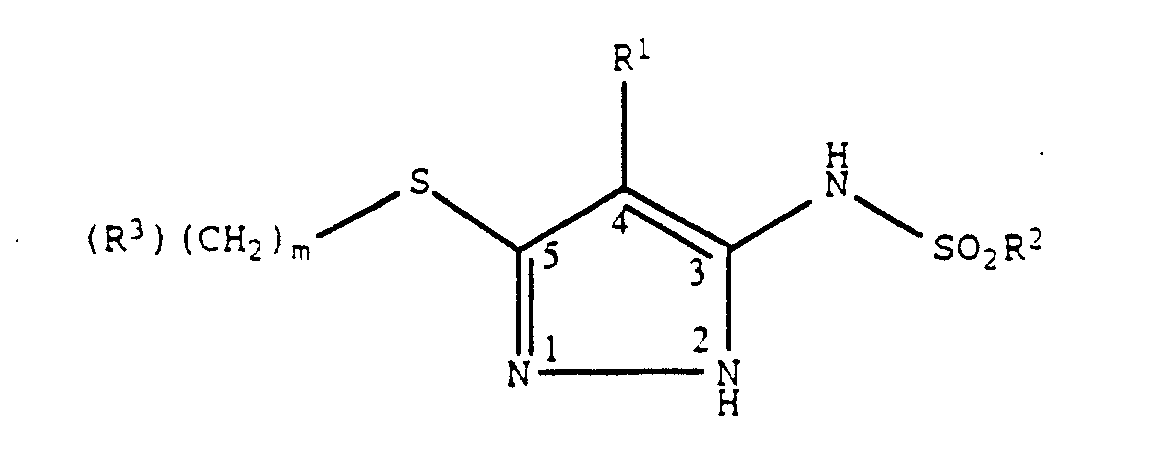
- R1
- is phenyl, isoquinolin-3-yl, pyrazinyl, pyridin-2-yl, pyridin-2-yl substituted at the 4-position with -(C1-C4)alkyl, (C1-C4)alkoxyl, -CN or -(CH2)nCONH2 where n is 0-2;
- R2
- is phenyl; phenyl substituted with 1 to 3 substituents selected from the group consisting of -(C1-C4)alkyl, -CN, halo, -NO2, CO2(C1-C4)alkyl and -CF3; naphthyl; thiophene or thiophene substituted with 1 to 3 halo groups;
- R3
- is hydrogen; phenyl; phenyl(C2-C6)alkenyl;
pyridyl; naphthyl; quinolinyl; (C1-C4)alkyl
thiazolyl;
phenyl substituted with one or two substituents selected from the group consisting of -(C1-C4)alkyl, -CN, -CONH2, -NO2, -CF3, halo, (C1-C4)alkoxy, CO2(C1-C4)alkyl, phenoxy and SR4 where R4 is -(C1-C4)alkyl or halophenyl; phenyl substituted with one substituent selected from the group consisting of- -O(CH2)pR5 where p is 1 to 3 and R5 is -CN, -CO2H, -CONH2, or tetrazolyl,
- phenyl and
- -OR6 where R6 is cyclopentyl, cyclohexenyl or phenyl substituted with halo or (C1-C4)alkoxy;
- or phenyl substituted with two substituents which, when taken together with the phenyl ring to which they are attached form a methylenedioxy ring; and
- m
- is 1 to 5;
- These pyrazoles are effective in inhibiting human sPLA2 mediated release of fatty acids.
- This invention is also a pharmaceutical formulation comprising a compound of formula I in association with one or more pharmaceutically acceptable diluents, carriers and excipients.
- This invention is also a method of inhibiting sPLA2 comprising administering to a mammal in need of such treatment a therapeutically effective amount of a compound of formula I.
- According to a further aspect of the present invention, there is provided a method of selectively inhibiting sPLA2 in a mammal in need of such treatment comprising administered to said mammal a therapeutically effective amount of a compound of formula I.
- This invention also provides a method of alleviating the pathological effects of septic shock, adult respiratory distress syndrome, pancreatitis, trauma-induced shock, bronchial asthma, allergic rhinitis, rheumatoid arthritis, and related diseases which comprises administering to a mammal in need of such treatment a therapeutically effective amount of the compound of formula I in an amount sufficient to inhibit sPLA2 mediated release of fatty acid and to thereby inhibit or prevent the arachidonic acid cascade and its deleterious products.
- This invention provides, in addition, a method of alleviating the pathological effects of cystic fibrosis, stroke, acute bronchitis, chronic bronchitis, acute bronchiolitis, chronic brochiolitis, osteoarthritis, gout, spondylarthropathris, ankylosing spondylitis, Reiter's syndrome, psoriatic arthropathy, enterapathric spondylitis, Juvenile arthropathy or juvenile ankylosing spondylitis, Reactive arthropathy, infectious or post-infectious arthritis, gonoccocal arthritis, Tuberculous arthritis, viral arthritis, fungal arthritis, syphilitic arthritis, Lyme disease, arthritis associated with "vasculitic syndromes", polyarteritis nodosa, hypersensitivity vasculitis, Luegenec's granulomatosis, polymyalgin rheumatica, joint cell arteritis, calcium crystal deposition arthropathris, pseudo gout, non-articular rheumatism, bursitis, tenosynomitis, epicondylitis (tennis elbow), carpal tunnel syndrome, repetitive use injury (typing), miscellaneous forms of arthritis, neuropathic joint disease (charco and joint), hemarthrosis (hemarthrosic), Henoch-Schonlein Purpura, hypertrophic osteoparthropathy, multicentric reticulohistiocytosis, arthritis associated with certain diseases, surcoilosis, hemochromatosis, sickle cell disease and other hemoglobinopathries, hyperlipoproteineimia, hypogammaglobulinemia, hyperparathyroidism, acromegaly, familial Mediterranean fever, Behat's Disease, systemic lupus erythrematosis, or relapsing polychondritis.
- In another aspect of the invention is provided a process for preparing a compound of formula Iwhich comprises reacting a compound of formula III
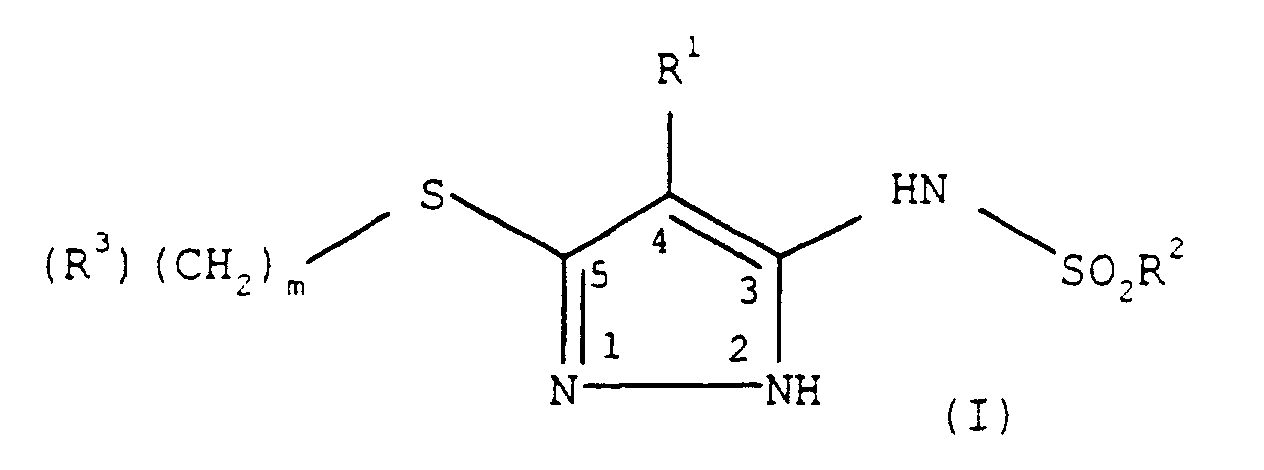 where R3, R1 and m are as defined above with a compound of formula
- Other objects, features and advantages of the present invention will become apparent from the subsequent description and the appended claims.
- As used herein, the term "alkyl" by itself or as part of another substituent means, unless otherwise defined, a straight or branched chain monovalent hydrocarbon radical such as methyl, ethyl, n-propyl, isopropyl, n-butyl, tertiary butyl, isobutyl, sec-butyl and the like.
- The term "halo" means chloro, fluoro, bromo or iodo.
- The term, "alkenyl" employed alone or in combination with other terms means a straight chain or branched monovalent hydrocarbon group having the stated number range of carbon atoms and one double bond, typified by groups such as vinyl, propenyl, crotonyl, isopentenyl, and various butenyl isomers.
- The term "phenyl(C2-C6 alkenyl)" refers to a straight or branched chain alkenyl group having from two to six carbon atoms attached to a phenyl ring which chain is attached to the remainder of the molecule. Typical phenylalkenyl groups include phenylethenyl, phenyl-2-propenyl, phenyl-2-butenyl, phenyl-3-butenyl, and phenyl-3-pentenyl.
- The term "(C1-C4)alkyl thiazolyl " defines a thiazole substituted with a straight or branched chain alkyl group having from one to four carbon atoms attached to the remainder of the molecule at the thiazole ring. Typical (C1-C4)alkyl thiazolyl groups include methylthiazolyl, ethylthiazolyl, propylthiazolyl, isopropylthiazolyl, and butylthiazolyl.
- The term "halophenyl" refers to a halo-substituted phenyl ring which ring is attached to the remainder of the molecule. Typical phenylhalo groups include fluorophenyl, chlorophenyl and bromophenyl.
- The term "leaving group" means a substituent with an unshared electron pair that departs from the substrate in a nucleophilic substitution reaction. Preferred leaving groups include chlorine, bromine, tosylate and mesylate.
- The salts of the above pyrazoles are an additional aspect of the invention. These salts can exist in conjunction with the acidic or basic portion of the molecule and can exist as acid addition, primary, secondary, tertiary or quaternary ammonium or alkali metal or alkaline earth metal salts. Acids commonly employed to form such salts include inorganic acids such as hydrochloric, hydrobromic, hydroiodic, sulfuric and phosphoric acid, as well as organic acids such as paratoluenesulfonic, methanesulfonic, oxalic, para-bromophenylsulfonic, carbonic, succinic, citric, benzoic and acetic acid, and related inorganic and organic acids. Such pharmaceutically acceptable salts thus include sulfate, pyrosulfate, bisulfate, sulfite, bisulfite, phosphate, monohydrogenphosphate, dihydrogenphosphate, metaphosphate, pyrophosphate, chloride, bromide, iodide, acetate, propionate, decanoate, caprylate, acrylate, formate, isobutyrate, caporate, heptanoate, propiolate, oxalate, malonate, succinate, suberate, sebacate, fumarate, maleate, butyne-1,4-dioate, hexyne-1,6-dioate, benzoate, chlorobenzoate, methylbenzoate, dinitrobenzoate, hydroxybenzoate, methoxybenzoate, phthalate, sulfonate, xylenesulfonate, phenylacetate, phenylpropionate, phenylbutyrate, citrate, lactate, b-hydroxybutyrate, gylcollate, tartrate, methanesulfonate, propanesulfonate, naphthalene-1-sulfonate, naphthalene-2-sulfonate, mandelate and the like salts.
- Where the compounds of the invention possess acidic functional groups various base addition salts may be formed which are more water soluble and physiologically suitable than the parent compound. Representative pharmaceutically acceptable salts include but are not limited to the alkali and alkaline earth salts such as lithium, sodium, potassium, calcium, magnesium, aluminum and the like. Salts are conveniently prepared from the free acid by treating the acid in solution with a base or by exposing the acid to an ion exchange resin.
- Included within the definition of pharmaceutically acceptable base addition salts are the relatively non-toxic, inorganic and organic base addition salts of compounds of the present invention, for example, ammonium, quaternary ammonium, and amine cations, derived from nitrogenous bases of sufficient basicity to form salts with the compounds of this invention (see, for example, S. M. Berge, et al., "Pharmaceutical Salts," J. Phar. Sci., 66: 1-19 (1977)).
- As is known in the art, pyrazole exists in two tautomeric structures, the first having the double bond at N1 and the proton on the N2 atom, referred to as a 2-H-pyrazole. The second tautomer has the proton at N1 and the double bond at N2 and is called a 1-H pyrazole. Since tetrazole tautomers are in constant equilibrium, the pyrazole structures in this invention are often referred to as 1(2)H-pyrazole and they may exist individually or as a combination of the two tautomers.
- A preferred group of compounds of formula I are those where:
- R1 is pyridine-2-yl or pyridine-2-yl substituted at the 4-position with -(C1-C4)alkyl, (C1-C4)alkoxy, -CN or -(CH2)nCONH2 where n is 0-2;
- R2 is phenyl substituted with 1 to 3 substituents selected from the group consisting of -(C1-C4)alkyl, -CN, halo, -NO2, CO2 (C1-C4)alkyl and -CF3; and
- R3 is phenyl; phenyl(C2-C6)alkenyl; phenyl substituted with one or two substituents selected from the group consisting of -(C1-C4)alkyl, -CN, -CONH2, -NO2, -CF3, halo, (C1-C4)alkoxy, CO2(C1-C4)alkyl, phenoxy and SR4 where R4 is -(C1-C4)alkyl or halophenyl;
- phenyl substituted with one substituent selected from the group consisting of -O(CH2)pR5 where p is 1 to 3 and R5 is -CN, -CO2H, -CONH2 or tetrazolyl, phenyl and -OR6 where R6 is cyclopentyl, cyclohexenyl or phenyl substituted with halo or (C1-C4)alkoxy;
- or phenyl substituted with two substituents which when taken together with the phenyl ring to which they are attached form a methylenedioxy ring.
-
- Of this preferred group of compounds, somewhat more preferred compounds of formula I include compounds where
- R1 is pyridin-2-yl substituted at the 4-position with (CH2)nCONH2 where n is 1; and
- R2 is phenyl substituted with one or two substituents selected from the group consisting of -(C1-C4)alkyl and halo.
-
- The most preferred compounds of the instant invention are 3-(2-chloro-6-methylphenylsulfonylamino)-4-(2-(4-acetamido)pyridyl)-5-(3-(4-fluorophenoxy)benzylthio)-(1H)-pyrazole and 3-(2,6-dichlorophenylsulfonylamino)-4-(2-(4-acetamido)pyridyl)-5-(3-(4-fluorophenoxy)benzylthio)-(1H)-pyrazole.
- Preferred groups of compounds of formula I include the compounds with the following substituents:
- (a) R1 is phenyl, isoquinolin-3-yl or pyrazinyl;
- (b) R1 is pyridin-2-yl or pyridin-2-yl substituted at the 4-position with -(C1-C4)alkyl, (C1-C4)alkoxy, -CN or -(CH2)nCONH2 where n is 1 to 2;
- (c) R2 is phenyl or phenyl substituted with 1 to three substituents selected from the group consisting of halo, NO2, (C1-C4)alkyl, CO2(C1-C4)alkyl, -CF3 or -CN;
- (d) R2 is naphthyl, thiophene or thiophene substituted with 1 to 3 halo groups;
- (e) R3 is hydrogen;
- (f) R3 is pyridyl, naphthyl, quinolinyl or thiazole(C1-C4)alkyl;
- (g) R3 is phenyl, phenyl(C2-C6)alkenyl, phenyl substituted with one or two substituents selected from the group consisting of (C1-C4)alkyl, -CN, -CONH2, -NO2, -CF3, halo, (C1-C4)alkoxy, CO2(C1-C4)alkyl, phenoxy or SR4 where R4 is -(C1-C4)alkyl or halophenyl;
- (h) R3 is phenyl substituted with -O(CH2)pR5 where p is 1 to 3 and R5 is hydrogen, -CN, -CO2H, -CONH2 or tetrazolyl;
- (i) R3 is- phenyl substituted with OR6 where R6 is cyclopentyl, cyclohexenyl or phenyl substituted with halo or (C1-C4)alkoxy;
- (j) R3 is phenyl substituted with phenyl;
- (k) R3 is phenyl substituted with two substituents which when taken together with the phenyl ring to which they are attached form a methylenedioxy ring;
- (l) m is 1 to 3.
-
- Further typical examples of compounds of formula I which are useful in the present invention include.
- 3-(naphth-1-yl-4-sulfonylamino) -4-(pyridin-2-yl)-5-(2-pyridin-2-yl)ethylthio-(1H)-pyrazole;
- 3-(naphth-2-ylsulfonylamino)-4-(4-cyanopyridin-2-yl)-5-((4-quinolin-2-yl)but-1-yl) thio-(1H)-pyrazole;
- 3-(naphth-1-ylsulfonylamino)-4-((4-acetamido)pyridin-2-yl)-5-((5-carboxamidophenyl) pent-1-yl)thio-(2H)-pyrazole;
- 3-(naphth-2-ylsulfonylamino)-4-(4-methylpyridin-2-yl)-5-(3,5-dinitro)benzylthio-(1H)-pyrazole;
- 3-(naphth-1-ylsulfonylamino)-4-(pyridin-2-yl)-5-(4-methoxy) benzylthio-(1H) -pyrazole;
- 3-(naphth-2-ylsulfonylamino)-4-(pyridin-2-yl)-5-(3-(3-tetrazol-2-ylphenyl)prop-1-yl)thio-(1H)-pyrazole;
- 3-(naphth-1-ylsulfonylamino)-4-(4-t-butyl)pyridin-2-yl)-5-(2-(3-cyclopentyloxyphenyl) ethyl) thio-(2H)-pyrazole;
- 3-(naphth-2-ylsulfonylamino)-4-(pyrazin-2-yl)-5- (2-methylthiobenzyl)thio-(2H)-pyrazole;
- 3-(naphth-1-ylsulfonylamino)-4-(pyridin-2-yl)-5-((3-(4-phenoxy)phenyl)prop-1-yl)thio-(2H)-pyrazole;
- 3-(naphth-2-ylsulfonylamino)-4-phenyl-5-(2-(3-(4-fluorophenyl)phenyl)ethyl)thio-(1H)-pyrazole;
- 3-(3-nitro-5-ethyl)phenylsulfonylamino-4- (phenyl) -5-((3-cyanoprop-1-yloxy)benzyl)thio-(1H)-pyrazole;
- 3- (2-methylphenyl)sulfonylamino-4-(isoquinolin-3-yl)-5-(4-ethoxybenzyl)thio-(2H)-pyrazole;
- 3-(2,6-di(2-fluoroethyl)phenyl)sulfonylamino-4-(pyrazin-3-yl)-5-(cyclohexenyloxybenzyl)thio-(2H)-pyrazole;
- 3-(4-trifluoromethylphenyl)sulfonylamino-4-(isoquinolin-3-yl)-5-(3-phenyl-2-propen-1-yl)thio-(2H)-pyrazole;
- 3-(3,5-(di-t-butyl)phenyl)sulfonylamino-4-(pyrazin-2-yl)-5-((5-(naphth-1-yl)pent-1-yl)thio-(1H)-pyrazole;
- 3-(2-cyano-5-methoxycarbonylphenyl)sulfonylamino-4-(pyridin-2-yl)-5-(quinolin-2-yl)methylthio-(1H)-pyrazole;
- 3-(6-propoxycarbonyl)phenylsulfonylamino-4-(4-isopropylpyridin-2-yl)-5-(2-(3-methylthiazol-4-yl)ethyl)thio-(2H)-pyrazole;
- 3-(5-bromophenyl)sulfonylamino-4-(4-ethoxypyridin-2-yl)-5-(5-phenyl-2-hepten-1-yl)thio-(1H)-pyrazole;
- 3-phenylsulfonylamino-4-(4-cyanopyridin-2-yl)-5-(4-phenylbenzyl)thio-(1H)-pyrazole;
- 3-(3-methyl-5-methoxy)phenylsulfonylamino-4-(4-acetamidopyridin-2-yl)-5-(2-(2-propyl-6-cyanophenyl)ethyl)thio-(2H)-pyrazole;
- 3-(2,6-dinitrophenyl)sulfonylamino-4-phenyl-5-(4-carboxamidobenzyl)thio-(1H)-pyrazole;
- 3-(4-trifluoromethyl)phenylsulfonylamino-4-(isoquinolin-3-yl)-5-(4-(3-nitro-5-fluorophenyl)but-1-yl)thio-(1H)-pyrazole;
- 3-(2-cyano)phenylsulfonylamino-4-(pyrazin-2-yl)-5-(3,5-diethoxybenzyl)thio-(1H)-pyrazole;
- 3-(4-butoxyphenyl)sulfonylamino-4-(pyridin-2-yl)-5-(3-methoxycarbonylbenzyl)thio-(2H)-pyrazole;
- 3-(2-propoxycarbonylphenyl) sulfonylamino-4-(4-ethylpyridin-2-yl)-5-(3-(3-phenoxy-5-methoxycarbonylphenyl)prop-1-yl)thio-(1H)-pyrazole;
- 3-(3-nitrophenyl)sulfonylamino-4-(4-cyanopyridin-2-yl)-5-(3-methylthiobenzyl) thio-(1H)-pyrazole;
- 3-(3-methoxycarbonylphenyl)sulfonylamino-4-(4-carboxamidoethylpyridin-2-yl)-5-(4-(2-fluorophenylthio)benzylthio)-(2H)-pyrazole;
- 3-(4-chlorophenyl)sulfonylamino-4-(4-ethylpyridin-2-yl)-5-(2-cyano-5-ethylthiobenzyl)thio-(1H)-pyrazole;
- 3-phenylsulfonylamino-4-(4-methoxypyridin-2-yl)-5-(3-(3-carboxamidophenylthio)benzylthio)-(1H)-pyrazole;
- 3-(4-methoxycarbonylphenyl)sulfonylamino-4-(4-cyanopyridin-2-yl)-5-(4-cyanomethoxybenzyl)thio-(1H)-pyrazole;
- 3-(5-chlorophenyl)sulfonylamino-4-(4-carboxamidoethylpyridin-2-yl)-5-(3-carboxyethoxybenzyl)thio-(2H)-pyrazole;
- 3-(6-nitrophenyl)sulfonylamino-4-(phenyl)-5-(4-cyanomethoxybenzyl) thio-(1H)-pyrazole;
- 3-(2,6-dimethylphenyl)sulfonylamino-4-(isoquinolin-3-yl)-5-(4-(3-carboxamidoprop-1-yloxy)benzyl)thio-(1H)-pyrazole;
- 3-(3-methyl-5-methoxyphenyl)sulfonylamino-4-(pyrazin-2-yl)-5-(5-phenylethoxybenzyl) thio-(1H)-pyrazole;
- 3-(4-trifluoromethylphenyl)sulfonylamino-4-(pyridin-2-yl)-5-(3-(3-methoxyphenylmethoxy)benzyl)thio-(1H)-pyrazole;
- 3-(3-cyanophenyl)sulfonylamino-4-(4-t-butylpyridin-2-yl)-5-(3-(4-fluorophenylethoxy)benzyl)thio-(1H)-pyrazole;
- 3-(2-nitro-4-methylphenyl)sulfonylamino-4-(4-cyanopyridin-2-yl)-5-(2-quinolin-2-yl)ethylthio-(1H)-pyrazole;
- 3-(3,5-dichlorothiophene-2-yl)sulfonylamino-4-(4-methoxypyridin-2-yl)-5-(benzyl)thio-(1H)-pyrazole;
- 3-(thiophene-2-yl)sulfonylamino-4-(4-carboxamidomethylpyridin-2-yl)-5-(4-phenyl-3-buten-1-yl)thio-(2H)-pyrazole;
- 3-(4-bromothiophene-2-yl)sulfonylamino-4-(4-cyanopyridin-2-yl)-5-(pyridin-2-yl)methylthio-(2H)-pyrazole;
- 3-(5-fluorothiophene-2-yl)sulfonylamino-4-(4-carboxamidoethylpyridin-2-yl)-5-(2-naphth-1-yl)ethylthio-(2H)-pyrazole;
- 3-(2,6-difluorothiophene-2-yl)sulfonylamino-4-(isoquinolin-3-yl)-5-(2-ethylthiazole-4-yl)methylthio-(1H)-pyrazole;
- 3-(5-bromothiophene-2-yl)sulfonylamino-4-(pyrazin-3-yl)-5-(4-phenylbut-1-yl)thio-(1H)-pyrazole;
- 3-(3,5-difluorothiophene-2-yl)sulfonylamino-4-(4-ethylpyridin-2-yl)-5-(3,5-dimethylbenzyl) thio-(1H)-pyrazole;
- 3-(3, 5-dichlorothiophene-2-yl)sulfonylamino-4-(4-cyanopyridin-2-yl)-5-(4-tetrazolylbenzyl) thio- (2H)-pyrazole;
- 3-(4-fluoro-3,5-dichlorothiophene-2-yl) sulfonylamino-4-(4-carboxamidoethylpyridin-2-yl) -5-(3-cyclohexen-3-yloxybenzyl)thio-(1H)-pyrazole;
- 3-(3-bromothiophene-2-yl)sulfonylamino-4-phenyl-5-(2-cyanomethoxybenzylthio-(2H)-pyrazole;
- 3-(phenyl)sulfonylamino-4-(pyridin-2-yl)-5-(3-(2-tetrazolylethoxy)benzyithio)-(1H)-pyrazole;
-
- Compounds of formula I can be prepared as described in Scheme I below.
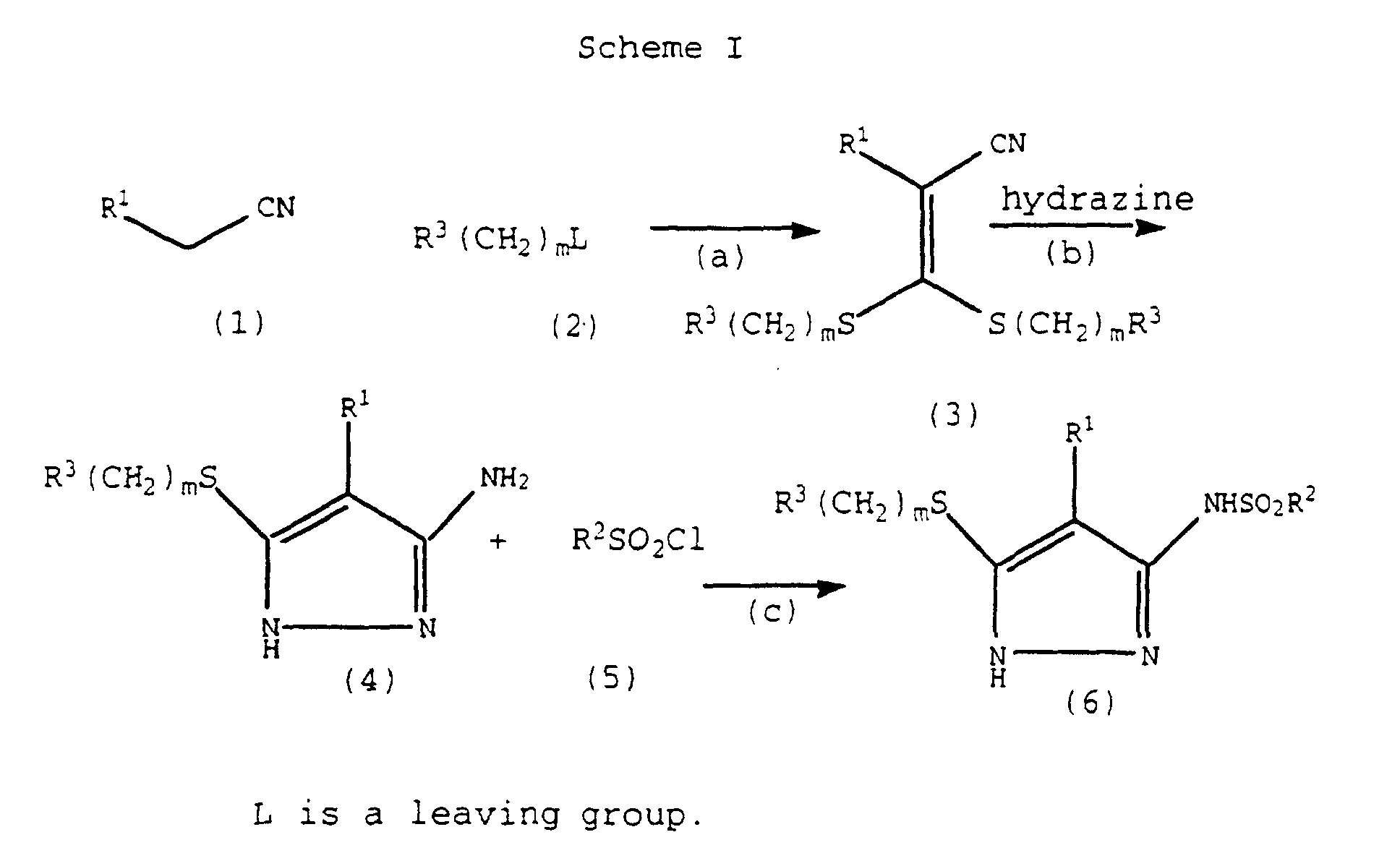
- In an aprotic polar solvent, such as tetrahydrofuran, an acetonitrile compound (1) is deprotonated by treatment with an excess of a strong base, such as sodium hydride, preferably under an inert gas, such as nitrogen. The deprotonated intermediate is treated with carbon disulfide and then alkylated twice with an appropriately substituted alkyl halide (2) of the formula R3(CH2)mL, where L is a leaving group, preferably bromine, and R3 and m are as defined above, to prepare intermediate compound (3). The reaction is conducted at ambient temperatures and is substantially complete in 1 to 24 hours.
- Cyclization to form the amino substituted pyrazole (4) is achieved by reacting intermediate (3) with hydrazine at room temperature for from about 1 to 24 hours.
- Selective sulfonylation of the amino group of intermediate (4) can be accomplished by treatment with a sulfonyl chloride (5) of the formula R2SO2Cl, where R2 is as defined above, to prepare product (6). The reaction is preferably conducted in a solvent, such as pyridine, at ambient temperature for a period of time of from 1 to 24 hours. Preparation of 2,6-dimethylphenylsulfonyl chloride can be accomplished as described in J. Org. Chem. 25, 1996 (1960). All other sulfonyl chlorides are commercially available.
- When R1 is isoquinolinyl, pyrazinyl or pyridinyl substituted in the -4 position, starting material (1) of the formula R1CH2CN can be prepared as described in Scheme II(a) below.
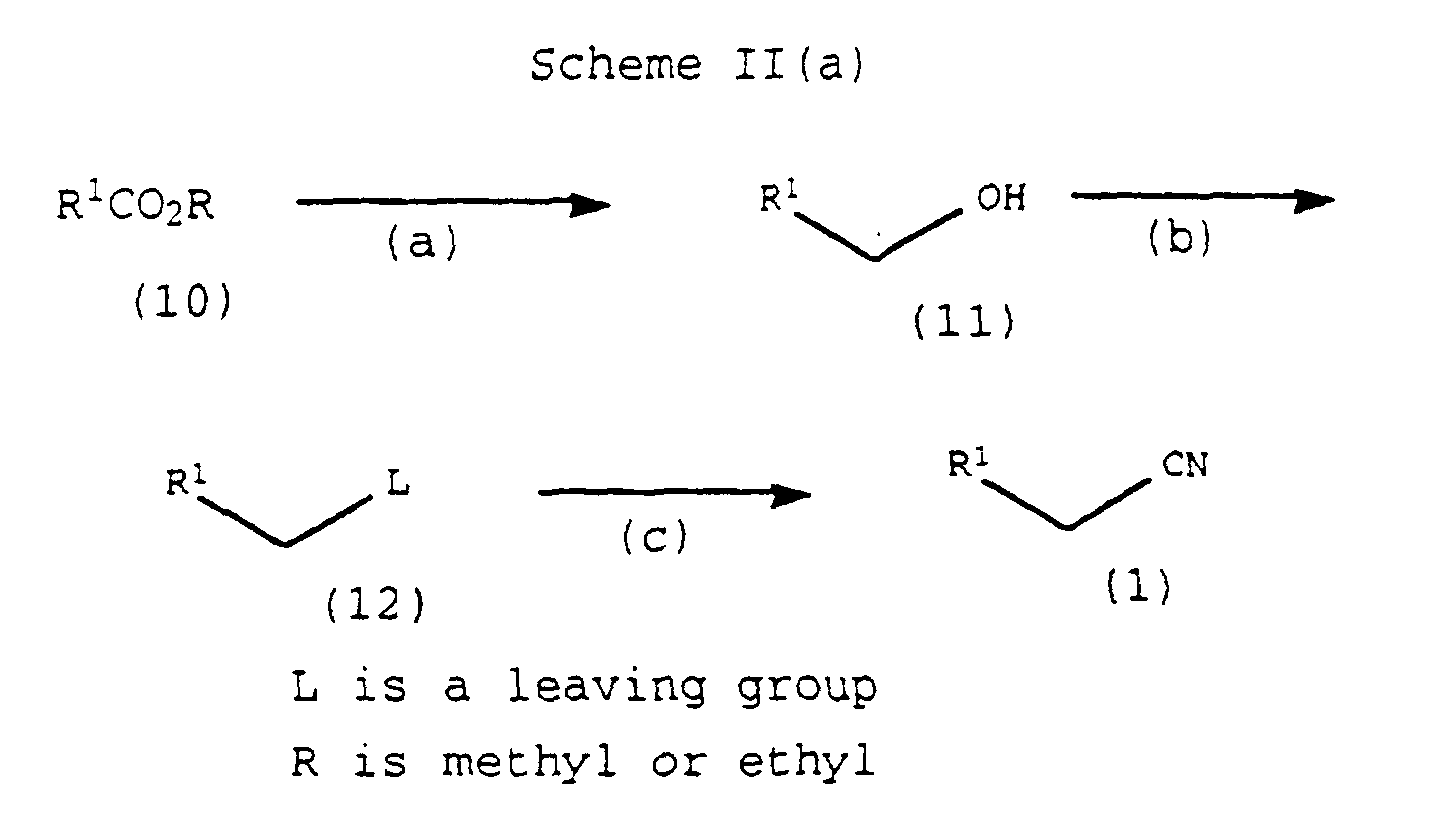
- An appropriately substituted ester (10) is reduced using an appropriate reducing agent, such as sodium borohydride with calcium chloride, as described in OPPI, 23, 204 (1991), to form the intermediate alcohol (11) which can be activated for displacement by converting to an appropriate leaving group such as a tosylate, mesylate or halogen.
- The activated intermediate (12) may then be reacted with sodium cyanide or potassium cyanide in a polar aprotic solvent such as dimethyl formamide or dimethyl sulfoxide, displacing the leaving group and forming starting material (1) which can then be used to prepare the desired product as shown in Scheme I above.
- Starting material (1) where R1 is pyridyl substituted at the 4-position with cyano or alkyl can be prepared according to Scheme II(b) below.

- Under Minisci reaction conditions, (Angew. Chem. Int. Ed., 24, 692(1985)), a 4-substituted pyridine (13) is converted to the ester (14) which may be readily reduced to intermediate (15) by employing an appropriate reducing agent, such as sodium borohydride with calcium chloride, as described in step (a), Scheme II(a).
- Preparation of compounds where R1 is pyridyl substituted with (C1-C4)alkoxy can be accomplished by converting 4-alkoxypyridine-N-oxide (16), under modified Minisci reaction conditions, to intermediate (17) as shown in Scheme II(c), below (Syn. Commun., 19, 317(1989)). Conversion to starting material (1) can then be easily accomplished using the process outlined in Scheme II(a), Steps (b-c).
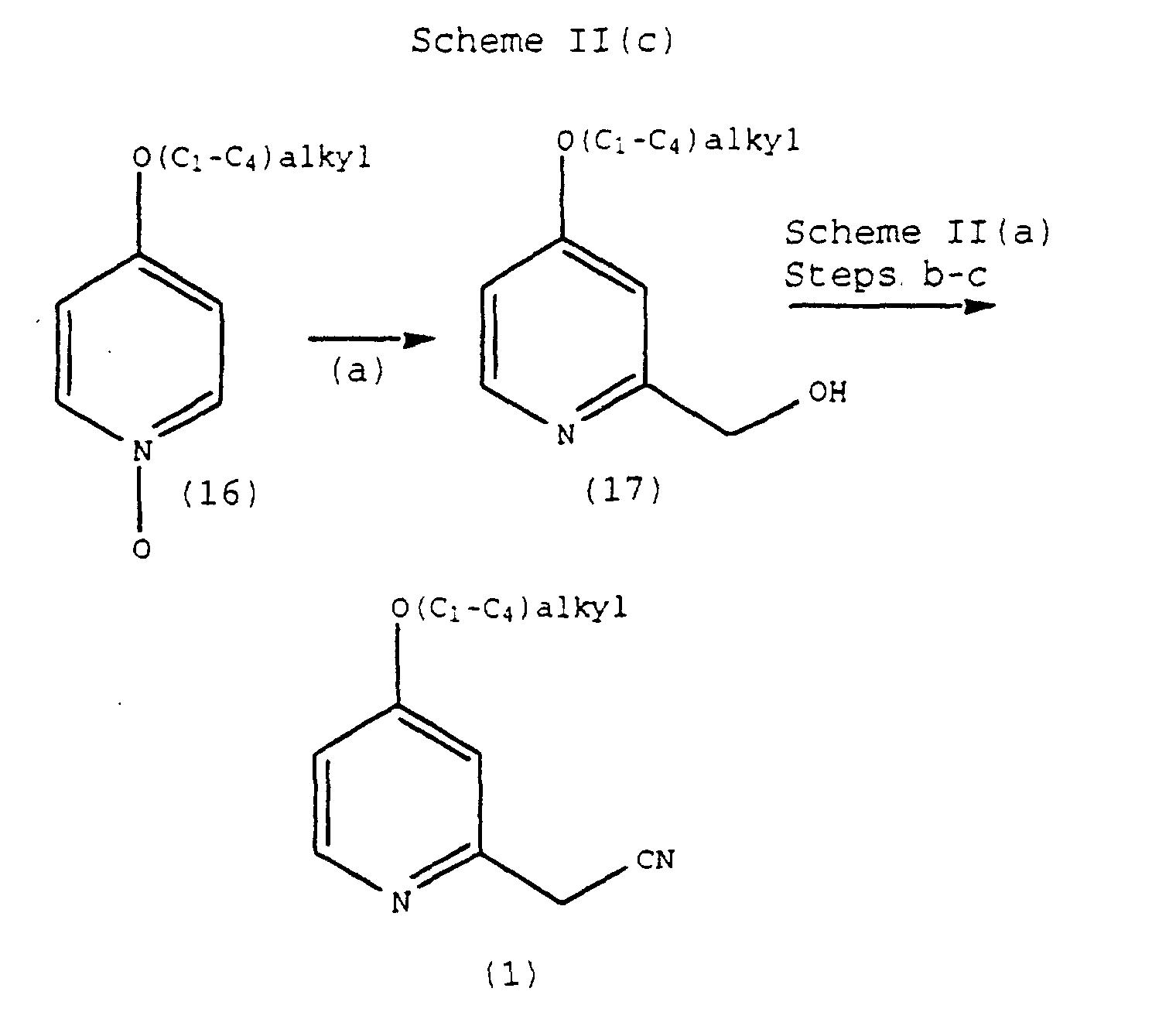
- Compound (1) where R1 is pyridyl substituted with (CH2)nCONH2 are prepared as described in Scheme II(d) below.

- Following the procedures outlined in Scheme II(a), Steps a, b, and c, the ester (18) is converted to the cyano/ester intermediate (19) which may then be converted to the amide (1) by treatment with concentrated ammonium hydroxide.
- When n is 2, compound (18) is prepared as shown in II(e) below by condensing 4-pyridine carboxaldehyde (20) with malonic acid and a base, such as piperidine, to form cinnamic acid (21). Esterification of (21) under standard acidic conditions forms the ester (22). Hydrogenation can then be readily accomplished using a reducing agent, such as hydrogen and palladium on carbon to form (18).
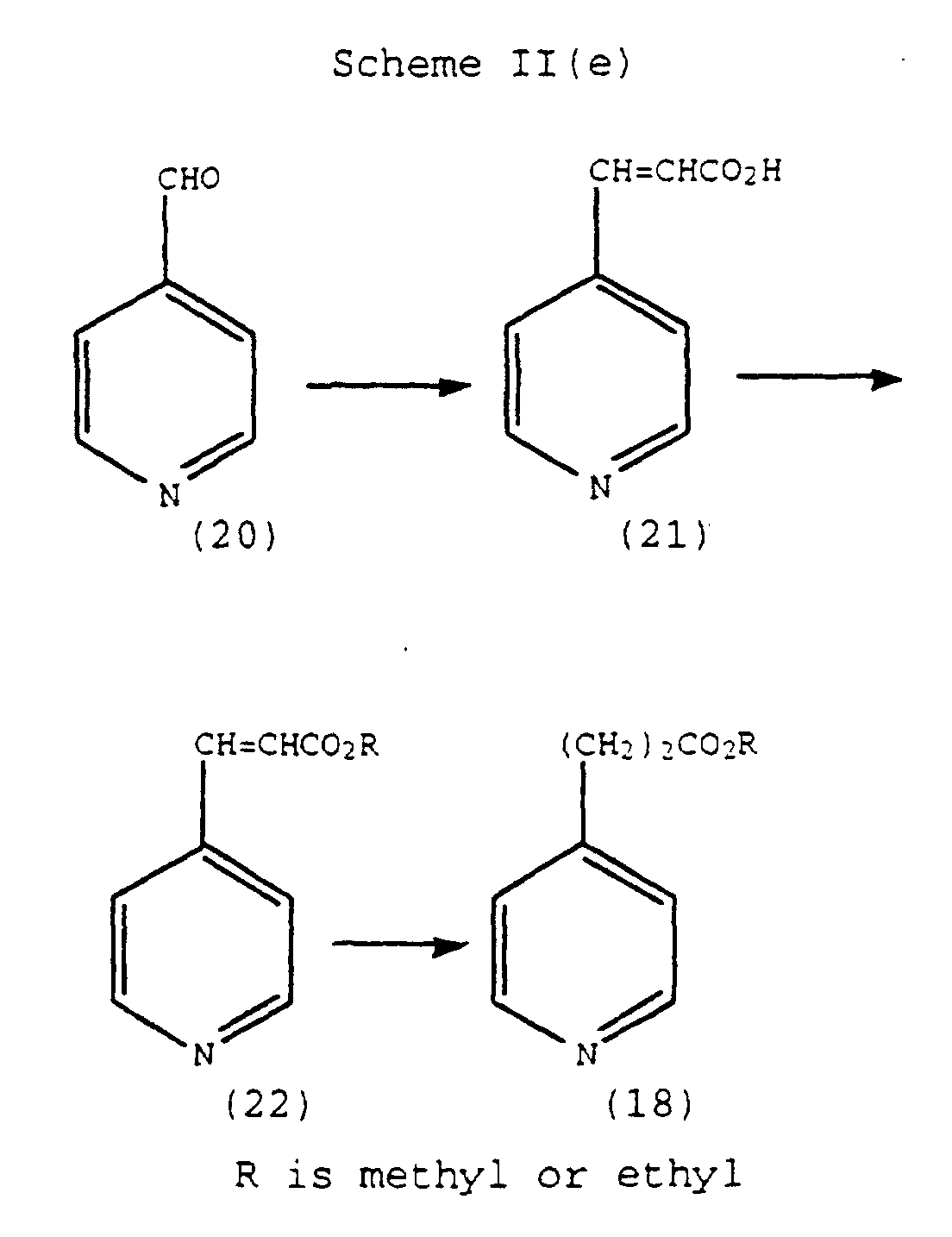
- Starting material (2) of the formula R3(CH2)mL where R3 is phenyl substituted with a halogenated phenoxy or thiophenoxy group, can be prepared as described in Scheme III(a) below.

- Using potassium fluoride and alumina, as described in J. Org. Chem., 58, 3229(1993), starting materials (23) and (24) are coupled to form intermediate (25). Reduction of the ester to the alcohol is achieved using lithium aluminum hydride, followed by conversion of the alcohol to a leaving group, such as a tosylate or mesylate group, or to a halogen by treatment, for example, with phosphorus tribromide, to form starting material (2).
- Compound (2) where m is 1 and R3 is phenyl substituted with -O(CH2)pR5 where R5 is -CN can be prepared as outlined in Scheme III(b) below.
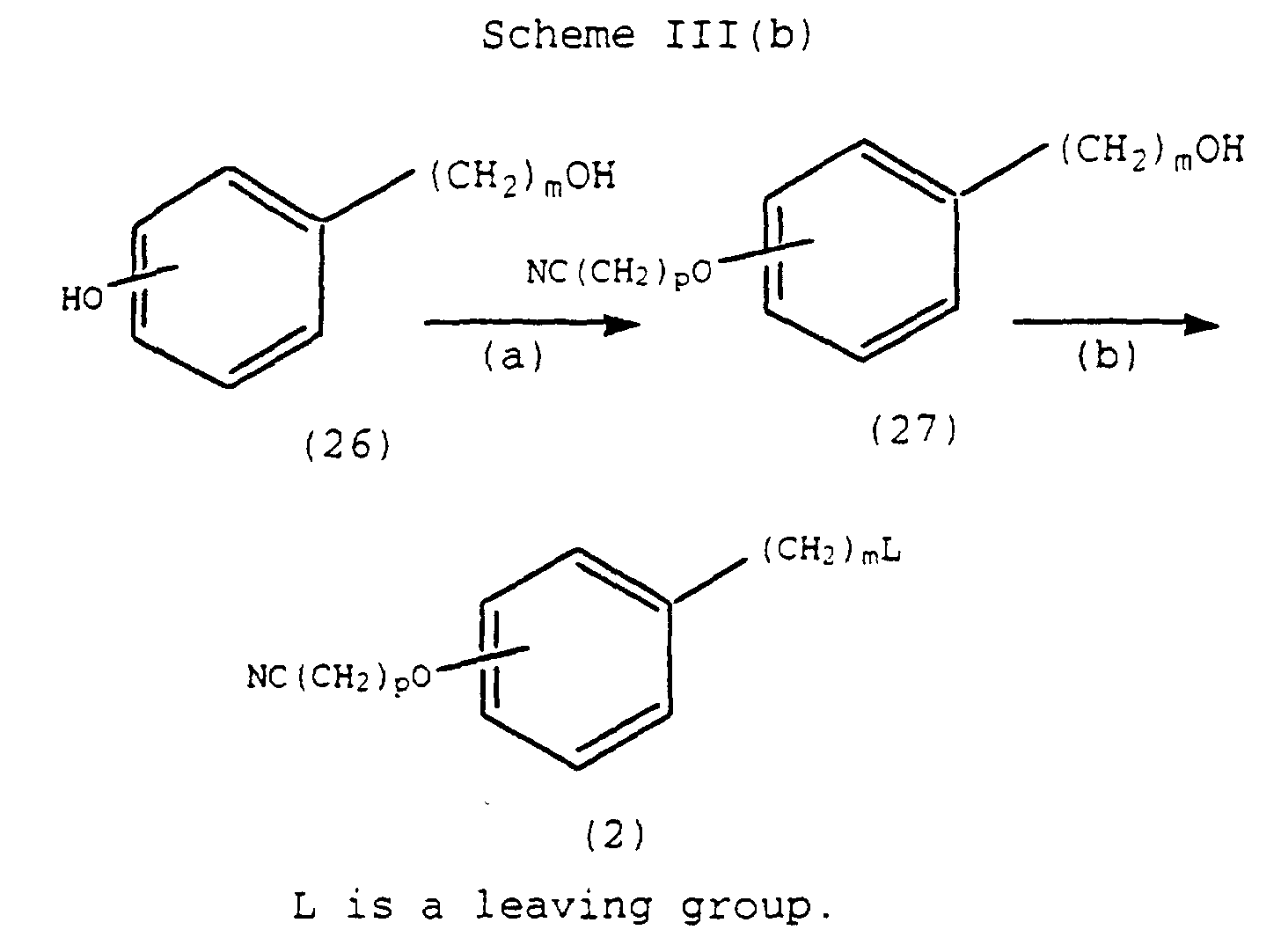
- Selective alkylation of (26) is achieved by treatment with a mild base, such as potassium carbonate and an alkylating agent of the formula NC(CH2)pZ, where Z is a halogen, to form (27). Conversion of the alcohol (27) to a leaving group is achieved, for example, by treatment with phosphorus tribromide to form compound (2) where L is bromine.
- Conversion to the acetonitrile starting material (1) can be performed as described in Scheme II(a), Steps b-c.
- When R3 is phenyl substituted with a cyano group, conversion to the acid can be achieved by reacting the cyano product (6) with a base such as potassium hydroxide.
- Conversion to the amide is accomplished by treatment of the cyano-substituted product (6) with postassium carbonate in the presence of hydrogen peroxide.
- The tetrazole can be accomplished by refluxing the cyano-substituted product (6) with an excess of tributyl tin azide for from 1-24 hours followed by treatment with an acid such as hydrochloric acid.
- Starting material (2) where R3 is phenyl substituted with CO2(C1-C4)alkyl can be prepared as illustrated below in Scheme III(c).
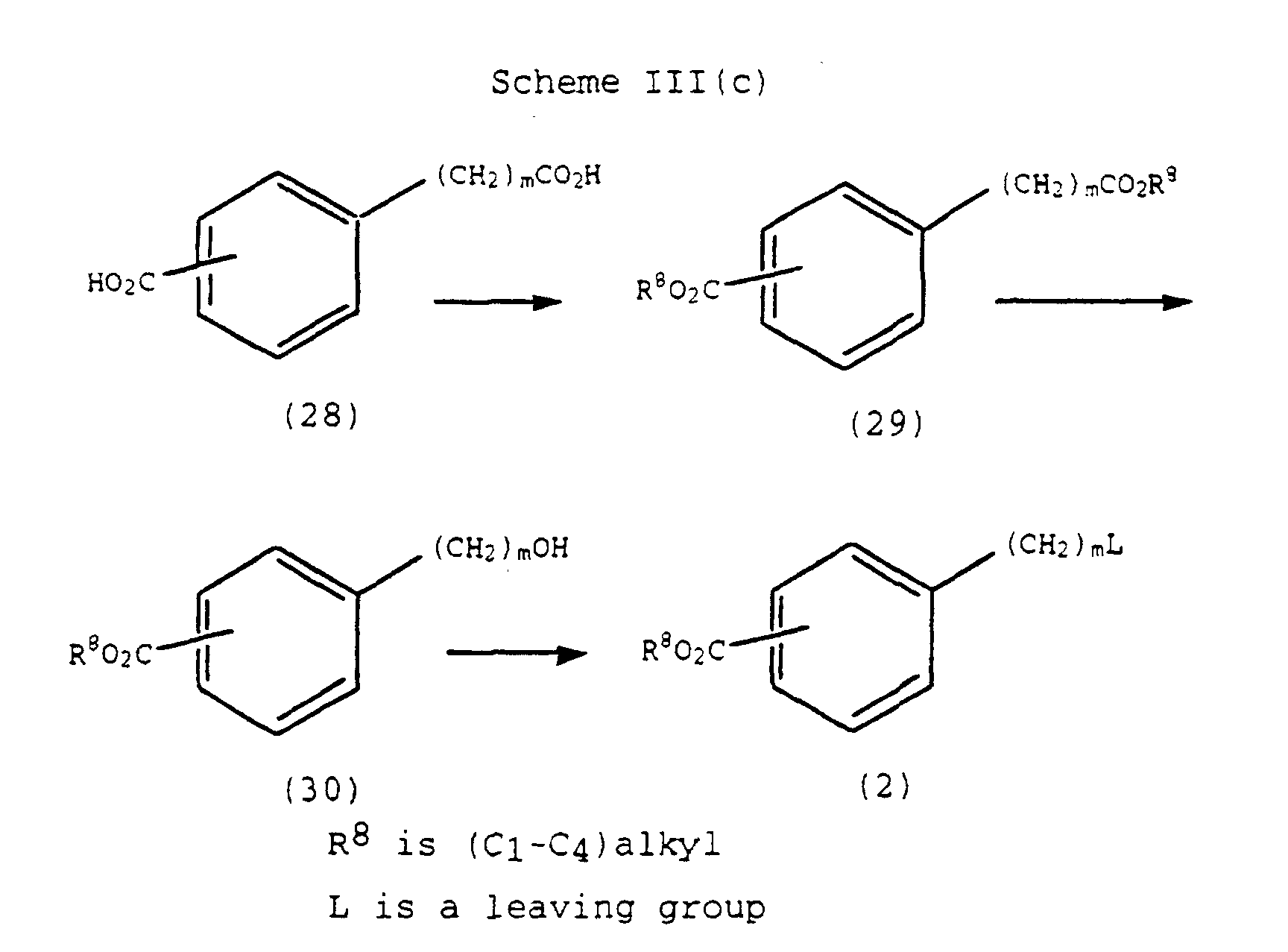
- Esterification of (28) using an acid, such as sulfuric acid, in a polar solvent, such as ethanol, prepares the diester (29). Selective reduction of the diester can be achieved by using a reducing agent, such as sodium borohydride (Synlett 419(1990)), in the presence of catalytic copper sulfate to form the alcohol (30) which is converted to a leaving group, preferably bromine, to form starting material (2) by treatment with carbonyl diimidazole and allylbromide. Chem. Pharm. Bull Japan 31, 4289 (1983)
- Additional compounds (2) of the formula R3(CH2)mL are either available from commercial sources or may be synthesized from commercially available alcohols via standard bromination reactions, such as phosphorus tribromide, carbon tetrabromide/triphenylphosphine or by reducing the corresponding commercially available aldehyde or carboxylic acid to the alcohol via standard reducing conditions such as sodium borohydride or lithium aluminum hydride and then converting to the bromide as described above.
- Where m is 1 and R3 is a meta-phenyl substituted phenyl group, a methyl group may be brominated under standard radical conditions using N-bromosuccinamide
- Starting materials of structure (2) where m is greater than 1 are available from commercial sources or compounds of this type may be readily prepared by chain extension methodology. For example, Friedman and Shani (L. Friedman and A. Shani J. Am. Chem. Soc. 1974, 96, 7102) demonstrate an effective method for chain extension of alkyl and aryl halides and summarize alternative methods as well.
- The intermediates and final products may be isolated and purified by conventional techniques, for example by concentration of the solvents, followed by washing of the residue with water, then purification by conventional techniques, such as chromatography or recystallization.
- It will be readily appreciated by the skilled artisan that the remaining starting materials are either commercially available or can be readily prepared by known techniques from commercially available starting materials. All other reactants used to prepare the compounds in the instant invention are commercially available.
- The following examples further illustrate the preparation of the compounds of this invention. The example are illustrative only and are not intended to limit the socpe of the invention in any way.
- The following abbreviations are used in Examples 1 to 13 below.
- Na2SO4 is sodium sulfate
- MgSO4 is magnesium sulfate
- K2CO3 is potassium carbonate
- CH2Cl2 is methylene chloride
- NaOH is sodium hydroxide
- NH4Cl is ammonium chloride
- THF is tetrahydrofuran
- DMSO is dimethyl sulfoxide
-
- 2-Pyridylacetonitrile (0.41 g, 3.50 mmol) in 10 ml of dry tetrahydrofuran (THF) was added dropwise to an ice-cooled slurry of 2.1 equivalents of sodium hydride (0.29 g of a 60% mineral oil dispersion) in 40 ml of dry THF under nitrogen. The resulting green slurry was stirred at room temperature for 30 minutes and then neat carbon disulfide (0.22 ml, 3.68 mmol) was added dropwise, resulting in an immediate precipitate choking the solution. More dry THF (10 ml) was added to aid stirring. After 15 minutes, commercial 3-(4-fluorophenoxy)benzyl bromide (2.0 g, 7.11 mmol) was added with 10 ml of dry THF. After stirring overnight at room temperature, the reaction mixture was poured into 100 ml of saturated NH4Cl solution and then extracted twice with 200 ml of diethylether. The organic extracts were washed with brine and then combined, dried over MgSO4 and then concentrated to an oil. This oil was rinsed with pentane and then concentrated to afford 2.05 g of the subtitle compound pure enough for further use.
- 3,3-Bis (3-(4-fluorophenoxy) benzylthio) -2-pyridylacrylonitrile (2.03 g, 3.41 mmol), prepared as described above, was placed in 8 ml of hydrazine hydrate and stirred at room temperature overnight. The reaction was poured into 100 ml of water and was extracted twice with ethyl acetate (150 ml each). The organic extracts were washed with water and brine, combined, dried over K2CO3 and concentrated. Flash chromatography on silica with first chloroform and then a 3:1 chloroform/ethyl acetate mixture afforded 1.11 g (83% yield) of the subtitle compound.
1H-NMR(300 MHz, CDCl3): 8.52(d,1H); 8.12 (d,1H) ; 7.62(t,1H); 7.21-6.73(m,11H); 5.75(br s,2H); 4.01(s,2H). - 3-Amino-4-(2-pyridyl)-5-(3-(4-fluorophenoxy)benzylthio)-(1H)-pyrazole (0.39 g, 0.99 mmol) was dissolved in 5 ml of pyridine. Commercial 2,6-dichlorobenzenesulfonyl chloride (0.26 g, 1.04 mmol) was added and the red solution was stirred overnight at room temperature. The reaction mixture was poured into 50 ml of water and was extracted twice with 100 ml portions of ethyl acetate. The organic layers were washed with water and brine, combined, dried over MgSO4 and concentrated. The crude product was slurried in cold ethyl acetate and the solid was filtered off and washed with small portions of cold ethyl acetate and cold diethyl ether and dried under vacuum to afford 0.32 g (53% yield) of the final compound.
- FD-MS: (M+)600
- mp. 164-5°C
-
- Ethyl pyruvate (84.4 g, 0.726 mol) was cooled in an ice/salt bath and treated dropwise with 30% hydrogen peroxide solution (55 g, 0.484 mol) keeping the temperature below 10°C. This solution was then added dropwise over 2 hours to an ice-cooled, vigorously stirred mixture of ethyl 4-pyridineacetate (8.00 g, 0.0484 mmol), ferrous sulfate heptahydrate (134.6 g, 0.484 mol) and concentrated sulfuric acid (14.3 g, 0.145 mol) in 39 ml of water and 700 ml of dichloromethane (CH2Cl2). After stirring for an additional 15 minutes, the mixture was poured into 500 ml of cold water. The layers were separated and the aqueous layer was extracted with 400 ml of CH2Cl2. The separate organic phases were washed with 400 ml of a 5% sodium sulfite solution and then with 250 ml of brine. The organic layers were combined, dried over Na2SO4 and concentrated. Flash chromatography on silica using hexane and then 3:1 hexane/ethyl acetate afforded 7.12 g (62% yield) of the subtitle compound.
- Ethyl 4-(2-carboethoxy)pyridylacetate (7.12 g, 30.0 mmol) was dissolved in 100 ml of absolute ethanol and cooled in an ice bath under nitrogen. Powdered anhydrous calcium chloride (1.82 g, 16.5 mmol) was added all at once. Sodium borohydride (0.63 g, 16.5 mmol) was then added in small portions over one hour. The reaction was stirred for 4 hours at 0°C and then an additional 0.2 g of sodium borohydride was added. The reaction was stored overnight in the freezer at approximately -20°C during which a solid precipitated. The solid was filtered off, washed with ethanol and discarded. The filtrate and washings were combined and evaporated to dryness. The residue was slurried in 50 ml of brine and extracted twice with 125 ml of chloroform. The organic extract was washed once with 40 ml of brine, dried over Na2SO4 and concentrated to afford 5.34 g (91% yield) of the subtitle compound.
- Ethyl 4-(2-hydroxymethyl)pyridylacetate (3.34 g, 17.1 mmol) and triethylamine (2.86 ml, 20.5 mmol) were dissolved in 50 ml of dry dichloromethane (CH2Cl2) under nitrogen and cooled to -40°C. Methanesulfonyl chloride (1.46 ml, 18.8 mmol) was added dropwise in 10 ml of CH2Cl2 and the reaction was stirred for one hour and then allowed to warm to 0°C. The reaction mixture was then poured into ice cold water and extracted twice with CH2Cl2. The extracts were washed with brine, dried over MgSO4 and concentrated to afford 4.42 g of the subtitle compound which was used immediately.
- Ethyl 4-(2-methanesulfonoxymethyl)pyridylacetate (4.42 g, 16.2 mmol) was added dropwise in 10 ml of dry dimethylsulfoxide (DMSO) to powdered sodium cyanide (2.50 g, 51.3 mmol) slurried in 15 ml of dry DMSO. The reaction was protected from light and stirred overnight at room temperature. The reaction mixture was poured into a cold solution of 70 g of K2CO3 in 210 ml of water and then extracted twice with 300 ml of diethyl ether. The extracts were washed with brine, dried over Na2SO4 and concentrated to afford 2.68 g (77% yield) of the subtitle compound.
- Ethyl 4-(2-cyanomethyl)pyridylacetate (2.70 g, 13.2 mmol) was cooled in an ice bath and treated dropwise with 12 ml of ice-cold concentrated ammonium hydroxide. The reaction was stirred at room temperature for five hours and then evaporated to dryness. Flash chromatography on silica with first chloroform and then a 20:1 chloroform/methanol mixture afforded 1.96 g (84% yield) of the subtitle compound.
- 4-(2-Cyanomethyl)pyridylacetamide (0.36 g, 2.06 mmol) in 5 ml of dry tetrahydrofuran (THF) and 0.5 ml of dry dimethyl sulfoxide was added dropwise to an ice-cooled slurry of 2.1 equivalents of sodium hydride (0.17 g of a 60% mineral oil dispersion) in 12 ml of dry THF under nitrogen. The resulting slurry was stirred at room temperature for 2 hours and then neat carbon disulfide (0.14 ml, 2.26 mmol) was added dropwise. After 45 minutes, commercial 3-(4-fluorophenoxy)benzyl bromide (1.18 g, 4.21 mmol) was added with 5 ml of dry THF. After being stirred overnight at room temperature, the reaction mixture was poured into 50 ml of saturated NH4Cl solution and then extracted twice with 100 ml of diethyl ether. The organic extracts were washed with brine and then combined, dried over MgSO4 and then concentrated to a solid. This solid was rinsed with pentane and then dried to afford 1.24 g of the subtitle compound pure enough for further use.
- 3,3-Bis(3-(4-fluorophenoxy)benzylthio)-2-(4-acetamido)pyridylacrylonitrile (1.24 g, 1.90 mmol) was dissolved in 30 ml of absolute ethanol and cooled in an ice bath. Ice-cold hydrazine hydrate (7 ml) was added slowly dropwise. The reaction was stirred at 0°C for 8 hours and then stored at -20°C for 60 hours. The reaction was diluted with 100 ml of ethyl acetate and then concentrated to dryness. The residue was slurried in brine and then extracted twice with 100 ml of ethyl acetate. The organic layers were washed with water and then brine, dried over MgSO4 and concentrated. Flash chromatography on silica with chloroform and then a 20:1 chloroform/methanol mixture afforded 0.55 g (64% yield) of the subtitle compound.
- By substantially following the procedures described for Example 1, Step C, the compound 3-(2-chloro-6-methylphenylsulfonylamino)-4-(2-(4-acetamidyl)pyridyl)-5-(3-(4-fluorophenoxy)benzylthio)-(1H)-pyrazole was afforded.
mp. 216-8°CElemental analysis: Calc. C 56.47 H 3.95 N 10.97 Found C 56.17 H 4.00 N 10.81 - 4-Pyridinecarboxaldehyde (18.96 g, 0.177 mol) and malonic acid (55.3 g, 0.53 mol) were placed in 200 ml of pyridine. Piperidine (5.25 ml, 0.053 mol) was added and the reaction was refluxed for 6 hours. The reaction mixture was cooled in an ice bath and then the white solid was filtered off and rinsed with ether and dried to afford 20.1 g of the subtitle compound. Concentration of the filtrate and then filtration and rinsing with ether resulted in recovery of another 2.2 g of product (84% total yield).
- 3-(4-Pyridyl)acrylic acid (16.18 g, 0.1085 mol) was slurried in 200 ml of absolute ethanol. Concentrated sulfuric acid (8 ml) was added and the reaction was refluxed for 3 hours. After cooling, the solvent was evaporated and the residue was cautiously neutralized with saturated sodium bicarbonate solution. The resulting mixture was then extracted twice with diethyl ether. The organic extracts were washed with water and then brine, dried over MgSO4 and concentrated to afford 17.88 g (93% yield) of the subtitle compound.
mp. 64-5°C - Ethyl 3-(4-pyridyl)acrylate (16.62 g, 93.8 mmol) was hydrogenated in 80 ml of ethanol over 5% Pd on carbon (2 g) at 60 psi at room temperature for 16 hours. After evaporation, the residue was dissolved in 200 ml of diethyl ether and filtered through diatomaceous silica and concentrated to afford 15.97 g (95% yield) of the subtitle compound.
- By substantially following the procedures described in Example 2 Step A and B, the subtitle compound is afforded.
- Ethyl 3-(4-(2-hydroxymethyl)pyridyl)propionate (2.76 g, 13.2 mmol) was dissolved in 5 ml of dry dichloromethane and cooled in an ice bath under nitrogen. Thionyl chloride (5 ml) was added slowly dropwise and the reaction was stirred several days at room temperature. After concentration, the residue was twice diluted with benzene and then evaporated to dryness to afford crude product (3.53 g) suitable for the next step.
- Ethyl 3-(4-(2-chloromethyl)pyridyl)propionate hydrochloride (2.05 g, 7.76 mmol) in 5 ml of dry dimethylsulfoxide (DMSO) was added dropwise to a slurry of powdered sodium cyanide (1.52 g, 31.0 mmol) in 6 ml of dry DMSO. The reaction was protected from light and stirred at room temperature overnight. The reaction mixture was poured into a solution of 20 g of K2CO3 in 60 ml of water and then extracted twice with 150 ml of diethyl ether. The organic extracts were washed with water and then brine, dried over Na2SO4 and concentrated to afford 1.42 g (84% yield) of the subtitle compound.
- By substantially following the procedures described for Example 2, Steps E, F and G and Example 1, Step C the compound 3-(2,6-dichlorophenylsulfonylamino)-4-(2-(4-(3-propionamido))pyridyl)-5-(2-phenoxybenzylthio)-(1H)-pyrazole was prepared.
mp. 178-80°CElemental analysis: Calc. C 55.05 H 3.85 N 10.70 Found C 55.34 H 3.94 N 10.67 - The 3-(4-carboxyphenyl)propionic acid (21.0 g, 0.108 mol) was slurried in 200 ml of absolute ethanol. Concentrated sulfuric acid (8 g) was added and the reaction was refluxed overnight. After cooling, the solvent was evaporated and the residue was slurried in 50 ml of water. The resulting mixture was then extracted twice with diethyl ether. The organic extracts were washed twice with saturated sodium bicarbonate solution and then brine, dried over MgSO4 and concentrated to afford 24.8 g (92% yield) of the subtitle compound.
- The ethyl 3-(4-carboethoxyphenyl)propionate (1.23 g, 4.91 mmol) was dissolved in 11 ml of absolute ethanol, cooled in an ice bath, and treated with 0.25 ml of a 2 N cupric sulfate solution in water. Sodium borohydride (0.93 g, 24.6 mmol) was added in small portions over one hour. The reaction was stirred at room temperature over night and then evaporated. The residue was slurried in brine and extracted twice with chloroform. The extracts were filtered through celite, dried over MgSO4, and concentrated to afford 1.0 g (98%) of the subtitle compound.
- The ethyl 3-(4-carboethoxyphenyl)propanol (1.00 g, 4.80 mmol) was dissolved in 8 ml of dry acetonitrile under nitrogen and treated with carbonyl diimidazole (1.01 g, 6.24 mmol). After ten minutes, allyl bromide (1.66 ml, 19.2 mmol) was added and the reaction was refluxed for 5 hours. After cooling, the mixture was evaporated, slurried in water and extracted twice with 5:1 pentane/diethyl ether solution. The organic extracts were washed with water and then brine, dried over MgSO4 and concentrated to afford 1.15 g (88% yield) of the subtitle compound.
- By substantially following the procedures described for Example 1, Steps A, B, and C the compound 3-(2,6-dichlorophenylsulfonylamino)-4-(2-pyridyl)-5-(3-(4-carboethoxyphenyl)propylthio)-(1H)-pyrazole was afforded.
mp.147-8°CElemental analysis: Calc. C 52.79 H 4.09 N 9.47 Found C 52.61 H 4.07 N 9.42 - p-Fluorophenol (1.66 g, 14.81 mmol) and ethyl p-fluorobenzoate (2.50 g, 14.87 mmol) were dissolved in 30 ml of dry DMSO and treated with 1.7 g of KF/alumina and 0.39 g of crown ether (18-C-6). The reaction mixture was heated at 100°C for sixty hours, cooled and poured into 100 ml of water. The mixture was extracted twice with 250 ml of diethyl ether. The extracts were washed with water and then brine, combined, dried over MgSO4 and concentrated. Medium-pressure liquid chromatography over silica using 30:1 hexane/ethyl acetate afforded 2.32 g (60% yield) of the subtitle compound.
- Lithium aluminum hydride (0.25 g, 6.69 mmol) was slurried in 20 ml of dry diethyl ether and cooled in an ice bath. The ethyl 4-(4-fluorophenoxy)benzoate (2.32 g, 8.91 mmol) in 5 ml of dry diethyl ether was added dropwise and the reaction was stirred at room temperature overnight. More lithium aluminum hydride (0.25 g) was added and the reaction was stirred for four hours. The reaction was carefully quenched by sequential addition of 0.5 ml of water, 0.5 ml of 15% NaOH solution in water, and 1.5 ml of water. The resulting white precipitate was filtered using celite and washed with diethyl ether and discarded. The filtrate and washings were combined and concentrated to afford 1.92 g (99%) of the subtitle compound.
- 4-(4-Fluorophenoxy)benzyl alcohol (1.92 g, 8.80 mmol) and 0.2 ml of pyridine was dissolved in 25 ml of benzene and cooled in cold water. Phosphorus tribromide (1.19 g, 4.40 mmol) in 10 ml of benzene was added dropwise and the reaction was stirred 30 minutes and allowed to warm to room temperature. The solvent was evaporated and the residue was carefully quenched with saturated sodium bicarbonate solution. After dilution with water, the mixture was extracted twice with diethyl ether. The organic extracts were washed with saturated sodium bicarbonate solution and then with brine, dried over MgSO4, and concentrated to afford 2.38 g (96%) of the subtitle compound.
- By substantially following the procedures described for Example 1, Steps A, B, and C the compound 3-(2,6-dichlorophenylsulfonylamino)-4-(2-pyridyl)-5-(4-(4-fluorophenoxy)benzylthio)-(1H)-pyrazole was afforded.
mp. 185-6°CElemental analysis: Calc. C 53.91 H 3.18 N 9.31 Found C 53.85 H 3.20 N 9.12 - The 4-methoxypyridine-N-oxide (6.3 g, 0.05 mol) was suspended in 150 ml of dichloromethane (CH2Cl2). Trimethyloxoniumtetrafluoroborate (7.5 g, 0.05 mol) was added all at once and the reaction was stirred at room temperature for 2 hrs. After evaporation of the solvent, the residue was dissolved in methanol (150 ml) and heated to reflux. To this solution was added of ammonium persulfate (2.3 g) in 20 ml of water. After 30 min. a further portion of 1.2 g of persulfate in 5 ml of water was added. After refluxing for one hour the solution was cooled and concentrated under vacuum. The residue was chromatographed over silica with 9:1 chloroform/methanol to give 3.52 g (51% yield) of the subtitle compound.
- The 2-hydroxymethyl-4-methoxypyridine, (3.48 g, 0.024 mol) was dissolved in 50 ml CH2Cl2 and cooled to 0°C. The p-toluenesulfonyl chloride (5.7 g, 0.03 mol) was added followed by triethylamine (5 g), in 10 ml of CH2Cl2. After 15 minutes, the reaction was stirred at room temperature for one hour. The reaction was diluted with CH2Cl2 (200 ml) and washed with water. The organic layer was separated and dried with MgSO4, filtered and concentrated to afford 7.3 g of crude subtitle compound suitable for further use.
- The 4-methoxy-2-p-toluenesulfonoxymethylpyridine (7.3 g, 0.024 mol) was added to a suspension of powdered sodium cyanide, (4.68 g, 0.096 mol) in 100 ml of dimethyl formamide. The solution turned red and was stirred 24 hrs. and then concentrated under vacuum. After dilution with water, the mixture was extracted with ethyl acetate and washed with water and then brine. The organic layer was dried over MgSO4, filtered and concentrated to dryness. The residue was chromatographed over silica with 2:1 hexane/ethyl acetate to afford 0.8 g of the subtitle compound.
- mp. 219-21°C
Elemental analysis: Calc. C 48.98 H 3.18 N 10.39 Found C 49.04 H 3.18 N 10.59 - The 4-hydroxybenzyl alcohol (24.8 g, 0.2 mol) and 3-bromopropionitrile (29.6 g, 0.2 mol) were dissolved in 250 ml of 2-butanone. Potassium carbonate (30 g) and catalytic potassium iodide (0.2 g) were added and the reaction was refluxed for 48 hrs. After cooling, water was added and the layers were separated. The organic layer was washed with water, 1N sodium hydroxide and water again, dried over MgSO4, filtered, and concentrated to dryness. The resultant oil was slurried in hexane and the precipitate was filtered to afford 40.5 g of the subtitle compound.
- mp. 198-200°C
Elemental analysis: Calc. C 52.27 H 3.68 N 12.19 Found C 52.50 H 3.81 N 12.23 - The 3-(2,6-dichlorophenyl)sulfonylamino-4-(2-pyridyl)-5-(4-(3-cyanopropoxy)benzylthio)-(1H)-pyrazole (0.19 g), prepared as described in Example 7, above, in 2 ml of diethylene glycol and 0.2 ml of water with 0.1 g of potassium hydroxide was heated at 100°C overnight. After cooling, the reaction was poured into a saturated solution of ammonium chloride, extracted in tetrahydrofuran/ethyl acetate 1:1, and washed with water and then brine. The organic phase was dried over MgSO4, filtered and concentrated to dryness. The residue was treated with ethanol/ether 2:1 to precipitate a yellow solid (0.130 g, 66% yield) isolated by filtration.
mp. 183-5°CElemental analysis: Calculated C 50.59 H 3.74 N 9.44 Found C 51.04 H 3.76 N 10.09 - The 3-(2-methyl-5-fluorophenyl)sulfonylamino-4-(2-pyridyl)-5-(4-(3-cyanopropoxy)benzylthio)-(1H)-pyrazole (0.537 g), prepared as described in Example 7, above, in 10 ml of dimethyl sulfoxide was treated with 0.5 g of potassium carbonate and 2 ml of 30% hydrogen peroxide and stirred at room temperature overnight. The mixture was diluted with water and brine and extracted with ethyl acetate/tetrahydrofuran, (2:1), and washed with brine. The organic layer was dried over MgSO4 and concentrated under vacuum to dryness. A solution of 10% of methanol in chloroform was added to the residue and a solid was separated by filtration. The mother liquor was subjected to chromatography over silica with 10% methanol in chloroform to give a greenish oil that crystallized from a minimum amount of methanol to afford 0.160 g (28% yield) of the desired product.
mp. 105-7°CElemental analysis: Calc. C 56.20 H 4.72 N 12.60 Found C 55.93 H 4.73 N 12.51 - The 3-(2-methyl-5-fluorophenyl)sulfonylamino-4-(2-pyridyl)-5-(4-(3-cyanopropoxy)benzylthio)-(1H)-pyrazole (0.537 g), prepared as described in Example 7, above, in diethylene glycol was treated with 1.5 equivalents of tributyltin azide and heated at reflux temperature overnight. After cooling, 2N hydrochloric acid (2 ml) was added and the mixture was stirred 1 hr at room temperature. After extraction with tetrahydrofuran, the organic layer was washed with brine, dried over MgSO4 and concentrated under vacuum. Flash chromatography over silica with 3:1 chloroform/ethyl acetate (1 1.), followed by the same solvent plus 5% methanol afforded 0.256 g (44% yield) of the pure product which crystallized from chloroform.
mp. 103°CElemental analysis: Calc. C 53.78 H 4.34 N 19.30 Found C 53.55 H 4.31 N 19.46 - 3-(2,6-Dichlorophenyl)sulfonylamino-4-(2-pyridyl)-5-(4-cyanobenzylthio)-(1H)-pyrazole (0.516 g) (prepared substantially as described in Example 1, steps A-C, above, using 19.6 g of 4-cyanobenzyl bromide in 10 ml of dimethyl sulfoxide was treated with 2 ml of 30% hydrogen peroxide and 0.5 g of potassium carbonate and stirred at room temperature overnight. The reaction was poured into brine and extracted with ethyl acetate. The organic layer was washed with brine, dried over MgSO4, filtered and concentrated to dryness. The product was crystallized from cold ethyl acetate to afford 0.268 g (50% yield).
mp. 238-40°CElemental analysis: Calculated C 49.44 H 3.21 N 13.10 Found C 49.68 H 3.26 N 13.08 - The following tables illustrate additional Examples of compounds of formula I. Compounds were made following the procedures described in Schemes I-III above.


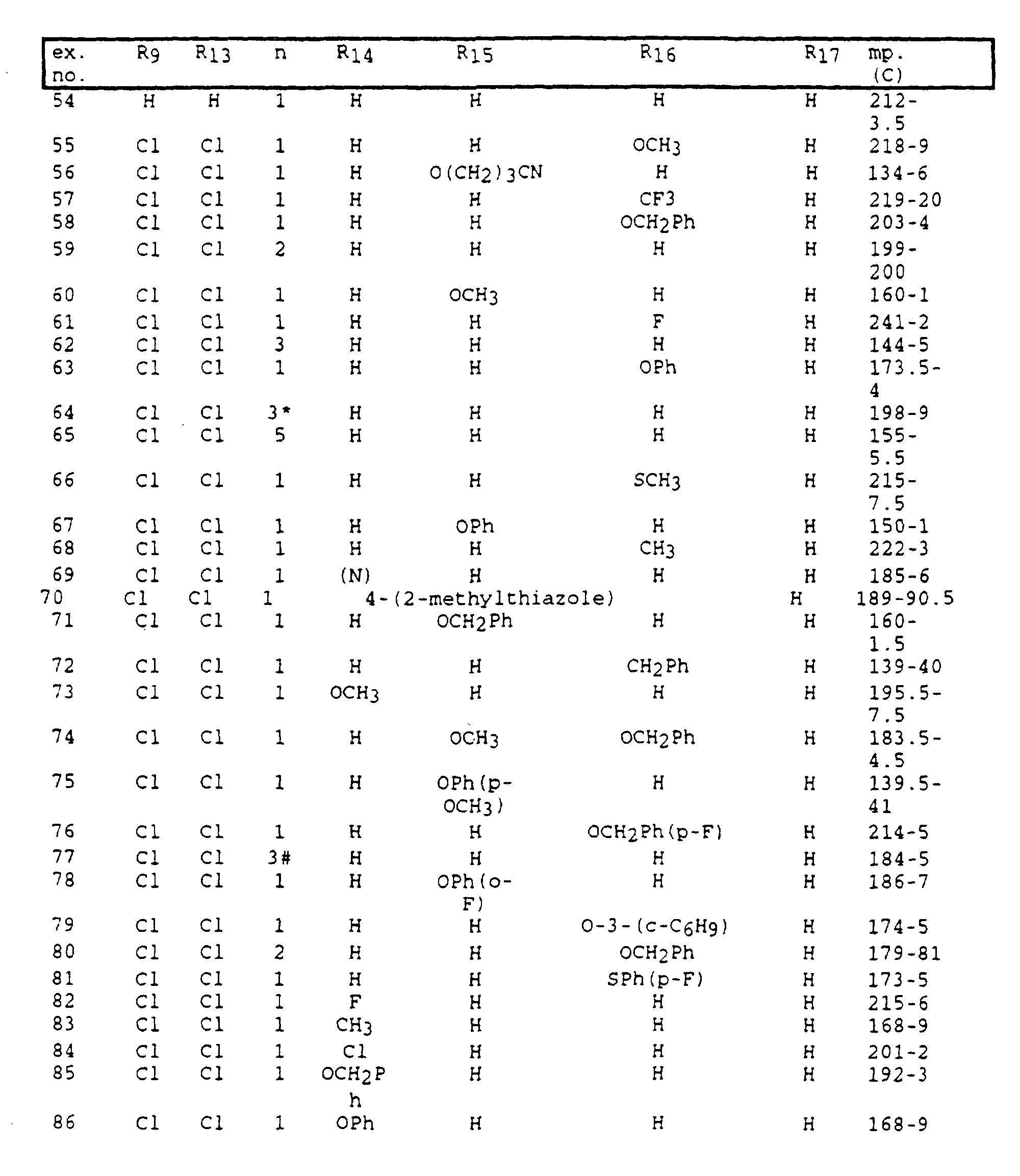
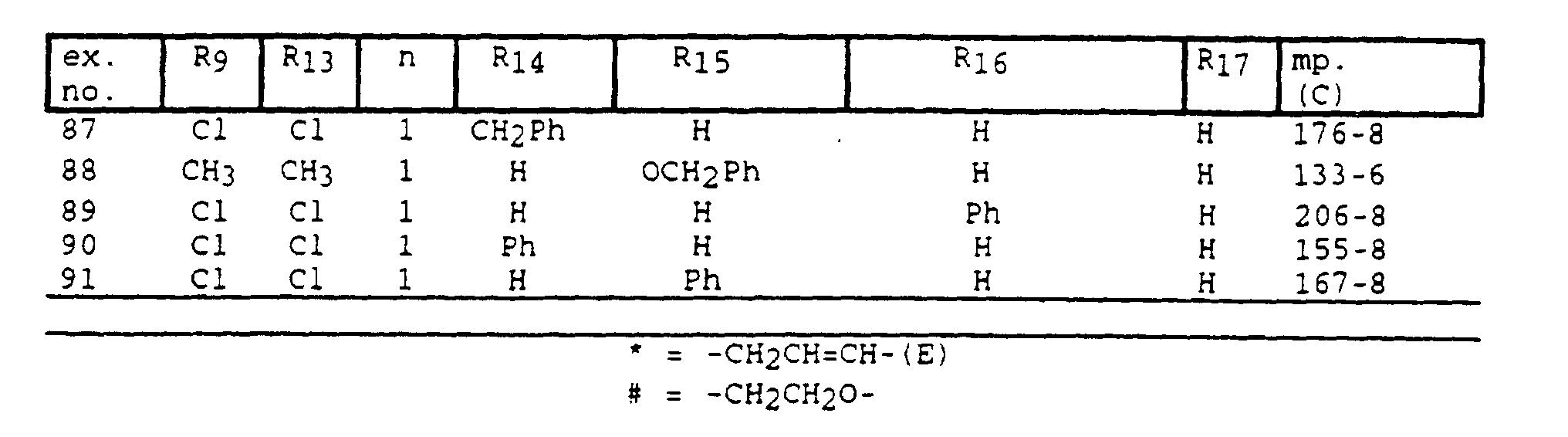
- R10
- is hydrogen except for Example No. 36 where R10 is chlorine.
- R11
- is hydrogen except for Example No. 54 where R11 is chlorine.
- R12
- is hydrogen except for Example Nos. 40 and 41 where R12 is fluorine.
- The pyrazoles described herein are believed to achieve their beneficial therapeutic action principally by direct inhibition of human sPLA2, and not by acting as antagonists for arachidonic acid, nor other active agents below arachidonic acid in the arachidonic acid cascade, such as 5-lipoxygenases, cyclooxygenases, and etc.
- The method of the invention for inhibiting sPLA2 mediated release of fatty acids comprises contacting sPLA2 with an therapeutically effective amount of the compound of Formula (I), its salt or a prodrug derivative thereof.
- The compounds of the invention may be used in a method of treating a mammal (e.g., a human) to alleviate the pathological effects of septic shock, adult respiratory distress syndrome, pancreatitus, trauma, bronchial asthma, allergic rhinitis, and rheumatoid arthritis; wherein the method comprises administering to the mammal a compound of formula (I) in a therapeutically effective amount. A "therapeutically effective" amount is an amount sufficient to inhibit sPLA2 mediated release of fatty acid and to thereby inhibit or prevent the arachidonic acid cascade and its deleterious products. The therapeutic amount of compound of the invention needed to inhibit sPLA2 may be readily determined by taking a sample of body fluid and assaying it for sPLA2 content by conventional methods.
- As previously noted the compounds of this invention are useful for inhibiting sPLA2 mediated release of fatty acids such as arachidonic acid. By the term, "inhibiting" is meant the prevention or therapeutically significant reduction in release of sPLA2 initiated fatty acids by the compounds of the invention. By "pharmaceutically acceptable" it is meant the carrier, diluent or excipient must be compatible with the other ingredients of the formulation and not deleterious to the recipient thereof.
- In general, the compounds of the invention are most desirably administered at a concentration that will generally afford effective results without causing any serious side effects and can be administered either as a single unit dose, or if desired, the dosage may be divided into convenient subunits administered at suitable times throughout the day.
- The specific dose of a compound administered according to this invention to obtain therapeutic or prophylactic effects will, of course, be determined by the particular circumstances surrounding the case, including, for example, the route of administration the age, weight and response of the individual patient, the condition being treated and the severity of the patient's symptoms. Typical daily doses will contain a non-toxic dosage level of from about 0.01 mg/kg to about 50 mg/kg of body weight of an active compound of this invention.
- Preferably the pharmaceutical formulation is in unit dosage form. The unit dosage form can be a capsule or tablet itself, or the appropriate number of any of these. The quantity of active ingredient in a unit dose of composition may be varied or adjusted from about 0.1 to about 1000 milligrams or more according to the particular treatment involved. It may be appreciated that it may be necessary to make routine variations to the dosage depending on the age and condition of the patient. The dosage will also depend on the route of administration.
- A "chronic" condition means a deteriorating condition of slow progress and long continuance. As such, it is treated when it is diagnosed and continued throughout the course of the disease. An "acute" condition is an exacerbation of short course followed by a period of remission. In an acute event, compound is administered at the onset of symptoms and discontinued when the symptoms disappear.
- Pancreatitis, trauma-induced shock, bronchial asthma, allergic rhinitis and rheumatoid arthritis may occur as an acute event or a chronic event. Thus, the treatment of these conditions contemplates both acute and chronic forms. Septic shock and adult respiratory distress, on the other hand, are acute conditions treated when diagnosed.
- The compound can be administered by a variety of routes including oral, aerosol, rectal, transdermal, subcutaneous, intravenous, intramuscular, and intranasal.
- Pharmaceutical formulations of the invention are prepared by combining (e.g., mixing) a therapeutically effective amount of the pyrazole compounds of the invention together with a pharmaceutically acceptable carrier or diluent therefor. The present pharmaceutical formulations are prepared by known procedures using well known and readily available ingredients.
- In making the compositions of the present invention, the active ingredient will usually be admixed with a carrier, or diluted by a carrier, or enclosed within a carrier which may be in the form of a capsule, sachet, paper or other container. When the carrier serves as a diluent, it may be a solid, semi-solid or liquid material which acts as a vehicle, or can be in the form of tablets, pills, powders, lozenges, elixirs, suspensions, emulsions, solutions, syrups, aerosols (as a solid or in a liquid medium), or ointment, containing, for example, up to 10% by weight of the active compound. The compounds of the present invention are preferably formulated prior to administration.
- For the pharmaceutical formulations any suitable carrier known in the art can be used. In such a formulation, the carrier may be a solid, liquid, or mixture of a solid and a liquid. Solid form formulations include powders, tablets and capsules. A solid carrier can be one or more substances which may also act as flavoring agents, lubricants, solubilisers, suspending agents, binders, tablet disintegrating agents and encapsulating material.
- Tablets for oral administration may contain suitable excipients such as calcium carbonate, sodium carbonate, lactose, calcium phosphate, together with disintegrating agents, such as maize, starch, or alginic acid, and/or binding agents, for example, gelatin or acacia, and lubricating agents such as magnesium stearate, stearic acid, or talc.
- In powders the carrier is a finely divided solid which is in admixture with the finely divided active ingredient. In tablets the active ingredient is mixed with a carrier having the necessary binding properties in suitable proportions and compacted in the shape and size desired. The powders and tablets preferably contain from about 1 to about 99 weight percent of the active ingredient which is the novel compound of this invention. Suitable solid carriers are magnesium carbonate, magnesium stearate, talc, sugar lactose, pectin, dextrin, starch, gelatin, tragacanth, methyl cellulose, sodium carboxymethyl cellulose, low melting waxes, and cocoa butter.
- Sterile liquid form formulations include suspensions, emulsions, syrups and elixirs.
- The active ingredient can be dissolved or suspended in a pharmaceutically acceptable carrier, such as sterile water, sterile organic solvent or a mixture of both. The active ingredient can often be dissolved in a suitable organic solvent, for instance aqueous propylene glycol. Other compositions can be made by dispersing the finely divided active ingredient in aqueous starch or sodium carboxymethyl cellulose solution or in a suitable oil.
- The following pharmaceutical formulations 1 through 8 are illustrative only and are not intended to limit the scope of the invention in any way. "Active ingredient", refers to a compound according to Formula (I) or a pharmaceutically acceptable salt, solvate, or prodrug thereof.
- Hard gelatin capsules are prepared using the following ingredients:
Quantity (mg/capsule) 3-(naphthylsulfonylamino)-4-(4-propoxypyridin-2-yl)-5-(5-((2-methyl-5-cyanophenyl)pent-1-yl)thio-(1H)-pyrazole 250 Starch, dried 200 Magnesium stearate 10 Total 460 mg - A tablet is prepared using the ingredients below:
Quantity (mg/tablet) 3-(3-nitro-5-ethyl)phenylsulfonylamino-4-(phenyl)-5-((3-cyanoprop-1-yloxy)benzyl)thio-(1H)-pyrazole 250 Cellulose, microcrystalline 400 Silicon dioxide, fumed 10 Stearic acid 5 Total 665 mg - An aerosol solution is prepared containing the following components:
Weight 3-(2-methylphenyl)sulfonylamino-4-(isoquinolin-3-yl)-5-(4-ethyoxybenzyl)thio-(2H)-pyrazole 0.25 Ethanol 25.75 Propellant 22 (Chlorodifluoromethane) 74.00 Total 100.00 - The active compound is mixed with ethanol and the mixture added to a portion of the propellant 22, cooled to -30°C and transferred to a filling device. The required amount is then fed to a stainless steel container and diluted with the remainder of the propellant. The valve units are then fitted to the container.
- Tablets, each containing 60 mg of active ingredient, are made as follows:
3-(5-bromo)phenylsulfonylamino-4-(4-ethoxypyridin-2-yl)-5-(5-phenylhepten-1-yl)thio-(1H)-pyrazole 60 mg Starch 45 mg Microcrystalline cellulose 35 mg Polyvinylpyrrolidone (as 10% solution in water) 4 mg Sodium carboxymethyl starch 4.5 mg Magnesium stearate 0.5 mg Talc 1 mg Total 150 mg - The active ingredient, starch and cellulose are passed through a No. 45 mesh U.S. sieve and mixed thoroughly. The aqueous solution containing polyvinylpyrrolidone is mixed with the resultant powder, and the mixture then is passed through a No. 14 mesh U.S. sieve. The granules so produced are dried at 50°C and passed through a No. 18 mesh U.S. sieve. The sodium carboxymethyl starch, magnesium stearate and talc, previously passed through a No. 60 mesh U.S. sieve, are then added to the granules which, after mixing, are compressed on a tablet machine to yield tablets each weighing 150 mg.
- Capsules, each containing 80 mg of active ingredient, are made as follows:
3-(3-methoxycarbonylphenyl)sulfonylamino-4-(4-ethylcarboxamidopyridin-2-yl)-5-(2-fluorophenylthiobenzyl)thio-(2H)-pyrazole 80 mg Starch 59 mg Microcrystalline cellulose 59 mg Magnesium stearate 2 mg Total 200 mg - The active ingredient, cellulose, starch, and magnesium stearate are blended, passed through a No. 45 mesh U.S. sieve, and filled into hard gelatin capsules in 200 mg quantities.
- Suppositories, each containing 225 mg of active ingredient, are made as follows:
3-(5-chlorophenyl)sulfonylamino-4-(4-ethylcarboxamidopyridin-2-yl)-5-(3-carboxyethyoxybenzyl)thio-(2H)-pyrazole 225 mg Saturated fatty acid glycerides 2,000 mg Total 2,225 mg - The active ingredient is passed through a No. 60 mesh U.S. sieve and suspended in the saturated fatty acid glycerides previously melted using the minimum heat necessary. The mixture is then poured into a suppository mold of nominal 2 g capacity and allowed to cool.
- Suspensions, each containing 50 mg of active ingredient per 5 ml dose, are made as follows:
3-(5-bromophenyl)sulfonylamino-4-(4-methoxypyridin-2-yl)-5-(2-(3-cyanoprop-1-yloxy)benzyl)thio-(1H)-pyrazole 50 mg Sodium carboxymethyl cellulose 50 mg Syrup 1.25 ml Benzoic acid solution 0.10 ml Flavor q.v. Color q.v. Purified water to total 5 ml - The active ingredient is passed through a No. 45 mesh U.S. sieve and mixed with the sodium carboxymethyl cellulose and syrup to form a smooth paste. The benzoic acid solution, flavor and color are diluted with a portion of the water and added, with stirring. Sufficient water is then added to produce the required volume.
- An intravenous formulation may be prepared as follows:
3-(4-chlorophenyl)sulfonylamino-4-(4-ethylpyridin-2-yl)-5-(2-cyano-5-ethylthiobenzyl)thio-(1H)-pyrazole 100 mg Isotonic saline 1,000 ml - The following chromogenic assay procedure was used to identify and evaluate inhibitors of recombinant human secreted phospholipase A2. The assay described herein has been adapted for high volume screening using 96 well microtiter plates. A general description of this assay method is found in the article, "Analysis of Human Synovial Fluid Phospholipase A2 on Short Chain Phosphatidylcholine-Mixed Micelles: Development of a Spectrophotometric Assay Suitable for a Microtiterplate Reader", by Laure J. Reynolds, Lori L. Hughes, and Edward A Dennis, Analytical Biochemistry, 204, pp. 190-197, 1992 (the disclosure of which is incorporated herein by reference):
Reagents: - REACTION BUFFER -
- CaCl2.2H2O (1.47 g/L)
- KCl (7.455 g/L)
- Bovine Serum Albumin (fatty acid free) (1 g/L)
(Sigma A-7030, product of Sigma Chemical Co. St. Louis MO, USA) - TRIS HCl (3.94 g/L)
- pH 7.5 (adjust with NaOH)
- ENZYME BUFFER -
- 0.05 NaOAc.3H2O, pH 4.5
- 0.2 NaCl
- Adjust pH to 4.5 with acetic acid
- DTNB - 5,5'-dithiobis-2-nitrobenzoic acid
- RACEMIC DIHEPTANOYL THIO - PC
- racemic 1, 2-bis (heptanoylthio)-1,2-dideoxy-sn-glycero-3-phosphorylcholine
- TRITON X-100™ prepare at 6.249 mg/ml in reaction buffer to equal 10uM.
- TRITON X-100™ is a polyoxy ethylene non-ionic
detergent supplied by
Pierce Chemical Company,
3747 N. Meridian Road, Rockford, Illinois 61101. - REACTION MIXTURE - A measured volume of racemic dipheptanoyl thio PC supplied in chloroform at a concentration of 100 mg/ml is taken to dryness and redissolved in 10 millimolar TRITON X-100™ nonionic detergent aqueous solution. Reaction Buffer is added to the solution, then DTNB to give the Reaction Mixture.The reaction mixture thus obtained contains 1mM diheptanoly thio-PC substrate, 0.29 mm Triton X-100™ detergent, and 0.12 mm DTMB in a buffered aqueous solution at pH 7.5.
-
-
- 1. Add 0.2 ml reaction mixture to all wells;
- 2. Add 10 ul test compound (or solvent blank) to appropriate wells, mix 20 seconds;
- 3. Add 50 nanograms of sPLA2 (10 microliters) to appropriate wells;
- 4. Incubate plate at 40°C for 30 minutes;
- 5. Read absorbance of wells at 405 nanometers with an automatic plate reader.
-
- All compounds were tested in triplicate. Typically, compounds were tested at a final concentration of 5 ug/ml. Compounds were considered active when they exhibited 40% inhibition or greater compared to uninhibited control reactions when measured at 405 nanometers. Lack of color development at 405 nanometers evidenced inhibition. Compounds initially found to be active were reassayed to confirm their activity and, if sufficiently active, IC50 values were determined. Typically, the IC50 values were determined by diluting test compound serially two-fold such that the final concentration in the reaction ranged from 45 ug/mL to 0.35 ug/ml. More potent inhibitors required significantly greater dilution. In all cases, % inhibition measured at 405 nanometers generated by enzyme reactions containing inhibitors relative to the uninhibited control reactions was determined. Each sample was titrated in triplicate and result values were averaged for plotting and calculation of IC50 values. IC50 were determined by plotting log concentration versus inhibition values in the range from 10-90% inhibition.
- Compounds of the instant invention were tested in Assay Example 1 and were found to be effective at concentrations of less than 100µM.
- Male Hartley strain guinea pigs (500-700g) were killed by cervical dislocation and their heart and lungs removed intact and placed in aerated (95% O2:5% CO2) Krebs buffer. Dorsal pleural strips (4x1x25mm) were dissected from intact parenchymal segments (8x4x25mm) cut parallel to the outer edge of the lower lung lobes. Two adjacent pleural strips, obtained from a single lobe and representing a single tissue sample, were tied at either end and independently attached to a metal support rod. One rod was attached to a Grass force-displacement transducer Model FTO3C, product of Grass Medical Instruments Co., Quincy, MA, USA). Changes in isometric tension were displayed on a monitor and thermal recorder (product of Modular Instruments, Malvern, PA). All tissues were placed in 10 ml jacketed tissue baths maintained at 37°C. The tissue baths were continuously aerated and contained a modified Krebs solution of the following composition (millimolar) NaCl, 118.2; KCl, 4.6; CaCl2·2H2O, 2.5; MgSO4·7H2O, 1.2; NaHCO3, 24.8; KH2PO4, 1.0; and dextrose, 10.0. Pleural strips from the opposite lobes of the lung were used for paired experiments. Preliminary data generated from tension/response curves demonstrated that resting tension of 800mg was optimal. The tissues were allowed to equilibrate for 45 min. as the bath fluid was changed periodically.
- Initially tissues were challenged 3 times with KCl (40 mM) to test tissue viability and to obtain a consistent response. After recording the maximal response to KCl, the tissues were washed and allowed to return to baseline before the next challenge. Cumulative concentration-response curves were obtained from pleural strips by increasing the agonist concentration (sPLA2) in the tissue bath by half-log10 increments while the previous concentration remained in contact with the tissues (Ref.1, supra.). Agonist concentration was increased after reaching the plateau of the contraction elicited by the preceding concentration. One concentration-response curve was obtained from each tissue. To minimize variability between tissues obtained from different animals, contractile responses were expressed as a percentage of the maximal response obtained with the final KCl challenge. When studying the effects of various drugs on the contractile effects of sPLA2, the compounds and their respective vehicles were added to the tissues 30 minutes prior to starting the sPLA2 concentration-response curves.
- Data from different experiments were pooled and presented as a percentage of the maximal KCl responses (mean ± S.E.). To estimate the drug induced rightward shifts in the concentration response curves, the curves were analyzed simultaneously using statistical nonlinear modeling methods similar to those described by Waud (1976), Equation 26, p. 163, (Ref.2). The model includes four parameters: the maximum tissue response which was assumed the same for each curve, the ED50 for the control curve, the steepness of the curves, and the pA2, the concentration of antagonist that requires a two-fold increase in agonist to achieve an equivalent response. The Schild slope was determined to be 1, using statistical nonlinear modeling methods similar to those described by Waud (1976), Equation 27, p. 164 (Ref. 2). The Schild slope equal to 1 indicates the model is consistent with the assumptions of a competitive antagonist; therefore, the pA2 may be interpreted as the apparent KB, the dissociation constant of the inhibitor.
- To estimate the drug-induced suppression of the maximal responses, sPLA2 responses (10 ug/ml) were determined in the absence and presence of drug, and percent suppression was calculated for each pair of tissues.
- Ref. 1 - van, J.M.: Cumulative dose-response curves. II. Technique for the making of dose-response curves in isolated organs and the evaluation of drug parameters. Arch. Int. Pharmacodyn. Ther., 143: 299-330, 1963.
- Ref. 2 - Waud, D.: Analysis of dose-response relationships. in Advances in General and Cellular Pharmacology eds Narahashi, Bianchi 1:145-178, 1976.
- Compounds of the instant invention were tested in Assay Example 2 and were found to be effective at concentrations below 20µM.
- While the present invention has been illustrated above by certain specific embodiments, it is not intended that these specific examples should limit the scope of the invention as described in the appended claims.
| Elemental analysis: | |||||
| Calc. | C 53.91% | H 3.18% | N 9.31% | S 10.66% | Cl 11.79% |
| Found | C 54.19% | H 3.20% | N 9.37% | S 9.80% | Cl 11.79% |


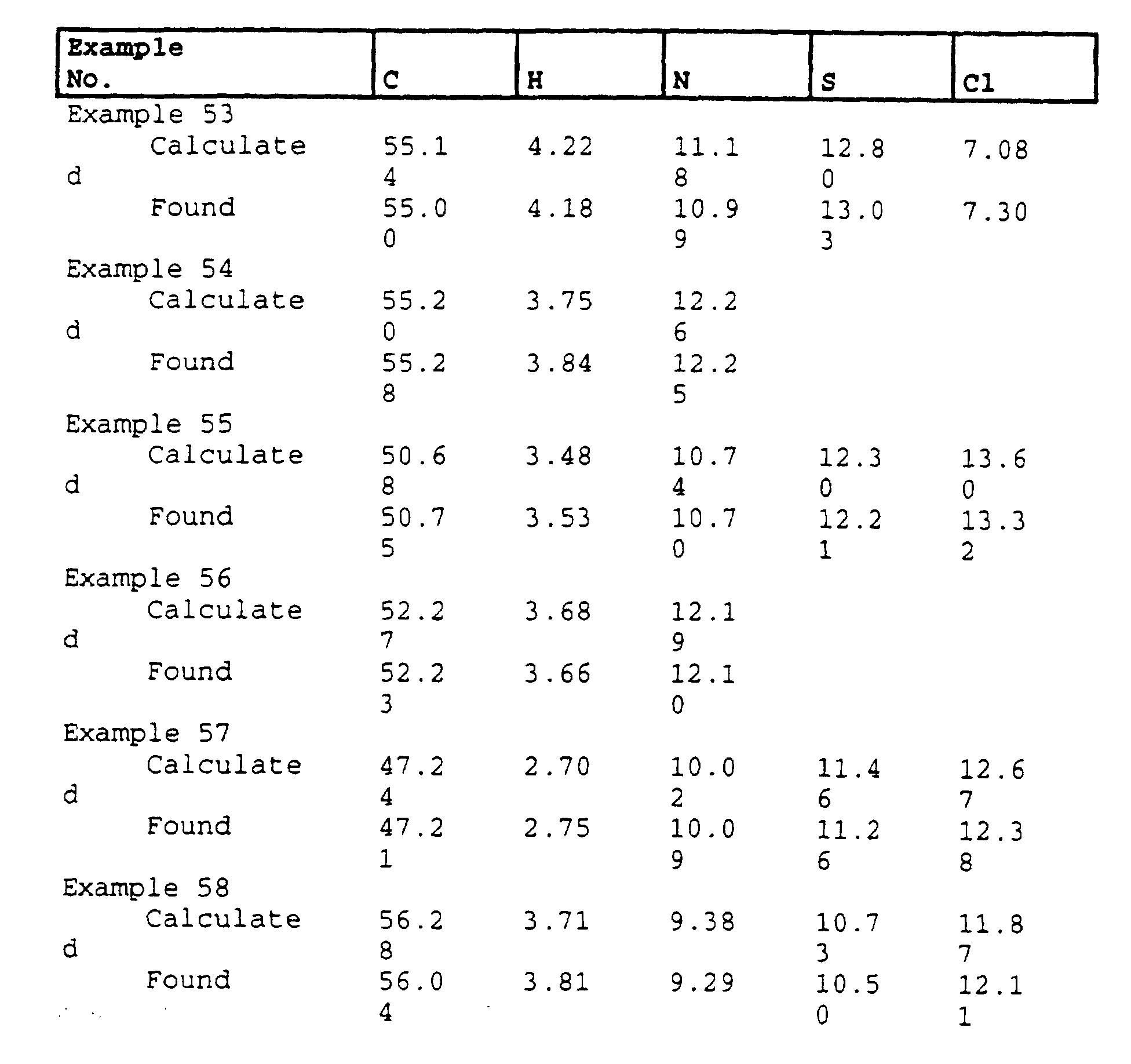

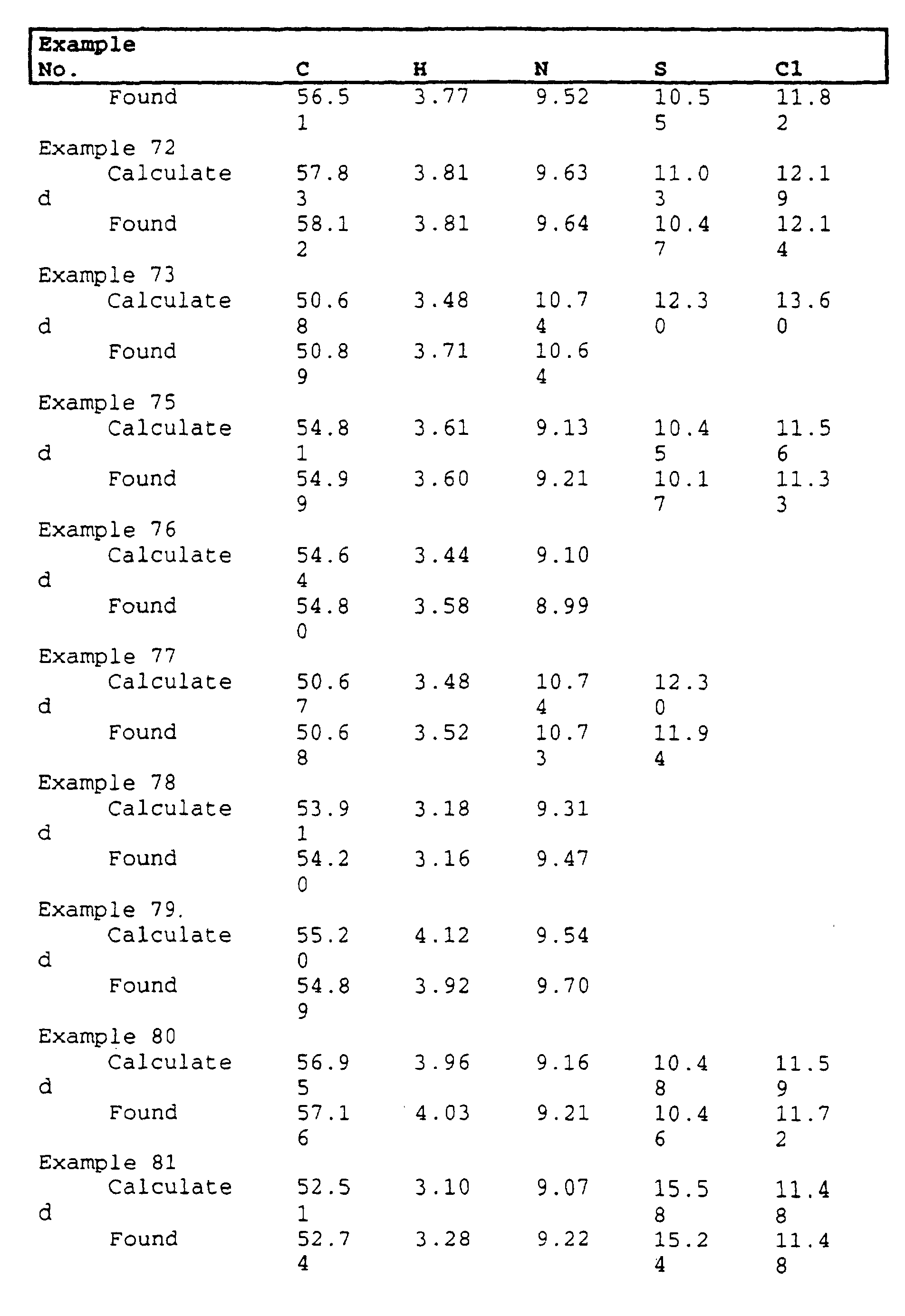
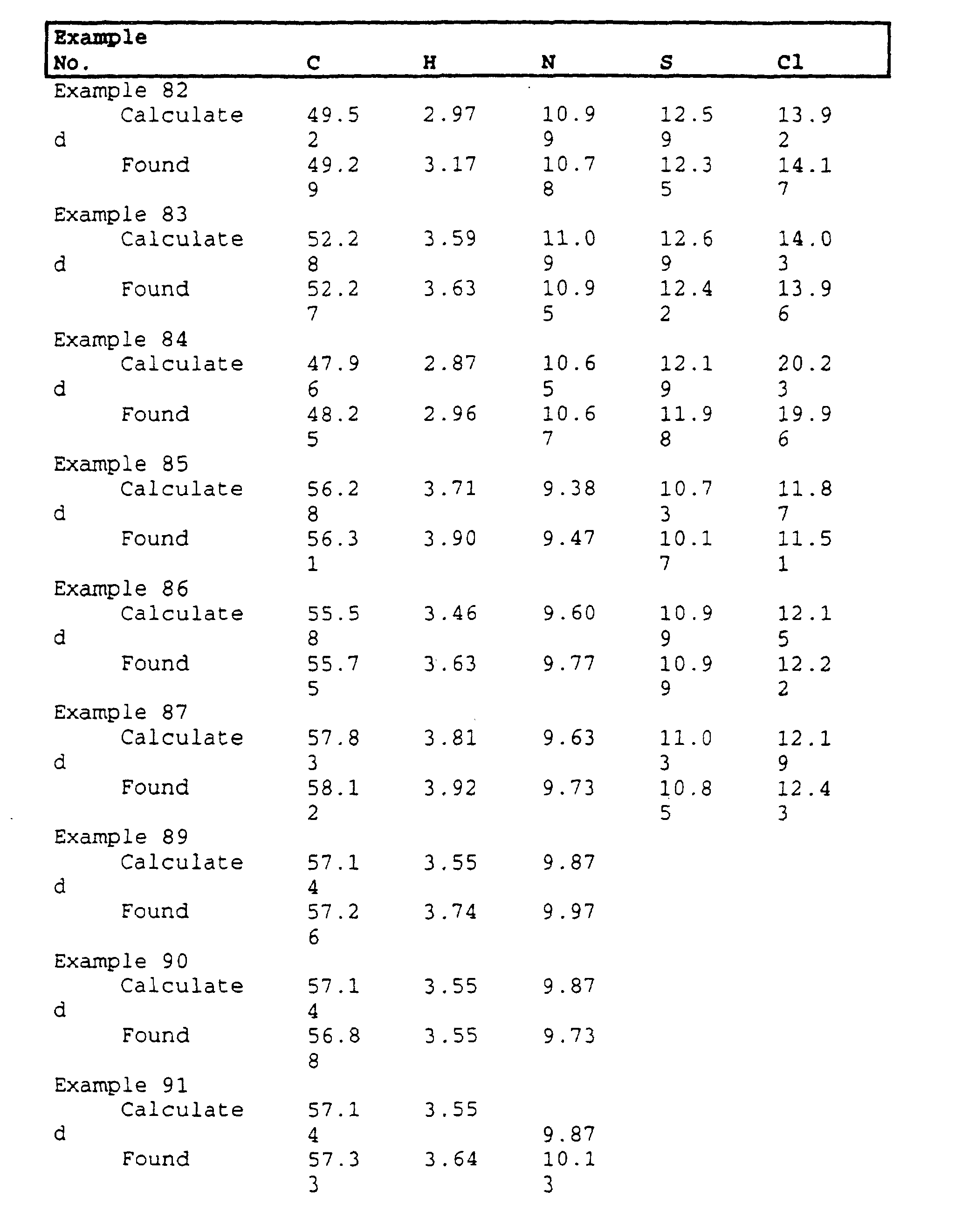
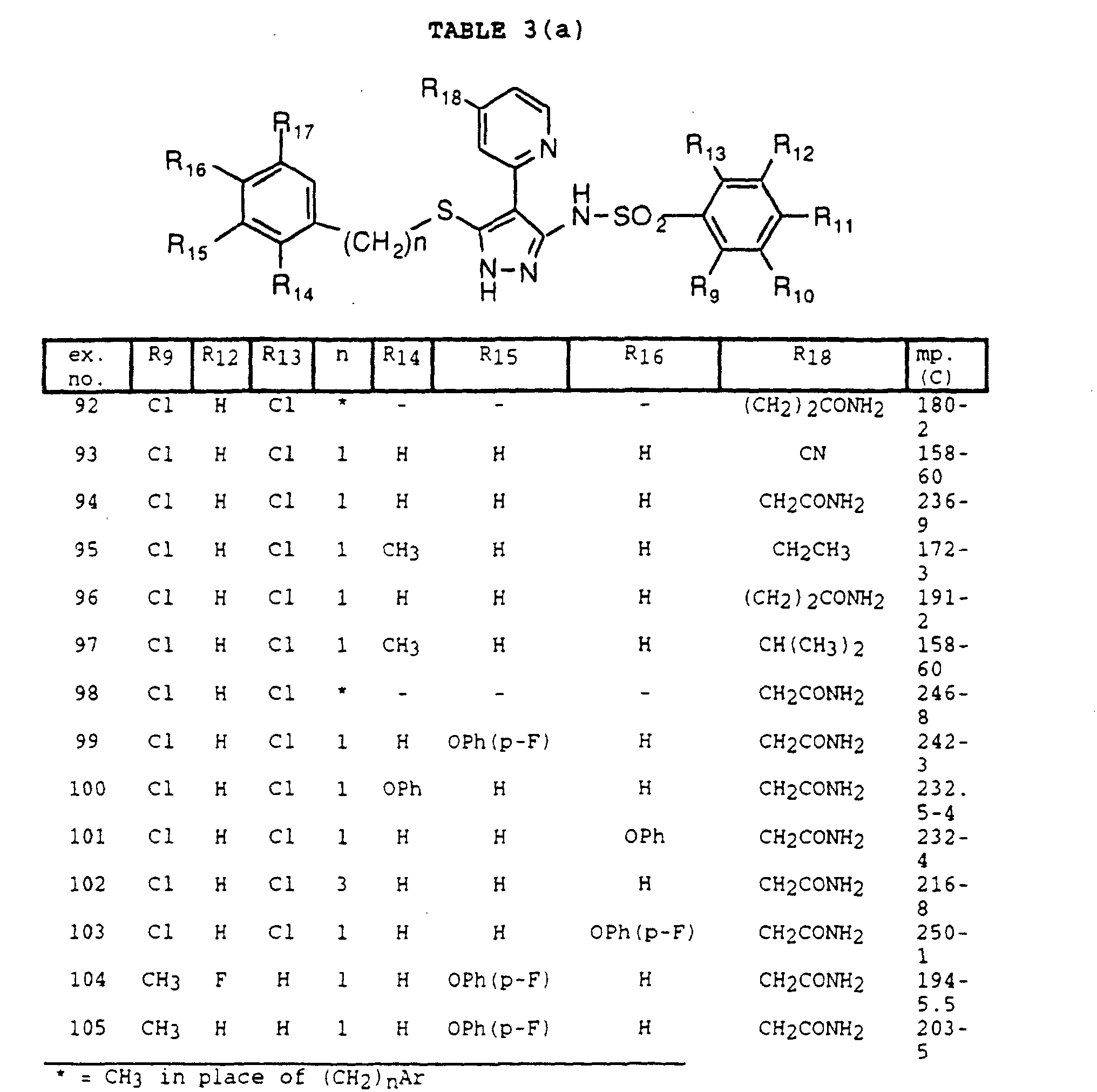
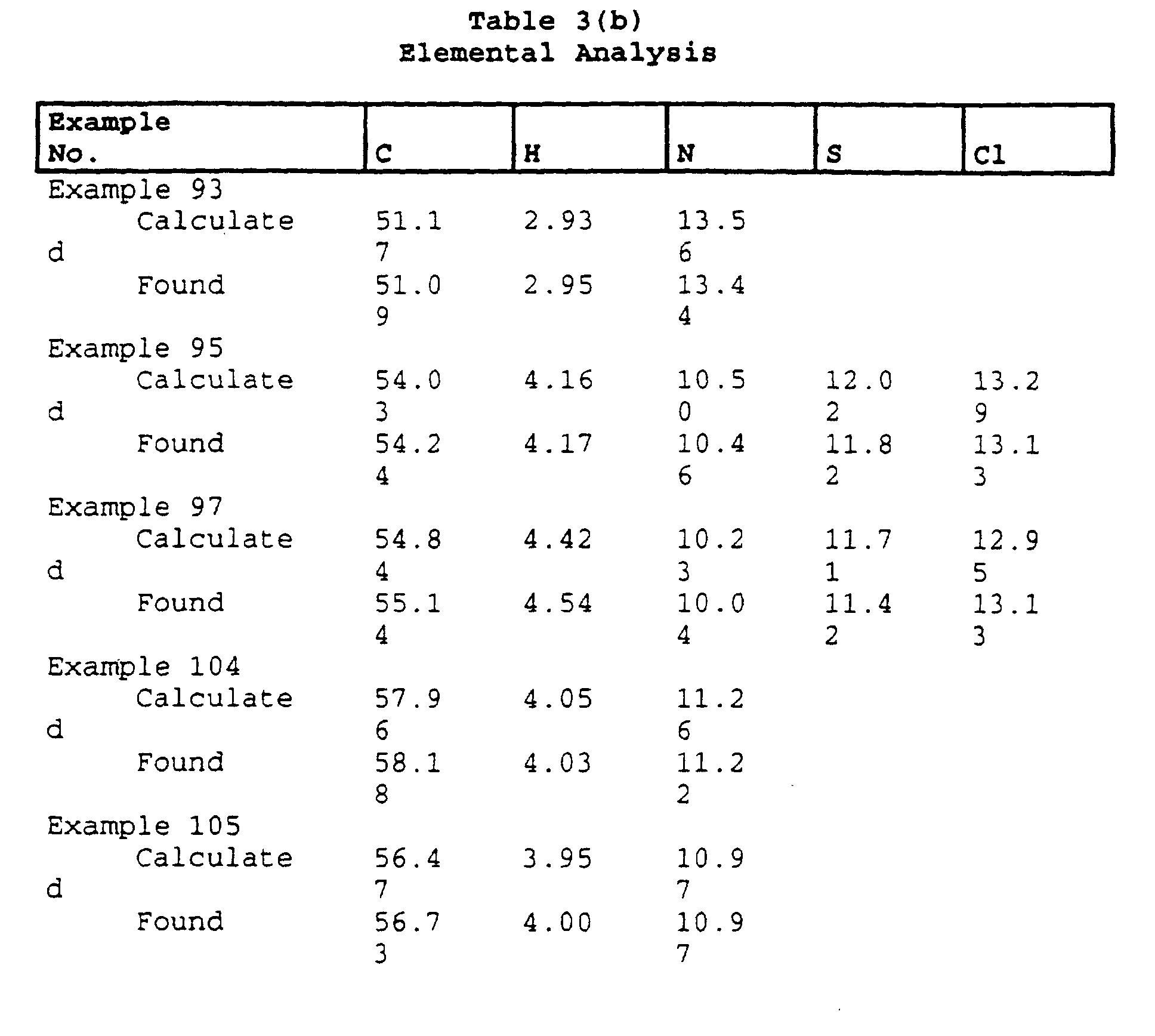

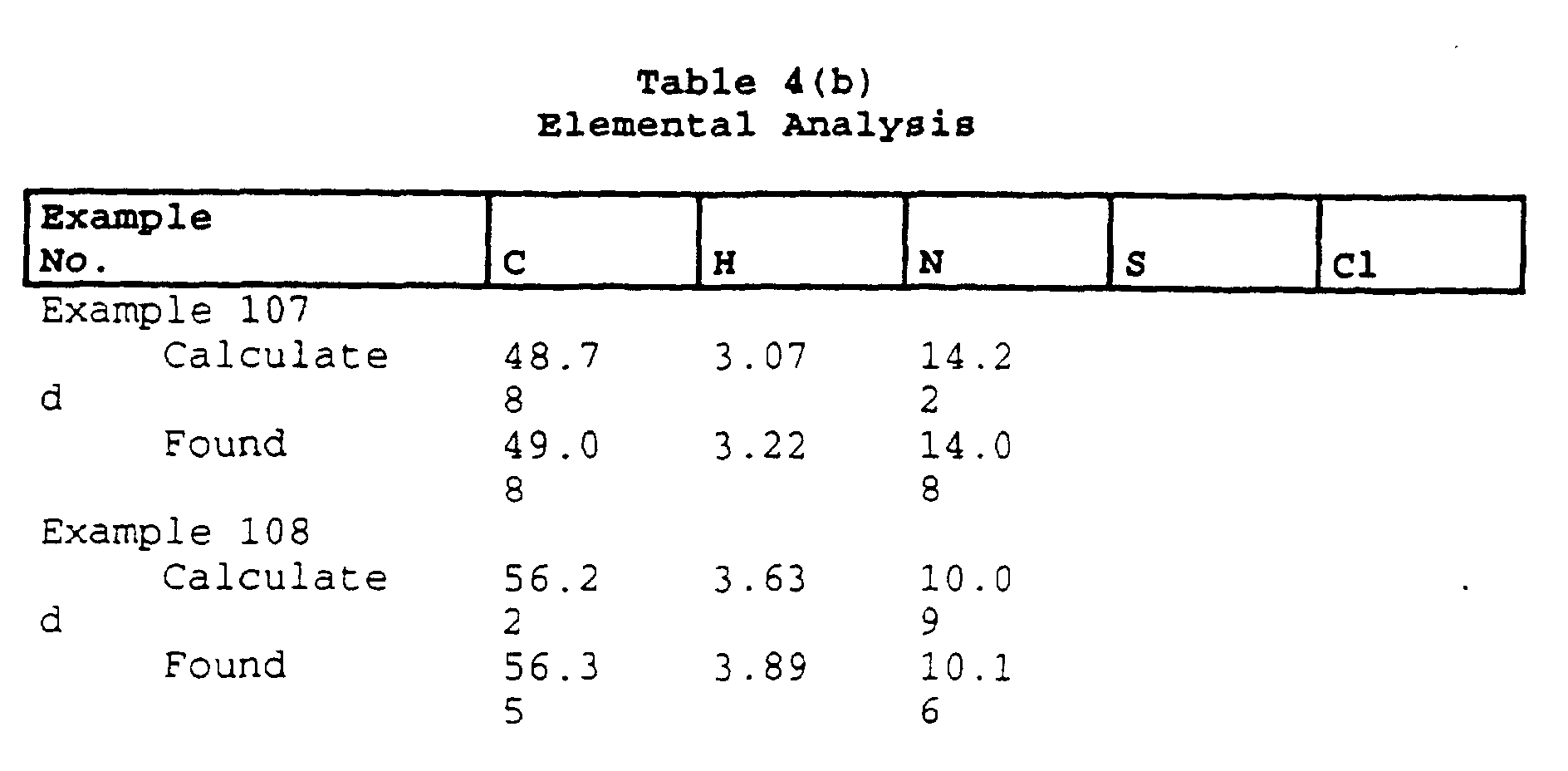


Claims (13)
- A compound of the formula (I)wherein:

- R1
- is phenyl, isoquinolin-3-yl, pyrazinyl, pyridin-2-yl, pyridin-2-yl substituted at the 4-position with -(C1-C4)alkyl, (C1-C4)alkoxyl,-CN or -(CH2)nCONH2 where n is 0-2;
- R2
- is phenyl; phenyl substituted with 1 to 3 substituents selected from the group consisting of -(C1-C4)alkyl, -CN, halo, -NO2, CO2(C1-C4)alkyl and -CF3; naphthyl; thiophene or thiophene substituted with 1 to 3 halo groups;
- R3
- is hydrogen; phenyl; phenyl(C2-C6)alkenyl;
pyridyl; naphthyl; quinolinyl;
(C1-C4) alkylthiazolyl;
phenyl substituted with 1 to 2 substituents selected from the group consisting of-(C1-C4)alkyl, -CN, -CONH2, -NO2, -CF3, halo, (C1-C4)alkoxy, CO2(C1-C4)alkyl, phenoxy and SR4 where R4 is -(C1-C4)alkyl or halophenyl; phenyl substituted with one substituent selected from the group consisting of- -O(CH2)pR5 where p is 1 to 3 and R5 is-CN, -CO2H, -CONH2, or tetrazolyl,
- phenyl and
- -OR6 where R6 is cyclopentyl, cyclohexenyl, or phenyl substituted with halo or (C1-C4)alkoxy;
- or phenyl substituted with two substituents which, when taken together with the phenyl ring to which they are attached form a methylenedioxy ring; and
- m
- is 1 to 5;
- A compound of Claim 1 wherein:R1 is pyridine-2-yl or pyridine-2-yl substituted at the 4-position with -(C1-C4)alkyl, (C1-C4)alkoxy, -CN or -(CH2)nCONH2 where n is 0-2;R2 is phenyl substituted with 1 to 3 substituents selected from the group consisting of -(C1-C4)alkyl, -CN, halo, -NO2, CO2(C1-C4)alkyl and -CF3; andR3 is phenyl; phenyl(C2-C6)alkenyl; phenyl substituted with 1 or 2 substituents selected from the group consisting of -(C1-C4)alkyl, -CN, -CONH2, -NO2, -CF3, halo, (C1-C4)alkoxy, CO2(C1-C4)alkyl, phenoxy and SR4 where R4 is -(C1-C4) alkyl or halo phenyl;phenyl substituted with one substituent selected from the group consisting of -O(CH2)pR5 where p is 1 to 3 and R5 is -CN, -CO2H, -CONH2 or tetrazolyl, phenyl and -OR6 where R6 is cyclopentyl, cyclohexenyl or phenyl substituted with halo or (C1-C4)alkoxy;or phenyl substituted with two substituents which when taken together with the phenyl ring to which they are attached form a methylenedioxy ring.
- A compound of Claim 2 wherein:R1 is pyridin-2-yl substituted at the 4-position with (CH2)nCONH2 where n is 1; andR2 is phenyl substituted with one or two substituents selected from the group consisting of -(C1-C4)alkyl or halo.
- A compound of Claim 1 selected from the group consisting of 3-(2-chloro-6-methylphenylsulfonylamino)-4-(2-(4-acetamido)pyridyl)-5-(3-(4-fluorophenoxy)benzylthio)-(lH)-pyrazole and 3-(2,6-dichlorophenylsulfonylamino)-4-(2-(4-acetamido)pyridyl)-5-(3-(4-fluorophenoxy)benzylthio)-(1H) -pyrazole.
- A pharmaceutical formulation comprising as an active ingredient a compound as claimed in any one of Claims 1-4 together with a pharmaceutically acceptable carrier or diluent therefor.
- A compound according to any of Claims 1 to 4, or a pharmaceutically acceptable salt thereof, for use as a pharmaceutical.
- The use of a compound according to any of Claims 1 to 4, or a pharmaceutically acceptable salt thereof, for the manufacture of a medicament for selectively inhibiting sPLA2.
- The use according to Claim 7, for the manufacture of a medicament for alleviating the pathological effects of septic shock, adult respiratory distress syndrome, pancreatitis, trauma-induced shock, bronchial asthma, allergic rhinitis, and rheumatoid arthritis.
- The use according to Claim 7, for the manufacture of a medicament for alleviating the pathological effects of cystic fibrosis, stroke, acute bronchitis, chronic bronchitis, acute bronchiolitis, chronic brochiolitis, osteoarthritis, gout, spondylarthropathris, ankylosing spondylitis, Reiter's syndrome, psoriatic arthropathy, enterapathric spondylitis, Juvenile arthropathy or juvenile ankylosing spondylitis, Reactive arthropathy, infectious or post-infectious arthritis, gonoccocal arthritis, Tuberculous arthritis, viral arthritis, fungal arthritis, syphilitic arthritis, Lyme disease, arthritis associated with "vasculitic syndromes", polyarteritis nodosa, hypersensitivity vasculitis, Luegenec's granulomatosis, polymyalgin rheumatica, joint cell arteritis, calcium crystal deposition arthropathris, pseudo gout, non-articular rheumatism, bursitis, tenosynomitis, epicondylitis (tennis elbow), carpal tunnel syndrome, repetitive use injury (typing), miscellaneous forms of arthritis, neuropathic joint disease (charco and joint), hemarthrosis (hemarthrosic), Henoch-Schonlein Purpura, hypertrophic osteoparthropathy, multicentric reticulohistiocytosis, arthritis associated with certain diseases, surcoilosis, hemochromatosis, sickle cell disease and other hemoglobinopathries, hyperlipoproteineimia, hypogammaglobulinemia, hyperparathyroidism, acromegaly, familial Mediterranean fever, Behat's Disease, systemic lupus erythrematosis, or relapsing polychondritis.
- A process for preparing a compound of formula Iwhich comprises reacting a compound of formula III
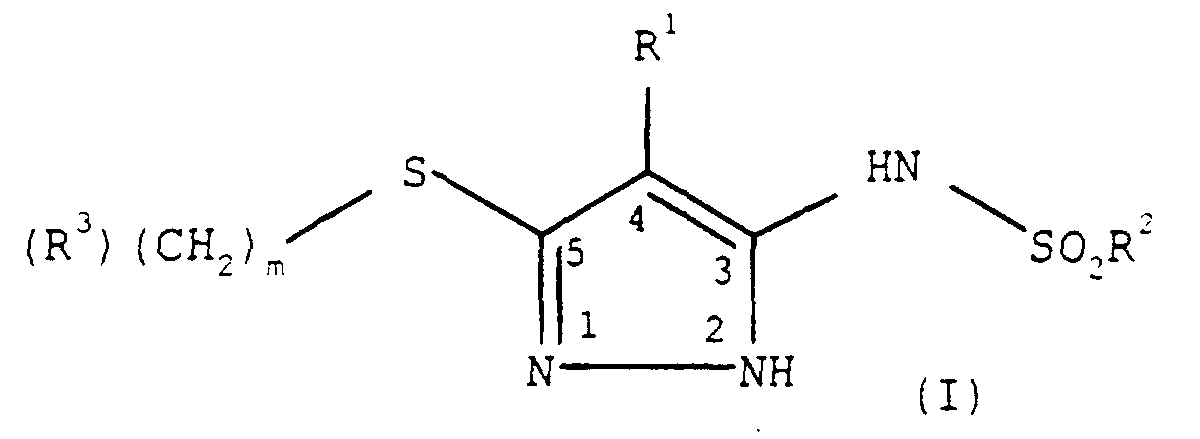 where R3, R1 and m are as defined in Claim 1 with a compound of formula
- A process of claim 10 whereinR1 is pyridine-2-yl or pyridine-2-yl substituted at the 4-position with -(C1-C4)alkyl, (C1-C4)alkoxy, -CN or -(CH2)nCONH2 where n is 0-2;R2 is phenyl substituted with 1 to 3 substituents selected from the group consisting of -(C1-C4)alkyl, -CN, halo, -NO2, CO2(C1-C4)alkyl and -CF3; andR3 is phenyl; phenyl(C2-C6)alkenyl; phenyl substituted with 1 or 2 substituents selected from the group consisting of -(C1-C4)alkyl, -CN, -CONH2, -NO2, -CF3, halo, (C1-C4)alkoxy, CO2 (C1-C4)alkyl, phenoxy and SR4 where R4 is -(C1-C4)alkyl or halo phenyl;phenyl substituted with one substituent selected from the group consisting of -O(CH2)pR5 where p is 1 to 3 and R5 is -CN, -CO2H, -CONH2 or tetrazolyl, phenyl and -OR6 where R6 is cyclopentyl, cyclohexenyl or phenyl substituted with halo or (C1-C4)alkoxy;or phenyl substituted with two substituents which when taken together with the phenyl ring to which they are attached form a methylenedioxy ring.
- A process of claim 10 whereinR1 is pyridin-2-yl substituted at the 4-position with (CH2)nCONH2 where n is 1; andR2 is phenyl substituted with one or two substituents selected from the group consisting of -(C1-C4)alkyl or halo.
- A process of claim 10 for preparing a compound selected from the group consisting of 3-(2-chloro-6-methylphenylsulfonylamino)-4-(2-(4-acetamido)pyridyl)-5-(3-(4-fluorophenoxy)benzylthio)-(1H)-pyrazole and 3-(2, 6-dichlorophenylsulfonylamino)-4-(2-(4-acetamido)pyridyl)-5-(3-(4-fluorophenoxy)benzylthio)-(1H)-pyrazole.
Applications Claiming Priority (2)
| Application Number | Priority Date | Filing Date | Title |
|---|---|---|---|
| US3321696P | 1996-12-04 | 1996-12-04 | |
| US33216P | 1996-12-04 |
Publications (2)
| Publication Number | Publication Date |
|---|---|
| EP0846687A1 EP0846687A1 (en) | 1998-06-10 |
| EP0846687B1 true EP0846687B1 (en) | 2001-08-08 |
Family
ID=21869147
Family Applications (1)
| Application Number | Title | Priority Date | Filing Date |
|---|---|---|---|
| EP97309701A Expired - Lifetime EP0846687B1 (en) | 1996-12-04 | 1997-12-02 | Pyrazoles as human non-pancreatic secretory phospholipase A2 inhibitors |
Country Status (21)
| Country | Link |
|---|---|
| US (1) | US5972972A (en) |
| EP (1) | EP0846687B1 (en) |
| JP (1) | JP2002515053A (en) |
| KR (1) | KR20000057366A (en) |
| AR (1) | AR010743A1 (en) |
| AT (1) | ATE203985T1 (en) |
| AU (1) | AU5365598A (en) |
| BR (1) | BR9713993A (en) |
| CA (1) | CA2274048A1 (en) |
| CO (1) | CO4910169A1 (en) |
| DE (1) | DE69706027T2 (en) |
| DK (1) | DK0846687T3 (en) |
| ES (1) | ES2160897T3 (en) |
| HU (1) | HUP0000292A3 (en) |
| ID (1) | ID18983A (en) |
| IL (1) | IL130202A0 (en) |
| PE (1) | PE20599A1 (en) |
| PT (1) | PT846687E (en) |
| TW (1) | TW432051B (en) |
| WO (1) | WO1998024437A1 (en) |
| ZA (1) | ZA9710878B (en) |
Families Citing this family (29)
| Publication number | Priority date | Publication date | Assignee | Title |
|---|---|---|---|---|
| JP2002502380A (en) | 1997-05-22 | 2002-01-22 | ジー.ディー.サール アンド カンパニー | Pyrazole derivatives as p38 kinase inhibitors |
| US6979686B1 (en) | 2001-12-07 | 2005-12-27 | Pharmacia Corporation | Substituted pyrazoles as p38 kinase inhibitors |
| US6514977B1 (en) | 1997-05-22 | 2003-02-04 | G.D. Searle & Company | Substituted pyrazoles as p38 kinase inhibitors |
| HUP0102981A3 (en) | 1998-03-31 | 2002-10-28 | Shionogi & Co | Pyrrolo[1,2-a]pyrazine derivatives and pharmaceutical compositions thereof |
| KR20010034881A (en) | 1998-05-21 | 2001-04-25 | 시오노 요시히코 | PYRROLO[1,2-b]PYRIDAZINE DERIVATIVES HAVING sPLA2 INHIBITORY EFFECT |
| ATE329619T1 (en) | 1998-10-14 | 2006-07-15 | Shionogi & Co | SPLA2 INHIBITORS FOR THE TREATMENT OF ISCHEMIC REPERFUSION INJURY |
| AU6015600A (en) | 1999-07-19 | 2001-02-05 | Shionogi & Co., Ltd. | Tricyclic compounds having spla2-inhibitory activities |
| US6673781B1 (en) | 1999-08-02 | 2004-01-06 | Shionogi & Co., Ltd. | Tricyclic compounds having sPLA2-inhibitory activities |
| US6787545B1 (en) | 1999-08-23 | 2004-09-07 | Shiongi & Co., Ltd. | Pyrrolotriazine derivatives having spla2-inhibitory activities |
| ES2171116B1 (en) * | 2000-04-14 | 2003-08-01 | Esteve Quimica Sa | PROCEDURE FOR OBTAINING DERIVATIVES OF (((PIRIDIL REPLACED) METAL) UNCLE) BENCIMIDAZOL. |
| WO2002000256A1 (en) | 2000-06-29 | 2002-01-03 | Shionogi & Co., Ltd. | Remedies for cirrhosis |
| JPWO2002000621A1 (en) | 2000-06-29 | 2004-04-22 | 塩野義製薬株式会社 | Compound having X-type sPLA2 inhibitory action |
| TWI314457B (en) | 2001-03-19 | 2009-09-11 | Shionogi & Co | |
| US7076539B2 (en) * | 2001-07-30 | 2006-07-11 | Hewlett-Packard Development Company, L.P. | Network connectivity establishment at user log-in |
| US20040018533A1 (en) * | 2002-06-04 | 2004-01-29 | Adam Gail Isabel Reid | Diagnosing predisposition to fat deposition and therapeutic methods for reducing fat deposition and treatment of associated conditions |
| AUPS282602A0 (en) | 2002-06-07 | 2002-06-27 | Garvan Institute Of Medical Research | Method of inhibiting cell proliferation |
| WO2004002295A2 (en) * | 2002-06-27 | 2004-01-08 | Sequenom, Inc. | Diagnosing predisposition to fat deposition and associated condition |
| AU2003248794B2 (en) * | 2002-06-27 | 2007-10-04 | Harkness Pharmaceuticals, Inc. | Therapeutic methods for reducing fat deposition and treating associated conditions |
| EP2231632A2 (en) * | 2008-01-25 | 2010-09-29 | Syngenta Participations AG | 2-cyanophenyl sulfonamide derivatives useful as pesticides |
| NZ720946A (en) | 2009-04-29 | 2017-09-29 | Amarin Pharmaceuticals Ie Ltd | Pharmaceutical compositions comprising epa and a cardiovascular agent and methods of using the same |
| CN105017134A (en) * | 2015-07-26 | 2015-11-04 | 陈吉美 | Preparation method for 4-pyridineacrylic acid |
| CA3088577A1 (en) | 2018-02-15 | 2019-08-22 | Vertex Pharmaceuticals Incorporated | Macrocycles as modulators of cystic fibrosis transmembrane conductance regulator, pharmaceutical compositions thereof, their use in the treatment of cycstic fibrosis, and process for making them |
| WO2020163689A1 (en) | 2019-02-08 | 2020-08-13 | University Of Pittsburgh - Of The Commonwealth System Of Higher Education | 20-hete formation inhibitors |
| TWI848092B (en) | 2019-04-03 | 2024-07-11 | 美商維泰克斯製藥公司 | Cystic fibrosis transmembrane conductance regulator modulating agents |
| TWI899097B (en) | 2019-08-14 | 2025-10-01 | 美商維泰克斯製藥公司 | Process of making cftr modulators |
| US11873300B2 (en) | 2019-08-14 | 2024-01-16 | Vertex Pharmaceuticals Incorporated | Crystalline forms of CFTR modulators |
| TWI867024B (en) | 2019-08-14 | 2024-12-21 | 美商維泰克斯製藥公司 | Modulators of cystic fibrosis transmembrane conductance regulator |
| EP4225737A1 (en) * | 2020-10-07 | 2023-08-16 | Vertex Pharmaceuticals Incorporated | Modulators of cystic fibrosis transmembrane conductance regulator |
| IL303519A (en) | 2020-12-10 | 2023-08-01 | Vertex Pharma | Methods of treatment for cystic fibrosis |
Family Cites Families (10)
| Publication number | Priority date | Publication date | Assignee | Title |
|---|---|---|---|---|
| DE3616681A1 (en) * | 1986-05-16 | 1987-11-19 | Bayer Ag | 1-ARALKYLPYRAZOLE |
| JPH02229168A (en) * | 1989-03-01 | 1990-09-11 | Takeda Chem Ind Ltd | Pyrazolone derivative |
| JPH02229169A (en) * | 1989-03-01 | 1990-09-11 | Takeda Chem Ind Ltd | Pyrazolone derivative |
| DE69127595T2 (en) * | 1990-07-10 | 1998-01-22 | Ishihara Sangyo Kaisha | Diaminotrifluoromethylpyrimidine derivatives, processes for their preparation and phospholipase A2 inhibitors containing them |
| EP0539034A1 (en) * | 1991-10-22 | 1993-04-28 | Konica Corporation | A novel photographic cyan coupler |
| US5541213A (en) * | 1993-06-24 | 1996-07-30 | Eisai Co., Ltd. | Propenoic acid derivatives diazole propenoic acid compounds which have useful pharmaceutical utility |
| US5466823A (en) * | 1993-11-30 | 1995-11-14 | G.D. Searle & Co. | Substituted pyrazolyl benzenesulfonamides |
| US5500439A (en) * | 1993-12-09 | 1996-03-19 | Alteon Inc. | Aminopyrazoles |
| US5559137A (en) * | 1994-05-16 | 1996-09-24 | Smithkline Beecham Corp. | Compounds |
| US5486534A (en) * | 1994-07-21 | 1996-01-23 | G. D. Searle & Co. | 3,4-substituted pyrazoles for the treatment of inflammation |
-
1997
- 1997-11-27 ID IDP973793A patent/ID18983A/en unknown
- 1997-12-01 IL IL13020297A patent/IL130202A0/en unknown
- 1997-12-01 BR BR9713993-9A patent/BR9713993A/en unknown
- 1997-12-01 JP JP52568198A patent/JP2002515053A/en not_active Withdrawn
- 1997-12-01 AU AU53655/98A patent/AU5365598A/en not_active Abandoned
- 1997-12-01 CA CA002274048A patent/CA2274048A1/en not_active Abandoned
- 1997-12-01 WO PCT/US1997/021795 patent/WO1998024437A1/en not_active Ceased
- 1997-12-01 HU HU0000292A patent/HUP0000292A3/en unknown
- 1997-12-01 KR KR1019990704898A patent/KR20000057366A/en not_active Withdrawn
- 1997-12-01 PE PE1997001083A patent/PE20599A1/en not_active Application Discontinuation
- 1997-12-02 DK DK97309701T patent/DK0846687T3/en active
- 1997-12-02 CO CO97070453A patent/CO4910169A1/en unknown
- 1997-12-02 PT PT97309701T patent/PT846687E/en unknown
- 1997-12-02 AT AT97309701T patent/ATE203985T1/en not_active IP Right Cessation
- 1997-12-02 ES ES97309701T patent/ES2160897T3/en not_active Expired - Lifetime
- 1997-12-02 DE DE69706027T patent/DE69706027T2/en not_active Expired - Fee Related
- 1997-12-02 EP EP97309701A patent/EP0846687B1/en not_active Expired - Lifetime
- 1997-12-03 US US08/984,261 patent/US5972972A/en not_active Expired - Fee Related
- 1997-12-03 AR ARP970105678A patent/AR010743A1/en unknown
- 1997-12-03 ZA ZA9710878A patent/ZA9710878B/en unknown
- 1997-12-05 TW TW086118237A patent/TW432051B/en not_active IP Right Cessation
Also Published As
| Publication number | Publication date |
|---|---|
| JP2002515053A (en) | 2002-05-21 |
| HK1011865A1 (en) | 1999-07-23 |
| CO4910169A1 (en) | 2000-04-24 |
| HUP0000292A3 (en) | 2002-01-28 |
| IL130202A0 (en) | 2000-06-01 |
| TW432051B (en) | 2001-05-01 |
| US5972972A (en) | 1999-10-26 |
| DE69706027T2 (en) | 2002-03-14 |
| ES2160897T3 (en) | 2001-11-16 |
| EP0846687A1 (en) | 1998-06-10 |
| DK0846687T3 (en) | 2001-10-08 |
| ATE203985T1 (en) | 2001-08-15 |
| CA2274048A1 (en) | 1998-06-11 |
| BR9713993A (en) | 2000-02-08 |
| PT846687E (en) | 2001-12-28 |
| ID18983A (en) | 1998-05-28 |
| WO1998024437A1 (en) | 1998-06-11 |
| HUP0000292A2 (en) | 2001-04-28 |
| AR010743A1 (en) | 2000-07-12 |
| AU5365598A (en) | 1998-06-29 |
| DE69706027D1 (en) | 2001-09-13 |
| ZA9710878B (en) | 1999-06-03 |
| PE20599A1 (en) | 1999-03-05 |
| KR20000057366A (en) | 2000-09-15 |
Similar Documents
| Publication | Publication Date | Title |
|---|---|---|
| EP0846687A1 (en) | Pyrazoles as human non-pancreatic secretory phospholipase A2 inhibitors | |
| US5578634A (en) | 1H-indole-3-acetic acid hydrazide sPLA2 inhibitors | |
| EP0674631B1 (en) | Substituted pyrazoles as crf antagonists | |
| EP0511865B1 (en) | Phenyl pyrazolidinones as bronchodilators and anti-inflammatory agents | |
| US5684034A (en) | 1H-indole-3-acetamide sPLA2 inhibitors | |
| DE69030206T2 (en) | Pyrazolopyridine compounds and process for their preparation | |
| EP0983064B1 (en) | PYRROLES AS sPLA2 INHIBITORS | |
| EP0950657B1 (en) | Substituted carbazoles, process for their preparation and their use as sPLA2 inhibitors | |
| US6962922B2 (en) | Alkynylated quinazoline compounds | |
| HK1000104B (en) | Phenyl pyrazolidinones as bronchodilators and anti-inflammatory agents | |
| EP0861243B1 (en) | Heterocyclic compounds as bradykinin antagonists | |
| KR930000167B1 (en) | Method for preparing 1,4-dihydropyridine derivative | |
| WO2003033478A1 (en) | Alkynylated fused ring pyrimidine compounds as matrix metalloprotease-13 inhibitors | |
| EP0552292B1 (en) | Substituted imidazobenzazepines and imidazopyridoazepines | |
| US4857644A (en) | Aryl sulfonopiperazines as anti-inflammatory agents | |
| EP1156050B1 (en) | Substituted tricyclics useful in sPLA2 induced diseases | |
| US5958948A (en) | Substituted pyrazoles as CRF antagonists | |
| JP2002522386A (en) | Indole sPLA2 inhibitor | |
| PL186885B1 (en) | Derivatives of indolydine useful as antagonists of 5-ht-2c receptor | |
| EP1140943B1 (en) | Substituted pyrroloindoles | |
| EP1395554B1 (en) | Substituted carbazoles as inhibitors of spla2 | |
| HK1011865B (en) | Pyrazoles as human non-pancreatic secretory phospholipase a2 inhibitors | |
| AU599251B2 (en) | 1H-pyrazole -1-alkanamides and preparation useful as antiarrhythmic agents | |
| Sato et al. | Synthesis and evaluation of novel fluorinated sulotroban-related sulfonamide derivatives as thromboxane A2 receptor antagonists | |
| JPH0528711B2 (en) |
Legal Events
| Date | Code | Title | Description |
|---|---|---|---|
| PUAI | Public reference made under article 153(3) epc to a published international application that has entered the european phase |
Free format text: ORIGINAL CODE: 0009012 |
|
| 17P | Request for examination filed |
Effective date: 19971209 |
|
| AK | Designated contracting states |
Kind code of ref document: A1 Designated state(s): AT BE CH DE DK ES FI FR GB GR IE IT LI LU NL PT SE |
|
| AX | Request for extension of the european patent |
Free format text: AL PAYMENT 971209;LT PAYMENT 971209;LV PAYMENT 971209;MK PAYMENT 971209;RO PAYMENT 971209;SI PAYMENT 971209 |
|
| AKX | Designation fees paid |
Free format text: AT BE CH DE DK ES FI FR GB GR IE IT LI LU NL PT SE |
|
| AXX | Extension fees paid |
Free format text: AL PAYMENT 971209;LT PAYMENT 971209;LV PAYMENT 971209;MK PAYMENT 971209;RO PAYMENT 971209;SI PAYMENT 971209 |
|
| RBV | Designated contracting states (corrected) |
Designated state(s): AT BE CH DE DK ES FI FR GB GR IE IT LI LU NL PT SE |
|
| 17Q | First examination report despatched |
Effective date: 20000202 |
|
| GRAG | Despatch of communication of intention to grant |
Free format text: ORIGINAL CODE: EPIDOS AGRA |
|
| GRAG | Despatch of communication of intention to grant |
Free format text: ORIGINAL CODE: EPIDOS AGRA |
|
| GRAH | Despatch of communication of intention to grant a patent |
Free format text: ORIGINAL CODE: EPIDOS IGRA |
|
| GRAH | Despatch of communication of intention to grant a patent |
Free format text: ORIGINAL CODE: EPIDOS IGRA |
|
| GRAA | (expected) grant |
Free format text: ORIGINAL CODE: 0009210 |
|
| AK | Designated contracting states |
Kind code of ref document: B1 Designated state(s): AT BE CH DE DK ES FI FR GB GR IE IT LI LU NL PT SE |
|
| AX | Request for extension of the european patent |
Free format text: AL PAYMENT 19971209;LT PAYMENT 19971209;LV PAYMENT 19971209;MK PAYMENT 19971209;RO PAYMENT 19971209;SI PAYMENT 19971209 |
|
| LTIE | Lt: invalidation of european patent or patent extension | ||
| REF | Corresponds to: |
Ref document number: 203985 Country of ref document: AT Date of ref document: 20010815 Kind code of ref document: T |
|
| REG | Reference to a national code |
Ref country code: CH Ref legal event code: EP |
|
| REG | Reference to a national code |
Ref country code: IE Ref legal event code: FG4D |
|
| REF | Corresponds to: |
Ref document number: 69706027 Country of ref document: DE Date of ref document: 20010913 |
|
| PGFP | Annual fee paid to national office [announced via postgrant information from national office to epo] |
Ref country code: SE Payment date: 20010928 Year of fee payment: 5 |
|
| PGFP | Annual fee paid to national office [announced via postgrant information from national office to epo] |
Ref country code: PT Payment date: 20011004 Year of fee payment: 5 |
|
| REG | Reference to a national code |
Ref country code: DK Ref legal event code: T3 |
|
| REG | Reference to a national code |
Ref country code: CH Ref legal event code: NV Representative=s name: E. BLUM & CO. PATENTANWAELTE |
|
| PGFP | Annual fee paid to national office [announced via postgrant information from national office to epo] |
Ref country code: CH Payment date: 20011109 Year of fee payment: 5 |
|
| REG | Reference to a national code |
Ref country code: ES Ref legal event code: FG2A Ref document number: 2160897 Country of ref document: ES Kind code of ref document: T3 |
|
| PGFP | Annual fee paid to national office [announced via postgrant information from national office to epo] |
Ref country code: LU Payment date: 20011119 Year of fee payment: 5 |
|
| PGFP | Annual fee paid to national office [announced via postgrant information from national office to epo] |
Ref country code: FI Payment date: 20011211 Year of fee payment: 5 |
|
| PGFP | Annual fee paid to national office [announced via postgrant information from national office to epo] |
Ref country code: BE Payment date: 20011212 Year of fee payment: 5 |
|
| PGFP | Annual fee paid to national office [announced via postgrant information from national office to epo] |
Ref country code: DK Payment date: 20011217 Year of fee payment: 5 |
|
| PGFP | Annual fee paid to national office [announced via postgrant information from national office to epo] |
Ref country code: GR Payment date: 20011220 Year of fee payment: 5 |
|
| PGFP | Annual fee paid to national office [announced via postgrant information from national office to epo] |
Ref country code: AT Payment date: 20011221 Year of fee payment: 5 |
|
| ET | Fr: translation filed | ||
| PGFP | Annual fee paid to national office [announced via postgrant information from national office to epo] |
Ref country code: NL Payment date: 20011228 Year of fee payment: 5 Ref country code: IE Payment date: 20011228 Year of fee payment: 5 |
|
| REG | Reference to a national code |
Ref country code: PT Ref legal event code: SC4A Free format text: AVAILABILITY OF NATIONAL TRANSLATION Effective date: 20010913 |
|
| REG | Reference to a national code |
Ref country code: GB Ref legal event code: IF02 |
|
| REG | Reference to a national code |
Ref country code: GR Ref legal event code: EP Ref document number: 20010402029 Country of ref document: GR |
|
| PLBE | No opposition filed within time limit |
Free format text: ORIGINAL CODE: 0009261 |
|
| STAA | Information on the status of an ep patent application or granted ep patent |
Free format text: STATUS: NO OPPOSITION FILED WITHIN TIME LIMIT |
|
| 26N | No opposition filed | ||
| PG25 | Lapsed in a contracting state [announced via postgrant information from national office to epo] |
Ref country code: LU Free format text: LAPSE BECAUSE OF NON-PAYMENT OF DUE FEES Effective date: 20021202 Ref country code: IE Free format text: LAPSE BECAUSE OF NON-PAYMENT OF DUE FEES Effective date: 20021202 Ref country code: FI Free format text: LAPSE BECAUSE OF NON-PAYMENT OF DUE FEES Effective date: 20021202 Ref country code: AT Free format text: LAPSE BECAUSE OF NON-PAYMENT OF DUE FEES Effective date: 20021202 |
|
| PG25 | Lapsed in a contracting state [announced via postgrant information from national office to epo] |
Ref country code: SE Free format text: LAPSE BECAUSE OF NON-PAYMENT OF DUE FEES Effective date: 20021203 |
|
| PG25 | Lapsed in a contracting state [announced via postgrant information from national office to epo] |
Ref country code: LI Free format text: LAPSE BECAUSE OF NON-PAYMENT OF DUE FEES Effective date: 20021231 Ref country code: CH Free format text: LAPSE BECAUSE OF NON-PAYMENT OF DUE FEES Effective date: 20021231 Ref country code: BE Free format text: LAPSE BECAUSE OF NON-PAYMENT OF DUE FEES Effective date: 20021231 |
|
| PG25 | Lapsed in a contracting state [announced via postgrant information from national office to epo] |
Ref country code: DK Free format text: LAPSE BECAUSE OF NON-PAYMENT OF DUE FEES Effective date: 20030131 |
|
| BERE | Be: lapsed |
Owner name: *ELI LILLY AND CY Effective date: 20021231 |
|
| PG25 | Lapsed in a contracting state [announced via postgrant information from national office to epo] |
Ref country code: PT Free format text: LAPSE BECAUSE OF NON-PAYMENT OF DUE FEES Effective date: 20030630 |
|
| PG25 | Lapsed in a contracting state [announced via postgrant information from national office to epo] |
Ref country code: NL Free format text: LAPSE BECAUSE OF NON-PAYMENT OF DUE FEES Effective date: 20030701 |
|
| PG25 | Lapsed in a contracting state [announced via postgrant information from national office to epo] |
Ref country code: GR Free format text: LAPSE BECAUSE OF NON-PAYMENT OF DUE FEES Effective date: 20030707 |
|
| EUG | Se: european patent has lapsed | ||
| REG | Reference to a national code |
Ref country code: DK Ref legal event code: EBP |
|
| REG | Reference to a national code |
Ref country code: CH Ref legal event code: PL |
|
| NLV4 | Nl: lapsed or anulled due to non-payment of the annual fee |
Effective date: 20030701 |
|
| REG | Reference to a national code |
Ref country code: PT Ref legal event code: MM4A Free format text: LAPSE DUE TO NON-PAYMENT OF FEES Effective date: 20030630 |
|
| REG | Reference to a national code |
Ref country code: IE Ref legal event code: MM4A |
|
| PGFP | Annual fee paid to national office [announced via postgrant information from national office to epo] |
Ref country code: GB Payment date: 20061213 Year of fee payment: 10 |
|
| PGFP | Annual fee paid to national office [announced via postgrant information from national office to epo] |
Ref country code: FR Payment date: 20061214 Year of fee payment: 10 Ref country code: DE Payment date: 20061214 Year of fee payment: 10 |
|
| PGFP | Annual fee paid to national office [announced via postgrant information from national office to epo] |
Ref country code: ES Payment date: 20061219 Year of fee payment: 10 |
|
| PGFP | Annual fee paid to national office [announced via postgrant information from national office to epo] |
Ref country code: IT Payment date: 20061231 Year of fee payment: 10 |
|
| GBPC | Gb: european patent ceased through non-payment of renewal fee |
Effective date: 20071202 |
|
| PG25 | Lapsed in a contracting state [announced via postgrant information from national office to epo] |
Ref country code: DE Free format text: LAPSE BECAUSE OF NON-PAYMENT OF DUE FEES Effective date: 20080701 |
|
| REG | Reference to a national code |
Ref country code: FR Ref legal event code: ST Effective date: 20081020 |
|
| PG25 | Lapsed in a contracting state [announced via postgrant information from national office to epo] |
Ref country code: GB Free format text: LAPSE BECAUSE OF NON-PAYMENT OF DUE FEES Effective date: 20071202 |
|
| REG | Reference to a national code |
Ref country code: ES Ref legal event code: FD2A Effective date: 20071203 |
|
| PG25 | Lapsed in a contracting state [announced via postgrant information from national office to epo] |
Ref country code: FR Free format text: LAPSE BECAUSE OF NON-PAYMENT OF DUE FEES Effective date: 20071231 Ref country code: ES Free format text: LAPSE BECAUSE OF NON-PAYMENT OF DUE FEES Effective date: 20071203 |
|
| PG25 | Lapsed in a contracting state [announced via postgrant information from national office to epo] |
Ref country code: IT Free format text: LAPSE BECAUSE OF NON-PAYMENT OF DUE FEES Effective date: 20071202 |