EP0843681B1 - Heterocycle-fused thiazole derivatives - Google Patents
Heterocycle-fused thiazole derivatives Download PDFInfo
- Publication number
- EP0843681B1 EP0843681B1 EP96917723A EP96917723A EP0843681B1 EP 0843681 B1 EP0843681 B1 EP 0843681B1 EP 96917723 A EP96917723 A EP 96917723A EP 96917723 A EP96917723 A EP 96917723A EP 0843681 B1 EP0843681 B1 EP 0843681B1
- Authority
- EP
- European Patent Office
- Prior art keywords
- group
- phenyl
- hydrogen atom
- compound
- lower alkyl
- Prior art date
- Legal status (The legal status is an assumption and is not a legal conclusion. Google has not performed a legal analysis and makes no representation as to the accuracy of the status listed.)
- Expired - Lifetime
Links
Classifications
-
- C—CHEMISTRY; METALLURGY
- C07—ORGANIC CHEMISTRY
- C07D—HETEROCYCLIC COMPOUNDS
- C07D513/00—Heterocyclic compounds containing in the condensed system at least one hetero ring having nitrogen and sulfur atoms as the only ring hetero atoms, not provided for in groups C07D463/00, C07D477/00 or C07D499/00 - C07D507/00
- C07D513/02—Heterocyclic compounds containing in the condensed system at least one hetero ring having nitrogen and sulfur atoms as the only ring hetero atoms, not provided for in groups C07D463/00, C07D477/00 or C07D499/00 - C07D507/00 in which the condensed system contains two hetero rings
- C07D513/04—Ortho-condensed systems
-
- A—HUMAN NECESSITIES
- A61—MEDICAL OR VETERINARY SCIENCE; HYGIENE
- A61P—SPECIFIC THERAPEUTIC ACTIVITY OF CHEMICAL COMPOUNDS OR MEDICINAL PREPARATIONS
- A61P1/00—Drugs for disorders of the alimentary tract or the digestive system
- A61P1/04—Drugs for disorders of the alimentary tract or the digestive system for ulcers, gastritis or reflux esophagitis, e.g. antacids, inhibitors of acid secretion, mucosal protectants
-
- A—HUMAN NECESSITIES
- A61—MEDICAL OR VETERINARY SCIENCE; HYGIENE
- A61P—SPECIFIC THERAPEUTIC ACTIVITY OF CHEMICAL COMPOUNDS OR MEDICINAL PREPARATIONS
- A61P43/00—Drugs for specific purposes, not provided for in groups A61P1/00-A61P41/00
-
- C—CHEMISTRY; METALLURGY
- C07—ORGANIC CHEMISTRY
- C07D—HETEROCYCLIC COMPOUNDS
- C07D513/00—Heterocyclic compounds containing in the condensed system at least one hetero ring having nitrogen and sulfur atoms as the only ring hetero atoms, not provided for in groups C07D463/00, C07D477/00 or C07D499/00 - C07D507/00
- C07D513/12—Heterocyclic compounds containing in the condensed system at least one hetero ring having nitrogen and sulfur atoms as the only ring hetero atoms, not provided for in groups C07D463/00, C07D477/00 or C07D499/00 - C07D507/00 in which the condensed system contains three hetero rings
- C07D513/14—Ortho-condensed systems
Definitions
- the present invention is related to new thiazole derivatives or their pharmaceutically acceptable salts useful as anti-ulcer agents, and to a method for producing them.
- the gastrointestinal ulcers may be caused by an excessive secretion of acids such as hydrochloride acid or pepsin as well as by an action of anti-inflammatory agents such as indomethacin, toxic chemicals, pathogenic virus or toxic microorganisms.
- acids such as hydrochloride acid or pepsin
- anti-inflammatory agents such as indomethacin, toxic chemicals, pathogenic virus or toxic microorganisms.
- H + /K + ATPase an enzyme which plays an important role during the last step of the acid secretion in stomach cell affects the gastric acidity (Am. J. Physiol., 1983, 245, G589, J. Biol. Chem., 1976, 251, 7690). Therefore, if a compound has an inhibitory activity against the enzyme so that it can be used to suppress gastric acid secretion and treat gastric ulcers.
- JP 82-134417A and KR 91-7679A disclose some thiazole derivatives having anti-ulcer activity
- JP 81-5538A and USP 4,283,408 teach thiazole derivatives having an activity of suppressing the secretion of gastric juices.
- the present inventors made extensive researches to provide novel compounds which can effectively inhibit H + /K + ATPase. And a result thereof, they found out that the compounds represented by the general formula (I) given below showed not only a potent inhibitory activity against H + /K + ATPase so that they can suppress the secretion of the gastric juices but also a significant cell protecting activity.
- an object of the present invention is to provide new thiazole derivatives represented by the following general formula (I): wherein,
- a method for producing the compounds is also provided.
- the compounds (I) wherein R is hydrogen atom, or methyl, ethyl, isopropyl, methoxymethyl, ethoxymethyl, methoxyethyl, aryl, phenyl, benzyl, pyridine, or guanidinyl group, or an amino group having a general formula : NR 3 R 4 in which R 3 and R 4 , identical to or different from each other, represent independently a hydrogen atom, or methyl, ethyl, butyl, isopropyl, aryl, cyclopropyl, cyclobutyl, cyclohexyl, phenyl.
- R 1 and R 2 identical to or different from each other, are independently a hydrogen atom, a hydroxy group, or methyl, ethyl, isopropyl, methoxymethyl, ethoxymethyl, methoxyethyl, aryl, phenyl, benzyl, pyridine or guanidine group;
- R 5 , R 6 , R 7 and R 8 identical to or different from each other, are independently a hydrogen atom, a hydroxy group, or methyl, ethyl, isopropyl, methoxymethyl, ethoxymethyl, methoxyethyl, aryl, phenyl, or benzyl group, or fluorine, chlorine or bromine atom; and Het is a heterocyclic group such as thiazole, imidazothiazole, benzimidazothiazole, imidazopyridine or triazolothiazole;
- the pharmaceutically acceptable salts of the compound (I) of the present invention include acid-addition salts of the compound (I) with pharmaceutically acceptable organic and inorganic acids such as hydrochloric, hydrobromic, hydroiodic, phosphorous, sulfuric, nitrous, citric, formic, fumaric, maleic, tartaric, or malonic acids, an alkylsulfonic acid such as methansulfonic acid, or an arylsulfonic acid such as p-toluene sulfonic acid.
- pharmaceutically acceptable organic and inorganic acids such as hydrochloric, hydrobromic, hydroiodic, phosphorous, sulfuric, nitrous, citric, formic, fumaric, maleic, tartaric, or malonic acids, an alkylsulfonic acid such as methansulfonic acid, or an arylsulfonic acid such as p-toluene sulfonic acid.
- the compound represented by the general formula (I) may be prepared from the compound represented by the general formula (II) by the reactions shown in the following reaction scheme I.
- R, R 1 , R 2 , R 3 , R 4 , R 5 , R 6 , R 7 , and R 8 have the same meanings as defined above.
- the compound (II) or its salt is dissolved into conc. aqueous solution of hydrobromic acid, and an equivalent halogen (particularly, bromine) is added while maintaining the solution at a temperature of 70°C to 90°C to give a compound (III) in the form of hydrogen halogenate.
- the hydrogen halogenate may be neutralized with a base in an aqueous system to give the compound (III).
- the compound (III) or its salts is reacted with a substituted or unsubstituted thiourea, amidinothiourea, or thioamide in a solvent to give the thiazole derivative (I) of the present invention.
- the examples of the solvent which may be employed for the reaction, may include, not limited thereto, acetone, ethanol, propanol, butanol, dimethylformamide, or dimethylsulfoxide and the like.
- the reaction may be carried out at a temperature or 50°C to 100°C.
- the resulting compound (I) in the form of hydrogen halogenate can be further reacted with a base in an aqueous system to give the compound (I).
- the compound (I) may be further treated with various organic and inorganic acid to give its pharmaceutically acceptable acid addition salts.
- the examples of the inorganic or organic acids include those stated in the above.
- the compound (II) employed for preparing the compound (I) may be prepared by the process shown in the following Reaction Scheme II. Wherein, R; R 1 , R 2 , R 3 , R 4 , R 5 , R 6 , R 7 , R 8 and Het have the same meanings as defined above.
- the compound (II) can be prepared by reacting a 2-bromo-1,3-cyclohexadione derivative (V) with 2-mercaptoimidazole (VIa) ("Route 1"), 2-mercaptobenzimidazole (VIb) ("Route 2"), 3-mercaptotriazole (VIc) ("Route 3"), 2-aminopyridine (VId) ("Route 4"), thioamide (VIe) ("Route 5") in a solvent.
- the compound (II) may be prepared by reacting the compound (X) with thiourea compound (VIg) which is prepared by reacting the compound (V) with thiourea compound (VIf).
- the example of the solvent may include, not limited thereto, ethanol, propanol, butanol, acetonitrile, 1,2-dimethoxyethane.
- the reaction is carried out at a temperature between 50°C and the boiling point of the solvent employed.
- the resulting compound (II) in the form of hydrobromide is neutralized with a base in an aqueous system to give the compound (II).
- H + /K + ATPase a proton carrying enzyme
- Saccomani et al a homogenate of the gastric mucose membrane of rabbit was used to prepare vesicles containing H + /K + ATPase by employing differential centrifugation and discontinuous density gradient centrifugation in Ficoll.
- the vesicles containing the enzyme were preincubated in a solution (0.5ml) containing 1 ⁇ 10 -4 M, 1 ⁇ 10 -5 M, 1 ⁇ 10 -6 M, or 1 ⁇ 10 -7 M of the inventive compound (Example 21) and 5 mM of imidazole buffer (pH 7.4) at a temperature of about 37°C for about 30 minutes.
- omeprazole was used as a control.
- a solution containing 2 mM of magnesium chloride, 40 mM of imidazole buffer (pH 7.4), 10 mM of potassium chloride and 10 mM of ATP was added to the mixture.
- test Compound Gastric juice Secretion Inhibition (ED 50 , mg/kg)
- Example 1 5.08
- Example 13 34.0% (25 mg/kg)
- Example 17 15.4
- Inhibition activity of the inventive compound on the ethanol-induced ulcer was measured by using male sprague-Dawley rats weighing 180 - 200g. Thus, rats were starved for 24 hours, and the inventive compound (Examples 1 and 17) or omeprazole as a positive control was orally administered. Thirty minutes later, absolute ethanol (5 ml /kg) was orally administered. 1.5 hours later, the stomach was removed, and the degree of the wound of the stomach was measured. By comparing the measured values with the degree of the lesion of the stomach the reference group to which no test compound was administered, the effective dose (ED 50 ) of the test compounds which inhibit the lesion by 50% were calculated and are shown in Table 3.
- Inhibition activity of the inventive compounds on the mepirizole-induced ulcers was measured by using male Spraque-Dawley rats weighing 200 - 230g. Thus, rats were starved, and the inventive compounds (Examples 1 and 17) or omeprazole as a positive control were orally administered. Thirty minutes later, mepirizole suspended in 1% CMC ( 250 mg /kg) was orally administered. Before administration, the rats were starved and the duodena were removed. The degree of the ulcer thereof was measured. By comparing the measured values with the degree of the ulcer of the duodena of the reference group to which no test compound was administered, the effective deses (ED 50 ) of the test compounds which inhibit the ulcer by 50% were calculated and are shown in Table 3.
- ED 50 effective deses
- Inhibitory activities of the inventive compounds on the indomethacin-induced lesions was measured by using male Sprague-Dawley rats. Thus, rats were starved for 48 hours and prohibited from being supplied with water for 2 hours, and 35 mg/kg of indomethacin (Sigma Co.) as a causative of gastric lesions was subcutaneously administered. Before indomethacine treatment, the inventive compounds (Examples 1 and 17) or omeprazole as a positive control were orally administered, and the inhibitions of lesions by the action of the test compounds were observed. The effective doses (ED 50 ) of the test compounds which inhibit the lesions by 50% were measured and are shown in Table 3.
- Inhibitory activity of the inventive compound on the stress-induced ulcer was evaluated by using male Sprague-Dawley rats. Thus, rats were starved for 24 hours prior to carrying out the experiment.
- the inventive compounds (Examples 1 and 17) or omeprazole as a positive control were orally administered, and the inhibitions of ulcer by the action of the test compounds were observed.
- the effective doses (ED 50 ) of the test compounds which inhibit the lesions by 50% were measured and are shown in Table 3.
- Inhibitory activity of the inventive compound on the acetic acid-induced ulcer was evaluated by using male Sprague-Dawley rats. Thus, rats were starved for 5 hours prior to carrying out the experiment.
- ICR mice male and female were orally administered with high doses (maximum dose : 5 g/kg) of inventive compound (Example 1) and were observed for their sudden death or a lasting of morbid conditions for 14 days.
- a median lethal dose (LD 50 ) An index of acute toxicity was measured and is shown in Table 4.
- Compound Sexuality Dose (mg/kg) No. of animals No. of Death Lethality (%) LD 50 (mg/kg)
- 1,3-Cyclohexadione (19.6 g) was dissolved into distilled water (200 ml) at room temperature, and bromine (10.3 ml) was added dropwise at a temperature of below 5°C. The resulting precipitates were filtered, washed with cold water and dried to give the titled compound (34.9 g).
- 6-Bromo-2-guanidino-7-oxo-4,5,6,7-tetrahydro-benxothiazole(1.4 g) prepared in the above (A) was reacted with thiourea (0.38 g) in ethanol while heating to reflux for 3 hours. After completion of the reaction, the reaction mixture was cooled and filtered to give hydrobromide of the desired compound (0.5 g). The hydrobromide was neutralized with sodium carbonate in an aqueous system to give the titled compound (22%). m.p.
Landscapes
- Chemical & Material Sciences (AREA)
- Organic Chemistry (AREA)
- Health & Medical Sciences (AREA)
- Chemical Kinetics & Catalysis (AREA)
- Life Sciences & Earth Sciences (AREA)
- General Chemical & Material Sciences (AREA)
- Medicinal Chemistry (AREA)
- Nuclear Medicine, Radiotherapy & Molecular Imaging (AREA)
- Bioinformatics & Cheminformatics (AREA)
- Pharmacology & Pharmacy (AREA)
- Engineering & Computer Science (AREA)
- Animal Behavior & Ethology (AREA)
- General Health & Medical Sciences (AREA)
- Public Health (AREA)
- Veterinary Medicine (AREA)
- Nitrogen And Oxygen Or Sulfur-Condensed Heterocyclic Ring Systems (AREA)
- Pharmaceuticals Containing Other Organic And Inorganic Compounds (AREA)
Abstract
Description
- The present invention is related to new thiazole derivatives or their pharmaceutically acceptable salts useful as anti-ulcer agents, and to a method for producing them.
- It has been reported that the gastrointestinal ulcers may be caused by an excessive secretion of acids such as hydrochloride acid or pepsin as well as by an action of anti-inflammatory agents such as indomethacin, toxic chemicals, pathogenic virus or toxic microorganisms. In particular, it had been reported that H+/K+ ATPase, an enzyme which plays an important role during the last step of the acid secretion in stomach cell affects the gastric acidity (Am. J. Physiol., 1983, 245, G589, J. Biol. Chem., 1976, 251, 7690). Therefore, if a compound has an inhibitory activity against the enzyme so that it can be used to suppress gastric acid secretion and treat gastric ulcers.
- JP 82-134417A and KR 91-7679A disclose some thiazole derivatives having anti-ulcer activity, and JP 81-5538A and USP 4,283,408 teach thiazole derivatives having an activity of suppressing the secretion of gastric juices.
- However, there has been still a need to develop agents which are capable of reinforcing various defensive factors against the above described factors causing gastrointestinal ulcers.
- The present inventors made extensive researches to provide novel compounds which can effectively inhibit H+/K+ ATPase. And a result thereof, they found out that the compounds represented by the general formula (I) given below showed not only a potent inhibitory activity against H+/K+ ATPase so that they can suppress the secretion of the gastric juices but also a significant cell protecting activity.
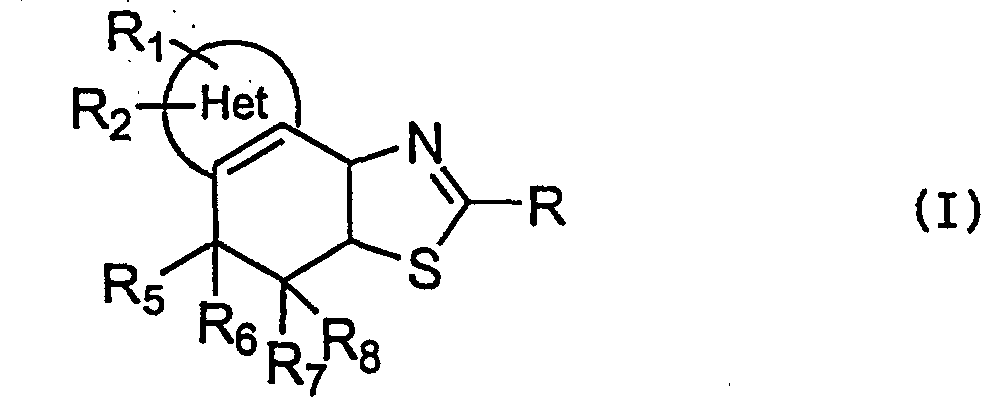
- Therefore, an object of the present invention is to provide new thiazole derivatives represented by the following general formula (I):wherein,

- R
- is a guanidino group, a pyridinyl group, a piperazino group, or an amino group having a general formula: NR3R4, wherein R3 and R4. identical to or different from each other, represent independently a hydrogen atom, a C1 - C6 lower alkyl group, a C3 - C6 cycloalkyl group, a C1 - C6 lower alkoxy, a phenyl group, a benzyl group or an allyl group;
- R1 and R2,
- identical to or different from each other, are independently a hydrogen atom, a hydroxy group, a C1 - C6 lower alkyl group, phenyl group, a phenyl group having one substituent selected from a group consisting of a C1 - C4 lower alkyl group, a C1 - C4 lower alkoxy group, a halogen atom, a nitro and a cyano group, a C1 - C5 alkylphenyl group, or a pyridine group;
- R5, R6, R7 and R8,
- identical to or different from each other, are independently a hydrogen atom, a hydroxy group, a C1 - C4 lower alkyl group, a C1 - C4 lower alkoxy group, phenyl group, or a phenyl group substituted with a C1 - C4 alkyl group, a C1 - C4 alkoxy group or a halogen atom, or a C1 - C3 alkylphenyl group, with proviso that R7 is neither H nor CH3 when Het is a 5-membered unsaturated oxygen-containing monocyclic group; and
- Het
- is a 3-, 4- or 5-membered unsaturated monocyclic group, or 6- to 12-membered unsaturated fused cyclic group, said monocyclic and fused cyclic group being comprises of one or more hetero atoms selected from oxygen, oxidative nitrogen and oxidative sulfur atom,
- According to the present invention, a method for producing the compounds is also provided.
- The above and other objects and features of the present invention will be apparent to the skilled in the art from the following detailed description.
- Among the compounds (I) according to the present invention, the compounds (I) wherein R is hydrogen atom, or methyl, ethyl, isopropyl, methoxymethyl, ethoxymethyl, methoxyethyl, aryl, phenyl, benzyl, pyridine, or guanidinyl group, or an amino group having a general formula : NR3R4 in which R3 and R4, identical to or different from each other, represent independently a hydrogen atom, or methyl, ethyl, butyl, isopropyl, aryl, cyclopropyl, cyclobutyl, cyclohexyl, phenyl. benzyl, pyridine, piperidine, or 4-methyl piperidine group; R1 and R2, identical to or different from each other, are independently a hydrogen atom, a hydroxy group, or methyl, ethyl, isopropyl, methoxymethyl, ethoxymethyl, methoxyethyl, aryl, phenyl, benzyl, pyridine or guanidine group; R5, R6, R7 and R8, identical to or different from each other, are independently a hydrogen atom, a hydroxy group, or methyl, ethyl, isopropyl, methoxymethyl, ethoxymethyl, methoxyethyl, aryl, phenyl, or benzyl group, or fluorine, chlorine or bromine atom; and Het is a heterocyclic group such as thiazole, imidazothiazole, benzimidazothiazole, imidazopyridine or triazolothiazole group.
- The pharmaceutically acceptable salts of the compound (I) of the present invention include acid-addition salts of the compound (I) with pharmaceutically acceptable organic and inorganic acids such as hydrochloric, hydrobromic, hydroiodic, phosphorous, sulfuric, nitrous, citric, formic, fumaric, maleic, tartaric, or malonic acids, an alkylsulfonic acid such as methansulfonic acid, or an arylsulfonic acid such as p-toluene sulfonic acid.
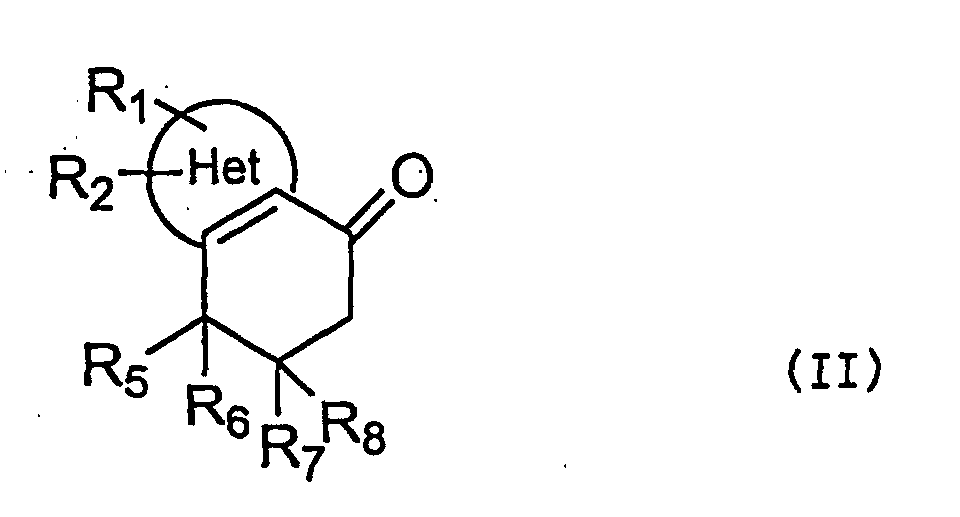
- The compound represented by the general formula (I) may be prepared from the compound represented by the general formula (II) by the reactions shown in the following reaction scheme I.Wherein, R, R1, R2, R3, R4, R5, R6, R7, and R8 have the same meanings as defined above.

- The reaction shown in Reaction Scheme I will be described in more detail hereinafter.
- The compound (II) or its salt is dissolved into conc. aqueous solution of hydrobromic acid, and an equivalent halogen (particularly, bromine) is added while maintaining the solution at a temperature of 70°C to 90°C to give a compound (III) in the form of hydrogen halogenate. The hydrogen halogenate may be neutralized with a base in an aqueous system to give the compound (III).
- The compound (III) or its salts is reacted with a substituted or unsubstituted thiourea, amidinothiourea, or thioamide in a solvent to give the thiazole derivative (I) of the present invention. The examples of the solvent, which may be employed for the reaction, may include, not limited thereto, acetone, ethanol, propanol, butanol, dimethylformamide, or dimethylsulfoxide and the like. The reaction may be carried out at a temperature or 50°C to 100°C. The resulting compound (I) in the form of hydrogen halogenate can be further reacted with a base in an aqueous system to give the compound (I). The compound (I) may be further treated with various organic and inorganic acid to give its pharmaceutically acceptable acid addition salts. The examples of the inorganic or organic acids include those stated in the above.
- The compound (II) employed for preparing the compound (I) may be prepared by the process shown in the following Reaction Scheme II.Wherein, R; R1, R2, R3, R4, R5, R6, R7, R8 and Het have the same meanings as defined above.

- The compound (II) can be prepared by reacting a 2-bromo-1,3-cyclohexadione derivative (V) with 2-mercaptoimidazole (VIa) ("Route 1"), 2-mercaptobenzimidazole (VIb) ("Route 2"), 3-mercaptotriazole (VIc) ("Route 3"), 2-aminopyridine (VId) ("Route 4"), thioamide (VIe) ("Route 5") in a solvent. Alternatively, the compound (II) may be prepared by reacting the compound (X) with thiourea compound (VIg) which is prepared by reacting the compound (V) with thiourea compound (VIf). The example of the solvent may include, not limited thereto, ethanol, propanol, butanol, acetonitrile, 1,2-dimethoxyethane. The reaction is carried out at a temperature between 50°C and the boiling point of the solvent employed. The resulting compound (II) in the form of hydrobromide is neutralized with a base in an aqueous system to give the compound (II).
- The methods and results of pharmacological experiments and acute toxicity experiments carried out using the representative compounds (I) of the present invention are described below.
- Inhibition of H+/K+ ATPase, a proton carrying enzyme, was measured by following the procedure of Saccomani et al. [Biochim. Biophy. Acta., 465, 311-330 (1977)]. Thus, a homogenate of the gastric mucose membrane of rabbit was used to prepare vesicles containing H+/K+ ATPase by employing differential centrifugation and discontinuous density gradient centrifugation in Ficoll. The vesicles containing the enzyme were preincubated in a solution (0.5mℓ) containing 1 × 10⁻⁴M, 1 × 10⁻⁵M, 1 × 10⁻⁶M, or 1 × 10⁻⁷M of the inventive compound (Example 21) and 5 mM of imidazole buffer (pH 7.4) at a temperature of about 37°C for about 30 minutes. omeprazole was used as a control. A solution containing 2 mM of magnesium chloride, 40 mM of imidazole buffer (pH 7.4), 10 mM of potassium chloride and 10 mM of ATP was added to the mixture. The resulting mixture was incubated at 37°C for 15 minutes and the reaction was terminated by adding 1 mℓ of ice-cold 22% solution of trichloroacetic acid. Enzyme activity was calculated by measuring the separated inorganic phosphate by following the method of Fiske and Subbarow [J. Biol. Chem., 66, 375-440 (1925)]. The concentrations (IC50) of the test compounds which inhibit the enzyme activity by 50% are shown in Table 1.
Test compound Enzyme Inhibition (IC50) Example 1 1.10 × 10⁻⁶M Example 2 2.16 × 10⁻⁵M Example 13 2.00 × 10⁻⁴M Example 14 " Example 15 " Example 16 " Example 17 4.90 × 10⁻⁵M Example 18 1.00 × 10⁻⁴M - Inhibition of gastric secretion was measured by following the procedure of Shay ligation (Gastroenterology, 1954, 26, 903). Thus, male Sprague-Dawley rats weighing 180 - 200g were starved for 24 hours and their pylorus were ligated. Then, the inventive compounds (Examples 1, 13 and 17) or omeprazole as a positive control was administered into duodenum. Four hours later, the stomach was removed, and the acidity and amount of gastric juice were measured. By comparing the measured values with the acidity and amount of the gastric juice of the stomach of the reference group to which no test compound was administered, the inhibition of gastric secretion was calculated. The effective dose (ED50) of the test compounds which inhibit the gastric secretion by 50% are shown in Table 2.
Test Compound Gastric juice Secretion Inhibition (ED50, mg/kg) Example 1 5.08 Example 13 34.0% (25 mg/kg) Example 17 15.4 - Inhibition activity of the inventive compound on the ethanol-induced ulcer was measured by using male sprague-Dawley rats weighing 180 - 200g. Thus, rats were starved for 24 hours, and the inventive compound (Examples 1 and 17) or omeprazole as a positive control was orally administered. Thirty minutes later, absolute ethanol (5 mℓ /kg) was orally administered. 1.5 hours later, the stomach was removed, and the degree of the wound of the stomach was measured. By comparing the measured values with the degree of the lesion of the stomach the reference group to which no test compound was administered, the effective dose (ED50) of the test compounds which inhibit the lesion by 50% were calculated and are shown in Table 3.
- Inhibition activity of the inventive compounds on the mepirizole-induced ulcers was measured by using male Spraque-Dawley rats weighing 200 - 230g. Thus, rats were starved, and the inventive compounds (Examples 1 and 17) or omeprazole as a positive control were orally administered. Thirty minutes later, mepirizole suspended in 1% CMC ( 250 mg /kg) was orally administered. Before administration, the rats were starved and the duodena were removed. The degree of the ulcer thereof was measured. By comparing the measured values with the degree of the ulcer of the duodena of the reference group to which no test compound was administered, the effective deses (ED50) of the test compounds which inhibit the ulcer by 50% were calculated and are shown in Table 3.
- Inhibitory activities of the inventive compounds on the indomethacin-induced lesions was measured by using male Sprague-Dawley rats. Thus, rats were starved for 48 hours and prohibited from being supplied with water for 2 hours, and 35 mg/kg of indomethacin (Sigma Co.) as a causative of gastric lesions was subcutaneously administered. Before indomethacine treatment, the inventive compounds (Examples 1 and 17) or omeprazole as a positive control were orally administered, and the inhibitions of lesions by the action of the test compounds were observed. The effective doses (ED50) of the test compounds which inhibit the lesions by 50% were measured and are shown in Table 3.
- Inhibitory activity of the inventive compound on the stress-induced ulcer was evaluated by using male Sprague-Dawley rats. Thus, rats were starved for 24 hours prior to carrying out the experiment.
- Stress is an important factor for causing gastric lesions, and was applied to rats by immersing them in water.
- Thirty minutes prior to immersing rats into water, the inventive compounds (Examples 1 and 17) or omeprazole as a positive control were orally administered, and the inhibitions of ulcer by the action of the test compounds were observed. The effective doses (ED50) of the test compounds which inhibit the lesions by 50% were measured and are shown in Table 3.
- Inhibitory activity of the inventive compound on the acetic acid-induced ulcer was evaluated by using male Sprague-Dawley rats. Thus, rats were starved for 5 hours prior to carrying out the experiment.
- 20 Microliter of 30% acetic acid was injected into the submucosal layer of the stomach using a microsyringe to induce a circular ulcer on the stomach. Various doses of the inventive compounds (Examples 1 and 17) or omeprazole as a positive control were orally administered for 10 days, and the healing of ulcer by the action of the test compounds were observed. The percentages of the healing of the ulcer were calculated by comparing them with that of reference group.
Test Compound Anti-ulcer activity (ED50, mg/kg) Ethanol Mepirizole Indomethacin Stress Acetic acid Control (Omeprazole) 17.1 2.8 1.2 4.4 27.1 Inventive Ex. 1 30.8 2.6 2.95 9.2 22.67 Ex. 17 2.91 18.67 4.68 17.56 31.59 - ICR mice (male and female) were orally administered with high doses (maximum dose : 5 g/kg) of inventive compound (Example 1) and were observed for their sudden death or a lasting of morbid conditions for 14 days. A median lethal dose (LD50), an index of acute toxicity was measured and is shown in Table 4.
Compound Sexuality Dose (mg/kg) No. of animals No. of Death Lethality (%) LD50 (mg/kg) Ex. 1 0 6 0 0 40 6 0 0 Male 200 6 0 0 >5000 1000 6 0 0 5000 6 0 0 0 6 0 0 40 6 0 0 Female 200 6 0 0 >5000 1000 6 0 0 5000 6 0 0 - The present invention will be described in more detail by way of Examples.
- 1,3-Cyclohexadione (19.6 g) was dissolved into distilled water (200 ml) at room temperature, and bromine (10.3 ml) was added dropwise at a temperature of below 5°C. The resulting precipitates were filtered, washed with cold water and dried to give the titled compound (34.9 g).
- 2-Mercapto-4-phenylimidazole (10.6 g) and 2-bromo-1,3-cyclohexadione (12.6 g) were placed into absolute ethanol (200 ml), and the reaction mixture was heated to reflux for 16 hours and then cooled to give hydrobromide salt of the desired compound (16.3 g). The hydrobromide salt was neutralized with 10% sodium carbonate solution in an aqueous system to give the titled compound (12.3 g, 76%).
m.p. : 202-203°C (240-241°C for hydrobromide)
1H-NMR (DMSO-d6) : δ 2.23(m, 2H), 2.62(t, 2H), 3.10(t, 2H), 7.25-7.50(m, 3H), 7.89(d, 2H), 8.49(s, 1H) - 2-Phenyl-6,7-dihydro-5H-imidazo[2,1-b]benzothiazol-8-one hydrobromide (11.2 g) was placed into conc. hydrobromic acid (130 ml), and bromine (18.2 ml) was added dropwise to the reaction mixture while maintaining the temperature of 70 - 80°C. The reaction mixture was stirred at the same temperature for 2 hours, cooled, and washed with cold water to give yellow titled compound (12.8 g, 93%).
m.p. 214-216°C
1H-NMR (DMSO-d6) : δ 2.60 (m, 1H), 2.80(m, 1H), 3.15-3.75(m, 2H), 5.13(m, 1H), 7.45(m, 3H), 7.98(m, 2H), 8.59(s, 1H) - 7-Bromo-2-phenyl-6,7-dihydro-5H-imidazo[2,1-b]benzothiazol -8-one hydrobromide (6.22 g) and thiourea (1.22 g) were placed into absolute ethanol (90 ml), and the reaction mixture was heated to reflux for 3 hours and then cooled to give dihydrobromide of the desired compound (5.85 g). The dihydrobromide was neutralized with 10% potassium hydroxide solution in an aqueous system to give pale yellow solids, which were recrystallized with dimethylformamide (20 ml) to give the titled compound (3.1 g, 66%).
m.p. : 275-276°C (248-250°C for dihydrobromide)
1H-NMR (CDCl3) : δ 2.95-3.28(m, 4H), 7,15(br.s, 2H), 7.18-7.46(m, 3H), 7.87(d, 2H), 8.34(s, 1H) - 2-Bromo-1,3-cyclohexadione (30 g) prepared in Route 1 (A) was suspended into absolute ethanol, and thiourea (13) was added thereto. The reaction mixture was heated to reflux for 12 - 15 hours. After completion of the reaction, the reaction mixture was cooled to room temperature and concentrated under reduced pressure to evaporate the solvent. Acetone (70 ml) was added to the residue to give solids, which were filtered, washed with acetone (30 ml) and dried to give hydrobromide of the titled compound (27g, 71%). The hydrobromide was neutralized with sodium hydroxide solution to give the titled compound (18g, 68%).
- 2-Amino-5,6-dihydro-4H-benzothiazol-7-one (18g) prepared in the above (A) was dissolved into dimethylformamide (250 ml), and 2-bromoacetophenone (21,83 g) was added thereto followed by heating to reflux for 12 - 15 hours. After completion of the reaction, the reaction mixture was cooled to room temperature and placed into distilled water. The resulting precipitates were filtered, neutralized with sodium hydroxide solution, filtered, washed with ethyl acetate (100 ml), and dried to give the titled compound (21.25 g, 76%).
- By following the procedure described in Example 1 by employing 7-bromo-2-phenyl-6,7-dihydro-5H-imidazo[2,1-b] benzothiazol-8-one hydrobromide (6.22 g) prepared in Example 1, Route 1 (D) and various thiourea derivatives for various reaction times, there were obtained inventive compounds of Examples 2-12. These compounds and their physical properties are shown in Table 5.
Compd. R Yield
(%)mp (°C)
[HBr (°C)]1H-NMR (DMSO-d6) : δ Ex. 2 Methylamino 63
69265-267
224-2272.85(d, 3H), 3.12(m, 4H), 7.28(d, 1H), 7.40(dd, 2H), 7.64(bs.d, 1H), 7.88(d, 2H), 7.32(s, 1H) Ex. 3 Ethylamino 63
69251-254
254-2571.20(t, 3H), 3.15(m, 4H), 3.27(qx5, 2H), 7.29(dd, 1H), 7.42(dd, 2H), 7.72(t, 1H), 7.88(d, 2H), 8.35(s, 1H) Ex. 4 Cyclopropylamino 64
69275-278
253-2560.64(m, 2H), 0.78(m, 2H), 2.63(m, 1H), 3.18(m, 4H), 7.28(dd, 1H), 7.42 (dd, 2H), 7.87(d, 2H), 8.14(s, 1H), 8.35(s, 1H) Ex. 5 2-Methoxyethylamino 54
57220-222
213-2163.13(m, 4H), 3.31(s, 3H), 3.42(m, 2H), 3.51(m, 2H), 7.29(dd, 1H), 7.42(dd, 2H), 7.81(bs, 1H), 7.88(d, 2H), 8.35 (s, 1H) Ex. 6 Phenylamino 55
59> 300
> 3003.27(m, 4H), 7.12(dd, 1H), 7.38(dd, 1H), 7.47(m, 3H), 7.88(m, 4H), 8.05(d, 1H), 8.88(s, 1H) Ex. 7 Benzylamino 66
68258-260
235-2373.15(m, 4H), 4.48(d, 2H), 7.21-7.48(m, 7H), 7.29(dd, 1H), 7.42(dd, 2H), 7.81(bs, 1H), 7.88(d, 2H), 8.35(s, 1H) Ex. 8 Allylamino 59
61234-237
230-2343.17(m, 4H), 3.91(m, 2H), 5.21(m, 2H), 5.93(m, 1H), 7.28(dd, 1H), 7.41(dd, 2H), 7.38(d, 2H), 7.80(bs, 1H), 8.35(s, 1H) Ex. 9 Dimethylamino-amino 61
67212-216
220-2233.08(s, 6H), 3.19(m, 4H), 7.26(dd, 1H), 7.42(dd, 2H), 7.87(d, 2H), 8.32(s, 1H) Ex. 10 -N=C(NH2)2 42
45> 300
> 3003.18(m, 4H), 6.88(bs, 4H), 7.28(dd, 1H), 7.42(dd, 2H), 7.88(d, 2H), 8.34(s, 1H) EX. 11 1-Piperazino 65
81284-288
290-2943.08-3.28(m, 8H), 3.49-3.66(m, 4H), 7.29(dd, 1H), 7.43(dd, 1H), 7.88(d, 2H), 8.38(s, 1H) Ex. 12 3-Pyridinyl 50
51245-248
248-2523.38(m, 4H), 7.31(dd, 1H), 7.42(dd, 2H), 7.58(dd, 1H), 7.89(d, 2H), 8.10(d, 1H), 8.42(s, 1H), 8.70(d, 1H), 9.15(s, 1H) - 2-Bromo-1,3-cyclohexadione prepared in Example 1, Route 1 (A) was reacted with 2-mercaptobenzimidazole in the same manner as that of Example 1, Route 1 (B) to give, lH-2,3-dihydro-benzimidazo[2,1-b] benzothiazol-4-one(IUPAC Name; 6,7-dihydro-5H-9-thia-4b,10-diaza-indeno[1,2-a]inden-8-one) (Compound(IIb) of Reaction Scheme II), which was subjected to bramination in the same manner as that of Example 1, Route 1 (C) to give 3-bromo-1H-2,3-dihydro-benzimidazo[2,1-b]benzothiazol -4-one hydrobramide (IUPAC Name; 7-bramo-6,7-dihydro-5H-9-thia-4b,10-diaza-indeno[1,2-a]inden-8-one hydrobromide). The hydrobromide (1.45 g) and thiourea (0.15 g) were placed into ethanol (50 ml), and the mixture was heated to reflux for 2 hours, cooled, and the filtered to give the titled compound (61%).
m.p. above 300°C
1H-NMR (DMSO-d6) : δ 3.15(t, 2H), 3.55(t, 2H), 7.15(br.s, 1H), 7.30(m, 2H), 7.70(d, 1H), 7.98(d, 1H) - 3-Bromo-1H-2,3-dihydro-benzimidazo[2,1-b]benzothiazol-4-one hydrobromide (1.0 g) prepared in Example 13 was reacted with amidinothiourea (0.59 g) in n-butanol (40 ml) while heating to reflux for 15 hours. After completion of the reaction, the reaction mixture was cooled and filtered to give dihydrobromide (0.65 g) of the desired compound. The dihydrobromide was neutralized with sodium carbonate solution in an aqueous system to give the titled compound (55%).
m.p. above 300°C (above 300°C for dihydrobromide)
1H-NMR (DMSO-d6) : δ 3.30 (t, 2H), 3.60(t, 2H), 6.90 (s, 4H), 7.35(m, 2H), 7.70 (d, 2H), 7.97 (d, 1H) - 2-Bromo-1,3-cyclohexadione (4.4 g) prepared in Example 1, Route 1 (A) and 1H-1,2,4-triazol-3-thiol (2.32 g) were dissolved into absolute ethanol (50 ml), and the reaction mixture was heated to reflux for 5 hours. After completion of the reaction, the reaction mixture was cooled and filtered to give 6,7-dihydro-5H-[1,2,4]triazolo[3,4-b]benzothiazol-8-one hydrobromide (IUPAC Name; 6,7-dihydro-5H-benzo[4,5]thiazolo [2,3-c] [1,2,4]triazol -8-one hydrobramide) (2.84 g, compound (IIc) of Reaction Scheme II). The hydrobromide was dissolved into anhydrous acetic acid (20 ml) and an equivalent amount of bramine was added dropwise thereto at a temperature of 100°C, and the mixture was stirred at the same temperature for 30 minutes. The reaction mixture was cooled to give the titled compound (95%) as solids.
1H-NMR (DMSO-d6) : δ 2.6(m, 2H), 2.8-2.91(m, 1H), 3.2-3.4(m, 2H), 5.15(t, 1H), 8.5(s, 1H) - 7-Bromo-6,7-dihydro-5H-[1,2,4]triazolo[3,4-b]benzothiazol-8-one hydrobromide (1.3 g) prepared in the above (A) and thiourea (1.06 g) were dissolved into ethanol (50 ml), and the solution was heated to reflux for 2 hours. After completion of the reaction, the reaction mixture was cooled and filtered to give solids (0.6 g), which are dihydrobromide of the desired compound. The dihydrobromide was neutralized with sodium carbonate in an aqueous system to give the titled compound (60%).
m.p. above 300°C
1H-NMR (DMSO-d6) : δ 3.1(t, 2H), 3.28(t, 2H), 7.25(br.s, NH2), 8.31(s, 1H) - 7-Bromo-6,7-dihydro-5H-[1,2-4]triazolo[3,4-b]benzothiazol-8-one hydrobromide (1.3 g) prepared in Example 15 (A) was reacted with amidinothiourea (1.41 g) in ethanol (50 ml) while heating to reflux for 4.5 hours. After completion of the reaction, the reaction mixture was cooled and filtered to give dihydrobromide (0.82 g) of the desired compound. The dihydrobromide was neutralized with sodium carbonate solution in an aqueous system to give the titled compound (73%).
m.p. above 300°C
1H-NMR (DMSO-d6) : δ 3.1(t, 2H), 3.25(t, 2H), 6.85(br.s, 2NH2), 8.3(s, 1H) - 2-Bromo-1,3-cyclohexadione (9.55 g) prepared in Example 1, Route 1 (A) and 2-aminopyridine (4.7 g) were dissolved into absolute ethanol (200 ml), and the reaction mixture was heated to reflux for 20 hours. After completion of the reaction, the reaction mixture was concentrated under reduced pressure, and the residue was dissolved into water. The solution was neutralized with sodium carbonate, extracted with chloroform three times, dried over magnesium sulfate, and concentrated under reduced pressure. The residue was purified by silica gel column chromatography (eluent : methylene chloride : acetonitrile = 2:1) to give the titled compound (3.0 g, 32%).
1H-NMR (DMSO-d6) : δ 2.18(m, 2H), 2.6(m, 2H), 2.98(t, 2H), 7.25(t, 1H), 7.72(m, 2H), 9.2(d, 1H) - 7,8-Dihydro-6H-pyrido[1,2-a]benzimidazol-9-one prepared in the above (A) was subjected to bromination in the similar manner to that of Example 1, Route 1(C) to give 8-bromo-7,8-dihydro-6H-pyrido[1,2-a]benzimidazol-9-one (IUPAC Name; 8-bromo-7,8-dihydro-6H-benzo[4,5]imidazo[1,2-a]pyridin-9-one) hydrobromide. The resulting compound (17.4 g) and thiourea (6.0 g) were dissolved into absolute ethanol (200 ml), and the solution was heated to reflux for 4 hours. After completion of the reaction, the reaction mixture was cooled and filtered to give solids (10.6 g), which are dihydrobromide of the desired compound. The dihydrobromide was neutralized with 2N-potassium hydroxide in an aqueous system and recrystallized with a mixture of DMF and ethanol to give the titled compound (7.1g, 56%).
m.p. 249°C
1H-NMR (IMSO-d6) : δ 3.1(m, 4H), 7.28(s, NH2), 7.50(t, 1H), 7.75(t, 1H), 7.92(d, 1H), 9.10(d, 1H) - 2-Bromo-1,3-cyclohexadione prepared in Example 1, Route 1 (A) was reacted with amidinothiourea in the similar manner to that of Example 1, Route 1(B) to give 2-guanidino-7-oxo-4,5,6,7-tetrahydro -benzothiazole hydrobromide (IUPAC Name; N-(7-oxo-4,5,6,7-tetrahydrobenzothiazol-2-yl)guanidine hydrobromide). The hydrobromide (3,4 g) was dissolved into conc. hydrobromic acid (20 ml), and one equivalent of bromine was added dropwise at a temperature of 85°C. The mixture was stirred at a temperature of 80°C to 90°C for 30 minutes, cooled and filtered. The solids were neutralized with sodium carbonate to give the titled compound (3.17 g, 67%).
1H-NMR (DMSO-d6) : δ 2.0 -2.45(m, 2H), 2.5-2.85(m, 2H), 4.8(t, 2H), 7.3(br.s, 2NH2) - 6-Bromo-2-guanidino-7-oxo-4,5,6,7-tetrahydro-benxothiazole(1.4 g) prepared in the above (A) was reacted with thiourea (0.38 g) in ethanol while heating to reflux for 3 hours. After completion of the reaction, the reaction mixture was cooled and filtered to give hydrobromide of the desired compound (0.5 g). The hydrobromide was neutralized with sodium carbonate in an aqueous system to give the titled compound (22%).
m.p. above 300°C (above 300°C for hydrobromide)
1H-NMR (DMSO-d6) : δ 2.85(m, 4H), 6.9(br.s, NH2), 7.6(br.s, 2NH2) - It is understood that the foregoing detailed description is given merely by way of illustration and that modifications and variations may be made therein without departing from the scope of the invention.
Claims (5)
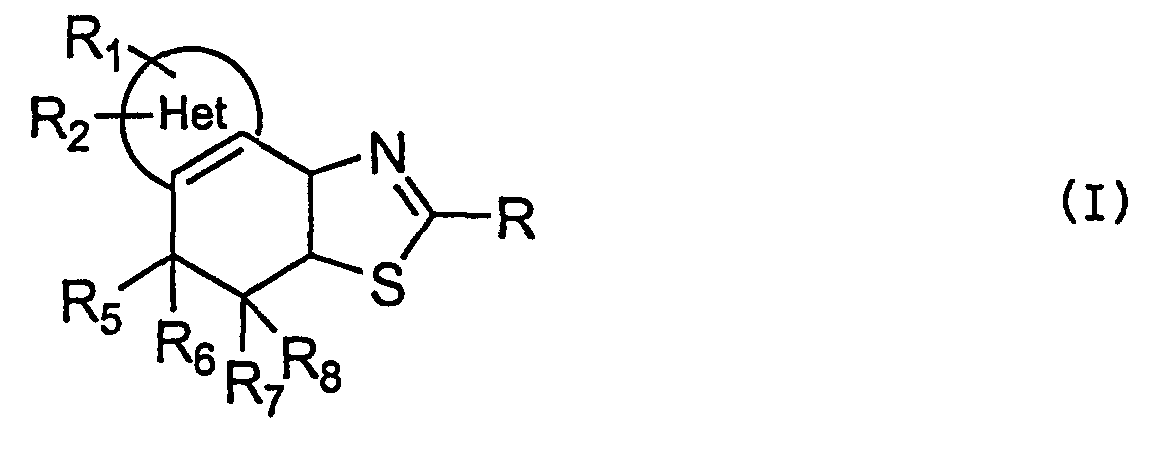
- A compound represented by the following general formula (I):wherein,
- R
- is a guanidino group, a pyridinyl group, a, piperazino group, or an amino group having a general formula: NR3R4. wherein R3 and R4. identical to or different from each other, represent independently a hydrogen atom, a C1 - C6 lower alkyl group, a C3 - C6 cycloalkyl group, a C1 - C6 lower alkoxy, a phenyl group, a benzyl group or an allyl group;
- R1 and R2,
- identical to or different from each other, are independently a hydrogen atom, a hydroxy group, a C1 - C6 lower alkyl group, phenyl group, a phenyl group having one substituent selected from a group consisting of a C1 - C4 lower alkyl group, a C1 - C4 lower alkoxy group, a halogen atom, a nitro and a cyano group, a C1 - C5 alkylphenyl group, or a pyridine group;
- R5, R6, R7 and R8,
- identical to or different from each other, are independently a hydrogen atom, a hydroxy group, a C1 - C4 lower alkyl group, a C1 - C4 lower alkoxy group, phenyl group, or a phenyl group substituted with a C1 - C4 alkyl group, a C1 - C4 alkoxy group or a halogen atom, or a C1 - C3 alkylphenyl group, with proviso that R7 is neither H nor CH3 when Het is a 5-membered unsaturated oxygen-containing monocyclic group; and
- Het
- is a 3-, 4- or 5-membered unsaturated monocyclic group, or 6- to 12-membered unsaturated fused cyclic group, said monocyclic and fused cyclic group being comprises of one or more hetero atoms selected from oxygen, oxidative nitrogen and oxidative sulfur atom,
- The compound (I) according to claim 1, whereinor its pharmaceutically acceptable salts.R is guanidino, pyridinyl, piperazino group, or an amino group having a general formula: NR3R4. wherein R3 and R4. identical to or different from each other, represent independently a hydrogen atom, methyl, ethyl, butyl, isopropyl, cyclopropyl, cyclobutyl, cyclohexyl, methoxy, phenyl, benzyl or allyl group;R1 and R2, identical to or different from each other, are independently a hydrogen atom, a hydroxy group, or methyl, ethyl, isopropyl, methoxymethyl, ethoxymethyl, methoxyethyl, aryl, phenyl, benzyl, pyridine or guanidine group;R5, R6, R7 and R8, identical to or different from each other, are independently a hydrogen atom, a hydroxy group, or methyl, ethyl, isopropyl, methoxymethyl, ethoxymethyl, methoxyethyl, aryl, phenyl, or benzyl group, or fluorine, chlorine or bromine atom; andHet is a heterocyclic group selected from group consisting of thiazole, imidazothiazole, benzimidazothiazole, imidazopyridine or triazolothiazole group,
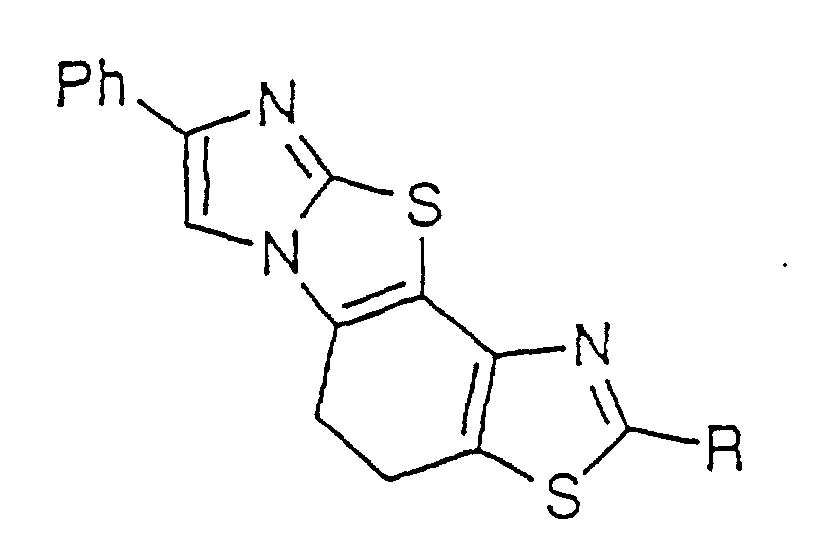
- The compound (I) according to claim 1, which is 2-amino-4,5-dihydro-8-phenylimidazo[2,1-b]thiazolo[5,4-g] benzothiazole, or its pharmaceutically acceptable salts.
- The compound (I) according to claim 1, which is 2-amino-4,5-dihydropyrido[1,2-a]thiazolo[5,4-g]benzimidazole, or its acceptable salts.
- A process for producing a compound represented by the following general formula (I):wherein
 or its pharmaceutically acceptable salts, which comprises a step of subjecting a compound represented by a general formula (II)R is guanidino, pyridinyl, piperazino, or an amino group having a general formula: NR3R4. wherein R3 and R4, identical to or different from each other, represent independently a hydrogen atom, methyl, ethyl, butyl, isopropyl, cyclopropyl, cyclobutyl, cyclohexyl, methoxy, phenyl, benzyl or allyl group;R1 and R2. identical to or different from each other, are independently a hydrogen atom, a hydroxy group, or methyl, ethyl, isopropyl, methoxymethyl, ethoxymethyl, methoxyethyl, aryl, phenyl, benzyl, pyridine or guanidine group;R5, R6, R7 and R8, identical to or different from each other, are independently a hydrogen atom, a hydroxy group, or methyl, ethyl, isopropyl, methoxymethyl, ethoxymethyl, methoxyethyl, aryl, phenyl, or benzyl group, or fluorine, chlorine or bromine atom; andHet is a heterocyclic group selected from group consisting of thiazole, imidazothiazole, benzimidazothiazole, imidazopyridine or triazolothiazole group,wherein, R1, R2, R5, R6, R7, R8 and Het have the same meanings as defined above, or its salts to bromination to give a compound represented by a general formula (III)
 wherein, R1, R2, R5, R6, R7, R8 and Het have the same meanings as defined above,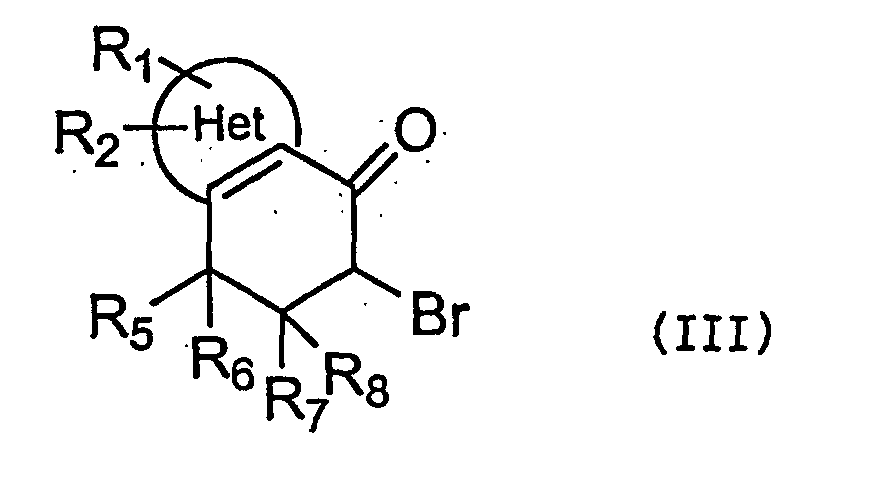
reacting the compound (III) or its salts with a compound represented by a following general formula (IV),wherein R has the same meanings as defined above,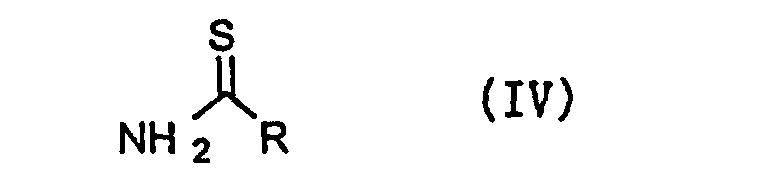
to give the compound (I) or its pharmaceutically acceptable salts.
Applications Claiming Priority (3)
| Application Number | Priority Date | Filing Date | Title |
|---|---|---|---|
| KR1019950020516A KR0168978B1 (en) | 1995-07-12 | 1995-07-12 | Hetero-cyclic fused thiazole derivatives |
| KR9520516 | 1995-07-12 | ||
| PCT/KR1996/000082 WO1997003076A1 (en) | 1995-07-12 | 1996-06-01 | Heterocycle-fused thiazole derivatives |
Publications (2)
| Publication Number | Publication Date |
|---|---|
| EP0843681A1 EP0843681A1 (en) | 1998-05-27 |
| EP0843681B1 true EP0843681B1 (en) | 2002-03-06 |
Family
ID=19420461
Family Applications (1)
| Application Number | Title | Priority Date | Filing Date |
|---|---|---|---|
| EP96917723A Expired - Lifetime EP0843681B1 (en) | 1995-07-12 | 1996-06-01 | Heterocycle-fused thiazole derivatives |
Country Status (9)
| Country | Link |
|---|---|
| US (1) | US6043373A (en) |
| EP (1) | EP0843681B1 (en) |
| JP (1) | JP3384807B2 (en) |
| KR (1) | KR0168978B1 (en) |
| CN (1) | CN1122038C (en) |
| CA (1) | CA2209313C (en) |
| DE (1) | DE69619680T2 (en) |
| ES (1) | ES2170237T3 (en) |
| WO (1) | WO1997003076A1 (en) |
Families Citing this family (6)
| Publication number | Priority date | Publication date | Assignee | Title |
|---|---|---|---|---|
| US7358269B2 (en) | 2002-05-21 | 2008-04-15 | Allergan, Inc. | 2-((2-Thioxo-2,3-dihydro-1H-imidazol-4-yl)methyl)-3,4-dihydronapthalen-1(2H)-one |
| US7091232B2 (en) * | 2002-05-21 | 2006-08-15 | Allergan, Inc. | 4-(substituted cycloalkylmethyl) imidazole-2-thiones, 4-(substituted cycloalkenylmethyl) imidazole-2-thiones, 4-(substituted cycloalkylmethyl) imidazol-2-ones and 4-(substituted cycloalkenylmethyl) imidazol-2-ones and related compounds |
| US7323485B2 (en) * | 2002-05-21 | 2008-01-29 | Allergan, Inc. | 4-(substituted cycloalkylmethyl) imidazole-2-thiones, 4-(substituted cycloalkenylmethyl) imidazole-2-thiones, 4-(substituted cycloalkylmethyl) imidazol-2-ones and 4-(substituted cycloalkenylmethyl) imidazol-2-ones and related compounds |
| CL2004000553A1 (en) * | 2003-03-20 | 2005-02-04 | Actelion Pharmaceuticals Ltd | USE OF GUANIDINE DERIVATIVE COMPOUNDS AS ANTAGONISTS OF THE FF NEUROPEPTIDE RECEIVER; COMPOUNDS DERIVED FROM GUANIDINA; PREPARATION PROCEDURES; AND PHARMACEUTICAL COMPOSITION THAT UNDERSTANDS THEM. |
| WO2005041961A1 (en) | 2003-11-03 | 2005-05-12 | Astrazeneca Ab | Imidazo [1,2-a] pyridine derivatives for the treatment of silent gastro-esophageal reflux |
| ATE405554T1 (en) * | 2006-06-26 | 2008-09-15 | Helm Ag | METHOD FOR PRODUCING PRAMIPEXOLE |
Citations (1)
| Publication number | Priority date | Publication date | Assignee | Title |
|---|---|---|---|---|
| EP0220053A2 (en) * | 1985-10-16 | 1987-04-29 | FISONS plc | Benzimidazoles, benzoxazoles, benzothiazoles and their production, formulation and use as gastric acid secretion inhibitors |
Family Cites Families (5)
| Publication number | Priority date | Publication date | Assignee | Title |
|---|---|---|---|---|
| US3631171A (en) | 1970-01-06 | 1971-12-28 | American Cyanamid Co | Certain 2-amino-4 5-dihydro-6h-pyrrolo (3 2-e)benzothiazoles |
| JPS6056143B2 (en) * | 1979-08-02 | 1985-12-09 | 山之内製薬株式会社 | Amidine derivatives and their production method |
| JPS565538A (en) * | 1979-06-27 | 1981-01-21 | Fuji Photo Film Co Ltd | Photographic mordanting layer |
| JPS57134417A (en) * | 1981-02-14 | 1982-08-19 | Meiji Seika Kaisha Ltd | Cardiotonic agent |
| EP0423642A3 (en) * | 1989-10-20 | 1991-07-03 | Air Products And Chemicals, Inc. | Polymeric diorganotin catalysts for use in polyurethane systems |
-
1995
- 1995-07-12 KR KR1019950020516A patent/KR0168978B1/en not_active Expired - Fee Related
-
1996
- 1996-06-01 DE DE69619680T patent/DE69619680T2/en not_active Expired - Fee Related
- 1996-06-01 ES ES96917723T patent/ES2170237T3/en not_active Expired - Lifetime
- 1996-06-01 EP EP96917723A patent/EP0843681B1/en not_active Expired - Lifetime
- 1996-06-01 CN CN96191355A patent/CN1122038C/en not_active Expired - Fee Related
- 1996-06-01 CA CA002209313A patent/CA2209313C/en not_active Expired - Fee Related
- 1996-06-01 US US08/849,739 patent/US6043373A/en not_active Expired - Fee Related
- 1996-06-01 JP JP50569597A patent/JP3384807B2/en not_active Expired - Fee Related
- 1996-06-01 WO PCT/KR1996/000082 patent/WO1997003076A1/en not_active Ceased
Patent Citations (1)
| Publication number | Priority date | Publication date | Assignee | Title |
|---|---|---|---|---|
| EP0220053A2 (en) * | 1985-10-16 | 1987-04-29 | FISONS plc | Benzimidazoles, benzoxazoles, benzothiazoles and their production, formulation and use as gastric acid secretion inhibitors |
Also Published As
| Publication number | Publication date |
|---|---|
| DE69619680D1 (en) | 2002-04-11 |
| CA2209313C (en) | 2001-12-25 |
| CN1179162A (en) | 1998-04-15 |
| ES2170237T3 (en) | 2002-08-01 |
| KR0168978B1 (en) | 1999-01-15 |
| WO1997003076A1 (en) | 1997-01-30 |
| CA2209313A1 (en) | 1997-01-30 |
| JP3384807B2 (en) | 2003-03-10 |
| JPH10508877A (en) | 1998-09-02 |
| KR970006308A (en) | 1997-02-19 |
| DE69619680T2 (en) | 2002-08-14 |
| EP0843681A1 (en) | 1998-05-27 |
| US6043373A (en) | 2000-03-28 |
| CN1122038C (en) | 2003-09-24 |
Similar Documents
| Publication | Publication Date | Title |
|---|---|---|
| PL154875B1 (en) | Method of obtaining novel aromatic and heterocyclic carbonamide derivatives | |
| FI65435C (en) | FRUIT PROCEDURE FOR IMMUNITY OF RELEASE OR CHEMICAL PROSTITUTES 5- (4-PYRIDYL) -6- (4-FLUORPHENYL) -2,3-DIHYDR OIDIDASO- (2,1-B) THIAZOLE | |
| PL142880B1 (en) | Method of obtaining novel imidazole derivatives | |
| WO2009074810A1 (en) | Antibacterial compositions | |
| US3455924A (en) | Dianisylimidazoles | |
| SE450573B (en) | 1H-PYRAZOLO / 1,5-A / PYRIMIDINES, PREPARATION OF THEM AND PHARMACEUTICAL COMPOSITION | |
| KR900003368B1 (en) | Process for preparing novel indenothiazole derivatives | |
| Singh et al. | Novel and potent adenosine 3', 5'-cyclic phosphate phosphodiesterase III inhibitors: thiazolo [4, 5-b][1, 6] naphthyridin-2-ones | |
| US6043373A (en) | Heterocycle-fused thiazole derivatives | |
| PL157186B1 (en) | Method for the production of new dihydropyridine derivatives PL PL PL | |
| CN106459060A (en) | Fused triazole derivatives as phosphodiesterase 10A inhibitors | |
| NO143223B (en) | ANALOGY PROCEDURE FOR THE PREPARATION OF THERAPEUTIC ACTIVE 1,3-DIMETHYL-1H-PYRAZOLE (3,4B) QUINOLINES | |
| JP3244276B2 (en) | 4-amino-3-acylnaphthyridine derivative | |
| EP0163240A2 (en) | Dihydroimidazo[1,2-a]pyrimidine derivatives, methods of preparing said compounds and pharmaceutical compositions constaining said compounds | |
| DK153950B (en) | ANALOGY PROCEDURE FOR PREPARING QUINOLYLGUANIDIN OR DERIVATIVES THEREOF | |
| CA1131226A (en) | Heterocyclic compounds | |
| EP0226641A1 (en) | OXODIAZINE COMPOUNDS. | |
| CS250249B2 (en) | Method of imidazole's tricyclic derivatives production | |
| CA1095524A (en) | Antiinflammatory imidazothiazoles | |
| US4652646A (en) | Thiazolo[3,2-a][1,2,3]triazolo[4,5-d]pyrimidine and [1,3,4]thiadiazolo[3,2-a][1,2,3]triazolo[4,5-d]pyrimidine derivatives | |
| EP0129409B1 (en) | Thiazolo - and thiazinobenzimidazoles | |
| FI79847C (en) | FOERFARANDE FOER FRAMSTAELLNING AV TERAPEUTISKT ANVAENDBARA AKRIDANON-DERIVAT. | |
| NO803521L (en) | PROCEDURE FOR THE PREPARATION OF THERAPEUTICALLY ACTIVE TIAZOLO-PYRIMIDINE-CARBOXAMIDE DERIVATIVES | |
| FI63415C (en) | PROCEDURE FOR ANTI-ARRITIC AND ANTIRERATIC 2,6-BIS- (AMINOALYLAMINO) -BENZO- (1,2-D: 5,4-D ') - BISTIAZOLE OR 2-AMINO-6- (AMINOACYLAMINO) -BENZO , 2-D: 5,4-D ') - BISTIAZOLER | |
| US5527908A (en) | Pyrazolothiazolopyrimidine derivatives |
Legal Events
| Date | Code | Title | Description |
|---|---|---|---|
| PUAI | Public reference made under article 153(3) epc to a published international application that has entered the european phase |
Free format text: ORIGINAL CODE: 0009012 |
|
| 17P | Request for examination filed |
Effective date: 19970702 |
|
| AK | Designated contracting states |
Kind code of ref document: A1 Designated state(s): BE DE ES FR GB IT |
|
| 17Q | First examination report despatched |
Effective date: 19991005 |
|
| GRAG | Despatch of communication of intention to grant |
Free format text: ORIGINAL CODE: EPIDOS AGRA |
|
| GRAG | Despatch of communication of intention to grant |
Free format text: ORIGINAL CODE: EPIDOS AGRA |
|
| GRAH | Despatch of communication of intention to grant a patent |
Free format text: ORIGINAL CODE: EPIDOS IGRA |
|
| GRAH | Despatch of communication of intention to grant a patent |
Free format text: ORIGINAL CODE: EPIDOS IGRA |
|
| REG | Reference to a national code |
Ref country code: GB Ref legal event code: IF02 |
|
| GRAA | (expected) grant |
Free format text: ORIGINAL CODE: 0009210 |
|
| AK | Designated contracting states |
Kind code of ref document: B1 Designated state(s): BE DE ES FR GB IT |
|
| REF | Corresponds to: |
Ref document number: 69619680 Country of ref document: DE Date of ref document: 20020411 |
|
| ET | Fr: translation filed | ||
| REG | Reference to a national code |
Ref country code: ES Ref legal event code: FG2A Ref document number: 2170237 Country of ref document: ES Kind code of ref document: T3 |
|
| PLBE | No opposition filed within time limit |
Free format text: ORIGINAL CODE: 0009261 |
|
| STAA | Information on the status of an ep patent application or granted ep patent |
Free format text: STATUS: NO OPPOSITION FILED WITHIN TIME LIMIT |
|
| 26N | No opposition filed |
Effective date: 20021209 |
|
| REG | Reference to a national code |
Ref country code: FR Ref legal event code: CA |
|
| PGFP | Annual fee paid to national office [announced via postgrant information from national office to epo] |
Ref country code: GB Payment date: 20040601 Year of fee payment: 9 |
|
| PGFP | Annual fee paid to national office [announced via postgrant information from national office to epo] |
Ref country code: DE Payment date: 20040615 Year of fee payment: 9 |
|
| PGFP | Annual fee paid to national office [announced via postgrant information from national office to epo] |
Ref country code: ES Payment date: 20040618 Year of fee payment: 9 |
|
| PGFP | Annual fee paid to national office [announced via postgrant information from national office to epo] |
Ref country code: FR Payment date: 20040630 Year of fee payment: 9 Ref country code: BE Payment date: 20040630 Year of fee payment: 9 |
|
| PG25 | Lapsed in a contracting state [announced via postgrant information from national office to epo] |
Ref country code: IT Free format text: LAPSE BECAUSE OF NON-PAYMENT OF DUE FEES;WARNING: LAPSES OF ITALIAN PATENTS WITH EFFECTIVE DATE BEFORE 2007 MAY HAVE OCCURRED AT ANY TIME BEFORE 2007. THE CORRECT EFFECTIVE DATE MAY BE DIFFERENT FROM THE ONE RECORDED. Effective date: 20050601 Ref country code: GB Free format text: LAPSE BECAUSE OF NON-PAYMENT OF DUE FEES Effective date: 20050601 |
|
| PG25 | Lapsed in a contracting state [announced via postgrant information from national office to epo] |
Ref country code: ES Free format text: LAPSE BECAUSE OF NON-PAYMENT OF DUE FEES Effective date: 20050602 |
|
| PG25 | Lapsed in a contracting state [announced via postgrant information from national office to epo] |
Ref country code: BE Free format text: LAPSE BECAUSE OF NON-PAYMENT OF DUE FEES Effective date: 20050630 |
|
| PG25 | Lapsed in a contracting state [announced via postgrant information from national office to epo] |
Ref country code: DE Free format text: LAPSE BECAUSE OF NON-PAYMENT OF DUE FEES Effective date: 20060103 |
|
| PG25 | Lapsed in a contracting state [announced via postgrant information from national office to epo] |
Ref country code: FR Free format text: LAPSE BECAUSE OF NON-PAYMENT OF DUE FEES Effective date: 20060228 |
|
| GBPC | Gb: european patent ceased through non-payment of renewal fee |
Effective date: 20050601 |
|
| REG | Reference to a national code |
Ref country code: FR Ref legal event code: ST Effective date: 20060228 |
|
| REG | Reference to a national code |
Ref country code: ES Ref legal event code: FD2A Effective date: 20050602 |
|
| BERE | Be: lapsed |
Owner name: *YUNGJIN PHARMACEUTICAL CO. LTD Effective date: 20050630 |