EP0842992A2 - Low gloss coating composition - Google Patents
Low gloss coating composition Download PDFInfo
- Publication number
- EP0842992A2 EP0842992A2 EP97308901A EP97308901A EP0842992A2 EP 0842992 A2 EP0842992 A2 EP 0842992A2 EP 97308901 A EP97308901 A EP 97308901A EP 97308901 A EP97308901 A EP 97308901A EP 0842992 A2 EP0842992 A2 EP 0842992A2
- Authority
- EP
- European Patent Office
- Prior art keywords
- coating composition
- polymer particles
- core
- low gloss
- gloss
- Prior art date
- Legal status (The legal status is an assumption and is not a legal conclusion. Google has not performed a legal analysis and makes no representation as to the accuracy of the status listed.)
- Granted
Links
- 239000008199 coating composition Substances 0.000 title claims abstract description 88
- 239000000203 mixture Substances 0.000 claims abstract description 64
- 239000000758 substrate Substances 0.000 claims abstract description 46
- 229920000642 polymer Polymers 0.000 claims description 153
- 239000002245 particle Substances 0.000 claims description 150
- 239000000178 monomer Substances 0.000 claims description 57
- 230000008961 swelling Effects 0.000 claims description 38
- 238000000034 method Methods 0.000 claims description 33
- 239000002253 acid Substances 0.000 claims description 31
- 150000001875 compounds Chemical class 0.000 claims description 26
- 239000000049 pigment Substances 0.000 claims description 26
- 239000003795 chemical substances by application Substances 0.000 claims description 21
- 239000011800 void material Substances 0.000 claims description 18
- CERQOIWHTDAKMF-UHFFFAOYSA-N Methacrylic acid Chemical compound CC(=C)C(O)=O CERQOIWHTDAKMF-UHFFFAOYSA-N 0.000 claims description 12
- 230000008569 process Effects 0.000 claims description 4
- 125000003837 (C1-C20) alkyl group Chemical group 0.000 claims description 3
- 125000003342 alkenyl group Chemical group 0.000 claims description 3
- 125000002768 hydroxyalkyl group Chemical group 0.000 claims description 3
- 230000002378 acidificating effect Effects 0.000 claims 1
- 125000000524 functional group Chemical group 0.000 claims 1
- 238000004519 manufacturing process Methods 0.000 claims 1
- 239000000976 ink Substances 0.000 abstract description 27
- 239000011162 core material Substances 0.000 description 80
- XLYOFNOQVPJJNP-UHFFFAOYSA-N water Substances O XLYOFNOQVPJJNP-UHFFFAOYSA-N 0.000 description 43
- 239000000123 paper Substances 0.000 description 31
- VVQNEPGJFQJSBK-UHFFFAOYSA-N Methyl methacrylate Chemical compound COC(=O)C(C)=C VVQNEPGJFQJSBK-UHFFFAOYSA-N 0.000 description 23
- 239000000839 emulsion Substances 0.000 description 17
- 238000012360 testing method Methods 0.000 description 14
- 238000000576 coating method Methods 0.000 description 12
- 238000003490 calendering Methods 0.000 description 11
- 239000007787 solid Substances 0.000 description 11
- NIXOWILDQLNWCW-UHFFFAOYSA-M Acrylate Chemical compound [O-]C(=O)C=C NIXOWILDQLNWCW-UHFFFAOYSA-M 0.000 description 10
- 239000011230 binding agent Substances 0.000 description 10
- 239000000047 product Substances 0.000 description 10
- 239000004927 clay Substances 0.000 description 9
- 239000011248 coating agent Substances 0.000 description 9
- 239000008367 deionised water Substances 0.000 description 9
- 229910021641 deionized water Inorganic materials 0.000 description 9
- PPBRXRYQALVLMV-UHFFFAOYSA-N Styrene Chemical compound C=CC1=CC=CC=C1 PPBRXRYQALVLMV-UHFFFAOYSA-N 0.000 description 8
- 239000002904 solvent Substances 0.000 description 8
- LCPVQAHEFVXVKT-UHFFFAOYSA-N 2-(2,4-difluorophenoxy)pyridin-3-amine Chemical compound NC1=CC=CN=C1OC1=CC=C(F)C=C1F LCPVQAHEFVXVKT-UHFFFAOYSA-N 0.000 description 7
- -1 2-(dimethylamino)ethyl Chemical group 0.000 description 7
- QGZKDVFQNNGYKY-UHFFFAOYSA-N Ammonia Chemical compound N QGZKDVFQNNGYKY-UHFFFAOYSA-N 0.000 description 7
- 238000007720 emulsion polymerization reaction Methods 0.000 description 7
- CHQMHPLRPQMAMX-UHFFFAOYSA-L sodium persulfate Substances [Na+].[Na+].[O-]S(=O)(=O)OOS([O-])(=O)=O CHQMHPLRPQMAMX-UHFFFAOYSA-L 0.000 description 7
- VZCYOOQTPOCHFL-UHFFFAOYSA-N trans-butenedioic acid Natural products OC(=O)C=CC(O)=O VZCYOOQTPOCHFL-UHFFFAOYSA-N 0.000 description 7
- NIXOWILDQLNWCW-UHFFFAOYSA-N 2-Propenoic acid Natural products OC(=O)C=C NIXOWILDQLNWCW-UHFFFAOYSA-N 0.000 description 6
- 229920002472 Starch Polymers 0.000 description 6
- GWEVSGVZZGPLCZ-UHFFFAOYSA-N Titan oxide Chemical compound O=[Ti]=O GWEVSGVZZGPLCZ-UHFFFAOYSA-N 0.000 description 6
- 230000000694 effects Effects 0.000 description 6
- 235000019698 starch Nutrition 0.000 description 6
- 239000008107 starch Substances 0.000 description 6
- VTYYLEPIZMXCLO-UHFFFAOYSA-L Calcium carbonate Chemical compound [Ca+2].[O-]C([O-])=O VTYYLEPIZMXCLO-UHFFFAOYSA-L 0.000 description 5
- JIGUQPWFLRLWPJ-UHFFFAOYSA-N Ethyl acrylate Chemical compound CCOC(=O)C=C JIGUQPWFLRLWPJ-UHFFFAOYSA-N 0.000 description 5
- XTXRWKRVRITETP-UHFFFAOYSA-N Vinyl acetate Chemical compound CC(=O)OC=C XTXRWKRVRITETP-UHFFFAOYSA-N 0.000 description 5
- 239000000654 additive Substances 0.000 description 5
- 230000015572 biosynthetic process Effects 0.000 description 5
- 230000000052 comparative effect Effects 0.000 description 5
- 239000007771 core particle Substances 0.000 description 5
- VZCYOOQTPOCHFL-UPHRSURJSA-N maleic acid Chemical compound OC(=O)\C=C/C(O)=O VZCYOOQTPOCHFL-UPHRSURJSA-N 0.000 description 5
- PNJWIWWMYCMZRO-UHFFFAOYSA-N pent‐4‐en‐2‐one Natural products CC(=O)CC=C PNJWIWWMYCMZRO-UHFFFAOYSA-N 0.000 description 5
- SMZOUWXMTYCWNB-UHFFFAOYSA-N 2-(2-methoxy-5-methylphenyl)ethanamine Chemical compound COC1=CC=C(C)C=C1CCN SMZOUWXMTYCWNB-UHFFFAOYSA-N 0.000 description 4
- IJGRMHOSHXDMSA-UHFFFAOYSA-N Atomic nitrogen Chemical compound N#N IJGRMHOSHXDMSA-UHFFFAOYSA-N 0.000 description 4
- KAKZBPTYRLMSJV-UHFFFAOYSA-N Butadiene Chemical compound C=CC=C KAKZBPTYRLMSJV-UHFFFAOYSA-N 0.000 description 4
- VZCYOOQTPOCHFL-OWOJBTEDSA-N Fumaric acid Chemical compound OC(=O)\C=C\C(O)=O VZCYOOQTPOCHFL-OWOJBTEDSA-N 0.000 description 4
- MTAZNLWOLGHBHU-UHFFFAOYSA-N butadiene-styrene rubber Chemical compound C=CC=C.C=CC1=CC=CC=C1 MTAZNLWOLGHBHU-UHFFFAOYSA-N 0.000 description 4
- 239000004615 ingredient Substances 0.000 description 4
- 125000002496 methyl group Chemical group [H]C([H])([H])* 0.000 description 4
- LVHBHZANLOWSRM-UHFFFAOYSA-N methylenebutanedioic acid Natural products OC(=O)CC(=C)C(O)=O LVHBHZANLOWSRM-UHFFFAOYSA-N 0.000 description 4
- 239000011087 paperboard Substances 0.000 description 4
- QTBSBXVTEAMEQO-UHFFFAOYSA-N Acetic acid Chemical compound CC(O)=O QTBSBXVTEAMEQO-UHFFFAOYSA-N 0.000 description 3
- HRPVXLWXLXDGHG-UHFFFAOYSA-N Acrylamide Chemical compound NC(=O)C=C HRPVXLWXLXDGHG-UHFFFAOYSA-N 0.000 description 3
- UHOVQNZJYSORNB-UHFFFAOYSA-N Benzene Chemical compound C1=CC=CC=C1 UHOVQNZJYSORNB-UHFFFAOYSA-N 0.000 description 3
- VGGSQFUCUMXWEO-UHFFFAOYSA-N Ethene Chemical compound C=C VGGSQFUCUMXWEO-UHFFFAOYSA-N 0.000 description 3
- 239000005977 Ethylene Substances 0.000 description 3
- LYCAIKOWRPUZTN-UHFFFAOYSA-N Ethylene glycol Chemical compound OCCO LYCAIKOWRPUZTN-UHFFFAOYSA-N 0.000 description 3
- WMFOQBRAJBCJND-UHFFFAOYSA-M Lithium hydroxide Chemical compound [Li+].[OH-] WMFOQBRAJBCJND-UHFFFAOYSA-M 0.000 description 3
- KWYUFKZDYYNOTN-UHFFFAOYSA-M Potassium hydroxide Chemical compound [OH-].[K+] KWYUFKZDYYNOTN-UHFFFAOYSA-M 0.000 description 3
- OFOBLEOULBTSOW-UHFFFAOYSA-N Propanedioic acid Natural products OC(=O)CC(O)=O OFOBLEOULBTSOW-UHFFFAOYSA-N 0.000 description 3
- HEMHJVSKTPXQMS-UHFFFAOYSA-M Sodium hydroxide Chemical compound [OH-].[Na+] HEMHJVSKTPXQMS-UHFFFAOYSA-M 0.000 description 3
- 239000002174 Styrene-butadiene Substances 0.000 description 3
- YXFVVABEGXRONW-UHFFFAOYSA-N Toluene Chemical compound CC1=CC=CC=C1 YXFVVABEGXRONW-UHFFFAOYSA-N 0.000 description 3
- 229910021529 ammonia Inorganic materials 0.000 description 3
- 239000012736 aqueous medium Substances 0.000 description 3
- CQEYYJKEWSMYFG-UHFFFAOYSA-N butyl acrylate Chemical compound CCCCOC(=O)C=C CQEYYJKEWSMYFG-UHFFFAOYSA-N 0.000 description 3
- 150000004649 carbonic acid derivatives Chemical class 0.000 description 3
- 229920001577 copolymer Polymers 0.000 description 3
- 238000011161 development Methods 0.000 description 3
- MTHSVFCYNBDYFN-UHFFFAOYSA-N diethylene glycol Chemical compound OCCOCCO MTHSVFCYNBDYFN-UHFFFAOYSA-N 0.000 description 3
- 230000009477 glass transition Effects 0.000 description 3
- 230000006872 improvement Effects 0.000 description 3
- 239000004816 latex Substances 0.000 description 3
- 229920000126 latex Polymers 0.000 description 3
- 239000007788 liquid Substances 0.000 description 3
- 239000011976 maleic acid Substances 0.000 description 3
- FPYJFEHAWHCUMM-UHFFFAOYSA-N maleic anhydride Chemical compound O=C1OC(=O)C=C1 FPYJFEHAWHCUMM-UHFFFAOYSA-N 0.000 description 3
- 238000005259 measurement Methods 0.000 description 3
- VLKZOEOYAKHREP-UHFFFAOYSA-N n-Hexane Chemical compound CCCCCC VLKZOEOYAKHREP-UHFFFAOYSA-N 0.000 description 3
- 238000006386 neutralization reaction Methods 0.000 description 3
- 239000012299 nitrogen atmosphere Substances 0.000 description 3
- 230000003287 optical effect Effects 0.000 description 3
- 230000035699 permeability Effects 0.000 description 3
- 239000004033 plastic Substances 0.000 description 3
- 229920003023 plastic Polymers 0.000 description 3
- 238000006116 polymerization reaction Methods 0.000 description 3
- 239000011541 reaction mixture Substances 0.000 description 3
- 239000002002 slurry Substances 0.000 description 3
- 239000011115 styrene butadiene Substances 0.000 description 3
- 229920003048 styrene butadiene rubber Polymers 0.000 description 3
- 239000006228 supernatant Substances 0.000 description 3
- 238000003786 synthesis reaction Methods 0.000 description 3
- 238000010998 test method Methods 0.000 description 3
- PUPZLCDOIYMWBV-UHFFFAOYSA-N (+/-)-1,3-Butanediol Chemical compound CC(O)CCO PUPZLCDOIYMWBV-UHFFFAOYSA-N 0.000 description 2
- 239000001124 (E)-prop-1-ene-1,2,3-tricarboxylic acid Substances 0.000 description 2
- MYRTYDVEIRVNKP-UHFFFAOYSA-N 1,2-Divinylbenzene Chemical compound C=CC1=CC=CC=C1C=C MYRTYDVEIRVNKP-UHFFFAOYSA-N 0.000 description 2
- KWBYXBYRUHMDAR-UHFFFAOYSA-N 2-(2-methylprop-2-enoxy)acetic acid Chemical compound CC(=C)COCC(O)=O KWBYXBYRUHMDAR-UHFFFAOYSA-N 0.000 description 2
- MUWOTPLDXQSGQZ-UHFFFAOYSA-N 2-(2-methylprop-2-enoyloxy)propanoic acid Chemical compound OC(=O)C(C)OC(=O)C(C)=C MUWOTPLDXQSGQZ-UHFFFAOYSA-N 0.000 description 2
- JAHNSTQSQJOJLO-UHFFFAOYSA-N 2-(3-fluorophenyl)-1h-imidazole Chemical compound FC1=CC=CC(C=2NC=CN=2)=C1 JAHNSTQSQJOJLO-UHFFFAOYSA-N 0.000 description 2
- OMIGHNLMNHATMP-UHFFFAOYSA-N 2-hydroxyethyl prop-2-enoate Chemical compound OCCOC(=O)C=C OMIGHNLMNHATMP-UHFFFAOYSA-N 0.000 description 2
- JYSWMLAADBQAQX-UHFFFAOYSA-N 2-prop-2-enoyloxyacetic acid Chemical compound OC(=O)COC(=O)C=C JYSWMLAADBQAQX-UHFFFAOYSA-N 0.000 description 2
- CUTWSDAQYCQTGD-UHFFFAOYSA-N 2-prop-2-enoyloxypropanoic acid Chemical compound OC(=O)C(C)OC(=O)C=C CUTWSDAQYCQTGD-UHFFFAOYSA-N 0.000 description 2
- VHUUQVKOLVNVRT-UHFFFAOYSA-N Ammonium hydroxide Chemical compound [NH4+].[OH-] VHUUQVKOLVNVRT-UHFFFAOYSA-N 0.000 description 2
- SOGAXMICEFXMKE-UHFFFAOYSA-N Butylmethacrylate Chemical compound CCCCOC(=O)C(C)=C SOGAXMICEFXMKE-UHFFFAOYSA-N 0.000 description 2
- IMROMDMJAWUWLK-UHFFFAOYSA-N Ethenol Chemical compound OC=C IMROMDMJAWUWLK-UHFFFAOYSA-N 0.000 description 2
- BAPJBEWLBFYGME-UHFFFAOYSA-N Methyl acrylate Chemical compound COC(=O)C=C BAPJBEWLBFYGME-UHFFFAOYSA-N 0.000 description 2
- AMQJEAYHLZJPGS-UHFFFAOYSA-N N-Pentanol Chemical compound CCCCCO AMQJEAYHLZJPGS-UHFFFAOYSA-N 0.000 description 2
- OFBQJSOFQDEBGM-UHFFFAOYSA-N Pentane Chemical compound CCCCC OFBQJSOFQDEBGM-UHFFFAOYSA-N 0.000 description 2
- VYPSYNLAJGMNEJ-UHFFFAOYSA-N Silicium dioxide Chemical compound O=[Si]=O VYPSYNLAJGMNEJ-UHFFFAOYSA-N 0.000 description 2
- DWAQJAXMDSEUJJ-UHFFFAOYSA-M Sodium bisulfite Chemical compound [Na+].OS([O-])=O DWAQJAXMDSEUJJ-UHFFFAOYSA-M 0.000 description 2
- 229920002125 Sokalan® Polymers 0.000 description 2
- 238000010521 absorption reaction Methods 0.000 description 2
- 229940091181 aconitic acid Drugs 0.000 description 2
- 150000001252 acrylic acid derivatives Chemical class 0.000 description 2
- PNEYBMLMFCGWSK-UHFFFAOYSA-N aluminium oxide Inorganic materials [O-2].[O-2].[O-2].[Al+3].[Al+3] PNEYBMLMFCGWSK-UHFFFAOYSA-N 0.000 description 2
- 229910000019 calcium carbonate Inorganic materials 0.000 description 2
- GTZCVFVGUGFEME-IWQZZHSRSA-N cis-aconitic acid Chemical compound OC(=O)C\C(C(O)=O)=C\C(O)=O GTZCVFVGUGFEME-IWQZZHSRSA-N 0.000 description 2
- 230000001143 conditioned effect Effects 0.000 description 2
- LDHQCZJRKDOVOX-NSCUHMNNSA-N crotonic acid Chemical compound C\C=C\C(O)=O LDHQCZJRKDOVOX-NSCUHMNNSA-N 0.000 description 2
- 239000002270 dispersing agent Substances 0.000 description 2
- 239000006185 dispersion Substances 0.000 description 2
- GVGUFUZHNYFZLC-UHFFFAOYSA-N dodecyl benzenesulfonate;sodium Chemical compound [Na].CCCCCCCCCCCCOS(=O)(=O)C1=CC=CC=C1 GVGUFUZHNYFZLC-UHFFFAOYSA-N 0.000 description 2
- 238000005538 encapsulation Methods 0.000 description 2
- 239000001530 fumaric acid Substances 0.000 description 2
- NKHAVTQWNUWKEO-UHFFFAOYSA-N fumaric acid monomethyl ester Natural products COC(=O)C=CC(O)=O NKHAVTQWNUWKEO-UHFFFAOYSA-N 0.000 description 2
- ZSIAUFGUXNUGDI-UHFFFAOYSA-N hexan-1-ol Chemical compound CCCCCCO ZSIAUFGUXNUGDI-UHFFFAOYSA-N 0.000 description 2
- 230000007062 hydrolysis Effects 0.000 description 2
- 238000006460 hydrolysis reaction Methods 0.000 description 2
- 150000007529 inorganic bases Chemical class 0.000 description 2
- 229910000358 iron sulfate Inorganic materials 0.000 description 2
- BAUYGSIQEAFULO-UHFFFAOYSA-L iron(2+) sulfate (anhydrous) Chemical compound [Fe+2].[O-]S([O-])(=O)=O BAUYGSIQEAFULO-UHFFFAOYSA-L 0.000 description 2
- 239000000314 lubricant Substances 0.000 description 2
- DCUFMVPCXCSVNP-UHFFFAOYSA-N methacrylic anhydride Chemical compound CC(=C)C(=O)OC(=O)C(C)=C DCUFMVPCXCSVNP-UHFFFAOYSA-N 0.000 description 2
- BDAGIHXWWSANSR-UHFFFAOYSA-N methanoic acid Natural products OC=O BDAGIHXWWSANSR-UHFFFAOYSA-N 0.000 description 2
- 150000007522 mineralic acids Chemical class 0.000 description 2
- 238000002156 mixing Methods 0.000 description 2
- NKHAVTQWNUWKEO-NSCUHMNNSA-N monomethyl fumarate Chemical compound COC(=O)\C=C\C(O)=O NKHAVTQWNUWKEO-NSCUHMNNSA-N 0.000 description 2
- 229940005650 monomethyl fumarate Drugs 0.000 description 2
- 229910052757 nitrogen Inorganic materials 0.000 description 2
- 238000010992 reflux Methods 0.000 description 2
- 229940080264 sodium dodecylbenzenesulfonate Drugs 0.000 description 2
- 235000010267 sodium hydrogen sulphite Nutrition 0.000 description 2
- 239000000454 talc Substances 0.000 description 2
- 229910052623 talc Inorganic materials 0.000 description 2
- GTZCVFVGUGFEME-UHFFFAOYSA-N trans-aconitic acid Natural products OC(=O)CC(C(O)=O)=CC(O)=O GTZCVFVGUGFEME-UHFFFAOYSA-N 0.000 description 2
- LDHQCZJRKDOVOX-UHFFFAOYSA-N trans-crotonic acid Natural products CC=CC(O)=O LDHQCZJRKDOVOX-UHFFFAOYSA-N 0.000 description 2
- NLVXSWCKKBEXTG-UHFFFAOYSA-N vinylsulfonic acid Chemical compound OS(=O)(=O)C=C NLVXSWCKKBEXTG-UHFFFAOYSA-N 0.000 description 2
- 230000002087 whitening effect Effects 0.000 description 2
- 229920002818 (Hydroxyethyl)methacrylate Polymers 0.000 description 1
- IAUGBVWVWDTCJV-UHFFFAOYSA-N 1-(prop-2-enoylamino)propane-1-sulfonic acid Chemical compound CCC(S(O)(=O)=O)NC(=O)C=C IAUGBVWVWDTCJV-UHFFFAOYSA-N 0.000 description 1
- OEPOKWHJYJXUGD-UHFFFAOYSA-N 2-(3-phenylmethoxyphenyl)-1,3-thiazole-4-carbaldehyde Chemical compound O=CC1=CSC(C=2C=C(OCC=3C=CC=CC=3)C=CC=2)=N1 OEPOKWHJYJXUGD-UHFFFAOYSA-N 0.000 description 1
- GOXQRTZXKQZDDN-UHFFFAOYSA-N 2-Ethylhexyl acrylate Chemical compound CCCCC(CC)COC(=O)C=C GOXQRTZXKQZDDN-UHFFFAOYSA-N 0.000 description 1
- IIEJGTQVBJHMDL-UHFFFAOYSA-N 2-[2-(2,3-dihydro-1H-inden-2-ylamino)pyrimidin-5-yl]-5-[2-oxo-2-[3-(sulfamoylamino)pyrrolidin-1-yl]ethyl]-1,3,4-oxadiazole Chemical compound C1CN(CC1NS(=O)(=O)N)C(=O)CC2=NN=C(O2)C3=CN=C(N=C3)NC4CC5=CC=CC=C5C4 IIEJGTQVBJHMDL-UHFFFAOYSA-N 0.000 description 1
- WDQMWEYDKDCEHT-UHFFFAOYSA-N 2-ethylhexyl 2-methylprop-2-enoate Chemical compound CCCCC(CC)COC(=O)C(C)=C WDQMWEYDKDCEHT-UHFFFAOYSA-N 0.000 description 1
- 229940095095 2-hydroxyethyl acrylate Drugs 0.000 description 1
- 125000003903 2-propenyl group Chemical group [H]C([*])([H])C([H])=C([H])[H] 0.000 description 1
- KGIGUEBEKRSTEW-UHFFFAOYSA-N 2-vinylpyridine Chemical compound C=CC1=CC=CC=N1 KGIGUEBEKRSTEW-UHFFFAOYSA-N 0.000 description 1
- OSWFIVFLDKOXQC-UHFFFAOYSA-N 4-(3-methoxyphenyl)aniline Chemical compound COC1=CC=CC(C=2C=CC(N)=CC=2)=C1 OSWFIVFLDKOXQC-UHFFFAOYSA-N 0.000 description 1
- LLQHSBBZNDXTIV-UHFFFAOYSA-N 6-[5-[[4-[2-(2,3-dihydro-1H-inden-2-ylamino)pyrimidin-5-yl]piperazin-1-yl]methyl]-4,5-dihydro-1,2-oxazol-3-yl]-3H-1,3-benzoxazol-2-one Chemical compound C1C(CC2=CC=CC=C12)NC1=NC=C(C=N1)N1CCN(CC1)CC1CC(=NO1)C1=CC2=C(NC(O2)=O)C=C1 LLQHSBBZNDXTIV-UHFFFAOYSA-N 0.000 description 1
- JTHZUSWLNCPZLX-UHFFFAOYSA-N 6-fluoro-3-methyl-2h-indazole Chemical compound FC1=CC=C2C(C)=NNC2=C1 JTHZUSWLNCPZLX-UHFFFAOYSA-N 0.000 description 1
- NLHHRLWOUZZQLW-UHFFFAOYSA-N Acrylonitrile Chemical compound C=CC#N NLHHRLWOUZZQLW-UHFFFAOYSA-N 0.000 description 1
- 125000006539 C12 alkyl group Chemical group [H]C([H])([H])C([H])([H])C([H])([H])C([H])([H])C([H])([H])C([H])([H])C([H])([H])C([H])([H])C([H])([H])C([H])([H])C([H])([H])C([H])([H])* 0.000 description 1
- 229920002134 Carboxymethyl cellulose Polymers 0.000 description 1
- WOBHKFSMXKNTIM-UHFFFAOYSA-N Hydroxyethyl methacrylate Chemical compound CC(=C)C(=O)OCCO WOBHKFSMXKNTIM-UHFFFAOYSA-N 0.000 description 1
- CERQOIWHTDAKMF-UHFFFAOYSA-M Methacrylate Chemical compound CC(=C)C([O-])=O CERQOIWHTDAKMF-UHFFFAOYSA-M 0.000 description 1
- 229920000881 Modified starch Polymers 0.000 description 1
- 239000004368 Modified starch Substances 0.000 description 1
- CTQNGGLPUBDAKN-UHFFFAOYSA-N O-Xylene Chemical compound CC1=CC=CC=C1C CTQNGGLPUBDAKN-UHFFFAOYSA-N 0.000 description 1
- 108010073771 Soybean Proteins Proteins 0.000 description 1
- OKKRPWIIYQTPQF-UHFFFAOYSA-N Trimethylolpropane trimethacrylate Chemical compound CC(=C)C(=O)OCC(CC)(COC(=O)C(C)=C)COC(=O)C(C)=C OKKRPWIIYQTPQF-UHFFFAOYSA-N 0.000 description 1
- BZHJMEDXRYGGRV-UHFFFAOYSA-N Vinyl chloride Chemical compound ClC=C BZHJMEDXRYGGRV-UHFFFAOYSA-N 0.000 description 1
- YKTSYUJCYHOUJP-UHFFFAOYSA-N [O--].[Al+3].[Al+3].[O-][Si]([O-])([O-])[O-] Chemical compound [O--].[Al+3].[Al+3].[O-][Si]([O-])([O-])[O-] YKTSYUJCYHOUJP-UHFFFAOYSA-N 0.000 description 1
- 150000007513 acids Chemical class 0.000 description 1
- 239000004480 active ingredient Substances 0.000 description 1
- 239000000853 adhesive Substances 0.000 description 1
- 230000001070 adhesive effect Effects 0.000 description 1
- 125000001931 aliphatic group Chemical group 0.000 description 1
- 150000001338 aliphatic hydrocarbons Chemical class 0.000 description 1
- 125000000217 alkyl group Chemical group 0.000 description 1
- RREGISFBPQOLTM-UHFFFAOYSA-N alumane;trihydrate Chemical compound O.O.O.[AlH3] RREGISFBPQOLTM-UHFFFAOYSA-N 0.000 description 1
- 150000001412 amines Chemical class 0.000 description 1
- 239000000908 ammonium hydroxide Substances 0.000 description 1
- 230000003064 anti-oxidating effect Effects 0.000 description 1
- 238000013459 approach Methods 0.000 description 1
- 238000000149 argon plasma sintering Methods 0.000 description 1
- 150000004982 aromatic amines Chemical class 0.000 description 1
- 150000004945 aromatic hydrocarbons Chemical class 0.000 description 1
- AOJOEFVRHOZDFN-UHFFFAOYSA-N benzyl 2-methylprop-2-enoate Chemical compound CC(=C)C(=O)OCC1=CC=CC=C1 AOJOEFVRHOZDFN-UHFFFAOYSA-N 0.000 description 1
- GCTPMLUUWLLESL-UHFFFAOYSA-N benzyl prop-2-enoate Chemical compound C=CC(=O)OCC1=CC=CC=C1 GCTPMLUUWLLESL-UHFFFAOYSA-N 0.000 description 1
- 239000006172 buffering agent Substances 0.000 description 1
- 239000001768 carboxy methyl cellulose Substances 0.000 description 1
- 235000010948 carboxy methyl cellulose Nutrition 0.000 description 1
- 239000008112 carboxymethyl-cellulose Substances 0.000 description 1
- 239000005018 casein Substances 0.000 description 1
- BECPQYXYKAMYBN-UHFFFAOYSA-N casein, tech. Chemical compound NCCCCC(C(O)=O)N=C(O)C(CC(O)=O)N=C(O)C(CCC(O)=N)N=C(O)C(CC(C)C)N=C(O)C(CCC(O)=O)N=C(O)C(CC(O)=O)N=C(O)C(CCC(O)=O)N=C(O)C(C(C)O)N=C(O)C(CCC(O)=N)N=C(O)C(CCC(O)=N)N=C(O)C(CCC(O)=N)N=C(O)C(CCC(O)=O)N=C(O)C(CCC(O)=O)N=C(O)C(COP(O)(O)=O)N=C(O)C(CCC(O)=N)N=C(O)C(N)CC1=CC=CC=C1 BECPQYXYKAMYBN-UHFFFAOYSA-N 0.000 description 1
- 235000021240 caseins Nutrition 0.000 description 1
- 239000012986 chain transfer agent Substances 0.000 description 1
- 230000008859 change Effects 0.000 description 1
- 230000003750 conditioning effect Effects 0.000 description 1
- 238000012937 correction Methods 0.000 description 1
- 238000005260 corrosion Methods 0.000 description 1
- 230000007797 corrosion Effects 0.000 description 1
- 239000003431 cross linking reagent Substances 0.000 description 1
- 230000003247 decreasing effect Effects 0.000 description 1
- 230000001419 dependent effect Effects 0.000 description 1
- GMSCBRSQMRDRCD-UHFFFAOYSA-N dodecyl 2-methylprop-2-enoate Chemical compound CCCCCCCCCCCCOC(=O)C(C)=C GMSCBRSQMRDRCD-UHFFFAOYSA-N 0.000 description 1
- YCUBDDIKWLELPD-UHFFFAOYSA-N ethenyl 2,2-dimethylpropanoate Chemical compound CC(C)(C)C(=O)OC=C YCUBDDIKWLELPD-UHFFFAOYSA-N 0.000 description 1
- MEGHWIAOTJPCHQ-UHFFFAOYSA-N ethenyl butanoate Chemical compound CCCC(=O)OC=C MEGHWIAOTJPCHQ-UHFFFAOYSA-N 0.000 description 1
- CMDXMIHZUJPRHG-UHFFFAOYSA-N ethenyl decanoate Chemical compound CCCCCCCCCC(=O)OC=C CMDXMIHZUJPRHG-UHFFFAOYSA-N 0.000 description 1
- GLVVKKSPKXTQRB-UHFFFAOYSA-N ethenyl dodecanoate Chemical compound CCCCCCCCCCCC(=O)OC=C GLVVKKSPKXTQRB-UHFFFAOYSA-N 0.000 description 1
- UIWXSTHGICQLQT-UHFFFAOYSA-N ethenyl propanoate Chemical compound CCC(=O)OC=C UIWXSTHGICQLQT-UHFFFAOYSA-N 0.000 description 1
- SUPCQIBBMFXVTL-UHFFFAOYSA-N ethyl 2-methylprop-2-enoate Chemical compound CCOC(=O)C(C)=C SUPCQIBBMFXVTL-UHFFFAOYSA-N 0.000 description 1
- 229940093476 ethylene glycol Drugs 0.000 description 1
- 235000019253 formic acid Nutrition 0.000 description 1
- 238000009472 formulation Methods 0.000 description 1
- ZNAOFAIBVOMLPV-UHFFFAOYSA-N hexadecyl 2-methylprop-2-enoate Chemical compound CCCCCCCCCCCCCCCCOC(=O)C(C)=C ZNAOFAIBVOMLPV-UHFFFAOYSA-N 0.000 description 1
- PZDUWXKXFAIFOR-UHFFFAOYSA-N hexadecyl prop-2-enoate Chemical compound CCCCCCCCCCCCCCCCOC(=O)C=C PZDUWXKXFAIFOR-UHFFFAOYSA-N 0.000 description 1
- LNMQRPPRQDGUDR-UHFFFAOYSA-N hexyl prop-2-enoate Chemical compound CCCCCCOC(=O)C=C LNMQRPPRQDGUDR-UHFFFAOYSA-N 0.000 description 1
- 229920001519 homopolymer Polymers 0.000 description 1
- 239000003112 inhibitor Substances 0.000 description 1
- 229910052500 inorganic mineral Inorganic materials 0.000 description 1
- 239000001023 inorganic pigment Substances 0.000 description 1
- PBOSTUDLECTMNL-UHFFFAOYSA-N lauryl acrylate Chemical compound CCCCCCCCCCCCOC(=O)C=C PBOSTUDLECTMNL-UHFFFAOYSA-N 0.000 description 1
- 239000002609 medium Substances 0.000 description 1
- FQPSGWSUVKBHSU-UHFFFAOYSA-N methacrylamide Chemical compound CC(=C)C(N)=O FQPSGWSUVKBHSU-UHFFFAOYSA-N 0.000 description 1
- 125000005395 methacrylic acid group Chemical group 0.000 description 1
- 239000011707 mineral Substances 0.000 description 1
- 235000019426 modified starch Nutrition 0.000 description 1
- HMZGPNHSPWNGEP-UHFFFAOYSA-N octadecyl 2-methylprop-2-enoate Chemical compound CCCCCCCCCCCCCCCCCCOC(=O)C(C)=C HMZGPNHSPWNGEP-UHFFFAOYSA-N 0.000 description 1
- 150000007524 organic acids Chemical class 0.000 description 1
- 150000007530 organic bases Chemical class 0.000 description 1
- 239000003002 pH adjusting agent Substances 0.000 description 1
- 239000003973 paint Substances 0.000 description 1
- 230000035515 penetration Effects 0.000 description 1
- 239000012466 permeate Substances 0.000 description 1
- 229940088417 precipitated calcium carbonate Drugs 0.000 description 1
- 238000002360 preparation method Methods 0.000 description 1
- HJWLCRVIBGQPNF-UHFFFAOYSA-N prop-2-enylbenzene Chemical compound C=CCC1=CC=CC=C1 HJWLCRVIBGQPNF-UHFFFAOYSA-N 0.000 description 1
- 239000006254 rheological additive Substances 0.000 description 1
- 239000010420 shell particle Substances 0.000 description 1
- 239000000377 silicon dioxide Substances 0.000 description 1
- 235000019710 soybean protein Nutrition 0.000 description 1
- 235000015096 spirit Nutrition 0.000 description 1
- 238000003756 stirring Methods 0.000 description 1
- 239000004094 surface-active agent Substances 0.000 description 1
- 239000004408 titanium dioxide Substances 0.000 description 1
- 239000002966 varnish Substances 0.000 description 1
- 229920001567 vinyl ester resin Polymers 0.000 description 1
- 125000000391 vinyl group Chemical group [H]C([*])=C([H])[H] 0.000 description 1
- 239000008096 xylene Substances 0.000 description 1
Classifications
-
- C—CHEMISTRY; METALLURGY
- C09—DYES; PAINTS; POLISHES; NATURAL RESINS; ADHESIVES; COMPOSITIONS NOT OTHERWISE PROVIDED FOR; APPLICATIONS OF MATERIALS NOT OTHERWISE PROVIDED FOR
- C09D—COATING COMPOSITIONS, e.g. PAINTS, VARNISHES OR LACQUERS; FILLING PASTES; CHEMICAL PAINT OR INK REMOVERS; INKS; CORRECTING FLUIDS; WOODSTAINS; PASTES OR SOLIDS FOR COLOURING OR PRINTING; USE OF MATERIALS THEREFOR
- C09D5/00—Coating compositions, e.g. paints, varnishes or lacquers, characterised by their physical nature or the effects produced; Filling pastes
-
- C—CHEMISTRY; METALLURGY
- C09—DYES; PAINTS; POLISHES; NATURAL RESINS; ADHESIVES; COMPOSITIONS NOT OTHERWISE PROVIDED FOR; APPLICATIONS OF MATERIALS NOT OTHERWISE PROVIDED FOR
- C09D—COATING COMPOSITIONS, e.g. PAINTS, VARNISHES OR LACQUERS; FILLING PASTES; CHEMICAL PAINT OR INK REMOVERS; INKS; CORRECTING FLUIDS; WOODSTAINS; PASTES OR SOLIDS FOR COLOURING OR PRINTING; USE OF MATERIALS THEREFOR
- C09D151/00—Coating compositions based on graft polymers in which the grafted component is obtained by reactions only involving carbon-to-carbon unsaturated bonds; Coating compositions based on derivatives of such polymers
- C09D151/003—Coating compositions based on graft polymers in which the grafted component is obtained by reactions only involving carbon-to-carbon unsaturated bonds; Coating compositions based on derivatives of such polymers grafted on to macromolecular compounds obtained by reactions only involving unsaturated carbon-to-carbon bonds
-
- B—PERFORMING OPERATIONS; TRANSPORTING
- B05—SPRAYING OR ATOMISING IN GENERAL; APPLYING FLUENT MATERIALS TO SURFACES, IN GENERAL
- B05D—PROCESSES FOR APPLYING FLUENT MATERIALS TO SURFACES, IN GENERAL
- B05D5/00—Processes for applying liquids or other fluent materials to surfaces to obtain special surface effects, finishes or structures
-
- C—CHEMISTRY; METALLURGY
- C08—ORGANIC MACROMOLECULAR COMPOUNDS; THEIR PREPARATION OR CHEMICAL WORKING-UP; COMPOSITIONS BASED THEREON
- C08F—MACROMOLECULAR COMPOUNDS OBTAINED BY REACTIONS ONLY INVOLVING CARBON-TO-CARBON UNSATURATED BONDS
- C08F265/00—Macromolecular compounds obtained by polymerising monomers on to polymers of unsaturated monocarboxylic acids or derivatives thereof as defined in group C08F20/00
- C08F265/04—Macromolecular compounds obtained by polymerising monomers on to polymers of unsaturated monocarboxylic acids or derivatives thereof as defined in group C08F20/00 on to polymers of esters
- C08F265/06—Polymerisation of acrylate or methacrylate esters on to polymers thereof
-
- C—CHEMISTRY; METALLURGY
- C09—DYES; PAINTS; POLISHES; NATURAL RESINS; ADHESIVES; COMPOSITIONS NOT OTHERWISE PROVIDED FOR; APPLICATIONS OF MATERIALS NOT OTHERWISE PROVIDED FOR
- C09D—COATING COMPOSITIONS, e.g. PAINTS, VARNISHES OR LACQUERS; FILLING PASTES; CHEMICAL PAINT OR INK REMOVERS; INKS; CORRECTING FLUIDS; WOODSTAINS; PASTES OR SOLIDS FOR COLOURING OR PRINTING; USE OF MATERIALS THEREFOR
- C09D5/00—Coating compositions, e.g. paints, varnishes or lacquers, characterised by their physical nature or the effects produced; Filling pastes
- C09D5/02—Emulsion paints including aerosols
- C09D5/024—Emulsion paints including aerosols characterised by the additives
- C09D5/028—Pigments; Filters
-
- C—CHEMISTRY; METALLURGY
- C09—DYES; PAINTS; POLISHES; NATURAL RESINS; ADHESIVES; COMPOSITIONS NOT OTHERWISE PROVIDED FOR; APPLICATIONS OF MATERIALS NOT OTHERWISE PROVIDED FOR
- C09D—COATING COMPOSITIONS, e.g. PAINTS, VARNISHES OR LACQUERS; FILLING PASTES; CHEMICAL PAINT OR INK REMOVERS; INKS; CORRECTING FLUIDS; WOODSTAINS; PASTES OR SOLIDS FOR COLOURING OR PRINTING; USE OF MATERIALS THEREFOR
- C09D5/00—Coating compositions, e.g. paints, varnishes or lacquers, characterised by their physical nature or the effects produced; Filling pastes
- C09D5/03—Powdery paints
- C09D5/032—Powdery paints characterised by a special effect of the produced film, e.g. wrinkle, pearlescence, matt finish
-
- C—CHEMISTRY; METALLURGY
- C09—DYES; PAINTS; POLISHES; NATURAL RESINS; ADHESIVES; COMPOSITIONS NOT OTHERWISE PROVIDED FOR; APPLICATIONS OF MATERIALS NOT OTHERWISE PROVIDED FOR
- C09D—COATING COMPOSITIONS, e.g. PAINTS, VARNISHES OR LACQUERS; FILLING PASTES; CHEMICAL PAINT OR INK REMOVERS; INKS; CORRECTING FLUIDS; WOODSTAINS; PASTES OR SOLIDS FOR COLOURING OR PRINTING; USE OF MATERIALS THEREFOR
- C09D5/00—Coating compositions, e.g. paints, varnishes or lacquers, characterised by their physical nature or the effects produced; Filling pastes
- C09D5/28—Coating compositions, e.g. paints, varnishes or lacquers, characterised by their physical nature or the effects produced; Filling pastes for wrinkle, crackle, orange-peel, or similar decorative effects
-
- C—CHEMISTRY; METALLURGY
- C09—DYES; PAINTS; POLISHES; NATURAL RESINS; ADHESIVES; COMPOSITIONS NOT OTHERWISE PROVIDED FOR; APPLICATIONS OF MATERIALS NOT OTHERWISE PROVIDED FOR
- C09D—COATING COMPOSITIONS, e.g. PAINTS, VARNISHES OR LACQUERS; FILLING PASTES; CHEMICAL PAINT OR INK REMOVERS; INKS; CORRECTING FLUIDS; WOODSTAINS; PASTES OR SOLIDS FOR COLOURING OR PRINTING; USE OF MATERIALS THEREFOR
- C09D7/00—Features of coating compositions, not provided for in group C09D5/00; Processes for incorporating ingredients in coating compositions
- C09D7/40—Additives
- C09D7/60—Additives non-macromolecular
- C09D7/61—Additives non-macromolecular inorganic
-
- C—CHEMISTRY; METALLURGY
- C08—ORGANIC MACROMOLECULAR COMPOUNDS; THEIR PREPARATION OR CHEMICAL WORKING-UP; COMPOSITIONS BASED THEREON
- C08K—Use of inorganic or non-macromolecular organic substances as compounding ingredients
- C08K3/00—Use of inorganic substances as compounding ingredients
- C08K3/34—Silicon-containing compounds
- C08K3/346—Clay
Definitions
- the present invention relates to a low gloss coating composition useful for improving the print quality of inks applied onto the low gloss coating composition.
- Low gloss coated substrates where print quality problems occur frequently include any coated substrate where the surface has a 75° sheet gloss of 50 percent or less.
- Low gloss coated substrates include for example paper; paper board; paper products used for newspapers, advertisements, posters, books or magazines; and building substrates such as wall paper, wall board, or ceiling tile. In the paper industry, examples of low gloss coated substrates include silk, matte and dull paper grades.
- Renk discloses a low gloss coating composition for light weight paper containing delaminated clay, calcined clay, whitening pigment, starch binder, starch crosslinking agent and lubricant. Renk discloses that the whitening pigment can be partially replaced with hollow core plastic pigments primarily for increasing the opacity of the paper. Although it is disclosed that the plastic pigments also assist in increasing ink gloss, experience shows, as detailed hereinafter, that delta gloss is only slightly improved because the plastic pigments also contribute to increasing the sheet gloss of the coating composition upon calendering.
- Blankenship discloses the use of certain core and shell polymer particles, which contain at least one core phase having at least one void, at least one shell phase encasing the core, and at least one channel, where the channel connects the void to the exterior of the particles. These particles are disclosed to be useful as opacifying agents in coatings. However, Blankenship does not disclose either the use of these core and shell particles in low gloss coating compositions or their use in any coating composition to improve delta gloss.
- low gloss coating composition which improves the print quality of ink applied to a substrate coated with the low gloss composition.
- This invention addresses this problem by incorporating into low gloss compositions certain polymer particles having at least one opening from the exterior into the interior of the particle. It is unexpected that these particles improve print qualities such as delta gloss in a low gloss composition.
- the present invention provides a low gloss coating composition
- a low gloss coating composition comprising: one or more polymer particles; and one or more pigments; wherein the polymer particles comprise at least one polymer core phase containing at least one void; at least one polymer shell phase at least partially surrounding the core; and at least one channel connecting the void in the core phase to the exterior of the particle; wherein the coating composition comprises from 1.0 part by weight to 50 parts by weight of the polymer particles per 100 parts of the pigment, and wherein the coating composition has a 75° sheet gloss of 50 percent or less.
- the low gloss coating composition of the present invention has a 75° sheet gloss of 50 percent or less; preferably from 7 percent to 50 percent; more preferably from 10 percent to 40 percent, and most preferably from 15 percent to 35 percent.
- 75° sheet gloss means the gloss measured at a 75° angle to a sheet coated with the low gloss coating composition.
- polymer particles we mean particles having a certain morphology.
- the polymer particles contain at least one opening in the exterior of the particle which is connected to the interior of the particle by a channel. More particularly, the polymer particles contain at least one void, at least one core phase, at least one shell phase, and at least one channel, where the core phase surrounds the void, the shell phase at least partially encases the core, and the channel connects the exterior of the particle to the void.
- unruptured polymer particles or “swellable polymer particles” we mean particles which can be modified to form the polymer particles useful in the present invention.
- the polymer particles are present in the low gloss coating composition in an amount of from 1 part by weight to 50 parts by weight, more preferably from 2 parts by weight to 20 parts by weight, and most preferably from 3 parts by weight to 15 parts by weight based on 100 parts by weight pigment in the composition.
- the polymer particles can be prepared by emulsion polymerization techniques well known to those skilled in the art. Preferably, multi-stage sequential emulsion polymerization techniques are used to form swellable polymer particles which are then treated to form the polymer particles useful in the present invention.
- the polymer particles useful in the present invention can be produced by the method disclosed in U.S. Patent No 4,985,064.
- U.S. Patent No. 4,985,064 multi-stage polymer particles are swollen with solvent. If the multi-stage particles contain a sufficient amount of acid or base, the particles, with suitable properties, such as shell thickness and shell permeability, will phase separate under neutralization, to form the polymer particles.
- the polymer particles can also be produced from swellable polymer particles, which when swelled, "rupture" to form voids and channels in the particles.
- Multi stage sequential emulsion polymerization techniques for making these swellable polymer particles are disclosed in U.S. Patent Nos. U.S. 4,427,836; 4,920,160; 4,594,363; 4,469825; and 4,468,498; 4,880,842; 5,157,0845; 5,041,464; 5,036,109; and 5,409,776.
- These polymerization methods can be modified to form swellable polymer particles which will rupture upon swelling so as to produce the polymer particles of the present invention.
- the swellable polymer particles are formed by preparing at least one polymer core which is swellable; encasing, either partially or completely the swellable core in at least one shell polymer; and contacting the polymer particles with a swelling agent which can permeate the shell and swell the core.
- the core is swelled in a controlled fashion to form at least one void in the core and to "rupture" the particle so that one or more channels form to connect the void to the exterior of the particle.
- the swelling of the polymer particles to form the voids or channels can be performed before or after the polymer particles are added to the low gloss coating composition.
- the polymer core phase may be made in a single stage or step of the sequential polymerization and the polymeric shell phase may be the product of a single sequential stage or step following the core stage
- the making of the polymer core phase may involve a plurality of steps in sequence followed by the making of the polymer shell phase which may involve a series of sequential steps as well.
- the molecular weight of the polymer formed in a given stage may range from 100,000, or lower if a chain transfer agent is used, to several million.
- the first stage in making the polymer particles useful in the present invention optionally may be the preparation of a seed polymer containing small dispersed polymer particles insoluble in the aqueous emulsion polymerization medium.
- This seed polymer may or may not be swellable and provides particles which form the nuclei on which the core phase is formed.
- the polymer core phase is preferably formed from the aqueous emulsion polymerization of one or more monoethylenically unsaturated monomers.
- suitable monoethylenically unsaturated monomers include styrene, vinyltoluene, ethylene, vinyl acetate, vinyl chloride, vinylidene chloride, acrylonitrile, acrylamide, methacrylamide, and various (C 1 -C 20 ) alkyl, (C 1 -C 20 ) hydroxyalkyl, or (C 3 -C 20 ) alkenyl esters of (meth)acrylic acid, such as methyl methacrylate, methyl acrylate, ethyl acrylate, ethyl methacrylate, butyl acrylate, butyl methacrylate, 2-ethylhexyl acrylate, 2-ethylhexyl methacrylate, benzyl acrylate, benzyl methacrylate, lauryl
- At least one core phase is swellable using techniques known to those skilled in the art.
- the core is susceptible to swelling through the use of a swellable compound which is incorporated into the core by techniques such as absorption, encapsulation, or polymerization.
- the swellable compound may be a functional monomer which is polymerized as all or part of the core phase and which is susceptible to swelling.
- Functional monomers include for example monoethylenically unsaturated compounds containing groups susceptible neutralization such as acid or base, or groups susceptible to hydrolysis.
- the swellable compound may also be a nonpolymerizable compound which is incorporated into the polymer particle through techniques such as absorption or encapsulation and is susceptible to neutralization or hydrolysis.
- the amount of swellable compound in the polymer particle should be at least 0.5 weight percent, more preferably from 1 weight percent to 70 weight percent based on the total weight of the unswollen polymer particle.
- the core contains at least 5 mole percent of the functional monomer based on total moles of monomer in the core phase. More preferably, the core phase contains at least 10 mole percent; and most preferably from 30 mole percent to 60 mole percent of a functional monomer based on total moles of monomer in the core phase.
- Examples of functional monomers include for example acid containing monomers such as acrylic acid, methacrylic acid, itaconic acid, aconitic acid, maleic acid, maleic anhydride, fumaric acid, crotonic acid, acryloxypropionic acid, methacryloxypropionic acid, acryloxyacetic acid, methacrylic anhydride, methacryloxyacetic acid, monomethyl acid maleate, monomethyl acid itaconate, monomethyl fumarate, vinyl sulfonic acid, acrylamidopropanesulfonic acid, or combinations thereof; base containing monomers such as vinyl pyridine, 2-(dimethylamino)ethyl (meth)acrylate, 2-(tert-butylamino)ethyl (meth)acrylate, 3-(dimethylamino)propyl (meth)acrylamide, 2-(diethylamino)ethyl (meth)acrylate, 2-(dimethylamino)ethyl (meth)acryl
- the polymer particle contains from 0.5 weight percent to 70 weight percent, more preferably from 1 weight percent to 30 weight percent and most preferably from 5 weight percent to 20 weight percent of the nonpolymerizable compound based on the total weight of the unswollen polymer particle.
- Suitable nonpolymerizable compounds include for example base or acid containing compounds such as C 6 to C 12 aliphatic or aromatic carboxylic acids, or C 6 to C 12 aliphatic or aromatic amines, and hydrolyzable compounds.
- the core phase preferably has an average particle size of from 20 nanometers to 1000 nanometers, and more preferably from 100 nanometers to 500 nanometers in unswollen condition. If the core is obtained from a seed polymer, the seed polymer preferably has an average particle size in the range of from 20 nanometers to 200 nanometers.
- a subsequent stage or stages of emulsion polymerization is effected to form a polymer shell phase on the core phase.
- the shell phase at least partially encases or surrounds the core phase.
- One or more monomers are polymerized to form the shell phase on the core phase.
- the monomers are any of the monoethylenically unsaturated monomers mentioned hereinbefore for making the core phase.
- the shell phase comprises one or more (C 1 -C 20 ) alkyl, (C 1 -C 20 ) hydroxyalkyl, or (C 3 -C 20 ) alkenyl esters of (meth)acrylic acid. It is also more preferable that the shell phase is a copolymer containing two or more different monomers.
- the amount and type of monomer polymerized in the shell phase should permit the core to swell and allow the shell to form the channel connecting the void to the exterior of the particle with swelling.
- the shell phase should preferably have a glass transition temperature (Tg) of from -40°C to 105°C, more preferably from - 10°C to 105°C, and most preferably from 35°C to 80°C.
- Tg glass transition temperature
- the polymer particle in an unswollen state preferably has a weight ratio of core polymer to shell polymer from 1:1 to 1:20, preferably from 1:1 to 1:10; and most preferably from 1:2 to 1:8.
- Monomeric mixtures for making the shell phase also preferably contains less than 15 mole percent, and more preferably from 0.1 mole percent to 8 mole percent of functional monomer, based on the total moles of monomer in the shell phase.
- the presence of some functional monomer in the shell phase promotes permeability of the shell to the swelling agent.
- any of the polymer stages may optionally contain polyethylenically unsaturated monomers such as ethyleneglycol di(meth)acrylate, allyl (meth)acrylate, diethyleneglycol di(meth)acrylate, 1,3-butanediol di(meth)acrylate; diethyleneglucol di(meth)acrylate, trimethylolpropane trimethacrylate, or divinylbenzene.
- the amount of polyethylenically unsaturated monomers is preferably from 0 to 15 mole percent and most preferably from 0 to 3 mole percent based on the total moles of monomer in the polymer stage.
- the average particle size of the polymer particle after swelling is from 100 nanometers to 4500 nanometers, preferably from 150 nanometers to 2500 nanometers, and more preferably from 200 to 2000 nanometers and most preferably from 300 to 1500 nanometers.
- the water uptake of the polymer particles is preferably from 0.1 to 4.0 grams water per grams polymer particles, and more preferably from 0.2 to 3.0 grams water per grams polymer particles.
- the particles are swollen by contacting the particles with a swelling agent.
- the time of exposure to the swelling agent is from about 0.5 hours to 24 hours.
- the swelling agent causes the core to swell to form at least one void in the core phase and one or more channels connecting the void to the exterior of the particle.
- the concentration of the particles in the aqueous medium is preferably from 15 to 35 weight percent, and more preferably from 15 to 25 weight percent. It is preferred that the amount of swelling agent added be enough to completely neutralize or hydrolyze, as the case may be, the swelling compound in the core phase.
- the swelling agent chosen must be capable of interacting with the swelling compound to swell the core. If the core is completely surrounded by the shell polymer, the swelling agent must also be capable of permeating the shell either independently or in the presence of another compound which aids permeation. For example, if an acid functional monomer or acid nonpolymerizable compound is incorporated into the core, an organic or inorganic base may be used to swell the core. If a base functional monomer or base nonpolymerizable compound is incorporated into the core, an organic or inorganic acid may be used to swell the core.
- an aqueous inorganic acid or base may be used to swell the core.
- swelling agents which can be used include any base in a gaseous or aqueous media such as ammonia, amines, sodium hydroxide, potassium hydroxide, lithium hydroxide or combinations thereof; or acids in a gaseous or aqueous media such as formic acid, acetic acid or combinations thereof.
- Factors which can effect the swelling and formation of the polymer particles include for example thickness of the shell, "softness" of the shell, amount of swelling compound in the core, permeability of the shell to the swelling agent, and exposure time and temperature of the particles to the swelling agent. These variables can be altered to promote swelling and formation of the void and channel within the polymer particle. For example, if the glass transition temperature (Tg) of the core or shell is above standard ambient temperature, it may be necessary to heat the polymer particles above their Tg, or to add a solvent to soften the polymer particles, to effect swelling. Also, as the amount of swelling compound is increased in the core, less time will be needed to swell the particle. If the amount of swelling compound is low in the core, the temperature during swelling can be increased to facilitate swelling. The degree of swelling is also dependent on the hardness of the shell in that as the shell hardness is increased, the more difficult it is to swell the polymer particle.
- the polymer particles are formed by the method disclosed in U.S. Patent No. 5,510,422 to Blankenship, et. al. These particles are produced by forming a core containing an acid functional monomer, completely encapsulating the core in a shell polymer which is permeable to a base swelling agent, and contacting the resulting polymer particle with an aqueous or gaseous base swelling agent to form a void and rupture the particle in a controlled fashion.
- the core phase contains at least 5 mole percent, more preferably at least 10 mole percent; and most preferably from 30 mole percent to 60 mole percent of the acid functional monomer based on total moles of monomer in the core phase.
- Preferred acid functional monomers are acrylic acid, methacrylic acid, maleic acid, maleic anhydride, or vinyl sulfonic acid.
- the low gloss coating composition contains pigment.
- the type and amount of pigment is chosen to provide a formulation having a 75° sheet gloss of 50 or less.
- the pigment in the coating composition imparts to the coating such properties as smoothness, low gloss, brightness, and opacity.
- the pigment is preferably added to the coating composition at a level of 70 parts by weight to 99 parts by weight, more preferably from 80 parts by weight to 90 parts by weight per 100 parts of dry coating composition.
- the pigment is preferably inorganic and includes for example clays ranging from fine to coarse in particle size; calcined clay; carbonates such as ground or precipitated calcium carbonate; titanium dioxide; low gloss grade specialty pigments such as talc, silica, aluminum silicate, hydrated alumina, aluminum trihydrate; or combinations thereof.
- Preferred pigments are clays, carbonates or combinations thereof.
- the low gloss coating composition may also contain other components such as binder, solvent, water, and other additives common to low gloss coating compositions.
- components such as binder, solvent, water, and other additives common to low gloss coating compositions.
- the amounts and types of components and additives are selected according to techniques well known to those skilled in the art to provide a composition having a 75° sheet gloss of 50 or less.
- Binder is typically added to the low gloss coating composition to provide adhesive and cohesive strength.
- the binder is preferably added to the coating composition in an amount of 4 parts by weight to 30 parts by weight, more preferably from 6 parts by weight to 25 parts by weight, and most preferably from 7 parts by weight to 21 parts by weight based on 100 parts pigment in the coating composition.
- the binder may be natural or synthetic. Natural binders include for example starch, modified starch, casein, or soybean protein. Synthetic binders include for example homopolymers or copolymers of ethylene, vinyl alcohol, vinyl acetate, styrene, (meth)acrylic acid, butadiene, or C 1 to C 12 alkyl (meth)acrylates esters; carboxymethyl cellulose; or combinations thereof.
- Preferred binders include copolymers of styrene and butadiene; styrene and acrylic acid; ethylene and vinyl acetate; and vinyl alcohol and vinyl acetate.
- the coating composition preferably contains water, solvent or combinations thereof.
- the water or solvent is preferably added in an amount to provide 40 weight percent to 80 weight percent, more preferably from 45 weight percent to 75 weight percent, and most preferably from 50 weight percent to 70 weight percent solids based on the total weight of the composition.
- Solvents which may be used in the coating composition include for example aliphatic or aromatic hydrocarbons, or aliphatic or aromatic alcohols. Examples of solvents include hexane, pentane, hexanol, pentanol, xylene, toluene, benzene, mineral spirits and combinations thereof.
- the coating composition can be formulated using solvent, it is preferable for the coating composition to be aqueous.
- the coating composition may optionally contain other additives well known to those skilled in the art such as dispersing agents; optical brighteners; insolubilizers; opacifying agents; rheology modifiers; lubricants; defoamers; corrosion inhibitors; antiwatering agents; pH adjusting agents; buffering agents; antioxidizing agents; or combinations thereof.
- additives typically comprise from 0.01 to 10 parts by weight per 100 parts by weight pigment in the coating composition.
- the low gloss coating composition is made by techniques well known to those skilled in the art.
- a dispersion of pigment is prepared, followed by the addition binder, polymer particles, and other additives to achieve the desired solids, pH, and viscosity.
- unswollen or unruptured polymer particles may be added to the low gloss composition before being modified to form the voids and channels in the particles.
- unswollen polymer particles can be added to the composition and then contacted in the composition with a swelling agent to form voids and channels in the particles.
- Unruptured polymer particles, which have been partially swollen, can also be added to the composition and then contacted in the composition with a swelling agent to form the polymer particles.
- the low gloss coating composition is useful for improving the print quality of ink applied to the low gloss composition.
- ink we mean to include any coating applied to the low gloss composition which is different from the low gloss coating composition including coatings such as varnishes and paint.
- Print properties which can be improved include for example delta gloss, ink holdout, or mottle.
- the polymer particles provide a change in delta gloss ( ⁇ delta gloss) from a composition containing no polymer particles of at least 2.0, more preferably at least 2.5, and most preferably at least 3.2.
- the low gloss coating composition may be applied to substrates which need a low gloss surface.
- ink is then applied to portions of the coated substrate.
- the ink can be printed onto the coated substrate to form images such as words or pictures.
- Substrates which may be coated include for example paper; paper board; paper products used for newspapers, advertisements, posters, books or magazines; and building substrates such as wall paper, wall board, or ceiling tile.
- the low gloss coating is used to coat paper, paperboard, or paper products.
- the amount of low gloss coating composition applied to the substrate is generally from 0.15 g/m 2 to 45 g/m 2 , more preferably from 1.5 g/m 2 to 30 g/m 2 , and most preferably from 3.0 g/m 2 to 21 g/m 2 .
- the low gloss coating composition may be applied to the substrate by techniques well known to those skilled in the art.
- the coating may be printed, sprayed, or applied with a roll applicator, blade coater, air knife, rod coater, or brush.
- the amount of core acid expelled and water uptake of the particles upon rupture was measured by centrifuging approximately 30 grams of the neutralized polymer particles with a Sorval table top centrifuge at 8,000 RPM for 1.5 hours. The supernatant liquid was poured off, and weighed. Also, the weight of the centrifuged polymer particles was obtained. The supernatant liquid was titrated with 0.5 N HCl using a Radiometer Automatic Titrator to determine the core acid expelled.
- Equation 1 The core acid expelled (pKa around 6.5) was calculated by Equation 1: where: "Theor. meq acid” is the theoretical milliequivalence of acid in the core in 1 gram of polymer particles, “g solids” is the grams of polymer solids after centrifuging.
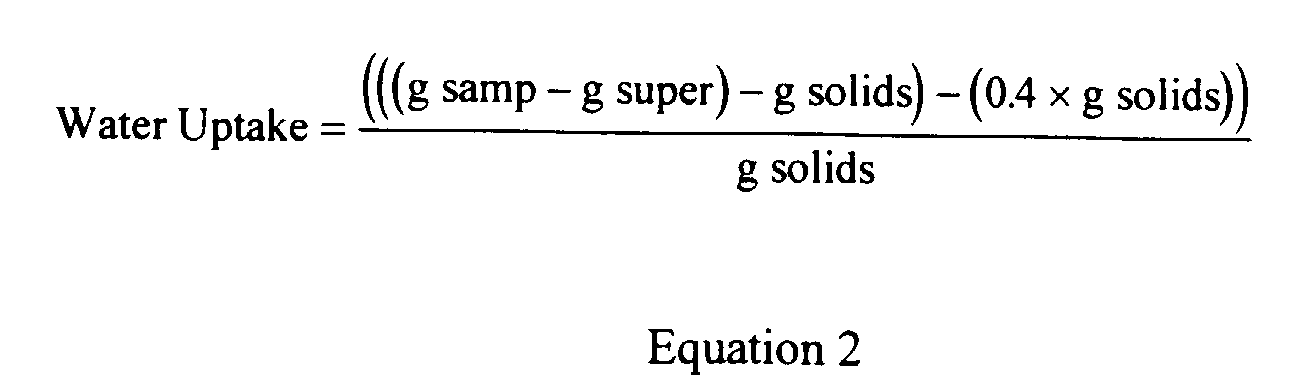
- Equation 2 The water uptake of the polymer particles was calculated by Equation 2: where: "g samp” is the grams of sample centrifuged, “g super” is the grams of supernatant liquid. “g solids” has the same meaning as in Equation 1.
- Equation 2 The value of 0.4 in Equation 2 is an approximation of the correction for interstitial water in the plug. This was determined separately on a polymer of similar composition and particle size.
- a 5-liter flask equipped with paddle stirrer, thermometer, nitrogen inlet, and reflux condenser was charged with 1700 grams (g) of deionized water (DI water). The water was heated to 85°C under nitrogen atmosphere. Then 82 grams of a monomer emulsion was added to the flask.
- the monomer emulsion was prepared from 335 g DI water, 3.5 g of sodium dodecyl benzene sulfonate, 23 % active ingredient, (SDS), 364.5 g methyl methacrylate, and 4.35 g of methacrylic acid.
- the resulting polymer product was swollen and "ruptured" by mixing 200 grams of the polymer product with 7.44 grams of ammonia (28 weight percent active) and 97.56 grams of deionized water. Half of this mixture was heated for 60 °C for one hour and the other half was held at room temperature for 24 hours. Both samples were analyzed for % core acid expelled and water uptake. The sample heated had 66 percent of its core acid expelled and had a water uptake of 2.22 grams water per grams polymer particles. The sample swelled at room temperature had 68 percent of its core material expelled and had a water uptake of 2.22 grams water per grams polymer particles.
- Example 2 To the equipment in Example 2 was added 850 grams DI water and 954.2 grams of the core made in Example 1. The mixture was heated to 60°C under nitrogen atmosphere and then a 20 gram solution of iron sulfate (0.15 weight percent active) was added, followed by the addition of 1.2 grams of sodium persulfate dissolved in 100 grams of DI water. A monomer emulsion of 250 grams of deionized water, 5.25 grams of SDS, 340 grams of ethyl acrylate, 497.25 grams of methyl methacrylate, and 12.75 grams of methacrylic acid was gradually added to the flask at a rate of 2.2 grams per minute.
- the resulting polymer product was swollen and ruptured by mixing 200 grams of the polymer product with 4.48 grams of ammonia (28 weight percent active) and 97.56 grams of DI water. Half of this mixture was heated for 60 °C for one hour and the other half was held at room temperature for 24 hours. Both samples were analyzed for % core acid expelled and water uptake. The sample heated had 59 percent of its core acid expelled and had a water uptake of 1.63 grams water per grams polymer particles. The sample swelled at room temperature had 46 percent of its core material expelled and had a water uptake of 1.17 grams water per grams polymer particles.
- Polymer Particles were prepared similar to the process in Example 3 except that the monomer composition, weight ratio of the core to shell, core particle size, and overall particle size were varied.
- the core particle size was varied primarily by adjusting the surfactant level in the emulsion polymerization.
- the polymer particles useful in the present invention were evaluated in low gloss paper coatings for optical properties.
- the procedure used was as follows:
- the polymer particles were formulated into low gloss paper coating compositions.
- Each low gloss paper coating composition was prepared by first making an aqueous slurry consisting of the inorganic pigments, deionized water, and dispersant shown in Table 3 below.
- Composition of Low Gloss Paper Coating Coating Composition (pbw) Ingredients A B C No.1 Clay (90-94% particles ⁇ 2 microns) 47 0 75 No.
- Enough of deionized water was added to the aqueous pigment slurry to obtain 72 ⁇ 2 weight percent solids.
- the polymer to be evaluated, styrene butadiene latex and starch were added.
- the pH of each coating composition was adjusted to a pH of about 8 with aqueous ammonium hydroxide (28 weight percent active).
- Deionized water was then added to adjust the concentration of solids in each composition to between 52 and 58 weight percent solids.
- Control Coating Compositions Ingredients Control for A (pbw) Control for B (pbw) Control for C (pbw) No.1 Clay 50 0 80 No. 2 Clay 0 65 0 TiO 2 10 0 0 UltraFine Ground Calcium Carbonate 25 35 20 Calcined Clay 15 0 0 Deionized Water Balance Balance Balance Acumer® 9000 0.2-0.3 0.2-0.3 0.2-0.3 Styrene Butadiene Latex 9 12.5 9 Starch 12 3.5 12 Rhoplex® ASE-75 0 0.25 0
- control compositions were prepared by the same method used for making the coating compositions in Table 3, except that no Test Polymer was added.
- the ingredients were the same as those used in Table 3, except Rhoplex® ASE-75 was used which is supplied by Rohm and Haas.
- the viscosity of the coating compositions were measured using a Brookfield LVF viscometer, spindle number 4, at 60 rpm.
- the compositions ranged in viscosity from about 1000 to about 6000 centipoises.
- Each coating composition in Tables 3 and 4 was applied to a number of paper sheets having dimensions of about 23 cms by 30 cms in the following manner.
- the coating composition was drawn down by hand onto the paper sheet using typically a # 5 or #6 Meyer wire wound rod.
- the coating composition was applied to the paper sheet in an amount of about 14.8 g/m 2 of paper sheet.
- the coating composition was applied to the wire side of the paper sheet in the machine direction of the paper sheet.
- the wire wound rod was obtained from RDS, Inc. located in Webster, New York.
- the paper sheet was a typical North American freesheet base stock having a weight of about 61 g/m 2 .
- Each coated paper sheet was oven dried at 80°C for one minute and then conditioned overnight at about 22 °C and 50 percent humidity.
- the weight of the coating on the paper sheet was determined after overnight conditioning by subtracting the weight of the average of several uncoated paper sheets (of the same dimensions as the coated sheets) from the weight of the coated paper sheet.
- the several paper sheets closest to the target weight 14.8 g/ m 2 were evaluated further for optical properties.
- the sheets selected were calendered, with one pass, at a rate of about 183 meters per minute using a laboratory calendering machine designed to simulate supercalendering conditions.
- the calendering was done at temperature of 52 °C and at a preselected pressure to produce a constant sheet gloss. After calendering, each sheet was evaluated for gloss.
- Delta gloss the difference in gloss between a printed and unprinted area of a substrate was determined for each coating composition as follows. Several coated calendered sheets which had the closest average sheet gloss were cut in the center of the sheet to obtain a strip, 4.7 cm by 23 cm in dimensions. The strip was printed to cover all surface area with ink using a fürbau Printer, obtained from fürbau located in Kunststoff, Germany. The settings on the fürbau printer were the following: educabau Printer Settings Print speed 0.5 meters /seconds Pressure on form roll 850 Newtons Ink volume 0.15 milliliters Ink distribution on blanket roll 45 seconds ink distribution on form roll 15 seconds
- the type of ink used was black heat set which was obtained from Wikoff located in Fort Mill, South Carolina. After printing, the strips were heat dried at about 50°C for 2 minutes. The strips were conditioned overnight at 22 °C and 50 percent humidity. The print gloss was measured at several locations down the center of the printed strip using the same procedure as was used for sheet gloss. The average print gloss for each coating composition is shown in Table 6.
- the delta gloss was calculated by subtracting the average sheet gloss from the average print gloss. The greater the delta gloss value, the more contrast in gloss there is between the unprinted and printed areas of a sheet.
- the results of delta gloss for each of the compositions tested are shown in Table 6.
- the " ⁇ Delta Gloss” shown in Table 6 is the difference between the delta gloss of the coating composition containing the test polymer and the appropriate control composition.
- Examples 20-28 in Table 6 show that low gloss coating compositions containing the polymer particles are effective in increasing the delta gloss of a substrate coated with the low gloss composition, in comparison to a substrate coated with the corresponding control, containing no test polymer.
- the results in Table 6 show that the polymer particles increase delta gloss in a variety of low gloss coating compositions.
- Table 6 also shows that the polymer particles are more effective in increasing delta gloss in comparison to polymers which contain voids, but are not "ruptured", hereinafter referred to as "hollow sphere pigments".
- Ropaque OP-84, HP-91, and HP-543 in Table 6 are hollow sphere pigments, and showed lower delta gloss in comparison to Examples 23 and 26.
- the hollow sphere pigments are available from Rohm and Haas Company.
- Table 8 show that low gloss coating compositions containing polymer particles having differing shell compositions are effective in increasing the delta gloss of a substrate coated with the low gloss composition in comparison to a substrate coated with the control composition, containing no test polymer.
- Examples 35-43 in Table 8 also show that polymer particles, having shell glass transition temperatures (Tg) ranging from 19 °C to 54 °C were effective in increasing the delta gloss of a substrate coated with Composition A in comparison to a substrate coated with Control Composition A.
- Tg shell glass transition temperatures
- a low gloss coating composition was prepared according to the method for making Coating Composition A in Table 3, except that the test polymer was not swelled or ruptured until after being added to the composition.
- the test polymer used was prepared according to Example 19.
- the composition prepared was divided in two parts; and each part was neutralized with aqueous ammonia (28 weight percent active) to the pH shown in Table 10.
- the coating compositions were then held at room temperature for at least an hour.
- the two coating compositions and Control Composition A were evaluated for delta gloss according to the same procedure used for Examples 20-28 in Table 6.
- Example 54 in Table 10 shows that polymer particles which are ruptured in the low gloss coating composition are effective in increasing delta gloss on a substrate coated with the composition in comparison to the Control, containing no polymer particles (Comparative Example 52).
- Comparative Example 53 shows that enough swelling agent must be added to the low gloss composition to swell and rupture the polymer particles in order obtain an improvement in delta gloss in comparison to the Control.
- Performance of Polymer Particles Neutralized in the Coating Composition Example pH 75° Sheet Gloss 75° Print Gloss Delta Gloss ⁇ Delta Gloss 52 (Control A) 8.0 30.1 63.8 33.7 --- 53 (comp) 8.0 29.6 63.0 33.4 -0.3 54 9.5 29.0 66.5 37.5 3.8
- the polymer particles were evaluated for their effectiveness in maintaining or decreasing sheet gloss when applied in a low gloss coating composition to a substrate which is then calendered.
- Test polymers were formulated into Coating Composition A according to the method used for Examples 20-28 in Table 6. Each coating composition was then coated and calendered onto a paper substrate according to the method used for Example 20-28 in Table 6, except that a constant calendering pressure of 72 kN/m was used. The sheet gloss of each paper substrate was measured according to the procedure previously described.
- Table 11 shows that the polymer particles maintain or decrease sheet gloss development in comparison to the Control, containing no test polymer (Comparative Example 55).
- Table 11 also shows that hollow sphere pigments (Comparative Examples 56-58) increase sheet gloss in comparison to the Control. Development of Sheet Gloss at Constant Calender Pressure Example Test Polymer 75° Sheet Gloss 55 (Control A) --- 30.7 56(comp) Ropaque® HP-543 40.8 57(comp) Ropaque OP-84 38.8 58 (comp) Ropaque HP-91 40.1 59
Landscapes
- Chemical & Material Sciences (AREA)
- Organic Chemistry (AREA)
- Life Sciences & Earth Sciences (AREA)
- Engineering & Computer Science (AREA)
- Materials Engineering (AREA)
- Wood Science & Technology (AREA)
- Chemical Kinetics & Catalysis (AREA)
- Inorganic Chemistry (AREA)
- Dispersion Chemistry (AREA)
- Health & Medical Sciences (AREA)
- Medicinal Chemistry (AREA)
- Polymers & Plastics (AREA)
- Paints Or Removers (AREA)
- Laminated Bodies (AREA)
- Paper (AREA)
- Inks, Pencil-Leads, Or Crayons (AREA)
Abstract
Description

| Abbreviations | |
| Abbreviation | Meaning |
| BA | weight percent butyl acrylate |
| DI | Deionized |
| EA | weight percent ethyl acrylate |
| MAA | weight percent methacrylic acid |
| MMA | weight percent methyl methacrylate |
| nm | nanometers |
| pbw | parts by weight |
| SDS | sodium dodecyl benzene sulfonate |
| Polymer Particle Compositions for Examples 4-19 | |||||
| Example | Core Composition | Shell Composition | Weight Ratio of Core: Shell | Core Particle Size (nm) | Swollen Particle Size (nm) |
| 4 | 60 MMA/40MAA | 40EA/58.5MMA/1.5 MAA | 1:4 | 355 | 869 |
| 5 | 70 MMA/30MAA | 40EA/58.5MMA/1.5 MAA | 1:4 | 347 | 825 |
| 6 | 35 MMA/65MAA | 40EA/58.5MMA/1.5 MAA | 1:4 | 261 | 560 |
| 7 | 98 MMA/2MAA | 40EA/58.5MMA/1.5 MAA | 1:4 | 410 | 700 |
| 8 | 60 MMA/40MAA | 40EA/58.5MMA/1.5 MAA | 1:4 | 377 | 868 |
| 9 | 60 MMA/40MAA | 65EA/33.5MMA/1.5 MAA | 1:8 | 377 | 1000 |
| 10 | 60 MMA/40MAA | 40EA/58.5MMA/1.5 MAA | 1:2 | 248 | 515 |
| 11 | 60 MMA/40MAA | 30EA/68.5MMA/1.5 MAA | 1:2 | 248 | 510 |
| 12 | 70 MMA/30MAA | 40EA/58.5MMA/1.5 MAA | 1:4 | 347 | 825 |
| 13 | 60 MMA/40MAA | 30BA/68.5MMA/1.5 MAA | 1:4 | 355 | 910 |
| 14 | 60 MMA/40MAA | 40EA/58.5MMA/1.5 MAA | 1:4 | 205 | 487 |
| 15 | 60 MMA/40MAA | 40EA/58.5MMA/1.5 MAA | 1:4 | 267 | 575 |
| 16 | 60 MMA/40MAA | 40EA/58.5MMA/1.5 MAA | 1:4 | 401 | 950 |
| 17 | 60 MMA/40MAA | 40EA/58.5MMA/1.5 MAA | 1:2 | 522 | 1080 |
| 18 | 60 MMA/40MAA | 40EA/58.5MMA/1.5 MAA | 1:4 | 522 | 1280 |
| 19 | 60 MMA/40MAA | 40EA/58.5MMA/1.5MAA | 1:4 | -- | 611 |
| Composition of Low Gloss Paper Coating | |||
| Coating Composition (pbw) | |||
| Ingredients | A | B | C |
| No.1 Clay (90-94% particles < 2 microns) | 47 | 0 | 75 |
| No. 2 Clay (80-84% particles < 2 microns) | 0 | 61 | 0 |
| TiO2 | 7 | 0 | 0 |
| UltraFine Ground Calcium Carbonate | 25 | 33 | 19 |
| Calcined Clay | 15 | 0 | 0 |
| Deionized Water | balance | balance | balance |
| Acumer® 9000 | 0.2-0.3 | 0.2-0.3 | 0.2-0.3 |
| Test Polymer | 6 | 6 | 6 |
| Styrene Butadiene Latex | 9 | 12.5 | 9 |
| Starch | 12 | 3.5 | 12 |
| Control Coating Compositions | |||
| Ingredients | Control for A (pbw) | Control for B (pbw) | Control for C (pbw) |
| No.1 Clay | 50 | 0 | 80 |
| No. 2 Clay | 0 | 65 | 0 |
| TiO2 | 10 | 0 | 0 |
| UltraFine Ground Calcium Carbonate | 25 | 35 | 20 |
| Calcined Clay | 15 | 0 | 0 |
| Deionized Water | Balance | Balance | Balance |
| Acumer® 9000 | 0.2-0.3 | 0.2-0.3 | 0.2-0.3 |
| Styrene Butadiene Latex | 9 | 12.5 | 9 |
| Starch | 12 | 3.5 | 12 |
| Rhoplex® ASE-75 | 0 | 0.25 | 0 |
| Prüfbau Printer Settings | |
| Print speed | 0.5 meters /seconds |
| Pressure on form roll | 850 Newtons |
| Ink volume | 0.15 milliliters |
| Ink distribution on blanket roll | 45 seconds |
| ink distribution on form roll | 15 seconds |
| Gloss Properties of Coating Composition | |||||||
| Example | Test Polymer from | Coating | Calender Pressure (kN/m) | 75° Sheet Gloss | 75° Print Gloss | Delta Gloss | Δ Delta Gloss |
| 20(comp) | -- (control) | A | 171 | 36.1 | 72.3 | 36.2 | --- |
| 21(comp) | Ropaque® OP84 | A | 91 | 39.5 | 78.0 | 38.5 | 2.3 |
| 22(comp) | Ropaque HP91 | A | 72 | 39.3 | 77.5 | 38.2 | 2.0 |
| 23 | Example 4 | A | 143 | 33.3 | 74.9 | 41.6 | 5.4 |
| 24(comp) | -- (control) | B | 168 | 32.9 | 66.3 | 33.4 | --- |
| 25(comp) | Ropaque HP-543 | B | 54 | 34.8 | 71.3 | 36.5 | 3.1 |
| 26 | Example 4 | B | 138 | 34.6 | 73.5 | 38.9 | 5.5 |
| 27(comp) | -- (control) | C | 240 | 43.6 | 76.1 | 32.5 | -- |
| 28 | Example 4 | C | 252 | 39.1 | 76.8 | 37.7 | 5.2 |
| Effect of Polymer Acid Content on Delta Gloss | ||||||||
| Example | Polymer from Example: | Theor. Core Acid Content (pbw) | %Core Acid Expelled | ( Water Uptake g Water/g polymer) | 75° Sheet Gloss | 75° Print Gloss | Delta Gloss | Δ Delta Gloss |
| 29(comp) | --(control) | -- | -- | -- | 30.3 | 66.4 | 36.1 | --- |
| 30 | Example 4 | 8 | 64.8 | 1.63 | 29.7 | 71.0 | 41.3 | 5.2 |
| 31 | Example 5 | 6 | 64.8 | 1.16 | 31.3 | 70.3 | 39.0 | 2.9 |
| 32(comp) | -- (control) | -- | -- | -- | 28.2 | 60.5 | 32.3 | --- |
| 33 | Example 6 | 13 | -- | -- | 26.0 | 69.3 | 43.3 | 11.0 |
| 34 | Example 7 | 0.4 | 28.2 | 61.9 | 33.7 | 1.4 |
| Effect of Shell Composition on Delta Gloss | |||||||
| Example | Polymer from Example: | Tg Shell Composition | Tg Shell | 75° Sheet Gloss | 75° Print Gloss | Delta Gloss | Δ Delta Gloss |
| 35(comp) | -- (control) | -- | 28.2 | 47.5 | 19.3 | --- | |
| 36 | Example 8 | 40EA/58.5MMA/1.5 MAA | 44 | 31.2 | 56.4 | 25.2 | 5.9 |
| 37 | Example 9 | 65EA/33.5MMA/1.5 MAA | 19 | 24.5 | 49.8 | 25.3 | 6.0 |
| 38(comp) | --(control) | -- | 32.9 | 65.3 | 32.4 | --- | |
| 39 | Example 10 | 40EA/58.5MMA/1.5 MAA | 44 | 31.0 | 70.2 | 39.2 | 6.8 |
| 40 | Example 11 | 30EA/68.5MMA/1.5 MAA | 54 | 29.9 | 68.2 | 38.3 | 5.9 |
| 41(comp) | --(control) | -- | 30.3 | 66.4 | 36.1 | --- | |
| 42 | Example 12 | 40EA/58.5MMA/1.5 MAA | 44 | 31.3 | 70.3 | 39.0 | 2.9 |
| 43 | Example 13 | 308A/68.5MMA/1.5 MAA | 44 | 30.0 | 68.8 | 38.8 | 2.7 |
| Effect of Particle Size on Delta Gloss | ||||||||
| Example | Test Polymer | Core Particle Size (nm) | Swollen Particle Size (nm) | Calen. Pres. (kN/m) | 75° Sheet Gloss | 75° Print Gloss | Delta Gloss | Δ Delta Gloss |
| 44(comp) | Control | -- | -- | 119 | 30.6 | 68.7 | 38.1 | --- |
| 45 | Example 14 | 205 | 487 | 191 | 31.8 | 76.3 | 44.5 | 6.4 |
| 46 | Example 15 | 267 | 575 | 108 | 30.3 | 72.1 | 41.8 | 3.7 |
| 47 | Example 4 | 377 | 869 | 96 | 29.7 | 72.6 | 42.9 | 4.8 |
| 48 | Example 16 | 401 | 950 | 91 | 29.6 | 70.7 | 41.1 | 3.0 |
| 49(comp) | Control | -- | -- | 143 | 28.2 | 60.5 | 32.3 | --- |
| 50 | Example 4 | 377 | 869 | 131 | 28.8 | 69.5 | 40.7 | 8.4 |
| 52 | Example 17 | 522 | 1080 | 84 | 27.2 | 71.6 | 44.4 | 12.1 |
| 51 | Example 18 | 522 | 1280 | 131 | 28.6 | 66.7 | 38.1 | 5.8 |
| Performance of Polymer Particles Neutralized in the Coating Composition | |||||
| Example | pH | 75° Sheet Gloss | 75° Print Gloss | Delta Gloss | Δ Delta Gloss |
| 52 (Control A) | 8.0 | 30.1 | 63.8 | 33.7 | --- |
| 53 (comp) | 8.0 | 29.6 | 63.0 | 33.4 | -0.3 |
| 54 | 9.5 | 29.0 | 66.5 | 37.5 | 3.8 |
| Development of Sheet Gloss at Constant Calender Pressure | ||
| Example | Test Polymer | 75° Sheet Gloss |
| 55 (Control A) | --- | 30.7 |
| 56(comp) | Ropaque® HP-543 | 40.8 |
| 57(comp) | Ropaque OP-84 | 38.8 |
| 58 (comp) | Ropaque HP-91 | 40.1 |
| 59 | Example 4 | 28.4 |
Claims (12)
- A low gloss coating composition comprising:one or more polymer particles; and one or more pigments;wherein the polymer particles comprise at least one polymer core phase containing at least one void; at least one polymer shell phase at least partially surrounding the core; and at least one channel connecting the void in the core to the exterior of the particle;wherein the coating composition comprises from 1.0 part by weight to 50 parts by weight of the polymer particles per 100 parts of the pigment, and wherein the coating composition has a 75° sheet gloss of 50 percent or less.
- The low gloss coating composition of claim 1: wherein the polymer particles contain at least 0.5 weight percent of a swellable compound based on the total weight of unswollen polymer particles.
- The low gloss coating composition of claim 1 wherein the polymer particles contain in the at least one core phase, as polymerized units, at least 5 mole percent of a monoethylenically unsaturated functional monomer having at least one functional group selected from the group consisting of a basic, acidic, and hydrolyzable group.
- The low gloss coating composition of claim 1 wherein the polymer particles contain in the at least one core phase, as polymerized units, at least 5 mole percent of an monoethylenically unsaturated acid functional monomer.
- The low gloss coating composition of claim 1, wherein the polymer particles contain in the at least one shell phase one or more monomers selected from the group consisting of (C1-C20) alkyl, (C1-C20) hydroxyalkyl, and (C3-C20) alkenyl esters of (meth)acrylic acid.
- The low gloss coating composition of claim 1, wherein the polymer particles have a core to shell weight ratio ranging from 1:1 to 1:20.
- The low gloss coating composition wherein the polymer particles have an average swollen particle size of from 200 nanometers to 2000 nanometers.
- The low gloss coating composition of claim 1, wherein the composition is made by a process comprising:a) forming a mixture comprising unruptured polymer particles; wherein the unruptured polymer particles comprise at least one polymer core phase containing a swellable compound; and at least one polymer shell phase at least partially surrounding the core, andb) adding a swelling agent to the mixture to form at least one void in the core phase and at least one channel connecting the void in the core to the exterior of the particle.
- A method of improving the print quality of a substrate comprising: applying the low gloss coating composition of claim 1 to the substrate.
- The method of claim 10, wherein the print quality improved is delta gloss.
- A method of making a low gloss coated substrate comprising: applying to a substrate the low gloss coating composition of claim 1.
- A low gloss coated substrate produced by the method of claim 12.
Applications Claiming Priority (2)
| Application Number | Priority Date | Filing Date | Title |
|---|---|---|---|
| US3100496P | 1996-11-15 | 1996-11-15 | |
| US31004P | 1996-11-15 |
Publications (3)
| Publication Number | Publication Date |
|---|---|
| EP0842992A2 true EP0842992A2 (en) | 1998-05-20 |
| EP0842992A3 EP0842992A3 (en) | 2000-02-02 |
| EP0842992B1 EP0842992B1 (en) | 2003-05-07 |
Family
ID=21857162
Family Applications (1)
| Application Number | Title | Priority Date | Filing Date |
|---|---|---|---|
| EP97308901A Expired - Lifetime EP0842992B1 (en) | 1996-11-15 | 1997-11-06 | Low gloss coating composition |
Country Status (10)
| Country | Link |
|---|---|
| EP (1) | EP0842992B1 (en) |
| JP (1) | JPH10147742A (en) |
| KR (1) | KR19980042317A (en) |
| CN (1) | CN1182763A (en) |
| AT (1) | ATE239771T1 (en) |
| AU (1) | AU4432997A (en) |
| BR (1) | BR9705715A (en) |
| CA (1) | CA2219965A1 (en) |
| DE (1) | DE69721695D1 (en) |
| ID (1) | ID18920A (en) |
Cited By (7)
| Publication number | Priority date | Publication date | Assignee | Title |
|---|---|---|---|---|
| EP1138825A1 (en) * | 2000-03-30 | 2001-10-04 | Rohm And Haas Company | Waterborne paper or paperboard coating composition |
| EP1146171A1 (en) * | 2000-04-12 | 2001-10-17 | Rohm And Haas Company | Paper having improved print quality and method of making the same |
| WO2002008297A3 (en) * | 2000-07-24 | 2002-05-30 | Basf Corp | Curable coating composition with improved stability |
| US7625607B1 (en) | 2003-07-22 | 2009-12-01 | Newpage Wisconsin System Inc. | Low glare, high print gloss printing paper |
| WO2010120344A1 (en) * | 2009-04-14 | 2010-10-21 | Omnova Solutions Inc. | Organic polymeric particles, paper coating compositions, and methods |
| WO2018204450A1 (en) * | 2017-05-04 | 2018-11-08 | Dow Global Technologies Llc | Preparation of a coatings formulation with alkali swellable polymer particles |
| US10730334B1 (en) | 2017-04-21 | 2020-08-04 | Omnova Solutions Inc. | Thermosensitive recording material |
Families Citing this family (4)
| Publication number | Priority date | Publication date | Assignee | Title |
|---|---|---|---|---|
| KR100405305B1 (en) * | 2000-06-10 | 2003-11-12 | 주식회사 엘지화학 | Coating composition for protecting dazzling effect |
| KR100726486B1 (en) * | 2005-12-30 | 2007-06-12 | 제일모직주식회사 | Gloss lowering agent of thermoplastic resin and preparation method thereof |
| DE102006009842A1 (en) * | 2006-03-01 | 2007-09-06 | Röhm Gmbh | Additive building material mixtures with microparticles that swell in the mixture |
| KR101182476B1 (en) | 2008-06-16 | 2012-09-12 | 주식회사 엘지화학 | Anti-glare coating composition and anti-glare coating film prepared by using the same |
Family Cites Families (7)
| Publication number | Priority date | Publication date | Assignee | Title |
|---|---|---|---|---|
| US3930101A (en) * | 1972-09-21 | 1975-12-30 | Champion Int Corp | Inorganic pigment-loaded polymeric microcapsular system |
| GB1591924A (en) * | 1976-10-25 | 1981-07-01 | Berger Jenson & Nicholson Ltd | Polymer aggregates |
| EP0179597B1 (en) * | 1984-10-18 | 1993-02-03 | Pfizer Inc. | Spherically shaped precipitated calcium carbonate, its preparation and use |
| US4751111A (en) * | 1986-05-02 | 1988-06-14 | The Dow Chemical Company | Method for producing low sheet gloss coated paper |
| JP2530687B2 (en) * | 1988-05-18 | 1996-09-04 | ローム アンド ハース カンパニー | Polymer composition |
| SG84480A1 (en) * | 1992-04-10 | 2001-11-20 | Rohm & Haas | Polymeric particles |
| US5283129A (en) * | 1992-10-21 | 1994-02-01 | Champion International Corporation | Light weight paper stock |
-
1997
- 1997-10-30 ID IDP973552A patent/ID18920A/en unknown
- 1997-11-03 AU AU44329/97A patent/AU4432997A/en not_active Abandoned
- 1997-11-03 CA CA002219965A patent/CA2219965A1/en not_active Abandoned
- 1997-11-06 DE DE69721695T patent/DE69721695D1/en not_active Expired - Lifetime
- 1997-11-06 EP EP97308901A patent/EP0842992B1/en not_active Expired - Lifetime
- 1997-11-06 AT AT97308901T patent/ATE239771T1/en not_active IP Right Cessation
- 1997-11-12 KR KR1019970059437A patent/KR19980042317A/en not_active Withdrawn
- 1997-11-14 BR BR9705715A patent/BR9705715A/en not_active Application Discontinuation
- 1997-11-14 CN CN97122672A patent/CN1182763A/en active Pending
- 1997-11-17 JP JP9330811A patent/JPH10147742A/en not_active Withdrawn
Cited By (14)
| Publication number | Priority date | Publication date | Assignee | Title |
|---|---|---|---|---|
| EP1138825A1 (en) * | 2000-03-30 | 2001-10-04 | Rohm And Haas Company | Waterborne paper or paperboard coating composition |
| EP1146171A1 (en) * | 2000-04-12 | 2001-10-17 | Rohm And Haas Company | Paper having improved print quality and method of making the same |
| US6547929B2 (en) | 2000-04-12 | 2003-04-15 | Rohm And Haas Company | Paper having improved print quality and method of making the same |
| US6863775B2 (en) | 2000-04-12 | 2005-03-08 | Rohm And Haas Company | Paper having improved print quality and method of making the same |
| WO2002008297A3 (en) * | 2000-07-24 | 2002-05-30 | Basf Corp | Curable coating composition with improved stability |
| US7811657B2 (en) | 2003-07-22 | 2010-10-12 | New Page Wisconsin System Inc. | Low glare, high print gloss printing paper |
| US7625607B1 (en) | 2003-07-22 | 2009-12-01 | Newpage Wisconsin System Inc. | Low glare, high print gloss printing paper |
| WO2010120344A1 (en) * | 2009-04-14 | 2010-10-21 | Omnova Solutions Inc. | Organic polymeric particles, paper coating compositions, and methods |
| US10189958B2 (en) | 2009-04-14 | 2019-01-29 | Omnova Solutions, Inc. | Organic polymeric particles, paper coating compositions and methods |
| US10351678B2 (en) | 2009-04-14 | 2019-07-16 | Omnova Solutions Inc. | Organic polymeric particles, paper coating compositions, and methods |
| US10774187B2 (en) | 2009-04-14 | 2020-09-15 | Omnova Solutions, Inc. | Organic polymeric particles, paper coating compositions, and methods |
| US10730334B1 (en) | 2017-04-21 | 2020-08-04 | Omnova Solutions Inc. | Thermosensitive recording material |
| WO2018204450A1 (en) * | 2017-05-04 | 2018-11-08 | Dow Global Technologies Llc | Preparation of a coatings formulation with alkali swellable polymer particles |
| US11155722B2 (en) | 2017-05-04 | 2021-10-26 | Rohm And Haas Company | Preparation of a coatings formulation with alkali swellable polymer particles |
Also Published As
| Publication number | Publication date |
|---|---|
| JPH10147742A (en) | 1998-06-02 |
| MX9708770A (en) | 1998-05-31 |
| EP0842992B1 (en) | 2003-05-07 |
| CA2219965A1 (en) | 1998-05-15 |
| BR9705715A (en) | 1999-06-29 |
| DE69721695D1 (en) | 2003-06-12 |
| ATE239771T1 (en) | 2003-05-15 |
| ID18920A (en) | 1998-05-20 |
| EP0842992A3 (en) | 2000-02-02 |
| CN1182763A (en) | 1998-05-27 |
| AU4432997A (en) | 1998-05-21 |
| KR19980042317A (en) | 1998-08-17 |
Similar Documents
| Publication | Publication Date | Title |
|---|---|---|
| EP0959176B1 (en) | Hollow sphere organic pigment for paper or paper coatings | |
| AU783561B2 (en) | Coated paper sheet | |
| JP5064616B2 (en) | Paper with improved print quality | |
| EP1010807B1 (en) | Polymers for use as barrier coatings | |
| US8674000B2 (en) | Multi-layered paper coating latex having high swelling and contraction property, method for preparing the same, and paper coating composition containing the same | |
| EP0331143B1 (en) | Coating composition and cast-coated paper coated with same | |
| EP0842992B1 (en) | Low gloss coating composition | |
| DK167699B1 (en) | PROCEDURE FOR COATING PAPER | |
| EP0430391B1 (en) | Coated printing material and process for producing the same | |
| US20020001698A1 (en) | Low gloss coating composition | |
| JP2001323223A (en) | Coating composition | |
| EP1403427B1 (en) | Coated paper for printing | |
| CA2283226C (en) | Improved size press coating method | |
| EP0024602B1 (en) | Aqueous dispersions, their preparation and their use in preparing coating compositions | |
| US4963604A (en) | Polymeric pigments used in paper coating compositions and a process for their preparation | |
| MXPA97008770A (en) | Composition of brightness coating b | |
| EP0513452B1 (en) | Coated printing paper and process for producing the same | |
| NO773392L (en) | COPOLYMERLATEX. | |
| JPH03279493A (en) | Pigment coating composition | |
| MXPA99004430A (en) | Organic pigment with hollow spheres, for the paper or coatings of the pa |
Legal Events
| Date | Code | Title | Description |
|---|---|---|---|
| PUAI | Public reference made under article 153(3) epc to a published international application that has entered the european phase |
Free format text: ORIGINAL CODE: 0009012 |
|
| 17P | Request for examination filed |
Effective date: 19971115 |
|
| AK | Designated contracting states |
Kind code of ref document: A2 Designated state(s): AT DE FI FR GB IT NL |
|
| AX | Request for extension of the european patent |
Free format text: AL;LT;LV;MK;RO;SI |
|
| PUAL | Search report despatched |
Free format text: ORIGINAL CODE: 0009013 |
|
| AK | Designated contracting states |
Kind code of ref document: A3 Designated state(s): AT BE CH DE DK ES FI FR GB GR IE IT LI LU MC NL PT SE |
|
| AX | Request for extension of the european patent |
Free format text: AL;LT;LV;MK;RO;SI |
|
| RIC1 | Information provided on ipc code assigned before grant |
Free format text: 7C 09D 5/02 A, 7C 09D 7/12 B, 7C 08F 265/02 B, 7C 08F 265/06 B, 7C 09D 151/00 B |
|
| AKX | Designation fees paid |
Free format text: AT DE FI FR GB IT NL |
|
| 17Q | First examination report despatched |
Effective date: 20011029 |
|
| GRAH | Despatch of communication of intention to grant a patent |
Free format text: ORIGINAL CODE: EPIDOS IGRA |
|
| GRAH | Despatch of communication of intention to grant a patent |
Free format text: ORIGINAL CODE: EPIDOS IGRA |
|
| GRAA | (expected) grant |
Free format text: ORIGINAL CODE: 0009210 |
|
| AK | Designated contracting states |
Designated state(s): AT DE FI FR GB IT NL |
|
| PG25 | Lapsed in a contracting state [announced via postgrant information from national office to epo] |
Ref country code: NL Free format text: LAPSE BECAUSE OF FAILURE TO SUBMIT A TRANSLATION OF THE DESCRIPTION OR TO PAY THE FEE WITHIN THE PRESCRIBED TIME-LIMIT Effective date: 20030507 Ref country code: IT Free format text: LAPSE BECAUSE OF FAILURE TO SUBMIT A TRANSLATION OF THE DESCRIPTION OR TO PAY THE FEE WITHIN THE PRESCRIBED TIME-LIMIT;WARNING: LAPSES OF ITALIAN PATENTS WITH EFFECTIVE DATE BEFORE 2007 MAY HAVE OCCURRED AT ANY TIME BEFORE 2007. THE CORRECT EFFECTIVE DATE MAY BE DIFFERENT FROM THE ONE RECORDED. Effective date: 20030507 Ref country code: FR Free format text: LAPSE BECAUSE OF FAILURE TO SUBMIT A TRANSLATION OF THE DESCRIPTION OR TO PAY THE FEE WITHIN THE PRESCRIBED TIME-LIMIT Effective date: 20030507 Ref country code: FI Free format text: LAPSE BECAUSE OF FAILURE TO SUBMIT A TRANSLATION OF THE DESCRIPTION OR TO PAY THE FEE WITHIN THE PRESCRIBED TIME-LIMIT Effective date: 20030507 Ref country code: AT Free format text: LAPSE BECAUSE OF FAILURE TO SUBMIT A TRANSLATION OF THE DESCRIPTION OR TO PAY THE FEE WITHIN THE PRESCRIBED TIME-LIMIT Effective date: 20030507 |
|
| REG | Reference to a national code |
Ref country code: GB Ref legal event code: FG4D |
|
| REF | Corresponds to: |
Ref document number: 69721695 Country of ref document: DE Date of ref document: 20030612 Kind code of ref document: P |
|
| PG25 | Lapsed in a contracting state [announced via postgrant information from national office to epo] |
Ref country code: DE Free format text: LAPSE BECAUSE OF FAILURE TO SUBMIT A TRANSLATION OF THE DESCRIPTION OR TO PAY THE FEE WITHIN THE PRESCRIBED TIME-LIMIT Effective date: 20030808 |
|
| NLV1 | Nl: lapsed or annulled due to failure to fulfill the requirements of art. 29p and 29m of the patents act | ||
| PG25 | Lapsed in a contracting state [announced via postgrant information from national office to epo] |
Ref country code: GB Free format text: LAPSE BECAUSE OF NON-PAYMENT OF DUE FEES Effective date: 20031106 |
|
| PLBE | No opposition filed within time limit |
Free format text: ORIGINAL CODE: 0009261 |
|
| STAA | Information on the status of an ep patent application or granted ep patent |
Free format text: STATUS: NO OPPOSITION FILED WITHIN TIME LIMIT |
|
| 26N | No opposition filed |
Effective date: 20040210 |
|
| EN | Fr: translation not filed | ||
| GBPC | Gb: european patent ceased through non-payment of renewal fee |
Effective date: 20031106 |