EP0842922A1 - Process for producing acrylonitrile - Google Patents
Process for producing acrylonitrile Download PDFInfo
- Publication number
- EP0842922A1 EP0842922A1 EP97308934A EP97308934A EP0842922A1 EP 0842922 A1 EP0842922 A1 EP 0842922A1 EP 97308934 A EP97308934 A EP 97308934A EP 97308934 A EP97308934 A EP 97308934A EP 0842922 A1 EP0842922 A1 EP 0842922A1
- Authority
- EP
- European Patent Office
- Prior art keywords
- catalyst
- ammoxidation
- fluidized
- reaction
- propylene
- Prior art date
- Legal status (The legal status is an assumption and is not a legal conclusion. Google has not performed a legal analysis and makes no representation as to the accuracy of the status listed.)
- Granted
Links
Images
Classifications
-
- C—CHEMISTRY; METALLURGY
- C07—ORGANIC CHEMISTRY
- C07C—ACYCLIC OR CARBOCYCLIC COMPOUNDS
- C07C253/00—Preparation of carboxylic acid nitriles
- C07C253/24—Preparation of carboxylic acid nitriles by ammoxidation of hydrocarbons or substituted hydrocarbons
- C07C253/26—Preparation of carboxylic acid nitriles by ammoxidation of hydrocarbons or substituted hydrocarbons containing carbon-to-carbon multiple bonds, e.g. unsaturated aldehydes
-
- Y—GENERAL TAGGING OF NEW TECHNOLOGICAL DEVELOPMENTS; GENERAL TAGGING OF CROSS-SECTIONAL TECHNOLOGIES SPANNING OVER SEVERAL SECTIONS OF THE IPC; TECHNICAL SUBJECTS COVERED BY FORMER USPC CROSS-REFERENCE ART COLLECTIONS [XRACs] AND DIGESTS
- Y02—TECHNOLOGIES OR APPLICATIONS FOR MITIGATION OR ADAPTATION AGAINST CLIMATE CHANGE
- Y02P—CLIMATE CHANGE MITIGATION TECHNOLOGIES IN THE PRODUCTION OR PROCESSING OF GOODS
- Y02P20/00—Technologies relating to chemical industry
- Y02P20/50—Improvements relating to the production of bulk chemicals
- Y02P20/52—Improvements relating to the production of bulk chemicals using catalysts, e.g. selective catalysts
-
- Y—GENERAL TAGGING OF NEW TECHNOLOGICAL DEVELOPMENTS; GENERAL TAGGING OF CROSS-SECTIONAL TECHNOLOGIES SPANNING OVER SEVERAL SECTIONS OF THE IPC; TECHNICAL SUBJECTS COVERED BY FORMER USPC CROSS-REFERENCE ART COLLECTIONS [XRACs] AND DIGESTS
- Y02—TECHNOLOGIES OR APPLICATIONS FOR MITIGATION OR ADAPTATION AGAINST CLIMATE CHANGE
- Y02P—CLIMATE CHANGE MITIGATION TECHNOLOGIES IN THE PRODUCTION OR PROCESSING OF GOODS
- Y02P20/00—Technologies relating to chemical industry
- Y02P20/50—Improvements relating to the production of bulk chemicals
- Y02P20/584—Recycling of catalysts
Definitions
- This invention relates to an improved process for the production of acrylonitrile by the catalytic ammoxidation of propylene in a fluidized-bed reactor, which can produce acrylonitrile in a high yield at a low production cost.
- Reaction for synthesizing acrylonitrile by means of the ammoxidation of propylene is, in general, accompanied by high heat generation. For this reason, a method using a fluidized-bed reactor, which is advantageous to the removal of heat generated, is often employed.
- the conventional technique using such a method tends to have the following problems: the back mixing of a gas is unavoidable due to the violent mixing of particles which is caused in a fluidized bed; and the yield of acrylonitrile is lowered due to the progress of unfavorable side reaction which is caused when contact between a gas and a catalyst becomes insufficient because of bubbles formed in a fluidized-bed reaction area.
- Japanese Patent Laid-Open Publication No. 144528/1978 proposes a method for attaining high acrylonitrile yield by using a fluidized bed with a high gas velocity of approximately 1.5 to 7.5 m/sec.
- this method seems to be unsatisfactory for economically attaining high productivity by the use of a highly-active catalyst.
- a particular problem in this method is that a considerably long reactor is required to attain a predetermined rate of reaction because the superficial gas velocity in a column is high. An increased cost is needed to construct such a reactor for use in an industrial-scale apparatus, and this becomes a great economical burden.
- the reactor in the shape of a coil.
- a gas and a catalyst are to flow in the coil with a circling movement, so that they are separated from each other due to centrifugal force, and the efficiency of contact between them is thus lowered.
- This problem is a fatal drawback in large-scale apparatuses for industrial use.
- the present invention provides in a process for producing acrylonitrile by the ammoxidation of propylene comprising bringing, in a fluidized-bed reactor, a gas containing propylene, ammonia and molecular oxygen into contact with a highly-active ammoxidation catalyst (this catalyst being one which can attain a rate constant of 2 s -1 or more for the ammoxidation reaction of propylene, assuming that the ammoxidation reaction is a first-order reaction) which is in a state of being fluidized by the gas, the improvement comprising carrying out the ammoxidation under the following conditions:
- acrylonitrile can be obtained in high yield and with high productivity from a gas containing propylene, ammonia and molecular oxygen by using a highly-active ammoxidation catalyst. Moreover, the construction cost of a reactor for use in the above process is low, so that acrylonitrile can be produced economically.
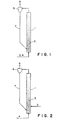
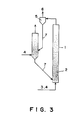
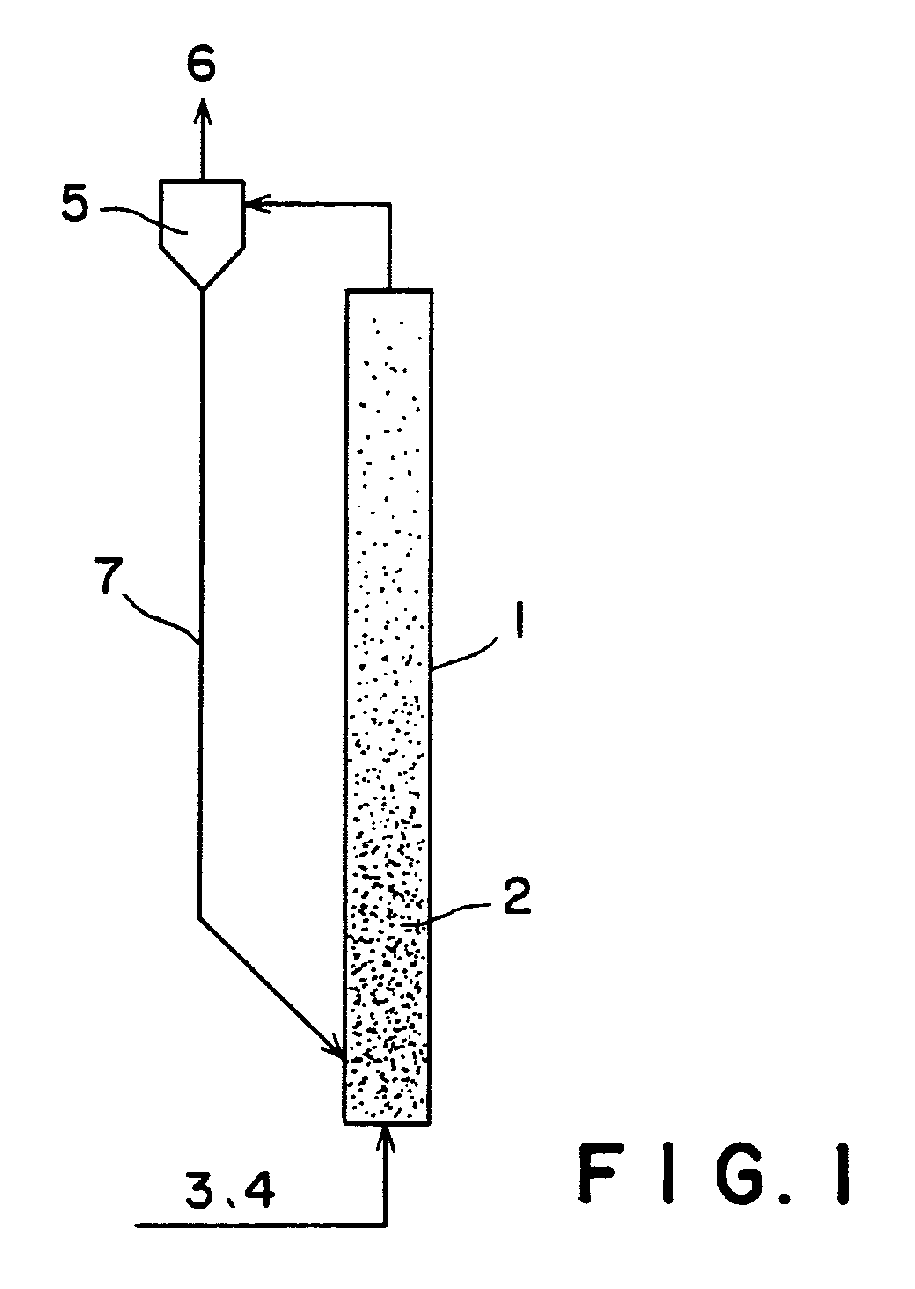
- a feed gas containing propylene and ammonia or a feed gas containing propylene, ammonia and molecular oxygen is fed through a feed-gas feed line 3 (Figs. 1 to 3).
- the feed gas can contain other purposive components or components which are inevitably present therein. It is thus possible to feed air as the molecular oxygen. In this case, the components of air other than oxygen, especially molecular nitrogen, are to co-exist in the feed gas. Moreover, it is also a common manner to add steam to the feed gas.
- molecular oxygen is fed to the fluidized-bed reactor 1 through a molecular oxygen-containing gas feed line 4.
- the superficial gas velocity in the fluidized-bed reactor 1 is maintained at 1 to 10 m/s, preferably 1 to 9 m/s, more preferably 1 to 7 m/s under such a condition that, when the ammoxidation reaction of propylene is assumed to be a first-order reaction, the rate constant of the reaction is 2 s -1 or more, preferably 3 s -1 or more.
- the superficial gas velocity is as high as 1 to 10 m/s as in the present invention, bubbles substantially disappear, and the degree of the back mixing of the gas becomes negligibly small. Contact between the gas and the catalyst is thus extremely excellent.
- the rate constant of the reaction varies depending upon the activity of the catalyst used, the reaction temperature, the composition of a gas to be fed to a reactor, the superficial gas velocity in the reactor, the structure of the reactor, or the like.
- the rate constant of the reaction under given reaction conditions can be determined by the concentrations of propylene at the inlet and outlet of a reactor, and the contact time.
- an area in which the density of fluidized solid matter (comprising the highly-active ammoxidation catalyst 2, and other solids which may be used when necessary) is 100 kg/m 3 or more, preferably 150 kg/m 3 or more, more preferably 200 kg/m 3 or more is kept in the fluidized-bed reactor 1 at the upstream side thereof.
- the density is less than 100 kg/m 3 , the reaction at the upstream side of the fluidized-bed reactor cannot fully proceed, so that it is necessary to increase the height of the reactor. Such a low density is thus unfavorable.
- the fluidized-bed reactor is generally upright. Therefore, the upstream side of the fluidized-bed reactor means the lower part of the reactor. Further, the position in the reactor at which the high-density area should be kept is, in general, lower than 1/2 of the height of the reactor (the height of the reactor means the distance between a gas feed opening positioned at the lowest part of the reactor at the upstream side thereof, and a gas discharge opening positioned at the topmost part of the reactor at the downstream side thereof).
- the density of fluidized solid matter can be adjusted to a predetermined value by suitably selecting the superficial gas velocity in a reactor, the amount of a catalyst to be packed in the reactor, the particle diameter of the catalyst, the density of the catalyst particles, the position at which the recycling catalyst is returned to the reactor, and the position at which the gas containing propylene, ammonia and molecular oxygen is fed to the reactor. It is noted that the density of fluidized solid matter can be obtained by determining the difference between pressures measured at two different points along the height of the fluidized-bed reactor, and dividing it by the distance between the two points.
- the fluidized solid matter is conveyed to the upper part of the reactor 1, and separated from the gas stream by a catalyst separator 5 placed in the vicinity of the top of the reactor 1, or at the outside of the reactor 1.
- a catalyst separator 5 As the catalyst separator 5, a cyclone is usually used. If necessary, a multicyclone can be used (not shown in the figures).
- reaction product-containing gas The gas from which the highly-active ammoxidation catalyst (and other fluidized solids) has been separated, that is, a reaction product-containing gas is drawn out from the system, and transferred to a purification system 6. From this gas transferred, acrylonitrile, the desired product, is recovered by a conventionally known means.
- the catalyst 2 collected by the catalyst separator 5 is introduced, as it is (Figs. 1 and 2), or after subjected to a reactivation treatment (Fig. 3), into the fluidized-bed reactor 1 either continuously or intermittently through a catalyst-recycling line 7.
- a reactivation treatment Fig. 3
- the catalyst-recycling system is, in general, formed in the fluidized-bed reactor between the downstream side and upstream side thereof.
- downstream side includes not only a reactor in a narrow sense which contains a fluidized catalyst bed to provide a place for reaction, but also, in the case where a reaction gas drawn out from this reactor still reacts because it contains the fluidized catalyst, a region outside the reactor in which such a reaction is proceeding, that is, the outside region including the cyclone in the case of the embodiment shown in Fig. 1.
- the catalytic activity of the catalyst used has generally been lowered due to the deposition of coke and/or reduction (since the catalyst is generally composed of an oxide, it is usually reduced in the process of ammoxidation). Therefore, the catalyst is usually activated by heating it in an oxidizing atmosphere.
- This heating can be conducted by any purposive method. It is however preferable to employ a fluidized bed in order to continuously activate and recycle the catalyst, and to uniformly heat the catalyst (Fig. 3). Thus, it is preferable to reactivate the ammoxidation catalyst which has passed through the catalyst separator 5 with a molecular oxygen-containing gas while fluidizing the catalyst by the gas. Any type of fluidized bed such as a conventional fluidized bed or a high-velocity fluidized bed may be used for this purpose.
- the reactivation treatment is usually carried out by bringing a catalyst to be treated into contact with a molecular oxygen-containing gas at a high temperature.
- a molecular oxygen-containing gas As the molecular oxygen, air, oxygen-rich air, air diluted with steam, nitrogen or carbon dioxide, or the like can-be used.
- the reactivation treatment temperature varies depending upon the catalyst to be treated. It is however generally from 450 to 700 °C, preferably from 480 to 600 °C.
- the reactivation treatment time is generally from approximately 1 to 300 minutes, preferably from 10 to 120 minutes.
- the catalyst drawn out of from the fluidized-bed reactor 1 is reintroduced into the reactor at such a position that the weight ratio of the ammoxidation catalyst present in an area above the position to the ammoxidation catalyst present in an area below the position will be from 2:1 to 99:1, preferably from 5:1 to 99:1, more preferably from 9:1 to 99:1.
- the feed gas to be fed to the fluidized-bed reactor 1, that is, the gas containing propylene, ammonia and molecular oxygen is, in general, fed to the bottom of the reactor so that the fluidized bed which provides a place for reaction can be effectively utilized.
- a part of or the whole quantity of propylene or ammonia, and a part of a molecular oxygen-containing gas can also be fed from a position higher than the bottom of the reactor.
- the feed gas can be fed to the fluidized-bed reactor 1 after mixed with an inert gas such as steam, nitrogen or carbon dioxide; or the feed gas and an inert gas can be separately fed to the fluidized-bed reactor 1 from different feed openings for the respective gases.
- an inert gas such as steam, nitrogen or carbon dioxide
- the ammoxidation catalyst for use in the present invention is of high activity, which can attain a rate constant of at least 2 s -1 , preferably 3 s -1 or more, more preferably 4 s -1 or more for the ammoxidation reaction of propylene, assuming that the reaction is a first-order reaction.
- a highly-active ammoxidation catalyst any conventionally-known one can be used as long as it does not contravene the object of the invention.
- Typical examples of highly-active ammoxidation catalysts that can be preferably used in the present invention include those ones which comprise as essential components iron, antimony and molybdenum. Examples of these catalysts include those described in Japanese Patent Publications No. 18014/1978 and No.
- catalysts containing iron, antimony and molybdenum, and, in addition to these elements, two elements selected from the group consisting of potassium, rubidium, cesium, manganese, cobalt, nickel, copper, zinc, boron, tin, tellurium, bismuth and cerium specifically those catalysts which are represented by the following general formula can be preferably used: Fe a Sb b Mo c Q d R e S f O g wherein Q represents at least one element selected from the group consisting of K, Rb and Cs; R represents at least one element selected from the group consisting of Mn, Co, Ni, Cu and Zn; S represents at least one element selected from the group consisting of B, P, Te, Bi and
- the catalyst for use in the present invention is as follows: the range of particle diameters is generally from 5 to 300 ⁇ m, preferably from 10 to 200 ⁇ m (the “range of particle diameters” as used herein is a range of particle diameters corresponding to the weight-based cumulative values between 0.1% and 99.9% in a weight-based cumulative distribution determined by sieve analysis); an average particle diameter is generally from 30 to 80 ⁇ m, preferably from 40 to 65 ⁇ m (the "average particle diameter” as used herein is a particle diameter corresponding to the weight-based cumulative value of 50% in a weight-based cumulative distribution determined by sieve analysis); and a bulk density is generally from 0.6 to 1.5 g/cm 3 , preferably from 0.7 to 1.3 g/cm 3 (the "bulk density” as used herein is a density determined by measuring the mass of a catalyst which has been packed in a measuring cylinder without shaking the cylinder, and converting it into a mass per unit volume).
- the highly-active ammoxidation catalyst according to the present invention is used as a high-velocity fluidized bed, so that it should be tough.
- preferable catalysts are such that 90% or more, preferably 95% or more of 20-75 ⁇ m particles have a compressive strength (CS) which can fulfill the following inequality: CS > A ⁇ d ⁇ wherein CS represents a compressive strength [g-weight/ -particle], A represents the constant of 0.001, d represents a particle diameter [ ⁇ m], and a represents the constant of 2.
- CS compressive strength
- A represents the constant of 0.001
- d represents a particle diameter [ ⁇ m]
- a represents the constant of 2.
- the compressive strength (CS) as defined in the present invention is a value measured by using a "Shimadzu MCTM-200" manufactured by Shimadzu Corp., Japan under the following conditions: Indenter upper pressure indenter diamond-made indenter having a face of 500 ⁇ m lower pressure plate SUS plate Loading rate 0.72 g-weight/sec
- the 20-75 ⁇ m particles mean that the diameters of particles are, or an average of the lengths and breadths of particles is in the range of 20 to 75 ⁇ m, Specifically, such particles can be obtained by means of sieving using micromesh high-precision sieves manufactured by Buckbee Mears. Co., St. Paul. It is noted that samples are randomly taken from the 20-75 ⁇ m particles and that the number of the samples taken is statistically significant one.
- the reaction temperature at which acrylonitrile is produced is generally from 400 to 500 °C, preferably from 420 to 470 °C.
- the reaction pressure is generally from atmospheric pressure to 5 kg/cm 2 gage, preferably from atmospheric pressure to 2 kg/cm 2 gage.
- the materials to be fed to the reactor are such that the molar ratio of oxygen/propylene is generally from 1.5 to 3.0, preferably from 1.8 to 2.5 and that the molar ratio of ammonia/propylene is generally from 0.8 to 2.0, preferably from 1.0 to 1.5.
- the feed gas-ammoxidation catalyst contact time is generally from 0.1 to 20 seconds, preferably from 1 to 10 seconds.
- Rate constant of reaction [1/s] Ln ⁇ 100/(100 - conversion of propylene [%]) ⁇ / (contact time [s])
- Contact time [s] (weight of catalyst existing above propylene- feed opening [kg])/ ⁇ (bulk density of catalyst [kg/m 3 ]) x (volumetric flow rate of whole feed gas under reaction conditions [m 3 /s]) ⁇
- Conversion of propylene [%] ⁇ (weight of carbon contained in propylene reacted [kg])/(weight of carbon contained in propylene fed [kg]) ⁇ x
- Yield of acrylonitrile [%] ⁇ (weight of carbon contained in acrylonitrile produced [kg])/ (weight of carbon contained in propylene fed [kg]) ⁇ x 100
- Acrylonitrile was produced by the ammoxidation of propylene using a reactor as shown in Fig. 1. Specifically, to the bottom of a fluidized-bed reactor as shown in Fig. 1, having an inner diameter of 0.04 m and a height of 10 m, a feed gas consisting of 8.5 mol% of propylene, 10.3 mol% of ammonia, and air as the remainder was fed; and the superficial gas velocity in the reactor was maintained at 4 m/sec under such conditions that the reaction temperature was 435 °C and that the pressure at the top of the reactor was 0.80 kg/cm 2 G.
- the ammoxidation catalyst used was a highly-active ammoxidation catalyst (the rate constant of the reaction was 7.7 s -1 under the operation conditions) supported on silica, represented by the following empirical formula: Fe 10.0 Sb 8.6 Mo 1.0 K 0.33 Ni 6.7 B 0.54 P 0.77 Bi 0.83 O x wherein x represents an atomic ratio of oxygen when the above components are combined, having particle diameters ranging from 5 to 300 ⁇ m, an average particle diameter of approximately 50 ⁇ m, and a bulk density of 1.0 g/cm 3 .
- the separation of the catalyst from the reaction product gas was performed in a cyclone provided at the outlet of the reactor.
- the catalyst separated was introduced into the reactor through a catalyst feed opening at such a position that the weight ratio of the ammoxidation catalyst present in an area above the position to the ammoxidation catalyst present in an area below the position was 19:1.
- an area in which the density of the catalyst solid was 200 kg/m 3 was formed between the bottom of the reactor and the opening through which the catalyst was returned to the reactor for recycling.
- the yield of acrylonitrile was determined by the gas-chromatographic analysis of a solution obtained by allowing an aqueous hydrochloric acid solution to absorb the reaction product gas; and the conversion of propylene was determined by measuring, by gas-chromatographic analysis, unreacted propylene contained in the unabsorbed gas. As a result of the reaction and measurement, the conversion of propylene was 99%, and the yield of acrylonitrile was 82.5%.
- propylene can be ammoxidized into acrylonitrile at high conversion and in high yield in a fluidized-bed reactor using a highly-active catalyst.
- Example 1 The procedure of Example 1 was repeated except that a fluidized-bed reactor shown in Fig. 2, a feed gas consisting of 8.6 mol% of propylene, 10.5 mol% of ammonia and air as the remainder, and a catalyst represented by the following empirical formula: Fe 10.0 Sb 10.0 Mo 0.85 K 0.2 Ni 5.0 B 0.75 P 0.55 Bi 1.5 O x were used instead of those used in Example 1.
- the catalyst used had the following features: the catalytic activity was such that the rate constant of the reaction became 7.8 s -1 under the operation conditions; the range of particle diameters was from 5 to 300 ⁇ m; the average particle diameter was 55 ⁇ m; and the bulk density was 1.0 g/cm 3 .
- the position at which the catalyst separated was introduced from the recycling system into the reactor was such that the weight ratio of the ammoxidation catalyst present in an area above the position to the ammoxidation catalyst present in an area below the position was 19:1.
- an area in which the density of the catalyst solid was 250 kg/cm 3 was kept between the bottom of the reactor and the opening for introducing the catalyst.
- Example 2 The procedure of Example 2 was repeated except that only air was fed to the bottom of the fluidized-bed reactor and that propylene and ammonia were fed to the reactor at such a position that the weight ratio of the ammoxidation catalyst present in an area above the feed position to the ammoxidation catalyst present in an area below the position was 8:2.
- the reaction conditions and the results are as shown in Table 1.
- Example 1 Reaction was carried out under the same conditions as in Example 1 except that a fluidized-bed reactor having an inner diameter of 0.04 m and a height of 1 m was used and that the superficial gas velocity in the reactor and the contact time were changed to 0.1 m/s and 1.75 seconds, respectively.
- the reaction conditions and the results are as shown in Table 1. It is apparent from the results that the yield in Example 1 in which a recycling fluidized-bed reactor was used is considerably higher than the yield in this Comparative Example 1 in which a conventional fluidized-bed reactor was used.
- Example No. Reaction area Feed gas (mol%) Results of reaction Temperature Contact time Propylene Ammonia Air Conversion (%) Yield of acrylonitrile (%) Ex.
Landscapes
- Chemical & Material Sciences (AREA)
- Organic Chemistry (AREA)
- Organic Low-Molecular-Weight Compounds And Preparation Thereof (AREA)
- Low-Molecular Organic Synthesis Reactions Using Catalysts (AREA)
- Catalysts (AREA)
Abstract
Description
| Indenter | |
| upper pressure indenter | diamond-made indenter having a face of 500 µm |
| lower pressure plate | SUS plate |
| Loading rate | 0.72 g-weight/sec |
having particle diameters ranging from 5 to 300 µm, an average particle diameter of approximately 50 µm, and a bulk density of 1.0 g/cm3.
| Example No. | Reaction area | Feed gas (mol%) | Results of reaction | ||||
| Temperature | Contact time | Propylene | Ammonia | Air | Conversion (%) | Yield of acrylonitrile (%) | |
| Ex. 1 | 435°C | 0.60 sec | 8.5 | 10.3 | 81.2 | 99.0 | 82.5 |
| Ex. 2 | 435°C | 0.60 sec | 8.6 | 10.5 | 80.9 | 99.1 | 82.3 |
| Ex. 3 | 435°C | 0.55 sec | 8.6 | 10.5 | 80.9 | 98.9 | 82.3 |
| Comp. Ex. 1 | 435°C | 1.75 sec | 8.5 | 10.3 | 81.2 | 98.1 | 80.4 |
Claims (6)
- A process for producing acrylonitrile by the ammoxidation of propylene in a fluidized-bed reactor, which comprises contacting a gas containing propylene, ammonia and molecular oxygen with a highly-active ammoxidation catalyst (this catalyst being one which can attain a rate constant of 2 s-1 or more for the ammoxidation reaction of propylene, assuming that the reaction is a first-order reaction) which is in a state of being fluidized by the gas, characterised in that the ammoxidation is carried out under the following conditions:(a) the superficial gas velocity in the fluidized-bed reactor is maintained at 1 to 10 m/s under such an operation condition that the rate constant of the ammoxidation reaction of propylene is 2 s-1 or more, assuming that the reaction is a first-order reaction;(b) an area in which the density of fluidized solid matter is 100 kg/m3 or more is kept in the fluidized-bed reactor at the upstream side thereof; and(c) a system for recycling the ammoxidation catalyst which has been supplied to the reaction is provided in the fluidized-bed reactor between the upstream side and downstream side thereof, and the recycling catalyst is introduced into the reactor at such a position that the weight ratio of the ammoxidation catalyst present in an area above the introduction position to the ammoxidation catalyst present in an area below the position will be from 2:1 to 99:1.
- The process according to claim 1, wherein the recycling catalyst is introduced into the fluidized-bed reactor after it has been subjected to a reactivation treatment which comprises bringing the catalyst into contact with a molecular oxygen-containing gas.
- The process according to claim 1 or 2, wherein the highly-active ammoxidation catalyst has a composition represented by the following general formula:
- The process according to any one of claims 1 to 3, wherein the highly-active ammoxidation catalyst has particle diameters ranging from 5 to 300 µm, an average particle diameter of approximately 30 to 80 µm, and a bulk density of approximately 0.6 to 1.5 g/cm3.
- The process according to any one of claims 2 to 4, wherein the reactivation treatment is carried out at a temperature of 450 to 700 °C.
- The process according to any one of the preceding claims, wherein the ammoxidation is carried out at a temperature of 400 to 500 °C.
Applications Claiming Priority (3)
| Application Number | Priority Date | Filing Date | Title |
|---|---|---|---|
| JP29412296 | 1996-11-06 | ||
| JP29412296A JP3976824B2 (en) | 1996-11-06 | 1996-11-06 | Production method of acrylonitrile |
| JP294122/96 | 1996-11-06 |
Publications (2)
| Publication Number | Publication Date |
|---|---|
| EP0842922A1 true EP0842922A1 (en) | 1998-05-20 |
| EP0842922B1 EP0842922B1 (en) | 2002-04-24 |
Family
ID=17803585
Family Applications (1)
| Application Number | Title | Priority Date | Filing Date |
|---|---|---|---|
| EP97308934A Expired - Lifetime EP0842922B1 (en) | 1996-11-06 | 1997-11-06 | Process for producing acrylonitrile |
Country Status (7)
| Country | Link |
|---|---|
| US (1) | US5914424A (en) |
| EP (1) | EP0842922B1 (en) |
| JP (1) | JP3976824B2 (en) |
| CN (1) | CN1113858C (en) |
| DE (1) | DE69712157T2 (en) |
| ES (1) | ES2173395T3 (en) |
| NL (1) | NL1007469C2 (en) |
Cited By (2)
| Publication number | Priority date | Publication date | Assignee | Title |
|---|---|---|---|---|
| EP0893435A3 (en) * | 1997-07-25 | 1999-12-29 | Praxair Technology, Inc. | Oxygen addition to reduce inerts in an acrylonitrile reactor |
| EP3470392A4 (en) * | 2017-07-03 | 2020-08-12 | Asahi Kasei Kabushiki Kaisha | PROCESS FOR MANUFACTURING UNSATURATED NITRILE |
Families Citing this family (12)
| Publication number | Priority date | Publication date | Assignee | Title |
|---|---|---|---|---|
| JP4889866B2 (en) * | 2001-02-06 | 2012-03-07 | ダイヤニトリックス株式会社 | Method for producing acrylonitrile |
| US6890877B2 (en) * | 2002-07-09 | 2005-05-10 | Conocophillips Company | Enhanced fluid/solids contacting in a fluidization reactor |
| JP4762554B2 (en) * | 2005-01-06 | 2011-08-31 | ダイヤニトリックス株式会社 | Method for producing acrylonitrile |
| CN102010350B (en) * | 2009-09-07 | 2013-12-18 | 中国石油化工集团公司 | Method for increasing production capacity of acrylonitrile or methacrylonitrile |
| RU2541471C2 (en) * | 2010-04-30 | 2015-02-20 | Асахи Касеи Кемикалз Корпорейшн | Device for removal of surface substances of catalyst |
| WO2015137926A1 (en) * | 2014-03-11 | 2015-09-17 | Ineos Europe Ag | Acrylonitrile reactor startup procedure |
| WO2015137925A1 (en) | 2014-03-11 | 2015-09-17 | Ineos Europe Ag | Acrylonitrile reactor startup procedure |
| CN104672106A (en) * | 2015-03-06 | 2015-06-03 | 英尼奥斯欧洲股份公司 | Improved acrylonitrile manufacture process |
| CN106478457A (en) * | 2015-09-02 | 2017-03-08 | 中国石油化工股份有限公司 | Improved ammoxidation of propylene technique and its reactor |
| CN107413285B (en) | 2016-05-24 | 2021-09-07 | 英尼奥斯欧洲股份公司 | Ammoxidation reactor control |
| BR112020021485A2 (en) * | 2018-05-15 | 2021-01-26 | Asahi Kasei Kabushiki Kaisha | process for unsaturated nitrile production |
| JP7320346B2 (en) * | 2018-11-28 | 2023-08-03 | 旭化成株式会社 | Process for producing unsaturated nitrile |
Citations (3)
| Publication number | Priority date | Publication date | Assignee | Title |
|---|---|---|---|---|
| US4102914A (en) * | 1977-05-20 | 1978-07-25 | Gulf Research & Development Company | Process for preparing acrylonitrile |
| US4246192A (en) * | 1979-10-29 | 1981-01-20 | Uop Inc. | Ammoxidation process with isolated catalyst regeneration zone |
| US4668802A (en) * | 1985-01-18 | 1987-05-26 | E. I. Du Pont De Nemours And Company | Improved vapor phase catalytic oxidation of butane to maleic anhydride |
Family Cites Families (1)
| Publication number | Priority date | Publication date | Assignee | Title |
|---|---|---|---|---|
| US4339394A (en) * | 1980-10-01 | 1982-07-13 | The Standard Oil Co. | Process of ammoxidation of olefins in the presence of multiply promoted Sn-Sb oxide catalysts |
-
1996
- 1996-11-06 JP JP29412296A patent/JP3976824B2/en not_active Expired - Lifetime
-
1997
- 1997-11-05 CN CN97120847A patent/CN1113858C/en not_active Expired - Lifetime
- 1997-11-05 US US08/965,021 patent/US5914424A/en not_active Expired - Lifetime
- 1997-11-06 EP EP97308934A patent/EP0842922B1/en not_active Expired - Lifetime
- 1997-11-06 NL NL1007469A patent/NL1007469C2/en not_active IP Right Cessation
- 1997-11-06 DE DE69712157T patent/DE69712157T2/en not_active Expired - Lifetime
- 1997-11-06 ES ES97308934T patent/ES2173395T3/en not_active Expired - Lifetime
Patent Citations (3)
| Publication number | Priority date | Publication date | Assignee | Title |
|---|---|---|---|---|
| US4102914A (en) * | 1977-05-20 | 1978-07-25 | Gulf Research & Development Company | Process for preparing acrylonitrile |
| US4246192A (en) * | 1979-10-29 | 1981-01-20 | Uop Inc. | Ammoxidation process with isolated catalyst regeneration zone |
| US4668802A (en) * | 1985-01-18 | 1987-05-26 | E. I. Du Pont De Nemours And Company | Improved vapor phase catalytic oxidation of butane to maleic anhydride |
Cited By (2)
| Publication number | Priority date | Publication date | Assignee | Title |
|---|---|---|---|---|
| EP0893435A3 (en) * | 1997-07-25 | 1999-12-29 | Praxair Technology, Inc. | Oxygen addition to reduce inerts in an acrylonitrile reactor |
| EP3470392A4 (en) * | 2017-07-03 | 2020-08-12 | Asahi Kasei Kabushiki Kaisha | PROCESS FOR MANUFACTURING UNSATURATED NITRILE |
Also Published As
| Publication number | Publication date |
|---|---|
| ES2173395T3 (en) | 2002-10-16 |
| NL1007469A1 (en) | 1998-05-08 |
| JPH10139749A (en) | 1998-05-26 |
| JP3976824B2 (en) | 2007-09-19 |
| CN1188105A (en) | 1998-07-22 |
| US5914424A (en) | 1999-06-22 |
| NL1007469C2 (en) | 1998-07-15 |
| CN1113858C (en) | 2003-07-09 |
| EP0842922B1 (en) | 2002-04-24 |
| DE69712157T2 (en) | 2002-10-02 |
| DE69712157D1 (en) | 2002-05-29 |
Similar Documents
| Publication | Publication Date | Title |
|---|---|---|
| EP0842922B1 (en) | Process for producing acrylonitrile | |
| EP1925606B1 (en) | Method for vapor phase catalytic oxidation | |
| US8517180B2 (en) | Process for charging a reactor with a fixed catalyst bed which comprises at least annular shaped catalyst bodies K | |
| EP0318295B1 (en) | Process for producing nitriles | |
| US3429654A (en) | Reacting gases or vapors in a fluidized bed | |
| EP0832877B1 (en) | Ammoxidation method in fluidized-bed reactor | |
| JPWO1999003825A1 (en) | Gas-phase catalytic oxidation reaction method for hydrocarbons | |
| EP1460053A1 (en) | Process for vapor-phase catalytic oxidation and process for production of (meth)acrolein or (meth)acrylic acid | |
| JPH10139749A5 (en) | ||
| EP1350784B1 (en) | Process for production of unsaturated aldehyde or acid using Mo-Bi-Fe catalyst | |
| JP3091168B2 (en) | Ammoxidation process in a fluidized bed reactor. | |
| JP7294401B2 (en) | Method for producing hydrocyanic acid and apparatus for producing hydrocyanic acid | |
| CN112717839A (en) | Fluidized reaction device and method for oxidizing m-xylene by using same | |
| EP0078150A1 (en) | Production of methacrylonitrile | |
| JP3272925B2 (en) | Filling method of solid catalyst | |
| CN112707844A (en) | Method for producing aromatic nitrile by ammoxidation of aromatic hydrocarbon | |
| US20090088316A1 (en) | Method for regenerating catalyst | |
| US4082786A (en) | Process of production of aromatic nitriles | |
| CA1037046A (en) | Process for producing pyridine and 3-methyl pyridine | |
| US3691224A (en) | Process for the continuous production of olefinically unsaturated nitriles | |
| JPH10120641A (en) | Production of aromatic nitriles by gas-phase ammoxidation | |
| JP4854172B2 (en) | Improvement of ammonia leakage in alkane ammoxidation process. | |
| US3546268A (en) | Method for producing unsaturated nitriles | |
| JP2002233768A (en) | Ammoxidation catalyst and method for producing nitrile compound using the same | |
| JP3272924B2 (en) | Fixed bed reactor |
Legal Events
| Date | Code | Title | Description |
|---|---|---|---|
| PUAI | Public reference made under article 153(3) epc to a published international application that has entered the european phase |
Free format text: ORIGINAL CODE: 0009012 |
|
| AK | Designated contracting states |
Kind code of ref document: A1 Designated state(s): DE ES GB |
|
| AX | Request for extension of the european patent |
Free format text: AL;LT;LV;MK;RO;SI |
|
| 17P | Request for examination filed |
Effective date: 19980617 |
|
| AKX | Designation fees paid |
Free format text: DE ES GB |
|
| RBV | Designated contracting states (corrected) |
Designated state(s): DE ES GB |
|
| RAP1 | Party data changed (applicant data changed or rights of an application transferred) |
Owner name: MITSUBISHI RAYON CO., LTD. |
|
| 17Q | First examination report despatched |
Effective date: 19990825 |
|
| GRAG | Despatch of communication of intention to grant |
Free format text: ORIGINAL CODE: EPIDOS AGRA |
|
| GRAG | Despatch of communication of intention to grant |
Free format text: ORIGINAL CODE: EPIDOS AGRA |
|
| GRAH | Despatch of communication of intention to grant a patent |
Free format text: ORIGINAL CODE: EPIDOS IGRA |
|
| REG | Reference to a national code |
Ref country code: GB Ref legal event code: IF02 |
|
| GRAH | Despatch of communication of intention to grant a patent |
Free format text: ORIGINAL CODE: EPIDOS IGRA |
|
| GRAA | (expected) grant |
Free format text: ORIGINAL CODE: 0009210 |
|
| AK | Designated contracting states |
Kind code of ref document: B1 Designated state(s): DE ES GB |
|
| REG | Reference to a national code |
Ref country code: GB Ref legal event code: FG4D |
|
| REF | Corresponds to: |
Ref document number: 69712157 Country of ref document: DE Date of ref document: 20020529 |
|
| REG | Reference to a national code |
Ref country code: ES Ref legal event code: FG2A Ref document number: 2173395 Country of ref document: ES Kind code of ref document: T3 |
|
| PLBE | No opposition filed within time limit |
Free format text: ORIGINAL CODE: 0009261 |
|
| STAA | Information on the status of an ep patent application or granted ep patent |
Free format text: STATUS: NO OPPOSITION FILED WITHIN TIME LIMIT |
|
| 26N | No opposition filed |
Effective date: 20030127 |
|
| PGFP | Annual fee paid to national office [announced via postgrant information from national office to epo] |
Ref country code: DE Payment date: 20161101 Year of fee payment: 20 Ref country code: GB Payment date: 20161102 Year of fee payment: 20 |
|
| PGFP | Annual fee paid to national office [announced via postgrant information from national office to epo] |
Ref country code: ES Payment date: 20161011 Year of fee payment: 20 |
|
| REG | Reference to a national code |
Ref country code: DE Ref legal event code: R071 Ref document number: 69712157 Country of ref document: DE |
|
| REG | Reference to a national code |
Ref country code: GB Ref legal event code: PE20 Expiry date: 20171105 |
|
| PG25 | Lapsed in a contracting state [announced via postgrant information from national office to epo] |
Ref country code: GB Free format text: LAPSE BECAUSE OF EXPIRATION OF PROTECTION Effective date: 20171105 |
|
| REG | Reference to a national code |
Ref country code: ES Ref legal event code: FD2A Effective date: 20180508 |
|
| PG25 | Lapsed in a contracting state [announced via postgrant information from national office to epo] |
Ref country code: ES Free format text: LAPSE BECAUSE OF EXPIRATION OF PROTECTION Effective date: 20171107 |