EP0841326B1 - Process for the preparation of pyrimidine derivatives - Google Patents
Process for the preparation of pyrimidine derivatives Download PDFInfo
- Publication number
- EP0841326B1 EP0841326B1 EP97119003A EP97119003A EP0841326B1 EP 0841326 B1 EP0841326 B1 EP 0841326B1 EP 97119003 A EP97119003 A EP 97119003A EP 97119003 A EP97119003 A EP 97119003A EP 0841326 B1 EP0841326 B1 EP 0841326B1
- Authority
- EP
- European Patent Office
- Prior art keywords
- pyrimidin
- octane
- alkyl
- phenoxy
- methoxy
- Prior art date
- Legal status (The legal status is an assumption and is not a legal conclusion. Google has not performed a legal analysis and makes no representation as to the accuracy of the status listed.)
- Expired - Lifetime
Links
- 0 *C1NC(*)=*C(*)=C1* Chemical compound *C1NC(*)=*C(*)=C1* 0.000 description 2
Classifications
-
- C—CHEMISTRY; METALLURGY
- C07—ORGANIC CHEMISTRY
- C07D—HETEROCYCLIC COMPOUNDS
- C07D239/00—Heterocyclic compounds containing 1,3-diazine or hydrogenated 1,3-diazine rings
- C07D239/02—Heterocyclic compounds containing 1,3-diazine or hydrogenated 1,3-diazine rings not condensed with other rings
- C07D239/24—Heterocyclic compounds containing 1,3-diazine or hydrogenated 1,3-diazine rings not condensed with other rings having three or more double bonds between ring members or between ring members and non-ring members
- C07D239/28—Heterocyclic compounds containing 1,3-diazine or hydrogenated 1,3-diazine rings not condensed with other rings having three or more double bonds between ring members or between ring members and non-ring members with hetero atoms or with carbon atoms having three bonds to hetero atoms with at the most one bond to halogen, directly attached to ring carbon atoms
-
- C—CHEMISTRY; METALLURGY
- C07—ORGANIC CHEMISTRY
- C07D—HETEROCYCLIC COMPOUNDS
- C07D487/00—Heterocyclic compounds containing nitrogen atoms as the only ring hetero atoms in the condensed system, not provided for by groups C07D451/00 - C07D477/00
- C07D487/02—Heterocyclic compounds containing nitrogen atoms as the only ring hetero atoms in the condensed system, not provided for by groups C07D451/00 - C07D477/00 in which the condensed system contains two hetero rings
- C07D487/08—Bridged systems
-
- A—HUMAN NECESSITIES
- A61—MEDICAL OR VETERINARY SCIENCE; HYGIENE
- A61P—SPECIFIC THERAPEUTIC ACTIVITY OF CHEMICAL COMPOUNDS OR MEDICINAL PREPARATIONS
- A61P43/00—Drugs for specific purposes, not provided for in groups A61P1/00-A61P41/00
-
- A—HUMAN NECESSITIES
- A61—MEDICAL OR VETERINARY SCIENCE; HYGIENE
- A61P—SPECIFIC THERAPEUTIC ACTIVITY OF CHEMICAL COMPOUNDS OR MEDICINAL PREPARATIONS
- A61P9/00—Drugs for disorders of the cardiovascular system
-
- A—HUMAN NECESSITIES
- A61—MEDICAL OR VETERINARY SCIENCE; HYGIENE
- A61P—SPECIFIC THERAPEUTIC ACTIVITY OF CHEMICAL COMPOUNDS OR MEDICINAL PREPARATIONS
- A61P9/00—Drugs for disorders of the cardiovascular system
- A61P9/10—Drugs for disorders of the cardiovascular system for treating ischaemic or atherosclerotic diseases, e.g. antianginal drugs, coronary vasodilators, drugs for myocardial infarction, retinopathy, cerebrovascula insufficiency, renal arteriosclerosis
-
- A—HUMAN NECESSITIES
- A61—MEDICAL OR VETERINARY SCIENCE; HYGIENE
- A61P—SPECIFIC THERAPEUTIC ACTIVITY OF CHEMICAL COMPOUNDS OR MEDICINAL PREPARATIONS
- A61P9/00—Drugs for disorders of the cardiovascular system
- A61P9/12—Antihypertensives
-
- C—CHEMISTRY; METALLURGY
- C07—ORGANIC CHEMISTRY
- C07D—HETEROCYCLIC COMPOUNDS
- C07D239/00—Heterocyclic compounds containing 1,3-diazine or hydrogenated 1,3-diazine rings
- C07D239/02—Heterocyclic compounds containing 1,3-diazine or hydrogenated 1,3-diazine rings not condensed with other rings
- C07D239/24—Heterocyclic compounds containing 1,3-diazine or hydrogenated 1,3-diazine rings not condensed with other rings having three or more double bonds between ring members or between ring members and non-ring members
- C07D239/28—Heterocyclic compounds containing 1,3-diazine or hydrogenated 1,3-diazine rings not condensed with other rings having three or more double bonds between ring members or between ring members and non-ring members with hetero atoms or with carbon atoms having three bonds to hetero atoms with at the most one bond to halogen, directly attached to ring carbon atoms
- C07D239/30—Halogen atoms or nitro radicals
-
- C—CHEMISTRY; METALLURGY
- C07—ORGANIC CHEMISTRY
- C07D—HETEROCYCLIC COMPOUNDS
- C07D239/00—Heterocyclic compounds containing 1,3-diazine or hydrogenated 1,3-diazine rings
- C07D239/02—Heterocyclic compounds containing 1,3-diazine or hydrogenated 1,3-diazine rings not condensed with other rings
- C07D239/24—Heterocyclic compounds containing 1,3-diazine or hydrogenated 1,3-diazine rings not condensed with other rings having three or more double bonds between ring members or between ring members and non-ring members
- C07D239/28—Heterocyclic compounds containing 1,3-diazine or hydrogenated 1,3-diazine rings not condensed with other rings having three or more double bonds between ring members or between ring members and non-ring members with hetero atoms or with carbon atoms having three bonds to hetero atoms with at the most one bond to halogen, directly attached to ring carbon atoms
- C07D239/46—Two or more oxygen, sulphur or nitrogen atoms
- C07D239/52—Two oxygen atoms
-
- C—CHEMISTRY; METALLURGY
- C07—ORGANIC CHEMISTRY
- C07D—HETEROCYCLIC COMPOUNDS
- C07D401/00—Heterocyclic compounds containing two or more hetero rings, having nitrogen atoms as the only ring hetero atoms, at least one ring being a six-membered ring with only one nitrogen atom
- C07D401/02—Heterocyclic compounds containing two or more hetero rings, having nitrogen atoms as the only ring hetero atoms, at least one ring being a six-membered ring with only one nitrogen atom containing two hetero rings
- C07D401/04—Heterocyclic compounds containing two or more hetero rings, having nitrogen atoms as the only ring hetero atoms, at least one ring being a six-membered ring with only one nitrogen atom containing two hetero rings directly linked by a ring-member-to-ring-member bond
-
- C—CHEMISTRY; METALLURGY
- C07—ORGANIC CHEMISTRY
- C07D—HETEROCYCLIC COMPOUNDS
- C07D453/00—Heterocyclic compounds containing quinuclidine or iso-quinuclidine ring systems, e.g. quinine alkaloids
- C07D453/02—Heterocyclic compounds containing quinuclidine or iso-quinuclidine ring systems, e.g. quinine alkaloids containing not further condensed quinuclidine ring systems
Definitions
- the present invention provides a new process for the preparation of pyrimidine derivatives.
- a first aspect of the present invention relates to a process which comprises reacting a pyrimidine of the general formula wherein R 1 , R 2 and R 3 have the above significances and X is chlorine, with a compound yielding the residue A in the presence of 1-azabicyclo-[2,2,2]octane (ABCO) or 1,4-diazabicyclo[2,2,2]octane (DABCO).
- ABCO 1-azabicyclo-[2,2,2]octane
- DABCO 1,4-diazabicyclo[2,2,2]octane
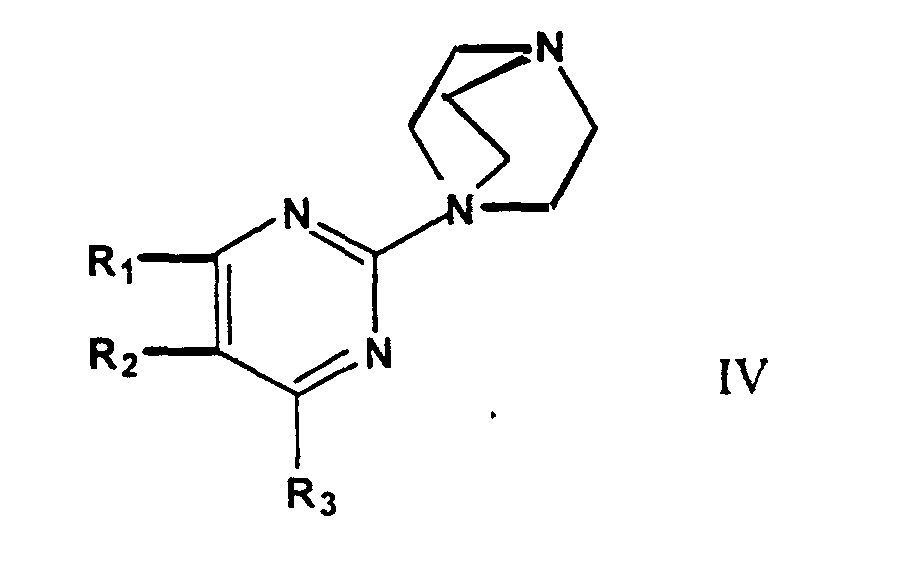
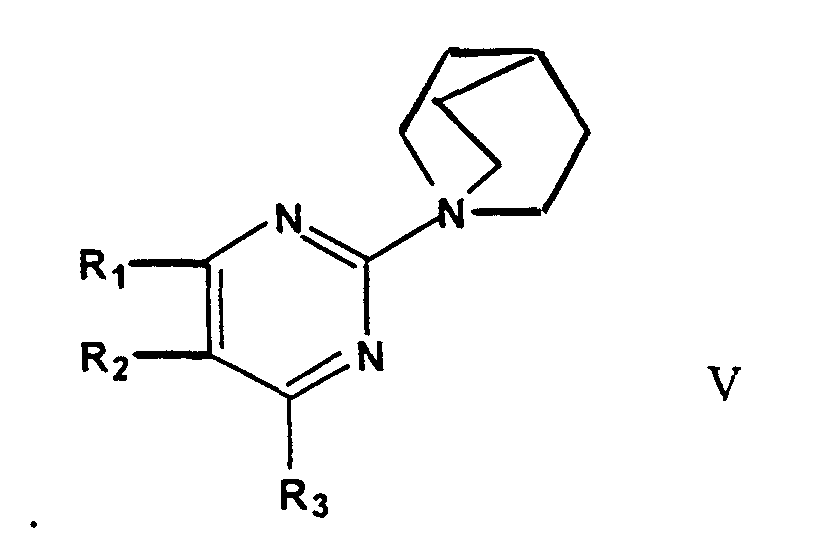
- a second aspect of this invention relates to intermediates of formulae IV and V or salts thereof, and wherein R 1 , R 2 , R 3 each independently represent hydrogen, C 1-7 -alkyl, or C 1-7 -alkoxy.
- the present invention refers to a process for the manufacture of pyrimidines of the general formula I wherein
- the starting compounds, pyrimidine derivatives of general formula II can be prepared from the corresponding 2-pyrimidone (2-hydroxypyrimidine) derivatives ("The chemistry of heterocyclic compounds", Ed. E.C. Taylor, Vol. 52, "The Pyrimidines", John Wiley & Sons, NY, 1994).
- 2-pyrimidone (2-hydroxypyrimidine) can be reacted with PCl 5 , POCl 3 or a combination of PCl 5 and POCl 3 .
- the resulting 2-chloropyrimidine derivative can be used for the process of the present invention.
- alkyl signifies a straight-chain or branched alkyl group containing 1 to 7 carbon atoms, preferably 1 to 3 carbon atoms, such as methyl, ethyl, n-propyl, iso-propyl, n-butyl, iso-butyl, tert.butyl, n-pentyl, iso-pentyl, neopentyl, n-hexyl, iso-hexyl and isohexyl.
- alkoxy means the group -O-R wherein R is alkyl as defined above.
- aryl means a monocyclic or bicyclic aromatic ring, preferably phenyl or naphthyl, and most preferably phenyl , which optionally can be substituted in the ortho-, meta- and/or para-position.
- Substituents which come into consideration are alkyl, alkoxy, hydroxy, nitro, trifluoromethyl as well as halo such as fluorine, chlorine, bromine and iodine or also trialkylsilyl.
- Preferred aryl residues are phenyl, p-tolyl, m-tolyl, m,m'-dialkylphenyl, p-chlorophenyl and p-methoxyphenyl.
- carbanionic residue refers to residues resulting from base treatment of alkynyls or malonic acid derivatives, e.g. carbanionic R 4 -alkynyl residues wherein R 4 is alkyl or hydrogen.
- R 4 -alkynyl residues are acetylene, propyne and 1-butyne, which can be converted by alcoholates and other bases into the carbanionic residue.
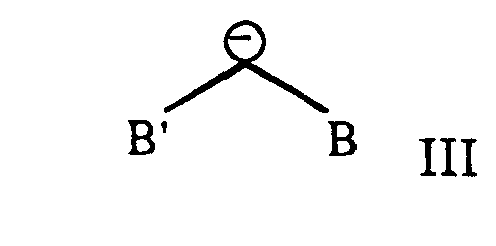
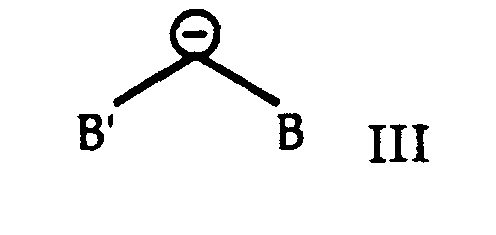
- carbanionic residues are carbanionic residues of malonic acid derivatives of formula III in which B and B' independently represent -CN, -COOR 5 , or -C(O)R 5 , wherein R 5 is alkyl or aryl.
- Examples for these carbanionic residues are acetoacetic ester and its higher homologues, which have been converted by for example by a metal hydride into the reactive carbanionic component A.
- One preferred process includes pyrimidines of general formula II in which R 1 , R 2 and R 3 are each independently hydrogen, C 1-3 -alkyl, or C 1-3 -alkoxy as starting material. In the most preferred embodiment R 1 , R 2 and R 3 are all hydrogen (2-chloropyrimidine).
- Another preferred category refers to the compounds yielding the residue A.
- the above pyrimidine compounds of formula II are reacted with a compound yielding the residue A wherein A signifies -CN or a carbanionic residue of a malonic acid derivative of formula III in which B and B' independently represent -CN, -COOR 5 , or -C(O)R 5 , wherein R 5 is alkyl or aryl. In a more preferred embodiment R 5 is alkyl.
- the carbanionic residues of formula III can be prepared e.g. from malonic acid esters and malonic acid derivatives using a metal hydride such as sodium hydride, lithium aluminium hydride and the like.
- the above pyrimidines of general formula II are reacted with a compound yielding the residue A wherein A is -CN.
- the reagents yielding this cyano group can be e.g. alkali cyanides such as sodium cyanide.
- organic aprotic, non-polar or polar solvents from the group of halogenated hydrocarbons such as methylene chloride or chloroform, DMF, DMSO, N-methylpyrrolidine, acetonitrile, sulpholane, esters from the group of methyl acetate, ethyl acetate and propyl acetate or ethers such as tetrahydrofuran either alone in admixture with one another or with water.
- DMF, DMSO, N-methylpyrrolidine, acetonitrile, sulpholane, methylene chloride, chloroform as well as trifluoromethylbenzene are preferred.
- an alkali cyanide especially sodium cyanide
- compounds of formula II preferably 2-chloropyrimidine.
- the compound of formula II is preferably reacted in an equivalent ratio of 0.1 to 1.4.
- the aforementioned 1-azabicyclo[2,2,2]octane or 1,4-diazabicyclo[2,2,2]octane can be used as catalysts. These compounds are commercially available (Fluka, etc.). 1,4-Diazabicyclo[2,2,2]octane (DABCO) is especially preferred.
- DABCO 1,4-Diazabicyclo[2,2,2]octane
- the catalyst is used in the process in accordance with the invention in amounts of 0.001 to 1.5, preferably 0.05 to 0.8, mol equivalents based on the compound of formula II. When 1,4-diazabicyclo[2,2,2]octane is used, the most preferred amount of catalyst is 0.05 to 0.2 molar equivalents based on compound II.
- the course of the reaction is conveniently monitored by an in-process control in which the ratio of educt (e.g. chloropyrimidine) to product (e.g. cyanopyrimidine) is the determining criterion for stopping the reaction.
- the reaction is stopped when the critical limit has been reached.
- the working up of the reaction product can be effected using means which are known per se, e.g. extraction with solvents.
- the reaction mixture can be firstly diluted with water and thereupon subsequently extracted several times with TBME and n-hexane.
- the reaction temperature conveniently amounts to about 20° to 60°C. Using calorimetric investigations it has been established that higher yields can be achieved at temperatures below 40°C than at higher reaction temperatures.
- the reaction temperature is therefore preferably 15-35°C.
- the most preferred process refers to the preparation of 2-cyanopyrimidine which process comprises reacting 2-chloropyrimidine with an alkali cyanide in the presence of 1-azabicyclo[2,2,2]octane or 1,4-diazabicyclo[2,2,2]octane, preferably diazabicyclo[2,2,2]octane.
- the process of the present invention is useful for the preparation of valuable intermediates for the synthesis of pyrimidine derivatives.
- Compounds of general formula I in which A is -CN can be converted into pharmaceutically active substances useful as inhibitors of endothelin receptors. They can be used for the treatment of disorders which are associated with endothelin activities, especially circulatory disorders such as hypertension, ischaemia, and angina pectoris.
- the process of the present invention is especially useful for the preparation of 4-tert.butyl-N-6-(2-hydroxy-ethoxy)-5-(2-methoxy-phenoxy)-2-(pyrimidine-2-yl)-pyrimidine-4-yl-benzenesulphonamide (bosentan).
- 2-cyanopyrimidine is prepared as described above and converted into pyrimidin-2-carboxamidine hydrochloride by means of NH 3 /NH 4 Cl in a sodium methanolate/methanol solution.
- This compound is converted in the presence of sodium methanolate with diethyl (o-methoxy-phenoxy-malonate) into rac-5-(2-methoxy-phenoxy)-2-pyrimidin-2-yl-tetrahydro-pyrimidin-4,6-dione.
- the obtained product is reacted with N,N-diisopropyl-N-ethylamine and phosphorus pentachloride to give 4,6-dichloro-5-(2-methoxy-phenoxy)-2,2'-bipyrimidine.
- the present invention accordingly includes the use of the process in accordance with the invention for the production of bosentan.
- the most preferred compounds are 1-pyrimidin-2-yl-4-aza-1-azonium-bicyclo[2,2,2]octane chloride and 1-pyrimidin-2-yl-1-azonium-bicyclo[2,2,2]octane chloride. These compounds are also an object of the present invention and can be obtained in isolated form conveniently by reacting a compound of formula II with ABCO or DABCO in toluene at room temperature.
- Example 2 to 7 were carried out analogously to Example 1 using different organic solvents. The yields will be evident from Table 1.
- Example Org. solvent/water Isolated yield (%) 2 tert.-Butyl methyl ether 51 3 Toluene 60 4 Diethoxymethane 71 5 Isopropyl acetate 71 6 Methylene chloride 77 7 Methylene chloride 82
- the reaction was controlled by withdrawing samples. After less than 3% of the educt used was present in the reaction mixture the reaction was interrupted and the reaction mixture containing 3-oxo-2-pyrimidin-2-yl-butyrethyl ester as the product and the starting materials was worked up by extraction with toluene and water.
- the reaction was controlled by the withdrawal of samples. After less than 3% of the educt used was present in the reaction mixture the reaction was interrupted and the reaction mixture was worked up by extraction with toluene and water. 2-Malononitrile-pyrimidin-2-yl was obtained as the product.
- 2-Chloropyrimidine is reacted with 1.05 equivalents of sodium cyanide in the presence of 0.1 equivalent of ABCO in an aqueous solution of DMSO and water at a temperature of 25-30°C over a period of 4-5 hours.
- the working up of the reaction mixture is effected by extraction with TBME. 2-Cyanopyrimidine is obtained.
- 2-Cyanopyrimidine can be converted as follows into the endothelin inhibitor bosentan (4-tert.-butyl-N-6-(2-hydroxy-ethoxy)-5-(2-[-methoxy-phenoxy)-2-(pyrimidin-2-yl)-pyrimidin-4-yl]-benzenesulphonamide) (EP-A- 526 708):
- 2-Cyanopyrimidine is converted using NH 3 , sodium methanolate/ methanol solution and ammonium chloride in a known manner into pyrimidin-2-carboxamidine hydrochloride, which is converted in the presence of sodium methanolate with diethyl (o-methoxy-phenoxy-malonate) into rac-5-(2-methoxy-phenoxy)-2-pyrimidin-2-yl-tetrahydro-pyrimidin-4,6-dione.
Landscapes
- Organic Chemistry (AREA)
- Chemical & Material Sciences (AREA)
- Health & Medical Sciences (AREA)
- Bioinformatics & Cheminformatics (AREA)
- Engineering & Computer Science (AREA)
- Medicinal Chemistry (AREA)
- Public Health (AREA)
- Life Sciences & Earth Sciences (AREA)
- Pharmacology & Pharmacy (AREA)
- Nuclear Medicine, Radiotherapy & Molecular Imaging (AREA)
- Chemical Kinetics & Catalysis (AREA)
- Veterinary Medicine (AREA)
- General Chemical & Material Sciences (AREA)
- Animal Behavior & Ethology (AREA)
- General Health & Medical Sciences (AREA)
- Heart & Thoracic Surgery (AREA)
- Cardiology (AREA)
- Urology & Nephrology (AREA)
- Vascular Medicine (AREA)
- Pharmaceuticals Containing Other Organic And Inorganic Compounds (AREA)
- Nitrogen Condensed Heterocyclic Rings (AREA)
- Plural Heterocyclic Compounds (AREA)
- Nitrogen And Oxygen Or Sulfur-Condensed Heterocyclic Ring Systems (AREA)
Abstract
Description

- R1, R2, R3
- each independently represent hydrogen, C1-7-alkyl, or C1-7-alkoxy,
- A
- signifies
-CN,- a carbanionic residue of acetylene, propyne or 1-butyne, or
- a carbanionic residue of the malonic acid derivative of formula III
in which B and B' independently represent -CN, -COOR5, or -C(O)R5, wherein R5 is C1-7-alkyl, phenyl or naphthyl, optionally substituted in the ortho-, meta- and/or para-position with C1-7-alkyl, C1-7-alkoxy, hydroxy, nitro, trifluoromethyl, fluorine, chlorine, bromine, iodine and/or tri-C1-7-alkyl-silyl.



- R1, R2, R3
- each independently represent hydrogen, C1-7-alkyl, or C1-7-alkoxy,
- A
- signifies
-CN,- a carbanionic residue of acetylene, propyne or 1-butyne, or
- a carbanionic residue of the malonic acid derivative of formula
III
in which B and B' independently represent -CN, -COOR5, or -C(O)R5, wherein R5 is C1-7-alkyl, phenyl or naphthyl, optionally substituted in the ortho-, meta- and/or para-position with C1-7-alkyl, C1-7-alkoxy, hydroxy, nitro, trifluoromethyl, fluorine, chlorine, bromine, iodine and/or tri-C1-7-alkyl-silyl.

- an alkali cyanide,
- acetylene, propyne, 1-butyne, or
- a malonic acid derivative



- RT
- Room temperature
- GC
- Gas chromatography
- ABCO
- 1-Azabicyclo[2,2,2]-octane
- DABCO
- 1,4-Diazabicyclo[2,2,2]-octane
- DMF
- Dimethylformamide
- DMSO
- Dimethyl sulphoxide
- TBME
- tert-Butyl methyl ether
| Example | Org. solvent/water | Isolated yield (%) |
| 2 | tert.-Butyl methyl ether | 51 |
| 3 | Toluene | 60 |
| 4 | Diethoxymethane | 71 |
| 5 | Isopropyl acetate | 71 |
| 6 | Methylene chloride | 77 |
| 7 | Methylene chloride | 82 |
Claims (14)
- A process for the manufacture of pyrimidines of the general formula Iwherein

- R1, R2, R3
- each independently represent hydrogen, C1-7-alkyl, or C1-7-alkoxy,
- A
- signifies
-CN,- a carbanionic residue of acetylene, propyne or 1-butyne, or
- a carbanionic residue of the malonic acid derivative of formula
III
in which B and B' independently represent -CN, -COOR5, or -C(O)R5, wherein R5 is C1-7-alkyl, phenyl or naphthyl, optionally substituted in the ortho-, meta- and/or para-position with C1-7-alkyl, C1-7-alkoxy, hydroxy, nitro, trifluoromethyl, fluorine, chlorine, bromine, iodine and/or tri-C1-7-alkyl-silyl.

wherein R1, R2 and R3 have the above significances and X is chlorine, with in the presence of 1-azabicyclo[2,2,2]octane or 1,4-diazabicyclo[2,2,2]octane.an alkali cyanide,acetylene, propyne, 1-butyne, ora malonic acid derivative
 - The process according to claim 1, wherein a pyrimidine of general formula II is reacted in which R1, R2 and R3 are each independently hydrogen, C1-3-alkyl, or C1-3-alkoxy.
- The process according to claim 2, wherein a pyrimidine of general formula II is reacted in which R1, R2 and R3 are hydrogen.
- The process according to any one of claims 1 to 3, wherein the pyrimidine of general formula II is reacted withan alkali cyanide, ora malonic acid derivative.
- The process according to claim 4 wherein R5 is C1-7-alkyl.
- The process according to any one of claims 1 to 5, wherein the pyrimidine of general formula II is reacted with an alkali cyanide.
- The process according any one of claims 1 to 6, wherein 1-azabicyclo[2,2,2]octane or 1,4-diazabicyclo[2,2,2]octane is present in an amount of 0.001 to 1.5 mol equivalents based on the compound of formula II.
- A process according to any one of claims 1 to 7, wherein 1,4-diazabicyclo[2,2,2]octane is present.
- A process according to claim 8, wherein the amount of 1,4-diazabicyclo[2,2,2]octane is 0.05 to 0.2 mol equivalents based on the compound of formula II.
- A process for the preparation of 2-cyanopyrimidine according to any one of claims 1 to 9 which process comprises reacting 2-chloropyrimidine with an alkali cyanide in the presence of 1-azabicyclo[2,2,2]octane or 1,4-diazabicyclo[2,2,2]octane.
- A process for the preparation of 4-tert.butyl-N-6-(2-hydroxy-ethoxy)-5-(2-methoxy-phenoxy)-2-(pyrimidin-2-yl)-pyrimidin-4-yl-benzenesulphonamide, which process comprisesa) manufacturing 2-cyanopyrimidine according to any one of claims 1 to 10,b) converting the 2-cyanopyrimidine by means of NH3/NH4Cl in a sodium methanolate/methanol solution into pyrimidin-2-carboxamidine hydrochloride,c) converting the product obtained in b) in the presence of sodium methanolate with diethyl (o-methoxy-phenoxy-malonate) into rac-5-(2-methoxy-phenoxy)-2-pyrimidin-2-yl-tetrahydro-pyrimidin-4,6-dione,d) reacting the product obtained in c) with N,N-diisopropyl-N-ethylamine and phosphorus pentachloride to give 4,6-dichloro-5-(2-methoxy-phenoxy)-2,2'-bipyrimidine,e) reacting the product obtained in d) with p-tert.butylbenzene-sulphonamide to give 4-tert.butyl-N-6-chloro-5-[2-(2-methoxy-phenoxy)-2-(pyrimidin-2-yl)-pyrimidin-4-yl]-benzenesulphonamide andf) reacting the product obtained in e) with sodium ethylene glycolate to give 4-tert.butyl-N-6-(2-hydroxy-ethoxy)-5-(2-methoxy-phenoxy)-2-(pyrimidin-2-yl)-pyrimidin-4-yl-benzenesulphonamide (bosentan).
- Compounds of formulae IV and V or salts thereof,and
 wherein R1, R2, R3 are as defined in claim 1.
- The compounds according to claim 12, wherein R1, R2 and R3 are as defined in claim 2.
- A compound according to claim 13 which is 1-pyrimidin-2-yl-4-aza-1-azonium-bicyclo[2,2,2]octane chloride or 1-pyrimidin-2-yl-1-azonium-bicyclo[2,2,2]octane chloride.
Applications Claiming Priority (3)
| Application Number | Priority Date | Filing Date | Title |
|---|---|---|---|
| CH275796 | 1996-11-08 | ||
| CH275796 | 1996-11-08 | ||
| CH2757/96 | 1996-11-08 |
Publications (2)
| Publication Number | Publication Date |
|---|---|
| EP0841326A1 EP0841326A1 (en) | 1998-05-13 |
| EP0841326B1 true EP0841326B1 (en) | 2001-05-16 |
Family
ID=4240937
Family Applications (1)
| Application Number | Title | Priority Date | Filing Date |
|---|---|---|---|
| EP97119003A Expired - Lifetime EP0841326B1 (en) | 1996-11-08 | 1997-10-31 | Process for the preparation of pyrimidine derivatives |
Country Status (9)
| Country | Link |
|---|---|
| US (3) | US5883254A (en) |
| EP (1) | EP0841326B1 (en) |
| JP (1) | JP3805502B2 (en) |
| KR (1) | KR100535450B1 (en) |
| CN (1) | CN1109023C (en) |
| AT (1) | ATE201201T1 (en) |
| DE (1) | DE69704832T2 (en) |
| DK (1) | DK0841326T3 (en) |
| ES (1) | ES2158425T3 (en) |
Families Citing this family (13)
| Publication number | Priority date | Publication date | Assignee | Title |
|---|---|---|---|---|
| NZ542136A (en) | 2003-03-07 | 2008-07-31 | Sanofi Aventis | Substituted 2-(diaza-bicyclo-alkyl)-pyrimidone derivatives |
| EP1454908B1 (en) * | 2003-03-07 | 2008-02-27 | Sanofi-Aventis | Substituted pyridinyl-2-(diaza-bicyclo-alkyl)-pyrimidinone derivatives |
| EP1454910A1 (en) * | 2003-03-07 | 2004-09-08 | Sanofi-Synthelabo | Substituted pyrimidinyl-2-(diaza-bicyclo-alkyl)-pyrimidone derivatives |
| CL2004000545A1 (en) * | 2003-03-18 | 2005-01-28 | Pharmacia Corp Sa Organizada B | USE OF AN ANTAGONIST OF ALDOSTERONE RECEPTORS AND AN ENDOTHELINE RECEIVER ANTAGONIST FOR THE TREATMENT OR PROFILAXIS OF A PATHOLOGICAL CONDITION RELATED TO HYPERTENSION, RENAL DYSFUNCTION, INSULINOPATHY AND CARDIOVASCUL DISEASES |
| DE102004022897A1 (en) * | 2004-05-10 | 2005-12-08 | Bayer Cropscience Ag | Azinyl-imidazoazines |
| US20100022568A1 (en) * | 2006-04-13 | 2010-01-28 | Actelion Pharmaceeuticals Ltd. | Endothelin receptor antagonists for early stage idiopathic pulmonary fibrosis |
| EP2072503B1 (en) * | 2007-12-18 | 2011-10-26 | Dipharma Francis S.r.l. | Process for the preparation of bosentan |
| EP2251001A4 (en) * | 2008-02-08 | 2013-01-09 | Shiseido Co Ltd | Skin whitening agent and external preparation for the skin |
| WO2010118992A1 (en) | 2009-04-13 | 2010-10-21 | Sandoz Ag | Process for preparation of endothelial receptor antagonist (bosentan) |
| EP2509594A1 (en) | 2009-12-09 | 2012-10-17 | INSERM - Institut National de la Santé et de la Recherche Médicale | Endothelin inhibitors for the treatment of rapidly progressive glomerulonephritis |
| KR102004422B1 (en) * | 2012-12-20 | 2019-07-26 | 제일약품주식회사 | A preparation method of bosentan monohydrate, novel intermediate useful for the preparation of bosentan monohydrate, and the preparation method thereof |
| WO2018185516A1 (en) | 2017-04-05 | 2018-10-11 | INSERM (Institut National de la Santé et de la Recherche Médicale) | Methods and pharmaceutical compositions for treating cardiovascular toxicity induced by anti-cancer therapy |
| CN116410141A (en) * | 2021-12-31 | 2023-07-11 | 南京艾德凯腾生物医药有限责任公司 | A kind of preparation method of avanafil intermediate |
Citations (1)
| Publication number | Priority date | Publication date | Assignee | Title |
|---|---|---|---|---|
| EP0526708A1 (en) * | 1991-06-13 | 1993-02-10 | F. Hoffmann-La Roche Ag | Sulfonamide, preparation and use thereof as medicine and intermediate |
Family Cites Families (3)
| Publication number | Priority date | Publication date | Assignee | Title |
|---|---|---|---|---|
| CH423708A (en) * | 1961-12-08 | 1966-06-30 | Ciba Geigy | Process for dyeing and printing textile materials |
| BE625803A (en) * | 1961-12-08 | |||
| EP0726708A1 (en) * | 1993-11-05 | 1996-08-21 | Pathogenesis Corporation | Virus associated multiple sclerosis: treatments, prevention and diagnosis thereof |
-
1997
- 1997-10-16 US US08/951,700 patent/US5883254A/en not_active Expired - Lifetime
- 1997-10-28 KR KR1019970055491A patent/KR100535450B1/en not_active Expired - Lifetime
- 1997-10-31 EP EP97119003A patent/EP0841326B1/en not_active Expired - Lifetime
- 1997-10-31 DE DE69704832T patent/DE69704832T2/en not_active Expired - Lifetime
- 1997-10-31 AT AT97119003T patent/ATE201201T1/en active
- 1997-10-31 DK DK97119003T patent/DK0841326T3/en active
- 1997-10-31 ES ES97119003T patent/ES2158425T3/en not_active Expired - Lifetime
- 1997-11-04 JP JP30148197A patent/JP3805502B2/en not_active Expired - Lifetime
- 1997-11-07 CN CN97122238A patent/CN1109023C/en not_active Expired - Lifetime
-
1998
- 1998-09-25 US US09/161,086 patent/US6121447A/en not_active Expired - Lifetime
-
2000
- 2000-03-16 US US09/526,252 patent/US6274734B1/en not_active Expired - Lifetime
Patent Citations (1)
| Publication number | Priority date | Publication date | Assignee | Title |
|---|---|---|---|---|
| EP0526708A1 (en) * | 1991-06-13 | 1993-02-10 | F. Hoffmann-La Roche Ag | Sulfonamide, preparation and use thereof as medicine and intermediate |
Also Published As
| Publication number | Publication date |
|---|---|
| CN1109023C (en) | 2003-05-21 |
| JP3805502B2 (en) | 2006-08-02 |
| DK0841326T3 (en) | 2001-07-23 |
| US6121447A (en) | 2000-09-19 |
| US6274734B1 (en) | 2001-08-14 |
| ATE201201T1 (en) | 2001-06-15 |
| KR19980041968A (en) | 1998-08-17 |
| JPH10139765A (en) | 1998-05-26 |
| EP0841326A1 (en) | 1998-05-13 |
| DE69704832D1 (en) | 2001-06-21 |
| ES2158425T3 (en) | 2001-09-01 |
| US5883254A (en) | 1999-03-16 |
| KR100535450B1 (en) | 2006-03-30 |
| DE69704832T2 (en) | 2001-11-29 |
| CN1182082A (en) | 1998-05-20 |
Similar Documents
| Publication | Publication Date | Title |
|---|---|---|
| US5808066A (en) | Process for the preparation of dihaloazolopyrimidines | |
| US6274734B1 (en) | Process for making pyrimidine derivatives | |
| US12187714B2 (en) | Process for preparing aminopyrimidine derivatives | |
| EP2091923A1 (en) | Process for the preparation of rosuvastatin | |
| HUP0401248A2 (en) | Preparation of aminopyrimidine compounds and new intermediates | |
| JPH07179465A (en) | Method for producing imidazopyridine derivative | |
| US20110178296A1 (en) | Process for preparing pyrimidine propenaldehyde | |
| KR100649927B1 (en) | Process for the preparation of 2-amino-4- (4-fluorophenyl) -6-alkylpyrimidine-5-carboxylate | |
| Yu et al. | A novel precursor for per (poly) fluoroalkyl heterocycles from N-aryl per (poly) fluoroalkyl imidoyl iodides | |
| US6337400B1 (en) | Process for the preparation of tetrahydroindolizines | |
| WO1997007119A1 (en) | Thienopyrimidine derivatives, their production and use | |
| US3764600A (en) | 1-substituted-quinazoline-2(1h)-thiones | |
| US3819627A (en) | 1-substituted-3,4-dihydro-2(1h)-quinazolinones | |
| PL171137B1 (en) | N-5-protected 2,5-diamino-4,6-dichloropyrimidines and their preparation PL PL PL | |
| US3714093A (en) | Spiro [heterocycloalkyl-2'(1'h)-quinazoline]-4'(3'h)-ones | |
| US5817814A (en) | Method for the preparation of benzyluracils | |
| US5208337A (en) | Process for the preparation of aminopyrimidines | |
| JPH08253458A (en) | Production of substituted quinazoline-2,4-dione | |
| US6300512B1 (en) | Method for producing a 1-(3-cyclopentenyloxy-4-alkoxyphenyl)-4-oxocyclohexanecar-bonitrile | |
| HK40032181A (en) | Process for preparing aminopyrimidine derivatives | |
| KR20010092262A (en) | Method for Preparing 5-(1-MethylEthyl)-6-(PhenylMethyl)Pyrimidine-2,4(1H,3H)-Dione | |
| JPH1045762A (en) | Production of oxotetrahydroindolizine derivative |
Legal Events
| Date | Code | Title | Description |
|---|---|---|---|
| PUAI | Public reference made under article 153(3) epc to a published international application that has entered the european phase |
Free format text: ORIGINAL CODE: 0009012 |
|
| AK | Designated contracting states |
Kind code of ref document: A1 Designated state(s): AT BE CH DE DK ES FR GB IE IT LI NL |
|
| AX | Request for extension of the european patent |
Free format text: AL;LT;LV;RO;SI |
|
| 17P | Request for examination filed |
Effective date: 19980914 |
|
| AKX | Designation fees paid |
Free format text: AT BE CH DE DK ES FR GB IE IT LI NL |
|
| RBV | Designated contracting states (corrected) |
Designated state(s): AT BE CH DE DK ES FR GB IE IT LI NL |
|
| 17Q | First examination report despatched |
Effective date: 19991026 |
|
| GRAG | Despatch of communication of intention to grant |
Free format text: ORIGINAL CODE: EPIDOS AGRA |
|
| GRAG | Despatch of communication of intention to grant |
Free format text: ORIGINAL CODE: EPIDOS AGRA |
|
| GRAH | Despatch of communication of intention to grant a patent |
Free format text: ORIGINAL CODE: EPIDOS IGRA |
|
| GRAH | Despatch of communication of intention to grant a patent |
Free format text: ORIGINAL CODE: EPIDOS IGRA |
|
| GRAA | (expected) grant |
Free format text: ORIGINAL CODE: 0009210 |
|
| AK | Designated contracting states |
Kind code of ref document: B1 Designated state(s): AT BE CH DE DK ES FR GB IE IT LI NL |
|
| REF | Corresponds to: |
Ref document number: 201201 Country of ref document: AT Date of ref document: 20010615 Kind code of ref document: T |
|
| REG | Reference to a national code |
Ref country code: CH Ref legal event code: EP |
|
| REG | Reference to a national code |
Ref country code: IE Ref legal event code: FG4D |
|
| REF | Corresponds to: |
Ref document number: 69704832 Country of ref document: DE Date of ref document: 20010621 |
|
| ITF | It: translation for a ep patent filed | ||
| REG | Reference to a national code |
Ref country code: DK Ref legal event code: T3 |
|
| REG | Reference to a national code |
Ref country code: ES Ref legal event code: FG2A Ref document number: 2158425 Country of ref document: ES Kind code of ref document: T3 |
|
| ET | Fr: translation filed | ||
| REG | Reference to a national code |
Ref country code: GB Ref legal event code: IF02 |
|
| PLBE | No opposition filed within time limit |
Free format text: ORIGINAL CODE: 0009261 |
|
| STAA | Information on the status of an ep patent application or granted ep patent |
Free format text: STATUS: NO OPPOSITION FILED WITHIN TIME LIMIT |
|
| 26N | No opposition filed | ||
| REG | Reference to a national code |
Ref country code: FR Ref legal event code: PLFP Year of fee payment: 20 |
|
| PGFP | Annual fee paid to national office [announced via postgrant information from national office to epo] |
Ref country code: DK Payment date: 20160926 Year of fee payment: 20 Ref country code: GB Payment date: 20160926 Year of fee payment: 20 Ref country code: IE Payment date: 20160926 Year of fee payment: 20 |
|
| PGFP | Annual fee paid to national office [announced via postgrant information from national office to epo] |
Ref country code: FR Payment date: 20160926 Year of fee payment: 20 |
|
| PGFP | Annual fee paid to national office [announced via postgrant information from national office to epo] |
Ref country code: DE Payment date: 20161031 Year of fee payment: 20 Ref country code: CH Payment date: 20161025 Year of fee payment: 20 Ref country code: NL Payment date: 20161007 Year of fee payment: 20 |
|
| PGFP | Annual fee paid to national office [announced via postgrant information from national office to epo] |
Ref country code: BE Payment date: 20161013 Year of fee payment: 20 Ref country code: ES Payment date: 20161010 Year of fee payment: 20 Ref country code: AT Payment date: 20160926 Year of fee payment: 20 Ref country code: IT Payment date: 20161017 Year of fee payment: 20 |
|
| REG | Reference to a national code |
Ref country code: DE Ref legal event code: R071 Ref document number: 69704832 Country of ref document: DE |
|
| REG | Reference to a national code |
Ref country code: NL Ref legal event code: MK Effective date: 20171030 |
|
| REG | Reference to a national code |
Ref country code: DK Ref legal event code: EUP Effective date: 20171031 |
|
| REG | Reference to a national code |
Ref country code: CH Ref legal event code: PL |
|
| REG | Reference to a national code |
Ref country code: GB Ref legal event code: PE20 Expiry date: 20171030 |
|
| REG | Reference to a national code |
Ref country code: IE Ref legal event code: MK9A |
|
| REG | Reference to a national code |
Ref country code: AT Ref legal event code: MK07 Ref document number: 201201 Country of ref document: AT Kind code of ref document: T Effective date: 20171031 |
|
| REG | Reference to a national code |
Ref country code: BE Ref legal event code: QB Free format text: DETAILS LICENCE: LICENCE, ENREGISTREMENT NOUVELLE LICENCE Name of requester: ACTELION PHARMACEUTICALS LTD. Effective date: 20150529 Ref country code: BE Ref legal event code: MK Effective date: 20171031 |
|
| PG25 | Lapsed in a contracting state [announced via postgrant information from national office to epo] |
Ref country code: IE Free format text: LAPSE BECAUSE OF EXPIRATION OF PROTECTION Effective date: 20171031 Ref country code: GB Free format text: LAPSE BECAUSE OF EXPIRATION OF PROTECTION Effective date: 20171030 |
|
| REG | Reference to a national code |
Ref country code: ES Ref legal event code: FD2A Effective date: 20180508 |
|
| PG25 | Lapsed in a contracting state [announced via postgrant information from national office to epo] |
Ref country code: ES Free format text: LAPSE BECAUSE OF EXPIRATION OF PROTECTION Effective date: 20171101 |