EP0841249B1 - A stacking device for packaging machines to form groups of products arranged side to side and to insert the groups into cartons - Google Patents
A stacking device for packaging machines to form groups of products arranged side to side and to insert the groups into cartons Download PDFInfo
- Publication number
- EP0841249B1 EP0841249B1 EP97830540A EP97830540A EP0841249B1 EP 0841249 B1 EP0841249 B1 EP 0841249B1 EP 97830540 A EP97830540 A EP 97830540A EP 97830540 A EP97830540 A EP 97830540A EP 0841249 B1 EP0841249 B1 EP 0841249B1
- Authority
- EP
- European Patent Office
- Prior art keywords
- container
- hopper
- products
- group
- presser
- Prior art date
- Legal status (The legal status is an assumption and is not a legal conclusion. Google has not performed a legal analysis and makes no representation as to the accuracy of the status listed.)
- Expired - Lifetime
Links
Images


Classifications
-
- B—PERFORMING OPERATIONS; TRANSPORTING
- B65—CONVEYING; PACKING; STORING; HANDLING THIN OR FILAMENTARY MATERIAL
- B65B—MACHINES, APPARATUS OR DEVICES FOR, OR METHODS OF, PACKAGING ARTICLES OR MATERIALS; UNPACKING
- B65B35/00—Supplying, feeding, arranging or orientating articles to be packaged
- B65B35/30—Arranging and feeding articles in groups
- B65B35/40—Arranging and feeding articles in groups by reciprocating or oscillatory pushers
-
- B—PERFORMING OPERATIONS; TRANSPORTING
- B65—CONVEYING; PACKING; STORING; HANDLING THIN OR FILAMENTARY MATERIAL
- B65B—MACHINES, APPARATUS OR DEVICES FOR, OR METHODS OF, PACKAGING ARTICLES OR MATERIALS; UNPACKING
- B65B35/00—Supplying, feeding, arranging or orientating articles to be packaged
- B65B35/30—Arranging and feeding articles in groups
- B65B35/50—Stacking one article, or group of articles, upon another before packaging
-
- B—PERFORMING OPERATIONS; TRANSPORTING
- B65—CONVEYING; PACKING; STORING; HANDLING THIN OR FILAMENTARY MATERIAL
- B65B—MACHINES, APPARATUS OR DEVICES FOR, OR METHODS OF, PACKAGING ARTICLES OR MATERIALS; UNPACKING
- B65B59/00—Arrangements to enable machines to handle articles of different sizes, to produce packages of different sizes, to vary the contents of packages, to handle different types of packaging material, or to give access for cleaning or maintenance purposes
- B65B59/001—Arrangements to enable adjustments related to the product to be packaged
-
- B—PERFORMING OPERATIONS; TRANSPORTING
- B65—CONVEYING; PACKING; STORING; HANDLING THIN OR FILAMENTARY MATERIAL
- B65B—MACHINES, APPARATUS OR DEVICES FOR, OR METHODS OF, PACKAGING ARTICLES OR MATERIALS; UNPACKING
- B65B59/00—Arrangements to enable machines to handle articles of different sizes, to produce packages of different sizes, to vary the contents of packages, to handle different types of packaging material, or to give access for cleaning or maintenance purposes
- B65B59/003—Arrangements to enable adjustments related to the packaging material
-
- B—PERFORMING OPERATIONS; TRANSPORTING
- B65—CONVEYING; PACKING; STORING; HANDLING THIN OR FILAMENTARY MATERIAL
- B65B—MACHINES, APPARATUS OR DEVICES FOR, OR METHODS OF, PACKAGING ARTICLES OR MATERIALS; UNPACKING
- B65B35/00—Supplying, feeding, arranging or orientating articles to be packaged
- B65B35/30—Arranging and feeding articles in groups
- B65B35/32—Arranging and feeding articles in groups by gravity
-
- B—PERFORMING OPERATIONS; TRANSPORTING
- B65—CONVEYING; PACKING; STORING; HANDLING THIN OR FILAMENTARY MATERIAL
- B65B—MACHINES, APPARATUS OR DEVICES FOR, OR METHODS OF, PACKAGING ARTICLES OR MATERIALS; UNPACKING
- B65B5/00—Packaging individual articles in containers or receptacles, e.g. bags, sacks, boxes, cartons, cans, jars
- B65B5/06—Packaging groups of articles, the groups being treated as single articles
Definitions
- the present invention relates to a stacking device for packaging machines to form groups of products arranged side to side and to insert the groups into cartons.
- the invention applies in particular to packaging machines for making tea bags or similar infusable products but, although the present description specifically refers to these products, it may also be conveniently applied to the stacking and cartoning of products of various other kinds, or their packages, having similar properties of flexibility and pliability.
- the tube passes through a cutting station, which makes a continuous succession of tea bags by cutting the tube at regular intervals.
- the tea bags made in this way are stacked in groups or batches containing a predetermined number of tea bags which are then inserted into cartons.
- the main problem of packaging the tea bags is to synchronize the continuous motion of the machine which makes the tea bags with the alternating motion of the one which stacks and cartons the individual groups of tea bags.
- One known solution to this problem which reflects customary packaging techniques is to provide devices consisting in particular of a vertical stacking line located downstream of the cutting station and a cartoning station located beside the stacking line.
- the stacking line is equipped with a controlled outfeed hopper into which the continuous stream of products from the cutting station is fed. Inside the hopper, there is an alternating presser which pushes the products one by one into a container located below.
- a movable tongue actuated in such a manner as to retain the single products and push them down the container to form a stack which extends downwards towards the endwall of the container itself.
- the hopper When the predetermined number of products is reached, the hopper is closed and the container moves from an initial condition in which it is connected with the hopper to a final position in which it is connected with the cartoning station.
- the stack is extracted from the container and inserted into a carton, after which the container returns to the initial condition, the hopper re-opens and the sequence is repeated for the next batch of products.
- These consist essentially of a shaft that rotates at a speed connected with the speed of the tea bag maker, so as to enable the products forming part of the group to be counted, and separating devices which, on reaching the predetermined number of products in a batch, separate the batch on a command issued by cam-operated elements.
- the present invention has for an object to provide a device designed to form groups of products and insert them into cartons which is simple and economical in construction and which thus overcomes the disadvantages mentioned above.
- This object is achieved by the device as defined in claim 1. It provides linear actuating means to drive at least the movable tongue of the container, the linear actuating means being synchronized with the tea bag maker by programmable control means which count the tea bags and, on reaching a preset reference value, issue commands that move the container to the cartoning station, extract the stack of tea bags from the container and return the latter to the hopper.
- the device Since the counting of the tea bags forming a group is completely independent of the movement of the container, the device has the further advantage of allowing the formation of groups consisting of any number of stacked tea bags, limited only by the capacity of the container.
- the number of tea bags to be stacked is set via software using the programmable control means. Since the control signals for driving the device are subject only to the reaching of the set number of tea bags counted, the device makes it possible to easily change the number of tea bags making up a group and to automatically respond to the new working parameters without requiring lengthy or complicated mechanical adjustments.
- the numeral 1 indicates as a whole a device for forming and inserting into cartons 4 groups 2 of products 3 consisting, in this particular embodiment, of filter bags containing tea, chamomile, herbs or other similar infusable products.
- the device 1 is located downstream of a cutting station 20 forming part of a tea bag making machine and operates between a horizontal feed line 21 along which the products 3 feeding out of the cutting station 20 move and a cartoning station 5 located below and to the side of the feed line 21.
- the device 1 essentially comprises a vertical stacking line 6 located to the side of the cartoning station 5 and equipped with a hopper 7 placed above an elongated container.
- the hopper 7 has a product 3 infeed section made in a first wall 22a oriented crossways with respect to the feed line 6.
- the outfeed section is made on a horizontal bottom 23 adjacent to the container 9.
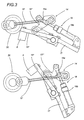
- the hopper 7 is also equipped with a presser 8 mounted by a linkage 14 (see Figs. 2 and 3) which makes it move alternately inside the hopper 7 along a substantially circular curved path.
- the presser 8 operates in synchrony with the tea bag maker in such a way as to intercept, one by one, the products 3 which the hopper 7 receives between the said first wall 22a and a second opposite wall 22b, also placed crossways, and to push the products 3 towards the outfeed section below.
- the linkage 14 (see Figs. 2 and 3) is of the type with jointed, reciprocally movable elements 15', 15", 15'", 16 and 17.
- the lengths of these elements and their relative angular positions are such that a rotary input motion applied to them by a drive lever 30, which moves in synchrony with the tea bag maker, results in an angular output swinging motion of predetermined amplitude applied to the presser 8.
- the one labelled 16, of the linkage 14 is made of two parts 16a, 16b which can slide one inside the other so as to vary the overall length of the element 16 between the ends where it joins the adjacent elements 15'" and 17.
- the angular path swept by the presser 8 is the shortest; instead, the longest angular path (see Fig. 2) is swept when the parts 16a, 16b are placed in such a way that the joints of the element 16 are closest together.
- the linkage 14 can therefore be used to make the presser 8 effect a longer stroke in relation to the hopper 7 when, for example, it is necessary to compact the products 3 that are already inside the container 9.
- the element 16 is a pneumatic cylinder, the stem and the cylinder being represented by the said parts 16a and 16b, respectively, it is possible to make the presser 8 effect the longest stroke each time the products 3 fed into the hopper 7 reach a preset count.
- the hopper 7 is of the controlled outfeed type. This feature is obtained through a cutoff element 31 mounted on the end of a swinging rod 35.
- the cutoff element 31 moves along a path shaped like a circular arc from an inoperative position in which it is located on the side of the stacking line 6 to a position in which it cuts off the products 3 of the hopper 7 and is located between the hopper 7 and the container 9 below.
- Fig. 1 also shows that the container 9 is shaped like a channel with a substantially C-shaped cross section.
- linear actuating means consisting of a fluid cylinder 12, and synchronized with the motion of the tea bag maker, mount a movable tongue 10 which extends into the container through an open side 50 of it.
- the movable tongue 10 moves along the container 9 and retains the products 3 as they feed out of the hopper 7, thus forming a group 2 of products 3 which grows gradually downwards towards the endwall 11 of the container 9.
- the end of the container 9 further away from the hopper 7 is mounted in such a way that it can rotate while remaining in contact with an arc-shaped closing element 32 which is attached to the side of the hopper 7 and extends from the stacking line 6 to the cartoning station 5.
- an extraction blade 40 mounted next to the container 9.
- the blade 40 is driven into the container 9, pulls all the products 3 out through an open wall 51 of the container 9 and transfers them to the carton 4 while the horizontal top of the carton is kept open at the cartoning station at a position adjacent to the extraction blade 40.
- the device 1 comprises programmable control means 13 which are interfaced with the device 1 so as to synchronize the sequence of movements of the movable parts.
- control means 13 consisting, for example, of a conventional PLC, make it possible to set and store a reference value of the number of products 3 to be stacked in the container 9 to form the groups 2.
- An encoder (not illustrated) forming part of the tea bag maker can be used to count the products 3 fed to the device 1.
- control means 13 apply a drive signal to the linkage 14 so that the stroke of the presser 8 in the hopper 7 is the longest possible and the group 2 of products 3 is compressed against the endwall 11 of the container 9. This also causes the means that actuate the tongue 10 to reach the end of stroke condition.
- This end of stroke condition provides the signal to enable the activation of the cutoff element 31 which closes the hopper 7.
- another drive signal moves the container 9 to the cartoning station 5 while the group 2 of tea bags 3 it contains is held between the endwall 11 of the container 9 and the closing element 32.
- a limit switch (not illustrated) is triggered to enable the blade 40 to transfer the group 2 to the carton 4.
- the return of the blade 40 to its initial position provides the control means 13 with the signal to enable the container 9 to return to the initial position under the hopper 7.
- the tea bags 3 that have accumulated inside it in the meantime are transferred to the container 9 and the sequence of operations described above is repeated. It should be noticed that the time taken by the container 9 to move to the cartoning station and back is independent of the preset number of tea bags 3 in each group 2. For this reason, it is extremely easy to set the device 1 to form groups 2 containing different numbers of tea bags 3 by simply changing the PLC input value that defines the number of tea bags 3 to be stacked.
- the only mechanical adjustment required to adapt the device 1 to the new and different packaging parameters is changing the capacity of the container 9 by moving the endwall 11 according to the larger or smaller number of tea bags 3 to be stacked.
Landscapes
- Engineering & Computer Science (AREA)
- Mechanical Engineering (AREA)
- Container Filling Or Packaging Operations (AREA)
- Packages (AREA)
Description
- The present invention relates to a stacking device for packaging machines to form groups of products arranged side to side and to insert the groups into cartons.
- The invention applies in particular to packaging machines for making tea bags or similar infusable products but, although the present description specifically refers to these products, it may also be conveniently applied to the stacking and cartoning of products of various other kinds, or their packages, having similar properties of flexibility and pliability.
- In the automatic tea-bag making sector, numerous machines are known (as described, for example, in Italian patent application No. BO95A000574 made by the same Applicant as the present). These machines make a continuous tube of filter paper containing charges of infusable product and transversely sealed at regular intervals, each portion of tube thus formed containing a single charge of product.
- As it feeds continuously along the machine, the tube passes through a cutting station, which makes a continuous succession of tea bags by cutting the tube at regular intervals. The tea bags made in this way are stacked in groups or batches containing a predetermined number of tea bags which are then inserted into cartons.
- The main problem of packaging the tea bags is to synchronize the continuous motion of the machine which makes the tea bags with the alternating motion of the one which stacks and cartons the individual groups of tea bags.
- One known solution to this problem which reflects customary packaging techniques is to provide devices consisting in particular of a vertical stacking line located downstream of the cutting station and a cartoning station located beside the stacking line.
- The stacking line is equipped with a controlled outfeed hopper into which the continuous stream of products from the cutting station is fed. Inside the hopper, there is an alternating presser which pushes the products one by one into a container located below.
- Inside the container, a movable tongue actuated in such a manner as to retain the single products and push them down the container to form a stack which extends downwards towards the endwall of the container itself.
- When the predetermined number of products is reached, the hopper is closed and the container moves from an initial condition in which it is connected with the hopper to a final position in which it is connected with the cartoning station.
- At the latter, the stack is extracted from the container and inserted into a carton, after which the container returns to the initial condition, the hopper re-opens and the sequence is repeated for the next batch of products.
- To enable this sequence to be suitably synchronized with the products feeding out of the tea bag maker, known devices envisage complex mechanical systems.
- These consist essentially of a shaft that rotates at a speed connected with the speed of the tea bag maker, so as to enable the products forming part of the group to be counted, and separating devices which, on reaching the predetermined number of products in a batch, separate the batch on a command issued by cam-operated elements.
- Although the devices of this kind operate satisfactorily, the considerable complexity of their construction involves high costs.
- Another disadvantage is that it is impossible to rapidly effect size changeover by changing the number of products in a group. In fact, even if their drive systems are equipped with mechanical adjustment means which, moreover, further increase the constructional complexity of the devices as a whole, the changeover procedure requires lengthy adjustments which are economically justified only if very large numbers of batches with the same number of tea bags are to be made.
- The present invention has for an object to provide a device designed to form groups of products and insert them into cartons which is simple and economical in construction and which thus overcomes the disadvantages mentioned above. This object is achieved by the device as defined in
claim 1. It provides linear actuating means to drive at least the movable tongue of the container, the linear actuating means being synchronized with the tea bag maker by programmable control means which count the tea bags and, on reaching a preset reference value, issue commands that move the container to the cartoning station, extract the stack of tea bags from the container and return the latter to the hopper. - Since the counting of the tea bags forming a group is completely independent of the movement of the container, the device has the further advantage of allowing the formation of groups consisting of any number of stacked tea bags, limited only by the capacity of the container.
- The number of tea bags to be stacked is set via software using the programmable control means. Since the control signals for driving the device are subject only to the reaching of the set number of tea bags counted, the device makes it possible to easily change the number of tea bags making up a group and to automatically respond to the new working parameters without requiring lengthy or complicated mechanical adjustments.
- Further characteristics of the invention according to the abovementioned objects are laid out in the claims below and the advantages of the disclosure are apparent from the detailed description which follows, with reference to the accompanying drawings, which illustrate a preferred embodiment of the invention and in which:
- Figure 1 is a perspective view of the device made according to the present invention illustrated as a whole as mounted, in working conditions, on a packaging machine which is only partly illustrated;
- Figures 2 and 3 illustrate a mechanism with which the hopper presser is equipped, each showing characteristic positions of the mechanism in two different working states.
- With reference to Fig. 1, the
numeral 1 indicates as a whole a device for forming and inserting intocartons 4groups 2 ofproducts 3 consisting, in this particular embodiment, of filter bags containing tea, chamomile, herbs or other similar infusable products. - The
device 1 is located downstream of acutting station 20 forming part of a tea bag making machine and operates between ahorizontal feed line 21 along which theproducts 3 feeding out of thecutting station 20 move and a cartoning station 5 located below and to the side of thefeed line 21. - The
device 1 essentially comprises avertical stacking line 6 located to the side of the cartoning station 5 and equipped with ahopper 7 placed above an elongated container. - The
hopper 7 has aproduct 3 infeed section made in afirst wall 22a oriented crossways with respect to thefeed line 6. The outfeed section, on the other hand, is made on ahorizontal bottom 23 adjacent to thecontainer 9. - The
hopper 7 is also equipped with apresser 8 mounted by a linkage 14 (see Figs. 2 and 3) which makes it move alternately inside thehopper 7 along a substantially circular curved path. Thepresser 8 operates in synchrony with the tea bag maker in such a way as to intercept, one by one, theproducts 3 which thehopper 7 receives between the saidfirst wall 22a and a secondopposite wall 22b, also placed crossways, and to push theproducts 3 towards the outfeed section below. - The linkage 14 (see Figs. 2 and 3) is of the type with jointed, reciprocally
movable elements 15', 15", 15'", 16 and 17. The lengths of these elements and their relative angular positions are such that a rotary input motion applied to them by adrive lever 30, which moves in synchrony with the tea bag maker, results in an angular output swinging motion of predetermined amplitude applied to thepresser 8. - If we compare Figs. 2 and 3, we can see that one of the elements, the one labelled 16, of the
linkage 14 is made of twoparts element 16 between the ends where it joins the adjacent elements 15'" and 17. - Consequently, when the
element 16 is extended as far as possible (see Fig. 3), the angular path swept by thepresser 8 is the shortest; instead, the longest angular path (see Fig. 2) is swept when theparts element 16 are closest together. - The
linkage 14 can therefore be used to make thepresser 8 effect a longer stroke in relation to thehopper 7 when, for example, it is necessary to compact theproducts 3 that are already inside thecontainer 9. If theelement 16 is a pneumatic cylinder, the stem and the cylinder being represented by the saidparts presser 8 effect the longest stroke each time theproducts 3 fed into thehopper 7 reach a preset count. - Looking at Fig. 1 again, it can be seen that the
hopper 7 is of the controlled outfeed type. This feature is obtained through acutoff element 31 mounted on the end of a swingingrod 35. Thecutoff element 31 moves along a path shaped like a circular arc from an inoperative position in which it is located on the side of thestacking line 6 to a position in which it cuts off theproducts 3 of thehopper 7 and is located between thehopper 7 and thecontainer 9 below. - Fig. 1 also shows that the
container 9 is shaped like a channel with a substantially C-shaped cross section. Outside thecontainer 9, linear actuating means, consisting of afluid cylinder 12, and synchronized with the motion of the tea bag maker, mount amovable tongue 10 which extends into the container through anopen side 50 of it. - When the
fluid cylinder 12 is driven, themovable tongue 10 moves along thecontainer 9 and retains theproducts 3 as they feed out of thehopper 7, thus forming agroup 2 ofproducts 3 which grows gradually downwards towards the endwall 11 of thecontainer 9. - Moreover, the end of the
container 9 further away from thehopper 7 is mounted in such a way that it can rotate while remaining in contact with an arc-shaped closing element 32 which is attached to the side of thehopper 7 and extends from thestacking line 6 to the cartoning station 5. - At the cartoning station 5, there is an
extraction blade 40 mounted next to thecontainer 9. Theblade 40 is driven into thecontainer 9, pulls all theproducts 3 out through anopen wall 51 of thecontainer 9 and transfers them to thecarton 4 while the horizontal top of the carton is kept open at the cartoning station at a position adjacent to theextraction blade 40. - Lastly, the
device 1 comprises programmable control means 13 which are interfaced with thedevice 1 so as to synchronize the sequence of movements of the movable parts. - During use, the control means 13, consisting, for example, of a conventional PLC, make it possible to set and store a reference value of the number of
products 3 to be stacked in thecontainer 9 to form thegroups 2. - An encoder (not illustrated) forming part of the tea bag maker can be used to count the
products 3 fed to thedevice 1. - When the reference value set on the PLC is reached, the control means 13 apply a drive signal to the
linkage 14 so that the stroke of thepresser 8 in thehopper 7 is the longest possible and thegroup 2 ofproducts 3 is compressed against the endwall 11 of thecontainer 9. This also causes the means that actuate thetongue 10 to reach the end of stroke condition. - This end of stroke condition provides the signal to enable the activation of the
cutoff element 31 which closes thehopper 7. Immediately after this, another drive signal moves thecontainer 9 to the cartoning station 5 while thegroup 2 oftea bags 3 it contains is held between the endwall 11 of thecontainer 9 and theclosing element 32. - When the cartoning station 5 is reached, a limit switch (not illustrated) is triggered to enable the
blade 40 to transfer thegroup 2 to thecarton 4. - Once this operation has been completed, the return of the
blade 40 to its initial position provides the control means 13 with the signal to enable thecontainer 9 to return to the initial position under thehopper 7. When the hopper opens again, thetea bags 3 that have accumulated inside it in the meantime are transferred to thecontainer 9 and the sequence of operations described above is repeated. It should be noticed that the time taken by thecontainer 9 to move to the cartoning station and back is independent of the preset number oftea bags 3 in eachgroup 2. For this reason, it is extremely easy to set thedevice 1 to formgroups 2 containing different numbers oftea bags 3 by simply changing the PLC input value that defines the number oftea bags 3 to be stacked. - Apart from that, the only mechanical adjustment required to adapt the
device 1 to the new and different packaging parameters is changing the capacity of thecontainer 9 by moving the endwall 11 according to the larger or smaller number oftea bags 3 to be stacked. - The invention described can be subject to modifications and variations without thereby departing from the scope of the inventive concept. Moreover, all the details of the invention may be substituted by technically equivalent elements.
Claims (5)
- A device for packaging machines to form groups (2) of products (3) placed in contact with each other and to insert the group into cartons (4) at a cartoning station (5), comprising a stacking line (6) located next to the cartoning station (5) and equipped with a controlled outfeed hopper (7) in which an alternating product (3) presser (8) operates, the said stacking line (6) also comprising a container (9) located at the bottom of the hopper (7) and having inside it a tongue (10) designed to retain the products (3) as they leave the hopper (7) so as to form a group (2) which thus grows downwards towards an endwall (11) of the container (9), the said container (9) moving alternately from a position in which it is connected with the hopper (7) to a position in which it is connected with the cartoning station (5) where the group (2) is extracted from the container (9) and transferred to the carton (4) after which the container (9) returns to the hopper (7), the said device being characterized in that at least the said tongue (10) is actuated by linear actuating means (12) synchronized with the packaging machine by control means (13) which can be programmed to receive an input reference value defining the number of products (3) in a group (2), to count the products (3) received by the container (9) and, on reaching the preset reference value and on an enable signal provided by the movable tongue (10) when pressed to its end of stroke condition by the presser (8), to issue drive signals to close the hopper (7) and move the container (9) to the cartoning station.
- The device according to claim 1 characterized in that the said linear actuating means are driven by a fluid medium.
- The device according to claim 1 characterized in that the said presser (8) moves on a command from the said control means (13) in such a way that the amplitude of its stroke in relation to the hopper (7) varies when the preset number of products (3) in the group (2) is reached so as to press the group (2) against the endwall (11) of the container (9).
- The device according to claim 3 characterized in that the said presser (8) is actuated by a linkage (14) consisting of jointed elements (15', 15", 15'", 16, 17) at least one of which (16) is made in such a way that the distance between its jointed ends can be varied on a command from the control means (13).
- The device according to claim 4 characterized in that the said element (16), whose jointed ends can be moved closer together or further apart, consists of a stem (16a) and a cylinder (16b) containing a drive fluid.
Applications Claiming Priority (2)
| Application Number | Priority Date | Filing Date | Title |
|---|---|---|---|
| IT96BO000568A IT1286753B1 (en) | 1996-11-08 | 1996-11-08 | DEVICE FOR FORMING, IN PACKAGING MACHINES, ORDERED SETS OF PRODUCTS AVAILABLE TO MUTUAL CONTACT AND INTRODUCING THEM INTO |
| ITBO960568 | 1996-11-08 |
Publications (2)
| Publication Number | Publication Date |
|---|---|
| EP0841249A1 EP0841249A1 (en) | 1998-05-13 |
| EP0841249B1 true EP0841249B1 (en) | 2002-01-23 |
Family
ID=11341701
Family Applications (1)
| Application Number | Title | Priority Date | Filing Date |
|---|---|---|---|
| EP97830540A Expired - Lifetime EP0841249B1 (en) | 1996-11-08 | 1997-10-23 | A stacking device for packaging machines to form groups of products arranged side to side and to insert the groups into cartons |
Country Status (11)
| Country | Link |
|---|---|
| US (1) | US6041578A (en) |
| EP (1) | EP0841249B1 (en) |
| KR (1) | KR100500300B1 (en) |
| AR (1) | AR010559A1 (en) |
| AT (1) | ATE212306T1 (en) |
| CA (1) | CA2219069A1 (en) |
| DE (1) | DE69710025T2 (en) |
| ES (1) | ES2171877T3 (en) |
| ID (1) | ID19619A (en) |
| IT (1) | IT1286753B1 (en) |
| TW (1) | TW418170B (en) |
Cited By (1)
| Publication number | Priority date | Publication date | Assignee | Title |
|---|---|---|---|---|
| KR100500300B1 (en) * | 1996-11-08 | 2005-10-21 | 테크노메카니카 에스.알.엘. | A stacking device for packaging machines to form groups of products arranged side to side and to insert the group into cartons |
Families Citing this family (2)
| Publication number | Priority date | Publication date | Assignee | Title |
|---|---|---|---|---|
| ITBO20060422A1 (en) * | 2006-05-31 | 2007-12-01 | Ima Spa | AUTOMATIC PACKAGING MACHINE FOR THE PRODUCTION OF FILTER BAGS FOR INFUSION PRODUCTS |
| DE102015115732A1 (en) | 2014-09-29 | 2016-03-31 | Tecnomeccanica S.R.L. | A method of forming packaging stacks of reduced dimensions containing an infusion substance and a unit for carrying out the method |
Family Cites Families (20)
| Publication number | Priority date | Publication date | Assignee | Title |
|---|---|---|---|---|
| US3139714A (en) * | 1962-02-28 | 1964-07-07 | Lillian E Hall | Machine for loading stacks of packages in cartons |
| US3435584A (en) * | 1966-06-14 | 1969-04-01 | Domino Sugar Co | Packaging machine |
| GB1260123A (en) * | 1968-11-06 | 1972-01-12 | Wentcroft Engs Ltd | Improvements in or relating to the collation and packing of articles |
| US3593837A (en) * | 1969-02-06 | 1971-07-20 | Riegel Paper Corp | Packaging machine |
| US3670474A (en) * | 1971-03-03 | 1972-06-20 | Jones & Co Inc R A | Bag packer |
| US3890764A (en) * | 1972-06-28 | 1975-06-24 | Carl C Hartman | Semi-automatic packing of packages |
| US3815316A (en) * | 1973-03-13 | 1974-06-11 | Delamere & Williams Co Ltd | Method and apparatus for loading tea bags into cartons |
| US3854270A (en) * | 1973-08-20 | 1974-12-17 | Cloud Machine Corp | Apparatus for automatically erecting and loading cartons |
| US4492070A (en) * | 1979-04-09 | 1985-01-08 | Morse Hugh B | Case loading apparatus and method |
| CH653632A5 (en) * | 1982-01-21 | 1986-01-15 | Sig Schweiz Industrieges | METHOD AND DEVICE FOR GROUPING OBJECTS AND APPLICATION OF THE METHOD. |
| IT1199414B (en) * | 1984-09-27 | 1988-12-30 | Ima Spa | Mfg. machine for infusion bags |
| NL8900771A (en) * | 1989-03-29 | 1990-10-16 | Bouwe Prakken | DEVICE FOR FILLING BOXES WITH FILLED BAGS. |
| US5235796A (en) * | 1992-03-19 | 1993-08-17 | Campbell-Hardage, Inc. | Method and apparatus for packaging articles |
| DE4330427C2 (en) * | 1993-09-08 | 1996-07-11 | Haensel Otto Gmbh | Method and device for stacking flat goods, in particular for packaging biscuits |
| DE4342112C1 (en) * | 1993-12-10 | 1995-02-02 | Teepack Spezialmaschinen | Apparatus for the groupwise packaging of filled teabags |
| IT1279697B1 (en) * | 1995-12-07 | 1997-12-16 | Tecnomeccanica Srl | MACHINE FOR PACKAGING ASSEMBLIES FOR INFUSION IN A LIQUID IN WHICH AN INFUSIBLE PRODUCT IS CONTAINED IN A FILTER BAG IN |
| US5765337A (en) * | 1996-05-23 | 1998-06-16 | Forpak, Inc. | Apparatus and method for stacking and boxing stackable articles |
| IT1286753B1 (en) * | 1996-11-08 | 1998-07-17 | Tecnomeccanica Srl | DEVICE FOR FORMING, IN PACKAGING MACHINES, ORDERED SETS OF PRODUCTS AVAILABLE TO MUTUAL CONTACT AND INTRODUCING THEM INTO |
| KR102113641B1 (en) * | 2018-07-24 | 2020-05-25 | 한국과학기술원 | Packet scheduling method by using mixed-criticality mode in software-defined network system, computer program therefor, and switch apparatus therefor |
| KR102165203B1 (en) * | 2020-05-15 | 2020-10-13 | 이경근 | Door closer structure with spring |
-
1996
- 1996-11-08 IT IT96BO000568A patent/IT1286753B1/en active IP Right Grant
-
1997
- 1997-10-09 US US08/947,998 patent/US6041578A/en not_active Expired - Lifetime
- 1997-10-21 CA CA002219069A patent/CA2219069A1/en not_active Abandoned
- 1997-10-23 DE DE69710025T patent/DE69710025T2/en not_active Expired - Lifetime
- 1997-10-23 ES ES97830540T patent/ES2171877T3/en not_active Expired - Lifetime
- 1997-10-23 EP EP97830540A patent/EP0841249B1/en not_active Expired - Lifetime
- 1997-10-23 AT AT97830540T patent/ATE212306T1/en not_active IP Right Cessation
- 1997-10-30 ID IDP973566A patent/ID19619A/en unknown
- 1997-11-03 KR KR1019970057624A patent/KR100500300B1/en not_active Expired - Fee Related
- 1997-11-07 AR ARP970105202A patent/AR010559A1/en unknown
- 1997-11-07 TW TW086116625A patent/TW418170B/en not_active IP Right Cessation
Cited By (1)
| Publication number | Priority date | Publication date | Assignee | Title |
|---|---|---|---|---|
| KR100500300B1 (en) * | 1996-11-08 | 2005-10-21 | 테크노메카니카 에스.알.엘. | A stacking device for packaging machines to form groups of products arranged side to side and to insert the group into cartons |
Also Published As
| Publication number | Publication date |
|---|---|
| ATE212306T1 (en) | 2002-02-15 |
| DE69710025D1 (en) | 2002-03-14 |
| DE69710025T2 (en) | 2002-08-29 |
| IT1286753B1 (en) | 1998-07-17 |
| TW418170B (en) | 2001-01-11 |
| ID19619A (en) | 1998-07-23 |
| ES2171877T3 (en) | 2002-09-16 |
| AR010559A1 (en) | 2000-06-28 |
| KR19980042034A (en) | 1998-08-17 |
| ITBO960568A0 (en) | 1996-11-08 |
| ITBO960568A1 (en) | 1998-05-08 |
| US6041578A (en) | 2000-03-28 |
| EP0841249A1 (en) | 1998-05-13 |
| KR100500300B1 (en) | 2005-10-21 |
| CA2219069A1 (en) | 1998-05-08 |
Similar Documents
| Publication | Publication Date | Title |
|---|---|---|
| CA1080606A (en) | Packaging under continuous movement | |
| US4727707A (en) | Packaging film feeding apparatus and method | |
| US4781011A (en) | Apparatus for packing filled bags in boxes | |
| EP0694009B1 (en) | Apparatus and method for packaging loose leaf material | |
| EP0273240B1 (en) | Apparatus for folding and closing a blank of wrapping material around an article to be packaged | |
| EP0962390B1 (en) | Unit and method for forming a group of products on a wrapping machine | |
| US3877562A (en) | Article packaging machine | |
| US5743071A (en) | Assembly for automatic packaging of series of articles or products delivered on conveyor belts | |
| US6938393B2 (en) | Packaging line and method for packaging separate products in a continuous manner | |
| CA2115499C (en) | Apparatus for transferring paper napkins or similar products from the production machine to stacker means | |
| EP3704025A1 (en) | Machine for forming filter bags for infusion products | |
| US6041578A (en) | Stacking device for packaging machines to form groups of products arranged side to side and to insert the groups into cartons | |
| EP1268279B1 (en) | Multipathway product distribution system and method | |
| KR970000002B1 (en) | Collating device | |
| US5131804A (en) | Apparatus for forming groups of packs | |
| US4448010A (en) | Method and apparatus for making bag-type packages | |
| US2697541A (en) | Automatic packaging method and apparatus | |
| EP0680882B1 (en) | A machine for packing items of clothing such as stockings and similar articles into cartons | |
| US3949861A (en) | Packaging weighted groups of articles | |
| US3818676A (en) | Packaging machines | |
| EP1195324B1 (en) | Machine for storing paper articles in counted piles | |
| US5809751A (en) | Machine for automatically packaging pasta strips of wide flat type, in particular pasta known as lasagne | |
| EP0161357A1 (en) | Automatic inserter | |
| US5104368A (en) | Carton set-up machine | |
| US3603061A (en) | Ing machine |
Legal Events
| Date | Code | Title | Description |
|---|---|---|---|
| PUAI | Public reference made under article 153(3) epc to a published international application that has entered the european phase |
Free format text: ORIGINAL CODE: 0009012 |
|
| AK | Designated contracting states |
Kind code of ref document: A1 Designated state(s): AT CH DE ES FR GB IT LI NL |
|
| AX | Request for extension of the european patent |
Free format text: AL;LT;LV;RO;SI |
|
| 17P | Request for examination filed |
Effective date: 19980909 |
|
| AKX | Designation fees paid |
Free format text: AT CH DE ES FR GB IT LI NL |
|
| RBV | Designated contracting states (corrected) |
Designated state(s): AT CH DE ES FR GB IT LI NL |
|
| R17P | Request for examination filed (corrected) |
Effective date: 19980909 |
|
| GRAG | Despatch of communication of intention to grant |
Free format text: ORIGINAL CODE: EPIDOS AGRA |
|
| 17Q | First examination report despatched |
Effective date: 20001101 |
|
| GRAG | Despatch of communication of intention to grant |
Free format text: ORIGINAL CODE: EPIDOS AGRA |
|
| GRAH | Despatch of communication of intention to grant a patent |
Free format text: ORIGINAL CODE: EPIDOS IGRA |
|
| GRAH | Despatch of communication of intention to grant a patent |
Free format text: ORIGINAL CODE: EPIDOS IGRA |
|
| GRAA | (expected) grant |
Free format text: ORIGINAL CODE: 0009210 |
|
| REG | Reference to a national code |
Ref country code: GB Ref legal event code: IF02 |
|
| AK | Designated contracting states |
Kind code of ref document: B1 Designated state(s): AT CH DE ES FR GB IT LI NL |
|
| PG25 | Lapsed in a contracting state [announced via postgrant information from national office to epo] |
Ref country code: NL Free format text: LAPSE BECAUSE OF FAILURE TO SUBMIT A TRANSLATION OF THE DESCRIPTION OR TO PAY THE FEE WITHIN THE PRESCRIBED TIME-LIMIT Effective date: 20020123 Ref country code: IT Free format text: LAPSE BECAUSE OF FAILURE TO SUBMIT A TRANSLATION OF THE DESCRIPTION OR TO PAY THE FEE WITHIN THE PRESCRIBED TIME-LIMIT;WARNING: LAPSES OF ITALIAN PATENTS WITH EFFECTIVE DATE BEFORE 2007 MAY HAVE OCCURRED AT ANY TIME BEFORE 2007. THE CORRECT EFFECTIVE DATE MAY BE DIFFERENT FROM THE ONE RECORDED. Effective date: 20020123 Ref country code: FR Free format text: LAPSE BECAUSE OF FAILURE TO SUBMIT A TRANSLATION OF THE DESCRIPTION OR TO PAY THE FEE WITHIN THE PRESCRIBED TIME-LIMIT Effective date: 20020123 Ref country code: AT Free format text: LAPSE BECAUSE OF FAILURE TO SUBMIT A TRANSLATION OF THE DESCRIPTION OR TO PAY THE FEE WITHIN THE PRESCRIBED TIME-LIMIT Effective date: 20020123 |
|
| REF | Corresponds to: |
Ref document number: 212306 Country of ref document: AT Date of ref document: 20020215 Kind code of ref document: T |
|
| REG | Reference to a national code |
Ref country code: CH Ref legal event code: EP |
|
| REF | Corresponds to: |
Ref document number: 69710025 Country of ref document: DE Date of ref document: 20020314 |
|
| REG | Reference to a national code |
Ref country code: CH Ref legal event code: NV Representative=s name: BUGNION S.A. |
|
| NLV1 | Nl: lapsed or annulled due to failure to fulfill the requirements of art. 29p and 29m of the patents act | ||
| REG | Reference to a national code |
Ref country code: ES Ref legal event code: FG2A Ref document number: 2171877 Country of ref document: ES Kind code of ref document: T3 |
|
| EN | Fr: translation not filed | ||
| PLBE | No opposition filed within time limit |
Free format text: ORIGINAL CODE: 0009261 |
|
| STAA | Information on the status of an ep patent application or granted ep patent |
Free format text: STATUS: NO OPPOSITION FILED WITHIN TIME LIMIT |
|
| 26N | No opposition filed | ||
| PGFP | Annual fee paid to national office [announced via postgrant information from national office to epo] |
Ref country code: ES Payment date: 20041116 Year of fee payment: 8 |
|
| PG25 | Lapsed in a contracting state [announced via postgrant information from national office to epo] |
Ref country code: ES Free format text: LAPSE BECAUSE OF NON-PAYMENT OF DUE FEES Effective date: 20051024 |
|
| PGFP | Annual fee paid to national office [announced via postgrant information from national office to epo] |
Ref country code: CH Payment date: 20051027 Year of fee payment: 9 |
|
| PG25 | Lapsed in a contracting state [announced via postgrant information from national office to epo] |
Ref country code: LI Free format text: LAPSE BECAUSE OF NON-PAYMENT OF DUE FEES Effective date: 20061031 Ref country code: CH Free format text: LAPSE BECAUSE OF NON-PAYMENT OF DUE FEES Effective date: 20061031 |
|
| REG | Reference to a national code |
Ref country code: ES Ref legal event code: FD2A Effective date: 20051024 |
|
| REG | Reference to a national code |
Ref country code: CH Ref legal event code: PL |
|
| PGFP | Annual fee paid to national office [announced via postgrant information from national office to epo] |
Ref country code: DE Payment date: 20121029 Year of fee payment: 16 |
|
| PGFP | Annual fee paid to national office [announced via postgrant information from national office to epo] |
Ref country code: GB Payment date: 20121025 Year of fee payment: 16 |
|
| GBPC | Gb: european patent ceased through non-payment of renewal fee |
Effective date: 20131023 |
|
| PG25 | Lapsed in a contracting state [announced via postgrant information from national office to epo] |
Ref country code: GB Free format text: LAPSE BECAUSE OF NON-PAYMENT OF DUE FEES Effective date: 20131023 |
|
| REG | Reference to a national code |
Ref country code: DE Ref legal event code: R119 Ref document number: 69710025 Country of ref document: DE Effective date: 20140501 |
|
| PG25 | Lapsed in a contracting state [announced via postgrant information from national office to epo] |
Ref country code: DE Free format text: LAPSE BECAUSE OF NON-PAYMENT OF DUE FEES Effective date: 20140501 |