EP0840824B1 - Method for making soft tissue paper with improved bulk softness and surface softness - Google Patents
Method for making soft tissue paper with improved bulk softness and surface softness Download PDFInfo
- Publication number
- EP0840824B1 EP0840824B1 EP96925330A EP96925330A EP0840824B1 EP 0840824 B1 EP0840824 B1 EP 0840824B1 EP 96925330 A EP96925330 A EP 96925330A EP 96925330 A EP96925330 A EP 96925330A EP 0840824 B1 EP0840824 B1 EP 0840824B1
- Authority
- EP
- European Patent Office
- Prior art keywords
- softener
- debonders
- following structure
- chloride
- alkyl
- Prior art date
- Legal status (The legal status is an assumption and is not a legal conclusion. Google has not performed a legal analysis and makes no representation as to the accuracy of the status listed.)
- Expired - Lifetime
Links
- 238000000034 method Methods 0.000 title claims description 29
- 210000004872 soft tissue Anatomy 0.000 title claims description 5
- 210000001519 tissue Anatomy 0.000 claims description 51
- 239000000835 fiber Substances 0.000 claims description 30
- 229920001296 polysiloxane Polymers 0.000 claims description 22
- 229920006395 saturated elastomer Chemical group 0.000 claims description 19
- 125000004432 carbon atom Chemical group C* 0.000 claims description 18
- 150000001805 chlorine compounds Chemical group 0.000 claims description 17
- 125000000217 alkyl group Chemical group 0.000 claims description 16
- 150000003856 quaternary ammonium compounds Chemical class 0.000 claims description 16
- 125000001931 aliphatic group Chemical group 0.000 claims description 13
- -1 polysiloxanes Polymers 0.000 claims description 13
- 108090000623 proteins and genes Proteins 0.000 claims description 12
- 102000004169 proteins and genes Human genes 0.000 claims description 12
- JZMJDSHXVKJFKW-UHFFFAOYSA-M methyl sulfate(1-) Chemical group COS([O-])(=O)=O JZMJDSHXVKJFKW-UHFFFAOYSA-M 0.000 claims description 11
- 150000001875 compounds Chemical class 0.000 claims description 10
- DNIAPMSPPWPWGF-UHFFFAOYSA-N Propylene glycol Chemical compound CC(O)CO DNIAPMSPPWPWGF-UHFFFAOYSA-N 0.000 claims description 9
- 125000003342 alkenyl group Chemical group 0.000 claims description 8
- 150000003904 phospholipids Chemical class 0.000 claims description 8
- 125000002877 alkyl aryl group Chemical group 0.000 claims description 7
- 125000002768 hydroxyalkyl group Chemical group 0.000 claims description 7
- LFQSCWFLJHTTHZ-UHFFFAOYSA-N Ethanol Chemical compound CCO LFQSCWFLJHTTHZ-UHFFFAOYSA-N 0.000 claims description 6
- LYCAIKOWRPUZTN-UHFFFAOYSA-N Ethylene glycol Chemical compound OCCO LYCAIKOWRPUZTN-UHFFFAOYSA-N 0.000 claims description 6
- KFZMGEQAYNKOFK-UHFFFAOYSA-N Isopropanol Chemical compound CC(C)O KFZMGEQAYNKOFK-UHFFFAOYSA-N 0.000 claims description 6
- OKKJLVBELUTLKV-UHFFFAOYSA-N Methanol Chemical compound OC OKKJLVBELUTLKV-UHFFFAOYSA-N 0.000 claims description 6
- 150000001450 anions Chemical class 0.000 claims description 6
- 150000001768 cations Chemical class 0.000 claims description 6
- 238000001035 drying Methods 0.000 claims description 6
- 235000014113 dietary fatty acids Nutrition 0.000 claims description 5
- 239000000194 fatty acid Substances 0.000 claims description 5
- 229930195729 fatty acid Natural products 0.000 claims description 5
- 239000001257 hydrogen Substances 0.000 claims description 5
- 229910052739 hydrogen Inorganic materials 0.000 claims description 5
- 125000004435 hydrogen atom Chemical group [H]* 0.000 claims description 5
- 125000000547 substituted alkyl group Chemical group 0.000 claims description 5
- 125000000954 2-hydroxyethyl group Chemical group [H]C([*])([H])C([H])([H])O[H] 0.000 claims description 4
- IJGRMHOSHXDMSA-UHFFFAOYSA-N Atomic nitrogen Chemical compound N#N IJGRMHOSHXDMSA-UHFFFAOYSA-N 0.000 claims description 4
- 102000008186 Collagen Human genes 0.000 claims description 4
- 108010035532 Collagen Proteins 0.000 claims description 4
- 102000011782 Keratins Human genes 0.000 claims description 4
- 108010076876 Keratins Proteins 0.000 claims description 4
- JVTAAEKCZFNVCJ-UHFFFAOYSA-M Lactate Chemical group CC(O)C([O-])=O JVTAAEKCZFNVCJ-UHFFFAOYSA-M 0.000 claims description 4
- 241000209140 Triticum Species 0.000 claims description 4
- 235000021307 Triticum Nutrition 0.000 claims description 4
- 125000003545 alkoxy group Chemical group 0.000 claims description 4
- 239000007900 aqueous suspension Substances 0.000 claims description 4
- NEHMKBQYUWJMIP-NJFSPNSNSA-N chloro(114C)methane Chemical group [14CH3]Cl NEHMKBQYUWJMIP-NJFSPNSNSA-N 0.000 claims description 4
- 229920001436 collagen Polymers 0.000 claims description 4
- 125000000753 cycloalkyl group Chemical group 0.000 claims description 4
- 150000002334 glycols Chemical class 0.000 claims description 4
- 125000005527 methyl sulfate group Chemical group 0.000 claims description 4
- VEXZGXHMUGYJMC-UHFFFAOYSA-M Chloride anion Chemical group [Cl-] VEXZGXHMUGYJMC-UHFFFAOYSA-M 0.000 claims description 3
- QTBSBXVTEAMEQO-UHFFFAOYSA-M Acetate Chemical group CC([O-])=O QTBSBXVTEAMEQO-UHFFFAOYSA-M 0.000 claims description 2
- KIWBPDUYBMNFTB-UHFFFAOYSA-N Ethyl hydrogen sulfate Chemical group CCOS(O)(=O)=O KIWBPDUYBMNFTB-UHFFFAOYSA-N 0.000 claims description 2
- 239000002202 Polyethylene glycol Substances 0.000 claims description 2
- 108010073771 Soybean Proteins Proteins 0.000 claims description 2
- QAOWNCQODCNURD-UHFFFAOYSA-L Sulfate Chemical group [O-]S([O-])(=O)=O QAOWNCQODCNURD-UHFFFAOYSA-L 0.000 claims description 2
- 125000003118 aryl group Chemical group 0.000 claims description 2
- 125000001797 benzyl group Chemical group [H]C1=C([H])C([H])=C(C([H])=C1[H])C([H])([H])* 0.000 claims description 2
- 125000004181 carboxyalkyl group Chemical group 0.000 claims description 2
- 229920001577 copolymer Polymers 0.000 claims description 2
- 238000000151 deposition Methods 0.000 claims description 2
- 229940008099 dimethicone Drugs 0.000 claims description 2
- 239000004205 dimethyl polysiloxane Substances 0.000 claims description 2
- 235000013870 dimethyl polysiloxane Nutrition 0.000 claims description 2
- 125000003700 epoxy group Chemical group 0.000 claims description 2
- 239000004744 fabric Substances 0.000 claims description 2
- 125000002887 hydroxy group Chemical group [H]O* 0.000 claims description 2
- 229910052757 nitrogen Inorganic materials 0.000 claims description 2
- 229920000435 poly(dimethylsiloxane) Polymers 0.000 claims description 2
- 229920001223 polyethylene glycol Polymers 0.000 claims description 2
- 239000002904 solvent Substances 0.000 claims description 2
- 229940001941 soy protein Drugs 0.000 claims description 2
- XLYOFNOQVPJJNP-UHFFFAOYSA-N water Substances O XLYOFNOQVPJJNP-UHFFFAOYSA-N 0.000 claims description 2
- 150000003868 ammonium compounds Chemical class 0.000 claims 2
- 239000000725 suspension Substances 0.000 claims 1
- 239000000047 product Substances 0.000 description 9
- 239000000463 material Substances 0.000 description 7
- 239000000123 paper Substances 0.000 description 7
- 239000011121 hardwood Substances 0.000 description 5
- RWUKNUAHIRIZJG-AFEZEDKISA-M benzyl-dimethyl-[(z)-octadec-9-enyl]azanium;chloride Chemical compound [Cl-].CCCCCCCC\C=C/CCCCCCCC[N+](C)(C)CC1=CC=CC=C1 RWUKNUAHIRIZJG-AFEZEDKISA-M 0.000 description 4
- 239000003795 chemical substances by application Substances 0.000 description 4
- 239000000203 mixture Substances 0.000 description 4
- 239000011122 softwood Substances 0.000 description 4
- 239000000126 substance Substances 0.000 description 4
- 230000000699 topical effect Effects 0.000 description 4
- 239000011248 coating agent Substances 0.000 description 3
- 238000000576 coating method Methods 0.000 description 3
- 239000002655 kraft paper Substances 0.000 description 3
- 239000011347 resin Substances 0.000 description 3
- 229920005989 resin Polymers 0.000 description 3
- 244000166124 Eucalyptus globulus Species 0.000 description 2
- 239000000654 additive Substances 0.000 description 2
- 125000002091 cationic group Chemical group 0.000 description 2
- 239000004094 surface-active agent Substances 0.000 description 2
- 239000004593 Epoxy Chemical group 0.000 description 1
- 206010016322 Feeling abnormal Diseases 0.000 description 1
- 239000004721 Polyphenylene oxide Substances 0.000 description 1
- FKNQFGJONOIPTF-UHFFFAOYSA-N Sodium cation Chemical group [Na+] FKNQFGJONOIPTF-UHFFFAOYSA-N 0.000 description 1
- 229920002472 Starch Polymers 0.000 description 1
- 230000002745 absorbent Effects 0.000 description 1
- 239000002250 absorbent Substances 0.000 description 1
- 230000000996 additive effect Effects 0.000 description 1
- 150000001412 amines Chemical group 0.000 description 1
- 125000000129 anionic group Chemical group 0.000 description 1
- 239000007864 aqueous solution Substances 0.000 description 1
- FLNKWZNWHZDGRT-UHFFFAOYSA-N azane;dihydrochloride Chemical compound [NH4+].[NH4+].[Cl-].[Cl-] FLNKWZNWHZDGRT-UHFFFAOYSA-N 0.000 description 1
- 239000011230 binding agent Substances 0.000 description 1
- 210000005258 dental pulp stem cell Anatomy 0.000 description 1
- 239000000839 emulsion Substances 0.000 description 1
- 150000004665 fatty acids Chemical group 0.000 description 1
- 239000012467 final product Substances 0.000 description 1
- MTNDZQHUAFNZQY-UHFFFAOYSA-N imidazoline Chemical group C1CN=CN1 MTNDZQHUAFNZQY-UHFFFAOYSA-N 0.000 description 1
- 238000004519 manufacturing process Methods 0.000 description 1
- 229940053549 olealkonium chloride Drugs 0.000 description 1
- 239000003960 organic solvent Substances 0.000 description 1
- 229920002401 polyacrylamide Polymers 0.000 description 1
- 229920000570 polyether Polymers 0.000 description 1
- 239000002002 slurry Substances 0.000 description 1
- 229910001415 sodium ion Inorganic materials 0.000 description 1
- 238000005507 spraying Methods 0.000 description 1
- 235000019698 starch Nutrition 0.000 description 1
- 239000008107 starch Substances 0.000 description 1
- 229920001187 thermosetting polymer Polymers 0.000 description 1
- 239000010409 thin film Substances 0.000 description 1
Classifications
-
- D—TEXTILES; PAPER
- D21—PAPER-MAKING; PRODUCTION OF CELLULOSE
- D21H—PULP COMPOSITIONS; PREPARATION THEREOF NOT COVERED BY SUBCLASSES D21C OR D21D; IMPREGNATING OR COATING OF PAPER; TREATMENT OF FINISHED PAPER NOT COVERED BY CLASS B31 OR SUBCLASS D21G; PAPER NOT OTHERWISE PROVIDED FOR
- D21H23/00—Processes or apparatus for adding material to the pulp or to the paper
- D21H23/02—Processes or apparatus for adding material to the pulp or to the paper characterised by the manner in which substances are added
-
- D—TEXTILES; PAPER
- D21—PAPER-MAKING; PRODUCTION OF CELLULOSE
- D21H—PULP COMPOSITIONS; PREPARATION THEREOF NOT COVERED BY SUBCLASSES D21C OR D21D; IMPREGNATING OR COATING OF PAPER; TREATMENT OF FINISHED PAPER NOT COVERED BY CLASS B31 OR SUBCLASS D21G; PAPER NOT OTHERWISE PROVIDED FOR
- D21H17/00—Non-fibrous material added to the pulp, characterised by its constitution; Paper-impregnating material characterised by its constitution
- D21H17/03—Non-macromolecular organic compounds
- D21H17/05—Non-macromolecular organic compounds containing elements other than carbon and hydrogen only
- D21H17/07—Nitrogen-containing compounds
-
- D—TEXTILES; PAPER
- D21—PAPER-MAKING; PRODUCTION OF CELLULOSE
- D21H—PULP COMPOSITIONS; PREPARATION THEREOF NOT COVERED BY SUBCLASSES D21C OR D21D; IMPREGNATING OR COATING OF PAPER; TREATMENT OF FINISHED PAPER NOT COVERED BY CLASS B31 OR SUBCLASS D21G; PAPER NOT OTHERWISE PROVIDED FOR
- D21H17/00—Non-fibrous material added to the pulp, characterised by its constitution; Paper-impregnating material characterised by its constitution
- D21H17/03—Non-macromolecular organic compounds
- D21H17/05—Non-macromolecular organic compounds containing elements other than carbon and hydrogen only
- D21H17/10—Phosphorus-containing compounds
-
- D—TEXTILES; PAPER
- D21—PAPER-MAKING; PRODUCTION OF CELLULOSE
- D21H—PULP COMPOSITIONS; PREPARATION THEREOF NOT COVERED BY SUBCLASSES D21C OR D21D; IMPREGNATING OR COATING OF PAPER; TREATMENT OF FINISHED PAPER NOT COVERED BY CLASS B31 OR SUBCLASS D21G; PAPER NOT OTHERWISE PROVIDED FOR
- D21H17/00—Non-fibrous material added to the pulp, characterised by its constitution; Paper-impregnating material characterised by its constitution
- D21H17/20—Macromolecular organic compounds
- D21H17/21—Macromolecular organic compounds of natural origin; Derivatives thereof
- D21H17/22—Proteins
-
- D—TEXTILES; PAPER
- D21—PAPER-MAKING; PRODUCTION OF CELLULOSE
- D21H—PULP COMPOSITIONS; PREPARATION THEREOF NOT COVERED BY SUBCLASSES D21C OR D21D; IMPREGNATING OR COATING OF PAPER; TREATMENT OF FINISHED PAPER NOT COVERED BY CLASS B31 OR SUBCLASS D21G; PAPER NOT OTHERWISE PROVIDED FOR
- D21H17/00—Non-fibrous material added to the pulp, characterised by its constitution; Paper-impregnating material characterised by its constitution
- D21H17/20—Macromolecular organic compounds
- D21H17/33—Synthetic macromolecular compounds
- D21H17/46—Synthetic macromolecular compounds obtained otherwise than by reactions only involving carbon-to-carbon unsaturated bonds
- D21H17/53—Polyethers; Polyesters
-
- D—TEXTILES; PAPER
- D21—PAPER-MAKING; PRODUCTION OF CELLULOSE
- D21H—PULP COMPOSITIONS; PREPARATION THEREOF NOT COVERED BY SUBCLASSES D21C OR D21D; IMPREGNATING OR COATING OF PAPER; TREATMENT OF FINISHED PAPER NOT COVERED BY CLASS B31 OR SUBCLASS D21G; PAPER NOT OTHERWISE PROVIDED FOR
- D21H17/00—Non-fibrous material added to the pulp, characterised by its constitution; Paper-impregnating material characterised by its constitution
- D21H17/20—Macromolecular organic compounds
- D21H17/33—Synthetic macromolecular compounds
- D21H17/46—Synthetic macromolecular compounds obtained otherwise than by reactions only involving carbon-to-carbon unsaturated bonds
- D21H17/59—Synthetic macromolecular compounds obtained otherwise than by reactions only involving carbon-to-carbon unsaturated bonds obtained by reactions forming in the main chain of the macromolecule a linkage containing silicon
-
- D—TEXTILES; PAPER
- D21—PAPER-MAKING; PRODUCTION OF CELLULOSE
- D21H—PULP COMPOSITIONS; PREPARATION THEREOF NOT COVERED BY SUBCLASSES D21C OR D21D; IMPREGNATING OR COATING OF PAPER; TREATMENT OF FINISHED PAPER NOT COVERED BY CLASS B31 OR SUBCLASS D21G; PAPER NOT OTHERWISE PROVIDED FOR
- D21H21/00—Non-fibrous material added to the pulp, characterised by its function, form or properties; Paper-impregnating or coating material, characterised by its function, form or properties
- D21H21/14—Non-fibrous material added to the pulp, characterised by its function, form or properties; Paper-impregnating or coating material, characterised by its function, form or properties characterised by function or properties in or on the paper
- D21H21/22—Agents rendering paper porous, absorbent or bulky
Definitions
- US-A-4,447,294 discloses a process for making soft, absorbent tissue paper webs.
- a furnish of papermaking fibers and a wet strength resin is provided; a wet fibrous web is made from that furnish and the wet web is dried.
- the wet strength resin in the web is at least partially cured.
- a nitrogenous cationic debonding agent is incorporated into the dried web according to US-A-4,447,294.
- US-A-3,755,220 provides cellulosic sheet materials having an improved ratio of wet tensile strength to dry tensile strength which comprise cellulosic fibers; at least one debonder selected from the group consisting of anionic and cationic surface active agents; and a cationic thermosetting resin such as those normally employed to increase the wet strength of paper.
- EP-A-0,347,153 a process for making soft tissue paper is disclosed which includes the steps of wet-laying cellulosic fibers to form a web, applying to the wet web, at a fiber consistency level of from about 10% to about 80%, a polysiloxane material, and then drying and creping the web to form the finished tissue paper.
- the process according to EP-A-0,347,153 may further include the steps of applying an effective amount of a surfactant material to enhance softness and/or wettability control; and/or an effective amount of a binder material, such as a starch, for linting control, and/or to contribute tensile strength to the tissue paper.
- WO-A-94/05857 describes a process for making soft tissue paper which includes providing a dry tissue web and then applying a sufficient amount of a chemical papermaking additive from a thin film to the dry web.
- the chemical papermaking additives according to WO-A-94/05857 are added to the surface of the tissue paper to enhance properties of the tissue such as strength, softener, absorbency and/or aesthetics.
- US-A-415 8594 discloses a method for forming a strong, soft, fibrous sheet material having substantial stretch in all directions in its own plane, by forming a web of cellulosic fibers having a basis weight of from about 9.5-104 g/m 2 (5 to about 55 pounds per ream of 2,880 square feet), adhering one surface of the web to a creping surface in a fine pattern arrangement by a bonding material adhered to one surface of the web and to the creping surface in the fine pattern arrangement, and creping the web from the creping surface to form the sheet material.
- softness of tissues can be improved by the combined addition of one or more softner/debonders (hereinafter defined) to the tissue making furnish, followed by a second addition of one or more softner/debonders to the surface of the dried tissue.
- the initial introduction of the softener/debonder to the furnish provides more of a bulk softness to the tissue, while the subsequent topical application imparts a more smooth or slick surface feel.
- the combination results in a very soft-feeling tissue product.
- the invention resides in a method for making soft tissue comprising:
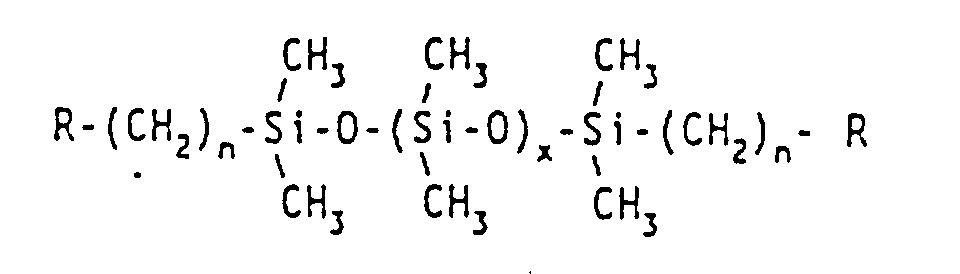
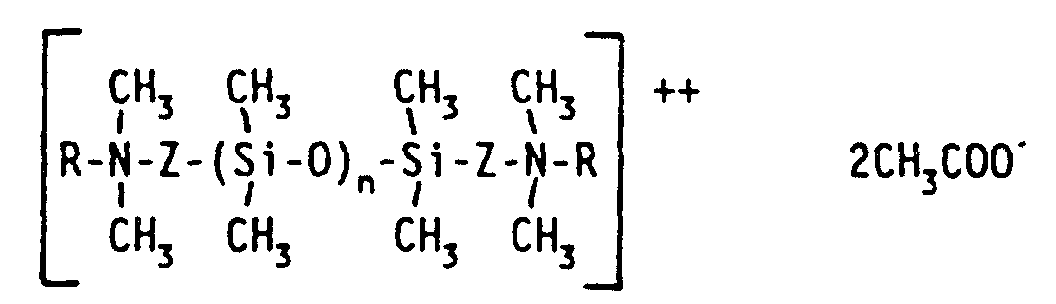
- softener/debonder is a chemical compound selected from the group consisting of quaternary ammonium compounds, quaternized protein compounds, phospholipids, silicone quaternaries, quaternized, hydrolyzed wheat protein/dimethicone phosphocopolyol copolymer, organoreactive polysiloxanes, and silicone glycols.
- Suitable quaternary ammonium compounds have the following structures: wherein
- Suitable quaternized protein compounds include the following structures: wherein
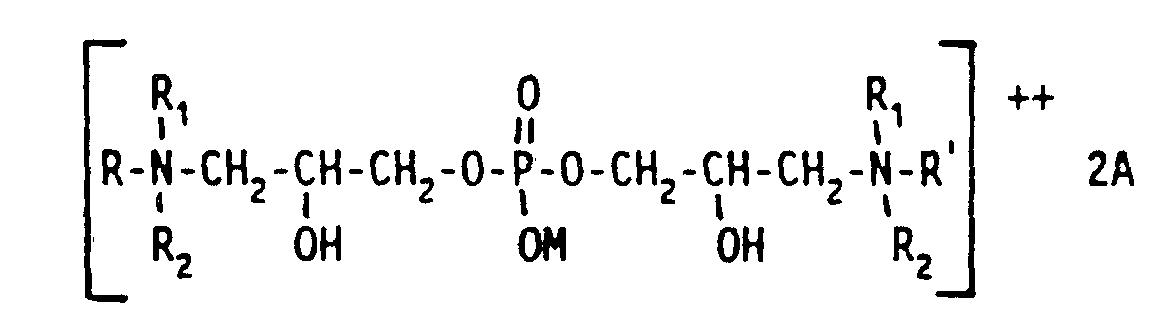
- Suitable phospholipids include, without limitation, those having the following structures: wherein
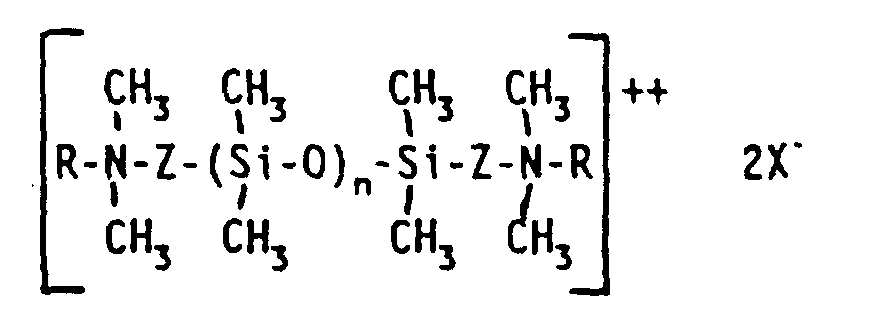
- Suitable silicone quaternaries include the following structure: wherein
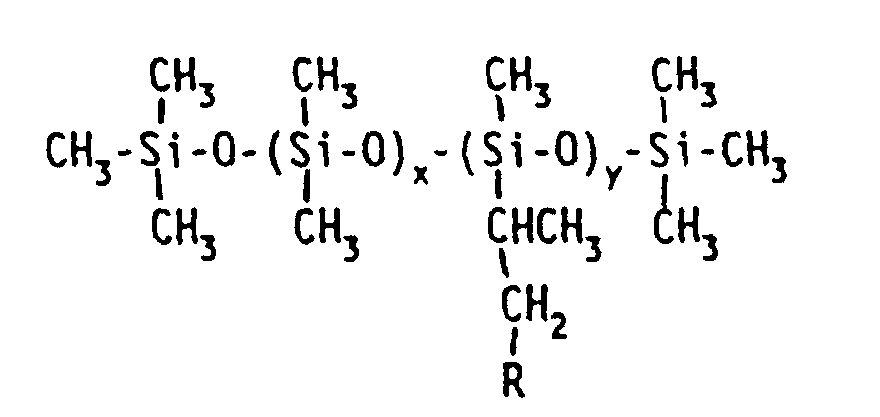
- Suitable organoreactive polysiloxanes include the following structures: and and wherein
- Suitable silicone glycols include the following structure: wherein
- the combination can be added to the thick stock simultaneously or separately.
- the combinations can contain one or more compounds from the above groups and added to the slurry, either in a premixed form or individually metered.
- the final tissue sheet comprises from about 0.01 to about 6 percent (by weight of the fiber) of the softener/debonders added to the wet end of the tissue making process, individually or in combination. More preferably, the final tissue sheet comprises from about 0.1 to about 3 percent of the softener/debonder added at the wet end, based on the weight of the fiber.
- Softener/debonders used for the topical treatment can be delivered in an aqueous solution or be dissolved in a suitable solvent such as propylene glycol, ethylene glycol, polyethylene glycol, isopropyl alcohol, methanol, ethanol or other organic solvents. They can be applied to the surface of the basesheet individually or in combination with others. It is preferred that the composition for topical treatment comprises from about 1 to about 100 weight percent of the softener/debonder (individually or in combination), more preferably from about 35 to about 80 weight percent. It is also preferred that the softener/debonder be topically added to the tissue sheet at an add-on ratio of from about 0.01 to about 10 weight percent of the fiber, and more preferably from about 0.1 to about 2 weight percent of the fiber.
- a suitable solvent such as propylene glycol, ethylene glycol, polyethylene glycol, isopropyl alcohol, methanol, ethanol or other organic solvents. They can be applied to the surface of the basesheet individually or in combination with others. It
- Suitable methods for the topical treatment include, but are not limited to spraying, rotogravure printing, trailing blade coating, flexographic printing, and the like.
- a 2-ply, wet-pressed, creped tissue was made using a layered headbox.
- the first stock layer (the layer which ultimately contacts the Yankee dryer surface) contained eucalyptus hardwood fiber and provided 60 dry weight percent of the tissue sheet.
- the remaining 40 percent of the tissue sheet was provided via a second stock layer consisting of northern softwood kraft pulp.
- the total basis weight of the sheet was 13,6 g/m 2 (7.3 pounds per 2880 square feet) of air dried tissue.
- Two strength agents were added to the fiber stock layers prior to the headbox.
- Parez 631NC (a glyoxalated polyacrylamide from Cytec Industries, Inc.) was metered into the softwood thick stock at 0.08 to 0.1 percent of the total fiber weight.
- Another strength agent, Kymene 557 LX (commercially available from Hercules, Inc.) was metered into both the hardwood and the softwood thick stock at 0.05 and 0.1 percent of the total fiber weight, respectively.
- a quaternary ammonium compound softener/debonder (methyl-1-oleyl amidoethyl-2-oleyl imidazolinium methyl sulfate identified as Varisoft 3690 available from Witco Corporation, 90 percent active matter) was added to the hardwood thick stock at 0.17 percent of the total fiber weight.
- tissue sheet After drying and creping, the tissue sheet was plied together with a like sheet to form a two-ply tissue.
- the hardwood layer of both plies was rotogravure-printed with a 40 percent emulsion of an organoreactive polysiloxane (FTS-226 made by OSi Specialties, Inc.) at an add-on amount of 1 percent per ply based on the weight of fiber.
- FTS-226 organoreactive polysiloxane
- a 2-ply layered tissue was made as described in Example 1, except instead of rotogravure-printing both plies with an organoreactive polysiloxane, both plies were instead coated with a silicone phospholipid (Mona Industries, Inc., Item Code #54146, Lot 2426, 25-30% active) having the following structure: wherein
- a trailing blade coater was used to apply the silicone phospholipid.
- the blade angle was set at 30° and blade pressures were varied between 20 and 40 psi to deliver different levels of addition.
- the resulting tissue products had increased bulk and smooth surface feel.
- a 2-ply tissue was made as described in Example 2, except both plies were coated with a quaternary ammonium compound (olealkonium chloride, Mackernium KP made by McIntyre Group, LTD., 50% active) having the following structure:
- the resulting tissue products had increased bulk and smooth surface feel.
- a 2-ply layered tissue was made as described in Example 2, except both plies were coated with a silicone quaternary compound (Abilquat 3272 made by Goldschmidt Chemical Corporation, 50% active) having the following structure: wherein
- the resulting tissue products had increased bulk and smooth surface feel.
- a 2-ply layered basesheet was made as described in Example 2, except both plies were printed with an aqueous composition comprising 50% of organopolydimethylsiloxane (FTS-226) and 50% quaternary ammonium compound (Mackernium KP).
- FTS-226 organopolydimethylsiloxane
- Mackernium KP 50% quaternary ammonium compound
- a 2-ply layered basesheet was made as described in Example 1, except both plies were coated with an aqueous composition comprising 40% quaternary ammonium compound (Mackernium NLE made by McIntyre Group, LTD.), 40% organopolydimethylsiloxane (FTS-226) and 20% water.
- Mackernium NLE is an alkylamidopropyl epoxypropyl diammonium chloride, 100 percent active.
- the resulting tissue products had increased bulk and smooth surface feel.
- a two-ply layered basesheet was made as described in Example 2, except both plies were coated with an aqueous composition comprising 25% quaternary ammonium compound (Mackernium KP), 25% organopolysiloxane (FTS-226) and 50% propylene glycol.
- the resulting tissue products had increased bulk and smooth surface feel.
- a one-ply, uncreped, through-air-dried tissue was made using a layered headbox.
- the two outer layers contained bleached eucalyptus hardwood kraft pulp processed through a Maule shaft disperser with a power input of 80 kilowatts at a consistency of about 34 percent and at a temperature of 84,4°C (184°F).
- the two outer layers made up 70 percent of the tissue sheet by weight of fiber.
- the middle layer constituted the remaining 30 percent of the tissue web and consisted of bleached northern softwood kraft pulp.
- the total basis weight of the sheet was 33.9 grams per square meter of air-dried tissue.
- the inner layer was refined to obtain sufficient dry strength in the final product.
- a wet strength agent (Parez 631NC) was metered into the inner layer at a rate of 5 kilograms per tonne or 0.5 percent of the weight of fiber.
- a softener/debonder (quaternary imidazolinium, fatty acid alkoxylate and polyether with 200 - 800 molecular weight, identified as DPSC 5299-8 from Witco Corporation) was added to the two outer layers at a rate of 5.25 kilograms per tonne (0.525 percent) of the total fiber weight.
- the thick stock of all layers was diluted to approximately 0.12 percent consistency prior to forming, dewatering and drying the tissue web.
- tissue After drying, the tissue was coated with a silicone diquaternary compound (Abilquat 3272) similar to Example 4.
- the resulting tissue product had a smoother surface feel compared to the tissue without coating.
Landscapes
- Chemical & Material Sciences (AREA)
- Chemical Kinetics & Catalysis (AREA)
- Paper (AREA)
- Treatments For Attaching Organic Compounds To Fibrous Goods (AREA)
- Sanitary Thin Papers (AREA)
- Cosmetics (AREA)
- Chemical Or Physical Treatment Of Fibers (AREA)
Description

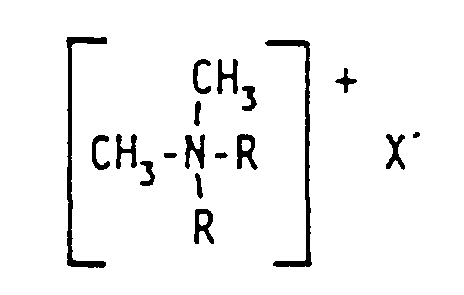
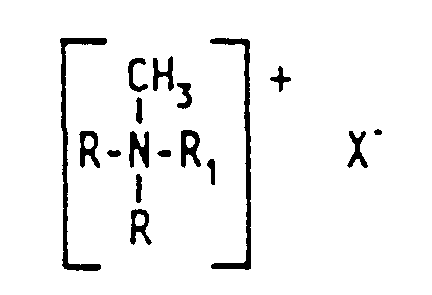
- X = chloride, methyl sulfate, or other compatible counterion;
- R = aliphatic, saturated or unsaturated C8 - C22; and
- R1= benzyl or epoxy group;
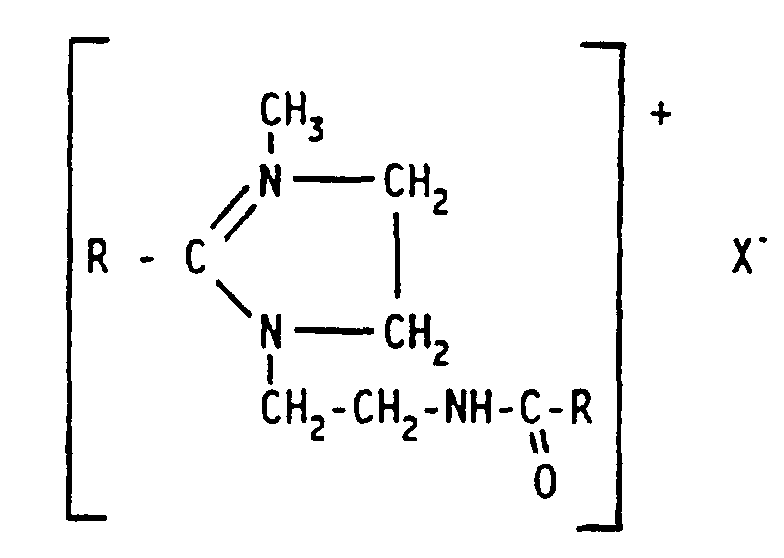
- X = chloride, methyl sulfate, or other compatible counterion; and
- R = aliphatic, saturated or unsaturated C8-C22;
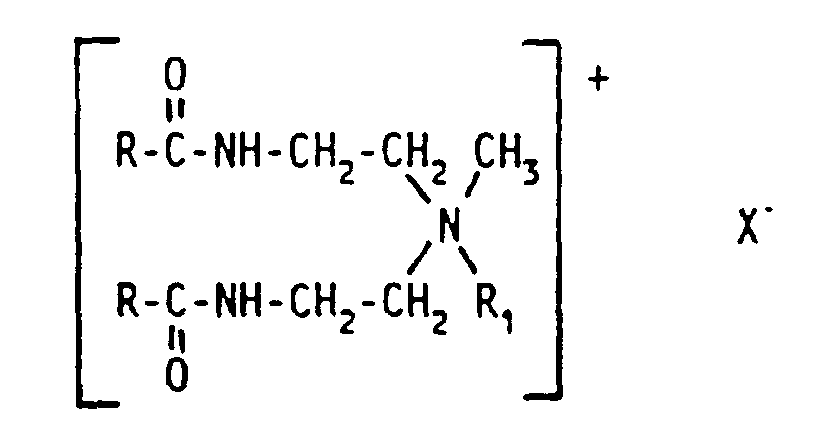
- X = methyl sulfate, chloride, or other compatible counterion;
- R = aliphatic, normal, saturated or unsaturated, C8 - C22; and
- R1 = 2-hydroxyethyl or 2-hydroxypropyl;

- R = aliphatic, normal or branched, saturated or unsaturated, C8 - C22;
- X = chloride, methyl sulfate, ethyl sulfate, or other compatible counterion;
- R' = 2-hydroxyethyl or polyethoxyethanol; and
- n = 1 to 50;

- R = C8 - C22; and
- X = methyl sulfate, chloride, or other compatible counterion;
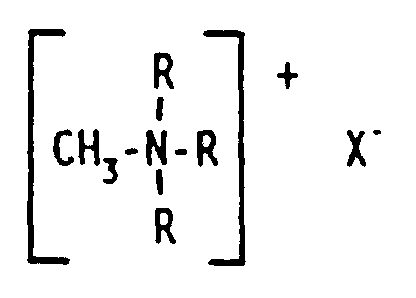
- R = aliphatic alkyl, normal or branched, saturated or unsaturated, C8 - C22; and
- X = chloride, methyl sulfate or other compatible counterion.
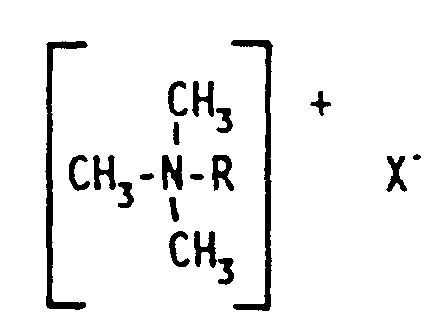
- R = aliphatic, saturated or unsaturated, C8 - C22; or allyl-; or R'-O-CH2-CH2-CH2, where R'= normal or branched, C4 - C18; and
- X = chloride, sulfate or any other compatible counterion.
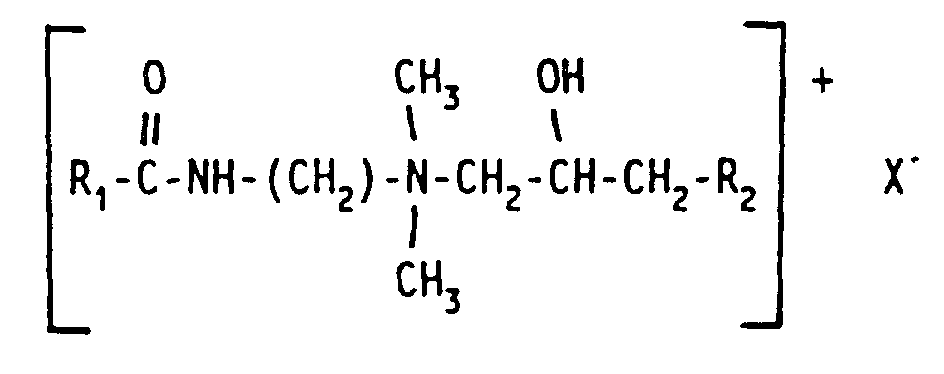
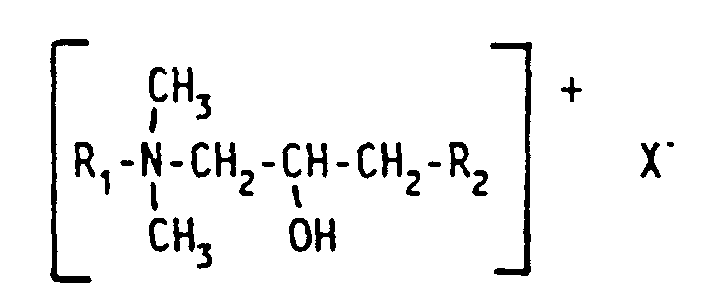
- R1 = fatty acid radical, saturated or unsaturated, C12 - C22;
- R2 = hydrolyzed collagen or keratin moiety; and
- X = chloride, lactate or other compatible counterion.

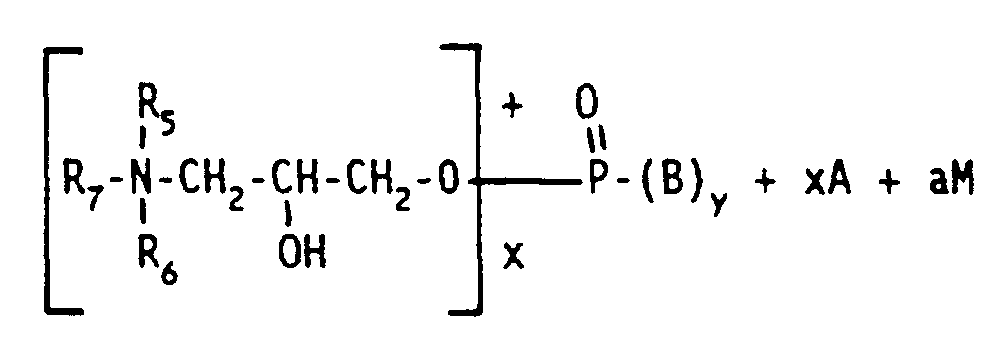
- x = 1 to 3;
- x + y = 3;
- a = 0 to 2;
- B = O- or OM;
- A = an anion;
- M = a cation;
- R5, R6 may be the same or different, are alkyl, hydroxyalkyl, carboxyalkyl of up to C6, or polyoxyalkylene of up to C10; or R5, R6 and the nitrogen they are attached to may represent an N-heterocycle; and
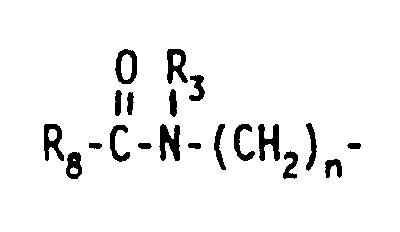
- R7 = an amidoamine moiety of the formula:
wherein

- n = 2 to 6;
- R3 = hydrogen or alkyl, hydroxyalkyl or alkenyl of up to 6 carbons; or cycloalkyl of up to 6 carbon atoms, or polyoxyalkylene of up to 10 carbon atoms; and
- R4 = alkyl, alkenyl, alkoxy or hydroxyalkyl, C5-C21, or aryl or alkaryl of up to C20;
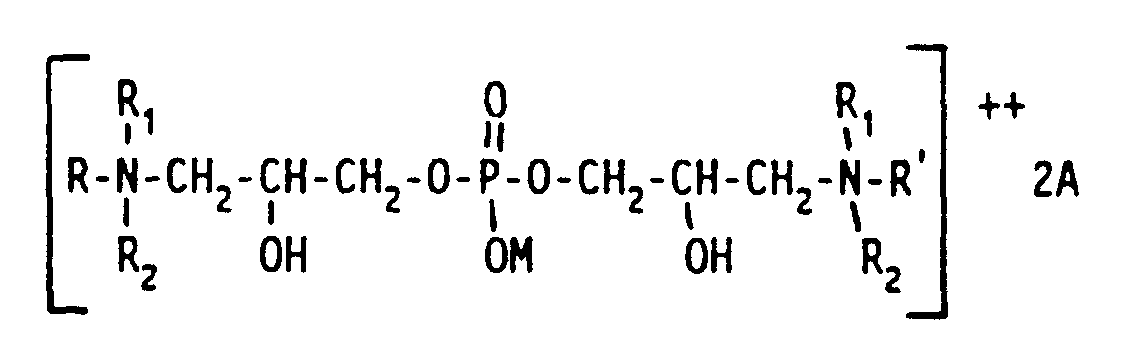
- A = an anion;
- M = a cation;
- R, R1 & R2 can be the same or different, are alkyl, substituted alkyl, alkyl aryl or altkenyl groups of up to 16 carbon atoms, and the total carbon atoms of R + R1 + R2 = 10 to 24; and
- R' is an amidoamine moiety of the structure:
wherein

- n = 2 to 6;
- R3 = hydrogen or alkyl, hydroxyalkyl or alkenyl of up to 6 carbons; or cycloalkyl of up to 6 carbon atoms, or polyoxyalkylene of up to 10 carbon atoms; and
- R8 has the following structure:
wherein

- n = 3 or greater;
- p = 1 to 1000;
- q = 1 to 25.




Claims (19)
- A method for making a soft tissue comprising:(a) forming an aqueous suspension of papermaking fibers having from 0.01 to 6 weight percent, based on dry fiber, of a quatemary ammonium compound having the following structure:wherein
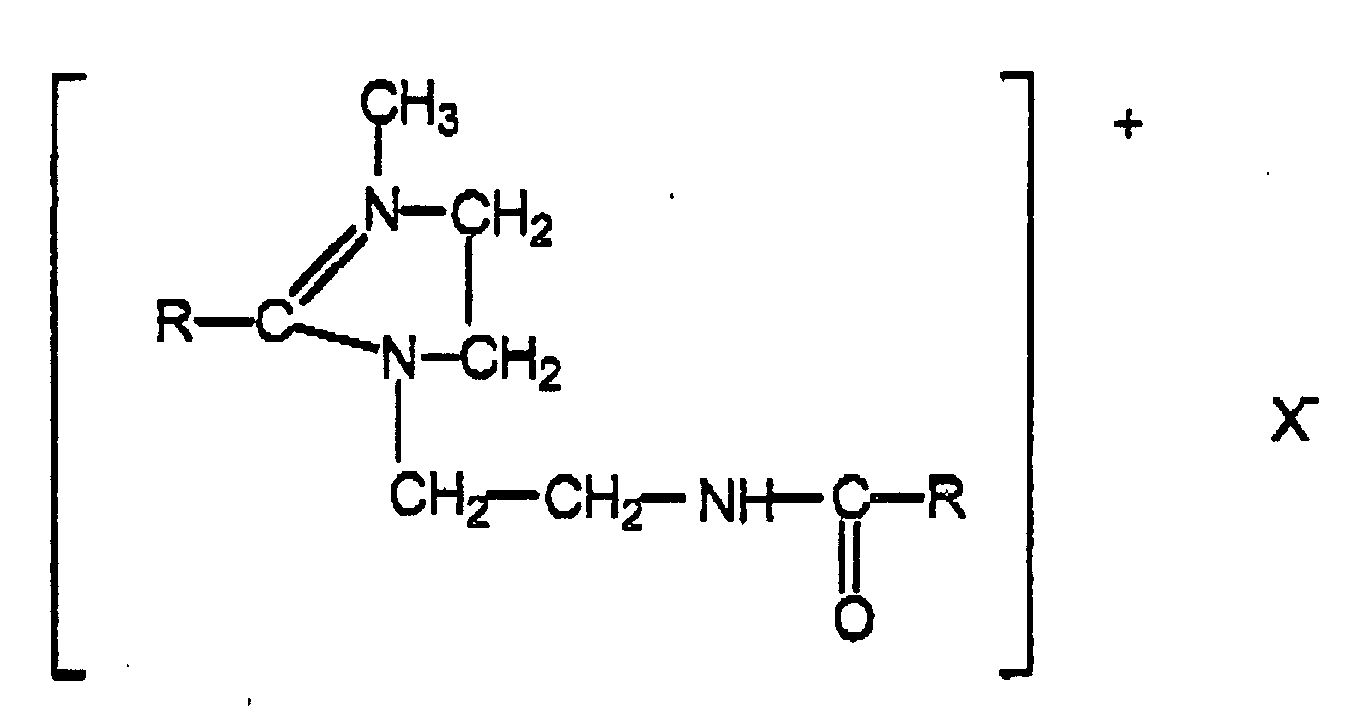 X= chloride, methyl sulfate or other compatible counterion; andR = aliphatic, saturated or unsaturated C8-C22;(b) forming a tissue web by depositing the aqueous suspension of papermaking fibers onto a forming fabric;(c) dewatering and drying the tissue web; and(d) topically applying to the dry tissue web from 0.01 to 10 weight percent, based on dry fiber, of one or more softener/debonders selected from the group consisting of quaternary ammonium compounds, quaternized protein compounds, phospholipids, silicone quaternaries, organoreactive polysiloxanes, and silicone glycols.
 - The method of Claim 1 wherein the amount of softener/debonder added to the fiber suspension is from 0.1 to 3 dry weight percent based on the amount of fiber.
- The method of Claim 1 wherein the amount of softener/debonder topically applied to the dried web is from 0.1 to 10 dry weight percent, based on the amount of fiber.
- The method of Claim 1 wherein at least one of the softner/debonders in step d) is a quaternary ammonium compound having the following structure:wherein
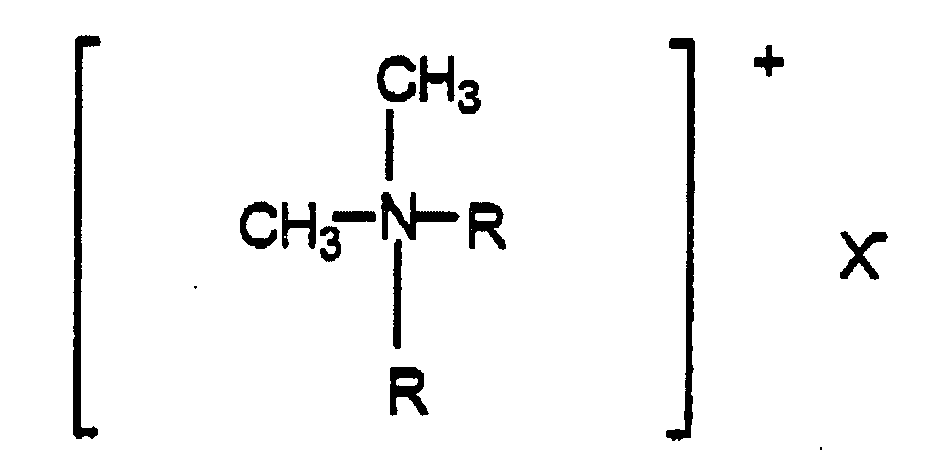 X = chloride, methyl sulfate, or other compatible counterion; andR = aliphatic, saturated or unsaturated C8-C22.
 - The method of Claim 1 wherein at least one of the softener/debonders in step d) is a quatemary ammonium compound having the following structure:wherein
 X = chloride, methyl sulfate, or other compatible counterion;R = aliphatic, saturated or unsaturated C8-C22;R1 = benzyl or epoxy group,
 - The method of Claim 1 wherein at least one of the softener/debonders in step d) is a quaternary ammonium compound having the following structure:wherein
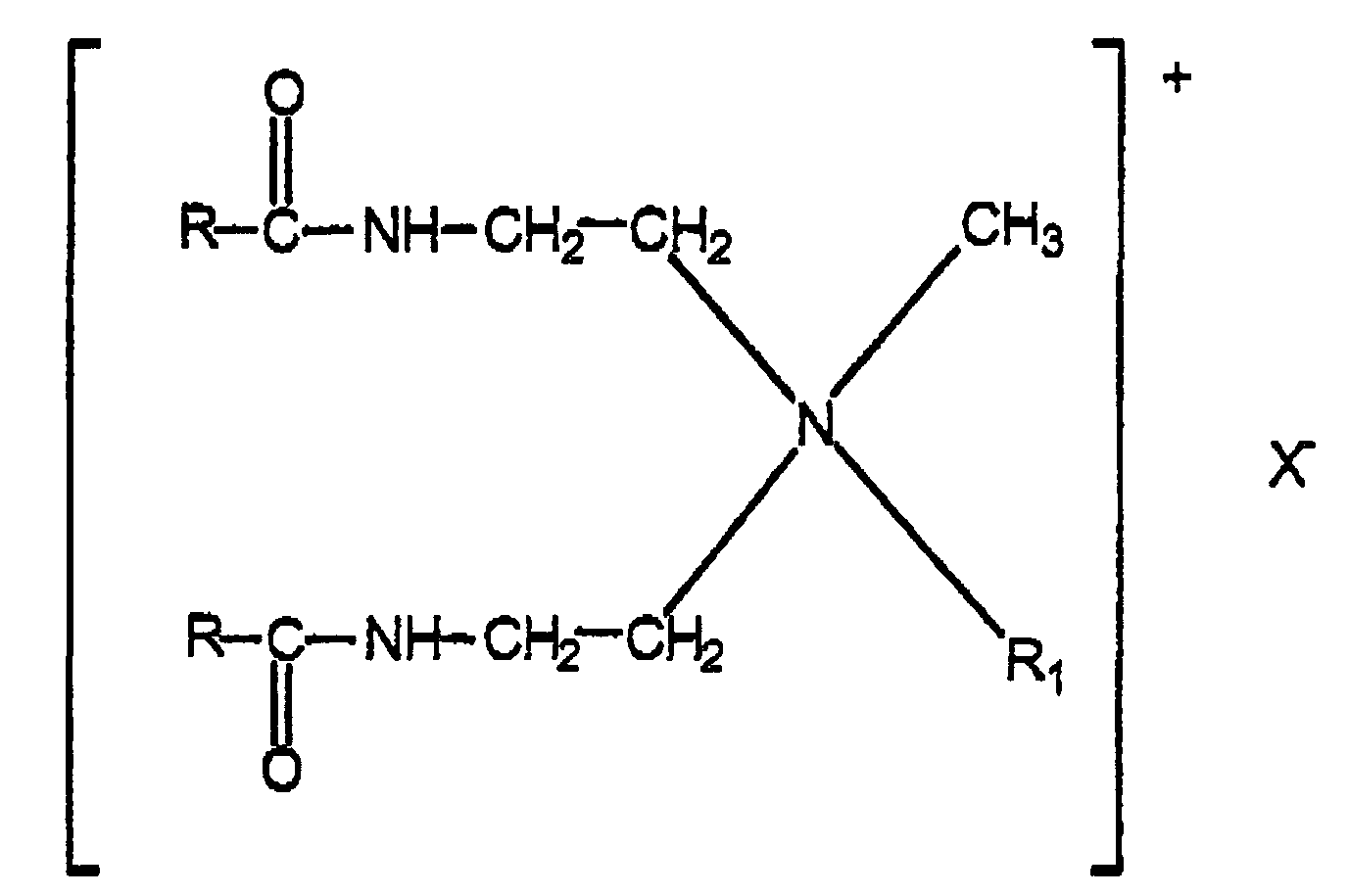 X = methyl sulfate, chloride, or other compatible counterion;R = aliphatic, normal saturated or unsaturated, C8-C22R1 = 2-hydroxyethyl or 2-hydroxypropyl;
 - The method of Claim 1 wherein at least one of the softener/debonders in step d) is a quaternary ammonium compound having the following structure:wherein
 R = aliphatic, normal or branched, saturated or unsaturated C8-C22;X = chloride, methyl sulfate, ethyl sulfate, or other compatible counterion;R' = 2-hydroxyethyl or polyethoxyethanol; andn = 1 to 50.
 - The method of Claim 1 wherein at least one of the softener/debonders in step d) is a quaternary ammonium compound having the following structure:wherein
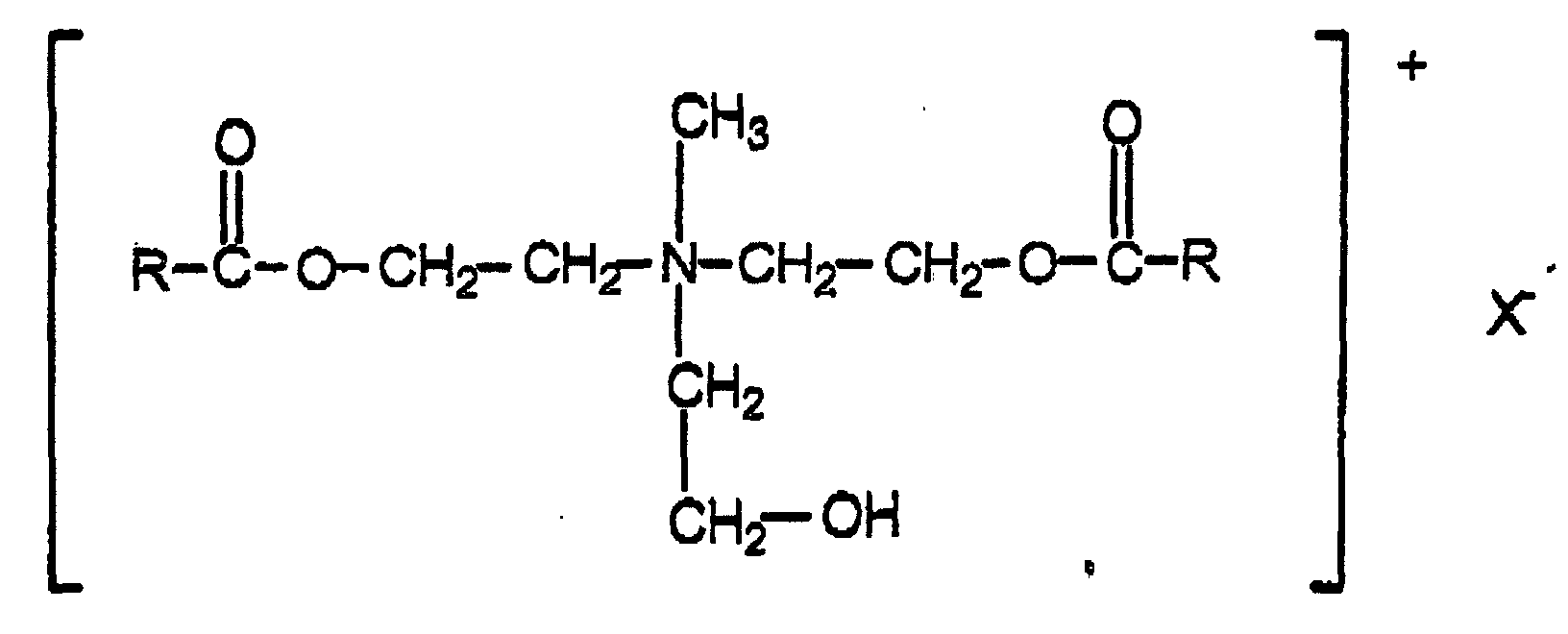 R = C8-C22; andX = methyl sulfate, chloride, or other compatible counterion.
 - The method of Claim 1 wherein at least one of the softener/debonders in step d) is a quaternary ammonium compound having the following structure:wherein
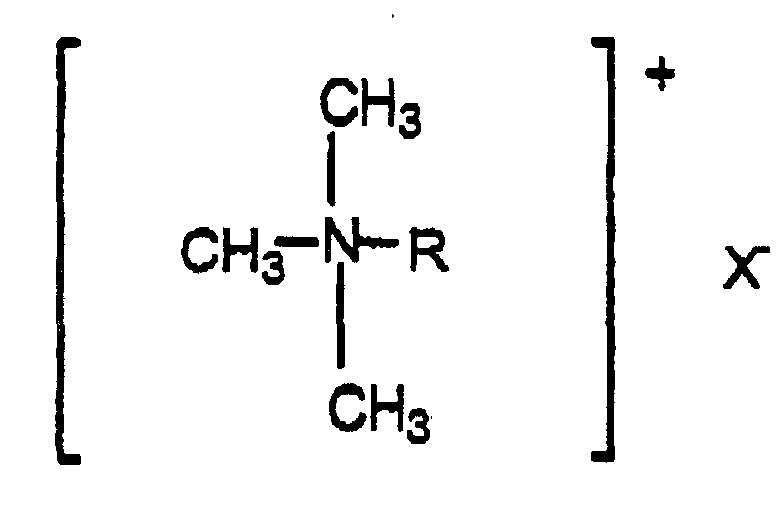
- R =
- aliphatic, saturated or unsaturated C8-C22; or allyl-; or R'-O-CH2-CH2-CH2. where R' = normal or branched, C4-C18; and
- X =
- chloride, sulfate or any other compatible counterion.
- The method of Claim 1 wherein at least one of the softener/debonders in step d) is a quaternary ammonium compound having the following structure:wherein
 R = aliphatic alkyl, normal or branched, saturated or unsaturated C8-C22; andX= chloride, methyl sulfate, or other compatible counterion.
 - The method of Claim 1 wherein at least one of the softener/debonders in step d) is a quaternized protein compound having the following structure:wherein
 R1 = fatty acid radical, saturated or unsaturated, C12-C22;R2 = hydrolyzed soy protein, hydrolyzed silk protein, hydrolyzed wheat protein, collagen moiety, or keratin moiety; andX = chloride, lactate, or other compatible counterion.
 - The method of Claim 1 wherein at least one of the softener/debonders In step d) is a quaternized protein compound having the following structure:wherein
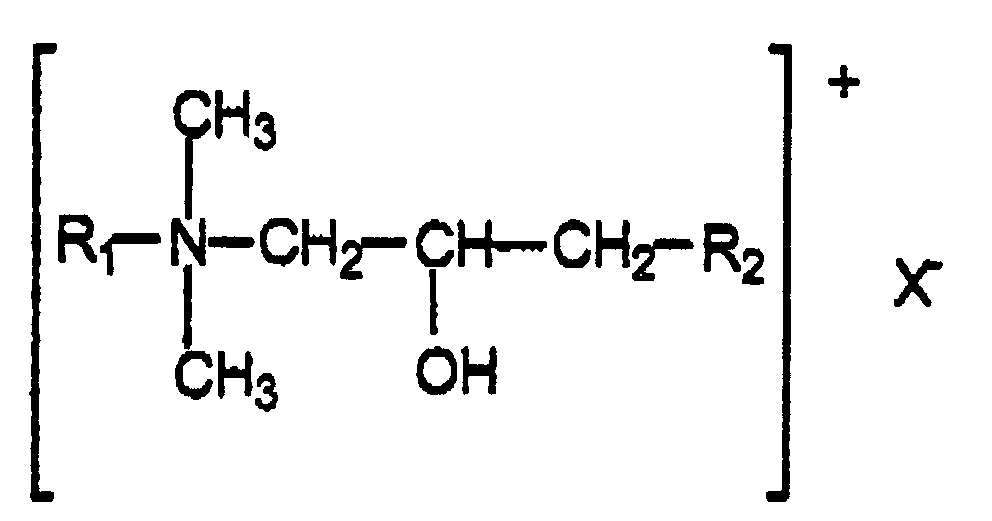 R1 = fatty acid radical, saturated or unsaturated, C12-C22;R2 = hydrolyzed collagen or keratin moiety; andX = chloride, lactate, or other compatible counterion.
 - The method of claim 1 wherein at least one of the softener/debonders in step is a phospholipid having the following structure:wherein
 x = 1 to 3;x + y = 3;a = 0 to 2;B = O- or OMA = an anionM = a cation; andR, R1& R2 can be the same or different, are alkyl, substituted alkyl, alkyl aryl or alkenyl groups of up to 16 carbon atoms and the total carbon atoms of R + R1 + R2 = 10 to 24.
 - The method of Claim 1 wherein at least one of the softener/debonders in step d) is a phospholipid having the following structure:wherein
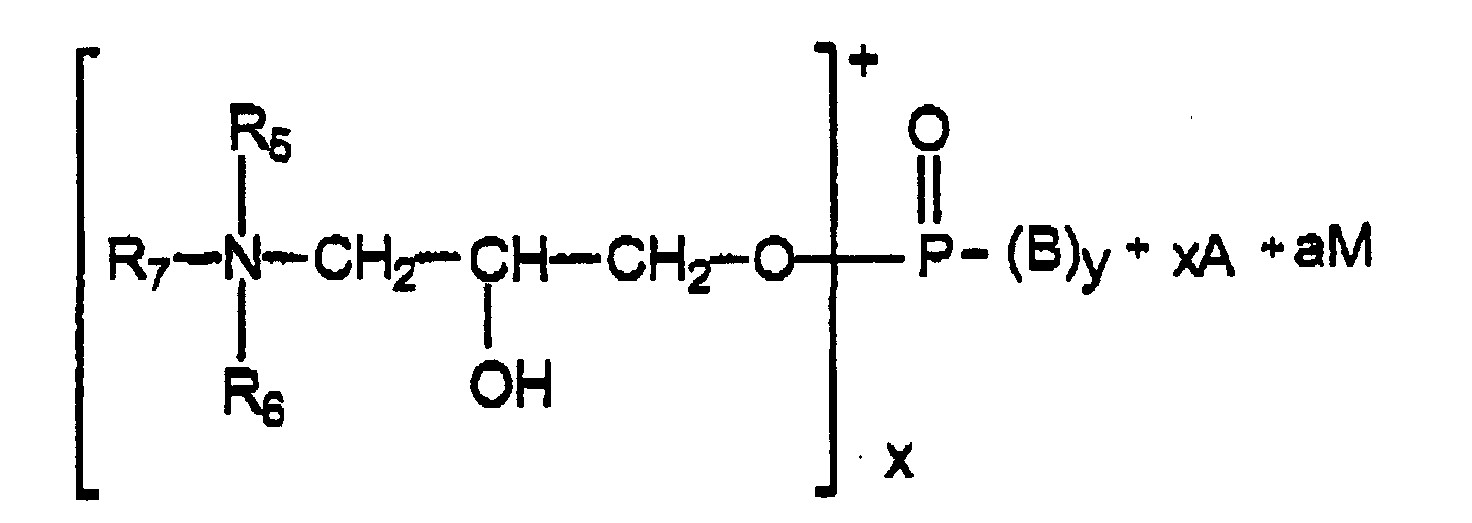 x =1 to 3;x + y = 3;a = 0 to 2;B = O- or OM;A = an anion;M = a cation;R5, R6 may be the same or different, are alkyl, hydroxyalkyl, carboxyalkyl of up to C6, or polyoxyalkylene of up to C10; or R5, R6 and the nitrogen they are attached to may represent an N-heterocycle; andR7 = an amidoamine moiety of the formula;wherein
 n = 2 to 6;R3 = hydrogen or alkyl, hydroxyalkyl or alkenyl of up to 6 carbons; or cycloalkyl of up to 6 carbon atoms, or polyoxyalkylene of up to 10 carbon atoms; andR4 = alkyl, alkenyt, alkoxy or hydroxyalkyl, C5-C21, or aryl or alkaryl of up to C20.
 - The method of Claim 1 wherein at least one of the softener/debonders in step d) is a phospholipld having the following structure:wherein
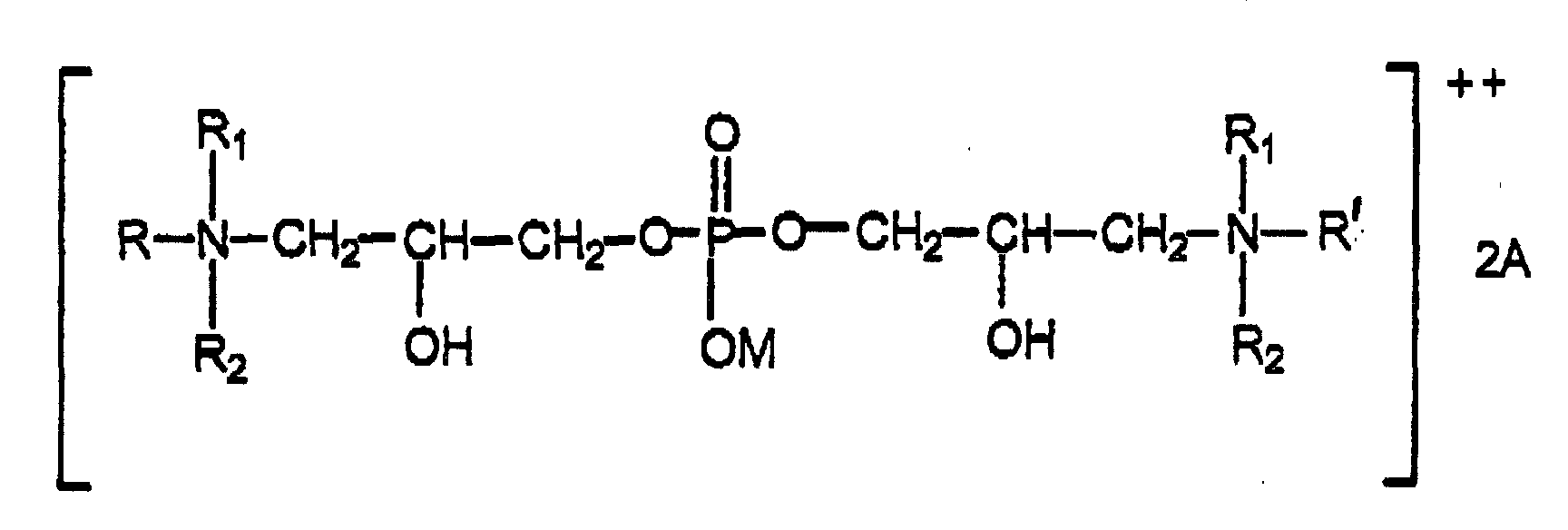 A = anion;M = a cation;R, R1 & R2 can be the same or different, are alkyl, substituted alkyl, alkyl aryl or alkenyl groups of up to 16 carbon atoms, and the total carbon atoms of R + R1 + R2 = 10 to 24; andR' is an amidoamine moiety of the structure:wherein
 n = 2 to 6;R3 = hydrogen or alkyl, hydroxalkyl or alkenyl of up to 6 carbons; or cycloalkyl of up to 6 carbon atoms, or polyoxyalkylene of up to 10 carbon atoms; andR8 has the following structure:wherein
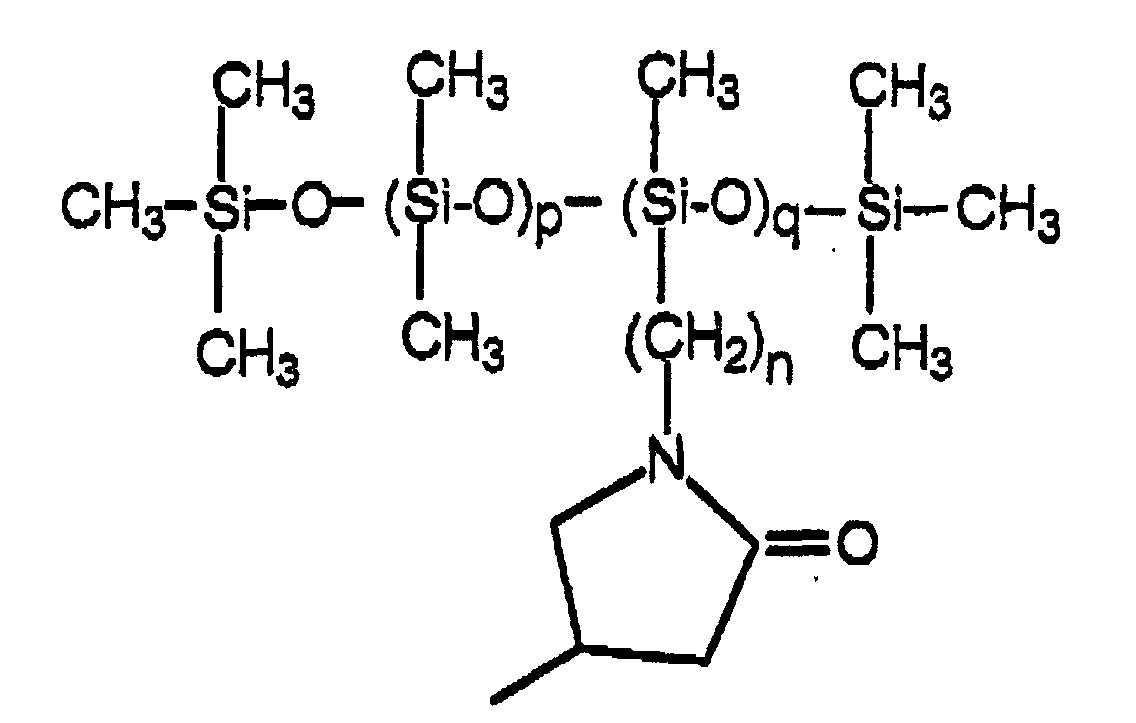 n = 3 or greaterp = 1 to 1000; andq = 1 to 25.
 - The method of Claim 1 wherein at least one of the softener/debonders in step d) is a silicone quaternary having the following structure:wherein
 R = alkyl group, C12-C18;Z = -CH2-CH2-CH2-O-(CH2)3-;X = alkoxy, chloride or other compatible counterion; andn = 1 to 50.
 - The method of Claim 1 wherein at least one of the softener/debonder in step d) is a silicone having the following formula:wherein
 R=alkylen, C1-C8:R1=acetate or hydroxyl group;x=1 to 1000y=1 to 50m=1 to 30; andn=1 to 30.
 - The method of Claim 1 wherein at least one of the softeners/debonders in step d) is a quaternized, hydrolyzed wheat protein/dimethicone phosphocopolyol copolymer.
- The method of Claim 1 wherein the softener/debonder added to the dried web is carried by a solvent selected from the group consisting of water, propylene glycol, ethylene glycol, polyethylene glycol, isopropyl alcohol, methanol and ethanol.
Applications Claiming Priority (3)
| Application Number | Priority Date | Filing Date | Title |
|---|---|---|---|
| US50583895A | 1995-07-21 | 1995-07-21 | |
| US505838 | 1995-07-21 | ||
| PCT/US1996/011780 WO1997004171A1 (en) | 1995-07-21 | 1996-07-16 | Method for making soft tissue with improved bulk softness and surface softness |
Publications (2)
| Publication Number | Publication Date |
|---|---|
| EP0840824A1 EP0840824A1 (en) | 1998-05-13 |
| EP0840824B1 true EP0840824B1 (en) | 2002-02-13 |
Family
ID=24012076
Family Applications (1)
| Application Number | Title | Priority Date | Filing Date |
|---|---|---|---|
| EP96925330A Expired - Lifetime EP0840824B1 (en) | 1995-07-21 | 1996-07-16 | Method for making soft tissue paper with improved bulk softness and surface softness |
Country Status (14)
| Country | Link |
|---|---|
| US (1) | US6156157A (en) |
| EP (1) | EP0840824B1 (en) |
| JP (1) | JPH11512153A (en) |
| KR (1) | KR100453477B1 (en) |
| CN (1) | CN1077939C (en) |
| AR (1) | AR002887A1 (en) |
| AU (1) | AU699180B2 (en) |
| BR (1) | BR9610456A (en) |
| CA (1) | CA2223810A1 (en) |
| DE (1) | DE69619245T2 (en) |
| HU (1) | HUP9802214A3 (en) |
| PL (1) | PL327402A1 (en) |
| WO (1) | WO1997004171A1 (en) |
| ZA (1) | ZA965679B (en) |
Families Citing this family (27)
| Publication number | Priority date | Publication date | Assignee | Title |
|---|---|---|---|---|
| US5725736A (en) * | 1996-10-25 | 1998-03-10 | Kimberly-Clark Worldwide, Inc. | Tissue containing silicone betaines |
| US6146494A (en) * | 1997-06-12 | 2000-11-14 | The Procter & Gamble Company | Modified cellulosic fibers and fibrous webs containing these fibers |
| US5869075A (en) * | 1997-08-15 | 1999-02-09 | Kimberly-Clark Worldwide, Inc. | Soft tissue achieved by applying a solid hydrophilic lotion |
| US6054020A (en) * | 1998-01-23 | 2000-04-25 | Kimberly-Clark Worldwide, Inc. | Soft absorbent tissue products having delayed moisture penetration |
| US7195771B1 (en) | 2000-11-21 | 2007-03-27 | Kimberly-Clark Worldwide, Inc. | Water-soluble lotions for paper products |
| US6905697B2 (en) | 2001-01-19 | 2005-06-14 | Sca Hygiene Products Gmbh | Lotioned fibrous web having a short water absorption time |
| US6860967B2 (en) | 2001-01-19 | 2005-03-01 | Sca Hygiene Products Gmbh | Tissue paper penetrated with softening lotion |
| US6797114B2 (en) * | 2001-12-19 | 2004-09-28 | Kimberly-Clark Worldwide, Inc. | Tissue products |
| US6821387B2 (en) * | 2001-12-19 | 2004-11-23 | Paper Technology Foundation, Inc. | Use of fractionated fiber furnishes in the manufacture of tissue products, and products produced thereby |
| US20030111195A1 (en) * | 2001-12-19 | 2003-06-19 | Kimberly-Clark Worldwide, Inc. | Method and system for manufacturing tissue products, and products produced thereby |
| US6716309B2 (en) | 2001-12-21 | 2004-04-06 | Kimberly-Clark Worldwide, Inc. | Method for the application of viscous compositions to the surface of a paper web and products made therefrom |
| US7229530B2 (en) * | 2001-12-31 | 2007-06-12 | Kimberly-Clark Worldwide, Inc. | Method for reducing undesirable odors generated by paper hand towels |
| US7297228B2 (en) * | 2001-12-31 | 2007-11-20 | Kimberly-Clark Worldwide, Inc. | Process for manufacturing a cellulosic paper product exhibiting reduced malodor |
| US6977026B2 (en) | 2002-10-16 | 2005-12-20 | Kimberly-Clark Worldwide, Inc. | Method for applying softening compositions to a tissue product |
| US6964725B2 (en) | 2002-11-06 | 2005-11-15 | Kimberly-Clark Worldwide, Inc. | Soft tissue products containing selectively treated fibers |
| US7029756B2 (en) | 2002-11-06 | 2006-04-18 | Kimberly-Clark Worldwide, Inc. | Soft tissue hydrophilic tissue products containing polysiloxane and having unique absorbent properties |
| US6949168B2 (en) | 2002-11-27 | 2005-09-27 | Kimberly-Clark Worldwide, Inc. | Soft paper product including beneficial agents |
| US7258764B2 (en) | 2002-12-23 | 2007-08-21 | Sca Hygiene Products Gmbh | Soft and strong webs from highly refined cellulosic fibres |
| US7012058B2 (en) * | 2003-02-26 | 2006-03-14 | Huntsman Petrochemical Corporation | Chemical softening compositions for paper products |
| US7396593B2 (en) | 2003-05-19 | 2008-07-08 | Kimberly-Clark Worldwide, Inc. | Single ply tissue products surface treated with a softening agent |
| US20050136097A1 (en) * | 2003-12-19 | 2005-06-23 | Kimberly-Clark Worldwide, Inc. | Soft paper-based products |
| HUE056235T2 (en) * | 2005-06-29 | 2022-02-28 | Henkel Ag & Co Kgaa | Process for softening hygienic paper |
| CA2735867C (en) | 2008-09-16 | 2017-12-05 | Dixie Consumer Products Llc | Food wrap basesheet with regenerated cellulose microfiber |
| KR101413975B1 (en) * | 2012-09-24 | 2014-07-02 | 깨끗한나라 주식회사 | Powder type wet tissue |
| MX376250B (en) * | 2016-12-22 | 2025-03-07 | Kimberly Clark Co | PROCESS AND SYSTEM FOR REORIENTING FIBERS IN THE FOAM FORMATION PROCESS. |
| US11035078B2 (en) | 2018-03-07 | 2021-06-15 | Gpcp Ip Holdings Llc | Low lint multi-ply paper products having a first stratified base sheet and a second stratified base sheet |
| CA3034832A1 (en) | 2018-03-07 | 2019-09-07 | Gpcp Ip Holdings Llc | Low lint paper products and methods of making the same |
Family Cites Families (63)
| Publication number | Priority date | Publication date | Assignee | Title |
|---|---|---|---|---|
| US302073A (en) * | 1884-07-15 | wheeler | ||
| US22362A (en) * | 1858-12-21 | Improvement in medicated fabrics | ||
| US967688A (en) * | 1910-04-14 | 1910-08-16 | Charles Philip Lowndes Titherley | Topical medicated pad. |
| US2251328A (en) * | 1938-05-12 | 1941-08-05 | Ehret Clement | Flexible sheet |
| NL110447C (en) * | 1957-09-05 | |||
| US3138533A (en) * | 1958-05-27 | 1964-06-23 | Leo J Heim | Sanitary tissues |
| US3058873A (en) * | 1958-09-10 | 1962-10-16 | Hercules Powder Co Ltd | Manufacture of paper having improved wet strength |
| DE1118781B (en) * | 1959-02-12 | 1961-12-07 | Koppers Co Inc | Process for the preparation of organic compounds containing phosphorus and silicon |
| US3227614A (en) * | 1960-09-29 | 1966-01-04 | Dustikin Products Inc | Germicidal paper |
| US3264188A (en) * | 1963-01-16 | 1966-08-02 | Kimberly Clark Co | Sanitary impregnated skin wiper |
| SE309154B (en) * | 1965-08-24 | 1969-03-10 | Mo Och Domsjoe Ab | |
| US3489148A (en) * | 1966-12-20 | 1970-01-13 | Procter & Gamble | Topsheet for disposable diapers |
| US3585998A (en) * | 1968-03-29 | 1971-06-22 | Ncr Co | Disposable diaper with rupturable capsules |
| CA978465A (en) * | 1970-04-13 | 1975-11-25 | Scott Paper Company | Fibrous sheet material and method and apparatus for forming same |
| US3755220A (en) * | 1971-10-13 | 1973-08-28 | Scott Paper Co | Cellulosic sheet material having a thermosetting resin bonder and a surfactant debonder and method for producing same |
| US3814096A (en) * | 1973-03-09 | 1974-06-04 | F Weiss | Facial tissue |
| DE2314060A1 (en) * | 1973-03-21 | 1974-10-10 | Honshu Paper Co Ltd | SURFACE-ACTIVE SUBSTANCE |
| US3896807A (en) * | 1974-06-13 | 1975-07-29 | Gilbert Buchalter | Article impregnated with skin-care formulations |
| US4117187A (en) * | 1976-12-29 | 1978-09-26 | American Can Company | Premoistened flushable wiper |
| US4112167A (en) * | 1977-01-07 | 1978-09-05 | The Procter & Gamble Company | Skin cleansing product having low density wiping zone treated with a lipophilic cleansing emollient |
| US4432834A (en) * | 1978-10-25 | 1984-02-21 | Nalco Chemical Company | Additive for felted cellulose fibers |
| GB2033751A (en) * | 1978-11-13 | 1980-05-29 | Johnson & Johnson | Nappy Liner |
| US4209449A (en) * | 1978-11-30 | 1980-06-24 | Mona Industries | Phosphate quaternary compounds |
| US4300981A (en) * | 1979-11-13 | 1981-11-17 | The Procter & Gamble Company | Layered paper having a soft and smooth velutinous surface, and method of making such paper |
| DE3015733C2 (en) * | 1980-04-24 | 1982-07-01 | Beiersdorf Ag, 2000 Hamburg | Process for the production of impregnated smooth or creped papers in one operation on the paper machine and their use as carrier material for pressure-sensitive adhesive layers |
| US4448638A (en) * | 1980-08-29 | 1984-05-15 | James River-Dixie/Northern, Inc. | Paper webs having high bulk and absorbency and process and apparatus for producing the same |
| US4482429A (en) * | 1980-08-29 | 1984-11-13 | James River-Norwalk, Inc. | Paper webs having high bulk and absorbency and process and apparatus for producing the same |
| US4441962A (en) * | 1980-10-15 | 1984-04-10 | The Procter & Gamble Company | Soft, absorbent tissue paper |
| US4447294A (en) * | 1981-12-30 | 1984-05-08 | The Procter & Gamble Company | Process for making absorbent tissue paper with high wet strength and low dry strength |
| US4550035A (en) * | 1982-12-10 | 1985-10-29 | Creative Products Resource Associates, Ltd. | Cosmetic applicator useful for skin moisturizing and deodorizing |
| EP0116512A1 (en) * | 1983-02-10 | 1984-08-22 | Sherex Chemical Company, Inc. | Fiber debonder formulation comprising diamido quaternary ammonium compound and alkoxylated fatty acid |
| US4559157A (en) * | 1983-04-21 | 1985-12-17 | Creative Products Resource Associates, Ltd. | Cosmetic applicator useful for skin moisturizing |
| JPS59225111A (en) * | 1983-06-07 | 1984-12-18 | Kao Corp | Composition for cleaning and wiping skin around anus |
| CA1230708A (en) * | 1983-07-14 | 1987-12-29 | The Procter & Gamble Company | Process for making pulp sheets containing debonding agents |
| US4528316A (en) * | 1983-10-18 | 1985-07-09 | Kimberly-Clark Corporation | Creping adhesives containing polyvinyl alcohol and cationic polyamide resins |
| US4560599A (en) * | 1984-02-13 | 1985-12-24 | Marquette University | Assembling multilayers of polymerizable surfactant on a surface of a solid material |
| US4623339A (en) * | 1985-08-15 | 1986-11-18 | Joann Ciraldo | Precious baby diaper |
| US4615937A (en) * | 1985-09-05 | 1986-10-07 | The James River Corporation | Antimicrobially active, non-woven web used in a wet wiper |
| US4795530A (en) * | 1985-11-05 | 1989-01-03 | Kimberly-Clark Corporation | Process for making soft, strong cellulosic sheet and products made thereby |
| US4735860A (en) * | 1985-12-06 | 1988-04-05 | Dai Nippon Insatsu Kabushiki Kaisha | Heat-resistant, thermal-sensitive transfer sheet |
| IL78566A (en) * | 1986-04-22 | 1989-07-31 | Porat Amir | Towelette |
| JPH07122050B2 (en) * | 1986-07-16 | 1995-12-25 | 東レ・ダウコーニング・シリコーン株式会社 | Antistatic treatment agent for solid materials |
| US4766015A (en) * | 1987-04-21 | 1988-08-23 | Bercen, Inc. | Phospholipid lubricant for coating moving webs |
| US4943350A (en) * | 1987-08-06 | 1990-07-24 | Scott Paper Company | Chemically treated paper products - towel and tissue |
| US4883475A (en) * | 1987-08-06 | 1989-11-28 | Scott Paper Company | Chemically treated paper products--towel and tissue |
| JP2506125B2 (en) * | 1987-10-06 | 1996-06-12 | 雄二 加藤 | Sterilizing and softening composition |
| ATE120820T1 (en) * | 1988-06-14 | 1995-04-15 | Procter & Gamble | METHOD FOR PRODUCING SOFT TISSUE PAPER TREATED WITH A POLYSILOXANE. |
| US4904524A (en) * | 1988-10-18 | 1990-02-27 | Scott Paper Company | Wet wipes |
| JPH02273536A (en) * | 1989-04-13 | 1990-11-08 | Yakult Honsha Co Ltd | Surface active agent and its manufacture |
| US5093452A (en) * | 1990-06-27 | 1992-03-03 | Siltech Inc. | Silicone phosphate amines |
| US5164522A (en) * | 1990-06-29 | 1992-11-17 | Karlshamns Ab | Cationic silicones |
| US5160450A (en) * | 1990-12-05 | 1992-11-03 | Lion Corporation | Surface-active agents having two hydrophobic chains and two hydrophilic groups |
| US5217576A (en) * | 1991-11-01 | 1993-06-08 | Dean Van Phan | Soft absorbent tissue paper with high temporary wet strength |
| JP2674431B2 (en) * | 1992-07-03 | 1997-11-12 | 信越化学工業株式会社 | Phosphate ester group-containing organopolysiloxane, method for producing the same, and anionic surfactant |
| ES2093452T3 (en) * | 1992-08-27 | 1996-12-16 | Procter & Gamble | PROCEDURE FOR APPLYING CHEMICAL ADDITIVES PAPELEROS FROM A THIN FILM TO TISSUE PAPER. |
| JP2923722B2 (en) * | 1992-09-09 | 1999-07-26 | 花王株式会社 | Organo (poly) siloxane modified with phosphate ester and method for producing the same |
| WO1994005720A1 (en) * | 1992-09-09 | 1994-03-17 | Kao Corporation | Organo(poly)siloxane modified with phosphoric ester and process for producing the same |
| US5240562A (en) * | 1992-10-27 | 1993-08-31 | Procter & Gamble Company | Paper products containing a chemical softening composition |
| US5237035A (en) * | 1992-12-28 | 1993-08-17 | Siltech Corp. | Silicone phospholipid polymers |
| US5334286A (en) * | 1993-05-13 | 1994-08-02 | The Procter & Gamble Company | Tissue paper treated with tri-component biodegradable softener composition |
| US5399241A (en) * | 1993-10-01 | 1995-03-21 | James River Corporation Of Virginia | Soft strong towel and tissue paper |
| US5573637A (en) * | 1994-12-19 | 1996-11-12 | The Procter & Gamble Company | Tissue paper product comprising a quaternary ammonium compound, a polysiloxane compound and binder materials |
| US5730839A (en) * | 1995-07-21 | 1998-03-24 | Kimberly-Clark Worldwide, Inc. | Method of creping tissue webs containing a softener using a closed creping pocket |
-
1996
- 1996-07-04 ZA ZA965679A patent/ZA965679B/en unknown
- 1996-07-16 EP EP96925330A patent/EP0840824B1/en not_active Expired - Lifetime
- 1996-07-16 DE DE69619245T patent/DE69619245T2/en not_active Expired - Fee Related
- 1996-07-16 CN CN96196864A patent/CN1077939C/en not_active Expired - Fee Related
- 1996-07-16 WO PCT/US1996/011780 patent/WO1997004171A1/en not_active Ceased
- 1996-07-16 AU AU65467/96A patent/AU699180B2/en not_active Ceased
- 1996-07-16 BR BR9610456A patent/BR9610456A/en not_active IP Right Cessation
- 1996-07-16 JP JP9506802A patent/JPH11512153A/en active Pending
- 1996-07-16 KR KR10-1998-0700427A patent/KR100453477B1/en not_active Expired - Fee Related
- 1996-07-16 HU HU9802214A patent/HUP9802214A3/en unknown
- 1996-07-16 PL PL96327402A patent/PL327402A1/en unknown
- 1996-07-16 CA CA002223810A patent/CA2223810A1/en not_active Abandoned
- 1996-07-19 AR ARP960103654A patent/AR002887A1/en unknown
-
1997
- 1997-04-21 US US08/847,392 patent/US6156157A/en not_active Expired - Fee Related
Also Published As
| Publication number | Publication date |
|---|---|
| CA2223810A1 (en) | 1997-02-06 |
| DE69619245D1 (en) | 2002-03-21 |
| KR19990035771A (en) | 1999-05-25 |
| ZA965679B (en) | 1997-01-24 |
| US6156157A (en) | 2000-12-05 |
| MX9800374A (en) | 1998-07-31 |
| HUP9802214A3 (en) | 1999-07-28 |
| PL327402A1 (en) | 1998-12-07 |
| DE69619245T2 (en) | 2002-11-14 |
| EP0840824A1 (en) | 1998-05-13 |
| CN1196767A (en) | 1998-10-21 |
| WO1997004171A1 (en) | 1997-02-06 |
| AU6546796A (en) | 1997-02-18 |
| AR002887A1 (en) | 1998-04-29 |
| CN1077939C (en) | 2002-01-16 |
| HUP9802214A2 (en) | 1999-01-28 |
| KR100453477B1 (en) | 2005-01-15 |
| AU699180B2 (en) | 1998-11-26 |
| JPH11512153A (en) | 1999-10-19 |
| BR9610456A (en) | 1999-06-08 |
Similar Documents
| Publication | Publication Date | Title |
|---|---|---|
| US6156157A (en) | Method for making soft tissue with improved bulk softness and surface softness | |
| US5725736A (en) | Tissue containing silicone betaines | |
| US6030675A (en) | Tissue containing silicone amidoamine esters and phosphates | |
| EP0864013B1 (en) | Tissue products containing softeners and silicone glycol | |
| EP0775235B1 (en) | Method for making soft tissue using cationic silicones | |
| US6120644A (en) | Tissue containing cationic amidoamine compounds | |
| EP0656971B1 (en) | Process for applying chemical papermaking additives from a thin film to tissue paper | |
| WO1997004170A1 (en) | Tissue products with improved softness | |
| MXPA98000374A (en) | Method for the manufacture of soft tisu with soft volume and softness of superfi | |
| MXPA98000373A (en) | Tisu products with better softness | |
| HK1015840B (en) | Tissue products containing softeners and silicone glycol |
Legal Events
| Date | Code | Title | Description |
|---|---|---|---|
| PUAI | Public reference made under article 153(3) epc to a published international application that has entered the european phase |
Free format text: ORIGINAL CODE: 0009012 |
|
| 17P | Request for examination filed |
Effective date: 19980116 |
|
| AK | Designated contracting states |
Kind code of ref document: A1 Designated state(s): BE DE ES FR GB IT NL SE |
|
| 17Q | First examination report despatched |
Effective date: 19980722 |
|
| RTI1 | Title (correction) |
Free format text: METHOD FOR MAKING SOFT TISSUE PAPER WITH IMPROVED BULK SOFTNESS AND SURFACE SOFTNESS |
|
| RTI1 | Title (correction) |
Free format text: METHOD FOR MAKING SOFT TISSUE PAPER WITH IMPROVED BULK SOFTNESS AND SURFACE SOFTNESS |
|
| GRAG | Despatch of communication of intention to grant |
Free format text: ORIGINAL CODE: EPIDOS AGRA |
|
| RTI1 | Title (correction) |
Free format text: METHOD FOR MAKING SOFT TISSUE PAPER WITH IMPROVED BULK SOFTNESS AND SURFACE SOFTNESS |
|
| GRAG | Despatch of communication of intention to grant |
Free format text: ORIGINAL CODE: EPIDOS AGRA |
|
| GRAH | Despatch of communication of intention to grant a patent |
Free format text: ORIGINAL CODE: EPIDOS IGRA |
|
| GRAH | Despatch of communication of intention to grant a patent |
Free format text: ORIGINAL CODE: EPIDOS IGRA |
|
| GRAA | (expected) grant |
Free format text: ORIGINAL CODE: 0009210 |
|
| REG | Reference to a national code |
Ref country code: GB Ref legal event code: IF02 |
|
| AK | Designated contracting states |
Kind code of ref document: B1 Designated state(s): BE DE ES FR GB IT NL SE |
|
| PG25 | Lapsed in a contracting state [announced via postgrant information from national office to epo] |
Ref country code: NL Free format text: LAPSE BECAUSE OF FAILURE TO SUBMIT A TRANSLATION OF THE DESCRIPTION OR TO PAY THE FEE WITHIN THE PRESCRIBED TIME-LIMIT Effective date: 20020213 Ref country code: IT Free format text: LAPSE BECAUSE OF FAILURE TO SUBMIT A TRANSLATION OF THE DESCRIPTION OR TO PAY THE FEE WITHIN THE PRE;WARNING: LAPSES OF ITALIAN PATENTS WITH EFFECTIVE DATE BEFORE 2007 MAY HAVE OCCURRED AT ANY TIME BEFORE 2007. THE CORRECT EFFECTIVE DATE MAY BE DIFFERENT FROM THE ONE RECORDED.SCRIBED TIME-LIMIT Effective date: 20020213 Ref country code: BE Free format text: LAPSE BECAUSE OF FAILURE TO SUBMIT A TRANSLATION OF THE DESCRIPTION OR TO PAY THE FEE WITHIN THE PRESCRIBED TIME-LIMIT Effective date: 20020213 |
|
| REF | Corresponds to: |
Ref document number: 69619245 Country of ref document: DE Date of ref document: 20020321 |
|
| PG25 | Lapsed in a contracting state [announced via postgrant information from national office to epo] |
Ref country code: SE Free format text: LAPSE BECAUSE OF FAILURE TO SUBMIT A TRANSLATION OF THE DESCRIPTION OR TO PAY THE FEE WITHIN THE PRESCRIBED TIME-LIMIT Effective date: 20020513 |
|
| NLV1 | Nl: lapsed or annulled due to failure to fulfill the requirements of art. 29p and 29m of the patents act | ||
| ET | Fr: translation filed | ||
| PG25 | Lapsed in a contracting state [announced via postgrant information from national office to epo] |
Ref country code: ES Free format text: LAPSE BECAUSE OF FAILURE TO SUBMIT A TRANSLATION OF THE DESCRIPTION OR TO PAY THE FEE WITHIN THE PRESCRIBED TIME-LIMIT Effective date: 20020829 |
|
| PLBE | No opposition filed within time limit |
Free format text: ORIGINAL CODE: 0009261 |
|
| STAA | Information on the status of an ep patent application or granted ep patent |
Free format text: STATUS: NO OPPOSITION FILED WITHIN TIME LIMIT |
|
| 26N | No opposition filed |
Effective date: 20021114 |
|
| PGFP | Annual fee paid to national office [announced via postgrant information from national office to epo] |
Ref country code: FR Payment date: 20090717 Year of fee payment: 14 |
|
| PGFP | Annual fee paid to national office [announced via postgrant information from national office to epo] |
Ref country code: GB Payment date: 20090727 Year of fee payment: 14 Ref country code: DE Payment date: 20090729 Year of fee payment: 14 |
|
| GBPC | Gb: european patent ceased through non-payment of renewal fee |
Effective date: 20100716 |
|
| REG | Reference to a national code |
Ref country code: FR Ref legal event code: ST Effective date: 20110331 |
|
| PG25 | Lapsed in a contracting state [announced via postgrant information from national office to epo] |
Ref country code: DE Free format text: LAPSE BECAUSE OF NON-PAYMENT OF DUE FEES Effective date: 20110201 |
|
| REG | Reference to a national code |
Ref country code: DE Ref legal event code: R119 Ref document number: 69619245 Country of ref document: DE Effective date: 20110201 |
|
| PG25 | Lapsed in a contracting state [announced via postgrant information from national office to epo] |
Ref country code: FR Free format text: LAPSE BECAUSE OF NON-PAYMENT OF DUE FEES Effective date: 20100802 |
|
| PG25 | Lapsed in a contracting state [announced via postgrant information from national office to epo] |
Ref country code: GB Free format text: LAPSE BECAUSE OF NON-PAYMENT OF DUE FEES Effective date: 20100716 |