EP0840736B1 - Improved synthons for the synthesis and deprotection of peptide nucleic acids under mild conditions - Google Patents
Improved synthons for the synthesis and deprotection of peptide nucleic acids under mild conditions Download PDFInfo
- Publication number
- EP0840736B1 EP0840736B1 EP96918202A EP96918202A EP0840736B1 EP 0840736 B1 EP0840736 B1 EP 0840736B1 EP 96918202 A EP96918202 A EP 96918202A EP 96918202 A EP96918202 A EP 96918202A EP 0840736 B1 EP0840736 B1 EP 0840736B1
- Authority
- EP
- European Patent Office
- Prior art keywords
- group
- pna
- methyl
- ethyl
- protected
- Prior art date
- Legal status (The legal status is an assumption and is not a legal conclusion. Google has not performed a legal analysis and makes no representation as to the accuracy of the status listed.)
- Expired - Lifetime
Links
- 0 *=C(CN(C=CC(NC(OC(c1ccccc1)c1ccccc1)=O)=N1)C1=O)O Chemical compound *=C(CN(C=CC(NC(OC(c1ccccc1)c1ccccc1)=O)=N1)C1=O)O 0.000 description 3
- KCIYEHOBLWOPNC-UHFFFAOYSA-N CCOC(C[n]1c(ncnc2NC(OC(c3ccccc3)c3ccccc3)=O)c2nc1)=O Chemical compound CCOC(C[n]1c(ncnc2NC(OC(c3ccccc3)c3ccccc3)=O)c2nc1)=O KCIYEHOBLWOPNC-UHFFFAOYSA-N 0.000 description 1
Images


Classifications
-
- C—CHEMISTRY; METALLURGY
- C07—ORGANIC CHEMISTRY
- C07D—HETEROCYCLIC COMPOUNDS
- C07D239/00—Heterocyclic compounds containing 1,3-diazine or hydrogenated 1,3-diazine rings
- C07D239/02—Heterocyclic compounds containing 1,3-diazine or hydrogenated 1,3-diazine rings not condensed with other rings
- C07D239/24—Heterocyclic compounds containing 1,3-diazine or hydrogenated 1,3-diazine rings not condensed with other rings having three or more double bonds between ring members or between ring members and non-ring members
- C07D239/28—Heterocyclic compounds containing 1,3-diazine or hydrogenated 1,3-diazine rings not condensed with other rings having three or more double bonds between ring members or between ring members and non-ring members with hetero atoms or with carbon atoms having three bonds to hetero atoms with at the most one bond to halogen, directly attached to ring carbon atoms
- C07D239/46—Two or more oxygen, sulphur or nitrogen atoms
- C07D239/47—One nitrogen atom and one oxygen or sulfur atom, e.g. cytosine
-
- C—CHEMISTRY; METALLURGY
- C07—ORGANIC CHEMISTRY
- C07D—HETEROCYCLIC COMPOUNDS
- C07D473/00—Heterocyclic compounds containing purine ring systems
- C07D473/02—Heterocyclic compounds containing purine ring systems with oxygen, sulphur, or nitrogen atoms directly attached in positions 2 and 6
- C07D473/18—Heterocyclic compounds containing purine ring systems with oxygen, sulphur, or nitrogen atoms directly attached in positions 2 and 6 one oxygen and one nitrogen atom, e.g. guanine
-
- C—CHEMISTRY; METALLURGY
- C07—ORGANIC CHEMISTRY
- C07D—HETEROCYCLIC COMPOUNDS
- C07D473/00—Heterocyclic compounds containing purine ring systems
- C07D473/26—Heterocyclic compounds containing purine ring systems with an oxygen, sulphur, or nitrogen atom directly attached in position 2 or 6, but not in both
- C07D473/32—Nitrogen atom
- C07D473/34—Nitrogen atom attached in position 6, e.g. adenine
-
- C—CHEMISTRY; METALLURGY
- C07—ORGANIC CHEMISTRY
- C07D—HETEROCYCLIC COMPOUNDS
- C07D473/00—Heterocyclic compounds containing purine ring systems
- C07D473/40—Heterocyclic compounds containing purine ring systems with halogen atoms or perhalogeno-alkyl radicals directly attached in position 2 or 6
-
- C—CHEMISTRY; METALLURGY
- C07—ORGANIC CHEMISTRY
- C07K—PEPTIDES
- C07K14/00—Peptides having more than 20 amino acids; Gastrins; Somatostatins; Melanotropins; Derivatives thereof
- C07K14/001—Peptides having more than 20 amino acids; Gastrins; Somatostatins; Melanotropins; Derivatives thereof by chemical synthesis
- C07K14/003—Peptide-nucleic acids (PNAs)
-
- Y—GENERAL TAGGING OF NEW TECHNOLOGICAL DEVELOPMENTS; GENERAL TAGGING OF CROSS-SECTIONAL TECHNOLOGIES SPANNING OVER SEVERAL SECTIONS OF THE IPC; TECHNICAL SUBJECTS COVERED BY FORMER USPC CROSS-REFERENCE ART COLLECTIONS [XRACs] AND DIGESTS
- Y02—TECHNOLOGIES OR APPLICATIONS FOR MITIGATION OR ADAPTATION AGAINST CLIMATE CHANGE
- Y02P—CLIMATE CHANGE MITIGATION TECHNOLOGIES IN THE PRODUCTION OR PROCESSING OF GOODS
- Y02P20/00—Technologies relating to chemical industry
- Y02P20/50—Improvements relating to the production of bulk chemicals
- Y02P20/55—Design of synthesis routes, e.g. reducing the use of auxiliary or protecting groups
Definitions
- the t-Boc protecting group must be removed from the amino group backbone during each synthetic cycle so the next monomer can be attached to the backbone at the free amino site thereby allowing the polymeric chain to grow.
- the deprotection of the t-Boc amino protected backbone is accomplished using a strong acid such as trifluoroacetic acid.
- a strong acid such as trifluoroacetic acid.
- removal of the nucleobase side chain protecting groups, i.e., the benzyls is undesirable.
- trifluoroacetic acid is potentially strong enough to prematurely deprotect a percentage of the side chain benzyl groups, thereby introducing the possibility of polymer branching and reducing the overall yield of desired product.
- nucleobases e.g., cytosine, adenine, and guanine
- carbamates via reaction with activated carbonates or chloroformates.
- This method of carbamate formation suffers from the disadvantage that many chloroformates are unstable or that the chloroformates are not appreciably reactive with the mildly nucleophilic exocyclic amino groups of the nucleobases.
- Other methods of carbamate formation used for nucleobases include the use of imidazolides and alkyl imidazolium salts as acylating agents.
- a PNA synthonlis according to the invention assembled by coupling a carbamate protected nucleobase side chain moiety with an amino protected backbone of the amino acid N-(2-aminoethyl)-glycine. Because the PNA synthons have protecting groups that are removed under mild conditions, they are highly desirable for use with commercially available instrumentation and products.
- the fully protected nucleobase compound is reacted with a metal alkoxide or metal hydroxide to hydrolyze an acetate ester side chain present in the starting material, the partially protected nucleobase compound. Hydrolysis produces the carbamate protected nucleobase side chain moiety with a free carboxylic acid group available for subsequent coupling to the amino backbone.
- the invention is directed to fully protected nucleobase compounds (e.g.'s, compound XI in Fig. and compound XVI in Fig. 2 ) having the formulas: and
- the atom or group represented by R 1 is methyl, ethyl, 2,2,2-trichloroethyl, 2-(trimethylsilyl)-ethyl, 2-(phenylthio)-ethyl, propyl, isopropyl, n-butyl, t-butyl allyl,1-isopropyl allyl, cinnamyl, 4-nitrocinnamyl, or a substituted or unsubstituted benzyl of the formula:
- the atom or group represented by each of a-e is the same or different and is independently selected from the group consisting of F, Cl, Br, I, hydrogen, methyl, ethyl, isopropyl, n-butyl, t-butyl, phenyl, methoxy, ethoxy, NO 2 , -SO 3 H, -CN, -SCH 3 , and -(O)SCH 3 .
- the Preferred partially protected cytosine compound has the formula:
- Phosgene while an electrophilic carbonyl equivalent, was found to be unsuitable for the conversion of the partially protected adenine compound into the corresponding fully protected nucleobase compound.
- phosgene is believed to react at the N7 heterocyclic nitrogen atom as previously described in the guanine section.
- carbonyldiimidazole was determined to possess the proper electrophilicity for selective reaction at only the exocyclic amino group of the partially protected adenine compound and the partially protected cytosine compound.
- other electrophilic carbonyl equivalents with similar electrophilic properties may also be employed for this transformation.
- PNA synthon is defined as the carbamate protected nucleobase side chain moiety coupled to the amino protected backbone of the amino acid N-(2-aminoethyl)-glycine either as a free carboxylic acid or an ester. While a distinction between the acid and ester is made in the case of guanine, the acid and ester distinction for the adenine and cytosine PNA synthons was consolidated for brevity of description.
Landscapes
- Chemical & Material Sciences (AREA)
- Organic Chemistry (AREA)
- Health & Medical Sciences (AREA)
- Biochemistry (AREA)
- Life Sciences & Earth Sciences (AREA)
- General Health & Medical Sciences (AREA)
- Gastroenterology & Hepatology (AREA)
- Biophysics (AREA)
- General Chemical & Material Sciences (AREA)
- Genetics & Genomics (AREA)
- Medicinal Chemistry (AREA)
- Molecular Biology (AREA)
- Proteomics, Peptides & Aminoacids (AREA)
- Chemical Kinetics & Catalysis (AREA)
- Organic Low-Molecular-Weight Compounds And Preparation Thereof (AREA)
- Preparation Of Compounds By Using Micro-Organisms (AREA)
Description
- This application is a continuation-in-part of
U.S. Application Serial No. 08/172,695 filed on December 22, 1993 - This invention relates to the field of Peptide Nucleic Acid (PNA) synthesis. More particularly, this invention relates to improved PNA synthons suitable for the synthesis and deprotection of PNAs under mild conditions.
- Peptide Nucleic Acids (PNAs) are synthetic polyamides which are promising candidates for the sequence-specific regulation of DNA expression and for the preparation of gene targeted drugs. See European Patent applications
EP 92/01219 and92/01220 which are herein incorporated by reference. PNAs are biopolymer hybrids which possess a peptide-like backbone to which the nucleobases of DNA are attached. Specifically, PNAs are synthetic polyamides comprised of repeating units of the amino acid, N-(2-aminoethyl)-glycine, to which the nucleobases adenine, cytosine, guanine, thymine and uracil are attached through a methylene carbonyl group. Unnatural nucleobases, such as pseudo isocytosine, 5-methyl cytosine and 2,6-diaminopurine, among many others, also can be incorporated in PNA synthons. - PNAs are most commonly synthesized from monomers (PNA synthons) protected according to the t-Boc/benzyl protection strategy, wherein the backbone amino group of the growing polymer is protected with the t-butyloxycarbonyl (t-Boc) group and the exocyclic amino groups of the nucleobases, if present, are protected with the benzyloxycarbonyl (benzyl) group. PNA synthons protected using the t-Boc/benzyl strategy are now commercially available but are inconvenient to use because, among other reasons, harsh acidic conditions are required to remove these protecting groups.
- The t-Boc/benzyl protection strategy requires very strong acids to remove all of the benzyloxycarbonyl side chain nucleobase protecting groups. Typically, nucleic acid oligomers are exposed to hydrofluoric acid or trifluoromethane sulfonic acid for periods of time often exceeding one hour to completely remove the benzyl side chain protecting groups. This harsh acid treatment needed for final deprotection will often decompose, among other acid sensitive moieties, nucleic acids and carbohydrates which might be attached to the PNA oligomer. Furthermore, the use of hazardous acids such as hydrofluoric acid or trifluoromethane sulfonic acid is not commercially embraced in view of safety concerns for the operators and the corrosive effect on automation equipment and lines.
- In addition, the t-Boc/benzyl protection strategy is not orthogonal but differential. A differential strategy is defined as a system of protecting groups wherein the protecting groups are removed by essentially the same type of reagent or condition, but rely on the different relative rates of reaction to remove one group over the other. For example, in the t-Boc/benzyl protecting strategy, both protecting groups are acid labile, with benzyloxycarbonyl groups requiring a stronger acid for efficient removal. When acid is used to completely remove the more acid labile t-Boc protecting groups, there is a potential that a percentage of benzyl groups will also be removed contemporaneously. Specifically, the t-Boc protecting group must be removed from the amino group backbone during each synthetic cycle so the next monomer can be attached to the backbone at the free amino site thereby allowing the polymeric chain to grow. The deprotection of the t-Boc amino protected backbone is accomplished using a strong acid such as trifluoroacetic acid. During this deprotection and subsequent construction of the PNA or nucleic acid oligomer, removal of the nucleobase side chain protecting groups, i.e., the benzyls, is undesirable. However, trifluoroacetic acid is potentially strong enough to prematurely deprotect a percentage of the side chain benzyl groups, thereby introducing the possibility of polymer branching and reducing the overall yield of desired product.
- An orthogonal strategy, on the other hand, removes the protecting groups under mutually exclusive conditions, e.g., one group is removed with acid while the other group is removed with base. Christensen et al. have described orthogonal PNA synthons wherein the t-Boc amino backbone protecting group is removed in strong acid then reprotected with 9-fluorenylmethyloxycarbonyl (Fmoc), a base labile protecting group. Christensen, L. et al. "Innovation and Perspectives in Solid Phase Synthesis and Complementary Technologies-Biological and Biomedical Applications," 3rd SPS Oxford Symposia (1994). Although this protection strategy eliminates the potential for premature deprotection of the exocyclic amino group of the side chain nucleobase, extra steps are involved in preparation of this monomer. Additionally, strong acids such as hydrofluoric acid or trifluoromethane sulfonic acid still are required to remove the benzyl side chain protecting groups.
- Another current limitation on the synthesis of PNA synthons is the formation of the side chain nucleobase protecting group. Generally, the exocyclic amino groups of the nucleobases, e.g., cytosine, adenine, and guanine, are protected as carbamates via reaction with activated carbonates or chloroformates. This method of carbamate formation suffers from the disadvantage that many chloroformates are unstable or that the chloroformates are not appreciably reactive with the mildly nucleophilic exocyclic amino groups of the nucleobases. Other methods of carbamate formation used for nucleobases include the use of imidazolides and alkyl imidazolium salts as acylating agents. See Watkins et al, J. Org. Chem., 1982, 47:4471-77 and Watkins et al., J. Am. Chem. Soc., 1982, 104, 5702-08. While imidazolides and alkylated imidazolides appear to overcome some of the difficulties associated with carbamate formation, their widespread use with nucleobases has yet to be reported. Recently, the 4-methoxy-triphenylmethyl (MMT) group was presented as another exocyclic amino protecting group for PNA synthon side chain nucleobases. Breipohl et al. 1 st Australian Peptide Conference, Great Barrier Reef, Australia, October 16-21, 1994.
- The reported guanine PNA synthons are protected as benzyl ethers at the C6 carbonyl group and optionally possess benzyl protection of the exocyclic 2-amino group. See European Patent Application
EP 92/01219 and United States Patent ApplicationsPCT/US92/10921 - The benzyloxycarbonyl group has been utilized in DNA synthesis for the protection of the exocyclic amino groups of the nucleobases cytosine, adenine and guanine. See Watkins et al, J. Org. Chem., 1982, 47, 4471-77 and Watkins et al., J. Am. Chem. Soc., 1982, 104, 5702-08. Nonetheless, the guanine synthon was difficult to prepare because the exocyclic 2-amino group of guanine was not reactive toward reagents routinely used to introduce the benzyl group, such as benzyl chloroformate, benzyloxycarbonyl imidazole and acyl imidazolium salts of benzyloxycarbonyl imidazole. Consequently, a non-conventional multi-step procedure was described wherein treatment with phenyl chlorothioformate simultaneously protected both the C6 carbonyl group and the exocyclic 2-amino group. Thereafter, the adduct was converted to a carbamate protected guanine compound whereby the C6 carbonyl protecting group was subsequently removed. Nonetheless, this indirect method is laborious because it requires the formation of a carbamate protecting group from the initial adduct and the subsequent deprotection of the C6 carbonyl group.
- Suitably protected derivatives of 2-amino-6-chloropurine may be converted to guanine compounds by displacement of the 6-chloro group with oxygen nucleophiles. See Robins et al, J. Am. Chem. Soc. 1965, 87, 4934, Reese et al., Nucl. Acids Res., 1981, 9, 4611 and Hodge et al., J. Org. Chem., 1990, 56, 1553. Indeed, suitably protected derivatives of 2-amino-6-chloropurine are among the starting materials currently described for preparation of the reported guanine PNA synthons. See European Patent Application
EP 92/ 01219 and United States Patent ApplicationPCT/ US 92/10921 - The inventors of PNA describe a guanine synthon having no protection of the exocyclic 2-amino group but having the C6 carbonyl group protected as a benzyl ether. See European Patent Application
EP 92/01219 . This protection strategy is surprising because the more reactive 2-amino group will likely react (at least marginally) with the activated carboxylic acid group of other PNA monomers, thereby causing branching of the synthesized polymer. Conversely, the enol, which exists when the C6 carbonyl group remains unprotected, is not reactive enough to result in polymer branching and therefore should require no protection. This particular approach is inconsistent with t-Boc/benzyl protection strategy they employed for the other PNA synthons. - In a more recent patent application, the guanine PNA synthon has both benzyl protection of the exocyclic 2-amino group and a C6 carbonyl group protected as a benzyl ether. See United States Patent Application
PCT/US 92/10921 - Solid phase peptide synthesis methodology is applicable to the synthesis of PNA oligomers, but often requires the use of harsh conditions. In the above-mentioned t-Boc/benzyl protection scheme, the final deprotection of side-chains and release of the PNA molecule from the solid support is most often carried out by the use of strong acids such as anhydrous hydrofluoric acid (HF) (Sakakibara, et al., Bull. Chem. Soc. Jpn., 1965, 38, 4921), boron tris (trifluoroacetate) (Pless, et al., Heiv. Chim. Acta, 1973, 46, 1609), and sulfonic acids such as trifluoromethanesulfonic acid and methanesulfonic acid (Yajima, et al., J. Chem. Soc., Chem. Comm., 1974, 107). This conventional strong acid (e.g., anhydrous HF) deprotection method, produces very reactive carbocations that may lead to alkylation and acylation of sensitive residues in the PNA chain. Such side-reactions are only partly avoided by the presence of scavengers such as anisole, phenol, dimethyl sulfide, and mercaptoethanol. Thus, the sulfide-assisted
acidolytic S N2 deprotection method (Tam, et al., J. Am. Chem. Soc., 1983, 105, 6442 and J. Am. Chem. Soc., 1986, 108, 5242), the so-called "low," which removes the precursors of harmful carbocations to form inert sulfonium salts, is frequently employed in peptide and PNA synthesis, either solely or in combination with "high" methods. Less frequently, in special cases, other methods used for deprotection and/or final cleavage of the PNA-solid support bond are, for example, such methods as base-catalyzed alcoholysis (Barton, et al., J. Am. Chem. Soc., 1973, 95, 4501), and ammonolysis as well as hydrazinolysis (Bodanszky, et al., Chem., Ind., 1964, 1423), hydrogenolysis (Jones, Tetrahedron Lett., 1977, 2853 and Schlatter, et al., Tetrahedron Lett., 1977, 2861)), and photolysis (Rich and Gurwara, J. Am. Chem. Soc., 1975, 97, 1575)). - Based on the recognition that most operations are identical in the synthetic cycles of solid-phase peptide synthesis (as is also the case for solid-phase PNA synthesis), a new matrix, PEPS, was recently introduced (Berg, et al., J. Am. Chem. Soc., 1989, 111, 8024 and International Patent Application
WO 90/02749 - Two other methods proposed for the simultaneous synthesis of large numbers of peptides also apply to the preparation of multiple, different PNA molecules. The first of these methods (Geysen, et al., Proc. Natl. Acad. Sci. USA, 1984, 81, 3998) utilizes acrylic acid-grafted polyethylene-rods and 96-microtiter wells to immobilize the growing peptide chains and to perform the compartmentalized synthesis. While highly effective, the method is only applicable on a microgram scale. The second method (Houghten, Proc. Natl. Acad. Sci. USA, 1984, 82, 5131) utilizes a "tea bag" containing traditionally-used polymer beads. Other relevant proposals for multiple peptide or PNA synthesis include the simultaneous use of two different supports with different densities (Tregear, in "Chemistry and Biology of Peptides," J. Meienhofer, ed., Ann Arbor Sci., Publ., Ann Arbor, 1972, pp. 175-178), combining of reaction vessels via a manifold (Gordman, Anal. Biochem., 1984, 136, 397), multicolumn solid-phase synthesis (e.g. Krchnak, et al., Int. J. Peptide Protein Res., 1989, 33, 209), and Holm and Meldal, in "Proceedings of the 20th European Peptide Symposium," G. Jung and E. Bayer, eds., Walter de Gruyter & Co., Berlin, 1989, pp. 208-210), and the use of cellulose paper (Eichler, et al., Collect. Czech. Chem. Commun., 1989, 54, 1746).
- While the conventional cross-linked styrene/divinylbenzene copolymer matrix and the PEPS supports are presently preferred in the context of solid-phase PNA synthesis, a nonlimiting list of examples of solid supports which may be of relevance are: (1) Particles based upon copolymers of dimethylacrylamide cross-linked with N,N-bisacryloylethylenediamine, including a known amount of N-tertbutoxycarbonyl-beta-alanyl N'-acryloylhexamethylenediamine. Several spacer molecules are typically added via the beta alanyl group, followed thereafter by the amino acid residue subunits. Also, the beta alanyl-containing monomer can be replaced with an acryloyl sarcosine monomer during polymerization to form resin beads. The polymerization is followed by reaction of the beads with ethylenediamine to form resin particles that contain primary amines as the covalently linked functionality. The polyacrylamide-based supports are relatively more hydrophilic than are the polystyrene-based supports and are usually used with polar aprotic solvents including dimethylformamide, dimethylacetamide, N-methylpyrrolidone and the like (see Atherton, et al., J. Am. Chem. Soc., 1975, 97, 6584, Bioorg. Chem. 1979, 8, 351), and J.C.S. Perkin I 538 (1981)); (2) a second group of solid supports is based on silica-containing particles such as porous glass beads and silica gel. One example is the reaction product of trichloro-[3-(4-chloromethyl)phenyl]propylsilane and porous glass beads (see Parr and Grohmann, Angew. Chem. Internal. Ed. 1972, 11, 314) sold under the trademark "PORASIL E" by Waters Associates, Framingham, MA, USA. Similarly, a mono ester of 1,4-dihydroxymethylbenzene and silica (sold under the trademark "BIOPAK" by Waters Associates) has been reported to be useful (see Bayer and Jung, Tetrahedron Lett., 1970, 4503); (3) a third general type of useful solid supports can be termed composites in that they contain two major ingredients: a resin and another material that is also substantially inert to the organic synthesis reaction conditions employed. A preferred support of this type is described in
U.S. Patent No. 5,235,028 which is herein incorporated by reference. One other exemplary composite (see Scott, et al., J. Chrom. Sci., 1971, 9, 577) utilized glass particles coated with a hydrophobic, cross-linked styrene polymer containing reactive chloromethyl groups, and was supplied by Northgate Laboratories, Inc., of Hamden, CT, USA. Another exemplary composite contains a core of fluorinated ethylene polymer onto which has been grafted polystyrene (see Kent and Merrifield, Israel J. Chem. 1978, 17, 243) and van Rietschoten in "Peptides 1974," Y. Wolman, Ed., Wiley and Sons, New York, 1975, pp. 113-116); and (4) continguous solid supports other than PEPS, such as cotton sheets (Lebl and Eichler, Peptide Res. 1989, 2, 232) and hydroxypropylacrylate-coated polypropylene membranes (Daniels, et al., Tetrahedron Lett., 1989, 4345), are suited for PNA synthesis as well. - While the solid-phase technique is presently preferred in the context of PNA synthesis, other methodologies or combinations thereof, for example, in combination with the solid-phase technique, apply as well: (1) the classical solution-phase methods for peptide synthesis (e.g., Bodanszky, "Principles of Peptide Synthesis," Springer-Verlag, Berlin-New York 1984), either by stepwise assembly or by segment/fragment condensation, are of particular relevance when considering especially large scale productions (gram, kilogram, and even tons) of PNA compounds; (2) the so-called "liquid-phase" strategy, which utilizes soluble polymeric supports such as linear polystyrene (Shemyakin, et al., Tetrahedron Lett., 1965, 2323) and polyethylene glycol (PEG) (Mutter and Bayer, Angew. Chem., Int. Ed Engl., 1974, 13, 88), is useful; (3) random polymerization (see, e.g., Odian, "Principles of Polymerization," McCraw-Hill, New York (1970)) yielding mixtures of many molecular weights ("polydisperse") peptide or PNA molecules are particularly relevant for purposes such as screening for antiviral effects; (4) a technique based on the use of polymer-supported amino acid active esters (Fridkin, et al., J. Am. Chem. Soc., 1965, 87, 4646), sometimes referred to as "inverse Merrifield synthesis" or "polymeric reagent synthesis," offers the advantage of isolation and purification of intermediate products, and may thus provide a particularly suitable method for the synthesis of medium-sized, optionally protected, PNA molecules, that can subsequently be used for fragment condensation into larger PNA molecules; (5) it is envisaged that PNA molecules may be assembled enzymatically by enzymes such as proteases or derivatives thereof with novel specificities (obtained, for example, by artificial means such as protein engineering), and one also can envision the development of "PNA ligases" for the condensation of a number of PNA fragments into very large PNA molecules; and (6) since antibodies can be gernated to virtually any molecule of interest, the recently developed catalytic antibodies (abzymes), discovered simultaneously by the groups of Lerner (Tramantano, et aL, Science, 1986, 234, 1566) and of Schultz (Pollack, et al., Science, 1986, 234, 1570), also should be considered as potential candidates for assembling PNA molecules. There has been considerable success in producing abzymes catalyzing acyl-transfer reactions (see for example Shokat, et aL, Nature, 1989, 338, 269 and references therein). Finally, completely artificial enzymes, very recently pioneered by Stewart's group (Hahn, et al., Science, 1990, 248, 1544), may be developed to suit PNA synthesis. The design of generally applicable enzymes, ligases, and catalytic antibodies, capable of mediating specific coupling reactions, should be more readily achieved for PNA synthesis than for "normal" peptide synthesis since PNA molecules will often be comprised of only four different amino acids (one for each of the four native nucleobases) as compared to the twenty naturally occurring (proteinogenic) amino acids constituting peptides. In conclusion, no single strategy may be wholly suitable for the synthesis of a specific PNA molecule, and therefore, sometimes a combination of methods may work best.
- Accordingly, it is an object of this invention to provide novel PNA synthons having protecting groups capable of removal under mild conditions. Another object is to provide orthogonally protected PNA synthons for increased efficiency during PNA or nucleic acid oligomer synthesis. Still another object ofthis invention is to provide PNA synthons that are compatible with commercially available products and instrumentation, such as automated synthesizers.
- Generally, a PNA synthonlis according to the invention assembled by coupling a carbamate protected nucleobase side chain moiety with an amino protected backbone of the amino acid N-(2-aminoethyl)-glycine. Because the PNA synthons have protecting groups that are removed under mild conditions, they are highly desirable for use with commercially available instrumentation and products.
- Additional features and advantages of the invention will be set forth in the description which follows, and, in part will be apparent from the description, drawings, and claims, or may be learned by practice of the invention.
- By the method of this invention, a partially protected nucleobase compound having an exocyclic amino group, such as cytosine and adenine, is reacted with an electrophilic carbonyl equivalent. The reaction produces an N-substituted intermediate compound which is believed to be an isocyanate. The N-substituted intermediate compound is not isolated, but is further reacted with an alcohol, thereby generating a fully protected nucleobase compound having a carbamate protected exocyclic amino group. The ability to react the N-substituted intermediate compound with various alcohols provides a versatile methodology for protecting the exocyclic amino group as a carbamate. Finally, the fully protected nucleobase compound is reacted with a metal alkoxide or metal hydroxide to hydrolyze an acetate ester side chain present in the starting material, the partially protected nucleobase compound. Hydrolysis produces the carbamate protected nucleobase side chain moiety with a free carboxylic acid group available for subsequent coupling to the amino backbone.
- The PNA synthon is assembled by coupling the carbamate protected nucleobase side chain moiety to the amino protected backbone, either as the free carboxylic acid or the protected ester. Preferably, the amino protected backbone is an amino protected backbone ofN-(2-aminoethyl)-glycine. Consequently, the method yields novel PNA synthons with orthogonal protection of the exocyclic amino group of the nucleobase and the amino backbone group, e.g., acid labile carbamate protection of the exocyclic amino group of the nucleobase and base labile protection of the amino backbone group.
- Subsequently, the PNA synthons having a free carboxylic acid functionality on the backbone are used to create PNAs, nucleic acid oligomers, and nucleic acid polymers, such as in combination with nucleotide and peptide monomers. Examples of nucleic acid oligomers include, but are not limited to, PNA, DNA and RNA sequences, and their various combinations. Because the chemistry of the PNA synthons is compatible with commercially available synthesizers, the synthons are readily transformed into polymeric hains of various lengths and sequences.
- In one aspect, the invention is directed to fully protected nucleobase compounds (e.g.'s, compound XI in Fig. and compound XVI in
Fig. 2 ) having the formulas:

- The group represented by R1 is methyl, ethyl, 2,2,2-trichloroethyl, 2-(trimethylsilyl)-ethyl, propyl, isopropyl, n-butyl, t-butyl, allyl, 1-isopropyl allyl, cinnamyl, 4-nitrocinnamyl, or a substituted or unsubstituted benzyl of the formula:

- The group represented by R2 is a diphenyl group of the formula:

- In preferred embodiments of the compounds, R1 is a methyl group and R2 is a diphenyl group wherein each of A1-A10 and R4 is hydrogen; and, alternatively R1 is an ethyl group and R2 is a diphenyl group wherein each of A1-A10 and R4 is hydrogen.
- In another aspect, this invention is directed to carbamate protected nucleobase side chain moieties (e.g.'s, compound XII in
Fig. 1 and compound XVII inFig 2 ) having the formulas:

- Preferred embodiments of the compounds occur when R2 is a diphenyl group wherein each of A1-A12 and R4 is hydrogen;
- In another aspect, this invention is directed to PNA synthons (e.g.'s, compound XIV in
Fig. 1 and compound XIX inFig. 2 ) having the formulas:

- Preferred embodiments of the compounds occur when Pg is 9-fluomethyloxycarbonyl R2 is a diphenyl group wherein each of A1-A10 and R4 is hydrogen and R3 is hydrogen; and when Pg is 9-fluorenylmethyloxycarbonyl, R2 is a diphenyl group wherein each of A1-A10 and R4 is hydrogen and R3 is ethyl. These preferred embodiments are examples of orthogonally protected PNA synthons.
- It is to be understood that both the foregoing general description and the following detailed description are exemplary and explanatory and are intended to provide further explanation of the invention as claimed. The invention will be understood further from the following drawings, which are incorporated in and constitute a part of this specification.
-
-
Figure 1 is a schematic representation of the synthesis of the preferred adenine PNA synthon of this invention. -
Figure 2 is a schematic representation of the synthesis of the preferred cytosine PNA synthon of this invention. -
Figure 3 is a chart illustrating the structural representations ofnatural and unnatural nucleobases useful in this invention. -
Figure 4 is an HPLC trace of the PNA oligomer sequence Fmoc-CAGGAGTCGCAT-gly-NH2. - The applicant has developed a convenient high yield method for preparing novel N-substituted nucleobase intermediates having carbamate protection of the exocyclic amino functional group of the heterocycle which are suitable for preparation of novel PNA synthons. Generally, the PNA synthons are assembled by coupling the carbamate protected nucleobase side chain moiety to an amino protected backbone of the amino acid N-(2-aminoethyl)-glycine. Thus, the PNA synthons of the invention are prepared with a nucleobase side chain moiety containing carbamate protection capable of removal under mild conditions. Natural or unnatural nucleobases can be incorporated into the PNA synthons. In addition, the PNA synthons of the invention can have orthogonal protection of the carbamate protected nucleobase and the amino protected backbone. Furthermore, there is no report of a guanine PNA synthon having selective carbamate protection of the exocyclic 2-amino group wherein the C6 carbonyl group remains unprotected.
- In one embodiment, the invention is a method for the preparation of an adenine PNA synthon (see
Figure 1 ) and a cytosine PNA synthon (seeFigure 2 ). - The starting material for the preparation of the carbamate protected nucleobase side chain moiety is a partially protected nucleobase compound having an acetate ester substituent. The partially protected adenine compound has the formula:

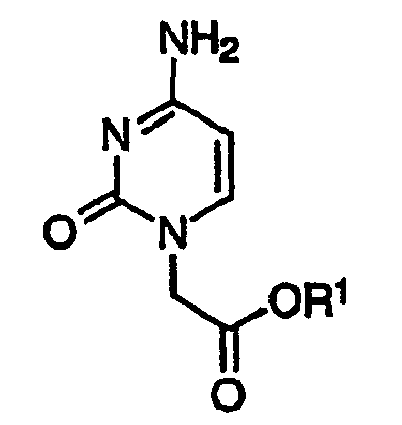
- The atom or group represented by R1 is methyl, ethyl, 2,2,2-trichloroethyl, 2-(trimethylsilyl)-ethyl, 2-(phenylthio)-ethyl, propyl, isopropyl, n-butyl, t-butyl allyl,1-isopropyl allyl, cinnamyl, 4-nitrocinnamyl, or a substituted or unsubstituted benzyl of the formula:

- With reference to
Figure 1 , the preferred partially protected adenine compound has the formula:
- With reference to
Figure 2 , the Preferred partially protected cytosine compound has the formula:
- Generally, the partially protected nucleobase compound is transformed into a fully protected nucleobase compound by sequential reaction with an electrophilic carbonyl equivalent and an alcohol, followed by quenching with a polar solvent Thus, by the method of this invention, the partially protected nucleobase compound is reacted with at least one molar equivalent of carbonyldiimidizole thereby generating an N-substituted intermediate compound. Heat may be required to facilitate the formation of the N-substituted intermediate compound, which is the isocyanate derivative formed at the exocyclic amino group. Thin layer chromatography (tlc) may be utilized to follow the progress of the reaction. The reaction is typically performed in a non-nucleophilic anhydrous solvent which at least partially dissolves the partially protected nucleobase compound. Some examples of suitable solvents include, but are not limited to, diethyl ether, diisopropylether, dioxane, dimethylformamide, tetrahydrofuran, acetonitrile, ethyl acetate, dichloromethane, chloroform, carbon tetrachloride, benzene and toluene. The preferred solvent is dimethylformamide.
- Phosgene, while an electrophilic carbonyl equivalent, was found to be unsuitable for the conversion of the partially protected adenine compound into the corresponding fully protected nucleobase compound. In the case of adenine, phosgene is believed to react at the N7 heterocyclic nitrogen atom as previously described in the guanine section. However, carbonyldiimidazole was determined to possess the proper electrophilicity for selective reaction at only the exocyclic amino group of the partially protected adenine compound and the partially protected cytosine compound. Additionally, other electrophilic carbonyl equivalents with similar electrophilic properties may also be employed for this transformation.
- The N-substituted intermediate compound is not isolated because it is easily hydrolyzed back to the starting partially protected nucleobase compound. Therefore, the N-substituted intermediate compound is reacted in situ with an alcohol thereby generating the fully protected nucleobase compound. Though it is known that an alcohol reacts with an isocyanate compound to produce a carbamate, this chemistry has yet to be applied to the synthesis of carbamate protected nucleobase compounds. Advantageously, this method of carbamate formation allows various alcohols to be utilized, providing a versatile synthetic procedure. The ability to react various alcohols allows formation of carbamate groups that can be removed under mild conditions. For example, in a preferred embodiment, benzhydrol is the alcohol which, upon reaction with the N-substituted intermediate compound, forms the protecting group benzhydroloxycarbonyl (Bhoc). Benzhydrol was chosen because it was known to create a fairly acid labile carbamate protecting group. See Seiber et al. Helvetica Chemica Acta (1968) 51:614-622. The lability of this protecting group is demonstrated by its rapid and efficient removal in trifluoroacetic acid; the half-life of the reaction is less than one minute. Thus, alcohols can be selected with various chemical properties and substituents so as to tailor the resulting carbamate protecting group for cleavage under mild conditions.
- Suitable alcohols which will react with the N-substituted intermediate compound include, but are not limited to, methanol, ethanol, 2,2,2-trichloroethanol, 2-(trimethylsilyl)-ethanol, n-propanol, isopropanol, n-butanol, and t-butanol. The alcohol may be allyl alcohol or an allyl alcohol derivative such as 1 -isopropylallyl alcohol, cinnamyl alcohol, or 4-nitrocinnamyl alcohol. Additionally, the alcohol may be a substituted or unsubstituted benzyl alcohol of the general formula:

- Preferably, the alcohol is a diphenyl group having the formula:

- After sufficient time is allowed for the conversion of the partially protected nucleobase compound into the fully protected nucleobase compound, during which time heat may applied, the reaction is quenched with a polar solvent. Examples of polar solvents include, but are not limited to, water, methanol and ethanol. In the case of the fully protected adenine compound, water is the preferred quenching solvent. The preferred quenching solvent for the fully protected cytosine compound is methanoL
- Thus, the fully protected adenine compound has the formula:


- The group represented by R1 is defined above. The group represented by R2 is methyl, ethyl, 2,2,2-trichloroethyl, 2-(trimethylsilyl)-ethyl, propyl, isopropyl, n-butyl, t-butyl, allyl, 1-isopropyl allyl, cinnamyl, 4-nitrocinnamyl, a substituted benzyl as set forth above, or a diphenyl group of the formula:


- The preferred fully protected cytosine compound has the formula

- The fully protected nucleobase compound is next converted into a carbamate protected nucleobase side chain moiety by hydrolysis of the acetate ester group. The fully protected nucleobase compound is first dissolved in an appropriate solvent system. Heating may be required to completely dissolve the fully protected nucleobase compound. Some examples of solvent systems include, but are not limited to, ethanol/acetonitrile; methanol/acetonitrile; ethanol/acetonitrile/water, methanol/acetonitrile/water; ethanol/methanol/acetonitrile; and ethanol/methanol/acetonitrile/water. If water is not initially included in the solvent system, upon complete dissolution of the fully protected adenine compound, water is added. The preferred solvent system for dissolving the carbamate protected adenine compound is ethanol/acetonitrile. After dissolution is achieved, water is added. For the carbamate protected cytosine compound, the preferred solvent system for dissolution is ethanol/methanol/acetonitrile/water.
- The solution containing the fully protected nucleobase compound is cooled in an ice bath, preferably to a temperature below about 10°C. A solution of a metal hydroxide in water is added to the cooled solution and the temperature is allowed to increase. Typically, the metal hydroxide is a group one transition metal hydroxide such as lithium hydroxide, sodium hydroxide, potassium hydroxide or cesium hydroxide. The preferred metal hydroxide is lithium hydroxide for both the fully protected adenine and cytosine compounds. The hydrolysis is allowed to proceed for a relatively short period of time, depending on the scale of the reaction, and then quenched by the addition of an aqueous acid solution. For example, the hydrolysis of approximately 75 mmoles of the fully protected cytosine compound with a methyl ester acetate group is allowed to occur for about 6 minutes before quenching of the reaction. Acids used in the quenching step include but are not limited to citric acid, hydrochloric acid and potassium hydrogen sulfate. Preferably, the acid is citric acid in both nucleobase examples.
- After acidification of the hydrolysis solution, the carbamate protected nucleobase side chain moiety is collected. The carbamate protected adenine side chain moiety has the formula:


- A preferred carbamate protected adenine side chain moiety has the formula:

- A preferred carbamate protected cytosine side chain moiety has the formula:

- Coupling of the carbamate protected nucleobase side chain moiety to the amino protected backbone of the amino acid N-(2-aminoethyl)-glycine produces a PNA synthon. A "PNA synthon" is defined as the carbamate protected nucleobase side chain moiety coupled to the amino protected backbone of the amino acid N-(2-aminoethyl)-glycine either as a free carboxylic acid or an ester. While a distinction between the acid and ester is made in the case of guanine, the acid and ester distinction for the adenine and cytosine PNA synthons was consolidated for brevity of description.
- The coupling can be accomplished by a number of methods. Often the carboxylic acid functional group of the carbamate protected nucleobase side chain moiety is converted into an activated form such as an ester, an acid chloride or a mixed anhydride. Examples of coupling reagents used to facilitate this transformation include, but are not limited to, carbodiimide reagents such as dicyclohexylcarbodiimide (DCC) and diisopropylcarbodiimide (DIPCDI); phosphonium salts such as benzotriazol-1-yloxytris(dimethylamino)phosphonium hexafluorophospate (BOP), and uranium salts such as HBTU and HATU. Following activation, the side chain moiety is reacted with the amino protected backbone to form the PNA synthon.
- In general, the mixed anhydride method has an economic advantage over the use of the more expensive coupling reagents and is the preferred method. Examples of sterically hindered acid chlorides used to form mixed anhydrides include isobutyryl chloride, trimethylacetyl chloride (pivaloyl chloride) and adamantane carboxyl chloride. The most preferred mixed anhydride for coupling the carbamate protected nucleobase side chain moiety to the amino protected backbone is trimethylacetyl chloride (pivaloyl chloride).
- Generally, the mixed anhydride of the carbamate protected nucleobase side chain moiety is formed by treatment of the carbamate protected nucleobase side chain moiety with a non-nucleophilic base followed by reaction with an acid chloride. Non-nucleophilic bases useful in this step of the reaction sequence include, but are not limited to, triethylamine, diisopropylethylamine, N-methyl morpholine and N-ethyl morpholine. The preferred non-nucleophilic base is N-methyl morpholine. Specifically, the acid chloride is added to a cooled solution of the carbamate protected nucleobase side chain moiety in the presence of the non-nucleophilic base. After stirring at below ambient temperature, preferably about 0°C, for a sufficient time to allow formation of the mixed anhydride, an aqueous solution of the amino protected backbone in the presence of a non-nucleophilic base is then added to the cooled solution. Examples of non-nucleophilic bases are those previously described. The preferred non-nucleophilic base for the amino protected backbone solution is triethylamine.
- The amino protected backbone of the amino acid N-(2-aminoethyl)-glycine has the formula:


- The Fmoc protecting group is a well known base labile protecting group used in peptide synthesis. By the method of this invention, since the exocyclic amino group of the nucleobase is protected as an acid labile carbamate, coupling the preferred Fmoc amino protected backbone to the nucleobase side chain moiety results in an orthogonally protected PNA synthon. Orthogonal is defined as a system of protecting groups wherein each independent class of protecting groups can be removed under conditions that are mutually exclusive in regard to the other class or classes of protecting groups. Methods of removal of each independent class of protecting groups include but are not limited to acid hydrolysis, base hydrolysis, photolytic cleavage and hydrogenation. Thus, by proper selection of the amino acid backbone protecting group, orthogonally protected PNA synthons can be synthesized.
- After addition of the amino protected backbone to the cooled solution of the mixed anhydride, the reaction is allowed to proceed for a sufficient time to permit coupling, and therefore, formation of the PNA synthon. The adenine PNA synthon has the formula:


- The preferred cytosine PNA synthon has the formula:

- Alternatively, the PNA synthon can be made from an amino protected backbone having an alkyl group as R3. With an alkyl group as R3, the amino protected backbone is an amino protected backbone ester. If the amino protected backbone ester is coupled to the carbamate protected nucleobase side chain moiety, subsequent hydrolysis of a backbone ester group is required to produce a PNA synthon suitable for PNA or nucleic acid polymer synthesis.
- Generally, following the previously described procedure, the carbamate protected nucleobase side chain moiety is reacted with a sterically hindered acid chloride in the presence of a non-nucleophilic base to form a mixed anhydride of the carbamate protected nucleobase side chain moiety. A salt of the amino protected backbone ester of N-(2-aminoethyl)-glycine is added to the cooled solution of the mixed anhydride and allowed to warm to room temperature while stirring a sufficient time to allow the coupling to occur. Examples of salts of the amino protected backbone ester of N-(2-aminoethyl)-glycine useful in this transformation include, but are not limited to, hydrochloride and trifluoroacetic acid salts. The preferred salt is the trifluoroacetic acid salt. After the coupling reaction is complete, either the solid PNA synthon precipitates and is collected or the reaction mixture is poured into chilled water whereupon the PNA synthon precipitates and is collected. The adenine PNA synthon has the formula:


- The preferred cytosine PNA synthon has the formula:

- Following formation of the PNA synthon having the backbone carboxylic acid protected as an ester, the ester group must be hydrolyzed for subsequent oligomer synthesis. Generally, the backbone carboxylic acid protected PNA synthon is suspended in a cooled aqueous solvent system and an aqueous solution of a metal hydoxide solution is added. Examples of solvents found in the aqueous solvent system include, but are not limited to, water, acetone and acetonitrile, in various combinations. Metal hydroxides useful in the hydrolysis include, but are not limited to, lithium hydroxide, sodium hydroxide, potassium hydroxide and cesium hydroxide. Preferrably, the metal hydroxide is lithium hydroxide.
- After the hydrolysis reaction is complete, the reaction is quenched and the PNA synthon can be isolated and purified. If the backbone amino protecting group is basic labile and suseptible to removal under the basic conditions, an activated form of the backbone amino protecting group can be added to the solution prior to isolation of the PNA synthon, thereby reprotecting any amino backbone groups that were inadvertantly removed. For example, if the amino backbone protecting group is the base labile protecting group 9-fluorenylmethyloxycarbonyl, addition of 9-fluorenylmethyloxycarbonyl succinimide after the hydrolysis and before isolation will help to increase the overall yield of desired PNA synthon. The adenine PNA synthon isolated will have the formula:


- Another possible method of coupling the carbamate protected nucleobase side chain moiety to the amino protected backbone involves the use of transient protection for the carboxylic acid functionality on the amino protected backbone rather than the ester form of the amino protected backbone previously described. Generally, following the previously described procedure, the carbamate protected nucleobase side chain moiety is reacted with a sterically hindered acid chloride in the presence of a non-nucleophilic base to form a mixed anhydride of the carbamate protected nucleobase side chain moiety. Following formation of the mixed anhydride, a solution of the amino protected backbone in the presence of a non-nucleophilic base and a sterically hindered silyl choride is added to the cooled mixed anhydride solution. After the reaction is stirred for a sufficient time to allow coupling, the reaction is quenched, dried and then subjected to treatment with a silyl removing group (e.g., a fluoride compound). Subsequent to removal of the silyl protecting group, the desired PNA synthon is isolated.
- The adenine PNA synthon has the formula:


- The PNA synthons as their free carboxylic acids can be coupled to each other to form a PNA oligomer (PNA). Additionally, the PNA synthons can be coupled to other peptide monomers and nucleic acid monomers such as nucleotides, to form various combinations of "bio" oligomers or polymers. Examples of oligomers include, but are not limited to, PNA, DNA and RNA sequences; oligonucleotides; polypeptides; and their various combinations. For example, PNA-DNA chimeras are disclosed in a companion patent application entitled "PNA-DNA Chimeras and PNA Synthons for Their Preparation" (Attorney Docket No. SYP-105;
U.S. Application Serial No. 08/480,228 filed June 7, 1995 - Various methods already described in the chemical literature for peptide synthesis are generally applicable to PNA oligomer synthesis. These methods include, but are not limited to, solid phase peptide synthesis and solution synthesis. For example, in solid-phase synthesis, following coupling of the first amino acid, the next step is the systematic elaboration of the desired PNA chain. This elaboration involves repeated deprotection/coupling cycles. The temporary backbone protecting group on the last-coupled amino acid, such as Fmoc, is quantitatively removed by a suitable treatment, for example by base treatment with piperidine, so as to liberate the N-terminal amine function.
- The next desired N-protected amino acid is then coupled to the N-terminal of the last-coupled amino acid. This coupling of the C-terminal of an amino acid with the N-terminal of the last-coupled amino acid can be achieved in several ways. For example, the carboxyl group of the incoming amino acid can be reacted directly with the N-terminal of the last-coupled amino acid with the assistance of a condensation reagent such as, for example, dicyclohexylcarbodiimide (DCC) (Sheehan & Hess, et al., J. Am. Chem. Soc., 1955, 77, 1067) and diisoproplycarbodiimide (DIC) (Sraantakis et al., Biochem. Biophys. Res. Commun., 1976, 73, 336) or derivatives thereof. Alternatively, it can be bound by providing the incoming amino acid in a form with the carboxyl group activated by any of several methods, including the initial formation of an active ester derivative such as a 2,4,5-trichlorophenyl ester (Pless, et al., Helv. Chim. Acta, 1963, 46, 1609), a phthalimido ester (Nefkens, et al., J. Am. Chem. Soc., 1961, 83, 1263), a pentachlorophenyl ester (Kupryszewski, Rocz. Chem., 1961, 35, 595), a pentafluorophenyl ester (Kovacs, et al., J. Am. Chem. Soc., 1963, 85, 183), an o-nitrophenyl ester (Bodanzsky, Nature, 1955, 175, 685), an imidazole ester (Li, et al., J. Am. Chem. Soc., 1970, 92, 7608), and a 3-hydroxy-4-oxo-3,4-dihydroquinazoline (Dhbt-OH) ester (Konig, et al., Chem. Ber., 1973, 103, 2024 and 2034), or the initial formation of an anhydride such as a symmetrical anhydride (Wieland, et al., Angew. Chem., Int. Ed. Engl., 1971, 10, 336). Benzotriazolyl N-oxytrisdimethylaminophosphonium hexafluorophosphate (BOP), "Castro's reagent" (see, e.g., Rivaille, et al., Tetrahedron 1980, 36, 3413) is recommended when assembling PNA molecules containing secondary amino groups. Preferred reagents for activity the carboxylic acid groups include 1-hydroxy-7-azabenzotriazole (HOAT) and its phosphonium and uronium salts. See Carpino, J.Am. Chem. Soc., 1993, 115, 4397. Finally, activated PNA monomers analogous to the recently-reported amino acid fluorides (Carpino, J. Am. Chem. Soc., 1990, 112, 9651) hold considerable promise to be used in PNA synthesis as well.
- Following assembly of the desired PNA chain, including protecting groups, the next step will normally be deprotection of the amino acid moieties of the PNA chain and cleavage of the synthesized PNA from the solid support. These processes can take place substantially simultaneously, thereby providing the free PNA molecule in the desired form. Alternatively, in cases in which condensation of two separately synthesized PNA chains is to be carried out, it is possible by choosing a suitable spacer group at the start of the synthesis to cleave the desired PNA chains from their respective solid supports (both peptide chains still incorporating their side-chain protecting groups) and finally removing the side-chain protecting groups after, for example, coupling the two side-chain protected peptide chains to form a longer PNA chain.
- The invention, being generally described above, is now more specifically illustrated by way of the following examples, which are not meant to limit the invention, unless otherwise noted.
- To 2.5 mole of cytosine was added 2.5 L of dry dimethylformamide (DMF) and 2.75 mole of potassium-tert-butoxide. The reaction was heated to about 100°C for 1-2 hours until the reaction turned light tan. The heat source was then removed, and the solution was cooled to less than 10°C in an ice bath. To the rapidly stirring solution was then added dropwise (over 30 to 40 minutes) 2.8 mole of ethylbromoacetate. After addition, the reaction as allowed to stir overnight while warming to room temperature. In the morning, the reaction was neutralized by the addition of 30 mL of acetic acid. The solvent was then removed by evaporation and the residue put under high vacuum for several days to remove all traces of DMF. The residue was then re-suspended in 2.5 L of water and stirred for 3 hours. The solid product was collected by vacuum filtration and washed with several volumes of water. Yield: 342.7 grams (70%).
1H NMR (DMSO-d6): δ 7.56 (d,1H 7.18 (s, 2H), 5.68 (d,1H, 4.43 (s, 2H), 4.13 (q, 2H), 1.19 (t, 3H). - To 1.8 mole of ethyl 2-(1'-cytosyl)acetate was added 3.5 L of DMF and 2.9 mole of carbonyldiimidazole. The reaction was stirred for 1.5 hours at room temperature. Thin layer chromatography (tlc) analysis of a methanol quenched reaction sample indicated isocyanate formation had proceeded well. To the reaction was added 432 grams of benzhydrol, and the reaction was heated to 60°C. The temperature was maintained at 60°C for about 6 hours and then an additional 80 grams of benzhydrol was added in two portions (1 hour apart). Let the reaction stir overnight while cooling to room temperature. In the morning, 100 mL of methanol was added to quench the reaction. The solvent was then completely evaporated. The red oil residue was recrystallized from 2.5 L of ethanol (372.2 grams impure white crystal). The mother liquor was evaporated and recrystallized from 2 L of 3/1 methanol/water (222 grams of product). The two crops of impure material were combined and recrystallized from 2.5 L of methanol.
Yield: 565 grams (77 %)
1H NMR (DMSO-d6): δ 11.01 (s, 1H), 8.02 (d, 1H), 7.46-7.27 (m, 10H), 6.98 (d,1H) 6.79 (s, 1H), 4.60 (s, 2H), 4.13 (q, 2H), 1.18 (t, 3H) - To 75 mmole of ethyl 2-[N'4-benzhydroloxycarbonyl(1'-cytosyl)]acetate was added 150 mL of acetonitrile, 150 mL of methanol, 75 mL water and 75 mL of ethanol. This solution was heated until all solid dissolved and then cooled in an ice bath to less than 10°C. To the briskly stirring solution was added rapidly a solution containing 730 mmole of lithium hydroxide dissolved in 250 mL of water. The reaction was then allowed to stir for exactly 6 minutes and then quenched by the immediate addition of a solution containing 365 mmole of citric acid dissolved in 350 mL of water. The white solid precipitate was then collected by vacuum filtration and the precipitate washed with several volumes of water. Yield: 27.25 grams white solid (98%).
1H NMR (DMSO-d6): δ 8.00 (d,1H), 7.46-7.24 (m, 10H), 6.93 (d,1H), 6.78 (s,1H), 4.51 (s, 2H). - To 389 grams of oven-dried adenine suspended in 6 L of DMF was added 40 grams of sodium hydride. The reaction was stirred and the evolution of hydrogen gas was monitored. After stirring 15 minutes, an additional 42 grams of sodium hydride was added. After 1 hour of stirring, the reaction was very thick. An additional 1.5 L of DMF was added and then the reaction was allowed to stir for another 3 hours until all hydrogen gas had been evolved. To the briskly stirring solution was added 351 mL of ethylbromoacetate dropwise over 30 minutes. The reaction was maintained between 20 - 30°C by cooling with an ice bath. Reaction was then allowed to stir overnight while warming to room temperature. The solvent was then removed by evaporation and 3 L ofwater was added. After stirring for 1 hour, the solid product was collected by vacuum filtration and washed with several volumes of water. The product was then suspended in 2 L of boiling ethanol and allowed to reflux for 45 minutes with stirring. After cooling to room temperature overnight, the solid was collected by vacuum filtration and washed with ethanol. Yield: 638 grams (68%).
1H-NMR (DMSO-d6): δ 8.14 (s,1H), 8.10 (s,1H), 7.22 (s, 2H), 5.05 (s, 2H), 4.18 (q, 2H), 1.22 (t, 3H) - To 1.96 mole ethyl 2-(9'-adenyl)acetate and 2.95 mole carbonyldiimidazole was added 4 L of DMF. The reaction was slowly heated to 105°C and then maintained at that temperature for 2 hours. (During the heating, initially everything dissolved, then the reaction became thick and finally began to thin again.) The temperature was reduced to 95°C and then 2.94 mole of benzhydrol was added. All heat was removed and the reaction was allowed to stir overnight. In the morning, 2.5 volumes of water was added, and the reaction was stirred rapidly for 20 minutes until crystals formed. The solution was then stirred for 1 hour and the solid product was collected by vacuum filtration and washed with several volumes of water. The collected product was then recrystallized from 1.8 L of boiling methanol. Yield: 630 grams (75%).
1H-NMR (DMSO-d6): δ 10.9 (s, 1H), 8.6 (s, 1H), 8.42 (s, 1H), 7.53-7.23 (m, 10H), 6.81 (s, 1H), 5.1 (s, 2H), 4.2-4.0 (q, 2H), 1.2-1.1 (t, 3H). - To 300 grams of ethyl 2-[N'6-benzhydroloxycarbonyl(9'-adenyl)]acetate was added 1.5 L of ethanol and 1.5 L of acetonitrile. The solution was heated until all of the solid dissolved and then 1 L of water was added. The reaction was then cooled in an ice bath to less than 10°C. To the briskly stirring mixture was added a solution containing 294 grams of lithium hydroxide dissolved in 2.5 L of water (the reaction temperature rose to 20°C). The reaction was stirred for exactly 6 minutes (reaction became clear and the temperature was now about 25°C) and then a solution containing 1,346 grams of citric acid dissolved in 3 L ofwater was immediately added. After about 10 minutes of stirring, seed crystals were added and the product crystallized. Thereafter, an additional 1 L of water was added, and while cooling in an ice bath, reaction was allowed to stir for an additional 30 minutes. The product was then collected by vacuum filtration and washed with water. Yield: 251 grams (89.5%). Reaction was repeated under identical conditions. Yield: 257.6 grams (92%).
1H-NMR(DMSO-d6): δ 11.78 (s, 1H), 10.90 (s, 1H), 8.60 (s,1H), 8.42 (s, 1H), 7.54-7.27 (m, 10H), 6.81 (s, 1H), 5.07 (s, 2H). - To 380.2 µL(3.08 mmol) of pivaloyl chloride was added dropwise and under argon to a solution of 1.1 g (2.94 mmol) of 2-(N'4-Bhoc-1-cytosyl)acetic acid and 646.5 µL (5.88 mmol) of NMM in 10 mL of acetonitrile. The resulting mixture was stirred for 20 min at 0°C. 1 g ( 2.94 mmol) of finely ground N-Fmoc-aminoethylglycine was suspended in 10 mL of acetonitrile/warter (7:3) mixture in a separate flask. Triethylamine was added dropwise to the vigorously stirred suspension until a clear solution was obtained. The two solutions were then combined and the resulting mixture stirred for 30 min. at room temperature. The flask was placed in an ice-bath and acidified to
pH 3 with 20% citric acid. After stirring overnight the title compound was isolated by filtration and thoroughly washed with water. The yield was 1.84 g (89.3%) of white solid after drying, in vacuo.
1H-NMR (DMSO-d6): δ 10.9 (s, 1H), 7.9-7.7 (m, 3H), 7.7 (d, 2H), 7.5-7.3 (m, 15H), 6.9 (d, 1H), 6.8 (s, 1H), 4.6 (s, 2H), 4.3-4.2 (m 3H), 3.7 (s, 2H), 3.3 [s, 2H], 3.1 (m, 2H). - To 2.32 g(5.75 mmol) of 2-[N'6-Bhoc(9'-adenyl)]acetic acid in 15 mL of acetonitrile was added in one portion 1.3 mL of N-methylmorpholine at room temperature and the resulting mixture stirred for 5 min. The mixture was cooled to 0°C, and pivaloyl chloride (716 µL, 5.81 mmol) was added dropwise under argon. The reaction mixture was stirred for 20 min. In a separate flask, 2.00 g(5.88 mmol) offinely ground N-[N'-fluorenylmethyloxycarbonyl-(2'-aminoethyl)]glycine was suspended in 20 mL of a mixture of acetonitrile/water (1:1). Triethylamine was added dropwise to the vigorously stirred suspension until a clear solution was obtained. The two solutions were then combined and the resulting mixture stirred for15 min at room temperature. The solution was diluted with ethyl acetate and then washed with brine. The aqueous layer was back extracted four times with ethyl acetate. The combined organic layer was washed once with brine, dried over MgSO4, and evaporated to dryness, in vacuo. The residue was dissolved in a minimum amount of methanol and the product precipitated from ice-water. 3.65 g (87.5%) of the desired monomer was obtained. The crude material was recrystallized from a mixture of dioxane/ether.
1H NMR (DMSO) δ 3.1-3.3 (m, 4H), 3.9 (s, 2H), 4.2-4.3 (m, 3H), 5.1 (s, 2H), 6.8 [s, 1H], 7.2-8.5 (m, 21H), 10.9 (s, 1H) - To 2 g(4.96 mmol) of 2-[N'6-Bhoc(9'-adenyl)]acetic acid in 10 mL of acetonitrile/DMF (1:1) was added 1.64 mL(14.88 mmol) of NMM. The solution was cooled to 0°C, and pivaloyl chloride (672 µL, 5.45 mmol) was added dropwise under argon. The reaction mixture was stirred at 0°C for 25 min. 2.27 g(4.85 mmol) of Fmoc-aminoethylglycine methyl ester TFA salt was added in one portion and the resulting mixture stirred at room temperature for 3 hr. The reaction mixture was then slowly added to 100 mL of ice-water. A white solid precipitated which was filtered and dried. 3.5 g (95.6%) of the desired monomer methyl ester was obtained.
1H NMR δ 3.1-3.3 (m, 4H), 3.6 (s, 3H), 3.7-5.3 (m, 7H), 6.8 [s, 1H], 7.2-8.5 (m, 21H), 10.8 (s, 1H) - To a stirred, pre-cooled suspension of methyl N-[N"-Fmoc-(2"-aminoethyl)]-N-[2-[N'6-Bhoc(9'-adenyl)]acetyl]glycinate (2 g, 2.7 mmol) in 15 mL of acetone/water (10:5) was added in one portion 11 mL of 2.5N LiOH. The resulting mixture was stirred for 7 min. at 0°C, neutralized with 20% citric acid and then the pH was raised to 8 with sat. NaHCO3 solution. 200 mg of Fmoc-succinimide was added in one portion and the reaction mixture stirred at room temperature for 11/2 hr. The solution was extracted three times with ether after which the aqueous phase was acidified to
pH 3 with 20 % citric acid. The solution was extracted several times with ethyl acetate and the combined organic layer washed with brine, dried over MgSO4, evaporated to dryness, in vacuo. The residue was triturated with ether and gently warmed. The title compound was isolates as an off white solid 1.5 g(77%) after filtration and drying. The 1H
NMR was identical to the sample obtained by the direct coupling method. - To 4 g(10.5 mmol) of 2-[N'4-Bhoc(1'-cytosyl)]acetic acid in 30 mL of a mixture of acetonitrile/DMF (1:1) was added 3.5 mL(31.6 mmol) of NMM. The solution was cooled to 0°C, and pivaloyl chloride (1.44 mL, 11.6 mmol) was added dropwise under argon. The reaction mixture was stirred at 0°C for 20 min. 4.44 g (9.48 mmol) of Fmoc-aminoethylglycine methyl ester TFA salt was added in one portion and the resulting mixture stirred at room temperature for overnight. A white solid precipitated which was filtered, rinsed thoroughly with warm acetonitrile and dried. 6.4 g (84.8%) of the desired monomer methyl ester was isolated.
1H NMR (DMSO) δ 3.1-3.4 (m, 4H), 3.6 (s, 3H), 3.7-4.8 (m, 7H), 6.7 [s, 1H], 6.8-7.9 (m, 21H), 10.9 (s, 1H).
1H NMR data in brackets[] indicates that peaks are superimposed on other proton sources. - To a stirred, pre-cooled suspension of Methyl N-[N"-Fmoc-(2"-aminoethyl)]-N-[2-[N'4-Bhoc(1'-cytosyl)]acetyl]glycinate (3 g, 4.19 mmol) in 45 mL of a mixture of acetonitrile/acetone/water (1:1:1) was added in one portion 16.7 mL of 2.5N LiOH. The resulting mixture was stirred for 10 min. at 0°C, neutralized with 20% citric acid and then the pH was raised to 8 with sat. NaHCO3 solution. 300 mg of Fmoc-succinimide was added in one portion and the reaction mixture stirred at room temperature for 2 hr. The flask was placed in an ice-bath and acidified to
pH 3 with 20% citric acid. After stirring at 0°C for 1/2 hr, a white solid precipitated which was filtered and dried. This material resuspended in acetonitrile and heated. 1.8 g( 61.4%) of the desired product was obtained. The 1H NMR was identical to the sample obtained by the direct coupling method. - 3g (15.22 mmol) of ethyl 2-(1'cytosyl)acetate was stirred at room temperature for 2 hours with 2.96 g (18.25 mmol) of 1,1'-carbonyldiimidazole in 50 ml of DMF. tert-Butyl alcohol (7 ml, 73.19 mmol) was then added in one portion and the resulting mixture heated to 80°C for 2 hours. The solvent was removed in vacuo and the residue taken up in acetonitrile and again the solvent was removed. The resulting brown oil was ten dissolved in 100 ml of acetonitrile and used directly for next step without further purification.
- The crude ester of the above-mentioned reaction was subjected to hydrolysis with 30 ml of LiOH (2.5N). The mixture was stirrec at room temperature for 10 min. by which time the TLC showed complete disappearance of the ester. The solution was acidified to pH with 20% citric acid and mixture left stirring for overnight. The solution was filtered and the filtrate extracted with ethyl acetate. The combined organic solution was concentrated and was left standing at room temperature for overnight. 1 g of the desired product was isolated. 1H-NMR (d6 DMSO) δ 7.98 (d, 1H), 6.97 (d, 1H), 4.47 (s, 2H), 1.44 (s, 9H).
- 233 µl (1.88 mmol) of pivaloyl chloride was added dropwise o a precooled mixture of 2-(N'4tertbutoxycarbonyl-1-cytosyl)acetic acid (0.5 g, 1.85 mmol) and N-methylmorpholine (406, 3.7 mmol) in 7 ml of acetonitrile. The resulting mixture was stirred for 20 min at 0°C. 0.6 g (1.76 mmol) of finely ground N-Fmoc-aminoethylglycine was suspended in 10 ml of acetonitrile/water (1:1) mixture in a separate flask. Triethylamine was added dropwise to the vigorously stirred suspension until a clear solution was obtained. The two solutions were then combined and the resulting mixture was stirred for 20 min. at room temperature. The flask was placed in an ice-bath and acidified to
pH 3 with 20% citric acid. The product was extracted with ethyl acetate and the combined ethyl acetate solution was washed once with brine. The ethyl acetate was evaporated and the residue dissolved in methanol which was again removed in vacuo. Finally the product was taken up in 4 ml of methanol and added dropwise to an ice-cold water (∼100 ml). An off-white solid precipitated which was filtered and dried. 825 mg (79.3%) of the desired monomer was obtained. 1H-NMR (d6 DMSO) δ 10.3 (bs, 1H), 7.89-7.78 (m, 3H), 7.68 (d, 2H), 7.43-7.27 (m, 4H), 6.97-6.92 (dd, 1H), 4.79 (bs, 4/3H), 4.60 (bs, 2/3H), 4.34 (m, 4H), 3.98 (bs, 2H), 3.39 [m, 4H], 1.44 (s, 9H). - The sequence H-CAG GAG TCG CAT gly-NH2 was synthesized manually on an Fmoc-Pal-Peg-PS (PerSeptive Biosystems P/N GEN 913383: 100 mg, 0.17mmol/g loading) according to the following synthesis cycle. All reactions and washes of the resin were performed in a fritted vial. Reagent and wash solutions were added to the vial containing the synthesis resin and allowed to react. At designated time intervals the solutions were removed by vacuum filtration through the frit.
-
- 1) Deprotection with 20 % piperidine in DMF for 10 min.
- 2) Wash with
DMF 3 times followed by 2 washes with dichloromethane (DCM) - 3) Coupling with 3 equiv, of the appropriate monomer (0.1 M in DMF). Activation was initiated by addition of 3 equiv. O-7-azabenzotriazol-1-yl)-1,1,3,3,-tetramethyluronium hexafluorophosphate (HATU) and 3 equiv, of diisopropylethylamine (DIEA). The activated mixtures was added immediately to the resin and the coupling was allowed to proceed for 30 minutes.
- 4) Wash with
DMF 3 times followed by 2 washes with dichloromethane (DCM) - The final Fmoc group was retained on the oligomer which was cleaved from the resin for analysis. The removal the Bhoc protection groups and cleavage from the resin was accomplished in one step by treatment with TFA/m-cresol (4:1) for 90 minutes. The cleavage was performed in an Ultrafree device (Millipore P/N SE3P230J3). After completed cleavage the resin was retained by centrifugation and the crude PNA oligomer was isolated the addition of 2 vol. of diethyl ether to the TFA/m-cresol. The crude PNA oligomer was washed twice with diethyl ether. HPLC (260 nm) analysis of the crude product under standard conditions revealed a purity of 83%, the major impurities being a deletion without adenine (3.8%) (See Figure 6). The identity of the product was confirmed by Matrix Assisted Laser Desorption -Time of Flight (MALDI-TOF) Mass Spectrometer and a mass of 3 571.3 atomic mass units (amu) was observed compared to the calculated mass of 3573.1 amu within the 0.1% accuracy of the instrument.
Claims (8)
- A fully protected nucleobase compound having the formula selected from the group consisting of:


R1 is selected from the group consisting of methyl, ethyl, 2,2,2-trichloroethyl, 2-(trimethylsilyl)-ethyl, 2-(phenylthio)-ethyl, propyl, isopropyl, n-butyl, t-butyl, allyl, 1-isopropyl allyl, cinnamyl, 4-nitrocinnamyl and a benzyl group or derivative thereof having the formula:
the atom or group represented by each of a-e is the same or different and is independently selected from the group consisting of F, Cl, Br,1, hydrogen, methyl, ethyl, isopropyl, n-butyl, t-butyl, phenyl, methoxy, ethoxy, -NO2, -SO3H, -CN, -SCH3, and -(O)SCH3, and
the atom or group represented by each of g-h is the same or different and is independently selected from the group consisting of hydrogen and methyl; and
R2 is
a diphenylmethane group or derivative thereof having the formula:
R4 is selected from the group consisting of hydrogen, methyl, and ethyl. - The fully protected nucleobase compound of claim 1 having one or other of the formulae:


- A carbarnate protected nucleobase side chain moiety having the formula selected from the group consisting of:


a diphenylmethans group or derivative thereof having the formula:
R4 is selected from the group consisting of hydrogen, methyl, and ethyl, - The carbamate protected nucleobase side chain moiety of claim 3 having one or the other of the formulae:


- A PNA synthon or PNA synthon ester having the formula selected from the group consisting of:
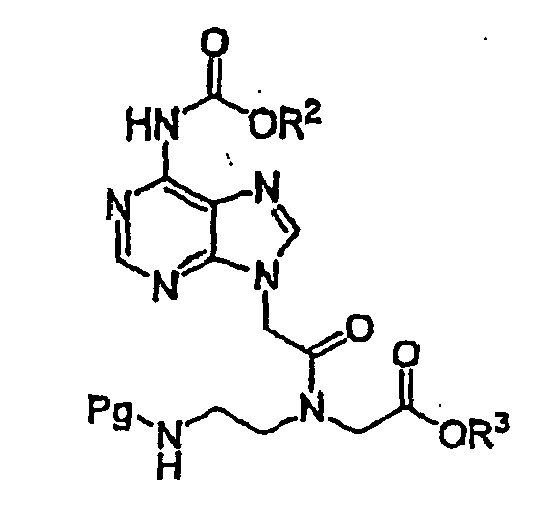

Pg is a protecting group selected from the group consisting of alkyloxycarbonyl, 9-fluorenylmethyloxycarbonyl, 1-methyl-1-(4-biphenyl)-ethyloxycarbonyl, 1-methyl-1-phenyl-ethyloxycarbonyl, triphenylmethyl, 4-methoxy-triphenylmethyl, and 4,4'-dimethoxy-triphenylmethyl;
R2 is a diphenylmethane group or derivative thereof having the formula:
R4 is selected from the group consisting of hydrogen, methyl, and ethyl; and
R3 is hydrogen or an alkyl group selected from the group consisting of methyl and ethyl. - A PNA synthon of claim 5 having the formula:

- A PNA synthon of claim 5 having the formula:

- A PNA synthon or synthon ester of claim 5 having any of the formulae:


Priority Applications (1)
| Application Number | Priority Date | Filing Date | Title |
|---|---|---|---|
| EP07016616A EP1873156A1 (en) | 1995-06-07 | 1996-06-06 | Process for the preparation of 6-[[(alkoxy)carbonyl]amino]-9H-Purine-9-acetic acid and 4-[(alkoxycarbonyl)amino]-2-oxo-1(2H)-Pyrimidineacetic acid derivatives as synthons for the synthesis of peptide nucleic acids |
Applications Claiming Priority (3)
| Application Number | Priority Date | Filing Date | Title |
|---|---|---|---|
| US487666 | 1995-06-07 | ||
| US08/487,666 US6133444A (en) | 1993-12-22 | 1995-06-07 | Synthons for the synthesis and deprotection of peptide nucleic acids under mild conditions |
| PCT/US1996/009144 WO1996040685A1 (en) | 1995-06-07 | 1996-06-06 | Improved synthons for the synthesis and deprotection of peptide nucleic acids under mild conditions |
Related Child Applications (1)
| Application Number | Title | Priority Date | Filing Date |
|---|---|---|---|
| EP07016616A Division EP1873156A1 (en) | 1995-06-07 | 1996-06-06 | Process for the preparation of 6-[[(alkoxy)carbonyl]amino]-9H-Purine-9-acetic acid and 4-[(alkoxycarbonyl)amino]-2-oxo-1(2H)-Pyrimidineacetic acid derivatives as synthons for the synthesis of peptide nucleic acids |
Publications (2)
| Publication Number | Publication Date |
|---|---|
| EP0840736A1 EP0840736A1 (en) | 1998-05-13 |
| EP0840736B1 true EP0840736B1 (en) | 2009-10-07 |
Family
ID=23936665
Family Applications (2)
| Application Number | Title | Priority Date | Filing Date |
|---|---|---|---|
| EP07016616A Withdrawn EP1873156A1 (en) | 1995-06-07 | 1996-06-06 | Process for the preparation of 6-[[(alkoxy)carbonyl]amino]-9H-Purine-9-acetic acid and 4-[(alkoxycarbonyl)amino]-2-oxo-1(2H)-Pyrimidineacetic acid derivatives as synthons for the synthesis of peptide nucleic acids |
| EP96918202A Expired - Lifetime EP0840736B1 (en) | 1995-06-07 | 1996-06-06 | Improved synthons for the synthesis and deprotection of peptide nucleic acids under mild conditions |
Family Applications Before (1)
| Application Number | Title | Priority Date | Filing Date |
|---|---|---|---|
| EP07016616A Withdrawn EP1873156A1 (en) | 1995-06-07 | 1996-06-06 | Process for the preparation of 6-[[(alkoxy)carbonyl]amino]-9H-Purine-9-acetic acid and 4-[(alkoxycarbonyl)amino]-2-oxo-1(2H)-Pyrimidineacetic acid derivatives as synthons for the synthesis of peptide nucleic acids |
Country Status (5)
| Country | Link |
|---|---|
| US (2) | US6133444A (en) |
| EP (2) | EP1873156A1 (en) |
| JP (2) | JP4089979B2 (en) |
| DE (1) | DE69638047D1 (en) |
| WO (1) | WO1996040685A1 (en) |
Families Citing this family (24)
| Publication number | Priority date | Publication date | Assignee | Title |
|---|---|---|---|---|
| US6465650B1 (en) * | 1995-03-13 | 2002-10-15 | Aventis Pharma Deutschland Gmbh | Substituted N-ethylglycine derivatives for preparing PNA and PNA/DNA hybrids |
| DE69632324T2 (en) * | 1995-06-07 | 2005-06-16 | PerSeptive Biosystems, Inc., Framingham | PNA-DNA CHIMESES AND PNA SYNTHESES FOR THEIR PREPARATION |
| DE19653646A1 (en) * | 1996-12-20 | 1998-06-25 | Hoechst Ag | Substituted purine derivatives, processes for their preparation, agents containing them and their use |
| CA2320390C (en) | 1998-02-11 | 2010-06-08 | Applied Biosystems, Llc | Pna and dna conjugates and methods for preparation thereof |
| BR0009739A (en) * | 1999-04-13 | 2002-04-09 | Basf Ag | Compound, medicine, pharmaceutical preparation, and, uses of a structural element, a compound and a pharmaceutical preparation |
| US6929907B2 (en) | 1999-12-31 | 2005-08-16 | North Carolina State University | Methods and compositions for determining the purity of chemically synthesized nucleic acids |
| US20020146684A1 (en) * | 2001-04-09 | 2002-10-10 | Meldal Morten Peter | One dimensional unichemo protection (UCP) in organic synthesis |
| CA2452690C (en) * | 2001-06-29 | 2016-08-16 | Veri-Q, Inc. | Methods and compositions for determining the purity of and purifying chemically synthesized nucleic acids |
| KR100464261B1 (en) * | 2002-01-24 | 2005-01-03 | 주식회사 파나진 | A Novel Monomer For Synthesis of PNA Oligomer And A Process For Producing The Same |
| KR20030084444A (en) * | 2002-04-26 | 2003-11-01 | 주식회사 파나진 | A Novel Monomer For Synthesis of PNA Oligomer And A Process For Producing The Same |
| US7482353B2 (en) * | 2005-06-15 | 2009-01-27 | Applied Biosystems Inc. | Compositions and methods pertaining to PNA synthons and oligomers comprising a universal base |
| US8198039B2 (en) * | 2007-09-04 | 2012-06-12 | University of Pittsburgh—of the Commonwealth System of Higher Education | Biosensors and related methods |
| KR20090098710A (en) | 2008-03-14 | 2009-09-17 | 주식회사 씨티아이바이오 | Peptide Nucleic Acid Derivatives with Good Cell Permeability and Nucleic Acid Binding Capacity |
| WO2010027326A1 (en) * | 2008-09-03 | 2010-03-11 | Nanyang Technological University | Peptide nucleic acid monomers and oligomers |
| CN103145714A (en) * | 2013-03-13 | 2013-06-12 | 苏州维泰生物技术有限公司 | Feather weight PNA (pentose nucleic acid) synthesis method |
| CN103524426A (en) * | 2013-10-14 | 2014-01-22 | 苏州维泰生物技术有限公司 | Feather weight preparation method of cytosine containing PNA (pentose nucleic acid) monomer |
| CN104193801A (en) * | 2014-08-12 | 2014-12-10 | 苏州维泰生物技术有限公司 | Guanine peptide nucleic acid monomer and synthetic method thereof |
| CN104151317A (en) * | 2014-08-19 | 2014-11-19 | 苏州维泰生物技术有限公司 | Fmoc-PNA-G(Bhoc)-OH synthesis method |
| CN104211619B (en) * | 2014-08-19 | 2016-08-17 | 苏州维泰生物技术有限公司 | A kind of synthetic method of N-(2-Fmoc-aminoethyl) glycine methyl ester hydrochloride |
| CN110072879B (en) * | 2016-08-08 | 2023-03-10 | 奥利通公司 | Androgen receptor antisense oligonucleotide |
| WO2019018422A1 (en) * | 2017-07-17 | 2019-01-24 | Trucode Gene Repair, Inc. | Peptide nucleic acid (pna) monomers with an orthogonally protected ester moiety and novel intermediates and methods related thereto |
| CN108424376A (en) * | 2018-02-28 | 2018-08-21 | 苏州凌科特新材料有限公司 | A kind of synthetic method of N- (2-Fmoc- aminoethyls) glycine methyl ester hydrochloride |
| KR102304280B1 (en) | 2018-08-14 | 2021-09-23 | 올리패스 주식회사 | Acetyl-CoA Carboxylase2 Antisense Oligonucleotides |
| KR20240172540A (en) | 2023-06-01 | 2024-12-10 | 주식회사 기프티드엠에스 | A pharmaceutical composition for preventing or treating coronavirus infection disease containing a cell-permeable peptide-nucleic acid oligomer as an active ingredient |
Family Cites Families (56)
| Publication number | Priority date | Publication date | Assignee | Title |
|---|---|---|---|---|
| US3936452A (en) * | 1971-09-17 | 1976-02-03 | Nitto Boseki Co., Ltd. | Process of producing pyrimidyl thiocarbonates |
| US3852332A (en) * | 1972-06-30 | 1974-12-03 | American Cyanamid Co | Esters of (alkynloxy) and (alkenyloxy) carbanilic acid |
| US4001226A (en) * | 1974-12-04 | 1977-01-04 | Eli Lilly And Company | 3-(substituted)carbonylamino cephem derivatives |
| US5142056A (en) * | 1989-05-23 | 1992-08-25 | Abbott Laboratories | Retroviral protease inhibiting compounds |
| EP0068378B1 (en) * | 1981-06-26 | 1986-03-05 | Schering Corporation | Novel imidazo(1,2-a)pyridines and pyrazines, processes for their preparation and pharmaceutical compositions containing them |
| EP0104041B1 (en) * | 1982-09-15 | 1988-07-27 | Aktiebolaget Hässle | Enzyme inhibitors |
| EP0114993B1 (en) * | 1982-12-27 | 1990-05-16 | Merck & Co. Inc. | Renin inhibitory tripeptides |
| US4668770A (en) * | 1982-12-27 | 1987-05-26 | Merck & Co., Inc. | Renin inhibitory tripeptides |
| EP0118223A1 (en) * | 1983-02-07 | 1984-09-12 | Aktiebolaget Hässle | Enzyme inhibitors |
| JPS59227851A (en) * | 1983-06-09 | 1984-12-21 | Sankyo Co Ltd | Peptides having inhibitory action on renin |
| US4514391A (en) * | 1983-07-21 | 1985-04-30 | E. R. Squibb & Sons, Inc. | Hydroxy substituted peptide compounds |
| US4477441A (en) * | 1983-09-14 | 1984-10-16 | Merck & Co., Inc. | Renin inhibitors containing a C-terminal disulfide cycle |
| US4645759A (en) * | 1984-06-22 | 1987-02-24 | Abbott Laboratories | Renin inhibiting compounds |
| US4616088A (en) * | 1984-10-29 | 1986-10-07 | E. R. Squibb & Sons, Inc. | Amino acid ester and amide renin inhibitor |
| JP2528107B2 (en) * | 1985-03-15 | 1996-08-28 | サマ−トン,ジエ−ムス | Reagents and methods for measuring polynucleotides |
| US4668769A (en) * | 1985-08-02 | 1987-05-26 | Hoover Dennis J | Oxa- and azahomocyclostatine polypeptides |
| US4599198A (en) * | 1985-08-02 | 1986-07-08 | Pfizer Inc. | Intermediates in polypeptide synthesis |
| CA1282549C (en) * | 1985-11-12 | 1991-04-02 | Eric M. Gordon | Aminocarbonyl renin inhibitors |
| CA1297631C (en) * | 1985-12-23 | 1992-03-17 | Sesha I. Natarajan | Ureido renin inhibitors |
| US4757050A (en) * | 1985-12-23 | 1988-07-12 | E. R. Squibb Sons, Inc. | Ureido renin inhibitors |
| US4880938A (en) * | 1986-06-16 | 1989-11-14 | Merck & Co., Inc. | Amino acid analogs |
| DE3635907A1 (en) * | 1986-10-22 | 1988-04-28 | Merck Patent Gmbh | HYDROXY AMINO ACID DERIVATIVES |
| CH676988A5 (en) * | 1987-01-21 | 1991-03-28 | Sandoz Ag | |
| USH725H (en) * | 1987-02-26 | 1990-01-02 | E. R. Squibb & Sons, Inc. | Ureido amino and imino acids, compositions and methods for use |
| GB8707412D0 (en) * | 1987-03-27 | 1987-04-29 | Fujisawa Pharmaceutical Co | Peptide compounds |
| US4933431A (en) * | 1987-07-31 | 1990-06-12 | Massachusetts Institute Of Technology | One step preparation of poly(amide-anhydride) |
| DE3830825A1 (en) * | 1987-09-15 | 1989-03-23 | Sandoz Ag | HYDROPHILIC RENINHERMERS, THEIR PREPARATION AND USE |
| IL89900A0 (en) * | 1988-04-12 | 1989-12-15 | Merck & Co Inc | Hiv protease inhibitors useful for the treatment of aids and pharmaceutical compositions containing them |
| US4977277A (en) * | 1988-05-09 | 1990-12-11 | Abbott Laboratories | Functionalized peptidyl aminodiols and -triols 4-amino-5-cyclohexyl-3-hydroxy-1,2-oxopentane and derivatives thereof |
| IL90218A0 (en) * | 1988-05-13 | 1989-12-15 | Abbott Lab | Retroviral protease inhibitors |
| CA1340588C (en) * | 1988-06-13 | 1999-06-08 | Balraj Krishan Handa | Amino acid derivatives |
| IL91307A0 (en) * | 1988-08-24 | 1990-03-19 | Merck & Co Inc | Hiv protease inhibitors and pharmaceutical compositions for the treatment of aids containing them |
| JP2807522B2 (en) * | 1988-09-01 | 1998-10-08 | フォルスクニングスセンター・リソ | Peptide synthesis method and use of solid support in the method |
| CA2012306A1 (en) * | 1989-03-28 | 1990-09-28 | Werner Neidhart | Amino acid derivatives |
| JP2701932B2 (en) * | 1989-04-10 | 1998-01-21 | サントリー株式会社 | Protease inhibitor |
| DE3912829A1 (en) * | 1989-04-19 | 1990-10-25 | Bayer Ag | USE OF RENININHIBITIC PEPTIDES AS AGENTS AGAINST RETROVIRUS |
| TW225540B (en) * | 1990-06-28 | 1994-06-21 | Shionogi & Co | |
| WO1992008699A1 (en) * | 1990-11-19 | 1992-05-29 | Monsanto Company | Retroviral protease inhibitors |
| US5340716A (en) * | 1991-06-20 | 1994-08-23 | Snytex (U.S.A.) Inc. | Assay method utilizing photoactivated chemiluminescent label |
| DK51092D0 (en) * | 1991-05-24 | 1992-04-15 | Ole Buchardt | OLIGONUCLEOTIDE ANALOGUE DESCRIBED BY PEN, MONOMERIC SYNTHONES AND PROCEDURES FOR PREPARING THEREOF, AND APPLICATIONS THEREOF |
| US6228982B1 (en) * | 1992-05-22 | 2001-05-08 | Benget Norden | Double-stranded peptide nucleic acids |
| US5264586A (en) * | 1991-07-17 | 1993-11-23 | The Scripps Research Institute | Analogs of calicheamicin gamma1I, method of making and using the same |
| MX9207334A (en) * | 1991-12-18 | 1993-08-01 | Glaxo Inc | NUCLEIC ACIDS PEPTIDICS AND PHARMACEUTICAL FORMULATION CONTAINING THEM |
| US5700922A (en) * | 1991-12-24 | 1997-12-23 | Isis Pharmaceuticals, Inc. | PNA-DNA-PNA chimeric macromolecules |
| GB9211979D0 (en) * | 1992-06-05 | 1992-07-15 | Buchard Ole | Uses of nucleic acid analogues |
| IT1254996B (en) * | 1992-06-25 | 1995-10-11 | Mediolanum Farmaceutici Srl | AMINO ALKYLCARBAMMIC ESTERS OF ESEROLINE ACTS FOR USE AS ANTICOLINESTERASICS AND RELATED PREPARATION PROCEDURE |
| US5302721A (en) * | 1992-07-21 | 1994-04-12 | Hoechst-Roussel Pharmaceuticals Incorporated | Method of preparation of physostigmine carbamate derivatives from eseretholes |
| WO1995004068A1 (en) * | 1993-07-29 | 1995-02-09 | Isis Pharmaceuticals, Inc. | Oligomers for modulating human immunodeficiency virus |
| DE4331011A1 (en) * | 1993-09-13 | 1995-03-16 | Bayer Ag | C-branched oligomers that bind nucleic acids for therapy and diagnostics |
| EP0720615B1 (en) * | 1993-09-21 | 2000-07-26 | Amersham Pharmacia Biotech UK Limited | Elongation, amplification and sequence determination using a chimeric oligonucleotide |
| GB2284208A (en) * | 1993-11-25 | 1995-05-31 | Pna Diagnostics As | Nucleic acid analogues with a chelating functionality for metal ions |
| WO1995017403A1 (en) * | 1993-12-22 | 1995-06-29 | Perseptive Biosystems, Inc. | Guanine synthons for peptide nucleic acid synthesis and method for production |
| US5539083A (en) * | 1994-02-23 | 1996-07-23 | Isis Pharmaceuticals, Inc. | Peptide nucleic acid combinatorial libraries and improved methods of synthesis |
| DE4408533A1 (en) * | 1994-03-14 | 1995-09-28 | Hoechst Ag | PNA synthesis using a base-labile amino protecting group |
| DE4408534A1 (en) * | 1994-03-14 | 1995-09-28 | Hoechst Ag | Substituted N-ethyl-glycine derivatives for the production of PNA and PNA / DNA hybrids |
| DE4408531A1 (en) * | 1994-03-14 | 1995-09-28 | Hoechst Ag | PNA synthesis using an amino protecting group labile to weak acids |
-
1995
- 1995-06-07 US US08/487,666 patent/US6133444A/en not_active Expired - Lifetime
-
1996
- 1996-06-06 EP EP07016616A patent/EP1873156A1/en not_active Withdrawn
- 1996-06-06 DE DE69638047T patent/DE69638047D1/en not_active Expired - Lifetime
- 1996-06-06 WO PCT/US1996/009144 patent/WO1996040685A1/en not_active Ceased
- 1996-06-06 JP JP50153497A patent/JP4089979B2/en not_active Expired - Lifetime
- 1996-06-06 EP EP96918202A patent/EP0840736B1/en not_active Expired - Lifetime
-
1998
- 1998-07-16 US US09/116,793 patent/US6172226B1/en not_active Expired - Lifetime
-
2007
- 2007-12-05 JP JP2007315280A patent/JP2008069181A/en not_active Withdrawn
Also Published As
| Publication number | Publication date |
|---|---|
| WO1996040685A1 (en) | 1996-12-19 |
| DE69638047D1 (en) | 2009-11-19 |
| US6172226B1 (en) | 2001-01-09 |
| JP2008069181A (en) | 2008-03-27 |
| JP4089979B2 (en) | 2008-05-28 |
| EP1873156A1 (en) | 2008-01-02 |
| JPH11507911A (en) | 1999-07-13 |
| EP0840736A1 (en) | 1998-05-13 |
| US6133444A (en) | 2000-10-17 |
Similar Documents
| Publication | Publication Date | Title |
|---|---|---|
| US6172226B1 (en) | Synthons for the synthesis and deprotection of peptide nucleic acids under mild conditions | |
| EP0840741B1 (en) | Pna-dna chimeras and pna synthons for their preparation | |
| US7022851B2 (en) | PNA monomer and precursor | |
| EP0741710B1 (en) | Chloropyrimidine intermediates | |
| US20190062378A1 (en) | CONFORMATIONALLY-PREORGANIZED, MiniPEG-CONTAINING GAMMA-PEPTIDE NUCLEIC ACIDS | |
| Breipohl et al. | Synthesis of polyamide nucleic acids (PNAs) using a novel Fmoc/Mmt protecting-group combination | |
| JP2002534501A (en) | New stable activated derivatives of carbamic acid, a process for its preparation and its use for the preparation of urea | |
| US6121418A (en) | PNA synthesis using a base-labile amino protecting group | |
| WO1997027195A1 (en) | Process for preparing purine derivatives | |
| JPH07258222A (en) | Substituted n-ethylglycine derivative for producing pna and pna/dna hybrid | |
| US7105648B1 (en) | Oligomers substituted by phosphite acid ester, phosphonic acid or carbaborane functions and the corresponding PNA monomers | |
| EP0736027B1 (en) | Guanine synthons for peptide nucleic acid synthesis and method for production | |
| WO1997027194A1 (en) | Process for preparing purine derivatives | |
| KR20030042180A (en) | A Method for Producing a Backbone of Peptide Nucleic Acid | |
| CA2243972C (en) | Process for preparing purine derivatives | |
| KR20020091905A (en) | Alkyl or arylsulfonylethoxycarbonyl protected pna monomer as the amino protected group of backbone, 2-aminoethylglycine and preparation method of thereof | |
| PL191196B1 (en) | Method of obtaining nmda antagonists | |
| CA2228875A1 (en) | A method for the preparation of nucleic acid binding compound | |
| HK1004087B (en) | Chloropyrimidine intermediates | |
| JP2003219874A (en) | Method for using peptide nucleic acid that selectively binds to RNA as antisense oligonucleotide, and method for producing said peptide nucleic acid | |
| JPH035499A (en) | Novel tripeptide and production and use thereof |
Legal Events
| Date | Code | Title | Description |
|---|---|---|---|
| PUAI | Public reference made under article 153(3) epc to a published international application that has entered the european phase |
Free format text: ORIGINAL CODE: 0009012 |
|
| 17P | Request for examination filed |
Effective date: 19971215 |
|
| AK | Designated contracting states |
Kind code of ref document: A1 Designated state(s): DE GB |
|
| RIN1 | Information on inventor provided before grant (corrected) |
Inventor name: RAJUR, S., B. Inventor name: ISMAIL, MOHAMED Inventor name: HODGE, RICHARD, P. Inventor name: EGHOLM, MICHAEL Inventor name: COULL, JAMES, M. |
|
| 17Q | First examination report despatched |
Effective date: 20030121 |
|
| 17Q | First examination report despatched |
Effective date: 20030121 |
|
| GRAP | Despatch of communication of intention to grant a patent |
Free format text: ORIGINAL CODE: EPIDOSNIGR1 |
|
| GRAS | Grant fee paid |
Free format text: ORIGINAL CODE: EPIDOSNIGR3 |
|
| GRAA | (expected) grant |
Free format text: ORIGINAL CODE: 0009210 |
|
| AK | Designated contracting states |
Kind code of ref document: B1 Designated state(s): DE GB |
|
| REG | Reference to a national code |
Ref country code: GB Ref legal event code: FG4D |
|
| REF | Corresponds to: |
Ref document number: 69638047 Country of ref document: DE Date of ref document: 20091119 Kind code of ref document: P |
|
| PLBE | No opposition filed within time limit |
Free format text: ORIGINAL CODE: 0009261 |
|
| STAA | Information on the status of an ep patent application or granted ep patent |
Free format text: STATUS: NO OPPOSITION FILED WITHIN TIME LIMIT |
|
| 26N | No opposition filed |
Effective date: 20100708 |
|
| PGFP | Annual fee paid to national office [announced via postgrant information from national office to epo] |
Ref country code: GB Payment date: 20150603 Year of fee payment: 20 Ref country code: DE Payment date: 20150602 Year of fee payment: 20 |
|
| REG | Reference to a national code |
Ref country code: DE Ref legal event code: R071 Ref document number: 69638047 Country of ref document: DE |
|
| REG | Reference to a national code |
Ref country code: GB Ref legal event code: PE20 Expiry date: 20160605 |
|
| PG25 | Lapsed in a contracting state [announced via postgrant information from national office to epo] |
Ref country code: GB Free format text: LAPSE BECAUSE OF EXPIRATION OF PROTECTION Effective date: 20160605 |