EP0837682B1 - Therapeutic use of 1-amino-3-(n,n-dimethylamino)-propyliden-1,1-bisphosphonic acid and its salts - Google Patents
Therapeutic use of 1-amino-3-(n,n-dimethylamino)-propyliden-1,1-bisphosphonic acid and its salts Download PDFInfo
- Publication number
- EP0837682B1 EP0837682B1 EP96925679A EP96925679A EP0837682B1 EP 0837682 B1 EP0837682 B1 EP 0837682B1 EP 96925679 A EP96925679 A EP 96925679A EP 96925679 A EP96925679 A EP 96925679A EP 0837682 B1 EP0837682 B1 EP 0837682B1
- Authority
- EP
- European Patent Office
- Prior art keywords
- amino
- dimethylamino
- bone
- propyliden
- bisphosphonic acid
- Prior art date
- Legal status (The legal status is an assumption and is not a legal conclusion. Google has not performed a legal analysis and makes no representation as to the accuracy of the status listed.)
- Expired - Lifetime
Links
Images


Classifications
-
- A—HUMAN NECESSITIES
- A61—MEDICAL OR VETERINARY SCIENCE; HYGIENE
- A61K—PREPARATIONS FOR MEDICAL, DENTAL OR TOILETRY PURPOSES
- A61K31/00—Medicinal preparations containing organic active ingredients
- A61K31/66—Phosphorus compounds
- A61K31/662—Phosphorus acids or esters thereof having P—C bonds, e.g. foscarnet, trichlorfon
- A61K31/663—Compounds having two or more phosphorus acid groups or esters thereof, e.g. clodronic acid, pamidronic acid
-
- A—HUMAN NECESSITIES
- A61—MEDICAL OR VETERINARY SCIENCE; HYGIENE
- A61K—PREPARATIONS FOR MEDICAL, DENTAL OR TOILETRY PURPOSES
- A61K31/00—Medicinal preparations containing organic active ingredients
- A61K31/66—Phosphorus compounds
-
- A—HUMAN NECESSITIES
- A61—MEDICAL OR VETERINARY SCIENCE; HYGIENE
- A61K—PREPARATIONS FOR MEDICAL, DENTAL OR TOILETRY PURPOSES
- A61K33/00—Medicinal preparations containing inorganic active ingredients
- A61K33/06—Aluminium, calcium or magnesium; Compounds thereof, e.g. clay
-
- A—HUMAN NECESSITIES
- A61—MEDICAL OR VETERINARY SCIENCE; HYGIENE
- A61K—PREPARATIONS FOR MEDICAL, DENTAL OR TOILETRY PURPOSES
- A61K33/00—Medicinal preparations containing inorganic active ingredients
- A61K33/16—Fluorine compounds
-
- C—CHEMISTRY; METALLURGY
- C07—ORGANIC CHEMISTRY
- C07F—ACYCLIC, CARBOCYCLIC OR HETEROCYCLIC COMPOUNDS CONTAINING ELEMENTS OTHER THAN CARBON, HYDROGEN, HALOGEN, OXYGEN, NITROGEN, SULFUR, SELENIUM OR TELLURIUM
- C07F9/00—Compounds containing elements of Groups 5 or 15 of the Periodic Table
- C07F9/02—Phosphorus compounds
- C07F9/28—Phosphorus compounds with one or more P—C bonds
- C07F9/38—Phosphonic acids [RP(=O)(OH)2]; Thiophosphonic acids ; [RP(=X1)(X2H)2(X1, X2 are each independently O, S or Se)]
- C07F9/3804—Phosphonic acids [RP(=O)(OH)2]; Thiophosphonic acids ; [RP(=X1)(X2H)2(X1, X2 are each independently O, S or Se)] not used, see subgroups
- C07F9/3839—Polyphosphonic acids
- C07F9/3873—Polyphosphonic acids containing nitrogen substituent, e.g. N.....H or N-hydrocarbon group which can be substituted by halogen or nitro(so), N.....O, N.....S, N.....C(=X)- (X =O, S), N.....N, N...C(=X)...N (X =O, S)
Definitions
- U.S. Patent No. 4,054,598 discloses a method with sequestering agents, especially for alkaline earth metal ions, having the formula 1-hydroxy-3-amino-alkane-1, 1-bisphosphonic acids, useful for the treatment of disturbances of calcium or phosphate metabolism characterized by abnormal deposition of difficultly soluble calcium salts or the abnormal dissoulution of hard tissues causing losses of hard bone substance, which cannot be replaced or only by incompletely crystallized tissues, such as Paget's disease, lithiasis, arthritis and others.
- Spanish Patent No. P910088 discloses pharmaceutical liposome preparations containing bisphosphonates as active compounds. The use of olpadronate as an anabolic agent for the treatment of osteoporosis and other bone metabolism disorders is claimed in the Applicant's earlier PCT application WO-96/19998 (PCT/EP95/05142).
- 1,3-diaminoalkane-1,1-bisphosphonic acids including, amongst others, 1-amino-3-(N,N-dimethylamino)-propyliden-1,1-bisphosphonic acid are disclosed in DE-A1-25 34 390.
- applications medical and non-medical, unrelated to the claimed methods of use of the present application, are mentioned, without giving any specific advantages for 1-amino-3-(N,N-dimethylamino)-propyliden-1,1-bisphosphonic acid.
- DE-A1-18 13 659 is directed to compositions for the inhibision of deposition and mobilisation of calcium phosphate in tissues with an effective, but non-toxic content of various polyphosphonates.
- the specific compound of the present application is not mentioned.
- DE-C1-10 02 355 is directed to processes for the production of various bisphosphonates.
- the specific compound of the present application is not mentioned.
- no specific applications for the described compounds are given.
- CA-A1-21 20 538 discloses the use of bisphosphonic acid derivatives for promoting bone repair. Although the general formula would also cover the specific compound of the present application, this compound or any related advantages are not mentioned in the description.
- the present invention is related to the use of the biological carrier 1-amino-3-(N,N-dimethylamino)-propyliden-1,1-bisphosphonic acid of the structural formula or of its monosodium or other pharmaceutically acceptable salt for the manufacture of a medicament for the diagnosis, treatment and/or prophylaxis of disorders of calcium and/or bone metabolism, characterized in that said medicament exhibits no carrier-mediated antiresorptive activity.
- the invention is related to the use of 1-amino-3-(N,N-dimethylamino)-propyliden-1,1-bisphosphonic acid of the above structural formula, for the manufacture of a medicament for the diagnosis, prophylaxis and/or treatment of urolithiasis, ectopic calcifications, all forms of osteoporosis, all forms of arthritis and all forms of periodontal diseases.
- the use of the invention is in combination with bone-active substances selected from the group consisting of cytokines, growth factors, prostaglandins, amino acids or modified amino acids, hormones and cytostatic drugs.
- the invention proposes the simultaneous or sequential administration of at least one calcium salt and/or vitamin D or derivatives thereof and/or at least one fluoride salt and/or at least one parathyroid hormone and/or at least one androgen and/or at least one estrogen.
- the hydroxyl group in R 1 of formula (A) of three clinically useful bisphosphonates namely etidronate (1-hydroxyethyliden-1,1-bisphosphonate), pamidronate (1-hydroxy-3-aminopropyliden-1,1-bisphosponate), and olpadronate (1-hydroxy-3 (N,N-dimethylamino) -propyliden-1,1-bisphosphonate) was substituted by the amino group resulting in the following compounds: 1-aminoethyliden-1,1-bisphosphonic acid, 1,3-diaminopropyliden-1,1-bisphosphonic acid, and the specific compound of the present application 1-amino-3-(N,N-dimethylamino)-propyliden-1,1-bisphosphonic acid.
- Etidronate and pamidronate were obtained by a process known from Argentine Patent No. 200,473 that discloses a process for the preparation of 1-hydroxyalkyliden-bisphosphonic acids and their salts, and Argentine Patent No. 218,558 that discloses a process to prepare 3-amino-1-hydroxypropylidene-bisphosphonic acids and their salts.
- Olpadronate is obtained by a process described in above-mentioned, published PCT application No. WO 96/19998 (PCT/EP95/05142).
- the amino substituted compounds were obtained by a synthesis process described hereinbelow (see examples 1 to 3).
- the bisphosphonates with an amino substitution at R 1 exhibited physiochemical properties (binding to bone mineral, inhibition of calcium incorporation to bone, inhibition of crystal growth) comparable to their respective hydroxyl analogs (see Example 4 to 7)
- compound X 1-amino-3-(N,N-dimethylamino)-propyliden-1,1-bisphosphonic acid was, however, additionally devoid of any antiresorptive activity, which is the essential feature for the new medical applications of this compound.
- Compound X can therefore be used in the treatment of conditions in which a potent antiresorptive action is unwanted while targeting to calcium crystals and/or retention of other properties is required.
- Examples include the diagnosis, prophylaxis and/or treatment of urolithiasis, ectopic calcifications, their use as specific carriers for other bone active molecules (including, but not restricted to, cytokines, growth factors, prostglandins, hormones, etc.) or cytostatic drugs to the skeleton, either for diagnosis of therapeutic purposes, or when the specific properties of the R 2 group on bone metabolism should be retained (e.g. anabolic effect) such as in the treatment of all forms of osteoporosis, all forms of arthritis and periodontal diseases.
- bone active molecules including, but not restricted to, cytokines, growth factors, prostglandins, hormones, etc.
- cytostatic drugs to the skeleton, either for diagnosis of therapeutic purposes, or when the specific properties of the R 2 group on bone metabolism should be retained (e.g. anabolic effect) such as in the treatment of all forms of osteoporosis, all forms of arthritis and periodontal diseases.
- MOLECULAR FORMULA C 2 H 9 NO 6 P 2 MOLECULAR WEIGHT: 205,995
- MOLECULAR FORMULAR C 3 H 11 N 2 O 6 P 2 Na MOLECULAR WEIGHT: 256,067
- MOLECULAR FORMULA C 5 H 16 N 2 O 6 P 2 MOLECULAR WEIGHT: 262,148
- Binding of compounds (III), (VII) and (X) with an amino group at R 1 to bone was examined by their ability to displace 14C-bisphosphonate from mouse fetal explants according to accepted methodology (van Beek et al, Journal of Bone and Mineral Research, (1994), Vol. 9, p. 1875-1882) and was compared to that of their hydroxyl analogs, the bisphosphonates etidronate, pamidronate and olpadronate.
- Olpadronate and compound X were also tested (Methode: Kok et al., Kidney Int. 1988, Vol. 34, p. 346-350) for their ability to inhibit the growth of calcium oxalate monohydrate crystals using a seeded crystal growth system. Both compounds inhibited the growth of the calcium crystals roughly equipotently (half-maximal concentrations: 6 x 10 -6 M and 3 x 10 -6 M, respectively).
- Fetal mouse metacarpal bones prelabelled with 45 calcium were treated with various concentrations of the six bisphosphonates tested in the previous experiments, and were cultured for 10 days. Resorption was assessed as percentage of 45 calcium release relative to control according to standard methodology (Van der Pluijm et al., Endocrinology, (1991), Vol. 129, p. 1596-1604).
- Etidronate and its analogous compound III suppressed 45 calcium release equipotently; pamidronate was about 6 times more potent than compound VII, while compound X showed absolutely no antiresorptive activity in contrast to the increased potency of olpadronate.
- Fig. 3 The results are shown in Fig. 3.
Landscapes
- Health & Medical Sciences (AREA)
- Chemical & Material Sciences (AREA)
- General Health & Medical Sciences (AREA)
- Life Sciences & Earth Sciences (AREA)
- Pharmacology & Pharmacy (AREA)
- Epidemiology (AREA)
- Medicinal Chemistry (AREA)
- Animal Behavior & Ethology (AREA)
- Public Health (AREA)
- Veterinary Medicine (AREA)
- Inorganic Chemistry (AREA)
- Organic Chemistry (AREA)
- Biochemistry (AREA)
- Molecular Biology (AREA)
- Pharmaceuticals Containing Other Organic And Inorganic Compounds (AREA)
- Medicinal Preparation (AREA)
- Acyclic And Carbocyclic Compounds In Medicinal Compositions (AREA)
Abstract
Description
- Bisphosphonates - synthetic compounds containing two phosphonate groups bound to a carbon and two additional groups R1 and R2, respectively (see formula A herebelow) - bind strongly to calcium crystals, inhibit their growth, suppress bone resorption and are used in the treatment of a variety of disorders of calcium and bone metabolism. It is generally considered that the "bone hook" (P-C-P with R1) is responsible for the binding of these molecules to mineralized matrices, while, in turn, the R2 group is primarily responsible for its effect on bone resorption.

- U.S. Patent No. 4,054,598 discloses a method with sequestering agents, especially for alkaline earth metal ions, having the formula 1-hydroxy-3-amino-alkane-1, 1-bisphosphonic acids, useful for the treatment of disturbances of calcium or phosphate metabolism characterized by abnormal deposition of difficultly soluble calcium salts or the abnormal dissoulution of hard tissues causing losses of hard bone substance, which cannot be replaced or only by incompletely crystallized tissues, such as Paget's disease, lithiasis, arthritis and others. Spanish Patent No. P910088 discloses pharmaceutical liposome preparations containing bisphosphonates as active compounds. The use of olpadronate as an anabolic agent for the treatment of osteoporosis and other bone metabolism disorders is claimed in the Applicant's earlier PCT application WO-96/19998 (PCT/EP95/05142).
- A number of 1,3-diaminoalkane-1,1-bisphosphonic acids including, amongst others, 1-amino-3-(N,N-dimethylamino)-propyliden-1,1-bisphosphonic acid are disclosed in DE-A1-25 34 390. Several applications (medical and non-medical), unrelated to the claimed methods of use of the present application, are mentioned, without giving any specific advantages for 1-amino-3-(N,N-dimethylamino)-propyliden-1,1-bisphosphonic acid.
- DE-A1-18 13 659 is directed to compositions for the inhibision of deposition and mobilisation of calcium phosphate in tissues with an effective, but non-toxic content of various polyphosphonates. However, the specific compound of the present application is not mentioned.
- In Eur. J. Clin. Invest. 1970, Vol. 1 (1) pp. 12-18 (Fleisch et al.) the inhibitory effect of phosphonates on the formation of calcium phosphate crystals in vitro and an aortic and kidney calcification in vivo is described. However, the specific compound of the present application is not mentioned.
- DE-C1-10 02 355 is directed to processes for the production of various bisphosphonates. However, the specific compound of the present application is not mentioned. Moreover, no specific applications for the described compounds are given.
- Z. Anorg. Allg. Chem. 389, pp. 119-128 (1972) (Plöger et al.) is directed to different processes for the production of various bisphosphonates, however without mentioning the specific compound of the present application or any specific application of the described compounds at all.
- CA-A1-21 20 538 discloses the use of bisphosphonic acid derivatives for promoting bone repair. Although the general formula would also cover the specific compound of the present application, this compound or any related advantages are not mentioned in the description.
- It is the object of the invention to provide for a specific new medical use of 1-amino-3-(N,N-dimethylamino)-propyliden-1,1-bisphosphonic acid or its monosodium or other pharmaceutically acceptable salt.
- The present invention is related to the use of the biological carrier 1-amino-3-(N,N-dimethylamino)-propyliden-1,1-bisphosphonic acid of the structural formulaor of its monosodium or other pharmaceutically acceptable salt for the manufacture of a medicament for the diagnosis, treatment and/or prophylaxis of disorders of calcium and/or bone metabolism, characterized in that said medicament exhibits no carrier-mediated antiresorptive activity.

- Furthermore the invention is related to the use of 1-amino-3-(N,N-dimethylamino)-propyliden-1,1-bisphosphonic acid of the above structural formula, for the manufacture of a medicament for the diagnosis, prophylaxis and/or treatment of urolithiasis, ectopic calcifications, all forms of osteoporosis, all forms of arthritis and all forms of periodontal diseases.
- In an preferred embodiment, the use of the invention is in combination with bone-active substances selected from the group consisting of cytokines, growth factors, prostaglandins, amino acids or modified amino acids, hormones and cytostatic drugs.
- For further improvement of those methods of use, the invention proposes the simultaneous or sequential administration of at least one calcium salt and/or vitamin D or derivatives thereof and/or at least one fluoride salt and/or at least one parathyroid hormone and/or at least one androgen and/or at least one estrogen.
- For showing the specific advantages of 1-amino-3-(N,N-dimethylamino)-propyliden-1,1-bisphosphonic acid, allowing the novel medical applications of this compound, the present inventors have provided for comparative examples with structurally closely relate bisphosphonates as submitted in the following description. For that purpose, the hydroxyl group in R1 of formula (A) of three clinically useful bisphosphonates, namely etidronate (1-hydroxyethyliden-1,1-bisphosphonate), pamidronate (1-hydroxy-3-aminopropyliden-1,1-bisphosponate), and olpadronate (1-hydroxy-3 (N,N-dimethylamino) -propyliden-1,1-bisphosphonate) was substituted by the amino group resulting in the following compounds: 1-aminoethyliden-1,1-bisphosphonic acid, 1,3-diaminopropyliden-1,1-bisphosphonic acid, and the specific compound of the present application 1-amino-3-(N,N-dimethylamino)-propyliden-1,1-bisphosphonic acid.
- Etidronate and pamidronate were obtained by a process known from Argentine Patent No. 200,473 that discloses a process for the preparation of 1-hydroxyalkyliden-bisphosphonic acids and their salts, and Argentine Patent No. 218,558 that discloses a process to prepare 3-amino-1-hydroxypropylidene-bisphosphonic acids and their salts. Olpadronate is obtained by a process described in above-mentioned, published PCT application No. WO 96/19998 (PCT/EP95/05142). The amino substituted compounds were obtained by a synthesis process described hereinbelow (see examples 1 to 3).
- The bisphosphonates with an amino substitution at R1 exhibited physiochemical properties (binding to bone mineral, inhibition of calcium incorporation to bone, inhibition of crystal growth) comparable to their respective hydroxyl analogs (see Example 4 to 7)
- 1-amino-3-(N,N-dimethylamino)-propyliden-1,1-bisphosphonic acid (referred to as compound X) was, however, additionally devoid of any antiresorptive activity, which is the essential feature for the new medical applications of this compound. Compound X can therefore be used in the treatment of conditions in which a potent antiresorptive action is unwanted while targeting to calcium crystals and/or retention of other properties is required. Examples include the diagnosis, prophylaxis and/or treatment of urolithiasis, ectopic calcifications, their use as specific carriers for other bone active molecules (including, but not restricted to, cytokines, growth factors, prostglandins, hormones, etc.) or cytostatic drugs to the skeleton, either for diagnosis of therapeutic purposes, or when the specific properties of the R2 group on bone metabolism should be retained (e.g. anabolic effect) such as in the treatment of all forms of osteoporosis, all forms of arthritis and periodontal diseases.
-
- Fig. 1
- shows the result of binding tests to bone mineral;
- Fig. 2
- shows results of test on inhibition of 45 calcium incorporation into osteoplast-devoid bones; and
- Fig. 3
- shows the inhibition of bone resorption.
- Synthesis of 1-amino-ethyliden-1,1-bisphosphonic acid (compound III) and monosodium salt (compound IV)
- a. Mix 84 ml of water with 150 ml of phosphorus trichloride. Phosphorus acid (I) is formed.
- b. Heat I to 130°C and add 20 ml of acetonitrile. Maintain the temperature during 12 hours.
- c. Cool to room temperature and add 250 ml of methanol.
- d. Cool to 0-5°C, filter, wash with methanol and dry. The yield is 21.2 g (26 %) of a colorless product with melts at 263°C with decomposition (II).
- e. Suspend the product in 43 ml of water. Add a solution of 4.4 g of sodium hydroxide in 15 ml of water and heat to 60°C. At this point, the product dissolves and a crystalline colorless precipitate is formed. Cool, filter, wash with water and dry. The yield is 34.9 g of the monosodium salt (IV).
- f. To convert IV in the acid form (III), suspend 10.2 g of the salt in 90 ml of water. Add 4.2 g of sodium hydroxide and heat to 70°C until total dissolution. Add concentrated hydrochloric acid until pH = 1 (approximately 10 ml), cool, filter and wash with cold water. The yield is 9,34 g (100%) of colorless crystals which melt at 254-255°C with decomposition.
-
- MOLECULAR FORMULA: C2H9NO6P2
MOLECULAR WEIGHT: 205,995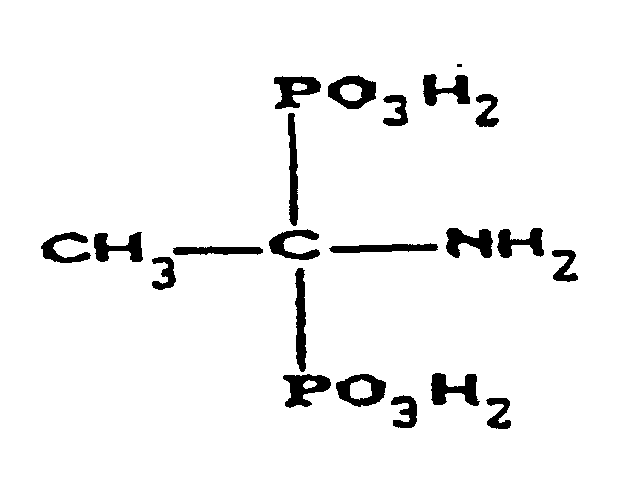
-
Found C 13,33 % H 4,73 % N 6,78% Calculated C 11,66 % H 4,89 % N 6,80% - 1H-MMR:
- Solvent: D2O/D2SO4
- Equipment: BRUCKER AC-200
-
- Synthesis of 1,3-diamino-propylidene-1,1-bisphosphonic acid, monosodium salt (compound VII):
- a. Add 39 ml of phosphorous tribromide to a suspension of 11.59 g of 3-aminopropionitrile and 8.93 g of phosphorous acid in 80 ml of dioxane of 40°C. Heat to 75-80°C and maintain that temperature during 7 hours.
- b. Add 36 ml of water and heat under reflux during 2.5 hours.
- c. Cool to 5°C and filter from an orange impurity.
- d. Add 125 ml of isopropanol to solid and stir during 15 hours. Filter and dry. The yield is 1.43 g of a colorless solid that by suspension in water and filtration gives 783 mg of a solid which melts at 258-265°C (V).
- e. Suspend V in 2.5 ml of water, add 0.244 g of sodium hydroxide, which produces dissolution.
- f. Add 7 ml of methanol. A white solid is produced (VI). Filter at 0°C and dissolve in 1.5 ml of water.
- g. Add 7 ml of methanol, cool to 5°C, filter and dry at 40°C. The yield is 800 mg of a colorless solid (VII), homogeneous by thin layer chromatography, which does not melt at 320°C.
-
- MOLECULAR FORMULAR: C3H11N2O6P2Na
MOLECULAR WEIGHT: 256,067
- 1H-NMR:
- Solvent: D2O/D2SO4
- Equipment: BRUCKER AC-200
-
- Synthesis of 1-amino-3-(N,N-dimethylamino)-propylidene-1,1-bisphosphonic acid (compound X):
- a. Add 174.5 ml of phosphorous trichloride to a solution of 57.5 ml of N,N-dimethylaminopropionitrile in 102 ml of 70% methanesulfonic acid at room temperature.
- b. Heat under nitrogen to 65°C during 6 hours.
- c. Cool to approximately 25°C, add 200 ml of water, heat under reflux during 5 hours and filter to eliminate a yellow solid in suspension (VIII).
- d. Add 1.3 l of isopropanol to the filtrate with stirring. Cool to 0°C and filter.
- e. Suspend the solid in isopropanol:water (6:4), filter again and dry. The yield is 28.3 g (21.7%) of a colorless solid (IX).
- f. Suspend IX in 56 ml of water. Add a solution of 4.5 g of sodium hydroxide in 30 ml of water, heat to 80°C and filter while hot.
- g. Add concentrated hydrochloric acid to the filtrate until pH = 1 (about 13.5 ml), cool and filter.
- h. Dissolve the solid in a solution of 3.4 g of sodium hydroxide in 60 ml of water at 65°C.
- i. Add concentrated hydrochloric acid to pH = 1, cool to 0°C, filter and dry. The yield is 20,6 g (73%) of colorless crystals which melt at 275°C with decomposition (X).
-
- MOLECULAR FORMULA: C5H16N2O6P2
MOLECULAR WEIGHT: 262,148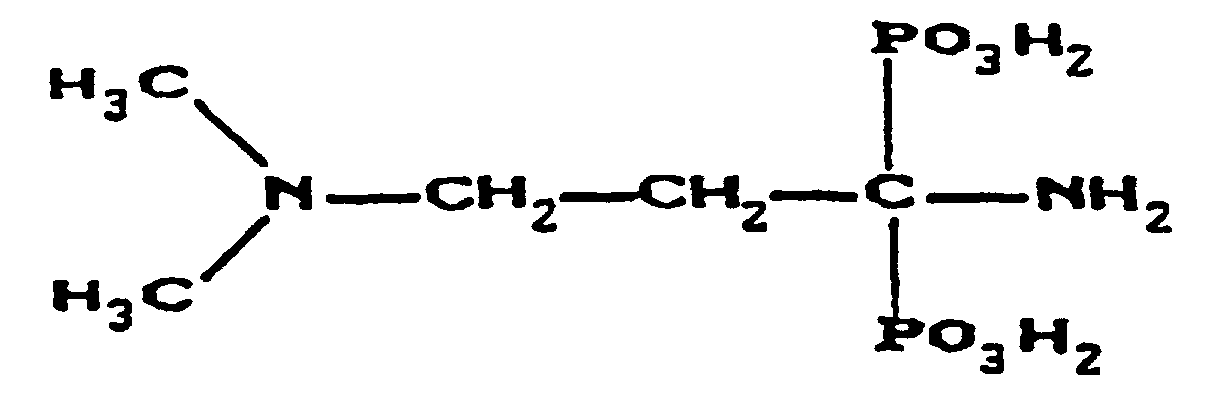
-
Found C 23,44 % H 7,41 % N 10,11% Calculated C 22,91 % H 6,15 % N 10,69% - 1H-NMR:
- Solvent: D2O/D2SO4
- Equipment: BRUCKER AC-200
-
- Binding of compounds (III), (VII) and (X) with an amino group at R1 to bone was examined by their ability to displace 14C-bisphosphonate from mouse fetal explants according to accepted methodology (van Beek et al, Journal of Bone and Mineral Research, (1994), Vol. 9, p. 1875-1882) and was compared to that of their hydroxyl analogs, the bisphosphonates etidronate, pamidronate and olpadronate.
- All six bisphosphonates tested bound to the explants dose-dependently. There were no differences between etidronate and compound (III) and pamidronate and compound (VII) and olpadronate and compound (X). The results are shown in Fig. 1.
- 45 calcium incorporation into osteoclast-devoid fetal bones of mice was inhibited by all bisphosphonates dose-dependently. There were no differences between the three hydroxybisphosphonates (etidronate, pamidronate and olpadronate) and their respective aminosubstituted analogs (compounds III, VII, and X). Half-maximal inhibiting concentrations: etidronate and compound III: 1.5 x 10⁻⁷ M; pamidronate and compound VII: 2 x 10⁻⁷ and 2.5 x 10⁻⁷ M, respectively; olpadronate and compound X: 2 x 10⁻⁷ and 4 x 10⁻⁷ M, respectively. The results are shown in Fig. 2.
- Olpadronate and compound X were also tested (Methode: Kok et al., Kidney Int. 1988, Vol. 34, p. 346-350) for their ability to inhibit the growth of calcium oxalate monohydrate crystals using a seeded crystal growth system. Both compounds inhibited the growth of the calcium crystals roughly equipotently (half-maximal concentrations: 6 x 10⁻⁶ M and 3 x 10⁻⁶ M, respectively).
- Fetal mouse metacarpal bones prelabelled with 45 calcium were treated with various concentrations of the six bisphosphonates tested in the previous experiments, and were cultured for 10 days. Resorption was assessed as percentage of 45 calcium release relative to control according to standard methodology (Van der Pluijm et al., Endocrinology, (1991), Vol. 129, p. 1596-1604).
- Etidronate and its analogous compound III suppressed 45 calcium release equipotently; pamidronate was about 6 times more potent than compound VII, while compound X showed absolutely no antiresorptive activity in contrast to the increased potency of olpadronate. The results are shown in Fig. 3.
- According to previous results (Papapoulos et al., Journal of Bone and Mineral Research, 1989, Vol. 4, p. 775-781) those in vitro data allow prediction of equivalent in vivo effects.
| Chemical Shifts (ppm) | Multiplicity | Number of | ASSIGNMENTS | |
| 2,21 | |
3 | CH3 JH-p= 14,5 HZ |
| Chemical Shifts (ppm) | Multiplicity | Number of | ASSIGNMENTS | |
| 2,19 | m | 2 | -CH2- |
|
| 3,32 | m | 2 | N-CH2-C |
| Chemical Shifts (ppm) | Multiplicity | Number of protons | ASSIGNMENTS |
| 9,41 | |
1 | +N-H |
| 2,65 | |
2 | CH2- |
| 2,05 | |
6 | CH3-N- |
| 1,71-1,48 | |
2 | CH2-C-P |
Claims (5)
- Use of the biological carrier 1-amino-3-(N,N-dimethylamino)-propyliden-1,1-bis-phosphonic acid of the structural formulaor its monosodium or other pharmaceutically acceptable salt for the manufacture of a medicament for the diagnosis, treatment and/or prophylaxis of disorders of calcium and/or bone metabolism, characterized in that said medicament exhibits no carrier-mediated antiresorptive activity.

- Use according to claim 1 for the manufacture of a medicament for the diagnosis, treatment and/or prophylaxis of urolithiasis, ectopic calcifications, all forms of osteoporosis, all forms of arthritis and all forms of periodontal diseases.
- Use according to claim 1 or 2 in combination with bone-active substances selected from the group consisting of cytokines, growth factors, prostaglandins, hormones, glycine or other amino acids or modified amino acids and cytostatic drugs.
- Use according to any of claims 1 to 3 in combination with substances selected from the group comprising at least one calcium salt, vitamin D or derivatives thereof and at least one fluoride salt or mixtures thereof.
- Use according to any of claims 1 to 4 in combination with substances selected from the group comprising at least one parathyroid hormone, at least one androgen and at least one estrogen and mixtures thereof.
Priority Applications (1)
| Application Number | Priority Date | Filing Date | Title |
|---|---|---|---|
| EP96925679A EP0837682B1 (en) | 1995-07-10 | 1996-07-08 | Therapeutic use of 1-amino-3-(n,n-dimethylamino)-propyliden-1,1-bisphosphonic acid and its salts |
Applications Claiming Priority (4)
| Application Number | Priority Date | Filing Date | Title |
|---|---|---|---|
| EP95110706A EP0753523A1 (en) | 1995-07-10 | 1995-07-10 | Amino-substituted bisphosphonic acids |
| EP95110706 | 1995-07-10 | ||
| PCT/EP1996/002981 WO1997002827A1 (en) | 1995-07-10 | 1996-07-08 | Therapeutic use of 1-amino-3-(n,n-dimethylamino)-propyliden-1,1-bisphosphonic acid and its salts |
| EP96925679A EP0837682B1 (en) | 1995-07-10 | 1996-07-08 | Therapeutic use of 1-amino-3-(n,n-dimethylamino)-propyliden-1,1-bisphosphonic acid and its salts |
Publications (2)
| Publication Number | Publication Date |
|---|---|
| EP0837682A1 EP0837682A1 (en) | 1998-04-29 |
| EP0837682B1 true EP0837682B1 (en) | 2002-11-06 |
Family
ID=8219423
Family Applications (2)
| Application Number | Title | Priority Date | Filing Date |
|---|---|---|---|
| EP95110706A Withdrawn EP0753523A1 (en) | 1995-07-10 | 1995-07-10 | Amino-substituted bisphosphonic acids |
| EP96925679A Expired - Lifetime EP0837682B1 (en) | 1995-07-10 | 1996-07-08 | Therapeutic use of 1-amino-3-(n,n-dimethylamino)-propyliden-1,1-bisphosphonic acid and its salts |
Family Applications Before (1)
| Application Number | Title | Priority Date | Filing Date |
|---|---|---|---|
| EP95110706A Withdrawn EP0753523A1 (en) | 1995-07-10 | 1995-07-10 | Amino-substituted bisphosphonic acids |
Country Status (8)
| Country | Link |
|---|---|
| US (1) | US5990098A (en) |
| EP (2) | EP0753523A1 (en) |
| JP (1) | JPH11508905A (en) |
| AR (1) | AR004625A1 (en) |
| AU (1) | AU6612596A (en) |
| DE (1) | DE69624707T2 (en) |
| WO (1) | WO1997002827A1 (en) |
| ZA (1) | ZA965798B (en) |
Families Citing this family (15)
| Publication number | Priority date | Publication date | Assignee | Title |
|---|---|---|---|---|
| US6660468B1 (en) | 1998-10-27 | 2003-12-09 | Board Of Trustees Of The University Of Arkansas | Vitro and in vivo models for screening compounds to prevent glucocorticoid-induced bone destruction |
| AR013994A1 (en) * | 1998-10-30 | 2001-01-31 | Gador Sa | PROCEDURE AND PREPARATIONS THAT SELECTIVELY MODULATE THE FUNCTION OF THE OSTEOBLASTO FOR THE PREVENTION AND TREATMENT OF FRAGILIZING OSTEOPATHIES. |
| US6416737B1 (en) | 1998-11-19 | 2002-07-09 | Board Of Trustees Of The University Of Arkansas | Increasing bone strength with selected bisphosphonates |
| CA2484761C (en) | 2002-05-24 | 2010-11-09 | Angiotech International Ag | Compositions and methods for coating medical implants |
| WO2005000858A2 (en) * | 2003-06-27 | 2005-01-06 | Akira Odani | Bisphosphonate complexes |
| WO2005090370A1 (en) | 2004-02-05 | 2005-09-29 | The Regents Of The University Of California | Pharmacologically active agents containing esterified phosphonates and methods for use thereof |
| BRPI0418756A (en) * | 2004-05-19 | 2007-09-11 | Merck & Co Inc | compositions and methods for inhibiting bone resorption |
| US7068172B2 (en) * | 2004-05-21 | 2006-06-27 | Xiao Hui Yang | Method and apparatus for deactivating an EAS device |
| JP2008538354A (en) | 2005-04-08 | 2008-10-23 | キメリクス,インコーポレイテッド | Compounds, compositions and methods for treating viral infections and other medical diseases |
| US8642577B2 (en) | 2005-04-08 | 2014-02-04 | Chimerix, Inc. | Compounds, compositions and methods for the treatment of poxvirus infections |
| CN101977610B (en) | 2008-01-25 | 2012-05-16 | 奇默里克斯公司 | Methods of treating viral infections |
| WO2011011519A1 (en) | 2009-07-21 | 2011-01-27 | Chimerix, Inc. | Compounds, compositions and methods for treating ocular conditions |
| US20120164104A1 (en) | 2009-08-03 | 2012-06-28 | Chimerix, Inc. | Composition and Methods of Treating Viral Infections and Viral Induced Tumors |
| PT2534150T (en) | 2010-02-12 | 2017-05-02 | Chimerix Inc | Methods of treating viral infection |
| US9278135B2 (en) | 2010-04-26 | 2016-03-08 | Chimerix Inc. | Methods of treating retroviral infections and related dosage regimes |
Family Cites Families (20)
| Publication number | Priority date | Publication date | Assignee | Title |
|---|---|---|---|---|
| DE1002355C2 (en) * | 1954-05-03 | 1957-07-25 | Thomae Gmbh Dr K | Process for the preparation of ª ‡ -prim.-amino-diphosphonic acids and their esters |
| FR8441M (en) * | 1968-04-01 | 1971-07-15 | ||
| DE2405254C2 (en) | 1974-02-04 | 1982-05-27 | Henkel KGaA, 4000 Düsseldorf | Use of 3-amino-1-hydroxypropane-1, 1-diphosphonic acid or its water-soluble salts for influencing calcium metabolic disorders in the human or animal body |
| AR200473A1 (en) | 1974-09-17 | 1974-11-08 | Gador Y Cia Sa Com E Ind Lab | PROCEDURE FOR PREPARING 1-HYDROXYALKYLIDEN-DIPHOSPHONIC ACIDS AND ITS SALTS |
| GB1508772A (en) * | 1975-04-04 | 1978-04-26 | Shell Int Research | Biologically active compositions |
| DE2534390C2 (en) * | 1975-08-01 | 1983-01-13 | Henkel KGaA, 4000 Düsseldorf | 1,3-di-aminoalkane-1,1-diphosphonic acids |
| DE2534391C2 (en) | 1975-08-01 | 1983-01-13 | Henkel KGaA, 4000 Düsseldorf | 1-Hydroxy-3-aminoalkane-1,1-diphosphonic acids |
| AR218558A1 (en) | 1979-09-28 | 1980-06-13 | Gador Lab & Cia Sa | PROCEDURE FOR PREPARING 3-AMINO-1-HYDROXY-PROPILIDENDIPHOSPHONIC ACID AND ITS SALTS |
| US4822609A (en) * | 1984-12-21 | 1989-04-18 | The Procter & Gamble Company | Treatment of osteoporosis |
| DE3623397A1 (en) | 1986-07-11 | 1988-01-14 | Boehringer Mannheim Gmbh | NEW DIPHOSPHONIC ACID DERIVATIVES, METHOD FOR THE PRODUCTION THEREOF AND MEDICINAL PRODUCTS CONTAINING THESE COMPOUNDS |
| US4868164A (en) | 1986-12-19 | 1989-09-19 | Norwich Eaton Pharmaceuticals, Inc. | Octahydro-pyridine diphosphonate compounds, pharmaceutical compositions, and methods for treating abnormal calcium and phosphate metabolism |
| US5006329A (en) | 1988-01-22 | 1991-04-09 | Cadema Medical Products, Inc. | Radioactive tagged compounds and method for the treatment of metastatic bone cancer |
| DE3917153A1 (en) | 1989-05-26 | 1990-11-29 | Boehringer Mannheim Gmbh | NEW DIPHOSPHONIC ACID DERIVATIVES, METHOD FOR THE PRODUCTION THEREOF AND MEDICINAL PRODUCTS CONTAINING THESE COMPOUNDS |
| US5039819A (en) | 1990-09-18 | 1991-08-13 | Merck & Co., Inc. | Diphosphonate intermediate for preparing an antihypercalcemic agent |
| US5103036A (en) | 1991-05-13 | 1992-04-07 | E. R. Squibb & Sons, Inc. | Process for preparing 3-alkenylidene-1,1-bisphosphonates |
| EP0541037A3 (en) | 1991-11-06 | 1997-02-26 | Takeda Chemical Industries Ltd | Squalene synthetase inhibitory composition and use thereof |
| US5205253A (en) | 1992-08-24 | 1993-04-27 | Ford Motor Company | Engine operation interrupt using engine operating parameters |
| FR2703590B1 (en) * | 1993-04-05 | 1995-06-30 | Sanofi Elf | USE OF BISPHOSPHONIC ACID DERIVATIVES FOR THE PREPARATION OF MEDICINES FOR PROMOTING BONE REPAIR. |
| JPH09511927A (en) * | 1994-04-18 | 1997-12-02 | ザ、プロクター、エンド、ギャンブル、カンパニー | Iontophoretic delivery of bisphosphonates to alveolar bone |
| WO1996019998A1 (en) * | 1994-12-28 | 1996-07-04 | Gador S.A. | Bone mass anabolic composition comprising olpadronate |
-
1995
- 1995-07-10 EP EP95110706A patent/EP0753523A1/en not_active Withdrawn
-
1996
- 1996-07-08 DE DE69624707T patent/DE69624707T2/en not_active Expired - Lifetime
- 1996-07-08 EP EP96925679A patent/EP0837682B1/en not_active Expired - Lifetime
- 1996-07-08 AR ARP960103486A patent/AR004625A1/en not_active Application Discontinuation
- 1996-07-08 WO PCT/EP1996/002981 patent/WO1997002827A1/en not_active Ceased
- 1996-07-08 AU AU66125/96A patent/AU6612596A/en not_active Abandoned
- 1996-07-08 JP JP9505494A patent/JPH11508905A/en not_active Ceased
- 1996-07-08 US US08/983,247 patent/US5990098A/en not_active Expired - Lifetime
- 1996-07-09 ZA ZA9605798A patent/ZA965798B/en unknown
Also Published As
| Publication number | Publication date |
|---|---|
| AU6612596A (en) | 1997-02-10 |
| JPH11508905A (en) | 1999-08-03 |
| US5990098A (en) | 1999-11-23 |
| WO1997002827A1 (en) | 1997-01-30 |
| EP0753523A1 (en) | 1997-01-15 |
| DE69624707T2 (en) | 2003-03-20 |
| ZA965798B (en) | 1998-01-09 |
| AR004625A1 (en) | 1999-03-10 |
| EP0837682A1 (en) | 1998-04-29 |
| DE69624707D1 (en) | 2002-12-12 |
Similar Documents
| Publication | Publication Date | Title |
|---|---|---|
| US5990098A (en) | Therapeutic use of 1-amino-3-(N,N-dimethylamino)-propylidene-1,1-bisphosphonic acid and its salts | |
| US4621077A (en) | Pharmacologically active biphosphonates, process for the preparation thereof and pharmaceutical compositions therefrom | |
| US5849726A (en) | Anhydrous alendronate monosodium salt formulations | |
| US5804602A (en) | Methods of cancer treatment using naaladase inhibitors | |
| US5880112A (en) | Naaladase inhibitors | |
| EP0252505A1 (en) | 1-Hydroxy-3-(N-methyl-N-propyl amino)propane-1,1-diphosphonic acid, process for its preparation and medicines containing this compound | |
| Gatti et al. | New bisphosphonates in the treatment of bone diseases | |
| EP1556041B1 (en) | New crystalline hydrates of the sodium salt of 3-pyridyl-1-hydroxyethylidene-1,1-bisphosphonic acid | |
| US6008207A (en) | Anhydrous alendronate monosodium salt formulations | |
| EP0994884B1 (en) | Diphosphonic acid salts for the treatment of osteoporosis | |
| JP3883137B2 (en) | Therapeutic active agent comprising pyridyl bisphosphonate | |
| EP1723157B2 (en) | Amorphous forms of risedronate monosodium | |
| WO1996039410A1 (en) | Disodium alendronate formulations | |
| Fleisch | From polyphosphates to bisphosphonates and their role in bone and calcium metabolism | |
| DE3313049A1 (en) | Pharmacologically active biphosphonates, process for their preparation and pharmaceutical compositions containing them | |
| EP0592488A1 (en) | Dimethylamino-hydroxy-alkan diphosphonic acids and pharmaceutical compositions containing them | |
| WO2001030788A1 (en) | Novel salts of 4-amino-1-hydroxybutylidene-1,1-bisphosphonic acid, their preparation and use | |
| Fleisch¹ | From Polyphosphates to Bisphosphonates |
Legal Events
| Date | Code | Title | Description |
|---|---|---|---|
| PUAI | Public reference made under article 153(3) epc to a published international application that has entered the european phase |
Free format text: ORIGINAL CODE: 0009012 |
|
| AK | Designated contracting states |
Kind code of ref document: A1 Designated state(s): DE FR GB NL |
|
| 17P | Request for examination filed |
Effective date: 19971217 |
|
| 17Q | First examination report despatched |
Effective date: 20000614 |
|
| GRAG | Despatch of communication of intention to grant |
Free format text: ORIGINAL CODE: EPIDOS AGRA |
|
| GRAG | Despatch of communication of intention to grant |
Free format text: ORIGINAL CODE: EPIDOS AGRA |
|
| GRAH | Despatch of communication of intention to grant a patent |
Free format text: ORIGINAL CODE: EPIDOS IGRA |
|
| GRAH | Despatch of communication of intention to grant a patent |
Free format text: ORIGINAL CODE: EPIDOS IGRA |
|
| GRAA | (expected) grant |
Free format text: ORIGINAL CODE: 0009210 |
|
| AK | Designated contracting states |
Kind code of ref document: B1 Designated state(s): DE FR GB NL |
|
| REG | Reference to a national code |
Ref country code: GB Ref legal event code: FG4D |
|
| REF | Corresponds to: |
Ref document number: 69624707 Country of ref document: DE Date of ref document: 20021212 |
|
| ET | Fr: translation filed | ||
| PLBE | No opposition filed within time limit |
Free format text: ORIGINAL CODE: 0009261 |
|
| STAA | Information on the status of an ep patent application or granted ep patent |
Free format text: STATUS: NO OPPOSITION FILED WITHIN TIME LIMIT |
|
| 26N | No opposition filed |
Effective date: 20030807 |
|
| PGFP | Annual fee paid to national office [announced via postgrant information from national office to epo] |
Ref country code: DE Payment date: 20140702 Year of fee payment: 19 Ref country code: NL Payment date: 20140710 Year of fee payment: 19 |
|
| PGFP | Annual fee paid to national office [announced via postgrant information from national office to epo] |
Ref country code: GB Payment date: 20140702 Year of fee payment: 19 Ref country code: FR Payment date: 20140708 Year of fee payment: 19 |
|
| REG | Reference to a national code |
Ref country code: DE Ref legal event code: R119 Ref document number: 69624707 Country of ref document: DE |
|
| GBPC | Gb: european patent ceased through non-payment of renewal fee |
Effective date: 20150708 |
|
| REG | Reference to a national code |
Ref country code: NL Ref legal event code: MM Effective date: 20150801 |
|
| PG25 | Lapsed in a contracting state [announced via postgrant information from national office to epo] |
Ref country code: DE Free format text: LAPSE BECAUSE OF NON-PAYMENT OF DUE FEES Effective date: 20160202 Ref country code: GB Free format text: LAPSE BECAUSE OF NON-PAYMENT OF DUE FEES Effective date: 20150708 |
|
| REG | Reference to a national code |
Ref country code: FR Ref legal event code: ST Effective date: 20160331 |
|
| PG25 | Lapsed in a contracting state [announced via postgrant information from national office to epo] |
Ref country code: NL Free format text: LAPSE BECAUSE OF NON-PAYMENT OF DUE FEES Effective date: 20150801 Ref country code: FR Free format text: LAPSE BECAUSE OF NON-PAYMENT OF DUE FEES Effective date: 20150731 |