EP0836807B1 - Produit alimentaire de type pellet expansable aux micro-ondes, dans son emballage de type suscepteur, et procédé d'obtention - Google Patents
Produit alimentaire de type pellet expansable aux micro-ondes, dans son emballage de type suscepteur, et procédé d'obtention Download PDFInfo
- Publication number
- EP0836807B1 EP0836807B1 EP97402431A EP97402431A EP0836807B1 EP 0836807 B1 EP0836807 B1 EP 0836807B1 EP 97402431 A EP97402431 A EP 97402431A EP 97402431 A EP97402431 A EP 97402431A EP 0836807 B1 EP0836807 B1 EP 0836807B1
- Authority
- EP
- European Patent Office
- Prior art keywords
- weight
- starch
- process according
- extruder
- food product
- Prior art date
- Legal status (The legal status is an assumption and is not a legal conclusion. Google has not performed a legal analysis and makes no representation as to the accuracy of the status listed.)
- Expired - Lifetime
Links
- 235000013305 food Nutrition 0.000 title claims description 38
- 238000000034 method Methods 0.000 title claims description 20
- 230000008569 process Effects 0.000 title claims description 17
- 239000008188 pellet Substances 0.000 claims description 52
- 229920002472 Starch Polymers 0.000 claims description 35
- 235000019698 starch Nutrition 0.000 claims description 33
- 239000008107 starch Substances 0.000 claims description 32
- 238000004806 packaging method and process Methods 0.000 claims description 21
- 239000000463 material Substances 0.000 claims description 19
- 239000000203 mixture Substances 0.000 claims description 18
- 235000013312 flour Nutrition 0.000 claims description 15
- 239000000796 flavoring agent Substances 0.000 claims description 12
- 229920000881 Modified starch Polymers 0.000 claims description 11
- 235000019426 modified starch Nutrition 0.000 claims description 11
- 239000004368 Modified starch Substances 0.000 claims description 10
- 235000013339 cereals Nutrition 0.000 claims description 10
- 239000008187 granular material Substances 0.000 claims description 10
- 239000000835 fiber Substances 0.000 claims description 9
- 235000002017 Zea mays subsp mays Nutrition 0.000 claims description 8
- 239000002655 kraft paper Substances 0.000 claims description 8
- 150000003839 salts Chemical class 0.000 claims description 8
- 240000008042 Zea mays Species 0.000 claims description 7
- 239000000470 constituent Substances 0.000 claims description 7
- 239000000843 powder Substances 0.000 claims description 7
- XAGFODPZIPBFFR-UHFFFAOYSA-N aluminium Chemical compound [Al] XAGFODPZIPBFFR-UHFFFAOYSA-N 0.000 claims description 6
- 229910052782 aluminium Inorganic materials 0.000 claims description 6
- 238000002360 preparation method Methods 0.000 claims description 6
- 235000011888 snacks Nutrition 0.000 claims description 6
- 241000209140 Triticum Species 0.000 claims description 5
- 235000021307 Triticum Nutrition 0.000 claims description 5
- 229920000139 polyethylene terephthalate Polymers 0.000 claims description 5
- 239000005020 polyethylene terephthalate Substances 0.000 claims description 5
- 235000013311 vegetables Nutrition 0.000 claims description 5
- 239000000123 paper Substances 0.000 claims description 4
- -1 polyethylene terephthalate Polymers 0.000 claims description 4
- 230000001681 protective effect Effects 0.000 claims description 3
- 240000005979 Hordeum vulgare Species 0.000 claims description 2
- 235000007340 Hordeum vulgare Nutrition 0.000 claims description 2
- 235000016383 Zea mays subsp huehuetenangensis Nutrition 0.000 claims 1
- 235000009973 maize Nutrition 0.000 claims 1
- 239000000047 product Substances 0.000 description 31
- XLYOFNOQVPJJNP-UHFFFAOYSA-N water Substances O XLYOFNOQVPJJNP-UHFFFAOYSA-N 0.000 description 12
- 235000019634 flavors Nutrition 0.000 description 9
- 238000001125 extrusion Methods 0.000 description 7
- 235000005824 Zea mays ssp. parviglumis Nutrition 0.000 description 6
- 235000005822 corn Nutrition 0.000 description 6
- 230000009471 action Effects 0.000 description 4
- 238000010438 heat treatment Methods 0.000 description 4
- 238000004519 manufacturing process Methods 0.000 description 4
- 230000035699 permeability Effects 0.000 description 4
- 238000012360 testing method Methods 0.000 description 4
- MIDXCONKKJTLDX-UHFFFAOYSA-N 3,5-dimethylcyclopentane-1,2-dione Chemical compound CC1CC(C)C(=O)C1=O MIDXCONKKJTLDX-UHFFFAOYSA-N 0.000 description 3
- GJCOSYZMQJWQCA-UHFFFAOYSA-N 9H-xanthene Chemical compound C1=CC=C2CC3=CC=CC=C3OC2=C1 GJCOSYZMQJWQCA-UHFFFAOYSA-N 0.000 description 3
- 244000303965 Cyamopsis psoralioides Species 0.000 description 3
- 235000007688 Lycopersicon esculentum Nutrition 0.000 description 3
- 239000004743 Polypropylene Substances 0.000 description 3
- 240000003768 Solanum lycopersicum Species 0.000 description 3
- 239000000654 additive Substances 0.000 description 3
- 235000013736 caramel Nutrition 0.000 description 3
- 238000010411 cooking Methods 0.000 description 3
- 238000009826 distribution Methods 0.000 description 3
- 238000009472 formulation Methods 0.000 description 3
- 238000001465 metallisation Methods 0.000 description 3
- 238000002156 mixing Methods 0.000 description 3
- 235000013550 pizza Nutrition 0.000 description 3
- 229920001155 polypropylene Polymers 0.000 description 3
- 229920001285 xanthan gum Polymers 0.000 description 3
- 229920000945 Amylopectin Polymers 0.000 description 2
- 240000003183 Manihot esculenta Species 0.000 description 2
- 235000016735 Manihot esculenta subsp esculenta Nutrition 0.000 description 2
- 240000007594 Oryza sativa Species 0.000 description 2
- 235000007164 Oryza sativa Nutrition 0.000 description 2
- 230000000996 additive effect Effects 0.000 description 2
- 230000004888 barrier function Effects 0.000 description 2
- 239000011248 coating agent Substances 0.000 description 2
- 238000000576 coating method Methods 0.000 description 2
- 235000009508 confectionery Nutrition 0.000 description 2
- 238000005520 cutting process Methods 0.000 description 2
- 238000001035 drying Methods 0.000 description 2
- 230000000694 effects Effects 0.000 description 2
- 235000009566 rice Nutrition 0.000 description 2
- 239000011265 semifinished product Substances 0.000 description 2
- 239000002356 single layer Substances 0.000 description 2
- 238000003756 stirring Methods 0.000 description 2
- 239000006228 supernatant Substances 0.000 description 2
- 238000009834 vaporization Methods 0.000 description 2
- 230000008016 vaporization Effects 0.000 description 2
- 235000015099 wheat brans Nutrition 0.000 description 2
- 229940100445 wheat starch Drugs 0.000 description 2
- 241000251468 Actinopterygii Species 0.000 description 1
- 244000291564 Allium cepa Species 0.000 description 1
- 235000002732 Allium cepa var. cepa Nutrition 0.000 description 1
- 240000002234 Allium sativum Species 0.000 description 1
- 229920000856 Amylose Polymers 0.000 description 1
- 240000007087 Apium graveolens Species 0.000 description 1
- 235000015849 Apium graveolens Dulce Group Nutrition 0.000 description 1
- 235000010591 Appio Nutrition 0.000 description 1
- 235000007319 Avena orientalis Nutrition 0.000 description 1
- 244000075850 Avena orientalis Species 0.000 description 1
- 235000018185 Betula X alpestris Nutrition 0.000 description 1
- 235000018212 Betula X uliginosa Nutrition 0.000 description 1
- 240000008886 Ceratonia siliqua Species 0.000 description 1
- 235000013912 Ceratonia siliqua Nutrition 0.000 description 1
- 244000000626 Daucus carota Species 0.000 description 1
- 235000002767 Daucus carota Nutrition 0.000 description 1
- 241000238557 Decapoda Species 0.000 description 1
- 239000004097 EU approved flavor enhancer Substances 0.000 description 1
- 241000196324 Embryophyta Species 0.000 description 1
- 229920000134 Metallised film Polymers 0.000 description 1
- 241001465754 Metazoa Species 0.000 description 1
- GXCLVBGFBYZDAG-UHFFFAOYSA-N N-[2-(1H-indol-3-yl)ethyl]-N-methylprop-2-en-1-amine Chemical compound CN(CCC1=CNC2=C1C=CC=C2)CC=C GXCLVBGFBYZDAG-UHFFFAOYSA-N 0.000 description 1
- 241000209504 Poaceae Species 0.000 description 1
- 244000300264 Spinacia oleracea Species 0.000 description 1
- 235000009337 Spinacia oleracea Nutrition 0.000 description 1
- 241000482268 Zea mays subsp. mays Species 0.000 description 1
- 238000002835 absorbance Methods 0.000 description 1
- 239000002535 acidifier Substances 0.000 description 1
- 229940095602 acidifiers Drugs 0.000 description 1
- NIXOWILDQLNWCW-UHFFFAOYSA-N acrylic acid group Chemical group C(C=C)(=O)O NIXOWILDQLNWCW-UHFFFAOYSA-N 0.000 description 1
- 239000000853 adhesive Substances 0.000 description 1
- 230000001070 adhesive effect Effects 0.000 description 1
- 239000003963 antioxidant agent Substances 0.000 description 1
- 235000019568 aromas Nutrition 0.000 description 1
- 238000005899 aromatization reaction Methods 0.000 description 1
- 235000021152 breakfast Nutrition 0.000 description 1
- 230000008859 change Effects 0.000 description 1
- 238000007385 chemical modification Methods 0.000 description 1
- 239000003153 chemical reaction reagent Substances 0.000 description 1
- 239000003795 chemical substances by application Substances 0.000 description 1
- 235000019219 chocolate Nutrition 0.000 description 1
- 239000003086 colorant Substances 0.000 description 1
- 239000002131 composite material Substances 0.000 description 1
- 230000001143 conditioned effect Effects 0.000 description 1
- 238000001816 cooling Methods 0.000 description 1
- 238000004132 cross linking Methods 0.000 description 1
- 238000011161 development Methods 0.000 description 1
- 235000012489 doughnuts Nutrition 0.000 description 1
- 230000005672 electromagnetic field Effects 0.000 description 1
- 239000003995 emulsifying agent Substances 0.000 description 1
- 230000032050 esterification Effects 0.000 description 1
- 238000005886 esterification reaction Methods 0.000 description 1
- 238000006266 etherification reaction Methods 0.000 description 1
- 235000013861 fat-free Nutrition 0.000 description 1
- 235000013373 food additive Nutrition 0.000 description 1
- 239000002778 food additive Substances 0.000 description 1
- 235000019264 food flavour enhancer Nutrition 0.000 description 1
- 235000003599 food sweetener Nutrition 0.000 description 1
- 235000004611 garlic Nutrition 0.000 description 1
- 238000000265 homogenisation Methods 0.000 description 1
- 235000012907 honey Nutrition 0.000 description 1
- 230000002209 hydrophobic effect Effects 0.000 description 1
- 239000004615 ingredient Substances 0.000 description 1
- 239000013067 intermediate product Substances 0.000 description 1
- 238000010030 laminating Methods 0.000 description 1
- 239000010410 layer Substances 0.000 description 1
- 239000011159 matrix material Substances 0.000 description 1
- 229940038580 oat bran Drugs 0.000 description 1
- 230000003287 optical effect Effects 0.000 description 1
- 238000013021 overheating Methods 0.000 description 1
- 239000004033 plastic Substances 0.000 description 1
- 229920003023 plastic Polymers 0.000 description 1
- 229920006254 polymer film Polymers 0.000 description 1
- 229920005862 polyol Polymers 0.000 description 1
- 150000003077 polyols Chemical class 0.000 description 1
- 238000012545 processing Methods 0.000 description 1
- 238000005096 rolling process Methods 0.000 description 1
- 239000007787 solid Substances 0.000 description 1
- 239000003381 stabilizer Substances 0.000 description 1
- 238000003860 storage Methods 0.000 description 1
- 239000000126 substance Substances 0.000 description 1
- 239000003765 sweetening agent Substances 0.000 description 1
- 239000002562 thickening agent Substances 0.000 description 1
Images
Classifications
-
- A—HUMAN NECESSITIES
- A23—FOODS OR FOODSTUFFS; TREATMENT THEREOF, NOT COVERED BY OTHER CLASSES
- A23L—FOODS, FOODSTUFFS OR NON-ALCOHOLIC BEVERAGES, NOT OTHERWISE PROVIDED FOR; PREPARATION OR TREATMENT THEREOF
- A23L7/00—Cereal-derived products; Malt products; Preparation or treatment thereof
- A23L7/10—Cereal-derived products
- A23L7/161—Puffed cereals, e.g. popcorn or puffed rice
- A23L7/165—Preparation of puffed cereals involving preparation of meal or dough as an intermediate step
Definitions
- the invention relates to the food sector. More particularly, the invention relates to a process for preparing a food product of the "pellet" type expandable under the action of microwaves.
- Pellets are cooked and dried starch products intended for "Snacking". These products are intermediate products obtained by baking / extrusion, which requires an additional processing step. These pellets, too hard to be consumed as they are, are expanded industrially by frying or hot air. Thus, the pellet dipped in an oil to 200 ° C (ten seconds) causes vaporization of the water materializing by an expansion of the product; the pellet then becomes a product of consumable snacking with very low density and honeycomb, an example of this kind of product being the shrimp donut.
- Pellet is defined by its starch-based formulation, its cooking intensity, its shape and final humidity, which directly condition the level expansion of the product and therefore its texture.
- pellets are generally obtained using 2 extruders.
- the first extruder is used to gelatinize the starch to give it a "melted or pseudo-plastic" state. It is the association of the thermal energy brought by the heating and of the mechanical energy brought by the shear linked to the configuration of the screws which allows the starch to gelatinize in a hydrated medium. Temperature scales and pressure are such that the product before it leaves the extruder must be at a low pressure and temperature ( ⁇ 100 bar, ⁇ 70 ° C) to avoid expansion at this level.
- This extruder will push these granules through a die and form the pellet final, whose form is conditioned by the choice of the sector. Extruded pellets are pre-dried to prevent them from sticking together and then dried to the required content in desired humidity.
- EP-A-0 375 006 discloses a snacking food product which can be blown and expand under the effect of microwave heating, including a solid core, partially baked, expandable and puffable, comprising a pre-gelled and / or natural tapioca starch, with a moisture content ranging from 12 to 16% by weight, said core being coated with an adhesive coating of cooked dough, can be blown and cannot expand.
- EP-A-0 331 820 is a method for preparing Expanded crispy snack products with a moisture content included between 1 and 7% by weight, in which the expansion is carried out by means of air hot.
- EP-A-0 338 239 discloses a process for preparing semi-finished products expandable in the microwave
- US-A-4,904,488 discloses a preparation process of popcorn under the influence of microwaves
- GB-A-1 139 762 discloses a process to prepare a snack product.
- An object of the invention is to provide a food product of the pellet type. susceptible to expansion under the action of microwaves which has properties improved organoleptics when consumed hot.
- Another object of the invention is to provide a food product of the pellet type. susceptible to expansion under the action of microwaves which does not contain fat.
- the food product contains a gum, in an amount generally between 0.1 and 1% by weight of the total weight of the composition of said product.
- said food product having a moisture content of between 9 and 11.5% by weight and a degree of gelatinization of at least 75%, preferably at least 80%.
- This food product can be in the form of a sweet product, for example example in the form of ready-to-eat cereals (CPAC) for the little one lunch or as a salty product, for example a salty appetizer (PSA).
- CPAC ready-to-eat cereals
- PSA salty appetizer
- the food product according to the invention contains advantageously from 40 to 95% by weight of starch and preferably has a degree of gelatinization of at least 85%.
- the food product according to the invention advantageously contains from 50 to 95% by weight of starch and preferably has a degree of gelatinization of at least 90%.
- said food product having a moisture content of between 9 and 11.5% by weight and a degree of gelatinization of at least 75%, preferably at least 80%, preferably still at least 85%.
- said food product having a moisture content of between 9 and 11.5% by weight and a degree of gelatinization of at least 75%, preferably at least 80%, preferably still at least 90%.
- the content of starch of the food product according to the invention is defined as the sum the amount of starch in the starch-containing material and the quantity of native or modified starch entering into the composition of said product.
- the starch-containing material which can be used in the context of the invention can be in particular a cereal flour, such as for example a wheat flour, corn, barley or oats, or a mixture of these flours; or else this material can be another source of starch, such as cassava, earth or rice. Preferably, this material contains 60 to 90% starch.
- the native or modified starch which can be used according to the invention is for example chosen among the native starch of wheat, corn (normal, rich in amylopectin or rich in amylose) or rice (normal or rich in amylopectin), native wheat starch being prefer.
- native starch starch which has not undergone treatment chemical and can be used without restriction of use.
- modified starch we means a starch which has undergone chemical modifications (crosslinking or esterification or etherification) to improve their functional properties, including improved shear strength. These starches are subject to restrictions on use and are declared as additives.
- modified starches starches (starch adipic cross-linked acetylated) precooked from waxy corn which, in some cases, can improve the level of expansion and the surface quality of the product.
- the fibers suitable for the food product according to the invention include the bran from cereals, such as wheat bran, corn bran or oat bran, and fibers from other varieties, such as pea fibers.
- Powder from any vegetable can be used in the composition of food product according to the invention.
- the gums which can be used in the composition of the food product in accordance with the invention include in particular xanthan, guar, carob, preferably xanthan or guar.
- Water and fat soluble flavors suitable for the product food according to the invention are for example caramel, chocolate, honey, tomato or pizza. These products are commercially available.
- the starch contained in the starch source material allows the expansion of the product.
- the gums have a role of stabilizer and distributor of water in the pellet.
- the aromatization is carried out with two aromas whose behavior is different at the time of expansion.
- the fat-soluble aroma is used to preserve the flavoring potential and participate in the taste of the product, the second flavor, water-soluble, is used to volatilize when water vaporizes under the effect of microwaves and thus contribute to the aroma released.
- the food product according to the invention may also contain one or more several ingredients and / or food additives chosen from the agents texture, colors, flavors, antioxidants, acidifiers or acidity correctors, emulsifiers, thickeners, sweeteners, polyols or flavor enhancers.
- the food product of the pellet type according to the invention is packaged in "susceptor" type packaging.
- susceptor packaging also called “packaging active”
- packages active consist of a polymer film and an additive.
- the additive is metallic, it is essentially aluminum.
- the film susceptor produces, under the influence of an electromagnetic field, a field thermal and thus ensures good thermal homogenization. Movies susceptors by creating an induced field independent of the microwave oven cavity avoid problems of heterogeneity.
- the packaging used according to the invention is composed of a susceptor, preferably of the slightly metallized polyethylene terephthalate (PET) type, laminated on paper or kraft.
- the metallization (aluminum deposit) can be continuous or present "perforations"; in this case they are demetallized susceptors.
- the deposited aluminum has a thickness of less than 20 ⁇ , the conductivity resulting from this metallization is 50 to 200 ohms / m 2 .
- the metallization is carried out on a PET for its heat resistance properties, the temperature exceeding 200 ° C. during expansion.
- the metallized PET is laminated on paper or kraft, preferably on kraft, of grammage between 30 and 100 g / m 2 .
- a protective film preferably a light weight kraft ( ⁇ 20 g / m 2 ) is used.
- the laminating of the assembly thus takes the susceptor in "sandwich" between the krafts of different thicknesses.
- the aluminum phase can be placed below or above the pellets, but preferably and to avoid overheating it will be placed under the pellets.
- the packaging used according to the invention must have very good barrier properties to water vapor, with a water permeability generally less than 10 g / m 2 / 24 hours, preferably less than 3 g / m 2 / 24h at 38 ° C under a relative humidity of 90%.
- an overpack preferably made of polypropylene (PP) having a water permeability ⁇ 10 g / m 2 / 24h at 38 ° C under a relative humidity of 90%, with a thickness of between 10 and 60 ⁇ m or else use a coated kraft where the hydrophobic coating is generally carried out with an acrylic base having a water permeability ⁇ 3 g / m 2 / 24h at 38 ° C under a relative humidity of 90% .
- PP polypropylene
- the packaging according to the invention is an uncoated kraft with a grammage of between 30 and 100 g / m 2 with an polypropylene overpack as defined above.
- a single layer distribution of the pellets on the susceptor guarantees better heat exchange and improves the quality of expansion.
- the packaging may therefore be carried out under vacuum so as to guarantee this single-layer distribution.
- This composite packaging incorporating a susceptor allows, during the passage to domestic microwave oven or in an automatic distribution system pellets incorporating a microwave source, to homogenize the induced fields and to transform part of the electromagnetic energy into thermal energy allowing initialization of the expansion.
- the pellets thus receive energy electromagnetic (microwave) for heating at the heart of the product and thermal energy (released by the susceptor) for heating at the periphery, synergistically facilitating the vaporization of water and improving the qualities of expansion.
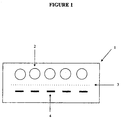
- FIG. 1 represents an embodiment of the food product in accordance with the invention, packaged in a susceptor type packaging.
- This packaging 1 comprises pellets 2 which are separated from the metallic phase 4 by a protective film 3.
- the food product according to the invention therefore has properties improved organoleptics when consumed hot, while being free of fat.
- the mixture is extruded in providing mechanical energy by a configuration of screws incorporating mixing elements and counter thread and working with a total moisture content inside the extruder between 29% and 35% by weight. All of these parameters determine the amount of mechanical energy transmitted to the product, which is more or less sheared by the extruder screw according to the configuration and the rotation speed thereof.
- This specific mechanical energy is between 50 and 400 kWh / t, preferably between 100 and 300 kWh / t.
- a large amount of thermal energy between 10 and 150 kWh / t, preferably between 30 and 120 kWh / t is brought to the extruder.
- This thermal energy transmitted to the product participates also to gelatinization of the product.
- a scale is applied from 100 to 140 ° C over 50 to 75% of the length of the extruder, and a temperature scale of 30 to 50 ° C on the remaining 25 to 50% of the length of the extruder, in order to allow the extruder to cut the granules before forming.
- a temperature scale of 100 to 140 ° C is applied on the first 3/4 of the length of the extruder, and a temperature scale from 30 to 50 ° C on the last 1/4 of the length of the extruder.
- the total energy supplied to the product is defined as the sum of the energy mechanical and thermal energy. This total transmitted energy allows the gelatinization of starch which is all the stronger as the energy supplied is important. The gelatinization level of the starch determining for the expansion of the product and therefore its final texture after passage to microwave oven.
- the total energy is between 60 kWh / t and 550 kWh / t, from preferably between 130 kWh / t and 420 kWh / t.
- the starchy material leaving this first extruder is then cut into granules which are transferred to a second extruder for extrusion therein temperature between 15 ° C and 60 ° C.
- the pellets obtained from the second extruder are then pre-dried up to a moisture content of 20% to 25% by weight, then dried to a moisture content of between 9% and 11.5% by weight.
- the pellets thus obtained have a size less than 40 mm and a thickness less than 4 mm.
- the shape of the pellets depends on the shape of the die of the second extruder and the additional satellite equipment used to expand this potential shapes (rolling mill, stamper, ). It is thus possible to obtain shapes geometric, such as for example a sphere, a cone or an ellipsoid, as well as shapes like rings, stars or figurines (for example animals, plants, boats, planes or people).
- the pellets are then packaged, preferably, in sachets of 20 to 150 g, said sachets consisting of the packaging incorporating a susceptor such as defined above.
- Instructions for use are printed on the packaging and mainly incorporates the characteristics of domestic microwave ovens. Preferably, it is a double entry matrix taking up the volume of the oven. as well as its commercial power and indicates the optimal expansion time in according to these parameters, preferably according to the volume of the oven. This expansion time is between 30 seconds and 2 minutes at maximum power.
- the invention therefore relates, according to another of its aspects, to a method for reheat and expand the food product according to the invention, which consists of adapt the expansion time of the pellets according to the volume and the power of the microwave oven used.
- the invention also relates to the food product expanded thus obtained.
- the sample is ground for 2 minutes in a mill equipped with a cooling system (marketed by IKA) and then about 5 g of sample is weighed (ie P 1 ) which is dried for 4 hours at 130 ° C. +/- 1 ° C.
- the sample is weighed again after drying (ie P 2 ).
- the final value of the moisture content is given by the average of two experiences.
- 200 mg of this sample are treated with 100 ml of 0.2 M KOH with stirring for 10 minutes and 200 mg per 100 ml of 0.4 M KOH, with stirring for 10 minutes. Centrifuge at 3000 rpm for 10 minutes, then take 1 ml of 0.2 M KOH treated supernatant which is neutralized with 0.2 HCl N (1 ml) by adjusting to 20 ml in a 25 ml tube. Similarly, 1 ml of supernatant of the sample treated with 0.4 M KOH which is neutralized with 0.2 N HCl (2 ml) by adjusting to 20 ml in a 25 ml tube.
- Example 2 Salted product for aperitif without fat
Landscapes
- Health & Medical Sciences (AREA)
- Nutrition Science (AREA)
- Life Sciences & Earth Sciences (AREA)
- Chemical & Material Sciences (AREA)
- Engineering & Computer Science (AREA)
- Food Science & Technology (AREA)
- Polymers & Plastics (AREA)
- Grain Derivatives (AREA)
Description
- SNACK FOOD, édité par R. Cordon Booth, publié par Van Nostrand Reinhold, New Yord (1990).
- EXTRUSION COOKING, édité par C. Mercier, P. Linko, J.M. Harper, publié par American Association of Cereal Chemist, AACC Inc. St Paul, Minnesota (1989).
- 40 à 99,7 % en poids de matière contenant de l'amidon
- 0 à 20 % en poids d'amidon natif ou modifié
- 0 à 25 % en poids de fibres
- 0 à 20 % en poids de poudre de légumes
- 0 à 20 % en poids de sucre
- 0,1 à 5 % en poids de sel
- 0,1 à 1 % en poids de gommes
- 0,1 à 3 % en poids d'arômes hydrosolubles et/ou liposolubles,
- 40 à 95 % en poids de matières contenant de l'amidon
- 0 à 20 % en poids d'amidon natif ou modifié
- 2,5 à 25 % en poids de fibres
- 2,2 à 20 % en poids de sucre
- 0,1 à 5 % en poids de sel
- 0,1 à 1 % en poids de gommes
- 0,1 à 3 % en poids d'arômes hydrosolubles et/ou liposolubles,
- 50 à 95 % en poids de matière contenant de l'amidon
- 3 à 20 % en poids d'amidon natif ou modifié
- 0 à 25 % en poids de fibres
- 1,7 à 20 % en poids de poudre de légumes
- 0,1 à 5 % en poids de sel
- 0,1 à 1 % en poids de gommes
- 0,1 à 3 % en poids d'arômes hydrosolubles et/ou liposolubles,
- une longue conservation des pellets du fait de leur faible humidité
- un potentiel de forme très élevé
- un changement d'état au cours de l'expansion
- un produit sans matières grasses
- un produit fini consommable à chaud
- un dégagement d'arôme au cours de l'expansion et donc à l'ouverture du sachet.
- farine de blé 48,5
- farine de maïs 30
- sucre 12
- son de blé 5
- malt 2
- sel 1
- guar 0,5
- arôme liposoluble "caramel" 0,5
- arôme hydrosoluble "caramel" 0,5
- matériel : extrudeur BC45 couplé avec un formeur F20 Mapimpianti
- paramètres :
- configuration de vis du BC45 avec disques malaxeurs et contre filet
- humidité extrudeur : 30 %
- barème de température : 120°C sur les 3 premiers/4 de l'extrudeur et 30°C sur le dernier 1/4.
- Energie mécanique : 140 kWh/t
⇒ Energie totale : 220 kWh/t - Energie thermique : 80 kWh/t
- après formage, les pellets sont séchés pour obtenir une humidité de 10,5 %
- forme : poisson longueur : 17 mm épaisseur : 2 mm
- humidité : 10,5 %
- degré de gélatinisation : 85 %
- conditionnement : sachet de 30 g.
- farine de blé 38
- farine de maïs 38
- amidon natif de blé 15
- poudre de tomate 5
- sel 2,5
- xanthane 0,5
- arôme liposoluble "pizza" 0,5
- arôme hydrosoluble "pizza" 0,5
- matériel : extrudeur BC45 couplé à un formeur F20 Mapimpianti
- paramètres :
- configuration de vis du BC45 avec disques malaxeurs et contre filet
- humidité extrudeur : 31 %
- barème de température : 130°C sur les 3 premiers/4 de l'extrudeur et 30°C sur le dernier 1/4
- Energie mécanique : 180 kWh/t
⇒ Energie totale : 280 kWh/t - Energie thermique : 100 kWh/t
- après formage, les pellets sont séchés pour obtenir une humidité de 10,5 %
- forme : roue longueur : 20 mm épaisseur : 2 mm
- humidité : 10,5 %
- degré de gélatinisation : 90 %
- conditionnement : sachet de 50 g.
Claims (11)
- Procédé de préparation d'un produit alimentaire de type pellet expansable aux micro-ondes, contenant au moins 40 % d'amidon et possédant une teneur en humidité comprise entre 9 et 11,5 % en poids et un degré de gélatinisation d'au moins 75 %, ledit produit étant conditionné dans un emballage de type suscepteur, procédé qui consiste à :a) extruder dans un premier extrudeur le mélange des composants avec une teneur en humidité comprise entre 29 et 35 % en poids, en apportant une énergie mécanique comprise entre 50 et 400 kWh/t et une énergie thermique comprise entre 10 et 150 kWh/t ;b) couper en sortie de premier extrudeur des granulés de matière extrudée et les transférer vers un second extrudeur ;c) extruder lesdits granulés pour obtenir en sortie de second extrudeur des pellets de forme désirée ;d) présécher les pellets jusqu'à une teneur en humidité de 20 à 25 % en poids, puis les sécher jusqu'à une teneur en humidité comprise entre 9 et 11,5 % en poids ; ete) conditionner les pellets obtenus dans un emballage de type suscepteur.
- Procédé selon la revendication 1, pour la préparation d'un produit alimentaire contenant en outre une gomme.
- Procédé selon la revendication 1 ou 2, pour la préparation d'un produit alimentaire contenant :la somme de ces constituants étant égale à 100 %.40 à 99,7 % en poids de matière contenant de l'amidon0 à 20 % en poids d'amidon natif ou modifié0 à 25 % en poids de fibres0 à 20 % en poids de poudre de légumes0 à 20 % en poids de sucre0,1 à 5 % en poids de sel0,1 à 1 % en poids de gommes0,1 à 3 % en poids d'arômes hydrosolubles et/ou liposolubles,
- Procédé selon l'une des revendications 1 à 3, pour la préparation d'une céréale prête à consommer contenant :la somme de ces constituants étant égale à 100 %.40 à 95 % en poids de matière contenant de l'amidon0 à 20 % en poids d'amidon natif ou modifié2,5 à 25 % en poids de fibres2,2 à 20 % en poids de sucre0,1 à 5 % en poids de sel0,1 à 1 % en poids de gommes0,1 à 3 % en poids d'arômes hydrosolubles et/ou liposolubles,
- Procédé selon la revendication 4, dans lequel la céréale prête à consommer possède un degré de gélatinisation d'au moins 85 %.
- Procédé selon l'une des revendications 1 à 3, pour la préparation d'un produit salé pour l'apéritif contenant :la somme de ces constituants étant égale à 100 %.50 à 95 % en poids de matière contenant de l'amidon3 à 20 % en poids d'amidon natif ou modifié0 à 25 % en poids de fibre1,7 à 20 % en poids de poudre de légumes0,1 à 5 % en poids de sel0,1 à 1 % en poids de gommes0,1 à 3 % en poids d'arômes hydrosolubles et/ou liposolubles,
- Procédé selon la revendication 6, dans lequel le produit salé pour l'apéritif possède un degré de gélatinisation d'au moins 90 %.
- Procédé selon l'une des revendications 1 à 7, dans lequel à l'étape a) on utilise une matière contenant de l'amidon constituée par une farine de céréale ou un mélange de farines de céréale.
- Procédé selon la revendication 8, dans lequel la farine de céréale est choisie parmi la farine de blé, la farine de maïs, la farine d'avoine ou la farine d'orge.
- Procédé selon l'une des revendications 1 à 9, dans lequel à l'étape e) on utilise un suscepteur de type polyéthylène téréphtalhate métallisé avec de l'aluminium, le film de polyéthylène téréphthalate étant contrecollé sur papier ou kraft, et on sépare le produit alimentaire de la phase métallique par un film protecteur.
- Procédé selon la revendication 10, dans lequel la conductivité du suscepteur est comprise entre 50 et 200 ohms/m2 et la densité du papier ou du kraft est comprise entre 30 et 100 g/m2.
Applications Claiming Priority (2)
| Application Number | Priority Date | Filing Date | Title |
|---|---|---|---|
| FR9612640 | 1996-10-16 | ||
| FR9612640A FR2754430B1 (fr) | 1996-10-16 | 1996-10-16 | Produit alimentaire de type pellet expansable aux micro-ondes et procede d'obtention |
Publications (2)
| Publication Number | Publication Date |
|---|---|
| EP0836807A1 EP0836807A1 (fr) | 1998-04-22 |
| EP0836807B1 true EP0836807B1 (fr) | 2002-08-21 |
Family
ID=9496736
Family Applications (1)
| Application Number | Title | Priority Date | Filing Date |
|---|---|---|---|
| EP97402431A Expired - Lifetime EP0836807B1 (fr) | 1996-10-16 | 1997-10-15 | Produit alimentaire de type pellet expansable aux micro-ondes, dans son emballage de type suscepteur, et procédé d'obtention |
Country Status (3)
| Country | Link |
|---|---|
| EP (1) | EP0836807B1 (fr) |
| DE (1) | DE69714818T2 (fr) |
| FR (1) | FR2754430B1 (fr) |
Families Citing this family (9)
| Publication number | Priority date | Publication date | Assignee | Title |
|---|---|---|---|---|
| AU5744900A (en) * | 1999-06-18 | 2001-01-09 | James R. Borek | Food distribution, preparation and consumption system |
| EP1121860A1 (fr) * | 2000-01-31 | 2001-08-08 | Gemeinnützige Stiftung für Existenzanalyse | Composition pour la préparation de produits de boulangerie |
| ES2162611B1 (es) * | 2000-06-09 | 2003-01-01 | Borges S A | Aperitivo para cocinar en microondas. |
| US6645541B2 (en) * | 2000-09-27 | 2003-11-11 | Wynn Starr Flavors, Inc. | Enhancing puffable food products and for production thereof |
| EP1772064A1 (fr) * | 2005-10-10 | 2007-04-11 | Nederlandse Organisatie voor Toegepast-Natuuurwetenschappelijk Onderzoek TNO | Méthode de préparation d'un produit snack et produit susceptible d'être obtenu d'après cette méthode |
| US8277866B2 (en) | 2009-10-08 | 2012-10-02 | Wenger Manufacturing, Inc. | Extruded, highly cooked, non-sticky starch products |
| US7749552B1 (en) | 2009-10-08 | 2010-07-06 | Wenger Manufacturing, Inc. | Extruded, highly cooked, non-sticky starch products |
| GB2522232B (en) * | 2014-01-17 | 2017-08-02 | Frito Lay Trading Co Gmbh | Snack food pellets |
| DE102022116569A1 (de) | 2022-07-04 | 2024-01-04 | Audi Aktiengesellschaft | Synthetisches Korn, Verfahren zur Herstellung eines synthetischen Korns, Ausgangsprodukt für ein aufgeschäumtes, stärkehaltiges Lebensmittelerzeugnis sowie Verfahren zum Herstellen eines aufgeschäumten, stärkehaltigen Lebensmittelerzeugnisses |
Family Cites Families (7)
| Publication number | Priority date | Publication date | Assignee | Title |
|---|---|---|---|---|
| US3462276A (en) * | 1965-01-29 | 1969-08-19 | Gen Mills Inc | Process for producing a tubular,puffed product |
| US3526514A (en) * | 1968-04-02 | 1970-09-01 | Quaker Oats Co | Flavored instant grain products |
| US4551347A (en) * | 1983-09-14 | 1985-11-05 | Nabisco Brands, Inc. | Process of preparing instant, flaked, wheat farina |
| US4904488A (en) * | 1988-03-29 | 1990-02-27 | Nabisco Brands, Inc. | Uniformly-colored, flavored, microwaveable popcorn |
| EP0338239A1 (fr) * | 1988-04-22 | 1989-10-25 | J.R. Short Milling Company | Produits alimentaires pouvant être traités par des micro-ondes et méthodes pour leur production |
| US5108772A (en) * | 1990-08-20 | 1992-04-28 | General Mills, Inc. | Puffable cereal pellets which pop upon microwave heating and method of preparation |
| US5165950A (en) * | 1991-08-28 | 1992-11-24 | American Amaranth, Inc. | Microwave expandable half product and process for its manufacture |
-
1996
- 1996-10-16 FR FR9612640A patent/FR2754430B1/fr not_active Expired - Fee Related
-
1997
- 1997-10-15 DE DE69714818T patent/DE69714818T2/de not_active Expired - Fee Related
- 1997-10-15 EP EP97402431A patent/EP0836807B1/fr not_active Expired - Lifetime
Also Published As
| Publication number | Publication date |
|---|---|
| EP0836807A1 (fr) | 1998-04-22 |
| FR2754430B1 (fr) | 1998-12-31 |
| FR2754430A1 (fr) | 1998-04-17 |
| DE69714818T2 (de) | 2003-04-30 |
| DE69714818D1 (de) | 2002-09-26 |
Similar Documents
| Publication | Publication Date | Title |
|---|---|---|
| AU603680B2 (en) | Extruded starch snack foods and process | |
| US5108772A (en) | Puffable cereal pellets which pop upon microwave heating and method of preparation | |
| CA2308477C (fr) | Preparation de produit extrude a base de grains dans des extrudeuses a vis a vitesses elevees | |
| JP3249125B2 (ja) | 耐性澱粉を含む食品組成物 | |
| US5500240A (en) | Production of chip-like starch based snacks | |
| US4517204A (en) | Reduced calorie puffed snack food products | |
| US4526800A (en) | Cereal snackfoods and compositions and methods for making the same | |
| US6287621B1 (en) | Sweetened extruded cereals containing pregelatinized high amylose starches | |
| CN101500431B (zh) | 低脂肪小吃组合物 | |
| US5250308A (en) | Formulation for and method of producing a fiber fortified foodstuff | |
| MX2007015352A (es) | Composiciones con harina de arroz y almidon de arroz. | |
| EP0662788B1 (fr) | Procede de preparation de produit alimentaire a rehydratation rapide susceptible d'etre ajoute a des potages et soupes instantanes | |
| ZA200107801B (en) | Mixture of popcorn kernels and pellets. | |
| JP4490693B2 (ja) | 米をベースとしたスナックチップ、およびその作成方法 | |
| EP0836807A1 (fr) | Produit alimentaire de type pellet expansable aux micro-ondes, dans son emballage de type suscepteur, et procédé d'obtention | |
| US5759612A (en) | Solid food composition which provides a time released energy source | |
| Guraya et al. | Volume expansion during hot air puffing of a fat‐free starch‐based snack | |
| EP4687491A1 (fr) | Aliments extrudés soufflés à haute teneur en fibres insolubles et morceaux à haute teneur en fibres totales et procédés de fabrication | |
| JP2793763B2 (ja) | さつまいもチップスの製造方法 | |
| US6451362B1 (en) | Phytoglycogen coated food and process of preparing | |
| WO2010132650A1 (fr) | Collations granulées éclatées | |
| JP5582827B2 (ja) | 成型食品及びその製造方法 | |
| EP0915665A1 (fr) | Aliments mis en forme et precuits a base de cereales et procede d'obtention | |
| EP0847702B1 (fr) | Procédé de fabrication d'un produit alimentaire à base de pâte laminée et/ou feuilletée | |
| CN109924426A (zh) | 一种低热量代餐米稀及其制备方法 |
Legal Events
| Date | Code | Title | Description |
|---|---|---|---|
| PUAI | Public reference made under article 153(3) epc to a published international application that has entered the european phase |
Free format text: ORIGINAL CODE: 0009012 |
|
| AK | Designated contracting states |
Kind code of ref document: A1 Designated state(s): BE CH DE DK ES FI FR GB IT LI NL SE |
|
| 17P | Request for examination filed |
Effective date: 19980629 |
|
| AKX | Designation fees paid |
Free format text: BE CH DE DK ES FI FR GB IT LI NL SE |
|
| RBV | Designated contracting states (corrected) |
Designated state(s): BE CH DE DK ES FI FR GB IT LI NL SE |
|
| 17Q | First examination report despatched |
Effective date: 20010420 |
|
| GRAG | Despatch of communication of intention to grant |
Free format text: ORIGINAL CODE: EPIDOS AGRA |
|
| GRAG | Despatch of communication of intention to grant |
Free format text: ORIGINAL CODE: EPIDOS AGRA |
|
| GRAH | Despatch of communication of intention to grant a patent |
Free format text: ORIGINAL CODE: EPIDOS IGRA |
|
| GRAH | Despatch of communication of intention to grant a patent |
Free format text: ORIGINAL CODE: EPIDOS IGRA |
|
| GRAA | (expected) grant |
Free format text: ORIGINAL CODE: 0009210 |
|
| AK | Designated contracting states |
Kind code of ref document: B1 Designated state(s): BE CH DE DK ES FI FR GB IT LI NL SE |
|
| PG25 | Lapsed in a contracting state [announced via postgrant information from national office to epo] |
Ref country code: NL Free format text: LAPSE BECAUSE OF FAILURE TO SUBMIT A TRANSLATION OF THE DESCRIPTION OR TO PAY THE FEE WITHIN THE PRESCRIBED TIME-LIMIT Effective date: 20020821 Ref country code: IT Free format text: LAPSE BECAUSE OF FAILURE TO SUBMIT A TRANSLATION OF THE DESCRIPTION OR TO PAY THE FEE WITHIN THE PRE;WARNING: LAPSES OF ITALIAN PATENTS WITH EFFECTIVE DATE BEFORE 2007 MAY HAVE OCCURRED AT ANY TIME BEFORE 2007. THE CORRECT EFFECTIVE DATE MAY BE DIFFERENT FROM THE ONE RECORDED.SCRIBED TIME-LIMIT Effective date: 20020821 Ref country code: FI Free format text: LAPSE BECAUSE OF FAILURE TO SUBMIT A TRANSLATION OF THE DESCRIPTION OR TO PAY THE FEE WITHIN THE PRESCRIBED TIME-LIMIT Effective date: 20020821 |
|
| REG | Reference to a national code |
Ref country code: GB Ref legal event code: FG4D Free format text: NOT ENGLISH |
|
| REG | Reference to a national code |
Ref country code: CH Ref legal event code: EP |
|
| REF | Corresponds to: |
Ref document number: 69714818 Country of ref document: DE Date of ref document: 20020926 |
|
| PG25 | Lapsed in a contracting state [announced via postgrant information from national office to epo] |
Ref country code: LI Free format text: LAPSE BECAUSE OF NON-PAYMENT OF DUE FEES Effective date: 20021031 Ref country code: CH Free format text: LAPSE BECAUSE OF NON-PAYMENT OF DUE FEES Effective date: 20021031 Ref country code: BE Free format text: LAPSE BECAUSE OF NON-PAYMENT OF DUE FEES Effective date: 20021031 |
|
| GBT | Gb: translation of ep patent filed (gb section 77(6)(a)/1977) |
Effective date: 20021011 |
|
| PG25 | Lapsed in a contracting state [announced via postgrant information from national office to epo] |
Ref country code: SE Free format text: LAPSE BECAUSE OF FAILURE TO SUBMIT A TRANSLATION OF THE DESCRIPTION OR TO PAY THE FEE WITHIN THE PRESCRIBED TIME-LIMIT Effective date: 20021121 Ref country code: DK Free format text: LAPSE BECAUSE OF FAILURE TO SUBMIT A TRANSLATION OF THE DESCRIPTION OR TO PAY THE FEE WITHIN THE PRESCRIBED TIME-LIMIT Effective date: 20021121 |
|
| NLV1 | Nl: lapsed or annulled due to failure to fulfill the requirements of art. 29p and 29m of the patents act | ||
| PG25 | Lapsed in a contracting state [announced via postgrant information from national office to epo] |
Ref country code: ES Free format text: LAPSE BECAUSE OF FAILURE TO SUBMIT A TRANSLATION OF THE DESCRIPTION OR TO PAY THE FEE WITHIN THE PRESCRIBED TIME-LIMIT Effective date: 20030228 |
|
| BERE | Be: lapsed |
Owner name: *ULICE Effective date: 20021031 |
|
| REG | Reference to a national code |
Ref country code: CH Ref legal event code: PL |
|
| PLBE | No opposition filed within time limit |
Free format text: ORIGINAL CODE: 0009261 |
|
| STAA | Information on the status of an ep patent application or granted ep patent |
Free format text: STATUS: NO OPPOSITION FILED WITHIN TIME LIMIT |
|
| 26N | No opposition filed |
Effective date: 20030522 |
|
| PGFP | Annual fee paid to national office [announced via postgrant information from national office to epo] |
Ref country code: FR Payment date: 20050831 Year of fee payment: 9 |
|
| PGFP | Annual fee paid to national office [announced via postgrant information from national office to epo] |
Ref country code: GB Payment date: 20050926 Year of fee payment: 9 |
|
| PGFP | Annual fee paid to national office [announced via postgrant information from national office to epo] |
Ref country code: DE Payment date: 20051004 Year of fee payment: 9 |
|
| PG25 | Lapsed in a contracting state [announced via postgrant information from national office to epo] |
Ref country code: DE Free format text: LAPSE BECAUSE OF NON-PAYMENT OF DUE FEES Effective date: 20070501 |
|
| GBPC | Gb: european patent ceased through non-payment of renewal fee |
Effective date: 20061015 |
|
| REG | Reference to a national code |
Ref country code: FR Ref legal event code: ST Effective date: 20070629 |
|
| PG25 | Lapsed in a contracting state [announced via postgrant information from national office to epo] |
Ref country code: GB Free format text: LAPSE BECAUSE OF NON-PAYMENT OF DUE FEES Effective date: 20061015 |
|
| PG25 | Lapsed in a contracting state [announced via postgrant information from national office to epo] |
Ref country code: FR Free format text: LAPSE BECAUSE OF NON-PAYMENT OF DUE FEES Effective date: 20061031 |